The MAX IV Laboratory
Andreas Lassesson, 8 May 2013
The MAX IV Laboratory
● A national laboratory at Lund 
University
● Financed by the Swedish Research 
Council
● Annual budget of €11M
● Consists of present MAX‐lab and the 
MAX IV project
● Nearly 1000 users each year 
● Materials Science
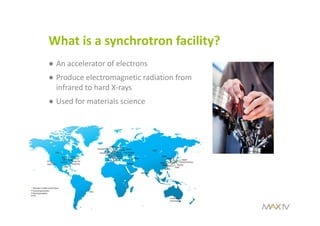
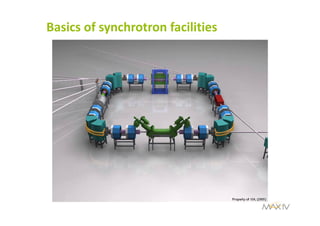
What is a synchrotron facility?
● An accelerator of electrons
● Produce electromagnetic radiation from 
infrared to hard X‐rays
● Used for materials science
Basics of synchrotron facilities
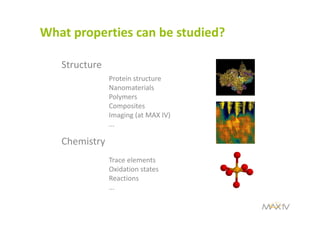
What properties can be studied?
Structure
Chemistry
Protein structure
Nanomaterials
Polymers
Composites
Imaging (at MAX IV)
...
Trace elements
Oxidation states
Reactions
...
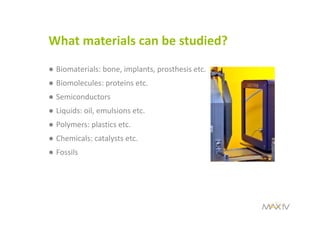
What materials can be studied?
● Biomaterials: bone, implants, prosthesis etc.
● Biomolecules: proteins etc.
● Semiconductors
● Liquids: oil, emulsions etc. 
● Polymers: plastics etc.
● Chemicals: catalysts etc. 
● Fossils
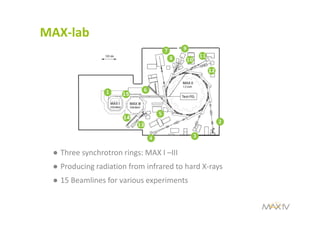
MAX‐lab
● Three synchrotron rings: MAX I –III
● Producing radiation from infrared to hard X‐rays
● 15 Beamlines for various experiments
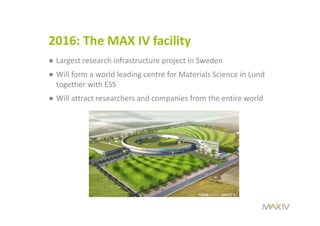
2016: The MAX IV facility
● Largest research infrastructure project in Sweden 
● Will form a world leading centre for Materials Science in Lund 
together with ESS 
● Will attract researchers and companies from the entire world
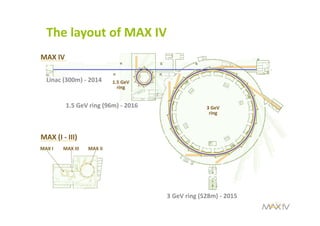
Linac (300m) ‐ 2014
1.5 GeV ring (96m) ‐ 2016
3 GeV ring (528m) ‐ 2015
The layout of MAX IV
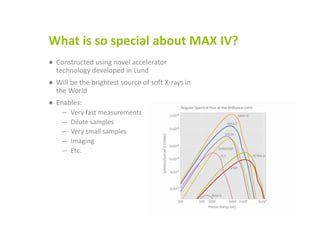
What is so special about MAX IV?
● Constructed using novel accelerator 
technology developed in Lund
● Will be the brightest source of soft X‐rays in 
the World
● Enables:
– Very fast measurements
– Dilute samples
– Very small samples
– Imaging
– Etc. 
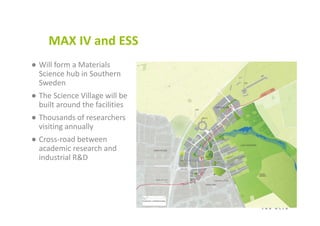
MAX IV and ESS 
● Will form a Materials 
Science hub in Southern 
Sweden
● The Science Village will be 
built around the facilities
● Thousands of researchers 
visiting annually
● Cross‐road between 
academic research and 
industrial R&D
The Science Village
● fgdgh
The MAX IV budget
● Total cost for buildings: €250M 
● Costs for accelerators €150M provided by four organisations:
– Swedish Research Council
– VINNOVA ‐ Sweden’s Innovation Agency
– Lund University
– Region Skåne
● The first seven beamlines (€60M):
– Knut & Alice Wallenberg Foundation
– Swedish Universities
● 8th beamline “FinEst” funded by Estonia and Finland (€3M)
● Additional beamlines under negotiation within Sweden and 
internationally
What properties can be studied?
● Largest research infrastructure in Sweden 
● Will attract researchers world‐wide to Lund
● Constructing the MAX IV
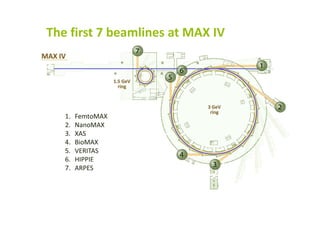
The first 7 beamlines at MAX IV
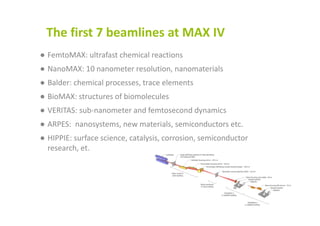
● FemtoMAX: ultrafast chemical reactions
● NanoMAX: 10 nanometer resolution, nanomaterials
● Balder: chemical processes, trace elements
● BioMAX: structures of biomolecules
● VERITAS: sub‐nanometer and femtosecond dynamics
● ARPES:  nanosystems, new materials, semiconductors etc.
● HIPPIE: surface science, catalysis, corrosion, semiconductor 
research, et.
The first 7 beamlines at MAX IV
| 17
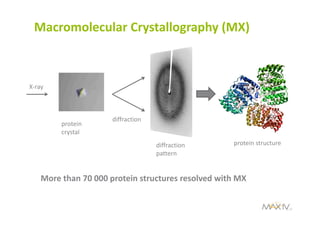
Macromolecular Crystallography (MX)
X‐ray
diffraction
diffraction
pattern
protein 
crystal
protein structure
More than 70 000 protein structures resolved with MX
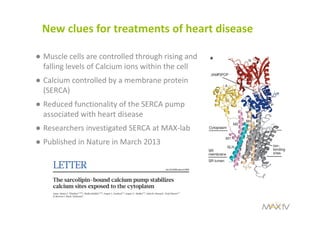
New clues for treatments of heart disease
● Muscle cells are controlled through rising and 
falling levels of Calcium ions within the cell
● Calcium controlled by a membrane protein 
(SERCA)
● Reduced functionality of the SERCA pump 
associated with heart disease
● Researchers investigated SERCA at MAX‐lab 
● Published in Nature in March 2013
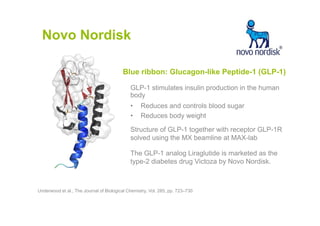
Novo Nordisk
Underwood et al., The Journal of Biological Chemistry, Vol. 285, pp. 723–730
Blue ribbon: Glucagon-like Peptide-1 (GLP-1)
GLP-1 stimulates insulin production in the human
body
• Reduces and controls blood sugar
• Reduces body weight
Structure of GLP-1 together with receptor GLP-1R
solved using the MX beamline at MAX-lab
The GLP-1 analog Liraglutide is marketed as the
type-2 diabetes drug Victoza by Novo Nordisk.
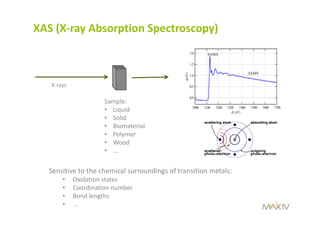
XAS (X‐ray Absorption Spectroscopy)
X‐rays
Sample: 
• Liquid
• Solid
• Biomaterial
• Polymer
• Wood
• ...
Sensitive to the chemical surroundings of transition metals:
• Oxidation states
• Coordination number
• Bond lengths
• ...
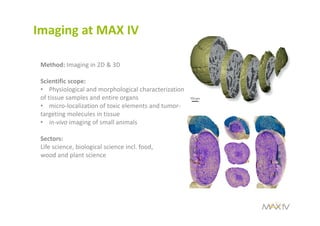
Imaging at MAX IV
Method: Imaging in 2D & 3D
Scientific scope:
• Physiological and morphological characterization 
of tissue samples and entire organs
• micro‐localization of toxic elements and tumor‐
targeting molecules in tissue
• in‐vivo imaging of small animals 
Sectors:
Life science, biological science incl. food, 
wood and plant science 
Commercial users
| 23
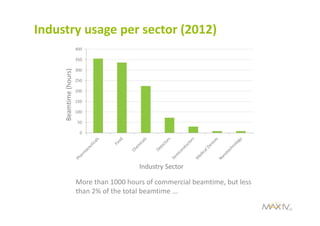
Industry usage per sector (2012)
More than 1000 hours of commercial beamtime, but less 
than 2% of the total beamtime ...
13/05/201324
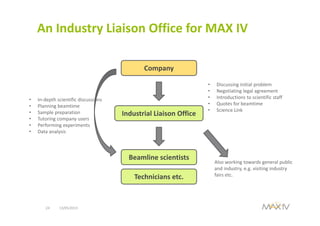
An Industry Liaison Office for MAX IV
Industrial Liaison Office
Company
Beamline scientists
• Discussing initial problem
• Negotiating legal agreement
• Introductions to scientific staff
• Quotes for beamtime
• Science Link
Technicians etc.
Also working towards general public 
and industry, e.g. visiting industry 
fairs etc. 
• In‐depth scientific discussions
• Planning beamtime
• Sample preparation
• Tutoring company users
• Performing experiments
• Data analysis
13/05/201325
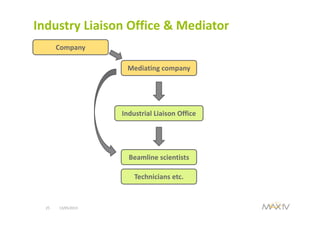
Industrial Liaison Office
Company
Beamline scientists
Technicians etc.
Mediating company
Industry Liaison Office & Mediator
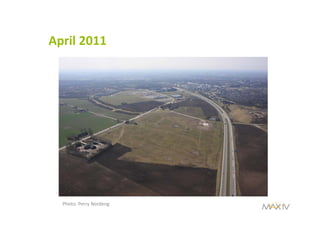
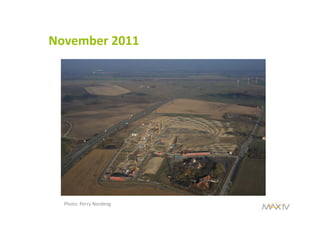
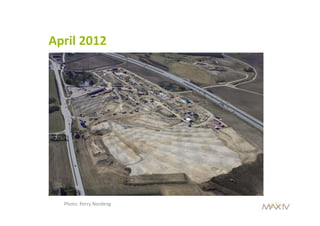
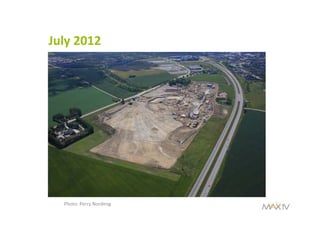
The construction work
● Started in Spring of 2011
● Will be finished in 2016
April 2011
Photo: Perry Nordeng
November 2011
Photo: Perry Nordeng
April 2012
Photo: Perry Nordeng
July 2012
Photo: Perry Nordeng
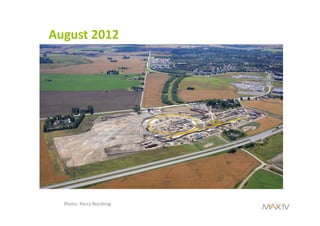
August 2012
Photo: Perry Nordeng
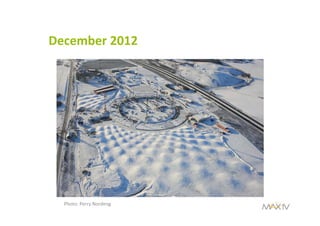
December 2012
Photo: Perry Nordeng
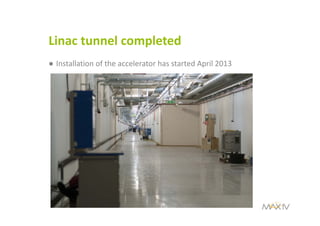
Linac tunnel completed
● Installation of the accelerator has started April 2013
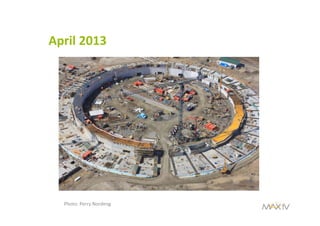
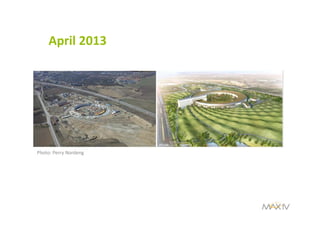
April 2013
Photo: Perry Nordeng
April 2013
Photo: Perry Nordeng
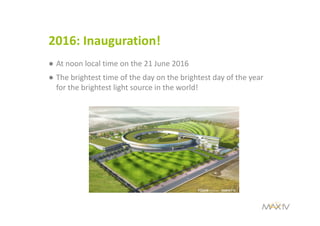
2016: Inauguration!
● At noon local time on the 21 June 2016
● The brightest time of the day on the brightest day of the year 
for the brightest light source in the world!
Thank you!
Contact:
Andreas Lassesson
Andreas.Lassesson@maxlab.lu.se
www.maxlab.lu.se

Wednesday 5 andreas lasesson max iv laboratory