Quantifying Collective Mood
by Emoticon Networks
Kazutoshi Sasahara
Graduate School of Information Science,
Nagoya University
WebSci 14
PK1
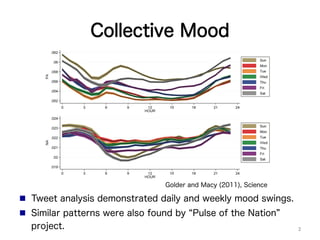
Collective Mood
n  Tweet analysis demonstrated daily and weekly mood swings.
n  Similar patterns were also found by Pulse of the Nation
project.
Golder and Macy (2011), Science
2
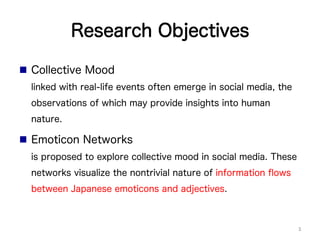
Research Objectives
n  Collective Mood
linked with real-life events often emerge in social media, the
observations of which may provide insights into human
nature.
n  Emoticon Networks
is proposed to explore collective mood in social media. These
networks visualize the nontrivial nature of information flows
between Japanese emoticons and adjectives.
3
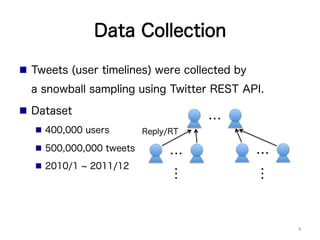
Data Collection
n  Tweets (user timelines) were collected by
a snowball sampling using Twitter REST API.
n  Dataset
n  400,000 users
n  500,000,000 tweets
n  2010/1 2011/12
・・・	
・・・	
 ・・・	
・・・	
・・・	
Reply/RT
4
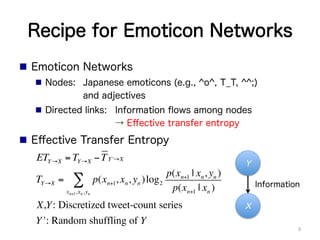
Recipe for Emoticon Networks
n  Emoticon Networks
n  Nodes: Japanese emoticons (e.g., ^o^, T_T, ^^;)
and adjectives
n  Directed links: Information flows among nodes
→ Effective transfer entropy
n  Effective Transfer Entropy
ETY→X = TY→X −TY '→X
TY→X = p
xn+1,xn,yn
∑ (xn+1, xn, yn )log2
p(xn+1 | xn, yn )
p(xn+1 | xn )
X,Y: Discretized tweet-count series
Y ': Random shuffling of Y
Y
X
Information
5
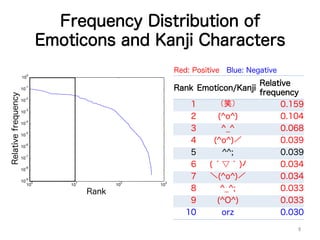
Frequency Distribution of
Emoticons and Kanji Characters
10
0
10
1
10
2
10
310
-9
10
-8
10
-7
10
-6
10
-5
10
-4
10
-3
10
-2
10
-1
10
0
Red: Positive Blue: Negative
Rank
Rank Emoticon/Kanji
Relative
frequency
1 (笑)	
 0.159
2 (^o^) 0.104
3 ^_^ 0.068
4 (^o^)/	
 0.039
5 ^^; 0.039
6 ( ́ ▽ ` )ノ	
 0.034
7 \(^o^)/	
 0.034
8 ^_^; 0.033
9 (^O^) 0.033
10 orz 0.030
Relativefrequency
6
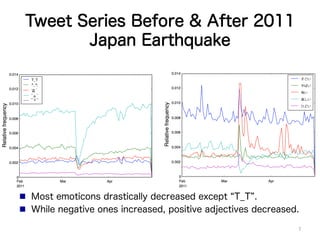
Tweet Series Before & After 2011
Japan Earthquake
n  Most emoticons drastically decreased except T_T .
n  While negative ones increased, positive adjectives decreased.
7
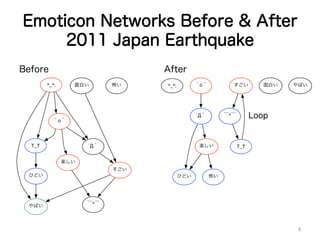
Emoticon Networks Before & After
2011 Japan Earthquake
^_^;
T_T
やばい
^o^
´Д`
面白い
すごい
楽しい
 ̄^ ̄
ひどい
怖い ^_^; ^o^
´Д`
楽しい
ひどい 怖い
すごい
 ̄^ ̄
T_T
面白い やばい
Before After
Loop
8
Summary
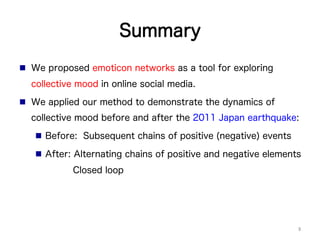
n  We proposed emoticon networks as a tool for exploring
collective mood in online social media.
n  We applied our method to demonstrate the dynamics of
collective mood before and after the 2011 Japan earthquake:
n  Before: Subsequent chains of positive (negative) events
n  After: Alternating chains of positive and negative elements
Closed loop
9
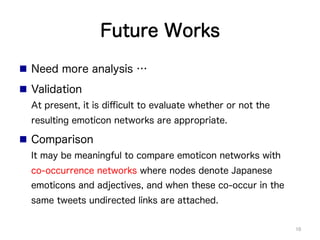
Future Works
n  Need more analysis …
n  Validation
At present, it is difficult to evaluate whether or not the
resulting emoticon networks are appropriate.
n  Comparison
It may be meaningful to compare emoticon networks with
co-occurrence networks where nodes denote Japanese
emoticons and adjectives, and when these co-occur in the
same tweets undirected links are attached.
10

Quantifying Collective Mood by Emoticon Networks

  • 1.
    Quantifying Collective Mood byEmoticon Networks Kazutoshi Sasahara Graduate School of Information Science, Nagoya University WebSci 14 PK1
  • 2.
    Collective Mood n  Tweetanalysis demonstrated daily and weekly mood swings. n  Similar patterns were also found by Pulse of the Nation project. Golder and Macy (2011), Science 2
  • 3.
    Research Objectives n  CollectiveMood linked with real-life events often emerge in social media, the observations of which may provide insights into human nature. n  Emoticon Networks is proposed to explore collective mood in social media. These networks visualize the nontrivial nature of information flows between Japanese emoticons and adjectives. 3
  • 4.
    Data Collection n  Tweets(user timelines) were collected by a snowball sampling using Twitter REST API. n  Dataset n  400,000 users n  500,000,000 tweets n  2010/1 2011/12 ・・・ ・・・ ・・・ ・・・ ・・・ Reply/RT 4
  • 5.
    Recipe for EmoticonNetworks n  Emoticon Networks n  Nodes: Japanese emoticons (e.g., ^o^, T_T, ^^;) and adjectives n  Directed links: Information flows among nodes → Effective transfer entropy n  Effective Transfer Entropy ETY→X = TY→X −TY '→X TY→X = p xn+1,xn,yn ∑ (xn+1, xn, yn )log2 p(xn+1 | xn, yn ) p(xn+1 | xn ) X,Y: Discretized tweet-count series Y ': Random shuffling of Y Y X Information 5
  • 6.
    Frequency Distribution of Emoticonsand Kanji Characters 10 0 10 1 10 2 10 310 -9 10 -8 10 -7 10 -6 10 -5 10 -4 10 -3 10 -2 10 -1 10 0 Red: Positive Blue: Negative Rank Rank Emoticon/Kanji Relative frequency 1 (笑) 0.159 2 (^o^) 0.104 3 ^_^ 0.068 4 (^o^)/ 0.039 5 ^^; 0.039 6 ( ́ ▽ ` )ノ 0.034 7 \(^o^)/ 0.034 8 ^_^; 0.033 9 (^O^) 0.033 10 orz 0.030 Relativefrequency 6
  • 7.
    Tweet Series Before& After 2011 Japan Earthquake n  Most emoticons drastically decreased except T_T . n  While negative ones increased, positive adjectives decreased. 7
  • 8.
    Emoticon Networks Before& After 2011 Japan Earthquake ^_^; T_T やばい ^o^ ´Д` 面白い すごい 楽しい  ̄^ ̄ ひどい 怖い ^_^; ^o^ ´Д` 楽しい ひどい 怖い すごい  ̄^ ̄ T_T 面白い やばい Before After Loop 8
  • 9.
    Summary n  We proposedemoticon networks as a tool for exploring collective mood in online social media. n  We applied our method to demonstrate the dynamics of collective mood before and after the 2011 Japan earthquake: n  Before: Subsequent chains of positive (negative) events n  After: Alternating chains of positive and negative elements Closed loop 9
  • 10.
    Future Works n  Needmore analysis … n  Validation At present, it is difficult to evaluate whether or not the resulting emoticon networks are appropriate. n  Comparison It may be meaningful to compare emoticon networks with co-occurrence networks where nodes denote Japanese emoticons and adjectives, and when these co-occur in the same tweets undirected links are attached. 10