Breaking the Code
A WebQuest designed by Suzanne Reed And Dana Kwiatkowski
Breaking the Code The Topic  The Task The Process The Resources The Evaluation
The Topic Scientists Watson and Crick determined the 3-D structure of DNA in the 1953.  A few years later, Marshall Niremberg broke the code contained in the 4 letter alphabet of DNA.  We now know that DNA is made of 4 types of nitrogen bases called: Adenine Guanine Cytosine Thymine Each base is represented by its first letter, as a letter of the DNA alphabet.
For example: Adenine is represented by  A Guanine is represented by  G Thymine is represented by  T Cytosine is represented by  C
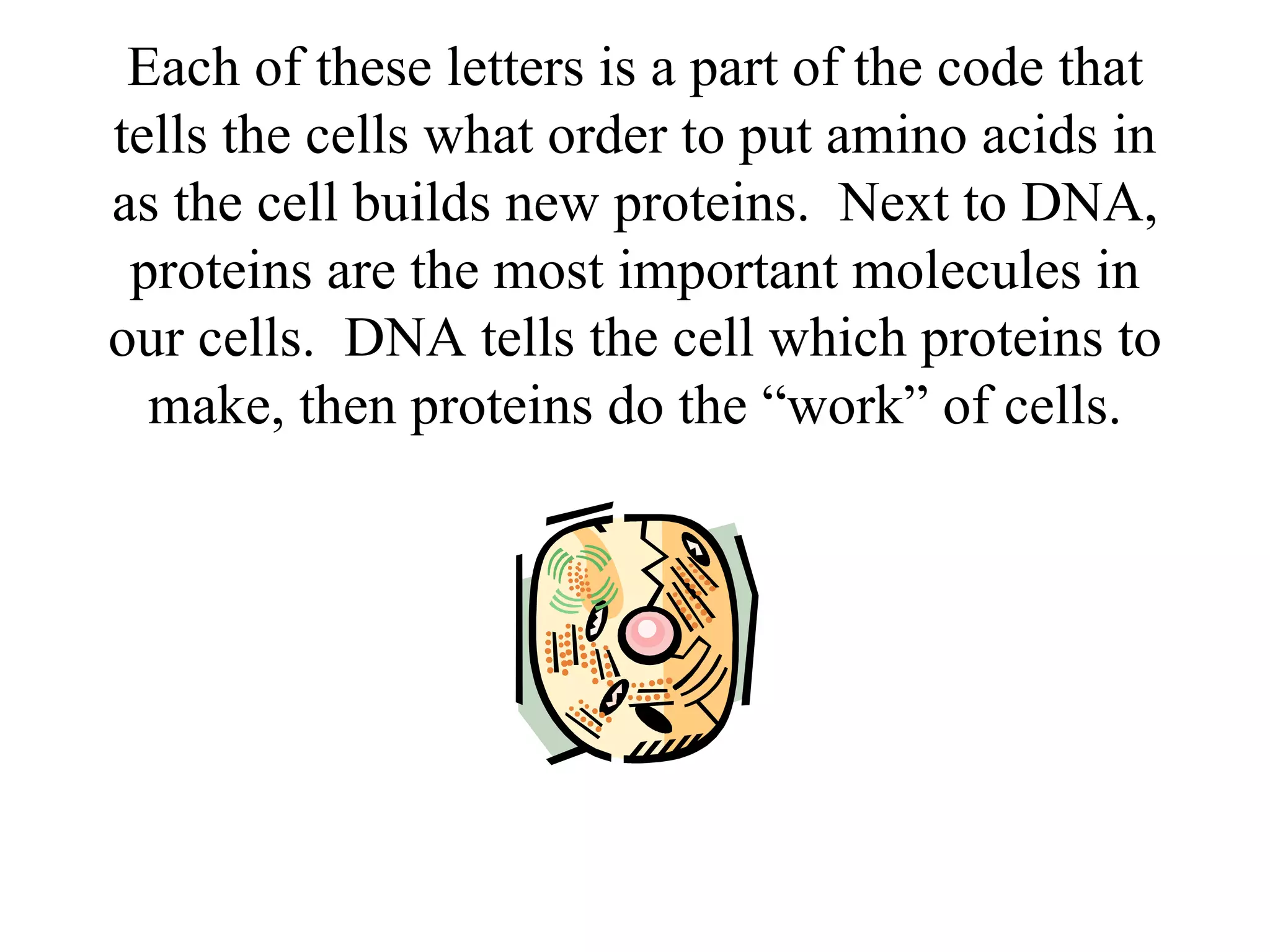
Each of these letters is a part of the code that tells the cells what order to put amino acids in as the cell builds new proteins.  Next to DNA, proteins are the most important molecules in our cells.  DNA tells the cell which proteins to make, then proteins do the “work” of cells.
The  Task Your group will work together to build a three dimensional model of DNA using any materials of your choice.  The model will have to have the correct number of bases and the bases must be in the correct sequence.  You will determine the sequence as you  Break the Code!
The Process This project can be done as an individual or in a group.  The  only product an individual has to turn in is the model itself. If  done as a group project, then the task will be divided into 4  jobs.  Pick the job below that you are interested in  completing. Research Scientist   (Group of 1, 2, 3, or 4 people) Artistic Consultant   (Group of 2, 3, or 4 people) Building Supervisor   (Group of 3 or 4 people) Purchasing Agent   (Group of 4 people) Your group will all be responsible for the final model, but your job gives you specific tasks that you will be held  accountable for.
Research Scientist Your job as the research scientist is to examine the sequence of amino acids on the next page and determine the sequence of bases it represents.  You will need to use your text and the following websites: http://www.johnkyrk.com/DNAanatomy.html http://www.biology.clc.uc.edu/courses/bio104/dna.htm In addition to research, you will  submit a one page typed report  that describes DNA.  Your report should explain  how  the bases code for the amino acids.  Back to The Process
2008 Sequence of Amino Acids Start codon Leucine Glutamine Lysine Alanine  Arginine Stop codon Back to The Process
Purchasing Agent You will need to develop a list of possible materials and the costs of these materials for your group.  Once the group has decided on materials, you will collect money for the materials and purchase the materials. You will  submit a one page report  of the materials you choose, how much the materials costs, and if you would recommend these materials in the future and why or why not. Your report should explain what materials were used to form each of the parts of DNA. Back to The Process
Artistic Consultant You will work closely with the purchasing director to decide on possible materials for the model.  You will also draw and  submit  a color schematic of what your model will look like. The drawing should be labeled and completed  before  you build your model.  It is your “blueprint” for construction. You will turn in your drawing and a description of each part .  Back to The Process
Building Supervisor Your primary job is to plan the construction phase of the model building. You will determine when and where assembly will take place and distribute labor equally among other group members. You will  turn in a typed chart  of when you worked on the model, how long you worked, where it was done, and which members were present. Each of the members needs to sign the chart to verify their efforts. You should also write a description of what materials were used for each of the parts of the model. Back to The Process
The Resources There are several biology texts available in the classroom in addition to your text that will be helpful Sample models of former students will be available for your inspection Check the following websites on DNA: http://www.ncc.gmu.edu/dna/ http://www.pbs.org/wgbh/aso/tryit/dna/ http://www.johnkyrk.com/DNAanatomy.html http://www.biology.clc.uc.edu/courses/bio104/dna.htm http://web.indstate.edu/thcme/mwking/protein-synthesis. html#genetic%20code
The Evaluation The Report from each job: Each position will file a  typed , one page report of their activities and include any drawings requested in the instructions. The report should have the  job title  and the  name  of the individual assigned to that job. 20 points per report  — to impact your grade only—not the group grade
The Model Double Helix  (must make a minimum360 degree turn) 15 points Accurately bonds phosphates, sugars and bases 10 points Correctly pairs bases 10 points Bases are properly sequenced according to code 35 points Key is provided and legible 10 points 80 points Report/Drawing/Chart 20 points
Due Dates November 28—First Period November 29—Fifth Period November 30—Sixth and Seventh Period The projects are due at the beginning of class.  If turned in later than the beginning of class, the grade will be reduced by one letter grade. Each day thereafter will be a letter grade reduction.
Conclusion The discovery of the shape of DNA and the code it  contains was one of the most important breakthroughs of the last century.  Be prepared to share with the class how your understanding of DNA has grown as a result of  Breaking the Code!

Webquest2007

  • 1.
  • 2.
    A WebQuest designedby Suzanne Reed And Dana Kwiatkowski
  • 3.
    Breaking the CodeThe Topic The Task The Process The Resources The Evaluation
  • 4.
    The Topic ScientistsWatson and Crick determined the 3-D structure of DNA in the 1953. A few years later, Marshall Niremberg broke the code contained in the 4 letter alphabet of DNA. We now know that DNA is made of 4 types of nitrogen bases called: Adenine Guanine Cytosine Thymine Each base is represented by its first letter, as a letter of the DNA alphabet.
  • 5.
    For example: Adenineis represented by A Guanine is represented by G Thymine is represented by T Cytosine is represented by C
  • 6.
    Each of theseletters is a part of the code that tells the cells what order to put amino acids in as the cell builds new proteins. Next to DNA, proteins are the most important molecules in our cells. DNA tells the cell which proteins to make, then proteins do the “work” of cells.
  • 7.
    The TaskYour group will work together to build a three dimensional model of DNA using any materials of your choice. The model will have to have the correct number of bases and the bases must be in the correct sequence. You will determine the sequence as you Break the Code!
  • 8.
    The Process Thisproject can be done as an individual or in a group. The only product an individual has to turn in is the model itself. If done as a group project, then the task will be divided into 4 jobs. Pick the job below that you are interested in completing. Research Scientist (Group of 1, 2, 3, or 4 people) Artistic Consultant (Group of 2, 3, or 4 people) Building Supervisor (Group of 3 or 4 people) Purchasing Agent (Group of 4 people) Your group will all be responsible for the final model, but your job gives you specific tasks that you will be held accountable for.
  • 9.
    Research Scientist Yourjob as the research scientist is to examine the sequence of amino acids on the next page and determine the sequence of bases it represents. You will need to use your text and the following websites: http://www.johnkyrk.com/DNAanatomy.html http://www.biology.clc.uc.edu/courses/bio104/dna.htm In addition to research, you will submit a one page typed report that describes DNA. Your report should explain how the bases code for the amino acids. Back to The Process
  • 10.
    2008 Sequence ofAmino Acids Start codon Leucine Glutamine Lysine Alanine Arginine Stop codon Back to The Process
  • 11.
    Purchasing Agent Youwill need to develop a list of possible materials and the costs of these materials for your group. Once the group has decided on materials, you will collect money for the materials and purchase the materials. You will submit a one page report of the materials you choose, how much the materials costs, and if you would recommend these materials in the future and why or why not. Your report should explain what materials were used to form each of the parts of DNA. Back to The Process
  • 12.
    Artistic Consultant Youwill work closely with the purchasing director to decide on possible materials for the model. You will also draw and submit a color schematic of what your model will look like. The drawing should be labeled and completed before you build your model. It is your “blueprint” for construction. You will turn in your drawing and a description of each part . Back to The Process
  • 13.
    Building Supervisor Yourprimary job is to plan the construction phase of the model building. You will determine when and where assembly will take place and distribute labor equally among other group members. You will turn in a typed chart of when you worked on the model, how long you worked, where it was done, and which members were present. Each of the members needs to sign the chart to verify their efforts. You should also write a description of what materials were used for each of the parts of the model. Back to The Process
  • 14.
    The Resources Thereare several biology texts available in the classroom in addition to your text that will be helpful Sample models of former students will be available for your inspection Check the following websites on DNA: http://www.ncc.gmu.edu/dna/ http://www.pbs.org/wgbh/aso/tryit/dna/ http://www.johnkyrk.com/DNAanatomy.html http://www.biology.clc.uc.edu/courses/bio104/dna.htm http://web.indstate.edu/thcme/mwking/protein-synthesis. html#genetic%20code
  • 15.
    The Evaluation TheReport from each job: Each position will file a typed , one page report of their activities and include any drawings requested in the instructions. The report should have the job title and the name of the individual assigned to that job. 20 points per report — to impact your grade only—not the group grade
  • 16.
    The Model DoubleHelix (must make a minimum360 degree turn) 15 points Accurately bonds phosphates, sugars and bases 10 points Correctly pairs bases 10 points Bases are properly sequenced according to code 35 points Key is provided and legible 10 points 80 points Report/Drawing/Chart 20 points
  • 17.
    Due Dates November28—First Period November 29—Fifth Period November 30—Sixth and Seventh Period The projects are due at the beginning of class. If turned in later than the beginning of class, the grade will be reduced by one letter grade. Each day thereafter will be a letter grade reduction.
  • 18.
    Conclusion The discoveryof the shape of DNA and the code it contains was one of the most important breakthroughs of the last century. Be prepared to share with the class how your understanding of DNA has grown as a result of Breaking the Code!