The document discusses computational problems, categorizing them into various classes such as tractable, intractable, decision, and optimization problems, and introduces the concepts of P, NP, NP-complete, and NP-hard problems. It emphasizes the differences between deterministic and non-deterministic algorithms, detailing their complexities and behaviors, along with examples. The document also explores computational complexity in terms of polynomial and exponential time, providing insights into the relationships and properties of different problem classes.
CONCEPTS
Problem
Problemv/s Algorithm v/s Program
Types of Problems
Computational complexity
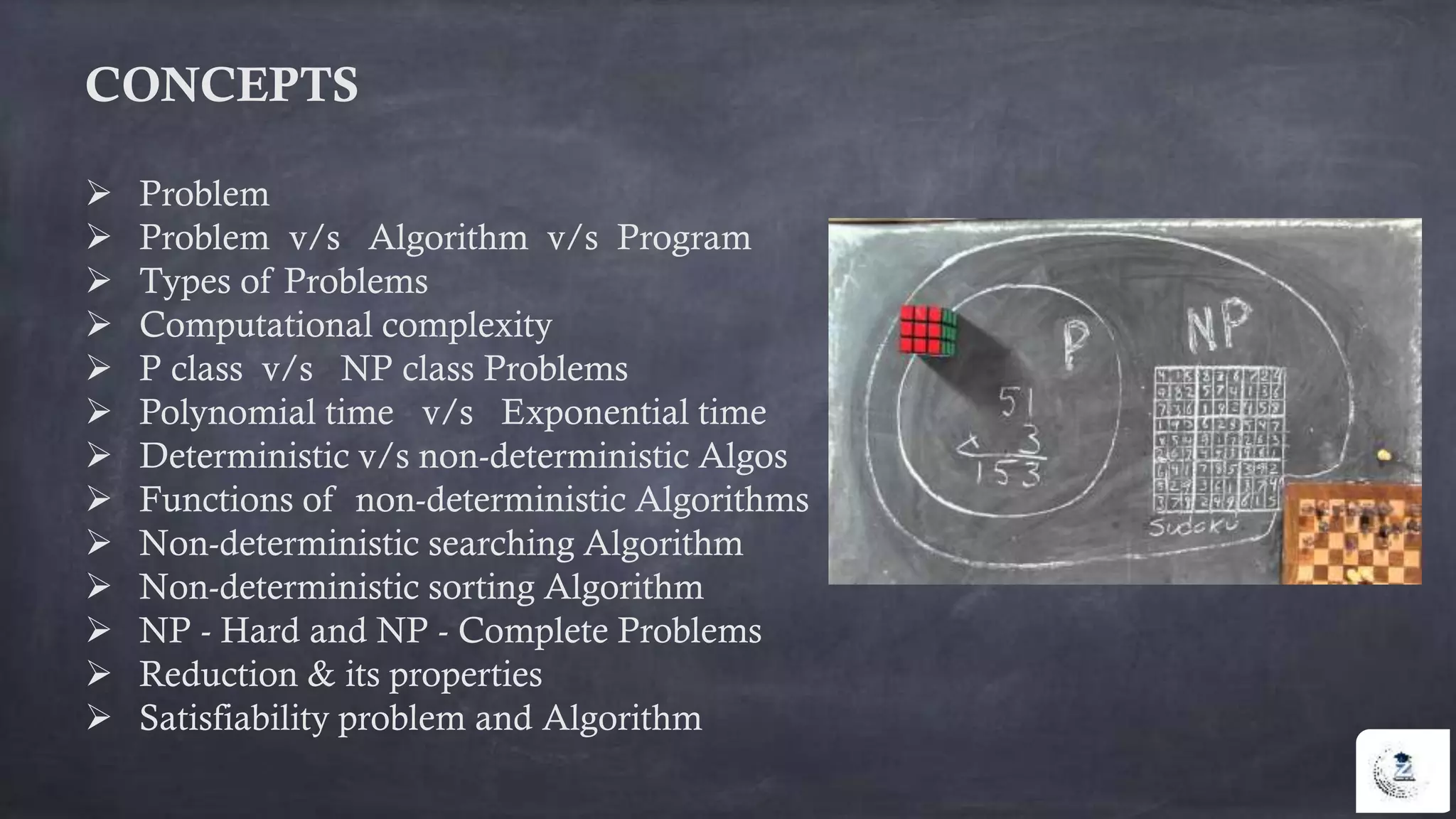
P class v/s NP class Problems
Polynomial time v/s Exponential time
Deterministic v/s non-deterministic Algos
Functions of non-deterministic Algorithms
Non-deterministic searching Algorithm
Non-deterministic sorting Algorithm
NP - Hard and NP - Complete Problems
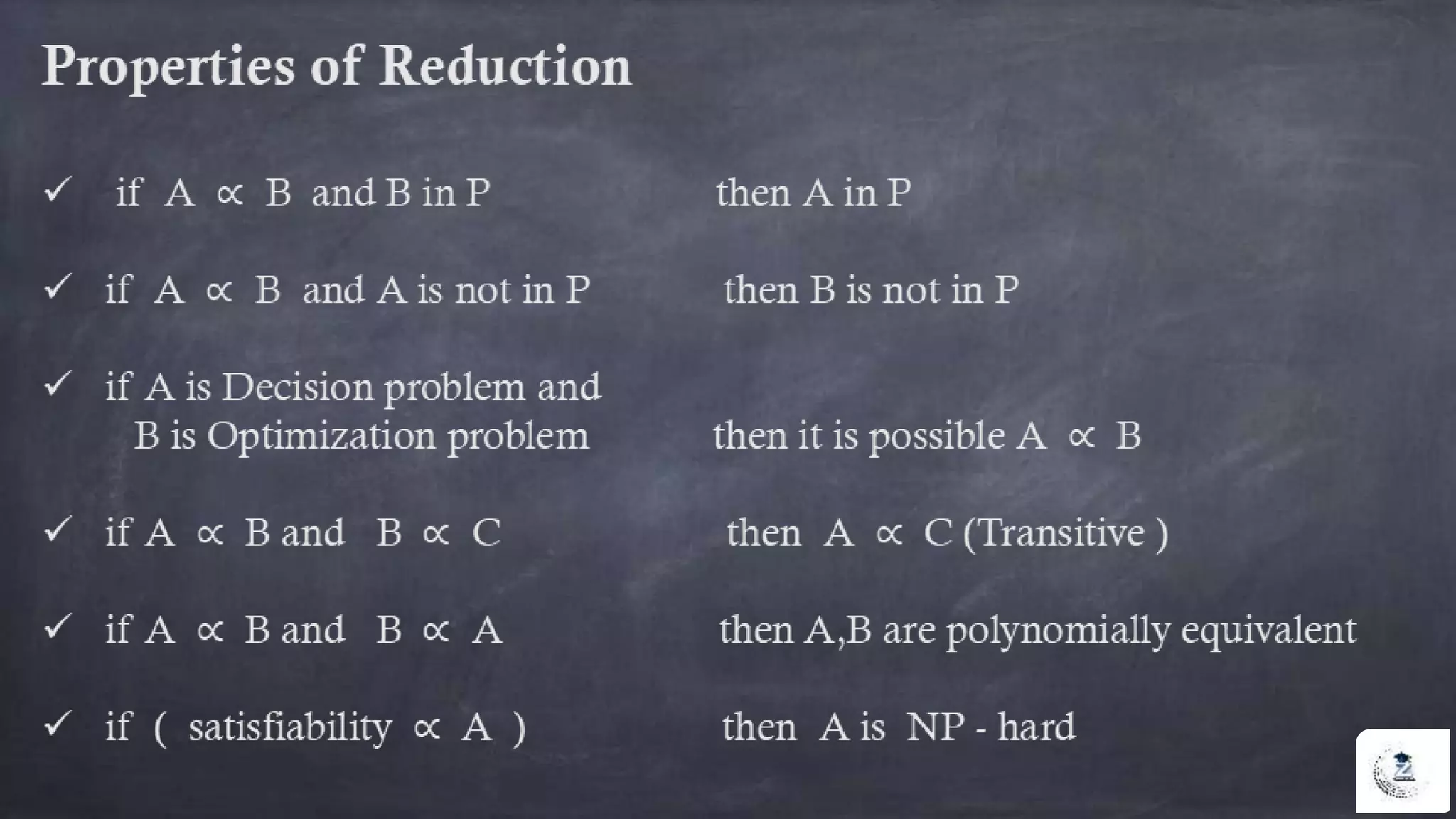
Reduction & its properties
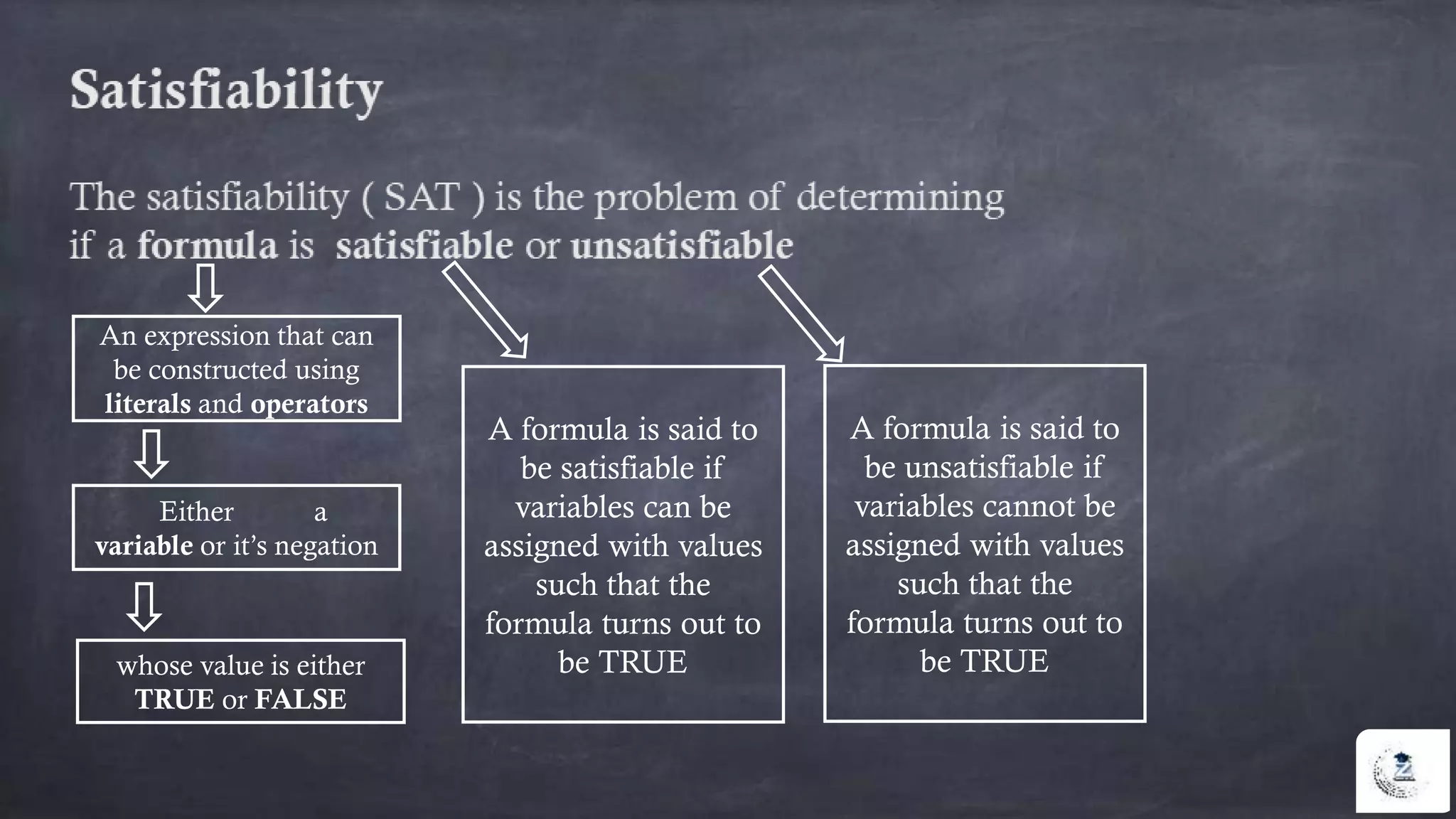
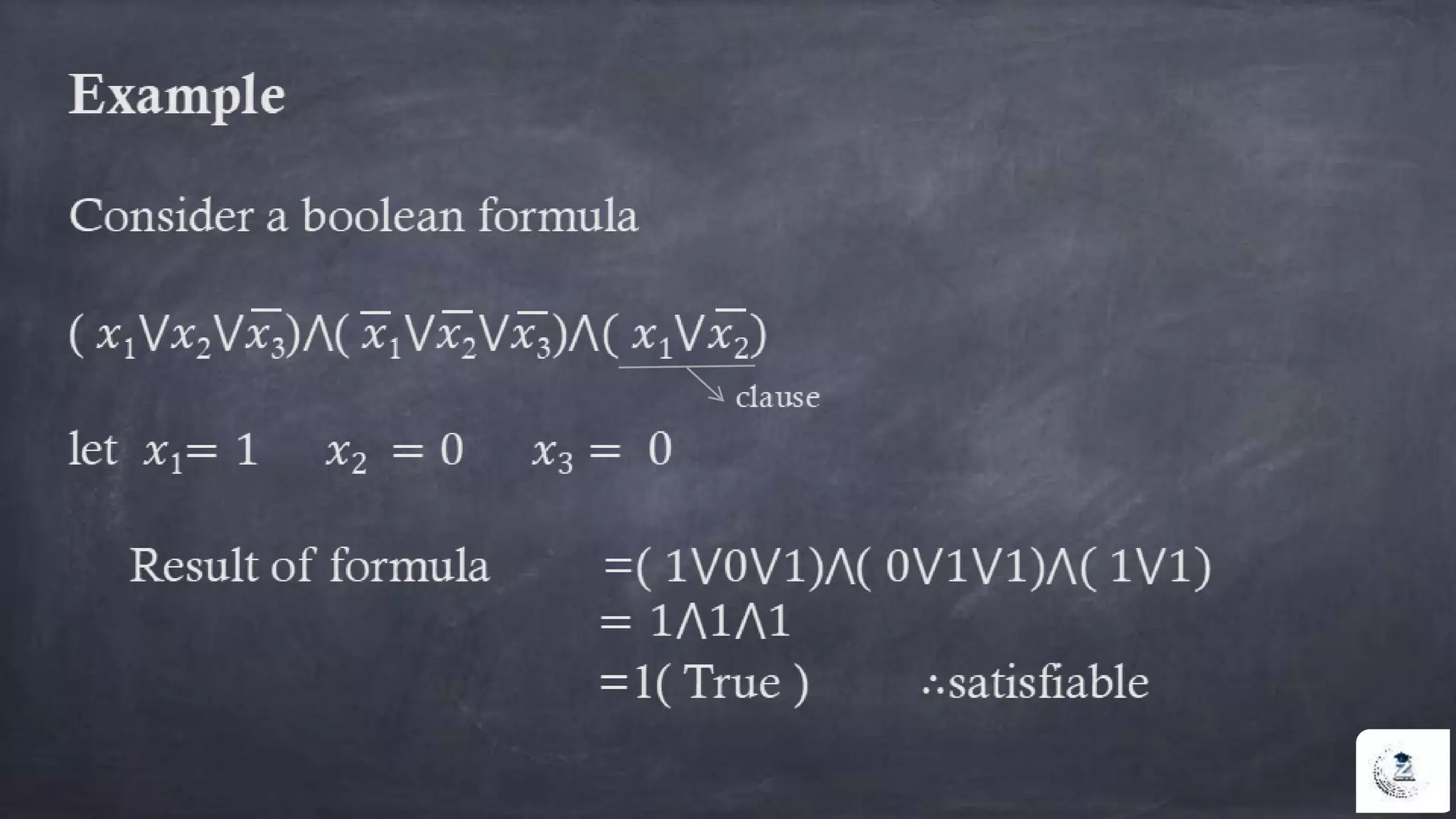
Satisfiability problem and Algorithm
3.
PROBLEM
“A computational problemspecifies an input-output relationship.”
i.e. What does the input look like ?
What should the output be for each input ?
Example :
Input : A list of names of people
Output : The same list sorted alphabetically
Example:
Input : A picture in digital format
Output : A description of what the picture shows
4.
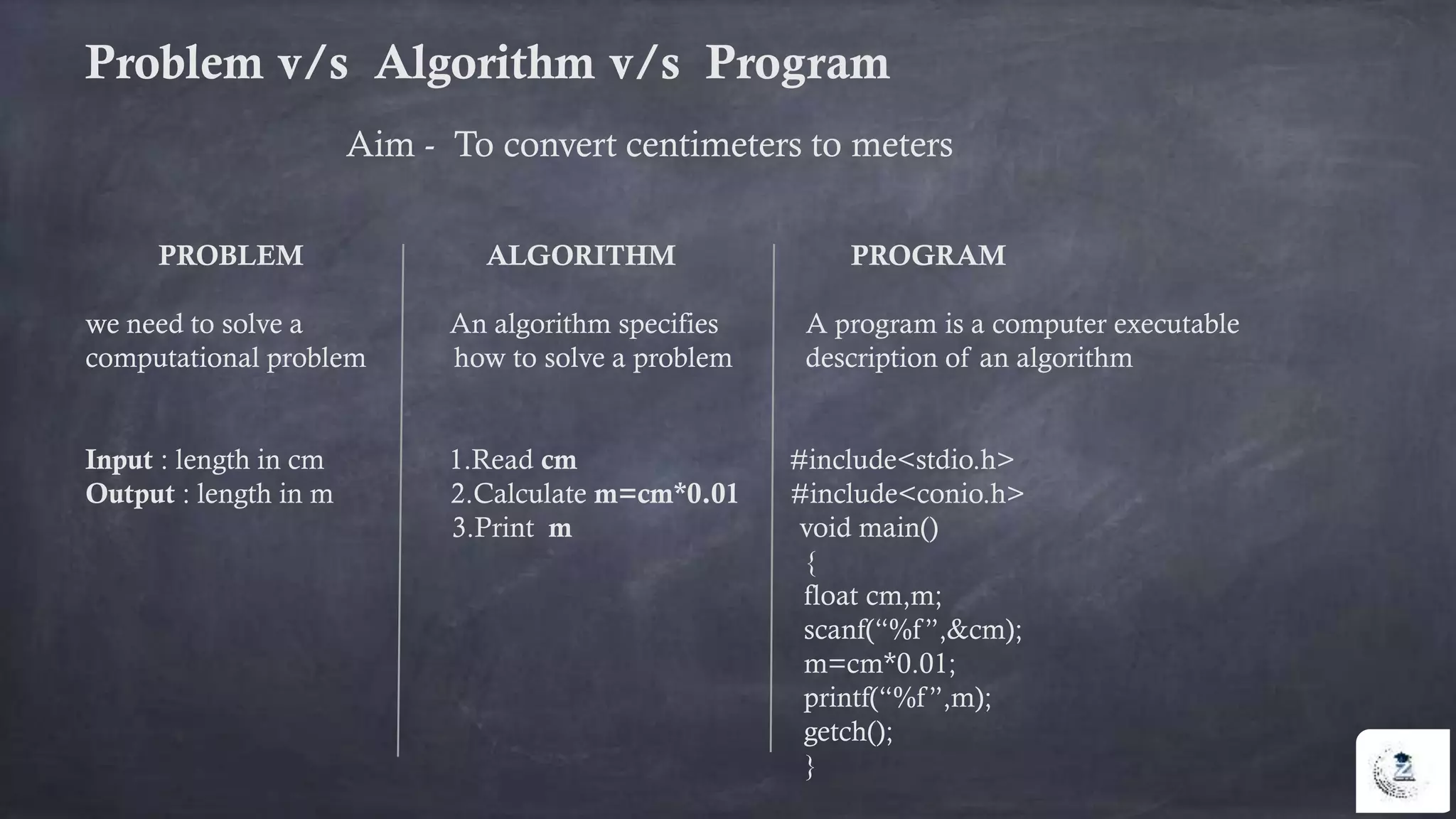
Problem v/s Algorithmv/s Program
Aim - To convert centimeters to meters
PROBLEM ALGORITHM PROGRAM
we need to solve a An algorithm specifies A program is a computer executable
computational problem how to solve a problem description of an algorithm
Input : length in cm 1.Read cm #include<stdio.h>
Output : length in m 2.Calculate m=cm*0.01 #include<conio.h>
3.Print m void main()
{
float cm,m;
scanf(“%f”,&cm);
m=cm*0.01;
printf(“%f”,m);
getch();
}
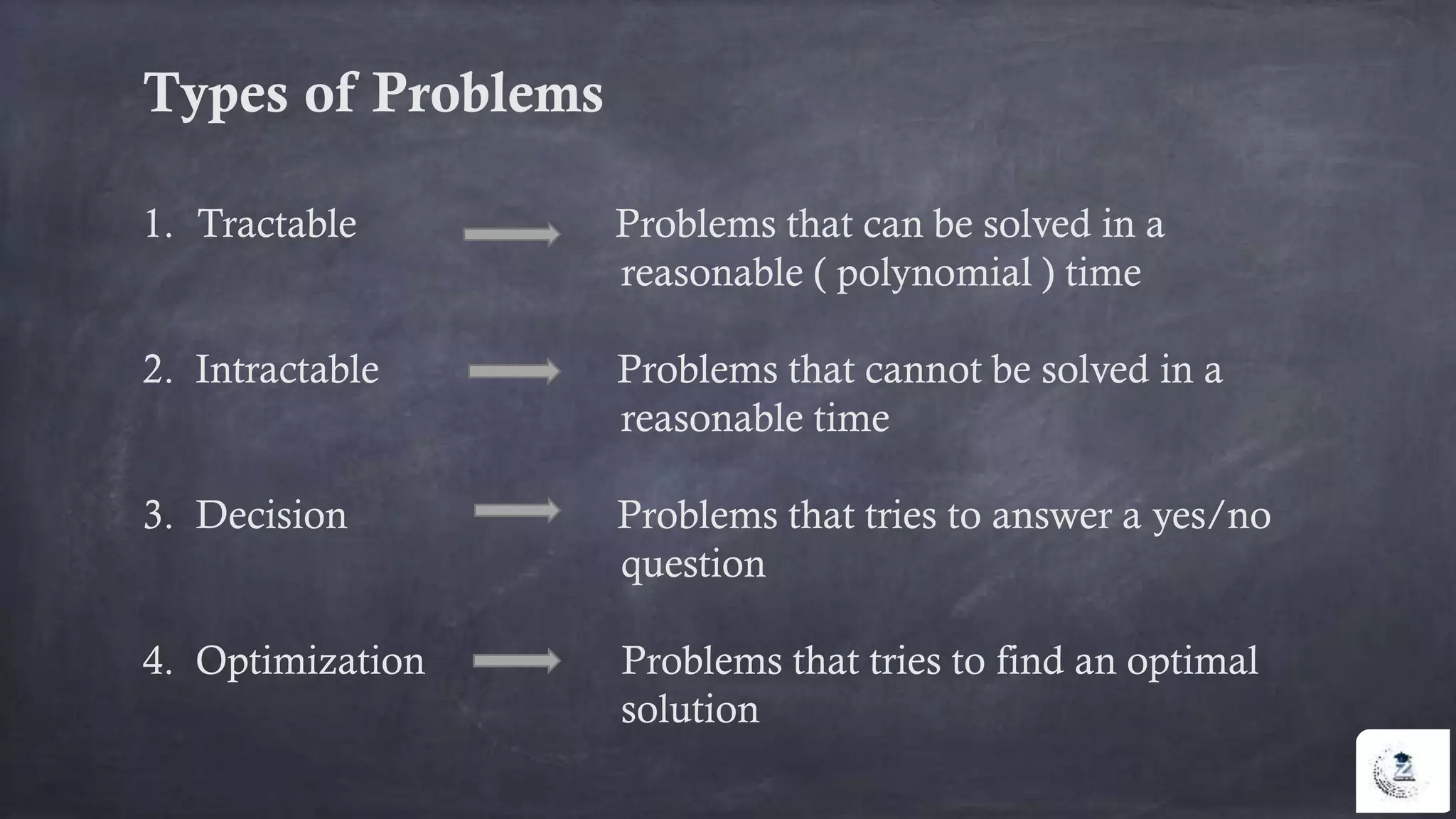
1. Tractable Problemsthat can be solved in a
reasonable ( polynomial ) time
2. Intractable Problems that cannot be solved in a
reasonable time
3. Decision Problems that tries to answer a yes/no
question
4. Optimization Problems that tries to find an optimal
solution
Types of Problems
7.
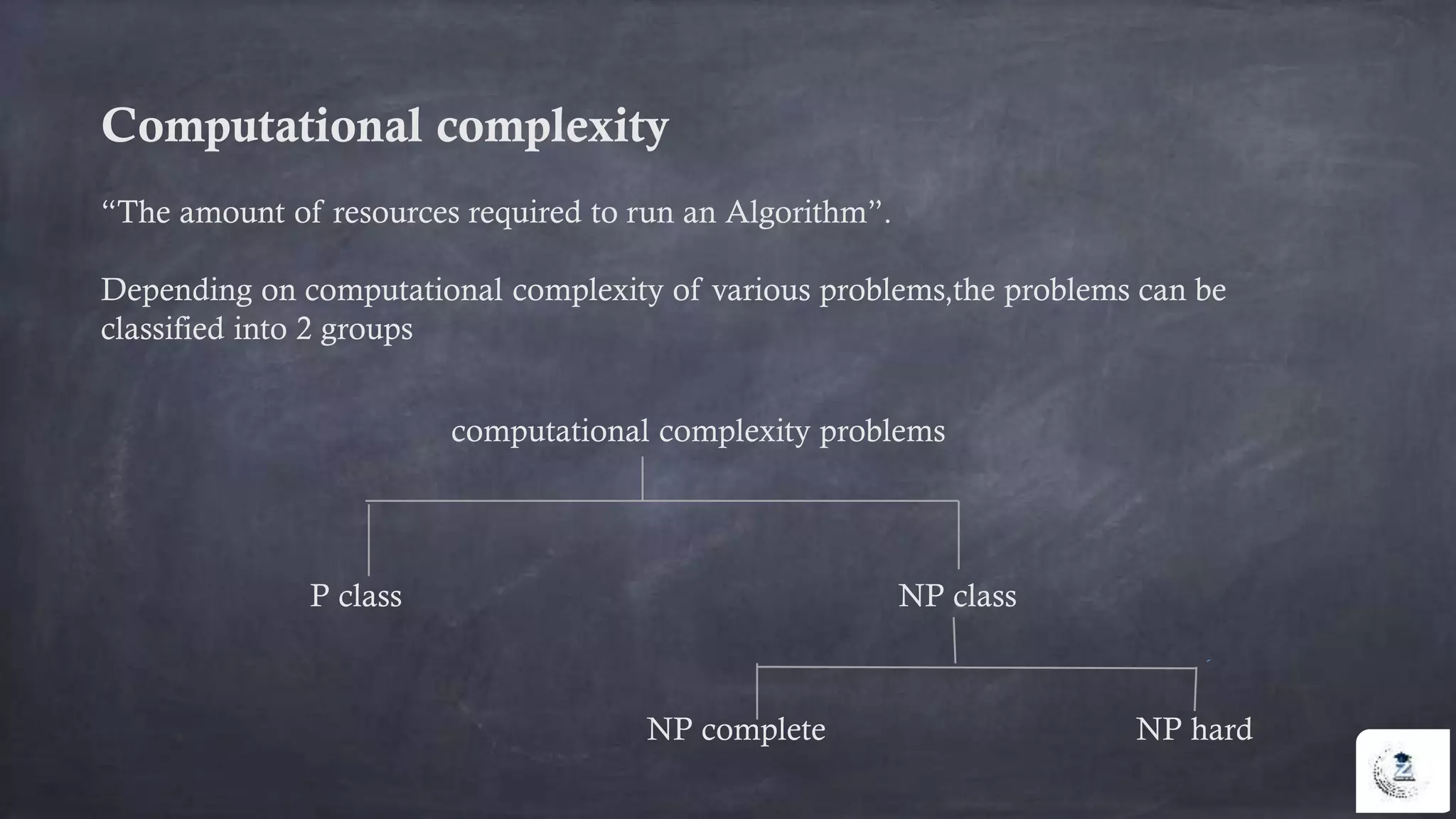
Computational complexity
“The amountof resources required to run an Algorithm”.
Depending on computational complexity of various problems,the problems can be
classified into 2 groups
computational complexity problems
P class NP class
NP complete NP hard
8.
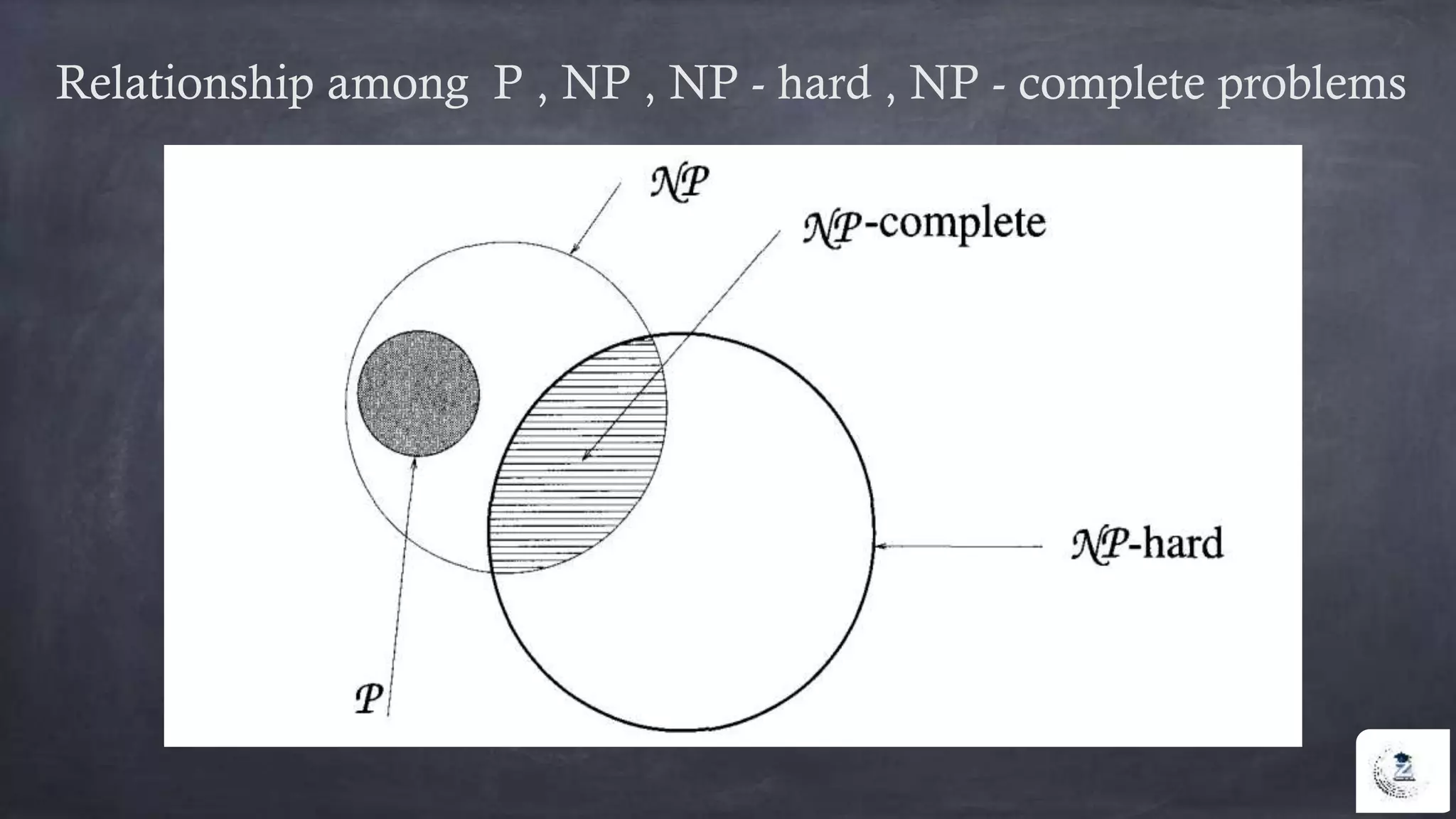
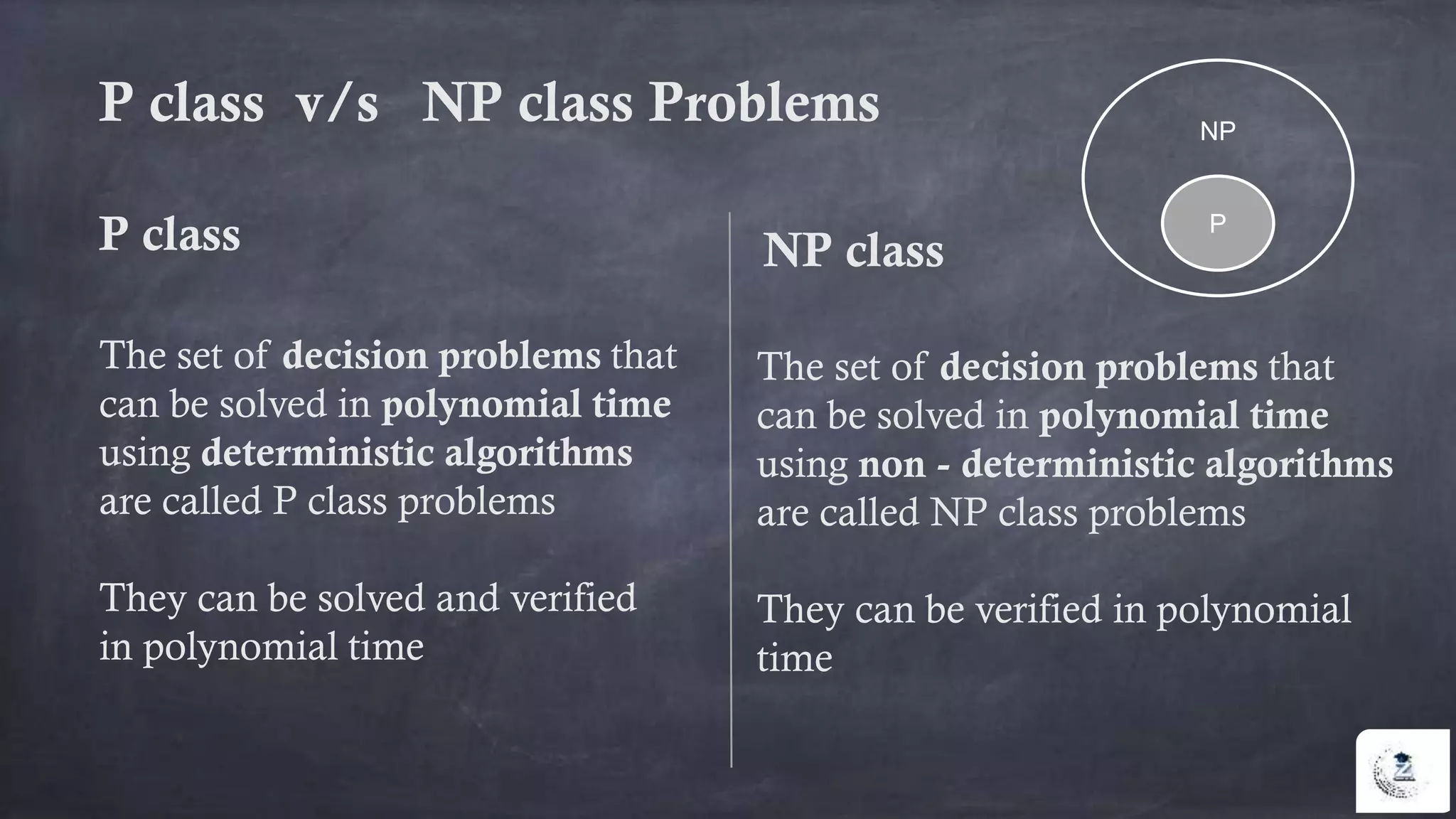
P class v/sNP class Problems
P class
The set of decision problems that
can be solved in polynomial time
using deterministic algorithms
are called P class problems
They can be solved and verified
in polynomial time
NP class
The set of decision problems that
can be solved in polynomial time
using non - deterministic algorithms
are called NP class problems
They can be verified in polynomial
time
NP
P
9.
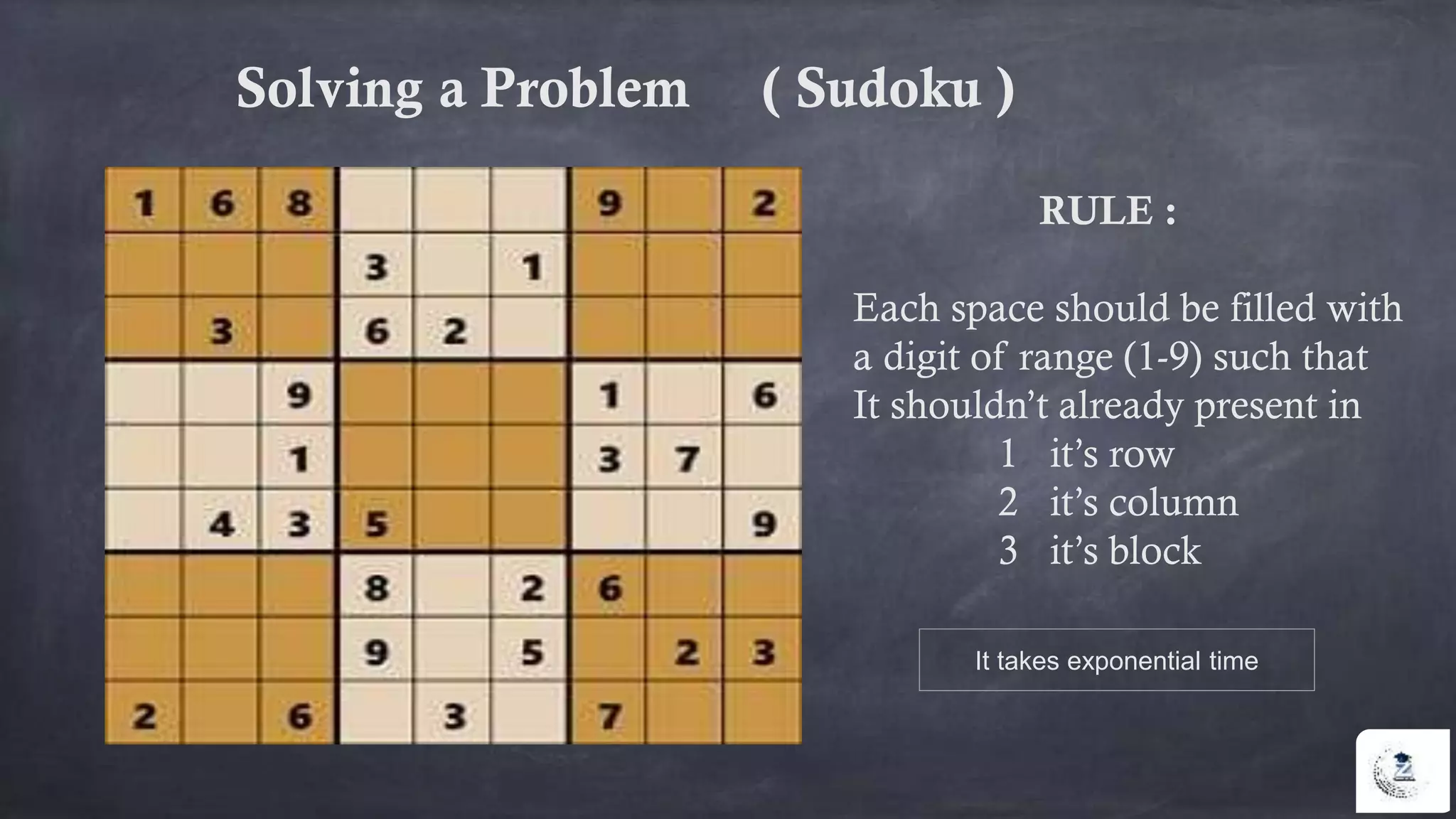
RULE :
Each spaceshould be filled with
a digit of range (1-9) such that
It shouldn’t already present in
1 it’s row
2 it’s column
3 it’s block
Solving a Problem ( Sudoku )
It takes exponential time
10.
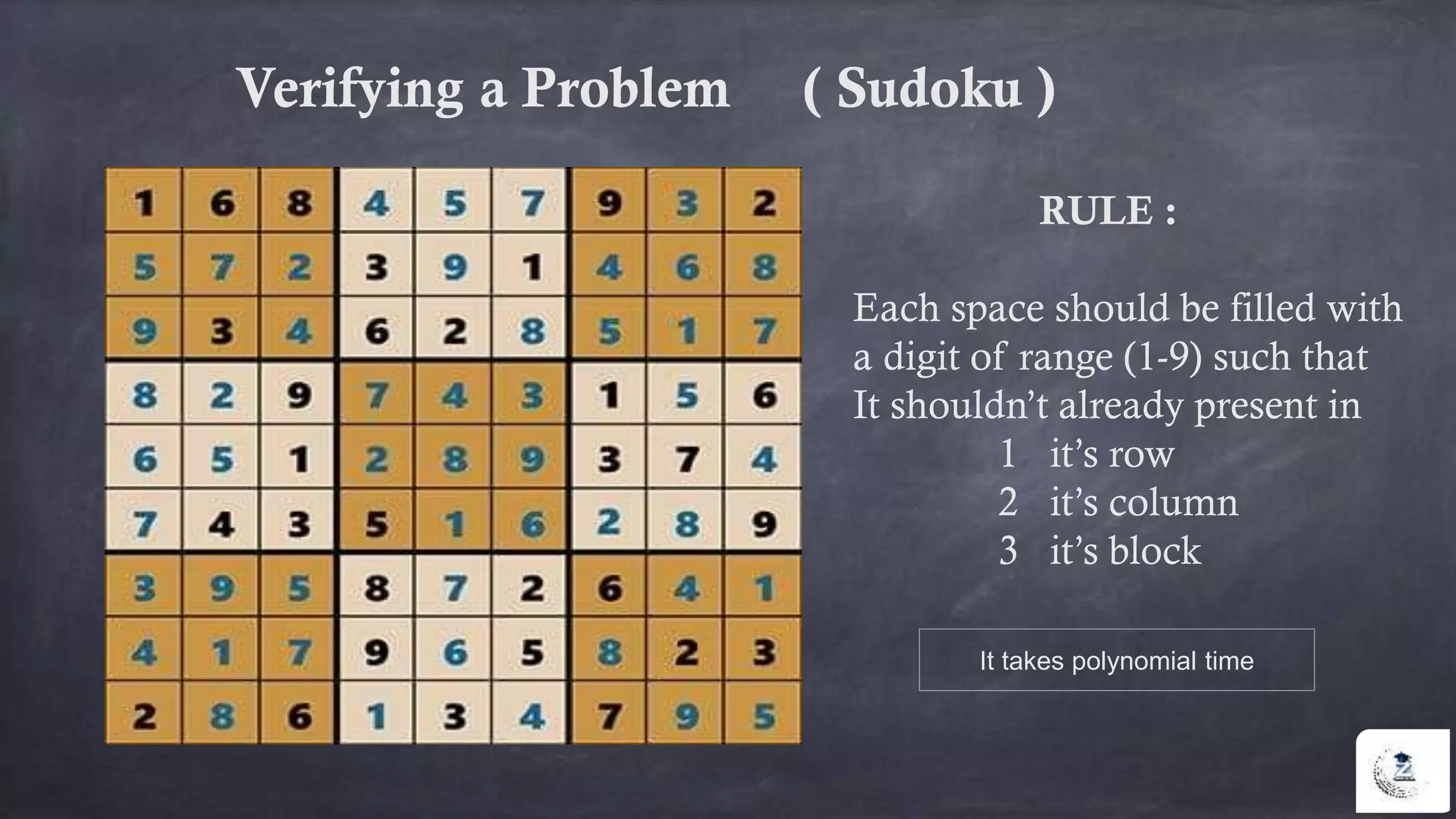
RULE :
Each spaceshould be filled with
a digit of range (1-9) such that
It shouldn’t already present in
1 it’s row
2 it’s column
3 it’s block
Verifying a Problem ( Sudoku )
It takes polynomial time
11.
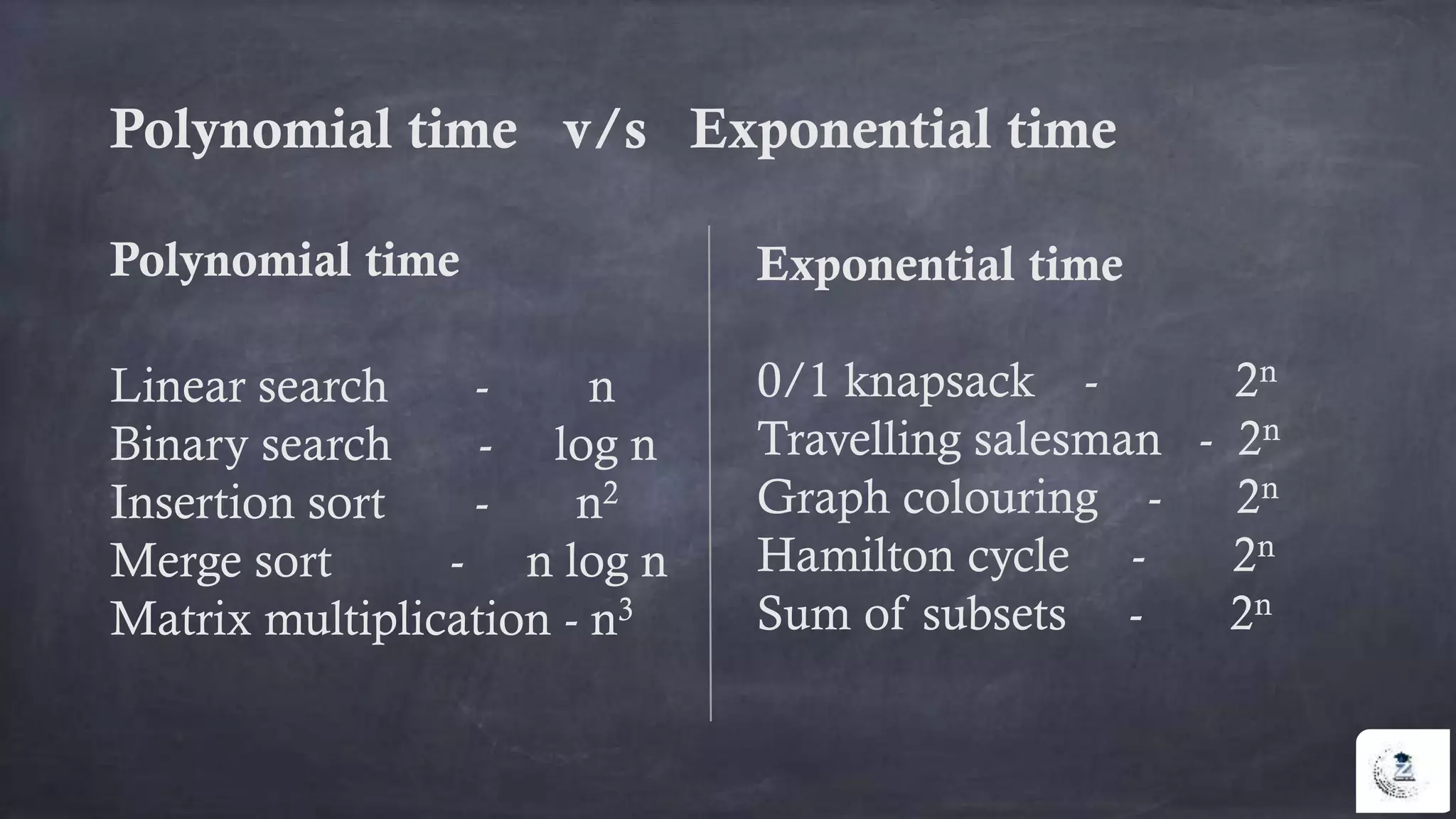
Polynomial time v/sExponential time
Polynomial time
Linear search - n
Binary search - log n
Insertion sort - n2
Merge sort - n log n
Matrix multiplication - n3
Exponential time
0/1 knapsack - 2n
Travelling salesman - 2n
Graph colouring - 2n
Hamilton cycle - 2n
Sum of subsets - 2n
12.
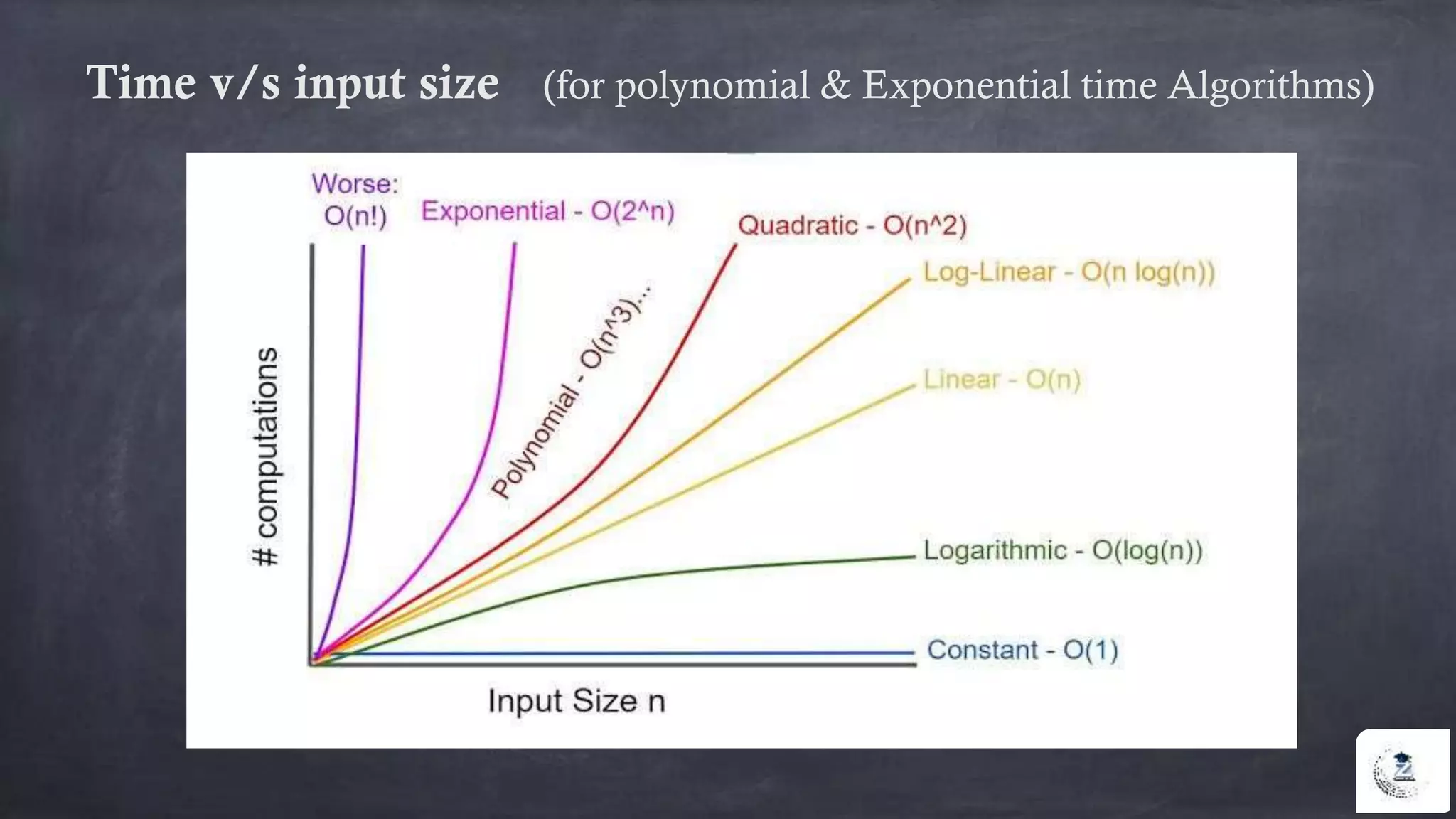
Time v/s inputsize (for polynomial & Exponential time Algorithms)
13.
Deterministic v/s non-deterministicAlgorithms
Deterministic
A Deterministic algorithm
produces only a single output
for the same input even on
different runs
1 0
0 0
Non-deterministic
A non - deterministic algorithm
can provide different outputs
for the same input on
different runs
q
q1
q2
q
q1
q2
14.
Functions of non- deterministic algorithm
To specify such non - deterministic algorithms
we introduce three new functions
1. Choice(S) - arbitrarily chooses one of the elements of set S
2. Failure() - signals an unsuccessful completion
3. Success() - signals a successful completion
The assignment statement x=Choice(1,n) could result in x being
assigned any one of the integers in the range [1,n]
There is no rule specifying how this value is chosen
15.
A non -deterministic searching algorithm
Searching for an element x in a given set of elements A[1:n], n>1. We are required
to determine an index j such that A[j]=x or j=0 if x is not in A.
Algorithm NSearch(A,n,key)
{
j=Choice(1,n);
if A[j]==key then
{
write( j);
Success( );
}
write ( 0);
Failure( );
}
Running Time : O(1)
17.
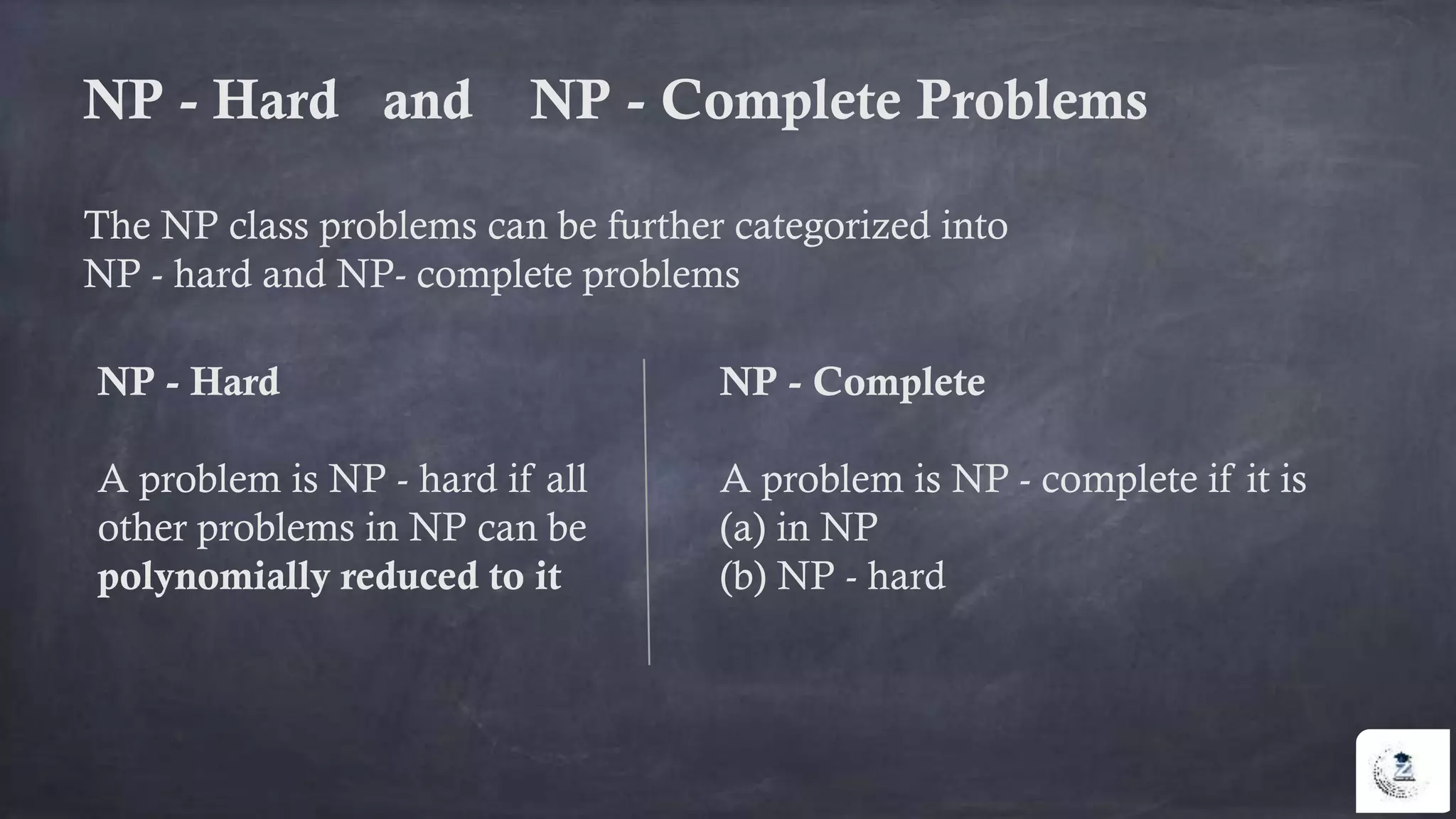
NP - Hardand NP - Complete Problems
The NP class problems can be further categorized into
NP - hard and NP- complete problems
NP - Hard
A problem is NP - hard if all
other problems in NP can be
polynomially reduced to it
NP - Complete
A problem is NP - complete if it is
(a) in NP
(b) NP - hard
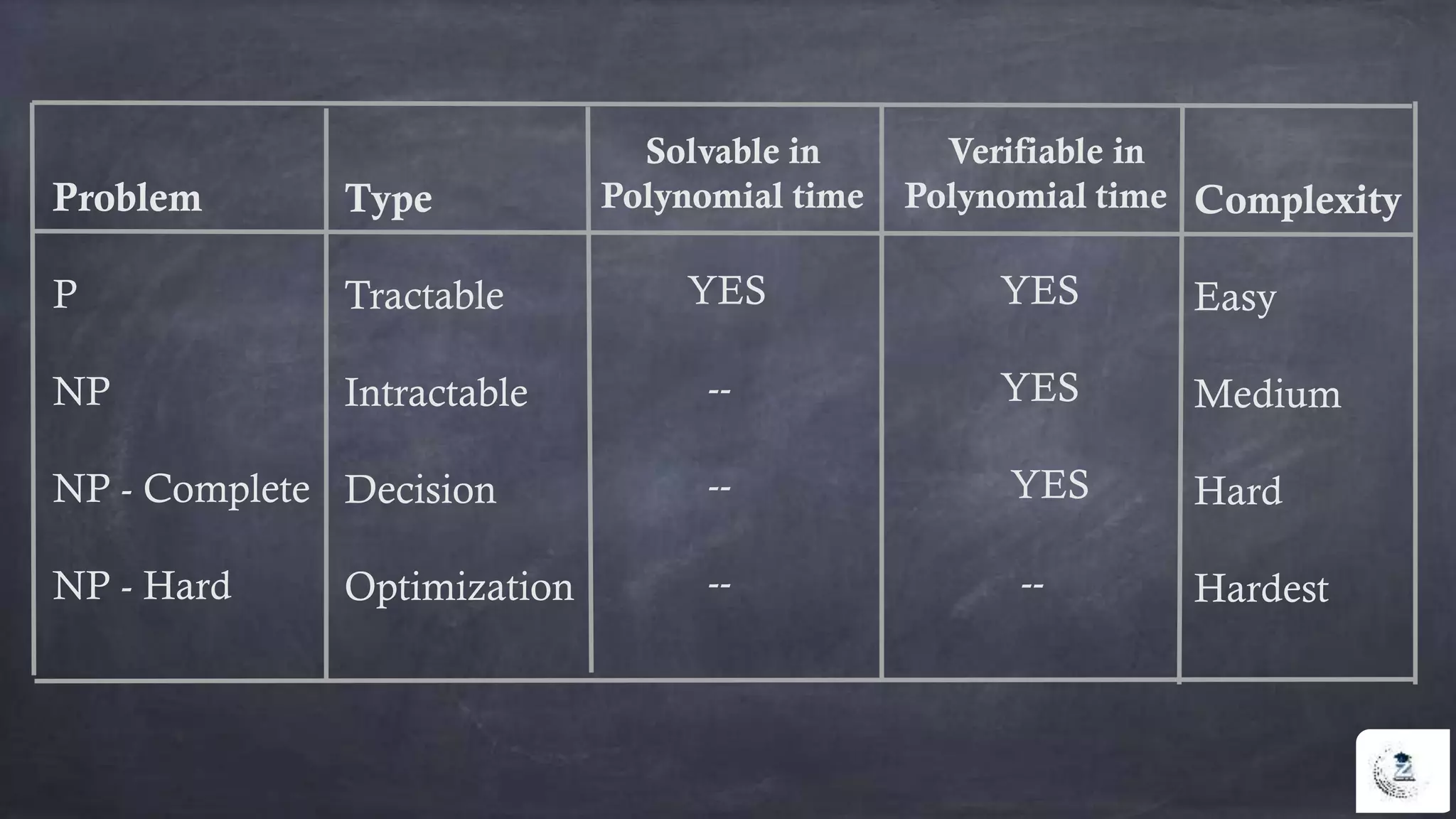
Problem
P
NP
NP - Complete
NP- Hard
Type
Tractable
Intractable
Decision
Optimization
Verifiable in
Polynomial time
YES
YES
YES
--
Solvable in
Polynomial time
YES
--
--
--
Complexity
Easy
Medium
Hard
Hardest
An expression thatcan
be constructed using
literals and operators
Either a
variable or it’s negation
whose value is either
TRUE or FALSE
A formula is said to
be satisfiable if
variables can be
assigned with values
such that the
formula turns out to
be TRUE
A formula is said to
be unsatisfiable if
variables cannot be
assigned with values
such that the
formula turns out to
be TRUE