Downloaded 183 times
![MERGE SORT
Sort into nondecreasing order
log2n passes are required.
time complexity: O(nlogn)
[25][57][48][37][12][92][86][33]
[25 57][37 48][12 92][33 86]
[25 37 48 57][12 33 86 92]
[12 25 33 37 48 57 86 92]
pass 1
pass 2
pass 3
6](https://image.slidesharecdn.com/divideandconquer-171108085822/75/Divide-and-conquer-6-2048.jpg)
![QUICK SORT
Select a pivot whose value we are going to divide the
sublist. (e.g., p = A[l])
Rearrange the list so that it starts with the pivot
followed by a ≤ sublist (a sublist whose elements are
all smaller than or equal to the pivot) and a ≥ sublist
(a sublist whose elements are all greater than or equal
to the pivot ) (See algorithm Partition in section 4.2)
Exchange the pivot with the last element in the first
sublist(i.e., ≤ sublist) – the pivot is now in its final
position
Sort the two sublists recursively using quicksort.
p
A[i]≤p A[i] ≥ p
7](https://image.slidesharecdn.com/divideandconquer-171108085822/75/Divide-and-conquer-7-2048.jpg)
![BINARY SEARCH
ALGORITHM
BinarySearch(A[0..n-1], K)
//Implements nonrecursive binary search
//Input: An array A[0..n-1] sorted in ascending order and
// a search key K
//Output: An index of the array’s element that is equal to K
// or –1 if there is no such element
l 0, r n – 1
while l ≤ r do //l and r crosses over can’t find
K.
m (l + r) / 2
if K = A[m] return m //the key is found
else
if K < A[m] r m – 1//the key is on the left half of the
array
else l m + 1 // the key is on the right half of
the array
return -1
9](https://image.slidesharecdn.com/divideandconquer-171108085822/75/Divide-and-conquer-9-2048.jpg)

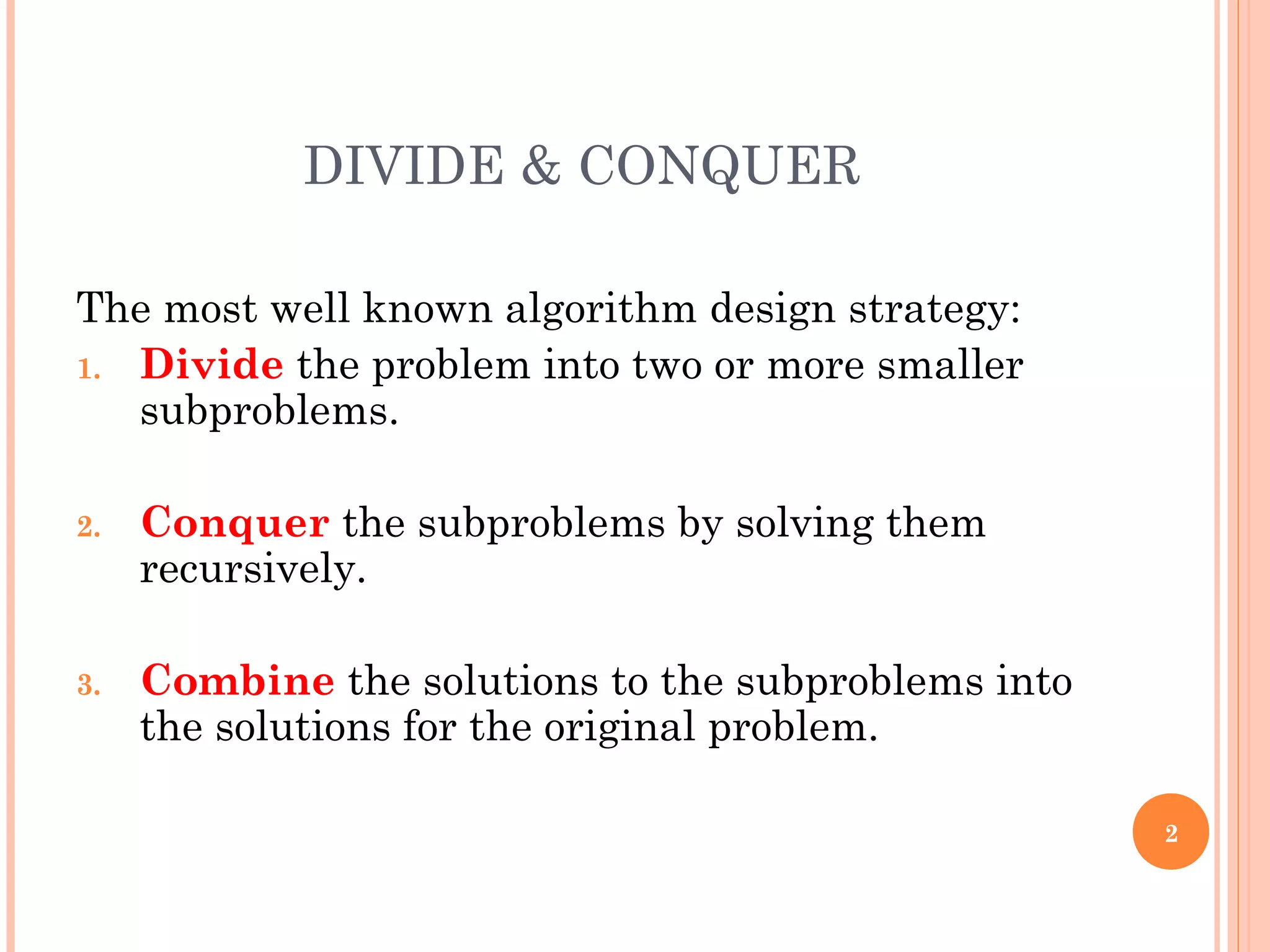
The document discusses divide and conquer algorithms. It describes divide and conquer as a design strategy that involves dividing a problem into smaller subproblems, solving the subproblems recursively, and combining the solutions. It provides examples of divide and conquer algorithms like merge sort, quicksort, and binary search. Merge sort works by recursively sorting halves of an array until it is fully sorted. Quicksort selects a pivot element and partitions the array into subarrays of smaller and larger elements, recursively sorting the subarrays. Binary search recursively searches half-intervals of a sorted array to find a target value.
Introduction of the Divide and Conquer algorithm strategy by Shashikant V. Athawale.
Description of the Divide and Conquer strategy: divide, conquer, and combine smaller problems.
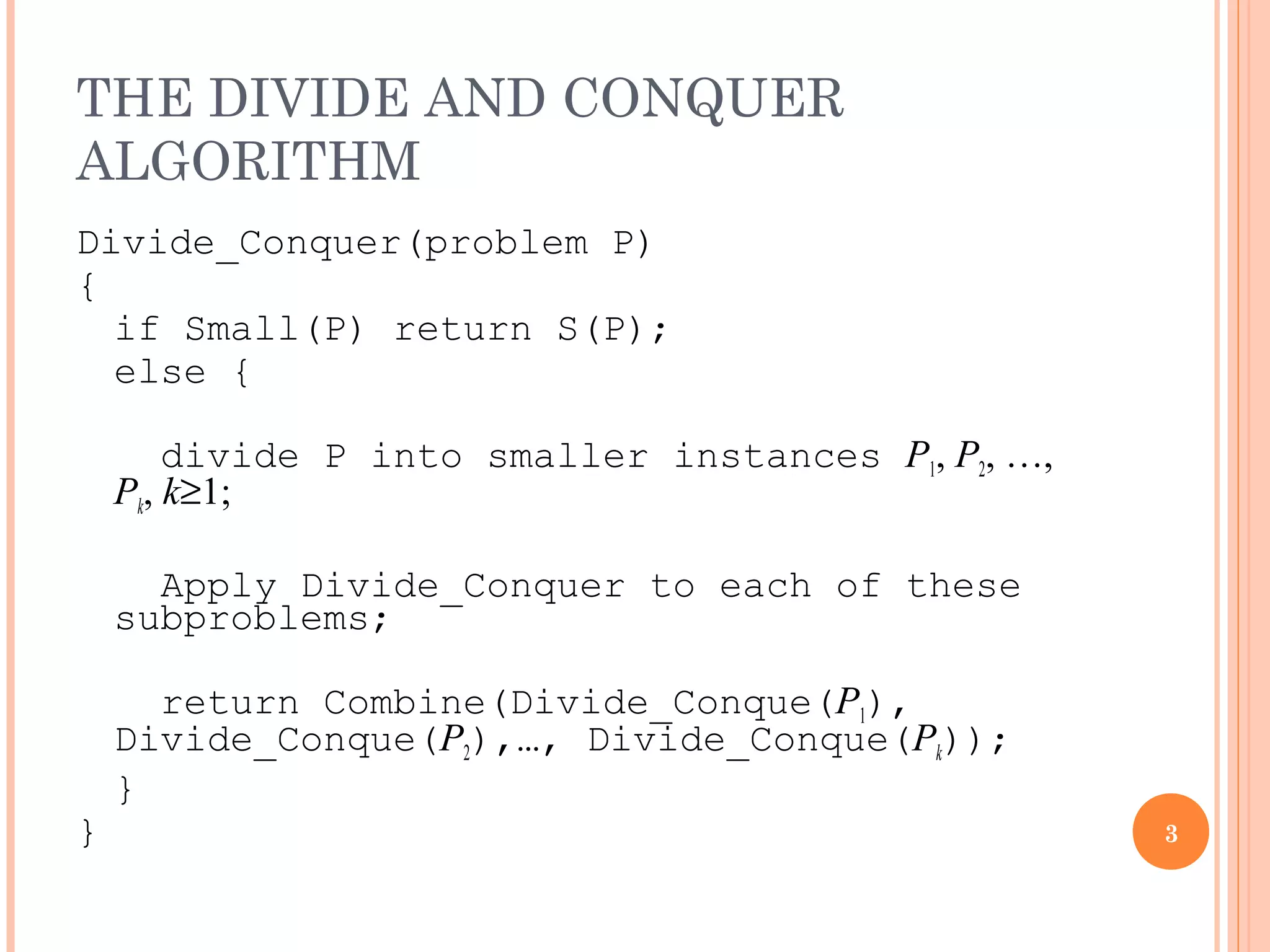
Pseudo code representation of Divide and Conquer algorithm including base case and recursive calls.
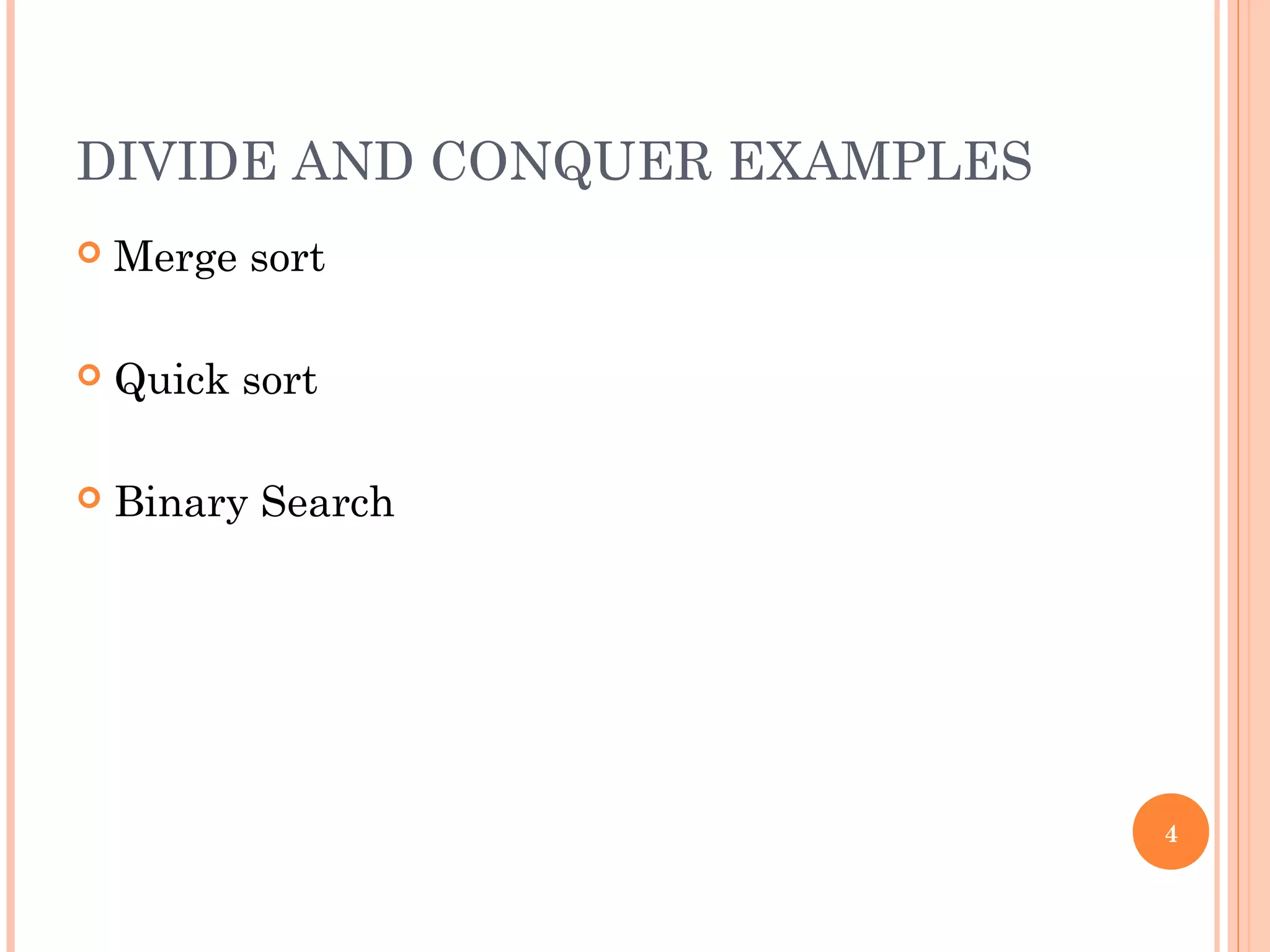
Examples of algorithms that use Divide and Conquer: Merge Sort, Quick Sort, and Binary Search.
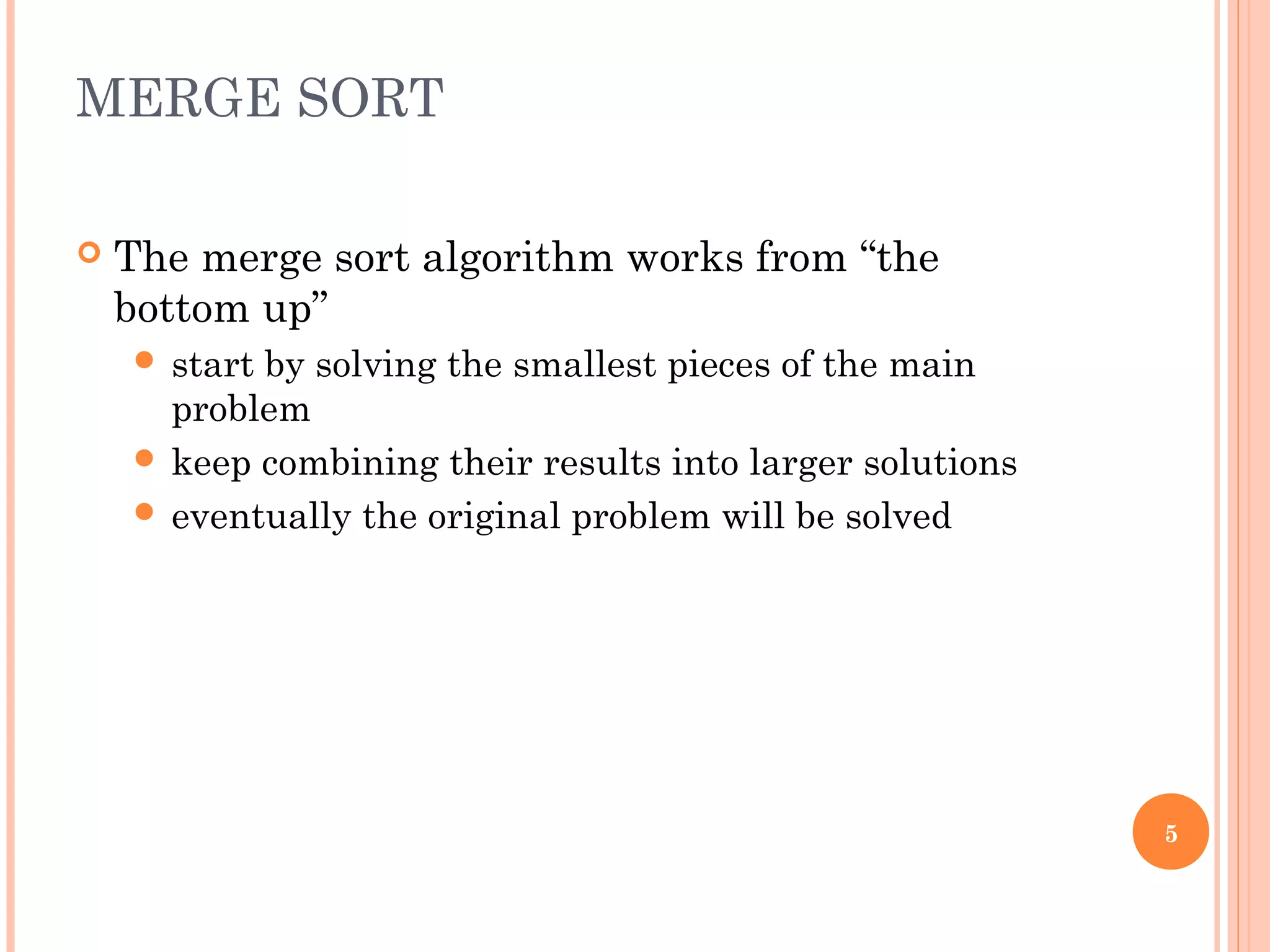
Explanation of Merge Sort working from small problems to larger solutions.
Details on Merge Sort, including its time complexity: O(n log n) and number of passes required.
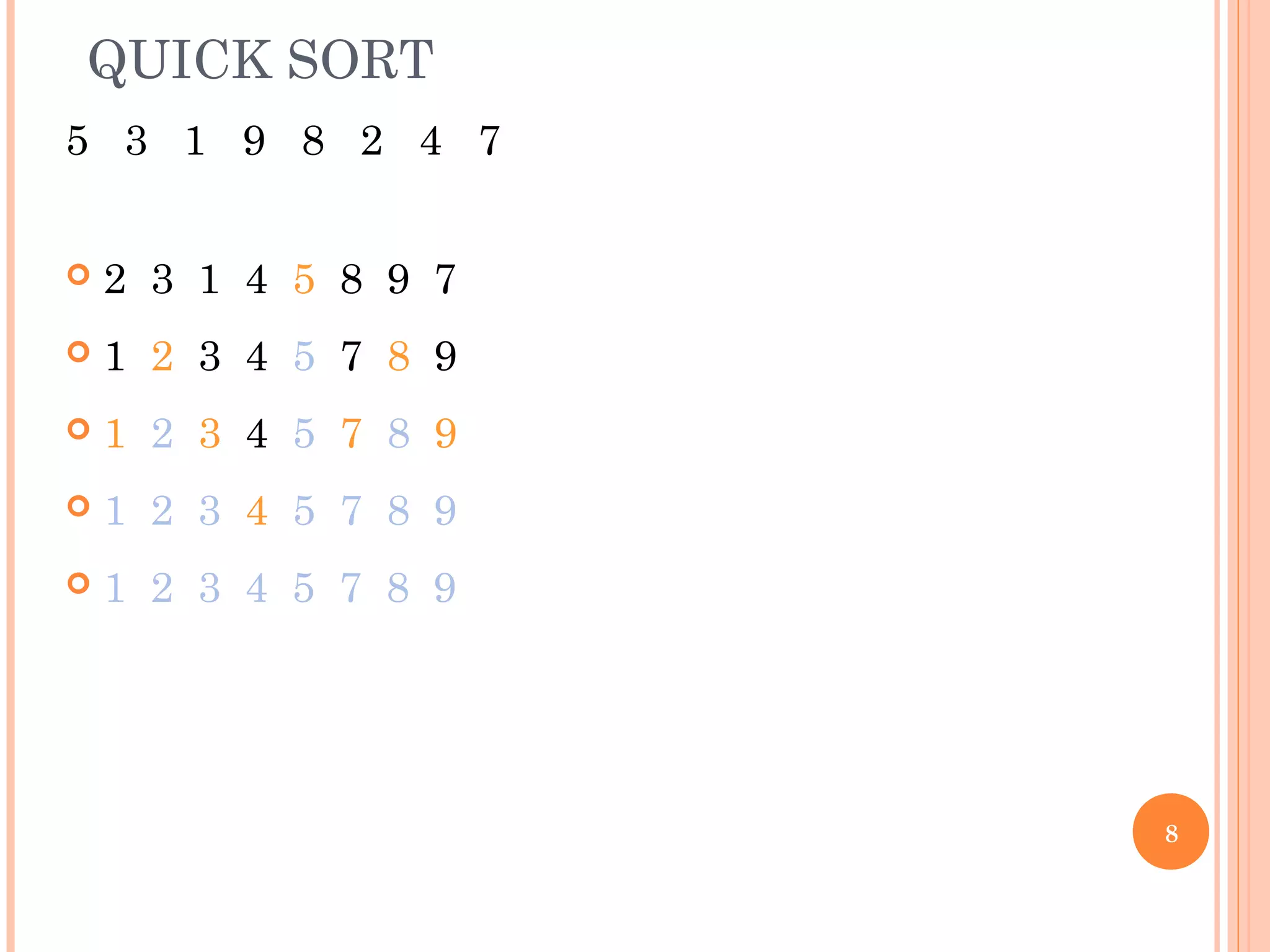
Step-by-step breakdown of the Quick Sort algorithm and how to rearrange sublists around a pivot.
An example showing the execution and results of the Quick Sort algorithm.
Step-by-step explanation of the nonrecursive Binary Search algorithm with input/output specifications.
Wrap-up of the presentation with a thank you note.


