2016
10th
Edition
THE
WEALTH
REPORTThe global perspective on prime property and investment
The Wealth
Report 2016
COMMISSIONED BY
ANDREW HAY
WRITTEN BY
KNIGHT FRANK RESEARCH
DESIGNED BY
WINKREATIVE
PRINTED BY
PUREPRINT
Knight Frank
EDITOR
ANDREW SHIRLEY
GLOBAL HEAD OF
RESEARCH
LIAM BAILEY
RESEARCH
KATE EVERETT-ALLEN,
GRÁINNE GILMORE,
TAIMUR KHAN, TOM BILL
BUSINESS DEVELOPMENT
SARAH MAY-BROWN
MARKETING
FIONA O’KEEFE
PR ENQUIRIES
DAISY ZIEGLER
All contacts:
firstname.familyname@knightfrank.com
Winkreative
CREATIVE DIRECTOR
MAURUS FRASER
ART DIRECTOR
MATT LE GALLEZ
DESIGNER
BRIAN LO
ART BUYER
JULIEN BEAUPRÉ STE-MARIE
EDITOR
WILLIAM OLIVER
SUB-EDITOR
LOUISE BANBURY
ACCOUNT MANAGER
JOEL TODD
Photography
Portraits of Andrew Hay
and Liam Bailey taken by
John Wright at 31 Chester
Terrace, London
Photographs of Lady
de Rothschild taken
by Daniel Shea
Selected images by Getty
Illustration
JUN CEN
BOWLGRAPHICS (TOKUMA)
SIX&FIVE
GIULIO MIGLIETTA
Definitions
UHNWI
We use UHNWI as an
abbreviation for ultra-
high-net-worth individual –
someone with a net worth
of over US$30m excluding
their primary residence.
PRIME PROPERTY
The most desirable and
most expensive property
in a given location,
generally defined as the
top 5% of each market
by value. Prime markets
often have a significant
international bias in terms
of buyer profile.
Unless stated, all
references to dollars
or $ refer to US dollars
Welcome to the
10th
edition of
The Wealth Report
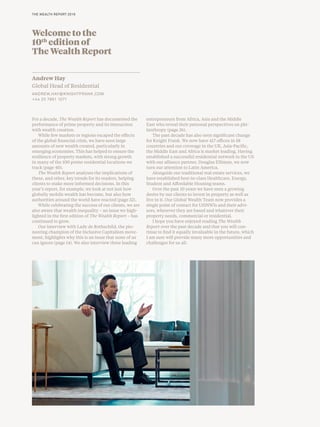
Andrew Hay
Global Head of Residential
ANDREW.HAY@KNIGHTFRANK.COM
+44 20 7861 1071
For a decade, The Wealth Report has documented the
performance of prime property and its interaction
with wealth creation.
While few markets or regions escaped the effects
of the global financial crisis, we have seen large
amounts of new wealth created, particularly in
emerging economies. This has helped to ensure the
resilience of property markets, with strong growth
in many of the 100 prime residential locations we
track (page 40).
The Wealth Report analyses the implications of
these, and other, key trends for its readers, helping
clients to make more informed decisions. In this
year’s report, for example, we look at not just how
globally mobile wealth has become, but also how
authorities around the world have reacted (page 32).
While celebrating the success of our clients, we are
also aware that wealth inequality – an issue we high-
lighted in the first edition of The Wealth Report – has
continued to grow.
Our interview with Lady de Rothschild, the pio-
neering champion of the Inclusive Capitalism move-
ment, highlights why this is an issue that none of us
can ignore (page 14). We also interview three leading
entrepreneurs from Africa, Asia and the Middle
East who reveal their personal perspectives on phi-
lanthropy (page 26).
The past decade has also seen significant change
for Knight Frank. We now have 417 offices in 58
countries and our coverage in the UK, Asia-Pacific,
the Middle East and Africa is market leading. Having
established a successful residential network in the US
with our alliance partner, Douglas Elliman, we now
turn our attention to Latin America.
Alongside our traditional real estate services, we
have established best-in-class Healthcare, Energy,
Student and Affordable Housing teams.
Over the past 10 years we have seen a growing
desire by our clients to invest in property as well as
live in it. Our Global Wealth Team now provides a
single point of contact for UHNWIs and their advi-
sors, wherever they are based and whatever their
property needs, commercial or residential.
I hope you have enjoyed reading The Wealth
Report over the past decade and that you will con-
tinue to find it equally invaluable in the future, which
I am sure will provide many more opportunities and
challenges for us all.
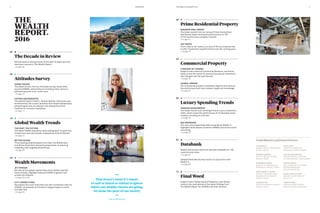
THE WEALTH REPORT 2016
06	
	 The Decade in Review	
	 We look back at the big issues of the past 10 years and how 	
	 they were covered in The Wealth Report
	 page 06
08	
	 Attitudes Survey
	UHNWI ISSUES
The latest results from our Attitudes Survey reveal what
worries UHNWIs, where they are investing, their views on
philanthropy and much, much more
	 page 10
	CAPITALISM REBOOTED
The Wealth Report Editor, Andrew Shirley, interviews Lady
de Rothschild, the London and New York-based entrepreneur,
philanthropist and art collector who helped found the
Coalition for Inclusive Capitalism
	 page 14
	
18	
	 Global Wealth Trends	
	THE PAST, THE FUTURE
The latest UHNWI population data looking back 10 years and
forward over the next decade, analysed by Gráinne Gilmore
	 page 22
	BETTER GIVING
Three leading philanthropists from Asia, the Middle East
and Africa share their personal perspectives on reducing
inequality with targeted philanthropy
	 page 26
28	
	 Wealth Movements
	JET STREAM
We look at how global capital flows have shifted, identify
future threats, highlight seasonal UNHWI migration and
private-jet hotspots
	 page 30 to 35
	CITY CONNECTIONS
We analyse the most important and well-connected cities for
UHNWIs, and assess the threats to league toppers London
and New York
	 page 36
38	
	 Prime Residential Property
	WINNERS AND LOSERS
The latest results from our unique Prime International
Residential Index tracking the performance of 100
of the world’s luxury property markets
	 page 41
	HOT SPOTS
From cities to ski resorts, our pick of the top locations set
to offer investment outperformance over the coming years
	 page 44
46	
	 Commercial Property	
	A DECADE OF CHANGE
Knight Frank’s Head of Commercial Research, Lee Elliott,
looks at how the world of commercial property investment
has changed over the past decade
	 page 48
	GLOBAL TRENDS
Our commercial property investment experts from around
the world share their local market insight and knowledge
	 page 50
56	
	 Luxury Spending Trends
	PASSION INVESTMENTS
The latest results from the Knight Frank Luxury Investment
Index, which tracks the performance of 10 desirable asset
classes, including art and cars
page 58
	 BIG SPENDERS
	 The new Luxury Spending Index compiled by Wealth-X 		
	 highlights what objects of desire UHNWIs around the world 	
	 are buying
	 page 60
64	
	 Databank	
	Wealth distribution data from New World Wealth for 100
countries and cities
	 page 64
	Detailed Attitudes Survey results in conjunction with
Wealth-X
	 page 68
72	
	 Final Word	
	Knight Frank’s Global Head of Research, Liam Bailey,
looks at the implications of the latest findings from
The Wealth Report for UHNWIs and their advisors
Contributors and interviewees
LIAM BAILEY
GLOBAL HEAD OF RESEARCH
KNIGHT FRANK
ANDREW SHIRLEY
WEALTH REPORT EDITOR
KNIGHT FRANK
GRÁINNE GILMORE
HEAD OF UK RESIDENTIAL
RESEARCH, KNIGHT FRANK
KATE EVERETT-ALLEN
HEAD OF INTERNATIONAL
RESIDENTIAL RESEARCH
KNIGHT FRANK
TAIMUR KHAN
SENIOR RESEARCH ANALYST
KNIGHT FRANK
LEE ELLIOTT
HEAD OF COMMERCIAL
RESEARCH, KNIGHT FRANK
LADY DE ROTHSCHILD
ENTREPRENEUR, INVESTOR,
PHILANTHROPIST, CAMPAIGNER
TONY ELUMELU
ONE OF NIGERIA’S LEADING
BUSINESSMEN AND
PHILANTHROPISTS
MADELAINE OLLIVIER
SENIOR LUXURY ANALYST
WEALTH-X
JAMES POWELL
HEAD OF GLOBAL SPORTS
GROUP, CANTOR FITZGERALD
Lady de Rothschild
That doesn’t mean it’s smart,
or safe or moral or ethical to ignore
where our middle classes are going,
let alone the poor of our society
THE
WEALTH
REPORT
2016
54 THE WEALTH REPORT 2016CONTENTS
2007 20122008 20132009 20142010 20152011 2016
Predicted values
In his contribution
to this year’s
report, Sir Richard
Branson explored
the potential for
investment in
space technology
to revolutionise
terrestrial travel,
with potential
dramatic impact on
property demand
We predicted the Hong
Kong government’s
intervention in mortgage
lending would herald
a new era of market
control and we expected
the trend to spread
globally. It did
As the world economy
reached its nadir,
our residential
investment selection
was led by London’s
Marylebone. Those
brave enough to
follow our pick have
seen a 71% rise in value
We took our first diversion
into luxury investments,
with The Wealth Report
Editor Andrew Shirley
urging investors to “act
now” to secure “bargains”
in fine wine, art and
classic cars
Our suggestion that
Croatia would be one
of the few Eastern
European markets to
develop a true prime
residential offer
has been largely
borne out
Citi’s plutonomy
investment thesis –
the concept that wealth
inequality would worsen
– provided the backdrop
to our inaugural edition,
and has continued
largely unchecked
£1M
The Decade in Review
Over the past decade, The Wealth Report has provided
a unique perspective on the interaction between
wealth and the world’s prime property markets. With
the performance of prime central London residential
property – one of the most critical global wealth markets
– as our backdrop, we pick out some highlights and
predictions from the past 10 years
By a margin of four out of
six, Shanghai was selected
by our global panel as the
city most likely to domi-
nate the global economy,
finance, wealth creation
and investment in 2050
Our analysis of
global web-traffic
data pointed to a
90% growth in online
luxury property
searches from Latin
America, led by a
200% growth from
Venezuela
At the same time,
Ledbury Research’s
James Lawson
confirmed how the
combination of
established branding,
education and market
maturity would keep
Europe’s key cities on
investors’ agendas into
the future
Total worth
of world’s
167,700
UHNWIs
$20tn
Private money
investedworldwide
in commercial
property
$71bn
UHNWIs living in
London. Highest
city population
globally
4,364We reported how,
despite rising prices,
Asian investor appetite
for property investment
was only likely to grow
and those from Myanmar
and Sri Lanka were set to
become more noticeable
With rising geo-political
stresses in many parts
of the world our survey
results noted how 37%
of Russian UHNWIs were
considering a change
in residence
The rise of education
as a driver for global
property investment
was confirmed by our
survey results with 42%
of Chinese UHNWIs
planning to send their
children overseas for
secondary education
The rise in the
importance of
Africa as a wealth
investment
location was
cemented by our
wealth distribution
data confirming
US$200bn of
assets held by
African UHNWIs
Roger Orf, then
Investment Head
at Citi Property
Investors, confirmed
his belief in
agricultural land
as the investment
sector for the
decade ahead. UK
values have since
risen by 70%
Sentosa Cove in
Singapore, Bahia
in Brazil, Grenada,
Mauritius and the Italian
Riviera all featured in
our review of up-and-
coming prime residential
markets. The strongest
performer since? Despite
subsequent cooling
measures - Sentosa Cove
by a wide margin
Average price
change for prime
Londonresidential
property
+29%
2007
2008
2009
2010
2011
2012
2013
2014
2015
Our prediction that
emerging market
cities would
see economic
outperformance
convert to growing
influence as
investment
destinations proved
too positive. The
established market
leaders still dominate
Legendary investor Jim
Rogers shared his view
that the financial crisis
meant the rise of Asia
and the decline of the US
was now inevitable
Average price
change for prime
Shanghai resi-
dential property
+21%
Ulan Bator, Suzhou
and Astana all
featured in our
one-off ‘Cool List’
feature. At least
investors couldn’t
complain we weren’t
scouring the world
for opportunities
Drop in US
corn price from
2008 peak
-49%
£1.26M
£0.99M
£1.1M
£1.23M
£1.37M
£1.49M
£1.60M
£1.67M
£1.69M
£1.72M
PERFORMANCE OF A £1M INVESTMENT IN PRIME CENTRAL LONDON PERFORMANCE OF A £1M INVESTMENT IN PRIME CENTRAL LONDONSource: The Knight Frank
Prime Central London Index
7THE WEALTH REPORT 20166 10-YEAR ROUND UP
98
A global guide to
the attitudes of
UHNWIs towards
property, wealth
and investments
To mark the 10th edition of The Wealth
Report, this year’s Attitudes Survey
takes a 10-year view. We look back at how
the attitudes of UHNWIs to key issues
and investment decisions have changed
since the report was first published, and
look forward to examine the outlook for
the next 10 years.
One of the most interesting findings
is that a significant proportion of respond-
ents – leading wealth advisors and private
bankers from around the world – expect
their clients’ wealth to increase at a
slower rate over the next 10 years than
the past decade.
Succession and inheritance issues,
wealth taxes and the global economy
were identified as the main threats to
future growth.
We also look at attitudes to philan-
thropy and property – both remain high
on the UHNWI agenda. The majority of
respondents said their clients would be
increasing their philanthropic activi-
ties, while exposure to property as an
asset class is also set to grow – 30% of
their clients are considering a residential
purchase in 2016.
Past editions of The Wealth Report
have included contributions from
influential thinkers and this year is
no exception. On page 14 we interview
Lynn Forester de Rothschild, who
is at the forefront of the Inclusive
Capitalism movement.
Although she still believes capital-
ism is ultimately the best way to reduce
wealth inequality around the world, she
says businesses, investors and govern-
ments need to take a longer-term view to
make it work. A failure to act now could
have serious consequences, she says.
Key topics
01
Generation games
Wealthy family businesses
are involving the next generation
at an earlier stage, but succession
issues are still one of the biggest
worries for UHNWIs
page 10
02
Carry on giving
Almost 70% of survey respondents
said UHNWI philanthropy activity had
increased over the past 10 years
page 12
03
Inclusive Capitalism
Urgent action is needed, but
capitalism is still the best way
to reduce wealth inequality, Lynn
Forester de Rothschild tells
The Wealth Report
page 14
The Wealth Report
Attitudes Survey
THE WEALTH REPORT 2016ATTITUDES SURVEY
1110
To mark the The Wealth Report’s 10th
edition, the latest results from our annual
Attitudes Survey shed light on how
the outlook of the world’s wealthy has
changed over the past decade and takes
a look forward to the next 10 years.
This year’s survey, conducted in
conjunction with ultra-wealth intel-
ligence consultancy Wealth-X, is based
on the views of around 400 of the world’s
leading private bankers and wealth advi-
sors who, between them, manage assets
for about 45,000 ultra-high-net-worth
individuals (UHNWIs) with a combined
wealth of over half a trillion US dollars.
As ever, the Attitudes Survey covers
a wide range of topics from investment
decisions to succession planning. Some
of the highlights are analysed over the
following pages, but you can find a compre-
hensive summary of the survey responses,
broken down by world region, in the
Databank section at the end of the report.
Wealth issues
The launch of The Wealth Report in
2007 was, ironically, quickly followed
by the beginning of the global financial
crisis. At first it seemed as if subsequent
editions would be focusing on wealth
diminution rather than creation, but
that proved not to be the case.
As our analysis of global wealth distri-
bution on page 20 clearly shows, UHNWI
numbers have burgeoned around the
world, particularly in emerging markets.
But our forecast for the next 10 years is
more cautious, with the rate predicted to
slow considerably.
This is echoed by the Attitudes Survey.
When we asked the respondents if their
clients’ wealth had increased at a faster
rate over the past 10 years than it would
do over the next 10, two thirds agreed.
In Australasia, 84% of respondents
predicted a slowdown – unsurprising
perhaps as much of the wealth creation in
the region has been powered by China’s
economic growth, which is now slowing.
Growth is
slowing and
the wealthy
are under
increased
scrutiny, yet
significant
opportunities
remain for
those who truly
understand
how to identify,
understand
and serve
this group
very concerned about matters of suc-
cession and how their children will deal
with the pressures of inherited wealth,”
confirms Deon de Klerk, Head of Africa
and International Wealth and Investment
at Standard Bank.
At a regional level, personal security
and safety was high on the agenda in
Latin America, with 63% of respondents
citing it as a concern that has grown
over the past 10 years. Looking forward,
personal and family health was the
third most important issue for North
American UHNWIs.
Increased scrutiny of UHNWIs and
their affairs, by both the public and
authorities, was acknowledged by the
survey. Almost 70% of respondents said
their clients had become more conscious
about displaying their wealth in public.
A significant number also felt UHNWIs
were being made scapegoats by govern-
ments for their own failure to address
wealth-inequality issues.
This year promises to be a very signifi-
cant year for the ultra-wealthy and for
those who advise them, says Marc Cohen,
Regional Managing Director EMEA at
Wealth-X. “Growth is slowing and the
wealthy are under increased scrutiny,
yet significant opportunities remain
for those who truly understand how to
identify, engage, understand and serve
this group.”
Management matters
Focusing on how UHNWIs manage their
wealth, a number of interesting trends
have developed over the past 10 years.
Not only do 87% of those polled believe
that their clients are taking a more
active role in the management of their
wealth, but 92% agree that the wealth
industry has to work harder to earn the
trust of its clientele.
Advisors may also need to refocus
how they engage with clients. On average
almost 80% of respondents said women
were taking a more significant role in
managing family wealth, while 64% said
clients were involving their children in
their businesses at an earlier age.
“Having served the parents does not
provide us a birthright to serve their
next generation. We have to earn it,” says
Money K, who heads Citi Private Bank’s
Globally, succession and inheritance
issues, wealth taxes and the global
economy were identified as the three
main factors threatening wealth crea-
tion over both the past 10 years and the
next decade.
“We find our clients to be more multi-
jurisdictional than ever before, with
families often ending up dispersed across
the globe. Many of our clients are also
Ten-year
perspective
The Wealth Report’s Attitudes Survey
looks at the changing outlook of UHNWIs
ANDREW SHIRLEY,
THE WEALTH REPORT EDITOR
Much of Australasia’s wealth creation has been powered by China’s economic growth
RISKS TO WEALTH CREATION AND PRESERVATION
Issues that have grown in prevalence over the past decade and top concerns for next 10 years
LEGEND
Past 10 years
Next 10 years
34%
24%
Personal
security  safety
14%
6%
The
environment
34%
12%
Compliance
issues
33%
20%
Personal 
family health
67%
56%
Succession 
inheritance issues
61%
47%
Global
economy
39%
9%
Online security
 privacy
51%
32%
Stock market
volatility
62%
50%
Tax for the
wealthy
Data refers to the
percentage of respondents
selecting each option
Source: all data from The Wealth Report Attitudes Survey
WEALTH CREATION PROSPECTS
Russia  CIS
Europe
Africa
Middle East
Asia
North America
Australasia
Latin America
47%
50%
54%
59%
68%
62%
84%
100%
UHNWIS ARE
INVOLVING THEIR
CHILDREN IN THEIR
BUSINESSES AT AN
EARLIER AGE
India
91%
UK
60%
Average number of homes owned by UHNWIs
3.7
Singapore
75%
Change in UHNWI philanthropic activities
Past10years
Next10years
25%
14%
2%2%
5%
55%
52%
Increase a lot
Increase slightly
Don’t know
Decrease slightly
Stay the same Decrease a lot
LEGEND
0%0%
17%
27%
2%
% of respondents
who agree
Respondents who think wealth creation will slow over the next 10 years
% of respondents who selected option
THE WEALTH REPORT 2016ATTITUDES SURVEY
1312
%ofrespondentswhoagree
Prime property in London: UHNWI investment in residential property has grown over the past 10 years
THE WEALTH REPORT
ATTITUDES SURVEY
The results of the Attitudes Survey are
based on the responses from private
bankers and wealth advisors who
completed a survey in late autumn 2015.
A full regional breakdown of the data is
available in the Databank section at the
back of the report. Selected country-level
data is available on request.
“Philanthropists are becoming increas-
ingly sophisticated in how they struc-
ture their giving and investing, with
social impact emerging as a key third
dimension along with risk and return in
every investment decision.”
Property
How UHNWIs feel about property as
a place to live and as something to
invest in, is an important part of the
Attitudes Survey.
Residential real estate accounts for a
quarter of the average UHNWI’s invest-
able wealth, according to the survey,
while commercial property investments
make up 11%.
Over the past 10 years, 54% of respond-
ents said their clients had increased their
allocation to residential property. Just
over 40% expected it to increase further
over the next 10 years, with 30% of clients
likely to consider a residential purchase
in 2016.
When asked what factors had been
growing in importance as a reason for
UHNWIs to buy residential property, the
most popular (55% of respondents) was
as an investment to sell in the future.
Investment diversification (46%) and as
a safe haven for funds (47%) also scored
highly. The safe-haven element was
considered especially important by those
respondents with clients in Russia and
the CIS – 80% said it was becoming
more important.
“The majority of our high-net-worth
clients across Africa seek international
diversification, with an ever increasing
appetite for real estate,” says Standard
Bank’s Deon de Klerk. “With the develop-
ing complexity of cross-border transac-
tions, as well as a demand for real value
and the most appropriate properties, the
necessity to employ specialists in their
respective fields to truly realise that safe-
haven perception is vital.”
Interest in commercial property is also
growing strongly, with 47% of wealth ad-
visors predicting an increased portfolio
allocation by their clients over the next
10 years. Offices and hotels are predicted
to remain the investments of choice,
although warehousing and logistics could
overtake shopping centres and high-
street retail, according to the survey.
Lack of experience was considered
the main reason hindering more private
investment into the sector. See pages 46
to 53 for the latest insight from Knight
Frank’s commercial property experts.
Next Generation programme. “They pre-
fer online delivery for market intelligence
and execution of transactions.”
As mentioned earlier, succession
issues are the biggest worry for UHNWIs
around the world with recent research
suggesting that it is the second gen-
eration, rather than the oft-quoted
third, that is most likely to squander
the family fortune.
When asked why their clients were so
concerned about handing their wealth to
the next generation, 62% of respondents
said they didn’t feel their children would
be encouraged to make their own wealth,
while almost half said they wouldn’t
know how to handle the investments.
Encouraging them to get involved in the
family business from a younger age
appears to be an obvious solution.
However, as many as two thirds are
generally not inspired to join the family
business, preferring to pursue entrepre-
neurial ambitions or other professional
careers, says Mr K. “There is a certain
restlessness in them to make a difference
in whatever they do.”
Many of those who do join the family
business say they are not satisfied with
the status quo. “Because of globalisation
and new technologies, they desire to ex-
pand, modernise or reinvent the business
to be more relevant and sustainable for
the future,” says Mr K.
Philanthropy
Although protecting their wealth is a
preoccupation for many UHNWIs, giv-
ing much of it away is also important.
Facebook founder Mark Zuckerberg and
his wife Priscilla Chan hit the headlines
last year when they pledged to give away
99% of their shares­– currently worth
$45bn – in the social media giant.
On average, 67% of those who took
part in the Attitudes Survey said their
clients’ philanthropic activities had in-
creased over the past 10 years, with al-
most 80% saying activity would increase
further over the next 10.
A sense of personal fulfilment was
cited as the main motivator, although
in the Middle East religious beliefs were
considered almost as important.
However, the way the wealthy are
giving is changing. The Zuckerbergs, for
example, have created a more flexible
limited liability company, not a tradi-
tional charitable foundation, to oversee
their endeavours.
“This is indicative of a wider trend
that we have seen across our client base,”
says Tom Hall, Head of Philanthropy
Services (UK) at UBS. “Not only is
philanthropy increasing, so too is the
desire to ensure that it is truly effective
and actually solving the social and
environmental problems of our time.
%ofrespondentswho agree
UHNWIs have started to
take a more active role in
the management of their
wealth over the past 10 years
WOMEN HAVE TAKEN
A MORE SIGNIFICANT
ROLE IN MANAGING
FAMILY WEALTH OVER
THE PAST 10 YEARS
UAE
92%
China
84%
US
61%
Wealth managers have had to
work harder to earn the trust
of their clients over the past
10 years
92%
Strongly agree
Slightly disagree
Strongly
disagree
Neither agree
nor disagreee
Slightly agree
PORTFOLIO SPLITS
UHNWIs have become more conscious
about displaying their wealth over the
past 10 years
Agree
Disagree
14%
69%
1%
4%
8%
41%
46%
Proportion of total UHNWI wealth allocation
% of respondents who selected option
28%Financial investments (equities, bonds, etc)
24%Primary residence  second homes
19%Personal businesses
11%Real estate investments
2%Collectibles (art, wine, cars, etc)
15%Cash
1%Precious metals (gold, etc)
Source: all data from The Wealth Report Attitudes Survey
ALLOCATION SHIFTS
How asset allocations have changed or are
likely to change, according to respondents
Past 10 years
Next 10 years
IncreasedNo changeDecreased
LEGEND
IncreaseNo changeDecrease
LEGEND
Real estate investments
19% 32% 49%
Financial investments (equities, bonds, etc)
62%22%16%
Personal businesses
36%49%15%
Collectibles (art, wine, cars, etc)
26%58%16%
Precious metals (gold, etc)
13%45%41%
Primary residence  second homes
41%43%16%
Real estate investments
47%33%20%
Cash
26% 44% 30%
Financial investments (equities, bonds, etc)
11% 19% 70%
Cash
42%36%22%
Primary residence  second homes
54%35%11%
Personal businesses
41% 39%20%
Collectibles (art, wine, cars, etc)
48% 36%16%
Precious metals (gold, etc)
45% 14%41%
Neither
17%
THE WEALTH REPORT 2016ATTITUDES SURVEY
1514
Making capitalism work
The Wealth Report Editor Andrew Shirley
talks to Lynn Forester de Rothschild
clever enough to ask a person who, having
created her own hugely successful US
telecommunications business, is now lead-
ing an ambitious campaign to redefine
capitalism. And, for good measure, is part
of a dynasty synonymous with 400 years
or so of wealth creation. 
The reason we are meeting is to talk
about the emerging Inclusive Capitalism
movement and the Coalition for Inclusive
Capitalism ­­– a not-for-profit organisation
that was founded by Lady de Rothschild
and is dedicated to promoting the concept.
Apologetic for not having longer to
chat while ensuring a coffee is on its way,
and then immediately teasing me about
my “old-fashioned” Dictaphone, it is easy
to see why so many influential figures,
Christine Lagarde, Mark Carney, Bill
Clinton, Prince Charles and even the Pope
to name but a few, have been persuaded to
lend their support to her campaign.
Despite this high-profile backing, the
concept of Inclusive Capitalism is still not
a part of mainstream vocabulary, so I begin
by asking Lady de Rothschild to capture its
essence for readers of The Wealth Report.
It’s not often I get nervous before an inter-
view. I’ve quizzed the likes of legendary
investor Jim Rogers, environmentalist and
film producer Trudie Styler and iconic
fashion-house scion Massimo Ferragamo
over the past 10 editions of The Wealth
Report. But I do have to admit to a few but-
terflies on the way to meeting the glamorous
and rather well connected American busi-
nesswoman Lynn Forester de Rothschild
or, to be more formal, Lady de Rothschild
– a title that came with her marriage to
British banker Sir Evelyn de Rothschild.
Perhaps it is because, unusually for an
interviewee, Lady de Rothschild has gener-
ously invited me to her own home in
London, fittingly for a noted art collector,
the former Chelsea studio of John Singer
Sargeant, one of America’s most influen-
tial artists.
Or maybe it is because it has been
slightly daunting thinking of questions
“It’s a belief that capitalism should be
a system for the creation of broad-based
prosperity, and should instil trust in our
institutions, and optimism for the future –
that’s the way I think about it,” she explains
succinctly.
A single sentence, but one that opens a
Pandora’s box of questions. The first on my
list: how badly does capitalism really need
fixing? But Lady de Rothschild beats me to
it and is already recounting some survey
findings released just that morning sug-
gesting the answer is “very”.
“Only 19% of Americans,” she laments,
“believe that their government, in most
cases, will do the right thing. Trust in busi-
ness is not that much higher. So, to the extent
that business is not trusted by society, often
with good reason, it is not good for capital-
ism. There is no excuse for that.”
If we do not correct the problem, Lady
de Rothschild believes the consequences
could be dire. “A divided society against
itself will not stand and it doesn’t matter if
you’re in the top 1% or 0.001%. If the
society around you is crumbling, you’re in
a bad place,” she says.
LYNN FORESTER
DE ROTHSCHILD
Lynn Forester de Rothschild is
Chief Executive of E L Rothschild,
an investment business that she
established with husband Sir
Evelyn de Rothschild. She lives in
the UK and the US.
Opposite: Lady de
Rothschild, at home
in New York
This page left:
The de Rothschild’s
investments include
renewable energy
schemes in Africa
Below: Bill and
Hillary Clinton with
Sir Evelyn and Lady
de Rothschild
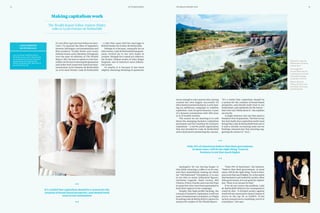
It’s a belief that capitalism should be a system for the
creation of broad-based prosperity, and should instil
trust in our institutions
Only 19% of Americans believe that their government,
in most cases, will do the right thing. Trust in
business is not that much higher
THE WEALTH REPORT 2016ATTITUDES SURVEY
1716
of the world’s institutional assets under
management), so then we had a second one
in 2015 and are planning 2016 in New York
City. To create change, however, we need
more than a conference a year, so we created
the Coalition. 
“I believe our entrée is to the large asset
owners, the sovereign wealth funds, the
pension funds, the insurance companies
and the people who manage their money
– to simply convince them that an invest-
ment for the long term means attention to
product, planet, people and profit.”
Lady de Rothschild is firm in her belief
that practising Inclusive Capitalism need
not come at the expense of profits.  “I’m not
asking people to have a lower return.”
It’s a compelling message, and it’s one that’s
backed up by the many research papers on
the coalition’s website – one of the latest
questions the assumed wisdom that hedge-
fund activism offers long-term benefits to
target firms.
She also points to the returns of the busi-
nesses that EL Rothschild – an investment
vehicle she set up with Sir Evelyn – invests
in. Some of the firms, such as a renewable
energy operation in Africa and an Indian
agri-business, do have an element of impact
investing, but Lady de Rothschild insists
“Now we can sit in London and New York
and say society isn’t crumbling, the restau-
rants are beautiful, I can live my life, but
that doesn’t mean it’s smart, or safe
or moral or ethical to ignore where our mid-
dle classes are going, let alone the poor of
our society.” 
So what can we do about it, I ask. “One
result is Occupy Wall Street, another result
is the Tunisian vegetable vendor who set
himself on fire, but I believe the best result
is for business and investors to be part of
the solution,” she explains.
 “We have a lot of work to do and I don’t
think we can put the burden on government
alone. The point of Inclusive Capitalism is
to talk with the large asset owners, asset
managers and corporate leaders of the world
and give them ideas that will be part of
the solution.”
And that is where the Coalition for In-
clusive Capitalism comes in. The Coalition
was created after the City of London asked
Lady de Rothschild if she would help pull
together the Conference on Inclusive
Capitalism in 2014.
“I didn’t know what that would be like,
but it was more successful than we could
have imagined (the delegates represented
a staggering $30 trillion of assets – one third
that the couple are rigorous investors look-
ing for very good returns.
“We’ve more than doubled our money
in India and in Africa we see internal rates
of return north of 20%. The returns from
our EL Rothschild portfolio are over 30%
so we are very clear that having impact does
not mean we have to sacrifice returns.”
Lady de Rothschild, however, does admit
it will be difficult to break the short-termism
endemic among politics, business and con-
sumer behaviour.
What motivated her to take on such a
Herculean task, I wonder. “I personally care
about the issue because I want to leave a
world, or at least a country – America – that
has a level playing field where people can
achieve their dreams based on their God-
given talent, not based on the families they
are born into. I just believe in that.” 
Inclusive Capitalism is not without its
detractors. Some commentators claim it is
simply a PR exercise by the world’s business
elite to protect itself from the wrath of the
disgruntled masses. Others say the concept
of capitalism itself is the problem.
But Lady de Rothschild is quick to point
out that while capitalism is not perfect, it
has, by and large, been a power for good in
the world. “I believe it’s like what Churchill
said about democracy: ‘It’s the worst system
apart from all the others.’ And remember
that since 1980, while inequality has grown
and way too much of the wealth has gone
to the 1% in the developed world, for the
rest of the world 700 million people have
been lifted out of poverty.
“I don’t think capitalism properly prac-
tised needs to make any apologies. Crony
capitalism is completely wrong, subsidies
to the wealthy while we are gutting out the
middle class – that’s just wrong and govern-
ments shouldn’t be there to protect the rich.
“Capitalism should be about competi-
tion, ethics, innovation and a level playing
field. If all that is in place, I don’t see how
anybody could have an argument with In-
clusive Capitalism.”
However, Lady de Rothschild does con-
cede that Ian Davis, Chairman of Rolls
Royce and a contributor to the 2015 confer-
ence on Inclusive Capitalism, makes a
valid point whenhesaystheconcept“needs
to be democratised if it is to become real
and effective”.
So how can the concept be spread beyond
the business leaders who attend her confer-
ences, I wonder. “It’s a very good question,
and of course it’s the hardest question,”
says Lady de Rothschild. “My simple
It doesn’t matter if you’re in the top 1% or
0.001%. If the society around you is crumbling,
you’re in a bad place
The returns from our EL Rothschild portfolio are over
30% so we are very clear that having impact does not
mean we have to sacrifice returns
response is that a journey of a thousand
miles starts with the first step and I have
said from the very beginning that Inclusive
Capitalism is not about a destination, it’s
about a journey and opening our eyes to
how we invest.”
Inclusive Capitalism should not be con-
fused with corporate responsibility or phi-
lanthropy, she stresses, although she and
Sir Evelyn support a wide variety of causes. 
Some are traditional, such as funding a
children’s hospital in London; some are
based around the arts world – they are
noted supporters of modern art and helped
the Tate acquire a work by acclaimed video
artist Bill Viola. But many are about micro
finance, education and economic empow-
erment – elements that fit very closely with
the concept of Inclus­ive Capitalism.
As we say goodbye, Lady de Rothschild
worriesthatIhaven’tbroughtacoattoguard
against the inclement English weather. It’s
actually quite mild for the time of year, but
I appreciate her concern.
It remains to be seen whether the critics
of Inclusive Capitalism will recognise her
sincerity, though I leave thinking that Lady
de Rothschild’s call for action is something
that businesses, wealth creators, politicians
and even consumers the world over can ill
afford to ignore.
inc-cap.com
Right: Lady de Rothschild
speaks at the 2015
Inclusive Capitalism
conference
Below: A self-portrait
of American artist John
Singer Sargent, whose
former studio is now
Lady de Rothschild’s home
in London. Image courtesy
of Bridgeman Images
Opposite: A still from
Bill Viola’s ‘Divine Light’.
Image courtesy of Bill
Viola Studio
THE WEALTH REPORT 2016ATTITUDES SURVEY
A comprehensive
analysis of
how wealth is
distributed around
the world
One of the key trends The Wealth Report
has tracked since it was first published in
2007 has been global wealth distribution
– or to be more precise, where the
ultra-wealthy live and how populations
are changing. This year we feature data,
provided by New World Wealth, from
more countries, cities and wealth
bandings than ever before. If, for example,
you need to know how many people with
a net worth of over $10m currently live in
Accra or Azerbaijan, we can tell you.
Our analysis of this comprehensive
data over the next few pages concentrates
on how the population of ultra-high-
net-worth individuals has changed on a
regional basis over the past 10 years, the
latest annual shift and how it is predicted
to move during the next 10 years.
A pivotal shift is that the growth of
UHNWI populations is forecast to slow
significantly over the next 10 years when
compared with the past decade. Between
2014 and 2015, a slump in many global
equity and commodity markets led to an
actual drop in the number of UHNWIs
around the world.
We also include a detailed look at
one of the current hot political issues
of the moment – the increase in wealth
inequality around the world. Although
fewer people now live in absolute poverty
compared to 10 years ago, the gap
between the rich and poor within many
countries has widened. We also share the
insight of three leading philanthropists
from around the world.
Global
Wealth Trends
Key topics
01
Wealth slowdown
New UHNWIs will continue to be
created over the next 10 years,
but the growth will be significantly
slower than the past decade
page 20
02
Plutonomy’s rise
Fewer people live in absolute
poverty, but wealth inequality
within countries is on the rise
page 24
03
A new philanthropy
Influential philanthropists from
the developing world outline
their empowering approach to
philanthropy, which aims to reduce
inequality via wealth creation
page 26
THE WEALTH REPORT 2016GLOBAL WEALTH TRENDS 1918
UHNWI populations
2005–2025
Using data from New World Wealth, this infographic clearly illustrates
three trends regarding the world’s population of ultra-high-net-worth
individuals – those with net assets of over $30m excluding their
primary residence. First, despite the global financial crisis, UHNWI
numbers grew sharply over the past decade. Second, the rate of growth
was much higher in emerging economies. Third, the rate of growth is
set to slow significantly over the next 10 years.
NORTH
AMERICA
RUSSIA
 CIS
ASIA
AUSTRALASIA
NORTH PACIFIC
OCEAN
SOUTH PACIFIC
OCEAN
Totalglobal
UHNWIs
2025
263,483
41%
2015
187,468
61%
2005
116,800
2015global
UHNWIwealth
$19.3tn
66%
134%
90,247
69,283
51,934
67,999
41,072
17,531
2,039
6,105
10,517
30%
72%
199%
1,630
3,795
5,179
36%
133%
33%
2005 population
2015 population
2025 population
LEGEND
2015 Total UHNWI wealth
$6,928bn
$702bn
$4,313bn
$417bn
MIDDLE
EAST
EUROPE
AFRICA
LATIN
AMERICA

CARIBBEAN
INDIAN OCEAN
SOUTH ATLANTIC
OCEAN
NORTH ATLANTIC
OCEAN
58,465
9,492
2,620
5,279
1,602
46,191
32,073
41%
50%
27%
44%
80%
64%
13,380
3,933
8,910
4,712
54%
89%
13,763
$4,619bn
$980bn
$301bn
$997bn
Source: New World Wealth
THE WEALTH REPORT 2016GLOBAL WEALTH TRENDS 2120
when their net worth is expressed in
dollar terms. The trade-weighted value
of the greenback rose by 6% in 2015,
with a cumulative 16% increase between
July 2014 and December 2015. “Only
two major currencies strengthened
against the US dollar in 2015 – the
Japanese yen and the Israeli shekel. All
other major currencies depreciated,
some considerably. This fluctuation in
currency has certainly contributed to
some people slipping into lower wealth
brackets as measured by US dollars. Yet
it is also worth noting that many ultra-
wealthy people hold at least some of their
assets in US dollars, which may have
offered some protection against the effect
of currency changes,” explains Amoils.
In The Wealth Report this year we
have also included data for other wealth
The global population of ultra-high-net-
worth individuals (UHNWIs) has grown
by 60% in the 10 years since The Wealth
Report was first published.
According to data prepared for the
2016 report by wealth intelligence
company New World Wealth, there are
now 187,500 UHNWIs with $30 million
or more in net assets, excluding their
principal residence, around the world.
This figure is up 61% from 116,800
in 2005.
This growth reflects the increase in
asset prices and investment returns,
especially in the years following the global
financial crisis. Emerging economies have
experienced the fastest rates of ultra-
wealth generation over this period.
While the global population of
UHNWIs is set to continue expanding,
the pace will be significantly slower than
the previous 10 years. The total number
of ultra-wealthy individuals is forecast to
rise 41% to 263,500 by 2025.
Predicted growth rates vary widely on a
regional basis, with emerging economies
still leading the way. The ranks of Asian
UHNWIs are set to expand by 66% over
the next decade, compared with 27%
growth in Europe.
According to New World Wealth’s
forecast, in 10 years North America
will still boast the largest population of
UHNWIs, but the increase of 21,000 will
be overshadowed by the 27,000 people in
Asia who will see their wealth exceed $30
million by 2025.
Despite this long-term growth trend,
data from 2015 shows the first annual
dip in ultra-wealthy populations since
the global financial crisis began in 2008.
Last year only 34 of the 91 countries for
which individual data is compiled saw a
rise in UHNWIs.
Almost 6,000 people dropped out of
the UHNWI wealth bracket in 2015 – a
3% slide. This downward shift reflected
slower economic growth and the more
UHNWI
growth slows
New data suggests the next decade will
see fewer UHNWIs created
GRÁINNE GILMORE,
HEAD OF UK RESIDENTIAL RESEARCH
There are
now more than
13 million
millionaires
across the
globe, up from
8.7 million in
2005
brackets, including millionaire and,
for the first time, multi-millionaire
populations – defined as those with
assets of over $10m. This data provides
an insight into the base from which more
ultra-wealthy individuals will emerge.
There are now more than 13 million
millionaires across the globe, up from
8.7 million in 2005. These individuals,
with assets ranging from over one million
to billions of dollars, hold net assets
worth around US$66 trillion – more than
the value of all global equities.
Over the next decade more than one
million new millionaires are expected
to be created in each of the world’s three
main regional wealth hubs - Asia (+1.6m),
North America (+1.4m) and Europe (+1m).
However, at a country level, the US is still
striding way out in front with 1.25 million
millionaires set to be created, compared
with 490,500 in China, 253,500 in the UK
and 247,800 in India. By 2025 the global
population of millionaires will be more
than 18 million.
Moving slightly up the wealth scale
to multi-millionaires, in Asia-Pacific the
63% growth in their number over the next
10 years means that the population with
$10m or more in net assets will outnumber
that in Europe in 2025, although both will
still trail behind North America.
A 71% surge in the number of Asian
billionaires over the next decade will take
the total to 832, nearly neck and neck
with the US, where the population by
then will be 840. Europe is forecast to be
home to around 569 billionaires in 2025.
For more detailed data covering
almost 100 countries and cities, see
Databank, p64
volatile financial climate. The rate of
global economic growth slowed in 2015,
while growth in equity, commodity and
other asset prices also decelerated.
In fact, most major stock market indices
were down in 2015 in US dollar terms.
“Some of the biggest fallers included
Canada, which ended the year down 24%,
Singapore, where equities fell 20% and
South Africa with a fall of 23%,” explains
Andrew Amoils, Head of Research at New
World Wealth. “The only notable risers
were Japan, Denmark and Hungary, all
countries that saw a rise in the number
of UHNWIs during the year. Variable
market performance was accompanied
by lower growth in some property
markets around the world. Sharp falls
in the oil price also had a notable effect
on the ultra-wealthy in many Middle
Eastern and some African countries.”
The ongoing strength of the US dollar
also exacerbates any declines in local
currency wealth for many UHNWIs
Monaco: Its UHNWI
population grew in 2015,
despite a global decrease
Historic and forecast UHNWI population growth in selected countries as of 2015CHANGE IN UHNWI POPULATIONS
NEXT
10 YEARS
PAST
10 YEARS
AVERAGE AGE
OF $10M+
POPULATIONS
Vietnam
48
China
52
UK
57
Switzerland
62
US
56
–12%
–5%
Switzerland/12%
US
/30%
UK
/30%
Australia/35%
UAE
/50%
Russia/72%
China
/75%
India
/105%
M
ozam
bique/129%
Vietnam
/140%
Source: All data on these pages
supplied by New World Wealth
1
2
3
4
5
6
7
8
9
10
Portugal/2%
US/32%
UK/39%
UAE/110%
Australia/135%
Russia/195%
Angola/318%
China/330%
India/340%
Azerbaijan
/444%
1
2
3
4
5
6
7
8
9
10
CHANGES IN SELECTED UHNWI
POPULATIONS 2014 TO 2015
China
–1%
Saudi Arabia
Brazil
Russia
US
–2%
–8%
THE WEALTH REPORT 2016GLOBAL WEALTH TRENDS 2322
now one of the biggest issues facing politi-
cians as they try to address those who feel
disenfranchised. Ultimately, feelings of
social, economic and political inequality
can ferment revolution, as in the case of
the Arab Spring.
The electorates in Western economies
have also been making their feelings
known, with the rise of populist right-wing
politicians in the US, France and Hungary,
while in the UK, the opposition Labour
party has made a significant jump to the
left with the election of Jeremy Corbyn as
party leader.
A more fractured political landscape can
cause economic uncertainty, and this can
impact overall economic growth. As Lynn
Forester de Rothschild says in her interview
on page 14, entrepreneurs and wealth crea-
tors function best in a stable society.
Sowhatisbehindtherecentriseinwealth
inequality and how can it be addressed?
French economist Thomas Piketty
received worldwide attention in 2014 when
he suggested that wealth was not flowing
down from the rich to the rest of society.
Inequality, he said, should be addressed by
taxing wealth held by individuals around
the world, to allow a share of that wealth to
be redistributed.
Anthony Atkinson, a British economist,
goes a step further, calling for robust taxa-
tion of the wealthiest, as well as government
intervention in markets, to ensure even
wealth distribution and guaranteed public
employment.
However, the globalisation of wealth
creation has made it easier for individu-
als and businesses to choose where and
how to invest, making it more difficult for
national tax legislation to have an impact
on national outcomes.
There are also arguments that the digi-
tal revolution is exacerbating the concen-
tration of wealth among those who “own”
– whether it is shares, or companies – as
opposed to those who work. In their paper
Technology at Work, Dr Carl Benedikt Frey,
Dr Michael Osborne and Citi argue that
this is explained by the changing nature
of innovation.
Wealth inequality
takes centre stage
A growing sense of disenfranchisement is
changing the political landscape globally
GRÁINNE GILMORE,
HEAD OF UK RESIDENTIAL RESEARCH
While the industrial revolution benefited
consumers and workers (as large pools of
labour were required to build and assemble
new products), they point out that the tech-
nological revolution is primarily of benefit
to consumers. “In the digital age, innovators
and entrepreneurs, not workers or investors,
will be the main beneficiaries.”
This chimes with those economists and
commentators who have said that wealth
taxes are not the best way to ensure econom-
ic opportunity for all. Dr Pippa Malmgren,
a former US presidential economic advi-
sor, said in last year’s edition of TheWealth
Report that governments should be focusing
on cutting rather than raising taxes in order
to foster entrepreneurship. “It is essential
that policy-makers focus on innovating and
growing their economies,” she said.
Another view that has received much
attention is that of Matthew Rognlie, a
researcher at Massachusetts Institute of
Technology, who believes that the answer
to inequality actually lies in property plan-
ning policy.
Rognlie does not agree with Piketty
that returns on capital investments will
continue to grow ad infinitum. Instead, he
says it is property, particularly residential,
that helps underpin the net worth of the
ultra-wealthy.
He says that the “super-normal” returns
experienced by those holding property are
bolstered by restrictive planning policies,
especially in advanced economies in and
around economically dynamic towns and
cities. “Policy-makers should deal with the
planning regulations and NIMBYism that
inhibit house building.”
A recent paper published by Era Dabla-
Norris and other economists working at the
International Monetary Fund (IMF) has
highlighted that “better access to education
and health care and well-targeted social
policies…can help raise the income share for
the poor and middle class”. But Oxfam says
that the work towards addressing inequality
should go further than purely economics,
arguing that tackling climate change should
be one of the key goals of policy-makers,
as weather events such as heat waves or
flooding affect those who depend directly
on crops for their livelihoods hardest.
The UN has also highlighted that many
other vulnerable groups are also at risk.
“People who are socially, economically,
culturally, politically, institutionally or
otherwise marginalised are especially
vulnerable to climate change,” it said in a
report from 2014.
The ground-breaking global deal struck
on climate change late last year in Paris may
go some way to helping alleviate these con-
cerns, but the wider debate around inequal-
ity is set to run for some time yet and will
have long-term implications for UHNWIs
and their advisors.
The economic growth seen in many coun-
tries over the past few decades, coupled
with increased globalisation, has not only
underpinned some of the wealth creation
discussed in the previous pages but it has
also helped to halve the number of peo-
ple living in extreme poverty and narrow
wealth inequality between countries on a
global scale.
However, the gap between rich and poor
is growing within many countries, espe-
cially in advanced economies.
The increasing power of the “one per
cent” is not a new phenomenon. The first
edition of The Wealth Report, published in
2007, highlighted the rise of “Plutonomies”
– a concept that was coined by economists
at Citi to explain the process where the
wealthy saw their wealth levels rise more
rapidly than other groups.
Since then wealth inequality has con-
tinued to climb the political agenda and is
The globalisation of wealth creation has made it easier for
individuals and businesses to choose where and how to invest,
making it more difficult for national tax legislation to have
an impact on national outcomes
Wealth inequality has continued to climb the
political agenda and is now one of the biggest issues
facing politicians as they try to address those who
feel disenfranchised
Opposite:The Eiffel Tower during last
year’s Paris Conference on Climate
Change. Tackling climate change
could help reduce wealth inequality
Above: Some say the digital revolution
benefits entrepreneurs, not workers
Below: Controversial French
economist Thomas Piketty
READ MORE
1. Read Gráinne’s full article at
knightfrank.com/wealthreport
2. Could Inclusive Capitalism be
one answer to wealth inequality?
Read our interview with Lady de
Rothschild on page 14 to decide
3. Find out how a new breed of
philanthropists is tackling wealth
and social inequality on page 26
THE WEALTH REPORT 2016GLOBAL WEALTH TRENDS 2524
Giving something back:
personal perspectives
Three leading
philanthropists share
their personal and
innovative approaches
to tackling inequality
I believe that every human
being should have the
opportunity to develop their
talent to its fullest potential,
regardless of age, gender,
socio-economic or ethnic
background. This belief has led
me to set up the Stephen Riady
Group of Foundations, which
we established in 2010. Guided
by my personal philosophy,
the Foundations are dedicated
to improving the lives of
the less privileged through
education, empowerment
and engagement. For me,
education lies at the heart
of improving both people’s
lives and social mobility,
empowering them to make a
difference and engaging others
so as to make a greater impact
and serve the community.
Since its inception, the Group
of Foundations has donated
Philanthropy is a key part
of my DNA. As a young
child, I was always listening
to stories about the family
foundation and how we
were building schools and
clinics, or providing various
scholarships in Africa, India
and all over the world. As an
adult, after having acquired
experience and wealth, I
started thinking ‘what am
I going to do?’ in order to
follow in the footsteps of
the foundation and give
something back. I was always
very interested in working
with young people, so I
started off with the Young
Arab Leaders – at first as a
member, then moving to join
on the board and eventually
as chairwoman. At that time
in the Middle East there
was a huge problem with
Central to Africa’s growth
is the rapidly expanding
private sector, fuelled in part
by record-breaking foreign
investment into increasingly
diverse sectors and
investment by Africans into
other parts of the continent,
which is growing at an even
faster rate. Africa does have
its challenges; chief among
them is a rapidly increasing
population of working-age
adults, which will be the
largest on the planet by
2050. Ensuring the private
sector continues to flourish
is the best way to meet the
needs of this expanding
workforce. However, to avoid
the widening income and
opportunity gap plaguing
many developed economies,
Africa’s growth must be
inclusive. Achieving this
ASIA AFRICA
Dr Stephen Riady
Dr Stephen Riady is the Executive Chairman of Singapore
integrated developer OUE Limited and President of the Lippo
Group of companies
Muna Easa Al Gurg
Muna Easa Al Gurg is Director of Retail for Easa Saleh Al Gurg
Group, Chairwoman of Young Arab Leaders UAE and board member
of Emirates Foundation and Easa Saleh Al Gurg Charity Foundation
Tony Elumelu
Tony Elumelu, a Nigerian, is one of Africa’s most influential
businessmen. In 2010 he established the Tony Elumelu Foundation,
which promotes entrepreneurship across the continent
to various worthy causes and
hopes to inspire and instil a
sense of social responsibility
in future generations. Among
the key causes are education
and skills building, health
and sports, humanitarian
and social development and
environmental conservation.
To encourage greater
understanding and awareness
of natural disasters and the
effects of climate change,
I set up the Stephen Riady
Geosciences Scholars Fund
at the Earth Observatory
of Singapore at Nanyang
Technological University to
help graduate students pursue
research in geosciences. This
is part of our commitment to
ensuring more sustainable
communities in Asia and
making the world a safer place
for everyone.
unemployment and striking
– it was just going crazy.
Subsequently we rolled out
a number of programmes
aimed at tackling this issue
by empowering young people
to achieve their potential.
I also recently started a
scholarship in my name
for Arab women, at London
Business School. As we know,
the rotation of wealth in
a country is crucial to the
growth and development of
its economy. When you are
examining gender inequality,
it is very important to have
a balance of both genders
within organisations and
this scholarship looks at that.
Once you have created wealth
in your lifetime, I believe it
is your responsibility to turn
that wealth to the greater
good of society.
requires businesses to act
deliberately, while the public
sector builds an environment
that is globally competitive.
This underpins my own
foundation’s endeavours,
which include the Tony
Elumelu Entrepreneurship
programme, a 10-year
$100 million commitment
to create 10,000 African
entrepreneurs. Known
as “Africapitalism”, this
sustainable approach to
philanthropy is an economic
philosophy that encourages
long-term investment in
strategic sectors to help create
broad economic and social
wealth. Africapitalism will
help build societies in ways
that generate opportunities
for advancement for all
Africans – lifting millions
out of poverty.
THE MIDDLE EAST
THE WEALTH REPORT 2016GLOBAL WEALTH TRENDS 2726
An analysis of
global capital
flows and seasonal
wealth migration
Wealthy investors are more mobile than
ever and investment flows are targeting
new markets.
Our analysis of cross-border capital
flows confirms the rapid growth of
investment activity and also the scale of
movements between key countries, with
strong growth in outflows from China
reflecting the growth from the wider
Asian region.
Movements of wealth and the wealthy
are not just a matter of fixed investments.
In our seasonal focus we analyse the
annual migration of the wealthy by
looking at the locations that see the
largest changes in their resident wealthy
population through the year. Los
Angeles’ multi-millionaire population
gyrates between a little over 11,000 to
just under 6,000 through the year. Dubai,
Cape Town, London and Miami also see
significant volatility in their wealthy
populations.
Our calendar of global events looks
at the key locations where the wealthy
cluster through the year – through the
lens of private jet travel. Networking with
the wealthy will take you from Davos in
January, to the Masters in Augusta in
April, Monaco Grand Prix the following
month and the Aspen Ideas Festivals in
June before ending the year at Art Basel
in Miami.
London and New York have long
dominated our ranking of global cities
that matter most to the world’s wealthy.
This year’s Attitudes Survey confirms
no change to the prevailing mood. To
understand the drivers for this attraction
we have analysed connectivity between
cities and global UHNWI populations us-
ing flight times and wealth density data.
Key topics
01
Capital flows
Cross-border investments
have increased markedly over
the past 10 years. China has
seen the outbound flow of
funds increase by almost
1,500% during the decade
page 30
02
Season ticket
A snapshot of non-permanent
wealth migration, including
private-jet hotspots and
seasonal shifts in city
UHNWI populations
page 34
03
Get connected
New research reveals the
world’s best connected cities
when it comes to accessing
UHNWIs. Also – our latest
Global Cities Index results.
page 36
Wealth
Movements
2928 THE WEALTH REPORT 2016WEALTH MOVEMENTS
Global
Wealth Flows
A review of capital movements
over the past decade
TAIMUR KHAN, SENIOR
RESEARCH ANALYST
The past decade has seen remarkable
growth in cross-border investment by
individuals, with property forming a
significant part of the story.
While transparent data on investment
into residential property is not available
on a global basis, the graphic on the next
page uses the latest IMF data to draw
together a comprehensive picture of capi-
tal movements.
For each country we have taken Inter-
national Investment Positions, more spe-
cifically country-by-country assets and
liabilities. Our ‘inward investment’ flow
represents the liabilities that are claims
on local assets by foreign residents. Our
‘outward investment flow’ represents as-
sets that are claims of a local resident on
an asset located in a foreign country.
By comparing the positions in 2005
and 2015 the data reveals trends in
direct investment across key markets.
While a broader dataset than just resi-
dential property investments, we can
see clearly the key movements driving
investment markets.
Unsurprisingly, the general trend over
the past decade has been for significant
growth in cross-border investment, led
by massive growth in outflows from
China (+1,471%) and in absolute terms,
if not rate of growth, from the US. The
impact of domestic economic growth and
wealth creation, and in some cases more
liberal credit controls, has seen rapid
growth in outflows from markets such as
Indonesia, Thailand and South Korea.
Economic instability in markets such
as Italy and Greece has led to relatively
strong outbound investment flows in
Chongqing business district: China has seen annual inward investments grow substantially since 2005
a European context – with 106% and
135% growth respectively – over the
past decade.
Looking at inward investment, China
has seen notable growth (500%) along-
side other emerging markets, such as
Brazil (294%). Asian markets, which have
seen strong interest from regional prop-
erty investors, have seen concomitant
growth in the data reviewed here –
notably Singapore (285%), Hong Kong
(222%) and Australia (146%).
Returning to Greece, we can see the
impact of economic instability in an 18%
decline in inward investment over the
period considered.
The factors set to influence the future
performance of these numbers are con-
sidered overleaf in our focus on risks to
wealth flows.
Economic
instability in
markets such
as Italy and
Greece has led
to relatively
strong
outbound
investment
flows in a
European
context
Ten-year shift in global wealth movements Data as at Q2 2015
unless otherwise stated
INWARD INVESTMENTS
OUTWARD INVESTMENTS
Location % change US$ billion
United States 99%
6,434
3,227
China 500%
2,827
472
United Kingdom 71%
2,025
1,183
Hong Kong 222%
1,832
569
Singapore 285%
912
237
Ireland 123%
895
402
Brazil 294%
714
181
Australia 146%
595
242
Italy 110%
470
224
Russia 111%
380
180
India 421%
52
270
Thailand 240%
214
63
South Korea 72%
105
181
South Africa 36%
97
132
Greece -18%
24
29
Location % change US$ billion
United States 80%
7,298
4,047
China 1,471%
1,013
64
United Kingdom 19%
1,880
1,581
Hong Kong 208%
1,696
551
Singapore 206%
576
188
Ireland 284%
1,316
342
Brazil 297%
315
79
Australia 123%
466
209
Italy 106%
604
293
Russia 173%
385
141
India 738%
132
16
Thailand 1,054%
76
7
South Korea 600%
271
39
South Africa 423%
162
31
Greece 135%
32
14
20052015
20052015
Source: IMF IFS, Balance
of Payments, International
Investment Positions
Q4-2014
Q4-2014
Q1-2015
Q4-2014
Q4-2014
Q1-2015
3130 THE WEALTH REPORT 2016WEALTH MOVEMENTS
Over the past decade, The Wealth Report
has tracked a growing trend in the global
movement of wealthy people and their
investments. Inevitably as flows have
grown, governments have started to take
an ever-closer interest.
There is a developing push for tax
transparency, as revealed by the bi-
annual Financial Secrecy Index from
the Tax Justice Network last year, which
confirmed it is becoming far harder to
evade taxation.
Most countries have seen an increase in
tax transparency over the previous two
years – with considerable improvements
in locations such as the Cayman Islands
and Luxembourg.
The key reason is an increased demand
for the global sharing of tax information.
Encouraged initially by weaker economic
performance and lower tax receipts
Wealth flows under
the microscope
National and international regulation
could temper global capital and invest-
ment flows
LIAM BAILEY,
GLOBAL HEAD OF RESEARCH
following the global financial crisis,
progress has been cemented by the
OECD’s Common Reporting Standard
(CRS) initiative. The CRS is attempting to
ensure taxpayers are taxed appropriately
in their home countries.
The CRS builds on the US Foreign
Account and Tax Compliance Act (FATCA)
and is progressing rapidly. Exchange of
information between over 50 countries is
set to start in September 2017, but due dili-
gence to identify owners and controllers of
assets began in January this year.
Some concerns are being expressed.
Greater data sharing provides the poten-
tial for conflicting reports and informa-
tion held by different governments and
the potential for misuse of sensitive data.
Some suggest that greater data sharing
could mean some investors reduce their
exposure to cross-border investments to
ensure information on their financial as-
sets is not shared with unstable regimes.
James Butera, a lawyer with Jones
Walker in Washington, says that many
Latin Americans “are afraid that if their
financial information is revealed, they’ll
be at risk of kidnapping or extortion”.
However, others point to the reality
of demand pressures for overseas invest-
ments and the desire for relocation – es-
pecially from emerging markets. “People
think we are seeing a wave of Chinese
demand. No, what we have seen so far is
the ripple before the wave has even begun
to arrive,” says Stephen Muller of New-
York-based Kuafu Properties.
Luxembourg: Tax transparency has improved considerably
The Cayman Islands: Also seeing improvements
Migration implications
of global security threats
Exclusions from investor citizenship pro-
grammes are not new: Iranian, North Korean,
and Afghani nationals already face restric-
tions. St Kitts and Nevis has suspended, and
Antigua and Barbuda is ‘actively’ considering
excluding, Syrian nationals from its Citizenship
by Investment Programme. The impact of lifting
sanctions on Iran remains to be seen in 2016.
Restrictions and closures of popular
investor migration models
In November 2014, the UK doubled the mini-
mum threshold for its popular Tier 1 Investor
programme to £2m and introduced additional
compliance requirements. Two popular
programmes, Hong Kong’s Capital Invest-
ment Entrant Scheme (CIES) and Canada’s
Federal Investor Programme, were closed in
2014/2015.
Changes to residency
in Switzerland
The requirements of the lump-sum taxation
regime were recently tightened, and in 2014
the Swiss federal government proposed
abolishing it altogether, while the French
government announced that Swiss residents
who are taxed under the lump-sum regime
will no longer benefit from the provisions of
the Swiss-French double-tax treaty.
Internal restrictions impacting
top sending countries
In 2014, Russia introduced a legal require-
ment for its citizens to notify the authori-
ties if they obtain alternative permanent
residency or citizenship. China has imposed
limits on withdrawals outside of China on
UnionPay bank cards, which in effect applies
to all bank cards as UnionPay processes
virtually all card transactions.
Schengen restrictions and
developments in the EU
Recent months have seen border controls
being re-introduced across parts of the EU
in response to the refugee crisis. This has
effectively meant temporary exit of some
countries from the Schengen system,
potentially affecting all those with investor
residency elsewhere in the EU seeking to
enter under Schengen.
TOP 5 BARRIERS
TO MOVEMENT
TOP 5 OPPORTUNITIES
FOR MOVEMENT
Caribbean opportunities
increasing
Saint Lucia’s first citizenship by invest-
ment programme was announced in late
2015. Applicants will require a net worth of
US$3m and must make a qualifying invest-
ment to qualify with an initial annual limit
of 500 applications. In May 2015, Dominica
and Grenada signed short-stay visa waiver
agreements allowing EU citizens to travel
under Schengen terms.
Malta’s Individual Investor
Programme (IIP)
Interest in Malta’s Individual Investor
Programme remains high. As of June 2015,
the number of applicants for this service
was just over 620, out of the cap of 1,800
applications in place for the whole pro-
gramme. Malta is also introducing a
Residency by Investment programme.
Incentives and flexibility introduced in
other investor migration programmes
Antigua is offering time-limited reductions
in investment thresholds and fee waivers,
work restrictions are being lifted in Spain,
and, as of 1 November 2015, applicants to
Cyprus’ citizenship programme who initially
invested in bonds may be able to switch to
immovable property during the three-year
qualifying period.
Australia introduces the Premium
Investor Visa (PIV)
Introduced in July 2015, the Premium Investor
Visa (PIV) allows investors the opportunity
to fast track to permanent residence in
Australia. This is a service made available
for those holding a complying investment of
at least AU$15m for 12 months, with no at-
tached residence requirements.
Portugal increases Golden Residence
Permit investment options
Four additional options have been introduced
to encourage investment into science, cul-
tural heritage and urban rehabilitation and
incentivise applicants to invest in areas of
low density and lower than average GDP.
BARRIERS AND OPPORTUNITIES
FOR WEALTH MIGRATION
We asked Fragomen Worldwide to assess the largest barriers to future
movement and highlight new opportunities
3332 THE WEALTH REPORT 2016WEALTH MOVEMENTS
– but the 2022 Qatar World Cup will
boost activity as well,” says Mr Koe.
We have also drilled into city-level
wealth using data from New World
Wealth, to understand highs and lows
in the population of wealthy individuals
across key markets globally, month-by-
month through the year.
While it is not surprising that tradi-
tional second-home markets, such as The
Hamptons in the US and Cape Town in
South Africa, experience wide fluc-
tuations in their populations of HNWIs
through the year, there are also big fluc-
tuations in some of the key global hubs.
In London and Paris, for example, the
peak-season population of those with net
assets of over $10m is more than double
seasonal lows. Los Angeles is the most
“stable” market, according to our data.
Previous editions of The Wealth Report
have examined, in detail, worldwide
migration patterns for the wealthy.
While these permanent movements of
people are critical in driving residential
property investment, seasonal and tem-
porary movements are also instrumental
in boosting demand for second-home
purchases, reinforcing the appeal of one
location over another.
To illustrate these trends, we have
teamed up with NetJets and WINGX to
reveal how global sporting, art and busi-
ness events create private-jet hotspots.
Data from New World Wealth highlights
the seasonal ebb and flow of wealthy
individuals in first and second-home
locations around the world.
The list of private-jet clusters is
dominated by European and US events,
mainly due to the maturity of private
aviation in these markets. As Asia and
other markets mature, further events are
likely to join the list.
Private aviation is still emerging in the
region and private jet operators are slowly
increasing their operations. “Events such
as Art Basel Hong Kong will certainly
attract a specific clientele who choose to
There has
also been
something
of a rebound
in high-end
tourism to the
Greek islands
and increasing
VIP travel
to resorts in
Turkey
“There has also been something of a re-
bound in high-end tourism to the Greek is-
lands and increasing VIP travel to resorts
in Turkey. In the future, Istanbul should
be an increasingly popular host-location
for VIP events, such as boat shows and
Grand Prix, but everything is contingent
on the security situation,” he adds.
“Elsewhere, Brazil should have excit-
ing long-term growth in terms of private
jet demand with a boost from the Rio
Olympics later this year. The question is
whether that leads to sustainable growth.
The Beijing and Sochi Olympics saw a
surge of private jet activity during the
event, but the China and Russia business
jet market has subsequently declined.
“In the Middle East we expect to see
more activity for events in the UAE –
especially Dubai, Sharjah and Abu Dhabi
Art Basel Hong Kong: A top destination for private aviation. Image courtesy of Art Basel
fly privately, with a view to purchasing
artwork,” says Marine Eugene, Head of
Sales at NetJets Europe.
In terms of growth locations in
Europe, last year saw strong growth
for some Mediterranean resorts, espe-
cially the Ibiza season, says Richard Koe,
Managing Director of business aviation
specialist WINGX Advance.
Seasonal
wealth flows
Private jet hotspots and city shifts
LIAM BAILEY,
GLOBAL HEAD OF RESEARCH
SEASONAL FLUCTUATIONS OF MULTI-MILLIONAIRE (US$10M+) POPULATIONS AROUND THE WORLD
Figures include those staying in permanent or second homes and exclude people staying in hotels
June
May
Source: NetJets  WINGX Advance
Country Location Peak population Low population Peak month Low month Percentage difference
London 34,230 10,450 July January 228%
New York 32,500 11,870 June February 174%
Hong Kong 24,450 8,680 June January 182%
Zurich 11,820 4,050 August February 192%
Los Angeles* 11,170 5,630 June February 98%
Dubai 10,470 1,560 November July 571%
Paris 9,480 2,860 May February 231%
The Hamptons 9,300 1,060 August January 777%
Rio 6,510 1,980 December July 229%
Miami 5,410 1,170 December June 362%
Monaco 5,400 1,480 July February 265%
Sydney 5,050 2,210 December July 129%
Palm Beach 4,700 1,080 December June 335%
Cape Town 2,690 380 December July 608%
Cannes 2,220 460 August February 383%
January
April
Febr
uary
October
Nove
m
ber
September
Septe
m
ber
June
M
ay
December
Event
Location
Top non-
national traffic
2012-2014
% growth
Non-national
traffic%
LEGEND
PRIVATE JET TRAVEL TO KEY GLOBAL EVENTS
*Including Malibu and Beverley Hills
Source: New World Wealth
Davos
Switzerland
+16%
88%
Art Basel
Miami
US
+28%
20%
Monaco
Grand Prix
Monaco
+10%
83%
Art Basel
Switzerland
+12%
93%
Aspen Ideas
Festival
US
+8%
10%
Superbowl
US
-20%
50%
Thanksgiving
US
+4%
8%
The Masters
Augusta
US
+18%
15%
Kentucky
Derby
US
+15%
10%
Oktoberfest
Germany
+2%
40%
Monaco
Yacht Show
Monaco
+9%
85%
Frieze
UK
3%
70%
528
191
5,325
661
165
70
31
425
180
168
88
511
3534 THE WEALTH REPORT 2016WEALTH MOVEMENTS
Cities that matter
The Wealth Report analyses the most
important hubs for the world’s UHNWIs
LIAM BAILEY,
GLOBAL HEAD OF RESEARCH
Over the past decade, The Wealth Report
has ranked the cities that matter most to
the world’s wealthy, based on where they
live, invest, educate their children, grow
their businesses, network and spend their
leisure time.
On all measures, year-in year-out,
London and New York have vied for the
two top slots. No other city comes close in
terms of their breadth and depth of appeal.
This year, London has beaten New
York for the second successive time to
win the accolade of ‘most important city
to UHNWIs’, according to the results of
our Attitudes Survey of wealth advisors.
Singapore, Hong Kong, Shanghai and
Dubai repeated their competition for
positions three to six.
Given that London and New York seemed
unlikely to be overtaken this year, we also
asked the contributors to the Attitudes
Survey to identify risks that could poten-
tially undermine the two cities’ appeal.
For London, the table of risks was
headed by changes in taxation – reflect-
ing five years of relatively rapid tax
reform in the UK, followed by changes to
financial regulation driven by the impact
of EU and domestic activism on London’s
financial sector.
In New York, tax and financial regula-
tion risk were joined by the threat from
terrorism, which ranked only marginally
lower in London’s case.
Looking ahead, we asked which cit-
ies, if any, could realistically challenge
Our analysis was based on matching
nearly 100 key cities globally to each
other in terms of travel time.
In the graphic on this page we confirm
the population of UHNWIs normally
resident in each city and then confirm
the number of UHNWIs who can reach
the city from other key hubs within a
two-hour flight period.
New York (5,600) pips London (4,900)
in terms of resident UHNWI residents.
But London’s geographical position
London and New York during the next
decade. Of those who thought a challenger
could emerge, opinion was divided fairly
evenly between Singapore and Shanghai.
In terms of importance, our respondents
are predicting Shanghai will eclipse Hong
Kong’s appeal over the period.
Interestingly, while 68% of European
respondents and nearly 50% of North
American respondents felt no city could
overtake London and New York, Asians
took a more bullish outcome with only
30% saying the status quo was set in stone.
Connections
There is no direct correlation between the
locations where the wealthy are normally
resident and the locations their advisors
view as being most important to them.
This reflects the itinerant nature of many
UHNWIs who increasingly educate their
children overseas while working and liv-
ing in multiple international locations.
Working with our data partners at
Sabre Airline Solutions, we wanted to
understand which cities were actually
the best connected to the world’s wealthy.
Asians
took a more
bullish
outlook,
with only
30% saying
the status quo
was set in
stone
means that within a two-hour flight the
city is accessible to over 16,000 UHNWIs
compared with New York’s 8,300. This
helps to explain why the UK capital is
generally held as being more important
to the global UHNWI population.
The concentration of wealth within
Europe propels cities in this region high
up the ranking of “wealth accessibility”
on this measure, with cities in the US and
China seeing similar levels of connectiv-
ity to wealth.
London, still the number
one city for UHNWIs
2015
1 London
2 New York
3 Hong Kong
4 Singapore
5 Shanghai
6 Miami
7 Paris
8 Dubai
9 Beijing
10 Zurich
2016
1 London
2 New York
3 Singapore
4 Hong Kong
5 Dubai
6 Shanghai
7 Paris
8 Sydney
9 Beijing
10 Geneva
Source: The Wealth
Report Attitudes Survey
MOST IMPORTANT
CITIES TO UHNWIS
Percentage of American Attitudes
Survey respondents that felt no city
could overtake London and New York
50%
NEW YORK CITY CONNECTIONS
8,300
5,600
14,000 UHNWIs living
within 4 hours*
UHNWIs living
within 2 hours*
*Based on average scheduled direct flights. Includes resident UHNWIs
THE BEST CONNECTED CITIES
LONDON
SYDNEY
TAIPEI
TOKYO
SHANGHAI
BEIJING
ISTANBUL
GENEVA
LEGEND
UHNWI residents
UHNWIs living within two hours*
MUMBAI
 1,100
 2,300
DUBAI
 900
 1,500
MOSCOW
 3,500
 3,500
HONG KONG
 3,900
 8,200
CAPE TOWN
 100
 100
MIAMI
 500
 1,300
LOS ANGELES
 2,800
 5,000
SAN FRANCISCO
 2,200
 5,300
NEW YORK
 5,600
 8,300
SAO PAULO
 1,700
 2,500
MADRID
 500
 4,000
PARIS
 1,500
 19,000
 1,600
 18,100
 1,300
 1,900
MUNICH
 1,000
 16,900
 4,900
 16,100
AUCKLAND
 200
 200
 800
 1,400
 2,100
 9,700
 2,000
 2,600
 1,500
 6,300
 2,100
 3,300
BUENOS AIRES
 200
 200
MELBOURNE
 600
 1,400
 2,400
SINGAPORE
 3,500
Source:SabreAirlinesSolutions,NewWorldWealth
Resident
UHNWIs
3736 THE WEALTH REPORT 2016WEALTH MOVEMENTS
The performance
of the world’s most
important prime
residential markets
Last year was a mixed one for the world’s
most important prime residential
markets. At one end of the scale we saw
prices in Vancouver rise by almost 25%,
with nine other cities including Monaco,
Shanghai, Sydney, San Francisco and
Istanbul also posting double-digit growth.
At the other end of the league table Lagos
saw prices drop 20%, unsurprising per-
haps given Nigeria’s dependence on oil.
This performance disparity across
the 100 locations covered by our Prime
International Residential Index (PIRI)
highlights the many factors playing
out around the world that affect prime
property markets. Some markets such
as second-home locations in Italy and
France are still gradually recovering from
the impact of the global financial crisis,
while others such as London have already
reached new heights. But, on a more posi-
tive note, fewer locations saw values fall
than in 2014.
Governments are still vying with the
increased mobility of global wealth in
a bid to increase tax take and transpar-
ency, and our detailed analysis on page
42 looks at how these issues will develop
longer term.
Given the growing complexity and nu-
ances of the current marketplace, decid-
ing where to invest for the future is not
an easy decision. Our Hotspots article on
page 44 may help. It lists three locations
for each of five categories, ranging from
countries to resorts, that we believe have
the potential to outperform the average,
for the short term at least.
Prime
Residential Property
Key topics
01
Winners  losers
Vancouver is the top performer
in our Prime International
Residential Index, with price
growth of almost 25% in 2015.
Lagos saw values fall 20%
page 40
02
Future outlook
With rising US interest rates and
supply and demand imbalances,
the outlook for prime markets is
far from generic
page 42
03
Global hotspots
From ski resorts to city
neighbourhoods, our pick
of the locations offering the
best opportunities for
residential investors looking
for capital growth
page 44
3938 THE WEALTH REPORT 2016PIRI (PRIME INTERNATIONAL RESIDENTIAL INDEX)
The value of the world’s leading prime
residential property markets rose on
average by 1.8% in 2015, according to the
latest results of our unique Prime Inter-
national Residential Index (PIRI).
This was similar to the 2% growth
seen a year earlier. However, in 2015 over
66% of the PIRI 100 locations recorded
flat or positive price growth, compared
with 62% in 2014.
The gap between the strongest and
weakest-performing luxury residential
markets in the PIRI 100 has shrunk
considerably from 97 percentage points
during the tumultuous times of 2009, to
45 points in 2015.
Despite this convergence, the index
still saw some significant outper-
formance last year. Vancouver leads the
rankings by some margin, with prices
accelerating 25% during 2015. A lack of
supply, coupled with foreign demand,
spurred on by a weaker Canadian dollar
explain the city’s stellar performance.
Antipodean markets also performed
strongly. Sydney, Melbourne and Auckland
all recorded double-digit annual price
growth, up 15%, 12% and 10%, respectively.
Of the 34 locations where prime
prices slipped in 2015, 22 were located in
Europe. Yet there is renewed optimism
that prices in the region’s most popular
second-home destinations, particularly
Spain, Italy, the Algarve and parts of the
Côte d’Azur, are close to bottoming out.
Munich, Amsterdam, Monaco and
Berlin are Europe’s standout performers,
recording price growth of 12%, 10%, 10%
and 9% respectively in 2015. Even the
global financial crisis hardly affected the
upward trajectory of key German cities.
Amsterdam conversely is bouncing back
from a fall of 18% in peak-to-trough terms.
The prime central London market
remained in positive territory during the
year (+1%) despite a raft of new property
taxes, many of which were aimed at for-
eign buyers, being introduced.
The relaxation of cooling measures in
some Chinese cities has had an immedi-
ate impact on performance, with luxury
prices in Shanghai ending 2015 14%
higher. Given price falls in Singapore and
Hong Kong, it will be interesting to see if
policymakers in these markets follow suit
and loosen their grip on cooling measures.
Despite areas of growth, the world’s
emerging markets are not the shining bea-
cons they were two to three years ago. The
US Federal Reserve’s recent rate rise, the
resulting strong dollar and the collapse in
commodity prices all help to explain why
Buenos Aires (-8%) and Lagos (-20%) are
located at the foot of the PIRI 100.
Vancouver’s prime property value outperformed during 2015
Vancouver sets
the pace
The winners and losers in our annual
round-up of prime market performance
KATE EVERETT-ALLEN,
HEAD OF INTERNATIONAL RESIDENTIAL
RESEARCH
Monaco is still one of Europe’s property hotspots
Annual price change to Dec 2015
All price changes relate to local currency and reflect nominal change.
Data for San Francisco, New York, Miami, Los Angeles, Boston,
Chicago, and Cyprus relates to the period from 1 Nov 2014 to
31 Oct 2015. Data for The Hamptons, Aspen and Sao Paulo
relates to the period from 1 Dec 2014 to 30 Nov 2015. The price
change for Tokyo relates to all properties above JPY100m
Sources: All data comes from Knight Frank’s global network with the exception of
Tokyo - Ken Corporation; Washington DC - Metropolitan Regional Information Systems,
Inc. Statistics generated on 06/01-2016 ©Copyright 2016. All rights reserved. São
Paulo - FIPE (Fundação Instituto de Pesquisas Econômicas); Oslo - Torbjørn EK; San
Francisco, Miami, Los Angeles, Boston, New York, Chicago - SP Case Shiller
Rank Location Region Annual % increase
1 Vancouver North America 24.5%
2 Sydney Australasia 14.8%
3 Shanghai Asia 14.1%
4 Istanbul Middle East 13.0%
5 Munich Europe 12.0%
6 Melbourne Australasia 11.9%
7 San Francisco North America 10.9%
8 Auckland Australasia 10.2%
9 = Amsterdam Europe 10.0%
9 = Monaco Europe 10.0%
11 Berlin Europe 9.0%
12 Toronto North America 8.0%
13 Cape Town Africa 6.9%
14 Miami North America 6.4%
15 Bangkok Asia 6.3%
16 Seoul Asia 6.1%
17 Val d'Isere Europe 5.8%
18 = Jakarta Asia 5.1%
18 = Bengaluru Asia 5.1%
20 = Madrid Europe 5.0%
20 = Ibiza Europe 5.0%
22 Los Angeles North America 4.7%
23 Méribel Europe 4.5%
24 Beijing Asia 4.3%
25 Phuket Asia 4.1%
26 Johannesburg Africa 4.0%
27 Boston North America 3.8%
28 Tel Aviv Middle East 3.7%
29 Barcelona Europe 3.3%
30 = The Hamptons North America 3.2%
30 = Chamonix Europe 3.2%
32 Zurich Europe 3.0%
33 = Nairobi Africa 2.9%
33 = Washington DC North America 2.9%
35 Marbella Europe 2.8%
36 = Guangzhou Asia 2.6%
36 = Cortina Europe 2.6%
38 São Paulo Latin America 2.5%
39 New York North America 2.4%
40 Moscow Russia/CIS 2.3%
41 = Courchevel 1550 Europe 2.1%
41 = Venice Europe 2.1%
41 = Provence Europe 2.1%
44 = St Barts Caribbean 2.0%
44 = Florence Europe 2.0%
44 = Delhi Asia 2.0%
47 Mallorca Europe 1.8%
48 = Edinburgh Europe 1.5%
48 = Italian Riviera Europe 1.5%
48 = Brussels Europe 1.5%
Rank Location Region Annual % increase
51 Mumbai Asia 1.3%
52 Oslo Europe 1.2%
53 Aspen North America 1.1%
54 = Mustique Caribbean 1.0%
54 = Jumby Bay (Antigua) Caribbean 1.0%
54 = London Europe 1.0%
54 = Western Algarve Europe 1.0%
54 = Gstaad Europe 1.0%
59 = Gascony Europe 0.8%
59 = Tokyo Asia 0.8%
61 Dublin Europe 0.6%
62 Rome Europe 0.3%
63 Lake Como Europe 0.2%
64 = Bali Asia 0.0%
64 = Chicago North America 0.0%
64 = Riyadh Middle East 0.0%
67 Kuala Lumpur Asia -0.9%
68 = Tuscany Europe -1.0%
68 = Klosters Europe -1.0%
70 Vienna Europe -1.1%
71 Evian Europe -1.2%
72 Villars-sur-Ollon Europe -1.4%
73 Verbier Europe -1.8%
74 Milan Europe -1.9%
75 = Lausanne Europe -2.0%
75 = Barbados Caribbean -2.0%
75 = Davos Europe -2.0%
75 = Courchevel 1850 Europe -2.0%
75 = Umbria Europe -2.0%
75 = Abu Dhabi Middle East -2.0%
81 = Paris Europe -2.1%
81 = Singapore Asia -2.1%
83 = Cyprus Europe -2.4%
83 = Cap Ferrat Europe -2.4%
85 Doha Middle East -2.6%
86 Cannes Europe -2.7%
87 St Gervais Europe -2.8%
88 = St Moritz Europe -3.0%
88 = Sardinia Europe -3.0%
90 St Tropez Europe -3.4%
91 Hong Kong Asia -3.6%
92 Geneva Europe -3.7%
93 Taipei Asia -4.7%
94 = Bahamas Caribbean -5.0%
94 = British Virgin Islands Caribbean -5.0%
96 Dubai Middle East -5.5%
97 Crans-Montana Europe -6.0%
98 Megève Europe -6.7%
99 Buenos Aires Latin America -8.0%
100 Lagos Africa -20.0%
The PIRI 100
40 PIRI (PRIME INTERNATIONAL RESIDENTIAL INDEX) 41THE WEALTH REPORT 2016
-8.0%
Buenos Aires
Currency and affordability issues
+2.5%
São Paulo
Economic slowdown, rate hikes
+1.1%
Aspen
Sale volumes at 8-year high
+24.5%
Vancouver
Record-breaking demand
+2.4%
New York
Currency impact slows growth
-2.0%
Barbados
Prices reaching their floor
+3.2%
Chamonix
Infrastructure investment
+10.0%
Monaco
Top tax destination
+5.0%
Madrid
Recovery continuing
+2.1%
Provence
Market on the move
+1.0%
London
Wealth taxes bite
+9.0%
Berlin
Investment boom
+2.3%
Moscow
Capital outflow, weak rouble
+13.0%
Istanbul
Foreign and domestic demand
+2.9%
Nairobi
Muted, geopolitical issues
+6.9%
Cape Town
Limited supply, weak rand
+14.8%
Sydney
Tight supply, low rates
+4.1%
Phuket
Condos outperform villas
-2.1%
Singapore
Demand recovering
+14.1%
Shanghai
Buying restrictions eased
Latin America
 Caribbean
Australasia
Asia Pacific
Europe
North
America
Russia  CIS
Africa
Middle
East
PIRI Highlights
A closer look at 20 of the locations in the PIRI
100 that saw interesting shifts in the price of
prime residential property in 2015 PIRI (PRIME INTERNATIONAL RESIDENTIAL INDEX)
The value of the world’s leading prime
residential property markets rose on
average by 1.8% in 2015, according to the
latest results of our unique Prime Inter-
national Residential Index (PIRI).
This was similar to the 2% growth
seen a year earlier. However, in 2015 over
66% of the PIRI 100 locations recorded
flat or positive price growth, compared
with 62% in 2014.
The gap between the strongest and
weakest-performing luxury residential
markets in the PIRI 100 has shrunk
considerably from 97 percentage points
during the tumultuous times of 2009, to
45 points in 2015.
Despite this convergence, the index
still saw some significant outper-
formance last year. Vancouver leads the
rankings by some margin, with prices
accelerating 25% during 2015. A lack of
supply, coupled with foreign demand,
spurred on by a weaker Canadian dollar
explain the city’s stellar performance.
Antipodean markets also performed
strongly. Sydney, Melbourne and Auckland
all recorded double-digit annual price
growth, up 15%, 12% and 10%, respectively.
Of the 34 locations where prime
prices slipped in 2015, 22 were located in
Europe. Yet there is renewed optimism
that prices in the region’s most popular
second-home destinations, particularly
Spain, Italy, the Algarve and parts of the
Côte d’Azur, are close to bottoming out.
Munich, Amsterdam, Monaco and
Berlin are Europe’s standout performers,
recording price growth of 12%, 10%, 10%
and 9% respectively in 2015. Even the
global financial crisis hardly affected the
upward trajectory of key German cities.
Amsterdam conversely is bouncing back
from a fall of 18% in peak-to-trough terms.
The prime central London market
remained in positive territory during the
year (+1%) despite a raft of new property
taxes, many of which were aimed at for-
eign buyers, being introduced.
The relaxation of cooling measures in
some Chinese cities has had an immedi-
ate impact on performance, with luxury
prices in Shanghai ending 2015 14%
higher. Given price falls in Singapore and
Hong Kong, it will be interesting to see if
policymakers in these markets follow suit
and loosen their grip on cooling measures.
Despite areas of growth, the world’s
emerging markets are not the shining bea-
cons they were two to three years ago. The
US Federal Reserve’s recent rate rise, the
resulting strong dollar and the collapse in
commodity prices all help to explain why
Buenos Aires (-8%) and Lagos (-20%) are
located at the foot of the PIRI 100.
Vancouver’s prime property value outperformed during 2015
Vancouver sets
the pace
The winners and losers in our annual
round-up of prime market performance
KATE EVERETT-ALLEN,
HEAD OF INTERNATIONAL RESIDENTIAL
RESEARCH
Monaco is still one of Europe’s property hotspots
40 PIRI (PRIME INTERNATIONAL RESIDENTIAL INDEX)
As The Wealth Report went to press, one
of the dominant issues overshadowing
the world’s key residential markets was
the fallout from the shift to rising interest
rates in the US.
In Asia, for example, there will
undoubtedly be an impact on buyer
sentiment, which our Hong Kong Head
of Research, David Ji, believes will lead
to a reduction of sales volumes. This will
be the case even though the Federal Re-
serve’s initial moves are likely to remain
cautious and will have only a minimal
impact on mortgage payments.
The impact of the impending change
in US policy was already being felt in the
final three months of 2015, with many
global markets seeing weaker trading
conditions. The transition to higher rates
in the US is likely to be emulated by other
strongly performing economies, includ-
ing the UK, Australia and Canada, al-
though expectations are being regularly
pushed further out in time.
The expectation of higher rates helped
boost the US dollar throughout 2015,
which weighed on inward investment
into the US. “A slowdown in demand was
inevitable, but the US still remains hugely
attractive as a global market,” says Sofia
Song, Head of Research at Knight Frank’s
US residential partner, Douglas Elliman.
It is important to remember that
not every market internationally has
been waiting for the transition away
from ultra-low interest rates – some
never experienced them. In Kenya, for
example, rates are in double digits. The
main theme in Nairobi is the impact of
weaker oil prices, which has undermined
demand from employees of oil firms
and related businesses, says Knight
strong run in many markets – London
and New York are high-profile examples
– while interest rates, and ownership
costs for foreign investors are increas-
ing. Restrictions on non-residents
are even being discussed in markets such
as Canada.
THE NUMBER OF SQUARE METRES US$1M WILL BUY IN...
Based on prime residential prices as at Dec 2015
Prime performance
drivers
Economics, taxation and political priorities
influence prime global housing markets
LIAM BAILEY,
GLOBAL HEAD OF RESEARCH
Frank’s Managing Director in Kenya, Ben
Woodhams.
This impact has been replicated in
other resource-heavy markets, including
Australia’s previously booming prime
regional markets.
New supply
In addition to interest rates and other eco-
nomic factors, performance will be influ-
enced by rising supply pipelines. Develop-
ers have taken advantage of a combination
of rising prices and low financing costs to
deliver new homes at a significantly faster
rate in many prime markets.
New York, London, especially around
the edge of the prime central London
market, Sydney and Melbourne have all
seen an increase in supply. As the market
tilts in favour of purchasers, there will
be a reevaluation of pricing potential in
many areas.
Taking a long-term view, investors will
do well to maintain their focus on the
leading urban centres. Prime city
markets tend to bounce back quickest
from any downturn and deliver
relatively strong liquidity throughout
market cycles.
the lowest level of inventory for 25 years.
“The number of multifamily develop-
ments along the major transportation
routes is rising but this is not enough
to make up for the lack of prime market
supply,” says Kevin Skipworth of Knight
Frank’s partner Dexter Associates.
Outperformance
Opportunities still exist in some Euro-
pean markets, many of which are still
recovering nearly eight years after the
2008 crash.
Well-connected areas in the South
of France, especially rural areas within
easy reach of the new Eurostar route to
Provence, and ski resorts within an hour’s
commute of one of the main airports serv-
ing the Alps, look well placed for future
growth. Most Italian prime markets saw
flat or marginal price increases in 2015.
Although prices are not going to jump
significantly in 2016, some foreign buyers
find themselves in a favourable
position given the currency advantage
and the selection of properties on offer.
Although many markets in the Asia-
Pacific region are close to, or at the top of,
their cycle, Vietnam, the Philippines and
possibly Japan look likely to outperform
in 2016, says Nicholas Holt. Tokyo is see-
ing strong investment in the run up to the
2020 Olympic Games and Chinese buyers
are starting to show an interest.
In the US, Los Angeles is set to lead the
market, followed by Miami. Lower base
pricing and relatively low supply provides
scope for price growth in Los Angeles,
while demand is still robust in Miami.
Overall, investors globally need to be
cautious. Price rises are slowing after a Istanbul: $1m will buy 94 sq metres of prime residential property
The Avalon Hotel in Miami: Prime property demand is still strong in the city
The opposite trend can be seen in other
key markets, notably land-restricted
Hong Kong. Here, the low supply of
land over recent years has added to the
affordability issue. Although the cur-
rent government is trying to make up
the shortfall, the political climate has
changed. Environmental pressure groups
hold more influence and local councils
are displaying a more protectionist at-
titude to their land.
While prime buyers in Hong Kong still
focus on The Peak and Mid-levels, it will
be the New Territories where most new
supply is delivered. Prices are likely to
underperform there.
New-build volumes are critical to
future performance, confirms Nicholas
Holt, Head of Research in Asia-Pacific.
“At the prime end of the market Hong
Kong is seeing tight supply. Singapore is
too but at much less severe levels.”
Similar issues are being seen in
Vancouver, with the city experiencing
Overall,
investors need
to be cautious.
Price rises
are slowing
after a strong
run in many
markets, while
interest rates
and ownership
costs for foreign
investors are
increasing
Notes: Price ranges for Hong Kong, Beijing and Shanghai are for properties considered “Super-Prime”. Prices
used in the calculation for Sydney and Hong Kong are based on apartments only and for New York, Los Angeles
and Miami based on condos only. All currency calculations are based on the prevailing rate on 31 December 2015.
255
203
99
96
94
83
83
77
75
65
58
57
46
42
40
40
27
22
20
17Monaco
Hong Kong
London
New York
Geneva
Sydney
Singapore
Shanghai
Paris
Beijing
Los Angeles
Rome
Miami
Moscow
Tokyo
Istanbul
Berlin
Mumbai
São Paulo
Cape Town
Source: Knight Frank Research / Douglas Elliman
4342 THE WEALTH REPORT 2016PIRI (PRIME INTERNATIONAL RESIDENTIAL INDEX)
VIETNAM
A country on an upward trajectory.
Structural reforms initiated by the cur-
rent government place Vietnam ahead
of other emerging markets. Importantly
for investors, new rules were brought in
during 2015 which opened up property
markets to foreign buyers. The new metro
line currently underway in Ho Chi Minh
City will see District 2 and 9 outperform.
—
GERMANY
The European Union’s largest economy.
Residential prices have increased 23% in
the past five years, yet wages have kept
pace resulting in good levels of afford-
ability. Cities such as Berlin and Munich
outperform and, despite strong house-
building rates, the gap between demand
and supply is set to expand.
—
US
Since the global financial crisis the US has
led the developed world’s economic recov-
ery and demonstrated an enviable ability
to convert innovation into enterprise. This
process has powered key cities with strong
growth in employment and wealth crea-
tion. Significant inward demand from in-
ternational investors should help mitigate
the impact of higher interest rates and a
strengthening dollar through 2016.
MÉRIBEL
Located in the heart of The Three Val-
leys, the resort is increasingly viewed
as the destination of choice in the Alps
providing access to the world’s largest
ski domain, good facilities and a vibrant
village atmosphere.
—
ASPEN
Rising international demand has
bolstered sales volumes which reached
an eight-year high in 2015. The first US
ski resort to cater for the super wealthy,
it has expanded its facilities and re-
branded itself as a year-round resort via
numerous events and festivals.
—
CHAMONIX
Within easy reach of Geneva Airport, the
resort offers a broad range of amenities
while remaining competitively priced
compared with other Alpine resorts. A
recent pledge by the Compagnie du Mont
Blanc to upgrade the lift system will
strengthen demand further.
LOS ANGELES
The city is just three years into a market
recovery. Prices are growing, under-
pinned by limited new supply, while
demand flows have been bolstered by
Asian buyers. Improvements to urban
centres, retail and the wider lifestyle offer
are opening up new areas to investors.
—
MADRID
Last year underlined the extent to which
Madrid’s prime market has recovered
with prime sales volumes up 25% year-
on-year and prime prices outperforming
many neighbouring European cities.
Steady price growth looks likely to
continue in 2016 as the impact of supply
constraints are felt in the top districts of
Salamanca, Jerónimos and Chamberí.
—
SHANGHAI
The city, along with Shenzhen, the other
financial hub of mainland China, has
turned a corner in economic and market
terms over the past six months. Shanghai
is seeing positive price growth on the
back of continued urbanisation, a diverse
and thriving service sector and a strong
international community.   
PIMLICO, LONDON
An area that remains one of central
London’s very few overlooked residential
markets. High-quality housing stock,
a riverside location and proximity to
established prime markets combine to
ensure the area stands to benefit from the
major regeneration work taking place in
adjacent Victoria.
LOWER EAST SIDE, NEW YORK
New infrastructure, amenities and
restaurants are driving price growth
in an area burgeoning with luxury
developments by developers like Ian
Schrager and architects Herzog  de
Meuron. Proximity to Nolita, SoHo, and
the East Village is helping market prod-
uct to investors.
—
CHIYODA, TOKYO
The prime residential market in Chiyoda
– along with Minato and Chūō, the two
other central Tokyo wards – have per-
formed well since the advent of Abenom-
ics. While Japan’s overall population is
in decline, Tokyo continues to see its
numbers swell. Chiyoda’s residential
market looks set to benefit from the 2020
Olympic Games, which will bring im-
provements in infrastructure and attract
foreign investment.
Country
Ski resort
Shanghai, along
with Shenzhen,
has turned
a corner in
economic and
market terms
over the past six
months
The US
has led the
developed
world’s
economic
recovery and
demonstrated
an ability
to convert
innovation into
enterprise
Second home
City
Neighbourhood
Residential hotspots
We select three locations across
each of five categories, highlighting
key investment opportunities
In a higher-interest rate and lower-growth environment,
picking the right residential property investment
location becomes a more pressing issue. Our shortlist
is influenced by the burgeoning requirement for market
outperformance led by economic and employment growth,
new infrastructure, regeneration, quality of education,
environment and lifestyle.
GOLD COAST
A popular second-home destination, the
arrival of the Commonwealth Games in
2018 has kickstarted investment, with
a new light rail system and a AU$200m
airport expansion planned. Competitive
prices, compared with Australia’s top
cities, plus strong fundamentals –
local population growth and expanding
tourism – underpin demand along the
57-kilometre coastline.
—
CÔTE D’AZUR
A perennial favourite with the super
wealthy, the South of France is in the
nascent stages of recovery. Last year
saw an upturn in sales activity, with the
village of Mougins and the exclusive Cap
d’Antibes seeing strong demand.
—
IBIZA
The island’s prime market continues to
outperform mainland Spain, with areas
such as San José, the marina and proper-
ties in Ibiza Old Town generating strong
interest. Year-round flights from most
top European cities, good international
schools and strong 4G internet connec-
tion have persuaded many wealthy young
professionals in northern Europe to
either relocate or commute long distance.
4544 THE WEALTH REPORT 2016PIRI (PRIME INTERNATIONAL RESIDENTIAL INDEX)
A guide to global
trends and markets
for UHNWI investors
A decade on from the first edition of
The Wealth Report and commercial
real estate is a firmly established com-
ponent of the investment portfolios of
the wealthy. According to Real Capital
Analytics, private investors have placed
$1 trillion in the asset class since 2009 – or
$1 in every $4 invested in commercial real
estate investment over that time.
The on-going appeal of commercial
real estate to private wealth derives from
it being a tangible asset with an underly-
ing value that extends beyond the ability
to produce income. As part of a diversi-
fied investment strategy, bricks and
mortar offer reduced volatility relative
to assets subject to daily market pric-
ing. Furthermore, the asset class also
serves as a hedge against other publicly
traded investments and protection from
rising inflation rates, though this is not
currently a significant issue across the
global economy.
Despite clear market evolution over
the last decade, multiple perceived barri-
ers to entry for private investors remain.
The central obstacle, identified by 52% of
our Attitudes Survey respondents, is the
lack of deep experience across the private
investor community. This is significant
in a sector that is also regarded as being
both highly complex and management
intensive. It also contributes to the
second strongest perceived barrier – that
of liquidity. Further improvements in
market transparency, greater best prac-
tice exchange and access to professional
advice are essential if the pool of private
investors is to extend and reach deeper
into the commercial market.
Key topics
01
Decade in review
It has been a rollercoaster
ride for commercial property
markets, but private investors
have been instrumental in
helping to kickstart markets
page 48
02
Regional insight
Ten of Knight Frank’s commercial
property experts from around
the world share their insight into
local market trends
page 50
03
Future trends
We examine five macro trends
that will shape the future of
private investment into
commercial property markets.
Urbanisation, India and
experiential real estate all feature
page 54
Commercial
Property Trends
4746 THE WEALTH REPORT 2016COMMERCIAL PROPERTY
2009–2015 TOTAL COMMERCIAL
REAL ESTATE INVESTMENT BY REGION
commercial real estate market over the
past decade – the emergence of a deeper
pool of prospective investors. A host of
new sources of capital have emerged,
not just the likes of sovereign wealth
funds, Asian pension funds and petro-
states, but also UHNWIs and other
private interests.
The role of these private interests
should not be underestimated. There was
clear capacity, willingness and opportun-
ism to fill the space left by debt finance
following the global financial crisis, and to
adopt higher-risk development positions
critical to market momentum.
In this sense, private wealth has had
an important role in sustaining and,
in some cases, effectively kickstarting,
global commercial real estate markets.
While the pool of prospective inves-
tors has broadened, so has their geo-
graphical focus. The globalisation of
demand has taken hold. After building
expertise and understanding in their
domestic markets, Asian and Middle
Eastern investors have increased their
share of cross-border investment in
global real estate in an attempt to diver-
sify portfolios, mitigate risks and benefit
from currency variance.
According to RCA, total cross-border
investment from Asian and Middle
Eastern capital equated to just 18% of the
global total at the height of the last com-
mercial property investment cycle. With
a structural shift in overseas investment,
that figure has moved to in excess of 35%
– often focused on major global gateway
cities, such as London, Paris, New York
and Sydney.
These levels are unlikely to be sus-
tained given current global oil price
dynamics, but, in a retrospective context,
the emergence of these truly global
During the past decade the commercial
real estate landscape has transformed,
now neatly encapsulated in one word –
globalisation. For an asset class that in its
essence is inherently local, this interna-
tional influence has been nothing short
of remarkable.
Invariably, globalisation has ushered in
significant cyclical and structural changes
to the marketplace. No 10-year retrospec-
tive can ignore the onset of the greatest
economic catastrophe since the Great
Depression – the global financial crisis.
It was a crisis derived from the dra-
matic unravelling of the flawed inter-con-
nection between residential real estate
assets and sophisticated, but flawed,
financial instruments.
Almost immediately the commercial
real estate market entered a downturn
as asset prices tumbled and highly
leveraged investors ran into difficulty.
Demand for commercial real estate assets
slumped and investment volumes fell.
Yet, ironically, the crisis generated a
macro-economic backdrop that proved
conducive to significant and sustained
capital flows into commercial real estate.
The combination of low growth, low
inflation, low interest rates, a huge injec-
tion of liquidity courtesy of quantitative
easing and a lack of performance from
other mainstream asset classes, all point-
ed investors to commercial real estate.
At the bottom of the cycle in 2009,
investment into global office, retail,
industrial and hotel properties stood at
$216bn, according to data from Real Capi-
tal Analytics (RCA). One year later global
investment across the same asset types
had risen by 67% to $362bn. Four years on
and volumes stood in excess of $700bn.
What is telling, in the context of
private wealth, is despite this variability
in investment volumes, the proportion of
private investment remained remarkably
consistent from 2009 to 2015 – 23.4 to
26.6% of total volumes.
This illustrates perhaps the most
significant transformation in the investors has been a central feature of the
commercial real estate market over the
past 10 years.
Other key developments include the
new real estate investment products. As
real estate has matured as an asset class,
more countries have passed real estate
investment trust (REIT) legislation.
Increasingly sophisticated products, like
unit trusts and even derivatives (which
did ultimately fall foul of the global fi-
nancial crisis), have made property more
accessible to a wider range of investors.
The tangible qualities of direct
investment into ‘bricks and mortar’ do,
however, continue to hold sway over the
wealthy private investor.
Finally, the past decade has witnessed
marked improvements in market trans-
parency. There is now more data, more
information and more expertise across
more markets. This will enable private
investors to overcome knowledge gaps
and inform their investment strategies.
The past 10 years has witnessed a ma-
turing of commercial real estate into
a sophisticated and truly global asset
class open to a deep and varied pool of
investors. What is certain is that the next
10 years will be no less transformative
than the last. I fully expect private inves-
tors to, once more, be at the vanguard of
this transformation.
From crisis to
critical mass
Commercial property investment’s
10-year journey
LEE ELLIOTT, HEAD OF
COMMERCIAL RESEARCH
Perhaps
the most
significant
transformation
in the
commercial
real estate
market is the
emergence of
a deeper pool
of prospective
investors
% of total commercial real estate
investment in 2015 that is private
26.4%
Paris: A gateway
location for commercial
property investment
Source: RCA, data preliminary as at 11 Jan 2016
NORTH AMERICA $1.39tn
EUROPE $1.30tn
ASIA PACIFIC $802bn
OTHERS $62bn
ANNUAL GLOBAL
COMMERCIAL
REAL ESTATE
INVESTMENT BY
ASSET TYPE,
2009 V 2015
Source: RCA, data
preliminary as at
11 Jan 2016
2009
2015
Hotel
$87bn
Industrial
$108bn
Retail
$195bn
Office
$327bn
Hotel
$14bn
Industrial
$27bn
Retail
$60bn
Office
$115bn
TOTAL ANNUAL INVESTMENT IN COMMERCIAL REAL ESTATE (US$BN) 2009–2015
Comparing private and institutional investment* into commercial real estate
2011
2013
2015
2010
2014
2012
$ 111 bn
$ 157 bn
$ 178 bn
$ 87 bn
$ 187 bn
$ 128 bn
$ 361 bn
$ 438 bn
$ 539 bn
$ 275 bn
$ 514 bn
$ 354 bn
Private investment
Institutional investment
LEGEND
Source: RCA, data preliminary as at 11 Jan 2016
*Commercial real estate investment
from institutional investors, real
estate investment trusts, equity funds,
listed funds, others and unknown
2009
$ 54 bn
$ 162 bn
4948 THE WEALTH REPORT 2016COMMERCIAL PROPERTY
TRENDS OF THE DECADE
As the past decade’s growth engine of the
world economy, the Asia-Pacific region
has seen a number of significant trends.
The expansion of interest in commercial
property from a swelling population of
wealthy individuals has perhaps been the
most notable. We’ve seen private capital
from Hong Kong, Singapore, India,
Malaysia and most notably, China, buy-
ing in key western markets, such as the
UK, Australia and the US. Domestically,
we’ve seen numerous tiers of private
capital attracted to opportunities in lo-
cal commercial markets, often spurred
by the cooling measures placed on the
region’s residential markets.
—
FUTURE OPPORTUNITIES
Assets in the key Western markets will
continue to be targeted by Asian private
investment, while a slow maturing of
domestic markets and the growth of
different methods of investing – from
REITs in India and China, to syndicated
or club-type deals that increase UHNWI
exposure to the commercial real-estate
market. Asset classes showing growth
prospects in locations that provide trans-
parency, wealth preservation, liquidity
and security will be most in demand.
—
LANDMARK DEAL
The sale of 50 Bank Street, Canary Wharf,
London, for £153.5m to a prominent Hong
Kong family illustrates how private Asian
capital is moving away from low yielding
domestic markets.
TRENDS OF THE DECADE
Dubai has emerged as a global hub for
financial services, logistics, hospital-
ity and trade. Its airport has overtaken
London Heathrow as the busiest by
international passenger numbers and
TRENDS OF THE DECADE
Berlin is now a significant target for global
investors, particularly those attracted by
its young, creative business environment.
Besides local and other European players,
international developers such as Hines
and Tishman Speyer are currently very
active. Only a few office developments
were built before 2012, but, within the last
36 months, potential prime locations such
as Europa City and the Media Spree area
have been established, driven by the city’s
dramatic IT expansion.
—
FUTURE OPPORTUNITIES
Berlin’s growing start-up community
will continue to drive the office market as
new creative areas are established. Over
the next three to six years investors will
discover different types of investment.
This will provide office opportunities in
city locations such as Charlottenburg,
Kreuzberg and Tiergarten, which are not
yet prime but have growth potential for
rents and yields. The eventual opening of
the city’s new airport can only help.
—
LANDMARK DEAL
Kurfürstendamm 212-214 was a rarely
available prime high-street opportunity.
We acted for a Berlin-based family on the
acquisition of this €84m investment.
TRENDS OF THE DECADE
There has been a sea-change in attitudes
towards Sub-Saharan Africa over the past
decade, as a rising number of investors
have recognised it as a region of long-
term growth and opportunity. Although
most markets, with the exception of
South Africa, remain small by inter-
national standards, modern property
development has gathered pace and the
stock of investment-grade commercial
property has increased. Private intra-
Africa investment by UHNWIs is increas-
ing as is the amount of money being
invested by individuals from the Gulf,
particularly into Muslim countries in-
cluding Senegal. South African funds and
trailblazing UK-based emerging market
specialist Actis are also active.
—
FUTURE OPPORTUNITIES
Large, fast-growing cities, such as Nairo-
bi, Lagos, Dar es Salaam and Luanda will
continue to offer the clearest investment
Global Markets in Focus
Knight Frank’s capital markets
experts look at the key trends
of the past decade, future
opportunities for private
investors and landmark deals
in their market
opportunities. The growth of Africa’s
consumer class will create opportunities
for further development in the retail sec-
tor – both in the current hotspots and in
second-tier cities where developers may
be able to gain first-mover advantage.
The logistics sector should also emerge in
importance, particularly in key gateway
locations such as Lusaka, Zambia.
—
LANDMARK DEAL
Developed by Actis, the first phase of
Nairobi’s 33,000 sq m Garden City mall
opened in 2015. It is the largest mall in
East Africa.
the Dubai International Finance Centre
(DIFC) is the region’s leading financial
hub. These factors have fuelled the devel-
opment of new master communities and a
CBD and attracted significant investment
from neighbouring GCC countries and the
wider region, including India and China.
—
FUTURE OPPORTUNITIES
We see continued investment from the
Gulf into other key international markets
as diversification remains paramount. As
more international corporations establish
regional headquarters and expand and
consolidate existing office space, there
will be a greater focus on quality in Dubai.
We see opportunities in well located,
wholly owned Grade A office develop-
ments and in logistics warehouses con-
nected to the new Dubai airport.
—
LANDMARK DEAL
The acquisition of the super-prime Rolex
Unit at One Hyde Park, Knightsbridge,
London, highlights the continued demand
for best-in-class assets in key global cities.
Knight Frank acted for a private Middle
Eastern investor in this transaction.
DEBORAH WATT
London NEIL BROOKES
Asia Pacific
JOSEPH MORRIS
Middle East
PETER WELBORN
Africa
OLE SAUER
Germany
We have seen
Dubai airport
overtake
Heathrow as the
busiest airport
by international
passenger
numbers and
Dubai overtake
New York in
respect of
overnight
tourist numbers
per annum
There has been
a sea-change
in attitudes
towards Sub-
Saharan Africa
over the past
decade, as a
rising number
of investors
have recognised
it as a region
of long-term
growth and
opportunity
TRENDS OF THE DECADE
Ten years ago UHNW investors looked
to trusted Central London office loca-
tions, particularly Mayfair, High St
Kensington and core City, with the more
adventurous venturing into Soho or Cov-
ent Garden. Investments would often be
freehold, with a 10-year plus lease and no
more than two tenants. Today, multi-let
properties with well-timed lease expiries
and rent reviews are favoured. New areas
include the City fringe, Farringdon,
Clerkenwell, Bloomsbury (all benefiting
from Crossrail) and Paddington. They are
also branching into the UK’s regional cit-
ies and different sectors such as logistics
and student accommodation.
—
FUTURE OPPORTUNITIES
I would be looking at offices in good CBD
locations in key regional UK cities, such
as Birmingham, Manchester and Edin-
burgh. Multi-let offices in Bloomsbury,
Farringdon and Old Street/Moorgate,
where there is the opportunity to refur-
bish and reconfigure to improve rental
levels, and where the micro location will
benefit from new Crossrail stations.
—
LANDMARK DEAL
The Aviva Tower, which Knight Frank
sold to a private Asian investor who
outbid the institutional sector, was the
first of three skyscrapers acquired by
international UHNWIs.
5150 THE WEALTH REPORT 2016COMMERCIAL PROPERTY
TRENDS OF THE DECADE
As a credible investment class from a
global standpoint, the technology sector
has been the most significant force in the
emergence of commercial real estate in
leading cities. Besides Mumbai, which has
a diversified occupier base, other cities
like Delhi and Bengaluru have been the
prime beneficiaries of this tech boom.
India is attracting global investors such as
Blackstone, while Indian investors are di-
versifying globally into development and
core assets in gateway cities such as Lon-
don. The “Modi effect”has been crucial in
both the import and export of capital.
—
FUTURE OPPORTUNITIES
Technology is now one of the core dif-
ferentiators for many businesses across all
sectors. Such dynamics will benefit cities
with the right combination of technology
talent, affordable real estate, superior in-
frastructure and a vibrant living environ-
ment. Bengaluru for instance will reap the
benefits of this transformation. In 2013 to
2015, the technology sector contributed
58% to the city’s total office demand of 26
million sq ft.
—
LANDMARK DEAL
In 2015 India’s largest office deal of
around two million sq ft in Mumbai’s
peripheral business district was agreed to
a technology sector giant.
TRENDS OF THE DECADE
Chinese institutional investors have
dominated the market in the past,
including the China Life Insurance
TRENDS OF THE DECADE
Foreign UHNWIs have always been com-
petitive in San Francisco’s commercial
real estate market, particularly those from
Asia Pacific and the Middle East. While
many invest directly, we’ve seen a major-
ity enter the market as capital partners
with growing local and regional operators.
UHNWIs provide these groups with tre-
mendous flexibility in terms of capital and
timing. They are generally less concerned
with upfront returns and willing to hold
for longer periods than domestic invest-
ment funds.
—
FUTURE OPPORTUNITIES
The San Francisco Bay Area is now home
to more than half of the world’s ‘unicorns’
– start-up companies with valuations
greater than $1bn. We are starting to see
tech spilling over across the region, most
recently with Uber’s entry into downtown
Oakland. The rapid growth and insatiable
tenant demand has created many value-
add opportunities, especially among
properties that have yet to catch up to
market rents.
—
LANDMARK DEAL
The new 61-storey Salesforce Tower will
be San Francisco’s tallest office structure.
Salesforce’s lease of the majority of the
tower epitomises tech’s dominance in the
San Francisco market in recent years.
TRENDS OF THE DECADE
International capital investment has in-
creased significantly into New York City
over the past three years. It now accounts
for more than 16% of all transactional
activity in the US. In the past 12 months,
38% of all Manhattan real estate invest-
ment has been from international inves-
tors. UHNWI investment in New York is
a significant part of that and has come
predominantly from China, Singapore,
Brazil, Canada and the Middle East. A
key investment from two UHNWIs was
the minority interest purchase in the GM
Building/767 Fifth Avenue by Zhang Xin
and a Moise Safra-led company for ap-
proximately $1.4bn.
—
FUTURE OPPORTUNITIES
Brooklyn is a New York City metro market
that has experienced sharp increases in
both supply and demand and will con-
tinue to offer opportunities to UHNWI in-
vestors over the next 10 years. It remains a
market of choice among creative types due
to its burgeoning communities and prox-
imity to Manhattan. Inventory is growing
as developers such as Boston Properties,
Rudin, Jamestown and RFR construct and
redevelop millions of square feet. New tax
legislation that makes it easier to invest in
property will have a major impact.
(Overseas) purchase of the west tower of
One HarbourGate, Hung Hom, Kowloon,
Hong Kong, for US$755m. Now we are
starting to see a new wave of Chinese
investors venture offshore. Private
UHNWIs, typically developers and indus-
trialists, have been making quite a stir.
Unlike earlier investments by Chinese
institutions focusing on trophy assets,
these new investors dominate small to
mid-cap private investments in primary
and secondary locations. The US and
Western Europe are key targets.
—
FUTURE OPPORTUNITIES
The US remains the stand-out location
for UHNWIs, but Hong Kong, being closer
to home, is also considered an attractive
location for them to invest in commercial
property in decentralised locations. Yield
compression in London will make the
UK’s provincial cities more attractive. In
Australia, Sydney and Melbourne still
present high-yield opportunities, but we
are expecting to see some spill-over into
Brisbane off the back of Echo Entertain-
ment’s recent casino deal.
—
LANDMARK DEAL
Kuafu Properties, a New-York based
developer backed by a Chinese private
fund, has acquired four US properties one
year after entering the market, spending
over $500m.
The San
Francisco Bay
Area is now
home to more
than half of
the world’s
‘unicorns’
– start-up
companies
with valuations
greater than
$1bn
Ten years ago,
the Australian
investment
market was
dominated by
local buyers.
Since then, it
has become
increasingly
attractive
to offshore
investors
including
UHNWIs
RAJEEV BAIRATHI
India
ALEX FOSHAY
New York
DANIEL CRESSMAN
US West Coast
PAUL HART
HK/Mainland China
TRENDS OF THE DECADE
Ten years ago, the Australian investment
market was dominated by local buyers.
Since then, it has become increasingly
attractive to offshore investors including
UHNWIs, who are among the most active
buyers in this market. Until about five
years ago, offshore investors were look-
ing to Sydney and Melbourne, but now
we are seeing these buyers invest across
other Australian major cities including
Perth, Brisbane, Canberra and Adelaide.
Offshore buyers are coming from all over
the world, but in recent years Asia-based
investors have been the most active buy-
ers, with Singapore, Kuala Lumpur, Hong
Kong and China leading the charge.
JAMES PARRY
Australia
FUTURE OPPORTUNITIES
Location-wise, we continue to see
exceptional buying opportunities in
counter-cyclical markets such as Perth
and Canberra. Secondary stock has excel-
lent fundamentals in the Sydney CBD
and metropolitan markets. The generous
yields and stable markets of Adelaide
are attracting investors, while Brisbane,
which is a market affected by the slump
in the resource and commodities sector, is
generally considered at, or near, the bot-
tom, with an increase in buyer activity.
—
LANDMARK DEAL
The Australian Technology Park sale on the
fringe of Sydney’s CBD for AU$263m dur-
ing late 2015 set a new benchmark (5.75%)
for core yields in a non-CBD location.
LANDMARK DEAL
In 2015, Bank of China acquired Seven
Bryant Park in the heart of Midtown
Manhattan for $600m and will occupy
approximately 60% of the asset.
5352 THE WEALTH REPORT 2016COMMERCIAL PROPERTY
Future trends
As private investors push further into
commercial real estate markets, new
investment strategies and market behav-
iours will emerge. Knight Frank’s Head
of Commercial Research examines five
macro trends that will prove influential
LEE ELLIOTT, HEAD OF
COMMERCIAL RESEARCH
The insatiable rise of urbanisation
The stage for future commercial real
estate investment is undoubtedly urban.
The momentum behind urban place crea-
tion is as ubiquitous as it is unstoppable.
This will create tremendous opportuni-
ties for investors, in three ways. First,
the changing shape of the city and the
creation of new urban quarters through
regeneration will generate investment
opportunities. Second, as business
models adapt to the needs of urban con-
sumers new types of real estate product
will emerge. Most notable here is the
inevitable rise of urban logistics in direct
response to the growth of e-commerce.
Third, the changing shape of cities
presents opportunities for adding value –
obsolescent office stock being converted
to hotel, residential or specialist uses or
being upgraded. Urban infrastructure
projects present a huge opportunity too.
India emerges from the shadows
BRIC economies have been on the inves-
tor’s radar since Jim O’Neil first coined
the acronym in 2001. Although these
economies have been buffeted in recent
years and still present transparency
challenges for investors, we see strong
opportunity, particularly in India, over
the next decade. The election of the
Modi government has ushered in a
pro-business, pro-technology agenda
that is starting to play out in the real es-
tate markets. The incredible progress of
the technology sector in India has served
as a catalyst for the emergence of high-
grade commercial real estate in leading
Indian cities, such as Mumbai, Delhi and
Bengaluru, and has positioned these
markets as credible investment destina-
tions from a global standpoint.
Experiential real estate
Successful investors must be attuned
to how the occupier will utilise the real
estate asset they are renting or buying. It
is the key to income generation. Yet the
wants and needs of the occupier, and the
strategic significance placed upon real
estate, is transforming. No longer can
the office be viewed simply as a container
for staff. Similarly, the modern retail
unit is today about much more than the
throughput in the cash register. Real
estate is increasingly about the user
experience. Best performing retail assets
will support retailers indirectly in driv-
ing increased sales – being one, albeit
important, part of an omni-channel
presence. Office buildings will be central
to driving occupier efficiency, productiv-
ity and talent retention. Understanding
these changing dynamics will be pivotal
in stock selection and investment return.
Innovative access to real estate product
Although the wave of innovative finan-
cial instruments crashed following the
global financial crisis, as illustrated by
the demise of real estate derivatives, new
innovative products will emerge over the
short to mid-term that allow the private
investor to access commercial real estate.
We live in an era of crowd-sourcing and
crowd-funding and these collabora-
tive models will develop in commercial
real estate. We will see greater tie-ups
between private wealth and real estate
expertise in joint venture structures and
anticipate syndicated approaches that
utilise strata title in office buildings. This
will enable the wealthy to invest in lot
sizes that would have otherwise been dif-
ficult to access. Indirect real estate prod-
ucts also continue to emerge, especially
in emerging markets such as India and
China where REITs will become estab-
lished investment vehicles.
Specialist sectors move further into
the vanguard
Specialist commercial real estate sectors
such as student accommodation,
automotive, healthcare and hotels have
become an established favourite of
UHNWI investors over the past decade.
But wider socio-economic and demo-
graphic dynamics mean that the
opportunity has been barely exploited.
For example, demographic upheaval
caused by an ageing population will serve
to create future market opportunity in
the healthcare sector. While such
opportunities are currently focused on
Western markets, the absence of state
systems of welfare, the rising ability to
pay for private provision, and the sheer
weight of demography, will open up the
emerging markets too.
No longer
can the office
be viewed
simply as a
container for
staff. Similarly,
the modern
retail unit is
about much
more than the
throughput
in the cash
register
Opposite page: Singapore,
a key urban centre
This page, above: Knight Frank’s
Sydney headquarters
Left: Imaginative office spaces
are key to retaining talent and
driving efficiency
5554 THE WEALTH REPORT 2016COMMERCIAL PROPERTY
Investments of
passion performance
and global luxury
spending trends
Last year saw yet more records broken
in the modern-art world. When Will You
Marry?, a painting by Paul Gauguin of
two Tahitian girls, became the most ex-
pensive work of art ever sold when it was
bought by a museum in Qatar for $300m.
Picasso’s Women of Algiers notched up a
new record for a painting sold at auction
after making over $179m, while Reclining
Nude by Modigliani was not far behind,
going under the hammer for $170m to a
buyer from Shanghai.
However, our overall art index rose by
a muted 4% as other genres fared less well
during the year. Classic cars were again
the top performing investment of passion
with annual growth of 17%. The Knight
Frank Luxury Investment Index tracks the
performance of 10 investments of passion
and always makes for fascinating reading.
With a Hong Kong businessman also
paying the top price ever achieved for
a piece of jewellery – the Blue Moon
diamond – last year, UHNWI hunger to
collect the world’s most desirable objects
seems stronger than ever. Our new Luxury
Spending Index compiled by Wealth-X
reveals how trends vary around the world.
Football teams have always been con-
sidered an investment of passion, with
the emphasis on the passion rather than
the investment. But huge new TV rights
deals mean that clubs are beginning to
look like a viable alternative asset class
for UHNWIs seeking to diversify their
portfolios, according to one industry
expert. Read our article on page 62 and
see if you agree.
Key topics
01
Luxury investment
Once again classic cars top
the Knight Frank Luxury
Investment Index (KFLII) with
annual growth of almost 17%
page 58
02
Who owns what
Our new index produced
by Wealth-X shows how
luxury asset ownership
varies around the world
page 60
03
Going for goal
With 60% of the clubs in the
English Premier League now
owned by overseas UHNWIs,
does such an investment
make sense financially?
page 62
Luxury Spending
Trends
5756 THE WEALTH REPORT 2016LUXURY SPENDING TRENDS
The value of the Knight Frank Luxury
Investment Index (KFLII) rose by 7% in
2015. This compares with a 5% drop in
the value of the FTSE 100 equities index
and a rise of only 1% for the top end of
the London residential market.
But the headline figure masks a mixed
performance across the 10 asset classes in
KFLII. Classic cars (+17%) continue to top
our league, with furniture again bringing
up the rear (-6%).
A slew of stellar auction results
throughout the year kept luxury invest-
ments firmly in the media spotlight. Even
furniture secured a new high for a living
maker when a Marc Newson Lockheed
Lounge sofa was sold in April for £2.4m
($3.7m) by Phillips.
Although no classic car managed to
beat the record set by Bonhams in 2014
when it auctioned a 1962 Ferrari 250
GTO Berlinetta for $38m, eight of the 25
cars ever to have sold for over $10m at
auction went under the hammer in 2015.
These included all-time high results for
Jaguar ($13.2m), Porsche ($10.1m) and,
interestingly because of its youth,
McLaren ($13.75m).
Despite this, Dietrich Hatlapa, of
analyst HAGI, says growth is slowing
Luxury
auctions shine
The results of the Knight Frank
Luxury Investment Index
ANDREW SHIRLEY,
THE WEALTH REPORT EDITOR
and considerably lower than for the 12
months to September 2014, when the
HAGI Top Index zoomed up by 25%.
Mr Hatlapa says the collector market is
reacting to a downturn in global liquidity
and potential interest rate rises.
A Hong Kong-based billionaire set
an all-time record for a gem or piece of
jewellery when he bid $48.4m for the Blue
Moon, a rare fancy vivid blue diamond
auctioned by Sotheby’s Geneva in Novem-
ber. The day before, he paid $28.5m for a
vivid pink diamond sold by Christie’s.
Contemporary and modern artists
have performed particularly strongly
this year, with Picasso’s Women of Algiers
setting an all-time auction high of $179m
with Christie’s in May. Many other
artists, including Modigliani ($170m)
and Twombly ($70.5m), also scored
personal bests.
Wine also had a good year with the
Knight Frank Fine Wine Icons Index
up 5%. Many of the investment-grade
Bordeaux wines have now started to
recover from the slump induced by the
sharp drop in Chinese demand, says Nick
Martin of Wine Owners, which compiles
the index.
A slew of
stellar auction
results
kept luxury
investment
firmly in
the media
spotlight.
Even furniture
scored a new
high when a
sofa was sold
for £2.4m
STAND OUT AUCTION SALES
A selection of some of the luxury collectables that set new records or were
the top sales of the year when they went under the hammer during 2015
1
2
3
4
5
1 – Picasso: Women
of Algiers
Sold by Christie’s, May 2015
$179,300,000
2 – Lockheed Lounge,
Marc Newson
Sold by Phillips, April 2015
$3,700,400
3 – Jaguar C-Type
Works Lightweight
Sold by Sotheby’s, August 2015
$13,200,000
4 – Patek Philippe
Doctor’s Chronograph
Sold by Phillips, May 2015
$4,987,383
5 – The 12-carat
Blue Moon of Josephine
Sold by Sotheby’s, November 2015
$48,400,000
All data to Q4 2015
except coloured
diamonds (Q3 2015)
Sources: AMRD –
Furniture, Chinese
ceramics, Jewellery,
Watches, Art. Stanley
Gibbons – Stamps, Coins.
HAGI – Classic cars.
Wine Owners - Wine.
Fancy Color Research
Foundation – Coloured
diamonds
LEGEND
12-month change
5-year change
10-year change
500%
400%
300%
200%
100%
38
136
0
Coloured
diamonds
-29
-21
-6
Furniture
200
56
7
KFLII
162
490
17
Classic
cars
35
67
5
Watches
65
155
4
Jewellery
50
13
0
Chinese
ceramics
Art
226
28
4
32
241
5
Wine
232
92
13
Coins
166
27
2
Stamps
PERFORMANCE OF THE KNIGHT FRANK LUXURY INVESTMENT INDEX (KFLII) BY ASSET CLASS
MOST COLLECTED
CARS WORTH
OVER $1M
8.5%
Mercedes-Benz 300SL
4.1%
Ferrari 275 GTB/4
2.6%
Shelby Cobra
% = collections worth over
$5m that include at least
one example of model
Opposite:PatekPhillippesourceimagecourtesyofChristopherBeccan
Source: Hagerty
5958 THE WEALTH REPORT 2016LUXURY SPENDING TRENDS
YACHTS
Continued growth in the super-yacht
sector (boats over 24 metres), is
supported by a 40% increase in sales
during 2015 compared with 2014 (Boat
International Media). As people become
more focused on the lifestyle experienc-
es associated with yachting, we see the
choice of destinations shifting from the
traditional havens of the Mediterranean
and Caribbean, to more adventurous
locations such as the Antarctic and Asia.
LUXURY AUTOMOBILES
In order to navigate the intricacies of
doing business in emerging markets such
as Africa, brands will have to re-calibrate
their product offerings. We have seen
more top-end marques such as Bentley
release off-road models more suited to
rougher roads. Appealing to a rapidly
growing and youthful population heavily
influenced by the strength of the conti-
nent’s online community is also key for
luxury marketers to get right.
PRIVATE JETS
Private jet ownership levels are very low
in Asia, despite the region’s strong eco-
nomic growth in recent years. Under‑
developed infrastructure, lack of qualified
professionals and stringent civil aviation
regulations in important markets such as
China are contributing factors. However,
the industry continues to watch the region
in order to capitalise on rapid wealth
growth. The entry of fractional ownership
operators into China may boost demand.
LUXURY COLLECTABLES
As individuals in emerging markets
become wealthier, we expect to see the
numbers of collectors increase. Not
only do collectables represent a safe
asset investment, they are a way of il-
lustrating status and a sense of having
‘arrived’. Last year, the world’s top 200
art collectors came from 36 countries,
compared with 17 in 1990. Many of these
were emerging markets such as China
and Brazil (Art News).
LUXURY FOCUS
The latest trends driving UHNWI spending patterns
and the global market for luxury goods
The Vava II: The largest yacht ever built in the UK cruises off the coast of Plymouth
The index is based on the proportion
of UHNWIs from each of the principal
geographic regions who own at least one
of the following luxury assets – yachts,
private jets, collectables (fine wine,
antiques, art, jewellery and watches)
– and a luxury automobile worth more
than $100,000.
This allows us to compare the likeli-
hood of an UHNWI from a particular
region owning a luxury asset against the
global average. The overall index is equal-
ly weighted across the four asset classes.
In a world where many UHNWIs are
cash rich yet time poor, yachting contin-
ues to provide the ultimate sanctuary
for privacy and an opportunity to spend
quality time with family and friends. 
Currently, North American UHNWIs
are below the global average for yacht
ownership. However, due to the high
levels of wealth in the US we expect own-
ership to increase. In Asia, there tends
not to be such an affinity with the sea,
compared with countries in the Pacific
and Europe. We see this as one reason
for the lower proportion of Asian yacht-
owning UHNWIs.
UHNWIs in Africa and Latin America
show a much stronger propensity for
private jet ownership (2.0x and 1.59x
respectively) than the global average. 
Poor commercial travel infrastruc-
ture within the regions combined with
Global luxury
spending patterns
Wealth-X introduces its new Luxury
Spending Index, produced exclusively for
The Wealth Report
MADELAINE OLLIVIER,
BEN KINNARD, WEALTH-X
significant travel distances between busi-
ness hubs on each continent has, in our
opinion, contributed to this high demand.
Our index highlights that, within
Africa, the number of UHNWIs with a
luxury automobile is 1.55x the global
average. Although wealth in Africa is
extremely concentrated in certain
countries, we see growing potential for
luxury brands brands including high-end
auto marques.
Despite ongoing difficult economic
conditions in many emerging markets,
the appetite of wealthy collectors hasn’t
diminished. If anything, during periods
of economic uncertainty, many wealthy
individuals in emerging markets look for
tangible investments such as paintings
(particularly the contemporary, modern
and impressionist genres), which will
appreciate in value, as opposed to luxury
clothing and leather accessories.
Our Luxury Spending Index shows
that UHNWIs in Europe are almost twice
as likely to own a collectable compared
with the global average. UHNWIs in Asia
and Latin America, however, are below
the global average.
Afr
ica
Pac
ific
Eur
ope
North
A
m
erica
Global
MiddleEast
Latin America
Asia
WEALTH-X LUXURY SPENDING INDEX
UHNWI ownership of luxury assets by region
OVERALL LUXURY SPENDING INDEX
Afr
ica
Pac
ific
Eur
ope
North
A
m
erica
MiddleEast
Latin America
Asia
Global
300
200
155
168
60
178
113
128
108
Luxury automobiles
Afr
ica
Pac
ific
Eur
ope
North
A
m
erica
MiddleEast
Latin America
Asia
Global
200
111
133
73
48
28
159
Private jets
50
Global Africa Asia Europe Middle
East
North
America
PacificLatin
America
100
150
200
191
9285110
163
72
126
100
84
342
74
216
96
42
113
Yachts
100
300
200
100
Afr
ica
Pac
ific
Eur
ope
North
A
m
erica
MiddleEast
Latin America
Asia
Global
300
200
66
142
75
187
110
88
59
Collectables
100
300
200
100
Source: Wealth-X
Denotes global average
LEGEND
6160 THE WEALTH REPORT 2016LUXURY SPENDING TRENDS
While the playgrounds of the super-rich
are ever-changing, a new generation of
young, extremely wealthy entrepreneurs
and business people are looking for new
ways to invest their money.
One area to have seen a huge leap
in interest from investors is sport, particu-
larly football. At the top end of the profile
scale is the Russian billionaire Roman
Abramovich, who became the owner of
Chelsea FC in 2003. Since then there has
been a growing list of investors with an
interest in football clubs, from Sheikh
Mansour, the owner of Manchester City,
to Les Scadding, a lottery winner and now
the owner of Newport County AFC.
What are these owners looking for? Not
everyone who buys a club is a fan nor
do they own the club as a status symbol.
They may not even be viewing ownership
as an opportunity to increase the target
audience for another of their businesses.
There is money to be made.
According to Deloitte’s annual Review
of Football Finances, English Premier
League (EPL) revenues rose 29% last
year from £2.5bn to £3.3bn. Wages have
incre­a­sed by just 6%, far less than
anyone expected.
In February 2015, the league sold
television rights to its games for a record
£5bn, 71% above the previous deal. It is
projected that from the 2016-17 season,
even the bottom club in the league can
of academy graduates while Lille, chaired
by businessman Michel Seydoux, has
generated €76m since July 2012.
But many investors coming into
football do not have a ready-made scout-
ing network, so is it possible to find the
potential big-money sales of the future
another way?
One option is to crunch numbers – lots
of them. Using thousands of data points
it has been possible to create the Cantor
Fitzgerald Player Valuation Model (in
collaboration with Soccernomics) that
shows a player’s ‘intrinsic’ value and
even puts a figure on just how much his
on-pitch decisions increase his team’s
chances of scoring.
The model can also show if it is better
to spend big and ride high in a top-flight
league or target a lower division club and
win promotion.
Football is often seen as a game full of
surprises, but what seems certain is the
enduring appeal to fans. As a result, its
ability to generate money will not change.
An investment
of two halves
Football team ownership
is not just a passion play
JAMES POWELL, HEAD OF SPORTS
GROUP, CANTOR FITZGERALD
INVEST TO WIN –
FIVE LEAGUE OPPORTUNITIES
1. Portugal Primeira Liga. Good-value
opportunity to participate in Europa
League with additional revenues and
shop window for talent
2. Australian A-League. Potential to
participate in the Asian Champions
League with significant TV coverage for
under £10m
3. Major League Soccer. Football will be on
a rapid trajectory in the US over the next
10-15 years, and the MLS will be at the
heart of this
4. English Championship. Massive disparity
in TV money with Premier League
provides low entry-cost opportunity.
Promotion could be worth £200m
5. English Premier League. Not a cheap
investment, but TV monies and global
commercial opportunities only like to
increase over the next 10 years
with Adidas worth £42.5m a year to the
German club. However, even this pales in
comparison to Manchester United’s deal,
also with Adidas, worth £75m per year.
There are also other properties for
sale: stadium naming rights, training kit
deals, leisurewear partners; Manchester
United even has an official Global Noodle
Partner. The list, the potential and there-
fore the income, is almost endless.
An indication of fast rising income
and huge financial rewards is demonstra-
ble through the increased interest of US
private equity firms in the EPL. PEAK6,
a Chicago-based vehicle, owns 25% of
Bournemouth, while Josh Harris, the
private equity executive, has acquired a
significant interest in Crystal Palace.
But if you are not a global brand like
Manchester United, with companies
queuing up to pay millions to partner
with you, or an EPL club sharing the
spoils of a new mega TV deal, how do
you make money from owning a
football club?
You go back to that most basic of eco-
nomic credos: buy low and sell high. Over
the last decade Porto, the Portuguese
club, has made nearly €500m in player
sales. They have also been champions in
eight of the last 10 seasons and won the
Champions League and Europa League.
Real Sociedad has generated €62m in
transfer fees since July 2012, from sales
Manchester
United’s NYSE
shares have
risen almost
20% this year,
while the
SP500 has
been flat. The
public markets
are giving
private owners
a very clear
message
expect around £100m in central prize
money each season (up from £62m now)
and the highest earning club can expect
around £156m (up from £97.5m).
Many assume that this growth cannot
be sustained exponentially, but others
believe that increased TV revenue is
linked to the globalisation of football,
and in that sense there is plenty more
audience to capture and monetise.
In China and India, fewer than 10% of
the population currently “really, really
care about football”. The EPL earns just
2p in TV rights per Chinese person,
compared with over £35 per Singaporean,
according to the business website
Sportingintelligence.com.
There are other key revenue streams,
ticket sales, of course, being one. But you
can buy a season ticket at Bayern Munich
for the equivalent of £104 and Barcelona
for £74, which is less than the cheapest
available in the top four leagues in both
England and Scotland.
So how have Barcelona and Bayern
Munich become the second and fourth
richest clubs in the world respectively, in
spite of (relatively) cheap season tick-
ets? There is another strand of revenue
aside from broadcasting and match-day
income: commercial revenue. These
activities include shirt deals, stadium
rights and major sponsorship deals on a
regional or global level.
Bayern has the second largest kit
deal in the world, a 15-year contract
ORIGIN OF ENGLISH PREMIER LEAGUE UHNWI OWNERS*
Barcelona: The world’s second-richest football club
*Excluding public ownership
Source: Cantor Fitzgerald
SEASON
2015–2016
20%
5%
5%
30%
40%
LEGEND
Asia
Europe/Russia
Africa/Middle East
UK/Ireland
US
SEASON
2009–2010
11%
6%
17%
17%
50%
% of wealth advisors in North America
saying clients becoming more interested
in sports team opwnership
63%
Source: Attitudes Survey
ENGLISH PREMIER LEAGUE
MAJORITY OWNERS BY TYPE
Who own’s England’s
most valuable clubs
SEASON
2004–2005
0%
8%
8%
17%
67%
Past 10 years
UK/Ireland UHNWI
Overseas UHNWI
Public
LEGEND
Season 2004–2005
40%40% 20%
Season 2015–2016
40%60%
Season 2009–2010
45%45%10%
6362 THE WEALTH REPORT 2016LUXURY SPENDING TRENDS
65THE WEALTH REPORT 2016DATABANK64
REGIONAL WEALTH DISTRIBUTION COUNTRY-LEVEL WEALTH DISTRIBUTION
Each wealth band includes the number of individuals in subsequent bands eg millionaire
populations include multi-millionares, UHNWIs etc. 2015 figures are provisional.
Countries excluded due to instability: Tunisia, Libya, Zimbabwe, Sudan, Ukraine, Greece, Iraq, Syria.
Source: New World Wealth
The numbers
behind the trends
Comprehensive wealth distribution data
and regional Attitudes Survey results
cities. For this year’s Attitudes Survey,
conducted in association with Wealth-X,
we have included the results at a regional
level for the majority of the survey’s find-
ings, but a more detailed breakdown of
responses and further data for selected
countries is also available for those want-
ing to delve deeper.
Totakepartinnextyear’ssurveypleasecon-
tact:sarah.may-brown@knightfrank.com
The wealth distribution data, provided
by New World Wealth, includes historic,
current and 10-year predictions for wealth
populations in almost 100 countries and
Millionaire ($1m+) populations % change
2005 2014 2015 2025 2005-2015 2014-2015 2015-2025
North America 3,342,600 4,582,700 4,472,000 5,828,200 34% -2% 30%
Europe 2,762,600 4,021,800 3,925,400 4,958,100 42% -2% 26%
Asia 1,731,300 3,147,300 3,096,300 4,687,100 79% -2% 51%
Middle East 252,100 495,200 479,400 739,300 90% -3% 54%
Australasia 163,000 385,800 379,000 517,900 133% -2% 37%
Latin America  Caribbean 336,500 649,500 591,500 841,100 76% -9% 42%
Africa 92,000 170,900 165,100 254,100 79% -3% 54%
Russia and CIS 48,300 152,900 146,500 252,400 203% -4% 72%
TOTAL 8,728,400 13,606,100 13,255,200 18,078,200 52% -3% 36%
Multi-millionaire ($10m+) populations % change
2005 2014 2015 2025 2005-2015 2014-2015 2015-2025
North America 144,920 197,890 193,300 251,780 33% -2% 30%
Europe 87,770 129,940 127,130 160,780 45% -2% 26%
Asia 47,240 108,140 105,060 171,480 122% -3% 63%
Middle East 13,320 25,860 25,130 38,740 89% -3% 54%
Australasia 4,720 11,180 10,980 15,000 133% -2% 37%
Latin America  Caribbean 14,940 29,370 26,690 37,710 79% -9% 41%
Africa 4,200 7,800 7,480 11,430 78% -4% 53%
Russia and CIS 4,470 14,030 13,400 23,080 200% -4% 72%
TOTAL 321,580 524,210 509,170 710,000 58% -3% 39%
UHNWI ($30m+) populations % change
2005 2014 2015 2025 2005-2015 2014-2015 2015-2025
North America 51,934 70,934 69,283 90,247 33% -2% 30%
Europe 32,073 47,250 46,191 58,465 44% -2% 27%
Asia 17,531 42,345 41,072 67,999 134% -3% 66%
Middle East 4,712 9,146 8,910 13,763 89% -3% 54%
Australasia 1,630 3,864 3,795 5,179 133% -2% 36%
Latin America  Caribbean 5,279 10,455 9,492 13,380 80% -9% 41%
Africa 1,602 2,731 2,620 3,933 64% -4% 50%
Russia and CIS 2,039 6,390 6,105 10,517 199% -4% 72%
TOTAL 116,800 193,115 187,468 263,483 61% -3% 41%
Centa-millionaire ($100m+) populations % change
2005 2014 2015 2025 2005-2015 2014-2015 2015-2025
North America 6,039 8,251 8,058 10,496 33% -2% 30%
Europe 3,779 5,552 5,423 6,866 44% -2% 27%
Asia 2,088 5,225 5,062 8,454 142% -3% 67%
Middle East 556 1,084 1,052 1,623 89% -3% 54%
Australasia 185 438 430 587 132% -2% 37%
Latin America  Caribbean 608 1,211 1,098 1,547 81% -9% 41%
Africa 215 369 351 524 63% -5% 49%
Russia and CIS 274 859 820 1,413 199% -5% 72%
TOTAL 13,744 22,989 22,294 31,510 62% -3% 41%
Billionaire ($1,000m) populations % change
2005 2014 2015 2025 2005-2015 2014-2015 2015-2025
North America 483 660 645 840 34% -2% 30%
Europe 316 461 448 569 42% -3% 27%
Asia 182 504 487 832 168% -3% 71%
Middle East 50 92 90 140 80% -2% 56%
Australasia 13 32 31 42 138% -3% 35%
Latin America  Caribbean 47 96 86 120 83% -10% 40%
Africa 21 36 35 51 67% -3% 46%
Russia and CIS 33 101 97 166 194% -4% 71%
TOTAL 1,145 1,982 1,919 2,760 68% -3% 44%
Millionaires ($1m+) Multi-millionaires ($10m+) UHNWIs ($30m+) Centa-millionaires ($100m+) Billionaires ($1,000m+) UHNWI % change
Country Region 2005 2014 2015 2025 2005 2014 2015 2025 2005 2014 2015 2025 2005 2014 2015 2025 2005 2014 2015 2025
2005-
2015
2014-
2015
2015-
2025
Algeria Africa 4,100 4,900 4,700 5,700 170 200 190 230 67 81 77 94 9 11 10 12 1 1 1 1 15% -5% 22%
Angola Africa 1,600 6,500 6,400 9,800 80 340 330 510 17 72 71 109 4 17 17 26 - 1 1 2 318% -1% 54%
Argentina Latin America 21,200 31,900 33,500 42,200 920 1,380 1,450 1,830 316 475 499 629 35 53 56 71 3 4 4 5 58% 5% 26%
Australia Australasia 123,400 295,900 290,000 391,500 3,570 8,570 8,400 11,340 1,281 3,071 3,010 4,064 149 357 350 473 12 29 28 38 135% -2% 35%
Austria Europe 68,100 114,100 113,000 140,100 1,390 2,320 2,300 2,850 487 816 808 1,002 56 94 93 115 4 7 7 9 66% -1% 24%
Azerbaijan Russia/CIS 1,000 5,500 5,600 9,500 40 240 240 410 16 86 87 148 2 10 10 17 - - - - 444% 1% 70%
Bangladesh Asia 4,500 9,800 10,600 20,700 140 310 340 660 61 134 145 283 6 14 15 29 - - - - 138% 8% 95%
Belgium Europe 74,200 116,200 115,000 139,200 1,460 2,290 2,270 2,750 467 731 724 876 50 78 77 93 3 4 4 5 55% -1% 21%
Botswana Africa 1,100 2,500 2,600 4,000 40 90 90 140 11 24 25 38 1 2 2 3 - - - - 127% 4% 52%
Brazil Latin America 101,500 225,000 198,000 267,300 5,280 11,700 10,300 13,910 2,004 4,441 3,908 5,276 243 538 473 639 22 49 43 58 95% -12% 35%
Bulgaria Europe 2,000 4,600 4,600 7,100 90 200 200 310 31 73 72 112 3 8 8 12 - - - - 132% -1% 56%
Cambodia Asia 600 1,400 1,500 3,400 30 60 70 160 9 22 24 54 1 3 3 7 - - - - 167% 9% 125%
Canada North America 175,900 317,400 292,000 394,200 5,900 10,650 9,800 13,230 2,151 3,880 3,570 4,820 253 457 420 567 21 38 35 47 66% -8% 35%
Chile Latin America 9,100 23,000 21,200 28,600 490 1,250 1,150 1,550 177 448 412 556 21 52 48 65 3 7 6 8 133% -8% 35%
China Asia 152,100 660,600 654,000 1,144,500 7,090 30,810 30,500 53,380 3,026 13,144 13,013 22,773 393 1,705 1,688 2,954 43 187 185 324 330% -1% 75%
Colombia Latin America 25,000 56,700 48,200 62,700 940 2,130 1,810 2,350 297 674 573 745 31 71 60 78 2 4 3 4 93% -15% 30%
Cote d'Ivoire Africa 1,000 2,200 2,300 4,800 40 90 90 190 11 24 25 53 1 2 2 4 - - - - 127% 4% 112%
Croatia Europe 5,600 11,500 11,400 19,600 220 450 450 770 60 125 124 213 5 11 11 19 - - - - 107% -1% 72%
Cyprus Europe 8,000 11,900 12,400 17,400 470 700 730 1,020 162 241 251 351 18 27 28 39 1 2 2 3 55% 4% 40%
Czech Republic Europe 10,100 17,300 17,000 23,800 450 770 750 1,050 159 272 267 374 18 32 31 43 3 5 5 7 68% -2% 40%
Denmark Europe 49,200 71,200 74,800 101,700 1,320 1,910 2,010 2,730 446 646 678 922 49 71 75 102 3 5 5 7 52% 5% 36%
Egypt Africa 18,800 21,900 19,700 23,600 980 1,140 1,030 1,240 460 537 483 580 63 73 66 79 8 9 8 10 5% -10% 20%
Estonia Europe 800 1,700 1,800 2,900 40 80 80 130 13 27 28 45 1 3 3 5 - - - - 115% 4% 61%
Ethiopia Africa 1,000 2,600 2,800 5,700 50 130 140 290 14 36 39 80 1 4 4 8 - - - - 179% 8% 105%
Finland Europe 32,600 50,200 49,200 63,500 750 1,160 1,140 1,470 384 592 580 748 43 66 65 84 3 5 5 6 51% -2% 29%
France Europe 273,700 336,500 323,000 371,500 6,930 8,520 8,180 9,410 2,818 3,464 3,325 3,824 356 438 420 483 36 45 43 49 18% -4% 15%
Germany Europe 508,600 849,500 824,000 1,087,700 15,680 26,190 25,400 33,530 5,747 9,598 9,310 12,289 679 1,134 1,100 1,452 57 96 93 123 62% -3% 32%
Ghana Africa 700 2,700 2,700 5,000 30 110 110 200 8 30 30 56 1 4 4 7 - - - - 275% 0% 87%
Hong Kong Asia 120,800 228,700 215,000 305,300 5,420 10,270 9,650 13,700 2,165 4,100 3,854 5,473 270 512 481 683 27 51 48 68 78% -6% 42%
Hungary Europe 7,800 11,200 12,100 18,800 340 490 530 820 122 176 190 295 14 20 22 34 - - - - 56% 8% 55%
India Asia 53,600 248,400 236,000 483,800 3,360 15,580 14,800 30,340 1,368 6,337 6,020 12,341 173 800 760 1,558 18 82 78 160 340% -5% 105%
Indonesia Asia 10,800 49,500 48,500 101,900 560 2,580 2,530 5,310 244 1,118 1,096 2,302 32 146 143 300 4 16 16 34 349% -2% 110%
Iran Middle East 17,800 36,500 32,100 54,600 730 1,500 1,320 2,240 228 466 410 697 36 74 65 111 2 5 4 7 80% -12% 70%
Ireland Europe 66,400 79,200 78,400 100,400 2,200 2,630 2,600 3,330 712 848 840 1,075 76 91 90 115 4 5 5 6 18% -1% 28%
Israel Middle East 42,200 68,300 71,700 111,100 2,310 3,740 3,930 6,090 886 1,434 1,506 2,334 108 174 183 284 10 16 17 26 70% 5% 55%
Italy Europe 287,700 321,100 305,000 359,900 6,190 6,910 6,560 7,740 2,504 2,794 2,654 3,132 315 352 334 394 32 36 34 40 6% -5% 18%
Japan Asia 1,032,800 1,235,300 1,260,000 1,587,600 17,130 20,490 20,900 26,330 5,285 6,322 6,448 8,124 543 650 663 835 23 27 28 35 22% 2% 26%
Jordan Middle East 3,200 5,700 6,300 11,000 140 250 280 490 51 93 102 179 6 11 12 21 1 1 1 2 100% 10% 75%
Kazakhstan Russia/CIS 1,700 5,700 6,200 11,200 130 440 480 860 56 190 207 373 7 25 27 49 1 3 3 5 270% 9% 80%
Kenya Africa 3,900 8,300 8,500 15,300 150 330 340 610 48 103 105 189 7 16 16 29 - 1 1 2 119% 2% 80%
Latvia Europe 800 1,700 1,800 2,800 30 70 70 110 11 24 25 40 1 2 2 3 - - - - 127% 4% 60%
Lebanon Middle East 9,100 14,700 14,100 20,000 580 940 900 1,280 148 240 230 326 26 42 40 57 3 4 4 6 55% -4% 42%
Liechtenstein Europe 3,300 5,300 5,500 7,400 580 910 950 1,280 204 323 336 454 24 38 39 53 2 3 3 4 65% 4% 35%
Lithuania Europe 1,100 2,700 2,800 4,500 50 110 120 190 18 42 44 70 2 5 5 8 - - - - 144% 5% 59%
Luxembourg Europe 18,100 31,900 32,500 46,500 1,260 2,230 2,270 3,250 416 734 749 1,071 46 80 82 117 3 5 5 7 80% 2% 43%
Malawi Africa 100 100 100 200 10 10 10 20 1 1 1 2 - - - - - - - - 0% 0% 100%
Malaysia Asia 19,900 49,100 41,700 68,400 1,200 2,960 2,520 4,130 473 1,168 993 1,629 59 145 123 202 6 14 12 20 110% -15% 64%
Malta Europe 2,700 5,600 5,900 10,900 130 280 290 540 59 124 130 241 8 16 17 31 1 2 2 4 120% 5% 85%
Mauritius Africa 1,000 2,900 3,200 7,400 40 130 140 320 12 36 39 90 1 4 4 9 - - - - 225% 8% 131%
Mexico Latin America 128,800 202,200 188,000 297,000 5,160 8,110 7,540 11,910 1,729 2,714 2,524 3,988 191 300 279 441 12 19 18 28 46% -7% 58%
Monaco Europe 7,500 11,800 12,200 15,900 1,360 2,140 2,200 2,860 466 733 755 982 52 83 85 111 4 6 6 8 62% 3% 30%
Mongolia Asia 300 1,300 1,400 3,100 10 60 60 130 4 22 23 51 1 3 3 7 - - - - 475% 5% 122%
Morocco Africa 3,600 4,900 4,800 6,500 160 230 220 300 101 140 136 184 16 22 21 28 2 3 3 4 35% -3% 35%
Mozambique Africa 400 900 1,000 2,300 20 40 50 120 6 12 14 32 - 1 1 2 - - - - 133% 17% 129%
Namibia Africa 1,200 3,000 3,100 4,800 40 110 110 170 12 29 30 47 1 3 3 5 - - - - 150% 3% 57%
Netherlands Europe 76,600 119,200 118,000 144,000 2,690 4,180 4,140 5,050 1,016 1,580 1,564 1,908 123 191 189 231 11 17 17 21 54% -1% 22%
New Zealand Australasia 39,600 89,900 89,000 126,400 1,150 2,610 2,580 3,660 349 793 785 1,115 36 81 80 114 1 3 3 4 125% -1% 42%
Nigeria Africa 5,500 16,400 15,400 21,600 280 820 770 1,080 75 222 209 293 6 19 18 25 2 5 5 7 179% -6% 40%
Norway Europe 54,200 104,000 103,000 134,900 1,460 2,800 2,770 3,630 533 1,022 1,012 1,326 63 120 119 156 5 10 10 13 90% -1% 31%
Pakistan Asia 8,700 19,300 18,300 27,500 490 1,090 1,040 1,560 177 394 374 561 20 45 43 65 1 3 3 5 111% -5% 50%
Panama Latin America 1,300 3,300 3,500 5,600 50 140 150 240 20 52 55 88 2 6 6 10 - - - - 175% 6% 60%
Paraguay Latin America 700 2,100 2,100 2,800 30 90 90 120 10 34 33 45 1 4 4 5 - - - - 230% -3% 36%
Peru Latin America 6,100 16,800 16,500 21,900 310 850 830 1,100 110 305 299 398 13 36 35 47 2 5 5 7 172% -2% 33%
Philippines Asia 5,700 13,300 13,700 25,300 340 800 820 1,520 209 486 501 927 32 74 76 141 5 11 11 20 140% 3% 85%
Poland Europe 18,200 43,600 41,900 67,000 810 1,950 1,870 2,990 278 666 639 1,022 31 75 72 115 2 5 5 8 130% -4% 60%
Portugal Europe 53,800 59,700 54,900 64,800 1,900 2,110 1,940 2,290 597 662 609 719 63 70 64 76 3 3 3 4 2% -8% 18%
Qatar Middle East 9,700 29,500 28,000 40,600 410 1,260 1,200 1,740 131 400 380 551 21 63 60 87 1 3 3 4 190% -5% 45%
Romania Europe 3,800 10,300 10,800 18,400 170 450 470 800 60 161 169 287 7 19 20 34 1 2 2 3 182% 5% 70%
Russian Federation Russia/CIS 43,100 133,700 127,000 218,400 3,970 12,320 11,700 20,120 1,811 5,624 5,343 9,190 243 756 718 1,235 29 89 85 146 195% -5% 72%
Rwanda Africa 100 200 200 400 10 20 20 40 1 3 3 6 - - - - - - - - 200% 0% 100%
Saudi Arabia Middle East 30,000 58,700 54,000 77,800 1,440 2,830 2,600 3,750 456 891 820 1,181 72 140 129 186 6 11 10 14 80% -8% 44%
Serbia Europe 1,300 2,500 2,400 3,500 60 110 110 160 21 39 38 55 2 4 4 6 - - - - 81% -3% 45%
Singapore Asia 114,900 243,500 224,000 331,500 3,370 7,150 6,580 9,740 1,210 2,565 2,360 3,493 141 299 275 407 11 24 22 33 95% -8% 48%
South Africa Africa 25,500 48,900 46,500 72,100 1,130 2,170 2,060 3,190 351 673 639 990 48 92 87 135 3 6 6 9 82% -5% 55%
South Korea Asia 65,800 128,900 125,000 193,800 2,860 5,600 5,430 8,420 1,128 2,209 2,143 3,322 140 274 266 412 14 27 26 40 90% -3% 55%
Spain Europe 101,900 116,700 105,000 119,700 3,510 4,020 3,620 4,130 1,452 1,662 1,496 1,705 185 212 191 218 19 22 20 23 3% -10% 14%
Sri Lanka Asia 1,200 3,800 4,200 10,100 60 170 190 460 20 61 67 161 2 7 8 19 - - - - 235% 10% 140%
Sweden Europe 66,700 119,600 116,000 150,800 1,930 3,460 3,360 4,370 847 1,520 1,474 1,916 111 200 194 252 13 23 22 29 74% -3% 30%
Switzerland Europe 223,200 353,100 346,000 387,500 11,740 18,570 18,200 20,380 3,665 5,796 5,680 6,362 381 602 590 661 17 28 27 30 55% -2% 12%
Taiwan Asia 65,900 109,100 98,200 145,300 3,050 5,060 4,550 6,730 1,309 2,168 1,951 2,887 170 282 254 376 19 31 28 41 49% -10% 48%
Tanzania Africa 1,100 2,000 2,200 4,200 40 70 80 150 36 67 72 137 6 11 12 23 1 2 2 4 100% 7% 90%
Thailand Asia 8,800 20,900 20,700 37,300 540 1,270 1,260 2,270 243 578 572 1,030 33 78 77 139 4 9 9 16 135% -1% 80%
Turkey Middle East 53,200 104,100 101,000 161,600 2,760 5,410 5,250 8,400 1,126 2,206 2,140 3,424 143 279 271 434 15 29 28 45 90% -3% 60%
Uganda Africa 600 1,200 1,300 2,300 20 50 50 90 19 36 39 68 3 6 6 11 - 1 1 2 105% 8% 74%
United Arab Emirates Middle East 34,300 74,300 72,100 108,200 1,460 3,150 3,060 4,590 643 1,392 1,350 2,025 93 201 195 293 5 11 11 17 110% -3% 50%
United Kingdom Europe 607,900 853,500 845,000 1,098,500 19,210 26,970 26,700 34,710 7,171 10,069 9,968 12,958 858 1,205 1,193 1,551 76 106 105 137 39% -1% 30%
United States North America 3,166,700 4,265,300 4,180,000 5,434,000 139,020 187,240 183,500 238,550 49,783 67,054 65,713 85,427 5,786 7,794 7,638 9,929 462 622 610 793 32% -2% 30%
Uruguay Latin America 1,600 4,700 4,600 6,200 70 210 200 270 25 74 72 97 3 8 8 11 - - - - 188% -3% 35%
Venezuela Latin America 1,700 7,500 6,400 8,000 70 330 280 350 26 119 101 126 3 14 12 15 1 4 3 4 288% -15% 25%
Vietnam Asia 2,600 11,200 12,100 29,000 110 480 520 1,250 37 156 168 403 4 17 18 43 - 1 1 2 354% 8% 140%
Zambia Africa 300 900 1,000 2,100 10 40 40 80 5 14 16 34 1 3 3 6 - - - - 220% 14% 113%
67THE WEALTH REPORT 2016DATABANK66
CITY LEVEL CHANGE (LISTED BY COUNTRY) CITY LEVEL CHANGE
Wealth population
% change in
UHNWI population
City Country Region
Millionaires
($1m+)
Multi-millionaires
($10m+)
UHNWIs
($30m+)
2005-2015 2015-2025
Algiers Algeria Africa 2,000 80 32 16% 20%
Luanda Angola Africa 4,900 250 54 316% 50%
Buenos Aires Argentina Latin America 14,000 690 237 60% 28%
Sydney Australia Australasia 95,400 2,350 842 140% 36%
Melbourne Australia Australasia 66,800 1,640 588 135% 38%
Perth Australia Australasia 28,000 810 290 175% 34%
Brisbane Australia Australasia 23,000 580 208 150% 41%
Vienna Austria Europe 29,300 950 334 67% 26%
Brussels Belgium Europe 38,600 660 211 55% 22%
Gaborone Botswana Africa 1,200 40 11 140% 53%
Sao Paulo Brazil Latin America 84,700 4,420 1,677 99% 34%
Rio Brazil Latin America 42,300 2,210 839 96% 41%
Toronto Canada North America 95,000 2,730 995 68% 36%
Vancouver Canada North America 25,300 720 262 68% 36%
Montreal Canada North America 14,600 450 164 70% 38%
Santiago Chile Latin America 10,200 630 226 135% 35%
Beijing China Asia 111,000 4,860 2,073 320% 72%
Shanghai China Asia 81,600 3,560 1,519 320% 75%
Hangzhou China Asia 44,500 1,940 828 370% 85%
Shenzhen China Asia 28,000 1,220 521 320% 73%
Guangzhou China Asia 23,100 1,000 427 325% 74%
Bogota Colombia Latin America 14,200 530 168 95% 35%
Abidjan Cote d'Ivoire Africa 1,100 40 11 125% 112%
Copenhagen Denmark Europe 28,000 940 317 52% 36%
Cairo Egypt Africa 10,200 520 244 5% 21%
Alexandria Egypt Africa 2,000 100 47 4% 20%
Addis Ababa Ethiopia Africa 700 40 11 195% 110%
Paris France Europe 126,000 3,180 1,510 20% 14%
Cannes France Europe 9,000 520 211 22% 20%
Frankfurt Germany Europe 142,900 4,420 1,650 70% 34%
Munich Germany Europe 85,800 2,650 971 63% 32%
Hamburg Germany Europe 64,300 1,980 726 62% 32%
Dusseldorf Germany Europe 42,900 1,320 484 64% 35%
Berlin Germany Europe 35,700 1,100 403 60% 32%
Accra Ghana Africa 2,300 90 25 282% 88%
Budapest Hungary Europe 5,400 220 79 56% 55%
Mumbai India Asia 41,200 2,690 1,094 357% 105%
Delhi India Asia 20,600 1,340 545 335% 107%
Kolkata India Asia 8,700 560 228 320% 98%
Hyderabad India Asia 7,800 510 207 360% 120%
Jakarta Indonesia Asia 26,600 1,380 598 380% 112%
Tehran Iran Asia 13,000 620 193 84% 75%
Dublin Ireland Europe 26,600 1,090 352 20% 29%
Tel Aviv Israel Middle East 29,000 1,640 628 71% 57%
Jerusalem Israel Middle East 8,000 480 184 68% 50%
Rome Italy Europe 73,100 3,070 1,242 7% 18%
Milan Italy Europe 17,000 670 271 4% 14%
Florence Italy Europe 9,700 380 154 10% 25%
Tokyo Japan Asia 264,000 6,430 2,035 23% 26%
Wealth population
% change in
UHNWI population
City Country Region
Millionaires
($1m+)
Multi-millionaires
($10m+)
UHNWIs
($30m+)
2005-2015 2015-2025
Osaka Japan Asia 110,000 1,840 568 21% 24%
Amman Jordan Middle East 4,000 170 62 102% 75%
Nairobi Kenya Africa 6,200 250 77 122% 81%
Mombasa Kenya Africa 900 40 12 114% 77%
Beirut Lebanon Middle East 9,000 550 141 56% 40%
Kuala Lumpur Malaysia Asia 22,100 1,330 524 112% 65%
Port Louis Mauritius Africa 1,300 60 17 230% 130%
Mexico City Mexico Latin America 101,000 4,580 1,533 48% 56%
Casablanca Morocco Africa 2,400 110 68 36% 32%
Maputo Mozambique Africa 700 40 11 155% 135%
Windhoek Namibia Africa 1,300 50 14 155% 56%
Amsterdam Netherlands Europe 43,500 1,210 457 55% 23%
Auckland New Zealand Australasia 23,100 790 240 128% 43%
Lagos Nigeria Africa 9,100 450 122 182% 38%
Abuja Nigeria Africa 1,000 50 14 185% 42%
Oslo Norway Europe 32,000 1,050 384 90% 31%
Manila Philippines Asia 9,600 570 348 150% 90%
Warsaw Poland Europe 16,500 750 256 135% 64%
Doha Qatar Middle East 23,000 1,050 333 192% 47%
Moscow Russian Federation Russia/CIS 76,100 7,570 3,457 198% 73%
St Petersburg Russian Federation Russia/CIS 14,300 960 438 205% 80%
Riyadh Saudi Arabia Middle East 18,000 900 284 81% 44%
Singapore Singapore Asia 224,000 6,580 2,360 95% 48%
Johannesburg South Africa Africa 23,400 1,030 320 83% 55%
Cape Town South Africa Africa 8,900 390 121 80% 52%
Seoul South Korea Asia 102,000 4,410 1,740 92% 56%
Madrid Spain Europe 33,000 1,130 467 3% 15%
Barcelona Spain Europe 16,000 550 227 4% 16%
Stockholm Sweden Europe 34,000 1,160 509 74% 30%
Zurich Switzerland Europe 106,000 5,620 1,754 54% 11%
Geneva Switzerland Europe 97,500 5,150 1,607 57% 13%
Taipei Taiwan Asia 112,000 4,810 2,062 50% 47%
Dar Es Salaam Tanzania Africa 1,200 40 36 105% 92%
Bangkok Thailand Asia 13,300 810 368 136% 82%
Istanbul Turkey Middle East 48,000 3,120 1,272 93% 62%
Ankara Turkey Middle East 6,000 310 126 85% 58%
Kampala Uganda Africa 700 30 23 110% 78%
Dubai United Arab Emirates Middle East 42,000 2,070 913 111% 50%
Abu Dhabi United Arab Emirates Middle East 15,000 680 300 128% 55%
London United Kingdom Europe 376,000 12,730 4,905 41% 31%
Edinburgh United Kingdom Europe 29,000 920 343 42% 33%
New York United States North America 320,000 14,300 5,600 32% 29%
Los Angeles United States North America 165,000 7,370 2,820 31% 28%
Chicago United States North America 134,000 5,990 2,030 32% 30%
Houston United States North America 82,500 3,680 1,318 63% 35%
Miami United States North America 29,500 1,310 469 34% 32%
Ho Chi Minh City Vietnam Asia 5,000 190 61 380% 145%
Lusaka Zambia Africa 600 20 8 255% 120%
Source: New World Wealth
69THE WEALTH REPORT 2016DATABANK68
Attitudes Survey results in conjunction with Wealth-X
INVESTMENT TRENDS
WEALTH MANAGEMENT, NEXT GENERATION AND PHILANTHROPY TRENDS
Breakdown of UHNWI wealth portfolio allocations
Africa Asia Australasia Europe Latin America Middle East North America Russia  CIS Global average
Investments (equities, bonds etc) 33% 25% 21% 30% 36% 21% 37% 19% 28%
Primary residence and second homes 22% 26% 30% 22% 17% 24% 22% 28% 24%
Personal businesses 22% 16% 11% 16% 21% 20% 23% 20% 19%
Cash 9% 20% 19% 11% 14% 16% 7% 21% 15%
Real estate investments 9% 9% 16% 16% 10% 14% 9% 8% 11%
Collectibles (art, wine, classic cars etc) 4% 2% 2% 3% 1% 2% 2% 1% 2%
Precious metals (gold etc) 0% 2% 1% 1% 1% 2% 1% 2% 1%
10-year wealth management and spending trends
Africa Asia Australasia Europe Latin America Middle East North America Russia  CIS Global average
Wealth managers have had to work harder to earn
the trust of their UHNWI clients
82% 91% 100% 90% 88% 88% 100% 100% 92%
UHNWIs have started to take a more active role in the
management of their wealth
88% 84% 89% 78% 88% 88% 89% 90% 87%
Women have taken a more significant role in
managing family wealth
82% 82% 84% 66% 100% 71% 63% 80% 79%
Governments have increasingly used UHNWIs as scapegoats for
their own failure to address issues of wealth inequality
71% 57% 53% 78% 100% 62% 74% 70% 71%
UHNWIs have become more conscious
about publicly displaying their wealth
59% 76% 37% 76% 63% 71% 79% 90% 69%
Philanthropy has become more important to my clients 65% 65% 89% 66% 75% 65% 84% 30% 67%
My clients' wealth increased at a faster rate
than it will in the next 10 years
59% 62% 84% 54% 100% 47% 68% 50% 66%
UHNWIs are involving their children in
their businesses at an earlier age
65% 73% 63% 59% 75% 76% 47% 50% 64%
Overseas educated children have brought back new ideas that
have benefited clients' businesses and wealth creation activities
53% 76% 53% 53% 75% 76% 58% 60% 63%
There has been an increase in sports team ownership and other
sports investments (e.g. football teams, horses) by UHNWIs
24% 59% 53% 56% 50% 56% 63% 50% 51%
Ownership issues have caused UHNWIs to reduce the number of
homes they own around the world
41% 58% 21% 45% 63% 41% 47% 60% 47%
My clients have become increasingly concerned about the rising
levels of wealth inequality around the world
12% 53% 32% 50% 75% 38% 53% 30% 43%
Change in popularity of asset classes over past 10 years % of respondents who said allocation had increased
Africa Asia Australasia Europe Latin America Middle East North America Russia  CIS Global average
Investments (equities, bonds etc) 76% 58% 79% 49% 50% 62% 63% 60% 62%
Primary residence and second homes 71% 52% 58% 59% 38% 59% 47% 50% 54%
Real estate investments 59% 37% 42% 64% 38% 53% 37% 60% 49%
Cash 24% 51% 63% 41% 13% 38% 42% 60% 42%
Personal businesses 35% 36% 21% 29% 38% 53% 42% 30% 36%
Collectibles (art, wine, classic cars etc) 29% 17% 5% 39% 13% 18% 37% 50% 26%
Precious metals (gold etc) 6% 12% 21% 9% 13% 12% 21% 10% 13%
Potential change in popularity of asset class over next 10 years % of respondents who said allocation was likely to increase
Africa Asia Australasia Europe Latin America Middle East North America Russia  CIS Global average
Investments (equities, bonds etc) 71% 68% 100% 61% 50% 65% 68% 80% 70%
Real estate investments 47% 38% 32% 55% 63% 65% 26% 50% 47%
Primary residence and second homes 53% 34% 37% 45% 25% 59% 32% 40% 41%
Personal businesses 18% 47% 16% 41% 63% 41% 37% 50% 39%
Collectibles (art, wine, classic cars etc) 41% 28% 21% 43% 38% 38% 42% 40% 36%
Cash 29% 50% 37% 16% 0% 21% 47% 40% 30%
Precious metals (gold etc) 18% 17% 21% 10% 0% 18% 16% 10% 14%
Reasons UHNWIs collect luxury investments % of respondents who selected option
Africa Asia Australasia Europe Latin America Middle East North America Russia  CIS Global average
Act as status symbols 71% 55% 37% 34% 75% 35% 42% 50% 50%
Passion for the investment 65% 34% 68% 54% 13% 32% 37% 40% 43%
Further diversification 59% 38% 32% 38% 25% 56% 58% 30% 42%
Tangible 24% 16% 26% 29% 13% 21% 26% 20% 22%
Better returns 0% 15% 11% 29% 25% 15% 11% 10% 15%
Tax breaks 0% 8% 0% 14% 13% 12% 16% 20% 10%
Precious metals (gold etc) 18% 17% 21% 10% 0% 18% 16% 10% 14%
Most common collectible investments for UHNWIs % of respondents who said their clients collected asset
Africa Asia Australasia Europe Latin America Middle East North America Russia  CIS Global average
Fine art and antiques 82% 62% 79% 75% 75% 47% 95% 80% 74%
Cars and bikes 65% 28% 42% 44% 63% 38% 37% 50% 46%
Watches 24% 43% 21% 30% 63% 53% 21% 30% 36%
Wine 47% 31% 32% 30% 38% 15% 21% 50% 33%
Jewellery and precious metals 24% 49% 32% 30% 13% 47% 16% 30% 30%
Precious metals (not jewellery or coins) 6% 12% 32% 8% 0% 3% 16% 20% 12%
Stamps and coins 6% 5% 0% 5% 13% 3% 5% 0% 5%
Collectible investments that will become more popular with UHNWIs over the next 10 years % of respondents who selected asset
Africa Asia Australasia Europe Latin America Middle East North America Russia  CIS Global average
Fine art and antiques 65% 62% 79% 61% 50% 59% 89% 80% 68%
Wine 47% 38% 21% 31% 50% 21% 21% 30% 32%
Cars and bikes 24% 26% 16% 45% 50% 32% 11% 30% 29%
Jewellery and precious metals 6% 34% 47% 28% 25% 35% 32% 20% 28%
Watches 18% 29% 16% 25% 13% 53% 21% 20% 24%
Precious metals (not jewellery or coins) 6% 12% 53% 8% 0% 6% 11% 20% 15%
Stamps and coins 6% 3% 0% 4% 13% 0% 5% 0% 4%
Issues that have become more prevalent more with UHNWIs regarding
the creation and preservation of their wealth over the past 10 years
Africa Asia Australasia Europe Latin America Middle East North America Russia  CIS Global average
Succession/inheritance issues 76% 54% 74% 61% 63% 56% 74% 80% 67%
Tax for the wealthy 59% 53% 63% 69% 63% 65% 63% 60% 62%
Global economy 76% 56% 63% 44% 88% 41% 58% 60% 61%
Legislation directly affecting the wealthy 53% 35% 68% 56% 50% 47% 47% 80% 55%
Stock market volatility 53% 55% 58% 49% 50% 56% 47% 40% 51%
Online security and privacy 41% 30% 63% 38% 13% 32% 53% 40% 39%
Personal security and safety 35% 26% 21% 35% 63% 18% 26% 50% 34%
Compliance issues 24% 25% 26% 35% 13% 41% 37% 70% 34%
Personal and family health 29% 38% 53% 25% 0% 38% 53% 30% 33%
Anti-money laundering initiatives 6% 19% 16% 19% 13% 38% 21% 50% 23%
Know-your-client' initiatives 12% 23% 11% 18% 0% 35% 21% 30% 19%
% of respondents who listed issue as a concern
Biggest concerns UHNWIs regarding wealth creation
and preservation over the next 10 years
Africa Asia Australasia Europe Latin America Middle East North America Russia  CIS Global average
Succession/inheritance issues 59% 46% 53% 54% 50% 53% 63% 70% 56%
Tax for the wealthy 59% 41% 37% 68% 63% 38% 53% 40% 50%
Global economy 59% 59% 53% 35% 63% 38% 26% 40% 47%
Legislation directly affecting the wealthy 35% 29% 42% 43% 25% 50% 26% 40% 36%
Stock market volatility 35% 37% 58% 25% 25% 21% 32% 20% 32%
Personal security and safety 18% 14% 16% 20% 50% 18% 26% 30% 24%
Personal and family health 12% 26% 21% 19% 0% 21% 47% 10% 20%
Compliance issues 12% 10% 0% 11% 13% 21% 5% 20% 12%
Online security and privacy 0% 9% 11% 15% 0% 9% 5% 20% 9%
The environment 6% 14% 0% 4% 13% 6% 5% 0% 6%
'Know your client' initiatives 0% 6% 5% 1% 0% 6% 5% 10% 4%
Anti-money laundering initiatives 0% 6% 0% 6% 0% 12% 5% 0% 4%
% of respondents who listed an issue
(respondents were asked to select three)
Africa Asia Australasia Europe Latin America Middle East North America Russia  CIS Global average
Technology 82% 68% 95% 80% 75% 76% 61% 80% 77%
Healthcare and Pharmaceuticals 75% 72% 89% 42% 88% 56% 61% 50% 67%
Property 71% 29% 68% 80% 63% 63% 37% 50% 58%
Leisure and Hospitality 31% 56% 28% 42% 57% 48% 50% 40% 44%
Business Services 35% 52% 28% 42% 63% 22% 29% 10% 35%
Financial 69% 45% 42% 4% 0% 26% 26% 30% 30%
Consumer Goods 29% 48% -6% 28% 25% 32% 0% 30% 23%
Retail 31% 20% -50% -3% 50% 26% -26% 44% 12%
Construction and Engineering -23% -7% 0% 4% 43% 6% 6% -10% 2%
Utilities -6% 7% 0% -19% 25% -13% -6% -22% -4%
Industrial Goods/Manufacturing -13% -22% -39% -25% -25% -21% -5% -20% -21%
Mining/Commodities -63% -53% -44% -49% -14% -28% -50% -30% -41%
10-year change in sources of UHNWI wealth Net balance of positive and negative responses
% of respondents who agreed with statement
Figures may not add up to 100% due to rounding
71THE WEALTH REPORT 2016DATABANK70
WEALTH MANAGEMENT, NEXT GENERATION AND PHILANTHROPY TRENDS CONTINUED PROPERTY
Africa Asia Australasia Europe Latin America Middle East North America Russia  CIS Global average
Decreased a lot 0% 1% 0% 1% 0% 0% 0% 0% 0%
Decreased slightly 6% 3% 0% 3% 0% 6% 0% 0% 2%
Stayed the same 18% 28% 26% 25% 25% 24% 21% 50% 27%
Increased slightly 59% 53% 47% 53% 63% 44% 58% 40% 52%
Increased a lot 18% 9% 26% 13% 0% 18% 21% 10% 14%
10-year change in UHNWI philanthropic activities
Africa Asia Australasia Europe Latin America Middle East North America Russia  CIS Global average
3.50 3.92 3.97 3.45 3.25 4.33 3.65 3.50 3.7
Average number of residential properties owned by UHNWIs
Africa Asia Australasia Europe Latin America Middle East North America Russia  CIS Global average
31% 27% 30% 31% 13% 41% 25% 33% 29%
Proportion of UHNWIs considering buying another residential property in the next 12 months
Africa Asia Australasia Europe Latin America Middle East North America Russia  CIS Global average
Decrease a lot 0% 0% 0% 0% 0% 0% 0% 0% 0%
Decrease slightly 6% 3% 0% 1% 0% 0% 5% 0% 2%
Stay the same 18% 21% 5% 16% 25% 24% 5% 20% 17%
Increase slightly 53% 54% 68% 63% 38% 47% 63% 50% 55%
Increase a lot 24% 18% 26% 15% 38% 21% 26% 30% 25%
Predicted change in UHNWI philanthropic activities over the next 10 years
Africa Asia Australasia Europe Latin America Middle East North America Russia  CIS Global average
Personal fulfilment 41% 42% 68% 54% 38% 44% 58% 70% 52%
It gives their life meaning / a sense of purpose 53% 41% 79% 39% 75% 24% 47% 50% 51%
A sense of duty / responsibility 53% 46% 53% 60% 38% 44% 68% 20% 48%
To make an impact on others 24% 31% 47% 48% 38% 26% 47% 30% 36%
To be remembered / leave a legacy 35% 27% 63% 33% 25% 35% 32% 40% 36%
Tax relief 24% 28% 37% 26% 13% 26% 26% 30% 26%
Enjoy the recognition it brings 24% 24% 21% 24% 25% 35% 11% 30% 24%
It is tied into their social activities 12% 24% 11% 24% 38% 15% 42% 20% 23%
It is in line with their religious beliefs 24% 27% 21% 10% 25% 41% 11% 20% 22%
Social and media pressure 18% 11% 0% 13% 25% 15% 5% 20% 13%
Increased availability of advice on effective philanthropy 18% 13% 11% 10% 25% 3% 16% 10% 13%
Opportunity to interact with their family members 6% 8% 37% 13% 0% 0% 16% 10% 11%
To ensure their children's financial independence 6% 8% 11% 4% 0% 3% 11% 10% 7%
Main UHNWI motivations for giving wealth or time to charitable causes % of respondents who selected each option
Africa Asia Australasia Europe Latin America Middle East North America Russia  CIS Global average
As an investment to sell in the future 29% 60% 74% 54% 38% 65% 53% 70% 55%
As a safe haven for their funds 41% 33% 42% 56% 50% 41% 32% 80% 47%
To diversify their investments 47% 49% 42% 48% 38% 44% 47% 50% 46%
As a new place to live 29% 22% 37% 41% 25% 24% 68% 50% 37%
For additional rental income 41% 38% 42% 31% 50% 29% 26% 10% 33%
To aid their children's education 18% 25% 11% 15% 0% 24% 16% 40% 19%
For better healthcare and a healthier lifestyle 0% 13% 11% 4% 13% 12% 26% 30% 14%
As a base for a new entrepreneurial venture (e.g. winemaking) 6% 6% 11% 9% 0% 9% 5% 0% 6%
Factors that have become more important for UHNWIs when buying residential property over the past 10 years % of respondents who selected reason
Africa Asia Australasia Europe Latin America Middle East North America Russia  CIS Global average
Children won't be encouraged to make their own wealth 71% 50% 79% 58% 63% 53% 58% 60% 62%
Children won't know how to handle the investments 35% 49% 79% 38% 25% 50% 53% 60% 49%
Children won't be responsible with the money 71% 41% 58% 34% 50% 50% 42% 40% 48%
Losing money to inheritance tax 12% 29% 0% 41% 38% 41% 53% 40% 32%
The money will change their children for the worse 35% 35% 53% 34% 25% 15% 26% 10% 29%
They don't know how much they should pass on to their children 24% 27% 26% 20% 13% 15% 26% 30% 23%
Concerns when passing wealth to next generation % of respondents who selected each option
Africa Asia Australasia Europe Latin America Middle East North America Russia  CIS Global average
Much less likely 0% 0% 0% 1% 0% 0% 5% 0% 1%
Slightly less likely 0% 2% 11% 3% 0% 0% 0% 0% 2%
No change 12% 13% 42% 31% 0% 18% 37% 10% 20%
Slightly more likely 29% 33% 37% 26% 38% 21% 42% 40% 33%
Much more likely 59% 51% 11% 33% 63% 59% 16% 50% 43%
How likely have UHNWIs been to send their children overseas for their education over the past 10 year
Africa Asia Australasia Europe Latin America Middle East North America Russia  CIS Global average
To broaden their perspective 65% 75% 89% 65% 63% 76% 79% 50% 70%
Better education 88% 73% 58% 53% 88% 74% 53% 60% 68%
Better prospects 53% 50% 47% 28% 38% 32% 26% 60% 42%
Better lifestyle 0% 27% 5% 5% 13% 12% 16% 60% 17%
Protect them from issues in their home country 41% 19% 0% 19% 0% 15% 5% 60% 20%
Following what the parents did 0% 9% 11% 4% 13% 12% 21% 0% 9%
The main reasons UHNWIs send their children abroad for their education % of respondents who selected option
Africa Asia Australasia Europe Latin America Middle East North America Russia  CIS Global average
Average 24% 18% 6% 19% 12% 19% 6% 21% 16%
Proportion of UHNWIs considering permanently changing their domicile
or country of residence over the next 10 years % of respondents who said their clients were considering a move
Main reason UHNWIs are considering moving % of respondents who selected option
Africa Asia Australasia Europe Latin America Middle East North America Russia  CIS Global average
Quality of life/health 24% 62% 42% 46% 38% 35% 53% 60% 45%
Tax reasons 6% 20% 58% 70% 25% 24% 42% 50% 37%
Political issues 53% 31% 5% 28% 38% 53% 47% 40% 37%
Personal security 65% 18% 5% 14% 75% 38% 11% 50% 35%
Business opportunities 6% 24% 63% 31% 13% 26% 37% 20% 28%
Their children's education 29% 52% 5% 20% 13% 29% 16% 50% 27%
Lack of civil liberties at home 6% 9% 0% 9% 13% 9% 11% 10% 8%
Main barriers that prevent UHNWIs from investing in commercial property % of respondents who selected option
Africa Asia Australasia Europe Latin America Middle East North America Russia  CIS Global average
Lack of experience 53% 46% 63% 58% 38% 59% 68% 70% 57%
Liquidity 18% 33% 53% 43% 25% 32% 42% 40% 36%
Too complicated 18% 27% 26% 31% 25% 35% 21% 30% 27%
Management costs 18% 33% 26% 20% 25% 21% 26% 30% 25%
Not enough research has been conducted on the market 29% 34% 11% 11% 25% 26% 11% 50% 25%
Transactions costs 6% 27% 42% 23% 0% 24% 0% 10% 17%
Commercial property sectors most popular with UHNWI investors over the past 10 years % of respondents who selected option
Africa Asia Australasia Europe Latin America Middle East North America Russia  CIS Global average
Residential for investment 59% 65% 84% 59% 63% 82% 63% 80% 69%
Offices 29% 43% 42% 44% 63% 41% 32% 60% 44%
Shopping centres 24% 15% 47% 25% 50% 15% 26% 40% 30%
Hotels 6% 20% 26% 31% 0% 47% 16% 50% 25%
Town centre/high street shops 12% 24% 32% 19% 13% 9% 32% 20% 20%
Warehousing/logistics 24% 10% 21% 14% 13% 15% 26% 20% 18%
Agricultural 6% 8% 21% 19% 13% 6% 26% 10% 14%
Industrial 6% 13% 26% 10% 13% 12% 11% 10% 13%
Infrastructure 0% 5% 16% 5% 13% 6% 16% 10% 9%
Commercial property sectors that will become more popular with UHNWI investors over next 10 years % of respondents who selected option
Africa Asia Australasia Europe Latin America Middle East North America Russia  CIS Global average
Residential for investment 41% 41% 42% 49% 38% 53% 58% 50% 47%
Offices 47% 42% 37% 44% 25% 53% 26% 50% 41%
Hotels 0% 23% 16% 29% 38% 38% 37% 50% 29%
Warehousing/logistics 41% 19% 16% 24% 25% 32% 21% 20% 25%
Shopping centres 12% 24% 32% 14% 13% 21% 11% 30% 20%
Town centre/high street shops 6% 21% 16% 20% 0% 18% 26% 30% 17%
Infrastructure 18% 13% 26% 19% 38% 15% 21% 40% 24%
Agricultural 6% 8% 42% 20% 25% 21% 21% 40% 23%
Industrial 24% 7% 37% 15% 0% 12% 0% 30% 16%
The biggest risk that could undermine the attractiveness of New York and London to UHNWIs over the next 10 years % of respondents who selected risk
Threat of terrorism
Changes in
financial regulation
Changes in
accessibility to visas
Changes in access to the property
market for international investors
Emerging social
hostility to the wealthy
Changes in government
administration
New York 49% 36% 31% 28% 22% 20%
London 36% 44% 28% 40% 23% 23%
% of respondents who selected each option
% of respondents’ clients
Figures may not add up to 100% due to rounding
Africa Asia Australasia Europe Latin America Middle East North America Russia  CIS Global average
Decrease significantly 0% 0% 0% 1% 0% 0% 5% 0% 1%
Decrease slightly 0% 3% 5% 1% 0% 3% 0% 10% 3%
Stay the same 6% 11% 32% 30% 0% 12% 21% 0% 14%
Increase slightly 35% 33% 42% 31% 50% 38% 47% 40% 40%
Increase significantly 59% 52% 21% 26% 50% 44% 21% 50% 40%
Don't know 0% 0% 0% 10% 0% 3% 5% 0% 2%
Change in likely prevalence of UHNWIs sending children overseas for their education over next 10 years % of respondents who selected option
Investment trends will
increasingly be driven
by tax and policy
FINAL WORD
Liam Bailey
Global Head of Research
LIAM.BAILEY@KNIGHTFRANK.COM
+44 20 7861 5133
In the first edition of The Wealth Report, published in
2007, we highlighted the growing divergence between
the fortunes of the very wealthy and everybody else.
The phenomenon, with the rich becoming
ever richer, was awarded the moniker ‘plutonomy’
by Citi. In line with the plutonomy investment the-
sis, investing in goods and services favoured by the
wealthy would lead to investment outperformance.
In the case of property at least, this strategy has
largely been proved successful. Over the past decade,
prices in prime markets have been pushed higher
by low interest rates. But it has been the weight of
money from wealthy investors looking to secure
assets in leading world economic hubs that has
propelled markets to record levels.
With mixed policy responses from the US, Europe
and Japan, it is too early to claim that the era of low
rates is firmly at an end.
However, it is, at the very least, likely that 2016
will see the beginning of an unwinding of the impact
of the low cost of debt.
Irrespective of what happens to interest rates
during 2016, policy pressure will continue to build
on prime property markets. As we note on page 32,
there is increased attention being paid by govern-
ments on the impact rising investor demand for
residential property is having on affordability in key
urban markets.
Higher taxes, curbs on foreign investment and
loan caps will continue to spread globally. At the
same time investors will continue to demand prime
assets, not at any price, but the desire for safe-haven
investments in an increasingly volatile economic
environment will only grow. As rising demand meets
policy barriers, the spread of locations considered by
investors will widen.
On page 44 we point to markets where investors
have the potential to see out-performance in the
near-term. The pressure from investors for stronger
income returns in the face of rising rates will see
a growing focus on regional residential markets,
alternative sectors – like retirement and student
housing – and new neighbourhoods close to existing
prime markets.
Policy pressure will increasingly inform invest-
ment activity.
Disclaimer
The Wealth Report (© Knight Frank
LLP 2016) is produced for general
interest only; it is not definitive and is
not intended to give advice. It must not
be relied upon in any way. Although we
believe that high standards have been
used in the preparation of the informa-
tion, analysis and views presented in
The Wealth Report, no responsibility or
liability whatsoever can be accepted
by Knight Frank for the contents. We
make no express or implied warranty
or guarantee of the accuracy of any of
the contents. As far as applicable laws
allow, we do not accept responsibility
for errors, inaccuracies or omissions,
nor for loss or damage that may result
directly or indirectly from reliance
on or use of its contents. The Wealth
Report does not necessarily reflect the
view of Knight Frank in any respect.
Information may have been provided
by others without verification. Readers
should not take or omit to take any
action as a result of information in The
Wealth Report.
Reproduction of this report in
whole or in part is not permitted
without the prior written approval of
Knight Frank LLP. In preparing The
Wealth Report, Knight Frank does not
imply or establish any client, advisory,
financial or professional relationship.
Through The Wealth Report, neither
Knight Frank nor any other person is
providing advisory, financial or other
services. In particular, Knight Frank
LLP is not authorised by the Financial
Services Authority to undertake regu-
lated activities (other than limited
insurance intermediation activity in
connection with property management).
Knight Frank LLP also trades as
Knight Frank. Knight Frank LLP is a
limited liability partnership registered
in England with registered number
OC305934. Our registered office is 55
Baker Street, London, W1U 8AN, where
youmaylookatalistofmembers’names.
The Wealth Report is compiled
from information contributed by vari-
ous sources including Knight Frank
LLP, its direct UK subsidiaries and a
network of separate and independent
overseas entities or practices offering
property services. Together these are
generally known as “the Knight Frank
global network”. Each entity or prac-
tice in the Knight Frank global network
is a distinct and separate legal entity.
Its ownership and management is
distinct from that of any other entity or
practice, whether operating under the
name Knight Frank or otherwise.
In any event, no entity or practice
operating under the name Knight
Frank (including Knight Frank LLP) is
liable for the acts or omissions of any
other entity or practice. Nor does it act
as an agent for or have any authority
(whether actual, apparent, implied or
otherwise) to represent, bind or oblige
in any way any other entity or practice
that operates under the name Knight
Frank (including Knight Frank LLP).
Where applicable, references to Knight
Frank include the Knight Frank
global network.
Residential Property Enquiries
Paddy Dring
+44 20 7861 1061
Paddy.Dring@KnightFrank.com
Commercial Property Enquiries
Deborah Watt
+44 20 7861 1678
Deborah.Watt@KnightFrank.com
knightfrank.com/wealthreport

wealth-report-2016-3579

  • 1.
  • 2.
    The Wealth Report 2016 COMMISSIONEDBY ANDREW HAY WRITTEN BY KNIGHT FRANK RESEARCH DESIGNED BY WINKREATIVE PRINTED BY PUREPRINT Knight Frank EDITOR ANDREW SHIRLEY GLOBAL HEAD OF RESEARCH LIAM BAILEY RESEARCH KATE EVERETT-ALLEN, GRÁINNE GILMORE, TAIMUR KHAN, TOM BILL BUSINESS DEVELOPMENT SARAH MAY-BROWN MARKETING FIONA O’KEEFE PR ENQUIRIES DAISY ZIEGLER All contacts: firstname.familyname@knightfrank.com Winkreative CREATIVE DIRECTOR MAURUS FRASER ART DIRECTOR MATT LE GALLEZ DESIGNER BRIAN LO ART BUYER JULIEN BEAUPRÉ STE-MARIE EDITOR WILLIAM OLIVER SUB-EDITOR LOUISE BANBURY ACCOUNT MANAGER JOEL TODD Photography Portraits of Andrew Hay and Liam Bailey taken by John Wright at 31 Chester Terrace, London Photographs of Lady de Rothschild taken by Daniel Shea Selected images by Getty Illustration JUN CEN BOWLGRAPHICS (TOKUMA) SIX&FIVE GIULIO MIGLIETTA Definitions UHNWI We use UHNWI as an abbreviation for ultra- high-net-worth individual – someone with a net worth of over US$30m excluding their primary residence. PRIME PROPERTY The most desirable and most expensive property in a given location, generally defined as the top 5% of each market by value. Prime markets often have a significant international bias in terms of buyer profile. Unless stated, all references to dollars or $ refer to US dollars
  • 3.
    Welcome to the 10th editionof The Wealth Report Andrew Hay Global Head of Residential ANDREW.HAY@KNIGHTFRANK.COM +44 20 7861 1071 For a decade, The Wealth Report has documented the performance of prime property and its interaction with wealth creation. While few markets or regions escaped the effects of the global financial crisis, we have seen large amounts of new wealth created, particularly in emerging economies. This has helped to ensure the resilience of property markets, with strong growth in many of the 100 prime residential locations we track (page 40). The Wealth Report analyses the implications of these, and other, key trends for its readers, helping clients to make more informed decisions. In this year’s report, for example, we look at not just how globally mobile wealth has become, but also how authorities around the world have reacted (page 32). While celebrating the success of our clients, we are also aware that wealth inequality – an issue we high- lighted in the first edition of The Wealth Report – has continued to grow. Our interview with Lady de Rothschild, the pio- neering champion of the Inclusive Capitalism move- ment, highlights why this is an issue that none of us can ignore (page 14). We also interview three leading entrepreneurs from Africa, Asia and the Middle East who reveal their personal perspectives on phi- lanthropy (page 26). The past decade has also seen significant change for Knight Frank. We now have 417 offices in 58 countries and our coverage in the UK, Asia-Pacific, the Middle East and Africa is market leading. Having established a successful residential network in the US with our alliance partner, Douglas Elliman, we now turn our attention to Latin America. Alongside our traditional real estate services, we have established best-in-class Healthcare, Energy, Student and Affordable Housing teams. Over the past 10 years we have seen a growing desire by our clients to invest in property as well as live in it. Our Global Wealth Team now provides a single point of contact for UHNWIs and their advi- sors, wherever they are based and whatever their property needs, commercial or residential. I hope you have enjoyed reading The Wealth Report over the past decade and that you will con- tinue to find it equally invaluable in the future, which I am sure will provide many more opportunities and challenges for us all. THE WEALTH REPORT 2016
  • 4.
    06 The Decadein Review We look back at the big issues of the past 10 years and how they were covered in The Wealth Report page 06 08 Attitudes Survey UHNWI ISSUES The latest results from our Attitudes Survey reveal what worries UHNWIs, where they are investing, their views on philanthropy and much, much more page 10 CAPITALISM REBOOTED The Wealth Report Editor, Andrew Shirley, interviews Lady de Rothschild, the London and New York-based entrepreneur, philanthropist and art collector who helped found the Coalition for Inclusive Capitalism page 14 18 Global Wealth Trends THE PAST, THE FUTURE The latest UHNWI population data looking back 10 years and forward over the next decade, analysed by Gráinne Gilmore page 22 BETTER GIVING Three leading philanthropists from Asia, the Middle East and Africa share their personal perspectives on reducing inequality with targeted philanthropy page 26 28 Wealth Movements JET STREAM We look at how global capital flows have shifted, identify future threats, highlight seasonal UNHWI migration and private-jet hotspots page 30 to 35 CITY CONNECTIONS We analyse the most important and well-connected cities for UHNWIs, and assess the threats to league toppers London and New York page 36 38 Prime Residential Property WINNERS AND LOSERS The latest results from our unique Prime International Residential Index tracking the performance of 100 of the world’s luxury property markets page 41 HOT SPOTS From cities to ski resorts, our pick of the top locations set to offer investment outperformance over the coming years page 44 46 Commercial Property A DECADE OF CHANGE Knight Frank’s Head of Commercial Research, Lee Elliott, looks at how the world of commercial property investment has changed over the past decade page 48 GLOBAL TRENDS Our commercial property investment experts from around the world share their local market insight and knowledge page 50 56 Luxury Spending Trends PASSION INVESTMENTS The latest results from the Knight Frank Luxury Investment Index, which tracks the performance of 10 desirable asset classes, including art and cars page 58 BIG SPENDERS The new Luxury Spending Index compiled by Wealth-X highlights what objects of desire UHNWIs around the world are buying page 60 64 Databank Wealth distribution data from New World Wealth for 100 countries and cities page 64 Detailed Attitudes Survey results in conjunction with Wealth-X page 68 72 Final Word Knight Frank’s Global Head of Research, Liam Bailey, looks at the implications of the latest findings from The Wealth Report for UHNWIs and their advisors Contributors and interviewees LIAM BAILEY GLOBAL HEAD OF RESEARCH KNIGHT FRANK ANDREW SHIRLEY WEALTH REPORT EDITOR KNIGHT FRANK GRÁINNE GILMORE HEAD OF UK RESIDENTIAL RESEARCH, KNIGHT FRANK KATE EVERETT-ALLEN HEAD OF INTERNATIONAL RESIDENTIAL RESEARCH KNIGHT FRANK TAIMUR KHAN SENIOR RESEARCH ANALYST KNIGHT FRANK LEE ELLIOTT HEAD OF COMMERCIAL RESEARCH, KNIGHT FRANK LADY DE ROTHSCHILD ENTREPRENEUR, INVESTOR, PHILANTHROPIST, CAMPAIGNER TONY ELUMELU ONE OF NIGERIA’S LEADING BUSINESSMEN AND PHILANTHROPISTS MADELAINE OLLIVIER SENIOR LUXURY ANALYST WEALTH-X JAMES POWELL HEAD OF GLOBAL SPORTS GROUP, CANTOR FITZGERALD Lady de Rothschild That doesn’t mean it’s smart, or safe or moral or ethical to ignore where our middle classes are going, let alone the poor of our society THE WEALTH REPORT 2016 54 THE WEALTH REPORT 2016CONTENTS
  • 5.
    2007 20122008 2013200920142010 20152011 2016 Predicted values In his contribution to this year’s report, Sir Richard Branson explored the potential for investment in space technology to revolutionise terrestrial travel, with potential dramatic impact on property demand We predicted the Hong Kong government’s intervention in mortgage lending would herald a new era of market control and we expected the trend to spread globally. It did As the world economy reached its nadir, our residential investment selection was led by London’s Marylebone. Those brave enough to follow our pick have seen a 71% rise in value We took our first diversion into luxury investments, with The Wealth Report Editor Andrew Shirley urging investors to “act now” to secure “bargains” in fine wine, art and classic cars Our suggestion that Croatia would be one of the few Eastern European markets to develop a true prime residential offer has been largely borne out Citi’s plutonomy investment thesis – the concept that wealth inequality would worsen – provided the backdrop to our inaugural edition, and has continued largely unchecked £1M The Decade in Review Over the past decade, The Wealth Report has provided a unique perspective on the interaction between wealth and the world’s prime property markets. With the performance of prime central London residential property – one of the most critical global wealth markets – as our backdrop, we pick out some highlights and predictions from the past 10 years By a margin of four out of six, Shanghai was selected by our global panel as the city most likely to domi- nate the global economy, finance, wealth creation and investment in 2050 Our analysis of global web-traffic data pointed to a 90% growth in online luxury property searches from Latin America, led by a 200% growth from Venezuela At the same time, Ledbury Research’s James Lawson confirmed how the combination of established branding, education and market maturity would keep Europe’s key cities on investors’ agendas into the future Total worth of world’s 167,700 UHNWIs $20tn Private money investedworldwide in commercial property $71bn UHNWIs living in London. Highest city population globally 4,364We reported how, despite rising prices, Asian investor appetite for property investment was only likely to grow and those from Myanmar and Sri Lanka were set to become more noticeable With rising geo-political stresses in many parts of the world our survey results noted how 37% of Russian UHNWIs were considering a change in residence The rise of education as a driver for global property investment was confirmed by our survey results with 42% of Chinese UHNWIs planning to send their children overseas for secondary education The rise in the importance of Africa as a wealth investment location was cemented by our wealth distribution data confirming US$200bn of assets held by African UHNWIs Roger Orf, then Investment Head at Citi Property Investors, confirmed his belief in agricultural land as the investment sector for the decade ahead. UK values have since risen by 70% Sentosa Cove in Singapore, Bahia in Brazil, Grenada, Mauritius and the Italian Riviera all featured in our review of up-and- coming prime residential markets. The strongest performer since? Despite subsequent cooling measures - Sentosa Cove by a wide margin Average price change for prime Londonresidential property +29% 2007 2008 2009 2010 2011 2012 2013 2014 2015 Our prediction that emerging market cities would see economic outperformance convert to growing influence as investment destinations proved too positive. The established market leaders still dominate Legendary investor Jim Rogers shared his view that the financial crisis meant the rise of Asia and the decline of the US was now inevitable Average price change for prime Shanghai resi- dential property +21% Ulan Bator, Suzhou and Astana all featured in our one-off ‘Cool List’ feature. At least investors couldn’t complain we weren’t scouring the world for opportunities Drop in US corn price from 2008 peak -49% £1.26M £0.99M £1.1M £1.23M £1.37M £1.49M £1.60M £1.67M £1.69M £1.72M PERFORMANCE OF A £1M INVESTMENT IN PRIME CENTRAL LONDON PERFORMANCE OF A £1M INVESTMENT IN PRIME CENTRAL LONDONSource: The Knight Frank Prime Central London Index 7THE WEALTH REPORT 20166 10-YEAR ROUND UP
  • 6.
    98 A global guideto the attitudes of UHNWIs towards property, wealth and investments To mark the 10th edition of The Wealth Report, this year’s Attitudes Survey takes a 10-year view. We look back at how the attitudes of UHNWIs to key issues and investment decisions have changed since the report was first published, and look forward to examine the outlook for the next 10 years. One of the most interesting findings is that a significant proportion of respond- ents – leading wealth advisors and private bankers from around the world – expect their clients’ wealth to increase at a slower rate over the next 10 years than the past decade. Succession and inheritance issues, wealth taxes and the global economy were identified as the main threats to future growth. We also look at attitudes to philan- thropy and property – both remain high on the UHNWI agenda. The majority of respondents said their clients would be increasing their philanthropic activi- ties, while exposure to property as an asset class is also set to grow – 30% of their clients are considering a residential purchase in 2016. Past editions of The Wealth Report have included contributions from influential thinkers and this year is no exception. On page 14 we interview Lynn Forester de Rothschild, who is at the forefront of the Inclusive Capitalism movement. Although she still believes capital- ism is ultimately the best way to reduce wealth inequality around the world, she says businesses, investors and govern- ments need to take a longer-term view to make it work. A failure to act now could have serious consequences, she says. Key topics 01 Generation games Wealthy family businesses are involving the next generation at an earlier stage, but succession issues are still one of the biggest worries for UHNWIs page 10 02 Carry on giving Almost 70% of survey respondents said UHNWI philanthropy activity had increased over the past 10 years page 12 03 Inclusive Capitalism Urgent action is needed, but capitalism is still the best way to reduce wealth inequality, Lynn Forester de Rothschild tells The Wealth Report page 14 The Wealth Report Attitudes Survey THE WEALTH REPORT 2016ATTITUDES SURVEY
  • 7.
    1110 To mark theThe Wealth Report’s 10th edition, the latest results from our annual Attitudes Survey shed light on how the outlook of the world’s wealthy has changed over the past decade and takes a look forward to the next 10 years. This year’s survey, conducted in conjunction with ultra-wealth intel- ligence consultancy Wealth-X, is based on the views of around 400 of the world’s leading private bankers and wealth advi- sors who, between them, manage assets for about 45,000 ultra-high-net-worth individuals (UHNWIs) with a combined wealth of over half a trillion US dollars. As ever, the Attitudes Survey covers a wide range of topics from investment decisions to succession planning. Some of the highlights are analysed over the following pages, but you can find a compre- hensive summary of the survey responses, broken down by world region, in the Databank section at the end of the report. Wealth issues The launch of The Wealth Report in 2007 was, ironically, quickly followed by the beginning of the global financial crisis. At first it seemed as if subsequent editions would be focusing on wealth diminution rather than creation, but that proved not to be the case. As our analysis of global wealth distri- bution on page 20 clearly shows, UHNWI numbers have burgeoned around the world, particularly in emerging markets. But our forecast for the next 10 years is more cautious, with the rate predicted to slow considerably. This is echoed by the Attitudes Survey. When we asked the respondents if their clients’ wealth had increased at a faster rate over the past 10 years than it would do over the next 10, two thirds agreed. In Australasia, 84% of respondents predicted a slowdown – unsurprising perhaps as much of the wealth creation in the region has been powered by China’s economic growth, which is now slowing. Growth is slowing and the wealthy are under increased scrutiny, yet significant opportunities remain for those who truly understand how to identify, understand and serve this group very concerned about matters of suc- cession and how their children will deal with the pressures of inherited wealth,” confirms Deon de Klerk, Head of Africa and International Wealth and Investment at Standard Bank. At a regional level, personal security and safety was high on the agenda in Latin America, with 63% of respondents citing it as a concern that has grown over the past 10 years. Looking forward, personal and family health was the third most important issue for North American UHNWIs. Increased scrutiny of UHNWIs and their affairs, by both the public and authorities, was acknowledged by the survey. Almost 70% of respondents said their clients had become more conscious about displaying their wealth in public. A significant number also felt UHNWIs were being made scapegoats by govern- ments for their own failure to address wealth-inequality issues. This year promises to be a very signifi- cant year for the ultra-wealthy and for those who advise them, says Marc Cohen, Regional Managing Director EMEA at Wealth-X. “Growth is slowing and the wealthy are under increased scrutiny, yet significant opportunities remain for those who truly understand how to identify, engage, understand and serve this group.” Management matters Focusing on how UHNWIs manage their wealth, a number of interesting trends have developed over the past 10 years. Not only do 87% of those polled believe that their clients are taking a more active role in the management of their wealth, but 92% agree that the wealth industry has to work harder to earn the trust of its clientele. Advisors may also need to refocus how they engage with clients. On average almost 80% of respondents said women were taking a more significant role in managing family wealth, while 64% said clients were involving their children in their businesses at an earlier age. “Having served the parents does not provide us a birthright to serve their next generation. We have to earn it,” says Money K, who heads Citi Private Bank’s Globally, succession and inheritance issues, wealth taxes and the global economy were identified as the three main factors threatening wealth crea- tion over both the past 10 years and the next decade. “We find our clients to be more multi- jurisdictional than ever before, with families often ending up dispersed across the globe. Many of our clients are also Ten-year perspective The Wealth Report’s Attitudes Survey looks at the changing outlook of UHNWIs ANDREW SHIRLEY, THE WEALTH REPORT EDITOR Much of Australasia’s wealth creation has been powered by China’s economic growth RISKS TO WEALTH CREATION AND PRESERVATION Issues that have grown in prevalence over the past decade and top concerns for next 10 years LEGEND Past 10 years Next 10 years 34% 24% Personal security safety 14% 6% The environment 34% 12% Compliance issues 33% 20% Personal family health 67% 56% Succession inheritance issues 61% 47% Global economy 39% 9% Online security  privacy 51% 32% Stock market volatility 62% 50% Tax for the wealthy Data refers to the percentage of respondents selecting each option Source: all data from The Wealth Report Attitudes Survey WEALTH CREATION PROSPECTS Russia CIS Europe Africa Middle East Asia North America Australasia Latin America 47% 50% 54% 59% 68% 62% 84% 100% UHNWIS ARE INVOLVING THEIR CHILDREN IN THEIR BUSINESSES AT AN EARLIER AGE India 91% UK 60% Average number of homes owned by UHNWIs 3.7 Singapore 75% Change in UHNWI philanthropic activities Past10years Next10years 25% 14% 2%2% 5% 55% 52% Increase a lot Increase slightly Don’t know Decrease slightly Stay the same Decrease a lot LEGEND 0%0% 17% 27% 2% % of respondents who agree Respondents who think wealth creation will slow over the next 10 years % of respondents who selected option THE WEALTH REPORT 2016ATTITUDES SURVEY
  • 8.
    1312 %ofrespondentswhoagree Prime property inLondon: UHNWI investment in residential property has grown over the past 10 years THE WEALTH REPORT ATTITUDES SURVEY The results of the Attitudes Survey are based on the responses from private bankers and wealth advisors who completed a survey in late autumn 2015. A full regional breakdown of the data is available in the Databank section at the back of the report. Selected country-level data is available on request. “Philanthropists are becoming increas- ingly sophisticated in how they struc- ture their giving and investing, with social impact emerging as a key third dimension along with risk and return in every investment decision.” Property How UHNWIs feel about property as a place to live and as something to invest in, is an important part of the Attitudes Survey. Residential real estate accounts for a quarter of the average UHNWI’s invest- able wealth, according to the survey, while commercial property investments make up 11%. Over the past 10 years, 54% of respond- ents said their clients had increased their allocation to residential property. Just over 40% expected it to increase further over the next 10 years, with 30% of clients likely to consider a residential purchase in 2016. When asked what factors had been growing in importance as a reason for UHNWIs to buy residential property, the most popular (55% of respondents) was as an investment to sell in the future. Investment diversification (46%) and as a safe haven for funds (47%) also scored highly. The safe-haven element was considered especially important by those respondents with clients in Russia and the CIS – 80% said it was becoming more important. “The majority of our high-net-worth clients across Africa seek international diversification, with an ever increasing appetite for real estate,” says Standard Bank’s Deon de Klerk. “With the develop- ing complexity of cross-border transac- tions, as well as a demand for real value and the most appropriate properties, the necessity to employ specialists in their respective fields to truly realise that safe- haven perception is vital.” Interest in commercial property is also growing strongly, with 47% of wealth ad- visors predicting an increased portfolio allocation by their clients over the next 10 years. Offices and hotels are predicted to remain the investments of choice, although warehousing and logistics could overtake shopping centres and high- street retail, according to the survey. Lack of experience was considered the main reason hindering more private investment into the sector. See pages 46 to 53 for the latest insight from Knight Frank’s commercial property experts. Next Generation programme. “They pre- fer online delivery for market intelligence and execution of transactions.” As mentioned earlier, succession issues are the biggest worry for UHNWIs around the world with recent research suggesting that it is the second gen- eration, rather than the oft-quoted third, that is most likely to squander the family fortune. When asked why their clients were so concerned about handing their wealth to the next generation, 62% of respondents said they didn’t feel their children would be encouraged to make their own wealth, while almost half said they wouldn’t know how to handle the investments. Encouraging them to get involved in the family business from a younger age appears to be an obvious solution. However, as many as two thirds are generally not inspired to join the family business, preferring to pursue entrepre- neurial ambitions or other professional careers, says Mr K. “There is a certain restlessness in them to make a difference in whatever they do.” Many of those who do join the family business say they are not satisfied with the status quo. “Because of globalisation and new technologies, they desire to ex- pand, modernise or reinvent the business to be more relevant and sustainable for the future,” says Mr K. Philanthropy Although protecting their wealth is a preoccupation for many UHNWIs, giv- ing much of it away is also important. Facebook founder Mark Zuckerberg and his wife Priscilla Chan hit the headlines last year when they pledged to give away 99% of their shares­– currently worth $45bn – in the social media giant. On average, 67% of those who took part in the Attitudes Survey said their clients’ philanthropic activities had in- creased over the past 10 years, with al- most 80% saying activity would increase further over the next 10. A sense of personal fulfilment was cited as the main motivator, although in the Middle East religious beliefs were considered almost as important. However, the way the wealthy are giving is changing. The Zuckerbergs, for example, have created a more flexible limited liability company, not a tradi- tional charitable foundation, to oversee their endeavours. “This is indicative of a wider trend that we have seen across our client base,” says Tom Hall, Head of Philanthropy Services (UK) at UBS. “Not only is philanthropy increasing, so too is the desire to ensure that it is truly effective and actually solving the social and environmental problems of our time. %ofrespondentswho agree UHNWIs have started to take a more active role in the management of their wealth over the past 10 years WOMEN HAVE TAKEN A MORE SIGNIFICANT ROLE IN MANAGING FAMILY WEALTH OVER THE PAST 10 YEARS UAE 92% China 84% US 61% Wealth managers have had to work harder to earn the trust of their clients over the past 10 years 92% Strongly agree Slightly disagree Strongly disagree Neither agree nor disagreee Slightly agree PORTFOLIO SPLITS UHNWIs have become more conscious about displaying their wealth over the past 10 years Agree Disagree 14% 69% 1% 4% 8% 41% 46% Proportion of total UHNWI wealth allocation % of respondents who selected option 28%Financial investments (equities, bonds, etc) 24%Primary residence second homes 19%Personal businesses 11%Real estate investments 2%Collectibles (art, wine, cars, etc) 15%Cash 1%Precious metals (gold, etc) Source: all data from The Wealth Report Attitudes Survey ALLOCATION SHIFTS How asset allocations have changed or are likely to change, according to respondents Past 10 years Next 10 years IncreasedNo changeDecreased LEGEND IncreaseNo changeDecrease LEGEND Real estate investments 19% 32% 49% Financial investments (equities, bonds, etc) 62%22%16% Personal businesses 36%49%15% Collectibles (art, wine, cars, etc) 26%58%16% Precious metals (gold, etc) 13%45%41% Primary residence second homes 41%43%16% Real estate investments 47%33%20% Cash 26% 44% 30% Financial investments (equities, bonds, etc) 11% 19% 70% Cash 42%36%22% Primary residence second homes 54%35%11% Personal businesses 41% 39%20% Collectibles (art, wine, cars, etc) 48% 36%16% Precious metals (gold, etc) 45% 14%41% Neither 17% THE WEALTH REPORT 2016ATTITUDES SURVEY
  • 9.
    1514 Making capitalism work TheWealth Report Editor Andrew Shirley talks to Lynn Forester de Rothschild clever enough to ask a person who, having created her own hugely successful US telecommunications business, is now lead- ing an ambitious campaign to redefine capitalism. And, for good measure, is part of a dynasty synonymous with 400 years or so of wealth creation.  The reason we are meeting is to talk about the emerging Inclusive Capitalism movement and the Coalition for Inclusive Capitalism ­­– a not-for-profit organisation that was founded by Lady de Rothschild and is dedicated to promoting the concept. Apologetic for not having longer to chat while ensuring a coffee is on its way, and then immediately teasing me about my “old-fashioned” Dictaphone, it is easy to see why so many influential figures, Christine Lagarde, Mark Carney, Bill Clinton, Prince Charles and even the Pope to name but a few, have been persuaded to lend their support to her campaign. Despite this high-profile backing, the concept of Inclusive Capitalism is still not a part of mainstream vocabulary, so I begin by asking Lady de Rothschild to capture its essence for readers of The Wealth Report. It’s not often I get nervous before an inter- view. I’ve quizzed the likes of legendary investor Jim Rogers, environmentalist and film producer Trudie Styler and iconic fashion-house scion Massimo Ferragamo over the past 10 editions of The Wealth Report. But I do have to admit to a few but- terflies on the way to meeting the glamorous and rather well connected American busi- nesswoman Lynn Forester de Rothschild or, to be more formal, Lady de Rothschild – a title that came with her marriage to British banker Sir Evelyn de Rothschild. Perhaps it is because, unusually for an interviewee, Lady de Rothschild has gener- ously invited me to her own home in London, fittingly for a noted art collector, the former Chelsea studio of John Singer Sargeant, one of America’s most influen- tial artists. Or maybe it is because it has been slightly daunting thinking of questions “It’s a belief that capitalism should be a system for the creation of broad-based prosperity, and should instil trust in our institutions, and optimism for the future – that’s the way I think about it,” she explains succinctly. A single sentence, but one that opens a Pandora’s box of questions. The first on my list: how badly does capitalism really need fixing? But Lady de Rothschild beats me to it and is already recounting some survey findings released just that morning sug- gesting the answer is “very”. “Only 19% of Americans,” she laments, “believe that their government, in most cases, will do the right thing. Trust in busi- ness is not that much higher. So, to the extent that business is not trusted by society, often with good reason, it is not good for capital- ism. There is no excuse for that.” If we do not correct the problem, Lady de Rothschild believes the consequences could be dire. “A divided society against itself will not stand and it doesn’t matter if you’re in the top 1% or 0.001%. If the society around you is crumbling, you’re in a bad place,” she says. LYNN FORESTER DE ROTHSCHILD Lynn Forester de Rothschild is Chief Executive of E L Rothschild, an investment business that she established with husband Sir Evelyn de Rothschild. She lives in the UK and the US. Opposite: Lady de Rothschild, at home in New York This page left: The de Rothschild’s investments include renewable energy schemes in Africa Below: Bill and Hillary Clinton with Sir Evelyn and Lady de Rothschild It’s a belief that capitalism should be a system for the creation of broad-based prosperity, and should instil trust in our institutions Only 19% of Americans believe that their government, in most cases, will do the right thing. Trust in business is not that much higher THE WEALTH REPORT 2016ATTITUDES SURVEY
  • 10.
    1716 of the world’sinstitutional assets under management), so then we had a second one in 2015 and are planning 2016 in New York City. To create change, however, we need more than a conference a year, so we created the Coalition.  “I believe our entrée is to the large asset owners, the sovereign wealth funds, the pension funds, the insurance companies and the people who manage their money – to simply convince them that an invest- ment for the long term means attention to product, planet, people and profit.” Lady de Rothschild is firm in her belief that practising Inclusive Capitalism need not come at the expense of profits.  “I’m not asking people to have a lower return.” It’s a compelling message, and it’s one that’s backed up by the many research papers on the coalition’s website – one of the latest questions the assumed wisdom that hedge- fund activism offers long-term benefits to target firms. She also points to the returns of the busi- nesses that EL Rothschild – an investment vehicle she set up with Sir Evelyn – invests in. Some of the firms, such as a renewable energy operation in Africa and an Indian agri-business, do have an element of impact investing, but Lady de Rothschild insists “Now we can sit in London and New York and say society isn’t crumbling, the restau- rants are beautiful, I can live my life, but that doesn’t mean it’s smart, or safe or moral or ethical to ignore where our mid- dle classes are going, let alone the poor of our society.”  So what can we do about it, I ask. “One result is Occupy Wall Street, another result is the Tunisian vegetable vendor who set himself on fire, but I believe the best result is for business and investors to be part of the solution,” she explains.  “We have a lot of work to do and I don’t think we can put the burden on government alone. The point of Inclusive Capitalism is to talk with the large asset owners, asset managers and corporate leaders of the world and give them ideas that will be part of the solution.” And that is where the Coalition for In- clusive Capitalism comes in. The Coalition was created after the City of London asked Lady de Rothschild if she would help pull together the Conference on Inclusive Capitalism in 2014. “I didn’t know what that would be like, but it was more successful than we could have imagined (the delegates represented a staggering $30 trillion of assets – one third that the couple are rigorous investors look- ing for very good returns. “We’ve more than doubled our money in India and in Africa we see internal rates of return north of 20%. The returns from our EL Rothschild portfolio are over 30% so we are very clear that having impact does not mean we have to sacrifice returns.” Lady de Rothschild, however, does admit it will be difficult to break the short-termism endemic among politics, business and con- sumer behaviour. What motivated her to take on such a Herculean task, I wonder. “I personally care about the issue because I want to leave a world, or at least a country – America – that has a level playing field where people can achieve their dreams based on their God- given talent, not based on the families they are born into. I just believe in that.”  Inclusive Capitalism is not without its detractors. Some commentators claim it is simply a PR exercise by the world’s business elite to protect itself from the wrath of the disgruntled masses. Others say the concept of capitalism itself is the problem. But Lady de Rothschild is quick to point out that while capitalism is not perfect, it has, by and large, been a power for good in the world. “I believe it’s like what Churchill said about democracy: ‘It’s the worst system apart from all the others.’ And remember that since 1980, while inequality has grown and way too much of the wealth has gone to the 1% in the developed world, for the rest of the world 700 million people have been lifted out of poverty. “I don’t think capitalism properly prac- tised needs to make any apologies. Crony capitalism is completely wrong, subsidies to the wealthy while we are gutting out the middle class – that’s just wrong and govern- ments shouldn’t be there to protect the rich. “Capitalism should be about competi- tion, ethics, innovation and a level playing field. If all that is in place, I don’t see how anybody could have an argument with In- clusive Capitalism.” However, Lady de Rothschild does con- cede that Ian Davis, Chairman of Rolls Royce and a contributor to the 2015 confer- ence on Inclusive Capitalism, makes a valid point whenhesaystheconcept“needs to be democratised if it is to become real and effective”. So how can the concept be spread beyond the business leaders who attend her confer- ences, I wonder. “It’s a very good question, and of course it’s the hardest question,” says Lady de Rothschild. “My simple It doesn’t matter if you’re in the top 1% or 0.001%. If the society around you is crumbling, you’re in a bad place The returns from our EL Rothschild portfolio are over 30% so we are very clear that having impact does not mean we have to sacrifice returns response is that a journey of a thousand miles starts with the first step and I have said from the very beginning that Inclusive Capitalism is not about a destination, it’s about a journey and opening our eyes to how we invest.” Inclusive Capitalism should not be con- fused with corporate responsibility or phi- lanthropy, she stresses, although she and Sir Evelyn support a wide variety of causes.  Some are traditional, such as funding a children’s hospital in London; some are based around the arts world – they are noted supporters of modern art and helped the Tate acquire a work by acclaimed video artist Bill Viola. But many are about micro finance, education and economic empow- erment – elements that fit very closely with the concept of Inclus­ive Capitalism. As we say goodbye, Lady de Rothschild worriesthatIhaven’tbroughtacoattoguard against the inclement English weather. It’s actually quite mild for the time of year, but I appreciate her concern. It remains to be seen whether the critics of Inclusive Capitalism will recognise her sincerity, though I leave thinking that Lady de Rothschild’s call for action is something that businesses, wealth creators, politicians and even consumers the world over can ill afford to ignore. inc-cap.com Right: Lady de Rothschild speaks at the 2015 Inclusive Capitalism conference Below: A self-portrait of American artist John Singer Sargent, whose former studio is now Lady de Rothschild’s home in London. Image courtesy of Bridgeman Images Opposite: A still from Bill Viola’s ‘Divine Light’. Image courtesy of Bill Viola Studio THE WEALTH REPORT 2016ATTITUDES SURVEY
  • 11.
    A comprehensive analysis of howwealth is distributed around the world One of the key trends The Wealth Report has tracked since it was first published in 2007 has been global wealth distribution – or to be more precise, where the ultra-wealthy live and how populations are changing. This year we feature data, provided by New World Wealth, from more countries, cities and wealth bandings than ever before. If, for example, you need to know how many people with a net worth of over $10m currently live in Accra or Azerbaijan, we can tell you. Our analysis of this comprehensive data over the next few pages concentrates on how the population of ultra-high- net-worth individuals has changed on a regional basis over the past 10 years, the latest annual shift and how it is predicted to move during the next 10 years. A pivotal shift is that the growth of UHNWI populations is forecast to slow significantly over the next 10 years when compared with the past decade. Between 2014 and 2015, a slump in many global equity and commodity markets led to an actual drop in the number of UHNWIs around the world. We also include a detailed look at one of the current hot political issues of the moment – the increase in wealth inequality around the world. Although fewer people now live in absolute poverty compared to 10 years ago, the gap between the rich and poor within many countries has widened. We also share the insight of three leading philanthropists from around the world. Global Wealth Trends Key topics 01 Wealth slowdown New UHNWIs will continue to be created over the next 10 years, but the growth will be significantly slower than the past decade page 20 02 Plutonomy’s rise Fewer people live in absolute poverty, but wealth inequality within countries is on the rise page 24 03 A new philanthropy Influential philanthropists from the developing world outline their empowering approach to philanthropy, which aims to reduce inequality via wealth creation page 26 THE WEALTH REPORT 2016GLOBAL WEALTH TRENDS 1918
  • 12.
    UHNWI populations 2005–2025 Using datafrom New World Wealth, this infographic clearly illustrates three trends regarding the world’s population of ultra-high-net-worth individuals – those with net assets of over $30m excluding their primary residence. First, despite the global financial crisis, UHNWI numbers grew sharply over the past decade. Second, the rate of growth was much higher in emerging economies. Third, the rate of growth is set to slow significantly over the next 10 years. NORTH AMERICA RUSSIA  CIS ASIA AUSTRALASIA NORTH PACIFIC OCEAN SOUTH PACIFIC OCEAN Totalglobal UHNWIs 2025 263,483 41% 2015 187,468 61% 2005 116,800 2015global UHNWIwealth $19.3tn 66% 134% 90,247 69,283 51,934 67,999 41,072 17,531 2,039 6,105 10,517 30% 72% 199% 1,630 3,795 5,179 36% 133% 33% 2005 population 2015 population 2025 population LEGEND 2015 Total UHNWI wealth $6,928bn $702bn $4,313bn $417bn MIDDLE EAST EUROPE AFRICA LATIN AMERICA CARIBBEAN INDIAN OCEAN SOUTH ATLANTIC OCEAN NORTH ATLANTIC OCEAN 58,465 9,492 2,620 5,279 1,602 46,191 32,073 41% 50% 27% 44% 80% 64% 13,380 3,933 8,910 4,712 54% 89% 13,763 $4,619bn $980bn $301bn $997bn Source: New World Wealth THE WEALTH REPORT 2016GLOBAL WEALTH TRENDS 2120
  • 13.
    when their networth is expressed in dollar terms. The trade-weighted value of the greenback rose by 6% in 2015, with a cumulative 16% increase between July 2014 and December 2015. “Only two major currencies strengthened against the US dollar in 2015 – the Japanese yen and the Israeli shekel. All other major currencies depreciated, some considerably. This fluctuation in currency has certainly contributed to some people slipping into lower wealth brackets as measured by US dollars. Yet it is also worth noting that many ultra- wealthy people hold at least some of their assets in US dollars, which may have offered some protection against the effect of currency changes,” explains Amoils. In The Wealth Report this year we have also included data for other wealth The global population of ultra-high-net- worth individuals (UHNWIs) has grown by 60% in the 10 years since The Wealth Report was first published. According to data prepared for the 2016 report by wealth intelligence company New World Wealth, there are now 187,500 UHNWIs with $30 million or more in net assets, excluding their principal residence, around the world. This figure is up 61% from 116,800 in 2005. This growth reflects the increase in asset prices and investment returns, especially in the years following the global financial crisis. Emerging economies have experienced the fastest rates of ultra- wealth generation over this period. While the global population of UHNWIs is set to continue expanding, the pace will be significantly slower than the previous 10 years. The total number of ultra-wealthy individuals is forecast to rise 41% to 263,500 by 2025. Predicted growth rates vary widely on a regional basis, with emerging economies still leading the way. The ranks of Asian UHNWIs are set to expand by 66% over the next decade, compared with 27% growth in Europe. According to New World Wealth’s forecast, in 10 years North America will still boast the largest population of UHNWIs, but the increase of 21,000 will be overshadowed by the 27,000 people in Asia who will see their wealth exceed $30 million by 2025. Despite this long-term growth trend, data from 2015 shows the first annual dip in ultra-wealthy populations since the global financial crisis began in 2008. Last year only 34 of the 91 countries for which individual data is compiled saw a rise in UHNWIs. Almost 6,000 people dropped out of the UHNWI wealth bracket in 2015 – a 3% slide. This downward shift reflected slower economic growth and the more UHNWI growth slows New data suggests the next decade will see fewer UHNWIs created GRÁINNE GILMORE, HEAD OF UK RESIDENTIAL RESEARCH There are now more than 13 million millionaires across the globe, up from 8.7 million in 2005 brackets, including millionaire and, for the first time, multi-millionaire populations – defined as those with assets of over $10m. This data provides an insight into the base from which more ultra-wealthy individuals will emerge. There are now more than 13 million millionaires across the globe, up from 8.7 million in 2005. These individuals, with assets ranging from over one million to billions of dollars, hold net assets worth around US$66 trillion – more than the value of all global equities. Over the next decade more than one million new millionaires are expected to be created in each of the world’s three main regional wealth hubs - Asia (+1.6m), North America (+1.4m) and Europe (+1m). However, at a country level, the US is still striding way out in front with 1.25 million millionaires set to be created, compared with 490,500 in China, 253,500 in the UK and 247,800 in India. By 2025 the global population of millionaires will be more than 18 million. Moving slightly up the wealth scale to multi-millionaires, in Asia-Pacific the 63% growth in their number over the next 10 years means that the population with $10m or more in net assets will outnumber that in Europe in 2025, although both will still trail behind North America. A 71% surge in the number of Asian billionaires over the next decade will take the total to 832, nearly neck and neck with the US, where the population by then will be 840. Europe is forecast to be home to around 569 billionaires in 2025. For more detailed data covering almost 100 countries and cities, see Databank, p64 volatile financial climate. The rate of global economic growth slowed in 2015, while growth in equity, commodity and other asset prices also decelerated. In fact, most major stock market indices were down in 2015 in US dollar terms. “Some of the biggest fallers included Canada, which ended the year down 24%, Singapore, where equities fell 20% and South Africa with a fall of 23%,” explains Andrew Amoils, Head of Research at New World Wealth. “The only notable risers were Japan, Denmark and Hungary, all countries that saw a rise in the number of UHNWIs during the year. Variable market performance was accompanied by lower growth in some property markets around the world. Sharp falls in the oil price also had a notable effect on the ultra-wealthy in many Middle Eastern and some African countries.” The ongoing strength of the US dollar also exacerbates any declines in local currency wealth for many UHNWIs Monaco: Its UHNWI population grew in 2015, despite a global decrease Historic and forecast UHNWI population growth in selected countries as of 2015CHANGE IN UHNWI POPULATIONS NEXT 10 YEARS PAST 10 YEARS AVERAGE AGE OF $10M+ POPULATIONS Vietnam 48 China 52 UK 57 Switzerland 62 US 56 –12% –5% Switzerland/12% US /30% UK /30% Australia/35% UAE /50% Russia/72% China /75% India /105% M ozam bique/129% Vietnam /140% Source: All data on these pages supplied by New World Wealth 1 2 3 4 5 6 7 8 9 10 Portugal/2% US/32% UK/39% UAE/110% Australia/135% Russia/195% Angola/318% China/330% India/340% Azerbaijan /444% 1 2 3 4 5 6 7 8 9 10 CHANGES IN SELECTED UHNWI POPULATIONS 2014 TO 2015 China –1% Saudi Arabia Brazil Russia US –2% –8% THE WEALTH REPORT 2016GLOBAL WEALTH TRENDS 2322
  • 14.
    now one ofthe biggest issues facing politi- cians as they try to address those who feel disenfranchised. Ultimately, feelings of social, economic and political inequality can ferment revolution, as in the case of the Arab Spring. The electorates in Western economies have also been making their feelings known, with the rise of populist right-wing politicians in the US, France and Hungary, while in the UK, the opposition Labour party has made a significant jump to the left with the election of Jeremy Corbyn as party leader. A more fractured political landscape can cause economic uncertainty, and this can impact overall economic growth. As Lynn Forester de Rothschild says in her interview on page 14, entrepreneurs and wealth crea- tors function best in a stable society. Sowhatisbehindtherecentriseinwealth inequality and how can it be addressed? French economist Thomas Piketty received worldwide attention in 2014 when he suggested that wealth was not flowing down from the rich to the rest of society. Inequality, he said, should be addressed by taxing wealth held by individuals around the world, to allow a share of that wealth to be redistributed. Anthony Atkinson, a British economist, goes a step further, calling for robust taxa- tion of the wealthiest, as well as government intervention in markets, to ensure even wealth distribution and guaranteed public employment. However, the globalisation of wealth creation has made it easier for individu- als and businesses to choose where and how to invest, making it more difficult for national tax legislation to have an impact on national outcomes. There are also arguments that the digi- tal revolution is exacerbating the concen- tration of wealth among those who “own” – whether it is shares, or companies – as opposed to those who work. In their paper Technology at Work, Dr Carl Benedikt Frey, Dr Michael Osborne and Citi argue that this is explained by the changing nature of innovation. Wealth inequality takes centre stage A growing sense of disenfranchisement is changing the political landscape globally GRÁINNE GILMORE, HEAD OF UK RESIDENTIAL RESEARCH While the industrial revolution benefited consumers and workers (as large pools of labour were required to build and assemble new products), they point out that the tech- nological revolution is primarily of benefit to consumers. “In the digital age, innovators and entrepreneurs, not workers or investors, will be the main beneficiaries.” This chimes with those economists and commentators who have said that wealth taxes are not the best way to ensure econom- ic opportunity for all. Dr Pippa Malmgren, a former US presidential economic advi- sor, said in last year’s edition of TheWealth Report that governments should be focusing on cutting rather than raising taxes in order to foster entrepreneurship. “It is essential that policy-makers focus on innovating and growing their economies,” she said. Another view that has received much attention is that of Matthew Rognlie, a researcher at Massachusetts Institute of Technology, who believes that the answer to inequality actually lies in property plan- ning policy. Rognlie does not agree with Piketty that returns on capital investments will continue to grow ad infinitum. Instead, he says it is property, particularly residential, that helps underpin the net worth of the ultra-wealthy. He says that the “super-normal” returns experienced by those holding property are bolstered by restrictive planning policies, especially in advanced economies in and around economically dynamic towns and cities. “Policy-makers should deal with the planning regulations and NIMBYism that inhibit house building.” A recent paper published by Era Dabla- Norris and other economists working at the International Monetary Fund (IMF) has highlighted that “better access to education and health care and well-targeted social policies…can help raise the income share for the poor and middle class”. But Oxfam says that the work towards addressing inequality should go further than purely economics, arguing that tackling climate change should be one of the key goals of policy-makers, as weather events such as heat waves or flooding affect those who depend directly on crops for their livelihoods hardest. The UN has also highlighted that many other vulnerable groups are also at risk. “People who are socially, economically, culturally, politically, institutionally or otherwise marginalised are especially vulnerable to climate change,” it said in a report from 2014. The ground-breaking global deal struck on climate change late last year in Paris may go some way to helping alleviate these con- cerns, but the wider debate around inequal- ity is set to run for some time yet and will have long-term implications for UHNWIs and their advisors. The economic growth seen in many coun- tries over the past few decades, coupled with increased globalisation, has not only underpinned some of the wealth creation discussed in the previous pages but it has also helped to halve the number of peo- ple living in extreme poverty and narrow wealth inequality between countries on a global scale. However, the gap between rich and poor is growing within many countries, espe- cially in advanced economies. The increasing power of the “one per cent” is not a new phenomenon. The first edition of The Wealth Report, published in 2007, highlighted the rise of “Plutonomies” – a concept that was coined by economists at Citi to explain the process where the wealthy saw their wealth levels rise more rapidly than other groups. Since then wealth inequality has con- tinued to climb the political agenda and is The globalisation of wealth creation has made it easier for individuals and businesses to choose where and how to invest, making it more difficult for national tax legislation to have an impact on national outcomes Wealth inequality has continued to climb the political agenda and is now one of the biggest issues facing politicians as they try to address those who feel disenfranchised Opposite:The Eiffel Tower during last year’s Paris Conference on Climate Change. Tackling climate change could help reduce wealth inequality Above: Some say the digital revolution benefits entrepreneurs, not workers Below: Controversial French economist Thomas Piketty READ MORE 1. Read Gráinne’s full article at knightfrank.com/wealthreport 2. Could Inclusive Capitalism be one answer to wealth inequality? Read our interview with Lady de Rothschild on page 14 to decide 3. Find out how a new breed of philanthropists is tackling wealth and social inequality on page 26 THE WEALTH REPORT 2016GLOBAL WEALTH TRENDS 2524
  • 15.
    Giving something back: personalperspectives Three leading philanthropists share their personal and innovative approaches to tackling inequality I believe that every human being should have the opportunity to develop their talent to its fullest potential, regardless of age, gender, socio-economic or ethnic background. This belief has led me to set up the Stephen Riady Group of Foundations, which we established in 2010. Guided by my personal philosophy, the Foundations are dedicated to improving the lives of the less privileged through education, empowerment and engagement. For me, education lies at the heart of improving both people’s lives and social mobility, empowering them to make a difference and engaging others so as to make a greater impact and serve the community. Since its inception, the Group of Foundations has donated Philanthropy is a key part of my DNA. As a young child, I was always listening to stories about the family foundation and how we were building schools and clinics, or providing various scholarships in Africa, India and all over the world. As an adult, after having acquired experience and wealth, I started thinking ‘what am I going to do?’ in order to follow in the footsteps of the foundation and give something back. I was always very interested in working with young people, so I started off with the Young Arab Leaders – at first as a member, then moving to join on the board and eventually as chairwoman. At that time in the Middle East there was a huge problem with Central to Africa’s growth is the rapidly expanding private sector, fuelled in part by record-breaking foreign investment into increasingly diverse sectors and investment by Africans into other parts of the continent, which is growing at an even faster rate. Africa does have its challenges; chief among them is a rapidly increasing population of working-age adults, which will be the largest on the planet by 2050. Ensuring the private sector continues to flourish is the best way to meet the needs of this expanding workforce. However, to avoid the widening income and opportunity gap plaguing many developed economies, Africa’s growth must be inclusive. Achieving this ASIA AFRICA Dr Stephen Riady Dr Stephen Riady is the Executive Chairman of Singapore integrated developer OUE Limited and President of the Lippo Group of companies Muna Easa Al Gurg Muna Easa Al Gurg is Director of Retail for Easa Saleh Al Gurg Group, Chairwoman of Young Arab Leaders UAE and board member of Emirates Foundation and Easa Saleh Al Gurg Charity Foundation Tony Elumelu Tony Elumelu, a Nigerian, is one of Africa’s most influential businessmen. In 2010 he established the Tony Elumelu Foundation, which promotes entrepreneurship across the continent to various worthy causes and hopes to inspire and instil a sense of social responsibility in future generations. Among the key causes are education and skills building, health and sports, humanitarian and social development and environmental conservation. To encourage greater understanding and awareness of natural disasters and the effects of climate change, I set up the Stephen Riady Geosciences Scholars Fund at the Earth Observatory of Singapore at Nanyang Technological University to help graduate students pursue research in geosciences. This is part of our commitment to ensuring more sustainable communities in Asia and making the world a safer place for everyone. unemployment and striking – it was just going crazy. Subsequently we rolled out a number of programmes aimed at tackling this issue by empowering young people to achieve their potential. I also recently started a scholarship in my name for Arab women, at London Business School. As we know, the rotation of wealth in a country is crucial to the growth and development of its economy. When you are examining gender inequality, it is very important to have a balance of both genders within organisations and this scholarship looks at that. Once you have created wealth in your lifetime, I believe it is your responsibility to turn that wealth to the greater good of society. requires businesses to act deliberately, while the public sector builds an environment that is globally competitive. This underpins my own foundation’s endeavours, which include the Tony Elumelu Entrepreneurship programme, a 10-year $100 million commitment to create 10,000 African entrepreneurs. Known as “Africapitalism”, this sustainable approach to philanthropy is an economic philosophy that encourages long-term investment in strategic sectors to help create broad economic and social wealth. Africapitalism will help build societies in ways that generate opportunities for advancement for all Africans – lifting millions out of poverty. THE MIDDLE EAST THE WEALTH REPORT 2016GLOBAL WEALTH TRENDS 2726
  • 16.
    An analysis of globalcapital flows and seasonal wealth migration Wealthy investors are more mobile than ever and investment flows are targeting new markets. Our analysis of cross-border capital flows confirms the rapid growth of investment activity and also the scale of movements between key countries, with strong growth in outflows from China reflecting the growth from the wider Asian region. Movements of wealth and the wealthy are not just a matter of fixed investments. In our seasonal focus we analyse the annual migration of the wealthy by looking at the locations that see the largest changes in their resident wealthy population through the year. Los Angeles’ multi-millionaire population gyrates between a little over 11,000 to just under 6,000 through the year. Dubai, Cape Town, London and Miami also see significant volatility in their wealthy populations. Our calendar of global events looks at the key locations where the wealthy cluster through the year – through the lens of private jet travel. Networking with the wealthy will take you from Davos in January, to the Masters in Augusta in April, Monaco Grand Prix the following month and the Aspen Ideas Festivals in June before ending the year at Art Basel in Miami. London and New York have long dominated our ranking of global cities that matter most to the world’s wealthy. This year’s Attitudes Survey confirms no change to the prevailing mood. To understand the drivers for this attraction we have analysed connectivity between cities and global UHNWI populations us- ing flight times and wealth density data. Key topics 01 Capital flows Cross-border investments have increased markedly over the past 10 years. China has seen the outbound flow of funds increase by almost 1,500% during the decade page 30 02 Season ticket A snapshot of non-permanent wealth migration, including private-jet hotspots and seasonal shifts in city UHNWI populations page 34 03 Get connected New research reveals the world’s best connected cities when it comes to accessing UHNWIs. Also – our latest Global Cities Index results. page 36 Wealth Movements 2928 THE WEALTH REPORT 2016WEALTH MOVEMENTS
  • 17.
    Global Wealth Flows A reviewof capital movements over the past decade TAIMUR KHAN, SENIOR RESEARCH ANALYST The past decade has seen remarkable growth in cross-border investment by individuals, with property forming a significant part of the story. While transparent data on investment into residential property is not available on a global basis, the graphic on the next page uses the latest IMF data to draw together a comprehensive picture of capi- tal movements. For each country we have taken Inter- national Investment Positions, more spe- cifically country-by-country assets and liabilities. Our ‘inward investment’ flow represents the liabilities that are claims on local assets by foreign residents. Our ‘outward investment flow’ represents as- sets that are claims of a local resident on an asset located in a foreign country. By comparing the positions in 2005 and 2015 the data reveals trends in direct investment across key markets. While a broader dataset than just resi- dential property investments, we can see clearly the key movements driving investment markets. Unsurprisingly, the general trend over the past decade has been for significant growth in cross-border investment, led by massive growth in outflows from China (+1,471%) and in absolute terms, if not rate of growth, from the US. The impact of domestic economic growth and wealth creation, and in some cases more liberal credit controls, has seen rapid growth in outflows from markets such as Indonesia, Thailand and South Korea. Economic instability in markets such as Italy and Greece has led to relatively strong outbound investment flows in Chongqing business district: China has seen annual inward investments grow substantially since 2005 a European context – with 106% and 135% growth respectively – over the past decade. Looking at inward investment, China has seen notable growth (500%) along- side other emerging markets, such as Brazil (294%). Asian markets, which have seen strong interest from regional prop- erty investors, have seen concomitant growth in the data reviewed here – notably Singapore (285%), Hong Kong (222%) and Australia (146%). Returning to Greece, we can see the impact of economic instability in an 18% decline in inward investment over the period considered. The factors set to influence the future performance of these numbers are con- sidered overleaf in our focus on risks to wealth flows. Economic instability in markets such as Italy and Greece has led to relatively strong outbound investment flows in a European context Ten-year shift in global wealth movements Data as at Q2 2015 unless otherwise stated INWARD INVESTMENTS OUTWARD INVESTMENTS Location % change US$ billion United States 99% 6,434 3,227 China 500% 2,827 472 United Kingdom 71% 2,025 1,183 Hong Kong 222% 1,832 569 Singapore 285% 912 237 Ireland 123% 895 402 Brazil 294% 714 181 Australia 146% 595 242 Italy 110% 470 224 Russia 111% 380 180 India 421% 52 270 Thailand 240% 214 63 South Korea 72% 105 181 South Africa 36% 97 132 Greece -18% 24 29 Location % change US$ billion United States 80% 7,298 4,047 China 1,471% 1,013 64 United Kingdom 19% 1,880 1,581 Hong Kong 208% 1,696 551 Singapore 206% 576 188 Ireland 284% 1,316 342 Brazil 297% 315 79 Australia 123% 466 209 Italy 106% 604 293 Russia 173% 385 141 India 738% 132 16 Thailand 1,054% 76 7 South Korea 600% 271 39 South Africa 423% 162 31 Greece 135% 32 14 20052015 20052015 Source: IMF IFS, Balance of Payments, International Investment Positions Q4-2014 Q4-2014 Q1-2015 Q4-2014 Q4-2014 Q1-2015 3130 THE WEALTH REPORT 2016WEALTH MOVEMENTS
  • 18.
    Over the pastdecade, The Wealth Report has tracked a growing trend in the global movement of wealthy people and their investments. Inevitably as flows have grown, governments have started to take an ever-closer interest. There is a developing push for tax transparency, as revealed by the bi- annual Financial Secrecy Index from the Tax Justice Network last year, which confirmed it is becoming far harder to evade taxation. Most countries have seen an increase in tax transparency over the previous two years – with considerable improvements in locations such as the Cayman Islands and Luxembourg. The key reason is an increased demand for the global sharing of tax information. Encouraged initially by weaker economic performance and lower tax receipts Wealth flows under the microscope National and international regulation could temper global capital and invest- ment flows LIAM BAILEY, GLOBAL HEAD OF RESEARCH following the global financial crisis, progress has been cemented by the OECD’s Common Reporting Standard (CRS) initiative. The CRS is attempting to ensure taxpayers are taxed appropriately in their home countries. The CRS builds on the US Foreign Account and Tax Compliance Act (FATCA) and is progressing rapidly. Exchange of information between over 50 countries is set to start in September 2017, but due dili- gence to identify owners and controllers of assets began in January this year. Some concerns are being expressed. Greater data sharing provides the poten- tial for conflicting reports and informa- tion held by different governments and the potential for misuse of sensitive data. Some suggest that greater data sharing could mean some investors reduce their exposure to cross-border investments to ensure information on their financial as- sets is not shared with unstable regimes. James Butera, a lawyer with Jones Walker in Washington, says that many Latin Americans “are afraid that if their financial information is revealed, they’ll be at risk of kidnapping or extortion”. However, others point to the reality of demand pressures for overseas invest- ments and the desire for relocation – es- pecially from emerging markets. “People think we are seeing a wave of Chinese demand. No, what we have seen so far is the ripple before the wave has even begun to arrive,” says Stephen Muller of New- York-based Kuafu Properties. Luxembourg: Tax transparency has improved considerably The Cayman Islands: Also seeing improvements Migration implications of global security threats Exclusions from investor citizenship pro- grammes are not new: Iranian, North Korean, and Afghani nationals already face restric- tions. St Kitts and Nevis has suspended, and Antigua and Barbuda is ‘actively’ considering excluding, Syrian nationals from its Citizenship by Investment Programme. The impact of lifting sanctions on Iran remains to be seen in 2016. Restrictions and closures of popular investor migration models In November 2014, the UK doubled the mini- mum threshold for its popular Tier 1 Investor programme to £2m and introduced additional compliance requirements. Two popular programmes, Hong Kong’s Capital Invest- ment Entrant Scheme (CIES) and Canada’s Federal Investor Programme, were closed in 2014/2015. Changes to residency in Switzerland The requirements of the lump-sum taxation regime were recently tightened, and in 2014 the Swiss federal government proposed abolishing it altogether, while the French government announced that Swiss residents who are taxed under the lump-sum regime will no longer benefit from the provisions of the Swiss-French double-tax treaty. Internal restrictions impacting top sending countries In 2014, Russia introduced a legal require- ment for its citizens to notify the authori- ties if they obtain alternative permanent residency or citizenship. China has imposed limits on withdrawals outside of China on UnionPay bank cards, which in effect applies to all bank cards as UnionPay processes virtually all card transactions. Schengen restrictions and developments in the EU Recent months have seen border controls being re-introduced across parts of the EU in response to the refugee crisis. This has effectively meant temporary exit of some countries from the Schengen system, potentially affecting all those with investor residency elsewhere in the EU seeking to enter under Schengen. TOP 5 BARRIERS TO MOVEMENT TOP 5 OPPORTUNITIES FOR MOVEMENT Caribbean opportunities increasing Saint Lucia’s first citizenship by invest- ment programme was announced in late 2015. Applicants will require a net worth of US$3m and must make a qualifying invest- ment to qualify with an initial annual limit of 500 applications. In May 2015, Dominica and Grenada signed short-stay visa waiver agreements allowing EU citizens to travel under Schengen terms. Malta’s Individual Investor Programme (IIP) Interest in Malta’s Individual Investor Programme remains high. As of June 2015, the number of applicants for this service was just over 620, out of the cap of 1,800 applications in place for the whole pro- gramme. Malta is also introducing a Residency by Investment programme. Incentives and flexibility introduced in other investor migration programmes Antigua is offering time-limited reductions in investment thresholds and fee waivers, work restrictions are being lifted in Spain, and, as of 1 November 2015, applicants to Cyprus’ citizenship programme who initially invested in bonds may be able to switch to immovable property during the three-year qualifying period. Australia introduces the Premium Investor Visa (PIV) Introduced in July 2015, the Premium Investor Visa (PIV) allows investors the opportunity to fast track to permanent residence in Australia. This is a service made available for those holding a complying investment of at least AU$15m for 12 months, with no at- tached residence requirements. Portugal increases Golden Residence Permit investment options Four additional options have been introduced to encourage investment into science, cul- tural heritage and urban rehabilitation and incentivise applicants to invest in areas of low density and lower than average GDP. BARRIERS AND OPPORTUNITIES FOR WEALTH MIGRATION We asked Fragomen Worldwide to assess the largest barriers to future movement and highlight new opportunities 3332 THE WEALTH REPORT 2016WEALTH MOVEMENTS
  • 19.
    – but the2022 Qatar World Cup will boost activity as well,” says Mr Koe. We have also drilled into city-level wealth using data from New World Wealth, to understand highs and lows in the population of wealthy individuals across key markets globally, month-by- month through the year. While it is not surprising that tradi- tional second-home markets, such as The Hamptons in the US and Cape Town in South Africa, experience wide fluc- tuations in their populations of HNWIs through the year, there are also big fluc- tuations in some of the key global hubs. In London and Paris, for example, the peak-season population of those with net assets of over $10m is more than double seasonal lows. Los Angeles is the most “stable” market, according to our data. Previous editions of The Wealth Report have examined, in detail, worldwide migration patterns for the wealthy. While these permanent movements of people are critical in driving residential property investment, seasonal and tem- porary movements are also instrumental in boosting demand for second-home purchases, reinforcing the appeal of one location over another. To illustrate these trends, we have teamed up with NetJets and WINGX to reveal how global sporting, art and busi- ness events create private-jet hotspots. Data from New World Wealth highlights the seasonal ebb and flow of wealthy individuals in first and second-home locations around the world. The list of private-jet clusters is dominated by European and US events, mainly due to the maturity of private aviation in these markets. As Asia and other markets mature, further events are likely to join the list. Private aviation is still emerging in the region and private jet operators are slowly increasing their operations. “Events such as Art Basel Hong Kong will certainly attract a specific clientele who choose to There has also been something of a rebound in high-end tourism to the Greek islands and increasing VIP travel to resorts in Turkey “There has also been something of a re- bound in high-end tourism to the Greek is- lands and increasing VIP travel to resorts in Turkey. In the future, Istanbul should be an increasingly popular host-location for VIP events, such as boat shows and Grand Prix, but everything is contingent on the security situation,” he adds. “Elsewhere, Brazil should have excit- ing long-term growth in terms of private jet demand with a boost from the Rio Olympics later this year. The question is whether that leads to sustainable growth. The Beijing and Sochi Olympics saw a surge of private jet activity during the event, but the China and Russia business jet market has subsequently declined. “In the Middle East we expect to see more activity for events in the UAE – especially Dubai, Sharjah and Abu Dhabi Art Basel Hong Kong: A top destination for private aviation. Image courtesy of Art Basel fly privately, with a view to purchasing artwork,” says Marine Eugene, Head of Sales at NetJets Europe. In terms of growth locations in Europe, last year saw strong growth for some Mediterranean resorts, espe- cially the Ibiza season, says Richard Koe, Managing Director of business aviation specialist WINGX Advance. Seasonal wealth flows Private jet hotspots and city shifts LIAM BAILEY, GLOBAL HEAD OF RESEARCH SEASONAL FLUCTUATIONS OF MULTI-MILLIONAIRE (US$10M+) POPULATIONS AROUND THE WORLD Figures include those staying in permanent or second homes and exclude people staying in hotels June May Source: NetJets WINGX Advance Country Location Peak population Low population Peak month Low month Percentage difference London 34,230 10,450 July January 228% New York 32,500 11,870 June February 174% Hong Kong 24,450 8,680 June January 182% Zurich 11,820 4,050 August February 192% Los Angeles* 11,170 5,630 June February 98% Dubai 10,470 1,560 November July 571% Paris 9,480 2,860 May February 231% The Hamptons 9,300 1,060 August January 777% Rio 6,510 1,980 December July 229% Miami 5,410 1,170 December June 362% Monaco 5,400 1,480 July February 265% Sydney 5,050 2,210 December July 129% Palm Beach 4,700 1,080 December June 335% Cape Town 2,690 380 December July 608% Cannes 2,220 460 August February 383% January April Febr uary October Nove m ber September Septe m ber June M ay December Event Location Top non- national traffic 2012-2014 % growth Non-national traffic% LEGEND PRIVATE JET TRAVEL TO KEY GLOBAL EVENTS *Including Malibu and Beverley Hills Source: New World Wealth Davos Switzerland +16% 88% Art Basel Miami US +28% 20% Monaco Grand Prix Monaco +10% 83% Art Basel Switzerland +12% 93% Aspen Ideas Festival US +8% 10% Superbowl US -20% 50% Thanksgiving US +4% 8% The Masters Augusta US +18% 15% Kentucky Derby US +15% 10% Oktoberfest Germany +2% 40% Monaco Yacht Show Monaco +9% 85% Frieze UK 3% 70% 528 191 5,325 661 165 70 31 425 180 168 88 511 3534 THE WEALTH REPORT 2016WEALTH MOVEMENTS
  • 20.
    Cities that matter TheWealth Report analyses the most important hubs for the world’s UHNWIs LIAM BAILEY, GLOBAL HEAD OF RESEARCH Over the past decade, The Wealth Report has ranked the cities that matter most to the world’s wealthy, based on where they live, invest, educate their children, grow their businesses, network and spend their leisure time. On all measures, year-in year-out, London and New York have vied for the two top slots. No other city comes close in terms of their breadth and depth of appeal. This year, London has beaten New York for the second successive time to win the accolade of ‘most important city to UHNWIs’, according to the results of our Attitudes Survey of wealth advisors. Singapore, Hong Kong, Shanghai and Dubai repeated their competition for positions three to six. Given that London and New York seemed unlikely to be overtaken this year, we also asked the contributors to the Attitudes Survey to identify risks that could poten- tially undermine the two cities’ appeal. For London, the table of risks was headed by changes in taxation – reflect- ing five years of relatively rapid tax reform in the UK, followed by changes to financial regulation driven by the impact of EU and domestic activism on London’s financial sector. In New York, tax and financial regula- tion risk were joined by the threat from terrorism, which ranked only marginally lower in London’s case. Looking ahead, we asked which cit- ies, if any, could realistically challenge Our analysis was based on matching nearly 100 key cities globally to each other in terms of travel time. In the graphic on this page we confirm the population of UHNWIs normally resident in each city and then confirm the number of UHNWIs who can reach the city from other key hubs within a two-hour flight period. New York (5,600) pips London (4,900) in terms of resident UHNWI residents. But London’s geographical position London and New York during the next decade. Of those who thought a challenger could emerge, opinion was divided fairly evenly between Singapore and Shanghai. In terms of importance, our respondents are predicting Shanghai will eclipse Hong Kong’s appeal over the period. Interestingly, while 68% of European respondents and nearly 50% of North American respondents felt no city could overtake London and New York, Asians took a more bullish outcome with only 30% saying the status quo was set in stone. Connections There is no direct correlation between the locations where the wealthy are normally resident and the locations their advisors view as being most important to them. This reflects the itinerant nature of many UHNWIs who increasingly educate their children overseas while working and liv- ing in multiple international locations. Working with our data partners at Sabre Airline Solutions, we wanted to understand which cities were actually the best connected to the world’s wealthy. Asians took a more bullish outlook, with only 30% saying the status quo was set in stone means that within a two-hour flight the city is accessible to over 16,000 UHNWIs compared with New York’s 8,300. This helps to explain why the UK capital is generally held as being more important to the global UHNWI population. The concentration of wealth within Europe propels cities in this region high up the ranking of “wealth accessibility” on this measure, with cities in the US and China seeing similar levels of connectiv- ity to wealth. London, still the number one city for UHNWIs 2015 1 London 2 New York 3 Hong Kong 4 Singapore 5 Shanghai 6 Miami 7 Paris 8 Dubai 9 Beijing 10 Zurich 2016 1 London 2 New York 3 Singapore 4 Hong Kong 5 Dubai 6 Shanghai 7 Paris 8 Sydney 9 Beijing 10 Geneva Source: The Wealth Report Attitudes Survey MOST IMPORTANT CITIES TO UHNWIS Percentage of American Attitudes Survey respondents that felt no city could overtake London and New York 50% NEW YORK CITY CONNECTIONS 8,300 5,600 14,000 UHNWIs living within 4 hours* UHNWIs living within 2 hours* *Based on average scheduled direct flights. Includes resident UHNWIs THE BEST CONNECTED CITIES LONDON SYDNEY TAIPEI TOKYO SHANGHAI BEIJING ISTANBUL GENEVA LEGEND UHNWI residents UHNWIs living within two hours* MUMBAI  1,100  2,300 DUBAI  900  1,500 MOSCOW  3,500  3,500 HONG KONG  3,900  8,200 CAPE TOWN  100  100 MIAMI  500  1,300 LOS ANGELES  2,800  5,000 SAN FRANCISCO  2,200  5,300 NEW YORK  5,600  8,300 SAO PAULO  1,700  2,500 MADRID  500  4,000 PARIS  1,500  19,000  1,600  18,100  1,300  1,900 MUNICH  1,000  16,900  4,900  16,100 AUCKLAND  200  200  800  1,400  2,100  9,700  2,000  2,600  1,500  6,300  2,100  3,300 BUENOS AIRES  200  200 MELBOURNE  600  1,400  2,400 SINGAPORE  3,500 Source:SabreAirlinesSolutions,NewWorldWealth Resident UHNWIs 3736 THE WEALTH REPORT 2016WEALTH MOVEMENTS
  • 21.
    The performance of theworld’s most important prime residential markets Last year was a mixed one for the world’s most important prime residential markets. At one end of the scale we saw prices in Vancouver rise by almost 25%, with nine other cities including Monaco, Shanghai, Sydney, San Francisco and Istanbul also posting double-digit growth. At the other end of the league table Lagos saw prices drop 20%, unsurprising per- haps given Nigeria’s dependence on oil. This performance disparity across the 100 locations covered by our Prime International Residential Index (PIRI) highlights the many factors playing out around the world that affect prime property markets. Some markets such as second-home locations in Italy and France are still gradually recovering from the impact of the global financial crisis, while others such as London have already reached new heights. But, on a more posi- tive note, fewer locations saw values fall than in 2014. Governments are still vying with the increased mobility of global wealth in a bid to increase tax take and transpar- ency, and our detailed analysis on page 42 looks at how these issues will develop longer term. Given the growing complexity and nu- ances of the current marketplace, decid- ing where to invest for the future is not an easy decision. Our Hotspots article on page 44 may help. It lists three locations for each of five categories, ranging from countries to resorts, that we believe have the potential to outperform the average, for the short term at least. Prime Residential Property Key topics 01 Winners losers Vancouver is the top performer in our Prime International Residential Index, with price growth of almost 25% in 2015. Lagos saw values fall 20% page 40 02 Future outlook With rising US interest rates and supply and demand imbalances, the outlook for prime markets is far from generic page 42 03 Global hotspots From ski resorts to city neighbourhoods, our pick of the locations offering the best opportunities for residential investors looking for capital growth page 44 3938 THE WEALTH REPORT 2016PIRI (PRIME INTERNATIONAL RESIDENTIAL INDEX)
  • 22.
    The value ofthe world’s leading prime residential property markets rose on average by 1.8% in 2015, according to the latest results of our unique Prime Inter- national Residential Index (PIRI). This was similar to the 2% growth seen a year earlier. However, in 2015 over 66% of the PIRI 100 locations recorded flat or positive price growth, compared with 62% in 2014. The gap between the strongest and weakest-performing luxury residential markets in the PIRI 100 has shrunk considerably from 97 percentage points during the tumultuous times of 2009, to 45 points in 2015. Despite this convergence, the index still saw some significant outper- formance last year. Vancouver leads the rankings by some margin, with prices accelerating 25% during 2015. A lack of supply, coupled with foreign demand, spurred on by a weaker Canadian dollar explain the city’s stellar performance. Antipodean markets also performed strongly. Sydney, Melbourne and Auckland all recorded double-digit annual price growth, up 15%, 12% and 10%, respectively. Of the 34 locations where prime prices slipped in 2015, 22 were located in Europe. Yet there is renewed optimism that prices in the region’s most popular second-home destinations, particularly Spain, Italy, the Algarve and parts of the Côte d’Azur, are close to bottoming out. Munich, Amsterdam, Monaco and Berlin are Europe’s standout performers, recording price growth of 12%, 10%, 10% and 9% respectively in 2015. Even the global financial crisis hardly affected the upward trajectory of key German cities. Amsterdam conversely is bouncing back from a fall of 18% in peak-to-trough terms. The prime central London market remained in positive territory during the year (+1%) despite a raft of new property taxes, many of which were aimed at for- eign buyers, being introduced. The relaxation of cooling measures in some Chinese cities has had an immedi- ate impact on performance, with luxury prices in Shanghai ending 2015 14% higher. Given price falls in Singapore and Hong Kong, it will be interesting to see if policymakers in these markets follow suit and loosen their grip on cooling measures. Despite areas of growth, the world’s emerging markets are not the shining bea- cons they were two to three years ago. The US Federal Reserve’s recent rate rise, the resulting strong dollar and the collapse in commodity prices all help to explain why Buenos Aires (-8%) and Lagos (-20%) are located at the foot of the PIRI 100. Vancouver’s prime property value outperformed during 2015 Vancouver sets the pace The winners and losers in our annual round-up of prime market performance KATE EVERETT-ALLEN, HEAD OF INTERNATIONAL RESIDENTIAL RESEARCH Monaco is still one of Europe’s property hotspots Annual price change to Dec 2015 All price changes relate to local currency and reflect nominal change. Data for San Francisco, New York, Miami, Los Angeles, Boston, Chicago, and Cyprus relates to the period from 1 Nov 2014 to 31 Oct 2015. Data for The Hamptons, Aspen and Sao Paulo relates to the period from 1 Dec 2014 to 30 Nov 2015. The price change for Tokyo relates to all properties above JPY100m Sources: All data comes from Knight Frank’s global network with the exception of Tokyo - Ken Corporation; Washington DC - Metropolitan Regional Information Systems, Inc. Statistics generated on 06/01-2016 ©Copyright 2016. All rights reserved. São Paulo - FIPE (Fundação Instituto de Pesquisas Econômicas); Oslo - Torbjørn EK; San Francisco, Miami, Los Angeles, Boston, New York, Chicago - SP Case Shiller Rank Location Region Annual % increase 1 Vancouver North America 24.5% 2 Sydney Australasia 14.8% 3 Shanghai Asia 14.1% 4 Istanbul Middle East 13.0% 5 Munich Europe 12.0% 6 Melbourne Australasia 11.9% 7 San Francisco North America 10.9% 8 Auckland Australasia 10.2% 9 = Amsterdam Europe 10.0% 9 = Monaco Europe 10.0% 11 Berlin Europe 9.0% 12 Toronto North America 8.0% 13 Cape Town Africa 6.9% 14 Miami North America 6.4% 15 Bangkok Asia 6.3% 16 Seoul Asia 6.1% 17 Val d'Isere Europe 5.8% 18 = Jakarta Asia 5.1% 18 = Bengaluru Asia 5.1% 20 = Madrid Europe 5.0% 20 = Ibiza Europe 5.0% 22 Los Angeles North America 4.7% 23 Méribel Europe 4.5% 24 Beijing Asia 4.3% 25 Phuket Asia 4.1% 26 Johannesburg Africa 4.0% 27 Boston North America 3.8% 28 Tel Aviv Middle East 3.7% 29 Barcelona Europe 3.3% 30 = The Hamptons North America 3.2% 30 = Chamonix Europe 3.2% 32 Zurich Europe 3.0% 33 = Nairobi Africa 2.9% 33 = Washington DC North America 2.9% 35 Marbella Europe 2.8% 36 = Guangzhou Asia 2.6% 36 = Cortina Europe 2.6% 38 São Paulo Latin America 2.5% 39 New York North America 2.4% 40 Moscow Russia/CIS 2.3% 41 = Courchevel 1550 Europe 2.1% 41 = Venice Europe 2.1% 41 = Provence Europe 2.1% 44 = St Barts Caribbean 2.0% 44 = Florence Europe 2.0% 44 = Delhi Asia 2.0% 47 Mallorca Europe 1.8% 48 = Edinburgh Europe 1.5% 48 = Italian Riviera Europe 1.5% 48 = Brussels Europe 1.5% Rank Location Region Annual % increase 51 Mumbai Asia 1.3% 52 Oslo Europe 1.2% 53 Aspen North America 1.1% 54 = Mustique Caribbean 1.0% 54 = Jumby Bay (Antigua) Caribbean 1.0% 54 = London Europe 1.0% 54 = Western Algarve Europe 1.0% 54 = Gstaad Europe 1.0% 59 = Gascony Europe 0.8% 59 = Tokyo Asia 0.8% 61 Dublin Europe 0.6% 62 Rome Europe 0.3% 63 Lake Como Europe 0.2% 64 = Bali Asia 0.0% 64 = Chicago North America 0.0% 64 = Riyadh Middle East 0.0% 67 Kuala Lumpur Asia -0.9% 68 = Tuscany Europe -1.0% 68 = Klosters Europe -1.0% 70 Vienna Europe -1.1% 71 Evian Europe -1.2% 72 Villars-sur-Ollon Europe -1.4% 73 Verbier Europe -1.8% 74 Milan Europe -1.9% 75 = Lausanne Europe -2.0% 75 = Barbados Caribbean -2.0% 75 = Davos Europe -2.0% 75 = Courchevel 1850 Europe -2.0% 75 = Umbria Europe -2.0% 75 = Abu Dhabi Middle East -2.0% 81 = Paris Europe -2.1% 81 = Singapore Asia -2.1% 83 = Cyprus Europe -2.4% 83 = Cap Ferrat Europe -2.4% 85 Doha Middle East -2.6% 86 Cannes Europe -2.7% 87 St Gervais Europe -2.8% 88 = St Moritz Europe -3.0% 88 = Sardinia Europe -3.0% 90 St Tropez Europe -3.4% 91 Hong Kong Asia -3.6% 92 Geneva Europe -3.7% 93 Taipei Asia -4.7% 94 = Bahamas Caribbean -5.0% 94 = British Virgin Islands Caribbean -5.0% 96 Dubai Middle East -5.5% 97 Crans-Montana Europe -6.0% 98 Megève Europe -6.7% 99 Buenos Aires Latin America -8.0% 100 Lagos Africa -20.0% The PIRI 100 40 PIRI (PRIME INTERNATIONAL RESIDENTIAL INDEX) 41THE WEALTH REPORT 2016
  • 23.
    -8.0% Buenos Aires Currency andaffordability issues +2.5% São Paulo Economic slowdown, rate hikes +1.1% Aspen Sale volumes at 8-year high +24.5% Vancouver Record-breaking demand +2.4% New York Currency impact slows growth -2.0% Barbados Prices reaching their floor +3.2% Chamonix Infrastructure investment +10.0% Monaco Top tax destination +5.0% Madrid Recovery continuing +2.1% Provence Market on the move +1.0% London Wealth taxes bite +9.0% Berlin Investment boom +2.3% Moscow Capital outflow, weak rouble +13.0% Istanbul Foreign and domestic demand +2.9% Nairobi Muted, geopolitical issues +6.9% Cape Town Limited supply, weak rand +14.8% Sydney Tight supply, low rates +4.1% Phuket Condos outperform villas -2.1% Singapore Demand recovering +14.1% Shanghai Buying restrictions eased Latin America Caribbean Australasia Asia Pacific Europe North America Russia CIS Africa Middle East PIRI Highlights A closer look at 20 of the locations in the PIRI 100 that saw interesting shifts in the price of prime residential property in 2015 PIRI (PRIME INTERNATIONAL RESIDENTIAL INDEX) The value of the world’s leading prime residential property markets rose on average by 1.8% in 2015, according to the latest results of our unique Prime Inter- national Residential Index (PIRI). This was similar to the 2% growth seen a year earlier. However, in 2015 over 66% of the PIRI 100 locations recorded flat or positive price growth, compared with 62% in 2014. The gap between the strongest and weakest-performing luxury residential markets in the PIRI 100 has shrunk considerably from 97 percentage points during the tumultuous times of 2009, to 45 points in 2015. Despite this convergence, the index still saw some significant outper- formance last year. Vancouver leads the rankings by some margin, with prices accelerating 25% during 2015. A lack of supply, coupled with foreign demand, spurred on by a weaker Canadian dollar explain the city’s stellar performance. Antipodean markets also performed strongly. Sydney, Melbourne and Auckland all recorded double-digit annual price growth, up 15%, 12% and 10%, respectively. Of the 34 locations where prime prices slipped in 2015, 22 were located in Europe. Yet there is renewed optimism that prices in the region’s most popular second-home destinations, particularly Spain, Italy, the Algarve and parts of the Côte d’Azur, are close to bottoming out. Munich, Amsterdam, Monaco and Berlin are Europe’s standout performers, recording price growth of 12%, 10%, 10% and 9% respectively in 2015. Even the global financial crisis hardly affected the upward trajectory of key German cities. Amsterdam conversely is bouncing back from a fall of 18% in peak-to-trough terms. The prime central London market remained in positive territory during the year (+1%) despite a raft of new property taxes, many of which were aimed at for- eign buyers, being introduced. The relaxation of cooling measures in some Chinese cities has had an immedi- ate impact on performance, with luxury prices in Shanghai ending 2015 14% higher. Given price falls in Singapore and Hong Kong, it will be interesting to see if policymakers in these markets follow suit and loosen their grip on cooling measures. Despite areas of growth, the world’s emerging markets are not the shining bea- cons they were two to three years ago. The US Federal Reserve’s recent rate rise, the resulting strong dollar and the collapse in commodity prices all help to explain why Buenos Aires (-8%) and Lagos (-20%) are located at the foot of the PIRI 100. Vancouver’s prime property value outperformed during 2015 Vancouver sets the pace The winners and losers in our annual round-up of prime market performance KATE EVERETT-ALLEN, HEAD OF INTERNATIONAL RESIDENTIAL RESEARCH Monaco is still one of Europe’s property hotspots 40 PIRI (PRIME INTERNATIONAL RESIDENTIAL INDEX)
  • 24.
    As The WealthReport went to press, one of the dominant issues overshadowing the world’s key residential markets was the fallout from the shift to rising interest rates in the US. In Asia, for example, there will undoubtedly be an impact on buyer sentiment, which our Hong Kong Head of Research, David Ji, believes will lead to a reduction of sales volumes. This will be the case even though the Federal Re- serve’s initial moves are likely to remain cautious and will have only a minimal impact on mortgage payments. The impact of the impending change in US policy was already being felt in the final three months of 2015, with many global markets seeing weaker trading conditions. The transition to higher rates in the US is likely to be emulated by other strongly performing economies, includ- ing the UK, Australia and Canada, al- though expectations are being regularly pushed further out in time. The expectation of higher rates helped boost the US dollar throughout 2015, which weighed on inward investment into the US. “A slowdown in demand was inevitable, but the US still remains hugely attractive as a global market,” says Sofia Song, Head of Research at Knight Frank’s US residential partner, Douglas Elliman. It is important to remember that not every market internationally has been waiting for the transition away from ultra-low interest rates – some never experienced them. In Kenya, for example, rates are in double digits. The main theme in Nairobi is the impact of weaker oil prices, which has undermined demand from employees of oil firms and related businesses, says Knight strong run in many markets – London and New York are high-profile examples – while interest rates, and ownership costs for foreign investors are increas- ing. Restrictions on non-residents are even being discussed in markets such as Canada. THE NUMBER OF SQUARE METRES US$1M WILL BUY IN... Based on prime residential prices as at Dec 2015 Prime performance drivers Economics, taxation and political priorities influence prime global housing markets LIAM BAILEY, GLOBAL HEAD OF RESEARCH Frank’s Managing Director in Kenya, Ben Woodhams. This impact has been replicated in other resource-heavy markets, including Australia’s previously booming prime regional markets. New supply In addition to interest rates and other eco- nomic factors, performance will be influ- enced by rising supply pipelines. Develop- ers have taken advantage of a combination of rising prices and low financing costs to deliver new homes at a significantly faster rate in many prime markets. New York, London, especially around the edge of the prime central London market, Sydney and Melbourne have all seen an increase in supply. As the market tilts in favour of purchasers, there will be a reevaluation of pricing potential in many areas. Taking a long-term view, investors will do well to maintain their focus on the leading urban centres. Prime city markets tend to bounce back quickest from any downturn and deliver relatively strong liquidity throughout market cycles. the lowest level of inventory for 25 years. “The number of multifamily develop- ments along the major transportation routes is rising but this is not enough to make up for the lack of prime market supply,” says Kevin Skipworth of Knight Frank’s partner Dexter Associates. Outperformance Opportunities still exist in some Euro- pean markets, many of which are still recovering nearly eight years after the 2008 crash. Well-connected areas in the South of France, especially rural areas within easy reach of the new Eurostar route to Provence, and ski resorts within an hour’s commute of one of the main airports serv- ing the Alps, look well placed for future growth. Most Italian prime markets saw flat or marginal price increases in 2015. Although prices are not going to jump significantly in 2016, some foreign buyers find themselves in a favourable position given the currency advantage and the selection of properties on offer. Although many markets in the Asia- Pacific region are close to, or at the top of, their cycle, Vietnam, the Philippines and possibly Japan look likely to outperform in 2016, says Nicholas Holt. Tokyo is see- ing strong investment in the run up to the 2020 Olympic Games and Chinese buyers are starting to show an interest. In the US, Los Angeles is set to lead the market, followed by Miami. Lower base pricing and relatively low supply provides scope for price growth in Los Angeles, while demand is still robust in Miami. Overall, investors globally need to be cautious. Price rises are slowing after a Istanbul: $1m will buy 94 sq metres of prime residential property The Avalon Hotel in Miami: Prime property demand is still strong in the city The opposite trend can be seen in other key markets, notably land-restricted Hong Kong. Here, the low supply of land over recent years has added to the affordability issue. Although the cur- rent government is trying to make up the shortfall, the political climate has changed. Environmental pressure groups hold more influence and local councils are displaying a more protectionist at- titude to their land. While prime buyers in Hong Kong still focus on The Peak and Mid-levels, it will be the New Territories where most new supply is delivered. Prices are likely to underperform there. New-build volumes are critical to future performance, confirms Nicholas Holt, Head of Research in Asia-Pacific. “At the prime end of the market Hong Kong is seeing tight supply. Singapore is too but at much less severe levels.” Similar issues are being seen in Vancouver, with the city experiencing Overall, investors need to be cautious. Price rises are slowing after a strong run in many markets, while interest rates and ownership costs for foreign investors are increasing Notes: Price ranges for Hong Kong, Beijing and Shanghai are for properties considered “Super-Prime”. Prices used in the calculation for Sydney and Hong Kong are based on apartments only and for New York, Los Angeles and Miami based on condos only. All currency calculations are based on the prevailing rate on 31 December 2015. 255 203 99 96 94 83 83 77 75 65 58 57 46 42 40 40 27 22 20 17Monaco Hong Kong London New York Geneva Sydney Singapore Shanghai Paris Beijing Los Angeles Rome Miami Moscow Tokyo Istanbul Berlin Mumbai São Paulo Cape Town Source: Knight Frank Research / Douglas Elliman 4342 THE WEALTH REPORT 2016PIRI (PRIME INTERNATIONAL RESIDENTIAL INDEX)
  • 25.
    VIETNAM A country onan upward trajectory. Structural reforms initiated by the cur- rent government place Vietnam ahead of other emerging markets. Importantly for investors, new rules were brought in during 2015 which opened up property markets to foreign buyers. The new metro line currently underway in Ho Chi Minh City will see District 2 and 9 outperform. — GERMANY The European Union’s largest economy. Residential prices have increased 23% in the past five years, yet wages have kept pace resulting in good levels of afford- ability. Cities such as Berlin and Munich outperform and, despite strong house- building rates, the gap between demand and supply is set to expand. — US Since the global financial crisis the US has led the developed world’s economic recov- ery and demonstrated an enviable ability to convert innovation into enterprise. This process has powered key cities with strong growth in employment and wealth crea- tion. Significant inward demand from in- ternational investors should help mitigate the impact of higher interest rates and a strengthening dollar through 2016. MÉRIBEL Located in the heart of The Three Val- leys, the resort is increasingly viewed as the destination of choice in the Alps providing access to the world’s largest ski domain, good facilities and a vibrant village atmosphere. — ASPEN Rising international demand has bolstered sales volumes which reached an eight-year high in 2015. The first US ski resort to cater for the super wealthy, it has expanded its facilities and re- branded itself as a year-round resort via numerous events and festivals. — CHAMONIX Within easy reach of Geneva Airport, the resort offers a broad range of amenities while remaining competitively priced compared with other Alpine resorts. A recent pledge by the Compagnie du Mont Blanc to upgrade the lift system will strengthen demand further. LOS ANGELES The city is just three years into a market recovery. Prices are growing, under- pinned by limited new supply, while demand flows have been bolstered by Asian buyers. Improvements to urban centres, retail and the wider lifestyle offer are opening up new areas to investors. — MADRID Last year underlined the extent to which Madrid’s prime market has recovered with prime sales volumes up 25% year- on-year and prime prices outperforming many neighbouring European cities. Steady price growth looks likely to continue in 2016 as the impact of supply constraints are felt in the top districts of Salamanca, Jerónimos and Chamberí. — SHANGHAI The city, along with Shenzhen, the other financial hub of mainland China, has turned a corner in economic and market terms over the past six months. Shanghai is seeing positive price growth on the back of continued urbanisation, a diverse and thriving service sector and a strong international community.    PIMLICO, LONDON An area that remains one of central London’s very few overlooked residential markets. High-quality housing stock, a riverside location and proximity to established prime markets combine to ensure the area stands to benefit from the major regeneration work taking place in adjacent Victoria. LOWER EAST SIDE, NEW YORK New infrastructure, amenities and restaurants are driving price growth in an area burgeoning with luxury developments by developers like Ian Schrager and architects Herzog de Meuron. Proximity to Nolita, SoHo, and the East Village is helping market prod- uct to investors. — CHIYODA, TOKYO The prime residential market in Chiyoda – along with Minato and Chūō, the two other central Tokyo wards – have per- formed well since the advent of Abenom- ics. While Japan’s overall population is in decline, Tokyo continues to see its numbers swell. Chiyoda’s residential market looks set to benefit from the 2020 Olympic Games, which will bring im- provements in infrastructure and attract foreign investment. Country Ski resort Shanghai, along with Shenzhen, has turned a corner in economic and market terms over the past six months The US has led the developed world’s economic recovery and demonstrated an ability to convert innovation into enterprise Second home City Neighbourhood Residential hotspots We select three locations across each of five categories, highlighting key investment opportunities In a higher-interest rate and lower-growth environment, picking the right residential property investment location becomes a more pressing issue. Our shortlist is influenced by the burgeoning requirement for market outperformance led by economic and employment growth, new infrastructure, regeneration, quality of education, environment and lifestyle. GOLD COAST A popular second-home destination, the arrival of the Commonwealth Games in 2018 has kickstarted investment, with a new light rail system and a AU$200m airport expansion planned. Competitive prices, compared with Australia’s top cities, plus strong fundamentals – local population growth and expanding tourism – underpin demand along the 57-kilometre coastline. — CÔTE D’AZUR A perennial favourite with the super wealthy, the South of France is in the nascent stages of recovery. Last year saw an upturn in sales activity, with the village of Mougins and the exclusive Cap d’Antibes seeing strong demand. — IBIZA The island’s prime market continues to outperform mainland Spain, with areas such as San José, the marina and proper- ties in Ibiza Old Town generating strong interest. Year-round flights from most top European cities, good international schools and strong 4G internet connec- tion have persuaded many wealthy young professionals in northern Europe to either relocate or commute long distance. 4544 THE WEALTH REPORT 2016PIRI (PRIME INTERNATIONAL RESIDENTIAL INDEX)
  • 26.
    A guide toglobal trends and markets for UHNWI investors A decade on from the first edition of The Wealth Report and commercial real estate is a firmly established com- ponent of the investment portfolios of the wealthy. According to Real Capital Analytics, private investors have placed $1 trillion in the asset class since 2009 – or $1 in every $4 invested in commercial real estate investment over that time. The on-going appeal of commercial real estate to private wealth derives from it being a tangible asset with an underly- ing value that extends beyond the ability to produce income. As part of a diversi- fied investment strategy, bricks and mortar offer reduced volatility relative to assets subject to daily market pric- ing. Furthermore, the asset class also serves as a hedge against other publicly traded investments and protection from rising inflation rates, though this is not currently a significant issue across the global economy. Despite clear market evolution over the last decade, multiple perceived barri- ers to entry for private investors remain. The central obstacle, identified by 52% of our Attitudes Survey respondents, is the lack of deep experience across the private investor community. This is significant in a sector that is also regarded as being both highly complex and management intensive. It also contributes to the second strongest perceived barrier – that of liquidity. Further improvements in market transparency, greater best prac- tice exchange and access to professional advice are essential if the pool of private investors is to extend and reach deeper into the commercial market. Key topics 01 Decade in review It has been a rollercoaster ride for commercial property markets, but private investors have been instrumental in helping to kickstart markets page 48 02 Regional insight Ten of Knight Frank’s commercial property experts from around the world share their insight into local market trends page 50 03 Future trends We examine five macro trends that will shape the future of private investment into commercial property markets. Urbanisation, India and experiential real estate all feature page 54 Commercial Property Trends 4746 THE WEALTH REPORT 2016COMMERCIAL PROPERTY
  • 27.
    2009–2015 TOTAL COMMERCIAL REALESTATE INVESTMENT BY REGION commercial real estate market over the past decade – the emergence of a deeper pool of prospective investors. A host of new sources of capital have emerged, not just the likes of sovereign wealth funds, Asian pension funds and petro- states, but also UHNWIs and other private interests. The role of these private interests should not be underestimated. There was clear capacity, willingness and opportun- ism to fill the space left by debt finance following the global financial crisis, and to adopt higher-risk development positions critical to market momentum. In this sense, private wealth has had an important role in sustaining and, in some cases, effectively kickstarting, global commercial real estate markets. While the pool of prospective inves- tors has broadened, so has their geo- graphical focus. The globalisation of demand has taken hold. After building expertise and understanding in their domestic markets, Asian and Middle Eastern investors have increased their share of cross-border investment in global real estate in an attempt to diver- sify portfolios, mitigate risks and benefit from currency variance. According to RCA, total cross-border investment from Asian and Middle Eastern capital equated to just 18% of the global total at the height of the last com- mercial property investment cycle. With a structural shift in overseas investment, that figure has moved to in excess of 35% – often focused on major global gateway cities, such as London, Paris, New York and Sydney. These levels are unlikely to be sus- tained given current global oil price dynamics, but, in a retrospective context, the emergence of these truly global During the past decade the commercial real estate landscape has transformed, now neatly encapsulated in one word – globalisation. For an asset class that in its essence is inherently local, this interna- tional influence has been nothing short of remarkable. Invariably, globalisation has ushered in significant cyclical and structural changes to the marketplace. No 10-year retrospec- tive can ignore the onset of the greatest economic catastrophe since the Great Depression – the global financial crisis. It was a crisis derived from the dra- matic unravelling of the flawed inter-con- nection between residential real estate assets and sophisticated, but flawed, financial instruments. Almost immediately the commercial real estate market entered a downturn as asset prices tumbled and highly leveraged investors ran into difficulty. Demand for commercial real estate assets slumped and investment volumes fell. Yet, ironically, the crisis generated a macro-economic backdrop that proved conducive to significant and sustained capital flows into commercial real estate. The combination of low growth, low inflation, low interest rates, a huge injec- tion of liquidity courtesy of quantitative easing and a lack of performance from other mainstream asset classes, all point- ed investors to commercial real estate. At the bottom of the cycle in 2009, investment into global office, retail, industrial and hotel properties stood at $216bn, according to data from Real Capi- tal Analytics (RCA). One year later global investment across the same asset types had risen by 67% to $362bn. Four years on and volumes stood in excess of $700bn. What is telling, in the context of private wealth, is despite this variability in investment volumes, the proportion of private investment remained remarkably consistent from 2009 to 2015 – 23.4 to 26.6% of total volumes. This illustrates perhaps the most significant transformation in the investors has been a central feature of the commercial real estate market over the past 10 years. Other key developments include the new real estate investment products. As real estate has matured as an asset class, more countries have passed real estate investment trust (REIT) legislation. Increasingly sophisticated products, like unit trusts and even derivatives (which did ultimately fall foul of the global fi- nancial crisis), have made property more accessible to a wider range of investors. The tangible qualities of direct investment into ‘bricks and mortar’ do, however, continue to hold sway over the wealthy private investor. Finally, the past decade has witnessed marked improvements in market trans- parency. There is now more data, more information and more expertise across more markets. This will enable private investors to overcome knowledge gaps and inform their investment strategies. The past 10 years has witnessed a ma- turing of commercial real estate into a sophisticated and truly global asset class open to a deep and varied pool of investors. What is certain is that the next 10 years will be no less transformative than the last. I fully expect private inves- tors to, once more, be at the vanguard of this transformation. From crisis to critical mass Commercial property investment’s 10-year journey LEE ELLIOTT, HEAD OF COMMERCIAL RESEARCH Perhaps the most significant transformation in the commercial real estate market is the emergence of a deeper pool of prospective investors % of total commercial real estate investment in 2015 that is private 26.4% Paris: A gateway location for commercial property investment Source: RCA, data preliminary as at 11 Jan 2016 NORTH AMERICA $1.39tn EUROPE $1.30tn ASIA PACIFIC $802bn OTHERS $62bn ANNUAL GLOBAL COMMERCIAL REAL ESTATE INVESTMENT BY ASSET TYPE, 2009 V 2015 Source: RCA, data preliminary as at 11 Jan 2016 2009 2015 Hotel $87bn Industrial $108bn Retail $195bn Office $327bn Hotel $14bn Industrial $27bn Retail $60bn Office $115bn TOTAL ANNUAL INVESTMENT IN COMMERCIAL REAL ESTATE (US$BN) 2009–2015 Comparing private and institutional investment* into commercial real estate 2011 2013 2015 2010 2014 2012 $ 111 bn $ 157 bn $ 178 bn $ 87 bn $ 187 bn $ 128 bn $ 361 bn $ 438 bn $ 539 bn $ 275 bn $ 514 bn $ 354 bn Private investment Institutional investment LEGEND Source: RCA, data preliminary as at 11 Jan 2016 *Commercial real estate investment from institutional investors, real estate investment trusts, equity funds, listed funds, others and unknown 2009 $ 54 bn $ 162 bn 4948 THE WEALTH REPORT 2016COMMERCIAL PROPERTY
  • 28.
    TRENDS OF THEDECADE As the past decade’s growth engine of the world economy, the Asia-Pacific region has seen a number of significant trends. The expansion of interest in commercial property from a swelling population of wealthy individuals has perhaps been the most notable. We’ve seen private capital from Hong Kong, Singapore, India, Malaysia and most notably, China, buy- ing in key western markets, such as the UK, Australia and the US. Domestically, we’ve seen numerous tiers of private capital attracted to opportunities in lo- cal commercial markets, often spurred by the cooling measures placed on the region’s residential markets. — FUTURE OPPORTUNITIES Assets in the key Western markets will continue to be targeted by Asian private investment, while a slow maturing of domestic markets and the growth of different methods of investing – from REITs in India and China, to syndicated or club-type deals that increase UHNWI exposure to the commercial real-estate market. Asset classes showing growth prospects in locations that provide trans- parency, wealth preservation, liquidity and security will be most in demand. — LANDMARK DEAL The sale of 50 Bank Street, Canary Wharf, London, for £153.5m to a prominent Hong Kong family illustrates how private Asian capital is moving away from low yielding domestic markets. TRENDS OF THE DECADE Dubai has emerged as a global hub for financial services, logistics, hospital- ity and trade. Its airport has overtaken London Heathrow as the busiest by international passenger numbers and TRENDS OF THE DECADE Berlin is now a significant target for global investors, particularly those attracted by its young, creative business environment. Besides local and other European players, international developers such as Hines and Tishman Speyer are currently very active. Only a few office developments were built before 2012, but, within the last 36 months, potential prime locations such as Europa City and the Media Spree area have been established, driven by the city’s dramatic IT expansion. — FUTURE OPPORTUNITIES Berlin’s growing start-up community will continue to drive the office market as new creative areas are established. Over the next three to six years investors will discover different types of investment. This will provide office opportunities in city locations such as Charlottenburg, Kreuzberg and Tiergarten, which are not yet prime but have growth potential for rents and yields. The eventual opening of the city’s new airport can only help. — LANDMARK DEAL Kurfürstendamm 212-214 was a rarely available prime high-street opportunity. We acted for a Berlin-based family on the acquisition of this €84m investment. TRENDS OF THE DECADE There has been a sea-change in attitudes towards Sub-Saharan Africa over the past decade, as a rising number of investors have recognised it as a region of long- term growth and opportunity. Although most markets, with the exception of South Africa, remain small by inter- national standards, modern property development has gathered pace and the stock of investment-grade commercial property has increased. Private intra- Africa investment by UHNWIs is increas- ing as is the amount of money being invested by individuals from the Gulf, particularly into Muslim countries in- cluding Senegal. South African funds and trailblazing UK-based emerging market specialist Actis are also active. — FUTURE OPPORTUNITIES Large, fast-growing cities, such as Nairo- bi, Lagos, Dar es Salaam and Luanda will continue to offer the clearest investment Global Markets in Focus Knight Frank’s capital markets experts look at the key trends of the past decade, future opportunities for private investors and landmark deals in their market opportunities. The growth of Africa’s consumer class will create opportunities for further development in the retail sec- tor – both in the current hotspots and in second-tier cities where developers may be able to gain first-mover advantage. The logistics sector should also emerge in importance, particularly in key gateway locations such as Lusaka, Zambia. — LANDMARK DEAL Developed by Actis, the first phase of Nairobi’s 33,000 sq m Garden City mall opened in 2015. It is the largest mall in East Africa. the Dubai International Finance Centre (DIFC) is the region’s leading financial hub. These factors have fuelled the devel- opment of new master communities and a CBD and attracted significant investment from neighbouring GCC countries and the wider region, including India and China. — FUTURE OPPORTUNITIES We see continued investment from the Gulf into other key international markets as diversification remains paramount. As more international corporations establish regional headquarters and expand and consolidate existing office space, there will be a greater focus on quality in Dubai. We see opportunities in well located, wholly owned Grade A office develop- ments and in logistics warehouses con- nected to the new Dubai airport. — LANDMARK DEAL The acquisition of the super-prime Rolex Unit at One Hyde Park, Knightsbridge, London, highlights the continued demand for best-in-class assets in key global cities. Knight Frank acted for a private Middle Eastern investor in this transaction. DEBORAH WATT London NEIL BROOKES Asia Pacific JOSEPH MORRIS Middle East PETER WELBORN Africa OLE SAUER Germany We have seen Dubai airport overtake Heathrow as the busiest airport by international passenger numbers and Dubai overtake New York in respect of overnight tourist numbers per annum There has been a sea-change in attitudes towards Sub- Saharan Africa over the past decade, as a rising number of investors have recognised it as a region of long-term growth and opportunity TRENDS OF THE DECADE Ten years ago UHNW investors looked to trusted Central London office loca- tions, particularly Mayfair, High St Kensington and core City, with the more adventurous venturing into Soho or Cov- ent Garden. Investments would often be freehold, with a 10-year plus lease and no more than two tenants. Today, multi-let properties with well-timed lease expiries and rent reviews are favoured. New areas include the City fringe, Farringdon, Clerkenwell, Bloomsbury (all benefiting from Crossrail) and Paddington. They are also branching into the UK’s regional cit- ies and different sectors such as logistics and student accommodation. — FUTURE OPPORTUNITIES I would be looking at offices in good CBD locations in key regional UK cities, such as Birmingham, Manchester and Edin- burgh. Multi-let offices in Bloomsbury, Farringdon and Old Street/Moorgate, where there is the opportunity to refur- bish and reconfigure to improve rental levels, and where the micro location will benefit from new Crossrail stations. — LANDMARK DEAL The Aviva Tower, which Knight Frank sold to a private Asian investor who outbid the institutional sector, was the first of three skyscrapers acquired by international UHNWIs. 5150 THE WEALTH REPORT 2016COMMERCIAL PROPERTY
  • 29.
    TRENDS OF THEDECADE As a credible investment class from a global standpoint, the technology sector has been the most significant force in the emergence of commercial real estate in leading cities. Besides Mumbai, which has a diversified occupier base, other cities like Delhi and Bengaluru have been the prime beneficiaries of this tech boom. India is attracting global investors such as Blackstone, while Indian investors are di- versifying globally into development and core assets in gateway cities such as Lon- don. The “Modi effect”has been crucial in both the import and export of capital. — FUTURE OPPORTUNITIES Technology is now one of the core dif- ferentiators for many businesses across all sectors. Such dynamics will benefit cities with the right combination of technology talent, affordable real estate, superior in- frastructure and a vibrant living environ- ment. Bengaluru for instance will reap the benefits of this transformation. In 2013 to 2015, the technology sector contributed 58% to the city’s total office demand of 26 million sq ft. — LANDMARK DEAL In 2015 India’s largest office deal of around two million sq ft in Mumbai’s peripheral business district was agreed to a technology sector giant. TRENDS OF THE DECADE Chinese institutional investors have dominated the market in the past, including the China Life Insurance TRENDS OF THE DECADE Foreign UHNWIs have always been com- petitive in San Francisco’s commercial real estate market, particularly those from Asia Pacific and the Middle East. While many invest directly, we’ve seen a major- ity enter the market as capital partners with growing local and regional operators. UHNWIs provide these groups with tre- mendous flexibility in terms of capital and timing. They are generally less concerned with upfront returns and willing to hold for longer periods than domestic invest- ment funds. — FUTURE OPPORTUNITIES The San Francisco Bay Area is now home to more than half of the world’s ‘unicorns’ – start-up companies with valuations greater than $1bn. We are starting to see tech spilling over across the region, most recently with Uber’s entry into downtown Oakland. The rapid growth and insatiable tenant demand has created many value- add opportunities, especially among properties that have yet to catch up to market rents. — LANDMARK DEAL The new 61-storey Salesforce Tower will be San Francisco’s tallest office structure. Salesforce’s lease of the majority of the tower epitomises tech’s dominance in the San Francisco market in recent years. TRENDS OF THE DECADE International capital investment has in- creased significantly into New York City over the past three years. It now accounts for more than 16% of all transactional activity in the US. In the past 12 months, 38% of all Manhattan real estate invest- ment has been from international inves- tors. UHNWI investment in New York is a significant part of that and has come predominantly from China, Singapore, Brazil, Canada and the Middle East. A key investment from two UHNWIs was the minority interest purchase in the GM Building/767 Fifth Avenue by Zhang Xin and a Moise Safra-led company for ap- proximately $1.4bn. — FUTURE OPPORTUNITIES Brooklyn is a New York City metro market that has experienced sharp increases in both supply and demand and will con- tinue to offer opportunities to UHNWI in- vestors over the next 10 years. It remains a market of choice among creative types due to its burgeoning communities and prox- imity to Manhattan. Inventory is growing as developers such as Boston Properties, Rudin, Jamestown and RFR construct and redevelop millions of square feet. New tax legislation that makes it easier to invest in property will have a major impact. (Overseas) purchase of the west tower of One HarbourGate, Hung Hom, Kowloon, Hong Kong, for US$755m. Now we are starting to see a new wave of Chinese investors venture offshore. Private UHNWIs, typically developers and indus- trialists, have been making quite a stir. Unlike earlier investments by Chinese institutions focusing on trophy assets, these new investors dominate small to mid-cap private investments in primary and secondary locations. The US and Western Europe are key targets. — FUTURE OPPORTUNITIES The US remains the stand-out location for UHNWIs, but Hong Kong, being closer to home, is also considered an attractive location for them to invest in commercial property in decentralised locations. Yield compression in London will make the UK’s provincial cities more attractive. In Australia, Sydney and Melbourne still present high-yield opportunities, but we are expecting to see some spill-over into Brisbane off the back of Echo Entertain- ment’s recent casino deal. — LANDMARK DEAL Kuafu Properties, a New-York based developer backed by a Chinese private fund, has acquired four US properties one year after entering the market, spending over $500m. The San Francisco Bay Area is now home to more than half of the world’s ‘unicorns’ – start-up companies with valuations greater than $1bn Ten years ago, the Australian investment market was dominated by local buyers. Since then, it has become increasingly attractive to offshore investors including UHNWIs RAJEEV BAIRATHI India ALEX FOSHAY New York DANIEL CRESSMAN US West Coast PAUL HART HK/Mainland China TRENDS OF THE DECADE Ten years ago, the Australian investment market was dominated by local buyers. Since then, it has become increasingly attractive to offshore investors including UHNWIs, who are among the most active buyers in this market. Until about five years ago, offshore investors were look- ing to Sydney and Melbourne, but now we are seeing these buyers invest across other Australian major cities including Perth, Brisbane, Canberra and Adelaide. Offshore buyers are coming from all over the world, but in recent years Asia-based investors have been the most active buy- ers, with Singapore, Kuala Lumpur, Hong Kong and China leading the charge. JAMES PARRY Australia FUTURE OPPORTUNITIES Location-wise, we continue to see exceptional buying opportunities in counter-cyclical markets such as Perth and Canberra. Secondary stock has excel- lent fundamentals in the Sydney CBD and metropolitan markets. The generous yields and stable markets of Adelaide are attracting investors, while Brisbane, which is a market affected by the slump in the resource and commodities sector, is generally considered at, or near, the bot- tom, with an increase in buyer activity. — LANDMARK DEAL The Australian Technology Park sale on the fringe of Sydney’s CBD for AU$263m dur- ing late 2015 set a new benchmark (5.75%) for core yields in a non-CBD location. LANDMARK DEAL In 2015, Bank of China acquired Seven Bryant Park in the heart of Midtown Manhattan for $600m and will occupy approximately 60% of the asset. 5352 THE WEALTH REPORT 2016COMMERCIAL PROPERTY
  • 30.
    Future trends As privateinvestors push further into commercial real estate markets, new investment strategies and market behav- iours will emerge. Knight Frank’s Head of Commercial Research examines five macro trends that will prove influential LEE ELLIOTT, HEAD OF COMMERCIAL RESEARCH The insatiable rise of urbanisation The stage for future commercial real estate investment is undoubtedly urban. The momentum behind urban place crea- tion is as ubiquitous as it is unstoppable. This will create tremendous opportuni- ties for investors, in three ways. First, the changing shape of the city and the creation of new urban quarters through regeneration will generate investment opportunities. Second, as business models adapt to the needs of urban con- sumers new types of real estate product will emerge. Most notable here is the inevitable rise of urban logistics in direct response to the growth of e-commerce. Third, the changing shape of cities presents opportunities for adding value – obsolescent office stock being converted to hotel, residential or specialist uses or being upgraded. Urban infrastructure projects present a huge opportunity too. India emerges from the shadows BRIC economies have been on the inves- tor’s radar since Jim O’Neil first coined the acronym in 2001. Although these economies have been buffeted in recent years and still present transparency challenges for investors, we see strong opportunity, particularly in India, over the next decade. The election of the Modi government has ushered in a pro-business, pro-technology agenda that is starting to play out in the real es- tate markets. The incredible progress of the technology sector in India has served as a catalyst for the emergence of high- grade commercial real estate in leading Indian cities, such as Mumbai, Delhi and Bengaluru, and has positioned these markets as credible investment destina- tions from a global standpoint. Experiential real estate Successful investors must be attuned to how the occupier will utilise the real estate asset they are renting or buying. It is the key to income generation. Yet the wants and needs of the occupier, and the strategic significance placed upon real estate, is transforming. No longer can the office be viewed simply as a container for staff. Similarly, the modern retail unit is today about much more than the throughput in the cash register. Real estate is increasingly about the user experience. Best performing retail assets will support retailers indirectly in driv- ing increased sales – being one, albeit important, part of an omni-channel presence. Office buildings will be central to driving occupier efficiency, productiv- ity and talent retention. Understanding these changing dynamics will be pivotal in stock selection and investment return. Innovative access to real estate product Although the wave of innovative finan- cial instruments crashed following the global financial crisis, as illustrated by the demise of real estate derivatives, new innovative products will emerge over the short to mid-term that allow the private investor to access commercial real estate. We live in an era of crowd-sourcing and crowd-funding and these collabora- tive models will develop in commercial real estate. We will see greater tie-ups between private wealth and real estate expertise in joint venture structures and anticipate syndicated approaches that utilise strata title in office buildings. This will enable the wealthy to invest in lot sizes that would have otherwise been dif- ficult to access. Indirect real estate prod- ucts also continue to emerge, especially in emerging markets such as India and China where REITs will become estab- lished investment vehicles. Specialist sectors move further into the vanguard Specialist commercial real estate sectors such as student accommodation, automotive, healthcare and hotels have become an established favourite of UHNWI investors over the past decade. But wider socio-economic and demo- graphic dynamics mean that the opportunity has been barely exploited. For example, demographic upheaval caused by an ageing population will serve to create future market opportunity in the healthcare sector. While such opportunities are currently focused on Western markets, the absence of state systems of welfare, the rising ability to pay for private provision, and the sheer weight of demography, will open up the emerging markets too. No longer can the office be viewed simply as a container for staff. Similarly, the modern retail unit is about much more than the throughput in the cash register Opposite page: Singapore, a key urban centre This page, above: Knight Frank’s Sydney headquarters Left: Imaginative office spaces are key to retaining talent and driving efficiency 5554 THE WEALTH REPORT 2016COMMERCIAL PROPERTY
  • 31.
    Investments of passion performance andglobal luxury spending trends Last year saw yet more records broken in the modern-art world. When Will You Marry?, a painting by Paul Gauguin of two Tahitian girls, became the most ex- pensive work of art ever sold when it was bought by a museum in Qatar for $300m. Picasso’s Women of Algiers notched up a new record for a painting sold at auction after making over $179m, while Reclining Nude by Modigliani was not far behind, going under the hammer for $170m to a buyer from Shanghai. However, our overall art index rose by a muted 4% as other genres fared less well during the year. Classic cars were again the top performing investment of passion with annual growth of 17%. The Knight Frank Luxury Investment Index tracks the performance of 10 investments of passion and always makes for fascinating reading. With a Hong Kong businessman also paying the top price ever achieved for a piece of jewellery – the Blue Moon diamond – last year, UHNWI hunger to collect the world’s most desirable objects seems stronger than ever. Our new Luxury Spending Index compiled by Wealth-X reveals how trends vary around the world. Football teams have always been con- sidered an investment of passion, with the emphasis on the passion rather than the investment. But huge new TV rights deals mean that clubs are beginning to look like a viable alternative asset class for UHNWIs seeking to diversify their portfolios, according to one industry expert. Read our article on page 62 and see if you agree. Key topics 01 Luxury investment Once again classic cars top the Knight Frank Luxury Investment Index (KFLII) with annual growth of almost 17% page 58 02 Who owns what Our new index produced by Wealth-X shows how luxury asset ownership varies around the world page 60 03 Going for goal With 60% of the clubs in the English Premier League now owned by overseas UHNWIs, does such an investment make sense financially? page 62 Luxury Spending Trends 5756 THE WEALTH REPORT 2016LUXURY SPENDING TRENDS
  • 32.
    The value ofthe Knight Frank Luxury Investment Index (KFLII) rose by 7% in 2015. This compares with a 5% drop in the value of the FTSE 100 equities index and a rise of only 1% for the top end of the London residential market. But the headline figure masks a mixed performance across the 10 asset classes in KFLII. Classic cars (+17%) continue to top our league, with furniture again bringing up the rear (-6%). A slew of stellar auction results throughout the year kept luxury invest- ments firmly in the media spotlight. Even furniture secured a new high for a living maker when a Marc Newson Lockheed Lounge sofa was sold in April for £2.4m ($3.7m) by Phillips. Although no classic car managed to beat the record set by Bonhams in 2014 when it auctioned a 1962 Ferrari 250 GTO Berlinetta for $38m, eight of the 25 cars ever to have sold for over $10m at auction went under the hammer in 2015. These included all-time high results for Jaguar ($13.2m), Porsche ($10.1m) and, interestingly because of its youth, McLaren ($13.75m). Despite this, Dietrich Hatlapa, of analyst HAGI, says growth is slowing Luxury auctions shine The results of the Knight Frank Luxury Investment Index ANDREW SHIRLEY, THE WEALTH REPORT EDITOR and considerably lower than for the 12 months to September 2014, when the HAGI Top Index zoomed up by 25%. Mr Hatlapa says the collector market is reacting to a downturn in global liquidity and potential interest rate rises. A Hong Kong-based billionaire set an all-time record for a gem or piece of jewellery when he bid $48.4m for the Blue Moon, a rare fancy vivid blue diamond auctioned by Sotheby’s Geneva in Novem- ber. The day before, he paid $28.5m for a vivid pink diamond sold by Christie’s. Contemporary and modern artists have performed particularly strongly this year, with Picasso’s Women of Algiers setting an all-time auction high of $179m with Christie’s in May. Many other artists, including Modigliani ($170m) and Twombly ($70.5m), also scored personal bests. Wine also had a good year with the Knight Frank Fine Wine Icons Index up 5%. Many of the investment-grade Bordeaux wines have now started to recover from the slump induced by the sharp drop in Chinese demand, says Nick Martin of Wine Owners, which compiles the index. A slew of stellar auction results kept luxury investment firmly in the media spotlight. Even furniture scored a new high when a sofa was sold for £2.4m STAND OUT AUCTION SALES A selection of some of the luxury collectables that set new records or were the top sales of the year when they went under the hammer during 2015 1 2 3 4 5 1 – Picasso: Women of Algiers Sold by Christie’s, May 2015 $179,300,000 2 – Lockheed Lounge, Marc Newson Sold by Phillips, April 2015 $3,700,400 3 – Jaguar C-Type Works Lightweight Sold by Sotheby’s, August 2015 $13,200,000 4 – Patek Philippe Doctor’s Chronograph Sold by Phillips, May 2015 $4,987,383 5 – The 12-carat Blue Moon of Josephine Sold by Sotheby’s, November 2015 $48,400,000 All data to Q4 2015 except coloured diamonds (Q3 2015) Sources: AMRD – Furniture, Chinese ceramics, Jewellery, Watches, Art. Stanley Gibbons – Stamps, Coins. HAGI – Classic cars. Wine Owners - Wine. Fancy Color Research Foundation – Coloured diamonds LEGEND 12-month change 5-year change 10-year change 500% 400% 300% 200% 100% 38 136 0 Coloured diamonds -29 -21 -6 Furniture 200 56 7 KFLII 162 490 17 Classic cars 35 67 5 Watches 65 155 4 Jewellery 50 13 0 Chinese ceramics Art 226 28 4 32 241 5 Wine 232 92 13 Coins 166 27 2 Stamps PERFORMANCE OF THE KNIGHT FRANK LUXURY INVESTMENT INDEX (KFLII) BY ASSET CLASS MOST COLLECTED CARS WORTH OVER $1M 8.5% Mercedes-Benz 300SL 4.1% Ferrari 275 GTB/4 2.6% Shelby Cobra % = collections worth over $5m that include at least one example of model Opposite:PatekPhillippesourceimagecourtesyofChristopherBeccan Source: Hagerty 5958 THE WEALTH REPORT 2016LUXURY SPENDING TRENDS
  • 33.
    YACHTS Continued growth inthe super-yacht sector (boats over 24 metres), is supported by a 40% increase in sales during 2015 compared with 2014 (Boat International Media). As people become more focused on the lifestyle experienc- es associated with yachting, we see the choice of destinations shifting from the traditional havens of the Mediterranean and Caribbean, to more adventurous locations such as the Antarctic and Asia. LUXURY AUTOMOBILES In order to navigate the intricacies of doing business in emerging markets such as Africa, brands will have to re-calibrate their product offerings. We have seen more top-end marques such as Bentley release off-road models more suited to rougher roads. Appealing to a rapidly growing and youthful population heavily influenced by the strength of the conti- nent’s online community is also key for luxury marketers to get right. PRIVATE JETS Private jet ownership levels are very low in Asia, despite the region’s strong eco- nomic growth in recent years. Under‑ developed infrastructure, lack of qualified professionals and stringent civil aviation regulations in important markets such as China are contributing factors. However, the industry continues to watch the region in order to capitalise on rapid wealth growth. The entry of fractional ownership operators into China may boost demand. LUXURY COLLECTABLES As individuals in emerging markets become wealthier, we expect to see the numbers of collectors increase. Not only do collectables represent a safe asset investment, they are a way of il- lustrating status and a sense of having ‘arrived’. Last year, the world’s top 200 art collectors came from 36 countries, compared with 17 in 1990. Many of these were emerging markets such as China and Brazil (Art News). LUXURY FOCUS The latest trends driving UHNWI spending patterns and the global market for luxury goods The Vava II: The largest yacht ever built in the UK cruises off the coast of Plymouth The index is based on the proportion of UHNWIs from each of the principal geographic regions who own at least one of the following luxury assets – yachts, private jets, collectables (fine wine, antiques, art, jewellery and watches) – and a luxury automobile worth more than $100,000. This allows us to compare the likeli- hood of an UHNWI from a particular region owning a luxury asset against the global average. The overall index is equal- ly weighted across the four asset classes. In a world where many UHNWIs are cash rich yet time poor, yachting contin- ues to provide the ultimate sanctuary for privacy and an opportunity to spend quality time with family and friends.  Currently, North American UHNWIs are below the global average for yacht ownership. However, due to the high levels of wealth in the US we expect own- ership to increase. In Asia, there tends not to be such an affinity with the sea, compared with countries in the Pacific and Europe. We see this as one reason for the lower proportion of Asian yacht- owning UHNWIs. UHNWIs in Africa and Latin America show a much stronger propensity for private jet ownership (2.0x and 1.59x respectively) than the global average.  Poor commercial travel infrastruc- ture within the regions combined with Global luxury spending patterns Wealth-X introduces its new Luxury Spending Index, produced exclusively for The Wealth Report MADELAINE OLLIVIER, BEN KINNARD, WEALTH-X significant travel distances between busi- ness hubs on each continent has, in our opinion, contributed to this high demand. Our index highlights that, within Africa, the number of UHNWIs with a luxury automobile is 1.55x the global average. Although wealth in Africa is extremely concentrated in certain countries, we see growing potential for luxury brands brands including high-end auto marques. Despite ongoing difficult economic conditions in many emerging markets, the appetite of wealthy collectors hasn’t diminished. If anything, during periods of economic uncertainty, many wealthy individuals in emerging markets look for tangible investments such as paintings (particularly the contemporary, modern and impressionist genres), which will appreciate in value, as opposed to luxury clothing and leather accessories. Our Luxury Spending Index shows that UHNWIs in Europe are almost twice as likely to own a collectable compared with the global average. UHNWIs in Asia and Latin America, however, are below the global average. Afr ica Pac ific Eur ope North A m erica Global MiddleEast Latin America Asia WEALTH-X LUXURY SPENDING INDEX UHNWI ownership of luxury assets by region OVERALL LUXURY SPENDING INDEX Afr ica Pac ific Eur ope North A m erica MiddleEast Latin America Asia Global 300 200 155 168 60 178 113 128 108 Luxury automobiles Afr ica Pac ific Eur ope North A m erica MiddleEast Latin America Asia Global 200 111 133 73 48 28 159 Private jets 50 Global Africa Asia Europe Middle East North America PacificLatin America 100 150 200 191 9285110 163 72 126 100 84 342 74 216 96 42 113 Yachts 100 300 200 100 Afr ica Pac ific Eur ope North A m erica MiddleEast Latin America Asia Global 300 200 66 142 75 187 110 88 59 Collectables 100 300 200 100 Source: Wealth-X Denotes global average LEGEND 6160 THE WEALTH REPORT 2016LUXURY SPENDING TRENDS
  • 34.
    While the playgroundsof the super-rich are ever-changing, a new generation of young, extremely wealthy entrepreneurs and business people are looking for new ways to invest their money. One area to have seen a huge leap in interest from investors is sport, particu- larly football. At the top end of the profile scale is the Russian billionaire Roman Abramovich, who became the owner of Chelsea FC in 2003. Since then there has been a growing list of investors with an interest in football clubs, from Sheikh Mansour, the owner of Manchester City, to Les Scadding, a lottery winner and now the owner of Newport County AFC. What are these owners looking for? Not everyone who buys a club is a fan nor do they own the club as a status symbol. They may not even be viewing ownership as an opportunity to increase the target audience for another of their businesses. There is money to be made. According to Deloitte’s annual Review of Football Finances, English Premier League (EPL) revenues rose 29% last year from £2.5bn to £3.3bn. Wages have incre­a­sed by just 6%, far less than anyone expected. In February 2015, the league sold television rights to its games for a record £5bn, 71% above the previous deal. It is projected that from the 2016-17 season, even the bottom club in the league can of academy graduates while Lille, chaired by businessman Michel Seydoux, has generated €76m since July 2012. But many investors coming into football do not have a ready-made scout- ing network, so is it possible to find the potential big-money sales of the future another way? One option is to crunch numbers – lots of them. Using thousands of data points it has been possible to create the Cantor Fitzgerald Player Valuation Model (in collaboration with Soccernomics) that shows a player’s ‘intrinsic’ value and even puts a figure on just how much his on-pitch decisions increase his team’s chances of scoring. The model can also show if it is better to spend big and ride high in a top-flight league or target a lower division club and win promotion. Football is often seen as a game full of surprises, but what seems certain is the enduring appeal to fans. As a result, its ability to generate money will not change. An investment of two halves Football team ownership is not just a passion play JAMES POWELL, HEAD OF SPORTS GROUP, CANTOR FITZGERALD INVEST TO WIN – FIVE LEAGUE OPPORTUNITIES 1. Portugal Primeira Liga. Good-value opportunity to participate in Europa League with additional revenues and shop window for talent 2. Australian A-League. Potential to participate in the Asian Champions League with significant TV coverage for under £10m 3. Major League Soccer. Football will be on a rapid trajectory in the US over the next 10-15 years, and the MLS will be at the heart of this 4. English Championship. Massive disparity in TV money with Premier League provides low entry-cost opportunity. Promotion could be worth £200m 5. English Premier League. Not a cheap investment, but TV monies and global commercial opportunities only like to increase over the next 10 years with Adidas worth £42.5m a year to the German club. However, even this pales in comparison to Manchester United’s deal, also with Adidas, worth £75m per year. There are also other properties for sale: stadium naming rights, training kit deals, leisurewear partners; Manchester United even has an official Global Noodle Partner. The list, the potential and there- fore the income, is almost endless. An indication of fast rising income and huge financial rewards is demonstra- ble through the increased interest of US private equity firms in the EPL. PEAK6, a Chicago-based vehicle, owns 25% of Bournemouth, while Josh Harris, the private equity executive, has acquired a significant interest in Crystal Palace. But if you are not a global brand like Manchester United, with companies queuing up to pay millions to partner with you, or an EPL club sharing the spoils of a new mega TV deal, how do you make money from owning a football club? You go back to that most basic of eco- nomic credos: buy low and sell high. Over the last decade Porto, the Portuguese club, has made nearly €500m in player sales. They have also been champions in eight of the last 10 seasons and won the Champions League and Europa League. Real Sociedad has generated €62m in transfer fees since July 2012, from sales Manchester United’s NYSE shares have risen almost 20% this year, while the SP500 has been flat. The public markets are giving private owners a very clear message expect around £100m in central prize money each season (up from £62m now) and the highest earning club can expect around £156m (up from £97.5m). Many assume that this growth cannot be sustained exponentially, but others believe that increased TV revenue is linked to the globalisation of football, and in that sense there is plenty more audience to capture and monetise. In China and India, fewer than 10% of the population currently “really, really care about football”. The EPL earns just 2p in TV rights per Chinese person, compared with over £35 per Singaporean, according to the business website Sportingintelligence.com. There are other key revenue streams, ticket sales, of course, being one. But you can buy a season ticket at Bayern Munich for the equivalent of £104 and Barcelona for £74, which is less than the cheapest available in the top four leagues in both England and Scotland. So how have Barcelona and Bayern Munich become the second and fourth richest clubs in the world respectively, in spite of (relatively) cheap season tick- ets? There is another strand of revenue aside from broadcasting and match-day income: commercial revenue. These activities include shirt deals, stadium rights and major sponsorship deals on a regional or global level. Bayern has the second largest kit deal in the world, a 15-year contract ORIGIN OF ENGLISH PREMIER LEAGUE UHNWI OWNERS* Barcelona: The world’s second-richest football club *Excluding public ownership Source: Cantor Fitzgerald SEASON 2015–2016 20% 5% 5% 30% 40% LEGEND Asia Europe/Russia Africa/Middle East UK/Ireland US SEASON 2009–2010 11% 6% 17% 17% 50% % of wealth advisors in North America saying clients becoming more interested in sports team opwnership 63% Source: Attitudes Survey ENGLISH PREMIER LEAGUE MAJORITY OWNERS BY TYPE Who own’s England’s most valuable clubs SEASON 2004–2005 0% 8% 8% 17% 67% Past 10 years UK/Ireland UHNWI Overseas UHNWI Public LEGEND Season 2004–2005 40%40% 20% Season 2015–2016 40%60% Season 2009–2010 45%45%10% 6362 THE WEALTH REPORT 2016LUXURY SPENDING TRENDS
  • 35.
    65THE WEALTH REPORT2016DATABANK64 REGIONAL WEALTH DISTRIBUTION COUNTRY-LEVEL WEALTH DISTRIBUTION Each wealth band includes the number of individuals in subsequent bands eg millionaire populations include multi-millionares, UHNWIs etc. 2015 figures are provisional. Countries excluded due to instability: Tunisia, Libya, Zimbabwe, Sudan, Ukraine, Greece, Iraq, Syria. Source: New World Wealth The numbers behind the trends Comprehensive wealth distribution data and regional Attitudes Survey results cities. For this year’s Attitudes Survey, conducted in association with Wealth-X, we have included the results at a regional level for the majority of the survey’s find- ings, but a more detailed breakdown of responses and further data for selected countries is also available for those want- ing to delve deeper. Totakepartinnextyear’ssurveypleasecon- tact:sarah.may-brown@knightfrank.com The wealth distribution data, provided by New World Wealth, includes historic, current and 10-year predictions for wealth populations in almost 100 countries and Millionaire ($1m+) populations % change 2005 2014 2015 2025 2005-2015 2014-2015 2015-2025 North America 3,342,600 4,582,700 4,472,000 5,828,200 34% -2% 30% Europe 2,762,600 4,021,800 3,925,400 4,958,100 42% -2% 26% Asia 1,731,300 3,147,300 3,096,300 4,687,100 79% -2% 51% Middle East 252,100 495,200 479,400 739,300 90% -3% 54% Australasia 163,000 385,800 379,000 517,900 133% -2% 37% Latin America Caribbean 336,500 649,500 591,500 841,100 76% -9% 42% Africa 92,000 170,900 165,100 254,100 79% -3% 54% Russia and CIS 48,300 152,900 146,500 252,400 203% -4% 72% TOTAL 8,728,400 13,606,100 13,255,200 18,078,200 52% -3% 36% Multi-millionaire ($10m+) populations % change 2005 2014 2015 2025 2005-2015 2014-2015 2015-2025 North America 144,920 197,890 193,300 251,780 33% -2% 30% Europe 87,770 129,940 127,130 160,780 45% -2% 26% Asia 47,240 108,140 105,060 171,480 122% -3% 63% Middle East 13,320 25,860 25,130 38,740 89% -3% 54% Australasia 4,720 11,180 10,980 15,000 133% -2% 37% Latin America Caribbean 14,940 29,370 26,690 37,710 79% -9% 41% Africa 4,200 7,800 7,480 11,430 78% -4% 53% Russia and CIS 4,470 14,030 13,400 23,080 200% -4% 72% TOTAL 321,580 524,210 509,170 710,000 58% -3% 39% UHNWI ($30m+) populations % change 2005 2014 2015 2025 2005-2015 2014-2015 2015-2025 North America 51,934 70,934 69,283 90,247 33% -2% 30% Europe 32,073 47,250 46,191 58,465 44% -2% 27% Asia 17,531 42,345 41,072 67,999 134% -3% 66% Middle East 4,712 9,146 8,910 13,763 89% -3% 54% Australasia 1,630 3,864 3,795 5,179 133% -2% 36% Latin America Caribbean 5,279 10,455 9,492 13,380 80% -9% 41% Africa 1,602 2,731 2,620 3,933 64% -4% 50% Russia and CIS 2,039 6,390 6,105 10,517 199% -4% 72% TOTAL 116,800 193,115 187,468 263,483 61% -3% 41% Centa-millionaire ($100m+) populations % change 2005 2014 2015 2025 2005-2015 2014-2015 2015-2025 North America 6,039 8,251 8,058 10,496 33% -2% 30% Europe 3,779 5,552 5,423 6,866 44% -2% 27% Asia 2,088 5,225 5,062 8,454 142% -3% 67% Middle East 556 1,084 1,052 1,623 89% -3% 54% Australasia 185 438 430 587 132% -2% 37% Latin America Caribbean 608 1,211 1,098 1,547 81% -9% 41% Africa 215 369 351 524 63% -5% 49% Russia and CIS 274 859 820 1,413 199% -5% 72% TOTAL 13,744 22,989 22,294 31,510 62% -3% 41% Billionaire ($1,000m) populations % change 2005 2014 2015 2025 2005-2015 2014-2015 2015-2025 North America 483 660 645 840 34% -2% 30% Europe 316 461 448 569 42% -3% 27% Asia 182 504 487 832 168% -3% 71% Middle East 50 92 90 140 80% -2% 56% Australasia 13 32 31 42 138% -3% 35% Latin America Caribbean 47 96 86 120 83% -10% 40% Africa 21 36 35 51 67% -3% 46% Russia and CIS 33 101 97 166 194% -4% 71% TOTAL 1,145 1,982 1,919 2,760 68% -3% 44% Millionaires ($1m+) Multi-millionaires ($10m+) UHNWIs ($30m+) Centa-millionaires ($100m+) Billionaires ($1,000m+) UHNWI % change Country Region 2005 2014 2015 2025 2005 2014 2015 2025 2005 2014 2015 2025 2005 2014 2015 2025 2005 2014 2015 2025 2005- 2015 2014- 2015 2015- 2025 Algeria Africa 4,100 4,900 4,700 5,700 170 200 190 230 67 81 77 94 9 11 10 12 1 1 1 1 15% -5% 22% Angola Africa 1,600 6,500 6,400 9,800 80 340 330 510 17 72 71 109 4 17 17 26 - 1 1 2 318% -1% 54% Argentina Latin America 21,200 31,900 33,500 42,200 920 1,380 1,450 1,830 316 475 499 629 35 53 56 71 3 4 4 5 58% 5% 26% Australia Australasia 123,400 295,900 290,000 391,500 3,570 8,570 8,400 11,340 1,281 3,071 3,010 4,064 149 357 350 473 12 29 28 38 135% -2% 35% Austria Europe 68,100 114,100 113,000 140,100 1,390 2,320 2,300 2,850 487 816 808 1,002 56 94 93 115 4 7 7 9 66% -1% 24% Azerbaijan Russia/CIS 1,000 5,500 5,600 9,500 40 240 240 410 16 86 87 148 2 10 10 17 - - - - 444% 1% 70% Bangladesh Asia 4,500 9,800 10,600 20,700 140 310 340 660 61 134 145 283 6 14 15 29 - - - - 138% 8% 95% Belgium Europe 74,200 116,200 115,000 139,200 1,460 2,290 2,270 2,750 467 731 724 876 50 78 77 93 3 4 4 5 55% -1% 21% Botswana Africa 1,100 2,500 2,600 4,000 40 90 90 140 11 24 25 38 1 2 2 3 - - - - 127% 4% 52% Brazil Latin America 101,500 225,000 198,000 267,300 5,280 11,700 10,300 13,910 2,004 4,441 3,908 5,276 243 538 473 639 22 49 43 58 95% -12% 35% Bulgaria Europe 2,000 4,600 4,600 7,100 90 200 200 310 31 73 72 112 3 8 8 12 - - - - 132% -1% 56% Cambodia Asia 600 1,400 1,500 3,400 30 60 70 160 9 22 24 54 1 3 3 7 - - - - 167% 9% 125% Canada North America 175,900 317,400 292,000 394,200 5,900 10,650 9,800 13,230 2,151 3,880 3,570 4,820 253 457 420 567 21 38 35 47 66% -8% 35% Chile Latin America 9,100 23,000 21,200 28,600 490 1,250 1,150 1,550 177 448 412 556 21 52 48 65 3 7 6 8 133% -8% 35% China Asia 152,100 660,600 654,000 1,144,500 7,090 30,810 30,500 53,380 3,026 13,144 13,013 22,773 393 1,705 1,688 2,954 43 187 185 324 330% -1% 75% Colombia Latin America 25,000 56,700 48,200 62,700 940 2,130 1,810 2,350 297 674 573 745 31 71 60 78 2 4 3 4 93% -15% 30% Cote d'Ivoire Africa 1,000 2,200 2,300 4,800 40 90 90 190 11 24 25 53 1 2 2 4 - - - - 127% 4% 112% Croatia Europe 5,600 11,500 11,400 19,600 220 450 450 770 60 125 124 213 5 11 11 19 - - - - 107% -1% 72% Cyprus Europe 8,000 11,900 12,400 17,400 470 700 730 1,020 162 241 251 351 18 27 28 39 1 2 2 3 55% 4% 40% Czech Republic Europe 10,100 17,300 17,000 23,800 450 770 750 1,050 159 272 267 374 18 32 31 43 3 5 5 7 68% -2% 40% Denmark Europe 49,200 71,200 74,800 101,700 1,320 1,910 2,010 2,730 446 646 678 922 49 71 75 102 3 5 5 7 52% 5% 36% Egypt Africa 18,800 21,900 19,700 23,600 980 1,140 1,030 1,240 460 537 483 580 63 73 66 79 8 9 8 10 5% -10% 20% Estonia Europe 800 1,700 1,800 2,900 40 80 80 130 13 27 28 45 1 3 3 5 - - - - 115% 4% 61% Ethiopia Africa 1,000 2,600 2,800 5,700 50 130 140 290 14 36 39 80 1 4 4 8 - - - - 179% 8% 105% Finland Europe 32,600 50,200 49,200 63,500 750 1,160 1,140 1,470 384 592 580 748 43 66 65 84 3 5 5 6 51% -2% 29% France Europe 273,700 336,500 323,000 371,500 6,930 8,520 8,180 9,410 2,818 3,464 3,325 3,824 356 438 420 483 36 45 43 49 18% -4% 15% Germany Europe 508,600 849,500 824,000 1,087,700 15,680 26,190 25,400 33,530 5,747 9,598 9,310 12,289 679 1,134 1,100 1,452 57 96 93 123 62% -3% 32% Ghana Africa 700 2,700 2,700 5,000 30 110 110 200 8 30 30 56 1 4 4 7 - - - - 275% 0% 87% Hong Kong Asia 120,800 228,700 215,000 305,300 5,420 10,270 9,650 13,700 2,165 4,100 3,854 5,473 270 512 481 683 27 51 48 68 78% -6% 42% Hungary Europe 7,800 11,200 12,100 18,800 340 490 530 820 122 176 190 295 14 20 22 34 - - - - 56% 8% 55% India Asia 53,600 248,400 236,000 483,800 3,360 15,580 14,800 30,340 1,368 6,337 6,020 12,341 173 800 760 1,558 18 82 78 160 340% -5% 105% Indonesia Asia 10,800 49,500 48,500 101,900 560 2,580 2,530 5,310 244 1,118 1,096 2,302 32 146 143 300 4 16 16 34 349% -2% 110% Iran Middle East 17,800 36,500 32,100 54,600 730 1,500 1,320 2,240 228 466 410 697 36 74 65 111 2 5 4 7 80% -12% 70% Ireland Europe 66,400 79,200 78,400 100,400 2,200 2,630 2,600 3,330 712 848 840 1,075 76 91 90 115 4 5 5 6 18% -1% 28% Israel Middle East 42,200 68,300 71,700 111,100 2,310 3,740 3,930 6,090 886 1,434 1,506 2,334 108 174 183 284 10 16 17 26 70% 5% 55% Italy Europe 287,700 321,100 305,000 359,900 6,190 6,910 6,560 7,740 2,504 2,794 2,654 3,132 315 352 334 394 32 36 34 40 6% -5% 18% Japan Asia 1,032,800 1,235,300 1,260,000 1,587,600 17,130 20,490 20,900 26,330 5,285 6,322 6,448 8,124 543 650 663 835 23 27 28 35 22% 2% 26% Jordan Middle East 3,200 5,700 6,300 11,000 140 250 280 490 51 93 102 179 6 11 12 21 1 1 1 2 100% 10% 75% Kazakhstan Russia/CIS 1,700 5,700 6,200 11,200 130 440 480 860 56 190 207 373 7 25 27 49 1 3 3 5 270% 9% 80% Kenya Africa 3,900 8,300 8,500 15,300 150 330 340 610 48 103 105 189 7 16 16 29 - 1 1 2 119% 2% 80% Latvia Europe 800 1,700 1,800 2,800 30 70 70 110 11 24 25 40 1 2 2 3 - - - - 127% 4% 60% Lebanon Middle East 9,100 14,700 14,100 20,000 580 940 900 1,280 148 240 230 326 26 42 40 57 3 4 4 6 55% -4% 42% Liechtenstein Europe 3,300 5,300 5,500 7,400 580 910 950 1,280 204 323 336 454 24 38 39 53 2 3 3 4 65% 4% 35% Lithuania Europe 1,100 2,700 2,800 4,500 50 110 120 190 18 42 44 70 2 5 5 8 - - - - 144% 5% 59% Luxembourg Europe 18,100 31,900 32,500 46,500 1,260 2,230 2,270 3,250 416 734 749 1,071 46 80 82 117 3 5 5 7 80% 2% 43% Malawi Africa 100 100 100 200 10 10 10 20 1 1 1 2 - - - - - - - - 0% 0% 100% Malaysia Asia 19,900 49,100 41,700 68,400 1,200 2,960 2,520 4,130 473 1,168 993 1,629 59 145 123 202 6 14 12 20 110% -15% 64% Malta Europe 2,700 5,600 5,900 10,900 130 280 290 540 59 124 130 241 8 16 17 31 1 2 2 4 120% 5% 85% Mauritius Africa 1,000 2,900 3,200 7,400 40 130 140 320 12 36 39 90 1 4 4 9 - - - - 225% 8% 131% Mexico Latin America 128,800 202,200 188,000 297,000 5,160 8,110 7,540 11,910 1,729 2,714 2,524 3,988 191 300 279 441 12 19 18 28 46% -7% 58% Monaco Europe 7,500 11,800 12,200 15,900 1,360 2,140 2,200 2,860 466 733 755 982 52 83 85 111 4 6 6 8 62% 3% 30% Mongolia Asia 300 1,300 1,400 3,100 10 60 60 130 4 22 23 51 1 3 3 7 - - - - 475% 5% 122% Morocco Africa 3,600 4,900 4,800 6,500 160 230 220 300 101 140 136 184 16 22 21 28 2 3 3 4 35% -3% 35% Mozambique Africa 400 900 1,000 2,300 20 40 50 120 6 12 14 32 - 1 1 2 - - - - 133% 17% 129% Namibia Africa 1,200 3,000 3,100 4,800 40 110 110 170 12 29 30 47 1 3 3 5 - - - - 150% 3% 57% Netherlands Europe 76,600 119,200 118,000 144,000 2,690 4,180 4,140 5,050 1,016 1,580 1,564 1,908 123 191 189 231 11 17 17 21 54% -1% 22% New Zealand Australasia 39,600 89,900 89,000 126,400 1,150 2,610 2,580 3,660 349 793 785 1,115 36 81 80 114 1 3 3 4 125% -1% 42% Nigeria Africa 5,500 16,400 15,400 21,600 280 820 770 1,080 75 222 209 293 6 19 18 25 2 5 5 7 179% -6% 40% Norway Europe 54,200 104,000 103,000 134,900 1,460 2,800 2,770 3,630 533 1,022 1,012 1,326 63 120 119 156 5 10 10 13 90% -1% 31% Pakistan Asia 8,700 19,300 18,300 27,500 490 1,090 1,040 1,560 177 394 374 561 20 45 43 65 1 3 3 5 111% -5% 50% Panama Latin America 1,300 3,300 3,500 5,600 50 140 150 240 20 52 55 88 2 6 6 10 - - - - 175% 6% 60% Paraguay Latin America 700 2,100 2,100 2,800 30 90 90 120 10 34 33 45 1 4 4 5 - - - - 230% -3% 36% Peru Latin America 6,100 16,800 16,500 21,900 310 850 830 1,100 110 305 299 398 13 36 35 47 2 5 5 7 172% -2% 33% Philippines Asia 5,700 13,300 13,700 25,300 340 800 820 1,520 209 486 501 927 32 74 76 141 5 11 11 20 140% 3% 85% Poland Europe 18,200 43,600 41,900 67,000 810 1,950 1,870 2,990 278 666 639 1,022 31 75 72 115 2 5 5 8 130% -4% 60% Portugal Europe 53,800 59,700 54,900 64,800 1,900 2,110 1,940 2,290 597 662 609 719 63 70 64 76 3 3 3 4 2% -8% 18% Qatar Middle East 9,700 29,500 28,000 40,600 410 1,260 1,200 1,740 131 400 380 551 21 63 60 87 1 3 3 4 190% -5% 45% Romania Europe 3,800 10,300 10,800 18,400 170 450 470 800 60 161 169 287 7 19 20 34 1 2 2 3 182% 5% 70% Russian Federation Russia/CIS 43,100 133,700 127,000 218,400 3,970 12,320 11,700 20,120 1,811 5,624 5,343 9,190 243 756 718 1,235 29 89 85 146 195% -5% 72% Rwanda Africa 100 200 200 400 10 20 20 40 1 3 3 6 - - - - - - - - 200% 0% 100% Saudi Arabia Middle East 30,000 58,700 54,000 77,800 1,440 2,830 2,600 3,750 456 891 820 1,181 72 140 129 186 6 11 10 14 80% -8% 44% Serbia Europe 1,300 2,500 2,400 3,500 60 110 110 160 21 39 38 55 2 4 4 6 - - - - 81% -3% 45% Singapore Asia 114,900 243,500 224,000 331,500 3,370 7,150 6,580 9,740 1,210 2,565 2,360 3,493 141 299 275 407 11 24 22 33 95% -8% 48% South Africa Africa 25,500 48,900 46,500 72,100 1,130 2,170 2,060 3,190 351 673 639 990 48 92 87 135 3 6 6 9 82% -5% 55% South Korea Asia 65,800 128,900 125,000 193,800 2,860 5,600 5,430 8,420 1,128 2,209 2,143 3,322 140 274 266 412 14 27 26 40 90% -3% 55% Spain Europe 101,900 116,700 105,000 119,700 3,510 4,020 3,620 4,130 1,452 1,662 1,496 1,705 185 212 191 218 19 22 20 23 3% -10% 14% Sri Lanka Asia 1,200 3,800 4,200 10,100 60 170 190 460 20 61 67 161 2 7 8 19 - - - - 235% 10% 140% Sweden Europe 66,700 119,600 116,000 150,800 1,930 3,460 3,360 4,370 847 1,520 1,474 1,916 111 200 194 252 13 23 22 29 74% -3% 30% Switzerland Europe 223,200 353,100 346,000 387,500 11,740 18,570 18,200 20,380 3,665 5,796 5,680 6,362 381 602 590 661 17 28 27 30 55% -2% 12% Taiwan Asia 65,900 109,100 98,200 145,300 3,050 5,060 4,550 6,730 1,309 2,168 1,951 2,887 170 282 254 376 19 31 28 41 49% -10% 48% Tanzania Africa 1,100 2,000 2,200 4,200 40 70 80 150 36 67 72 137 6 11 12 23 1 2 2 4 100% 7% 90% Thailand Asia 8,800 20,900 20,700 37,300 540 1,270 1,260 2,270 243 578 572 1,030 33 78 77 139 4 9 9 16 135% -1% 80% Turkey Middle East 53,200 104,100 101,000 161,600 2,760 5,410 5,250 8,400 1,126 2,206 2,140 3,424 143 279 271 434 15 29 28 45 90% -3% 60% Uganda Africa 600 1,200 1,300 2,300 20 50 50 90 19 36 39 68 3 6 6 11 - 1 1 2 105% 8% 74% United Arab Emirates Middle East 34,300 74,300 72,100 108,200 1,460 3,150 3,060 4,590 643 1,392 1,350 2,025 93 201 195 293 5 11 11 17 110% -3% 50% United Kingdom Europe 607,900 853,500 845,000 1,098,500 19,210 26,970 26,700 34,710 7,171 10,069 9,968 12,958 858 1,205 1,193 1,551 76 106 105 137 39% -1% 30% United States North America 3,166,700 4,265,300 4,180,000 5,434,000 139,020 187,240 183,500 238,550 49,783 67,054 65,713 85,427 5,786 7,794 7,638 9,929 462 622 610 793 32% -2% 30% Uruguay Latin America 1,600 4,700 4,600 6,200 70 210 200 270 25 74 72 97 3 8 8 11 - - - - 188% -3% 35% Venezuela Latin America 1,700 7,500 6,400 8,000 70 330 280 350 26 119 101 126 3 14 12 15 1 4 3 4 288% -15% 25% Vietnam Asia 2,600 11,200 12,100 29,000 110 480 520 1,250 37 156 168 403 4 17 18 43 - 1 1 2 354% 8% 140% Zambia Africa 300 900 1,000 2,100 10 40 40 80 5 14 16 34 1 3 3 6 - - - - 220% 14% 113%
  • 36.
    67THE WEALTH REPORT2016DATABANK66 CITY LEVEL CHANGE (LISTED BY COUNTRY) CITY LEVEL CHANGE Wealth population % change in UHNWI population City Country Region Millionaires ($1m+) Multi-millionaires ($10m+) UHNWIs ($30m+) 2005-2015 2015-2025 Algiers Algeria Africa 2,000 80 32 16% 20% Luanda Angola Africa 4,900 250 54 316% 50% Buenos Aires Argentina Latin America 14,000 690 237 60% 28% Sydney Australia Australasia 95,400 2,350 842 140% 36% Melbourne Australia Australasia 66,800 1,640 588 135% 38% Perth Australia Australasia 28,000 810 290 175% 34% Brisbane Australia Australasia 23,000 580 208 150% 41% Vienna Austria Europe 29,300 950 334 67% 26% Brussels Belgium Europe 38,600 660 211 55% 22% Gaborone Botswana Africa 1,200 40 11 140% 53% Sao Paulo Brazil Latin America 84,700 4,420 1,677 99% 34% Rio Brazil Latin America 42,300 2,210 839 96% 41% Toronto Canada North America 95,000 2,730 995 68% 36% Vancouver Canada North America 25,300 720 262 68% 36% Montreal Canada North America 14,600 450 164 70% 38% Santiago Chile Latin America 10,200 630 226 135% 35% Beijing China Asia 111,000 4,860 2,073 320% 72% Shanghai China Asia 81,600 3,560 1,519 320% 75% Hangzhou China Asia 44,500 1,940 828 370% 85% Shenzhen China Asia 28,000 1,220 521 320% 73% Guangzhou China Asia 23,100 1,000 427 325% 74% Bogota Colombia Latin America 14,200 530 168 95% 35% Abidjan Cote d'Ivoire Africa 1,100 40 11 125% 112% Copenhagen Denmark Europe 28,000 940 317 52% 36% Cairo Egypt Africa 10,200 520 244 5% 21% Alexandria Egypt Africa 2,000 100 47 4% 20% Addis Ababa Ethiopia Africa 700 40 11 195% 110% Paris France Europe 126,000 3,180 1,510 20% 14% Cannes France Europe 9,000 520 211 22% 20% Frankfurt Germany Europe 142,900 4,420 1,650 70% 34% Munich Germany Europe 85,800 2,650 971 63% 32% Hamburg Germany Europe 64,300 1,980 726 62% 32% Dusseldorf Germany Europe 42,900 1,320 484 64% 35% Berlin Germany Europe 35,700 1,100 403 60% 32% Accra Ghana Africa 2,300 90 25 282% 88% Budapest Hungary Europe 5,400 220 79 56% 55% Mumbai India Asia 41,200 2,690 1,094 357% 105% Delhi India Asia 20,600 1,340 545 335% 107% Kolkata India Asia 8,700 560 228 320% 98% Hyderabad India Asia 7,800 510 207 360% 120% Jakarta Indonesia Asia 26,600 1,380 598 380% 112% Tehran Iran Asia 13,000 620 193 84% 75% Dublin Ireland Europe 26,600 1,090 352 20% 29% Tel Aviv Israel Middle East 29,000 1,640 628 71% 57% Jerusalem Israel Middle East 8,000 480 184 68% 50% Rome Italy Europe 73,100 3,070 1,242 7% 18% Milan Italy Europe 17,000 670 271 4% 14% Florence Italy Europe 9,700 380 154 10% 25% Tokyo Japan Asia 264,000 6,430 2,035 23% 26% Wealth population % change in UHNWI population City Country Region Millionaires ($1m+) Multi-millionaires ($10m+) UHNWIs ($30m+) 2005-2015 2015-2025 Osaka Japan Asia 110,000 1,840 568 21% 24% Amman Jordan Middle East 4,000 170 62 102% 75% Nairobi Kenya Africa 6,200 250 77 122% 81% Mombasa Kenya Africa 900 40 12 114% 77% Beirut Lebanon Middle East 9,000 550 141 56% 40% Kuala Lumpur Malaysia Asia 22,100 1,330 524 112% 65% Port Louis Mauritius Africa 1,300 60 17 230% 130% Mexico City Mexico Latin America 101,000 4,580 1,533 48% 56% Casablanca Morocco Africa 2,400 110 68 36% 32% Maputo Mozambique Africa 700 40 11 155% 135% Windhoek Namibia Africa 1,300 50 14 155% 56% Amsterdam Netherlands Europe 43,500 1,210 457 55% 23% Auckland New Zealand Australasia 23,100 790 240 128% 43% Lagos Nigeria Africa 9,100 450 122 182% 38% Abuja Nigeria Africa 1,000 50 14 185% 42% Oslo Norway Europe 32,000 1,050 384 90% 31% Manila Philippines Asia 9,600 570 348 150% 90% Warsaw Poland Europe 16,500 750 256 135% 64% Doha Qatar Middle East 23,000 1,050 333 192% 47% Moscow Russian Federation Russia/CIS 76,100 7,570 3,457 198% 73% St Petersburg Russian Federation Russia/CIS 14,300 960 438 205% 80% Riyadh Saudi Arabia Middle East 18,000 900 284 81% 44% Singapore Singapore Asia 224,000 6,580 2,360 95% 48% Johannesburg South Africa Africa 23,400 1,030 320 83% 55% Cape Town South Africa Africa 8,900 390 121 80% 52% Seoul South Korea Asia 102,000 4,410 1,740 92% 56% Madrid Spain Europe 33,000 1,130 467 3% 15% Barcelona Spain Europe 16,000 550 227 4% 16% Stockholm Sweden Europe 34,000 1,160 509 74% 30% Zurich Switzerland Europe 106,000 5,620 1,754 54% 11% Geneva Switzerland Europe 97,500 5,150 1,607 57% 13% Taipei Taiwan Asia 112,000 4,810 2,062 50% 47% Dar Es Salaam Tanzania Africa 1,200 40 36 105% 92% Bangkok Thailand Asia 13,300 810 368 136% 82% Istanbul Turkey Middle East 48,000 3,120 1,272 93% 62% Ankara Turkey Middle East 6,000 310 126 85% 58% Kampala Uganda Africa 700 30 23 110% 78% Dubai United Arab Emirates Middle East 42,000 2,070 913 111% 50% Abu Dhabi United Arab Emirates Middle East 15,000 680 300 128% 55% London United Kingdom Europe 376,000 12,730 4,905 41% 31% Edinburgh United Kingdom Europe 29,000 920 343 42% 33% New York United States North America 320,000 14,300 5,600 32% 29% Los Angeles United States North America 165,000 7,370 2,820 31% 28% Chicago United States North America 134,000 5,990 2,030 32% 30% Houston United States North America 82,500 3,680 1,318 63% 35% Miami United States North America 29,500 1,310 469 34% 32% Ho Chi Minh City Vietnam Asia 5,000 190 61 380% 145% Lusaka Zambia Africa 600 20 8 255% 120% Source: New World Wealth
  • 37.
    69THE WEALTH REPORT2016DATABANK68 Attitudes Survey results in conjunction with Wealth-X INVESTMENT TRENDS WEALTH MANAGEMENT, NEXT GENERATION AND PHILANTHROPY TRENDS Breakdown of UHNWI wealth portfolio allocations Africa Asia Australasia Europe Latin America Middle East North America Russia CIS Global average Investments (equities, bonds etc) 33% 25% 21% 30% 36% 21% 37% 19% 28% Primary residence and second homes 22% 26% 30% 22% 17% 24% 22% 28% 24% Personal businesses 22% 16% 11% 16% 21% 20% 23% 20% 19% Cash 9% 20% 19% 11% 14% 16% 7% 21% 15% Real estate investments 9% 9% 16% 16% 10% 14% 9% 8% 11% Collectibles (art, wine, classic cars etc) 4% 2% 2% 3% 1% 2% 2% 1% 2% Precious metals (gold etc) 0% 2% 1% 1% 1% 2% 1% 2% 1% 10-year wealth management and spending trends Africa Asia Australasia Europe Latin America Middle East North America Russia CIS Global average Wealth managers have had to work harder to earn the trust of their UHNWI clients 82% 91% 100% 90% 88% 88% 100% 100% 92% UHNWIs have started to take a more active role in the management of their wealth 88% 84% 89% 78% 88% 88% 89% 90% 87% Women have taken a more significant role in managing family wealth 82% 82% 84% 66% 100% 71% 63% 80% 79% Governments have increasingly used UHNWIs as scapegoats for their own failure to address issues of wealth inequality 71% 57% 53% 78% 100% 62% 74% 70% 71% UHNWIs have become more conscious about publicly displaying their wealth 59% 76% 37% 76% 63% 71% 79% 90% 69% Philanthropy has become more important to my clients 65% 65% 89% 66% 75% 65% 84% 30% 67% My clients' wealth increased at a faster rate than it will in the next 10 years 59% 62% 84% 54% 100% 47% 68% 50% 66% UHNWIs are involving their children in their businesses at an earlier age 65% 73% 63% 59% 75% 76% 47% 50% 64% Overseas educated children have brought back new ideas that have benefited clients' businesses and wealth creation activities 53% 76% 53% 53% 75% 76% 58% 60% 63% There has been an increase in sports team ownership and other sports investments (e.g. football teams, horses) by UHNWIs 24% 59% 53% 56% 50% 56% 63% 50% 51% Ownership issues have caused UHNWIs to reduce the number of homes they own around the world 41% 58% 21% 45% 63% 41% 47% 60% 47% My clients have become increasingly concerned about the rising levels of wealth inequality around the world 12% 53% 32% 50% 75% 38% 53% 30% 43% Change in popularity of asset classes over past 10 years % of respondents who said allocation had increased Africa Asia Australasia Europe Latin America Middle East North America Russia CIS Global average Investments (equities, bonds etc) 76% 58% 79% 49% 50% 62% 63% 60% 62% Primary residence and second homes 71% 52% 58% 59% 38% 59% 47% 50% 54% Real estate investments 59% 37% 42% 64% 38% 53% 37% 60% 49% Cash 24% 51% 63% 41% 13% 38% 42% 60% 42% Personal businesses 35% 36% 21% 29% 38% 53% 42% 30% 36% Collectibles (art, wine, classic cars etc) 29% 17% 5% 39% 13% 18% 37% 50% 26% Precious metals (gold etc) 6% 12% 21% 9% 13% 12% 21% 10% 13% Potential change in popularity of asset class over next 10 years % of respondents who said allocation was likely to increase Africa Asia Australasia Europe Latin America Middle East North America Russia CIS Global average Investments (equities, bonds etc) 71% 68% 100% 61% 50% 65% 68% 80% 70% Real estate investments 47% 38% 32% 55% 63% 65% 26% 50% 47% Primary residence and second homes 53% 34% 37% 45% 25% 59% 32% 40% 41% Personal businesses 18% 47% 16% 41% 63% 41% 37% 50% 39% Collectibles (art, wine, classic cars etc) 41% 28% 21% 43% 38% 38% 42% 40% 36% Cash 29% 50% 37% 16% 0% 21% 47% 40% 30% Precious metals (gold etc) 18% 17% 21% 10% 0% 18% 16% 10% 14% Reasons UHNWIs collect luxury investments % of respondents who selected option Africa Asia Australasia Europe Latin America Middle East North America Russia CIS Global average Act as status symbols 71% 55% 37% 34% 75% 35% 42% 50% 50% Passion for the investment 65% 34% 68% 54% 13% 32% 37% 40% 43% Further diversification 59% 38% 32% 38% 25% 56% 58% 30% 42% Tangible 24% 16% 26% 29% 13% 21% 26% 20% 22% Better returns 0% 15% 11% 29% 25% 15% 11% 10% 15% Tax breaks 0% 8% 0% 14% 13% 12% 16% 20% 10% Precious metals (gold etc) 18% 17% 21% 10% 0% 18% 16% 10% 14% Most common collectible investments for UHNWIs % of respondents who said their clients collected asset Africa Asia Australasia Europe Latin America Middle East North America Russia CIS Global average Fine art and antiques 82% 62% 79% 75% 75% 47% 95% 80% 74% Cars and bikes 65% 28% 42% 44% 63% 38% 37% 50% 46% Watches 24% 43% 21% 30% 63% 53% 21% 30% 36% Wine 47% 31% 32% 30% 38% 15% 21% 50% 33% Jewellery and precious metals 24% 49% 32% 30% 13% 47% 16% 30% 30% Precious metals (not jewellery or coins) 6% 12% 32% 8% 0% 3% 16% 20% 12% Stamps and coins 6% 5% 0% 5% 13% 3% 5% 0% 5% Collectible investments that will become more popular with UHNWIs over the next 10 years % of respondents who selected asset Africa Asia Australasia Europe Latin America Middle East North America Russia CIS Global average Fine art and antiques 65% 62% 79% 61% 50% 59% 89% 80% 68% Wine 47% 38% 21% 31% 50% 21% 21% 30% 32% Cars and bikes 24% 26% 16% 45% 50% 32% 11% 30% 29% Jewellery and precious metals 6% 34% 47% 28% 25% 35% 32% 20% 28% Watches 18% 29% 16% 25% 13% 53% 21% 20% 24% Precious metals (not jewellery or coins) 6% 12% 53% 8% 0% 6% 11% 20% 15% Stamps and coins 6% 3% 0% 4% 13% 0% 5% 0% 4% Issues that have become more prevalent more with UHNWIs regarding the creation and preservation of their wealth over the past 10 years Africa Asia Australasia Europe Latin America Middle East North America Russia CIS Global average Succession/inheritance issues 76% 54% 74% 61% 63% 56% 74% 80% 67% Tax for the wealthy 59% 53% 63% 69% 63% 65% 63% 60% 62% Global economy 76% 56% 63% 44% 88% 41% 58% 60% 61% Legislation directly affecting the wealthy 53% 35% 68% 56% 50% 47% 47% 80% 55% Stock market volatility 53% 55% 58% 49% 50% 56% 47% 40% 51% Online security and privacy 41% 30% 63% 38% 13% 32% 53% 40% 39% Personal security and safety 35% 26% 21% 35% 63% 18% 26% 50% 34% Compliance issues 24% 25% 26% 35% 13% 41% 37% 70% 34% Personal and family health 29% 38% 53% 25% 0% 38% 53% 30% 33% Anti-money laundering initiatives 6% 19% 16% 19% 13% 38% 21% 50% 23% Know-your-client' initiatives 12% 23% 11% 18% 0% 35% 21% 30% 19% % of respondents who listed issue as a concern Biggest concerns UHNWIs regarding wealth creation and preservation over the next 10 years Africa Asia Australasia Europe Latin America Middle East North America Russia CIS Global average Succession/inheritance issues 59% 46% 53% 54% 50% 53% 63% 70% 56% Tax for the wealthy 59% 41% 37% 68% 63% 38% 53% 40% 50% Global economy 59% 59% 53% 35% 63% 38% 26% 40% 47% Legislation directly affecting the wealthy 35% 29% 42% 43% 25% 50% 26% 40% 36% Stock market volatility 35% 37% 58% 25% 25% 21% 32% 20% 32% Personal security and safety 18% 14% 16% 20% 50% 18% 26% 30% 24% Personal and family health 12% 26% 21% 19% 0% 21% 47% 10% 20% Compliance issues 12% 10% 0% 11% 13% 21% 5% 20% 12% Online security and privacy 0% 9% 11% 15% 0% 9% 5% 20% 9% The environment 6% 14% 0% 4% 13% 6% 5% 0% 6% 'Know your client' initiatives 0% 6% 5% 1% 0% 6% 5% 10% 4% Anti-money laundering initiatives 0% 6% 0% 6% 0% 12% 5% 0% 4% % of respondents who listed an issue (respondents were asked to select three) Africa Asia Australasia Europe Latin America Middle East North America Russia CIS Global average Technology 82% 68% 95% 80% 75% 76% 61% 80% 77% Healthcare and Pharmaceuticals 75% 72% 89% 42% 88% 56% 61% 50% 67% Property 71% 29% 68% 80% 63% 63% 37% 50% 58% Leisure and Hospitality 31% 56% 28% 42% 57% 48% 50% 40% 44% Business Services 35% 52% 28% 42% 63% 22% 29% 10% 35% Financial 69% 45% 42% 4% 0% 26% 26% 30% 30% Consumer Goods 29% 48% -6% 28% 25% 32% 0% 30% 23% Retail 31% 20% -50% -3% 50% 26% -26% 44% 12% Construction and Engineering -23% -7% 0% 4% 43% 6% 6% -10% 2% Utilities -6% 7% 0% -19% 25% -13% -6% -22% -4% Industrial Goods/Manufacturing -13% -22% -39% -25% -25% -21% -5% -20% -21% Mining/Commodities -63% -53% -44% -49% -14% -28% -50% -30% -41% 10-year change in sources of UHNWI wealth Net balance of positive and negative responses % of respondents who agreed with statement Figures may not add up to 100% due to rounding
  • 38.
    71THE WEALTH REPORT2016DATABANK70 WEALTH MANAGEMENT, NEXT GENERATION AND PHILANTHROPY TRENDS CONTINUED PROPERTY Africa Asia Australasia Europe Latin America Middle East North America Russia CIS Global average Decreased a lot 0% 1% 0% 1% 0% 0% 0% 0% 0% Decreased slightly 6% 3% 0% 3% 0% 6% 0% 0% 2% Stayed the same 18% 28% 26% 25% 25% 24% 21% 50% 27% Increased slightly 59% 53% 47% 53% 63% 44% 58% 40% 52% Increased a lot 18% 9% 26% 13% 0% 18% 21% 10% 14% 10-year change in UHNWI philanthropic activities Africa Asia Australasia Europe Latin America Middle East North America Russia CIS Global average 3.50 3.92 3.97 3.45 3.25 4.33 3.65 3.50 3.7 Average number of residential properties owned by UHNWIs Africa Asia Australasia Europe Latin America Middle East North America Russia CIS Global average 31% 27% 30% 31% 13% 41% 25% 33% 29% Proportion of UHNWIs considering buying another residential property in the next 12 months Africa Asia Australasia Europe Latin America Middle East North America Russia CIS Global average Decrease a lot 0% 0% 0% 0% 0% 0% 0% 0% 0% Decrease slightly 6% 3% 0% 1% 0% 0% 5% 0% 2% Stay the same 18% 21% 5% 16% 25% 24% 5% 20% 17% Increase slightly 53% 54% 68% 63% 38% 47% 63% 50% 55% Increase a lot 24% 18% 26% 15% 38% 21% 26% 30% 25% Predicted change in UHNWI philanthropic activities over the next 10 years Africa Asia Australasia Europe Latin America Middle East North America Russia CIS Global average Personal fulfilment 41% 42% 68% 54% 38% 44% 58% 70% 52% It gives their life meaning / a sense of purpose 53% 41% 79% 39% 75% 24% 47% 50% 51% A sense of duty / responsibility 53% 46% 53% 60% 38% 44% 68% 20% 48% To make an impact on others 24% 31% 47% 48% 38% 26% 47% 30% 36% To be remembered / leave a legacy 35% 27% 63% 33% 25% 35% 32% 40% 36% Tax relief 24% 28% 37% 26% 13% 26% 26% 30% 26% Enjoy the recognition it brings 24% 24% 21% 24% 25% 35% 11% 30% 24% It is tied into their social activities 12% 24% 11% 24% 38% 15% 42% 20% 23% It is in line with their religious beliefs 24% 27% 21% 10% 25% 41% 11% 20% 22% Social and media pressure 18% 11% 0% 13% 25% 15% 5% 20% 13% Increased availability of advice on effective philanthropy 18% 13% 11% 10% 25% 3% 16% 10% 13% Opportunity to interact with their family members 6% 8% 37% 13% 0% 0% 16% 10% 11% To ensure their children's financial independence 6% 8% 11% 4% 0% 3% 11% 10% 7% Main UHNWI motivations for giving wealth or time to charitable causes % of respondents who selected each option Africa Asia Australasia Europe Latin America Middle East North America Russia CIS Global average As an investment to sell in the future 29% 60% 74% 54% 38% 65% 53% 70% 55% As a safe haven for their funds 41% 33% 42% 56% 50% 41% 32% 80% 47% To diversify their investments 47% 49% 42% 48% 38% 44% 47% 50% 46% As a new place to live 29% 22% 37% 41% 25% 24% 68% 50% 37% For additional rental income 41% 38% 42% 31% 50% 29% 26% 10% 33% To aid their children's education 18% 25% 11% 15% 0% 24% 16% 40% 19% For better healthcare and a healthier lifestyle 0% 13% 11% 4% 13% 12% 26% 30% 14% As a base for a new entrepreneurial venture (e.g. winemaking) 6% 6% 11% 9% 0% 9% 5% 0% 6% Factors that have become more important for UHNWIs when buying residential property over the past 10 years % of respondents who selected reason Africa Asia Australasia Europe Latin America Middle East North America Russia CIS Global average Children won't be encouraged to make their own wealth 71% 50% 79% 58% 63% 53% 58% 60% 62% Children won't know how to handle the investments 35% 49% 79% 38% 25% 50% 53% 60% 49% Children won't be responsible with the money 71% 41% 58% 34% 50% 50% 42% 40% 48% Losing money to inheritance tax 12% 29% 0% 41% 38% 41% 53% 40% 32% The money will change their children for the worse 35% 35% 53% 34% 25% 15% 26% 10% 29% They don't know how much they should pass on to their children 24% 27% 26% 20% 13% 15% 26% 30% 23% Concerns when passing wealth to next generation % of respondents who selected each option Africa Asia Australasia Europe Latin America Middle East North America Russia CIS Global average Much less likely 0% 0% 0% 1% 0% 0% 5% 0% 1% Slightly less likely 0% 2% 11% 3% 0% 0% 0% 0% 2% No change 12% 13% 42% 31% 0% 18% 37% 10% 20% Slightly more likely 29% 33% 37% 26% 38% 21% 42% 40% 33% Much more likely 59% 51% 11% 33% 63% 59% 16% 50% 43% How likely have UHNWIs been to send their children overseas for their education over the past 10 year Africa Asia Australasia Europe Latin America Middle East North America Russia CIS Global average To broaden their perspective 65% 75% 89% 65% 63% 76% 79% 50% 70% Better education 88% 73% 58% 53% 88% 74% 53% 60% 68% Better prospects 53% 50% 47% 28% 38% 32% 26% 60% 42% Better lifestyle 0% 27% 5% 5% 13% 12% 16% 60% 17% Protect them from issues in their home country 41% 19% 0% 19% 0% 15% 5% 60% 20% Following what the parents did 0% 9% 11% 4% 13% 12% 21% 0% 9% The main reasons UHNWIs send their children abroad for their education % of respondents who selected option Africa Asia Australasia Europe Latin America Middle East North America Russia CIS Global average Average 24% 18% 6% 19% 12% 19% 6% 21% 16% Proportion of UHNWIs considering permanently changing their domicile or country of residence over the next 10 years % of respondents who said their clients were considering a move Main reason UHNWIs are considering moving % of respondents who selected option Africa Asia Australasia Europe Latin America Middle East North America Russia CIS Global average Quality of life/health 24% 62% 42% 46% 38% 35% 53% 60% 45% Tax reasons 6% 20% 58% 70% 25% 24% 42% 50% 37% Political issues 53% 31% 5% 28% 38% 53% 47% 40% 37% Personal security 65% 18% 5% 14% 75% 38% 11% 50% 35% Business opportunities 6% 24% 63% 31% 13% 26% 37% 20% 28% Their children's education 29% 52% 5% 20% 13% 29% 16% 50% 27% Lack of civil liberties at home 6% 9% 0% 9% 13% 9% 11% 10% 8% Main barriers that prevent UHNWIs from investing in commercial property % of respondents who selected option Africa Asia Australasia Europe Latin America Middle East North America Russia CIS Global average Lack of experience 53% 46% 63% 58% 38% 59% 68% 70% 57% Liquidity 18% 33% 53% 43% 25% 32% 42% 40% 36% Too complicated 18% 27% 26% 31% 25% 35% 21% 30% 27% Management costs 18% 33% 26% 20% 25% 21% 26% 30% 25% Not enough research has been conducted on the market 29% 34% 11% 11% 25% 26% 11% 50% 25% Transactions costs 6% 27% 42% 23% 0% 24% 0% 10% 17% Commercial property sectors most popular with UHNWI investors over the past 10 years % of respondents who selected option Africa Asia Australasia Europe Latin America Middle East North America Russia CIS Global average Residential for investment 59% 65% 84% 59% 63% 82% 63% 80% 69% Offices 29% 43% 42% 44% 63% 41% 32% 60% 44% Shopping centres 24% 15% 47% 25% 50% 15% 26% 40% 30% Hotels 6% 20% 26% 31% 0% 47% 16% 50% 25% Town centre/high street shops 12% 24% 32% 19% 13% 9% 32% 20% 20% Warehousing/logistics 24% 10% 21% 14% 13% 15% 26% 20% 18% Agricultural 6% 8% 21% 19% 13% 6% 26% 10% 14% Industrial 6% 13% 26% 10% 13% 12% 11% 10% 13% Infrastructure 0% 5% 16% 5% 13% 6% 16% 10% 9% Commercial property sectors that will become more popular with UHNWI investors over next 10 years % of respondents who selected option Africa Asia Australasia Europe Latin America Middle East North America Russia CIS Global average Residential for investment 41% 41% 42% 49% 38% 53% 58% 50% 47% Offices 47% 42% 37% 44% 25% 53% 26% 50% 41% Hotels 0% 23% 16% 29% 38% 38% 37% 50% 29% Warehousing/logistics 41% 19% 16% 24% 25% 32% 21% 20% 25% Shopping centres 12% 24% 32% 14% 13% 21% 11% 30% 20% Town centre/high street shops 6% 21% 16% 20% 0% 18% 26% 30% 17% Infrastructure 18% 13% 26% 19% 38% 15% 21% 40% 24% Agricultural 6% 8% 42% 20% 25% 21% 21% 40% 23% Industrial 24% 7% 37% 15% 0% 12% 0% 30% 16% The biggest risk that could undermine the attractiveness of New York and London to UHNWIs over the next 10 years % of respondents who selected risk Threat of terrorism Changes in financial regulation Changes in accessibility to visas Changes in access to the property market for international investors Emerging social hostility to the wealthy Changes in government administration New York 49% 36% 31% 28% 22% 20% London 36% 44% 28% 40% 23% 23% % of respondents who selected each option % of respondents who selected each option % of respondents who selected each option % of respondents’ clients Figures may not add up to 100% due to rounding Africa Asia Australasia Europe Latin America Middle East North America Russia CIS Global average Decrease significantly 0% 0% 0% 1% 0% 0% 5% 0% 1% Decrease slightly 0% 3% 5% 1% 0% 3% 0% 10% 3% Stay the same 6% 11% 32% 30% 0% 12% 21% 0% 14% Increase slightly 35% 33% 42% 31% 50% 38% 47% 40% 40% Increase significantly 59% 52% 21% 26% 50% 44% 21% 50% 40% Don't know 0% 0% 0% 10% 0% 3% 5% 0% 2% Change in likely prevalence of UHNWIs sending children overseas for their education over next 10 years % of respondents who selected option
  • 39.
    Investment trends will increasinglybe driven by tax and policy FINAL WORD Liam Bailey Global Head of Research LIAM.BAILEY@KNIGHTFRANK.COM +44 20 7861 5133 In the first edition of The Wealth Report, published in 2007, we highlighted the growing divergence between the fortunes of the very wealthy and everybody else. The phenomenon, with the rich becoming ever richer, was awarded the moniker ‘plutonomy’ by Citi. In line with the plutonomy investment the- sis, investing in goods and services favoured by the wealthy would lead to investment outperformance. In the case of property at least, this strategy has largely been proved successful. Over the past decade, prices in prime markets have been pushed higher by low interest rates. But it has been the weight of money from wealthy investors looking to secure assets in leading world economic hubs that has propelled markets to record levels. With mixed policy responses from the US, Europe and Japan, it is too early to claim that the era of low rates is firmly at an end. However, it is, at the very least, likely that 2016 will see the beginning of an unwinding of the impact of the low cost of debt. Irrespective of what happens to interest rates during 2016, policy pressure will continue to build on prime property markets. As we note on page 32, there is increased attention being paid by govern- ments on the impact rising investor demand for residential property is having on affordability in key urban markets. Higher taxes, curbs on foreign investment and loan caps will continue to spread globally. At the same time investors will continue to demand prime assets, not at any price, but the desire for safe-haven investments in an increasingly volatile economic environment will only grow. As rising demand meets policy barriers, the spread of locations considered by investors will widen. On page 44 we point to markets where investors have the potential to see out-performance in the near-term. The pressure from investors for stronger income returns in the face of rising rates will see a growing focus on regional residential markets, alternative sectors – like retirement and student housing – and new neighbourhoods close to existing prime markets. Policy pressure will increasingly inform invest- ment activity.
  • 40.
    Disclaimer The Wealth Report(© Knight Frank LLP 2016) is produced for general interest only; it is not definitive and is not intended to give advice. It must not be relied upon in any way. Although we believe that high standards have been used in the preparation of the informa- tion, analysis and views presented in The Wealth Report, no responsibility or liability whatsoever can be accepted by Knight Frank for the contents. We make no express or implied warranty or guarantee of the accuracy of any of the contents. As far as applicable laws allow, we do not accept responsibility for errors, inaccuracies or omissions, nor for loss or damage that may result directly or indirectly from reliance on or use of its contents. The Wealth Report does not necessarily reflect the view of Knight Frank in any respect. Information may have been provided by others without verification. Readers should not take or omit to take any action as a result of information in The Wealth Report. Reproduction of this report in whole or in part is not permitted without the prior written approval of Knight Frank LLP. In preparing The Wealth Report, Knight Frank does not imply or establish any client, advisory, financial or professional relationship. Through The Wealth Report, neither Knight Frank nor any other person is providing advisory, financial or other services. In particular, Knight Frank LLP is not authorised by the Financial Services Authority to undertake regu- lated activities (other than limited insurance intermediation activity in connection with property management). Knight Frank LLP also trades as Knight Frank. Knight Frank LLP is a limited liability partnership registered in England with registered number OC305934. Our registered office is 55 Baker Street, London, W1U 8AN, where youmaylookatalistofmembers’names. The Wealth Report is compiled from information contributed by vari- ous sources including Knight Frank LLP, its direct UK subsidiaries and a network of separate and independent overseas entities or practices offering property services. Together these are generally known as “the Knight Frank global network”. Each entity or prac- tice in the Knight Frank global network is a distinct and separate legal entity. Its ownership and management is distinct from that of any other entity or practice, whether operating under the name Knight Frank or otherwise. In any event, no entity or practice operating under the name Knight Frank (including Knight Frank LLP) is liable for the acts or omissions of any other entity or practice. Nor does it act as an agent for or have any authority (whether actual, apparent, implied or otherwise) to represent, bind or oblige in any way any other entity or practice that operates under the name Knight Frank (including Knight Frank LLP). Where applicable, references to Knight Frank include the Knight Frank global network. Residential Property Enquiries Paddy Dring +44 20 7861 1061 Paddy.Dring@KnightFrank.com Commercial Property Enquiries Deborah Watt +44 20 7861 1678 Deborah.Watt@KnightFrank.com
  • 41.