Venkat Java Projects
Mobile:+91 9966499110 Visit:www.venkatjavaprojects.com
Email:venkatjavaprojects@gmail.com
WEAKLY-SUPERVISED DEEP EMBEDDING FOR
PRODUCT REVIEW SENTIMENT ANALYSIS
ABSTRACT:
Product reviews are valuable for upcoming buyers in helping them make
decisions. To this end, different opinion mining techniques have been proposed,
where judging a review sentence’s orientation (e.g. positive or negative) is one of
their key challenges. Recently, deep learning has emerged as an effective means
for solving sentiment classification problems. A neural network intrinsically learns
a useful representation automatically without human efforts. However, the success
of deep learning highly relies on the availability of large-scale training data. We
propose a novel deep learning framework for product review sentiment
classification which employs prevalently available ratings as weak supervision
signals. The framework consists of two steps: (1) learning a high level
representation (an embedding space) which captures the general sentiment
distribution of sentences through rating information; (2) adding a classification
layer on top of the embedding layer and use labeled sentences for supervised fine-
tuning. We explore two kinds of low level network structure for modeling review
sentences, namely, convolutional feature extractors and long short-term memory.
To evaluate the proposed framework, we construct a dataset containing 1.1M
weakly labeled review sentences and 11,754 labeled review sentences from
Amazon. Experimental results show the efficacy of the proposed framework and
its superiority over baselines.
EXISTING SYSTEM:
Venkat Java Projects
Mobile:+91 9966499110 Visit:www.venkatjavaprojects.com
Email:venkatjavaprojects@gmail.com
Lexicon-based methods typically take the tack of first constructing a
sentiment lexicon of opinion words (e.g. “wonderful”, “disgusting”), and then
design classification rules based on appeared opinion words and prior syntactic
knowledge. Despite effectiveness, this kind of methods requires substantial efforts
in lexicon construction and rule design. Furthermore, lexicon-based methods
cannot well handle implicit opinions, i.e. objective statements such as “I bought the
mattress a week ago, and a valley appeared today”. As pointed out in this is also an
important form of opinions. Factual information is usually more helpful than
subjective feelings. Lexicon-based methods can only deal with implicit opinions in
an ad-hoc way.
DISADVANTAGES:
Feature engineering also costs a lot of human efforts, and a feature set
suitable for one domain may not generate good performance for other domains.
This kind of algorithm needs complex lexicon construction and rule design. The
existing systems cannot well handle objective statements; it only handles single
word based sentiment analysis.
PROPOSED SYSTEM:
In this work, we propose a novel deep learning framework for review
sentence sentiment classification. The framework treats review ratings as weak
labels to train deep neural networks. For example, with 5-stars scale we can deem
ratings above/below 3-stars as positive/ negative weak labels respectively. The
framework generally consists of two steps. In the first step, rather than predicting
sentiment labels directly, we try to learn an embedding space (a high level layer in
the neural network) which reflects the general sentiment distribution of sentences,
from a large number of weakly labeled sentences. That is, we force sentences with
the same weak labels to be near each other, while sentences with different weak
Venkat Java Projects
Mobile:+91 9966499110 Visit:www.venkatjavaprojects.com
Email:venkatjavaprojects@gmail.com
labels are kept away from one another. To reduce the impact of sentences with
rating-inconsistent orientation (hereafter called wrong-labeled sentences), we
propose to penalize the relative distances among sentences in the embedding space
through a ranking loss. In the second step, a classification layer is added on top of
the embedding layer, and we use labeled sentences to fine-tune the deep network.
The framework is dubbed Weakly-supervised Deep Embedding (WDE). Regarding
network structure, two popular schemes are adopted to learn to extract fixed-length
feature vectors from review sentences, namely, convolutional feature extractors
and Long Short-Term Memory.
ADVANTAGES:
The Proposed work leverages the vast amount of weakly labeled review
sentences for sentiment analysis. It is much more effective than the previously
developed works. The proposed work finds the sentiment not only based on the
rating that user gives but also taking into consideration of reviews that they are
post, In fact mainly takes an account of review, even though user gave ratings
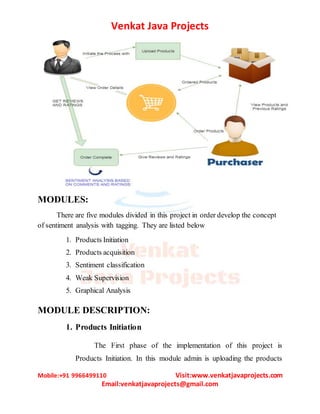
ARCHITECTURE:
Venkat Java Projects
Mobile:+91 9966499110 Visit:www.venkatjavaprojects.com
Email:venkatjavaprojects@gmail.com
MODULES:
There are five modules divided in this project in order develop the concept
of sentiment analysis with tagging. They are listed below
1. Products Initiation
2. Products acquisition
3. Sentiment classification
4. Weak Supervision
5. Graphical Analysis
MODULE DESCRIPTION:
1. Products Initiation
The First phase of the implementation of this project is
Products Initiation. In this module admin is uploading the products
Venkat Java Projects
Mobile:+91 9966499110 Visit:www.venkatjavaprojects.com
Email:venkatjavaprojects@gmail.com
which user wants to see and purchase. Once admin uploads the
product means it stored in the database. The products which are
uploaded are listed in website to admin in order to modify or delete
the particular product. Admin is the only authorized person to upload
the products in this project.
2. Products acquisition
The second module of this product conveys that user can view
the products which are uploaded by admin. Then they can view the
ratings and reviews of the same products which are given by other
users who already purchased the product. According to the help of
ratings and reviews user can purchase the product. The ordered list is
also shown in the project for the convenience of users. The cart and
checkout facility is also available to users from this module.
3. Sentiment classification
The users who are all purchased the products can rate product
as per their interest on one scale of five and they are free to comment
for the same. Based on the ratings and reviews given by user
sentiment can be analyzed. There are two sentiments maintained in
this project they are positive and negative. The equilibrium of rating
and the particular comments are noted. In this module of project we
implement the algorithm named Sentiment-Analysis-using-Naive-
Bayes-Classifier to find the exact sentiment based on the dataset
which are predefined.
4. Weak Supervision
Venkat Java Projects
Mobile:+91 9966499110 Visit:www.venkatjavaprojects.com
Email:venkatjavaprojects@gmail.com
This module provides the convenience to admin for supervision
of the ratings and reviews. It supervises the given rating is high for
positive comment or low ratings for negative comments. It shows the
admin that how user rated for the products. It shows the comments
and rating on the products.
5. Graphical Analysis
In this phase of the Implementation user can get the clear
picture analysis of the products ratings and reviews. Various factors
take into consideration for the graph analysis. In this phase plot the
charts like pie graph, bar chart and so others.
ALGORITHM:
In machine learning, naive Bayes classifiers are a family of
simple probabilistic classifiers based on applying Bayes' theorem with
strong (naive) independence assumptions between the features.
Naive Bayes has been studied extensively since the 1950s. It was
introduced under a different name into the text retrieval community in
the early 1960s,and remains a popular (baseline) method for text
categorization, the problem of judging documents as belonging to one
category or the other (such as spam or legitimate, sports or politics, etc.)
with word frequencies as the features. With appropriate pre-processing,
it is competitive in this domain with more advanced methods
including support vector machines. It also finds application in
automatic medical diagnosis.
Naive Bayes classifiers are highly scalable, requiring a number of
parameters linear in the number of variables (features/predictors) in a
learning problem. Maximum-likelihood training can be done by
evaluating a closed-form expression, which takes linear time, rather than
Venkat Java Projects
Mobile:+91 9966499110 Visit:www.venkatjavaprojects.com
Email:venkatjavaprojects@gmail.com
by expensive iterative approximation as used for many other types of
classifiers.
In the statistics and computer science literature, naive Bayes
models are known under a variety of names, including simple
Bayes and independence Bayes. All these names reference the use of
Bayes' theorem in the classifier's decision rule, but naive Bayes is not
(necessarily) a Bayesian method
Naive Bayes is a simple technique for constructing classifiers:
models that assign class labels to problem instances, represented as
vectors of feature values, where the class labels are drawn from some
finite set. It is not a single algorithm for training such classifiers, but a
family of algorithms based on a common principle: all naive Bayes
classifiers assume that the value of a particular feature is independent of
the value of any other feature, given the class variable. For example, a
fruit may be considered to be an apple if it is red, round, and about
10 cm in diameter. A naive Bayes classifier considers each of these
features to contribute independently to the probability that this fruit is an
apple, regardless of any possible correlations between the color,
roundness, and diameter features.
For some types of probability models, naive Bayes classifiers can
be trained very efficiently in a supervised learning setting. In many
practical applications, parameter estimation for naive Bayes models uses
the method of maximum likelihood; in other words, one can work with
the naive Bayes model without accepting Bayesian probability or using
any Bayesian methods.
Despite their naive design and apparently oversimplified
assumptions, naive Bayes classifiers have worked quite well in many
complex real-world situations. In 2004, an analysis of the Bayesian
classification problem showed that there are sound theoretical reasons
for the apparently implausible efficacy of naive Bayes classifiers.Still, a
comprehensive comparison with other classification algorithms in 2006
showed that Bayes classification is outperformed by other approaches,
such as boosted trees or random forests.
Venkat Java Projects
Mobile:+91 9966499110 Visit:www.venkatjavaprojects.com
Email:venkatjavaprojects@gmail.com
SYSTEM SPECIFICATION:
HARDWARE REQUIREMENTS:
 System : Pentium IV 2.4 GHz.
 Hard Disk : 40 GB.
 Floppy Drive : 1.44 Mb.
 Monitor : 14’ Colour Monitor.
 Mouse : Optical Mouse.
 Ram : 512 Mb.
SOFTWARE REQUIREMENTS:
 Operating system : Windows 7 Ultimate.
 Coding Language : Python.
 Front-End : Python.
 Back-End : Django-ORM
 Designing : Html, css, javascript.
 Data Base : MySQL (WAMP Server).
CONCLUSION:
Venkat Java Projects
Mobile:+91 9966499110 Visit:www.venkatjavaprojects.com
Email:venkatjavaprojects@gmail.com
In this work we proposed a novel deep learning framework named Weakly-
supervised Deep Embedding for review sentencesentiment classification. WDE
trains deep neural networks byexploiting rating information of reviews which is
prevalentlyavailable on many merchant/review Websites. The training is a2-step
procedure: first we learn an embedding space which triesto capture the sentiment
distribution of sentences by penalizingrelative distances among sentences
according to weak labelsinferred from ratings; then a softmax classifier is added on
topof the embedding layer and we fine-tune the network by labeleddata.
Experiments on reviews collected from Amazon.com showthat WDE is effective
and outperforms baseline methods.Two specific instantiations of the framework,
WDE-CNN andWDE-LSTM, are proposed. Compared to WDE-LSTM,
WDECNNhas fewer model parameters, and its computation is moreeasily
parallelized on GPUs. Nevertheless, WDE-CNN cannotwell handle long-term
dependencies in sentences. WDE-LSTMis more capable of modeling the long-term
dependencies insentences, but it is less efficient than WDE-CNN and needs
moretraining data. For future work, we plan to investigate how to combinedifferent
methods to generate better prediction performance.We will also try to apply WDE
on other problems involving weaklabels.

weakly supervised deep embedding for product review sentiment analysis

  • 1.
    Venkat Java Projects Mobile:+919966499110 Visit:www.venkatjavaprojects.com Email:venkatjavaprojects@gmail.com WEAKLY-SUPERVISED DEEP EMBEDDING FOR PRODUCT REVIEW SENTIMENT ANALYSIS ABSTRACT: Product reviews are valuable for upcoming buyers in helping them make decisions. To this end, different opinion mining techniques have been proposed, where judging a review sentence’s orientation (e.g. positive or negative) is one of their key challenges. Recently, deep learning has emerged as an effective means for solving sentiment classification problems. A neural network intrinsically learns a useful representation automatically without human efforts. However, the success of deep learning highly relies on the availability of large-scale training data. We propose a novel deep learning framework for product review sentiment classification which employs prevalently available ratings as weak supervision signals. The framework consists of two steps: (1) learning a high level representation (an embedding space) which captures the general sentiment distribution of sentences through rating information; (2) adding a classification layer on top of the embedding layer and use labeled sentences for supervised fine- tuning. We explore two kinds of low level network structure for modeling review sentences, namely, convolutional feature extractors and long short-term memory. To evaluate the proposed framework, we construct a dataset containing 1.1M weakly labeled review sentences and 11,754 labeled review sentences from Amazon. Experimental results show the efficacy of the proposed framework and its superiority over baselines. EXISTING SYSTEM:
  • 2.
    Venkat Java Projects Mobile:+919966499110 Visit:www.venkatjavaprojects.com Email:venkatjavaprojects@gmail.com Lexicon-based methods typically take the tack of first constructing a sentiment lexicon of opinion words (e.g. “wonderful”, “disgusting”), and then design classification rules based on appeared opinion words and prior syntactic knowledge. Despite effectiveness, this kind of methods requires substantial efforts in lexicon construction and rule design. Furthermore, lexicon-based methods cannot well handle implicit opinions, i.e. objective statements such as “I bought the mattress a week ago, and a valley appeared today”. As pointed out in this is also an important form of opinions. Factual information is usually more helpful than subjective feelings. Lexicon-based methods can only deal with implicit opinions in an ad-hoc way. DISADVANTAGES: Feature engineering also costs a lot of human efforts, and a feature set suitable for one domain may not generate good performance for other domains. This kind of algorithm needs complex lexicon construction and rule design. The existing systems cannot well handle objective statements; it only handles single word based sentiment analysis. PROPOSED SYSTEM: In this work, we propose a novel deep learning framework for review sentence sentiment classification. The framework treats review ratings as weak labels to train deep neural networks. For example, with 5-stars scale we can deem ratings above/below 3-stars as positive/ negative weak labels respectively. The framework generally consists of two steps. In the first step, rather than predicting sentiment labels directly, we try to learn an embedding space (a high level layer in the neural network) which reflects the general sentiment distribution of sentences, from a large number of weakly labeled sentences. That is, we force sentences with the same weak labels to be near each other, while sentences with different weak
  • 3.
    Venkat Java Projects Mobile:+919966499110 Visit:www.venkatjavaprojects.com Email:venkatjavaprojects@gmail.com labels are kept away from one another. To reduce the impact of sentences with rating-inconsistent orientation (hereafter called wrong-labeled sentences), we propose to penalize the relative distances among sentences in the embedding space through a ranking loss. In the second step, a classification layer is added on top of the embedding layer, and we use labeled sentences to fine-tune the deep network. The framework is dubbed Weakly-supervised Deep Embedding (WDE). Regarding network structure, two popular schemes are adopted to learn to extract fixed-length feature vectors from review sentences, namely, convolutional feature extractors and Long Short-Term Memory. ADVANTAGES: The Proposed work leverages the vast amount of weakly labeled review sentences for sentiment analysis. It is much more effective than the previously developed works. The proposed work finds the sentiment not only based on the rating that user gives but also taking into consideration of reviews that they are post, In fact mainly takes an account of review, even though user gave ratings ARCHITECTURE:
  • 4.
    Venkat Java Projects Mobile:+919966499110 Visit:www.venkatjavaprojects.com Email:venkatjavaprojects@gmail.com MODULES: There are five modules divided in this project in order develop the concept of sentiment analysis with tagging. They are listed below 1. Products Initiation 2. Products acquisition 3. Sentiment classification 4. Weak Supervision 5. Graphical Analysis MODULE DESCRIPTION: 1. Products Initiation The First phase of the implementation of this project is Products Initiation. In this module admin is uploading the products
  • 5.
    Venkat Java Projects Mobile:+919966499110 Visit:www.venkatjavaprojects.com Email:venkatjavaprojects@gmail.com which user wants to see and purchase. Once admin uploads the product means it stored in the database. The products which are uploaded are listed in website to admin in order to modify or delete the particular product. Admin is the only authorized person to upload the products in this project. 2. Products acquisition The second module of this product conveys that user can view the products which are uploaded by admin. Then they can view the ratings and reviews of the same products which are given by other users who already purchased the product. According to the help of ratings and reviews user can purchase the product. The ordered list is also shown in the project for the convenience of users. The cart and checkout facility is also available to users from this module. 3. Sentiment classification The users who are all purchased the products can rate product as per their interest on one scale of five and they are free to comment for the same. Based on the ratings and reviews given by user sentiment can be analyzed. There are two sentiments maintained in this project they are positive and negative. The equilibrium of rating and the particular comments are noted. In this module of project we implement the algorithm named Sentiment-Analysis-using-Naive- Bayes-Classifier to find the exact sentiment based on the dataset which are predefined. 4. Weak Supervision
  • 6.
    Venkat Java Projects Mobile:+919966499110 Visit:www.venkatjavaprojects.com Email:venkatjavaprojects@gmail.com This module provides the convenience to admin for supervision of the ratings and reviews. It supervises the given rating is high for positive comment or low ratings for negative comments. It shows the admin that how user rated for the products. It shows the comments and rating on the products. 5. Graphical Analysis In this phase of the Implementation user can get the clear picture analysis of the products ratings and reviews. Various factors take into consideration for the graph analysis. In this phase plot the charts like pie graph, bar chart and so others. ALGORITHM: In machine learning, naive Bayes classifiers are a family of simple probabilistic classifiers based on applying Bayes' theorem with strong (naive) independence assumptions between the features. Naive Bayes has been studied extensively since the 1950s. It was introduced under a different name into the text retrieval community in the early 1960s,and remains a popular (baseline) method for text categorization, the problem of judging documents as belonging to one category or the other (such as spam or legitimate, sports or politics, etc.) with word frequencies as the features. With appropriate pre-processing, it is competitive in this domain with more advanced methods including support vector machines. It also finds application in automatic medical diagnosis. Naive Bayes classifiers are highly scalable, requiring a number of parameters linear in the number of variables (features/predictors) in a learning problem. Maximum-likelihood training can be done by evaluating a closed-form expression, which takes linear time, rather than
  • 7.
    Venkat Java Projects Mobile:+919966499110 Visit:www.venkatjavaprojects.com Email:venkatjavaprojects@gmail.com by expensive iterative approximation as used for many other types of classifiers. In the statistics and computer science literature, naive Bayes models are known under a variety of names, including simple Bayes and independence Bayes. All these names reference the use of Bayes' theorem in the classifier's decision rule, but naive Bayes is not (necessarily) a Bayesian method Naive Bayes is a simple technique for constructing classifiers: models that assign class labels to problem instances, represented as vectors of feature values, where the class labels are drawn from some finite set. It is not a single algorithm for training such classifiers, but a family of algorithms based on a common principle: all naive Bayes classifiers assume that the value of a particular feature is independent of the value of any other feature, given the class variable. For example, a fruit may be considered to be an apple if it is red, round, and about 10 cm in diameter. A naive Bayes classifier considers each of these features to contribute independently to the probability that this fruit is an apple, regardless of any possible correlations between the color, roundness, and diameter features. For some types of probability models, naive Bayes classifiers can be trained very efficiently in a supervised learning setting. In many practical applications, parameter estimation for naive Bayes models uses the method of maximum likelihood; in other words, one can work with the naive Bayes model without accepting Bayesian probability or using any Bayesian methods. Despite their naive design and apparently oversimplified assumptions, naive Bayes classifiers have worked quite well in many complex real-world situations. In 2004, an analysis of the Bayesian classification problem showed that there are sound theoretical reasons for the apparently implausible efficacy of naive Bayes classifiers.Still, a comprehensive comparison with other classification algorithms in 2006 showed that Bayes classification is outperformed by other approaches, such as boosted trees or random forests.
  • 8.
    Venkat Java Projects Mobile:+919966499110 Visit:www.venkatjavaprojects.com Email:venkatjavaprojects@gmail.com SYSTEM SPECIFICATION: HARDWARE REQUIREMENTS:  System : Pentium IV 2.4 GHz.  Hard Disk : 40 GB.  Floppy Drive : 1.44 Mb.  Monitor : 14’ Colour Monitor.  Mouse : Optical Mouse.  Ram : 512 Mb. SOFTWARE REQUIREMENTS:  Operating system : Windows 7 Ultimate.  Coding Language : Python.  Front-End : Python.  Back-End : Django-ORM  Designing : Html, css, javascript.  Data Base : MySQL (WAMP Server). CONCLUSION:
  • 9.
    Venkat Java Projects Mobile:+919966499110 Visit:www.venkatjavaprojects.com Email:venkatjavaprojects@gmail.com In this work we proposed a novel deep learning framework named Weakly- supervised Deep Embedding for review sentencesentiment classification. WDE trains deep neural networks byexploiting rating information of reviews which is prevalentlyavailable on many merchant/review Websites. The training is a2-step procedure: first we learn an embedding space which triesto capture the sentiment distribution of sentences by penalizingrelative distances among sentences according to weak labelsinferred from ratings; then a softmax classifier is added on topof the embedding layer and we fine-tune the network by labeleddata. Experiments on reviews collected from Amazon.com showthat WDE is effective and outperforms baseline methods.Two specific instantiations of the framework, WDE-CNN andWDE-LSTM, are proposed. Compared to WDE-LSTM, WDECNNhas fewer model parameters, and its computation is moreeasily parallelized on GPUs. Nevertheless, WDE-CNN cannotwell handle long-term dependencies in sentences. WDE-LSTMis more capable of modeling the long-term dependencies insentences, but it is less efficient than WDE-CNN and needs moretraining data. For future work, we plan to investigate how to combinedifferent methods to generate better prediction performance.We will also try to apply WDE on other problems involving weaklabels.