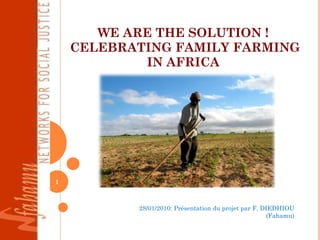
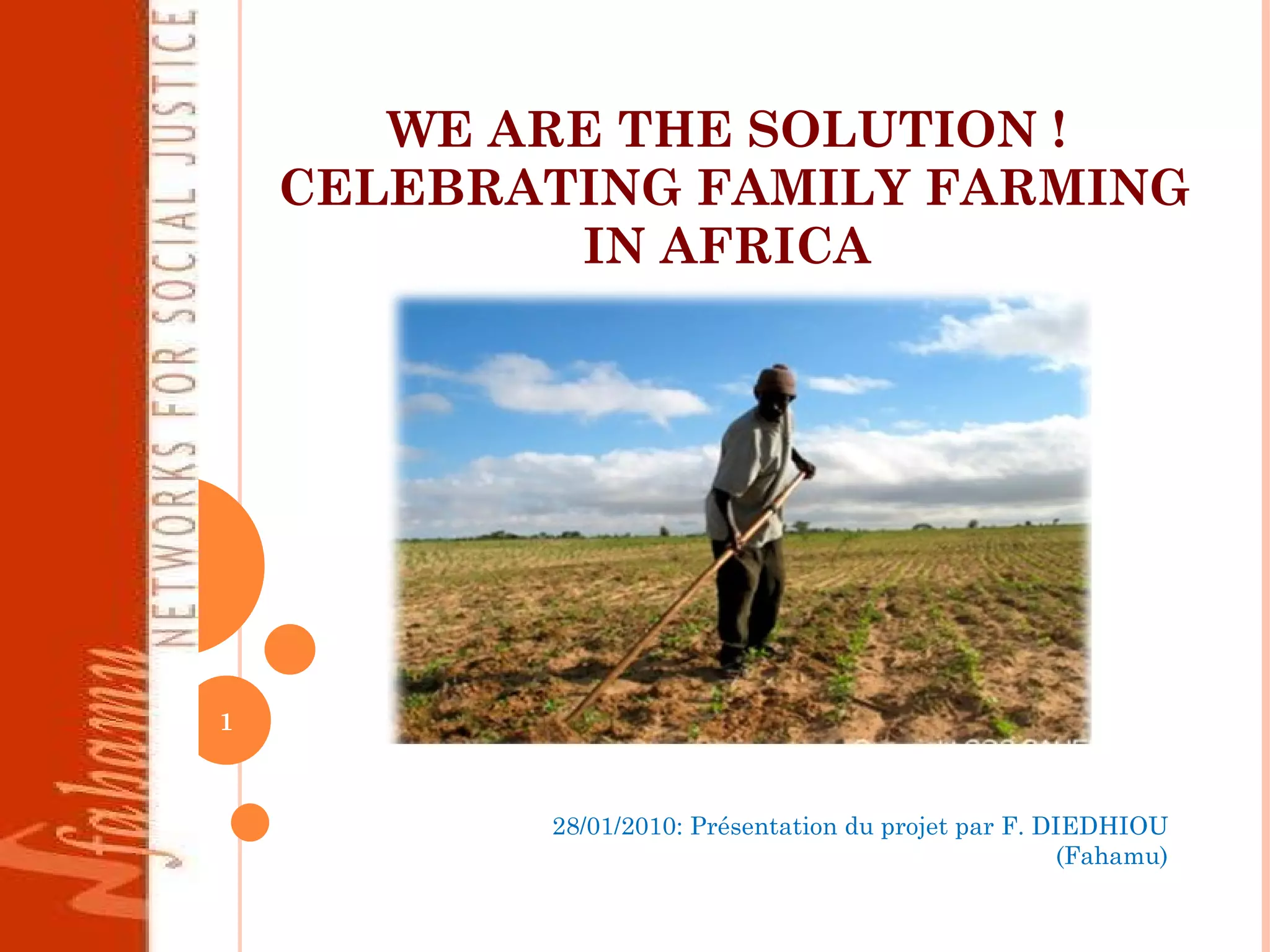
WE ARE THE SOLUTION !  CELEBRATING FAMILY FARMING IN AFRICA  28/01/2010: Présentation du projet par F. DIEDHIOU (Fahamu)
FAHAMU has a vision of the world where people organise to emancipate themselves from all forms of oppression, recognise their social responsibilities, respect each other’s differences, and realise their full potential. www.fahamu.org
WE ARE THE SOLUTION’ PAN-AFRICAN CAMPAIGN OBJECTIVES To promote good practices and knowledge that have been known and handed down for generations in Africa (agro-ecology, seed saving) and have sustained food sovereignty on the continent To influence decision-makers and promote better governance To value family agricultural production
OBJECTIVES OF THE WOMEN’S CAMPAIGN The overall goal of this campaign is to equip rural women with the skills and tools to ensure that their voices are heard and concerns are addressed in order to effectively participate alongside Africa’s large farmer federations in the greater  ‘We are the Solution’ pan-African campaign.
THE GENERAL WOMEN’S CAMPAIGN OBJECTIVES Objective 1:  To build the organizational and individual capacities of selected rural women’s associations and their leaders. Objective 2:  To build awareness and empower the voices of rural women to engage in decision-making processes in ongoing local, regional and global campaigns. Objective 3:  To organize, mobilize and sustain an Africa-wide action oriented network for information sharing and advocacy
THE SPECIFIC OBJECTIVES OF THE WOMEN’S CAMPAIGN Objective 1:  To strengthen the work of 12 rural women’s associations and their leaders through organizational and individual capacity building activities. Objective 2:   To facilitate the participation of 75 rural women participants in media and advocacy activities so that they can engage in decision-making processes in local, regional and global campaigns.  Objective 3:  To mobilize and sustain an Africa-wide action oriented network of 1000 stakeholders for information sharing, partnership and advocacy
EXPECTED IMPACTS  The impact of this campaign will be to ensure that rural women’s associations will have the skills to improve, promote and share their traditional agricultural knowledge ensuring that this rich knowledge is not lost and is indeed promoted as an alternative to the Green Revolution methods
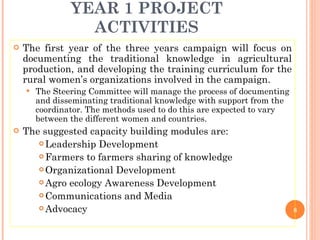
YEAR 1 PROJECT ACTIVITIES The first year of the three years campaign will focus on documenting the traditional knowledge in agricultural production, and developing the training curriculum for the rural women’s organizations involved in the campaign.  The Steering Committee will manage the process of documenting and disseminating traditional knowledge with support from the coordinator. The methods used to do this are expected to vary between the different women and countries. The suggested capacity building modules are:  Leadership Development Farmers to farmers sharing of knowledge Organizational Development Agro ecology Awareness Development Communications and Media Advocacy
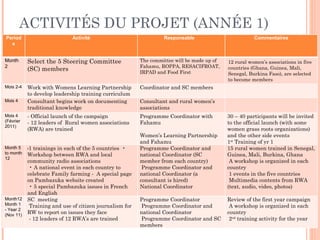
ACTIVITÉS DU PROJET (ANNÉE 1) Periode Activité Responsable  Commentaires Month 2 Select the 5 Steering Committee (SC) members The committee will be made up of Fahamu, ROPPA, RESACIFROAT, IRPAD and Food First 12 rural women’s associations in five countries (Ghana, Guinea, Mali, Senegal, Burkina Faso), are selected to become members Mois 2-4 Work with Womens Learning Partnership to develop leadership training curriculum Coordinator and SC members Mois 4 Consultant begins work on documenting traditional knowledge Consultant and rural women’s associations Mois 4 (Février 2011) - Official launch of the campaign - 12 leaders of  Rural women associations (RWA) are trained Programme Coordinator with Fahamu   Women’s Learning Partnership and Fahamu 30 – 40 participants will be invited to the official launch (with some women grass roots organizations) and the other side events 1 st  Training of yr 1 Month 5 to month 12 • 1 trainings in each of the 5 countries  • Workshop between RWA and local community radio associations   •  A national event in each country to celebrate Family farming -  A special page on Pambazuka website created  •  5 special Pambazuka issues in French and English  Programme Coordinator and national Coordinator (SC member from each country)   Programme Coordinator and national Coordinator (a consultant is hired) National Coordinator 15 rural women trained in Senegal, Guinea, Mali, Burkina, Ghana   A workshop is organized in each country   1 events in the five countries   Multimedia contents from RWA (text, audio, video, photos)  Month12  Month 1 - Year 2 (Nov 11) SC  meeting   Training and use of citizen journalism for RW to report on issues they face   - 12 leaders of 12 RWA’s are trained Programme Coordinator   Programme Coordinator and national Coordinator    Programme Coordinator and SC members Review of the first year campaign   A workshop is organized in each country   2 nd  training activity for the year
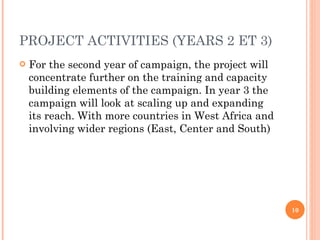
PROJECT ACTIVITIES (YEARS 2 ET 3) For the second year of campaign, the project will concentrate further on the training and capacity building elements of the campaign. In year 3 the campaign will look at scaling up and expanding its reach. With more countries in West Africa and involving wider regions (East, Center and South)
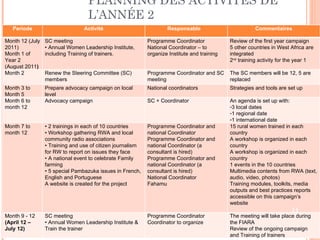
PLANNING DES ACTIVITÉS DE L’ANNÉE 2 Periode Activité Responsable  Commentaires Month 12 (July 2011) Month 1 of Year 2 (August 2011 ) SC meeting •  Annual Women Leadership Institute, including Training of trainers. Programme Coordinator National Coordinator – to organize Institute and training Review of the first year campaign 5 other countries in West Africa are integrated 2 nd  training activity for the year 1 Month 2 Renew the Steering Committee (SC) members Programme Coordinator and SC meeting The SC members will be 12, 5 are replaced Month 3 to Month 5 Prepare advocacy campaign on local level  National coordinators Strategies and tools are set up Month 6 to month 12 Advocacy campaign SC + Coordinator  An agenda is set up with: 3 local dates 1 regional date 1 international date Month 7 to month 12 •  2 trainings in each of 10 countries •  Workshop gathering RWA and local community radio associations  •  Training and use of citizen journalism for RW to report on issues they face •  A national event to celebrate Family farming •  5 special Pambazuka issues in French, English and Portuguese A website is created for the project Programme Coordinator and national Coordinator Programme Coordinator and national Coordinator (a consultant is hired) Programme Coordinator and national Coordinator (a consultant is hired) National Coordinator Fahamu 15 rural women trained in each country A workshop is organized in each country A workshop is organized in each country 1 events in the 10 countries Multimedia contents from RWA (text, audio, video, photos) Training modules, toolkits, media outputs and best practices reports accessible on this campaign’s website Month 9 - 12 (April 12 – July 12) SC meeting •  Annual Women Leadership Institute & Train the trainer  Programme Coordinator Coordinator to organize The meeting will take place during the FIARA  Review of the ongoing campaign and Training of trainers
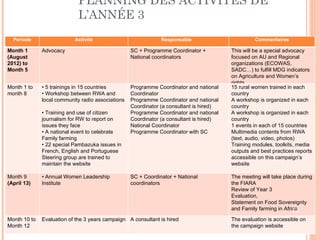
PLANNING DES ACTIVITÉS DE L’ANNÉE 3 Periode Activité Responsable  Commentaires Month 1  (August 2012) to Month 5 Advocacy  SC + Programme Coordinator + National coordinators This will be a special advocacy focused on AU and Regional organizations (ECOWAS, SADC…) to fulfill MDG indicators on Agriculture and Women’s rights Month 1 to month 8 •  5 trainings in 15 countries •  Workshop between RWA and local community radio associations  •  Training and use of citizen journalism for RW to report on issues they face •  A national event to celebrate Family farming •  22 special Pambazuka issues in French, English and Portuguese Steering group are trained to maintain the website Programme Coordinator and national Coordinator Programme Coordinator and national Coordinator (a consultant is hired) Programme Coordinator and national Coordinator (a consultant is hired) National Coordinator Programme Coordinator with SC 15 rural women trained in each country A workshop is organized in each country A workshop is organized in each country 1 events in each of 15 countries Multimedia contents from RWA (text, audio, video, photos) Training modules, toolkits, media outputs and best practices reports accessible on this campaign’s website Month 9 (April 13) •  Annual Women Leadership Institute SC + Coordinator + National coordinators The meeting will take place during the FIARA  Review of Year 3  Evaluation,  Statement on Food Sovereignty and Family farming in Africa Month 10 to Month 12 Evaluation of the 3 years campaign A consultant is hired The evaluation is accessible on the campaign website
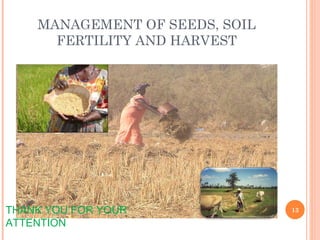
MANAGEMENT OF SEEDS, SOIL FERTILITY AND HARVEST THANK YOU FOR YOUR ATTENTION

We are the_solution

  • 1.
    WE ARE THESOLUTION ! CELEBRATING FAMILY FARMING IN AFRICA 28/01/2010: Présentation du projet par F. DIEDHIOU (Fahamu)
  • 2.
    FAHAMU has avision of the world where people organise to emancipate themselves from all forms of oppression, recognise their social responsibilities, respect each other’s differences, and realise their full potential. www.fahamu.org
  • 3.
    WE ARE THESOLUTION’ PAN-AFRICAN CAMPAIGN OBJECTIVES To promote good practices and knowledge that have been known and handed down for generations in Africa (agro-ecology, seed saving) and have sustained food sovereignty on the continent To influence decision-makers and promote better governance To value family agricultural production
  • 4.
    OBJECTIVES OF THEWOMEN’S CAMPAIGN The overall goal of this campaign is to equip rural women with the skills and tools to ensure that their voices are heard and concerns are addressed in order to effectively participate alongside Africa’s large farmer federations in the greater ‘We are the Solution’ pan-African campaign.
  • 5.
    THE GENERAL WOMEN’SCAMPAIGN OBJECTIVES Objective 1: To build the organizational and individual capacities of selected rural women’s associations and their leaders. Objective 2: To build awareness and empower the voices of rural women to engage in decision-making processes in ongoing local, regional and global campaigns. Objective 3: To organize, mobilize and sustain an Africa-wide action oriented network for information sharing and advocacy
  • 6.
    THE SPECIFIC OBJECTIVESOF THE WOMEN’S CAMPAIGN Objective 1: To strengthen the work of 12 rural women’s associations and their leaders through organizational and individual capacity building activities. Objective 2: To facilitate the participation of 75 rural women participants in media and advocacy activities so that they can engage in decision-making processes in local, regional and global campaigns. Objective 3: To mobilize and sustain an Africa-wide action oriented network of 1000 stakeholders for information sharing, partnership and advocacy
  • 7.
    EXPECTED IMPACTS The impact of this campaign will be to ensure that rural women’s associations will have the skills to improve, promote and share their traditional agricultural knowledge ensuring that this rich knowledge is not lost and is indeed promoted as an alternative to the Green Revolution methods
  • 8.
    YEAR 1 PROJECTACTIVITIES The first year of the three years campaign will focus on documenting the traditional knowledge in agricultural production, and developing the training curriculum for the rural women’s organizations involved in the campaign. The Steering Committee will manage the process of documenting and disseminating traditional knowledge with support from the coordinator. The methods used to do this are expected to vary between the different women and countries. The suggested capacity building modules are: Leadership Development Farmers to farmers sharing of knowledge Organizational Development Agro ecology Awareness Development Communications and Media Advocacy
  • 9.
    ACTIVITÉS DU PROJET(ANNÉE 1) Periode Activité Responsable Commentaires Month 2 Select the 5 Steering Committee (SC) members The committee will be made up of Fahamu, ROPPA, RESACIFROAT, IRPAD and Food First 12 rural women’s associations in five countries (Ghana, Guinea, Mali, Senegal, Burkina Faso), are selected to become members Mois 2-4 Work with Womens Learning Partnership to develop leadership training curriculum Coordinator and SC members Mois 4 Consultant begins work on documenting traditional knowledge Consultant and rural women’s associations Mois 4 (Février 2011) - Official launch of the campaign - 12 leaders of Rural women associations (RWA) are trained Programme Coordinator with Fahamu   Women’s Learning Partnership and Fahamu 30 – 40 participants will be invited to the official launch (with some women grass roots organizations) and the other side events 1 st Training of yr 1 Month 5 to month 12 • 1 trainings in each of the 5 countries  • Workshop between RWA and local community radio associations  •  A national event in each country to celebrate Family farming -  A special page on Pambazuka website created  • 5 special Pambazuka issues in French and English Programme Coordinator and national Coordinator (SC member from each country)   Programme Coordinator and national Coordinator (a consultant is hired) National Coordinator 15 rural women trained in Senegal, Guinea, Mali, Burkina, Ghana   A workshop is organized in each country   1 events in the five countries   Multimedia contents from RWA (text, audio, video, photos) Month12 Month 1 - Year 2 (Nov 11) SC meeting   Training and use of citizen journalism for RW to report on issues they face   - 12 leaders of 12 RWA’s are trained Programme Coordinator   Programme Coordinator and national Coordinator   Programme Coordinator and SC members Review of the first year campaign   A workshop is organized in each country   2 nd training activity for the year
  • 10.
    PROJECT ACTIVITIES (YEARS2 ET 3) For the second year of campaign, the project will concentrate further on the training and capacity building elements of the campaign. In year 3 the campaign will look at scaling up and expanding its reach. With more countries in West Africa and involving wider regions (East, Center and South)
  • 11.
    PLANNING DES ACTIVITÉSDE L’ANNÉE 2 Periode Activité Responsable Commentaires Month 12 (July 2011) Month 1 of Year 2 (August 2011 ) SC meeting • Annual Women Leadership Institute, including Training of trainers. Programme Coordinator National Coordinator – to organize Institute and training Review of the first year campaign 5 other countries in West Africa are integrated 2 nd training activity for the year 1 Month 2 Renew the Steering Committee (SC) members Programme Coordinator and SC meeting The SC members will be 12, 5 are replaced Month 3 to Month 5 Prepare advocacy campaign on local level National coordinators Strategies and tools are set up Month 6 to month 12 Advocacy campaign SC + Coordinator An agenda is set up with: 3 local dates 1 regional date 1 international date Month 7 to month 12 •  2 trainings in each of 10 countries • Workshop gathering RWA and local community radio associations • Training and use of citizen journalism for RW to report on issues they face •  A national event to celebrate Family farming • 5 special Pambazuka issues in French, English and Portuguese A website is created for the project Programme Coordinator and national Coordinator Programme Coordinator and national Coordinator (a consultant is hired) Programme Coordinator and national Coordinator (a consultant is hired) National Coordinator Fahamu 15 rural women trained in each country A workshop is organized in each country A workshop is organized in each country 1 events in the 10 countries Multimedia contents from RWA (text, audio, video, photos) Training modules, toolkits, media outputs and best practices reports accessible on this campaign’s website Month 9 - 12 (April 12 – July 12) SC meeting • Annual Women Leadership Institute & Train the trainer Programme Coordinator Coordinator to organize The meeting will take place during the FIARA Review of the ongoing campaign and Training of trainers
  • 12.
    PLANNING DES ACTIVITÉSDE L’ANNÉE 3 Periode Activité Responsable Commentaires Month 1 (August 2012) to Month 5 Advocacy SC + Programme Coordinator + National coordinators This will be a special advocacy focused on AU and Regional organizations (ECOWAS, SADC…) to fulfill MDG indicators on Agriculture and Women’s rights Month 1 to month 8 •  5 trainings in 15 countries • Workshop between RWA and local community radio associations • Training and use of citizen journalism for RW to report on issues they face •  A national event to celebrate Family farming • 22 special Pambazuka issues in French, English and Portuguese Steering group are trained to maintain the website Programme Coordinator and national Coordinator Programme Coordinator and national Coordinator (a consultant is hired) Programme Coordinator and national Coordinator (a consultant is hired) National Coordinator Programme Coordinator with SC 15 rural women trained in each country A workshop is organized in each country A workshop is organized in each country 1 events in each of 15 countries Multimedia contents from RWA (text, audio, video, photos) Training modules, toolkits, media outputs and best practices reports accessible on this campaign’s website Month 9 (April 13) • Annual Women Leadership Institute SC + Coordinator + National coordinators The meeting will take place during the FIARA Review of Year 3 Evaluation, Statement on Food Sovereignty and Family farming in Africa Month 10 to Month 12 Evaluation of the 3 years campaign A consultant is hired The evaluation is accessible on the campaign website
  • 13.
    MANAGEMENT OF SEEDS,SOIL FERTILITY AND HARVEST THANK YOU FOR YOUR ATTENTION