Use of Python For
Cyber Security
How can we use this in different ways
www.appsdevpro.com
Owners of businesses must be mindful of the dangers
that might be presented by nefarious individuals.
Python, thankfully, makes finding and fixing problems in
a system easier and faster.
It offers reliable libraries that may be used to build apps
that scan source code for flaws and examine network
data for suspicious activity.
Python enables security experts to quickly identify and
fix any existing or potential holes, protecting their
systems from harm.
1) Identifying Vulnerabilities
The Python programming language offers developers
strong tools for safe development as online application
security becomes more crucial for businesses.
Threats like remote code execution, cross-site scripting,
and SQL injection are guarded against by libraries like
Django and Flask.
Developers may quickly get data from webpages using
Requests, Scrapy, and Urllib. Last but not least, pyJWT
and cryptography offer a safe way to authenticate users
and encrypt data.
These Python modules and tools can assist
programmers in building safe online apps.
2) Web Application Security
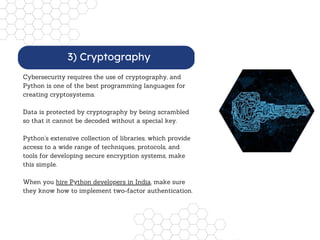
Cybersecurity requires the use of cryptography, and
Python is one of the best programming languages for
creating cryptosystems.
Data is protected by cryptography by being scrambled
so that it cannot be decoded without a special key.
Python's extensive collection of libraries, which provide
access to a wide range of techniques, protocols, and
tools for developing secure encryption systems, make
this simple.
When you hire Python developers in India, make sure
they know how to implement two-factor authentication.
3) Cryptography
This automation may significantly boost productivity
while also enabling you to implement consistent and
precise security measures. All of your security-related
operations may be automated quickly and easily with
Python.
Additionally, Python may be used to streamline
administrative chores like network device setting and
user account management. Python-based custom scripts
can also help with security testing by producing test
cases and executing automated scans.
An excellent tool for facilitating and protecting your
network is automation. Python allows you to create
scripts that automate security-related operations and
greatly reduce your workload.
4) Automating Tasks
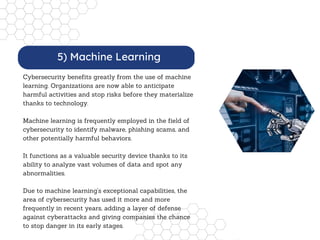
Cybersecurity benefits greatly from the use of machine
learning. Organizations are now able to anticipate
harmful activities and stop risks before they materialize
thanks to technology.
Machine learning is frequently employed in the field of
cybersecurity to identify malware, phishing scams, and
other potentially harmful behaviors.
It functions as a valuable security device thanks to its
ability to analyze vast volumes of data and spot any
abnormalities.
Due to machine learning's exceptional capabilities, the
area of cybersecurity has used it more and more
frequently in recent years, adding a layer of defense
against cyberattacks and giving companies the chance
to stop danger in its early stages.
5) Machine Learning
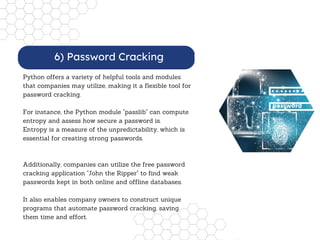
Python offers a variety of helpful tools and modules
that companies may utilize, making it a flexible tool for
password cracking.
For instance, the Python module "passlib" can compute
entropy and assess how secure a password is.
Entropy is a measure of the unpredictability, which is
essential for creating strong passwords.
Additionally, companies can utilize the free password
cracking application "John the Ripper" to find weak
passwords kept in both online and offline databases.
It also enables company owners to construct unique
programs that automate password cracking, saving
them time and effort.
6) Password Cracking
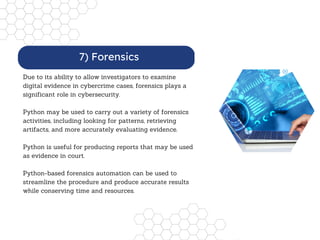
Due to its ability to allow investigators to examine
digital evidence in cybercrime cases, forensics plays a
significant role in cybersecurity.
Python may be used to carry out a variety of forensics
activities, including looking for patterns, retrieving
artifacts, and more accurately evaluating evidence.
Python is useful for producing reports that may be used
as evidence in court.
Python-based forensics automation can be used to
streamline the procedure and produce accurate results
while conserving time and resources.
7) Forensics
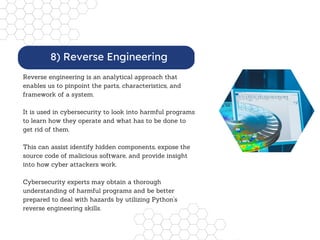
Reverse engineering is an analytical approach that
enables us to pinpoint the parts, characteristics, and
framework of a system.
It is used in cybersecurity to look into harmful programs
to learn how they operate and what has to be done to
get rid of them.
This can assist identify hidden components, expose the
source code of malicious software, and provide insight
into how cyber attackers work.
Cybersecurity experts may obtain a thorough
understanding of harmful programs and be better
prepared to deal with hazards by utilizing Python's
reverse engineering skills.
8) Reverse Engineering
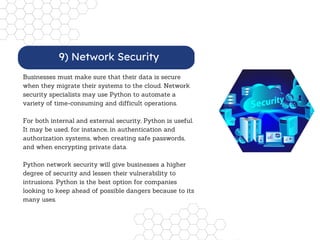
Businesses must make sure that their data is secure
when they migrate their systems to the cloud. Network
security specialists may use Python to automate a
variety of time-consuming and difficult operations.
For both internal and external security, Python is useful.
It may be used, for instance, in authentication and
authorization systems, when creating safe passwords,
and when encrypting private data.
Python network security will give businesses a higher
degree of security and lessen their vulnerability to
intrusions. Python is the best option for companies
looking to keep ahead of possible dangers because to its
many uses.
9) Network Security
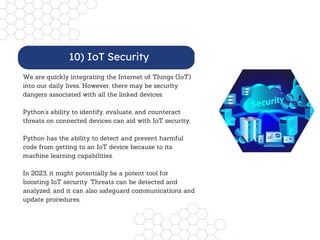
We are quickly integrating the Internet of Things (IoT)
into our daily lives. However, there may be security
dangers associated with all the linked devices.
Python's ability to identify, evaluate, and counteract
threats on connected devices can aid with IoT security.
Python has the ability to detect and prevent harmful
code from getting to an IoT device because to its
machine learning capabilities.
In 2023, it might potentially be a potent tool for
boosting IoT security. Threats can be detected and
analyzed, and it can also safeguard communications and
update procedures.
10) IoT Security
A crucial part of cyber security is penetration testing,
which examines a system, application, or network's
security by looking for weaknesses.
Python is a dependable tool for this type of testing since
it enables users to automate activities, analyze data, and
search for new vulnerabilities.
Python scripting may be used to conduct vulnerability
checks, automate processes like breaking weak
passwords, and analyze networks and systems for flaws.
Python may be used to create reports that provide
information on any vulnerabilities or flaws that were
discovered during the test.
11) Penetration Testing
Python is a very adaptable language that is become
more and more useful in the cybersecurity industry.
Python can be used in almost every aspect of
cybersecurity, from finding flaws in online apps and
encryption to automating procedures and using
machine learning.
Python adoption is anticipated to increase as the cyber
security industry develops and grows. Up until at least
2023, Python is anticipated to remain a vital tool for
cyber security experts due to its continued success and
improved functionality.
Companies looking to exploit Python's capabilities for
cybersecurity can outsource their needs to Indian
Python developers, giving them access to qualified help
while cutting costs.
Conclusion
Contact Us
www.appsdevpro.com
biz@appsdevpro.com
(+91)9898021433

Ways You Can Use Python For Cybersecurity - AppsDevPro

  • 1.
    Use of PythonFor Cyber Security How can we use this in different ways www.appsdevpro.com
  • 2.
    Owners of businessesmust be mindful of the dangers that might be presented by nefarious individuals. Python, thankfully, makes finding and fixing problems in a system easier and faster. It offers reliable libraries that may be used to build apps that scan source code for flaws and examine network data for suspicious activity. Python enables security experts to quickly identify and fix any existing or potential holes, protecting their systems from harm. 1) Identifying Vulnerabilities
  • 3.
    The Python programminglanguage offers developers strong tools for safe development as online application security becomes more crucial for businesses. Threats like remote code execution, cross-site scripting, and SQL injection are guarded against by libraries like Django and Flask. Developers may quickly get data from webpages using Requests, Scrapy, and Urllib. Last but not least, pyJWT and cryptography offer a safe way to authenticate users and encrypt data. These Python modules and tools can assist programmers in building safe online apps. 2) Web Application Security
  • 4.
    Cybersecurity requires theuse of cryptography, and Python is one of the best programming languages for creating cryptosystems. Data is protected by cryptography by being scrambled so that it cannot be decoded without a special key. Python's extensive collection of libraries, which provide access to a wide range of techniques, protocols, and tools for developing secure encryption systems, make this simple. When you hire Python developers in India, make sure they know how to implement two-factor authentication. 3) Cryptography
  • 5.
    This automation maysignificantly boost productivity while also enabling you to implement consistent and precise security measures. All of your security-related operations may be automated quickly and easily with Python. Additionally, Python may be used to streamline administrative chores like network device setting and user account management. Python-based custom scripts can also help with security testing by producing test cases and executing automated scans. An excellent tool for facilitating and protecting your network is automation. Python allows you to create scripts that automate security-related operations and greatly reduce your workload. 4) Automating Tasks
  • 6.
    Cybersecurity benefits greatlyfrom the use of machine learning. Organizations are now able to anticipate harmful activities and stop risks before they materialize thanks to technology. Machine learning is frequently employed in the field of cybersecurity to identify malware, phishing scams, and other potentially harmful behaviors. It functions as a valuable security device thanks to its ability to analyze vast volumes of data and spot any abnormalities. Due to machine learning's exceptional capabilities, the area of cybersecurity has used it more and more frequently in recent years, adding a layer of defense against cyberattacks and giving companies the chance to stop danger in its early stages. 5) Machine Learning
  • 7.
    Python offers avariety of helpful tools and modules that companies may utilize, making it a flexible tool for password cracking. For instance, the Python module "passlib" can compute entropy and assess how secure a password is. Entropy is a measure of the unpredictability, which is essential for creating strong passwords. Additionally, companies can utilize the free password cracking application "John the Ripper" to find weak passwords kept in both online and offline databases. It also enables company owners to construct unique programs that automate password cracking, saving them time and effort. 6) Password Cracking
  • 8.
    Due to itsability to allow investigators to examine digital evidence in cybercrime cases, forensics plays a significant role in cybersecurity. Python may be used to carry out a variety of forensics activities, including looking for patterns, retrieving artifacts, and more accurately evaluating evidence. Python is useful for producing reports that may be used as evidence in court. Python-based forensics automation can be used to streamline the procedure and produce accurate results while conserving time and resources. 7) Forensics
  • 9.
    Reverse engineering isan analytical approach that enables us to pinpoint the parts, characteristics, and framework of a system. It is used in cybersecurity to look into harmful programs to learn how they operate and what has to be done to get rid of them. This can assist identify hidden components, expose the source code of malicious software, and provide insight into how cyber attackers work. Cybersecurity experts may obtain a thorough understanding of harmful programs and be better prepared to deal with hazards by utilizing Python's reverse engineering skills. 8) Reverse Engineering
  • 10.
    Businesses must makesure that their data is secure when they migrate their systems to the cloud. Network security specialists may use Python to automate a variety of time-consuming and difficult operations. For both internal and external security, Python is useful. It may be used, for instance, in authentication and authorization systems, when creating safe passwords, and when encrypting private data. Python network security will give businesses a higher degree of security and lessen their vulnerability to intrusions. Python is the best option for companies looking to keep ahead of possible dangers because to its many uses. 9) Network Security
  • 11.
    We are quicklyintegrating the Internet of Things (IoT) into our daily lives. However, there may be security dangers associated with all the linked devices. Python's ability to identify, evaluate, and counteract threats on connected devices can aid with IoT security. Python has the ability to detect and prevent harmful code from getting to an IoT device because to its machine learning capabilities. In 2023, it might potentially be a potent tool for boosting IoT security. Threats can be detected and analyzed, and it can also safeguard communications and update procedures. 10) IoT Security
  • 12.
    A crucial partof cyber security is penetration testing, which examines a system, application, or network's security by looking for weaknesses. Python is a dependable tool for this type of testing since it enables users to automate activities, analyze data, and search for new vulnerabilities. Python scripting may be used to conduct vulnerability checks, automate processes like breaking weak passwords, and analyze networks and systems for flaws. Python may be used to create reports that provide information on any vulnerabilities or flaws that were discovered during the test. 11) Penetration Testing
  • 13.
    Python is avery adaptable language that is become more and more useful in the cybersecurity industry. Python can be used in almost every aspect of cybersecurity, from finding flaws in online apps and encryption to automating procedures and using machine learning. Python adoption is anticipated to increase as the cyber security industry develops and grows. Up until at least 2023, Python is anticipated to remain a vital tool for cyber security experts due to its continued success and improved functionality. Companies looking to exploit Python's capabilities for cybersecurity can outsource their needs to Indian Python developers, giving them access to qualified help while cutting costs. Conclusion
  • 14.