Huygen’s Principle
WAVEFRONT 
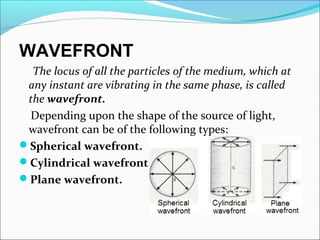
The locus of all the particles of the medium, which at 
any instant are vibrating in the same phase, is called 
the wavefront. 
Depending upon the shape of the source of light, 
wavefront can be of the following types: 
Spherical wavefront. 
Cylindrical wavefront. 
Plane wavefront.
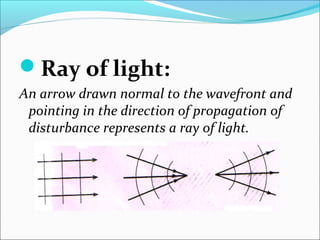
Ray of light: 
An arrow drawn normal to the wavefront and 
pointing in the direction of propagation of 
disturbance represents a ray of light.
HUYGENS’ PRINCIPLE 
Huygens’ principle is a geometrical construction, which is 
used to determine the new position of a wavefront at a later 
time from its given position at any instant. In other words, 
the principle gives a method to know as to how light spreads 
out in the medium. 
Huygens’ principle is based on the following assumptions: 
Each point on the given or primary wavefront acts as a source 
of secondary wavelets, sending out disturbance in all directions 
in a similar manner as the original source of light does. 
The new position of the wavefront at any instant (called 
secondary wavefront) is the envelope of the secondary wavelets 
at that instant. 
The above two assumptions are known as Huygens’ 
principle or Huygens’ construction.
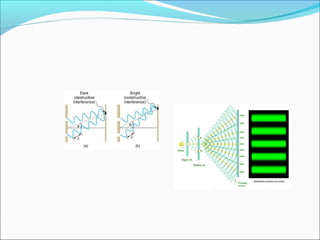
INTERFERENCE OF LIGHT 
The phenomenon of non-uniform distribution of energy 
in the medium due to superposition of two light waves is 
called interference of light. 
COHERENT SOURCES 
Two independent sources of light cannot emit waves 
continuously. 
The waves emitted by two independent sources of light 
do not have same phase or a constant phase difference.
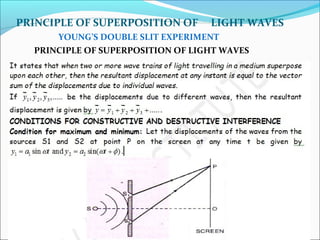
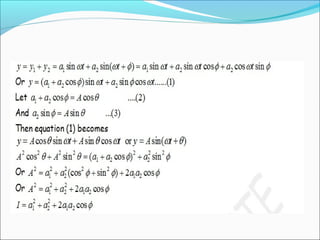
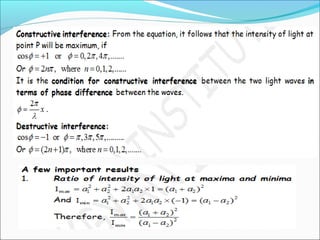
PRINCIPLE OF SUPERPOSITION OF LIGHT WAVES 
YOUNG’S DOUBLE SLIT EXPERIMENT 
PRINCIPLE OF SUPERPOSITION OF LIGHT WAVES
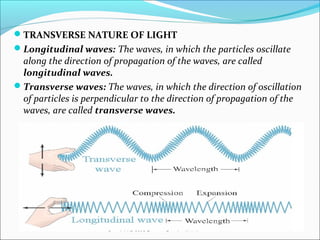
TRANSVERSE NATURE OF LIGHT 
Longitudinal waves: The waves, in which the particles oscillate 
along the direction of propagation of the waves, are called 
longitudinal waves. 
Transverse waves: The waves, in which the direction of oscillation 
of particles is perpendicular to the direction of propagation of the 
waves, are called transverse waves.
LAW OF MALUS 
It states that when a completely plane polarized light 
beam is incident on an analyser, the intensity of the 
emergent light varies as the square of the cosine of the 
angle between the planes of transmission of the analyser 
and the polarizer.
TRANSVERSE NATURE OF LIGHT 
Longitudinal waves: The waves, in which the particles 
oscillate along the direction of propagation of the waves, 
are called longitudinal waves. 
Transverse waves: The waves, in which the direction of 
oscillation of particles is perpendicular to the direction of 
propagation of the waves, are called transverse waves.

Wave optics

  • 1.
  • 2.
    WAVEFRONT The locusof all the particles of the medium, which at any instant are vibrating in the same phase, is called the wavefront. Depending upon the shape of the source of light, wavefront can be of the following types: Spherical wavefront. Cylindrical wavefront. Plane wavefront.
  • 3.
    Ray of light: An arrow drawn normal to the wavefront and pointing in the direction of propagation of disturbance represents a ray of light.
  • 4.
    HUYGENS’ PRINCIPLE Huygens’principle is a geometrical construction, which is used to determine the new position of a wavefront at a later time from its given position at any instant. In other words, the principle gives a method to know as to how light spreads out in the medium. Huygens’ principle is based on the following assumptions: Each point on the given or primary wavefront acts as a source of secondary wavelets, sending out disturbance in all directions in a similar manner as the original source of light does. The new position of the wavefront at any instant (called secondary wavefront) is the envelope of the secondary wavelets at that instant. The above two assumptions are known as Huygens’ principle or Huygens’ construction.
  • 5.
    INTERFERENCE OF LIGHT The phenomenon of non-uniform distribution of energy in the medium due to superposition of two light waves is called interference of light. COHERENT SOURCES Two independent sources of light cannot emit waves continuously. The waves emitted by two independent sources of light do not have same phase or a constant phase difference.
  • 6.
    PRINCIPLE OF SUPERPOSITIONOF LIGHT WAVES YOUNG’S DOUBLE SLIT EXPERIMENT PRINCIPLE OF SUPERPOSITION OF LIGHT WAVES
  • 12.
    TRANSVERSE NATURE OFLIGHT Longitudinal waves: The waves, in which the particles oscillate along the direction of propagation of the waves, are called longitudinal waves. Transverse waves: The waves, in which the direction of oscillation of particles is perpendicular to the direction of propagation of the waves, are called transverse waves.
  • 14.
    LAW OF MALUS It states that when a completely plane polarized light beam is incident on an analyser, the intensity of the emergent light varies as the square of the cosine of the angle between the planes of transmission of the analyser and the polarizer.
  • 15.
    TRANSVERSE NATURE OFLIGHT Longitudinal waves: The waves, in which the particles oscillate along the direction of propagation of the waves, are called longitudinal waves. Transverse waves: The waves, in which the direction of oscillation of particles is perpendicular to the direction of propagation of the waves, are called transverse waves.