T- 1-855-694-8886
Email- info@iTutor.com
By iTutor.com
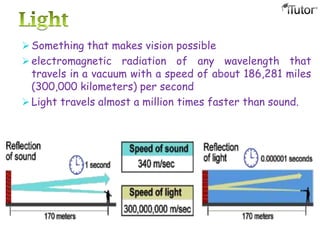
 Something that makes vision possible
 electromagnetic radiation of any wavelength that
travels in a vacuum with a speed of about 186,281 miles
(300,000 kilometers) per second
 Light travels almost a million times faster than sound.
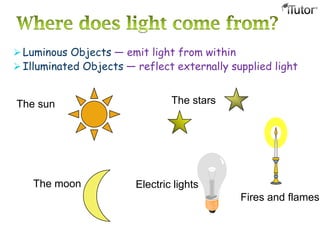
 Luminous Objects — emit light from within
 Illuminated Objects — reflect externally supplied light
The starsThe sun
The moon Electric lights
Fires and flames
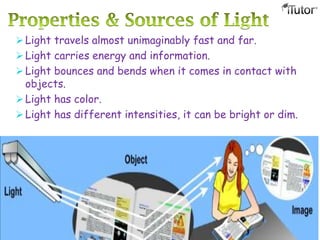
 Light travels almost unimaginably fast and far.
 Light carries energy and information.
 Light bounces and bends when it comes in contact with
objects.
 Light has color.
 Light has different intensities, it can be bright or dim.
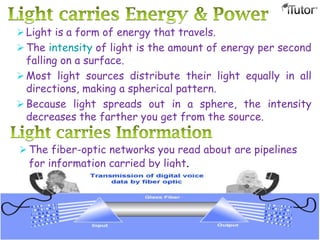
 Light is a form of energy that travels.
 The intensity of light is the amount of energy per second
falling on a surface.
 Most light sources distribute their light equally in all
directions, making a spherical pattern.
 Because light spreads out in a sphere, the intensity
decreases the farther you get from the source.
 The fiber-optic networks you read about are pipelines
for information carried by light.
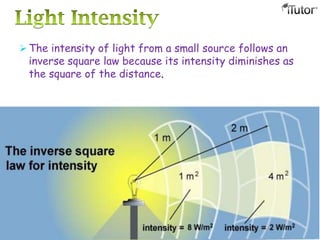
 The intensity of light from a small source follows an
inverse square law because its intensity diminishes as
the square of the distance.
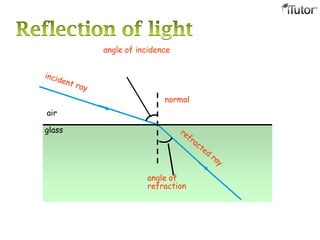
air
glass
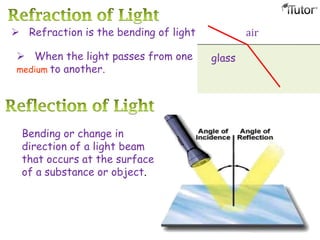
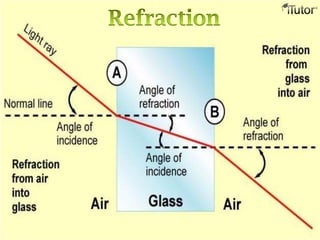
 Refraction is the bending of light
 When the light passes from one
medium to another.
Bending or change in
direction of a light beam
that occurs at the surface
of a substance or object.
air
glass
normal
angle of
refraction
angle of incidence
The angle of
incidence equals
the angle of
reflection.
The incident ray
strikes the mirror.
The reflected ray
bounces off.
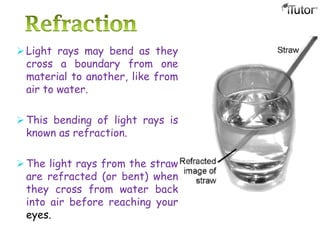
 Light rays may bend as they
cross a boundary from one
material to another, like from
air to water.
 This bending of light rays is
known as refraction.
 The light rays from the straw
are refracted (or bent) when
they cross from water back
into air before reaching your
eyes.
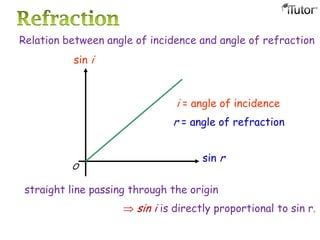
sin i is directly proportional to sin r.
sin i
sin r
O
Relation between angle of incidence and angle of refraction
i = angle of incidence
r = angle of refraction
straight line passing through the origin
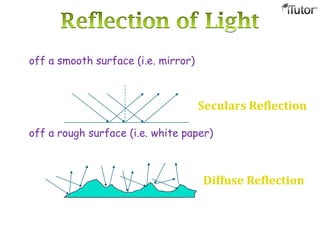
off a smooth surface (i.e. mirror)
off a rough surface (i.e. white paper)
Seculars Reflection
Diffuse Reflection
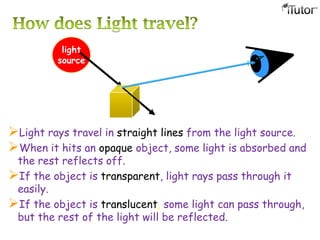
Light rays travel in straight lines from the light source.
When it hits an opaque object, some light is absorbed and
the rest reflects off.
If the object is transparent, light rays pass through it
easily.
If the object is translucent, some light can pass through,
but the rest of the light will be reflected.
light
source
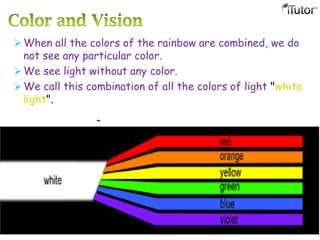
 When all the colors of the rainbow are combined, we do
not see any particular color.
 We see light without any color.
 We call this combination of all the colors of light "white
light".
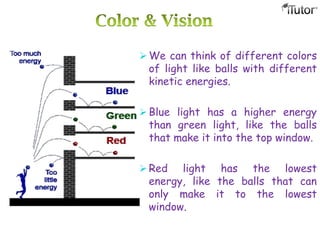
 We can think of different colors
of light like balls with different
kinetic energies.
 Blue light has a higher energy
than green light, like the balls
that make it into the top window.
 Red light has the lowest
energy, like the balls that can
only make it to the lowest
window.
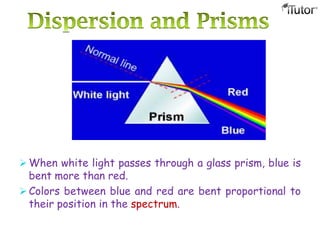
 When white light passes through a glass prism, blue is
bent more than red.
 Colors between blue and red are bent proportional to
their position in the spectrum.
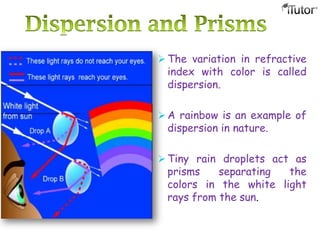
 The variation in refractive
index with color is called
dispersion.
 A rainbow is an example of
dispersion in nature.
 Tiny rain droplets act as
prisms separating the
colors in the white light
rays from the sun.
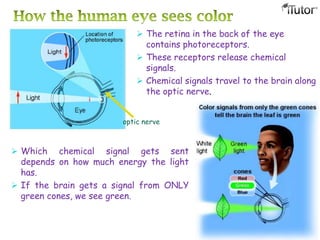
 The retina in the back of the eye
contains photoreceptors.
 These receptors release chemical
signals.
 Chemical signals travel to the brain along
the optic nerve.
optic nerve
 Which chemical signal gets sent
depends on how much energy the light
has.
 If the brain gets a signal from ONLY
green cones, we see green.
Call us for more
information
www.iTutor.com
1-855-694-8886
Visit

Light & optics

  • 1.
  • 2.
     Something thatmakes vision possible  electromagnetic radiation of any wavelength that travels in a vacuum with a speed of about 186,281 miles (300,000 kilometers) per second  Light travels almost a million times faster than sound.
  • 3.
     Luminous Objects— emit light from within  Illuminated Objects — reflect externally supplied light The starsThe sun The moon Electric lights Fires and flames
  • 4.
     Light travelsalmost unimaginably fast and far.  Light carries energy and information.  Light bounces and bends when it comes in contact with objects.  Light has color.  Light has different intensities, it can be bright or dim.
  • 5.
     Light isa form of energy that travels.  The intensity of light is the amount of energy per second falling on a surface.  Most light sources distribute their light equally in all directions, making a spherical pattern.  Because light spreads out in a sphere, the intensity decreases the farther you get from the source.  The fiber-optic networks you read about are pipelines for information carried by light.
  • 6.
     The intensityof light from a small source follows an inverse square law because its intensity diminishes as the square of the distance.
  • 7.
    air glass  Refraction isthe bending of light  When the light passes from one medium to another. Bending or change in direction of a light beam that occurs at the surface of a substance or object.
  • 8.
  • 9.
    The angle of incidenceequals the angle of reflection. The incident ray strikes the mirror. The reflected ray bounces off.
  • 10.
     Light raysmay bend as they cross a boundary from one material to another, like from air to water.  This bending of light rays is known as refraction.  The light rays from the straw are refracted (or bent) when they cross from water back into air before reaching your eyes.
  • 12.
    sin i isdirectly proportional to sin r. sin i sin r O Relation between angle of incidence and angle of refraction i = angle of incidence r = angle of refraction straight line passing through the origin
  • 13.
    off a smoothsurface (i.e. mirror) off a rough surface (i.e. white paper) Seculars Reflection Diffuse Reflection
  • 14.
    Light rays travelin straight lines from the light source. When it hits an opaque object, some light is absorbed and the rest reflects off. If the object is transparent, light rays pass through it easily. If the object is translucent, some light can pass through, but the rest of the light will be reflected. light source
  • 15.
     When allthe colors of the rainbow are combined, we do not see any particular color.  We see light without any color.  We call this combination of all the colors of light "white light".
  • 17.
     We canthink of different colors of light like balls with different kinetic energies.  Blue light has a higher energy than green light, like the balls that make it into the top window.  Red light has the lowest energy, like the balls that can only make it to the lowest window.
  • 18.
     When whitelight passes through a glass prism, blue is bent more than red.  Colors between blue and red are bent proportional to their position in the spectrum.
  • 19.
     The variationin refractive index with color is called dispersion.  A rainbow is an example of dispersion in nature.  Tiny rain droplets act as prisms separating the colors in the white light rays from the sun.
  • 20.
     The retinain the back of the eye contains photoreceptors.  These receptors release chemical signals.  Chemical signals travel to the brain along the optic nerve. optic nerve  Which chemical signal gets sent depends on how much energy the light has.  If the brain gets a signal from ONLY green cones, we see green.
  • 21.
    Call us formore information www.iTutor.com 1-855-694-8886 Visit