BASIC OPTICS
SANIA ASLAM OD
BSVS KEMU LAHORE
“
”
What is optical science
mostly people associate the word ‘optics’ with the lenses for
eyeglasses, telescopes, and microscopes
In physics the term more broadly refers to the study of the
behavior of light and its interactions with matter.
Three broad subfields of optics
1) Geometrical optics, the study of light as rays
2) Physical optics, the study of light as waves
3) Quantum optics, the study of light as particles
A mirror forms an image where left and right are
reversed
Mirror
A mirror is optical media which reflects light
backwards when fall on it. It may be:
1) Plane mirrors or
2) Spherical mirrors
Mirror: Rules for rays tracing through a mirror
1) The ray which pass through the pole shall pass undeviated.
2) The ray which is parallel with the axis shall pass through the
focal point after convergence or divergence.
3) The ray passing through the focal point & falling on the
mirror surface shall pass parallel to the optical axis.
4) The ray passing through the centre of curvature of a mirror
shall also pass un-deviated.
5) Path of light rays are also reversible.
19 March 2020 saniaaslam2013@gmail.com
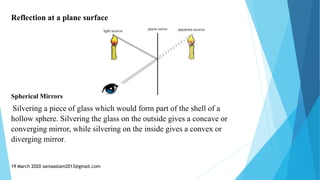
Reflection at a plane surface
Spherical Mirrors
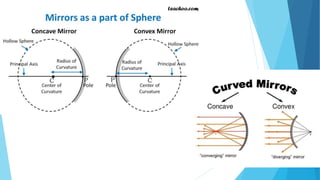
Silvering a piece of glass which would form part of the shell of a
hollow sphere. Silvering the glass on the outside gives a concave or
converging mirror, while silvering on the inside gives a convex or
diverging mirror.
19 March 2020 saniaaslam2013@gmail.com
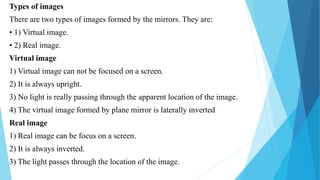
Types of images
There are two types of images formed by the mirrors. They are:
• 1) Virtual image.
• 2) Real image.
Virtual image
1) Virtual image can not be focused on a screen.
2) It is always upright.
3) No light is really passing through the apparent location of the image.
4) The virtual image formed by plane mirror is laterally inverted
Real image
1) Real image can be focus on a screen.
2) It is always inverted.
3) The light passes through the location of the image.
Nomenclature
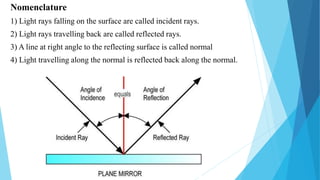
1) Light rays falling on the surface are called incident rays.
2) Light rays travelling back are called reflected rays.
3) A line at right angle to the reflecting surface is called normal
4) Light travelling along the normal is reflected back along the normal.
5) The angle formed by the incident ray and the normal is called angle
of incident.
6) The angle formed by the reflected ray and the normal is called angle
of reflection.
7) The angle of incident and the angle of reflection are equal.
8) The incident ray, the reflected ray and the normal are in the same
plane.
9) The line joining the centre of curvature to any point on the curved
mirror is the normal of that mirror.
10) The focal length of the plane mirror is infinity
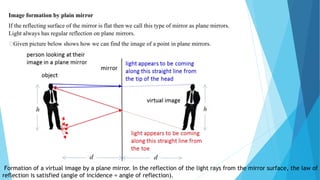
Image formation by plain mirror
If the reflecting surface of the mirror is flat then we call this type of mirror as plane mirrors.
Light always has regular reflection on plane mirrors.
Given picture below shows how we can find the image of a point in plane mirrors.
Formation of a virtual image by a plane mirror. In the reflection of the light rays from the mirror surface, the law of
reflection is satisfied (angle of incidence = angle of reflection).
Characteristics of image formed by a plane
mirror.
1) Image is virtual and erect.
2) It is of same size as the object.
3) It has the same distance as object to
the mirror.
4) It is laterally reversed.
5) The minimum length of the mirror
required to form full size image of the
object is half the size of the object.
Number of images
How many images can you form by two plane mirror?
It depends upon the inclination of two mirrors with each other.
The number of images formed by two plane mirrors inclined to each other is calculated by the
formula:
Number of images:
N=360/ ᴓ - 1 (Here, N = number of images form, ᴓ is the angle between two mirrors)
Less the angle between two mirrors, more the number of images.
Number of images
N = 360/90 – 1 = 4 – 1 = 3.
N = 360/60 – 1 = 6 – 1 = 5
N= 360/45 – 1 = 8 – 1 = 7.
An object placed between two parallel plane mirrors will form infinite number of images.
This is true only for mirrors kept at right angles or less than that.
Uses of plane mirror in ophthalmology
1) A plane mirror is used at a distance of 3 m with a reverse
Snellen’s chart kept at little higher position than patient’s head.
2) Used in plane mirror retinoscope.
3) Used in both direct & indirect ophthalmoscope.
4) Used in slit lamp, synaptophore, stereoscope, to change the
direction of rays & save space.
19 March 2020 saniaaslam2013@gmail.com
Spherical mirror
Nomenclature in spherical mirror image
1) Pole: It is the vertex of the mirror.
2) Center of curvature: It is the center of curvature of the sphere out of which the mirror is
fashioned.
3) Radius of curvature: It is the line joining the center of curvature to the pole.
4) Principal axis: It is the ling joining center of curvature and the vertex.
Nomenclature in spherical mirror image
5) Normal in a spherical mirror: It is a line that joins any point of the mirror to the center of
curvature.
6) All the measurements are valid from the pole of the center.
7) By convention, all the incident rays are taken to travel from the left to right.
Nomenclature in spherical mirror image
8) Focal length of a concave mirror is taken as negative and positive in convex lens
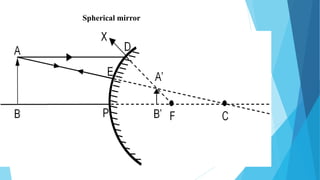
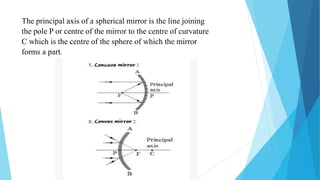
The principal axis of a spherical mirror is the line joining
the pole P or centre of the mirror to the centre of curvature
C which is the centre of the sphere of which the mirror
forms a part.
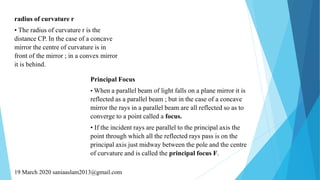
radius of curvature r
• The radius of curvature r is the
distance CP. In the case of a concave
mirror the centre of curvature is in
front of the mirror ; in a convex mirror
it is behind.
Principal Focus
• When a parallel beam of light falls on a plane mirror it is
reflected as a parallel beam ; but in the case of a concave
mirror the rays in a parallel beam are all reflected so as to
converge to a point called a focus.
• If the incident rays are parallel to the principal axis the
point through which all the reflected rays pass is on the
principal axis just midway between the pole and the centre
of curvature and is called the principal focus F.
19 March 2020 saniaaslam2013@gmail.com
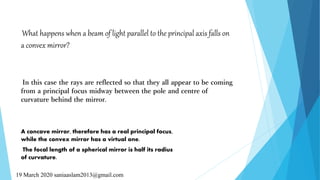
What happens when a beam of light parallel to the principal axis falls on
a convex mirror?
In this case the rays are reflected so that they all appear to be coming
from a principal focus midway between the pole and centre of
curvature behind the mirror.
A concave mirror, therefore has a real principal focus,
while the convex mirror has a virtual one.
The focal length of a spherical mirror is half its radius
of curvature.
19 March 2020 saniaaslam2013@gmail.com
Construction of ray diagrams
Since a point on an image can be located by the point of
intersection of two reflected rays, we have to consider which are
the most convenient rays to use for this purpose.
Remembering that, by geometry, the normal to a curved surface
at any point is the radius of curvature at that point, one very
useful ray to draw will be one which is incident along a radius of
curvature. Since this is incident normally on the mirror, it will be
reflected back along its own path.
Another useful ray is one which falls on the mirror parallel to the
principal axis. By definition, this will be reflected through the
principal focus. Conversely, any incident ray passing through the
principal focus will be reflected back parallel to the principal
axis.
The same observations also apply to the convex mirrors, so we may
briefly sum them up into a set of rules for constructing images
formed by spherical mirrors.
1) Rays passing through the centre of curvature are reflected back
along their own paths.
2) Rays parallel to the principal axis are reflected through the
principal focus.
3) Rays through the principal focus are reflected parallel to the
principal axis.
4) (Useful when using squared paper) Rays incident at the pole are
reflected, making the same angle with the principal axis.

Basic optics

  • 1.
    BASIC OPTICS SANIA ASLAMOD BSVS KEMU LAHORE
  • 2.
    “ ” What is opticalscience mostly people associate the word ‘optics’ with the lenses for eyeglasses, telescopes, and microscopes In physics the term more broadly refers to the study of the behavior of light and its interactions with matter.
  • 3.
    Three broad subfieldsof optics 1) Geometrical optics, the study of light as rays 2) Physical optics, the study of light as waves 3) Quantum optics, the study of light as particles
  • 4.
    A mirror formsan image where left and right are reversed
  • 5.
    Mirror A mirror isoptical media which reflects light backwards when fall on it. It may be: 1) Plane mirrors or 2) Spherical mirrors
  • 6.
    Mirror: Rules forrays tracing through a mirror 1) The ray which pass through the pole shall pass undeviated. 2) The ray which is parallel with the axis shall pass through the focal point after convergence or divergence. 3) The ray passing through the focal point & falling on the mirror surface shall pass parallel to the optical axis. 4) The ray passing through the centre of curvature of a mirror shall also pass un-deviated. 5) Path of light rays are also reversible. 19 March 2020 saniaaslam2013@gmail.com
  • 7.
    Reflection at aplane surface Spherical Mirrors Silvering a piece of glass which would form part of the shell of a hollow sphere. Silvering the glass on the outside gives a concave or converging mirror, while silvering on the inside gives a convex or diverging mirror. 19 March 2020 saniaaslam2013@gmail.com
  • 9.
    Types of images Thereare two types of images formed by the mirrors. They are: • 1) Virtual image. • 2) Real image. Virtual image 1) Virtual image can not be focused on a screen. 2) It is always upright. 3) No light is really passing through the apparent location of the image. 4) The virtual image formed by plane mirror is laterally inverted Real image 1) Real image can be focus on a screen. 2) It is always inverted. 3) The light passes through the location of the image.
  • 10.
    Nomenclature 1) Light raysfalling on the surface are called incident rays. 2) Light rays travelling back are called reflected rays. 3) A line at right angle to the reflecting surface is called normal 4) Light travelling along the normal is reflected back along the normal.
  • 11.
    5) The angleformed by the incident ray and the normal is called angle of incident. 6) The angle formed by the reflected ray and the normal is called angle of reflection. 7) The angle of incident and the angle of reflection are equal. 8) The incident ray, the reflected ray and the normal are in the same plane. 9) The line joining the centre of curvature to any point on the curved mirror is the normal of that mirror. 10) The focal length of the plane mirror is infinity
  • 12.
    Image formation byplain mirror If the reflecting surface of the mirror is flat then we call this type of mirror as plane mirrors. Light always has regular reflection on plane mirrors. Given picture below shows how we can find the image of a point in plane mirrors. Formation of a virtual image by a plane mirror. In the reflection of the light rays from the mirror surface, the law of reflection is satisfied (angle of incidence = angle of reflection).
  • 13.
    Characteristics of imageformed by a plane mirror. 1) Image is virtual and erect. 2) It is of same size as the object. 3) It has the same distance as object to the mirror. 4) It is laterally reversed. 5) The minimum length of the mirror required to form full size image of the object is half the size of the object.
  • 14.
    Number of images Howmany images can you form by two plane mirror? It depends upon the inclination of two mirrors with each other. The number of images formed by two plane mirrors inclined to each other is calculated by the formula: Number of images: N=360/ ᴓ - 1 (Here, N = number of images form, ᴓ is the angle between two mirrors) Less the angle between two mirrors, more the number of images. Number of images N = 360/90 – 1 = 4 – 1 = 3. N = 360/60 – 1 = 6 – 1 = 5 N= 360/45 – 1 = 8 – 1 = 7. An object placed between two parallel plane mirrors will form infinite number of images. This is true only for mirrors kept at right angles or less than that.
  • 15.
    Uses of planemirror in ophthalmology 1) A plane mirror is used at a distance of 3 m with a reverse Snellen’s chart kept at little higher position than patient’s head. 2) Used in plane mirror retinoscope. 3) Used in both direct & indirect ophthalmoscope. 4) Used in slit lamp, synaptophore, stereoscope, to change the direction of rays & save space. 19 March 2020 saniaaslam2013@gmail.com
  • 16.
  • 17.
    Nomenclature in sphericalmirror image 1) Pole: It is the vertex of the mirror. 2) Center of curvature: It is the center of curvature of the sphere out of which the mirror is fashioned. 3) Radius of curvature: It is the line joining the center of curvature to the pole. 4) Principal axis: It is the ling joining center of curvature and the vertex. Nomenclature in spherical mirror image 5) Normal in a spherical mirror: It is a line that joins any point of the mirror to the center of curvature. 6) All the measurements are valid from the pole of the center. 7) By convention, all the incident rays are taken to travel from the left to right. Nomenclature in spherical mirror image 8) Focal length of a concave mirror is taken as negative and positive in convex lens
  • 18.
    The principal axisof a spherical mirror is the line joining the pole P or centre of the mirror to the centre of curvature C which is the centre of the sphere of which the mirror forms a part.
  • 19.
    radius of curvaturer • The radius of curvature r is the distance CP. In the case of a concave mirror the centre of curvature is in front of the mirror ; in a convex mirror it is behind. Principal Focus • When a parallel beam of light falls on a plane mirror it is reflected as a parallel beam ; but in the case of a concave mirror the rays in a parallel beam are all reflected so as to converge to a point called a focus. • If the incident rays are parallel to the principal axis the point through which all the reflected rays pass is on the principal axis just midway between the pole and the centre of curvature and is called the principal focus F. 19 March 2020 saniaaslam2013@gmail.com
  • 20.
    What happens whena beam of light parallel to the principal axis falls on a convex mirror? In this case the rays are reflected so that they all appear to be coming from a principal focus midway between the pole and centre of curvature behind the mirror. A concave mirror, therefore has a real principal focus, while the convex mirror has a virtual one. The focal length of a spherical mirror is half its radius of curvature. 19 March 2020 saniaaslam2013@gmail.com
  • 21.
    Construction of raydiagrams Since a point on an image can be located by the point of intersection of two reflected rays, we have to consider which are the most convenient rays to use for this purpose. Remembering that, by geometry, the normal to a curved surface at any point is the radius of curvature at that point, one very useful ray to draw will be one which is incident along a radius of curvature. Since this is incident normally on the mirror, it will be reflected back along its own path. Another useful ray is one which falls on the mirror parallel to the principal axis. By definition, this will be reflected through the principal focus. Conversely, any incident ray passing through the principal focus will be reflected back parallel to the principal axis.
  • 22.
    The same observationsalso apply to the convex mirrors, so we may briefly sum them up into a set of rules for constructing images formed by spherical mirrors. 1) Rays passing through the centre of curvature are reflected back along their own paths. 2) Rays parallel to the principal axis are reflected through the principal focus. 3) Rays through the principal focus are reflected parallel to the principal axis. 4) (Useful when using squared paper) Rays incident at the pole are reflected, making the same angle with the principal axis.