An Improved Method for Measuring the Absolute DD Neutron Yield
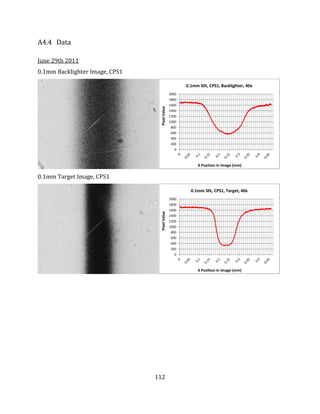
and Calibrating Neutron Time-of-Flight Detectors in Inertial
Confinement Fusion Experiments
by
Caleb J. Waugh
M.S. Technology and Policy
Massachusetts Institute of Technology, 2012
B.S. Electrical Engineering, B.A. Philosophy
Brigham Young University, 2009
Submitted to the Department of Nuclear Science and Engineering in
Partial Fulfillment of the Requirements for the Degree of
Master of Science in Nuclear Science and Engineering at the
Massachusetts Institute of Technology
May 9, 2014
© 2014 Massachusetts Institute of Technology
All rights reserved.
Signature of Author.................................................................................................................................................
Department of Nuclear Science and Engineering
May 9, 2014
Certified by .................................................................................................................................................................
Dr. Richard Petrasso
Senior Research Scientist
Division Head, High-Energy-Density Physics
Thesis Supervisor
Certified by .................................................................................................................................................................
Dr. Dennis G. Whyte
Professor of Nuclear Science and Engineering
Thesis Reader
Accepted by................................................................................................................................................................
Dr. Mujid S. Kazimi
TEPCO Professor of Nuclear Science and Engineering
Chair, Department Committee on Graduate Students
2
3
Abstract
Improved Methods for Measuring the Absolute DD Neutron Yield and Calibrating Neutron
Time-of-Flight Detectors in Inertial Confinement Fusion Experiments
By
Caleb J. Waugh
Submitted to the Department of Nuclear Science and Engineering on
May 9, 2014 in partial fulfillment of the requirements for the degree of
Master of Nuclear Science and Engineering
Since the establishment of nuclear physics in the early 1900’s and the development of the
hydrogen bomb in the 1950’s, inertial confinement fusion (ICF) has been an important field
in physics. Funded largely though the U.S. National Nuclear Security Agency (NNSA), the
Laboratory for Laser Energetics (LLE), Sandia National Laboratories (SNL) and Lawrence
Livermore National Laboratory (LLNL) have advanced ICF as a platform for stockpile
stewardship and weapons physics, but also have contributed to basic science in high
energy density regimes and for pursuing fusion an energy source.
One of the primary goals of the ICF research program is to produce a thermonuclear burn
in an ICF capsule where the power balance of the reaction is net positive. This criterion is
often referred to as ignition. One of the most common metrics for gauging progress
towards ignition in an ICF implosion is the ITFX parameter (similar to the Lawson
Criterion) and is primarily a function of the implosion areal density (ρR) and fusion yield.
An ITFX value greater than one indicates net energy production. In deuterium/tritium fuel
mixtures the yield is determined by measuring the reactant 14.0 MeV neutrons.
Subsequently, the ability to obtain highly accurate absolute neutron yield measurements is
vital to determining the ITFX and hence progress toward ignition. Although ignition
implosions all use deuterium/tritium fuel mixes, other capsule fuel mixes such as pure
deuterium and deuterium/helium 3 are also used to improve understanding of capsule
performance.
At the LLE and LLNL, neutron time-of-flight (nTOF) detectors routinely measure the
absolute neutron yield from laser-driven ICF implosions. Although originally calibrated
through a series of cross-calibrations with indium and copper neutron activation systems,
an alternative method has been developed for measuring the DDn yield that provides a
more accurate calibration by directly calibrating nTOF in situ to CR-39 range filter (RF)
proton detectors. A neutron yield can be inferred from the CR-39 RF proton measurement
since the DD proton and DD neutron branching ratio is well characterized and close to
unity. By obtaining highly accurate DDp yields from a series of exploding pusher campaigns
on OMEGA, an excellent absolute DDn yield measurement was obtained and used to
calibrate the 3m nTOF detector. Data obtained suggest the existing OMEGA nTOF
4
calibration coefficient to be low by 9.0±1.5 % based on the inferred CR-39 DD neutron
yield.
In addition, comparison across multiple exploding pusher campaigns indicate that
significant reduction in charged particle flux anisotropies can be achieved on shots where
capsule bang time occurs significantly (on the order of 500ps) after the end of the laser
pulse. This is important since the main source of error in the RF DDp yield measurement is
due to particle flux anisotropies. Results indicate that the CR-39 RF/nTOF in situ calibration
method can serve as a valuable platform for measuring the DDn yield from ICF implosions
and for calibrating and reducing the uncertainty of calibration coefficients of nTOF detector
systems on OMEGA and other larger facilities such as the National Ignition Facility (NIF).
Thesis Supervisor: Dr. Richard Petrasso
Title: Division Head, High-Energy-Density Physics
5
Acknowledgements
In Nichomachean Ethics, Aristotle states that “intellectual excellence owes its birth and
growth mainly to instruction…” Throughout my education at MIT I have been impressed
that there is very little we can truly call our own, especially when it comes to academic
achievement and success. If there is any “intellectual excellence” I may have achieved in my
attempt to improve existing methodologies for measuring the absolute DD neutron yield in
inertial confinement fusion experiments I owe it largely to the instruction and guidance of
my advisor and colleagues at the Division for High-Energy-Density Physics at the MIT
Plasma Science and Fusion Center.
Specifically, I would like to thank my advisor Rich Petrasso for giving me the
opportunity to work in high-energy-density physics, for granting me the opportunity to be
involved in a wide variety of projects in conjunction with our colleagues at the national
laboratories, and for instilling an excitement, passion, and drive for physics and research in
general in a way that only people who have had the pleasure to know him can understand. I
would also like to thank Frederick Seguin, Johan Frenje and Chikang Li for their unmatched
expertise and for personally assisting me in understanding the mysteries of inertial
confinement fusion, nuclear diagnostics, and above all, the “magical” properties of CR-39.
Many thanks go to Maria Gatu-Johnson, Daniel Casey, Mario Manuel, Nareg Sinenian, Hans
Rinderknecht, Alex Zylstra, Mike Rosenberg and Hong Sio for assisting me with countless
questions and problems over the last two years, for offering of their time and expertise on
numerous occasions in the MIT Linear Electrostatic Ion Accelerator (LEIA) laboratory, and
for always providing thoughtful feedback and suggestions, always in the spirit of
improvement and commitment to doing the absolute best science possible. Special thanks
go to the Laboratory for Laser Energetics, the National Ignition Facility, the U.S.
Department of Energy, the U.S. National Nuclear Security Administration, Los Alamos
National Laboratories, Sandia National Laboratories and the National Laser Users Facility,
for their never-ending commitment to supporting and engaging students in HEDP and ICF
research in a meaningful and collaborative way.
6
Finally, to Ece for her love, support, inspiration and patience while working on this
thesis and to my parents, Jody and Marsha Waugh, for instilling in me a passion for the
outdoors, an appreciation of hard work, and the knowhow to live each day to its fullest.
This work was supported in part by the U.S. Department of Energy (DOE) (DE-FG52-
09NA-29553), the National Laser User’s Facility (DOE Award No. DE-NA0000877), the
Fusion Science Center at the University of Rochester (Rochester Sub Award PO No. 415023-
G), and the Laboratory for Laser Energetics (LLE) (No. 412160-001G).
7
Table of Contents
Abstract.....................................................................................................................................................................3
Acknowledgements..............................................................................................................................................5
List of Figures.........................................................................................................................................................9
List of Tables........................................................................................................................................................ 15
1 Introduction................................................................................................................................................ 17
1.1 Nuclear Fusion and Nucleosynthesis........................................................................................ 20
1.2 High Energy Density Physics........................................................................................................ 29
1.3 Thesis Outline .................................................................................................................................... 30
2 Inertial Confinement Fusion ................................................................................................................ 33
2.1 Contemporary Motivation for Inertial Confinement Fusion Research........................ 33
2.2 The Physics of Inertial Confinement Fusion .......................................................................... 37
3 Previous DDn Yield Measurements and nTOF Calibration Methods.................................... 43
3.1 The Indium Activation Method ................................................................................................... 46
3.2 NOVA In/nTOF Cross-calibration............................................................................................... 49
3.3 OMEGA In/NOVA nTOF Cross-calibration.............................................................................. 49
3.4 OMEGA nTOF/CR-39 Neutron Verification............................................................................ 50
3.5 OMEGA In/nTOF Cross-calibration........................................................................................... 51
4 Measuring the Absolute DDn Yield on OMEGA............................................................................. 53
4.1 High Accuracy YDDp Measurements on OMEGA using CR-39 Range Filters............... 54
4.2 Relation Between Particle Flux Anisotropies and Bang Time......................................... 63
4.3 CR-39/nTOF Yield Comparison and Calibration Coefficient Verification .................. 66
5 Conclusion................................................................................................................................................... 72
6 Bibliography............................................................................................................................................... 74
8
Appendix 1: Derivation of the Fusion Reaction Rate ........................................................................... 78
Appendix 2: MIT Linear Electrostatic Ion Accelerator (LEIA) Ion Beam Current
Measurements (Faraday Cup)....................................................................................................................... 92
Appendix 3: Radiochromic Film Slit Width Verification on OMEGA Charged Particle
Spectrometers..................................................................................................................................................... 96
A4.1 Introduction ................................................................................................................................... 96
A4.2 Overview.......................................................................................................................................... 96
A4.2 Results............................................................................................................................................105
A4.3 Radiochromic Film Setup........................................................................................................111
A4.4 Data..................................................................................................................................................112
Appendix 4: Stage Etching of High Fluence Range Filter CR-39 Modules On Omega............122
Appendix 5: Absolute DDp Measurements taken on Exploding Pushers on OMEGA (Febuary
7th and 9th, 2012)..............................................................................................................................................126
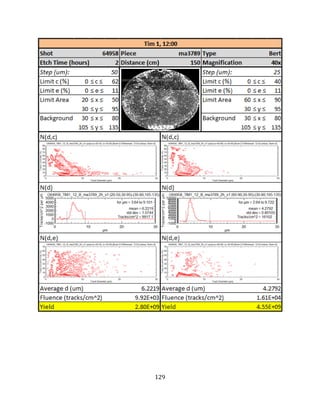
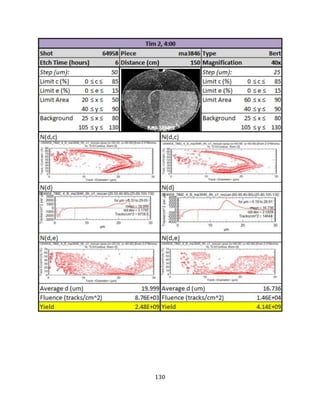
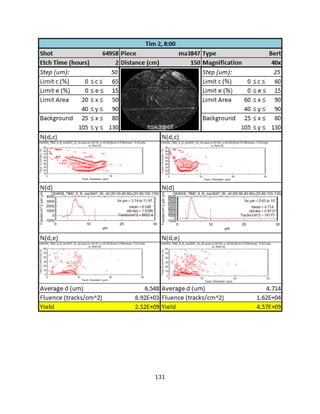
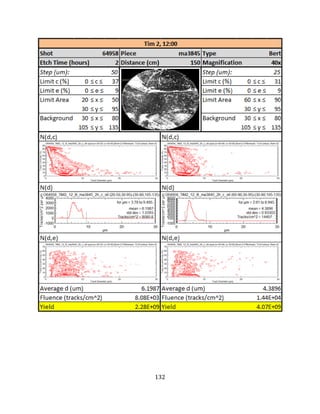
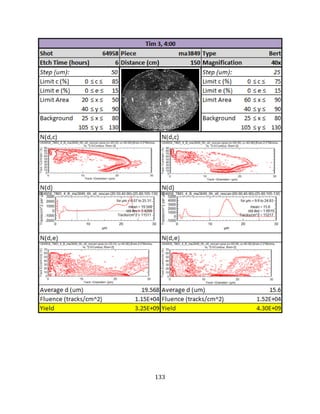
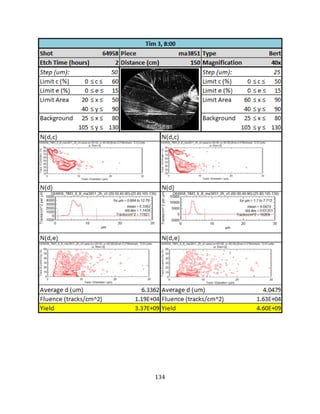
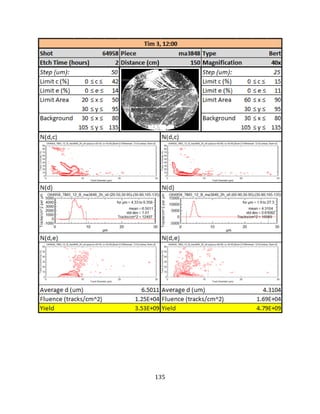
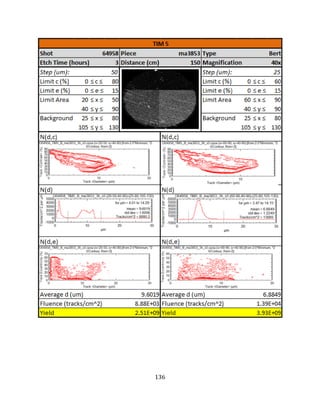
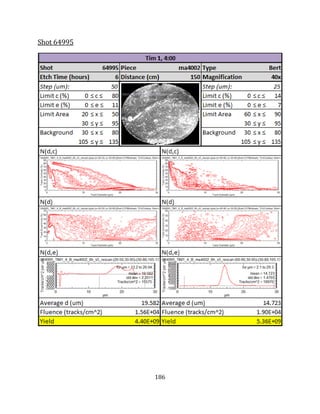
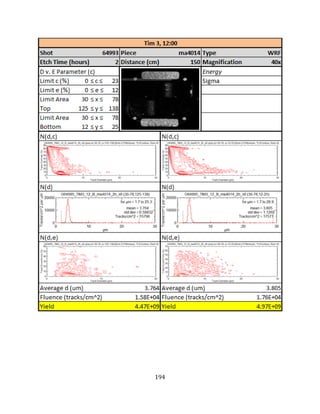
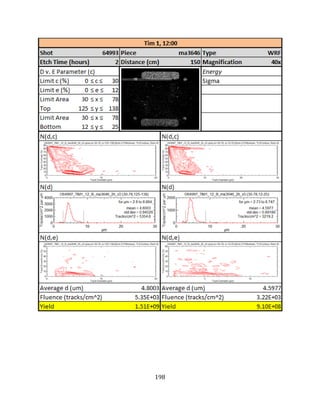
Shot 64958.....................................................................................................................................................127
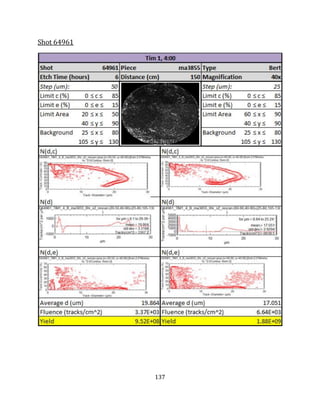
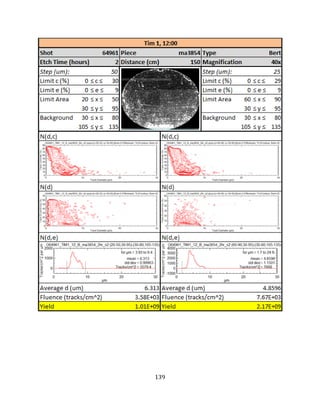
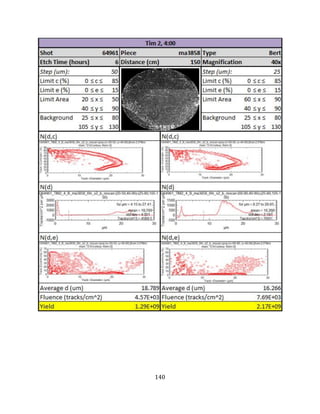
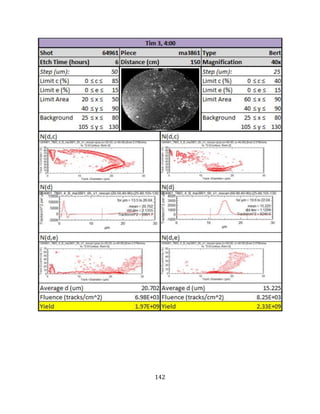
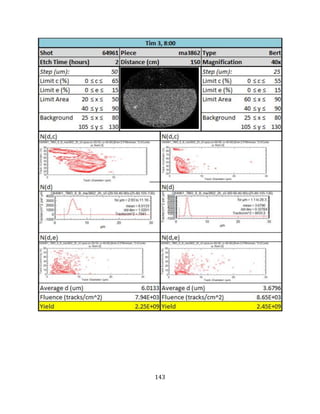
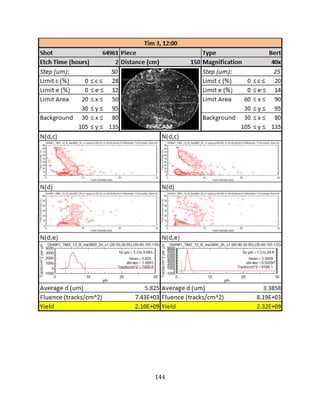
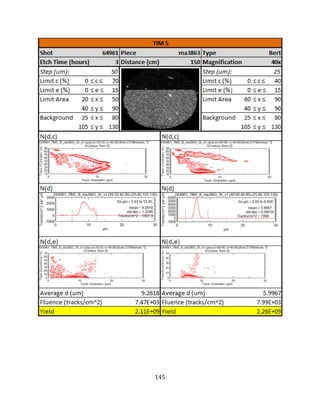
Shot 64961.....................................................................................................................................................137
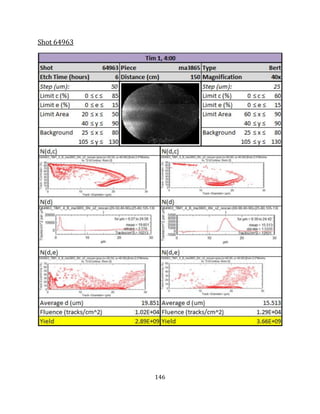
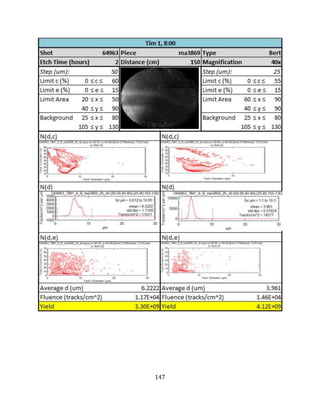
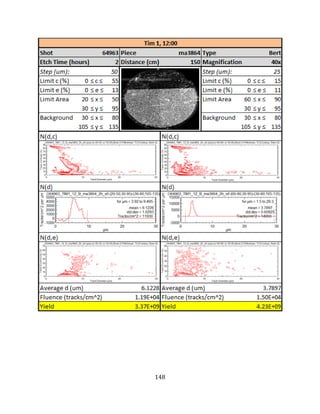
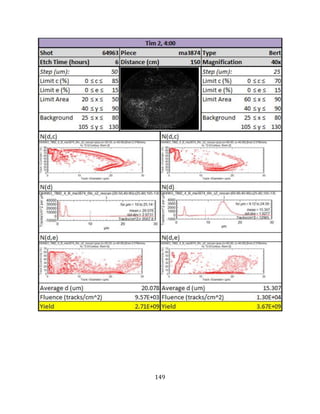
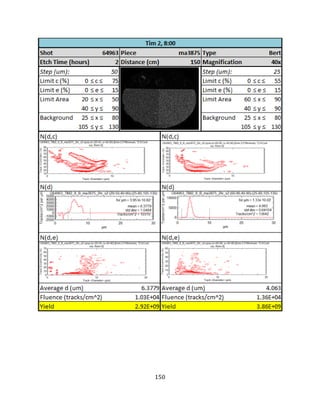
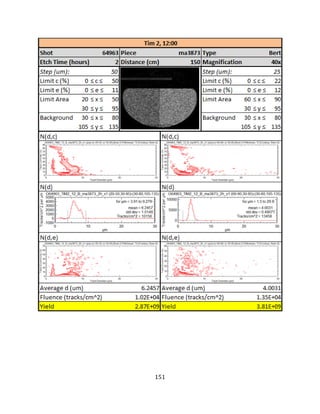
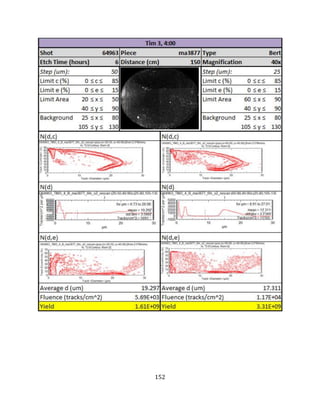
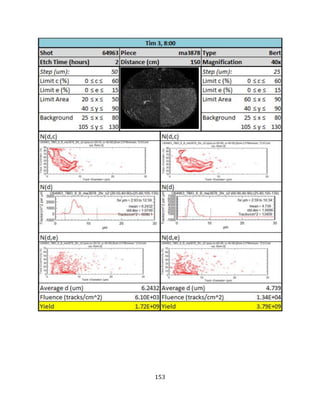
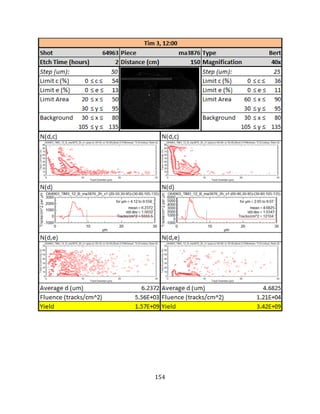
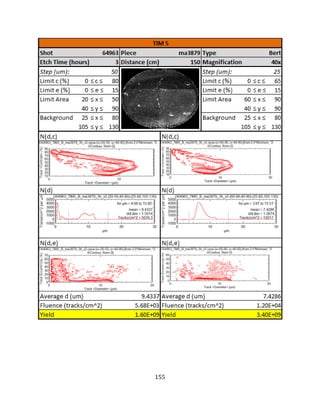
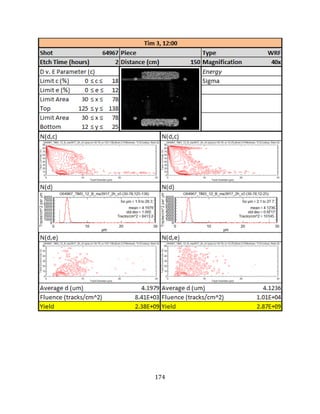
Shot 64963.....................................................................................................................................................146
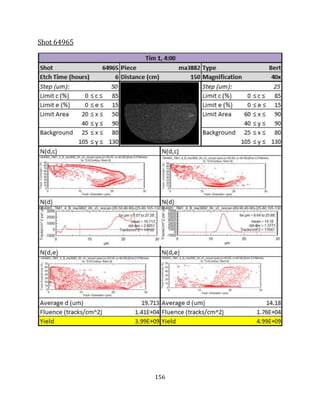
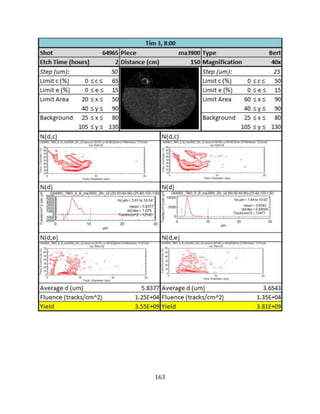
Shot 64965.....................................................................................................................................................156
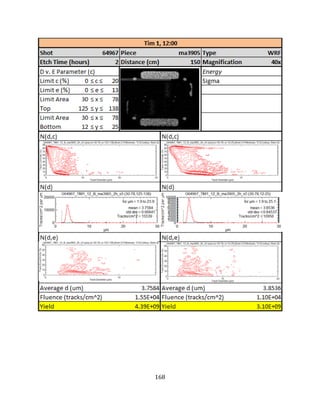
Shot 64967.....................................................................................................................................................166
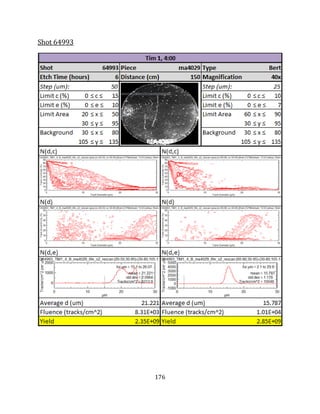
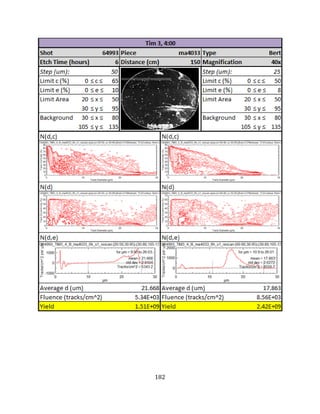
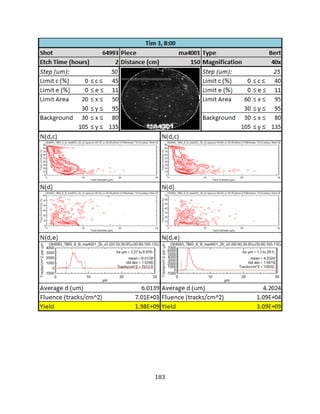
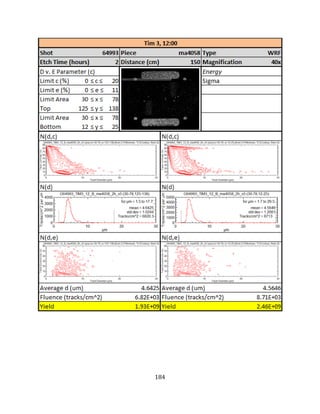
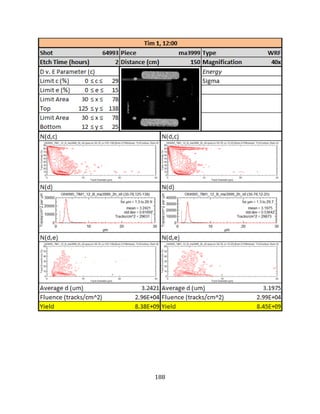
Shot 64993.....................................................................................................................................................176
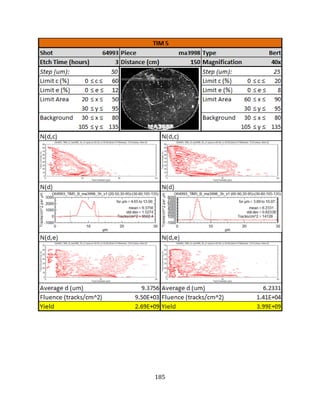
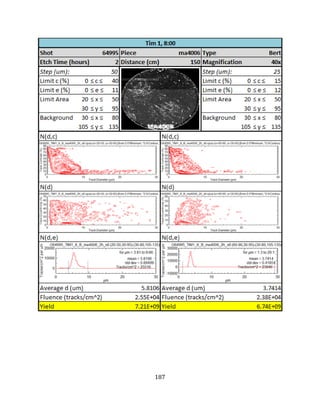
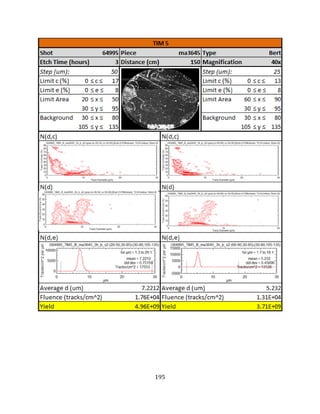
Shot 64995.....................................................................................................................................................186
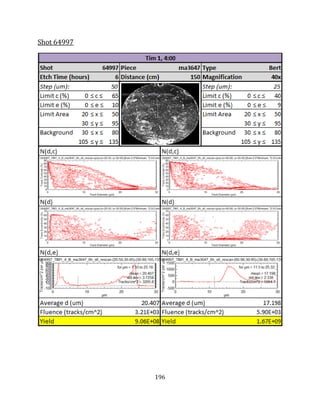
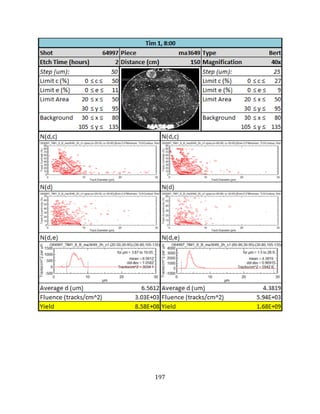
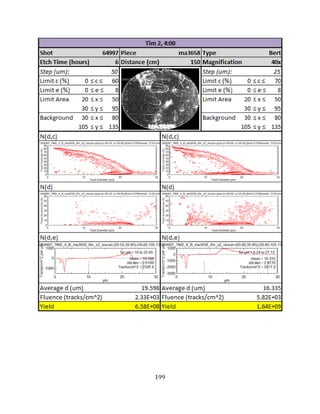
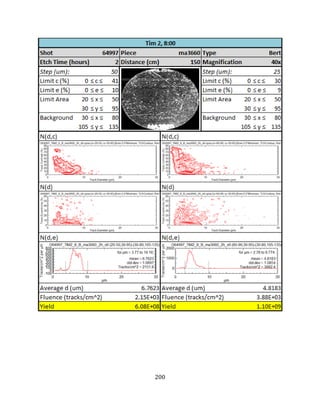
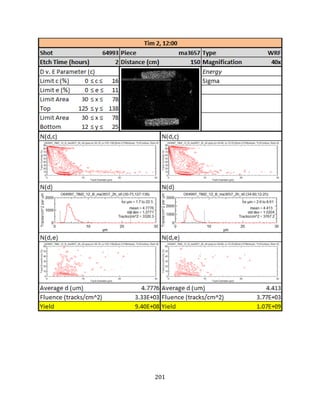
Shot 64997.....................................................................................................................................................196
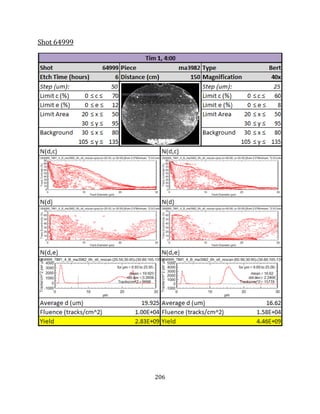
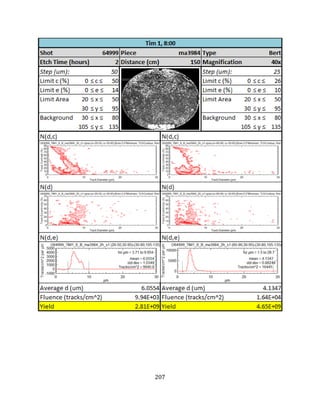
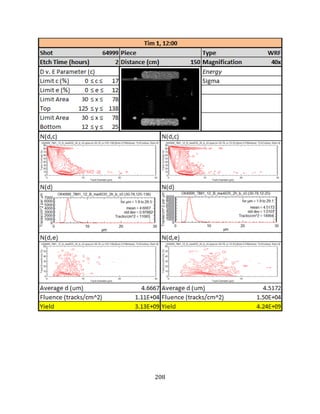
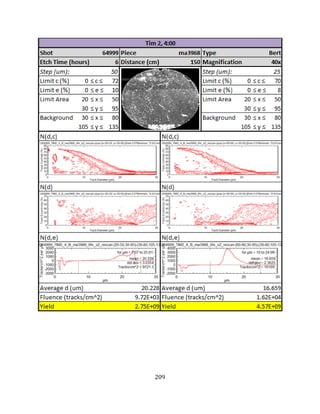
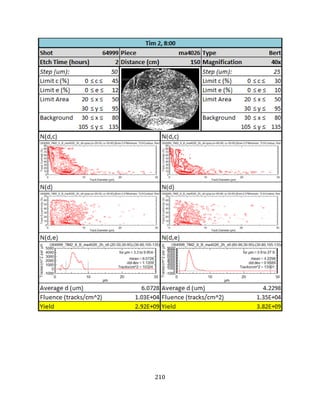
Shot 64999.....................................................................................................................................................206
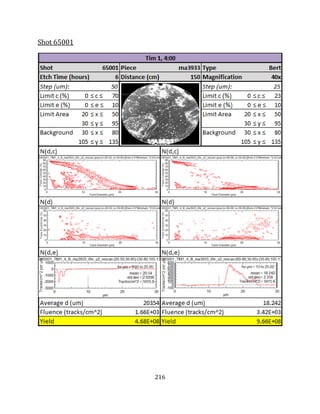
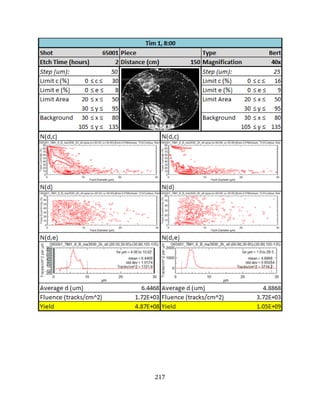
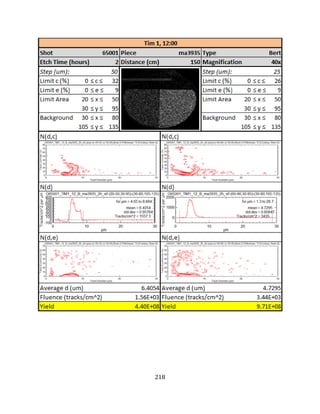
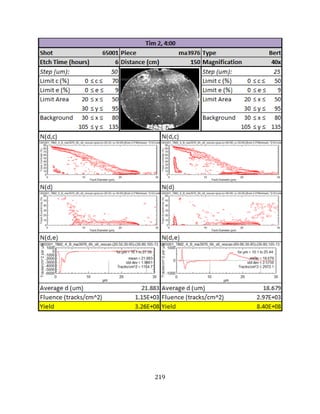
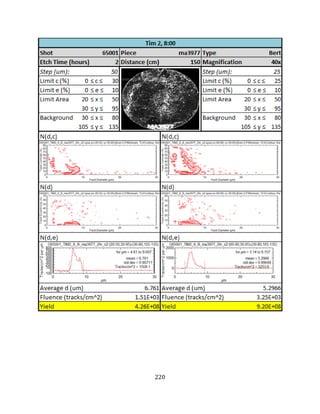
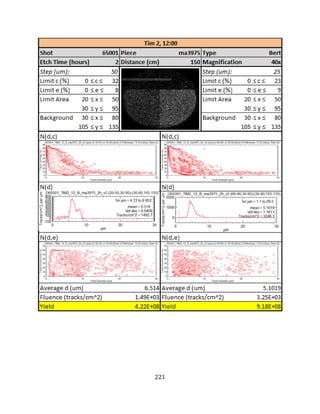
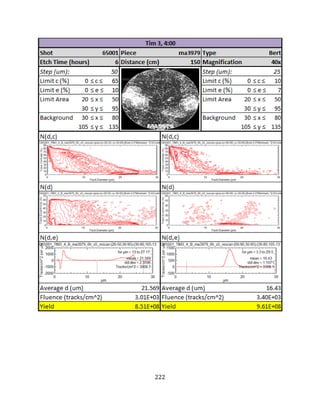
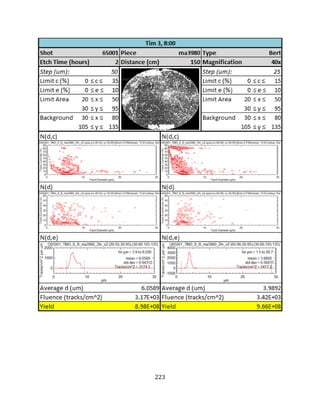
Shot 65001.....................................................................................................................................................216
9
List of Figures
Figure 1. First ionization energies of the elements (energy required to free one electron).18
Figure 2. Fractional ionization for light elements hydrogen, helium, and lithium as a
function of ion temperature. The corresponding ionization energies are: 13.60 eV (H),
24.59 eV (He), and 5.39 eV (Li)..................................................................................................................... 19
Figure 3. The Cat's Eye nebula as seen from the Hubble telescope................................................ 20
Figure 4. Binding energy per nucleon for all known nuclides (both stable and unstable).
Fusion reactions resulting in heavier nuclides and fission reactions creating lighter nuclides
release energy while moving toward more heavily bond states. Deuterium (D), tritium (T),
helium, iron (56Fe) and uranium (235U) are noted. ............................................................................... 22
Figure 5. Image depicting the standard fusion problem [3]. A nuclei with energy ε is
incident on a second nuclei. As the two nuclei approach the Coulomb repulsive force acts to
push the two particles apart. Under classical mechanics, if the relative energy (center of
mass energy) of the two particles is less than Vb the two particles will not fuse. However,
under quantum mechanics there is a finite probability of the particles tunneling through
the Coulomb barrier even though ε is lower than the Vb. .................................................................. 24
Figure 6. (a) fusion cross sections and (b) fusion reactivities for primary light isotope
fusion reactions. The fusion reactivities assume a Maxwellian velocity distribution
characterized by temperature T................................................................................................................... 26
Figure 7. The first three steps in the proton-proton (pp) fusion chain resulting in 4He........ 28
Figure 8. Natural and man-made regimes in high-energy-density physics. ............................... 29
Figure 9. Areial views taken of the Nevada test site. Both images depict craters left from
underground tests. ............................................................................................................................................ 34
Figure 10. The Titan supercomputer at Oak Ridge National Laboratory..................................... 36
Figure 11. Major research facilities that are part of the National Nuclear Security
Administration's Stockpile Stewardship program: (a) the Z-Machine pulsed power facility
at Sandia National Laboratories, (b) the OMEGA laser at the Laboratory for Laser
Energetics, (c) the National Ignition Facility at Lawerance Livermore National Laboratory.
................................................................................................................................................................................... 37
10
Figure 12. Basic principles of inertial confinement fusion: (a) a driver beam heats the
capsule surrounding a small pellet of fuel, (b) the fuel is compressed and a hot spot forms
in the center, (c) the fuel stagnates and temperatures and densities are sufficient for
thermonuclear burn, (d) alpha particles emitted from the hot spot heat the remaining fuel
and the nuclear burn propagates through the fuel............................................................................... 38
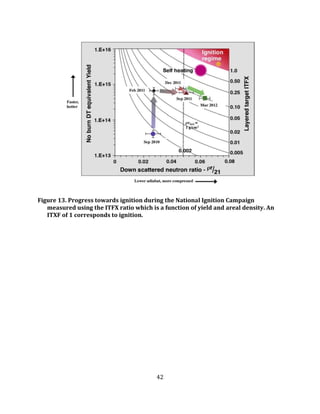
Figure 13. Progress towards ignition during the National Ignition Campaign measured
using the ITFX ratio which is a function of yield and areal density. An ITXF of 1 corresponds
to ignition.............................................................................................................................................................. 42
Figure 14. A sample nTOF response with the raw single passed through an inverting
amplifier and fit using the method outlined in [27, 28]. An absolute neutron yield for DD
and DT neutrons is obtained by time integrating the signal (SnTOF) and then multiplying by a
detector-specific calibration coefficient (CnTOF). (Figure as given in [29]).................................. 44
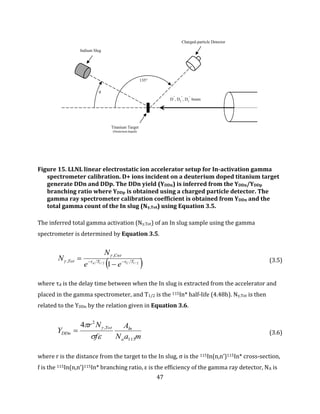
Figure 15. LLNL linear electrostatic ion accelerator setup for In-activation gamma
spectrometer calibration. D+ ions incident on a deuterium doped titanium target generate
DDn and DDp. The DDn yield (YDDn) is inferred from the YDDn/YDDp branching ratio where
YDDp is obtained using a charged particle detector. The gamma ray spectrometer calibration
coefficient is obtained from YDDn and the total gamma count of the In slug (Nγ,Tot) using
Equation 3.5......................................................................................................................................................... 47
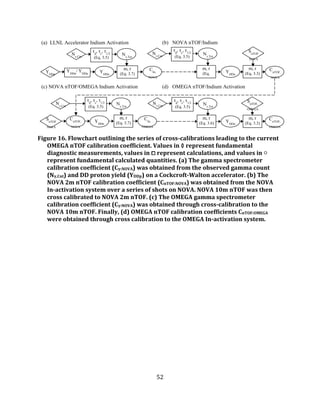
Figure 16. Flowchart outlining the series of cross-calibrations leading to the current
OMEGA nTOF calibration coefficient. Values in ◊ represent fundamental diagnostic
measurements, values in ⧠ represent calculations, and values in ○ represent fundamental
calculated quantities. (a) The gamma spectrometer calibration coefficient (Cγ:NOVA) was
obtained from the observed gamma count (Nγ,Cnt) and DD proton yield (YDDp) on a
Cockcroft-Walton accelerator. (b) The NOVA 2m nTOF calibration coefficient (CnTOF:NOVA)
was obtained from the NOVA In-activation system over a series of shots on NOVA. NOVA
10m nTOF was then cross calibrated to NOVA 2m nTOF. (c) The OMEGA gamma
spectrometer calibration coefficient (Cγ:NOVA) was obtained through cross-calibration to the
NOVA 10m nTOF. Finally, (d) OMEGA nTOF calibration coefficients CnTOF:OMEGA were
obtained through cross calibration to the OMEGA In-activation system..................................... 52
11
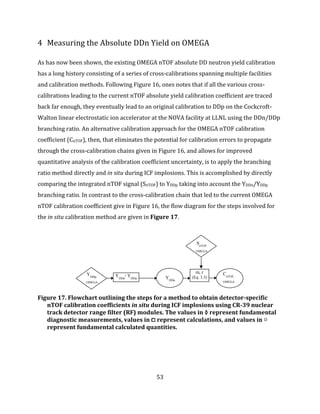
Figure 17. Flowchart outlining the steps for a method to obtain detector-specific nTOF
calibration coefficients in situ during ICF implosions using CR-39 nuclear track detector
range filter (RF) modules. The values in ◊ represent fundamental diagnostic
measurements, values in ⧠ represent calculations, and values in ○ represent fundamental
calculated quantities......................................................................................................................................... 53
Figure 18. (a) Campaign A, (b) and Campaign B exploding pusher shot campaigns on
OMEGA used to obtain an absolute yield calibration coefficient for 3m nTOF.......................... 54
Figure 19. Aitoff projection of the OMEGA target chamber showing the diagnostic ports
(given in yellow) and laser drive ports (given in green red and blue). CR-39 range filter
(RF) modules for nTOF calibration shots were fielded in ten inch manipulators (TIMs)
1,2,3, and 5 to provide broad angular coverage over the target chamber solid angle and
account for particle flux anisotropies. ...................................................................................................... 55
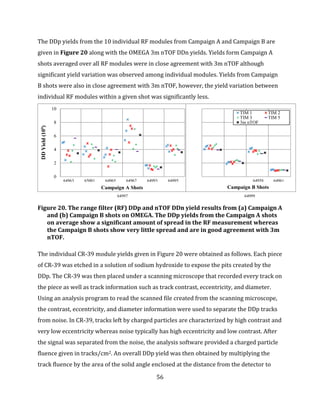
Figure 20. The range filter (RF) DDp and nTOF DDn yield results from (a) Campaign A and
(b) Campaign B shots on OMEGA. The DDp yields from the Campaign A shots on average
show a significant amount of spread in the RF measurement whereas the Campaign B shots
show very little spread and are in good agreement with 3m nTOF............................................... 56
Figure 21. The simulated capsule radius and areal density are given for shot 64999 as a
funciton of time (where t = 0 corresponds to the beginning of the laser pulse)....................... 59
Figure 22. Measured and modeled values of proton track diameter in CR-39 as a function of
incident proton energy (MeV). As given in Seguin et al. [31]. .......................................................... 60
Figure 23. CPS2 measured energy spectrums for (a) shot 64967 (Campaign A—D3He) and
(b) shot 64961 (Campaign B—DD)............................................................................................................. 61
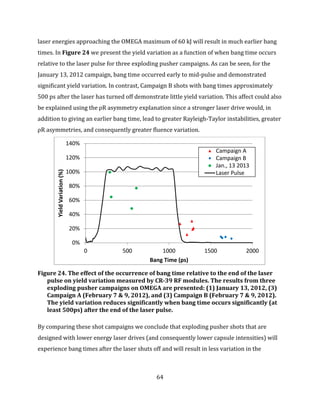
Figure 24. The effect of the occurrence of bang time relative to the end of the laser pulse on
yield variation measured by CR-39 RF modules. The results from three exploding pusher
campaigns on OMEGA are presented: (1) January 13, 2012, (3) Campaign A (February 7 &
9, 2012), and (3) Campaign B (February 7 & 9, 2012). The yield variation reduces
significantly when bang time occurs significantly (at least 500ps) after the end of the laser
pulse........................................................................................................................................................................ 64
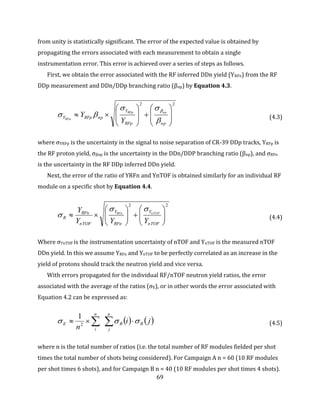
Figure 25. The YDDn/YDDp branching ratio is given by the ratio of the parameterized reaction
rates obtained from Bosch and Hale for DDn and DDp. This ratio as a function of ion
12
temperature is given by the black line. The inferred branching ratios for the OMEGA
Campaign A and Campaign B shots are obtained using the fuel burn-averaged ion
temperatures from nTOF and plotted on the black line. The error bars given for each shot in
Campaign A and Campaign B indicate the measured error in the nTOF ion temperature
measurement (x-axis) and the inferred error in the branching ratio (y-axix). ......................... 67
Figure 26. The expected value of the average of the RFn/nTOF DDn yield ratio
(E[<YRFn/YnTOF>]) with the associated 95% confidence interval obtained from the error
analysis for the OMEGA Campaign A and Campaign B shots............................................................ 71
Figure 27. The "fusion problem" where VTot(r) is the potential energy barrier particle X2
experiences as it approaches particle X1 and r is the distance between particles. .................. 80
Figure 28. The wave-function solution to the Schrodinger equation for the fusion problem.
................................................................................................................................................................................... 87
Figure 29. Impact parameter b, and cross section of nuclear collision......................................... 89
Figure 30. Fusion collisions with a density of target particles......................................................... 90
Figure 31. Linear Electrostatic Ion Accelerator (LEIA)....................................................................... 92
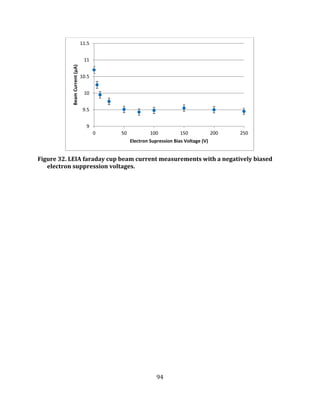
Figure 32. LEIA faraday cup beam current measurements with a negatively biased electron
suppression voltages........................................................................................................................................ 94
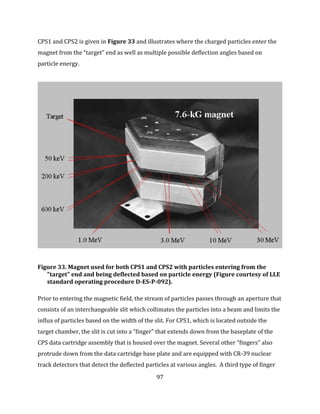
Figure 33. Magnet used for both CPS1 and CPS2 with particles entering from the "target"
end and being deflected based on particle energy (Figure courtesy of LLE standard
operating procedure D-ES-P-092)............................................................................................................... 97
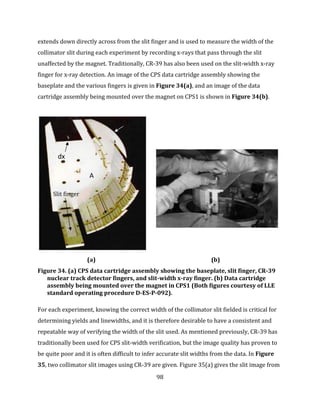
Figure 34. (a) CPS data cartridge assembly showing the baseplate, slit finger, CR-39 nuclear
track detector fingers, and slit-width x-ray finger. (b) Data cartridge assembly being
mounted over the magnet in CPS1 (Both figures courtesy of LLE standard operating
procedure D-ES-P-092). .................................................................................................................................. 98
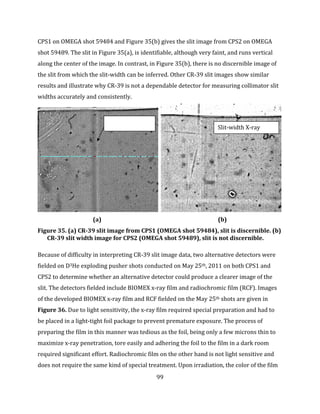
Figure 35. (a) CR-39 slit image from CPS1 (OMEGA shot 59484), slit is discernible. (b) CR-
39 slit width image for CPS2 (OMEGA shot 59489), slit is not discernible................................. 99
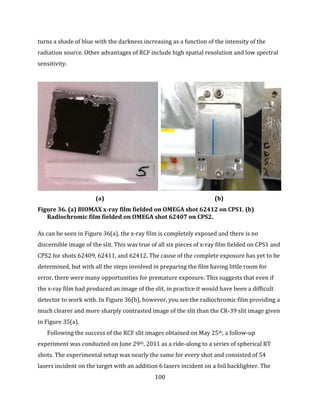
Figure 36. (a) BIOMAX x-ray film fielded on OMEGA shot 62412 on CPS1. (b) Radiochromic
film fielded on OMEGA shot 62407 on CPS2. ........................................................................................100
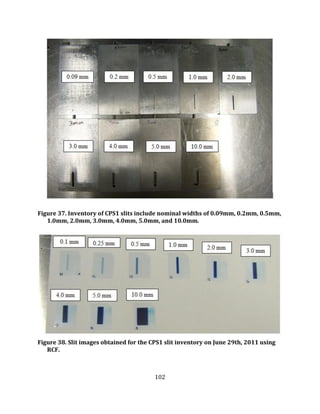
Figure 37. Inventory of CPS1 slits include nominal widths of 0.09mm, 0.2mm, 0.5mm,
1.0mm, 2.0mm, 3.0mm, 4.0mm, 5.0mm, and 10.0mm. .....................................................................102
13
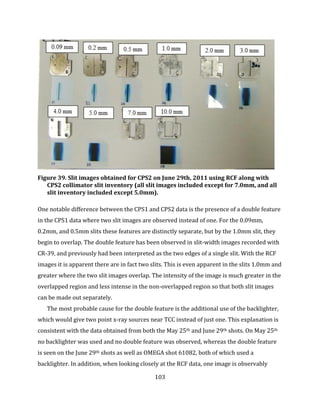
Figure 38. Slit images obtained for the CPS1 slit inventory on June 29th, 2011 using RCF.
.................................................................................................................................................................................102
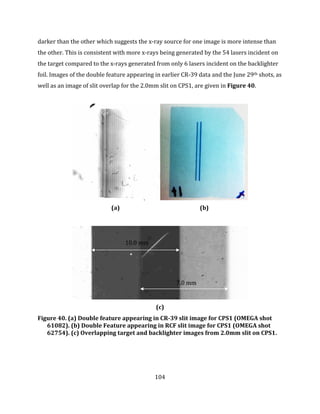
Figure 39. Slit images obtained for CPS2 on June 29th, 2011 using RCF along with CPS2
collimator slit inventory (all slit images included except for 7.0mm, and all slit inventory
included except 5.0mm)................................................................................................................................103
Figure 40. (a) Double feature appearing in CR-39 slit image for CPS1 (OMEGA shot 61082).
(b) Double Feature appearing in RCF slit image for CPS1 (OMEGA shot 62754). (c)
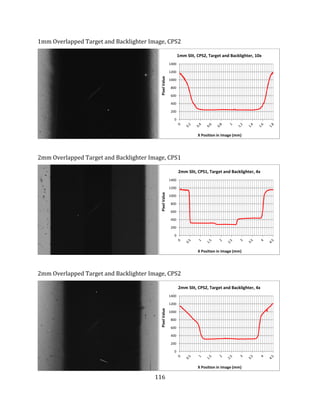
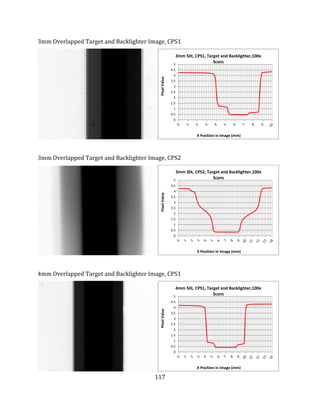
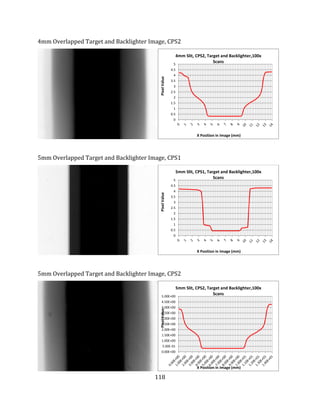
Overlapping target and backlighter images from 2.0mm slit on CPS1. ......................................104
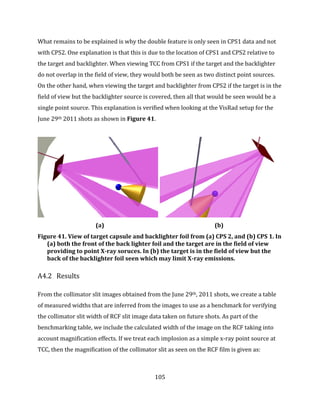
Figure 41. View of target capsule and backlighter foil from (a) CPS 2, and (b) CPS 1. In (a)
both the front of the back lighter foil and the target are in the field of view providing to
point X-ray soruces. In (b) the target is in the field of view but the back of the backlighter
foil seen which may limit X-ray emissions.............................................................................................105
Figure 42. Experimental configuration for CPS1 and CPS2 with corresponding
magnification factors......................................................................................................................................106
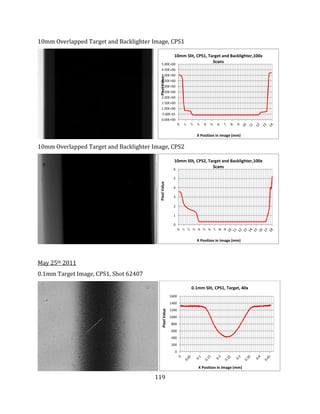
Figure 43. Target slit image for 0.1mm slit on CPS1 with lineout showing slit thickness
(microscope magnification set to 100x). ................................................................................................107
Figure 44. Overlapping target and backlighter image for 3mm slit on CPS1 with lineout
showing slit thickness (microscope set to 100x in scanning mode)............................................107
Figure 45. Effect of rotational perturbation on slit image width: (a) no rotation, (b) rotation
of angle θS...........................................................................................................................................................108
Figure 46. Preparation specifications for RCF used for imaging collimator slit width on
CPS1 and CPS2. .................................................................................................................................................111
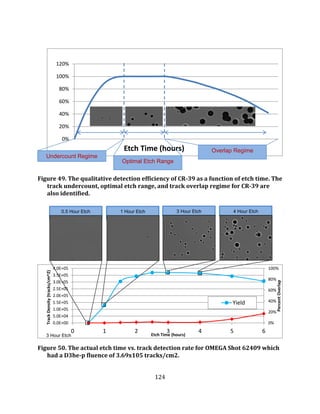
Figure 47. Average track diameter vs. etch time for CR-39 etched in a sodium hydroxide
solution. ...............................................................................................................................................................123
Figure 48. (a) CR-39 Normal Fluence (standard 5 hour etch) with a track density of ~1x10⁴
tracks/cm2, (b) CR-39 high fluence (standard 5 hour etch) track density 2.4x10⁵
tracks/cm2. .........................................................................................................................................................123
Figure 49. The qualitative detection efficiency of CR-39 as a function of etch time. The track
undercount, optimal etch range, and track overlap regime for CR-39 are also identified..124
14
Figure 50. The actual etch time vs. track detection rate for OMEGA Shot 62409 which had a
D3he-p fluence of 3.69x10⁵ tracks/cm2. ...............................................................................................124
15
List of Tables
Table 1. Table of primary fusion reactions in the p-p and CNO....................................................... 28
Table 2. U.S. Department of Energy supercomputers as of June 2013.......................................... 35
Table 3. nTOFs comprising the NOVA nTOF system in the 1990s along with their
corresponding distance to target chamber center (TCC), the method used for cross-
calibration, and the resulting detector-specific calibration coefficient (CnTOF)......................... 49
Table 4. Primary fusion product charged particles incident on CR-39 RF modules in
Campaigns A and B. Given are the source fusion reactions, the particle birth energy, the
range of the particle in aluminum corresponding to the birth energy, and the energy of the
particle after passing through the 25 μm range filter.......................................................................... 58
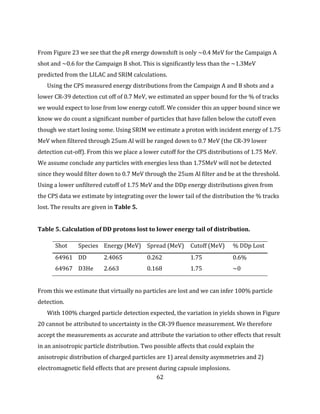
Table 5. Calculation of DD protons lost to lower energy tail of distribution.............................. 62
Table 6. The errors associated with the averaged expected value of the RFn/nTOF DDn
yield ratios for the Campaign A, Campaign B, and both campaigns are given. σE is the
companied instrumentation error, σC is the error from yield variation (due to particle flux
anisotropies), and σT is the total error in the expected value. The 95% confidence interval is
also given............................................................................................................................................................... 70
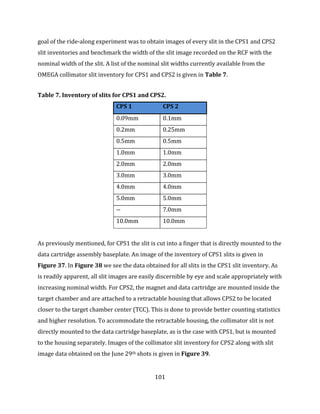
Table 7. Inventory of slits for CPS1 and CPS2.......................................................................................101
Table 8. Benchmarked measured and calculated widths of slits in CPS1 and CPS2 inventory.
For CPS1, both widths from the target and backlighter (BL) images are given separately.
.................................................................................................................................................................................109
Table 9. Measured slit width and slit depths, calcualted and measured RCF slit images and
the angle of rotational perturbation needed to reduce the yield measurement by 20%. ...110
16
17
1 Introduction
“…if both observation and conceptualization,
fact and assimilation to theory, are inseparably linked in discovery,
then discover is a process and must take time…”
—Thomas Kuhn [1]—
Understanding of the cosmos and the nature of terrestrial substance has a long tradition
dating back to the very first of the natural philosophers who sought to apply the tools of
reason to overthrow the confines of mythological explanations of the universe and
establish complete and consistent arguments for the nature of the phenomena they
observed. Of the first in the tradition, Thales of Miletus circa 600 B.C. claimed all substance
was made of water. Anaximenes circa 550 B.C. claimed all substance was air. Later,
Heraclitus circa 500 B.C. claimed all was fire, while Empedocles synthesizing all preceding
views, and adding a fourth, claimed all substance was air, fire, water, or earth. In 350 B.C.
Aristotle accepted Empedocles categorization of the earthly substances and added a fifth,
aether, the perfect and unchanging material of the celestial regions and heavenly bodies
that was otherworldly compared to the terrestrial elements which are subject to change,
rot and decay. This view of the heavens as a place of unchanging perfection lasted for 2000
years until Galileo, while staring through the lens of his telescope in Padua in the 16th
century, observed mountains, craters, and other imperfections on the surface of the moon,
suggesting that what was once regarded in reverence as perfect, unchanging, and divine,
was strikingly more similar to the terrestrial elements then had ever previously been
thought.
In our day the Aristotelian paradigm for terrestrial substance has long been replaced,
but at the same time this ancient categorization of substance is strikingly similar to what
we now view as the four states of matter: solids, liquids, gases, and plasma. Solids are
characterized by strong binding between particles with low kinetic energy. As the kinetic
energy of the particles increases, the solid experiences a phase transition to liquid where
the particles are still bound together although the bonds are much weaker. In water at
18
atmospheric pressure this occurs at 273K. As additional energy is added, the inter-particle
bonds start to break apart and the liquid goes through a second phase transition to a gas
which has virtually no bonding between particles. In water at atmospheric pressure, this
occurs at 373K. Finally, if enough energy is added, the Coulomb forces holding the electrons
to the nuclei themselves are overcome and the electrons disassociate with the nuclei
altogether. In this stage the particles are ionized and the matter is said to be in the plasma
state. For hydrogen, this occurs at 1.58x10⁵ K or 13.59 eV (where 1 eV is equal to 11604.5
K). Elements are often characterized by their atomic number Z which corresponds to the
number of protons. Heavier elements with high Z have Z electrons and there is a distinct
energy required to ionize each electron. The energy required to ionize the first electron is
the 1st ionization energy, the energy required to ionize the 2nd electron is the second
ionization energy, and so on. The ionization energies differ for each element based on the
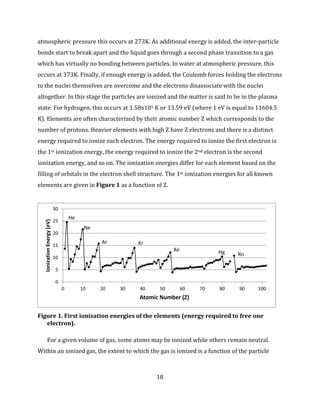
filling of orbitals in the electron shell structure. The 1st ionization energies for all known
elements are given in Figure 1 as a function of Z.
Figure 1. First ionization energies of the elements (energy required to free one
electron).
For a given volume of gas, some atoms may be ionized while others remain neutral.
Within an ionized gas, the extent to which the gas is ionized is a function of the particle
0
5
10
15
20
25
30
0 10 20 30 40 50 60 70 80 90 100
IonizationEnergy(eV)
Atomic Number (Z)
He
Ne
Ar Kr
Xe Hg Rn
19
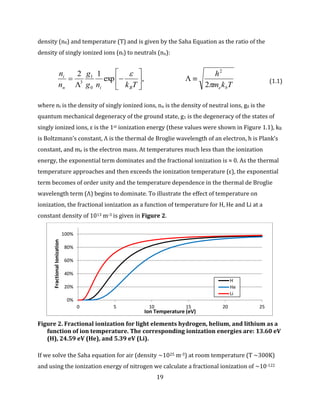
density (n0) and temperature (T) and is given by the Saha Equation as the ratio of the
density of singly ionized ions (ni) to neutrals (nn):
Tkm
h
Tkng
g
n
n
beBin
i


2
,exp
12 2
0
1
3








 (1.1)
where ni is the density of singly ionized ions, nn is the density of neutral ions, g0 is the
quantum mechanical degeneracy of the ground state, g1 is the degeneracy of the states of
singly ionized ions, ε is the 1st ionization energy (these values were shown in Figure 1.1), kB
is Boltzmann’s constant, Λ is the thermal de Broglie wavelength of an electron, h is Plank’s
constant, and me is the electron mass. At temperatures much less than the ionization
energy, the exponential term dominates and the fractional ionization is ≈ 0. As the thermal
temperature approaches and then exceeds the ionization temperature (ε), the exponential
term becomes of order unity and the temperature dependence in the thermal de Broglie
wavelength term (Λ) begins to dominate. To illustrate the effect of temperature on
ionization, the fractional ionization as a function of temperature for H, He and Li at a
constant density of 1013 m-3 is given in Figure 2.
Figure 2. Fractional ionization for light elements hydrogen, helium, and lithium as a
function of ion temperature. The corresponding ionization energies are: 13.60 eV
(H), 24.59 eV (He), and 5.39 eV (Li).
If we solve the Saha equation for air (density ~1025 m-3) at room temperature (T ~300K)
and using the ionization energy of nitrogen we calculate a fractional ionization of ~10-122
0%
20%
40%
60%
80%
100%
0 5 10 15 20 25
FractionalIonization
Ion Temperature (eV)
H
He
Li
20
which is essentially zero! The fractional ionization for other gases at these temperatures
and densities on earth is comparable. This result indicates that it is virtually impossible to
find ionized gases naturally on earth (although there are some exceptions such as
lightening and the aurora borealis). By contrast, in interstellar medium consisting of
hydrogen, we find extremely low densities on the order of 103 m-3, and particles are fully
ionized at temperatures less than 1 eV. In addition, temperatures in stars, gas-giant cores,
supernovae, and neutron stars often greatly exceed the ionization energy resulting in
complete ionization. From the Saha equation one can estimate that as much as 99% of all
matter in the non-terrestrial universe—the matter making up Aristotle’s unchanging and
divine aether—is nothing more than the same material found on earth except existing in a
plasma state. As we gaze into the heavens we observe plasmas everywhere in stars,
galaxies, and nebula such as the Cat’s Eye nebula pictured in Figure 3.
Figure 3. The Cat's Eye nebula as seen from the Hubble telescope.
1.1 Nuclear Fusion and Nucleosynthesis
Of all the theories of the original natural philosophers (i.e. Thales, Anaximenes,
Empedocles, Aristotle, etc.) the hypothesis most closely resembling our contemporary
theory of substance was given by Democritus who claimed that everything was composed
of “atoms” that were physically indivisible and constituted the smallest building blocks of
21
the universe. Atoms, as Democritus claimed, were infinite in number, could be different in
kind, size, and shape, and were separated by empty space or void. The processes
responsible for creating daughter atoms of different kind, size, and shape, from parent
atoms of smaller Z only occur when matter is in the plasma state through nuclear fusion
reactions. Additionally, nuclear fission and radioactive decay (e.g. alpha, beta, and gamma
decay) produce daughter atoms from parent atoms of higher Z. The process responsible for
creating new atomic nuclei from pre-existing nucleons with smaller Z through nuclear
fusion is called nucleosynthesis. We now turn the problem of how atoms are formed and
the nuclear reactions that lead to their formation.
In Albert Einstein’s paradigm-shattering paper “On the Electrodynamics of Moving
Bodies” we learn that the rest mass of a particle can be expressed as an energy equivalence
that is given by the famous equation E=mc2 [2]. One result of this relationship is that any
change in the rest mass of an atom leads to a change in its kinetic energy as given in
Equation 1.2:
2
cmE  (1.2)
where ΔE is in joules, Δm is in kilograms, and c is in meters per second. In nuclei, this mass
differential contributes to the binding energy, EB , that is responsible for binding the
nuclear protons and neutrons together. The binding energy is expressed in terms of the
mass differential between the total mass of the individual protons, neutrons and electrons,
and the actual mass of the atom as a whole. The binding energy relationship is given in
Equation 1.3:
    2
cmZXmmNmZE e
A
npB  (1.3)
where Z is the number of protons and electrons, N is the number of neutrons, mp is the
proton mass, mn is the neutron mass, me is the electron mass, and m(AX) is the mass of
atom X with atomic mass number A. Nuclear reactions are often represented similarly to
chemical reactions with the reactants on the left side and the products on the right side of a
reaction chain. An example of this is given by Equation 1.4
22
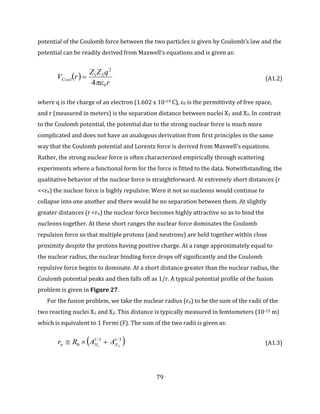
FQXXXX  4321 (1.4)
where X1 and X2 are the reacting nuclei, X3 and X4 are the fusion product(s)—depending on
the reaction there may be more than one—and QF is the change in energy which is based on
the mass differential between the reactant nuclei and the fusion products. For positive QF
the reaction is exothermic, for negative QF the reaction is endothermic. An equivalent
alternative notation that is commonly used for the fusion reaction is: X1(X2,X3)X4.
When a nuclear reaction occurs such that the mass of the reacting nuclei is greater than
the mass of its products, the binding energy is converted to kinetic energy and released
with the reaction products as QF. Despite the change of mass, the number of nucleons in a
nuclear reaction remains constant. Since the total number of nucleons is conserved, it is
customary to express the binding energy of an atom in terms of its binding energy per
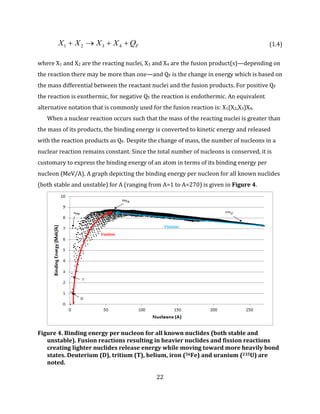
nucleon (MeV/A). A graph depicting the binding energy per nucleon for all known nuclides
(both stable and unstable) for A (ranging from A=1 to A=270) is given in Figure 4.
Figure 4. Binding energy per nucleon for all known nuclides (both stable and
unstable). Fusion reactions resulting in heavier nuclides and fission reactions
creating lighter nuclides release energy while moving toward more heavily bond
states. Deuterium (D), tritium (T), helium, iron (56Fe) and uranium (235U) are
noted.
23
As can be seen, initially the binding energy per nucleon increases from A=1—where by
definition it is 0—until it reaches a maximum at 8.79 MeV/A around 56Fe. From there the
binding energy per nucleon gradually decreases arriving at 7.87 MeV/A for 235U. From the
graph we gain a clear understanding of the kinds of nuclear reactions that have the
potential of releasing energy. Any reactions among nuclei that go from lower to higher
binding energies convert mass energy to kinetic energy and are therefore exothermic. For
nuclei with A less than 56 this happens for nuclear fusion reactions whereas for nuclei with
A greater than 56 this only happens through fission. The amount of energy released is
referred to as the Q-value and is equal to the energy mass differential of the reaction
products and reactants as expressed earlier in Equation 1.2.
Having established the kinds of nuclear reactions and the source of energy released in
these reactions, we now look at the physics behind the reactions themselves. Fusion
reactions are the result of particle collisions and the attractive and repulsive forces that act
on particles when they collide. The two primary forces of interest include (1) the Coulomb
repulsive force which is due to each nuclei having a positive charge, and (2) the strong
nuclear force which is attractive between nucleons. Due to the long range nature of the
Coulomb force relative to the short range nature of the strong nuclear force, as two positive
nuclei first begin to approach each other the initial force experienced by the particles is the
Coulomb force. However, when the distance between the two nuclei reaches the order of a
nuclear radius (a few femtometers) the strong nuclear force begins to take over and
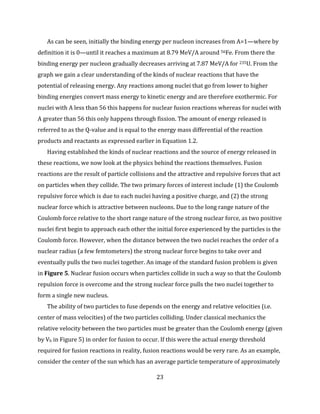
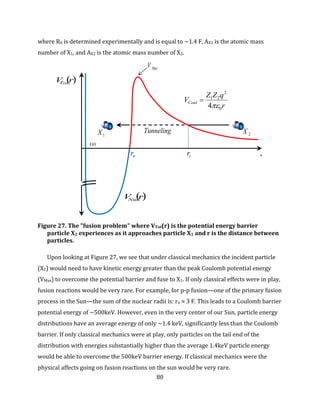
eventually pulls the two nuclei together. An image of the standard fusion problem is given
in Figure 5. Nuclear fusion occurs when particles collide in such a way so that the Coulomb
repulsion force is overcome and the strong nuclear force pulls the two nuclei together to
form a single new nucleus.
The ability of two particles to fuse depends on the energy and relative velocities (i.e.
center of mass velocities) of the two particles colliding. Under classical mechanics the
relative velocity between the two particles must be greater than the Coulomb energy (given
by Vb in Figure 5) in order for fusion to occur. If this were the actual energy threshold
required for fusion reactions in reality, fusion reactions would be very rare. As an example,
consider the center of the sun which has an average particle temperature of approximately
24
1.4keV and an energy distribution that is roughly Maxwellian. Based on Figure 5, the
Coulomb barrier is estimated as being on the order of 500keV (for proton/proton and
deuterium/proton collisions). If only classical mechanics were at play only particles with
energies substantially higher than the average 1.4keV particle energy in a Maxwellian
energy distribution would be able to overcome the 500keV barrier energy. If only classical
mechanics were considered fusion reactions on the sun would be very rare.
Figure 5. Image depicting the standard fusion problem [3]. A nuclei with energy ε is
incident on a second nuclei. As the two nuclei approach the Coulomb repulsive
force acts to push the two particles apart. Under classical mechanics, if the
relative energy (center of mass energy) of the two particles is less than Vb the two
particles will not fuse. However, under quantum mechanics there is a finite
probability of the particles tunneling through the Coulomb barrier even though ε
is lower than the Vb.
However, classical mechanics are not the only phenomena when it comes to fusion
reactions. Due to quantum effects where particles exhibit wave-like properties and are
represented mathematically as waves, there exists a finite probability that one particle
colliding with another particle will “tunnel” through the potential barrier (Vb) even if the
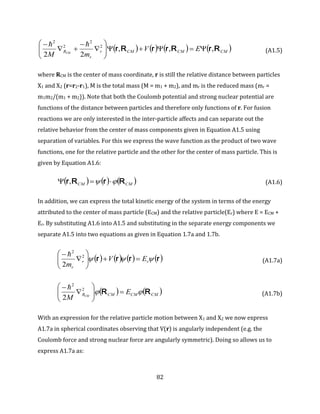
relative energy between the particles (ε) is less than Vb. The derivation of this probability is
somewhat involved and is provided in detail in Appendix A. The resulting probability of
25
one particle tunneling through the potential barrier to a second particle was originally
derived by Gamow [4] and is given here as:
  2
0
42
2
2
1
8
where,exp

r
G
G
Tun
mqZZ
E
E
E
EP 







 (1.5)
where E is the center of mass energy of the particles, EG is the Gamow energy, mr is the
reduced mass of the two particles (mr =(m1+m2)/(m1*m2)), m1 is the mass of particle 1, m2
is the mass of particle 2, ħ is the reduced Plank’s constant, Z1 is the atomic number of
particle 1, Z2 is the atomic number of particle 2, q is the charge of an electron, and ε0 is the
permittivity of free space.
When looking at the tunneling probability given by Equation 1.5 a few things stand out.
The threshold energy required to achieve a high probability of tunneling is highly affected
by the Gamow energy (EG). The higher the Gamow energy, the higher the center of mass
energy between the particles must be for tunneling to occur. The Gamow energy itself is
mainly dependent on the charge and mass of the colliding particles. The larger the atomic
number, the greater the nuclear charge, the greater the Coulomb repulsion force between
the particles, and the lower the probability the particles will tunnel. Even for the smallest of
Coulomb repulsion force between particles, the center of mass energy required for even a
small probability of tunneling can be large when compared to the ionization energy. As an
example, evaluating Equation 1.4 for a collision between deuterium and tritium and for a
tunneling probability of 10%, the energy required is on the order of 220keV. Since the
ionization energy for hydrogen is only 13.59eV we see that fusion reactions can only occur
when matter is very hot and in an ionized state.
We have now looked at the problem of fusion reactions for individual colliding
particles. In most applications of interest, instead of looking at single particle interactions
we are dealing with systems consisting of many particle collisions. For these situations we
can express the fusion reactions in terms of a fusion reaction rate that gives the number of
fusion collisions in a set volume over a given period of time. The reaction rate for particles
colliding at a set energy is derived in Appendix A and is given as:
26
vnnR 21 (1.6)
where R is the fusion reaction rate (m-3·s-1), n1 is the density of particle species 1, n2 is the
density of particle species 2, σ is the fusion reaction cross-section, and v is the relative
velocity between particles. The fusion reaction cross-section represents an area defining
where a fusion collision reaction is likely to occur and is a function of the particle’s center
of mass energy. The fusion cross section is derived in its entirety in Appendix A but is given
below in Equation 1.7:
  2
0
42
2
2
1
2
8
where,exp
1
2 



 r
G
G
r
mqZZ
E
E
E
Em
E 







 (1.7)
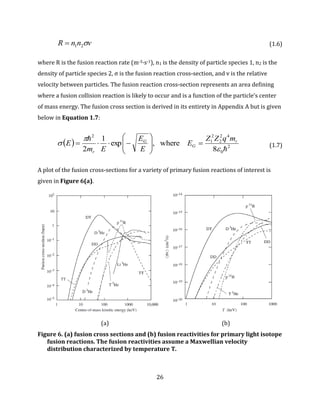
A plot of the fusion cross-sections for a variety of primary fusion reactions of interest is
given in Figure 6(a).
(a) (b)
Figure 6. (a) fusion cross sections and (b) fusion reactivities for primary light isotope
fusion reactions. The fusion reactivities assume a Maxwellian velocity
distribution characterized by temperature T.
27
In most situations, the relative velocity between particles is not homogenous but rather
is spread across a distribution of velocities. Since, as shown in Equation 1.7, the fusion
reaction cross section (σ) is also function of the center of mass energy (or also the velocity),
the value of σv (commonly referred to as the fusion reactivity) will be different for each
particle velocity in the distribution. In this case, a convenient way to obtain a set reaction
rate for all particles in a volume is by determining an average reactivity rate across the
velocity distribution. The average fusion reactivity is given in Equation 1.8 as:



0
)()( dvvvfvv  (1.7)
where f(v) is the distribution function of the relative (i.e. center of mass) velocities . The
average reactivity for a number of fusion reactions of interest, assuming a Maxwellian
velocity distribution characterized by temperature T, is given in Figure 6(b). As can be
seen, the reaction with the highest reactivity is the D-T reaction which reaches a maximum
with an average reactivity of around 10-15 cm3s-1. Because D-T fusion has the highest
reaction rate and also produces among the highest amounts of energy per reaction (17.6
MeV) it is the primary reaction of interest for purposes of energy production.
With an understanding of the fundamentals of fusion reactions we return to the
discussion on the formation of atoms and the original atomic hypothesis presented by
Democritus. It is now widely accepted that the first atomic nuclei were formed shortly after
the Big Bang through a chain of fusion reactions known as nucleosynthesis. In general,
nucleosynthesis is the process by which new atomic nuclei are formed from preexisting
nuclei and/or protons and neutrons. The first nucleosynthesis chain is known as the
proton-proton or pp chain and results in the formation of 2H, 3He, and 4He from individual
protons. An illustration of the first few steps of the pp chain is given in Figure 7.
From this chain, many other fusion reaction chains can be traced and if followed out in
their entirety would eventually lead to the formation of all atomic nuclei. One of the more
important chains in addition to the pp chain is the CNO chain which gives the formation of
carbon (C), nitrogen (N), and oxygen (O), the most important elements for biological
28
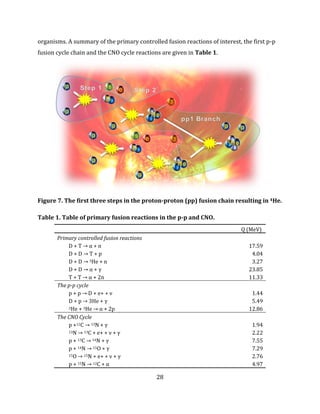
organisms. A summary of the primary controlled fusion reactions of interest, the first p-p
fusion cycle chain and the CNO cycle reactions are given in Table 1.
Figure 7. The first three steps in the proton-proton (pp) fusion chain resulting in 4He.
Table 1. Table of primary fusion reactions in the p-p and CNO.
Q (MeV)
Primary controlled fusion reactions
D + T → α + n 17.59
D + D → T + p 4.04
D + D → 3He + n 3.27
D + D → α + γ 23.85
T + T → α + 2n 11.33
The p-p cycle
p + p → D + e+ + ν 1.44
D + p → 3He + γ 5.49
3He + 3He → α + 2p 12.86
The CNO Cycle
p +12C → 13N + γ 1.94
13N → 13C + e+ + ν + γ 2.22
p + 13C → 14N + γ 7.55
p + 14N → 15O + γ 7.29
15O → 15N + e+ + ν + γ 2.76
p + 15N → 12C + α 4.97
29
1.2 High Energy Density Physics
The interstellar environments in which many natural nuclear reactions and
nucleosynthesis occur are characterized by very high particle energies at high densities.
Physical systems in this regime with an energy density (product of density and
temperature) greater than around 105 J/cm3 are in the regime of high energy density
physics (HEDP). Many HEDP regimes of interest occur naturally in solar and gas-giant
cores, supernovae, neutron stars, and black holes. It was not, however, until the mid-1900s
that experimental facilities existed to probe environments in HEDP in a laboratory setting.
Many of the first experiments to cross into this regime used particle accelerators, similar to
the first one developed by Cockcroft and Walton, to focus and collimate particle beams on
stationary targets [5]. The advent of the laser in the 1960’s opened the possibility of using
high powered lasers to create HEDP environments in the lab[6]. Since being introduced,
high powered lasers in the terawatt and petawatt range have been developed as an
additional platform for creating HEDP environments in the lab. One of the primary
platforms for conducting HEDP research that has emerged since the 1950s is inertial
confinement fusion [7]. Many HEDP regimes of interest are given in Figure 8.
Figure 8. Natural and man-made regimes in high-energy-density physics.
30
1.3 Thesis Outline
The primary focus of this thesis is to present work conducted aimed at reducing the
uncertainty in DDp and DDn yield measurements in inertial confinement fusion (ICF)
experiments on the OMEGA laser. In addition, some additional work in support of nuclear
diagnostic development conducted on behalf of the High Energy Density Physics group at
the MIT Plasma Science and Fusion Center is also given in the appendices.
In Chapter 2 a brief history and overview of the contemporary inertial confinement
fusion program with primary motivations for the research as well as a brief overview of
inertial confinement fusion physics is given. For a complete treatment on ICF physics see
Atzeni et al. [3]. Chapter 3 presents the background and history behind the DDn yield
measurement on the OMEGA laser and the many interconnected efforts that went into
establishing the current absolute yield calibration factor for the OMEGA nTOF detector
system. These efforts include a series of cross calibrations between accelerator DDp
measurements, indium activation systems on the NOVA1 laser and OMEGA, and cross
calibration between NOVA and OMEGA nTOF systems. In Chapter 4 an improved method
for measuring the DDp yield on OMEGA using CR-39 range filter (RF) modules is presented
from which the DDn yield can be inferred. The data obtained suggest a relationship
between particle flux anisotropies and bang time, where fluence variation is observed to be
significantly reduced when bang time occurs significantly after the end of the laser pulse.
The CR-39 DDn inferred yield is then compared to the existing nTOF DDn absolute yield
calibration for verification. Chapter 5 concludes with a summary of the findings and ideas
for next steps.
In Appendix A, a derivation of the fusion reaction rate from first principles is presented
as a supplement for the equations presented in Chapter 1. In Appendix B, work done to
install a Faraday Cup on the MIT Linear Electrostatic Ion Accelerator (LEIA) is presented as
well as beam current readings to determine optimal electron suppression bias source
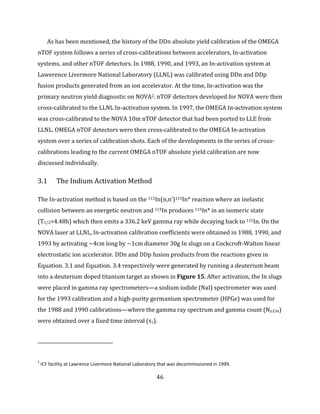
1
A high power laser for ICF at Lawrence Livermore National Laboratory that was decommissioned in 1999.
31
settings. In Appendix C, a project is presented that was conducted to establish a way to
unequivocally and consistently verify the slit width on Charged Particle Spectrometers
(CPS) on OMEGA. Appendix D presents work that was used to increase the dynamic range
of CR-39 detectors by stage etching high-fluence range filter detectors fielded on OMEGA.
Finally, in Appendix E the raw data from the OMEGA campaigns used for low uncertainty
DDn absolute yield measurements for nTOF calibration is presented in its entirety.
32
33
2 Inertial Confinement Fusion
Inertial confinement fusion (ICF) is an approach by which fusion occurs in a laboratory
setting by using the inertia of a hot dense plasma to confine the plasma long enough for a
significant amount of fuel to undergo nuclear fusion and release energy. The concept was
first envisioned in the late 1950’s after the successful development of the hydrogen bomb.
At that time Edward Teller, the “father of the hydrogen bomb” and co-founder of Lawrence
Livermore National Laboratory, called for the exploration of nuclear fusion for peaceful
purposes. Some of the original ideas included the use of hydrogen bombs for excavation
and mining, constructing dams and canals, and energy. Early ideas for the use of fusion for
energy included detonating hydrogen bombs in water-filled underground caverns deep in
the earth to generate steam from which electricity would be generated, and using small
non-nuclear micro-implosions to drive a shock wave into the fusion fuel. The idea of micro-
implosion induced shock waves compressing and igniting the fusion fuel led to the concept
of a tiny droplet of fuel being heated and burned using an external driver as a heating
source.
2.1 Contemporary Motivation for Inertial Confinement Fusion Research
After the initial success of the Manhattan Project in producing the first fission bombs, and
the subsequent success of the first fusion bombs, the U.S. continued an extensive nuclear
weapons testing program for the purposes of: (1) gaining a better understanding of
weapon physics, (2) testing the effectiveness of different weapon designs, (3)
understanding the effects of weapons and nuclear fallout on organisms and the
environment, and (4) exploring the peaceful use of nuclear explosions. From the first
nuclear test at the Trinity site at Alamogordo, New Mexico in 1945 to the last U.S. nuclear
test at the Nevada Test Site in 1992, the United States conducted 1054 nuclear tests
including both underground and atmospheric testing. Most of these tests were conducted
at the Nevada Test Site (pictured below in Figure 9) and the Pacific Proving Grounds in the
Marshall Islands.
34
Throughout the period of weapons testing, multiple attempts had been made to limit or
ban nuclear tests. The first step toward a comprehensive ban on nuclear weapons testing
occurred in 1963 through the Partial Test Ban Treaty that banned nuclear tests underwater
and in the atmosphere but not underground. In 1968, the Nuclear Non-proliferation Treaty
was passed that prohibited previously non-nuclear states from acquiring nuclear weapons
capabilities. Little additional progress in banning nuclear testing was made until the end of
the Cold War. In 1993, negotiations for a comprehensive nuclear test ban treaty began in
the United Nations General Assembly. In 1996 the Comprehensive Test Ban Treaty was
adopted by the United Nations and has now been signed and ratified by 159 states. Despite
ratification of the treaty by peer nuclear powers such as Russia, France, and the United
Kingdom, the U.S. has yet to ratify the treaty although a moratorium on all nuclear weapons
testing has essentially been in effect since 1992.
Figure 9. Areial views taken of the Nevada test site. Both images depict craters left
from underground tests.
Many arguments have been made in opposition to the U.S. ratifying the Comprehensive
Test Ban Treaty. One argument holds that by ratifying the treaty, the U.S. would lose its
ability to make continued advancements in weapons science and to gain fundamental
understanding of material properties under nuclear detonations. Another argument is that
in order to ensure the continued reliability of the nuclear stockpile, periodic testing of
weapons is needed to verify that weapons in the nuclear arsenal are still functional and will
remain a strong deterrent. This is important since no new weapons are currently being
35
developed and aging weapons have the potential to fail or prove unreliable in a number of
ways.
To the end of providing an alternative to weapons testing and to continue advanced
weapons science and maintain the reliability of the nation’s nuclear deterrent, inertial
confinement fusion has been promoted and funded as a platform for continuing weapons
research without the need of detonating weapons. The goal is that eventually the
underlying physics will be well enough understood and benchmarked to experimental data
gained from ICF experiments so that “virtual” testing using advanced codes run on
supercomputers will be able to eliminate the need for physical nuclear tests altogether.
This goal of obtaining virtual testing and simulations as a perfect substitute for physical
testing has motivated the U.S. government through the National Nuclear Security
Administration of the U.S. Department of Energy under the Stockpile Stewardship program
to invest significantly in both supercomputers capable of running advanced plasma codes
as well as facilities used to experimentally benchmark key code parameters. As part of this
effort, four of the top ten supercomputers in the world are owned and operated by the U.S.
Department of Energy including the Titan Supercomputer at Oak Ridge National
Laboratory (given in Figure 10), which as of June 2013, was the second fastest super
computer in the world. A list of the top U.S. Department of Energy supercomputers is given
in Table 2 along with the number of cores and fastest recorded floating point operations
(Flops) per second.
Table 2. U.S. Department of Energy supercomputers as of June 2013.
Rank Site System Cores TFlops/s
2 Oak Ridge National Laboratory Titan—Cray 560640 17590
3 Lawrence Livermore National Laboratory Sequoia 1572864 17173.2
5 Argonne National Laboratory Mira—BlueGene 786432 8586.6
8 Lawrence Livermore National Laboratory Vulcan—BlueGene 393216 4293.3
22 Los Alamos National Laboratory Cielo—Cray 142272 1110.0
34 Lawrence Livermore National Laboratory Zin 46208 773.7
61 Sandia National Laboratories Red Sky 42440 433.5
36
Figure 10. The Titan supercomputer at Oak Ridge National Laboratory.
In addition to the impressive supercomputing infrastructure that has been built in support
of the DOE NNSA Stockpile Stewardship’s program to create the capabilities to perform
“virtual” nuclear tests, major experimental facilities have been built with the goal of using
experimental data from ICF, equation of state, and materials tests, to benchmark computer
codes. The primary DOE laboratories supporting this effort are Los Alamos National
Laboratory, Lawrence Livermore National Laboratory, and Sandia National Laboratories.
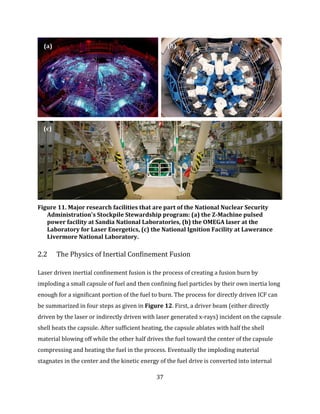
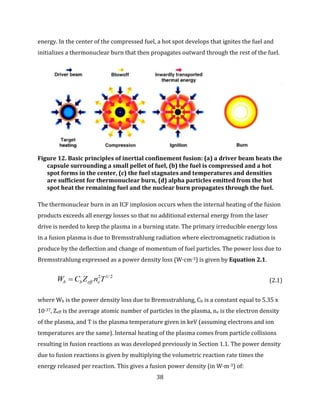
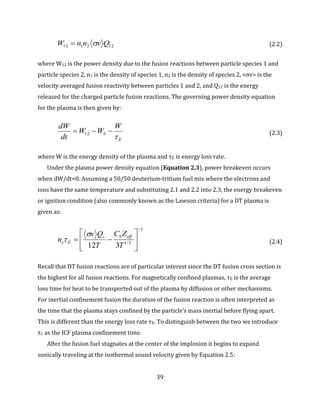
Major experiments at these labs include the Z-Machine at Sandia National Laboratory
which is used for z-pinch driven inertial confinement fusion and material equation of state
experiments [8], the National Ignition Facility at Lawrence Livermore National Laboratory
which aims at achieving a thermonuclear burn using laser indirectly-driven ICF [9], and the
OMEGA laser at the Laboratory for Laser Energetics (LLE) at the University of Rochester
which acts as a small laser ICF test-bed [10]. Images of these research facilities are given in
Figure 10.
In addition to stockpile stewardship, other contemporary interests and motivations for
ICF research include energy and basic research in HEDP such as atomic physics, nuclear
physics, plasma physics, astrophysics, material science, and laser science. Many of these
additional interests are addressed through user programs at the major research facilities
where academic and government collaborators work to further understanding of basic
science. That said, stockpile stewardship remains the primary policy goal of the program,
has a dominant share of shot time at experimental facilities, and remains the justification
for the significant amount of federal funding ICF receives [11].
37
Figure 11. Major research facilities that are part of the National Nuclear Security
Administration's Stockpile Stewardship program: (a) the Z-Machine pulsed
power facility at Sandia National Laboratories, (b) the OMEGA laser at the
Laboratory for Laser Energetics, (c) the National Ignition Facility at Lawerance
Livermore National Laboratory.
2.2 The Physics of Inertial Confinement Fusion
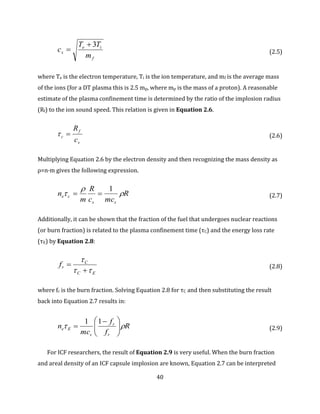
Laser driven inertial confinement fusion is the process of creating a fusion burn by
imploding a small capsule of fuel and then confining fuel particles by their own inertia long
enough for a significant portion of the fuel to burn. The process for directly driven ICF can
be summarized in four steps as given in Figure 12. First, a driver beam (either directly
driven by the laser or indirectly driven with laser generated x-rays) incident on the capsule
shell heats the capsule. After sufficient heating, the capsule ablates with half the shell
material blowing off while the other half drives the fuel toward the center of the capsule
compressing and heating the fuel in the process. Eventually the imploding material
stagnates in the center and the kinetic energy of the fuel drive is converted into internal
(a) (b)
(c)
38
energy. In the center of the compressed fuel, a hot spot develops that ignites the fuel and
initializes a thermonuclear burn that then propagates outward through the rest of the fuel.
Figure 12. Basic principles of inertial confinement fusion: (a) a driver beam heats the
capsule surrounding a small pellet of fuel, (b) the fuel is compressed and a hot
spot forms in the center, (c) the fuel stagnates and temperatures and densities
are sufficient for thermonuclear burn, (d) alpha particles emitted from the hot
spot heat the remaining fuel and the nuclear burn propagates through the fuel.
The thermonuclear burn in an ICF implosion occurs when the internal heating of the fusion
products exceeds all energy losses so that no additional external energy from the laser
drive is needed to keep the plasma in a burning state. The primary irreducible energy loss
in a fusion plasma is due to Bremsstrahlung radiation where electromagnetic radiation is
produce by the deflection and change of momentum of fuel particles. The power loss due to
Bremsstrahlung expressed as a power density loss (W·cm-3) is given by Equation 2.1.
2/12
TnZCW eeffbb  (2.1)
where Wb is the power density loss due to Bremsstrahlung, Cb is a constant equal to 5.35 x
10-37, Zeff is the average atomic number of particles in the plasma, ne is the electron density
of the plasma, and T is the plasma temperature given in keV (assuming electrons and ion
temperatures are the same). Internal heating of the plasma comes from particle collisions
resulting in fusion reactions as was developed previously in Section 1.1. The power density
due to fusion reactions is given by multiplying the volumetric reaction rate times the
energy released per reaction. This gives a fusion power density (in W·m-3) of:
39
122112 QvnnW  (2.2)
where W12 is the power density due to the fusion reactions between particle species 1 and
particle species 2, n1 is the density of species 1, n2 is the density of species 2, <σv> is the
velocity averaged fusion reactivity between particles 1 and 2, and Q12 is the energy
released for the charged particle fusion reactions. The governing power density equation
for the plasma is then given by:
E
b
W
WW
dt
dW

 12 (2.3)
where W is the energy density of the plasma and τE is energy loss rate.
Under the plasma power density equation (Equation 2.3), power breakeven occurs
when dW/dt=0. Assuming a 50/50 deuterium-tritium fuel mix where the electrons and
ions have the same temperature and substituting 2.1 and 2.2 into 2.3, the energy breakeven
or ignition condition (also commonly known as the Lawson criteria) for a DT plasma is
given as:
1
2/1
312










T
ZC
T
Qv
n effbc
Ee

 (2.4)
Recall that DT fusion reactions are of particular interest since the DT fusion cross section is
the highest for all fusion reactions. For magnetically confined plasmas, τE is the average
loss time for heat to be transported out of the plasma by diffusion or other mechanisms.
For inertial confinement fusion the duration of the fusion reaction is often interpreted as
the time that the plasma stays confined by the particle’s mass inertial before flying apart.
This is different than the energy loss rate τE. To distinguish between the two we introduce
τC as the ICF plasma confinement time.
After the fusion fuel stagnates at the center of the implosion it begins to expand
sonically traveling at the isothermal sound velocity given by Equation 2.5:
40
f
ie
s
m
TT
c
3
 (2.5)
where Te is the electron temperature, Ti is the ion temperature, and mf is the average mass
of the ions (for a DT plasma this is 2.5 mp, where mp is the mass of a proton). A reasonable
estimate of the plasma confinement time is determined by the ratio of the implosion radius
(Rf) to the ion sound speed. This relation is given in Equation 2.6.
s
f
c
c
R
 (2.6)
Multiplying Equation 2.6 by the electron density and then recognizing the mass density as
ρ=n·m gives the following expression.
R
mcc
R
m
n
ss
ce 


1
 (2.7)
Additionally, it can be shown that the fraction of the fuel that undergoes nuclear reactions
(or burn fraction) is related to the plasma confinement time (τC) and the energy loss rate
(τE) by Equation 2.8:
EC
C
rf



 (2.8)
where fr is the burn fraction. Solving Equation 2.8 for τC and then substituting the result
back into Equation 2.7 results in:
R
f
f
mc
n
r
r
s
Ee  




 

11
(2.9)
For ICF researchers, the result of Equation 2.9 is very useful. When the burn fraction
and areal density of an ICF capsule implosion are known, Equation 2.7 can be interpreted
41
as a Lawson-type criteria of the ignition requirement for ICF. In addition, the expression of
the ignition requirement in terms of the quantity ρR is particularly useful since ρR can be
physically interpreted as the plasma mass density integrated over the capsule radius or
areal density.

R
drrR
0
)( (2.10)
The areal density can be interpreted as the amount of material that an energetic particle
passes through while escaping the plasma sphere. Many diagnostics (such as neutron time-
of flight detectors [12] and the Magnetic Recoil Spectrometer [13]) have been developed to
probe ρR by measuring the energy downshift of fusion particles (neutrons and alpha’s) that
occurs when the particles pass through the plasma. In addition, the burn fraction can be
determined by measuring the absolute fusion yield of the implosion. From measurements
of the areal density (ρR), ion temperatures, and the overall fusion yield, progress towards
ignition criteria can be determined.
An alternative and more rigorous ignition criteria for ICF implosions that is currently
used to gauge progress toward thermonuclear ignition on the National Ignition Facility is
the Ignition Threshold Factor (ITFX). This Lawson-type ignition criteria is much more
rigorous than the simple derivation given above and is benchmarked to simulations to
account for implosion velocities, hot spot shape, entropy of the compressed fuel, and the
adiabat of the compressed fuel [14]. A plot depicting progress towards thermonuclear
ignition for a number of cryogenic shots as part of the National Ignition Campaign on the
National Ignition Facility is given in Figure 13. Here the layered target ITFX (curved lines
on the graph) is given as a function of the measured down scattered neutron ratio (which is
proportional to the areal density), and the DT yield. As can be seen, progress towards
ignition on the NIF has been significant during the Ignition Campaign going from an ITFX of
0.001 in September 2010 to 0.10 in March 2012.
42
Figure 13. Progress towards ignition during the National Ignition Campaign
measured using the ITFX ratio which is a function of yield and areal density. An
ITXF of 1 corresponds to ignition.
43
3 Previous DDn Yield Measurements and nTOF Calibration Methods
As mentioned above, in addition to areal density, the fuel burn fraction is also a key
measurement in determining the performance of an ICF implosion and this is determined
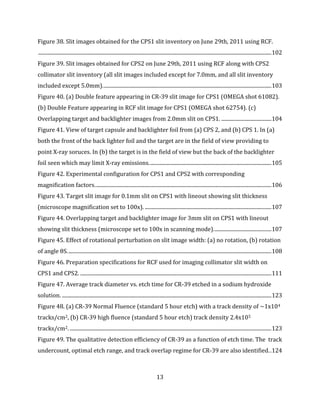
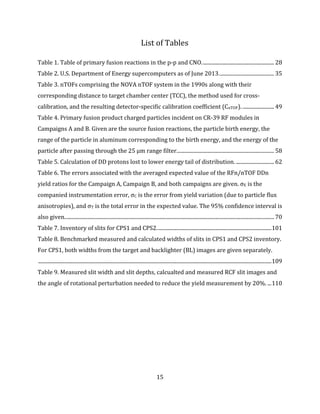
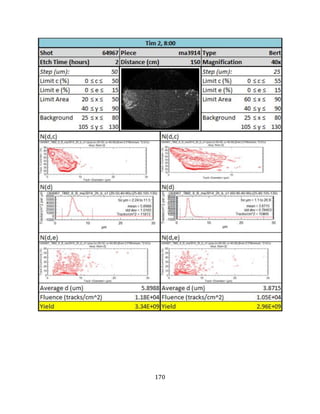
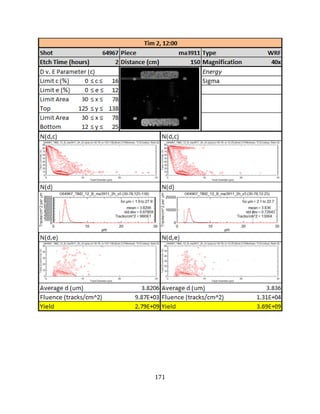
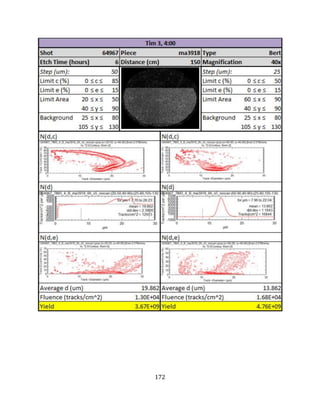
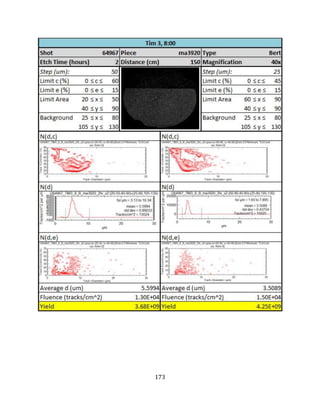
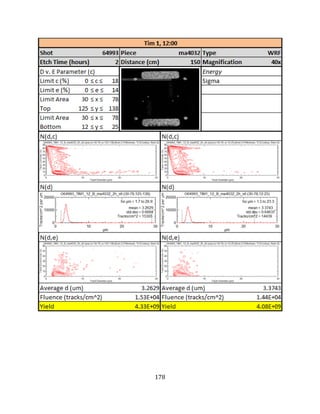
from measurements of the absolute fusion yield. Accurate absolute yield measurements are
therefore vital to determining ICF capsule performance and overall progress toward the
ignition criteria. As can be seen from Table 1, many fusion reactions of interest from
controlled fusion experiments result in charged particles such as protons, tritons, 3He and
alphas but also produce neutrons. Neutron time-of-flight (nTOF) current-mode detectors
fielded on large inertial confinement fusion (ICF) facilities, such as OMEGA [10], the
National Ignition Facility [9], and which will be fielded on Laser Megajoule (LMJ) upon
completion [15, 16], are principle diagnostics that regularly measure key properties of
neutrons produced from ICF implosions. Time-of flight refers to the time it takes neutrons
to travel from the target chamber center to the nTOF detector and is can be used to infer
particle energies and the overall neutron energy spectrum. On ICF facilities implosion
neutrons are generally generated from the primary fusion reactions of deuterium (DD), or
a deuterium/tritium fuel mix (DT) as given in Equation 3.1 and Equation 3.2.
   MeV0.82HeMeV2.45nDD 3
 (3.1)
   MeV3.52MeV14.07nTD  (3.2)
The principles of nTOF operation are straightforward. Neutrons incident on a scintillator
generate photons which are then optically coupled to a photomultiplier tube (PMT) or
photo diode (PD). More recently, nTOF detectors using chemical vapor deposition (CVD)
diamonds have been developed that directly measure the neutron response without use of
a scintillator [17].
nTOF detectors are used to diagnose: (1) the absolute neutron yield by time integrating
the neutron response [18], (2) fuel burn-average ion temperatures by fitting the signal to a
response function and then using the Brysk formula [19-24], (3) the peak neutron emission
time relative to the start of the laser pulse—also commonly referred to as shot bang-time
44
[25], and more recently (4) the areal density (ρR) in cryogenic DT implosions on OMEGA
and the NIF [26]. Because the neutron response is a linear function of the number of
incident neutrons as long as the detector does not saturate, measurement of the absolute
neutron yield only requires a detector-specific calibration coefficient (CnTOF [n·mV-1·ns-1])
to relate the integrated nTOF signal (SnTOF [mV·ns]) to the neutron response as given in
Equation 3.3.
nTOFnTOFn CSY  (3.3)
A sample of a typical nTOF pulse is given in Figure 14. Since the detector neutron response
varies with the neutron energy, separate calibration coefficients must be obtained to
characterize the different responses for DT (14.07 MeV) and DD (0.82 MeV) neutrons.
Figure 14. A sample nTOF response with the raw single passed through an inverting
amplifier and fit using the method outlined in [27, 28]. An absolute neutron yield
for DD and DT neutrons is obtained by time integrating the signal (SnTOF) and then
multiplying by a detector-specific calibration coefficient (CnTOF). (Figure as given
in [29]).
45
Historically, detector-specific nTOF calibration coefficients were obtained by either (1)
cross-calibration to a previously calibrated nTOF, or (2) cross-calibration to Copper (Cu) or
indium (In) activation samples for DT and DD neutrons respectively [30]. In the second
approach, Cu and In slugs were activated by incident neutrons from DT and DD neutrons.
After activation the resulting Cu and In radioisotopes would decay back to stable isotopes
emitting gamma rays in the process. The calibration coefficients for the gamma ray
spectrometers used to measure gammas emitted from Cu and In-activation were obtained
separately from accelerator produced DD and DT fusion products by measuring the
charged particle counts associated with those reactions. For Cu-activation, this was done
my measuring the 3.52 MeV alpha yield from the reaction given in Equation 3.2. For In-
activation, this was done by measuring the proton yield from the other DD reaction branch,
given in Equation 3.4, and then using the corresponding branching ratio to infer an
equivalent neutron yield [30].
   MeV1.01MeV3.02pDD T (3.4)
In the next two chapters, a method for obtaining detector-specific DD neutron (DDn)
nTOF calibration coefficients through an in situ measurement of DD protons (DDp)
produced during OMEGA ICF implosions is presented. The method involves calibrating the
integrated nTOF neutron response (SnTOF) to DDp measurements obtained using CR-39
nuclear track range filter (RF) modules [31]. An advantage of using CR-39 is that it has
100% particle detection when operating in optimal detection regimes and does not need to
be calibrated. An equivalent DDn yield (YDDn) is inferred from the DDp RF yield (YDDp) using
the YDDn/YDDp branching ratio which at ion temperatures common in laser driven ICF
experiments is close to unity. This approach for obtaining an nTOF absolute yield
calibration has the advantage over previous calibration methods in that: (1) it reduces the
dependence on what had been a series of multiple cross-calibrations between accelerators,
In-activation systems, and other nTOF detectors, and (2) it takes advantage of the fact that
CR-39 has 100% detection efficiency. By directly calibrating the nTOF response to a DDn
inferred yield from DDp using CR-39 RF modules, the uncertainty in the calibration
coefficient can be well quantified.
46
As has been mentioned, the history of the DDn absolute yield calibration of the OMEGA
nTOF system follows a series of cross-calibrations between accelerators, In-activation
systems, and other nTOF detectors. In 1988, 1990, and 1993, an In-activation system at
Lawerence Livermore National Laboratory (LLNL) was calibrated using DDn and DDp
fusion products generated from an ion accelerator. At the time, In-activation was the
primary neutron yield diagnostic on NOVA2. nTOF detectors developed for NOVA were then
cross-calibrated to the LLNL In-activation system. In 1997, the OMEGA In-activation system
was cross-calibrated to the NOVA 10m nTOF detector that had been ported to LLE from
LLNL. OMEGA nTOF detectors were then cross-calibrated to the OMEGA In-activation
system over a series of calibration shots. Each of the developments in the series of cross-
calibrations leading to the current OMEGA nTOF absolute yield calibration are now
discussed individually.
3.1 The Indium Activation Method
The In-activation method is based on the 115In(n,n’)115In* reaction where an inelastic
collision between an energetic neutron and 115In produces 115In* in an isomeric state
(T1/2=4.48h) which then emits a 336.2 keV gamma ray while decaying back to 115In. On the
NOVA laser at LLNL, In-activation calibration coefficients were obtained in 1988, 1990, and
1993 by activating ~4cm long by ~1cm diameter 30g In slugs on a Cockcroft-Walton linear
electrostatic ion accelerator. DDn and DDp fusion products from the reactions given in
Equation. 3.1 and Equation. 3.4 respectively were generated by running a deuterium beam
into a deuterium doped titanium target as shown in Figure 15. After activation, the In slugs
were placed in gamma ray spectrometers—a sodium iodide (NaI) spectrometer was used
for the 1993 calibration and a high-purity germanium spectrometer (HPGe) was used for
the 1988 and 1990 calibrations—where the gamma ray spectrum and gamma count (Nγ,Cnt)
were obtained over a fixed time interval (τc).
2
ICF facility at Lawrence Livermore National Laboratory that was decommissioned in 1999.
47
Figure 15. LLNL linear electrostatic ion accelerator setup for In-activation gamma
spectrometer calibration. D+ ions incident on a deuterium doped titanium target
generate DDn and DDp. The DDn yield (YDDn) is inferred from the YDDn/YDDp
branching ratio where YDDp is obtained using a charged particle detector. The
gamma ray spectrometer calibration coefficient is obtained from YDDn and the
total gamma count of the In slug (Nγ,Tot) using Equation 3.5.
The inferred total gamma activation (Nγ,Tot) of an In slug sample using the gamma
spectrometer is determined by Equation 3.5.
 2/12/1
1
,
, TT
Cnt
Tot Cd
ee
N
N 

 

 (3.5)
where τd is the delay time between when the In slug is extracted from the accelerator and
placed in the gamma spectrometer, and T1/2 is the 115In* half-life (4.48h). Nγ,Tot is then
related to the YDDn by the relation given in Equation 3.6.
maN
A
f
Nr
Y
a
InTot
DDn
115
,
2
4

 
 (3.6)
where r is the distance from the target to the In slug, σ is the 115In(n,n’)115In* cross-section,
f is the 115In(n,n’)115In* branching ratio, ε is the efficiency of the gamma ray detector, NA is
Titanium Target
(Deuterium doped)
135°
θ
Charged-particle Detector
Indium Slug
D
+
, D2
+
, D3
+
beam
48
Avogadro’s number, AIn is the atomic weight of indium, a115 is the isotopic abundance of
115In in the slug, and m is the mass of the slug. The calibration coefficient (CIn) for the
gamma spectrometer response to the 115In* gammas is then given by Equation 3.7.
2
,115
4
r
m
N
Y
aNf
A
C
Tot
DDn
a
In
In


 (3.7)
In the LLNL accelerator calibration, YDDn was then inferred from the YDDp measurement
obtained from a charged particle detector by multiplying YDDp by the DDn/DDp branching
ration (βnp). In determining the branching ratio, the kinematics of the experimental setup
(such as the angle of the detector and the angle of the In slug relative to the deuterium
beam) were taken into account. In sum, by inferring a YDDn yield on the accelerator from the
YDDp measurement, the gamma spectrometer calibration coefficient was obtained so that
future YDDn yields could be inferred from the 115In* gamma count.
For the NOVA In-activation calibrations, CIn was determined by averaging calibration
coefficients obtained from measured values of YDDn and Nγ,Tot over multiple accelerator
runs which varied the In slug distances from the titanium target (r), and the angle of the In
slug with respect to the beam line (θ). The angle of the charged particle detector was set at
135° while the angle of the In slug (θ) was fielded at multiple angles between –135° and
45° (see Figure 15). By averaging over multiple accelerator runs and accounting for the
kinematics of scattered DDp in the target chamber, a 1993 In-activation gamma
spectrometer calibration coefficient (CIn) of 39,200 was obtained for the LLNL NaI gamma
spectrometer, while a 1988 calibration coefficient of 104,400 was obtained for the high-
purity germanium (HPGe) spectrometer. Since CIn is inversely proportional to the gamma
ray detector efficiency (ε) as given by Equation 3.7, one can see that gamma spectrometer
calibration coefficients are spectrometer specific and will vary among individual gamma
spectrometers as the efficiency of each spectrometer varies. Because of this the calibration
coefficient of the gamma spectrometers must be determined experimentally.
49
3.2 NOVA In/nTOF Cross-calibration
With calibration coefficients determined for the NaI and HPGe gamma spectrometers, the
NOVA YDDn nTOF response was later cross-calibrated to In-activation samples fielded on a
series of NOVA ICF implosions. At the time, the NOVA nTOF system consisted of four nTOF
detectors—50cm nTOF, 2m nTOF, 10m nTOF, and 20m nTOF—located at 62cm, 1.9m,
8.36m, and 18.33m from the NOVA target chamber center respectively. For the cross-
calibrations, only the 2m nTOF was directly calibrated against neutron yields obtained
from In-activation. With a time-integrated signal (SnTOF) for 10m nTOF, and YDDn
determined using In-activation, the 10m nTOF calibration coefficient CnTOF was found using
Equation 3.3. 50 cm nTOF and 10m nTOF were then cross-calibrated against 2m nTOF, and
in subsequent shots, 20m nTOF was calibrated against 10m nTOF. A summary of the NOVA
nTOF specifications and calibration information is given in Table 3.
Table 3. nTOFs comprising the NOVA nTOF system in the 1990s along with their
corresponding distance to target chamber center (TCC), the method used for
cross-calibration, and the resulting detector-specific calibration coefficient
(CnTOF).
nTOF Detector Distance to TCC Cross-calibrated to CnTOF [n·mV-1·ns-1]
50cm 0.62m 2m nTOF 1.92x10³
2m 1.92m In-activation 3.92x10⁴
10m 8.36m 2m nTOF 6.94x10⁵
20m 18.33m 10m nTOF 3.24x10⁶
3.3 OMEGA In/NOVA nTOF Cross-calibration
In 1996, methods were explored to calibrate an In-activation system using a HPGe gamma
ray spectrometer for the OMEGA 60 laser that at that time had recently been upgraded
from OMEGA 24. The initial calibration approach was similar to that used to calibrate the
50
In-activation system on NOVA previously. A 2MeV Van DeGraff accelerator at SUNY
Geneseo3 resulted in a calibration coefficient for the OMEGA HPGe gamma spectrometer of
7.35 x 10⁶. However, additional accelerator runs at SUNY Geneseo performed early in 1997
resulted in a calibration coefficient of 5.92 x 10⁵, over an order of magnitude lower than the
coefficient previously obtained. To address the discrepancy, other calibration techniques
were utilized including direct calculation of the gamma spectrometer calibration coefficient
from first principles (which resulted in a coefficient of 1.7 x 10⁷), and using a multi-line
gamma source to characterize the HPGe efficiency (which resulted in a coefficient of 8.93 x
105). Overall these early attempts at calibrating the OMEGA In-activation gamma
spectrometer resulted in large discrepancies in the calibration coefficients obtained and
the associated uncertainty regarding what the actual value of the coefficient should be.
In a final attempt to resolve the calibration discrepancy, the 10m nTOF from NOVA was
ported to and fielded on OMEGA where a calibration coefficient of 2.20 x10⁶ was obtained
(3.3 times smaller than the first calibration coefficient obtained at SUNY Geneseo). As the
NOVA 10m nTOF had originally been calibrated to an In-activation system where
consistent results had been obtained over a wide range of accelerator runs and with two
different kinds of gamma spectrometers (both the In and HPGe), the final OMEGA In-
activation system In-activation gamma spectrometer calibration coefficient used was the
one obtained through the cross-calibration to the ported NOVA 10m nTOF.
3.4 OMEGA nTOF/CR-39 Neutron Verification
In 2000, CR-39 nuclear track detectors were characterized to directly measure absolute
neutron yields in DD and DT implosions on OMEGA [32]. CR-39 is regularly used to
measure charged particle yields in the low energy range (~MeV) as charged particles leave
a trail of damage in the plastic in the form of broke molecular chins and free radicals.
Through post-shot etching of CR-39 in a sodium hydroxide solution (NaOH), damage trails
are enlarged to become conical pits or tracks that are readily identified under
3
Geneseo State University of New York, 1 College Circle, Geneseo, NY 14454.
51
magnification [31]. Elastic scattering of DD neutrons within the CR-39 produce recoil
protons, or oxygen or carbon nuclei that also leave identifiable damage trails on both the
front and back sides of the CR-39 detectors. If the CR-39 neutron detection efficiency—
probability that an incident neutron produces a recoil charged particle that leaves a visible
track—is known, a neutron yield can be inferred from the recoil particle count.
The CR-39 neutron detection efficiency was determined by cross-calibration to the
OMEGA In-activation system (shot 19556). Efficiencies of (1.1 ± 0.2) x 10-4 and (3.3 ± 0.3) x
10-4 were determined for the front and back sides respectively, and were in good
agreement with Monte Carlo simulations of the neutron response. Subsequent DD shots on
OMEGA showed good agreement between the In-activation DD yield and the inferred CR-39
neutron yield, however, since the CR-39 detection efficiency was benchmarked to the
OMEGA In-activation system, these experiments do not constitute an absolute calibration
but rather only provide a CR-39 neutron detection efficiency.
3.5 OMEGA In/nTOF Cross-calibration
With the HPGe gamma ray spectrometer at OMEGA calibrated to the ported NOVA 10m
nTOF, the OMEGA nTOF system was then cross-calibrated to the OMEGA In-activation
system over a series of OMEGA ICF implosions similar to the way that the NOVA nTOF
system was calibrated to the NOVA In-activation system. On OMEGA, however, the In-
activation system continued to be used as the primary YDDn diagnostic from 1996-2000
with the nTOF system being run as a backup. As has now been shown in detail, the current
OMEGA nTOF calibration coefficients are the results of extensive cross calibrations that
took place across multiple diagnostic platforms and facilities. To aid in visualizing all the
cross-calibrations that were conducted leading to the current OMEGA nTOF calibration
coefficient, a flow chart of the cross-calibrations along with references to the equations
needed to infer fundamental calculated quantities is given in Figure 16.
52
Figure 16. Flowchart outlining the series of cross-calibrations leading to the current
OMEGA nTOF calibration coefficient. Values in ◊ represent fundamental
diagnostic measurements, values in ⧠ represent calculations, and values in ○
represent fundamental calculated quantities. (a) The gamma spectrometer
calibration coefficient (Cγ:NOVA) was obtained from the observed gamma count
(Nγ,Cnt) and DD proton yield (YDDp) on a Cockcroft-Walton accelerator. (b) The
NOVA 2m nTOF calibration coefficient (CnTOF:NOVA) was obtained from the NOVA
In-activation system over a series of shots on NOVA. NOVA 10m nTOF was then
cross calibrated to NOVA 2m nTOF. (c) The OMEGA gamma spectrometer
calibration coefficient (Cγ:NOVA) was obtained through cross-calibration to the
NOVA 10m nTOF. Finally, (d) OMEGA nTOF calibration coefficients CnTOF:OMEGA
were obtained through cross calibration to the OMEGA In-activation system.
SnTOF
NOVA
YDDn
/ YDDp
Nγ,Cnt
YDDp
τd
, τc
, τ1/2
(Eq. 3.5)
m, r
(Eq. 3.7)YDDn
Nγ,Tot
CIn,
NOVA
(a) LLNL Accelerator Indium Activation (b) NOVA nTOF/Indium
Activation
m, r
(Eq.
3.6)
Nγ,Cnt
τd
, τc
, τ1/2
(Eq. 3.5)
Nγ,Tot
YDDn
m, r
(Eq. 3.3)
CnTOF,
NOVA
SnTOF,
OMEGA
(c) NOVA nTOF/OMEGA Indium Activation (d) OMEGA nTOF/Indium Activation
m, r
(Eq. 3.6)
Nγ,Cnt
τd
, τc
, τ1/2
(Eq. 3.5)
Nγ,Tot
YDDn
m, r
(Eq. 3.3)
CnTOF,
OMEGA
Nγ,Cnt
τd
, τc
, τ1/2
(Eq. 3.5)
m, r
(Eq. 3.7)
CnTOF,
NOVA
Nγ,Tot
CIn,
OMEGA
YDDn
SnTOF
NOVA
53
4 Measuring the Absolute DDn Yield on OMEGA
As has now been shown, the existing OMEGA nTOF absolute DD neutron yield calibration
has a long history consisting of a series of cross-calibrations spanning multiple facilities
and calibration methods. Following Figure 16, ones notes that if all the various cross-
calibrations leading to the current nTOF absolute yield calibration coefficient are traced
back far enough, they eventually lead to an original calibration to DDp on the Cockcroft-
Walton linear electrostatic ion accelerator at the NOVA facility at LLNL using the DDn/DDp
branching ratio. An alternative calibration approach for the OMEGA nTOF calibration
coefficient (CnTOF), then, that eliminates the potential for calibration errors to propagate
through the cross-calibration chains given in Figure 16, and allows for improved
quantitative analysis of the calibration coefficient uncertainty, is to apply the branching
ratio method directly and in situ during ICF implosions. This is accomplished by directly
comparing the integrated nTOF signal (SnTOF) to YDDp taking into account the YDDn/YDDp
branching ratio. In contrast to the cross-calibration chain that led to the current OMEGA
nTOF calibration coefficient give in Figure 16, the flow diagram for the steps involved for
the in situ calibration method are given in Figure 17.
Figure 17. Flowchart outlining the steps for a method to obtain detector-specific
nTOF calibration coefficients in situ during ICF implosions using CR-39 nuclear
track detector range filter (RF) modules. The values in ◊ represent fundamental
diagnostic measurements, values in ⧠ represent calculations, and values in ○
represent fundamental calculated quantities.
YDDn
/ YDDp
YDDp,
OMEGA
m, r
(Eq. 3.3)YDDn
CnTOF,
OMEGA
SnTOF
OMEGA
54
4.1 High Accuracy YDDp Measurements on OMEGA using CR-39 Range Filters
As has been previously mentioned, CR-39 nuclear track detectors are widely used for
charged particle detection. As such they serve as the primary detection mechanism in a
wide array of ICF diagnostics on OMEGA and the NIF [33-44]. The CR-39 response to
protons in particular has been studied extensively and is well documented [31, 45-49].
To test the CR-39/nTOF in situ calibration method, a series of directly-driven exploding
pusher shots on OMEGA were taken where DDn yields obtained from nTOF using the
existing absolute yield calibration coefficient (CnTOF) were compared to DDn yields inferred
from DDp yields obtained from CR-39 RF modules. Exploding pushers are thin shell
capsules made of glass or plastic in which a high-density shell is heated rapidly to
temperatures on the order of a few keV and then explodes. For the experiments comprising
the study, two shot campaigns were designed to optimize both the CR-39 RF DDp and nTOF
DDn responses and reduce measurement uncertainty.
Figure 18. (a) Campaign A, (b) and Campaign B exploding pusher shot campaigns on
OMEGA used to obtain an absolute yield calibration coefficient for 3m nTOF.
For what we will henceforth refer to as Campaign A, the targets were nominally 880μm in
diameter 2.0 μm thick silicon dioxide (Si02) and were filled with 3.6 atm D2 and 7.9 atm
3He. Laser conditions included 60 beams providing a total nominal energy of 5.3 kJ. For the
second campaign, which we will refer to as Campaign B, the capsules were also nominally
880μm in diameter 2.0μm thick silicon dioxide (SiO2) filled with 9.3 atm of D2. Laser
conditions included 60 beams providing a total nominal energy of 2.5kJ. Both shot
campaigns used a 1ns square laser pulse, smoothing by spectral dispersion (SSD), SG4
9.3 atm D2
2.0 μm SiO
2
2.4 kJ
1670 ps
BT
7.9 atm
3
He
2.0 μm SiO
2
3.6 atm D2
5.2 kJ
1274 ps BT
(a) (b)
55
phase plates, and a distributed polarization rotator (DPR). Campaign A consisted of six
shots while Campaign B consisted of four. A standard capsule pie cutout indicating the
capsule and laser conditions for the two campaigns is given in Figure 18. In addition to
DDp, the Campaign A shots also produced D3He fusion products as given in Equation 4.1.
   MeV14.68MeV3.67HeD 3
p  (4.1)
Nominally the flux of DDp being emitted from the implosion would be isotropic so that
only one detector should be needed to gain an accurate measurement of the DDp fluence. In
practice, particle fluxes around the capsule exhibit some degree of anisotropy. In order to
account for these anisotropies 10 CR-39 RF modules were fielded to provide multiple
fluence samples over the target chamber solid angle. The modules were fielded in standard
OMEGA ten inch manipulators (TIMs) using “trident” allowing three RF modules to be
fielded per TIM. The final RF module configuration for the campaigns included tridents in
TIMs 1, 2, and 3, and a single RF module in TIM 5 for a total of 10 RFs fielded per shot. All
RF modules were fielded 150cm from the OMEGA target chamber center (TCC). The
location of the TIMs and other diagnostic ports on OMEGA are shown in Figure 19.
Figure 19. Aitoff projection of the OMEGA target chamber showing the diagnostic
ports (given in yellow) and laser drive ports (given in green red and blue). CR-39
range filter (RF) modules for nTOF calibration shots were fielded in ten inch
manipulators (TIMs) 1,2,3, and 5 to provide broad angular coverage over the
target chamber solid angle and account for particle flux anisotropies.
L
TIM1
CPS1
nTOF
TIM3
56
The DDp yields from the 10 individual RF modules from Campaign A and Campaign B are
given in Figure 20 along with the OMEGA 3m nTOF DDn yields. Yields form Campaign A
shots averaged over all RF modules were in close agreement with 3m nTOF although
significant yield variation was observed among individual modules. Yields from Campaign
B shots were also in close agreement with 3m nTOF, however, the yield variation between
individual RF modules within a given shot was significantly less.
Figure 20. The range filter (RF) DDp and nTOF DDn yield results from (a) Campaign A
and (b) Campaign B shots on OMEGA. The DDp yields from the Campaign A shots
on average show a significant amount of spread in the RF measurement whereas
the Campaign B shots show very little spread and are in good agreement with 3m
nTOF.
The individual CR-39 module yields given in Figure 20 were obtained as follows. Each piece
of CR-39 was etched in a solution of sodium hydroxide to expose the pits created by the
DDp. The CR-39 was then placed under a scanning microscope that recorded every track on
the piece as well as track information such as track contrast, eccentricity, and diameter.
Using an analysis program to read the scanned file created from the scanning microscope,
the contrast, eccentricity, and diameter information were used to separate the DDp tracks
from noise. In CR-39, tracks left by charged particles are characterized by high contrast and
very low eccentricity whereas noise typically has high eccentricity and low contrast. After
the signal was separated from the noise, the analysis software provided a charged particle
fluence given in tracks/cm2. An overall DDp yield was then obtained by multiplying the
track fluence by the area of the solid angle enclosed at the distance from the detector to
0
2
4
6
8
10
DDYield(109)
Campaign A Shots Campaign B Shots
TIM 1 TIM 2
TIM 3 TIM 5
3m nTOF
64958 6496164963 65001 64965 64967 64993 64995
64997 64999
57
TCC (which was 150cm). Although not given here, full details regarding the processing and
signal to noise separation in CR-39 detectors is given in Sequin et al. [31]. A full overview of
the raw data and analysis used to obtain the individual RF yield measurements is given
Figure 20 are provided in Appendix E.
Upon observing the measured yields from the shot campaigns in Figure 20—and in
particular the shots from Campaign A—ones notes the significant variation in individual RF
yield measurements within a given shot. This variation exists between the RF modules
fielded in different TIMs, but also within the RF modules fielded in a trident within a single
TIM. We now look at the source of this variation in more detail and consider whether this is
caused by: (1) instrumentation and measurement uncertainty in the individual
measurements from CR-39 RF modules, or (2) capsule implosion effects leading to an
asymmetric distribution to charged particles. What we would like to know is whether the
fluences observed really do exhibit a large degree of variance or whether the variance is
due to measurement uncertainty.
As has already been mentioned, one primary advantage of CR-39 is that when certain
criteria are met the detector exhibits 100% detection efficiency of the charged particles of
interest. To obtain 100% detection efficiency there must be 1) clear separation of charged
particle species to isolate the given particle of interest, 2) the individual particles must
have an energy that lies within the optimal CR-39 detection range, and 3) there must be
clear signal to noise separation to keep intrinsic noise in the CR-39 from being counted as
tracks.
When using CR-39 detectors to observe and isolate a single charged particle species,
range filters are commonly used to range out species not of interest and to range species of
interest into the CR-39 optimal detection energy range. For the shots comprising Campaign
A, the primary charged particles incident on the CR-39 were from the primary DD and D3He
fusion reactions and include: 3He (from the DD reaction in Equation 3.1), T (from the DD
reaction in Equation 3.4), protons (from the DD reaction in Equation 3.4), alphas (from the
D3He reaction given in Equation 4.1), and protons (also from the D3He reaction in Equation
4.1). Other lower energy ions (on the order of less than 10keV for both Campaign A and
Campaign B shots) from the SiO2 capsule and fuel were also present. For campaign B the
58
primary ions were the same except for the fusion products from the D3He reaction. For
both campaigns a 25μm Al filter was placed in front of the CR-39. The thickness was chosen
so as to range out all the low energy ions from the capsule and fuel as well as all charge
particles except for the DD and D3He protons. An overview of the charged particles
generated from the primary fusion reactions from DD and D3He along with the particle
birth energy, particle range in aluminum corresponding to the birth energy, and the ranged
energy of the particle after passing through 25μm of aluminum, is given in Table 4. The
values in Table 4 assume that no ranging other than the 25μm Al range filter occurs. In
practice there is often additional ranging of particles through the fuel and capsule.
Table 4. Primary fusion product charged particles incident on CR-39 RF modules in
Campaigns A and B. Given are the source fusion reactions, the particle birth
energy, the range of the particle in aluminum corresponding to the birth energy,
and the energy of the particle after passing through the 25 μm range filter.
Ion Reaction Birth Energy (MeV) Range (um) Ranged Energy (MeV)
3He D(D,3He)n 0.82 2.70 0
Triton D(D,T)p 1.01 9.82 0
Alpha D(3He,α)p 3.67 14.10 0
Proton D(D,T)p 3.02 81.47 2.42
Proton D(3He,α)p 14.68 1222 14.50
From Table 4 we see that only DD an D3He protons are able to pass through the aluminum
range filter and all other charged particle species are stopped. energy range and are the
only charged particle species that leave observable pits in the detector.
Although only DDp are detected in the CR-39, to ensure 100% counting the entire DDp
spectrum must fall within the detectable energy range of the CR-39. In addition to range
filters which cause an energy downshift, the areal density (ρR) of the capsule and fuel in
ICF implosions can also potentially have a significant effect of ranging down the proton
energy from the original birth energy. In some studies the measured energy downshift of
primary fusion reaction protons (DDp and D3He-p) has been used to estimate the fuel ρR
[39]. If the ρR energy downshift is large enough there is a risk that the combined 25μm Al
59
filter and ρR energy downshift could shift the energy of the DDp incident on the CR-39 to
below the optimal energy range, will make the particle undetectable by the scanning
microscope, and result in undercounting of particles. To rule out the possibility of a
significant ρR energy downshift on the DDp yield we look at simulations of the shots from
Campaigns A and B given by the 1D hydrodynamic code LILAC (which is routinely used to
model ICF implosions on OMEGA), as well as the DDp energy spectrum that was measured
on shots from Campaign A and Campaign B.
From LILAC we obtain plots of the predicted capsule radius and ρR as a function of time
elapsed after the beginning of the 1ns laser pulse. In Figure 21 we give these plots for shot
64999 which, after observing all the shot simulations, exhibited the highest simulated ρR
from Campaigns A and B.
Figure 21. The simulated capsule radius and areal density are given for shot 64999
as a funciton of time (where t = 0 corresponds to the beginning of the laser pulse).
As can be seen, the maximum ρR is ~8 mg/cm2 where the capsule is compressed from
440μm to a minimum of 50 μm at 1.5ns. Using SRIM (Stopping and Range of Ions in Matter
code), the average stopping power of a 3.02 MeV proton for the Campaign A shots with a
D3He fuel mix is calculated to be 0.14 MeV/(mg/cm2). Similarly for Campaign B shots with
a deuterium fuel mix, the average stopping power is calculated to be 0.16 MeV/(mg/cm2).
For a ρR of ~8 mg/cm2 this would lead to an energy downshift of ~1.3 MeV and would
result in protons of energy 1.7 MeV incident on the range filter. Calculating the additional
0
1
2
3
4
5
6
7
8
9
0
50
100
150
200
250
300
350
400
450
500
0 0.5 1 1.5 2
ArealDensity(ρR)(mg/cm2)
CapsuleRadius(μm)
Time (ns)
Radius
pR
60
ranging through the 25μm of Al using SRIM, the energy incident on the CR-39 is calculated
to be ~0.7MeV.
In order for a track to be detectable on CR-39 it must fall within a detectable energy
range. The range of detectable protons can be understood by observing a plot of the proton
diameter as a function of energy as given by Seguin et al. and provided below in Figure 22.
Figure 22. Measured and modeled values of proton track diameter in CR-39 as a
function of incident proton energy (MeV). As given in Seguin et al. [31].
As can be seen, high energy protons leave small tracks on the order of 2-4μm. As the energy
reaches around 4 MeV the track diameter starts to increase significantly until it peaks
around 0.7MeV. For energies less than 0.7 MeV, the track diameter starts to get smaller as
the proton energy is reduced and approaches 0. In addition to getting smaller, the contrast
of the tracks becomes increasingly faint until they are unable to be detected by the
scanning microscope. The conclusions this figure is that for protons we should expect good
contrast of tracks and therefore full detection under the scanning microscope up to the
peak energy of 0.7MeV, after which we would gradually start losing tracks as the proton
energy goes to 0. That said, some tracks are still detectable at the lower energy levels (as
61
can be seen in the plot where Seguin et al. do have data on the diameter of protons with
energies as low as ~0.3 MeV).
With the estimated mean energy of the protons incident on CR-39 being ~0.7 MeV from
the LILAC and SRIM calculations there is risk that much of the lower tail of the energy
distribution may be cut off. To rule this out, we look at the measured energy spectrum from
two of the calibration shots (one from Campaign A and one from Campaign B). The energy
spectrum from shot 64967 (Campaign B) and 64961 (Campaign B) are given in Figure 23
below:
(a)
(b)
Figure 23. CPS2 measured energy spectrums for (a) shot 64967 (Campaign A—D3He)
and (b) shot 64961 (Campaign B—DD).
62
From Figure 23 we see that the ρR energy downshift is only ~0.4 MeV for the Campaign A
shot and ~0.6 for the Campaign B shot. This is significantly less than the ~1.3MeV
predicted from the LILAC and SRIM calculations.
Using the CPS measured energy distributions from the Campaign A and B shots and a
lower CR-39 detection cut off of 0.7 MeV, we estimated an upper bound for the % of tracks
we would expect to lose from low energy cutoff. We consider this an upper bound since we
know we do count a significant number of particles that have fallen below the cutoff even
though we start losing some. Using SRIM we estimate a proton with incident energy of 1.75
MeV when filtered through 25um Al will be ranged down to 0.7 MeV (the CR-39 lower
detection cut-off). From this we place a lower cutoff for the CPS distributions of 1.75 MeV.
We assume conclude any particles with energies less than 1.75MeV will not be detected
since they would filter down to 0.7 MeV through the 25um Al filter and be at the threshold.
Using a lower unfiltered cutoff of 1.75 MeV and the DDp energy distributions given from
the CPS data we estimate by integrating over the lower tail of the distribution the % tracks
lost. The results are given in Table 5.
Table 5. Calculation of DD protons lost to lower energy tail of distribution.
Shot Species Energy (MeV) Spread (MeV) Cutoff (MeV) % DDp Lost
64961 DD 2.4065 0.262 1.75 0.6%
64967 D3He 2.663 0.168 1.75 ~0
From this we estimate that virtually no particles are lost and we can infer 100% particle
detection.
With 100% charged particle detection expected, the variation in yields shown in Figure
20 cannot be attributed to uncertainty in the CR-39 fluence measurement. We therefore
accept the measurements as accurate and attribute the variation to other effects that result
in an anisotropic particle distribution. Two possible affects that could explain the
anisotropic distribution of charged particles are 1) areal density asymmetries and 2)
electromagnetic field effects that are present during capsule implosions.
63
In many ICF implosions, Rayleigh-Taylor instabilities created on the capsule surface
during compression result in areal density asymmetries. For charged particles passing
through, we would expect greater angular particle deflection in the higher density areas
than the lower density area. If the mode of these asymmetries were high enough it could
lead to the kind of anisotropic particle flux distribution observed in the data in Figure 20.
Another effect that has been observed is the presence of large electromagnetic fields that
are generated around the target as the laser ablates the capsule. These fields have been
observed in proton radiographs published by Rygg et al. in Science [33]. While the fields
have no effect on neutrons, the electromagnetic fields generated are strong enough to
deflect charged particles and could lead to an anisotropic flux of particles over the target
chamber solid angle.
4.2 Relation Between Particle Flux Anisotropies and Bang Time
As can be seen in Figure 22, individual Campaign A shots exhibit significantly more yield
variation between individual RF modules than the shots in Campaign B. As has been shown,
the variation between the individual RF module fluence measurements is not due to
measurement error: CR-39 has 100% detection efficiency and on all shots the number of
tracks counted per area analyzed varied between 25,000 and 85,000 tracks so that
counting errors were less than 1%. Consequently the variation is essentially entirely
contributed to particle flux anisotropies which currently we attribute to either ρR
asymmetries or electromagnetic fields generated around the capsule during implosion. For
the electromagnetic field explanation, these fields have been found to be strongest during
the laser pulse while the laser is incident on the capsule. In addition a circuit model of the
capsule from which electromagnetic fields can be inferred was recently presented in N.
Sinenian’s PhD thesis that also predicts significant reduction in fields shortly after the laser
has turned off [50]. Shots that are designed so that the laser is not incident on the capsule
when bang time occurs will have weaker electromagnetic fields during bang time and will
result in less yield variation. The most significant parameter that affects when bang time
occurs within the laser pulse is the laser drive energy and subsequently the capsule laser
intensity. On OMEGA, laser energies of a few kilo-joules will result in late bang times while
64
laser energies approaching the OMEGA maximum of 60 kJ will result in much earlier bang
times. In Figure 24 we present the yield variation as a function of when bang time occurs
relative to the laser pulse for three exploding pusher campaigns. As can be seen, for the
January 13, 2012 campaign, bang time occurred early to mid-pulse and demonstrated
significant yield variation. In contrast, Campaign B shots with bang times approximately
500 ps after the laser has turned off demonstrate little yield variation. This affect could also
be explained using the ρR asymmetry explanation since a stronger laser drive would, in
addition to giving an earlier bang time, lead to greater Rayleigh-Taylor instabilities, greater
ρR asymmetries, and consequently greater fluence variation.
Figure 24. The effect of the occurrence of bang time relative to the end of the laser
pulse on yield variation measured by CR-39 RF modules. The results from three
exploding pusher campaigns on OMEGA are presented: (1) January 13, 2012, (3)
Campaign A (February 7 & 9, 2012), and (3) Campaign B (February 7 & 9, 2012).
The yield variation reduces significantly when bang time occurs significantly (at
least 500ps) after the end of the laser pulse.
By comparing these shot campaigns we conclude that exploding pusher shots that are
designed with lower energy laser drives (and consequently lower capsule intensities) will
experience bang times after the laser shuts off and will result in less variation in the
0%
20%
40%
60%
80%
100%
120%
140%
0 500 1000 1500 2000
YieldVariation(%)
Bang Time (ps)
Campaign A
Campaign B
Jan., 13 2013
Laser Pulse
65
individual CR-39 RF module yield measurements, hence reducing the uncertainty in the
overall yield measurement.
The trend in yield variation as a function of bang time depicted in Figure 24 can also be
used to evaluate the two explanations presented earlier regarding the cause of the
observed particle flux anisotropies. The two explanations given were that the yield
variation could be explained by 1) areal density asymmetries and 2) electromagnetic field
effects that are present during capsule implosions. For the January 13 shots that exhibited
high yield variation and early bang time the capsules were driven with a 30 kJ 1ns square
pulse. As shown before, Campaign A shots were driven with a 5.2 kJ 1ns square pulse and
Campaign B shots were driven with a 2.4 kJ 1 ns square pulse. The trend we see in Figure
24 then shows an increase in yield variation with higher laser intensity and a decrease in
yield variation with lower laser intensity. However, in Lindl et al. [51] equation 46 an
increase in laser intensity is shown to cause an increase in ablation velocity (i.e. the
velocity with which the ablation front moves through the shell), and an increase in ablation
velocity is shown to reduce the growth of Rayleigh-Taylor instabilities which would result
in less ρR assymetires. Based on the theory presented by Lindl we would then expect lesser
Rayleigh-Taylor instabilities, less ρR asymmetries and less yield variation for the January
13 shots and greater Rayleigh-Taylor instabilities, greater ρR asymmetries and greater
yield variation in the Campaign B shots. Since Figure 24 shows the exact opposite of this
the hypothesis of particle flux anisotropies being caused by ρR asymmetries is inconsistent
with the theory presented by Lindl and the observations given in Figure 24.
In addition, we consider whether the areal density of the fuel is enough to create
significant angular deflection of DDp. From the measured mean energy of 2.663 MeV
obtained in Figure 23(a) for shot 64967 we modeled the implosion using SRIM adjusting
the plasma density until the corresponding ion energy in the simulation matched the
measured mean ion energy. This resulted in a fuel density of 0.4 g/cm3 compared to the 1.2
g/cm3 predicted by the LILAC code. The mean angular deflection associated with the 0.4
g/cm3 fuel density is calculated to be 0.41° ± 0.27°. Where the CR-39 RF modules were
fielded at 150 cm from TCC, this would result in an average lateral deflection of 3.4mm ±
66
2.25 mm. This suggests that we would expect very little angular deflection due to areal
density effects.
4.3 CR-39/nTOF Yield Comparison and Calibration Coefficient Verification
To verify the existing OMEGA 3m nTOF calibration coefficient and to more accurately
quantify the calibration coefficient uncertainty, uncertainties associated with the CR-39
range filter yield measurement, the nTOF yield measurement, and the DDn/DDp branching
ratio are taken into account. Uncertainties associated with the CR-39 proton response
consist of three kinds: (1) the statistical uncertainty associated with the particle counts, (2)
uncertainty in signal to noise track separation, and (3) uncertainty in the individual RF
yield measurements due to particle flux anisotropies. As the number of tracks recorded per
RF module for both shot campaigns were between 25,000 and 85,000, counting statistics
result in uncertainties less than 1% can therefore be neglected since these are much less
than the systematic calibration errors. As mentioned previously, in the analysis software
used to analyze the CR-39 tracks, noise is separated from signal by filtering tracks based on
size, eccentricity, and contrast. Using track filtering techniques, signal and noise separation
usually results in only a few percent uncertainty in the track count. With counting and
signal to noise separation uncertainties being small the uncertainties stemming from the
particle flux anisotropies dominate. Particle flux anisotropies can be reduced by increasing
the number of CR-39 RF modules fielded to obtain a greater sample size and reduce the
variance in the average yield of the detectors, or by designing shots so that bang time
occurs significantly after the end of the laser pulse so that the yield variation is small and
fewer CR-39 RF modules are needed to average out flux anisotropy affects.
Uncertainty of the nTOF measurements consists of (1) the instrumentation uncertainty
of the nTOF neutron response, cable reflections, and intrinsic noise, and (2) the uncertainty
in the calibration coefficient. Instrumentation uncertainty of nTOF is quoted as being on the
order of 5%.
The YDDn/YDDp branching ratio is a function of the plasma ion energy and is near unity
for low energy ions (between 1-10 keV) [52-54]. For completeness in this uncertainty
analysis, instead of assuming the ratio to be unity, we include calculated values of the
67
branching ratio using the DDn and DDp reaction rate parameterizations found in Bosch and
Hale [53]. Fuel burn-average ion temperatures obtained from nTOF were used in the Bosch
and Hale parameterization to obtain the branching ratio uncertainty for each shot
individually. The nTOF signal can be used in this case without methodological circularity
since the parameterization of the functional fit to the raw nTOF signal that is used to
determine the fuel burn-average ion temperature is independent of the absolute yield
calibration [19]. The nominal branching ratio along with the uncertainty in the branching
ratio due to the uncertainty in the nTOF ion temperature measurement is given in Figure
25. The uncertainty in the Bosch and Hale parameterization reaction rate itself is quoted as
being 0.3% in the 0-100 keV range and is therefore neglected.
Figure 25. The YDDn/YDDp branching ratio is given by the ratio of the parameterized
reaction rates obtained from Bosch and Hale for DDn and DDp. This ratio as a
function of ion temperature is given by the black line. The inferred branching
ratios for the OMEGA Campaign A and Campaign B shots are obtained using the
fuel burn-averaged ion temperatures from nTOF and plotted on the black line.
The error bars given for each shot in Campaign A and Campaign B indicate the
measured error in the nTOF ion temperature measurement (x-axis) and the
inferred error in the branching ratio (y-axix).
Using the DDn/DDp branching ratio (βnp) and the CR-39 RF DDp yield (YDDp), a RF
equivalent DDn yield (YRFn) is obtained for every RF module DDp measurement. The ratio
0.94
0.96
0.98
1.00
1.02
1.04
0 1 2 3 4 5 6 7 8 9 10 11 12
<σv>DD-p/<σv>DD-n
Ti (keV)
Campaign A
Campaign B
68
of the RF equivalent DDn yield to the nTOF DDn yield is then taken to allow for a direct
yield measurement comparison among RF modules and across all shots. In the absence of
particle flux anisotropies and assuming the nTOF calibration coefficient (CnTOF) is perfectly
calibrated, the expected value of the ratio of the inferred RF module DDn yield to the nTOF
DDn yield is unity (E[<YRFn/YnTOF>]=1). Any shot specific phenomena that would affect the
DDp yield should also affect the DDn yield such that the expected values would be equal
provided the correct branching ratio is used to determine the RF inferred DDn yield. In
practice, particle flux anisotropies are present so that the ratio is rarely unity. However, by
taking an average of all the RF inferred DDn to nTOF DDn yield ratios over all shots, flux
anisotropies can be averaged out so that the expected value of the average yield ratio is
unity. Using multiple detector measurements to average out flux anisotropies, therefore,
isolates the effects of the calibration coefficient. Any average RF inferred DDn to nTOF DDn
yield ratio other than unity that is statistically significant would suggest an anomaly in the
current nTOF calibration coefficient (CnTOF). The expected value of the average of the RF
inferred DDn and nTOF DDn ratios can be expressed in Equation 4.2.
   
 







jRFs DDn
pnDDp
iShotnTOF
RFn
iY
ijiY
nY
Y
E
,,
,1 
(4.2)
where E is the expectation value of the average of the inferred CR-39 DDn yield to the nTOF
yield, n is the total number of RF modules being considered (n = i*j), YRFn is the DDn yield
inferred from the DDp RF measurement, YnTOF is the measured DDn yield from nTOF,
YDDp(i,j) is the DDp RF measurement for shot i and RF module j, βnp(i) is the DDn/DDp
branching ratio for shot i, and YDDn(i) is the DDn nTOF measurement for shot i. For
Campaign A n = 60 (10 RF modules per shot times 6 shots), and for Campaign B n = 40 (10
RF modules per shot times 4 shots).
While the effect of the nTOF calibration coefficient on the RF inferred DDn to nTOF DDn
ratio can be isolated using Equation 4.2, the uncertainties associated with the CR-39 DDp
measurement, DDn/DDp branching ratio, and the nTOF DDn measurement must be taken
into account to determine whether any deviation in the expected value of Equation 4.2
69
from unity is statistically significant. The error of the expected value is obtained by
propagating the errors associated with each measurement to obtain a single
instrumentation error. This error is achieved over a series of steps as follows.
First, we obtain the error associated with the RF inferred DDn yield (YRFn) from the RF
DDp measurement and DDn/DDp branching ratio (βnp) by Equation 4.3.
22


















npRFp
Y
npRFpY
npRFp
RFn
Y
Y




(4.3)
where σYRFp is the uncertainty in the signal to noise separation of CR-39 DDp tracks, YRFp is
the RF proton yield, σβnp is the uncertainty in the DDn/DDP branching ratio (βnp), and σRFn
is the uncertainty in the RF DDp inferred DDn yield.
Next, the error of the ratio of YRFn and YnTOF is obtained similarly for an individual RF
module on a specific shot by Equation 4.4.
22













nTOF
Y
RFn
Y
nTOF
RFn
R
YYY
Y nTOFRFn

 (4.4)
Where σYnTOF is the instrumentation uncertainty of nTOF and YnTOF is the measured nTOF
DDn yield. In this we assume YRFn and YnTOF to be perfectly correlated as an increase in the
yield of protons should track the neutron yield and vice versa.
With errors propagated for the individual RF/nTOF neutron yield ratios, the error
associated with the average of the ratios (σE), or in other words the error associated with
Equation 4.2 can be expressed as:
   ji
n
R
n
j
R
n
i
E   2
1
(4.5)
where n is the total number of ratios (i.e. the total number of RF modules fielded per shot
times the total number of shots being considered). For Campaign A n = 60 (10 RF modules
per shot times 6 shots), and for Campaign B n = 40 (10 RF modules per shot times 4 shots).
70
The total error is then obtained by adding the overall measurement error (σE) to the
standard error of the RF/nTOF DDn ratios in quadrature as given in Equation 4.6.
222
ECTot   (4.6)
The standard error of the ratios is determined in the usual way as σC /√n, where σC is the
standard deviation of the RF/nTOF DDn yield ratios. As the propagated uncertainty of all
measured quantities (σC) increases, so does the total uncertainty in the expected value
(σTot). However, if there is little uncertainty in the measured quantities and σC ≫ σE , then
the overall uncertainty is just the uncertainty associated with the spread of the RF/nTOF
DDn ratio. An overview of the instrumentation, particle flux anisotropy, and total error is
given in Table 6. As can be seen, the uncertainty in the DDp measurement that arises from
particle flux anisotropies dominates the instrumentation error.
Table 6. The errors associated with the averaged expected value of the RFn/nTOF
DDn yield ratios for the Campaign A, Campaign B, and both campaigns are given.
σE is the companied instrumentation error, σC is the error from yield variation
(due to particle flux anisotropies), and σT is the total error in the expected value.
The 95% confidence interval is also given.
Shots σE σC σTot 95% Conf. Int.
Campaign A 0.011 0037 0.038 0.074
Campaign B 0.012 0.014 0.019 0.036
Both 0.012 0.023 0.025 0.049
From σTot a 95% confidence interval for the expected value of the average RF inferred
DDn to nTOF DDn yield ratio (Equation 4.2) is obtained in the usual way by multiplying the
standard error by the number of standard deviations covering 95% of the distribution
(which for a Gaussian distribution is 1.96). The calculated expected values for
E[<YRFn/YnTOF>] and the 95% confidence intervals are given separately in Figure 26 for the
early bang time (Campaign A) and late bang time (Campaign B) shots.
In Figure 26, the expected values and 95% confidence interval as defined by Equations
4.2 and 4.6 are given for Campaign A shots, Campaign B shots, and both shot campaigns
71
combined. From this one sees that the greater variation in the individual RF measurements
from Campaign A (as shown in Figure 22(a) ), compared to the yield variation in the
measurements from Campaign B (as shown in Figure 19(b) ), has a significant effect on the
standard error and associated confidence interval. Since the total error is dominated by the
error due to particle flux anisotropies, and since the RF DDp measurements on the
Campaign B shots have less yield variation, the 95% confidence interval obtained from the
Campaign B shots provides a tighter band on the expected value of the yield ratio. From the
Campaign B shots we estimate that the current 3m nTOF DDn calibration coefficient to be
well calibrated, but low by 9±1.5%.
Figure 26. The expected value of the average of the RFn/nTOF DDn yield ratio
(E[<YRFn/YnTOF>]) with the associated 95% confidence interval obtained from the
error analysis for the OMEGA Campaign A and Campaign B shots.
0.95 1 1.05 1.1 1.15
<YRFn/YnTOF>
Campaign A
Campaign B
Both
72
5 Conclusion
In conclusion, in the last 50 years inertial confinement fusion has grown to be an important
platform for conducting research in high energy density regimes. Although primarily
funded and motivated by the goals of the Stockpile Stewardship program under the U.S.
National Nuclear Security Administration, ICF has also made important advances in energy
and basic research in HEDP such as atomic physics, nuclear physics, plasma physics,
astrophysics, material science, and laser science.
In order to obtain more accurate measurements of DDn yields in ICF implosions,
this work has presented a method for obtaining detector-specific DDn nTOF calibration
coefficients through in situ measurements of DDp generated during ICF implosions. This
method has successfully been implemented on OMEGA. The method involves calibrating
the integrated nTOF neutron response to DDp measurements obtained using CR-39 nuclear
track RF modules after which the DDn yield is inferred using the YDDn/YDDp branching ratio.
Two advantages of this approach are that (1) it reduces the dependence on multiple layers
of cross-calibration between accelerators, In-activation systems, and other nTOF detectors
as was conducted previously to obtain the current nTOF absolute yield calibration
coefficient, and (2) it reduces the uncertainty of propagated errors introduced through all
the multiple cross-calibrations. Results from exploding pusher shot campaigns on OMEGA
confirm the existing calibration coefficient of 3m nTOF to be well calibrated although
slightly high by 9 ± 1.5%. As most of the uncertainty in the calibration coefficient obtained
from OMEGA using the method has been shown to be the result of charged particle flux
anisotropies, highly accurate calibration coefficients can be obtained from only a few RF
modules fielded per shot if calibration shots are designed in such a way as to reduce
anisotropies. As was shown, this can be done be designing shots with reduced laser drive
so that bang time occurs significantly after the end of the laser pulse. In sum, the CR-39
RF/nTOF in situ calibration method is a simple yet powerful tool for determining
calibration coefficients for individual nTOF detectors on OMEGA, but may also be used to
improve the absolute yield calibration of nTOF systems on other large ICF facilities such as
the NIF and LMJ.
73
74
6 Bibliography
1. Kuhn, T.S., The structure of scientific revolutions. Vol. 2. 1996: University of Chicago
press.
2. Einstein, A., Zur Elektrodynamik bewegter Körper. Annalen der Physik, 1905.
322(10): p. 891-921.
3. Atzeni, S.J.M.-T.-V., The Physics of Inertial Confinement Fusion. International Series of
Monographs on Physics, ed. O.S. Publications. 2004, Oxford, UK: Oxford University
Press.
4. Gamow, G., Zur Quantentheorie des Atomkernes. Zeitschrift für Physik, 1928. 51(3-4):
p. 204-212.
5. Cockcroft, J. and E. Walton, Experiments with high velocity positive ions. II. The
disintegration of elements by high velocity protons. Proceedings of the Royal Society
of London. Series A, 1932. 137(831): p. 229-242.
6. Schawlow, A.L. and C.H. Townes, Infrared and Optical Masers. Physical Review, 1958.
112(6): p. 1940-1949.
7. Nuckolls, J. and L. Wood, Laser Compression of Matter to Super-High Densities:
Thermonuclear (CTR). Nature, 1972. 239: p. 139.
8. Matzen, M.K., et al., Pulsed-power-driven high energy density physics and inertial
confinement fusion research. Physics of Plasmas, 2005. 12(5): p. 055503-16.
9. George, H.M., I.M. Edward, and R.W. Craig, The National Ignition Facility: enabling
fusion ignition for the 21st century. Nuclear Fusion, 2004. 44(12): p. S228.
10. Boehly, T.R., et al., Initial performance results of the OMEGA laser system. Optics
Communications, 1997. 133(1–6): p. 495-506.
11. Keane, C., D. Kovar, and Y. Thio, Report of the Interagency Task Force on High Energy
Density Physics. National Science and Technology Council, Committee on Science,
OSTP, Washington, DC, 2007.
12. Forrest, C.J., et al., High-resolution spectroscopy used to measure inertial confinement
fusion neutron spectra on Omega (invited). Review of Scientific Instruments, 2012.
83(10): p. 10D919-6.
13. Frenje, J.A., et al., Probing high areal-density cryogenic deuterium-tritium implosions
using downscattered neutron spectra measured by the magnetic recoil spectrometer.
Physics of Plasmas, 2010. 17(5): p. 056311.
14. Betti, R., et al., Progress in hydrodynamics theory and experiments for direct-drive and
fast ignition inertial confinement fusion. Plasma Physics and Controlled Fusion, 2006.
48(12B): p. B153.
15. Besnard, D., The megajoule laser program — ignition at hand. The European Physical
Journal D - Atomic, Molecular, Optical and Plasma Physics, 2007. 44(2): p. 207-213.
16. Charles, L., The LMJ program: An overview. Journal of Physics: Conference Series,
2010. 244(1): p. 012003.
17. Schmid, G.J., et al., CVD diamond as a high bandwidth neutron detector for inertial
confinement fusion diagnostics. Review of Scientific Instruments, 2003. 74(3): p.
1828-1831.
75
18. Cable, M.D. and M.B. Nelson, Neutron yield measurements with current-mode neutron
time-of-flight detectors (abstract). Review of Scientific Instruments, 1988. 59(8): p.
1738-1738.
19. Lerche, R.A., et al., Laser fusion ion temperatures determined by neutron time-of-flight
techniques. Applied Physics Letters, 1977. 31(10): p. 645-647.
20. Lerche, R.A. and B.A. Remington, Detector distance selection for neutron time-of-flight
temperature measurements. Review of Scientific Instruments, 1990. 61(10): p. 3131-
3133.
21. Russotto, M.A. and R.L. Kremens, Measurement of fuel ion temperatures in ICF
implosions using current-mode neutron time-of-flight detectors. Review of Scientific
Instruments, 1990. 61(10): p. 3125-3127.
22. Murphy, T.J. and R.A. Lerche, Development of a geometry-compensated neutron time-
of-flight detector for ICF applications with approximately 200 ps time response.
Review of Scientific Instruments, 1992. 63(10): p. 4883-4885.
23. Murphy, T.J., et al., Ion-temperature measurement of indirectly driven implosions
using a geometry-compensated neutron time-of-flight detector. Review of Scientific
Instruments, 1995. 66(1): p. 930-932.
24. Brysk, H., Fusion neutron energies and spectra. Plasma Physics, 1973. 15(7): p. 611.
25. Lerche, R.A., et al., Neutron emission time measurements for ICF targets. Review of
Scientific Instruments, 1988. 59(8): p. 1697-1699.
26. Forrest, C., et al., Measuring Areal Density Using nT Elastic Scattering. Bulletin of the
American Physical Society, 2011. 56.
27. Murphy, T.J., R.E. Chrien, and K.A. Klare, Neutron time-of-flight signals from
expanding or contracting spherical sources. Review of scientific instruments, 1997.
68(1): p. 614-617.
28. Murphy, T.J., R.E. Chrien, and K.A. Klare, Interpretation of neutron time-of-flight
signals from current-mode detectors. Review of scientific instruments, 1997. 68(1):
p. 610-613.
29. Ali, Z., et al., Tests and calibration of NIF neutron time of flight detectors. Review of
scientific instruments, 2008. 79: p. 10E527.
30. Ruiz, C.L., et al., Absolute calibration of a total yield indium activation detector for DD
and DT neutrons. Review of scientific instruments, 1992. 63(10): p. 4889-4891.
31. Seguin, F.H., et al., Spectrometry of charged particles from inertial-confinement-fusion
plasmas. Review of scientific instruments, 2003. 74(2): p. 975-995.
32. Frenje, J.A., et al., Absolute measurements of neutron yields from DD and DT
implosions at the OMEGA laser facility using CR-39 track detectors. Review of
scientific instruments, 2002. 73(7): p. 2597-2605.
33. Rygg, J.R., et al., Proton Radiography of Inertial Fusion Implosions. Science, 2008.
319(5867): p. 1223-1225.
34. Casey, D.T., et al., Evidence for Stratification of Deuterium-Tritium Fuel in Inertial
Confinement Fusion Implosions. Physical Review Letters, 2012. 108(7): p. 075002.
35. Casey, D.T., et al., Measurements of the T(t,2n)^{4}He Neutron Spectrum at Low
Reactant Energies from Inertial Confinement Implosions. Physical Review Letters,
2012. 109(2): p. 025003.
76
36. Casey, D.T., et al., Measuring the absolute deuterium--tritium neutron yield using the
magnetic recoil spectrometer at OMEGA and the NIF. Review of Scientific
Instruments, 2012. 83(10): p. 10D912-3.
37. Seguin, F.H., et al., Advances in compact proton spectrometers for inertial-confinement
fusion and plasma nuclear science. Review of Scientific Instruments, 2012. 83(10): p.
10D908-3.
38. Manuel, M.J.E., et al., Source characterization and modeling development for
monoenergetic-proton radiography experiments on OMEGA. Review of scientific
instruments, 2012. 83(6): p. 063506-9.
39. Zylstra, A.B., et al., Charged-particle spectroscopy for diagnosing shock rho R and
strength in NIF implosions. Review of scientific instruments, 2012. 83(10): p.
10D901-3.
40. Zylstra, A.B., et al., Using high-intensity laser-generated energetic protons to
radiograph directly driven implosions. Review of scientific instruments, 2012. 83(1):
p. 013511-9.
41. Zylstra, A.B., et al., Measurements of hohlraum-produced fast ions. Physics of Plasmas,
2012. 19(4): p. 042707.
42. Frenje, J.A., et al., First measurements of the absolute neutron spectrum using the
magnetic recoil spectrometer at OMEGA (invited). Review of scientific instruments,
2008. 79(10): p. 10E502-6.
43. Li, C.K. and R.D. Petrasso, Stopping, straggling, and blooming of directed energetic
electrons in hydrogenic and arbitrary-Z plasmas. Physical Review E, 2006. 73(1): p.
016402.
44. Frenje, J.A., et al., A neutron spectrometer for precise measurements of DT neutrons
from 10 to 18 MeV at OMEGA and the National Ignition Facility. Review of scientific
instruments, 2001. 72(1): p. 854-858.
45. Sinenian, N., et al., The response of CR-39 nuclear track detector to 1--9 MeV protons.
Review of scientific instruments, 2011. 82(10): p. 103303-7.
46. Manuel, M.J.E., et al., Changes in CR-39 proton sensitivity due to prolonged exposure to
high vacuums relevant to the National Ignition Facility and OMEGA. Review of
scientific instruments, 2011. 82(9): p. 095110-8.
47. Casey, D.T., et al., The coincidence counting technique for orders of magnitude
background reduction in data obtained with the magnetic recoil spectrometer at
OMEGA and the NIF. Review of scientific instruments, 2011. 82(7): p. 073502-8.
48. Zylstra, A.B., et al., A new model to account for track overlap in CR-39 data. Nuclear
Instruments and Methods in Physics Research Section A: Accelerators,
Spectrometers, Detectors and Associated Equipment, 2012. 681(0): p. 84-90.
49. Zylstra, A.B., et al., Increasing the energy dynamic range of solid-state nuclear track
detectors using multiple surfaces. Review of scientific instruments, 2011. 82(8): p.
083301-7.
50. Sinenian, N., Fast-Ion Spectrometry of ICF Implosions and Laser-Foil Experiments at
the OMEGA and MTW Laser Facilities, in Nuclear Science and Engineering. 2013,
Massachusetts Institute of Technology: Cambridge. p. 225.
77
51. Lindl, J., Development of the indirect-drive approach to inertial confinement fusion
and the target physics basis for ignition and gain. Physics of Plasmas, 1995. 2(11): p.
3933-4024.
52. Boughrara, A., H. Beaumevieille, and S. Ouichaoui, Branching ratios and screening
effect in the d + d nuclear interaction. EPL (Europhysics Letters), 1999. 48(3): p. 264.
53. Bosch, H.-S. and G.M. Hale, Improved formulas for fusion cross-sections and thermal
reactivities. Nuclear Fusion, 1992. 32(4): p. 611.
54. Erba, M., New parametrizations of dd fusion cross sections. Journal of Physics D:
Applied Physics, 1994. 27(9): p. 1874.
55. Liboff, R.L., Introductory Quantum Mechanics. 2003: Addison-Wesley.
56. Sinenian, N., et al., Upgrade of the MIT Linear Electrostatic Ion Accelerator (LEIA) for
nuclear diagnostics development for Omega, Z and the NIF. Review of scientific
instruments, 2012. 83(4): p. 043502-11.
57. Hicks, D., Charged-Particle Spectroscopy: A New Window on Inertial Confinement
Fusion, in Nuclear Science and Engineering. 1999, Massachusetts Institute of
Technology: Massachusetts Institute of Technology.
78
Appendix 1: Derivation of the Fusion Reaction Rate
This section contains a derivation of the fusion reaction rate from first principles.
“…everything should be as simple as possible, but not simpler…”
—Albert Einstein—
Fusion reactions occur when two atomic nuclei of low atomic numbers (low Z) combine to
create a new nucleus with higher Z. The reaction is also accompanied by the production of
light fusion products such as alpha particles, neutrons, protons, and gammas. The reaction
is often written as:
FQXXXX  4321 (A1.1)
where X1 and X2 are the reacting nuclei, X3 is the new nucleus, X4 is the light fusion
product(s)—depending on the reaction there may be more than one—and QF is the fusion
energy released which is based on the rest mass differential between the reactant nuclei
and the fusion products (this energy can also be thought of as the difference between the
binding energy of the fusion products and reacting nuclei). An alternative notation for the
fusion reaction is written as: X1(X2,X3)X4.
Due to their positive charge, nucleons experience a Coulomb repulsion force at
distances greater than the sum of the radii of the two reacting nuclei (rn), which pushes the
nuclei apart. However, at distances on the order of rn, a strong nuclear force begins to exert
itself that acts to bind the nucleons together and competes with the Coulomb repulsion
force at distances slightly less than rn. The binding energy of the strong force per nucleon
(MeV/A) was given previously in Figure 4. The “fusion problem” then, is for the two nuclei
to approach one another at distances on the order of an atomic radius (usually a few
femtometers) so that the Coulomb repulsion force is overcome and the strong nuclear
binding force dominates. When this occurs the two nuclei are attracted by the strong
nuclear force and bind together to create a new nucleus. For two nuclei X1, and X2, the
79
potential of the Coulomb force between the two particles is given by Coulomb’s law and the
potential can be readily derived from Maxwell’s equations and is given as:
 
r
qZZ
rVCoul
0
2
21
4
 (A1.2)
where q is the charge of an electron (1.602 x 10⁻¹⁹ C), ε0 is the permittivity of free space,
and r (measured in meters) is the separation distance between nuclei X1 and X2. In contrast
to the Coulomb potential, the potential due to the strong nuclear force is much more
complicated and does not have an analogous derivation from first principles in the same
way that the Coulomb potential and Lorentz force is derived from Maxwell’s equations.
Rather, the strong nuclear force is often characterized empirically through scattering
experiments where a functional form for the force is fitted to the data. Notwithstanding, the
qualitative behavior of the nuclear force is straightforward. At extremely short distances (r
<<rn) the nuclear force is highly repulsive. Were it not so nucleons would continue to
collapse into one another and there would be no separation between them. At slightly
greater distances (r <rn) the nuclear force becomes highly attractive so as to bind the
nucleons together. At these short ranges the nuclear force dominates the Coulomb
repulsion force so that multiple protons (and neutrons) are held together within close
proximity despite the protons having positive charge. At a range approximately equal to
the nuclear radius, the nuclear binding force drops off significantly and the Coulomb
repulsive force begins to dominate. At a short distance greater than the nuclear radius, the
Coulomb potential peaks and then falls off as 1/r. A typical potential profile of the fusion
problem is given in Figure 27.
For the fusion problem, we take the nuclear radius (rn) to be the sum of the radii of the
two reacting nuclei X1 and X2. This distance is typically measured in femtometers (10-15 m)
which is equivalent to 1 Fermi (F). The sum of the two radii is given as:
 3/13/1
0 21 XXn AARr  (A1.3)
80
where R0 is determined experimentally and is equal to ~1.4 F, AX1 is the atomic mass
number of X1, and AX2 is the atomic mass number of X2.
Figure 27. The "fusion problem" where VTot(r) is the potential energy barrier
particle X2 experiences as it approaches particle X1 and r is the distance between
particles.
Upon looking at Figure 27, we see that under classical mechanics the incident particle
(X2) would need to have kinetic energy greater than the peak Coulomb potential energy
(VMax) to overcome the potential barrier and fuse to X1. If only classical effects were in play,
fusion reactions would be very rare. For example, for p-p fusion—one of the primary fusion
process in the Sun—the sum of the nuclear radii is: rn ≈ 3 F. This leads to a Coulomb barrier
potential energy of ~500keV. However, even in the very center of our Sun, particle energy
distributions have an average energy of only ~1.4 keV, significantly less than the Coulomb
barrier. If only classical mechanics were at play, only particles on the tail end of the
distribution with energies substantially higher than the average 1.4keV particle energy
would be able to overcome the 500keV barrier energy. If classical mechanics were the
physical affects going on fusion reactions on the sun would be very rare.
(a)
 rVNuc
r
qZZ
VCoul
0
2
21
4

 rVTot
r

MaxV
Tunneling1X 2X
nr cr
81
With quantum mechanics, however, nuclei exhibit a wave/particle duality so that the
position of a particle has a probability of existing over a range of locations. Because of this
wave nature, the incident particle (X2) will have a finite probability of passing through the
Coulomb barrier even if its kinetic energy is much lower than the potential barrier. In
quantum mechanics, the behavior of a particle passing through a potential barrier where
the potential energy is greater than the kinetic energy is known as “tunneling.”
The tunneling probability for two nuclei was first derived by George Gamow in 1928
and his original approach is followed closely here[4]. The fusion problem can be
represented in quantum mechanics with the multi-particle Hamiltonian operator as a three
dimensional system comprised of particles X1 and X2 and the potential forces acting
between them. The system described by Figure 27 is represented in terms of the
Schrödinger equation as:
       21212121
2
2
2
2
1
2
,,,,
22 21
rrrrrrrr 









EV
mm
rr

(A1.4)
where m1 is the mass of X1, m2 is the mass of X2 , ψ(r1,r2) is the wave-function of the
system, V(r1,r2) is the total potential acting on the two particles (the sum of both the
nuclear and Coulomb potentials), and E is the kinetic energy of the system. The solution to
the Schrödinger equation that we seek is a wave-function, ψ(r1,r2), which contains all
information concerning the wave/particle nature of the interaction between the two
particles. The probability of X2 tunneling through the barrier and fusing with X1 can be
determined from the wave-function as will be shown later in the derivation.
The problem can be simplified significantly by representing equation A1.4 in the center
of mass frame of reference. In this reference it can be shown that the center of mass of the
system moves at a constant velocity. Because of this we can perform a Galilean coordinate
transformation from the original lab frame to a frame of reference on the center of mass
system where the origin of the new coordinate system is at the center of mass. In the center
of mass frame, the two particle system is represented as a single particle with mass mr that
is acted on by a central force whose origin is at the center of mass. Under the center of mass
representation, the Schrödinger equation in A1.4 becomes:
82
       CMCMCMr
r
R EV
mM CM
RrRrrRr ,,,
22
2
2
2
2









 
(A1.5)
where RCM is the center of mass coordinate, r is still the relative distance between particles
X1 and X2 (r=r2-r1), M is the total mass (M = m1 + m2), and mr is the reduced mass (mr =
m1m2/(m1 + m2)). Note that both the Coulomb potential and strong nuclear potential are
functions of the distance between particles and therefore only functions of r. For fusion
reactions we are only interested in the inter-particle affects and can separate out the
relative behavior from the center of mass components given in Equation A1.5 using
separation of variables. For this we express the wave function as the product of two wave
functions, one for the relative particle and the other for the center of mass particle. This is
given by Equation A1.6:
     CMCM RrRr   , (A1.6)
In addition, we can express the total kinetic energy of the system in terms of the energy
attributed to the center of mass particle (ECM) and the relative particle(Er) where E = ECM +
Er. By substituting A1.6 into A1.5 and substituting in the separate energy components we
separate A1.5 into two equations as given in Equation 1.7a and 1.7b.
       rrrr  rr
r
EV
m







 2
2
2

(A1.7a)
   CMCMCMR E
M CM
RR  






 2
2
2

(A1.7b)
With an expression for the relative particle motion between X1 and X2 we now express
A1.7a in spherical coordinates observing that V(r) is angularly independent (e.g. the
Coulomb force and strong nuclear force are angularly symmetric). Doing so allows us to
express A1.7a as:
83
        ,,,,,,
2
2
2
rErrVr
mr

 
(A1.8)
where we have dropped the subscript for Er which from here on will simply be given as E.
In spherical coordinates, the Laplacian of the wave-function is given as:
  2
2
222
2
2
2
sin
1
sin
sin
11
,,































rrr
r
rr
r (A1.9)
For three dimensional Schrödinger equations of this kind, it can be shown that if the
potential is spherically symmetric (i.e. is angularly invariant), then the wave function can
be expressed as the product of three separable functions of r, θ, and ϕ. In our case both the
strong nuclear potential and Coulomb potential are spherically symmetric so the wave
function is expressed in terms of the separable functions as given by:
         rRr ,, (A1.10)
By using the separable form of the wave function along with A1.8, and A1.9, the
Schrödinger equation in terms of the separable components can be expressed as:
 
 
   
 
   
 
   0
sin
1
sin
sin
11
2
2
2
2
2
2
2















 













ErVr
r
rR
r
rrRmr 






(A1.11)
This form of the Schrödinger equation is particularly useful since the radial and angular
components appear as independent terms and are completely separated. The radial
component is given as:
 
     0
21
2
2
2










ErV
rm
r
rR
r
rrR
r

(A1.12)
While the angular component can be expressed in terms of an eigenvalue problem as:
84
 
 
 
 
2
2
2
2
2
sin
1
sin
sin 




 







 





L (A1.13)
The eigenfuctions to the eigenvalue problem of equation A1.13 are given in the form of
spherical harmonics and can be represented using Legendre polynomials. The derivation of
the eigenfunctions is beyond the scope of the present derivation, but a complete derivation
can be found in standard introductory texts on quantum mechanics such as Liboff [55].The
eigenvalue solutions to the eigenvalue problem give the allowed values of the angular
momentum, L, of the system. The angular momentum can be expressed in terms of the
angular quantum number l and m, where the square of the angular momentum expressed
solely in terms of l is given as:
 122
 llL  (A1.14)
Using A1.14 as the solution to the angular component, the complete Schrödinger equation
can be expressed in terms of the angular eigenvalue solution and radial eigenvalue problem
by combining A1.11, A1.13 and A1.14:
 
       01
1
2
22
2
















ErVrll
r
rR
r
rrRmr

(A1.15)
Finally, we can represent the radial component of the wave function by substituting
u(r)=R(r)·r into equation A1.15. Doing this we obtain:
    0)(
2
)1(
2
,,2
2
2
22











lnln
rr
uErV
rm
ll
rm

(A1.16)
This result is much more straight forward and easier to work with. By recognizing the
angular invariance of the nuclear and Coulomb potentials, and representing the problem in
the center of mass frame, the whole system is reduced to a one dimensional problem with
an effective particle in the center of mass frame.
85
Also, from A1.16 we see an additional potential term that is introduced from the
solution to the angular component of the Schrödinger equation. This potential is related to
the angular momentum of the system and is characterized by the quantum number l. At
higher values of l, the angular momentum increases and adds an additional repulsive force
to the existing Coulomb and nuclear force. The overall effective potential is the sum of all
these potentials and is given as:
   rV
r
qZZ
rm
ll
rV Nuc
r
eff 


0
2
21
2
2
42
)1(


(A1.17)
From this the Schrödinger equation can be expressed as:
    0)(
2
,,2
22









lnlneff
r
uErV
rm

(A1.18)
As can be seen by equation A1.17 and Figure 14, the effective potential is not constant and
varies as a function of r. Looking back to Figure 14 we can identify three distinct regions
where the potential varies. The first region is where r <rn and the strong nuclear potential
dominates. In this region the kinetic energy is greater than the potential energy. Solving the
Schrödinger expressed in equation A1.18 for r < rn, where E > V(r) we obtain the following
radial wave equation:
ikrikr
BAru 
 expexp)(I (A1.19)
where A and B are constants introduced from the solution to Equation A1.18 and represent
the magnitudes of the two wave solutions. The first term represents a wave traveling form
left to right and the second term represents a wave traveling right to left. The wave number
for both terms, k, is given as:
 
2
)(2
)(

rVEm
rk r 
 (A1.20)
86
Another region of interest is the region where the coulomb potential dominates the
nuclear potential, but the kinetic energy is greater than the Coulomb potential. In this
region r > rc, (where rc is the distance at which the kinetic and potential energies are equal).
Since E > V(r) the form of the solution is the same as in region I and the wave also
propagates. The solution to the wave equation in this region is given as:
ikrikr
FEru expexp)(III  (A1.21)
where E and F are constants introduced from the differential equation and represent the
magnitudes of the forward and reverse traveling waves. The expression for the wave
number remains the same as in region I (as given by Equation A1.20), although the values
will be different since the potential V(r) for r > rc is dominated by the Coulomb potential
whereas in region I the nuclear potential dominates. The key similarity between regions I
and III is that since the wavenumber k is real (E > V(r)) the solutions to the equations result
in traveling waves that are oscillatory. Whereas in region II the wavenumber k is imaginary
and the wave is evanescent.
The region of most interested for tunneling is the region between rn < r < rc , where E <
V(r), which under classical representation would not allow the particle to penetrate. In this
region under the quantum mechanical representation the wave is no longer freely
propagating as it was given by the wave-function solutions in A1.19 and A1.21, but is
expressed as an evanescent wave that decays exponentially from rc to rn. The solution to
the wave function in this region is given as:
rr
DCru  
 expexp)(II (A1.22)
where C and D are constants introduced from the differential equation and represent the
magnitudes of the two evanescent wave solutions. The decay constant, κ is given as:
 
2
)(2
)(

ErVm
r r 
 (A1.23)
The behavior of the wave function for all three regions is given in Figure 28.
87
Figure 28. The wave-function solution to the Schrodinger equation for the fusion
problem.
From the wave-functions in each region, the tunneling probability is determined by
solving for the wave function magnitudes taking into account the appropriate boundary
and continuity conditions. The derivation is somewhat involved, but in the end the
probability is determined to be:
G
TunP 2
exp 
 (A1.24)
Here G is a new parameter called the Gamow factor and is given as:
  
c
n
r
r
eff
r
drErV
m
G )(
2
2

(A1.25)
In many cases of interest, the Coulomb potential dominates the nuclear potential and the
angular momentum repulsive force (as given previously in A1.17) so that the effective
 ru
r

I
)(III r
nr cr
II III
)(II r
)(I r
88
potential can be approximated as just the Coulomb potential. Taking the potential to be the
Coulomb potential, the Gamow energy expression is reduced to:
 






c
n
r
r
r
drE
m
G
r4
qZZ2
0
2
21
2

(A1.26)
which, when solving for the integral, gives the following relation:














 
c
n
c
n
c
nr
r
r
r
r
r
r
E
m
G 1cos
4
qZZ2 1
0
2
21
2

(A1.27)
When the kinetic energy of the particle (E) is significantly less than the peak potential
energy (VMax), E << VMax, then rn << rc and A1.27 reduces to:
24
qZZ2
0
2
21
2

E
m
G r

 (A1.28)
In this form we can express the probability of tunneling as a function of energy as:
  2
0
42
2
2
1
8
where,exp

r
G
G
Tun
mqZZ
E
E
E
EP 







 (A1.29)
With the probability of two particles tunneling as a function of energy determined, we now
look to the nuclear reaction rate itself. The collision between two nuclei can be
characterized in terms of the vertical separation between two particles that are passing by
each other. A “collision” between the two particles is defined in terms of the vertical
separation such that for a particle passing a distance greater than some value b is taken as
the two particles missing, whereas any particle passing a distance less than b is taken as
the two particles colliding. The defining distance between a collision and a miss is known
as the impact parameter b and is illustrated in Figure 29.
89
Figure 29. Impact parameter b, and cross section of nuclear collision.
In addition, the impact parameter b defines a surface within which a collision will occur.
This surface is known as the nuclear cross section (σ) and is given by σ = πb2. A reasonable
approximation for the impact parameter is obtained from the conservation of angular
momentum. Classically, the angular momentum of the reduced particle in the center of
mass frame can be shown to be equal to bmrv, where b is the impact parameter, mr is the
reduced mass and v is the reduced particle velocity. On the other hand from equation
A1.14, we see that for low impact parameters, the quantum mechanical angular momentum
is on the order of ℏ. Therefore, in order for a collision to occur, bmrv ≤ ℏ. Expressed in
terms of the kinetic energy:
2
1
1
2 Em
b
r

 (A1.30)
Even if the particles collide, fusion will only occur if the particles are able to tunnel through
the Coulomb barrier. Therefore, the full nuclear cross section taking into account the
tunneling probability is given as:
TunPb  2
 (A1.31)
Substituting in A1.30 and A1.31 gives the cross section as a function of energy:
  2
0
42
2
2
1
2
8
where,exp
1
2 



 r
G
G
r
mqZZ
E
E
E
Em
E 







 (A1.32)

b
90
Now consider the case where instead of two particles colliding, a single particle is launched
into a sea of target particles with density n2 [m-3]. The probability of a collision in this case
is given as the ratio of the surface area covered by target particles to the total area. This
ratio is given as:
dxn
A
dxAn
A
N
PRn 

2
2
 (A1.33)
where PRn is the probability of a reaction, N is the number of target particles, A is the area
of the incremental volume, n2 is the density of target particles, and dx is the differential
thickness of the volume. The situation is illustrated in Figure 30.
Figure 30. Fusion collisions with a density of target particles.
In this case the differential thickness of the reaction volume can be expressed in terms of
the velocity: dx = v·dt. By substituting into A1.33 and dividing by dt we get the single
particle reaction rate:
vn
dt
P
R Rn
2 (A1.34)
X
X
dx

A
91
Now when there is more than just one particle, but rather a whole density (n1) of particles
moving toward the target particles, this reaction rate is just the single particle reaction rate
times the source particle density. This gives the general fusion reaction rate for two
particle densities:
  vvnnvR )(2112  (A1.35)
where σ is also a function of the relative velocity between the particles. For practical
situations the velocities of each species is not constant and collisions are happening in
three dimensions. In this case the particle species is characterized by a Maxwellian velocity
distribution as given by Equation A1.36:
  














Tk
vm
Tk
m
vf
B
ii
B
i
ii
2
exp
2
22/3
 (A1.36)
where i is the particle species, f is the velocity distribution function, m is mass of species I,
kB is Boltzman’s constant, and T is the species temperature. When both species 1 and 2
have separate distribution functions, the reaction rate between the species can be
expressed as:
        2
3
1
3
2211212112 vvvvvvvv ddffvR   (A1.37)
When integrated over the entire velocity distributions of both species this is commonly
expressed as
vnnR 2112  (A1.38)
where <σv> is the rate coefficient and represents the average nuclear reaction rate over
both species’ velocity distributions. Since the velocity terms are integrated out, by looking
at Equation A1.36 one can see that the rate coefficient and therefore fusion reaction rate is
only a function of the plasma temperature.
92
Appendix 2: MIT Linear Electrostatic Ion Accelerator (LEIA) Ion
Beam Current Measurements (Faraday Cup)
The MIT Linear Electrostatic Ion Accelerator (LEIA) [56] is a an accelerator-based fusion
product generator at the MIT Plasma Science and Fusion center that is primarily used for
nuclear diagnostic development for diagnostics fielded in the OMEGA [10] laser, the Z-
Machine [8], and the National Ignition Facility [9]. LEIA is capable of producing DD and
D3He fusion products at rates on the order of 107 s-1 and 106 s-1 respectively. An image of
LEIA is given in the figure below.
Figure 31. Linear Electrostatic Ion Accelerator (LEIA).
In the accelerator, DD or D3He gas is fed into a glass bottle that is ionized using an RF
source. After ionization, a ~5kV probe voltage is used to extract the ions from which they
are focused by a ~3.5kV focus supply and then accelerated down a 135kV acceleration
tube. The ions travel the length of the accelerator to the target chamber where the collide
with an erbium deuteride target creating DD or D3He fusion products depending on the gas
used and target doping (often times the target is doped with 3He and then hit with a D
beam to create D3He fusion products instead of running a 3He beam into the target
directly). Energies and yields from the charged particles are then measured using a surface
barrier semiconductor detector. A complete overview of LEIA can be found in Sinenian et.
al [56].
93
As part of a recent upgrade to the accelerator, a National Electrostatics Corporation FC-
50 faraday cup was installed to measure the beam current in-situ during operation. The
cup consists of a tantalum collector to limit neutron production and an electron
suppression ring to limit electron emission from the cup. The beam current gathered by the
collector (on the order of micro amps) is sent to a log-linear operational amplifier that
converts the beam current to a ±10 V signal The signal is then read by an Acromag IP
network controller which sends the measured signal in real-time to the LEIA control and
data acquisition computer where the software converts the ±10 V signal back to the actual
beam current.
To obtain absolute beam current measurements, the electron suppression ring must be
properly biased to direct emitted electrons back into the collector cup. A negative bias
creates a field between the suppressor ring and the collector that accelerates electrons
toward the collector, while a positively biased suppressor ring accelerates electrons away
from the cup and has the effect of increasing the measured current reading above what the
beam current actual is.
To determine the optimum bias voltage, a bias voltage sweep was conducted to test the
effect of negative polarity biases on the measured beam current. For all sweeps a
deuterium beam was used with a beam energy of 120keV. The probe voltage was set to
5.025 kV, and the focus voltage was set to 3.55 kV. The gas pressure in the plasma bottle
was set to 75 ±1 mTorr and the probe current remained constant at 0.9 mA. The measured
beam currents for the negative polarity sweep at voltage settings between 0 V and -250 V
are given in Figure 32. In the plot we see that the initial voltage without any electron
suppression is 10.7 μA. As the electron suppression voltage ramps up between 0 and ~ -
75V the current measurement reduces to around 9.5 μA and then hits a plateau that
continues all the way to -500V (although only data points through -500V are given in the
plot).
From this we conclude that at ion energies of 120keV, which is in the standard range
for LEIA operation (maximum energy being 150keV), the negatively biased electron
suppression voltage should be set no less than at -75V in order to obtain accurate beam
current measurements by accelerating emitted electrons back into the collector.
94
Figure 32. LEIA faraday cup beam current measurements with a negatively biased
electron suppression voltages.
9
9.5
10
10.5
11
11.5
0 50 100 150 200 250
BeamCurrent(μA)
Electron Supression Bias Voltage (V)
95
96
Appendix 3: Radiochromic Film Slit Width Verification on OMEGA
Charged Particle Spectrometers
A4.1 Introduction
Charged Particle Spectrometers (CPS) permanently mounted on the OMEGA target
chamber are used to measure energy spectra by passing charged particles through a large
magnetic field which separates the particles based on their mass and energy. Prior to
entering the magnetic field, the stream of particles passes through an interchangeable slit
that collimates the particle beam and limits the influx of particles based on the width of the
slit used. Knowing the correct width of the collimator slit fielded on each experiment is
critical for proper analysis of the CPS data and it is therefore desirable to have a consistent
and repeatable way of verifying the width of the slit used for each experiment. CR-39 has
traditionally been used to verify the collimator slit width, but the image quality from CR-39
is often too poor to infer the slit width with any reasonable accuracy. In this appendix I
present the results of a new approach to measuring the CPS slit-width using radiochromic
film (RCF) instead of CR-39. Nominal and actual slit widths for the two CPS diagnostics on
OMEGA are given along with a brief study looking at the effect of parallax on the slit image.
I conclude that RCF produces a sharp and predictable image of CPS slits and that slit-width
verification can be accomplished using RCF in a consistent and repeatable way. A table of
measured slit widths and RCF slit images from all the slits in the CPS1 and CPS2 collimator
slit inventories is provided for use as a benchmark for verifying the CPS slit width on future
experiments.
A4.2 Overview
Two Charged Particle Spectrometers (CPS1 and CPS2), that are permanently mounted on
the OMEGA target chamber, are used to measure charged particle energy spectra and yields
by directing charged particles through a 7.6 kG uniform magnetic field which alters the
particles’ trajectory based the particle’s mass and energy. The position at which particles
are detected is determined by the particle gyroradius. An image of the magnet used in both
97
CPS1 and CPS2 is given in Figure 33 and illustrates where the charged particles enter the
magnet from the “target” end as well as multiple possible deflection angles based on
particle energy.
Figure 33. Magnet used for both CPS1 and CPS2 with particles entering from the
"target" end and being deflected based on particle energy (Figure courtesy of LLE
standard operating procedure D-ES-P-092).
Prior to entering the magnetic field, the stream of particles passes through an aperture that
consists of an interchangeable slit which collimates the particles into a beam and limits the
influx of particles based on the width of the slit. For CPS1, which is located outside the
target chamber, the slit is cut into a “finger” that extends down from the baseplate of the
CPS data cartridge assembly that is housed over the magnet. Several other “fingers” also
protrude down from the data cartridge base plate and are equipped with CR-39 nuclear
track detectors that detect the deflected particles at various angles. A third type of finger
98
extends down directly across from the slit finger and is used to measure the width of the
collimator slit during each experiment by recording x-rays that pass through the slit
unaffected by the magnet. Traditionally, CR-39 has also been used on the slit-width x-ray
finger for x-ray detection. An image of the CPS data cartridge assembly showing the
baseplate and the various fingers is given in Figure 34(a), and an image of the data
cartridge assembly being mounted over the magnet on CPS1 is shown in Figure 34(b).
(a) (b)
Figure 34. (a) CPS data cartridge assembly showing the baseplate, slit finger, CR-39
nuclear track detector fingers, and slit-width x-ray finger. (b) Data cartridge
assembly being mounted over the magnet in CPS1 (Both figures courtesy of LLE
standard operating procedure D-ES-P-092).
For each experiment, knowing the correct width of the collimator slit fielded is critical for
determining yields and linewidths, and it is therefore desirable to have a consistent and
repeatable way of verifying the width of the slit used. As mentioned previously, CR-39 has
traditionally been used for CPS slit-width verification, but the image quality has proven to
be quite poor and it is often difficult to infer accurate slit widths from the data. In Figure
35, two collimator slit images using CR-39 are given. Figure 35(a) gives the slit image from
dx
A
Slit finger
CR-39
99
CPS1 on OMEGA shot 59484 and Figure 35(b) gives the slit image from CPS2 on OMEGA
shot 59489. The slit in Figure 35(a), is identifiable, although very faint, and runs vertical
along the center of the image. In contrast, in Figure 35(b), there is no discernible image of
the slit from which the slit-width can be inferred. Other CR-39 slit images show similar
results and illustrate why CR-39 is not a dependable detector for measuring collimator slit
widths accurately and consistently.
(a) (b)
Figure 35. (a) CR-39 slit image from CPS1 (OMEGA shot 59484), slit is discernible. (b)
CR-39 slit width image for CPS2 (OMEGA shot 59489), slit is not discernible.
Because of difficulty in interpreting CR-39 slit image data, two alternative detectors were
fielded on D3He exploding pusher shots conducted on May 25th, 2011 on both CPS1 and
CPS2 to determine whether an alternative detector could produce a clearer image of the
slit. The detectors fielded include BIOMEX x-ray film and radiochromic film (RCF). Images
of the developed BIOMEX x-ray film and RCF fielded on the May 25th shots are given in
Figure 36. Due to light sensitivity, the x-ray film required special preparation and had to
be placed in a light-tight foil package to prevent premature exposure. The process of
preparing the film in this manner was tedious as the foil, being only a few microns thin to
maximize x-ray penetration, tore easily and adhering the foil to the film in a dark room
required significant effort. Radiochromic film on the other hand is not light sensitive and
does not require the same kind of special treatment. Upon irradiation, the color of the film
Baseplate
Slit-width X-ray
finger
100
turns a shade of blue with the darkness increasing as a function of the intensity of the
radiation source. Other advantages of RCF include high spatial resolution and low spectral
sensitivity.
(a) (b)
Figure 36. (a) BIOMAX x-ray film fielded on OMEGA shot 62412 on CPS1. (b)
Radiochromic film fielded on OMEGA shot 62407 on CPS2.
As can be seen in Figure 36(a), the x-ray film is completely exposed and there is no
discernible image of the slit. This was true of all six pieces of x-ray film fielded on CPS1 and
CPS2 for shots 62409, 62411, and 62412. The cause of the complete exposure has yet to be
determined, but with all the steps involved in preparing the film having little room for
error, there were many opportunities for premature exposure. This suggests that even if
the x-ray film had produced an image of the slit, in practice it would have been a difficult
detector to work with. In Figure 36(b), however, you see the radiochromic film providing a
much clearer and more sharply contrasted image of the slit than the CR-39 slit image given
in Figure 35(a).
Following the success of the RCF slit images obtained on May 25th, a follow-up
experiment was conducted on June 29th, 2011 as a ride-along to a series of spherical RT
shots. The experimental setup was nearly the same for every shot and consisted of 54
lasers incident on the target with an addition 6 lasers incident on a foil backlighter. The
101
goal of the ride-along experiment was to obtain images of every slit in the CPS1 and CPS2
slit inventories and benchmark the width of the slit image recorded on the RCF with the
nominal width of the slit. A list of the nominal slit widths currently available from the
OMEGA collimator slit inventory for CPS1 and CPS2 is given in Table 7.
Table 7. Inventory of slits for CPS1 and CPS2.
CPS 1 CPS 2
0.09mm 0.1mm
0.2mm 0.25mm
0.5mm 0.5mm
1.0mm 1.0mm
2.0mm 2.0mm
3.0mm 3.0mm
4.0mm 4.0mm
5.0mm 5.0mm
-- 7.0mm
10.0mm 10.0mm
As previously mentioned, for CPS1 the slit is cut into a finger that is directly mounted to the
data cartridge assembly baseplate. An image of the inventory of CPS1 slits is given in
Figure 37. In Figure 38 we see the data obtained for all slits in the CPS1 slit inventory. As
is readily apparent, all slit images are easily discernible by eye and scale appropriately with
increasing nominal width. For CPS2, the magnet and data cartridge are mounted inside the
target chamber and are attached to a retractable housing that allows CPS2 to be located
closer to the target chamber center (TCC). This is done to provide better counting statistics
and higher resolution. To accommodate the retractable housing, the collimator slit is not
directly mounted to the data cartridge baseplate, as is the case with CPS1, but is mounted
to the housing separately. Images of the collimator slit inventory for CPS2 along with slit
image data obtained on the June 29th shots is given in Figure 39.
102
Figure 37. Inventory of CPS1 slits include nominal widths of 0.09mm, 0.2mm, 0.5mm,
1.0mm, 2.0mm, 3.0mm, 4.0mm, 5.0mm, and 10.0mm.
Figure 38. Slit images obtained for the CPS1 slit inventory on June 29th, 2011 using
RCF.
103
Figure 39. Slit images obtained for CPS2 on June 29th, 2011 using RCF along with
CPS2 collimator slit inventory (all slit images included except for 7.0mm, and all
slit inventory included except 5.0mm).
One notable difference between the CPS1 and CPS2 data is the presence of a double feature
in the CPS1 data where two slit images are observed instead of one. For the 0.09mm,
0.2mm, and 0.5mm slits these features are distinctly separate, but by the 1.0mm slit, they
begin to overlap. The double feature has been observed in slit-width images recorded with
CR-39, and previously had been interpreted as the two edges of a single slit. With the RCF
images it is apparent there are in fact two slits. This is even apparent in the slits 1.0mm and
greater where the two slit images overlap. The intensity of the image is much greater in the
overlapped region and less intense in the non-overlapped region so that both slit images
can be made out separately.
The most probable cause for the double feature is the additional use of the backlighter,
which would give two point x-ray sources near TCC instead of just one. This explanation is
consistent with the data obtained from both the May 25th and June 29th shots. On May 25th
no backlighter was used and no double feature was observed, whereas the double feature
is seen on the June 29th shots as well as OMEGA shot 61082, both of which used a
backlighter. In addition, when looking closely at the RCF data, one image is observably
104
darker than the other which suggests the x-ray source for one image is more intense than
the other. This is consistent with more x-rays being generated by the 54 lasers incident on
the target compared to the x-rays generated from only 6 lasers incident on the backlighter
foil. Images of the double feature appearing in earlier CR-39 data and the June 29th shots, as
well as an image of slit overlap for the 2.0mm slit on CPS1, are given in Figure 40.
(a) (b)
(c)
Figure 40. (a) Double feature appearing in CR-39 slit image for CPS1 (OMEGA shot
61082). (b) Double Feature appearing in RCF slit image for CPS1 (OMEGA shot
62754). (c) Overlapping target and backlighter images from 2.0mm slit on CPS1.
10.0 mm
7.0 mm
105
What remains to be explained is why the double feature is only seen in CPS1 data and not
with CPS2. One explanation is that this is due to the location of CPS1 and CPS2 relative to
the target and backlighter. When viewing TCC from CPS1 if the target and the backlighter
do not overlap in the field of view, they would both be seen as two distinct point sources.
On the other hand, when viewing the target and backlighter from CPS2 if the target is in the
field of view but the backlighter source is covered, then all that would be seen would be a
single point source. This explanation is verified when looking at the VisRad setup for the
June 29th 2011 shots as shown in Figure 41.
(a) (b)
Figure 41. View of target capsule and backlighter foil from (a) CPS 2, and (b) CPS 1. In
(a) both the front of the back lighter foil and the target are in the field of view
providing to point X-ray soruces. In (b) the target is in the field of view but the
back of the backlighter foil seen which may limit X-ray emissions.
A4.2 Results
From the collimator slit images obtained from the June 29th, 2011 shots, we create a table
of measured widths that are inferred from the images to use as a benchmark for verifying
the collimator slit width of RCF slit image data taken on future shots. As part of the
benchmarking table, we include the calculated width of the image on the RCF taking into
account magnification effects. If we treat each implosion as a simple x-ray point source at
TCC, then the magnification of the collimator slit as seen on the RCF film is given as:
106
SlitTCC
RCFSlitSlitTCC
Slit
RCF
L
LL
W
W
M

 

where RCFW is the width of the slit image on the RCF, SlitW is the actual width of the slit,
SlitTCCL  is the distance from TCC to the slit, and RCFSlitL  is the distance from the slit to the
RCF. The distance between TCC and the slit is documented for both CPS1 and CPS 2 where
SlitTCCL  = 235cm for CPS1 and SlitTCCL  = 100cm for CPS2. For CPS1, RCFSlitL  has been
measured to be 31cm and the distance should be the same for CPS2 according to Damien
Hicks’ thesis[57], although this needs to be measured and verified. Magnification factors for
both CPS1 and CPS2 along with both experimental configurations are given in Figure 42.
Figure 42. Experimental configuration for CPS1 and CPS2 with corresponding
magnification factors.
To obtain the slit width images for the 0.09mm to 2.0mm slits, the RCF was observed under
a microscope and a lineout was obtained by integrating the signal vertically over 1000
pixels to reduce noise. The slits 3.0mm and greater were too large to fit in a single frame
and instead were scanned to create an image containing multiple frames each at 100x
magnification. As each frame is 0.178mm wide at 100x magnification, the total width was
determined by multiplying the number of frames by the frame width. For slits 1.00mm and
smaller, lineouts were made for both the target and backlighter slit images. For slits
2.00mm and larger, a single lineout was made of the overlapping target and backlighter
107
images. The lineout of the target image for the 0.1mm slit on CPS1 is given in Figure 43,
showing how the slit width was determined from a slit image that fit under a single
microscope frame. Figure 44, which shows overlapping target and backlighter slit images
of the 3mm slit on CPS1, provides an example of how the lineout was determined from a
scan using multiple frames at 100x magnification.
Figure 43. Target slit image for 0.1mm slit on CPS1 with lineout showing slit
thickness (microscope magnification set to 100x).
Figure 44. Overlapping target and backlighter image for 3mm slit on CPS1 with
lineout showing slit thickness (microscope set to 100x in scanning mode).
Although both methods provide well characterized images of the slit, the resolution of the
scanning method is limited by frame size at 100x magnification which introduces an error
of ±0.178mm. For measurement, the width of each slit is given as the FWHM of the
0
200
400
600
800
1000
1200
1400
1600
1800
2000
PixelValue
X Position in Image (mm)
0.1mm Slit, CPS1, Target, 40x
0
0.5
1
1.5
2
2.5
3
3.5
4
4.5
5
PixelValue
X Position in Image (mm)
3mm Slit, CPS1, Target and Backlighter,100x
Scans
108
intensity on each lineout. Using this definition for slit width, we obtain the measured
widths of the CPS1 and CPS2 collimator slit inventories as given in Table 8. For CPS1,
widths are given for both the target and backlighter images separately. For the 2.0mm and
larger slits where the target and backlighter images overlap, this was done by using the
change in contrast in the overlapped region as can be seen in Figure 40(c).
In addition, a study was also conducted to look into the effect of small rotational
perturbations in slit alignment on the width of the RCF slit image. Nominally the slit is
perfectly orthogonal to the line of sight between capsule and the RCF as shown in Figure
45(a). However, small rotational perturbations (θS) limit the fluence passing through the
slit which will result in a smaller yield measurement and a narrower slit image on the RCF.
This effect of small rotational perturbations is illustrated in Figure 45(b). Calculations of
the angle needed for a 20% reduction in yield are also given in Table 9.
(a)
(b)
Figure 45. Effect of rotational perturbation on slit image width: (a) no rotation, (b)
rotation of angle θS.
109
Table 8. Benchmarked measured and calculated widths of slits in CPS1 and CPS2
inventory. For CPS1, both widths from the target and backlighter (BL) images are
given separately.
Slit Width CPS Source Measured Width Calculated Width
0.09mm 1 Target 0.107mm 0.113mm
1 Backlighter 0.175mm 0.113mm
0.1mm 2 Target + BL 0.376mm 0.131mm
0.2mm 1 Target 0.240mm 0.226mm
1 Backlighter 0.266mm 0.226mm
0.25mm 2 Target + BL 0.568mm 0.328mm
0.5mm 1 Target 0.593mm 0.566mm
1 Backlighter 0.594mm 0.566mm
2 Target + BL 0.94mm 0.655mm
1.0mm 1 Target 1.133mm 1.132mm
1 Backlighter 1.174mm 1.132mm
2 Target + BL 1.487mm 1.31mm
2.0mm 1 Target 2.284mm 2.264mm
1 Backlighter 2.306mm 2.264mm
2 Target + BL 2.927mm 2.62mm
3.0mm 1 Target 3.38 ±0.178mm 3.39mm
1 Backlighter 3.38 ±0.178mm 3.39mm
2 Target + BL 3.92 ±0.178mm 3.93mm
4.0mm 1 Target 4.63 ±0.178mm 4.52mm
1 Backlighter 4.63 ±0.178mm 4.52mm
2 Target + BL 5.52 ±0.178mm 5.24mm
5.0mm 1 Target 5.70 ±0.178mm 5.65mm
1 Backlighter 5.70 ±0.178mm 5.65mm
2 Target + BL 6.59 ±0.178mm 6.55mm
10.0mm 1 Target 11.40 ±0.178mm 11.30mm
1 Backlighter 11.40 ±0.178mm 11.30mm
2 Target + BL 13.10 ±0.178mm 13.10mm
110
Overall the measured widths show good agreement with the calculated widths except for
CPS2 on the narrower slits (0.1mm, 0.25mm, 0.5mm, 1.0mm, and 2.0mm).
Table 9. Measured slit width and slit depths, calcualted and measured RCF slit
images and the angle of rotational perturbation needed to reduce the yield
measurement by 20%.
Nominal Width CPS
Measured
Width
Measured
Depth
RCF Image
Calculated
RCF Image
Measured θS
0.09mm 1 - 2.5 0.107 0.107 2.29
0.1mm 2 0.102 1.323 0.131 0.376 4.45
0.2mm 1 0.210 2.545 0.231 0.240 4.70
0.25mm 2 0.262 1.519 0.328 0.568 9.87
0.5mm 1 0.501 2.47 0.566 0.593 11.47
2 0.517 1.535 0.655 0.94 18.59
1.0mm 1 1.044 2.69 1.13 1.133 21.18
2 0.976 2.518 1.31 1.487 21.23
2.0mm 1 - - 2.26 2.284 -
2 2.052 2.883 2.62 2.927 35.48
3.0mm 1 - - 3.40 3.38 -
2 - - 3.93 3.92 -
4.0mm 1 - - 4.53 4.63 -
2 - - 5.24 5.52 -
5.0mm 1 - - 5.66 5.70 -
2 - - 6.55 6.59 -
10.0mm 1 - - 11.32 11.40 -
2 - - 13.10 13.10 -
111
A4.3 Radiochromic Film Setup
This section establishes the guidelines for setting up the RCF to be used for slit width
verification on CPS1 and CPS2. Each piece should be 1 3/8in x 1in to fit the holder on the x-
ray slit-width finger. A notch is made in the upper right hand corner to distinguish the front
side from back side of the RCF. This is important as the organic microcrystal monomer
layer must be facing TCC. To determine which side is the layered side, breathe softly on the
film and note weather or not the film fogs up. The side that is not layered will fog while the
side layered with the organic microcrystal monomer will not. To label each piece, use a
Sharpie to carefully write in the bottom left hand corner a two number identifier where the
first digit stand for the CPS number and the second digit(s) stand for the shot number for
that day (e.g. 25 would be CPS2, shot 5 and 112 would be CPS1 shot 12). Although a more
sophisticated identification system would be valuable to uniquely identify each piece
regardless of the shot day, recording more than 3 digits would be difficult without taking
up needed surface area on the film.
Figure 46. Preparation specifications for RCF used for imaging collimator slit width
on CPS1 and CPS2.
112
A4.4 Data
June 29th 2011
0.1mm Backlighter Image, CPS1
0.1mm Target Image, CPS1
0
200
400
600
800
1000
1200
1400
1600
1800
2000
PixelValue X Position in Image (mm)
0.1mm Slit, CPS1, Backlighter, 40x
0
200
400
600
800
1000
1200
1400
1600
1800
2000
PixelValue
X Position in Image (mm)
0.1mm Slit, CPS1, Target, 40x
113
0.1mm Target and Backlighter Image, CPS2
0.2mm Backlighter Image, CPS1
0.2mm Target Image, CPS1
0
200
400
600
800
1000
1200
1400
1600
1800
2000
2200
PixelValue
X Position in Image (mm)
0.1mm Slit, CPS2, Target and Backlighter, 20x
0
200
400
600
800
1000
1200
1400
1600
1800
2000
PixelValue
X Position in Image (mm)
0.2mm Slit, CPS1, Backlighter, 40x
0
200
400
600
800
1000
1200
1400
1600
1800
2000
PixelValue
X Position in Image (mm)
0.2mm Slit, CPS1, Target, 40x
114
0.25mm Overlapped Target and Backlighter Image, CPS2
0.5mm Backlighter Image, CPS1
0.5mm Target Image, CPS1
0
200
400
600
800
1000
1200
1400
1600
1800
2000
PixelValue
X Position in Image (mm)
0.25mm Slit, CPS2, Target and Backlighter, 20x
0
200
400
600
800
1000
1200
1400
1600
1800
2000
2200
2400
PixelValue
X Position in Image (mm)
0.5mm Slit, CPS1, Backlighter, 20x
0
200
400
600
800
1000
1200
1400
1600
1800
2000
2200
2400
PixelValue
X Position in Image (mm)
0.5mm Slit, CPS1, Target, 20x
115
0.5mm Overlapped Target and Backlighter Image, CPS2
1mm Backlighter Image, CPS1
1mm Target Image, CPS1
0
200
400
600
800
1000
1200
1400
1600
1800
PixelValue
X Position in Image (mm)
0.5mm Slit, CPS2, Target and Backlighter, 10x
0
500
1000
1500
2000
2500
3000
PixelValue
X Position in Image (mm)
1mm Slit, CPS1, Backlighter, 10x
0
500
1000
1500
2000
2500
3000
PixelValue
X Position in Image (mm)
1mm Slit, CPS1, Target, 10x
116
1mm Overlapped Target and Backlighter Image, CPS2
2mm Overlapped Target and Backlighter Image, CPS1
2mm Overlapped Target and Backlighter Image, CPS2
0
200
400
600
800
1000
1200
1400
PixelValue
X Position in Image (mm)
1mm Slit, CPS2, Target and Backlighter, 10x
0
200
400
600
800
1000
1200
1400
PixelValue
X Position in Image (mm)
2mm Slit, CPS1, Target and Backlighter, 4x
0
200
400
600
800
1000
1200
1400
PixelValue
X Position in Image (mm)
2mm Slit, CPS2, Target and Backlighter, 4x
117
3mm Overlapped Target and Backlighter Image, CPS1
3mm Overlapped Target and Backlighter Image, CPS2
4mm Overlapped Target and Backlighter Image, CPS1
0
0.5
1
1.5
2
2.5
3
3.5
4
4.5
5
PixelValue
X Position in Image (mm)
3mm Slit, CPS1, Target and Backlighter,100x
Scans
0
0.5
1
1.5
2
2.5
3
3.5
4
4.5
5
PixelValue
X Position in Image (mm)
3mm Slit, CPS2, Target and Backlighter,100x
Scans
0
0.5
1
1.5
2
2.5
3
3.5
4
4.5
5
PixelValue
X Position in Image (mm)
4mm Slit, CPS1, Target and Backlighter,100x
Scans
118
4mm Overlapped Target and Backlighter Image, CPS2
5mm Overlapped Target and Backlighter Image, CPS1
5mm Overlapped Target and Backlighter Image, CPS2
0
0.5
1
1.5
2
2.5
3
3.5
4
4.5
5
PixelValue
X Position in Image (mm)
4mm Slit, CPS2, Target and Backlighter,100x
Scans
0
0.5
1
1.5
2
2.5
3
3.5
4
4.5
5
PixelValue
X Position in Image (mm)
5mm Slit, CPS1, Target and Backlighter,100x
Scans
0.00E+00
5.00E-01
1.00E+00
1.50E+00
2.00E+00
2.50E+00
3.00E+00
3.50E+00
4.00E+00
4.50E+00
5.00E+00
PixelValue
X Position in Image (mm)
5mm Slit, CPS2, Target and Backlighter,100x
Scans
119
10mm Overlapped Target and Backlighter Image, CPS1
10mm Overlapped Target and Backlighter Image, CPS2
May 25th 2011
0.1mm Target Image, CPS1, Shot 62407
0.00E+00
5.00E-01
1.00E+00
1.50E+00
2.00E+00
2.50E+00
3.00E+00
3.50E+00
4.00E+00
4.50E+00
5.00E+00
PixelValue
X Position in Image (mm)
10mm Slit, CPS1, Target and Backlighter,100x
Scans
0
1
2
3
4
5
6
PixelValue
X Position in Image (mm)
10mm Slit, CPS2, Target and Backlighter,100x
Scans
0
200
400
600
800
1000
1200
1400
1600
PixelValue
X Position in Image (mm)
0.1mm Slit, CPS1, Target, 40x
120
0.1mm Target Image, CPS2, Shot 62407
0.1mm Target Image, CPS1, Shot 62408
0.1mm Target Image, CPS2, Shot 62408
0
200
400
600
800
1000
1200
1400
PixelValue
X Position in Image (mm)
0.1mm Slit, CPS2, Target, 40x
0
200
400
600
800
1000
1200
1400
1600
PixelValue
X Position in Image (mm)
0.1mm Slit, CPS2, Target, 40x
0
200
400
600
800
1000
1200
1400
PixelValue
X Position in Image (mm)
0.1mm Slit, CPS2, Target, 40x
121
122
Appendix 4: Stage Etching of High Fluence Range Filter CR-39
Modules On Omega
It has been shown previously that CR-39 solid state nuclear track plastic, used as a charged
particle detector on the “back-end” of OMEGA and NIF diagnostics/spectrometers, is ideally
suited to record particle fluences up to 3x10⁴ tracks/cm2 [31]. However, often times
conditions on OMEGA and the NIF can result in fluences two orders of magnitude greater
than this. Typically the optimal etch time for CR-39 to fully uncover charged particle tracks
is 5 hours. By using shorter etch times than the standard 5 hour, and by cross calibrating to
CR-39 shot on the MIT Linear Electrostatic Ion Accelerator (LEIA) to fluences equivalent to
what is seen on inertial confinement fusion experiments on OMEGA and the NIF, the
dynamic fluence range of the CR-39 can be significantly extended. Work conducted to
extend the range of the CR-39 fluence from OMEGA D3He exploding pusher shots is given
here for the case of DD and D3He protons.
Under standard conditions, CR-39 is etched in a solution of sodium hydroxide for 5
hours in order to full expose the charged particle tracks for detection under a 40x scanning
microscope and to etch the track diameters to a sufficient size so as to ensure good signal
to noise separation. An image depicting how the track diameter change as a function of etch
time is given in Figure 47. At a 5 hour etch, counting efficiencies of 100% are obtained
under both 40x and 100x magnification. Longer etch times are also beneficial for improving
signal to noise separation in the analysis. With fluences up to 3x10⁴/cm2, tracks are easily
distinguished and little overlap occurs. However, as the fluence increases beyond this,
tracks begin to overlap and are rejected by the scanning software as depicted in Figure 47.
The dynamic range of CR-39 can be significantly extended by reducing the etch time
which by so doing reduces the track diameter. However, if the etch time is reduce too much
the track will not be discerned by the scanning microscope which will result in track
undercounting and poor signal to noise separation. For a given fluence, then, there is an
optimal etch time span which is long enough so that track undercounting does not occur,
but at the same time is short enough so that tracks have not yet begun to overlap. An image
123
depicting the track undercount regime, optimal etch range, and track overlap regime is
given in Figure 49.
Figure 47. Average track diameter vs. etch time for CR-39 etched in a sodium
hydroxide solution.
Figure 48. (a) CR-39 Normal Fluence (standard 5 hour etch) with a track density of
~1x10⁴ tracks/cm2, (b) CR-39 high fluence (standard 5 hour etch) track density
2.4x10⁵ tracks/cm2.
0
2
4
6
8
10
12
14
16
0 1 2 3 4 5 6 7
AverageTrackDiameter(µm)
Etch Time (Hours)
B
T
AcceptedOverlap/Rejected
O
124
Figure 49. The qualitative detection efficiency of CR-39 as a function of etch time. The
track undercount, optimal etch range, and track overlap regime for CR-39 are
also identified.
Figure 50. The actual etch time vs. track detection rate for OMEGA Shot 62409 which
had a D3he-p fluence of 3.69x10⁵ tracks/cm2.
0%
20%
40%
60%
80%
100%
120%
Etch Time (hours)
Optimal Etch Range
Overlap Regime
Undercount Regime
0%
20%
40%
60%
80%
100%
0.0E+00
5.0E+04
1.0E+05
1.5E+05
2.0E+05
2.5E+05
3.0E+05
3.5E+05
4.0E+05
0 1 2 3 4 5 6
PercentOverlap
TrackDensity(tracks/cm^2)
Etch Time (hours)
Yield
0.5 Hour Etch 1 Hour Etch 3 Hour Etch 4 Hour Etch
3 Hour Etch
125
126
Appendix 5: Absolute DDp Measurements taken on Exploding
Pushers on OMEGA (Febuary 7th and 9th, 2012)
This appendix documents the details of the analysis of CR-39 to obtain DD proton yields for use of
calibrating the OMEGA nTOF detector for Campaigns A and B for a series of shots conducted on
February 7th and 9th, 2012. For each analysis a header specified the following: TIM and trident
location of the CR-39 (e.g. TIM 1, 4:00), shot number, the amount of time (in hours) that the piece
was etched in a sodium hydroxide bath, the distance of the piece (in cm) from OMEGA TCC, and the
magnification used for the scanning software (standard being 40x). In addition, we include the
analysis parameters that specify the analysis software setup for analyzing both the 50μm and 25μm
steps. These parameters designate: Limit Area (the data area on the CR-39 to include in the
analysis), Background (the area on the CR-39 with no signal that is used for background
subtraction, Limit c% (the limit placed on the contrast of a track to aid in signal to noise
separation), Limit e% (the limit placed on the eccentricity of a track to aid in signal to noise
separation). Next, three plots are given to visualize the data by ploting all track by diameter vs.
eccentricit—N(d,c), diameter vs. contrast—N(d,e), and then just s histogram of track diameters. The
diameter vs. eccentricity and diameter vs. contrast are used to determine the signal to noise cutoffs
used in the analysis paramters (i.e. Limit c% and Limit e%). With signal separated from the noise,
an average track diameter is given along with a calculated track fluence in terms of tracks/cm2. The
yield is then obtained by multiplying the track fluence over the target chamber solid angle. For a
complete discussion on the analysis of charged particle tracks in CR-39 refer to Sequin et al. [31].
127
Shot 64958
128
129
130
131
132
133
134
135
136
137
Shot 64961
138
139
140
141
142
143
144
145
146
Shot 64963
147
148
149
150
151
152
153
154
155
156
Shot 64965
157
158
159
160
161
162
163
164
165
166
Shot 64967
167
168
169
170
171
172
173
174
175
176
Shot 64993
177
178
179
180
181
182
183
184
185
186
Shot 64995
187
188
189
190
191
192
193
194
195
196
Shot 64997
197
198
199
200
201
202
203
204
205
206
Shot 64999
207
208
209
210
211
212
213
214
215
216
Shot 65001
217
218
219
220
221
222
223
224
225

WaughThesis v2.2

  • 1.
    An Improved Methodfor Measuring the Absolute DD Neutron Yield and Calibrating Neutron Time-of-Flight Detectors in Inertial Confinement Fusion Experiments by Caleb J. Waugh M.S. Technology and Policy Massachusetts Institute of Technology, 2012 B.S. Electrical Engineering, B.A. Philosophy Brigham Young University, 2009 Submitted to the Department of Nuclear Science and Engineering in Partial Fulfillment of the Requirements for the Degree of Master of Science in Nuclear Science and Engineering at the Massachusetts Institute of Technology May 9, 2014 © 2014 Massachusetts Institute of Technology All rights reserved. Signature of Author................................................................................................................................................. Department of Nuclear Science and Engineering May 9, 2014 Certified by ................................................................................................................................................................. Dr. Richard Petrasso Senior Research Scientist Division Head, High-Energy-Density Physics Thesis Supervisor Certified by ................................................................................................................................................................. Dr. Dennis G. Whyte Professor of Nuclear Science and Engineering Thesis Reader Accepted by................................................................................................................................................................ Dr. Mujid S. Kazimi TEPCO Professor of Nuclear Science and Engineering Chair, Department Committee on Graduate Students
  • 2.
  • 3.
    3 Abstract Improved Methods forMeasuring the Absolute DD Neutron Yield and Calibrating Neutron Time-of-Flight Detectors in Inertial Confinement Fusion Experiments By Caleb J. Waugh Submitted to the Department of Nuclear Science and Engineering on May 9, 2014 in partial fulfillment of the requirements for the degree of Master of Nuclear Science and Engineering Since the establishment of nuclear physics in the early 1900’s and the development of the hydrogen bomb in the 1950’s, inertial confinement fusion (ICF) has been an important field in physics. Funded largely though the U.S. National Nuclear Security Agency (NNSA), the Laboratory for Laser Energetics (LLE), Sandia National Laboratories (SNL) and Lawrence Livermore National Laboratory (LLNL) have advanced ICF as a platform for stockpile stewardship and weapons physics, but also have contributed to basic science in high energy density regimes and for pursuing fusion an energy source. One of the primary goals of the ICF research program is to produce a thermonuclear burn in an ICF capsule where the power balance of the reaction is net positive. This criterion is often referred to as ignition. One of the most common metrics for gauging progress towards ignition in an ICF implosion is the ITFX parameter (similar to the Lawson Criterion) and is primarily a function of the implosion areal density (ρR) and fusion yield. An ITFX value greater than one indicates net energy production. In deuterium/tritium fuel mixtures the yield is determined by measuring the reactant 14.0 MeV neutrons. Subsequently, the ability to obtain highly accurate absolute neutron yield measurements is vital to determining the ITFX and hence progress toward ignition. Although ignition implosions all use deuterium/tritium fuel mixes, other capsule fuel mixes such as pure deuterium and deuterium/helium 3 are also used to improve understanding of capsule performance. At the LLE and LLNL, neutron time-of-flight (nTOF) detectors routinely measure the absolute neutron yield from laser-driven ICF implosions. Although originally calibrated through a series of cross-calibrations with indium and copper neutron activation systems, an alternative method has been developed for measuring the DDn yield that provides a more accurate calibration by directly calibrating nTOF in situ to CR-39 range filter (RF) proton detectors. A neutron yield can be inferred from the CR-39 RF proton measurement since the DD proton and DD neutron branching ratio is well characterized and close to unity. By obtaining highly accurate DDp yields from a series of exploding pusher campaigns on OMEGA, an excellent absolute DDn yield measurement was obtained and used to calibrate the 3m nTOF detector. Data obtained suggest the existing OMEGA nTOF
  • 4.
    4 calibration coefficient tobe low by 9.0±1.5 % based on the inferred CR-39 DD neutron yield. In addition, comparison across multiple exploding pusher campaigns indicate that significant reduction in charged particle flux anisotropies can be achieved on shots where capsule bang time occurs significantly (on the order of 500ps) after the end of the laser pulse. This is important since the main source of error in the RF DDp yield measurement is due to particle flux anisotropies. Results indicate that the CR-39 RF/nTOF in situ calibration method can serve as a valuable platform for measuring the DDn yield from ICF implosions and for calibrating and reducing the uncertainty of calibration coefficients of nTOF detector systems on OMEGA and other larger facilities such as the National Ignition Facility (NIF). Thesis Supervisor: Dr. Richard Petrasso Title: Division Head, High-Energy-Density Physics
  • 5.
    5 Acknowledgements In Nichomachean Ethics,Aristotle states that “intellectual excellence owes its birth and growth mainly to instruction…” Throughout my education at MIT I have been impressed that there is very little we can truly call our own, especially when it comes to academic achievement and success. If there is any “intellectual excellence” I may have achieved in my attempt to improve existing methodologies for measuring the absolute DD neutron yield in inertial confinement fusion experiments I owe it largely to the instruction and guidance of my advisor and colleagues at the Division for High-Energy-Density Physics at the MIT Plasma Science and Fusion Center. Specifically, I would like to thank my advisor Rich Petrasso for giving me the opportunity to work in high-energy-density physics, for granting me the opportunity to be involved in a wide variety of projects in conjunction with our colleagues at the national laboratories, and for instilling an excitement, passion, and drive for physics and research in general in a way that only people who have had the pleasure to know him can understand. I would also like to thank Frederick Seguin, Johan Frenje and Chikang Li for their unmatched expertise and for personally assisting me in understanding the mysteries of inertial confinement fusion, nuclear diagnostics, and above all, the “magical” properties of CR-39. Many thanks go to Maria Gatu-Johnson, Daniel Casey, Mario Manuel, Nareg Sinenian, Hans Rinderknecht, Alex Zylstra, Mike Rosenberg and Hong Sio for assisting me with countless questions and problems over the last two years, for offering of their time and expertise on numerous occasions in the MIT Linear Electrostatic Ion Accelerator (LEIA) laboratory, and for always providing thoughtful feedback and suggestions, always in the spirit of improvement and commitment to doing the absolute best science possible. Special thanks go to the Laboratory for Laser Energetics, the National Ignition Facility, the U.S. Department of Energy, the U.S. National Nuclear Security Administration, Los Alamos National Laboratories, Sandia National Laboratories and the National Laser Users Facility, for their never-ending commitment to supporting and engaging students in HEDP and ICF research in a meaningful and collaborative way.
  • 6.
    6 Finally, to Ecefor her love, support, inspiration and patience while working on this thesis and to my parents, Jody and Marsha Waugh, for instilling in me a passion for the outdoors, an appreciation of hard work, and the knowhow to live each day to its fullest. This work was supported in part by the U.S. Department of Energy (DOE) (DE-FG52- 09NA-29553), the National Laser User’s Facility (DOE Award No. DE-NA0000877), the Fusion Science Center at the University of Rochester (Rochester Sub Award PO No. 415023- G), and the Laboratory for Laser Energetics (LLE) (No. 412160-001G).
  • 7.
    7 Table of Contents Abstract.....................................................................................................................................................................3 Acknowledgements..............................................................................................................................................5 Listof Figures.........................................................................................................................................................9 List of Tables........................................................................................................................................................ 15 1 Introduction................................................................................................................................................ 17 1.1 Nuclear Fusion and Nucleosynthesis........................................................................................ 20 1.2 High Energy Density Physics........................................................................................................ 29 1.3 Thesis Outline .................................................................................................................................... 30 2 Inertial Confinement Fusion ................................................................................................................ 33 2.1 Contemporary Motivation for Inertial Confinement Fusion Research........................ 33 2.2 The Physics of Inertial Confinement Fusion .......................................................................... 37 3 Previous DDn Yield Measurements and nTOF Calibration Methods.................................... 43 3.1 The Indium Activation Method ................................................................................................... 46 3.2 NOVA In/nTOF Cross-calibration............................................................................................... 49 3.3 OMEGA In/NOVA nTOF Cross-calibration.............................................................................. 49 3.4 OMEGA nTOF/CR-39 Neutron Verification............................................................................ 50 3.5 OMEGA In/nTOF Cross-calibration........................................................................................... 51 4 Measuring the Absolute DDn Yield on OMEGA............................................................................. 53 4.1 High Accuracy YDDp Measurements on OMEGA using CR-39 Range Filters............... 54 4.2 Relation Between Particle Flux Anisotropies and Bang Time......................................... 63 4.3 CR-39/nTOF Yield Comparison and Calibration Coefficient Verification .................. 66 5 Conclusion................................................................................................................................................... 72 6 Bibliography............................................................................................................................................... 74
  • 8.
    8 Appendix 1: Derivationof the Fusion Reaction Rate ........................................................................... 78 Appendix 2: MIT Linear Electrostatic Ion Accelerator (LEIA) Ion Beam Current Measurements (Faraday Cup)....................................................................................................................... 92 Appendix 3: Radiochromic Film Slit Width Verification on OMEGA Charged Particle Spectrometers..................................................................................................................................................... 96 A4.1 Introduction ................................................................................................................................... 96 A4.2 Overview.......................................................................................................................................... 96 A4.2 Results............................................................................................................................................105 A4.3 Radiochromic Film Setup........................................................................................................111 A4.4 Data..................................................................................................................................................112 Appendix 4: Stage Etching of High Fluence Range Filter CR-39 Modules On Omega............122 Appendix 5: Absolute DDp Measurements taken on Exploding Pushers on OMEGA (Febuary 7th and 9th, 2012)..............................................................................................................................................126 Shot 64958.....................................................................................................................................................127 Shot 64961.....................................................................................................................................................137 Shot 64963.....................................................................................................................................................146 Shot 64965.....................................................................................................................................................156 Shot 64967.....................................................................................................................................................166 Shot 64993.....................................................................................................................................................176 Shot 64995.....................................................................................................................................................186 Shot 64997.....................................................................................................................................................196 Shot 64999.....................................................................................................................................................206 Shot 65001.....................................................................................................................................................216
  • 9.
    9 List of Figures Figure1. First ionization energies of the elements (energy required to free one electron).18 Figure 2. Fractional ionization for light elements hydrogen, helium, and lithium as a function of ion temperature. The corresponding ionization energies are: 13.60 eV (H), 24.59 eV (He), and 5.39 eV (Li)..................................................................................................................... 19 Figure 3. The Cat's Eye nebula as seen from the Hubble telescope................................................ 20 Figure 4. Binding energy per nucleon for all known nuclides (both stable and unstable). Fusion reactions resulting in heavier nuclides and fission reactions creating lighter nuclides release energy while moving toward more heavily bond states. Deuterium (D), tritium (T), helium, iron (56Fe) and uranium (235U) are noted. ............................................................................... 22 Figure 5. Image depicting the standard fusion problem [3]. A nuclei with energy ε is incident on a second nuclei. As the two nuclei approach the Coulomb repulsive force acts to push the two particles apart. Under classical mechanics, if the relative energy (center of mass energy) of the two particles is less than Vb the two particles will not fuse. However, under quantum mechanics there is a finite probability of the particles tunneling through the Coulomb barrier even though ε is lower than the Vb. .................................................................. 24 Figure 6. (a) fusion cross sections and (b) fusion reactivities for primary light isotope fusion reactions. The fusion reactivities assume a Maxwellian velocity distribution characterized by temperature T................................................................................................................... 26 Figure 7. The first three steps in the proton-proton (pp) fusion chain resulting in 4He........ 28 Figure 8. Natural and man-made regimes in high-energy-density physics. ............................... 29 Figure 9. Areial views taken of the Nevada test site. Both images depict craters left from underground tests. ............................................................................................................................................ 34 Figure 10. The Titan supercomputer at Oak Ridge National Laboratory..................................... 36 Figure 11. Major research facilities that are part of the National Nuclear Security Administration's Stockpile Stewardship program: (a) the Z-Machine pulsed power facility at Sandia National Laboratories, (b) the OMEGA laser at the Laboratory for Laser Energetics, (c) the National Ignition Facility at Lawerance Livermore National Laboratory. ................................................................................................................................................................................... 37
  • 10.
    10 Figure 12. Basicprinciples of inertial confinement fusion: (a) a driver beam heats the capsule surrounding a small pellet of fuel, (b) the fuel is compressed and a hot spot forms in the center, (c) the fuel stagnates and temperatures and densities are sufficient for thermonuclear burn, (d) alpha particles emitted from the hot spot heat the remaining fuel and the nuclear burn propagates through the fuel............................................................................... 38 Figure 13. Progress towards ignition during the National Ignition Campaign measured using the ITFX ratio which is a function of yield and areal density. An ITXF of 1 corresponds to ignition.............................................................................................................................................................. 42 Figure 14. A sample nTOF response with the raw single passed through an inverting amplifier and fit using the method outlined in [27, 28]. An absolute neutron yield for DD and DT neutrons is obtained by time integrating the signal (SnTOF) and then multiplying by a detector-specific calibration coefficient (CnTOF). (Figure as given in [29]).................................. 44 Figure 15. LLNL linear electrostatic ion accelerator setup for In-activation gamma spectrometer calibration. D+ ions incident on a deuterium doped titanium target generate DDn and DDp. The DDn yield (YDDn) is inferred from the YDDn/YDDp branching ratio where YDDp is obtained using a charged particle detector. The gamma ray spectrometer calibration coefficient is obtained from YDDn and the total gamma count of the In slug (Nγ,Tot) using Equation 3.5......................................................................................................................................................... 47 Figure 16. Flowchart outlining the series of cross-calibrations leading to the current OMEGA nTOF calibration coefficient. Values in ◊ represent fundamental diagnostic measurements, values in ⧠ represent calculations, and values in ○ represent fundamental calculated quantities. (a) The gamma spectrometer calibration coefficient (Cγ:NOVA) was obtained from the observed gamma count (Nγ,Cnt) and DD proton yield (YDDp) on a Cockcroft-Walton accelerator. (b) The NOVA 2m nTOF calibration coefficient (CnTOF:NOVA) was obtained from the NOVA In-activation system over a series of shots on NOVA. NOVA 10m nTOF was then cross calibrated to NOVA 2m nTOF. (c) The OMEGA gamma spectrometer calibration coefficient (Cγ:NOVA) was obtained through cross-calibration to the NOVA 10m nTOF. Finally, (d) OMEGA nTOF calibration coefficients CnTOF:OMEGA were obtained through cross calibration to the OMEGA In-activation system..................................... 52
  • 11.
    11 Figure 17. Flowchartoutlining the steps for a method to obtain detector-specific nTOF calibration coefficients in situ during ICF implosions using CR-39 nuclear track detector range filter (RF) modules. The values in ◊ represent fundamental diagnostic measurements, values in ⧠ represent calculations, and values in ○ represent fundamental calculated quantities......................................................................................................................................... 53 Figure 18. (a) Campaign A, (b) and Campaign B exploding pusher shot campaigns on OMEGA used to obtain an absolute yield calibration coefficient for 3m nTOF.......................... 54 Figure 19. Aitoff projection of the OMEGA target chamber showing the diagnostic ports (given in yellow) and laser drive ports (given in green red and blue). CR-39 range filter (RF) modules for nTOF calibration shots were fielded in ten inch manipulators (TIMs) 1,2,3, and 5 to provide broad angular coverage over the target chamber solid angle and account for particle flux anisotropies. ...................................................................................................... 55 Figure 20. The range filter (RF) DDp and nTOF DDn yield results from (a) Campaign A and (b) Campaign B shots on OMEGA. The DDp yields from the Campaign A shots on average show a significant amount of spread in the RF measurement whereas the Campaign B shots show very little spread and are in good agreement with 3m nTOF............................................... 56 Figure 21. The simulated capsule radius and areal density are given for shot 64999 as a funciton of time (where t = 0 corresponds to the beginning of the laser pulse)....................... 59 Figure 22. Measured and modeled values of proton track diameter in CR-39 as a function of incident proton energy (MeV). As given in Seguin et al. [31]. .......................................................... 60 Figure 23. CPS2 measured energy spectrums for (a) shot 64967 (Campaign A—D3He) and (b) shot 64961 (Campaign B—DD)............................................................................................................. 61 Figure 24. The effect of the occurrence of bang time relative to the end of the laser pulse on yield variation measured by CR-39 RF modules. The results from three exploding pusher campaigns on OMEGA are presented: (1) January 13, 2012, (3) Campaign A (February 7 & 9, 2012), and (3) Campaign B (February 7 & 9, 2012). The yield variation reduces significantly when bang time occurs significantly (at least 500ps) after the end of the laser pulse........................................................................................................................................................................ 64 Figure 25. The YDDn/YDDp branching ratio is given by the ratio of the parameterized reaction rates obtained from Bosch and Hale for DDn and DDp. This ratio as a function of ion
  • 12.
    12 temperature is givenby the black line. The inferred branching ratios for the OMEGA Campaign A and Campaign B shots are obtained using the fuel burn-averaged ion temperatures from nTOF and plotted on the black line. The error bars given for each shot in Campaign A and Campaign B indicate the measured error in the nTOF ion temperature measurement (x-axis) and the inferred error in the branching ratio (y-axix). ......................... 67 Figure 26. The expected value of the average of the RFn/nTOF DDn yield ratio (E[<YRFn/YnTOF>]) with the associated 95% confidence interval obtained from the error analysis for the OMEGA Campaign A and Campaign B shots............................................................ 71 Figure 27. The "fusion problem" where VTot(r) is the potential energy barrier particle X2 experiences as it approaches particle X1 and r is the distance between particles. .................. 80 Figure 28. The wave-function solution to the Schrodinger equation for the fusion problem. ................................................................................................................................................................................... 87 Figure 29. Impact parameter b, and cross section of nuclear collision......................................... 89 Figure 30. Fusion collisions with a density of target particles......................................................... 90 Figure 31. Linear Electrostatic Ion Accelerator (LEIA)....................................................................... 92 Figure 32. LEIA faraday cup beam current measurements with a negatively biased electron suppression voltages........................................................................................................................................ 94 Figure 33. Magnet used for both CPS1 and CPS2 with particles entering from the "target" end and being deflected based on particle energy (Figure courtesy of LLE standard operating procedure D-ES-P-092)............................................................................................................... 97 Figure 34. (a) CPS data cartridge assembly showing the baseplate, slit finger, CR-39 nuclear track detector fingers, and slit-width x-ray finger. (b) Data cartridge assembly being mounted over the magnet in CPS1 (Both figures courtesy of LLE standard operating procedure D-ES-P-092). .................................................................................................................................. 98 Figure 35. (a) CR-39 slit image from CPS1 (OMEGA shot 59484), slit is discernible. (b) CR- 39 slit width image for CPS2 (OMEGA shot 59489), slit is not discernible................................. 99 Figure 36. (a) BIOMAX x-ray film fielded on OMEGA shot 62412 on CPS1. (b) Radiochromic film fielded on OMEGA shot 62407 on CPS2. ........................................................................................100 Figure 37. Inventory of CPS1 slits include nominal widths of 0.09mm, 0.2mm, 0.5mm, 1.0mm, 2.0mm, 3.0mm, 4.0mm, 5.0mm, and 10.0mm. .....................................................................102
  • 13.
    13 Figure 38. Slitimages obtained for the CPS1 slit inventory on June 29th, 2011 using RCF. .................................................................................................................................................................................102 Figure 39. Slit images obtained for CPS2 on June 29th, 2011 using RCF along with CPS2 collimator slit inventory (all slit images included except for 7.0mm, and all slit inventory included except 5.0mm)................................................................................................................................103 Figure 40. (a) Double feature appearing in CR-39 slit image for CPS1 (OMEGA shot 61082). (b) Double Feature appearing in RCF slit image for CPS1 (OMEGA shot 62754). (c) Overlapping target and backlighter images from 2.0mm slit on CPS1. ......................................104 Figure 41. View of target capsule and backlighter foil from (a) CPS 2, and (b) CPS 1. In (a) both the front of the back lighter foil and the target are in the field of view providing to point X-ray soruces. In (b) the target is in the field of view but the back of the backlighter foil seen which may limit X-ray emissions.............................................................................................105 Figure 42. Experimental configuration for CPS1 and CPS2 with corresponding magnification factors......................................................................................................................................106 Figure 43. Target slit image for 0.1mm slit on CPS1 with lineout showing slit thickness (microscope magnification set to 100x). ................................................................................................107 Figure 44. Overlapping target and backlighter image for 3mm slit on CPS1 with lineout showing slit thickness (microscope set to 100x in scanning mode)............................................107 Figure 45. Effect of rotational perturbation on slit image width: (a) no rotation, (b) rotation of angle θS...........................................................................................................................................................108 Figure 46. Preparation specifications for RCF used for imaging collimator slit width on CPS1 and CPS2. .................................................................................................................................................111 Figure 47. Average track diameter vs. etch time for CR-39 etched in a sodium hydroxide solution. ...............................................................................................................................................................123 Figure 48. (a) CR-39 Normal Fluence (standard 5 hour etch) with a track density of ~1x10⁴ tracks/cm2, (b) CR-39 high fluence (standard 5 hour etch) track density 2.4x10⁵ tracks/cm2. .........................................................................................................................................................123 Figure 49. The qualitative detection efficiency of CR-39 as a function of etch time. The track undercount, optimal etch range, and track overlap regime for CR-39 are also identified..124
  • 14.
    14 Figure 50. Theactual etch time vs. track detection rate for OMEGA Shot 62409 which had a D3he-p fluence of 3.69x10⁵ tracks/cm2. ...............................................................................................124
  • 15.
    15 List of Tables Table1. Table of primary fusion reactions in the p-p and CNO....................................................... 28 Table 2. U.S. Department of Energy supercomputers as of June 2013.......................................... 35 Table 3. nTOFs comprising the NOVA nTOF system in the 1990s along with their corresponding distance to target chamber center (TCC), the method used for cross- calibration, and the resulting detector-specific calibration coefficient (CnTOF)......................... 49 Table 4. Primary fusion product charged particles incident on CR-39 RF modules in Campaigns A and B. Given are the source fusion reactions, the particle birth energy, the range of the particle in aluminum corresponding to the birth energy, and the energy of the particle after passing through the 25 μm range filter.......................................................................... 58 Table 5. Calculation of DD protons lost to lower energy tail of distribution.............................. 62 Table 6. The errors associated with the averaged expected value of the RFn/nTOF DDn yield ratios for the Campaign A, Campaign B, and both campaigns are given. σE is the companied instrumentation error, σC is the error from yield variation (due to particle flux anisotropies), and σT is the total error in the expected value. The 95% confidence interval is also given............................................................................................................................................................... 70 Table 7. Inventory of slits for CPS1 and CPS2.......................................................................................101 Table 8. Benchmarked measured and calculated widths of slits in CPS1 and CPS2 inventory. For CPS1, both widths from the target and backlighter (BL) images are given separately. .................................................................................................................................................................................109 Table 9. Measured slit width and slit depths, calcualted and measured RCF slit images and the angle of rotational perturbation needed to reduce the yield measurement by 20%. ...110
  • 16.
  • 17.
    17 1 Introduction “…if bothobservation and conceptualization, fact and assimilation to theory, are inseparably linked in discovery, then discover is a process and must take time…” —Thomas Kuhn [1]— Understanding of the cosmos and the nature of terrestrial substance has a long tradition dating back to the very first of the natural philosophers who sought to apply the tools of reason to overthrow the confines of mythological explanations of the universe and establish complete and consistent arguments for the nature of the phenomena they observed. Of the first in the tradition, Thales of Miletus circa 600 B.C. claimed all substance was made of water. Anaximenes circa 550 B.C. claimed all substance was air. Later, Heraclitus circa 500 B.C. claimed all was fire, while Empedocles synthesizing all preceding views, and adding a fourth, claimed all substance was air, fire, water, or earth. In 350 B.C. Aristotle accepted Empedocles categorization of the earthly substances and added a fifth, aether, the perfect and unchanging material of the celestial regions and heavenly bodies that was otherworldly compared to the terrestrial elements which are subject to change, rot and decay. This view of the heavens as a place of unchanging perfection lasted for 2000 years until Galileo, while staring through the lens of his telescope in Padua in the 16th century, observed mountains, craters, and other imperfections on the surface of the moon, suggesting that what was once regarded in reverence as perfect, unchanging, and divine, was strikingly more similar to the terrestrial elements then had ever previously been thought. In our day the Aristotelian paradigm for terrestrial substance has long been replaced, but at the same time this ancient categorization of substance is strikingly similar to what we now view as the four states of matter: solids, liquids, gases, and plasma. Solids are characterized by strong binding between particles with low kinetic energy. As the kinetic energy of the particles increases, the solid experiences a phase transition to liquid where the particles are still bound together although the bonds are much weaker. In water at
  • 18.
    18 atmospheric pressure thisoccurs at 273K. As additional energy is added, the inter-particle bonds start to break apart and the liquid goes through a second phase transition to a gas which has virtually no bonding between particles. In water at atmospheric pressure, this occurs at 373K. Finally, if enough energy is added, the Coulomb forces holding the electrons to the nuclei themselves are overcome and the electrons disassociate with the nuclei altogether. In this stage the particles are ionized and the matter is said to be in the plasma state. For hydrogen, this occurs at 1.58x10⁵ K or 13.59 eV (where 1 eV is equal to 11604.5 K). Elements are often characterized by their atomic number Z which corresponds to the number of protons. Heavier elements with high Z have Z electrons and there is a distinct energy required to ionize each electron. The energy required to ionize the first electron is the 1st ionization energy, the energy required to ionize the 2nd electron is the second ionization energy, and so on. The ionization energies differ for each element based on the filling of orbitals in the electron shell structure. The 1st ionization energies for all known elements are given in Figure 1 as a function of Z. Figure 1. First ionization energies of the elements (energy required to free one electron). For a given volume of gas, some atoms may be ionized while others remain neutral. Within an ionized gas, the extent to which the gas is ionized is a function of the particle 0 5 10 15 20 25 30 0 10 20 30 40 50 60 70 80 90 100 IonizationEnergy(eV) Atomic Number (Z) He Ne Ar Kr Xe Hg Rn
  • 19.
    19 density (n0) andtemperature (T) and is given by the Saha Equation as the ratio of the density of singly ionized ions (ni) to neutrals (nn): Tkm h Tkng g n n beBin i   2 ,exp 12 2 0 1 3          (1.1) where ni is the density of singly ionized ions, nn is the density of neutral ions, g0 is the quantum mechanical degeneracy of the ground state, g1 is the degeneracy of the states of singly ionized ions, ε is the 1st ionization energy (these values were shown in Figure 1.1), kB is Boltzmann’s constant, Λ is the thermal de Broglie wavelength of an electron, h is Plank’s constant, and me is the electron mass. At temperatures much less than the ionization energy, the exponential term dominates and the fractional ionization is ≈ 0. As the thermal temperature approaches and then exceeds the ionization temperature (ε), the exponential term becomes of order unity and the temperature dependence in the thermal de Broglie wavelength term (Λ) begins to dominate. To illustrate the effect of temperature on ionization, the fractional ionization as a function of temperature for H, He and Li at a constant density of 1013 m-3 is given in Figure 2. Figure 2. Fractional ionization for light elements hydrogen, helium, and lithium as a function of ion temperature. The corresponding ionization energies are: 13.60 eV (H), 24.59 eV (He), and 5.39 eV (Li). If we solve the Saha equation for air (density ~1025 m-3) at room temperature (T ~300K) and using the ionization energy of nitrogen we calculate a fractional ionization of ~10-122 0% 20% 40% 60% 80% 100% 0 5 10 15 20 25 FractionalIonization Ion Temperature (eV) H He Li
  • 20.
    20 which is essentiallyzero! The fractional ionization for other gases at these temperatures and densities on earth is comparable. This result indicates that it is virtually impossible to find ionized gases naturally on earth (although there are some exceptions such as lightening and the aurora borealis). By contrast, in interstellar medium consisting of hydrogen, we find extremely low densities on the order of 103 m-3, and particles are fully ionized at temperatures less than 1 eV. In addition, temperatures in stars, gas-giant cores, supernovae, and neutron stars often greatly exceed the ionization energy resulting in complete ionization. From the Saha equation one can estimate that as much as 99% of all matter in the non-terrestrial universe—the matter making up Aristotle’s unchanging and divine aether—is nothing more than the same material found on earth except existing in a plasma state. As we gaze into the heavens we observe plasmas everywhere in stars, galaxies, and nebula such as the Cat’s Eye nebula pictured in Figure 3. Figure 3. The Cat's Eye nebula as seen from the Hubble telescope. 1.1 Nuclear Fusion and Nucleosynthesis Of all the theories of the original natural philosophers (i.e. Thales, Anaximenes, Empedocles, Aristotle, etc.) the hypothesis most closely resembling our contemporary theory of substance was given by Democritus who claimed that everything was composed of “atoms” that were physically indivisible and constituted the smallest building blocks of
  • 21.
    21 the universe. Atoms,as Democritus claimed, were infinite in number, could be different in kind, size, and shape, and were separated by empty space or void. The processes responsible for creating daughter atoms of different kind, size, and shape, from parent atoms of smaller Z only occur when matter is in the plasma state through nuclear fusion reactions. Additionally, nuclear fission and radioactive decay (e.g. alpha, beta, and gamma decay) produce daughter atoms from parent atoms of higher Z. The process responsible for creating new atomic nuclei from pre-existing nucleons with smaller Z through nuclear fusion is called nucleosynthesis. We now turn the problem of how atoms are formed and the nuclear reactions that lead to their formation. In Albert Einstein’s paradigm-shattering paper “On the Electrodynamics of Moving Bodies” we learn that the rest mass of a particle can be expressed as an energy equivalence that is given by the famous equation E=mc2 [2]. One result of this relationship is that any change in the rest mass of an atom leads to a change in its kinetic energy as given in Equation 1.2: 2 cmE  (1.2) where ΔE is in joules, Δm is in kilograms, and c is in meters per second. In nuclei, this mass differential contributes to the binding energy, EB , that is responsible for binding the nuclear protons and neutrons together. The binding energy is expressed in terms of the mass differential between the total mass of the individual protons, neutrons and electrons, and the actual mass of the atom as a whole. The binding energy relationship is given in Equation 1.3:     2 cmZXmmNmZE e A npB  (1.3) where Z is the number of protons and electrons, N is the number of neutrons, mp is the proton mass, mn is the neutron mass, me is the electron mass, and m(AX) is the mass of atom X with atomic mass number A. Nuclear reactions are often represented similarly to chemical reactions with the reactants on the left side and the products on the right side of a reaction chain. An example of this is given by Equation 1.4
  • 22.
    22 FQXXXX  4321(1.4) where X1 and X2 are the reacting nuclei, X3 and X4 are the fusion product(s)—depending on the reaction there may be more than one—and QF is the change in energy which is based on the mass differential between the reactant nuclei and the fusion products. For positive QF the reaction is exothermic, for negative QF the reaction is endothermic. An equivalent alternative notation that is commonly used for the fusion reaction is: X1(X2,X3)X4. When a nuclear reaction occurs such that the mass of the reacting nuclei is greater than the mass of its products, the binding energy is converted to kinetic energy and released with the reaction products as QF. Despite the change of mass, the number of nucleons in a nuclear reaction remains constant. Since the total number of nucleons is conserved, it is customary to express the binding energy of an atom in terms of its binding energy per nucleon (MeV/A). A graph depicting the binding energy per nucleon for all known nuclides (both stable and unstable) for A (ranging from A=1 to A=270) is given in Figure 4. Figure 4. Binding energy per nucleon for all known nuclides (both stable and unstable). Fusion reactions resulting in heavier nuclides and fission reactions creating lighter nuclides release energy while moving toward more heavily bond states. Deuterium (D), tritium (T), helium, iron (56Fe) and uranium (235U) are noted.
  • 23.
    23 As can beseen, initially the binding energy per nucleon increases from A=1—where by definition it is 0—until it reaches a maximum at 8.79 MeV/A around 56Fe. From there the binding energy per nucleon gradually decreases arriving at 7.87 MeV/A for 235U. From the graph we gain a clear understanding of the kinds of nuclear reactions that have the potential of releasing energy. Any reactions among nuclei that go from lower to higher binding energies convert mass energy to kinetic energy and are therefore exothermic. For nuclei with A less than 56 this happens for nuclear fusion reactions whereas for nuclei with A greater than 56 this only happens through fission. The amount of energy released is referred to as the Q-value and is equal to the energy mass differential of the reaction products and reactants as expressed earlier in Equation 1.2. Having established the kinds of nuclear reactions and the source of energy released in these reactions, we now look at the physics behind the reactions themselves. Fusion reactions are the result of particle collisions and the attractive and repulsive forces that act on particles when they collide. The two primary forces of interest include (1) the Coulomb repulsive force which is due to each nuclei having a positive charge, and (2) the strong nuclear force which is attractive between nucleons. Due to the long range nature of the Coulomb force relative to the short range nature of the strong nuclear force, as two positive nuclei first begin to approach each other the initial force experienced by the particles is the Coulomb force. However, when the distance between the two nuclei reaches the order of a nuclear radius (a few femtometers) the strong nuclear force begins to take over and eventually pulls the two nuclei together. An image of the standard fusion problem is given in Figure 5. Nuclear fusion occurs when particles collide in such a way so that the Coulomb repulsion force is overcome and the strong nuclear force pulls the two nuclei together to form a single new nucleus. The ability of two particles to fuse depends on the energy and relative velocities (i.e. center of mass velocities) of the two particles colliding. Under classical mechanics the relative velocity between the two particles must be greater than the Coulomb energy (given by Vb in Figure 5) in order for fusion to occur. If this were the actual energy threshold required for fusion reactions in reality, fusion reactions would be very rare. As an example, consider the center of the sun which has an average particle temperature of approximately
  • 24.
    24 1.4keV and anenergy distribution that is roughly Maxwellian. Based on Figure 5, the Coulomb barrier is estimated as being on the order of 500keV (for proton/proton and deuterium/proton collisions). If only classical mechanics were at play only particles with energies substantially higher than the average 1.4keV particle energy in a Maxwellian energy distribution would be able to overcome the 500keV barrier energy. If only classical mechanics were considered fusion reactions on the sun would be very rare. Figure 5. Image depicting the standard fusion problem [3]. A nuclei with energy ε is incident on a second nuclei. As the two nuclei approach the Coulomb repulsive force acts to push the two particles apart. Under classical mechanics, if the relative energy (center of mass energy) of the two particles is less than Vb the two particles will not fuse. However, under quantum mechanics there is a finite probability of the particles tunneling through the Coulomb barrier even though ε is lower than the Vb. However, classical mechanics are not the only phenomena when it comes to fusion reactions. Due to quantum effects where particles exhibit wave-like properties and are represented mathematically as waves, there exists a finite probability that one particle colliding with another particle will “tunnel” through the potential barrier (Vb) even if the relative energy between the particles (ε) is less than Vb. The derivation of this probability is somewhat involved and is provided in detail in Appendix A. The resulting probability of
  • 25.
    25 one particle tunnelingthrough the potential barrier to a second particle was originally derived by Gamow [4] and is given here as:   2 0 42 2 2 1 8 where,exp  r G G Tun mqZZ E E E EP          (1.5) where E is the center of mass energy of the particles, EG is the Gamow energy, mr is the reduced mass of the two particles (mr =(m1+m2)/(m1*m2)), m1 is the mass of particle 1, m2 is the mass of particle 2, ħ is the reduced Plank’s constant, Z1 is the atomic number of particle 1, Z2 is the atomic number of particle 2, q is the charge of an electron, and ε0 is the permittivity of free space. When looking at the tunneling probability given by Equation 1.5 a few things stand out. The threshold energy required to achieve a high probability of tunneling is highly affected by the Gamow energy (EG). The higher the Gamow energy, the higher the center of mass energy between the particles must be for tunneling to occur. The Gamow energy itself is mainly dependent on the charge and mass of the colliding particles. The larger the atomic number, the greater the nuclear charge, the greater the Coulomb repulsion force between the particles, and the lower the probability the particles will tunnel. Even for the smallest of Coulomb repulsion force between particles, the center of mass energy required for even a small probability of tunneling can be large when compared to the ionization energy. As an example, evaluating Equation 1.4 for a collision between deuterium and tritium and for a tunneling probability of 10%, the energy required is on the order of 220keV. Since the ionization energy for hydrogen is only 13.59eV we see that fusion reactions can only occur when matter is very hot and in an ionized state. We have now looked at the problem of fusion reactions for individual colliding particles. In most applications of interest, instead of looking at single particle interactions we are dealing with systems consisting of many particle collisions. For these situations we can express the fusion reactions in terms of a fusion reaction rate that gives the number of fusion collisions in a set volume over a given period of time. The reaction rate for particles colliding at a set energy is derived in Appendix A and is given as:
  • 26.
    26 vnnR 21 (1.6) whereR is the fusion reaction rate (m-3·s-1), n1 is the density of particle species 1, n2 is the density of particle species 2, σ is the fusion reaction cross-section, and v is the relative velocity between particles. The fusion reaction cross-section represents an area defining where a fusion collision reaction is likely to occur and is a function of the particle’s center of mass energy. The fusion cross section is derived in its entirety in Appendix A but is given below in Equation 1.7:   2 0 42 2 2 1 2 8 where,exp 1 2      r G G r mqZZ E E E Em E          (1.7) A plot of the fusion cross-sections for a variety of primary fusion reactions of interest is given in Figure 6(a). (a) (b) Figure 6. (a) fusion cross sections and (b) fusion reactivities for primary light isotope fusion reactions. The fusion reactivities assume a Maxwellian velocity distribution characterized by temperature T.
  • 27.
    27 In most situations,the relative velocity between particles is not homogenous but rather is spread across a distribution of velocities. Since, as shown in Equation 1.7, the fusion reaction cross section (σ) is also function of the center of mass energy (or also the velocity), the value of σv (commonly referred to as the fusion reactivity) will be different for each particle velocity in the distribution. In this case, a convenient way to obtain a set reaction rate for all particles in a volume is by determining an average reactivity rate across the velocity distribution. The average fusion reactivity is given in Equation 1.8 as:    0 )()( dvvvfvv  (1.7) where f(v) is the distribution function of the relative (i.e. center of mass) velocities . The average reactivity for a number of fusion reactions of interest, assuming a Maxwellian velocity distribution characterized by temperature T, is given in Figure 6(b). As can be seen, the reaction with the highest reactivity is the D-T reaction which reaches a maximum with an average reactivity of around 10-15 cm3s-1. Because D-T fusion has the highest reaction rate and also produces among the highest amounts of energy per reaction (17.6 MeV) it is the primary reaction of interest for purposes of energy production. With an understanding of the fundamentals of fusion reactions we return to the discussion on the formation of atoms and the original atomic hypothesis presented by Democritus. It is now widely accepted that the first atomic nuclei were formed shortly after the Big Bang through a chain of fusion reactions known as nucleosynthesis. In general, nucleosynthesis is the process by which new atomic nuclei are formed from preexisting nuclei and/or protons and neutrons. The first nucleosynthesis chain is known as the proton-proton or pp chain and results in the formation of 2H, 3He, and 4He from individual protons. An illustration of the first few steps of the pp chain is given in Figure 7. From this chain, many other fusion reaction chains can be traced and if followed out in their entirety would eventually lead to the formation of all atomic nuclei. One of the more important chains in addition to the pp chain is the CNO chain which gives the formation of carbon (C), nitrogen (N), and oxygen (O), the most important elements for biological
  • 28.
    28 organisms. A summaryof the primary controlled fusion reactions of interest, the first p-p fusion cycle chain and the CNO cycle reactions are given in Table 1. Figure 7. The first three steps in the proton-proton (pp) fusion chain resulting in 4He. Table 1. Table of primary fusion reactions in the p-p and CNO. Q (MeV) Primary controlled fusion reactions D + T → α + n 17.59 D + D → T + p 4.04 D + D → 3He + n 3.27 D + D → α + γ 23.85 T + T → α + 2n 11.33 The p-p cycle p + p → D + e+ + ν 1.44 D + p → 3He + γ 5.49 3He + 3He → α + 2p 12.86 The CNO Cycle p +12C → 13N + γ 1.94 13N → 13C + e+ + ν + γ 2.22 p + 13C → 14N + γ 7.55 p + 14N → 15O + γ 7.29 15O → 15N + e+ + ν + γ 2.76 p + 15N → 12C + α 4.97
  • 29.
    29 1.2 High EnergyDensity Physics The interstellar environments in which many natural nuclear reactions and nucleosynthesis occur are characterized by very high particle energies at high densities. Physical systems in this regime with an energy density (product of density and temperature) greater than around 105 J/cm3 are in the regime of high energy density physics (HEDP). Many HEDP regimes of interest occur naturally in solar and gas-giant cores, supernovae, neutron stars, and black holes. It was not, however, until the mid-1900s that experimental facilities existed to probe environments in HEDP in a laboratory setting. Many of the first experiments to cross into this regime used particle accelerators, similar to the first one developed by Cockcroft and Walton, to focus and collimate particle beams on stationary targets [5]. The advent of the laser in the 1960’s opened the possibility of using high powered lasers to create HEDP environments in the lab[6]. Since being introduced, high powered lasers in the terawatt and petawatt range have been developed as an additional platform for creating HEDP environments in the lab. One of the primary platforms for conducting HEDP research that has emerged since the 1950s is inertial confinement fusion [7]. Many HEDP regimes of interest are given in Figure 8. Figure 8. Natural and man-made regimes in high-energy-density physics.
  • 30.
    30 1.3 Thesis Outline Theprimary focus of this thesis is to present work conducted aimed at reducing the uncertainty in DDp and DDn yield measurements in inertial confinement fusion (ICF) experiments on the OMEGA laser. In addition, some additional work in support of nuclear diagnostic development conducted on behalf of the High Energy Density Physics group at the MIT Plasma Science and Fusion Center is also given in the appendices. In Chapter 2 a brief history and overview of the contemporary inertial confinement fusion program with primary motivations for the research as well as a brief overview of inertial confinement fusion physics is given. For a complete treatment on ICF physics see Atzeni et al. [3]. Chapter 3 presents the background and history behind the DDn yield measurement on the OMEGA laser and the many interconnected efforts that went into establishing the current absolute yield calibration factor for the OMEGA nTOF detector system. These efforts include a series of cross calibrations between accelerator DDp measurements, indium activation systems on the NOVA1 laser and OMEGA, and cross calibration between NOVA and OMEGA nTOF systems. In Chapter 4 an improved method for measuring the DDp yield on OMEGA using CR-39 range filter (RF) modules is presented from which the DDn yield can be inferred. The data obtained suggest a relationship between particle flux anisotropies and bang time, where fluence variation is observed to be significantly reduced when bang time occurs significantly after the end of the laser pulse. The CR-39 DDn inferred yield is then compared to the existing nTOF DDn absolute yield calibration for verification. Chapter 5 concludes with a summary of the findings and ideas for next steps. In Appendix A, a derivation of the fusion reaction rate from first principles is presented as a supplement for the equations presented in Chapter 1. In Appendix B, work done to install a Faraday Cup on the MIT Linear Electrostatic Ion Accelerator (LEIA) is presented as well as beam current readings to determine optimal electron suppression bias source 1 A high power laser for ICF at Lawrence Livermore National Laboratory that was decommissioned in 1999.
  • 31.
    31 settings. In AppendixC, a project is presented that was conducted to establish a way to unequivocally and consistently verify the slit width on Charged Particle Spectrometers (CPS) on OMEGA. Appendix D presents work that was used to increase the dynamic range of CR-39 detectors by stage etching high-fluence range filter detectors fielded on OMEGA. Finally, in Appendix E the raw data from the OMEGA campaigns used for low uncertainty DDn absolute yield measurements for nTOF calibration is presented in its entirety.
  • 32.
  • 33.
    33 2 Inertial ConfinementFusion Inertial confinement fusion (ICF) is an approach by which fusion occurs in a laboratory setting by using the inertia of a hot dense plasma to confine the plasma long enough for a significant amount of fuel to undergo nuclear fusion and release energy. The concept was first envisioned in the late 1950’s after the successful development of the hydrogen bomb. At that time Edward Teller, the “father of the hydrogen bomb” and co-founder of Lawrence Livermore National Laboratory, called for the exploration of nuclear fusion for peaceful purposes. Some of the original ideas included the use of hydrogen bombs for excavation and mining, constructing dams and canals, and energy. Early ideas for the use of fusion for energy included detonating hydrogen bombs in water-filled underground caverns deep in the earth to generate steam from which electricity would be generated, and using small non-nuclear micro-implosions to drive a shock wave into the fusion fuel. The idea of micro- implosion induced shock waves compressing and igniting the fusion fuel led to the concept of a tiny droplet of fuel being heated and burned using an external driver as a heating source. 2.1 Contemporary Motivation for Inertial Confinement Fusion Research After the initial success of the Manhattan Project in producing the first fission bombs, and the subsequent success of the first fusion bombs, the U.S. continued an extensive nuclear weapons testing program for the purposes of: (1) gaining a better understanding of weapon physics, (2) testing the effectiveness of different weapon designs, (3) understanding the effects of weapons and nuclear fallout on organisms and the environment, and (4) exploring the peaceful use of nuclear explosions. From the first nuclear test at the Trinity site at Alamogordo, New Mexico in 1945 to the last U.S. nuclear test at the Nevada Test Site in 1992, the United States conducted 1054 nuclear tests including both underground and atmospheric testing. Most of these tests were conducted at the Nevada Test Site (pictured below in Figure 9) and the Pacific Proving Grounds in the Marshall Islands.
  • 34.
    34 Throughout the periodof weapons testing, multiple attempts had been made to limit or ban nuclear tests. The first step toward a comprehensive ban on nuclear weapons testing occurred in 1963 through the Partial Test Ban Treaty that banned nuclear tests underwater and in the atmosphere but not underground. In 1968, the Nuclear Non-proliferation Treaty was passed that prohibited previously non-nuclear states from acquiring nuclear weapons capabilities. Little additional progress in banning nuclear testing was made until the end of the Cold War. In 1993, negotiations for a comprehensive nuclear test ban treaty began in the United Nations General Assembly. In 1996 the Comprehensive Test Ban Treaty was adopted by the United Nations and has now been signed and ratified by 159 states. Despite ratification of the treaty by peer nuclear powers such as Russia, France, and the United Kingdom, the U.S. has yet to ratify the treaty although a moratorium on all nuclear weapons testing has essentially been in effect since 1992. Figure 9. Areial views taken of the Nevada test site. Both images depict craters left from underground tests. Many arguments have been made in opposition to the U.S. ratifying the Comprehensive Test Ban Treaty. One argument holds that by ratifying the treaty, the U.S. would lose its ability to make continued advancements in weapons science and to gain fundamental understanding of material properties under nuclear detonations. Another argument is that in order to ensure the continued reliability of the nuclear stockpile, periodic testing of weapons is needed to verify that weapons in the nuclear arsenal are still functional and will remain a strong deterrent. This is important since no new weapons are currently being
  • 35.
    35 developed and agingweapons have the potential to fail or prove unreliable in a number of ways. To the end of providing an alternative to weapons testing and to continue advanced weapons science and maintain the reliability of the nation’s nuclear deterrent, inertial confinement fusion has been promoted and funded as a platform for continuing weapons research without the need of detonating weapons. The goal is that eventually the underlying physics will be well enough understood and benchmarked to experimental data gained from ICF experiments so that “virtual” testing using advanced codes run on supercomputers will be able to eliminate the need for physical nuclear tests altogether. This goal of obtaining virtual testing and simulations as a perfect substitute for physical testing has motivated the U.S. government through the National Nuclear Security Administration of the U.S. Department of Energy under the Stockpile Stewardship program to invest significantly in both supercomputers capable of running advanced plasma codes as well as facilities used to experimentally benchmark key code parameters. As part of this effort, four of the top ten supercomputers in the world are owned and operated by the U.S. Department of Energy including the Titan Supercomputer at Oak Ridge National Laboratory (given in Figure 10), which as of June 2013, was the second fastest super computer in the world. A list of the top U.S. Department of Energy supercomputers is given in Table 2 along with the number of cores and fastest recorded floating point operations (Flops) per second. Table 2. U.S. Department of Energy supercomputers as of June 2013. Rank Site System Cores TFlops/s 2 Oak Ridge National Laboratory Titan—Cray 560640 17590 3 Lawrence Livermore National Laboratory Sequoia 1572864 17173.2 5 Argonne National Laboratory Mira—BlueGene 786432 8586.6 8 Lawrence Livermore National Laboratory Vulcan—BlueGene 393216 4293.3 22 Los Alamos National Laboratory Cielo—Cray 142272 1110.0 34 Lawrence Livermore National Laboratory Zin 46208 773.7 61 Sandia National Laboratories Red Sky 42440 433.5
  • 36.
    36 Figure 10. TheTitan supercomputer at Oak Ridge National Laboratory. In addition to the impressive supercomputing infrastructure that has been built in support of the DOE NNSA Stockpile Stewardship’s program to create the capabilities to perform “virtual” nuclear tests, major experimental facilities have been built with the goal of using experimental data from ICF, equation of state, and materials tests, to benchmark computer codes. The primary DOE laboratories supporting this effort are Los Alamos National Laboratory, Lawrence Livermore National Laboratory, and Sandia National Laboratories. Major experiments at these labs include the Z-Machine at Sandia National Laboratory which is used for z-pinch driven inertial confinement fusion and material equation of state experiments [8], the National Ignition Facility at Lawrence Livermore National Laboratory which aims at achieving a thermonuclear burn using laser indirectly-driven ICF [9], and the OMEGA laser at the Laboratory for Laser Energetics (LLE) at the University of Rochester which acts as a small laser ICF test-bed [10]. Images of these research facilities are given in Figure 10. In addition to stockpile stewardship, other contemporary interests and motivations for ICF research include energy and basic research in HEDP such as atomic physics, nuclear physics, plasma physics, astrophysics, material science, and laser science. Many of these additional interests are addressed through user programs at the major research facilities where academic and government collaborators work to further understanding of basic science. That said, stockpile stewardship remains the primary policy goal of the program, has a dominant share of shot time at experimental facilities, and remains the justification for the significant amount of federal funding ICF receives [11].
  • 37.
    37 Figure 11. Majorresearch facilities that are part of the National Nuclear Security Administration's Stockpile Stewardship program: (a) the Z-Machine pulsed power facility at Sandia National Laboratories, (b) the OMEGA laser at the Laboratory for Laser Energetics, (c) the National Ignition Facility at Lawerance Livermore National Laboratory. 2.2 The Physics of Inertial Confinement Fusion Laser driven inertial confinement fusion is the process of creating a fusion burn by imploding a small capsule of fuel and then confining fuel particles by their own inertia long enough for a significant portion of the fuel to burn. The process for directly driven ICF can be summarized in four steps as given in Figure 12. First, a driver beam (either directly driven by the laser or indirectly driven with laser generated x-rays) incident on the capsule shell heats the capsule. After sufficient heating, the capsule ablates with half the shell material blowing off while the other half drives the fuel toward the center of the capsule compressing and heating the fuel in the process. Eventually the imploding material stagnates in the center and the kinetic energy of the fuel drive is converted into internal (a) (b) (c)
  • 38.
    38 energy. In thecenter of the compressed fuel, a hot spot develops that ignites the fuel and initializes a thermonuclear burn that then propagates outward through the rest of the fuel. Figure 12. Basic principles of inertial confinement fusion: (a) a driver beam heats the capsule surrounding a small pellet of fuel, (b) the fuel is compressed and a hot spot forms in the center, (c) the fuel stagnates and temperatures and densities are sufficient for thermonuclear burn, (d) alpha particles emitted from the hot spot heat the remaining fuel and the nuclear burn propagates through the fuel. The thermonuclear burn in an ICF implosion occurs when the internal heating of the fusion products exceeds all energy losses so that no additional external energy from the laser drive is needed to keep the plasma in a burning state. The primary irreducible energy loss in a fusion plasma is due to Bremsstrahlung radiation where electromagnetic radiation is produce by the deflection and change of momentum of fuel particles. The power loss due to Bremsstrahlung expressed as a power density loss (W·cm-3) is given by Equation 2.1. 2/12 TnZCW eeffbb  (2.1) where Wb is the power density loss due to Bremsstrahlung, Cb is a constant equal to 5.35 x 10-37, Zeff is the average atomic number of particles in the plasma, ne is the electron density of the plasma, and T is the plasma temperature given in keV (assuming electrons and ion temperatures are the same). Internal heating of the plasma comes from particle collisions resulting in fusion reactions as was developed previously in Section 1.1. The power density due to fusion reactions is given by multiplying the volumetric reaction rate times the energy released per reaction. This gives a fusion power density (in W·m-3) of:
  • 39.
    39 122112 QvnnW (2.2) where W12 is the power density due to the fusion reactions between particle species 1 and particle species 2, n1 is the density of species 1, n2 is the density of species 2, <σv> is the velocity averaged fusion reactivity between particles 1 and 2, and Q12 is the energy released for the charged particle fusion reactions. The governing power density equation for the plasma is then given by: E b W WW dt dW   12 (2.3) where W is the energy density of the plasma and τE is energy loss rate. Under the plasma power density equation (Equation 2.3), power breakeven occurs when dW/dt=0. Assuming a 50/50 deuterium-tritium fuel mix where the electrons and ions have the same temperature and substituting 2.1 and 2.2 into 2.3, the energy breakeven or ignition condition (also commonly known as the Lawson criteria) for a DT plasma is given as: 1 2/1 312           T ZC T Qv n effbc Ee   (2.4) Recall that DT fusion reactions are of particular interest since the DT fusion cross section is the highest for all fusion reactions. For magnetically confined plasmas, τE is the average loss time for heat to be transported out of the plasma by diffusion or other mechanisms. For inertial confinement fusion the duration of the fusion reaction is often interpreted as the time that the plasma stays confined by the particle’s mass inertial before flying apart. This is different than the energy loss rate τE. To distinguish between the two we introduce τC as the ICF plasma confinement time. After the fusion fuel stagnates at the center of the implosion it begins to expand sonically traveling at the isothermal sound velocity given by Equation 2.5:
  • 40.
    40 f ie s m TT c 3  (2.5) where Teis the electron temperature, Ti is the ion temperature, and mf is the average mass of the ions (for a DT plasma this is 2.5 mp, where mp is the mass of a proton). A reasonable estimate of the plasma confinement time is determined by the ratio of the implosion radius (Rf) to the ion sound speed. This relation is given in Equation 2.6. s f c c R  (2.6) Multiplying Equation 2.6 by the electron density and then recognizing the mass density as ρ=n·m gives the following expression. R mcc R m n ss ce    1  (2.7) Additionally, it can be shown that the fraction of the fuel that undergoes nuclear reactions (or burn fraction) is related to the plasma confinement time (τC) and the energy loss rate (τE) by Equation 2.8: EC C rf     (2.8) where fr is the burn fraction. Solving Equation 2.8 for τC and then substituting the result back into Equation 2.7 results in: R f f mc n r r s Ee          11 (2.9) For ICF researchers, the result of Equation 2.9 is very useful. When the burn fraction and areal density of an ICF capsule implosion are known, Equation 2.7 can be interpreted
  • 41.
    41 as a Lawson-typecriteria of the ignition requirement for ICF. In addition, the expression of the ignition requirement in terms of the quantity ρR is particularly useful since ρR can be physically interpreted as the plasma mass density integrated over the capsule radius or areal density.  R drrR 0 )( (2.10) The areal density can be interpreted as the amount of material that an energetic particle passes through while escaping the plasma sphere. Many diagnostics (such as neutron time- of flight detectors [12] and the Magnetic Recoil Spectrometer [13]) have been developed to probe ρR by measuring the energy downshift of fusion particles (neutrons and alpha’s) that occurs when the particles pass through the plasma. In addition, the burn fraction can be determined by measuring the absolute fusion yield of the implosion. From measurements of the areal density (ρR), ion temperatures, and the overall fusion yield, progress towards ignition criteria can be determined. An alternative and more rigorous ignition criteria for ICF implosions that is currently used to gauge progress toward thermonuclear ignition on the National Ignition Facility is the Ignition Threshold Factor (ITFX). This Lawson-type ignition criteria is much more rigorous than the simple derivation given above and is benchmarked to simulations to account for implosion velocities, hot spot shape, entropy of the compressed fuel, and the adiabat of the compressed fuel [14]. A plot depicting progress towards thermonuclear ignition for a number of cryogenic shots as part of the National Ignition Campaign on the National Ignition Facility is given in Figure 13. Here the layered target ITFX (curved lines on the graph) is given as a function of the measured down scattered neutron ratio (which is proportional to the areal density), and the DT yield. As can be seen, progress towards ignition on the NIF has been significant during the Ignition Campaign going from an ITFX of 0.001 in September 2010 to 0.10 in March 2012.
  • 42.
    42 Figure 13. Progresstowards ignition during the National Ignition Campaign measured using the ITFX ratio which is a function of yield and areal density. An ITXF of 1 corresponds to ignition.
  • 43.
    43 3 Previous DDnYield Measurements and nTOF Calibration Methods As mentioned above, in addition to areal density, the fuel burn fraction is also a key measurement in determining the performance of an ICF implosion and this is determined from measurements of the absolute fusion yield. Accurate absolute yield measurements are therefore vital to determining ICF capsule performance and overall progress toward the ignition criteria. As can be seen from Table 1, many fusion reactions of interest from controlled fusion experiments result in charged particles such as protons, tritons, 3He and alphas but also produce neutrons. Neutron time-of-flight (nTOF) current-mode detectors fielded on large inertial confinement fusion (ICF) facilities, such as OMEGA [10], the National Ignition Facility [9], and which will be fielded on Laser Megajoule (LMJ) upon completion [15, 16], are principle diagnostics that regularly measure key properties of neutrons produced from ICF implosions. Time-of flight refers to the time it takes neutrons to travel from the target chamber center to the nTOF detector and is can be used to infer particle energies and the overall neutron energy spectrum. On ICF facilities implosion neutrons are generally generated from the primary fusion reactions of deuterium (DD), or a deuterium/tritium fuel mix (DT) as given in Equation 3.1 and Equation 3.2.    MeV0.82HeMeV2.45nDD 3  (3.1)    MeV3.52MeV14.07nTD  (3.2) The principles of nTOF operation are straightforward. Neutrons incident on a scintillator generate photons which are then optically coupled to a photomultiplier tube (PMT) or photo diode (PD). More recently, nTOF detectors using chemical vapor deposition (CVD) diamonds have been developed that directly measure the neutron response without use of a scintillator [17]. nTOF detectors are used to diagnose: (1) the absolute neutron yield by time integrating the neutron response [18], (2) fuel burn-average ion temperatures by fitting the signal to a response function and then using the Brysk formula [19-24], (3) the peak neutron emission time relative to the start of the laser pulse—also commonly referred to as shot bang-time
  • 44.
    44 [25], and morerecently (4) the areal density (ρR) in cryogenic DT implosions on OMEGA and the NIF [26]. Because the neutron response is a linear function of the number of incident neutrons as long as the detector does not saturate, measurement of the absolute neutron yield only requires a detector-specific calibration coefficient (CnTOF [n·mV-1·ns-1]) to relate the integrated nTOF signal (SnTOF [mV·ns]) to the neutron response as given in Equation 3.3. nTOFnTOFn CSY  (3.3) A sample of a typical nTOF pulse is given in Figure 14. Since the detector neutron response varies with the neutron energy, separate calibration coefficients must be obtained to characterize the different responses for DT (14.07 MeV) and DD (0.82 MeV) neutrons. Figure 14. A sample nTOF response with the raw single passed through an inverting amplifier and fit using the method outlined in [27, 28]. An absolute neutron yield for DD and DT neutrons is obtained by time integrating the signal (SnTOF) and then multiplying by a detector-specific calibration coefficient (CnTOF). (Figure as given in [29]).
  • 45.
    45 Historically, detector-specific nTOFcalibration coefficients were obtained by either (1) cross-calibration to a previously calibrated nTOF, or (2) cross-calibration to Copper (Cu) or indium (In) activation samples for DT and DD neutrons respectively [30]. In the second approach, Cu and In slugs were activated by incident neutrons from DT and DD neutrons. After activation the resulting Cu and In radioisotopes would decay back to stable isotopes emitting gamma rays in the process. The calibration coefficients for the gamma ray spectrometers used to measure gammas emitted from Cu and In-activation were obtained separately from accelerator produced DD and DT fusion products by measuring the charged particle counts associated with those reactions. For Cu-activation, this was done my measuring the 3.52 MeV alpha yield from the reaction given in Equation 3.2. For In- activation, this was done by measuring the proton yield from the other DD reaction branch, given in Equation 3.4, and then using the corresponding branching ratio to infer an equivalent neutron yield [30].    MeV1.01MeV3.02pDD T (3.4) In the next two chapters, a method for obtaining detector-specific DD neutron (DDn) nTOF calibration coefficients through an in situ measurement of DD protons (DDp) produced during OMEGA ICF implosions is presented. The method involves calibrating the integrated nTOF neutron response (SnTOF) to DDp measurements obtained using CR-39 nuclear track range filter (RF) modules [31]. An advantage of using CR-39 is that it has 100% particle detection when operating in optimal detection regimes and does not need to be calibrated. An equivalent DDn yield (YDDn) is inferred from the DDp RF yield (YDDp) using the YDDn/YDDp branching ratio which at ion temperatures common in laser driven ICF experiments is close to unity. This approach for obtaining an nTOF absolute yield calibration has the advantage over previous calibration methods in that: (1) it reduces the dependence on what had been a series of multiple cross-calibrations between accelerators, In-activation systems, and other nTOF detectors, and (2) it takes advantage of the fact that CR-39 has 100% detection efficiency. By directly calibrating the nTOF response to a DDn inferred yield from DDp using CR-39 RF modules, the uncertainty in the calibration coefficient can be well quantified.
  • 46.
    46 As has beenmentioned, the history of the DDn absolute yield calibration of the OMEGA nTOF system follows a series of cross-calibrations between accelerators, In-activation systems, and other nTOF detectors. In 1988, 1990, and 1993, an In-activation system at Lawerence Livermore National Laboratory (LLNL) was calibrated using DDn and DDp fusion products generated from an ion accelerator. At the time, In-activation was the primary neutron yield diagnostic on NOVA2. nTOF detectors developed for NOVA were then cross-calibrated to the LLNL In-activation system. In 1997, the OMEGA In-activation system was cross-calibrated to the NOVA 10m nTOF detector that had been ported to LLE from LLNL. OMEGA nTOF detectors were then cross-calibrated to the OMEGA In-activation system over a series of calibration shots. Each of the developments in the series of cross- calibrations leading to the current OMEGA nTOF absolute yield calibration are now discussed individually. 3.1 The Indium Activation Method The In-activation method is based on the 115In(n,n’)115In* reaction where an inelastic collision between an energetic neutron and 115In produces 115In* in an isomeric state (T1/2=4.48h) which then emits a 336.2 keV gamma ray while decaying back to 115In. On the NOVA laser at LLNL, In-activation calibration coefficients were obtained in 1988, 1990, and 1993 by activating ~4cm long by ~1cm diameter 30g In slugs on a Cockcroft-Walton linear electrostatic ion accelerator. DDn and DDp fusion products from the reactions given in Equation. 3.1 and Equation. 3.4 respectively were generated by running a deuterium beam into a deuterium doped titanium target as shown in Figure 15. After activation, the In slugs were placed in gamma ray spectrometers—a sodium iodide (NaI) spectrometer was used for the 1993 calibration and a high-purity germanium spectrometer (HPGe) was used for the 1988 and 1990 calibrations—where the gamma ray spectrum and gamma count (Nγ,Cnt) were obtained over a fixed time interval (τc). 2 ICF facility at Lawrence Livermore National Laboratory that was decommissioned in 1999.
  • 47.
    47 Figure 15. LLNLlinear electrostatic ion accelerator setup for In-activation gamma spectrometer calibration. D+ ions incident on a deuterium doped titanium target generate DDn and DDp. The DDn yield (YDDn) is inferred from the YDDn/YDDp branching ratio where YDDp is obtained using a charged particle detector. The gamma ray spectrometer calibration coefficient is obtained from YDDn and the total gamma count of the In slug (Nγ,Tot) using Equation 3.5. The inferred total gamma activation (Nγ,Tot) of an In slug sample using the gamma spectrometer is determined by Equation 3.5.  2/12/1 1 , , TT Cnt Tot Cd ee N N       (3.5) where τd is the delay time between when the In slug is extracted from the accelerator and placed in the gamma spectrometer, and T1/2 is the 115In* half-life (4.48h). Nγ,Tot is then related to the YDDn by the relation given in Equation 3.6. maN A f Nr Y a InTot DDn 115 , 2 4     (3.6) where r is the distance from the target to the In slug, σ is the 115In(n,n’)115In* cross-section, f is the 115In(n,n’)115In* branching ratio, ε is the efficiency of the gamma ray detector, NA is Titanium Target (Deuterium doped) 135° θ Charged-particle Detector Indium Slug D + , D2 + , D3 + beam
  • 48.
    48 Avogadro’s number, AInis the atomic weight of indium, a115 is the isotopic abundance of 115In in the slug, and m is the mass of the slug. The calibration coefficient (CIn) for the gamma spectrometer response to the 115In* gammas is then given by Equation 3.7. 2 ,115 4 r m N Y aNf A C Tot DDn a In In    (3.7) In the LLNL accelerator calibration, YDDn was then inferred from the YDDp measurement obtained from a charged particle detector by multiplying YDDp by the DDn/DDp branching ration (βnp). In determining the branching ratio, the kinematics of the experimental setup (such as the angle of the detector and the angle of the In slug relative to the deuterium beam) were taken into account. In sum, by inferring a YDDn yield on the accelerator from the YDDp measurement, the gamma spectrometer calibration coefficient was obtained so that future YDDn yields could be inferred from the 115In* gamma count. For the NOVA In-activation calibrations, CIn was determined by averaging calibration coefficients obtained from measured values of YDDn and Nγ,Tot over multiple accelerator runs which varied the In slug distances from the titanium target (r), and the angle of the In slug with respect to the beam line (θ). The angle of the charged particle detector was set at 135° while the angle of the In slug (θ) was fielded at multiple angles between –135° and 45° (see Figure 15). By averaging over multiple accelerator runs and accounting for the kinematics of scattered DDp in the target chamber, a 1993 In-activation gamma spectrometer calibration coefficient (CIn) of 39,200 was obtained for the LLNL NaI gamma spectrometer, while a 1988 calibration coefficient of 104,400 was obtained for the high- purity germanium (HPGe) spectrometer. Since CIn is inversely proportional to the gamma ray detector efficiency (ε) as given by Equation 3.7, one can see that gamma spectrometer calibration coefficients are spectrometer specific and will vary among individual gamma spectrometers as the efficiency of each spectrometer varies. Because of this the calibration coefficient of the gamma spectrometers must be determined experimentally.
  • 49.
    49 3.2 NOVA In/nTOFCross-calibration With calibration coefficients determined for the NaI and HPGe gamma spectrometers, the NOVA YDDn nTOF response was later cross-calibrated to In-activation samples fielded on a series of NOVA ICF implosions. At the time, the NOVA nTOF system consisted of four nTOF detectors—50cm nTOF, 2m nTOF, 10m nTOF, and 20m nTOF—located at 62cm, 1.9m, 8.36m, and 18.33m from the NOVA target chamber center respectively. For the cross- calibrations, only the 2m nTOF was directly calibrated against neutron yields obtained from In-activation. With a time-integrated signal (SnTOF) for 10m nTOF, and YDDn determined using In-activation, the 10m nTOF calibration coefficient CnTOF was found using Equation 3.3. 50 cm nTOF and 10m nTOF were then cross-calibrated against 2m nTOF, and in subsequent shots, 20m nTOF was calibrated against 10m nTOF. A summary of the NOVA nTOF specifications and calibration information is given in Table 3. Table 3. nTOFs comprising the NOVA nTOF system in the 1990s along with their corresponding distance to target chamber center (TCC), the method used for cross-calibration, and the resulting detector-specific calibration coefficient (CnTOF). nTOF Detector Distance to TCC Cross-calibrated to CnTOF [n·mV-1·ns-1] 50cm 0.62m 2m nTOF 1.92x10³ 2m 1.92m In-activation 3.92x10⁴ 10m 8.36m 2m nTOF 6.94x10⁵ 20m 18.33m 10m nTOF 3.24x10⁶ 3.3 OMEGA In/NOVA nTOF Cross-calibration In 1996, methods were explored to calibrate an In-activation system using a HPGe gamma ray spectrometer for the OMEGA 60 laser that at that time had recently been upgraded from OMEGA 24. The initial calibration approach was similar to that used to calibrate the
  • 50.
    50 In-activation system onNOVA previously. A 2MeV Van DeGraff accelerator at SUNY Geneseo3 resulted in a calibration coefficient for the OMEGA HPGe gamma spectrometer of 7.35 x 10⁶. However, additional accelerator runs at SUNY Geneseo performed early in 1997 resulted in a calibration coefficient of 5.92 x 10⁵, over an order of magnitude lower than the coefficient previously obtained. To address the discrepancy, other calibration techniques were utilized including direct calculation of the gamma spectrometer calibration coefficient from first principles (which resulted in a coefficient of 1.7 x 10⁷), and using a multi-line gamma source to characterize the HPGe efficiency (which resulted in a coefficient of 8.93 x 10⁵). Overall these early attempts at calibrating the OMEGA In-activation gamma spectrometer resulted in large discrepancies in the calibration coefficients obtained and the associated uncertainty regarding what the actual value of the coefficient should be. In a final attempt to resolve the calibration discrepancy, the 10m nTOF from NOVA was ported to and fielded on OMEGA where a calibration coefficient of 2.20 x10⁶ was obtained (3.3 times smaller than the first calibration coefficient obtained at SUNY Geneseo). As the NOVA 10m nTOF had originally been calibrated to an In-activation system where consistent results had been obtained over a wide range of accelerator runs and with two different kinds of gamma spectrometers (both the In and HPGe), the final OMEGA In- activation system In-activation gamma spectrometer calibration coefficient used was the one obtained through the cross-calibration to the ported NOVA 10m nTOF. 3.4 OMEGA nTOF/CR-39 Neutron Verification In 2000, CR-39 nuclear track detectors were characterized to directly measure absolute neutron yields in DD and DT implosions on OMEGA [32]. CR-39 is regularly used to measure charged particle yields in the low energy range (~MeV) as charged particles leave a trail of damage in the plastic in the form of broke molecular chins and free radicals. Through post-shot etching of CR-39 in a sodium hydroxide solution (NaOH), damage trails are enlarged to become conical pits or tracks that are readily identified under 3 Geneseo State University of New York, 1 College Circle, Geneseo, NY 14454.
  • 51.
    51 magnification [31]. Elasticscattering of DD neutrons within the CR-39 produce recoil protons, or oxygen or carbon nuclei that also leave identifiable damage trails on both the front and back sides of the CR-39 detectors. If the CR-39 neutron detection efficiency— probability that an incident neutron produces a recoil charged particle that leaves a visible track—is known, a neutron yield can be inferred from the recoil particle count. The CR-39 neutron detection efficiency was determined by cross-calibration to the OMEGA In-activation system (shot 19556). Efficiencies of (1.1 ± 0.2) x 10-4 and (3.3 ± 0.3) x 10-4 were determined for the front and back sides respectively, and were in good agreement with Monte Carlo simulations of the neutron response. Subsequent DD shots on OMEGA showed good agreement between the In-activation DD yield and the inferred CR-39 neutron yield, however, since the CR-39 detection efficiency was benchmarked to the OMEGA In-activation system, these experiments do not constitute an absolute calibration but rather only provide a CR-39 neutron detection efficiency. 3.5 OMEGA In/nTOF Cross-calibration With the HPGe gamma ray spectrometer at OMEGA calibrated to the ported NOVA 10m nTOF, the OMEGA nTOF system was then cross-calibrated to the OMEGA In-activation system over a series of OMEGA ICF implosions similar to the way that the NOVA nTOF system was calibrated to the NOVA In-activation system. On OMEGA, however, the In- activation system continued to be used as the primary YDDn diagnostic from 1996-2000 with the nTOF system being run as a backup. As has now been shown in detail, the current OMEGA nTOF calibration coefficients are the results of extensive cross calibrations that took place across multiple diagnostic platforms and facilities. To aid in visualizing all the cross-calibrations that were conducted leading to the current OMEGA nTOF calibration coefficient, a flow chart of the cross-calibrations along with references to the equations needed to infer fundamental calculated quantities is given in Figure 16.
  • 52.
    52 Figure 16. Flowchartoutlining the series of cross-calibrations leading to the current OMEGA nTOF calibration coefficient. Values in ◊ represent fundamental diagnostic measurements, values in ⧠ represent calculations, and values in ○ represent fundamental calculated quantities. (a) The gamma spectrometer calibration coefficient (Cγ:NOVA) was obtained from the observed gamma count (Nγ,Cnt) and DD proton yield (YDDp) on a Cockcroft-Walton accelerator. (b) The NOVA 2m nTOF calibration coefficient (CnTOF:NOVA) was obtained from the NOVA In-activation system over a series of shots on NOVA. NOVA 10m nTOF was then cross calibrated to NOVA 2m nTOF. (c) The OMEGA gamma spectrometer calibration coefficient (Cγ:NOVA) was obtained through cross-calibration to the NOVA 10m nTOF. Finally, (d) OMEGA nTOF calibration coefficients CnTOF:OMEGA were obtained through cross calibration to the OMEGA In-activation system. SnTOF NOVA YDDn / YDDp Nγ,Cnt YDDp τd , τc , τ1/2 (Eq. 3.5) m, r (Eq. 3.7)YDDn Nγ,Tot CIn, NOVA (a) LLNL Accelerator Indium Activation (b) NOVA nTOF/Indium Activation m, r (Eq. 3.6) Nγ,Cnt τd , τc , τ1/2 (Eq. 3.5) Nγ,Tot YDDn m, r (Eq. 3.3) CnTOF, NOVA SnTOF, OMEGA (c) NOVA nTOF/OMEGA Indium Activation (d) OMEGA nTOF/Indium Activation m, r (Eq. 3.6) Nγ,Cnt τd , τc , τ1/2 (Eq. 3.5) Nγ,Tot YDDn m, r (Eq. 3.3) CnTOF, OMEGA Nγ,Cnt τd , τc , τ1/2 (Eq. 3.5) m, r (Eq. 3.7) CnTOF, NOVA Nγ,Tot CIn, OMEGA YDDn SnTOF NOVA
  • 53.
    53 4 Measuring theAbsolute DDn Yield on OMEGA As has now been shown, the existing OMEGA nTOF absolute DD neutron yield calibration has a long history consisting of a series of cross-calibrations spanning multiple facilities and calibration methods. Following Figure 16, ones notes that if all the various cross- calibrations leading to the current nTOF absolute yield calibration coefficient are traced back far enough, they eventually lead to an original calibration to DDp on the Cockcroft- Walton linear electrostatic ion accelerator at the NOVA facility at LLNL using the DDn/DDp branching ratio. An alternative calibration approach for the OMEGA nTOF calibration coefficient (CnTOF), then, that eliminates the potential for calibration errors to propagate through the cross-calibration chains given in Figure 16, and allows for improved quantitative analysis of the calibration coefficient uncertainty, is to apply the branching ratio method directly and in situ during ICF implosions. This is accomplished by directly comparing the integrated nTOF signal (SnTOF) to YDDp taking into account the YDDn/YDDp branching ratio. In contrast to the cross-calibration chain that led to the current OMEGA nTOF calibration coefficient give in Figure 16, the flow diagram for the steps involved for the in situ calibration method are given in Figure 17. Figure 17. Flowchart outlining the steps for a method to obtain detector-specific nTOF calibration coefficients in situ during ICF implosions using CR-39 nuclear track detector range filter (RF) modules. The values in ◊ represent fundamental diagnostic measurements, values in ⧠ represent calculations, and values in ○ represent fundamental calculated quantities. YDDn / YDDp YDDp, OMEGA m, r (Eq. 3.3)YDDn CnTOF, OMEGA SnTOF OMEGA
  • 54.
    54 4.1 High AccuracyYDDp Measurements on OMEGA using CR-39 Range Filters As has been previously mentioned, CR-39 nuclear track detectors are widely used for charged particle detection. As such they serve as the primary detection mechanism in a wide array of ICF diagnostics on OMEGA and the NIF [33-44]. The CR-39 response to protons in particular has been studied extensively and is well documented [31, 45-49]. To test the CR-39/nTOF in situ calibration method, a series of directly-driven exploding pusher shots on OMEGA were taken where DDn yields obtained from nTOF using the existing absolute yield calibration coefficient (CnTOF) were compared to DDn yields inferred from DDp yields obtained from CR-39 RF modules. Exploding pushers are thin shell capsules made of glass or plastic in which a high-density shell is heated rapidly to temperatures on the order of a few keV and then explodes. For the experiments comprising the study, two shot campaigns were designed to optimize both the CR-39 RF DDp and nTOF DDn responses and reduce measurement uncertainty. Figure 18. (a) Campaign A, (b) and Campaign B exploding pusher shot campaigns on OMEGA used to obtain an absolute yield calibration coefficient for 3m nTOF. For what we will henceforth refer to as Campaign A, the targets were nominally 880μm in diameter 2.0 μm thick silicon dioxide (Si02) and were filled with 3.6 atm D2 and 7.9 atm 3He. Laser conditions included 60 beams providing a total nominal energy of 5.3 kJ. For the second campaign, which we will refer to as Campaign B, the capsules were also nominally 880μm in diameter 2.0μm thick silicon dioxide (SiO2) filled with 9.3 atm of D2. Laser conditions included 60 beams providing a total nominal energy of 2.5kJ. Both shot campaigns used a 1ns square laser pulse, smoothing by spectral dispersion (SSD), SG4 9.3 atm D2 2.0 μm SiO 2 2.4 kJ 1670 ps BT 7.9 atm 3 He 2.0 μm SiO 2 3.6 atm D2 5.2 kJ 1274 ps BT (a) (b)
  • 55.
    55 phase plates, anda distributed polarization rotator (DPR). Campaign A consisted of six shots while Campaign B consisted of four. A standard capsule pie cutout indicating the capsule and laser conditions for the two campaigns is given in Figure 18. In addition to DDp, the Campaign A shots also produced D3He fusion products as given in Equation 4.1.    MeV14.68MeV3.67HeD 3 p  (4.1) Nominally the flux of DDp being emitted from the implosion would be isotropic so that only one detector should be needed to gain an accurate measurement of the DDp fluence. In practice, particle fluxes around the capsule exhibit some degree of anisotropy. In order to account for these anisotropies 10 CR-39 RF modules were fielded to provide multiple fluence samples over the target chamber solid angle. The modules were fielded in standard OMEGA ten inch manipulators (TIMs) using “trident” allowing three RF modules to be fielded per TIM. The final RF module configuration for the campaigns included tridents in TIMs 1, 2, and 3, and a single RF module in TIM 5 for a total of 10 RFs fielded per shot. All RF modules were fielded 150cm from the OMEGA target chamber center (TCC). The location of the TIMs and other diagnostic ports on OMEGA are shown in Figure 19. Figure 19. Aitoff projection of the OMEGA target chamber showing the diagnostic ports (given in yellow) and laser drive ports (given in green red and blue). CR-39 range filter (RF) modules for nTOF calibration shots were fielded in ten inch manipulators (TIMs) 1,2,3, and 5 to provide broad angular coverage over the target chamber solid angle and account for particle flux anisotropies. L TIM1 CPS1 nTOF TIM3
  • 56.
    56 The DDp yieldsfrom the 10 individual RF modules from Campaign A and Campaign B are given in Figure 20 along with the OMEGA 3m nTOF DDn yields. Yields form Campaign A shots averaged over all RF modules were in close agreement with 3m nTOF although significant yield variation was observed among individual modules. Yields from Campaign B shots were also in close agreement with 3m nTOF, however, the yield variation between individual RF modules within a given shot was significantly less. Figure 20. The range filter (RF) DDp and nTOF DDn yield results from (a) Campaign A and (b) Campaign B shots on OMEGA. The DDp yields from the Campaign A shots on average show a significant amount of spread in the RF measurement whereas the Campaign B shots show very little spread and are in good agreement with 3m nTOF. The individual CR-39 module yields given in Figure 20 were obtained as follows. Each piece of CR-39 was etched in a solution of sodium hydroxide to expose the pits created by the DDp. The CR-39 was then placed under a scanning microscope that recorded every track on the piece as well as track information such as track contrast, eccentricity, and diameter. Using an analysis program to read the scanned file created from the scanning microscope, the contrast, eccentricity, and diameter information were used to separate the DDp tracks from noise. In CR-39, tracks left by charged particles are characterized by high contrast and very low eccentricity whereas noise typically has high eccentricity and low contrast. After the signal was separated from the noise, the analysis software provided a charged particle fluence given in tracks/cm2. An overall DDp yield was then obtained by multiplying the track fluence by the area of the solid angle enclosed at the distance from the detector to 0 2 4 6 8 10 DDYield(109) Campaign A Shots Campaign B Shots TIM 1 TIM 2 TIM 3 TIM 5 3m nTOF 64958 6496164963 65001 64965 64967 64993 64995 64997 64999
  • 57.
    57 TCC (which was150cm). Although not given here, full details regarding the processing and signal to noise separation in CR-39 detectors is given in Sequin et al. [31]. A full overview of the raw data and analysis used to obtain the individual RF yield measurements is given Figure 20 are provided in Appendix E. Upon observing the measured yields from the shot campaigns in Figure 20—and in particular the shots from Campaign A—ones notes the significant variation in individual RF yield measurements within a given shot. This variation exists between the RF modules fielded in different TIMs, but also within the RF modules fielded in a trident within a single TIM. We now look at the source of this variation in more detail and consider whether this is caused by: (1) instrumentation and measurement uncertainty in the individual measurements from CR-39 RF modules, or (2) capsule implosion effects leading to an asymmetric distribution to charged particles. What we would like to know is whether the fluences observed really do exhibit a large degree of variance or whether the variance is due to measurement uncertainty. As has already been mentioned, one primary advantage of CR-39 is that when certain criteria are met the detector exhibits 100% detection efficiency of the charged particles of interest. To obtain 100% detection efficiency there must be 1) clear separation of charged particle species to isolate the given particle of interest, 2) the individual particles must have an energy that lies within the optimal CR-39 detection range, and 3) there must be clear signal to noise separation to keep intrinsic noise in the CR-39 from being counted as tracks. When using CR-39 detectors to observe and isolate a single charged particle species, range filters are commonly used to range out species not of interest and to range species of interest into the CR-39 optimal detection energy range. For the shots comprising Campaign A, the primary charged particles incident on the CR-39 were from the primary DD and D3He fusion reactions and include: 3He (from the DD reaction in Equation 3.1), T (from the DD reaction in Equation 3.4), protons (from the DD reaction in Equation 3.4), alphas (from the D3He reaction given in Equation 4.1), and protons (also from the D3He reaction in Equation 4.1). Other lower energy ions (on the order of less than 10keV for both Campaign A and Campaign B shots) from the SiO2 capsule and fuel were also present. For campaign B the
  • 58.
    58 primary ions werethe same except for the fusion products from the D3He reaction. For both campaigns a 25μm Al filter was placed in front of the CR-39. The thickness was chosen so as to range out all the low energy ions from the capsule and fuel as well as all charge particles except for the DD and D3He protons. An overview of the charged particles generated from the primary fusion reactions from DD and D3He along with the particle birth energy, particle range in aluminum corresponding to the birth energy, and the ranged energy of the particle after passing through 25μm of aluminum, is given in Table 4. The values in Table 4 assume that no ranging other than the 25μm Al range filter occurs. In practice there is often additional ranging of particles through the fuel and capsule. Table 4. Primary fusion product charged particles incident on CR-39 RF modules in Campaigns A and B. Given are the source fusion reactions, the particle birth energy, the range of the particle in aluminum corresponding to the birth energy, and the energy of the particle after passing through the 25 μm range filter. Ion Reaction Birth Energy (MeV) Range (um) Ranged Energy (MeV) 3He D(D,3He)n 0.82 2.70 0 Triton D(D,T)p 1.01 9.82 0 Alpha D(3He,α)p 3.67 14.10 0 Proton D(D,T)p 3.02 81.47 2.42 Proton D(3He,α)p 14.68 1222 14.50 From Table 4 we see that only DD an D3He protons are able to pass through the aluminum range filter and all other charged particle species are stopped. energy range and are the only charged particle species that leave observable pits in the detector. Although only DDp are detected in the CR-39, to ensure 100% counting the entire DDp spectrum must fall within the detectable energy range of the CR-39. In addition to range filters which cause an energy downshift, the areal density (ρR) of the capsule and fuel in ICF implosions can also potentially have a significant effect of ranging down the proton energy from the original birth energy. In some studies the measured energy downshift of primary fusion reaction protons (DDp and D3He-p) has been used to estimate the fuel ρR [39]. If the ρR energy downshift is large enough there is a risk that the combined 25μm Al
  • 59.
    59 filter and ρRenergy downshift could shift the energy of the DDp incident on the CR-39 to below the optimal energy range, will make the particle undetectable by the scanning microscope, and result in undercounting of particles. To rule out the possibility of a significant ρR energy downshift on the DDp yield we look at simulations of the shots from Campaigns A and B given by the 1D hydrodynamic code LILAC (which is routinely used to model ICF implosions on OMEGA), as well as the DDp energy spectrum that was measured on shots from Campaign A and Campaign B. From LILAC we obtain plots of the predicted capsule radius and ρR as a function of time elapsed after the beginning of the 1ns laser pulse. In Figure 21 we give these plots for shot 64999 which, after observing all the shot simulations, exhibited the highest simulated ρR from Campaigns A and B. Figure 21. The simulated capsule radius and areal density are given for shot 64999 as a funciton of time (where t = 0 corresponds to the beginning of the laser pulse). As can be seen, the maximum ρR is ~8 mg/cm2 where the capsule is compressed from 440μm to a minimum of 50 μm at 1.5ns. Using SRIM (Stopping and Range of Ions in Matter code), the average stopping power of a 3.02 MeV proton for the Campaign A shots with a D3He fuel mix is calculated to be 0.14 MeV/(mg/cm2). Similarly for Campaign B shots with a deuterium fuel mix, the average stopping power is calculated to be 0.16 MeV/(mg/cm2). For a ρR of ~8 mg/cm2 this would lead to an energy downshift of ~1.3 MeV and would result in protons of energy 1.7 MeV incident on the range filter. Calculating the additional 0 1 2 3 4 5 6 7 8 9 0 50 100 150 200 250 300 350 400 450 500 0 0.5 1 1.5 2 ArealDensity(ρR)(mg/cm2) CapsuleRadius(μm) Time (ns) Radius pR
  • 60.
    60 ranging through the25μm of Al using SRIM, the energy incident on the CR-39 is calculated to be ~0.7MeV. In order for a track to be detectable on CR-39 it must fall within a detectable energy range. The range of detectable protons can be understood by observing a plot of the proton diameter as a function of energy as given by Seguin et al. and provided below in Figure 22. Figure 22. Measured and modeled values of proton track diameter in CR-39 as a function of incident proton energy (MeV). As given in Seguin et al. [31]. As can be seen, high energy protons leave small tracks on the order of 2-4μm. As the energy reaches around 4 MeV the track diameter starts to increase significantly until it peaks around 0.7MeV. For energies less than 0.7 MeV, the track diameter starts to get smaller as the proton energy is reduced and approaches 0. In addition to getting smaller, the contrast of the tracks becomes increasingly faint until they are unable to be detected by the scanning microscope. The conclusions this figure is that for protons we should expect good contrast of tracks and therefore full detection under the scanning microscope up to the peak energy of 0.7MeV, after which we would gradually start losing tracks as the proton energy goes to 0. That said, some tracks are still detectable at the lower energy levels (as
  • 61.
    61 can be seenin the plot where Seguin et al. do have data on the diameter of protons with energies as low as ~0.3 MeV). With the estimated mean energy of the protons incident on CR-39 being ~0.7 MeV from the LILAC and SRIM calculations there is risk that much of the lower tail of the energy distribution may be cut off. To rule this out, we look at the measured energy spectrum from two of the calibration shots (one from Campaign A and one from Campaign B). The energy spectrum from shot 64967 (Campaign B) and 64961 (Campaign B) are given in Figure 23 below: (a) (b) Figure 23. CPS2 measured energy spectrums for (a) shot 64967 (Campaign A—D3He) and (b) shot 64961 (Campaign B—DD).
  • 62.
    62 From Figure 23we see that the ρR energy downshift is only ~0.4 MeV for the Campaign A shot and ~0.6 for the Campaign B shot. This is significantly less than the ~1.3MeV predicted from the LILAC and SRIM calculations. Using the CPS measured energy distributions from the Campaign A and B shots and a lower CR-39 detection cut off of 0.7 MeV, we estimated an upper bound for the % of tracks we would expect to lose from low energy cutoff. We consider this an upper bound since we know we do count a significant number of particles that have fallen below the cutoff even though we start losing some. Using SRIM we estimate a proton with incident energy of 1.75 MeV when filtered through 25um Al will be ranged down to 0.7 MeV (the CR-39 lower detection cut-off). From this we place a lower cutoff for the CPS distributions of 1.75 MeV. We assume conclude any particles with energies less than 1.75MeV will not be detected since they would filter down to 0.7 MeV through the 25um Al filter and be at the threshold. Using a lower unfiltered cutoff of 1.75 MeV and the DDp energy distributions given from the CPS data we estimate by integrating over the lower tail of the distribution the % tracks lost. The results are given in Table 5. Table 5. Calculation of DD protons lost to lower energy tail of distribution. Shot Species Energy (MeV) Spread (MeV) Cutoff (MeV) % DDp Lost 64961 DD 2.4065 0.262 1.75 0.6% 64967 D3He 2.663 0.168 1.75 ~0 From this we estimate that virtually no particles are lost and we can infer 100% particle detection. With 100% charged particle detection expected, the variation in yields shown in Figure 20 cannot be attributed to uncertainty in the CR-39 fluence measurement. We therefore accept the measurements as accurate and attribute the variation to other effects that result in an anisotropic particle distribution. Two possible affects that could explain the anisotropic distribution of charged particles are 1) areal density asymmetries and 2) electromagnetic field effects that are present during capsule implosions.
  • 63.
    63 In many ICFimplosions, Rayleigh-Taylor instabilities created on the capsule surface during compression result in areal density asymmetries. For charged particles passing through, we would expect greater angular particle deflection in the higher density areas than the lower density area. If the mode of these asymmetries were high enough it could lead to the kind of anisotropic particle flux distribution observed in the data in Figure 20. Another effect that has been observed is the presence of large electromagnetic fields that are generated around the target as the laser ablates the capsule. These fields have been observed in proton radiographs published by Rygg et al. in Science [33]. While the fields have no effect on neutrons, the electromagnetic fields generated are strong enough to deflect charged particles and could lead to an anisotropic flux of particles over the target chamber solid angle. 4.2 Relation Between Particle Flux Anisotropies and Bang Time As can be seen in Figure 22, individual Campaign A shots exhibit significantly more yield variation between individual RF modules than the shots in Campaign B. As has been shown, the variation between the individual RF module fluence measurements is not due to measurement error: CR-39 has 100% detection efficiency and on all shots the number of tracks counted per area analyzed varied between 25,000 and 85,000 tracks so that counting errors were less than 1%. Consequently the variation is essentially entirely contributed to particle flux anisotropies which currently we attribute to either ρR asymmetries or electromagnetic fields generated around the capsule during implosion. For the electromagnetic field explanation, these fields have been found to be strongest during the laser pulse while the laser is incident on the capsule. In addition a circuit model of the capsule from which electromagnetic fields can be inferred was recently presented in N. Sinenian’s PhD thesis that also predicts significant reduction in fields shortly after the laser has turned off [50]. Shots that are designed so that the laser is not incident on the capsule when bang time occurs will have weaker electromagnetic fields during bang time and will result in less yield variation. The most significant parameter that affects when bang time occurs within the laser pulse is the laser drive energy and subsequently the capsule laser intensity. On OMEGA, laser energies of a few kilo-joules will result in late bang times while
  • 64.
    64 laser energies approachingthe OMEGA maximum of 60 kJ will result in much earlier bang times. In Figure 24 we present the yield variation as a function of when bang time occurs relative to the laser pulse for three exploding pusher campaigns. As can be seen, for the January 13, 2012 campaign, bang time occurred early to mid-pulse and demonstrated significant yield variation. In contrast, Campaign B shots with bang times approximately 500 ps after the laser has turned off demonstrate little yield variation. This affect could also be explained using the ρR asymmetry explanation since a stronger laser drive would, in addition to giving an earlier bang time, lead to greater Rayleigh-Taylor instabilities, greater ρR asymmetries, and consequently greater fluence variation. Figure 24. The effect of the occurrence of bang time relative to the end of the laser pulse on yield variation measured by CR-39 RF modules. The results from three exploding pusher campaigns on OMEGA are presented: (1) January 13, 2012, (3) Campaign A (February 7 & 9, 2012), and (3) Campaign B (February 7 & 9, 2012). The yield variation reduces significantly when bang time occurs significantly (at least 500ps) after the end of the laser pulse. By comparing these shot campaigns we conclude that exploding pusher shots that are designed with lower energy laser drives (and consequently lower capsule intensities) will experience bang times after the laser shuts off and will result in less variation in the 0% 20% 40% 60% 80% 100% 120% 140% 0 500 1000 1500 2000 YieldVariation(%) Bang Time (ps) Campaign A Campaign B Jan., 13 2013 Laser Pulse
  • 65.
    65 individual CR-39 RFmodule yield measurements, hence reducing the uncertainty in the overall yield measurement. The trend in yield variation as a function of bang time depicted in Figure 24 can also be used to evaluate the two explanations presented earlier regarding the cause of the observed particle flux anisotropies. The two explanations given were that the yield variation could be explained by 1) areal density asymmetries and 2) electromagnetic field effects that are present during capsule implosions. For the January 13 shots that exhibited high yield variation and early bang time the capsules were driven with a 30 kJ 1ns square pulse. As shown before, Campaign A shots were driven with a 5.2 kJ 1ns square pulse and Campaign B shots were driven with a 2.4 kJ 1 ns square pulse. The trend we see in Figure 24 then shows an increase in yield variation with higher laser intensity and a decrease in yield variation with lower laser intensity. However, in Lindl et al. [51] equation 46 an increase in laser intensity is shown to cause an increase in ablation velocity (i.e. the velocity with which the ablation front moves through the shell), and an increase in ablation velocity is shown to reduce the growth of Rayleigh-Taylor instabilities which would result in less ρR assymetires. Based on the theory presented by Lindl we would then expect lesser Rayleigh-Taylor instabilities, less ρR asymmetries and less yield variation for the January 13 shots and greater Rayleigh-Taylor instabilities, greater ρR asymmetries and greater yield variation in the Campaign B shots. Since Figure 24 shows the exact opposite of this the hypothesis of particle flux anisotropies being caused by ρR asymmetries is inconsistent with the theory presented by Lindl and the observations given in Figure 24. In addition, we consider whether the areal density of the fuel is enough to create significant angular deflection of DDp. From the measured mean energy of 2.663 MeV obtained in Figure 23(a) for shot 64967 we modeled the implosion using SRIM adjusting the plasma density until the corresponding ion energy in the simulation matched the measured mean ion energy. This resulted in a fuel density of 0.4 g/cm3 compared to the 1.2 g/cm3 predicted by the LILAC code. The mean angular deflection associated with the 0.4 g/cm3 fuel density is calculated to be 0.41° ± 0.27°. Where the CR-39 RF modules were fielded at 150 cm from TCC, this would result in an average lateral deflection of 3.4mm ±
  • 66.
    66 2.25 mm. Thissuggests that we would expect very little angular deflection due to areal density effects. 4.3 CR-39/nTOF Yield Comparison and Calibration Coefficient Verification To verify the existing OMEGA 3m nTOF calibration coefficient and to more accurately quantify the calibration coefficient uncertainty, uncertainties associated with the CR-39 range filter yield measurement, the nTOF yield measurement, and the DDn/DDp branching ratio are taken into account. Uncertainties associated with the CR-39 proton response consist of three kinds: (1) the statistical uncertainty associated with the particle counts, (2) uncertainty in signal to noise track separation, and (3) uncertainty in the individual RF yield measurements due to particle flux anisotropies. As the number of tracks recorded per RF module for both shot campaigns were between 25,000 and 85,000, counting statistics result in uncertainties less than 1% can therefore be neglected since these are much less than the systematic calibration errors. As mentioned previously, in the analysis software used to analyze the CR-39 tracks, noise is separated from signal by filtering tracks based on size, eccentricity, and contrast. Using track filtering techniques, signal and noise separation usually results in only a few percent uncertainty in the track count. With counting and signal to noise separation uncertainties being small the uncertainties stemming from the particle flux anisotropies dominate. Particle flux anisotropies can be reduced by increasing the number of CR-39 RF modules fielded to obtain a greater sample size and reduce the variance in the average yield of the detectors, or by designing shots so that bang time occurs significantly after the end of the laser pulse so that the yield variation is small and fewer CR-39 RF modules are needed to average out flux anisotropy affects. Uncertainty of the nTOF measurements consists of (1) the instrumentation uncertainty of the nTOF neutron response, cable reflections, and intrinsic noise, and (2) the uncertainty in the calibration coefficient. Instrumentation uncertainty of nTOF is quoted as being on the order of 5%. The YDDn/YDDp branching ratio is a function of the plasma ion energy and is near unity for low energy ions (between 1-10 keV) [52-54]. For completeness in this uncertainty analysis, instead of assuming the ratio to be unity, we include calculated values of the
  • 67.
    67 branching ratio usingthe DDn and DDp reaction rate parameterizations found in Bosch and Hale [53]. Fuel burn-average ion temperatures obtained from nTOF were used in the Bosch and Hale parameterization to obtain the branching ratio uncertainty for each shot individually. The nTOF signal can be used in this case without methodological circularity since the parameterization of the functional fit to the raw nTOF signal that is used to determine the fuel burn-average ion temperature is independent of the absolute yield calibration [19]. The nominal branching ratio along with the uncertainty in the branching ratio due to the uncertainty in the nTOF ion temperature measurement is given in Figure 25. The uncertainty in the Bosch and Hale parameterization reaction rate itself is quoted as being 0.3% in the 0-100 keV range and is therefore neglected. Figure 25. The YDDn/YDDp branching ratio is given by the ratio of the parameterized reaction rates obtained from Bosch and Hale for DDn and DDp. This ratio as a function of ion temperature is given by the black line. The inferred branching ratios for the OMEGA Campaign A and Campaign B shots are obtained using the fuel burn-averaged ion temperatures from nTOF and plotted on the black line. The error bars given for each shot in Campaign A and Campaign B indicate the measured error in the nTOF ion temperature measurement (x-axis) and the inferred error in the branching ratio (y-axix). Using the DDn/DDp branching ratio (βnp) and the CR-39 RF DDp yield (YDDp), a RF equivalent DDn yield (YRFn) is obtained for every RF module DDp measurement. The ratio 0.94 0.96 0.98 1.00 1.02 1.04 0 1 2 3 4 5 6 7 8 9 10 11 12 <σv>DD-p/<σv>DD-n Ti (keV) Campaign A Campaign B
  • 68.
    68 of the RFequivalent DDn yield to the nTOF DDn yield is then taken to allow for a direct yield measurement comparison among RF modules and across all shots. In the absence of particle flux anisotropies and assuming the nTOF calibration coefficient (CnTOF) is perfectly calibrated, the expected value of the ratio of the inferred RF module DDn yield to the nTOF DDn yield is unity (E[<YRFn/YnTOF>]=1). Any shot specific phenomena that would affect the DDp yield should also affect the DDn yield such that the expected values would be equal provided the correct branching ratio is used to determine the RF inferred DDn yield. In practice, particle flux anisotropies are present so that the ratio is rarely unity. However, by taking an average of all the RF inferred DDn to nTOF DDn yield ratios over all shots, flux anisotropies can be averaged out so that the expected value of the average yield ratio is unity. Using multiple detector measurements to average out flux anisotropies, therefore, isolates the effects of the calibration coefficient. Any average RF inferred DDn to nTOF DDn yield ratio other than unity that is statistically significant would suggest an anomaly in the current nTOF calibration coefficient (CnTOF). The expected value of the average of the RF inferred DDn and nTOF DDn ratios can be expressed in Equation 4.2.              jRFs DDn pnDDp iShotnTOF RFn iY ijiY nY Y E ,, ,1  (4.2) where E is the expectation value of the average of the inferred CR-39 DDn yield to the nTOF yield, n is the total number of RF modules being considered (n = i*j), YRFn is the DDn yield inferred from the DDp RF measurement, YnTOF is the measured DDn yield from nTOF, YDDp(i,j) is the DDp RF measurement for shot i and RF module j, βnp(i) is the DDn/DDp branching ratio for shot i, and YDDn(i) is the DDn nTOF measurement for shot i. For Campaign A n = 60 (10 RF modules per shot times 6 shots), and for Campaign B n = 40 (10 RF modules per shot times 4 shots). While the effect of the nTOF calibration coefficient on the RF inferred DDn to nTOF DDn ratio can be isolated using Equation 4.2, the uncertainties associated with the CR-39 DDp measurement, DDn/DDp branching ratio, and the nTOF DDn measurement must be taken into account to determine whether any deviation in the expected value of Equation 4.2
  • 69.
    69 from unity isstatistically significant. The error of the expected value is obtained by propagating the errors associated with each measurement to obtain a single instrumentation error. This error is achieved over a series of steps as follows. First, we obtain the error associated with the RF inferred DDn yield (YRFn) from the RF DDp measurement and DDn/DDp branching ratio (βnp) by Equation 4.3. 22                   npRFp Y npRFpY npRFp RFn Y Y     (4.3) where σYRFp is the uncertainty in the signal to noise separation of CR-39 DDp tracks, YRFp is the RF proton yield, σβnp is the uncertainty in the DDn/DDP branching ratio (βnp), and σRFn is the uncertainty in the RF DDp inferred DDn yield. Next, the error of the ratio of YRFn and YnTOF is obtained similarly for an individual RF module on a specific shot by Equation 4.4. 22              nTOF Y RFn Y nTOF RFn R YYY Y nTOFRFn   (4.4) Where σYnTOF is the instrumentation uncertainty of nTOF and YnTOF is the measured nTOF DDn yield. In this we assume YRFn and YnTOF to be perfectly correlated as an increase in the yield of protons should track the neutron yield and vice versa. With errors propagated for the individual RF/nTOF neutron yield ratios, the error associated with the average of the ratios (σE), or in other words the error associated with Equation 4.2 can be expressed as:    ji n R n j R n i E   2 1 (4.5) where n is the total number of ratios (i.e. the total number of RF modules fielded per shot times the total number of shots being considered). For Campaign A n = 60 (10 RF modules per shot times 6 shots), and for Campaign B n = 40 (10 RF modules per shot times 4 shots).
  • 70.
    70 The total erroris then obtained by adding the overall measurement error (σE) to the standard error of the RF/nTOF DDn ratios in quadrature as given in Equation 4.6. 222 ECTot   (4.6) The standard error of the ratios is determined in the usual way as σC /√n, where σC is the standard deviation of the RF/nTOF DDn yield ratios. As the propagated uncertainty of all measured quantities (σC) increases, so does the total uncertainty in the expected value (σTot). However, if there is little uncertainty in the measured quantities and σC ≫ σE , then the overall uncertainty is just the uncertainty associated with the spread of the RF/nTOF DDn ratio. An overview of the instrumentation, particle flux anisotropy, and total error is given in Table 6. As can be seen, the uncertainty in the DDp measurement that arises from particle flux anisotropies dominates the instrumentation error. Table 6. The errors associated with the averaged expected value of the RFn/nTOF DDn yield ratios for the Campaign A, Campaign B, and both campaigns are given. σE is the companied instrumentation error, σC is the error from yield variation (due to particle flux anisotropies), and σT is the total error in the expected value. The 95% confidence interval is also given. Shots σE σC σTot 95% Conf. Int. Campaign A 0.011 0037 0.038 0.074 Campaign B 0.012 0.014 0.019 0.036 Both 0.012 0.023 0.025 0.049 From σTot a 95% confidence interval for the expected value of the average RF inferred DDn to nTOF DDn yield ratio (Equation 4.2) is obtained in the usual way by multiplying the standard error by the number of standard deviations covering 95% of the distribution (which for a Gaussian distribution is 1.96). The calculated expected values for E[<YRFn/YnTOF>] and the 95% confidence intervals are given separately in Figure 26 for the early bang time (Campaign A) and late bang time (Campaign B) shots. In Figure 26, the expected values and 95% confidence interval as defined by Equations 4.2 and 4.6 are given for Campaign A shots, Campaign B shots, and both shot campaigns
  • 71.
    71 combined. From thisone sees that the greater variation in the individual RF measurements from Campaign A (as shown in Figure 22(a) ), compared to the yield variation in the measurements from Campaign B (as shown in Figure 19(b) ), has a significant effect on the standard error and associated confidence interval. Since the total error is dominated by the error due to particle flux anisotropies, and since the RF DDp measurements on the Campaign B shots have less yield variation, the 95% confidence interval obtained from the Campaign B shots provides a tighter band on the expected value of the yield ratio. From the Campaign B shots we estimate that the current 3m nTOF DDn calibration coefficient to be well calibrated, but low by 9±1.5%. Figure 26. The expected value of the average of the RFn/nTOF DDn yield ratio (E[<YRFn/YnTOF>]) with the associated 95% confidence interval obtained from the error analysis for the OMEGA Campaign A and Campaign B shots. 0.95 1 1.05 1.1 1.15 <YRFn/YnTOF> Campaign A Campaign B Both
  • 72.
    72 5 Conclusion In conclusion,in the last 50 years inertial confinement fusion has grown to be an important platform for conducting research in high energy density regimes. Although primarily funded and motivated by the goals of the Stockpile Stewardship program under the U.S. National Nuclear Security Administration, ICF has also made important advances in energy and basic research in HEDP such as atomic physics, nuclear physics, plasma physics, astrophysics, material science, and laser science. In order to obtain more accurate measurements of DDn yields in ICF implosions, this work has presented a method for obtaining detector-specific DDn nTOF calibration coefficients through in situ measurements of DDp generated during ICF implosions. This method has successfully been implemented on OMEGA. The method involves calibrating the integrated nTOF neutron response to DDp measurements obtained using CR-39 nuclear track RF modules after which the DDn yield is inferred using the YDDn/YDDp branching ratio. Two advantages of this approach are that (1) it reduces the dependence on multiple layers of cross-calibration between accelerators, In-activation systems, and other nTOF detectors as was conducted previously to obtain the current nTOF absolute yield calibration coefficient, and (2) it reduces the uncertainty of propagated errors introduced through all the multiple cross-calibrations. Results from exploding pusher shot campaigns on OMEGA confirm the existing calibration coefficient of 3m nTOF to be well calibrated although slightly high by 9 ± 1.5%. As most of the uncertainty in the calibration coefficient obtained from OMEGA using the method has been shown to be the result of charged particle flux anisotropies, highly accurate calibration coefficients can be obtained from only a few RF modules fielded per shot if calibration shots are designed in such a way as to reduce anisotropies. As was shown, this can be done be designing shots with reduced laser drive so that bang time occurs significantly after the end of the laser pulse. In sum, the CR-39 RF/nTOF in situ calibration method is a simple yet powerful tool for determining calibration coefficients for individual nTOF detectors on OMEGA, but may also be used to improve the absolute yield calibration of nTOF systems on other large ICF facilities such as the NIF and LMJ.
  • 73.
  • 74.
    74 6 Bibliography 1. Kuhn,T.S., The structure of scientific revolutions. Vol. 2. 1996: University of Chicago press. 2. Einstein, A., Zur Elektrodynamik bewegter Körper. Annalen der Physik, 1905. 322(10): p. 891-921. 3. Atzeni, S.J.M.-T.-V., The Physics of Inertial Confinement Fusion. International Series of Monographs on Physics, ed. O.S. Publications. 2004, Oxford, UK: Oxford University Press. 4. Gamow, G., Zur Quantentheorie des Atomkernes. Zeitschrift für Physik, 1928. 51(3-4): p. 204-212. 5. Cockcroft, J. and E. Walton, Experiments with high velocity positive ions. II. The disintegration of elements by high velocity protons. Proceedings of the Royal Society of London. Series A, 1932. 137(831): p. 229-242. 6. Schawlow, A.L. and C.H. Townes, Infrared and Optical Masers. Physical Review, 1958. 112(6): p. 1940-1949. 7. Nuckolls, J. and L. Wood, Laser Compression of Matter to Super-High Densities: Thermonuclear (CTR). Nature, 1972. 239: p. 139. 8. Matzen, M.K., et al., Pulsed-power-driven high energy density physics and inertial confinement fusion research. Physics of Plasmas, 2005. 12(5): p. 055503-16. 9. George, H.M., I.M. Edward, and R.W. Craig, The National Ignition Facility: enabling fusion ignition for the 21st century. Nuclear Fusion, 2004. 44(12): p. S228. 10. Boehly, T.R., et al., Initial performance results of the OMEGA laser system. Optics Communications, 1997. 133(1–6): p. 495-506. 11. Keane, C., D. Kovar, and Y. Thio, Report of the Interagency Task Force on High Energy Density Physics. National Science and Technology Council, Committee on Science, OSTP, Washington, DC, 2007. 12. Forrest, C.J., et al., High-resolution spectroscopy used to measure inertial confinement fusion neutron spectra on Omega (invited). Review of Scientific Instruments, 2012. 83(10): p. 10D919-6. 13. Frenje, J.A., et al., Probing high areal-density cryogenic deuterium-tritium implosions using downscattered neutron spectra measured by the magnetic recoil spectrometer. Physics of Plasmas, 2010. 17(5): p. 056311. 14. Betti, R., et al., Progress in hydrodynamics theory and experiments for direct-drive and fast ignition inertial confinement fusion. Plasma Physics and Controlled Fusion, 2006. 48(12B): p. B153. 15. Besnard, D., The megajoule laser program — ignition at hand. The European Physical Journal D - Atomic, Molecular, Optical and Plasma Physics, 2007. 44(2): p. 207-213. 16. Charles, L., The LMJ program: An overview. Journal of Physics: Conference Series, 2010. 244(1): p. 012003. 17. Schmid, G.J., et al., CVD diamond as a high bandwidth neutron detector for inertial confinement fusion diagnostics. Review of Scientific Instruments, 2003. 74(3): p. 1828-1831.
  • 75.
    75 18. Cable, M.D.and M.B. Nelson, Neutron yield measurements with current-mode neutron time-of-flight detectors (abstract). Review of Scientific Instruments, 1988. 59(8): p. 1738-1738. 19. Lerche, R.A., et al., Laser fusion ion temperatures determined by neutron time-of-flight techniques. Applied Physics Letters, 1977. 31(10): p. 645-647. 20. Lerche, R.A. and B.A. Remington, Detector distance selection for neutron time-of-flight temperature measurements. Review of Scientific Instruments, 1990. 61(10): p. 3131- 3133. 21. Russotto, M.A. and R.L. Kremens, Measurement of fuel ion temperatures in ICF implosions using current-mode neutron time-of-flight detectors. Review of Scientific Instruments, 1990. 61(10): p. 3125-3127. 22. Murphy, T.J. and R.A. Lerche, Development of a geometry-compensated neutron time- of-flight detector for ICF applications with approximately 200 ps time response. Review of Scientific Instruments, 1992. 63(10): p. 4883-4885. 23. Murphy, T.J., et al., Ion-temperature measurement of indirectly driven implosions using a geometry-compensated neutron time-of-flight detector. Review of Scientific Instruments, 1995. 66(1): p. 930-932. 24. Brysk, H., Fusion neutron energies and spectra. Plasma Physics, 1973. 15(7): p. 611. 25. Lerche, R.A., et al., Neutron emission time measurements for ICF targets. Review of Scientific Instruments, 1988. 59(8): p. 1697-1699. 26. Forrest, C., et al., Measuring Areal Density Using nT Elastic Scattering. Bulletin of the American Physical Society, 2011. 56. 27. Murphy, T.J., R.E. Chrien, and K.A. Klare, Neutron time-of-flight signals from expanding or contracting spherical sources. Review of scientific instruments, 1997. 68(1): p. 614-617. 28. Murphy, T.J., R.E. Chrien, and K.A. Klare, Interpretation of neutron time-of-flight signals from current-mode detectors. Review of scientific instruments, 1997. 68(1): p. 610-613. 29. Ali, Z., et al., Tests and calibration of NIF neutron time of flight detectors. Review of scientific instruments, 2008. 79: p. 10E527. 30. Ruiz, C.L., et al., Absolute calibration of a total yield indium activation detector for DD and DT neutrons. Review of scientific instruments, 1992. 63(10): p. 4889-4891. 31. Seguin, F.H., et al., Spectrometry of charged particles from inertial-confinement-fusion plasmas. Review of scientific instruments, 2003. 74(2): p. 975-995. 32. Frenje, J.A., et al., Absolute measurements of neutron yields from DD and DT implosions at the OMEGA laser facility using CR-39 track detectors. Review of scientific instruments, 2002. 73(7): p. 2597-2605. 33. Rygg, J.R., et al., Proton Radiography of Inertial Fusion Implosions. Science, 2008. 319(5867): p. 1223-1225. 34. Casey, D.T., et al., Evidence for Stratification of Deuterium-Tritium Fuel in Inertial Confinement Fusion Implosions. Physical Review Letters, 2012. 108(7): p. 075002. 35. Casey, D.T., et al., Measurements of the T(t,2n)^{4}He Neutron Spectrum at Low Reactant Energies from Inertial Confinement Implosions. Physical Review Letters, 2012. 109(2): p. 025003.
  • 76.
    76 36. Casey, D.T.,et al., Measuring the absolute deuterium--tritium neutron yield using the magnetic recoil spectrometer at OMEGA and the NIF. Review of Scientific Instruments, 2012. 83(10): p. 10D912-3. 37. Seguin, F.H., et al., Advances in compact proton spectrometers for inertial-confinement fusion and plasma nuclear science. Review of Scientific Instruments, 2012. 83(10): p. 10D908-3. 38. Manuel, M.J.E., et al., Source characterization and modeling development for monoenergetic-proton radiography experiments on OMEGA. Review of scientific instruments, 2012. 83(6): p. 063506-9. 39. Zylstra, A.B., et al., Charged-particle spectroscopy for diagnosing shock rho R and strength in NIF implosions. Review of scientific instruments, 2012. 83(10): p. 10D901-3. 40. Zylstra, A.B., et al., Using high-intensity laser-generated energetic protons to radiograph directly driven implosions. Review of scientific instruments, 2012. 83(1): p. 013511-9. 41. Zylstra, A.B., et al., Measurements of hohlraum-produced fast ions. Physics of Plasmas, 2012. 19(4): p. 042707. 42. Frenje, J.A., et al., First measurements of the absolute neutron spectrum using the magnetic recoil spectrometer at OMEGA (invited). Review of scientific instruments, 2008. 79(10): p. 10E502-6. 43. Li, C.K. and R.D. Petrasso, Stopping, straggling, and blooming of directed energetic electrons in hydrogenic and arbitrary-Z plasmas. Physical Review E, 2006. 73(1): p. 016402. 44. Frenje, J.A., et al., A neutron spectrometer for precise measurements of DT neutrons from 10 to 18 MeV at OMEGA and the National Ignition Facility. Review of scientific instruments, 2001. 72(1): p. 854-858. 45. Sinenian, N., et al., The response of CR-39 nuclear track detector to 1--9 MeV protons. Review of scientific instruments, 2011. 82(10): p. 103303-7. 46. Manuel, M.J.E., et al., Changes in CR-39 proton sensitivity due to prolonged exposure to high vacuums relevant to the National Ignition Facility and OMEGA. Review of scientific instruments, 2011. 82(9): p. 095110-8. 47. Casey, D.T., et al., The coincidence counting technique for orders of magnitude background reduction in data obtained with the magnetic recoil spectrometer at OMEGA and the NIF. Review of scientific instruments, 2011. 82(7): p. 073502-8. 48. Zylstra, A.B., et al., A new model to account for track overlap in CR-39 data. Nuclear Instruments and Methods in Physics Research Section A: Accelerators, Spectrometers, Detectors and Associated Equipment, 2012. 681(0): p. 84-90. 49. Zylstra, A.B., et al., Increasing the energy dynamic range of solid-state nuclear track detectors using multiple surfaces. Review of scientific instruments, 2011. 82(8): p. 083301-7. 50. Sinenian, N., Fast-Ion Spectrometry of ICF Implosions and Laser-Foil Experiments at the OMEGA and MTW Laser Facilities, in Nuclear Science and Engineering. 2013, Massachusetts Institute of Technology: Cambridge. p. 225.
  • 77.
    77 51. Lindl, J.,Development of the indirect-drive approach to inertial confinement fusion and the target physics basis for ignition and gain. Physics of Plasmas, 1995. 2(11): p. 3933-4024. 52. Boughrara, A., H. Beaumevieille, and S. Ouichaoui, Branching ratios and screening effect in the d + d nuclear interaction. EPL (Europhysics Letters), 1999. 48(3): p. 264. 53. Bosch, H.-S. and G.M. Hale, Improved formulas for fusion cross-sections and thermal reactivities. Nuclear Fusion, 1992. 32(4): p. 611. 54. Erba, M., New parametrizations of dd fusion cross sections. Journal of Physics D: Applied Physics, 1994. 27(9): p. 1874. 55. Liboff, R.L., Introductory Quantum Mechanics. 2003: Addison-Wesley. 56. Sinenian, N., et al., Upgrade of the MIT Linear Electrostatic Ion Accelerator (LEIA) for nuclear diagnostics development for Omega, Z and the NIF. Review of scientific instruments, 2012. 83(4): p. 043502-11. 57. Hicks, D., Charged-Particle Spectroscopy: A New Window on Inertial Confinement Fusion, in Nuclear Science and Engineering. 1999, Massachusetts Institute of Technology: Massachusetts Institute of Technology.
  • 78.
    78 Appendix 1: Derivationof the Fusion Reaction Rate This section contains a derivation of the fusion reaction rate from first principles. “…everything should be as simple as possible, but not simpler…” —Albert Einstein— Fusion reactions occur when two atomic nuclei of low atomic numbers (low Z) combine to create a new nucleus with higher Z. The reaction is also accompanied by the production of light fusion products such as alpha particles, neutrons, protons, and gammas. The reaction is often written as: FQXXXX  4321 (A1.1) where X1 and X2 are the reacting nuclei, X3 is the new nucleus, X4 is the light fusion product(s)—depending on the reaction there may be more than one—and QF is the fusion energy released which is based on the rest mass differential between the reactant nuclei and the fusion products (this energy can also be thought of as the difference between the binding energy of the fusion products and reacting nuclei). An alternative notation for the fusion reaction is written as: X1(X2,X3)X4. Due to their positive charge, nucleons experience a Coulomb repulsion force at distances greater than the sum of the radii of the two reacting nuclei (rn), which pushes the nuclei apart. However, at distances on the order of rn, a strong nuclear force begins to exert itself that acts to bind the nucleons together and competes with the Coulomb repulsion force at distances slightly less than rn. The binding energy of the strong force per nucleon (MeV/A) was given previously in Figure 4. The “fusion problem” then, is for the two nuclei to approach one another at distances on the order of an atomic radius (usually a few femtometers) so that the Coulomb repulsion force is overcome and the strong nuclear binding force dominates. When this occurs the two nuclei are attracted by the strong nuclear force and bind together to create a new nucleus. For two nuclei X1, and X2, the
  • 79.
    79 potential of theCoulomb force between the two particles is given by Coulomb’s law and the potential can be readily derived from Maxwell’s equations and is given as:   r qZZ rVCoul 0 2 21 4  (A1.2) where q is the charge of an electron (1.602 x 10⁻¹⁹ C), ε0 is the permittivity of free space, and r (measured in meters) is the separation distance between nuclei X1 and X2. In contrast to the Coulomb potential, the potential due to the strong nuclear force is much more complicated and does not have an analogous derivation from first principles in the same way that the Coulomb potential and Lorentz force is derived from Maxwell’s equations. Rather, the strong nuclear force is often characterized empirically through scattering experiments where a functional form for the force is fitted to the data. Notwithstanding, the qualitative behavior of the nuclear force is straightforward. At extremely short distances (r <<rn) the nuclear force is highly repulsive. Were it not so nucleons would continue to collapse into one another and there would be no separation between them. At slightly greater distances (r <rn) the nuclear force becomes highly attractive so as to bind the nucleons together. At these short ranges the nuclear force dominates the Coulomb repulsion force so that multiple protons (and neutrons) are held together within close proximity despite the protons having positive charge. At a range approximately equal to the nuclear radius, the nuclear binding force drops off significantly and the Coulomb repulsive force begins to dominate. At a short distance greater than the nuclear radius, the Coulomb potential peaks and then falls off as 1/r. A typical potential profile of the fusion problem is given in Figure 27. For the fusion problem, we take the nuclear radius (rn) to be the sum of the radii of the two reacting nuclei X1 and X2. This distance is typically measured in femtometers (10-15 m) which is equivalent to 1 Fermi (F). The sum of the two radii is given as:  3/13/1 0 21 XXn AARr  (A1.3)
  • 80.
    80 where R0 isdetermined experimentally and is equal to ~1.4 F, AX1 is the atomic mass number of X1, and AX2 is the atomic mass number of X2. Figure 27. The "fusion problem" where VTot(r) is the potential energy barrier particle X2 experiences as it approaches particle X1 and r is the distance between particles. Upon looking at Figure 27, we see that under classical mechanics the incident particle (X2) would need to have kinetic energy greater than the peak Coulomb potential energy (VMax) to overcome the potential barrier and fuse to X1. If only classical effects were in play, fusion reactions would be very rare. For example, for p-p fusion—one of the primary fusion process in the Sun—the sum of the nuclear radii is: rn ≈ 3 F. This leads to a Coulomb barrier potential energy of ~500keV. However, even in the very center of our Sun, particle energy distributions have an average energy of only ~1.4 keV, significantly less than the Coulomb barrier. If only classical mechanics were at play, only particles on the tail end of the distribution with energies substantially higher than the average 1.4keV particle energy would be able to overcome the 500keV barrier energy. If classical mechanics were the physical affects going on fusion reactions on the sun would be very rare. (a)  rVNuc r qZZ VCoul 0 2 21 4   rVTot r  MaxV Tunneling1X 2X nr cr
  • 81.
    81 With quantum mechanics,however, nuclei exhibit a wave/particle duality so that the position of a particle has a probability of existing over a range of locations. Because of this wave nature, the incident particle (X2) will have a finite probability of passing through the Coulomb barrier even if its kinetic energy is much lower than the potential barrier. In quantum mechanics, the behavior of a particle passing through a potential barrier where the potential energy is greater than the kinetic energy is known as “tunneling.” The tunneling probability for two nuclei was first derived by George Gamow in 1928 and his original approach is followed closely here[4]. The fusion problem can be represented in quantum mechanics with the multi-particle Hamiltonian operator as a three dimensional system comprised of particles X1 and X2 and the potential forces acting between them. The system described by Figure 27 is represented in terms of the Schrödinger equation as:        21212121 2 2 2 2 1 2 ,,,, 22 21 rrrrrrrr           EV mm rr  (A1.4) where m1 is the mass of X1, m2 is the mass of X2 , ψ(r1,r2) is the wave-function of the system, V(r1,r2) is the total potential acting on the two particles (the sum of both the nuclear and Coulomb potentials), and E is the kinetic energy of the system. The solution to the Schrödinger equation that we seek is a wave-function, ψ(r1,r2), which contains all information concerning the wave/particle nature of the interaction between the two particles. The probability of X2 tunneling through the barrier and fusing with X1 can be determined from the wave-function as will be shown later in the derivation. The problem can be simplified significantly by representing equation A1.4 in the center of mass frame of reference. In this reference it can be shown that the center of mass of the system moves at a constant velocity. Because of this we can perform a Galilean coordinate transformation from the original lab frame to a frame of reference on the center of mass system where the origin of the new coordinate system is at the center of mass. In the center of mass frame, the two particle system is represented as a single particle with mass mr that is acted on by a central force whose origin is at the center of mass. Under the center of mass representation, the Schrödinger equation in A1.4 becomes:
  • 82.
    82       CMCMCMr r R EV mM CM RrRrrRr ,,, 22 2 2 2 2            (A1.5) where RCM is the center of mass coordinate, r is still the relative distance between particles X1 and X2 (r=r2-r1), M is the total mass (M = m1 + m2), and mr is the reduced mass (mr = m1m2/(m1 + m2)). Note that both the Coulomb potential and strong nuclear potential are functions of the distance between particles and therefore only functions of r. For fusion reactions we are only interested in the inter-particle affects and can separate out the relative behavior from the center of mass components given in Equation A1.5 using separation of variables. For this we express the wave function as the product of two wave functions, one for the relative particle and the other for the center of mass particle. This is given by Equation A1.6:      CMCM RrRr   , (A1.6) In addition, we can express the total kinetic energy of the system in terms of the energy attributed to the center of mass particle (ECM) and the relative particle(Er) where E = ECM + Er. By substituting A1.6 into A1.5 and substituting in the separate energy components we separate A1.5 into two equations as given in Equation 1.7a and 1.7b.        rrrr  rr r EV m         2 2 2  (A1.7a)    CMCMCMR E M CM RR          2 2 2  (A1.7b) With an expression for the relative particle motion between X1 and X2 we now express A1.7a in spherical coordinates observing that V(r) is angularly independent (e.g. the Coulomb force and strong nuclear force are angularly symmetric). Doing so allows us to express A1.7a as:
  • 83.
    83        ,,,,,, 2 2 2 rErrVr mr    (A1.8) where we have dropped the subscript for Er which from here on will simply be given as E. In spherical coordinates, the Laplacian of the wave-function is given as:   2 2 222 2 2 2 sin 1 sin sin 11 ,,                                rrr r rr r (A1.9) For three dimensional Schrödinger equations of this kind, it can be shown that if the potential is spherically symmetric (i.e. is angularly invariant), then the wave function can be expressed as the product of three separable functions of r, θ, and ϕ. In our case both the strong nuclear potential and Coulomb potential are spherically symmetric so the wave function is expressed in terms of the separable functions as given by:          rRr ,, (A1.10) By using the separable form of the wave function along with A1.8, and A1.9, the Schrödinger equation in terms of the separable components can be expressed as:                    0 sin 1 sin sin 11 2 2 2 2 2 2 2                               ErVr r rR r rrRmr        (A1.11) This form of the Schrödinger equation is particularly useful since the radial and angular components appear as independent terms and are completely separated. The radial component is given as:        0 21 2 2 2           ErV rm r rR r rrR r  (A1.12) While the angular component can be expressed in terms of an eigenvalue problem as:
  • 84.
    84        2 2 2 2 2 sin 1 sin sin                      L (A1.13) The eigenfuctions to the eigenvalue problem of equation A1.13 are given in the form of spherical harmonics and can be represented using Legendre polynomials. The derivation of the eigenfunctions is beyond the scope of the present derivation, but a complete derivation can be found in standard introductory texts on quantum mechanics such as Liboff [55].The eigenvalue solutions to the eigenvalue problem give the allowed values of the angular momentum, L, of the system. The angular momentum can be expressed in terms of the angular quantum number l and m, where the square of the angular momentum expressed solely in terms of l is given as:  122  llL  (A1.14) Using A1.14 as the solution to the angular component, the complete Schrödinger equation can be expressed in terms of the angular eigenvalue solution and radial eigenvalue problem by combining A1.11, A1.13 and A1.14:          01 1 2 22 2                 ErVrll r rR r rrRmr  (A1.15) Finally, we can represent the radial component of the wave function by substituting u(r)=R(r)·r into equation A1.15. Doing this we obtain:     0)( 2 )1( 2 ,,2 2 2 22            lnln rr uErV rm ll rm  (A1.16) This result is much more straight forward and easier to work with. By recognizing the angular invariance of the nuclear and Coulomb potentials, and representing the problem in the center of mass frame, the whole system is reduced to a one dimensional problem with an effective particle in the center of mass frame.
  • 85.
    85 Also, from A1.16we see an additional potential term that is introduced from the solution to the angular component of the Schrödinger equation. This potential is related to the angular momentum of the system and is characterized by the quantum number l. At higher values of l, the angular momentum increases and adds an additional repulsive force to the existing Coulomb and nuclear force. The overall effective potential is the sum of all these potentials and is given as:    rV r qZZ rm ll rV Nuc r eff    0 2 21 2 2 42 )1(   (A1.17) From this the Schrödinger equation can be expressed as:     0)( 2 ,,2 22          lnlneff r uErV rm  (A1.18) As can be seen by equation A1.17 and Figure 14, the effective potential is not constant and varies as a function of r. Looking back to Figure 14 we can identify three distinct regions where the potential varies. The first region is where r <rn and the strong nuclear potential dominates. In this region the kinetic energy is greater than the potential energy. Solving the Schrödinger expressed in equation A1.18 for r < rn, where E > V(r) we obtain the following radial wave equation: ikrikr BAru   expexp)(I (A1.19) where A and B are constants introduced from the solution to Equation A1.18 and represent the magnitudes of the two wave solutions. The first term represents a wave traveling form left to right and the second term represents a wave traveling right to left. The wave number for both terms, k, is given as:   2 )(2 )(  rVEm rk r   (A1.20)
  • 86.
    86 Another region ofinterest is the region where the coulomb potential dominates the nuclear potential, but the kinetic energy is greater than the Coulomb potential. In this region r > rc, (where rc is the distance at which the kinetic and potential energies are equal). Since E > V(r) the form of the solution is the same as in region I and the wave also propagates. The solution to the wave equation in this region is given as: ikrikr FEru expexp)(III  (A1.21) where E and F are constants introduced from the differential equation and represent the magnitudes of the forward and reverse traveling waves. The expression for the wave number remains the same as in region I (as given by Equation A1.20), although the values will be different since the potential V(r) for r > rc is dominated by the Coulomb potential whereas in region I the nuclear potential dominates. The key similarity between regions I and III is that since the wavenumber k is real (E > V(r)) the solutions to the equations result in traveling waves that are oscillatory. Whereas in region II the wavenumber k is imaginary and the wave is evanescent. The region of most interested for tunneling is the region between rn < r < rc , where E < V(r), which under classical representation would not allow the particle to penetrate. In this region under the quantum mechanical representation the wave is no longer freely propagating as it was given by the wave-function solutions in A1.19 and A1.21, but is expressed as an evanescent wave that decays exponentially from rc to rn. The solution to the wave function in this region is given as: rr DCru    expexp)(II (A1.22) where C and D are constants introduced from the differential equation and represent the magnitudes of the two evanescent wave solutions. The decay constant, κ is given as:   2 )(2 )(  ErVm r r   (A1.23) The behavior of the wave function for all three regions is given in Figure 28.
  • 87.
    87 Figure 28. Thewave-function solution to the Schrodinger equation for the fusion problem. From the wave-functions in each region, the tunneling probability is determined by solving for the wave function magnitudes taking into account the appropriate boundary and continuity conditions. The derivation is somewhat involved, but in the end the probability is determined to be: G TunP 2 exp   (A1.24) Here G is a new parameter called the Gamow factor and is given as:    c n r r eff r drErV m G )( 2 2  (A1.25) In many cases of interest, the Coulomb potential dominates the nuclear potential and the angular momentum repulsive force (as given previously in A1.17) so that the effective  ru r  I )(III r nr cr II III )(II r )(I r
  • 88.
    88 potential can beapproximated as just the Coulomb potential. Taking the potential to be the Coulomb potential, the Gamow energy expression is reduced to:         c n r r r drE m G r4 qZZ2 0 2 21 2  (A1.26) which, when solving for the integral, gives the following relation:                 c n c n c nr r r r r r r E m G 1cos 4 qZZ2 1 0 2 21 2  (A1.27) When the kinetic energy of the particle (E) is significantly less than the peak potential energy (VMax), E << VMax, then rn << rc and A1.27 reduces to: 24 qZZ2 0 2 21 2  E m G r   (A1.28) In this form we can express the probability of tunneling as a function of energy as:   2 0 42 2 2 1 8 where,exp  r G G Tun mqZZ E E E EP          (A1.29) With the probability of two particles tunneling as a function of energy determined, we now look to the nuclear reaction rate itself. The collision between two nuclei can be characterized in terms of the vertical separation between two particles that are passing by each other. A “collision” between the two particles is defined in terms of the vertical separation such that for a particle passing a distance greater than some value b is taken as the two particles missing, whereas any particle passing a distance less than b is taken as the two particles colliding. The defining distance between a collision and a miss is known as the impact parameter b and is illustrated in Figure 29.
  • 89.
    89 Figure 29. Impactparameter b, and cross section of nuclear collision. In addition, the impact parameter b defines a surface within which a collision will occur. This surface is known as the nuclear cross section (σ) and is given by σ = πb2. A reasonable approximation for the impact parameter is obtained from the conservation of angular momentum. Classically, the angular momentum of the reduced particle in the center of mass frame can be shown to be equal to bmrv, where b is the impact parameter, mr is the reduced mass and v is the reduced particle velocity. On the other hand from equation A1.14, we see that for low impact parameters, the quantum mechanical angular momentum is on the order of ℏ. Therefore, in order for a collision to occur, bmrv ≤ ℏ. Expressed in terms of the kinetic energy: 2 1 1 2 Em b r   (A1.30) Even if the particles collide, fusion will only occur if the particles are able to tunnel through the Coulomb barrier. Therefore, the full nuclear cross section taking into account the tunneling probability is given as: TunPb  2  (A1.31) Substituting in A1.30 and A1.31 gives the cross section as a function of energy:   2 0 42 2 2 1 2 8 where,exp 1 2      r G G r mqZZ E E E Em E          (A1.32)  b
  • 90.
    90 Now consider thecase where instead of two particles colliding, a single particle is launched into a sea of target particles with density n2 [m-3]. The probability of a collision in this case is given as the ratio of the surface area covered by target particles to the total area. This ratio is given as: dxn A dxAn A N PRn   2 2  (A1.33) where PRn is the probability of a reaction, N is the number of target particles, A is the area of the incremental volume, n2 is the density of target particles, and dx is the differential thickness of the volume. The situation is illustrated in Figure 30. Figure 30. Fusion collisions with a density of target particles. In this case the differential thickness of the reaction volume can be expressed in terms of the velocity: dx = v·dt. By substituting into A1.33 and dividing by dt we get the single particle reaction rate: vn dt P R Rn 2 (A1.34) X X dx  A
  • 91.
    91 Now when thereis more than just one particle, but rather a whole density (n1) of particles moving toward the target particles, this reaction rate is just the single particle reaction rate times the source particle density. This gives the general fusion reaction rate for two particle densities:   vvnnvR )(2112  (A1.35) where σ is also a function of the relative velocity between the particles. For practical situations the velocities of each species is not constant and collisions are happening in three dimensions. In this case the particle species is characterized by a Maxwellian velocity distribution as given by Equation A1.36:                  Tk vm Tk m vf B ii B i ii 2 exp 2 22/3  (A1.36) where i is the particle species, f is the velocity distribution function, m is mass of species I, kB is Boltzman’s constant, and T is the species temperature. When both species 1 and 2 have separate distribution functions, the reaction rate between the species can be expressed as:         2 3 1 3 2211212112 vvvvvvvv ddffvR   (A1.37) When integrated over the entire velocity distributions of both species this is commonly expressed as vnnR 2112  (A1.38) where <σv> is the rate coefficient and represents the average nuclear reaction rate over both species’ velocity distributions. Since the velocity terms are integrated out, by looking at Equation A1.36 one can see that the rate coefficient and therefore fusion reaction rate is only a function of the plasma temperature.
  • 92.
    92 Appendix 2: MITLinear Electrostatic Ion Accelerator (LEIA) Ion Beam Current Measurements (Faraday Cup) The MIT Linear Electrostatic Ion Accelerator (LEIA) [56] is a an accelerator-based fusion product generator at the MIT Plasma Science and Fusion center that is primarily used for nuclear diagnostic development for diagnostics fielded in the OMEGA [10] laser, the Z- Machine [8], and the National Ignition Facility [9]. LEIA is capable of producing DD and D3He fusion products at rates on the order of 107 s-1 and 106 s-1 respectively. An image of LEIA is given in the figure below. Figure 31. Linear Electrostatic Ion Accelerator (LEIA). In the accelerator, DD or D3He gas is fed into a glass bottle that is ionized using an RF source. After ionization, a ~5kV probe voltage is used to extract the ions from which they are focused by a ~3.5kV focus supply and then accelerated down a 135kV acceleration tube. The ions travel the length of the accelerator to the target chamber where the collide with an erbium deuteride target creating DD or D3He fusion products depending on the gas used and target doping (often times the target is doped with 3He and then hit with a D beam to create D3He fusion products instead of running a 3He beam into the target directly). Energies and yields from the charged particles are then measured using a surface barrier semiconductor detector. A complete overview of LEIA can be found in Sinenian et. al [56].
  • 93.
    93 As part ofa recent upgrade to the accelerator, a National Electrostatics Corporation FC- 50 faraday cup was installed to measure the beam current in-situ during operation. The cup consists of a tantalum collector to limit neutron production and an electron suppression ring to limit electron emission from the cup. The beam current gathered by the collector (on the order of micro amps) is sent to a log-linear operational amplifier that converts the beam current to a ±10 V signal The signal is then read by an Acromag IP network controller which sends the measured signal in real-time to the LEIA control and data acquisition computer where the software converts the ±10 V signal back to the actual beam current. To obtain absolute beam current measurements, the electron suppression ring must be properly biased to direct emitted electrons back into the collector cup. A negative bias creates a field between the suppressor ring and the collector that accelerates electrons toward the collector, while a positively biased suppressor ring accelerates electrons away from the cup and has the effect of increasing the measured current reading above what the beam current actual is. To determine the optimum bias voltage, a bias voltage sweep was conducted to test the effect of negative polarity biases on the measured beam current. For all sweeps a deuterium beam was used with a beam energy of 120keV. The probe voltage was set to 5.025 kV, and the focus voltage was set to 3.55 kV. The gas pressure in the plasma bottle was set to 75 ±1 mTorr and the probe current remained constant at 0.9 mA. The measured beam currents for the negative polarity sweep at voltage settings between 0 V and -250 V are given in Figure 32. In the plot we see that the initial voltage without any electron suppression is 10.7 μA. As the electron suppression voltage ramps up between 0 and ~ - 75V the current measurement reduces to around 9.5 μA and then hits a plateau that continues all the way to -500V (although only data points through -500V are given in the plot). From this we conclude that at ion energies of 120keV, which is in the standard range for LEIA operation (maximum energy being 150keV), the negatively biased electron suppression voltage should be set no less than at -75V in order to obtain accurate beam current measurements by accelerating emitted electrons back into the collector.
  • 94.
    94 Figure 32. LEIAfaraday cup beam current measurements with a negatively biased electron suppression voltages. 9 9.5 10 10.5 11 11.5 0 50 100 150 200 250 BeamCurrent(μA) Electron Supression Bias Voltage (V)
  • 95.
  • 96.
    96 Appendix 3: RadiochromicFilm Slit Width Verification on OMEGA Charged Particle Spectrometers A4.1 Introduction Charged Particle Spectrometers (CPS) permanently mounted on the OMEGA target chamber are used to measure energy spectra by passing charged particles through a large magnetic field which separates the particles based on their mass and energy. Prior to entering the magnetic field, the stream of particles passes through an interchangeable slit that collimates the particle beam and limits the influx of particles based on the width of the slit used. Knowing the correct width of the collimator slit fielded on each experiment is critical for proper analysis of the CPS data and it is therefore desirable to have a consistent and repeatable way of verifying the width of the slit used for each experiment. CR-39 has traditionally been used to verify the collimator slit width, but the image quality from CR-39 is often too poor to infer the slit width with any reasonable accuracy. In this appendix I present the results of a new approach to measuring the CPS slit-width using radiochromic film (RCF) instead of CR-39. Nominal and actual slit widths for the two CPS diagnostics on OMEGA are given along with a brief study looking at the effect of parallax on the slit image. I conclude that RCF produces a sharp and predictable image of CPS slits and that slit-width verification can be accomplished using RCF in a consistent and repeatable way. A table of measured slit widths and RCF slit images from all the slits in the CPS1 and CPS2 collimator slit inventories is provided for use as a benchmark for verifying the CPS slit width on future experiments. A4.2 Overview Two Charged Particle Spectrometers (CPS1 and CPS2), that are permanently mounted on the OMEGA target chamber, are used to measure charged particle energy spectra and yields by directing charged particles through a 7.6 kG uniform magnetic field which alters the particles’ trajectory based the particle’s mass and energy. The position at which particles are detected is determined by the particle gyroradius. An image of the magnet used in both
  • 97.
    97 CPS1 and CPS2is given in Figure 33 and illustrates where the charged particles enter the magnet from the “target” end as well as multiple possible deflection angles based on particle energy. Figure 33. Magnet used for both CPS1 and CPS2 with particles entering from the "target" end and being deflected based on particle energy (Figure courtesy of LLE standard operating procedure D-ES-P-092). Prior to entering the magnetic field, the stream of particles passes through an aperture that consists of an interchangeable slit which collimates the particles into a beam and limits the influx of particles based on the width of the slit. For CPS1, which is located outside the target chamber, the slit is cut into a “finger” that extends down from the baseplate of the CPS data cartridge assembly that is housed over the magnet. Several other “fingers” also protrude down from the data cartridge base plate and are equipped with CR-39 nuclear track detectors that detect the deflected particles at various angles. A third type of finger
  • 98.
    98 extends down directlyacross from the slit finger and is used to measure the width of the collimator slit during each experiment by recording x-rays that pass through the slit unaffected by the magnet. Traditionally, CR-39 has also been used on the slit-width x-ray finger for x-ray detection. An image of the CPS data cartridge assembly showing the baseplate and the various fingers is given in Figure 34(a), and an image of the data cartridge assembly being mounted over the magnet on CPS1 is shown in Figure 34(b). (a) (b) Figure 34. (a) CPS data cartridge assembly showing the baseplate, slit finger, CR-39 nuclear track detector fingers, and slit-width x-ray finger. (b) Data cartridge assembly being mounted over the magnet in CPS1 (Both figures courtesy of LLE standard operating procedure D-ES-P-092). For each experiment, knowing the correct width of the collimator slit fielded is critical for determining yields and linewidths, and it is therefore desirable to have a consistent and repeatable way of verifying the width of the slit used. As mentioned previously, CR-39 has traditionally been used for CPS slit-width verification, but the image quality has proven to be quite poor and it is often difficult to infer accurate slit widths from the data. In Figure 35, two collimator slit images using CR-39 are given. Figure 35(a) gives the slit image from dx A Slit finger CR-39
  • 99.
    99 CPS1 on OMEGAshot 59484 and Figure 35(b) gives the slit image from CPS2 on OMEGA shot 59489. The slit in Figure 35(a), is identifiable, although very faint, and runs vertical along the center of the image. In contrast, in Figure 35(b), there is no discernible image of the slit from which the slit-width can be inferred. Other CR-39 slit images show similar results and illustrate why CR-39 is not a dependable detector for measuring collimator slit widths accurately and consistently. (a) (b) Figure 35. (a) CR-39 slit image from CPS1 (OMEGA shot 59484), slit is discernible. (b) CR-39 slit width image for CPS2 (OMEGA shot 59489), slit is not discernible. Because of difficulty in interpreting CR-39 slit image data, two alternative detectors were fielded on D3He exploding pusher shots conducted on May 25th, 2011 on both CPS1 and CPS2 to determine whether an alternative detector could produce a clearer image of the slit. The detectors fielded include BIOMEX x-ray film and radiochromic film (RCF). Images of the developed BIOMEX x-ray film and RCF fielded on the May 25th shots are given in Figure 36. Due to light sensitivity, the x-ray film required special preparation and had to be placed in a light-tight foil package to prevent premature exposure. The process of preparing the film in this manner was tedious as the foil, being only a few microns thin to maximize x-ray penetration, tore easily and adhering the foil to the film in a dark room required significant effort. Radiochromic film on the other hand is not light sensitive and does not require the same kind of special treatment. Upon irradiation, the color of the film Baseplate Slit-width X-ray finger
  • 100.
    100 turns a shadeof blue with the darkness increasing as a function of the intensity of the radiation source. Other advantages of RCF include high spatial resolution and low spectral sensitivity. (a) (b) Figure 36. (a) BIOMAX x-ray film fielded on OMEGA shot 62412 on CPS1. (b) Radiochromic film fielded on OMEGA shot 62407 on CPS2. As can be seen in Figure 36(a), the x-ray film is completely exposed and there is no discernible image of the slit. This was true of all six pieces of x-ray film fielded on CPS1 and CPS2 for shots 62409, 62411, and 62412. The cause of the complete exposure has yet to be determined, but with all the steps involved in preparing the film having little room for error, there were many opportunities for premature exposure. This suggests that even if the x-ray film had produced an image of the slit, in practice it would have been a difficult detector to work with. In Figure 36(b), however, you see the radiochromic film providing a much clearer and more sharply contrasted image of the slit than the CR-39 slit image given in Figure 35(a). Following the success of the RCF slit images obtained on May 25th, a follow-up experiment was conducted on June 29th, 2011 as a ride-along to a series of spherical RT shots. The experimental setup was nearly the same for every shot and consisted of 54 lasers incident on the target with an addition 6 lasers incident on a foil backlighter. The
  • 101.
    101 goal of theride-along experiment was to obtain images of every slit in the CPS1 and CPS2 slit inventories and benchmark the width of the slit image recorded on the RCF with the nominal width of the slit. A list of the nominal slit widths currently available from the OMEGA collimator slit inventory for CPS1 and CPS2 is given in Table 7. Table 7. Inventory of slits for CPS1 and CPS2. CPS 1 CPS 2 0.09mm 0.1mm 0.2mm 0.25mm 0.5mm 0.5mm 1.0mm 1.0mm 2.0mm 2.0mm 3.0mm 3.0mm 4.0mm 4.0mm 5.0mm 5.0mm -- 7.0mm 10.0mm 10.0mm As previously mentioned, for CPS1 the slit is cut into a finger that is directly mounted to the data cartridge assembly baseplate. An image of the inventory of CPS1 slits is given in Figure 37. In Figure 38 we see the data obtained for all slits in the CPS1 slit inventory. As is readily apparent, all slit images are easily discernible by eye and scale appropriately with increasing nominal width. For CPS2, the magnet and data cartridge are mounted inside the target chamber and are attached to a retractable housing that allows CPS2 to be located closer to the target chamber center (TCC). This is done to provide better counting statistics and higher resolution. To accommodate the retractable housing, the collimator slit is not directly mounted to the data cartridge baseplate, as is the case with CPS1, but is mounted to the housing separately. Images of the collimator slit inventory for CPS2 along with slit image data obtained on the June 29th shots is given in Figure 39.
  • 102.
    102 Figure 37. Inventoryof CPS1 slits include nominal widths of 0.09mm, 0.2mm, 0.5mm, 1.0mm, 2.0mm, 3.0mm, 4.0mm, 5.0mm, and 10.0mm. Figure 38. Slit images obtained for the CPS1 slit inventory on June 29th, 2011 using RCF.
  • 103.
    103 Figure 39. Slitimages obtained for CPS2 on June 29th, 2011 using RCF along with CPS2 collimator slit inventory (all slit images included except for 7.0mm, and all slit inventory included except 5.0mm). One notable difference between the CPS1 and CPS2 data is the presence of a double feature in the CPS1 data where two slit images are observed instead of one. For the 0.09mm, 0.2mm, and 0.5mm slits these features are distinctly separate, but by the 1.0mm slit, they begin to overlap. The double feature has been observed in slit-width images recorded with CR-39, and previously had been interpreted as the two edges of a single slit. With the RCF images it is apparent there are in fact two slits. This is even apparent in the slits 1.0mm and greater where the two slit images overlap. The intensity of the image is much greater in the overlapped region and less intense in the non-overlapped region so that both slit images can be made out separately. The most probable cause for the double feature is the additional use of the backlighter, which would give two point x-ray sources near TCC instead of just one. This explanation is consistent with the data obtained from both the May 25th and June 29th shots. On May 25th no backlighter was used and no double feature was observed, whereas the double feature is seen on the June 29th shots as well as OMEGA shot 61082, both of which used a backlighter. In addition, when looking closely at the RCF data, one image is observably
  • 104.
    104 darker than theother which suggests the x-ray source for one image is more intense than the other. This is consistent with more x-rays being generated by the 54 lasers incident on the target compared to the x-rays generated from only 6 lasers incident on the backlighter foil. Images of the double feature appearing in earlier CR-39 data and the June 29th shots, as well as an image of slit overlap for the 2.0mm slit on CPS1, are given in Figure 40. (a) (b) (c) Figure 40. (a) Double feature appearing in CR-39 slit image for CPS1 (OMEGA shot 61082). (b) Double Feature appearing in RCF slit image for CPS1 (OMEGA shot 62754). (c) Overlapping target and backlighter images from 2.0mm slit on CPS1. 10.0 mm 7.0 mm
  • 105.
    105 What remains tobe explained is why the double feature is only seen in CPS1 data and not with CPS2. One explanation is that this is due to the location of CPS1 and CPS2 relative to the target and backlighter. When viewing TCC from CPS1 if the target and the backlighter do not overlap in the field of view, they would both be seen as two distinct point sources. On the other hand, when viewing the target and backlighter from CPS2 if the target is in the field of view but the backlighter source is covered, then all that would be seen would be a single point source. This explanation is verified when looking at the VisRad setup for the June 29th 2011 shots as shown in Figure 41. (a) (b) Figure 41. View of target capsule and backlighter foil from (a) CPS 2, and (b) CPS 1. In (a) both the front of the back lighter foil and the target are in the field of view providing to point X-ray soruces. In (b) the target is in the field of view but the back of the backlighter foil seen which may limit X-ray emissions. A4.2 Results From the collimator slit images obtained from the June 29th, 2011 shots, we create a table of measured widths that are inferred from the images to use as a benchmark for verifying the collimator slit width of RCF slit image data taken on future shots. As part of the benchmarking table, we include the calculated width of the image on the RCF taking into account magnification effects. If we treat each implosion as a simple x-ray point source at TCC, then the magnification of the collimator slit as seen on the RCF film is given as:
  • 106.
    106 SlitTCC RCFSlitSlitTCC Slit RCF L LL W W M     where RCFWis the width of the slit image on the RCF, SlitW is the actual width of the slit, SlitTCCL  is the distance from TCC to the slit, and RCFSlitL  is the distance from the slit to the RCF. The distance between TCC and the slit is documented for both CPS1 and CPS 2 where SlitTCCL  = 235cm for CPS1 and SlitTCCL  = 100cm for CPS2. For CPS1, RCFSlitL  has been measured to be 31cm and the distance should be the same for CPS2 according to Damien Hicks’ thesis[57], although this needs to be measured and verified. Magnification factors for both CPS1 and CPS2 along with both experimental configurations are given in Figure 42. Figure 42. Experimental configuration for CPS1 and CPS2 with corresponding magnification factors. To obtain the slit width images for the 0.09mm to 2.0mm slits, the RCF was observed under a microscope and a lineout was obtained by integrating the signal vertically over 1000 pixels to reduce noise. The slits 3.0mm and greater were too large to fit in a single frame and instead were scanned to create an image containing multiple frames each at 100x magnification. As each frame is 0.178mm wide at 100x magnification, the total width was determined by multiplying the number of frames by the frame width. For slits 1.00mm and smaller, lineouts were made for both the target and backlighter slit images. For slits 2.00mm and larger, a single lineout was made of the overlapping target and backlighter
  • 107.
    107 images. The lineoutof the target image for the 0.1mm slit on CPS1 is given in Figure 43, showing how the slit width was determined from a slit image that fit under a single microscope frame. Figure 44, which shows overlapping target and backlighter slit images of the 3mm slit on CPS1, provides an example of how the lineout was determined from a scan using multiple frames at 100x magnification. Figure 43. Target slit image for 0.1mm slit on CPS1 with lineout showing slit thickness (microscope magnification set to 100x). Figure 44. Overlapping target and backlighter image for 3mm slit on CPS1 with lineout showing slit thickness (microscope set to 100x in scanning mode). Although both methods provide well characterized images of the slit, the resolution of the scanning method is limited by frame size at 100x magnification which introduces an error of ±0.178mm. For measurement, the width of each slit is given as the FWHM of the 0 200 400 600 800 1000 1200 1400 1600 1800 2000 PixelValue X Position in Image (mm) 0.1mm Slit, CPS1, Target, 40x 0 0.5 1 1.5 2 2.5 3 3.5 4 4.5 5 PixelValue X Position in Image (mm) 3mm Slit, CPS1, Target and Backlighter,100x Scans
  • 108.
    108 intensity on eachlineout. Using this definition for slit width, we obtain the measured widths of the CPS1 and CPS2 collimator slit inventories as given in Table 8. For CPS1, widths are given for both the target and backlighter images separately. For the 2.0mm and larger slits where the target and backlighter images overlap, this was done by using the change in contrast in the overlapped region as can be seen in Figure 40(c). In addition, a study was also conducted to look into the effect of small rotational perturbations in slit alignment on the width of the RCF slit image. Nominally the slit is perfectly orthogonal to the line of sight between capsule and the RCF as shown in Figure 45(a). However, small rotational perturbations (θS) limit the fluence passing through the slit which will result in a smaller yield measurement and a narrower slit image on the RCF. This effect of small rotational perturbations is illustrated in Figure 45(b). Calculations of the angle needed for a 20% reduction in yield are also given in Table 9. (a) (b) Figure 45. Effect of rotational perturbation on slit image width: (a) no rotation, (b) rotation of angle θS.
  • 109.
    109 Table 8. Benchmarkedmeasured and calculated widths of slits in CPS1 and CPS2 inventory. For CPS1, both widths from the target and backlighter (BL) images are given separately. Slit Width CPS Source Measured Width Calculated Width 0.09mm 1 Target 0.107mm 0.113mm 1 Backlighter 0.175mm 0.113mm 0.1mm 2 Target + BL 0.376mm 0.131mm 0.2mm 1 Target 0.240mm 0.226mm 1 Backlighter 0.266mm 0.226mm 0.25mm 2 Target + BL 0.568mm 0.328mm 0.5mm 1 Target 0.593mm 0.566mm 1 Backlighter 0.594mm 0.566mm 2 Target + BL 0.94mm 0.655mm 1.0mm 1 Target 1.133mm 1.132mm 1 Backlighter 1.174mm 1.132mm 2 Target + BL 1.487mm 1.31mm 2.0mm 1 Target 2.284mm 2.264mm 1 Backlighter 2.306mm 2.264mm 2 Target + BL 2.927mm 2.62mm 3.0mm 1 Target 3.38 ±0.178mm 3.39mm 1 Backlighter 3.38 ±0.178mm 3.39mm 2 Target + BL 3.92 ±0.178mm 3.93mm 4.0mm 1 Target 4.63 ±0.178mm 4.52mm 1 Backlighter 4.63 ±0.178mm 4.52mm 2 Target + BL 5.52 ±0.178mm 5.24mm 5.0mm 1 Target 5.70 ±0.178mm 5.65mm 1 Backlighter 5.70 ±0.178mm 5.65mm 2 Target + BL 6.59 ±0.178mm 6.55mm 10.0mm 1 Target 11.40 ±0.178mm 11.30mm 1 Backlighter 11.40 ±0.178mm 11.30mm 2 Target + BL 13.10 ±0.178mm 13.10mm
  • 110.
    110 Overall the measuredwidths show good agreement with the calculated widths except for CPS2 on the narrower slits (0.1mm, 0.25mm, 0.5mm, 1.0mm, and 2.0mm). Table 9. Measured slit width and slit depths, calcualted and measured RCF slit images and the angle of rotational perturbation needed to reduce the yield measurement by 20%. Nominal Width CPS Measured Width Measured Depth RCF Image Calculated RCF Image Measured θS 0.09mm 1 - 2.5 0.107 0.107 2.29 0.1mm 2 0.102 1.323 0.131 0.376 4.45 0.2mm 1 0.210 2.545 0.231 0.240 4.70 0.25mm 2 0.262 1.519 0.328 0.568 9.87 0.5mm 1 0.501 2.47 0.566 0.593 11.47 2 0.517 1.535 0.655 0.94 18.59 1.0mm 1 1.044 2.69 1.13 1.133 21.18 2 0.976 2.518 1.31 1.487 21.23 2.0mm 1 - - 2.26 2.284 - 2 2.052 2.883 2.62 2.927 35.48 3.0mm 1 - - 3.40 3.38 - 2 - - 3.93 3.92 - 4.0mm 1 - - 4.53 4.63 - 2 - - 5.24 5.52 - 5.0mm 1 - - 5.66 5.70 - 2 - - 6.55 6.59 - 10.0mm 1 - - 11.32 11.40 - 2 - - 13.10 13.10 -
  • 111.
    111 A4.3 Radiochromic FilmSetup This section establishes the guidelines for setting up the RCF to be used for slit width verification on CPS1 and CPS2. Each piece should be 1 3/8in x 1in to fit the holder on the x- ray slit-width finger. A notch is made in the upper right hand corner to distinguish the front side from back side of the RCF. This is important as the organic microcrystal monomer layer must be facing TCC. To determine which side is the layered side, breathe softly on the film and note weather or not the film fogs up. The side that is not layered will fog while the side layered with the organic microcrystal monomer will not. To label each piece, use a Sharpie to carefully write in the bottom left hand corner a two number identifier where the first digit stand for the CPS number and the second digit(s) stand for the shot number for that day (e.g. 25 would be CPS2, shot 5 and 112 would be CPS1 shot 12). Although a more sophisticated identification system would be valuable to uniquely identify each piece regardless of the shot day, recording more than 3 digits would be difficult without taking up needed surface area on the film. Figure 46. Preparation specifications for RCF used for imaging collimator slit width on CPS1 and CPS2.
  • 112.
    112 A4.4 Data June 29th2011 0.1mm Backlighter Image, CPS1 0.1mm Target Image, CPS1 0 200 400 600 800 1000 1200 1400 1600 1800 2000 PixelValue X Position in Image (mm) 0.1mm Slit, CPS1, Backlighter, 40x 0 200 400 600 800 1000 1200 1400 1600 1800 2000 PixelValue X Position in Image (mm) 0.1mm Slit, CPS1, Target, 40x
  • 113.
    113 0.1mm Target andBacklighter Image, CPS2 0.2mm Backlighter Image, CPS1 0.2mm Target Image, CPS1 0 200 400 600 800 1000 1200 1400 1600 1800 2000 2200 PixelValue X Position in Image (mm) 0.1mm Slit, CPS2, Target and Backlighter, 20x 0 200 400 600 800 1000 1200 1400 1600 1800 2000 PixelValue X Position in Image (mm) 0.2mm Slit, CPS1, Backlighter, 40x 0 200 400 600 800 1000 1200 1400 1600 1800 2000 PixelValue X Position in Image (mm) 0.2mm Slit, CPS1, Target, 40x
  • 114.
    114 0.25mm Overlapped Targetand Backlighter Image, CPS2 0.5mm Backlighter Image, CPS1 0.5mm Target Image, CPS1 0 200 400 600 800 1000 1200 1400 1600 1800 2000 PixelValue X Position in Image (mm) 0.25mm Slit, CPS2, Target and Backlighter, 20x 0 200 400 600 800 1000 1200 1400 1600 1800 2000 2200 2400 PixelValue X Position in Image (mm) 0.5mm Slit, CPS1, Backlighter, 20x 0 200 400 600 800 1000 1200 1400 1600 1800 2000 2200 2400 PixelValue X Position in Image (mm) 0.5mm Slit, CPS1, Target, 20x
  • 115.
    115 0.5mm Overlapped Targetand Backlighter Image, CPS2 1mm Backlighter Image, CPS1 1mm Target Image, CPS1 0 200 400 600 800 1000 1200 1400 1600 1800 PixelValue X Position in Image (mm) 0.5mm Slit, CPS2, Target and Backlighter, 10x 0 500 1000 1500 2000 2500 3000 PixelValue X Position in Image (mm) 1mm Slit, CPS1, Backlighter, 10x 0 500 1000 1500 2000 2500 3000 PixelValue X Position in Image (mm) 1mm Slit, CPS1, Target, 10x
  • 116.
    116 1mm Overlapped Targetand Backlighter Image, CPS2 2mm Overlapped Target and Backlighter Image, CPS1 2mm Overlapped Target and Backlighter Image, CPS2 0 200 400 600 800 1000 1200 1400 PixelValue X Position in Image (mm) 1mm Slit, CPS2, Target and Backlighter, 10x 0 200 400 600 800 1000 1200 1400 PixelValue X Position in Image (mm) 2mm Slit, CPS1, Target and Backlighter, 4x 0 200 400 600 800 1000 1200 1400 PixelValue X Position in Image (mm) 2mm Slit, CPS2, Target and Backlighter, 4x
  • 117.
    117 3mm Overlapped Targetand Backlighter Image, CPS1 3mm Overlapped Target and Backlighter Image, CPS2 4mm Overlapped Target and Backlighter Image, CPS1 0 0.5 1 1.5 2 2.5 3 3.5 4 4.5 5 PixelValue X Position in Image (mm) 3mm Slit, CPS1, Target and Backlighter,100x Scans 0 0.5 1 1.5 2 2.5 3 3.5 4 4.5 5 PixelValue X Position in Image (mm) 3mm Slit, CPS2, Target and Backlighter,100x Scans 0 0.5 1 1.5 2 2.5 3 3.5 4 4.5 5 PixelValue X Position in Image (mm) 4mm Slit, CPS1, Target and Backlighter,100x Scans
  • 118.
    118 4mm Overlapped Targetand Backlighter Image, CPS2 5mm Overlapped Target and Backlighter Image, CPS1 5mm Overlapped Target and Backlighter Image, CPS2 0 0.5 1 1.5 2 2.5 3 3.5 4 4.5 5 PixelValue X Position in Image (mm) 4mm Slit, CPS2, Target and Backlighter,100x Scans 0 0.5 1 1.5 2 2.5 3 3.5 4 4.5 5 PixelValue X Position in Image (mm) 5mm Slit, CPS1, Target and Backlighter,100x Scans 0.00E+00 5.00E-01 1.00E+00 1.50E+00 2.00E+00 2.50E+00 3.00E+00 3.50E+00 4.00E+00 4.50E+00 5.00E+00 PixelValue X Position in Image (mm) 5mm Slit, CPS2, Target and Backlighter,100x Scans
  • 119.
    119 10mm Overlapped Targetand Backlighter Image, CPS1 10mm Overlapped Target and Backlighter Image, CPS2 May 25th 2011 0.1mm Target Image, CPS1, Shot 62407 0.00E+00 5.00E-01 1.00E+00 1.50E+00 2.00E+00 2.50E+00 3.00E+00 3.50E+00 4.00E+00 4.50E+00 5.00E+00 PixelValue X Position in Image (mm) 10mm Slit, CPS1, Target and Backlighter,100x Scans 0 1 2 3 4 5 6 PixelValue X Position in Image (mm) 10mm Slit, CPS2, Target and Backlighter,100x Scans 0 200 400 600 800 1000 1200 1400 1600 PixelValue X Position in Image (mm) 0.1mm Slit, CPS1, Target, 40x
  • 120.
    120 0.1mm Target Image,CPS2, Shot 62407 0.1mm Target Image, CPS1, Shot 62408 0.1mm Target Image, CPS2, Shot 62408 0 200 400 600 800 1000 1200 1400 PixelValue X Position in Image (mm) 0.1mm Slit, CPS2, Target, 40x 0 200 400 600 800 1000 1200 1400 1600 PixelValue X Position in Image (mm) 0.1mm Slit, CPS2, Target, 40x 0 200 400 600 800 1000 1200 1400 PixelValue X Position in Image (mm) 0.1mm Slit, CPS2, Target, 40x
  • 121.
  • 122.
    122 Appendix 4: StageEtching of High Fluence Range Filter CR-39 Modules On Omega It has been shown previously that CR-39 solid state nuclear track plastic, used as a charged particle detector on the “back-end” of OMEGA and NIF diagnostics/spectrometers, is ideally suited to record particle fluences up to 3x10⁴ tracks/cm2 [31]. However, often times conditions on OMEGA and the NIF can result in fluences two orders of magnitude greater than this. Typically the optimal etch time for CR-39 to fully uncover charged particle tracks is 5 hours. By using shorter etch times than the standard 5 hour, and by cross calibrating to CR-39 shot on the MIT Linear Electrostatic Ion Accelerator (LEIA) to fluences equivalent to what is seen on inertial confinement fusion experiments on OMEGA and the NIF, the dynamic fluence range of the CR-39 can be significantly extended. Work conducted to extend the range of the CR-39 fluence from OMEGA D3He exploding pusher shots is given here for the case of DD and D3He protons. Under standard conditions, CR-39 is etched in a solution of sodium hydroxide for 5 hours in order to full expose the charged particle tracks for detection under a 40x scanning microscope and to etch the track diameters to a sufficient size so as to ensure good signal to noise separation. An image depicting how the track diameter change as a function of etch time is given in Figure 47. At a 5 hour etch, counting efficiencies of 100% are obtained under both 40x and 100x magnification. Longer etch times are also beneficial for improving signal to noise separation in the analysis. With fluences up to 3x10⁴/cm2, tracks are easily distinguished and little overlap occurs. However, as the fluence increases beyond this, tracks begin to overlap and are rejected by the scanning software as depicted in Figure 47. The dynamic range of CR-39 can be significantly extended by reducing the etch time which by so doing reduces the track diameter. However, if the etch time is reduce too much the track will not be discerned by the scanning microscope which will result in track undercounting and poor signal to noise separation. For a given fluence, then, there is an optimal etch time span which is long enough so that track undercounting does not occur, but at the same time is short enough so that tracks have not yet begun to overlap. An image
  • 123.
    123 depicting the trackundercount regime, optimal etch range, and track overlap regime is given in Figure 49. Figure 47. Average track diameter vs. etch time for CR-39 etched in a sodium hydroxide solution. Figure 48. (a) CR-39 Normal Fluence (standard 5 hour etch) with a track density of ~1x10⁴ tracks/cm2, (b) CR-39 high fluence (standard 5 hour etch) track density 2.4x10⁵ tracks/cm2. 0 2 4 6 8 10 12 14 16 0 1 2 3 4 5 6 7 AverageTrackDiameter(µm) Etch Time (Hours) B T AcceptedOverlap/Rejected O
  • 124.
    124 Figure 49. Thequalitative detection efficiency of CR-39 as a function of etch time. The track undercount, optimal etch range, and track overlap regime for CR-39 are also identified. Figure 50. The actual etch time vs. track detection rate for OMEGA Shot 62409 which had a D3he-p fluence of 3.69x10⁵ tracks/cm2. 0% 20% 40% 60% 80% 100% 120% Etch Time (hours) Optimal Etch Range Overlap Regime Undercount Regime 0% 20% 40% 60% 80% 100% 0.0E+00 5.0E+04 1.0E+05 1.5E+05 2.0E+05 2.5E+05 3.0E+05 3.5E+05 4.0E+05 0 1 2 3 4 5 6 PercentOverlap TrackDensity(tracks/cm^2) Etch Time (hours) Yield 0.5 Hour Etch 1 Hour Etch 3 Hour Etch 4 Hour Etch 3 Hour Etch
  • 125.
  • 126.
    126 Appendix 5: AbsoluteDDp Measurements taken on Exploding Pushers on OMEGA (Febuary 7th and 9th, 2012) This appendix documents the details of the analysis of CR-39 to obtain DD proton yields for use of calibrating the OMEGA nTOF detector for Campaigns A and B for a series of shots conducted on February 7th and 9th, 2012. For each analysis a header specified the following: TIM and trident location of the CR-39 (e.g. TIM 1, 4:00), shot number, the amount of time (in hours) that the piece was etched in a sodium hydroxide bath, the distance of the piece (in cm) from OMEGA TCC, and the magnification used for the scanning software (standard being 40x). In addition, we include the analysis parameters that specify the analysis software setup for analyzing both the 50μm and 25μm steps. These parameters designate: Limit Area (the data area on the CR-39 to include in the analysis), Background (the area on the CR-39 with no signal that is used for background subtraction, Limit c% (the limit placed on the contrast of a track to aid in signal to noise separation), Limit e% (the limit placed on the eccentricity of a track to aid in signal to noise separation). Next, three plots are given to visualize the data by ploting all track by diameter vs. eccentricit—N(d,c), diameter vs. contrast—N(d,e), and then just s histogram of track diameters. The diameter vs. eccentricity and diameter vs. contrast are used to determine the signal to noise cutoffs used in the analysis paramters (i.e. Limit c% and Limit e%). With signal separated from the noise, an average track diameter is given along with a calculated track fluence in terms of tracks/cm2. The yield is then obtained by multiplying the track fluence over the target chamber solid angle. For a complete discussion on the analysis of charged particle tracks in CR-39 refer to Sequin et al. [31].
  • 127.
  • 128.
  • 129.
  • 130.
  • 131.
  • 132.
  • 133.
  • 134.
  • 135.
  • 136.
  • 137.
  • 138.
  • 139.
  • 140.
  • 141.
  • 142.
  • 143.
  • 144.
  • 145.
  • 146.
  • 147.
  • 148.
  • 149.
  • 150.
  • 151.
  • 152.
  • 153.
  • 154.
  • 155.
  • 156.
  • 157.
  • 158.
  • 159.
  • 160.
  • 161.
  • 162.
  • 163.
  • 164.
  • 165.
  • 166.
  • 167.
  • 168.
  • 169.
  • 170.
  • 171.
  • 172.
  • 173.
  • 174.
  • 175.
  • 176.
  • 177.
  • 178.
  • 179.
  • 180.
  • 181.
  • 182.
  • 183.
  • 184.
  • 185.
  • 186.
  • 187.
  • 188.
  • 189.
  • 190.
  • 191.
  • 192.
  • 193.
  • 194.
  • 195.
  • 196.
  • 197.
  • 198.
  • 199.
  • 200.
  • 201.
  • 202.
  • 203.
  • 204.
  • 205.
  • 206.
  • 207.
  • 208.
  • 209.
  • 210.
  • 211.
  • 212.
  • 213.
  • 214.
  • 215.
  • 216.
  • 217.
  • 218.
  • 219.
  • 220.
  • 221.
  • 222.
  • 223.
  • 224.
  • 225.