1
WATER
OPERATIONS
PLAN
Revision 1, 01-Dec-15
2
Revision 1, 01-Dec-15
Town of Virden
DISCLAIMER STATEMENT
Any use which a third party makes of this plan, or any part thereof, or any reliance on or
decisions made based on information within it, is the responsibility of such third parties. The
Corporation of the Town of Virden accepts no responsibility for damages, if any, suffered by any
third party as a result of decisions made or actions taken based on this Plan or any part thereof.
Any documents developed and owned by The Town which are referred to in this Plan remain
the property of The Corporation. Accordingly, these documents shall be considered to form part
of the Waterworks Emergency Plan belonging to the Town.
REVISION HISTORY
Date Revision Description of Revision
01-Dec-15 1 Document created and implemented
3
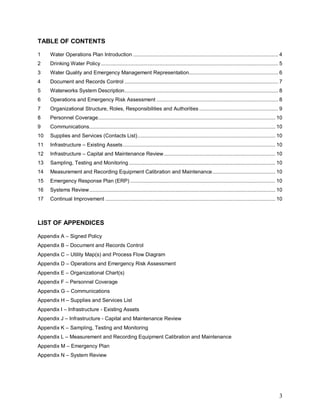
TABLE OF CONTENTS
1 Water Operations Plan Introduction ................................................................................................... 4
2 Drinking Water Policy ......................................................................................................................... 5
3 Water Quality and Emergency Management Representation............................................................. 6
4 Document and Records Control ......................................................................................................... 7
5 Waterworks System Description......................................................................................................... 8
6 Operations and Emergency Risk Assessment ................................................................................... 8
7 Organizational Structure, Roles, Responsibilities and Authorities ...................................................... 9
8 Personnel Coverage......................................................................................................................... 10
9 Communications............................................................................................................................... 10
10 Supplies and Services (Contacts List).............................................................................................. 10
11 Infrastructure – Existing Assets........................................................................................................ 10
12 Infrastructure – Capital and Maintenance Review............................................................................ 10
13 Sampling, Testing and Monitoring.................................................................................................... 10
14 Measurement and Recording Equipment Calibration and Maintenance........................................... 10
15 Emergency Response Plan (ERP) ................................................................................................... 10
16 Systems Review............................................................................................................................... 10
17 Continual Improvement .................................................................................................................... 10
LIST OF APPENDICES
Appendix A – Signed Policy
Appendix B – Document and Records Control
Appendix C – Utility Map(s) and Process Flow Diagram
Appendix D – Operations and Emergency Risk Assessment
Appendix E – Organizational Chart(s)
Appendix F – Personnel Coverage
Appendix G – Communications
Appendix H – Supplies and Services List
Appendix I – Infrastructure - Existing Assets
Appendix J – Infrastructure - Capital and Maintenance Review
Appendix K – Sampling, Testing and Monitoring
Appendix L – Measurement and Recording Equipment Calibration and Maintenance
Appendix M – Emergency Plan
Appendix N – System Review
4
1 Water Operations Plan Introduction
The Corporation of the Town of Virden is the Operating Authority for the Water Treatment,
Water Distribution, Wastewater Treatment, Wastewater Collection Systems within the Town of
Virden.
The Municipality’s Plan is structured and documented with the purpose of:
1. Establishing policy and objectives with respect to the effective operation of the Water
Systems, drinking water, and wastewater respectively;
2. Understanding and controlling the risks associated with the systems activities, processes
and addressing potential emergencies;
3. Achieving continuous improvement of the systems performance operations and
infrastructure longevity.
This Water Operations Plan supports the overall goal of The Town of Virden to provide safe,
cost-effective drinking water. With that in mind, opportunities exist to include wastewater as part
of the Plan, even though not currently legislated. The Plan’s legislative purpose is to meet and
exceed the drinking water requirements and Emergency Response Plan (ERP) legislative
requirements.
In addition economic sustainability requires the Towns departments to operate in a
multidisciplinary environment, this plan is to reflect that and help maintain those efficiencies.
This Plan has been developed with the municipalities operating practices and systems in mind,
utilizing its personnel to implement it, and where feasible include not only drinking water, but
wastewater as well.
5
2 Drinking Water Policy
We, The Town of Virden, owner and operator of the drinking water distribution system servicing
the Town of Virden, understand that supplying good quality drinking water is essential to the
continued growth, prosperity, and wellbeing of our citizens. We are committed to managing all
aspects of our water system effectively to provide safe and aesthetically appealing water. It is
our policy that the drinking water we provide will meet or exceed the quality as per Manitoba’s
regulated standards.
To achieve our goals we will:

 cooperate with the provincial government to protect our water source from
contamination;
 ensure the potential risks associated with water quality are identified and assessed;
 ensure that our water supply, treatment, storage, and distribution infrastructure is
properly designed, constantly maintained, and regularly evaluated and improved;
 include the drinking water quality and quantity priorities, needs, and expectations of our
citizens, the provincial authorities, and our water system employees into our planning;
 develop a mechanism to ensure adequate funds are available for the water utility to
maintain and improve the infrastructure, implement best practices, and ensure our water
treatment employees are educated about their responsibilities and adequately trained
and certified;
 establish regular verification of the quality of drinking water provided to our citizens and
monitoring of the water supplied;
 provide community awareness about the drinking water and its management by
establishing and maintaining effective reporting of the water quality and timely
information about the water system to our citizens;
 develop contingency plans and incident response capabilities in cooperation with
provincial health authorities;
 participate in appropriate research and development activities to ensure continued
understanding of drinking water quality issues and performance;
 participate in the drinking water guideline development and review process; and
 regularly assess our performance and continually improve our practices to produce good
quality water.
We support development of the Water Operations Management Plan including the
implementation to achieve these goals and adequately manage the risks to our drinking water
quality.
All of our officials, managers, and employees involved with the supply of drinking water are
responsible for understanding, implementing, maintaining, and continuously improving the
drinking water quality.
6
Operations Representative
____________________ ___________
Rhonda Stewart Date
CAO
Owner Representation
____________________ ___________
Jeff Mc Connell Date
Mayor
A copy of the signed commitment is in appendix A.
7
3 Water Quality and Emergency Management Representation
All personnel have a role and associated responsibilities within the Plan.
The designation Incident Commander (IC) is used to maintain a continuous flow of terminology
during emergency events, prior to designation of a severe emergency event the intent is to allow
the Utilities Manager as a specialist in the water and wastewater field, address events that are
Water Quality and Quantity threats in nature and continue to be the specialist on staff if event
escalates to the regional Municipal Emergency Plan. It is critical to plan and prepare mitigation
measure not only planning for server emergencies. This provides the best opportunity to the
ultimate success of responding to emergency events, and management of operations.
Incident Commander = Water Crisis /Water Quality Coordinator:
 In the event of an emergency event, the Utilities Manager or designate acts as the
Incident Commander. The Utilities Manager would work closely with Council, the
CAO and/or Mayor to determine best course of action. Once the event exceeds the
resources of Utilities Manager and the CAO/Council sees fit, the regional Municipal
Emergency Plan would be enacted and applied.
 The Water Crisis Coordinator classifies emergencies and disasters, determines
severity of event and triggers level of response.
 The Water Crisis Coordinator sets into motion action plans, contacts and
emergency management responses, to ensure public health and protection of the
environment and property.
 The Water Crisis Coordinator ensures personnel (specifically operators) are
trained for emergency response and aware of applicable legislative and regulatory
requirements that pertain to their operational duties.
 The Water Quality Coordinator implements and maintains operational systems of
the QA/QC program and identifies opportunities for improvement.
 The Water Quality Coordinator maintains and communicates status of the Water
Quality Management Plan to staff, management, and council.
 In most cases the Utility Manager acts as the Water Crisis Coordinator and/or
Water Quality Coordinator, but can designate these roles as required.
Public Relations Coordinator(s):
 In the event of a water related emergency event, the CAO, Mayor, and Utilities
Manager and or designate(s) would be identified as Public Relations Coordinators.
 The CAO or designate determines the urgency, medium, and method of
communications. A number of methods can be utilized including but not limited to:
door to door notification and pamphlets, website and local press notifications such as
“Precautionary Drinking Water Advisory (PDWA)”.
 Staff working on response and recovery can speak with the public in emergency
events, and in fact this can assist as a calming effect, but they should speak only on
topics related to their own responsibilities and help communicate what is currently
being done. Not what should have or what needs to be done. These individuals
should not address issues of policy, politics, or operational decisions.
 In most cases one of either the: Mayor, CAO or Utilities Manager act as the Public
Relations Coordinator(s) during a drinking water emergency event, but this too can
be designate as required.
8
4 Document and Records Control
Refer to appendix B for Document and Records Control Procedure.
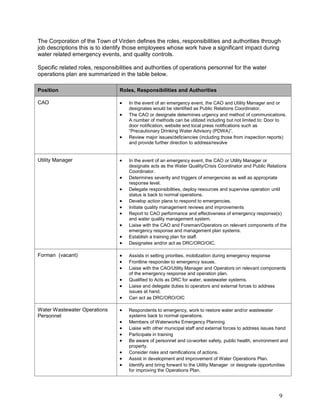
5 Water and Wastewater System(s) Description
Water System:
The Treatment and Distribution System(s) is owned and operated by Town of Virden. For a
detailed description of the system, see the Waterworks System Assessment (WSA). The
Waterworks system Assessment report is updated every 5 years as provincially regulated.
Wastewater System:
The Town of Virden is the owner and operator of the Wastewater Collection system and
Wastewater Treatment Plant. The system(s) are provincially designated as Wastewater
Treatment Class 2 and Wastewater Collection Class 2.
Infrastructure Details:
The Town’s water and wastewater infrastructure maps are readily available. The overview
maps are located in appendix C, more detailed drawings were digitized and are stored at the
water treatment plant computer and Utility Managers external storage drive at the town office.
These digitized maps include:
 Water and Wastewater mains/valves/hydrants/manholes
 Pump Stations and Booster stations
 Water Tower
 Water Treatment and Wastewater Treatment Plants
 Municipal buildings
6 Operations and Emergency Risk Assessment
Refer to appendix D for Operations and Emergency Risk Assessment.
7 Organizational Structure, Roles, Responsibilities and Authorities
Organizational Structure
See attached organizational charts in Appendix E
Roles, Responsibilities and Authorities
9
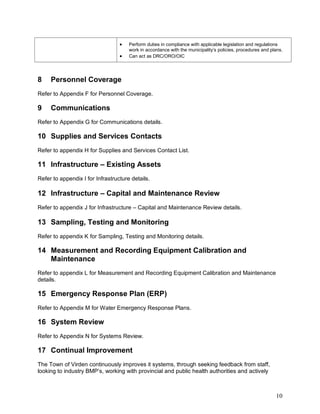
The Corporation of the Town of Virden defines the roles, responsibilities and authorities through
job descriptions this is to identify those employees whose work have a significant impact during
water related emergency events, and quality controls.
Specific related roles, responsibilities and authorities of operations personnel for the water
operations plan are summarized in the table below.
Position Roles, Responsibilities and Authorities
CAO  In the event of an emergency event, the CAO and Utility Manager and or
designates would be identified as Public Relations Coordinator.
 The CAO or designate determines urgency and method of communications.
A number of methods can be utilized including but not limited to: Door to
door notification, website and local press notifications such as
“Precautionary Drinking Water Advisory (PDWA)”.
 Review major issues/deficiencies (including those from inspection reports)
and provide further direction to address/resolve
Utility Manager  In the event of an emergency event, the CAO or Utility Manager or
designate acts as the Water Quality/Crisis Coordinator and Public Relations
Coordinator.
 Determines severity and triggers of emergencies as well as appropriate
response level.
 Delegate responsibilities, deploy resources and supervise operation until
status is back to normal operations.
 Develop action plans to respond to emergencies.
 Initiate quality management reviews and improvements
 Report to CAO performance and effectiveness of emergency response(s)
and water quality management system.
 Liaise with the CAO and Foreman/Operators on relevant components of the
emergency response and management plan systems.
 Establish a training plan for staff.
 Designates and/or act as DRC/ORO/OIC.
Forman (vacant)  Assists in setting priorities, mobilization during emergency response
 Frontline responder to emergency issues.
 Liaise with the CAO/Utility Manager and Operators on relevant components
of the emergency response and operation plan.
 Qualified to Acts as DRC for water, wastewater systems.
 Liaise and delegate duties to operators and external forces to address
issues at hand.
 Can act as DRC/ORO/OIC
Water Wastewater Operations
Personnel
 Respondents to emergency, work to restore water and/or wastewater
systems back to normal operations.
 Members of Waterworks Emergency Planning
 Liaise with other municipal staff and external forces to address issues hand
 Participate in training
 Be aware of personnel and co-worker safety, public health, environment and
property.
 Consider risks and ramifications of actions.
 Assist in development and improvement of Water Operations Plan.
 Identify and bring forward to the Utility Manager or designate opportunities
for improving the Operations Plan.
10
 Perform duties in compliance with applicable legislation and regulations
work in accordance with the municipality’s policies, procedures and plans.
 Can act as DRC/ORO/OIC
8 Personnel Coverage
Refer to Appendix F for Personnel Coverage.
9 Communications
Refer to Appendix G for Communications details.
10 Supplies and Services Contacts
Refer to appendix H for Supplies and Services Contact List.
11 Infrastructure – Existing Assets
Refer to appendix I for Infrastructure details.
12 Infrastructure – Capital and Maintenance Review
Refer to appendix J for Infrastructure – Capital and Maintenance Review details.
13 Sampling, Testing and Monitoring
Refer to appendix K for Sampling, Testing and Monitoring details.
14 Measurement and Recording Equipment Calibration and
Maintenance
Refer to appendix L for Measurement and Recording Equipment Calibration and Maintenance
details.
15 Emergency Response Plan (ERP)
Refer to Appendix M for Water Emergency Response Plans.
16 System Review
Refer to Appendix N for Systems Review.
17 Continual Improvement
The Town of Virden continuously improves it systems, through seeking feedback from staff,
looking to industry BMP’s, working with provincial and public health authorities and actively
11
responding to inspections. Through these processes, areas of concern as well as opportunities
for improvement are identified.

Water Operations Plan

  • 1.
  • 2.
    2 Revision 1, 01-Dec-15 Townof Virden DISCLAIMER STATEMENT Any use which a third party makes of this plan, or any part thereof, or any reliance on or decisions made based on information within it, is the responsibility of such third parties. The Corporation of the Town of Virden accepts no responsibility for damages, if any, suffered by any third party as a result of decisions made or actions taken based on this Plan or any part thereof. Any documents developed and owned by The Town which are referred to in this Plan remain the property of The Corporation. Accordingly, these documents shall be considered to form part of the Waterworks Emergency Plan belonging to the Town. REVISION HISTORY Date Revision Description of Revision 01-Dec-15 1 Document created and implemented
  • 3.
    3 TABLE OF CONTENTS 1Water Operations Plan Introduction ................................................................................................... 4 2 Drinking Water Policy ......................................................................................................................... 5 3 Water Quality and Emergency Management Representation............................................................. 6 4 Document and Records Control ......................................................................................................... 7 5 Waterworks System Description......................................................................................................... 8 6 Operations and Emergency Risk Assessment ................................................................................... 8 7 Organizational Structure, Roles, Responsibilities and Authorities ...................................................... 9 8 Personnel Coverage......................................................................................................................... 10 9 Communications............................................................................................................................... 10 10 Supplies and Services (Contacts List).............................................................................................. 10 11 Infrastructure – Existing Assets........................................................................................................ 10 12 Infrastructure – Capital and Maintenance Review............................................................................ 10 13 Sampling, Testing and Monitoring.................................................................................................... 10 14 Measurement and Recording Equipment Calibration and Maintenance........................................... 10 15 Emergency Response Plan (ERP) ................................................................................................... 10 16 Systems Review............................................................................................................................... 10 17 Continual Improvement .................................................................................................................... 10 LIST OF APPENDICES Appendix A – Signed Policy Appendix B – Document and Records Control Appendix C – Utility Map(s) and Process Flow Diagram Appendix D – Operations and Emergency Risk Assessment Appendix E – Organizational Chart(s) Appendix F – Personnel Coverage Appendix G – Communications Appendix H – Supplies and Services List Appendix I – Infrastructure - Existing Assets Appendix J – Infrastructure - Capital and Maintenance Review Appendix K – Sampling, Testing and Monitoring Appendix L – Measurement and Recording Equipment Calibration and Maintenance Appendix M – Emergency Plan Appendix N – System Review
  • 4.
    4 1 Water OperationsPlan Introduction The Corporation of the Town of Virden is the Operating Authority for the Water Treatment, Water Distribution, Wastewater Treatment, Wastewater Collection Systems within the Town of Virden. The Municipality’s Plan is structured and documented with the purpose of: 1. Establishing policy and objectives with respect to the effective operation of the Water Systems, drinking water, and wastewater respectively; 2. Understanding and controlling the risks associated with the systems activities, processes and addressing potential emergencies; 3. Achieving continuous improvement of the systems performance operations and infrastructure longevity. This Water Operations Plan supports the overall goal of The Town of Virden to provide safe, cost-effective drinking water. With that in mind, opportunities exist to include wastewater as part of the Plan, even though not currently legislated. The Plan’s legislative purpose is to meet and exceed the drinking water requirements and Emergency Response Plan (ERP) legislative requirements. In addition economic sustainability requires the Towns departments to operate in a multidisciplinary environment, this plan is to reflect that and help maintain those efficiencies. This Plan has been developed with the municipalities operating practices and systems in mind, utilizing its personnel to implement it, and where feasible include not only drinking water, but wastewater as well.
  • 5.
    5 2 Drinking WaterPolicy We, The Town of Virden, owner and operator of the drinking water distribution system servicing the Town of Virden, understand that supplying good quality drinking water is essential to the continued growth, prosperity, and wellbeing of our citizens. We are committed to managing all aspects of our water system effectively to provide safe and aesthetically appealing water. It is our policy that the drinking water we provide will meet or exceed the quality as per Manitoba’s regulated standards. To achieve our goals we will:   cooperate with the provincial government to protect our water source from contamination;  ensure the potential risks associated with water quality are identified and assessed;  ensure that our water supply, treatment, storage, and distribution infrastructure is properly designed, constantly maintained, and regularly evaluated and improved;  include the drinking water quality and quantity priorities, needs, and expectations of our citizens, the provincial authorities, and our water system employees into our planning;  develop a mechanism to ensure adequate funds are available for the water utility to maintain and improve the infrastructure, implement best practices, and ensure our water treatment employees are educated about their responsibilities and adequately trained and certified;  establish regular verification of the quality of drinking water provided to our citizens and monitoring of the water supplied;  provide community awareness about the drinking water and its management by establishing and maintaining effective reporting of the water quality and timely information about the water system to our citizens;  develop contingency plans and incident response capabilities in cooperation with provincial health authorities;  participate in appropriate research and development activities to ensure continued understanding of drinking water quality issues and performance;  participate in the drinking water guideline development and review process; and  regularly assess our performance and continually improve our practices to produce good quality water. We support development of the Water Operations Management Plan including the implementation to achieve these goals and adequately manage the risks to our drinking water quality. All of our officials, managers, and employees involved with the supply of drinking water are responsible for understanding, implementing, maintaining, and continuously improving the drinking water quality.
  • 6.
    6 Operations Representative ____________________ ___________ RhondaStewart Date CAO Owner Representation ____________________ ___________ Jeff Mc Connell Date Mayor A copy of the signed commitment is in appendix A.
  • 7.
    7 3 Water Qualityand Emergency Management Representation All personnel have a role and associated responsibilities within the Plan. The designation Incident Commander (IC) is used to maintain a continuous flow of terminology during emergency events, prior to designation of a severe emergency event the intent is to allow the Utilities Manager as a specialist in the water and wastewater field, address events that are Water Quality and Quantity threats in nature and continue to be the specialist on staff if event escalates to the regional Municipal Emergency Plan. It is critical to plan and prepare mitigation measure not only planning for server emergencies. This provides the best opportunity to the ultimate success of responding to emergency events, and management of operations. Incident Commander = Water Crisis /Water Quality Coordinator:  In the event of an emergency event, the Utilities Manager or designate acts as the Incident Commander. The Utilities Manager would work closely with Council, the CAO and/or Mayor to determine best course of action. Once the event exceeds the resources of Utilities Manager and the CAO/Council sees fit, the regional Municipal Emergency Plan would be enacted and applied.  The Water Crisis Coordinator classifies emergencies and disasters, determines severity of event and triggers level of response.  The Water Crisis Coordinator sets into motion action plans, contacts and emergency management responses, to ensure public health and protection of the environment and property.  The Water Crisis Coordinator ensures personnel (specifically operators) are trained for emergency response and aware of applicable legislative and regulatory requirements that pertain to their operational duties.  The Water Quality Coordinator implements and maintains operational systems of the QA/QC program and identifies opportunities for improvement.  The Water Quality Coordinator maintains and communicates status of the Water Quality Management Plan to staff, management, and council.  In most cases the Utility Manager acts as the Water Crisis Coordinator and/or Water Quality Coordinator, but can designate these roles as required. Public Relations Coordinator(s):  In the event of a water related emergency event, the CAO, Mayor, and Utilities Manager and or designate(s) would be identified as Public Relations Coordinators.  The CAO or designate determines the urgency, medium, and method of communications. A number of methods can be utilized including but not limited to: door to door notification and pamphlets, website and local press notifications such as “Precautionary Drinking Water Advisory (PDWA)”.  Staff working on response and recovery can speak with the public in emergency events, and in fact this can assist as a calming effect, but they should speak only on topics related to their own responsibilities and help communicate what is currently being done. Not what should have or what needs to be done. These individuals should not address issues of policy, politics, or operational decisions.  In most cases one of either the: Mayor, CAO or Utilities Manager act as the Public Relations Coordinator(s) during a drinking water emergency event, but this too can be designate as required.
  • 8.
    8 4 Document andRecords Control Refer to appendix B for Document and Records Control Procedure. 5 Water and Wastewater System(s) Description Water System: The Treatment and Distribution System(s) is owned and operated by Town of Virden. For a detailed description of the system, see the Waterworks System Assessment (WSA). The Waterworks system Assessment report is updated every 5 years as provincially regulated. Wastewater System: The Town of Virden is the owner and operator of the Wastewater Collection system and Wastewater Treatment Plant. The system(s) are provincially designated as Wastewater Treatment Class 2 and Wastewater Collection Class 2. Infrastructure Details: The Town’s water and wastewater infrastructure maps are readily available. The overview maps are located in appendix C, more detailed drawings were digitized and are stored at the water treatment plant computer and Utility Managers external storage drive at the town office. These digitized maps include:  Water and Wastewater mains/valves/hydrants/manholes  Pump Stations and Booster stations  Water Tower  Water Treatment and Wastewater Treatment Plants  Municipal buildings 6 Operations and Emergency Risk Assessment Refer to appendix D for Operations and Emergency Risk Assessment. 7 Organizational Structure, Roles, Responsibilities and Authorities Organizational Structure See attached organizational charts in Appendix E Roles, Responsibilities and Authorities
  • 9.
    9 The Corporation ofthe Town of Virden defines the roles, responsibilities and authorities through job descriptions this is to identify those employees whose work have a significant impact during water related emergency events, and quality controls. Specific related roles, responsibilities and authorities of operations personnel for the water operations plan are summarized in the table below. Position Roles, Responsibilities and Authorities CAO  In the event of an emergency event, the CAO and Utility Manager and or designates would be identified as Public Relations Coordinator.  The CAO or designate determines urgency and method of communications. A number of methods can be utilized including but not limited to: Door to door notification, website and local press notifications such as “Precautionary Drinking Water Advisory (PDWA)”.  Review major issues/deficiencies (including those from inspection reports) and provide further direction to address/resolve Utility Manager  In the event of an emergency event, the CAO or Utility Manager or designate acts as the Water Quality/Crisis Coordinator and Public Relations Coordinator.  Determines severity and triggers of emergencies as well as appropriate response level.  Delegate responsibilities, deploy resources and supervise operation until status is back to normal operations.  Develop action plans to respond to emergencies.  Initiate quality management reviews and improvements  Report to CAO performance and effectiveness of emergency response(s) and water quality management system.  Liaise with the CAO and Foreman/Operators on relevant components of the emergency response and management plan systems.  Establish a training plan for staff.  Designates and/or act as DRC/ORO/OIC. Forman (vacant)  Assists in setting priorities, mobilization during emergency response  Frontline responder to emergency issues.  Liaise with the CAO/Utility Manager and Operators on relevant components of the emergency response and operation plan.  Qualified to Acts as DRC for water, wastewater systems.  Liaise and delegate duties to operators and external forces to address issues at hand.  Can act as DRC/ORO/OIC Water Wastewater Operations Personnel  Respondents to emergency, work to restore water and/or wastewater systems back to normal operations.  Members of Waterworks Emergency Planning  Liaise with other municipal staff and external forces to address issues hand  Participate in training  Be aware of personnel and co-worker safety, public health, environment and property.  Consider risks and ramifications of actions.  Assist in development and improvement of Water Operations Plan.  Identify and bring forward to the Utility Manager or designate opportunities for improving the Operations Plan.
  • 10.
    10  Perform dutiesin compliance with applicable legislation and regulations work in accordance with the municipality’s policies, procedures and plans.  Can act as DRC/ORO/OIC 8 Personnel Coverage Refer to Appendix F for Personnel Coverage. 9 Communications Refer to Appendix G for Communications details. 10 Supplies and Services Contacts Refer to appendix H for Supplies and Services Contact List. 11 Infrastructure – Existing Assets Refer to appendix I for Infrastructure details. 12 Infrastructure – Capital and Maintenance Review Refer to appendix J for Infrastructure – Capital and Maintenance Review details. 13 Sampling, Testing and Monitoring Refer to appendix K for Sampling, Testing and Monitoring details. 14 Measurement and Recording Equipment Calibration and Maintenance Refer to appendix L for Measurement and Recording Equipment Calibration and Maintenance details. 15 Emergency Response Plan (ERP) Refer to Appendix M for Water Emergency Response Plans. 16 System Review Refer to Appendix N for Systems Review. 17 Continual Improvement The Town of Virden continuously improves it systems, through seeking feedback from staff, looking to industry BMP’s, working with provincial and public health authorities and actively
  • 11.
    11 responding to inspections.Through these processes, areas of concern as well as opportunities for improvement are identified.