CENTRE FOR COAL TECHNOLOGY
UNIVERSITY OF THE PUNJAB
LAHORE
Topic:-
Water Analysis
Presented By:-
KOMAL AROOSH
Session:-
2010-2012
5/1/20113:36:13PM
1
. WATER
. WATER QUALITY
. HARDNESS OF WATER
. SOLIDS IN WATER
. SEPARATION TECHNIQUES
5/1/20113:36:13PM
2
CONTENTS
5/1/20113:36:13PM
3
Water:
• Water is undesirable in fuel when it is injected into the
cylinders.
• In practice it is impossible to be entirely certain that the
fuel is completely free of water.
• Sea water can lead to problems, because the sodium will
get into the cylinder.
• Fresh water should not lead to serious problems if it is
evenly distributed in the fuel oil.
5/1/20113:36:13PM
4
WATER QUALITY
Water quality varies with the source.
It may or may not contain
 dissolved minerals
 dissolved gases
 organic matter
 microorganisms
 combinations of these impurities that cause
deterioration of metalworking fluid performance.
5/1/20113:36:13PM
5
The amount of dissolved minerals, for example, in
lake or river water (surface water) depends on
whether the source is near mineral deposits.
Typically, lake water is of a consistent quality, while
river water varies with weather conditions. Well
water (ground water), since it seeps through
minerals in the earth, tends to contain more
dissolved minerals than either lake or river water.
Surface water, however, is likely to contain a higher
number of microorganisms (bacteria and mold) and
thus need treatment
5/1/20113:36:13PM
6
1.If water is badly polluted-- like raw sewage---
it might be obvious from its appearance or
odor.
2.It might be colored or turbid (cloudy), or have
solids, oil or foam floating on it.
3.It might have a rotten odor, or smell like
industrial chemicals.
5/1/20113:36:13PM
7
Why do we need to analyze water?
THERE ARE TWO ASPECTS OF WATER
ANALYSIS THAT WE NEED TO CONSIDER:
5/1/20113:36:13PM
8
 what substances or
organisms are we
interested in testing for-
- and why?
 what procedures and
equipment do we use
to make the
measurements, and
how do they work?
TWO ASPECTS OF WATER
5/1/20113:36:13PM
9
HARDNESS OF WATER
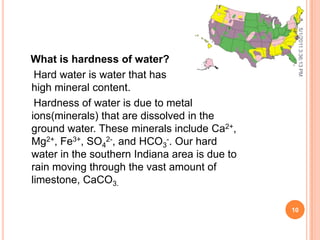
What is hardness of water?
Hard water is water that has
high mineral content.
Hardness of water is due to metal
ions(minerals) that are dissolved in the
ground water. These minerals include Ca2+,
Mg2+, Fe3+, SO4
2-, and HCO3
-. Our hard
water in the southern Indiana area is due to
rain moving through the vast amount of
limestone, CaCO3.
5/1/20113:36:13PM
10
Hardness of water
5/1/20113:36:13PM
11
WHY BE CONCERNED ABOUT HARD WATER?
 The determination of water hardness is a useful test that
provides a measure of quality of water for households and
industrial uses.
 Originally, water hardness was defined as the measure of
the capacity of the water to precipitate soap. Hard water is
not a health hazard.
 When hard water is heated, CaCO3 precipitates out, which
then clogs pipes and industrial boilers. This leads to
malfunction or damage and is expensive to remove
5/1/20113:36:13PM
12
TYPES OF HARDNESS
There are two basic types of water hardness:
1. Temporary hardness
2. Permanent hardness
5/1/20113:36:13PM
13
TEMPORARY HARDNESS
5/1/20113:36:13PM
14
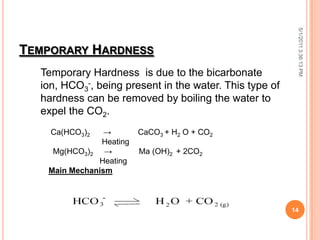
Temporary Hardness is due to the bicarbonate
ion, HCO3
-, being present in the water. This type of
hardness can be removed by boiling the water to
expel the CO2.
Ca(HCO3)2 → CaCO3 + H2 O + CO2
Heating
Mg(HCO3)2 → Ma (OH)2 + 2CO2
Heating
Main Mechanism
Permanent hardness
Permanent hardness is due to the presence of the
ions Ca2+, Mg+2, Fe3+ and SO4
-. This type of
hardness cannot be eliminated by boiling. The
water with this type of hardness is said to
be permanently hard.
5/1/20113:36:13PM
15
SOLIDS IN
WATER
5/1/20113:36:13PM
16
DISSOLVED SOLIDS
The total dissolved solids can have a significant impact on
the quality of water. The amount of dissolved solids affects
the water for almost all of its uses, whether for drinking,
agricultural, or industrial use. The recommended maximum
limit of dissolved solids in drinking water is 500 ppm
5/1/20113:36:13PM
17
PROBLEMS RELATED TO DISSOLVED SOLIDS
The problems caused by dissolved material relate
to taste and odor, hardness, and corrosion and
scaling in the distribution system, among others.
Several different types of dissolved solids could be
toxic if the levels become too high. These include
barium, arsenic, cadmium, chromium, lead,
mercury, selenium, and silver. Each of these are
regulated by the EPA and have maximum
contaminant levels assigned to them.
5/1/20113:36:13PM
18
SUSPENDED SOLIDS
Suspended solids refers to small solid particles which
remain in suspension in water as a colloid or due to the
motion of the water. It is used as one indicator of water
quality.
5/1/20113:36:13PM
19
PROBLEMS RELATED TO SUSPENDED PARTICLES
High concentrations of suspended solids
can cause many problems for stream health
and aquatic life.
5/1/20113:36:13PM
20
5/1/20113:36:13PM
21
SEPARATION
TECHNIQUES
Separation technique include
1. Filtration
2. Distillation
3. Extraction
5/1/20113:36:13PM
22
Filtration:
The water is passed through a fine-pore filter which can
be made of paper, glass fibers, a cellulose acetate
membrane, etc.
Filtration through a filter of some agreed-upon standard
pore size can be used to separate "suspended" from
"dissolved" portions of the analyte. The analyte may be
the suspended matter which is captured on the filter-- or
the filter may be used to clarify the water for analysis of a
dissolved material.
5/1/20113:36:13PM
23
Distillation:
If the analyte can be boiled out of the water, or along
with the water, then the vapors can be cooled and re-
condensed or trapped in a liquid form in a different
container. This way the analyte can be removed from the
interfering substances in the original water sample. Often
the sample is made acidic or alkaline, or treated
chemically in some other way before distillation, to
convert the analyte into a volatile (easily evaporated)
form, and to immobilize or neutralize interfering
substances.
5/1/20113:36:13PM
24
Extraction:
Some analytes may be much more soluble in an organic
solvent than in water. If the solvent does not mix with
water, and the sample is shaken with portions of the
solvent, almost all of the analyte may be transferred from
the water into the solvent, leaving interfering substances
behind. This is known as a "liquid-liquid" extraction. The
analysis may be completed using the organic portion.
There are also continuous versions of this process for
use with liquid or with dry samples.
5/1/20113:36:13PM
25
REFERENCES
 Map from Morton Salt at
http://www.mortonsalt.com/soft/sofisoft.htm
 ^ a b c World Health Organization Hardness in
Drinking-Water, 2003
 ^ a b Hermann Weingärtner, "Water" in Ullmann's
Encyclopedia of Industrial Chemistry,
2006[december], Wiley–VCH,
Weinheim.doi:10.1002/14356007.a28_001
 http://www.glendalewaterandpower.com/residents/
water_hardnes
 http://www.mrwa.com/OPWater%20and%20Impuriti
es.pdf
5/1/20113:36:13PM
26
PARTICULATE
MATTERS
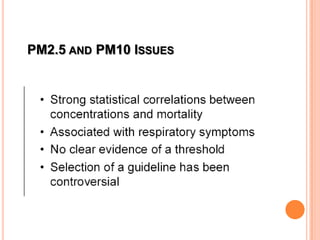
PM2.5 AND PM10 ISSUES
PM EFFECTS
UNDERSTATEMENT OF PM BY HAZCO
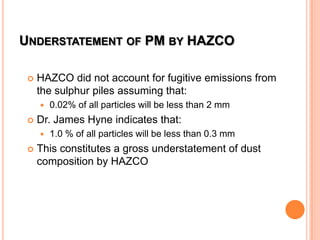
 HAZCO did not account for fugitive emissions from
the sulphur piles assuming that:
 0.02% of all particles will be less than 2 mm
 Dr. James Hyne indicates that:
 1.0 % of all particles will be less than 0.3 mm
 This constitutes a gross understatement of dust
composition by HAZCO
PM DISPERSION MODELING
UNDERSTATEMENTS
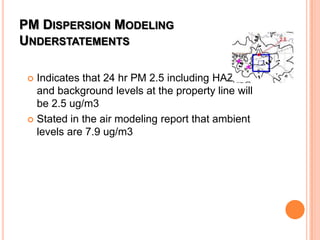
 Indicates that 24 hr PM 2.5 including HAZCO
and background levels at the property line will
be 2.5 ug/m3
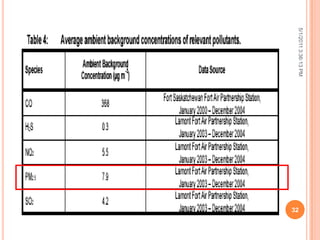
 Stated in the air modeling report that ambient
levels are 7.9 ug/m3
5/1/20113:36:13PM
32
IMPACTS TO ADJACENT INDUSTRY
 Canexus and ERCO Worldwide produce
sodium chlorate, which is incompatible with
sulphur
 Both industries employ open cooling towers,
as will many future developing industries
 A Canexus review of the particulates
estimates concludes that, “HAZCO’s
conclusion that fugitive dust emissions
associated with the storage, handling and
transportation activities will be negligible, is
neither credible nor valid.”

Water analysis

  • 1.
    CENTRE FOR COALTECHNOLOGY UNIVERSITY OF THE PUNJAB LAHORE Topic:- Water Analysis Presented By:- KOMAL AROOSH Session:- 2010-2012 5/1/20113:36:13PM 1
  • 2.
    . WATER . WATERQUALITY . HARDNESS OF WATER . SOLIDS IN WATER . SEPARATION TECHNIQUES 5/1/20113:36:13PM 2 CONTENTS
  • 3.
    5/1/20113:36:13PM 3 Water: • Water isundesirable in fuel when it is injected into the cylinders. • In practice it is impossible to be entirely certain that the fuel is completely free of water. • Sea water can lead to problems, because the sodium will get into the cylinder. • Fresh water should not lead to serious problems if it is evenly distributed in the fuel oil.
  • 4.
  • 5.
    Water quality varieswith the source. It may or may not contain  dissolved minerals  dissolved gases  organic matter  microorganisms  combinations of these impurities that cause deterioration of metalworking fluid performance. 5/1/20113:36:13PM 5
  • 6.
    The amount ofdissolved minerals, for example, in lake or river water (surface water) depends on whether the source is near mineral deposits. Typically, lake water is of a consistent quality, while river water varies with weather conditions. Well water (ground water), since it seeps through minerals in the earth, tends to contain more dissolved minerals than either lake or river water. Surface water, however, is likely to contain a higher number of microorganisms (bacteria and mold) and thus need treatment 5/1/20113:36:13PM 6
  • 7.
    1.If water isbadly polluted-- like raw sewage--- it might be obvious from its appearance or odor. 2.It might be colored or turbid (cloudy), or have solids, oil or foam floating on it. 3.It might have a rotten odor, or smell like industrial chemicals. 5/1/20113:36:13PM 7 Why do we need to analyze water?
  • 8.
    THERE ARE TWOASPECTS OF WATER ANALYSIS THAT WE NEED TO CONSIDER: 5/1/20113:36:13PM 8  what substances or organisms are we interested in testing for- - and why?  what procedures and equipment do we use to make the measurements, and how do they work? TWO ASPECTS OF WATER
  • 9.
  • 10.
    What is hardnessof water? Hard water is water that has high mineral content. Hardness of water is due to metal ions(minerals) that are dissolved in the ground water. These minerals include Ca2+, Mg2+, Fe3+, SO4 2-, and HCO3 -. Our hard water in the southern Indiana area is due to rain moving through the vast amount of limestone, CaCO3. 5/1/20113:36:13PM 10
  • 11.
  • 12.
    WHY BE CONCERNEDABOUT HARD WATER?  The determination of water hardness is a useful test that provides a measure of quality of water for households and industrial uses.  Originally, water hardness was defined as the measure of the capacity of the water to precipitate soap. Hard water is not a health hazard.  When hard water is heated, CaCO3 precipitates out, which then clogs pipes and industrial boilers. This leads to malfunction or damage and is expensive to remove 5/1/20113:36:13PM 12
  • 13.
    TYPES OF HARDNESS Thereare two basic types of water hardness: 1. Temporary hardness 2. Permanent hardness 5/1/20113:36:13PM 13
  • 14.
    TEMPORARY HARDNESS 5/1/20113:36:13PM 14 Temporary Hardnessis due to the bicarbonate ion, HCO3 -, being present in the water. This type of hardness can be removed by boiling the water to expel the CO2. Ca(HCO3)2 → CaCO3 + H2 O + CO2 Heating Mg(HCO3)2 → Ma (OH)2 + 2CO2 Heating Main Mechanism
  • 15.
    Permanent hardness Permanent hardnessis due to the presence of the ions Ca2+, Mg+2, Fe3+ and SO4 -. This type of hardness cannot be eliminated by boiling. The water with this type of hardness is said to be permanently hard. 5/1/20113:36:13PM 15
  • 16.
  • 17.
    DISSOLVED SOLIDS The totaldissolved solids can have a significant impact on the quality of water. The amount of dissolved solids affects the water for almost all of its uses, whether for drinking, agricultural, or industrial use. The recommended maximum limit of dissolved solids in drinking water is 500 ppm 5/1/20113:36:13PM 17
  • 18.
    PROBLEMS RELATED TODISSOLVED SOLIDS The problems caused by dissolved material relate to taste and odor, hardness, and corrosion and scaling in the distribution system, among others. Several different types of dissolved solids could be toxic if the levels become too high. These include barium, arsenic, cadmium, chromium, lead, mercury, selenium, and silver. Each of these are regulated by the EPA and have maximum contaminant levels assigned to them. 5/1/20113:36:13PM 18
  • 19.
    SUSPENDED SOLIDS Suspended solidsrefers to small solid particles which remain in suspension in water as a colloid or due to the motion of the water. It is used as one indicator of water quality. 5/1/20113:36:13PM 19
  • 20.
    PROBLEMS RELATED TOSUSPENDED PARTICLES High concentrations of suspended solids can cause many problems for stream health and aquatic life. 5/1/20113:36:13PM 20
  • 21.
  • 22.
    Separation technique include 1.Filtration 2. Distillation 3. Extraction 5/1/20113:36:13PM 22
  • 23.
    Filtration: The water ispassed through a fine-pore filter which can be made of paper, glass fibers, a cellulose acetate membrane, etc. Filtration through a filter of some agreed-upon standard pore size can be used to separate "suspended" from "dissolved" portions of the analyte. The analyte may be the suspended matter which is captured on the filter-- or the filter may be used to clarify the water for analysis of a dissolved material. 5/1/20113:36:13PM 23
  • 24.
    Distillation: If the analytecan be boiled out of the water, or along with the water, then the vapors can be cooled and re- condensed or trapped in a liquid form in a different container. This way the analyte can be removed from the interfering substances in the original water sample. Often the sample is made acidic or alkaline, or treated chemically in some other way before distillation, to convert the analyte into a volatile (easily evaporated) form, and to immobilize or neutralize interfering substances. 5/1/20113:36:13PM 24
  • 25.
    Extraction: Some analytes maybe much more soluble in an organic solvent than in water. If the solvent does not mix with water, and the sample is shaken with portions of the solvent, almost all of the analyte may be transferred from the water into the solvent, leaving interfering substances behind. This is known as a "liquid-liquid" extraction. The analysis may be completed using the organic portion. There are also continuous versions of this process for use with liquid or with dry samples. 5/1/20113:36:13PM 25
  • 26.
    REFERENCES  Map fromMorton Salt at http://www.mortonsalt.com/soft/sofisoft.htm  ^ a b c World Health Organization Hardness in Drinking-Water, 2003  ^ a b Hermann Weingärtner, "Water" in Ullmann's Encyclopedia of Industrial Chemistry, 2006[december], Wiley–VCH, Weinheim.doi:10.1002/14356007.a28_001  http://www.glendalewaterandpower.com/residents/ water_hardnes  http://www.mrwa.com/OPWater%20and%20Impuriti es.pdf 5/1/20113:36:13PM 26
  • 27.
  • 28.
  • 29.
  • 30.
    UNDERSTATEMENT OF PMBY HAZCO  HAZCO did not account for fugitive emissions from the sulphur piles assuming that:  0.02% of all particles will be less than 2 mm  Dr. James Hyne indicates that:  1.0 % of all particles will be less than 0.3 mm  This constitutes a gross understatement of dust composition by HAZCO
  • 31.
    PM DISPERSION MODELING UNDERSTATEMENTS Indicates that 24 hr PM 2.5 including HAZCO and background levels at the property line will be 2.5 ug/m3  Stated in the air modeling report that ambient levels are 7.9 ug/m3
  • 32.
  • 33.
    IMPACTS TO ADJACENTINDUSTRY  Canexus and ERCO Worldwide produce sodium chlorate, which is incompatible with sulphur  Both industries employ open cooling towers, as will many future developing industries  A Canexus review of the particulates estimates concludes that, “HAZCO’s conclusion that fugitive dust emissions associated with the storage, handling and transportation activities will be negligible, is neither credible nor valid.”