PRESENTATION ON
WATER CHEMISTRY
Environmental Engineering


                       Madhur Devkota
                        Bikalp Acharya
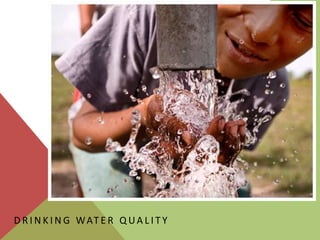
D R I N K I N G W AT E R Q U A L I T Y
Background

1. Rural India has more than 700 million people residing in
   about 1.42 million habitations spread over 15 diverse
   ecological regions.

2. 85 % of rural population in India is solely depended on ground
   water, which is depleting at a fast rate.

3. India has 16% of the world’s population and 4% of its fresh
   water resources.

4. Ninety 2% groundwater extracted is used in the agricultural
   sector, five and 3 % respectively for industrial and domestic
   sector.
Water Quality Problems
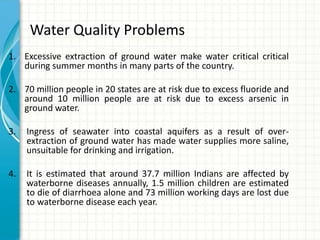
1. Excessive extraction of ground water make water critical critical
   during summer months in many parts of the country.

2. 70 million people in 20 states are at risk due to excess fluoride and
   around 10 million people are at risk due to excess arsenic in
   ground water.

3.   Ingress of seawater into coastal aquifers as a result of over-
     extraction of ground water has made water supplies more saline,
     unsuitable for drinking and irrigation.

4.   It is estimated that around 37.7 million Indians are affected by
     waterborne diseases annually, 1.5 million children are estimated
     to die of diarrhoea alone and 73 million working days are lost due
     to waterborne disease each year.
Water Pollution


                   Polluting
                   Agents*
                  (Public Health
                    Services)
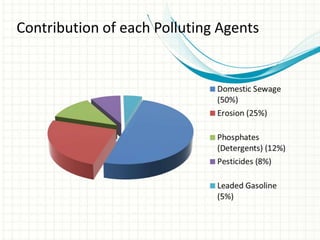
Contribution of each Polluting Agents
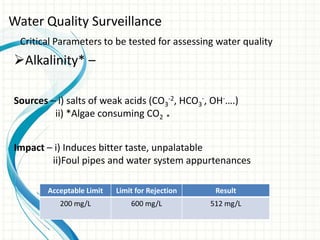
Water Quality Surveillance
 Critical Parameters to be tested for assessing water quality
Alkalinity* –

Sources – i) salts of weak acids (CO3-2, HCO3-, OH-….)
         ii) *Algae consuming CO2 *


Impact – i) Induces bitter taste, unpalatable
        ii)Foul pipes and water system appurtenances

        Acceptable Limit   Limit for Rejection    Result
           200 mg/L            600 mg/L          512 mg/L
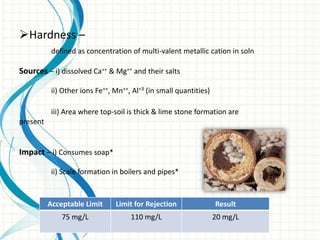
Hardness –
           defined as concentration of multi-valent metallic cation in soln

Sources – i) dissolved Ca++ & Mg++ and their salts

           ii) Other ions Fe++, Mn++, Al+3 (in small quantities)

           iii) Area where top-soil is thick & lime stone formation are
present


Impact – i) Consumes soap*

           ii) Scale formation in boilers and pipes*


          Acceptable Limit      Limit for Rejection                Result
              75 mg/L                110 mg/L                      20 mg/L
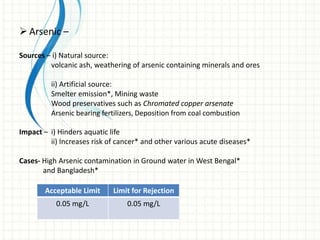
 Arsenic –

Sources – i) Natural source:
         volcanic ash, weathering of arsenic containing minerals and ores

         ii) Artificial source:
         Smelter emission*, Mining waste
         Wood preservatives such as Chromated copper arsenate
         Arsenic bearing fertilizers, Deposition from coal combustion

Impact – i) Hinders aquatic life
         ii) Increases risk of cancer* and other various acute diseases*

Cases- High Arsenic contamination in Ground water in West Bengal*
       and Bangladesh*

        Acceptable Limit     Limit for Rejection
           0.05 mg/L             0.05 mg/L
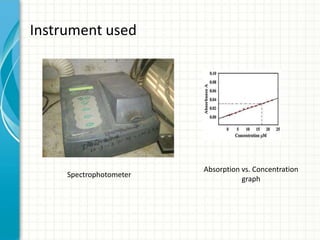
Instrument used


                         Absorption vs. Concentration
     Spectrophotometer
                                    graph
 Chloride –

Sources – i) Nonpoint source:
             a) Natural*
             b) Agriculture*
             c) Residential and Urban*

         ii) Point source *

Reagent Used for test- Indicator: K2CrO4; Titrant: N/70 AgNO3 soln

Impact – i) >250 mg/L the taste is salty
         ii) Evapotransportation increase salinity  makes crops difficult
             to absorb water *

Application- Used as a tracer*
       Acceptable Limit      Limit for Rejection            Result
           200 mg/L              600 mg/L                  36 mg/L
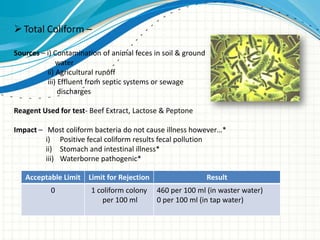
 Total Coliform –

Sources – i) Contamination of animal feces in soil & ground
              water
          ii) Agricultural runoff
          iii) Effluent from septic systems or sewage
               discharges

Reagent Used for test- Beef Extract, Lactose & Peptone

Impact – Most coliform bacteria do not cause illness however…*
         i) Positive fecal coliform results fecal pollution
         ii) Stomach and intestinal illness*
         iii) Waterborne pathogenic*

   Acceptable Limit    Limit for Rejection                    Result
           0           1 coliform colony     460 per 100 ml (in waster water)
                           per 100 ml        0 per 100 ml (in tap water)
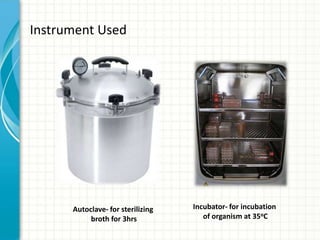
Instrument Used


      Autoclave- for sterilizing   Incubator- for incubation
           broth for 3hrs             of organism at 35oC
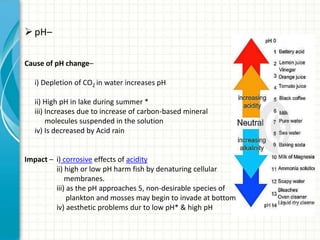
 pH–

Cause of pH change–

   i) Depletion of CO2 in water increases pH

   ii) High pH in lake during summer *
   iii) Increases due to increase of carbon-based mineral
        molecules suspended in the solution
   iv) Is decreased by Acid rain


Impact – i) corrosive effects of acidity
         ii) high or low pH harm fish by denaturing cellular
             membranes.
         iii) as the pH approaches 5, non-desirable species of
              plankton and mosses may begin to invade at bottom
         iv) aesthetic problems dur to low pH* & high pH
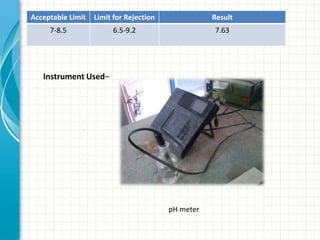
Acceptable Limit   Limit for Rejection              Result
     7-8.5              6.5-9.2                     7.63


   Instrument Used–


                                         pH meter
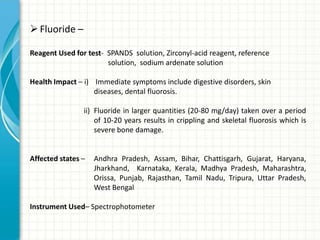
 Fluoride –

Reagent Used for test- SPANDS solution, Zirconyl-acid reagent, reference
                       solution, sodium ardenate solution

Health Impact – i) Immediate symptoms include digestive disorders, skin
                   diseases, dental fluorosis.

                ii) Fluoride in larger quantities (20-80 mg/day) taken over a period
                    of 10-20 years results in crippling and skeletal fluorosis which is
                    severe bone damage.


Affected states –   Andhra Pradesh, Assam, Bihar, Chattisgarh, Gujarat, Haryana,
                    Jharkhand, Karnataka, Kerala, Madhya Pradesh, Maharashtra,
                    Orissa, Punjab, Rajasthan, Tamil Nadu, Tripura, Uttar Pradesh,
                    West Bengal

Instrument Used– Spectrophotometer
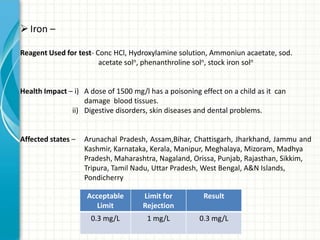
 Iron –

Reagent Used for test- Conc HCl, Hydroxylamine solution, Ammoniun acaetate, sod.
                        acetate soln, phenanthroline soln, stock iron soln


Health Impact – i) A dose of 1500 mg/l has a poisoning effect on a child as it can
                   damage blood tissues.
               ii) Digestive disorders, skin diseases and dental problems.


Affected states –   Arunachal Pradesh, Assam,Bihar, Chattisgarh, Jharkhand, Jammu and
                    Kashmir, Karnataka, Kerala, Manipur, Meghalaya, Mizoram, Madhya
                    Pradesh, Maharashtra, Nagaland, Orissa, Punjab, Rajasthan, Sikkim,
                    Tripura, Tamil Nadu, Uttar Pradesh, West Bengal, A&N Islands,
                    Pondicherry

                    Acceptable       Limit for          Result
                       Limit         Rejection
                     0.3 mg/L          1 mg/L          0.3 mg/L
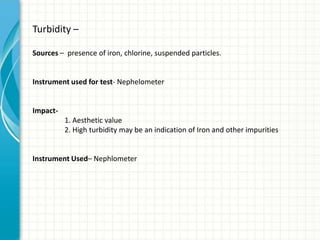
Turbidity –

Sources – presence of iron, chlorine, suspended particles.


Instrument used for test- Nephelometer


Impact-
          1. Aesthetic value
          2. High turbidity may be an indication of Iron and other impurities


Instrument Used– Nephlometer
THANKYOU !!

Presentation on water testing

  • 1.
    PRESENTATION ON WATER CHEMISTRY EnvironmentalEngineering Madhur Devkota Bikalp Acharya
  • 2.
    D R IN K I N G W AT E R Q U A L I T Y
  • 3.
    Background 1. Rural Indiahas more than 700 million people residing in about 1.42 million habitations spread over 15 diverse ecological regions. 2. 85 % of rural population in India is solely depended on ground water, which is depleting at a fast rate. 3. India has 16% of the world’s population and 4% of its fresh water resources. 4. Ninety 2% groundwater extracted is used in the agricultural sector, five and 3 % respectively for industrial and domestic sector.
  • 4.
    Water Quality Problems 1.Excessive extraction of ground water make water critical critical during summer months in many parts of the country. 2. 70 million people in 20 states are at risk due to excess fluoride and around 10 million people are at risk due to excess arsenic in ground water. 3. Ingress of seawater into coastal aquifers as a result of over- extraction of ground water has made water supplies more saline, unsuitable for drinking and irrigation. 4. It is estimated that around 37.7 million Indians are affected by waterborne diseases annually, 1.5 million children are estimated to die of diarrhoea alone and 73 million working days are lost due to waterborne disease each year.
  • 5.
    Water Pollution Polluting Agents* (Public Health Services)
  • 6.
    Contribution of eachPolluting Agents
  • 7.
    Water Quality Surveillance Critical Parameters to be tested for assessing water quality Alkalinity* – Sources – i) salts of weak acids (CO3-2, HCO3-, OH-….) ii) *Algae consuming CO2 * Impact – i) Induces bitter taste, unpalatable ii)Foul pipes and water system appurtenances Acceptable Limit Limit for Rejection Result 200 mg/L 600 mg/L 512 mg/L
  • 8.
    Hardness – defined as concentration of multi-valent metallic cation in soln Sources – i) dissolved Ca++ & Mg++ and their salts ii) Other ions Fe++, Mn++, Al+3 (in small quantities) iii) Area where top-soil is thick & lime stone formation are present Impact – i) Consumes soap* ii) Scale formation in boilers and pipes* Acceptable Limit Limit for Rejection Result 75 mg/L 110 mg/L 20 mg/L
  • 9.
     Arsenic – Sources– i) Natural source: volcanic ash, weathering of arsenic containing minerals and ores ii) Artificial source: Smelter emission*, Mining waste Wood preservatives such as Chromated copper arsenate Arsenic bearing fertilizers, Deposition from coal combustion Impact – i) Hinders aquatic life ii) Increases risk of cancer* and other various acute diseases* Cases- High Arsenic contamination in Ground water in West Bengal* and Bangladesh* Acceptable Limit Limit for Rejection 0.05 mg/L 0.05 mg/L
  • 10.
    Instrument used Absorption vs. Concentration Spectrophotometer graph
  • 11.
     Chloride – Sources– i) Nonpoint source: a) Natural* b) Agriculture* c) Residential and Urban* ii) Point source * Reagent Used for test- Indicator: K2CrO4; Titrant: N/70 AgNO3 soln Impact – i) >250 mg/L the taste is salty ii) Evapotransportation increase salinity  makes crops difficult to absorb water * Application- Used as a tracer* Acceptable Limit Limit for Rejection Result 200 mg/L 600 mg/L 36 mg/L
  • 12.
     Total Coliform– Sources – i) Contamination of animal feces in soil & ground water ii) Agricultural runoff iii) Effluent from septic systems or sewage discharges Reagent Used for test- Beef Extract, Lactose & Peptone Impact – Most coliform bacteria do not cause illness however…* i) Positive fecal coliform results fecal pollution ii) Stomach and intestinal illness* iii) Waterborne pathogenic* Acceptable Limit Limit for Rejection Result 0 1 coliform colony 460 per 100 ml (in waster water) per 100 ml 0 per 100 ml (in tap water)
  • 13.
    Instrument Used Autoclave- for sterilizing Incubator- for incubation broth for 3hrs of organism at 35oC
  • 14.
     pH– Cause ofpH change– i) Depletion of CO2 in water increases pH ii) High pH in lake during summer * iii) Increases due to increase of carbon-based mineral molecules suspended in the solution iv) Is decreased by Acid rain Impact – i) corrosive effects of acidity ii) high or low pH harm fish by denaturing cellular membranes. iii) as the pH approaches 5, non-desirable species of plankton and mosses may begin to invade at bottom iv) aesthetic problems dur to low pH* & high pH
  • 15.
    Acceptable Limit Limit for Rejection Result 7-8.5 6.5-9.2 7.63 Instrument Used– pH meter
  • 16.
     Fluoride – ReagentUsed for test- SPANDS solution, Zirconyl-acid reagent, reference solution, sodium ardenate solution Health Impact – i) Immediate symptoms include digestive disorders, skin diseases, dental fluorosis. ii) Fluoride in larger quantities (20-80 mg/day) taken over a period of 10-20 years results in crippling and skeletal fluorosis which is severe bone damage. Affected states – Andhra Pradesh, Assam, Bihar, Chattisgarh, Gujarat, Haryana, Jharkhand, Karnataka, Kerala, Madhya Pradesh, Maharashtra, Orissa, Punjab, Rajasthan, Tamil Nadu, Tripura, Uttar Pradesh, West Bengal Instrument Used– Spectrophotometer
  • 17.
     Iron – ReagentUsed for test- Conc HCl, Hydroxylamine solution, Ammoniun acaetate, sod. acetate soln, phenanthroline soln, stock iron soln Health Impact – i) A dose of 1500 mg/l has a poisoning effect on a child as it can damage blood tissues. ii) Digestive disorders, skin diseases and dental problems. Affected states – Arunachal Pradesh, Assam,Bihar, Chattisgarh, Jharkhand, Jammu and Kashmir, Karnataka, Kerala, Manipur, Meghalaya, Mizoram, Madhya Pradesh, Maharashtra, Nagaland, Orissa, Punjab, Rajasthan, Sikkim, Tripura, Tamil Nadu, Uttar Pradesh, West Bengal, A&N Islands, Pondicherry Acceptable Limit for Result Limit Rejection 0.3 mg/L 1 mg/L 0.3 mg/L
  • 18.
    Turbidity – Sources –presence of iron, chlorine, suspended particles. Instrument used for test- Nephelometer Impact- 1. Aesthetic value 2. High turbidity may be an indication of Iron and other impurities Instrument Used– Nephlometer
  • 19.