PRESENTATION TOPIC;
Control of particulate emissions using cyclones


                Presentation by

               Komal Aroosh
                 M.Sc (4th semester)


                  DEPARTMENT
            CENTER FOR COAL TECHNOLOGY
             PUNJAB UNIVERSITY LAHORE
Control of particulate emissions using cyclones

                             QUESTIONS
    What are the particulate emissions?
    Why its necessary to control the particulate emissions?
    What systems are available to control the particulate emissions?
    History of high efficiency cyclones
    What is agglomeration spray?
    Commercial applications of high efficiency cyclones
    Working principle
    Advantages
    disadvantages
    Can a cyclone reach efficiencies of ESP / Bag filter / Wet scrubber?
    Selection criteria
    Outlook
Control of particulate emissions using cyclones

          What are the particulate emissions?


 Particulate emissions are emissions characterized by
 the presence of small particles of solids and liquids.
 These common byproducts of combustion are a
 major health and environmental concern in many
 regions of the world, and steps have been taken to
 reduce particulate emissions and to educate people
 about their risks. These emissions are also known as
 particulate pollution or particulate matter.
Control of particulate emissions using cyclones

         Sources of particulate emissions
   Sources of particulate emission can be man made or
    natural.
   the vast majority of such emissions coming from
    factories
   around 10% coming from vehicles on the road.
   Combustion of fossil fuels also releases other
    substances and particulates into the air
   Some particulates occur naturally, originating from
    volcanoes, dust storms, forest and grassland fires,
    living vegetation, and sea spray.
Control of particulate emissions using cyclones

 Why its necessary to control the particulate emissions?

       Sometimes, particulate emissions are visible in
        the form of soot or smoke, because the particles
        are so large. Most are not visible, however,
        which is part of what makes them dangerous,
        because people do not realize that the emissions
        are occurring. Small particles are also more
        dangerous because they are less likely to be
        trapped in the mucus linings of the nose and
        throat.
Control of particulate emissions using cyclones

     Effect of particulate emissions on the humans


   If the particles, which can be composed of any
   combination of hundreds of chemicals and
   elements, are able to get through the defenses of
   the nose and mouth, then they can find their way
   into the lungs and possibly even pass into the
   blood stream. This can cause respiratory problems
   and potentially contribute to a higher risk for
   certain types of cancer or heart disease.
Control of particulate emissions using cyclones

       Effect of particulate emissions on the plants
     The particulates may block their leaves so that
    they cannot photosynthesize properly.
   The climate as a whole can be heavily impacted by
    such emissions, as they can block the sunlight so
    that it cannot reach the Earth.
   Cause a decrease in crop yields, and contribute to
    global warming trends.
Control of particulate emissions using cyclones

     Effect of particulate emissions on the animals

   For animals, particulate emissions pose a threat to
   cardiovascular and lung health. In the lungs,
   particulates can block or rupture the alveoli,
   interfering with lung function. A number of
   respiratory conditions including asthma and
   cancer are linked to exposure to particulate
   emissions. The heart muscle and blood vessels can
   also be damaged by particulates if they enter the
   bloodstream through the lungs, causing
   widespread medical problems.
Control of particulate emissions using cyclones


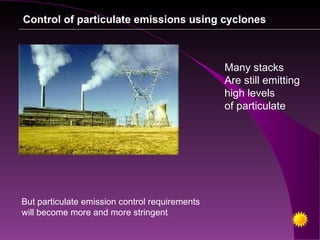
                                                Many stacks
                                                Are still emitting
                                                high levels
                                                of particulate


But particulate emission control requirements
will become more and more stringent
Control of particulate emissions using cyclones


What systems are available to control
Particulate emissions ?


   • Electrostatic precipitator
   • Bag house fabric filter
   • Wet scrubber
   • High efficiency cyclones
Control of particulate emissions using cyclones


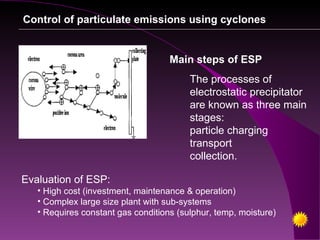
                                    Main steps of ESP
                                         The processes of
                                         electrostatic precipitator
                                         are known as three main
                                         stages:
                                         particle charging
                                         transport
                                         collection.

Evaluation of ESP:
   • High cost (investment, maintenance & operation)
   • Complex large size plant with sub-systems
   • Requires constant gas conditions (sulphur, temp, moisture)
Control of particulate emissions using cyclones


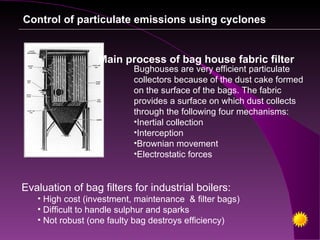
                  Main process of bag house fabric filter
                           Bughouses are very efficient particulate
                           collectors because of the dust cake formed
                           on the surface of the bags. The fabric
                           provides a surface on which dust collects
                           through the following four mechanisms:
                           •Inertial collection
                           •Interception
                           •Brownian movement
                           •Electrostatic forces


Evaluation of bag filters for industrial boilers:
   • High cost (investment, maintenance & filter bags)
   • Difficult to handle sulphur and sparks
   • Not robust (one faulty bag destroys efficiency)
Control of particulate emissions using cyclones
   Mechanism
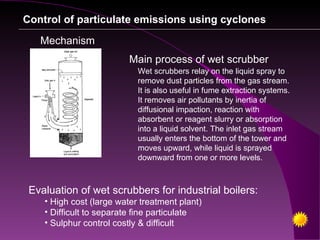
                          Main process of wet scrubber
                            Wet scrubbers relay on the liquid spray to
                            remove dust particles from the gas stream.
                            It is also useful in fume extraction systems.
                            It removes air pollutants by inertia of
                            diffusional impaction, reaction with
                            absorbent or reagent slurry or absorption
                            into a liquid solvent. The inlet gas stream
                            usually enters the bottom of the tower and
                            moves upward, while liquid is sprayed
                            downward from one or more levels.


 Evaluation of wet scrubbers for industrial boilers:
    • High cost (large water treatment plant)
    • Difficult to separate fine particulate
    • Sulphur control costly & difficult
Control of particulate emissions using cyclones

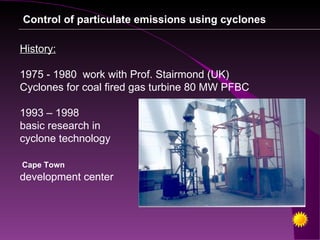
History:

1975 - 1980 work with Prof. Stairmond (UK)
Cyclones for coal fired gas turbine 80 MW PFBC

1993 – 1998
basic research in
cyclone technology

Cape Town
development center
Control of particulate emissions using cyclones
Project 1996 / 97
30 year old Büttner solid fired wood chip dryer equipped
with low efficiency cyclone. Emission > 650 mg / Nm3
Solution:

Step 1 = retrofitting of high efficiency cyclones

                 Reduction of emission to < 100 mg / Nm3

First idea of agglomeration spray in 1997
Step 2 = installation of THERMAX agglomeration sprays
                 upstream of cyclones

                 Reduction of emission to < 20 mg / Nm3
Control of particulate emissions using cyclones

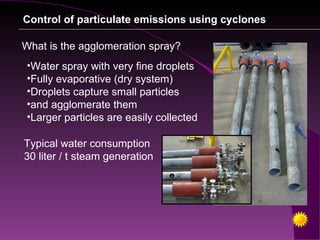
What is the agglomeration spray?
•Water spray with very fine droplets
•Fully evaporative (dry system)
•Droplets capture small particles
•and agglomerate them
•Larger particles are easily collected

Typical water consumption
30 liter / t steam generation
Control of particulate emissions using cyclones

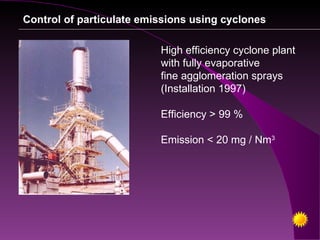
                          High efficiency cyclone plant
                          with fully evaporative
                          fine agglomeration sprays
                          (Installation 1997)

                          Efficiency > 99 %

                          Emission < 20 mg / Nm3
Control of particulate emissions using cyclones


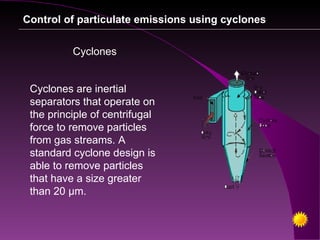
          Cyclones


 Cyclones are inertial
 separators that operate on
 the principle of centrifugal
 force to remove particles
 from gas streams. A
 standard cyclone design is
 able to remove particles
 that have a size greater
 than 20 μm.
Control of particulate emissions using cyclones


         Cyclones


    Cyclones can be used as it is or combined
   with other control device. Cyclones are used
   to pretreat the gas stream by removing the
   purge particles while the second device will
   function to collect smaller particles present at
   a much reduced particulate loading but at
   higher collection efficiency.
Control of particulate emissions using cyclones


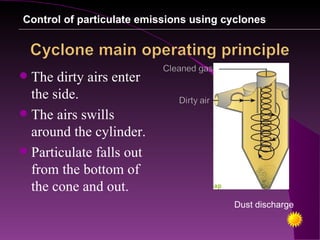
 The dirty airs enter
  the side.
 The airs swills
  around the cylinder.
 Particulate falls out
  from the bottom of
  the cone and out.
                                        Dust discharge
Control of particulate emissions using cyclones

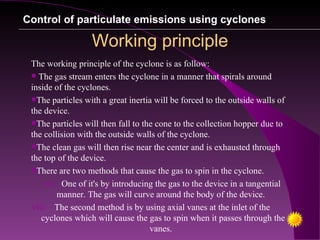
                  Working principle
 The working principle of the cyclone is as follow:
  The gas stream enters the cyclone in a manner that spirals around
 inside of the cyclones.
 The particles with a great inertia will be forced to the outside walls of
 the device.
 The particles will then fall to the cone to the collection hopper due to
 the collision with the outside walls of the cyclone.
 The clean gas will then rise near the center and is exhausted through
 the top of the device.
 There are two methods that cause the gas to spin in the cyclone.
     VII. One of it's by introducing the gas to the device in a tangential
         manner. The gas will curve around the body of the device.
 VIII. The second method is by using axial vanes at the inlet of the
    cyclones which will cause the gas to spin when it passes through the
                                    vanes.
Control of particulate emissions using cyclones

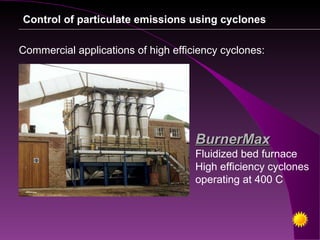
Commercial applications of high efficiency cyclones:


                                     BurnerMax
                                     Fluidized bed furnace
                                     High efficiency cyclones
                                     operating at 400 C
Control of particulate emissions using cyclones

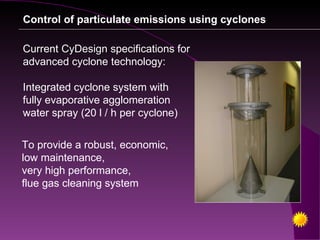
Current CyDesign specifications for
advanced cyclone technology:

Integrated cyclone system with
fully evaporative agglomeration
water spray (20 l / h per cyclone)


To provide a robust, economic,
low maintenance,
very high performance,
flue gas cleaning system
Control of particulate emissions using cyclones

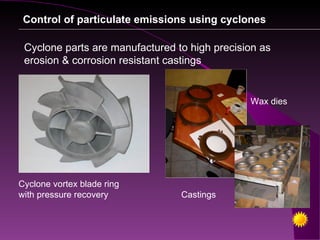
 Cyclone parts are manufactured to high precision as
 erosion & corrosion resistant castings


                                               Wax dies


Cyclone vortex blade ring
with pressure recovery           Castings
Control of particulate emissions using cyclones


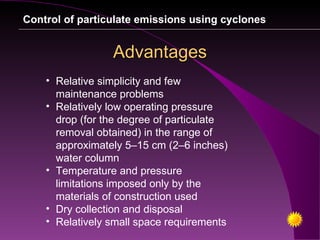
                 Advantages
    • Relative simplicity and few
      maintenance problems
    • Relatively low operating pressure
      drop (for the degree of particulate
      removal obtained) in the range of
      approximately 5–15 cm (2–6 inches)
      water column
    • Temperature and pressure
      limitations imposed only by the
      materials of construction used
    • Dry collection and disposal
    • Relatively small space requirements
Control of particulate emissions using cyclones

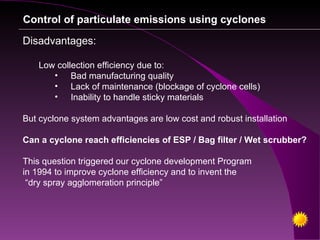
Disadvantages:

   Low collection efficiency due to:
      • Bad manufacturing quality
      • Lack of maintenance (blockage of cyclone cells)
      • Inability to handle sticky materials

But cyclone system advantages are low cost and robust installation

Can a cyclone reach efficiencies of ESP / Bag filter / Wet scrubber?

This question triggered our cyclone development Program
in 1994 to improve cyclone efficiency and to invent the
 “dry spray agglomeration principle”
Control of particulate emissions using cyclones
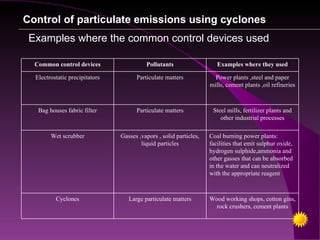
 Examples where the common control devices used

  Common control devices                  Pollutants                   Examples where they used

  Electrostatic precipitators         Particulate matters             Power plants ,steel and paper
                                                                    mills, cement plants ,oil refineries


   Bag houses fabric filter           Particulate matters            Steel mills, fertilizer plants and
                                                                        other industrial processes

        Wet scrubber            Gasses ,vapors , solid particles,   Coal burning power plants:
                                        liquid particles            facilities that emit sulphur oxide,
                                                                    hydrogen sulphide,ammonia and
                                                                    other gasses that can be absorbed
                                                                    in the water and can neutralized
                                                                    with the appropriate reagent


          Cyclones                 Large particulate matters        Wood working shops, cotton gins,
                                                                     rock crushers, cement plants
Control of particulate emissions using cyclones

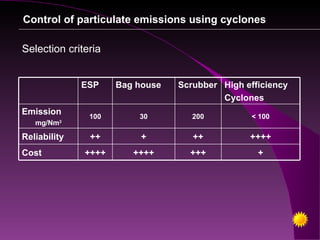
Selection criteria


              ESP    Bag house   Scrubber High efficiency
                                          Cyclones
Emission       100       30         200          < 100
   mg/Nm 3


Reliability    ++         +         ++          ++++
Cost          ++++      ++++       +++            +
Control of particulate emissions using cyclones

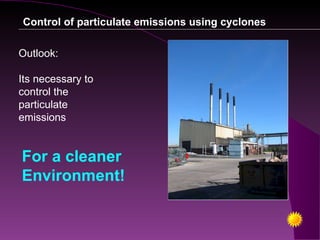
Outlook:

Its necessary to
control the
particulate
emissions


For a cleaner
Environment!
Cyclone intro

Cyclone intro

  • 1.
    PRESENTATION TOPIC; Control ofparticulate emissions using cyclones Presentation by Komal Aroosh M.Sc (4th semester) DEPARTMENT CENTER FOR COAL TECHNOLOGY PUNJAB UNIVERSITY LAHORE
  • 2.
    Control of particulateemissions using cyclones QUESTIONS  What are the particulate emissions?  Why its necessary to control the particulate emissions?  What systems are available to control the particulate emissions?  History of high efficiency cyclones  What is agglomeration spray?  Commercial applications of high efficiency cyclones  Working principle  Advantages  disadvantages  Can a cyclone reach efficiencies of ESP / Bag filter / Wet scrubber?  Selection criteria  Outlook
  • 3.
    Control of particulateemissions using cyclones What are the particulate emissions? Particulate emissions are emissions characterized by the presence of small particles of solids and liquids. These common byproducts of combustion are a major health and environmental concern in many regions of the world, and steps have been taken to reduce particulate emissions and to educate people about their risks. These emissions are also known as particulate pollution or particulate matter.
  • 4.
    Control of particulateemissions using cyclones Sources of particulate emissions Sources of particulate emission can be man made or natural.  the vast majority of such emissions coming from factories  around 10% coming from vehicles on the road.  Combustion of fossil fuels also releases other substances and particulates into the air  Some particulates occur naturally, originating from volcanoes, dust storms, forest and grassland fires, living vegetation, and sea spray.
  • 5.
    Control of particulateemissions using cyclones Why its necessary to control the particulate emissions? Sometimes, particulate emissions are visible in the form of soot or smoke, because the particles are so large. Most are not visible, however, which is part of what makes them dangerous, because people do not realize that the emissions are occurring. Small particles are also more dangerous because they are less likely to be trapped in the mucus linings of the nose and throat.
  • 6.
    Control of particulateemissions using cyclones Effect of particulate emissions on the humans If the particles, which can be composed of any combination of hundreds of chemicals and elements, are able to get through the defenses of the nose and mouth, then they can find their way into the lungs and possibly even pass into the blood stream. This can cause respiratory problems and potentially contribute to a higher risk for certain types of cancer or heart disease.
  • 7.
    Control of particulateemissions using cyclones Effect of particulate emissions on the plants  The particulates may block their leaves so that they cannot photosynthesize properly.  The climate as a whole can be heavily impacted by such emissions, as they can block the sunlight so that it cannot reach the Earth.  Cause a decrease in crop yields, and contribute to global warming trends.
  • 8.
    Control of particulateemissions using cyclones Effect of particulate emissions on the animals For animals, particulate emissions pose a threat to cardiovascular and lung health. In the lungs, particulates can block or rupture the alveoli, interfering with lung function. A number of respiratory conditions including asthma and cancer are linked to exposure to particulate emissions. The heart muscle and blood vessels can also be damaged by particulates if they enter the bloodstream through the lungs, causing widespread medical problems.
  • 9.
    Control of particulateemissions using cyclones Many stacks Are still emitting high levels of particulate But particulate emission control requirements will become more and more stringent
  • 10.
    Control of particulateemissions using cyclones What systems are available to control Particulate emissions ? • Electrostatic precipitator • Bag house fabric filter • Wet scrubber • High efficiency cyclones
  • 11.
    Control of particulateemissions using cyclones Main steps of ESP The processes of electrostatic precipitator are known as three main stages: particle charging transport collection. Evaluation of ESP: • High cost (investment, maintenance & operation) • Complex large size plant with sub-systems • Requires constant gas conditions (sulphur, temp, moisture)
  • 12.
    Control of particulateemissions using cyclones Main process of bag house fabric filter Bughouses are very efficient particulate collectors because of the dust cake formed on the surface of the bags. The fabric provides a surface on which dust collects through the following four mechanisms: •Inertial collection •Interception •Brownian movement •Electrostatic forces Evaluation of bag filters for industrial boilers: • High cost (investment, maintenance & filter bags) • Difficult to handle sulphur and sparks • Not robust (one faulty bag destroys efficiency)
  • 13.
    Control of particulateemissions using cyclones Mechanism Main process of wet scrubber Wet scrubbers relay on the liquid spray to remove dust particles from the gas stream. It is also useful in fume extraction systems. It removes air pollutants by inertia of diffusional impaction, reaction with absorbent or reagent slurry or absorption into a liquid solvent. The inlet gas stream usually enters the bottom of the tower and moves upward, while liquid is sprayed downward from one or more levels. Evaluation of wet scrubbers for industrial boilers: • High cost (large water treatment plant) • Difficult to separate fine particulate • Sulphur control costly & difficult
  • 14.
    Control of particulateemissions using cyclones History: 1975 - 1980 work with Prof. Stairmond (UK) Cyclones for coal fired gas turbine 80 MW PFBC 1993 – 1998 basic research in cyclone technology Cape Town development center
  • 15.
    Control of particulateemissions using cyclones Project 1996 / 97 30 year old Büttner solid fired wood chip dryer equipped with low efficiency cyclone. Emission > 650 mg / Nm3 Solution: Step 1 = retrofitting of high efficiency cyclones Reduction of emission to < 100 mg / Nm3 First idea of agglomeration spray in 1997 Step 2 = installation of THERMAX agglomeration sprays upstream of cyclones Reduction of emission to < 20 mg / Nm3
  • 16.
    Control of particulateemissions using cyclones What is the agglomeration spray? •Water spray with very fine droplets •Fully evaporative (dry system) •Droplets capture small particles •and agglomerate them •Larger particles are easily collected Typical water consumption 30 liter / t steam generation
  • 17.
    Control of particulateemissions using cyclones High efficiency cyclone plant with fully evaporative fine agglomeration sprays (Installation 1997) Efficiency > 99 % Emission < 20 mg / Nm3
  • 18.
    Control of particulateemissions using cyclones Cyclones Cyclones are inertial separators that operate on the principle of centrifugal force to remove particles from gas streams. A standard cyclone design is able to remove particles that have a size greater than 20 μm.
  • 19.
    Control of particulateemissions using cyclones Cyclones Cyclones can be used as it is or combined with other control device. Cyclones are used to pretreat the gas stream by removing the purge particles while the second device will function to collect smaller particles present at a much reduced particulate loading but at higher collection efficiency.
  • 20.
    Control of particulateemissions using cyclones  The dirty airs enter the side.  The airs swills around the cylinder.  Particulate falls out from the bottom of the cone and out. Dust discharge
  • 21.
    Control of particulateemissions using cyclones Working principle The working principle of the cyclone is as follow:  The gas stream enters the cyclone in a manner that spirals around inside of the cyclones. The particles with a great inertia will be forced to the outside walls of the device. The particles will then fall to the cone to the collection hopper due to the collision with the outside walls of the cyclone. The clean gas will then rise near the center and is exhausted through the top of the device. There are two methods that cause the gas to spin in the cyclone. VII. One of it's by introducing the gas to the device in a tangential manner. The gas will curve around the body of the device. VIII. The second method is by using axial vanes at the inlet of the cyclones which will cause the gas to spin when it passes through the vanes.
  • 22.
    Control of particulateemissions using cyclones Commercial applications of high efficiency cyclones: BurnerMax Fluidized bed furnace High efficiency cyclones operating at 400 C
  • 23.
    Control of particulateemissions using cyclones Current CyDesign specifications for advanced cyclone technology: Integrated cyclone system with fully evaporative agglomeration water spray (20 l / h per cyclone) To provide a robust, economic, low maintenance, very high performance, flue gas cleaning system
  • 24.
    Control of particulateemissions using cyclones Cyclone parts are manufactured to high precision as erosion & corrosion resistant castings Wax dies Cyclone vortex blade ring with pressure recovery Castings
  • 25.
    Control of particulateemissions using cyclones Advantages • Relative simplicity and few maintenance problems • Relatively low operating pressure drop (for the degree of particulate removal obtained) in the range of approximately 5–15 cm (2–6 inches) water column • Temperature and pressure limitations imposed only by the materials of construction used • Dry collection and disposal • Relatively small space requirements
  • 26.
    Control of particulateemissions using cyclones Disadvantages: Low collection efficiency due to: • Bad manufacturing quality • Lack of maintenance (blockage of cyclone cells) • Inability to handle sticky materials But cyclone system advantages are low cost and robust installation Can a cyclone reach efficiencies of ESP / Bag filter / Wet scrubber? This question triggered our cyclone development Program in 1994 to improve cyclone efficiency and to invent the “dry spray agglomeration principle”
  • 27.
    Control of particulateemissions using cyclones Examples where the common control devices used Common control devices Pollutants Examples where they used Electrostatic precipitators Particulate matters Power plants ,steel and paper mills, cement plants ,oil refineries Bag houses fabric filter Particulate matters Steel mills, fertilizer plants and other industrial processes Wet scrubber Gasses ,vapors , solid particles, Coal burning power plants: liquid particles facilities that emit sulphur oxide, hydrogen sulphide,ammonia and other gasses that can be absorbed in the water and can neutralized with the appropriate reagent Cyclones Large particulate matters Wood working shops, cotton gins, rock crushers, cement plants
  • 28.
    Control of particulateemissions using cyclones Selection criteria ESP Bag house Scrubber High efficiency Cyclones Emission 100 30 200 < 100 mg/Nm 3 Reliability ++ + ++ ++++ Cost ++++ ++++ +++ +
  • 29.
    Control of particulateemissions using cyclones Outlook: Its necessary to control the particulate emissions For a cleaner Environment!

Editor's Notes

  • #8 Haze caused by particulates can interfere with visibility, react with other pollutants to produce dangerous forms of pollution, interfere with air quality to the point that people have difficulty breathing
  • #13 Inertial collection - Dust particles strike the fibers placed perpendicular to the gas-flow direction instead of changing direction with the gas stream. Interception - Particles that do not cross the fluid streamlines come in contact with fibers because of the fiber size. Brownian movement - Submicrometre particles are diffused, increasing the probability of contact between the particles and collecting surfaces. Electrostatic forces - The presence of an electrostatic charge on the particles and the filter can increase dust capture.