WASHING MACHINE
María Tejada Valle
Andrea Molina Soler
2ºA Magisterio Infantil Bilingüe
INDEX
 Introduction
 Conceptualization of the narrators
 Photos of the evolution of washing machines.
 Difficulties
 Conclusions
INTRODUCTION
 We are going to talk in detail how washing machines arrived to
houses.Besides, how it was received by society and changes that it
produced.
 Narrators:
 Grandmothers ,each of them are going to talk about their
experiences that will be very useful for our blog.
 Moreover, we are going to upload to the blog information and photos
about our investigation that is going to be answered by clips of
audio.
 We hope that we can enjoy knowing new events about the past
history and we want you to be interested about this topic.
CONCEPTUALIZATION OF THE
NARRATORS
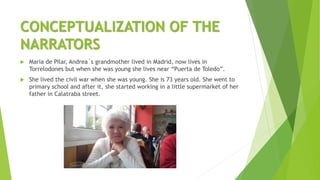
 Maria de Pilar, Andrea´s grandmother lived in Madrid, now lives in
Torrelodones but when she was young she lives near “Puerta de Toledo”.
 She lived the civil war when she was young. She is 73 years old. She went to
primary school and after it, she started working in a little supermarket of her
father in Calatraba street.
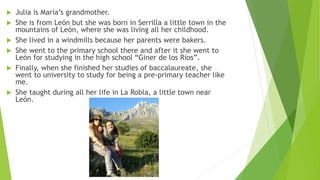
 Julia is María’s grandmother.
 She is from León but she was born in Serrilla a little town in the
mountains of León, where she was living all her childhood.
 She lived in a windmills because her parents were bakers.
 She went to the primary school there and after it she went to
León for studying in the high school “Giner de los Ríos”.
 Finally, when she finished her studies of baccalaureate, she
went to university to study for being a pre-primary teacher like
me.
 She taught during all her life in La Robla, a little town near
León.
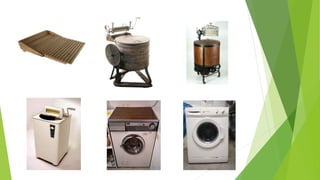
EVOLUTION OF WASHING MACHINES
DIFFICULTIES
 When we did the investigation, we had a difficulty with access to one
of our narrators. One of them does not live in the same place as us
and we needed an intermediary for record the interview.
 We believe that this activity needs more time to perform well.
Because we did not know how to do the blog and when we tried to
upload something or open an entrance, it was a disaster. Because of
all those things, we could not do the blog as good as we wanted.
 We should also have given more training classes to perform
adequately blog.
CONCLUSIONS
The topic that we have chosen is an issue that has
evolved a lot and we have seen with the interviews
of our narrators that this evolution has favored much
to society, especially women, because they wasted a
lot of time and effort cleaning clothes with methods
which were used a few years ago when there were
no electric washing machines.

Washingmachine ppt

  • 1.
    WASHING MACHINE María TejadaValle Andrea Molina Soler 2ºA Magisterio Infantil Bilingüe
  • 2.
    INDEX  Introduction  Conceptualizationof the narrators  Photos of the evolution of washing machines.  Difficulties  Conclusions
  • 3.
    INTRODUCTION  We aregoing to talk in detail how washing machines arrived to houses.Besides, how it was received by society and changes that it produced.  Narrators:  Grandmothers ,each of them are going to talk about their experiences that will be very useful for our blog.  Moreover, we are going to upload to the blog information and photos about our investigation that is going to be answered by clips of audio.  We hope that we can enjoy knowing new events about the past history and we want you to be interested about this topic.
  • 4.
    CONCEPTUALIZATION OF THE NARRATORS Maria de Pilar, Andrea´s grandmother lived in Madrid, now lives in Torrelodones but when she was young she lives near “Puerta de Toledo”.  She lived the civil war when she was young. She is 73 years old. She went to primary school and after it, she started working in a little supermarket of her father in Calatraba street.
  • 5.
     Julia isMaría’s grandmother.  She is from León but she was born in Serrilla a little town in the mountains of León, where she was living all her childhood.  She lived in a windmills because her parents were bakers.  She went to the primary school there and after it she went to León for studying in the high school “Giner de los Ríos”.  Finally, when she finished her studies of baccalaureate, she went to university to study for being a pre-primary teacher like me.  She taught during all her life in La Robla, a little town near León.
  • 6.
  • 8.
    DIFFICULTIES  When wedid the investigation, we had a difficulty with access to one of our narrators. One of them does not live in the same place as us and we needed an intermediary for record the interview.  We believe that this activity needs more time to perform well. Because we did not know how to do the blog and when we tried to upload something or open an entrance, it was a disaster. Because of all those things, we could not do the blog as good as we wanted.  We should also have given more training classes to perform adequately blog.
  • 9.
    CONCLUSIONS The topic thatwe have chosen is an issue that has evolved a lot and we have seen with the interviews of our narrators that this evolution has favored much to society, especially women, because they wasted a lot of time and effort cleaning clothes with methods which were used a few years ago when there were no electric washing machines.