
Developing a cohesive walking bass line
© 2005 Eric Elias
Developing a walking bass lines is a subject that many of my students (guitarists
and bassists alike) have been interested in. If you are a jazz player, then having the skill
to walk the changes to a particular song is a must. As hard as it might seem at first to do
this, there are some very systematic exercises and incremental steps that will help us
develop these skills. In a previous lesson, I gave many examples for walking lines from
one chord to the next. In this lesson, I want to break down the steps necessary for
developing a variety of lines.
Before we get to the steps for creating lines there are some prerequisites. First,
we need to know our chord tones. We need to know that when we see a G7 chord that it
is made up of the notes G B D F. Second, we also need to know our major scales. If we
want to be able to use the right notes that fit over a particular chord, we will need to know
the notes available in each key. That is not to say that we can’t get started with this
material prior to learning the notes of the chords or the scales, but that knowledge will
make developing your own bass lines much easier. It is not within the scope of this
lesson to develop those skills. There are many sources for learning chord tones and
scales (visit www.funkyfolkmusic.com or www.guitarcollege.com for books and
material).
Assuming that you are comfortable with chord tones and scale tones, we will
develop skills at three incremental levels. The first level will be to develop bass lines
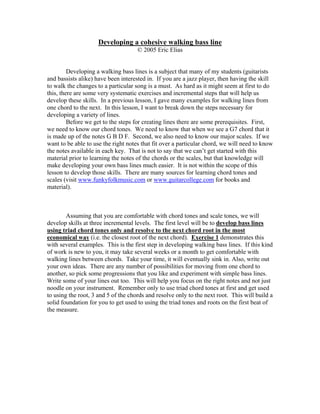
using triad chord tones only and resolve to the next chord root in the most
economical way (i.e. the closest root of the next chord). Exercise 1 demonstrates this
with several examples. This is the first step in developing walking bass lines. If this kind
of work is new to you, it may take several weeks or a month to get comfortable with
walking lines between chords. Take your time, it will eventually sink in. Also, write out
your own ideas. There are any number of possibilities for moving from one chord to
another, so pick some progressions that you like and experiment with simple bass lines.
Write some of your lines out too. This will help you focus on the right notes and not just
noodle on your instrument. Remember only to use triad chord tones at first and get used
to using the root, 3 and 5 of the chords and resolve only to the next root. This will build a
solid foundation for you to get used to using the triad tones and roots on the first beat of
the measure.
Exercise 1:
Simple bass lines using triads only and resolving to nearest root of next chord.
You can also try playing the chord at the first beat of the measure as well
(The root of the chord will be the beginning of the measure).
Am7 D9 Gmaj7 Cmaj7
5
3 7 3 5
4 7 4 5
5
7
5 3 7 3
3
Chord tones
1 3 5 3 1 3 5 3 1 5 3 5 1 5 1 3
Am7 D7 Gmaj7 Cmaj7
7
7 3 7 5
4
5
5 3 7
5
5
5
5
7
5
Chord Tones
1 5 3 5 1 3 1 5 1 3 5 1 1 5 3 1
F7 B 7 F
1 5
3
5
1 5
3
5
3
2
3
3
3
3
5
3
Chord tones
1 3 5 3 1 3 5 3 1 3 1 5 1 5 3 5
Worksheet:
Fill in the blanks with your own ideas (decide what chord inversion you want to use too).
Simple bass lines using triads only and resolving to nearest root of next chord.
Amin D7 GMaj C Maj
5
2
5
2
5
2
2
3
Chord tones
1 __ 5 __ 1 __ 5 __ 1 __ 3 __ __ 5 __ 3
Create your own line now
Amin D7 GMaj C Maj
Chord Tones
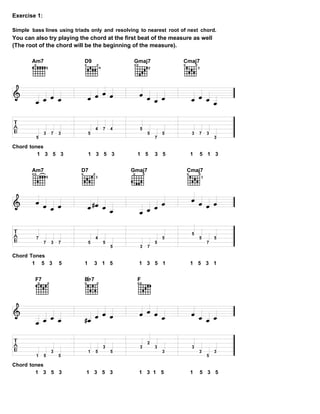
The second level will be to use all chord tones (including 7ths) to build your
line from. When resolving to the next chord then you will resolve (by proximity) to
any available chord tone of the next chord. This helps create a nice flowing line that
uses voice leading. Creating lines that resolve to the closest chord tone allows for a
smooth transition between chords and creates a nice sounding line. Exercise 2
demonstrates this idea using the same chords that were given in example 1. Once again,
practice this idea for a while before moving on. Write out your lines for tunes that you
like.
Exercise 2:
Bass lines using all chord tones and resolving to nearest chord tone of next chord.
Notice how this sounds very different from the lines in Exercise 1.
Am7 D7 Gmaj7/B Cmaj7
5
2
2
5 4
2
5 3 2 5
5 4 2
3 2
3
Chord tones
1 5 1 b7 3 5 1 b7 3 5 1 7 3 1 7 5
Amin D7 GMaj 7 C Maj 7
What chord inversions might you play here?
5 3 0 3 2 5
3 5
4
5
5 4 2 5
1
4
Chord tones
1 b7 5 b7 3 5 b7 1 3 5 1 3 3 5 1 7
You can also displace the chords a little to fit your bass line.
F7 Bb7 F7 F7
(played on 2nd beat) (played on 2nd beat)
F7 B 7 F7
3
1
1
2
1
3 0 1
0
1
0 3
1
1
2
1 3
2
1
2
3 1
Chord tones
1 b7 5 3 1 3 b7 3 1 b7 1 3 5 3 1 b7
The third level allows you more freedom to be creative in your bass lines. For
this level there are 2 parts. Part 1 is use scale tones 1, 2, 3, 5, 6, 7 (obviously use the 3rd
and 7th
that correspond with the chord—i.e. don’t use the major 3rd
on a minor
chord). Resolve to either a root or a close tone of the next chord. For part 2, use scale
tones, then add ½ step motion into the resolving chord (on beat 4 of the previous
measure). For this one resolving to a root will probably sound best, but feel free to
experiment. Lets try some of these and see how they sound (demonstrated in exercise
3).
Exercise 3
Part 1
use scale tones 1, 2, 3, 5, 6, 7. Resolve to either a root or a close tone of the next chord.
This first one resolves to roots of the next chord.
Am7 D9 Gmaj7
5 7 8
7 5 3 2
5 3 5
2 5
Chord tones
1 2 b3 5 1 b7 6 5 1 2 3 5
This one resolves to roots as well.
Cm7 F7 B maj7
3 1
5 3 1 3 5
3 1 3 5
3
Chord tones
1 b7 6 5 1 2 3 5 1 2 3 5
This one resolves to a chord tone of the next chord but not to the roots. What chords would you play?
A min7 D9 G Maj7
5
2 3
2 3
2
3
5 2
3
2 5
Chord tones
1 2 b3 5 3 5 3 1 3 1 3 5
Part 2 use scale tones, then adds 1/2 step motion into the resolving chord
(on beat 4 of the previous measure).
Am7 D9 Gmaj7
5 7 8
6 5 3 2
4 3 5
2 5
Chord Tones
1 2 b3 (1/2 step) 1 b7 6 (1/2 step) 1 2 3 5
A min 7 D9 G Maj7
What chords would you play here?
7 5 4
6 5
2 4 6 5
5
2 5
Chord Tones
1 b7 6 (1/2 step) 1 2 3 (1/2 step) 1 2 3 5
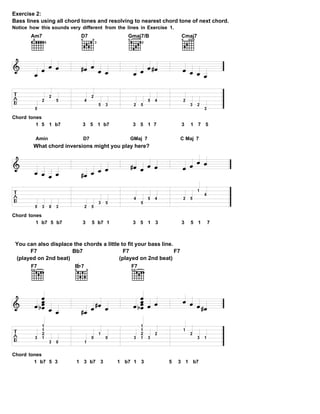
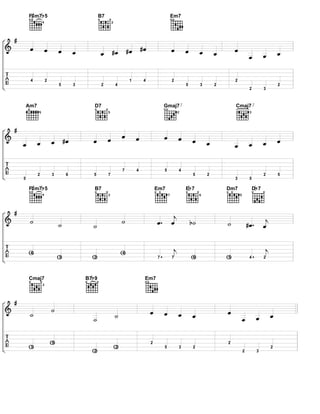
For the last part I’ve included a bass line that I wrote for the chords to a tune like
Autumn Leaves. Here I also employ a little ½ time (half notes) and some 1/8 notes as
well. SO you can see how we might change the rhythm a little. Enjoy this. Remember,
there is no substitute for practice and time on your instrument, so try some of these ideas
with your favorite standard. Also, don’t forget to write out your lines at first and really
practice these. The more you do, the easier they become. If you like these ideas and
want more information, my books “Walking Bass Lines for Jazz Guitar” and “Walking
Bass Lines for Bass Guitar” are available at www.funkyfolkmusic.com .
Bass Line for songs like: Autumn Leaves
Am7 D7 Gmaj7 Cmaj7
5
7 5
7
3
5 3
5
F m7 5 B7 Em7
4
3 2
4 4 2
2
4 2
3 0
Am7 D7 Gmaj7 Cmaj7
5
7 5
7
3
5 3
5
F m7 5 B7 Em7
2
3 2
4 2
2
2
55 3 2
F m7 5 B7 Em7
4 2
5 3 2 4
1 4 2
5 3 2
2
2 3
2
Am7 D7 Gmaj72 Cmaj7 2
5
2 3 6 5 7
7 4 5 4
5 2
3 5
2 5
F m7 5 B7 Em7 E 7 Dm7 D 7
4
3 2
4
7 7 6 5 4 2
Cmaj7 B7 9 Em7
3
5
2
2
2
5 3 2
2
2 3
2
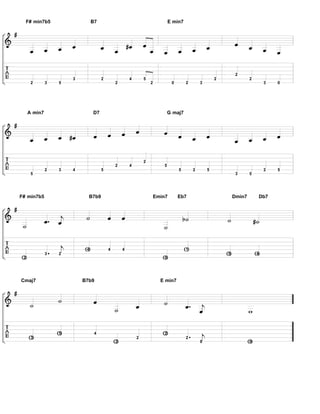
Try some of your own chord inversions here.
A min7 D7 G maj7 C maj7
5
2 3 6 5 3
5 2 3
5 3 2 3
2
5 3
F# min7b5 B7 E min7
2 5
3
5
2
5
5
4 2
5 3 2
5 3 2 3
A min7 D7 G maj7 C maj7
5
2 3 4 5
2
5 4
5 3
3
2 3 2
5 3
F# min7b5 B7 E min7
2 5
3
5
2
5
5
4 2
5 3 2
5 3 2 3
F# min7b5 B7 E min7
2 3 5
3 2
2
4 5
2 0 2 3
2
2
2
3 0
A min7 D7 G maj7
5
2 3 4 5
2 4
2
5
5 2 5
3 5
2 5
F# min7b5 B7b9 Emin7 Eb7 Dmin7 Db7
2
3 2
4 4 4
0
1
5 4
Cmaj7 B7b9 E min7
3
5 4
2
2
2
2
0 0

Walking bass lines

  • 1.
    Developing a cohesivewalking bass line © 2005 Eric Elias Developing a walking bass lines is a subject that many of my students (guitarists and bassists alike) have been interested in. If you are a jazz player, then having the skill to walk the changes to a particular song is a must. As hard as it might seem at first to do this, there are some very systematic exercises and incremental steps that will help us develop these skills. In a previous lesson, I gave many examples for walking lines from one chord to the next. In this lesson, I want to break down the steps necessary for developing a variety of lines. Before we get to the steps for creating lines there are some prerequisites. First, we need to know our chord tones. We need to know that when we see a G7 chord that it is made up of the notes G B D F. Second, we also need to know our major scales. If we want to be able to use the right notes that fit over a particular chord, we will need to know the notes available in each key. That is not to say that we can’t get started with this material prior to learning the notes of the chords or the scales, but that knowledge will make developing your own bass lines much easier. It is not within the scope of this lesson to develop those skills. There are many sources for learning chord tones and scales (visit www.funkyfolkmusic.com or www.guitarcollege.com for books and material). Assuming that you are comfortable with chord tones and scale tones, we will develop skills at three incremental levels. The first level will be to develop bass lines using triad chord tones only and resolve to the next chord root in the most economical way (i.e. the closest root of the next chord). Exercise 1 demonstrates this with several examples. This is the first step in developing walking bass lines. If this kind of work is new to you, it may take several weeks or a month to get comfortable with walking lines between chords. Take your time, it will eventually sink in. Also, write out your own ideas. There are any number of possibilities for moving from one chord to another, so pick some progressions that you like and experiment with simple bass lines. Write some of your lines out too. This will help you focus on the right notes and not just noodle on your instrument. Remember only to use triad chord tones at first and get used to using the root, 3 and 5 of the chords and resolve only to the next root. This will build a solid foundation for you to get used to using the triad tones and roots on the first beat of the measure.
  • 2.
    Exercise 1: Simple basslines using triads only and resolving to nearest root of next chord. You can also try playing the chord at the first beat of the measure as well (The root of the chord will be the beginning of the measure). Am7 D9 Gmaj7 Cmaj7 5 3 7 3 5 4 7 4 5 5 7 5 3 7 3 3 Chord tones 1 3 5 3 1 3 5 3 1 5 3 5 1 5 1 3 Am7 D7 Gmaj7 Cmaj7 7 7 3 7 5 4 5 5 3 7 5 5 5 5 7 5 Chord Tones 1 5 3 5 1 3 1 5 1 3 5 1 1 5 3 1 F7 B 7 F 1 5 3 5 1 5 3 5 3 2 3 3 3 3 5 3 Chord tones 1 3 5 3 1 3 5 3 1 3 1 5 1 5 3 5
  • 3.
    Worksheet: Fill in theblanks with your own ideas (decide what chord inversion you want to use too). Simple bass lines using triads only and resolving to nearest root of next chord. Amin D7 GMaj C Maj 5 2 5 2 5 2 2 3 Chord tones 1 __ 5 __ 1 __ 5 __ 1 __ 3 __ __ 5 __ 3 Create your own line now Amin D7 GMaj C Maj Chord Tones
  • 4.
    The second levelwill be to use all chord tones (including 7ths) to build your line from. When resolving to the next chord then you will resolve (by proximity) to any available chord tone of the next chord. This helps create a nice flowing line that uses voice leading. Creating lines that resolve to the closest chord tone allows for a smooth transition between chords and creates a nice sounding line. Exercise 2 demonstrates this idea using the same chords that were given in example 1. Once again, practice this idea for a while before moving on. Write out your lines for tunes that you like.
  • 5.
    Exercise 2: Bass linesusing all chord tones and resolving to nearest chord tone of next chord. Notice how this sounds very different from the lines in Exercise 1. Am7 D7 Gmaj7/B Cmaj7 5 2 2 5 4 2 5 3 2 5 5 4 2 3 2 3 Chord tones 1 5 1 b7 3 5 1 b7 3 5 1 7 3 1 7 5 Amin D7 GMaj 7 C Maj 7 What chord inversions might you play here? 5 3 0 3 2 5 3 5 4 5 5 4 2 5 1 4 Chord tones 1 b7 5 b7 3 5 b7 1 3 5 1 3 3 5 1 7 You can also displace the chords a little to fit your bass line. F7 Bb7 F7 F7 (played on 2nd beat) (played on 2nd beat) F7 B 7 F7 3 1 1 2 1 3 0 1 0 1 0 3 1 1 2 1 3 2 1 2 3 1 Chord tones 1 b7 5 3 1 3 b7 3 1 b7 1 3 5 3 1 b7
  • 6.
    The third levelallows you more freedom to be creative in your bass lines. For this level there are 2 parts. Part 1 is use scale tones 1, 2, 3, 5, 6, 7 (obviously use the 3rd and 7th that correspond with the chord—i.e. don’t use the major 3rd on a minor chord). Resolve to either a root or a close tone of the next chord. For part 2, use scale tones, then add ½ step motion into the resolving chord (on beat 4 of the previous measure). For this one resolving to a root will probably sound best, but feel free to experiment. Lets try some of these and see how they sound (demonstrated in exercise 3).
  • 7.
    Exercise 3 Part 1 usescale tones 1, 2, 3, 5, 6, 7. Resolve to either a root or a close tone of the next chord. This first one resolves to roots of the next chord. Am7 D9 Gmaj7 5 7 8 7 5 3 2 5 3 5 2 5 Chord tones 1 2 b3 5 1 b7 6 5 1 2 3 5 This one resolves to roots as well. Cm7 F7 B maj7 3 1 5 3 1 3 5 3 1 3 5 3 Chord tones 1 b7 6 5 1 2 3 5 1 2 3 5 This one resolves to a chord tone of the next chord but not to the roots. What chords would you play? A min7 D9 G Maj7 5 2 3 2 3 2 3 5 2 3 2 5 Chord tones 1 2 b3 5 3 5 3 1 3 1 3 5
  • 8.
    Part 2 usescale tones, then adds 1/2 step motion into the resolving chord (on beat 4 of the previous measure). Am7 D9 Gmaj7 5 7 8 6 5 3 2 4 3 5 2 5 Chord Tones 1 2 b3 (1/2 step) 1 b7 6 (1/2 step) 1 2 3 5 A min 7 D9 G Maj7 What chords would you play here? 7 5 4 6 5 2 4 6 5 5 2 5 Chord Tones 1 b7 6 (1/2 step) 1 2 3 (1/2 step) 1 2 3 5
  • 9.
    For the lastpart I’ve included a bass line that I wrote for the chords to a tune like Autumn Leaves. Here I also employ a little ½ time (half notes) and some 1/8 notes as well. SO you can see how we might change the rhythm a little. Enjoy this. Remember, there is no substitute for practice and time on your instrument, so try some of these ideas with your favorite standard. Also, don’t forget to write out your lines at first and really practice these. The more you do, the easier they become. If you like these ideas and want more information, my books “Walking Bass Lines for Jazz Guitar” and “Walking Bass Lines for Bass Guitar” are available at www.funkyfolkmusic.com .
  • 10.
    Bass Line forsongs like: Autumn Leaves Am7 D7 Gmaj7 Cmaj7 5 7 5 7 3 5 3 5 F m7 5 B7 Em7 4 3 2 4 4 2 2 4 2 3 0 Am7 D7 Gmaj7 Cmaj7 5 7 5 7 3 5 3 5 F m7 5 B7 Em7 2 3 2 4 2 2 2 55 3 2
  • 11.
    F m7 5B7 Em7 4 2 5 3 2 4 1 4 2 5 3 2 2 2 3 2 Am7 D7 Gmaj72 Cmaj7 2 5 2 3 6 5 7 7 4 5 4 5 2 3 5 2 5 F m7 5 B7 Em7 E 7 Dm7 D 7 4 3 2 4 7 7 6 5 4 2 Cmaj7 B7 9 Em7 3 5 2 2 2 5 3 2 2 2 3 2
  • 12.
    Try some ofyour own chord inversions here. A min7 D7 G maj7 C maj7 5 2 3 6 5 3 5 2 3 5 3 2 3 2 5 3 F# min7b5 B7 E min7 2 5 3 5 2 5 5 4 2 5 3 2 5 3 2 3 A min7 D7 G maj7 C maj7 5 2 3 4 5 2 5 4 5 3 3 2 3 2 5 3 F# min7b5 B7 E min7 2 5 3 5 2 5 5 4 2 5 3 2 5 3 2 3
  • 13.
    F# min7b5 B7E min7 2 3 5 3 2 2 4 5 2 0 2 3 2 2 2 3 0 A min7 D7 G maj7 5 2 3 4 5 2 4 2 5 5 2 5 3 5 2 5 F# min7b5 B7b9 Emin7 Eb7 Dmin7 Db7 2 3 2 4 4 4 0 1 5 4 Cmaj7 B7b9 E min7 3 5 4 2 2 2 2 0 0