The World of
Quantitative Research
Welcome to the fascinating world of quantitative
research. This type of research is based on
collecting numerical data and then analyzing it to
draw conclusions. Let's take a closer look at what
makes it unique.
https://www.youtube.com/watch?v=HpQnZrLvzcI
Objectives:
1
Define the
Quantitative
Research
2
Describe the
different
characteristics
of
Quantitative
Research
3
Determine
the strength
and
weaknesses
of
Quantitative
Research
4
Decide on the
suitable kinds
of
Quantitative
Research in
various fields
and interest.
SMALL-SCALE
INTRODUCTION
TO RESEARCH
The World of
Research!
Two main forms of research, qualitative and
quantitative research.
Quantitative Research emphasizes
objective measurements and statistical,
mathematical or numerical analysis of
data collected through polls,
questionnaires, and surveys, or by
manipulating pre-existing statistical data
using computational techniques to
explain a particular phenomenon.
Task 1: Comprehension
Check!
Statement 1: There are eight teachers in the Research Department this
school year (S.Y.) 2023-2024 who specifically handle students in the
Technical-Vocational Livelihood (TVL) and Science, Technology,
Engineering, and Mathematics (STEM) tracks.
Statement 2: A group of teachers from the research department
collectively handles students in the Technical-Vocational Livelihood
(TVL) and Science, Technology, Engineering, and Mathematics (STEM)
tracks.
Task 1: Comprehension
Check!
Statement 1: There are eight teachers in the Research Department this
school year (S.Y.) 2023-2024 who specifically handle students in the
Technical-Vocational Livelihood (TVL) and Science, Technology,
Engineering, and Mathematics (STEM) tracks.
Statement 2: A group of teachers from the research department
collectively handles students in the Technical-Vocational Livelihood
(TVL) and Science, Technology, Engineering, and Mathematics (STEM)
tracks.
EMPHASIZES THE INDIVIDUAL
COLLECTIVE EMPHASIS
Quantitative Research
Can provide meaning through:
 Numerals
 Symbols (Specificity, Particularity,
Exactness)
Characteristics of Quantitative Research
Clearly defined
Research questions
(what, which, how
much) ensure the
validity of data.
Numerical
Presentation of
Data
Data are presented
using numbers, graph,
chart, tables and
figures.
Statistical Analysis
extract patterns from
numerical data.
Objective
Impartial, unbiased
and neutral.
Large Sample Size
Represents a
population.
Replication
Repeating a study’s
procedure and
observing if the prior
findings repeat in
similar conditions.
Structured Research
Tools
systematic approach
to data collection and
analysis.
Predict
Future Outcomes
New concepts and
further studies.
How do you think Quantitative Research
differ from Qualitative Research in terms
of the following standards?
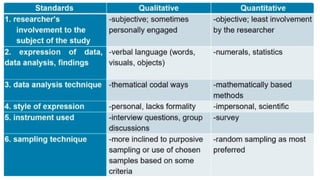
1.Researcher’s Involvement to the subject of the study.
2.Expression of data, data analysis and findings
3.Data analysis technique
4.Style of expression
5.Instrument used
6.Sampling technique
Strengths and Weaknesses of Quantitative
Research
Strengths
Quantitative research is
highly precise, objective, and
replicable, with findings that
are easily generalizable to a
larger population.
Weaknesses
- Lacks the ability to capture
the complexities and
nuances of human
experiences, emotions, or
social contexts.
- Costly, requires a lot of
respondents.
Kinds of Quantitative Research
Experimental Research
- seeks to establish cause-and-effect relationships between variables
through controlled experiments.
- Uses the Scientific Approach.
2 Non-Experimental Research
- Describe a situation or phenomenon.
- Researchers collect data without making changes or introducing
treatments.
1
1. TRUE-EXPERIMENTAL - test the true cause and effect relationships of variables
involve in the study. Offers the highest internal validity of all the designs (Prieto, et
al.)
characteristics:
- randomly formed groups
- manipulation of treatment
- comparison among groups
2. QUASI-EXPERIMENTAL – Almost the same as the True-Experimental
Research the difference is the absence of random assignment.
Experimental Research
- seeks to establish cause-and-effect relationships between variables
through controlled experiments.
- Uses the Scientific Approach.
- Collects data with making changes or introducing
treatments/intervention (testing)
Kinds of Quantitative Research
Experimental Research
- seeks to establish cause-and-effect relationships between variables
through controlled experiments.
- Uses the Scientific Approach.
2 Non-Experimental Research
- Describe a situation or phenomenon.
- Researchers collect data without making changes or introducing
treatments.
1
Descriptive Research
This type of quantitative research is used to describe phenomena and
collect data about their prevalence, frequency, distribution, and patterns.
2
Correlational Research
This type of quantitative research examines the relationships and
associations between variables, without necessarily establishing
causality.
1
Non-Experimental Research
- Describe a situation or phenomenon.
- Researchers collect data without making changes or introducing
treatments.
Descriptive Research
- This type of quantitative research is used to describe phenomena and
collect data about their prevalence, frequency, distribution, and patterns.
- Manipulation of variables or search for cause and effect is not
applicable.
- Determine the frequency with which it occurs and to find general
attributes of the presently existing situation.
Example Research Problem:
1. How many hours senior high school students spent in playing online
games?
2. How many malnourished students who failed in the achievement test?
3. How healthy is the food served during lunch time in the public school?
Example Title:
“Factors Affecting the Academic Performance of
Senior High School Students”
- Attendance
-Family
Correlational Research
- This type of quantitative research examines the
relationships and associations between
variables, without necessarily establishing
causality.
- Measures the degree of relationship between
two variables.
Example Research Problem:
1. Performance in Mathematics and score in
Practical Research 2.
2. Sex and mathematical ability
3. Age and leadership style
4. Occupation and lifespan
Example Title:
“The Relationship Between Playing Online
Games and the Grade-point Average”
Types of Correlational Research
POSITIVE CORRELATION
- An increase in one variable leads to increase
the other variable. A decrease in one variable
will also decrease in the other variable.
Example: Family income and Daily allowance.
NEGATIVE CORRELATION
- If there is an increase in one variable, the
second variable will show a decrease and vice
versa.
Example: Age of a car and price of the car.
The Importance of Quantitative Research Across Fields
Natural Sciences
Quantitative research is critical in the
natural sciences for discovering new
phenomena, testing theories, and
developing interventions or
treatments.
Social Sciences
Quantitative research is used in social
sciences to study human behavior, attitudes,
and beliefs, and to understand how society
functions.
Health Sciences
Quantitative research helps medical
professionals to identify risk factors,
diagnose diseases, and evaluate the
effectiveness of treatments or
interventions.
Finance
Quantitative research is applied in finance to
forecast trends, model financial markets, and
develop investment strategies.
Applications of Quantitative Research
1 Marketing
Research 📈
….understand
consumers'
behaviors,
preferences,
and satisfaction
towards
products or
services.
2 Educationa
l
Research
🎓
…evaluate the
impact of
educational
programs,
policies, and
interventions
on student
learning
outcomes.
3 Psychologic
al
Research 💭
…study mental
processes,
behaviors, and
disorders, and
to evaluate the
effectiveness of
psychotherapy.
“Do research. Feed your talent. Research not only
wins the war on cliché, it’s the key to victory over
fear and its cousin, depression.”
- Robert Mckee
Hypothesis:
Null Hypothesis: There is NO significant difference in
stress levels between SHS students who own pets and
those who do not.
Alternative Hypothesis: There is significant difference
in stress levels between SHS students who own pets
and those who do not.
Objective:
The objective is to compare the stress levels
between these two groups to see if there is a
statistically significant difference. By
measuring and comparing their stress levels,
you aim to determine whether pet ownership
has any impact on the stress levels of SHS
students.
SCALE OF STRESS LEVEL
1Completely Relaxed: No stress at all; feeling completely calm and at ease.
2Very Low Stress: Minimal stress, almost no noticeable tension or worry.
3Low Stress: Some mild stress, but generally manageable and not overly concerning.
4Moderate Stress: Moderate levels of stress, with noticeable tension and mild discomfort.
5Moderate-High Stress: Increasing stress levels, causing moderate discomfort and worry.
6High Stress: Elevated stress levels, feeling quite tense and concerned.
7Very High Stress: Significant stress, causing a lot of tension and discomfort.
8Extremely High Stress: Extremely high levels of stress, feeling overwhelmed and anxious.
9Almost Maximum Stress: Almost at the highest stress level, experiencing severe tension and anxiety.
10Maximum Stress: The highest level of stress possible, feeling extremely overwhelmed and unable to cope.

W1_Quantitative Research PRACTICAL RESEARCH2.pptx

  • 1.
    The World of QuantitativeResearch Welcome to the fascinating world of quantitative research. This type of research is based on collecting numerical data and then analyzing it to draw conclusions. Let's take a closer look at what makes it unique. https://www.youtube.com/watch?v=HpQnZrLvzcI
  • 2.
    Objectives: 1 Define the Quantitative Research 2 Describe the different characteristics of Quantitative Research 3 Determine thestrength and weaknesses of Quantitative Research 4 Decide on the suitable kinds of Quantitative Research in various fields and interest.
  • 3.
  • 4.
    The World of Research! Twomain forms of research, qualitative and quantitative research. Quantitative Research emphasizes objective measurements and statistical, mathematical or numerical analysis of data collected through polls, questionnaires, and surveys, or by manipulating pre-existing statistical data using computational techniques to explain a particular phenomenon.
  • 5.
    Task 1: Comprehension Check! Statement1: There are eight teachers in the Research Department this school year (S.Y.) 2023-2024 who specifically handle students in the Technical-Vocational Livelihood (TVL) and Science, Technology, Engineering, and Mathematics (STEM) tracks. Statement 2: A group of teachers from the research department collectively handles students in the Technical-Vocational Livelihood (TVL) and Science, Technology, Engineering, and Mathematics (STEM) tracks.
  • 6.
    Task 1: Comprehension Check! Statement1: There are eight teachers in the Research Department this school year (S.Y.) 2023-2024 who specifically handle students in the Technical-Vocational Livelihood (TVL) and Science, Technology, Engineering, and Mathematics (STEM) tracks. Statement 2: A group of teachers from the research department collectively handles students in the Technical-Vocational Livelihood (TVL) and Science, Technology, Engineering, and Mathematics (STEM) tracks. EMPHASIZES THE INDIVIDUAL COLLECTIVE EMPHASIS
  • 7.
    Quantitative Research Can providemeaning through:  Numerals  Symbols (Specificity, Particularity, Exactness)
  • 8.
    Characteristics of QuantitativeResearch Clearly defined Research questions (what, which, how much) ensure the validity of data. Numerical Presentation of Data Data are presented using numbers, graph, chart, tables and figures. Statistical Analysis extract patterns from numerical data. Objective Impartial, unbiased and neutral. Large Sample Size Represents a population. Replication Repeating a study’s procedure and observing if the prior findings repeat in similar conditions. Structured Research Tools systematic approach to data collection and analysis. Predict Future Outcomes New concepts and further studies.
  • 9.
    How do youthink Quantitative Research differ from Qualitative Research in terms of the following standards? 1.Researcher’s Involvement to the subject of the study. 2.Expression of data, data analysis and findings 3.Data analysis technique 4.Style of expression 5.Instrument used 6.Sampling technique
  • 12.
    Strengths and Weaknessesof Quantitative Research Strengths Quantitative research is highly precise, objective, and replicable, with findings that are easily generalizable to a larger population. Weaknesses - Lacks the ability to capture the complexities and nuances of human experiences, emotions, or social contexts. - Costly, requires a lot of respondents.
  • 13.
    Kinds of QuantitativeResearch Experimental Research - seeks to establish cause-and-effect relationships between variables through controlled experiments. - Uses the Scientific Approach. 2 Non-Experimental Research - Describe a situation or phenomenon. - Researchers collect data without making changes or introducing treatments. 1
  • 14.
    1. TRUE-EXPERIMENTAL -test the true cause and effect relationships of variables involve in the study. Offers the highest internal validity of all the designs (Prieto, et al.) characteristics: - randomly formed groups - manipulation of treatment - comparison among groups 2. QUASI-EXPERIMENTAL – Almost the same as the True-Experimental Research the difference is the absence of random assignment. Experimental Research - seeks to establish cause-and-effect relationships between variables through controlled experiments. - Uses the Scientific Approach. - Collects data with making changes or introducing treatments/intervention (testing)
  • 15.
    Kinds of QuantitativeResearch Experimental Research - seeks to establish cause-and-effect relationships between variables through controlled experiments. - Uses the Scientific Approach. 2 Non-Experimental Research - Describe a situation or phenomenon. - Researchers collect data without making changes or introducing treatments. 1
  • 16.
    Descriptive Research This typeof quantitative research is used to describe phenomena and collect data about their prevalence, frequency, distribution, and patterns. 2 Correlational Research This type of quantitative research examines the relationships and associations between variables, without necessarily establishing causality. 1 Non-Experimental Research - Describe a situation or phenomenon. - Researchers collect data without making changes or introducing treatments.
  • 17.
    Descriptive Research - Thistype of quantitative research is used to describe phenomena and collect data about their prevalence, frequency, distribution, and patterns. - Manipulation of variables or search for cause and effect is not applicable. - Determine the frequency with which it occurs and to find general attributes of the presently existing situation. Example Research Problem: 1. How many hours senior high school students spent in playing online games? 2. How many malnourished students who failed in the achievement test? 3. How healthy is the food served during lunch time in the public school? Example Title: “Factors Affecting the Academic Performance of Senior High School Students” - Attendance -Family
  • 18.
    Correlational Research - Thistype of quantitative research examines the relationships and associations between variables, without necessarily establishing causality. - Measures the degree of relationship between two variables. Example Research Problem: 1. Performance in Mathematics and score in Practical Research 2. 2. Sex and mathematical ability 3. Age and leadership style 4. Occupation and lifespan Example Title: “The Relationship Between Playing Online Games and the Grade-point Average”
  • 19.
    Types of CorrelationalResearch POSITIVE CORRELATION - An increase in one variable leads to increase the other variable. A decrease in one variable will also decrease in the other variable. Example: Family income and Daily allowance. NEGATIVE CORRELATION - If there is an increase in one variable, the second variable will show a decrease and vice versa. Example: Age of a car and price of the car.
  • 20.
    The Importance ofQuantitative Research Across Fields Natural Sciences Quantitative research is critical in the natural sciences for discovering new phenomena, testing theories, and developing interventions or treatments. Social Sciences Quantitative research is used in social sciences to study human behavior, attitudes, and beliefs, and to understand how society functions. Health Sciences Quantitative research helps medical professionals to identify risk factors, diagnose diseases, and evaluate the effectiveness of treatments or interventions. Finance Quantitative research is applied in finance to forecast trends, model financial markets, and develop investment strategies.
  • 21.
    Applications of QuantitativeResearch 1 Marketing Research 📈 ….understand consumers' behaviors, preferences, and satisfaction towards products or services. 2 Educationa l Research 🎓 …evaluate the impact of educational programs, policies, and interventions on student learning outcomes. 3 Psychologic al Research 💭 …study mental processes, behaviors, and disorders, and to evaluate the effectiveness of psychotherapy.
  • 22.
    “Do research. Feedyour talent. Research not only wins the war on cliché, it’s the key to victory over fear and its cousin, depression.” - Robert Mckee
  • 23.
    Hypothesis: Null Hypothesis: Thereis NO significant difference in stress levels between SHS students who own pets and those who do not. Alternative Hypothesis: There is significant difference in stress levels between SHS students who own pets and those who do not.
  • 24.
    Objective: The objective isto compare the stress levels between these two groups to see if there is a statistically significant difference. By measuring and comparing their stress levels, you aim to determine whether pet ownership has any impact on the stress levels of SHS students.
  • 25.
    SCALE OF STRESSLEVEL 1Completely Relaxed: No stress at all; feeling completely calm and at ease. 2Very Low Stress: Minimal stress, almost no noticeable tension or worry. 3Low Stress: Some mild stress, but generally manageable and not overly concerning. 4Moderate Stress: Moderate levels of stress, with noticeable tension and mild discomfort. 5Moderate-High Stress: Increasing stress levels, causing moderate discomfort and worry. 6High Stress: Elevated stress levels, feeling quite tense and concerned. 7Very High Stress: Significant stress, causing a lot of tension and discomfort. 8Extremely High Stress: Extremely high levels of stress, feeling overwhelmed and anxious. 9Almost Maximum Stress: Almost at the highest stress level, experiencing severe tension and anxiety. 10Maximum Stress: The highest level of stress possible, feeling extremely overwhelmed and unable to cope.