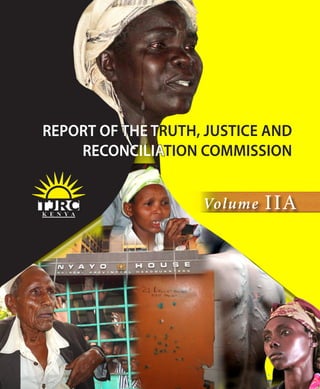

REPORT OF THE TRUTH, JUSTICE AND
RECONCILIATION COMMISSION
Volume IIA
REPORT OF THE TRUTH, JUSTICE AND
RECONCILIATION COMMISSION
Volume IIA
© Truth, Justice and Reconciliation Commission, 2013
This publication is available as a pdf on the website of the Truth, Justice
and Reconciliation Commission (and upon its dissolution, on the website
of its successor in law). It may be copied and distributed, in its entirety, as
long as it is attributed to the Truth, Justice and Reconciliation Commission
and used for noncommercial educational or public policy purposes.
Photographs may not be used separately from the publication.
Published by Truth Justice and Reconciliation Commission (TJRC), Kenya
ISBN: 978-9966-1730-3-4
Design & Layout by Noel Creative Media Limited, Nairobi, Kenya
His Excellency
President of the Republic of Kenya
Nairobi
3 May 2013
LETTER OF TRANSMITTAL
By Gazette Notice No. 8737 of 22 July 2009 and pursuant to section 10 of the Truth, Justice and
Reconciliation Act No. 6 of 2008, the undersigned were appointed to be Commissioners of the Truth,
Justice and Reconciliation Commission. The Commission was established with the objective of
promoting peace, justice, national unity, healing, reconciliation and dignity among the people of Kenya.
Having concluded our operations, and pursuant to section 48 of the Truth, Justice and Reconciliation
Act, we have the honour to submit to you the Report of our findings and recommendations.
Please accept, Your Excellency, the assurances of our highest consideration.
Amb. Bethuel Kiplagat	
Chairperson
Tecla Namachanja Wanjala	
(Vice Chairperson)
Judge Gertrude Chawatama 	 			
Amb. Berhanu Dinka	
Maj. Gen (Rtd) Ahmed Sheikh Farah
Prof. Tom Ojienda 	
Margaret Shava 	
Prof. Ronald Slye
i
Volume IIA
REPORT OF THE TRUTH, JUSTICE AND RECONCILIATION COMMISSION
Table of Contents
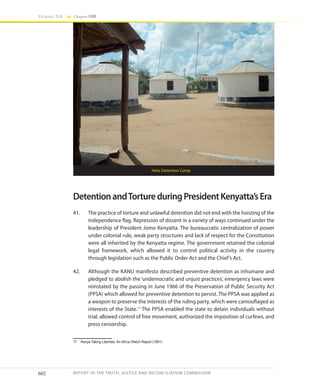
	Foreword..........................................................................................................................................iii
	 List of Abbreviations...................................................................................................................vi
CHAPTER ONE
Historical Context: A General Overview................................................................................................. 1
	 Introduction....................................................................................................................................1
	 British Colonial Era .......................................................................................................................3
	 President Jomo Kenyatta’s Era ............................................................................................. 17
	 President Daniel Arap Moi’s Era .......................................................................................... 24
	 President Mwai Kibaki’s Era................................................................................................... 27
Appendix
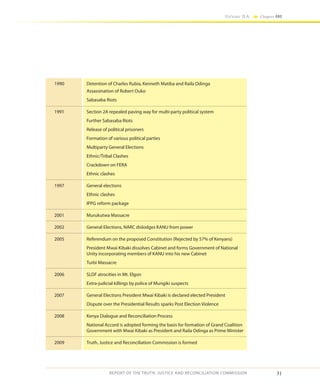
	 Selected major events in Kenya........................................................................................... 30
		
CHAPTER TWO
History of Security Agencies: Focus on Colonial Roots of the Police and
Military Forces ...................................................................................................................................................33
	 Introduction ................................................................................................................................ 33
	 The Police ..................................................................................................................................... 34
	 The Military .................................................................................................................................. 72
	Conclusion ................................................................................................................................... 99
CHAPTER THREE
The Shifta War................................................................................................................................................. 101
	 Introduction ..............................................................................................................................101
	Origins...........................................................................................................................................103
	 Legal Framework .....................................................................................................................109
	 Socio-Economic Policy in Support of The War ...........................................................111
	 Fighting The War.......................................................................................................................113
	 Massacres During The Shifta War......................................................................................131
	 Assigning Responsibility.......................................................................................................137
ii
Volume IIA
REPORT OF THE TRUTH, JUSTICE AND RECONCILIATION COMMISSION
	 Mass Graves, Burial Sites and Forensic Possibilities............................................. 142
	 War’s End - October 1964........................................................................................... 144
CHAPTER FOUR
Unlawful Killings and Enforced Disappearances...........................................................................147
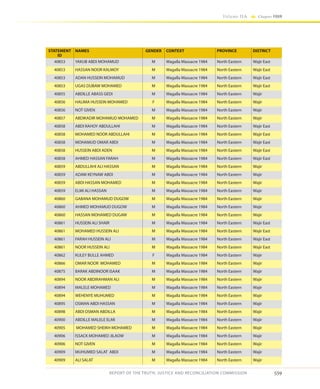
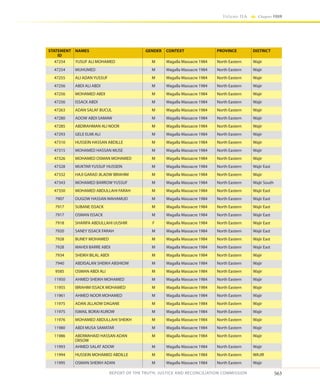
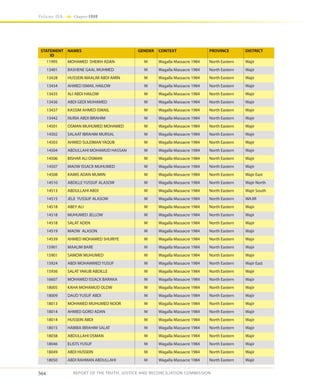
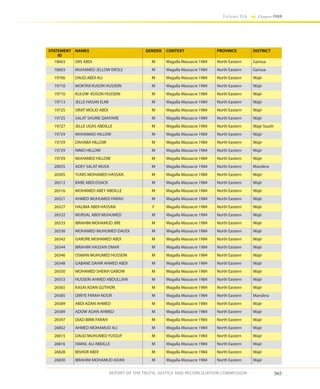
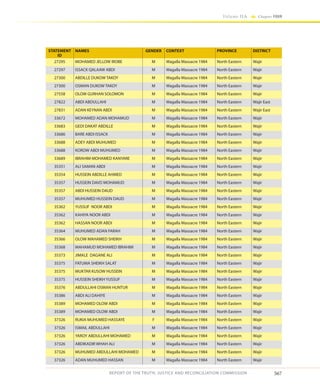
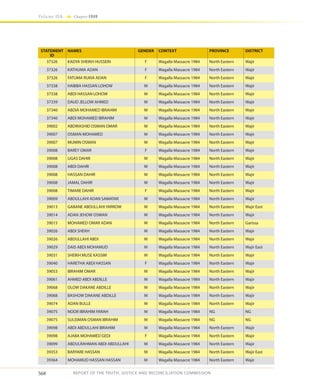
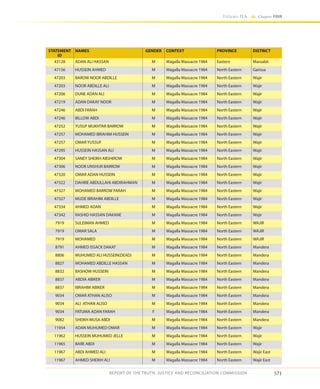
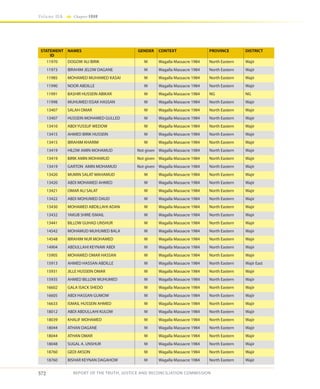
	Massacres............................................................................................................................................. 149
	 Political Assassinations................................................................................................................. 430
	 Extra-Judicial Killings and enforced Disappearances ................................................... 477
	 Annex: List of Massacre Victims.........................................................................................552
CHAPTER FIVE
Unlawful Detention, Torture and ill-Treatment.............................................................................. 589
	Introduction ..............................................................................................................................590
	 Definitions and Legal Framework ....................................................................................590
	Methodology ............................................................................................................................594
	 Detention and Torture during the Colonial Era .........................................................599
	 Detention and Torture during President Kenyatta’s Era..........................................602
	 Detention and Torture during President Moi’s Era....................................................605
	 Detention and Torture during President Kibaki’s Era ..............................................662
	 Annex: List of Victims of Detention, Torture and ill-Treatment............................664
CHAPTER SIX
Sexual Violence............................................................................................................................................... 707
	Introduction ..............................................................................................................................707
	Definition ....................................................................................................................................708
	Methodology ............................................................................................................................712
	 Reporting of Cases on Sexual Violations........................................................................713
	 Sexual Violence during Peacetime ..................................................................................718
	 Sexual Violence during Conflicts.......................................................................................721
	 Sexual Violence in the Context of Interrogation .......................................................744
	 Sexual Violence during Forced Evictions.......................................................................746
	 Sexual Violence by the British Royal Army ...................................................................750
	 Impact of Sexual Violence on Victims and their Families ......................................753
iii
Volume IIA
REPORT OF THE TRUTH, JUSTICE AND RECONCILIATION COMMISSION
Foreword
This Volume focuses on the major violations of bodily integrity rights that were
committed during the Commission’s mandate period. While most of the violations in this
volume are traditionally defined to require state action – extra judicial killings, enforced
disappearances, detention, torture – the Commission adopted a more expansive view of
these violations. This was for four reasons. First, while as a matter of law the distinction
between state and non-state action is important with respect to many of these violations,
many victims are less concerned about the official status of those who wronged them,
and more with identifying those individuals and addressing the consequences of the
harm they suffered.
Second, if the Commission were to strictly define these violations as requiring state
action, the experience and narratives of many victims would be lost. This would diminish
the ability of the Commission to provide an accurate, complete and historical record of
gross violations of human rights committed during the mandate period.
Third, while some of the violations described in this volume were not directly committed
by state officials, the failure of the state to provide adequate security to many of its
citizens provided an opportunity for such violations to occur. In seeking to understand
the circumstances, factors and causes of violations committed by militias and other non-
state actors, the Commission was inevitably drawn to an analysis of state inaction, and
in particular the failure of the state to provide, and appear to be providing, justice and
security.
Fourth, while the Commission does make recommendations with respect to the law and
legal structures, it is not a court of law, but rather a body dedicated to describing and
explaining historical injustices and gross violations of human rights. While accountability
is part of the Commission’s mandate, justice is one of three equally important pillars,
the other two being truth and reconciliation. In interpreting its mandate, therefore, the
Commission was sensitive to furthering the fulfilment of each of the three pillars, and
not giving undue weight to any one over the other two.
While much of this volume is focused on violations directly committed by the state,
it also includes descriptions of killings, severe injury and violence, sexual violence,
detention, and other similar violations committed by non-state actors.
The volume starts with a general overview of the political history of Kenya. This chapter
provides the overall political context for understanding not only the other specific
iv
Volume IIA
REPORT OF THE TRUTH, JUSTICE AND RECONCILIATION COMMISSION
violations in this chapter, but also the violations and other materials in the rest of the
report. Because the political history focuses heavily on the state and its development,
we include it here in the volume that focuses most on some of the worst violations
committed by the state.
In the chapter on political history we also, as in other parts of the report, discuss some
of the practices and violations of the colonial government. While the Commission’s
temporal mandate formally commenced at independence, the Act also required us to
describe and analyze the ‘antecedents, circumstances, factors and context’ of violations
committed during the mandate period. There is no question that in order to understand,
for example, the newly independent government’s reaction to the Shifta War (not
to mention injustices related to land, state abuse of power, corruption, and many of
the other violations discussed in this Report), one needs to understand the policies
and actions of the colonial government, as well as the legal, political, and economic
structures they established and bequeathed to the newly independent government.
This general political overview is then supplemented by a description of the history
of the state security agencies. While other agencies of the state were responsible for
historical injustices and gross violations of human rights during the mandate period (see
e.g. Volume 2B which focuses on land, economic crimes, violations of socio-economic
rights, and corruption), the security agencies were both primarily responsible for many
of the acts of commission discussed in this volume, as well as the acts of omission (the
failure to provide security) that allowed many of the violations committed by non-state
actors to occur.
The next chapter focuses on the major armed conflict (in this case a non-international
armed conflict) within the Commission’s mandate, the Shifta War. As the defining
moment of the independence of the nation, the Shifta War acts as a bridge from the
violations committed by the colonial power prior to independence and the violations
committed by the newly independent government. The Shifta War had a profound
impact on the early development of the state, the effects of which are still being felt
today, not least by the survivors and their descendants in the north eastern part of the
country.
The remaining chapters are organized by class of violations. Unlawful killings and enforced
disappearances are divided into three separate parts: massacres, political assassinations,
and extra judicial killings. Detention, torture and ill treatment were unfortunately
present during all periods of Kenyan history. While the infamous Nyayo House torture
chamber is often the first thing that one thinks of with respect to the Kenyan government
and torture, this chapter illustrates how prevalent illegal detention, torture, and other
similar treatment continues to plague the nation. Finally, the chapter on sexual violence
v
Volume IIA
REPORT OF THE TRUTH, JUSTICE AND RECONCILIATION COMMISSION
describes a particular form of violence committed against men and women, boys and
girls. It is only in the last three decades that the international community has become
more aware of the use of sexual violence as a systematic tool of oppression and armed
conflict. Sexual violence was prevalent during the colonial period, and unfortunately
continued unabated through independence to the present day.
Investigations related to some of the events in this chapter – e.g. the Wagalla Massacre;
the assassinations of, among others, Tom Mboya, J.M. Kariuki, and Robert Ouko – are
some of the most anticipated by many Kenyans. The report of the Task Force reported
the high interest in providing truth and justice with respect to these violations, and
the experience of the Commission was the same. The Commission was able to unearth
some new information regarding some of these events. But there is no question that
the Commission was unable to provide clear answers to all of the questions raised about
these injustices. A major cause of this inability was the difficulty the Commission faced
in securing documents and the cooperation of witnesses and other interested parties
with respect to these events. It is our hope that the information provided here will
re-emphasize the importance of the government coming clean and releasing all of the
information within its possession with respect to these and other historical injustices.
vi
Volume IIA
REPORT OF THE TRUTH, JUSTICE AND RECONCILIATION COMMISSION
List of Abbreviations
ADC	 Agricultural Development Consult
AFC 	 African Finance Corporation
AP 	 Administrative Police
ADCU 	 Air Defence Control Unit
ASTU	 Anti- Stock Theft Unit
AMREF	 African Medical and Research Foundation
BBC	 British Broadcasting Corporation
CBK	 Central Bank of Kenya
CJPC	 Catholic Justice and Peace Commission
CEO	 Chief Executive Officer		
CEDAW	 Convention on the Elimination of All Forms
of Discrimination Against Women
CID	 Criminal Investigation Department
CMS	 Church Missionary Society
COVAW	 Coalition of Violence against Women
CAT	 Convention against Torture and other Cruel,
Inhuman or Degrading Treatment
DSC	 District Security Committee
DNA	 Deoxyribonucleic Acid	
DO	 District Officer
DSBO	 District Special Branch Officer
DTM	 December Twelfth Movement
EAR	 East African Rifles
EATC	 East Africa Transport Corps
FAO	 Food and Agricultural Organitzation
FERA	 February 18 Revolution Army
FEM	 February Eighteenth Movement
FGM 	 Female Genital Mutilation
GSU	 General Service Unit
GVRC	 Gender Violence Recovery Centre
ICTY	 International Criminal Tribunal for the former
Yugoslavia
IBEAC	 Imperial British East Africa Company
IMLU	 Independent Medico-Legal Unit
ILO	 International Labour Organization
IDPs	 Internally Displaced Persons
KAR	 King’s African Rifles
KR	 Kenya Rifles
KANU	 Kenya African National Union	
KDF	 Kenya Defence Forces
KPU	 Kenya Peoples Union
KCB	 Kenya Commercial Bank
KADU	 Kenya African Democratic Union
KGGCU	 Kenya Grain Growers Cooperative Union
KPTC	 Kenya Posts and Telecommunications
Corporation
KAF	 Kenya Air Force
KHRC	 Kenya Human Rights Commission
KNHRC	 Kenya National Human Rights Commission
KNH	 Kenyatta National Hospital
KMC 	 Kenya Meat Commission
KBC	 Kenya Broadcasting Corporation
KWS	 Kenya Wildlife Service
KIC	 Kenya Intelligence Committee
KDHS	 Kenya Demographic and Health Survey
KPLC	 Kenya Power and Lighting Company
KNUT	 Kenya National Union of Teachers
MoU	 Memorandum of Understanding
MoH	 Ministry of Health
MMB	 Meat Market Board
vii
Volume IIA
REPORT OF THE TRUTH, JUSTICE AND RECONCILIATION COMMISSION
MP	 Member of Parliament
NCPB	 National Cereals and Produce Board
NFD	 Northern Frontier District
NTZ	 Nyayo Tea Zones
NBC	 Nyayo Bus Company
NTZDC	 Nyayo Tea Zones Development Corporation
NARC	 National Alliance Rainbow Coalition
NPPPP	 Northern province People’s Progressive Party
NFDLA	 Northern Frontier District Liberation Army
NSC	 National Security Council
NSIS	 National Security intelligence Service
NEP	 North Eastern Province
OLF	 Oromo Liberation Force
ODM	 Orange Democratic Movement
OCS	 Officer Commanding Station
OCPD	 Officer Commanding Police Division
OB	 Occurrence Book
PPSA	 Preservation of Public Security Act
PSBO 	 Provincial Special Branch Officer
PPO	 Provincial Police Officer
PCIO	 Provincial Criminal Investigations Officer
PNU	 Party of National Unity
PRCT	 People for Rural Change Trust
PEV	 Post Election Violence
PC 	 Provincial Commissioner
PSC	 Provincial Security Committee
RHA	 Royal Horse Artillery
SDO	 Special District Ordinance
SLDF	 Sabaot Lands Defence Force
SSAs	 State Security Agents
SYL	 Somali Youth League
SOA	 Sexual Offences Act
TJRC	 Truth Justice and Reconciliation Commission
UAE	 United Arab Emirates
UNDP	 United Nations Development Programme
UNESCO	 United Nations Educational, Scientific and
Cultural Organization
UPI	 United Press International
UN	 United Nations
VOK 	 Voice of Kenya
VOCA	 Victims of Coup Attempt
viii
Volume I  Chapter ONEVolume IIA
viii REPORT OF THE TRUTH, JUSTICE AND RECONCILIATION COMMISSION
1
CHAPTER
ONE
Historical Context:
A General Overview
Introduction
1.	 On the eve of Kenya’s Independence Day, the Duke of Edinburgh said the following
to a people that about to become free citizens of a new African nation:
Tomorrow a new volume will be opened and an independent Kenya will start to write
a new story. The pages of this volume are still blank and empty; the story that is to be
written on them is still in the hands and minds of all the people of Kenya.1
2.	 The next day, 12 December 1963, independence was greeted with jubilation and
celebrations across the entire country. Immediately, Kenyans began to write the
country’s story. Almost 50 years later, Kenya’s story is a success story as it is a sad story.
It is a success story because, despite the many challenges that have bedeviled the
country, Kenyans have made huge strides in achieving the goals that had been set
forth at independence, chief amongst which is the eradication of poverty, diseases
and illiteracy. It is a sad story because it is burdened by ghastly accounts of gross
violations of human rights and historical injustices. It is mainly this sad part of Kenya’s
story that the Truth, Justice and Reconciliation Commission was tasked to examine
and document.
1	 Daily Nation, 13 December 1963.
2
Volume IIA Chapter ONE
REPORT OF THE TRUTH, JUSTICE AND RECONCILIATION COMMISSION
3.	 This Chapter locates gross human rights violations and injustices that occurred in
Kenya between 1963 and 2008 in their historical context. It provides a composite
account or historical overview of the dynamics and factors that nurtured an
environment under which these violations and injustices thrived. The overview is
presented in a chronological order beginning from 1895 when the Kenyan state
was created to 2008 when it was at the edge of disintegration.
4.	 For analytical purposes, the historical period has been divided into four distinct
epochs. These epochs correspond with the four political administrations that
governed the country during the Commission’s mandate period:
	 British colonial era (1895 to 1963);
	 President Jomo Kenyatta’s era (1963 to 1978);
	 President Daniel arap Moi’s era (1978 to 2002); and
	 President Mwai Kibaki’s era (2002 to 2008).
5.	 As a historical overview, the scope and focus of this Chapter is limited to describing
and explaining key events in the political realm during these four epochs. As
such, it does not describe any particular violations and injustices in great detail.
Comprehensive descriptions of such violations and injustices are covered in
subsequent chapters and volumes of the Report.
6.	 In analysing these key events and their historical perspective, it is argued that the
violence generated in the context of colonialism was perpetuated in the post-
colonial period through unaltered colonial structures, institutions and mentalities.
Thus Kenya’s relatively long history of human rights violations cannot be explained
nor understood adequately without unravelling the country’s colonial experience.
Kenya’s story is a success story as it is a sad story. It is a
success story because, despite the many challenges that
have bedeviled the country, Kenyans have made huge
strides in achieving the goals that had been set forth at
independence, chief amongst which is the eradication
of poverty, diseases and illiteracy. It is a sad story
because it is burdened by ghastly accounts of gross
violations of human rights and historical injustices.
3
Volume IIA Chapter ONE
REPORT OF THE TRUTH, JUSTICE AND RECONCILIATION COMMISSION
British Colonial Era
7.	 The creation of modern day Kenya dates back to 1885 when European imperial
powers assembled in Berlin, Germany, to partition Africa among themselves. At the
Berlin conference where these powers met, it was resolved that those interested in
Africa would declare their spheres of influence then follow such declaration with
effective control of the new territories. What followed was the partition of Africa,
with little knowledge of the continent, especially its hinterlands. In the end, some
roughly 10,000 African polities were amalgamated into 40 European colonies and
protectorates. These colonies and protectorates would later provide the basis for
the modern nation-states of Africa including Kenya. Some African societies with a
lot in common were rent apart while others with nothing or little networks were
fused together
8.	 To establish and consolidate their rule in Kenya, the British employed violence
on a locally unprecedented scale and with unprecedented singleness of
mind and purpose. The colonial violence was characterized by unimaginable
human rights violations and injustices which reached its zenith in the 1950s,
a time when communities in Kenya staged a fight for political and economic
self-determination.
9.	 The British, having earmarked Kenya for control, moved with speed to implement
the Berlin resolution. Within two years, the British East African Protectorate
(where most of the present Kenya falls) had been declared. Henceforth, most laws
applicable in England and its hinter territories such as India would be exerted in
the so-called ’protectorate’.
Rule by proxy: Imperial British East Africa Company
10.	 Initially, the British chose to administer its newly-acquired territory through a
proxy: the Imperial British East Africa Company (IBEAC). The IBEAC was granted
a charter in 1888 to administer and develop the territory as it saw fit. It used this
authority to exploit natural resources such as ivory. The charter was exclusive but
the company faced numerous challenges in establishing its authority in Kenya.
Its agents have been described as ‘alcoholics’ who failed to establish working
relationships with the local populations with whom they were supposed to
trade.2
Moreover, the IBEAC lacked the finances to develop infrastructure and
was therefore unable to make the investments necessary to properly advance its
East African presence.
2	 B Berman Control and Crisis in Colonial Kenya: The Dialectic of Domination (1990) 50.
4
Volume IIA Chapter ONE
REPORT OF THE TRUTH, JUSTICE AND RECONCILIATION COMMISSION
11.	 In early 1890, the company started constructing the Mackinnon-Sclater road, which
was actually little more than cattle-track designed to link Mombasa and Busia.
The company also ordered a large steamship, the SS William Mackinnon, in the
hope that it would crisscross Lake Victoria and further stimulate commerce in the
region. Neither of these projects succeeded. Indeed the failure of these projects,
coupled with high profile political disputes and wrangles in Uganda, eventually
convinced the British government that the IBEAC’s charter should be cancelled.
Consequently, the charter was cancelled on 1July 1895. Administrative control of
the territory passed from the IBEAC to the British Foreign Office. In effect, Kenya
became a British protectorate.
From British Protectorate to British Colony
12.	 The declaration of Kenya as a British protectorate was primarily a diplomatic
gesture, aimed at the Sultan of Zanzibar, Germany, Italy and Ethiopia. It was a
declaration of exclusion of these powers from this political space that ran from
Jubaland to Lake Naivasha.3
This ‘diplomatic gesture’ proved a major obstacle to
the British settlers and the British Colonial Office in their attempts to secure cheap
loans under the Colonial Stock Act of 1900 for the development of the protectorate.
The Colonial Stock Act of 1900 only benefitted British colonies and dominions and
not protectorates.4
The crown agents, therefore, advised the colonial office to look
into ways to change the status of the protectorate to a colony.
13.	 It was this desire to change the status of the protectorate to a colony that exposed
the intricate political arrangement of the territory. It became clear that the
incorporationofthe10-milecoastalstripintothecolonywouldarouseinternational
conflicts from other countries that had entered into trading agreements with the
Sultan of Zanzibar.
14.	 The sultanate of Zanzibar for instance had signed treaties with various states:
United States of America in 1833, France in 1862, and Germany in 1886. These
treaties recognized the sovereignty of the Sultan. Of particular importance was
the 1886 Anglo-Germany treaty which internationally recognized the 10-mile
coastal strip as the rightful dominion of the sultanate of Zanzibar.5
As a result of
manipulation, persuasions and coercions, the Sultan accepted the proposal and
acknowledged that he:
3	 Atieno-Odhiambo ‘Mugo’s Prophesy’ in W Ochieng’ (ed) Kenya: The Making of a Nation. A Hundred Years of Kenya’s History 1895-
1995 (2000) 7.
4	 M John ‘The Ten Mile Coastal Strip: An Examination of the Intricate Nature of Land Question at Kenyan Coast’ (2011) International
Journal of Humanities and Social Sciences 177.
5	 As above.
5
Volume IIA Chapter ONE
REPORT OF THE TRUTH, JUSTICE AND RECONCILIATION COMMISSION
was the child of His Majesty’s government and was always ready loyally to carry out its
wishes. If His Majesty’s government considered the alienation desirable, he was quite
prepared to agree to it.6
15.	 Thus, in July 1920, the territory of the East Africa Protectorate was annexed to
the British Crown under the new name Kenya Colony. From then onwards, the
former protectorate became the Kenya Colony. The British colonialists imposed
the state structure on collections of ethno-political communities in Kenya that
historically lacked the inter-communal coherence. The communities which lived
independently from each other were forced to live together in newly-created
colonial Kenya7
. This imagined or invented political community superimposed into
much older alignments and loyalties has continue to be a fault line of ethnic socio-
political mobilization and conflict till today.
Resistance and military expeditions
16.	 The conquest of state and territory for British settlement and exploitation in Kenya
was achieved through colonial violence.8
To force Africans into submission, the
colonial administration in Kenya conducted ‘punitive expeditions’ in the 1890s
against what they called ‘recalcitrant tribes’. There were military expeditions
against the Nandi in 1901, 1905, and 1906, against the Embu in 1905, against the
Abagusii in 1904, 1908, and 1914, against the Kipsigis in 1905 and against the
Abagishu and Kabras in 1907.
17.	 Even the ‘angels’ within the British administration who recommended peaceful
methods of expansion discovered that the majority of the African people were
not willing to forgo their independence without some military show.9
Sir Arthur
Hardinge, the first protectorate commissioner, could even remark: ‘These
people must learn submission by bullets - it’s the only school; after that you
may begin more modern and humane methods of education’.10
The aftermath
of such violence was destruction of property, rape, torture, death, and destruction
to property.
6	 As above.
7	 N Peter ‘Colonialism and Its Legacies in Kenya’, Lecturer Delivered During Fulbright Hays Group Project, July 6th
to August 6th
2009, Moi University-Kenya; O Bethwell “Introduction” in W Ochieng’ (ed) Kenya: The Making of a Nation. A Hundred Years of
Kenya’s History 1895-1995 (2000).
8	 This study borrows from Tirop Simatei’s Work “Colonial Violence, Postcolonial Violations: Violence, Landscape and Memory in
Kenyan Fiction”. Here colonial violence is understood to mean relationships, processes, and conditions that attended the practice
of colonialism in Kenya and that violated the physical, social, and/or psychological integrity of the colonized while similarly impacting
on the colonizer.
9	W Ochieng’ A History of Kenya (1985) 89-90
10	 For details se J Lonsdale ‘The conquest state, 1895-1904’ in O William (ed) (1989) A Modern History of Kenya, 1895-1980
(1989) 11.
6
Volume IIA Chapter ONE
REPORT OF THE TRUTH, JUSTICE AND RECONCILIATION COMMISSION
18.	 Having been appointed as the first commissioner, Sir Hardinge later realized
the need to convert the external, costly and destructive force of conquest into
internal, negotiable and productive power.11
In order to set up an administrative
and judicial system, Hardinge fell back on the IBEAC administrators, retaining
people like Charles Hobley and Martin the Maltese. He proceeded to divide the
land into provinces and districts. And since administrative boundaries tended
to be based on ethnic or linguistic units, they froze cultural development and
population mobility at a certain point in time, thus fossilizing situations which
had been fluid.12
But more importantly, the administrative creativity of Hobley
witnessed the planting of seeds for ethnic hatred as communities started to
establish ownership of their territories to the exclusion of others. Hardinge:
had low opinion of the Africans, whom he regarded as barbarous races and he therefore
hoped to rely on the Arabs and to a lesser extent, the Swahili people … who according
to him were a civilizing influence for local administration. The process of dividing the
Kenyan people into primitive tribes and civilized tribes had begun … and intensified as
the administration spread into the interior”13
.
19.	 Sir Arthur Hardinge was succeeded as a commissioner by Sir Charles Elliot,
who had an even lower opinion of the Africans. His first task was to consolidate
British control within the protectorate and to formulate administrative policies
and structures suitable for white settlers. Unlike his predecessor, his actions
witnessed not only grave injustices against Africans, but also widespread
fighting between different African ‘tribes’ in the second half of the 19th Century.
The tribal units thus created and defined were encased in district boundaries,
but many of these classifications were arbitrary in some cases dividing groups
more sharply than they had been previously while in others they combined
groups that were originally distinct. As Ogot aptly concludes, ‘new and bigger
tribes such as the Luhya, the Kalenjin, and the Mijikenda had been invented …
by the Africans themselves to safeguard the interest and welfare of smaller units
against possible domination by the larger groups’. This kind of balancing action
has tended to intensify ethnic chauvinism and the struggle for the capture of the
post-colonial state14
.
20.	 On the ground, the British sought to establish alliances and loyalties of Africans.
In so doing, the British sought to manipulate, subvert and at times circumvent
the existing indigenous systems of authority. As Atieno-Odhiambo explains:
11	 As above.
12	 Ogot Bethwell (2000:21) ‘Boundary Changes and the Invention of Tribes’ in William Ochieng’ (ed) Kenya: The Making of a Nation.
A Hundred Years of Kenya’s History 1895-1995 (2000) 21.
13	 As above.
14	 As above.
7
Volume IIA Chapter ONE
REPORT OF THE TRUTH, JUSTICE AND RECONCILIATION COMMISSION
‘the politics of this time were at one level the politics of conquest, but the more
enduring heritage was the politics of manipulation’.15
Such were evident as the
British manipulated leaders of the Maasai namely Olonona, Ole Galisha, and
Ole Masikonti. The British too manipulated the power equation in Luhya land
by inventing empires for Mumia in Wanga and for Sudi Namachanja in Bukusu.
This was followed by imposition of new leaders such as Karuri wa Gakure and
Kinyanjui wa Gathirimu among the Kikuyu. In the coastal region, the Sultan of
Zanzibar was manipulated by Sir Edward Northey and the British residents in
Zanzibar to allow annexation of his 10-mile coastal strip to be part of the new
colony.16
21.	 Practically everywhere in Kenya, as was the case in the rest of Africa, the
imposition of colonial rule was resisted. Such resistance inevitably provoked
military retaliation from the colonial powers. Better armed and employing crack
shot mercenaries, colonial powers imposed their rule by violence and/or military
expeditions. This was particularly the case between 1895 and 1914; a phase of
pacification of ‘recalcitrant tribes’ fighting for the preservation of their political,
cultural and economic independence.17
The period was thus characterized by
an unimaginable degree of human rights abuses against defenceless Africans.
The military expeditions were accompanied by crimes such as theft, rape,
death and destruction of property by the colonial soldiers or their associates.
Such actions defy the view that the British colonialist used humane and
gentle methods to impose their rule in Kenya.18
22.	 Examples abound of how the British used brutal force to impose its rule. On the
Kenya coast, Swahili chiefs like Mbaruk were famous for resisting alien rule. When
the British took over Kenya, the Mazrui chiefs resisted British rule as they had
repeatedly done in the past. They knew that they could not win pitched battles
against an enemy who was far more powerful and better armed than they. So
they concentrated on fighting limited engagements and making lightning attacks,
and they sustained a fairly successful resistance movement for some time. But the
British were in Kenya to stay. They therefore imported Baluchistan regiments from
India to crush the African resisters.19
Mbaruk, the leader of the resistance, fled to
Tanzania, only to fall into German hands.
15	 Atieno-Odhiambo (2000:7) “Mugo’s Prophesy” in William Ochieng’ (ed) (2000) Kenya: The Making of a Nation. A Hundred Years of
Kenya’s History 1895-1995. Maseno University: Institute of Research and Postgraduate Studies.
16	 Mwaruvie John op.cit, pg 177
17	 S Kiwanuka From Colonialism to Independence: Reappraisal of Colonial Policies and African Reactions 1870- 1960 (1973) 20.
18	 As above, 21.
19	 As above, 21.
8
Volume IIA Chapter ONE
REPORT OF THE TRUTH, JUSTICE AND RECONCILIATION COMMISSION
23.	 Heandfourotherleadersdiedinexile.20
ThesamefatebefelltheOgadenSomaliin1889,
when they too attempted to resist British rule. Their opposition to British colonialism
forced the British to resort to more violent methods. Convinced that the best‘tutors’to
make the Ogaden see reason were bayonets and machine guns, the British in Kenya
movedagainsttheOgadenwiththehelpofIndianregimentsin1889.Ogadenresisters
were smashed and hundreds of their cattle confiscated by the British.21
Similarly, while
forcing theTaita to submission, Captain Robert H. Nelson remarked:
In a few minutes the men cleared out, leaving some fifteen dead on the spot and I have
no doubt that a good many received fatal wounds. I then marched on to the village of
the men who had been fighting us, burning the surrounding villages and seizing the
sheep and goats belonging to them.22
24.	 In the Mount Kenya region, Colonel Richard Meinertzhagen also led many bloody
expeditions between 1902 and 1906, in which many Kikuyu and Tharaka people
were killed and about 11,000 head of stock captured.
25.	 British soldiers, porters and other associates made more injustices in western
Kenya, particularly among the Kisii and the Luo people. When a message arrived
in 1905 of the Kisii revolt, a detachment of a hundred African Police under Robert
Foran and a company of the Third King’s African Rifles (KAR) under captain
Jenkins were immediately dispatched to quell it. This is how Foran described the
encounter:
The machine gun was kept in action so long during this sharp engagement that it
became almost red-hot to the touch. Before then … they left several hundreds dead
and wounded spearsmen heaped up outside the square of bayonets. This was not so
much a battle as a massacre, but wholly unavoidable under the circumstances. It was an
urgent case of decimating the determined attack or else being completely wiped out by
the Kisii warriors.23
26.	 In 1908, the British organized another expedition, when the Kisii ambushed and
speared a colonial administrator, Northcote. One of the relief patrols headed by Foran
sent to Northcote’s aid explained that ‘… the African Rifles were putting in some
strenuous work – burning villages, devastating standing crops, capturing livestock
and hunting down the bolting warriors’24
A series of telegrams conveyed the results
of the expeditions to the colonial office in London. On 1 February 1908, a telegram
received by the colonial office read in part:‘Result of operations in Kisii to 28 January -
20	 Ochieng’ William A History of Kenya (1985) 90.
21	 As above.
22	 As above, 91.
23	 For details see W Audrey Rural Rebels: A Study of Two Protest Movements in Kenya (1977) 25.
24	 As above.
9
Volume IIA Chapter ONE
REPORT OF THE TRUTH, JUSTICE AND RECONCILIATION COMMISSION
cattlecaptured5,636sheepandgoats3,281and100Kisiikilled’.Twodayslateranother
telegram reported the number of Kisii dead had risen to 160.25
Manipulations
27.	 The British colonialists’injustices against the people of Kenya were not only limited
to the 1895-1914 military expeditions. British administrators and functionaries
used manipulation, colonial laws and policies, and continued to use violence
and harassment to appropriate both human and natural resources from Kenya
throughout the colonial period.
28.	 Manipulations were more evident in the signing of treaties involving British
administrators and African leaders to create frontiers for European settlers from
Britain, Canada, South Africa, Australia and New Zealand. One such ‘treaty’ which
easily comes to mind was the first and the second Maasai Treaty of 1904 and 1911.
Thefirsttreaty,signedwithouttheknowledgeoftheMaasaipeople,agreedtomove
the Naivasha Maasai en masse to the Laikipia plateau, together with their cattle.
Such a move enabled white settlers to occupy the whole of the Rift, Zedong and
Gong. But even this grave injustice committed against the Maasai by the colonial
government did not satisfy the appetite of the white settlers for more productive
land. They pressed that the Laikipia Maasai should be moved again to a southern
reserve so that the Maasai tribe could be together in a United Maasai Reserve. On
4 April 1911, the second Maasai agreement was signed according to which the
northern Maasai had agreed to move to the southern reserve. Subsequently, the
new Maasailand was declared a closed area and the policy of reservation for the
new tribe continued throughout the colonial period. As such, attempts to further
alienate Maasai land during the post-colonial period engendered strong ethnic
feeling among the people.26
29.	 It was not only the Maasai who suffered colonial manipulations, the same was
the case in the Kiambu-Thika area from 1903 to 1908, central Rift Valley 1904
to 1914, and lastly in the Kericho to Nyeri/Nanyuki areas through the soldier
settlement schemes following the First World War. This last scheme left the
Kipsigis without Kimulot, the Nandi without Kipkarren valley, the Sabaot without
the Trans-Nzoia pastures and made the Samburu, Meru and Kikuyu squatters in
the Timau-Nanyuki areas.27
25	 As above.
26	 For details, see O Bethwell ‘Boundary Changes and the Invention of Tribes’ in William Ochieng’ (ed) Kenya: The Making of a
Nation. A Hundred Years of Kenya’s History 1895-1995 (2000) 21; Ochieng’ William A History of Kenya (1985) 90.
27	 Atieno-Odhiambo (n 3 above) 8.
10
Volume IIA Chapter ONE
REPORT OF THE TRUTH, JUSTICE AND RECONCILIATION COMMISSION
Chiefs and forced labour
30.	 British officials, with African submission to their authority after pacification, were
pressed by the reluctant metropolitan taxpayers to find means of making the
colonial territories self-financing. They achieved this through the creation of
the office of the chief as agents of local administration and tasked them with
the responsibility for tax collection, maintenance of law and order and more
importantly to supply cheap labour for public and settler requirements. It was
the assignment of these tasks which put the colonial chiefs at the forefront in the
abuse of human rights.
31.	 During the mobilization of labour for Europeans, chiefs were empowered by a
series of labour laws to call out any number of able-bodied persons to labour
without pay on public works28
. This mandate was extended at the outbreak of
World War 1 to finding able-bodied manpower for the First World War, a war that
caused the death of over 50,000 Africans and left thousands more wounded.
Astonishingly, most Africans who were recruited into the war had very limited
understanding of why the Europeans were fighting. In 1919 the Northey Circular
spelt out its extension to embrace the directive on African labourers to work for
settlers at very low wages. These aspects of chief authority were backed by force.
Chiefs had retainers who in the process of tax collection, punitively confiscated
peoples’ animals and produce, seized their women and routinely whipped the
young men.29
Such coercive chiefly authority, supervised and approved by the
district commissioners, brought in the intense hatred of the system, even in the
post-colonial period.
32.	 In his 1936 report on Kenya’s finances, Sir Alan Pim identified two potential
opportunities for corruption - the counting of huts for hut tax, and the enforcement
of tax payment by chiefs. The hut counters responsible for determining tax liability
were, certainly not of a type likely to be exempt from the temptation to make a
little money; they used both influence and bribery to exempt some who were
required to pay and to extort taxes from those who were not. Additionally, due to
limited staffing at the district level, collection was largely enforced by employing
the services of the chiefs or headmen with their various satellites. This unavoidably
gave opportunities for the abuse of authority, either in the direction of using
improper means to enforce payment, or in connection with applications for
exemption.
28	 Ochieng’ William A History of Kenya. Nairobi (1985) 16.
29	 Atieno-Odhiambo (n 3 above) 8
11
Volume IIA Chapter ONE
REPORT OF THE TRUTH, JUSTICE AND RECONCILIATION COMMISSION
Land alienation
33.	 After the First World War, the colonial administration was keen at increasing the
numberofsettlers,increasingsettlerlandholdingandboostingsettleragriculture
by providing them with good infrastructural services. Needless to say, the land
alienated to the settlers was carved out of the most fertile regions, land which
was inhabited by the Africans. Therefore, the main injustice on Africans after
the First World War focused on land alienation and the creation of the African
squatters, both in Central and the Rift Valley regions of colonial Kenya.
34.	 In enforcing this injustice, the colonial administration introduced the Crown
Lands Ordinance of 1915,30
which declared all ‘waste and unoccupied’ land in
the protectorate ‘Crown Land’ subject to the governor’s powers of alienation. In
the British imagination, such land included any empty land or any land vacated
by a native.31
The protectorate administration gave no cognizance to customary
tenure systems, and by 1914 nearly 5 million acres (2 million hectares) of land had
been taken away from Kenyan Africans, mostly from the Kikuyu, Maasai and Nandi
communities. It created the reserves for‘natives’and located them away from areas
scheduled for European settlement. These developments witnessed the creation
of what Mamdani refers to as ‘citizen’ (settlers) and ‘subject’ (Africans) – a dual
system of land tenure and land administration to consolidate colonial rule.32
35.	 Colonial appropriation of land and alienation of a large section of the African people
produced a situation where by 1930, probably more than 15 000 Kiambu Kikuyu had
lost their land ownership, while a similar number lost their communal or ‘tenant at
will’ use of land. Thus, approximately 30,000 Kikuyu had lost land rights in Kiambu
district alone. About half that number lost land rights in Murang'a and Nyeri districts.
The total loss of land among the Kikuyu could therefore involve well over 45,000
people. Annual reports for the period indicate that there were 41,156 Africans in
European-settled areas of Nakuru and Naivasha and these would seem to support
our estimates, given that the majority of Africans in these areas were Kikuyu.33
36.	 Other ‘troublesome communities’, like the Talai, were in 1934 forcibly evicted from
Kericho/Nandi areas on accusations of being extortionist and sent to open jails in
Lambwe, a tsetse-flies infected area in a valley where sleeping sickness was rampant.
30	S Wanjala Essays on Land Law: The Reform Debate in Kenya (2002).
31	 Syagga Paul (undated) Public Land, Historical Land Injustices and the New Constitution. Society for International Development
(SID): Constitution Working Paper No. 9
32	M Mamdani Citizen and Subject: Contemporary Africa and the Legacy of the Late Colonialism (1996).
33	 Alila Patrick Kinyanjui Kabiru, and Wanjoyi Gatheru (Rural Landlessness in Kenya (1985) 2.
12
Volume IIA Chapter ONE
REPORT OF THE TRUTH, JUSTICE AND RECONCILIATION COMMISSION
It was described as the‘Valley of Death’where 30 years earlier, 60 percent of Lambwe
valley inhabitants had been killed by diseases.34
37.	 By 1945, there were about 203,000 people rendered squatters and labourers in
European farms, with 101,000 Kikuyu as resident labourers on European farms and
about 21,000 more employed mainly in the government’s department of forestry. A
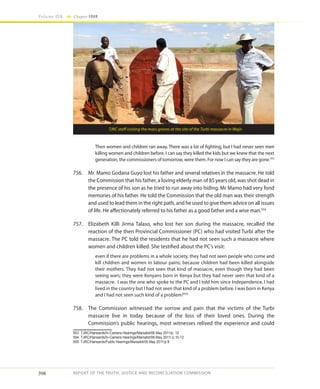
substantial number of Africans in the settled area were not enumerated in this labour
census and the total number of the Kikuyu in the alienated area must have been a
lot more than 150,000 by 1945. No wonder, three years later, in 1948, the number of
Kikuyu recorded as living outside their ‘native reserves’ was more than 294,000 or
nearly 29 percent of the total Kikuyu population. Some of them lived in towns or in
other African reserves, but nearly all of them had been effectively uprooted by the
process of alienation. They were outside their reserves in search of work and or new
land as a means of subsistence.35
38.	 The creation of reserves in areas deemed unsuitable for European settlement had
far-reaching implications, both for the natives and the colonial administration.
Underlying them was a policy of exploitation and oppression against the
colonizedpeopleaccentuatedbylandalienation,forcedmalelabourmobilization,
overcrowding, insecurity, stagnation in African agricultural production, massive
landlessness and rapid land deterioration due to fragmentation, over-stocking
and soil erosion.
39.	 In the long term, the problems in the reserves led to unrest and eventually to a
political uprising – the Mau Mau resistance movement that organized around
the issue of foreign rule, land alienation and political and economic inequality.36
The colonial state’s answer to the unrest was to initiate an ambitious project of
land tenure reform in the reserves that would serve as a bulwark against rural
radicalism. The colonial agronomist’s thought about the individualization of land
tenure was first contained in the less well-known JH Ingham Report published in
1950. However, the blueprint that was to destroy the indigenous/communal access
to land was formulated by Roger Swynnerton in what was to be known as the
1954 Swynnerton Plan. The architect of this plan argued persuasively in support of
individualization of tenure in Kenya as a pre-condition for enhanced agricultural
production37
.
34	 D Anderson ‘Black Mischief: Crime, Protest and Resistance in Colonial Kenya’ (1993) 36 The Historical Journal 36, 851-877
35	 For details see: A Patrick et al Rural Landlessness in Kenya (1985) 2.
36	S Okuro Land Reforms in Kenya: The Place of Land Tribunals in Kombewa” in Elisio Macamo ed. Negotiating Modernity (2005).
37	 Studies have shown that those on whose names land was registered as principal landholders-men, assumed exclusive individual
rights in given pieces of land at the expense of women, widows and juniors whose rights to land remained either secondary or
usufruct.
13
Volume IIA Chapter ONE
REPORT OF THE TRUTH, JUSTICE AND RECONCILIATION COMMISSION
Mau Mau War
40.	 The Mau Mau war, from 1952 to 1955, marked the climax of African resistance to
British colonial rule in Kenya. It was a key event in Kenya’s history. Recent studies
by Caroline Elkins, David Anderson and Charles Hornsby have demonstrated the
extent of British atrocities hitherto undocumented in Kenyan History.
41.	 In contrast to the conventional notion that the counter-insurgency was aimed
at the Mau Mau militants, Elkins recognizes that the British interned practically
the entire Kikuyu population as Mau Mau. Key to this was turning the insurgency
inward, into a battle of Kikuyu militants against Kikuyu loyalists, thereby turning
Mau Mau insurgency into civil war. The turning point came on the night of 26
March 1953, at Lari, which was the site of two successive massacres, the first by
the Mau Mau and the second by homeguards. During this massacre, Anderson
describes how the Mau Mau militants herded Kikuyu men, women and children
into huts and set them on fire, hacking down with pangas anyone who attempted
escape, before throwing them back into the burning huts. The vast majority of the
400 killed at Lari were women and children.
42.	 But even more importantly, the Mau Mau started to target, less and less the settlers
on the highlands or even less the colonial power itself, but increasingly those they
perceived as local beneficiaries of colonial power, turning neighbours and relatives
against each other in a rapidly brutalizing civil war. This was not the only massacre;
the colonial administration also committed a similar massacre in Hola in 1959 in
which 11 detainees were clubbed to death, with 77 having permanent injuries.38
The submissions of Michael Gerard Sullivan, the colonial officer in-charge of Hola
camp to the commission investigating the death of the detainees revealed the firm
instructions from Compell, the deputy commissioner of prisons, to torture the Mau
Mau detainees by denying them drinking water for a number of hours, weeding
rice fields with bare hands and use of batons on the non-cooperative ones.39
43.	 Elkins has indeed demonstrated the injustices meted on the Mau Mau by the colonial
police and the loyalist. For example she argues that electric shock was widely used, as
well as cigarettes and fire. Bottles (often broken), gun barrels, knives, snakes, vermin,
and hot eggs were thrust up men's rectums and women's vaginas. The screening
teams whipped, shot, burned and mutilated Mau Mau suspects, ostensibly to gather
intelligence for military operations and as court evidence.
38	 M Wunyabari Mau Mau and Kenya: An Analysis of a Peasant Revolt (1993).
39	 KNA, Documents related to the death of 11 detainees at Hola camp in Kenya. Reference No. K967.62
14
Volume IIA Chapter ONE
REPORT OF THE TRUTH, JUSTICE AND RECONCILIATION COMMISSION
44.	 Between 150,000 and 320,000 Africans were detained for varying lengths of time
in more than 50 detention and work camps. The treatment in the camps, staffed
by little trained non-Kikuyu, loyalists and European settlers, was often brutal. The
information about what was happening there was carefully controlled and the
colonial office and the governor systematically denied reports of mistreatment.
Elkins’ extended descriptions of the regime of torture, one is struck by its
predominantly sexual nature. Male detainees were often sexually abused‘through
sodomy with foreign objects, animals, and insects, cavity searches, the imposition
of a filthy toilet bucket-system, or forced penetrative sex’. Women had ‘various
foreign objects thrust into their vaginas, and their breasts squeezed and mutilated
with pliers.’Variations abounded, with sand, pepper, banana leaves, flower bottles
(often broken), gun barrels, knives, snakes, vermin, and hot eggs being thrust up
men’s rectum and women’s vaginas. A common practice during interrogation was
to squeeze testicles with pliers. Josiah Mwangi Kariuki (popularly known as J.M
Kariuki) was detained in 14 detention camps between 1953 and 1960. In his book
‘Mau Mau Detainee’, he wrote that his experience at Kwa Nyangwethu detention
camp was the worst:
Kwa Nyangwethu was, however, particularly bad and was notorious not for mere
beatings, but for castration. I have seen with my own eyes that Kongo Chuma whom
I first met in Nakuru before he was detained and who is now living at Kianga in
Embu district, has been castrated. He had not been like this when he was in Nakuru
but when we met in the detention camp at Athi River he told me it has been done to
him by the screeners at Kwa Nyangwethu. He also told me that bottles of soda water
were opened and pushed into the uterus of some women to make them confess.
Kongo said these things were done by the Africans but the European officers knew
what was going on.40
45.	 The Mau Mau fighters were also responsible for unspeakable atrocities. Contrary to
African customs and values, they assaulted old people, women and children. The
horrors they practiced included decapitation and general mutilation of civilians,
torture before murder, bodies bound up in sacks and dropped in wells, burning
victims alive, gouging out of eyes and splitting open the stomachs of pregnant
women41
. Mau Mau officially ended with the capture and execution of Dedan
Kimathi, the uprising’s most senior leader in October 1956. While the figures are
debatable, the Mau Mau are said to have caused the death of at least 14,000
Africans, 29 Asians and 95 Europeans.
40	 JM Mwangi Mau Mau Detainee (2009) 30.
41	 O Bethwell Alan ‘BRITAIN'S GULAG Histories of the Hanged: Britain's Dirty War in Kenya and the End of Empire. By
DAVID ANDERSON. London: Weidenfeld and Nicolson, 2005. Pp. viii+406 (ISBN 0-297-84719-8). Britain's Gulag:
The Brutal End of Empire in Kenya. By CAROLINE ELKINS (London: Jonathan Cape, 2005). Pp. xiv+475". The
Journal of African History (Cambridge University Press) 46: 493–505.
15
Volume IIA Chapter ONE
REPORT OF THE TRUTH, JUSTICE AND RECONCILIATION COMMISSION
46.	 To establish the root causes of Mau Mau, the colonial administration appointed
the Corfield Tribunal, which relied extensively on psychologist JC Carothers
and in their report recorded 11,503 Mau Mau dead. It was understandable that
the number was under-estimated to disguise the ferocity of the colonial office
response to Mau Mau. A thousand were hanged upon being convicted by courts,
while more were killed by troops in the forest. There were also extra-judicial
executions by the colonial police and homeguard units. Moreover, the beating
and torture of Kikuyu suspects was commonplace, and the security forces
murdered hundreds. The Mau Mau war did not only mark the end of the African
resistance against colonial rule, but it was the climax of colonial atrocities on
Africans suspected to be members of Mau Mau.
47.	 In 1999, a few former fighters calling themselves the Mau Mau Original Group
announced that they would attempt a £5 billion claim against the UK, on behalf
of hundreds of thousands of Kenyans for ill-treatment they said they suffered
during the rebellion. In November 2002, the Mau Mau Trust - a welfare group
for former members of the movement - announced it would attempt to sue the
British government for widespread human rights violations committed against
its members. With the assistance of the Kenya Human Rights Commission, in
2011, the Mau Mau group succeeded in suing the British after a British court
ruled that the Kenyans could sue the British government for their torture.
48.	 After the Mau Mau War, the colonial government not only relaxed the ban on
the formation of African political parties, but also attempted to increase African
representation in the colonial administration. The colonial administration
permitted the re-establishment of African district- based political parties and/
or associations and disallowed national organizations. The first to be registered
was the Nairobi District African Congress in April 1956, with Mau Mau lawyer
Argwings Kodhek as the president. The other district-based associations that
emerged at this time were the Mombasa African Democratic Union, the African
District Association, the Abagusii Association of South Nyanza District, the South
There were also extra-judicial executions by the colonial
police and homeguard units. Moreover, the beating and
torture of Kikuyu suspects was commonplace, and the security
forces murdered hundreds.
16
Volume IIA Chapter ONE
REPORT OF THE TRUTH, JUSTICE AND RECONCILIATION COMMISSION
Nyanza District African Political Association, the Taita African Democratic Union,
the Nakuru African Progressive Party, the Nakuru District Congress, the Abaluhya
Peoples Association and the Nyanza North African Congress42
.
49.	 One of the legacies of these district-based political associations was that the pace
of political developments among the various districts continued to be uneven
and parochialism rooted in ethnic loyalties was encouraged at the expense of
African unity.43
It provided the foundation of alignment of political orientation and
ethnicity. The other effect was the emergence of local powerful figures that would
resist attempts at political centralization by colony wide political organization such
as the Kenya African National Union (KANU).
50.	 The process of increasing African and other races’ representation into the colonial
administration was initiated by the British Colonial Secretary Oliver Lyttleton
in 1954. In his advice to the administration, he said ‘it is prudent to have all the
inhabitants of the colony to share in the responsibility of government, albeit at a
subservient level’. His advice resulted in the enactment of the Lyttleton Constitution
in 1954, which put in place institutional structures to curb anti-colonial revolts,
establish a multi-racial society and provide a timetable for independence. But
in reality it asserted minority interests while the language of democracy was
employed to hoodwink the majority.44
The War Council created by the constitution
was racially exclusive and emerged as the supreme organ with powers to enact
legislation to deal with the Emergency without reference to the legislative council.
Even the Council of Ministers was by and large in the hands of a handful of settlers.
The contradictions emanating from the dispensation of the Lyttleton Constitution
culminated in protracted political struggle in which Africans, Arabs and Asians
demanded an all-inclusive political process. The political crises after the 1957
general election witnessed the enactment of another constitution, the Lennnox
Boyd Constitution in 1956.
51.	 While the Lennox Boyd Constitution increased the number of African representatives
in the Legislative Council, it did not adequately address the Africans’ grievances.
However,itsharpeneddivisiveracialandethnicpoliticalintereststhatspilledoverinto
the 1960 Lancaster House Constitutional Conference where a new constitution was
negotiated. Therefore the Lancaster House conferences became a space for contest
by various racial groups and emerging political elites and commitment to democratic
and social change remained abstract.45
42	 Ogot Bethwell and Ochieng William (eds) Decolonization and Independence in Kenya (1995) 52.
43	 As above.
44	 For details see: Samwel Alfayo Nyanchoga et al Constitutionalism and Democratisation in Kenya, 1945- 2007 (2008).
45	 As above.
17
Volume IIA Chapter ONE
REPORT OF THE TRUTH, JUSTICE AND RECONCILIATION COMMISSION
President Jomo Kenyatta’s Era
52.	 On 12 December 1963, Kenya got independence from British rule with Jomo
Kenyatta as the Prime Minister. A year later, Kenya became a Republic with Jomo
Kenyatta as the President and Jaramogi Oginga Odinga as the Vice President.
Within a short period into independence, gradually returned to the ways of the
colonial master. The government and the ruling political party, Kenya African
National Union (KANU), not only retained repressive colonial laws, but also became
increasingly intolerant of political dissent and opposition. Political assassinations
and arbitrary detentions were turned into potent tools for silencing dissenting
voices and ultimately for dismantling opposition political parties. For the larger
part of Kenyatta’s reign Kenya was a de facto one-party state.
Official amnesia
53.	 TheattainmentofKenya’spoliticalindependenceonthe12December1963,with
Jomo Kenyatta as the first Prime Minister, marked the culmination of 68 years of
anti-colonial struggles waged by Kenyan Africans to free themselves from British
domination, oppression and exploitation. However, in his independence speech,
Jomo Kenyatta did not suggest any substantial change in the colonial structures.
Thecolonialstatewouldremainintact–despitethefactthatthefightfornational
independence had been dominated by demands for social justice, egalitarian
reforms, participatory democracy, prosecution of those who had committed
mass killings and other forms of crimes during the war of independence, and
the abolition of the colonial state and its oppressive institutions.
54.	 Also, in his independence speech, Jomo Kenyatta never mentioned the
heroism of the Mau Mau movement.46
No Mau Mau freedom songs were
sung, no KLFA leaders was allowed to speak during the historic day. Instead,
Kenyatta asked the people to forget the past – to forgive and forget the
atrocities committed against them by the British and their Kenyan supporters
during the war of independence47
. He became no radical on nationalization
of foreign-held assets including land and often remarked: “I regard titles as a
private property and they must be respected … I would not like to feel that
my shamba (smallholding) or house belongs to the government. Titles must
be respected and the right of the individual safeguarded48
”. In this way, the
Kenyatta administration provided a relief to the settler community that their
land will not be taken away from them without compensation.
46	 The usage of KLFA to refer to Mau Mau is rather problematic in literature. KLFA is not simply another name for Mau Mau: it was the
name that Dedan Kimathi used for a coordinating body which he tried to set up for Mau Mau. It was also the name of another militant
group that sprang up briefly in the spring of 1960; the group was broken up during a brief operation from 26 March to 30 April
47	 Maina wa Kinyatti (2008:363) History of Resistance in Kenya, 1884-2002 (2008) 63.
48	 For details see Daniel Branch Kenya: Between Hope and Despair, 1963-2011 (2011)
18
Volume IIA Chapter ONE
REPORT OF THE TRUTH, JUSTICE AND RECONCILIATION COMMISSION
55.	 The attainment of political independence shadowed several tensions and
cleavages which occupied the new ruling elites prior to and immediately after
independence.49
For example, the radicals represented by Oginga Odinga and
Bildad Kaggia who favoured nationalization of foreign owned corporations,
seizing of white settler farms without compensation and following more pro-
Eastern foreign policy. Odinga persuasively argued that “I understand that
in communist countries the emphasis was on food for all. If that was what
communism meant then there was nothing wrong with that50
”. He as his
supporters opted to look to Soviet Union, China and their allies for backing.
On the other hand, conservatives led by Jomo Kenyatta and Tom Mboya - the
nationalists who espoused a constitutionalist and reformist approach and
were after independence concerned with the maintenance of the colonial
legacy. As the struggle raged for control of the state, decisions based on short-
term expediency were interspersed with fundamental directional choices.
56.	 Kenya soon returned to a command and control leadership model strikingly
similar to that of the colonial era. Decisions about development, money and
military protection drove foreign relations, domestic policy and land policy,
which in turn drove greater centralization and a conservative social and
political model that combined individual accumulation with a partisan and
interventionist state.51
The struggle for power saw the abandonment of the
Majimbo Constitution, which conceded much autonomy to the regions for a de
facto one party state. The dissolution of the Kenya African Democratic Union
(KADU) was a critical moment, setting the stage for three decades of single-
party dictatorship and prioritisation of the maintenance of public order by the
Kenyatta administration.
Dealing with Mau Mau
57.	 Jomo Kenyatta took over power in a country which was already polarized by
the Mau Mau issue over land and more importantly“ownership of the fight for
independence”. The reason for this was the expectation that those who fought
for Uhuru (independence) should exclusively eat the fruits of independence52
.
This debate thrived even in the context of the revelations that Kenya had many
powerful voices in the anti-colonial movement. Indeed Bethwell Ogot has
demonstrated the roles and responsibilities of all the communities in Kenya, in
anti-colonial movements53
. Therefore the first issue which Jomo Kenyatta had
to deal with was the Mau Mau – a movement whose main agenda revolved
49	 For details see: Hornsby Charles Kenya: A History Since Independence (2012)
50	 For details see Branch (n 48 above) 36. 2011
51	 As above.
52	 E Atieno Odhiambo ‘Matunda Ya Uhuru, Fruits of Independence: Seven Theses on Nationalism in Kenya’ in E Atieno Odhiambo
and John Lonsdale (eds) Mau Mau and Nationhood: Arms, Authority and Narration (2003).
53	 O Bethwell ‘Mau Mau and Nationhood: Untold Story’ in ES Odhiambo and J Lonsdale (eds) Mau Mau and Nationhood: Arms,
Authority and Narration (2003).
19
Volume IIA Chapter ONE
REPORT OF THE TRUTH, JUSTICE AND RECONCILIATION COMMISSION
around land and the colonial land alienation among the Kikuyu, which had
created a special group of Kikuyu without land54
. Before independence,
Kenyatta had pardoned the remaining Mau Mau detainees in prison and
issued an amnesty for Mau Mau fighters to leave the forest and surrender their
weapons. More than 2,000 did so in the first weeks after independence far more
than the British had expected55
. But after the amnesty for Mau Mau expired in
January 1964, the government started treating the remnants as criminals.
58.	 By early 1965, most of the remaining Mau Mau hard-core fighters had been
captured and killed by the new independent government. The Mau Mau who
made good their threat to return to the forest under the slogan of ‘Not yet
Uhuru,’ Baimungi, were quickly executed. Kenyatta’s message in the 1960s
was clear - there would be nothing for free. In the 1970s, it was politically
imprudent to be called Mau Mau. Although on paper, Kenya acknowledged the
role Mau Mau had played in the struggle for independence; his government
persistently downgraded its importance and did nothing to reward the those
who had suffered. Despite President Kenyatta’s promise in 1964 that the land
confiscated during the Emergency would be returned, nothing happened.
59.	 TheBritishremovedandhidmostrecordsofthewarontheeveofindependenceto
protect loyalists from reprisals and themselves from demands for compensation
for atrocities. Ex-Mau Mau were given no preferential treatment in access to land
and jobs.56
60.	 The ex-Mau Mau fighters were thus short-changed after independence. Even
when the settlement schemes were initiated between 1963 and 1967, the
Maasai whosufferedthemostgotnothingandthe Kalenjin receivedsmall areas
around Sotik and Nandi. The squatters were not any better in their continued
demand for cultivatable land across the highlands. Those living in the former
White Highlands were evicted. In the majority of the settlement schemes in
Nakuru and Nyandarua, the existing squatters were simply removed by force,
with new claimants chosen to occupy the plots. The situation of the landless
did not improve with the sale of larger farms under the ‘willing buyer, willing
seller’model. A decade after the implementation, one sixth of the settler lands
were found to have been sold intact to the emerging African elite comprising
Kenyatta, his wife, children and close associates. These elites did not even need
much money to buy settler farms, as they were also able to raise loans from
government bodies such as the Agricultural Finance Corporation (AFC) and
the Land and Agriculture Bank.57
54	 M Patrick The Land Question and the Mau Mau today (2005) IFRA: Kenya Studies, IFRA ~ Les Cahiers, N° 28
55	 The Times, 19th
December 1963
56	 Hornsby Charles (2012: 117) Kenya: A History Since Independence. London I. B. Tauris
57	 As above.
20
Volume IIA Chapter ONE
REPORT OF THE TRUTH, JUSTICE AND RECONCILIATION COMMISSION
Shifta War
61.	 After dealing with the Mau Mau issue, the next issue that the emergent
fragile state had to deal with was the Shifta War. Before independence, the
Somali had maintained a constant attack on police posts and army camps in
Somali-inhabited regions. Two days after independence, the Somalia staged
five more incursions, forcing the government to declare a state of emergency
on 25 December 1963. The government became convinced that Somalia was
training and providing bases for up to 2,000 shifta (bandit) guerrillas. While the
shifta used guerrilla tactics, including hit-and-run attacks and mining of roads,
the Kenya government adopted British counter-insurgency techniques used
during the Mau Mau uprising, including the establishment of collective villages
surrounded by barbed wire and guarded by troops. There were widespread
beatings and killings of civilians and mass confiscation of livestock. As with
the Kikuyu in 1953 to 1955, every Somali was seen as a potential shifta and
treated accordingly, although, there was no equivalent of the detention camp
pipeline, and the loyalists were not so well rewarded.
62.	 The government used its ability to detain without trial anyone it believed
to be helping the shifta. No official death figures were published for the
conflict, which received little international attention. The conflict established
patterns of suspicion and hostility between ethnic Somali and other Kenyans
that has endured for decades. Development in the colonial era in North
Eastern where the Somali live had been non-existent and this changed little
after independence. The state treated the Kenyan Somali as subjects rather
than citizens and the region as a military-ruled colony.
Consolidation of power
63.	 On 24 January 1964, there was a strike by several hundreds of soldiers of
the Kenya Rifles 11th
Battalion, based in Lanet near Nakuru. The mutineers
were driven by disgruntlement over pay, working conditions, and fear of
their future under the KANU government which held on to British expatriate
officers. With increasing internal tensions and external threats, the Kenyatta
regime became even more repressive after the January 1964 mutiny. With no
reference to the cabinet, Kenyatta appealed for and received the support of
the British Army units to restore order without significant bloodshed.
64.	 But to make an example to mutineers, 43 soldiers were court-martialed, and
the military court jailed 16 ring leaders for a total of 197 years. To consolidate
power, the Kenyatta regime supported constitutional amendments between
1964 and 1969 whose objective were to destroy democratic institutions while
21
Volume IIA Chapter ONE
REPORT OF THE TRUTH, JUSTICE AND RECONCILIATION COMMISSION
protecting the KANU-led government and the interests of the comprador
class.58
Selected constitutional amendments (1963-1969)
The Constitution of Kenya (Amendment) Act No. 14 of 1965
This Amendment Act reduced the threshold for amending the Constitution from 90
percent to 65 percent in Senate and 75 percent to 65 percent in the National Assembly.
It also increased the days within which Parliament should approve a state of emergency
from 7 to 21 days. Importantly, it reduced the threshold for approval of state of
emergency from 65 percent to a simple majority
The Constitution of Kenya (Amendment) Act No. 16 of 1966
The Amendment Act introduced the rule that a Member of Parliament would lose his
seat in Parliament if he missed 8 sittings or was imprisoned for a period of over six
months. This amendment was intended to deal with KANU ‘rebels’ and those who had
joined KPU. The amendment also increased the President’s powers to rule by decree in
North Eastern Province.
The Constitution of Kenya (Amendment) (No. 2) Act No. 17 of 1966 (Turn Coat Rule)
UnderthisAmendmentAct,aMemberofParliamentwouldbylawlosehisparliamentary
seat of he defected to another political party. The amendment was meant to deal with
Members of Parliament who had defected from KANU to KPU.
The Constitution of Kenya (Amendment) (No. 3) Act No. 18 of 1966
This Amendment Act increased the period for National Assembly’s review of emergency
orders from 2 to 8 months. It permitted greater and wider derogation powers of
fundamental rights and freedoms. It also removed the provision calling for reasonable
justification for such derogations. This amendment was intended to allow for detention
of KPU members who had defected from KANU.
The Constitution of Kenya (Amendment) Act No. 13 of 1967
This Amendment Act was intended to clear doubt over section 42A which spelt out the
Turn Coat Rule. It backdated the effect of the Fifth Amendment to 1963.
The Constitution of Kenya (Amendment) (No. 2) Act No. 16 of 1968
Under this Amendment Act, independent candidates were barred from participating in
elections.The amendment also removed parliamentary approval for state of emergency
declaration.
The Constitution of Kenya (Amendment) Act No. 5 of 1969
This amendment Act consolidated all the constitutional amendments as at February
1969 thereby resulting in a revised Constitution of Kenya in a single document which
was declared to be the authentic document.
58	 For details see: Samwel Alfayo Nyanchoga et al (2008) Constitutionalism and Democratisation in Kenya, 1945- 2007. Catholic
University of Eastern Africa
22
Volume IIA Chapter ONE
REPORT OF THE TRUTH, JUSTICE AND RECONCILIATION COMMISSION
65.	 The polarization of the country between the radicals and the conservatives
continued to remain a threat which Kenyatta had to handle. The first attempt
to deal with this situation was the development of Sessional Paper Number 10
of 1965, which was a mix of the socialist and capitalist models, rejecting both
Marxism and laissez-faire capitalism, and stressing African traditions, equity and
social justice. Kenyatta made it clear in his introduction to the paper that the
intent was not to stimulate discussions on Kenya’s economic policy, but to end
it. However, Oginga Odinga and his camp instructed Pio Gama Pinto to prepare
a competing paper to mobilize for the rejection of the government sessional
paper. But before Pinto could prepare the parallel paper, he was murdered on
24 February 1965 outside his home in Nairobi by people believed to have been
auxiliaries loyal to Kenyatta. The killing of Pinto marked the process of political
assassinations under the Kenyatta regime.
66.	 The year 1966, marked the turning point in Kenya’s political history and
witnessed the introduction of the motion of confidence in the president by Tom
Mboya without the knowledge of Oginga Odinga, who was then the leader
of government business. The year also saw the holding of the KANU National
Delegates Conference in Limuru, which created a new position of eight new
provincial vice-presidents. These actions forced Odinga and his supporters to
pursue the constitutional opposition by forming a political party, the Kenya
Peoples Union (KPU). On 14 April 1966, Odinga resigned as vice-president and
together with his supporters joined KPU. In his resignation statement, Odinga
argued that he refused to be part of a government “ruled by underground
masters serving foreign interests”, and accused the Limuru Conference of being
rigged in favour of Kenyatta and his allies. The Kenyatta regime also passed the
Preservation of Public Security Act in 1966, which provided the state with wide
powers for detention without trial and allowed control of free movement, the
imposition of curfews and press censorship. The Act was used effectively from
1966 to 1968 in dealing with those perceived to be critical of the Kenyatta regime,
particularly in the jailing without trial of Odinga and KPU supporters.
67.	 Next was the assassination of Tom Mboya on 5 July 1969 in the current Moi
Avenue.59
As with Pinto’s death, the apparent culprit was a petty crook with
connections to the intelligence service who was charged with the murder on 21
July the same year. Facing a revolt from the Luo and the growing support for
change among many Kenyans horrified by Mboya’s assassination, Kenyatta’s
closest allies reverted to their ethnic bailiwicks, through oathing to force Kikuyu
voters to return sitting members of parliament in the election.
68.	 KPU MP Okelo-Odongo claimed that those being oathed were stripped naked,
tied with a rope around their neck and forced to swear to fight the Luo and not
59	 Other prominent leaders and academicians who died in politically controversial circumstances included but were not limited to
Argwings Kodhek (1969) and Ronald Ngala (1972)
23
Volume IIA Chapter ONE
REPORT OF THE TRUTH, JUSTICE AND RECONCILIATION COMMISSION
to allow any other tribe to lead Kenya.60
The worst came on the 25 October
1969, when Kenyatta visited Kisumu to open the Russia-built Nyanza Provincial
General Hospital. The opening of this health facility coincided with the Kisumu
District sports day, with a huge number of students attending. Odinga was not
invited, but he and his supporters came in force shouting Dume (Bull, the party
symbol of KPU).
69.	 In the ensuing commotion, a full-scale riot erupted, the presidential escort
and the dreaded crack paramilitary General Service Unit (GSU surrounded
the president, shot their way through the threatening crowd and continued
shooting 25 kilometres outside the town. When the dust settled, the ‘Kisumu
Massacre’of 1969 was complete, with many shot dead, including school pupils,
by the presidential security. Virtually all the films of the incident was seized
and destroyed. Odinga and his supporters were arrested and detained without
trial and KPU, the party associated with Odinga was banned. A curfew was
imposed in Central Nyanza and Siaya and hundreds were arrested.
70.	 Although KPU was banned and its leaders arrested, after 1969 Kenyatta’s
legitimacy and that of his government was still being questioned by left-
wing politicians. Kenyatta himself became more intolerant of dissent and the
centralization of power around him encouraged sycophancy, exploitation
and the creation the so-labeled ’Kiambu Mafia‘ Josiah Mwangi Kariuki was
the government’s most influential critic between 1970 and 1974. ‘J.M’ Kariuki
catalysed the wishes of the poor, landless and those unhappy with the direction
that Kenya was taking. It was Kariuki who coined the phrase“we do not want …
a Kenya of ten millionaires and ten million beggars”. He was also at the forefront
of the fight against corruption and the social policies of the government. As
assistantministerfortourismandwildlife,hewasprobablyinvolvedinrevelations
about poaching and ivory smuggling.61
71.	 Under a state orchestrated fear on 3 March 1975, Maasai herdsmen discovered
JM’s tortured and mutilated corpse on the slopes of Ngong Hills near Nairobi.
His fingers had been cut off and his eyes gouged out before he was shot. The
killers had burnt his face with acid to prevent identification of the body and his
fingerprints were gone. JM’s death also joined the long list of unresolved political
assassinations during the Kenyatta era. To respond to Kariuki’s murder and to
rebuild his authority, the Kenyatta regime continued arresting and jailing those
he labelled troublesome MPs such Jean Marie Seroney, Martin Shikuku, Chelagat
Mutai, Peter Kibisu, Mark Mwithaga and George Anyona on dubious grounds
even within the precincts of Parliament Buildings. As Kenyatta departed from
the political scene with his death in Mombasa in August 1978, he left a handful
of unaddressed issues including: corruption, tribalism, state orchestrated
repression, political assassinations, and land distribution policies.
60	 Okelo- Odongo East Africa Standard 12 August 1969.
61	 For details see Daniel Branch Kenya: Between Hope and Despair, 1963-2011 (2011)
24
Volume IIA Chapter ONE
REPORT OF THE TRUTH, JUSTICE AND RECONCILIATION COMMISSION
President Daniel Arap Moi’s Era
Following in Kenyatta’s footsteps
72.	 Daniel arap Moi assumed the presidency after Kenyatta’s death in 1978.
On assuming power, President Moi promised that he would follow in Jomo
Kenyatta’sfootsteps.InDecember1978,PresidentMoireleasedallthe26political
detainees across the ethnic spectrum, most of whom had been languishing
in jail for years (Shikuku, Seroney, Anyona, Koigi wa Wamwere, and Ngugi wa
Thiong’o). He also reassured Kenyans that his administration would not condone
drunkenness, tribalism, corruption and smuggling – problems which were
already deeply entrenched in Kenya under President Kenyatta’s administration.
This was partly a strategy geared towards the achievement of specific objectives,
namely, the control of the state, the consolidation of power, the legitimisation
of his leadership and the broadening of his political base and popular support.62
President Moi was well aware of his own underlying problems, especially the fact
that he was from a minority community. Leading the country to independence
had brought President Kenyatta economic opportunities that had permitted
him to rule over a period of prosperity.63
73.	 President Moi’s first priority was to secure his position and to weaken not only
his most vociferous Kikuyu opponents, but also those he perceived to be critics
of his regime. To achieve his objective, President Moi under the cover of an
anti-corruption crusade, systematically started replacing President Kenyatta’s
courtiers with his own to topple the Kikuyu ascendancy. Like his predecessor,
he also resorted used the law to consolidate his power.
74.	 To bolster his grip on power, President Moi also embarked on the gradual
‘Kalenjinisation’of the public and private sectors from the 1980s. President Moi is a
Tugen, one of the smaller Kalenjin ethnic groups. He began to "de-Kikuyunize" the
civil service and the state-owned enterprises previously dominated by the Kikuyu
ethnicgroupduringPresidentKenyatta'sadministration.HeappointedtheKalenjin
to key posts in, among others, the Agricultural Development Corporation (ADC),
Kenya Commercial Bank (KCB), Kenya Posts and Telecommunications Corporation
(KPTC), Central Bank of Kenya (CBK), Kenya Industrial Estates (KIE), National Cereals
and Produce Board (NCPB), Nyayo Tea Zones (NTZ), Nyayo Bus Company (NBC),
Nyayo Tea Zones Development Corporation (NTZDC) and the Kenya Grain Growers
Cooperative Union (KGGCU).64
This process marked the rise of the Kalenjin elite,
who strategically positioned themselves to benefit from state resources.
62	 Korwa G. Adar and Isaac M. Munyae ‘Human Rights Abuse in Kenya under Daniel arap Moi 1978-2001’ (2001) 5 African Studies
Quarterly 1.
63	 Hornsby Charles Kenya: A History Since Independence (2012) 334.
64	Ibid
25
Volume IIA Chapter ONE
REPORT OF THE TRUTH, JUSTICE AND RECONCILIATION COMMISSION
Constitutional amendments
75.	 President Moi’s government sponsored a series of constitutional amendments in a
bidtoconsolidatepowerinthepresidency.TheConstitutionofKenya(Amendment)
Act No. 7 of 1982 introduced Section 2(A) which had the effect of transforming
the country into a de jure one-party state. Moreover, Parliament reinstated the
detention laws which had been suspended in 1978. The application of a number
of laws had the effect of denying citizens’ enjoyment of human rights. These laws
included the Chief's Authority Act, the Public Order Act, the Preservation of Public
Security Act, the Public Order Act, and the Penal Code.The parliamentary privilege,
which gave representatives the right to obtain information from the Office of the
President, was also revoked. Parliamentary supremacy became subordinated to
the presidency and the ruling KANU party.65
76.	 Moreover, the provincial administration became highly politicized and provincial
administrators wielded wide discretionary powers. In 1981, President Moi banned
all ethnic-centred welfare associations. The president also outlawed the civil
servants union and the university academic staff union.
Selected Constitutional amendments, 1982 -1991
The Constitution of Kenya (Amendment) Act No 7 of 1982
This Amendment Act introduced Section 2A that changed Kenya from a de facto to de
jure one party state. It also abolished the Turn Coat Rule.
The Constitution of Kenya (Amendment) Act No 14 of 1986
This Amendment Act removed security of tenure of the Attorney General and Auditor
and Controller General
The Constitution of Kenya (Amendment) Act No 20 of 1987
This Amendment Act made all capital offences non-bailable
The Constitution of Kenya (Amendment) Act No 8 of 1988
This Amendment Act made it lawful to detain capital offenders for 14 days before they
could be formally charged in a court of law. It also removed the security of tenure of
constitutional office holders
The Constitution of Kenya (Amendment) Act 1990
This Amendment Act reinstated the security of tenure of constitutional office holders
The Constitution of Kenya (Amendment) Act No 12 of 1991
This Amendment Act repealed Section 2A of the Constitution hence bringing an end
to the de jure one-party rule in Kenya. It also reintroduced the Turn Coat Rule. The
nomination procedure leading to elections of the National Assembly and Presidency
were amended to accommodate multi-party system of governance.
65	 Weekly Review, Nairobi, 8 May 1987. See also, Ogot, B. A., "Politics of Populism", pp. 187-213, in Ogot and Ochieng,
op. cit., 187-213.
26
Volume IIA Chapter ONE
REPORT OF THE TRUTH, JUSTICE AND RECONCILIATION COMMISSION
Attempted Coup and the aftermath
77.	 On 1 August 1982 there was a military coup attempt by Kenya Air Force (KAF)
officers.The attempted coup was however brutally quashed by Kenya Army officers
who were loyal to President Moi. It was put down at an estimated cost of 600 to
1,800 lives lost in addition to other human rights abuses, including arbitrary arrests,
detention and torture. The coup attempt and the punitive reaction accelerated the
process of the control of the state and solidified President Moi's authoritarian rule.
In 1986, Parliament amended the Constitution to remove the security of tenure of
the Attorney General and of the Auditor and Controller Genera. This was followed
in 1988 by another constitutional amendment that removed security of tenure of
constitutional office holders. The amendment also made it lawful to detain capital
offenders for 14 days before they could be formally charged in a court of law
Limitations on the independence of the judiciary, with far-reaching human rights
violations. By this time, Parliament was functioning largely as a rubber stamp of
policies initiated by the presidency.66
78.	 Following the attempted coup, the government resorted to even more vicious and
repressive ways of dealing with dissent. Political activists and individuals who dared
oppose President Moi’s rule were routinely detained and tortured. This led to the
formation of dissident groups whose main focus was to agitate for opening up of the
democratic space, social justice and respect for human rights.The best known of the
dissidents groups is Mwakenya movement. The government moved to quash this
movement with brutal force. In 1986 alone, 100 people were arrested and detained
for their alleged association with Mwakenya. Moreover, between March 1986 and
March 1987, at least 75 journalists, academics, and university students were jailed for
crimes such as the possession of seditious literature. In the 1990s, the government
used the same tactics to denounce and quash the February Eighteenth Movement
(FEM), which was accused of planning attacks on Kenya to be launched from Uganda.
Multi-party and ethnic clashes
79.	 But as government’s crackdown of pro-democracy activists intensified so did the
pressure on government increased. In 1991, in response to local and international
pressure prompted by the end of the Cold War, President Moi yielded to demands
for a multi-party state. However, political and ethnic violence, reportedly
orchestrated by the state became integral to multi-party elections held in 1992 and
1997. Ethnicity was used as a political tool for accessing power and state resources
and for fuelling violence.
66	 Korwa G. Adar and Isaac M. Munyae ‘Human Rights Abuse in Kenya under Daniel arap Moi 1978-2001 (2001) 5 African Studies
Quarterly 1.
27
Volume IIA Chapter ONE
REPORT OF THE TRUTH, JUSTICE AND RECONCILIATION COMMISSION
80.	 From various independent human rights reports, the 1992 and 1997/1998
ethnic clashes in the Coast, Rift Valley, and Western Provinces were deliberately
inflamed for political purposes by members of the government. Violence spread
in the Likoni-Kwale (Coast Province) prior to and after the 1997 elections, in areas
where opposition to KANU was strong. These clashes led to the displacement of
many people from their lands in the Rift Valley. Reports by the KHRC indicates
that the 1991 to 1997 election-related clashes displaced more than 600,000
people in the Coast, Rift Valley, Nyanza and Western provinces.67
81.	 The displacements, which were occasioned by the ethnic clashes in the Rift
Valley has been used to explain the emergence of Mungiki in Kenya.68
Most of the
Mungiki members, are victims of land clashes in the Rift Valley region who were
affected by ethnic conflicts on the eve of the 1992 multi-party General Election
in Kenya, the majority of whom are either Standard Eight or Form Four school
dropouts composed mainly of low-income earners in the Jua Kali (hot sun) sector.
However, in the rest of the country, the ethnic clashes and the use of private
militias witnessed the rise of the so-called “armies of the elders” known at least
to be backed by an ethnic leader. For example, during the multi-party era there
were the Taliban, Jeshi la Mzee, Jeshi la Embakasi, Baghdad Boys, Sungu Sungu,
Amachuma, Chinkororo, Dallas Muslim Youth, Runyenyes Football Club, Jeshi la
King’ole, Kaya Bombo Youth, Sakina Youth, Kuzacha, Kamjesh, Charo Shutu, Sri
Lanka and the Banyamulenge.69
President Mwai Kibaki’s Era
Goodwill
82.	 On 30 December 2002, Kibaki was inaugurated as Kenya’s third President.
Presidents Kibaki’s NARC government had huge goodwill, both domestically and
internationally. NARC had to come to power on a platform that promised to curb
and ultimately eliminate the political transgressions and human rights violations
that had been regularised during the 39 years of KANU’s rule. NARC had also
pledged to address and rectify historical injustices. The first few months of its
operations the NARC Government initiated numerous legislative and institutional
reforms and a range of activities aimed at redressing past injustices.
67	 Kenya Human Rights Commission Justice Delayed: A Status Report on Historical Injustices in Kenya (2011).
68	 Grace N Wamue ‘Revisiting Our Indigenous Shrines Through Mungiki” (2001) 100 Africa Affairs (2001) 454.
69	 Okuro Samwel “Thinking Through the Chequered History of Mungiki in Kenya. A Historiographical interrogation” (2006) Journal of
Historical Association of Kenya
28
Volume IIA Chapter ONE
REPORT OF THE TRUTH, JUSTICE AND RECONCILIATION COMMISSION
Sliding back to old practices
83.	 However, before long, President Kibaki’s government started to renege on its
promises.70
The emerging“Mount Kenya Mafia”behaved as its predecessor had done:
corrupt,intolerantandethnicallychauvinistic.AsputacrossbyDanielBranch,“behind
the scenes, the newly-appointed ministers and their supporters had quickly eased
themselves into positions at the top of corruption networks’ and that ‘the apparent
hypocrisy of the government, whose ministers continued to attack Moi’s regime for
its corruption, angered many in KANU”. These corruption networks crystallized into
what became known as the ’Anglo-Leasing Scandal‘. As was the case with President
Moi, the new Kibaki administration soon began to ‘Kikuyunise’ the public service.
In essence, despite NARC’s many promises, the new government soon adopted the
practices of its predecessors, and while the economy improved, it unable to reduce
corruption and human rights abuses.
84.	 Moreover, during the first term of President Kibaki’s administration, insecurity
remained high, particularly between 2005 and 2008. In January 2005, more than
50 Kenyans lost their lives in various clashes between communities over grazing,
access to water and cattle raiding. In July the same year, Boran cattle raiders attacked
Gabbra village in Turbi, in which over 50 people were killed (many of them children)
at Turbi primary school.71
2005 Constitutional Referendum
85.	 Thestateofinsecurityworsenedasthecountrypreparedforthe2005constitutional
referendum. The constitutional referendum seems to have shattered the dreams
of key players in the NARC coalition. At the Bomas constitutional conference
there were two contentious issues on which the coalition partners sharply
disagreed on - the powers of the president and devolution. In return to Raila
Odinga’s endorsement of Kibaki as the NARC presidential candidate in 2002, he
was promised the position of the prime minister. The coalition collapsed when
the Kibaki side of the coalition reneged on the coalition’s two key pillars.
86.	 And when the resultant constitution (with clauses promising devolution and
dilution of presidential powers removed) was put on the referendum in November
2005, it was overwhelmingly defeated. The main architect of the crusade against the
watered down constitution Raila Odinga and his supporters joined with some KANU
leaders and other dissatisfied members of the government and campaigned for a
‘No’vote. The‘No’campaign was triumphant, claiming 57 percent of the vote.
70	 See Chapter One of Volume 1 of this Report.
71	 For details see Daniel Branch Kenya: Between Hope and Despair, 1963-2011 (2011).
29
Volume IIA Chapter ONE
REPORT OF THE TRUTH, JUSTICE AND RECONCILIATION COMMISSION
87.	 After the defeat in 2005 constitutional referendum, the Kibaki administration did
not only consolidate his faction’s grasp of power, but also became increasingly
intolerant to opposition. In the early hours of 2 March, a team of armed men
stormed The Standard newspaper offices in central Nairobi, right in the middle
of the central business district. At the same time, another armed group stormed
the newspaper’s printing plant and destroyed copies of that day’s edition, which
were awaiting collection and distribution. As the country approached the 2007
General Election, Kibaki consolidated power in the hands of trusted Kikuyu,
Embu and Meru allies. However, more importantly was the powerful message
which those who surrounded the president shared. In the words of Daniel Branch
‘each had bitter memories of the 1980s and 1990s, when it seemed as though
Kikuyu influence was restricted and the opportunities for wealth limited as a
result. Kibaki supporters were not willing to repeat the experience.72
88.	 More disturbing under the Kibaki administration were the rampant extra-judicial
killingstargetingMungikiyouthsinCentralKenyaandpartsofNairobi.InNovember
2007, the Kenya National Commission on Human Rights (KNCHR) published a
report on extra-judicial killings. The report concluded that the police could be
complicit in the killing of an estimated 500 individuals suspected to be members
of the outlawed Mungiki sect.73
Thus, the general elections of 27 December 2007
were conducted in a volatile environment in which violence had been normalised
and ethnic relations had become poisoned.
2007 General Elections
89.	 Kenyan voters went to polls on 27 December 2007. Before the polling, opinion
polls had indicated that Raila’s Orange Democratic Movement (ODM) had a
considerable lead over Kibaki’s Party of National Unity (PNU). Voting went on
relatively smoothly and peacefully. However, this mood changed as people
moved from polling to vote counting. Delays in announcing presidential results
caused not only frustration, but also suspicion among citizens particularly in
ODM-dominated regions. In the end, Mwai Kibaki was declared the winner with
about 200,000 votes. Immediately after this declaration, violence erupted in
ODM-dominated regions. When a mediation process finally brought the violence
to an end,74
more than 1,300 lives had been lost, thousands were maimed, more
than 300,000 Kenyans were internally displaced and property worth billions of
shillings destroyed.
72	 For details see Daniel Branch (2011: 265) Kenya: Between Hope and Despair, 1963-2011. London: Yale University Press.
73	KNCHR The cry of blood: Report on extra-judicial killings and disappearances (2008).
74	 See Chapter One in Volume 1 of this Report.
30
Volume IIA Chapter ONE
REPORT OF THE TRUTH, JUSTICE AND RECONCILIATION COMMISSION
Appendix
Selected major events in Kenya
1963	 Kenya gains independence with Kenyatta as Prime Minister
1964	 Republic of Kenya formed with Jomo Kenyatta as President and Oginga Odinga
as Vice President
	 KADU dissolves and joins KANU
1964 - 967 	 Shifta War
1965	 Assassination of Pio Gama Pinto
1966	 KANU’s Limuru Conference which proposed eight vice presidents
	 Oginga Odinga resigns from KANU and forms rival Kenya People’s Union (KPU)
1969	 Tom Mboya assassinated, (Assassination sparks ethnic unrest)
	 Kisumu Massacre
	 KPU banned and Oginga Odinga arrested. Kenya thereby became a de facto
one-party state under KANU.
1975 	 Assassination of Josiah Mwangi Kariuki
1975 – 1979 	 Change the Constitution Movement (seeking to bar Vice President, Daniel Arap
Moi from ascending to power in the event of President Jomo Kenyatta’s death)
1978	 President Jomo Kenyatta dies
	 Daniel Arap Moi becomes the President and releases political prisoners
1980	 Bulla Karatasi Massacre
1982	 Kenya becomes a de jure single party state
	 Attempted coup
1984	 Wagalla Massacre
	 Lotirir Massacre
1986-1989 	 Mwakenya arrests, torture, detention and trials
1986	 Constitution amendment meant to remove the security ot tenure of the
Attorney General and Auditor and Controller General
1988	 KANU nominations by‘mlolongo’(queuing) System
1989	 Political prisoners freed
	 Rubia, Matiba and others expelled from KANU
	 Muoroto Riots
31
Volume IIA Chapter ONE
REPORT OF THE TRUTH, JUSTICE AND RECONCILIATION COMMISSION
1990	 Detention of Charles Rubia, Kenneth Matiba and Raila Odinga
	 Assassination of Robert Ouko
	 Sabasaba Riots
1991	 Section 2A repealed paving way for multi-party political system
	 Further Sabasaba Riots
	 Release of political prisoners
	 Formation of various political parties
	 Multiparty General Elections
	 Ethnic/Tribal Clashes
	 Crackdown on FERA
	 Ethnic clashes
1997	 General elections
	 Ethnic clashes
	 IPPG reform package
2001	 Murukutwa Massacre
2002	 General Elections, NARC dislodges KANU from power
2005	 Referendum on the proposed Constitution (Rejected by 57% of Kenyans)
	 President Mwai Kibaki dissolves Cabinet and forms Government of National
Unity incorporating members of KANU into his new Cabinet
	 Turbi Massacre
2006	 SLDF atrocities in Mt. Elgon
	 Extra-judicial killings by police of Mungiki suspects
2007	 General Elections President Mwai Kibaki is declared elected President
	 Dispute over the Presidential Results sparks Post Election Violence
2008	 Kenya Dialogue and Reconciliation Process
	 National Accord is adopted forming the basis for formation of Grand Coalition
Government with Mwai Kibaki as President and Raila Odinga as Prime Minister
2009	 Truth, Justice and Reconciliation Commission is formed
32
Volume I  Chapter ONEVolume IIA
32 REPORT OF THE TRUTH, JUSTICE AND RECONCILIATION COMMISSION
33
CHAPTER
TWO
History of Security Agencies:
Focus on Colonial Roots of the
Police and Military Forces
The soldiers killed our men and raped our girls but there was no one to
complain to. When you complained […] they told us that the soldiers
are the law themselves and if they kill you, you have no one to talk to.1
While he was doing that, crying on top of the roof, the neighbours heard
a bullet shot. That gun shot hit my son in the left leg, disabling him and
he fell from the roof. But he was still pleading with the police saying:
“Please, do not kill me.” Instead, the police went ahead and shot him
right in the pelvis. By that time, the police vehicle had also arrived and
they carried the young man to the hospital while he was still speaking. I
am told he was still asking them; “why have you killed me?’’ When they
reached the hospital, he was pronounced dead.2
Introduction
1.	 As institutions, the police and the military forces are at the centre of Kenya’s
history of gross violations of human rights. Across the country, the Commission
heard horror accounts of atrocities committed against innocent citizens by the
police and the military. The history of security operations conducted by these
1	 TJRC/Hansard/Women’s Hearing/Mandera/26 April 2011/p.4.
2	 TJRC/Hansard/Public Hearing/Busia/1 July 2011/p. 29.
34
Volume IIA Chapter TWO
REPORT OF THE TRUTH, JUSTICE AND RECONCILIATION COMMISSION
two institutions, either jointly or severally, is dominated by tales of brutal use of
force, unlawful killings (sometimes in large scale), rape and sexual violence, and
burning and looting of property. In security operations, the police and the military
have known no other means of achieving their goals but through collective
punishment; the indiscriminate rounding of individuals in a specific area, then
brutally punishing them with the hope that this would yield the desired results.
Thus, since independence, the police and the military in Kenya have been viewed
and invariably described as rogue institutions; they are still feared and seen as
perennial violators of human rights rather than protectors of the same.
2.	 This Chapter traces the colonial roots of these two institutions with a view to
unearthingtheoriginsofthepost-independencementalitiesandpracticesofKenyan
security agencies. The Chapter explores the colonial organisational arrangements,
structures and attitudes that have influenced and shaped the behaviour of the
Kenyan police and military forces in the post-independence period.
The Police
Policing in Colonial Africa
3.	 In details, specifics and personalities, the history of policing in Kenya has of course
been shaped by features unique to Kenyan history. In its telling of the story of
the police in Kenya, however, the Commission came to understand that Kenya’s
experiences can also be placed within a much larger paradigm: policing in British
colonial Africa. For all its peculiarities, Kenya belongs to an established and broad
approach to the maintenance of law and order in British colonial Africa. Similarities
can also be found in other parts of the Commonwealth (particularly India) but it is
within Africa that the resemblances are most striking. Notwithstanding an almost
century long tradition of policing in Anglophone Africa, historians and others have
been slow to provide the kinds of analyses that would shed light on overall trends
and patterns. Incidentally, the same lack of pace is also found in Kenya studies.
One explanation given for this reticence has been the focus of academic energies
on issues such as the creation of a civil service, taxation, labour, agriculture and
other visible examples of what have been described as “government in action”.3
The other more sinister explanation is that the coercive, forceful and frequently
violent nature of policing in colonial Africa has resisted analysis and has instead
simple listing and describing manifestations of such violence and coercion.
3	 Richard Waller, ‘Towards a contextualisation of policing in colonial Kenya’ Journal of Eastern African Studies 4 2010, 526.
35
Volume IIA Chapter TWO
REPORT OF THE TRUTH, JUSTICE AND RECONCILIATION COMMISSION
4.	 The Commission benefitted from a number of attempts over the past decade to
shed light on the inner workings of the police. Because of the emptiness of the
field, these attempts have had to start with very basic definitions. The most basic
of these definitions explains who the police are in an African context:
National police forces are the formal conduit through which regime power or authority
is normally channelled. The rationale of the police remains maintaining the order that
the regime sustaining them defines as appropriate.4
5.	 Additional definitions have sketched out the primary functions of African policing
as‘the maintenance of law and order, paramilitary operations, regulatory activities
and regime representation.’5
Finally, some scholars believe that African experiences
also require an preliminary understanding of a‘police system’. This is a much more
nebulous concept that attempts to explain the overall meshing together of key
individuals and personalities with more formal policing structures and functions:
The police sector…forms a system [defined] as an organization made up of groups and
individuals existing for a specific purpose, employing systems of relatively structured
activity with a structured boundary and driven by actors pursuing their own goals
according to their own incentives and calculations. The complexity of the police sector
results from the interactions between the various parts of the system.6
6.	 While these three definitions offer much needed simplicity and clarity, the
Commission remains acutely aware that the overall story of policing in Africa
is deeply rooted in some of the most complex and contested issues in the
continent’s history. For instance, the question of law and order in colonial period
presents a number of fundamental difficulties. It is clear that the arrival of the
British signalled the entrance of an entirely new legal system based on the
situation pertaining in England at the time. Initially, no provisions were made
whatsoever for pre-existing African notions of law, order, crime and punishment.
New authorities, new judicial personnel and new personnel in charged
populating this new English-based system of law and order. These included
judges, magistrates, administrative officers, clerks, messengers and, of course,
policemen. More often than not, all these people were drawn from Britain and
other parts of Commonwealth. In essence, the British introduced an entirely alien
legal system manned almost exclusively by either the British themselves or their
emissaries.
4	 Alice Hill, Policing Africa: Internal Security and the Limits of Liberalization, 6.
5	 Alice Hill, Policing Africa: Internal Security and the Limits of Liberalization, 8.
6	 Alice Hill, Policing Africa and Internal Security and the Limits of Liberalization, 11.
36
Volume IIA Chapter TWO
REPORT OF THE TRUTH, JUSTICE AND RECONCILIATION COMMISSION
7.	 The arrival of a formal and codified legal system should not be confused with the
rule of law. If anything, the opposite applied. The primary preoccupation of the
legal system was not the rule of law but the maintenance of colonial authority
over frequently rebellious and recalcitrant Africans. And so it was that the laws
imposed in much of Africa were designed to underpin the colonial presence and
little else. Colonial rule went on to create many new crimes that were mostly crimes
against, as it were, the colonial edifice itself rather than serious transgressions.
Essential features of colonial law and policing became enforcing colonial rules
and punishing those who breached them as opposed, for instance, to curbing and
punishing disputes and crimes committed by one person against another. To make
matters even worse, this deeply skewed and biased edifice was manned by men
(and they were indeed almost always men) with very little professional training
or any local knowledge. The result was what has been described above as rough,
ready and violent. Numerically small, the colonial police and military maintained
their authority almost entirely through superior weaponry. Machine guns, modern
artillery gave them a clear edge in their encounters with African opponents.
8.	 The crudeness of colonial law was a continent wide phenomenon. It is also clear that
the nature of colonial law also gave birth to equally crude forms of policing all over
Africa A lack of resources and man power meant that most colonial governments
in Africa could not translate ambitions into reality. In some territories, the British
presence was barely felt as colonial authorities governed indirectly through existing
traditional rulers. These traditional rulers became the conduit through which the
British governed many a far flung territory. A professionalised form of colonial
administration only began to emerge after the First World War. Prior to that, most
colonies were run on a shoestring budget overseen by a skeleton staff. The same
applied to the police, the military and other forces charged with the maintenance of
lawandorder;Africawasverythinlypoliced. Hubsofintensepoliceactivitycoincided
with areas where the colonial government had an interest in protecting European
lives, property and economic interests and infrastructure. Most Anglophone colonies
therefore had police forces dedicated to precisely such duties; there were units
charged with the protection of British settlers and officials. Others were attached to
railways, waterways, mines and other sites of economic value.
9.	 The policing of ‘native’ or African matters was limited to municipal police who
regulated and supervised the movement of Africans in towns and other urban
centres.Africansinruralareaswerelargelyleftinthehandsoftraditionalauthorities.
The two-tier system of policing is a recurrent theme in African history. Kenya was
not the only country characterized by clearly demarcated zones of concentrated
and negligent (if not non-existent) policing. Crime in African townships and in the
country side lay beyond the boundaries of colonial interest.The prevailing ideology
37
Volume IIA Chapter TWO
REPORT OF THE TRUTH, JUSTICE AND RECONCILIATION COMMISSION
argued that to the extent that it was possible, African communities needed to
police themselves. Africans themselves knew best what ailed their communities
and were best placed to address their own problems. Transgressions of law and
order only became problematic if they directly impinged on core colonial concerns
and, more seriously, on the security of the state itself. African crime went almost
entirely unchecked by British who lacked the local knowledge about it and the
means to prevent it. What few government police and soldiers only intervened in
the most extreme and pressing cases.
10.	 Ultimately, however, this hands off and detached approach to the policing of local
African affairs would prove detrimental to the very security and integrity of the
colonial state that it was meant to promote. In many instances the traditional
authorities charged with the maintenance of law and order turned into predators
who in turn inspired African populations into civil unrest, disorder and even open
rebellion. There are numerous instances of chief and their agents who used their
positions to seize livestock, exploit labour and impose taxes all for their own
personal gain. Others ran protection rackets, created vigilante groups and in
some extreme cases set up their own tribunals, courts and judicial type systems
imposing fines and meting out punishments at will. It became very clear to central
authorities that changes would have to be made and that new conduits would
have to be found for the delivery of colonial law and order. It was at this point that
the idea of‘tribal’or‘native’police began to sweep across Africa.
A chronology
11.	 For the most part, developments and advances in policing were determined by
events within individual colonies. Indeed, it is even possible in some cases to speak
of policing as the response to even more local, sub-regional concerns. A handful
of researchers have, however, tried to impose a broader chronology. They have
emerged with a chronology during which the multitude of experiences can easily
be reduced to just a handful of themes. While broadly general and necessarily
crude, such chronologies are nonetheless useful for comparative purposes. For
the Commission, they offer the opportunity to present policing in Kenya as part
of a larger, continent-wide narrative. The general chronology of Anglo-African
policing, law and order covers the following key phases:
1885-1914
12.	 Thisinitialphasewascharacterizedbythecreationofsmallconstabulariesincentral
towns and larger urban centres where the British had established footholds. The
Sierra Leone Frontier Force and the Niger Coast Constabulary are good examples
38
Volume IIA Chapter TWO
REPORT OF THE TRUTH, JUSTICE AND RECONCILIATION COMMISSION
of early constabularies. Small, haphazard and lacking in proper mandates, these
constabularies were also often assigned more paramilitary duties related to the
conquest and/or pacification of troublesome hot spots still resisting colonial
impositions.
13.	 By 1914, a crucial distinction had been made between military and paramilitary
forces and civilian ones. Constabularies were re-drawn as civilian and completely
separated from the military. Proper, albeit rudimentary, police forces were
established in most colonies. In a handful of colonies, a further separation had
taken place with the creation of the aforementioned Native or African police.
Few were well funded or properly equipped as what money there was funnelled
towards the military forces and their apparently more pressing needs for uniforms
and munitions.
1914 – 1920
14.	 Researchers describe this a militarized period during which most energies and
resources were dedicated to the fighting of World War I as it manifested itself in
Africa. Little is known about growth and development of the police during the war
years.
1920 – 1945
15.	 These two and a half decades are characterized by the rapid intensification of police
work in many parts of Africa. A number of developments drove this trend. Most
fundamentally, while not entirely pacified, most colonies were peaceful enough for
attentiontoturntoquestionsofpublicorderandnotmilitaryconquest.Evenso,the
changing nature of the threat to presented a number of challenges to ever fragile
and underfunded African police forces. Most significantly some colonies saw the
rise of civilian unrest over political, labour, agricultural, taxation issues. In some
parts of Sierra Leone, Northern Rhodesia and Nigeria, such unrest was frequent
with police frequently called in to quell sometimes violent demonstrations and
riots. At the same time as the colonial state expanded and entrenched itself in
rural areas, the need for African/Native police and policing services away from
main urban settlements and town centres increased. A number of technological
advances meant that in some cases police departments were better placed to bear
the heavier burdens placed upon them. Forensic laboratories, finger printing and
radios became far more common.
16.	 The inter-war years were also characterized by the gradual establishment of
units tasked with investigating the political, civil, religious and labour unrest just
39
Volume IIA Chapter TWO
REPORT OF THE TRUTH, JUSTICE AND RECONCILIATION COMMISSION
described. The predecessors of what later became known as ‘Special Branch’ were
set up to keep tabs on agitators, activists and various others deemed threats to
internal security. Elevated concerns about serious and organized crime syndicates
also resulted in the creation of specialized Criminal Investigations Departments.
In some territories, however, the onset of the Second World War once again drew
resources and attention away from the police and to the military.
1945 – 1960s
17.	 This period served to both consolidate earlier policing trends and to create new
ones that would persist into the 1960s and 1970s as most colonies in British Africa
attained independence. Both military and police forces gradually increased
both in strength and equipment. Driving the increase was the apparent need
to respond to the political unrest and opposition that had begun to be seen in
the 1940s. New paramilitary forces were proposed and then created throughout
Anglophone Africa at the behest of governors and senior police administrators
worried about the impact of rising political disquiet. Kenya was a key arena for
such beefed up policing. Following a series of disturbances in parts of central
Kenya in 1947, authorities created a Police Emergency Company. The Police
Emergency Company was far more expansively equipped with top of the range
bren and stun guns, grenades, rifles and even armoured cars. The company
undertook preventive crime patrols in Nairobi and parts of central Kenya. In 1949,
as Kenya hurtled towards the Mau Mau uprising, the Police Emergency Company
was replaced with the even more vigorous Kenya Police Emergency Company.
18.	 Policing during this era has also been described as increasingly professional
as better qualified and trained personnel gradually edged out the casuals
employed as ‘native’ policemen in the countryside. In essence therefore there
was a narrowing of the gap between policing urban, settled and industrialized
areas and more rural ones. Equipment and techniques previously only seen in
towns now began to feature in more remote regions. But once again, most of
these new improvements and investments were arranged around an old priority:
the security of the colonial state. Researchers have found very little evidence of
an increasing desire to actually extend the net of safety, security, law and order
to poorly served populations. Instead, the need to curtail and repress threats
dominated.
19.	 By the late 1950s and early 1960s when it became increasingly clear that British
rule would not persist, discourse changed somewhat to the reforming of the
police service for post-colonial times. Policing entered something of a transition
40
Volume IIA Chapter TWO
REPORT OF THE TRUTH, JUSTICE AND RECONCILIATION COMMISSION
period during which forces had to make a difficult change from being—as it
were—agents of colonial control to servants of the independent state. Whether
or not police systems were actually successful in making this transition has been
the focus of many long and vigorous debates. The overall consensus being that
very few successfully made that leap. Contemporaneously, however, police forces
began to prepare for Independence by embarking on a process of Africanisation:
the appointment of indigenous Africans to senior police positions.
The Police in Colonial Kenya
20.	 The origins of Kenya’s present day police force are irrefutably colonial. Everything
before1885canonlybedescribedashaphazard,informalandlimitedbytheequally
haphazard and limited nature of the Imperial British East Africa Company’s hold
over Kenya. The only formation in pre-colonial Kenya that has been documented
as responsible for the maintenance of law and order and deterrence were attached
to the Liwali of Mombasa. The Liwali was an important and powerful figure
charged with governing the ten mile coastal strip of mainland Kenya on behalf of
the Omani Sultans of Zanzibar who installed themselves as the rulers of the strip
after a series of small scale wars with the Portuguese who had in turn maintained
a tenuous hold over the coast since their own arrival at the end of the 15th
century.
Beginning with Imam Sa’if ibn Sultan in 1698, the Liwalis loosely oversaw the local
Arab and Swahili elites who held sway in coastal towns and settlements. The
presence of British anti-slavery ships in the Indian Ocean from the 19th
century
served as precursors that the pendulum would soon shift away from the Omanis
and towards the British. The nature and extent of Omani rule sits at the heart of a
long running and heated secessionist debate during which numerous arguments
have been made for and against the coastal strip as historically distinct from the
rest of Kenya. This is a debate that the Commission considers in other sections of
this report. Here it suffices to identify the coastal strip as the initial focus of modern
policing in Kenya.
21.	 When the first emissaries of the Imperial British East Africa Company arrived in
Mombasa in the mid-1880s, the closest thing to a law enforcement unit was a
company of Baluchi soldiers deployed during Sultan Seyyid Bargash’s tenure
(1870-1888). Originally from the plateaus of western Pakistan and eastern Iran,
Baluchi soldiers were held in high regard by the Zanzibari sultans on account of
their military prowess and bravery. Indeed, the Baluchi had been used for at least
a century as the Sultans’ first defense against unrest or threats in their coastal
territories. The Baluchi role was as such largely military but from time to time, they
seemed to feature in more civil and criminal matters. Strictly speaking however, the
41
Volume IIA Chapter TWO
REPORT OF THE TRUTH, JUSTICE AND RECONCILIATION COMMISSION
Baluchi company stationed in Mombasa was a military one. Sir William Mackinnon,
IBEAC’s chair and founder, would have found them unsuited to the company’s
civilian policing needs. The Baluchis were decommissioned but were allowed to
remain in Mombasa and were settled in Makadara; a neighbourhood right in the
middle of the island. Mackinnon’s attention then turned to the question of securing
the vital company stores and property that were needed for IBEAC’s launch into
the hinterland.
22.	 With 10,000 pounds to be paid to the Sultan in annual rent and various other
expenses, it was vital for the company to quickly exploit the interior for ivory and
whatever other commodities could be funnelled towards settling the bills. The
company’s stores in Mombasa therefore became the hub and the staging post for
inward bound caravans. Their value and centrality to IBEAC’s operations cannot be
understated. Mackinnon had vast business interests in India. His primary holding,
the British India Steam Navigation Company employed thousands. With IBEAC’s
leasing of the coastal strip, staff members were diverted from Indian operations
and to East Africa. On arrival some were quickly organized into a company of
watchmen.Their main duty was to guard company property.Very little information
is available as to how they were supervised or regulated. Even so, historians of
policing in Kenya have taken this lightly documented group of Indian imports
as representing the first time that an organized, sustained attempt was made to
address the maintenance of law and order and the prevention of crime. Some of
these men travelled inland accompanying caravans bound for the interior. Once
again, however, their policing credentials were limited. They are better understood
perhaps as simple armed guards who could also be drafted as porters or general
labourers.
23.	 Despite its best efforts, the IBEAC simply could not succeed in East Africa. The
company found itself in a territory with huge potential but almost impossible to
translate into regular and steady profits. The costs of the caravans were immense.
Moreover, as other sections of this report discuss, the caravans themselves were
often caught up in webs of violence that made it very difficult to conduct them
as money making ventures. The IBEAC completely underestimated the expense
of creating and maintaining administrative forts along the caravan routes. There
were salaries to be paid as well as an array of maintenance and construction costs.
For some historians, the collapse of the Company demonstrated the structural
instability of merchant colonialism; a form of colonialism driven by the interests
and priorities of the merchant and business owning classes. This particular school
of thought holds that the drivers of colonialism are not in profit and loss accounts
but more geo-political and cultural reasons that need the underpinning of a state.
In other words, the IBEAC was destined to fail.
42
Volume IIA Chapter TWO
REPORT OF THE TRUTH, JUSTICE AND RECONCILIATION COMMISSION
24.	 There is much in the company’s operations to support the notion that
mercantilism and colonialism are fundamentally incompatible. Just two years
after the company was granted its charter, the IBEAC was flirting with bankruptcy.
A humiliated Sir William explained the extent of IBEAC’s woes to the Colonial and
Foreign Offices in London. Without some kind of assistance, Mackinnon warned
that he would no longer be able to fulfil his obligations in Uganda and Kenya.
Spurred into action by the activities of Karl Peters and competition from the
German East Africa Company, a combination of private and public sympathizers
raised 21 000 pounds. This bought the IBEAC another year as bureaucrats
decided what do next. Finally in 1893, the curtain came down on the company’s
operations in Uganda. The Foreign Office took over the administration of the
Uganda Protectorate. Two years later the Foreign Office stepped in and took
over the running of British East Africa. The final transfer was made in 1905 when
the Colonial Office assumed full responsibility for both Uganda and British East
Africa. The IBEAC experiment came to an ignominious end as both territories
were absorbed into the British Empire.
25.	 The arrival of the Foreign Office and the Colonial Office signalled a complete
overhaul of the rather haphazard arrangements that the Company had made for
the policing of its East African holdings. Simply put, the Indian freelancers who
had guarded IBEAC stores and accompanied the caravans were no longer befitting
of a fully-fledged protectorate. Changes had to be made and they had to be made
quickly.
26.	 In 1896, an important appointment was made. A Mr. Ewart was sent from Zanzibar
to Mombasa and named as the Assistant Superintendant of Police. In effect,
however, there was no police force for Ewart to supervise. His main task became
to assemble a credible police force out of the ragtag porters, watchmen and part-
timers that greeted him upon his arrival in Mombasa. Ewart’s task was both a
daunting and a pressing one. He drafted in two Inspectors, J. West and A. Hill to
assist him. They immediately set about recruiting the men who would form the
core of the British East Africa Police. By 1901, the force stood at 150 strong. The
stories of these individual recruits are impossible to tell in any great detail.
27.	 As with so many Africans in early colonial history, these men have been all but
ignored by official and written records. For administrative purposes, their ethnic
and national origins were recorded. Some were from the Comoros Islands. There
were clutch of Indian and Swahili men drawn from a pool of Mombasa residents
who may well have had previous exposure to police work during the Company
43
Volume IIA Chapter TWO
REPORT OF THE TRUTH, JUSTICE AND RECONCILIATION COMMISSION
years.The bulk of this fledgling police force, however, consisted of Somali recruits.
Some were quickly promoted to the rank of Deputy Inspector. Over time, this
early Somali dominance and seniority within the police force developed into
something of a trend. Indeed the Somali community’s understanding of itself
as a professional elite gave rise to very curious form of political activism that
promoted the re-classification of Somalis as non-natives entitled to different tax,
housing and political benefits than other African populations. The question of
Somali nationalism from the 1930s onwards is explored at length elsewhere in
this report.
28.	 It would be many years before leadership of the Kenya Police would become an
indigenous affair. For nearly six decades, the force remained exactly as described
above: African and Indian foot officers commanded by European (largely British)
seniors. This was neither unusual nor unique. After all, the very essence of the
colonial project was to impose European norms and ways of doing things on
African ones. With the police force, however, these patterns and structure became
particularly symbolic of European dominance at the cost of African submission.
Simply put, the European hold over the police was unyielding and—as this chapter
will discuss later on--difficult to dismantle. Personnel such as Ewart were not the
only expatriate feature; the legislation used to set up the fledgling police force
was imported directly from India. The Indian Police Act along with the Penal Code,
Criminal Procedure Code and the Evidence Code were all drafted in by the British
to provide the foundation for law and law enforcement in Kenya. No alterations
were made to the codes to cater for a context and a setting that was African and
not Indian.
29.	 The idea of an alien, poorly adjusted regime of law and order run by outside agents
is one that the Commission will return to later. For now it is enough to appreciate
the structural frailties of the British East Africa Police. In both its regulation and
membership, the force seemed ill-suited to the immensity of the task handed it.
Not for the Foreign (and later Colonial) Office were the half-hearted and piecemeal
efforts to govern the territory as attempted by the IBEAC. The colonial project was
a much grander one with aspirations to pacify, govern and modernize British East
Africa as part of the larger British Empire. The ability to provide and guarantee
security and policing was one of the cornerstones of the colonial project. But from
very early on, it was clear that the ambitions of the colonial state could not be
reconciled with the reality on the ground. And reality of the situation was that
the British East Africa Police could not be counted to deliver any kind of security
beyond Mombasa. Even within Mombasa itself, the quality and consistency of
services provided by the police were questionable. An early administrator, a
44
Volume IIA Chapter TWO
REPORT OF THE TRUTH, JUSTICE AND RECONCILIATION COMMISSION
Captain Rainsford, described them disparagingly:
I was in those early days somewhat intimately acquainted with the working of this
composite and heterogeneous body. One had to admit that the system and recruitment
and want of training, together with all the other disadvantages from which the
Force suffered, made it extremely unlikely that their activities would prove in any
way satisfactory, but the practical results were somewhat amazing. Burglaries of the
most daring character were committed constantly, almost under their eyes, and went
undetected.The house of every European Government servant, with one exception, was
broken into, or attempted, in the course of a few months. The altar cloth was stolen
from the church and the cashier’s box from the Law Courts without anyone being
apprehended. Indian merchants made constant complaints of the losses they suffered
by robbery and asked piteously if something could not be done.
30.	 In some ways Rainford’s commentary is enduring. Complaints about the training,
character and professionalism of the police reverberate throughout Kenyan
history. Even so the Commission is wary of drawing a straight line between the
problems facing the police at the beginning and at the end of the 20th
century. The
police force of the early 1900s was in a very unique and peculiar position. There
was as Rainford has indicated no formalized program and schedule of training. The
new recruits were simply taken as they were. Trial and error became the only way
to determine what worked and what did not.
31.	 Notwithstanding the lack of training and the wanting performance of the
officers, the biggest concerns for British East Africa police lay beyond the force
itself. For all the weight that the colonial state was to eventually acquire, its
origins were halting and humble. What this meant was that it took many years
for the state and its organs to fully establish itself. In essence then the British
East Africa Police operated in a vacuum of sorts that greatly compromised
productivity. Nothing illustrates this point more clearly than the early history of
the Judiciary in Kenya. The establishment of the Judiciary in the new protectorate
occurred at roughly the same time and pace as the police. An 1897 Order in
Council created a three-tier court system. The first tier consisted of so called
Native African courts overseen by administrators and magistrates. The second
category of courts served adherents of Islam. The third and final branch catered
to the small but growing European community resident in Kenya. Cases from
the Native and European courts could be referred upwards to higher courts. As
mentioned above, legislation was hastily imported and tacked on from India. As
with the police, the arrangements and aspirations for the courts far out ran actual
capacity. Properly qualified magistrates and administrators were in short supply.
The Captain Rainsford quoted above was eventually installed as a magistrate.
45
Volume IIA Chapter TWO
REPORT OF THE TRUTH, JUSTICE AND RECONCILIATION COMMISSION
In that capacity he found himself presiding over cases involving the very same
police officers that he had earlier railed against:
On several occasions, I have had to convict policemen of robbery from people in the
streets and night, and in a number of other cases to order them punishment for being
the cause of street rows or affrays in which they attempted to screen themselves by
arresting unoffending people and then charging them with riotous conduct.
32.	 But while Rainsford poured scorn on the police, there is no indication that the
judiciarywasperformingatahigherlevel.Thecourtsthemselveshadalimitedreach
and only served Mombasa Island and its surrounding environs. More conceptually,
there is also no evidence that local Africans either accepted or understood these
new methods of determining right from wrong. The judiciary cannot be presented
as any more functional than the police.
Roots: 1902-1908
33.	 It did not take long for it to become clear that the haphazard arrangements made
for policing British East Africa were completely inadequate. The administration’s
hands were forced by a number of important developments in the protectorate. The
most critical of these was the completion of the Uganda Railway in 1901. Initiated in
1985, the railway line connecting the coast with the hinterland became the defining
symbol of British colonialism in Kenya. Another section of this report looks in greater
detail at the centrality of the railway to the unfolding of the colonial project in
Kenya.The line quite literally became the spine for the expansion and establishment
of colonial rule in the Protectorate. Informal trading centres and stations became
morphed into District and sub-District headquarters. Administrators known as
Collectors were posted to these stations and charged with the business of manning
them. In so doing, the railway presented two distinct policing needs.
34.	 Firstly, there was the need to police the railway itself. At a cost of nearly five million
pounds—astaggeringsumatthetime—therailwayrepresentedahugeinvestment
on the part of the British government.The safety and proper functioning of the line
was key; after all the goods transported up and down along the line and the profits
extracted from them represented the only way of recouping that investment. And
so it was that in 1897, the decision was made to establish the Uganda Railway Police
under the stewardship of a Mr. Napier, a railway engineer with no real policing
experience. Once again the British looked to India for resources. Indian labour had
been brought in to construct the railway and Indian labour was also brought in to
secure it. Initially their main job was to protect the line, workers and supplies from
the threats presented by local African communities. The railway police were also
key players in the saga of the man-eating lions of Tsavo that ruptured wok in the
46
Volume IIA Chapter TWO
REPORT OF THE TRUTH, JUSTICE AND RECONCILIATION COMMISSION
line in the middle of 1900. When construction ended, the Uganda Railway police
continued to provide protection along these lines.
35.	 By 1902, the railway police force consisted of some four hundred men commanded
by a dedicated superintendant (G. Farquhar) and an assistant (C. Ryall). Two further
European inspectors were also appointed as well as a number of Indian Deputy
Inspectors. The Railway Police worked independently of the British East Africa
Police. But it is not at all clear from the sources whether they developed their own
operational codes and procedures.
36.	 The creation of administrative posts along the line led to the second branch of
policing. The Collectors and Assistant Collectors sent to places like Voi, Makindu,
Sultan Hamud and further up the railway required the services of police more
concerned with broader law and order issues that—for the most part—had very
little to do with the railway itself. These new administrative centres represented
the sharp end of the colonial project; the point at which the British introduced
(imposed) new ideas of right and wrong on a bewildered population. The police
were amongst the first purveyors of the reality that traditional African norms no
longer applied. More literally, the police acted as the eyes and ears for the often
oblivious Collectors and Assistant Collectors. They conducted patrols and carried
out surveillance again for any threats to the nascent new order. Officers were often
recruited locally by the respective Collectors. No central body oversaw this process.
37.	 The result was nothing short of chaotic. Each district essentially had its own
autonomous force. Precious little united them. From one district to the next,
uniforms changed as did formations, pay and chains of command. The only
commondominatorwasanunhappyone:thelackofprofessionalismandresources.
A Captain Ewart travelling inland from Mombasa to Kiambu in 1904 described all
the units he encountered along the way as ‘an extraordinarily ragged lot, almost
untrained and [with] little in the way uniforms.’There was also no consistency to the
equipment used by the various forces. In general, however, the guns and weapons
supplied to the police were of very poor quality having already either been used or
rejected by the King’s African Rifles. Indeed, early there was even one extraordinary
instance when guns dumped in the sea because they had outlived their usefulness
were recovered, cleaned and re-issued to the various police units.
38.	 The situation persisted until 1904 when a Captain McCaskill, Ewart’s successor,
presented the Foreign Office with a series of proposals and estimates for the long
overdue amalgamation of the various forces into one centrally organized structure.
The proposals were studied and eventually approved by both the Foreign Office
47
Volume IIA Chapter TWO
REPORT OF THE TRUTH, JUSTICE AND RECONCILIATION COMMISSION
and the Sir Charles Elliot, the Commissioner of the Protectorate. The entire system
was then overhauled. Sitting at the top was the Inspector General of Police. He
was in overall charge. Beneath him were a Deputy Inspector General, six Assistant
District Superintendants, seven European Inspectors, six Sergeant-Instructors,
Asian Inspectors and sub-Inspectors (about 1800 of them), Asian and African non-
commissioned officers and men. Rigid and hierarchical, these reforms brought order
and structure where there had been none. A focused attempt was made to fill all
these positions with men who had previous policing experience. McCaskill remained
as Inspector General. Applications were welcomed from all over the British Empire –
South Africa, Australia, Canada and New Zealand. Generous terms of service meant
that by the end of 1904, all the upper level positions were occupied.
39.	 Two years later, the Kenya Police Force formally came into being through the Police
Ordinance of 1906. The ordinance built on many of the earlier organisational and
personnel changes described above with the confirmation of the transfer of police
headquarters from Mombasa to Nairobi. Soon afterwards there was however
an announcement was made about a key new development: the creation of a
European Police Force. A statement from the Secretary of State for the colonies,
Lord Elgin, explained that this new force was a response to requests from settler
community. The European Force operational area was limited to Nairobi; expansion
was not regarded as feasible:
The duties of officers and men have been defined by the new Police Ordinance,
and in order to meet the wishes of the European inhabitants I have sanctioned the
formation of a small European Police Force for the Nairobi District. The substitution,
however, of European for African Police in other parts of the Protectorate cannot
be contemplated in view not only of the great expenditure involved but also of the
probability that European Police would be less efficient than Africans for service in
the tropical regions of the protectorate.
40.	 Small as it was, the creation of the European force would have significant and far-
reaching implications for overall policing. Those implications will be discussed by
the Commission shortly in a section on the race-driven nature of law enforcement
in Kenya.
41.	 Police reform during these early years was characterized by fits and starts of
activity. In 1908 another redrawing took place. Once again, it was described by
contemporaries as an attempt to modernize, rationalize and expand the force. A
Captain W. Edwards arrived from Uganda to take up the post of Inspector General
of Police.The new Commissioner of Police—a separate position--was given to a Mr.
Notley who also had previous Uganda experience. Notley and Edwards embarked
48
Volume IIA Chapter TWO
REPORT OF THE TRUTH, JUSTICE AND RECONCILIATION COMMISSION
on yet another round of reform. They bemoaned the militarism that ran rampant in
the Kenya Police Force. Also bothering then was the perennially troublesome issue
of inadequate training:
That a military element had been advanced at the expense of Police training; the Force
is inadequately staffed; the superior officers of the Force have been insufficiently
trained, as also the subordinate ranks; there has been no means of reward for the
zealous and competent; the Force has not received that official recognition and
support which are its due; insufficient attention has been paid to the selection of
recruits; superior officers have exhibited no tendency of sympathy towards the
community and little towards their subordinates; there has been no co-operation with
the Chiefs or Headmen.
42.	 The list of woes continued. Like many of their predecessors, Notley and Edwards
found that there was very little that they could do to reverse the rot. One success
they registered was setting the foundations for re-training the police along more
civilian lines and methods. Eventually in 1911, a Training Depot was established
in Nairobi. While the training was still militaristic in nature, it was only offered to
police officers (both European and African). The influence of army was diluted
somewhat with this separation. In 1914, however, increasing demands from the
war effort resulted in the police returning to paramilitary work especially in districts
bordering enemy territory and forces in German East Africa.
Zoned policing: 1920s-1930s
43.	 The Commission has found it useful to follow the lead of previous studies and to
divide policing in Kenya into different zones of policing intensity. These zones
were very clearly in evidence by the early 1920s. The first and more dominant
zone consisted of main urban centres and the more populated (and developed)
areas of white settlement in the Rift Valley and Central Kenya. These zones were
policed in the sense that the presence of police was both routine and growing.
Crimes were detected and investigated with a certain rigor and attempts were
made to arrest criminals and deal with them through the nascent criminal justice
system. Developments in the policed zone were almost entirely defined by settler
understandings of law, order, crime and punishment.
44.	 Beyond this core lay a second zone in which policing thinned out to, in the
most extreme cases, almost nothing. On the frontiers of colonial rule in Kenya,
therefore, it is not possible to speak of a consistent or sizeable police presence.
Indeed, it is difficult to speak of the maintenance and enforcement of colonial
law and order in parts of the country where the concepts of law and order were
49
Volume IIA Chapter TWO
REPORT OF THE TRUTH, JUSTICE AND RECONCILIATION COMMISSION
not only contested but irrelevant. The majority of Kenyan communities in the
1920s continued to deal with transgressors and offenders as they always had.
The notion that this function could be taken over by external agents did not
resonate. Similarly, few communities were willing to leave issues concerning
their foes and competitors to be handled by police forces whose legitimacy was
only very poorly understood.
45.	 The Northern Frontier District provides the clearest evidence of what policing an
un-policed zone looked like in the 1920s and the 1930s. The NFD was a vast, arid
and sparsely populated district that effectively made up the whole northern half
of Kenya. Exact figures are unavailable but until the early 1930s, it appears that the
district was served by between just 240 and 300 policemen. The burden that these
officers were expected to bear was a heavy one. In just one year, 1931–1932, nearly
180 murders were reported to the police. Several hundred others were simply
never became matters because they took place during the course of violent inter-
ethnic encounters between the various communities that occupied the district.
Police success in the processing and handling of these cases was very limited.
Isiolo—a southern corner of the district—recorded nearly 30 murders during
that year. Just 12 arrests resulted with no word as to how prosecutions unfolded.
District officials were unsentimental about the shortcomings and failures of their
policing programs. In 1935, administrators in Samburu expressed surprise that
murder rates in their area were not much higher than they already were.
46.	 Lackofpersonnelandthedemandsoftheterritorygaverisetoveryunconventional
and sometimes alarming forms of law enforcement that the Commission has taken
as the foundations for a long history of questionable policing in the region in
particular and in Kenya in general. In essence, what one finds very early on in the
history of policing in Kenya is a certain readiness to abandon and ignore all norms
under the guise operating in a difficult policing environment. Once again, the
evidence from Samburu is instructive. Conventional police work in any sense of
the word did not exist as administrators and officers readily admitted to ignoring
all crimes other than murder, assault and stock theft. Others were candid about
their treatment of suspects. Sometimes groups of people were held hostage and
forcibly detained until communities produced those believed to be the real culprits.
Witnesses were similarly harshly treated and were kept under armed guard in the
lead up to their testimonies and court appearances.
47.	 In some parts of the Northern Frontier District, all pretences at civilian policing
were abandoned. Everything to do with the maintenance of law and order was
abdicated to the King’s African Rifles. Such was the case for instance with the Ilemi
50
Volume IIA Chapter TWO
REPORT OF THE TRUTH, JUSTICE AND RECONCILIATION COMMISSION
Triangle. Ilemi was a 5400 square mile triangle of land in the extreme north western
corner of Kenya. With political ownership long contested by Sudan, Ethiopia and
Kenya, Ilemi was characterized further characterized by intense competition
between the Turkana, the Dassanetch, the Didinga, the Topasa, the Nyangatom
and other pastoralists who roamed the land in search of pasture and water for their
livestock.The violence of their gun-dictated encounters were far too intense for the
already stretched police force deputized to the Northern Frontier District. Add to
this international tension over boundaries and frontiers and the police were simply
unable to cope. In the later 1920s, units from the King’s African Rifles were posted
to Lokitaung just south of a key Ilemi boundary. And there they would remain at
the staggering cost of thirty thousand pounds a year. It was a cost that theTreasury
would bear for another two decades. There was never any chance that the triangle
would be left in the care of the police. Any civilians concerns about law, order and
criminal justice were subsumed to the military imperative.
48.	 While terrain, lack of finances and personnel were all acknowledged as reasons
for the dilapidated state of policing at the frontier, colonials seized on to much
more fundamental existential explanations for the chaos. Many an administrator
argued that African cultures and norms were fundamentally incompatible with
Western notions of crime and punishment. They bemoaned incidents such as
one took place in Gusii in May 1926 when a woman was killed during a brawl.
The killing went entirely unreported as the various parties decided that the
issue was a private one that could be discussed and resolved internally. It took
a concerned neighbour to alert the police. The overall assumption was that in
time, African communities would eventually adjust to the new realities. And
until that adjustment took place, most colonial officials, as exemplified by those
in Samburu, were more or less resigned themselves to tackling the only most
serious of crimes and leaving the rest to traditional systems of disputes and
conflict resolution.
49.	 As colonial administrators chided local populations for their resistance and
backwardness, they failed to consider that the piecemeal and haphazard nature
of the policing that they offered held very few attractions for Africans. Officers
rarely showed up to investigate incidents in a timely fashion. They offered no
preventive measures whatsoever. On the very rare occasions when incidents were
carried forward for prosecution, the outcomes were rarely satisfactory. A more
accurate reading of the situation therefore has to be that instead of mindlessly
rejecting colonial policing, Africans deliberately chose to continue using an
indigenous system that worked well for them and was far more responsive to
their needs.
51
Volume IIA Chapter TWO
REPORT OF THE TRUTH, JUSTICE AND RECONCILIATION COMMISSION
Racialised policing
50.	 Yet another dynamic was at work further distancing African populations in Kenya
from the goals and aspirations of the Kenya Police Force. That dynamic was race.
The security needs of Kenya’s settler population exerted a powerful influence on
policing from 1902 onwards when the territory was thrown open to European
settlers and immigrants as means of paying for the Uganda Railways and other
investments and expenses associated with formal colonization. It is impossible to
understate the centrality of settler concerns to the history of policing in Kenya. The
small European Police Force created in 1906 formed the beating heart of police
system with only one goal: to serve the settler population in Nairobi. As Europeans
spread into what would eventually become known as the White Highlands, the
European Police Force followed to provide coverage. Over time it became even
more explicit to the extent that the Kenya Police Force was in effect banned from
the Reserves where the vast majority of African lived. The Reserves were left to
Tribal Police. Kenya Police were only allowed to cross into the Reserves when they
were in hot pursuit of suspects. And even then they had to seek permission from
the relevant District Commissioners.
51.	 Tribal and Administrative Police held sway in the Native Reserves. The Tribal Police
were the product of a pioneering piece of legislation designed to bring African’s
more solidly under colonial influence and rule: the Village Headman Ordinance
of 1902. The ordinance mandated the establishment of the Tribal and then (later)
Administration Police. A great deal of writing has been done on the administration
police in Kenya mainly with the aim of understanding their role and niche in law
enforcement.7
There is a lot of uncertainty as to whether the Tribal/Administration
Police were ever actually envisioned as a vehicle for law enforcement. It seems
clear that they were initially conceptualized as running somewhat parallel to the
British East Africa Police. In this, Tribal Police were handed a rather complex set
of duties. Their job it seems was to cover predominantly rural expanses ensuring
compliance with new regulations and obligations imposed by the new colonial
order. For instance, it became the job of the trial police to enforce the payment
of head and hut taxes. Tribal police were also responsible for the enforcement of
livestock regulations. They also made sure that local populations followed the
many regulations introduced to govern labour, farming and water use. Eventually
the Tribal and Administration would acquire powers that would result in a certain
amount of overlap with the Kenya Police particularly in crime prevention and the
apprehension of offenders and suspects.
7	 J Mbuba and F Mugambi ‘Approaches to crime control and order Maintenance: The role of village headmen, chiefs, sub-chiefs, and
administration police in rural Kenya’ (2011) 4 African Journal of Criminology and Justice Studies 1 -12.
52
Volume IIA Chapter TWO
REPORT OF THE TRUTH, JUSTICE AND RECONCILIATION COMMISSION
52.	 The European Force and the Tribal/Administration Police provide the very clearest
examples that law enforcement in Kenya was carried out along solidly racial
terms with each of the dominant groups (African, Asian and European) seen as a
meriting distinctive handling by the police and justice system. African and Indian
police would never be assigned to incidents involving either European suspects or
victims. European settlers demanded nothing else. In Kiambu, settlers even went
as far as donating the materials to construct housing for a permanent contingent
of European officers; the only ones that settlers would trust with their cases. In
some instances, racialisation was born out of sheer necessity. The majority of
Indian officers and labourers did not speak English or Swahili. As such, they could
only be processed by Indian-language speakers. By the early 1900s, it became
increasingly evident that similar arrangements had to be made for the myriad
African populations who were also very poorly served by the services offered by
the British East Africa Police.
53.	 At the heart of complaints about inadequately trained and resourced officers were
lay even more fundamental concerns about the actual applicability of Western
models of law and order to societies with very different traditions.The codified and
streamlined approach taken by the British to crime, disputes and conflict was not
always suited to the much more fluid notions in evidence in Africa. Furthermore,
African communities had in place their own indigenous systems that were difficult
to sweep aside simply because of colonial demands. In essence, there remained
an entire raft of African activity that remained beyond the reach of administrators
of colonial law and their agents. Furthermore, as has been mentioned above,
there was very little interest drawing Africans into the colonial fold; only the most
grievous of African crimes elicited reactions from administrators.
54.	 There was no question that European interests dominated the hierarchy with a
disproportionate amount of time and money spent addressing the security of
only several thousand people. The main settler concerns were that their lives and
property were under severe threat from the African populations surrounding
them. They were persistent and vocal about expressing their worries. Legislators,
representatives, Colonial Office officials were bombarded with letters, missives and
petitions demanding stiffer legislation, increased surveillance and more rigorous
policing. Certain crimes were almost guaranteed to raise settler temperatures and
set off a firestorm. The rape of European women was one. Murder and stock theft
were others. Panics often swept the community that crime was on the rise with
further demands that something more needed to be done. Single incidents were
often seized upon as evidence that insecurity was rampant and out of control.
Settlers often threatened to take matters into their own hands and to respond
53
Volume IIA Chapter TWO
REPORT OF THE TRUTH, JUSTICE AND RECONCILIATION COMMISSION
instantly. As many were armed and easily mobilized, the threat that they would
mete out their own from justice was a very real one and often prompted the police
to act in a timely fashion.
55.	 While Kenya’s police force was almost entirely tailored around European needs, the
police themselves were objects of scorn and derision. The European Police Force
itself was very small. More often than not, the officer sent to the scene of a crime
as an immediate response was an African. Some settlers simply refused to accept
their authority. Research has uncovered the case of a settler known as Mrs. Rainbow
who threatened and eventually drove off at gunpoint an African sergeant who was
simply trying to serve a warrant. The opposite also applied in that very few settlers
were prepared to hand over European suspects to officers and a system that many
of them regarded as somewhat inferior. Some have described the vast settler
estates as fiefdoms; private dominions in which settlers could do as they pleased
without fear of retribution and recrimination. The Kenya Police Force therefore
found itself in something of a conundrum with the settler community. On the
one hand, the Force spent inordinate amounts of time trying to resolve the many
issues facing this small but demanding population. No police official—senior or
otherwise—could afford to ignore them and expect not to hear about it. On the
other hand, the police were widely reviled by the very same constituency that they
were attempting to serve. The White Highlands of Kenya eventually distinguished
themselves for the reckless and trigger-happy behaviour of its inhabitants who
seemed to show no fear of either detection or punishment.
Stock theft
56.	 The limitations and failures of the Kenya Police Force were, as has been discussed
above, were both many and obvious. But few issues exposed the weakness
of the Force as starkly as stock theft. Stock theft presented successive colonial
administrations with a difficult almost insurmountable problem. The problem
consisted of two fairly distinct trends. Firstly, there was theft that took place as
cattle raiding between various African communities. Culturally sanctioned by
many pastoralists, cattle raids were a feature of African life throughout the Western
Highlands inhabited by the various Kalenjin groups, the Maasai, the Turkana, the
Pokot and others. Secondly, there was theft of livestock from European-owned
farms particularly those in areas already plagued by the first form of stock theft.
57.	 Colonial administrations appeared largely helpless in the face of both. The raids
launched by one ethnic community on another were frequently spectacular. Some
of the very earliest ones recorded by European observers could involve up to
54
Volume IIA Chapter TWO
REPORT OF THE TRUTH, JUSTICE AND RECONCILIATION COMMISSION
fifty or sixty warriors. They had to be sanctioned by elders; elaborate prayers and
rituals were an essential part of the lead up to the raid itself. Raids were therefore
community-wide affairs. Indeed cattle acquired during a raid were distributed
widely. By the same token, the entire community stood to suffer if their adversaries
decided to take revenge. The violence of the raids was immense. Indeed, the
raids themselves came to symbolize the very chaos of traditional African life that
necessitated a stern reaction from colonisers. And so it was that by the early 1900s,
subduing if not actually eradicating cattle raids became a top priority for the British
as they too expanded into the Western Highlands. Cattle raiding communities
were dealt harshly. The Nandi in particular were on the receiving end of punitive
military expeditions that were also designed to counter their broader opposition
to colonial rule.
58.	 By the 1920s, the large scale cattle raids of old had been largely eradicated. But
new forms of stock theft developed to fill the void. Individuals, as opposed to
entire communities, began to engage in smaller scale theft from each other as
well as from European settlers who had by this point had established farms and
settlements throughout Uasin Gishu and other parts of the Western Highlands.
Forest areas were identified as the main lairs for thieves who would then steal into
farms and drive small numbers of cattle back into the woods and then back across
to their home locations either of sale or keeping. While most of the thefts appeared
opportunistic, by the mid-1920s some District Commissioners found evidence of
fairly sophisticated gangs that actually organized the theft and trafficking of cattle
for specific markets.
59.	 Colonial administrators enacted various legislations to help tackle the problem.The
primary vehicle was the Stock and Produce Theft Ordinance of 1913. In presenting
the ordinance before the Colonial Office for consideration and eventual approval,
Kenya’s Attorney General explained:
Stock and Produce Theft Ordinance is designed to deal with a class of offence which
is prevalent in the Protectorate and which, if not checked, will ruin a most important
industry. Amongst natives of this Protectorate cattle thieving is considered as an
honourable occupation, provided the thefts are committed in respect of cattle not the
property of any member of the community to which the thief belongs, and it is not only
by creating a public opinion in the Reserves against stock thieving that stock thieving
can be checked. The sentencing of natives convicted of that offence to long terms of
imprisonment has not and will not have the desired effect. If, however, heads of families
and communities can be taught that it is not only their duty but it is to their advantage
to use their parental authority to restrain the young men from committing this offence,
a public opinion against stock thieving will be created.
55
Volume IIA Chapter TWO
REPORT OF THE TRUTH, JUSTICE AND RECONCILIATION COMMISSION
60.	 Reforming sentiments aside, colonial authorities also introduced a formidable
raft of sanctions designed to drive the point home that theft of produce and, in
particular, stock was not going to be tolerated and would be soundly punished.
And so people convicted under the ordinance could be subjected to between one
and five years imprisonment. On top of jail time, there was a fine to be paid as well.
The size of the fine depended on the number and value of the stock stolen. The
ordinance was adamant: if the convicted person could not pay, family members
and even the broader community could be liable. Administrators could also use
the Collective Punishment Ordinance of 1909 to fine the community as whole if it
was believed to have harboured the thief or have otherwise prevented detection
and prosecution.
61.	 Settlers were on hand to harangue for the energetic pursuit of all livestock thieves.
As usual, the Kenya Police Force was the focus of most settler efforts. It should come
as no surprise, however, that the police proved spectacularly incapable of handling
the complexities of stock theft. Quite aside from the usual problems of lack of
personnel and equipment, the force was stymied by an even more basic issue:
lack of jurisdiction. The various machinations surrounding the police meant that
in 1911, the Kenya Police was in effect limited to Nairobi and the White Highlands.
What this meant was that the police were banned from the very African Reserves
that formed the hub of a booming but illegal business in stolen animals. Certain
regulations allowed the Police into African Reserves particularly when were in hot
pursuit of suspects. These occasional incursions were far from adequate and did
very little to help police pinpoint key individuals involved in what was by the late
1920s the theft of thousands of animals.
62.	 The real responsibility for tackling the problem of stock lay with the much
maligned Tribal/Administration Police as well as government appointed chiefs and
headmen. There was particular pressure on chiefs and headmen. It was to them
that senior administrators turned to for first hand information on the identity of
cattle thieves and the movement of animals in and out of their respective locations.
The Administration Police were tasked with conducting regular patrols as well as
mounting emergency responses to particular incidents. For this they depended
heavily on information and intelligence provided by chiefs and headmen. Over all
of them hung the threat of Stock and Collective Punishment Ordinances which held
that entire communities could be held liable for the crimes of a few. This made for
a very difficult policing and environment. Just as predictably, very few headmen,
chiefs and administration could claim regular success against the livestock
menace. Thefts continued unabated. Some locations such as Tinderet became
particularly notorious for the near complete inability of the local authorities to
56
Volume IIA Chapter TWO
REPORT OF THE TRUTH, JUSTICE AND RECONCILIATION COMMISSION
stamp out the theft and movement of stolen animals. An investigation of Tinderet
and its environs in 1923 found approximately 1500 illegal cows in the forest. A
few years later, further investigation revealed almost 4500 animals. By this stage,
the theft of livestock dovetailed with another colonial concern: the unregulated
settlement of forested areas. Far from combating the trade, chiefs and police were
often suspected of even colluding with criminals.
63.	 The 1930s were characterized by the theft of livestock place on a vastly expanded
scale. Thieves had organized themselves into much larger and sophisticated gangs
that were even capable of funnelling animals across the borders into Uganda
and Tanganyika. The gangs made a complete mockery of the numerous colonial
regulations surrounding the sale, movement and quarantining of animals. As the
black market boomed and settler woes mounted, it became increasingly obvious
that the Kenya Police could no longer sit on the sidelines and devolve responsibility
to headmen, chiefs and administrative police. In the late 1930’s, a number of senior
Kenya Police officers (Sam Slatter, Jack Tull and Des Conner) turned their attentions
to the vexing issue of stock theft. Detailed investigations resulted in the gathering
of much useful intelligence on the gangs’membership and behaviour. For instance,
it emerged that many of the gangs had forged working relationships with each
other thereby setting up an intricate chain that allowed for stolen livestock to be
easily transported far away from locations where the thefts first occurred.
64.	 European officers called for increased patrols and more frequent raids of known
cattle-raiding areas. They also proposed more radical interventions such as the
creation and maintenance of ‘black lists’ of suspicious characters, their associates
and kin. The list was meant help in surveillance. Another proposal was that it be
circulated widely to prevent those listed from taking up employment on European
farms especially if they had been to prison. By far the most ambitious attempt to
keep track of cattle thieves occurred in Elgeyo, another troubled location in the
West, where a special compound was set up to house known and convicted raiders
under the supervision of trusted chiefs and headmen.The new efforts and energies
directed towards stock theft yielded little. If anything, the police were swimming
against a tide of increased theft brought about by the establishment of a Meat
Marketing Board licensed to buy cattle directly from Africans.The MMB occasioned
a boom in criminality as traders tried to get animals—stolen or not—to the board.
65.	 Police administrators returned to the drawing board in order to craft an even
more aggressive response to what was openly described by the mid-1940s as a
very serious crime wave. In essence, concerns about stock theft finally pushed the
Kenya Police into policing parts of the country, the African Reserves, that it had
57
Volume IIA Chapter TWO
REPORT OF THE TRUTH, JUSTICE AND RECONCILIATION COMMISSION
studiously ignored before on account of the racial and zoned approach that the
force had taken to law enforcement and the detection and prevention of crime. A
number of regulations and recommendations laid the foundation for the move. In
1943, Provincial Commissioners’ recommended that the Commissioner of Police
consider expanding into Native Reserves. A pilot scheme was approved and the
Kenya Police Force set up shop in Kiambu, Nandi and Narok Districts. Once again
the continuing challenge presented by livestock theft meant that this slow roll out
of police service had to be sped up.
66.	 The following year, two cattle rustling hot spots, Kisii and Kipsigis, were also
brought under the Kenya Police as arrangements were made for Nakuru and
Mau Narok. The Auxiliary Police Regulations of 1944 laid the foundation for
additional police posts namely District and Assistant District Commandant and
Senior Auxiliary Officers. At the same time, the Legislative Council passed a
motion directing yet further solutions be found for those areas hardest hit by
livestock theft. The idea of a mounted police force was born. Approximately one
hundred horses and mules were imported from Ethiopia and were distributed to
those police divisions in the Rift Valley and the Highlands where a quick and agile
response to cattle raids was deemed important. Vulnerable divisions were also
equipped with new radio transmitters. The Mounted Unit then went on to form
the foundation of the Anti Stock Theft Unit in 1965. This unit which now consists
of the three platoons continues to form the basis of the Kenya Police’s response
to livestock theft.
67.	 The unhappy conclusion of most observers was that very few of these reforms and
innovations could get to grips to the full extent of cattle thieving in the colony. As
Kenya headed towards independence the raiding and theft of livestock became
even more entrenched and audacious than ever before. Indeed, as the Commission
found, the struggle to contain and to respond stock theft sits at the core of several
disturbing incidents and trends surrounding the violation of human rights in
Kenya.
Coercive policing
68.	 A central dilemma presents in itself in any historical consideration of the Kenya
Police. For all its weaknesses, lack of resources and oversights, the Kenya Police
was easily one of the most violent and coercive institutions of the colonial era. If
anything, the Police have become emblematic of the very worst excesses of colonial
administration in Kenya and beyond. At once weak and powerful, the Commission
believes that these colonial contradictions in the police force have carried over
58
Volume IIA Chapter TWO
REPORT OF THE TRUTH, JUSTICE AND RECONCILIATION COMMISSION
into postcolonial Kenya with disastrous consequences. Part of the Commission’s
work has therefore involved understanding this particular dynamic.
69.	 The weakness of the Kenya Police Force is well established. As has already been
explained above, the force was intrinsically flawed with its racially driven approach
to the cross-racial issue of crime and law enforcement. To these ideological failures,
organisational ones must be added. Understaffing was a chronic problem. In 1925,
nearly two decades after establishment, the force consisted of just 2224 officers
serving in 31 police stations and 15 police posts. Distribution was wildly unequal
with some stations much better served by others. Far from getting larger, the force
actually got smaller over the next two decades. The global depression of the 1930s
hit Kenya hard and compromised the government’s ability to expand services.
Recruitment picked up again in the mid-1940s. By 1945, the force had nearly
doubled. Five thousand men were employed in 59 police stations and 162 posts.
As the force increased its operational areas to cover Native Reserves, the size of the
force increased accordingly.
70.	 Increases in efficiency and productivity were not, however, the outcome of a larger
force. The reason for this was an old one: lack of resources and equipment. A 1930
census showed that outside of Nairobi, the transport pool available to the police
consisted of 19 cars, 4 motorcycles and 57 bicycles. Improvements in radio and
telephone communications helped considerably but did not fundamentally alter
the fact that more often than not, the police were rarely able to respond to incidents
in a timely fashion. The ability to launch regular and wide-ranging patrols was also
limited particularly in areas plagued by stock theft.
71.	 Puny and under-resourced, the Kenya Police Force was nevertheless capable of
violence on a spectacular scale. Indeed, the argument can and has been made
that the very weakness of the force provided the very impetus for violence and
coercion. A little known but extra-ordinary feature of the Kenya Police Force
and the District Administration was the ability to impose what were known as
Police Levies. Levies were amongst the most powerful tools available to Kenya’s
hapless police. Careful procedures had to be followed for a levy to be imposed
on particular district or location. For starters, an inquiry had to be carried out
to establish whether the location was ‘disturbed’ or ‘dangerous’. In other words,
there had to be an exceptional situation where crime and violence were out of
control and were considered a serious threat to overall security. Having made
this determination, administrators could then ask the Police Commissioner for
temporary reinforcements to be drafted in to assist the local authorities. Their stay
could be extended until such time as the situation was felt to have returned to
59
Volume IIA Chapter TWO
REPORT OF THE TRUTH, JUSTICE AND RECONCILIATION COMMISSION
normal. While such operations were not uncommon, they are lightly documented.
So examples appear only rarely in the record. Recent research has uncovered a
1929 operation in Kipsigis country. Nearly 100 extra men were drafted in to the
district on an unspecified law and order mission. Between 1935 and 1936, there
was a similar year-long operation in Samburu. In 1948, another took place in Keiyo
location badly affected by cattle theft.
72.	 The procedures and formalities required for police levies belie the fact that in
essence the levy was a sort of tax imposed on host communities. Simply put,
communities had to bear the cost of the very operations launched to pacify them.
Payment was made either in cash or kind (livestock and produce). There is very
little documentation to indicate how the size of the levy was determined. The
suspicion is that it was probably a fairly arbitrary process detached from any proper
consideration of the actual cost of the operation. Of concern, was that the police
were permitted to extract money and goods from the inhabitants of a particular
location set the stage for frequent clashes between the two groups. In essence,
the police simply took to raiding and stealing from local populations under the
guise of imposing levies. Many could not distinguish so-called police operations
from full out military campaigns carried out by the Kings African Rifles. The police
were further informed by the Collective Punishment Ordinance that allowed entire
communities to be held responsible for the crimes of a few. Undergirding almost
all operations was the sense that people had to be punished, harshly treated
and—if necessary—forcefully be made to understand that they had to comply
with colonial rules and regulations. The futility of using such punitive methods to
enforce respect for the law was entirely lost on authorities.
73.	 While levies and punitive para-military operations were common features of early
policing in Kenya, things began to change somewhat in the 1930s. A notable
shift took place in the way that the police approached the public; a new era of
somewhat more advanced policing was ushered in as the force attempted to deal
in a more targeted fashion with threats to overall law and order.
Criminal Investigation Department
74.	 This new era of policing in Kenya was characterized by establishment of a discrete
unit dedicated to the pursuit of higher value crimes and criminals: the Criminal
Investigation Department (CID). As with so many other aspects of colonial
policing, the story of the CID is a murky, often contradictory one. In 1908, a
committee set up to review the force concluded that a criminal investigation and
criminal records department could not be established because Kenya lacked the
60
Volume IIA Chapter TWO
REPORT OF THE TRUTH, JUSTICE AND RECONCILIATION COMMISSION
calibre of [European] officers necessary to properly run such departments. The
following year Captain Edwards—the new Inspector General of Police—offered a
completely different opinion. He was of the view that criminal investigation and
criminal records units were hallmarks of a modern police force. He recommended
that notwithstanding the lack of personnel, the force had to consider creating
them. Edwards was particularly anxious about criminal records describing them
as weapon for detection and against re-offending. However, no movement
was made on the issue. For the next decade, the closest that the force came to
criminal records was a small Finger Print unit run by a single officer.
75.	 The question of a Criminal Investigation Department returned in 1925 when the
Police Commissioner bemoaned the lack of funds and personnel necessary to
handle serious cases. Even so, the decision was made to push ahead with the formal
creation of a specialized unit. It is unclear how this decision came about. One thing
is certain, Nairobi and other settled areas at this stage played host to an expanded
array of crimes—forgery, rape, murders, housebreakings, violent robberies—that
resulted in the usual hue and cry that something needed to be done. The more
sensational cases were reported in the press in lurid detail further creating the
impression that crime was spiralling out of control. More likely than not, the new CID
was a product of the need (and the need to be seen) to respond to the activities of
an increasingly sophisticated criminal class. Few other details about the early history
of the department are available other than attempts were made to recruit the most
qualified African, Asian and European officers.The following year—1926—was spent
giving organisational shape to the department. The Criminal Record Department
was also formalized.
76.	 While it got off to a slow start, by the mid-1930s the CID began to be regarded
as something of a success story. The department was credited with developing
a network of informants that finally allowed the police to arrive at some sort of
understanding of the crime and criminals that so plagued the colony. By the
very nature of their work, these agents and informers worked in the shadows
and in anonymity. Very little is known about their identities and their motives
for engaging in such work. Some may well have been criminals themselves or at
the very least, associates. Whatever their identities and their motives informants
helped the police to amass criminal intelligence, make arrests and initiate
prosecution. Statistically, the Police Department began to register impressive
increases in three key areas: the number of cases being reported, conviction rates
and the number of parolees under police supervision. At their simplest, increases
between 70 percent and 80 percent provide evidence of increased efficiency and
productivity in a buffed-up police force. These figures do, however, have to be
61
Volume IIA Chapter TWO
REPORT OF THE TRUTH, JUSTICE AND RECONCILIATION COMMISSION
treated with a certain amount of care because they cannot be desegregated
into petty and serious crimes/offenders. In other words, there is no real way to
determine from the statistics alone whether the creation of the CID actually led
to a dent in serious crime. The department’s greatest achievement may well have
been the simple creation of the impression that the police were taking crime
more seriously than they previously had.
Special Branch
77.	 The creation of Special Branch represents another attempt by the Kenya Police to
refine and professionalise its operations in the mid-1920s. The unit’s origins were,
however, fairly innocuous in that initially it was simply a part of the larger Criminal
Investigation Department. The Intelligence Branch—as it was then known—sat
unheralded within the CID largely because of a lack of clarity. Nobody could really
say what was that an Intelligence Branch was meant to do.
78.	 Modern practitioners and analysts offer a layered definition of the term“intelligence”:
The meaning of the word intelligence varies among people and even within governments.
It certain contexts, it connotes information needed or desired by government in order
to pursue its national interests. It means information or news concerning an enemy or
an area of an agency engaged in obtaining such information. It includes the process
of obtaining, evaluating, protecting and eventually exploiting the same information.
It also encompasses the defense of government’s institutions from penetration and
harm by hostile intelligence services. The term is also used to describe mechanisms and
the bureaucracies that accomplish these activities. Hence intelligence is knowledge,
organization and process. Its four major disciplines (analysis, collection, counter
intelligence and covert action) are interdependent.
79.	 By this definition, the Kenya Police of the early colonial era cannot comfortably
be described as an intelligence-oriented body. Out of sheer necessity, however,
police officers performed many intelligence functions. During World War I, the
Kenya Police oversaw an ad hoc intelligence operation that sought to acquire
information on German and Italian activities along Kenya’s borders. A wide cast of
characters was drawn into the effort to establish what Britain’s enemies were up to.
Game rangers, hunters, traders, messengers and even missionaries were all used
to get a sense of troop movements and formations. The police were responsible
for basis processing and analysis of the data and sending it on to the military for
consumption. With the end of the war, the police retreated from issues of national
and external security and returned to their usual fodder of crime and punishment;
law and order. The Intelligence Department appeared somewhat redundant in a
force preoccupied with fairly local concerns.
62
Volume IIA Chapter TWO
REPORT OF THE TRUTH, JUSTICE AND RECONCILIATION COMMISSION
80.	 In the 1930s, the Intelligence Department began to find its feet again somewhat.
The main reason for this was the Italo-Ethiopian war of 1935 – 1936. While Kenyan
territory was never actually threatened by this tussle for autonomy and power
between Italy and Ethiopia, the war had important intelligence implications. There
werewell-groundedconcerns,forinstance,aboutthethreatspresentedbyrefugees
and runaway troops. Another worry was the impact that unrest would have on
the already volatile and insecure Northern Frontier District. It therefore became
very important for the Police to run intelligence operations out of outposts like
Mandera and Garissa. The usual network of herdsmen, hunters and tradesmen was
activated to gather whatever information they could about this difficult yet highly
vulnerable terrain. The need for intelligence continued on into the late 1930s as
the tensions that would eventually explode into World War manifested (albeit on
a much smaller scale) in East Africa. In the months before war broke out, both the
Intelligence Department and the military placed an increasingly high premium
on sources who could speak to the activities of Italian troops, their equipment,
weaponry and officers. The department did its best to meet need for this kind of
information.
Policing the emergency
81.	 On the 20th
of October 1952 the Governor of Kenya, Evelyn Baring, declared a State
of Emergency. For the next seven years, Kenya was effectively at war with itself
as colonial authorities attempted to get to grips with the Mau Mau uprising. Mau
Mau, its origins, unfolding and its implications for the overall story of human rights
violations in Kenya are dealt with at some length in other sections of this report.
This particular section concerns itself with the institutional and organisational
implications of the Emergency for the Police Force.The Commission’s interest stems
from a broad understanding that the Emergency was an extraordinary period that
made extraordinary demands of the police, military, security and intelligence. The
Emergency is a watershed moment in the policing history of Kenya; seven years of
both intense and unconventional warfare changed the force completely.
The lead up
82.	 The five or so years in the lead up to the Emergency were busy ones for the force
occasioned by the placement of the African Reserves under police jurisdiction. The
size of the force increased. More significantly, efforts were made to improve terms
of service. In 1946, a Governor-appointed committee was established to investigate
such issues as pensions, housing, allowances, promotions, uniforms and other
benefits. A number of the committee’s recommendations were accepted by the
government at the same time that greater investments were made in hardware and
63
Volume IIA Chapter TWO
REPORT OF THE TRUTH, JUSTICE AND RECONCILIATION COMMISSION
equipment. Once again, these were increases were pegged to police expansion into
previously neglected regions. New motor vehicles were acquired. The distances
involved in this new policing effort led to a revamping in communication. New radios
were purchased and in 1943, a Signals Branch was established. Run by a European
supervisor and ten African signallers, the Signals Branch became the lifeblood of
such far flung areas as the Northern Frontier District. Small but vital, signals were the
primary means of passing information between various districts and their respective
headquarters. They were absolutely critical to determining police reactions to a
given situation.
83.	 In 1948, there was another important development with the opening of a new police
training school in Kiganjo. A small trading centre in the heart of central Kenya, Kiganjo
replaced Nairobi as the location of the national Police Training Depot. Senior police
administrators were proud of their new establishment. The buildings were described
asairy,cleanandfarmoreconducivetoeffectivelearningthanthenrun-downfacilities
that compromised the old depot in Nairobi. Other facilities on the campus included a
clinic, a dispensary and spacious living quarters for faculty. The police were prouder
still of the actual syllabus offered to incoming students. After several decades of trying,
the police were still trying to reduce the militarized nature of the training offered
to new recruits. Many of the instructors at Kiganjo were knowledgeable in modern
methods taught at the Police College in England itself; the hope was that the Kenya
Police Force would finally become much more civilian-oriented in its overall approach.
Optimismaside,thenewtrainingschoolwasunderconsiderablepressure.Thenumber
of new recruits in the force was so large that the six month course was slashed to three
months. This was the only way that everyone could be accommodated. With this, of
course, came concerns that the much-vaunted training was being watered down and
that recruits were leaving Kiganjo somewhat prematurely.
84.	 Another worry was that incoming recruits had such different levels of education
that it was difficult to standardize the training offered them. Some were completely
illiterate and others were much more proficient. Even so, Kiganjo remained the
jewel in the Kenya Police Force’s crown. Contemporary observers could not hide
their joy at the school’s graduates:
All who have been privileged to watch a Passing Out Parade at the Kenya Police Training
School, Kiganjo, cannot have failed to be impressed greatly by the smartness, precision
and excellence of these parades. The recruits, who have completed their course of
training are posted to units for duty as fully-fledged policemen and they put up a
remarkable performance which reflects the highest possible credit on the School and
its staff of instructors. It is made only too evident that no effort is spared in turning out
thoroughly smart and efficient policemen.
64
Volume IIA Chapter TWO
REPORT OF THE TRUTH, JUSTICE AND RECONCILIATION COMMISSION
85.	 These new batches of policemen and Kiganjo graduates were draw into a complex
criminal environment that tested their new found skills and training to the limit.
Kenya in the lead up to the Emergency presented a variety of law enforcement
challenges. Crime continued to soar in and around Nairobi. Stock theft continued
to plague outlying and frontier areas. What really distinguished the pre-emergency
years, however, was a steady rise in politically and religiously-driven incidents which,
more often than not, were given to the police to tackle despite the fact these were
not clear-cut law enforcement issues. Discussed at length in another section of this
report,theKollowaMassacreof1950isanexampleofacomplexanti-colonialuprising
turned into a simple policing matter. A company of almost fifty policemen were
posted to a remote part of West Pokot to deal with Louis Pkech and three hundred
of his armed followers. The results of this encounter were spectacularly disastrous;
scores lay dead at end of the fire fight between the police and civilians. Dini ya
Jesu Kristu, a Kikuyu-based sect, posed a similar threat with its complete rejection
of European norms. When in December 1947 sect members attacked police killing
three of them, Dini ya Jesu Kristu became the object of a sustained police operation
that eventually resulted in the arrest and trial of two dozen of them. In both cases the
underlying theme was African rebellion against colonial norms.
86.	 The rise of such overtly anti-colonial disquiet prompted a drastic re-drawing of
Special Branch. By the 1950s, it was no longer possible for authorities to ignore
the ever growing tides of unrest sweeping across the country. From trade unions
to trade unions to political associations, various factions and constituencies in
Kenya made their disdain for colonial rule known. The need to understand these
groups and to gather information was what finally pushed police authorities give
Special Branch shape and definition. The unit was removed from underneath the
Criminal Investigation Department. In 1945 Special Branch was assigned its own
director who in turn reported to the Member for Law and Order (the Attorney
General) instead of the Commissioner of Police. Special Branch’s realignment
allowed the unit to turn inwards and focus on individuals and groups deemed to
threaten Kenya’s internal security and cohesion. The revamped unit placed new
emphasis on political rather than strictly criminal activity. Theoretically, therefore,
Special Branch entered the Emergency with an improved ability to keep of political
dissonance and dissidents.
87.	 Before the full scale and nature of the uprising dawned on the administration,
government officials tackled Mau Mau incidents disparately. In other words, there
was no structured response with each policing division responding in its own
capacity and in its own time. Some police divisions choose to impose police levies.
Others embarked on a flurry of mass arrests, fines and prosecutions for such offenses
65
Volume IIA Chapter TWO
REPORT OF THE TRUTH, JUSTICE AND RECONCILIATION COMMISSION
as illegal assembly and malicious damage to property. In the first few months of
1952, it became clear that what colonial was up against was a movement that was
far more cohesive than they had previously imagined. Oathing was being carried out
on a systematic almost industrial scale. By the middle of 1952, there were carefully
organized raids on settler farms killing hundreds of sheep, goats and cattle. Holdings
in and around Mount Kenya in particular were badly hit. State responses continued
to be largely uncoordinated until May 1952 when a Special Police Bureau was
established.The Bureau’s only job was to work on Mau Mau and Mau related cases. In
August, the Bureau was supplemented with something called the“The Special Effort
Force”.The Special Effort Force was made up of detachments of police officers drawn
in from all over Kenya including Northern Kenya. Seven hundred men were on hand
to assist in anti-Mau Mau campaigns. These initial reforms did very little to stem the
flow of Mau Mau activity. From the end of 1952 onwards, the police were forced to
embark on program of rapid expansion and reorganization. There were several key
elements to this expansion and re-organization:
The General Service Unit
88.	 Police administrators had long expressed the need for the Kenya Police to have a
standing emergency force that could be used during extraordinary situations when
regular policing channels were not enough. This was a need that predated the
Emergency as, incidentally, did the response. In 1948, a Police Emergency Company
was created. At first it was little more than a mobile unit consisting of a handful of
armoured cars and an unknown number of men. With the onset of the Emergency,
the Police Company became the object of wholesale reform. It was renamed the
General Services Unit. Forty seven European and just over 1000 African officers were
added to the unit. Platoons consisting of an African and a European Inspector and 40
men were sent to the provincial headquarters of Central, Rift Valley, Nairobi, Nyanza
and the Coast. Each platoon was equipped with a Land Rover, a pick-up, a 3-tonne
lorry, wireless radios, tents and modern arms.The concentration of Mau Mau activity
in Central and Rift Valley meant that these two provinces received extra infusions
from the General Service Unit. Nyeri was assigned a total of 12 platoons with 500
men. Five platoons each were sent to Rift Valley and Nairobi.
Kenya Police Reserve
89.	 Like the Emergency Company, the Kenya Police Reserve started life as a fairly
innocuous and low profile branch of the larger police force. The Reserve was
initially concocted as a response to the pressures of World War II and the need for
extra boots on the ground to support the war effort. In 1943, the Legislative Council
passed regulations requiring all male adult Europeans to sign up for basic military
66
Volume IIA Chapter TWO
REPORT OF THE TRUTH, JUSTICE AND RECONCILIATION COMMISSION
training. In 1944, these regulations were changed slightly to allow conscripts to
see out their service in auxiliary police units. Three years later, these units were
disbanded but continuing shortages in the police meant that approximately three
hundred men were retained as a force that was known as the Special Police. Its
status was regularized in 1948 with the Kenya Police Reserve Ordinance. At first,
Police Reserve was almost European in its membership. Asian members were
outnumbered by almost four to one. There were no Africans.
90.	 The exigencies of the Emergency led to a sharp redrawing of the Kenya Police
Reserve. In 1948 it was opened to Africans again as a means of adding numbers
and bite to the fight against Mau Mau. Very quickly large numbers of Africans
began to join the Reserve. Their training can only described as rudimentary; no
Kiganjo-style lessons were on offer. Instead African reservists were taken through
a very basic program focused on the use of modern rifles and arms. They were then
issued with uniforms and badges and sent out into the field. Their role was loose
and largely undefined. It seems that they were deployed to wherever they were
needed providing extra manpower during sweeps and raids. They also conducted
patrols. Despite their rag-tag training and lack of structure, the Reserve has been
described as having‘rendered invaluable service to the Force and the Colony.’
The Police Air wing
91.	 The Police Air Wing was formed in 1948. The impetus behind its formation was the
need to enable the police to respond to emergency situations in far flung areas
that could not easily be reached using regular methods. The Air Wing was small
but expensive to run. Pilots and planes were drawn from both public and private
sources. They were also only available on a part-time basis. The typical air wing
incident involved evacuating critically injured or ill people from remote farms,
hospitals or missions. As with other branches of the policing tree in Kenya, the
Emergency wrought a number of changes. Pilots were employed full time and more
planes purchased. Modern radios and sets allowed synchronized communication.
Military and police strategists were quick to realize that the Air Wing gave number
of strategic advantages over the Mau Mau. The Air Wing was quickly pressed into
bombing raids in the Aberdare and Mount Kenya forests and ranges. By 1954, these
were regular features of the effort. Planes overflew sites identified as Mau Mau
strongholds and released one thousand pound bombs. It was also not unheard of
for officers to throw grenades out and to shoot out of open plane doors. An air base
at Nanyuki served as the Wing’s main operational base in Central and Rift Valley. In
1957, permanent headquarters was set up at Wilson Airport in Nairobi and the wing
was confirmed as part of the police force.
67
Volume IIA Chapter TWO
REPORT OF THE TRUTH, JUSTICE AND RECONCILIATION COMMISSION
Special Branch
92.	 The Criminal Investigation Department and Special Branch were also not
immune to the exigencies of the emergency. Both were forced to adjust to the
tremendous security challenges birthed by the Mau Mau crisis. But for Special
Branch in particular, the Emergency was transformational. The Emergency’s
impact was profound on an institution that, up to this point, struggled for identity
and purpose. Special Branch entered the Mau Mau period as a fairly autonomous
body with its own headquarters (in Nairobi) and its own reporting line (through
the Attorney General). As it emerged that the threat facing Kenya was an
overwhelmingly internal one, the focus on externally-oriented intelligence was
dropped. In its place rose strategies and structures dedicated to the acquisition
of information on Mau Mau. The restructuring of Special Branch was overseen
at the very highest levels. In November 1952 the Director-General of Security
Services in Britain (MI5), Sir Percy Sillitoe, arrived in Kenya charged with review
of the prevailing security situation and making whatever recommendations he
saw fit. Sillitoe’s assessment was unsympathetic concluding that Kenya’s security
and intelligence services were simply not fit for purpose. If anything, Sillitoe may
well have agreed with various top officials who argued that weaknesses within
Special Branch may actually have led to a failure to understand and combat Mau
Mau during the early years.
93.	 The Sillitoe-authored restructuring was sweeping and ambitious. Its effects
persisted long after the end of the Emergency and can easily be described as the
foundation of modern intelligence and security in Kenya. Sillitoe drew extensively
from Britain’s experiences during the Malayan Emergency which also involved a
guerilla army taking on a traditional colonial army in a war of independence. Sillitoe
recommended the creation of central body responsible for the collection and
analysis of intelligence.This body was named the Kenya Intelligence Committee. In
addition to receiving and analysing intelligence, the Kenya Intelligence Committee
would also give direct advice to the governor regarding based on its reading of the
information that it was privy to. Sitting on the Kenya Intelligence Committee were
the head of Special Branch, the Secretary for Law and Order (the Attorney General)
and members of African Affairs and East African Command Security Liaison.
Stilltoe also recommended the establishment of such Intelligence Committees
at the Provincial and District level with the same collection, analysis and advisory
functions.
94.	 Special Branch itself was overhauled to reflect its increased prominence in the new
security/intelligence arrangements. Recruitment was stepped up to fill vacancies in
68
Volume IIA Chapter TWO
REPORT OF THE TRUTH, JUSTICE AND RECONCILIATION COMMISSION
Special Branch units set up in all districts and provinces. However, new officers were
not easy to come by and Special Branch was frequently in competition with the CID
for the very best and most highly qualified officers. Efforts were made to harmonize
the handling of files and other security or intelligence material. All districts and
provinces were set up with secret registries and reading rooms for sensitive
documents. As mentioned above, the focus on politically-relevant intelligence was
sharpened. No politically prominent Africans were immune from Special Branch’s
determined and relentless gaze. At the same time a military element was also
integrated with the realization that such intelligence could be used to plan specific
operations and tactics. Field Intelligence Officers (Military Intelligence) were tacked
onto Special Branch. In Mau Mau hotspots, Special Branch, the Police and the Army
were all put into an overarching unit known as JAPOIT (Joint Army Police Intelligence
Team) which became an operational focal point.
95.	 By its very nature Special Branch work during the emergency was hidden and
secretive. One issue on which there is a certain amount of openness and pride is the
unit’s use of infiltrators. Special Branch was behind the creation of so-called‘pseudo
gangs’ that were sent into the forests to gather information and intelligence from
genuine Mau Mau. Pseudo gangs were valuable assets not only for the information
they yielded but also because they were charged with destabilising and confusing
Mau Mau from within. A special unit known as ‘the Bureau’ was set up to handle
and organize the gangs.
Home guards
96.	 Twenty five thousand strong (at their peak) the Home Guards were an important
part of the overall policing response to Mau Mau. Technically speaking, however,
they were not really police. Home Guards were drawn from the parallel Tribal or
Administration Police. Colonial chiefs known as loyalists because of their fidelity
to the colonial government first began to put together teams of home guards in
1952. In a process that is still unclear, Home Guards eventually received official
sanction and approvals. Some of them underwent a very rudimentary training and
were assigned basic weapons and uniforms. Home Guards were not under direct
police control. Instead, their received orders from chiefs, headmen and others in
the parallel system of Native Administration. In the course of their duties—patrols,
guarding of villages, anti-Mau Mau sweeps—home guards worked closely with the
various other branches of the police force described above. Home Guards have
even been described as the most effective weapon that the colonial government
had in the fight against Mau Mau on account of their knowledge of the local culture
and terrain.
69
Volume IIA Chapter TWO
REPORT OF THE TRUTH, JUSTICE AND RECONCILIATION COMMISSION
Post-emergency policing
97.	 The State of Emergency was not lifted until the very of end 1959. By 1957, however,
authorities were quietly confident that Mau Mau no longer presented the threat
that it once had and that a scaling back of sorts could take place. In 1958, the
military returned to barracks leaving the police in complete charge. A handful of
cells continued to be active necessitating small-scale (but robust) mopping up
operations in the Aberdares, Meru and Embu. Such operations were, however, the
exception rather than the rule. For the most part, official attention began to turn
back to more ordinary policing matters.
98.	 One of the most pressing issues was the handling of the thousands of extra men who
had been drafted into the force from 1953. It became very important to decide their
fate as not all of them could be retained. A number of them lost their jobs outright as
police posts and stations in Central and Rift Valley were shut down. Kiganjo School
absorbed some of the overflow as well with some 3600 constables who joined the
force at the beginning of the Emergency undergoing training. Another issue became
the revisiting of crimes that had been left somewhat unattended as the force grappled
with Mau Mau.The frequency and intensity of poaching increased particularly in Hola,
Makindu and Voi. Last seen dropping bombs over the forests of Mount Kenya and the
Aberdares, Kenya Police Force aircraft were re-diverted to surveillance, reconnaissance
and tracking. The perennially troublesome question of livestock continued to plague
frontier districts. In late November 1957, Merille tribesmen from Ethiopia crossed
into Northern Kenya killing almost 180 Turkana villagers. In a response that would lay
down a modern template, a number of police units set of in pursuit of the Merille.Two
companies KAR was also called upon to assist.
99.	 The end of the Emergency put to an end to one kind of political activism but it also
markedtherisetoothers. MauMaumadeitclearthatKenyahadnofuturewhatsoever
as a colony of any kind; settler or otherwise. Independence was inevitable. Kenya’s
differentpoliticalconstituenciesrepositionedandrealignedthemselvesallinreadiness
for the handover of power. Unionists, workers, politicians and their followers took to
organizing all manner of rallies, strikes and demonstrations. Because these sometimes
turned violent, the police were anxious to see that they did not. Riot and crowd control
became a top priority as did the monitoring of political luminaries. To this end, both
Special Branch and the Criminal Investigation Department retained the highest levels
of support and funding that could be afforded them. In the middle of 1957, a new
CID training was opened in a Nairobi suburb. Specialized courses were offered in
investigation, detective work and prosecution. Special BranchTraining School opened
the following year in the same location with advanced classes for officers.
70
Volume IIA Chapter TWO
REPORT OF THE TRUTH, JUSTICE AND RECONCILIATION COMMISSION
100.	 Structurally, a number of adjustments were made again with the aim of giving the
department a forward-looking and progressive gloss. One of the most important
interventions was the creation of the new position of Deputy Commissioner (Field).
This was a key bridging post designed to link police officers out in the field more
closely to Police Headquarters. His job was to communicate central policy to those in
the more outlying areas and to make them feel closer to events in Nairobi. Similarly,
the Deputy Commissioner was charged with communicating information and
sentiments in the field back to headquarters. Post-emergency budgeting reflected
the continuing centrality of the police and law enforcement. Hundreds of thousands
of pounds were allocated to the force to embark on an expansive (and expensive)
building scheme. New police stations and new police housing were planned. Most
ambitiously of all, a large modern headquarters was to be constructed in downtown
Nairobi. Completed towards the end of 1957, the new building signified the dawning
of a new era for the police in particular and Kenya in general. Spacious and modern,
the new building finally united all branches of the force under one roof. Plans were
made to add a second block to house Special Branch and the Criminal Investigations
Department.
101.	 The immediate run-up to independence found senior police officers in a somber,
reflectivemood.MistakespastandfuturepossibilitieswereonCommissionerCatling’s
mindashedeliveredaseminalspeechinOctober1960.Catlingacknowledgedserious
failings during the Emergency and described the police as completely ‘unprepared’
for the storm that would break in the form of Mau Mau. He was also acknowledged
that the force had great difficulty in fighting the emergency and carrying out normal
policing work at the same time.The main thrust of the speech was, however, forward
looking with Catling concentrating on the force’s impending transformation into a
post colonial entity.
102.	 Two things appeared to concern the Commissioner about the upcoming era. The
first was that police officers develop a reputation for public and citizen-oriented
service. Implicit in this of course was the acceptance that this was something that
the force had previously been unable to do. The hope was that notions of service
would somehow be inculcated:
Kenya policemen exercise their powers and responsibilities on behalf of the citizens of
this country—powers and responsibilities which in essence are shared by all citizens
alike—and not as the agent of a higher authority. These policemen are therefore the
appointed agents of those citizens for ensuring conditions in which the people of
Kenya can go about their lawful occasions in peace and without fear. In other words
we were trying to say that the description of a policeman as an officer of the law
71
Volume IIA Chapter TWO
REPORT OF THE TRUTH, JUSTICE AND RECONCILIATION COMMISSION
and a servant of the public should really mean something and that the importance
of this distinction between the policeman and the ordinary Government civil servant
should be realized and understood by the people of the county, no less than by the
policemen themselves.
103.	 The second issue was, as Catling delicately put it, the selection and training of
local police officers for higher offices and ranks. Otherwise (and simply) put:
Africanisation. Once again, the sub-text was clear in that there was the unspoken
concession that the force was devoid of Africans at the senior levels. According
to Catling, some progress had been made with the promotion of some 200
corporals to various ranks within the overall Inspectorate. The Commissioner was
blunt in his assessment of the poor prospects of further advancement; there were
simply not enough locals to promote without a sharp reduction in the quality
of policing. Compulsory Africanisation would put the police force on a slippery
downward slope unless drastic measures were taken:
We shall not be stuffy, unimaginative or fearful in tackling it but the object cannot be
achievedwithreasonablespeedorwithoutanacceptabledropinefficiencywithreasonable
speed unless training facilities are increased both Kenya and the United Kingdom.
104.	 Inconclusion,Catlingsketchedoutapictureofameritoriouspoliceforcepopulated
by police officers who earned appointments and promotions on the basis of their
work, productivity and results. His vision was for a force that would thus rice to the
policing challenge of independent Kenya:
We have reached our position by basing advancement in the force on a combination
of ability, merit and professional regardless of race, by concentrating on quality and
not quantity and by devoting our resources to the production of quality. I believe that
it would be foolhardy and wrong to desert these principles for anything else. I believe
that we should be doing a disservice to the people of Kenya if we did. Moreover, there
appears to be no reason why we should.There is good material in the Force today which,
by training and experience can be advanced to high responsibility although this will
require time. We face the future therefore with confidence and are not afraid… 8
105.	 Catling’s smooth optimism was misleading even deceptive. The police force that
marched towards independence in 1963 was, as the Commission has established,
deeply and historically troubled. From the 1890s right through to the late 1950s
and early 1960s, the Kenya police force clearly structured itself around the policing
needs of a small and politically powerful elite and racial minority. Kenya’s police
force was from the outset built to cater to these privileged few. What little money
and few resources it had were channelled towards the protection of a handful.
8	 Foran 230.
72
Volume IIA Chapter TWO
REPORT OF THE TRUTH, JUSTICE AND RECONCILIATION COMMISSION
Most ordinary Africans were left to fend largely for themselves in a parallel policing
universe run by administration police, chiefs and village headmen. Direct links
between these two very different worlds were tenuous and infrequent. When,
however, the Kenya Police Force did encounter African populations it was with a
force, violence and lack of understanding that the Commission has characterized
as devastating. Kenya’s experiences have also made it difficult to argue that the
eventual bringing in of African reserves under the umbrella of the Kenya Police
Force was born of anything other than age-old impulse to protect and guard
the same elite interests that dominated in the White Highlands and larger urban
areas. With the colonial administration itself describing Mau Mau as a policing and
intelligence failure, the Emergency itself represents a mighty effort to re-impose
law and order on the wayward and misguided.
106.	 Fifty plus years of racialised, elite and coercive policing were not easy to
dislodge. Kenya’s police force would not have found it easy to shed nearly half
a century of such deeply rooted characteristics. Moreover the force had such a
long and stuttering history of reform that few expectations could be attached
to the adjustments made to Kenya Police in anticipation of Independence. For
the Commission then, the Kenya Police Force of 1960 much resembled the Kenya
Police Force of the 1900s: narrow in outlook, unclear in mission and violent
in tendency. It was a deadly combination which, as is discussed elsewhere in
this report, would have stunning consequences for the human rights story of
Independent Kenya.
The Military
107.	 There are few more visible symbols of the chaos of the colonial project than a
colonial army on the rampage. From Cape to Cairo and beyond, the European
presence in Africa was both established and maintained through the barrel of a
gun. Kenya was no exception to this overall rule of colonial rule as the product
of brute force. From the outset, British exploits in Kenya were defined militarily.
Civilian authority rested almost entirely on the ability to marshal colonial troops
and forces generally (but not always) better organized and equipped than
indigenous ones. The incidents and events that gave rise to military encounters
are in themselves worthy of attention because, again, they clearly demonstrate
the violence of the collision between the conquering and the conquered.
108.	 The military history of Kenya is the history of an institution that has long dominated
accounts of gross human rights violations in Kenya. For the Commission, therefore,
73
Volume IIA Chapter TWO
REPORT OF THE TRUTH, JUSTICE AND RECONCILIATION COMMISSION
the exploration of Kenya’s military past provides an opportunity to explore those
organisational arrangements, structures and attitudes that have shaped the
military present. Apart from continuities, the Commission is also interested in
questions of reinvention, and reform and the various ways that Kenya’military has
tried to break with its past. The overall story, as the Commission understands it, is
a complex one that intersects with well-known currents in Kenyan history as well
presenting a number of less obvious ones.
Origins
109.	 While recognizing that many indigenous African societies had sophisticated
and well-organized military systems, most military histories of the continent
begin with colonialism. The Commission follows this convention by beginning
its analysis of Kenya’s military in the late 1870s and 1880s with the arrival of the
ImperialBritishEastAfricanCompany.TheIBEACwasapurelycommercialconcern
established to exploit East Africa’s natural resources.9
A primary concern for the
company became the creation of an environment that would allow trade and
commerce to thrive. From the outset then security was an issue with rudimentary
police and military forces established to protect, defend and expand Company
territory. IBEAC police have already been described as unprofessional, poorly
organized and only capable of performing the most basic of tasks.10
110.	 The IBEAC military and armed forces fit into the same mould.11
They were a
motley bunch. Some were former mercenaries from Baluchistan and Iran.
Originally hired by the Sultan of Zanzibar to take on enemies, threats and revolts
on the mainland, some of these men were taken on in the 1870s by a Lieutenant
Matthews. Matthews was a naval officer mainly responsible for anti-slavery
patrols but he also undertook various expeditions on land. A decade later,
Matthews was in charge of some 1,300 men. The force stood at 850 strong in the
early 1890s and leadership was taken over by a Captain Hatch. Hatch organized
them into 12 companies. A band and drums added a little pomp and ceremony.
Populating the force presented the Company with an ongoing challenge. The
Zanzibari mercenaries continued to feature. There were also discussions about
the wholesale importation of troops from Sierra Leone and from Southern Africa.
These suggestions were dismissed as expensive and unworkable. Eventually, the
Company settled on man power from the Sudan and various other miscellaneous
9	 For more on the economic imperatives of the IBEAC, see William Robert Ochieng and Robert Maxon (eds), An Economic History
of Kenya. Nairobi: East African Publishing Company, 1992.
10	 See sub-section above on the history of policing in Kenya.
11	 The central text on the early history of the King’s African Rifles is Lieutenant-Colonel Moyse-Bartlett, The King’s African Rifles: A
Study in the Military History of East and Central Africa, 1890 – 1940.
74
Volume IIA Chapter TWO
REPORT OF THE TRUTH, JUSTICE AND RECONCILIATION COMMISSION
soldiers who had seen service in Afghanistan and Egypt. The end product was
predictably messy. Different languages, cultures and levels of training were
thrown together into a collection of ‘slipshod, half-clothed and half-drilled’
soldiers.12
Half-clothed and half-drilled though they were, the Company had
no alternatives. These were the only men available for deployment to various
hot and trouble spots along the Kenyan Coast and hinterland. The sultanate
of Witu near Lamu was particularly restive and became the focus of a number
of expeditions. What little is known about these early expeditions is that they
were violent affairs pitting company forces against local ones with frequently
disastrous consequences for the local ones.
111.	 For reasons that are explained in detail elsewhere, the IBEAC could not administer
its East African holdings. In 1895, the Foreign Office took responsibility for
running the territory that was now referred to as the East African Protectorate.
Sir Arthur Hardinge-, previously the Consul General in Zanzibar--moved to
Mombasa take up a new appointment as the Commissioner of British East Africa.
Hardinge inherited 800-odd soldiers. Half were stationed in Mombasa and the
rest in Jubaland, Tana and surrounding areas. They were as poorly trained and
equipped as they had been during the Company era. In that regard, there was
no change. Hardinge was disparaging about his charges describing them as
‘inclined to drunkenness’.13
East African Rifles
112.	 Initially, few efforts were made to improve the actual quality of the troops. Issues
of discipline and equipment were put on the back burner. Instead, Hardinge and
his team occupied themselves with questions of re-organizing and re-drawing.
They initiated a number of administrative reforms that would have important
and long standing implications. All the troops were pulled into a single regiment
called the East African Rifles. The erstwhile Captain Hatch was proposed as
the overall commandant. He was assigned two assistants. Both Hardinge and
Hatch were of the opinion that, at the very least, 1000 troops were needed to
garrison the protectorate. But once again the question of actual recruitment
was shelved in favour of more immediate and more administrative concerns.
The Protectorate was divided into three large military districts: Tana/Seyyidieh,
Ukambani and Jubaland. The 800 troops of the East African Rifles were divided
amongst three districts with Hatch and his two assistants at the helm. In 1897,
12	 Lieutenant-Colonel Moyse-Bartlett, The King’s African Rifles: A Study in the Military History of East and Central Africa, 1890 – 1940,
96.
13	 Lieutenant-Colonel Moyse-Bartlett, The King’s African Rifles: A Study in the Military History of East and Central Africa, 1890 – 1940,
104.
75
Volume IIA Chapter TWO
REPORT OF THE TRUTH, JUSTICE AND RECONCILIATION COMMISSION
there was another restructuring that resulted in the drafting of a further two
hundred troops bringing the total regiment size to 1000; the figure that Hardinge
had originally recommended.
113.	 The East Africa Rifles was short-lived. By the early 1900s, it was disbanded to make
wayforanewformation.Itslifewashowever,wasaneventfulone.Theregimentwas
immediately drawn into the violent and messy task of subduing African resistance
to British rule. A process known as pacification was anything but peaceful. Troops
were dispatched to all corners of the Protectorate to take on the various groups
that were challenging the imposition of colonial rule. Resistance was widespread
but certain regions stood out for the persistence and intensity of their campaigns.
Jubaland, for instance, consistently presented challenge as the various groups
took on the British. In 1901, a campaign was launched against the Ogaden who
had been battling the British since 1893. Crushing the Ogaden had been the goal
of an earlier mission in 1898. Limited success meant that the Ogaden continued to
raid and attack all manner of government expeditions.
114.	 While the Ogaden were peculiarly dogged fighters, the expedition launched
against them was fairly typical for the time. EAR troops moved into the area with
very little understanding of the fighters that they were up against; they were
very rarely the beneficiaries of local intelligence and espionage. The troops
and their commanders would have been unfamiliar with the unconventional
guerilla tactics used by their opponents. Excessive heat and a desert terrain
made matters very difficult for the EAR and often left them with significant
losses during their encounters with the enemy. Modern weaponry gave the
regiment some advantages and they were also able to inflict damage against
Ogaden who were only equipped with daggers and swords. With time, the EAR
adapted somewhat to the harsh environment that they found themselves in.
The creation of a camel corps for instance helped with mobility and transport in
the thick desert shrubs.
115.	 By the middle of 1901, the campaign was winding down. Once again, however,
results were mixed. Despite increases in size and re-organization, the EAR was unable
to completely snuff out the rebellion. The Ogaden, like several other communities
continued to resist the British—both overtly and covertly—for many years. It is
not altogether possible (or even useful) to make assessments about the regiment’s
success of failure. For the Commission, the regiment’s importance lies in highlighting
the difficulties encountered in the creation of a military tradition where none existed.
It was difficult, touch and go work that demanded time, resources and expertise that
were not always available in early colonial Kenya.
76
Volume IIA Chapter TWO
REPORT OF THE TRUTH, JUSTICE AND RECONCILIATION COMMISSION
Uganda Rifles
116.	 The Uganda Rifles was also important to the overall history of the military in
Kenya. If anything, it was probably much more pivotal than the EAR because of the
controversial nature of the missions that it undertook. Older and larger, the Uganda
Rifles regiment dates back to 1890 when Captain Lugard set off from Mombasa en
route to Buganda. His mission on the face of it was a simple one: to set up shop on
behalf of his employers, the Imperial British East Africa. As it turned out, Lugard’s
actionsintheBugandaheartlandtriggeredoffacomplexchainofeventsthatresulted
in the eventual colonization of the whole of Uganda. That particular narrative lies
beyond the Commission’s mandate (even though the interconnectedness of British
colonialism meant that the conquest of Uganda had direct consequences for Kenya).
117.	 What is of interest here is Lugard’s putting together of the fighting force that would
eventually become the Uganda Rifles. Lugard first left Mombasa with some 70
Sudanese soldiers who had recruited by a Captain Williams in Egypt. As he travelled
inland, he added a further 100 Somali and Sudanese recruits. The usual complaints
about lack of discipline and training featured. The 400 porters who were part of
the expedition were described as ‘entirely useless’.14
The following year intensified
recruitment brought the total number of men available to Lugard to 650. Captain
Williams, who by this time was also stationed in Buganda, attempted to raise
standards by basic training and daily drills. The real change in fortunes came in
1891 when Lugard essentially inherited about eight hundred or so men who had
previously served under Emin Pasha in Equatoria Province, Sudan. Once again,
the specifics of Emin Pasha’s story belong to another strand of British colonial
history in East and Central Africa. The Commission’s only interest is in the arrival
of several hundred men described as the‘best material for soldiery in Africa’.15
118.	 Actual legal recognition for the regiment would only come in September 1895 with
the Uganda Rifles Ordinance which provided for a Commandant, Chief Officers,
African Officers and under-Officers. But even before that, what Lugard was in fact
in charge of was by far the largest and most sophisticated collection of troops in
East Africa. It should come as no surprise that these were liberally used to take on
the various challenges to IBEAC supremacy. In Uganda itself those challenges were
many and serious. In 1893, for instance, the target became Bunyoro. A powerful
kingdom in the west, Bunyoro refused to accept protectorate status.16
The ruler
of Bunyoro, Kabarega was rumoured to command an army of some 8000 gunmen
and 20 000 spearmen. Unsurprisingly, the threat from Bunyoro elicited a vigorous
response from the IBEAC who marched on the kingdom with a strong force of its
14	 Lieutenant-Colonel Moyse-Bartlett, The King’s African Rifles: A Study in the Military History of East and Central Africa, 1890 – 194, 49.
15	 Lieutenant-Colonel Moyse-Bartlett, The King’s African Rifles: A Study in the Military History of East and Central Africa, 1890 – 194, 50.
16	 For more on the complicated history of Bunyoro kingdom and its relationship with the British, see M.S.M. Kiwanuka, ‘Bunyoro and
the British: A Reappraisal of the Causes for the Decline of an African Kingdom’, Journal of African History 9 (4), 1968, pp. 603 – 619.
77
Volume IIA Chapter TWO
REPORT OF THE TRUTH, JUSTICE AND RECONCILIATION COMMISSION
led by a Colonel Colvile. What followed were two years of fierce fighting and the
eventual subjugation of Bunyoro resistance five years later.
119.	 One other aspect of the Ugandan Rifles’ early campaigns deserves mentioning:
weaponry. The regiment provides the clearest examples bestowed by superior
weaponry. As Lugard left Mombasa, he took with him a single Maxim gun.
Described in the literature as‘worn-out’, the Maxim gun nevertheless underscored
that the key difference between the colonial and traditional militaries was the
ability to access modern firearms.17
And in the early 1890s, there was no weapon
more advanced than the Maxim. The gun itself was a re-worked version of the
heavier and more cumbersome Gatling gun and was capable of firing 600 rounds
per minute. A Maxim prototype had been used during the Emin Pasha expedition.
Somehow—it is not clear how—Lugard came to possess the final version of the
gun or why it was in such poor condition. At any rate, the gun had a brief but
starring role in Lugard’s campaign. During the battle of Mengo in January 1892,
the gun was fired for the first time leaving observers and the enemy with no
doubts about the weapon’s power. Weapons such as the Maxim gun were what
gave colonial formations the edge over their enemies. Without such weapons, it is
debatable whether they would have been able to take on African armies that were
often much better organized and disciplined.
Uganda Rifles and the Nandi Expeditions
120.	 Kenya’s military history is deeply intertwined with Uganda’s not least because until
1902, all land west of Lake Naivasha was actually part of the Uganda Protectorate.
Developments in [modern-day] Uganda had a direct impact on events in [modern-
day] Kenya. And so it was that was that as the unrest was quelled in Uganda,
attention turned to Kenya which presented similar challenges to British authority.
The Commission has already noted the difficulties that the Company along the
coast in Tana and Jubaland. These troubles followed the British as they moved
further inland with the railway and its attendant administration. As the railway
reached the western edge of the Rift Valley, it ran into very serious trouble with
local inhabitants completely opposed to the British passage and presence in their
lands. Nandi campaigns against the British are a much studied topic in Kenya’s
early colonial history on account of their determined nature.18
For the Commission,
they provide yet further evidence of a military past defined by spectacular and
unequal violence unleashed in the name of colonial pacification.
121.	 The Uganda Rifles were central to British efforts to take on the Nandi. The regiment
was, by some distance, the best trained and equipped in the region. It was also much
17	 Lieutenant-Colonel Moyse-Bartlett, The King’s African Rifles: A Study in the Military History of East and Central Africa, 1890 – 194, 49.
18	 For detailed narrative on Nandi resistance see, A. T. Matson, Nandi Resistance to British Rule 1890 – 1906, Nairobi: East African
Publishing House, 1972.
78
Volume IIA Chapter TWO
REPORT OF THE TRUTH, JUSTICE AND RECONCILIATION COMMISSION
more battle hardened than, say, the East African Rifles. The dust in Bunyoro had
barely settled when the alarm was raised in Eldama Ravine; a small station deep in
the highlands that was an important stop over for those on their way westwards to
Lake Victoria and Uganda itself. Eldama Ravine and the surrounding areas became
the focus of Nandi campaigns to oust the British from their lands. Sporadic raids
were launched throughout 1895 as warriors attacked caravans stealing supplies and
weapons and inflicting casualties.There was real concern that British influence would
not be able to proceed past Eldama Ravine. After yet another attack in early October
1895 that left nine people dead, the decision was made to take action. Orders were
sent to Major Cunningham, the commanding officer of Uganda Rifles. On the 14th
,
Cunningham and about left Kampala bound Kenya. He took with him almost one
thousand Sudanese and Ugandan men as well as the fabled Maxim gun. It took
him two weeks to reach Mumias, another westerly station. There he was joined by
Captain Sitwell and troops from the East African Rifles who had been in the region
since August on a separate excursion. Together they launched what is known in the
literature as the First Nandi expedition.
122.	 Descriptions of the fighting that ensued are vivid. They paint a picture of attacks
and counter attacks at high altitude and difficult surroundings. Sitwell, the EAR
commander, was an avid diarist and has left detailed accounts between his troops
and an enemy whom he described as determined and formidable. It is quite clear
that many of their encounters were dramatic:
In the valley of the River Kimondi, Cunningham stood to face a sudden attack, delivered
by about 500 tribesmen, who advanced rapidly through the long grass in a formation
resembling three sides of a square. It was the first time that the Sudanese had faced
tossing skin headdresses and flashing, long-bladed spears of the Nandi warriors, but they
stood firm and their fire checked the attack before it reached close quarters, though the
enemy scored a minor success by cutting off and annihilating a party of fourteen men.19
123.	 The Commission’s interest is in the dark underbelly that made the first Nandi
expedition and the two that followed so problematic. The dominant narrative of
a plucky colonial army against a cunning and deserving enemy is one that has
to be unpacked. Like many other colonial expeditions, the Nandi expeditions
were punitive. Their only goal was to punish the Nandi for their transgressions.
No distinctions were made between the guilty and the innocent or between the
civilian and the military. The tactics used reflected the military mindset. Sitwell’s
accounts are clear: he and his men swept through the countryside burning huts,
villages and crops. Other punitive measures included the confiscation of livestock.
For pastoralists and cattle-owning peoples such as the Nandi this was a painful and
keenly felt punishment. Once again, there is no doubt that such confiscations took
place. Colonial records themselves carefully document how many cows, sheep
19	 Lieutenant-Colonel Moyse-Bartlett, The King’s African Rifles: A Study in the Military History of East and Central Africa, 1890 – 1945,
p. 66.
79
Volume IIA Chapter TWO
REPORT OF THE TRUTH, JUSTICE AND RECONCILIATION COMMISSION
and goats were taken during each expedition. The records also show how the
booty was distributed amongst the officers. The confiscation and redistribution of
livestock laid the foundation for expeditions that were less about tackling unrest
and more about enrichment and personal gain. By June 1897, the proceeds of
the expeditions consisted of 238 cattle and 7, 800 sheep and goats.20
These were
distributed by seniority with commanding officers eligible for the highest quality
bulls. African troops were only entitled to the smaller stock (sheep and goats).
124.	 It came as no surprise to the Commission that a very low premium was placed on
negotiation and discussion between aggrieved parties. The interaction between the
military and the Nandi was entirely pugilistic. There was no real interest in anything
other than a military solution to the Nandi issue. With the benefit of hindsight, it is
quite clear that no amount of force and militarism would ever resolve the problems
caused by the advent of colonial rule. Nandi concerns about loss of power, prestige,
territory and culture could not be blasted away with a maxim gun.The confusion and
violence surrounding the expeditions rendered all efforts at generating peaceful,
non-military solutions useless. On the 10 February 1896, a group of elders arrived in
Eldama to talk peace. Whether these elders were actually sanctioned to talk peace
is debatable as they lacked the ritual authority to control the younger warriors. That
notwithstanding, some kind of discussions were held and some kind of agreement
reached; the literature is not specific. Soon afterwards, the agreement collapsed.The
reason for the collapse was given as the construction of yet another fort/station in a
place known as Kipture. The stung elders withdrew and hostilities.
125.	 Fighting inspired yet more fighting. And, if anything sentiments hardened on both
sides. Writing in 1899 after nearly five years of back and forth battling, the District
Commissioner (Hobley) complained that‘The Wanandi with the exception of a few
in the vicinity of the station, have all along viewed our presence in the country with
veiled repugnance…We were unwittingly living on the edge of a volcano’.21
The
volcano rumbled on and there were two further expeditions launched in 1900
and 1905. These will be discussed shortly.
Mutiny in the Ranks
126.	 The East African regiments were deeply troubled. The lack of training, money
and proper administration made for a very uneasy operating environment. The
military is by its very nature a highly regimented and stratified institution. People
occupy certain ranks and issue or receive orders accordingly. There is no room
for transgression. And yet such were the difficulties in the Uganda and the East
African rifles that revolt was almost inevitable. In 1897 mutiny broke out and
20	 Lieutenant-Colonel Moyse-Bartlett, The King’s African Rifles: A Study in the Military History of East and Central Africa, 1890 – 1945,
p. 69.
21	 Lieutenant-Colonel Moyse-Bartlett, The King’s African Rifles: A Study in the Military History of East and Central Africa, 1890 – 1945,
p. 86.
80
Volume IIA Chapter TWO
REPORT OF THE TRUTH, JUSTICE AND RECONCILIATION COMMISSION
made it starkly clear the levels of disaffection between foot soldiers and their
commanders:
Once again the details fall beyond the Commission’s mandate and as such cannot be
told here. The story itself is a complex one that is intricately tied up with the colonial
geo-politics of the conquest of East-Central Africa. In 1897 an exploratory expedition
was organized for the Sudanese province of Equatoria. The British Government became
convinced of the importance of mapping and investigating the province further. A large
expedition was raised under the command of a Major Macdonald. Three Uganda Rifles
companies were called up even though they had only just come out of many months
of arduous fighting in Bunyoro and in Nandi. Indeed, the plan was for the Uganda Rifles
men to wait in Eldama Ravine for Macdonald and to depart directly for Equatoria from
there. It was too much for the men. Instead of following instructions and waiting for
Macdonald to travel up from the coast, they deserted. After taking ammunition and
other supplies the men—most of them Sudanese—headed westwards for Uganda.What
made the Ugandan Mutiny particularly unusual was what happened next. Upon arrival
in Uganda the mutineers found sympathy and support amongst groups already rising
up against the British presence: the Bunyoro and Muslims. The result was a sprawling
and multifaceted rebellion further complicated by the fact that the Sudanese defectors
were skilful fighters and easily the best troops in East Africa. The British incurred several
losses and were often on the back foot. Lingering concerns about the loyalty of African
troops meant that the decision was made to import Indian troops. Even with these
reinforcements, the mutiny was not fully quashed until 1898.
127.	 TheBritishweresurprisinglycandidabouttheparttheyhadplayedintheemergence
of Sudanese unhappiness. Subsequent debates and inquires in the House of
Commons depicted Macdonald as high handed and‘uncompromisingly strict’in his
dealings with troops whose language he did not understand.22
He was also criticized
forbeingtardyinhispursuitoftheoriginalgroupofmutineersfromEldamaRavineto
Uganda.Recognitionwasalsomadeofunderlyingstructuralissues.In1899,aMilitary
Ordinance was passed and it greatly improved the terms of service. Sudanese pay
was raised from seven to twenty rupees a month (though this was later scaled back
to eighteen). The more hard-nosed and political calculations was also made to slash
British dependency on what were—in some quarters—described as a mercenary
force. The mutiny had revealed the Sudanese impact on the Ugandan Rifles to be
very inordinately powerful. The Military Ordinance provided for the appointment of
more European officers and the strategic recruitment of larger number of Indian and
indigenous African troops.The Sudanese hold on the regiment was gradually diluted
out of pragmatic necessity.
128.	 While the need for post-mutiny reform was clear, some British administrators were
open in their admiration and respect for Sudanese services to the Uganda Rifles:
22	 Lieutenant-Colonel Moyse-Bartlett, The King’s African Rifles: A Study in the Military History of East and Central Africa, 1890 – 1945,
p. 82.
81
Volume IIA Chapter TWO
REPORT OF THE TRUTH, JUSTICE AND RECONCILIATION COMMISSION
Possibly they are not heroes—heroes are not required; but in endurance, subordination,
patience and cheerfulness, they are a model to be admired and imitated by every army
in the world. They would march twenty miles a day, or more, through long tangled grass
reaching over twenty miles a day, or more, through long tangled grass reaching over
their heads, through swamps and jungles, and at the end go foraging, sometimes for
many miles to fetch food. Crime and punishment were almost unknown; they worked
at parade, at agriculture, or at house-building, from sunrise to sunset, and they did so
cheerfully and well their monthly payment of some four shillings’worth of white calico.23
King’s African Rifles
129.	 While the Ugandan and East African Rifles were central, the starring role in Kenya’s
military history belongs to the King’s African Rifles (KAR). A direct line can be
drawn between the KAR and the current Kenya Defense Forces. The organization
and structure of the KAR provides a much more recognizable predecessor for the
KDF than the older Ugandan and East African formations. The regiment itself was
the product of strategic re-thinking in the War Office in London. Concerns about
fragmented and expensive nature of their Africans forces led top military officials to
embark on sweeping reforms. In the late 1890s, troops from Sierra Leone, Nigeria,
Gold Coast and Gambia were brought consolidated into a single force called the
West African Frontier Force. The first commander of the Frontier Force was none
other the (by now) Colonel Lugard fresh from his numerous adventures in East and
Central Africa.
130.	 The same need for consolidation was identified on the other side of the continent.
As the Commission has already intimated, the East African formations were in
something of a shambles. There was overlap and uncertain jurisdiction between
the East African and Ugandan Rifles. The confusion was magnified by equally loose
arrangements in the Central African Rifles of Nyasaland (Malawi) and the sporadic
contributions from Indian and Somali contingents. There was the further weight
of a large wage bill occasioned by the mutiny. In short, East Africa was in real need
of urgent reform. The Foreign and War Offices entertained various suggestions
and memoranda but what won out in the end was the proposal for the creation of
a force very similar to the West African one. In November 1901, the Foreign Office
set a dispatch to the Commissioners of Kenya, Malawi, Somaliland and Uganda
explaining what was to happen next:‘The definite constitution of the armed forces
under this Department as one regiment, to be styled the King’s African Rifles, will
take effect from 1st
January next’.24
23	 Lieutenant-Colonel Moyse-Bartlett, The King’s African Rifles: A Study in the Military History of East and Central Africa, 1890 – 1945,
p. 86.
24	 Lieutenant-Colonel Moyse-Bartlett, The King’s African Rifles: A Study in the Military History of East and Central Africa, 1890 – 1945,
p. 129.
82
Volume IIA Chapter TWO
REPORT OF THE TRUTH, JUSTICE AND RECONCILIATION COMMISSION
131.	 As announced and scheduled, on the 1st
of January 1902 the King’s African Rifles
came into being. The multi-battalion regiment was organized as follows:25
	 1st
Battalion consisting of 8 companies (formerly 1 Central African Rifles).
	 2nd
Battalion consisting of 6 companies (formerly 2 Central African Rifles).
	 3rd
Battalion consisting of 7 companies and one camel corps (formerly the East
African Rifles).
	 4th
Battalion consisting of 9 companies (formerly the African companies of the
Ugandan Rifles)
	 5th
Battalion consisting of four companies (formerly the Indian section of the
Uganda Rifles.
	 6th
Battalion consisting of three companies, camel corps, militia and mounted
infantry.
132.	 Added up, the six battalions came to just over 4500 men and 104 officers. Colonel
Manning, a very senior officer with many years of African experience was appointed
Inspector-General.
133.	 The regiment’s regulations were not published until 1905. These regulations
formalized a number of practices that had already informed the KAR’s overall
operations and ethos. For starters, the 5th
KAR Battalion was confirmed as the
highest ranking in the regiment. 5 KAR was of course compromised exclusively of
the Indian troops sent to Uganda to quell the mutiny. In this, the regiment was just as
racialised as its predecessors and sister institutions such as the police.The regiment’s
relationship with civilian authorities was also clarified.
134.	 Colony/Protectorate Commissioners were the commanders-in-chief of their
individual battalions and they defined the objectives and scope of operations. But
theydidnothaveactualoperationalcontrol.Thatwaslefttobattalioncommanders.
The regulations also specified that within a year of their appointment, European
officers had to demonstrate that they possessed a working knowledge of the main
language spoken by their troops. Regulations were changed regularly. In 1908,
a revised manual was issued by which officers were required to compile written
operation reports and maps. A few years later, the regulation manual changed
again to include revisions on deployment; KAR troops could be called on to serve
anywhere in the four colonies/protectorates. For the Commission, the changing
nature and content of the regulations speaks to a regiment that could not afford to
remain static in a difficult, ever-shifting working environment.
25	 Adapted from Lieutenant-Colonel Moyse-Bartlett, The King’s African Rifles: A Study in the Military History of East and Central
Africa, 1890 – 1945, p. 129.
83
Volume IIA Chapter TWO
REPORT OF THE TRUTH, JUSTICE AND RECONCILIATION COMMISSION
3rd
King’s African Rifles Battalion
135. 	 Upon the creation of the King’s African Rifles, the East African Rifles became 3rd
KAR. Its operational area was confirmed as the East African Protectorate, later
Kenya. The Battalion’s seven companies were posted throughout the territory.
Some remained in the older stations (such as Mombasa); others were sent out to
establish new ones in places in Embu and Nyeri. The overall situation in Kenya was
a complicated one. This meant that almost as soon as 3 KAR was commissioned, it
found itself embroiled in ongoing security situations linked—unsurprisingly—to
continuing efforts to establish British control.
136.	 The Commission’s interest in the battalion goes beyond mere curiosity. 3rd KAR
continues to live on in the minds of some Kenyans as the source and cause of
many of their historical injustices. While long defunct, for some communities and
individuals, 3rd
KAR as such continues to wield power as a perpetrator. Sections of
this report explore the battalion’s role in mass killings that resulted in the murder
of hundreds of people along the Coast and in Pokot country.26
This section looks
at the KAR’s role in a smaller but no less shattering incident: the shooting dead of
Koitalel Arap Samoei on the 19th
of October 1905. Even today Koitalel’s murder
resonates as an example of one of the most callous abuses of colonial power in
Kenya’s history. More than a century later, the feelings of anger aroused by this
death and the circumstances in which it occurred have not faded.
The King’s African Rifles and the Killing of Koitalel Arap Samoei
137.	 The story of Koitalel Arap Samoei’s death intertwines with the story of Colonel
Richard Meinertzhagen’s service with the King’s African Rifles. Meinertzhagen was a
deeply divisive and controversial character.The reasons for this will emerge shortly.
A member of a prominent and wealthy British family, Meinertzhagen arrived in
Kenya in 1902 and was assigned as a staff officer in the KAR. Meinertzhagen was a
keen journal keeper and compiled daily notes which were subsequently published
as The Kenya Diary 1902 – 1906.27
138.	 The diary is revealing. For starters, it vividly shows that despite the elaborate
administrative reforms, the fundamentals of 3 KAR were very much the same as
those of EAR: poor equipment, training and discipline. Meinertzhagen’s company
was in a hapless state and clearly not fit for purpose:
My company is armed with Martini-Henry .450 rifles with old fashioned bayonet, and each
man has a machete, an excellent weapon for cutting bush and incidentally ideal for close
fighting. Every man has two pairs of boots which they always take off on the slightest
26	 See Chapter on Massacres.
27	 Colonel Richard Meinertzhagen, The Kenya Diary 1902 – 1906. London: Oliver and Boyd 1957.
84
Volume IIA Chapter TWO
REPORT OF THE TRUTH, JUSTICE AND RECONCILIATION COMMISSION
excuse. I examined the rifles this morning and found every one rusted up and corroded;
in one case the breech mechanism would not work owing to rust and in another case the
barrel was completely blocked by rag. All this is going to take time but in six months’time,
I am going to have the best company in the battalion. I have already asked for 24 new
rifles but am told there are none and that we shall be re-armed with the .303 service rifle
shortly. I enquired about musketry and a rifle range. Apparently we have not yet reached
that stage.28
139.	 Poor equipment went hand in hand with indiscipline:
My company is composed of 125 Swahilis with a few Sudanese and 4 Maasai, the latter
being useless. The Swahilis are excellent material, very willing and cheerful but quite
undisciplined and untrained; they have the mentality of children; my first duty is to lean
their language. And then I should have no difficulty in bringing the company up to my
standard, that is, an efficient fighting machine and perfect discipline. The native officers
are not much good and the NCOS have little control but I shall soon alter that.29
140.	 The diary is a product of its time and makes difficult reading on account of its casual
racism and chauvinism. Even so, for the Commission it was a valuable document
because it gave a direct and first-hand account of the actual workings of 3rd
KAR.
141.	 Meinertzhagenwentfurther,muchfurther.Whathealsorevealedisthatinadditionto
the inefficiency and broad technical failings, the Battalion was also characterized by
shocking levels of internal violence towards its very own recruits. As Meinertzhagen
seemed to suggest a constant stream of insubordination had to be swiftly and
firmly dealt with. But even he balked at the beatings meted out as punishment and
wondered about the appropriateness of the 3rd
KAR’s disciplinary codes:
Last week I brought up a man to orderly room for insubordination; he told his sergeant
that his mother was a crocodile and his father a hyena. Bailey sentenced him to 25 lashes.
As his company officer, I had to witness the flogging. The culprit was lashed to a triangle,
his breeches were removed, and he was then flogged by a hefty Sudanese with a strip of
hippopotamus hide; he was bleeding horribly when it was over and I was nearly sick. I
hated and resented the punishment so furiously that I went off to the orderly room and
expressed my thorough disgust at such brutal punishment, which I thought should be
ordered only in cases of violence and cruelty; and said that such a flogging should always
be automatically followed by discharge for how can a man have any self-respect left after
such a brutal public flogging. Bailey and Mackay gaped in astonishment, told me that I
was squeamish, that I did not understand the African and that it was gross impertinence
questioning an orderly room punishment. I rejoined that never again would I have any
of my men flogged unless they were discharged; I was then told by Bailey that if I did not
like flogging and that if I made any further complaints I could revert to my regiment; I said
I certainly should. I fear I was very angry, but never again does a man in my company get
flogged as long as I command.30
28	 Richard Meinertzhagen, The Kenya Diary 1902 – 1906, p. 10
29	 Richard Meinertzhagen, The Kenya Diary 1902 – 1906, p. 10.
30	 Richard Meinertzhagen, The Kenya Diary 1902 – 1906, p. 11.
85
Volume IIA Chapter TWO
REPORT OF THE TRUTH, JUSTICE AND RECONCILIATION COMMISSION
142.	 Meinertzhagen’s discomfort about the use of violence did not extend any further
than this. In all other regards, he showed no qualms whatsoever about unleashing
the full force of the 3rd
KAR on enemy forces. His war ethic was clear. By any means
necessary and whatever the consequences, the enemy had to be taken on:
As regards the first, a soldier enters a fight to come out on top in the shortest possible time
and lost the fewest possible casualties. In my view any means to achieve those ends are
justified. In the long run, inflicting heavy casualties on an enemy will shorten the duration
of a conflict, it will teach a lesson and will result in a more enduring peace than less violent
measures. War cannot be carried out without some degree of cruelty and suffering; these
curses of war are inevitable, and nobody knows this better than the soldier; but they can
to a large extent be reduced by an iron discipline. Cruelty, unnecessary slaughter and
suffering after victory are almost always the outcome of bad discipline. The strain of war
on the individual will lead to acts of unnecessary suffering if discipline is relaxed.31
143.	 Once again, Meinertzhagen brought up the issue of discipline. He created a link
between a disciplined force and minimal casualties. In other words, disciplined
troops would be far less inclined to excesses than undisciplined ones. For the
Commission this link was illustrative. That 3rd
KAR (and EAR before) were entirely
lacking in a disciplinary tradition has already been established. This then implies
that as a fighting force 3rd
KAR was structurally pre-disposed to violence and
casualties on a massive scale. The battalion lacked the internal mechanisms to
operate as anything other than a massive killing machine.
144.	 In 1905, Meinertzhagen took to his diary again to describe Koitalel Arap Samoei as
‘the root of our trouble’.32
His disdain for Samoei was rooted in a long history. As the
Commissionhasalreadydescribed,thearrivaloftheBritishintheWesternHighlands
triggered the beginning of years of fierce Nandi resistance. The British response to
this resistance was the launching of a series of punitive expeditions. Beginning in
1895, colonial officials set off on a series of elaborate military campaigns designed
to eliminate the Nandi threat to the advance of British colonialism. The conversion
of EAR to 3rd
KAR did nothing to change the fundamentals. The British seemed to
be unable to find a lasting solution to a people they regarded as‘naturally truculent
and unruly’. 33
145.	 In April 1903, the British adopted a familiar tactic. They put together a fourth
expedition to address the issue of the continued theft of railway supplies as well
as the danger of unrest spreading to previously peaceful areas. A formidable force
was assembled out 3rd
KAR troops with support from 4th
and 5th
KAR. A further 700
“friendly” Nandi were also included. The mission set off towards the end of the
31	 Richard Meinertzhagen, The Kenya Diary 1902 – 1906, p. 10.
32	 Richard Meinertzhagen, The Kenya Diary 1902 – 1906, p. 223.
33	 Lieutenant-Colonel Moyse-Bartlett, The King’s African Rifles: A Study in the Military History of East and Central Africa, 1890 – 1945,
p. 196
86
Volume IIA Chapter TWO
REPORT OF THE TRUTH, JUSTICE AND RECONCILIATION COMMISSION
month. By all descriptions, it was classically punitive. Crops were destroyed and
livestock.The casualty count was one-sided: 100 Nandi fighters killed in contrast to
just 4 colonial troops. At the end of the expedition, administrators were confident
that the issue had been resolved. The new Commissioner of East Africa, Sir Donald
Stewart, concluded that the Nandi issue was dead and that peace would prevail.
Nothing was further than the truth. By 1904, it was as if the fourth expedition had
never taken place. Thefts of cattle and railway supplies resumed. A number of
settlers were also killed. The killing of any Europeans was--as has been discussed
elsewhere in this report—guaranteed to elicit an energetic reaction from security
officials. After another flurry of Nandi-authored unrest, the British had enough. In
the middle of 1905, the fifth expedition was announced. It was by far the largest
and most ambitious of all the expeditions. The whole of 3rd
KAR was called up as
well as six companies from 1st
KAR, 200 armed police and other assorted Maasai
and Somali auxiliaries. The scale of the force signalled British intent to settle
matters once and for all.
146.	 Koitalel Arap Samoei loomed large in the architecture of the fifth Nandi expedition.
While the British regarded the Nandi as inherently warlike, they also believed that
there was a central organisation and purpose to the rebellion. And they credited this
to Koitalel. Colonial literature refers to him as the‘Supreme’chief of the Nandi.34
It is a
simplistic description that flattens the nuanced, complex role that Koitalel played in
Nandi society. He was first and foremost an Orkoiyot; a ritual expert and specialist. A
hereditary position (Koitalel inherited it from his father Kimnyole in 1855), Orkoiyots
were infused with considerable spiritual powers.These included powers of prophecy,
divination, witch-finding and healing. Research and writing emphasizes their highly
specialized role; these were not people who played any part in the mundane.35
If
anything fear and respect for the Orkoiyots’ abilities meant they were deliberately
kept at arm’s length from day to day community, social and political affairs.
147.	 The Orkoiyot cannot properly be called a paramount chief for the very simple reason
that the Nandi were a chiefless society. Anthropological research has established the
Nandi as a highly egalitarian society organized around age-sets.36
Even so there is
no denying the Orkoiyot’s centrality to key events in the society and the leadership
role that he played during these events. He presided over, for instance, fertility and
rainmaking ceremonies as well as the various rites attached to the transition of age
sets. Orkoiyots also featured during war and conflict.Warriors could not take up arms
without his ritual counsel or his protective herbal potions. With livestock raids, the
34	 An early example of colonial writing on the Nandi is Alfred Hollis, The Nandi: Their Language and Folklore. Oxford: Clarendon Press,
1909.
35	 See for instance, P.K. Magut, “The Rise and Fall of the Nandi Orkoyoit, 1850 – 1957”, Nairobi Historical Studies 1 (1969), pp. 95 – 108.
36	 The seminal piece is G. W.B. Huntingford, The Nandi of Kenya. London: Taylor and Francis, 1953.
87
Volume IIA Chapter TWO
REPORT OF THE TRUTH, JUSTICE AND RECONCILIATION COMMISSION
Orkoiyot’s intervention was even more direct.37
His divination was used to determine
the timing of raids. He was also was consulted on questions of the conduct and
organisation of raids.
148.	 It was the Orkoiyot’s militaristic role that led successive British administrators to
conclude that Koitalel was in fact the leader and the person behind the decade
long Nandi resistance. Once again while British readings of the situation were not
entirely incorrect, they are not nuanced enough. Koitalel was almost certainly
centrally involved in the planning of what was a focused, long-running and
determined campaign. Even so, it is important to appreciate that Orkoiyots were
not commanders in the classic [Western] sense and did not have executive powers.
Indeed their decisions—even ritual ones—could be challenged. Furthermore,
Nandi society was also highly militarized with entire age sets dedicated to the
commission of war. They were somewhat self-running with the power to hold
discussions and make decisions within themselves. They did not necessarily
require the hands-on involvement of the Orkoiyot. The British presence in Nandi
country presented a unique and unprecedented problem that demanded a unique
and unprecedented response from Koitalel. In becoming the face and the focal
point of the resistance, he re-defined the Orkoiyot’s mission for the exigencies of
colonialism.
Ket Parak Hill, 19 October 1905
149.	 Meinertzhagen’s disdain for Koitalel was profound, almost personal. His diary it
makes clear that the only solution to the Nandi problem lay in either capturing or
killing Koitalel:
Koitalel is a wicked old man and at the root of all our trouble. He is a dictator, and as such
must show successes in order to retain power. He is therefore in favour of fighting the
British. Many of his hot-heads support him. My main reason for trying to kill or capture the
laibon is that, if I remove him, this expedition will not be necessary and the Nandi will be
spared all the horrors of military operations. But both the civil and military authorities are
intent on a punitive expedition.The military are keen to gain a new glory and a medal and
the civil people want the Nandi country for the new proposal of the White Highlands—
just brigandage.38
150.	 That Meinertzhagen intended to eliminate or kill Koitalel was also evident. In a series
of events that are still very murky, Meinertzhagen managed to arrange a meeting
with Koitalel for the 19th
of October 1905 in location known locally as Ket Parak Hill.
The ostensible purpose of the meeting was to discuss a truce of sorts. Two things
37	 Details can be found in T. Matson, “Nandi Traditions on Raiding”, Hadith 2 (1970), pp. 61 – 78.
38	 Richard Meinertzhagen, The Kenya Diary 1902 – 1906, 223
88
Volume IIA Chapter TWO
REPORT OF THE TRUTH, JUSTICE AND RECONCILIATION COMMISSION
were unusual about the meeting. Firstly it is not at all clear how Meinhertzhagen
himself landed this assignment. As has been explained above, the whole of 3rd
KAR
was in the field for the expedition. Senior commanders were passed over in favour of
a relative novice and this sensitive job was handed to a man with very little African
experience. Secondly, and just mysteriously, Koitalel agreed to the meeting. Over
more than a decade of fighting, he had steadfastly refused to meet any Europeans.
For reasons unknown, on this particular occasion he assented to British requests.
The meeting was set for Ket Parak Hill. Koitalel was accompanied by several dozen
warriors and Meinertzhagen by 80 3rd
KAR men. Meinertzhagen left the bulk of his
men at the behind and went upwards to a small clearing with just five armed men.
151.	 There are many versions about what happened next but they nearly all converge
around one crucial fact: as Koitalel approached with an outstretched hand, guns
were drawn and fired at nearly point blank range.39
As Nandi warriors rushed
forward a fierce fighting broke out and at the end of it all, a further 25 of them
lay dead. Meinertzhagen and his men escaped unscathed. The colonel presented
his superiors with a simple and straightforward account of what had happened
explaining that he and his men had opened fire in self-defense in the belief that
his interpreter was a double agent and had lured them into a trap. His report was
accepted unchallenged. Meinertzhagen was the recipient of much preliminary
praise. As a result of Koitalel’s death, Nandi resistance quickly crumbled. In the
middle of November 1905, the hostilities were declared over. Koitalel’s supporters
were executed, deported and imprisoned.
152.	 As the dust settled on the expedition, questions began to be asked about events on
Ket Parak Hill.The first hints of suspicion and disquiet came from within 3rd
KAR itself.
A number of officers openly wondered how just six people (Meinhertzhagen and
his five riflemen) could kill so many warriors without suffering as even as much as a
scratch. Meinertzhagen’s version of events just did not seem credible. Various other
parties joined the fray; missionary groups, humanists and abolitionists included.40
A
powerfulandnoisybloc,theyalsoraisedthealarmaboutanincidentthatincreasingly
appeared to them as cold blooded murder not a heroic stand against a dangerous
enemy. Pressure continued to build. Telegrams flew back and forth between the
War Office, the Foreign Office and Nairobi. Eventually, a Court of Inquiry was created
at the end of 1905. The inquiry’s purpose was to investigate the incident. After two
further inquiries in early 1906, Meinertzhagen and his men were eventually declared,
as it were, innocent. Meinertzhagen’s version of the incident was upheld and he was
determined to have upheld the honour and dignity of the 3rd
KAR.41
	
39	 Oral sources.
40	 For more on the story on public outcry (in Britain) surrounding Meinertzhagen’s killing of Koitalel, see Brian Garfield, The
Meinertzhagen Mystery: The Life and Legend of a colossal fraud. Washington D. C: Potomac Books, 2007, p. 66 – 67.
41	 From Brian Garfield, The Meinertzhagen Mystery: The Life and Legend of a colossal fraud, p. 67.
89
Volume IIA Chapter TWO
REPORT OF THE TRUTH, JUSTICE AND RECONCILIATION COMMISSION
153.	 The inquiry’s verdict did very little to quell public anger. For the humanists and
reformers, Meinertzhagen represented military excess and violence that could not
be tolerated in the very young Kenya Colony. They continued their letter writing
campaign and petitions. The Foreign Office took a much more pragmatic line:
Meinertzhagen’s continued presence in the 3rd
KAR could act as the impetus for
another round of Nandi resistance. The Foreign Office was unwilling to take the
risk of further Nandi unrest on account of a single troublesome officer. Eventually
in May 1906, the War Office issued Meinertzhagen with his marching orders. He
left Kenya for England. His brief career with the King’s African Rifles had come to
an ignominious end. In another humiliating blow to the Nandi, Meinertzhagen
took with him three clubs that symbolized the Orkoiyot’s authority and leadership.
These important artefacts remained in England with the Meinertzhagen family
until 2006.They are currently housed in the Koitalel Arap Samoei museum in Nandi
Hills.
Fall out
154.	 The impact of Koitalel’s death and the subsequent snuffing out of Nandi
resistance was momentous. Defeat marked the beginning proper of the removal
of the Nandi from their traditional lands and their settlement into a so-called
Native Reserve. The doors were thrown open to European settlement. The
Commission took Koitalel’s murder in October 1905 as a watershed moment in
Kenyan history. There was no returning to a simpler time where the Nandi and
associated groups were free to roam the highlands with their cattle. The Nandi
in defeat were alienated of their lands and their livelihoods. The die was cast
for many decades of confusion, distress and violence surrounding questions of
territory and land ownership. These are issues the Commission explores in detail
in another section of this report.42
Forced Recruitment and Labour Exploitation: The Carrier Corps
155.	 The fifth punitive expedition temporarily put the lid on Nandi unrest.The colony was,
however, far from pacified. 3rd
KAR companies were dispatched throughout Kenya
to tackle smaller but no less dogged resistance to the arrival of the British. In 1907,
troops were sent against the Kabras in Western Kenya. A year later, 3rd
KAR was in
Kisii. November 1912 found the KAR in Sotik and in 1912 it was in Gilgil.The Northern
Frontier Districts and the borderlands with Uganda were particularly restive and
posed a special challenge to the KAR. As the Commission has discussed elsewhere,
Giriama armed resistance from about 1912 onwards placed further demands on
the KAR. As World War I approached, it became clear that Eastern Africa would be
a proxy battleground due to the presence of the Germans and Italians. There is
42	 See the Chapter on Land in this Report.
90
Volume IIA Chapter TWO
REPORT OF THE TRUTH, JUSTICE AND RECONCILIATION COMMISSION
no understating the subsequent demand in the colonial military set up for huge
amounts of manpower. From 1910 onwards, 3rd
KAR turned into a labour-hungry
beast that required constant feeding. The mechanisms used to supply 3rd
KAR with
labour were controversial and have contributed much to the battalion’s historical
reputation for ruthlessness and brute force.
156.	 The sudden arrival of World War I in the East African theatre caught the military
establishment completely unprepared. All the old frailties—indiscipline, limited
equipment and understaffing—were all cruelly exposed as 3rd
KAR geared up to
face immediate threats from German troops in Tanganyika. While KAR’s needs were
many and pressing there was one that dominated the rest: the need for porters and
carriers to ferry equipment and supplies.Transport in the 3rd
KAR was completely un-
mechanised. The battalion did not have any vehicles. And even if it had any, there
were roads. Cattle drawn carts were also not an option because of the widespread
prevalence of tsetse fly. As a news article explained it, the main difficulty lay not in
defeating the enemy but in reaching the enemy.43
There was no other way around
it; equipment had to be transported manually. And so it was that in early 1915,
command orders established the Carrier Corps as a section of the East Africa
Transport Corps.44
In 1916, the Corps was separated from the EATC and assumed its
own autonomous identity.
157.	 From the outset, populating the Carrier Corps proved difficult. At first the recruitment
process seemed to rest on goodwill, good timing and volunteerism. District officials
were simply asked to see how many men could be funnelled into the corps. They in
turn depended on the co-operation and efficiency of local headmen and chiefs. In a
handful of locations, the process was a fairly smooth one. But more often than not,
it proved almost impossible to find men who were willing to volunteer for service.
One drive in Malindi in 1915 yielded just three recruits. District officials turned to
subterfuge and trickery to get men to sign up. In a station in Kisii for instance young
men who thought that they were signing up for temporary menial work (such as
cutting grass or general cleaning) were surreptitiously enrolled as porters. In other
instances, officials resorted to force. After the disastrous Malindi drive described
above, district officers took drastic, shocking action which was later described by the
District Commissioner:
Government raided the town by the night under the exigencies of marital law forcibly
collected 200. This 200 was apparently mostly composed of loafers and‘scally-wags’living
on the earning of the women, and whilst it were perhaps idle to waste sympathy on the
particular victims, the fact remains that a general exodus immediately took place, with the
43	 From Donald Savage and J. Forbes Munro, “Carrier Corps Recruitment in the British East Africa Protectorate 1914 – 1918” Journal
of African History 7 (2) 1966, p. 314.
44	 For a complete and detailed history of the Carrier Corps, see Geoffrey Hodges, The Carrier Corps: Military Labour in the East
African Campaign, 1914 – 1918. Westport: 1986.
91
Volume IIA Chapter TWO
REPORT OF THE TRUTH, JUSTICE AND RECONCILIATION COMMISSION
result that the appearance of any government officer of whatever standing is even now
the signal for a general and headlong flight of all except women and greybeards.45
158.	 The haphazard and unreliable nature of early recruitment frustrated both the
Carrier Corps and the 3rd KAR companies that so depended on them. A more
robust response was required. In August 1915, the Native Followers Recruitment
Ordinance was passed. The act gave the government the power to conscript for the
Carrier Corps. It was stunning in its breadth. All Africans were eligible. Exemptions
were only extended to the elderly, infirm and those able to produce passes/letters
showing that they were employed by settlers.46
The narrowness of choices for African
men—either military or settler labour—were obvious to the Commission. Force and
coercionwereinbuilt. Theactualjobofrecruitmentfelltoheadmenandchiefs.Those
judged to be uncooperative could be fine and/or jailed for six months. Conscription
dodgers also faced stiff fines and imprisonment. As soon as the ordinance passed,
recruitment unfolded with a grim efficiency. Recruitment parties to hunt down men
who fled into the bush to try and escape. Deserters were returned to the Carrier
Corps with determined regularity. It has been estimated that by 1918, more than half
of the total male population in the African Reserves had been conscripted.47
It is a
stunning statistic that clearly demonstrates the scale of the conscription effort.
159.	 The conditions in which these thousands of men found themselves were truly
appalling. Porters and carriers represented the very lowest rung of the colonial
military structure and were treated accordingly. They were paid minimally for
arduous, back-breaking work. Discipline was roughly instilled; whippings and
canings were the order of the day.48
The killer blow was dealt by diseases such
as pneumonia, influenza, dysentery and typhoid which swept through the corps
with fatal consequences. Recent studies have estimated that porters in Tanganyika
subsisted on less than 1000 calories a day.49
Their Kenyan counterparts were
almost certainly on a similar regime. Weak, underfed and overworked, the porters
had virtually no resistance and they died in their thousands. Almost no medical
attention was offered them. As the war wound down so did the conscription effort.
45	 Donald Savage and J. Forbes Munro, “Carrier Corps Recruitment in the British East Africa Protectorate 1914 – 1918” Journal of
African History 7 (2) 1966, pp. 316 – 317.
46	 There were further almost eugenic considerations at work. Certain communities—such as the Maasai—were deemed too warlike
and unstable to be drafted either into the Carrier Corps or 3rd
KAR. For the sake of overall peace and stability in the colony, such
communities were never targeted for recruitment. The Maasai reputation is discussed in Robert Tignor, “The Maasai Warriors:
Pattern Maintenance and Violence in Colonial Kenya” Journal of African History 13 2 (1972), pp. 271 – 290. Conversely, some
communities (such as the Kamba and some Kalenjin sub-groups) were categorized by the British as ‘martial’ and particularly suited
for military work. Special efforts were made to recruit them both for the Carrier Corps and 3rd
KAR. For the martialisation of the
Kamba community, see Timothy Parsons, ““Wakamba Warriors are soldiers of the Queen”: The Evolution of the Kamba as a Martial
Race, 1890 – 1970”, Ethnohistory 46 9 (1999), pp. 671 – 701.
47	 From David Killingray, “Labour Exploitation for Military Campaigns in British Colonial Africa, 1870 – 1940” Journal of Contemporary
History 24 (1989), p. 489.
48	 On corporal punishment, see David Killingray, “The ‘Rod of Empire’: The Debate over Corporal Punishment in the British African
Colonial Forces, 1888 – 1946” Journal of African History 35 2 (1994), pp. 201 – 216.
49	 David Killingray, “Labour Exploitation for Military Campaigns in British Colonial Africa, 1870 – 1940” Journal of Contemporary
History 24 (1989), p. 493
92
Volume IIA Chapter TWO
REPORT OF THE TRUTH, JUSTICE AND RECONCILIATION COMMISSION
By 1918, porters and carriers were being formally discharged and being allowed to
return home. In a final irony, scores more died on the journey back to their villages
or soon after their arrival. Over 2000 men died at a camp set up near Nairobi to care
for recently discharged men.
160.	 Final and accurate mortality figures will never be known.50
A report known as the
WatkinsReportputthetotalnumberofporterswhodiedduringtheBritishEastAfrica
campaign at 23, 869.This represented nearly 15% of the total number recruited into
the Carrier Corps. As astonishing as this figure is, it is an underestimate. The number
of men who died after discharge is essentially unknowable. In some ways, the exact
number is unimportant as forced recruitment for the Carrier Corps in support of 3rd
KAR had already distinguished itself as one of the most disastrous events in Kenya’s
military history.
Kenya Defence Force: Settler Politics and the Military
161.	 The Kenya Defence Force sits at the intersection of settler politics and the military.
This curious, little-known and short lived military formation was the product of
settler efforts to create an all-European armed force.51
The Commission has already
examined settler manipulation of the police force resulting in the Kenya Police
Force which was dedicated almost entirely to the policing of the settler community
and its security needs. The Kenya Defence Force was an attempt to recreate the
same within the military: a strict hierarchy in which European and settler priorities
dominated over all others. The notion of a settler force dates back to the first years
of the Kenya Colony. At an early settler political meeting in 1905, resolutions were
passed requesting the establishment of just such a force. The issue returned to the
fore in 1914 as World War One brewed. This time round settler associations were
joined by various ex-servicemen (former KAR and others from different formations
in the Commonwealth). They passed another resolution recommending the
establishment of a Defence Force. A small committee was created for the purpose
of looking South African precedents. It returned in February 1920 with the
recommendation that a force be established consisting of all European males
between 16 and 60.
162.	 The proposed Defence Force was a curious beast. It is not at all clear what its
objectives were. Some researchers have explained it as a response to the thousands
of demobilized and discharged African men and concerns that they could rise up
against the settlers. Others have taken the view that it represented deep-seated
settler resentment at the settlers’ inability to control and/or influence 3rd
KAR.
50	 Efforts (some more successful than others) have been made at overall quantification have been made. See for instance, G.W.T.
Hodges, “African Manpower Statistics for the British Forces in East Africa, 1914 – 1918” Journal of African History 19 1 (1978), pp.
101 – 116.
51	 One of the few academic articles on KDF is C. Duder, “An Army of One’s Own: The Politics of the Kenya Defense Force”, Canadian
Journal of African Studies 25 2 (1991), pp. 207 – 225.
93
Volume IIA Chapter TWO
REPORT OF THE TRUTH, JUSTICE AND RECONCILIATION COMMISSION
Confusion and scepticism about the overall purpose of the force also reigned at
the Colonial Office delaying its institutionalization. One official put a damper on
the whole idea describing it as ‘an arrangement by which native malcontents are
liable to be shot down…is undesirable’.52
After another five year delay, the force
finally received approval via the Defence Force Bill of 1926. The membership of
force was just as had been proposed in 1920: all European men between the ages
of 16 and 60. Recruits were required to swear an oath of allegiance to the King
and the laws of Kenya. Past that, Functions and operations remained vague. The
Governor could send the force out to any part of the country for any length of time.
Locally, the force would be administered by district commandants.
163.	 A decade later the force had been abandoned without, as far as the Commission
can tell, undertaking a single substantial operation. Numerous factors contributed
to the Kenya Defence Force’s demise. There was the sheer inefficiency of the unit.
A government committee found that KDF store keepers could not account for 225
rifles and nearly 90,000 rounds of ammunition! Colonel Fitzgerald, the officer in
charge of overall administration was deemed to have ‘failed signally’. The lack of
preparedness and professionalism in the KDF meant that administrators were highly
unlikely to call them up in the case of any real trouble. The more serious threat was
internal opposition to the force; not all settlers were in favour of it. Indeed there
were some whose hostility was so intense that it doomed the whole project from the
outset. Some sections of the settler community rejected the idea of wholesale and
compulsory conscription. They had livelihoods to earn and simply had‘no time play
at soldier’.53
Others took issue with the movers and shakers behind the KDF (men like
Lord Delamere) and suspected that the force was merely a vehicle for their personal
political ambitions. All in all, the Kenya Defence won itself very few supporters and
plenty of detractors. Hardly anyone objected when in March 1936, the Governor of
Kenya moved to disband it in favour of another force known as the Kenya Regiment.
3rd KAR was unshaken as the dominant military formation in Kenya.
Kings African Rifles, Mau Mau and the Emergency
164.	 The KAR entered the Emergency on the back of long and difficult campaigns during
the Second World War. Because the regiment was part of the British Army it could be
dispatched anywhere that commanders, planners and strategists at theWar Office in
London saw fit.This had happened during the FirstWorldWar and it happened again
with the second with KAR battalions sent as far away as Burma and Japan. There
were a number of changes at the regimental level to accommodate the astonishing
demand for troops. New divisions were assembled drawing in companies from
52	 From C. Duder, “An Army of One’s Own: The Politics of the Kenya Defense Force”, Canadian Journal of African Studies 25 2
(1991), p. 213.
53	 C. Duder, “An Army of One’s Own: The Politics of the Kenya Defense Force”, Canadian Journal of African Studies 25 2 (1991), p. 215.
94
Volume IIA Chapter TWO
REPORT OF THE TRUTH, JUSTICE AND RECONCILIATION COMMISSION
South Africa, Nigeria and Ghana. These were later dismantled. At the end of the war,
administrative attention turned to the tricky question of demobilizing approximately
100 000 KAR men. It was an issue that the administration took very seriously because
of fears that these ex-soldiers would severely destabilise the political and social life of
their home areas.54
Various 3 KAR companies continued to join the police in tackling
security threats in far flung frontier areas. Added up, what all this meant was that 3rd
KAR like the rest of Kenya’s security and intelligence apparatus was caught entirely
of guard by the onset of Mau Mau.
165.	 Therewasneveranydoubtthatthemilitarywouldformakeypartofthegovernment’s
response to Mau Mau.55
In fact, one of the early criticisms made of the Kenyan
administration’s handling of Mau Mau was that it was treated as a law and order and
policing matter instead of military one. When Emergency was declared in October
1952, Sir Evelyn Baring took up the mantle of Commander in Chief coordinating the
police and the army as they carried out joint sweeps. By June 1953, however, another
command and control structure had emerged. It was a multi-faceted one that by
some accounts often clashed and confused. Evelyn Baring was shunted aside for
General Erskine who was appointed as the Commander-in-Chief of the East Africa
Command. The East Africa Command was an entirely new entity separate from
the Middle Eastern Command that the region previously used to sit under. Erskine
had direct operational control over the Army, the Police, the Air Force and all other
auxiliary formations mobilized to take on Mau Mau. There was a separate civilian
strand occupied by civilian administrators who concerned themselves with the
restoration of law and order in areas affected by the violence. But they too had to
report and implement through Erskine.
166.	 The military element consisted of all five companies of 3rd
KAR. 5th
KAR also saw
battle. An entirely new battalion--7th
KAR—was created specifically to take on
Mau Mau. Three further battalions were drafted in from Uganda, Tanganyika and
Mauritius. This amounted to about 4000 KAR men in total. A further 1800 men came
from the Kenya Regiment; the volunteer all-settler force formed in the mid-1930s
to replace the defunct KDF. From 1954 onwards, huge numbers of troops (6000 in
all) were seconded to East Africa Command. They came from as far afield as Britain
itself, Malta and Cyprus. The Royal Air Force also featured running bombing raids
in the Aberdares and other parts of the Highlands. The other contributors to the
armed forces consisted of the police, police reserves and African Home Guards.
Some sources mention 6000‘other’African troops but fail to detail who these troops
were and where they came from. There was a great deal of movement between the
various units. For instance, the Kenya Regiment seconded some 300 men to the KAR.
54	 Details on demobilization can be found in Hal Brand, “Wartime Recruiting Practices, Marital Identity and Post World War II
Demobilization in Colonial Kenya” Journal of African History 46, 1 (2005), pp. 103 – 125.
55	 All details on security and military arrangements during Mau Mau are drawn from Anthony Clayton, Counter-Insurgency in Kenya:
A study of military operations against Mau Mau. Nairobi: Transafrica, 1976.
95
Volume IIA Chapter TWO
REPORT OF THE TRUTH, JUSTICE AND RECONCILIATION COMMISSION
The Army’s role
167.	 In some ways, the role played by the KAR and the other military units during Mau
Mau was fairly traditional. Forested areas in the highlands in and around Mount
Kenya were the sites of pitched battles between the various combatants. But
because Mau Mau was a guerilla force, the security forces were pressed into methods
and techniques that went far beyond the bounds of conventional warfare. And it
is these unconventional methods and techniques that form the core of the many
continuingcontroversiessurroundingthepartplayedbytheArmyinthesuppression
of the movement. The central difficulty for the security forces were the issues of
membership and support for Mau Mau. The working assumption was that Mau Mau
enjoyed widespread, practical, tacit and otherwise, favour in the general population.
It became a priority to cast as broad a net as possible and to screen and interrogate
people in order to extract information from them. It is from these twin processes of
screening and interrogation that the most astonishing evidence of widespread and
institutionalized torture has emerged.
168.	 The nature and extent of the abuses are discussed at some length elsewhere in this
Report.56
The purpose of this section is to consider the role that the army played in
screening and interrogation. In this the Commission has benefitted from research
and writing that has occurred around civil proceedings that have been instituted by
Kenyan victims of screening and interrogation.57
The Army (and particularly those
units imported into Kenya) has maintained a studious distance from screening,
interrogation and the abuses born of them. The backbone of their argument has
been the claim that screenings and interrogations were carried out by the police,
Special Branch officers, local administrators and Home Guards. The Army describes
its role as limited by operating procedure to throwing and maintaining a cordon
around an area while others (the Police and so on) moved in to continue with the
actual screening.
169.	 Current and still-emerging evidence paint a very different picture of an Army,
both local and shipped in, steeped violence. The distinction between cordoning
and screening/interrogating was a spurious one; there was simply too much
cross-pollination. Military Intelligence Officers conducted screenings. Indeed lines
of interrogation were developed around army needs and priorities. The Army
maintained a close relationship between the African Home Guards who are often
blamed for the worst of torture, violence and abuse. In 1953, East Africa Command
headquarters issued a memorandum directing Police and Military to make“full”use
of the Home Guards.58
A number of KAR officers were tried and convicted for crimes
committed during interrogation. Above all, the official British attempts to subvert
56	 See chapter on Detention, Torture and ill-Treatment
57	 Principally, Huw Bennett, “Soldiers in the Court Room: The British Army’s Part in the Kenya Emergency under the Legal Spotlight”
The Journal of Imperial and Commonwealth History 39 5 (2011), pp. 717 – 730.
58	 Huw Bennett, “Soldiers in the Court Room: The British Army’s Part in the Kenya Emergency under the Legal Spotlight” The Journal
of Imperial and Commonwealth History 39 5 (2011), p. 772.
96
Volume IIA Chapter TWO
REPORT OF THE TRUTH, JUSTICE AND RECONCILIATION COMMISSION
documents—the ‘Hanslope Park files’—speaks at the very least to a reluctance to
allow proper scrutiny of the Army’s role in the quashing of Mau Mau.59
170.	 The Commission’s study of Kenya’s colonial history has turned up a number of trends,
patterns and practices that have endured post-colonially. The military’s assessment
of its role in screening and interrogating Mau Mau suspects provides a particularly
striking continuity. The Kenya Army retained the procedure whereby the function of
the army in security operations [involving civilians] was establishing and maintaining
a cordon. The procedure emerged most spectacularly in February 1984 during a
security operation at the Wagalla Airstrip in Wajir. The same insistence on military
distance from the main action also prevailed in official descriptions of Wagalla
unmasking the army as one of the most fixed and unchanging institutions in Kenya.
Lanet 1964: Mutiny in the Ranks
171.	 As the Emergency wound down and it became evident that Mau Mau would
be defeated, the military embarked on the familiar routine of demobilizing
and discharging the hundreds of extra troops raised during the Emergency.
Independence from Britain was fast approaching. De-colonizing the KAR and
handing it over to local [African] administrators and commanders rose to the very
top of the military agenda. It became a difficult issue to address because the army
overseers—like the police ones—had done nothing to engender the development
of a class of African professionals. Basic primary education for recruits was a feature
of the KAR from the 1950s but none of the African enrollees ever progressed into
post secondary education. While promoting Africans was a priority, there were
in effect no Africans to promote to leadership positions. And so it was that in
December 1963--Independence—more than fifty percent of the all senior and non-
commissioned officers were still non-Africans.60
172.	 Another obstacle was the lack of ethnic diversity. The British had diligently divided
indigenousAfricancommunitiesintothemartialandnon-martial. Theso-calledmartial
races were regarded as inherently suited to military service. The result was an army
largely populated by a handful of ethnic groups. A 1959 report on the KAR revealed
that 77% of all recruits were drawn from the Kamba, Kalenjin, Samburu and other
communities that had for so long been characterized as martial.61
For an institution
meant to symbolize Kenya’s newfound nationhood and nationalism, the KAR stood
out as a sore reminder of division and colonial stereotypes. Despite all these problems
(and others besides), the KAR was Kenya’s premier military formation; there was no
alternative. Upon Independence on the 12th
of December 1963, the KAR became the
59	 For more on the Hanslope Park files, see DavidAnderson, “Mau Mau in the High Court and the “lost” British EmpireArchives: Colonial
Conspiracy or Bureaucratic Bungle?” Journal of Imperial and Commonwealth History 39 5 (2011), pp. 699 – 716.
60	 Timothy Parsons, “The Lanet Incident, 2 – 25 January 1964: Military Unrest and National Amnesia in Kenya” The International
Journal of African Studies 40 1 (2007), p. 61.
61	 From Timothy Parsons, “The Lanet Incident, 2 – 25 January 1964: Military Unrest and National Amnesia in Kenya” The International
Journal of African Studies 40 1 (2007), p. 60.
97
Volume IIA Chapter TWO
REPORT OF THE TRUTH, JUSTICE AND RECONCILIATION COMMISSION
Kenya Military Forces. The individual battalions were also renamed as 3rd
, 7th
and 11th
Kenya Rifles.
173.	 Kenya’smilitaryfacedanimmediateanddauntingchallengeintheformoftheShifta
War which was declared on the 24th
of December 1964. Troops were immediately
thrown into a very difficult campaign against secessionists in Northern Kenya. The
conduct of this war resulted in a catalogue of very serious human rights violations.
Many of these violations were committed by the army itself. These violations are
discussed at length in another section of this report. In addition to the external
stresses caused by the Shifta War, Kenya’s army also buckled under the weight of a
number of internal strains. The most pointed of these was issue of military pay. The
question of military wages was a long standing one. From the very earliest days of
the KAR, troops were paid a pittance: a few shillings and a roll of calico. The trend
continued over the decades and by the early 1960s, the rumblings of discontent
were getting louder. In 1961, Oginga Odinga warned the Kenya Legislative Council
about the possible consequences of continuing disquiet about army pay.62
A pay
rise was instituted in 1962 but it appears to have been too small to keep pace with
inflation. Disgruntled soldiers were far from pacified.
174.	 Matters finally came to a boil in late January 1964 at Lanet Barracks near Nakuru. The
trigger was indirect one.Troops in Uganda andTanganyika succeeded in wringing out
substantial pay rises from their respective governments as well as the promise of the
speedy removal of British officers from top army positions.The literature is not precise
on how these promises were extracted. One version of events describes the soldiers
as ‘essentially holding their political masters hostage with the implicit threat of
violence.’63
NewsoftheUgandanandTanganyikandevelopmentsreachedKenyavery
quickly through the old KAR radio network that linked all the East African battalions
together. Army seniors tried to diffuse the situation by calling for meetings and
forums to discuss wages but it was too late; the issue had moved beyond that. Once
again in a series of events that is not exactly clear, troops gathered on the evening
24th
of January expecting to hear President Kenyatta announce wage increments.The
president’s speech made no such announcement. Disappointed and incensed, troops
from 11 KR based in Lanet decided to act.They took over the armoury where weapons
were kept and then attempted to barricade the entire barracks.
175.	 The mutinous men 11th
KR were quickly and decisively dealt with assistance from
the 3rd
Regiment of the Royal Horse Artillery. The RHA was amongst several British
formations that had remained in Kenya after independence for strategic reasons.
British military intelligence had already warned of possible unrest in the Kenya
Army and so RHA (and others) had already been mobilized and were already on
62	 From Timothy Parsons, “The Lanet Incident, 2 – 25 January 1964: Military Unrest and National Amnesia in Kenya” The International
Journal of African Studies 40 1 (2007), p. 59.
63	 Timothy Parsons, “The Lanet Incident, 2 – 25 January 1964: Military Unrest and National Amnesia in Kenya” The International
Journal of African Studies 40 1 (2007), pp. 61 – 62.
98
Volume IIA Chapter TWO
REPORT OF THE TRUTH, JUSTICE AND RECONCILIATION COMMISSION
alert. The RHA troops surrounded Lanet and used loudspeakers to warn mutineers
that maximum force would be used to sweep through the camp if they did not put
their weapons down. Shots were fired at any 11th
KR soldiers who attempted to
break though the perimeter. A Private Simon Kiprop was shot dead in the process;
he was the first casualty of the rebellion. The barricade was maintained into the
following day—the 25th
of January—as a core group of about twenty soldiers
apparently made plans to shoot their way out of Lanet at whatever cost. The
rebellion only came to an end when an armoured vehicle was used to barrel into
the camp allowing RHA troops to enter and disarm the 11th
KR.
176.	 President Kenyatta’s handling of the entire incident was nothing short of strident.
The RHA was mobilized with his full knowledge and authorization. The President
also refused all negotiations. On the morning of the 25th
of January, he issued a
press statement stating the rigidity of his stand:
Those who took part in the Lanet incident have gravely broken military discipline and
must be dealt with firmly. They will be dealt with according to military law. There will be
no compromise on this, and I do not intend to meet them or to allow any of my Ministers
to negotiate with them.64
177.	 After the mutiny was quashed it became clear just how firmly Kenyatta intended to
deal with the rebels. 11 KAR was completely disbanded. Military carried out extensive
investigations of 11th
KR eventually classifying the regiment into three colour-coded
categories each representing a different levels of involvement in the mutiny. Three
hundred and forty men were coded green and were allowed to remain in the Army
on account of their limited participation. They were redeployed to a new regiment
designated 1st
KR. Yellow consisted of some 100 troops who were discharged and
sent back to their home areas. They were kept under surveillance for any further
signs of possible unrest and trouble that they might cause. The final and most
serious category was red. One hundred troops were charged with mutiny under the
Kenya Military Forces Act. They were then taken forward and prosecuted. Sentences
ranging between five to fourteen years imprisonment were handed down.With that,
11th
KR passed unheralded into oblivion. The battalion is not even mentioned in the
Kenya Defence Force’s official version of its history.65
178.	 Inevitably perhaps, the Lanet incident was politicized. Part of the vigour of the
President’sresponsestemmedfromthesensethattherewasmoretothemutinythan
met the eye. Suspicions hovered about Oginga Odinga who was—as has just been
mentioned—a long term supporter of higher wages and better conditions for the
Army. Indeed part of the Defence Counsel’s strategy during the court martial became
to argue that the rebelling soldiers were acting on “outside” orders. Although these
64	 Timothy Parsons, “The Lanet Incident, 2 – 25 January 1964: Military Unrest and National Amnesia in Kenya” The International
Journal of African Studies 40 1 (2007), p. 63.
65	 See Ministry of State for Defence: History of the Kenya Army at http://www.mod.go.ke/army/?page_link=history Accessed
March 28th
2013.
99
Volume IIA Chapter THREE
REPORT OF THE TRUTH, JUSTICE AND RECONCILIATION COMMISSION
claims were never proved, the unspoken text of the entire trial became that army
unrest benefitted President Kenyatta’s political opponents and enemies. Conversely,
in his own memoirs Odinga accused the President of using the mutiny as a vehicle
for the re-introduction of British influence over the Kenya Army.66
Fall out, consequences
179.	 A central reality emerged from the wreckage of Lanet Mutiny: the importance of
stability within the military. Events in the barracks had shown that a small handful
of armed men had the ability to generate a serious security incident. Concerns
that the government had either ignored or downplayed before the incident
were taken up at the very highest levels. In April 1964, pay rises were introduced
across the board for military, police and prisons staff. The painfully slow clear out
of senior British officers picked up pace in the wake of the rebellion. In December
1966, Brigadier Joseph Ndolo was appointed as the first indigenous commander
of the Kenya Army. Content and depoliticized, Kenya’s armed forces retreated to
barracks until the 1980s. Their return to centre stage through the 1982 coup and
mass killings in Garissa and Wajir are discussed elsewhere in this Report. For the
Commission, they mark something of a return to form with displays of violence
and brutality that so characterized the earliest years of Kenya’s military history.
Conclusion
180.	 Independent Kenya inherited a police force which was deeply and historically
troubled. From the 1890s right through to the late 1950s and early 1960s, the Kenya
policeforceclearlystructureditselfaroundthepolicingneedsofasmallandpolitically
powerful elite and racial minority. Kenya’s police force was from the outset built to
cater to these privileged few. When, however, the Kenya Police Force did encounter
African populations it was with a force and devastating violence. Throughout the
Commission’s mandate this never changed. The police force remained a law unto
itself. The Kenya Police Force of 1960 much resembled the Kenya Police Force of the
1900s: narrow in outlook, unclear in mission and violent in tendency. The history of
the military paints a similar grim picture. During the colonial period, and especially
during the emergency period, the military was engaged in the screening and
interrogating of people in order to extract information from them concerning Mau
Mau. It is from these twin processes of screening and interrogation that the most
astonishing evidence of widespread and institutionalized torture has emerged. The
military would continue to use similar brutal tactics way into the post-independence
era and as recently as March 2008 during Operation Okoa Maisha in Mt. Elgon.
66	 Oginga Odinga, Not Yet Uhuru (New York: 1969), p. 281
100
Volume I  Chapter ONEVolume IIA
100 REPORT OF THE TRUTH, JUSTICE AND RECONCILIATION COMMISSION
101
CHAPTER
THREE
The Shifta War
Introduction
1.	 On 24 December 1964, faced by a region that was threatening to secede,
President Jomo Kenyatta declared a state of emergency in Northern Kenya.
What followed is what has come to be known as the ‘Shifta War’, and in which,
widespread and systematic violations of human rights were committed by
state security agencies. It is in the Shifta War that the citizens and communities
of the new Kenyan nation experienced state brutality and violence in a large
scale level. Most of the tactics employed by state security agencies during the
Shifta War would endure throughout the Commission’s mandate period, with
only slight variations. For this reason, the Commission paid special attention to
the Shifta War.
2.	 For analytical purposes, the Commission categorized the Shifta War as a non-
international armed conflict under the Geneva Conventions of 1949. Under
these Conventions a non-international armed conflict exists when there is (1)
protracted armed violence between government authorities; when there are two
(2) organised armed groups within the state. The intensity and prolonged nature
of the violence and the organisational structure of the parties distinguishes
an armed conflict from banditry, the normal activity of a criminal organisation
and unorganised and short-lived insurrections. As discussed later in this
Chapter, although their organisational structure was loose (in order to adapt to
the environment of the region and the nature of guerrilla warfare), the Shifta
102
Volume IIA Chapter THREE
REPORT OF THE TRUTH, JUSTICE AND RECONCILIATION COMMISSION
exhibited the type of organisation that is common among guerrilla forces. Given
the materials available to the Commission, it was difficult to determine the nature
of the organisation of the Shifta forces, including to what extent they operated
under a uniform command and hierarchy. The evidence that was available,
however, including analysis of Shifta activity by the Kenyan government and
by foreign diplomats reporting on the situation, suggests that the Shifta forces
meet the organisational test for qualifying as a party to an armed conflict.
3.	 The conflict with the Shifta lasted four years, resulted in the deaths of between
2,000 to 7,000 combatants and civilians and engaged the Kenyan military in
pitched battles throughout the Northern region. These facts satisfy the second
requirement of a prolonged and intense conflict.
4.	 There is, however, some evidence that the Shifta War had an international
dimension to it. Traditionally, international armed conflicts involve the military
forces of two separate states. Contemporary jurisprudence developed at the
International Criminal Tribunal for the former Yugoslavia (ICTY) defines an
international armed conflict as including situations in which a foreign state
plays “a role in organising, coordinating or planning the military actions of the
military group, in addition to financing, training and equipping or providing
operational support to that group.”1
The Somali government clearly provided
assistance to the Shifta forces operating in Kenya – in fact it was the agreement
reached between the governments of Kenya and Somalia in 1967 that effectively
ended the Shifta War. However, the information available to the Commission is
not sufficient for it to conclude that the Somali government exercised a level of
control over the Shifta forces that would qualify the conflict as an international
armed conflict.
5.	 Whether the Shifta War qualifies as an international or non-international armed
conflict is significant, because it determines which body of international law applies
to the parties to the conflict. However, for most of the work of the Commission, the
significance of whether the Shifta War was an international or non-international
armed conflict was minor. With respect to the Commission’s mandate to establish
an accurate, complete and historical record of human rights violations, the killings,
torture, rape and other atrocities committed during the Shifta War are violations
no matter how the conflict is characterised.
1	 Decision on the Defence Motion for interlocutory appeal on jurisdiction, The Prosecutor v. Duško Tadić a/k/a “Dule”, Case no. IT-
94-1-AR72, para. 137
103
Volume IIA Chapter THREE
REPORT OF THE TRUTH, JUSTICE AND RECONCILIATION COMMISSION
Origins
6.	 Few episodes in the post-colonial history of Kenya have been subjected to
scrutiny, including the Shifta War, yet the war is unique in that it represents the
first time that the Kenyan state formally declared war on a section of its territory.
It is hoped that historians and researchers will take up the challenge of placing
that particular period within the larger narrative of Kenya’s modern history.2
7.	 For the purposes of this report, however, the main focus will be the relatively
narrow theme of mass killings. With an official death toll of about 2,000 and
unofficial estimates reaching 7,000, the Shifta War represents one of the most
intensive spates of widespread killing that Kenya has ever experienced. Some of
these deaths were legal: the killing of armed combatants and killings that took
place in self-defence. Others were not, such as the deliberate targeting of civilians
by both parties to the conflict. The task of the Commission was to establish how
many of these deaths could be attributed to massacres. A brief review of the
history of unrest in Northern Kenya helps to place this inquiry in a broader social
and political context.
8.	 The Shifta War itself arose out of a long history of political unrest in Northern
Kenya. Ethnic Somali and other Northern Kenya communities resisted centralised
rule from the very earliest days of colonialism.
9.	 From 1893 to about 1918, various Somali groups engaged in primary resistance to
the colonial powers. Resistance at this stage lacked an explicitly positive political
objective and instead centred on resistance to the British invasion of previously
independent territories.
10.	 As in other parts of Kenya, however, not all inhabitants of Northern Kenya took
up arms against the colonialists. One Somali clan, the Herti, for example, adopted
a strategy of cooperation. Collaboration with the British gave the Herti a virtual
monopoly in government employment. Nearly all askaris, scouts and mail runners
were drawn from this small clan.The scattered and sporadic nature of the uprisings
meantthatultimatelytheresistancedidnotpresentamajorchallengetotheBritish.
Ethnic Somalis, however, acquired a reputation of being troublesome, difficult to
govern and dangerous as several fairly high-ranking European administrators were
killed in the fighting.
2	 See for example Daniel Branch Kenya: Between Hope and Despair, 1963 – 2011 (2011) 28 – 35
104
Volume IIA Chapter THREE
REPORT OF THE TRUTH, JUSTICE AND RECONCILIATION COMMISSION
11.	 By the 1920s, this initial phase of primary resistance had more or less come to an
end. The locus of Northern activism then moved to Nairobi. The move ushered in
nearly two decades of sustained politicking by a numerically minor clan known
as the Isaq. Notably, Isaq activism revolved around the issue of identity.
12.	 The colonial government’s love of taxonomy meant that officials spent a great
deal of time classifying people by race and ethnicity. The Isaq were grouped as
African or native-Africans and were saddled with all the tax, residential and labour
requirements that came with that status. The Isaq resisted this definition of them
as African. Their objections were based on a claim that they were more Arab
than anything else, with the modern-day port of Aden in Yemen often cited as
their original birthplace. Isaq determination to distinguish themselves both from
Africans and other Somali groups fuelled many years of curious yet determined
efforts to exempt themselves from the various regulations governing African life
in Kenya. The particular target of Isaq’s anger was the Native Poll and Hut Tax
Ordinance, which required them to pay the same amount of tax as Kenya’s other
African populations.3
Through various welfare associations, the Isaq sought to be
removed from Native Ordinance and placed under the Non-Native Ordinance. At
30 shillings per year, the non-native tax rate was a hefty 10 shillings more than
the native rate, but this did not seem to concern the Isaq; their only concern was
that they not be equated with a people that were viewed as inferior.
13.	 The third phase of pre-independence political activity in Northern Kenya has
more direct connections to the Shifta War. In May 1943, the innocuously named
Somali Youth Club was founded in Mogadishu. Four years later, branches were
opened in Wajir, Mandera and Isiolo. The club changed its name to the Somali
Youth League (SYL). Membership was primarily Somali and more specifically,
Herti. Large numbers of non-Somali Northerners, such as the Burji and the
Borana, were also drawn to the SYL by a seductive and progressive manifesto
that included promises to fight for better educational and health facilities. The
paucity of schools and hospitals in the region was as much a concern in the
1940s as it is today; the roots of social and economic marginalisation ran very
deep. There was a political edge to some of the League’s other objectives. For
instance, SYL leaders sought to “foster Islam”. Although no further information
was available as to what would be done to foster Islam, colonial officials came to
view with a great deal of suspicion any efforts to increase the profile of Islam in
the colonies.
3	 For a fuller account of the Isaq campaign against the poll tax, see E Turton ‘The Isaq Somali Diaspora and Poll-Tax Agitation in
Kenya, 1938 – 41’ (1974) 73 African Affairs 325 – 346
105
Volume IIA Chapter THREE
REPORT OF THE TRUTH, JUSTICE AND RECONCILIATION COMMISSION
14.	 Finally and most critically, the SYL championed the unification of all Somali
populations in the Horn of Africa. As controversial as the issue of Somali unity
would prove in later years, in the 1940s few concerns were raised by the SYL’s
stated objective of bringing all Somalis together into some kind of geo-political
arrangement. It may well have been that administrators hundreds of miles away in
Nairobi did not take the League seriously.
15.	 War British Foreign Secretary. During a 1946 meeting held to negotiate the fate
of colonies belonging to the defeated Italians and Germans, Bevin suggested the
creation of a union of Somali territories in Kenya, Somalia and Ethiopia. Naturally,
British officials would be responsible for governing the new territory. The Bevin
Plan, as it was known, was quickly dismissed, with the Ethiopians raising the
most objections. Ethiopia would not countenance losing the Somali-dominated
southern regions of Ogaden and Haud. The entire plan was dismissed as a naked
and shameless attempt to extend British influence in the region. Nevertheless
Bevin had hit upon a nascent Somali nationalism that could not easily be ignored.
A decade later arguments about a Greater Somalia would resurface with a ferocity
that would result in the Shifta War.
16.	 In the interim, the SYL branches in Kenya busied themselves with more local
campaigns. While presenting itself as a social, charitable and quasi-religious
organisation, the League’s activities from 1948 onwards were more overtly political.
SYL leaders began to advocate non-compliance with colonial policies, regulations
and laws. They urged followers not to take orders from government-appointed
headmen. All matters relating to Somali affairs (marriage, disputes, debt, etc.)
would instead be handled by SYL-approved appointees.
17.	 The elaborate colonial boundaries that restricted the various communities and their
cattle to prescribed areas were also targeted by the SYL, who called for a return to
more traditional land use patterns. Alarm bells went off when news reached Nairobi
that the League was seeking to recruit Somali askaris, policemen and youths and
subject them to basic paramilitary training organised by the former King’s African
Rifles (KAR). By the early 1950s, when talk of Koranic oaths emerged from Isiolo,
Garissa and other Northern towns, colonial administrators had had enough. The
Somali Youth League was declared a threat to security and proscribed. It is not
immediately clear what happened to its leaders and organisers. Some of them might
have fled to Somalia where they continued to issue pamphlets and treatises that
were occasionally smuggled into Kenya for distribution. There is also some evidence
that League devotees in Isiolo attempted to revive the organisation through an
affiliated group known as the Somali Youth Association. Again, the colonial officials
would have none of this and the Somali Youth Association was refused registration.
106
Volume IIA Chapter THREE
REPORT OF THE TRUTH, JUSTICE AND RECONCILIATION COMMISSION
18.	 By the late 1950s, the Somali Youth League was most certainly in decline. Its place
at the helm of Somali nationalism in Kenya had been taken over by the Northern
Province People’s Progressive Party. The NPPPP, as it was popularly known, forms
the final link in the chain of events leading up to the Shifta War. As with most other
currents in the history of Northern Kenya, the impulses that inspired the formation
of the NPPPP originated in Somalia proper. In 1960, officials in British Somaliland
sprung something of a surprise. They suddenly declared British Somaliland, the
predecessor of modern-day Somaliland, independent. A few days later, British
Somaliland was united with the Trust Territory of Somalia (formerly Italian
Somaliland) to form the Somali Republic. Administrators in Kenya, Djibouti and
Ethiopia were caught off guard because they had received no notice about a move
that would effectively revive the Bevin Plan.
19.	 An article in the Somali independence constitution articulated the imperative
of achieving “the union of Somali territories by legal and peaceful means”.4
The
new state of Somalia adopted a flag in the centre of which was a five-pointed star
symbolizing the union of five areas: Italian Somaliland, British Somaliland, French
Somaliland (Djibouti), Ethiopia’s Ogaden Province and Kenya’s Northern Frontier
District.
20.	 In a speech to the United Nations, Ali Sharmake, the president of Somalia, went
even further and declared that “[our] neighbours are Somali kinsmen whose
citizenship has been falsified by indiscriminate boundary arrangements, so how
we can regard our own brothers as foreigners?”5
These pronouncements from
the newly-independent state of Somalia revived long dormant aspirations in
Northern Kenya. Within months, the NPPPP was up and running. Headquartered
in Wajir, the party was led by Wako Happi and Maalim Stanboul. Happi and
Stanboul made it clear that their primary objective was secession from Kenya.
Their message was wildly popular and the party quickly attracted Somali and
non-Somali members from throughout the region. Somali populations in Nairobi
were drawn into the cause by an NPPPP affiliate organisation known as the
National Political Movement.
21.	 How a small, isolated and rural party came to present such a fundamental challenge
to Kenya’s territorial integrity has as much to do with its fortuitous timing as
anything else. The NPPPP came to prominence precisely when outgoing British
4	 Ahmed Issack Hassan, North Eastern Province and the Constitutional Review Process: Lessons from History http://www.braissac.
com/northeastern_constitution_review_proocess.html Accessed 9th January 2012.
5	 Ahmed Issack Hassan, North Eastern Province and the Constitutional Review Process: Lessons from History http://www.braissac.
com/northeastern_constitution_review_proocess.html Accessed 9th January 2012
107
Volume IIA Chapter THREE
REPORT OF THE TRUTH, JUSTICE AND RECONCILIATION COMMISSION
administrators and incoming Kenyan ones were engaged in a series of important
conversations about political arrangements for self-governance and, eventually,
independence. An NPPPP-backed delegation was present during the first Lancaster
Conference in 1960 and through its spokesman, Abdirashid Khalif, reiterated
Northern Kenya’s intention and desire to be part of Somalia. The delegation
returned to Kenya and continued to support the idea of a greater Somalia. At the
second Lancaster Conference of 1962, the NPPPP scored something of a victory as
the Colonial Secretary agreed to the establishment of a Northern Frontier District
(NFD) Commission to establish the level of support for secession. That Commission
travelled extensively throughout the Northern region, hearing witnesses and
collecting memoranda. In all, the NFD Commission’s hearings were attended by
nearly 40 000 people, with 134 of them making oral submissions and another 106
depositing written ones. Of the data it received, the NFD Commission concluded in
its report:
The areas in which we found the people supporting the Somali Opinion are the biggest
total in population and size…we found that the people there almost unanimously
favour secession from Kenya of the NFD when Kenya attains Independence, with the
object of ultimately joining the Somali Republic, but they want the NFD to have a
period under British authority in which to build up its machinery of government so
that it can join the Somali Republic as self-governing unit.6
22.	 The only exceptions were sections of the Burji, Borana and other non-Somali
populations around Moyale. For the NPPPP, the Commission’s findings were all
the proof they needed to make the final push for independence from Kenya.
23.	 Secessionist hopes were severely dashed by what has been characterised as a
betrayal by the British.The Colonial Secretary was simply not prepared to preside
over such a fundamental re-drawing of Kenya’s territory only a few months
before independence. Moreover, the British seemed to believe that Kenya was
capable of developing and functioning as a nation that could cater to diverse
ethnicities, cultures and religions. In language that foreshadows subsequent
debates about the status of Northern Kenya, the Colonial Secretary insisted that
Kenya
... is a country which depends for its future on being able to recognize people of different
races and prove it is capable of providing a home where people of different races can
live honourably and amicably.7
6	 In Nene Mburu, Bandits on the Border: The Last Frontier in the Search for Somali Unity (2005) 98
7	 From Ahmed Issack Hassan, North Eastern Province and the Constitutional Review Process: Lessons from History http://www.
braissac.com/northeastern_constitution_review_proocess.html Accessed 9th January 2012
108
Volume IIA Chapter THREE
REPORT OF THE TRUTH, JUSTICE AND RECONCILIATION COMMISSION
24.	 And so the Commission’s findings were shelved. The only concession that the
British made to northern aspirations was to re-organise the area into a province.
With this, the Northern Frontier Province became the seventh and largest
province in Kenya, which entitled it to greater resources and attention from the
centre. The reasoning was that this would somehow pacify the secessionists’
demands for greater autonomy.
25.	 Meanwhile, politicians from both the main political parties (KANU and KADU)
completely rejected the idea of ceding any territory. Oginga Odinga spoke for
many when he thundered before a 1963 meeting of the Organisation of African
Unity (OAU) that“we shall not give up even one inch of our country to the Somali
tribalists and that is final”.8
Jomo Kenyatta was even more scornful of the NPPPP
and its objectives. In a widely quoted statement attributed to the first president
of Kenya, Mzee Kenyatta is reported to have told the secessionists to “pack their
camels and go to Somalia”.9
At an inter-African meeting, the first President of
Kenya said those in Northern Kenya who want to hold a referendum on the issue
could “vote with their feet”. Consequently, the NPPPP decided to boycott voter
registration and all other preparations in the lead-up to the General Election.
The boycott drew the same contemptuous response from Nairobi. If anything,
by this point, positions had hardened on the idea of majimbo (federalism) as
well. Best described as a loose federal system that envisioned a certain degree
of self-governance for the seven provinces, majimbo was championed by one
party (KADU) and rejected by another (KANU). KANU’s arguments eventually
won the day; Kenya was to remain a highly centralised state governed from the
centre.
26.	 For many NPPPP members and supporters, the second half of 1963 was a
deeply unhappy time. In June, Kenya became self-governing. As most citizens
were celebrating this important milestone, pressure was being applied to the
secessionists.Stanboul,HappiandotherNPPPPluminarieshadalreadybeenarrested
and internally exiled. By the end of the year, matters had degenerated further
with the NPPPP abandoning the idea of reaching a solution through peaceful and
political means. The party, with support from Somalia, set up the Northern Frontier
District Liberation Army (NFLDA) and staged a number of attacks on government
institutions and officers. A short two weeks after Kenya gained its independence
on 12 December 1963 President Kenyatta declared a State of Emergency and a
crackdown on the Shifta insurgency began.
8	 From Daniel Branch Kenya: Between Hope and Despair, 1963 – 2011 (2011) 30
9	 See Ahmed Issack Hassan, North Eastern Province and the Constitutional Review Process: Lessons from History http://www.
braissac.com/northeastern_constitution_review_proocess.html Accessed 9th January 2012
109
Volume IIA Chapter THREE
REPORT OF THE TRUTH, JUSTICE AND RECONCILIATION COMMISSION
27.	 The Commission was struck by the overall portrayal of the people of Northern
Kenya as removed - literally and figuratively - from the excitement, optimism
and pride sweeping across the rest of the country as self-government and
independence approached. Part of the reason for Northern antipathy was most
certainly the widespread anxiety about the unresolved and pressing issue of
secession.
28.	 Commission witnesses also alluded to much deeper and more fundamental
factors. Some inhabitants of the region were already so far removed from colonial
rule that independence held no meaning for them. In some cases, people were
completely unaware that such a momentous political change was even taking
place. Dayow Ibrahim Mohammed described himself as being“in the bush”when
independence was achieved. His frank assessment was that he and his kin“did not
know much” about what was happening beyond the immediate radius of their
families, livestock and homesteads.10
This dissociation from mainstream political
life in Kenya is instructive for any effort to understand the marginalisation that
continues to be experienced by the inhabitants of Northern Kenya. As fighting
commenced and the war progressed, the sense of Northern Kenya as a neglected
and ignored region became even more acute.
Legal Framework
29.	 Scholars of Northern Kenya have rightly paid a lot of attention to the legal
environment in which the war was conducted. One of the most extraordinary
characteristics of the Shifta War was the latitude given to the security forces to,
essentially, behave as they pleased. When President Jomo Kenyatta proclaimed
the State of Emergency on the 24 December 1963, he set in motion a process
that would give almost unlimited powers to the government and the military in
Northern Kenya.
30.	 Concerns about insecurity and civil unrest (occasioned by the prolonged
resistance described above) meant the region had always been handled quite
differently from other parts of the country. During the colonial period, Northern
Kenya was administered using the Special District (Administrations) Ordinance
and the Outlying Districts Ordinance of 1902. Movement in and out of such
Special Districts as the NFD was tightly controlled with a pass system. Anyone
wishing to visit the NFD had to apply for a pass and more often than not, these
10	 TJRC/ Hansard/ Public Hearing / Wajir/ 19April 2011/ p. 45
110
Volume IIA Chapter THREE
REPORT OF THE TRUTH, JUSTICE AND RECONCILIATION COMMISSION
applications were flatly turned down. The only people granted freedom of
movement were military personnel. The 1902 Ordinance was followed in 1933
and 1934 by the Stock Theft and Produce Ordinance and the Special Districts
(Administration) Ordinances, respectively.11
Cumulatively, these Ordinances
gave colonial administrators the power to arrest, restrain and detain members of
“hostile” tribes, including the Somali.
31.	 Preparations for independence further demonstrated the State’s preoccupation
with insecurity and threats from the north. Section 19 of the Independence
Constitution provided that the Governor-General
may, by regulations which shall be published in the Kenya Gazette, make such provision
as appears to him to be necessary or expedient for ensuring effective government or
in relation to the North Eastern Region and without prejudice to the generality of that
power, he may by such regulation make such temporary adaptations, modifications or
qualification or exceptions to the Provisions of the Constitution or of any other law as
appear to him to be necessary.12
32.	 The President was thus given the enormous power to amend the Constitution (at
least as it applied to the North Eastern Region) unilaterally through regulation.
Section 19 morphed into Section 127 of the Republic of Kenya’s Constitution,
resulting, as some commentators have put it, in a situation whereby the
President could rule Northern Kenya by decree. When the State of Emergency
was declared, the Preservation of Public Security Act was activated allowing
the President to impose curfews and to create a buffer security zone between
Kenya and Somalia. People could be shot on sight or arrested or have their cattle
confiscated if they were found within the five-kilometre buffer security zone. As
the war progressed, additional laws were passed that tightened the screws even
further. An amendment of the Preservation of Public Security Act enlarged the
Government’s emergency powers by removing all existing legislation relating
to parliamentary control over emergency laws and the laws relating to public
order. Existing constitutional provisions were repealed and replaced with what
has been described as a “blank cheque” for the President of Kenya, who was now
permitted to “at any time by order in the Kenya Gazette to bring into operation
generally or in any part of Kenya, part III of the Preservation of Public Security Act
or any part thereof”.13
11	 Ahmed Issack Hassan, Legal Impediments to Development in Northern Kenya. http://www.braissac.com/legal_impediments_
to_developement_in_northern_kenya.html Accessed 2nd
November 2010.
12	 Ahmed Issack Hassan, Legal Impediments to Development in Northern Kenya. http://www.braissac.com/legal_impediments_to_
developement_in_northern_kenya.html Accessed 2nd
November 2010
13	 Ahmed Issack Hassan, Legal Impediments to Development in Northern Kenya http://www.braissac.com/legal_impediments_
to_developement_in_northern_kenya.html Accessed 2nd
November 2010
111
Volume IIA Chapter THREE
REPORT OF THE TRUTH, JUSTICE AND RECONCILIATION COMMISSION
Socio-Economic Policy in Support of The War
33.	 The government also developed a handful of socio-economic policies intended
to work in tandem with the military, security and legal efforts to tackle the Shifta.
Rather less attention has been paid to these policies, but for the Commission
they were important in understanding the history of violation of socio-economic
rights in the region. In 1964, through the Ministry of Economic Planning and
Development, Kenya published its inaugural National Development Plan. The 840
000 dollars allocated to Northern Kenya reflected the desperate lack of investment
in the province. Livestock, the mainstay of the northern economy, received the
lion’s share of the allocation, with huge sums set aside for boreholes, paddocks and
improved veterinary services. Schools and health centres were also scheduled to
receive money to help redress such shocking imbalances as the fact that in 1963
there was not a single secondary school in the whole of the North Eastern Province.
34.	 In 1966, a very important shift occurred among leading policy makers and thinkers.
The notion of development for development’s sake in Northern Kenya was put on
the back burner. What replaced it was the idea of development as a function of
war. As the military campaign floundered, men like Tom Mboya (who was then
Minister of Economic Planning and Development) began to suggest specific
development initiatives as a direct response to the government’s obvious inability
to contain the Shifta and to neutralise the support that militants received from the
local communities. In other words, the connection was made - albeit belatedly -
between secessionism and economic neglect in Northern Kenya.
35.	 Recognising that government policy would have to change to win over hearts and
minds of the people of the North, the government in 1966 embarked on a flurry of
carefully chosen projects over and above those outlined by the development plan
of 1964. In February, for instance, a standard one classroom for thirty students was
symbolically built in a ‘Balambala’ shop that once belonged to Maalim Stanboul,
the now exiled leader of the NPPPP.14
Ever-present film and newspaper crews
further underscored the fact that most of these activities were undertaken as
much for their propaganda value as they were for their contribution to a carefully
structured development agenda.
36.	 Another development policy that also appears to have been driven by security
and military concerns was or, as it is sometimes known, ‘manyattarisation’. The
term villagisation begins to appear in policy documents on Northern Kenya in the
14	 Balambala is a small town
112
Volume IIA Chapter THREE
REPORT OF THE TRUTH, JUSTICE AND RECONCILIATION COMMISSION
mid-1960s. It refers to the placement of ordinarily nomadic populations into model
villages where modern animal husbandry, health and education techniques would
be taught.
37.	 Many who testified before the Commission rejected this utopian reading of
villagisation. The descriptions provided by these witnesses were more reminiscent
of the protected villages created throughout Central Kenya some 15 years earlier
by the colonial authorities. Villagisation during the pre-independence Emergency
was a disruptive process that cannot by any stretch of imagination be described
as progressive. Thousands of people were herded into stockade compounds
surrounded by barbed wire and spike-filled trenches. A single, tightly-monitored
gate controlled access all in the name of protecting villagers and their occupants
from alleged Mau Mau attacks.
38.	 Despite these precautions, extensive research has shown that the principal threats
emanated from inside the villages themselves, as squalid and violent conditions
gave rise to murders, rapes and assaults committed in the main by the very
home guards charged with protection. Some of the testimonies presented to the
Commission on the villagisation programme in Northern Kenya during the Shifta
War were eerily reminiscent of the descriptions of the camps created during the
Mau Mau period. Like the colonial officials before them, Kenyan authorities were
absolutely wedded to villagisation as the blanket solution to the twin problems
of unrest and poverty. And so it was that even at a time of limited finances,
overstretched budgets and perennial shortfalls, villagisation programmes in the
North were the beneficiaries of healthy tranches from Treasury. In 1967, over a
million dollars was sent villagisation’s way.15
39.	 What the government got in return for its large investment in villagisation is
difficult to say. Some villages (Balambala, Ijara and Modogashe in greater Garissa)
have been described as safe havens in a region badly affected by Shifta attacks on
civilian populations.
40.	 Other villages (Garbatulla, Moyale and Isiolo further west and north of Garissa) had
reputations for unrestrained brutality. Some estimates suggest that only about a
fifth of Northern Kenya’s population were resident in the government-controlled
villages. If these figures withstand further scrutiny and research, it would be
impossible to classify villagisation as a success, either in isolating civilians from the
Shifta or as an engine of modernisation.
15	 Nene Mburu, Bandits on the Border: The Last Frontier in the Search for Somali Unity (2005) 157.
113
Volume IIA Chapter THREE
REPORT OF THE TRUTH, JUSTICE AND RECONCILIATION COMMISSION
Fighting The War
41.	 The declaration of a State of Emergency on 24 December 1963 marked the formal
beginning of an unconventional armed conflict about which very little is known. As
previously mentioned, the Shifta period has attracted very little scholarly attention
and so it was not easy for the Commission to construct a master narrative.16
The
secrecy enveloping some of the military operations carried out during the war
stands in the way of openness and transparency. Attempts to gain access to
relevant documents in the possession of the Kenya government met with limited
success.The Commission was able to gain access to diplomatic dispatches from the
United States and the United Kingdom, though such dispatches obviously come
with their own biases and other limitations. Despite this difficulty in accessing
written documentation, certain facts are well within the public domain.
42.	 As soon as the State of Emergency was announced, operational orders were issued
to the 1st
, 3rd
and 5th
Battalions of the Kenya Rifles. These battalions were the post-
colonial successors to the infamous Kings African Rifles (KAR). They have a long
tradition of service in Northern Kenya and were regularly deployed for so-called
pacification operations as well as normal tours of duty. The 7th
battalion, which is
more commonly associated with modern security operations in the north, was not
formed until 1968 and so did not feature in the Shifta War.
43.	 For the newly independent Kenyan army, the Shifta War was a first test of the
abilities of the newly independent armed forces. The war also became something
of a rite of passage as an entire generation of Kenya’s military officers was defined
by its experiences of the war. Some of them (Joseph Ndolo and Jackson Mulinge, for
example) went on to careers at the very highest levels of the military partly based on
acts of bravery and leadership evidenced during the campaign against the Shifta.17
44.	 Most accounts of the war characterised it as compromised by personnel, terrain and
finance.18
The cost of the war provided an early shock. Air support alone for the first
few months cost close to 130,000 British pounds.19
It was a staggering amount that
waspartiallyoffsetby250,000poundsofemergencyandtechnicalaidfromtheUnited
Kingdom. The shortage of fighting men was also a consequence of a cash-strapped
military. From the outset it was common for the army to draw General Service Unit
(GSU) servicemen, regular and administration policemen into joint operations.
16	 The main texts on the Shifta War is Nene Mburu, Bandits on the Border: The Last Frontier in the Search for Somali Unity (2005).
17	 See First Honours List, The Kenya Gazette Vol LXIX – 28a (Ist June 1967) 594a – 594g
18	 Nene Mburu, Bandits on the Border: The Last Frontier in the Search for Somali Unity (2005) 139
19	 Timothy Parsons, The 1964 army mutinies and the making of modern East Africa (2003) 82
114
Volume IIA Chapter THREE
REPORT OF THE TRUTH, JUSTICE AND RECONCILIATION COMMISSION
45.	 The immediate problem of a lack of personnel was solved in the short term, but in the
months and years ahead, this impromptu marriage with the police forces would lead
to breakdowns in command, control and discipline that severely compromised the
government’s ability to take on the Shifta effectively. Little could be done to mitigate
the inhospitable terrain of Northern Kenya. Fighting started after particularly heavy
rains in November and early December 1963. The entire landscape was rendered
impassable.When the rains stopped, the heat and the dust returned. Retired Colonel
Frank Muhindi, who saw action in Garbatulla near Isiolo, described the conditions as
intolerable, especially when soldiers had to march for miles on foot.20
46.	 For all its problems, however, the Kenya Army was a conventional force.The Northern
Frontier District Liberation Army was not. For starters, command-and-control
structures within the NFLDA were diffuse. There were two fairly separate factions
within the NFLDA. The first was active in a wide swath of territory north of Wajir
and could count on the support from Ethiopian-based renegades. Membership of
this faction was dominated by the Garre, Murulle, Ajuran and Degodia clans. The
second faction’s operational area was the vast flat plains south of Wajir inhabited
by such Darood groups as the Ogaden. Sitting in Mogadishu was a small cohort of
Somali National Army generals and police officers who occasionally issued various
operational commands and developed strategy. Distance from the theatre of war
prevented those in Somalia from having a direct and immediate influence on events
on the ground, although they were responsible for the supply of some arms and,
20	 TJRC/ Hansard/ Public Hearing / Nairobi/ 24 June 2011/ p. 3
Hostile terrain in Northern Kenya
115
Volume IIA Chapter THREE
REPORT OF THE TRUTH, JUSTICE AND RECONCILIATION COMMISSION
later on, mines. The most fundamental unit of the NFDLA was a small guerrilla cell
that consisted of 25 to 30 men who shared kinship on - at the very least - a sub-clan
level. These cells were loosely grouped into battalions of about 600 fighters that fell
under the command of ethnic Somali defectors from the Kenya Army and police.
Once again, however, these battalions were loosely organised. Staged, large-scale
encounters between the NFLDA and the Kenya Army only begin to feature in the
later months of 1964.
47.	 This loose organisation and fluidity made the NFLDA a difficult target to pin down.
In the early weeks of the war, the Kenyan military seemed confused about the
nature of the threat posed by the NFDLA fighters. One of the first things to throw
the Kenyan command into a panic was the defection of Somali men with military
experience. Fearing further defections and even mutiny, the decision was made
in 1964 to remove all Somali soldiers from the province and send them to other
parts of the country. Some argue that this denied the army of the local expertise
necessary to take on such a slippery opponent. As it was, the Kenyan military
charged into Northern Kenya lacking cultural and language skills necessary
to gather intelligence from residents or to win hearts and minds over to the
government’s cause. The NFLDA’s hit-and-run tactics also proved effective against
the Kenyan military. Guerrilla cells roamed freely and independently launched
small raids and engaged the security forces in impromptu, unplanned skirmishes.
48.	 The guerrillas seemed to melt in and out of the bushy undergrowth at will, while
conventionally trained forces were much less nimble and quick, particularly at night
when most of the raids were staged as the NFLDA engaged them in rudimentary
psychological warfare. Anecdotal evidence indicates that some Kenyan soldiers
were reluctant to pursue NFDLA fighters for fear of genital mutilation and forced
circumcision.21
49.	 It was a gruelling strain on the soldiers who served in the Kenya military. Although
the Commission did not hear direct testimony on this particular issue, the
psychological strain caused by service in Northern Kenya was demonstrated by
the powerful testimony of Fred Obachi Machoka.22
A popular Kenyan radio and
television personality over the past three decades, in the 1970s Machoka was a
young serviceman who undertook several tours of duty in the North Eastern
Province. He spoke at some length about the pressures of tracking down and
engaging with former Shifta fighters. He describes himself as suffering from
some kind of post-traumatic stress for which he has never been treated. Unable
21	 Nene Mburu, Bandits on the Border: The Last Frontier in the Search for Somali Unity (2005) 147
22	 TJRC/ Hansard/ Public Hearing/ Nairobi/ 18 May 2011/ Nairobi/ p. 55
116
Volume IIA Chapter THREE
REPORT OF THE TRUTH, JUSTICE AND RECONCILIATION COMMISSION
to continue, Machoka left the army a broken man, unwilling (until his testimony
before the Commission) to discuss publicly his experiences.
50.	 In 1967, the course of the war changed considerably with the announcement of
Operation Fagia Shifta (Operation wipe out the Shifta). Operation Fagia Shifta was
conceived by the army as a major counter-offensive against the Shifta, who had
enjoyed considerable success in 1965 and 1966. Guerrilla attacks continued to
frustrate the Kenyan military. In addition, the Shifta began to deploy landmines
throughout Northern Kenya. The landmines were rumoured to have originated
from the United Arab Emirates (UAE) and found their way to Kenya through Somalia.
Randomly placed and difficult to detect because of a then-innovative plastic casing,
the mines wreaked havoc. Scores of army vehicles were destroyed by the explosives
and an unknown number of soldiers killed. Unintended targets – local traders and
other civilians – were also victims of the landmines. The mines severely limited the
ability of the army to patrol the region in search of the very fighters who were laying
the explosives.
51.	 After months of frustration, the army eventually emerged with an ambitious plan to
combat recent Shifta gains. One of the measures proposed by Operation Fagia Shifta
was the creation of incentives to civilians to engage in de-mining. Small payments
were made for all mines turned in to either the police or the military. This proved to
be a popular measure amongst traders who had lost trucks and merchandise to the
explosives. Operation Fagia also saw the launching of more carefully and closely-
coordinated patrols supported by expanded air patrols. The Ethiopians were also
drawn into the conflict with the signing of a defence pact that dismantled support
and protection that the Shifta had been receiving from their kin in Ethiopia. A
determined push was made to convert prominent religious, business and political
leaders to the government position. Large barazas were held throughout the
province during which the secessionist cause was roundly condemned. Last, but not
least, amnesty was offered to former and active Shifta fighters.
52.	 Bythemiddleof1967,thismulti-prongedoperationstartedtoyieldresults.Valuable
intelligence about guerrilla leaders and tactics was received from surrendering
Shifta fighters. Military planners used this intelligence to pursue the few remaining
cells still involved in active combat. The demise of the Shifta was further hastened
by a growing rift between the southern and northern factions. The northern
faction of Garre, Ajuran, Degodia and Murulle turned in arms and landmines
in huge quantities, leaving the southerners on their own. By October 1967, the
war was effectively over as Kenya and Somalia finally signed a memorandum of
understanding. Mediated by the then President of Zambia, Kenneth Kaunda, the
117
Volume IIA Chapter THREE
REPORT OF THE TRUTH, JUSTICE AND RECONCILIATION COMMISSION
memorandum marked the end of formal Somali support for the Shifta. Money,
supplies and technical support that used to flow freely from Mogadishu to fighters
in Kenya stopped. With such an essential conduit shut down, the Shifta were only
able to stage a few lone and incoherent attacks. Surrenders occurred at a fairly
steady rate of about 15 a week and in the six months between October 1967 and
April 1968 about 450 fighters turned in their weapons. The most critical provisions
of the memorandum required Somalia to renounce all claims to Kenyan territory.
By the time that the Somali President and Prime Minister visited Kenya in late 1967,
it was clear that they were no longer actively pursuing the secession of northern
Kenya. Similar declarations by the Somalis were made to the Ethiopians regarding
the Ogaden.
53.	 The Shifta War has recently been described as a “small” and a “dirty” war that,
according to official estimates, resulted in the death of about 2 000 people.23
Several witnesses before the Commission believed that the Shifta War reinforced
the foundation upon which the long history of violations and atrocities in Northern
Kenya had been built.
54.	 Because of the direct connection made between past and present injustices,
the war is a live issue among the people of Northern Kenya. Scores of people
flocked to the Commission eager to share what had happened to them and
their families during the Shifta War. Entire communities submitted memoranda
to the Commission outlining their version of events. The problem facing the
Commission was not the quantity of sources, but their quality. Almost half a
century later, witness memories are fuzzy and sometimes thin on specifics. Those
interested in further details will most certainly have to carry out additional
inquiries. For now, setting out the broad trends and recurrent patterns will have
to suffice. In the case of the Shifta War, these patterns and trends are marked
by brutality, excessiveness and violence, with massacres and allegations of
massacres, popping up with stunning regularity.
‘The time when misfortune befell us’:24
Violations from the frontline
55.	 Because the ShiftaWar was fought on so many fronts (legal, economic and military),
the stories presented by witnesses were also sprawling and multi-faceted. Even
so, a handful of violations dominated the submissions. For the Commission, these
violations defined the Shifta War; they represented the things that have stuck in
peoples’memories and the things that they want others to know about this period.
23	 Daniel Branch Kenya: Between Hope and Despair, 1963 – 2011 (2011) 27
24	 TJRC/ Hansard/ Public Hearing/ 14 April 2011/ Garissa/ p. 4
118
Volume IIA Chapter THREE
REPORT OF THE TRUTH, JUSTICE AND RECONCILIATION COMMISSION
56.	 While reports and allegations of mass killings feature prominently and are the focus
of this particular chapter, it is important to establish the relationship between mass
killings and other violations. In other words, as extraordinary and unusual as mass
killings are, they are the wholly predictable products of environments that foster
many other atrocities. Mass killings, particularly during the Shifta period, belong
to a large cluster of other gross violations such as rape, abduction and torture.
Daaba: Villagilagisation and poverty
57.	 There has long been a tendency to characterise all Shifta experiences as
undifferentiated. What the Commission found, however, was significant sub-
regional diversity. Witnesses were very anxious that we understood that their
histories were specific and varied. The Borana people of Isiolo, for instance, have
a special name for the Shifta War years: Daaba. The simple translation of Daaba is
“when time stopped”.25
The term itself gives some sense of how profoundly the
Shifta War affected the region. The notion of Daaba encompasses the entire period
of forced settlement brought about by the policy of villagisation. Villagisation
was implemented in Isiolo from about 1965 to 1967 with compounds set up in
Garbatulla, Merti and Modogashe.26
Not enough data has emerged to make very
reliable contrasts and comparisons between Isiolo and protected villages in other
districts such as Garissa and Mandera. But from the evidence received, it does seem
that the people of Isiolo were exposed to a more aggressive and destructive form
of villagisation than most.
58.	 One of the reasons that Isiolo may have been the focus of such a determined anti-
Shifta campaign was the 1963 assassination of two senior government officials by
suspected bandits: Daudi Dabaso Wabera, the first African District Commissioner
of Isiolo and Galma Diida, a government-appointed chief from a prominent and
wealthy Borana family. Wabera and Diida were gunned down in a dramatic ambush
near Modogashe in June 1963. Even though the killings took place a few months
before the declaration of the State of Emergency, they marked Isiolo District as an
area of particularly intense and high-level Shifta activity.
59.	 The testimony of Dura Nuya, an elder from Garbatulla, suggested that even the
process of committing people to villages was a violently disorganised one. In his
case, he was beaten and taken to a protected village without the knowledge of his
parents:
25	 Godana Doyo and Hussein Golicha, DAABA: Historical accounts of the People, Pastoralism and Poverty among the Waso
Community (June 2002)
26	 For a detailed map of this part of Northern Kenya, see http://reliefweb.int/sites/reliefweb.int/files/resources/
F5F8EDE05525D825C125729D00503ABA-wfp_AGR_ken060228-b.pdf Accessed 30th
January 2012.
119
Volume IIA Chapter THREE
REPORT OF THE TRUTH, JUSTICE AND RECONCILIATION COMMISSION
In 1965, when I was in grade I of primary school, I used to go home when schools closed.
While at home one day the armed forces raided our residential place. I was brutally
beaten. My parents themselves were not able to know where I was. They had taken me
to Garbatula and they were able to know about my whereabouts after one week.27
60.	 Nuya got off far more lightly than another neighbourhood boy caught up in the
same incident and who Mzee Nuya saw at the camp:
The young man, who was a son to a neighbour, had bloodshot eyes and could not speak.
His name was Ordha Jilo Wario Gulio. He went through a high level of trauma. We do not
know whether he went to heaven, or whether he was burnt...28
61.	 Such narratives contradict the claim that these villages were places of peace and
progress and reinforce the view of them as brutal, chaotic detention camps. Hussein
Sheikh Adan Golicha, an Isiolo resident with long-standing interests in the history
of Daaba, testified before the Commission.29
Golicha readily admitted that there are
large, gaping holes in the data. For instance, it has never been possible to generate a
census showing the number and the profile of people held in the Isiolo camps. In the
absence of such numbers, Golicha emphasised the importance of understanding the
impact of restricted spaces on people whose existence was predominantly nomadic.
One of the observations that Golicha has made over many years of research is that
Daaba may have resulted in a sharp upswing in mortality rates. His estimates are that
at least 700 people died during Daaba. Estimated deaths per family in Daaba and the
common cause of death are given as: Modogashe Camp (1.1 men per family, Merti
(1.6 men and Garba (1.6 men). Women were 0.4 and children 0.4 in Modogashe,
Merti (1.2 women and 0.7 children and Garbatulla (0.9 women and 0.8 children).30
62.	 While only a rough estimate, this claim of 2,700 deaths in the Isiolo camps alone is
an important one, as it is much higher than the official government number of 2 000
dead throughout the northern region during the Shifta period. Golicha’s numbers
are based on the argument that most of the war’s victims were not in fact victims
of direct encounters with the military. Instead, he included those individuals who
may have died as a result of the conditions imposed on them by Daaba; hundreds
of people may have died from malnutrition, poor health and general illness visited
upon themin the villages.The much-trumpeted modern health care and progressive
medicine promised in the villagisation policy never materialised. Indeed, camp
administrators were hard pressed to provide even the most basic services.
27	 TJRC/ Hansard/ Public Hearing/ 9 May 2011/ Isiolo/ p. 59
28	 TJRC/ Hansard/ Public Hearing/ 9 May 2011/ Isiolo/ p. 59
29	 TJRC/ Hansard/ Public Hearing/ 9 May 2011/ Isiolo/ p. 2 – 15
30	 TJRC/ Hansard/ Public Hearing/ 9 May 2011/ Isiolo/ p.4
120
Volume IIA Chapter THREE
REPORT OF THE TRUTH, JUSTICE AND RECONCILIATION COMMISSION
63.	 General accounts indicate that dysentery, pneumonia and malaria frequently
swept through the camps. Epidemics of highly contagious, tuberculosis presented
particular problems and quarantine areas (“tuberculosis manhattans”) were
created in the compounds. Starvation was a serious problem. The only food on
offer in the camps was ugali; the stiff maize-based porridge that many Northerners
found unpalatable and unfamiliar. As Hassan Liban plaintively explained it, “they
gave us ugali and we could not eat it.”31
64.	 For security reasons, livestock were only allowed to use thin belts of pasture
surroundingthecamps.Asaresult,milkandmeatyieldsplummeted,deprivingthose
in the camps of much needed nutritional variety. Nearly all villages had makeshift
graveyards where the bodies of the dead were unceremoniously deposited.
65.	 As the camps were gradually shut down towards the end of 1967, people were
released to return to their homes. For Garbatulla elders, this long-awaited moment
of freedom marked the beginning of an even more difficult period during which
the full impact of Daaba began to be felt.32
After so many months confined in the
villages, these former inmates could not really say where“home”was. Unlike Central
Kenya, where detainees were systematically released back to their villages and
communities, the nomadic peoples of Isiolo (and elsewhere in the north) found
themselves stranded. They had been displaced. A slow but inexorable drift towards
the towns began to take place. Uncertainty about where to go and what to do forced
many people into urban centres such as Isiolo. The elders’ depiction of town life is
bleak. People started to live unstructured lives characterised by urban poverty,
substance abuse and trauma:
[They] could only find employment as watchmen or night guards or prostitutes. Many
started chewing miraa (khat) as a way of obliterating memories…for some, life was
never the same again…many people complained of pain, headache, depressed mood
and of death and dying.33
66.	 Disbandment of the camps did not, therefore, mean a return to the predictability
of pre-village life; an irreversible chain reaction had been set off that nobody could
control.
67.	 TheideaofDaabaasatotalandunwelcomerupturebetweenthepastandthepresent
was brought up again in subsequent discussions about what the elders describe as
forced conversion to Christianity. The complete failure of the government to provide
any services to the people it released from the camps provided an opportunity for
31	 TJRC/ Hansard/ Public Hearing/ 26 April 2011/ Mandera/ p.9
32	 Dying an Invisible Death and Living an Invisible Life: A Memorandum by Garbatulla Elders, February 2011. TJRC/ISL/1.
33	 Dying an Invisible Death and Living an Invisible Life: A Memorandum by Garbatulla Elders, February 2011. TJRC/ISL/1.
121
Volume IIA Chapter THREE
REPORT OF THE TRUTH, JUSTICE AND RECONCILIATION COMMISSION
others to step into the void. In Isiolo, the task of caring for thousands of sickly and
confused former inmates fell largely to Christian missionaries who set up stations in
Merti, Garbatulla and Modogashe. Although many locals appreciated the feeding
andhealthcentres,therewereunderlyingsuspicionsaboutthemissionaries’motives.
Numerous questions were asked about orphaned children and those, as Dura Nuya’s
testimony showed, who were separated from their parents by missionaries:
And Garbatulla was never the same again as generations were wiped out and children
were ferried in missionary vehicles to schools in Meru and Isiolo.34
68.	 One topic overshadows all others in discussions with local residents about the
post-Daaba era: the loss of livestock. The heat and emotion raised by this topic
extends far beyond Isiolo; nearly all Northern witnesses and other participants in
the Commission’s process returned to this theme time and again. For example,
witnesses testified of how government agents strategically killed livestock to
hasten the misery of the locals.
During this time when we had the Shifta War, the Kenyan authorities believed that any
camel herder…camel milk can sustain the lives of the people for a long time…so the
soldiers were actually killing the camel and human beings in the same manner35
.
69.	 Indeed, the story of livestock losses is a complicated one, but Golicha’s testimony
and research proved useful. His central claim is that livestock herds in Northern
Kenya were almost completely obliterated by Daaba and the war. He estimates that
between 1963 and 1970 the camel population of Isiolo declined by a stunning 70
percent. An even sharper decline of 90 percent was recorded in cattle and small stock
(such as sheep and goats). Golicha’s figures seem to originate from a 1971 United
Nations Development Programme (UNDP) and Food and Agricultural Organisation
(FAO) study.36
Similar trends were found in Garissa District, where the losses were in
the region of 93 percent for camels and 68 per cent for cattle, sheep and goats.
70.	 Golicha’s research and testimony provided a number of explanations for these
extraordinary statistics. The Preservation of Public Security Act had established a
buffer zone along the Kenya-Somali border in which livestock could be confiscated
(and people shot); no explanations and justifications had to be given, as people
and domestic animals simply did not belong in this security area. Losses that
occurred hundreds of kilometres away from the buffer zone cannot be explained
away using the Preservation of Public Security Act. The brutal reality of the war
was that animals were at once targets and unintended casualties of military
tactics. The most dramatic evidence of the deliberate waging of war on the civilian
34	 Dying an Invisible Death and Living an Invisible Life: A Memorandum by Garbatulla Elders, February 2011. TJRC/ISL/1.
35	 TJRC/ Hansard/ Public Hearing/ 18 April 2011/ Wajir/ p. 18
36	 See study details in Richard Hogg, ‘The New Pastoralism: Poverty and Dependency in Northern Kenya’ (1986) 56 Africa: Journal
of the International African Institute, 320 – 333.
122
Volume IIA Chapter THREE
REPORT OF THE TRUTH, JUSTICE AND RECONCILIATION COMMISSION
population through their animals came from further north in Moyale. Witnesses
from the minority Sakuye community - which shall be discussed shortly - spoke of
disturbing widespread poisoning of their animals. It is such a well-known story that
has been passed down from one generation to the next such that even relatively
young people like Councillor Alio Adupo of Moyale recite the details:
The only food these people could get was maybe when they slaughtered a camel,
but the camels were injected with poison and anybody consuming it, his or her body
swelled and died at the end of the day.37
71.	 Hassan Ali’s evidence was almost identical and specifically pins responsibility on
security officers:
Leader of Evidence: You did indicate that some people were given poisoned meat. Is
what you wrote true? Do you know about this?
Hassan Kuno Ali: It is true. When they came, they injected the animal with poison. They
then slaughtered the animals and gave the meat to the people. When people ate the
meat, they slept and could not wake up. They died.
Leader of Evidence: Who poisoned the meat?
Hassan Kuno Ali: It was the police and the army personnel.38
72.	 Archival material from the Foreign and Commonwealth Office of the United
Kingdom suggests that the Government of Kenya was indeed poisoning water
sources as a way of limiting the movement of people and their herds and enabling
security forces to patrol smaller and more contained areas.39
73.	 Claims of poisoning and the deliberate withholding of water have resurfaced
in discussions about subsequent security operations in Northern Kenya, such
as Wagalla. These appear to be tactics all too commonly used in government
operations in the Northern region.
74.	 Hassan Kuno Ali’s experience exemplified the tactics used during the operation. He
described to the Commission the appalling conditions they were subjected to by
the security officers:
People were dumped together at one place. Some were killed by rain and some died of
the poisoned meat. Those who were very weak, like me, were left in the rain. There were
women and children. We had no animals. Our animals had been taken away. So we were
brought here. We were told to walk. As we walked, the police beat us up.Those who could
not walk properly were beaten and killed on the way. The old people who could not walk
were left to die as we were being taken to Gurar.40
37	 TJRC/ Hansard/ Public Hearing/ 9 May 2011/ Moyale/ p. 59
38	 TJRC/ Hansard/ Public Hearing/ 9 May 2011/ Moyale/ p. 50
39	 CAB 21/5284 (1965) “Military Assistance to Kenya in North Eastern Region,” 29 May 1964 (indicating British Government interest
in negotiating for Kenyan abandonment of “the more repressive and unpalatable features of the operation (e.g. Evacuation from
Isiolo and poisoning of wells” in return for British military assistance). FO371/178534, ‘British Military Aid to Kenya: Shifta Raids
from Somalia 1964’ from Nene Mburu, Bandits on the Border: The Last Frontier in the Search for Somali Unity (2005) 149, 170
40	 TJRC/ Hansard/ Public Hearing/ 30 April 2011/ Isiolo/ p. 50
123
Volume IIA Chapter THREE
REPORT OF THE TRUTH, JUSTICE AND RECONCILIATION COMMISSION
75.	 Several witnesses drew attention to a heavy-handed strategy that involved the
shooting of animals during security operations. From the point of view of the
security agents, camels could and often were, loaded with guns and supplies for
the Shifta and therefore were legitimate targets. As told to the Commission:
There was a mass operation from the border, starting from Kiunga. The soldiers were
being led by somebody whose name I cannot really remember. I think he was called
Godhana. Instructions were given that all camels be finished because the Somalis or
Shiftas were using the camels to carry their loads or as means of transport. The camels
were within the state of Kenya. They were not along the border. They were just coming
from Garissa. That was why they were killed.41
76.	 Equally upsetting for the residents of this region was the large-scale confiscation of
livestockalsoduringsecuritysweepsofonesortoranother.Testimony suggests it was
fairly common for government officers to arrive in villages and to leave with cattle,
sheep, camels and goats. Owners were never told what happened to their animals.
Nor were they ever compensated for their losses. Many suspected that livestock was
sold and the profits used to line the pockets of the military and civilian officials:
Animals were taken away by the state and the officers who rounded up the animals.
Some of the animals were taken to the Kenya Meat Commission (KMC) by the state.42
77.	 The 80 to 90 per cent decline in livestock reported by Golicha suggests that the
actual number of cattle lost was huge. Some witnesses tried to quantify the total
amount of the loss:
The livestock that was found in the villages was confiscated by the authorities,
transported and shared amongst themselves. The weak ones were shot dead en masse.
The loss of animals was estimated as follows: 187,000 head of cattle were shot dead;
420,000 were taken away; 10,000 donkeys were shot dead. The loss of livestock and
property was valued at Kenya Shillings 2 billion.43
78.	 These estimates are just for Isiolo. The figures for all of Northern Kenya are bound
to be higher. Further complicating the picture was a prolonged drought in the
early 1970s. The end result was what Golicha has described as the reduction of an
entire generation of Northerners from relative prosperity to “penury and chronic
famine” in just a few years. The sudden disappearance of thousands of animals
dealt the economy of Northern Kenya a severe blow. Studies from the early 1970s
estimate that family resources (food, livestock and money) had been at least halved
by the war. Witnesses spoke of lost opportunities as education was put on hold or
abandoned all together.
41	 TJRC/ Hansard/ Public Hearing/ 12 April 2011/ Garissa / p. 4
42	 TJRC/ Hansard/ Public Hearing/ 9 May 2011/ Isiolo/ p. 18
43	 TJRC/ Hansard/ Public Hearing/ 9 May 2011/ Isiolo/ p. 14.
124
Volume IIA Chapter THREE
REPORT OF THE TRUTH, JUSTICE AND RECONCILIATION COMMISSION
79.	 Daaba presents a slowly unfolding, primarily economic catastrophe that is quite
different from the dramatic explosions of violence so characteristic of mass killings.
For the people of Isiolo, in particular and Northern Kenya, in general, however,
Daaba is the more important cause of deaths emanating from the Shifta War. The
Commission both recognises and acknowledges the depth of the losses caused
directly and indirectly by the forced confinement resulting from the villagisation
policy. At the same time, however, the Commission maintains that while Daaba is a
very specific and painful consequence of the war, its full impact only becomes clear
when villagisation is connected to other violations and atrocities of the Shifta period.
The Sakuye and the Shifta War
80.	 The Sakuye are a minority and marginalised community within a region inhabited
by people who describe themselves as minorities and marginalised. Their unusual
ethnic origins place them right at the edge of most stories about Northern Kenya.
Most anthropologists lump the Sakuye together with the Rendille, another small
community also believed to have formed several centuries ago as a result of
interactionsbetweentheBorana-OromogroupsfromthenorthandSomalisfromthe
west. Although they speak Borana, the Sakuye are distinct from the Borana and the
Rendille and have their own unique social and religious norms, including worship of
a supreme being known as Waaq. However, prolonged exposure to Islamic beliefs of
their more numerous and powerful neighbours has meant that most Sakuye are now
Muslim. Numerical weakness has put the Sakuye in an extremely precarious position.
2009 Census figures place the total Sakuye population at about 28,000.44
With such
a small number, the Sakuye live in relative obscurity. One would be hard-pressed to
argue that the Sakuye have had any political and cultural relevance outside their
corner of Moyale - a tiny location known as Dabel.
81.	 Their small population defined the Sakuye experience during the Shifta War as
well. A count in 1969 estimated the Sakuye population to be around 4,700. A
review of the literature has produced no evidence that the Sakuye, unlike the
more politically active populations of Wajir, Garissa and Isiolo, played any part
in either formulating or supporting the secessionist agenda. There is also no
direct indication of Sakuye contributions to the fighting forces. Despite their
having no obvious role in the campaign and lacking the numerical weight
to present any serious threat, the Sakuye nevertheless became the focus of
intensive anti-Shifta assaults. The first step was villagisation. Like the Isiolo
Borana further south, the Sakuye were herded into the so-called protected
44	 Population by Ethnic Affiliation see http://marsgroupkenya.org/census/?data=ethaf Accessed 14th
February 2012.Historically,
there has been a certain degree of undercounting of the Sakuye. Less nuanced censuses from the late 1960s and 1970s have
sometimes categorized them as Borana
125
Volume IIA Chapter THREE
REPORT OF THE TRUTH, JUSTICE AND RECONCILIATION COMMISSION
villages in and around Moyale. It was a rough and ready process that in typical
fashion paid little attention to Sakuye property and well-being.
82.	 Witnesses testified that the military applied some kind of scorched earth
policy, destroying everything in their wake as Dabel was cleared of its
inhabitants:
Those people were pushed from Dabel up to Moyale…they were pushed all through to
that stretch of Gula Location. All the houses were burned and even the best business
people as of that time…everything that I have mentioned happened at the Dabel
Location…45
83.	 Witnesses testified that the Sakuye also suffered the usual loss of livestock on a
grand scale. By the end of the war, the Sakuye were in the same miserable situation
as most other communities in Northern Kenya. They were, in essence, destitute:
All the camels and cows they had were taken by the government and the Sakuye
community was left bankrupt; they had nothing. So many things happened when they
were in those camps. For example, their wealth vanished, poverty dawned on them and
death visited them. The leader who could talk on behalf of the community was arrested
and jailed. There was no way anybody could be asked why he said this or that. So, the
poor Sakuye people just died like that. There is no record to show how many people and
animals died because the government never wanted to know anything of that sort of
thing. They only cared about making their operation successful.46
84.	 The Sakuye also experienced extensive loss of life while in the protected villages.
The government drove the Sakuye even further to Somalia.
People from that community died until the government decided to push them to Somalia
and a majority of them died along the way. There is no record to show how many people
and animals died because the government never wanted to know anything of that sort of
thing.They only cared about making their operation successful. It is the same government
that ordered the soldiers to push these people to Somalia by trekking. Nobody has ever
known the number of the people who died on the way. When the poor Sakuye people
arrived in Somalia, they were not taken in as ordinary refugees. They were just taken
as ordinary people who had been in that country and nobody cared for them…but
remember that they came from a country which was independent - Kenya.47
85.	 We were 18 women and I can even show you the houses where we were put. The
soldiers locked the doors of the houses and they took us as their wives.48
In many
respects, the Sakuye experience of the ShiftaWar can be described as fairly typical. On
the particular issue of sexual violence against women, however, Sakuye experiences
45	 TJRC/ Hansard/ Public Hearing/ 30 April 2011/ IMoyale / p. 8
46	 TJRC/ Hansard/ Public Hearing/ 30 April 2011/ Moyale/ p. 4
47	 TJRC/ Hansard/ Public Hearing/ 30 April 2011/ Moyale/ p. 4
48	 TJRC/Hansard/Women’s Hearing/Wajir/19 April 2011/p. 7.
126
Volume IIA Chapter THREE
REPORT OF THE TRUTH, JUSTICE AND RECONCILIATION COMMISSION
take a much more drastic, extreme and unusual turn.When the Commission began to
explore the general question of sexual violence in Northern Kenya there was concern
that a number of religious and cultural considerations would limit the work the
Commission would be able to carry out on this important topic. When investigations,
research and data collection began, however, the extent to which both women and
men from this traditionally conservative region came forward to speak about such
intimate and painful issues surprised the Commission. It may well be that the desire
for the truth to be known and for justice to be pursued trumped both cultural and
religious sensibilities. Several middle-aged women who were violated during the
early 1960s came forward to share their stories.
86.	 The testimonies and evidence of such highly motivated respondents from Sakuye
and beyond gave the Commission the material with which to make assessments
about patterns and prevalence of sexual violence in Northern Kenya, particularly
during the Shifta period. A number of important trends emerged from the
Commission’s data. Most fundamentally, among the statements recorded with
the Commission, rape, attempted rape and other forms of sexual violence were
the sixth most common violations reported as taking place during the four-
year war fought in Northern Kenya. The Commission also found that of the five
perpetrator groups identified as responsible for sexual violence by those who
recorded statements with the Commission, the military was named as being
responsible for the largest proportion of incidents. The police were a close
second. The Commission was, therefore, able to link violations with perpetrators.
87.	 The information available to the Commission is less clear about the actual
circumstances under which sexual violence took place. Witness testimony suggests
all number of scenarios. Women out herding animals would be set upon by military
men out on patrol.49
Other assaults took place during security operations which
might have involved, for instance, security officers storming into manyattas in
search of Shifta fighters and those giving them refuge. The Commission heard
how people were frequently subjected to severe beatings as they were forced out
of their homes. It is entirely possible that rapes occurred at the same time. Due
to a relatively small sample, the Commission also found itself unable to arrive at
a broad-based understanding of soldiers’attitudes and actions towards the issue
of sexual violence. In general, military officers and security operatives from the
Shifta era as a whole proved to be a somewhat reticent and elusive lot, willing to
shed light on certain topics but suddenly forgetful on others. One of the officers
49	 Recent research in Wajir indicates that women (and young women in particular) who are traditionally charged with the herding of
small livestock such as sheep and goats currently represent more than 80% of all reported rape and sexual assault cases. The
reason for this is quite simple: women and girls in this position are isolated and vulnerable. See Gladys Mwangi and Guyo Jaldessa,
An Assessment of Sexual and Gender Based Violence in Wajir District, North Eastern Kenya. New York: Population Council,
January 2009
127
Volume IIA Chapter THREE
REPORT OF THE TRUTH, JUSTICE AND RECONCILIATION COMMISSION
who testified before the Commission was Colonel (retired) Frank Muhindi who
served as a Platoon Commander in Garbatulla in 1965.The retired colonel, it must
be emphasized, spoke entirely in his own capacity; he did not appear before the
Commission on behalf of the Kenya army. Colonel Muhindi denied hearing about
sexual assault of local women by military officers:
Leader of Evidence:When we were in that part of the country we were told that women
were sexually assaulted by security officers. Did you receive such reports?
Col (retired) Frank Kariuki Muhindi: No I did not. All military persons or policemen
knew that the repercussions would be drastic if they were confirmed to have done that.
The repercussions would be very severe.50
88.	 When pressed further, Colonel Muhindi conceded that sexual assaults may have
taken place but that they would have been committed by isolated, aberrant officers
and not therefore characteristic of the military as a whole:
Leader of Evidence: Would it surprise you that we had reports from women that there
were many incidents of brutal rapes against women who would be on their way to
attend to basic needs?
Col (retired) Frank Kariuki Muhindi: I would not deny that there would be such
incidents. However, I can assure you that if a military person or a policeman was
discovered to have been involved in that kind of activity, they were severely punished
because that would be outside our code of conduct. There were specific instructions
that that should not happen. We are human beings and it may have happened.51
89.	 Colonel Muhindi’s testimony alludes to the existence of a military code of conduct
and subsequent investigations into breaches of that code. The Commission was
unable to establish if, when and how any such investigations took place. What
the Commission arrived at, however, was an appreciation that the military would
have been highly unlikely to accept responsibility for all occurrences of rape and
sexual violence in Northern Kenya. Colonel Muhindi’s testimony indicates - and
evidence collected by the Commission corroborates - that the Shifta fighters
themselves also committed violence against women:
Some of these incidents were even inflicted upon them by their own people. You have
Shifta men and they have hunger for women…52
90.	 What the Commission uncovered amongst the Sakuye, however, was an incident
that challenges the prevailing official view that sexual violence during the Shifta
War was infrequent, isolated and unofficial. The Commission’s investigations in
the Sakuye stronghold of Dabel located a small group of now elderly women
50	 TJRC/ Hansard/ Public Hearing/ 24 June 2011/ Nairobi/ p. 9
51	 TJRC/ Hansard/ Public Hearing/ 24 June 2011/ Nairobi/ p. 10
52	 TJRC/ Hansard/ Public Hearing/ 24 June 2011/ Nairobi/ p. 11
128
Volume IIA Chapter THREE
REPORT OF THE TRUTH, JUSTICE AND RECONCILIATION COMMISSION
with extraordinary tales of extreme sexual violence and abduction. The women
eventually travelled to Moyale to speak publicly and frankly before the Commission
about their ordeals. Their stories are detailed but they are, unsurprisingly, bereft of
specific dates and locations.
91.	 In April 1965 (or thereabouts), a contingent of about four army trucks arrived in
Gula, a settlement of about a dozen manyattas located some distance away from
Moyale. What happened next has remained imprinted on the victims’ memories,
nearly half a century later. The Gula men were taken away. Where they were taken
is unclear, but it seems that they may have been taken to a police station nearer
Bute, a small urban centre south-west of modern-day Moyale. Between 15 and 30
women from the village were also ferried away to a place known as Dhidhanani.53
Not much is known about Dhidhanani, save that it was close to a water pan and
may have been the location of a military encampment. The women were kept in
Dhidhanani for a number of days; some accounts say three and others say five.
During that time, they were raped multiple times by multiple men.
92.	 The rapes were extremely violent and the Commission witnesses did not shy away
from describing them in detail. Mama Halima Martille, now an elderly woman but
at the time a young girl, remembers very clearly what happened to her:
Men sat on my head and legs. I could not look left or right. Some were even putting
soil in our private parts saying: “Fill with soil”. They filled us with soil and left us. We
are human beings. We did not die, but we removed the soil and went away. We were
smelly and dirty as a result of what they did to us.54
93.	 Although most of the women have long since died, there are still a few survivors
who corroborate and support each other’s stories. Mama Zainabu Hiyesa’s story
was almost identical to Mama Hartille’s:
One soldier held my right hand and the other one held my left hand and another held
my left leg. They just raped us. They did not see us as dead but they just raped us for
six hours. This was until midnight. At some moment they left us for a minute and then
other people raped us. For the first five days, four people were unable to wake up.55
94.	 Halima Ado met the same fate as the other Gula women:
I can say truly that there were four trucks and they took us for five days. I was raped. You
can look at my leg. I have some scars which occurred when they were trying to rape me. I
was strong. I was fighting, but they stepped on my legs. One was holding my head down.
They tried to pierce me with some... for five days they were raping us. They only gave us
53	 May also be spelt as “Ndhidh Adhani”
54	 TJRC/ Hansard/ Public Hearing/ 30 April 2011/ Moyale/ p. 33
55	 TJRC/ Hansard/ Public Hearing/ 30 April 2011/ Moyale/ p. 31
129
Volume IIA Chapter THREE
REPORT OF THE TRUTH, JUSTICE AND RECONCILIATION COMMISSION
one hour. We were not able to sit or bring our…I am sorry to say this, but I have seen a
donkey do that, but not a man. They were forcing us to do things that I have never seen.
They would beat us. That is what the government did to us56
95.	 Attheendofthethreetofivedays,thewomenwerereleased.Injuredandtraumatised,
their lives were changed forever. None of them sought any treatment other than
local medicinal and herb washes. Many of the women attributed their subsequent
inability to conceive to injuries sustained during the attack. The Commission was,
unfortunately, unable to investigate in detail the actual physiological damage done
to the women. So many years after the event, such investigations would require a
level of specialised medical inquiry that was not available to the Commission. One
thing is absolutely certain, however: the women continue to suffer today from post-
traumatic stress. The delivery of their testimonies given during the Commission
hearings veered from one extreme to the next: cold detachment, on the one hand
and overwhelming emotion on the other.
56	 TJRC/ Hansard/ Public Hearing/ 30 April 2011/ Moyale/ p. 36
A woman at a Community forum convened by the Commission.
130
Volume IIA Chapter THREE
REPORT OF THE TRUTH, JUSTICE AND RECONCILIATION COMMISSION
96.	 The impact of these rapes on the Sakuye was profound. Community representatives
explained to the Commission that in the wake of the assault, the decision was made
to leave Kenya altogether and seek safety and refuge in Somalia. Some accounts
of the relocation recast the move as entirely involuntary, with government soldiers
accused of forcing the Sakuye to flee. The journey was a harrowing one as families
were separated and people died along the way. The Sakuye then found themselves
living in Somalia as refugees trying to rebuild their lives in, ironically, the very
country that has itself sent hundreds of thousands of refugees to Kenya. The Sakuye
would remain in Somalia for nearly three decades until an apparent plea for them
to return home was issued by President Mwai Kibaki soon after he took office in
2002.57
Very quickly, the Sakuye ran into another problem: they were unable to prove
Kenyan nationality and so were not issued with identity documents. The matter was
mentioned in Parliament in June 2004 when a Member of Parliament, Dr. Guracha
Boru Galgallo, sought to find out why more than 100 returnees had had to endure
nearly two years of so-called“vetting”to establish their origins.58
97.	 The Sakuye returnees had to prove their Kenyan citizenship. Citizenship is the
foundation upon which many other rights (the right to vote, the right to
education and employment, the right to health, the right to own property,
etc.) rests. Inhabitants of Northern Kenya find it very difficult to acquire birth
certificates, passports and, above all, national identity cards that function as proof
of citizenship in almost all facets of Kenyan life. The vetting process to which
the Sakuye were subjected upon their return involved applicants presenting
themselves before a local vetting committee that usually consisted of a District
Officer, a registration officer from the National Registration Bureau, chiefs,
village elders and intelligence officers. The purpose of these committees was to
determine the nationality of the applicant and eligibility for an identity card.
98.	 There was no legal basis for this vetting procedure. Nevertheless it has
become de facto policy and practice at the National Registration Bureau.
Despite various legal challenges, vetting remains. Northerners are generally
required to present a staggering variety of documents to the registrars and
the vetting committees. More often than not, these are documents that the
applicants simply do not possess, such as letters of allotment, title deeds,
electricity and water bills, as well as letters of employment. Applicants are
also routinely asked to produce their parents’and grandparents’identification
papers. It is a continuing source of both anger and dismay that applicants in
other parts of Kenya do not generally have to meet this burden of proof.
57	 TJRC/ Hansard/ Public Hearing/ 30 April 2011/ Moyale/ p. 7
58	 Kenya National Assembly Official Record (Hansard) 30th
June 2004, 2249 – 2250
131
Volume IIA Chapter THREE
REPORT OF THE TRUTH, JUSTICE AND RECONCILIATION COMMISSION
99.	 Itcanandundoubtedlywillbearguedthatoneincidentinonesmallsettlement
cannot be taken as representative. The Commission was of the view that it is
impossible to discount the possibility that the events of Gula and Dhidhanani
were not replicated elsewhere. Indeed, the Commission collected enough data
and heard enough first-hand testimony to suggest that it was more than likely
that sexual violence against women was a frequent occurrence during the Shifta
War. Moreover, sexual violence was frequently accompanied by abduction,
torture and killing on a broad scale. The military’s reluctance to address the
allegations of sexual violence committed by their officers makes it difficult for
the Commission to analyse the structural and other conditions that made such
violence possible. The Commission would have benefitted from a more candid
discussion of these issues from the military, especially since the testimony of
Shifta War veterans, such as Col Muhindi, suggests that the mechanisms existed
within the military for the investigation of sexual and other crimes. Like many
analysts of the Indemnity Act of 1970 (which grants amnesty to Kenyan security
forces for crimes committed during the Shifta War) the Commission believes that
the Indemnity Act itself was both a tacit and overt admission of the existence of
a broad raft of very serious violations, including sexual violence.
100.	 Meanwhile, the Sakuye victims continue to live a precarious existence. Husbands
and relatives shun the women on account of the mistaken (but common) belief that
they somehow collaborated with their violators. It would not be an exaggeration
to describe their lives as both helpless and hopeless. The women feel completely
abandoned by both the state and the wider society. Mama Hiyesa described the
women as“cows who have been running and crying for such a long time that they
can neither run nor cry any more”.
Massacres During The Shifta War
101.	 The third and final theme the Commission chose to highlight with respect to the
Shifta War is mass killings. The issue of mass killings during the Shifta War presented
the Commission with the familiar but daunting problem of limited and sketchy data.
Faced with the above limitation relating to data, the Commission directly analysed
the personal stories, reminiscences and testimonies provided through statements
and hearings about this very difficult issue. It is primarily these primary sources that
provide the basis for the Commission’s analysis of mass killing during the Shifta War.
102.	 An additional challenge faced by the Commission in analysing mass killings related
to the manner in which the war was fought. As discussed above, the difficulty with
132
Volume IIA Chapter THREE
REPORT OF THE TRUTH, JUSTICE AND RECONCILIATION COMMISSION
the Shifta War revolved around the central players. On the one hand, there was the
Kenyan military, a traditional fighting force with all the usual trappings of a modern
army at war. On the other hand, there were the highly unconventional Shifta forces
thatincludedwithintheirrankssomemenwithparamilitaryexperience(assoldiers,
regular and administration police and so on). Most Shifta fighters, however, were
ordinary civilians. Also associated with the Shifta were non-fighting civilians who
provided food, shelter and intelligence. Another less frequently mentioned group
consisted of those who claimed that they had been forced to join (or otherwise
support) the Shifta against their will. Most residents of Northern Kenya, however,
describe themselves as non-actors whose only interests lay in keeping themselves
and their families safe from both the Shifta and Kenyan military forces. The heart of
the problem for the Commission was to disentangle these separate but intertwined
groups and to assess the extent of their roles in mass killings.
103.	 The first issue of the nature of the Shifta forces was easiest to resolve. The Shifta
tended to operate in small units of about 25 to 30 men who staged guerrilla-
type skirmishes that typically produced a fairly small body count per encounter.
Preliminary analysis of materials held at the Kenya National Archives reveals that
the typical run-in between Shifta and the military ended with two, three or four
insurgents dead. Crucially, there is little reference to army fatalities and casualties,
suggesting that the Shifta tended to be on the losing end of these encounters. It
was relatively rare for the Shifta to engage in the kind of large-scale battles that
would typically result in a larger loss of life.
104.	 One such encounter took place near Mandera in April 1967.59
Eight hundred
insurgents took a stand against the military and fierce fighting left 40 dead. Over
the course of the next few days, a further 24 were killed. This represents one of the
very few occasions during the entire campaign when battle-related fatalities were
in the double digits.
105.	 The typical incident, based upon testimony provided to the Commission, involved
the arrival of security forces in a given village or manyatta. Residents would then
be asked any of a number of questions relating to the insurgency. Had they seen
any fighters in their area? Were they harbouring any Shifta? Or feeding them? Did
they have any information on imminent raids or attacks? A search would then be
conducted. Depending on the response, security forces would either leave empty-
handed or rampage through the village.Those unfortunate enough to witness such
rampages have been left with the memories of terrible scenes. During hearings in
Wajir, Ibrahim Dayow Mohammed described the events in Hadado in 1966:
59	 Hannah Whittaker ‘Pursuing Pastoralists: the Stigma of Shifta during the ‘Shifta War’ in Kenya 1963 – 1968’ (2008) 10 Eras
133
Volume IIA Chapter THREE
REPORT OF THE TRUTH, JUSTICE AND RECONCILIATION COMMISSION
The most shocking day for me was in 1966 when the Kenyan army came to Hadado.
The military came to us in more than 30 trucks and they surrounded us. They did not
ask us anything. They opened fire on us without any concern. They killed women, men,
children, old men and animals. Nothing was left. I remember relatives who were there,
most of them died, but only a few escaped. The most painful thing is that I saw my
father, Dayow Mohammed Ali.......... I also remember Hussein and Mohammed were killed
during that time. Three of my brothers died there. These were Ahmed, Jilo and Hassan.
When I remember that day, I feel like a dead man. It was the most shocking experience
of my life. The worst thing was I could not report this incident to anybody. Some of our
animals were all killed. Others were taken away from us. Houses were burnt. How did
they expect us to continue living? I slept in the bush for three days. I was shocked and
did not know what to do. That is the worst experience I had in my life.60
106.	 The Commission heard similar stories from witnesses further north in Mandera
border town:
In June 1964 there were killings of innocent citizens and their livestock was forcefully
taken away. The livestock composed of 500 camels, 1000 cattle and 5000 sheep and
goats. Seven people were killed, that is, Salat Osman Aligal; Isaak Ibrahim Osman;
Mohamed Ibrahim Osman; Ilow Abagubow; Adam Balaya Adawu; Ibrahim Musa Malishe;
and Issak Abdow Abdikadir Abudalahi Hussein of Wante, Godha.61
60	 TJRC/ Hansard/ Public Hearing/ 19 April 2011/ Wajir/ p. 45
61	 TJRC/ Hansard/ Public Hearing/ 25 April 2011/ Mandera/ p. 5
Community members at a Commission forum.
134
Volume IIA Chapter THREE
REPORT OF THE TRUTH, JUSTICE AND RECONCILIATION COMMISSION
107.	 The stories in Mandera were further corroborated by witnesses to the Commission.
Guliye Musa Mohamed, one of the witnesses, described the inhuman conditions
they were subjected to:
We were beaten. Those other two people were not beaten like us. I was thoroughly
beaten because I was strong. This was a very traumatising experience. Sometimes they
would tie my legs. At times, I could feel pain in the head. They would tightly hold my
testicles. Pull my penis. They would tie it. I never thought the penis could be pulled
like that. There was an SSP from the police who gave orders that I be burnt to death.
Sometimes I was electrocuted. I had undergone so much pain. The Ogaden people
heard about the suffering I had undergone when they were taken to a concentration
camp. They used to take fathers and taken the daughters away62
.
108.	 Commission witnesses described innocent civilians going about their normal
activities and then somehow getting caught up in a whirlwind of violence far
beyond their control and understanding:
How can a person who was taking care of his camels be a Shifta? He has no gun, panga or
axe. He does not even have a knife. So how can that person be a Shifta? Forty four young
men were killed at a place called Afkar without being questioned. They did not have any
guns or arms.Their camels were drinking water at a borehole and they just died like that.63
109.	 The Commission was informed that even places of worship offered no sanctuary.
In 1967 (the exact date and month are unknown) – administration police burst into
Jamia mosque in Isiolo in apparent pursuit of suspected militants. At the end of the
raid at least seven people lay dead. Sheikh Ahmed Nassir witnessed the entire scene:
At that time, I was a Borana teacher at a primary school which has been elevated to a
secondary school. I was a teacher there in 1967. During lunchtime, I used to come to
Jamia mosque which is the biggest in town. One day, when I was almost getting out of
the mosque after the afternoon prayers, the Kenya military officers entered the mosque.
We were almost eight people. Before we got out, those officers came in front of us. The
soldiers sprayed bullets at us. I fell down, pretending that I was shot and the remaining
seven died. I was the only survivor. I ran.64
110.	 Another witness, Hassan Sheikh Omar, lost his father in Jamia Mosque. Like Sheikh
Ahmed Nassir, he describes a disturbing and tension-filled scene:
When people were praying, my father was not in Jamia mosque for the initial
congregational prayers. He came to the mosque quite late. He went there and
started praying and then the Administration Police (AP) officials sent by the District
Commissioner came there. They sat outside the mosque. When they saw the army going
inside the mosque, they went back to the DC. They killed everybody.65
62	 TJRC/ Hansard/ Public Hearing/ 26 April 2011/ Mandera/ p. 44
63	 TJRC/ Hansard/ Public Hearing/ 19 April 2011/ Wajir/ p. 7
64	 TJRC/ Hansard/ Public Hearing/ 10 May 2011/ Isiolo/ p. 22
65	 TJRC/ Hansard/ Public Hearing/ 10 May 2011/ Isiolo/ p. 26
135
Volume IIA Chapter THREE
REPORT OF THE TRUTH, JUSTICE AND RECONCILIATION COMMISSION
111.	 In Garbatulla, the Commission encountered a slightly different pattern. There most
killings seemed to take place in or around the protected villages. For whatever
reason, villagisation was much more volatile in Garbatulla than in other parts of
the region. Witnesses and statements repeatedly refer to “The Day of Killings”
in Garbatulla.66
The details are thin simply because no one can be certain about
the day, month or even the year. But all indications are that the Kenya Army
was responsible for a particularly violent incident that took place in the camps
in response to an attack on a convoy of military trucks between Modogashe and
Garbatulla. On the morning of the killing, the army swept through the camp.
Witnesses describe soldiers jumping out of trucks and indiscriminately opening
fire. Men and boys out with their animals were shot in the back and legs. Women
described the burning of huts, beatings and rapes. How many people died on this
day will never be known. But a large number of people must have been killed,
given the ferocity of violence described.
112.	 Even though he admits that his own understanding is limited, Golicha proved to
be one of the Commission’s most important sources on the disturbing and elusive
issue of the day of killing in Garbatulla:
I would like to mention one of the biggest happenings in Daaba. It was called ‘Guyaua’
which means “The Day of Lamentations.” On that day, the calls “Ua! Ua!” (Kill!, Kill!) rang
around all the camps. This was the day the camp was literally turned upside down.
Between 30 and 60 men were taken away in military lorries and shot at point blank
range. That action was supposedly triggered by the Shifta blowing up three military
vehicles between Garbatulla and Modogashe.67
113.	 Golicha continued:
that morning people in the camps were woken up and pushed to a central position and
some people were taken out. Those who were believed to have their sons in Shifta were
taken in military vehicles; specifically the Garbatulla situation, people were shot and our
respondents saw the remains…we actually saw bones at a place called Taiboto of the
people who were killed.68
114.	 As with the Gula rapes previously described, ‘The Day of Killings’ triggered a mass
exodus of Isiolo residents to Somalia. Like the Sakuye, many Isiolo people found
themselves unable to obtain proper documentation when they returned to Kenya.
The effects of a long-hidden mass killing in an isolated camp have thus been
incredibly profound and long-lasting.
66	 Also sometimes referred to as ‘Day of Ua’ or Guyaua which means “day of lamentations “in Oromo
67	 TJRC/ Hansard/ Public Hearing/ 9 May 2011/ Isiolo/ p. 4
68	 TJRC/ Hansard/ Public Hearing/ 9 May 2011/ Isiolo/ p. 9
136
Volume IIA Chapter THREE
REPORT OF THE TRUTH, JUSTICE AND RECONCILIATION COMMISSION
115.	 Garbatulla was also the location of yet another mass killing that deviated
somewhat from the script in that there was a certain amount of selection of
victims. The story of this particular killing was told to the Commission by Adano
Diba, currently a resident of Moyale but originally from Garbatulla. In 1967, Diba
was just seven years old, but he clearly remembers a local meeting (baraza)
presided over by the various administration and security officials. The experience
of testifying before the Commission was extremely emotional for the doctor, but
somehow he managed to compose himself enough to share his memories of that
difficult day:
On that day, people were called together for a baraza by administration officials. I
happened to be in the crowd. The security and administrative officials started calling
names from a list. People were called to the dais and I saw my father among them. When
his name was called, that was the last time that I saw him. As a child of seven years, I was
not following the proceedings but when I went back to where I lived, I remember telling
people who were around me that I saw my father among the group that was called. I was
then told that he had been killed by security forces69
116.	 Many years later, Diba would learn that his father’s name was on the list because
he was suspected of being a supporter of Shifta. His father’s elder brother - also
labelled a Shifta - was somehow spared a similar fate. Like so many other victims
and survivors of such killings throughout Northern Kenya, Diba could not reconcile
such descriptions with the man that he knew and loved:
My father was a herdsman tending goats, sheep, cattle and camels. From what I remember,
I had never seen him with a gun, even when the security forces took all our livestock, except
two camels. He was always by my side and I lived with him up to the day of his death.70
117.	 Dibawasunabletosaywhetherhisfather’sinclusiononthelistwastheconsequence
ofanyproperinvestigation.Indeed,ifthebroadpatternfromotherpartsofNorthern
Kenya holds true in Garbatulla, the Commission regards it as highly unlikely that
any such inquiry took place. Informants were quite regularly used by the military
to gather intelligence about local Shifta plans and movements. However, their
usefulness seems to have been compromised by the fact that their information
was frequently tainted by what one Wajir District Commissioner described as “the
usual tribal animosity and blood feuds”.71
What Diba’s case illustrates is that not all
mass killings in the region were randomly executed; there appears to be a class of
mass killings where the victims were selected and killed according to some kind
of criteria. The Commission was not at all convinced that the military criteria for
the selection of men like Diba’s father are founded on anything other than vague
69	 TJRC/ Hansard/ Public Hearing/ 30 April 2011/ Moyale/ p. 55
70	 TJRC/ Hansard/ Public Hearing/ 30 April 2011/ Moyale/ p. 57
71	 From Hannah Whittaker ‘Pursuing Pastoralists: the Stigma of Shifta during the ‘Shifta War’ in Kenya 1963 – 1968’ (2008) 10 Eras
137
Volume IIA Chapter THREE
REPORT OF THE TRUTH, JUSTICE AND RECONCILIATION COMMISSION
suspicions and fairly random associations. That is certainly the perception of Diba
and others who suffered similar losses in Northern Kenya.
118.	 While mass killings are the focus here, it is important to acknowledge that individual
extra-judicial killings and murders took place at a high rate during the same period. A
Balambala resident’s story is fairly typical in that he was witness to what he described
as the sudden and unprovoked shooting of an unarmed herdsman:
Looking far east to the field, a man with two goats appeared and a group of soldiers had
passed by just before I saw him. When they were like 200 steps from where I was, I heard
gun shots. The man whom I saw with the two goats was already down on the ground
dead.72
119.	 More often than not, men were the targets of such random shootings but women
were also caught up in them as well; a fact that makes it even more difficult to attach
military and tactical legitimacy to some of these killings. Speaking in camera, an
Isiolo man described the discovery of his wife’s dead body near a watering point.73
She had apparently been shot dead by a passing military patrol. It is difficult
to imagine under what circumstances a solitary young woman watering her
animals could be a legitimate military target.
Assigning Responsibilty
120.	 The nature and circumstances of mass killings during the Shifta War presented the
Commission with the extraordinarily difficult task of assigning responsibility. In
most instances, the hurdles were insurmountable. A defining characteristic of the
mass killings of Northern Kenya is the anonymity of both victim and perpetrator.
The soldiers ambushing the wells and villages of Northern Kenya were just as
unknowable as those being ambushed.
121.	 As the Commission discovered from its hearings, investigations and statement-taking,
half a century has essentially wiped away the names, ranks and other details that could
have helped identify particular individuals. Fading memories, however, was only one
of the obstacles faced by the Commission on the particular issue of identification. The
Indemnity Act of 1970 protected those acting on behalf of the state during the Shifta
War from any form of accountability in incidents involving harm to victims or damages
to their property; it also precluded any form of inquiry into the events during that
period. Thus there are no contemporaneous investigations available into the events
described by the witnesses who testified before the Commission.
72	 TJRC/ Hansard/ Public Hearing/ 14 April 2011/ Garissa/ p. 3
73	 TJRC/ Hansard/ In-camera Hearing/ 10 May 2011/ Isiolo/ p. 19
138
Volume IIA Chapter THREE
REPORT OF THE TRUTH, JUSTICE AND RECONCILIATION COMMISSION
122.	 In the absence of the identification of specific individuals or even organisations,
the Commission had to paint a much more general picture of whom or what
organisations are responsible for the atrocities described. Firstly and most obviously,
there are the security forces. In addition to the regular military and the General
Service Unit (GSU), a specialised paramilitary wing of the Kenya Police was also
involved, though its role was initially a supplementary one. Serving in the military or
the GSU during the ShiftaWar became a stepping stone; many officers who served in
Northern Kenya eventually rose to the very highest ranks of Kenya’s armed forces. It
is a well-known fact of Kenyan military history that the seeds of Kenya’s military elite
were sown in Northern Kenya. It is these men and the institutions they served that
bear ultimate responsibility for the conduct of the Shifta campaign, including all the
crimes, atrocities and violations perpetrated as part of that campaign.
123.	 The Commander of the Kenya Army during the Shifta War was (then) Brigadier
Joseph Ndolo. Brigadier Ndolo’s military career came to a sudden and ignominious
end in July 1971 when he resigned in the wake of a coup plot uncovered a few
months earlier.74
The prosecution of those accused of involvement in the coup
attempt revealed a link to Major-General Ndolo, who by that time had been
promoted to the rank of Major-General (unprecedented for a Kenyan African) and
the Chief of Defence Staff.To the surprise and shock of many, a series of testimonies
revealed that Ndolo not only knew about the planned coup, but also had assured
the plotters of military success. Once this became public, his position at the very
apex of Kenya’s combined defence forces became untenable; he had to leave.
124.	 The Commission found absolutely no connection between the implosion of the
Major-General’s career and the war. The Shifta campaign was probably the high
water-mark of Ndolo’s military service. Lavishly commended for “maintaining the
Kenya Army at the highest pitch of operational efficiency as well for the training of
fighting units”, at the end of the war, Ndolo was awarded the Chief of the Order of
the Burning Spear.75
As Commander - and a highly regarded one at that - the Major-
General could not claim ignorance or a lack of responsibility for the conduct of his
troopsintheplainsanddesertsofNorthernKenya.Thisconclusiondoesnotmeanthat
the finer operational details of every single mission carried out during the war rested
with Ndolo. The overall tenor and tone of the campaign, however, was formulated
by and flowed from the army high command. Foot soldiers and patrol men did not
create their own operational orders. Those orders were the result of careful planning
sessions held, literally and figuratively, in Ndolo’s office. As was clearly established by
74	 Documentation of this attempted coup is limited. For a copy of a Hilary Ngweno article see http://www.marsgroupkenya.org/
multimedia/cache/cache_c21f969b5f03d33d43e04f8f136e7682_9003c1b45d3605e00f541e2326c7b4ec accessed 25th
February 2012.
75	 From First Honours List, the Kenya Gazette Vol LXIX – 28a (Ist June 1967) 594a.
139
Volume IIA Chapter THREE
REPORT OF THE TRUTH, JUSTICE AND RECONCILIATION COMMISSION
the Nuremberg and Tokyo Tribunals after World War II, commanders are ultimately
responsible for the actions of their subordinates.
125.	 When Ndolo resigned in 1971, he was replaced as Chief of Defence Staff by Brigadier
(later Major-General) Jackson Mulinge. Like his predecessor, Mulinge belongs to the
group of those with direct responsibility for the conduct of the war. As Lieutenant-
Colonel, Mulinge led the 3rd
Battalion of the Kenya Rifles into the war. Mulinge was
much closer to battlefield action than Ndolo and won much respect for the way that
he handled himself in the theatre of war:
He has spent more time in the operational area than any other senior officer, never
relaxing in his efforts to attain peak military efficiency and bring the Shifta to battle.
Despite numerous difficulties, he has remained indomitable in spirit, setting for the
Army a magnificent personal example of smartness, loyalty and devotion to duty.76
126	 The Commission’s references to Mulinge and other top officials should not be seen as
ignoring the great personal sacrifices made by military men as they defended Kenya
against what was a threat to its territorial integrity. Such sacrifices and contributions
to the defence of the nation cannot be used to minimize responsibility for violations
of the laws of armed conflict and other gross human rights violations. As is often the
case, individuals who are involved in gross human rights violations may also have
made positive contributions to their community and nation. We thus distinguish
between efforts to evaluate the overall character of an individual and efforts to
evaluate specific actions or omissions of an individual. It is the latter that is the
focus of the Commission and not the former. In many ways the Kenya Army today
is a much-changed institution. Current military officers probably feel quite distant
from the policies and strategies of their predecessors. The question of responsibility,
however, is one that still has to be addressed and sought at the very highest levels.
127.	 The police were also involved in the ShiftaWar.They too need to be called to account,
even though the police did not feature as regularly and as prominently as the army in
most witness accounts presented to the Commission. The police, it appears, played
a somewhat specialised role. They occupied the space between civilians and the
military. What this meant in the field was that when, for instance, a military patrol
approached a manyatta, the police accompanied them and were the ones charged
with questioning and interrogating its residents. Retired Colonel Muhindi confirms
this operational practice:
If you found people away from these manyattas then you became suspicious and you
had to interrogate them to know what they were going. Normally as military we were
accompanied by the police and the police did the duty of interrogating them…77
76	 From First Honours List the, Kenya Gazette Vol LXIX – 28a (Ist June 1967) 594a.
77	 TJRC/ Hansard/ Public Hearing/ 24 June 2011/ Nairobi/ p. 8
140
Volume IIA Chapter THREE
REPORT OF THE TRUTH, JUSTICE AND RECONCILIATION COMMISSION
128.	 Based on evidence and testimonies presented to the Commission about operations
in Northern Kenya, it does not appear to be the case that the police restricted their
activities to interrogation. The interactions between security officers and civilians
during these operations were highly charged, chaotic and violent affairs that
often ended in bloodshed. The unpredictability surrounding these encounters
makes it difficult to dismiss the police from scenes of violence simply on account
of their technical and formal designation as interrogators. Police culpability
indeed becomes quite clear when one examines the convincing evidence that the
interrogations conducted by the police were little more than extended and brutal
torture sessions.
129.	 The General Service Unit (GSU) of the Kenya Police came up almost as regularly in
Commission hearings and statements as the army itself. One of the claims repeatedly
made in Northern Kenya is that the GSU was“banned”from the region in the 1970s,
1980s and 1990s on account of crimes and atrocities committed during the war.
When pressed, however, witnesses were unable to provide the Commission with any
meaningful details about GSU activities.The unit’s official history was also unhelpful,
only confirming that the unit did indeed serve in Northern Kenya between 1964 and
1967 under the command of one R.J. Angel, a senior superintendant of police.78
The
GSU is widely described as the most militarised and best trained wing of the police
force, specifically charged with “special operations and civil disorder”. What this
meant within the context of the Shifta war remains something of a mystery. Given
their paramilitary training, however, GSU officers probably played much more of an
operational role than the regular police.
130.	 The Commission also paid very close attention to the role of the civilian
administrators of Northern Kenya during this period. The general assessment
is that civilian administrators played an important role alongside members of
the security forces in a number of areas, including the controversial villagisation
policy that has been examined in detail elsewhere in this chapter. Villagisation
wasaboveall,apolicydrivenbytheimperativesofthewarandtheneedtocontain
and control a nomadic population. The provincial and district administrators
were the ultimate supervisors of these camps, although provincial and district
authorities may not have been involved in the planning of every single raid or
incursion into protected compounds. Indeed, it is altogether possible that they
had very little (if any) knowledge of the operational side of things. Nevertheless
the civilian administrators were part and parcel of the State apparatus responsible
for the creation and maintenance of these camps.
78	 The General Service Unit, http://www.kenyapolice.go.ke/general%20service%20unit.asp Accessed 26th
February 2012.
141
Volume IIA Chapter THREE
REPORT OF THE TRUTH, JUSTICE AND RECONCILIATION COMMISSION
131.	 Diba’s account of his father’s death in Garbatulla suggested that, in some cases,
administrators may have played a more direct and ominous role in the death
of an unknown number of civilians. To recap, Diba’s father was shot dead in
Garbatulla with several other men. What was so unusual about this incident
compared to others described to the Commission was that before the shooting,
a public meeting was held in the town and a list of names read out. The named
men were then loaded onto trucks and driven some distance out of town before
being killed. Diba’s testimony suggested that administration officials may have
convened the baraza and even read out the list of names of those to be killed. If
true, civilian authorities facilitated the killing of large groups of probably innocent
people. The Commission noted, however, that Diba’s account was exceptional
and was not repeated anywhere else in the region. As a single incident, it could
not be described as part of a broader trend or policy.
132.	 Some of the angriest and most emotional testimonies heard by the Commission
were from bereaved family members unable to understand why disciplinary
or legal action had never been taken against individual officers responsible
for the death of their family members. These testimonies were challenging
for the Commission. They indicated that expectations were very high that the
Commission would be able to deliver a highly personalised form of justice. This
is unlikely to happen. Quite aside from the continuing uncertainties surrounding
the Indemnity Act, there is the dilemma of not being able to identify those directly
responsible when only the scantiest of details are available. The nicknames, first
names and aliases that witnesses and survivors gave in evidence could not be
used to initiate specific searches for individuals or to recommend prosecution.
133.	 The Commission was thus only able to assign responsibility at a general level and
concluded that the security forces were involved in committing brutal atrocities
against the civilian population in Northern Kenya.
134.	 Finally,inadditiontotheStatesecurityforces,theShiftathemselvesalsocommitted
atrocities. The Commission found the Shifta fighters difficult to document. The
sense today is that because the movement was so thoroughly defeated, stigma
attaches to anyone who would publicly acknowledge having associated with
the secessionists or to admit having fought with them. Even so, the Commission
unearthed certain reluctance on the part of the general public in the region to
condemn the fighters. A number of witnesses portrayed them as fairly harmless:
Leader of Evidence: Kenyan soldiers were killing indiscriminately. Would the Shifta
cause any harm to the people or it was only the Kenyan soldiers that would cause harm?
Were the Shifta also involved in the killings or destruction of property?
142
Volume IIA Chapter THREE
REPORT OF THE TRUTH, JUSTICE AND RECONCILIATION COMMISSION
Mr Ibrahim Dayow Mohammed: The Shifta never used to kill people. They would ask
for food; eat and leave. That is what the Shifta would do. They never used to kill people.79
135.	 Others had much more menacing stories to tell. Edwin Jilo of Moyale lived in an area
prone to Shifta attacks. As Jilo, described them, these attacks were extremely violent:
The first manyatta that was attacked was called Kochore. By that time, it belonged to
the Guracho Sacco of the people. There was another manyatta called Rabale. I think by
then it was in Oda Location. It was attacked by the Shiftas and 20 people were killed
and 30 injured. Some of those who were injured could be present here. Women were
raped, men castrated and camels shot. It was difficult for us to take our camels out in
the open.80
136.	 This account of a Shifta raid, with its extreme and indiscriminate violence against
the civilian population, echoed many of the accounts summarised above of raids
by the security forces. The overall story of atrocities during the war against civilians
cannot be told without some consideration of Shifta responsibility. Commission
research on the issue was not detailed enough to allow for a fuller exploration. Of
the 788 instances of war-time extra-judicial killings and murder reported to the
Commission, only two identified members of the Shifta forces as responsible. The
statistics collected on sexual violence suggest a similar trend, with just 2 per cent
blamed on Shifta fighters.The Commission believed that as small as these numbers
were, if the incidents involved crimes and atrocities as serious as those outlined by
Jilo, then they needed to be further investigated. It is possible that supporters of
secession refused to report atrocities committed by Shifta forces.
Mass Graves, Burial Sites and Forensic Possibilities
137.	 With official and unofficial claims of between 2 000 and 7 000 dead, the Commission
had to confront the issue of what had happened to the bodies of the dead.
Concerned residents wanted the Commission to establish what had happened to
all of these bodies. Research and evidence suggest various answers. Nene Mburu’s
description of the protected compounds pointed to the digging of crude graves
just beyond the thorn fences encircling the manyattas.81
These graves would have
accommodated the bodies of those who died of natural causes, such as disease
or old age, albeit at the elevated rate occasioned by the poor conditions in the
camps. But as has been discussed, the protected villages themselves were the
scenes of astonishing violence, including mass killings. It is, therefore, likely
79	 TJRC/ Hansard/ Public Hearing/ 19 April 2011/ Wajir/ p. 45
80	 TJRC/ Hansard/ Public Hearing/ 30 April 2011/ Moyale/ p. 37
81	 Nene Mburu, Bandits on the Border: The Last Frontier in the Search for Somali Unity (2005), 220 – 221
143
Volume IIA Chapter THREE
REPORT OF THE TRUTH, JUSTICE AND RECONCILIATION COMMISSION
that the victims of such incidents would have been buried in and around the
compounds. Indeed, during a field visit to Garbatulla on the May 12 2011,
the Commission was shown the location of several very large graves apparently
containing hundreds of bodies.
138.	 The Commission lacked the capacity and specialist pathological expertise to
carry out any investigations into the bodies buried at Garbatulla and other sites.
However, it recognised the need for proper excavation and forensic investigation.
The Commission recognised the enormity of such a task, considering the
possibility of thousands of bodies being in a state of advanced decomposition.
The issue of identification posed an even more daunting challenge, given the
prohibitive costs of DNA testing on such a scale. One way out of this dilemma
would be to conduct a number of preliminary searches and mapping of sites
throughout the country using surviving locals who may know the sites and the
people buried in them. In Moyale, for instance, the Commission heard testimony
from Abdullahi Laffa, a former administration policeman who claimed to have
precisely such knowledge:
The dead bodies were thrown into mass graves in three different locations. The first one
was below the Kilta Hill, the second one was at the old road at Odha and the third place
is on the way and I cannot remember the exact name. It was a government directive to
get all the Sakuyes on allegations that they were Shiftas…I inquired about the killings
and why government vehicles were carrying the corpses, but the then DO asked me to
stop being nosy and stop prying into those operations. Approximately 20 to 30 persons
died. Ministry of Works vehicles would carry the corpses and dump them. 82
139.	 Anotherwitness,CouncillorAlioTepoApudo,substantiatesthisclaimoftheexistence
of mass graves, asserting:
These mass graves, at that time…Sakuye did not have people who were free and could
bury their people anywhere they wished, because all their leaders were in prison. But the
official information we have, the mass grave is just near the big mosque, according to the
information that I know and I have. Because there is no individual person of Sakuye who
could do that, because the government would be able to release a public works vehicle
to be able to carry out the operation…this was done in two main areas; one area is called
Kausera or Kaushaba and the other area is at the old mosque… that is where the mass
burials were done.83
140.	 Time is running out. The war broke out nearly a half a century ago. The number
of direct witnesses and survivors able to direct and assist in such inquiries are few
and dying out. Therefore, a real sense of urgency needs to inform any forensic
undertakings.
82	 TJRC/ Hansard/ Public Hearing/ 30 April 2011/ Moyale/ p.15
83	 TJRC/ Hansard/ Public Hearing/ 30 April 2011/ Moyale/ p.7
144
Volume IIA Chapter THREE
REPORT OF THE TRUTH, JUSTICE AND RECONCILIATION COMMISSION
War’s End - October 1967
141.	 The signing of a Memorandum of Understanding in Arusha,Tanzania on 28 October
1967 between the governments of Kenya and Somalia marked the formal end of
the war. Then Zambian President Kenneth Kaunda mediated talks between Kenya
and Somalia, resulting in the announcement of a ceasefire and a gradual winding
down of hostilities.
142.	 Finally, in April 1968, all - and this was a critical distinction - large-scale military
operations in Northern Kenya came to an end. Diplomatic relations between the
two countries were restored and later in 1968 Kenya hosted President Sharmarke
and Prime Minister Egal of Somalia on a full state visit to Kenya.
143.	 Events in Northern Kenya do not normally form part of the mainstream narrative
of Kenyan history and the Arusha MoU does not elicit much interest outside of
Northern Kenya. Commission witnesses in the region thus demonstrated detailed
knowledge of an otherwise obscure event. The Commission was left with the
impression that there was a great deal of ambivalence among the peoples of
Northern Kenya about the Arusha MoU and the cessation of hostilities. Most
civilians were quite happy for the war to end as they had routinely been caught
in the crossfire between the military and Shifta fighters. While the Arusha
agreement offered the chance of a return to a simple pre-war normality for some,
for others it opened a humiliating chapter in the region’s history. Although most
Commission witnesses did not describe themselves as secessionists – the collapse
of Somalia as a coherent state over the past 20 years makes that an unrealistic
position to adopt. They blame the Arusha agreement for the incorporation of
their region into a hostile, unwelcoming Kenya.
144.	 Some Commission witnesses complained that they had no idea what was decided
during the bilateral negotiations between Somali and Kenyan government
officials that led to the Arusha agreement. Suleiman Mahmud Isaak of Mandera
said: “The contents of the agreement were not revealed to the people of the NFD.”
84
Isaak went on to argue before the Commission that as the two governments
buried the hatchet, very little concern was paid to the priorities of ordinary
people and that, if anything, they continued to be “punished” for their stand
during the war.85
84	 TJRC/ Hansard/ Public Hearing/ 25 April 2011/ Mandera/ p.3
85	 TJRC/ Hansard/ Public Hearing/ 25 April 2011/ Mandera/ p.4
145
Volume IIA Chapter THREE
REPORT OF THE TRUTH, JUSTICE AND RECONCILIATION COMMISSION
145.	 Testimonies such as Isaak’s support the view that the Shifta War was primarily a
proxy war between Somalia and Kenya and that without the logistical support
of Somalia it could not be sustained. At the same time, it underscored the point
that the formal end of the Shifta War did nothing to address the anxieties (under-
development, neglect and discrimination) that drove them to demand autonomy
and secession and that made them susceptible to Somali influence and support.
146.	 Northern Kenya remains today a politically marginalised, culturally unfamiliar and
geographically distant territory seemingly doomed to play host to some of the very
worst of the Kenyan state’s excesses. Defeated, divided and poor, the people of the
region presented the Commission with a complex mix of victims and perpetrators
with unresolved historical grievances.
147.	 Put together, these elements would create a combustible and unstable foundation
for the post-Shifta era. Such an unstable mix continues today, complicated by more
modern developments, such as the emergence of Al-Shabaab and other similar
militant organisations. Deliberate interventions by the State to acknowledge,
address and correct past injustices and neglect would go a long way to reverse this
historical legacy.
146
Volume I  Chapter ONEVolume IIA
146 REPORT OF THE TRUTH, JUSTICE AND RECONCILIATION COMMISSION
The animal which is only found in Northern Kenya
(TJRC/Hansard/Public Hearing/Mandera/27 April 2011)
‘Thank you very much Commissioners for coming here to listen to our views. Whatever you have been listening to from
yesterday, I thought of putting all those things into a diagram. This is a picture of an animal which is only found in northern Kenya.
It cannot live in cold places. It lives in hot and dry places. It is a very large mammal. One leg is in Garissa and the other in Mandera.
The other leg is in Isiolo and the other one in Moyale. So, it is as large as that. It has two heads and each head takes one other human
being. This animal, for your information is security and corruption. Each head takes one person per day in normal circumstances, if
it is not disturbed.
For your information each head rotates. Each head has four eyes. This animal is 48 years old and has three children. The first
born is 15 years old. It counts its years differently. So, we shall just take it like that. If I may explain, it is 15 years of Kenyatta regime,
24 years of Moi regime and eight and a half years of Kibaki regime. So, you will find that this animal is called‘security and corruption’.
You will find that in this region, there are many soldiers. There are Kenya army camps, Administration Police, and regular Police. On
top of that we have people called‘homeguards’and their work is to maintain security. I wonder who is fighting with us. I have not
seen that enemy. So, security people have turned into wild animals and started eating human beings. So, for the last 48 years, it eats
two adults per day times 365 days. That is about 35,000 people and it is not disturbed. But if it disturbed it can cause massacres.’
147
CHAPTER
FOUR
Unlawful Killings and Enforced
Disappearances
Table of Contents
Massacres	.......................................................................................................................................................... 149
	 Introduction ..............................................................................................................................149
	 Historical Antecedents ..........................................................................................................152
	 Kedong Massacre: Valley of Death....................................................................................153
	 Giriama Massacres: Death by the Sea..............................................................................156
	 Kollowa Massacre: Dying to Believe.................................................................................159
	 Mau Mau Massacres................................................................................................................163
	 Lari Massacre: The Night of the Long Knives...............................................................164
	 Hola Massacre: Of Conspiracies and Cover-Ups.........................................................171
	 Massacres in North Eastern..................................................................................................180
	 Bulla Karatasi Massacre..........................................................................................................193
	 Wagalla Massacre ....................................................................................................................221
	 Malka Mari Massacre .............................................................................................................367
	 A Massacre of Children: Turbi Massacre ........................................................................375
	 Revenge Massacre: Bubisa Massacre ..............................................................................382
	 Massacres in the North Rift..................................................................................................410
148
Volume IIA Chapter FOUR
REPORT OF THE TRUTH, JUSTICE AND RECONCILIATION COMMISSION
	 Murkutwa Massacre, Marakwet ........................................................................................411
	 Lotirir Massacre ........................................................................................................................420
	 Loteteleit Massacre (28 April 1988)..................................................................................428
Political Assassinations.............................................................................................................................. 430
	Introduction ..............................................................................................................................430
	 Definition and Context .........................................................................................................432
	 Pio Gama Pinto..........................................................................................................................436
	 Tom Mboya ................................................................................................................................440
	 Josiah Mwangi Kariuki ..........................................................................................................446
	 Robert Ouko ..............................................................................................................................455
	 Crispin Odhiambo Mbai .......................................................................................................474
	Conclusion...................................................................................................................................476
Extra-Judicial Killings and enforced Disappearances ................................................................ 477
	 Introduction ..............................................................................................................................477
	Definitions ..................................................................................................................................478
	Context ........................................................................................................................................482
	 Episodes of Extra-Judicial killings and Enforced Disappearances......................487
	 Colonial Period .........................................................................................................................487
	 President Kenyatta’s Era (1963-1978)..............................................................................492
	 President Moi’s Era...................................................................................................................495
	 Killings during Electoral Periods .......................................................................................518
	 State Responses .......................................................................................................................541
	 Responsibility of Main Actors ............................................................................................546
149
Volume IIA Chapter FOUR
REPORT OF THE TRUTH, JUSTICE AND RECONCILIATION COMMISSION
Massacres
Introduction
The history of Kenya is replete with horrific accounts of massacres
committed by state security agencies in what they traditionally call
security operations. Most of these massacres have been committed in
Northern Kenya, particularly in North Eastern Province and in the
North Rift. Section 5(c) of the TJR Act, therefore, specifically required
the Commission to investigate massacres as part of its broader mandate
to establish an accurate, complete and historical record of gross
violations of human rights committed in Kenya from 1963 to 2008.
1.	 The term ‘massacre’ was not defined in the Act, nor is the term defined in Kenyan
or international law. It was left to the Commission to elaborate an appropriate
definition for a massacre.
2.	 In developing a definition, the Commission considered several issues. First, it
looked at popular references to the term‘massacre’. This included consideration of
testimonies of people affected by a security operation or an attack the aftermath
of which they considered a massacre. The Commission also considered references
by the media. While it is difficult to determine cause and effect, the use of the term
‘massacre’ by the media influences public discourse around an event. People are
more likely to refer to an incident as a massacre if that is how the media first reports
the incident.
3.	 Secondly, the Commission considered the work of academics and institutions
that have dealt with the subject of massacres. The simplest definition of the term
massacre is found in the dictionary. The Oxford Advanced Learners Dictionary
defines a massacre as ‘the killing of a large number of people, especially in a cruel
way’.1
This seemingly simple definition highlights one of the contentious issues
inherent in defining the term ‘massacre’. How many people must be killed for an
incident to qualify as a massacre? One scholar has observed that:
1	 Oxford Advanced Learners Dictionary, International Students Edition, 8th
Edition
150
Volume IIA Chapter FOUR
REPORT OF THE TRUTH, JUSTICE AND RECONCILIATION COMMISSION
a massacre implies the death of several people, although it is impossible to specify a
minimum figure. There is nevertheless a difference in magnitude between the series of
‘small-scale massacres’ such as those that took place in Algeria or Colombia, and a very
large-scale massacre such as in Rwanda.2
4.	 A United Nations commission conducting an inquiry on human rights violations
after the Guatemalan Civil War defined massacres as a mass killing resulting in three
or more deaths. This numerical threshold is considered by many experts as too low.
5.	 While it is clear that the number of deaths is an important element in defining
massacre, the numbers alone cannot adequately distinguish a massacre from
a ‘normal killing’. To define massacre, therefore, one needs to look beyond mere
numbers. A commonly used definition of massacre that is not dependent on a
specific numerical threshold was developed by Jacques Semelin. According to
Semelin, the term massacre refers to
aformofaction,usuallycollective,aimedattheeliminationofciviliansornon-combatants,
including men, women, children or elderly people unable to defend themselves. The
definition may also include the killing of soldiers who have been disarmed.3
6.	 ThedefinitionadoptedbySemelinraisestheissueoftheconnectionbetweenarmed
conflict and massacres. Semelin’s definition appears to assume that massacres
only happen within the context of an armed conflict. However, historical examples
from Kenya and other countries indicate that killings which people describe as
massacres can be perpetrated in relatively peaceful times. For Kenya, save for the
killings committed during the Shifta War, most of the killings that are described as
massacres occurred during peace time. Armed conflict can create conditions that
engender massacres, since it radically reduces human relations to that of friends
and enemies. Hence, a massacre can be looked at from different perspectives: as
an extension of armed conflict, as in the case of mass killings during the so-called
‘Shifta War’(1963-1967) or as an extension of political conflict.
7.	 More importantly, Semelin’s definition includes an element of intent. He considers a
massacre as‘a form of action, usually collective, aimed at the elimination of civilians
or non-combatants’. The dictionary definition quoted above did not include the
element of intent, but did suggest that to qualify as a massacre, the killings must
occur in a cruel way. Therefore, the accidental killing of a large number of people
would not qualify as a massacre under Semelin’s definition, although if the accident
led to a particularly painful or cruel form of death, it might qualify as a massacre.
2	 R Gellately & B Kiernan (2003) The Specter of Genocide: Mass murder in historical perspective (2003) 13.
3	 Semelin, Jacques (2007): Purify and Destroy. The political uses of massacres and genocide. p. 323
151
Volume IIA Chapter FOUR
REPORT OF THE TRUTH, JUSTICE AND RECONCILIATION COMMISSION
8.	 Thirdly, the Commission looked to international criminal law, international human
rights law, and international humanitarian law for guidance in developing a
definition of massacre. As already noted, the term ‘massacre’ is not defined under
international law. Depending on its context, however, a massacre may qualify as a
crime under international criminal law or international humanitarian law, or as a
violation under international human rights law.
9.	 Massacres are often confused with the international crime of genocide. While
genocide may be committed by way of a massacre, many massacres do not meet
the strict legal definition of genocide. The definition of genocide under the TJR Act
is consistent with the definition of genocide under international law. A massacre can
only qualify as genocide when it is evident that the perpetrators of the massacre
killed the victims specifically because of their ethnicity, religion, nationality or race.
This‘specific intent’requirement of genocide is often difficult to prove.Whether there
is evidence of such specific intent with respect to any of the massacres investigated
by the Commission is a point that is discussed later in this report.
10.	 A massacre may also qualify as ‘crimes against humanity’. The definition of crimes
against humanity provided in the TJR Act is consistent with the international law
definition and requires a ‘widespread or systematic attack directed against any
civilian population’. In addition, the massacre would need to be conducted by
individuals who had knowledge of that widespread or systematic attack. While
massacres are often directed against a civilian population – and that is certainly
the case for the vast majority of massacres investigated by the Commission – it is
often difficult to show that a massacre is part of a widespread or systematic attack
directed against such a civilian population.
11.	 A massacre may also sometimes be described as a war crime. To qualify as a war
crime a massacre needs to be committed as part of, and linked to, armed conflict,
whetherthatarmedconflictisinternationalornon-international.Finally,amassacre
will always qualify as a violation of a fundamental human right – in this case, the
right to life. Deliberate killing by state agents without due process and not in self-
defence violates the right to life.TheTJR Act defines‘killing and severe ill treatment
of any person’as a gross human rights violation. All massacres thus violate the right
to life of the victims and may violate other fundamental human rights (for instance,
the right to be free from torture and cruel, inhuman or degrading treatment).
However, not all killings qualify as a massacre.
12.	 Having considered the above issues and approaches, the Commission developed
a simple definition of the term ‘massacre’ that does not establish a precise
152
Volume IIA Chapter FOUR
REPORT OF THE TRUTH, JUSTICE AND RECONCILIATION COMMISSION
numerical threshold and one which is contextual to Kenya. In this regard, the
Commission defined a massacre as the deliberate killing of several members
a particular targeted group on a single occasion. While there have been many
massacres in Kenya, the Commission focused on a just a few due to strictures of
time.Firstly,theCommissionfocusedonmassacrescommittedduringthecolonial
period (Kedong Massacre, Kollowa Massacre, Giriama Massacres, Lari Massacre,
and Hola Massacre). Secondly, the Commission focused on massacres committed
in Northern Kenya (North Eastern Province, Upper Eastern and North Rift). This
was in recognition of the fact that Northern Kenya has been the epicentre of
massacres and gross violations of human rights. In this regard, the massacres
documented here are as follows: Bulla Karatasi Massacre, Wagalla Massacre,
Malka Mari Massacre, Turbi Massacre, Lotirir Massacre, Murkutwa Massacre and
Loteteleit. The Chapter on Shifta War deals with massacres committed during the
Shifta War.
Historical Antecedents
13.	 Massacres have occurred throughout the history of Kenya. While they increased
during and as a result of colonialism, massacres predate the colonial period. In
the 19th
century and at the start of the colonial period, the hinterland witnessed
a series of extremely bloody inter-ethnic and intra-ethnic attacks that left
scores of victims in their wake. The so-called ‘Maasai Wars’ of the 1840s, 1850s
and 1860s are but one example of internal unrest that resulted in the killings of
large populations as various Maasai groups went to war with each other over
territory, pasture and succession. Further west, the Kenyan countryside was also
characterised by intensive conflict between the Kalenjin, Wanga, Kisii and Luo.
Once again, killing on a large scale was the outcome. Lack of documentation
makes it difficult to put a number on the actual loss of life.
14.	 These massacres occurred just as Arab, Swahili and European traders began to
lay claim to parts of Kenya. Caravans that crossed Kenya as various emissaries of
the British Empire tried to work their way inland were both the cause and subject
of violence. The presence of the caravans was undeniably provocative. Joseph
Thompson, renowned for his early exploration of Maasai territory, observed that in
the early 1880s, hundreds of men were frequently lost in the attempt to open up
the Kenyan hinterland to missionary, economic and eventually imperial activity.4
Despite the frequency and intensity of these episodes, those interested in Kenya’s
past have been unable to explore them in any great detail. There is no way to know
4	 J Thompson Through Maasai Land – A journey of exploration through the snow-clad volcanic mountains and strange tribes of
eastern equatorial Africa (1887) 455
153
Volume IIA Chapter FOUR
REPORT OF THE TRUTH, JUSTICE AND RECONCILIATION COMMISSION
how many lives were lost as a result of what were undoubtedly heated encounters
between the invaders and the invaded.
15.	 In the late 1880s, Kenya was placed under the control of the Imperial British East
Africa Company (IBEAC). The company had been granted a charter in 1888 which
gave it the right under British law to administer and develop the territory as it saw
fit. On 1 July 1895, administrative control passed from the IBEAC to the Foreign
Office and the East Africa Protectorate was formed. In 1902, there was another
transfer of responsibility from the Foreign Office to the Colonial Office, with the
transformation of present-day Kenya (except for the coastal strip) into a British
Crown Colony.
16.	 Kenya’s new status as a colony had important implications. Kenya was placed
under a professional and modern bureaucracy that would align it with other
parts of the British empire. The British insistence on the three C’s of colonialism
– commerce, civilization and Christianity – also meant that previously neglected
local populations were drawn into the net of European influence, which involved
coercion and also resulted in bloodshed. Colonisation opened fresh horizons for
mass violence to occur on an unprecedented scale. The British advance inspired
indigenous populations to take up arms and resist the imposition of new social
and political norms. As in other parts of the British empire, colonial officials in
Kenya became experts in implementing a policy of ‘divide and rule’. Differences
between different communities were ruthlessly exploited in order to further
colonial agendas. Some communities were designated allies and others enemies;
previous alliances were discarded and new ones forged. All of this made for a
volatile and unpredictable environment prone to outbreaks of extreme violence.
Kedong Massacre: Valley of Death
17.	 The ‘Kedong Massacre’ (hereinafter referred to as ‘Kedong’) is the first properly
documented large-scale killing in Kenya’s colonial history. Kedong may seem
too distant and remote to be relevant to the issue of modern-day massacres. To
a certain extent, it belongs to a bygone era of lawlessness and adventurism that
could not easily be replicated today. However, Kedong’s importance stems not
from the actual events of 26 November 1895, but from its illustration of broader
trends and patterns that recur with some regularity throughout the history of mass
violence in Kenya.
154
Volume IIA Chapter FOUR
REPORT OF THE TRUTH, JUSTICE AND RECONCILIATION COMMISSION
18.	 ThecentralfactsoftheKedongMassacrearethatinNovember1895,alargecaravan
consisting of about 1 100 men left Murang’a destined for the up-country station of
Eldama Ravine.The caravan delivered supplies without incident and quickly turned
around for the return journey. Trouble struck when the caravan reached Kedong,
a few kilometres outside Naivasha. The details of the various accounts differ, but
it seems that the head of the caravan lost control of his men who kidnapped two
young women from a Maasai manyatta. Contemporary accounts are silent about
what happened to the women, but they were almost certainly raped. Despite
numerous appeals from Maasai elders for the caravan to move on and to avoid any
further provocation, some of the porters with the caravan tried to steal cattle and
milk.
19.	 Retaliation came swiftly. On the morning of 26November 1895, a group of Maasai
came down from Mount Margaret and headed for Kedong where the caravan was
based. After a few initial skirmishes, the warriors set upon the unsuspecting porters
with horrifying results. A total of 555 people were killed. Most (456) of the victims
were Kikuyu porters recruited from around Murang’a. The rest were Swahili.
20.	 Matters did not end there. Andrew Dick was a hold-over from the IBEAC days who
had stayed on in Kenya to operate a fairly successful transport and provisions
business.When news of events at Kedong reached him, Dick immediately recruited
a French explorer, Versepuit, to assist him in pursuing the warriors responsible for
the massacre. Dick and Versepuit were warned to leave the issue to the relevant
authorities, but they would have none of this. They set off in hot pursuit. The exact
date is unknown, but at some point after 26 November 1895, Dick and Versepuit
caught up with the apparently victorious party of Maasai celebrating their success.
Dick opened fire and killed approximately 100 of them on the spot. Dick was
eventually killed by the Maasai as he tried to escape.
21.	 The initial attack on the caravan combined with the retaliatory attack by Dick and
Versepuit, resulted in over 600 people being killed in a matter of days. People who
visited the scene were shaken to the core. Dr Ansorge, a medical officer, wrote that
‘by the way-side, bodies lay in some places by the dozen, where frightened and
wounded men had huddled together in the vain hope of finding mercy or safety.5
22.	 Accounts written in the immediate aftermath are even more graphic. One traveller
who arrived five weeks afterwards observed:
When I passed along the road there were skeletons everywhere. The road itself was
strewn with basket-work hamper lids (used in their donkey transport when moving to
5	 WT Ansorge Under the African Sun: A description of native races in Uganda, sporting adventures and other experiences (1899) 50.
155
Volume IIA Chapter FOUR
REPORT OF THE TRUTH, JUSTICE AND RECONCILIATION COMMISSION
fresh grounds), stooks, dressed leather garments – all loot. It is interesting to note that
the majority of the skeletons seen by myself were quite perfect, even to the first joints
of their fingers and toes. This showed clearly that while the vultures and ravens were
able to deal with them, hyenas and jackals had not been numerous enough to do so.6
23.	 While many colonial administrators were quite used to violence, the scale and
intensity of Kedong still took them by surprise. Their reaction was one that will strike
most Kenyans as very familiar: a commission of inquiry was established to investigate
the causes and the circumstances of both the massacre and counter-massacre.
24.	 The Truth Justice and Reconciliation Commission could not trace any direct
documentation on the Kedong inquiry, but its findings have been circulated by
secondary writers. Members of the caravan initiated the cycle of violence when they
abducted (and presumably raped) the Maasai women, and when they stole cattle
and milk. The Maasai response, however, was clearly disproportionate resulting in
over 500 deaths.While the Kikuyu and Swahili porters bore the brunt of the violence,
the Kedong commission of inquiry concluded that they should be held responsible
for provoking the Maasai into responding in the manner that they did.
25.	 The apparent one-sidedness of the commission’s findings as reported by secondary
writers suggested that the entire exercise was a cosmetic one designed to somehow
appease the Maasai, who had openly threatened to avenge the loss of their warriors
during the retaliatory attack. It has been argued that the British could ill afford to
further antagonise such a powerful community and decided not to pursue the issue
any further.7
Sure enough, within a matter of weeks, the British and Maasai would
enter into a series of treaties outlining the safe passage of caravans and the railway
through Maasai lands. As part of these agreements, a buffer zone was created to
protect the Maasai from future attacks by the members of such caravans.
26.	 There is much to learn from the Kedong Massacre. It demonstrated that massacres
are usually the product of long-running and deeply felt social and economic
antagonisms. In the case of Kedong, Maasai, Arab and Swahili relationships
were obviously strained by the new economic forces unleashed by colonialism.
Massacres were also the product of the unplanned and the unexpected. In other
words, there was always an immediate trigger that set off the chain reaction of
events that culminated in massive loss of life. In the case of Kedong, the triggers
were obvious: the abduction (and probably rape) of Maasai women and theft of
property. That investigations were carried out and official commissions of inquiry
created in the wake of mass killings came as no surprise; the instinct to find
answers to difficult questions is deeply human. The subsequent politicisation of
6	 http://www.britishempire.co.uk/article/sanders/sandersindex.htm (accessed 3rd November 2011)
7	 AT Mason Nandi Resistance to British rule 1890 – 1906 (1972) 164 179
156
Volume IIA Chapter FOUR
REPORT OF THE TRUTH, JUSTICE AND RECONCILIATION COMMISSION
such commissions was also far from unusual. The very nature of mass killings made
objective neutrality a difficult goal to achieve. Kedong demonstrated the extent to
which external concerns can find their way into the very heart of an inquiry and
influence outcomes: in this case, the colonial government’s desire to placate the
Maasai in order to reach an advantageous agreement regarding future caravans
and railways.
Giriama Massacres: Death by the Sea
27.	 Kenya’s colonial history witnessed a large number of mass killings that occurred
in the context of colonial resistance. This sub-section provides an account
of the massacres committed during the Giriama Rebellion which took place
between 1912 and 1914. Tales of this rebellion continue to be passed down from
generation to generation. The rebellion was unusually led by a woman: Mekatilili
wa Menza.
28.	 The first contacts between the Giriama and the British took place in the 1840s
through the Church Missionary Society (CMS) mission in Rabai. In 1890, another
mission station opened further up the coast at Jilore. Despite their best efforts
over nearly half a century, CMS found it difficult to convert more than a few
Giriama to Christianity. The IBEAC was largely uninterested in Giriama territories
as they did not seem to offer much commercial potential. No development
occurred outside the main urban areas of Mombasa and, to a lesser extent,
Malindi.
29.	 Initially, British administrators adopted the same detached approach to the
Giriama as their predecessors. Their main focus was on the pacification of larger
and much more troublesome inland communities such as the Nandi. The transfer
of Kenya’s capital from Mombasa to Nairobi drew attention and resources inland.
As long as things remained calm, the British were happy to administer the coastal
region indirectly using existing Arab-Swahili personnel inherited from the Mazruis,
the former rulers of the coastal strip.
30.	 Everything changed in 1912 when Arthur Champion was posted to the region as
Assistant District Commissioner. He set up his headquarters at Mount Mangea.8
8	 Mount Mangea is approximately fifteen to twenty kilometers north-west of modern day Shimo la Tewa
	http://maps.google.co.ke/maps?hl=en&rlz=1C1enKE415KE415&q=Mangea%2BKenya&gs_upl=5646l8725l0l109
39l20l11l0l0l0l9l1761l11057l6-2.6.1l9l0&bav=on.2,or.r_gc.r_pw.r_cp.,cf.osb&biw=1366&bih=667&um=1&ie=UTF-
8&ei=XLK3TrH4NY-srAf-pvXnAw&sa=X&oi=mode_link&ct=mode&cd=3&ved=0CAwQ_AUoAg accessed 11th
November
2011
157
Volume IIA Chapter FOUR
REPORT OF THE TRUTH, JUSTICE AND RECONCILIATION COMMISSION
Champion pronounced himself shocked by the lack of British influence on the
Giriama. He immediately set about bringing them under much firmer control. One
of his first priorities was to impose taxes on the Giriama. The imposition of taxes
was a common method by which the British forced Africans into the labour market.
In this particular instance, nearby large-scale rubber plantations (Magarini and
Sokoke) were in danger of collapse on account of the refusal of members of the
Giriama community to take up employment there.
31.	 Public works in the area faced the same fate. Early in his posting, Champion
began a census and mapping exercise that would be used to determine who
would pay tax and how much. Champion immediately encountered resistance.
People would run and hide in the forests and bushes when headcounters were
spotted. Public works projects were sabotaged. A few taxpayers were added to
the roll but their payments came not from wages from employment in the local
labour market, but from Arab-Swahili money lenders. Champion became more
aggressive. Huts belonging to tax evaders were burnt down and their livestock
confiscated. Stiff fines and prison sentences were imposed on more persistent
offenders.
32.	 The Giriama resistance was under the direct influence and inspiration of Mekatilili
wa Menza, assisted by her son-in-lawWanje wa Mwadarikola. Mekatilili was at this
stage a seventy-year-old woman who had already shown a talent for activism.
When she was younger, her brother was kidnapped by Arab slave traders. She
spent many years organising small pockets of Giriama to hide away from slave
traders. Despite her age, Mekatilili took on Champion and the interests he
represented. In 1913 she organised a large meeting in Chakama, deep in Giriama
territory near the Sabaki River. The plan was to convince people to reject paying
taxes and to resist the recruitment of Giriama men into the King’s African Rifles
(KAR), the main military instrument of the British colonial regime. Champion was
informed of the impending meeting and headed to Chakama. When he arrived,
there was a confrontation that resulted in one Giriama warrior being shot dead.
Some versions of the story suggest that Champion was hit in the face by Mekatilili
herself and then, humiliatingly, forced to hide in a nearby granary with nothing
to eat other than fermented ugali for several days. Mekatilili fled into the forest.
The rebellion was on.
33.	 The Giriama uprising employed guerrilla-style skirmishes during which warriors
targeted the homes and properties of converts to Christianity and government
employees. They also cut telegraph lines. On at least two occasions, however,
158
Volume IIA Chapter FOUR
REPORT OF THE TRUTH, JUSTICE AND RECONCILIATION COMMISSION
the Giriama were drawn into open encounters with the KAR. It was during these
encounters that mass killings took place. The first took place near Jilore that
may have been a point of interest because it hosted a large mission station.
About 1 000 Giriama were assembling when they were ambushed by a small
contingent of KAR forces under the command of one Captain Carew. Carew and
his men opened fire. Official reports list 30 fatalities and an unspecified number
of casualties. Some Giriama would have succumbed to their injuries later and
the death toll was thus probably higher than 30. KAR operations in and around
Giriama country were characterised by a casual brutality. There are accounts
of, for instance, soldiers simply emerging from river banks and shooting at
anything that moved; they made no attempts to determine whether they were
firing at combatants or civilians. There are also reports of KAR firing into the
backs of fleeing civilians. Seven were killed in this manner in a village known as
Magogeni.9
34.	 Details of another massacre came to light through Giriama legends. The Gohu
are Giriama elders respected for their ability to communicate with ancestral
spirits. Mekatilili was quick to recruit the Gohu to the rebellion. She needed their
authority to draw in wider members of their community. More importantly, she
needed their skills for the preparation of poisons, spells and potions for warriors
as they went into battle. As with many other African societies, the Giriama
believed that their cultural and religious beliefs offered them protection against
the Europeans.
35.	The Gohu quickly became central to the resistance. Indeed after Mekatilili’s capture
(in either late 1913 or 1914) and subsequent detention in Kisii, the Gohu became
the fulcrum around which the uprising revolved. By the time Mekatilili escaped
detention (again, the date is uncertain), the elders were central to the Giriama
rebellion. They thus became the target of the administration’s military campaigns.
A British officer known locally as Mugamara summoned members of the Gohu for
a meeting near Kilifi. That meeting turned into a bloodbath with several Gohu shot
dead and their bodies apparently burned in a heap that also contained the remains
of dead sheep and goats.
36.	 What happened at Kilifi is so notorious not for the number of deaths but the impact
that these deaths had. The Giriama were severely affected by Mugamara and his
men attacking their spiritual elders. The fact that the killings took place in a kaya
caused even more distress.
9	 C Brantley The Giriama and Colonial Resistance in Kenya 1800 – 1920 121
159
Volume IIA Chapter FOUR
REPORT OF THE TRUTH, JUSTICE AND RECONCILIATION COMMISSION
37.	Kayas are the spiritual or sacred places of the Giriama community. They are
clearings that are typically found deep inside a forest. Prayers and other religious
ceremonies take place in kayas. Kayas are also politically important as they are
the places where significant decisions relating to governance and justice are
made. The desecration of this particular kaya and the burning of the others10
were identified as key factors in forcing the Giriama into peace negotiations with
the British at the end of 1914. The passage of time did very little to lessen Giriama
pain even though the kayas were beautifully restored and recognised as a World
Heritage Site by UNESCO.11
Ceremonies are regularly held to commemorate the
loss of life in these sacred spaces, as well as the achievements of Mekatilili wa
Menza.12
38.	 Official estimates put the total number of Giriama killed during the entire
uprising at 500. The behaviour of the KAR and its commanding officers pointed
to an emergent pattern; many of the deaths occurred as a result of arbitrary and
indiscriminate shootings.13
Nothing demonstrated this trend more than a shooting
that took place in January 1915 after the British and the Giriama had agreed to a
cessation of hostilities. The KAR were sent up the Sabaki River to collect animals
and money as a fine imposed on the Giriama as part of the peace treaty. This
turned into another bloodbath. Instead of simply collecting what was due to them,
the KAR stormed into villages with their guns blazing. One patrol killed 19 people
in addition to burning down 400 huts. Such were the tactics employed by the KAR
during peaceful times.
Kollowa Massacre: Dying to Believe
39.	 By the early 1920s, the Giriama, Bukusu, Kisii, Nandi and other communities that
had taken up the military option had, to use the colonial description, been pacified.
Some fighting continued through the 1930s and the 1940s, but it was sporadic and
limited to far-flung locations in Northern Kenya.14
40.	 The absence of fighting should not, however, be taken as evidence of a lack of
conflict. Many of the tensions that gave birth to Kedong and the Giriama uprising
were still present decades later. If anything, fears and suspicions about the British
intensified as the full implications of the colonial mission became obvious to the
10	 There are nine kayas in all each representing a different Mjikenda community. They were all destroyed during the rebellion. C
Brantley The Giriama and colonial resistance in Kenya 1800 – 1920 110 - 111
11	 http://whc.unesco.org/en/list/1231 Accessed 10th
November 2011
12	 http://www.mekatilili.com/ Accessed 10th
November 2011
13	Meinertzhagen
14	 E Turton ‘Somali resistance to colonial rule and the development of Somali political activity in Kenya 1893 – 1960’ (1972) 13 Journal
of African History
160
Volume IIA Chapter FOUR
REPORT OF THE TRUTH, JUSTICE AND RECONCILIATION COMMISSION
African people. People who thought the European presence was only going to be
temporary had to re-evaluate their positions as did those who believed that their
lives would not be affected by that presence. As the realisation that the British were
in Kenya to stay sunk in, the context of violence changed, with clashes beginning
to emerge over culture and ideas.
41.	 The‘KollowaMassacre’occurredforideologicalreasons. Kollowaitselfisasmalldusty
settlement in the far west of Baringo District. Kollowa is a very remote place with the
feel of an ungoverned frontier. It is sparsely populated and has long suffered from
security problems associated with the proliferation of small arms and cattle raids.
This semi-arid environment is occupied mostly by the Pokot people. Other than a
monument in the shape of a small dove and a cross on the site of the massacre, there
is nothing about Kollowa to suggest the horrific events of six decades ago.
42.	 The Pokot experience of colonial rule was dominated by marginalisation, poverty
and insecurity. The British made no secret of the fact that Pokot territories held few
attractions for them.They were far more interested in the valuable, fertile and well-
watered fields of Trans Nzoia in the south that had been opened up to European
settlement. British attentions were also drawn to the Turkana, the northern
neighbours of the Pokot, who between 1910 and 1918 staged a long and spirited
fight against the imposition of colonial rule.
43.	 The British were so pre-occupied with Trans Nzoia and Turkana that the Pokot
were, at first, largely ignored. Chiefs were not introduced until the early 1920s. The
first census followed a few years afterwards. This is not to suggest, however, that
the Pokot way of life was left untouched.The irony of the situation was that even as
the British neglected the Pokot, colonialism had a profoundly negative impact on
the region. A key problem arose from the annexing of Trans Nzoia for the exclusive
use of European farmers.This deprived the Pokot of their historic grazing areas and
forced them further upwards into much drier and unproductive lands that could
not support livestock. This also pushed the Pokot into direct contact, and conflict,
with their traditional enemies, the Turkana.
44.	 Colonial administrators had a sudden change of heart in the early 1940s and
transformed their attitude from disinterested neglect to high-handed interference.
While no single reason explained this shift, the British could no longer ignore
the disastrous impact of European settlement in Pokot lands. With Pokot herds
squeezing into smaller and smaller acreages, administrators began to express
alarm at the resulting environmental degradation.
45.	 After some experimentation, the British eventually proposed livestock quotas as
161
Volume IIA Chapter FOUR
REPORT OF THE TRUTH, JUSTICE AND RECONCILIATION COMMISSION
the solution to overgrazing. The Pokot would have to sell off their animals if they
overshot the quota. In 1945, grazing schemes were introduced under the auspices of
the African Land Development Board. Grazing schemes were essentially a refinement
of the quotas. The government fenced off large tracts of land and constructed cattle
dips and watering points. For a small fee, vaccination of livestock was also provided.
A cap was set on the number of cattle that could be admitted into these government
facilities; the remainder had to be sold or otherwise off-loaded. Preliminary attempts
were made to introduce the Pokot to settled agriculture as a way of weaning
them away from the uncertainty of nomadic cattle rearing. Farms were set up to
demonstrate the proper techniques for growing bananas and other crops.
46.	 It should come as no surprise that these innovations were poorly received by the
Pokot, who were at their core, pastoralists. The cultural, religious and economic
value that the Pokot placed on cattle and other livestock was such that they were
simply unable to accept the concept of not having too many animals. Predictably,
the new regulations were ignored as no self-respecting Pokot livestock owner
would ever agree to the sale of the so-called extra animals.
47.	 Some estimates have it that about 20 percent of Pokot-owned sheep, cattle and
goats entered the government-sanctioned schemes. This left the vast majority
on the fringes where environmental degradation continued apace. British efforts
to seek a lasting solution to the issue of overgrazing failed. Crop cultivation was
also a non-starter. The Pokot had no tradition of cultivation and there was very
little uptake for the demonstration farms. The farms fell into a state of disrepair
and under-use almost as soon as they were opened to the public. With the Pokot
unwilling to accept the colonial vision of land use and the British determined
to forge ahead, the foundations were laid for a major and potentially violent
confrontation. This is precisely what happened at Kollowa on 24April 1950.
48.	 The story of Kollowa Massacre revolved around an unlikely character known as
Lukas Pkech, a former pupil at the Catholic mission school in West Suk. Not much
is known about Pkech’s early life but it is assumed that his education gave him
a certain amount of exposure to European ways and beliefs. Pkech’s name came
to the fore at some point in the mid-1940s when he began to associate with and
eventually became an adherent of Dini ya Msambwa, a religious movement that
emerged amongst the Bukusu who occupy territories just south of the Pokot. The
movement was based on the visions and teachings of Elijah Masinde. Like Pkech,
Masinde was the product of a rigidly conventional Quaker mission education. In the
1940s, Masinde declared himself prophet urging his people to abandon European
customs and return to their traditional ways. Dini ya Msambwa translates roughly
162
Volume IIA Chapter FOUR
REPORT OF THE TRUTH, JUSTICE AND RECONCILIATION COMMISSION
as “religion of ancestral customs”. Masinde’s message soon began to acquire more
militant connotations. He called for the destruction of European property. To
protect them from bullets in their encounters with the British, Masinde anointed
his followers with waters from a lake on Mount Elgon.
49.	 Colonial administrators watched Masinde closely. He was jailed in 1944 after being
accused of interfering with the recruitment of men for employment. While in jail,
he was diagnosed as insane and sent to a mental institution. This did not deter
Masinde. Soon after his release, he led a large group to Malakisi police station.
His goal was to break Dini members out of jail. The police were waiting and in the
resulting melee, shots were fired. Eleven people died of their injuries. That incident
marked the end of whatever tolerance the British had for Dini ya Msambwa and the
colonial administration immediately declared it an illegal organisation. Masinde
was sent back to prison where he would remain for many years.
50.	Although Dini ya Msambwa’s activities and impact were limited to a fairly small
corner of Western Kenya, Lukas Pkech was somehow drawn into the movement’s
circle of influence. By the late 1940s, Pkech was an ardent and active member of
Dini ya Msambwa. In August 1948, Pkech and 15 others were arrested and charged
with belonging to an unlawful society. They were found guilty and sentenced to 30
months hard labour. After less than a year in custody, Pkech sensationally escaped
from prison and returned to Pokot. Far from going underground or keeping a low
profile, he travelled the length of the countryside spreading a hard-line message:
Europeans and their ideas were not welcome among the Pokot.
51.	 Pkech and his anti-colonialist sentiments found an appreciative audience in
young Pokot men who felt particularly victimised by British attempts at redefining
traditional notions of land and cattle ownership. Like his mentor Elijah Masinde,
Pkech eventually decided that words were not enough and that the British had
to be taken on directly. First attempts were limited to intermittent and small-
scale ambushes of schools, police and mission stations. After a few months of
these sporadic raids, Pkech launched a spectacular plan. He began to arm his
followers with bows, arrows and other traditional weapons. On the morning of the
24 April 1950 he and around 300 men gathered in Kollowa to embark on what
has been described as “a pilgrimage”. The British were waiting for them. A violent
confrontation ensued.
52.	 By the time that the dust settled, the records indicate that 50 people lay dead,
including Pkech himself and three colonial officers. In keeping with a broader
trend in Kenyan history, however, the number of fatalities has been debated,
163
Volume IIA Chapter FOUR
REPORT OF THE TRUTH, JUSTICE AND RECONCILIATION COMMISSION
with few people agreeing on the final tally. Some versions of the Kollowa story
put the death toll at over 1,000.15
The fallout from the events at Kollowa was
immense and far-reaching. The British were determined to exact punishment
for the death of the three officers. Fourteen of the Kollowa survivors were tried,
found guilty and hanged. A further group was found guilty and sentenced to 20-
year terms. Finally, a fine of 2 000 head of cattle was handed down on the entire
Pokot community.
53.	 Few other incidents in Kenya’s history illustrate how mass violence can arise when
people differ over fundamental ideas. At its heart, Kollowa is a clash over which
vision should have prevailed in the region: the carefully controlled and managed
one of the British, or the traditional, time-honoured one of the Pokot. Like the
Giriama, the Pokot keep the memory of the massacre alive; a monument has been
constructed on the site of the killings. Community elders have also signalled their
intention to seek reparations from the British government.16
54.	 Above all, many people from the Pokot community claim that the massacre is the
root of their continued marginalisation from mainstream Kenya. Their argument is
that colonial attitudes towards the Pokot have carried on into the post-colonial era.
The Pokot view their relationship with modern-day authorities as characterised by
the same lack of respect and consideration for Pokot conventions. Reverend Simon
Alew, Samson Akasile and John Luchakai speak for many others when they describe
Kollowaasasorethathasneverquitehealed.17
ThePokotdrawadirectlinebetween
the rampantly indiscriminate behaviour of the security forces at Kollowa and the
Chemulunjo operations of 1979 during which at least seven people were thought
to have died at the hands of General Service Unit (GSU) officers as attempts were
made to disarm the community of unregistered firearms.18
Mau Mau Massacres
55.	 At about the same time that the Kollowa Massacre happened, the ‘Mau Mau
War’ also erupted in Central and Rift Valley provinces. The Mau Mau movement
so dominates the study of Kenyan history that very few aspects of it remain
unexplored. Nevertheless the movement, and the brutal response of the colonial
authorities to it, occupies an important place in the trajectory of mass killings that
stretches from the pre-colonial past to the present.
15	 Forinstance,AsmanKamama,MemberofParliamentBaringoEasthttp://westfm.co.ke/mobile/index.php?page=news&id=2455
16	 http://oaic.org/index.php?option=com_content&view=article&id=91&Itemid=111 Accessed 17th
November 2011
17	 See generally TJRC/Hansard/ Public Hearing/Kapenguria/ 14 October 2011.
18	 Reverend Simon Alew, Chemlunjo in 1979, TJRC/KAP/002
164
Volume IIA Chapter FOUR
REPORT OF THE TRUTH, JUSTICE AND RECONCILIATION COMMISSION
56.	 The Mau Mau uprising peaked between 1952 and 1959. These seven years of
intense and often brutal fighting witnessed a number of mass killings that fit the
Commission’s definition of massacre. The choice of only two for consideration by
this report—Lari and Hola—is not meant to denigrate or ignore the diversity of
Mau Mau experiences. Rather, the analysis of Lari and Hola is offered to illustrate
specific trends and characteristics of mass killings that are, in turn, important for
the understanding of subsequent massacres in Kenya’s history.
Lari Massacre: The Night of the Long Knives19
57.	 Somewhere in the region of 400 people were killed in Lari on the night of the 26
and the morning of the 27 March 1953.20
It was the bloodiest incident in the entire
history of the Mau Mau. The number of people who died, as well as the manner in
which they met their death, guaranteed Lari a unique chapter in Kenyan history.
Sixty years on, Lari continues to impact peoples’lives in very direct ways. In some
quarters, debates about responsibility, justice and compensation rage unabated.
58.	 While Lari falls just outside the Commission’s temporal mandate, like all of the
massacres discussed in this historical analysis, it plays an important part in
establishing independent Kenya as a state deeply rooted in mass killings. Because
of the massacre, long-standing divides between victims and victimisers mean
that even now some Lari residents do not speak to each other and harbour great
resentments about their respective roles.21
For these reasons, it is important to have
some understanding of the disturbing events that took place on this “night of the
long knives”.
59.	 Lari is a fairly typical Central Kenyan town which, from the late 1940s onwards,
received hundreds of squatters evicted from the Rift Valley estates, also known as
the ’White Highlands‘. Workers at the Uplands bacon factory on the outskirts of Lari
were restless and hankering to strike.
60.	 It was not all doom and gloom though. As in other parts of the country, a good
number of people prospered under the colonial system. In Lari, this cadre
included wealthy Kikuyu elders who owned and controlled large tracts of land.
19	 The ‘Night of the Long Knives’ is widely and popularly used to refer to events at Lari; no further details on the origins of the phrase
20	 There are no definite figures for Lari. This estimate of four hundred is the product of a contemporary account written by an Irish lawyer
called Peter Evans. Most other accounts cluster around two hundred and two hundred fatalities. David Anderson Histories of the
Hanged (2005) 130
21	 http://www.trinityafer.com/en/index.php/news/5168-the-massacre-58-years-ago-today-that-still-divides-lari-kenya-
Accessed 29th November 2011
165
Volume IIA Chapter FOUR
REPORT OF THE TRUTH, JUSTICE AND RECONCILIATION COMMISSION
It also included Africans directly employed by the colonial administration as
chiefs, headmen and the like, who were referred to by the local population as
‘loyalists’. The local chief’s name was Makimei. Both he and his predecessor,
Luka wa Kahangara, have been described as unrepentant loyalists and had been
threatened by the Mau Mau. Lari, therefore, became one of the first places where
the British colonialists intensified their recruitment of so-called home guards:
men who had undergone basic training and who were usually called in to support
the police and the army.
61.	 A couple of factors distinguished Lari from its neighbours. From 1939, it had been
the focus of a bitter and extremely divisive land dispute. The dispute’s origins lie in
nearby Tigoni, which was an early centre of European settlement in the Highlands.
As land was alienated for settler use, the problem of what to do with the indigenous
Africans presented itself. In May 1928, Lari was proposed as a place to move the
displaced Africans. The 600 or so evictees were offered one-and-a-half acres of Lari
land for every one acre they had held in Tigoni. Some of the Tigoni elders held out
for two acres. Another group headed by Luka wa Kahangara agreed to the European
terms and, in 1939, headed for Lari. The move ignited a firestorm, with the hold-
outs describing wa Kahangara and his group as traitors. He was also accused of
all kinds of trickery in the distribution of Lari land. People who were not provided
for in the initial counts were mysteriously awarded allotments. In the same way,
legitimate claimants were disenfranchised. The choicest plots (well-watered and
close to transport links) all ended up in the elders’ hands. To make matters worse,
Lari was already densely occupied and had been witnessing conflicts between the
landed and landless.
Dusk
62.	 The evening of the 26 March 1953 saw Lari home guards set off on their usual patrol.
The unpredictable security situation in Central Kenya meant that such patrols were
critical. About an hour into their rounds, the guards came across a badly mutilated
body nailed to a tree. The dead man was identified as a local loyalist. At around
9.00pm that evening, the guards noticed that a number of huts were ablaze in the
direction of Central Lari.
63.	As the guards turned around heading towards the fires it became clear that Lari
was under attack. It was close to 10.00pm by the time they arrived in the main
village. The scene that greeted their return was gruesome. As they found 75
people had been shot, hacked, strangled, burned and beaten to death. A further
50 people suffered severe injuries including slashed limbs that eventually had
166
Volume IIA Chapter FOUR
REPORT OF THE TRUTH, JUSTICE AND RECONCILIATION COMMISSION
to be amputated. Others exhibited second and third degree burns. Women and
children were among the dead and injured.
64.	 This initial phase of the massacre was documented in graphic detail. Sources of
information included survivors who recorded statements that were later used
in the Lari trials. A handful of survivors were alive and available to speak to the
press on the 58th
anniversary of the Lari Massacre on 26 March 2011. Philomena
Nduta and Jacinta Wairuiru spoke of masked armed men who were lying in wait -
villagers mistook them for“black dogs”- for the home guards to go out on patrol.22
The women described extraordinary levels of violence. Attackers are said to have
licked their pangas clean of their victims’ blood. A number of decapitations took
place and the detached heads were triumphantly displayed.
65.	 Because Lari is so close to Nairobi, journalists were quick to arrive and document
the atrocities.23
While it is difficult to exaggerate the horrors of Lari, some scholars
have characterised British coverage as luridly sensationalistic and tailored to
the anti-Mau Mau propaganda market. Within days, the story of Lari had been
splashed across world media and Kenya’s image as a happy-go-lucky European
outpost was shattered. Questions about the intruders could not be readily
answered as victims were traumatised and the home guards arrived in Lari at the
tail end of the ambush. The guards pursued the attackers but by this point most
had melted away into the surrounding darkness.
66.	 Terrified survivors suggested that between five to six gangs consisting of 100 men
each had carried out the attack. Nobody could be sure who they were because
their faces were masked. It was clear though that the men came well prepared and
were determined to inflict as much damage as possible. They were heavily armed
with an assortment of ropes, swords and spears. Some were heard telling their
victims that they were all to be“finished”.
Dawn
67.	 The rising sun exposed a further 200 or so bodies strewn all over Lari and its
immediate environs. Dead men, women and children were everywhere: in the
bushes, in the rivers, in the streams and by the roadside. The tiny local mortuary
was groaning under the weight of scores of bodies. A second massacre had taken
place in Lari in the early hours of 27 March 1953. Little-known, little-discussed,
little-acknowledged and yet undeniable, the perpetrators of this massacre were
22	 http://www.the-star.co.ke/lifestyle/128-lifestyle/18591-the-night-of-long-knives-slain-colonial-chiefs-widows-recall-lari-
massacre Accessed 29th November 2011
23	 Selected original clips of contemporary coverage of Lari are available at http://www.britishpathe.com/record.php?id=30923
167
Volume IIA Chapter FOUR
REPORT OF THE TRUTH, JUSTICE AND RECONCILIATION COMMISSION
almost certainly home guards, reservists and police who may have been under the
direct command of European police officers.
68.	 A curious, almost oppressive, silence surrounds this second massacre. Historians
and various other interested parties have found it difficult to construct a firm
chronology. From the few details available, it seems that the conditions for the
second massacre began at about 10.00pm the night before, shortly after the
arrival of the home guards in Lari. They rushed off in hot pursuit of the attackers,
firing shots as they ran. Eye-witness reports indicate that the gangs had largely
disappeared by the time the guards arrived. Sporadic skirmishes between home
guards and the remnants of the gangs could not then have been responsible
for the more than 200 bodies discovered on the morning of the 27 March 1953.
Most of these people were more likely to have been killed later when the then
Lari District Commissioner John Cumber ordered all male suspects rounded up.
Notwithstanding the fairly vague nature of Cumber’s instructions, the home guards
(who by this time had been joined by the police and reservists) combed through
greater Lari. Men, women and children were pulled out of their homes, beaten and
killed.
69.	 This version of events is corroborated, admittedly long after the event, by Kimani
Njuguna who was interviewed by a Daily Nation reporter in March 2011. Njuguna
recalled how he “lost ten members of my family when the colonialists struck the
following morning, including my two parents and uncles”.24
He added:“These raids
were led by African home guards. Colonial police went door to door searching for
those suspected to have taken the (Mau Mau) oath, rounded them up and took
them to police stations, where they were tortured, brutalised and killed.”25
70.	 Lari’s proximity to Nairobi meant that a number of people were on site to document
and record the atrocities. Karigo Muchai, for instance, was a Kenya African Union
(KAU) member who arrived in Lari very early that morning after receiving reports
of upheaval from his associates in nearby Kiambaa. He hid up in the hills to observe
what was happening.26
He saw for himself the burning huts. More importantly,
Muchai claims to have witnessed people actually being shot. He remained in Lari
for a further three days, speaking to shell-shocked residents who confirmed what
he already suspected: mass killings at the hands of the security officers. Muchai
would later write that“in Lari there was a massacre on 26 March 1953, but most of
24	 http://www.trinityafer.com/en/index.php/news/5168-the-massacre-58-years-ago-today-that-still-divides-lari-kenya-
Accessed 29th
November 2011
25	 http://www.trinityafer.com/en/index.php/news/5168-the-massacre-58-years-ago-today-that-still-divides-lari-kenya-
Accessed 29th November 2011
26	 For further details on Muchai’s trip to Lari, see Marshall Clough Mau Mau Memoirs: History Memory and Politics (1998) 157
168
Volume IIA Chapter FOUR
REPORT OF THE TRUTH, JUSTICE AND RECONCILIATION COMMISSION
the blood was on government hands.’27
The most convincing evidence, however,
comes directly from the government itself. A fortnight after the attack, an official
statement was published in the East African Standard. Short on specifics, the notice
simply stated that “the security forces had killed 150 people alleged to have been
involved in the massacre.”28
No further details, no official inquiries, no files, no
arrests; the second Lari massacre simply slipped out of official discourse.
The dead
71.	 The number of people who died in Lari will never be known. The lowest estimates
for the first episode are in the mid-70s. This figure is based on a count apparently
carried out by an independent lawyer, Patrick Evans. Other estimates hit an outer
limit of 120. The death toll from the second incident is even more difficult to
establish because of the secrecy and the silence. David Anderson suggests that for
every one person killed in the first massacre, at least two were killed in the second.
This suggests the official death toll of 150 represents the lower end of the scale,
with 400 given as a more reasonable estimation of the deaths involved, especially
as it includes a number of people who reported their family members missing.
72.	 The description of massacres often emphasise the indiscriminate nature of the
killings. Lari deviated from this traditional script. A survey of the victims of the first
massacreshowedthattheywerecarefullytargetedanddeliberatelychosen.Nearlyall
the dead were relatives, dependents or associates of the Lari loyalist community. One
of the first people to be killed was wa Kahangara, the prominent government chief.
Two of his widows (the Philomena and Nduta mentioned above) somehow survived
and subsequently provided the accounts that spoke to the attackers’determination
not only to kill wa Kahangara, but to kill him in the most gruesome way possible.29
The home guards themselves were out on patrol and so they too survived. Their
families, however, were among the first to be killed. The killing of certain villagers
and the sparing of others demonstrates an intimacy and knowledge of the victims
that is not usually associated with the anonymity of a mass killing such as that of
Kedowa. Very little information has emerged about the victims of the second set
of killings. Government reticence at the time means that the victims’ names were
never recorded. Indeed, Lari people received no official assistance whatsoever in the
handling of hundreds of corpses. They were left to collect bodies from all across the
countryside and to identify and bury them as best as they could.
27	 Marshall Clough Mau Mau Memoirs: History Memory and Politics (1998) 157.
28	 David Anderson Histories of the Hanged (2005) 130
29	 The widows describe Luka’s beheading and the detachment of his limbs. http://www.the-star.co.ke/lifestyle/128-
lifestyle/18591-the-night-of-long-knives-slain-colonial-chiefs-widows-recall-lari-massacre Accessed 29th November
2011
169
Volume IIA Chapter FOUR
REPORT OF THE TRUTH, JUSTICE AND RECONCILIATION COMMISSION
73.	 Survivors and descendants demonstrate that the passage of time has done
very little to lessen the pain occasioned by the loss of so many people in such
traumatic circumstances. Lari is in many ways as divided and fractured today as it
was on the 27 March 1953, and along the same lines. People on either side of the
Lari divide speak openly about the fact that six decades on, marriage between
loyalists and Mau Mau families is strongly discouraged. People will even cross
the street to avoid interacting with one another. Further contributing to the
problem, no formal efforts have been made to honour the memories of the dead.
The task of remembrance has been left to private individuals and groups, such as
the Lari Memorial Peace Museum and Cultural Resource Centre that organises an
annual prayer service.30
Lari trials
74.	 Some sections of the community may have drawn comfort and a sense of justice
from the eventual hanging of 70 people found guilty of the Lari killings after a
series of trials held in the months following the killings. For others, however, the
Lari trials and their verdicts represent the very worst of victors’ justice: rushed,
partial and poorly considered.
75.	 Recent historical research and analysis supported the view that the Lari trials
were, at the very least, ambiguous. The majority of the 2 000 suspects presented
for trial emerged as a result of the dragnet cast over Lari just before dawn on
27 March 1953. To put this in perspective, the suspects were rounded up at the
very same time that hundreds of others were shot to death - also as suspects.
Because the second Lari massacre was only acknowledged in passing by the
colonial government, the prosecutors for the Crown proceeded without any
further investigation of the extreme brutality that accompanied the round-up.
Some of the remaining suspects were identified by highly-traumatised victims
of the mass violence. In a significant minority of the cases, the suspects were
identified by children who were hauled before identification parades and asked
to pick out the men responsible for the deaths of their parents, siblings and
loved ones. Large groups of suspects were also indicted on the testimony of an
individual witness. Machune Kiranga, a home guard who lost two children in the
attack, submitted the names of 50 men he identified as having taken part in the
slaughter. Despite the well-established timeline that puts the arrival of the home
guards at the tail end of the carnage, Kiranga insisted that he had seen the 50
men kill his children as well as another man and set fire to a number of huts.
30	 http://www.open.ac.uk/Arts/ferguson-centre/memorialisation/lari-memorial.pdf
170
Volume IIA Chapter FOUR
REPORT OF THE TRUTH, JUSTICE AND RECONCILIATION COMMISSION
76.	 The 2 000 suspects were funnelled into a criminal justice system that lacked the
capacity to handle anywhere near such huge numbers. The government was
absolutely determined to respond firmly and quickly to the Mau Mau threat.Within
weeks of the Lari attack, Governor Sir Evelyn Baring fired off a detailed proposal to
the Colonial Office in London proposing the establishment of Special Emergency
Assize Courts in Nairobi, Githunguri, Nyeri, Nakuru and other areas experiencing
Mau Mau activity. All Mau Mau cases would be fast-tracked through these special
courts. In addition to establishing special courts, the proposal expanded criminal
offences related to Mau Mau. For instance, it became a capital offence to consort
with people likely to carry out acts of public disorder. Lawyers appearing for the
Lari suspects were up in arms over the looseness of the terms ‘consorting’ and
‘likely’, but colonial authorities were undeterred. By June 1953, these proposals
had come into force.31
77.	 Another troubling aspect of the colonial justice system was its vulnerability to
settler pressure and other blatantly political forces. Just before declaring the State
of Emergency, Governor Baring wrote to the Colonial Secretary Oliver Lyttleton,
privately expressing concern about the settlers’ propensity for retaliatory
violence.32
The settler community was so enraged by the events in Lari that
an armed reaction was a real possibility as plans were made to hunt down the
attackers. The government found itself in the uncomfortable position of placating
the settlers by giving in to their often outrageous demands. A prominent settler
leader, Michael Blundell, happened to be in London when the Lari Massacre took
place. He immediately rushed to the Colonial Office to make known the settlers’
expectations that suspects would find their way to the gallows as soon as possible.
He suggested that magistrates be given the power to hear capital cases and that
the appeals process be sharply curtailed. Astonishingly, Blundell represented the
so-called‘minority progressive wing’of the settler community. Back in Kenya, most
settlers called for the complete abolition of the appeals process and execution
within 24 hours of conviction.While colonial officials were able to resist the settlers’
more extreme requests, the issue of speedy trials with limited options for appeal
was incorporated into the Emergency Assize Courts.
78.	 On 15 October – seven months after the massacre – twelve men were executed
for the murder of one Penina Ikenya, the wife of a Lari headman. Over the next few
months a further 58 men would meet the same end. Since then numerous attempts
have been made to answer questions of guilt, innocence and motivation with limited
31	 An early generation of human and civil rights lawyers including Chiedo More, Gem Argwings-Kodhek and A. R. Kapila represented
the Lari defendants. For moreArgwings-Kodhek and Lari see E. S.Atieno-Odhiambo and John Lonsdale Mau Mau and Nationhood:
Arms, Authority and Narration (2003) 27 – 28
32	 John Lonsdale ‘Mau Maus of the Mind: Making Mau Mau and Remaking Kenya’ (1990) 31 Journal of African History 409
171
Volume IIA Chapter FOUR
REPORT OF THE TRUTH, JUSTICE AND RECONCILIATION COMMISSION
success. Overall, Lari illustrates the terrible complexity surrounding massacres in
Kenya. Such sudden and massive explosions of violence can rarely be attributed to
one cause. While Lari is undoubtedly a massacre related to Mau Mau, the social and
economic forces that eventually tore the community apart pre-dated the emergence
of Mau Mau itself. Similarly, the crushing of Mau Mau and the end of the Emergency
did nothing to resolve the fundamental social and economic tensions in Lari and left
the community equally open to the possibility of further violence.This is underscored
by the continuing low-level animosity that still exists among the people of Lari. The
role of the colonial state in the Lari Massacre is easier to categorise. State agents were
among the perpetrators and state agencies were responsible for the staging of a legal
process that almost certainly sent innocent men to the gallows.The more lasting and
insidious consequence of the state’s behaviour during and immediately after Lari was
the creation of a legal and political environment in which the suspension of civil and
human rights were permitted to maintain security under the rubric of fighting, in this
case,theMauMau.Thiswasalessonthatthepost-independenceKenyangovernment
would not easily forget.
Hola Massacre: Of Conspiracies and Cover-Ups
79.	 Towards the end of the Emergency, another massacre took place in Hola, a small
town on the banks of the River Tana. Hola was most recently the headquarters
of Tana River District. During the Emergency, however, Hola was home to one of
the camps in Kenya’s infamous ’Pipeline‘ system of detention centres set up for
the supposed rehabilitation of Mau Mau adherents. On 4 March 1959, news of the
death of 11 Hola detainees became public. The men were said to have died after
having “drunk from a water cart.”33
Readers were left to conclude that the water
was somehow contaminated, a not unreasonable assumption with respect to the
Pipeline’s filthy and overcrowded camps. Initially, therefore, there was nothing at
all unusual in the report from Hola and nothing to cause any alarm. Eight days later,
however, would come the news that the men had not died as a result of drinking
tainted water, but from blunt force injuries. They had been beaten to death with
clubs and heavy instruments.
80.	 The killing of the 11 men was immediately dubbed ’The Hola Massacre' and 'The
Hola Scandal' by the international media.34
In numerical terms, the Hola Massacre
is completely overshadowed by Lari and the other mass killings that have been
33	 For the press release in its entirety, see The Truth about Mau Mau: State Murder in Kenya http://www.troopsoutmovement.com/
oliversarmychap6.htm Accessed 10th December 2011
34	 The Hola Scandal http://www.time.com/time/magazine/article/0,9171,892578-1,00.html Accessed 10th
December 2011
172
Volume IIA Chapter FOUR
REPORT OF THE TRUTH, JUSTICE AND RECONCILIATION COMMISSION
considered so far in this report. Few other colonial massacres lay bare the politics
of mass killings as starkly and as openly as Hola. The politics of late colonial Kenya
was such that a web of untruths and half-truths were spun around the killing
of these 11 men. Hola presents a unique opportunity to examine the colonial
legacy of what is a dominant and recurrent theme in the story of massacres in
Kenya - state attempts to minimise, cover-up or flatly deny their occurrence.
81.	 From the outset, the official reaction to the Hola killings was characterised by
an almost complete absence of openness and honesty. The very first report to
come out from the camp about the deaths was an elaborate one outlining how
a group of 100 detainees were out digging irrigation trenches when they drank
water from a water truck. Two of them collapsed and died immediately after
drinking the water. The remaining nine were said to have died either on the way
to or upon arrival at the hospital. Not one word of this statement was true and
its originator - a Mr Sullivan, the camp commandant - was well aware of this.
As with all cover-ups, success therefore depended on Sullivan’s word remaining
unchallenged.
82.	 For a while, Hola officials were able to maintain the façade despite obvious
evidence suggesting that the men had met a much more violent end. None
other than District Commissioner Willoughby Thompson found the death by
contaminated water tale to be an “improbable” because when he visited the
camp, he not only saw the corpses for himself, but also found scores of badly
beaten men in extreme distress.35
Sullivan’s presentation of events at Hola
nevertheless prevailed and found acceptance at the highest levels of the colonial
administration. Neither Governor Baring nor Colonial Secretary Lennox-Boyd
deviated from this script, even though they were almost certainly in receipt of
the findings of the initial autopsy that described the injuries suffered by the dead
as “due to violence”.36
83.	 Cracks began to appear in the foundation that Hola officials had built for
themselves when results of the autopsy were leaked to Barbara Castle, a Labour
Member of Parliament and a vociferous and persistent critic of the‘Pipeline’. Castle
immediately demanded that the Secretary of State table the inquest documents
before the House of Commons. Baring and Lennox-Boyd tried to neutralise Castle
by releasing a second statement acknowledging the possibility of violent deaths.
They also announced the creation of a limited inquiry under the stewardship of
Senior Resident Magistrate W.H. Goudie. If the hope was that Goudie’s inquiry
35	 David Anderson Histories of the Hanged (2005) 326
36	 Caroline Elkins Britain’s Gulag: The Brutal End of Empire in Kenya (2005) 345
173
Volume IIA Chapter FOUR
REPORT OF THE TRUTH, JUSTICE AND RECONCILIATION COMMISSION
would cool temperatures, a serious miscalculation had been made. Goudie
proceeded to Hola on 18 March 1959 to carry out on-site investigations. His final
report put to rest all notions of accidental or provoked deaths:
In each case, death was found to have been caused by shock and haemorrhage due to
multiple bruising caused by violence. There was no serious combined attempt by the
detainees to attack warders and…there was a very considerable amount of beating by
warders with batons solely for the purpose of compelling them to work or punishing
them for refusing to work.37
84.	 Historians of Hola have uncovered and preserved the experiences of Hola
survivors and have revealed a level of violence that Goudie was unwilling, unable
or uninterested in including in his final write-up. Paul Mahehu, for instance, spoke
of broken skulls and splattered brain matter. Even though it was written in the
dry and distant tone of a detached outsider, the impact of Goudie’s report was
electric. Energised Labour politicians leapt into action seeking the establishment
of a more comprehensive public inquiry with the powers to look deeper into the
running of Hola Camp.
85.	 In a long and fairly convoluted series of events, Baring and Lennox-Boyd then
attempted to stave off the possibility of more rigorous investigations into the Hola
killings. The British Prime Minister Harold Macmillan also became embroiled in
the affair. Part of Baring’s offensive involved inviting the press to visit Hola. They
found a clean and orderly setup that contrasted sharply with the bloody hell-hole
described in the aftermath of the massacre. This did nothing to pacify opposition
Labour members and a growing number of politicians within the Prime Minister’s
own party, the Conservatives. A full blown House of Commons debate was
scheduled for the middle of June 1959.
86.	 During an extraordinary and apparently fiery Cabinet meeting to prepare for the
debate, a number of top officials, including Reginald Manningham-Buller, the
Attorney-General, suggested that the entire Colonial Office be formally censured on
the issue and that, if necessary, disciplinary action should be taken against Sullivan
and any other “men on the ground”. Despite the private acknowledgement by the
Prime Minister that the Colonial Office was“a badly run office”, no move was made to
pin any kind of responsibility on Lennox-Boyd, Baring or any of their subordinates in
the Colonial Office.38
The most that Macmillan would commit to was the creation of
the so-called Fairn Commission that was mandated to generate recommendations
and guidelines for the future management of the camps. The Hola Massacre and
��������������������Caroline Elkins Britain’s Gulag: The Brutal End of Empire in Kenya (2005) 349
38	 Caroline Elkins Britain’s Gulag: The Brutal End of Empire in Kenya (2005) 349
174
Volume IIA Chapter FOUR
REPORT OF THE TRUTH, JUSTICE AND RECONCILIATION COMMISSION
historical issues relating to the camps would not be touched; the Prime Minister
went into the debate with this as a red line that he would not cross.
87.	 In the face of such persistent attempts to rebuff all attempts to investigate
Hola, one simple question must be asked: why was the colonial government so
determined not to reveal the facts about Hola? This is the same question that
ultimately must be asked about all cover-ups. It is important to understand what
drives states to treat the truth with such reckless abandon. In the case of Hola,
the desire to cover up derived in part from the gradual realisation that the grand
experiment to rehabilitate Mau Mau adherents through the ‘Pipeline’ had all but
imploded. Not only was there no rehabilitation, policies ostensibly developed for
further rehabilitation instead spawned a murderous and abusive regime seemingly
sanctioned by all levels of the colonial and metropolitan administration.
88.	 There is a large body of literature dedicated to the study of rehabilitation.39
What this
literaturemakesclearisthatrightfromthebeginning,colonialeffortsatrehabilitation
were destined for failure or, at the very most, limited success. The policy itself began
to come together at the beginning of the Emergency when thousands of men were
rounded up because of their suspected ties to Mau Mau. By the end of 1954, close to
52,000 men were in government custody.40
The vast majority of these men were not
considered hard-core Mau Mau militants who could be detained without trial under
the Emergency orders. Instead, they were described as low-level sympathisers and
adherents of Mau Mau; men (and a few women) who might have taken an oath but
whose support of the movement had yet to translate into anything more pro-active.
It was these men who became the focus of rehabilitation.
89.	 The main goal of the entire process was to totally obliterate all things Mau Mau
and remake these men into loyal, productive and trustworthy members of colonial
society. To achieve this, detainees were held in camps where they would be
screened (in order to establish the full extent of their Mau Mau beliefs), cleanse
them of their oath and expose them to honest labour in a development project
of some kind. Christian classes were on offer every evening. Finally, the detainees
would be released and returned to their home districts where monitoring would
continue under chiefs and headmen. The centrepiece of this 'Pipeline' doctrine
was the setting up of a series of camps and centres dotted all over Kenya from
Lokitaung to Lamu and Mageta to Mara.41
39	 For a review of this literature, see AR Baggallay ‘Myths of Mau Mau expanded: rehabilitation in Kenya’s detention camps 1954 – 60’
(2011) 553 – 578 Journal of Eastern African Studies
40	 Most of these men were rounded up during Operation Anvil of May – June 1954. Security officials swept through Nairobi and its
environs in search of Mau Mau suspects. For operational details, see Anthony Clayton The Killing Fields of Kenya 1952 – 1960
(2006) 21 – 32
41	 For a map showing locations of the camps, see Caroline Elkins Britain’s Gulag: The Brutal End of Empire in Kenya (2005) 150
175
Volume IIA Chapter FOUR
REPORT OF THE TRUTH, JUSTICE AND RECONCILIATION COMMISSION
90.	 On paper, the Pipeline’s rehabilitation purposes read beautifully. Emphasising the
voluntary nature of the work, colonial officials were able to avoid early concerns
that they were acting in direct violation of the International Labour Organisation
(ILO)conventionsonForcedandCommunalLabour.42
Itdidnottakelong,however,
for the harsh realities of the Pipeline to come bubbling to the surface and to put
colonial officials on defensive footing. Severe overcrowding and the associated
phenomena of cholera, typhoid and tuberculosis were commonplace. A single
outbreak of typhoid in Manyani Camp (200 kilometres south of Hola) killed about
60 inmates. The much vaunted re-education classes crumbled under the sheer
weight of the system and most of the teachers fell far short of the ideal espoused
by the Department of Rehabilitation: “Christian, idealistic, practical, with a keen
desire to help the Kikuyu to adjust themselves to the new conditions”.43
Most of
the camp employees were basically trained staffers seconded to rehabilitation
from prison departments as far away as Malawi and Tanzania. They showed no
inclination or propensity for inspirational or rehabilitative work of any kind.
91.	 The worst product of the Pipeline project was a steady stream of dead and
brutalised bodies that came to symbolise the entire process of rehabilitation.
The question of torture is addressed in detail in the Chapter on torture in this
Report. It is enough to note here that the issue of rising death rates was key to
unlocking the Hola conspiracy. Death from infectious disease was an accepted
feature of camp life. It was not something that colonial officials were proud of
because it belied the whole notion of the camps as modern and carefully run.
For the most part, camp administrators found it easy to maintain that they were
always working to improve food, water supply and other facets of hygiene and
sanitation. Much more difficult to explain were deaths that resulted from the
beatings and torture inflicted on inmates by detention camp staff. That such
beatings and torture were informed by deliberate and specific government
policy was essentially indefensible.
92.	 A year into rehabilitation, it became obvious that the Pipeline infrastructure could
not cater for tens of thousands of low-value detainees. The Colonial Office and the
Kenya Administration then decided to make a very drastic change. Lesser value
inmates would be released, leaving the Pipeline to concentrate on a recalcitrant
population of about 30,000 detainees who had refused to either confess or to
cooperate. In early 1957, both Baring and Lennox-Boyd signed off on a release
form that set about 50,000 men free to return to their homes.
42	 The ILO convention on Forced Labour states that people incarcerated without trial cannot be made to work. The convention on
Communal Labour only allows communal labour for sixty days a year. For more on the colonial government and the ILO, see
Caroline Elkins Britain’s Gulag: The Brutal End of Empire in Kenya (2005) 117, 129 – 131
43	 Caroline Elkins Britain’s Gulag: The Brutal End of Empire in Kenya (2005) 148
176
Volume IIA Chapter FOUR
REPORT OF THE TRUTH, JUSTICE AND RECONCILIATION COMMISSION
93.	 What was not made clear is that at the same time, officials agreed on the adoption
and implementation of drastic new strategies designed to break the resistance of the
core group of so-called“black”detainees.44
Two new positions were created: Special
Commissioner and District Officer in Charge of Rehabilitation. The Commissioner
and his District Officer were, essentially, left free to take whatever measures they
needed in order to get detainees to confess their oaths. They reported directly to
the Governor, which meant that no other administrators were privy to their plans
and no one could ask them to make revisions or alterations of any kind. “Monkey”
Johnston and Terence Gavaghan were appointed Commissioner and District Officer
respectively.
94.	 Johnston and Gavaghan recruited a highly regarded prison officer from Mwea
known as John Cowan and together they developed something known as the
‘dilution technique’. Dilution was the euphemistic term given to a process that
involved gathering detainees into small groups, isolating them from the general
camp population, and then physically beating them with fists, clubs, whips, bats
or any other weapons at the wardens’ disposal until they became submissive
or confessed. As crude as this technique was, it became the apex of Operation
Progress sold by Gavaghan, Cowan and Johnston as the answer to continued
resistance and indiscipline in the camps. Dilution would be systematically applied
throughout the Pipeline by groups of specially trained African guards overseen by
European superiors.
95.	 Dilution and Operation Progress marked an extraordinary hardening of the
colonial position. The Colonial Secretary was said to harbour concerns about the
institutionalisation of violence and force. It would take a series of legal refinements
clarifying that the dilution technique was based on “compelling,” not “punitive”
force for the Secretary to eventually sign off on Dilution and Operation Progress.
With the benefit of hindsight, it is difficult to see how administrators ever thought
that such brutal techniques would bear positive results. Within a matter of weeks,
reports about the excesses of Dilution began to filter out of the camps. The sources
were the detainees themselves who somehow smuggled out letters addressed to
British Members of Parliament, the Colonial Secretary and even Queen Elizabeth.
The catalogue of abuse was stunning as was the apparent inability of officials to
rein in the excesses of the supposedly well-trained enforcers of Dilution.
96.	 The death of Michuri Githumu encapsulates the many tensions surrounding
the dilution policy. Githumu died in early 1957 in Gathigirigiri Camp. The cause
of his death was a prolonged and severe beating supposedly administered by
44	 The Rehabilitation Department used a colour-coded system to classify inmates with black representing the most un-cooperative
and white representing those most willing to submit to the system
177
Volume IIA Chapter FOUR
REPORT OF THE TRUTH, JUSTICE AND RECONCILIATION COMMISSION
prison staff. Both the Governor and the Colonial Secretary were made aware of
the circumstances of Githumu’s demise, but seemed fairly unmoved until the
news hit London. Once again, the redoubtable Barbara Castle was on the case.
She immediately wrote to the Colonial Secretary demanding further details.
The response was quintessentially evasive. Lennox-Boyd wrote back to explain
that no Europeans had been involved in the incident, as though that was the
information Castle was seeking. Eventually, charges of murder were laid against
several “Rehabilitation Assistants”. Some of the defendants were found guilty on
the lesser charge of assault causing bodily harm and sentenced to a few months
of hard labour. During the trial, information about 37 other cases of assault at
Gathigirigiri surfaced. The Colonial Secretary accepted that the information was
correct, but Operation Progress proceeded undisturbed. This kind of violence was
by no means limited to Mwea camp. The much-used excuse that Mwea was an
exception that could be blamed on a few bad apples cracked under the weight of
similar occurrences in Athi River, Murang’a, Lokitaung and many other camps in
the Pipeline.
97.	 Part of the irony of the Hola Massacre was that it occurred at the same time that
the colonial administration had essentially declared both Operation Progress and
Dilution successes. By 1959, officials were telling anyone who would listen that the
number of detainees in the system was down to only a few thousand hold-outs, who
would be speedily processed. Once again, however, what the authorities proclaimed
in public was much different than what they knew was the case in private. Privately,
the administration prepared to implement a harsher programme because the
remaining detainees were seen as the hardest of the hard-core; men whose
resistance had continued over many months and years. Far from winding down,
the Rehabilitation Department was actually intensifying and refining Dilution. Hola
stood at the centre of this final restructuring.The infamous John Cowan of Operation
Progress was assigned to Hola in early February 1959 and asked to find a lasting
solution to the problem.
98.	 Cowan arrived to find that the camp had already been divided into two separate
spaces: closed and open areas for the un-cooperative and cooperative inmates
respectively. All this was in keeping with previous policy. So too were instructions
to use a certain amount of force to compel inmates to work and to confess. What
was different about Hola was the chilling acknowledgement that people “might
even get killed”, but beatings should continue regardless until the desired results
were achieved. This was the policy that the colonial administration signed up to
just days before the massacre took place. And this was Hola’s dirty little secret:
state-sanctioned assaults, brutality and, eventually, murder.
178
Volume IIA Chapter FOUR
REPORT OF THE TRUTH, JUSTICE AND RECONCILIATION COMMISSION
99.	 Conspiracies and cover-ups are, over the long run, very difficult to sustain and so it
was with Hola. Although Macmillan, Lennox-Boyd and Baring were able to dodge
the bullet of a formal inquiry, the cat was out of the bag. Too many people knew
what had happened for the status quo to remain. It was simply no longer possible
to continue with either Dilution or Operation Progress. The further irony is that
these two strategies, originally conceived to support the entrenchment of colonial
rule in Kenya in fact played a large part in the final dismantling of British power. The
questions that arose after Hola were not the specifics of the massacre, but whether
Great Britain could continue to represent itself as morally and ethically fit to run an
empire. By the end of the year, both supporters and opponents had arrived at the
same answer: No. Discussions then turned to the complicated but unavoidable issue
of decolonisation.
100.	 The Commission carefully combed Kenya’s pre-colonial and colonial past to find
mass killings that help provide context for mass killings after independence. The
difficulty with massacres is that in some respects they are so localised in their
origins and dynamics that it is difficult to draw conclusions from one mass killing
and apply them to another. As has been explained, the causes and consequences
of Kedowa are distinct from the causes and consequences of Lari.
101.	 When, however, a country’s history plays host to a series of violent massacres,
serious attempts must be made to think about continuity and the particular
elements that link one incident to another. Clearly, competition is at the core of all
the massacres presented here. From Kedowa to Hola, what the Kenyan experience
illustrates is that when two or more groups find themselves in competition
over what they consider, rightly or wrongly, as an existential issue over which
no compromise can be made, the potential for an explosion of mass violence
is always present. It is tempting to reach for firm and fixed understandings of
“competition” but more fluid ones are more appropriate.
102.	 The groups that have been examined here have competed over ideas, territory,
and political, social and economic power with disastrous results. Groups locked
in such vicious struggles do not require much of a push to descend into such
fatal encounters. All it may take is a single spark such as the stealing of a goat,
while the underlying competition was often the product of long-standing and
deeply-rooted forces that even the warring parties may not fully understand,
much less control. Late 19th
and 20th
century Kenya and Kenyans were sucked into
a global vortex of capitalism that impacted their lives in new, unexpected and
179
Volume IIA Chapter FOUR
REPORT OF THE TRUTH, JUSTICE AND RECONCILIATION COMMISSION
ultimately violent ways. The Arabs, Swahili and Maasai of the Kedong Massacre,
for instance, can easily be seen as unwitting actors in a larger drama about the
expansion of European trade into the Kenyan hinterland. Similarly, there are
analyses of Mau Mau that understand the protagonists not as loyalists and rebels
but as beneficiaries and losers in the economics of colonialism.
103.	 The other connecting link among these massacres is the role of the state. In
each of the mass killings analysed here, the state is present. The only issue up
for debate is the breadth and depth of the state’s presence. Once again, the pre-
independence massacres offer a broad spectrum. On the one end is Kedowa,
where the state distinguishes itself with a near total absence from the events of
26 November 1895. No state agents or emissaries were anywhere near Kedowa on
that fateful day. They only showed up much later to conduct investigations. Yet
it is not sufficient to simply conclude that the Kedowa Massacre excluded state
actors. The more provocative and potentially insightful line of inquiry asks: What
kind of state creates the conditions for the massacre of hundreds of innocent
people to take place? In the case of Kedowa, a combination of negligence and
ignorance seems to be most applicable. State responsibility for massacres cannot
therefore only be assessed based on the presence or absence of government
officers.
104.	 At the other end of the spectrum, the role of the state was much more visible and
obvious. From the time of the Giriama Massacre onwards, the state appears as the
unapologetic perpetrator of violence. King’s African Rifles (KAR) officers, prison
wardens and home guards and various other paramilitary forces have rampaged
through Kenyan history, inflicting death, injury, and destruction on hundreds (if
not thousands) of people. For the most part, these individuals appear to have acted
with the full approval and knowledge of civilian colonial authorities. Remorse and
remonstration do not feature at all.
105.	 Other than the half-hearted prosecution of apparently deviant or errant officers,
the history of massacres in colonial Kenya offers very little to demonstrate that
the state accepted any kind of responsibility. Instead, state practice for years has
been diminishment, deflection and, ultimately, denial. Thus Kenya on the eve of
independence was a blood-drenched state showing little or no willingness to tackle
the wrongs of the past and entering the future with heavy historical baggage that
would inevitably affect future events.
180
Volume IIA Chapter FOUR
REPORT OF THE TRUTH, JUSTICE AND RECONCILIATION COMMISSION
Massacres in North Eastern
General Background
106.	 More than a decade after the ‘Shifta War’ ended, North Eastern Province was the
setting for at least three violent security operations that resulted in the massacres
and injury of tens of hundreds of people. These incidents took place between 1980
and 1984, in Bulla Karatasi, Malka Mari and Wagalla.
107.	 Bulla Karatasi, Malka Mari and Wagalla massacres stand at the intersection of a
number of important political, economic and legal currents. The Commission was,
however, most interested in understanding the relationship between security
operations and mass killings in Kenya. In its simplest form, the Commission saw this
relationship as direct and unmediated: security-oriented operations have had the
tendency to quickly degenerate into mass killings in Kenya since the very earliest
days of the colonial state. State attempts to contain and neutralise security threats
regularly have resulted in an unusually large number of casualties. The need to
restore a sense of stability has often trumped all other considerations surrounding
the sanctity of human life.
108.	 The challenge the Commission faced when examining the mass killings in Bulla
Karatasi, Malka Mari and Wagalla was the sheer number of analyses and readings
that have been generated around these incidents for nearly 30 years. Efforts to
understand the killings have resulted in a stunning array of interpretations and
explanations.The Commission was convinced, on the basis of evidence, testimonies,
investigations, and research, that a particular approach to security was the chain that
linked Bulla Karatasi, Malka Mari andWagalla to each other and to other mass killings
in Kenya.
Banditry and cattle rustling
109.	 The end of active military activities in Northern Kenya after the Arusha Agreement
was signed by the governments of Kenya and Somalia, did not signal the onset of
peace; far from it. Indeed, the formal cessation of fighting ushered in a new and
troubled era of local and sub-regional insecurity that would lead to the mass killings
in Bulla Karatasi, Malka Mari and, most dramatically, Wagalla. Research has identified
various reasons for this tragic state of affairs. As with most conflicts, the end of the
Shifta War left thousands of former fighters with nothing to do. The government of
Kenya did not seem to have a formal demobilisation programme. The plan, such as
it was, appeared to have consisted of former Shifta fighters reporting to the nearest
181
Volume IIA Chapter FOUR
REPORT OF THE TRUTH, JUSTICE AND RECONCILIATION COMMISSION
chief or government representative. Fighters surrendered, but at a very slow rate;
only about a dozen a week. The covert and underground nature of the Shifta force
meant that it was difficult to speak authoritatively about its size. Even so, it can be
said with some degree of certainty that the few hundred men who complied with
orders to surrender represented a minority. The majority of former Shifta fighters
resisted government attempts to get them to surrender. This armed Shifta group
formed the core of the debate about security in North Eastern.
110.	 These elusive former Shifta were not easy to pin down. Nene Mburu described
them as “disgruntled” ex-fighters who were in effect armed and uncontrollable.45
With absolutely no prospects for employment or education, they quickly turned to
banditry and cattle-rustling.
111.	 Inter-clan relations also suffered as a result of these former fighters, who quickly
transformed into a quasi-mercenary force available for hire during encounters
against enemy clans. With armed groups as participants, traditional clashes over
territory, water and pasture degenerated into deadly encounters. Elders and chiefs
were powerless in the face of a new social order in which young men with guns
were setting the agenda.
The Ogaden War
112.	 In 1977, this already bad situation took a drastic turn for the worse with the
outbreak of war between Ethiopia and Somalia. While complicated by the Cold
War politics of the time, the ‘Ogaden War’, as it came to be known, was rooted in
the same soil as the Shifta War before it: the desire of the government of Somalia
to incorporate ethnic Somalis living in the Ethiopian province of Ogaden into
Somalia proper. Some residents of the Ogaden region of south-eastern Ethiopia
supported the project.46
In July 1977, almost the entire Somali army crossed into
Ethiopia to join forces with the secessionist Western Somali Liberation Front. It was
an audacious and provocative move that drew an immediate reaction from the
central Ethiopian government of Mengistu Haile Mariam.
113.	 The two years of intensive fighting that followed resulted in the loss of more than 12
000lives.Thewar ended not only withSomalia’s defeat, butalso sawthe beginning of
the collapse of the Somalia state which descended into anarchy after President Siad
Barre was ousted from power a decade later.The Ogaden Liberation Front continued
45	 Nene Mburu ‘Contemporary Banditry in the Horn of Africa: Causes, History and Political Implications’ (1999) 8 Nordic Journal of
African Studies 100
46	 For detailed work on the background to and the conduct of the war see Joseph Nkaissery ‘The Ogaden War: an analysis and its
impact on regional peace on the horn of Africa’ at http://www.dtic.mil/cgi-bin/GetTRDoc?AD=ADA326941Location=U2d
oc=GetTRDoc.pdf. Accessed 3rd
March 2012
182
Volume IIA Chapter FOUR
REPORT OF THE TRUTH, JUSTICE AND RECONCILIATION COMMISSION
its limited efforts at secession and engaged in skirmishes with the Ethiopian army.
The Ogaden War had a profound effect on Northern Kenya as well. It triggered,
for instance, the southward migration of refugees from the Ogaden, as well as the
defeated Somali army troops into both Wajir and Mandera districts.47
Alongside
the refugees flowed a current of sophisticated, illegal and unregistered weapons.
When these weapons found their way into the hands of the disenfranchised and
increasingly criminal former Shifta, the stage was set for serious instability.
114.	 It was important therefore for the Commission to establish how such instability
manifested itself on the ground. As has been mentioned earlier, it was difficult to
get a full understanding of the role of former Shifta fighters; witnesses did not
speak about them in very precise ways. Many, however, testified about violations
committed by civilian gunmen. While it is impossible to be completely certain, it
is possible to attribute a good number of these incidents to ex-Shifta. The attacks
were violent, random and seemed to serve no other purpose than to prey upon
local residents. The Commission heard a disturbing, but not particularly unusual,
case in Garissa. An Ijara family’s hut was invaded by a gang of two gunmen.
After a brief struggle, the mother was shot dead. The men attempted to rape the
young women of the household but were chased away by the arrival of friends
and neighbours alerted by their screams. Nearly 30 years later, the family is still
traumatised by the event as told by one of the surviving daughters:
My father was working for the government of Kenya by then. During the time that my
mother was killed, he was on leave and was in the house. When he heard what had
happened, he was shocked and became mentally disabled. My two brothers also
became mentally disabled. They were the only sons that my mother had.
Later, nobody came to ask about what had happened to us. Nobody bothered to know
about the calamity that had befallen us. I had to start taking care of the younger ones.48
115.	 Such stories were a common feature of life in North Eastern in the 1970s and 1980s.
An already traumatised population was subjected to further bouts of violence and
criminality.
116.	 The state’s response to the rising wave of insecurity during this period was weak and
uncoordinated. Many of these attacks did not prompt any kind of sustained police
investigations, criminal charges or anything along those lines. Generally, it was
difficult for the police and local administrations to take action in response to every
single raid. The scale and frequency of the banditry, coupled with the large distances
involved, made that kind of follow-up impossible. Even so, the Commission’s overall
47	 Jennifer Hyndman ‘A post-cold war geography of forced migration in Kenya and Somalia’ (1999) 51 Professional Geographer 104
48	 TJRC/ Hansard/ Public Hearing/ 13 April 2011/ Garissa/ p.2
183
Volume IIA Chapter FOUR
REPORT OF THE TRUTH, JUSTICE AND RECONCILIATION COMMISSION
impression was that the government could have been more energetic in pursuing
security for the residents of the region. There is little evidence to indicate that even
the most preliminary of efforts were made to address banditry and its impact on
the civilian population. The Ijara family, for example, has never had any interaction
with government representatives over the death of their mother. Again, it is highly
unlikely that the Ijara case was exceptional.
Government reactions seem only to have become more focused when Shifta banditry
began to engulf targets more closely associated with the government itself. The
government was only moved into action when the issues, targets and victims mattered
to the state itself. Organised poaching illustrates this approach.
Poaching
117.	 Few things raised government temperatures more reliably than the Shifta-driven
trade in ivory, rhino horns, leopard skins and other valuable animal trophies. The
1970s and 1980s were characterised by a surge in such activity. Poaching had,
however, been a fact of the economic life of Northern Kenya even during the
colonial period. Somali hunters and traders created a formidable network that
trafficked horns, tusks and skins through the Northern Frontier Districts (NFD)
and to the coastal ports of Kismayu, Lamu and Mogadishu.49
An under-staffed
and under-financed Kenya Game Department could do little to curb a trade that
in the 1930s was valued at hundreds of thousands of rupees (the currency used
at that time). The introduction of a series of hunting licenses and fines for non-
compliance had very little impact. Ironically, the very profitability of poaching was
what eventually drove the poachers out of business. Herds in Northern Kenya were
severely depleted, leaving the hunters with little left to poach.
118.	 The outbreak of the Shifta War in the 1960s had a chilling effect on the trade in
game trophies. Very little hunting could take place in an atmosphere of all-out
fighting. As soon as the war ended, however, the hunters returned to re-establish
their networks. The armed bandits spread throughout the region would prove to
be their natural allies. In the late 1980s, raiders and bandits from Somalia proper
would also join the fray. It did not take long for this new and highly aggressive breed
of hunters and fighters to make an impact. In the early 1970s, parliamentarians
from Samburu, Isiolo, Marsabit, Meru and the Tana River Basin were up in arms
at the sudden appearance of violent gangs of armed men in their constituencies’
parks and game reserves.50
49	 For descriptions, see Peter Dalleo ‘The Somali role in organized poaching in northeastern Kenya c.1909 – 1939 (1979) 12
International Journal of African Historical Studies 472
50	 For an example of such exchanges, see Kenya National Assembly Official Record (Hansard) 5 May 1970, 201 – 202
184
Volume IIA Chapter FOUR
REPORT OF THE TRUTH, JUSTICE AND RECONCILIATION COMMISSION
119.	 With thousands of elephants and rhinos killed, conservationists began to
speak openly about the complete disappearance of these animals from Kenya’s
ecosystems.51
Anxieties surrounded the continued viability of Kenya’s vital tourist
industry. The export of violent poaching to other parts of the country triggered
an outcry. With one outrageous attack after another on animals, tourists and
game rangers, public anger at government inaction reached a fever pitch. Mr.
Kholkholle, the member of parliament for Marsabit South, spoke for many Kenyans
when he questioned the ineffective response from the Ministry of Wildlife and the
government as a whole:
I am very surprised for the Assistant Minister to say that these poachers have automatic
weapons and, therefore, probably his ministry is unable to deal with these people. If the
government has dealt with Shifta, who were many in numbers and also very powerful,
why not these few poachers?52
120.	 In early 1975, then Vice President Daniel arap Moi declared that “no effort will be
spared to stamp [poaching] out”.53
Three years later, President Kenyatta banned all
forms of hunting.
121.	The second branch of Shifta violence to elicit a reaction from the government
was violence aimed directly at government employees, property, installations
and the like. Like poaching, such attacks were depicted as intolerable. During
the war, strikes against the government were, of course, deliberate. The post-
war situation was much more opportunistic. Government convoys, for instance,
were a favourite target. If the raiders were lucky, the cars might be carrying civil
servants’ salaries. So it was in 1989 in Hulugho, a tiny Garissa town, when three
policemen were killed while transporting the payroll. While not unusual, such
incidents had the capacity to both shock and anger the administration. And
as Hulugho again shows, fairly determined attempts were made to track down
bandits involved in such incidents.
External threat
122.	 Anotherelementofthesecurityequationinpost-ShiftaNorthernKenyawasexternal.
Long, porous borders and shared ethnic identities have long meant that the region’s
connections to Somalia and southern Ethiopia go far beyond the superficial. Indeed,
deeply held beliefs about Somali identity and the Somali nation were at the core of
the war. The end of the war put an end to Somalia’s territorial ambitions in Kenya. It
51	 See for instance, David Western ‘Patterns of Depletion in a Kenya Rhino Population and the Conservation Implications’ (1982) 24
Biological Conservation 147
52	 Kenya National Assembly Official Record (Hansard) 14th
June 1972, 75
53	 Quoted in John Tinker, ‘Who’s killing Kenya’s jumbos?’(1975) 22 New Scientist 452
185
Volume IIA Chapter FOUR
REPORT OF THE TRUTH, JUSTICE AND RECONCILIATION COMMISSION
did not, however, mark the end of informal border crossings of family members and
those related to the booming trade in khat, the mildly narcotic leaf grown in Kenya
and exported to Somalia. More ominously, there were always groups of fighters
ready to cross the border in one direction or the other to lend support to their clan
members in times of conflict with their clan enemies. There is enough anecdotal
evidence to suggest that a good number of the poachers who wreaked such havoc
on Kenya’s wildlife were Somali nationals with reputations for being expert hunters.
The catastrophic collapse of the central government in Somalia, and the subsequent
influx of hundreds of thousands of refugees and militia men into Kenya, started in
1991. The war between Somalia and Ethiopia in the 1970s further contributed to
insecurity in the region. A torrent of arms and refugees were sent southwards into
Kenya by two years of intensive fighting.
123.	 Top-level administrators and civil servants in Nairobi were well aware of these
troubling developments up north. James Stanley Mathenge, the Permanent
Secretary for Internal Security in the early 1980s, monitored the region closely in
the wake of the Ogaden conflict:
We knew the issues which concerned the people on a day-to-day basis. We knew that
immediately after the Ogaden War, there was a lot of influx of people from Ogaden to
this area. That influx created pressure, particularly in Wajir.54
An endless emergency
124.	 As already noted, Government responses to events in Northern Kenya was weak
and uncoordinated. They were half-hearted in some cases and fast-moving in
others. But this description does not adequately explain the entire spectrum of
government reactions to the complex security situation in Northern Kenya. Many
of the issues affecting Northern Kenya find their roots in the Shifta War. The link is
strong, obvious and incontestable as the construction of a legal framework that
effectively placed the entire region under a state of emergency demonstrates.
125.	 Collectively, the Preservation of Public Security Act, North Eastern Province and
Contiguous Districts Regulations Act of 1966 and the suspension of sections 386
and 387 of the Civil Procedure Code set Northern Kenya aside as a special and
entirely different region that could be governed directly by presidential decree.
Restrictions were placed on movement in and out of the province, a burden that
has never been imposed on any other region of the country. The suspension of
the Civil Procedure Code was accompanied by the assigning of judicial powers to
military and administrative officers. Broad powers of arrest and detention were
54	 TJRC/ Hansard/ Public Hearing/ 15 June 2011/ Nairobi/ p. 14
186
Volume IIA Chapter FOUR
REPORT OF THE TRUTH, JUSTICE AND RECONCILIATION COMMISSION
also conferred on the military. It was an extraordinary and highly unusual state of
affairs that was the focus of many embittered submissions to the Commission.
126.	 The end of the Shifta War did not result in the lifting of the emergency. The end
of the war only meant the cessation of fighting and not the restoration of civil
liberties so radically stripped away by emergency legislation. If anything, the state’s
position with respect to the region hardened with the passage of the Indemnity
Act on 5 June 1970. This, as the Commission heard, was another Northern Kenya-
specific piece of legislation that was, and still is, highly resented in the region as
it shields the crimes of government agents and military officers from legal inquiry
and accountability. “Militarised” is a word often used by residents to describe the
resultantsituation.Totheextentthatmilitarisedreferstoasituationinwhichmilitary
priorities define and dominate civilian ones, this is a term that the Commission also
found useful. The continued state of emergency in Northern Kenya has attracted a
good deal of scholarly attention. While the Commission benefited from the various
exchanges and analyses, the situation may be explained simply: The government’s
assessment of the security situation in the region was the basis upon which the
state of emergency remained intact until 1991.
127.	 The Commission also examined in great detail other components of the security
infrastructureofNorthernKenya.UnderKenya’soldsystemofprovincialadministration,
all provinces were required to develop an‘Internal Security Scheme’. The scheme was
a fairly routine document periodically produced as a means of providing guidelines
for exceptional emergency and security situations. These schemes were then shared
across all the different provinces and districts, creating in the process a national
template for internal security. The Commission was provided with an Internal Security
Scheme for North Eastern Province compiled by Benson Kaaria, who served as the
Provincial Commissioner between 1980 and 1984.55
In testimony, Kaaria explained the
document in precisely these terms: a “standard” manual that he compiled soon after
taking office in April 1980.56
128.	 The Internal Security Scheme might have been a routine document, but for the
Commission it was a vital one because of the light it shed on a number of key issues.
The scheme began by clearly defining events and circumstances that constituted
an emergency:
Internal unrest and organised aggression by Somalis either within or outside the
province, aided by other tribes who prophesy the same religion for political reasons or
any other cause;
55	 Benson Kaaria, North Eastern Province Internal Security Scheme, Kenya National Archives (KNA)
56	 TJRC/ Hansard/ Public Hearing/ 14 June 2011/ Nairobi/ p.11
187
Volume IIA Chapter FOUR
REPORT OF THE TRUTH, JUSTICE AND RECONCILIATION COMMISSION
Lawlessness and civil disobedience amongst the Somalis who still pursue the secessions;
Unrest and lawlessness stemming from inter-tribal or sectional disputes between the
Somali themselves or inter-racial or Trade Union disputes;
Large scale raiding by Somalia/Ethiopia Nationals;
Organised and large scale banditry promoted by grievances, criminal activities or any
other cause;
General uprising involving violence and destruction of property;
Civil disobedience.57
129.	 All the usual government anxieties about security are reflected in this document,
with large-scale raids by Somali and Ethiopian nationals, ex-Shifta, criminal
elements and inter-clan conflicts featuring most prominently.
130.	 Thedocumentspellsoutexactlywhatwasexpectedofthearmedforces.Traditionally,
the Province was home to three Kenya army companies based in Mandera, Wajir
and Garissa. Garissa also functioned as the army’s territorial headquarters. The
regular police and administration police were deployed throughout the region,
from the provincial down to the divisional and location levels. Both the police and
the military were listed under what the scheme describes as “resources” available
for deployment in case of an emergency. There were, however, key procedural
differences. The police were part of the stock response. No special regulations or
procedures were required to activate them other than a direct request to police
headquarters in Nairobi (channelled through the Provincial Security Committee in
Garissa) for extra policemen, as required by the particular operation.
131.	 While military forces were fully integrated and factored into the Internal Security
Scheme, their actual deployment and mobilisation was more complicated. For
starters, the military could only be called up “in aid of the civil power”.58
Military
involvement was not automatic; it had to be specifically requested by the
civilian authorities for back-up and assistance. This had important implications
for determining who was in charge of a particular operation. Once a request for
military assistance was deemed necessary, it was forwarded to the ‘Operations
Room’.59
The Operations Room was located in the police headquarters in Nairobi
and seemed to act as a clearing house for security issues nationwide. The normal
procedure was for all requests for military assistance to be“passed”to the President.
As that happened, the ministers for Home Affairs and Defence would be informed,
57	 Benson Kaaria, North Eastern Province Internal Security Scheme p. 2, KNA.
58	 Benson Kaaria, North Eastern Province Internal Security Scheme p. 3, KNA.
59	 Benson Kaaria, North Eastern Province Internal Security Scheme p. 3, KNA.
188
Volume IIA Chapter FOUR
REPORT OF THE TRUTH, JUSTICE AND RECONCILIATION COMMISSION
as would the Armed Forces Commanders and the Commissioner of Police. The
scheme specified that any alterations to the original request also needed to be
channelled through the Operations Room. Requests for withdrawal of the military
had to follow the same route.
132.	 When, however, the emergency was what the scheme described as “sudden and
urgent”, the formalised procedures just described were abandoned in favour of
a much more speedy approach.60
In such cases, either the District or Provincial
Commissioner could ask any commander of any branch of the Armed Forces in the
area for assistance. The request was immediate and direct, with no engagement of
the Operations Room.The scheme makes it clear that in such cases, the commander
on the ground was the ultimate decision-maker about the extent and duration of
his troops’ involvement until such a time as he was able to speak to his superiors.
It was a responsibility he assumed, as the scheme specified, regardless of his rank.
133.	 While the scheme served as yet further evidence of the importance of the military
to the internal security of the province, it also described a command-and-control
structure that was run almost entirely by civil servants. Sitting at the very top
was the Provincial Security Committee made up of the Provincial Commissioner,
the Provincial Police Officer and the Provincial Special Branch Officer. The District
Security Committee occupied the next tier and it comprised the same officers, but
at the district level, that is the District Commissioner, the District Police Officer, and
the District Special Branch Officer. Military representatives were included on the
committees as and when necessary. The chain of command described in the scheme
was again a fairly simple and straightforward one. Concerns, decisions and queries
from the District and Provincial Security Committees made their way upwards to the
Kenya Security Committee, the National Security Council and the President. Thus
decision-making and control by civil servants was controlled by the centre, even in
such a militarised province as North Eastern.
134.	 As will also become clearer in subsequent discussions, there was yet a further
distribution of powers and responsibilities between the District and Provincial
Security Committees. There were certain decisions that could only be made at
either the district or provincial level. For instance, the power to move people
in an emergency lay with the District Security Committee and Internal Security
Schemes generated at the district level:
Depending on the nature of the emergency, it may be necessary in order to protect life, to
concentrate part of the population in certain areas and this possibility must be considered
in District Schemes.61
60	 Benson Kaaria, North Eastern Province Internal Security Scheme p. 4, KNA.
61	 Benson Kaaria, North Eastern Province Internal Security Scheme p. 6, KNA
189
Volume IIA Chapter FOUR
REPORT OF THE TRUTH, JUSTICE AND RECONCILIATION COMMISSION
135.	 Because it shed rare light on the administration of a security-obsessed and
somewhat secretive province, the Internal Security Scheme was a critical
document analysed by the Commission to establish of the link between the
government security apparatus and the killings. As investigations into Bulla
Karatasi, Malka Mari and Wagalla continued, the Commission found itself moving
away from an interest in the mere existence and content of internal security
schemes and to the more fundamental question of application: the scheme as it
worked in practice.
Development and security
136.	 Like many before them, post-war administrators and officials linked security and
development in a direct, causal and reciprocal relationship in which security
fostered development, and development increased security. The opposite, of
course, also applied in that a lack of development could increase insecurity.
137.	 Byanymeasure,thesocialandeconomicsituationinNorthernKenyaafterthewarwas
grim. The chapter on the Shifta War has described at length the multi-dimensional
and disastrous impact of the war on the region. Villagisation - a policy ostensibly
introduced to both secure and settle nomads into permanent compounds with
modern health and social facilities - failed miserably.These protected villages instead
became centres for extreme brutality and violence. The imposition of sedentary
ways of life on a nomadic people and their animals had an equally devastating
effect on animal husbandry. Confined cattle keepers were no longer able to care
for animals in their traditional and environmentally appropriate manner. Inevitably,
limited access to water and pasture in the villages and large-scale confiscation and
killing of livestock by security forces led to an alarming decline in livestock. It came
as no surprise to the Commission that many witnesses and respondents felt that
the development of the region was frozen in time. Ibrahim Ali Hussein, a former
Member of Parliament for Wajir West, testified that just one school was added to his
constituency during the entire period of the war.This brought the number of schools
in the constituency to two, with the first having been constructed in 1948 by the
British colonial government.62
138.	 Former Permanent Secretary for Internal Security James Mathenge was among
those who believed that increased resources and spending on roads, wells and
hospitals was the answer to eliminating the underlying causes of conflict:
I wanted to solve a security problem and my solution was to put development. The more
development you put, the less insecurity you get. If I give people in North Eastern a lot
of water, there will be less movement of cattle. I improve the grazing and roads so that
they can sell their ng’ombe (cows) quickly when drought appears I have solved it...Security
62	 TJRC/ Hansard/ Public Hearing/ 18 April 2011/ Wajir/ p. 48
190
Volume IIA Chapter FOUR
REPORT OF THE TRUTH, JUSTICE AND RECONCILIATION COMMISSION
must protect life and property, but, please the permanent issue is to provide more schools
and infrastructure in North Eastern. These are the permanent issues.63
Political transition
139.	 The period under consideration here overlaps with the death of President Jomo
Kenyatta and Daniel arap Moi’s ascendancy to the presidency in August 1978. Even
though Northern Kenya is distant from the political centre, the changeover from
Kenyatta to Moi had important consequences for the region. These consequences
were at once both stylistic and substantive. President Kenyatta’s stance towards
Northern Kenya could perhaps best be described as unsympathetic. Many of his
public pronouncements reflected this lack of interest. Early on, he dismissed the
secessionists as “hooligans”and people who “go raiding here and there”.64
President
Kenyatta was also reported to have told the secessionists to“pack their camels and to
return to Somalia”. This statement is often repeated in the region as evidence of the
first Kenyan president’s disdain for the Somali and other inhabitants of the province.
140.	 The end of the war appeared to do nothing to soften his attitude towards the
region. The public insults and scorn he previously heaped on the Shifta were
simply transferred to the poachers and illegal hunters who, as has just been
discussed, were widely taken to be Somali. Few witnesses who appeared before
the Commission had anything kind to say about President Kenyatta. Many blame
him personally for some of the bleakest years in the region’s bleak history. As one
speaker in Wajir put it, Kenyatta “finished us in the wilderness.’65
141.	 President Moi’s ascent to power was initially characterised by a different tone.
With his early calls for hard work, discipline and nationhood, the new president
seemed to be setting the stage for a much more united country focused on the
ever-important issue of economic growth. It was an inclusive approach that, in
theory at least, created room even for those on the margins. There were a number
of other signs that suggested a much higher political profile for the region during
the Moi years. In 1979, the President nominated Hussein Maalim Mohammed to
Parliament. After he ran and won the race for Garissa Central constituency in 1983,
Maalim was appointed to the Cabinet. With this, Mohammed became the first
Northerner (and first Muslim) to serve as a minister. Mohammed went on to win
elections in 1988, 1992, 1997 and 2002.
142.	 As Maalim Mohammed was consolidating his position as the most powerful elected
politician in Northern Kenya, his older brother General Mohamud Mohammed
was completing his own astonishing rise through the ranks to become Chief of
63	 TJRC/ Hansard/ Public Hearing/ 15 June 2011/ Nairobi/ p.16
64	 From Hannah Whittaker ‘Pursuing Pastoralists: the Stigma of Shifta during the ‘Shifta War’ in Kenya 1963 – 1968’ (2008) 10 Eras.
65	 TJRC/Hansard/Public Hearing/Wajir/18 April 2011/p. 49.
191
Volume IIA Chapter FOUR
REPORT OF THE TRUTH, JUSTICE AND RECONCILIATION COMMISSION
the General Services of the Armed Forces of Kenya. It is widely acknowledged that
the appointment of General Mohammed to the highest military office in Kenya
was a reward for acts of loyalty and bravery during the suppression of the 1982
coup attempt. As the head of the Kenya Army, General Mohammed commanded
battalions that fought through the streets of Nairobi and eventually reclaimed the
Voice of Kenya (VoK) - the precursor of the present Kenya Broadcasting Corporation
(KBC) - headquarters and other key installations from the mutinous soldiers. The
dominance of the Mohammed family has given rise to complaints about nepotism
and favouritism. In a region riven by clan-driven conflicts and competition, the
Ogaden clan (to which the Mohammed brothers belong) were seen to enjoy Moi’s
patronage at the expense of other clans, such as the Degodia and the Ajuran.
Anxieties about Ogaden dominance were compounded with the gradual ascent to
prominence of Mohammed Yusuf Haji, a long-term administrator with a long record
of service in Western and Rift Valley provinces. In 1997, he was eventually appointed
commissioner of the largest province in the country. It was an immensely powerful
position that eventually propelled him to even greater political heights as an elected
Member of Parliament and to a number of Cabinet positions, including his most
recent post as the Minister of Defence.
143.	 Like Kenyatta, Moi had to address disruptive and destabilising influences from
Somalia. As Moi took power in 1978, the Ogaden War was ending with the ejection
of invading Somali troops from southern Ethiopia. Kenya felt the impact of the
war primarily through the influx of thousands of refugees and weapons. Somalia
North Eastern legislators meeting with the Commission on historical human rights violations in their region.
192
Volume IIA Chapter FOUR
REPORT OF THE TRUTH, JUSTICE AND RECONCILIATION COMMISSION
then began a slow but steady march to collapse.66
After 22 years of increasingly
repressive military rule and near-economic ruin, a coalition of opposition generals
came together to topple President Siad Barre. The clan-based nature of this
coalition, however, worked against long-term unity, and soon after Barre’s ouster,
the groups turned against each other. A catastrophic civil war broke out, driven
largely by vicious fighting between heavily armed clan militias bankrolled by
warlords seeking to control the territory.
144.	 Kenya took several direct hits from the ensuing violence with fighting in Somalia
occasionally spilling over into border towns, such as Mandera and El Wak.67
The scale
of the refugee flows triggered by fighting within Somalia itself was unprecedented.
Thousands of desperately vulnerable men, women, and children fled Somalia for
Kenya where they were placed into hurriedly constructed refugee camps, such as
Dadaab. Two decades on, the crisis in Somalia still rages on, and with a population
of nearly half a million, Dadaab is now easily one of the largest refugee camps in the
world, and continues to grow.
145.	 With so many guns circulating in Somalia, it was only a matter of time before
some of these weapons found their way into Kenya. Long, porous borders and
the unregulated movement of people created the ideal environment for the
extensive smuggling of firearms by small-time traders and middlemen who
made a good living from the contraband. The guns were sold freely in the
towns and settlements of North Eastern. A good proportion of these guns
ended up in Nairobi and other parts of the country where they were used to
commit various crimes.There is no real way to quantify the number of weapons
that arrived in Northern Kenya from Somalia. A Human Rights Watch report
estimated that there were 40,000 guns in the region in the year 2002.68
It is
difficult to overstate the wide-ranging and devastating impact the presence
of weapons had on life in Northern Kenya. Ordinary inter-ethnic and inter-clan
conflicts were transformed into deadly encounters. An imam (Muslim preacher)
interviewed by Human Rights Watch bemoaned the fact that people were no
longer interested in traditional forms of conflict resolution; all disputes were
instead resolved with the brute force of the gun.69
66	 There is large body of literature dedicated to the study of the collapse of the Somali state. Part of it is summarized in Lidwein
Kaptejeins ‘The Disintegration of Somalia: A Historiographical Essay’ (2001) 1 Bildhaan: An International Journal of Somali Studies
67	 A thorough and comprehensive assessment of the impact of the break-up of Somalia on Kenya’s borders can be found in Ken
Menkhaus, Kenya-Somalia Border Conflict Analysis (2005) at http://www.somali-jna.org/downloads/Kenya-Somalia%20
Menkhaus%20(2).pdf accessed 12th
March 2012.
68	 Playing With Fire: Weapons Proliferation, Political Violence and Human Rights in Kenya (2002) at http://www.hrw.org/
reports/2002/kenya/accessed 12th
March 2012
69	 Playing With Fire: Weapons Proliferation, Political Violence and Human Rights in Kenya (2002) at http://www.hrw.org/
reports/2002/kenya/accessed 12th
March 2012
193
Volume IIA Chapter FOUR
REPORT OF THE TRUTH, JUSTICE AND RECONCILIATION COMMISSION
146.	 President Moi reacted sharply to the rapidly degenerating situation. He
dismissed those fighting for power in Somalia as “an international crime
syndicate ranging from drug barons and religious extremists to international
fugitives’.70
In 1999, Moi stunned the United Nations High Commission for Refugees
and other associated bodies with the demand that all Somali refugees be removed
from Kenya immediately.71
He made the announcement during a tour of Wajir, a
district that he described as suffering greatly as a result of the insecurity wrought
by the arrival of the refugees. Moi also asked the local administration to deal firmly
with any refugees they found sneaking out of the camps and into local villages
and towns. He followed this up with a ban on trade between Somalia and Kenya.72
The reasons given were security-oriented, with the President arguing that guns
and criminals were being smuggled into Kenya under the guise of legitimate trade
in khat and food. Moi’s apparently stalwart and resolute defence of the people of
North Eastern Province against the malign influence of Somalia yielded political
rewards. The region became what is known in Kenyan discourse as a “KANU zone”
on account of its regular and overwhelming backing of Moi and his party, the
Kenya African National Union. In the 1992 General Elections, for instance, KANU’s
share of the vote in the province stood at a staggering 78 per cent.
147.	 A central irony of the region’s continued support for KANU is that the years when
KANU was at its zenith were also characterised by a series of controversial security
operations that have, in turn, become almost synonymous with the equally
controversial history of massacres in Kenya: Bulla Karatasi, Malka Mari and Wagalla.
Bulla Karatasi Massacre
It was a place of death
In the place called Bulla Kamor where we lived, we learnt about the violence that was
going on at 7.00am. Houses were being burnt and we heard the commotion due to the
skirmishes. The violence reached us at noon. Our house was burnt at that time and we
ran away. Our last-born was with my husband then. They hit my husband with the butt
of a gun and he told them to stop that. They hit him on the shoulder and spinal cord. The
children ran all over. I had a small child then. I ran away and I was told to come back. They
said that they wanted to beat me up. But they disagreed among themselves. Some said
that it was wrong to kill me. That is how I was rescued. I was told to run to Garissa town.
In the first call of prayers in the morning, we were told to come out of our houses. We
went to Garissa primary school grounds. It was a place of death. People were beaten up,
tortured and killed. My son was brought to me when I was there. There were dead bodies.
70	 The Sunday Times, 28th
November 2001
71	 See ‘Kenya’s Moi orders Somali refugees back home’ 4th
May 1999 at http://reliefweb.int/node/46572 accessed 12th
March 2012
72	 ‘Kenya bans trade with Somalia’ 30th
July 2001 at http://news.bbc.co.uk/2/hi/africa/1464503.stm accessed 12th March 2012
194
Volume IIA Chapter FOUR
REPORT OF THE TRUTH, JUSTICE AND RECONCILIATION COMMISSION
At 1.00pm, women and children were allowed to return. Those who were left there were
only Somalis. I could not even get water to give the children. I left them under a tree and
went back, only to find that the father was among the people who were killed by the
police. I witnessed his body being put in a car. They threw the dead body into the river.
Men were in the field, while women and children were at home. The women were raped,
girls were crying for help and no one could help them. Some people died and those who
did not die were released after three days. The issue is very painful. It affected very many
people. Many women were raped. We give thanks to God that some people survived.73
148.	 This testimony is from Fatuma Abdi Anshur, who was caught up in a security
operation that resulted in what came to be popularly known as ‘Bulla Karatasi’ or
the ‘Garissa Gubai Massacre’. Bulla Karatasi refers to the bulla (village) in Garissa
town that was badly hit by a security operation carried out in Garissa in November
1980. The Commission received more than 40 statements from individuals who
were affected during this security operation.
149.	 On the morning of 9 November 1980 Fatuma and other residents of Garissa’s
villages remember waking up to scenes of great confusion as their usual routines
were interrupted by the stormy arrival of policemen, administration policemen
and army officers. The police were the easiest to identify on account of their
instantly recognisable uniforms. It was not immediately clear to Fatuma what
these security personnel were after. As she explained in her testimony, the sudden
appearance of the uniformed men was baffling:“We were not expecting anything.
It just happened. It just happened unexpectedly”.74
The security officers were on
a rampage, beating up everyone as they flushed them out of their huts. Ahmed
Sheikh Mohamed, for instance, remembers been beaten up mercilessly.75
150.	 Residents of the villages soon noticed smoke; their homes were on fire. Fatuma’s
own hut was razed to the ground by the flames. She would later find out from
neighbours and friends that in some parts of Garissa fires had actually been
burning since about 7.00 or 8.00pm the previous evening. Witnesses closer to the
action provided explanations for the fires: security forces were setting houses
alight. It also emerged that houses were burned down in the full knowledge that
people might still be inside them. The recollection of Hawa Waheliya was that
security officials locked doors from the outside and then set them on fire: “They
were locking the houses from outside and burning them ruthlessly with people
inside them.”76
Anyone caught on the inside was either burnt or suffocated to
death. Kiosks, shops and commercial holdings were not spared either as property
worth hundreds of thousands of shillings went up in flames. Some people like
73	 TJRC/ Hansard/ Public Hearing/ 12 April 2011/ Garissa p.36-37.
74	 TJRC/ Hansard/ Public Hearing/ 12 April 2011/ Garissa p.36
75	TJRC/Statement/41007.
76	 TJRC/ Hansard/ Public Hearing/ 12 April 2011/ Garissa p.43
195
Volume IIA Chapter FOUR
REPORT OF THE TRUTH, JUSTICE AND RECONCILIATION COMMISSION
Abdia Abdi Somo ran to the Garissa police station to seek refuge but he was
turned away.77
He then rushed to the mosque where he spent the night. Back in
the village, his house and properties were burnt to ashes. He remained internally
displaced for one year.
151.	 As the fires spread, the women of Garissa’s bullas were subjected to sexual attacks.
Reports of rape came to the surface through women likeWaheliya who heard or knew
directly of women who had been violated in this manner by members of the security
forces. In the three decades since the operation, some of the women who were
attacked have told detailed stories of rape, gang rape and extreme violence carried
out by police and army men seemingly unconcerned about detection, consequences
or punishment. With the rapes came the attendant traumas, with a number of
women alluding to long-standing gynaecological and obstetric conditions that they
attributed to the attacks visited upon them in 1980. Medical attention, either in the
immediate aftermath or later on, was not an option for many of the victims. Rape
in a traditional and conservative society like that of Garissa in 1980 carries a stigma,
and thus violated women fully expected a certain degree of social isolation from their
families and loved ones, and often did not seek medical help.
152.	 Many survivors of the security operations developed mental illness. Dubai Olow
Dege’s wife was pregnant during the operation. She suffered massive shock that
left her with a mental illness after she was beaten up by police officers.78
Another
survivor was seven months pregnant during the operation. She miscarried after
she was beaten up by security officers.79
153.	 Because the security forces entered the villages armed with guns, an already bad
situation quickly got worse. Shooting broke out and people were either deliberately
shot or caught in the crossfire. Fatuma’s husband was the victim of such a shooting.
Themeleeandgeneralchaosmadeitimpossibleforhertoestablishthecircumstances
of his shooting. Her husband’s body was eventually disposed of in the nearby River
Tana. Others have told similar stories of burned and bullet-ridden corpses simply
being tossed into the river. Hawa Waheliye remembers that ‘If a person died, the
body was taken and thrown into the river’.80
Such bodies were ultimately untraceable.
Waheliye recalls that in a neighbouring house, 7 people were killed and their bodies
were carried away in a‘government vehicle’.81
154.	 While this was happening, residents were also being directed towards Garissa
primary school. Torches, spotlights and microphones were used to herd people
77	TJRC/Statement/39433.
78	TJRC/Statement/41018.
79	TJRC/Statement/41041.
80	 TJRC/Hansard/Public Hearing/Garissa/12 April 2011/p. 41.
81	 TJRC/Hansard/Public Hearing/Garissa/12 April 2011/p. 43.
196
Volume IIA Chapter FOUR
REPORT OF THE TRUTH, JUSTICE AND RECONCILIATION COMMISSION
in the direction of the school’s playing grounds. Planes were also heard flying
overhead. Once in the school, the residents were surprised to find out that most
of them could not leave. Instead they were held at the school for a further three
days and nights. Exceptions were made for women, children, the elderly and the
sick. Conditions at the school got steadily worse. No provisions had been made
for either food or water. A missionary came to the field with a few bottles of
water, but they were quickly snatched up, forcing some people to drink their own
urine in order to quench their thirst. There are reports that several people might
have died within the school grounds either from the heat, exhaustion or hunger.
155.	 After the third day, the people were released and told to return to their homes.
Wahaliye could not and would not return to her bulla. She left Garissa and
moved nearly 100 kilometres away to Dadaab. Some moved even further beyond
into Somalia.82
Like other women widowed as a result of Bulla Karatasi, Fatuma
embarked on a life of struggle and sacrifice to care for her children. Life would
never be the same again for those who had been beaten up, assaulted or bereaved
in Garissa in November 1980. Fatuma described her situation in the following
words:
It was a difficult venture. My children were very young then and it was quite difficult.
I tried my best and a man called Hajj Athan Kundhe helped us with shelter. I was
advised to sell miraa. I survived the hard way. It was difficult raising children without
a husband. It is difficult to be a single parent, but I tried my best. My husband had
advised me earlier to let them stay in town where they could survive. I took that advice
and God helped me. I educated them, but I did not get any help apart from Haj Athan
Kundhe. We did not get much help from the government or other institutions.83
156.	 Another victim, who was hit with the butt of a gun, indicated in his statement
that following the incident he ”was in bed for three months since they hit me
with the gun and until now I have that problem which prevents me from doing
any work”.84
Moreover, he added: ”I constantly become depressed whenever I
remember that incident”.
157.	 For many survivors of the Bulla Karatasi Massacre like Fatuma, the grounds
on which Garissa primary school remains to them what it was in 1980: a place
of death. Others remember that dark November as a ‘frightening and harsh’
period.85
82	 TJRC/ Hansard/ Public Hearing/ Garissa/12 April 2011/ p. 4
83	 TJRC/Hansard/Public Hearing/Garissa/12 April 2011/p. 40.
84	TJRC/Statement/31573.
85	TJRC/Statement/41041.
197
Volume IIA Chapter FOUR
REPORT OF THE TRUTH, JUSTICE AND RECONCILIATION COMMISSION
Genesis of the security operation
158	 The rationale for the Bulla Karatasi operation dates back to early November
1980 to a place known as Liboi. Liboi was in 1980 the same as it is today: a small
town in Garissa District just 20 kilometres west of the border with Somalia. On 4
November 1980, national newspapers reported the shooting to death of District
Officer Johnson Welimo.86
Welimo was caught in an ambush as he rode in a
vehicle from Liboi to Garissa on official duties. The attack on Welimo was a classic
North Eastern one, with armed men melting out of the bushes, opening fire
and then melting back into the bushes. There was no way to trace the attackers
or to interrogate their motives. The whole incident was chalked down to that
most convenient of catch-alls: the Shifta. On the 8 November 1980 Provincial
Commissioner Benson Kaaria called a public meeting in Baraza Park to address
the issue of insecurity. His assessments of the region and its inhabitants were
uncompromising and blunt. During the Baraza Park meeting, Benson Kaaria
was in his typically combative form. With members of the Provincial Security
Committee, District Security Committee and various heads of local government
departments in attendance, Kaaria did not mince his words. The gathered Garissa
residents were warned that their apparent shielding of and co-operation with
Shifta bandits would not be tolerated by the administration.
159.	 Newspaper reports of the baraza indicate that in addition to the general
warnings about growing impatience with the perceived links between the public
and Shifta, the Provincial Commissioner intimated that the government was
well aware that the Shifta had, to use his word, “collaborators” among the local
population.87
Kaaria went on to state that certain responses were available to
him. Protected villagisation, a relic of the Shifta past, was one option:
There is a demand that the people of Garissa produce the Shifta gangsters and an
ultimatum that unless the Shifta is produced, the government will have no alternative
but to round up all Somalis and put them in restricted villages.88
160.	 He was also reported as saying that he was in a position to withdraw food aid and
livestock services. Instructions were also issued to stop the digging and maintenance
of boreholes. A 14-day ultimatum was issued to those who might be harbouring or
otherwiseassistingtheShifta.Kaariawarnedhisaudiencethattheleadersandpeople
of the Province “had gone too far” and were “playing with fire” in their continued
provocation of government.89
He then went on to issue another of those statements
that has gone on to live in the memories of many Northerners: “Since you are 678
86	 ‘District Officer Shot dead by Shifta’ The Standard 4th
November 1980
87	 ‘Report Shifta, Somalis Ordered’ Daily Nation 10th
November (1980) 5
88	 ‘State Acts on Shiftas’ Sunday Standard 9th
November (1980).
89	 Report Shifta, Somalis Ordered’ Daily Nation 10th
November (1980) 5
198
Volume IIA Chapter FOUR
REPORT OF THE TRUTH, JUSTICE AND RECONCILIATION COMMISSION
000 people in the province, all of you would be eliminated and Kenyans would be
left living in peace.”90
Garissa folk left the baraza with those words still ringing in their
ears.“We will shoot to kill, PC warns”, blared the following day’s newspapers.91
161.	 Civil servants also attended the baraza. They were privy to more detailed
information about the fighting talk emanating from their superiors. David Rabasi
is a former government employee of the Ministry of Works who has spoken to the
press about some of the events surrounding Bulla Karatasi.92
Rabasi’s version of
the story has it that Benson Kaaria had mentioned intelligence he had received
about impending Shifta attacks:
The PC told us that they had received intelligence reports that there would be Shifta
attacks. Apparently, the Shiftas had written to him personally and informed him they
would strike but they did not indicate where they would strike.93
162.	 This notion of an advance warning from the Shifta is something that Kaaria himself
vehemently denies. His testimony before the Commission was that he had received
no such information.94
163.	 Within hours of the public meeting, the threats of an attack had turned into a
grim reality. Mama Wanjiru’s was a local Garissa bar popular with civil servants.
On 9 November 1980, Rabasi was at Mama Wanjiru’s enjoying in the company
of friends and colleagues.95
At around 8.00 pm that evening, their routine was
rudely interrupted when a side door burst open and at least three heavily-armed
and possibly masked men entered the bar. Rabasi clearly remembers shots being
fired into the air. This was then followed by a round of gunfire aimed directly into
the bar. The gunmen left almost as quickly and mysteriously as they had arrived.
In their wake they left four men dead. They were later described in the press as
senior civil servants from the Kenya Wildlife Service (KWS) and the Ministry of
Works.96
Three others later succumbed to their injuries.
The operation
164.	 Within the hour, news of the shooting of the civil servants had reached both
the Garissa District Security Committee and the Provincial Security Committee,
which swung quickly into action. Kaaria described what happened next:
90	 ‘State Acts on Shiftas’ Sunday Standard 9th
November 1980
91	 ‘We shoot to Kill, PC Warns’ Sunday Nation 9th
November 1980
92	 Civil servant who witnessed Garissa Massacre speaks out’ 11th
March 2011 at http://www.propertykenya.com/news/1436640-
civil-servant-who-witnessed-garissa-massacre-speaks-out Accessed 14th March 2012
93	 ‘Civil servant who witnessed Garissa Massacre speaks out’ 11th
March 2011 at http://www.propertykenya.com/news/1436640-
civil-servant-who-witnessed-garissa-massacre-speaks-out Accessed 14th March 2012
94	 TJRC/ Hansard/ Public Hearing/ 14 June 2011/ Nairobi/ p.25
95	 Rabasi’s account gives the 4November 1980 as the date of the attack on Mama Wanjiru’s but this is incorrect based on account
of the date of the baraza addressed by Benson Kaaria: 8 November 1980.
96	 ‘Shiftas kill Four Civil Servants’ Daily Nation November 10th
1980 p. 1
199
Volume IIA Chapter FOUR
REPORT OF THE TRUTH, JUSTICE AND RECONCILIATION COMMISSION
On receiving this information, both the District Security Committee and the Provincial
Security Committee held an emergency security meeting to assess the situation. It was
then decided that the bandits must be pursued. An operation order was to be drawn
in order to flush out the culprits. We prepared an operational order, rounded up all the
adults and took them to the open primary school for interrogation and screening in
order to know who the perpetrators were.97
165.	 The police and the administration police swung into action almost immediately. The
involvement of the army was not immediately evident. By the time that Fatuma and
Wahaliye woke up the next morning, the operation was actually several hours old.
166.	 In addition to the operational orders for the pursuit of the gunmen, a curfew was
also imposed. Kaaria invoked the power of the Preservation of Public Security Act,
Cap 57 to announce an absolute clampdown on all movement between 7.00pm
and 6.00am. The curfew was not limited to Garissa alone; Wajir and Mandera
districts were also subjected to the same restrictions. Concern about possible
incursions from Somalia was the reason given for the province-wide curfew:
The PSC was of the view that maybe that was one of the attacks aimed at the Kenya
government by the Somali militia from across the border. If so, the incident could have
occurred simultaneously in both Wajir and Mandera districts. In order to contain the
situation, the movement of civilians had to be curtailed somehow in the whole province.98
167	 Kaaria spoke to a reporter from the Daily Nation soon after the shooting. His
remarks appeared in the following day’s edition. It was clear the PC was furious at
what had happened the night before. He accused Garissa locals of providing cover
for the bandits despite calls for cooperation issued at Baraza Park. Somalia came
in for harsh criticism as Kaaria accused remnants of the secessionist movement of
trying to sow discord in Kenya itself:
They seem to want to kill the people who are working so hard to develop this part of
Kenya. This means we are now back to the 1963 situation whereby the Somalis thought
that a large part of our country belonged to them.99
168.	 He followed this up with a final flourish that was in essence a re-working of
Kenyatta’s infamous“pack your camels and go back to Somalia”remark. The Kaaria
version was that those residents with loyalty to Somalia should pack up and leave.
169.	 The field at Garissa primary school became the site of a large-scale screening
exercise proposed by the District and Provincial Security Committee as operation
orders were being drawn up on 9 November 1980. Male adults were the ostensible
targets of the interrogation to gather information about the identity, whereabouts
97	 TJRC/ Hansard/ Public Hearing/ 14 June 2011/ Nairobi/ p.5
98	 TJRC/ Hansard/ Public Hearing/ 14 June 2011/ Nairobi/ p.5
99	 ‘Shiftas kill Four Civil Servants’ Daily Nation November 10th
1980 p. 1
200
Volume IIA Chapter FOUR
REPORT OF THE TRUTH, JUSTICE AND RECONCILIATION COMMISSION
and movements of the raiders. By noon on 10 November 1980, it became evident
that a number of women and children had been caught up in the dragnet. A
number of civil servants, including Rabasi, found themselves at the field as well.
Government employees, women and children were released soon after Kaaria and
his team arrived to tour the grounds. The rest were to remain there as questioning
continued. Special Branch officers and the police were seen to be at the forefront of
the actual questioning and handling of civilians. There was also a military presence
of some kind. Rabasi recalls seeing a number of military men dotted through the
field. They were heavily-armed but had no direct interactions with the gathered
men. Their“mean-looking faces”were a source of great concern not least to Rabasi
himself. He also spotted four military personnel carriers strategically parked at the
corners of the field.
170.	 After his tour of the field on 10November 1980 Kaaria issued yet another statement
that was reported in the newspapers of 11 November 1980.100
There was no sign
of any softening of the government position. If anything, Kaaria intensified the
crackdown, with the disbandment of the provincial, district and location committees
that were so central to administration. He reiterated that the government would not
tolerate any form of what he referred to as “terrorism and banditry”. The screening
continued with scores of men all individually subjected to a barrage of questions
about the said terrorism and banditry. Even as conditions deteriorated due to the
lack of water and food, the men would remain detained at the field until the exercise
wound down over the next couple of days.
Main state actors
171.	 As discussed earlier, security operations require permissions and authorisations.
These permissions are key determinants of how, when, and by whom an operation
is to be carried out. What Bulla Karatasi quite clearly demonstrated was that these
permissions and authorisations were generated at the District and Provincial
Security Committee level in Garissa itself. Kaaria’s testimony was unequivocal on this
particular issue: the decision to conduct the rounding up, holding and screening
operation came out of a joint District and Provincial Security Committee meeting
held less than an hour after the shooting in the bar. No go-ahead or green light was
needed or sought from Nairobi or from anywhere else. All approvals required to
launch the operation were local. In this sense, Bulla Karatasi provided a text book
example of an operation executed in accordance with the guidelines set out in
the province’s Internal Security Scheme or, as Kaaria sometimes referred to it, the
[Security] Charter. As described above, the charter identifies both the Provincial
100	 Thousands Rounded Up’ The Standard 11th
November 2011 1
201
Volume IIA Chapter FOUR
REPORT OF THE TRUTH, JUSTICE AND RECONCILIATION COMMISSION
and District Security Committees as the central decision-making bodies of most
operations. These committees had been vested with the powers to craft whatever
responses were deemed necessary to combat even fairly serious emergencies and
internal security situations.
172.	 The Commission has thus far represented the District and Provincial Security
Committees as marching together in lockstep and bearing equal responsibility for
the planning and execution of the Garissa operation. After all, the members of the
District and Provincial Security Committees sat in the same emergency meeting
convened immediately after the shooting in the bar. Under further questioning
and somewhat circuitously, however, Kaaria revealed a critical divergence: the
Provincial Commissioner was not bound by the Security Charter. The District
Commissioner was. As he put it:
Leader of Evidence: So it was not a binding document on the DC.
Benson Kaaria: Not on the PC but on the DC.
Leader of Evidence: The DC was not bound and he could act outside of this scheme?
Benson Kaaria: My understanding is that he could not. It has never happened.101
173.	 It is not clear whether this also applied to the rest of the Provincial Security
Committee and the District Security Committee.
174.	 Kaaria’s testimony could be taken to suggest that the charter placed a particular
and specific load on the District Commissioner and the District Security
Committee. Kariuki’s submissions flowed along very similar lines in creating
the impression that while the two security committees worked very closely
together, many (if not most) of the initial calls about the need for an operation
were actually made by the District Security Committee alone. Decisions and
assessments generated at the district level then flowed up the administrative
chain to the Provincial Security Committee and beyond:
Leader of Evidence: Therefore, in terms of defining whether there was insecurity or
whether there was need for an operation, those were decisions that would be made by
your ministry.
G.G. Kariuki: It does not work that way.When a situation has happened like it happened
in Garissa that time, it is the local security committee and the officers in charge of
maintaining law and order to immediately decide which direction they want to take
to stop whatever incident which was against the law and also an incident which was
against public security.
101	 TJRC/ Hansard/ Public Hearing/ 14 June 2011/ Nairobi/ p.12-13
202
Volume IIA Chapter FOUR
REPORT OF THE TRUTH, JUSTICE AND RECONCILIATION COMMISSION
Leader of Evidence: When you talk about the local security body, in this instance you
would we be talking about the District Security Committee (DSC)?
G.G. Kariuki: That one evaluates day-to-day business of security nature. You must
appreciate that the Government only anticipates that something may happen and
sometimes it does not happen. The criminals do not report that they are going to attack
at a certain time. You should appreciate that all actions are taken immediately after an
incident has occurred.
Leader of Evidence: After the local DSC analyses a situation, do they respond to the
situation or are they required to consult a higher office?
G.G. Kariuki: No more security action is taken immediately if something has
happened…102
175.	 Further responses from the former minister continued to stress that, more often
than not, it was the District Security Committee that occupied the core of the
average security operation:
Leader of Evidence: Thank you, Sir. Because we have said that when it is normal the
District Security Committee can make a decision and respond to the situation that
appears to suggest that there are situations that are not normal?
G.G. Kariuki Which ones are not normal? I did not get you!
The Commission Secretary: You said that when there is a normal situation, and there is
a normal security issue, then the District Security Committee will be able to respond to
the issue. So, in my thinking, then there are issues that you would define as not normal
security issues.
G.G. Kariuki The District Security Committee is in charge of the entire maintenance of
law and order in that district. That is the job of the security committee. I am using the
word abnormal to mean, if it is a bigger crime that they are unable to control, they ask
for assistance from their seniors outside the district.103
176.	 The presence of the Provincial and (especially) the District Security Committees as
the primary decision-makers in Bulla Karatasi provided evidence of the displacement
of other organs and individuals. Kariuki was at pains to de-link himself from both the
decisions and actions of the two committees. Both Kaaria’s and Kariuki’s testimonies
suggested that even the President of Kenya was left largely on the sidelines as the
Provincial and District Security Committees quickly mobilised security forces to
track down the raiders of Mama Wanjiru’s bar. The president’s permission was not
required and was not sought to launch the part of the operation that concerned
itself with the rounding up, confinement and screening of citizens at Garissa primary
102	 TJRC/ Hansard/ Public Hearing/ 17 May 2011/ Nairobi/ p. 18
103	 TJRC/ Hansard/ Public Hearing/ 17 May 2011/ Nairobi/ p.19
203
Volume IIA Chapter FOUR
REPORT OF THE TRUTH, JUSTICE AND RECONCILIATION COMMISSION
school.The president’s permission was only needed for the imposition of the curfew.
And even then, as Kaaria’s testimony indicated, it was the security committees that
determined whether the curfew was necessary and then sought what appeared to
be fairly technical approvals from the president:
In order to contain the situation, the movement of civilians had to be curtailed
somehow in the whole province. The PSC felt the need to invoke the Preservation
of Public Security Act, Cap 57, which provides for an imposition of a curfew order. I
was then mandated by the PSC to seek the approval of the Head of State to declare a
curfew in the whole province, which I did and the Head of State gave a nod. I made the
order that limited movement from 7.00pm. to 6.00am until further notice.104
177.	 Kariuki presented a similar description of President Moi’s role in the Bulla Karatasi
operation. The president was only involved after decisions and logistical details
were tabled at the district and provincial levels:
When the District Security Committee advises the Provincial Security Committee that
the situation warrants a curfew so that they can deal with the situation effectively
than normal, the PC has two persons to inform or seek authority or concurrence, that
is the president, and sometimes they can ask the minister what they think. They have
the authority to do all these things in terms of maintaining law and order. But in this
case the provincial commissioner did not seek permission from me but he got it directly
from the president. In fact, even with the President, it is kind of consultation. Before the
provincial commissioner and others impose a curfew, they have to seek concurrence
from the president.105
178.	 The president’s formal role seemed to be limited to signing off on the curfew
orders as requested by the security committees. He, however, continued to
engage in a more informal and more political capacity. President Moi dispatched
Kariuki to Garissa along with several other senior political figures and charged
them with fact-finding and explaining the government stand. As the British
correspondence also indicates, the president was also busy on the diplomatic
front as he lashed out against Somalia, whose leaders he held responsible for
Shifta attacks and raids. Because few (if any) of the interactions between the
president and the Provincial and District Security Committee have ever been
published, it is difficult to say whether the president ever returned to the issue of
Bulla Karatasi at a later point.
179.	 Another component of Bulla Karatasi relates to the issue of military participation.The
charter on which the operation was based created room for military involvement in
what were otherwise classified as purely civilian affairs.The Internal Security Scheme
104	 TJRC/ Hansard/ Public Hearing/ 14 June 2011/ Nairobi/ p.5
105	 TJRC/ Hansard/ Public Hearing/ 17 May 2011/ Nairobi/ p.30
204
Volume IIA Chapter FOUR
REPORT OF THE TRUTH, JUSTICE AND RECONCILIATION COMMISSION
specified that the Kenya Army companies based in Garissa, Wajir and Mandera could
only be drafted into an operation at the request of the District or Provincial Security
Committee. Such requests had to follow an elaborate and hierarchical path that
wound all the way up to the Ministry of Defence headquarters in Nairobi. Exceptions
could be made in emergency situations, but even then there were strict procedures
to be followed. Kaaria strenuously denied any involvement of the military in the Bulla
Karatasi operation. Kariuki was more circumspect, but was unwilling or unable to
say if the military had been involved. Their recollections and testimonies suggested
that military officers were not present as people were flushed out of their homes
and herded towards the school. Kariuki and Kaaria also denied claims and refuted
testimonies to the effect that army men were responsible for patrolling the perimeter
of the field and ensuring that nobody left or escaped interrogation.
180.	 Statements received from victims of the security operation strongly suggest that
the military participated in the operation. A victim indicated that he could generally
identify the perpetrators because ‘they were military men because I saw them
wearing their uniform and also using military vehicles’.106
181.	 Despite the denials and uncertainty about a military component in the operation,
the commander of the Kenya Army flew to Garissa the day after the operation.
Major General John Sawe was part of the so-called fact-finding mission that
arrived from Nairobi. It is difficult to see what would have necessitated the Major
General’s presence other than some level of military involvement in the operation.
The highest ranking officer in the Kenya Army would not have gone to Garissa to
investigate and assess, as it were, the non-participation of his men. If anything, the
history of Northern Kenya suggests that it was unusual for the military not to be
involved in such security operations. There may have been something of a lull in
the decade and a half between the end of the Shifta War and Bulla Karatasi, but the
continuing state of emergency and the overall security situation in the province
no doubt meant that Kenya army companies in the North were at a high state of
alert and ready to be incorporated into an operation at a moment’s notice.This was
more likely to have been the case with Bulla Karatasi than not.
182.	 Collective punishment was a key component of the Bulla Karatasi operation. The
operation, conceived in the wake of the raid on the bar, cannot be described as
targetedorinvestigation-driven.Thepolicehadnosuspectsandtheyhadnonames.
They developed no profile other than the ubiquitous Shifta. As the Commission
established, however, the problem facing the people of Garissa was that they were
all classified by the administration as either Shifta or Shifta supporters. This meant
106	 TJRC/Statement/31569. See also TJRC/Statement/31573; TJRC/Statement/41042.
205
Volume IIA Chapter FOUR
REPORT OF THE TRUTH, JUSTICE AND RECONCILIATION COMMISSION
that the entire population of the town was assumed to be somehow responsible
for the actions of a handful of rogue and criminal gunmen. And it was on this basis
that men, women and children were indiscriminately collected onto the field at
the primary school. A sifting of sorts took place at the playing fields. Non-Somalis,
such as Randiki, who had been caught up in the swoop were apparently allowed to
leave; the assumption of course being that their very ethnic identity was a marker
of their ignorance of and innocence in the entire affair. Women, children, the sick
and elderly were also released following Kaaria’s tour of Garissa Primary School.
183.	 This left a cohort of men of Somali origin who were subjected to a screening and
interrogation process conducted by the police and the administration police.
Special Branch officers spearheaded the questioning of the people caught in the
indiscriminate dragnet thrown over Garissa on the night and the early morning
of the 9 and 10 November. None of the witness testimonies suggested anything
other than a crude sweep through Garissa’s bullas, streets and alleys. The collective
and undifferentiated approach applied to Garissa residents was a hallmark of the
Bulla Karatasi operation.
The stage for a massacre
184.	 Localised decision-making, military involvement and collective punishment were
the three components of the Bulla Karatasi operation that created the conditions
for a massacre. While it was not been possible to quantify the number of people
injured and killed at Bulla Karatasi in any meaningful way, it was nonetheless
possible to think about the conditions which might have given rise to killings on
the scale suggested by witness testimonies and other descriptions that have come
out of Garissa over the past three decades. The highly localised decision-making
process used for the Bulla Karatasi operation could be somewhat problematic, even
though locally generated decisions can, in some respects, be highly responsive to
local conditions.
185.	 Provincialanddistrictadministratorsonthegroundwereinapositiontoimmediately
tackle emergency situations that required quick responses. Because the district and
provincial security committees were largely autonomous, their members could
assemble operations and responses without being slowed down by a need to
consult or communicate with their colleagues in Nairobi. It could also be argued that
these Garissa-based officials were best placed to assess the security needs presented
by emergencies in their areas. They knew the terrain, issues, personalities and
challenges better than an official in distant Nairobi. Notwithstanding the obvious
logistical advantages of locally-driven security operations, the fact that the Bulla
Karatasi operation was conceived and carried out with little initial involvement from
206
Volume IIA Chapter FOUR
REPORT OF THE TRUTH, JUSTICE AND RECONCILIATION COMMISSION
Nairobi raises the question of whether that autonomy and isolation created the pre-
conditions for mass violence and mass killings.
186.	 With limited input into the discussions and the overall decision-making on security
operations, district and provincial officials were essentially left free to react as they
saw fit with little apparent guidance or accountability. The security committees
were more like self-regulating bodies, unfettered by a system of checks, balances
and inputs that might have resulted in a focused, targeted, restrained, and,
ultimately, more effective response to the shootout in the bar. This self-contained
and localised approach was also highly personalised and placed ultimate and
sole responsibility for security operations into the hands of a very small group of
administrators with a particular approach to security matters. With Bulla Karatasi,
this group of administrators was led by Benson Kaaria, who adopted a particularly
harsh approach to local security issues. With Kaaria and a small cohort of like-
minded colleagues setting the security agenda in Garissa, it was not surprising
that the security committees reacted the way they did that November night.
187.	 The presence of the military in Bulla Karatasi was yet another factor that made it
more likely that the operation would result in mass violence and killings. There
were two reasons for this: (1) training and reputation; and (2) the secretive nature
of military activities in Northern Kenya.
188.	 First, military forces are not trained and equipped to undertake civilian policing
operations.Ashasbeendiscussedatsomelengthabove,thehistoryofthemilitary’s
entanglement with the people of Northern Kenya was characterised by episodes
of large-scale violence that may have resulted in the loss of thousands of lives.
Witness testimonies dating back to the Shifta period suggest that of all the security
personnel - the police, administration police, General Service Unit (GSU) officers
and the military - it was the military that the people feared and resented the most.
Army officers from that period were rarely described by the people of the region as
anything other than brutal and uncommunicative; men who seemed uninterested
in fostering any positive relationship with the local populations. With the end of
the war, Kenya Army companies returned to their barracks in Wajir, Garissa and
Mandera. Their reputations amongst civilians, however, remained intact.
189.	 Second, a cloak of silence had been thrown around army activities in Northern
Kenya. The Indemnity Act had made research concerning the Shifta War extremely
difficult. The Commission’s experience was that the post-war years were similarly
protected by a culture of military secrecy and non-disclosure that proved difficult
to surmount. And so it was with Bulla Karatasi. If army officers are responsible
for any deaths during this period in Garissa, their involvement was firmly hidden
207
Volume IIA Chapter FOUR
REPORT OF THE TRUTH, JUSTICE AND RECONCILIATION COMMISSION
within an institution that lacked a tradition of openness. Investigations, reports
and assessments of the operation were inaccessible. The operational orders would
give the clearest indication of the scope of the role assigned to the Garissa-based
military forces. But the operational orders were unavailable. There was thus no way
to establish what was expected of the officers. Also unknown was whether any
officers were disciplined for disobeying what orders they may have been given.
190.	 Notwithstanding the unwillingness of the military to reveal information about an
operation conducted over 30 years ago or perhaps because of that unwillingness,
it was not difficult to make an educated guess regarding the consequences of an
operation that may have been carried out by officers who were, and continue to
be, shielded from public scrutiny and accountability. With no apparent means of
holding them publicly to account for their actions, the possibility that such officers
might adopt an aggressive and belligerent approach to a particular mission
cannot be dismissed. The army’s portrayal of itself as a modern, professionally-
trained fighting force is inconsistent with soldiers rampaging through Garissa as
reported by some witnesses. If military documentation and evidence had been
made available to the Commission, it would have been possible to provide a more
accurate assessment of the army’s role in Bulla Karatasi. In the absence of such
material, however, an assessment of military involvement in civilian operations
must be based on witness testimony and on educated speculation based in part
on a previous history and tradition of excesses and brutality.
191.	 The third and final component of the Bulla Karatasi operation was collective
punishment, which is the factor most likely to have ensured that an operation
resulted in mass violence and killings. As described above, collective punishment
during Bulla Karatasi took the form of an indiscriminate and violent circuit through
Garissa by security forces. Hundreds, and possibly thousands, of people were
wrenched from their homes, made to march to the primary school and held there.
Later on it emerged that all the residents of Garissa were being considered as
sympathisers, if not suspects, in the bar shooting. The indiscriminate rounding up
of scores of frightened people provided the conditions for a massacre to take place
with the slightest of provocations. As a victim of the operation observed: They
were saying they were looking for the bandits, but they killed innocent citizens”.107
Post-operation
192.	 The initial operation launched on the night of the shooting at Mama Wanjiru’s did
not yield any quick results as the attackers were not caught. The interrogations
at the field, however, produced a well-known name: Abdi Madhobe. Madhobe
107	TJRC/Statement/11278.
208
Volume IIA Chapter FOUR
REPORT OF THE TRUTH, JUSTICE AND RECONCILIATION COMMISSION
was described by the police and the administration as a notorious Somalia-born
gangster and poacher with extensive connections to the criminal underworld. On
the other hand, Madhobe was portrayed in a very different light by some sections
of the local population. He emerged from some accounts as an almost virtuous,
legendary figure whose life in crime sought to avenge his alleged castration at the
hands of policemen who had caught him with illegal ivory.108
Madhobe’s image
as some kind of Northern anti-hero was only enhanced by his apparent escape
from police custody several times. Because Madhobe was so well known, it did
not take very long for reasons behind the shooting to emerge. Madhobe and
the Kenya Wildlife Service (KWS) officers that he was meant to have killed are
described in popular accounts as trading in illegal ivory. When a deal turned sour,
a short-changed Madhobe went looking for his former partners at Mama Wanjiku’s
with fatal results. Madhobe was not suspected of having anything to do with the
shooting of District Officer Welimo in Liboi at the beginning of November.
193.	 Once Madhobe’s name had emerged, the screening and interrogation halted.
The attention of the police and Special Branch then turned to his capture and
prosecution. Little is known about what happened next. Some sources suggested
that Madhobe was eventually captured and jailed, but made a sensational escape.
He then is rumoured to have returned to a life of crime and violence before being
killed by game rangers as he attempted to row across River Tana.
194.	 On Friday 14 November 1980, the still shaken and traumatised residents of
Garissa were summoned back to Baraza Park. The occasion was yet another
public meeting. The guests of honour this time round were highly placed officials
from Nairobi: The Minister of Internal Security, G.G. Kariuki; a Minister of State
in the Office of President, Nicholas Biwott; an Assistant Minister in the Office
of the President, Justus ole Tipis; a nominated Member of Parliament, Ezekiel
Bargetuny; the Commissioner of Police, Ben Gethi; and Major General John Sawe,
the commander of the Kenya Army.
195.	 Described by subsequent newspaper reports as wearing “traditional Somali
attire”, G.G. Kariuki was the first to address the audience.109
His speech started out
optimistically enough. The ban on the distribution of famine relief food would be
immediately lifted because it was causing “unnecessary hardship” for the people of
the region. Another hopeful note was struck when he announced a relaxing of the
curfew in Garissa and a complete lifting of restrictions further afield in Mandera and
Wajir. He also instructed the police not to harass residents on account of the curfew.
Attempts would be made to assist those who had lost their property to the fires.
108	 See for instance ‘Congratulations for killing the bandit’ http://duqow.stormloader.com/massacre.htmlAccessed 11th March 2012
109	 ‘Famine aid to continue’ Sunday Nation 16 November 1980, 1.
209
Volume IIA Chapter FOUR
REPORT OF THE TRUTH, JUSTICE AND RECONCILIATION COMMISSION
196.	 It did not take very long, however, for the mood to shift and for the officials to begin
addressing the recurrent themes of insecurity in North Eastern Kenya. Bargetuny
promised “execution” of Madhobe. Biwott struck an equally combative note when
he assured potential trouble-makers of a tough government response:
If we find that the peace our president has so firmly blended in our midst is threatened by a
person or persons, we shall move in full swing and crush that element wherever it may be. 110
197.	 By the time that Kariuki told the“Doubting Thomases”in the crowd that they were
free to leave Kenya, the message was incontrovertible: The government was in no
mood to entertain or tolerate any further unrest.
The count
198.	 The shadowy and undocumented nature of the Garissa operation makes it difficult
to quantify the dead, the injured and the assaulted. No official counts have emerged
in the over three decades since the event. In the absence of a contemporary count,
what has emerged are differing estimates.
199.	 One end of the scale is represented by people like Randiki, who believe that as many
as 3000 people may have died in Bulla Karatasi. Randiki’s impressions are based on
what he saw on the night of 9 of November 1980 and what he has heard since.When
the shooting in the bar had stopped, Randiki somehow found his way back home.
In keeping with the timeline, about an hour afterwards Randiki heard gunshots and
loud screams from his neighours’ compounds and beyond. This was followed by
announcements on a public address system ordering people to leave their homes
and make their way to Garissa primary school. Between his home and the school,
Randiki claimed to have seen scores of dead bodies all over the streets and alley ways
of the town. As he described it,“we were literally jumping over human bodies lying
in pools of blood on the way to the stadium. It was the most horrific sight I have ever
seen.”111
Randiki also believed that scores of bodies were either thrown into the
river or hurriedly incinerated. He claimed that bodies disposed of this way might
have accounted for the bulk of the 3 000 dead. While Randiki speaks of such a
high death toll, he never saw any bodies other than those he said he almost
stumbled over as he ran towards the primary school during the initial stage of
the operation. After his release from the school grounds,
he tried to establish
the whereabouts of some of his missing friends and colleagues. He went to the
Garissa mortuary but found nothing. Not only were his friends nowhere to be
seen, but the mortuary itself had not received any new bodies at all.
110	 ‘Famine aid to continue’ Sunday Nation November 16th
1980 4
111	 ‘Civil servant who witnessed Garissa Massacre speaks out’ 11th
March 2011 at http://www.propertykenya.com/news/1436640-
civil-servant-who-witnessed-garissa-massacre-speaks-out Accessed 14th March 2012
210
Volume IIA Chapter FOUR
REPORT OF THE TRUTH, JUSTICE AND RECONCILIATION COMMISSION
200.	 AttheotherendofthespectrumliesthetestimonyprovidedbyKaaria,whoclaimed
that nobody was killed as a result of the operation. His claims were apparently
based on inquiries and investigations carried out after the initial operation and
the screening. Kaaria believes that the Provincial and District Security Committees
must have produced a report but he did not remember what it said, other than
that no deaths occurred as a result of the operation.112
Kaaria said he knew of no
bodies that were disposed of either in the river or elsewhere. He also had nothing
tosayconcerningthepossibilitythatpeoplemayhavediedlaterfromtheirinjuries
during the operation. The former PC’s testimony ended with the final observation
that he received no reports of rape or any other sexual violence. Again, this was
based on a report compiled by the security committees, but not recalled in any
great detail by Kaaria. The only aspect of the operation that Kaaria confirmed as
appearing in the post-operation report was the burning down of houses, huts,
kiosks and shops. But he blamed the fleeing criminals, not the security forces. The
Commission was unable to locate a copy of such a report.
201.	 Other estimates indicate that the number of people killed was not as high as
that suggested by Randiki and neither was it as low as that claimed by Kaaria. As
shall be discussed shortly, the British High Commission and the British Foreign
and Commonwealth Office developed a keen interest in monitoring the security
situation in North Eastern. Correspondence was sent back and forth between
Nairobi and London as diplomats tried to understand the confusing and potentially
dangerous situation. One cable mentioned the Member of Parliament for Wajir East,
Mohammed Sheikh Abdi, as a source of the middle-of-the-spectrum estimate of 300
people dead.113
The letter did not explain how Abdi arrived at this figure. It was not
even clear where or when this claim was made. Even so, 300 has since become the
number that is most widely attached to Bulla Karatasi. It is also the number that the
Commission heard most often in Garissa itself from witnesses and statement givers:
In November 1980, the worst massacre took place in Garissa County. That was Garissa
Gubai Massacre. It was the worst massacre. Almost 300 people were killed and others
went missing.114
International reaction
202.	 As news about events in Bulla Karatasi filtered out, Nairobi-based foreign
representatives began to make their own assessments of what they were hearing
and reading. Kenya’s historical ties to Britain meant that British diplomats were
particularly quick to write to London about Garissa. Initially their primary concerns
112	 TJRC/ Hansard/ Public Hearing/ 14 June 2011/ Nairobi/ p.23-25
113	 Breton (British High Commission Nairobi) to Raferty (Foreign and Commonwealth Office Nairobi), November 1980. PRO/
FCO/31.2864.
114	 TJRC/ Hansard/ Public Hearing/ 12 April 2011/ Nairobi/ p.4
211
Volume IIA Chapter FOUR
REPORT OF THE TRUTH, JUSTICE AND RECONCILIATION COMMISSION
seemed to revolve around the implications of the operation (and the Shifta attacks
that preceded them) for the perennially touchy and problematic relationship
between Somalia and Kenya. If the British reactions can be taken as representative,
Bulla Karatasi first appeared on the international radar as a foreign affairs concern
and not as a human rights one. At the time British diplomats were almost certainly
speaking to Kenyan political and intelligence insiders and the impressions they
developed were of a Kenyan government pre-occupied, if not obsessed, with the
idea of continuing Somali aspirations on Kenyan territory:
The Kenyans firmly believe that there is an organised fifth column among the Kenyan
Somalis who are dedicated to bringing the province under the umbrella of the ‘Greater
Somalia’concept which is enshrined in the Somali constitution.115
203.	 Correspondence from the first few months of 1980 suggest that the British were
willing to present themselves as an arbiter of sorts as tensions continued to simmer
between Somalia and Kenya. It was a role they had assigned themselves since 1977
when a Somali delegation visited London on a fence-mending mission in the wake
of the Ogaden war. The cables portrayed Kenyan officials as open to the idea of
either British or American intervention:
The Kenyans would naturally welcome anything we could do to persuade the Somalis to
renounce their claim on Kenyan territory.We keep in very close touch with the Americans
on all these matters and I have no doubt that Kenya’s relations with her neighbours will
be addressed during President Moi’s current visit to Washington.116
204.	 While the British appeared eager to assist, Kenyan reactions to the Somali threat
were characterised as “unduly suspicious”.117
This, the argument went, led Kenyan
officials to factor Somali government involvement into raids and attacks that were
simple robberies.
205.	 In the lead up to Bulla Karatasi, British analysts expressed increasing concerns
about the impact of Kenya’s approach to the Somali nation on its own ethnic Somali
populations. This represented something of a variation on the more geo-political
concerns that had dominated discussions up to that point. The British found these
developments alarming and worried about the implications on growing insecurity
in Northern Kenya and other regional issues:
Our own plans were knocked on the head by the conclusion on the 31st
of the 10-year
Kenya/Ethiopian Cooperation Treaty during President Moi’s visit to Addis Ababa and
a certain hardening of Kenyan attitudes towards Somalia illustrated by the harsher
treatment of ethnic Somalis in Kenya.118
115	PRO/FCO/31.2864
116	 Robson to Luce and Aspin, 20th
February 1980. PRO/FCO/31.2864
117	 Jarrold, 10th
June 1980. PRO/FCO/31.2864
118	 Jarrold, 10th
June 1980. PRO/FCO/31.2864
212
Volume IIA Chapter FOUR
REPORT OF THE TRUTH, JUSTICE AND RECONCILIATION COMMISSION
206.	 Once again, however, there appeared no particular interest on the part of the British
to delve further into the “harsher treatment”of ethnic Somali. There did not appear
to have been any attempt to push for explanations from the Kenya government
about its handling of its Somali populations. Even in the days and weeks after Bulla
Karatasi, a detailed picture of what had happened in Garissa did not emerge. British
correspondencesseemedtodrawmainlyfromthesamenewspapersourcesavailable
to the public. These were presented without much commentary and analysis.
207.	 While some of their work could easily be described as routine, the British High
Commission in Nairobi excelled at creating and maintaining contact with important
political personalities. And so it was that in the wake of Bulla Karatasi, British
diplomats were able to speak directly to President Moi as early as 11 November
1980; only hours after people were first rounded up and taken to Garissa primary
school.The British Minister for Africa, Lord Luce, found the President in a trenchant,
unforgiving mood occasioned, once again, by an understanding that the Somalis
had something to do with the Shifta attacks in Liboi and in Garissa. Luce’s reporting
of the meetings gives some sense of the President’s stand:
Moi started off the talk with a strong denunciation of the Somalis whom he said were
masters of deception. He said that recently the Ethiopians had crossed a corner of Kenya
without the knowledge of the Kenyan authorities to attack Somalis in the Ogaden. The
Somalis were now taking their revenge against the Kenyans. He was convinced that the
Somalia government was behind the Shifta attacks and was worried that public opinion
would become increasingly critical of United States military co-operation with Somalia.119
208.	 Moi’s outrage filtered downwards. According to further communications, the
Kenyan High Commissioner in London displayed similar impatience with the
Somalis:
The Kenyan Ambassador, normally fairly relaxed, said his government had“proof”that the
Somali Government had been involved, but would not be drawn on the nature of that
proof.120
209.	 The British did not seem entirely convinced by the Kenyan arguments surrounding
Somalia’s involvement in these particular Shifta attacks. Their line continued to be
that Kenyan dealings with the Somali were grounded more in fear and exaggeration
than anything else. As November drew to a close, British correspondences on Bulla
Karatasi gradually petered out. Diplomats ended their assessments of the episode
on very much the same note with which they had begun, namely, emphasising the
need for greater understanding and cooperation between Kenya and Somalia. Joint
Kenyan and Somali border patrols were proposed but they never materialised. The
Somalis showed some enthusiasm, but Kenyan officials would hear nothing of it.
119	 Internal Security in North East Province, 11th
November PRO/FCO/31.2864.
120	 Internal Security in North East Province, 13th
November PRO/FCO/31.2864.
213
Volume IIA Chapter FOUR
REPORT OF THE TRUTH, JUSTICE AND RECONCILIATION COMMISSION
They understandably, given the history between the two countries, flatly refused to
give the Somalis access to such sensitive and contested territory.
Deflections and denials
210.	 Thirty years on, many of the personalities involved in Bulla Karatasi are either
untraceable or dead. Benson Kaaria and G.G. Kariuki are among the few people still
availabletospeakdirectlytotheeventsofNovember1980. TheCommissionreceived
submissions from Kaaria and Kariuki on 14 June and the 17 May 2011, respectively.
And it is from their testimonies that the Commission reconstructed recurring strands
of deflection and denial that have long characterised state and official treatment of
Bulla Karatasi.
211.	 These two were mentioned as the government officials who headed the operation.
In his testimony before the commission Mohamed Ibrahim Elmi singled them out;
In October, 1980, the worst massacre took place in Garissa County. That was Garissa
Gua Massacre. It was the worst massacre. Almost 300 people were killed and others
went missing. Women were raped and killed and some of the people ran off to the
neighbouring country, Somalia. These massacres have been extended to the divisional
level. The operation was headed by the former provincial commissioner, Benson Kaaria
and the then Minister for Internal Security, G.G. Kariuki121
	 Another witness singled them out too:
In 1980, after the death of a district officer who was killed by bandits at Daadab, a
curfew was imposed in the North Eastern Province by the then Minister of State, Internal
Security, Hon G.G. Kariuki, and the curfew order was implemented by the former
Provincial Commissioner of North Eastern Province, Mr Benson Kaaria.122
Benson Kaaria
212.	 Benson Kaaria was asked to testify before the Commission because he was the
Provincial Commissioner of North Eastern Province in 1980 when the Bulla Karatasi
incident took place. Kaaria is one of a handful of officials who were directly involved
in decision-making on this particular operation. He has long had a reputation
for plain speaking and directness. And on some of the issues surrounding Bulla
Karatasi, he lived up to his reputation.
213.	 The former PC was blunt about his public pronouncements in the lead up to the
operation itself. Kaaria stood by the controversial threat to confine all Somalis to
restricted villages if they did not turn in gunmen and raiders. He made these remarks
at the Baraza Park meeting held after Welimo’s shooting in Liboi but before the
121	 TJRC/ Hansard/ Public Hearing/ 18 May 2011/ Nairobi/ p. 4
122	 TJRC/ Hansard/ Public Hearing/ 25 April 2011/ mandera/ p. 6
214
Volume IIA Chapter FOUR
REPORT OF THE TRUTH, JUSTICE AND RECONCILIATION COMMISSION
Madhobe raid. Kaaria maintained that it was necessary for him to take such a firm
line because of overriding suspicions about civilian support and protection for the
Shifta.“I had”, he said,“to give a terse statement to the people, and it worked.”123
Not
only did Kaaria stand by the necessity of the statement, he was also unequivocal that
both the Internal Security Scheme and the Preservation of Public Security Act gave
him the power to make good on his threat and actually put people into restricted
compounds:
Leader of Evidence: Now when you said that you had the power to put them into
restricted villages, were you referring to the power that you had under the Internal
Security Scheme?
Benson Kaaria: Yes, and in relation to the Preservation of Public Security Act. It had
provisions.
Leader of Evidence: For rounding up people and putting them into villages?
Benson Kaaria: Yes it had happened before.124
214.	 Kaaria also admitted making the controversial comment ordering disloyal elements
to relocate to Somalia. It was a variation of the “pack your camels” remark that has
been attributed to President Kenyatta:
Leader of Evidence:There is a statement that says that Mr Kaaria said that those residents
whose loyalty was in Somalia should pack and go. Do you recollect saying that?
Benson Kaaria: That is true. If you did not want to be under the Kenya government, you
could pack up and go elsewhere.This was a warning to people who would understand.125
215.	 Along very similar lines, the former PC confirmed that he was prepared to carry
out large-scale security operations that could potentially result in the loss of life:
Leader of Evidence: There are other remarks that are attributed to you again at that
baraza. You said in the end “since you are 678 000 people in that province, all of you
would be eliminated and Kenyans would be left living in peace.”Do you recollect making
those remarks?
Benson Kaaria: That was taken out of context. If you finish people, whom do you rule?
You would remain with empty land.
Leader of Evidence: So what exactly did you say?
Benson Kaaria: I said that action would be taken by the government.
Leader of Evidence: Did you state exactly how many people the action would be taken
against?
123	 TJRC/ Hansard/ Public Hearing/ 14 June 2011/ Nairobi/ p.15
124	 TJRC/ Hansard/ Public Hearing/ 14 June 2011/ Nairobi/ p.15 –16
125	 TJRC/ Hansard/ Public Hearing/ 14 June 2011/ Nairobi/ p.17
215
Volume IIA Chapter FOUR
REPORT OF THE TRUTH, JUSTICE AND RECONCILIATION COMMISSION
Benson Kaaria: I did not. I do not even know whether they were exactly that number.
Leader of Evidence: Did you, during that baraza, indicate that action taken would
resort into loss of life?
Benson Kaaria: Yes126
216.	 Kaaria’s confirmations give some sense of the official thinking in the immediate run-
up to the operation. And while Kaaria cannot speak for all administrators, his position
at the very top of North Eastern officialdom could be taken as fairly representative.
Officials were in no mood to entertain any further security breaches. Their language
and intentions demonstrated a certain resolute determination to get to the bottom
of the Shifta issue in Garissa and its environs.
217.	 Kaaria did not contest the general objectives and shape of the operation. He
confirmed that an operation did indeed take place on the 8 November 1980. That
operation was prompted by the raid on Mama Wanjiku’s bar and the subsequent
decision by the District and Provincial Security Committees to immediately
pursue the bandits. The rounding up and confinement of Garissa residents were
adopted as the primary means to that end. Again, these were not issues that
Kaaria regarded as controversial in any way; he embraced them in their entirety.
Both his statement and testimony before the Commission confirmed this.
218.	 The former PC disowned a number of comments attributed to him by newspapers.
One of the remarks that Kaaria disowned was a “shoot to kill’ threat apparently
issued at the Baraza Park gathering. The Sunday Nation newspaper of 9 November
1980 carried a front page story headlined‘We will shoot to kill, PC warns’.127
Kaaria’s
testified that he did not recall issuing a“shoot to kill”threat. He also claimed not to
remember threatening to withdraw government food and famine relief supplies
from North Eastern Kenya. The same explanation, total lack of recall, was given by
Kaaria for another stern warning that the people of the province and their leaders
were “playing with fire”.128
On some operational specifics, Kaaria also drew a blank
and claimed either not to know or to remember a number of details that the
Commission regarded as vital.
219.	 For instance, he did not know how many people were rounded up, taken to and
held at Garissa primary school. All he could say was that when he went to the
grounds the next day, he found the field “half filled” with people sitting down
126	 TJRC/ Hansard/ Public Hearing/ 14 June 2011/ Nairobi/ p. 17
127	 ‘We Shoot to Kill, PC Warns’ Sunday Nation 9th
November 1980 1
128	 ‘We Shoot to Kill, PC Warns’ Sunday Nation 9th
November 1980 1
216
Volume IIA Chapter FOUR
REPORT OF THE TRUTH, JUSTICE AND RECONCILIATION COMMISSION
on the grass.129
The former PC also was unable to say either when the rounding
up of residents had started or when it had finished. The Commission was struck
by the contrast between the lucidity of Kaaria’s memory on some issues and
fogginess on others. Three issues elicited particularly sharp denials from him.
First, he denied any army involvement in the operation. Kaaria claimed that only
the police and the administration police were involved in flushing people out
of their homes and shepherding them to the school grounds. In direct contrast
to Randiki’s claim that both army men and vehicles were present at the school
and were responsible for somehow making sure that people remained within the
field, Kaaria’s insistence was that no military officers were at the scene. Not only
were they not at the school, he testified, they were also not involved in any other
aspect of the operation.
220.	 Second, as has been mentioned above, Kaaria was certain that the Bulla
Karatasi operation did not result in any deaths. He denied that there had been
any shooting. He also disagreed with the testimony of others that bodies were
thrown into River Tana. Kaaria was certain that not even livestock had been lost
during the operation.
221.	 Third, Kaaria also dismissed all evidence and reports about rape. His testimony
was that no rapes took place and that no rapes were ever reported. In so doing,
Kaaria’s was a disturbing attempt to set aside a substantial body of evidence that
outlined the occurrence of a number of rapes and attempted rapes.
G.G Kariuki
222.	 G.G. Kariuki’s testimony was defined primarily by his attempts to distance himself
from the main centres of decision-making in the operation. Authorization
and planning for the operation came from the District and Provincial Security
Committees. WhilehehadbeeninformedoftheraidonthebarbytheCommissioner
of Police, Kariuki testified that his ministry nothing to do with the chain of events
that followed:
Leader of Evidence: So, when you received this report from the Commissioner of Police,
as the minister, what action did you take?
G.G. Kariuki: They had already taken action. The Provincial Security Committee had
already taken action; they had imposed a curfew which would run from 5.00pm to
6.00am. in the morning.130
129	 TJRC/ Hansard/ Public Hearing/ 14 June 2011/ Nairobi/ p.20
130	 TJRC/ Hansard/ Public Hearing/ 17 May 2011/ Nairobi/ p.20
217
Volume IIA Chapter FOUR
REPORT OF THE TRUTH, JUSTICE AND RECONCILIATION COMMISSION
223.	 In defining the District and Provincial Security Committees as responsible for
the operation, Kariuki gave a limited and modest explanation for his subsequent
appearance in Garissa a couple of days afterwards:
All I was to do was to go to Garissa and for a fact-finding mission to understand what
had happened and what action had been taken. That is what I did and I went there the
following day.131
224.	 Despite the minister’s insistence on the autonomy of the security committees,
Kariuki’s first order of business when he arrived in Garissa was to attend a Provincial
Security Committee meeting. Even there, however, the former minister emphasised
his outsider and observer status, underscoring that he was only there to receive
updates. As a result, Kariuki’s testimony displayed a certain level of disinterest in
and ignorance of the finer details of the operation. He appeared to know nothing
of the personalities involved in the operation and seemed not to care about the
result of the operation. The impression he gave was that he returned to Nairobi
none the wiser about events in Garissa:
Leader of Evidence: Did you, for instance, seek to find out who was in charge of the
operation, how many officers had been assigned to do that operation and what their
instructions were?
G.G. Kariuki: I cannot remember who was in charge of that particular operation, but
the person who was in charge of the district or the Provincial Police Officer (PPO), were
supposed to be on charge, it was their responsibility.
Leader of Evidence: Yes, Sir. I am just trying to imagine, on your flight back to Nairobi,
you would want to be settled in your mind that the people you have left in Garissa will
handle the situation well. That is the reason I am asking you whether you sought to
satisfy yourself that based on the situation on the ground, adequate arrangements had
been made to deal with the situation.
G.G. Kariuki: Yes. As far as they were concerned, the arrangements which had been
made to deal with that matter were sufficient. I was given to understand that it was
effective. Mark you these are the people trained to do this kind of job and the minister
is not trained to deal with situations like the security ones.
Leader of Evidence: Okay. What did they share with you that assured you that the
measures taken would be effective?
G.G. Kariuki: I am not sure whether you are asking relevant questions because I have
already said that I was satisfied and I was given to understand that whatever measures
which had been put in place were capable of dealing with that situation.132
131	 TJRC/ Hansard/ Public Hearing/ 17 May 2011/ Nairobi/ p.20
132	 TJRC/ Hansard/ Public Hearing/ 17 May 2011/ Nairobi/ p.21-22
218
Volume IIA Chapter FOUR
REPORT OF THE TRUTH, JUSTICE AND RECONCILIATION COMMISSION
225.	 As with Kaaria, Kariuki denied all knowledge of any killings, deaths or rapes. On the
question of military involvement, which Kaaria strongly refuted, the former minister
was more circumspect in that he did not confirm or deny military participation.
Instead, he emphasised that it would not be unusual or unprecedented for the
military to be involved in such an operation. The history of Northern Kenya was that
the military and the police often launched joint operations:
Leader of Evidence: Thank you very much. Mr Kariuki, when we were in Garissa, the
witnesses who came before us mentioned that the military and the police were involved
in this operation. I just wish to seek to confirm from you that when you got the briefing
you advised that the military was participating in the operation and the police were also
to participate in the operation.
G.G. Kariuki: That issue should not come up because before 1963, the military and the
police used to do joint operations in the area. So, I assumed they were doing the same.
So, I did not get confirmation whether the army or the police did this work together, but
it was in my mind that even before independence, the military and the police used to
do operations together.
Leader of Evidence: So, in fact, we can conclude that when you were in Garissa on
9 November 1980, there was nothing suggested to you that either the military or the
police were not involved in this operation? There was no contradiction and, therefore,
you understood that as had been the position from 1963, this operation was conducted
in the same manner and with the same people?
G.G. Kariuki: That would depend on whether the police are not able to control the
situation. May be they could get support from the army in those areas not in the other
areas, but the whole of Northern Frontier Districts, and that was before Independence.
There were a lot of threats from our neighbours and the job of the military is to maintain
international boundaries and make sure that our boundaries are secure and the police
deal with internal law and order. In an area like that one, the operations sometimes
could be held jointly. I cannot just remember when and what kind of operations took
place during a certain period where the army was invited.133
226.	 Kariuki presented himself during his testimony as a sort of official emissary
whose only responsibility in Garissa was to listen and speak to the people and
then explain the government position. And that, according to the minister, is
exactly what he did:
G.G. Kariuki: We were to be introduced by the PC and then the local politicians were
there. Before the minister who was in charge of the whole programme stood to speak,
others had already spoken, right from the local people to the administration and the
politicians who might have been there. And then finally, I took over the platform.
133	 TJRC/ Hansard/ Public Hearing/ 17 May 2011/ Nairobi/ p.21-23
219
Volume IIA Chapter FOUR
REPORT OF THE TRUTH, JUSTICE AND RECONCILIATION COMMISSION
Leader of Evidence: Thank you Mr Kariuki. Would you remember the address or the
statement made by any of the other persons you were and really what it was that you
were communicating to the people at the baraza?
G.G. Kariuki: I think there were two issues here: The local people were very concerned of
their security and what they said was happening from the armed forces. They said that
the armed forces were harassing people who had not committed any crime. That was the
local people’s stand and then the provincial commissioner and others would say what
they were doing and what had brought that kind of menace. Then the minister would
come and give a government statement after having listened to all the issues given by
everybody; he just stands and speaks what he thinks would be the Government policy.134
227.	 The former minister also emphasised the largely political nature of this job and
what was expected of him during times of insecurity:
The Minister for Internal Security works under the direct control of the President. You
will appreciate the President will not have come to Parliament to answer questions
regarding security problems in some areas. The main job of the minister is to make sure
that he satisfies Members of Parliament and the country at large that what happened,
the government has taken action in the manner that he would have explained to
Parliament or to any other invitation which he may have required to be given the same
answer. This is because it is not within the docket of the Permanent Secretary or the
Commissioner of Police to go to public meetings to explain what happened. It is the
minister who appears to carry the responsibility of talking to the masses or the public.135
228.	 When he was asked to clarify what government policy was in this particular instance,
Kariuki was reticent and would not be drawn on the issue. He provided no comments
or insights on the contents of his speech, which was widely reported in local
newspapers. That reporting suggested that Kariuki had made a hard-line address
very much along the lines of Kaaria’s remarks at Baraza Park the day before, warning
Garissa residents that the government was prepared to take tough measures against
the Shifta and their supporters. Newspaper reports made it clear that the minister
had also arrived at a fairly detailed understanding about what had taken place in
Bulla Karatasi. For instance, he is reported to have suggested that the government
would consider compensating the owners of properties destroyed in the fires.
229.	 In front of the Commission, however, Kariuki retreated. He claimed not to remember
what he had said during the baraza and only admitted to giving general assessments
of the security situation:
The government position is from the minister himself having listened to all the sides.
So you just explain to the people what you have heard and from the government side
you have to give confidence to the people and give them hope; that if the government
134	 TJRC/ Hansard/ Public Hearing/ 17 May 2011/ Nairobi/ p.25-26
135	 TJRC/ Hansard/ Public Hearing/ 17 May 2011/ Nairobi/ p.19-20
220
Volume IIA Chapter FOUR
REPORT OF THE TRUTH, JUSTICE AND RECONCILIATION COMMISSION
finds anybody harassing them for no reason, the government would take action. It was
up to the government to maintain peace and make sure that criminals do not hide in
their midst. So, such kinds of statements are what the minister normally gives to the
people.136
230.	 As his testimony continued to unfold, the former minister distanced himself even
further from the operation. He claimed that even the name ’Bulla Karatasi‘ was
new to him and that he had never visited it during his tour of Garissa or at any
time since then. He never heard Bulla Karatasi spoken of elsewhere or ever read
about it in any kind of report, official or otherwise. The only other action that
Kariuki was prepared to acknowledge was a subsequent phone call made to the
Provincial Security Committee for a quick update on post-operation Garissa:
We communicated to find out what was happening. We did this by telephone: “We
are just calling you to say that we have done A, B, C and D” but we also continued
cautioning them: “It must be done the way you are doing it, in terms of making sure
that people are not harassed. Look for the criminals and do not harass ordinary
persons”.137
231.	 When asked to clarify what he meant by ‘A, B, C and D’, the former minister was
unhelpful, pointing the Commission instead in the direction of the Provincial
Security Committee and the PC himself:
Commissioner: You have called the conversations that you had “A, B, C and D”. I am
just wondering what the details of the conversations that you were having with the PC
are when he told you that there was a certain action they were taking.
G.G. Kariuki: I do not know whether you will actually get anything from me to that
effect, because at the time I started talking here, I said that the PC would sit down with
you, together with his committee, and explain to you what had happened. I have said
what I told them. So, any other conversation may not be…138
232.	 Kariuki’s submission emphasised the limited nature of his and his ministry’s
involvement in events at Bulla Karatasi. He passed on nearly all responsibility
for the operation towards the District and Provincial Security Committees that
were also reticent to speak openly about what did and did not happen that day
in November. Yet, he was the minister in charge of internal security with political
responsibility for all matters relating to internal security in the country. It is utterly
disturbing that he did not and still does not see that the political responsibility
for a security operation and the consequences thereof rests, in the first instance,
with the minister in charge of internal security.
136	 TJRC/ Hansard/ Public Hearing/ 17 May 2011/ Nairobi/ p.26
137	 TJRC/ Hansard/ Public Hearing/ 17 May 2011/ Nairobi/ p.30
138	 TJRC/ Hansard/ Public Hearing/ 17 May 2011/ Nairobi/ p.30
221
Volume IIA Chapter FOUR
REPORT OF THE TRUTH, JUSTICE AND RECONCILIATION COMMISSION
Wagalla Massacre
During that short period that we stood there, what I saw and what has remained very
distinctly in mind today is a pile of bodies to my right and two naked people carrying yet
another body to put on the pile.139
233.	 By far, the‘Wagalla Massacre’of February 1984 is the most spoken about massacre
in Kenya and represents a tragic story of how a government can turn against and
massacre its own citizens. According to one victim of the excesses of the security
operation, ‘[t]he government that should protect us ate us like a hyena eats a
goat’.140
The Commission conducted its hearings in Wajir on three separate days
in April 2011. Commissioners also had an opportunity to visit Wagalla Airstrip, the
site of the Wagalla Massacre. At the site, survivors demonstrated how they were
treated during their detention at the airstrip in February 1984.
Background
234.	 The Wagalla Massacre must be understood in the broader context of clan relations
in Wajir, and North Eastern Province in general, and the politicisation of these
relations.
Clan relations in Wajir
235.	 Wajir District is dominated by three main clans - the Ajuran, the Degodia and the
Ogaden. The Garre and Murulle are also present in Wajir, but in smaller numbers.
Clan issues among the Somali are complex and have been the focus of much
historical and anthropological attention as scholars have sought to understand
how a people united by ethnicity and religion have fallen out so spectacularly over
clan identity.141
Somali clans are best described as the largest possible grouping of
families, sub-clans and lineages who claim a common ancestry.
236.	 There are six distinct Somali clans: the Darood, Isaaq, Hawiye, Dir, Digil and
Rahanwayn. While the Ajuran and the Degodia are generally understood and
referred to as separate clans, they are in fact sub-clans of the larger Hawiye clan.The
Ogaden are a sub-group of the Darood. Sub-clans are further divided by a caste-
like system that determines such issues as marriage and access to land and political
power. In a further complication, clan identities are neither fixed nor immutable.
Dominant clans have a long tradition of absorbing weaker and more subservient
ones. Entire clans can and have been known to define and redefine themselves
139	 TJRC/Hansard/Public Hearing/18 May 2011/p. 4.
140	 TJRC/Hansard/Women’s Hearing/Wajir/19 May 2011/p. 3.
141	 For a detailed discussion on the formation and evolution of clan identity amongst the Somali, see Lee Cassanelli, The Shaping of
Somali Society (1982).
222
Volume IIA Chapter FOUR
REPORT OF THE TRUTH, JUSTICE AND RECONCILIATION COMMISSION
primarily for economic and political reasons. Recent research argues that both the
Ajuran and Degodia have since the 1980s been engaged in an intricate pattern of
cultural association and disassociation with Borana communities in neighbouring
Marsabit, Moyale and Isiolo districts.142
237.	 The clan is particularly important in the context of nomadic culture, particularly
among people who live in harsh environments, because it is the people’s most
valuable asset, especially in times of uncertainty. In nomadic culture, clan identity
is “the last refuge one uses in order to safeguard one’s life and property”.143
Clan
identity in Somalia was strengthened after the country collapsed in 1991; it is
possible that state neglect and marginalisation of ethnic Somalis in Northern
Kenya had a similar impact.
238.	 However, critics of clan-based analyses of Somali society have argued that the clan is
a colonial construct that has tended to benefit the political elite who use clan identity
to advance their own political and commercial interests. They argue that Somali
society should not be viewed through the prism of clan identity or clan competition
but rather should be seen as a consequence of uneven development. Some Somali
academics refer to clan as an “anthropological fossil” that is not part of traditional
Somali identity but a legacy of the colonial strategy of “divide and rule”. They argue
that ethnic Somalis are culturally homogenous and are identified as members of
the Cushitic race in the Horn of Africa; each genealogical group (often referred to
as clan) does not have a distinct history that distinguishes it from other Somalis.
Somali identity is thus“a product of several mutually constitutive forces whose roles
are historically and socially contingent”.144
These forces include language, genealogy,
Islam and a customary social contract known as Xeer. Over time, new forces and
elements were added to Somali identity, while others were de-emphasised.
239.	 Though there is a certain cultural fluidity to clan identity, ideas about territory are
much more fixed. In other words, there is a very clear understanding that clans are
meant to occupy certain areas and not others.This is most certainly the case inWajir
District, which has been carved up between the Ogaden in the south, the Ajuran
in the north and west, and the Degodia in the east and west. The sub-clans are
seen as being bounded to their assigned areas and, as shall be discussed shortly,
transgressions of these boundaries have been the primary causes of serious and
prolonged conflicts in Wajir.
142	 Gunther Schlee, ‘Brothers of the Boran once again: On the fading popularity of certain Somali identities in Northern Kenya’ (2007)
1 Journal of Eastern African Studies 417 435
143	 Elmi, A.A. (2010), Understanding the Somalia Conflagration: Identity, Political Islam and Peacebuilding, London and New York:
Pluto Press
144	 Samatar, A.I., “Debating Somali identity in a British Tribunal: The case of the BBC Somali Service”, Bildhaan, Vol. 10
223
Volume IIA Chapter FOUR
REPORT OF THE TRUTH, JUSTICE AND RECONCILIATION COMMISSION
240.	 It is curious that such classically nomadic people should so strongly tie themselves
to such fixed understandings of territory. As with so many other aspects of Northern
Kenya’s present, explanations must be sought in the colonial history of the region.
WhentheBritishcreatedanadministrativeoutpostinWajirin1912,theyencountered
various groups who called the area home, including the Ogaden sub-clan known
as Mohammed Zubeir, who were concentrated in and around Wajir town itself. It is
difficult to be precise about inter-clan relationships in early colonial Wajir. The main
reason for this is that the British (and therefore their records and historians) were
much more preoccupied with the broader theme of Somali resistance to the arrival
of colonial rule.
241.	 Recent research suggests, however, that clan interactions during this era were
probably characterised by tension and bouts of intensive violence over the
perennially troublesome issues of access to pasture and water. Competition in Wajir
was particularly intense as the various groups – the Boran, the Ajuran, the Degodia,
and the Darood – jockeyed to access theWajir wells that offered a permanent source
of water in an otherwise parched land.145
These groups went back and forth in
battle as they had done for many generations; the presence of the British did not
fundamentally alter the long-standing patterns of inter-clan conflict.
242.	 As the British tried and failed to stamp their authority over Northern Kenya, it
becameincreasinglyobvioustothemthattheincessantcyclesofclanviolencewere
to blame. In 1934, they came up with a solution in the form of the Special Districts
Ordinance (SDO). The SDO, in both its colonial and post-colonial incarnations, has
beendescribedasthecentrepieceofNorthernKenya’ssecurityframework. TheSDO
is usually highlighted for its establishment of Northern Kenya as a closed district
requiring special permits for outsiders to move in and out of. What many people
do not realise, however, is that the ordinance also created ethnically bounded
blocks of land and territory that continue to fuel inter-clan conflict in Wajir and
beyond. British administrators in the late 1920s and early 1930s thought long and
hard about possible remedies for the fighting. They decided that they needed to
physically separate the various clans as best as they could. The district ordinance
went on to create a number of internal borders designed to limit interaction. The
main division was a north-south divide that separated the Somali from the
Oromo. This is the so-called “Somali-Galla” line that was drawn east of Moyale
and west of Wajir and ended up in the vicinity of Garissa.The primary objective
of this line was to create a buffer zone between the Somali and non-Somali
Oromo peoples, such as the Borana.
145	 For more on the Wajir Wells and conflicts surrounding them, see Gufu Oba, ‘Colonial Resource Capture: Triggers of Ethnic Conflicts
in the Northern Frontier District of Kenya, 1903-1930s” (2011) 5 Journal of Eastern African Studies 505, 534
224
Volume IIA Chapter FOUR
REPORT OF THE TRUTH, JUSTICE AND RECONCILIATION COMMISSION
243.	 Lands on the Somali side were then carved up even further. A sliver of territory
north-west of Wajir town was allocated to the Ajuran. To their immediate east
were the Degodia, and just south of them both were the Ogaden.Territory in and
around Garissa and Mandera was similarly divided up. The SDO referred to the
resulting zones as “tribal grazing areas”. The boundaries were strictly enforced.
People caught on the wrong side of their prescribed areas could be fined up to
10 percent of their herds. With the benefit of hindsight, it is difficult to see how
the British expected that this scheme would work with people who had no real
understanding or experience of borders or restricted spaces.
244.	 Indeed it did not take very long for the solution - tribal grazing areas - to turn
into the problem as the different clans sought to access their traditional patches
of land and water regardless of the new restrictions and boundaries. It did not
help that the boundaries themselves were“imprecise in breadth and length”.146
The issue of enforcement was also fraught with difficulties as a skeleton staff of
overworked district administrators and so-called ‘tribal policemen’ attempted
to patrol hundreds of kilometres. Worse, it appears that the ’tribal boundaries'
might even have been responsible for rapid environmental degradation in a
region that was already dry. Obsessed with the notion of over-crowding and
unwieldy animal herds, colonial administrators became convinced that strictly-
managed 'tribal grazing areas' would temper soil erosion and ease pressure
on vegetation. It took only a few seasons, however, for it to emerge that the
bounded grazing areas were having a disastrous impact. Pastures that were
previously allowed to rest and recover as herds moved from one region to the
next were now exposed to round-the-clock use. The results were inevitable:
steep and rapid environmental decline that continues to plague rangeland
management in Northern Kenya to date.147
245.	 Upon independence in 1963, the whole idea of bounded areas was abandoned,
with officials blaming this particular policy for over-grazing and for fostering
conflict over disputed borders. Northerners were instead advised to prepare
for land adjudication whereby the only boundaries the government would
recognise would be those defined by individuals and groups that had bought
land and had registered titles. Land adjudication, however, never arrived in
Northern Kenya due to a number of reasons that are addressed elsewhere in
this report.148
What is important to understand is that far from dying the natural
death that the post-colonial government predicted, the idea of bounded
146	 Nene Mburu, Bandits on the Border: The Last Frontier in the Search for Somali Unity (2005), 63.
147	For an overview of current approaches towards the management of livestock and pasture in Northern Kenya, see Guyo Haro
‘Linkages between community, environmental and conflict management: experiences from Northern Kenya’ (2005) 33 World
Development 285.
148	 See Chapter on Land.
225
Volume IIA Chapter FOUR
REPORT OF THE TRUTH, JUSTICE AND RECONCILIATION COMMISSION
ethnic territories grew even stronger. Politicians of all backgrounds were at the
forefront of championing the notion that certain lands and natural resources
(such as water and pasture) belonged to certain peoples and that all others were
intruders.
246.	 In Wajir, debates about land, territory and boundaries are conducted
almost entirely along clan-based notions of ownership and entitlement.
The modern history of the district is such that none of the clans – major or
minor – can be described as content with the ethnic geography of Wajir.
Further, evidence and testimonies presented to the Commission suggested
that all the Wajir protagonists felt deeply aggrieved. The Ajuran community
submitted a memorandum detailing their long-running concerns about the
situation in which they found themselves on account of clan conflict and
ethnic boundaries in the district.149
Their main issues seemed to stem from a
belief that the Ajuran were the original owners and occupiers of most land
in Wajir. The Ajuran date their claims all the way back to 1700 AD, when they
apparently first appeared in Northern Kenya after a series of complicated
wars in a part of Somalia known as Benaadir. The community represents itself
as honouring the Somali tradition of Shegat that entails hosting outside clans
in need of help, protection and patronage.
247.	 This, Ajuran elders argued, was how the Degodia ended up residing in what
were traditionally and rightfully Ajuran lands. In language that portrayed
the depth of their anger, the Ajuran memorandum went on to accuse the
Degodia of “instigating fracas and mischief” and generally abusing their
hosts’generosity and hospitality.150
The colonial grazing areas that have been
described above as unworkable and poorly thought out were welcomed
by sections of the Ajuran community, who saw them as restoring (and
recognising) something close to their original claims to Wajir lands. The
Ajuran also seemed to be grateful for the protection that colonial security
offered them against Degodia incursions from Somalia and Ethiopia.
248.	 Degodia representations of their place in the district’s history were dominated
by similar feelings of loss and unfairness, especially due to the treatment
handed out to them by the Borana along the Isiolo-Wajir district borders.
Because the Ajuran also speak the Borana language, Degodia discourses on
Ajuran identity tend to emphasise these affiliations with non-Somali groups.151
149	 Memorandum on Past Injustices Submitted to TJRC by the Ajuran Community of Wajir County
150	 Memorandum on Past Injustices Submitted to TJRC by the Ajuran Community of Wajir County, 3.
151	 See Gunther Schlee, ‘Brothers of the Boran once again: On the fading popularity of certain Somali identities in Northern Kenya’
(2007) 1 Journal of Eastern African Studies 424 425.
226
Volume IIA Chapter FOUR
REPORT OF THE TRUTH, JUSTICE AND RECONCILIATION COMMISSION
249.	 The Commission came to understand that none of the clans seemed entirely
pleased with their lot in Wajir; all felt aggrieved by the continued fissures and
tensions. Similarly, none of the communities seemed entirely convinced by
either colonial or post-colonial responses to the continuing story of inter-clan
conflict. The decision to dismantle the tribal grazing areas in 1963, for instance,
proved deeply unpopular with a number of clans, including the Ajuran. They
argued that the removal of the colonial systems of fines and restrictions
allowed Degodia herdsmen to move into Ajuran grazing grounds. As Ibrahim
Ali Hussein, the second Member of Parliament for Wajir West constituency and
an Ajuran, put it, the Degodia were“roaming at will throughout”the district.152
Even as the region was struggling under the weight of the Shifta War, the issue
of inter-clan unrest bubbled away until it reached a boiling point.
250.	 Archival material from Wajir indicates that by 1970 the Ajuran community –
led by the MP Ibrahim Ali Hussein – had had enough of Degodia incursions. A
letter was written to the Office of the President and to Provincial Commissioner
John Mburu, asking for the “tribal grazing areas” to be reinstated and for
“intermingling” between the clans to be prohibited.153
For Ibrahim Ali and his
Ajuran constituents only a return to the security of colonial boundaries could
stem the tide. Hussein’s letter briefly mentioned that a government team had
been sent to Wajir in 1969 to re-investigate the issue of “tribal grazing areas.”
No further evidence of such an inquiry appeared in the correspondence. At
any rate, Mburu’s response firmly shut the door on the revival of the grazing
areas as they were in the government’s view the source of tussles over land and
livestock. The PC warned Hussein and “his people” that they had to reconcile
themselves to the reality of official policy:
You and your people need to come to terms with the fact that land will only be owned
by groups with registered titles and legally defined boundaries. This is the way that
government is using to control movement from one area to another. Groups will be
assisted in keeping out intruders.154
251.	 Mburu was of the opinion that the re-organisation of land tenure systems in
Northern Kenya would happen fairly quickly as both the Ministry of Lands
and the relevant county councils were at an advanced stage of sorting out
the “modalities”. The Ajuran and the Degodia were advised to wait a little
while longer; a new age was dawning. However, that new age did not dawn.
The process of land adjudication did not take place in Northern Kenya. The
152	 Ali Ibrahim Hussein to Office of the President, 2nd
October 1970, Somali Border Affairs and Independence Administration File, Wajir
Registry
153	 Ali Ibrahim Hussein to Office of the President, 2nd
October 1970, Somali Border Affairs and Independence Administration File, Wajir
Registry
154	 J. G. Mburu to Ibrahim Ali Hussein, 12th
October 1970 Somali Border Affairs and Independence Administration File, Wajir Registry.
227
Volume IIA Chapter FOUR
REPORT OF THE TRUTH, JUSTICE AND RECONCILIATION COMMISSION
implications of this failure for the region were immense. It meant that one of
the main causes of clan conflict was not addressed. The inhabitants of Wajir
and other districts were essentially left to sort out access to land, pasture and
water among themselves. This hardening of community positions on access to
resources took place against a backdrop of weapons proliferation and political
unrest in both Ethiopia and Somalia.
Politics and clan relations
252.	 Research indicates that the 1970s and early 1980s in Wajir were characterised
by the slow but inexorable politicisation of inter-clan conflicts and tensions. An
inverse relationship began to emerge between the decline in security and the
rising role of politics and politicians. At independence, only three constituencies
existed in Wajir: Wajir East, Wajir West and Wajir South. From the outset, Wajir
South was an Ogaden stronghold; no other clan has ever represented the
constituency. Similarly, Wajir East was traditionally Degodia. Wajir West was
much more contested and complicated. The constituency was carved out
of territory the Ajuran regarded as theirs. And sure enough Abdi Nur Ali, the
first independence era Member of Parliament for Wajir West, was an Ajuran. So
too was Ibrahim Ali Hussein, who won the seat after the second 1969 General
Election.
253.	 While Ajuran hegemony appeared secure in those early years, several Ajuran
elders (including Ibrahim Ali Hussein) now charge that the Degodia were
engaging in all manner of political mischief and fraud aimed at capturing Wajir
West.The Degodia were said to have used“young and carefree ladies”to befriend
and compromise local Ajuran chiefs who were then replaced with Degodia ones.
Others were said to have resorted to bribery to secure government posts. By the
time that Hussein wrote to Mburu in 1970, many of his concerns transcended
the more basic issue of tribal grazing lands. Hussein accused the government
of showering the Degodia with favours and official jobs. He also stated that the
Degodia were reaping numerous political benefits from the appointment to the
Cabinet of Honourable Khalif (the winner in the 1969 race to represent Wajir
East) as an Assistant Minister for Housing.
254.	 Mburu’s rejoinder could not have been more unsympathetic. He brushed
aside Hussein, saying that the Ajuran were simply jealous that the Degodia
had earned government recognition as well as political and economic power
purely on merit and through hard work.155
Mburu’s reaction demonstrated a
worrying trend: administrators in Northern Kenya were unable to grasp the
155	 J. G. Mburu to Ibrahim Ali Hussein, 12th
October 1970 Somali Border Affairs and Independence Administration File, Wajir Registry.
228
Volume IIA Chapter FOUR
REPORT OF THE TRUTH, JUSTICE AND RECONCILIATION COMMISSION
depth of local concerns about clan competition and conflict. They were far too
quick to view these issues as either petty or irrational. As shall be discussed
shortly, this was an approach that was to serve Wajir poorly as the district
hurtled towards the Wagalla Massacre.
255.	 The 1974 General Election resulted in victory for another Ajuran candidate,
Abdullahi Abdi Noor. Five years later though, the Ajuran establishment was
shocked with the election of Ahmed Khalif Mohammed of the Degodia
community as the representative fromWajir West. It was at this point that clan
conflicts in Wajir became overtly political. It was an important turning point.
Stung by the loss, the Ajuran emerged with a long list of complaints about
the political conduct of the Degodia. At the top of that list were complaints
about the wholesale importation and illegal registration of Degodia kinsmen
from Ethiopia and Somalia. Accusations of bribery and undercover payments
were also levelled against the Degodia campaign machine in Wajir West.
256.	 The foundations were laid for pitched battles that combined three explosive
elements: clan, resources and politically-driven conflicts. With Wajir more
polarised than ever, Mohammed went on to recapture the seat in the election
of September 1983. On this occasion, the Ajuran response to electoral defeat
went beyond mere political sniping.
257.	 The Garre were a minority Wajir clan who sometimes voted in a bloc with
the Degodia against the Ajuran. In 1983 the Garre supported the incumbent
Ahmed Khalif Mohammed. This supposedly earned them the wrath of the
Ajuran who apparently embarked on an orgy of retaliatory violence in those
parts of Northern Wajir with significant Garre populations.156
The Ajuran were
also said to have hit out at the Degodia in a series of raids and attacks peppered
throughout the district. When the Garre and the Degodia responded, Wajir
West descended into all-out violence.
258.	 Wajir in the early 1980s was one of the most unstable parts of Kenya. The
district has been blamed for plunging much of Northern Kenya into almost total
anarchy a full decade before the break-up of neighbouring Somalia. Yet the
Commission found that an awkward silence hovers over this time. Few witnesses
came forward to discuss the period and the impact that inter-clan and political
violence had on their lives and livelihoods.Wajir stories tended to cluster around
much more high profile issues, such as the Shifta War and Wagalla Massacre.
156	 For descriptions of Garre/Ajuran violence see Abdulwahab H. Korre  D. A. Hassan, ‘The Gharri Experience in Northern Kenya’
available at http://www.africanewsonline.com/The%20Gharri%20Eperience%20In%20Kenya.htm Accessed 13th
March
2012.
229
Volume IIA Chapter FOUR
REPORT OF THE TRUTH, JUSTICE AND RECONCILIATION COMMISSION
Antecedents to the Massacre
259.	 Wagalla Massacre was the final product of a series of events that happened over a
period of about one year preceding the massacre itself. The antecedents leading to
the massacre are described below.
Wajir in 1983: Restless and troubled
260.	 A number of administrative and official documents paint a detailed picture of life in
the district in the six to eight months leading up to the Wagalla Massacre. Most of
these files were drawn from the government registry in Wajir. The Commission also
heard testimony from Joshua Matui, the District Commissioner in Wajir between
1982 and 1985. Indeed, Matui was the author of many of the documents used
by the Commission in constructing its narrative. The broad and basic impression
created by the documents and Matui’s evidence was that Wajir was explosive. As
Matui took office in October 1982, he immediately realised that the situation was
volatile and complicated:
I have stated that I was posted to Wajir as a District Commissioner in October 1982.
When I arrived there, I found a district which was in turmoil due to clan conflicts and
clashes. When I enquired why they are fighting and why people were stealing each
other’s livestock and killing each other, I was told that primarily, the clashes were due to
watering facilities, grazing facilities and even parliamentary seats.157
261.	 Nobody seemed safe or immune from the violence.The year before Matui took office,
a District Officer had been shot dead in Wajir. Coincidentally, at that point Matui was
serving as the District Commissioner in Kisii, the home district of the slain officer.
Matui received the body and assisted in the funeral and burial arrangements, little
knowing that within a matter of months he too would be in Wajir.
262.	 Matui detected a sudden spike in the violence in March 1983. By that time the
fighting was largely retaliatory in that a single attack could spawn several revenge
attacks. The violence had acquired a life of its own. The DC admitted that he
felt helpless in the face of tit-for-tat raids. His testimony was that of a powerless
onlooker unable to impact the cycle of violence:
The administration used to campaign by holding public barazas using clan elders, but it
was very tedious work because the clan elders would undertake to the government and
tell them that, actually, they would cease fights. However within a very short time, you
would hear that very many people from one clan had been killed.158
157	 TJRC/ Hansard/ Public Hearing/ 2 June 2011/ Nairobi/ p.5
158	 TJRC/ Hansard/ Public Hearing/ 2 June 2011/ Nairobi/ p.6
230
Volume IIA Chapter FOUR
REPORT OF THE TRUTH, JUSTICE AND RECONCILIATION COMMISSION
263.	 No investigations or follow-ups were possible for the simple reason that Matui and
his team were apparently overwhelmed by the steady stream of dead bodies:
We were advised by leaders that there was no point in taking the dead to the Wajir
District Hospital for post mortem examination because, already, we knew that they had
died of gun wounds.159
264.	 By the same token, the police seemed unable to make any arrests. Attackers were
generally nameless and faceless men who could not be identified by victims.
And yet somehow it was always clear that the raiders came from an enemy clan.
Although the entire district was unsettled, Wajir Town and its environs were
especially vulnerable on account of a large and diverse population. Reports of
violence in other parts of the district would trickle into Wajir and tempers would,
as Matui put it,“flare,”bringing people out on to the streets in demonstrations that
sometimes turned ugly.160
265.	 Matui’s testimony and the documents unearthed by the Commission both point to
a steady deterioration in inter-clan relationships and security in Wajir throughout
1983. By September, things were approaching crisis point, with three armed groups
– the Degodia, the Ajuran and the Garre – carrying out raids against each other. Matui
commented on the emergence of militias controlled by and attached to the various
clans. These militia groups were often heavily armed with weapons coming from
Ethiopia and Somalia; the entire region was awash with guns after the Ogaden War.
The militia escalated the violence to unprecedented levels. Early November brought
something of a reprieve after a series of peace meetings were held in Moyale with
Ajuran, Degodia and Garre elders. After apparently admitting to hosting Degodia
militia in their fight against the Ajuran, the Garre stepped back a little from the main
action. Garre militia seemed to heed their elders’ calls to rein in their attacks on the
Ajuran.This meant that the violence was now limited to the Degodia and the Ajuran.
266.	 Whatever optimism Matui may have had on account of the Garre withdrawal
quickly turned to despair. Days after the Moyale meeting, Ajuran fighters launched
a daring attack on 18 Degodia manyattas in a remote part of Wajir known as West
Eldas. One man died and 2 000 camels were stolen.
267.	 Matui’s assessment was that the raid was fuelled by Ajuran anger at the revelation
that the Degodia had been fighting them while impersonating the Garre. Matui
realised that the ferocity of the West Eldas attack would trigger a response. He did
not have to wait long for this to happen. On 11 November 1983, militiamen turned
up in Eldas at the home of a prominent Ajuran elder and KANU official. The fighting
159	 TJRC/ Hansard/ Public Hearing/ 2 June 2011/ Nairobi/ p.6
160	 TJRC/ Hansard/ Public Hearing/ 2 June 2011/ Nairobi/ p.6
231
Volume IIA Chapter FOUR
REPORT OF THE TRUTH, JUSTICE AND RECONCILIATION COMMISSION
that followed left the man dead along with five female members of the household.
Approximately 1 000 cows, sheep and goats were also taken. On 16 November
1980, Matui wrote to the North Eastern Provincial Commissioner Benson Kaaria,
explaining the deaths in Eldas.161
268.	 The details were graphic. Matui described how officers who visited the home
encountered a blood-drenched scene. Two babies were found still latched onto
their dead mothers’ breasts. Degodia militiamen were believed to have been
responsible. Matui portrayed himself as shocked and shaken by the killings. On
22 November 1983, he summoned Ajuran and Degodia elders to the Wajir Court,
pleading with them to stop the violence and the killings:
When those babies were collected, they were found suckling their dead mothers. I think
it was as a result of that episode that I asked them whether they have ever heard of
babies suckling dead mothers. I asked them: “Why are you killing each other? If it is
stealing, you could steal livestock from each other but surely, spare the lives.”162
269.	 The elders seemed responsive and committed themselves to a formal peace
ceremony – Subein – and to halting the hostilities.
270.	 Meanwhile a number of Degodia leaders met in Wajir, ostensibly to prepare for
the Subein. Pledges were made to deal firmly with Degodia luminaries seen to be
instigating violence. The Subein was an elaborate affair full of cultural and religious
symbolism. Seven lambs were slaughtered, with the manner of their deaths ritually
interpreted for good or bad tidings:
We were told that if the elders from both sides were genuinely after peace and if they
were genuinely true to what they were seeking then the seven lambs would die on the
right side. For sure, those seven lambs went and died on the right hand side and there
was jubilation. The people said:“We have now started peace”.163
271.	 The Ajuran agreed to return the 2 000 camels stolen from West Eldas. The Degodia
promised to pay‘blood money’to the relatives of the family of six also killed in Eldas.
The solemnity of the occasion and the promises made by both communities gave
Matui hope that Wajir’s troubles were drawing to a close. However, he worried that
despite their public pronouncements, the Degodia were privately insincere about
calling off their fighters. He even commented on their reluctance to handle the Koran
during the Subein, which in effect reduced the potency of their oaths and promises.
Meanwhile, the Ajuran did not appear to be doing anything to help the situation.
As of 15 December 1984, the 2 000 camels that were meant to be returned to the
Degodia were instead driven northwards towards Buna and Moyale. The failure to
161	 Districter to Provincer, 16th
November 1983 District Intelligence File, Wajir Registry
162	 TJRC/ Hansard/ Public Hearing/ 2 June 2011/ Nairobi/ p.6
163	 TJRC/ Hansard/ Public Hearing/ 2 June 2011/ Nairobi/ p.6
232
Volume IIA Chapter FOUR
REPORT OF THE TRUTH, JUSTICE AND RECONCILIATION COMMISSION
return the camels was a sore point. Matui remembered that a Degodia woman had
apparently been heard saying that “the work of the Ajuran would be to bury their
dead as long as they continued milking the stolen camels from the Degodia”.164
272.	 December also brought news of the apparent arrival in Wajir of perhaps as many as
500 Degodia fighters from Odo, a part of Ethiopia already suspected of supplying
Degodia politicians with illegal voters. These fighters were said to be under the
command of a “notorious” Shifta commander called Bulbul.165
Notwithstanding
the Subein, the attempts to recover cattle and pay blood money, it seems that
Bulbul and his men were preparing for a major offensive in the northern part of
the district. Most correspondence about Bulbul’s group was coded, so it was not
possible to decipher it in its entirety. It was quite clear, however, that major security
concerns surrounded this incursion.166
At the same time, there were intelligence
reports about the return of Ajuran fighters and herdsmen from neighbouring
Eastern Province. They were also believed to be preparing for a major showdown
with the Degodia. Matui was of the opinion that both clans were waiting for the
end of the November and December rains to resume hostilities.
Wajir in early 1984
273.	 The year 1984 in Wajir begun on the same note as the end of 1983 as yet another
round of clan-based raids, attacks and murders were entered into district records.
Almost without fail the victims were described as Ajuran and the perpetrators as
Degodia. On 29 January 1984, an Ajuran woman travelling between Wajir town and
Eldas was violently raped, beaten and left for dead after the two attackers first asked
her what clan she belonged to.Two days later – on 31 January 1984 – another Ajuran
woman had her house broken into by armed men who stole money and property. On
the same day, five camels were stolen near anotherWajir settlement known as Griftu.
Such incidents continued into February 1984. On 3 February 1984, Yusuf Ali Omar, a
50-year-old Ajuran man, was shot dead at a village known as Tula just outside Griftu.
Four other people were injured in the attack and a number of camels stolen by the
gunmen. This was followed on 6 February 1984 with a raid on another small Ajuran
settlement in the Griftu area. Three armed men beat up the villagers and stole four
camels. On 9 February 1984 news broke of the killing of one man and six women
in a village known as Yukho. The Yukho raid also resulted in the injury of two other
people and the shooting dead of a number of camels. The Yukho raid defines the
‘point of no return’in the march towards Wagalla.
164	 TJRC/ Hansard/ Public Hearing/ 2 June 2011/ Nairobi/ p.6
165	 Districter to Provincer 7th
December District Intelligence File, Wajir Registry
166	 Districter to Provincer 7th
December District Intelligence File, Wajir Registry
233
Volume IIA Chapter FOUR
REPORT OF THE TRUTH, JUSTICE AND RECONCILIATION COMMISSION
274.	 Matui described his main task in Wajir as “cooling the temperatures” in a district
that was super-heated by clan conflict, violence and tension. He represented
himself as having very little time to do anything else. Despite the enormity of the
problem, he described himself as being up to the task. Even so, his options were
fairly limited. Matui travelled through the district convening public meetings
(barazas) during which he urged the warring Wajir communities to put down
their weapons and to concentrate instead on livestock, health, education and
other development issues. But as the former DC himself described it, these public
meetings were thanklessly tedious and ultimately yielded very little. Within days
or weeks after a baraza, fighting would break out again and Matui would find
himself back where he started. Matui also tried to approach elders, opinion
leaders and others he believed had some kind of influence over the fighters. Here
again his efforts and energies seemed misplaced as some of the elders seemed
as baffled and as powerless as he was:
I would like to say that even the clan elders at one point were confused as to who was
actually perpetuating those killings because amongst themselves they would say:“There
would be no further killings’, and yet after a day or two there would be an attack.167
275.	 Documents examined by the Commission suggested that an important shift
took place in August 1983 with the tacit acceptance that public barazas and
consultations with elders would no longer be enough to tackle the rapidly
worsening situation. Matui decided to take a broader, more consultative approach
to the matter. He wrote to the heads of all government departments in Wajir and
asked them to submit ideas on how to tackle insecurity in the district.168
Matui
explained that this was something that the District Security Committee (DSC) was
already thinking about, but that he was very interested in hearing what others
outside the security committee had to say on the matter. He sifted through the
responses he got from the field and compiled them into a single document he
titled Suggestions and Recommendations for Wajir District Security.
276.	 Suggestions and Recommendations for Wajir District Security was a key document
for understanding the Wagalla Massacre. It raised questions about when the
operation at Wagalla was planned. While the document has been infused with a
number of meanings over the years, it needed to be understood in context, as a
product of its time. When the District Commissioner compiled the document, what
was uppermost in his mind was the violence sweeping throughWajir in and around
the middle of 1983. Suggestions and Recommendations is a curious compilation, a
mix of the practical and the aspirational. A theme that runs through the entire
167	 TJRC/ Hansard/ Public Hearing/ 2 June 2011/ Nairobi/ p.10
168	 J.K Matui to All Department Heads, 24th
August 1983, District Intelligence File, Wajir Registry
234
Volume IIA Chapter FOUR
REPORT OF THE TRUTH, JUSTICE AND RECONCILIATION COMMISSION
document is that insecurity in Wajir was caused by a lack of loyalty to Kenya, not
only on the part of the gunmen, but also on the part of the general population
as a whole. One of the items on Matui’s list was a “concentrated and ruthless”
programme designed to “instil” Kenyan Somalis (and specifically the residents of
Wajir) with a sense of patriotism.
277.	 It is difficult to see how a ruthlessly instilled sense of patriotism could be described
as patriotism. Matui’s suggestions included jamming Radio Mogadishu’s signals
which would force residents to listen to the Voice of Kenya instead. Patriotic
music and programmes would be featured and listeners would also have to
communicate in Kiswahili, the national language, instead of local dialects. At the
same time, however, the DC proposed continued engagement with both Somalia
and Ethiopia. He did not want Kenya to disassociate herself from neighbours that
had such a direct influence on her internal affairs.
278.	 Matui was also an enthusiastic supporter of some kind of affirmative action. He
called for national schools to set aside a quota for ethnic Somali students from
North Eastern Province. Along similar lines, he wanted to see more investment
and resources in local schools, health and social facilities. Matui was in essence
revisiting the relationships between security and development that had
dominated discourses in and about Northern Kenya for at least half a century.
279.	 Despite his obvious appreciation of the social and cultural roots of insecurity, DC
Matui was well aware that the persistent and pervasive nature of the violence also
required pragmatic interventions. One of the proposals floated in Suggestions
and Recommendations was an expanded role for the military. The military, the
document read, would need to “work more closely” with the police and the
administration police. Another suggestion and recommendation was that the
military be given powers of arrest in operational areas. These proposals were not
novel or unprecedented; the military already enjoyed such powers under the
Preservation of Public Security Act. The only other reference to the state of the
security forces in Wajir in 1983 came in July 1983 when in response to a query
from Matui, the Inspector of Administration Police clarified that 500 of his men
were stationed in the district.169
280.	 The document Suggestions and Recommendations was sent to PC Benson Kaaria
a fortnight after its compilation.170
As far as the Commission could tell, nothing
much was done with the document and its recommendations for the next
169	 Inspector of Administration Police to Matui, 19th
July 1983 Internal Security File Wajir
170	 Matui to Kaaria, 14th
September 1983, District Intelligence File, Wajir Registry
235
Volume IIA Chapter FOUR
REPORT OF THE TRUTH, JUSTICE AND RECONCILIATION COMMISSION
couple of months. Matui returned to the day-to-day business of running his
troubled district. He did not appear to have taken any further steps towards the
development of a specific operation during this period.
Disarmament
281.	 Illegal weapons have circulated in Northern Kenya for many years, with predictably
disastrous results for the region. The Shifta, militia and other criminal elements
have been able to acquire sophisticated weapons with minimal trouble and
expense. Wajir was no exception to this general rule. Soon after taking up office in
late 1982, Matui was faced with the issue of easy access to guns and other kinds
of firearms which were, quite literally, providing ammunition for clan and political
conflicts in the district:
I also realised that there were very many illegally acquired firearms among the clans.
You could easily get firearms from neighbouring countries and each clan more or
less had its own organised groups which had guns.171
282.	 Matui made it clear that ridding Wajir of guns was a top priority for him and
the District Security Committee. Indeed, this was the priority throughout the
province. He described “systematic campaigns” designed to collect illegal arms
from residents. The typical campaign consisted of calling people to a baraza and
appealing to them to hand over guns to their local chiefs, policemen or any other
suitable government representative.
283.	 In early August 1983, the District Security Committee flexed its powers under the
Preservation of Public Security Act and attempted to confiscate Ajuran, Degodia,
Gabbra and Garre animals as a way of coercing these communities to surrender
their armouries.172
The security committee was outfoxed by large Garre herds
moving northwards into Ethiopia. Ultimately, the success of such campaigns
depended almost entirely on securing the cooperation and goodwill of the people.
It was thus vitally important for the DC to win the hearts and minds of the public.
Given the seriousness of the situation in Wajir, Matui convened a number of public
barazas from the beginning of his tenure. He did not appear to have enjoyed much
success. By the middle of 1983, Wajir was more violent and gun-riddled than it had
ever been before.
284.	 InmidNovember1983,alargeandprominentAjuranfamilyinEldaswaskilled.Even
in a district used to extreme violence, the murder of these seven people convinced
171	 TJRC/ Hansard/ Public Hearing/ 2 June 2011/ Nairobi/ p.5
172	From Wajir DSC Brief to KIC During Its Visit to Wajir District on 8th
February 1984, 1st
February 1984, 2
236
Volume IIA Chapter FOUR
REPORT OF THE TRUTH, JUSTICE AND RECONCILIATION COMMISSION
Matui of the need to launch a much more energetic and determined round of
disarmament. The following month, on 16 December 1983, Maalim Mohammed,
the Minister of State, and easily the most senior and prominent politician in North
Eastern Kenya at the time, arrived in Wajir. During a well-attended rally that some
residents described as the largest that they had ever seen, the minister delivered
a single and direct message to the people of Wajir: Surrender your weapons and
hand in your guns. He gave the residents 10 days in which to respond to the
appeal. The firm and unprecedented nature of the announcement gave Matui and
his team some hope of an enthusiastic response. Unfortunately, it was not to be.
285.	 Mohammed’s deadline for the surrender of the weapons expired on 26 December
1983 Matui and his team then assessed the level of compliance. The Ajuran had
surrendered 11 guns. The Degodia had surrendered just one. For a district that
was supposedly awash with weapons, this haul of just a dozen guns was a major
disappointment. The DC could not hide his frustration. His suspicion was that the
very same clan elders that the government was depending on to lead their individual
communities into surrendering their armouries were, in fact, doing precisely the
opposite: “There were some leaders who were discouraging their fellow men from
surrendering their guns”.173
By January 1984, the District Security Committee in Wajir
had had enough of people they referred to as“known instigators of tribal feuds”. The
committee once again invoked the Preservation of Public Security Act to detain four
prominent Degodia leaders seen as obstacles to disarmament:
1.	 Abdi Sirat Khalif (Former Member of Parliament);
2.	 Mohamed Ali Noor (Chairman Wajir County Council);
3.	 Omar Ali Birik (former Councillor of Wajir County Council); and
4.	 Ahmed Elmi Daudi.174
286.	 These four individuals were detained atWajir police station for the maximum 28 days
permitted by the Act. The hope was that this would spur the wider community into
compliance.175
Matui accepted that the clans may have been reluctant to hand in all
their guns for legitimate and valid reasons. Men out with livestock were frequently
armed to protect them and their animals from cattle rustlers; they would have been
reluctant to part with their weapons without other guarantees of security. Even so,
Matui was clearly expecting a much more enthusiastic response and so, quite clearly,
was the provincial administration. On 27 December 1983 Benson Kaaria and the
entire Provincial Security Committee (PSC) announced an extension for the handing
in of weapons. The new deadline was set for 21 January 1984.
173	 TJRC/ Hansard/ Public Hearing/ 2 June 2011/ Nairobi/ p.17
174	 Names drawn from Report of a Committee appointed to investigate circumstances leading to the recent unrest in Wajir District and
the way Government Officials handled the Issue, 15th
March 1984, p.7.
175	 From Min5/84., Minutes of the North Eastern Provincial Security Committee Meeting Held in the Provincial Commissioner’s Office
on Thursday 26th
January beginning at 2.30 p.m, 28th
January 1984, p. 4.
237
Volume IIA Chapter FOUR
REPORT OF THE TRUTH, JUSTICE AND RECONCILIATION COMMISSION
287.	 Matui described the subsequent response as “poor”. The District Security
Committee assessed the situation in the third week of January. The Ajuran had
surrendered a further 15 firearms. The Degodia had surrendered seven. Over the
course of the disarmament period then, the Ajuran handed in 26 guns and the
Degodia handed in 8. The total number of guns yielded from Wajir was thus 34.
It was a disappointing result from a district believed to hold, at the very least,
hundreds of weapons.
288.	 There is no doubt that the Degodia emerged as the villains in the eyes of the
government in the faltering story of disarmament in Wajir. Security officials were
far from impressed with the total of 8 guns handed in on their behalf. To make
matters even worse, the Degodia were blamed for the parade of criminal incidents
described above, with nearly every one of them involving serious gun violence.
Matui was personally dismayed at their conduct and general demeanour:
The Degodia appeared completely unconcerned. The Ajuran were being convinced
easily by the government to surrender their firearms, unlike the Degodia who were
very difficult.176
289.	 If the Degodia were the villains in government’s eyes, then the Ajuran were the
victims. They were portrayed as a community who had obeyed the government
directive even though this had apparently exposed them to further attacks from
the Degodia:
The Ajuran were openly blaming the government for its failure to offer them protection
for their lives and their property, especially after they had heeded the government’s
appeal to surrender their firearms which they would have used to protect themselves
against the Degodia-instigated criminals.177
290.	 To make matters even more complicated, Provincial Security Committee minutes
indicated that by late January 1984, concerns about the Wajir Degodia were
beginning to spread to other parts of the province:
In view of the widespread influx of Degodia tribesmen from Wajir to various places, the
PSC advises that when Degodia tribesmen infiltrate other people’s areas, they should
be driven out. Apparently the Degodia tribesmen appear to be the aggressors virtually
against all other tribes and nobody appears to like them.178
291.	 At around the same time, brief mention was made of large numbers of Ajuran who
had crossed into neighbouring Eastern Province, and who were also being pushed
back to Wajir. A company from 7 Kenya Rifles (7KR) had apparently been part of
that effort.
176	 TJRC/ Hansard/ Public Hearing/ 2 June 2011/ Nairobi/ p.16
177	 TJRC/ Hansard/ Public Hearing/ 2 June 2011/ Nairobi/ p.11
178	 Ex-Min. 14/84 Influx of Degodia Tribesmen from Wajir into Garissa, Minutes of the North Eastern Provincial Security Committee
Meeting Held in the Provincial Commissioner’s Office on Thursday 23.2.84. at 10.00 am.
238
Volume IIA Chapter FOUR
REPORT OF THE TRUTH, JUSTICE AND RECONCILIATION COMMISSION
While the PSC Eastern commends the efforts of the Marsabit DSC in driving out the Ajuran
tribesmen back to Wajir District, the North Eastern PSC wishes to record that the effort of
the CO. 7KR in driving out the Ajurans from the Eastern Province side should not escape
a mention.179
292	 All these groups were being forcibly driven back to a district wracked by drought
and instability.
293.	 By the end of January 1984, the attempt to disarm the Degodia had all but
collapsed. The Provincial Security Committee was kept informed. Discussions in
Garissa about the situation ran along precisely the same lines as in Wajir in that the
Ajuran were cooperating and the Degodia were not:
The PSC noted with appreciation that the Ajuran group has co-operated with the
security forces and this has made it possible for the recovery of 31 firearms and a
number of assorted ammunitions. This move is very encouraging. Contrarily (sic),
Degodia have proved very adamant in surrendering of arms. The PSC pointed out that
apart from refusing to surrender the firearms; they are concealing and harbouring
destructive elements who are constantly harassing the Ajuran. They have not shown
any willingness to co-operate with the security personnel.180
294.	 The Provincial Security Committee’s discussion of Wajir ended with an important
recommendation:
Consequently the PSC recommended that to realise effectiveness, stiffer measures
should be deployed against the Degodia. Action: Wajir DSC.181
295.	 In early February, the Wajir District Security Committee raised the stakes. The
decision was made to shut the Degodia and their herds of livestock out of accessing
wells and watering holes in Wajir District. Along with the detention of the four
prominent Degodia leaders earlier in January 1984, the closing off of the wells was
intended as a collective punishment that would speed up compliance with the
earlier order to disarm:
As part of surrender of firearms, the DSC suggested that those suspected to be in
possession of illegally acquired firearms were reluctant to surrender them. They further
thought of another punishment whereby they were not allowed to have access to
watering points, which is very important in a place like Wajir and nearly all of North
Eastern Province.182
179	 Ex-Min. Marsabit DSC Held on 16.11.83 as a follow-up to Ex-Min.130/83: Northern Eastern Residents in Eastern Province, Minutes
of the North Eastern Provincial Security Committee Meeting Held in the Provincial Commissioner’s Office on Thursday 23.2.84. at
10.00 a.m.
180	 Ex-Min. 3/84 (ii) Tribal Tension Between Degodia and Ajuran in Wajir, Minutes of the North Eastern Provincial Security Committee
Meeting Held in the Provincial Commissioner’s Office on Thursday 23.2.84. at 10.00 a.m.
181	 Ex-Min. 3/84 (ii) Tribal Tension Between Degodia and Ajuran in Wajir Minutes of the North Eastern Provincial Security Committee
Meeting Held in the Provincial Commissioner’s Office on Thursday 23.2.84. at 10.00 a.m.
182	 TJRC/ Hansard/ Public Hearing/ 16 May 2011/ Nairobi/ p.5
239
Volume IIA Chapter FOUR
REPORT OF THE TRUTH, JUSTICE AND RECONCILIATION COMMISSION
296.	 The closing off of the wells was something that manyWajir residents remembered
because it took place at the height of a crippling drought. Abdi Ismael Hilowle’s
memories are particularly sharp because he worked with the Ministry of Livestock
at the time and so the issue fell under his docket:
I happened to go to the police officer in charge at the division and inquired on what
was happening. He told me these are orders which have come from the Divisional
Security Committee, which was not in his jurisdiction. That is why he deployed his
askaris to go and stop the community from accessing water. I had nothing to say
because the orders were from above. I had to do my level best to get any assistance
that I could get for the community.This was because I was living in a government camp
which is almost as large as this site where we are at Red Cross Hall. It had water which
was being pumped from the wells in that area. It had enough water taps all round with
my subordinate staff living in the area. I told my colleagues to be a bit lenient and give
water to the community that is coming right from the bush. Approximately 300 wells
were closed for the Degodias. All the people were running away saying that they had
been denied access to water.183
297.	 With hundreds of people and animals roaming the Wajir countryside in search of
water and few arms being turned in, a process originally intended to pacify and
secure the area ended up having precisely the opposite effect. Wajir was unstable,
the Ajuran and Degodia remained as divided as ever and the government position
was hardening. Worse was to follow.
February 1984 Security Operation
298.	 February has always been a difficult month in Wajir. The rain and cooler weather of
November and December give way to unrelenting heat. Wajir residents usually have
to brace themselves for days and weeks of very uncomfortable conditions. February
1984 was even more uncomfortable and difficult than usual.The rains had been poor
anddroughtstalkedtheland.Temperaturesweresoaringinmorewaysthanone.With
the failure of disarmament, continuing clan tensions, and government intransigence,
the district was a literal and figurative tinderbox waiting to explode. This is precisely
what happened between the 8 and 14 February 1984 in an extraordinary week for
Wajir. The Commission pieced together the events of those seven days by examining
a range of previously classified material. It was not an easy story to tell and its
production was fraught with difficulty. Nonetheless, it is hoped that its telling will
shed light on one of the most troubling episodes in Kenya’s history.
Main Actors
299.	 The week in Wajir between 8 and 14 February 1984 was characterised by intensive
interactions involving a number of important people and committees from the
overlapping and sometimes confusing world of internal security in Kenya during
183	 TJRC/ Hansard/ Public Hearing/ 18 April 2011/ Nairobi/ p.36
240
Volume IIA Chapter FOUR
REPORT OF THE TRUTH, JUSTICE AND RECONCILIATION COMMISSION
the 1980s. While some of their names may be familiar their functions are particular
to the time period under consideration.
District Security Committee
300.	 District Security Committees are a standard feature of the internal security
arrangements of all districts in Kenya. The membership of the District Security
Committee was unchanging and consisted of the District Commissioner, the OCPD
(Officer Commanding Police Division) who was the ranking police officer in the
district, and the District Special Branch Officer, who was the ranking Special Branch
officer in the district. Because North Eastern was what is known as an “operational
area”, the officer commanding the Army Division was also a member of the District
Security Committee. The function of the District Security Committee was clearly
spelt out in the Security Charter:
To keep under regular review measures for the maintenance and review of law and
order in the provinces and districts, to meet normally once a month for this purpose,
and to refer to the Provincial Security Committee concerned or to the Kenya Security
Committee as appropriate any problems in the internal security field, which, in their
view requires attention and cannot be solved locally. Subject to the overall control of
the President advised by the National Security Council, the direction of an emergency in
a province or district lies with the Provincial or District Security Committee.184
301.	 The Wajir District Security Committee was in a state of flux in February 1984 and in
the months that followed. Matui, the District Commissioner, was on leave. He had
not taken annual leave since he arrived in Wajir in October 1983. The first person
to hold brief for Matui while he, as he put it, “enjoyed” a much-needed break on his
small farm in Eastern Kenya, was Mr Godow,185
his District Officer. Godow, however,
was described by both Kaaria and Matui as frail and sickly. In the third week of
January he came down with malaria. It was at this point that Mr Manasseh Tiema,
who was an Administrative Officer in Garissa, was sent toWajir.Tiema arrived inWajir
on 24 January 1984 and served as the acting District Commissioner throughout the
operational period. Matui returned briefly to the district in February but left shortly
afterwards for a short course in the United Kingdom. Upon completion, Matui took
up his post again until December 1984. He was then replaced by David Mativo.
302.	 Another member of the District Security Committee in Wajir in 1984 was Mr
Wabwire, the OCPD. Major Mudogo was the officer in command of the Kenya Army
company in Wajir. The District Special Branch Officer was a Mr Kibere, though there
is some question as to whether he was actually in the district throughout the week
in question. His deputy, Mr Mbole, may have stepped in at some point.
184	 Benson Kaaria, North Eastern Province Internal Security Scheme, p. 8.
185	 TJRC/ Hansard/ Public Hearing/ 2 June 2011/ Nairobi/ p.6
241
Volume IIA Chapter FOUR
REPORT OF THE TRUTH, JUSTICE AND RECONCILIATION COMMISSION
Provincial Security Committee
303.	 The Provincial Security Committee (PSC) mirrored the District Security Committee
(DSC). Its membership consisted of virtually the same officials serving at the
provincial level and based in Garissa. The PSC’s functions and tasks were identical.
The committee was headed by Provincial Commissioner Benson Kaaria, the long-
serving administrator with many years of public service. Kaaria also had the dubious
distinction of direct involvement in at least one other large security operation in
North Eastern Kenya - Bulla Karatasi.
304.	 The exigencies of the security situation in North Eastern Province meant that the
Deputy Provincial Commissioner was also a member of the PSC. Alexander Njue
had held that post since July 1981.The Provincial Police Officer (PPO) was Mr Aswani
but he was absent for most of that week. His place on the committee was taken by
his deputy, Mr Gaturuku. The Commanding Officer of 7KR Battalion headquartered
in Garissa was Lt Colonel Frank Muhindi, who was a long-serving army officer with
many years of experience in Northern Kenya. He was also a member of the PSC.
The Provincial Special Branch Officer sat on the committee as well. Mr Okello was
the usual occupant of that position but he was also away on leave during February.
His deputy, Mr Joseph Muthui Ndirangu, filled in for him after having recently been
transferred from Rift Valley Province.
Some of the government officials who were in office at the time when Wagalla massacre took place appearing
before the Commission.
242
Volume IIA Chapter FOUR
REPORT OF THE TRUTH, JUSTICE AND RECONCILIATION COMMISSION
Provincial and District Intelligence Committees
305.	 The Provincial and District Intelligence Committees were closely related to the
District and Provincial Security Committees. Membership was similar to the
security committees. The Provincial Intelligence Committee, for instance, was
headed by the PC. The PPO served as the secretary. The Provincial Special Branch
Officer (PSBO) was a member of the Intelligence Committee as well.186
Provincial
Intelligence Committees have been described as being “led” by the PSBOs, in that
their intelligence reports were used to structure meetings.This distinguished them
from PS meetings, which were run and set by the PC.
306.	 The other unique characteristic of the Provincial Intelligence Committee was
that their meetings were never minuted and rarely recorded. Members simply
met before the Provincial Security Committee and discussed anything in the
Special Branch Officer’s briefing that had security implications. If necessary,
recommendations and proposals were carried into the main security committee
meeting. Provincial Intelligence Committee members have described their role
as ‘advisory’.187
District Intelligence Committees played the same function at the
district level.
Kenya Intelligence Committee
307.	 The Kenya Intelligence Committee (KIC) was another intelligence-related body
that was involved in Wajir during the week of the 8 to 14 February 1984. Unlike the
District and Provincial Intelligence and Security Committees which were somewhat
straightforward(incompositionandfunction),thefunctionsandpowersoftheKenya
IntelligenceCommitteearemoredifficulttoestablish.Thecolonialpredecessortothis
committee may have participated in the processing of intelligence and information
that went on to form the core of anti-Mau Mau policies. The committee seems to
have retreated in importance in the decade or so after independence. Whether it
made any contributions to intelligence efforts during the Shifta War is unknown.
The Kenya Intelligence Committee of the 1980s was described as an intelligence
gathering body by James Stanley Mathenge, the Permanent Secretary in the Office
of the President in charge of Internal Security and Provincial Administration at the
time. As the PS, Internal Security and Provincial Administration, Mathenge served
as the head of the Kenya Intelligence Committee. This was an ex officio position,
meaning that the PS also served as the head of the KIC.
186	In the 1990s, membership of the Provisional Intelligence Committee was re-drawn to include the Provincial Criminal Investigation
Officer and (eventually) the Military Commander in charge of the particular region. Under General Tonje, Kenya was divided into two
military command regions: Eastern Command and Western Command. In this new system, North Eastern Province fell under Eastern
Command. From TJRC/ Hansard/ Public Hearing/ 8 June 2011/ Nairobi/ p.45
187	 TJRC/ Hansard/ Public Hearing/ 8 June 2011/ Nairobi/ p.67
243
Volume IIA Chapter FOUR
REPORT OF THE TRUTH, JUSTICE AND RECONCILIATION COMMISSION
308.	 The rest of the committee consisted of a small and fairly select group of people:
Permanent Secretaries drawn from the ministries of Information, Foreign Affairs,
Defence, Home Affairs, the Director of Intelligence, the Commissioner of Police
and the officer in charge of Intelligence in the Army. In February 1984 the persons
occupying those posts were Mr Gituma, Ambassador Bethuel Kiplagat, Mr Muliro,
David Mwiraria, James Kanyotu, Bernard Njinu and Brigadier (later General) Joseph
Raymond Kibwana, respectively.
309.	 In a fairly convoluted arrangement that Mathenge laid out before the Commission,
the KIC had its own secretariat (but no actual office) housed within the Office of the
President. Secretariat staff included the Deputy Security Finance (Mr Kamenchu)
and the Deputy Secretary Security (Mr Mwangovya) who acted as secretary and
scheduler,respectively.FromMathenge’sdescription,itappearsthatthecommittee’s
primary role was to receive intelligence and, if and when necessary, to give advice
and suggestions that were then passed up to two more senior bodies: the Kenya
Security Committee and the National Security Council (NSC). Minutes of meetings of
the Kenya Intelligence Committee acquired by the Commission confirm that it often
made suggestions to other relevant security organs. While the KIC does not appear
to have had direct operational powers, there is no question that it was an important
and influential body in the national security structure of the time.
310.	 It is useful to understand the Kenya Intelligence Committee as a counterpart to
the District and Provincial Intelligence Committees described above. Mathenge
and other members who appeared before the Commission emphasised the
committee’s advisory role; actual implementation rested with the KIC. It must
also be remembered, however, that in another replication of the Provincial
Intelligence/Provincial Security Committee divide, all the members of the Kenya
Intelligence Committee were also members of the Kenya Security Committee.
Their respective ministers were members as well and the committee was chaired
by the Vice-President and Minister for Home Affairs. In February 1984, the Vice
President and chair of the Kenya Intelligence Committee was Mwai Kibaki (who
would later become President). The National Security Council sat at the apex of
the security pyramid in Kenya at the time. It was made up of the President, his
ministers, the Director of Intelligence, the Commissioner of Police and the Chief
of General Staff.
7th
Kenya Rifles Battalion
311.	 In February 1984, the Kenya Army battalion based in North Eastern Province was
the 7th
Battalion. Popularly referred to as 7KR, the battalion was a relative newcomer
to the region. It was only created in 1968 and so had not participated in the Shifta
244
Volume IIA Chapter FOUR
REPORT OF THE TRUTH, JUSTICE AND RECONCILIATION COMMISSION
War, unlike the 1st
, 3rd
and 5th
battalions.The battalion was headquartered in Garissa
under the Command of Frank Muhindi.
312.	 Three companies were stationed in Garissa, Wajir and Mandera; each company
had an officer in command. Major Mudogo was in charge of Wajir and Major (now
retired Brigadier) Phillip Chebet commanded the company in Garissa. A Major
Kamau was in Mandera.
313.	 The second in charge of the battalion and a few remnants were “in the rear”, back
in Nairobi at Lang’ata Barracks. Platoons, which are smaller, were also available to
be deployed when and where needed throughout the province. Battalions were
rotated in and out of the province every six months or so. In March 1984, 7KR left
Garissa and was replaced with 3KR; an old North Eastern hand.
Seven dreadful days in February 1984
An eye-witness account, Mohamed Ibrahim Elmi
(TJRC/Hansard/Public Hearing/Nairobi/18 May 2011/p.)
At the time I was a nursing officer in
charge of TB, Manyatta dispensary. Dur-
ing the week of the operation, I was doing
night rotation and in charge of the District
Hospital. This was Thursday 9 February,
1984. I was on night duty at the hospital
which is adjacent to the police station
and the police lines. Sometime, between
2.00am and 3.00am there was a police
alarm which is usually a signal to call all
policemen to duty. I know it because I
was brought up in the police lines. A lot
of movement of vehicles, followed until
morning. On Friday, 10 February, 1984,
that is that morning between 7.00am and
8.00am having handed over my duties, I was passing in front of the police station and found a
lot of men being kept outside and being herded into lorries. At the very moment when I was
passing by with colleagues from the hospital, my elder brother, Hassan Ibrahim Elmi, who was
a retired police officer, was being put on one of the lorries. I stopped to ask why. The officer
was rude and told me to go away. However, I persisted and managed to talk to my brother. He
was able to give me the keys to his shop, which I took to his family to be able to open the shop.
One of the staff, Abdi Ibrahim, who was walking with me, was a night watchman at the
hospital. He chose to go ahead while I engaged the police and my brother. Later in the day,
I learnt that he was picked up on his way home and taken to the airstrip where he died. I
245
Volume IIA Chapter FOUR
REPORT OF THE TRUTH, JUSTICE AND RECONCILIATION COMMISSION
continued to walk home and found different people in small groups. I learnt that my other
elder brother, Ugaz Ibrahim, was among those who were also picked up. There were soldiers
and KANU youth wingers all over the place identifying male Degodias. On being asked to
identify themselves, anyone who said that they were Degodia were arrested. By mid-morn-
ing, most people were aware that the soldiers were looking for Degodias and were not iden-
tifying themselves as such any more.
However, a few KANU youth wingers and some local chiefs continued to identify some
men. On that Friday, I learnt that similar operations targeting the Degodia were taking place
in all the adjacent trading centres as far as Buna and Modogashe, which are hundreds of kilo-
metres away. Anyone who was identified as such was picked up and taken to the airstrip. There
were reports that herders who had brought their animals to watering points were also picked
up and the livestock left without people to herd them. Some livestock were taken by some
security forces. In a number of trading centres, herders were refused access to water. Women
and children were beaten up very badly. On the whole of that Friday, people continued to be
brought from all over Wajir to the airstrip. By the end of that day, we witnessed a lot of lorries
with additional military personnel said to have come from Moyale, Mandera and Garissa, join
the operation.
On Saturday, 11 February, 1984, the operation continued. It was particularly bad in Bulla
Jogoo in Wajir town, where all non-permanent houses called herios belonging to the Dego-
dia were torched and burnt down. That was when women were raped. I distinctly remember
that a disabled person was burnt in one of those houses. My colleague at TB Manyatta dis-
pensary, Sister Annalena Tonelli, went to remove the remains for burial on Sunday morning.
Three Degodia men who were remaining in town stayed hiding for the whole of this period.
On Sunday, 12 February, a public baraza was called by the acting District Commissioner, Mr
Ndiema, in which he asked among many things for those whose houses were burnt to go back
to where they came from. At the time, it was understood that he meant people should leave
Kenya and go to Ethiopia.
On Monday, 12 February, I learnt that on the previous day, a number of those who were
kept at the airstrip had escaped and many of them had been killed. The story I was told was
that a security team visited the airstrip and the majority of the people learnt that they had
no hope of surviving. They were told that all of them would die until they brought back the
guns. In their desperation, people started running away. A number of the wounded came
into town. I first saw people in the morning at the hospital brought by the headmaster of
Sabule secondary school, Mr Ibrahim Wude. Sabule is on the side of Wagalla in the town.
Many students went out and helped some of the people they saw. After I saw this man, there
was information going round that people had been released, which later proved to be false.
Sister Annalena and I went to see the DO, Central, whose name I do not remember, and told
him that the people had been released and that a lot of them were wounded and that we
wanted to provide assistance. He offered to accompany us.
We went to the airstrip while he was preparing to join us. I remember it was mid-morn-
ing. As soon as we went up to the gates of the airstrip and got out of the vehicles, the sol-
diers at the gate looked at us a bit bewildered. It took them a few seconds to realise that we
246
Volume IIA Chapter FOUR
REPORT OF THE TRUTH, JUSTICE AND RECONCILIATION COMMISSION
were there. During that short period that we stood there, what I saw and what has remained
etched very distinctly in mind today is a pile of bodies to my right and two naked people
carrying yet another body to put on the pile. On the left side of the field, I saw a young man
who ran to a water bowser, where water was leaking and flowing to the ground. Two soldiers
came from two different directions with sticks; beat him up like an animal until he ran back to
the crowd at the centre of the field.
By then, the military officer in charge ran up to us and started asking us why we were
there. Sister Annalena said that we had been told that people had been released and we
were coming to help them. He asked: Who told you that? At this point, it dawned upon me
that I had put the sister at risk. So, I told him that I was the one who told her and that I was
a member of the International Red Cross. Actually I was a member of the local one. But I
said this to give her some protection. I said that I had heard that information from injured
people who had come to the hospital. When we said that we had come to look for injured
people, I remember him saying that then he would give us soldiers to accompany us and to
bring back those people because they had escaped. At that point, the DO Central arrived,
which I believed is what saved us. The army officer quarrelled with him telling him that he
did not know what he was doing. They all cocked their guns and told us to leave the place
and we left. That DO was very pained and upset. I believe he was a very good man.
When we reached town, we learnt that there had been a breakout and many people were
shot while attempting to escape. We also learnt that many were wounded and were hiding
in the bush. So, we went back later that day scouting for those who were injured during the
escape of the previous night. We moved around the area. I remember we were joined by two
Norwegian volunteers. I remember in particular, there was one man we found sitting under
a shade who was naked, whose legs were burnt up to the knees. His story was that as many
people came off the lorries they were told to remove their clothes. A number of these clothes
were put aside and set on fire. They were told to step on them. This is how he got burned. We
took him to the hospital.
As we were searching, we came across many women.These women were moving around
carrying water and looking for their loved ones. We spent the whole of that day combing the
bushes and collecting injured people, especially those identified by some of the women. But
it was not easy because people were running away from vehicles. In my view, many people
died that day.
On 14 February, between 4.00am and 5.00am - I cannot remember exactly, I was woken
up by one of my brother’s children to say that my elder brother Hassan, the ex-policeman,
had come home. I went there and he told me how he got off the lorry on the Wajir-Mandera
road, somewhere not far from Wajir town. He told me that all the people who were alive were
put in lorries and taken to different routes. The vehicles were moving very slowly because
their lights were off. So, he managed to lower himself down with the help of another ex-
policeman. He was totally naked and walked all the way to his house. I ran to Sister Annalena’s
compound and we went off to the route that he mentioned and started picking people. You
might want to know why I kept going back to Sister Annalena.
This is because she is a foreigner and that accorded her some protection; and, of course
247
Volume IIA Chapter FOUR
REPORT OF THE TRUTH, JUSTICE AND RECONCILIATION COMMISSION
she was also a very brave woman. We stopped public vehicles and they helped us to collect
and bring people to the hospital. We took the very injured to the hospital, which quickly
became very full. At the time, the hospital had only one male ward. We took the rest to her
compound for treatment.
We mobilised the hospital staff to start treating them. Some volunteered to work even
day and night. They were many, but I want just to mention a few. These were Dabo Diriye,
Anashiago is deceased, Dabar Abdi, the Medical Office of Health at the time was called Jawor,
Sister Panasero and many other nurses. By the end of Tuesday, both the hospital’s only male
ward and Sister Annalena’s compound were full of sick and injured people who had been
beaten. On the same day, between 10.00am and 11.00am, by then we had collected most of
the ones on the Wajir-Mandera road. I remember there was an international delegation from
the leader of Red Cross Societies, Switzerland led by C.E. Aquest. They were visiting the lo-
cal branch. I believe this visit was organised earlier and they had somehow managed to get
through the net. The security was determined to control the visit. They were taken from the
airport to the DC’s office and not allowed to see anything. However, Sister Annalena went
with me to the DC’s office. She went in to the meeting and told the visitors that there are a lot
of people dying and that we needed assistance. When she called me, she heard the DC saying
that was not true. I believe those sisters were taken back to the airport without interacting
with the people in the town.
While I was waiting outside in the car, I was confronted by the OCPD, Mr Baobera, who
insisted that I remove the Red Cross emblem that we had put on the vehicle which we did af-
terwards. In the late afternoon of the same day, we got word that another group of survivors
had been dumped along the Wajir-Moyale road at a placed called Dela. We got a guide and
left with two vehicles. One was driven by a Norwegian aid worker accompanied by Ahmed
Jele and Ibrahim Khamisi. The other was driven by Annalena Tonelli, myself and the guide.
The guide was very good and he managed to make us avoid the roadblocks and eventually
we ended up on the main road of Moyale at a place after the roadblocks when it was getting
dark. After a while, we picked up an elder who was among those who had been dumped
there. He had survived and tried to walk back to the road. He explained to us how the site
looked like and in his description, there were dead people there. We went there and found
in the first week dead bodies before we reached the main place. As we parked our cars with
their doors open, two military vehicles came to us. The soldiers asked us for directions. I re-
member them asking us where Eldas was. They were wearing masks, more like handkerchiefs
on their noses. They told us to remove our vehicle from the road so that they could pass. They
went ahead and as they passed, there was a stench coming from the lorries. We later learnt
that they were the ones dropping the dead bodies and one of the sites not far from that
area was visited by the senior investigating officer from Nairobi, Superintendent Amarati.
We went ahead and eventually brought back 16 people alive in our vehicles, although one
of them died on our way back. We saw many dead bodies in that general area. At that point,
we were only interested in rescuing people rather than counting dead bodies. We came back
and took the injured to Annalena’s compound for treatment. The one who died was buried at
Annalena’s compound. One of those who survived out of those 16 is now a councillor in Wajir
and he is called Abdullahi. I know of some who died later on Wednesday 15 February 1994.
248
Volume IIA Chapter FOUR
REPORT OF THE TRUTH, JUSTICE AND RECONCILIATION COMMISSION
On the following day, we went to
Girftu Eldas in that general direction,
because we were told that people who
were dropped in that area walked in
that general direction. We told the pub-
lic that it was safe and people could be
brought to the hospital. By then, many
people had joined the rescue. After we
came back, we went to Wagalla that af-
ternoon through a back route because
the main roads of the town were also
blocked. We went back behind the
fence on the other side of the airstrip where a lot of people who had been shot had been
scattered around the place. We spread out into the bush to look for bodies with the intention
of burying them. They were all over and very many. At that point, we decided that because
there was a lot of disbelief in that part of the town, that we should carry some of the bod-
ies into town so that they could be buried there. There was total denial by the police that
anything was happening even at that point. Ex-police Sergeant Bashe who had a pick-up,
volunteered to drive the bodies from Wagalla through town to the Catholic compound of
Sister Annalena. Commissioners, you might wonder why Muslims were driven to a Catholic
compound but at the time, it looked the only safe place because people were not being al-
lowed to bury the dead. Because the bodies were decomposed, the vehicle could only carry
about twelve of them.
They were driven and we deliberately did it in the police station until they were even-
tually buried at Annalena’s rehabilitation centre compound. On Thursday, 16 February, the
following day, we returned with grave diggers and buried the rest. We dug one mass grave
and started pulling some of the bodies there. However, by then, it got dark and so we agreed
to finish the work the following day. This time round, we decided to go through the main
road because it was dark. There were several of us in two vehicles but they had set up several
ambushes and right at the entrance of Wagalla town, we were ambushed, beaten thoroughly
and taken to Wajir police station.
We spent the night in the cells and we were released the following morning without any
charges. We were not allowed to go back to Wagalla to continue the burials, which was left
for others to do. Those mass graves remain unmarked behind the airstrip. Now, comes the
period of cover-up where people are continuously being killed. By the middle of the week
beginning February 13th, we were overwhelmed at the hospital. Because of the high volume
of supplies that we asked from AMREF, they did not have enough and I am told they went
to the Ministry of Health (MoH). I am told the MoH wondered why they were asked for this
high volume of supplies. I learnt from Dr Nancy Caroline who was the head of medical wing
of AMREF at the time that the Ministry of Health had to ask for clearance from the Office of
the President (OP) to send the supplies. At this time, OP stopped them, including getting
supplies for Sir Michael Wood who was the founder of AMREF, I am told they mobilised a
number of European countries to come to Wajir to assess the situation but this was blocked.
249
Volume IIA Chapter FOUR
REPORT OF THE TRUTH, JUSTICE AND RECONCILIATION COMMISSION
They reached Habaswein but they were forced to turn back. So, a lot of people died weeks
and months after the operation for lack of adequate supplies. It was some time before any
outsider was allowed to come to Wajir, mainly Red Cross, AMREF and Oxfam and even then,
they said they were there because of the drought. Every move of theirs was covered by the
Special Branch. Weeks after the operation, Dr Daba Abdi and some other hospital workers
and I were arrested and taken before the District Security Committee. The questions we were
asked were largely geared towards finding out my knowledge of things and I got again from
one of the corporals who arrested me that they would check what I knew and if I knew too
much I would be detained or the worst could happen. This was another good officer. There-
fore, I was generally truthful about what I described to them and I would have displayed the
numbers that I saw. Subsequently, I was told by the nomadic pastoralists that a team of sol-
diers went out and poured chemicals on the dead bodies that completely decimated them
and even the bone structure. That is why it was subsequently hard to find them.
Superintendent SP Amariati was sent from the Criminal Investigation Department (CID)
Headquarters in Nairobi to carry out the investigation almost a month later, which could
hardly be independent. I remember organising a number of people to see him to give their
testimony at Annalena’s rehabilitation centre. I remember bringing my elder brother, the ex-
policeman. I sat through the first preliminary parts when he was asking my brother’s opin-
ion on what were the numbers at the airstrip by the second day when everyone had been
brought in. As someone who was used to estimating crowds, my brother said that he thought
they were up to 5,000 people. To this day, the people of Wajir have never seen a report of that
investigation.
The government has continuously denied that a massacre took place. However, in Octo-
ber 1992, just before the elections, the former President Moi indirectly admitted it by prom-
ising to set up a Wagalla Trust Fund. I attach three sample letters sent to ten persons. I was
one of them and the local Member of Parliament, A.D.M. Amin, who were supposed to be
members of the trust fund. After the elections, the fund was never established. It is this dur-
ing this period that we were rescuing people and, therefore, heard a lot of testimonies of
survivors on the kind of things that had happened to the people at the airstrip. There were
those who were burnt, beaten up and sodomised. They had no food and water all through
that period. The worst thing is that, that day at 3.00pm, there was a water bowser which was
just pouring water into the ground and nobody was being given any. Clubs, sticks, machetes
and gun butts were used. On Sunday, the people who broke out were shot. Here are some
of the stories that have stuck with me over the years. The testimony of Hassan Gure who is
currently a DLPO in Rhamu, Mandera and how he survived during the breakout is very tell-
ing. He says whichever way he ran, bodies were falling around him as they were shot. Then
there is the story of the hospital watchman whose Maasai machete was used by an infamous
sergeant whose name kept coming up.
He killed him and many others using his machete. The sergeant was so brutal that he
killed very many people.There is a captain who put a pistol in people’s mouths and blew their
heads up. There is the story of a young man, and this one is still alive since I saw him recently
on Sunday, when he could not hold his thirst any longer. He pretended that he had a gun and
led them back to town to their homes, went in, drank water, came out and said:“I do not have
250
Volume IIA Chapter FOUR
REPORT OF THE TRUTH, JUSTICE AND RECONCILIATION COMMISSION
a gun and take me back at which point they took him back to the airstrip.”
The story of that particular young man showed how desperate people were. His family
was very upset with him for bringing the soldiers to their home because then they did worse
things at their home. That shows you the desperation. Another was the murderous stint of a
soldier who beat up a young man with the butt of his gun and got tired and then just decided
to catch him and bite him. He had a bite mark on his left arm. I believe that young man joined
the Kenya Army a few months later. Then there was the story of many civil servants picked up
from their work places who died there and whose families had to contend with the fact that
their departmental heads were told to declare them as having absconded from duty. Then
there is the story of the many people who have not been found even today. Rumours circu-
lated for months after the massacre which gave people hope that their loved ones would
still be alive somewhere. My brother, Hugas Ibrahim Elmi, is one of those whose bodies have
never been found.
My recommendations are that in my view, that was a systematic, well-planned operation
which was well covered-up later. To date, no serious investigation or inquiry has been done
until this process. I and the people I represent were affected by this incident seek the follow-
ing: First and foremost, to know the truth and, therefore, urge all those who were involved
to come forward and testify to this Commission so that once and for all we can close this
chapter. Two, an additional judicial inquest to carry out an in-depth investigation, something
we have been asking from the courts since 2005. The purpose is to establish precisely how
many people died, what happened and at what point.To date, it is impossible to establish the
exact number of people who died. I would like to give the example of an old man who was
visiting his son who had come from abroad and was returning to Mandera. The bus stopped
there and he slept in a lodging. He was picked up from there and he died there. There were
many people who were picked up from faraway places or towns and so it is very difficult for
the elders to know exactly how many people died. Thirdly, we want justice and justice can
take many forms and, therefore, that is what we ask for. We ask for reparations both general
and individual. We ask for memorialisation to ensure that events like those never happen
anywhere in Kenya again, as the motto of the Commission says: 'Never Again!'
On a personal note, I would like to say that Sister Annalena did extraordinary things. With-
out her, many lives would have been lost. She has since died. Apart from ways to remember
her service to humanity, I would like her to be posthumously cleared of the false allegations
that I am aware of that were made by the district security committees as part of their cover up
by telling the headquarters that she was a spy and all that. I can without doubt under oath say
that Sister Annalena was very forthright and did her things very professionally. She was inter-
ested only in service. For the many years until she died, I have known her. She had refused to
talk to journalists. She told me that she would talk to only the proper authority. I wish she was
alive today to talk to this Commission. She had told her story to the ASP who had come and,
therefore, I was very sure that she was there to serve and help the sick. A year after the massacre
and when her work permit came to an end, she was declared a persona non grata and given 24
hours to leave the country – a callous decision that caused her great pain as well as suffering to
the children and patients for whom she was caring.
251
Volume IIA Chapter FOUR
REPORT OF THE TRUTH, JUSTICE AND RECONCILIATION COMMISSION
Wednesday 8 February 1984
314.	 On the morning of 8 February 1984, a large military aircraft took off from Nairobi’s
Eastleigh Airport and headed for Garissa before landing at Wajir’s military airstrip
at around 9.00am. On board were guests from Nairobi and Garissa. The Kenya
Intelligence Committee and the Provincial Security Committee members were in
town on an important trip that had already been postponed at least once before.
The visit was originally slated to take place from the 28 to 1 December 1983.188
This
earlier trip had been cancelled on account of numerous scheduling difficulties.
Eventually new dates were agreed upon and as a result both committees were
represented in their entirety.189
The visiting delegation was met by the District
Security Committee under the leadership of the acting District Commissioner,
Mr Tiema.
315.	 A former military officer recounted receiving a delegation from Nairobi at Wagalla
airstrip on 8th
February 1984:
When I was a corporal in the military, I was told on 8 February that there were some
intelligence people from Nairobi who were coming. So, I took a Land rover Registration
No. 04 KA 89. I was told to go to the airstrip to take Brigadier Kibwana. When I reached
the airport, I found Brigadier Kibwana and the Battalion Commander who was then
Francis (Frank) Muhindi I saw them when they were alighting from the flight; they were
with Mr (Bethuel) Kiplagat and the DC, Garissa.190
From the airport, which was also sometimes referred to as the ‘Forward Operation Base’,
the team was driven to the DC’s office, which sits in a dusty complex in the centre of the
town.The DC’s office proper, which would ordinarily have been used, was too small for the
entire delegation, so everyone was ushered into the much larger boardroom just opposite.
316.	 Signing the visitor’s book was (and continues to be) part of the routine for all
visitors to government offices in Kenya. And this is what the delegation did when
presented with the book byTiema. Gituma, Kibwana, Kiplagat, Mathenge, Mwiraria
and Njinu all signed in as members of the Kenya Intelligence Committee. Aswani,
Kaaria, Muhindi and Ndirangu all appended their signatures as members of the
Provincial Security Committee. The others present who also signed the visitor’s
book represented a number of departments and government offices which, at first
glance, appeared to have very little to do with either security or intelligence. They
included Mr Kinyanjui of Land Adjudication; Mr Okumu, the Chief Aerodromes
188	 Notification of this trip was circulated through PC Garissa to DCs Garissa, Mandera and Wajir KIC Visit to North Eastern Province
16th
November 1983, District Intelligence File Wajir Registry
189	 Confirmation of the new trip dates was made during the Provincial Security Committee meeting of 26th
January 1984. See Min 6/84,
Minutes of the North Eastern Provincial Security Committee Meeting Held In The Provincial Commissioner’s Office on Thursday
26th
January Beginning at 2.30 p.m., 28th
January 1984, p. 4 – 5
190	 TJRC/ Hansard/ Public Hearing/ 19 April 2011/ p. 27
252
Volume IIA Chapter FOUR
REPORT OF THE TRUTH, JUSTICE AND RECONCILIATION COMMISSION
Engineer; and Mr Kiwura from Kenya Posts andTelecommunications Corporation.191
The reason for their presence would become clearer as the meeting unfolded.
317.	 Following a few preliminary comments from Mathenge and Kaaria, Tiema then
stood up to present a report prepared specially for the meeting. The Commission
acquired a copy of this much-talked about but elusive document.192
As with so many
other issues surrounding Wagalla, understanding the contents of the brief required
understanding the prevailing situation in Wajir at that time.
318.	 The brief was initially produced and compiled on 1 February 1984 by the District
Security Committee and while the document was signed by Tiema, he did not
actually prepare it as he had arrived in Wajir only a week earlier. He thus lacked the
local knowledge necessary to assemble such a document. The actual compilation
of the brief was thus left to other members of the DSC under the direction of David
Matui, who was described by Mr Tiema in his testimony as the substantive District
Commissioner.193
319.	 The end product was a far-ranging overview of the security situation in Wajir on
a constituency by constituency basis. Wajir South was described as “extremely
quiet” on account of the fact that the constituency was occupied by just one clan:
the Ogaden.194
Wajir East was seen as more problematic because of the apparent
prevalence of Kenyan, Somali and Ethiopian bandits in transit through it on the way
to Wajir West and back. Wajir West itself was represented as nothing less than the
main stage of inter-clan and inter-ethnic conflict. The grim series of attacks, counter-
attacks and failed peace efforts in Wajir West were covered in detail by the brief.
320.	 After describing the security problems in the region, Tiema’s presentation went
on to cover the issue of short and long-term solutions to insecurity in Wajir. The
short-term picture presented to the Kenya Intelligence Committee (KIC) was of a
District Security Committee hampered in its fight against insecurity by old and
dilapidated equipment. The KIC was informed of the need for new radios, a mine-
plated Mercedes lorry, a Land Rover, and a water truck. While the committee was
not empowered to purchase such equipment, the Commission established that
it could and did regularly pass requests like this on to the relevant government
authorities. The next section of the document consisted of a long analysis of
the main causes of banditry in North Eastern and possible solutions. The entire
discussion was presented under the headingRecommendationsforLong-TermPolicy
191	 The list is drawn from Mwangovya K.I.C Secretariat to Department of Defence, Ministry of Foreign Affairs, Ministry of Home Affairs,
Ministry of Information and Broadcasting, Commissioner of Police, Director of Intelligence, Department of Defence KIC Tour of
North Eastern Province 24th
May 1984
192	 Wajir DSC Brief to KIC during Its Visit to Wajir District on 8th
February 1984, 1st
February 1984.
193	 TJRC/ Hansard/ Public Hearing/ 16 May 2011/ Nairobi/ p.11
194	 Wajir DSC Brief to KIC During Its Visit to Wajir District on 8th
February 1984, 1st
February 1984, 1
253
Volume IIA Chapter FOUR
REPORT OF THE TRUTH, JUSTICE AND RECONCILIATION COMMISSION
to Eradicate Banditry Activities in the Province.195
The District Security Committee
identified three main causes of banditry as:
i.	 Political or ideological
ii.	 Tribal animosity and
iii.	 Robbery for personal gain which is perpetuated by the poverty of the
province.196
321.	 The solutions presented during this meeting on 8 February 1984 were, essentially, a
close re-working of proposals that had been generated six months earlier in August
1983 when District Commissioner Matui had written to his officers asking for their
views on insecurity. That document was titled Suggestions and Recommendations
for Wajir District Security and it was sent to Kaaria in September 1983.197
It may have
been sent to Garissa again in November of that same year when Kaaria wrote to
his district commissioners asking them to prepare briefs for the upcoming Kenya
Intelligence Committee visit.Whatever the case, SuggestionsandRecommendations
for Wajir District Security was clearly the inspiration for Recommendations for
Long-Term Policy to Eradicate Banditry Activities in the Province. The proposal for
a “concentrated and ruthless effort” to instil patriotism remained intact; Kenyan
Somalis had to be made to understand that they had to tune into, both literally and
figuratively, the Voice of Kenya instead of Radio Modagishu. The proposal to build
more and better schools and other social interventions were also included. New
proposals not in the earlier documents were also included, such as an energised
recruitment drive to sign up new members for KANU, the ruling political party, and
the banning of Somali currency.
322.	 All of this added up to a long presentation by Tiema which, for reasons that will
be discussed in a subsequent section, was handily forgotten and only partially
remembered by almost all surviving members of the KIC, the PSC and others who
were present at the meeting in Wajir on 8 February 1984. What followed next
was a discussion of some sort on the issues that had been presented in the brief.
Tiema estimated that the meeting could have taken several hours; it may have
stretched from ten in the morning to about three in the afternoon.198
The meeting
was not minuted in the formal sense. Two reports were written afterwards. The
Commission had copies of both, but they only gave a fleeting, general sense of
the discussions and exchanges that took place.199
The Commission was unable to
195	 Wajir DSC Brief to KIC During Its Visit to Wajir District on 8th
February 1984, 1st
February 1984, 8
196	 Wajir DSC Brief to KIC During Its Visit to Wajir District on 8th
February 1984, 1st
February 1984, 8
197	 Matui to Kaaria, 14th
September 1983, District Intelligence File, Wajir Registry
198	 TJRC/ Hansard/ Public Hearing/ 16 May 2011/ Nairobi/ p.40
199	 The two reports are Mwangovya K.I.C Secretariat to Department of Defence, Ministry of Foreign Affairs, Ministry of Home Affairs,
Ministry of Information and Broadcasting, Commissioner of Police, Director of Intelligence, Department of Defence KIC Tour of North
Eastern Province 24th
May 1984 and Paul Murimi to Director of Intelligence, KIC Tour of North Eastern Province 16th
February 1984.
254
Volume IIA Chapter FOUR
REPORT OF THE TRUTH, JUSTICE AND RECONCILIATION COMMISSION
establish whether the presentation itself or subsequent discussions touched on
the fact that the District Security Committee had shut down the wells, though it
would be odd for this not to be raised given that most of the briefing and thus
most of the meeting focused on banditry and insecurity in the area and what
steps had and should be taken to increase security in the area.
323.	 When the meeting ended, the group went on a tour of development-type
installations in and around Wajir. Brigadier Chebet of the 7KR company in
Garissa, who was providing security for the delegation, clearly remembered this
particular part of the programme:
Yes, I remember after the briefing, the DC took the KIC to tour some of these projects.
I remember two or three places which we visited or took the team and one was a
borehole which was stalled. There was a problem with the engine and I remember
when the team got there, they were asking the question why the engine had not
repaired so that the locals could benefit from the water…Another place we went was
the KPLC (Kenya Power and Lighting Company) generating station, where there were
two or three generators, one was functioning and it was directed that the other one
be repaired.200
324.	 The third stop involved inspection of what are known as the “police lines,” which
house police and administration police. The lines were apparently in poor
condition and police welfare was suffering as a result. The DC served lunch back
at the military base. This was in the late afternoon. Immediately afterwards,
the KIC, the PSC and their entourage flew out of Wajir for an overnight stay in
Mandera.
Thursday 9 February 1984
325.	 ThursdaymorningfoundtheKenyaIntelligenceandProvincialSecurityCommittees
in Mandera following a familiar schedule: a briefing from the district security team
and a tour of various development projects, including a recently inaugurated
irrigation scheme on the banks of the River Daua.
326.	 In Wajir itself, however, things were anything but ordinary as the District Security
Committee held an unscheduled meeting convened to discuss an unusual
situation: the murder at six that morning of six people in a village known as Yukho
by a group identified as“ten Degodia armed with firearms.”201
The news took several
hours to reach Wajir itself but once it did, district authorities reacted with speed.
200	 TJRC/ Hansard/ Public Hearing/ 7 June 2011/ Nairobi/ p.6
201	 See Min 16/84/ii, Minutes of the Special DSC Wajir Meeting held on 9/2/84 in the District Commissioner’s Office Starting at 3.00P
P.M., 9th
February 1984, p. 2.
255
Volume IIA Chapter FOUR
REPORT OF THE TRUTH, JUSTICE AND RECONCILIATION COMMISSION
Once again, the Commission benefitted from the location and emergence of a
number of documents and evidence that have enabled the construction of a fairly
detailed narrative. The narrative begins with the minutes of the DSC meeting of 9
February 1984 compiled by Mr Wabwire, the OCPD who was acting as secretary.
Tiema, Wabwire, Kibere, Mudogo and Situma started their deliberations at 3.00pm.
Tiema wasted no time in explaining why they were there:
The chairman informed the members that the purpose of calling for the meeting was
to review the security situation to keep ourselves well informed of the situation as it
was now in the district. He expressed his pleasure in the way members get things done
and the consultation they have continued as they arise and asked them to continue
with that spirit. The members agreed wholesale with the idea and observation.202
327.	 Before moving to the main focus of the meeting,Tiema also“thanked the members
for their contribution for the brief to the KIC” the day before. With that out of the
way, the DC then went on to list the incidences of robbery, rape and murders visited
upon the Ajuran and blamed them on the Degodia. The killing six days earlier of a
50-year-old Ajuran man in Tula was mentioned, but the most immediate reason for
the committee’s concern were the early morning murders:
And today (9/2/84) at about 0600hrs an Ajuran manyatta at Yukho was again attacked
by ten Degodia bandits who were armed with firearms, rounded up everybody in the
manyatta and killed by firearms (a) Ahmed Ibrahim (b) Hassan Mohammed Sori (c) Abdia
Huka (d) Tume Idhow (burned to death in her hut) (e) Muhia Hassan (f) and Habiba
Hussein all female adults.The total number shot dead in this incident were six and all were
Ajurans.Three camels were shot dead and three aerials burnt to the ground.The following
were injured (a) Abdi Karim Ibrahim and (b) Abdi Aziz Mohammed, both admitted at Wajir
District Hospital. Two empty cartridges were collected from the scene.203
328.	 The sentiments expressed by the District Security Committee made it clear that
they had had enough of this litany of violence attributed to the Degodia:
(a)	 Degodia tribesmen have become unnecessarily troublesome by killing
innocent lives despite the warning by the Minister of State in the Office
of the President Hon Hussein Maalim Mohammed on the 16/12/83 to stop
killing and stock raids followed by a series of barazas by PC N/E appealing
to them to surrender arms and live in harmony
(b)	 AttheendofthetendaysgivenforDegodiasandAjurantosurrenderfirearms,
Degodia had surrendered only one rifle and two rounds of ammunition.
Ajurans had surrendered six rifles and 74 rounds of ammunitions. And as at
202	 See Min 15/84, Minutes of the Special DSC Wajir Meeting held on 9/2/84 in the District Commissioner’s Office Starting at 3.00P
P.M., 9th
February 1984, p. 1
203	 See Min 16/84/ii, Minutes of the Special DSC Wajir Meeting held on 9/2/84 in the District Commissioner’s Office Starting at 3.00P
P.M., 9th
February 1984, p. 2
256
Volume IIA Chapter FOUR
REPORT OF THE TRUTH, JUSTICE AND RECONCILIATION COMMISSION
the time of this meeting, Degodia had surrendered eight rifles and Ajurans 25
rifles.204
329.	 It was at this point that the District Security Committee decided to act:
	 After discussion it was resolved that
(a)	 An immediate joint operation of the Kenya Police, Army and Administration
Police be mounted to be commanded by the OC ‘A’ (COY 7KR) to spread all
over the district to look and arrest the brutal killers of the incidents as per this
(b)	 Since the killers identification would be difficult as they (killers) could
mingle up with their relatives, sympathizers and harbourers, it was resolved
that all the Degodia tribesmen be rounded up and interrogated with a view
of identifying the killers [for] prosecution.
(c)	 Since this exercise is a big one, the security personnel in the district will not
be able to cover it adequately, the OC‘A’COY 7KR and OCPD were asked to
request for manpower from their respective superiors.205
330.	 The District Security Committee also addressed the issue of the so-called inciters of
violence:
	 The DSC has the view of extending the detention of the four inciters of violence
earlier detained namely:
(a)	 Abdi Sirat Khalif
(b)	 Mohamed Ali Noor
(c)	 Omar Ali Birik
(d)	 Ahmed Elmi Daudi
	 And the following new inciters of violence namely:
(a)	 Garey Omar Dore
(b)	 Hussein Ali Shoda
(c)	 Abdi Subdow Noor206
204	 See Min 16/84/iii, Minutes of the Special DSC Wajir Meeting held on 9/2/84 in the District Commissioner’s Office Starting at 3.00P
P.M., 9th
February 1984, p. 2
205	See Min 16/84/iii, Minutes of the Special DSC Wajir Meeting held on 9/2/84 in the District Commissioner’s Office Starting at
3.00P.M., 9th
February 1984, p. 2 – 3
206	 Mr Abdi Subdow Noor appeared before the Commission on the 19th
of April 2011 in Wajir.
257
Volume IIA Chapter FOUR
REPORT OF THE TRUTH, JUSTICE AND RECONCILIATION COMMISSION
(d)	 Mohammed Ali Shoda
(e)	 Daudi Shibil
(f)	 Isack Ali Shaoda
(g)	 Hussein Bure Noor
331.	 All these done under section 11 (I) (b) of the preservation of public security (North
Eastern Province and contiguous District Regulations) for interrogation.207
332.	 The meeting ended at 4.50pm. With Major Mudogo, the officer in command of the
7KR company in charge of all the operational details, the Wajir District Security
Committee moved into action.
333.	 An hour later, at about 6.00pm, communication (“a signal”) was sent to Mr Aswani,
then the Garissa PPO. The signal sent details about the situation in Griftu and
requested reinforcements for the operation. The Commission’s reconstruction of
what happened next draws heavily from the testimony of then Provincial Special
Branch Officer Joseph Ndirangu.208
334.	 The Kenya Intelligence Committee and the Provincial Security Committee members
landed in Garissa from the Mandera leg of their trip between 6.00 and 6.30pm in
the evening of the 9 February. The delegation gathered for a dinner hosted by PC
Kaaria. As people were milling around waiting to have dinner, the signal arrived
in the Garissa Operation Room from Wajir. It was addressed to Aswani, who then
passed the information on to Kaaria, Ndirangu and the rest of the members of the
group who were involved in security in a fairly informal fashion; no meeting of the
Provincial Security Committee was held at this point.
335.	 As Ndirangu explained it:
Joseph Muthui Ndirangu:The briefing from the PPO was on individual lines.We did not
make it a security meeting or a meeting at that time because we were congregating for
a meal. Therefore it was relayed to us on individual lines. So he told me about the signal
from Wajir calling for reinforcement and that there was an attack somewhere in Griftu. I
think he could have done the same to…
Leader of Evidence: That is all I needed to know. How was the message conveyed? Did
he just walk up to you and tell you individually or were you all seated at table and then
he shared?
207	 See Min 19/84/iii, Minutes of the Special DSC Wajir Meeting held on 9/2/84 in the District Commissioner’s Office Starting at 3.00P
P.M., 9th
February 1984, p. 3
208	 TJRC/ Hansard/ Public Hearing/ 2 June 2011/ Nairobi/ p.6 and TJRC/ Hansard/ Public Hearing/ 3 June 2011/ Nairobi/
258
Volume IIA Chapter FOUR
REPORT OF THE TRUTH, JUSTICE AND RECONCILIATION COMMISSION
Joseph Muthui Ndirangu: No, it was not a meeting because obviously the people who
were in that dinner were not all security men. There were other people. Therefore this
was conveyed to us individually.209
336.	 The rest of the group seemed to carry on with their meal. Those members of the
delegation who were not part of the security establishment did not seem to have
been told about developments in Wajir. It seemed unlikely that no mention of an
unfolding operation was made even in passing during the dinner, but members
of both the Provincial Security and Kenya Intelligence Committees maintained
that this was indeed what happened. According to their testimony, they enjoyed
their meal in apparent ignorance of what was happening some 200 kilometres
up the road. If the testimony of many of those who attended the dinner is to be
believed, the intelligence committee was supposedly kept out of the loop even as
the situation got steadily more serious.
337.	 At 8:20pm, a signal was sent from Garissa to Wajir. That signal read:
All Degodias plus stock in Griftu division plus adjacent divisions will be rounded-up and
will be treated mercilessly, everybody plus stock will be confined in the area. No mercy
will be exercised. You will get more instructions from this HQ in another two days time.
No nonsense will be accepted. Further instructions will follow on the relief of the stock.
Report progress daily210
338.	 While Kaaria and Ndirangu both confirm that this signal was indeed transmitted, it
seemed that they were far from happy about its overall tone and content. Kaaria’s
testimony before the Commission was that the signal represented the personal
views of the individual who sent it: Aswani, the PPO. And so when Aswani told
Kaaria and the other members of the Provincial Security Committee about the
signal, there was some disquiet and - for the first time that evening - they came
together for an impromptu discussion. Kaaria wanted the signal revised. His
concern was that its sentiments needed to be toned down:
Benson Kaaria: On the evening of the 9th
the PPO told me that he had sent a signal to
Wajir who had told him that they were going to have an operation. When he showed me
the signal, I thought it was very strongly worded. It said that they were going to mount
an operation covering all men, women and animals. We met as the PSC and revised the
signal. We said the operation should not include wives, children and animals.
209	 TJRC/ Hansard/ Public Hearing/ 3 June 2011/ Nairobi/ p. 5 - 6
210	From Report of a Committee appointed to investigate circumstances leading to the recent unrest in Wajir District and the way
Government Officials handled the Issue, 15th
March 1984, p. 8.
	 From Min5/84., Minutes of the North Eastern Provincial Security Committee Meeting held in the Provincial Commissioner’s Office
on Thursday 26th
January beginning at 2.30 p.m., 28th
January 1984, 8.
259
Volume IIA Chapter FOUR
REPORT OF THE TRUTH, JUSTICE AND RECONCILIATION COMMISSION
Leader of Evidence: When did you hold the meeting?
Benson Kaaria: We did not meet as such. We agreed because we were together. We said
we must revise.211
339.	 So the signal was revised. The new one read:
All Degodias in Griftu Division and surrounding areas will be rounded-up. Women,
children and animals not affected. Deputy PPO is visiting with further instructions.212
340.	 Thesignalwasrevisedbutnottransmittedthatevening;itwaseventuallytransmitted
near dawn the next morning, twelve hours after the earlier one and a few hours after
the operation had already commenced. The only other signal issued that evening
was again sent by Aswani requesting the deployment from Mandera and Garissa to
Wajir of police and military reinforcement (of about 100 men).
Friday 10 February 1984
341.	 In1984,AbdulrahmanElmiDaudiwasacorporalwiththeKenyaArmy.213
Hetestified
that on the first day of the operation he was awakened by Captain Njeru Mugo, an
officer with the 7KR company based in Wajir. The wake-up call on 10 February 1984
came early, at around 3.30am. By 4.00am, the men were boarding vehicles and
driving down the road towards Wajir town. On arrival in Wajir, they were joined
by administration and regular policemen. Daudi and his army colleagues were
stationed near Bulla Jogoo, a Wajir neighbourhood, and given strict instructions
that nobody should move inside or outside it. Dozens of witness testimonies and
statements from Wajir further confirm that by 6.00am the operation was well
underway.
342.	 Once again, a very consistent pattern emerged from the scores of survivors in and
around Wajir who remember that day very clearly. People woke up to noise and
general commotion. Uniformed police and administration policemen were on
their doorsteps and in their compounds demanding to know to what clan they
belonged. The experience of Abdi Ismael Hilowle, then a government employee
and resident of Griftu, was typical:
On the 10th at around 5.00am in the morning, some askaris came to my house where
I was living in a government camp. They knocked on the door. I asked my wife to go
and see what was happening on the door. She came and told me that there were a lot
of askaris standing in front of the house. So, I came out dressed in only one kikoi and a
211	 TJRC/ Hansard/ Public Hearing/ 14 June 2011/ Nairobi/ p.48
212	From Report of a Committee appointed to investigate circumstances leading to the recent unrest in Wajir District and the way
Government Officials handled the Issue, 15th
March 1984, p. 8.
213	 TJRC/ Hansard/ Public Hearing/ 19 April 2011/ Wajir/ p.20
260
Volume IIA Chapter FOUR
REPORT OF THE TRUTH, JUSTICE AND RECONCILIATION COMMISSION
bed sheet wrapped on my shoulders and asked the askaris what the problem was. They
asked me: “Are you Degodia?” I told them unfortunately, this is not a place where we
keep tribes. This is a government quarter and we harbour all tribes. There are Kikuyus,
Kambas and Somalis of all clans, among other people. So, it is not only Degodia who are
staying here.214
343.	 Hilowe did not reply directly to the question of whether he was Degodia. He was
then bundled into a lorry and driven to Griftu Division police station.The Provincial
Security Committee had been silent overnight. Their last communications were
the two signals sent on the evening of 9 February 1984. At 8.40am the following
morning, the PSC transmitted a message requesting officials in Wajir to scale back
and tone down their operations:
All Degodias in Griftu Division and surrounding areas will be rounded-up. Women,
children and animals not affected. Deputy PPO is visiting with further instructions.215
344.	 As has just been mentioned, this particular signal was crafted on 9 February 1984,
but it did not go out for several hours. Another signal travelled in the opposite
direction. Tiema sent a message to Garissa again outlining events in Griftu. He
also gave some kind of update on the progress of the operation. Unfortunately,
there was no time stamp on Tiema’s Garissa-bound signal. It may have been sent
as a reply to the 8.40am communication from the PSC revising the operation. If
that were the case, Tiema would not have that much to report other than the
early morning round-up and initial transfers to Wagalla Airstrip.
345.	 But that was not all. Tiema’s signal of 10 February 1984 contained another
astonishing detail that introduced a new element to the operation, which was
incompatible with the request to scale the operation downwards.Tiema signalled
his intent to “push Degodias back to their traditional grazing grounds”.216
346.	 There were other channels of communication flowing between Wajir and Garissa
on 10 February 1984. Joseph Ndirangu, the Provincial Special Branch Officer in
Garissa, testified that he received a number of signals from Mr Kibere, his Special
Branch counterpart in Wajir. Ndirangu’s recollection is that Kibere’s messages were
in themselves vague and non-specific. Other than the fact that an operation was
underway, those who testified before the Commission suggested that few details
emerged from Wajir that Friday:
214	 TJRC/ Hansard/ Public Hearing/ 18 April 2011/ Wajir/ p.36
215	From Report of a Committee appointed to investigate circumstances leading to the recent unrest in Wajir District and the way
Government Officials handled the Issue, 15th
March 1984, p. 8.
216	From Report of a Committee appointed to investigate circumstances leading to the recent unrest in Wajir District and the way
Government Officials handled the Issue, 15th
March 1984, p. 8.
261
Volume IIA Chapter FOUR
REPORT OF THE TRUTH, JUSTICE AND RECONCILIATION COMMISSION
After I learnt of the operation, we continued talking with him [Mr Kibere]. However,
he was just reporting that there was no progress and that they had not recovered any
firearm[s]. He did not say the details of the operation or the outcome of the interrogation.
That was on the 10th
.217
347.	 A clarification needs to be made. When Ndirangu said that he and Kibere were
“talking”what he actually meant was that they were exchanging coded radio calls:
I stated that communication in the North Eastern Province at the time was very poor
because we depended very much on radio calls. Most of the information, especially
on secret matters, was coded. It was just not transferred like that. It was coded to give
security to the message because there were interceptions from neighbouring countries.
Also some people had some gadgets for intercepting communication between the
security forces on the ground.218
348.	 During all of this, the Kenya Intelligence Committee was still present in Garissa until
the middle of the morning of 10 February 1984. A three-way Kenya Intelligence
Committee, Provincial Security Committee and Garissa District Security Committee
meeting had been scheduled. All of the participants who testified maintained that
not a word was spoken about the unfolding situation in Wajir. The delegation was
then flown back to Nairobi, with the Provincial Police Officer escorting them back
as the situation in Wajir was escalating.
349.	 Meanwhile, back in Wajir itself, residents were caught up in a bewildering
whirlwind. Other than security officers patrolling the streets, nobody seemed to
know what was happening and why. After the shock of being awakened and
ferried away from his home in Griftu, Hilowle found himself at the police station
surrounded by scores of equally mystified and, by then, increasingly frightened
men. Hilowle was somewhat fortunate in that as a government employee, he had
non-Somali friends and colleagues, including the officer in charge of the police
station:
The OCS (Officer Commanding Station) who was there told me to sit down. He told me
to sit down and that there was no problem. He told me that it was a government order
that had come from Wajir and above. I sat down because we knew one another. I had
to join my colleagues and sit there. The OCS gave us a brief speech because he also
knew most of the traders who were there, some of the workers who were there, and
most of the local residents who were living there who had all been removed from their
houses at night. He said: “My colleagues, I cannot help you today. There is something
somewhere. You will all go to Wajir and there is something that will be clarified to you.
Screening will be done and you will be screened there.”219
217	 TJRC/ Hansard/ Public Hearing/ 2 June 2011/ Nairobi/ p.76
218	 TJRC/ Hansard/ Public Hearing/ 3 June 2011/ Nairobi/ p.4
219	 TJRC/ Hansard/ Public Hearing/ 18 April 2011/ Wajir/ p.37
262
Volume IIA Chapter FOUR
REPORT OF THE TRUTH, JUSTICE AND RECONCILIATION COMMISSION
350.	 Far from being over, Hilowle’s woes had just started. Members of the Degodia
community from Griftu town and beyond were loaded back up on to the trucks.
Destination: Wagalla.
351.	 Wajir town itself was developing into something of a flashpoint. Bulla Jogoo, one
of the larger Wajir neighbourhoods, was amongst the first targeted by security
personnel. Testimony from Corporal Daudi confirmed that he and his unit encircled
Bulla Jogoo long before sunrise. Combing through Bulla Jogoo proved difficult
for reasons that the Commission was not able to pin down; it may have been the
more densely populated and more urbanised nature of the setting. While there was
nothingpeacefulororderlyabouttheroundingupexerciseasawhole,inBullaJogoo
it was especially traumatic. Bulla Jogoo experienced some of the worst excesses of
the Wagalla operation, including a number of violent rapes and sexual assaults, on
the morning of 10 February as security forces surrounded the area and evacuated
the men, leaving the women behind, exposed and vulnerable. Bulla Jogoo was also
unique in that direct and traceable orders were given by Major Mudogo to set fire to
private huts and other property.220
It was particularly bad in Bulla Jogoo inWajir town where all non-permanent houses called
herios belonging to the Degodia were torched and burnt. That was when women were
raped. I distinctly remember that a disabled person was burnt in one of those houses.221
352.	 A female victim recalls the situation during that dark February:
We all suffered terribly because we did not have any huts where we could sleep. There
was no shop where we could buy anything and there was no hospital or station where
we could give statements or report to. The women were bleeding and all we could do to
the injured men was put some glucose on their tongues and we could see them dying
right in front of our eyes.222
353.	 Security personnel entering Bulla Jogoo were apparently unable to flush people
out of their homes as quickly or as efficiently as they had hoped. Major Mudogo
gave residents until two in the afternoon to dismantle their huts and leave Bulla
Jogoo. Any huts found standing after the deadline would be burnt down. And
this is exactly what happened, with tragic results. At least one death of a disabled
person occurred as a result of huts set alight in Bulla Jogoo with no regard as to
whether these huts were occupied or not. The injuries and financial losses caused
by the Bulla Jogoo fires can only be estimated.
220	 Report of a committee appointed to investigate circumstances leading to the recent unrest in Wajir District and the way government
officials handled the issue, 15th
March 1984, 9.
221	 TJRC/ Hansard/ Public Hearing/ 18 May 2011/ Nairobi/ p. 4
222	 TJRC/Hansard/Women’s Hearing/Wajir/19 April 2011/p. 3.
263
Volume IIA Chapter FOUR
REPORT OF THE TRUTH, JUSTICE AND RECONCILIATION COMMISSION
354.	 Most accounts heard by the Commission suggested that by mid-morning of 10
February, Wagalla Airstrip began to fill up with scores of men from Wajir, Griftu
and beyond. Some might even have arrived earlier. Hilowle, whose sharp memory
and ability to remember details made him an invaluable witness, estimated that
the truck that he was travelling in must have reached Wagalla at around 7.30am.
While today Wagalla, for many, is a place of great sadness and unspeakable
memories, in February 1984 the District Security Committee settled on Wagalla
as the nerve centre of the entire operation for coldly practical reasons:
The choice of Wagalla Airstrip was decided because we did not have any other secure
place where those people could be put. We thought that since Wagalla was a fenced
ground, it would be suitable.223
355.	 Children - though not as many as older men - were not spared either, as one witness
who was a young boy at the time of the massacre recounted:
In fact, it was at 4.00pm when I was first taken to Wagalla Airstrip. By then I was very
young; just after primary school. So, I cannot exactly estimate or know the exact number
but I can remember people being brought every day and the number increasing day
and night. Lorries were just ferrying people and bringing them to Wagalla Airstrip.
People increased every minute and every hour.224
356.	 There had been some talk about taking the men to the army camp. Major Mudogo
apparently was in favour of that as a location. The other members of the District
Security Committee rejected this suggestion, choosingWagalla instead because, as
Tiema explained it, “it is neutral and it is not a military facility and it looked secure
because it is fenced.”225
“Suitable”is a relative and highly subjective term. The men
gathered atWagalla found it to be a forbidding location completely lacking in even
the most basic of amenities. There were (and still are) no structures of any kind at
Wagalla airstrip. No preparations of any kind had been made for the airstrip to
receive hundreds of men. There was little for them to do other than sit and wait to
see what would happen next; they sat there for hours:
There was nothing we could do, but just to go there on the ground. We were kept on the
murram stones. We were told to stay there and we stayed there for the whole of Friday
on that murram. There was a lot of sun, no water, no food, no shade, nothing was there.
We sweated there. To make it worse, the sun was very hot at that time. We stayed there
the whole day.226
223	 TJRC/ Hansard/ Public Hearing/ 16 May 2011/ Nairobi/ p.32
224	 TJRC/ Hansard/ Public Hearing/ 19 April/ Wajir/ p. 17
225	 TJRC/ Hansard/ Public Hearing/ 16 May 2011/ Nairobi/ p.41
226	 TJRC/ Hansard/ Public Hearing/ 18 April 2011/ Wajir/ p.37
264
Volume IIA Chapter FOUR
REPORT OF THE TRUTH, JUSTICE AND RECONCILIATION COMMISSION
357.	 By his own admission,Tiema did not arrive atWagalla until about five in the evening
of this first day. He was accompanied by the OCPD, Mr Wabwire. He claimed that
they found about 500 men gathered there.The detained men had apparently been
arranged by sub-clan and area of origin. The District Commissioner spoke to them:
On the same day of 10 February 1984 at around 5.00pm, I visited Wagalla Airstrip where
people were gathered and grouped into their clans by security agents. I addressed them
and emphasised the reasons why the operation had to be carried out and what was
expected of them and left them under the security men there.227
358.	 The men were clearly in a very difficult situation on the evening of Friday the 10th.
They had not been provided with any food. They had not been given any water.
They had no idea when they were going to leave. They knew nothing about the
fate of their families they had left behind that morning. A lucky few had been
released from the airstrip on the promise that they knew and could show the
security officers where weapons had been hidden. Two guns were retrieved in this
way. Screening and interrogation continued into the night.
359.	 After the men were taken to Wagalla Airstrip, the soldiers took the opportunity to
torture, rape and sexually violate women and girls who had been left behind in the
villages.
When they had picked all the men they could find, they took them to the airstrip and the
soldiers came back to us.They told us that they were now our men. We do not know their
names or where they came from, but they came and picked up all the women though I
cannot recall the exact number. No woman was spared; all the beautiful girls were each
raped by ten or more men, others by three and others by seven. Some women ran away
and some were killed in the incident or at the wheels of the trucks. I was also a victim; I
had just come out of labour and others who were pregnant gave birth prematurely. I can
remember that no woman or girl was spared.228
360.	 A victim of gang rape told the Commission the following horrific tale:
On the same day, Wednesday, the soldiers came back. Hundreds of girls were asked:
“Do you want your men back?” They said: “Yes.” Every little girl or woman was taken
away. They told us to follow them so that they could show us where our men were.
So, when we went with them to Makaror, the soldiers turned on us when we reached
the place called Makaror and said: “Today, there are no men for you. We are your men.”
No woman was spared. They did not care whether some were pregnant. They did not
care when some women told them they were about to give birth. They did not care
that some women were old. Every soldier came. They were so many soldiers. They were
uncountable. There were no prostitutes those days, so these men were sexually starved.
227	 Mr. Tiema, Personal Statement, 28th
March 2011.
228	 TJRC/Hansard/Women’s Hearing/Wajir/19 April 2011/p. 2.
265
Volume IIA Chapter FOUR
REPORT OF THE TRUTH, JUSTICE AND RECONCILIATION COMMISSION
By then, I was nine months pregnant. They raped me again and again until my unborn
child came out. Twenty women who were raped died. I saw them with my own eyes.
Some women resisted them. They struggled with them and because of that struggle,
they were beaten to death. During the night, the place became a camp for only women
to be raped.The dead bodies were taken away.We do not know where they took them.229
361.	 Surai Abdille Gurre was a little girl in 1984. She remembers that after the men
were taken to Wagalla Airstrip, the soldiers returned to the villages where they
indiscriminately attacked the women and burnt down their homes.
I was at home in Griftu when our brothers and husbands were all taken on a Friday night.
On Saturday, many soldiers came and they found my sick mother and I seated outside.
Five soldiers came with a match box and they torched my mother’s house. While I was
taking out the mattresses, five men caught me and threw me next to a big stone. As I
was crying, another one came, tied my mouth and covered my face.230
362.	 For Fatuma Jele, her experience of the operation and the violations she witnessed
are etched in her memory. She recalled close friends who were subjected to
unspeakable atrocities:
Many people died in Wajir and I cannot forget since I personally knew them. Among the
women who were arrested and tortured was Markabo, who was pregnant with twins
and she was stepped on until she miscarried. There was also Habiba who was newly-
wedded. She cannot give birth now because of the way she was violated. I was next to
Markabo and Habiba and I cannot forget them.231
Saturday 11 February 1984
363.	 The flow of information betweenWajir and the outside world appears to have been
reduced to a trickle on 11 February.The District and Provincial Security Committees
appear to have retreated into near total silence. The only people who seemed to
be in touch with each other were the Special Branch Officers: Ndirangu in Garissa
and Kibere in Wajir. Ndirangu claimed that he and his counterpart were signalling
but they were not signalling about the operation. According to Ndirangu, “other
intelligence issues were coming in”.232
The reason for this appeared to be that,
according to the Special Branch, nothing of note was happening at Wagalla.233
The
operation had apparently reached some kind of impasse with no further weapons
being turned in and no new information being received on the recent spate of
killings in Griftu. The team in Wajir had, in Ndirangu’s view, nothing to report:
229	 TJRC/Hansard/In-Camera Hearing/Wajir/20 April 2011/p. 4.
230	 TJRC/Hansard/Women’s Hearing/Wajir/19 April 2011/p. 5.
231	 TJRC/Hansard/Women’s Hearing/Wajir/19 April 2011/p. 7.
232	 TJRC/ Hansard/ Public Hearing/ 3 June 2011/ Nairobi/ p.8
233	 TJRC/ Hansard/ Public Hearing/ 3 June 2011/ Nairobi/ p.8
266
Volume IIA Chapter FOUR
REPORT OF THE TRUTH, JUSTICE AND RECONCILIATION COMMISSION
We would ask and they would tell us:“No we have got nothing material to report.”…We
used to get information that:“We have not achieved anything as per what they had told
us. As per their intention, they had not got anything material.234
364	 In another twist, Kibere seemed to have left Wajir right in the middle of the
operation. Ndirangu had no explanation as to why that happened. He speculated
that Kibere might have had a sick child in Garissa. His place was taken by a Mr
Mbole who it seemed continued to brief Ndirangu along very much the same lines
until the 12th
of February.
365.	 Although the official channels of communication appeared to be quiet, the
Commission received testimony from a number of people to suggest that by 11
February, the men at the airstrip felt that they were in grave danger. Evidence from
Hilowle painted a picture of a situation that actually started degenerating on the
night of 10 February and into the morning of 11 February. Tiema and Wabwire
departed from the airstrip on the evening of the 10th
and left the men in the hands
of junior army and police officers. Unsupervised, the security officers set about
inflicting further pain and humiliation:
In the evening at around 5.00pm, an army officer whose name I have forgotten, plus
all his soldiers came there. We were told to sleep on our stomachs on that soil. There
is murram and soil on Wagalla Airstrip. We were told to sleep on that sand. Everybody
was told to sleep on his stomach. In the night, there was a lot of torture. When people
requested for water or something of the kind, the soldiers would clobber them. Some
were hitting us with stones. I think you all know the Maasai panga is normally sharpened
on both sides. The soldiers could just use these weapons on you without any mercy. We
were told to sleep on bricks which were on the soil. They were walking on us as if we
were the hard ground. This happened until early in the morning.235
366.	 By Saturday morning, it was clear that things were going to get much worse. The
security men present began to strip the men of their clothing:
Commissioner: We have heard that when people were brought there, after one or two
days, they were stripped of their clothes. Do you remember what happened after the
first and the second day?
Mr Isaak Abdi Noor: Yes.
Commissioner: You arrived there on Friday, then after a period of time all your clothes
were taken away. Do you remember when that happened? Was it immediately when
you got there, or was it after a day or two?
234	 TJRC/ Hansard/ Public Hearing/ 3 June 2011/ Nairobi/ p.8
235	 TJRC/ Hansard/ Public Hearing/ 18 April 2011/ Wajir/ p.37
267
Volume IIA Chapter FOUR
REPORT OF THE TRUTH, JUSTICE AND RECONCILIATION COMMISSION
Mr Isaak Abdi Noor: No! Some people were made to strip their clothes on Saturday. But
almost all people were stripped off their clothes on Sunday.236
367.	 The men of Wagalla were half-naked on the airstrip for most of Saturday. Their
torsos were bare. Thin sheets of cotton covered their bodies from the waist
downwards. In essence, they were almost completely exposed to the heat and
the sun of Wajir in February. The Commission also learned that by this point (that
is, by Saturday morning) no food or water of any kind had been provided. This
meant that the men had received no nourishment or liquid for more than 24
hours. The Commission heard testimony that people held at that airstrip resorted
to drinking their own urine. A witness who testified remembers seeing his father
drinking his own urine:
So I left in the evening and I went there; I saw my father drinking his own urine. The
soldiers saw me carrying my father and they shot me.237
368.	 Another witness recalls:
There is a story of a young man, and this one is still alive since I saw him recently on
Sunday, when he could not hold his thirst any longer. He pretended that he had a gun
and led them back to town to their homes, went in, drank water, came out and said:“I do
not have a gun and take me back... at which point they took him back to the airstrip.”238
369.	 There continued to be no food or water whatsoever until the evening of the 11th
when Tiema finally made arrangements for supplies to be sent to the field:
I instructed my acting DO1 to get two bags of maize, one bag of beans and take them
to the assistant chief, Wagalla, to have it cooked for those at the airstrip together with
water. We had to use a water bowser from the police. He came and assured me that
the instruction had been carried out. We got the foodstuff from National Cereals and
Produce Board store in Wajir.239
370.	 Yet, even when the water bowser had been brought to the Airstrip, the soldiers and
policemen restricted access to it. Mohamed Elmi remembers a man being brutally
beaten when he tried to access it:
On the left side of the field, I saw a young man who ran to a water bowser where water
was leaking and flowing to the ground. Two soldiers came from two different directions
with sticks; beat him up like an animal until he ran back to the crowd which was at the
centre of the field.240
236	 TJRC/ Hansard/ Public Hearing/ 18 April 2011/ Wajir/ p.17
237	 TJRC/ Hansard/ Public Hearing/ 19 April 2011/ Wajir/ p. 7
238	 TJRC/ Hansard/ Public Hearing/ 18 May 2011/ Nairobi/ p. 8
239	 TJRC/ Hansard/ Public Hearing/ 16 May 2011/ Nairobi/ p.6
240	 TJRC/Hansard/Public Hearing/Nairobi/16 May 2011/p. 4.
268
Volume IIA Chapter FOUR
REPORT OF THE TRUTH, JUSTICE AND RECONCILIATION COMMISSION
371.	 These three bags of food (90 kilos each) were meant to feed a crowd which, due to
continuous inflows on Friday and Saturday, had swelled to at least 1,000. Tiema’s
involvement with the operation on this particular day was limited to the provision
of food. He did not visit the field to see if there had been any developments
overnight at the airstrip. He also did not find it necessary to check on the operation
during the afternoon. The explanation he provided was that he was receiving
updates from Wabwire that there was little progress; no guns were being turned in
and no information was emerging. In his mind, therefore, no trips to the field were
warranted.
372.	 Small numbers of people were being released from the field throughout the
operation at the discretion of the commanders and the security personnel. On
Friday, some people were let out on the promise that they would lead officers to
guns. By Saturday, that particular conduit had been shut down because the security
men found that people were “playing tricks” and had no useful information on the
location of firearms.241
From then on, the only people allowed out were those with
some kind of personal connection to the commanders. Everyone else had to stay put
and wait to see what the night of the 11th
and the morning of the 12th
would bring.
Sunday 12 February 1984
373.	 The penultimate day of the operation was characterised by a sudden and tragic
surge in levels of violence. A public baraza was held in Wajir that Sunday morning.
The Member of Parliament for Wajir West, Ahmed Khalif, was in attendance as
were a large group of Wajir locals eager to establish what had happened to family,
friends and loved ones they had last seen 48 hours earlier. Tiema described to the
Commission how he addressed the assembled crowd:
On the 12th
of February 1984, I held a big baraza at the stadium near the DC’s office
which was attended by the late Hon Ahmed Khalif and councillors and explained to
them the purpose of the operation, and assured them that those who had relatives
rounded up, they would be released. I welcomed the late Hon Khalif to address the
baraza and emphasise the same to the public.242
374.	 Few were likely to have been convinced by Tiema’s assurances; levels of anxiety
were far too high. Those who attended this baraza also remembered Tiema’s visit
and his address. Their testimony suggested that the DC’s remarks might have
been much more aggressive than he portrayed them as being. Some remember
him as telling the people whose huts had been burnt down that they would have
241	 Matui to Kaaria, Report Regarding the Recent Operation which resulted to rounding up of Male Degodia adults at Wagalla Airstrip
from 10.2.84 to 13.2.84, 27th
February 1984, p. 3.
242	 TJRC/ Hansard/ Public Hearing/ 16 May 2011/ Nairobi/ p.6
269
Volume IIA Chapter FOUR
REPORT OF THE TRUTH, JUSTICE AND RECONCILIATION COMMISSION
to go back home; that was interpreted as a threat to return them to Ethiopia or
Somalia.243
375.	 As soon as the public meeting was over, Tiema and Wabwire left and headed the
nine miles up the road towards the airstrip.The two men were accompanied by the
acting District Special Branch Officer, Mr Mbole. Kibere, who had earlier on in the
operation been in contact with Ndirangu, had by this point departed for Garissa.
Why Kibere left Wajir right in the middle of such a crucial operation was unclear.
At any rate, these members of the District Security Committee drove to the airstrip
in the DC’s familiar and instantly recognisable Land Rover. The purpose of the trip
was to assess the situation.Tiema himself had not been to the airstrip since the first
day of the operation and had received nothing other than verbal updates from the
police and the army.
376.	 His arrival at the field triggered a rapid succession of events that have long muddied
understandings of what did and did not happen atWagalla. At its most basic,Tiema’s
version of events was straightforward: he arrived at the field, there was some kind of
commotion in the crowd, the security commanders asked him to leave and he left.
That essentially was and continues to be his story three decades on:
At around 11.00am, I accompanied the OCPD and the DSBO to assess the situation but
when the crowd saw us they started shouting. They were agitated somehow. Those who
were sitting stood up and started shouting in their vernacular and the security men told
themtositdown.Someobeyedandothersdidnotobey;theyrefused.Theystartedrunning
in different directions and the situation became chaotic. With such confusion going on, I
was advised to leave the ground and left security agents to handle the situation. However,
I later learnt that some people lost their lives in the course of that stampede. I think the
visitors who were there can bear me witness. This is the report that I had.244
377.	 All this, by Tiema’s estimate, happened very quickly; in less than five minutes it was
all over. He said he was later told by the District Special Branch Officer (DSBO) that
a total of 57 people had died as a result of what he described as “the stampede”
and other events associated with the broader operation.245
378.	 Since Tiema claimed that he was absent when Wagalla finally exploded in
violence, the Commission tried to obtain from him further details about what
he saw and heard in those crucial minutes while he was actually there. Tiema’s
memory, however, was far from specific. He remembered seeing 500 to 800 men.
Some of them were apparently in a state of undress because their clothes had
243	 TJRC/ Hansard/ Public Hearing/ 18 May 2011/ Nairobi/ p.4
244	 TJRC/ Hansard/ Public Hearing/ 18 May 2011/ Nairobi/ p.6
245	 TJRC/ Hansard/ Public Hearing/ 18 May 2011/ Nairobi/ p.24
270
Volume IIA Chapter FOUR
REPORT OF THE TRUTH, JUSTICE AND RECONCILIATION COMMISSION
been torn, but he did not recall that any were completely naked. He accepted
that there might have been people within the crowd who had no clothes on. Pots
and various other cooking implements were strewn all over. Armed military men
were clearly visible among the civilians.
379.	 The former District Commissioner’s description of the men’s demeanour was
once again based on a fairly fleeting assessment. In his view, they were “tired and
desperate”.246
Their mood apparently seemed to change as Tiema approached
them. The men surged forward. They seemed angry. Under further questioning,
Tiema revealed that he had seen people break out of the main cluster and run
towards the fence:
Those were people who were trying to run away and the security shouted to them to
stop running away because they realised that they were going towards the fence so that
they can sneak out before we finished the exercise.247
380.	 It is an important detail that severely tested Tiema’s claim that he was away from
the field as the military and police attempted to handle a quickly evolving security
situation.
381.	 The recollections of men like Hilowle and others who were detained at the
airstrip were in part consistent with, and in other parts very different from, the
version presented by Tiema. The Commission’s impression was that the late night
and early morning of 11 and 12February respectively, were just as difficult as that
of the previous day. If anything, things might have become even more violent:
On 11th, we were still sleeping on the sand. The sun was hot. We were not wearing any
clothes; we were not given food or shelter.They continued beating us up, slashing us with
knives, pangas and hitting us with rungus. This went on throughout the night. At night,
soldiers hit us with big stones. I remember someone called Mohammed Jilo who was well
known inWajir. He asked them:“Why are you playing with us? Are we not Kenyan citizens?
Why are you doing this to us? Are you not government soldiers? Are you not Africans like
us?Why are you mistreating us?Two soldiers took a very big stone and started hitting him
with it. The man was smashed on the ground. 248
382.	 Hilowle did not remember the arrival of Tiema on the 12th
. He did remember the
arrival of a group of uniformed administrator-types but he did not recognise
Tiema. This was perhaps not surprising as Tiema was new to the district. Hilowle
said that upon seeing these government officials, some sections of the crowd
started singing the National Anthem. This account was corroborated by Bishar
Ismail Ibrahim, a former chief in Wagalla, who testified as follows:
246	 TJRC/ Hansard/ Public Hearing/ 16 May 2011/ Nairobi/ p.43
247	 TJRC/ Hansard/ Public Hearing/ 18 May 2011/ Nairobi/ p.30
248	 TJRC/ Hansard/ Public Hearing/ 18 April 2011/ Wajir/ p.38
271
Volume IIA Chapter FOUR
REPORT OF THE TRUTH, JUSTICE AND RECONCILIATION COMMISSION
In the morning of 12th, again, the DC and his team came back. I was not accompanying
them in an official manner, but I was, again, following them while I was not in uniform.
I just wanted to see what my friends were going to do to my location. I am a practical
witness. When they went there, the people there stood up and sang the National
Anthem. I could hear them. They stood up and sang the National Anthem, expecting
sympathy from the security committees. They expected that they would be assisted.249
383.	 The appeal to nationalism and patriotism did not, however, work. Instead chaos
broke out. What Tiema euphemistically referred to as a stampede, others termed
as a shooting that took place as the men rose and approached the DC for answers.
According to Hilowle, the bullets flew out of nowhere; people tried to run towards
the fence:
Since it was the third day and there was no alternative, people started jumping and
running away. Half of the people stood up and started running away. The soldiers
started firing at us. So many people were killed with bullets. So many of them started
rushing and they were put on the wires which surrounded Wagalla Airstrip.250
384.	 Bishar Ismail Ibrahim seems to have been some distance from the main action.
Nonetheless, he claimed he was close enough to hear OCPD Wabwire issue
specific instructions to the soldiers: “Anybody who is not seated should be shot”
and they left. So, there followed shooting here and there, without control.’251
When the gunfire died down, Hilowle counted ten dead bodies. How many
people died is one of the most vexed, contentious parts of the Wagalla story.
Most victims and survivors are clear in their minds that the shooting resulted in
many more deaths than those initially reported by the District Special Branch
Officer and more than the official tallies resulting from subsequent government
assessments of Wagalla. Their explanation was that the shooting was prolonged;
nobody remembered hearing any orders for soldiers to stop shooting.
385.	 The hours following the shooting proved difficult to reconstruct on account of the
secrecy and confusion that surrounded them. In essence,Wajir seemed to shut down
even further. Kaaria and Ndirangu in Garissa claimed that no operation-specific
signals arrived in Garissa at the Provincial Security Committee level. As Ndirangu
explained it, he was in the very unusual position of receiving signals that had nothing
to do with the actual operation itself. There was, however, one important exception
to the overall rule of non-communication. It appears that messages were getting to
Garissa through army channels.
249	 TJRC/ Hansard/ Public Hearing/ 18 April 2011/ Wajir/ p.22
250	 TJRC/ Hansard/ Public Hearing/ 18 April 2011/ Wajir/ p.38
251	 TJRC/ Hansard/ Public Hearing/ 18 April 2011/ Wajir/ p.22
272
Volume IIA Chapter FOUR
REPORT OF THE TRUTH, JUSTICE AND RECONCILIATION COMMISSION
386.	 On the evening of 12 February, Colonel Frank Muhindi, the commanding officer
of the 7KR battalion stationed in Garissa, was approached by an officer with some
startling news:
So, the officer, whether he was a duty officer or whoever it was, came to the club and
he sent for me. I went out and I met him, and he told me,“Sir, I think that something has
happened in Wajir, but I do not know the details.”252
387.	 Colonel Muhindi remembered quickly going to the army base and trying to get
hold of the officer commanding the unit in Wajir, Major Mudogo. Unable to reach
him, Muhindi then approached Kaaria with the news:
I went back to the club and I called aside the PC, Mr Kaaria, and I told him that “I have
heard something from one of our officers and I do not know how to take this information,
but I think that things may not be okay in Wajir.”253
388.	 News about Wagalla seeped out of Wajir on the evening of the 12th
but in a manner
that was unofficial and incomplete.
389.	 After his visit to the airstrip was cut short, the whereabouts of the District
Commissionerwereunclear. Tiema’sowntestimonyprovidedalmostnoclarification
as to where he went and what he did. All that he testified about this critical period
was that he was aware that some men were taken away from the airstrip on the
12th
. When asked for further details he said that the men were transported back to
their homes:
Tiema: …On the morning of the 13th
and some were taken away on that same day of
12th
when I visited there.
Leader of Evidence: Mr Tiema, when you said they were taken away, who took them
away and by what means?
Tiema: We had some military vehicles which were to be used because the DO did not
have transport facilities. But the police and military vehicles helped to transport those
people back to their respective areas.254
390.	 Testimony from the airstrip suggested that there was indeed a great deal of
movement on the field following the shooting. Hilowle was not among those to
be released that evening. He was instead left at the airstrip where he claimed to
have witnessed the loading of dead bodies on to trucks. His testimony was that
the survivors themselves were sent to collect the bodies of their clansmen and put
them into military vehicles that then drove off:
252	 TJRC/ Hansard/ Public Hearing/ 24 June 2011/ Nairobi/ p.21
253	 TJRC/ Hansard/ Public Hearing/ 24 June 2011/ Nairobi/ p.21
254	 TJRC/ Hansard/ Public Hearing/ 16 May 2011/ Nairobi/ p.18
273
Volume IIA Chapter FOUR
REPORT OF THE TRUTH, JUSTICE AND RECONCILIATION COMMISSION
At around 8.00pm or 9.00pm, those people who could walk were told to come and
collect all the corpses which were around there. Vehicles were brought and all the
corpses were ferried to the bush.255
391.	 Hilowle was not in a position to say how many bodies were loaded onto the trucks
or how many trucks were loaded up with bodies. The Commission spoke to a
former army corporal who claimed that he drove people to the field on the first
and second day of the operation. He seemed not to have been involved in any of
the transport on the 12th
so he was unable to shed any light on the movement of
men and bodies that Sunday night.
392.	 The Commission’s assessment was that for the third night in a row, the men at
Wagalla had to endure extraordinarily difficult conditions. There was no talk of
replenished supplies. This meant that the men had to make do with the meagre
provisions of maize, beans and water that Tiema had sent to the airstrip the day
before. BecauseWagalla Airstrip was effectively sealed off, no news could filter in or
out; this undoubtedly heightened the levels of anxiety as nobody was in a position
to send news about fatalities that had occurred as a result of the shooting. The
Commission heard no testimony and received no other evidence that the injured
were attended to in any way. Above all, the men at Wagalla remained at the field
overnight in the custody of the very security personnel who just hours before had
shot, killed and injured scores of their clansmen. One can only imagine the distress
this must have caused for the survivors.
Monday 13 February 1984
393.	 Monday 13 February brought with it a flurry of activity. Garissa became a centre
of action as the Provincial Security Committee wondered and then worried about
the continued lack of communication from Wajir. As Ndirangu outlined in his
testimony, although the District Special Branch Officer was signalling, his messages
relayed no information about the operation itself. Officials in Garissa testified to the
Commission that at the time they had no idea how the operation was progressing.
Kaaria explained the Provincial Security Committee’s position as of the morning of 13
February:
We did not remain updated because the DSC Wajir decided to put us off. We do not
know for what reason, but we did not know what had transpired, how they arrested
people, where they had taken them and the action they were taking until after two
days.256
255	 TJRC/ Hansard/ Public Hearing/ 18 April 2011/ Wajir/ p.38
256	 TJRC/ Hansard/ Public Hearing/ 14 June 2011/ Nairobi/ p.49
274
Volume IIA Chapter FOUR
REPORT OF THE TRUTH, JUSTICE AND RECONCILIATION COMMISSION
394.	 Come Monday morning the Provincial Security Committee felt, as Ndirangu put it,
“forced by circumstances” to organise a fact-finding mission to Wajir to establish
what was going on. Ndirangu, Gaturuku and Colonel Muhindi, the acting Provincial
Special Branch Officer, Provincial Police Officer and the Commanding Officer of the
7KR Battalion, respectively, were assigned the task. Kaaria remained in Garissa. No
invitation or plea for help was issued from Wajir; Garissa officials emphasised that
the mission emanated entirely out of concerns about the lack of communication,
as well as the alarming but general alerts sent out by the army.
395.	 The Commission established that there were actually two fact-finding missions to
Wajir on Monday 13 February. One mission was headed by Ndirangu, and another
by Colonel Muhindi. After a slight delay that pushed their departure from Garissa
into the late morning or early afternoon, Ndirangu remembered flying with the
now deceased Gaturuku and one other officer. They landed at the military airbase
where they were met by various members of the Wajir administration: Tiema,
Wabwire, Major Mudogo and Mbole. The visitors from Garissa were then taken to
a small office within the complex. A short meeting followed. Ndirangu’s testimony
was that it was during this meeting that a nervous-looking team explained what
had been happening in Wajir since 10 February when information about the
operation had last been signalled:
We just asked them to brief us on what was on the ground. They looked panicky and
you could tell from their faces that there was something wrong. That was the time they
disclosed that the DSC had gone to Wagalla Airstrip and there was a stampede. Some
prisoners tried to escape through the wire fence; some of them were coming towards
the DC and his team with stones and, as a result, there was fire. We fired at them and 13
people died.257
396.	 District officials also spoke about the ongoing clearance of the airstrip and the
return of the men. The need to investigate further was obvious and Ndirangu and
his colleagues apparently made it clear that it was important for them to visit the
airstrip itself. The District Security Committee, however, was of a different view and
ruled this out. Ndirangu’s recollection was that the Tiema-led team was adamant
that going to Wagalla was not a good idea:
We wanted to go to the field and see for ourselves but they discouraged us completely.
They told us that the field was not good, and if we went there, we could also escalate
the violence that had already been experienced. At the same time, the people who
were there had already made the place worse. The place was not conducive for us.258
257	 TJRC/ Hansard/ Public Hearing/ 3 June 2011/ Nairobi/ p.11
258	 TJRC/ Hansard/ Public Hearing/ 3 June 2011/ Nairobi/ p.12
275
Volume IIA Chapter FOUR
REPORT OF THE TRUTH, JUSTICE AND RECONCILIATION COMMISSION
397.	 The Commission pushed Ndirangu to explain how junior officers were able to
redefine the entire fact-finding mission by insisting that Wagalla was out of
bounds. The former Special Branch Officer maintained that the safety and security
argument presented by the Wajir District Committee won the day: Wagalla was
too unsafe and too insecure to access. Moreover, Wagalla was presented as an
operational area where considerable weight was attached to the opinions of those
on the ground. In the end, the group from Garissa did not go to Wagalla. Instead,
they overflew the airstrip and peered out of their windows at the scene below:
Leader of Evidence: So when you looked down from the aeroplane, what were you able
to see at the airstrip?
Joseph Muthui Ndirangu: As a person, I only saw the security men’s cordon along
the fence. I saw some clothes and fabrics hung on the fence, but I did not see human
beings, that is, those who had assembled there. When we talked in the aircraft, most of
us confirmed the same, but there was only one who said he saw some people, but we
had already passed the airstrip.259
398.	 And after that, according to Ndirangu, they flew back to Garissa. The other mission
was carried out by Colonel Muhindi who had independently decided the night
before that he was going to travel to Wajir and thus informed PC Kaaria. On the
morning of the 13th
Muhindi set off for Wajir determined to establish contact with
MajorMudogo.Otherthanthe military pilot, Muhindi was travelling alone. Hearrived
at the Air Force base several hours before the Ndirangu group, which by its own
admission left Garissa much later than originally planned. The Commission believed
that Wajir’s civilian administrators had no knowledge of or control over Colonel
Muhindi’s visit because it was an entirely military affair. Muhindi was picked up at the
base by a military Land Rover. Captain Njeru Mugo, who Muhindi describes as Major
Mudogo’s deputy, accompanied him. Unencumbered by the security concerns that
would curtail Ndirangu’s mission later on, Muhindi drove straight to Wagalla.
399.	 He arrived to find a raw and disturbing scene. By his estimate between 70 and
100 men were still being held at the airstrip. They were half-naked: bare torsos on
the top and light sheets of cotton covering them from the waist downwards. They
were lying on the ground. There were clear signs of violence; pools of blood dotted
the runway. Muhindi did not speak to any of the men. Instead, he described their
situation as desperate:
Leader of Evidence: Did you talk to the people who were lying down there?
Col (rtd) Frank Kariuki Muhindi: They were traumatised. It was a sight that you would
not want to see again. They were weak and traumatised.260
259	 TJRC/ Hansard/ Public Hearing/ 3 June 2011/ Nairobi/ p.13
260	 TJRC/ Hansard/ Public Hearing/ 24June 2011/ Nairobi/ p.30
276
Volume IIA Chapter FOUR
REPORT OF THE TRUTH, JUSTICE AND RECONCILIATION COMMISSION
400.	 Muhindi was also told, presumably by Captain Mugo, that a number of people had
been killed although he did not see any dead bodies at the airstrip. The colonel
described what he saw as“disturbing”. And yet, nobody seemed able or ready to fill
him in on the details. Captain Mugo could not provide any answers:
Leader of Evidence: When you were seeing all this, you were with Captain Mugo. Did
you ask him to explain to you why people were lying naked and why there was blood?
Col (rtd) Frank Kariuki Muhindi: He could not explain to me why people were in that
situation because he might not have been there that morning or the situation the
previous day may have been different. The only thing that I asked is how those people
were being looked after.261
401.	 The only others at the airstrip were the policemen who appeared to be standing
guard over the premises. They too proved unhelpful. There was no sign of Major
Mudogo, the one person Colonel Muhindi really wanted to see because he
was, after all, in overall charge of Wajir. But Mudogo was nowhere to be seen.
Incidentally, Captain Mugo remains silent on the issue of his own involvement
in the operation. Commission witnesses have portrayed him as one of the more
aggressive and more prolific interrogators who might even have been involved
in torture at the airstrip. Njeru Mugo has also been identified by witnesses as the
person responsible for cordoning off Bulla Jogoo.
402.	 The major’s absence was troubling because it was clear that only he was in a
position to provide the answers and explanations Muhindi was seeking:
I was sad because he was not on the ground and yet he was my right hand man. So
obviously his brief to me on how they planned the operation and how they determined
that it should be executed; I would have appreciated if it was him briefing me. That
would have been helpful to me. At that point, I actually felt bad.262
403.	 It is not clear why Major Mudogo was unable to meet with Colonel Muhindi. The
suspicionisthathewasengagedinthedisposalofthedead.Twoofficers,Lieutenant
Chungo of the army and Inspector Wachira of the police, were identified as being
involved in the burial of bodies in and around Wajir.263
It is possible that Mudogo
might have been supervising or somehow assisting in this. Colonel Muhindi denied
direct knowledge of the burials although he does admit that this is something that
Mudogo might have been involved in. Once again, however, the colonel’s primary
issue was that Mudogo was unavailable to answer his questions:
261	 TJRC/ Hansard/ Public Hearing/ 3 June 2011/ Nairobi/ p.29
262	 TJRC/ Hansard/ Public Hearing/ 24 June 2011/ Nairobi/ p.28
263	From Report of a Committee appointed to investigate circumstances leading to the recent unrest in Wajir District and the way
Government Officials handled the Issue, 15th
March 1984, p. 13.
277
Volume IIA Chapter FOUR
REPORT OF THE TRUTH, JUSTICE AND RECONCILIATION COMMISSION
The reason I was sad when I could not communicate with my officer commanding, Major
Mudogo, is because he is the one who would have told me how they disposed of those
bodies, but I did not get him.264
404.	 Like Ndirangu and his team would a few hours later, Colonel Muhindi left Wajir
with only a partial understanding of what had happened at Wagalla, and flew
back to Garissa. For the men who had remained on the field overnight, the
morning of the 13th
brought some measure of relief as the operation began to
wind down. After limited releases on the 12th
, Wajir administrators stepped up
their attempts to evacuate people from the airstrip. Tiema’s testimony was that
the operation was formally terminated on the 13th
of February and the District
Security Committee’s attention turned to clearing Wagalla. Military and some
police vehicles were used for this because the district office had no transport to
speak of. Not everybody left in this way.
405.	 The Commission heard evidence suggesting that some people might have left of
their own accord. In 1984, Mohammed Ibrahim Elmi was a young nursing officer
who was caught up in the Wagalla operation from the outset when he saw men,
his own family members included, being loaded on to trucks parked outside
the police station.265
He attended Tiema’s baraza on the 12th
. On the morning of
the 13th
, Elmi was at the hospital when some Wagalla wounded began to drift in
assisted by teachers and staff members from nearby Sabunley secondary school.
He came to understand that these were people who had somehow escaped from
the airstrip either that morning or the night before. Whatever the case, they had
not departed Wagalla on the military vehicles arranged for that purpose.
406.	 It was clear to the Commission that as the trickle out of Wagalla turned into a flood,
district officials were no longer able to control or contain information about what
was happening. As the word spread, civilian, private and non-state actors started
to play a much greater role. One such actor was Sister Annalena Tonelli, an Italian
missionary who had been based inWajir for 15 years. Her work revolved around the
tuberculosis ward (popularly known as TB Manyatta) of the district hospital, as well
a small rehabilitation centre for the physically disabled. She was clearly a much-
loved figure within the region on account of her dedication to the less fortunate
members of the community. She also seemed to enjoy the support of both the
provincial and district administration, with the Provincial Security Committee
donating 50 000 shillings to her centre at the end of 1983.266
264	 TJRC/ Hansard/ Public Hearing/ 24 June 2011/ Nairobi/ p.30. Mohamed Elmi would years later become the Member of Parliament
for Wajir East and Minister in the Coalition Government (2008-2013).
265	 TJRC/ Hansard/ Public Hearing/ 18 May2011/ Nairobi/ p.3
266	 Provincial Commissioner to Wajir, 24th
November 1983, District Intelligence File, Wajir Registry
278
Volume IIA Chapter FOUR
REPORT OF THE TRUTH, JUSTICE AND RECONCILIATION COMMISSION
407.	 All this changed with the Wagalla incident. On the morning of the 12th
of
February, Sister Annalena apparently collected the body of the disabled person
who had been burnt to death on the first day of the operation as Bulla Jogoo was
surrounded by Njeru Mugo and his men.267
As wounded men streamed into the
hospital on the 13th
, Sister Annalena sprung into action. According to Elmi, who
was with her at that point, she rushed to the district headquarters where she met
with an unnamed officer who agreed to take them to the airstrip to assess the
injured.
408.	 Mohamed Elmi did not recall what time they got to Wagalla. As with Colonel
Muhindi, they arrived to find that the airstrip was still active and populated by an
assortment of victims and guards. Because Elmi remembered seeing a number of
bodies in a small pile, the Commission’s assessment was that he and Sister Annalena
must have been at the airstrip early on the morning of the 13th
. They were almost
certainly there before Muhindi was; the colonel claimed he saw no dead bodies at
the time of his visit and concluded that whatever bodies might have been there
had already been removed.
409.	 The other impression created by Elmi’s testimony was that of squabbling and
disunited officials jostling to manage the airstrip. The District Officer who
accompanied Elmi and Sister Annalena found himself in a dangerous standoff with
the security officials.The issue at hand was an apparent plan to go after some of the
people who had escaped from the airstrip. The DO disagreed with this suggestion
vehemently:
The army officer quarrelled with him telling him that he did not know what he was
doing. They all cocked their guns and told us to leave the place and we left. That DO was
very pained and upset. I believe he was a very good man.268
410.	 By the time that Elmi and Sister Annalena turned around and went back to town,
they saw evidence of a full-blown search for survivors. Women carrying plastic
containers filled with water were combing the countryside aroundWagalla looking
for their loved ones. Isaak Abdi Noor, a witness, was found sitting on the side of the
road exhausted, hungry and confused. Noor and others like him were then taken
to the Wajir District Hospital and, as the hospital filled up, to Sister Annalena’s
rehabilitation centre. Elmi remembered staff and facilities being completely
overstretched as patients continued to arrive with serious injuries. Among those
in most immediate need of treatment were men suffering from burns to their legs
caused by the setting alight of piles of discarded clothes.
267	 TJRC/ Hansard/ Public Hearing/ 18 May 2011/ Nairobi/ p. 4
268	 TJRC/ Hansard/ Public Hearing/ 18 May 2011/ Nairobi/ p. 5
279
Volume IIA Chapter FOUR
REPORT OF THE TRUTH, JUSTICE AND RECONCILIATION COMMISSION
411.	 Releases from Wagalla were stepped up on the 13th
but the Commission heard
evidence that not everyone was set free then. A number of people would remain
at the airstrip for the fourth consecutive night. Abdi Ismael Hilowle was one such
unfortunate person. He testified that he was simply held there and not allowed to
leave on the 13th
as others were ferried away from the airstrip. Hilowle described
himself as being completely helpless and hopeless at that point. He had no idea
when his ordeal would end.
Tuesday 14 February 1984
412.	 Tuesday the 14th
was characterised by a flurry of activity on several fronts. A
series of declassified minutes gave the Commission a good sense of the official
perception of events in Wajir and in Garissa. At 10.30 in the morning, members
of the Wajir District Security Committee assembled at Wajir police station. This
was the first time that Tiema, Wabwire, Situma, Mudogo and Mbole met formally
since the 9th
of February. Tiema opened the proceedings:
The chairman informed the members that the purpose of the meeting was to review the
action we have taken on the security situation and make a follow-up of the operation as
per the meeting held on 9/2/84 and make observations.269
413.	 What followed was a meeting that, if the minutes are accurate, was unable to
speak plainly and directly about what had happened at Wagalla just hours before.
Committee members described the operation as ongoing in that three people were
still being held by the police and assisting them with interrogations into criminal
activity inWajir.Three hundred and seventy eight men had apparently been released
on the 13th
of February after being cleared because they had no useful information.
No mention was made during the meeting of the number of weapons acquired from
the operation. Even so, Tiema and his colleagues called the operation a success.
414.	 The only hint that something may have gone wrong in Wagalla and that Wajir
was in fact in a state of crisis came towards the very end of the meeting when the
District Security Committee talked about the prevailing security situation:
The security situation is still violative (sic) and there are two possibilities. Degodias
retaliating…will hit back at either Ajurans or civil servants. We are keeping very close
surveillance in case of any eventuality.270
415.	 The security committee’s resolutions also demonstrated continuing concerns
about matters in Wajir, as well as awareness that tensions were still very high.
District officials were also clearly anxious to prevent any flare-ups and to remain
on an emergency footing:
269	 Min. 21/84., Minutes of the Special DSC Wajir Meeting Held on 14/2/84 in the OCPD’s office starting at 10.30 AM, 1.
270	Min.24/84., Minutes of the Special DSC Wajir Meeting Held on 14/2/84 in the OCPD’s office starting at 10.30 AM, 2.
280
Volume IIA Chapter FOUR
REPORT OF THE TRUTH, JUSTICE AND RECONCILIATION COMMISSION
After discussions, it was resolved that:-
The operation to continue aimed at arresting the murders who killed the seven Ajurans
and injured many others who to date have not been traced.
Reinforce police posts and AP camps so that they may be able to deal with any situation
which may arise.
The patrols to continue in the areas occupied by Ajurans and Degodias.271
416.	 The meeting ended one hour later. Tiema and his colleagues appeared to have left
the police station without once discussing the dead and the injured, the conduct
of the forces, the escapees, Muhindi and Ndirangu’s mission, or indeed any other
issue relating to the specific operation in Wagalla. It is possible that the committee
spoke about such matters and that these discussions were not minuted. Tiema’s
testimony was also vague and lacking in details about the security committee’s
activities in the days and hours following the operation. All he could confirm was
that at some point the district security team had met to compile a report that was
subsequently sent to the Provincial Commissioner.
417.	 Officials in Garissa adopted a much more direct approach to the news coming out of
Wajir. Muhindi’s and Ndirangu’s return prompted the convening of two extraordinary
meetings.The first was a meeting of the Provincial Security Committee that included
Kaaria,Muhindi,Gaturuku,NdiranguandNjueintheProvincialCommissioner’soffice
from 8.45am. It was followed three hours later by a joint meeting of the Provincial
Security and the Garissa District Security Committee.272
The Garissa meetings differed
from their counterparts in Wajir.
418.	 Minutes of the two Garissa meetings clearly indicated a determination to discuss the
operation in much greater detail than their district counterparts. They had, after all,
been in what Ndirangu described as a “blackout” since the 9th
of February. The PSC
was thus playing catch-up. They spoke of the many months of Ajuran and Degodia
tension that the DSC identified as giving rise to the need for an operation. Of course
these were not issues that were entirely new to the provincial authorities; they had
been kept abreast of unrest in Wajir from November onwards. What was new about
the meeting of the 14th
was the frank assessment that indeed action had to be taken:
The Degodia tribesmen were becoming aggressively hostile and the situation was
reaching alarming proportion and something had to be done to quell it.273
271	 Min 25/84., Minutes of the Special DSC Wajir Meeting Held on 14/2/84 in the OCPD’s office starting at 10.30 AM, 2.
272	 The members of the Garissa District Security Committee were Mr. Lidambisa, Major Chebet, Mr. Muthuri and Mr. Joel, the District
Commissioner, Officer Commanding 7KR, the OCPD and the DSBO respectively. From Minutes of a Special Joint PSC/Garissa
DSC Meeting held in the Provincial Commissioner’s Office on Tuesday 14th
February 1984, 1.
273	Min.13/84., Minutes of the North Eastern Special PSC meeting held in the Provincial Commissioner’s Office on Tuesday 14th
February 1984, 2.
281
Volume IIA Chapter FOUR
REPORT OF THE TRUTH, JUSTICE AND RECONCILIATION COMMISSION
419.	 The other thing that was new was the charge that the Degodia were apparently
targeting civil servants for assassination: “confirmed reports also indicated that
the Degodia were planning to extinguish some civil servants by assassinating
them”.274
This information presumably came from Wajir and was absorbed into
the broader justification for the operation. This reference to assassination of civil
servants could only be dated the 14th
of February; no reference or evidence of
plans appeared in any of the evidence and testimonies before this date.
420.	 Much of what the PSC discussed on this Tuesday was, however, broadly familiar.
PC Kaaria and his team showed the same level of concern for post-operation
security in Wajir as the District Security Committee. The irony was that an
operation intended to dampen and pacify clan tensions in fact increased them
tremendously. In the hours and days afterwards, Wajir was judged as ready
to explode into open warfare between the Ajuran and Degodia. Provincial
authorities came up with a number of measures designed to complement those
generated in Wajir itself:
	 The PSC can foresee the danger of major conflict between Degodia tribesmen
and the Ajuran on one hand, and bitter feelings against the civil servants on the
other. The PSC, therefore, feels that besides exhaustive investigations into this
incident being carried out, the following measures should in addition be taken:-
i.	 Address civil servants and warn them against unescorted safaris by armed
personnel and unnecessary movement in case of an attack by Degodia
bandits in retaliation.
ii.	 Consider transferring all Degodia and Ajuran Kenya Policemen and
Administration Policemen should the situation so warrant.
iii.	 Maintain extra vigilance in the event of the Degodia bandits striking in
retaliation to avoid further loss of life of innocent citizens and any nature of
retaliation.
iv.	 DSC Wajir to be on alert and ensure that there is no unnecessary movement
particularly after 6.00pm.
v.	 Continuous operation should be stepped up with the increased reinforcement
of:
100 extra men already drawn from Mandera to assist.
a)	 45 extra men from Garissa to assist in this operation.
274	Min.13/84., Minutes of the North Eastern Special PSC meeting held in the Provincial Commissioner’s Office on Tuesday 14th
February 1984, 2.
282
Volume IIA Chapter FOUR
REPORT OF THE TRUTH, JUSTICE AND RECONCILIATION COMMISSION
b)	 1 Army Platoon from Moyale also reinforcing the troops on the ground.
c)	 1 Army Platoon from Garissa also reinforcing the ongoing operation.
421.	 The Commission heard directly from Major Chebet and Colonel Muhindi on the
last point: the reinforcement of security and army personnel in Wajir. They both
remembered this quite clearly and remember mobilising troops in Garissa for this
very purpose:
Leader of Evidence: I will go directly to where it says: “One Army platoon from Garissa
also reinforcing the ongoing operation.”Were you aware of this one army platoon?
Retired Brigadier Phillip Chebet: Yes. As a member of the DSC Garissa, I was aware.
Leader of Evidence: You were aware of this one army platoon that had to go and
reinforce the operations in Wajir? So why were they going to reinforce the operation?
What were the reasons for the PSC to seek reinforcement in Wajir yet we have an able
team of armed officers also in Wajir? Why would they seek reinforcement from Garissa
and Mandera?
Retired Brigadier Phillip Chebet: I remember that after the unfortunate incident, the
fear of some was that reprisal from the community might step up or might escalate
and they needed troops to stabilise the situation. Also, take note that the operation
was still ongoing in the mopping up of the arms which were in the possession of the
locals. So, that was one of the aims of reinforcing the police in the region. It was just
to stabilise the situation and not for any other operation. This is precisely what they
were doing.275
422.	 Back in Wajir itself, it was clear that by the 14th
of February that the entire
district was in a state of flux occasioned primarily by the combined escape and
release from the airstrip of detainees that started the day before. The District
Security Committee seemed to melt away after their meeting; the Commission
found nothing to shed any light on what they did that afternoon. In terms of
coordinating a rescue mission, Tiema and company were de facto replaced by
the young medic Mohammed Elmi and Sister Annalena Tonelli. On the 13th
they
were at the frontline of caring for the injured. By the 14th
, that role had expanded
considerably to include searching for survivors, and more gruesomely, the dead.
423.	 Elmi’s recollection of the 14th
was that early that morning, even before dawn, he
received news of missing friends and family who had been simply deposited on
the main Wajir-Mandera road by a slow-moving truck driving with its lights off. The
trucks were laden with half-naked, hungry and traumatized men who by that point
275	 TJRC/ Hansard/ Public Hearing/ 7 June 2011/ Nairobi/ p. 8
283
Volume IIA Chapter FOUR
REPORT OF THE TRUTH, JUSTICE AND RECONCILIATION COMMISSION
had spent nearly four nights at the airstrip. Elmi ran to Sister Tonnelli’s compound
with the news. They commandeered a number of private and public vehicles and
set off down the road in search of survivors who they took back to the District
Hospital and Rehabilitation Centre for treatment. A few hours later, word came in
of more survivors even further away near a place called Dela. Once again, Annalena
and Elmi mobilised this time with the assistance of a local guide. They attached a
Red Cross emblem to their car and headed off in the direction of Dela.
424.	 Elmi testified that the drive towards Dela yielded 16 survivors whom they brought
back to Wajir with them. One of them was very badly injured and did not last the
journey; he died along the way and was buried in Sister Annalena’s compound.
Elmi also reported to have seen evidence that the disposal of dead bodies was
still continuing. His testimony was that as they stopped at a road block, two
military vehicles pulled up beside them and asked for directions to Eldas. Elmi
immediately smelt the overpowering and unmistakable stench of death:
As we parked our cars with their doors open, two military vehicles came to us.The soldiers
asked us for directions. I remember them asking where Eldas is. They were wearing masks
more like handkerchiefs on their noses. They told us to remove our vehicles from the road
so that they could pass. They went ahead and as they passed there was a stench coming
from the lorries.We later learnt that they were the ones dropping the dead bodies and one
of the sites was not far from that area.276
425.	 At some point (perhaps after the initial early morning drive towards Mandera
and before the Dela mission), Sister Annalena and Elmi went back to the District
Commissioner’s complex where they had another heated encounter with unnamed
officials. It seemed that a delegation from the Swiss Red Cross happened to be in
Wajironthe14th
. Itwas,accordingtoElmi,apre-arrangedvisitdesignedtofamiliarise
the Swiss with activities of the local branch. The visitors (one of whom Elmi named
as a C.E. Aquest) was apparently received at the airport and driven to the DC’s offices
for a meeting. They were not allowed to make a wider tour of Wajir by security
officials who were by then in complete control of their schedule and movements.
Sister Annalena was then meant to have burst into the meeting uninvited with the
dramatic announcement that “a lot of people were dying” and that assistance was
needed.277
It is unclear what happened next. Elmi described an abrupt ending of the
meeting and the immediate return of the Swiss back to Nairobi.
426.	 The most heartfelt accounts of the 14th
of February came from men such as
Hilowle, who were finally released from Wagalla after nearly four days and four
nights trapped at the airstrip in the most challenging of circumstances. At the
276	 TJRC/ Hansard/ Public Hearing/ 18 May 2011/ Nairobi/ p.6
277	 TJRC/ Hansard/ Public Hearing/ Nairobi/18 May 2011/p. 6
284
Volume IIA Chapter FOUR
REPORT OF THE TRUTH, JUSTICE AND RECONCILIATION COMMISSION
end of it all, Hilowle’s release was a strange anti-climax. As night fell, he was
simply ordered into one of the army vehicles and dropped on another of the
roads leading out of Wajir. He was found in shock and hungry by Sister Annalena
and Elmi. They took him back into town, dressed the wounds on his legs, gave
him some medicine and then sent him home. He found his wife and family in
an abject state. They had heard nothing from or of him since the 9th
of February.
With all manner of stories swirling around Wajir, his family was in a state of
trauma.
427.	 The difficulties facing those who were fortunate to survive Wagalla was
illustrated by Hilowle; his return home signalled the onset of a series of problems
and misfortunes that he linked directly to the operation. Part of his home was
destroyed during the round-up. Money and personal belongings were also
stolen. Hilowle’s injuries were much more serious than was initially thought. The
need for extended treatment kept him in hospital for another three months. In
the end, however, all that Hilowle could do was express gratitude for the miracle
of his survival. Many of his friends and his clansmen had not been so lucky.
According to a female victim:
We do not have houses because they were burnt down and we have been poor from
the day of Wagalla up to now. We have not had any assistance from the government.
We were stigmatized and we were told that we were “the rape women”. We did not get
married and even the daughters we bore before are also stigmatized. They are suffering
because of that.278
428.	 Another female victim remained disabled due to the injuries she sustained during
the operation:
They cut my leg, burnt part of my house and asked me about Wagalla. The Kenyan
soldiers cut off my leg, injured my sister and killed my mother. My sister and I were in
hospital for five months and you can even see the leg that was cut. Since that day, I am
crippled and it is the government that did this to me.279
278	 TJRC/Hansard/Women’s Hearing/Wajir/19 May 2011/p. 3-4.
279	 TJRC/Hansard/Women’s Hearing/Wajir/19 May 2011/p. 4.
285
Volume IIA Chapter FOUR
REPORT OF THE TRUTH, JUSTICE AND RECONCILIATION COMMISSION
‘What happened to us, I have never heard of it anywhere else’
(Women’s In-Camera Hearing, Wajir)
We were the people who were born in the town and who witnessed what happened. Since I
was raped, I have never gone back to that place. Before that, my mother and father never used to
go outside our house to drink water.We were living in a very peaceful state. It was after the night
of Friday that everything changed. According to our Somali culture, the night before Friday is like
a holiday. We feel happy to welcome the holiday. We were in a very happy state because of that.
On that day, at 5.00am, I came out of the house to warm bathing water for my husband and the
men who were sleeping outside so that they could go for prayers. When I was trying to light fire,
and I was holding a matchstick, I turned behind and saw soldiers. They shouted at me: “Wewe!”
When I realised what was happening, the men were already inside the house.
They went to where the men were sleeping. My husband Adan Abdulla, my father Keynan
Abdi Hassan, my brother Adan Keynan, a cousin called Mohammed Harif Keynan and my two
maternal uncles who came from a place called Afmadhur, who were visiting at that moment,
were all among the men who were in the house.The men were all picked up.They requested:“At
least let us pray before you take us,”but nobody listened to their plea.They were taken out of the
house. Each one of them was lifted and thrown into the back of the truck like sacks of potatoes.
Every hut around us experienced the same thing. No man was left. No man could hide as we were
not expecting this kind of attack. Had we known, we could have hidden them, even if it meant
throwing them into wells, so that nobody could find them. We could even have told them to run
into the bush, but we were not expecting this kind of thing.
So, early in the morning at about 6.00am, every man was taken away. We kept seeing men
being taken away from all over the place from 6.00am to 6.00pm. Others were picked up from
one place.The men sustained injuries and some were bleeding and you could see blood flowing
out of the trucks. All these men were taken to an open field. They kept coming to collect men
between Friday, Saturday, Sunday and Monday. These men were not given any food or water.
Nobody could dare take food or anything to them. If they saw you taking a bottle of water to the
men, they would pick you up and take you to the field too.
They tricked us because we would not have allowed them to take away our men. They told
us that this field was meant for aeroplanes that would help us export our cattle and livestock. So,
weallowedthemtoconstructanairstrip.Wewerenotawarethattheywerepreparingthefieldfor
the aeroplanes to come and pick our men and people. After Saturday and Sunday, they brought
a truck full of water. By this time, these men were hungry and dehydrated and anyone who drank
the water dropped dead because it was poisoned. Nobody knew that at that time, but later on
people told us about it. We, ladies did not know that the water had been laced with poison. The
men who escaped later on testified and told us that story. So, in the field some men were told
to remove their shirts and hot stones were placed on their backs. The ground had very hot sand
because it was very dry. It was a very hot day.
After this, there were very many dead bodies and men were in a desperate situation. On
Wednesday, the bodies were collected. On the same day, Wednesday, the soldiers came back.
Thousands of girls were asked:“Do you want your men back?”They said:“Yes.”Every little girl or
woman was taken away. They told us to follow them so that they could show us where our men
were. So, when we went with them to Makaror, the soldiers turned on us when we reached the
286
Volume IIA Chapter FOUR
REPORT OF THE TRUTH, JUSTICE AND RECONCILIATION COMMISSION
place called Makaror and said:“Today, there are no men for you.We are your men.”
No woman was spared. They did not care whether some were pregnant. They did not care
when some women told them they were about to give birth.They did not care that some women
were old. Every soldier came.They were so many soldiers.They were uncountable.There were no
prostitutes those days, so these men were sexually starved. By then, I was nine months pregnant.
They raped me again and again until my unborn child came out.Twenty women who were raped
died. I saw them with my own eyes.
Some women resisted them. They struggled with them and because of that struggle, they
were beaten to death. During the night, the place became a camp for only women to be raped.
The dead bodies were taken away.We do not know where they took them.
The men’s bodies were taken to Moyale. One day, as I was travelling to Godhane, which is
across the border, I saw two trucks full of skeletons. A man pointed out that to me and said:“Those
are the bones of the Degodia men.”They were also taken to a place called Bandu, which is close
to Marsabit. There is another place called Sahara close to Mandera. There is also another place
called Wajirbora. Our bones were thrown in these places. What remained were the huts. Nobody
questioned whom they belonged to.They just took petrol and set them on fire.We were not intel-
ligent. Those days, women were very poor, but today the state of women has changed. I can see
that we are able to write. By then, the Degodia women were in a desperate state. Even the Kikuyu
women sympathised with us. Other Kenyan ladies came and cried with us. They donated to us
clothes when this calamity befell us.
[…] We could not help ourselves. We were absolutely helpless. All I could see was my father
who was cut into pieces. My father and brother were on top of each other. Both were dead. They
died in a very bad way.We were just watching. No tear could drop out of my eyes that day.Today,
I can cry because there is a change in the situation of women. We did not get any help that day.
We did not get someone to help us.
We lost wealth and relatives, but still we are alive today. We did not feed on the dead bodies
or the carcasses.The government“ate”us that day.
About three months after that incident, we were eating the bark of trees by scratching the
top parts and eating the inner parts, because we could not come to town since we were afraid.
We could not even access health care because they would ask:“Where are you taking this injured
Shifta?”If we told them that our people were massacred in Wagalla, they told us:“You go away.”I
personally remember I went seven times to the police station.They locked me up in prison seven
times. After my child came out prematurely, I screamed. I was shocked. I was mentally disturbed. I
was screaming hysterically every time, so they took me to prison and said that I needed help.They
took me to prison and sent me back after seven days.They had a name for us:“wolves or hyenas.”
Theysaidwedidnothaveanypeople.Theysaidwewerejustroamingaroundingroupsaimlessly.
So they called us“the crazy pack of hyenas.”
As to the calamity that befell us, only God can answer us.We were born in Kenya. I have never
seen any other flag other than the Kenyan flag. I am 67 years old. I used to drink a bottle of milk
which I used to buy for 50 cents in those days. Today if you need a bottle of milk, you buy it for
KSh100. I have lived for that long. What happened to us, I have never heard of it anywhere else.
When we heard about theTJRC we were frightened because we thought that you would identify
those of us with injuries and information and then we would be put in prison. But when we heard
that ladies are part of theTJRC, we felt better because we knew the compassion of women.
287
Volume IIA Chapter FOUR
REPORT OF THE TRUTH, JUSTICE AND RECONCILIATION COMMISSION
Back in Nairobi
429.	 The Commission found that events in Nairobi over the Wagalla period tended to
reflect the confusion in Wajir and, to a lesser extent, Garissa. The impression of
limited and sporadic interaction between Nairobi and the province dominated
the evidence gathered by the Commission. Submissions from former members of
the Kenya Intelligence Committee painted a picture of near-total silence between
their Nairobi-based committee and those based in Wajir and Garissa from the 9th
of February onwards. This appeared strange to the Commission as the start of the
operation coincided with the KIC’s grand tour of Northern Kenya.The group insisted
that they had heard nothing of the Wajir District Security Committee signalling its
intention to carry out the operation beginning on the 10th
. They maintained that
they spent the evening of the 9th
enjoying a pleasant dinner arranged by their host,
PC Benson Kaaria.
430.	 Because the KIC members claimed that they had not heard and knew nothing of the
operation, they also claimed that they had no news of the events that were taking
place as they flew back to Nairobi on the 10th
. Again this was despite the fact that
they were accompanied all the way to the capital by Aswani, the Provincial Police
Officer and the first Garissa person to receive a signal about the District Security
Committee’s plans for Wagalla. Even after they returned to Nairobi, the members
claimed that they remained ignorant of events in Wajir. They testified that they were
told nothing either as individuals or in their professional capacities.The testimony of
David Mwiraria, the then Permanent Secretary in charge of Home Affairs, was that he
only heard ofWagalla through newspaper reports that surfaced weeks afterwards.280
280	 TJRC/ Hansard/ Public Hearing/ 18 May 2011/ Nairobi/ p. 54
Victims of the Wagalla massacre during public hearing in Wajir.
288
Volume IIA Chapter FOUR
REPORT OF THE TRUTH, JUSTICE AND RECONCILIATION COMMISSION
431.	 The Commission found evidence that news about Wagalla reached Nairobi much
faster than Mwiraria and his colleagues claimed in their testimony. Moreover, at
least one member of the national intelligence service was aware of the operation
from its outset; that is from the 10th
onwards. In 1984, Brigadier Joseph Kibwana was
the Director of Military Intelligence, and thus a member of the Kenya Intelligence
Committee. Kibwana was part of the large group that embarked on the tour of
Northern Kenya. As with all other members of the team, Kibwana’s testimony was
that he knew nothing of Wagalla as the operation began on the 9th
of February. But
Kibwana parted company with the rest of the KIC in that he clearly stated that he
was told about the start of the operation on the 10th
after arriving at Moi Air Base
in Nairobi:
Commissioner: Can you recall when the first time was that you heard about the Wagalla
Massacre?
General Joseph Raymond Kibwana:When we landed at the Moi Air Base on our return,
I would have been briefed by the duty officer at the military intelligence.
Commissioner: What would that date have been?
General Joseph Raymond Kibwana: That would have been on the 10th
, I believe.
Commissioner: On the 10th
of February you would have been briefed on the initiation
of that operation. Is that correct?
General Joseph Raymond Kibwana: I would have been briefed on the outcome of the
operation.281
432.	 The briefing was given by the duty military intelligence officer who met Kibwana
at the airport. What this meant was that information about the operation had
also been funnelled through army channels to the Department of Defence (DoD)
headquarters in Nairobi. Kibwana underscored what the Commission established
through Colonel Frank Muhindi’s testimony: the army had its own reporting
systems for what Kibwana described as “all incidents that had any military
connotations.”282
The Directorate of Intelligence appeared to have been well
aware of the operation from the 9th
onwards. Paul Murimi, a senior intelligence
officer who also travelled on the Kenya Intelligence Committee trip, testified as
much:
Commissioner: If I assume that the Directorate had received intelligence beginning
from the 9th
, 10th
, 11th
, 12th
February and whatever, every day from Wajir through Garissa,
would I be right?
Mr Paul Murimi: Yes.
281	 TJRC/ Hansard/ Public Hearing/ 3 June 2011/ Nairobi/ p. 73
282	 TJRC/ Hansard/ Public Hearing/ 3 June 2011/ Nairobi/ p. 74
289
Volume IIA Chapter FOUR
REPORT OF THE TRUTH, JUSTICE AND RECONCILIATION COMMISSION
Commissioner: In that case, this being a very important development in Wajir, a big
operation, would that reach the desk of the Director or Manager?

Mr Paul Murimi: It would!283
433.	 For the Commission, the implications of this were that certain military and civilian
authoritiesinNairobiwerekeptintheloopabouteventsinWajirfromthe9th
onwards.
The extent and depth of the briefings that they received, however, remain hidden.
The minutes of the Provincial Security Committee meeting of the 14th
is important as
it indicated that Kaaria subsequently notified the Permanent Secretary in the Office
of the President, James Mathenge, of the Wagalla operation. Mathenge’s testimony
differed from this narrative. He said that he heard the news from Parliament. The
Wajir West Member of Parliament had apparently rushed to Nairobi to attend the
Tuesday session. Mathenge was mistaken because the 5th
Parliament was on recess
from its first session and did not return for the second session until the 20th
of March.
It was thus unlikely that he could have been informed through that route.
434.	 In Nairobi news about a large operation in Wajir set off a chain of events. Another
fact-finding team was rapidly assembled. This time round the team consisted of
(mainly) Nairobi officials quickly put together, it appears, after consultations among
the military, the Office of the President, and the police. The team was a high profile
one and included the highest ranking military officer in Kenya, the Chief of General
Staff General Jackson Mulinge. Like many military officers of a certain generation,
Mulinge participated in the Shifta War and knew the region well. Also on the team
was a Deputy Commissioner of Police, Mr Gatui. Mulinge and Gatui were joined by
Kaaria and a representative of the Provincial Criminal Investigations Department.284
435.	 As with the previous trips the mission had one overriding objective, and that was
to find out what had happened in Wajir. The composition of the team meant that
the previously elusive members of the District Security Committee (who were last
heard from on Monday the 13th
of February) were required to put in an appearance
and lead the tour of the operational area. Highlights included a stop at the army
base. From there the group went to the Wagalla Airstrip itself. The airstrip stood
empty and there was no sign of the hundreds (and possibly thousands) of men who
had been held there for several days and nights. There was, however, in Kaaria’s
description, incontrovertible evidence that something quite disturbing had taken
place at Wagalla:
283	 TJRC/ Hansard/ Public Hearing/ 16 June 2011/ Nairobi/ p. 22
284	 There is some confusion about the representation from the Provincial Criminal Investigations Office. Paul Kingori is listed in the
minutes as having been part of this team as the Provincial Criminal Investigations Officer. His evidence was that following last-minute
orders from Nairobi, he was replaced with a Mr. Ombati. See Min. 20/83, Minutes of the Special North Eastern Provincial Security
Committee Meeting held in the Provincial Commissioners Office on Wednesday 15th
1984 beginning at 9.30. Also, TJRC/ Hansard/
Public Hearing/ 9 June 2011/ Nairobi/ p. 27
290
Volume IIA Chapter FOUR
REPORT OF THE TRUTH, JUSTICE AND RECONCILIATION COMMISSION
Leader of Evidence: What did you find at the airstrip?
Benson Kaaria: We found the airstrip. We found the side of the fence which was broken
and we could see traces of footprints in the runway.
Leader of Evidence: Inside or outside the enclosure?
Benson Kaaria: Inside the airstrip there were traces of maize and beans scattered.
Leader of Evidence: On plates or on the ground?
Benson Kaaria: On the ground.285
436.	 That marked the end of the trip. The team did not seem interested in assessing
any other aspects of the operation and its impact. Kaaria, Mulinge and company
did not, for example, visit the district hospital to inquire about the injured and
the wounded. They also made no inquiries into the fate of the dead. Once they
were told by the District Security Committee that the bodies had, in their words,
been “dumped”, nothing else happened. They did not visit the sites and indeed
did not ask to visit the sites.286
Instead, they flew back to Nairobi through Garissa.
Kaaria went directly into a late night emergency meeting of the Provincial Security
Committee, during which the latest developments in Wajir were discussed.
437.	 Only a handful of people outside of government circles knew about Wagalla during
these early days. The main reason for this was a lag in the reporting of the incident
in the papers and other local media. This meant that Nairobi was curiously silent
in the days and weeks after the operation; there was no public hue and cry and
no commentary. Witnesses testified that attempts were made to send medicine
and other humanitarian supplies from Nairobi to Wajir. Elmi stated that requests
for assistance were sent to AMREF (African Medical and Research Foundation),
more popularly referred to as the Flying Doctors. These requests in turn triggered
something of a tug-of-war in Nairobi pitting AMREF, the Ministry of Health and
the Office of the President. The problem, it seemed, was that the large amount of
supplies needed inWajir required permissions and clearances.These clearances were
not processed. If anything, it appeared that they may have even been rejected. Aid
workers trying to get to Wajir were apparently stopped at roadblocks in Habaswein.
One hundred kilometres south of their destination, they were forced to turn back.
438.	 Documents obtained by the Commission from the government of the United
Kingdom shed additional light on these early efforts to provide relief to the victims
of Wagalla. In a series of reports and meetings, representatives of AMREF, Oxfam,
and other relief agencies began to report on the situation in Wagalla. These reports
285	 TJRC/ Hansard/ Public Hearing/ 14 June 2011/ Nairobi/ p. 53
286	 TJRC/ Hansard/ Public Hearing/ 14 June 2011/ Nairobi/ p. 53
291
Volume IIA Chapter FOUR
REPORT OF THE TRUTH, JUSTICE AND RECONCILIATION COMMISSION
were kept secret from the Kenya government for fear that the presence of foreign
aid organizations on the ground would lead to further restrictions on their ability
to address what was immediately clear was an emergency situation. In these early
reports, the aid agencies stated that they had seen 700 to 800 bodies that had
been dumped in the bush, and that on 14 February, approximately 3 500 people
had flooded the local hospitals and other medical facilities. Almost immediately the
hospitals were ordered not to treat the injured; the medical facilities were ordered to
evict any Degodia who had sought treatment; and the mission sisters were ordered
to provide no medical treatment on penalty of the mission being burnt down.287
439.	 The aid agencies documented an alarming picture of a medical and humanitarian
disaster:
A body count revealed 1 400 dead so far, 472 of which were known by name and
ID number to AMREF. This resulted from body counts 10 days ago. Many had been
obliterated in fires and many had died since. The total count could be double. Taking
the average number of dependents as 5, which was conservative, at least 7 000 people
were without support, without homes, without water and without livestock. A medical
examination of those children being fed at missions, that is the most fortunate children,
showed at least one-third were dangerously close to starvation.
440.	 Nancy Caroline was an American doctor who worked with AMREF. In a dramatic
turn of events, she resigned from the organisation in order to side-step the ban. She
then somehow organised for a charter plane filled with food and medicine to fly
from Nairobi to Wajir. She remained in Wajir for two weeks assisting Sister Annalena
in the provision of emergency care. The Commission was unable to determine the
exact dates of Caroline’s extraordinary mission, but the assumption was that it must
have taken place soon after the operation itself, because, as Elmi described it, she
was subject to close surveillance by still suspicious intelligence and police officers.
Aid and relief workers were not admitted back into Wajir until May 1984 when an
extended drought necessitated the staging of a large-scale humanitarian mission.
Reporting Wagalla
441.	 In stark contrast to the Bulla Karatasi operation that was reported within hours, it
took about three weeks for the Wagalla story to hit the newspapers. It was a lapse
that was part of the wall of silence that had slowly but inexorably been constructed
around the operation. Wagalla, to put it simply, was weakly reported particularly by
the local press who latched onto the events long after international correspondents.
One of the first reports about the operation was filed by United Press International
(UPI). The report was a fairly basic one and did not delve into details:
287	 Confidential Briefing by AMREF, attached to Tel 106 of 29 March 1984, paragraph 5.
292
Volume IIA Chapter FOUR
REPORT OF THE TRUTH, JUSTICE AND RECONCILIATION COMMISSION
Two local officials charged today that soldiers and policemen shot, bludgeoned and
burned to death at least 300 people among more than 5 000 forced to lie naked
outdoors for five days without food or water. The two officials, Sugal Unshur, a town
councillor, and Abdi Sheik, a member of the Kenyan Parliament, said more than 1 000
Degodia tribesmen were taken into the bush by security forces after the massacre and
were missing and feared dead. They accused security forces of dumping bodies in the
bush to conceal the incident in the Wajir District, about 320 miles northeast of Nairobi.
Mr Sheik said police arrested an Italian missionary, Annalena Tonelli, who searched the
bush for survivors for several days. The Italian Embassy said it was investigating.
A Norwegian Embassy spokesman said aid workers in Wajir had reported charges
similar to those by the two local officials. The staff of at least one foreign embassy
has sent medical supplies to the area for the injured, said a diplomat who asked not
to be identified. A spokesman for President Daniel arap Moi said the government had
''no comment at this time'' on the charges. Mr Sheik and Mr Unshur said the massacre
occurred from February 10 to February 14 as part of an apparent government drive to
wipe out the 140 000- member Degodia tribe, which is of Somali origin, because of past
links with Somali guerrillas.288
442.	 The Kenya government reacted swiftly to this piece through the Kenya Times, a
newspaper owned and operated by the ruling party, KANU. The government
line was aggressive, accusing both the foreign press and their sources in Wajir of
mischief and falsehoods. As reported by Reuters:
The official newspaper of Kenya's ruling party said today that some local politicians
and the foreign press had exaggerated and distorted reports of a purported massacre
by security forces in northeast Kenya. ''It is regrettable that some local leaders and
the foreign press have set it upon themselves to distort the truth about the situation
in Wajir,'' The Kenya Times said in an editorial. On Wednesday a councillor for the
area accused Kenyan security forces of killing at least 300 people last month in Wajir
township, a desert region inhabited by ethnic Somalis. Referring to local leaders and
foreign reporters, the newspaper, owned by the Kenya African National Union party,
said: ''They have deliberately exaggerated the magnitude of the conflict and made false
claims.'' The newspaper criticized local politicians for bringing the purported incidents
to the notice of foreign journalists, saying that they had blown up a minor quarrel and
that Kenya's enemies abroad would use the information for destructive purposes. 289
443.	 As far as the Commission could tell, the story then went back underground for the
next three weeks. Discussion of Wagalla became unavoidable on the 21st
of March
whenAhmedKhalif,theMemberofParliamentforWajirEast,madeanextraordinary
and charged appearance in Parliament. Members of the 5th
Parliament returned
from recess on the 20th
of March. The first seven days of new sessions of Parliament
288	 UPI, “2 Kenyan Officials Make Massacre Charges,” The New York Times, 1st
March 1984.
289	 Reuters, “Kenyans Assail Press for Massacre Reports,” The New York Times, 3 March 1984.
293
Volume IIA Chapter FOUR
REPORT OF THE TRUTH, JUSTICE AND RECONCILIATION COMMISSION
are usually dedicated to the fairly routine debate of the presidential address, with
each member allocated ten minutes to speak.When Khalif’s turn came, he plunged
straight into the Wagalla operation. Before his stunned colleagues - many of whom
would be hearing of the operation for the first time - he described what had taken
place in Wajir more than a month earlier:
I would like to take the opportunity of this brief period given to me to talk about some
very serious matters that have happened in my constituency and Wajir District as a
whole. From the 10th
February, up to the 14th
February, the security forces, that is the
police and the military, arrested more than 5 000 men and put them into concentration
camps…where all the people were stripped naked and kept there for five consecutive
days being persistently denied water and food. They were all nude or stripped naked.
Mr Deputy Speaker, Sir, during this time those people who tried - in keeping with their
religious obligations - to say their prayers they stood up - because they were all forced
to lie on their bellies - were shot dead.290
444.	 Khalif went on to detail the dead:
Mr Deputy Speaker, Sir, those people were killed through beatings, shootings, and some
of them were burned alive. Now, I have a list of more than 300 people, including a former
Member of this House, who was among those people who were killed. He is a former
senator and also a former Nominated Member. Twenty civil servants were among those
who were killed; former members of the Civil Service like chiefs were among the people
who were killed…291
445.	 With his remarks, Khalif ensured that the story of the Wagalla massacre rocketed
from obscurity to front page news. The following day, Khalif’s descriptions of the
operation were reported by all the local newspapers. “Kenyan security forces
accused of mass-killing” headlined the Daily Nation.292
The papers also reported the
reactions that Khalif’s submissions elicited among members of the house. Charles
Muthura said the statement was irrelevant because it was not a response to the
presidential address. Others asked Khalif to substantiate his claims. The then Vice-
President and Minister for Home Affairs Mwai Kibaki asked for substantiation that
people had been stripped naked. The Daily Nation also reported that yet another
Member of Parliament, Parmenas Munyasia (Kitui West), demanded that Khalif
attach a name to his description of“the person”who had“threatened to wipe out the
whole population of the Somalis.”293
That was, of course, a thinly veiled reference to
Kaaria and comments made four years earlier during the Bulla Karatasi operation.294
Khalif had also presented a number of photographs in the House showing the dead,
the injured, the security forces and their vehicles. These were not reproduced in
290	 Kenya National Assembly Official Record (Hansard) 21st
March 1984, 44 – 45.
291	 Kenya National Assembly Official Record (Hansard) 21st
March 1984, 45
292	 ‘Kenyan security forces accused of mass-killing’, Daily Nation March 22nd
1984.
293	 ‘Kenyan security forces accused of mass-killing’, Daily Nation 22nd
March 1984.
294	 ‘State Acts on Shiftas’ Sunday Standard 9th
November 1980.
294
Volume IIA Chapter FOUR
REPORT OF THE TRUTH, JUSTICE AND RECONCILIATION COMMISSION
the newspapers. It was, however, obvious that in Parliament at least, Wagalla was
now an open and live issue. The Daily Nation reported Khalif’s intention to seek the
establishment of a committee to investigate the operation more fully.
446.	 Exactlyaweeklater,Wagallawasbackinthenewsinanevenmoresensationalfashion.
On the 27th
of March, the Minister for Defence and Internal Security in the Office of
the President appeared in Parliament to present a ministerial statement in response
to Khalif’s claims of the 21st
of March. The national newspapers gave Justus ole Tipis’
statement prominent coverage under the headings “57 killed by troops in Wajir” in
the Daily Nation and “59 killed in violence” in The Standard.295
The importance of ole
Tipis’ appearance in Parliament cannot be downplayed. For the Commission it and
his subsequent appearance a few weeks later represented one of the government’s
most complete statements on Wagalla to date, and formed the foundation of most
official representations of the operation over the past three decades. Ole Tipis began
his statement in Parliament by claiming that the government:
“Does not and will not condone any acts of lawlessness or atrocities whether by bandits,
individuals or ill-intentioned persons against the humble, peace-loving and law-abiding
citizens of this nation.”296
447.	 With this as an introduction, the minister went on to supply the by now familiar
explanation for the start of the operation: the troubled state of inter-clan
relationships in Wajir West, in particular, and Wajir District in general. Once again,
it was not difficult to pick up on the depiction of the Ajuran, Degodia and Gurre as
engaged in an unending cycle of violence, driven largely by political interests:
Ethnic squabbles and rivalries have been a common feature in North Eastern Province
and Wajir District in particular. Some leaders from that area, particularly during the life
of the last Parliament, appear to have specialised in perpetuating clannism for their own
selfish ends. This was clearly evident during the last Parliamentary Elections when the
Ajuran clan was virtually driven out of a constituency to pave the way for an easy victory
of a candidate from the Degodia clan. Such are the tribal politics in some parts of the
North Eastern Province.297
448.	 Ole Tipis sketched out a history of failed barazas, piecemeal disarmament, and
spiralling crime where the Ajuran featured as victims and the Degodia, more
often than not, were the aggressors. The killing of six Ajuran near Griftu on the
9th
of February was presented as the last straw that finally prompted the district
authorities to take action:
295	 ’57 killed by troops in Wajir – Tipis’, Daily Nation 28th
March 1984 1 and ‘59 killed in violence – Tipis’, The Standard 28th
March 1984 2.
296	 Ministerial Statement Loss of Life-Government Operations against clashes between Degodia and Ajuran Somalia, Kenya National
Assembly Official Record (Hansard) 27th
March 1984, 146.
297	 Ministerial Statement Loss of Life-Government Operations against clashes between Degodia and Ajuran Somalia, Kenya National
Assembly Official Record (Hansard) 27th
March 1984, 147.
295
Volume IIA Chapter FOUR
REPORT OF THE TRUTH, JUSTICE AND RECONCILIATION COMMISSION
As a result of repeated tribal feuds between the Degodia and the Ajuran tribes and the
consequential loss of life in Wajir District of North Eastern Province, the government
found it necessary to intervene and restore peace and order. The operation by the
security forces was mounted, as a result of which a number of illegal firearms were
recovered and it was necessary to question several suspects.298
449.	 Thoseexpectingtohearmoreabouttheactualdetailsandspecificsoftheoperation
were disappointed, as the minister’s statement addressed none of these issues.
Instead the minister gave only a three-tiered explanation about the operation’s
outcomes. Firstly, ole Tipis gave the number of dead as 57 which was, in his words,
“far less than the number alleged,” presumably by Khalif and other interlocutors.
Secondly, he stated that the government did not condone any “excessive force”
that might have been used during the operation. Thirdly, ole Tipis explained that
force had nonetheless been necessary on account of resistance, violence and
negative attitudes encountered from the people rounded up during the operation.
OleTipis informed members that the government’s findings were based on already
complete investigations and a subsequent report. The minister ended on a stern
note and reiterated the government’s commitment to the maintenance of law and
order.
450.	 Other than The Standard, which put the death toll at 59, the newspapers presented
relatively straightforward accounts of the minister’s statement without any
commentary or editorialising. What the articles could not capture, however, was
the intensity and heat of the debate that followed the minister’s statement. On the
same day that ole Tipis presented the government’s version of events at Wagalla,
Khalif returned to Parliament (as promised) with further information on the 300
victims about which he had spoken the week before. Khalif read out a list of 20
names of civil servants apparently killed during the operation. He also formally
tabled the photographs of the airstrip.
451.	 It was all too much for the representative from Wajir East, Honourable Abdi. He
rose the next day to make an impassioned submission about the hundreds of
people who had, in his description, been butchered. He said that he was capable
of producing the skeletons of the dead to prove the killings. Abdi also said that
600 people were still missing. His comments provoked a firestorm as members of
Parliament took issue with their colleague’s claims and charges. The Minister of
Labour at the time, Dr Robert Ouko, asked Hon Abdi to clarify whether he was
claiming that the statement presented by the minister was written by the same
298	 Ministerial Statement Loss of Life-Government Operations against clashes between Degodia and Ajuran Somalia, Kenya National
Assembly Official Record (Hansard) 27th
March 1984, 147.
296
Volume IIA Chapter FOUR
REPORT OF THE TRUTH, JUSTICE AND RECONCILIATION COMMISSION
people he was accusing of murder. Ndolo Ayah, the acting Deputy Speaker, urged
Hon Abdi to be cautious and to substantiate his claims. An Assistant Minister in the
Office of the President, Isaac Salat, went further and demanded that Abdi withdraw
his remarks as well as apologise for them. The session ended with the Member for
Wajir East neither withdrawing nor apologizing.
452.	 Sitting through the entire exchange was ole Tipis. He remained tight-lipped
and only spoke several hours later to complain about the press coverage of his
ministerial statement on Wagalla.299
Specifically, he took the Daily Nation to task,
accusing the paper of misrepresentation. He was particularly upset with the
introductory paragraph which read:
Government security forces killed 57 people in Wajir District in an operation to quell
tribal feuds and take possession of illegally acquired arms, Mr Justus ole Tipis said
yesterday.300
453.	 The minister’s issue seemed to be that he had neither claimed nor implied any
such thing. His explanation was that 57 people had been killed in the course of
the operation and that their deaths were the result of excessive force and not
deliberate intent. He alerted his colleagues to what he had actually had said:
The government does not condone the excessive force which might have been meted
out during the operation. However, during the exercise of questioning, resistance
and violence on the part of the suspects were encountered and in the course of the
encounter 57 people were killed.301
454.	 Ole Tipis had harsh words for the Daily Nation, which he described as having
a long history of “putting words into the mouths” of parliamentarians.302
The
minister clearly felt that the Wagalla episode required much more sensitive and
diligent reporting:
Since the situation there is so very serious and very bad, indeed we expect that what
we talk here is correctly reported, truthfully with fairness on either side. I hope we will
get the Chair’s guidance and protection, especially when a matter of such magnitude
and seriousness, affecting the lives of our people, is misreported and the Press tries to
mislead the general public and instilling into their minds that the government is part of
these killings.303
299	 Correction of Newspaper Report on a Ministerial Statement, Kenya National Assembly Official Record (Hansard) 28th
March 1984 250
300	 ’57 killed by troops in Wajir – Tipis’, Daily Nation 28th
March 1984 1
301	 Correction of Newspaper Report on a Ministerial Statement, Kenya National Assembly Official Record (Hansard) 28th
March 1984 250
302	 Correction of Newspaper Report on a Ministerial Statement, Kenya National Assembly Official Record (Hansard) 28th
March 1984 250
303	 Correction of Newspaper Report on a Ministerial Statement, Kenya National Assembly Official Record (Hansard) 28th
March 1984 250
297
Volume IIA Chapter FOUR
REPORT OF THE TRUTH, JUSTICE AND RECONCILIATION COMMISSION
455.	The Daily Nation reported Ole Tipis’ remarks but did not retract or correct its
original article.304
International coverage of Wagalla was faster-moving than local
coverage. The Commission also found that international coverage was much more
victim and impact-oriented. An article from the Philadelphia Inquirer of 8April 1984
clearly illustrated this tendency. Robert Rosenthal, the staff writer, put together a
detailed piece that was quite clearly constructed around sources with direct, first-
hand knowledge of the operation, if not actual survivors and eyewitnesses. The
article contained all the elements of the Wagalla story, beginning with the pre-
dawn roundup of Wajir residents and their transfer to the airstrip:
A 34-year old man Rahman, a teacher of Arabic and the Koran in Wajir, said he was
sleeping in a house he shared with two other teachers when, at 3.00am, there was a
heavy pounding on the door.
When the door was opened, police barged in and dragged the men outside to an open
area where hundreds of other men squatted in the darkness, surrounded by soldiers and
police. Rahman was interviewed weeks later in the Eastleigh section of Nairobi where
many Somalis live. He said that at 7.30am on February 10, the Degodia men in Wajir
were put into army trucks and driven nine miles to an airstrip at a place called Wakala
(Wagalla) (sic).305
456.	 BasedontheinterviewwithRahman,thearticlealsoprovidedadetaileddescription
of events at the airstrip itself:
“The people at Wagalla were business, religious (teachers), students and bush people.
We were all together,”said Rahman.“An officer told us that we would soon know why we
were there and that if we did not turn over our guns, we would be buried where we sat.”
The men - he estimated their number to be 4 000 to 5 000 - sat all day in the sun without
food or water.
457.	 Rosenthal’s account continues:
That night, according to many of those interviewed, the soldiers ordered the Degodia
men to lie on their stomachs. Those who refused to do so were beaten with clubs and
rifle butts. The soldiers began walking on Degodias, and when they found men with
money or watches, they stole them, the witnesses said.
They said that some who resisted were dragged off, clubbed to death, shot or stabbed
with bayonets.
“When it was dawn,” Rahman recalled, “people got up and started praying and asking
why they were kept in such a situation. The army commander came and said, ‘Sit down
and we will tell you why you are here.’Then they asked us to reveal who had guns.”
“Later,
as the day became very hot, the soldiers told all people to take off their clothes. Some
304	 ‘Tipis statement on killing is criticized’ Daily Nation 29th
March 1984 5
305	 ‘Kenyans Recount Army Massacre’ Philadelphia Inquirer 8th
April 1984
298
Volume IIA Chapter FOUR
REPORT OF THE TRUTH, JUSTICE AND RECONCILIATION COMMISSION
were religious people and refused. Those that refused, they came with kerosene and
poured it on them and set them afire. When the people saw what was happening to the
religious men who refused, they started screaming and praying to God.”306
458.	 The article dismissed the government’s estimates of the number of dead and instead
suggested that over 1 000 people may have been killed in the operation. The Inquirer
went further to describe ole Tipis’statement of the week before as“oblique”:
But last week a high-ranking member of the cabinet seemed to offer an oblique
justification for what happened. Justus ole Tipis, the minister of state in the office of the
president, told the Kenyan parliament that the various Somali clans in the northeast had
been warring and squabbling, and he cited the Degodia as particularly troublesome.307
459.	 Rosenthal’s piece included the emerging suspicion among the Degodia that the
operation was planned long in advance:
A Degodia clan leader said he did not know the reason for the killings but that he
thought the operation had been planned. Five days before the massacre, he said, the
army closed many of the wells around Wajir to the Degodias, forcing them to a central
well near the town and making it easier for the army to round them up. The clan leader
discounted the killings of Ajuran women and children as a catalyst for the operation,
saying that nothing happened that had not happened before.308
460.	 Aid workers and missionaries quoted by the author offered yet another depiction
of Wagalla as an operation gone terribly wrong:
Aid officials and missionaries familiar with what happened in Wajir believe that a
security operation aimed at interrogation simply got tragically out of control. They
blame the poor training of the troops and officers and the inherent tribal and racial
differences between the Chinic Somalis and black Kenyans who come from areas
far south of Wajir.309
461.	 The Inquirer article was detailed, specific and far from bashful about its assessment
of the operation.The Commission was in no doubt that government officials would
haveseenitandwouldhavefelttheneedtoreacttoit.Twodaysafteritspublication,
Justus ole Tipis returned to Parliament. He had an important ministerial statement
to make on Wagalla. Ole Tipis’statement of the 12th
of April was considerably more
detailed than that of the 27th
of March. Not only did the minister supply new details
about the security situation in the run-up to the operation, but he also, for the first
time, tackled the context of the operation itself. In this, ole Tipis’April presentation
was unprecedented:
306	 ‘Kenyans Recount Army Massacre’ Philadelphia Inquirer 8th
April 1984.
307	 ‘Kenyans Recount Army Massacre’ Philadelphia Inquirer 8th
April 1984.
308	 ‘Kenyans Recount Army Massacre’ Philadelphia Inquirer 8th
April 1984
309	 ‘Kenyans Recount Army Massacre’ Philadelphia Inquirer 8th
April 1984.
299
Volume IIA Chapter FOUR
REPORT OF THE TRUTH, JUSTICE AND RECONCILIATION COMMISSION
The operation started on Friday, 10th
February 1984, at 0004 hours and covered the
following areas: Elben, Dambas, Butehelu, Eldas, Griftu and Bulla Jogoo. The operation
was composed of the army, police and administration police. At Bulla Jogoo, the security
forces surrounded the area at 0500 hours. The residents were given an order to leave
their huts, but they refused to do so. However by 1400 hours, the order had not yet
been complied with and the commander gave the order for the huts to be destroyed.
Three hundred and eighty-one male adult Degodia were rounded up and collected and
transported to Wagalla Airstrip which is nine miles west of Wajir Township for screening
and interrogation.310
462.	 Ole Tipis continued with his statement providing what for Parliament would have
been largely unknown information about the circumstances of the killing of the 57
people:
On 12th
February 1984, the Wajir Acting District Commissioner addressed a baraza at
Wajir Township and explained to the residents what was going on to avoid panic. After
the baraza the District Commissioner visited the airstrip, in the company of the Officer
Commanding Police Division (OCPD), to view progress of the interrogation. When the
District Commissioner was leaving, part of the crowd started shouting, moving toward
him and others attempted to escape. During the stampede, confusion arose and in the
melee fire was opened and 29 people died of gun wounds or were trampled upon.
During the operation, the security forces met resistance and 28 other persons were
killed. This brings the death toll to 57 persons dead.311
463.	 The minister’s statement attracted considerable press attention, particularly from
the very paper that he had so roundly condemned a couple of weeks earlier. Out
of the detailed historical material that the minister provided as context, the Daily
Nation started by giving prominence to a single issue: political dissonance in Wajir
District:
The general security situation in Wajir District is politically motivated and leaders have
involved themselves in divisive strategies planned along ethnic considerations. This
was revealed in a government statement issued last night by the Minister of State in
the Office of President, Mr Justus ole Tipis, as a result of investigations into the violent
incidents that resulted in loss of life and destruction of property in Wajir District, early
this year312
.
464.	TheDailyNation’sarticlethenwentontocapturewhatoleTipisandthegovernment
were proposing as solutions to the problem of insecurity in Wajir:
	 And in order to ensure that law and order in the district is maintained, Mr Tipis told
Parliament the following measures would be taken:
310	 Kenya National Assembly Official Record (Hansard) 12th
April 1984 819
311	 Kenya National Assembly Official Record (Hansard) 12th
April 1984 820
312	 ‘Wajir troubles political – Tipis’ Daily Nation 13th
April 1984 1
300
Volume IIA Chapter FOUR
REPORT OF THE TRUTH, JUSTICE AND RECONCILIATION COMMISSION
The government will select six elders from each section and meet at Wajir with the aim
of bringing about reconciliation and stop the wanton loss of life and property.
Any lawlessness in the district will continue to be dealt with firmness as armed bandits
will not be handled with soft gloves.
The solution to the security of Wajir lies squarely in the hands of the leaders. Old rivalries
must be changed to co-operation and understanding.
The government will continue to give relief in the form of medicines and food to families
in need; special care will be taken to look after the aged and children.313
465.	 Perhaps to ensure that there were no further misunderstandings about their
reporting, the paper reproduced the minister’s statement in its entirety. This
article of the 13th
of April 1984 represented the end of the immediate and
contemporary coverage of the Wagalla operation. Ole Tipis’statement presented
a certain finality that put a lid on public discussions for another decade or so.
As the ten-year anniversary approached in 1994, individuals and groups slowly
began to come forward to talk about further investigations.314
Others debated
the broader issues of clan and ethnic strife in the region.315
There were occasional
reports and articles in the press but nothing else. It would take another few years
before Wagalla became an issue that the Kenya media would speak about with
any kind of regularity.
Investigating Wagalla
466.	 Ole Tipis’ presentations, statements, and reports in Parliament in March and April
were based on a series of government-initiated investigations into the Wagalla
operation. The Commission found it vital to develop a clear understanding of the
sequence of these investigations, the investigators, and their findings on account
of their centrality to government perceptions and understandings about Wagalla
over the past 30 years. Simply put, these investigations have come to form the
foundationofalmosteverythingthegovernmenthassaidaboutWagallasince1984;
they cannot be ignored.The Commission identified five discreet investigations and
inquiries undertaken during February and March 1984 into the events at Wagalla.
It was also given access to a remarkable internal inquiry undertaken by the military
concerning the events of Wagalla, prepared in direct response to the creation of
the Commission.
313	 ‘Wajir troubles political – Tipis’ Daily Nation 13th
April 1984 1
314	 ’15 leaders defect from Kanu over ‘massacre’’ Daily Nation 12th
January 1992
315	 See for instance ‘Arrest inciters of Wajir clashes’ Daily Nation July 15th
1993. Also ‘Clan not to blame for Wajir clashes’ Daily Nation
August 10th
1993
301
Volume IIA Chapter FOUR
REPORT OF THE TRUTH, JUSTICE AND RECONCILIATION COMMISSION
Inquiry by Colonel Muhindi
467.	 Colonel Frank Muhindi’s arrival in Wajir on the morning of the 13th
of February
has already been discussed at some length previously in this chapter. As the
officer in overall command of 7KR Battalion in North Eastern Kenya, the colonel
was, the Commission believed, the first outsider to visit Wagalla after the
shootings of the 12th
. His early morning flight was prompted by information he
was receiving through military channels that continued to function even as the
District Security Committee shut down communication from the 10th
onwards.
By his own admission and testimony, Colonel Muhindi had been furnished
with only the barest of details by his sources. His information was, as he put it,
“scanty”.316
This meant that Muhindi’s inquiries were unstructured; he did not go
to Wajir with a clear understanding of the people with whom he needed to speak,
questions he needed answered, or sites he needed to visit. Indeed, Muhindi’s
efforts to understand what happened at Wagalla were almost entirely derailed by
the absence of Major Mudogo, the officer in command of the army unit and the
man in overall charge of the operation at Wagalla. In effect, Muhindi seemed to
have only one source in Wagalla: Captain Njeru Mugo.
468.	 The temptation exists, therefore, to dismiss Muhindi’s excursion to Wajir as
irrelevant. This would be true except for the fact that, notwithstanding the various
shortcomings of his investigation, Muhindi was conducting his inquiries as the
operation was ongoing. Civilians were still being held at the field, waiting to be
transported back to their homes. Speculation is rife that the reason Mudogo could
not be traced was because he was busy disposing of the dead bodies. Unlike some
of the investigators who arrived later on, therefore, Muhindi’s encounter ofWagalla
was unvarnished and unedited; because nobody knew he was visiting, nothing
had been moved around and nothing had been altered. The Commission was also
of the opinion that the briefing he received from Mugo was equally unprocessed.
469.	 In contrast, the Commission believed that the more sanitised official District
Security Committee version of events began to be put together and streamlined
during the committee meeting of Tuesday the 14th
of February. Muhindi’s
unannounced arrival at the airstrip meant that he may have been given a less
polished and, perhaps, more authentic version of events. After several hours
in Wajir, Muhindi flew back to Garissa, carrying important information and
impressions of the operation. He had been told, for instance, that people died in
the operation and the circumstances in which they had died; he saw for himself
pools of blood and other evidence of extreme violence. He was also aware that
316	 TJRC/ Hansard/ Public Hearing/ 24 June 2011/ Nairobi/ p.21
302
Volume IIA Chapter FOUR
REPORT OF THE TRUTH, JUSTICE AND RECONCILIATION COMMISSION
the military had been involved in most (if not all) aspects of the operation,
starting with the rounding up of the men. It was also clear to the colonel that
army officers, led by Mudogo, were also actively engaged in post-operational
activities, such as the disposal of dead bodies and return of survivors to their
homes. The informality of Muhindi’s inquiry did, however, pose a number of
challenges for the Commission. Principally, it appeared as if the colonel did not
produce a written report. As such, there was no paper trail to follow and study.
The Commission only has Muhindi’s testimony that he came back and gave an
oral briefing to Provincial Commissioner Kaaria. He presumably would also have
passed his findings onwards and upwards to his military superiors.
Inquiry by Joseph Ndirangu
470.	 Joseph Ndirangu, the Provincial Special Branch Officer, and Gaturuku, the Deputy
Police Provincial Officer, left Garissa either late in the morning of the 13th
or early
in the afternoon of the same day. Either way, they would have left after Muhindi
did. Ndirangu described himself as even less informed than Muhindi as he set off.
The signals he had been receiving from his men on the ground (Kibere and later
Mbole) since the 10th
of February were unrevealing; there was nothing in them
concerning the progress and outcome of the operation. Ndirangu and Gaturuku
were dispatched to the district by Kaaria with direct instructions to find out
what had been happening in Wajir over the weekend. Like Muhindi, Ndirangu
and Gaturuku were provided with an aircraft to make the short flight between
Garissa and Wajir.
471.	 Their reception, however, was markedly different. Where Muhindi arrived
anonymously and was driven straight to the airstrip, Ndirangu and Gaturuku were
met at the military airstrip by Tiema and Wabwire, and this put an end to any plans
to visit the airstrip. The Wajir officials portrayed Wagalla as unstable, possibly
dangerous, and thus off limits to outsiders. Tiema and Wabwire immediately
ruled out a visit to the site. Instead, Gaturuku and Ndirangu were directed into
a small office within the complex for what Ndirangu himself described as a “not
so long meeting”.317
Incidentally, Mudogo was also present; presumably back from
whatever mission that had kept him from meeting with Muhindi earlier that day.
472.	 In Ndirangu’s estimation, a “panicky”Tiema gave a quick run-down of events at
the airstrip. By now the Wagalla chronology was beginning to coalesce into a
solid, unchanging narrative revolving around certain key events. There were, of
course, the origins of the operation that were located in the many months of
clan tension and violence in Wajir and the failed disarmament.This was followed
317	 TJRC/ Hansard/ Public Hearing/ 3 June 2011/ Nairobi/ p.11
303
Volume IIA Chapter FOUR
REPORT OF THE TRUTH, JUSTICE AND RECONCILIATION COMMISSION
by the operation itself that consisted of the initial round-up and transportation
to Wagalla that started on the 10th
of February. Ndirangu was aware of all of
this because he had been receiving regular signals. The burning question then
became what happened once the men were gathered at the airstrip; this was
the issue that needed to be addressed. Tiema’s explanation was that the men
had been questioned by security forces on the twin issue of guns and crime
in the district. When the District Security Committee paid a visit to the airstrip
to assess progress, some kind of commotion, “a stampede”, broke out.318
As a
result, a number of people were killed.
473.	 Ndirangu’s trip seemed to yield more details than Muhindi’s. He was told that
the stampede was triggered by the fact that some of the men were apparently
carrying stones and approached the district officials in a supposedly hostile
fashion. Ndirangu also emerged with a more detailed version about the number
of people killed and the manner in which they were killed. At that point - that
is, on the afternoon of the 13th
- the District Security Committee gave the total
number of dead as 29. Thirteen of those 29 were apparently shot during the so-
called stampede that occurred as a result of stone-wielding men. The remaining
16 were an entirely new category of dead people that was discovered in the
aftermath of the shooting. As district officials explained it, these 16 people had
died between the 11th
and the 13th
of February from dehydration and prolonged
exposure to the sun and the heat. Ndirangu also came away from Wajir with an
understanding that a total of four weapons had been surrendered during the
operation.
474.	 There is little doubt that Ndirangu’s excursion was in many regards a useful one.
His findings fed directly into the Provincial Security Committee discussions. The
decision to send military reinforcements to Wajir was no doubt based on the
Special Branch Officer’s assessment of the situation. Once the briefing was over,
Tiema and his officials once again declared Wagalla as out of bounds. Ndirangu
boarded his plane and headed back to Garissa. His plane made a cursory
flypast over the airstrip. As they peered out their windows, they saw clothing
strewn on the surrounding fences. The Commission found it disturbing that the
junior officials of the District Security Committee so completely overruled their
superiors in this matter. Ndirangu and Gaturuku clearly wanted to visit Wagalla
and recognised the importance of such a visit, but they seemed powerless in the
face of the District Commissioner’s insistence that they stay away.
475.	 While the Commission accepted that the airstrip may still have been volatile on the
13th
, Ndirangu’s and Gaturuku’s inability to visit the location of the subject of their
318	 TJRC/ Hansard/ Public Hearing/ 3 June 2011/ Nairobi/ p.11
304
Volume IIA Chapter FOUR
REPORT OF THE TRUTH, JUSTICE AND RECONCILIATION COMMISSION
inquiry was unusual, especially since there seemed to have been no discussions,
not even preliminary ones, about securing the airstrip for a possible tour. The
Commission wondered whether it ever occurred to the provincial officers that
their district counterparts may have been keeping them away from the airstrip for
entirely different reasons. Once again, Ndirangu’s own account of his trip gave no
indication that he believed anything other than the District Security Committee’s
assessment of the operation. No outsiders, independents, civilians, victims or
survivors were spoken to. Ndirangu’s was a singly-sourced version of events
imbued with all the problems inherent in an investigation built around limited
data sourced from interested parties.
Inquiry by Benson Kaaria and Joseph Mulinge
476.	 Benson Kaaria and Joseph Mulinge arrived in Wajir on the 15th
of February for
the third in a series of fact-finding missions into Wagalla. This particular trip was
prompted by Muhindi’s and Ndirangu’s return to Garissa and an assessment
that the situation on the ground in Wajir was ‘very serious’.319
After the pivotal
Provincial Security Committee meeting of the 14th
, Benson Kaaria sent word to the
Permanent Secretary in the Office of the President in Nairobi and arrangements
were quickly made for travel to Wajir the next day. The chronology of the visit is
described above. Like Muhindi and Ndirangu before them, the Mulinge-Kaaria
group flew into the Air Force base. Unlike Muhindi and Ndirangu, they were
received by the full DSC, including the previously elusive Major Mudogo. Their
first stop was the Wajir Army Camp where brief discussions were held. From
there, they drove the nine miles up the road for a site visit.
477.	 The Commission’s reservations about the Mulinge-Kaaria excursion were similar to
those expressed about the Muhindi and Ndirangu trips. While Mulinge and Kaaria
were guided around Wajir by apparently cooperative, open and helpful district
officials, the Commission continued to be disturbed by the fact that no efforts were
made to expand the scope of the investigations beyond the security committee.
There was, even with such seasoned and experienced men as Kaaria and Mulinge, an
extraordinary lack of interest in alternative and unofficial versions of the operation.
Victims and survivors were never approached. The wounded and injured men lying
inWajir District Hospital were not asked what they had seen or heard. Instead, Kaaria
and Mulinge went back to Nairobi (via Garissa) seemingly happy with the assurance
thatTiema and his team were well on their way to containing the situation in Wajir. If
Kaaria harboured any doubts or suspicions about the story told to him by Tiema on
the 15th
of February, his testimony before the Commission did not reflect them.
319	 TJRC/ Hansard/ Public Hearing/ 14 June 2011/ Nairobi/ p.49
305
Volume IIA Chapter FOUR
REPORT OF THE TRUTH, JUSTICE AND RECONCILIATION COMMISSION
478.	 There was, the Commission established, an incremental quality to the inquiries. In
other words, each trip to Wajir uncovered fresh information. It may even be that
none of the investigating teams were ever given the complete story. Minutes of
a special Provincial Security Committee meeting held immediately upon Kaaria’s
return from Wajir revealed details that had not been shared with either Muhindi
or Ndirangu. One of the issues that only came to light after the Kaaria visit was the
disarmament of administration and regular police of Degodia origin because the
authorities feared they were planning to assassinate senior civil servants, and thus
questions were raised about their loyalty:
As the tensions were mounting rather high, and the DSC having had information that
the Degodia tribesmen were scheming a secret plan to assassinate some leaders in
the province, including senior civil servants using our own security personnel, the DSC
decided to disarm the Administration Policemen and Kenya Policemen and some 52
Administration Policemen and 7 Kenya Policemen were disarmed.320
479.	 News of the disarmament jolted the Provincial Security Committee into immediate
action. The provincial authorities were anxious that the disarmed men not be seen
to “lose face” in the community, thereby triggering further unrest.321
They quickly
engineered a massive swap of 200 Somali and non-Somali police between Garissa,
Mandera and Wajir in order to disguise the fact that only Degodia officers had been
disarmed.
480.	 Why district officials withheld this information from Ndirangu and Muhindi was
unknown, particularly given the obvious security implications. Perhaps they felt
that it was too sensitive a topic, or perhaps disarmament was simply overlooked
in the rush to explain other aspects of the operation. This omission was yet further
evidence of the piecemeal nature of the investigations carried out in the immediate
aftermath of the operation. It was also a demonstration of another tendency that
had serious implications for the Commission’s work: events as complex and as
layered as the Wagalla Massacre rarely result in straightforward, unidirectional
accounts, even from primary witnesses and participants.
Inquiry by Joshua Matui
481.	 The arrival of Joshua Matui marked an important shift in attempts to understand
and investigate the operation at Wagalla. Matui had been last seen in Wajir in
December 1983 as he tried, largely in vain, to enforce the order for disarmament.
Eventually he left the district on his scheduled annual leave and was in early 1984,
320	Min.22/84, Minutes of the Special North Eastern Provincial Security Committee Meeting held in the Provincial Commissioners Office
on Wednesday 15th
1984 beginning at 9.30.
321	Min.22/84, Minutes of the Special North Eastern Provincial Security Committee Meeting held in the Provincial Commissioners Office
on Wednesday 15th
1984 beginning at 9.30.
306
Volume IIA Chapter FOUR
REPORT OF THE TRUTH, JUSTICE AND RECONCILIATION COMMISSION
by his own testimony, enjoying a much-needed break on his farm in Eastern Kenya.
Wajir in January and February was very much in the hands of Tiema, the acting
District Commissioner, and the other members of the District Security Committee.
Matui submitted a statement to the Commission indicating that he heard and
knew nothing about Wajir over the month that he was away.
482.	 The first indication that all was not well at his work station came on the 14th
of
February when he was picked up from his home and driven to the Office of the
President in downtown Nairobi. He was then told that he would be travelling
immediately to Wajir via Garissa. He was taken to Moi Air Base where a chartered
aircraft awaited him. He still had no idea why he had been recalled from his leave
and was being asked to return to Wajir at such short notice. Only in Garissa was he
brought up to speed by Provincial Commissioner Benson Kaaria: there had been an
operation inWajir and it had gone badly wrong. Matui was thus returned to duty.322
The District Commissioner found his station in turmoil. His graphic description was
that Wajir “smelled of blood”.323
His officers openly welcomed his return. Some
expressed the sentiment that if he (Matui) had been in charge, the operation
would not have unfolded as it had. “Bwana DC” they said “if you had been around,
we know this would not have happened.”324
483.	 Over the next few days Matui re-acquainted himself with his traumatised district,
trying to establish what had happened while he was away. His main sources of
information seemed to be Godfrey Mate who briefly stood in as DC during the
immediate post-operation period, and Mr Godow, the officer whose malaria-
induced absence from duty led to Tiema’s posting to the district. These briefings
were informal and oral and that was the case until the 25th
of February when
a signal was received from Garissa. A furious Provincial Security Committee
demanded a written report. Minutes of a meeting held on the 23rd
of February
revealed the extent of their anger at the lack of documentation:
The Provincial Security Committee could not apprehead (sic) why the District Security
Committee decided to keep the authority uninformed of the incident, until when the
PSC visited Wajir on Monday. The Provincial Security Committee demands a detailed
written incident report on what went wrong and why the report was kept “secret” to
the District Security Committee alone. 325
322	 Confusingly, however, Tiema continued to be referred to as the acting District Commissioner until May 1984 when he was sent a
signal instructing him to proceed on leave.
323	 JPK Matui, TJRC Research, 13th
May 2011.
324	 TJRC/ Hansard/ Public Hearing/ 2 June 2011/ Nairobi/ p.23
325	Emphasis their own. Ex-Min 2/84., Minutes of the North Eastern Provincial Security Committee Meeting Held in the Provincial
Commissioner’s Officer on Thursday 23rd
February at 10.00 a.m.
307
Volume IIA Chapter FOUR
REPORT OF THE TRUTH, JUSTICE AND RECONCILIATION COMMISSION
484.	 It was at that point that Matui was informed that no briefs or reports had been
written, much less transmitted, over the entire period:
That was when I asked Mr Mate if they had not been briefing the Provincial Commissioner
on a daily basis; because it appeared that he was asking for a detailed report from us
as to what actually happened and what led to the Wagalla Operation and how the
operation was conducted. He told me that he was told by Mr Tiema that things were
happening so fast that they were unable to instantly brief the PC…even when I passed
at Garissa to see the PC, he did not have those details and that was the reason he sent
me a signal demanding for a detailed report.326
485.	 Shocked by the turn of events, but anxious to comply with Kaaria’s demand, Matui
then began work on what was in effect the first official written report on Wagalla
from the field.327
The resulting document tread the same territory as its unofficial
and oral predecessors in that Matui located the origins of the operation in the
volatile and violent state of clan interactions in Wajir.
486.	 The report covered the long-standing conflicts associated with the Ajuran-
Degodia-Garre triangle in great detail, reflecting the central preoccupation
of Matui’s tenure. The District Commissioner’s write-up of the murders, rapes
and shootings in the weeks and days leading up to the operation were equally
detailed, and provided new information about some of the victims and the loss of
property. The access that Matui had to the minutes of the special District Security
Committee meeting held on the 9th
of February also allowed him to report, for the
first time, the actual discussions that led to the decision to stage the operation.
As far as the Commission could tell, the DSC also stopped forwarding its minutes
to Garissa; Matui’s capture of their deliberations became vital reading for Kaaria
and his team.
487.	 The Commission found little new information in Matui’s version of the operation
itself. In essence it was a representation of the standard Wagalla story of roundup,
confinement, a stampede and then shooting. The only exception was a far more
detailed description of events in Bulla Jogoo, which was for the first time identified
as a special target of the security forces:
Another aspect of the operation to look for firearms was to strip the huts or herios of the
Degodia at Bulla Jogoo in Wajir Town. We had known of armed people coming to town
and getting shelter in some of those huts as they belong to their clansmen. Owners of
these huts were given to strip their huts of their grass so as to show that they do not
326	 TJRC/ Hansard/ Public Hearing/ 2 June 2011/ Nairobi/ p.19
327	 Matui to Kaaria, Report regarding the recent operation which resulted to rounding up of male Degodia adults at Wagalla Airstrip
from 10.2.84 to 13.2.84, 27th
February 1984.
308
Volume IIA Chapter FOUR
REPORT OF THE TRUTH, JUSTICE AND RECONCILIATION COMMISSION
have firearms hidden in the grass. Those who complied with the orders did not have
their huts burnt, but those who disobeyed the orders had their huts burnt down. All
these punitive measures where part of the operation to search for the murderers and
recover the illegally acquired firearms which were being used to take the lives of innocent
people from another tribe.328
488.	 Matui made no mention of the dead body collected from Bulla Jogoo by Sister
Annalena on Sunday the 12th
of February. Like the others before him, he gave the
total number of dead as 29: the 13 shot and killed as a result of the stampede
and the 16 victims of sunstroke and dehydration. Matui’s report also discussed
post-Wagalla Wajir. This attempt to analyse the broader impact of the operation
made his report unique; none of the other investigators expanded their inquiries
to address this issue. The conclusion that the DC reached was, however, a rather
depressing one: Wajir in the days and weeks after Wagalla was as riven by ethnic
violence and crime as ever. Matui listed a number of incidents where once again
the Degodia were the aggressors and the Ajuran and government installations
were the victims.
1.	 On the night of 21/22 February 1984 at a place 10 miles east of Buna
towards Ajawa, Degodia bandits attacked an Ajuran manyatta and killed
five people, injured one, stole 150 goats, eight camels, with all the herios
of the manyatta, only a child survived the onslaught in that Ajuran
manyatta.
2.	 On the night of 22/23 February 1984 an attack at Ajawa Caompa where 20
bandits attacked the AP Camp at night from 11.30pm to 1.00am.
	 There was no casualty among our men but the bandits broke into two houses
and stole some 200 shillings cash, sugar and other shop good and books. This
wasadirectconfrontationwithagovernmentinstitutionandcanbeinterpreted
as the beginning of a systematic revenge against the government.329
489.	 Matui ended his report by describing it as the“bitter truth”of theWagalla operation
as told to him by Tiema and all the other members of the Wajir District Security
Committee.330
For the Commission, however, the real weight of Matui’s report lay
in the fact that some of his information and material came from beyond the DSC.
In speaking to non-DSC members, such as Godow and Mate, Matui expanded the
range of voices contributing to the Wagalla story.
328	 Matui to Kaaria, Report regarding the recent operation which resulted to rounding up of male Degodia adults at Wagalla Airstrip
from 10.2.84 to 13.2.84, 27th
February 1984, 4.
329	 Matui to Kaaria, Report regarding the recent operation which resulted to rounding up of male Degodia adults at Wagalla Airstrip
from 10.2.84 to 13.2.84, 27th
February 1984, 4 5.
330	 Matui to Kaaria, Report regarding the recent operation which resulted to rounding up of male Degodia adults at Wagalla Airstrip
from 10.2.84 to 13.2.84, 27th
February 1984, 4.
309
Volume IIA Chapter FOUR
REPORT OF THE TRUTH, JUSTICE AND RECONCILIATION COMMISSION
490.	 The Commission believed that Matui may have been one of the first government
officials to start thinking beyond the confines of the DSC version of events. The
Commission also believed, however, that the nature of the reporting process was
such that Matui was not able to include his personal impressions. And so the DC
could not evaluate and assess the actions and decisions of the people in charge of
the district. He could not express then the kind of sentiments he openly expressed
to the Commission. In his testimony, 27 years after the event, he acknowledged
that certain mistakes were made during the operation, and that he would have
done things differently if he had been in charge:
In all sincerity, I think that something went wrong during the operation. The operation
was not done professionally. Firstly, what I would say is that, if I were there, I would have
insisted that those suspects be fed and be given water. I would have insisted on that! I
would have insisted that those people be fed as they are being interrogated. But I was
not there!331
491.	 Provincial Security Committee minutes do not say what happened to Matui’s
report once Kaaria received it. The Commission suspected, but could not confirm,
that the report was sent to the Office of the President.
The Etemesi-led inquiry
492.	 On 23 February 1984, the then Chief Secretary and the Head of the Civil Service
Jeremiah Kiereni appointed a committee charged with the task of investigating“the
circumstances leading to the recent unrest in Wajir District and the way government
officials handled the issue”.332
While the Chief Secretary was the convenor, according
to James Mathenge, the Kenya Intelligence Committee had an occasion to meet
beforehand on the issue of investigating Wagalla.333
Mathenge himself framed the
actual terms of reference. This committee and the report it produced represented
the pinnacle of the government’s attempts to investigate the Wagalla operation.The
committee was chaired by John Etemesi, the Provincial Commissioner of Eastern
Province, which had also had a long history of insecurity, ethnic violence and the
proliferation of weapons. The other members were Mr Serem from the Police, and
ColonelThirimu and Major Githiri of the Kenya Army. Unlike the previous groups who
had visited Wajir and inquired into Wagalla fairly casually, the Etemesi committee
had formal and detailed terms of reference:
1.	 To look into the background of the incidents which have caused
restlessness in Wajir.
331	 TJRC/ Hansard/ Public Hearing/ 2 June 2011/ Nairobi/ p.23-24
332	 Report of a committee appointed to investigate circumstances leading to the recent unrest in Wajir District and the way government
officials handled the issue, 15th
March 1984, 1.
333	 TJRC/ Hansard/ Public Hearing/ 15 June 2011/ Nairobi/ p.22
310
Volume IIA Chapter FOUR
REPORT OF THE TRUTH, JUSTICE AND RECONCILIATION COMMISSION
2.	 To scrutinise the instructions given to the Wajir DSC by the North
Eastern Province PSC regarding the incidents which took place in Griftu
Division between 3rd
and 9th
February 1984.
3.	 To scrutinise all the details of the operational orders which took effect
from 10th
February 1984 and look into how the same were carried out
and by who[m]..
4.	 To identify the officers responsible for the welfare of the prisoners
while under interrogations and in particular who was responsible for
the supply of food, water and shelter.
5.	 To look into the methods applied during interrogation.
6.	 To establish the cause of death of the 29 people and the manner in
which the bodies were handled and disposed of.
7.	 To gather and analyse any other relevant information related to the
incident.334
493.	 Etemesi and his team were also asked to:
Make concrete conclusions on all matters pertaining to the incident and recommend any
actiontobetakenonthoseresponsibleforanymisconductoromission.TheCommitteewas
also to propose, if necessary, any changes in the present operational procedures.335
494.	 The Commission found out that from the outset the Etemesi-led inquiry was different
from its predecessors. Its terms of reference more than suggested that previous
investigations were seen as lacking and limited and that a much more rigorous
approach was needed. Etemesi and his team had a much better understanding of
the outstanding and contentious issues and were thus able to structure their inquiry
accordingly.
495.	 The outcome was a report that was not only much more detailed than its
predecessors, but also much more probing. After a quick (and conventional)
assessment of the underlying ethnic and political situation in Wajir District,
Etemesi zeroed in on the critical issue of the actual operation. Etemesi uncovered
the trail of signals that emanated from Wajir and Garissa on the 9th
and the 10th
of
February. He even attached copies of the actual signals to his report. As directed by
the terms of reference, the team then directed their attention to the situation on
the field itself. He uncovered facts that no witnesses in the present - Tiema, Kaaria
and others - spoke about candidly:
334	 Report of a committee appointed to investigate circumstances leading to the recent unrest in Wajir District and the way government
officials handled the issue, 15th
March 1984, 1-2.
335	 Report of a committee appointed to investigate circumstances leading to the recent unrest in Wajir District and the way government
officials handled the issue, 15th
March 1984, 2.
311
Volume IIA Chapter FOUR
REPORT OF THE TRUTH, JUSTICE AND RECONCILIATION COMMISSION
The Committee on questioning the DSC on how the prisoners were fed, the DSC clearly
admitted that the 381 Degodias rounded up at the airstrip were neither given food nor
water. These were some of the punitive measures applied to force them to talk and to
surrender their illegal firearms. The prisoners unfortunately, in spite of all the measures
applied, were very uncooperative. It is due to this attitude of the prisoners that all
comforts were denied.336
496.	 Further probing of the DSC produced an elaborate account of the interrogation
process:
Due to the large number of people rounded up, the DSC explained that it was not possible
to apply the normal interrogation procedures; hence the people were dealt with as a
group, that is in sub-sections. The interrogation was communal. The prisoners were made
to strip completely naked and to lay head down on the sand. They were also subjected to
physical beating.These measures coupled with the denial of water and food was meant to
force the people to surrender their arms or give the names of the group of 10 bandits who
killed the family of six at Griftu. This unfortunately did not work.337
497.	 The Committee dug further. What they came up with next was a completely new
death count. Before Etemesi, the figure in circulation was the District Security
Committee-originated one of 29. Thirteen were identified as having been shot on
the 12th
as a consequence of the reported stone-throwing incident. The remaining
16 were described as having been found dead on the morning of the 13th
as the
men were being organised for travel back to their home areas. Etemesi came up
with a further 28 deaths directly attributable to the operation. The breakdown for
those deaths was given as 15 bodies collected and buried by Sister Annalena in
her compound, 12 bodies left in the bushes, also by Sister Annalena, and one body
buried in a public cemetery:
She currently has a total of 15 bodies buried in her compound. These are: The cripple
burnt in the manyatta, two (2) others who died in the hospital and twelve (12) more
who she says she collected from the vicinity of Wagalla Airstrip. These are however not
among the 29 killed and disposed of by the security forces.
Sister Annalena also claimed that she had left twelve (12) other dead bodies under a tree
approximately 4 miles from Griftu. This it is suspected were those who were weak and
died on the way after being released from the airstrip.338
498.	 This revised death count was the direct result of an expanded inquiry that included,
as Etemesi put it, “quiet side-line investigations” with unofficial sources.339
And in
336	 Report of a committee appointed to investigate circumstances leading to the recent unrest in Wajir District and the way government
officials handled the issue, 15th
March 1984, 11.
337	 Report of a committee appointed to investigate circumstances leading to the recent unrest in Wajir District and the way government
officials handled the issue, 15th
March 1984, 11.
338	 Report of a committee appointed to investigate circumstances leading to the recent unrest in Wajir District and the way government
officials handled the issue, 15th
March 1984, 13.
339	 Report of a committee appointed to investigate circumstances leading to the recent unrest in Wajir District and the way government
officials handled the issue, 15th
March 1984, 14.
312
Volume IIA Chapter FOUR
REPORT OF THE TRUTH, JUSTICE AND RECONCILIATION COMMISSION
this regard, no source was more important than Sister Annalena. The story of the
28 additional victims came entirely from her. According to the Etemesi report,
there was a further sub-set of four deaths that may or may not have been included
in the final tally. These four people died in circumstances that the Committee (and
the Commission) have seen as shrouded in mystery:
On the night of 11th/12th
February 1984, four prisoners were alleged to have died at
Wagalla Airstrip and were taken away to an unidentified area. The DSC has also not
admitted this fact neither have they clarified whether the four were among the 29
confirmed dead.340
499.	 Once again, this information came to light as a result of the team’s use of “side-
line investigations”. The Etemesi Committee also spoke to the Medical Officer, Dr
Jawuor, at the Wajir District Hospital. As a result of this interview there was, for the
first time, a specific picture of the injured and their treatment:
Dr Jawuor confirmed that there was no alarming number of casualties at the hospital
during the period of the incident. He said that there were only 30 in patients out of which
20 were normal patients filtered in through the casualty department. Among them seven
had bullet wounds, five were Ajuran shot at Griftu by Degodias and two were Degodias.
All the seven patients had been brought in by Annalena.341
	 Jawuor continued:
The Doctor also confirmed that only three people died at the hospital. Two died out
of broken ribs and one due to a bullet wound on the leg. The other four patients at
Annalena’s place had cuts on the face, hand and thighs only. They were treated and
discharged.342
500.	 With Etemesi exploring issues that Kaaria, Muhindi and company ignored, even
more layers were added to an already complex story. It emerged, for instance, that
one of the things that the District Security Committee did was to take identification
cards and other important documents from the men held at the field. Even as
Etemesi conducted his inquiries, those documents had not been returned.
501.	 A large section of the Etemesi report was dedicated to evaluating the district and
provincial authorities’performance during the operation. Once again, this served to
create a document that was very different in both tone and content from previous
writings on Wagalla. Indeed, some of the observations made about some of the
officials involved were unusual in their frankness. The District Security Committee
came in for special condemnation:
340	 Report of a committee appointed to investigate circumstances leading to the recent unrest in Wajir District and the way government
officials handled the issue, 15th
March 1984, 17.
341	 Report of a committee appointed to investigate circumstances leading to the recent unrest in Wajir District and the way government
officials handled the issue, 15th
March 1984, 14.
342	 Report of a committee appointed to investigate circumstances leading to the recent unrest in Wajir District and the way government
officials handled the issue, 15th
March 1984, 14
313
Volume IIA Chapter FOUR
REPORT OF THE TRUTH, JUSTICE AND RECONCILIATION COMMISSION
The Committee also observed that, after the shooting incident, the DSC did panic and
the Acting DC, Deputy DSBO and OCPD immediately left the area without due concern of
what was happening. This cowardly move and lack of any sense of responsibility left the
situation to get out of hand, since only junior officers were left in the area, i.e. Army and
Police Sergeant.343
502.	 EtemesialsocriticisedTiemaandhisgroupforthelackofexpertiseandorganisation:
The Committee also observed that most of the DSC officers lacked the operational
experience.This possibly accounts for the poor planning and execution of the operation.
The officers also unfortunately did panic and over-reacted at the airstrip. This fear, panic
and confusion made the officers unable to verify what took place at the airstrip and how
many people died.344
503.	 The members of the Provincial Security Committee were not spared either, and
were taken to task for their “vague, harsh and unprofessional” conduct during the
operation.345
Etemesi’s findings and assessments were later used to discipline both
district and provincial officials for their action (and inaction) during the operation.
The Commission took this as further evidence that the Etemesi report carried
much greater weight than any of the earlier attempts to investigate Wagalla. Of
course, it was not lost on the Commission that the Muhindi, Ndirangu and Kaaria
versions were authored by people who were directly involved in the operation and
thus may have had something to hide. Nor was it lost on the Commission that even
the Etemesi report, which was investigating one of the single worst human rights
violations committed by the government during the period of the Commission’s
mandate, may also have been designed to highlight the responsibility of some
individuals and institutions and downplay that of others.
504.	 The Etemesi report was completed on 15March 1984 and submitted to Jeremiah
Kiereni, the Chief Secretary and Head of Civil Service. James Mathenge also
received the document. Two things seemed to happen next. First, it seemed
that the report was absorbed into the Office of the President for review and
circulated among the various ministries and arms of government that, according
to Mathenge, were the primary consumers of the report. After editing and
extracting the more contentious sections regarding the conduct of the provincial
and district officers, the Office of the President produced a slimmed down and
tamer version of the report for the minister to deliver in Parliament. Ole Tipis’
presentation of April 13th
was in essence a presentation of the Etemesi report,
although it was not referred to as such. Secondly, as Mathenge explained in
343	 Report of a committee appointed to investigate circumstances leading to the recent unrest in Wajir District and the way government
officials handled the issue, 15th
March 1984, 18.
344	 Report of a committee appointed to investigate circumstances leading to the recent unrest in Wajir District and the way government
officials handled the issue, 15th
March 1984, 16.
345	 Report of a committee appointed to investigate circumstances leading to the recent unrest in Wajir District and the way government
officials handled the issue, 15th
March 1984, 15.
314
Volume IIA Chapter FOUR
REPORT OF THE TRUTH, JUSTICE AND RECONCILIATION COMMISSION
his testimony before the Commission, the report was studied closely for its
conclusions and disciplinary recommendations. The Etemesi report stands out
for its blunt, even brutal, observations of the conduct of the provincial and
district officials. Little wonder that it was a document which, 30 years on, Benson
Kaaria claimed he had never been given access to:
Leader of Evidence: Now in terms of the details of the operation, are you saying that
after Mr Etemesi prepared this report, you have never seen the final report?
Benson Kaaria: No. This is the first time that I am seeing it.
Leader of Evidence: This is the first time you are seeing it?
Benson Kaaria: Maybe he had to hand it over to the Office of the President which had
appointed him before circulating to us.346
505.	 The process of transferring and demoting district and provincial officials as per
Etemesi’s recommendations started shortly after the report was published. By April
and May most of the officers had already been dispatched to other posts outside
the province. Once again, for the Commission the almost wholesale adoption of
Etemesi’s suggestions served as an indication of the power and the weight of the
report, as well as the high regard in which it was held within the government. The
Commission found no subsequent attempts by successive governments to re-visit
the Etemesi report until the time of its creation. In other words, Etemesi’s findings
have, until quite recently, never been seen as open to revision or questioning;
they were, in the Commission’s view, treated with a finality that made successive
governments impervious to repeated calls for further investigation. By centring
responsibility at the district committee and, to a lesser extent, provincial committee
level, the Etemesi report succeeded in keeping the focus on those officials on the
ground with immediate responsibility for the massacre, and away from those higher
up who may have known about, or even ordered, such an operation.
506.	 The failure of any other official body to undertake an investigation made the
Etemesi report immune to criticism. The Commission took particular note of
Parliament’s inability to establish any kind of inquiry into the operation. When
Khalif appeared in Parliament on the 21st
of March with the news about Wagalla, he
pleaded with his colleagues to establish a probe into his allegations that more than
300 people had been killed in the most desperate and brutal of circumstances:
Mr Deputy Speaker Sir, I have submitted a Motion to the Speaker of the National
Assembly, and it should be with the Sessional Committee. This Motion is seeking
or requesting the House to elect a probe committee to establish the truth of my
346	 TJRC/ Hansard/ Public Hearing/ 14 June 2011/ Nairobi/ p.60
315
Volume IIA Chapter FOUR
REPORT OF THE TRUTH, JUSTICE AND RECONCILIATION COMMISSION
allegation. I have said that and I hope that this Motion is going to be given priority by
the members of the Sessional Committee because this matter is very grave; it is very
urgent.347
507.	 Khalif openly expressed his fear that his efforts would be, as he put it, “frustrated,”
especially by “Members of the Sessional Committee in the House” who would
ultimately determine the shape and form of any probe committee. His fears were
justified. As the Commission has already established, many of Khalif’s submissions
raised hackles with several members of Parliament, some of whom accused him
of not following proper parliamentary procedures. More fundamentally, there
were concerns about the veracity of his claims and the overall authenticity of his
information and material. The photographs he tabled as evidence of the carnage
were openly questioned by a number of his colleagues, including the Minister for
Internal Security Justus ole Tipis, who charged that the images had somehow been
“taken from different angles” and were not in fact true pictures of the scene.348
Khalif tried to counter the accusations levelled against him with further evidence
and documentation. On the 28th
of March, he returned to the House with a list
containing the names of 300 people killed during the operation; he read out
the names of some 20 civil servants. None of this would sway his colleagues; the
accusations of unreliable and possibly doctored evidence remained:
Order Mr Khalif! You had an opportunity here of speaking at length and producing the
documents you produced. Now what Mr Tipis said was that after looking at the pictures,
he saw that those pictures were one picture taken from one angle. That is what he saw,
but you are not going to revive that whole issue again.349
508.	 Khalif struggled to counter these accusations but to no avail. The Speaker had had
enough, and made a ruling that would shut down all discussion on the matter:“No,
I do not think that we should continue with this issue, next, order.” And that was
that. There was no further discussion of Wagalla in Parliament for another 16 years.
There was no discussion of establishing a probe committee, and no semblance of
a debate. On 18 October 2000, Nahashon Muchiri, the Member of Parliament for
Kasarani, rose to ask the following questions of the Minister of State in the Office of
the President:
(a)	How many Kenyans were detained in March 1984 atWagalla Airstrip after being
arrested by the security forces and what offences had they committed;
(b)	 Whether he was aware that some of the detainees were shot dead by the
Kenyan security forces;
347	 Kenya National Assembly Official Record (Hansard) 21st
March 1984, 46
348	 Kenya National Assembly Official Record (Hansard) 4th
April 1984, 458
349	 Kenya National Assembly Official Record (Hansard) 4th
April 1984, 459
316
Volume IIA Chapter FOUR
REPORT OF THE TRUTH, JUSTICE AND RECONCILIATION COMMISSION
(c)	 What action has been taken to punish the security officers involved in the
killings?350
509.	 An Assistant Minister (in the Office of the President), William Samoei Ruto, was
present to supply the following answers to those questions:
(a)	 Three hundred and eighty one (381) people were detained at Wagalla
Airstrip in Wajir District in 1984. They were arrested and detained pending
screening of those in possession of illegal firearms and those involved in
banditry activities.
(b)	 I am also aware that some of the suspects were shot dead when they tried
to attack the security personnel with the intention of escaping from lawful
custody.
(c)	 Since the officers then at the District Security Committee (DSC) were charged
with the task of maintaining law and order in the district, no criminal charges
were preferred against them.351
510.	 Ruto’s response was greeted with both anger and scepticism in the House, with
members clearly disagreeing with the Assistant Minister’s response. The main
issue, as it turned out, was the re-opening of Wagalla to the kind of investigation
that would resolve outstanding questions and controversies. Professor Peter
Anyang’ Nyong’o, then a nominated Member of Parliament, captured the
prevailing mood:
Mr Temporary Deputy Speaker Sir, it appears to this house that the Wagalla Massacre,
as Hon (Elias Barre) Shill said, is an incident which is very difficult to wipe out of the
memory of the society as well as the conscience of the government. The Assistant
Minister has said before this House that the government regards this incident as very
unfortunate, and that it was not properly treated. Since the government is on the
defensive, and people have been wronged and, we as a House are looking for justice,
why is it difficult for the government to establish a commission of inquiry to look into
this matter?’352
511.	 Nyong’o went on to specify what such a commission should look like:
The commission of inquiry should be composed of people who can stand in between
the government and the people of Wajir District to establish exactly what happened, so
that justice cannot only be done but seen to be done.353
350	 Kenya National Assembly Official Record (Hansard) 18th
October 2000, 2188
351	 Kenya National Assembly Official Record (Hansard) 18th
October 2000, 2188
352	 Kenya National Assembly Official Record (Hansard) 18th
October 2000, 2190
353	 Kenya National Assembly Official Record (Hansard) 18th
October 2000, 2190
317
Volume IIA Chapter FOUR
REPORT OF THE TRUTH, JUSTICE AND RECONCILIATION COMMISSION
512.	 Ruto stood firm and unyielding from the position that the government had held
for the past 16 years. The Wagalla operation had already been investigated to the
satisfaction of the government by the Etemesi team:
Mr Temporary Deputy Speaker Sir, in good faith, in February 1984, indeed a committee
was appointed to investigate the circumstances that led to that incident. It was that
committee that, that particular incident was in fact for. Mr Temporary Deputy Speaker
Sir, I was saying that indeed a committee was appointed then. In fact, it was that
committee’s [recommendation] that the then North Eastern Provincial Commissioner
(PC) be dismissed from government service.
I think it was not possible for the government to take any more drastic action than what
was taken then because the provincial administration personnel in that area then were
facing threats on their lives from the perpetrators of insecurity incidents. I believe the
best was done out of that situation.354
513.	 The exchange between the Assistant Minister and other MPs ended on a premature
and entirely unsatisfactory note for those interested in re-opening Wagalla. The
Speaker shut down the debate and moved on to the next question. The Etemesi
report’s status as the primordial source of government information and investigation
on Wagalla remained intact.
Military board of inquiry
514.	 As the Truth, Justice and Reconciliation Commission (TJRC) was being established in
2009 to investigate, among other things, the Wagalla Massacre, a board of inquiry
was established within the military to undertake an audit of those issues involving
themilitarythatfellwithintheCommission’smandate.Despiteanumberofattempts,
the Commission was never able to secure a full copy of the report of that board of
inquiry. It is possible that the TJRC was to receive the report, or at least a summary
of its contents. When the Commissioners paid a courtesy visit to the Kenya Defence
Forces(KDF)apresentationhadbeenpreparedforus.Ambassador(Bethuel)Kiplagat
(the TJRC Chairman), then left the room with the officer in charge to have a private
conversation, after which the presentation was cancelled.
515.	 Although the Commission never received a full copy of the report prepared by
the military in preparation for the Commission’s work, it did secure a copy of that
section of the report devoted to the Wagalla Massacre.355
It is a remarkably candid
document, at times acknowledging clear violations of the rights of the residents
354	 Kenya National Assembly Official Record (Hansard) 18th
October 2000, 2190
355	The section of the report provided to the Commission is titled “Wagalla Incident – 1984,” and consists of pages 42-46, and
paragraphs 100 to 120, of the larger report.
318
Volume IIA Chapter FOUR
REPORT OF THE TRUTH, JUSTICE AND RECONCILIATION COMMISSION
of Wajir, suggesting strategy for dealing with the Commission’s inevitable inquiry
into the matter, and concluding with lessons learnt.
516.	 The military board’s narrative was similar to that of the earlier inquiries: a brief
history of the conflict between the Degodia and Ajuran; the efforts to disarm both
clans; and the ensuing operation that resulted in a number of dead. There were
three significant, and for the Commission important, differences between this
narrative and all of the previous ones made available to the Commission. First, the
report for the first time introduced national security as an element of concern that
gave rise to the operation. Second, and related to the first point, the report for the
first time introduced two additional institutions as players in the Wagalla saga: the
National Security Council (NSC) and the Kenya Intelligence Committee (KIC). Third,
the report was candid and up front about how the operation was conducted in
a way that violated the constitutional and human rights of the Kenyan citizens
caught up in it.
517.	 In the background to the analysis of the Wagalla Massacre, the report quickly
noted the national security concerns raised by the conflict between the Degodia
and Ajuran, recording that “[t]he rivalry between the two clans was threatening
national security because of the foreign Degodia militia that had infiltrated Wajir
West from Somalia following the events in that country….”356
The report then
sets out in detail how the highest levels of the national security apparatus of the
government was brought to bear on this problem:
[T]he National Security Council (NSC) held a meeting in Nairobi in Jan 84 where it was
decided that all male Degodia be disarmed by force. The NSC further resolved that the
NEP Security Committee (NEP SC) study and forward recommendations as to how this
was to be realized. On 25 Jan 84, the PSC met in Garissa under the chairmanship of Mr
Benson Kaaria PC NEP to consider the requirements of the NSC. The Acting Wajir DC
Mr M M Tiema was charged with the responsibility of carrying out the operations. The
Kenya Intelligence Committee (KIC) accompanied by the PSC NEP visited Wajir on 8 Feb
84 where they were briefed on [the] security situation in the district during their NEP
tour.
On 9 Feb 84, A Special Wajir DSC was convened at Wajir DC’s office under the
chairmanship of the Acting DC. The meeting resolved to carry out an operation with the
objectives of disarming the Degodia and force them to provide names of bandits who
were committing crimes in the district. Once the operation was authorities, it began in
earnest on 10 Feb 84 at 0400 hrs and it involved the Police, the Administration Police
and the Armed Forces. The operation covered Elben, Dambas, Butehelu, Eldas, Griftu,
and Bulla Jogoo villages.357
356	 Army Board of Inquiry, “Wagalla Incident – 1984”, para 101.
357	 Army Board of Inquiry, pp. 42-3, para. 103.
319
Volume IIA Chapter FOUR
REPORT OF THE TRUTH, JUSTICE AND RECONCILIATION COMMISSION
518.	 The Commission was unable to confirm the above version of the events leading up
to the massacre. Despite repeated requests, the Commission was never given any
minutes of the meetings of the National Security Council. It did receive selected
minutes from the DSC, PSC, and KIC meetings around the time of Wagalla, but
even those were in places missing pages or were otherwise incomplete. There are,
however, some indications in the minutes made available that support this version
of events. For example, minutes were received of a meeting of the PSC held on 26
January 1984 in which the PC noted that proposals developed by the PSC on long-
term policy to address armed banditry had been circulated to the recipients of
the PSC minutes.358
In addition, as discussed below, the Commission obtained the
briefing paper used by the DSC to brief the KIC on security matters in the region,
which is consistent with the version of events disclosed above.
519.	 From this report, it appears that the NSC originated the idea of forcibly disarming
the Degodia. The specifics of the operation were then developed by the PSC and
DSC, and the KIC was then briefed on the upcoming operation when it took the
unprecedented step of leaving Nairobi and meeting on site with the local DSC and
PSC. While the Commission was not given access to documents that could either
corroborate or refute this version of events, the Commission noted that it would
be unusual for such a large operation, involving different branches of the security
forces and different branches of the military, to be undertaken without authority
and coordination at the national level.
520.	 In addition to filling in some of the information regarding the higher authorities
involved in the operation, this report candidly assessed which parts of the operation
were conducted consistent with the law, and which parts violated the law.The report
noted, for example, that while the existing laws at the time permitted detention
without trial,
holding the detainees at the airstrip without food and water violates the constitutional
protection against inhumane and cruel treatment which is non-derogable. Furthermore
the use of gunfire which ended in fatalities when the detainees were unarmed
contravenes the Constitution.
The indiscriminate burning of manyattas by the security forces to compel the inhabitants
to move to the airstrip was in violation of the constitutional protection of private property.
The indiscriminate burning of manyattas was not based on any evidence of possession of
firearms.
The operation by the security forces was in violation of the provisions of the Universal
Declaration of Human Rights, which protects against inhumane treatment and arbitrary
deprivation of property.359
358	 Minutes of the North Eastern Provincial Security Committee Meeting Held in the Provincial Commissioner’s Office on Thursday, 26
January 1984, Beginning at 2:30 P.M., B.6/Vol.VI/21, Min. 3/84(i).
359	 Army Board of Inquiry, pp 45-6, paras. 114 -116.
320
Volume IIA Chapter FOUR
REPORT OF THE TRUTH, JUSTICE AND RECONCILIATION COMMISSION
521.	 While the earlier reports indicated some missteps by members of the provincial
and district administration, this more recent report for the first time evaluates the
effects of the operation on the rights of the victims.The Etemesi report, for example,
criticized the unprofessionalism of those involved in the operation, the lack of clear
operational guidelines, and other problems related to the implementation of the
operation as it related to its success. At no point did the Etemesi report, or any
of the previous reports, indicate that the rights of those affected may have been
violated, much less that any efforts should be made to compensate or otherwise
provide reparations to such victims.
522.	 Finally, the Army Board inquiry notes that“[t]here is need to harmonize the evidence
to be given to the TJRC with other security agencies as the disparity affects the
credibility of the evidence.”360
It was not clear to the Commission what was meant
by “harmonizing” the evidence. There may of course be value in different agencies
and witnesses comparing their notes and assisting in their recollection and
reconstruction of events that occurred almost three decades ago. There is, of course,
a fine line between such efforts aimed at unearthing a more accurate truth about
the past, and efforts to create a common story of the past that may brush over or
suppress certain inconsistencies or other facts in a way to conceal the truth of what
happened. As the Commission notes below, there was other evidence suggesting
that some of those involved in the Wagalla operation attempted to harmonize their
evidence in a way that distorted or even hid the truth.
The Wagalla dead
523.	 Sitting at the heart of the Wagalla story is the still painful issue of the loss of life. For
survivors and victims alike, no other aspect of the operation generated as much
sorrow and anger. And as the Commission tracked down documents, pored over
reports and heard testimonies, it became increasingly clear that the one question
that most people wanted addressed was, quite simply: how many died in Wagalla?
While the question is simple and straightforward, the answer is not. As with Bulla
Karatasi and Malka Mari, the Commission’s inquiries uncovered wildly different
understandings of the Wagalla dead.
Fifty seven (57)
524.	 The official death toll for the Wagalla operation has been given as 57. While it is
clear that the death toll was greater – even the recent military inquiry puts the toll
at least 300 and perhaps as high as 1,000 – the government has never officially
revised the figure of 57. The Commission went to great lengths to understand the
360	 Army Board of Inquiry, p. 46, para. 119.
321
Volume IIA Chapter FOUR
REPORT OF THE TRUTH, JUSTICE AND RECONCILIATION COMMISSION
origins of this number as well as the controversies surrounding it. The official toll
of 57 dead was the outcome of inquiries and investigations carried out during
February and March 1984. For the Commission, the fact that it took several weeks
to compile this number was an early indication of the difficulties inherent to the
issue of the Wagalla dead.
525.	 Part of the difficulty seemed to be that 57 is actually a composite number that
consists of 57 people who died in different ways, at different times and at different
locations.The testimony ofTiema was that the first people to die atWagalla were the
13peopleshotdeadasaresultoftheso-calledstampedethattookplaceonSaturday
12February 1984. These 13 would have died on the spot in full view of the security
forces(who,obviously,carriedouttheshooting)andthehundredsofothersdetained
at the field for disarmament and interrogation. Theirs was in essence a very public
and open death even though they have remained anonymous; the Commission was
unable to identify them by name. From the 12th
onwards, the situation surrounding
the dead became much murkier and more difficult to understand. Monday the 13th
brought with it the discovery of a further 16 bodies. The discovery was recorded in
the Provincial Security Committee minutes of the 14th
:
After the rounding up of male persons at the airstrip, it appears that those rounded up and
taken to the airstrip were exposed to the‘harsh heat of the sun’for far too long, resulting
in some 16 people dying because of sun stroke between 11th
, 12th
and 13th
February, 1984,
reportedly without the DSC immediately knowing that some people had died. 361
526.	 The Etemesi report of March 1984 repeated the story of the discovery:
The DSC explained that on Monday 13th
February, 1984 as the crowd was being sorted
out so that they could be transported to their respective areas, a total of 16 other dead
bodies were discovered to the surprise of everybody. The DSC could not verify as to how
or what may have been the cause of the death. It is however believed that they may
have died as a result of dehydration, hunger and excessive exposure to the sun.362
527.	 The officially acknowledged death toll stood at 29 for two more weeks. The
Commission understood this from a number of sources including, most notably,
Matui’s report of 27 February. The former DC fell in with the dominant line out
of Wajir, maintaining the breakdown of 13 shot dead and 16 succumbing to the
deprivations at the airstrip.
528.	 The arrival of the Etemesi team inWajir at the end of February led to a drastic revision
of the Wagalla dead. In a sequence of inquiries and field trips described above,
Etemesi emerged with an estimate of 57 dead. The 28 extra deaths were products
361	Min.13/84., Minutes of the North Eastern Special PSC meeting held in the Provincial Commissioner’s Office on Tuesday 14th
February 1984, 2.
362	 Report of a committee appointed to investigate circumstances leading to the recent unrest in Wajir District and the way government
officials handled the issue, 15th
March 1984, 12
322
Volume IIA Chapter FOUR
REPORT OF THE TRUTH, JUSTICE AND RECONCILIATION COMMISSION
of what were described as “quiet, side-line investigations” beyond the confines of
the District Security Committee officials. In this regard, Sister Annalena was a key
source. It was only through her that Etemesi came to learn of the additional fatalities.
She had personally buried 15 victims in the grounds of the rehabilitation centre. Of
those 15, 12 had died close to the airstrip itself and had been carried back into town
for burial. Two others had died in the hospital and one was burnt to death in Bulla
Jogoo. Sister Annalena apparently left a further 12 bodies out in the bush and knew
of one other person who had died and was buried at the hospital. All these added up
to the 28 dead that were eventually incorporated into the final total of 57.
529.	 The Commission had serious reservations about this figure, with concerns rooted
in the security committee’s history of non-disclosure before, during and after
the operation. While Etemesi’s findings had been processed and represented as
definitive, the report itself was much more circumspect and reflected the sense
that more than 57 people may have died. Four deaths in particular left the Etemesi
team stumped. Almost all accounts of the Wagalla dead began with the shooting
that took place on 12 February and the killing of 13 people on the spot. But
Etemesi uncovered little-known and barely-mentioned killings that took place the
day before. On the 11th
of February (or very early on the morning of the 12th
) four
people died in the most mysterious of circumstances:
On the night of the 11th
/12th
February, 1984 four (4) prisoners were alleged to have died
at Wagalla Airstrip and were taken away to an unidentified area. The DSC has also not
admitted this fact, neither have they clarified whether the four (4) were among the
twenty-nine (29) confirmed dead.363
530.	 While very little is known about them, these four deaths are pivotal to theWagalla
chronology. The Commission believed that the deaths were probably the cause
of the shooting on the 13th
. Tiema’s arrival on the field on the morning of the 13th
sparked a reaction from men who, in the Commission’s view, had either seen or
were aware of these four initial killings. The Commission agreed with the Etemesi
team that these four deaths were almost certainly the reason that the Wajir
District Security Committee officials stopped communicating with Garissa:
The committee also learned reliably that there was no communication between PSC and
DSC between the night of 11th
to 13th
February 1984 morning when the PSC less the PC
decided to visit Wajir to find out the progress of the operation. The committee suspects
that this lack of communication could have been caused by the sudden death of the
four prisoners on the night of 11th
February, 1984.364
363	 Report of a committee appointed to investigate circumstances leading to the recent unrest in Wajir District and the way government
officials handled the issue, 15th
March 1984, 17.
364	 Report of a committee appointed to investigate circumstances leading to the recent unrest in Wajir District and the way government
officials handled the issue, 15th
March 1984, 17.
323
Volume IIA Chapter FOUR
REPORT OF THE TRUTH, JUSTICE AND RECONCILIATION COMMISSION
531.	 The actual cause of the deaths remains unknown. The Commission, however,
heard numerous and graphic testimonies about violent beatings inflicted by
the security forces from the outset of the operation. Nothing was said about
the disposal of these bodies. The enduring question for was whether these four
bodies were included in the death toll of 29 presented by the Wajir officials. And
if they were not, the District Security Committee total must go up to 33. This, in
turn, would revise Etemesi’s total upwards to 60.
532.	 The fate of 18 civil servants is also unresolved and presented reasonable grounds
for the immediate upward revision of the official death toll to 78.365
As Hilowle’s
experiences indicated, a number of Degodia civil servants and government
employees were also included in the swoop. Protestations of innocence fell on
deaf ears and they found themselves at Wagalla along with everyone else. Nobody
seemed to know what happened to them next. Some, like Hilowle, survived the
operation and returned to their families. Matui’s testimony also spoke to the
detention and subsequent release of a number of civil servants:
Leader of Evidence: Now in the briefing you were given, were you advised that civil
servants from the Degodia community.
Mr. Joshua Peter Matui: I was aware that some civil servants were detained for some
time, but I think that they were later released. In fact when I reported, I recall a certain
teacher came to my office and he was briefing me and he was breaking down every
time he was narrating to me what had happened. So I know some civil servants who
happened to be from the Degodia community were gathered at the airstrip.366
533.	 By the third of week March, however, questions began to be asked about the
whereabouts of 18 men who not had been seen either at home or at work since
the start of the operation on the 10th
of February. The issue was discussed by the
Provincial Security Committee:
The PSC now learns from reliable sources that 18 civil servants from Wajir are missing
since the incident. The DSC should carry out a thorough investigation to identify the
officers concerned; whether they had actually died or might have defected for fear of
their lives. They should also identify them and their respective ministries.367
534.	 All other civil servants had earlier on been warned to be vigilant and not to travel
without extra security.368
No protections of any kind were extended to Degodia
365	 Secondary writing claims that a total of 55 civil servants were reported missing from work in the days and weeks following the
operation. The Commission has not, however, seen the documents upon which this claim is based. S. Abdi Sheikh, Blood on the
Runway: The Wagalla Massacre of 1984 (2007), 109.
366	 TJRC/ Hansard/ Public Hearing/ 2 June 2011/ Nairobi/ p.25
367	 Ex-Min. 26/84 (i), Minutes of North Eastern Provincial Security Committee Meeting held in the Provincial Commissioner’s Office on
Monday 26th
March 1984 commencing at 10.00 a.m.
368	 Min 13/84, Minutes of the North Eastern Special Provincial Security Committee Meeting Held in the Provincial Commissioner’s
Office on Tuesday, 14th
February 1984 beginning at 8.45 a.m.
324
Volume IIA Chapter FOUR
REPORT OF THE TRUTH, JUSTICE AND RECONCILIATION COMMISSION
employees and so they were caught up in the Wagalla whirlwind with apparently
disastrous consequences. Despite conducting the most thorough of all theWagalla
investigations, the Etemesi team did not seem to pick up on the disappearance of
these 18 men. When the Etemesi report was submitted in the middle of March, no
mention was made of them.
535.	 On the 27th
of March, Khalif made an emotional appearance in Parliament during
which he read out the names of the still-missing employees. He also listed the
departments that they were attached to. The Wajir District Security Committee,
which had been asked to look into the issue, seemed not to have made any progress.
And as of the 25th
of April, the Provincial Security Committee in Garissa was in the
dark:
The PSC is still awaiting for the DSC report on government officers allegedly missing;
whether they have been identified, and their respective ministries/departments and
confirmation whether they actually died or whether they ran away for fear of their
lives.369
536.	 Like the four people killed on the 11th
of February, these 18 civil servants have
disappeared without a trace and without any evidence as to what happened to
them. If they were indeed killed and buried, nobody has ever come forward to
say where. Conversely, none of these men came forward to confirm that they
were alive and well. Subsequent writings on the Wagalla incident have described
the efforts of Ibrahim Khamis Adan and Ali Noor Yussuf to access their fathers’
terminal dues.370
Their fathers, who were Ministry of Health and Wajir County
Council employees, were apparently among the 18 listed as having disappeared
in the wake of the operation. The ministry and county council were said to
have accused the men of desertion and consequently refused to pay out what
was owed to them. Adan and Yussuf made no headway whatsoever, as they
were unable to supply details on the time and manner of death. Had this case
moved forward, the State Counsel might also have been forced to respond to
family members’ demands for answers. As it stands, however, Adan and Yussuf’s
proceedings seemed to have ground to a halt in early 1985 without any further
information emerging.
537.	 The difficulty in establishing what happened to the 18 civil servants and the four
people killed on the 11th
of February exposed the void at the core of the Wagalla
operation: the failure to identify, count and document. The District Security
Committee made no attempts whatsoever to process the victims and the injured.
369	Ex-Min 38/84, Minutes of North Eastern Provincial Security Committee Meeting held in the Provincial Commissioner’s Office on
Wednesday, 25th
April 1984
370	 S. Abdi Sheikh, Blood on the Runway: The Wagalla Massacre of 1984 (2007), 100 – 101.
325
Volume IIA Chapter FOUR
REPORT OF THE TRUTH, JUSTICE AND RECONCILIATION COMMISSION
There was no register as a point of reference or information. The Etemesi team
bemoaned the absence of such records:
The committee also observed that the officers should have struggled to get the details;
that is the names of those arrested and the dead. This would have greatly assisted to
authenticate any future allegations.371
538.	 The Commission found it difficult to understand the failure to perform such a
basic administrative function. Etemesi described panic and confusion within the
District Security Committee. The first priority it seemed was the disposal of the
bodies followed by clearing of the field; compilation and completion of lists came
a distant second:
Leader of Evidence: Were you also able to confirm the numbers of the people who died
while attempting to leave the camp?
Manasseh Tiema: I did not confirm the number and that is why I said I heard some
people lost their lives but eventually, we got the whole list of the figure of the people
who died during the operation. It was compiled by the Special Branch officers.372
539.	 HowtheSpecialBranchOfficers,KibereandMbolewentaboutcompilingthelistcan
only be guessed at. The Commission learnt that the men at the field were stripped
of documentation and so it was impossible to carry out formal identification. There
was no sense that the security committee list took any account of people who
might have died later on from their injuries. There was no indication that anyone
from the Special Branch (or from the DSC for that matter) consulted with either the
district hospital or Sister Annalena’s rehabilitation centre which, as Etemesi later
showed, housed a significant number of victims. Kibere and Mbole’s only sources
of information were most likely to have been the very same security personnel
responsible for the killings in the first instance. Over the following weeks and
months, Tiema himself seemed to accept that there were shortcomings with the
list and that there may well have been victims uncaptured by the official counts.
Once again, however, the former District Commissioner placed himself at some
distance from the controversy surrounding the numbers with the claim that he was
too busy to carry out any further investigations:
Commissioner: Did you subsequently learn before you were transferred that the figure
could be higher?
ManassehTiema: I did not have time to move out of the office to know what happened.
I said it was a very busy moment or period of giving reports for various incidences and
so forth, and the situation was not calm.373
371	 Report of a committee appointed to investigate circumstances leading to the recent unrest in Wajir District and the way government
officials handled the issue, 15th
March 1984, 16.
372	 Hansard/ Public Hearing/ 16 June 2011/ Nairobi/ p.19
373	 TJRC/ Hansard/ Public Hearing/ 16 May 2011/ Nairobi/ p.25
326
Volume IIA Chapter FOUR
REPORT OF THE TRUTH, JUSTICE AND RECONCILIATION COMMISSION
Three to four hundred
540.	 Fifty seven dead is the lowest number on the spectrum of the Wagalla dead as
understood by the Commission. The middle of the spectrum is represented by
estimates ranging from between 300 and 400. These are estimates that appear
with some regularity in writings, analyses and secondary sources. One such source
is Rodolfo Stavenhagen’s report of the situation of human rights and fundamental
freedoms of indigenous people. Stavenhagen visited Kenya at the end of 2006 and
wrote of Wagalla:
The 1984 Wagalla Massacre in Wajir stands as the worst episode of human rights
violations in Kenyan history. In the course of three days, security forces detained,
tortured and brutally killed many hundreds of Degodia Somali. While the government
recently acknowledged the loss of 360 lives, other sources interviewed by the Special
Rapporteur estimate that there were 2 000 to 3 000 victims.
541.	 Another prominent and often cited source that treads the same territory is the
2003 annual report of the Argentinian Forensic Anthropology Team. Members of
that team were in Wajir in September 2003 and later wrote:
The government officially claimed that they had taken“necessary action”against“inter-
tribal fighting” and had killed 57 people. In October 2000, the government raised that
number to 381.374
542.	 What these and other sources all have in common is that they are based on the
understanding that in October 2000, the government officially adjusted the
Wagalla death toll from 57 to 381. The Commission found no evidence whatsoever
of such an adjustment. Instead what it uncovered was a clear trail of misreporting
that had in turn given rise to incorrect analyses and interpretations.
543.	 As already discussed above, on the morning of Wednesday the 18 October 2000,
William Ruto Samoei stood to answer a series of questions relating to the Wagalla
Massacre. What followed was a heated debate driven primarily by frustration in
the House at the government’s failure to investigate Wagalla further in light of
continuing controversies raging around the Wagalla dead. Under a persistent
and determined line of questioning, Ruto presented the government’s stand
which, as the Commission found out, came directly out of the Etemesi report:
Mr (Adan) Keynan: …What we have heard is deliberate misinformation. It is unfortunate
that 15 years down the line, first of all, the government has not established any
Commission of Inquiry to find out exactly what happened. Secondly this did not happen
the way that the Assistant Minister is reporting. The people who were killed were over 5
000. Their skulls are still lying at Wagalla Airstrip.…
374	Kenya, EAAF Annual Report (2003), 113
327
Volume IIA Chapter FOUR
REPORT OF THE TRUTH, JUSTICE AND RECONCILIATION COMMISSION
Mr William Samoei [Ruto]: …I confirm that 13 people were shot dead at that particular
incident but in total, 57 and not 5 000, as the Hon Member is alleging, died as a result
of that exercise.375
544.	 Moments later, Ruto was back on his feet with yet another submission on the
Wagalla numbers:
I still maintain that 57 people died as a result of that incident. Indeed 13 people were
shot dead and the rest died from excessive sunshine.376
545.	 At 8.20pm that evening, the BBC News website published a story under the
heading“Kenya admits mistakes over‘Massacre’”.377
The item, a brief one, reported
the Wagalla debate that had taken place only a few hours before:
The Kenyan government has for the first time admitted making mistakes 16 years ago
when hundreds of ethnic Somalis were killed in the north-east of the country. A Kenyan
minister in the Office of the President, William Ruto, told Parliament that 380 people had
died in what's been called the Wagalla massacre, which took place during a drive by the
security forces against shifta bandits. Previously, the government had said that only 57
people had died. The parliamentarian who raised the issue, Ellias Barre Shill, said the
minister was trying to avoid crucial questions as he charged that more than 1 000 ethnic
Somalis were victims of the killings.
546.	 The Commission found that this BBC report was the prime source of the incorrect
claim that the government officially changed the death toll from 57 to 381.
Hansard records from the 18th
of October quite clearly show that Mr Ruto made no
such revision. He stuck to and indeed repeated Etemesi’s long-standing estimate
of 57 dead. Furthermore, the BBC website was the first and only news outlet to
report Ruto’s contributions to the debate in this manner. No local newspapers
repeated this claim when they went to press the following day. The Daily Nation
portrayed the debate as heated and disbelieving of the minister’s submissions
but made no mention whatsoever of 381 dead:
Mr Ruto told the House that 381 suspects were held to be screened for gun-holding,
but he angered members when he said 13 of them were shot dead and a further 44 died
in the ensuing commotion.378
547.	 What the BBC did report accurately was Ruto’s admission in Parliament that the
operation had not been handled correctly:
The chronology of events that led to this unfortunate incident speaks for itself.The arrest
and rounding up of those people and their presence at Wagalla Airstrip was as a result
375	 Kenya National Assembly Official Record (Hansard) 18th
October 2000, 2189
376	 Kenya National Assembly Official Record (Hansard) 18th
October 2000, 2190
377	Kenya Admits Mistakes Over ‘Massacre’, 18th
October 2000 available at http://news.bbc.co.uk/2/hi/africa/978922.stm
Accessed 25th June 2011.
378	 ‘Wagalla issue causes uproar in the House’ Daily Nation 19th
October 2000, 17.
328
Volume IIA Chapter FOUR
REPORT OF THE TRUTH, JUSTICE AND RECONCILIATION COMMISSION
of earlier events that had taken place; that is the fighting between the clans in North
Eastern Province. Subsequent appeals by the government that all those involved in that
fighting should surrender firearms were not heeded. Some of the members, especially
the Ajuran community, did surrender their arms. But the Degodia community refused
adamantly. The DSC did take action…I do admit that the way that the operation was
handled did not meet the security requirements then. It was unfortunate. I do admit
that incident was unfortunate.379
548.	 The BBC story was never corrected, clarified or retracted. It was also never
subjected to scrutiny; the BBC and the BBC Somali service in particular have a
reputation for solid and reliable coverage of the region. Indeed, sections of a
community of activists and advocates that developed around Wagalla have even
described the BBC Somali Service as sympathetic to their cause:
Yalahow and others continued with petitions and media attacks on the Kenyan
government employing especially the services of BBC Somali Service, which was and
still is sympathetic to the coverage of the issues in the Somali-dominated North Eastern
Province of Kenya.380
549.	 Press releases were crafted around the BBC story and it passed unchallenged
and unverified.381
The story continues to sit on the internet as an easily accessible
source of information on Wagalla. For the Commission, the BBC story represented
a clear instance of rushed and somewhat careless reporting. Even so, the story
resonated and gained traction mainly because it fell in line with previous
estimates about the number of people who had died at Wagalla. Khalif was one
of the initial and most consistent proponents of a position that held that the
operation had resulted in about 300 deaths. Khalif stuck to this number since
his first appearance in parliament on the 21st
of March 1984. Through Khalif, 300
became a baseline figure of sorts that was integrated into such early writings on
Wagalla as Amnesty International’s Annual Report of 1985.382
550.	 During hearings in Wajir, the Commission heard testimony that also placed the
death toll in the low to mid-hundreds. Osman Noor Abdille is a life-long resident
of Wajir who in February 1984 found himself on the Wagalla frontline. A Degodia
from Bulla Jogoo, Abdille somehow escaped transfer to the airstrip. He spent
Friday, Saturday and Sunday in hiding and in fear that he too would be caught
and sent to Wagalla. From Monday the 13th
February, he was co-opted into Sister
Annalena’s attempts to retrieve the dead and the injured. He worked alongside
Elmi who he described as a distant relative. Abdille spoke of seeing and counting
379	 Kenya National Assembly Official Record (Hansard) 18th
October 2000, 2188
380	 S. Abdi Sheikh, Blood on the Runway: The Wagalla Massacre of 1984 (2007), 100.
381	 Omar Abdi, “At Last the Kenya Government Admits the Wajir Massacre Occurred”. Kenya-Somali Community in Canada, October
2000 from Kenya, EAAF Annual Report (2003), 113
382	 Amnesty International Report 1985 (1985) 55 – 56.
329
Volume IIA Chapter FOUR
REPORT OF THE TRUTH, JUSTICE AND RECONCILIATION COMMISSION
193 bodies spread out over a number of locations, including Sarmanta in Griftu
and in Tarbaj. The specificity of his count came, he says, from grouping the dead
bodies into batches of 25 to facilitate the taking of the photographs that Khalif
attempted to table before Parliament in March 1984:
Then we looked for the dead bodies. Abdirizak told me to put the dead bodies in
50s. So, after we arranged 50 bodies, Abdirizak said that if I take 50 bodies in one
photograph, they would not fit in [the frame of] one camera. So, he said that we
arrange and put them in 25s in one snap shot. I tried to arrange the dead bodies
putting them in rows and Abdirizak was taking the snap shots of the bodies. We got
193 bodies. I tried to arrange the bodies in 25s…we arranged 193 bodies and then we
started taking snapshots.383
551.	 The pictures that Abdille said he helped to take were later discredited as staged by
disbelieving parliamentarians. The fundamentals of Abdille’s story have, however,
remained constant: he personally knows of 193 dead.
552.	 Most recently, the Wagalla Foundation Trust has emerged with an estimate of
475 dead.384
The trust divides this estimate into two sections. The first section
consists of a list of 335 people who were said to have died between the 10th
and the 14th
of February. These 335 were primary victims of the operation itself.
The second section consists of 140 people who died from injuries and medical
ailments attributed to Wagalla. The foundation’s estimates spring from a deep
and intimate knowledge of both Wajir and Wagalla, as well as a direct experience
of the operation as both victims and survivors.
553.	 The conundrum for the Commission was the continuing insistence that the
total number of people rounded up during the operation was just 381. The first
note of a specific number of detainees, 381, appeared in the minutes of the PSC
meeting of 15th
February.385
The number of detainees remained unvaried through
the various reports and investigations including the Etemesi-led inquiry.
554.	 Three hundred and eighty one detainees cannot be reconciled with estimates of
several hundred dead; either the death toll was lower or the number of detainees
was higher. The Commission received testimony to easily support both possibilities.
Fifty seven is of course the long-standing and much discussed official death count.
The notion of just 381 men rounded up was consistently challenged by witnesses
and survivors who gave estimates of 3 000 to 4 000 people crammed into the field.
In Wajir itself, the Commission heard from Abdulrahman Elmi Daudi, a former army
corporal, who remembered hundreds of men arriving at the airstrip by foot and in
383	 TJRC/ Hansard/ Public Hearing/ 18 April 2011/ Wajir/ p.61-62
384	 Families and Survivors Wagalla Massacre Lists of Victims, 29th
March 2012, TJRC-NAIROBI
385	 Min. 20/84., Minutes of the Special North Eastern Provincial Security Committee Meeting held in the Provincial Commissioners
Office on Wednesday 15th
1984 beginning at 9.30.
330
Volume IIA Chapter FOUR
REPORT OF THE TRUTH, JUSTICE AND RECONCILIATION COMMISSION
militaryvehiclesfromthemorningofthe10th
ofFebruaryonwards.386
Elmi’sclaimwas
that he was part of the unit that flushed scores of men out of Bulla Jogoo. Tellingly,
Elmi described the round-up as a continuous process that spilled into Saturday.
555	 For the Commission this raised the spectre of an ever-burgeoning operation that
grew larger with time. Thus 381 men may have been brought and counted at
some point on the first day of the operation but that number almost certainly
increased with further influxes. Certainly by Sunday the 12th
even Tiema was of
the view that there were “between 500 and 800” men at the field.387
This was at
least double what was presented as the official number of detainees.
One thousand plus
556.	 At the top end of the Wagalla scale lie estimates that begin at 1 000 and climb
upwards to 3 000, 4 000 and even 5 000. One of the more prolific and persistent
purveyors of this position is S. Abdi Sheikh’s Blood on the Runway: The Wagalla
Massacre of 1984. Sheikh writes of 5 000 dead in Wagalla alongside a much larger
group of victims, survivors and family members:
More than five thousand of them (Degodia) were dead, injured, or unaccounted for. Four
thousand widows and more than fifteen thousand orphans…388
557.	 Sheikh’s estimates hail from a long tradition of estimates that have always given the
number of Wagalla dead in the thousands. Such figures have been in circulation for
very many years. This number - though not with exactness - was corroborated by a
witness to the Commission in the following manner:
I remember bringing my elder brother, the ex-policeman. I sat through the first
preliminary parts when he was asking my brother’s opinion on what were the numbers
at the airstrip by the second day when everyone had been brought in. As someone who
was used to estimating crowds, my brother said that he thought they were up to 5 000
people.389
558.	A Philadelphia Inquirer article from the 8th
of April 1984 was among the first to state
that more than a thousand people had died:
On February 10, in the town of Wajir, Kenyan government forces killed more than 1
000 members of the troublesome Degodia tribe, according to members of the tribe,
missionaries and relief workers.390
559.	 The Inquirer piece rested on a number of sources. Information was drawn from
American missionaries who had apparently visited Wajir in late March and early
386	 TJRC/ Hansard/ Public Hearing/ 19 April 2011/ Nairobi/ p.23
387	 TJRC/ Hansard/ Public Hearing/ 17 May 2011/ Nairobi/ p.17
388	 S. Abdi Sheikh, Blood on the Runway: The Wagalla Massacre of 1984 (2007), 84 – 85.
389	 TJRC/ Hansard/ Public Hearing/ 18 May 2011/ Nairobi/ p. 8
390	 ‘Kenyans Recount Army Massacre’ Philadelphia Inquirer 8th
April 1984.
331
Volume IIA Chapter FOUR
REPORT OF THE TRUTH, JUSTICE AND RECONCILIATION COMMISSION
April and were told of widows and families of the disappeared numbering about 1
200. Rosenthal, the author of the article, also cited a Wajir teacher called Rahman
who had fled to Eastleigh, the predominantly Somali section of Nairobi that hosted
a large number of Wagalla survivors.
560.	 The report from the missionaries appears to come from a report compiled by
Dr Michael Wood and Dr Nancy Caroline of AMREF. It appears that as early as 16
March 1984 that Dr Nancy Caroline had visited Wajir during her leave. Her visit
was unauthorised and apparently unknown to the government. In that report Dr
Caroline concluded that at least 1 400 had been killed as a result of the operation,
and an additional 7,000 were homeless and destitute.The missionaries were more
concerned with facilitating relief to the survivors in Wajir, and thus were careful
not to go public with the information they had compiled. Instead AMREF and the
other relief agencies decided to try to secure an audience with President Moi to
both share with him the information and urge him to facilitate the provision of
relief to the survivors. President Moi was at the time in Mombasa, so a meeting
was instead secured with the then Vice-President and chair of the National
Security Committee, Mwai Kibaki:
In the President’s absence in Mombasa, Dr Wood of AMREF had seen Kibaki. He had
given Kibaki Dr Caroline’s report and had emphasised that AMREF had not been and
would not go to the press. Their aim was to help with the relief and not to generate
criticism of Kenya. Kibaki had been grateful for the report as he did not know the
details of what had happened. He thought that Moi would wish to see Wood. Moi
is out of town until the evening of 27 March and no summons has yet come. Wood
had asked Kibaki for permission to mount a relief effort. Kibaki had said he thought
permission would be given but this would depend on the President. The agencies are
standing by and are ready to launch both an appeal and instant relief from 28 March
if authorized.391
561.	 Also in Eastleigh were people who Rosenthal described as Degodia “clan elders”.
They provided additional information not only on the operation itself but on the
broader questions of planning, as well as motives and consequences:
A Degodia clan leader said that he did not know the reason for the killings but that
he thought that the operation had been planned. Five days before the massacre, he
said, the army closed many of the wells around Wajir to the Degodias, forcing them to
a central well near the town and making it easier for the army to round them up. The
clan leader discounted the killings of Ajuran women and children as a catalyst for the
operation, saying that nothing happened that had not happened before. He said that
the government’s closing the wells cost the Degodia thousands of camels, cattle and
goats, the basis of wealth and prestige in the region.392
391	 Tel. No. 106 of 29 March 1984, from Howe, para. 3. FM FCO 291742Z Mar 84
392	 Kenyans Recount Army Massacre’ Philadelphia Inquirer 8th
April 1984.
332
Volume IIA Chapter FOUR
REPORT OF THE TRUTH, JUSTICE AND RECONCILIATION COMMISSION
562.	 Rosenthal did not name the Degodia elder who was one of his primary informants
but the Commission believed that he might have been spoken to Councillor
Abdullahi Unshur from Wajir Town East Ward. Unshur was a well-known and
apparently vocal figure in local Wajir politics. In the days and weeks after the
operation, Unshur seemed to have developed into something of a spokesman for
sections of the Degodia community. In so doing, Unshur came to the attention
of the District Security Committee as an agitator of sorts determined to cultivate
the post-Wagalla tensions that Matui described in his report:
Despite the operation, Degodias…people have continued to cause breach of peace.
Already the Degodias have threatened to severely revenge against the Ajurans, Ogadens
and government senior civil servants, especially during the forthcoming April rains393
.
563.	 Etemesi’s team came across as suspicious of Unshur.They characterised his motives
and activities as questionable:
The committee also during its quiet side-line investigations found out that there are
currently a lot of rumours and exaggerations about the incident. It is apparent that
some Degodia elders are ready to go to any extreme to capitalise on the incident, mainly
to tarnish the good name of the government. Most vocal is Councilllor Abdullahi Unshur
of Wajir Town East Ward, who has since left for Nairobi. Councilllor Abdullahi, with the
assistance of Sheikh Abass Adan Musa, are believed to be compiling a list of all people
who allegedly died as a result of the incident.394
564.	 Like Matui before him, Etemesi then portrayedWagalla as being spun and modified
for largely political reasons:
ThecommitteealsofoundoutthatthegeneralsituationinWajirDistrictispurelypolitically-
motivated.The local leaders have involved themselves in these divisive political strategies
mainly planned on clan basis. This should be discouraged. This incident is currently being
interpreted as a political move by Ogaden and Ajuran leaders to finish Degodias. Hon
Minister Maalim Mohamed and Hon Ahmed Abdi Ogle Member of Parliament for Wajir
South are being directly implicated as they are Ogadens.395
565.	 In July 1984, Unshur was discussed by the PSC. Levels of discomfort and concern
had escalated because it seemed that by this point Unshur had published and
distributed a pamphlet giving figures of 1 000 dead and 5 000 rounded up. PSC
members urged immediate investigation of both the pamphlet and Unshur:
The meeting discussed the Kenya News pamphlet of April 1984 Issue No.3. It is a very
subversive and damaging pamphlet. It alleges that about 5 000 men who included
ordinary wananchi, businessmen, religious leaders and even civil servants were rounded
393	 Matui to Kaaria, Report regarding the recent operation which resulted to rounding up of male Degodia adults at Wagalla Airstrip
from 10.2.84 to 13.2.84, 27th
February 1984, 4.
394	 Report of a committee appointed to investigate circumstances leading to the recent unrest in Wajir District and the way government
officials handled the issue, 15th
March 1984, 14.
395	 Report of a committee appointed to investigate circumstances leading to the recent unrest in Wajir District and the way government
officials handled the issue, 15th
March 1984, 14.
333
Volume IIA Chapter FOUR
REPORT OF THE TRUTH, JUSTICE AND RECONCILIATION COMMISSION
up, stripped naked and forced to lie on their bellies under the hot sun by our Security
Forces. It also talks of 1 000 people missing and believed to be dead. The author of the
article is said to be Councillor Sugal A Unshur of Wajir, who gave the information in the
form of a press release. The DSC Wajir should interview this councillor and he should state
the source of his information about the 1 000 people who are“believed to be dead”. If any
offence is disclosed against him then appropriate action should be taken.396
566.	 The Commission found no evidence to indicate that the Wajir District Security
Committee investigated Unshur. The councillor himself went on to solidify his
reputation as an energetic champion of the Wajir Degodia until his death in
either 1993 or 1994. However, the issue of his material and information on the
magnitude of the Wagalla operation has never been interrogated, evaluated
or verified. In the three decades since the operation, there have not been
explorations, investigations or inquiries that could serve to prove or disprove
Unshur’s claim of 1 000 dead. In other words, there is no forensic material of any
kind to support any part of the Wagalla dead spectrum. From the lowest official
estimates of 57 to the intermediate ones of 400 to the highest of 1,000-plus, all
the Wagalla numbers are bereft of the kind of physical or biological evidence that
could act as verification.
567.	 The failure to carry out any kind of forensic work is a curious one, particularly
since the location of the supposed burial sites has been known since 1984. The
Etemesi report was clear about where some of the bodies had been deposited:
396	 Min 91/84, Minutes of North Eastern Special PSC Meeting Provincial Commissioner’s Office Tuesday, 10th
July 1984.
TJRC staff visiting the mass graves at the site of the Wagalla massacre in Wajir.
334
Volume IIA Chapter FOUR
REPORT OF THE TRUTH, JUSTICE AND RECONCILIATION COMMISSION
A total of 20 bodies were thrown into the bush near Korodile 100 miles north-west of
Wajir Town while the other 9 were buried at an area 6 to 10 miles from Wagalla Airstrip
on the way to Griftu.397
569.	 The majority of the 28 bodies credited to Sister Annalena’s search and rescue
efforts were also found in and around Griftu. It would have been an obvious
starting point for any mission to retrieve remains that could in turn have gone
towards quantifying and - for the sake of the families - identifying the Wagalla
dead. The hundreds or thousands dead that have also been associated with the
operation would have needed to have been disposed of somehow. The numbers
alone suggested the existence of several large sites; sites which even after so
many years could present forensic potential. Once again, however, no formal or
sustained attempts seemed to have been made to locate or otherwise map the
graves.
569,	 Meanwhile, time is running out. A very small and decreasing group of middle-
aged men are the only ones with actual knowledge of the grave sites. This group
includes Osman Noor Abdille, who has testified about photographing and
burying some of the 193 bodies discovered from the 13th
of February onwards
as the operation was called off and as survivors started streaming back to Wajir
with news about the dead and the injured. Abdille represents the very last of a
generation of participants, survivors and witnesses able to give such direct input.
Urgency therefore needs to inform any plans that would require his input on
possible locations to explore and excavate.
570.	 It will never be possible to be definitive about the number who died at Wagalla
because of the closed nature of the operation and the deliberate attempt to conceal
bodies and evidence. While the Commission believed that forensic investigations
were still possible, the passage of time and the almost certain degradation of the
sites meant that such investigations might not yield the specific and concrete
results that the victims and survivors both demand and deserve. The TJRC fully
acknowledged the unsatisfactory nature of this outcome for families who still have
no idea what happened to their loved ones, including that of the parliamentarian
Elmi:
Then there is the story of the many people who have not been found even today.
Rumours circulated for months after the massacre which gave people hope that their
loved ones would still be alive somewhere. My brother, Hugas Ibrahim Elmi, is one of
those whose bodies have never been found.398
397	 Report of a committee appointed to investigate circumstances leading to the recent unrest in Wajir District and the way government
officials handled the issue, 15th
March 1984, 13.
398	 TJRC/ Hansard/ Public Hearing/ 18 May 2011/ Nairobi/ p.9
335
Volume IIA Chapter FOUR
REPORT OF THE TRUTH, JUSTICE AND RECONCILIATION COMMISSION
The photographs
571.	 Several accounts of the Wagalla dead make reference to photographs of some
of the dead bodies. Abdille’s testimony was that he was directly involved
in the taking of a series of pictures in and around Wagalla and beyond. The
circumstances, as Abdille explained, were dramatic as he and his partner, a man
known as Abdirizak, sought to document the scene to avoid being detected by
the authorities:
Abdirizak and I were told to leave town and take the vehicle and a camera, so that we
go and get photographs of the bodies which were thrown in the countryside. We were
to come with photographs that were to be used as evidence or to be shown to the
international community. Three of us were told to bring as many photos as possible.
We looked for a camera but we did not get a camera to buy. We went to the American
volunteer teachers who were in Sabunley and also those from Norway helped us.
Norway is the only country in the world that reacted to what happened in Wagalla. We
went to the American volunteer teachers and got different cameras and there was one
that could take 48 photos. The issue was that if the police saw you with the camera,
they would have killed us. We got three cameras from them. We asked women who
brought milk to town to help us to hide the cameras in the container. Then I put water
on the car. We decided to cheat the police that this was water that we were taking
to the people living in the outskirts. Then we met with the ladies who we had given
the cameras. Then we looked for the dead bodies. Abdirizak told me to put the dead
bodies in 50s. The bodies were there for 9 days and so parts of the bodies had been
eaten by vultures and hyenas. I tried to put the head onto the other parts of the body.
After we arranged 50 bodies, Abdirizak said that if I take 50 bodies in one photograph,
they would not fit in one [frame of the] camera. So, he said that we arrange and put
them in 25s in one snap shot. I tried to arrange the dead bodies putting them in rows
and Abdirizak was taking the snap shots of the bodies. We got 193 bodies. I tried to
arrange the bodies in 25s.399
572.	 The Commission believed that the idea to take the pictures came from Sister
Annalena, the Norwegian volunteer, and others involved in the search, rescue and
retrieval of the bodies. But it was not possible to ascertain when the pictures were
taken and if they were all taken in the same location. It was also not established
about how many pictures were taken. The story of the pictures’ distribution is
equally dramatic. Still fearing discovery, Abdille and Abdirizak waited for several
days before taking action. They first hid the pictures and negatives in a torch that
had the batteries removed. They then had to find a way to leave Wajir without
raising suspicion:
399	 TJRC/ Hansard/ Public Hearing/ 18 April 2011/ Wajir/ p.61-62
336
Volume IIA Chapter FOUR
REPORT OF THE TRUTH, JUSTICE AND RECONCILIATION COMMISSION
For six days, our car could not come to town. We sent somebody on a donkey cart to
bring us petrol because if we came to town, we would have been arrested. We had to
hide the cameras and the photos. We were told to take the photos to Ahmed Khalif who
was in Nairobi. We gave out the photos to Ahmed Khalif and he then took the photos to
Parliament. He took the photos and said that they were documents of Parliament.We tried
to process the photo. Abdirizak and I took a torch and removed the batteries and put the
negatives into the torch and then we went somewhere; there was a car that ferried goats,
so we hid the torch inside that lorry and that is how we took the photos to Nairobi.400
573.	 Abdille also described efforts to get the pictures to consulates and diplomatic
missions:
We were hiding in Nairobi. He [Ahmed Khalif] gave the photos to a man and they were
processed. Then the embassies in Ethiopia were given the photos. That is how the world
knew about Wagalla.401
574.	 Other sources suggested a different scenario whereby the pictures and written
documents were somehow smuggled out of Wajir by Sister Annalena herself to
people like Barbara Lefkow, the American diplomat’s wife. Eventually, the pictures
got to AMREF’s Flying Doctors Service well known for its work in remote and
inaccessible parts of Kenya. At AMREF the pictures came to the attention of Nancy
Caroline, a specialist in emergency medicine and the agency’s chief medical officer.
In a sequence described above, Caroline then began to organise for medicine and
other supplies to be sent to Wajir, and arranged an unofficial visit to Wajir.
575.	 This report describes the ambiguous reception that the photographs were given
in Parliament when Ahmed Khalif attempted to table them in March 1984. Some
members dismissed the images as staged. The pictures themselves then seemed to
disappear entirely. Unable to table them before Parliament, Khalif appeared to have
simply held onto them as part of his own personal records and documentation. As
far as the Commission could tell, it appears they were never shared with newspapers
or any other media outlets or if they were, the newspapers declined to publish them.
576.	 The Commission, however, saw and acquired two images of body dumps inWajir in
1984. The pictures came to light as a result of recent interest and research into the
life and work of Sister Annalena Tonelli and Dr Nancy Caroline.402
Dr Caroline died
in 2002. Her personal papers and records are housed at the Schlesinger Library at
Radcliffe College, which is part of Harvard University in the United States. And it is
from her collection that the following pictures were drawn.
400	 TJRC/ Hansard/ Public Hearing/ 18 April 2011/ Wajir/ p.62
401	 TJRC/ Hansard/ Public Hearing/ 18 April 2011/ Wajir/ p.62
402	 Karen Smith, Massacre in Wajir, 1984: Western Relief Organizations Clash with Government Authorities in Post-Colonial
Kenya. Geographies of Volunteerism and Philanthropy II, Association of American Geographers, 25th
February 1984,
New York City
337
Volume IIA Chapter FOUR
REPORT OF THE TRUTH, JUSTICE AND RECONCILIATION COMMISSION
Source: Nancy L Caroline Papers 1905 - 2005, Schlesinger Library, Radcliffe University
After the operation, reverberations and repercussions
577.	 Formally, Wagalla came to an end on the 13th
of February 1984. The reverberations
and repercussions of this extraordinary operation unfolded several weeks, months
and even years later, and were felt in Wajir and beyond. As with the build-up to the
operation and the operation itself, the story of Wagalla revolves around a small
number of actors that the Commission followed and analysed.
338
Volume IIA Chapter FOUR
REPORT OF THE TRUTH, JUSTICE AND RECONCILIATION COMMISSION
District Security Committee
578.	 When the Etemesi team was formed towards the end of February 1984, it was
asked to make specific recommendations based on its investigations and findings:
The Committee should hence make concrete conclusions on all matters pertaining
to the incident and recommend any action to be taken on those responsible for any
omission. The Committee was also to propose, if necessary, any changes in the present
operational procedures.403
579.	 And so the team embarked upon its inquiries with this in mind. Occupying as it did a
place at the core of the operation; the Wajir District Security Committee became the
subject of Etemesi’s conclusions and, eventually, a number of recommendations. As
has been explained above, Etemesi and his team did not shirk away from making frank
assessments of the DSC’s conduct and decision-making.
580.	 Tiema and his colleagues were blamed for a number of serious failures. Most
fundamentally, Etemesi found the operation to be poorly conceptualised and even
more poorly implemented:
In view of the security situation in Wajir, currently worsened by the numerous
Ajuran/Degodia conflicts coupled with the large number of illegal firearms, with the
uncooperative attitude of the Degodia, the committee observed that the need to carry
out the operation was done in a hurry. Due to this fact, there was no time to write any
detailed operational orders.404
581.	 Etemesi further described the impact of the lack of operational orders:
Due to the lack of proper orders, no specific instructions were given to the subordinate
commanders; hence nobody was responsible for any specific action. Delegation of
responsibilities should have been more specific especially on the control, guard-system
and interrogation at the airstrip. It is due to the lack of these details that the situation
got out of hand and the unfortunate incident occurred at Wagalla Airstrip. The system of
interrogation used at the airport left a lot to be desired and was very unprofessional.405
582.	 In addition to the operation’s structural deficiencies, Etemesi could find nothing
exemplaryinthebehaviouranddemeanouroftheofficersinchargeoftheoperation:
The committee also observed that most of the DSC officers lacked the operational
experience.This possibly accounts for the poor planning and execution of the operation.
The officers also unfortunately did panic and over-reacted at the airstrip. This fear, panic
403	 Report of a committee appointed to investigate circumstances leading to the recent unrest in Wajir District and the way government
officials handled the issue, 15th
March 1984, 2.
404	 Report of a committee appointed to investigate circumstances leading to the recent unrest in Wajir District and the way government
officials handled the issue, 15th
March 1984, 15.
405	Report of a committee appointed to investigate circumstances leading to the recent unrest in Wajir District and the way
government officials handled the issue, 15th
March 1984, 15.
339
Volume IIA Chapter FOUR
REPORT OF THE TRUTH, JUSTICE AND RECONCILIATION COMMISSION
and confusion made the officers unable to verify what took place at the airstrip and how
many people died…406
583.	 Etemesi’s raking of the District Security Committee ended in his description of the
Wajir group as “cowardly” and irresponsible for their abrupt departure from the
field in the wake of the shooting:
The committee also observed that, after the shooting incident, the DSC did panic and
the Acting DC, Deputy DSBO and OCPD immediately left the area without due concern
of what was happening. This cowardly move and lack of any sense of responsibility left
the situation to get out of hand, since only the junior officers were left in the area; that
is the Army soldiers and Police Sergeant.407
584.	 Upon its completion in the middle of March 1984, the Etemesi report was absorbed
into the Office of the President. Then Permanent Secretary in the Office of the
President James Mathenge clearly remembered receiving the document and
studying it for its recommendations.
585.	 The centrality of the District Security Committee to the action meant that it could
not escape Etemesi’s gaze. As such, Tiema and his men featured prominently in the
recommendations:
To avoid any adverse effect the incident may have on the locals and the civil servants, the
committee recommends that small-scale transfers be effected. The officers, especially
Officer Commanding Army Unit atWajir – Major Mudogo, Acting DC MrTiema and OCPD
Mr Wabwire should be given severe reprimand departmentally.408
586.	 Simply put, the DSC members had to leave on account of their failures during the
operation itself as well the destabilising impact that their continued presence
might have in Wajir. These recommendations had been presented to, and found
agreement with, President Moi himself. In a telegram dated 29 March 1984, the
British High Commissioner noted:
Moi said that those involved [in the Wagalla Massacre] had greatly exceeded their
authority and the operation had got out of control. MPs had greatly exaggerated
the scale of the trouble and the numbers of deaths but this did not excuse what had
happened. He particularly criticized the Provincial Commissioner Benson Kaaria….
and said that a number of people involved would be removed and replaced. 409
406	 Report of a committee appointed to investigate circumstances leading to the recent unrest in Wajir District and the way government
officials handled the issue, 15th
March 1984, 16.
407	 Report of a committee appointed to investigate circumstances leading to the recent unrest in Wajir District and the way government
officials handled the issue, 15th
March 1984, 18.
408	 Report of a committee appointed to investigate circumstances leading to the recent unrest in Wajir District and the way government
officials handled the issue, 15th
March 1984, 19.
409	 Tel No. 431 of 29 March 1984 to Priority FCO from Allinson.
340
Volume IIA Chapter FOUR
REPORT OF THE TRUTH, JUSTICE AND RECONCILIATION COMMISSION
587.	 In fact the donor countries who had met a number of times concerning the
provision of relief aid to Wajir after the massacre had been informed of the Kenya
government’s reaction to the massacre:
The officials responsible would be punished, but privately in order not to provide
ammunition for those in North Eastern Province who sought to undermine the
Kenya government.410
588.	 And so it was that on the 4 May 1984, Tiema received a signal from Nairobi through
Garissa instructing him to leaveWajir.The Commission saw a copy of this document,
which states:
Divspec Wajir for Districter Instruction from Rais stop acting Districter to proceed on
leave with effect from today 4th
May stop message from Provincer stop.411
589.	 While there is much about the operation itself that Tiema did not seem able to
remember, his memory of the signal and the circumstances under which he left
Wajir was lucid and sharp:
Commissioner: You received the signal at 2.00pm on 4th
May?
Manasseh Tiema: By 3.00pm on the same day, my successor had arrived with his
luggage, ready to take over the station.
Commissioner: You left 12 hours later at 3:00am, were you given more time before you
left or were you just required to leave?
Manasseh Tiema: I was not given any time. I was just told to leave that same day.412
590.	 Tiema attributed his hurried departure from Wajir to the arrival the next day of a top
government official: Minister of State in the Office of the President Justus ole Tipis.
He speculated that his presence might have proven awkward because of his role in
the operation:
I do not know whether it was done for me to give way for them to perform the necessary
investigation or if they felt that my presence there would not give them access to the
information they wanted. As I said, there was a high-ranking officer who was supposed
to come the next day and I was not supposed to be there when that person came. That
was why I had to leave before sunrise.413
591.	 What followed next were 12 months of whatTiema portrayed as mental anguish and
deep confusion because, as it turned out, he received no additional communication
of any kind from his employers. He remained at home in limbo. And although he still
received his monthly pay, he heard nothing further about his fate:
410	 Tel. No. 457 of 10 April 1984 to Immediate FCO from Allinson.
411	 Provspec Garissa for Provincer NEP Divspec Wajir for Districter Wajir, 4/5/84.
412	 TJRC/ Hansard/ Public Hearing/ 18 May 2011/ Nairobi/ p.35
413	 TJRC/ Hansard/ Public Hearing/ 16 May 2011/ Nairobi/ p.34
341
Volume IIA Chapter FOUR
REPORT OF THE TRUTH, JUSTICE AND RECONCILIATION COMMISSION
My salary was not stopped. It was coming and I was taking it uncomfortably. I was
subjected to psychological torture somehow. Here I am staying idle at home and being
paid with no reasons being given why I should be at home when I should be on duty. It
went on for almost a year.414
592.	 Just as suddenly, after twelve months and just as his leave ended, Tiema received
news of a new posting:
After my leave I was instructed to report to the Provincial Commissioner Nyanza
Province for deployment. When I reported, I was posted to Kisii District as the District
Commissioner, Manga Division.415
593.	 TheCommissionbelievedthatTiema’s12-monthstaywasoccasionedbycontinuing
uncertainty within the Office of the President as to what to do with him. Etemesi
had quite clearly recommended transfer and “severe reprimand departmentally”
for Tiema and the rest of the District Security Committee.416
Even so, there was
a certain hesitation at taking more drastic action against Tiema, in particular,
who was increasingly portrayed as a novice administrator lacking in operational
experience. Etemesi had already intimated this:
Whenever possible, career background and operational experience should always be put
in consideration whenever postings of officers to the operational areas are being done.417
594.	 The discussion continued at the Office of the President. As Mathenge explained, it
appeared that eventually it was decided that Tiema could return from his forced
leave. The reasons given once again seemed to revolve around his inexperience
and his overall suitability for the Wajir posting:
Tiema was suspended and later on his case was reviewed. This was a person who was put
in a job and was very new to it. He was not an operations officer and we chose the position
of getting him out the area and later posted him to Nyanza. He ended up in Kisii.418
595.	 What the Commission found so unusual was the fact that government had made
no contact whatsoever withTiema during the period of his forced leave. No officials
ever explained his predicament to him. Even more puzzling was the fact that no
one ever returned toTiema for additional information or evidence, even as debates
and controversies flared up over Wagalla in the weeks and months following the
operation. Officially, Tiema never spoke formally to anyone ever again about the
Wagalla tragedy:
414	 TJRC/ Hansard/ Public Hearing/ 16 May 2011/ Wajir/ p.22
415	 Further Statement by Manasseh Birika Tiema, 28th
March 2011, TJRC, Nairobi
416	 Report of a committee appointed to investigate circumstances leading to the recent unrest in Wajir District and the way government
officials handled the issue, 15th
March 1984, 18.
417	 Report of a committee appointed to investigate circumstances leading to the recent unrest in Wajir District and the way government
officials handled the issue, 15th
March 1984, 20.
418	 TJRC/ Hansard/ Public Hearing/ 15 June 2011/ Nairobi/ p.24
342
Volume IIA Chapter FOUR
REPORT OF THE TRUTH, JUSTICE AND RECONCILIATION COMMISSION
I did not get into any official conversation with anyone and even privately, I was shying
away from talking about this matter with people not within the service. We would chat
with those who were in the service, but it was an informal chat.419
596.	 There was a single exception which Tiema was unable to put an exact date on.
Some time after being posted to Kisii, Tiema was asked to travel to the Office of the
President in Nairobi:
After I had been reinstated and posted to Kisii District…that is when I was called by the
District Commissioner, Kisii and he told me that I was required to report to somebody in
the Office of the President by the name Hola, about the incident that took place in Wajir.
I went to see M. Hola and he took me to the AG’s Chambers and that was where we met
a State Counsel who talked to me and then told me I could go back to my station.420
597.	 This summoning of Tiema to Nairobi may well certainly have related to the case
filed by Ibrahim Khamis Adan and Ali Noor Yussuf. As explained above, that case
fizzled out at some point in 1985. As with so much related to the Wagalla incident,
Tiema went largely unheard, unseen and unnoticed for almost three decades.
Provincial Security Committee
598.	 While the specific manner of the implementation of the operation origins lay inWajir
itself, the Provincial Security Committee was nonetheless pulled into the specific
details of the Wagalla operation from the very outset when the District Security
Committee signalled Garissa on the 9th
of February with news about the intention
to round up all Degodias for disarmament and interrogation. What followed next
was, as has been described at length, three days of almost no communication
between the District and Provincial Security Committee. Channels only opened
up again between the two committees on 13 February. Notwithstanding the very
limited interaction between Garissa and Wajir, the Etemesi-led team concluded that
the Provincial Security Committee had much to answer for the manner in which the
operation had unfolded. Indeed, it was this very failure to communicate regularly
and explicitly with which Etemesi took issue:
The PSC should also be able to be held responsible for giving vague and unprofessional
operational instructions…The PSC should in future be in full control of the situation and
should give proper guidelines and directives.421
599.	 This “vague and unprofessional order” was the signal sent from Garissa to Wajir
on the 9th
of February. This order was followed by another one the next day.
419	 TJRC/ Hansard/ Public Hearing/ 16 May 2011/ Nairobi/ p.36
420	 TJRC/ Hansard/ Public Hearing/ 16 May 2011/ Nairobi/ p.35
421	 Report of a committee appointed to investigate circumstances leading to the recent unrest in Wajir District and the way government
officials handled the issue, 15th
March 1984, 15 19.
343
Volume IIA Chapter FOUR
REPORT OF THE TRUTH, JUSTICE AND RECONCILIATION COMMISSION
Etemesi located the ultimate responsibility for limiting and defining the size of the
operation within the Provincial Security Committee:
Due to the fact that most of the incidents had taken place in Griftu, the initial stage of the
operation should have concentrated on the Degodias in that area and all Degodia elders
who should have been forced to produce the killers of the family of six in Griftu. However,
this assessment, direction and decision making should have been exercised by the PSC.422
600.	 For Etemesi, the Provincial Security Committee’s failure to provide any such
assessment, direction or definition meant that its members could not escape
sanction. And so it was that in April 1984, the entire PSC was sent on compulsory
leave. They never went back to Garissa. Benson Kaaria met a very particular fate.
He did not go back to the service. Instead, he was deployed to the Post Office and
SavingsBank.InKaaria’seyes,thiswasademotion.Chairmanshipofabankwasinno
way commensurate with the power, prestige and influence of heading a province.
James Mathenge makes the same point. In all respects, Kaaria’s deployment to the
bank and subsequently to the Kenya Tea Research Foundation was a demotion. It
was not in that sense the transfer that Etemesi had recommended:
Mr Kaaria got more than that. It was not a transfer but really a demotion. The PPO was
also demoted and the person from the Army was retired. So I thought we went even
beyond what the report was recommending.423
601.	 To be certain, even today Kaaria still seems to find it difficult to accept his removal
from office. He continues to maintain that under the Security Charter and the
Internal Security Scheme, the Wajir District Security Committee was in essence
a self-starting, self-regulating autonomous body over which he had little (if any)
control. In this Kaaria returned to a theme and a point that he made emphatically
during his submissions on the Bulla Karatasi operation in Garissa at the end of
1980. But with Wagalla, Kaaria was even more explicit: once the District Security
Committee decided to launch the operation, the powers it enjoyed under the
Security Charter meant that a process was set in motion that could not be
stopped:
Commissioner: Now I am asking you or I am assuming - correct me if my understanding
is not correct - that if you or when you learnt about the operation that was undertaken
on the night of the 9th
and the morning of the 10th
February, the rounding up of the
Degodia at the airstrip; you had the power to change the operation and even change
that operation, is that correct?
Benson Kaaria: No, I cannot.424
422	From Report of a Committee appointed to investigate circumstances leading to the recent unrest in Wajir District and the way
Government Officials handled the Issue, 15th
March 1984, 17.
423	 TJRC/ Hansard/ Public Hearing/ 15 June 2011/ Nairobi/ p.24
424	 TJRC/ Hansard/ Public Hearing/ 14 June 2011/ Nairobi/ p.83
344
Volume IIA Chapter FOUR
REPORT OF THE TRUTH, JUSTICE AND RECONCILIATION COMMISSION
602.	 Kaaria painted a picture of an unstoppable District Security Committee, even in the
midst of concerns, questions or doubts:
Commissioner: What I am trying to understand is, if the DSC engaged in an illegal act
then, if I understood you correctly before, you as the PSC had power to stop that act?
Benson Kaaria: No.
Commissioner: You did not? You had no power over the DSC?
Benson Kaaria: No. If I did that, I would dilute the authority of the DSC.
Commissioner: Okay.
Benson Kaaria: They would not be there.425
603.	 In later exchanges, however, Kaaria himself seemed to suggest that far from
sitting helplessly on the sidelines as Wajir behaved as it pleased, both he (as the
Provincial Commissioner) and the Provincial Security Committee could and did
wield influence over the District Security Committee. The Commission heard this
information through a line of questioning that began by asking Kaaria for his
opinion on the Wajir District Security Committee’s controversial shutting off of the
wells and water to the Degodia in the days before the operation:
Commissioner: If this had come to your attention - they say that it started on the 5th
of February, let us say on the 6th
of February - if you were informed that the DSC had
embarked on this, what would your reaction be to that?
Benson Kaaria: I would have gone there and changed the order.
Commissioner: So you would have reversed that order and said“stop this”?
Benson Kaaria: Immediately.
Commissioner: Because that would have been illegal in terms of…so, is that you as the
PC or is that the PSC?
Benson Kaaria: As the PSC.
Commissioner: So the PC had the power…
Benson Kaaria: That is coming to the heart…
Commissioner: So you could reverse the…
Benson Kaaria: There is the softer one and a harsh one.
Commissioner: And the PC is the softer one?
Benson Kaaria: Softer one.
Commissioner: That is the soft one. So, using your softer heart, you had the powers to
reverse a decision of the PSC?
425	 TJRC/ Hansard/ Public Hearing/ 14 June 2011/ Nairobi/ p.84
345
Volume IIA Chapter FOUR
REPORT OF THE TRUTH, JUSTICE AND RECONCILIATION COMMISSION
Benson Kaaria: Exactly.
Commissioner: That means a decision of the DSC on 9th
of February, 1984, to round
up all the Degodias and take them to the airstrip; you had the power to reverse that
decision? Is that correct?
Benson Kaaria: I would have reversed it on the spot.
604.	 Along the same lines, in another exchange Kaaria also eventually seemed to
accept that the two signals issued by the Provincial Security Committee on 9
and 10 February were not merely modifications of operational orders crafted in
Wajir. They were instead the very permissions and authorisations that allowed
the operation to go ahead:
Commissioner: Is it true that the PSC sanctioned or sent a signal confirming that
Degodia male tribesmen be arrested? You were correcting a previous signal which you
thought was very…
Benson Kaaria: The first signal was wrong because it was not authorised by us, but by
the PSC. The second signal was to correct the other one.
Commissioner: Is it as a result of that signal that the operation occurred?
Benson Kaaria: The operation was on. It was the DSC that had mentioned what they
would do.
Commissioner: So it is you, Mr Kaaria and your team in the PSC that gave the final
word to the operation?
Mr Benson Kaaria: Yes, to say it should go on.426
605.	 Notwithstanding his earlier testimony, it appears that Kaaria and the PSC had
authority to affect operational decisions taken by the DSC. This, for the Commission,
was what put Kaaria in the Office of the President’s firing line in the weeks and
months following Wagalla: the PC and the Provincial PSC had much more ownership
than they were prepared to admit. This superior authority to affect operations in the
field did not stop at the PSC. James Mathenge indicated that not only the PSC but
other superior bodies could raise questions and even alter a decision to undertaken
an operation:
Leader of Evidence: When Mr Kaaria was here yesterday, he informed us that at that
time, it was accepted that the DSC, in carrying out operations, had full authority. In
fact, no one could stop them in their tracks….Can you confirm that this is how we were
operating as a country? Now because the issue was raised by a PC and he says that
once a DSC was in conduct of an operation, he did not think that he could stop them.
Actually his statement was that as even as the PSC, they were running an operation
426	 TJRC/ Hansard/ Public Hearing/ 14June 2011/ Nairobi/ p.65
346
Volume IIA Chapter FOUR
REPORT OF THE TRUTH, JUSTICE AND RECONCILIATION COMMISSION
and no higher authority other than maybe the President could have stopped them. In
1984 was that the situation obtaining?
James Mathenge: I think I have very clearly said that that was not the situation at the
time. The higher body could have an input. The way things would go is that you would
raise a question: Why have an operation now? They will tell you the reason and you
can go ahead. You could also say that “it is not timely because of this and that.” As a
higher authority I have no means of swaying something with my junior. Even if the law
is supporting him to do it, it is good to be realistic.
But in these times we are very flexible and pragmatic. You take issues on the spot. Even
with that authority as a senior, I can improve that approach and do it differently427
.
606.	 Once again, the former Provincial Commissioner did not accept such apportioning
of responsibility. For him blame belonged in Wajir, with incompetent district
officers who bungled the execution of the operation itself and also made a mess
of post-operation formalities, such as reporting, documenting and handling of the
dead.
607.	 The closest that Kaaria came to embracing any kind of responsibility for events in
Wajir was acknowledging the confusion and problems surrounding the signal sent
on 9 February. Kaaria testified that this signal was the product of one person and
one person alone: the Provincial Police Officer, Aswani Kaaria’s version of events
was backed up by the then Provincial Special Branch Officer Joseph Ndirangu, who
clearly remembers how the signal came about:
Leader of Evidence: When you heard there was to be an operation, what part did you
play? Did you contact your colleagues at the district level maybe to know exactly what
was going on or the kind of operation they were talking about?
Joseph Ndirangu: I said earlier on that the report was received by the PPO, because
most of the signals came through the PPO. As he received this report, he acted swiftly,
before even we met to discuss this issue.428
608.	 Aswani then briefed Provincial Security Committee members individually about
his actions (that is the sending of the signal):
The briefing from the PPO was on individual lines. We did not make it a security meeting
or a meeting at that time because we were congregating for a meal. Therefore, it was
relayed to us on individual lines.429
609.	 The impression created by Kaaria and Ndirangu was of a rogue Provincial Police
Officer roaming outside the PSC and dealing directly with the authorities in Wajir.
Aswani and, more importantly, his operational orders, had to be brought back
427	 TJRC/ Hansard/ Public Hearing/ 15 June 2011/ Nairobi/ p.23
428	 TJRC/ Hansard/ Public Hearing/ 2 June 2011/ Nairobi/ p.75
429	 TJRC/ Hansard/ Public Hearing/ 3 June 2011/ Nairobi/ p.5
347
Volume IIA Chapter FOUR
REPORT OF THE TRUTH, JUSTICE AND RECONCILIATION COMMISSION
into line with the overall sentiments of his colleagues in the security committee.
The Aswani-authored signal that envisioned the sweeping up of women, children
and animals had, therefore, to be quickly revised:
Benson Kaaria: On the evening of the 9th
the PPO told me that he had sent a signal to
Wajir who had told him that they were going to have an operation. When he showed
the signal, I thought it was very strongly worded. It said that they were going to mount
an operation covering all men, women and animals. We met as the PSC and revised the
signal. We said the operation should not include wives, children and animals.
Leader of Evidence: When did you hold the meeting?
Benson Kaaria: We did not meet as such. We agreed because we were together. We said
we must revise...
Leader of Evidence: All the members of the PSC were there? This was the night when
there was the dinner at your house?
Mr. Benson Kaaria. Yes.
Leader of Evidence: We thought it was strong and did not convey the decision of the
PSC. It was an individual’s view.430
610.	 For the part he played in the Wagalla operation, Aswani was also demoted.
Kenya Intelligence Committee
611.	 Lack of involvement, detachment and distance were the overriding themes of the
evidence received from the former Kenya Intelligence Committee (KIC) on Wagalla.
The members of the KIC who testified before the Commission were near unanimous
in their testimony, viz. the KIC tour was focused on development and not security,
and as such the members of the KIC did not participate in any discussions related
to security, much less anything touching on the security operation that would
result in the Wagalla massacre. The documents made available to the Commission,
including those made available by some of those testifying, painted a much more
complex picture of the purpose of the KIC tour of the area. Not only the briefing
materials provided to the KIC by the DSC during their meeting on 8 February, but
also the minutes and summaries of the KIC tour produced by the secretary of the KIC
indicated that the KIC tour was focused on development and security, and related
matters.
612.	 The Commission was struck by how many KIC members who testified tried to
argue against what was clear in the documents concerning the purpose of their
trip. The harmonizing of their testimony became clear, however, when one of
430	 TJRC/ Hansard/ Public Hearing/ 14 June 2011/ Nairobi/ p.48
348
Volume IIA Chapter FOUR
REPORT OF THE TRUTH, JUSTICE AND RECONCILIATION COMMISSION
the members testified that a number of them had met prior to their testimony to
remind themselves of the events of over 27 years ago:
Commissioner:Thank you.You have mentioned what you remember happened in 1984
and that your memory is completely erased. That is understandable because it is 27
years ago. You have had the benefit of seeing some of the documents that we have to
refresh your memory. You have also had an opportunity to speak with other individuals
who were around at that time. I am wondering if you could tell us about that process
and how that helped you, particularly regarding the conversations that you had with
other individuals who were around at that time. How helpful was that in refreshing your
memory?
David Mwiraria (the former Permanent Secretary in the Ministry of Home Affairs):
Quite honestly, the only document that I have looked at before today contained minutes
of the meeting of May, 1984. We tried to get most of those other documents but we
were told that they are still part of government secrets and have not been released to
the public. If I read some of the minutes, I can remember some of the visits but not all of
them. I must be very honest.
Commissioner: Will meetings with other individuals help you to remember about the
visits, the purpose of the visit and content of the visit?
David Mwiraria: Yes, they will.
Commissioner: Would you mind sharing with us with whom you had those
conversations?
David Mwiraria: We met a few times to brief our lawyers and individuals would make
contributions which helped some of us remember some things that we had forgotten
completely.
Commissioner: When you met with lawyers to brief them you would all meet together
and speak as a group?
David Mwiraria: Yes.431
613.	 It was clear from this testimony that many of those who testified before the
Commission had met“a few times”to refresh their memories of things that some of
them may have“forgotten completely.”In fact the same counsel, Mr Kioko Kilukumi,
assisted by Mr Elijah Mwangi, represented Mr Mwiraria and the following additional
individuals: Mr A.J. Njue, David Mutemi, J.K. Kaguthi, D.K. Mativo, J.P. Mwangovya,
Benson Kaaria, Amb B.A. Kiplagat, John Gituma, James ole Serian, Gen (rtd) Joseph
Kibwana, Major Phillip Chebet, Lieutenant Murungi, Joshua Matui, J.M. Ndirangu,
and P.N. King’ori. It was thus apparent to the Commission that many if not all of
these individuals had met a number of times prior to testifying concerning their
testimony.
431	 TJRC/Hansard/Public Hearing/7 June 2011, page 71.
349
Volume IIA Chapter FOUR
REPORT OF THE TRUTH, JUSTICE AND RECONCILIATION COMMISSION
614.	 Mwiraria, for example, echoed the other members of the KIC that the purpose
of their trip to North Eastern Province was limited to development. Under
questioning, however, he admitted that he had come to that conclusion only after
having reviewed one set of minutes from May 1984 that provided a summary of
the KIC tour that took place three months earlier, and based upon “the little I
could remember.”432
As Mwiraria made it clear to the Commission, the little he
could remember had been aided by the meetings he had attended in his lawyer’s
office with the other members of the KIC prior to the Commission’s hearings.
615.	 Curiously, the summary of the KIC tour dated 24 May 1984 and that was relied
upon by Mwiraria and others to argue that the tour was limited to development
issues itself refers often to issues of security. For example, the report notes that the
meeting with the DSC in Mandera“dwelt on the security situation in the district and
the border area with Somalia and Ethiopia.”433
More importantly, and surprisingly
given the testimony of Mwiraria and others, these same minutes described the
briefing made by the Acting DC (Tiema) to the KIC in Wajir as focusing on “the
security situation in the district.”434
616.	 The Commission was particularly surprised that Ambassador Kiplagat in his
testimony repeatedly insisted that the KIC tour was limited to development
issues and did not have security issues in the region as one of its objectives. It
was not lost to the Commission, however, that earlier on when issues relating
to his suitability as Chairperson of the Commission were raised, Ambassador
Kiplagat said in a televised interview that “I doubt, I find it extremely difficult,
no government worth its salt plans to massacre its people”. In his testimony
Ambassador Kiplagat insisted that he had very little memory of what had occurred
more than 27 years earlier, and thus indicated that “[t]he only recollection I have
is what is captured in the final minutes of our tour [the minutes collected in
the 24 May 1984 document].”435
It is presumably based on that document that
Ambassador Kiplagat stated a number of times that “the objective of that trip…
as clearly stated, indicates that we were going there for development.”436
432	 TJRC/Hansard/Public Hearing/7 June 2011, page. 72.
433	 Mwangovya K.I.C Secretariat to Department of Defence, Ministry of Foreign Affairs, Ministry of Home Affairs, Ministry of Information
and Broadcasting, Commissioner of Police, Director of Intelligence, Department of Defence KIC Tour of North Eastern Province 24th
May 1984, page 2.
434	 Mwangovya K.I.C Secretariat to Department of Defence, Ministry of Foreign Affairs, Ministry of Home Affairs, Ministry of Information
and Broadcasting, Commissioner of Police, Director of Intelligence, Department of Defence KIC Tour of North Eastern Province 24th
May 1984, page 5.
435	 TJRC/Hansard/Public Hearing/ 6 June 2011/p. 32. See also page 43 (“I do not remember. I am using the Minutes to recollect.”)
436	 TJRC/Hansard/Public Hearing/6 June 2011/ p. 36. See also page 42 (“to acquaint ourselves with the problems in North Eastern
Province in terms of development and the welfare of the people.”); 72 (the objective of the tour was development; “the main emphasis
was on welfare and development.”); 85 (“the delegation went purposely to look at the possibilities of development in northern Kenya.”).
350
Volume IIA Chapter FOUR
REPORT OF THE TRUTH, JUSTICE AND RECONCILIATION COMMISSION
617.	 As already noted, the same documents on which Ambassador Kiplagat insisted
the Commission focus themselves on underscored how the KIC was briefed on
security matters throughout its tour of the region, including during the meeting of
8 February in Wajir. Ambassador Kiplagat would simply not be drawn on when and
if the Kenya Intelligence Committee ever even spoke about Wajir or Wagalla:
Commissioner: Was the Wagalla Massacre discussed in the March KIC meeting?
Bethwel Kiplagat: That we have to consult the minutes of the KIC meeting.
Commissioner: How about April?
Bethwel Kiplagat: I say we can consult those minutes.
Commissioner: Or even May, if we may put it that way.
Bethuel Kiplagat: Let me repeat. I think that it will be good if we can check the
minutes of the KIC for those months and then we can confirm whether they were
discussed.
618.	 While Ambassador Kiplagat and others made clear that minutes of KIC meetings
were taken, the Commission was never given copies of the minutes of any such
meetings, nor was it ever given any minutes of the meetings of the National
Security Council (NSC), including the NSC meeting in January 1984 where it was
decided that all male Degodia were to be disarmed by force. Ambassador Kiplagat’s
referencing of minutes that were not given to the Commission and that may not
even exist was unhelpful, if not diversionary.
619.	 The role of the KIC generally, and in particular with respect to the Wagalla
operation, was thus difficult to pin down. Members of the KIC understandably
had little actual memory of meetings that occurred almost three decades ago,
though they were able to meet among themselves to discuss and confirm the
little that they did remember. While the Commission was able to secure some
of the minutes and other documents related to the operation, there are clear
gaps, including no minutes from the KIC and the NSC other than minutes of the
KIC tour compiled over three months after the fact. The testimony from other
players in the Wagalla operation were not much more helpful. On the Provincial
Security Committee’s independence from the Kenya Intelligence Committee,
Kaaria testified:
Commissioner: Does that also mean that you, as the PSC, and you as a member
of the PSC had power to do anything and that could not be stopped by the Kenya
Intelligence Committee? Or could the KIC come in and say to you,“Do not do that”or
they would order you to stop that or “we think you should do this, but in a different
way?”
351
Volume IIA Chapter FOUR
REPORT OF THE TRUTH, JUSTICE AND RECONCILIATION COMMISSION
Benson Kaaria: The KIC would not do that.
Commissioner: What about the PS (Permanent Secretary) in the OP (Office of the
President)?
Benson Kaaria: For your information…
Commissioner: Would the PS in the OP do that?
Benson Kaaria: He could plead with us to see whether he could assist; otherwise we
would tell him, “Come and do it yourself.”Things do not work like that! The KIC or the
KSC cannot order the PSC to do something.
620.	 Thus emerged the curious situation whereby the entire Kenya Intelligence
Committee was sitting in Garissa with the Provincial Security Committee at the
very instance that the operation was being put together and yet they were not
briefed on the start of an operation to deal with the very security issues they had
discussed with the DSC the day before:
Commissioner: When you were asked whether on 9 February 1984 you briefed the KIC
what the PPO briefed you, you said it was not their business. Why did you not brief them
and yet they were with you at your home?
Benson Kaaria: The signal said that the operation would be done tomorrow. There
was no need for me to tell all the members of the KIC when they were eating that the
operation was to be done the following day. We did not require anything from them
because the operation was to be done in Wajir and those in Wajir had set it up, so they
were to operate.437
Commissioner: You have already sent the recommendations on how to solve these
problems on a long-term basis. So this would have been just an element of that and you
could have exchanged information or ideas to help them in approving that proposal.
Benson Kaaria: We did not brief them!438
621.	 The documents provided to the Commission, however, suggested that at least
the PSC viewed the KIC as a powerful force with respect to security operations.
When, after the Wagalla Massacre, a directive came down from the Office of the
President requiring tighter control and coordination between security operations
on the ground and the security establishment in Nairobi, the PSC both looked to
the KIC to alter that directive or, in the alternative, to have the KIC take on the
closer supervisory role:
Min 54/84 Operation by Security Forces
The contents of the letter OP.3/29A/IV/101 of 29th
March 1984 were noted. Whilst the
PSC does not want to dispute the directive, it is worth recording that the operations by
437	 TJRC/ Hansard/ Public Hearing/ 14 June 2011/ Nairobi/ p.97
438	 TJRC/ Hansard/ Public Hearing/ 14 June 2011/ Nairobi/ p.97
352
Volume IIA Chapter FOUR
REPORT OF THE TRUTH, JUSTICE AND RECONCILIATION COMMISSION
security forces here are the daily routine and patrols have to be organized on a daily
basis to search or track down bandits. Seeking for the approval of the Minister before an
operation is mounted will seriously delay action, hence too late to save a situation. The
alternative would be to withdraw all the security forces and confine them to barracks.
The PSC requests the KIC to review the directive. In the meantime the DSC requests
clearance to continue with operations as before but to keep KIC informed of the progress
of such operations.439
622.	 David Mwiraria, the former Permanent Secretary in the Ministry of Home Affairs,
was a little more forthcoming in that he suggested that the Kenya Intelligence
Committee may have formally been updated about the operation during their
March meeting. Mwiraria’s testimony drew attention to another astonishing detail
about the post-operation period: no extraordinary meetings were ever held to
discuss the extra-ordinary situation that was Wagalla. The committee did not
engage any other security or intelligence bodies on the matter. Instead, Mwiraria
described the KIC as having some tentative discussions but generally being content
to let functionaries within the Office of the President handle the matter:
David Mwiraria: I do not remember calling an extraordinary meeting, but we talked
about what action needed to be taken. We needed to get full information and that
is how the Permanent Secretary, Office of the President, had appointed a group to
investigate the matter.
Commissioner: Even after one month, what did the KIC do?
David Mwiraria: I think the KIC just confirmed the action of the Permanent Secretary.
Commissioner:What did they advise?They are the advisory body and here is something
very tragic which had happened with national consequences, what advice did they give
the National Security Committee?
David Mwiraria: There I cannot say exactly what happened, but we would have advised
that the matter be investigated quickly and a report given.440
623.	 Some members encountered the operation outside the Kenya Intelligence
Committee and through their, as it were, home ministries. As the Permanent
Secretary in the Ministry of Foreign Affairs, Ambassador Kiplagat would have
been on the receiving end of international expressions of concern about Wagalla.
Articles in such newspapers as the Miami Herald and, more particularly, the
Philadelphia Inquirer, had raised alarm about the operation itself and the resulting
humanitarian situation. Once again, however, the KIC’s reticence and failures of
memory prevented the Commission from making in-roads into Ambassador
Kiplagat’s handling of foreign missions seeking answers and explanations:
439	 Min 54/84., Minutes of the Provincial Security Committee Meeting Held in the Provincial Commissioner’s Office on Wednesday 25th
April 1984.
440	 TJRC/ Hansard/ Public Hearing/ 7 June 2011/ Nairobi/ p.66
353
Volume IIA Chapter FOUR
REPORT OF THE TRUTH, JUSTICE AND RECONCILIATION COMMISSION
Leader of Evidence: The other information that we have received is that as the PS,
Foreign Affairs, you received a protest note from 19 foreign missions in the country. Do
you have a recollection of this?
Bethwel Kiplagat: I do not remember that.
Leader of Evidence: My assumption is that it is not a common occurrence for foreign
missions to protest.
Bethwel Kiplagat: Did the 19 come to our office?
Leader of Evidence: There is an allegation that you received protest notes from them.
Bethwel Kiplagat: I do not remember.
624.	 In fact in a private conversation between Ambassador Kiplagat and the British
High Commissioner, Sir Leonard Allinson, on 25 June 1984, Sir Allinson noted :
Kiplagat said that he had felt isolated and ganged up against when not only the 10, but
also all other major aid donors (save the US who had made separate representations)
had made a joint demarche to him on the subject of the atrocities in Wajir and the need
for relief in the area.441
625.	 Ambassador Kiplagat may also have had to deal with Kenyan diplomats. The
Commission received information indicating that a number of them may have
confronted Kiplagat - their boss - seeking direction on how to answer awkward
questions that were coming their way. This confrontation may have happened
during the 1986 biennial conference that the Ministry of Foreign Affairs held
for ambassadors. That conference was attended by Zakayo Kamenchu, who
travelled to Wajir as the Deputy Secretary Finance in the Office of the President. He
remembered Kiplagat’s Wagalla briefing which, incidentally, contained a reference
to the very letters of protest later denied:
Zakayo Kamenchu: Some years later when I was in Foreign Affairs, Bethuel Kiplagat
who was our PS briefed us on how we should be treating our people properly because
this affects our image. He was giving us an example of the Western bloc based in Nairobi
who had called on him to protest about the Wajir Massacre.
Leader of Evidence: I believe as ambassadors you may have had very many issues to
tackle. I am very interested to know and to understand when Ambassador Kiplagat was
giving you directions that we must treat our people well, what did you understand that
to mean?
Mr Zakayo Kamenchu: The purpose of the Foreign Service of any country is to create a
good image for that country. So it was within his responsibility to tell us how we should
create a proper image in the world community.442
441	 Teleletter dated 29 June 1984 from Sir L. Allinson, LZH NR 892/29.
442	 TJRC/ Hansard/ Public Hearing/ 18 May June 2011/ Nairobi/ p.28
354
Volume IIA Chapter FOUR
REPORT OF THE TRUTH, JUSTICE AND RECONCILIATION COMMISSION
Kenya National Security Council
626.	 As noted above, the internal report prepared by the military in anticipation of the
Commission’s investigation into, among other atrocities, the Wagalla Massacre,
stated that there was a National Security Council (NSC) meeting in January 1984,
“where it was decided that all male Degodia be disarmed by force.”443
This account
of the planning of the operation suggested a coordinated effort involving the
NSC, KIC, PSC, and DSC, with respect to addressing the increasingly severe security
concerns in the region:
The NSC further resolved that the NEP Security Committee (NEP SC) study and forward
recommendations as to how this [the disarming of all male Degodia by force] was to
be realized. On 25 Jan 84, the PSC met in Garissa under the chairmanship of Mr Benson
Kaaria PC NEP to consider the requirements of the NSC. The Acting Wajir DC Mr M. M.
Tiema was charged with the responsibility of carrying out the operations. The Kenya
Intelligence Committee (KIC) accompanied by the PSC NEP visited Wajir on 8 Feb
84 where they were briefed on the security situation in the district during their NEP
tour. On 9 Feb 84, a Special Wajir DSC was convened at the Wajir DC’s office under the
chairmanship of the Acting DC. The meeting resolved to carry out an operation with the
objectives of disarming the Degodia and force them to provide names of bandits who
were committing crimes in the district.444
627.	 As noted previously, despite numerous requests, the Commission was never given
the minutes of any NSC meeting, including the meeting of 25 January 1984. The
Commission did receive a copy of minutes of the PSC from 26 January 1984. Under
the heading of ’Recommendations on long-term policy as a solution to the armed
banditry activities’, the minutes record:
The Chairman informed the meeting that the PSC proposals had now been circulated to
the recipients of the PSC minutes.445
628.	 This item referred to the minutes of a PSC meeting of 28 December 1983. The
Commission never received copies of the minutes of the 28 December 1983
meeting of the PSC, even though it did receive copies of PSC minutes from
November 1983 and January 1984. Despite repeated inquiries the Commission
was unable to secure a copy of the minutes from the 28 December PSC meeting.
629.	 In his testimony before the Commission, Benson Kaaria indicated that the minutes
of PSC meetings were circulated to the KIC.446
It would appear from these minutes
therefore that, pursuant to the NSC request for recommendations on how to disarm
443	 Army Board of Inquiry, “Wagalla Incident – 1984,” p. 42, para. 103.
444	 Army Board of Inquiry, “Wagalla Incident – 1984,” pp. 42-3, para. 103.
445	 Minutes of the North Eastern Provincial Security Committee Meeting Held in the Provincial Commissioner’s Office on Thursday, 26
January 1984, Beginning at 2:30 P.M., B.6/Vol.VI/21, Min. 3/84(i).
446	 TJRC/Hansard/Public Hearings/ 14 June 2011/ p. 27.
355
Volume IIA Chapter FOUR
REPORT OF THE TRUTH, JUSTICE AND RECONCILIATION COMMISSION
the Degodia by force, the PSC studied the matter, made some recommendations,
and then forwarded those recommendations to, among others, the KIC. Without
the missing minutes of the PSC, or any minutes from the KIC and NSC meetings,
it was impossible for the Commission to determine both the content of the
recommendations made and any action that may have been taken by the KIC or
NSC based upon those recommendations.
New directives
630.	 On 25 April 1984, the Provincial Security Committee of North Eastern Province held
its usual monthly meeting in the Garissa office of its chairman, PC Benson Kaaria. As
discussed, this particular incarnation of the PSC was soon to be dismantled. Etemesi’s
recommendation that all officers involved with the operation be transferred was
effected soon afterwards. By the next PSC meeting on the 23 May 1984, an entirely
new cast of actors had been installed, with Amos Bore as the new Provincial
Commissioner.The new PC saw the meeting of 25 April as marking the end of an era,
not least because of the departure of Benson Kaaria, the powerful personality who
had so defined life in the province for nearly four years.
631	 UnderpinningKaaria’sdeparturewasanevendeeper,morestructuralandideological
change that marked the demise of the near-legendary autonomy of District and
Provincial Security Committees in North Eastern Kenya.That change was signalled by
a brief and fairly innocuous-looking minute sandwiched between longer discussions
about much more pressing discussions concerning continuing conflict between the
Garre and Murulle further up north in Mandera District. The minute read:
Min 54/84 Operation by Security Forces
The contents of the letter OP.3/29A/IV/101 of 29th
March 1984 were noted. Whilst the
PSC does not want to dispute the directive, it is worth recording that the oper
Volume 2 a
Volume 2 a
Volume 2 a
Volume 2 a
Volume 2 a
Volume 2 a
Volume 2 a
Volume 2 a
Volume 2 a
Volume 2 a
Volume 2 a
Volume 2 a
Volume 2 a
Volume 2 a
Volume 2 a
Volume 2 a
Volume 2 a
Volume 2 a
Volume 2 a
Volume 2 a
Volume 2 a
Volume 2 a
Volume 2 a
Volume 2 a
Volume 2 a
Volume 2 a
Volume 2 a
Volume 2 a
Volume 2 a
Volume 2 a
Volume 2 a
Volume 2 a
Volume 2 a
Volume 2 a
Volume 2 a
Volume 2 a
Volume 2 a
Volume 2 a
Volume 2 a
Volume 2 a
Volume 2 a
Volume 2 a
Volume 2 a
Volume 2 a
Volume 2 a
Volume 2 a
Volume 2 a
Volume 2 a
Volume 2 a
Volume 2 a
Volume 2 a
Volume 2 a
Volume 2 a
Volume 2 a
Volume 2 a
Volume 2 a
Volume 2 a
Volume 2 a
Volume 2 a
Volume 2 a
Volume 2 a
Volume 2 a
Volume 2 a
Volume 2 a
Volume 2 a
Volume 2 a
Volume 2 a
Volume 2 a
Volume 2 a
Volume 2 a
Volume 2 a
Volume 2 a
Volume 2 a
Volume 2 a
Volume 2 a
Volume 2 a
Volume 2 a
Volume 2 a
Volume 2 a
Volume 2 a
Volume 2 a
Volume 2 a
Volume 2 a
Volume 2 a
Volume 2 a
Volume 2 a
Volume 2 a
Volume 2 a
Volume 2 a
Volume 2 a
Volume 2 a
Volume 2 a
Volume 2 a
Volume 2 a
Volume 2 a
Volume 2 a
Volume 2 a
Volume 2 a
Volume 2 a
Volume 2 a
Volume 2 a
Volume 2 a
Volume 2 a
Volume 2 a
Volume 2 a
Volume 2 a
Volume 2 a
Volume 2 a
Volume 2 a
Volume 2 a
Volume 2 a
Volume 2 a
Volume 2 a
Volume 2 a
Volume 2 a
Volume 2 a
Volume 2 a
Volume 2 a
Volume 2 a
Volume 2 a
Volume 2 a
Volume 2 a
Volume 2 a
Volume 2 a
Volume 2 a
Volume 2 a
Volume 2 a
Volume 2 a
Volume 2 a
Volume 2 a
Volume 2 a
Volume 2 a
Volume 2 a
Volume 2 a
Volume 2 a
Volume 2 a
Volume 2 a
Volume 2 a
Volume 2 a
Volume 2 a
Volume 2 a
Volume 2 a
Volume 2 a
Volume 2 a
Volume 2 a
Volume 2 a
Volume 2 a
Volume 2 a
Volume 2 a
Volume 2 a
Volume 2 a
Volume 2 a
Volume 2 a
Volume 2 a
Volume 2 a
Volume 2 a
Volume 2 a
Volume 2 a
Volume 2 a
Volume 2 a
Volume 2 a
Volume 2 a
Volume 2 a
Volume 2 a
Volume 2 a
Volume 2 a
Volume 2 a
Volume 2 a
Volume 2 a
Volume 2 a
Volume 2 a
Volume 2 a
Volume 2 a
Volume 2 a
Volume 2 a
Volume 2 a
Volume 2 a
Volume 2 a
Volume 2 a
Volume 2 a
Volume 2 a
Volume 2 a
Volume 2 a
Volume 2 a
Volume 2 a
Volume 2 a
Volume 2 a
Volume 2 a
Volume 2 a
Volume 2 a
Volume 2 a
Volume 2 a
Volume 2 a
Volume 2 a
Volume 2 a
Volume 2 a
Volume 2 a
Volume 2 a
Volume 2 a
Volume 2 a
Volume 2 a
Volume 2 a
Volume 2 a
Volume 2 a
Volume 2 a
Volume 2 a
Volume 2 a
Volume 2 a
Volume 2 a
Volume 2 a
Volume 2 a
Volume 2 a
Volume 2 a
Volume 2 a
Volume 2 a
Volume 2 a
Volume 2 a
Volume 2 a
Volume 2 a
Volume 2 a
Volume 2 a
Volume 2 a
Volume 2 a
Volume 2 a
Volume 2 a
Volume 2 a
Volume 2 a
Volume 2 a
Volume 2 a
Volume 2 a
Volume 2 a
Volume 2 a
Volume 2 a
Volume 2 a
Volume 2 a
Volume 2 a
Volume 2 a
Volume 2 a
Volume 2 a
Volume 2 a
Volume 2 a
Volume 2 a
Volume 2 a
Volume 2 a
Volume 2 a
Volume 2 a
Volume 2 a
Volume 2 a
Volume 2 a
Volume 2 a
Volume 2 a
Volume 2 a
Volume 2 a
Volume 2 a
Volume 2 a
Volume 2 a
Volume 2 a
Volume 2 a
Volume 2 a
Volume 2 a
Volume 2 a
Volume 2 a
Volume 2 a
Volume 2 a
Volume 2 a
Volume 2 a
Volume 2 a
Volume 2 a
Volume 2 a
Volume 2 a
Volume 2 a
Volume 2 a
Volume 2 a
Volume 2 a
Volume 2 a
Volume 2 a
Volume 2 a
Volume 2 a
Volume 2 a
Volume 2 a
Volume 2 a
Volume 2 a
Volume 2 a
Volume 2 a
Volume 2 a
Volume 2 a
Volume 2 a
Volume 2 a
Volume 2 a
Volume 2 a
Volume 2 a
Volume 2 a
Volume 2 a
Volume 2 a
Volume 2 a
Volume 2 a
Volume 2 a
Volume 2 a
Volume 2 a
Volume 2 a
Volume 2 a
Volume 2 a
Volume 2 a
Volume 2 a
Volume 2 a
Volume 2 a
Volume 2 a
Volume 2 a
Volume 2 a
Volume 2 a
Volume 2 a
Volume 2 a
Volume 2 a
Volume 2 a
Volume 2 a
Volume 2 a
Volume 2 a
Volume 2 a
Volume 2 a
Volume 2 a
Volume 2 a
Volume 2 a
Volume 2 a
Volume 2 a
Volume 2 a
Volume 2 a
Volume 2 a
Volume 2 a
Volume 2 a
Volume 2 a
Volume 2 a
Volume 2 a
Volume 2 a
Volume 2 a
Volume 2 a
Volume 2 a
Volume 2 a
Volume 2 a
Volume 2 a
Volume 2 a
Volume 2 a
Volume 2 a
Volume 2 a
Volume 2 a
Volume 2 a
Volume 2 a
Volume 2 a
Volume 2 a
Volume 2 a
Volume 2 a
Volume 2 a
Volume 2 a
Volume 2 a
Volume 2 a
Volume 2 a
Volume 2 a
Volume 2 a
Volume 2 a
Volume 2 a
Volume 2 a
Volume 2 a
Volume 2 a
Volume 2 a
Volume 2 a
Volume 2 a
Volume 2 a
Volume 2 a
Volume 2 a
Volume 2 a
Volume 2 a
Volume 2 a
Volume 2 a
Volume 2 a
Volume 2 a
Volume 2 a
Volume 2 a
Volume 2 a
Volume 2 a
Volume 2 a
Volume 2 a
Volume 2 a
Volume 2 a
Volume 2 a
Volume 2 a
Volume 2 a
Volume 2 a
Volume 2 a
Volume 2 a
Volume 2 a
Volume 2 a
Volume 2 a
Volume 2 a
Volume 2 a
Volume 2 a
Volume 2 a
Volume 2 a
Volume 2 a
Volume 2 a
Volume 2 a
Volume 2 a
Volume 2 a
Volume 2 a
Volume 2 a
Volume 2 a
Volume 2 a
Volume 2 a
Volume 2 a
Volume 2 a
Volume 2 a
Volume 2 a
Volume 2 a
Volume 2 a
Volume 2 a

Volume 2 a

  • 1.
    REPORT OF THETRUTH, JUSTICE AND RECONCILIATION COMMISSION Volume IIA
  • 3.
    REPORT OF THETRUTH, JUSTICE AND RECONCILIATION COMMISSION Volume IIA
  • 4.
    © Truth, Justiceand Reconciliation Commission, 2013 This publication is available as a pdf on the website of the Truth, Justice and Reconciliation Commission (and upon its dissolution, on the website of its successor in law). It may be copied and distributed, in its entirety, as long as it is attributed to the Truth, Justice and Reconciliation Commission and used for noncommercial educational or public policy purposes. Photographs may not be used separately from the publication. Published by Truth Justice and Reconciliation Commission (TJRC), Kenya ISBN: 978-9966-1730-3-4 Design & Layout by Noel Creative Media Limited, Nairobi, Kenya
  • 5.
    His Excellency President ofthe Republic of Kenya Nairobi 3 May 2013 LETTER OF TRANSMITTAL By Gazette Notice No. 8737 of 22 July 2009 and pursuant to section 10 of the Truth, Justice and Reconciliation Act No. 6 of 2008, the undersigned were appointed to be Commissioners of the Truth, Justice and Reconciliation Commission. The Commission was established with the objective of promoting peace, justice, national unity, healing, reconciliation and dignity among the people of Kenya. Having concluded our operations, and pursuant to section 48 of the Truth, Justice and Reconciliation Act, we have the honour to submit to you the Report of our findings and recommendations. Please accept, Your Excellency, the assurances of our highest consideration. Amb. Bethuel Kiplagat Chairperson Tecla Namachanja Wanjala (Vice Chairperson) Judge Gertrude Chawatama Amb. Berhanu Dinka Maj. Gen (Rtd) Ahmed Sheikh Farah Prof. Tom Ojienda Margaret Shava Prof. Ronald Slye
  • 7.
    i Volume IIA REPORT OFTHE TRUTH, JUSTICE AND RECONCILIATION COMMISSION Table of Contents Foreword..........................................................................................................................................iii List of Abbreviations...................................................................................................................vi CHAPTER ONE Historical Context: A General Overview................................................................................................. 1 Introduction....................................................................................................................................1 British Colonial Era .......................................................................................................................3 President Jomo Kenyatta’s Era ............................................................................................. 17 President Daniel Arap Moi’s Era .......................................................................................... 24 President Mwai Kibaki’s Era................................................................................................... 27 Appendix Selected major events in Kenya........................................................................................... 30 CHAPTER TWO History of Security Agencies: Focus on Colonial Roots of the Police and Military Forces ...................................................................................................................................................33 Introduction ................................................................................................................................ 33 The Police ..................................................................................................................................... 34 The Military .................................................................................................................................. 72 Conclusion ................................................................................................................................... 99 CHAPTER THREE The Shifta War................................................................................................................................................. 101 Introduction ..............................................................................................................................101 Origins...........................................................................................................................................103 Legal Framework .....................................................................................................................109 Socio-Economic Policy in Support of The War ...........................................................111 Fighting The War.......................................................................................................................113 Massacres During The Shifta War......................................................................................131 Assigning Responsibility.......................................................................................................137
  • 8.
    ii Volume IIA REPORT OFTHE TRUTH, JUSTICE AND RECONCILIATION COMMISSION Mass Graves, Burial Sites and Forensic Possibilities............................................. 142 War’s End - October 1964........................................................................................... 144 CHAPTER FOUR Unlawful Killings and Enforced Disappearances...........................................................................147 Massacres............................................................................................................................................. 149 Political Assassinations................................................................................................................. 430 Extra-Judicial Killings and enforced Disappearances ................................................... 477 Annex: List of Massacre Victims.........................................................................................552 CHAPTER FIVE Unlawful Detention, Torture and ill-Treatment.............................................................................. 589 Introduction ..............................................................................................................................590 Definitions and Legal Framework ....................................................................................590 Methodology ............................................................................................................................594 Detention and Torture during the Colonial Era .........................................................599 Detention and Torture during President Kenyatta’s Era..........................................602 Detention and Torture during President Moi’s Era....................................................605 Detention and Torture during President Kibaki’s Era ..............................................662 Annex: List of Victims of Detention, Torture and ill-Treatment............................664 CHAPTER SIX Sexual Violence............................................................................................................................................... 707 Introduction ..............................................................................................................................707 Definition ....................................................................................................................................708 Methodology ............................................................................................................................712 Reporting of Cases on Sexual Violations........................................................................713 Sexual Violence during Peacetime ..................................................................................718 Sexual Violence during Conflicts.......................................................................................721 Sexual Violence in the Context of Interrogation .......................................................744 Sexual Violence during Forced Evictions.......................................................................746 Sexual Violence by the British Royal Army ...................................................................750 Impact of Sexual Violence on Victims and their Families ......................................753
  • 9.
    iii Volume IIA REPORT OFTHE TRUTH, JUSTICE AND RECONCILIATION COMMISSION Foreword This Volume focuses on the major violations of bodily integrity rights that were committed during the Commission’s mandate period. While most of the violations in this volume are traditionally defined to require state action – extra judicial killings, enforced disappearances, detention, torture – the Commission adopted a more expansive view of these violations. This was for four reasons. First, while as a matter of law the distinction between state and non-state action is important with respect to many of these violations, many victims are less concerned about the official status of those who wronged them, and more with identifying those individuals and addressing the consequences of the harm they suffered. Second, if the Commission were to strictly define these violations as requiring state action, the experience and narratives of many victims would be lost. This would diminish the ability of the Commission to provide an accurate, complete and historical record of gross violations of human rights committed during the mandate period. Third, while some of the violations described in this volume were not directly committed by state officials, the failure of the state to provide adequate security to many of its citizens provided an opportunity for such violations to occur. In seeking to understand the circumstances, factors and causes of violations committed by militias and other non- state actors, the Commission was inevitably drawn to an analysis of state inaction, and in particular the failure of the state to provide, and appear to be providing, justice and security. Fourth, while the Commission does make recommendations with respect to the law and legal structures, it is not a court of law, but rather a body dedicated to describing and explaining historical injustices and gross violations of human rights. While accountability is part of the Commission’s mandate, justice is one of three equally important pillars, the other two being truth and reconciliation. In interpreting its mandate, therefore, the Commission was sensitive to furthering the fulfilment of each of the three pillars, and not giving undue weight to any one over the other two. While much of this volume is focused on violations directly committed by the state, it also includes descriptions of killings, severe injury and violence, sexual violence, detention, and other similar violations committed by non-state actors. The volume starts with a general overview of the political history of Kenya. This chapter provides the overall political context for understanding not only the other specific
  • 10.
    iv Volume IIA REPORT OFTHE TRUTH, JUSTICE AND RECONCILIATION COMMISSION violations in this chapter, but also the violations and other materials in the rest of the report. Because the political history focuses heavily on the state and its development, we include it here in the volume that focuses most on some of the worst violations committed by the state. In the chapter on political history we also, as in other parts of the report, discuss some of the practices and violations of the colonial government. While the Commission’s temporal mandate formally commenced at independence, the Act also required us to describe and analyze the ‘antecedents, circumstances, factors and context’ of violations committed during the mandate period. There is no question that in order to understand, for example, the newly independent government’s reaction to the Shifta War (not to mention injustices related to land, state abuse of power, corruption, and many of the other violations discussed in this Report), one needs to understand the policies and actions of the colonial government, as well as the legal, political, and economic structures they established and bequeathed to the newly independent government. This general political overview is then supplemented by a description of the history of the state security agencies. While other agencies of the state were responsible for historical injustices and gross violations of human rights during the mandate period (see e.g. Volume 2B which focuses on land, economic crimes, violations of socio-economic rights, and corruption), the security agencies were both primarily responsible for many of the acts of commission discussed in this volume, as well as the acts of omission (the failure to provide security) that allowed many of the violations committed by non-state actors to occur. The next chapter focuses on the major armed conflict (in this case a non-international armed conflict) within the Commission’s mandate, the Shifta War. As the defining moment of the independence of the nation, the Shifta War acts as a bridge from the violations committed by the colonial power prior to independence and the violations committed by the newly independent government. The Shifta War had a profound impact on the early development of the state, the effects of which are still being felt today, not least by the survivors and their descendants in the north eastern part of the country. The remaining chapters are organized by class of violations. Unlawful killings and enforced disappearances are divided into three separate parts: massacres, political assassinations, and extra judicial killings. Detention, torture and ill treatment were unfortunately present during all periods of Kenyan history. While the infamous Nyayo House torture chamber is often the first thing that one thinks of with respect to the Kenyan government and torture, this chapter illustrates how prevalent illegal detention, torture, and other similar treatment continues to plague the nation. Finally, the chapter on sexual violence
  • 11.
    v Volume IIA REPORT OFTHE TRUTH, JUSTICE AND RECONCILIATION COMMISSION describes a particular form of violence committed against men and women, boys and girls. It is only in the last three decades that the international community has become more aware of the use of sexual violence as a systematic tool of oppression and armed conflict. Sexual violence was prevalent during the colonial period, and unfortunately continued unabated through independence to the present day. Investigations related to some of the events in this chapter – e.g. the Wagalla Massacre; the assassinations of, among others, Tom Mboya, J.M. Kariuki, and Robert Ouko – are some of the most anticipated by many Kenyans. The report of the Task Force reported the high interest in providing truth and justice with respect to these violations, and the experience of the Commission was the same. The Commission was able to unearth some new information regarding some of these events. But there is no question that the Commission was unable to provide clear answers to all of the questions raised about these injustices. A major cause of this inability was the difficulty the Commission faced in securing documents and the cooperation of witnesses and other interested parties with respect to these events. It is our hope that the information provided here will re-emphasize the importance of the government coming clean and releasing all of the information within its possession with respect to these and other historical injustices.
  • 12.
    vi Volume IIA REPORT OFTHE TRUTH, JUSTICE AND RECONCILIATION COMMISSION List of Abbreviations ADC Agricultural Development Consult AFC African Finance Corporation AP Administrative Police ADCU Air Defence Control Unit ASTU Anti- Stock Theft Unit AMREF African Medical and Research Foundation BBC British Broadcasting Corporation CBK Central Bank of Kenya CJPC Catholic Justice and Peace Commission CEO Chief Executive Officer CEDAW Convention on the Elimination of All Forms of Discrimination Against Women CID Criminal Investigation Department CMS Church Missionary Society COVAW Coalition of Violence against Women CAT Convention against Torture and other Cruel, Inhuman or Degrading Treatment DSC District Security Committee DNA Deoxyribonucleic Acid DO District Officer DSBO District Special Branch Officer DTM December Twelfth Movement EAR East African Rifles EATC East Africa Transport Corps FAO Food and Agricultural Organitzation FERA February 18 Revolution Army FEM February Eighteenth Movement FGM Female Genital Mutilation GSU General Service Unit GVRC Gender Violence Recovery Centre ICTY International Criminal Tribunal for the former Yugoslavia IBEAC Imperial British East Africa Company IMLU Independent Medico-Legal Unit ILO International Labour Organization IDPs Internally Displaced Persons KAR King’s African Rifles KR Kenya Rifles KANU Kenya African National Union KDF Kenya Defence Forces KPU Kenya Peoples Union KCB Kenya Commercial Bank KADU Kenya African Democratic Union KGGCU Kenya Grain Growers Cooperative Union KPTC Kenya Posts and Telecommunications Corporation KAF Kenya Air Force KHRC Kenya Human Rights Commission KNHRC Kenya National Human Rights Commission KNH Kenyatta National Hospital KMC Kenya Meat Commission KBC Kenya Broadcasting Corporation KWS Kenya Wildlife Service KIC Kenya Intelligence Committee KDHS Kenya Demographic and Health Survey KPLC Kenya Power and Lighting Company KNUT Kenya National Union of Teachers MoU Memorandum of Understanding MoH Ministry of Health MMB Meat Market Board
  • 13.
    vii Volume IIA REPORT OFTHE TRUTH, JUSTICE AND RECONCILIATION COMMISSION MP Member of Parliament NCPB National Cereals and Produce Board NFD Northern Frontier District NTZ Nyayo Tea Zones NBC Nyayo Bus Company NTZDC Nyayo Tea Zones Development Corporation NARC National Alliance Rainbow Coalition NPPPP Northern province People’s Progressive Party NFDLA Northern Frontier District Liberation Army NSC National Security Council NSIS National Security intelligence Service NEP North Eastern Province OLF Oromo Liberation Force ODM Orange Democratic Movement OCS Officer Commanding Station OCPD Officer Commanding Police Division OB Occurrence Book PPSA Preservation of Public Security Act PSBO Provincial Special Branch Officer PPO Provincial Police Officer PCIO Provincial Criminal Investigations Officer PNU Party of National Unity PRCT People for Rural Change Trust PEV Post Election Violence PC Provincial Commissioner PSC Provincial Security Committee RHA Royal Horse Artillery SDO Special District Ordinance SLDF Sabaot Lands Defence Force SSAs State Security Agents SYL Somali Youth League SOA Sexual Offences Act TJRC Truth Justice and Reconciliation Commission UAE United Arab Emirates UNDP United Nations Development Programme UNESCO United Nations Educational, Scientific and Cultural Organization UPI United Press International UN United Nations VOK Voice of Kenya VOCA Victims of Coup Attempt
  • 14.
    viii Volume I Chapter ONEVolume IIA viii REPORT OF THE TRUTH, JUSTICE AND RECONCILIATION COMMISSION
  • 15.
    1 CHAPTER ONE Historical Context: A GeneralOverview Introduction 1. On the eve of Kenya’s Independence Day, the Duke of Edinburgh said the following to a people that about to become free citizens of a new African nation: Tomorrow a new volume will be opened and an independent Kenya will start to write a new story. The pages of this volume are still blank and empty; the story that is to be written on them is still in the hands and minds of all the people of Kenya.1 2. The next day, 12 December 1963, independence was greeted with jubilation and celebrations across the entire country. Immediately, Kenyans began to write the country’s story. Almost 50 years later, Kenya’s story is a success story as it is a sad story. It is a success story because, despite the many challenges that have bedeviled the country, Kenyans have made huge strides in achieving the goals that had been set forth at independence, chief amongst which is the eradication of poverty, diseases and illiteracy. It is a sad story because it is burdened by ghastly accounts of gross violations of human rights and historical injustices. It is mainly this sad part of Kenya’s story that the Truth, Justice and Reconciliation Commission was tasked to examine and document. 1 Daily Nation, 13 December 1963.
  • 16.
    2 Volume IIA ChapterONE REPORT OF THE TRUTH, JUSTICE AND RECONCILIATION COMMISSION 3. This Chapter locates gross human rights violations and injustices that occurred in Kenya between 1963 and 2008 in their historical context. It provides a composite account or historical overview of the dynamics and factors that nurtured an environment under which these violations and injustices thrived. The overview is presented in a chronological order beginning from 1895 when the Kenyan state was created to 2008 when it was at the edge of disintegration. 4. For analytical purposes, the historical period has been divided into four distinct epochs. These epochs correspond with the four political administrations that governed the country during the Commission’s mandate period:  British colonial era (1895 to 1963);  President Jomo Kenyatta’s era (1963 to 1978);  President Daniel arap Moi’s era (1978 to 2002); and  President Mwai Kibaki’s era (2002 to 2008). 5. As a historical overview, the scope and focus of this Chapter is limited to describing and explaining key events in the political realm during these four epochs. As such, it does not describe any particular violations and injustices in great detail. Comprehensive descriptions of such violations and injustices are covered in subsequent chapters and volumes of the Report. 6. In analysing these key events and their historical perspective, it is argued that the violence generated in the context of colonialism was perpetuated in the post- colonial period through unaltered colonial structures, institutions and mentalities. Thus Kenya’s relatively long history of human rights violations cannot be explained nor understood adequately without unravelling the country’s colonial experience. Kenya’s story is a success story as it is a sad story. It is a success story because, despite the many challenges that have bedeviled the country, Kenyans have made huge strides in achieving the goals that had been set forth at independence, chief amongst which is the eradication of poverty, diseases and illiteracy. It is a sad story because it is burdened by ghastly accounts of gross violations of human rights and historical injustices.
  • 17.
    3 Volume IIA ChapterONE REPORT OF THE TRUTH, JUSTICE AND RECONCILIATION COMMISSION British Colonial Era 7. The creation of modern day Kenya dates back to 1885 when European imperial powers assembled in Berlin, Germany, to partition Africa among themselves. At the Berlin conference where these powers met, it was resolved that those interested in Africa would declare their spheres of influence then follow such declaration with effective control of the new territories. What followed was the partition of Africa, with little knowledge of the continent, especially its hinterlands. In the end, some roughly 10,000 African polities were amalgamated into 40 European colonies and protectorates. These colonies and protectorates would later provide the basis for the modern nation-states of Africa including Kenya. Some African societies with a lot in common were rent apart while others with nothing or little networks were fused together 8. To establish and consolidate their rule in Kenya, the British employed violence on a locally unprecedented scale and with unprecedented singleness of mind and purpose. The colonial violence was characterized by unimaginable human rights violations and injustices which reached its zenith in the 1950s, a time when communities in Kenya staged a fight for political and economic self-determination. 9. The British, having earmarked Kenya for control, moved with speed to implement the Berlin resolution. Within two years, the British East African Protectorate (where most of the present Kenya falls) had been declared. Henceforth, most laws applicable in England and its hinter territories such as India would be exerted in the so-called ’protectorate’. Rule by proxy: Imperial British East Africa Company 10. Initially, the British chose to administer its newly-acquired territory through a proxy: the Imperial British East Africa Company (IBEAC). The IBEAC was granted a charter in 1888 to administer and develop the territory as it saw fit. It used this authority to exploit natural resources such as ivory. The charter was exclusive but the company faced numerous challenges in establishing its authority in Kenya. Its agents have been described as ‘alcoholics’ who failed to establish working relationships with the local populations with whom they were supposed to trade.2 Moreover, the IBEAC lacked the finances to develop infrastructure and was therefore unable to make the investments necessary to properly advance its East African presence. 2 B Berman Control and Crisis in Colonial Kenya: The Dialectic of Domination (1990) 50.
  • 18.
    4 Volume IIA ChapterONE REPORT OF THE TRUTH, JUSTICE AND RECONCILIATION COMMISSION 11. In early 1890, the company started constructing the Mackinnon-Sclater road, which was actually little more than cattle-track designed to link Mombasa and Busia. The company also ordered a large steamship, the SS William Mackinnon, in the hope that it would crisscross Lake Victoria and further stimulate commerce in the region. Neither of these projects succeeded. Indeed the failure of these projects, coupled with high profile political disputes and wrangles in Uganda, eventually convinced the British government that the IBEAC’s charter should be cancelled. Consequently, the charter was cancelled on 1July 1895. Administrative control of the territory passed from the IBEAC to the British Foreign Office. In effect, Kenya became a British protectorate. From British Protectorate to British Colony 12. The declaration of Kenya as a British protectorate was primarily a diplomatic gesture, aimed at the Sultan of Zanzibar, Germany, Italy and Ethiopia. It was a declaration of exclusion of these powers from this political space that ran from Jubaland to Lake Naivasha.3 This ‘diplomatic gesture’ proved a major obstacle to the British settlers and the British Colonial Office in their attempts to secure cheap loans under the Colonial Stock Act of 1900 for the development of the protectorate. The Colonial Stock Act of 1900 only benefitted British colonies and dominions and not protectorates.4 The crown agents, therefore, advised the colonial office to look into ways to change the status of the protectorate to a colony. 13. It was this desire to change the status of the protectorate to a colony that exposed the intricate political arrangement of the territory. It became clear that the incorporationofthe10-milecoastalstripintothecolonywouldarouseinternational conflicts from other countries that had entered into trading agreements with the Sultan of Zanzibar. 14. The sultanate of Zanzibar for instance had signed treaties with various states: United States of America in 1833, France in 1862, and Germany in 1886. These treaties recognized the sovereignty of the Sultan. Of particular importance was the 1886 Anglo-Germany treaty which internationally recognized the 10-mile coastal strip as the rightful dominion of the sultanate of Zanzibar.5 As a result of manipulation, persuasions and coercions, the Sultan accepted the proposal and acknowledged that he: 3 Atieno-Odhiambo ‘Mugo’s Prophesy’ in W Ochieng’ (ed) Kenya: The Making of a Nation. A Hundred Years of Kenya’s History 1895- 1995 (2000) 7. 4 M John ‘The Ten Mile Coastal Strip: An Examination of the Intricate Nature of Land Question at Kenyan Coast’ (2011) International Journal of Humanities and Social Sciences 177. 5 As above.
  • 19.
    5 Volume IIA ChapterONE REPORT OF THE TRUTH, JUSTICE AND RECONCILIATION COMMISSION was the child of His Majesty’s government and was always ready loyally to carry out its wishes. If His Majesty’s government considered the alienation desirable, he was quite prepared to agree to it.6 15. Thus, in July 1920, the territory of the East Africa Protectorate was annexed to the British Crown under the new name Kenya Colony. From then onwards, the former protectorate became the Kenya Colony. The British colonialists imposed the state structure on collections of ethno-political communities in Kenya that historically lacked the inter-communal coherence. The communities which lived independently from each other were forced to live together in newly-created colonial Kenya7 . This imagined or invented political community superimposed into much older alignments and loyalties has continue to be a fault line of ethnic socio- political mobilization and conflict till today. Resistance and military expeditions 16. The conquest of state and territory for British settlement and exploitation in Kenya was achieved through colonial violence.8 To force Africans into submission, the colonial administration in Kenya conducted ‘punitive expeditions’ in the 1890s against what they called ‘recalcitrant tribes’. There were military expeditions against the Nandi in 1901, 1905, and 1906, against the Embu in 1905, against the Abagusii in 1904, 1908, and 1914, against the Kipsigis in 1905 and against the Abagishu and Kabras in 1907. 17. Even the ‘angels’ within the British administration who recommended peaceful methods of expansion discovered that the majority of the African people were not willing to forgo their independence without some military show.9 Sir Arthur Hardinge, the first protectorate commissioner, could even remark: ‘These people must learn submission by bullets - it’s the only school; after that you may begin more modern and humane methods of education’.10 The aftermath of such violence was destruction of property, rape, torture, death, and destruction to property. 6 As above. 7 N Peter ‘Colonialism and Its Legacies in Kenya’, Lecturer Delivered During Fulbright Hays Group Project, July 6th to August 6th 2009, Moi University-Kenya; O Bethwell “Introduction” in W Ochieng’ (ed) Kenya: The Making of a Nation. A Hundred Years of Kenya’s History 1895-1995 (2000). 8 This study borrows from Tirop Simatei’s Work “Colonial Violence, Postcolonial Violations: Violence, Landscape and Memory in Kenyan Fiction”. Here colonial violence is understood to mean relationships, processes, and conditions that attended the practice of colonialism in Kenya and that violated the physical, social, and/or psychological integrity of the colonized while similarly impacting on the colonizer. 9 W Ochieng’ A History of Kenya (1985) 89-90 10 For details se J Lonsdale ‘The conquest state, 1895-1904’ in O William (ed) (1989) A Modern History of Kenya, 1895-1980 (1989) 11.
  • 20.
    6 Volume IIA ChapterONE REPORT OF THE TRUTH, JUSTICE AND RECONCILIATION COMMISSION 18. Having been appointed as the first commissioner, Sir Hardinge later realized the need to convert the external, costly and destructive force of conquest into internal, negotiable and productive power.11 In order to set up an administrative and judicial system, Hardinge fell back on the IBEAC administrators, retaining people like Charles Hobley and Martin the Maltese. He proceeded to divide the land into provinces and districts. And since administrative boundaries tended to be based on ethnic or linguistic units, they froze cultural development and population mobility at a certain point in time, thus fossilizing situations which had been fluid.12 But more importantly, the administrative creativity of Hobley witnessed the planting of seeds for ethnic hatred as communities started to establish ownership of their territories to the exclusion of others. Hardinge: had low opinion of the Africans, whom he regarded as barbarous races and he therefore hoped to rely on the Arabs and to a lesser extent, the Swahili people … who according to him were a civilizing influence for local administration. The process of dividing the Kenyan people into primitive tribes and civilized tribes had begun … and intensified as the administration spread into the interior”13 . 19. Sir Arthur Hardinge was succeeded as a commissioner by Sir Charles Elliot, who had an even lower opinion of the Africans. His first task was to consolidate British control within the protectorate and to formulate administrative policies and structures suitable for white settlers. Unlike his predecessor, his actions witnessed not only grave injustices against Africans, but also widespread fighting between different African ‘tribes’ in the second half of the 19th Century. The tribal units thus created and defined were encased in district boundaries, but many of these classifications were arbitrary in some cases dividing groups more sharply than they had been previously while in others they combined groups that were originally distinct. As Ogot aptly concludes, ‘new and bigger tribes such as the Luhya, the Kalenjin, and the Mijikenda had been invented … by the Africans themselves to safeguard the interest and welfare of smaller units against possible domination by the larger groups’. This kind of balancing action has tended to intensify ethnic chauvinism and the struggle for the capture of the post-colonial state14 . 20. On the ground, the British sought to establish alliances and loyalties of Africans. In so doing, the British sought to manipulate, subvert and at times circumvent the existing indigenous systems of authority. As Atieno-Odhiambo explains: 11 As above. 12 Ogot Bethwell (2000:21) ‘Boundary Changes and the Invention of Tribes’ in William Ochieng’ (ed) Kenya: The Making of a Nation. A Hundred Years of Kenya’s History 1895-1995 (2000) 21. 13 As above. 14 As above.
  • 21.
    7 Volume IIA ChapterONE REPORT OF THE TRUTH, JUSTICE AND RECONCILIATION COMMISSION ‘the politics of this time were at one level the politics of conquest, but the more enduring heritage was the politics of manipulation’.15 Such were evident as the British manipulated leaders of the Maasai namely Olonona, Ole Galisha, and Ole Masikonti. The British too manipulated the power equation in Luhya land by inventing empires for Mumia in Wanga and for Sudi Namachanja in Bukusu. This was followed by imposition of new leaders such as Karuri wa Gakure and Kinyanjui wa Gathirimu among the Kikuyu. In the coastal region, the Sultan of Zanzibar was manipulated by Sir Edward Northey and the British residents in Zanzibar to allow annexation of his 10-mile coastal strip to be part of the new colony.16 21. Practically everywhere in Kenya, as was the case in the rest of Africa, the imposition of colonial rule was resisted. Such resistance inevitably provoked military retaliation from the colonial powers. Better armed and employing crack shot mercenaries, colonial powers imposed their rule by violence and/or military expeditions. This was particularly the case between 1895 and 1914; a phase of pacification of ‘recalcitrant tribes’ fighting for the preservation of their political, cultural and economic independence.17 The period was thus characterized by an unimaginable degree of human rights abuses against defenceless Africans. The military expeditions were accompanied by crimes such as theft, rape, death and destruction of property by the colonial soldiers or their associates. Such actions defy the view that the British colonialist used humane and gentle methods to impose their rule in Kenya.18 22. Examples abound of how the British used brutal force to impose its rule. On the Kenya coast, Swahili chiefs like Mbaruk were famous for resisting alien rule. When the British took over Kenya, the Mazrui chiefs resisted British rule as they had repeatedly done in the past. They knew that they could not win pitched battles against an enemy who was far more powerful and better armed than they. So they concentrated on fighting limited engagements and making lightning attacks, and they sustained a fairly successful resistance movement for some time. But the British were in Kenya to stay. They therefore imported Baluchistan regiments from India to crush the African resisters.19 Mbaruk, the leader of the resistance, fled to Tanzania, only to fall into German hands. 15 Atieno-Odhiambo (2000:7) “Mugo’s Prophesy” in William Ochieng’ (ed) (2000) Kenya: The Making of a Nation. A Hundred Years of Kenya’s History 1895-1995. Maseno University: Institute of Research and Postgraduate Studies. 16 Mwaruvie John op.cit, pg 177 17 S Kiwanuka From Colonialism to Independence: Reappraisal of Colonial Policies and African Reactions 1870- 1960 (1973) 20. 18 As above, 21. 19 As above, 21.
  • 22.
    8 Volume IIA ChapterONE REPORT OF THE TRUTH, JUSTICE AND RECONCILIATION COMMISSION 23. Heandfourotherleadersdiedinexile.20 ThesamefatebefelltheOgadenSomaliin1889, when they too attempted to resist British rule. Their opposition to British colonialism forced the British to resort to more violent methods. Convinced that the best‘tutors’to make the Ogaden see reason were bayonets and machine guns, the British in Kenya movedagainsttheOgadenwiththehelpofIndianregimentsin1889.Ogadenresisters were smashed and hundreds of their cattle confiscated by the British.21 Similarly, while forcing theTaita to submission, Captain Robert H. Nelson remarked: In a few minutes the men cleared out, leaving some fifteen dead on the spot and I have no doubt that a good many received fatal wounds. I then marched on to the village of the men who had been fighting us, burning the surrounding villages and seizing the sheep and goats belonging to them.22 24. In the Mount Kenya region, Colonel Richard Meinertzhagen also led many bloody expeditions between 1902 and 1906, in which many Kikuyu and Tharaka people were killed and about 11,000 head of stock captured. 25. British soldiers, porters and other associates made more injustices in western Kenya, particularly among the Kisii and the Luo people. When a message arrived in 1905 of the Kisii revolt, a detachment of a hundred African Police under Robert Foran and a company of the Third King’s African Rifles (KAR) under captain Jenkins were immediately dispatched to quell it. This is how Foran described the encounter: The machine gun was kept in action so long during this sharp engagement that it became almost red-hot to the touch. Before then … they left several hundreds dead and wounded spearsmen heaped up outside the square of bayonets. This was not so much a battle as a massacre, but wholly unavoidable under the circumstances. It was an urgent case of decimating the determined attack or else being completely wiped out by the Kisii warriors.23 26. In 1908, the British organized another expedition, when the Kisii ambushed and speared a colonial administrator, Northcote. One of the relief patrols headed by Foran sent to Northcote’s aid explained that ‘… the African Rifles were putting in some strenuous work – burning villages, devastating standing crops, capturing livestock and hunting down the bolting warriors’24 A series of telegrams conveyed the results of the expeditions to the colonial office in London. On 1 February 1908, a telegram received by the colonial office read in part:‘Result of operations in Kisii to 28 January - 20 Ochieng’ William A History of Kenya (1985) 90. 21 As above. 22 As above, 91. 23 For details see W Audrey Rural Rebels: A Study of Two Protest Movements in Kenya (1977) 25. 24 As above.
  • 23.
    9 Volume IIA ChapterONE REPORT OF THE TRUTH, JUSTICE AND RECONCILIATION COMMISSION cattlecaptured5,636sheepandgoats3,281and100Kisiikilled’.Twodayslateranother telegram reported the number of Kisii dead had risen to 160.25 Manipulations 27. The British colonialists’injustices against the people of Kenya were not only limited to the 1895-1914 military expeditions. British administrators and functionaries used manipulation, colonial laws and policies, and continued to use violence and harassment to appropriate both human and natural resources from Kenya throughout the colonial period. 28. Manipulations were more evident in the signing of treaties involving British administrators and African leaders to create frontiers for European settlers from Britain, Canada, South Africa, Australia and New Zealand. One such ‘treaty’ which easily comes to mind was the first and the second Maasai Treaty of 1904 and 1911. Thefirsttreaty,signedwithouttheknowledgeoftheMaasaipeople,agreedtomove the Naivasha Maasai en masse to the Laikipia plateau, together with their cattle. Such a move enabled white settlers to occupy the whole of the Rift, Zedong and Gong. But even this grave injustice committed against the Maasai by the colonial government did not satisfy the appetite of the white settlers for more productive land. They pressed that the Laikipia Maasai should be moved again to a southern reserve so that the Maasai tribe could be together in a United Maasai Reserve. On 4 April 1911, the second Maasai agreement was signed according to which the northern Maasai had agreed to move to the southern reserve. Subsequently, the new Maasailand was declared a closed area and the policy of reservation for the new tribe continued throughout the colonial period. As such, attempts to further alienate Maasai land during the post-colonial period engendered strong ethnic feeling among the people.26 29. It was not only the Maasai who suffered colonial manipulations, the same was the case in the Kiambu-Thika area from 1903 to 1908, central Rift Valley 1904 to 1914, and lastly in the Kericho to Nyeri/Nanyuki areas through the soldier settlement schemes following the First World War. This last scheme left the Kipsigis without Kimulot, the Nandi without Kipkarren valley, the Sabaot without the Trans-Nzoia pastures and made the Samburu, Meru and Kikuyu squatters in the Timau-Nanyuki areas.27 25 As above. 26 For details, see O Bethwell ‘Boundary Changes and the Invention of Tribes’ in William Ochieng’ (ed) Kenya: The Making of a Nation. A Hundred Years of Kenya’s History 1895-1995 (2000) 21; Ochieng’ William A History of Kenya (1985) 90. 27 Atieno-Odhiambo (n 3 above) 8.
  • 24.
    10 Volume IIA ChapterONE REPORT OF THE TRUTH, JUSTICE AND RECONCILIATION COMMISSION Chiefs and forced labour 30. British officials, with African submission to their authority after pacification, were pressed by the reluctant metropolitan taxpayers to find means of making the colonial territories self-financing. They achieved this through the creation of the office of the chief as agents of local administration and tasked them with the responsibility for tax collection, maintenance of law and order and more importantly to supply cheap labour for public and settler requirements. It was the assignment of these tasks which put the colonial chiefs at the forefront in the abuse of human rights. 31. During the mobilization of labour for Europeans, chiefs were empowered by a series of labour laws to call out any number of able-bodied persons to labour without pay on public works28 . This mandate was extended at the outbreak of World War 1 to finding able-bodied manpower for the First World War, a war that caused the death of over 50,000 Africans and left thousands more wounded. Astonishingly, most Africans who were recruited into the war had very limited understanding of why the Europeans were fighting. In 1919 the Northey Circular spelt out its extension to embrace the directive on African labourers to work for settlers at very low wages. These aspects of chief authority were backed by force. Chiefs had retainers who in the process of tax collection, punitively confiscated peoples’ animals and produce, seized their women and routinely whipped the young men.29 Such coercive chiefly authority, supervised and approved by the district commissioners, brought in the intense hatred of the system, even in the post-colonial period. 32. In his 1936 report on Kenya’s finances, Sir Alan Pim identified two potential opportunities for corruption - the counting of huts for hut tax, and the enforcement of tax payment by chiefs. The hut counters responsible for determining tax liability were, certainly not of a type likely to be exempt from the temptation to make a little money; they used both influence and bribery to exempt some who were required to pay and to extort taxes from those who were not. Additionally, due to limited staffing at the district level, collection was largely enforced by employing the services of the chiefs or headmen with their various satellites. This unavoidably gave opportunities for the abuse of authority, either in the direction of using improper means to enforce payment, or in connection with applications for exemption. 28 Ochieng’ William A History of Kenya. Nairobi (1985) 16. 29 Atieno-Odhiambo (n 3 above) 8
  • 25.
    11 Volume IIA ChapterONE REPORT OF THE TRUTH, JUSTICE AND RECONCILIATION COMMISSION Land alienation 33. After the First World War, the colonial administration was keen at increasing the numberofsettlers,increasingsettlerlandholdingandboostingsettleragriculture by providing them with good infrastructural services. Needless to say, the land alienated to the settlers was carved out of the most fertile regions, land which was inhabited by the Africans. Therefore, the main injustice on Africans after the First World War focused on land alienation and the creation of the African squatters, both in Central and the Rift Valley regions of colonial Kenya. 34. In enforcing this injustice, the colonial administration introduced the Crown Lands Ordinance of 1915,30 which declared all ‘waste and unoccupied’ land in the protectorate ‘Crown Land’ subject to the governor’s powers of alienation. In the British imagination, such land included any empty land or any land vacated by a native.31 The protectorate administration gave no cognizance to customary tenure systems, and by 1914 nearly 5 million acres (2 million hectares) of land had been taken away from Kenyan Africans, mostly from the Kikuyu, Maasai and Nandi communities. It created the reserves for‘natives’and located them away from areas scheduled for European settlement. These developments witnessed the creation of what Mamdani refers to as ‘citizen’ (settlers) and ‘subject’ (Africans) – a dual system of land tenure and land administration to consolidate colonial rule.32 35. Colonial appropriation of land and alienation of a large section of the African people produced a situation where by 1930, probably more than 15 000 Kiambu Kikuyu had lost their land ownership, while a similar number lost their communal or ‘tenant at will’ use of land. Thus, approximately 30,000 Kikuyu had lost land rights in Kiambu district alone. About half that number lost land rights in Murang'a and Nyeri districts. The total loss of land among the Kikuyu could therefore involve well over 45,000 people. Annual reports for the period indicate that there were 41,156 Africans in European-settled areas of Nakuru and Naivasha and these would seem to support our estimates, given that the majority of Africans in these areas were Kikuyu.33 36. Other ‘troublesome communities’, like the Talai, were in 1934 forcibly evicted from Kericho/Nandi areas on accusations of being extortionist and sent to open jails in Lambwe, a tsetse-flies infected area in a valley where sleeping sickness was rampant. 30 S Wanjala Essays on Land Law: The Reform Debate in Kenya (2002). 31 Syagga Paul (undated) Public Land, Historical Land Injustices and the New Constitution. Society for International Development (SID): Constitution Working Paper No. 9 32 M Mamdani Citizen and Subject: Contemporary Africa and the Legacy of the Late Colonialism (1996). 33 Alila Patrick Kinyanjui Kabiru, and Wanjoyi Gatheru (Rural Landlessness in Kenya (1985) 2.
  • 26.
    12 Volume IIA ChapterONE REPORT OF THE TRUTH, JUSTICE AND RECONCILIATION COMMISSION It was described as the‘Valley of Death’where 30 years earlier, 60 percent of Lambwe valley inhabitants had been killed by diseases.34 37. By 1945, there were about 203,000 people rendered squatters and labourers in European farms, with 101,000 Kikuyu as resident labourers on European farms and about 21,000 more employed mainly in the government’s department of forestry. A substantial number of Africans in the settled area were not enumerated in this labour census and the total number of the Kikuyu in the alienated area must have been a lot more than 150,000 by 1945. No wonder, three years later, in 1948, the number of Kikuyu recorded as living outside their ‘native reserves’ was more than 294,000 or nearly 29 percent of the total Kikuyu population. Some of them lived in towns or in other African reserves, but nearly all of them had been effectively uprooted by the process of alienation. They were outside their reserves in search of work and or new land as a means of subsistence.35 38. The creation of reserves in areas deemed unsuitable for European settlement had far-reaching implications, both for the natives and the colonial administration. Underlying them was a policy of exploitation and oppression against the colonizedpeopleaccentuatedbylandalienation,forcedmalelabourmobilization, overcrowding, insecurity, stagnation in African agricultural production, massive landlessness and rapid land deterioration due to fragmentation, over-stocking and soil erosion. 39. In the long term, the problems in the reserves led to unrest and eventually to a political uprising – the Mau Mau resistance movement that organized around the issue of foreign rule, land alienation and political and economic inequality.36 The colonial state’s answer to the unrest was to initiate an ambitious project of land tenure reform in the reserves that would serve as a bulwark against rural radicalism. The colonial agronomist’s thought about the individualization of land tenure was first contained in the less well-known JH Ingham Report published in 1950. However, the blueprint that was to destroy the indigenous/communal access to land was formulated by Roger Swynnerton in what was to be known as the 1954 Swynnerton Plan. The architect of this plan argued persuasively in support of individualization of tenure in Kenya as a pre-condition for enhanced agricultural production37 . 34 D Anderson ‘Black Mischief: Crime, Protest and Resistance in Colonial Kenya’ (1993) 36 The Historical Journal 36, 851-877 35 For details see: A Patrick et al Rural Landlessness in Kenya (1985) 2. 36 S Okuro Land Reforms in Kenya: The Place of Land Tribunals in Kombewa” in Elisio Macamo ed. Negotiating Modernity (2005). 37 Studies have shown that those on whose names land was registered as principal landholders-men, assumed exclusive individual rights in given pieces of land at the expense of women, widows and juniors whose rights to land remained either secondary or usufruct.
  • 27.
    13 Volume IIA ChapterONE REPORT OF THE TRUTH, JUSTICE AND RECONCILIATION COMMISSION Mau Mau War 40. The Mau Mau war, from 1952 to 1955, marked the climax of African resistance to British colonial rule in Kenya. It was a key event in Kenya’s history. Recent studies by Caroline Elkins, David Anderson and Charles Hornsby have demonstrated the extent of British atrocities hitherto undocumented in Kenyan History. 41. In contrast to the conventional notion that the counter-insurgency was aimed at the Mau Mau militants, Elkins recognizes that the British interned practically the entire Kikuyu population as Mau Mau. Key to this was turning the insurgency inward, into a battle of Kikuyu militants against Kikuyu loyalists, thereby turning Mau Mau insurgency into civil war. The turning point came on the night of 26 March 1953, at Lari, which was the site of two successive massacres, the first by the Mau Mau and the second by homeguards. During this massacre, Anderson describes how the Mau Mau militants herded Kikuyu men, women and children into huts and set them on fire, hacking down with pangas anyone who attempted escape, before throwing them back into the burning huts. The vast majority of the 400 killed at Lari were women and children. 42. But even more importantly, the Mau Mau started to target, less and less the settlers on the highlands or even less the colonial power itself, but increasingly those they perceived as local beneficiaries of colonial power, turning neighbours and relatives against each other in a rapidly brutalizing civil war. This was not the only massacre; the colonial administration also committed a similar massacre in Hola in 1959 in which 11 detainees were clubbed to death, with 77 having permanent injuries.38 The submissions of Michael Gerard Sullivan, the colonial officer in-charge of Hola camp to the commission investigating the death of the detainees revealed the firm instructions from Compell, the deputy commissioner of prisons, to torture the Mau Mau detainees by denying them drinking water for a number of hours, weeding rice fields with bare hands and use of batons on the non-cooperative ones.39 43. Elkins has indeed demonstrated the injustices meted on the Mau Mau by the colonial police and the loyalist. For example she argues that electric shock was widely used, as well as cigarettes and fire. Bottles (often broken), gun barrels, knives, snakes, vermin, and hot eggs were thrust up men's rectums and women's vaginas. The screening teams whipped, shot, burned and mutilated Mau Mau suspects, ostensibly to gather intelligence for military operations and as court evidence. 38 M Wunyabari Mau Mau and Kenya: An Analysis of a Peasant Revolt (1993). 39 KNA, Documents related to the death of 11 detainees at Hola camp in Kenya. Reference No. K967.62
  • 28.
    14 Volume IIA ChapterONE REPORT OF THE TRUTH, JUSTICE AND RECONCILIATION COMMISSION 44. Between 150,000 and 320,000 Africans were detained for varying lengths of time in more than 50 detention and work camps. The treatment in the camps, staffed by little trained non-Kikuyu, loyalists and European settlers, was often brutal. The information about what was happening there was carefully controlled and the colonial office and the governor systematically denied reports of mistreatment. Elkins’ extended descriptions of the regime of torture, one is struck by its predominantly sexual nature. Male detainees were often sexually abused‘through sodomy with foreign objects, animals, and insects, cavity searches, the imposition of a filthy toilet bucket-system, or forced penetrative sex’. Women had ‘various foreign objects thrust into their vaginas, and their breasts squeezed and mutilated with pliers.’Variations abounded, with sand, pepper, banana leaves, flower bottles (often broken), gun barrels, knives, snakes, vermin, and hot eggs being thrust up men’s rectum and women’s vaginas. A common practice during interrogation was to squeeze testicles with pliers. Josiah Mwangi Kariuki (popularly known as J.M Kariuki) was detained in 14 detention camps between 1953 and 1960. In his book ‘Mau Mau Detainee’, he wrote that his experience at Kwa Nyangwethu detention camp was the worst: Kwa Nyangwethu was, however, particularly bad and was notorious not for mere beatings, but for castration. I have seen with my own eyes that Kongo Chuma whom I first met in Nakuru before he was detained and who is now living at Kianga in Embu district, has been castrated. He had not been like this when he was in Nakuru but when we met in the detention camp at Athi River he told me it has been done to him by the screeners at Kwa Nyangwethu. He also told me that bottles of soda water were opened and pushed into the uterus of some women to make them confess. Kongo said these things were done by the Africans but the European officers knew what was going on.40 45. The Mau Mau fighters were also responsible for unspeakable atrocities. Contrary to African customs and values, they assaulted old people, women and children. The horrors they practiced included decapitation and general mutilation of civilians, torture before murder, bodies bound up in sacks and dropped in wells, burning victims alive, gouging out of eyes and splitting open the stomachs of pregnant women41 . Mau Mau officially ended with the capture and execution of Dedan Kimathi, the uprising’s most senior leader in October 1956. While the figures are debatable, the Mau Mau are said to have caused the death of at least 14,000 Africans, 29 Asians and 95 Europeans. 40 JM Mwangi Mau Mau Detainee (2009) 30. 41 O Bethwell Alan ‘BRITAIN'S GULAG Histories of the Hanged: Britain's Dirty War in Kenya and the End of Empire. By DAVID ANDERSON. London: Weidenfeld and Nicolson, 2005. Pp. viii+406 (ISBN 0-297-84719-8). Britain's Gulag: The Brutal End of Empire in Kenya. By CAROLINE ELKINS (London: Jonathan Cape, 2005). Pp. xiv+475". The Journal of African History (Cambridge University Press) 46: 493–505.
  • 29.
    15 Volume IIA ChapterONE REPORT OF THE TRUTH, JUSTICE AND RECONCILIATION COMMISSION 46. To establish the root causes of Mau Mau, the colonial administration appointed the Corfield Tribunal, which relied extensively on psychologist JC Carothers and in their report recorded 11,503 Mau Mau dead. It was understandable that the number was under-estimated to disguise the ferocity of the colonial office response to Mau Mau. A thousand were hanged upon being convicted by courts, while more were killed by troops in the forest. There were also extra-judicial executions by the colonial police and homeguard units. Moreover, the beating and torture of Kikuyu suspects was commonplace, and the security forces murdered hundreds. The Mau Mau war did not only mark the end of the African resistance against colonial rule, but it was the climax of colonial atrocities on Africans suspected to be members of Mau Mau. 47. In 1999, a few former fighters calling themselves the Mau Mau Original Group announced that they would attempt a £5 billion claim against the UK, on behalf of hundreds of thousands of Kenyans for ill-treatment they said they suffered during the rebellion. In November 2002, the Mau Mau Trust - a welfare group for former members of the movement - announced it would attempt to sue the British government for widespread human rights violations committed against its members. With the assistance of the Kenya Human Rights Commission, in 2011, the Mau Mau group succeeded in suing the British after a British court ruled that the Kenyans could sue the British government for their torture. 48. After the Mau Mau War, the colonial government not only relaxed the ban on the formation of African political parties, but also attempted to increase African representation in the colonial administration. The colonial administration permitted the re-establishment of African district- based political parties and/ or associations and disallowed national organizations. The first to be registered was the Nairobi District African Congress in April 1956, with Mau Mau lawyer Argwings Kodhek as the president. The other district-based associations that emerged at this time were the Mombasa African Democratic Union, the African District Association, the Abagusii Association of South Nyanza District, the South There were also extra-judicial executions by the colonial police and homeguard units. Moreover, the beating and torture of Kikuyu suspects was commonplace, and the security forces murdered hundreds.
  • 30.
    16 Volume IIA ChapterONE REPORT OF THE TRUTH, JUSTICE AND RECONCILIATION COMMISSION Nyanza District African Political Association, the Taita African Democratic Union, the Nakuru African Progressive Party, the Nakuru District Congress, the Abaluhya Peoples Association and the Nyanza North African Congress42 . 49. One of the legacies of these district-based political associations was that the pace of political developments among the various districts continued to be uneven and parochialism rooted in ethnic loyalties was encouraged at the expense of African unity.43 It provided the foundation of alignment of political orientation and ethnicity. The other effect was the emergence of local powerful figures that would resist attempts at political centralization by colony wide political organization such as the Kenya African National Union (KANU). 50. The process of increasing African and other races’ representation into the colonial administration was initiated by the British Colonial Secretary Oliver Lyttleton in 1954. In his advice to the administration, he said ‘it is prudent to have all the inhabitants of the colony to share in the responsibility of government, albeit at a subservient level’. His advice resulted in the enactment of the Lyttleton Constitution in 1954, which put in place institutional structures to curb anti-colonial revolts, establish a multi-racial society and provide a timetable for independence. But in reality it asserted minority interests while the language of democracy was employed to hoodwink the majority.44 The War Council created by the constitution was racially exclusive and emerged as the supreme organ with powers to enact legislation to deal with the Emergency without reference to the legislative council. Even the Council of Ministers was by and large in the hands of a handful of settlers. The contradictions emanating from the dispensation of the Lyttleton Constitution culminated in protracted political struggle in which Africans, Arabs and Asians demanded an all-inclusive political process. The political crises after the 1957 general election witnessed the enactment of another constitution, the Lennnox Boyd Constitution in 1956. 51. While the Lennox Boyd Constitution increased the number of African representatives in the Legislative Council, it did not adequately address the Africans’ grievances. However,itsharpeneddivisiveracialandethnicpoliticalintereststhatspilledoverinto the 1960 Lancaster House Constitutional Conference where a new constitution was negotiated. Therefore the Lancaster House conferences became a space for contest by various racial groups and emerging political elites and commitment to democratic and social change remained abstract.45 42 Ogot Bethwell and Ochieng William (eds) Decolonization and Independence in Kenya (1995) 52. 43 As above. 44 For details see: Samwel Alfayo Nyanchoga et al Constitutionalism and Democratisation in Kenya, 1945- 2007 (2008). 45 As above.
  • 31.
    17 Volume IIA ChapterONE REPORT OF THE TRUTH, JUSTICE AND RECONCILIATION COMMISSION President Jomo Kenyatta’s Era 52. On 12 December 1963, Kenya got independence from British rule with Jomo Kenyatta as the Prime Minister. A year later, Kenya became a Republic with Jomo Kenyatta as the President and Jaramogi Oginga Odinga as the Vice President. Within a short period into independence, gradually returned to the ways of the colonial master. The government and the ruling political party, Kenya African National Union (KANU), not only retained repressive colonial laws, but also became increasingly intolerant of political dissent and opposition. Political assassinations and arbitrary detentions were turned into potent tools for silencing dissenting voices and ultimately for dismantling opposition political parties. For the larger part of Kenyatta’s reign Kenya was a de facto one-party state. Official amnesia 53. TheattainmentofKenya’spoliticalindependenceonthe12December1963,with Jomo Kenyatta as the first Prime Minister, marked the culmination of 68 years of anti-colonial struggles waged by Kenyan Africans to free themselves from British domination, oppression and exploitation. However, in his independence speech, Jomo Kenyatta did not suggest any substantial change in the colonial structures. Thecolonialstatewouldremainintact–despitethefactthatthefightfornational independence had been dominated by demands for social justice, egalitarian reforms, participatory democracy, prosecution of those who had committed mass killings and other forms of crimes during the war of independence, and the abolition of the colonial state and its oppressive institutions. 54. Also, in his independence speech, Jomo Kenyatta never mentioned the heroism of the Mau Mau movement.46 No Mau Mau freedom songs were sung, no KLFA leaders was allowed to speak during the historic day. Instead, Kenyatta asked the people to forget the past – to forgive and forget the atrocities committed against them by the British and their Kenyan supporters during the war of independence47 . He became no radical on nationalization of foreign-held assets including land and often remarked: “I regard titles as a private property and they must be respected … I would not like to feel that my shamba (smallholding) or house belongs to the government. Titles must be respected and the right of the individual safeguarded48 ”. In this way, the Kenyatta administration provided a relief to the settler community that their land will not be taken away from them without compensation. 46 The usage of KLFA to refer to Mau Mau is rather problematic in literature. KLFA is not simply another name for Mau Mau: it was the name that Dedan Kimathi used for a coordinating body which he tried to set up for Mau Mau. It was also the name of another militant group that sprang up briefly in the spring of 1960; the group was broken up during a brief operation from 26 March to 30 April 47 Maina wa Kinyatti (2008:363) History of Resistance in Kenya, 1884-2002 (2008) 63. 48 For details see Daniel Branch Kenya: Between Hope and Despair, 1963-2011 (2011)
  • 32.
    18 Volume IIA ChapterONE REPORT OF THE TRUTH, JUSTICE AND RECONCILIATION COMMISSION 55. The attainment of political independence shadowed several tensions and cleavages which occupied the new ruling elites prior to and immediately after independence.49 For example, the radicals represented by Oginga Odinga and Bildad Kaggia who favoured nationalization of foreign owned corporations, seizing of white settler farms without compensation and following more pro- Eastern foreign policy. Odinga persuasively argued that “I understand that in communist countries the emphasis was on food for all. If that was what communism meant then there was nothing wrong with that50 ”. He as his supporters opted to look to Soviet Union, China and their allies for backing. On the other hand, conservatives led by Jomo Kenyatta and Tom Mboya - the nationalists who espoused a constitutionalist and reformist approach and were after independence concerned with the maintenance of the colonial legacy. As the struggle raged for control of the state, decisions based on short- term expediency were interspersed with fundamental directional choices. 56. Kenya soon returned to a command and control leadership model strikingly similar to that of the colonial era. Decisions about development, money and military protection drove foreign relations, domestic policy and land policy, which in turn drove greater centralization and a conservative social and political model that combined individual accumulation with a partisan and interventionist state.51 The struggle for power saw the abandonment of the Majimbo Constitution, which conceded much autonomy to the regions for a de facto one party state. The dissolution of the Kenya African Democratic Union (KADU) was a critical moment, setting the stage for three decades of single- party dictatorship and prioritisation of the maintenance of public order by the Kenyatta administration. Dealing with Mau Mau 57. Jomo Kenyatta took over power in a country which was already polarized by the Mau Mau issue over land and more importantly“ownership of the fight for independence”. The reason for this was the expectation that those who fought for Uhuru (independence) should exclusively eat the fruits of independence52 . This debate thrived even in the context of the revelations that Kenya had many powerful voices in the anti-colonial movement. Indeed Bethwell Ogot has demonstrated the roles and responsibilities of all the communities in Kenya, in anti-colonial movements53 . Therefore the first issue which Jomo Kenyatta had to deal with was the Mau Mau – a movement whose main agenda revolved 49 For details see: Hornsby Charles Kenya: A History Since Independence (2012) 50 For details see Branch (n 48 above) 36. 2011 51 As above. 52 E Atieno Odhiambo ‘Matunda Ya Uhuru, Fruits of Independence: Seven Theses on Nationalism in Kenya’ in E Atieno Odhiambo and John Lonsdale (eds) Mau Mau and Nationhood: Arms, Authority and Narration (2003). 53 O Bethwell ‘Mau Mau and Nationhood: Untold Story’ in ES Odhiambo and J Lonsdale (eds) Mau Mau and Nationhood: Arms, Authority and Narration (2003).
  • 33.
    19 Volume IIA ChapterONE REPORT OF THE TRUTH, JUSTICE AND RECONCILIATION COMMISSION around land and the colonial land alienation among the Kikuyu, which had created a special group of Kikuyu without land54 . Before independence, Kenyatta had pardoned the remaining Mau Mau detainees in prison and issued an amnesty for Mau Mau fighters to leave the forest and surrender their weapons. More than 2,000 did so in the first weeks after independence far more than the British had expected55 . But after the amnesty for Mau Mau expired in January 1964, the government started treating the remnants as criminals. 58. By early 1965, most of the remaining Mau Mau hard-core fighters had been captured and killed by the new independent government. The Mau Mau who made good their threat to return to the forest under the slogan of ‘Not yet Uhuru,’ Baimungi, were quickly executed. Kenyatta’s message in the 1960s was clear - there would be nothing for free. In the 1970s, it was politically imprudent to be called Mau Mau. Although on paper, Kenya acknowledged the role Mau Mau had played in the struggle for independence; his government persistently downgraded its importance and did nothing to reward the those who had suffered. Despite President Kenyatta’s promise in 1964 that the land confiscated during the Emergency would be returned, nothing happened. 59. TheBritishremovedandhidmostrecordsofthewarontheeveofindependenceto protect loyalists from reprisals and themselves from demands for compensation for atrocities. Ex-Mau Mau were given no preferential treatment in access to land and jobs.56 60. The ex-Mau Mau fighters were thus short-changed after independence. Even when the settlement schemes were initiated between 1963 and 1967, the Maasai whosufferedthemostgotnothingandthe Kalenjin receivedsmall areas around Sotik and Nandi. The squatters were not any better in their continued demand for cultivatable land across the highlands. Those living in the former White Highlands were evicted. In the majority of the settlement schemes in Nakuru and Nyandarua, the existing squatters were simply removed by force, with new claimants chosen to occupy the plots. The situation of the landless did not improve with the sale of larger farms under the ‘willing buyer, willing seller’model. A decade after the implementation, one sixth of the settler lands were found to have been sold intact to the emerging African elite comprising Kenyatta, his wife, children and close associates. These elites did not even need much money to buy settler farms, as they were also able to raise loans from government bodies such as the Agricultural Finance Corporation (AFC) and the Land and Agriculture Bank.57 54 M Patrick The Land Question and the Mau Mau today (2005) IFRA: Kenya Studies, IFRA ~ Les Cahiers, N° 28 55 The Times, 19th December 1963 56 Hornsby Charles (2012: 117) Kenya: A History Since Independence. London I. B. Tauris 57 As above.
  • 34.
    20 Volume IIA ChapterONE REPORT OF THE TRUTH, JUSTICE AND RECONCILIATION COMMISSION Shifta War 61. After dealing with the Mau Mau issue, the next issue that the emergent fragile state had to deal with was the Shifta War. Before independence, the Somali had maintained a constant attack on police posts and army camps in Somali-inhabited regions. Two days after independence, the Somalia staged five more incursions, forcing the government to declare a state of emergency on 25 December 1963. The government became convinced that Somalia was training and providing bases for up to 2,000 shifta (bandit) guerrillas. While the shifta used guerrilla tactics, including hit-and-run attacks and mining of roads, the Kenya government adopted British counter-insurgency techniques used during the Mau Mau uprising, including the establishment of collective villages surrounded by barbed wire and guarded by troops. There were widespread beatings and killings of civilians and mass confiscation of livestock. As with the Kikuyu in 1953 to 1955, every Somali was seen as a potential shifta and treated accordingly, although, there was no equivalent of the detention camp pipeline, and the loyalists were not so well rewarded. 62. The government used its ability to detain without trial anyone it believed to be helping the shifta. No official death figures were published for the conflict, which received little international attention. The conflict established patterns of suspicion and hostility between ethnic Somali and other Kenyans that has endured for decades. Development in the colonial era in North Eastern where the Somali live had been non-existent and this changed little after independence. The state treated the Kenyan Somali as subjects rather than citizens and the region as a military-ruled colony. Consolidation of power 63. On 24 January 1964, there was a strike by several hundreds of soldiers of the Kenya Rifles 11th Battalion, based in Lanet near Nakuru. The mutineers were driven by disgruntlement over pay, working conditions, and fear of their future under the KANU government which held on to British expatriate officers. With increasing internal tensions and external threats, the Kenyatta regime became even more repressive after the January 1964 mutiny. With no reference to the cabinet, Kenyatta appealed for and received the support of the British Army units to restore order without significant bloodshed. 64. But to make an example to mutineers, 43 soldiers were court-martialed, and the military court jailed 16 ring leaders for a total of 197 years. To consolidate power, the Kenyatta regime supported constitutional amendments between 1964 and 1969 whose objective were to destroy democratic institutions while
  • 35.
    21 Volume IIA ChapterONE REPORT OF THE TRUTH, JUSTICE AND RECONCILIATION COMMISSION protecting the KANU-led government and the interests of the comprador class.58 Selected constitutional amendments (1963-1969) The Constitution of Kenya (Amendment) Act No. 14 of 1965 This Amendment Act reduced the threshold for amending the Constitution from 90 percent to 65 percent in Senate and 75 percent to 65 percent in the National Assembly. It also increased the days within which Parliament should approve a state of emergency from 7 to 21 days. Importantly, it reduced the threshold for approval of state of emergency from 65 percent to a simple majority The Constitution of Kenya (Amendment) Act No. 16 of 1966 The Amendment Act introduced the rule that a Member of Parliament would lose his seat in Parliament if he missed 8 sittings or was imprisoned for a period of over six months. This amendment was intended to deal with KANU ‘rebels’ and those who had joined KPU. The amendment also increased the President’s powers to rule by decree in North Eastern Province. The Constitution of Kenya (Amendment) (No. 2) Act No. 17 of 1966 (Turn Coat Rule) UnderthisAmendmentAct,aMemberofParliamentwouldbylawlosehisparliamentary seat of he defected to another political party. The amendment was meant to deal with Members of Parliament who had defected from KANU to KPU. The Constitution of Kenya (Amendment) (No. 3) Act No. 18 of 1966 This Amendment Act increased the period for National Assembly’s review of emergency orders from 2 to 8 months. It permitted greater and wider derogation powers of fundamental rights and freedoms. It also removed the provision calling for reasonable justification for such derogations. This amendment was intended to allow for detention of KPU members who had defected from KANU. The Constitution of Kenya (Amendment) Act No. 13 of 1967 This Amendment Act was intended to clear doubt over section 42A which spelt out the Turn Coat Rule. It backdated the effect of the Fifth Amendment to 1963. The Constitution of Kenya (Amendment) (No. 2) Act No. 16 of 1968 Under this Amendment Act, independent candidates were barred from participating in elections.The amendment also removed parliamentary approval for state of emergency declaration. The Constitution of Kenya (Amendment) Act No. 5 of 1969 This amendment Act consolidated all the constitutional amendments as at February 1969 thereby resulting in a revised Constitution of Kenya in a single document which was declared to be the authentic document. 58 For details see: Samwel Alfayo Nyanchoga et al (2008) Constitutionalism and Democratisation in Kenya, 1945- 2007. Catholic University of Eastern Africa
  • 36.
    22 Volume IIA ChapterONE REPORT OF THE TRUTH, JUSTICE AND RECONCILIATION COMMISSION 65. The polarization of the country between the radicals and the conservatives continued to remain a threat which Kenyatta had to handle. The first attempt to deal with this situation was the development of Sessional Paper Number 10 of 1965, which was a mix of the socialist and capitalist models, rejecting both Marxism and laissez-faire capitalism, and stressing African traditions, equity and social justice. Kenyatta made it clear in his introduction to the paper that the intent was not to stimulate discussions on Kenya’s economic policy, but to end it. However, Oginga Odinga and his camp instructed Pio Gama Pinto to prepare a competing paper to mobilize for the rejection of the government sessional paper. But before Pinto could prepare the parallel paper, he was murdered on 24 February 1965 outside his home in Nairobi by people believed to have been auxiliaries loyal to Kenyatta. The killing of Pinto marked the process of political assassinations under the Kenyatta regime. 66. The year 1966, marked the turning point in Kenya’s political history and witnessed the introduction of the motion of confidence in the president by Tom Mboya without the knowledge of Oginga Odinga, who was then the leader of government business. The year also saw the holding of the KANU National Delegates Conference in Limuru, which created a new position of eight new provincial vice-presidents. These actions forced Odinga and his supporters to pursue the constitutional opposition by forming a political party, the Kenya Peoples Union (KPU). On 14 April 1966, Odinga resigned as vice-president and together with his supporters joined KPU. In his resignation statement, Odinga argued that he refused to be part of a government “ruled by underground masters serving foreign interests”, and accused the Limuru Conference of being rigged in favour of Kenyatta and his allies. The Kenyatta regime also passed the Preservation of Public Security Act in 1966, which provided the state with wide powers for detention without trial and allowed control of free movement, the imposition of curfews and press censorship. The Act was used effectively from 1966 to 1968 in dealing with those perceived to be critical of the Kenyatta regime, particularly in the jailing without trial of Odinga and KPU supporters. 67. Next was the assassination of Tom Mboya on 5 July 1969 in the current Moi Avenue.59 As with Pinto’s death, the apparent culprit was a petty crook with connections to the intelligence service who was charged with the murder on 21 July the same year. Facing a revolt from the Luo and the growing support for change among many Kenyans horrified by Mboya’s assassination, Kenyatta’s closest allies reverted to their ethnic bailiwicks, through oathing to force Kikuyu voters to return sitting members of parliament in the election. 68. KPU MP Okelo-Odongo claimed that those being oathed were stripped naked, tied with a rope around their neck and forced to swear to fight the Luo and not 59 Other prominent leaders and academicians who died in politically controversial circumstances included but were not limited to Argwings Kodhek (1969) and Ronald Ngala (1972)
  • 37.
    23 Volume IIA ChapterONE REPORT OF THE TRUTH, JUSTICE AND RECONCILIATION COMMISSION to allow any other tribe to lead Kenya.60 The worst came on the 25 October 1969, when Kenyatta visited Kisumu to open the Russia-built Nyanza Provincial General Hospital. The opening of this health facility coincided with the Kisumu District sports day, with a huge number of students attending. Odinga was not invited, but he and his supporters came in force shouting Dume (Bull, the party symbol of KPU). 69. In the ensuing commotion, a full-scale riot erupted, the presidential escort and the dreaded crack paramilitary General Service Unit (GSU surrounded the president, shot their way through the threatening crowd and continued shooting 25 kilometres outside the town. When the dust settled, the ‘Kisumu Massacre’of 1969 was complete, with many shot dead, including school pupils, by the presidential security. Virtually all the films of the incident was seized and destroyed. Odinga and his supporters were arrested and detained without trial and KPU, the party associated with Odinga was banned. A curfew was imposed in Central Nyanza and Siaya and hundreds were arrested. 70. Although KPU was banned and its leaders arrested, after 1969 Kenyatta’s legitimacy and that of his government was still being questioned by left- wing politicians. Kenyatta himself became more intolerant of dissent and the centralization of power around him encouraged sycophancy, exploitation and the creation the so-labeled ’Kiambu Mafia‘ Josiah Mwangi Kariuki was the government’s most influential critic between 1970 and 1974. ‘J.M’ Kariuki catalysed the wishes of the poor, landless and those unhappy with the direction that Kenya was taking. It was Kariuki who coined the phrase“we do not want … a Kenya of ten millionaires and ten million beggars”. He was also at the forefront of the fight against corruption and the social policies of the government. As assistantministerfortourismandwildlife,hewasprobablyinvolvedinrevelations about poaching and ivory smuggling.61 71. Under a state orchestrated fear on 3 March 1975, Maasai herdsmen discovered JM’s tortured and mutilated corpse on the slopes of Ngong Hills near Nairobi. His fingers had been cut off and his eyes gouged out before he was shot. The killers had burnt his face with acid to prevent identification of the body and his fingerprints were gone. JM’s death also joined the long list of unresolved political assassinations during the Kenyatta era. To respond to Kariuki’s murder and to rebuild his authority, the Kenyatta regime continued arresting and jailing those he labelled troublesome MPs such Jean Marie Seroney, Martin Shikuku, Chelagat Mutai, Peter Kibisu, Mark Mwithaga and George Anyona on dubious grounds even within the precincts of Parliament Buildings. As Kenyatta departed from the political scene with his death in Mombasa in August 1978, he left a handful of unaddressed issues including: corruption, tribalism, state orchestrated repression, political assassinations, and land distribution policies. 60 Okelo- Odongo East Africa Standard 12 August 1969. 61 For details see Daniel Branch Kenya: Between Hope and Despair, 1963-2011 (2011)
  • 38.
    24 Volume IIA ChapterONE REPORT OF THE TRUTH, JUSTICE AND RECONCILIATION COMMISSION President Daniel Arap Moi’s Era Following in Kenyatta’s footsteps 72. Daniel arap Moi assumed the presidency after Kenyatta’s death in 1978. On assuming power, President Moi promised that he would follow in Jomo Kenyatta’sfootsteps.InDecember1978,PresidentMoireleasedallthe26political detainees across the ethnic spectrum, most of whom had been languishing in jail for years (Shikuku, Seroney, Anyona, Koigi wa Wamwere, and Ngugi wa Thiong’o). He also reassured Kenyans that his administration would not condone drunkenness, tribalism, corruption and smuggling – problems which were already deeply entrenched in Kenya under President Kenyatta’s administration. This was partly a strategy geared towards the achievement of specific objectives, namely, the control of the state, the consolidation of power, the legitimisation of his leadership and the broadening of his political base and popular support.62 President Moi was well aware of his own underlying problems, especially the fact that he was from a minority community. Leading the country to independence had brought President Kenyatta economic opportunities that had permitted him to rule over a period of prosperity.63 73. President Moi’s first priority was to secure his position and to weaken not only his most vociferous Kikuyu opponents, but also those he perceived to be critics of his regime. To achieve his objective, President Moi under the cover of an anti-corruption crusade, systematically started replacing President Kenyatta’s courtiers with his own to topple the Kikuyu ascendancy. Like his predecessor, he also resorted used the law to consolidate his power. 74. To bolster his grip on power, President Moi also embarked on the gradual ‘Kalenjinisation’of the public and private sectors from the 1980s. President Moi is a Tugen, one of the smaller Kalenjin ethnic groups. He began to "de-Kikuyunize" the civil service and the state-owned enterprises previously dominated by the Kikuyu ethnicgroupduringPresidentKenyatta'sadministration.HeappointedtheKalenjin to key posts in, among others, the Agricultural Development Corporation (ADC), Kenya Commercial Bank (KCB), Kenya Posts and Telecommunications Corporation (KPTC), Central Bank of Kenya (CBK), Kenya Industrial Estates (KIE), National Cereals and Produce Board (NCPB), Nyayo Tea Zones (NTZ), Nyayo Bus Company (NBC), Nyayo Tea Zones Development Corporation (NTZDC) and the Kenya Grain Growers Cooperative Union (KGGCU).64 This process marked the rise of the Kalenjin elite, who strategically positioned themselves to benefit from state resources. 62 Korwa G. Adar and Isaac M. Munyae ‘Human Rights Abuse in Kenya under Daniel arap Moi 1978-2001’ (2001) 5 African Studies Quarterly 1. 63 Hornsby Charles Kenya: A History Since Independence (2012) 334. 64 Ibid
  • 39.
    25 Volume IIA ChapterONE REPORT OF THE TRUTH, JUSTICE AND RECONCILIATION COMMISSION Constitutional amendments 75. President Moi’s government sponsored a series of constitutional amendments in a bidtoconsolidatepowerinthepresidency.TheConstitutionofKenya(Amendment) Act No. 7 of 1982 introduced Section 2(A) which had the effect of transforming the country into a de jure one-party state. Moreover, Parliament reinstated the detention laws which had been suspended in 1978. The application of a number of laws had the effect of denying citizens’ enjoyment of human rights. These laws included the Chief's Authority Act, the Public Order Act, the Preservation of Public Security Act, the Public Order Act, and the Penal Code.The parliamentary privilege, which gave representatives the right to obtain information from the Office of the President, was also revoked. Parliamentary supremacy became subordinated to the presidency and the ruling KANU party.65 76. Moreover, the provincial administration became highly politicized and provincial administrators wielded wide discretionary powers. In 1981, President Moi banned all ethnic-centred welfare associations. The president also outlawed the civil servants union and the university academic staff union. Selected Constitutional amendments, 1982 -1991 The Constitution of Kenya (Amendment) Act No 7 of 1982 This Amendment Act introduced Section 2A that changed Kenya from a de facto to de jure one party state. It also abolished the Turn Coat Rule. The Constitution of Kenya (Amendment) Act No 14 of 1986 This Amendment Act removed security of tenure of the Attorney General and Auditor and Controller General The Constitution of Kenya (Amendment) Act No 20 of 1987 This Amendment Act made all capital offences non-bailable The Constitution of Kenya (Amendment) Act No 8 of 1988 This Amendment Act made it lawful to detain capital offenders for 14 days before they could be formally charged in a court of law. It also removed the security of tenure of constitutional office holders The Constitution of Kenya (Amendment) Act 1990 This Amendment Act reinstated the security of tenure of constitutional office holders The Constitution of Kenya (Amendment) Act No 12 of 1991 This Amendment Act repealed Section 2A of the Constitution hence bringing an end to the de jure one-party rule in Kenya. It also reintroduced the Turn Coat Rule. The nomination procedure leading to elections of the National Assembly and Presidency were amended to accommodate multi-party system of governance. 65 Weekly Review, Nairobi, 8 May 1987. See also, Ogot, B. A., "Politics of Populism", pp. 187-213, in Ogot and Ochieng, op. cit., 187-213.
  • 40.
    26 Volume IIA ChapterONE REPORT OF THE TRUTH, JUSTICE AND RECONCILIATION COMMISSION Attempted Coup and the aftermath 77. On 1 August 1982 there was a military coup attempt by Kenya Air Force (KAF) officers.The attempted coup was however brutally quashed by Kenya Army officers who were loyal to President Moi. It was put down at an estimated cost of 600 to 1,800 lives lost in addition to other human rights abuses, including arbitrary arrests, detention and torture. The coup attempt and the punitive reaction accelerated the process of the control of the state and solidified President Moi's authoritarian rule. In 1986, Parliament amended the Constitution to remove the security of tenure of the Attorney General and of the Auditor and Controller Genera. This was followed in 1988 by another constitutional amendment that removed security of tenure of constitutional office holders. The amendment also made it lawful to detain capital offenders for 14 days before they could be formally charged in a court of law Limitations on the independence of the judiciary, with far-reaching human rights violations. By this time, Parliament was functioning largely as a rubber stamp of policies initiated by the presidency.66 78. Following the attempted coup, the government resorted to even more vicious and repressive ways of dealing with dissent. Political activists and individuals who dared oppose President Moi’s rule were routinely detained and tortured. This led to the formation of dissident groups whose main focus was to agitate for opening up of the democratic space, social justice and respect for human rights.The best known of the dissidents groups is Mwakenya movement. The government moved to quash this movement with brutal force. In 1986 alone, 100 people were arrested and detained for their alleged association with Mwakenya. Moreover, between March 1986 and March 1987, at least 75 journalists, academics, and university students were jailed for crimes such as the possession of seditious literature. In the 1990s, the government used the same tactics to denounce and quash the February Eighteenth Movement (FEM), which was accused of planning attacks on Kenya to be launched from Uganda. Multi-party and ethnic clashes 79. But as government’s crackdown of pro-democracy activists intensified so did the pressure on government increased. In 1991, in response to local and international pressure prompted by the end of the Cold War, President Moi yielded to demands for a multi-party state. However, political and ethnic violence, reportedly orchestrated by the state became integral to multi-party elections held in 1992 and 1997. Ethnicity was used as a political tool for accessing power and state resources and for fuelling violence. 66 Korwa G. Adar and Isaac M. Munyae ‘Human Rights Abuse in Kenya under Daniel arap Moi 1978-2001 (2001) 5 African Studies Quarterly 1.
  • 41.
    27 Volume IIA ChapterONE REPORT OF THE TRUTH, JUSTICE AND RECONCILIATION COMMISSION 80. From various independent human rights reports, the 1992 and 1997/1998 ethnic clashes in the Coast, Rift Valley, and Western Provinces were deliberately inflamed for political purposes by members of the government. Violence spread in the Likoni-Kwale (Coast Province) prior to and after the 1997 elections, in areas where opposition to KANU was strong. These clashes led to the displacement of many people from their lands in the Rift Valley. Reports by the KHRC indicates that the 1991 to 1997 election-related clashes displaced more than 600,000 people in the Coast, Rift Valley, Nyanza and Western provinces.67 81. The displacements, which were occasioned by the ethnic clashes in the Rift Valley has been used to explain the emergence of Mungiki in Kenya.68 Most of the Mungiki members, are victims of land clashes in the Rift Valley region who were affected by ethnic conflicts on the eve of the 1992 multi-party General Election in Kenya, the majority of whom are either Standard Eight or Form Four school dropouts composed mainly of low-income earners in the Jua Kali (hot sun) sector. However, in the rest of the country, the ethnic clashes and the use of private militias witnessed the rise of the so-called “armies of the elders” known at least to be backed by an ethnic leader. For example, during the multi-party era there were the Taliban, Jeshi la Mzee, Jeshi la Embakasi, Baghdad Boys, Sungu Sungu, Amachuma, Chinkororo, Dallas Muslim Youth, Runyenyes Football Club, Jeshi la King’ole, Kaya Bombo Youth, Sakina Youth, Kuzacha, Kamjesh, Charo Shutu, Sri Lanka and the Banyamulenge.69 President Mwai Kibaki’s Era Goodwill 82. On 30 December 2002, Kibaki was inaugurated as Kenya’s third President. Presidents Kibaki’s NARC government had huge goodwill, both domestically and internationally. NARC had to come to power on a platform that promised to curb and ultimately eliminate the political transgressions and human rights violations that had been regularised during the 39 years of KANU’s rule. NARC had also pledged to address and rectify historical injustices. The first few months of its operations the NARC Government initiated numerous legislative and institutional reforms and a range of activities aimed at redressing past injustices. 67 Kenya Human Rights Commission Justice Delayed: A Status Report on Historical Injustices in Kenya (2011). 68 Grace N Wamue ‘Revisiting Our Indigenous Shrines Through Mungiki” (2001) 100 Africa Affairs (2001) 454. 69 Okuro Samwel “Thinking Through the Chequered History of Mungiki in Kenya. A Historiographical interrogation” (2006) Journal of Historical Association of Kenya
  • 42.
    28 Volume IIA ChapterONE REPORT OF THE TRUTH, JUSTICE AND RECONCILIATION COMMISSION Sliding back to old practices 83. However, before long, President Kibaki’s government started to renege on its promises.70 The emerging“Mount Kenya Mafia”behaved as its predecessor had done: corrupt,intolerantandethnicallychauvinistic.AsputacrossbyDanielBranch,“behind the scenes, the newly-appointed ministers and their supporters had quickly eased themselves into positions at the top of corruption networks’ and that ‘the apparent hypocrisy of the government, whose ministers continued to attack Moi’s regime for its corruption, angered many in KANU”. These corruption networks crystallized into what became known as the ’Anglo-Leasing Scandal‘. As was the case with President Moi, the new Kibaki administration soon began to ‘Kikuyunise’ the public service. In essence, despite NARC’s many promises, the new government soon adopted the practices of its predecessors, and while the economy improved, it unable to reduce corruption and human rights abuses. 84. Moreover, during the first term of President Kibaki’s administration, insecurity remained high, particularly between 2005 and 2008. In January 2005, more than 50 Kenyans lost their lives in various clashes between communities over grazing, access to water and cattle raiding. In July the same year, Boran cattle raiders attacked Gabbra village in Turbi, in which over 50 people were killed (many of them children) at Turbi primary school.71 2005 Constitutional Referendum 85. Thestateofinsecurityworsenedasthecountrypreparedforthe2005constitutional referendum. The constitutional referendum seems to have shattered the dreams of key players in the NARC coalition. At the Bomas constitutional conference there were two contentious issues on which the coalition partners sharply disagreed on - the powers of the president and devolution. In return to Raila Odinga’s endorsement of Kibaki as the NARC presidential candidate in 2002, he was promised the position of the prime minister. The coalition collapsed when the Kibaki side of the coalition reneged on the coalition’s two key pillars. 86. And when the resultant constitution (with clauses promising devolution and dilution of presidential powers removed) was put on the referendum in November 2005, it was overwhelmingly defeated. The main architect of the crusade against the watered down constitution Raila Odinga and his supporters joined with some KANU leaders and other dissatisfied members of the government and campaigned for a ‘No’vote. The‘No’campaign was triumphant, claiming 57 percent of the vote. 70 See Chapter One of Volume 1 of this Report. 71 For details see Daniel Branch Kenya: Between Hope and Despair, 1963-2011 (2011).
  • 43.
    29 Volume IIA ChapterONE REPORT OF THE TRUTH, JUSTICE AND RECONCILIATION COMMISSION 87. After the defeat in 2005 constitutional referendum, the Kibaki administration did not only consolidate his faction’s grasp of power, but also became increasingly intolerant to opposition. In the early hours of 2 March, a team of armed men stormed The Standard newspaper offices in central Nairobi, right in the middle of the central business district. At the same time, another armed group stormed the newspaper’s printing plant and destroyed copies of that day’s edition, which were awaiting collection and distribution. As the country approached the 2007 General Election, Kibaki consolidated power in the hands of trusted Kikuyu, Embu and Meru allies. However, more importantly was the powerful message which those who surrounded the president shared. In the words of Daniel Branch ‘each had bitter memories of the 1980s and 1990s, when it seemed as though Kikuyu influence was restricted and the opportunities for wealth limited as a result. Kibaki supporters were not willing to repeat the experience.72 88. More disturbing under the Kibaki administration were the rampant extra-judicial killingstargetingMungikiyouthsinCentralKenyaandpartsofNairobi.InNovember 2007, the Kenya National Commission on Human Rights (KNCHR) published a report on extra-judicial killings. The report concluded that the police could be complicit in the killing of an estimated 500 individuals suspected to be members of the outlawed Mungiki sect.73 Thus, the general elections of 27 December 2007 were conducted in a volatile environment in which violence had been normalised and ethnic relations had become poisoned. 2007 General Elections 89. Kenyan voters went to polls on 27 December 2007. Before the polling, opinion polls had indicated that Raila’s Orange Democratic Movement (ODM) had a considerable lead over Kibaki’s Party of National Unity (PNU). Voting went on relatively smoothly and peacefully. However, this mood changed as people moved from polling to vote counting. Delays in announcing presidential results caused not only frustration, but also suspicion among citizens particularly in ODM-dominated regions. In the end, Mwai Kibaki was declared the winner with about 200,000 votes. Immediately after this declaration, violence erupted in ODM-dominated regions. When a mediation process finally brought the violence to an end,74 more than 1,300 lives had been lost, thousands were maimed, more than 300,000 Kenyans were internally displaced and property worth billions of shillings destroyed. 72 For details see Daniel Branch (2011: 265) Kenya: Between Hope and Despair, 1963-2011. London: Yale University Press. 73 KNCHR The cry of blood: Report on extra-judicial killings and disappearances (2008). 74 See Chapter One in Volume 1 of this Report.
  • 44.
    30 Volume IIA ChapterONE REPORT OF THE TRUTH, JUSTICE AND RECONCILIATION COMMISSION Appendix Selected major events in Kenya 1963 Kenya gains independence with Kenyatta as Prime Minister 1964 Republic of Kenya formed with Jomo Kenyatta as President and Oginga Odinga as Vice President KADU dissolves and joins KANU 1964 - 967 Shifta War 1965 Assassination of Pio Gama Pinto 1966 KANU’s Limuru Conference which proposed eight vice presidents Oginga Odinga resigns from KANU and forms rival Kenya People’s Union (KPU) 1969 Tom Mboya assassinated, (Assassination sparks ethnic unrest) Kisumu Massacre KPU banned and Oginga Odinga arrested. Kenya thereby became a de facto one-party state under KANU. 1975 Assassination of Josiah Mwangi Kariuki 1975 – 1979 Change the Constitution Movement (seeking to bar Vice President, Daniel Arap Moi from ascending to power in the event of President Jomo Kenyatta’s death) 1978 President Jomo Kenyatta dies Daniel Arap Moi becomes the President and releases political prisoners 1980 Bulla Karatasi Massacre 1982 Kenya becomes a de jure single party state Attempted coup 1984 Wagalla Massacre Lotirir Massacre 1986-1989 Mwakenya arrests, torture, detention and trials 1986 Constitution amendment meant to remove the security ot tenure of the Attorney General and Auditor and Controller General 1988 KANU nominations by‘mlolongo’(queuing) System 1989 Political prisoners freed Rubia, Matiba and others expelled from KANU Muoroto Riots
  • 45.
    31 Volume IIA ChapterONE REPORT OF THE TRUTH, JUSTICE AND RECONCILIATION COMMISSION 1990 Detention of Charles Rubia, Kenneth Matiba and Raila Odinga Assassination of Robert Ouko Sabasaba Riots 1991 Section 2A repealed paving way for multi-party political system Further Sabasaba Riots Release of political prisoners Formation of various political parties Multiparty General Elections Ethnic/Tribal Clashes Crackdown on FERA Ethnic clashes 1997 General elections Ethnic clashes IPPG reform package 2001 Murukutwa Massacre 2002 General Elections, NARC dislodges KANU from power 2005 Referendum on the proposed Constitution (Rejected by 57% of Kenyans) President Mwai Kibaki dissolves Cabinet and forms Government of National Unity incorporating members of KANU into his new Cabinet Turbi Massacre 2006 SLDF atrocities in Mt. Elgon Extra-judicial killings by police of Mungiki suspects 2007 General Elections President Mwai Kibaki is declared elected President Dispute over the Presidential Results sparks Post Election Violence 2008 Kenya Dialogue and Reconciliation Process National Accord is adopted forming the basis for formation of Grand Coalition Government with Mwai Kibaki as President and Raila Odinga as Prime Minister 2009 Truth, Justice and Reconciliation Commission is formed
  • 46.
    32 Volume I Chapter ONEVolume IIA 32 REPORT OF THE TRUTH, JUSTICE AND RECONCILIATION COMMISSION
  • 47.
    33 CHAPTER TWO History of SecurityAgencies: Focus on Colonial Roots of the Police and Military Forces The soldiers killed our men and raped our girls but there was no one to complain to. When you complained […] they told us that the soldiers are the law themselves and if they kill you, you have no one to talk to.1 While he was doing that, crying on top of the roof, the neighbours heard a bullet shot. That gun shot hit my son in the left leg, disabling him and he fell from the roof. But he was still pleading with the police saying: “Please, do not kill me.” Instead, the police went ahead and shot him right in the pelvis. By that time, the police vehicle had also arrived and they carried the young man to the hospital while he was still speaking. I am told he was still asking them; “why have you killed me?’’ When they reached the hospital, he was pronounced dead.2 Introduction 1. As institutions, the police and the military forces are at the centre of Kenya’s history of gross violations of human rights. Across the country, the Commission heard horror accounts of atrocities committed against innocent citizens by the police and the military. The history of security operations conducted by these 1 TJRC/Hansard/Women’s Hearing/Mandera/26 April 2011/p.4. 2 TJRC/Hansard/Public Hearing/Busia/1 July 2011/p. 29.
  • 48.
    34 Volume IIA ChapterTWO REPORT OF THE TRUTH, JUSTICE AND RECONCILIATION COMMISSION two institutions, either jointly or severally, is dominated by tales of brutal use of force, unlawful killings (sometimes in large scale), rape and sexual violence, and burning and looting of property. In security operations, the police and the military have known no other means of achieving their goals but through collective punishment; the indiscriminate rounding of individuals in a specific area, then brutally punishing them with the hope that this would yield the desired results. Thus, since independence, the police and the military in Kenya have been viewed and invariably described as rogue institutions; they are still feared and seen as perennial violators of human rights rather than protectors of the same. 2. This Chapter traces the colonial roots of these two institutions with a view to unearthingtheoriginsofthepost-independencementalitiesandpracticesofKenyan security agencies. The Chapter explores the colonial organisational arrangements, structures and attitudes that have influenced and shaped the behaviour of the Kenyan police and military forces in the post-independence period. The Police Policing in Colonial Africa 3. In details, specifics and personalities, the history of policing in Kenya has of course been shaped by features unique to Kenyan history. In its telling of the story of the police in Kenya, however, the Commission came to understand that Kenya’s experiences can also be placed within a much larger paradigm: policing in British colonial Africa. For all its peculiarities, Kenya belongs to an established and broad approach to the maintenance of law and order in British colonial Africa. Similarities can also be found in other parts of the Commonwealth (particularly India) but it is within Africa that the resemblances are most striking. Notwithstanding an almost century long tradition of policing in Anglophone Africa, historians and others have been slow to provide the kinds of analyses that would shed light on overall trends and patterns. Incidentally, the same lack of pace is also found in Kenya studies. One explanation given for this reticence has been the focus of academic energies on issues such as the creation of a civil service, taxation, labour, agriculture and other visible examples of what have been described as “government in action”.3 The other more sinister explanation is that the coercive, forceful and frequently violent nature of policing in colonial Africa has resisted analysis and has instead simple listing and describing manifestations of such violence and coercion. 3 Richard Waller, ‘Towards a contextualisation of policing in colonial Kenya’ Journal of Eastern African Studies 4 2010, 526.
  • 49.
    35 Volume IIA ChapterTWO REPORT OF THE TRUTH, JUSTICE AND RECONCILIATION COMMISSION 4. The Commission benefitted from a number of attempts over the past decade to shed light on the inner workings of the police. Because of the emptiness of the field, these attempts have had to start with very basic definitions. The most basic of these definitions explains who the police are in an African context: National police forces are the formal conduit through which regime power or authority is normally channelled. The rationale of the police remains maintaining the order that the regime sustaining them defines as appropriate.4 5. Additional definitions have sketched out the primary functions of African policing as‘the maintenance of law and order, paramilitary operations, regulatory activities and regime representation.’5 Finally, some scholars believe that African experiences also require an preliminary understanding of a‘police system’. This is a much more nebulous concept that attempts to explain the overall meshing together of key individuals and personalities with more formal policing structures and functions: The police sector…forms a system [defined] as an organization made up of groups and individuals existing for a specific purpose, employing systems of relatively structured activity with a structured boundary and driven by actors pursuing their own goals according to their own incentives and calculations. The complexity of the police sector results from the interactions between the various parts of the system.6 6. While these three definitions offer much needed simplicity and clarity, the Commission remains acutely aware that the overall story of policing in Africa is deeply rooted in some of the most complex and contested issues in the continent’s history. For instance, the question of law and order in colonial period presents a number of fundamental difficulties. It is clear that the arrival of the British signalled the entrance of an entirely new legal system based on the situation pertaining in England at the time. Initially, no provisions were made whatsoever for pre-existing African notions of law, order, crime and punishment. New authorities, new judicial personnel and new personnel in charged populating this new English-based system of law and order. These included judges, magistrates, administrative officers, clerks, messengers and, of course, policemen. More often than not, all these people were drawn from Britain and other parts of Commonwealth. In essence, the British introduced an entirely alien legal system manned almost exclusively by either the British themselves or their emissaries. 4 Alice Hill, Policing Africa: Internal Security and the Limits of Liberalization, 6. 5 Alice Hill, Policing Africa: Internal Security and the Limits of Liberalization, 8. 6 Alice Hill, Policing Africa and Internal Security and the Limits of Liberalization, 11.
  • 50.
    36 Volume IIA ChapterTWO REPORT OF THE TRUTH, JUSTICE AND RECONCILIATION COMMISSION 7. The arrival of a formal and codified legal system should not be confused with the rule of law. If anything, the opposite applied. The primary preoccupation of the legal system was not the rule of law but the maintenance of colonial authority over frequently rebellious and recalcitrant Africans. And so it was that the laws imposed in much of Africa were designed to underpin the colonial presence and little else. Colonial rule went on to create many new crimes that were mostly crimes against, as it were, the colonial edifice itself rather than serious transgressions. Essential features of colonial law and policing became enforcing colonial rules and punishing those who breached them as opposed, for instance, to curbing and punishing disputes and crimes committed by one person against another. To make matters even worse, this deeply skewed and biased edifice was manned by men (and they were indeed almost always men) with very little professional training or any local knowledge. The result was what has been described above as rough, ready and violent. Numerically small, the colonial police and military maintained their authority almost entirely through superior weaponry. Machine guns, modern artillery gave them a clear edge in their encounters with African opponents. 8. The crudeness of colonial law was a continent wide phenomenon. It is also clear that the nature of colonial law also gave birth to equally crude forms of policing all over Africa A lack of resources and man power meant that most colonial governments in Africa could not translate ambitions into reality. In some territories, the British presence was barely felt as colonial authorities governed indirectly through existing traditional rulers. These traditional rulers became the conduit through which the British governed many a far flung territory. A professionalised form of colonial administration only began to emerge after the First World War. Prior to that, most colonies were run on a shoestring budget overseen by a skeleton staff. The same applied to the police, the military and other forces charged with the maintenance of lawandorder;Africawasverythinlypoliced. Hubsofintensepoliceactivitycoincided with areas where the colonial government had an interest in protecting European lives, property and economic interests and infrastructure. Most Anglophone colonies therefore had police forces dedicated to precisely such duties; there were units charged with the protection of British settlers and officials. Others were attached to railways, waterways, mines and other sites of economic value. 9. The policing of ‘native’ or African matters was limited to municipal police who regulated and supervised the movement of Africans in towns and other urban centres.Africansinruralareaswerelargelyleftinthehandsoftraditionalauthorities. The two-tier system of policing is a recurrent theme in African history. Kenya was not the only country characterized by clearly demarcated zones of concentrated and negligent (if not non-existent) policing. Crime in African townships and in the country side lay beyond the boundaries of colonial interest.The prevailing ideology
  • 51.
    37 Volume IIA ChapterTWO REPORT OF THE TRUTH, JUSTICE AND RECONCILIATION COMMISSION argued that to the extent that it was possible, African communities needed to police themselves. Africans themselves knew best what ailed their communities and were best placed to address their own problems. Transgressions of law and order only became problematic if they directly impinged on core colonial concerns and, more seriously, on the security of the state itself. African crime went almost entirely unchecked by British who lacked the local knowledge about it and the means to prevent it. What few government police and soldiers only intervened in the most extreme and pressing cases. 10. Ultimately, however, this hands off and detached approach to the policing of local African affairs would prove detrimental to the very security and integrity of the colonial state that it was meant to promote. In many instances the traditional authorities charged with the maintenance of law and order turned into predators who in turn inspired African populations into civil unrest, disorder and even open rebellion. There are numerous instances of chief and their agents who used their positions to seize livestock, exploit labour and impose taxes all for their own personal gain. Others ran protection rackets, created vigilante groups and in some extreme cases set up their own tribunals, courts and judicial type systems imposing fines and meting out punishments at will. It became very clear to central authorities that changes would have to be made and that new conduits would have to be found for the delivery of colonial law and order. It was at this point that the idea of‘tribal’or‘native’police began to sweep across Africa. A chronology 11. For the most part, developments and advances in policing were determined by events within individual colonies. Indeed, it is even possible in some cases to speak of policing as the response to even more local, sub-regional concerns. A handful of researchers have, however, tried to impose a broader chronology. They have emerged with a chronology during which the multitude of experiences can easily be reduced to just a handful of themes. While broadly general and necessarily crude, such chronologies are nonetheless useful for comparative purposes. For the Commission, they offer the opportunity to present policing in Kenya as part of a larger, continent-wide narrative. The general chronology of Anglo-African policing, law and order covers the following key phases: 1885-1914 12. Thisinitialphasewascharacterizedbythecreationofsmallconstabulariesincentral towns and larger urban centres where the British had established footholds. The Sierra Leone Frontier Force and the Niger Coast Constabulary are good examples
  • 52.
    38 Volume IIA ChapterTWO REPORT OF THE TRUTH, JUSTICE AND RECONCILIATION COMMISSION of early constabularies. Small, haphazard and lacking in proper mandates, these constabularies were also often assigned more paramilitary duties related to the conquest and/or pacification of troublesome hot spots still resisting colonial impositions. 13. By 1914, a crucial distinction had been made between military and paramilitary forces and civilian ones. Constabularies were re-drawn as civilian and completely separated from the military. Proper, albeit rudimentary, police forces were established in most colonies. In a handful of colonies, a further separation had taken place with the creation of the aforementioned Native or African police. Few were well funded or properly equipped as what money there was funnelled towards the military forces and their apparently more pressing needs for uniforms and munitions. 1914 – 1920 14. Researchers describe this a militarized period during which most energies and resources were dedicated to the fighting of World War I as it manifested itself in Africa. Little is known about growth and development of the police during the war years. 1920 – 1945 15. These two and a half decades are characterized by the rapid intensification of police work in many parts of Africa. A number of developments drove this trend. Most fundamentally, while not entirely pacified, most colonies were peaceful enough for attentiontoturntoquestionsofpublicorderandnotmilitaryconquest.Evenso,the changing nature of the threat to presented a number of challenges to ever fragile and underfunded African police forces. Most significantly some colonies saw the rise of civilian unrest over political, labour, agricultural, taxation issues. In some parts of Sierra Leone, Northern Rhodesia and Nigeria, such unrest was frequent with police frequently called in to quell sometimes violent demonstrations and riots. At the same time as the colonial state expanded and entrenched itself in rural areas, the need for African/Native police and policing services away from main urban settlements and town centres increased. A number of technological advances meant that in some cases police departments were better placed to bear the heavier burdens placed upon them. Forensic laboratories, finger printing and radios became far more common. 16. The inter-war years were also characterized by the gradual establishment of units tasked with investigating the political, civil, religious and labour unrest just
  • 53.
    39 Volume IIA ChapterTWO REPORT OF THE TRUTH, JUSTICE AND RECONCILIATION COMMISSION described. The predecessors of what later became known as ‘Special Branch’ were set up to keep tabs on agitators, activists and various others deemed threats to internal security. Elevated concerns about serious and organized crime syndicates also resulted in the creation of specialized Criminal Investigations Departments. In some territories, however, the onset of the Second World War once again drew resources and attention away from the police and to the military. 1945 – 1960s 17. This period served to both consolidate earlier policing trends and to create new ones that would persist into the 1960s and 1970s as most colonies in British Africa attained independence. Both military and police forces gradually increased both in strength and equipment. Driving the increase was the apparent need to respond to the political unrest and opposition that had begun to be seen in the 1940s. New paramilitary forces were proposed and then created throughout Anglophone Africa at the behest of governors and senior police administrators worried about the impact of rising political disquiet. Kenya was a key arena for such beefed up policing. Following a series of disturbances in parts of central Kenya in 1947, authorities created a Police Emergency Company. The Police Emergency Company was far more expansively equipped with top of the range bren and stun guns, grenades, rifles and even armoured cars. The company undertook preventive crime patrols in Nairobi and parts of central Kenya. In 1949, as Kenya hurtled towards the Mau Mau uprising, the Police Emergency Company was replaced with the even more vigorous Kenya Police Emergency Company. 18. Policing during this era has also been described as increasingly professional as better qualified and trained personnel gradually edged out the casuals employed as ‘native’ policemen in the countryside. In essence therefore there was a narrowing of the gap between policing urban, settled and industrialized areas and more rural ones. Equipment and techniques previously only seen in towns now began to feature in more remote regions. But once again, most of these new improvements and investments were arranged around an old priority: the security of the colonial state. Researchers have found very little evidence of an increasing desire to actually extend the net of safety, security, law and order to poorly served populations. Instead, the need to curtail and repress threats dominated. 19. By the late 1950s and early 1960s when it became increasingly clear that British rule would not persist, discourse changed somewhat to the reforming of the police service for post-colonial times. Policing entered something of a transition
  • 54.
    40 Volume IIA ChapterTWO REPORT OF THE TRUTH, JUSTICE AND RECONCILIATION COMMISSION period during which forces had to make a difficult change from being—as it were—agents of colonial control to servants of the independent state. Whether or not police systems were actually successful in making this transition has been the focus of many long and vigorous debates. The overall consensus being that very few successfully made that leap. Contemporaneously, however, police forces began to prepare for Independence by embarking on a process of Africanisation: the appointment of indigenous Africans to senior police positions. The Police in Colonial Kenya 20. The origins of Kenya’s present day police force are irrefutably colonial. Everything before1885canonlybedescribedashaphazard,informalandlimitedbytheequally haphazard and limited nature of the Imperial British East Africa Company’s hold over Kenya. The only formation in pre-colonial Kenya that has been documented as responsible for the maintenance of law and order and deterrence were attached to the Liwali of Mombasa. The Liwali was an important and powerful figure charged with governing the ten mile coastal strip of mainland Kenya on behalf of the Omani Sultans of Zanzibar who installed themselves as the rulers of the strip after a series of small scale wars with the Portuguese who had in turn maintained a tenuous hold over the coast since their own arrival at the end of the 15th century. Beginning with Imam Sa’if ibn Sultan in 1698, the Liwalis loosely oversaw the local Arab and Swahili elites who held sway in coastal towns and settlements. The presence of British anti-slavery ships in the Indian Ocean from the 19th century served as precursors that the pendulum would soon shift away from the Omanis and towards the British. The nature and extent of Omani rule sits at the heart of a long running and heated secessionist debate during which numerous arguments have been made for and against the coastal strip as historically distinct from the rest of Kenya. This is a debate that the Commission considers in other sections of this report. Here it suffices to identify the coastal strip as the initial focus of modern policing in Kenya. 21. When the first emissaries of the Imperial British East Africa Company arrived in Mombasa in the mid-1880s, the closest thing to a law enforcement unit was a company of Baluchi soldiers deployed during Sultan Seyyid Bargash’s tenure (1870-1888). Originally from the plateaus of western Pakistan and eastern Iran, Baluchi soldiers were held in high regard by the Zanzibari sultans on account of their military prowess and bravery. Indeed, the Baluchi had been used for at least a century as the Sultans’ first defense against unrest or threats in their coastal territories. The Baluchi role was as such largely military but from time to time, they seemed to feature in more civil and criminal matters. Strictly speaking however, the
  • 55.
    41 Volume IIA ChapterTWO REPORT OF THE TRUTH, JUSTICE AND RECONCILIATION COMMISSION Baluchi company stationed in Mombasa was a military one. Sir William Mackinnon, IBEAC’s chair and founder, would have found them unsuited to the company’s civilian policing needs. The Baluchis were decommissioned but were allowed to remain in Mombasa and were settled in Makadara; a neighbourhood right in the middle of the island. Mackinnon’s attention then turned to the question of securing the vital company stores and property that were needed for IBEAC’s launch into the hinterland. 22. With 10,000 pounds to be paid to the Sultan in annual rent and various other expenses, it was vital for the company to quickly exploit the interior for ivory and whatever other commodities could be funnelled towards settling the bills. The company’s stores in Mombasa therefore became the hub and the staging post for inward bound caravans. Their value and centrality to IBEAC’s operations cannot be understated. Mackinnon had vast business interests in India. His primary holding, the British India Steam Navigation Company employed thousands. With IBEAC’s leasing of the coastal strip, staff members were diverted from Indian operations and to East Africa. On arrival some were quickly organized into a company of watchmen.Their main duty was to guard company property.Very little information is available as to how they were supervised or regulated. Even so, historians of policing in Kenya have taken this lightly documented group of Indian imports as representing the first time that an organized, sustained attempt was made to address the maintenance of law and order and the prevention of crime. Some of these men travelled inland accompanying caravans bound for the interior. Once again, however, their policing credentials were limited. They are better understood perhaps as simple armed guards who could also be drafted as porters or general labourers. 23. Despite its best efforts, the IBEAC simply could not succeed in East Africa. The company found itself in a territory with huge potential but almost impossible to translate into regular and steady profits. The costs of the caravans were immense. Moreover, as other sections of this report discuss, the caravans themselves were often caught up in webs of violence that made it very difficult to conduct them as money making ventures. The IBEAC completely underestimated the expense of creating and maintaining administrative forts along the caravan routes. There were salaries to be paid as well as an array of maintenance and construction costs. For some historians, the collapse of the Company demonstrated the structural instability of merchant colonialism; a form of colonialism driven by the interests and priorities of the merchant and business owning classes. This particular school of thought holds that the drivers of colonialism are not in profit and loss accounts but more geo-political and cultural reasons that need the underpinning of a state. In other words, the IBEAC was destined to fail.
  • 56.
    42 Volume IIA ChapterTWO REPORT OF THE TRUTH, JUSTICE AND RECONCILIATION COMMISSION 24. There is much in the company’s operations to support the notion that mercantilism and colonialism are fundamentally incompatible. Just two years after the company was granted its charter, the IBEAC was flirting with bankruptcy. A humiliated Sir William explained the extent of IBEAC’s woes to the Colonial and Foreign Offices in London. Without some kind of assistance, Mackinnon warned that he would no longer be able to fulfil his obligations in Uganda and Kenya. Spurred into action by the activities of Karl Peters and competition from the German East Africa Company, a combination of private and public sympathizers raised 21 000 pounds. This bought the IBEAC another year as bureaucrats decided what do next. Finally in 1893, the curtain came down on the company’s operations in Uganda. The Foreign Office took over the administration of the Uganda Protectorate. Two years later the Foreign Office stepped in and took over the running of British East Africa. The final transfer was made in 1905 when the Colonial Office assumed full responsibility for both Uganda and British East Africa. The IBEAC experiment came to an ignominious end as both territories were absorbed into the British Empire. 25. The arrival of the Foreign Office and the Colonial Office signalled a complete overhaul of the rather haphazard arrangements that the Company had made for the policing of its East African holdings. Simply put, the Indian freelancers who had guarded IBEAC stores and accompanied the caravans were no longer befitting of a fully-fledged protectorate. Changes had to be made and they had to be made quickly. 26. In 1896, an important appointment was made. A Mr. Ewart was sent from Zanzibar to Mombasa and named as the Assistant Superintendant of Police. In effect, however, there was no police force for Ewart to supervise. His main task became to assemble a credible police force out of the ragtag porters, watchmen and part- timers that greeted him upon his arrival in Mombasa. Ewart’s task was both a daunting and a pressing one. He drafted in two Inspectors, J. West and A. Hill to assist him. They immediately set about recruiting the men who would form the core of the British East Africa Police. By 1901, the force stood at 150 strong. The stories of these individual recruits are impossible to tell in any great detail. 27. As with so many Africans in early colonial history, these men have been all but ignored by official and written records. For administrative purposes, their ethnic and national origins were recorded. Some were from the Comoros Islands. There were clutch of Indian and Swahili men drawn from a pool of Mombasa residents who may well have had previous exposure to police work during the Company
  • 57.
    43 Volume IIA ChapterTWO REPORT OF THE TRUTH, JUSTICE AND RECONCILIATION COMMISSION years.The bulk of this fledgling police force, however, consisted of Somali recruits. Some were quickly promoted to the rank of Deputy Inspector. Over time, this early Somali dominance and seniority within the police force developed into something of a trend. Indeed the Somali community’s understanding of itself as a professional elite gave rise to very curious form of political activism that promoted the re-classification of Somalis as non-natives entitled to different tax, housing and political benefits than other African populations. The question of Somali nationalism from the 1930s onwards is explored at length elsewhere in this report. 28. It would be many years before leadership of the Kenya Police would become an indigenous affair. For nearly six decades, the force remained exactly as described above: African and Indian foot officers commanded by European (largely British) seniors. This was neither unusual nor unique. After all, the very essence of the colonial project was to impose European norms and ways of doing things on African ones. With the police force, however, these patterns and structure became particularly symbolic of European dominance at the cost of African submission. Simply put, the European hold over the police was unyielding and—as this chapter will discuss later on--difficult to dismantle. Personnel such as Ewart were not the only expatriate feature; the legislation used to set up the fledgling police force was imported directly from India. The Indian Police Act along with the Penal Code, Criminal Procedure Code and the Evidence Code were all drafted in by the British to provide the foundation for law and law enforcement in Kenya. No alterations were made to the codes to cater for a context and a setting that was African and not Indian. 29. The idea of an alien, poorly adjusted regime of law and order run by outside agents is one that the Commission will return to later. For now it is enough to appreciate the structural frailties of the British East Africa Police. In both its regulation and membership, the force seemed ill-suited to the immensity of the task handed it. Not for the Foreign (and later Colonial) Office were the half-hearted and piecemeal efforts to govern the territory as attempted by the IBEAC. The colonial project was a much grander one with aspirations to pacify, govern and modernize British East Africa as part of the larger British Empire. The ability to provide and guarantee security and policing was one of the cornerstones of the colonial project. But from very early on, it was clear that the ambitions of the colonial state could not be reconciled with the reality on the ground. And reality of the situation was that the British East Africa Police could not be counted to deliver any kind of security beyond Mombasa. Even within Mombasa itself, the quality and consistency of services provided by the police were questionable. An early administrator, a
  • 58.
    44 Volume IIA ChapterTWO REPORT OF THE TRUTH, JUSTICE AND RECONCILIATION COMMISSION Captain Rainsford, described them disparagingly: I was in those early days somewhat intimately acquainted with the working of this composite and heterogeneous body. One had to admit that the system and recruitment and want of training, together with all the other disadvantages from which the Force suffered, made it extremely unlikely that their activities would prove in any way satisfactory, but the practical results were somewhat amazing. Burglaries of the most daring character were committed constantly, almost under their eyes, and went undetected.The house of every European Government servant, with one exception, was broken into, or attempted, in the course of a few months. The altar cloth was stolen from the church and the cashier’s box from the Law Courts without anyone being apprehended. Indian merchants made constant complaints of the losses they suffered by robbery and asked piteously if something could not be done. 30. In some ways Rainford’s commentary is enduring. Complaints about the training, character and professionalism of the police reverberate throughout Kenyan history. Even so the Commission is wary of drawing a straight line between the problems facing the police at the beginning and at the end of the 20th century. The police force of the early 1900s was in a very unique and peculiar position. There was as Rainford has indicated no formalized program and schedule of training. The new recruits were simply taken as they were. Trial and error became the only way to determine what worked and what did not. 31. Notwithstanding the lack of training and the wanting performance of the officers, the biggest concerns for British East Africa police lay beyond the force itself. For all the weight that the colonial state was to eventually acquire, its origins were halting and humble. What this meant was that it took many years for the state and its organs to fully establish itself. In essence then the British East Africa Police operated in a vacuum of sorts that greatly compromised productivity. Nothing illustrates this point more clearly than the early history of the Judiciary in Kenya. The establishment of the Judiciary in the new protectorate occurred at roughly the same time and pace as the police. An 1897 Order in Council created a three-tier court system. The first tier consisted of so called Native African courts overseen by administrators and magistrates. The second category of courts served adherents of Islam. The third and final branch catered to the small but growing European community resident in Kenya. Cases from the Native and European courts could be referred upwards to higher courts. As mentioned above, legislation was hastily imported and tacked on from India. As with the police, the arrangements and aspirations for the courts far out ran actual capacity. Properly qualified magistrates and administrators were in short supply. The Captain Rainsford quoted above was eventually installed as a magistrate.
  • 59.
    45 Volume IIA ChapterTWO REPORT OF THE TRUTH, JUSTICE AND RECONCILIATION COMMISSION In that capacity he found himself presiding over cases involving the very same police officers that he had earlier railed against: On several occasions, I have had to convict policemen of robbery from people in the streets and night, and in a number of other cases to order them punishment for being the cause of street rows or affrays in which they attempted to screen themselves by arresting unoffending people and then charging them with riotous conduct. 32. But while Rainsford poured scorn on the police, there is no indication that the judiciarywasperformingatahigherlevel.Thecourtsthemselveshadalimitedreach and only served Mombasa Island and its surrounding environs. More conceptually, there is also no evidence that local Africans either accepted or understood these new methods of determining right from wrong. The judiciary cannot be presented as any more functional than the police. Roots: 1902-1908 33. It did not take long for it to become clear that the haphazard arrangements made for policing British East Africa were completely inadequate. The administration’s hands were forced by a number of important developments in the protectorate. The most critical of these was the completion of the Uganda Railway in 1901. Initiated in 1985, the railway line connecting the coast with the hinterland became the defining symbol of British colonialism in Kenya. Another section of this report looks in greater detail at the centrality of the railway to the unfolding of the colonial project in Kenya.The line quite literally became the spine for the expansion and establishment of colonial rule in the Protectorate. Informal trading centres and stations became morphed into District and sub-District headquarters. Administrators known as Collectors were posted to these stations and charged with the business of manning them. In so doing, the railway presented two distinct policing needs. 34. Firstly, there was the need to police the railway itself. At a cost of nearly five million pounds—astaggeringsumatthetime—therailwayrepresentedahugeinvestment on the part of the British government.The safety and proper functioning of the line was key; after all the goods transported up and down along the line and the profits extracted from them represented the only way of recouping that investment. And so it was that in 1897, the decision was made to establish the Uganda Railway Police under the stewardship of a Mr. Napier, a railway engineer with no real policing experience. Once again the British looked to India for resources. Indian labour had been brought in to construct the railway and Indian labour was also brought in to secure it. Initially their main job was to protect the line, workers and supplies from the threats presented by local African communities. The railway police were also key players in the saga of the man-eating lions of Tsavo that ruptured wok in the
  • 60.
    46 Volume IIA ChapterTWO REPORT OF THE TRUTH, JUSTICE AND RECONCILIATION COMMISSION line in the middle of 1900. When construction ended, the Uganda Railway police continued to provide protection along these lines. 35. By 1902, the railway police force consisted of some four hundred men commanded by a dedicated superintendant (G. Farquhar) and an assistant (C. Ryall). Two further European inspectors were also appointed as well as a number of Indian Deputy Inspectors. The Railway Police worked independently of the British East Africa Police. But it is not at all clear from the sources whether they developed their own operational codes and procedures. 36. The creation of administrative posts along the line led to the second branch of policing. The Collectors and Assistant Collectors sent to places like Voi, Makindu, Sultan Hamud and further up the railway required the services of police more concerned with broader law and order issues that—for the most part—had very little to do with the railway itself. These new administrative centres represented the sharp end of the colonial project; the point at which the British introduced (imposed) new ideas of right and wrong on a bewildered population. The police were amongst the first purveyors of the reality that traditional African norms no longer applied. More literally, the police acted as the eyes and ears for the often oblivious Collectors and Assistant Collectors. They conducted patrols and carried out surveillance again for any threats to the nascent new order. Officers were often recruited locally by the respective Collectors. No central body oversaw this process. 37. The result was nothing short of chaotic. Each district essentially had its own autonomous force. Precious little united them. From one district to the next, uniforms changed as did formations, pay and chains of command. The only commondominatorwasanunhappyone:thelackofprofessionalismandresources. A Captain Ewart travelling inland from Mombasa to Kiambu in 1904 described all the units he encountered along the way as ‘an extraordinarily ragged lot, almost untrained and [with] little in the way uniforms.’There was also no consistency to the equipment used by the various forces. In general, however, the guns and weapons supplied to the police were of very poor quality having already either been used or rejected by the King’s African Rifles. Indeed, early there was even one extraordinary instance when guns dumped in the sea because they had outlived their usefulness were recovered, cleaned and re-issued to the various police units. 38. The situation persisted until 1904 when a Captain McCaskill, Ewart’s successor, presented the Foreign Office with a series of proposals and estimates for the long overdue amalgamation of the various forces into one centrally organized structure. The proposals were studied and eventually approved by both the Foreign Office
  • 61.
    47 Volume IIA ChapterTWO REPORT OF THE TRUTH, JUSTICE AND RECONCILIATION COMMISSION and the Sir Charles Elliot, the Commissioner of the Protectorate. The entire system was then overhauled. Sitting at the top was the Inspector General of Police. He was in overall charge. Beneath him were a Deputy Inspector General, six Assistant District Superintendants, seven European Inspectors, six Sergeant-Instructors, Asian Inspectors and sub-Inspectors (about 1800 of them), Asian and African non- commissioned officers and men. Rigid and hierarchical, these reforms brought order and structure where there had been none. A focused attempt was made to fill all these positions with men who had previous policing experience. McCaskill remained as Inspector General. Applications were welcomed from all over the British Empire – South Africa, Australia, Canada and New Zealand. Generous terms of service meant that by the end of 1904, all the upper level positions were occupied. 39. Two years later, the Kenya Police Force formally came into being through the Police Ordinance of 1906. The ordinance built on many of the earlier organisational and personnel changes described above with the confirmation of the transfer of police headquarters from Mombasa to Nairobi. Soon afterwards there was however an announcement was made about a key new development: the creation of a European Police Force. A statement from the Secretary of State for the colonies, Lord Elgin, explained that this new force was a response to requests from settler community. The European Force operational area was limited to Nairobi; expansion was not regarded as feasible: The duties of officers and men have been defined by the new Police Ordinance, and in order to meet the wishes of the European inhabitants I have sanctioned the formation of a small European Police Force for the Nairobi District. The substitution, however, of European for African Police in other parts of the Protectorate cannot be contemplated in view not only of the great expenditure involved but also of the probability that European Police would be less efficient than Africans for service in the tropical regions of the protectorate. 40. Small as it was, the creation of the European force would have significant and far- reaching implications for overall policing. Those implications will be discussed by the Commission shortly in a section on the race-driven nature of law enforcement in Kenya. 41. Police reform during these early years was characterized by fits and starts of activity. In 1908 another redrawing took place. Once again, it was described by contemporaries as an attempt to modernize, rationalize and expand the force. A Captain W. Edwards arrived from Uganda to take up the post of Inspector General of Police.The new Commissioner of Police—a separate position--was given to a Mr. Notley who also had previous Uganda experience. Notley and Edwards embarked
  • 62.
    48 Volume IIA ChapterTWO REPORT OF THE TRUTH, JUSTICE AND RECONCILIATION COMMISSION on yet another round of reform. They bemoaned the militarism that ran rampant in the Kenya Police Force. Also bothering then was the perennially troublesome issue of inadequate training: That a military element had been advanced at the expense of Police training; the Force is inadequately staffed; the superior officers of the Force have been insufficiently trained, as also the subordinate ranks; there has been no means of reward for the zealous and competent; the Force has not received that official recognition and support which are its due; insufficient attention has been paid to the selection of recruits; superior officers have exhibited no tendency of sympathy towards the community and little towards their subordinates; there has been no co-operation with the Chiefs or Headmen. 42. The list of woes continued. Like many of their predecessors, Notley and Edwards found that there was very little that they could do to reverse the rot. One success they registered was setting the foundations for re-training the police along more civilian lines and methods. Eventually in 1911, a Training Depot was established in Nairobi. While the training was still militaristic in nature, it was only offered to police officers (both European and African). The influence of army was diluted somewhat with this separation. In 1914, however, increasing demands from the war effort resulted in the police returning to paramilitary work especially in districts bordering enemy territory and forces in German East Africa. Zoned policing: 1920s-1930s 43. The Commission has found it useful to follow the lead of previous studies and to divide policing in Kenya into different zones of policing intensity. These zones were very clearly in evidence by the early 1920s. The first and more dominant zone consisted of main urban centres and the more populated (and developed) areas of white settlement in the Rift Valley and Central Kenya. These zones were policed in the sense that the presence of police was both routine and growing. Crimes were detected and investigated with a certain rigor and attempts were made to arrest criminals and deal with them through the nascent criminal justice system. Developments in the policed zone were almost entirely defined by settler understandings of law, order, crime and punishment. 44. Beyond this core lay a second zone in which policing thinned out to, in the most extreme cases, almost nothing. On the frontiers of colonial rule in Kenya, therefore, it is not possible to speak of a consistent or sizeable police presence. Indeed, it is difficult to speak of the maintenance and enforcement of colonial law and order in parts of the country where the concepts of law and order were
  • 63.
    49 Volume IIA ChapterTWO REPORT OF THE TRUTH, JUSTICE AND RECONCILIATION COMMISSION not only contested but irrelevant. The majority of Kenyan communities in the 1920s continued to deal with transgressors and offenders as they always had. The notion that this function could be taken over by external agents did not resonate. Similarly, few communities were willing to leave issues concerning their foes and competitors to be handled by police forces whose legitimacy was only very poorly understood. 45. The Northern Frontier District provides the clearest evidence of what policing an un-policed zone looked like in the 1920s and the 1930s. The NFD was a vast, arid and sparsely populated district that effectively made up the whole northern half of Kenya. Exact figures are unavailable but until the early 1930s, it appears that the district was served by between just 240 and 300 policemen. The burden that these officers were expected to bear was a heavy one. In just one year, 1931–1932, nearly 180 murders were reported to the police. Several hundred others were simply never became matters because they took place during the course of violent inter- ethnic encounters between the various communities that occupied the district. Police success in the processing and handling of these cases was very limited. Isiolo—a southern corner of the district—recorded nearly 30 murders during that year. Just 12 arrests resulted with no word as to how prosecutions unfolded. District officials were unsentimental about the shortcomings and failures of their policing programs. In 1935, administrators in Samburu expressed surprise that murder rates in their area were not much higher than they already were. 46. Lackofpersonnelandthedemandsoftheterritorygaverisetoveryunconventional and sometimes alarming forms of law enforcement that the Commission has taken as the foundations for a long history of questionable policing in the region in particular and in Kenya in general. In essence, what one finds very early on in the history of policing in Kenya is a certain readiness to abandon and ignore all norms under the guise operating in a difficult policing environment. Once again, the evidence from Samburu is instructive. Conventional police work in any sense of the word did not exist as administrators and officers readily admitted to ignoring all crimes other than murder, assault and stock theft. Others were candid about their treatment of suspects. Sometimes groups of people were held hostage and forcibly detained until communities produced those believed to be the real culprits. Witnesses were similarly harshly treated and were kept under armed guard in the lead up to their testimonies and court appearances. 47. In some parts of the Northern Frontier District, all pretences at civilian policing were abandoned. Everything to do with the maintenance of law and order was abdicated to the King’s African Rifles. Such was the case for instance with the Ilemi
  • 64.
    50 Volume IIA ChapterTWO REPORT OF THE TRUTH, JUSTICE AND RECONCILIATION COMMISSION Triangle. Ilemi was a 5400 square mile triangle of land in the extreme north western corner of Kenya. With political ownership long contested by Sudan, Ethiopia and Kenya, Ilemi was characterized further characterized by intense competition between the Turkana, the Dassanetch, the Didinga, the Topasa, the Nyangatom and other pastoralists who roamed the land in search of pasture and water for their livestock.The violence of their gun-dictated encounters were far too intense for the already stretched police force deputized to the Northern Frontier District. Add to this international tension over boundaries and frontiers and the police were simply unable to cope. In the later 1920s, units from the King’s African Rifles were posted to Lokitaung just south of a key Ilemi boundary. And there they would remain at the staggering cost of thirty thousand pounds a year. It was a cost that theTreasury would bear for another two decades. There was never any chance that the triangle would be left in the care of the police. Any civilians concerns about law, order and criminal justice were subsumed to the military imperative. 48. While terrain, lack of finances and personnel were all acknowledged as reasons for the dilapidated state of policing at the frontier, colonials seized on to much more fundamental existential explanations for the chaos. Many an administrator argued that African cultures and norms were fundamentally incompatible with Western notions of crime and punishment. They bemoaned incidents such as one took place in Gusii in May 1926 when a woman was killed during a brawl. The killing went entirely unreported as the various parties decided that the issue was a private one that could be discussed and resolved internally. It took a concerned neighbour to alert the police. The overall assumption was that in time, African communities would eventually adjust to the new realities. And until that adjustment took place, most colonial officials, as exemplified by those in Samburu, were more or less resigned themselves to tackling the only most serious of crimes and leaving the rest to traditional systems of disputes and conflict resolution. 49. As colonial administrators chided local populations for their resistance and backwardness, they failed to consider that the piecemeal and haphazard nature of the policing that they offered held very few attractions for Africans. Officers rarely showed up to investigate incidents in a timely fashion. They offered no preventive measures whatsoever. On the very rare occasions when incidents were carried forward for prosecution, the outcomes were rarely satisfactory. A more accurate reading of the situation therefore has to be that instead of mindlessly rejecting colonial policing, Africans deliberately chose to continue using an indigenous system that worked well for them and was far more responsive to their needs.
  • 65.
    51 Volume IIA ChapterTWO REPORT OF THE TRUTH, JUSTICE AND RECONCILIATION COMMISSION Racialised policing 50. Yet another dynamic was at work further distancing African populations in Kenya from the goals and aspirations of the Kenya Police Force. That dynamic was race. The security needs of Kenya’s settler population exerted a powerful influence on policing from 1902 onwards when the territory was thrown open to European settlers and immigrants as means of paying for the Uganda Railways and other investments and expenses associated with formal colonization. It is impossible to understate the centrality of settler concerns to the history of policing in Kenya. The small European Police Force created in 1906 formed the beating heart of police system with only one goal: to serve the settler population in Nairobi. As Europeans spread into what would eventually become known as the White Highlands, the European Police Force followed to provide coverage. Over time it became even more explicit to the extent that the Kenya Police Force was in effect banned from the Reserves where the vast majority of African lived. The Reserves were left to Tribal Police. Kenya Police were only allowed to cross into the Reserves when they were in hot pursuit of suspects. And even then they had to seek permission from the relevant District Commissioners. 51. Tribal and Administrative Police held sway in the Native Reserves. The Tribal Police were the product of a pioneering piece of legislation designed to bring African’s more solidly under colonial influence and rule: the Village Headman Ordinance of 1902. The ordinance mandated the establishment of the Tribal and then (later) Administration Police. A great deal of writing has been done on the administration police in Kenya mainly with the aim of understanding their role and niche in law enforcement.7 There is a lot of uncertainty as to whether the Tribal/Administration Police were ever actually envisioned as a vehicle for law enforcement. It seems clear that they were initially conceptualized as running somewhat parallel to the British East Africa Police. In this, Tribal Police were handed a rather complex set of duties. Their job it seems was to cover predominantly rural expanses ensuring compliance with new regulations and obligations imposed by the new colonial order. For instance, it became the job of the trial police to enforce the payment of head and hut taxes. Tribal police were also responsible for the enforcement of livestock regulations. They also made sure that local populations followed the many regulations introduced to govern labour, farming and water use. Eventually the Tribal and Administration would acquire powers that would result in a certain amount of overlap with the Kenya Police particularly in crime prevention and the apprehension of offenders and suspects. 7 J Mbuba and F Mugambi ‘Approaches to crime control and order Maintenance: The role of village headmen, chiefs, sub-chiefs, and administration police in rural Kenya’ (2011) 4 African Journal of Criminology and Justice Studies 1 -12.
  • 66.
    52 Volume IIA ChapterTWO REPORT OF THE TRUTH, JUSTICE AND RECONCILIATION COMMISSION 52. The European Force and the Tribal/Administration Police provide the very clearest examples that law enforcement in Kenya was carried out along solidly racial terms with each of the dominant groups (African, Asian and European) seen as a meriting distinctive handling by the police and justice system. African and Indian police would never be assigned to incidents involving either European suspects or victims. European settlers demanded nothing else. In Kiambu, settlers even went as far as donating the materials to construct housing for a permanent contingent of European officers; the only ones that settlers would trust with their cases. In some instances, racialisation was born out of sheer necessity. The majority of Indian officers and labourers did not speak English or Swahili. As such, they could only be processed by Indian-language speakers. By the early 1900s, it became increasingly evident that similar arrangements had to be made for the myriad African populations who were also very poorly served by the services offered by the British East Africa Police. 53. At the heart of complaints about inadequately trained and resourced officers were lay even more fundamental concerns about the actual applicability of Western models of law and order to societies with very different traditions.The codified and streamlined approach taken by the British to crime, disputes and conflict was not always suited to the much more fluid notions in evidence in Africa. Furthermore, African communities had in place their own indigenous systems that were difficult to sweep aside simply because of colonial demands. In essence, there remained an entire raft of African activity that remained beyond the reach of administrators of colonial law and their agents. Furthermore, as has been mentioned above, there was very little interest drawing Africans into the colonial fold; only the most grievous of African crimes elicited reactions from administrators. 54. There was no question that European interests dominated the hierarchy with a disproportionate amount of time and money spent addressing the security of only several thousand people. The main settler concerns were that their lives and property were under severe threat from the African populations surrounding them. They were persistent and vocal about expressing their worries. Legislators, representatives, Colonial Office officials were bombarded with letters, missives and petitions demanding stiffer legislation, increased surveillance and more rigorous policing. Certain crimes were almost guaranteed to raise settler temperatures and set off a firestorm. The rape of European women was one. Murder and stock theft were others. Panics often swept the community that crime was on the rise with further demands that something more needed to be done. Single incidents were often seized upon as evidence that insecurity was rampant and out of control. Settlers often threatened to take matters into their own hands and to respond
  • 67.
    53 Volume IIA ChapterTWO REPORT OF THE TRUTH, JUSTICE AND RECONCILIATION COMMISSION instantly. As many were armed and easily mobilized, the threat that they would mete out their own from justice was a very real one and often prompted the police to act in a timely fashion. 55. While Kenya’s police force was almost entirely tailored around European needs, the police themselves were objects of scorn and derision. The European Police Force itself was very small. More often than not, the officer sent to the scene of a crime as an immediate response was an African. Some settlers simply refused to accept their authority. Research has uncovered the case of a settler known as Mrs. Rainbow who threatened and eventually drove off at gunpoint an African sergeant who was simply trying to serve a warrant. The opposite also applied in that very few settlers were prepared to hand over European suspects to officers and a system that many of them regarded as somewhat inferior. Some have described the vast settler estates as fiefdoms; private dominions in which settlers could do as they pleased without fear of retribution and recrimination. The Kenya Police Force therefore found itself in something of a conundrum with the settler community. On the one hand, the Force spent inordinate amounts of time trying to resolve the many issues facing this small but demanding population. No police official—senior or otherwise—could afford to ignore them and expect not to hear about it. On the other hand, the police were widely reviled by the very same constituency that they were attempting to serve. The White Highlands of Kenya eventually distinguished themselves for the reckless and trigger-happy behaviour of its inhabitants who seemed to show no fear of either detection or punishment. Stock theft 56. The limitations and failures of the Kenya Police Force were, as has been discussed above, were both many and obvious. But few issues exposed the weakness of the Force as starkly as stock theft. Stock theft presented successive colonial administrations with a difficult almost insurmountable problem. The problem consisted of two fairly distinct trends. Firstly, there was theft that took place as cattle raiding between various African communities. Culturally sanctioned by many pastoralists, cattle raids were a feature of African life throughout the Western Highlands inhabited by the various Kalenjin groups, the Maasai, the Turkana, the Pokot and others. Secondly, there was theft of livestock from European-owned farms particularly those in areas already plagued by the first form of stock theft. 57. Colonial administrations appeared largely helpless in the face of both. The raids launched by one ethnic community on another were frequently spectacular. Some of the very earliest ones recorded by European observers could involve up to
  • 68.
    54 Volume IIA ChapterTWO REPORT OF THE TRUTH, JUSTICE AND RECONCILIATION COMMISSION fifty or sixty warriors. They had to be sanctioned by elders; elaborate prayers and rituals were an essential part of the lead up to the raid itself. Raids were therefore community-wide affairs. Indeed cattle acquired during a raid were distributed widely. By the same token, the entire community stood to suffer if their adversaries decided to take revenge. The violence of the raids was immense. Indeed, the raids themselves came to symbolize the very chaos of traditional African life that necessitated a stern reaction from colonisers. And so it was that by the early 1900s, subduing if not actually eradicating cattle raids became a top priority for the British as they too expanded into the Western Highlands. Cattle raiding communities were dealt harshly. The Nandi in particular were on the receiving end of punitive military expeditions that were also designed to counter their broader opposition to colonial rule. 58. By the 1920s, the large scale cattle raids of old had been largely eradicated. But new forms of stock theft developed to fill the void. Individuals, as opposed to entire communities, began to engage in smaller scale theft from each other as well as from European settlers who had by this point had established farms and settlements throughout Uasin Gishu and other parts of the Western Highlands. Forest areas were identified as the main lairs for thieves who would then steal into farms and drive small numbers of cattle back into the woods and then back across to their home locations either of sale or keeping. While most of the thefts appeared opportunistic, by the mid-1920s some District Commissioners found evidence of fairly sophisticated gangs that actually organized the theft and trafficking of cattle for specific markets. 59. Colonial administrators enacted various legislations to help tackle the problem.The primary vehicle was the Stock and Produce Theft Ordinance of 1913. In presenting the ordinance before the Colonial Office for consideration and eventual approval, Kenya’s Attorney General explained: Stock and Produce Theft Ordinance is designed to deal with a class of offence which is prevalent in the Protectorate and which, if not checked, will ruin a most important industry. Amongst natives of this Protectorate cattle thieving is considered as an honourable occupation, provided the thefts are committed in respect of cattle not the property of any member of the community to which the thief belongs, and it is not only by creating a public opinion in the Reserves against stock thieving that stock thieving can be checked. The sentencing of natives convicted of that offence to long terms of imprisonment has not and will not have the desired effect. If, however, heads of families and communities can be taught that it is not only their duty but it is to their advantage to use their parental authority to restrain the young men from committing this offence, a public opinion against stock thieving will be created.
  • 69.
    55 Volume IIA ChapterTWO REPORT OF THE TRUTH, JUSTICE AND RECONCILIATION COMMISSION 60. Reforming sentiments aside, colonial authorities also introduced a formidable raft of sanctions designed to drive the point home that theft of produce and, in particular, stock was not going to be tolerated and would be soundly punished. And so people convicted under the ordinance could be subjected to between one and five years imprisonment. On top of jail time, there was a fine to be paid as well. The size of the fine depended on the number and value of the stock stolen. The ordinance was adamant: if the convicted person could not pay, family members and even the broader community could be liable. Administrators could also use the Collective Punishment Ordinance of 1909 to fine the community as whole if it was believed to have harboured the thief or have otherwise prevented detection and prosecution. 61. Settlers were on hand to harangue for the energetic pursuit of all livestock thieves. As usual, the Kenya Police Force was the focus of most settler efforts. It should come as no surprise, however, that the police proved spectacularly incapable of handling the complexities of stock theft. Quite aside from the usual problems of lack of personnel and equipment, the force was stymied by an even more basic issue: lack of jurisdiction. The various machinations surrounding the police meant that in 1911, the Kenya Police was in effect limited to Nairobi and the White Highlands. What this meant was that the police were banned from the very African Reserves that formed the hub of a booming but illegal business in stolen animals. Certain regulations allowed the Police into African Reserves particularly when were in hot pursuit of suspects. These occasional incursions were far from adequate and did very little to help police pinpoint key individuals involved in what was by the late 1920s the theft of thousands of animals. 62. The real responsibility for tackling the problem of stock lay with the much maligned Tribal/Administration Police as well as government appointed chiefs and headmen. There was particular pressure on chiefs and headmen. It was to them that senior administrators turned to for first hand information on the identity of cattle thieves and the movement of animals in and out of their respective locations. The Administration Police were tasked with conducting regular patrols as well as mounting emergency responses to particular incidents. For this they depended heavily on information and intelligence provided by chiefs and headmen. Over all of them hung the threat of Stock and Collective Punishment Ordinances which held that entire communities could be held liable for the crimes of a few. This made for a very difficult policing and environment. Just as predictably, very few headmen, chiefs and administration could claim regular success against the livestock menace. Thefts continued unabated. Some locations such as Tinderet became particularly notorious for the near complete inability of the local authorities to
  • 70.
    56 Volume IIA ChapterTWO REPORT OF THE TRUTH, JUSTICE AND RECONCILIATION COMMISSION stamp out the theft and movement of stolen animals. An investigation of Tinderet and its environs in 1923 found approximately 1500 illegal cows in the forest. A few years later, further investigation revealed almost 4500 animals. By this stage, the theft of livestock dovetailed with another colonial concern: the unregulated settlement of forested areas. Far from combating the trade, chiefs and police were often suspected of even colluding with criminals. 63. The 1930s were characterized by the theft of livestock place on a vastly expanded scale. Thieves had organized themselves into much larger and sophisticated gangs that were even capable of funnelling animals across the borders into Uganda and Tanganyika. The gangs made a complete mockery of the numerous colonial regulations surrounding the sale, movement and quarantining of animals. As the black market boomed and settler woes mounted, it became increasingly obvious that the Kenya Police could no longer sit on the sidelines and devolve responsibility to headmen, chiefs and administrative police. In the late 1930’s, a number of senior Kenya Police officers (Sam Slatter, Jack Tull and Des Conner) turned their attentions to the vexing issue of stock theft. Detailed investigations resulted in the gathering of much useful intelligence on the gangs’membership and behaviour. For instance, it emerged that many of the gangs had forged working relationships with each other thereby setting up an intricate chain that allowed for stolen livestock to be easily transported far away from locations where the thefts first occurred. 64. European officers called for increased patrols and more frequent raids of known cattle-raiding areas. They also proposed more radical interventions such as the creation and maintenance of ‘black lists’ of suspicious characters, their associates and kin. The list was meant help in surveillance. Another proposal was that it be circulated widely to prevent those listed from taking up employment on European farms especially if they had been to prison. By far the most ambitious attempt to keep track of cattle thieves occurred in Elgeyo, another troubled location in the West, where a special compound was set up to house known and convicted raiders under the supervision of trusted chiefs and headmen.The new efforts and energies directed towards stock theft yielded little. If anything, the police were swimming against a tide of increased theft brought about by the establishment of a Meat Marketing Board licensed to buy cattle directly from Africans.The MMB occasioned a boom in criminality as traders tried to get animals—stolen or not—to the board. 65. Police administrators returned to the drawing board in order to craft an even more aggressive response to what was openly described by the mid-1940s as a very serious crime wave. In essence, concerns about stock theft finally pushed the Kenya Police into policing parts of the country, the African Reserves, that it had
  • 71.
    57 Volume IIA ChapterTWO REPORT OF THE TRUTH, JUSTICE AND RECONCILIATION COMMISSION studiously ignored before on account of the racial and zoned approach that the force had taken to law enforcement and the detection and prevention of crime. A number of regulations and recommendations laid the foundation for the move. In 1943, Provincial Commissioners’ recommended that the Commissioner of Police consider expanding into Native Reserves. A pilot scheme was approved and the Kenya Police Force set up shop in Kiambu, Nandi and Narok Districts. Once again the continuing challenge presented by livestock theft meant that this slow roll out of police service had to be sped up. 66. The following year, two cattle rustling hot spots, Kisii and Kipsigis, were also brought under the Kenya Police as arrangements were made for Nakuru and Mau Narok. The Auxiliary Police Regulations of 1944 laid the foundation for additional police posts namely District and Assistant District Commandant and Senior Auxiliary Officers. At the same time, the Legislative Council passed a motion directing yet further solutions be found for those areas hardest hit by livestock theft. The idea of a mounted police force was born. Approximately one hundred horses and mules were imported from Ethiopia and were distributed to those police divisions in the Rift Valley and the Highlands where a quick and agile response to cattle raids was deemed important. Vulnerable divisions were also equipped with new radio transmitters. The Mounted Unit then went on to form the foundation of the Anti Stock Theft Unit in 1965. This unit which now consists of the three platoons continues to form the basis of the Kenya Police’s response to livestock theft. 67. The unhappy conclusion of most observers was that very few of these reforms and innovations could get to grips to the full extent of cattle thieving in the colony. As Kenya headed towards independence the raiding and theft of livestock became even more entrenched and audacious than ever before. Indeed, as the Commission found, the struggle to contain and to respond stock theft sits at the core of several disturbing incidents and trends surrounding the violation of human rights in Kenya. Coercive policing 68. A central dilemma presents in itself in any historical consideration of the Kenya Police. For all its weaknesses, lack of resources and oversights, the Kenya Police was easily one of the most violent and coercive institutions of the colonial era. If anything, the Police have become emblematic of the very worst excesses of colonial administration in Kenya and beyond. At once weak and powerful, the Commission believes that these colonial contradictions in the police force have carried over
  • 72.
    58 Volume IIA ChapterTWO REPORT OF THE TRUTH, JUSTICE AND RECONCILIATION COMMISSION into postcolonial Kenya with disastrous consequences. Part of the Commission’s work has therefore involved understanding this particular dynamic. 69. The weakness of the Kenya Police Force is well established. As has already been explained above, the force was intrinsically flawed with its racially driven approach to the cross-racial issue of crime and law enforcement. To these ideological failures, organisational ones must be added. Understaffing was a chronic problem. In 1925, nearly two decades after establishment, the force consisted of just 2224 officers serving in 31 police stations and 15 police posts. Distribution was wildly unequal with some stations much better served by others. Far from getting larger, the force actually got smaller over the next two decades. The global depression of the 1930s hit Kenya hard and compromised the government’s ability to expand services. Recruitment picked up again in the mid-1940s. By 1945, the force had nearly doubled. Five thousand men were employed in 59 police stations and 162 posts. As the force increased its operational areas to cover Native Reserves, the size of the force increased accordingly. 70. Increases in efficiency and productivity were not, however, the outcome of a larger force. The reason for this was an old one: lack of resources and equipment. A 1930 census showed that outside of Nairobi, the transport pool available to the police consisted of 19 cars, 4 motorcycles and 57 bicycles. Improvements in radio and telephone communications helped considerably but did not fundamentally alter the fact that more often than not, the police were rarely able to respond to incidents in a timely fashion. The ability to launch regular and wide-ranging patrols was also limited particularly in areas plagued by stock theft. 71. Puny and under-resourced, the Kenya Police Force was nevertheless capable of violence on a spectacular scale. Indeed, the argument can and has been made that the very weakness of the force provided the very impetus for violence and coercion. A little known but extra-ordinary feature of the Kenya Police Force and the District Administration was the ability to impose what were known as Police Levies. Levies were amongst the most powerful tools available to Kenya’s hapless police. Careful procedures had to be followed for a levy to be imposed on particular district or location. For starters, an inquiry had to be carried out to establish whether the location was ‘disturbed’ or ‘dangerous’. In other words, there had to be an exceptional situation where crime and violence were out of control and were considered a serious threat to overall security. Having made this determination, administrators could then ask the Police Commissioner for temporary reinforcements to be drafted in to assist the local authorities. Their stay could be extended until such time as the situation was felt to have returned to
  • 73.
    59 Volume IIA ChapterTWO REPORT OF THE TRUTH, JUSTICE AND RECONCILIATION COMMISSION normal. While such operations were not uncommon, they are lightly documented. So examples appear only rarely in the record. Recent research has uncovered a 1929 operation in Kipsigis country. Nearly 100 extra men were drafted in to the district on an unspecified law and order mission. Between 1935 and 1936, there was a similar year-long operation in Samburu. In 1948, another took place in Keiyo location badly affected by cattle theft. 72. The procedures and formalities required for police levies belie the fact that in essence the levy was a sort of tax imposed on host communities. Simply put, communities had to bear the cost of the very operations launched to pacify them. Payment was made either in cash or kind (livestock and produce). There is very little documentation to indicate how the size of the levy was determined. The suspicion is that it was probably a fairly arbitrary process detached from any proper consideration of the actual cost of the operation. Of concern, was that the police were permitted to extract money and goods from the inhabitants of a particular location set the stage for frequent clashes between the two groups. In essence, the police simply took to raiding and stealing from local populations under the guise of imposing levies. Many could not distinguish so-called police operations from full out military campaigns carried out by the Kings African Rifles. The police were further informed by the Collective Punishment Ordinance that allowed entire communities to be held responsible for the crimes of a few. Undergirding almost all operations was the sense that people had to be punished, harshly treated and—if necessary—forcefully be made to understand that they had to comply with colonial rules and regulations. The futility of using such punitive methods to enforce respect for the law was entirely lost on authorities. 73. While levies and punitive para-military operations were common features of early policing in Kenya, things began to change somewhat in the 1930s. A notable shift took place in the way that the police approached the public; a new era of somewhat more advanced policing was ushered in as the force attempted to deal in a more targeted fashion with threats to overall law and order. Criminal Investigation Department 74. This new era of policing in Kenya was characterized by establishment of a discrete unit dedicated to the pursuit of higher value crimes and criminals: the Criminal Investigation Department (CID). As with so many other aspects of colonial policing, the story of the CID is a murky, often contradictory one. In 1908, a committee set up to review the force concluded that a criminal investigation and criminal records department could not be established because Kenya lacked the
  • 74.
    60 Volume IIA ChapterTWO REPORT OF THE TRUTH, JUSTICE AND RECONCILIATION COMMISSION calibre of [European] officers necessary to properly run such departments. The following year Captain Edwards—the new Inspector General of Police—offered a completely different opinion. He was of the view that criminal investigation and criminal records units were hallmarks of a modern police force. He recommended that notwithstanding the lack of personnel, the force had to consider creating them. Edwards was particularly anxious about criminal records describing them as weapon for detection and against re-offending. However, no movement was made on the issue. For the next decade, the closest that the force came to criminal records was a small Finger Print unit run by a single officer. 75. The question of a Criminal Investigation Department returned in 1925 when the Police Commissioner bemoaned the lack of funds and personnel necessary to handle serious cases. Even so, the decision was made to push ahead with the formal creation of a specialized unit. It is unclear how this decision came about. One thing is certain, Nairobi and other settled areas at this stage played host to an expanded array of crimes—forgery, rape, murders, housebreakings, violent robberies—that resulted in the usual hue and cry that something needed to be done. The more sensational cases were reported in the press in lurid detail further creating the impression that crime was spiralling out of control. More likely than not, the new CID was a product of the need (and the need to be seen) to respond to the activities of an increasingly sophisticated criminal class. Few other details about the early history of the department are available other than attempts were made to recruit the most qualified African, Asian and European officers.The following year—1926—was spent giving organisational shape to the department. The Criminal Record Department was also formalized. 76. While it got off to a slow start, by the mid-1930s the CID began to be regarded as something of a success story. The department was credited with developing a network of informants that finally allowed the police to arrive at some sort of understanding of the crime and criminals that so plagued the colony. By the very nature of their work, these agents and informers worked in the shadows and in anonymity. Very little is known about their identities and their motives for engaging in such work. Some may well have been criminals themselves or at the very least, associates. Whatever their identities and their motives informants helped the police to amass criminal intelligence, make arrests and initiate prosecution. Statistically, the Police Department began to register impressive increases in three key areas: the number of cases being reported, conviction rates and the number of parolees under police supervision. At their simplest, increases between 70 percent and 80 percent provide evidence of increased efficiency and productivity in a buffed-up police force. These figures do, however, have to be
  • 75.
    61 Volume IIA ChapterTWO REPORT OF THE TRUTH, JUSTICE AND RECONCILIATION COMMISSION treated with a certain amount of care because they cannot be desegregated into petty and serious crimes/offenders. In other words, there is no real way to determine from the statistics alone whether the creation of the CID actually led to a dent in serious crime. The department’s greatest achievement may well have been the simple creation of the impression that the police were taking crime more seriously than they previously had. Special Branch 77. The creation of Special Branch represents another attempt by the Kenya Police to refine and professionalise its operations in the mid-1920s. The unit’s origins were, however, fairly innocuous in that initially it was simply a part of the larger Criminal Investigation Department. The Intelligence Branch—as it was then known—sat unheralded within the CID largely because of a lack of clarity. Nobody could really say what was that an Intelligence Branch was meant to do. 78. Modern practitioners and analysts offer a layered definition of the term“intelligence”: The meaning of the word intelligence varies among people and even within governments. It certain contexts, it connotes information needed or desired by government in order to pursue its national interests. It means information or news concerning an enemy or an area of an agency engaged in obtaining such information. It includes the process of obtaining, evaluating, protecting and eventually exploiting the same information. It also encompasses the defense of government’s institutions from penetration and harm by hostile intelligence services. The term is also used to describe mechanisms and the bureaucracies that accomplish these activities. Hence intelligence is knowledge, organization and process. Its four major disciplines (analysis, collection, counter intelligence and covert action) are interdependent. 79. By this definition, the Kenya Police of the early colonial era cannot comfortably be described as an intelligence-oriented body. Out of sheer necessity, however, police officers performed many intelligence functions. During World War I, the Kenya Police oversaw an ad hoc intelligence operation that sought to acquire information on German and Italian activities along Kenya’s borders. A wide cast of characters was drawn into the effort to establish what Britain’s enemies were up to. Game rangers, hunters, traders, messengers and even missionaries were all used to get a sense of troop movements and formations. The police were responsible for basis processing and analysis of the data and sending it on to the military for consumption. With the end of the war, the police retreated from issues of national and external security and returned to their usual fodder of crime and punishment; law and order. The Intelligence Department appeared somewhat redundant in a force preoccupied with fairly local concerns.
  • 76.
    62 Volume IIA ChapterTWO REPORT OF THE TRUTH, JUSTICE AND RECONCILIATION COMMISSION 80. In the 1930s, the Intelligence Department began to find its feet again somewhat. The main reason for this was the Italo-Ethiopian war of 1935 – 1936. While Kenyan territory was never actually threatened by this tussle for autonomy and power between Italy and Ethiopia, the war had important intelligence implications. There werewell-groundedconcerns,forinstance,aboutthethreatspresentedbyrefugees and runaway troops. Another worry was the impact that unrest would have on the already volatile and insecure Northern Frontier District. It therefore became very important for the Police to run intelligence operations out of outposts like Mandera and Garissa. The usual network of herdsmen, hunters and tradesmen was activated to gather whatever information they could about this difficult yet highly vulnerable terrain. The need for intelligence continued on into the late 1930s as the tensions that would eventually explode into World War manifested (albeit on a much smaller scale) in East Africa. In the months before war broke out, both the Intelligence Department and the military placed an increasingly high premium on sources who could speak to the activities of Italian troops, their equipment, weaponry and officers. The department did its best to meet need for this kind of information. Policing the emergency 81. On the 20th of October 1952 the Governor of Kenya, Evelyn Baring, declared a State of Emergency. For the next seven years, Kenya was effectively at war with itself as colonial authorities attempted to get to grips with the Mau Mau uprising. Mau Mau, its origins, unfolding and its implications for the overall story of human rights violations in Kenya are dealt with at some length in other sections of this report. This particular section concerns itself with the institutional and organisational implications of the Emergency for the Police Force.The Commission’s interest stems from a broad understanding that the Emergency was an extraordinary period that made extraordinary demands of the police, military, security and intelligence. The Emergency is a watershed moment in the policing history of Kenya; seven years of both intense and unconventional warfare changed the force completely. The lead up 82. The five or so years in the lead up to the Emergency were busy ones for the force occasioned by the placement of the African Reserves under police jurisdiction. The size of the force increased. More significantly, efforts were made to improve terms of service. In 1946, a Governor-appointed committee was established to investigate such issues as pensions, housing, allowances, promotions, uniforms and other benefits. A number of the committee’s recommendations were accepted by the government at the same time that greater investments were made in hardware and
  • 77.
    63 Volume IIA ChapterTWO REPORT OF THE TRUTH, JUSTICE AND RECONCILIATION COMMISSION equipment. Once again, these were increases were pegged to police expansion into previously neglected regions. New motor vehicles were acquired. The distances involved in this new policing effort led to a revamping in communication. New radios were purchased and in 1943, a Signals Branch was established. Run by a European supervisor and ten African signallers, the Signals Branch became the lifeblood of such far flung areas as the Northern Frontier District. Small but vital, signals were the primary means of passing information between various districts and their respective headquarters. They were absolutely critical to determining police reactions to a given situation. 83. In 1948, there was another important development with the opening of a new police training school in Kiganjo. A small trading centre in the heart of central Kenya, Kiganjo replaced Nairobi as the location of the national Police Training Depot. Senior police administrators were proud of their new establishment. The buildings were described asairy,cleanandfarmoreconducivetoeffectivelearningthanthenrun-downfacilities that compromised the old depot in Nairobi. Other facilities on the campus included a clinic, a dispensary and spacious living quarters for faculty. The police were prouder still of the actual syllabus offered to incoming students. After several decades of trying, the police were still trying to reduce the militarized nature of the training offered to new recruits. Many of the instructors at Kiganjo were knowledgeable in modern methods taught at the Police College in England itself; the hope was that the Kenya Police Force would finally become much more civilian-oriented in its overall approach. Optimismaside,thenewtrainingschoolwasunderconsiderablepressure.Thenumber of new recruits in the force was so large that the six month course was slashed to three months. This was the only way that everyone could be accommodated. With this, of course, came concerns that the much-vaunted training was being watered down and that recruits were leaving Kiganjo somewhat prematurely. 84. Another worry was that incoming recruits had such different levels of education that it was difficult to standardize the training offered them. Some were completely illiterate and others were much more proficient. Even so, Kiganjo remained the jewel in the Kenya Police Force’s crown. Contemporary observers could not hide their joy at the school’s graduates: All who have been privileged to watch a Passing Out Parade at the Kenya Police Training School, Kiganjo, cannot have failed to be impressed greatly by the smartness, precision and excellence of these parades. The recruits, who have completed their course of training are posted to units for duty as fully-fledged policemen and they put up a remarkable performance which reflects the highest possible credit on the School and its staff of instructors. It is made only too evident that no effort is spared in turning out thoroughly smart and efficient policemen.
  • 78.
    64 Volume IIA ChapterTWO REPORT OF THE TRUTH, JUSTICE AND RECONCILIATION COMMISSION 85. These new batches of policemen and Kiganjo graduates were draw into a complex criminal environment that tested their new found skills and training to the limit. Kenya in the lead up to the Emergency presented a variety of law enforcement challenges. Crime continued to soar in and around Nairobi. Stock theft continued to plague outlying and frontier areas. What really distinguished the pre-emergency years, however, was a steady rise in politically and religiously-driven incidents which, more often than not, were given to the police to tackle despite the fact these were not clear-cut law enforcement issues. Discussed at length in another section of this report,theKollowaMassacreof1950isanexampleofacomplexanti-colonialuprising turned into a simple policing matter. A company of almost fifty policemen were posted to a remote part of West Pokot to deal with Louis Pkech and three hundred of his armed followers. The results of this encounter were spectacularly disastrous; scores lay dead at end of the fire fight between the police and civilians. Dini ya Jesu Kristu, a Kikuyu-based sect, posed a similar threat with its complete rejection of European norms. When in December 1947 sect members attacked police killing three of them, Dini ya Jesu Kristu became the object of a sustained police operation that eventually resulted in the arrest and trial of two dozen of them. In both cases the underlying theme was African rebellion against colonial norms. 86. The rise of such overtly anti-colonial disquiet prompted a drastic re-drawing of Special Branch. By the 1950s, it was no longer possible for authorities to ignore the ever growing tides of unrest sweeping across the country. From trade unions to trade unions to political associations, various factions and constituencies in Kenya made their disdain for colonial rule known. The need to understand these groups and to gather information was what finally pushed police authorities give Special Branch shape and definition. The unit was removed from underneath the Criminal Investigation Department. In 1945 Special Branch was assigned its own director who in turn reported to the Member for Law and Order (the Attorney General) instead of the Commissioner of Police. Special Branch’s realignment allowed the unit to turn inwards and focus on individuals and groups deemed to threaten Kenya’s internal security and cohesion. The revamped unit placed new emphasis on political rather than strictly criminal activity. Theoretically, therefore, Special Branch entered the Emergency with an improved ability to keep of political dissonance and dissidents. 87. Before the full scale and nature of the uprising dawned on the administration, government officials tackled Mau Mau incidents disparately. In other words, there was no structured response with each policing division responding in its own capacity and in its own time. Some police divisions choose to impose police levies. Others embarked on a flurry of mass arrests, fines and prosecutions for such offenses
  • 79.
    65 Volume IIA ChapterTWO REPORT OF THE TRUTH, JUSTICE AND RECONCILIATION COMMISSION as illegal assembly and malicious damage to property. In the first few months of 1952, it became clear that what colonial was up against was a movement that was far more cohesive than they had previously imagined. Oathing was being carried out on a systematic almost industrial scale. By the middle of 1952, there were carefully organized raids on settler farms killing hundreds of sheep, goats and cattle. Holdings in and around Mount Kenya in particular were badly hit. State responses continued to be largely uncoordinated until May 1952 when a Special Police Bureau was established.The Bureau’s only job was to work on Mau Mau and Mau related cases. In August, the Bureau was supplemented with something called the“The Special Effort Force”.The Special Effort Force was made up of detachments of police officers drawn in from all over Kenya including Northern Kenya. Seven hundred men were on hand to assist in anti-Mau Mau campaigns. These initial reforms did very little to stem the flow of Mau Mau activity. From the end of 1952 onwards, the police were forced to embark on program of rapid expansion and reorganization. There were several key elements to this expansion and re-organization: The General Service Unit 88. Police administrators had long expressed the need for the Kenya Police to have a standing emergency force that could be used during extraordinary situations when regular policing channels were not enough. This was a need that predated the Emergency as, incidentally, did the response. In 1948, a Police Emergency Company was created. At first it was little more than a mobile unit consisting of a handful of armoured cars and an unknown number of men. With the onset of the Emergency, the Police Company became the object of wholesale reform. It was renamed the General Services Unit. Forty seven European and just over 1000 African officers were added to the unit. Platoons consisting of an African and a European Inspector and 40 men were sent to the provincial headquarters of Central, Rift Valley, Nairobi, Nyanza and the Coast. Each platoon was equipped with a Land Rover, a pick-up, a 3-tonne lorry, wireless radios, tents and modern arms.The concentration of Mau Mau activity in Central and Rift Valley meant that these two provinces received extra infusions from the General Service Unit. Nyeri was assigned a total of 12 platoons with 500 men. Five platoons each were sent to Rift Valley and Nairobi. Kenya Police Reserve 89. Like the Emergency Company, the Kenya Police Reserve started life as a fairly innocuous and low profile branch of the larger police force. The Reserve was initially concocted as a response to the pressures of World War II and the need for extra boots on the ground to support the war effort. In 1943, the Legislative Council passed regulations requiring all male adult Europeans to sign up for basic military
  • 80.
    66 Volume IIA ChapterTWO REPORT OF THE TRUTH, JUSTICE AND RECONCILIATION COMMISSION training. In 1944, these regulations were changed slightly to allow conscripts to see out their service in auxiliary police units. Three years later, these units were disbanded but continuing shortages in the police meant that approximately three hundred men were retained as a force that was known as the Special Police. Its status was regularized in 1948 with the Kenya Police Reserve Ordinance. At first, Police Reserve was almost European in its membership. Asian members were outnumbered by almost four to one. There were no Africans. 90. The exigencies of the Emergency led to a sharp redrawing of the Kenya Police Reserve. In 1948 it was opened to Africans again as a means of adding numbers and bite to the fight against Mau Mau. Very quickly large numbers of Africans began to join the Reserve. Their training can only described as rudimentary; no Kiganjo-style lessons were on offer. Instead African reservists were taken through a very basic program focused on the use of modern rifles and arms. They were then issued with uniforms and badges and sent out into the field. Their role was loose and largely undefined. It seems that they were deployed to wherever they were needed providing extra manpower during sweeps and raids. They also conducted patrols. Despite their rag-tag training and lack of structure, the Reserve has been described as having‘rendered invaluable service to the Force and the Colony.’ The Police Air wing 91. The Police Air Wing was formed in 1948. The impetus behind its formation was the need to enable the police to respond to emergency situations in far flung areas that could not easily be reached using regular methods. The Air Wing was small but expensive to run. Pilots and planes were drawn from both public and private sources. They were also only available on a part-time basis. The typical air wing incident involved evacuating critically injured or ill people from remote farms, hospitals or missions. As with other branches of the policing tree in Kenya, the Emergency wrought a number of changes. Pilots were employed full time and more planes purchased. Modern radios and sets allowed synchronized communication. Military and police strategists were quick to realize that the Air Wing gave number of strategic advantages over the Mau Mau. The Air Wing was quickly pressed into bombing raids in the Aberdare and Mount Kenya forests and ranges. By 1954, these were regular features of the effort. Planes overflew sites identified as Mau Mau strongholds and released one thousand pound bombs. It was also not unheard of for officers to throw grenades out and to shoot out of open plane doors. An air base at Nanyuki served as the Wing’s main operational base in Central and Rift Valley. In 1957, permanent headquarters was set up at Wilson Airport in Nairobi and the wing was confirmed as part of the police force.
  • 81.
    67 Volume IIA ChapterTWO REPORT OF THE TRUTH, JUSTICE AND RECONCILIATION COMMISSION Special Branch 92. The Criminal Investigation Department and Special Branch were also not immune to the exigencies of the emergency. Both were forced to adjust to the tremendous security challenges birthed by the Mau Mau crisis. But for Special Branch in particular, the Emergency was transformational. The Emergency’s impact was profound on an institution that, up to this point, struggled for identity and purpose. Special Branch entered the Mau Mau period as a fairly autonomous body with its own headquarters (in Nairobi) and its own reporting line (through the Attorney General). As it emerged that the threat facing Kenya was an overwhelmingly internal one, the focus on externally-oriented intelligence was dropped. In its place rose strategies and structures dedicated to the acquisition of information on Mau Mau. The restructuring of Special Branch was overseen at the very highest levels. In November 1952 the Director-General of Security Services in Britain (MI5), Sir Percy Sillitoe, arrived in Kenya charged with review of the prevailing security situation and making whatever recommendations he saw fit. Sillitoe’s assessment was unsympathetic concluding that Kenya’s security and intelligence services were simply not fit for purpose. If anything, Sillitoe may well have agreed with various top officials who argued that weaknesses within Special Branch may actually have led to a failure to understand and combat Mau Mau during the early years. 93. The Sillitoe-authored restructuring was sweeping and ambitious. Its effects persisted long after the end of the Emergency and can easily be described as the foundation of modern intelligence and security in Kenya. Sillitoe drew extensively from Britain’s experiences during the Malayan Emergency which also involved a guerilla army taking on a traditional colonial army in a war of independence. Sillitoe recommended the creation of central body responsible for the collection and analysis of intelligence.This body was named the Kenya Intelligence Committee. In addition to receiving and analysing intelligence, the Kenya Intelligence Committee would also give direct advice to the governor regarding based on its reading of the information that it was privy to. Sitting on the Kenya Intelligence Committee were the head of Special Branch, the Secretary for Law and Order (the Attorney General) and members of African Affairs and East African Command Security Liaison. Stilltoe also recommended the establishment of such Intelligence Committees at the Provincial and District level with the same collection, analysis and advisory functions. 94. Special Branch itself was overhauled to reflect its increased prominence in the new security/intelligence arrangements. Recruitment was stepped up to fill vacancies in
  • 82.
    68 Volume IIA ChapterTWO REPORT OF THE TRUTH, JUSTICE AND RECONCILIATION COMMISSION Special Branch units set up in all districts and provinces. However, new officers were not easy to come by and Special Branch was frequently in competition with the CID for the very best and most highly qualified officers. Efforts were made to harmonize the handling of files and other security or intelligence material. All districts and provinces were set up with secret registries and reading rooms for sensitive documents. As mentioned above, the focus on politically-relevant intelligence was sharpened. No politically prominent Africans were immune from Special Branch’s determined and relentless gaze. At the same time a military element was also integrated with the realization that such intelligence could be used to plan specific operations and tactics. Field Intelligence Officers (Military Intelligence) were tacked onto Special Branch. In Mau Mau hotspots, Special Branch, the Police and the Army were all put into an overarching unit known as JAPOIT (Joint Army Police Intelligence Team) which became an operational focal point. 95. By its very nature Special Branch work during the emergency was hidden and secretive. One issue on which there is a certain amount of openness and pride is the unit’s use of infiltrators. Special Branch was behind the creation of so-called‘pseudo gangs’ that were sent into the forests to gather information and intelligence from genuine Mau Mau. Pseudo gangs were valuable assets not only for the information they yielded but also because they were charged with destabilising and confusing Mau Mau from within. A special unit known as ‘the Bureau’ was set up to handle and organize the gangs. Home guards 96. Twenty five thousand strong (at their peak) the Home Guards were an important part of the overall policing response to Mau Mau. Technically speaking, however, they were not really police. Home Guards were drawn from the parallel Tribal or Administration Police. Colonial chiefs known as loyalists because of their fidelity to the colonial government first began to put together teams of home guards in 1952. In a process that is still unclear, Home Guards eventually received official sanction and approvals. Some of them underwent a very rudimentary training and were assigned basic weapons and uniforms. Home Guards were not under direct police control. Instead, their received orders from chiefs, headmen and others in the parallel system of Native Administration. In the course of their duties—patrols, guarding of villages, anti-Mau Mau sweeps—home guards worked closely with the various other branches of the police force described above. Home Guards have even been described as the most effective weapon that the colonial government had in the fight against Mau Mau on account of their knowledge of the local culture and terrain.
  • 83.
    69 Volume IIA ChapterTWO REPORT OF THE TRUTH, JUSTICE AND RECONCILIATION COMMISSION Post-emergency policing 97. The State of Emergency was not lifted until the very of end 1959. By 1957, however, authorities were quietly confident that Mau Mau no longer presented the threat that it once had and that a scaling back of sorts could take place. In 1958, the military returned to barracks leaving the police in complete charge. A handful of cells continued to be active necessitating small-scale (but robust) mopping up operations in the Aberdares, Meru and Embu. Such operations were, however, the exception rather than the rule. For the most part, official attention began to turn back to more ordinary policing matters. 98. One of the most pressing issues was the handling of the thousands of extra men who had been drafted into the force from 1953. It became very important to decide their fate as not all of them could be retained. A number of them lost their jobs outright as police posts and stations in Central and Rift Valley were shut down. Kiganjo School absorbed some of the overflow as well with some 3600 constables who joined the force at the beginning of the Emergency undergoing training. Another issue became the revisiting of crimes that had been left somewhat unattended as the force grappled with Mau Mau.The frequency and intensity of poaching increased particularly in Hola, Makindu and Voi. Last seen dropping bombs over the forests of Mount Kenya and the Aberdares, Kenya Police Force aircraft were re-diverted to surveillance, reconnaissance and tracking. The perennially troublesome question of livestock continued to plague frontier districts. In late November 1957, Merille tribesmen from Ethiopia crossed into Northern Kenya killing almost 180 Turkana villagers. In a response that would lay down a modern template, a number of police units set of in pursuit of the Merille.Two companies KAR was also called upon to assist. 99. The end of the Emergency put to an end to one kind of political activism but it also markedtherisetoothers. MauMaumadeitclearthatKenyahadnofuturewhatsoever as a colony of any kind; settler or otherwise. Independence was inevitable. Kenya’s differentpoliticalconstituenciesrepositionedandrealignedthemselvesallinreadiness for the handover of power. Unionists, workers, politicians and their followers took to organizing all manner of rallies, strikes and demonstrations. Because these sometimes turned violent, the police were anxious to see that they did not. Riot and crowd control became a top priority as did the monitoring of political luminaries. To this end, both Special Branch and the Criminal Investigation Department retained the highest levels of support and funding that could be afforded them. In the middle of 1957, a new CID training was opened in a Nairobi suburb. Specialized courses were offered in investigation, detective work and prosecution. Special BranchTraining School opened the following year in the same location with advanced classes for officers.
  • 84.
    70 Volume IIA ChapterTWO REPORT OF THE TRUTH, JUSTICE AND RECONCILIATION COMMISSION 100. Structurally, a number of adjustments were made again with the aim of giving the department a forward-looking and progressive gloss. One of the most important interventions was the creation of the new position of Deputy Commissioner (Field). This was a key bridging post designed to link police officers out in the field more closely to Police Headquarters. His job was to communicate central policy to those in the more outlying areas and to make them feel closer to events in Nairobi. Similarly, the Deputy Commissioner was charged with communicating information and sentiments in the field back to headquarters. Post-emergency budgeting reflected the continuing centrality of the police and law enforcement. Hundreds of thousands of pounds were allocated to the force to embark on an expansive (and expensive) building scheme. New police stations and new police housing were planned. Most ambitiously of all, a large modern headquarters was to be constructed in downtown Nairobi. Completed towards the end of 1957, the new building signified the dawning of a new era for the police in particular and Kenya in general. Spacious and modern, the new building finally united all branches of the force under one roof. Plans were made to add a second block to house Special Branch and the Criminal Investigations Department. 101. The immediate run-up to independence found senior police officers in a somber, reflectivemood.MistakespastandfuturepossibilitieswereonCommissionerCatling’s mindashedeliveredaseminalspeechinOctober1960.Catlingacknowledgedserious failings during the Emergency and described the police as completely ‘unprepared’ for the storm that would break in the form of Mau Mau. He was also acknowledged that the force had great difficulty in fighting the emergency and carrying out normal policing work at the same time.The main thrust of the speech was, however, forward looking with Catling concentrating on the force’s impending transformation into a post colonial entity. 102. Two things appeared to concern the Commissioner about the upcoming era. The first was that police officers develop a reputation for public and citizen-oriented service. Implicit in this of course was the acceptance that this was something that the force had previously been unable to do. The hope was that notions of service would somehow be inculcated: Kenya policemen exercise their powers and responsibilities on behalf of the citizens of this country—powers and responsibilities which in essence are shared by all citizens alike—and not as the agent of a higher authority. These policemen are therefore the appointed agents of those citizens for ensuring conditions in which the people of Kenya can go about their lawful occasions in peace and without fear. In other words we were trying to say that the description of a policeman as an officer of the law
  • 85.
    71 Volume IIA ChapterTWO REPORT OF THE TRUTH, JUSTICE AND RECONCILIATION COMMISSION and a servant of the public should really mean something and that the importance of this distinction between the policeman and the ordinary Government civil servant should be realized and understood by the people of the county, no less than by the policemen themselves. 103. The second issue was, as Catling delicately put it, the selection and training of local police officers for higher offices and ranks. Otherwise (and simply) put: Africanisation. Once again, the sub-text was clear in that there was the unspoken concession that the force was devoid of Africans at the senior levels. According to Catling, some progress had been made with the promotion of some 200 corporals to various ranks within the overall Inspectorate. The Commissioner was blunt in his assessment of the poor prospects of further advancement; there were simply not enough locals to promote without a sharp reduction in the quality of policing. Compulsory Africanisation would put the police force on a slippery downward slope unless drastic measures were taken: We shall not be stuffy, unimaginative or fearful in tackling it but the object cannot be achievedwithreasonablespeedorwithoutanacceptabledropinefficiencywithreasonable speed unless training facilities are increased both Kenya and the United Kingdom. 104. Inconclusion,Catlingsketchedoutapictureofameritoriouspoliceforcepopulated by police officers who earned appointments and promotions on the basis of their work, productivity and results. His vision was for a force that would thus rice to the policing challenge of independent Kenya: We have reached our position by basing advancement in the force on a combination of ability, merit and professional regardless of race, by concentrating on quality and not quantity and by devoting our resources to the production of quality. I believe that it would be foolhardy and wrong to desert these principles for anything else. I believe that we should be doing a disservice to the people of Kenya if we did. Moreover, there appears to be no reason why we should.There is good material in the Force today which, by training and experience can be advanced to high responsibility although this will require time. We face the future therefore with confidence and are not afraid… 8 105. Catling’s smooth optimism was misleading even deceptive. The police force that marched towards independence in 1963 was, as the Commission has established, deeply and historically troubled. From the 1890s right through to the late 1950s and early 1960s, the Kenya police force clearly structured itself around the policing needs of a small and politically powerful elite and racial minority. Kenya’s police force was from the outset built to cater to these privileged few. What little money and few resources it had were channelled towards the protection of a handful. 8 Foran 230.
  • 86.
    72 Volume IIA ChapterTWO REPORT OF THE TRUTH, JUSTICE AND RECONCILIATION COMMISSION Most ordinary Africans were left to fend largely for themselves in a parallel policing universe run by administration police, chiefs and village headmen. Direct links between these two very different worlds were tenuous and infrequent. When, however, the Kenya Police Force did encounter African populations it was with a force, violence and lack of understanding that the Commission has characterized as devastating. Kenya’s experiences have also made it difficult to argue that the eventual bringing in of African reserves under the umbrella of the Kenya Police Force was born of anything other than age-old impulse to protect and guard the same elite interests that dominated in the White Highlands and larger urban areas. With the colonial administration itself describing Mau Mau as a policing and intelligence failure, the Emergency itself represents a mighty effort to re-impose law and order on the wayward and misguided. 106. Fifty plus years of racialised, elite and coercive policing were not easy to dislodge. Kenya’s police force would not have found it easy to shed nearly half a century of such deeply rooted characteristics. Moreover the force had such a long and stuttering history of reform that few expectations could be attached to the adjustments made to Kenya Police in anticipation of Independence. For the Commission then, the Kenya Police Force of 1960 much resembled the Kenya Police Force of the 1900s: narrow in outlook, unclear in mission and violent in tendency. It was a deadly combination which, as is discussed elsewhere in this report, would have stunning consequences for the human rights story of Independent Kenya. The Military 107. There are few more visible symbols of the chaos of the colonial project than a colonial army on the rampage. From Cape to Cairo and beyond, the European presence in Africa was both established and maintained through the barrel of a gun. Kenya was no exception to this overall rule of colonial rule as the product of brute force. From the outset, British exploits in Kenya were defined militarily. Civilian authority rested almost entirely on the ability to marshal colonial troops and forces generally (but not always) better organized and equipped than indigenous ones. The incidents and events that gave rise to military encounters are in themselves worthy of attention because, again, they clearly demonstrate the violence of the collision between the conquering and the conquered. 108. The military history of Kenya is the history of an institution that has long dominated accounts of gross human rights violations in Kenya. For the Commission, therefore,
  • 87.
    73 Volume IIA ChapterTWO REPORT OF THE TRUTH, JUSTICE AND RECONCILIATION COMMISSION the exploration of Kenya’s military past provides an opportunity to explore those organisational arrangements, structures and attitudes that have shaped the military present. Apart from continuities, the Commission is also interested in questions of reinvention, and reform and the various ways that Kenya’military has tried to break with its past. The overall story, as the Commission understands it, is a complex one that intersects with well-known currents in Kenyan history as well presenting a number of less obvious ones. Origins 109. While recognizing that many indigenous African societies had sophisticated and well-organized military systems, most military histories of the continent begin with colonialism. The Commission follows this convention by beginning its analysis of Kenya’s military in the late 1870s and 1880s with the arrival of the ImperialBritishEastAfricanCompany.TheIBEACwasapurelycommercialconcern established to exploit East Africa’s natural resources.9 A primary concern for the company became the creation of an environment that would allow trade and commerce to thrive. From the outset then security was an issue with rudimentary police and military forces established to protect, defend and expand Company territory. IBEAC police have already been described as unprofessional, poorly organized and only capable of performing the most basic of tasks.10 110. The IBEAC military and armed forces fit into the same mould.11 They were a motley bunch. Some were former mercenaries from Baluchistan and Iran. Originally hired by the Sultan of Zanzibar to take on enemies, threats and revolts on the mainland, some of these men were taken on in the 1870s by a Lieutenant Matthews. Matthews was a naval officer mainly responsible for anti-slavery patrols but he also undertook various expeditions on land. A decade later, Matthews was in charge of some 1,300 men. The force stood at 850 strong in the early 1890s and leadership was taken over by a Captain Hatch. Hatch organized them into 12 companies. A band and drums added a little pomp and ceremony. Populating the force presented the Company with an ongoing challenge. The Zanzibari mercenaries continued to feature. There were also discussions about the wholesale importation of troops from Sierra Leone and from Southern Africa. These suggestions were dismissed as expensive and unworkable. Eventually, the Company settled on man power from the Sudan and various other miscellaneous 9 For more on the economic imperatives of the IBEAC, see William Robert Ochieng and Robert Maxon (eds), An Economic History of Kenya. Nairobi: East African Publishing Company, 1992. 10 See sub-section above on the history of policing in Kenya. 11 The central text on the early history of the King’s African Rifles is Lieutenant-Colonel Moyse-Bartlett, The King’s African Rifles: A Study in the Military History of East and Central Africa, 1890 – 1940.
  • 88.
    74 Volume IIA ChapterTWO REPORT OF THE TRUTH, JUSTICE AND RECONCILIATION COMMISSION soldiers who had seen service in Afghanistan and Egypt. The end product was predictably messy. Different languages, cultures and levels of training were thrown together into a collection of ‘slipshod, half-clothed and half-drilled’ soldiers.12 Half-clothed and half-drilled though they were, the Company had no alternatives. These were the only men available for deployment to various hot and trouble spots along the Kenyan Coast and hinterland. The sultanate of Witu near Lamu was particularly restive and became the focus of a number of expeditions. What little is known about these early expeditions is that they were violent affairs pitting company forces against local ones with frequently disastrous consequences for the local ones. 111. For reasons that are explained in detail elsewhere, the IBEAC could not administer its East African holdings. In 1895, the Foreign Office took responsibility for running the territory that was now referred to as the East African Protectorate. Sir Arthur Hardinge-, previously the Consul General in Zanzibar--moved to Mombasa take up a new appointment as the Commissioner of British East Africa. Hardinge inherited 800-odd soldiers. Half were stationed in Mombasa and the rest in Jubaland, Tana and surrounding areas. They were as poorly trained and equipped as they had been during the Company era. In that regard, there was no change. Hardinge was disparaging about his charges describing them as ‘inclined to drunkenness’.13 East African Rifles 112. Initially, few efforts were made to improve the actual quality of the troops. Issues of discipline and equipment were put on the back burner. Instead, Hardinge and his team occupied themselves with questions of re-organizing and re-drawing. They initiated a number of administrative reforms that would have important and long standing implications. All the troops were pulled into a single regiment called the East African Rifles. The erstwhile Captain Hatch was proposed as the overall commandant. He was assigned two assistants. Both Hardinge and Hatch were of the opinion that, at the very least, 1000 troops were needed to garrison the protectorate. But once again the question of actual recruitment was shelved in favour of more immediate and more administrative concerns. The Protectorate was divided into three large military districts: Tana/Seyyidieh, Ukambani and Jubaland. The 800 troops of the East African Rifles were divided amongst three districts with Hatch and his two assistants at the helm. In 1897, 12 Lieutenant-Colonel Moyse-Bartlett, The King’s African Rifles: A Study in the Military History of East and Central Africa, 1890 – 1940, 96. 13 Lieutenant-Colonel Moyse-Bartlett, The King’s African Rifles: A Study in the Military History of East and Central Africa, 1890 – 1940, 104.
  • 89.
    75 Volume IIA ChapterTWO REPORT OF THE TRUTH, JUSTICE AND RECONCILIATION COMMISSION there was another restructuring that resulted in the drafting of a further two hundred troops bringing the total regiment size to 1000; the figure that Hardinge had originally recommended. 113. The East Africa Rifles was short-lived. By the early 1900s, it was disbanded to make wayforanewformation.Itslifewashowever,wasaneventfulone.Theregimentwas immediately drawn into the violent and messy task of subduing African resistance to British rule. A process known as pacification was anything but peaceful. Troops were dispatched to all corners of the Protectorate to take on the various groups that were challenging the imposition of colonial rule. Resistance was widespread but certain regions stood out for the persistence and intensity of their campaigns. Jubaland, for instance, consistently presented challenge as the various groups took on the British. In 1901, a campaign was launched against the Ogaden who had been battling the British since 1893. Crushing the Ogaden had been the goal of an earlier mission in 1898. Limited success meant that the Ogaden continued to raid and attack all manner of government expeditions. 114. While the Ogaden were peculiarly dogged fighters, the expedition launched against them was fairly typical for the time. EAR troops moved into the area with very little understanding of the fighters that they were up against; they were very rarely the beneficiaries of local intelligence and espionage. The troops and their commanders would have been unfamiliar with the unconventional guerilla tactics used by their opponents. Excessive heat and a desert terrain made matters very difficult for the EAR and often left them with significant losses during their encounters with the enemy. Modern weaponry gave the regiment some advantages and they were also able to inflict damage against Ogaden who were only equipped with daggers and swords. With time, the EAR adapted somewhat to the harsh environment that they found themselves in. The creation of a camel corps for instance helped with mobility and transport in the thick desert shrubs. 115. By the middle of 1901, the campaign was winding down. Once again, however, results were mixed. Despite increases in size and re-organization, the EAR was unable to completely snuff out the rebellion. The Ogaden, like several other communities continued to resist the British—both overtly and covertly—for many years. It is not altogether possible (or even useful) to make assessments about the regiment’s success of failure. For the Commission, the regiment’s importance lies in highlighting the difficulties encountered in the creation of a military tradition where none existed. It was difficult, touch and go work that demanded time, resources and expertise that were not always available in early colonial Kenya.
  • 90.
    76 Volume IIA ChapterTWO REPORT OF THE TRUTH, JUSTICE AND RECONCILIATION COMMISSION Uganda Rifles 116. The Uganda Rifles was also important to the overall history of the military in Kenya. If anything, it was probably much more pivotal than the EAR because of the controversial nature of the missions that it undertook. Older and larger, the Uganda Rifles regiment dates back to 1890 when Captain Lugard set off from Mombasa en route to Buganda. His mission on the face of it was a simple one: to set up shop on behalf of his employers, the Imperial British East Africa. As it turned out, Lugard’s actionsintheBugandaheartlandtriggeredoffacomplexchainofeventsthatresulted in the eventual colonization of the whole of Uganda. That particular narrative lies beyond the Commission’s mandate (even though the interconnectedness of British colonialism meant that the conquest of Uganda had direct consequences for Kenya). 117. What is of interest here is Lugard’s putting together of the fighting force that would eventually become the Uganda Rifles. Lugard first left Mombasa with some 70 Sudanese soldiers who had recruited by a Captain Williams in Egypt. As he travelled inland, he added a further 100 Somali and Sudanese recruits. The usual complaints about lack of discipline and training featured. The 400 porters who were part of the expedition were described as ‘entirely useless’.14 The following year intensified recruitment brought the total number of men available to Lugard to 650. Captain Williams, who by this time was also stationed in Buganda, attempted to raise standards by basic training and daily drills. The real change in fortunes came in 1891 when Lugard essentially inherited about eight hundred or so men who had previously served under Emin Pasha in Equatoria Province, Sudan. Once again, the specifics of Emin Pasha’s story belong to another strand of British colonial history in East and Central Africa. The Commission’s only interest is in the arrival of several hundred men described as the‘best material for soldiery in Africa’.15 118. Actual legal recognition for the regiment would only come in September 1895 with the Uganda Rifles Ordinance which provided for a Commandant, Chief Officers, African Officers and under-Officers. But even before that, what Lugard was in fact in charge of was by far the largest and most sophisticated collection of troops in East Africa. It should come as no surprise that these were liberally used to take on the various challenges to IBEAC supremacy. In Uganda itself those challenges were many and serious. In 1893, for instance, the target became Bunyoro. A powerful kingdom in the west, Bunyoro refused to accept protectorate status.16 The ruler of Bunyoro, Kabarega was rumoured to command an army of some 8000 gunmen and 20 000 spearmen. Unsurprisingly, the threat from Bunyoro elicited a vigorous response from the IBEAC who marched on the kingdom with a strong force of its 14 Lieutenant-Colonel Moyse-Bartlett, The King’s African Rifles: A Study in the Military History of East and Central Africa, 1890 – 194, 49. 15 Lieutenant-Colonel Moyse-Bartlett, The King’s African Rifles: A Study in the Military History of East and Central Africa, 1890 – 194, 50. 16 For more on the complicated history of Bunyoro kingdom and its relationship with the British, see M.S.M. Kiwanuka, ‘Bunyoro and the British: A Reappraisal of the Causes for the Decline of an African Kingdom’, Journal of African History 9 (4), 1968, pp. 603 – 619.
  • 91.
    77 Volume IIA ChapterTWO REPORT OF THE TRUTH, JUSTICE AND RECONCILIATION COMMISSION led by a Colonel Colvile. What followed were two years of fierce fighting and the eventual subjugation of Bunyoro resistance five years later. 119. One other aspect of the Ugandan Rifles’ early campaigns deserves mentioning: weaponry. The regiment provides the clearest examples bestowed by superior weaponry. As Lugard left Mombasa, he took with him a single Maxim gun. Described in the literature as‘worn-out’, the Maxim gun nevertheless underscored that the key difference between the colonial and traditional militaries was the ability to access modern firearms.17 And in the early 1890s, there was no weapon more advanced than the Maxim. The gun itself was a re-worked version of the heavier and more cumbersome Gatling gun and was capable of firing 600 rounds per minute. A Maxim prototype had been used during the Emin Pasha expedition. Somehow—it is not clear how—Lugard came to possess the final version of the gun or why it was in such poor condition. At any rate, the gun had a brief but starring role in Lugard’s campaign. During the battle of Mengo in January 1892, the gun was fired for the first time leaving observers and the enemy with no doubts about the weapon’s power. Weapons such as the Maxim gun were what gave colonial formations the edge over their enemies. Without such weapons, it is debatable whether they would have been able to take on African armies that were often much better organized and disciplined. Uganda Rifles and the Nandi Expeditions 120. Kenya’s military history is deeply intertwined with Uganda’s not least because until 1902, all land west of Lake Naivasha was actually part of the Uganda Protectorate. Developments in [modern-day] Uganda had a direct impact on events in [modern- day] Kenya. And so it was that was that as the unrest was quelled in Uganda, attention turned to Kenya which presented similar challenges to British authority. The Commission has already noted the difficulties that the Company along the coast in Tana and Jubaland. These troubles followed the British as they moved further inland with the railway and its attendant administration. As the railway reached the western edge of the Rift Valley, it ran into very serious trouble with local inhabitants completely opposed to the British passage and presence in their lands. Nandi campaigns against the British are a much studied topic in Kenya’s early colonial history on account of their determined nature.18 For the Commission, they provide yet further evidence of a military past defined by spectacular and unequal violence unleashed in the name of colonial pacification. 121. The Uganda Rifles were central to British efforts to take on the Nandi. The regiment was, by some distance, the best trained and equipped in the region. It was also much 17 Lieutenant-Colonel Moyse-Bartlett, The King’s African Rifles: A Study in the Military History of East and Central Africa, 1890 – 194, 49. 18 For detailed narrative on Nandi resistance see, A. T. Matson, Nandi Resistance to British Rule 1890 – 1906, Nairobi: East African Publishing House, 1972.
  • 92.
    78 Volume IIA ChapterTWO REPORT OF THE TRUTH, JUSTICE AND RECONCILIATION COMMISSION more battle hardened than, say, the East African Rifles. The dust in Bunyoro had barely settled when the alarm was raised in Eldama Ravine; a small station deep in the highlands that was an important stop over for those on their way westwards to Lake Victoria and Uganda itself. Eldama Ravine and the surrounding areas became the focus of Nandi campaigns to oust the British from their lands. Sporadic raids were launched throughout 1895 as warriors attacked caravans stealing supplies and weapons and inflicting casualties.There was real concern that British influence would not be able to proceed past Eldama Ravine. After yet another attack in early October 1895 that left nine people dead, the decision was made to take action. Orders were sent to Major Cunningham, the commanding officer of Uganda Rifles. On the 14th , Cunningham and about left Kampala bound Kenya. He took with him almost one thousand Sudanese and Ugandan men as well as the fabled Maxim gun. It took him two weeks to reach Mumias, another westerly station. There he was joined by Captain Sitwell and troops from the East African Rifles who had been in the region since August on a separate excursion. Together they launched what is known in the literature as the First Nandi expedition. 122. Descriptions of the fighting that ensued are vivid. They paint a picture of attacks and counter attacks at high altitude and difficult surroundings. Sitwell, the EAR commander, was an avid diarist and has left detailed accounts between his troops and an enemy whom he described as determined and formidable. It is quite clear that many of their encounters were dramatic: In the valley of the River Kimondi, Cunningham stood to face a sudden attack, delivered by about 500 tribesmen, who advanced rapidly through the long grass in a formation resembling three sides of a square. It was the first time that the Sudanese had faced tossing skin headdresses and flashing, long-bladed spears of the Nandi warriors, but they stood firm and their fire checked the attack before it reached close quarters, though the enemy scored a minor success by cutting off and annihilating a party of fourteen men.19 123. The Commission’s interest is in the dark underbelly that made the first Nandi expedition and the two that followed so problematic. The dominant narrative of a plucky colonial army against a cunning and deserving enemy is one that has to be unpacked. Like many other colonial expeditions, the Nandi expeditions were punitive. Their only goal was to punish the Nandi for their transgressions. No distinctions were made between the guilty and the innocent or between the civilian and the military. The tactics used reflected the military mindset. Sitwell’s accounts are clear: he and his men swept through the countryside burning huts, villages and crops. Other punitive measures included the confiscation of livestock. For pastoralists and cattle-owning peoples such as the Nandi this was a painful and keenly felt punishment. Once again, there is no doubt that such confiscations took place. Colonial records themselves carefully document how many cows, sheep 19 Lieutenant-Colonel Moyse-Bartlett, The King’s African Rifles: A Study in the Military History of East and Central Africa, 1890 – 1945, p. 66.
  • 93.
    79 Volume IIA ChapterTWO REPORT OF THE TRUTH, JUSTICE AND RECONCILIATION COMMISSION and goats were taken during each expedition. The records also show how the booty was distributed amongst the officers. The confiscation and redistribution of livestock laid the foundation for expeditions that were less about tackling unrest and more about enrichment and personal gain. By June 1897, the proceeds of the expeditions consisted of 238 cattle and 7, 800 sheep and goats.20 These were distributed by seniority with commanding officers eligible for the highest quality bulls. African troops were only entitled to the smaller stock (sheep and goats). 124. It came as no surprise to the Commission that a very low premium was placed on negotiation and discussion between aggrieved parties. The interaction between the military and the Nandi was entirely pugilistic. There was no real interest in anything other than a military solution to the Nandi issue. With the benefit of hindsight, it is quite clear that no amount of force and militarism would ever resolve the problems caused by the advent of colonial rule. Nandi concerns about loss of power, prestige, territory and culture could not be blasted away with a maxim gun.The confusion and violence surrounding the expeditions rendered all efforts at generating peaceful, non-military solutions useless. On the 10 February 1896, a group of elders arrived in Eldama to talk peace. Whether these elders were actually sanctioned to talk peace is debatable as they lacked the ritual authority to control the younger warriors. That notwithstanding, some kind of discussions were held and some kind of agreement reached; the literature is not specific. Soon afterwards, the agreement collapsed.The reason for the collapse was given as the construction of yet another fort/station in a place known as Kipture. The stung elders withdrew and hostilities. 125. Fighting inspired yet more fighting. And, if anything sentiments hardened on both sides. Writing in 1899 after nearly five years of back and forth battling, the District Commissioner (Hobley) complained that‘The Wanandi with the exception of a few in the vicinity of the station, have all along viewed our presence in the country with veiled repugnance…We were unwittingly living on the edge of a volcano’.21 The volcano rumbled on and there were two further expeditions launched in 1900 and 1905. These will be discussed shortly. Mutiny in the Ranks 126. The East African regiments were deeply troubled. The lack of training, money and proper administration made for a very uneasy operating environment. The military is by its very nature a highly regimented and stratified institution. People occupy certain ranks and issue or receive orders accordingly. There is no room for transgression. And yet such were the difficulties in the Uganda and the East African rifles that revolt was almost inevitable. In 1897 mutiny broke out and 20 Lieutenant-Colonel Moyse-Bartlett, The King’s African Rifles: A Study in the Military History of East and Central Africa, 1890 – 1945, p. 69. 21 Lieutenant-Colonel Moyse-Bartlett, The King’s African Rifles: A Study in the Military History of East and Central Africa, 1890 – 1945, p. 86.
  • 94.
    80 Volume IIA ChapterTWO REPORT OF THE TRUTH, JUSTICE AND RECONCILIATION COMMISSION made it starkly clear the levels of disaffection between foot soldiers and their commanders: Once again the details fall beyond the Commission’s mandate and as such cannot be told here. The story itself is a complex one that is intricately tied up with the colonial geo-politics of the conquest of East-Central Africa. In 1897 an exploratory expedition was organized for the Sudanese province of Equatoria. The British Government became convinced of the importance of mapping and investigating the province further. A large expedition was raised under the command of a Major Macdonald. Three Uganda Rifles companies were called up even though they had only just come out of many months of arduous fighting in Bunyoro and in Nandi. Indeed, the plan was for the Uganda Rifles men to wait in Eldama Ravine for Macdonald and to depart directly for Equatoria from there. It was too much for the men. Instead of following instructions and waiting for Macdonald to travel up from the coast, they deserted. After taking ammunition and other supplies the men—most of them Sudanese—headed westwards for Uganda.What made the Ugandan Mutiny particularly unusual was what happened next. Upon arrival in Uganda the mutineers found sympathy and support amongst groups already rising up against the British presence: the Bunyoro and Muslims. The result was a sprawling and multifaceted rebellion further complicated by the fact that the Sudanese defectors were skilful fighters and easily the best troops in East Africa. The British incurred several losses and were often on the back foot. Lingering concerns about the loyalty of African troops meant that the decision was made to import Indian troops. Even with these reinforcements, the mutiny was not fully quashed until 1898. 127. TheBritishweresurprisinglycandidabouttheparttheyhadplayedintheemergence of Sudanese unhappiness. Subsequent debates and inquires in the House of Commons depicted Macdonald as high handed and‘uncompromisingly strict’in his dealings with troops whose language he did not understand.22 He was also criticized forbeingtardyinhispursuitoftheoriginalgroupofmutineersfromEldamaRavineto Uganda.Recognitionwasalsomadeofunderlyingstructuralissues.In1899,aMilitary Ordinance was passed and it greatly improved the terms of service. Sudanese pay was raised from seven to twenty rupees a month (though this was later scaled back to eighteen). The more hard-nosed and political calculations was also made to slash British dependency on what were—in some quarters—described as a mercenary force. The mutiny had revealed the Sudanese impact on the Ugandan Rifles to be very inordinately powerful. The Military Ordinance provided for the appointment of more European officers and the strategic recruitment of larger number of Indian and indigenous African troops.The Sudanese hold on the regiment was gradually diluted out of pragmatic necessity. 128. While the need for post-mutiny reform was clear, some British administrators were open in their admiration and respect for Sudanese services to the Uganda Rifles: 22 Lieutenant-Colonel Moyse-Bartlett, The King’s African Rifles: A Study in the Military History of East and Central Africa, 1890 – 1945, p. 82.
  • 95.
    81 Volume IIA ChapterTWO REPORT OF THE TRUTH, JUSTICE AND RECONCILIATION COMMISSION Possibly they are not heroes—heroes are not required; but in endurance, subordination, patience and cheerfulness, they are a model to be admired and imitated by every army in the world. They would march twenty miles a day, or more, through long tangled grass reaching over twenty miles a day, or more, through long tangled grass reaching over their heads, through swamps and jungles, and at the end go foraging, sometimes for many miles to fetch food. Crime and punishment were almost unknown; they worked at parade, at agriculture, or at house-building, from sunrise to sunset, and they did so cheerfully and well their monthly payment of some four shillings’worth of white calico.23 King’s African Rifles 129. While the Ugandan and East African Rifles were central, the starring role in Kenya’s military history belongs to the King’s African Rifles (KAR). A direct line can be drawn between the KAR and the current Kenya Defense Forces. The organization and structure of the KAR provides a much more recognizable predecessor for the KDF than the older Ugandan and East African formations. The regiment itself was the product of strategic re-thinking in the War Office in London. Concerns about fragmented and expensive nature of their Africans forces led top military officials to embark on sweeping reforms. In the late 1890s, troops from Sierra Leone, Nigeria, Gold Coast and Gambia were brought consolidated into a single force called the West African Frontier Force. The first commander of the Frontier Force was none other the (by now) Colonel Lugard fresh from his numerous adventures in East and Central Africa. 130. The same need for consolidation was identified on the other side of the continent. As the Commission has already intimated, the East African formations were in something of a shambles. There was overlap and uncertain jurisdiction between the East African and Ugandan Rifles. The confusion was magnified by equally loose arrangements in the Central African Rifles of Nyasaland (Malawi) and the sporadic contributions from Indian and Somali contingents. There was the further weight of a large wage bill occasioned by the mutiny. In short, East Africa was in real need of urgent reform. The Foreign and War Offices entertained various suggestions and memoranda but what won out in the end was the proposal for the creation of a force very similar to the West African one. In November 1901, the Foreign Office set a dispatch to the Commissioners of Kenya, Malawi, Somaliland and Uganda explaining what was to happen next:‘The definite constitution of the armed forces under this Department as one regiment, to be styled the King’s African Rifles, will take effect from 1st January next’.24 23 Lieutenant-Colonel Moyse-Bartlett, The King’s African Rifles: A Study in the Military History of East and Central Africa, 1890 – 1945, p. 86. 24 Lieutenant-Colonel Moyse-Bartlett, The King’s African Rifles: A Study in the Military History of East and Central Africa, 1890 – 1945, p. 129.
  • 96.
    82 Volume IIA ChapterTWO REPORT OF THE TRUTH, JUSTICE AND RECONCILIATION COMMISSION 131. As announced and scheduled, on the 1st of January 1902 the King’s African Rifles came into being. The multi-battalion regiment was organized as follows:25  1st Battalion consisting of 8 companies (formerly 1 Central African Rifles).  2nd Battalion consisting of 6 companies (formerly 2 Central African Rifles).  3rd Battalion consisting of 7 companies and one camel corps (formerly the East African Rifles).  4th Battalion consisting of 9 companies (formerly the African companies of the Ugandan Rifles)  5th Battalion consisting of four companies (formerly the Indian section of the Uganda Rifles.  6th Battalion consisting of three companies, camel corps, militia and mounted infantry. 132. Added up, the six battalions came to just over 4500 men and 104 officers. Colonel Manning, a very senior officer with many years of African experience was appointed Inspector-General. 133. The regiment’s regulations were not published until 1905. These regulations formalized a number of practices that had already informed the KAR’s overall operations and ethos. For starters, the 5th KAR Battalion was confirmed as the highest ranking in the regiment. 5 KAR was of course compromised exclusively of the Indian troops sent to Uganda to quell the mutiny. In this, the regiment was just as racialised as its predecessors and sister institutions such as the police.The regiment’s relationship with civilian authorities was also clarified. 134. Colony/Protectorate Commissioners were the commanders-in-chief of their individual battalions and they defined the objectives and scope of operations. But theydidnothaveactualoperationalcontrol.Thatwaslefttobattalioncommanders. The regulations also specified that within a year of their appointment, European officers had to demonstrate that they possessed a working knowledge of the main language spoken by their troops. Regulations were changed regularly. In 1908, a revised manual was issued by which officers were required to compile written operation reports and maps. A few years later, the regulation manual changed again to include revisions on deployment; KAR troops could be called on to serve anywhere in the four colonies/protectorates. For the Commission, the changing nature and content of the regulations speaks to a regiment that could not afford to remain static in a difficult, ever-shifting working environment. 25 Adapted from Lieutenant-Colonel Moyse-Bartlett, The King’s African Rifles: A Study in the Military History of East and Central Africa, 1890 – 1945, p. 129.
  • 97.
    83 Volume IIA ChapterTWO REPORT OF THE TRUTH, JUSTICE AND RECONCILIATION COMMISSION 3rd King’s African Rifles Battalion 135. Upon the creation of the King’s African Rifles, the East African Rifles became 3rd KAR. Its operational area was confirmed as the East African Protectorate, later Kenya. The Battalion’s seven companies were posted throughout the territory. Some remained in the older stations (such as Mombasa); others were sent out to establish new ones in places in Embu and Nyeri. The overall situation in Kenya was a complicated one. This meant that almost as soon as 3 KAR was commissioned, it found itself embroiled in ongoing security situations linked—unsurprisingly—to continuing efforts to establish British control. 136. The Commission’s interest in the battalion goes beyond mere curiosity. 3rd KAR continues to live on in the minds of some Kenyans as the source and cause of many of their historical injustices. While long defunct, for some communities and individuals, 3rd KAR as such continues to wield power as a perpetrator. Sections of this report explore the battalion’s role in mass killings that resulted in the murder of hundreds of people along the Coast and in Pokot country.26 This section looks at the KAR’s role in a smaller but no less shattering incident: the shooting dead of Koitalel Arap Samoei on the 19th of October 1905. Even today Koitalel’s murder resonates as an example of one of the most callous abuses of colonial power in Kenya’s history. More than a century later, the feelings of anger aroused by this death and the circumstances in which it occurred have not faded. The King’s African Rifles and the Killing of Koitalel Arap Samoei 137. The story of Koitalel Arap Samoei’s death intertwines with the story of Colonel Richard Meinertzhagen’s service with the King’s African Rifles. Meinertzhagen was a deeply divisive and controversial character.The reasons for this will emerge shortly. A member of a prominent and wealthy British family, Meinertzhagen arrived in Kenya in 1902 and was assigned as a staff officer in the KAR. Meinertzhagen was a keen journal keeper and compiled daily notes which were subsequently published as The Kenya Diary 1902 – 1906.27 138. The diary is revealing. For starters, it vividly shows that despite the elaborate administrative reforms, the fundamentals of 3 KAR were very much the same as those of EAR: poor equipment, training and discipline. Meinertzhagen’s company was in a hapless state and clearly not fit for purpose: My company is armed with Martini-Henry .450 rifles with old fashioned bayonet, and each man has a machete, an excellent weapon for cutting bush and incidentally ideal for close fighting. Every man has two pairs of boots which they always take off on the slightest 26 See Chapter on Massacres. 27 Colonel Richard Meinertzhagen, The Kenya Diary 1902 – 1906. London: Oliver and Boyd 1957.
  • 98.
    84 Volume IIA ChapterTWO REPORT OF THE TRUTH, JUSTICE AND RECONCILIATION COMMISSION excuse. I examined the rifles this morning and found every one rusted up and corroded; in one case the breech mechanism would not work owing to rust and in another case the barrel was completely blocked by rag. All this is going to take time but in six months’time, I am going to have the best company in the battalion. I have already asked for 24 new rifles but am told there are none and that we shall be re-armed with the .303 service rifle shortly. I enquired about musketry and a rifle range. Apparently we have not yet reached that stage.28 139. Poor equipment went hand in hand with indiscipline: My company is composed of 125 Swahilis with a few Sudanese and 4 Maasai, the latter being useless. The Swahilis are excellent material, very willing and cheerful but quite undisciplined and untrained; they have the mentality of children; my first duty is to lean their language. And then I should have no difficulty in bringing the company up to my standard, that is, an efficient fighting machine and perfect discipline. The native officers are not much good and the NCOS have little control but I shall soon alter that.29 140. The diary is a product of its time and makes difficult reading on account of its casual racism and chauvinism. Even so, for the Commission it was a valuable document because it gave a direct and first-hand account of the actual workings of 3rd KAR. 141. Meinertzhagenwentfurther,muchfurther.Whathealsorevealedisthatinadditionto the inefficiency and broad technical failings, the Battalion was also characterized by shocking levels of internal violence towards its very own recruits. As Meinertzhagen seemed to suggest a constant stream of insubordination had to be swiftly and firmly dealt with. But even he balked at the beatings meted out as punishment and wondered about the appropriateness of the 3rd KAR’s disciplinary codes: Last week I brought up a man to orderly room for insubordination; he told his sergeant that his mother was a crocodile and his father a hyena. Bailey sentenced him to 25 lashes. As his company officer, I had to witness the flogging. The culprit was lashed to a triangle, his breeches were removed, and he was then flogged by a hefty Sudanese with a strip of hippopotamus hide; he was bleeding horribly when it was over and I was nearly sick. I hated and resented the punishment so furiously that I went off to the orderly room and expressed my thorough disgust at such brutal punishment, which I thought should be ordered only in cases of violence and cruelty; and said that such a flogging should always be automatically followed by discharge for how can a man have any self-respect left after such a brutal public flogging. Bailey and Mackay gaped in astonishment, told me that I was squeamish, that I did not understand the African and that it was gross impertinence questioning an orderly room punishment. I rejoined that never again would I have any of my men flogged unless they were discharged; I was then told by Bailey that if I did not like flogging and that if I made any further complaints I could revert to my regiment; I said I certainly should. I fear I was very angry, but never again does a man in my company get flogged as long as I command.30 28 Richard Meinertzhagen, The Kenya Diary 1902 – 1906, p. 10 29 Richard Meinertzhagen, The Kenya Diary 1902 – 1906, p. 10. 30 Richard Meinertzhagen, The Kenya Diary 1902 – 1906, p. 11.
  • 99.
    85 Volume IIA ChapterTWO REPORT OF THE TRUTH, JUSTICE AND RECONCILIATION COMMISSION 142. Meinertzhagen’s discomfort about the use of violence did not extend any further than this. In all other regards, he showed no qualms whatsoever about unleashing the full force of the 3rd KAR on enemy forces. His war ethic was clear. By any means necessary and whatever the consequences, the enemy had to be taken on: As regards the first, a soldier enters a fight to come out on top in the shortest possible time and lost the fewest possible casualties. In my view any means to achieve those ends are justified. In the long run, inflicting heavy casualties on an enemy will shorten the duration of a conflict, it will teach a lesson and will result in a more enduring peace than less violent measures. War cannot be carried out without some degree of cruelty and suffering; these curses of war are inevitable, and nobody knows this better than the soldier; but they can to a large extent be reduced by an iron discipline. Cruelty, unnecessary slaughter and suffering after victory are almost always the outcome of bad discipline. The strain of war on the individual will lead to acts of unnecessary suffering if discipline is relaxed.31 143. Once again, Meinertzhagen brought up the issue of discipline. He created a link between a disciplined force and minimal casualties. In other words, disciplined troops would be far less inclined to excesses than undisciplined ones. For the Commission this link was illustrative. That 3rd KAR (and EAR before) were entirely lacking in a disciplinary tradition has already been established. This then implies that as a fighting force 3rd KAR was structurally pre-disposed to violence and casualties on a massive scale. The battalion lacked the internal mechanisms to operate as anything other than a massive killing machine. 144. In 1905, Meinertzhagen took to his diary again to describe Koitalel Arap Samoei as ‘the root of our trouble’.32 His disdain for Samoei was rooted in a long history. As the Commissionhasalreadydescribed,thearrivaloftheBritishintheWesternHighlands triggered the beginning of years of fierce Nandi resistance. The British response to this resistance was the launching of a series of punitive expeditions. Beginning in 1895, colonial officials set off on a series of elaborate military campaigns designed to eliminate the Nandi threat to the advance of British colonialism. The conversion of EAR to 3rd KAR did nothing to change the fundamentals. The British seemed to be unable to find a lasting solution to a people they regarded as‘naturally truculent and unruly’. 33 145. In April 1903, the British adopted a familiar tactic. They put together a fourth expedition to address the issue of the continued theft of railway supplies as well as the danger of unrest spreading to previously peaceful areas. A formidable force was assembled out 3rd KAR troops with support from 4th and 5th KAR. A further 700 “friendly” Nandi were also included. The mission set off towards the end of the 31 Richard Meinertzhagen, The Kenya Diary 1902 – 1906, p. 10. 32 Richard Meinertzhagen, The Kenya Diary 1902 – 1906, p. 223. 33 Lieutenant-Colonel Moyse-Bartlett, The King’s African Rifles: A Study in the Military History of East and Central Africa, 1890 – 1945, p. 196
  • 100.
    86 Volume IIA ChapterTWO REPORT OF THE TRUTH, JUSTICE AND RECONCILIATION COMMISSION month. By all descriptions, it was classically punitive. Crops were destroyed and livestock.The casualty count was one-sided: 100 Nandi fighters killed in contrast to just 4 colonial troops. At the end of the expedition, administrators were confident that the issue had been resolved. The new Commissioner of East Africa, Sir Donald Stewart, concluded that the Nandi issue was dead and that peace would prevail. Nothing was further than the truth. By 1904, it was as if the fourth expedition had never taken place. Thefts of cattle and railway supplies resumed. A number of settlers were also killed. The killing of any Europeans was--as has been discussed elsewhere in this report—guaranteed to elicit an energetic reaction from security officials. After another flurry of Nandi-authored unrest, the British had enough. In the middle of 1905, the fifth expedition was announced. It was by far the largest and most ambitious of all the expeditions. The whole of 3rd KAR was called up as well as six companies from 1st KAR, 200 armed police and other assorted Maasai and Somali auxiliaries. The scale of the force signalled British intent to settle matters once and for all. 146. Koitalel Arap Samoei loomed large in the architecture of the fifth Nandi expedition. While the British regarded the Nandi as inherently warlike, they also believed that there was a central organisation and purpose to the rebellion. And they credited this to Koitalel. Colonial literature refers to him as the‘Supreme’chief of the Nandi.34 It is a simplistic description that flattens the nuanced, complex role that Koitalel played in Nandi society. He was first and foremost an Orkoiyot; a ritual expert and specialist. A hereditary position (Koitalel inherited it from his father Kimnyole in 1855), Orkoiyots were infused with considerable spiritual powers.These included powers of prophecy, divination, witch-finding and healing. Research and writing emphasizes their highly specialized role; these were not people who played any part in the mundane.35 If anything fear and respect for the Orkoiyots’ abilities meant they were deliberately kept at arm’s length from day to day community, social and political affairs. 147. The Orkoiyot cannot properly be called a paramount chief for the very simple reason that the Nandi were a chiefless society. Anthropological research has established the Nandi as a highly egalitarian society organized around age-sets.36 Even so there is no denying the Orkoiyot’s centrality to key events in the society and the leadership role that he played during these events. He presided over, for instance, fertility and rainmaking ceremonies as well as the various rites attached to the transition of age sets. Orkoiyots also featured during war and conflict.Warriors could not take up arms without his ritual counsel or his protective herbal potions. With livestock raids, the 34 An early example of colonial writing on the Nandi is Alfred Hollis, The Nandi: Their Language and Folklore. Oxford: Clarendon Press, 1909. 35 See for instance, P.K. Magut, “The Rise and Fall of the Nandi Orkoyoit, 1850 – 1957”, Nairobi Historical Studies 1 (1969), pp. 95 – 108. 36 The seminal piece is G. W.B. Huntingford, The Nandi of Kenya. London: Taylor and Francis, 1953.
  • 101.
    87 Volume IIA ChapterTWO REPORT OF THE TRUTH, JUSTICE AND RECONCILIATION COMMISSION Orkoiyot’s intervention was even more direct.37 His divination was used to determine the timing of raids. He was also was consulted on questions of the conduct and organisation of raids. 148. It was the Orkoiyot’s militaristic role that led successive British administrators to conclude that Koitalel was in fact the leader and the person behind the decade long Nandi resistance. Once again while British readings of the situation were not entirely incorrect, they are not nuanced enough. Koitalel was almost certainly centrally involved in the planning of what was a focused, long-running and determined campaign. Even so, it is important to appreciate that Orkoiyots were not commanders in the classic [Western] sense and did not have executive powers. Indeed their decisions—even ritual ones—could be challenged. Furthermore, Nandi society was also highly militarized with entire age sets dedicated to the commission of war. They were somewhat self-running with the power to hold discussions and make decisions within themselves. They did not necessarily require the hands-on involvement of the Orkoiyot. The British presence in Nandi country presented a unique and unprecedented problem that demanded a unique and unprecedented response from Koitalel. In becoming the face and the focal point of the resistance, he re-defined the Orkoiyot’s mission for the exigencies of colonialism. Ket Parak Hill, 19 October 1905 149. Meinertzhagen’s disdain for Koitalel was profound, almost personal. His diary it makes clear that the only solution to the Nandi problem lay in either capturing or killing Koitalel: Koitalel is a wicked old man and at the root of all our trouble. He is a dictator, and as such must show successes in order to retain power. He is therefore in favour of fighting the British. Many of his hot-heads support him. My main reason for trying to kill or capture the laibon is that, if I remove him, this expedition will not be necessary and the Nandi will be spared all the horrors of military operations. But both the civil and military authorities are intent on a punitive expedition.The military are keen to gain a new glory and a medal and the civil people want the Nandi country for the new proposal of the White Highlands— just brigandage.38 150. That Meinertzhagen intended to eliminate or kill Koitalel was also evident. In a series of events that are still very murky, Meinertzhagen managed to arrange a meeting with Koitalel for the 19th of October 1905 in location known locally as Ket Parak Hill. The ostensible purpose of the meeting was to discuss a truce of sorts. Two things 37 Details can be found in T. Matson, “Nandi Traditions on Raiding”, Hadith 2 (1970), pp. 61 – 78. 38 Richard Meinertzhagen, The Kenya Diary 1902 – 1906, 223
  • 102.
    88 Volume IIA ChapterTWO REPORT OF THE TRUTH, JUSTICE AND RECONCILIATION COMMISSION were unusual about the meeting. Firstly it is not at all clear how Meinhertzhagen himself landed this assignment. As has been explained above, the whole of 3rd KAR was in the field for the expedition. Senior commanders were passed over in favour of a relative novice and this sensitive job was handed to a man with very little African experience. Secondly, and just mysteriously, Koitalel agreed to the meeting. Over more than a decade of fighting, he had steadfastly refused to meet any Europeans. For reasons unknown, on this particular occasion he assented to British requests. The meeting was set for Ket Parak Hill. Koitalel was accompanied by several dozen warriors and Meinertzhagen by 80 3rd KAR men. Meinertzhagen left the bulk of his men at the behind and went upwards to a small clearing with just five armed men. 151. There are many versions about what happened next but they nearly all converge around one crucial fact: as Koitalel approached with an outstretched hand, guns were drawn and fired at nearly point blank range.39 As Nandi warriors rushed forward a fierce fighting broke out and at the end of it all, a further 25 of them lay dead. Meinertzhagen and his men escaped unscathed. The colonel presented his superiors with a simple and straightforward account of what had happened explaining that he and his men had opened fire in self-defense in the belief that his interpreter was a double agent and had lured them into a trap. His report was accepted unchallenged. Meinertzhagen was the recipient of much preliminary praise. As a result of Koitalel’s death, Nandi resistance quickly crumbled. In the middle of November 1905, the hostilities were declared over. Koitalel’s supporters were executed, deported and imprisoned. 152. As the dust settled on the expedition, questions began to be asked about events on Ket Parak Hill.The first hints of suspicion and disquiet came from within 3rd KAR itself. A number of officers openly wondered how just six people (Meinhertzhagen and his five riflemen) could kill so many warriors without suffering as even as much as a scratch. Meinertzhagen’s version of events just did not seem credible. Various other parties joined the fray; missionary groups, humanists and abolitionists included.40 A powerfulandnoisybloc,theyalsoraisedthealarmaboutanincidentthatincreasingly appeared to them as cold blooded murder not a heroic stand against a dangerous enemy. Pressure continued to build. Telegrams flew back and forth between the War Office, the Foreign Office and Nairobi. Eventually, a Court of Inquiry was created at the end of 1905. The inquiry’s purpose was to investigate the incident. After two further inquiries in early 1906, Meinertzhagen and his men were eventually declared, as it were, innocent. Meinertzhagen’s version of the incident was upheld and he was determined to have upheld the honour and dignity of the 3rd KAR.41 39 Oral sources. 40 For more on the story on public outcry (in Britain) surrounding Meinertzhagen’s killing of Koitalel, see Brian Garfield, The Meinertzhagen Mystery: The Life and Legend of a colossal fraud. Washington D. C: Potomac Books, 2007, p. 66 – 67. 41 From Brian Garfield, The Meinertzhagen Mystery: The Life and Legend of a colossal fraud, p. 67.
  • 103.
    89 Volume IIA ChapterTWO REPORT OF THE TRUTH, JUSTICE AND RECONCILIATION COMMISSION 153. The inquiry’s verdict did very little to quell public anger. For the humanists and reformers, Meinertzhagen represented military excess and violence that could not be tolerated in the very young Kenya Colony. They continued their letter writing campaign and petitions. The Foreign Office took a much more pragmatic line: Meinertzhagen’s continued presence in the 3rd KAR could act as the impetus for another round of Nandi resistance. The Foreign Office was unwilling to take the risk of further Nandi unrest on account of a single troublesome officer. Eventually in May 1906, the War Office issued Meinertzhagen with his marching orders. He left Kenya for England. His brief career with the King’s African Rifles had come to an ignominious end. In another humiliating blow to the Nandi, Meinertzhagen took with him three clubs that symbolized the Orkoiyot’s authority and leadership. These important artefacts remained in England with the Meinertzhagen family until 2006.They are currently housed in the Koitalel Arap Samoei museum in Nandi Hills. Fall out 154. The impact of Koitalel’s death and the subsequent snuffing out of Nandi resistance was momentous. Defeat marked the beginning proper of the removal of the Nandi from their traditional lands and their settlement into a so-called Native Reserve. The doors were thrown open to European settlement. The Commission took Koitalel’s murder in October 1905 as a watershed moment in Kenyan history. There was no returning to a simpler time where the Nandi and associated groups were free to roam the highlands with their cattle. The Nandi in defeat were alienated of their lands and their livelihoods. The die was cast for many decades of confusion, distress and violence surrounding questions of territory and land ownership. These are issues the Commission explores in detail in another section of this report.42 Forced Recruitment and Labour Exploitation: The Carrier Corps 155. The fifth punitive expedition temporarily put the lid on Nandi unrest.The colony was, however, far from pacified. 3rd KAR companies were dispatched throughout Kenya to tackle smaller but no less dogged resistance to the arrival of the British. In 1907, troops were sent against the Kabras in Western Kenya. A year later, 3rd KAR was in Kisii. November 1912 found the KAR in Sotik and in 1912 it was in Gilgil.The Northern Frontier Districts and the borderlands with Uganda were particularly restive and posed a special challenge to the KAR. As the Commission has discussed elsewhere, Giriama armed resistance from about 1912 onwards placed further demands on the KAR. As World War I approached, it became clear that Eastern Africa would be a proxy battleground due to the presence of the Germans and Italians. There is 42 See the Chapter on Land in this Report.
  • 104.
    90 Volume IIA ChapterTWO REPORT OF THE TRUTH, JUSTICE AND RECONCILIATION COMMISSION no understating the subsequent demand in the colonial military set up for huge amounts of manpower. From 1910 onwards, 3rd KAR turned into a labour-hungry beast that required constant feeding. The mechanisms used to supply 3rd KAR with labour were controversial and have contributed much to the battalion’s historical reputation for ruthlessness and brute force. 156. The sudden arrival of World War I in the East African theatre caught the military establishment completely unprepared. All the old frailties—indiscipline, limited equipment and understaffing—were all cruelly exposed as 3rd KAR geared up to face immediate threats from German troops in Tanganyika. While KAR’s needs were many and pressing there was one that dominated the rest: the need for porters and carriers to ferry equipment and supplies.Transport in the 3rd KAR was completely un- mechanised. The battalion did not have any vehicles. And even if it had any, there were roads. Cattle drawn carts were also not an option because of the widespread prevalence of tsetse fly. As a news article explained it, the main difficulty lay not in defeating the enemy but in reaching the enemy.43 There was no other way around it; equipment had to be transported manually. And so it was that in early 1915, command orders established the Carrier Corps as a section of the East Africa Transport Corps.44 In 1916, the Corps was separated from the EATC and assumed its own autonomous identity. 157. From the outset, populating the Carrier Corps proved difficult. At first the recruitment process seemed to rest on goodwill, good timing and volunteerism. District officials were simply asked to see how many men could be funnelled into the corps. They in turn depended on the co-operation and efficiency of local headmen and chiefs. In a handful of locations, the process was a fairly smooth one. But more often than not, it proved almost impossible to find men who were willing to volunteer for service. One drive in Malindi in 1915 yielded just three recruits. District officials turned to subterfuge and trickery to get men to sign up. In a station in Kisii for instance young men who thought that they were signing up for temporary menial work (such as cutting grass or general cleaning) were surreptitiously enrolled as porters. In other instances, officials resorted to force. After the disastrous Malindi drive described above, district officers took drastic, shocking action which was later described by the District Commissioner: Government raided the town by the night under the exigencies of marital law forcibly collected 200. This 200 was apparently mostly composed of loafers and‘scally-wags’living on the earning of the women, and whilst it were perhaps idle to waste sympathy on the particular victims, the fact remains that a general exodus immediately took place, with the 43 From Donald Savage and J. Forbes Munro, “Carrier Corps Recruitment in the British East Africa Protectorate 1914 – 1918” Journal of African History 7 (2) 1966, p. 314. 44 For a complete and detailed history of the Carrier Corps, see Geoffrey Hodges, The Carrier Corps: Military Labour in the East African Campaign, 1914 – 1918. Westport: 1986.
  • 105.
    91 Volume IIA ChapterTWO REPORT OF THE TRUTH, JUSTICE AND RECONCILIATION COMMISSION result that the appearance of any government officer of whatever standing is even now the signal for a general and headlong flight of all except women and greybeards.45 158. The haphazard and unreliable nature of early recruitment frustrated both the Carrier Corps and the 3rd KAR companies that so depended on them. A more robust response was required. In August 1915, the Native Followers Recruitment Ordinance was passed. The act gave the government the power to conscript for the Carrier Corps. It was stunning in its breadth. All Africans were eligible. Exemptions were only extended to the elderly, infirm and those able to produce passes/letters showing that they were employed by settlers.46 The narrowness of choices for African men—either military or settler labour—were obvious to the Commission. Force and coercionwereinbuilt. Theactualjobofrecruitmentfelltoheadmenandchiefs.Those judged to be uncooperative could be fine and/or jailed for six months. Conscription dodgers also faced stiff fines and imprisonment. As soon as the ordinance passed, recruitment unfolded with a grim efficiency. Recruitment parties to hunt down men who fled into the bush to try and escape. Deserters were returned to the Carrier Corps with determined regularity. It has been estimated that by 1918, more than half of the total male population in the African Reserves had been conscripted.47 It is a stunning statistic that clearly demonstrates the scale of the conscription effort. 159. The conditions in which these thousands of men found themselves were truly appalling. Porters and carriers represented the very lowest rung of the colonial military structure and were treated accordingly. They were paid minimally for arduous, back-breaking work. Discipline was roughly instilled; whippings and canings were the order of the day.48 The killer blow was dealt by diseases such as pneumonia, influenza, dysentery and typhoid which swept through the corps with fatal consequences. Recent studies have estimated that porters in Tanganyika subsisted on less than 1000 calories a day.49 Their Kenyan counterparts were almost certainly on a similar regime. Weak, underfed and overworked, the porters had virtually no resistance and they died in their thousands. Almost no medical attention was offered them. As the war wound down so did the conscription effort. 45 Donald Savage and J. Forbes Munro, “Carrier Corps Recruitment in the British East Africa Protectorate 1914 – 1918” Journal of African History 7 (2) 1966, pp. 316 – 317. 46 There were further almost eugenic considerations at work. Certain communities—such as the Maasai—were deemed too warlike and unstable to be drafted either into the Carrier Corps or 3rd KAR. For the sake of overall peace and stability in the colony, such communities were never targeted for recruitment. The Maasai reputation is discussed in Robert Tignor, “The Maasai Warriors: Pattern Maintenance and Violence in Colonial Kenya” Journal of African History 13 2 (1972), pp. 271 – 290. Conversely, some communities (such as the Kamba and some Kalenjin sub-groups) were categorized by the British as ‘martial’ and particularly suited for military work. Special efforts were made to recruit them both for the Carrier Corps and 3rd KAR. For the martialisation of the Kamba community, see Timothy Parsons, ““Wakamba Warriors are soldiers of the Queen”: The Evolution of the Kamba as a Martial Race, 1890 – 1970”, Ethnohistory 46 9 (1999), pp. 671 – 701. 47 From David Killingray, “Labour Exploitation for Military Campaigns in British Colonial Africa, 1870 – 1940” Journal of Contemporary History 24 (1989), p. 489. 48 On corporal punishment, see David Killingray, “The ‘Rod of Empire’: The Debate over Corporal Punishment in the British African Colonial Forces, 1888 – 1946” Journal of African History 35 2 (1994), pp. 201 – 216. 49 David Killingray, “Labour Exploitation for Military Campaigns in British Colonial Africa, 1870 – 1940” Journal of Contemporary History 24 (1989), p. 493
  • 106.
    92 Volume IIA ChapterTWO REPORT OF THE TRUTH, JUSTICE AND RECONCILIATION COMMISSION By 1918, porters and carriers were being formally discharged and being allowed to return home. In a final irony, scores more died on the journey back to their villages or soon after their arrival. Over 2000 men died at a camp set up near Nairobi to care for recently discharged men. 160. Final and accurate mortality figures will never be known.50 A report known as the WatkinsReportputthetotalnumberofporterswhodiedduringtheBritishEastAfrica campaign at 23, 869.This represented nearly 15% of the total number recruited into the Carrier Corps. As astonishing as this figure is, it is an underestimate. The number of men who died after discharge is essentially unknowable. In some ways, the exact number is unimportant as forced recruitment for the Carrier Corps in support of 3rd KAR had already distinguished itself as one of the most disastrous events in Kenya’s military history. Kenya Defence Force: Settler Politics and the Military 161. The Kenya Defence Force sits at the intersection of settler politics and the military. This curious, little-known and short lived military formation was the product of settler efforts to create an all-European armed force.51 The Commission has already examined settler manipulation of the police force resulting in the Kenya Police Force which was dedicated almost entirely to the policing of the settler community and its security needs. The Kenya Defence Force was an attempt to recreate the same within the military: a strict hierarchy in which European and settler priorities dominated over all others. The notion of a settler force dates back to the first years of the Kenya Colony. At an early settler political meeting in 1905, resolutions were passed requesting the establishment of just such a force. The issue returned to the fore in 1914 as World War One brewed. This time round settler associations were joined by various ex-servicemen (former KAR and others from different formations in the Commonwealth). They passed another resolution recommending the establishment of a Defence Force. A small committee was created for the purpose of looking South African precedents. It returned in February 1920 with the recommendation that a force be established consisting of all European males between 16 and 60. 162. The proposed Defence Force was a curious beast. It is not at all clear what its objectives were. Some researchers have explained it as a response to the thousands of demobilized and discharged African men and concerns that they could rise up against the settlers. Others have taken the view that it represented deep-seated settler resentment at the settlers’ inability to control and/or influence 3rd KAR. 50 Efforts (some more successful than others) have been made at overall quantification have been made. See for instance, G.W.T. Hodges, “African Manpower Statistics for the British Forces in East Africa, 1914 – 1918” Journal of African History 19 1 (1978), pp. 101 – 116. 51 One of the few academic articles on KDF is C. Duder, “An Army of One’s Own: The Politics of the Kenya Defense Force”, Canadian Journal of African Studies 25 2 (1991), pp. 207 – 225.
  • 107.
    93 Volume IIA ChapterTWO REPORT OF THE TRUTH, JUSTICE AND RECONCILIATION COMMISSION Confusion and scepticism about the overall purpose of the force also reigned at the Colonial Office delaying its institutionalization. One official put a damper on the whole idea describing it as ‘an arrangement by which native malcontents are liable to be shot down…is undesirable’.52 After another five year delay, the force finally received approval via the Defence Force Bill of 1926. The membership of force was just as had been proposed in 1920: all European men between the ages of 16 and 60. Recruits were required to swear an oath of allegiance to the King and the laws of Kenya. Past that, Functions and operations remained vague. The Governor could send the force out to any part of the country for any length of time. Locally, the force would be administered by district commandants. 163. A decade later the force had been abandoned without, as far as the Commission can tell, undertaking a single substantial operation. Numerous factors contributed to the Kenya Defence Force’s demise. There was the sheer inefficiency of the unit. A government committee found that KDF store keepers could not account for 225 rifles and nearly 90,000 rounds of ammunition! Colonel Fitzgerald, the officer in charge of overall administration was deemed to have ‘failed signally’. The lack of preparedness and professionalism in the KDF meant that administrators were highly unlikely to call them up in the case of any real trouble. The more serious threat was internal opposition to the force; not all settlers were in favour of it. Indeed there were some whose hostility was so intense that it doomed the whole project from the outset. Some sections of the settler community rejected the idea of wholesale and compulsory conscription. They had livelihoods to earn and simply had‘no time play at soldier’.53 Others took issue with the movers and shakers behind the KDF (men like Lord Delamere) and suspected that the force was merely a vehicle for their personal political ambitions. All in all, the Kenya Defence won itself very few supporters and plenty of detractors. Hardly anyone objected when in March 1936, the Governor of Kenya moved to disband it in favour of another force known as the Kenya Regiment. 3rd KAR was unshaken as the dominant military formation in Kenya. Kings African Rifles, Mau Mau and the Emergency 164. The KAR entered the Emergency on the back of long and difficult campaigns during the Second World War. Because the regiment was part of the British Army it could be dispatched anywhere that commanders, planners and strategists at theWar Office in London saw fit.This had happened during the FirstWorldWar and it happened again with the second with KAR battalions sent as far away as Burma and Japan. There were a number of changes at the regimental level to accommodate the astonishing demand for troops. New divisions were assembled drawing in companies from 52 From C. Duder, “An Army of One’s Own: The Politics of the Kenya Defense Force”, Canadian Journal of African Studies 25 2 (1991), p. 213. 53 C. Duder, “An Army of One’s Own: The Politics of the Kenya Defense Force”, Canadian Journal of African Studies 25 2 (1991), p. 215.
  • 108.
    94 Volume IIA ChapterTWO REPORT OF THE TRUTH, JUSTICE AND RECONCILIATION COMMISSION South Africa, Nigeria and Ghana. These were later dismantled. At the end of the war, administrative attention turned to the tricky question of demobilizing approximately 100 000 KAR men. It was an issue that the administration took very seriously because of fears that these ex-soldiers would severely destabilise the political and social life of their home areas.54 Various 3 KAR companies continued to join the police in tackling security threats in far flung frontier areas. Added up, what all this meant was that 3rd KAR like the rest of Kenya’s security and intelligence apparatus was caught entirely of guard by the onset of Mau Mau. 165. Therewasneveranydoubtthatthemilitarywouldformakeypartofthegovernment’s response to Mau Mau.55 In fact, one of the early criticisms made of the Kenyan administration’s handling of Mau Mau was that it was treated as a law and order and policing matter instead of military one. When Emergency was declared in October 1952, Sir Evelyn Baring took up the mantle of Commander in Chief coordinating the police and the army as they carried out joint sweeps. By June 1953, however, another command and control structure had emerged. It was a multi-faceted one that by some accounts often clashed and confused. Evelyn Baring was shunted aside for General Erskine who was appointed as the Commander-in-Chief of the East Africa Command. The East Africa Command was an entirely new entity separate from the Middle Eastern Command that the region previously used to sit under. Erskine had direct operational control over the Army, the Police, the Air Force and all other auxiliary formations mobilized to take on Mau Mau. There was a separate civilian strand occupied by civilian administrators who concerned themselves with the restoration of law and order in areas affected by the violence. But they too had to report and implement through Erskine. 166. The military element consisted of all five companies of 3rd KAR. 5th KAR also saw battle. An entirely new battalion--7th KAR—was created specifically to take on Mau Mau. Three further battalions were drafted in from Uganda, Tanganyika and Mauritius. This amounted to about 4000 KAR men in total. A further 1800 men came from the Kenya Regiment; the volunteer all-settler force formed in the mid-1930s to replace the defunct KDF. From 1954 onwards, huge numbers of troops (6000 in all) were seconded to East Africa Command. They came from as far afield as Britain itself, Malta and Cyprus. The Royal Air Force also featured running bombing raids in the Aberdares and other parts of the Highlands. The other contributors to the armed forces consisted of the police, police reserves and African Home Guards. Some sources mention 6000‘other’African troops but fail to detail who these troops were and where they came from. There was a great deal of movement between the various units. For instance, the Kenya Regiment seconded some 300 men to the KAR. 54 Details on demobilization can be found in Hal Brand, “Wartime Recruiting Practices, Marital Identity and Post World War II Demobilization in Colonial Kenya” Journal of African History 46, 1 (2005), pp. 103 – 125. 55 All details on security and military arrangements during Mau Mau are drawn from Anthony Clayton, Counter-Insurgency in Kenya: A study of military operations against Mau Mau. Nairobi: Transafrica, 1976.
  • 109.
    95 Volume IIA ChapterTWO REPORT OF THE TRUTH, JUSTICE AND RECONCILIATION COMMISSION The Army’s role 167. In some ways, the role played by the KAR and the other military units during Mau Mau was fairly traditional. Forested areas in the highlands in and around Mount Kenya were the sites of pitched battles between the various combatants. But because Mau Mau was a guerilla force, the security forces were pressed into methods and techniques that went far beyond the bounds of conventional warfare. And it is these unconventional methods and techniques that form the core of the many continuingcontroversiessurroundingthepartplayedbytheArmyinthesuppression of the movement. The central difficulty for the security forces were the issues of membership and support for Mau Mau. The working assumption was that Mau Mau enjoyed widespread, practical, tacit and otherwise, favour in the general population. It became a priority to cast as broad a net as possible and to screen and interrogate people in order to extract information from them. It is from these twin processes of screening and interrogation that the most astonishing evidence of widespread and institutionalized torture has emerged. 168. The nature and extent of the abuses are discussed at some length elsewhere in this Report.56 The purpose of this section is to consider the role that the army played in screening and interrogation. In this the Commission has benefitted from research and writing that has occurred around civil proceedings that have been instituted by Kenyan victims of screening and interrogation.57 The Army (and particularly those units imported into Kenya) has maintained a studious distance from screening, interrogation and the abuses born of them. The backbone of their argument has been the claim that screenings and interrogations were carried out by the police, Special Branch officers, local administrators and Home Guards. The Army describes its role as limited by operating procedure to throwing and maintaining a cordon around an area while others (the Police and so on) moved in to continue with the actual screening. 169. Current and still-emerging evidence paint a very different picture of an Army, both local and shipped in, steeped violence. The distinction between cordoning and screening/interrogating was a spurious one; there was simply too much cross-pollination. Military Intelligence Officers conducted screenings. Indeed lines of interrogation were developed around army needs and priorities. The Army maintained a close relationship between the African Home Guards who are often blamed for the worst of torture, violence and abuse. In 1953, East Africa Command headquarters issued a memorandum directing Police and Military to make“full”use of the Home Guards.58 A number of KAR officers were tried and convicted for crimes committed during interrogation. Above all, the official British attempts to subvert 56 See chapter on Detention, Torture and ill-Treatment 57 Principally, Huw Bennett, “Soldiers in the Court Room: The British Army’s Part in the Kenya Emergency under the Legal Spotlight” The Journal of Imperial and Commonwealth History 39 5 (2011), pp. 717 – 730. 58 Huw Bennett, “Soldiers in the Court Room: The British Army’s Part in the Kenya Emergency under the Legal Spotlight” The Journal of Imperial and Commonwealth History 39 5 (2011), p. 772.
  • 110.
    96 Volume IIA ChapterTWO REPORT OF THE TRUTH, JUSTICE AND RECONCILIATION COMMISSION documents—the ‘Hanslope Park files’—speaks at the very least to a reluctance to allow proper scrutiny of the Army’s role in the quashing of Mau Mau.59 170. The Commission’s study of Kenya’s colonial history has turned up a number of trends, patterns and practices that have endured post-colonially. The military’s assessment of its role in screening and interrogating Mau Mau suspects provides a particularly striking continuity. The Kenya Army retained the procedure whereby the function of the army in security operations [involving civilians] was establishing and maintaining a cordon. The procedure emerged most spectacularly in February 1984 during a security operation at the Wagalla Airstrip in Wajir. The same insistence on military distance from the main action also prevailed in official descriptions of Wagalla unmasking the army as one of the most fixed and unchanging institutions in Kenya. Lanet 1964: Mutiny in the Ranks 171. As the Emergency wound down and it became evident that Mau Mau would be defeated, the military embarked on the familiar routine of demobilizing and discharging the hundreds of extra troops raised during the Emergency. Independence from Britain was fast approaching. De-colonizing the KAR and handing it over to local [African] administrators and commanders rose to the very top of the military agenda. It became a difficult issue to address because the army overseers—like the police ones—had done nothing to engender the development of a class of African professionals. Basic primary education for recruits was a feature of the KAR from the 1950s but none of the African enrollees ever progressed into post secondary education. While promoting Africans was a priority, there were in effect no Africans to promote to leadership positions. And so it was that in December 1963--Independence—more than fifty percent of the all senior and non- commissioned officers were still non-Africans.60 172. Another obstacle was the lack of ethnic diversity. The British had diligently divided indigenousAfricancommunitiesintothemartialandnon-martial. Theso-calledmartial races were regarded as inherently suited to military service. The result was an army largely populated by a handful of ethnic groups. A 1959 report on the KAR revealed that 77% of all recruits were drawn from the Kamba, Kalenjin, Samburu and other communities that had for so long been characterized as martial.61 For an institution meant to symbolize Kenya’s newfound nationhood and nationalism, the KAR stood out as a sore reminder of division and colonial stereotypes. Despite all these problems (and others besides), the KAR was Kenya’s premier military formation; there was no alternative. Upon Independence on the 12th of December 1963, the KAR became the 59 For more on the Hanslope Park files, see DavidAnderson, “Mau Mau in the High Court and the “lost” British EmpireArchives: Colonial Conspiracy or Bureaucratic Bungle?” Journal of Imperial and Commonwealth History 39 5 (2011), pp. 699 – 716. 60 Timothy Parsons, “The Lanet Incident, 2 – 25 January 1964: Military Unrest and National Amnesia in Kenya” The International Journal of African Studies 40 1 (2007), p. 61. 61 From Timothy Parsons, “The Lanet Incident, 2 – 25 January 1964: Military Unrest and National Amnesia in Kenya” The International Journal of African Studies 40 1 (2007), p. 60.
  • 111.
    97 Volume IIA ChapterTWO REPORT OF THE TRUTH, JUSTICE AND RECONCILIATION COMMISSION Kenya Military Forces. The individual battalions were also renamed as 3rd , 7th and 11th Kenya Rifles. 173. Kenya’smilitaryfacedanimmediateanddauntingchallengeintheformoftheShifta War which was declared on the 24th of December 1964. Troops were immediately thrown into a very difficult campaign against secessionists in Northern Kenya. The conduct of this war resulted in a catalogue of very serious human rights violations. Many of these violations were committed by the army itself. These violations are discussed at length in another section of this report. In addition to the external stresses caused by the Shifta War, Kenya’s army also buckled under the weight of a number of internal strains. The most pointed of these was issue of military pay. The question of military wages was a long standing one. From the very earliest days of the KAR, troops were paid a pittance: a few shillings and a roll of calico. The trend continued over the decades and by the early 1960s, the rumblings of discontent were getting louder. In 1961, Oginga Odinga warned the Kenya Legislative Council about the possible consequences of continuing disquiet about army pay.62 A pay rise was instituted in 1962 but it appears to have been too small to keep pace with inflation. Disgruntled soldiers were far from pacified. 174. Matters finally came to a boil in late January 1964 at Lanet Barracks near Nakuru. The trigger was indirect one.Troops in Uganda andTanganyika succeeded in wringing out substantial pay rises from their respective governments as well as the promise of the speedy removal of British officers from top army positions.The literature is not precise on how these promises were extracted. One version of events describes the soldiers as ‘essentially holding their political masters hostage with the implicit threat of violence.’63 NewsoftheUgandanandTanganyikandevelopmentsreachedKenyavery quickly through the old KAR radio network that linked all the East African battalions together. Army seniors tried to diffuse the situation by calling for meetings and forums to discuss wages but it was too late; the issue had moved beyond that. Once again in a series of events that is not exactly clear, troops gathered on the evening 24th of January expecting to hear President Kenyatta announce wage increments.The president’s speech made no such announcement. Disappointed and incensed, troops from 11 KR based in Lanet decided to act.They took over the armoury where weapons were kept and then attempted to barricade the entire barracks. 175. The mutinous men 11th KR were quickly and decisively dealt with assistance from the 3rd Regiment of the Royal Horse Artillery. The RHA was amongst several British formations that had remained in Kenya after independence for strategic reasons. British military intelligence had already warned of possible unrest in the Kenya Army and so RHA (and others) had already been mobilized and were already on 62 From Timothy Parsons, “The Lanet Incident, 2 – 25 January 1964: Military Unrest and National Amnesia in Kenya” The International Journal of African Studies 40 1 (2007), p. 59. 63 Timothy Parsons, “The Lanet Incident, 2 – 25 January 1964: Military Unrest and National Amnesia in Kenya” The International Journal of African Studies 40 1 (2007), pp. 61 – 62.
  • 112.
    98 Volume IIA ChapterTWO REPORT OF THE TRUTH, JUSTICE AND RECONCILIATION COMMISSION alert. The RHA troops surrounded Lanet and used loudspeakers to warn mutineers that maximum force would be used to sweep through the camp if they did not put their weapons down. Shots were fired at any 11th KR soldiers who attempted to break though the perimeter. A Private Simon Kiprop was shot dead in the process; he was the first casualty of the rebellion. The barricade was maintained into the following day—the 25th of January—as a core group of about twenty soldiers apparently made plans to shoot their way out of Lanet at whatever cost. The rebellion only came to an end when an armoured vehicle was used to barrel into the camp allowing RHA troops to enter and disarm the 11th KR. 176. President Kenyatta’s handling of the entire incident was nothing short of strident. The RHA was mobilized with his full knowledge and authorization. The President also refused all negotiations. On the morning of the 25th of January, he issued a press statement stating the rigidity of his stand: Those who took part in the Lanet incident have gravely broken military discipline and must be dealt with firmly. They will be dealt with according to military law. There will be no compromise on this, and I do not intend to meet them or to allow any of my Ministers to negotiate with them.64 177. After the mutiny was quashed it became clear just how firmly Kenyatta intended to deal with the rebels. 11 KAR was completely disbanded. Military carried out extensive investigations of 11th KR eventually classifying the regiment into three colour-coded categories each representing a different levels of involvement in the mutiny. Three hundred and forty men were coded green and were allowed to remain in the Army on account of their limited participation. They were redeployed to a new regiment designated 1st KR. Yellow consisted of some 100 troops who were discharged and sent back to their home areas. They were kept under surveillance for any further signs of possible unrest and trouble that they might cause. The final and most serious category was red. One hundred troops were charged with mutiny under the Kenya Military Forces Act. They were then taken forward and prosecuted. Sentences ranging between five to fourteen years imprisonment were handed down.With that, 11th KR passed unheralded into oblivion. The battalion is not even mentioned in the Kenya Defence Force’s official version of its history.65 178. Inevitably perhaps, the Lanet incident was politicized. Part of the vigour of the President’sresponsestemmedfromthesensethattherewasmoretothemutinythan met the eye. Suspicions hovered about Oginga Odinga who was—as has just been mentioned—a long term supporter of higher wages and better conditions for the Army. Indeed part of the Defence Counsel’s strategy during the court martial became to argue that the rebelling soldiers were acting on “outside” orders. Although these 64 Timothy Parsons, “The Lanet Incident, 2 – 25 January 1964: Military Unrest and National Amnesia in Kenya” The International Journal of African Studies 40 1 (2007), p. 63. 65 See Ministry of State for Defence: History of the Kenya Army at http://www.mod.go.ke/army/?page_link=history Accessed March 28th 2013.
  • 113.
    99 Volume IIA ChapterTHREE REPORT OF THE TRUTH, JUSTICE AND RECONCILIATION COMMISSION claims were never proved, the unspoken text of the entire trial became that army unrest benefitted President Kenyatta’s political opponents and enemies. Conversely, in his own memoirs Odinga accused the President of using the mutiny as a vehicle for the re-introduction of British influence over the Kenya Army.66 Fall out, consequences 179. A central reality emerged from the wreckage of Lanet Mutiny: the importance of stability within the military. Events in the barracks had shown that a small handful of armed men had the ability to generate a serious security incident. Concerns that the government had either ignored or downplayed before the incident were taken up at the very highest levels. In April 1964, pay rises were introduced across the board for military, police and prisons staff. The painfully slow clear out of senior British officers picked up pace in the wake of the rebellion. In December 1966, Brigadier Joseph Ndolo was appointed as the first indigenous commander of the Kenya Army. Content and depoliticized, Kenya’s armed forces retreated to barracks until the 1980s. Their return to centre stage through the 1982 coup and mass killings in Garissa and Wajir are discussed elsewhere in this Report. For the Commission, they mark something of a return to form with displays of violence and brutality that so characterized the earliest years of Kenya’s military history. Conclusion 180. Independent Kenya inherited a police force which was deeply and historically troubled. From the 1890s right through to the late 1950s and early 1960s, the Kenya policeforceclearlystructureditselfaroundthepolicingneedsofasmallandpolitically powerful elite and racial minority. Kenya’s police force was from the outset built to cater to these privileged few. When, however, the Kenya Police Force did encounter African populations it was with a force and devastating violence. Throughout the Commission’s mandate this never changed. The police force remained a law unto itself. The Kenya Police Force of 1960 much resembled the Kenya Police Force of the 1900s: narrow in outlook, unclear in mission and violent in tendency. The history of the military paints a similar grim picture. During the colonial period, and especially during the emergency period, the military was engaged in the screening and interrogating of people in order to extract information from them concerning Mau Mau. It is from these twin processes of screening and interrogation that the most astonishing evidence of widespread and institutionalized torture has emerged. The military would continue to use similar brutal tactics way into the post-independence era and as recently as March 2008 during Operation Okoa Maisha in Mt. Elgon. 66 Oginga Odinga, Not Yet Uhuru (New York: 1969), p. 281
  • 114.
    100 Volume I Chapter ONEVolume IIA 100 REPORT OF THE TRUTH, JUSTICE AND RECONCILIATION COMMISSION
  • 115.
    101 CHAPTER THREE The Shifta War Introduction 1. On 24 December 1964, faced by a region that was threatening to secede, President Jomo Kenyatta declared a state of emergency in Northern Kenya. What followed is what has come to be known as the ‘Shifta War’, and in which, widespread and systematic violations of human rights were committed by state security agencies. It is in the Shifta War that the citizens and communities of the new Kenyan nation experienced state brutality and violence in a large scale level. Most of the tactics employed by state security agencies during the Shifta War would endure throughout the Commission’s mandate period, with only slight variations. For this reason, the Commission paid special attention to the Shifta War. 2. For analytical purposes, the Commission categorized the Shifta War as a non- international armed conflict under the Geneva Conventions of 1949. Under these Conventions a non-international armed conflict exists when there is (1) protracted armed violence between government authorities; when there are two (2) organised armed groups within the state. The intensity and prolonged nature of the violence and the organisational structure of the parties distinguishes an armed conflict from banditry, the normal activity of a criminal organisation and unorganised and short-lived insurrections. As discussed later in this Chapter, although their organisational structure was loose (in order to adapt to the environment of the region and the nature of guerrilla warfare), the Shifta
  • 116.
    102 Volume IIA ChapterTHREE REPORT OF THE TRUTH, JUSTICE AND RECONCILIATION COMMISSION exhibited the type of organisation that is common among guerrilla forces. Given the materials available to the Commission, it was difficult to determine the nature of the organisation of the Shifta forces, including to what extent they operated under a uniform command and hierarchy. The evidence that was available, however, including analysis of Shifta activity by the Kenyan government and by foreign diplomats reporting on the situation, suggests that the Shifta forces meet the organisational test for qualifying as a party to an armed conflict. 3. The conflict with the Shifta lasted four years, resulted in the deaths of between 2,000 to 7,000 combatants and civilians and engaged the Kenyan military in pitched battles throughout the Northern region. These facts satisfy the second requirement of a prolonged and intense conflict. 4. There is, however, some evidence that the Shifta War had an international dimension to it. Traditionally, international armed conflicts involve the military forces of two separate states. Contemporary jurisprudence developed at the International Criminal Tribunal for the former Yugoslavia (ICTY) defines an international armed conflict as including situations in which a foreign state plays “a role in organising, coordinating or planning the military actions of the military group, in addition to financing, training and equipping or providing operational support to that group.”1 The Somali government clearly provided assistance to the Shifta forces operating in Kenya – in fact it was the agreement reached between the governments of Kenya and Somalia in 1967 that effectively ended the Shifta War. However, the information available to the Commission is not sufficient for it to conclude that the Somali government exercised a level of control over the Shifta forces that would qualify the conflict as an international armed conflict. 5. Whether the Shifta War qualifies as an international or non-international armed conflict is significant, because it determines which body of international law applies to the parties to the conflict. However, for most of the work of the Commission, the significance of whether the Shifta War was an international or non-international armed conflict was minor. With respect to the Commission’s mandate to establish an accurate, complete and historical record of human rights violations, the killings, torture, rape and other atrocities committed during the Shifta War are violations no matter how the conflict is characterised. 1 Decision on the Defence Motion for interlocutory appeal on jurisdiction, The Prosecutor v. Duško Tadić a/k/a “Dule”, Case no. IT- 94-1-AR72, para. 137
  • 117.
    103 Volume IIA ChapterTHREE REPORT OF THE TRUTH, JUSTICE AND RECONCILIATION COMMISSION Origins 6. Few episodes in the post-colonial history of Kenya have been subjected to scrutiny, including the Shifta War, yet the war is unique in that it represents the first time that the Kenyan state formally declared war on a section of its territory. It is hoped that historians and researchers will take up the challenge of placing that particular period within the larger narrative of Kenya’s modern history.2 7. For the purposes of this report, however, the main focus will be the relatively narrow theme of mass killings. With an official death toll of about 2,000 and unofficial estimates reaching 7,000, the Shifta War represents one of the most intensive spates of widespread killing that Kenya has ever experienced. Some of these deaths were legal: the killing of armed combatants and killings that took place in self-defence. Others were not, such as the deliberate targeting of civilians by both parties to the conflict. The task of the Commission was to establish how many of these deaths could be attributed to massacres. A brief review of the history of unrest in Northern Kenya helps to place this inquiry in a broader social and political context. 8. The Shifta War itself arose out of a long history of political unrest in Northern Kenya. Ethnic Somali and other Northern Kenya communities resisted centralised rule from the very earliest days of colonialism. 9. From 1893 to about 1918, various Somali groups engaged in primary resistance to the colonial powers. Resistance at this stage lacked an explicitly positive political objective and instead centred on resistance to the British invasion of previously independent territories. 10. As in other parts of Kenya, however, not all inhabitants of Northern Kenya took up arms against the colonialists. One Somali clan, the Herti, for example, adopted a strategy of cooperation. Collaboration with the British gave the Herti a virtual monopoly in government employment. Nearly all askaris, scouts and mail runners were drawn from this small clan.The scattered and sporadic nature of the uprisings meantthatultimatelytheresistancedidnotpresentamajorchallengetotheBritish. Ethnic Somalis, however, acquired a reputation of being troublesome, difficult to govern and dangerous as several fairly high-ranking European administrators were killed in the fighting. 2 See for example Daniel Branch Kenya: Between Hope and Despair, 1963 – 2011 (2011) 28 – 35
  • 118.
    104 Volume IIA ChapterTHREE REPORT OF THE TRUTH, JUSTICE AND RECONCILIATION COMMISSION 11. By the 1920s, this initial phase of primary resistance had more or less come to an end. The locus of Northern activism then moved to Nairobi. The move ushered in nearly two decades of sustained politicking by a numerically minor clan known as the Isaq. Notably, Isaq activism revolved around the issue of identity. 12. The colonial government’s love of taxonomy meant that officials spent a great deal of time classifying people by race and ethnicity. The Isaq were grouped as African or native-Africans and were saddled with all the tax, residential and labour requirements that came with that status. The Isaq resisted this definition of them as African. Their objections were based on a claim that they were more Arab than anything else, with the modern-day port of Aden in Yemen often cited as their original birthplace. Isaq determination to distinguish themselves both from Africans and other Somali groups fuelled many years of curious yet determined efforts to exempt themselves from the various regulations governing African life in Kenya. The particular target of Isaq’s anger was the Native Poll and Hut Tax Ordinance, which required them to pay the same amount of tax as Kenya’s other African populations.3 Through various welfare associations, the Isaq sought to be removed from Native Ordinance and placed under the Non-Native Ordinance. At 30 shillings per year, the non-native tax rate was a hefty 10 shillings more than the native rate, but this did not seem to concern the Isaq; their only concern was that they not be equated with a people that were viewed as inferior. 13. The third phase of pre-independence political activity in Northern Kenya has more direct connections to the Shifta War. In May 1943, the innocuously named Somali Youth Club was founded in Mogadishu. Four years later, branches were opened in Wajir, Mandera and Isiolo. The club changed its name to the Somali Youth League (SYL). Membership was primarily Somali and more specifically, Herti. Large numbers of non-Somali Northerners, such as the Burji and the Borana, were also drawn to the SYL by a seductive and progressive manifesto that included promises to fight for better educational and health facilities. The paucity of schools and hospitals in the region was as much a concern in the 1940s as it is today; the roots of social and economic marginalisation ran very deep. There was a political edge to some of the League’s other objectives. For instance, SYL leaders sought to “foster Islam”. Although no further information was available as to what would be done to foster Islam, colonial officials came to view with a great deal of suspicion any efforts to increase the profile of Islam in the colonies. 3 For a fuller account of the Isaq campaign against the poll tax, see E Turton ‘The Isaq Somali Diaspora and Poll-Tax Agitation in Kenya, 1938 – 41’ (1974) 73 African Affairs 325 – 346
  • 119.
    105 Volume IIA ChapterTHREE REPORT OF THE TRUTH, JUSTICE AND RECONCILIATION COMMISSION 14. Finally and most critically, the SYL championed the unification of all Somali populations in the Horn of Africa. As controversial as the issue of Somali unity would prove in later years, in the 1940s few concerns were raised by the SYL’s stated objective of bringing all Somalis together into some kind of geo-political arrangement. It may well have been that administrators hundreds of miles away in Nairobi did not take the League seriously. 15. War British Foreign Secretary. During a 1946 meeting held to negotiate the fate of colonies belonging to the defeated Italians and Germans, Bevin suggested the creation of a union of Somali territories in Kenya, Somalia and Ethiopia. Naturally, British officials would be responsible for governing the new territory. The Bevin Plan, as it was known, was quickly dismissed, with the Ethiopians raising the most objections. Ethiopia would not countenance losing the Somali-dominated southern regions of Ogaden and Haud. The entire plan was dismissed as a naked and shameless attempt to extend British influence in the region. Nevertheless Bevin had hit upon a nascent Somali nationalism that could not easily be ignored. A decade later arguments about a Greater Somalia would resurface with a ferocity that would result in the Shifta War. 16. In the interim, the SYL branches in Kenya busied themselves with more local campaigns. While presenting itself as a social, charitable and quasi-religious organisation, the League’s activities from 1948 onwards were more overtly political. SYL leaders began to advocate non-compliance with colonial policies, regulations and laws. They urged followers not to take orders from government-appointed headmen. All matters relating to Somali affairs (marriage, disputes, debt, etc.) would instead be handled by SYL-approved appointees. 17. The elaborate colonial boundaries that restricted the various communities and their cattle to prescribed areas were also targeted by the SYL, who called for a return to more traditional land use patterns. Alarm bells went off when news reached Nairobi that the League was seeking to recruit Somali askaris, policemen and youths and subject them to basic paramilitary training organised by the former King’s African Rifles (KAR). By the early 1950s, when talk of Koranic oaths emerged from Isiolo, Garissa and other Northern towns, colonial administrators had had enough. The Somali Youth League was declared a threat to security and proscribed. It is not immediately clear what happened to its leaders and organisers. Some of them might have fled to Somalia where they continued to issue pamphlets and treatises that were occasionally smuggled into Kenya for distribution. There is also some evidence that League devotees in Isiolo attempted to revive the organisation through an affiliated group known as the Somali Youth Association. Again, the colonial officials would have none of this and the Somali Youth Association was refused registration.
  • 120.
    106 Volume IIA ChapterTHREE REPORT OF THE TRUTH, JUSTICE AND RECONCILIATION COMMISSION 18. By the late 1950s, the Somali Youth League was most certainly in decline. Its place at the helm of Somali nationalism in Kenya had been taken over by the Northern Province People’s Progressive Party. The NPPPP, as it was popularly known, forms the final link in the chain of events leading up to the Shifta War. As with most other currents in the history of Northern Kenya, the impulses that inspired the formation of the NPPPP originated in Somalia proper. In 1960, officials in British Somaliland sprung something of a surprise. They suddenly declared British Somaliland, the predecessor of modern-day Somaliland, independent. A few days later, British Somaliland was united with the Trust Territory of Somalia (formerly Italian Somaliland) to form the Somali Republic. Administrators in Kenya, Djibouti and Ethiopia were caught off guard because they had received no notice about a move that would effectively revive the Bevin Plan. 19. An article in the Somali independence constitution articulated the imperative of achieving “the union of Somali territories by legal and peaceful means”.4 The new state of Somalia adopted a flag in the centre of which was a five-pointed star symbolizing the union of five areas: Italian Somaliland, British Somaliland, French Somaliland (Djibouti), Ethiopia’s Ogaden Province and Kenya’s Northern Frontier District. 20. In a speech to the United Nations, Ali Sharmake, the president of Somalia, went even further and declared that “[our] neighbours are Somali kinsmen whose citizenship has been falsified by indiscriminate boundary arrangements, so how we can regard our own brothers as foreigners?”5 These pronouncements from the newly-independent state of Somalia revived long dormant aspirations in Northern Kenya. Within months, the NPPPP was up and running. Headquartered in Wajir, the party was led by Wako Happi and Maalim Stanboul. Happi and Stanboul made it clear that their primary objective was secession from Kenya. Their message was wildly popular and the party quickly attracted Somali and non-Somali members from throughout the region. Somali populations in Nairobi were drawn into the cause by an NPPPP affiliate organisation known as the National Political Movement. 21. How a small, isolated and rural party came to present such a fundamental challenge to Kenya’s territorial integrity has as much to do with its fortuitous timing as anything else. The NPPPP came to prominence precisely when outgoing British 4 Ahmed Issack Hassan, North Eastern Province and the Constitutional Review Process: Lessons from History http://www.braissac. com/northeastern_constitution_review_proocess.html Accessed 9th January 2012. 5 Ahmed Issack Hassan, North Eastern Province and the Constitutional Review Process: Lessons from History http://www.braissac. com/northeastern_constitution_review_proocess.html Accessed 9th January 2012
  • 121.
    107 Volume IIA ChapterTHREE REPORT OF THE TRUTH, JUSTICE AND RECONCILIATION COMMISSION administrators and incoming Kenyan ones were engaged in a series of important conversations about political arrangements for self-governance and, eventually, independence. An NPPPP-backed delegation was present during the first Lancaster Conference in 1960 and through its spokesman, Abdirashid Khalif, reiterated Northern Kenya’s intention and desire to be part of Somalia. The delegation returned to Kenya and continued to support the idea of a greater Somalia. At the second Lancaster Conference of 1962, the NPPPP scored something of a victory as the Colonial Secretary agreed to the establishment of a Northern Frontier District (NFD) Commission to establish the level of support for secession. That Commission travelled extensively throughout the Northern region, hearing witnesses and collecting memoranda. In all, the NFD Commission’s hearings were attended by nearly 40 000 people, with 134 of them making oral submissions and another 106 depositing written ones. Of the data it received, the NFD Commission concluded in its report: The areas in which we found the people supporting the Somali Opinion are the biggest total in population and size…we found that the people there almost unanimously favour secession from Kenya of the NFD when Kenya attains Independence, with the object of ultimately joining the Somali Republic, but they want the NFD to have a period under British authority in which to build up its machinery of government so that it can join the Somali Republic as self-governing unit.6 22. The only exceptions were sections of the Burji, Borana and other non-Somali populations around Moyale. For the NPPPP, the Commission’s findings were all the proof they needed to make the final push for independence from Kenya. 23. Secessionist hopes were severely dashed by what has been characterised as a betrayal by the British.The Colonial Secretary was simply not prepared to preside over such a fundamental re-drawing of Kenya’s territory only a few months before independence. Moreover, the British seemed to believe that Kenya was capable of developing and functioning as a nation that could cater to diverse ethnicities, cultures and religions. In language that foreshadows subsequent debates about the status of Northern Kenya, the Colonial Secretary insisted that Kenya ... is a country which depends for its future on being able to recognize people of different races and prove it is capable of providing a home where people of different races can live honourably and amicably.7 6 In Nene Mburu, Bandits on the Border: The Last Frontier in the Search for Somali Unity (2005) 98 7 From Ahmed Issack Hassan, North Eastern Province and the Constitutional Review Process: Lessons from History http://www. braissac.com/northeastern_constitution_review_proocess.html Accessed 9th January 2012
  • 122.
    108 Volume IIA ChapterTHREE REPORT OF THE TRUTH, JUSTICE AND RECONCILIATION COMMISSION 24. And so the Commission’s findings were shelved. The only concession that the British made to northern aspirations was to re-organise the area into a province. With this, the Northern Frontier Province became the seventh and largest province in Kenya, which entitled it to greater resources and attention from the centre. The reasoning was that this would somehow pacify the secessionists’ demands for greater autonomy. 25. Meanwhile, politicians from both the main political parties (KANU and KADU) completely rejected the idea of ceding any territory. Oginga Odinga spoke for many when he thundered before a 1963 meeting of the Organisation of African Unity (OAU) that“we shall not give up even one inch of our country to the Somali tribalists and that is final”.8 Jomo Kenyatta was even more scornful of the NPPPP and its objectives. In a widely quoted statement attributed to the first president of Kenya, Mzee Kenyatta is reported to have told the secessionists to “pack their camels and go to Somalia”.9 At an inter-African meeting, the first President of Kenya said those in Northern Kenya who want to hold a referendum on the issue could “vote with their feet”. Consequently, the NPPPP decided to boycott voter registration and all other preparations in the lead-up to the General Election. The boycott drew the same contemptuous response from Nairobi. If anything, by this point, positions had hardened on the idea of majimbo (federalism) as well. Best described as a loose federal system that envisioned a certain degree of self-governance for the seven provinces, majimbo was championed by one party (KADU) and rejected by another (KANU). KANU’s arguments eventually won the day; Kenya was to remain a highly centralised state governed from the centre. 26. For many NPPPP members and supporters, the second half of 1963 was a deeply unhappy time. In June, Kenya became self-governing. As most citizens were celebrating this important milestone, pressure was being applied to the secessionists.Stanboul,HappiandotherNPPPPluminarieshadalreadybeenarrested and internally exiled. By the end of the year, matters had degenerated further with the NPPPP abandoning the idea of reaching a solution through peaceful and political means. The party, with support from Somalia, set up the Northern Frontier District Liberation Army (NFLDA) and staged a number of attacks on government institutions and officers. A short two weeks after Kenya gained its independence on 12 December 1963 President Kenyatta declared a State of Emergency and a crackdown on the Shifta insurgency began. 8 From Daniel Branch Kenya: Between Hope and Despair, 1963 – 2011 (2011) 30 9 See Ahmed Issack Hassan, North Eastern Province and the Constitutional Review Process: Lessons from History http://www. braissac.com/northeastern_constitution_review_proocess.html Accessed 9th January 2012
  • 123.
    109 Volume IIA ChapterTHREE REPORT OF THE TRUTH, JUSTICE AND RECONCILIATION COMMISSION 27. The Commission was struck by the overall portrayal of the people of Northern Kenya as removed - literally and figuratively - from the excitement, optimism and pride sweeping across the rest of the country as self-government and independence approached. Part of the reason for Northern antipathy was most certainly the widespread anxiety about the unresolved and pressing issue of secession. 28. Commission witnesses also alluded to much deeper and more fundamental factors. Some inhabitants of the region were already so far removed from colonial rule that independence held no meaning for them. In some cases, people were completely unaware that such a momentous political change was even taking place. Dayow Ibrahim Mohammed described himself as being“in the bush”when independence was achieved. His frank assessment was that he and his kin“did not know much” about what was happening beyond the immediate radius of their families, livestock and homesteads.10 This dissociation from mainstream political life in Kenya is instructive for any effort to understand the marginalisation that continues to be experienced by the inhabitants of Northern Kenya. As fighting commenced and the war progressed, the sense of Northern Kenya as a neglected and ignored region became even more acute. Legal Framework 29. Scholars of Northern Kenya have rightly paid a lot of attention to the legal environment in which the war was conducted. One of the most extraordinary characteristics of the Shifta War was the latitude given to the security forces to, essentially, behave as they pleased. When President Jomo Kenyatta proclaimed the State of Emergency on the 24 December 1963, he set in motion a process that would give almost unlimited powers to the government and the military in Northern Kenya. 30. Concerns about insecurity and civil unrest (occasioned by the prolonged resistance described above) meant the region had always been handled quite differently from other parts of the country. During the colonial period, Northern Kenya was administered using the Special District (Administrations) Ordinance and the Outlying Districts Ordinance of 1902. Movement in and out of such Special Districts as the NFD was tightly controlled with a pass system. Anyone wishing to visit the NFD had to apply for a pass and more often than not, these 10 TJRC/ Hansard/ Public Hearing / Wajir/ 19April 2011/ p. 45
  • 124.
    110 Volume IIA ChapterTHREE REPORT OF THE TRUTH, JUSTICE AND RECONCILIATION COMMISSION applications were flatly turned down. The only people granted freedom of movement were military personnel. The 1902 Ordinance was followed in 1933 and 1934 by the Stock Theft and Produce Ordinance and the Special Districts (Administration) Ordinances, respectively.11 Cumulatively, these Ordinances gave colonial administrators the power to arrest, restrain and detain members of “hostile” tribes, including the Somali. 31. Preparations for independence further demonstrated the State’s preoccupation with insecurity and threats from the north. Section 19 of the Independence Constitution provided that the Governor-General may, by regulations which shall be published in the Kenya Gazette, make such provision as appears to him to be necessary or expedient for ensuring effective government or in relation to the North Eastern Region and without prejudice to the generality of that power, he may by such regulation make such temporary adaptations, modifications or qualification or exceptions to the Provisions of the Constitution or of any other law as appear to him to be necessary.12 32. The President was thus given the enormous power to amend the Constitution (at least as it applied to the North Eastern Region) unilaterally through regulation. Section 19 morphed into Section 127 of the Republic of Kenya’s Constitution, resulting, as some commentators have put it, in a situation whereby the President could rule Northern Kenya by decree. When the State of Emergency was declared, the Preservation of Public Security Act was activated allowing the President to impose curfews and to create a buffer security zone between Kenya and Somalia. People could be shot on sight or arrested or have their cattle confiscated if they were found within the five-kilometre buffer security zone. As the war progressed, additional laws were passed that tightened the screws even further. An amendment of the Preservation of Public Security Act enlarged the Government’s emergency powers by removing all existing legislation relating to parliamentary control over emergency laws and the laws relating to public order. Existing constitutional provisions were repealed and replaced with what has been described as a “blank cheque” for the President of Kenya, who was now permitted to “at any time by order in the Kenya Gazette to bring into operation generally or in any part of Kenya, part III of the Preservation of Public Security Act or any part thereof”.13 11 Ahmed Issack Hassan, Legal Impediments to Development in Northern Kenya. http://www.braissac.com/legal_impediments_ to_developement_in_northern_kenya.html Accessed 2nd November 2010. 12 Ahmed Issack Hassan, Legal Impediments to Development in Northern Kenya. http://www.braissac.com/legal_impediments_to_ developement_in_northern_kenya.html Accessed 2nd November 2010 13 Ahmed Issack Hassan, Legal Impediments to Development in Northern Kenya http://www.braissac.com/legal_impediments_ to_developement_in_northern_kenya.html Accessed 2nd November 2010
  • 125.
    111 Volume IIA ChapterTHREE REPORT OF THE TRUTH, JUSTICE AND RECONCILIATION COMMISSION Socio-Economic Policy in Support of The War 33. The government also developed a handful of socio-economic policies intended to work in tandem with the military, security and legal efforts to tackle the Shifta. Rather less attention has been paid to these policies, but for the Commission they were important in understanding the history of violation of socio-economic rights in the region. In 1964, through the Ministry of Economic Planning and Development, Kenya published its inaugural National Development Plan. The 840 000 dollars allocated to Northern Kenya reflected the desperate lack of investment in the province. Livestock, the mainstay of the northern economy, received the lion’s share of the allocation, with huge sums set aside for boreholes, paddocks and improved veterinary services. Schools and health centres were also scheduled to receive money to help redress such shocking imbalances as the fact that in 1963 there was not a single secondary school in the whole of the North Eastern Province. 34. In 1966, a very important shift occurred among leading policy makers and thinkers. The notion of development for development’s sake in Northern Kenya was put on the back burner. What replaced it was the idea of development as a function of war. As the military campaign floundered, men like Tom Mboya (who was then Minister of Economic Planning and Development) began to suggest specific development initiatives as a direct response to the government’s obvious inability to contain the Shifta and to neutralise the support that militants received from the local communities. In other words, the connection was made - albeit belatedly - between secessionism and economic neglect in Northern Kenya. 35. Recognising that government policy would have to change to win over hearts and minds of the people of the North, the government in 1966 embarked on a flurry of carefully chosen projects over and above those outlined by the development plan of 1964. In February, for instance, a standard one classroom for thirty students was symbolically built in a ‘Balambala’ shop that once belonged to Maalim Stanboul, the now exiled leader of the NPPPP.14 Ever-present film and newspaper crews further underscored the fact that most of these activities were undertaken as much for their propaganda value as they were for their contribution to a carefully structured development agenda. 36. Another development policy that also appears to have been driven by security and military concerns was or, as it is sometimes known, ‘manyattarisation’. The term villagisation begins to appear in policy documents on Northern Kenya in the 14 Balambala is a small town
  • 126.
    112 Volume IIA ChapterTHREE REPORT OF THE TRUTH, JUSTICE AND RECONCILIATION COMMISSION mid-1960s. It refers to the placement of ordinarily nomadic populations into model villages where modern animal husbandry, health and education techniques would be taught. 37. Many who testified before the Commission rejected this utopian reading of villagisation. The descriptions provided by these witnesses were more reminiscent of the protected villages created throughout Central Kenya some 15 years earlier by the colonial authorities. Villagisation during the pre-independence Emergency was a disruptive process that cannot by any stretch of imagination be described as progressive. Thousands of people were herded into stockade compounds surrounded by barbed wire and spike-filled trenches. A single, tightly-monitored gate controlled access all in the name of protecting villagers and their occupants from alleged Mau Mau attacks. 38. Despite these precautions, extensive research has shown that the principal threats emanated from inside the villages themselves, as squalid and violent conditions gave rise to murders, rapes and assaults committed in the main by the very home guards charged with protection. Some of the testimonies presented to the Commission on the villagisation programme in Northern Kenya during the Shifta War were eerily reminiscent of the descriptions of the camps created during the Mau Mau period. Like the colonial officials before them, Kenyan authorities were absolutely wedded to villagisation as the blanket solution to the twin problems of unrest and poverty. And so it was that even at a time of limited finances, overstretched budgets and perennial shortfalls, villagisation programmes in the North were the beneficiaries of healthy tranches from Treasury. In 1967, over a million dollars was sent villagisation’s way.15 39. What the government got in return for its large investment in villagisation is difficult to say. Some villages (Balambala, Ijara and Modogashe in greater Garissa) have been described as safe havens in a region badly affected by Shifta attacks on civilian populations. 40. Other villages (Garbatulla, Moyale and Isiolo further west and north of Garissa) had reputations for unrestrained brutality. Some estimates suggest that only about a fifth of Northern Kenya’s population were resident in the government-controlled villages. If these figures withstand further scrutiny and research, it would be impossible to classify villagisation as a success, either in isolating civilians from the Shifta or as an engine of modernisation. 15 Nene Mburu, Bandits on the Border: The Last Frontier in the Search for Somali Unity (2005) 157.
  • 127.
    113 Volume IIA ChapterTHREE REPORT OF THE TRUTH, JUSTICE AND RECONCILIATION COMMISSION Fighting The War 41. The declaration of a State of Emergency on 24 December 1963 marked the formal beginning of an unconventional armed conflict about which very little is known. As previously mentioned, the Shifta period has attracted very little scholarly attention and so it was not easy for the Commission to construct a master narrative.16 The secrecy enveloping some of the military operations carried out during the war stands in the way of openness and transparency. Attempts to gain access to relevant documents in the possession of the Kenya government met with limited success.The Commission was able to gain access to diplomatic dispatches from the United States and the United Kingdom, though such dispatches obviously come with their own biases and other limitations. Despite this difficulty in accessing written documentation, certain facts are well within the public domain. 42. As soon as the State of Emergency was announced, operational orders were issued to the 1st , 3rd and 5th Battalions of the Kenya Rifles. These battalions were the post- colonial successors to the infamous Kings African Rifles (KAR). They have a long tradition of service in Northern Kenya and were regularly deployed for so-called pacification operations as well as normal tours of duty. The 7th battalion, which is more commonly associated with modern security operations in the north, was not formed until 1968 and so did not feature in the Shifta War. 43. For the newly independent Kenyan army, the Shifta War was a first test of the abilities of the newly independent armed forces. The war also became something of a rite of passage as an entire generation of Kenya’s military officers was defined by its experiences of the war. Some of them (Joseph Ndolo and Jackson Mulinge, for example) went on to careers at the very highest levels of the military partly based on acts of bravery and leadership evidenced during the campaign against the Shifta.17 44. Most accounts of the war characterised it as compromised by personnel, terrain and finance.18 The cost of the war provided an early shock. Air support alone for the first few months cost close to 130,000 British pounds.19 It was a staggering amount that waspartiallyoffsetby250,000poundsofemergencyandtechnicalaidfromtheUnited Kingdom. The shortage of fighting men was also a consequence of a cash-strapped military. From the outset it was common for the army to draw General Service Unit (GSU) servicemen, regular and administration policemen into joint operations. 16 The main texts on the Shifta War is Nene Mburu, Bandits on the Border: The Last Frontier in the Search for Somali Unity (2005). 17 See First Honours List, The Kenya Gazette Vol LXIX – 28a (Ist June 1967) 594a – 594g 18 Nene Mburu, Bandits on the Border: The Last Frontier in the Search for Somali Unity (2005) 139 19 Timothy Parsons, The 1964 army mutinies and the making of modern East Africa (2003) 82
  • 128.
    114 Volume IIA ChapterTHREE REPORT OF THE TRUTH, JUSTICE AND RECONCILIATION COMMISSION 45. The immediate problem of a lack of personnel was solved in the short term, but in the months and years ahead, this impromptu marriage with the police forces would lead to breakdowns in command, control and discipline that severely compromised the government’s ability to take on the Shifta effectively. Little could be done to mitigate the inhospitable terrain of Northern Kenya. Fighting started after particularly heavy rains in November and early December 1963. The entire landscape was rendered impassable.When the rains stopped, the heat and the dust returned. Retired Colonel Frank Muhindi, who saw action in Garbatulla near Isiolo, described the conditions as intolerable, especially when soldiers had to march for miles on foot.20 46. For all its problems, however, the Kenya Army was a conventional force.The Northern Frontier District Liberation Army was not. For starters, command-and-control structures within the NFLDA were diffuse. There were two fairly separate factions within the NFLDA. The first was active in a wide swath of territory north of Wajir and could count on the support from Ethiopian-based renegades. Membership of this faction was dominated by the Garre, Murulle, Ajuran and Degodia clans. The second faction’s operational area was the vast flat plains south of Wajir inhabited by such Darood groups as the Ogaden. Sitting in Mogadishu was a small cohort of Somali National Army generals and police officers who occasionally issued various operational commands and developed strategy. Distance from the theatre of war prevented those in Somalia from having a direct and immediate influence on events on the ground, although they were responsible for the supply of some arms and, 20 TJRC/ Hansard/ Public Hearing / Nairobi/ 24 June 2011/ p. 3 Hostile terrain in Northern Kenya
  • 129.
    115 Volume IIA ChapterTHREE REPORT OF THE TRUTH, JUSTICE AND RECONCILIATION COMMISSION later on, mines. The most fundamental unit of the NFDLA was a small guerrilla cell that consisted of 25 to 30 men who shared kinship on - at the very least - a sub-clan level. These cells were loosely grouped into battalions of about 600 fighters that fell under the command of ethnic Somali defectors from the Kenya Army and police. Once again, however, these battalions were loosely organised. Staged, large-scale encounters between the NFLDA and the Kenya Army only begin to feature in the later months of 1964. 47. This loose organisation and fluidity made the NFLDA a difficult target to pin down. In the early weeks of the war, the Kenyan military seemed confused about the nature of the threat posed by the NFDLA fighters. One of the first things to throw the Kenyan command into a panic was the defection of Somali men with military experience. Fearing further defections and even mutiny, the decision was made in 1964 to remove all Somali soldiers from the province and send them to other parts of the country. Some argue that this denied the army of the local expertise necessary to take on such a slippery opponent. As it was, the Kenyan military charged into Northern Kenya lacking cultural and language skills necessary to gather intelligence from residents or to win hearts and minds over to the government’s cause. The NFLDA’s hit-and-run tactics also proved effective against the Kenyan military. Guerrilla cells roamed freely and independently launched small raids and engaged the security forces in impromptu, unplanned skirmishes. 48. The guerrillas seemed to melt in and out of the bushy undergrowth at will, while conventionally trained forces were much less nimble and quick, particularly at night when most of the raids were staged as the NFLDA engaged them in rudimentary psychological warfare. Anecdotal evidence indicates that some Kenyan soldiers were reluctant to pursue NFDLA fighters for fear of genital mutilation and forced circumcision.21 49. It was a gruelling strain on the soldiers who served in the Kenya military. Although the Commission did not hear direct testimony on this particular issue, the psychological strain caused by service in Northern Kenya was demonstrated by the powerful testimony of Fred Obachi Machoka.22 A popular Kenyan radio and television personality over the past three decades, in the 1970s Machoka was a young serviceman who undertook several tours of duty in the North Eastern Province. He spoke at some length about the pressures of tracking down and engaging with former Shifta fighters. He describes himself as suffering from some kind of post-traumatic stress for which he has never been treated. Unable 21 Nene Mburu, Bandits on the Border: The Last Frontier in the Search for Somali Unity (2005) 147 22 TJRC/ Hansard/ Public Hearing/ Nairobi/ 18 May 2011/ Nairobi/ p. 55
  • 130.
    116 Volume IIA ChapterTHREE REPORT OF THE TRUTH, JUSTICE AND RECONCILIATION COMMISSION to continue, Machoka left the army a broken man, unwilling (until his testimony before the Commission) to discuss publicly his experiences. 50. In 1967, the course of the war changed considerably with the announcement of Operation Fagia Shifta (Operation wipe out the Shifta). Operation Fagia Shifta was conceived by the army as a major counter-offensive against the Shifta, who had enjoyed considerable success in 1965 and 1966. Guerrilla attacks continued to frustrate the Kenyan military. In addition, the Shifta began to deploy landmines throughout Northern Kenya. The landmines were rumoured to have originated from the United Arab Emirates (UAE) and found their way to Kenya through Somalia. Randomly placed and difficult to detect because of a then-innovative plastic casing, the mines wreaked havoc. Scores of army vehicles were destroyed by the explosives and an unknown number of soldiers killed. Unintended targets – local traders and other civilians – were also victims of the landmines. The mines severely limited the ability of the army to patrol the region in search of the very fighters who were laying the explosives. 51. After months of frustration, the army eventually emerged with an ambitious plan to combat recent Shifta gains. One of the measures proposed by Operation Fagia Shifta was the creation of incentives to civilians to engage in de-mining. Small payments were made for all mines turned in to either the police or the military. This proved to be a popular measure amongst traders who had lost trucks and merchandise to the explosives. Operation Fagia also saw the launching of more carefully and closely- coordinated patrols supported by expanded air patrols. The Ethiopians were also drawn into the conflict with the signing of a defence pact that dismantled support and protection that the Shifta had been receiving from their kin in Ethiopia. A determined push was made to convert prominent religious, business and political leaders to the government position. Large barazas were held throughout the province during which the secessionist cause was roundly condemned. Last, but not least, amnesty was offered to former and active Shifta fighters. 52. Bythemiddleof1967,thismulti-prongedoperationstartedtoyieldresults.Valuable intelligence about guerrilla leaders and tactics was received from surrendering Shifta fighters. Military planners used this intelligence to pursue the few remaining cells still involved in active combat. The demise of the Shifta was further hastened by a growing rift between the southern and northern factions. The northern faction of Garre, Ajuran, Degodia and Murulle turned in arms and landmines in huge quantities, leaving the southerners on their own. By October 1967, the war was effectively over as Kenya and Somalia finally signed a memorandum of understanding. Mediated by the then President of Zambia, Kenneth Kaunda, the
  • 131.
    117 Volume IIA ChapterTHREE REPORT OF THE TRUTH, JUSTICE AND RECONCILIATION COMMISSION memorandum marked the end of formal Somali support for the Shifta. Money, supplies and technical support that used to flow freely from Mogadishu to fighters in Kenya stopped. With such an essential conduit shut down, the Shifta were only able to stage a few lone and incoherent attacks. Surrenders occurred at a fairly steady rate of about 15 a week and in the six months between October 1967 and April 1968 about 450 fighters turned in their weapons. The most critical provisions of the memorandum required Somalia to renounce all claims to Kenyan territory. By the time that the Somali President and Prime Minister visited Kenya in late 1967, it was clear that they were no longer actively pursuing the secession of northern Kenya. Similar declarations by the Somalis were made to the Ethiopians regarding the Ogaden. 53. The Shifta War has recently been described as a “small” and a “dirty” war that, according to official estimates, resulted in the death of about 2 000 people.23 Several witnesses before the Commission believed that the Shifta War reinforced the foundation upon which the long history of violations and atrocities in Northern Kenya had been built. 54. Because of the direct connection made between past and present injustices, the war is a live issue among the people of Northern Kenya. Scores of people flocked to the Commission eager to share what had happened to them and their families during the Shifta War. Entire communities submitted memoranda to the Commission outlining their version of events. The problem facing the Commission was not the quantity of sources, but their quality. Almost half a century later, witness memories are fuzzy and sometimes thin on specifics. Those interested in further details will most certainly have to carry out additional inquiries. For now, setting out the broad trends and recurrent patterns will have to suffice. In the case of the Shifta War, these patterns and trends are marked by brutality, excessiveness and violence, with massacres and allegations of massacres, popping up with stunning regularity. ‘The time when misfortune befell us’:24 Violations from the frontline 55. Because the ShiftaWar was fought on so many fronts (legal, economic and military), the stories presented by witnesses were also sprawling and multi-faceted. Even so, a handful of violations dominated the submissions. For the Commission, these violations defined the Shifta War; they represented the things that have stuck in peoples’memories and the things that they want others to know about this period. 23 Daniel Branch Kenya: Between Hope and Despair, 1963 – 2011 (2011) 27 24 TJRC/ Hansard/ Public Hearing/ 14 April 2011/ Garissa/ p. 4
  • 132.
    118 Volume IIA ChapterTHREE REPORT OF THE TRUTH, JUSTICE AND RECONCILIATION COMMISSION 56. While reports and allegations of mass killings feature prominently and are the focus of this particular chapter, it is important to establish the relationship between mass killings and other violations. In other words, as extraordinary and unusual as mass killings are, they are the wholly predictable products of environments that foster many other atrocities. Mass killings, particularly during the Shifta period, belong to a large cluster of other gross violations such as rape, abduction and torture. Daaba: Villagilagisation and poverty 57. There has long been a tendency to characterise all Shifta experiences as undifferentiated. What the Commission found, however, was significant sub- regional diversity. Witnesses were very anxious that we understood that their histories were specific and varied. The Borana people of Isiolo, for instance, have a special name for the Shifta War years: Daaba. The simple translation of Daaba is “when time stopped”.25 The term itself gives some sense of how profoundly the Shifta War affected the region. The notion of Daaba encompasses the entire period of forced settlement brought about by the policy of villagisation. Villagisation was implemented in Isiolo from about 1965 to 1967 with compounds set up in Garbatulla, Merti and Modogashe.26 Not enough data has emerged to make very reliable contrasts and comparisons between Isiolo and protected villages in other districts such as Garissa and Mandera. But from the evidence received, it does seem that the people of Isiolo were exposed to a more aggressive and destructive form of villagisation than most. 58. One of the reasons that Isiolo may have been the focus of such a determined anti- Shifta campaign was the 1963 assassination of two senior government officials by suspected bandits: Daudi Dabaso Wabera, the first African District Commissioner of Isiolo and Galma Diida, a government-appointed chief from a prominent and wealthy Borana family. Wabera and Diida were gunned down in a dramatic ambush near Modogashe in June 1963. Even though the killings took place a few months before the declaration of the State of Emergency, they marked Isiolo District as an area of particularly intense and high-level Shifta activity. 59. The testimony of Dura Nuya, an elder from Garbatulla, suggested that even the process of committing people to villages was a violently disorganised one. In his case, he was beaten and taken to a protected village without the knowledge of his parents: 25 Godana Doyo and Hussein Golicha, DAABA: Historical accounts of the People, Pastoralism and Poverty among the Waso Community (June 2002) 26 For a detailed map of this part of Northern Kenya, see http://reliefweb.int/sites/reliefweb.int/files/resources/ F5F8EDE05525D825C125729D00503ABA-wfp_AGR_ken060228-b.pdf Accessed 30th January 2012.
  • 133.
    119 Volume IIA ChapterTHREE REPORT OF THE TRUTH, JUSTICE AND RECONCILIATION COMMISSION In 1965, when I was in grade I of primary school, I used to go home when schools closed. While at home one day the armed forces raided our residential place. I was brutally beaten. My parents themselves were not able to know where I was. They had taken me to Garbatula and they were able to know about my whereabouts after one week.27 60. Nuya got off far more lightly than another neighbourhood boy caught up in the same incident and who Mzee Nuya saw at the camp: The young man, who was a son to a neighbour, had bloodshot eyes and could not speak. His name was Ordha Jilo Wario Gulio. He went through a high level of trauma. We do not know whether he went to heaven, or whether he was burnt...28 61. Such narratives contradict the claim that these villages were places of peace and progress and reinforce the view of them as brutal, chaotic detention camps. Hussein Sheikh Adan Golicha, an Isiolo resident with long-standing interests in the history of Daaba, testified before the Commission.29 Golicha readily admitted that there are large, gaping holes in the data. For instance, it has never been possible to generate a census showing the number and the profile of people held in the Isiolo camps. In the absence of such numbers, Golicha emphasised the importance of understanding the impact of restricted spaces on people whose existence was predominantly nomadic. One of the observations that Golicha has made over many years of research is that Daaba may have resulted in a sharp upswing in mortality rates. His estimates are that at least 700 people died during Daaba. Estimated deaths per family in Daaba and the common cause of death are given as: Modogashe Camp (1.1 men per family, Merti (1.6 men and Garba (1.6 men). Women were 0.4 and children 0.4 in Modogashe, Merti (1.2 women and 0.7 children and Garbatulla (0.9 women and 0.8 children).30 62. While only a rough estimate, this claim of 2,700 deaths in the Isiolo camps alone is an important one, as it is much higher than the official government number of 2 000 dead throughout the northern region during the Shifta period. Golicha’s numbers are based on the argument that most of the war’s victims were not in fact victims of direct encounters with the military. Instead, he included those individuals who may have died as a result of the conditions imposed on them by Daaba; hundreds of people may have died from malnutrition, poor health and general illness visited upon themin the villages.The much-trumpeted modern health care and progressive medicine promised in the villagisation policy never materialised. Indeed, camp administrators were hard pressed to provide even the most basic services. 27 TJRC/ Hansard/ Public Hearing/ 9 May 2011/ Isiolo/ p. 59 28 TJRC/ Hansard/ Public Hearing/ 9 May 2011/ Isiolo/ p. 59 29 TJRC/ Hansard/ Public Hearing/ 9 May 2011/ Isiolo/ p. 2 – 15 30 TJRC/ Hansard/ Public Hearing/ 9 May 2011/ Isiolo/ p.4
  • 134.
    120 Volume IIA ChapterTHREE REPORT OF THE TRUTH, JUSTICE AND RECONCILIATION COMMISSION 63. General accounts indicate that dysentery, pneumonia and malaria frequently swept through the camps. Epidemics of highly contagious, tuberculosis presented particular problems and quarantine areas (“tuberculosis manhattans”) were created in the compounds. Starvation was a serious problem. The only food on offer in the camps was ugali; the stiff maize-based porridge that many Northerners found unpalatable and unfamiliar. As Hassan Liban plaintively explained it, “they gave us ugali and we could not eat it.”31 64. For security reasons, livestock were only allowed to use thin belts of pasture surroundingthecamps.Asaresult,milkandmeatyieldsplummeted,deprivingthose in the camps of much needed nutritional variety. Nearly all villages had makeshift graveyards where the bodies of the dead were unceremoniously deposited. 65. As the camps were gradually shut down towards the end of 1967, people were released to return to their homes. For Garbatulla elders, this long-awaited moment of freedom marked the beginning of an even more difficult period during which the full impact of Daaba began to be felt.32 After so many months confined in the villages, these former inmates could not really say where“home”was. Unlike Central Kenya, where detainees were systematically released back to their villages and communities, the nomadic peoples of Isiolo (and elsewhere in the north) found themselves stranded. They had been displaced. A slow but inexorable drift towards the towns began to take place. Uncertainty about where to go and what to do forced many people into urban centres such as Isiolo. The elders’ depiction of town life is bleak. People started to live unstructured lives characterised by urban poverty, substance abuse and trauma: [They] could only find employment as watchmen or night guards or prostitutes. Many started chewing miraa (khat) as a way of obliterating memories…for some, life was never the same again…many people complained of pain, headache, depressed mood and of death and dying.33 66. Disbandment of the camps did not, therefore, mean a return to the predictability of pre-village life; an irreversible chain reaction had been set off that nobody could control. 67. TheideaofDaabaasatotalandunwelcomerupturebetweenthepastandthepresent was brought up again in subsequent discussions about what the elders describe as forced conversion to Christianity. The complete failure of the government to provide any services to the people it released from the camps provided an opportunity for 31 TJRC/ Hansard/ Public Hearing/ 26 April 2011/ Mandera/ p.9 32 Dying an Invisible Death and Living an Invisible Life: A Memorandum by Garbatulla Elders, February 2011. TJRC/ISL/1. 33 Dying an Invisible Death and Living an Invisible Life: A Memorandum by Garbatulla Elders, February 2011. TJRC/ISL/1.
  • 135.
    121 Volume IIA ChapterTHREE REPORT OF THE TRUTH, JUSTICE AND RECONCILIATION COMMISSION others to step into the void. In Isiolo, the task of caring for thousands of sickly and confused former inmates fell largely to Christian missionaries who set up stations in Merti, Garbatulla and Modogashe. Although many locals appreciated the feeding andhealthcentres,therewereunderlyingsuspicionsaboutthemissionaries’motives. Numerous questions were asked about orphaned children and those, as Dura Nuya’s testimony showed, who were separated from their parents by missionaries: And Garbatulla was never the same again as generations were wiped out and children were ferried in missionary vehicles to schools in Meru and Isiolo.34 68. One topic overshadows all others in discussions with local residents about the post-Daaba era: the loss of livestock. The heat and emotion raised by this topic extends far beyond Isiolo; nearly all Northern witnesses and other participants in the Commission’s process returned to this theme time and again. For example, witnesses testified of how government agents strategically killed livestock to hasten the misery of the locals. During this time when we had the Shifta War, the Kenyan authorities believed that any camel herder…camel milk can sustain the lives of the people for a long time…so the soldiers were actually killing the camel and human beings in the same manner35 . 69. Indeed, the story of livestock losses is a complicated one, but Golicha’s testimony and research proved useful. His central claim is that livestock herds in Northern Kenya were almost completely obliterated by Daaba and the war. He estimates that between 1963 and 1970 the camel population of Isiolo declined by a stunning 70 percent. An even sharper decline of 90 percent was recorded in cattle and small stock (such as sheep and goats). Golicha’s figures seem to originate from a 1971 United Nations Development Programme (UNDP) and Food and Agricultural Organisation (FAO) study.36 Similar trends were found in Garissa District, where the losses were in the region of 93 percent for camels and 68 per cent for cattle, sheep and goats. 70. Golicha’s research and testimony provided a number of explanations for these extraordinary statistics. The Preservation of Public Security Act had established a buffer zone along the Kenya-Somali border in which livestock could be confiscated (and people shot); no explanations and justifications had to be given, as people and domestic animals simply did not belong in this security area. Losses that occurred hundreds of kilometres away from the buffer zone cannot be explained away using the Preservation of Public Security Act. The brutal reality of the war was that animals were at once targets and unintended casualties of military tactics. The most dramatic evidence of the deliberate waging of war on the civilian 34 Dying an Invisible Death and Living an Invisible Life: A Memorandum by Garbatulla Elders, February 2011. TJRC/ISL/1. 35 TJRC/ Hansard/ Public Hearing/ 18 April 2011/ Wajir/ p. 18 36 See study details in Richard Hogg, ‘The New Pastoralism: Poverty and Dependency in Northern Kenya’ (1986) 56 Africa: Journal of the International African Institute, 320 – 333.
  • 136.
    122 Volume IIA ChapterTHREE REPORT OF THE TRUTH, JUSTICE AND RECONCILIATION COMMISSION population through their animals came from further north in Moyale. Witnesses from the minority Sakuye community - which shall be discussed shortly - spoke of disturbing widespread poisoning of their animals. It is such a well-known story that has been passed down from one generation to the next such that even relatively young people like Councillor Alio Adupo of Moyale recite the details: The only food these people could get was maybe when they slaughtered a camel, but the camels were injected with poison and anybody consuming it, his or her body swelled and died at the end of the day.37 71. Hassan Ali’s evidence was almost identical and specifically pins responsibility on security officers: Leader of Evidence: You did indicate that some people were given poisoned meat. Is what you wrote true? Do you know about this? Hassan Kuno Ali: It is true. When they came, they injected the animal with poison. They then slaughtered the animals and gave the meat to the people. When people ate the meat, they slept and could not wake up. They died. Leader of Evidence: Who poisoned the meat? Hassan Kuno Ali: It was the police and the army personnel.38 72. Archival material from the Foreign and Commonwealth Office of the United Kingdom suggests that the Government of Kenya was indeed poisoning water sources as a way of limiting the movement of people and their herds and enabling security forces to patrol smaller and more contained areas.39 73. Claims of poisoning and the deliberate withholding of water have resurfaced in discussions about subsequent security operations in Northern Kenya, such as Wagalla. These appear to be tactics all too commonly used in government operations in the Northern region. 74. Hassan Kuno Ali’s experience exemplified the tactics used during the operation. He described to the Commission the appalling conditions they were subjected to by the security officers: People were dumped together at one place. Some were killed by rain and some died of the poisoned meat. Those who were very weak, like me, were left in the rain. There were women and children. We had no animals. Our animals had been taken away. So we were brought here. We were told to walk. As we walked, the police beat us up.Those who could not walk properly were beaten and killed on the way. The old people who could not walk were left to die as we were being taken to Gurar.40 37 TJRC/ Hansard/ Public Hearing/ 9 May 2011/ Moyale/ p. 59 38 TJRC/ Hansard/ Public Hearing/ 9 May 2011/ Moyale/ p. 50 39 CAB 21/5284 (1965) “Military Assistance to Kenya in North Eastern Region,” 29 May 1964 (indicating British Government interest in negotiating for Kenyan abandonment of “the more repressive and unpalatable features of the operation (e.g. Evacuation from Isiolo and poisoning of wells” in return for British military assistance). FO371/178534, ‘British Military Aid to Kenya: Shifta Raids from Somalia 1964’ from Nene Mburu, Bandits on the Border: The Last Frontier in the Search for Somali Unity (2005) 149, 170 40 TJRC/ Hansard/ Public Hearing/ 30 April 2011/ Isiolo/ p. 50
  • 137.
    123 Volume IIA ChapterTHREE REPORT OF THE TRUTH, JUSTICE AND RECONCILIATION COMMISSION 75. Several witnesses drew attention to a heavy-handed strategy that involved the shooting of animals during security operations. From the point of view of the security agents, camels could and often were, loaded with guns and supplies for the Shifta and therefore were legitimate targets. As told to the Commission: There was a mass operation from the border, starting from Kiunga. The soldiers were being led by somebody whose name I cannot really remember. I think he was called Godhana. Instructions were given that all camels be finished because the Somalis or Shiftas were using the camels to carry their loads or as means of transport. The camels were within the state of Kenya. They were not along the border. They were just coming from Garissa. That was why they were killed.41 76. Equally upsetting for the residents of this region was the large-scale confiscation of livestockalsoduringsecuritysweepsofonesortoranother.Testimony suggests it was fairly common for government officers to arrive in villages and to leave with cattle, sheep, camels and goats. Owners were never told what happened to their animals. Nor were they ever compensated for their losses. Many suspected that livestock was sold and the profits used to line the pockets of the military and civilian officials: Animals were taken away by the state and the officers who rounded up the animals. Some of the animals were taken to the Kenya Meat Commission (KMC) by the state.42 77. The 80 to 90 per cent decline in livestock reported by Golicha suggests that the actual number of cattle lost was huge. Some witnesses tried to quantify the total amount of the loss: The livestock that was found in the villages was confiscated by the authorities, transported and shared amongst themselves. The weak ones were shot dead en masse. The loss of animals was estimated as follows: 187,000 head of cattle were shot dead; 420,000 were taken away; 10,000 donkeys were shot dead. The loss of livestock and property was valued at Kenya Shillings 2 billion.43 78. These estimates are just for Isiolo. The figures for all of Northern Kenya are bound to be higher. Further complicating the picture was a prolonged drought in the early 1970s. The end result was what Golicha has described as the reduction of an entire generation of Northerners from relative prosperity to “penury and chronic famine” in just a few years. The sudden disappearance of thousands of animals dealt the economy of Northern Kenya a severe blow. Studies from the early 1970s estimate that family resources (food, livestock and money) had been at least halved by the war. Witnesses spoke of lost opportunities as education was put on hold or abandoned all together. 41 TJRC/ Hansard/ Public Hearing/ 12 April 2011/ Garissa / p. 4 42 TJRC/ Hansard/ Public Hearing/ 9 May 2011/ Isiolo/ p. 18 43 TJRC/ Hansard/ Public Hearing/ 9 May 2011/ Isiolo/ p. 14.
  • 138.
    124 Volume IIA ChapterTHREE REPORT OF THE TRUTH, JUSTICE AND RECONCILIATION COMMISSION 79. Daaba presents a slowly unfolding, primarily economic catastrophe that is quite different from the dramatic explosions of violence so characteristic of mass killings. For the people of Isiolo, in particular and Northern Kenya, in general, however, Daaba is the more important cause of deaths emanating from the Shifta War. The Commission both recognises and acknowledges the depth of the losses caused directly and indirectly by the forced confinement resulting from the villagisation policy. At the same time, however, the Commission maintains that while Daaba is a very specific and painful consequence of the war, its full impact only becomes clear when villagisation is connected to other violations and atrocities of the Shifta period. The Sakuye and the Shifta War 80. The Sakuye are a minority and marginalised community within a region inhabited by people who describe themselves as minorities and marginalised. Their unusual ethnic origins place them right at the edge of most stories about Northern Kenya. Most anthropologists lump the Sakuye together with the Rendille, another small community also believed to have formed several centuries ago as a result of interactionsbetweentheBorana-OromogroupsfromthenorthandSomalisfromthe west. Although they speak Borana, the Sakuye are distinct from the Borana and the Rendille and have their own unique social and religious norms, including worship of a supreme being known as Waaq. However, prolonged exposure to Islamic beliefs of their more numerous and powerful neighbours has meant that most Sakuye are now Muslim. Numerical weakness has put the Sakuye in an extremely precarious position. 2009 Census figures place the total Sakuye population at about 28,000.44 With such a small number, the Sakuye live in relative obscurity. One would be hard-pressed to argue that the Sakuye have had any political and cultural relevance outside their corner of Moyale - a tiny location known as Dabel. 81. Their small population defined the Sakuye experience during the Shifta War as well. A count in 1969 estimated the Sakuye population to be around 4,700. A review of the literature has produced no evidence that the Sakuye, unlike the more politically active populations of Wajir, Garissa and Isiolo, played any part in either formulating or supporting the secessionist agenda. There is also no direct indication of Sakuye contributions to the fighting forces. Despite their having no obvious role in the campaign and lacking the numerical weight to present any serious threat, the Sakuye nevertheless became the focus of intensive anti-Shifta assaults. The first step was villagisation. Like the Isiolo Borana further south, the Sakuye were herded into the so-called protected 44 Population by Ethnic Affiliation see http://marsgroupkenya.org/census/?data=ethaf Accessed 14th February 2012.Historically, there has been a certain degree of undercounting of the Sakuye. Less nuanced censuses from the late 1960s and 1970s have sometimes categorized them as Borana
  • 139.
    125 Volume IIA ChapterTHREE REPORT OF THE TRUTH, JUSTICE AND RECONCILIATION COMMISSION villages in and around Moyale. It was a rough and ready process that in typical fashion paid little attention to Sakuye property and well-being. 82. Witnesses testified that the military applied some kind of scorched earth policy, destroying everything in their wake as Dabel was cleared of its inhabitants: Those people were pushed from Dabel up to Moyale…they were pushed all through to that stretch of Gula Location. All the houses were burned and even the best business people as of that time…everything that I have mentioned happened at the Dabel Location…45 83. Witnesses testified that the Sakuye also suffered the usual loss of livestock on a grand scale. By the end of the war, the Sakuye were in the same miserable situation as most other communities in Northern Kenya. They were, in essence, destitute: All the camels and cows they had were taken by the government and the Sakuye community was left bankrupt; they had nothing. So many things happened when they were in those camps. For example, their wealth vanished, poverty dawned on them and death visited them. The leader who could talk on behalf of the community was arrested and jailed. There was no way anybody could be asked why he said this or that. So, the poor Sakuye people just died like that. There is no record to show how many people and animals died because the government never wanted to know anything of that sort of thing. They only cared about making their operation successful.46 84. The Sakuye also experienced extensive loss of life while in the protected villages. The government drove the Sakuye even further to Somalia. People from that community died until the government decided to push them to Somalia and a majority of them died along the way. There is no record to show how many people and animals died because the government never wanted to know anything of that sort of thing.They only cared about making their operation successful. It is the same government that ordered the soldiers to push these people to Somalia by trekking. Nobody has ever known the number of the people who died on the way. When the poor Sakuye people arrived in Somalia, they were not taken in as ordinary refugees. They were just taken as ordinary people who had been in that country and nobody cared for them…but remember that they came from a country which was independent - Kenya.47 85. We were 18 women and I can even show you the houses where we were put. The soldiers locked the doors of the houses and they took us as their wives.48 In many respects, the Sakuye experience of the ShiftaWar can be described as fairly typical. On the particular issue of sexual violence against women, however, Sakuye experiences 45 TJRC/ Hansard/ Public Hearing/ 30 April 2011/ IMoyale / p. 8 46 TJRC/ Hansard/ Public Hearing/ 30 April 2011/ Moyale/ p. 4 47 TJRC/ Hansard/ Public Hearing/ 30 April 2011/ Moyale/ p. 4 48 TJRC/Hansard/Women’s Hearing/Wajir/19 April 2011/p. 7.
  • 140.
    126 Volume IIA ChapterTHREE REPORT OF THE TRUTH, JUSTICE AND RECONCILIATION COMMISSION take a much more drastic, extreme and unusual turn.When the Commission began to explore the general question of sexual violence in Northern Kenya there was concern that a number of religious and cultural considerations would limit the work the Commission would be able to carry out on this important topic. When investigations, research and data collection began, however, the extent to which both women and men from this traditionally conservative region came forward to speak about such intimate and painful issues surprised the Commission. It may well be that the desire for the truth to be known and for justice to be pursued trumped both cultural and religious sensibilities. Several middle-aged women who were violated during the early 1960s came forward to share their stories. 86. The testimonies and evidence of such highly motivated respondents from Sakuye and beyond gave the Commission the material with which to make assessments about patterns and prevalence of sexual violence in Northern Kenya, particularly during the Shifta period. A number of important trends emerged from the Commission’s data. Most fundamentally, among the statements recorded with the Commission, rape, attempted rape and other forms of sexual violence were the sixth most common violations reported as taking place during the four- year war fought in Northern Kenya. The Commission also found that of the five perpetrator groups identified as responsible for sexual violence by those who recorded statements with the Commission, the military was named as being responsible for the largest proportion of incidents. The police were a close second. The Commission was, therefore, able to link violations with perpetrators. 87. The information available to the Commission is less clear about the actual circumstances under which sexual violence took place. Witness testimony suggests all number of scenarios. Women out herding animals would be set upon by military men out on patrol.49 Other assaults took place during security operations which might have involved, for instance, security officers storming into manyattas in search of Shifta fighters and those giving them refuge. The Commission heard how people were frequently subjected to severe beatings as they were forced out of their homes. It is entirely possible that rapes occurred at the same time. Due to a relatively small sample, the Commission also found itself unable to arrive at a broad-based understanding of soldiers’attitudes and actions towards the issue of sexual violence. In general, military officers and security operatives from the Shifta era as a whole proved to be a somewhat reticent and elusive lot, willing to shed light on certain topics but suddenly forgetful on others. One of the officers 49 Recent research in Wajir indicates that women (and young women in particular) who are traditionally charged with the herding of small livestock such as sheep and goats currently represent more than 80% of all reported rape and sexual assault cases. The reason for this is quite simple: women and girls in this position are isolated and vulnerable. See Gladys Mwangi and Guyo Jaldessa, An Assessment of Sexual and Gender Based Violence in Wajir District, North Eastern Kenya. New York: Population Council, January 2009
  • 141.
    127 Volume IIA ChapterTHREE REPORT OF THE TRUTH, JUSTICE AND RECONCILIATION COMMISSION who testified before the Commission was Colonel (retired) Frank Muhindi who served as a Platoon Commander in Garbatulla in 1965.The retired colonel, it must be emphasized, spoke entirely in his own capacity; he did not appear before the Commission on behalf of the Kenya army. Colonel Muhindi denied hearing about sexual assault of local women by military officers: Leader of Evidence:When we were in that part of the country we were told that women were sexually assaulted by security officers. Did you receive such reports? Col (retired) Frank Kariuki Muhindi: No I did not. All military persons or policemen knew that the repercussions would be drastic if they were confirmed to have done that. The repercussions would be very severe.50 88. When pressed further, Colonel Muhindi conceded that sexual assaults may have taken place but that they would have been committed by isolated, aberrant officers and not therefore characteristic of the military as a whole: Leader of Evidence: Would it surprise you that we had reports from women that there were many incidents of brutal rapes against women who would be on their way to attend to basic needs? Col (retired) Frank Kariuki Muhindi: I would not deny that there would be such incidents. However, I can assure you that if a military person or a policeman was discovered to have been involved in that kind of activity, they were severely punished because that would be outside our code of conduct. There were specific instructions that that should not happen. We are human beings and it may have happened.51 89. Colonel Muhindi’s testimony alludes to the existence of a military code of conduct and subsequent investigations into breaches of that code. The Commission was unable to establish if, when and how any such investigations took place. What the Commission arrived at, however, was an appreciation that the military would have been highly unlikely to accept responsibility for all occurrences of rape and sexual violence in Northern Kenya. Colonel Muhindi’s testimony indicates - and evidence collected by the Commission corroborates - that the Shifta fighters themselves also committed violence against women: Some of these incidents were even inflicted upon them by their own people. You have Shifta men and they have hunger for women…52 90. What the Commission uncovered amongst the Sakuye, however, was an incident that challenges the prevailing official view that sexual violence during the Shifta War was infrequent, isolated and unofficial. The Commission’s investigations in the Sakuye stronghold of Dabel located a small group of now elderly women 50 TJRC/ Hansard/ Public Hearing/ 24 June 2011/ Nairobi/ p. 9 51 TJRC/ Hansard/ Public Hearing/ 24 June 2011/ Nairobi/ p. 10 52 TJRC/ Hansard/ Public Hearing/ 24 June 2011/ Nairobi/ p. 11
  • 142.
    128 Volume IIA ChapterTHREE REPORT OF THE TRUTH, JUSTICE AND RECONCILIATION COMMISSION with extraordinary tales of extreme sexual violence and abduction. The women eventually travelled to Moyale to speak publicly and frankly before the Commission about their ordeals. Their stories are detailed but they are, unsurprisingly, bereft of specific dates and locations. 91. In April 1965 (or thereabouts), a contingent of about four army trucks arrived in Gula, a settlement of about a dozen manyattas located some distance away from Moyale. What happened next has remained imprinted on the victims’ memories, nearly half a century later. The Gula men were taken away. Where they were taken is unclear, but it seems that they may have been taken to a police station nearer Bute, a small urban centre south-west of modern-day Moyale. Between 15 and 30 women from the village were also ferried away to a place known as Dhidhanani.53 Not much is known about Dhidhanani, save that it was close to a water pan and may have been the location of a military encampment. The women were kept in Dhidhanani for a number of days; some accounts say three and others say five. During that time, they were raped multiple times by multiple men. 92. The rapes were extremely violent and the Commission witnesses did not shy away from describing them in detail. Mama Halima Martille, now an elderly woman but at the time a young girl, remembers very clearly what happened to her: Men sat on my head and legs. I could not look left or right. Some were even putting soil in our private parts saying: “Fill with soil”. They filled us with soil and left us. We are human beings. We did not die, but we removed the soil and went away. We were smelly and dirty as a result of what they did to us.54 93. Although most of the women have long since died, there are still a few survivors who corroborate and support each other’s stories. Mama Zainabu Hiyesa’s story was almost identical to Mama Hartille’s: One soldier held my right hand and the other one held my left hand and another held my left leg. They just raped us. They did not see us as dead but they just raped us for six hours. This was until midnight. At some moment they left us for a minute and then other people raped us. For the first five days, four people were unable to wake up.55 94. Halima Ado met the same fate as the other Gula women: I can say truly that there were four trucks and they took us for five days. I was raped. You can look at my leg. I have some scars which occurred when they were trying to rape me. I was strong. I was fighting, but they stepped on my legs. One was holding my head down. They tried to pierce me with some... for five days they were raping us. They only gave us 53 May also be spelt as “Ndhidh Adhani” 54 TJRC/ Hansard/ Public Hearing/ 30 April 2011/ Moyale/ p. 33 55 TJRC/ Hansard/ Public Hearing/ 30 April 2011/ Moyale/ p. 31
  • 143.
    129 Volume IIA ChapterTHREE REPORT OF THE TRUTH, JUSTICE AND RECONCILIATION COMMISSION one hour. We were not able to sit or bring our…I am sorry to say this, but I have seen a donkey do that, but not a man. They were forcing us to do things that I have never seen. They would beat us. That is what the government did to us56 95. Attheendofthethreetofivedays,thewomenwerereleased.Injuredandtraumatised, their lives were changed forever. None of them sought any treatment other than local medicinal and herb washes. Many of the women attributed their subsequent inability to conceive to injuries sustained during the attack. The Commission was, unfortunately, unable to investigate in detail the actual physiological damage done to the women. So many years after the event, such investigations would require a level of specialised medical inquiry that was not available to the Commission. One thing is absolutely certain, however: the women continue to suffer today from post- traumatic stress. The delivery of their testimonies given during the Commission hearings veered from one extreme to the next: cold detachment, on the one hand and overwhelming emotion on the other. 56 TJRC/ Hansard/ Public Hearing/ 30 April 2011/ Moyale/ p. 36 A woman at a Community forum convened by the Commission.
  • 144.
    130 Volume IIA ChapterTHREE REPORT OF THE TRUTH, JUSTICE AND RECONCILIATION COMMISSION 96. The impact of these rapes on the Sakuye was profound. Community representatives explained to the Commission that in the wake of the assault, the decision was made to leave Kenya altogether and seek safety and refuge in Somalia. Some accounts of the relocation recast the move as entirely involuntary, with government soldiers accused of forcing the Sakuye to flee. The journey was a harrowing one as families were separated and people died along the way. The Sakuye then found themselves living in Somalia as refugees trying to rebuild their lives in, ironically, the very country that has itself sent hundreds of thousands of refugees to Kenya. The Sakuye would remain in Somalia for nearly three decades until an apparent plea for them to return home was issued by President Mwai Kibaki soon after he took office in 2002.57 Very quickly, the Sakuye ran into another problem: they were unable to prove Kenyan nationality and so were not issued with identity documents. The matter was mentioned in Parliament in June 2004 when a Member of Parliament, Dr. Guracha Boru Galgallo, sought to find out why more than 100 returnees had had to endure nearly two years of so-called“vetting”to establish their origins.58 97. The Sakuye returnees had to prove their Kenyan citizenship. Citizenship is the foundation upon which many other rights (the right to vote, the right to education and employment, the right to health, the right to own property, etc.) rests. Inhabitants of Northern Kenya find it very difficult to acquire birth certificates, passports and, above all, national identity cards that function as proof of citizenship in almost all facets of Kenyan life. The vetting process to which the Sakuye were subjected upon their return involved applicants presenting themselves before a local vetting committee that usually consisted of a District Officer, a registration officer from the National Registration Bureau, chiefs, village elders and intelligence officers. The purpose of these committees was to determine the nationality of the applicant and eligibility for an identity card. 98. There was no legal basis for this vetting procedure. Nevertheless it has become de facto policy and practice at the National Registration Bureau. Despite various legal challenges, vetting remains. Northerners are generally required to present a staggering variety of documents to the registrars and the vetting committees. More often than not, these are documents that the applicants simply do not possess, such as letters of allotment, title deeds, electricity and water bills, as well as letters of employment. Applicants are also routinely asked to produce their parents’and grandparents’identification papers. It is a continuing source of both anger and dismay that applicants in other parts of Kenya do not generally have to meet this burden of proof. 57 TJRC/ Hansard/ Public Hearing/ 30 April 2011/ Moyale/ p. 7 58 Kenya National Assembly Official Record (Hansard) 30th June 2004, 2249 – 2250
  • 145.
    131 Volume IIA ChapterTHREE REPORT OF THE TRUTH, JUSTICE AND RECONCILIATION COMMISSION 99. Itcanandundoubtedlywillbearguedthatoneincidentinonesmallsettlement cannot be taken as representative. The Commission was of the view that it is impossible to discount the possibility that the events of Gula and Dhidhanani were not replicated elsewhere. Indeed, the Commission collected enough data and heard enough first-hand testimony to suggest that it was more than likely that sexual violence against women was a frequent occurrence during the Shifta War. Moreover, sexual violence was frequently accompanied by abduction, torture and killing on a broad scale. The military’s reluctance to address the allegations of sexual violence committed by their officers makes it difficult for the Commission to analyse the structural and other conditions that made such violence possible. The Commission would have benefitted from a more candid discussion of these issues from the military, especially since the testimony of Shifta War veterans, such as Col Muhindi, suggests that the mechanisms existed within the military for the investigation of sexual and other crimes. Like many analysts of the Indemnity Act of 1970 (which grants amnesty to Kenyan security forces for crimes committed during the Shifta War) the Commission believes that the Indemnity Act itself was both a tacit and overt admission of the existence of a broad raft of very serious violations, including sexual violence. 100. Meanwhile, the Sakuye victims continue to live a precarious existence. Husbands and relatives shun the women on account of the mistaken (but common) belief that they somehow collaborated with their violators. It would not be an exaggeration to describe their lives as both helpless and hopeless. The women feel completely abandoned by both the state and the wider society. Mama Hiyesa described the women as“cows who have been running and crying for such a long time that they can neither run nor cry any more”. Massacres During The Shifta War 101. The third and final theme the Commission chose to highlight with respect to the Shifta War is mass killings. The issue of mass killings during the Shifta War presented the Commission with the familiar but daunting problem of limited and sketchy data. Faced with the above limitation relating to data, the Commission directly analysed the personal stories, reminiscences and testimonies provided through statements and hearings about this very difficult issue. It is primarily these primary sources that provide the basis for the Commission’s analysis of mass killing during the Shifta War. 102. An additional challenge faced by the Commission in analysing mass killings related to the manner in which the war was fought. As discussed above, the difficulty with
  • 146.
    132 Volume IIA ChapterTHREE REPORT OF THE TRUTH, JUSTICE AND RECONCILIATION COMMISSION the Shifta War revolved around the central players. On the one hand, there was the Kenyan military, a traditional fighting force with all the usual trappings of a modern army at war. On the other hand, there were the highly unconventional Shifta forces thatincludedwithintheirrankssomemenwithparamilitaryexperience(assoldiers, regular and administration police and so on). Most Shifta fighters, however, were ordinary civilians. Also associated with the Shifta were non-fighting civilians who provided food, shelter and intelligence. Another less frequently mentioned group consisted of those who claimed that they had been forced to join (or otherwise support) the Shifta against their will. Most residents of Northern Kenya, however, describe themselves as non-actors whose only interests lay in keeping themselves and their families safe from both the Shifta and Kenyan military forces. The heart of the problem for the Commission was to disentangle these separate but intertwined groups and to assess the extent of their roles in mass killings. 103. The first issue of the nature of the Shifta forces was easiest to resolve. The Shifta tended to operate in small units of about 25 to 30 men who staged guerrilla- type skirmishes that typically produced a fairly small body count per encounter. Preliminary analysis of materials held at the Kenya National Archives reveals that the typical run-in between Shifta and the military ended with two, three or four insurgents dead. Crucially, there is little reference to army fatalities and casualties, suggesting that the Shifta tended to be on the losing end of these encounters. It was relatively rare for the Shifta to engage in the kind of large-scale battles that would typically result in a larger loss of life. 104. One such encounter took place near Mandera in April 1967.59 Eight hundred insurgents took a stand against the military and fierce fighting left 40 dead. Over the course of the next few days, a further 24 were killed. This represents one of the very few occasions during the entire campaign when battle-related fatalities were in the double digits. 105. The typical incident, based upon testimony provided to the Commission, involved the arrival of security forces in a given village or manyatta. Residents would then be asked any of a number of questions relating to the insurgency. Had they seen any fighters in their area? Were they harbouring any Shifta? Or feeding them? Did they have any information on imminent raids or attacks? A search would then be conducted. Depending on the response, security forces would either leave empty- handed or rampage through the village.Those unfortunate enough to witness such rampages have been left with the memories of terrible scenes. During hearings in Wajir, Ibrahim Dayow Mohammed described the events in Hadado in 1966: 59 Hannah Whittaker ‘Pursuing Pastoralists: the Stigma of Shifta during the ‘Shifta War’ in Kenya 1963 – 1968’ (2008) 10 Eras
  • 147.
    133 Volume IIA ChapterTHREE REPORT OF THE TRUTH, JUSTICE AND RECONCILIATION COMMISSION The most shocking day for me was in 1966 when the Kenyan army came to Hadado. The military came to us in more than 30 trucks and they surrounded us. They did not ask us anything. They opened fire on us without any concern. They killed women, men, children, old men and animals. Nothing was left. I remember relatives who were there, most of them died, but only a few escaped. The most painful thing is that I saw my father, Dayow Mohammed Ali.......... I also remember Hussein and Mohammed were killed during that time. Three of my brothers died there. These were Ahmed, Jilo and Hassan. When I remember that day, I feel like a dead man. It was the most shocking experience of my life. The worst thing was I could not report this incident to anybody. Some of our animals were all killed. Others were taken away from us. Houses were burnt. How did they expect us to continue living? I slept in the bush for three days. I was shocked and did not know what to do. That is the worst experience I had in my life.60 106. The Commission heard similar stories from witnesses further north in Mandera border town: In June 1964 there were killings of innocent citizens and their livestock was forcefully taken away. The livestock composed of 500 camels, 1000 cattle and 5000 sheep and goats. Seven people were killed, that is, Salat Osman Aligal; Isaak Ibrahim Osman; Mohamed Ibrahim Osman; Ilow Abagubow; Adam Balaya Adawu; Ibrahim Musa Malishe; and Issak Abdow Abdikadir Abudalahi Hussein of Wante, Godha.61 60 TJRC/ Hansard/ Public Hearing/ 19 April 2011/ Wajir/ p. 45 61 TJRC/ Hansard/ Public Hearing/ 25 April 2011/ Mandera/ p. 5 Community members at a Commission forum.
  • 148.
    134 Volume IIA ChapterTHREE REPORT OF THE TRUTH, JUSTICE AND RECONCILIATION COMMISSION 107. The stories in Mandera were further corroborated by witnesses to the Commission. Guliye Musa Mohamed, one of the witnesses, described the inhuman conditions they were subjected to: We were beaten. Those other two people were not beaten like us. I was thoroughly beaten because I was strong. This was a very traumatising experience. Sometimes they would tie my legs. At times, I could feel pain in the head. They would tightly hold my testicles. Pull my penis. They would tie it. I never thought the penis could be pulled like that. There was an SSP from the police who gave orders that I be burnt to death. Sometimes I was electrocuted. I had undergone so much pain. The Ogaden people heard about the suffering I had undergone when they were taken to a concentration camp. They used to take fathers and taken the daughters away62 . 108. Commission witnesses described innocent civilians going about their normal activities and then somehow getting caught up in a whirlwind of violence far beyond their control and understanding: How can a person who was taking care of his camels be a Shifta? He has no gun, panga or axe. He does not even have a knife. So how can that person be a Shifta? Forty four young men were killed at a place called Afkar without being questioned. They did not have any guns or arms.Their camels were drinking water at a borehole and they just died like that.63 109. The Commission was informed that even places of worship offered no sanctuary. In 1967 (the exact date and month are unknown) – administration police burst into Jamia mosque in Isiolo in apparent pursuit of suspected militants. At the end of the raid at least seven people lay dead. Sheikh Ahmed Nassir witnessed the entire scene: At that time, I was a Borana teacher at a primary school which has been elevated to a secondary school. I was a teacher there in 1967. During lunchtime, I used to come to Jamia mosque which is the biggest in town. One day, when I was almost getting out of the mosque after the afternoon prayers, the Kenya military officers entered the mosque. We were almost eight people. Before we got out, those officers came in front of us. The soldiers sprayed bullets at us. I fell down, pretending that I was shot and the remaining seven died. I was the only survivor. I ran.64 110. Another witness, Hassan Sheikh Omar, lost his father in Jamia Mosque. Like Sheikh Ahmed Nassir, he describes a disturbing and tension-filled scene: When people were praying, my father was not in Jamia mosque for the initial congregational prayers. He came to the mosque quite late. He went there and started praying and then the Administration Police (AP) officials sent by the District Commissioner came there. They sat outside the mosque. When they saw the army going inside the mosque, they went back to the DC. They killed everybody.65 62 TJRC/ Hansard/ Public Hearing/ 26 April 2011/ Mandera/ p. 44 63 TJRC/ Hansard/ Public Hearing/ 19 April 2011/ Wajir/ p. 7 64 TJRC/ Hansard/ Public Hearing/ 10 May 2011/ Isiolo/ p. 22 65 TJRC/ Hansard/ Public Hearing/ 10 May 2011/ Isiolo/ p. 26
  • 149.
    135 Volume IIA ChapterTHREE REPORT OF THE TRUTH, JUSTICE AND RECONCILIATION COMMISSION 111. In Garbatulla, the Commission encountered a slightly different pattern. There most killings seemed to take place in or around the protected villages. For whatever reason, villagisation was much more volatile in Garbatulla than in other parts of the region. Witnesses and statements repeatedly refer to “The Day of Killings” in Garbatulla.66 The details are thin simply because no one can be certain about the day, month or even the year. But all indications are that the Kenya Army was responsible for a particularly violent incident that took place in the camps in response to an attack on a convoy of military trucks between Modogashe and Garbatulla. On the morning of the killing, the army swept through the camp. Witnesses describe soldiers jumping out of trucks and indiscriminately opening fire. Men and boys out with their animals were shot in the back and legs. Women described the burning of huts, beatings and rapes. How many people died on this day will never be known. But a large number of people must have been killed, given the ferocity of violence described. 112. Even though he admits that his own understanding is limited, Golicha proved to be one of the Commission’s most important sources on the disturbing and elusive issue of the day of killing in Garbatulla: I would like to mention one of the biggest happenings in Daaba. It was called ‘Guyaua’ which means “The Day of Lamentations.” On that day, the calls “Ua! Ua!” (Kill!, Kill!) rang around all the camps. This was the day the camp was literally turned upside down. Between 30 and 60 men were taken away in military lorries and shot at point blank range. That action was supposedly triggered by the Shifta blowing up three military vehicles between Garbatulla and Modogashe.67 113. Golicha continued: that morning people in the camps were woken up and pushed to a central position and some people were taken out. Those who were believed to have their sons in Shifta were taken in military vehicles; specifically the Garbatulla situation, people were shot and our respondents saw the remains…we actually saw bones at a place called Taiboto of the people who were killed.68 114. As with the Gula rapes previously described, ‘The Day of Killings’ triggered a mass exodus of Isiolo residents to Somalia. Like the Sakuye, many Isiolo people found themselves unable to obtain proper documentation when they returned to Kenya. The effects of a long-hidden mass killing in an isolated camp have thus been incredibly profound and long-lasting. 66 Also sometimes referred to as ‘Day of Ua’ or Guyaua which means “day of lamentations “in Oromo 67 TJRC/ Hansard/ Public Hearing/ 9 May 2011/ Isiolo/ p. 4 68 TJRC/ Hansard/ Public Hearing/ 9 May 2011/ Isiolo/ p. 9
  • 150.
    136 Volume IIA ChapterTHREE REPORT OF THE TRUTH, JUSTICE AND RECONCILIATION COMMISSION 115. Garbatulla was also the location of yet another mass killing that deviated somewhat from the script in that there was a certain amount of selection of victims. The story of this particular killing was told to the Commission by Adano Diba, currently a resident of Moyale but originally from Garbatulla. In 1967, Diba was just seven years old, but he clearly remembers a local meeting (baraza) presided over by the various administration and security officials. The experience of testifying before the Commission was extremely emotional for the doctor, but somehow he managed to compose himself enough to share his memories of that difficult day: On that day, people were called together for a baraza by administration officials. I happened to be in the crowd. The security and administrative officials started calling names from a list. People were called to the dais and I saw my father among them. When his name was called, that was the last time that I saw him. As a child of seven years, I was not following the proceedings but when I went back to where I lived, I remember telling people who were around me that I saw my father among the group that was called. I was then told that he had been killed by security forces69 116. Many years later, Diba would learn that his father’s name was on the list because he was suspected of being a supporter of Shifta. His father’s elder brother - also labelled a Shifta - was somehow spared a similar fate. Like so many other victims and survivors of such killings throughout Northern Kenya, Diba could not reconcile such descriptions with the man that he knew and loved: My father was a herdsman tending goats, sheep, cattle and camels. From what I remember, I had never seen him with a gun, even when the security forces took all our livestock, except two camels. He was always by my side and I lived with him up to the day of his death.70 117. Dibawasunabletosaywhetherhisfather’sinclusiononthelistwastheconsequence ofanyproperinvestigation.Indeed,ifthebroadpatternfromotherpartsofNorthern Kenya holds true in Garbatulla, the Commission regards it as highly unlikely that any such inquiry took place. Informants were quite regularly used by the military to gather intelligence about local Shifta plans and movements. However, their usefulness seems to have been compromised by the fact that their information was frequently tainted by what one Wajir District Commissioner described as “the usual tribal animosity and blood feuds”.71 What Diba’s case illustrates is that not all mass killings in the region were randomly executed; there appears to be a class of mass killings where the victims were selected and killed according to some kind of criteria. The Commission was not at all convinced that the military criteria for the selection of men like Diba’s father are founded on anything other than vague 69 TJRC/ Hansard/ Public Hearing/ 30 April 2011/ Moyale/ p. 55 70 TJRC/ Hansard/ Public Hearing/ 30 April 2011/ Moyale/ p. 57 71 From Hannah Whittaker ‘Pursuing Pastoralists: the Stigma of Shifta during the ‘Shifta War’ in Kenya 1963 – 1968’ (2008) 10 Eras
  • 151.
    137 Volume IIA ChapterTHREE REPORT OF THE TRUTH, JUSTICE AND RECONCILIATION COMMISSION suspicions and fairly random associations. That is certainly the perception of Diba and others who suffered similar losses in Northern Kenya. 118. While mass killings are the focus here, it is important to acknowledge that individual extra-judicial killings and murders took place at a high rate during the same period. A Balambala resident’s story is fairly typical in that he was witness to what he described as the sudden and unprovoked shooting of an unarmed herdsman: Looking far east to the field, a man with two goats appeared and a group of soldiers had passed by just before I saw him. When they were like 200 steps from where I was, I heard gun shots. The man whom I saw with the two goats was already down on the ground dead.72 119. More often than not, men were the targets of such random shootings but women were also caught up in them as well; a fact that makes it even more difficult to attach military and tactical legitimacy to some of these killings. Speaking in camera, an Isiolo man described the discovery of his wife’s dead body near a watering point.73 She had apparently been shot dead by a passing military patrol. It is difficult to imagine under what circumstances a solitary young woman watering her animals could be a legitimate military target. Assigning Responsibilty 120. The nature and circumstances of mass killings during the Shifta War presented the Commission with the extraordinarily difficult task of assigning responsibility. In most instances, the hurdles were insurmountable. A defining characteristic of the mass killings of Northern Kenya is the anonymity of both victim and perpetrator. The soldiers ambushing the wells and villages of Northern Kenya were just as unknowable as those being ambushed. 121. As the Commission discovered from its hearings, investigations and statement-taking, half a century has essentially wiped away the names, ranks and other details that could have helped identify particular individuals. Fading memories, however, was only one of the obstacles faced by the Commission on the particular issue of identification. The Indemnity Act of 1970 protected those acting on behalf of the state during the Shifta War from any form of accountability in incidents involving harm to victims or damages to their property; it also precluded any form of inquiry into the events during that period. Thus there are no contemporaneous investigations available into the events described by the witnesses who testified before the Commission. 72 TJRC/ Hansard/ Public Hearing/ 14 April 2011/ Garissa/ p. 3 73 TJRC/ Hansard/ In-camera Hearing/ 10 May 2011/ Isiolo/ p. 19
  • 152.
    138 Volume IIA ChapterTHREE REPORT OF THE TRUTH, JUSTICE AND RECONCILIATION COMMISSION 122. In the absence of the identification of specific individuals or even organisations, the Commission had to paint a much more general picture of whom or what organisations are responsible for the atrocities described. Firstly and most obviously, there are the security forces. In addition to the regular military and the General Service Unit (GSU), a specialised paramilitary wing of the Kenya Police was also involved, though its role was initially a supplementary one. Serving in the military or the GSU during the ShiftaWar became a stepping stone; many officers who served in Northern Kenya eventually rose to the very highest ranks of Kenya’s armed forces. It is a well-known fact of Kenyan military history that the seeds of Kenya’s military elite were sown in Northern Kenya. It is these men and the institutions they served that bear ultimate responsibility for the conduct of the Shifta campaign, including all the crimes, atrocities and violations perpetrated as part of that campaign. 123. The Commander of the Kenya Army during the Shifta War was (then) Brigadier Joseph Ndolo. Brigadier Ndolo’s military career came to a sudden and ignominious end in July 1971 when he resigned in the wake of a coup plot uncovered a few months earlier.74 The prosecution of those accused of involvement in the coup attempt revealed a link to Major-General Ndolo, who by that time had been promoted to the rank of Major-General (unprecedented for a Kenyan African) and the Chief of Defence Staff.To the surprise and shock of many, a series of testimonies revealed that Ndolo not only knew about the planned coup, but also had assured the plotters of military success. Once this became public, his position at the very apex of Kenya’s combined defence forces became untenable; he had to leave. 124. The Commission found absolutely no connection between the implosion of the Major-General’s career and the war. The Shifta campaign was probably the high water-mark of Ndolo’s military service. Lavishly commended for “maintaining the Kenya Army at the highest pitch of operational efficiency as well for the training of fighting units”, at the end of the war, Ndolo was awarded the Chief of the Order of the Burning Spear.75 As Commander - and a highly regarded one at that - the Major- General could not claim ignorance or a lack of responsibility for the conduct of his troopsintheplainsanddesertsofNorthernKenya.Thisconclusiondoesnotmeanthat the finer operational details of every single mission carried out during the war rested with Ndolo. The overall tenor and tone of the campaign, however, was formulated by and flowed from the army high command. Foot soldiers and patrol men did not create their own operational orders. Those orders were the result of careful planning sessions held, literally and figuratively, in Ndolo’s office. As was clearly established by 74 Documentation of this attempted coup is limited. For a copy of a Hilary Ngweno article see http://www.marsgroupkenya.org/ multimedia/cache/cache_c21f969b5f03d33d43e04f8f136e7682_9003c1b45d3605e00f541e2326c7b4ec accessed 25th February 2012. 75 From First Honours List, the Kenya Gazette Vol LXIX – 28a (Ist June 1967) 594a.
  • 153.
    139 Volume IIA ChapterTHREE REPORT OF THE TRUTH, JUSTICE AND RECONCILIATION COMMISSION the Nuremberg and Tokyo Tribunals after World War II, commanders are ultimately responsible for the actions of their subordinates. 125. When Ndolo resigned in 1971, he was replaced as Chief of Defence Staff by Brigadier (later Major-General) Jackson Mulinge. Like his predecessor, Mulinge belongs to the group of those with direct responsibility for the conduct of the war. As Lieutenant- Colonel, Mulinge led the 3rd Battalion of the Kenya Rifles into the war. Mulinge was much closer to battlefield action than Ndolo and won much respect for the way that he handled himself in the theatre of war: He has spent more time in the operational area than any other senior officer, never relaxing in his efforts to attain peak military efficiency and bring the Shifta to battle. Despite numerous difficulties, he has remained indomitable in spirit, setting for the Army a magnificent personal example of smartness, loyalty and devotion to duty.76 126 The Commission’s references to Mulinge and other top officials should not be seen as ignoring the great personal sacrifices made by military men as they defended Kenya against what was a threat to its territorial integrity. Such sacrifices and contributions to the defence of the nation cannot be used to minimize responsibility for violations of the laws of armed conflict and other gross human rights violations. As is often the case, individuals who are involved in gross human rights violations may also have made positive contributions to their community and nation. We thus distinguish between efforts to evaluate the overall character of an individual and efforts to evaluate specific actions or omissions of an individual. It is the latter that is the focus of the Commission and not the former. In many ways the Kenya Army today is a much-changed institution. Current military officers probably feel quite distant from the policies and strategies of their predecessors. The question of responsibility, however, is one that still has to be addressed and sought at the very highest levels. 127. The police were also involved in the ShiftaWar.They too need to be called to account, even though the police did not feature as regularly and as prominently as the army in most witness accounts presented to the Commission. The police, it appears, played a somewhat specialised role. They occupied the space between civilians and the military. What this meant in the field was that when, for instance, a military patrol approached a manyatta, the police accompanied them and were the ones charged with questioning and interrogating its residents. Retired Colonel Muhindi confirms this operational practice: If you found people away from these manyattas then you became suspicious and you had to interrogate them to know what they were going. Normally as military we were accompanied by the police and the police did the duty of interrogating them…77 76 From First Honours List the, Kenya Gazette Vol LXIX – 28a (Ist June 1967) 594a. 77 TJRC/ Hansard/ Public Hearing/ 24 June 2011/ Nairobi/ p. 8
  • 154.
    140 Volume IIA ChapterTHREE REPORT OF THE TRUTH, JUSTICE AND RECONCILIATION COMMISSION 128. Based on evidence and testimonies presented to the Commission about operations in Northern Kenya, it does not appear to be the case that the police restricted their activities to interrogation. The interactions between security officers and civilians during these operations were highly charged, chaotic and violent affairs that often ended in bloodshed. The unpredictability surrounding these encounters makes it difficult to dismiss the police from scenes of violence simply on account of their technical and formal designation as interrogators. Police culpability indeed becomes quite clear when one examines the convincing evidence that the interrogations conducted by the police were little more than extended and brutal torture sessions. 129. The General Service Unit (GSU) of the Kenya Police came up almost as regularly in Commission hearings and statements as the army itself. One of the claims repeatedly made in Northern Kenya is that the GSU was“banned”from the region in the 1970s, 1980s and 1990s on account of crimes and atrocities committed during the war. When pressed, however, witnesses were unable to provide the Commission with any meaningful details about GSU activities.The unit’s official history was also unhelpful, only confirming that the unit did indeed serve in Northern Kenya between 1964 and 1967 under the command of one R.J. Angel, a senior superintendant of police.78 The GSU is widely described as the most militarised and best trained wing of the police force, specifically charged with “special operations and civil disorder”. What this meant within the context of the Shifta war remains something of a mystery. Given their paramilitary training, however, GSU officers probably played much more of an operational role than the regular police. 130. The Commission also paid very close attention to the role of the civilian administrators of Northern Kenya during this period. The general assessment is that civilian administrators played an important role alongside members of the security forces in a number of areas, including the controversial villagisation policy that has been examined in detail elsewhere in this chapter. Villagisation wasaboveall,apolicydrivenbytheimperativesofthewarandtheneedtocontain and control a nomadic population. The provincial and district administrators were the ultimate supervisors of these camps, although provincial and district authorities may not have been involved in the planning of every single raid or incursion into protected compounds. Indeed, it is altogether possible that they had very little (if any) knowledge of the operational side of things. Nevertheless the civilian administrators were part and parcel of the State apparatus responsible for the creation and maintenance of these camps. 78 The General Service Unit, http://www.kenyapolice.go.ke/general%20service%20unit.asp Accessed 26th February 2012.
  • 155.
    141 Volume IIA ChapterTHREE REPORT OF THE TRUTH, JUSTICE AND RECONCILIATION COMMISSION 131. Diba’s account of his father’s death in Garbatulla suggested that, in some cases, administrators may have played a more direct and ominous role in the death of an unknown number of civilians. To recap, Diba’s father was shot dead in Garbatulla with several other men. What was so unusual about this incident compared to others described to the Commission was that before the shooting, a public meeting was held in the town and a list of names read out. The named men were then loaded onto trucks and driven some distance out of town before being killed. Diba’s testimony suggested that administration officials may have convened the baraza and even read out the list of names of those to be killed. If true, civilian authorities facilitated the killing of large groups of probably innocent people. The Commission noted, however, that Diba’s account was exceptional and was not repeated anywhere else in the region. As a single incident, it could not be described as part of a broader trend or policy. 132. Some of the angriest and most emotional testimonies heard by the Commission were from bereaved family members unable to understand why disciplinary or legal action had never been taken against individual officers responsible for the death of their family members. These testimonies were challenging for the Commission. They indicated that expectations were very high that the Commission would be able to deliver a highly personalised form of justice. This is unlikely to happen. Quite aside from the continuing uncertainties surrounding the Indemnity Act, there is the dilemma of not being able to identify those directly responsible when only the scantiest of details are available. The nicknames, first names and aliases that witnesses and survivors gave in evidence could not be used to initiate specific searches for individuals or to recommend prosecution. 133. The Commission was thus only able to assign responsibility at a general level and concluded that the security forces were involved in committing brutal atrocities against the civilian population in Northern Kenya. 134. Finally,inadditiontotheStatesecurityforces,theShiftathemselvesalsocommitted atrocities. The Commission found the Shifta fighters difficult to document. The sense today is that because the movement was so thoroughly defeated, stigma attaches to anyone who would publicly acknowledge having associated with the secessionists or to admit having fought with them. Even so, the Commission unearthed certain reluctance on the part of the general public in the region to condemn the fighters. A number of witnesses portrayed them as fairly harmless: Leader of Evidence: Kenyan soldiers were killing indiscriminately. Would the Shifta cause any harm to the people or it was only the Kenyan soldiers that would cause harm? Were the Shifta also involved in the killings or destruction of property?
  • 156.
    142 Volume IIA ChapterTHREE REPORT OF THE TRUTH, JUSTICE AND RECONCILIATION COMMISSION Mr Ibrahim Dayow Mohammed: The Shifta never used to kill people. They would ask for food; eat and leave. That is what the Shifta would do. They never used to kill people.79 135. Others had much more menacing stories to tell. Edwin Jilo of Moyale lived in an area prone to Shifta attacks. As Jilo, described them, these attacks were extremely violent: The first manyatta that was attacked was called Kochore. By that time, it belonged to the Guracho Sacco of the people. There was another manyatta called Rabale. I think by then it was in Oda Location. It was attacked by the Shiftas and 20 people were killed and 30 injured. Some of those who were injured could be present here. Women were raped, men castrated and camels shot. It was difficult for us to take our camels out in the open.80 136. This account of a Shifta raid, with its extreme and indiscriminate violence against the civilian population, echoed many of the accounts summarised above of raids by the security forces. The overall story of atrocities during the war against civilians cannot be told without some consideration of Shifta responsibility. Commission research on the issue was not detailed enough to allow for a fuller exploration. Of the 788 instances of war-time extra-judicial killings and murder reported to the Commission, only two identified members of the Shifta forces as responsible. The statistics collected on sexual violence suggest a similar trend, with just 2 per cent blamed on Shifta fighters.The Commission believed that as small as these numbers were, if the incidents involved crimes and atrocities as serious as those outlined by Jilo, then they needed to be further investigated. It is possible that supporters of secession refused to report atrocities committed by Shifta forces. Mass Graves, Burial Sites and Forensic Possibilities 137. With official and unofficial claims of between 2 000 and 7 000 dead, the Commission had to confront the issue of what had happened to the bodies of the dead. Concerned residents wanted the Commission to establish what had happened to all of these bodies. Research and evidence suggest various answers. Nene Mburu’s description of the protected compounds pointed to the digging of crude graves just beyond the thorn fences encircling the manyattas.81 These graves would have accommodated the bodies of those who died of natural causes, such as disease or old age, albeit at the elevated rate occasioned by the poor conditions in the camps. But as has been discussed, the protected villages themselves were the scenes of astonishing violence, including mass killings. It is, therefore, likely 79 TJRC/ Hansard/ Public Hearing/ 19 April 2011/ Wajir/ p. 45 80 TJRC/ Hansard/ Public Hearing/ 30 April 2011/ Moyale/ p. 37 81 Nene Mburu, Bandits on the Border: The Last Frontier in the Search for Somali Unity (2005), 220 – 221
  • 157.
    143 Volume IIA ChapterTHREE REPORT OF THE TRUTH, JUSTICE AND RECONCILIATION COMMISSION that the victims of such incidents would have been buried in and around the compounds. Indeed, during a field visit to Garbatulla on the May 12 2011, the Commission was shown the location of several very large graves apparently containing hundreds of bodies. 138. The Commission lacked the capacity and specialist pathological expertise to carry out any investigations into the bodies buried at Garbatulla and other sites. However, it recognised the need for proper excavation and forensic investigation. The Commission recognised the enormity of such a task, considering the possibility of thousands of bodies being in a state of advanced decomposition. The issue of identification posed an even more daunting challenge, given the prohibitive costs of DNA testing on such a scale. One way out of this dilemma would be to conduct a number of preliminary searches and mapping of sites throughout the country using surviving locals who may know the sites and the people buried in them. In Moyale, for instance, the Commission heard testimony from Abdullahi Laffa, a former administration policeman who claimed to have precisely such knowledge: The dead bodies were thrown into mass graves in three different locations. The first one was below the Kilta Hill, the second one was at the old road at Odha and the third place is on the way and I cannot remember the exact name. It was a government directive to get all the Sakuyes on allegations that they were Shiftas…I inquired about the killings and why government vehicles were carrying the corpses, but the then DO asked me to stop being nosy and stop prying into those operations. Approximately 20 to 30 persons died. Ministry of Works vehicles would carry the corpses and dump them. 82 139. Anotherwitness,CouncillorAlioTepoApudo,substantiatesthisclaimoftheexistence of mass graves, asserting: These mass graves, at that time…Sakuye did not have people who were free and could bury their people anywhere they wished, because all their leaders were in prison. But the official information we have, the mass grave is just near the big mosque, according to the information that I know and I have. Because there is no individual person of Sakuye who could do that, because the government would be able to release a public works vehicle to be able to carry out the operation…this was done in two main areas; one area is called Kausera or Kaushaba and the other area is at the old mosque… that is where the mass burials were done.83 140. Time is running out. The war broke out nearly a half a century ago. The number of direct witnesses and survivors able to direct and assist in such inquiries are few and dying out. Therefore, a real sense of urgency needs to inform any forensic undertakings. 82 TJRC/ Hansard/ Public Hearing/ 30 April 2011/ Moyale/ p.15 83 TJRC/ Hansard/ Public Hearing/ 30 April 2011/ Moyale/ p.7
  • 158.
    144 Volume IIA ChapterTHREE REPORT OF THE TRUTH, JUSTICE AND RECONCILIATION COMMISSION War’s End - October 1967 141. The signing of a Memorandum of Understanding in Arusha,Tanzania on 28 October 1967 between the governments of Kenya and Somalia marked the formal end of the war. Then Zambian President Kenneth Kaunda mediated talks between Kenya and Somalia, resulting in the announcement of a ceasefire and a gradual winding down of hostilities. 142. Finally, in April 1968, all - and this was a critical distinction - large-scale military operations in Northern Kenya came to an end. Diplomatic relations between the two countries were restored and later in 1968 Kenya hosted President Sharmarke and Prime Minister Egal of Somalia on a full state visit to Kenya. 143. Events in Northern Kenya do not normally form part of the mainstream narrative of Kenyan history and the Arusha MoU does not elicit much interest outside of Northern Kenya. Commission witnesses in the region thus demonstrated detailed knowledge of an otherwise obscure event. The Commission was left with the impression that there was a great deal of ambivalence among the peoples of Northern Kenya about the Arusha MoU and the cessation of hostilities. Most civilians were quite happy for the war to end as they had routinely been caught in the crossfire between the military and Shifta fighters. While the Arusha agreement offered the chance of a return to a simple pre-war normality for some, for others it opened a humiliating chapter in the region’s history. Although most Commission witnesses did not describe themselves as secessionists – the collapse of Somalia as a coherent state over the past 20 years makes that an unrealistic position to adopt. They blame the Arusha agreement for the incorporation of their region into a hostile, unwelcoming Kenya. 144. Some Commission witnesses complained that they had no idea what was decided during the bilateral negotiations between Somali and Kenyan government officials that led to the Arusha agreement. Suleiman Mahmud Isaak of Mandera said: “The contents of the agreement were not revealed to the people of the NFD.” 84 Isaak went on to argue before the Commission that as the two governments buried the hatchet, very little concern was paid to the priorities of ordinary people and that, if anything, they continued to be “punished” for their stand during the war.85 84 TJRC/ Hansard/ Public Hearing/ 25 April 2011/ Mandera/ p.3 85 TJRC/ Hansard/ Public Hearing/ 25 April 2011/ Mandera/ p.4
  • 159.
    145 Volume IIA ChapterTHREE REPORT OF THE TRUTH, JUSTICE AND RECONCILIATION COMMISSION 145. Testimonies such as Isaak’s support the view that the Shifta War was primarily a proxy war between Somalia and Kenya and that without the logistical support of Somalia it could not be sustained. At the same time, it underscored the point that the formal end of the Shifta War did nothing to address the anxieties (under- development, neglect and discrimination) that drove them to demand autonomy and secession and that made them susceptible to Somali influence and support. 146. Northern Kenya remains today a politically marginalised, culturally unfamiliar and geographically distant territory seemingly doomed to play host to some of the very worst of the Kenyan state’s excesses. Defeated, divided and poor, the people of the region presented the Commission with a complex mix of victims and perpetrators with unresolved historical grievances. 147. Put together, these elements would create a combustible and unstable foundation for the post-Shifta era. Such an unstable mix continues today, complicated by more modern developments, such as the emergence of Al-Shabaab and other similar militant organisations. Deliberate interventions by the State to acknowledge, address and correct past injustices and neglect would go a long way to reverse this historical legacy.
  • 160.
    146 Volume I Chapter ONEVolume IIA 146 REPORT OF THE TRUTH, JUSTICE AND RECONCILIATION COMMISSION The animal which is only found in Northern Kenya (TJRC/Hansard/Public Hearing/Mandera/27 April 2011) ‘Thank you very much Commissioners for coming here to listen to our views. Whatever you have been listening to from yesterday, I thought of putting all those things into a diagram. This is a picture of an animal which is only found in northern Kenya. It cannot live in cold places. It lives in hot and dry places. It is a very large mammal. One leg is in Garissa and the other in Mandera. The other leg is in Isiolo and the other one in Moyale. So, it is as large as that. It has two heads and each head takes one other human being. This animal, for your information is security and corruption. Each head takes one person per day in normal circumstances, if it is not disturbed. For your information each head rotates. Each head has four eyes. This animal is 48 years old and has three children. The first born is 15 years old. It counts its years differently. So, we shall just take it like that. If I may explain, it is 15 years of Kenyatta regime, 24 years of Moi regime and eight and a half years of Kibaki regime. So, you will find that this animal is called‘security and corruption’. You will find that in this region, there are many soldiers. There are Kenya army camps, Administration Police, and regular Police. On top of that we have people called‘homeguards’and their work is to maintain security. I wonder who is fighting with us. I have not seen that enemy. So, security people have turned into wild animals and started eating human beings. So, for the last 48 years, it eats two adults per day times 365 days. That is about 35,000 people and it is not disturbed. But if it disturbed it can cause massacres.’
  • 161.
    147 CHAPTER FOUR Unlawful Killings andEnforced Disappearances Table of Contents Massacres .......................................................................................................................................................... 149 Introduction ..............................................................................................................................149 Historical Antecedents ..........................................................................................................152 Kedong Massacre: Valley of Death....................................................................................153 Giriama Massacres: Death by the Sea..............................................................................156 Kollowa Massacre: Dying to Believe.................................................................................159 Mau Mau Massacres................................................................................................................163 Lari Massacre: The Night of the Long Knives...............................................................164 Hola Massacre: Of Conspiracies and Cover-Ups.........................................................171 Massacres in North Eastern..................................................................................................180 Bulla Karatasi Massacre..........................................................................................................193 Wagalla Massacre ....................................................................................................................221 Malka Mari Massacre .............................................................................................................367 A Massacre of Children: Turbi Massacre ........................................................................375 Revenge Massacre: Bubisa Massacre ..............................................................................382 Massacres in the North Rift..................................................................................................410
  • 162.
    148 Volume IIA ChapterFOUR REPORT OF THE TRUTH, JUSTICE AND RECONCILIATION COMMISSION Murkutwa Massacre, Marakwet ........................................................................................411 Lotirir Massacre ........................................................................................................................420 Loteteleit Massacre (28 April 1988)..................................................................................428 Political Assassinations.............................................................................................................................. 430 Introduction ..............................................................................................................................430 Definition and Context .........................................................................................................432 Pio Gama Pinto..........................................................................................................................436 Tom Mboya ................................................................................................................................440 Josiah Mwangi Kariuki ..........................................................................................................446 Robert Ouko ..............................................................................................................................455 Crispin Odhiambo Mbai .......................................................................................................474 Conclusion...................................................................................................................................476 Extra-Judicial Killings and enforced Disappearances ................................................................ 477 Introduction ..............................................................................................................................477 Definitions ..................................................................................................................................478 Context ........................................................................................................................................482 Episodes of Extra-Judicial killings and Enforced Disappearances......................487 Colonial Period .........................................................................................................................487 President Kenyatta’s Era (1963-1978)..............................................................................492 President Moi’s Era...................................................................................................................495 Killings during Electoral Periods .......................................................................................518 State Responses .......................................................................................................................541 Responsibility of Main Actors ............................................................................................546
  • 163.
    149 Volume IIA ChapterFOUR REPORT OF THE TRUTH, JUSTICE AND RECONCILIATION COMMISSION Massacres Introduction The history of Kenya is replete with horrific accounts of massacres committed by state security agencies in what they traditionally call security operations. Most of these massacres have been committed in Northern Kenya, particularly in North Eastern Province and in the North Rift. Section 5(c) of the TJR Act, therefore, specifically required the Commission to investigate massacres as part of its broader mandate to establish an accurate, complete and historical record of gross violations of human rights committed in Kenya from 1963 to 2008. 1. The term ‘massacre’ was not defined in the Act, nor is the term defined in Kenyan or international law. It was left to the Commission to elaborate an appropriate definition for a massacre. 2. In developing a definition, the Commission considered several issues. First, it looked at popular references to the term‘massacre’. This included consideration of testimonies of people affected by a security operation or an attack the aftermath of which they considered a massacre. The Commission also considered references by the media. While it is difficult to determine cause and effect, the use of the term ‘massacre’ by the media influences public discourse around an event. People are more likely to refer to an incident as a massacre if that is how the media first reports the incident. 3. Secondly, the Commission considered the work of academics and institutions that have dealt with the subject of massacres. The simplest definition of the term massacre is found in the dictionary. The Oxford Advanced Learners Dictionary defines a massacre as ‘the killing of a large number of people, especially in a cruel way’.1 This seemingly simple definition highlights one of the contentious issues inherent in defining the term ‘massacre’. How many people must be killed for an incident to qualify as a massacre? One scholar has observed that: 1 Oxford Advanced Learners Dictionary, International Students Edition, 8th Edition
  • 164.
    150 Volume IIA ChapterFOUR REPORT OF THE TRUTH, JUSTICE AND RECONCILIATION COMMISSION a massacre implies the death of several people, although it is impossible to specify a minimum figure. There is nevertheless a difference in magnitude between the series of ‘small-scale massacres’ such as those that took place in Algeria or Colombia, and a very large-scale massacre such as in Rwanda.2 4. A United Nations commission conducting an inquiry on human rights violations after the Guatemalan Civil War defined massacres as a mass killing resulting in three or more deaths. This numerical threshold is considered by many experts as too low. 5. While it is clear that the number of deaths is an important element in defining massacre, the numbers alone cannot adequately distinguish a massacre from a ‘normal killing’. To define massacre, therefore, one needs to look beyond mere numbers. A commonly used definition of massacre that is not dependent on a specific numerical threshold was developed by Jacques Semelin. According to Semelin, the term massacre refers to aformofaction,usuallycollective,aimedattheeliminationofciviliansornon-combatants, including men, women, children or elderly people unable to defend themselves. The definition may also include the killing of soldiers who have been disarmed.3 6. ThedefinitionadoptedbySemelinraisestheissueoftheconnectionbetweenarmed conflict and massacres. Semelin’s definition appears to assume that massacres only happen within the context of an armed conflict. However, historical examples from Kenya and other countries indicate that killings which people describe as massacres can be perpetrated in relatively peaceful times. For Kenya, save for the killings committed during the Shifta War, most of the killings that are described as massacres occurred during peace time. Armed conflict can create conditions that engender massacres, since it radically reduces human relations to that of friends and enemies. Hence, a massacre can be looked at from different perspectives: as an extension of armed conflict, as in the case of mass killings during the so-called ‘Shifta War’(1963-1967) or as an extension of political conflict. 7. More importantly, Semelin’s definition includes an element of intent. He considers a massacre as‘a form of action, usually collective, aimed at the elimination of civilians or non-combatants’. The dictionary definition quoted above did not include the element of intent, but did suggest that to qualify as a massacre, the killings must occur in a cruel way. Therefore, the accidental killing of a large number of people would not qualify as a massacre under Semelin’s definition, although if the accident led to a particularly painful or cruel form of death, it might qualify as a massacre. 2 R Gellately & B Kiernan (2003) The Specter of Genocide: Mass murder in historical perspective (2003) 13. 3 Semelin, Jacques (2007): Purify and Destroy. The political uses of massacres and genocide. p. 323
  • 165.
    151 Volume IIA ChapterFOUR REPORT OF THE TRUTH, JUSTICE AND RECONCILIATION COMMISSION 8. Thirdly, the Commission looked to international criminal law, international human rights law, and international humanitarian law for guidance in developing a definition of massacre. As already noted, the term ‘massacre’ is not defined under international law. Depending on its context, however, a massacre may qualify as a crime under international criminal law or international humanitarian law, or as a violation under international human rights law. 9. Massacres are often confused with the international crime of genocide. While genocide may be committed by way of a massacre, many massacres do not meet the strict legal definition of genocide. The definition of genocide under the TJR Act is consistent with the definition of genocide under international law. A massacre can only qualify as genocide when it is evident that the perpetrators of the massacre killed the victims specifically because of their ethnicity, religion, nationality or race. This‘specific intent’requirement of genocide is often difficult to prove.Whether there is evidence of such specific intent with respect to any of the massacres investigated by the Commission is a point that is discussed later in this report. 10. A massacre may also qualify as ‘crimes against humanity’. The definition of crimes against humanity provided in the TJR Act is consistent with the international law definition and requires a ‘widespread or systematic attack directed against any civilian population’. In addition, the massacre would need to be conducted by individuals who had knowledge of that widespread or systematic attack. While massacres are often directed against a civilian population – and that is certainly the case for the vast majority of massacres investigated by the Commission – it is often difficult to show that a massacre is part of a widespread or systematic attack directed against such a civilian population. 11. A massacre may also sometimes be described as a war crime. To qualify as a war crime a massacre needs to be committed as part of, and linked to, armed conflict, whetherthatarmedconflictisinternationalornon-international.Finally,amassacre will always qualify as a violation of a fundamental human right – in this case, the right to life. Deliberate killing by state agents without due process and not in self- defence violates the right to life.TheTJR Act defines‘killing and severe ill treatment of any person’as a gross human rights violation. All massacres thus violate the right to life of the victims and may violate other fundamental human rights (for instance, the right to be free from torture and cruel, inhuman or degrading treatment). However, not all killings qualify as a massacre. 12. Having considered the above issues and approaches, the Commission developed a simple definition of the term ‘massacre’ that does not establish a precise
  • 166.
    152 Volume IIA ChapterFOUR REPORT OF THE TRUTH, JUSTICE AND RECONCILIATION COMMISSION numerical threshold and one which is contextual to Kenya. In this regard, the Commission defined a massacre as the deliberate killing of several members a particular targeted group on a single occasion. While there have been many massacres in Kenya, the Commission focused on a just a few due to strictures of time.Firstly,theCommissionfocusedonmassacrescommittedduringthecolonial period (Kedong Massacre, Kollowa Massacre, Giriama Massacres, Lari Massacre, and Hola Massacre). Secondly, the Commission focused on massacres committed in Northern Kenya (North Eastern Province, Upper Eastern and North Rift). This was in recognition of the fact that Northern Kenya has been the epicentre of massacres and gross violations of human rights. In this regard, the massacres documented here are as follows: Bulla Karatasi Massacre, Wagalla Massacre, Malka Mari Massacre, Turbi Massacre, Lotirir Massacre, Murkutwa Massacre and Loteteleit. The Chapter on Shifta War deals with massacres committed during the Shifta War. Historical Antecedents 13. Massacres have occurred throughout the history of Kenya. While they increased during and as a result of colonialism, massacres predate the colonial period. In the 19th century and at the start of the colonial period, the hinterland witnessed a series of extremely bloody inter-ethnic and intra-ethnic attacks that left scores of victims in their wake. The so-called ‘Maasai Wars’ of the 1840s, 1850s and 1860s are but one example of internal unrest that resulted in the killings of large populations as various Maasai groups went to war with each other over territory, pasture and succession. Further west, the Kenyan countryside was also characterised by intensive conflict between the Kalenjin, Wanga, Kisii and Luo. Once again, killing on a large scale was the outcome. Lack of documentation makes it difficult to put a number on the actual loss of life. 14. These massacres occurred just as Arab, Swahili and European traders began to lay claim to parts of Kenya. Caravans that crossed Kenya as various emissaries of the British Empire tried to work their way inland were both the cause and subject of violence. The presence of the caravans was undeniably provocative. Joseph Thompson, renowned for his early exploration of Maasai territory, observed that in the early 1880s, hundreds of men were frequently lost in the attempt to open up the Kenyan hinterland to missionary, economic and eventually imperial activity.4 Despite the frequency and intensity of these episodes, those interested in Kenya’s past have been unable to explore them in any great detail. There is no way to know 4 J Thompson Through Maasai Land – A journey of exploration through the snow-clad volcanic mountains and strange tribes of eastern equatorial Africa (1887) 455
  • 167.
    153 Volume IIA ChapterFOUR REPORT OF THE TRUTH, JUSTICE AND RECONCILIATION COMMISSION how many lives were lost as a result of what were undoubtedly heated encounters between the invaders and the invaded. 15. In the late 1880s, Kenya was placed under the control of the Imperial British East Africa Company (IBEAC). The company had been granted a charter in 1888 which gave it the right under British law to administer and develop the territory as it saw fit. On 1 July 1895, administrative control passed from the IBEAC to the Foreign Office and the East Africa Protectorate was formed. In 1902, there was another transfer of responsibility from the Foreign Office to the Colonial Office, with the transformation of present-day Kenya (except for the coastal strip) into a British Crown Colony. 16. Kenya’s new status as a colony had important implications. Kenya was placed under a professional and modern bureaucracy that would align it with other parts of the British empire. The British insistence on the three C’s of colonialism – commerce, civilization and Christianity – also meant that previously neglected local populations were drawn into the net of European influence, which involved coercion and also resulted in bloodshed. Colonisation opened fresh horizons for mass violence to occur on an unprecedented scale. The British advance inspired indigenous populations to take up arms and resist the imposition of new social and political norms. As in other parts of the British empire, colonial officials in Kenya became experts in implementing a policy of ‘divide and rule’. Differences between different communities were ruthlessly exploited in order to further colonial agendas. Some communities were designated allies and others enemies; previous alliances were discarded and new ones forged. All of this made for a volatile and unpredictable environment prone to outbreaks of extreme violence. Kedong Massacre: Valley of Death 17. The ‘Kedong Massacre’ (hereinafter referred to as ‘Kedong’) is the first properly documented large-scale killing in Kenya’s colonial history. Kedong may seem too distant and remote to be relevant to the issue of modern-day massacres. To a certain extent, it belongs to a bygone era of lawlessness and adventurism that could not easily be replicated today. However, Kedong’s importance stems not from the actual events of 26 November 1895, but from its illustration of broader trends and patterns that recur with some regularity throughout the history of mass violence in Kenya.
  • 168.
    154 Volume IIA ChapterFOUR REPORT OF THE TRUTH, JUSTICE AND RECONCILIATION COMMISSION 18. ThecentralfactsoftheKedongMassacrearethatinNovember1895,alargecaravan consisting of about 1 100 men left Murang’a destined for the up-country station of Eldama Ravine.The caravan delivered supplies without incident and quickly turned around for the return journey. Trouble struck when the caravan reached Kedong, a few kilometres outside Naivasha. The details of the various accounts differ, but it seems that the head of the caravan lost control of his men who kidnapped two young women from a Maasai manyatta. Contemporary accounts are silent about what happened to the women, but they were almost certainly raped. Despite numerous appeals from Maasai elders for the caravan to move on and to avoid any further provocation, some of the porters with the caravan tried to steal cattle and milk. 19. Retaliation came swiftly. On the morning of 26November 1895, a group of Maasai came down from Mount Margaret and headed for Kedong where the caravan was based. After a few initial skirmishes, the warriors set upon the unsuspecting porters with horrifying results. A total of 555 people were killed. Most (456) of the victims were Kikuyu porters recruited from around Murang’a. The rest were Swahili. 20. Matters did not end there. Andrew Dick was a hold-over from the IBEAC days who had stayed on in Kenya to operate a fairly successful transport and provisions business.When news of events at Kedong reached him, Dick immediately recruited a French explorer, Versepuit, to assist him in pursuing the warriors responsible for the massacre. Dick and Versepuit were warned to leave the issue to the relevant authorities, but they would have none of this. They set off in hot pursuit. The exact date is unknown, but at some point after 26 November 1895, Dick and Versepuit caught up with the apparently victorious party of Maasai celebrating their success. Dick opened fire and killed approximately 100 of them on the spot. Dick was eventually killed by the Maasai as he tried to escape. 21. The initial attack on the caravan combined with the retaliatory attack by Dick and Versepuit, resulted in over 600 people being killed in a matter of days. People who visited the scene were shaken to the core. Dr Ansorge, a medical officer, wrote that ‘by the way-side, bodies lay in some places by the dozen, where frightened and wounded men had huddled together in the vain hope of finding mercy or safety.5 22. Accounts written in the immediate aftermath are even more graphic. One traveller who arrived five weeks afterwards observed: When I passed along the road there were skeletons everywhere. The road itself was strewn with basket-work hamper lids (used in their donkey transport when moving to 5 WT Ansorge Under the African Sun: A description of native races in Uganda, sporting adventures and other experiences (1899) 50.
  • 169.
    155 Volume IIA ChapterFOUR REPORT OF THE TRUTH, JUSTICE AND RECONCILIATION COMMISSION fresh grounds), stooks, dressed leather garments – all loot. It is interesting to note that the majority of the skeletons seen by myself were quite perfect, even to the first joints of their fingers and toes. This showed clearly that while the vultures and ravens were able to deal with them, hyenas and jackals had not been numerous enough to do so.6 23. While many colonial administrators were quite used to violence, the scale and intensity of Kedong still took them by surprise. Their reaction was one that will strike most Kenyans as very familiar: a commission of inquiry was established to investigate the causes and the circumstances of both the massacre and counter-massacre. 24. The Truth Justice and Reconciliation Commission could not trace any direct documentation on the Kedong inquiry, but its findings have been circulated by secondary writers. Members of the caravan initiated the cycle of violence when they abducted (and presumably raped) the Maasai women, and when they stole cattle and milk. The Maasai response, however, was clearly disproportionate resulting in over 500 deaths.While the Kikuyu and Swahili porters bore the brunt of the violence, the Kedong commission of inquiry concluded that they should be held responsible for provoking the Maasai into responding in the manner that they did. 25. The apparent one-sidedness of the commission’s findings as reported by secondary writers suggested that the entire exercise was a cosmetic one designed to somehow appease the Maasai, who had openly threatened to avenge the loss of their warriors during the retaliatory attack. It has been argued that the British could ill afford to further antagonise such a powerful community and decided not to pursue the issue any further.7 Sure enough, within a matter of weeks, the British and Maasai would enter into a series of treaties outlining the safe passage of caravans and the railway through Maasai lands. As part of these agreements, a buffer zone was created to protect the Maasai from future attacks by the members of such caravans. 26. There is much to learn from the Kedong Massacre. It demonstrated that massacres are usually the product of long-running and deeply felt social and economic antagonisms. In the case of Kedong, Maasai, Arab and Swahili relationships were obviously strained by the new economic forces unleashed by colonialism. Massacres were also the product of the unplanned and the unexpected. In other words, there was always an immediate trigger that set off the chain reaction of events that culminated in massive loss of life. In the case of Kedong, the triggers were obvious: the abduction (and probably rape) of Maasai women and theft of property. That investigations were carried out and official commissions of inquiry created in the wake of mass killings came as no surprise; the instinct to find answers to difficult questions is deeply human. The subsequent politicisation of 6 http://www.britishempire.co.uk/article/sanders/sandersindex.htm (accessed 3rd November 2011) 7 AT Mason Nandi Resistance to British rule 1890 – 1906 (1972) 164 179
  • 170.
    156 Volume IIA ChapterFOUR REPORT OF THE TRUTH, JUSTICE AND RECONCILIATION COMMISSION such commissions was also far from unusual. The very nature of mass killings made objective neutrality a difficult goal to achieve. Kedong demonstrated the extent to which external concerns can find their way into the very heart of an inquiry and influence outcomes: in this case, the colonial government’s desire to placate the Maasai in order to reach an advantageous agreement regarding future caravans and railways. Giriama Massacres: Death by the Sea 27. Kenya’s colonial history witnessed a large number of mass killings that occurred in the context of colonial resistance. This sub-section provides an account of the massacres committed during the Giriama Rebellion which took place between 1912 and 1914. Tales of this rebellion continue to be passed down from generation to generation. The rebellion was unusually led by a woman: Mekatilili wa Menza. 28. The first contacts between the Giriama and the British took place in the 1840s through the Church Missionary Society (CMS) mission in Rabai. In 1890, another mission station opened further up the coast at Jilore. Despite their best efforts over nearly half a century, CMS found it difficult to convert more than a few Giriama to Christianity. The IBEAC was largely uninterested in Giriama territories as they did not seem to offer much commercial potential. No development occurred outside the main urban areas of Mombasa and, to a lesser extent, Malindi. 29. Initially, British administrators adopted the same detached approach to the Giriama as their predecessors. Their main focus was on the pacification of larger and much more troublesome inland communities such as the Nandi. The transfer of Kenya’s capital from Mombasa to Nairobi drew attention and resources inland. As long as things remained calm, the British were happy to administer the coastal region indirectly using existing Arab-Swahili personnel inherited from the Mazruis, the former rulers of the coastal strip. 30. Everything changed in 1912 when Arthur Champion was posted to the region as Assistant District Commissioner. He set up his headquarters at Mount Mangea.8 8 Mount Mangea is approximately fifteen to twenty kilometers north-west of modern day Shimo la Tewa http://maps.google.co.ke/maps?hl=en&rlz=1C1enKE415KE415&q=Mangea%2BKenya&gs_upl=5646l8725l0l109 39l20l11l0l0l0l9l1761l11057l6-2.6.1l9l0&bav=on.2,or.r_gc.r_pw.r_cp.,cf.osb&biw=1366&bih=667&um=1&ie=UTF- 8&ei=XLK3TrH4NY-srAf-pvXnAw&sa=X&oi=mode_link&ct=mode&cd=3&ved=0CAwQ_AUoAg accessed 11th November 2011
  • 171.
    157 Volume IIA ChapterFOUR REPORT OF THE TRUTH, JUSTICE AND RECONCILIATION COMMISSION Champion pronounced himself shocked by the lack of British influence on the Giriama. He immediately set about bringing them under much firmer control. One of his first priorities was to impose taxes on the Giriama. The imposition of taxes was a common method by which the British forced Africans into the labour market. In this particular instance, nearby large-scale rubber plantations (Magarini and Sokoke) were in danger of collapse on account of the refusal of members of the Giriama community to take up employment there. 31. Public works in the area faced the same fate. Early in his posting, Champion began a census and mapping exercise that would be used to determine who would pay tax and how much. Champion immediately encountered resistance. People would run and hide in the forests and bushes when headcounters were spotted. Public works projects were sabotaged. A few taxpayers were added to the roll but their payments came not from wages from employment in the local labour market, but from Arab-Swahili money lenders. Champion became more aggressive. Huts belonging to tax evaders were burnt down and their livestock confiscated. Stiff fines and prison sentences were imposed on more persistent offenders. 32. The Giriama resistance was under the direct influence and inspiration of Mekatilili wa Menza, assisted by her son-in-lawWanje wa Mwadarikola. Mekatilili was at this stage a seventy-year-old woman who had already shown a talent for activism. When she was younger, her brother was kidnapped by Arab slave traders. She spent many years organising small pockets of Giriama to hide away from slave traders. Despite her age, Mekatilili took on Champion and the interests he represented. In 1913 she organised a large meeting in Chakama, deep in Giriama territory near the Sabaki River. The plan was to convince people to reject paying taxes and to resist the recruitment of Giriama men into the King’s African Rifles (KAR), the main military instrument of the British colonial regime. Champion was informed of the impending meeting and headed to Chakama. When he arrived, there was a confrontation that resulted in one Giriama warrior being shot dead. Some versions of the story suggest that Champion was hit in the face by Mekatilili herself and then, humiliatingly, forced to hide in a nearby granary with nothing to eat other than fermented ugali for several days. Mekatilili fled into the forest. The rebellion was on. 33. The Giriama uprising employed guerrilla-style skirmishes during which warriors targeted the homes and properties of converts to Christianity and government employees. They also cut telegraph lines. On at least two occasions, however,
  • 172.
    158 Volume IIA ChapterFOUR REPORT OF THE TRUTH, JUSTICE AND RECONCILIATION COMMISSION the Giriama were drawn into open encounters with the KAR. It was during these encounters that mass killings took place. The first took place near Jilore that may have been a point of interest because it hosted a large mission station. About 1 000 Giriama were assembling when they were ambushed by a small contingent of KAR forces under the command of one Captain Carew. Carew and his men opened fire. Official reports list 30 fatalities and an unspecified number of casualties. Some Giriama would have succumbed to their injuries later and the death toll was thus probably higher than 30. KAR operations in and around Giriama country were characterised by a casual brutality. There are accounts of, for instance, soldiers simply emerging from river banks and shooting at anything that moved; they made no attempts to determine whether they were firing at combatants or civilians. There are also reports of KAR firing into the backs of fleeing civilians. Seven were killed in this manner in a village known as Magogeni.9 34. Details of another massacre came to light through Giriama legends. The Gohu are Giriama elders respected for their ability to communicate with ancestral spirits. Mekatilili was quick to recruit the Gohu to the rebellion. She needed their authority to draw in wider members of their community. More importantly, she needed their skills for the preparation of poisons, spells and potions for warriors as they went into battle. As with many other African societies, the Giriama believed that their cultural and religious beliefs offered them protection against the Europeans. 35. The Gohu quickly became central to the resistance. Indeed after Mekatilili’s capture (in either late 1913 or 1914) and subsequent detention in Kisii, the Gohu became the fulcrum around which the uprising revolved. By the time Mekatilili escaped detention (again, the date is uncertain), the elders were central to the Giriama rebellion. They thus became the target of the administration’s military campaigns. A British officer known locally as Mugamara summoned members of the Gohu for a meeting near Kilifi. That meeting turned into a bloodbath with several Gohu shot dead and their bodies apparently burned in a heap that also contained the remains of dead sheep and goats. 36. What happened at Kilifi is so notorious not for the number of deaths but the impact that these deaths had. The Giriama were severely affected by Mugamara and his men attacking their spiritual elders. The fact that the killings took place in a kaya caused even more distress. 9 C Brantley The Giriama and Colonial Resistance in Kenya 1800 – 1920 121
  • 173.
    159 Volume IIA ChapterFOUR REPORT OF THE TRUTH, JUSTICE AND RECONCILIATION COMMISSION 37. Kayas are the spiritual or sacred places of the Giriama community. They are clearings that are typically found deep inside a forest. Prayers and other religious ceremonies take place in kayas. Kayas are also politically important as they are the places where significant decisions relating to governance and justice are made. The desecration of this particular kaya and the burning of the others10 were identified as key factors in forcing the Giriama into peace negotiations with the British at the end of 1914. The passage of time did very little to lessen Giriama pain even though the kayas were beautifully restored and recognised as a World Heritage Site by UNESCO.11 Ceremonies are regularly held to commemorate the loss of life in these sacred spaces, as well as the achievements of Mekatilili wa Menza.12 38. Official estimates put the total number of Giriama killed during the entire uprising at 500. The behaviour of the KAR and its commanding officers pointed to an emergent pattern; many of the deaths occurred as a result of arbitrary and indiscriminate shootings.13 Nothing demonstrated this trend more than a shooting that took place in January 1915 after the British and the Giriama had agreed to a cessation of hostilities. The KAR were sent up the Sabaki River to collect animals and money as a fine imposed on the Giriama as part of the peace treaty. This turned into another bloodbath. Instead of simply collecting what was due to them, the KAR stormed into villages with their guns blazing. One patrol killed 19 people in addition to burning down 400 huts. Such were the tactics employed by the KAR during peaceful times. Kollowa Massacre: Dying to Believe 39. By the early 1920s, the Giriama, Bukusu, Kisii, Nandi and other communities that had taken up the military option had, to use the colonial description, been pacified. Some fighting continued through the 1930s and the 1940s, but it was sporadic and limited to far-flung locations in Northern Kenya.14 40. The absence of fighting should not, however, be taken as evidence of a lack of conflict. Many of the tensions that gave birth to Kedong and the Giriama uprising were still present decades later. If anything, fears and suspicions about the British intensified as the full implications of the colonial mission became obvious to the 10 There are nine kayas in all each representing a different Mjikenda community. They were all destroyed during the rebellion. C Brantley The Giriama and colonial resistance in Kenya 1800 – 1920 110 - 111 11 http://whc.unesco.org/en/list/1231 Accessed 10th November 2011 12 http://www.mekatilili.com/ Accessed 10th November 2011 13 Meinertzhagen 14 E Turton ‘Somali resistance to colonial rule and the development of Somali political activity in Kenya 1893 – 1960’ (1972) 13 Journal of African History
  • 174.
    160 Volume IIA ChapterFOUR REPORT OF THE TRUTH, JUSTICE AND RECONCILIATION COMMISSION African people. People who thought the European presence was only going to be temporary had to re-evaluate their positions as did those who believed that their lives would not be affected by that presence. As the realisation that the British were in Kenya to stay sunk in, the context of violence changed, with clashes beginning to emerge over culture and ideas. 41. The‘KollowaMassacre’occurredforideologicalreasons. Kollowaitselfisasmalldusty settlement in the far west of Baringo District. Kollowa is a very remote place with the feel of an ungoverned frontier. It is sparsely populated and has long suffered from security problems associated with the proliferation of small arms and cattle raids. This semi-arid environment is occupied mostly by the Pokot people. Other than a monument in the shape of a small dove and a cross on the site of the massacre, there is nothing about Kollowa to suggest the horrific events of six decades ago. 42. The Pokot experience of colonial rule was dominated by marginalisation, poverty and insecurity. The British made no secret of the fact that Pokot territories held few attractions for them.They were far more interested in the valuable, fertile and well- watered fields of Trans Nzoia in the south that had been opened up to European settlement. British attentions were also drawn to the Turkana, the northern neighbours of the Pokot, who between 1910 and 1918 staged a long and spirited fight against the imposition of colonial rule. 43. The British were so pre-occupied with Trans Nzoia and Turkana that the Pokot were, at first, largely ignored. Chiefs were not introduced until the early 1920s. The first census followed a few years afterwards. This is not to suggest, however, that the Pokot way of life was left untouched.The irony of the situation was that even as the British neglected the Pokot, colonialism had a profoundly negative impact on the region. A key problem arose from the annexing of Trans Nzoia for the exclusive use of European farmers.This deprived the Pokot of their historic grazing areas and forced them further upwards into much drier and unproductive lands that could not support livestock. This also pushed the Pokot into direct contact, and conflict, with their traditional enemies, the Turkana. 44. Colonial administrators had a sudden change of heart in the early 1940s and transformed their attitude from disinterested neglect to high-handed interference. While no single reason explained this shift, the British could no longer ignore the disastrous impact of European settlement in Pokot lands. With Pokot herds squeezing into smaller and smaller acreages, administrators began to express alarm at the resulting environmental degradation. 45. After some experimentation, the British eventually proposed livestock quotas as
  • 175.
    161 Volume IIA ChapterFOUR REPORT OF THE TRUTH, JUSTICE AND RECONCILIATION COMMISSION the solution to overgrazing. The Pokot would have to sell off their animals if they overshot the quota. In 1945, grazing schemes were introduced under the auspices of the African Land Development Board. Grazing schemes were essentially a refinement of the quotas. The government fenced off large tracts of land and constructed cattle dips and watering points. For a small fee, vaccination of livestock was also provided. A cap was set on the number of cattle that could be admitted into these government facilities; the remainder had to be sold or otherwise off-loaded. Preliminary attempts were made to introduce the Pokot to settled agriculture as a way of weaning them away from the uncertainty of nomadic cattle rearing. Farms were set up to demonstrate the proper techniques for growing bananas and other crops. 46. It should come as no surprise that these innovations were poorly received by the Pokot, who were at their core, pastoralists. The cultural, religious and economic value that the Pokot placed on cattle and other livestock was such that they were simply unable to accept the concept of not having too many animals. Predictably, the new regulations were ignored as no self-respecting Pokot livestock owner would ever agree to the sale of the so-called extra animals. 47. Some estimates have it that about 20 percent of Pokot-owned sheep, cattle and goats entered the government-sanctioned schemes. This left the vast majority on the fringes where environmental degradation continued apace. British efforts to seek a lasting solution to the issue of overgrazing failed. Crop cultivation was also a non-starter. The Pokot had no tradition of cultivation and there was very little uptake for the demonstration farms. The farms fell into a state of disrepair and under-use almost as soon as they were opened to the public. With the Pokot unwilling to accept the colonial vision of land use and the British determined to forge ahead, the foundations were laid for a major and potentially violent confrontation. This is precisely what happened at Kollowa on 24April 1950. 48. The story of Kollowa Massacre revolved around an unlikely character known as Lukas Pkech, a former pupil at the Catholic mission school in West Suk. Not much is known about Pkech’s early life but it is assumed that his education gave him a certain amount of exposure to European ways and beliefs. Pkech’s name came to the fore at some point in the mid-1940s when he began to associate with and eventually became an adherent of Dini ya Msambwa, a religious movement that emerged amongst the Bukusu who occupy territories just south of the Pokot. The movement was based on the visions and teachings of Elijah Masinde. Like Pkech, Masinde was the product of a rigidly conventional Quaker mission education. In the 1940s, Masinde declared himself prophet urging his people to abandon European customs and return to their traditional ways. Dini ya Msambwa translates roughly
  • 176.
    162 Volume IIA ChapterFOUR REPORT OF THE TRUTH, JUSTICE AND RECONCILIATION COMMISSION as “religion of ancestral customs”. Masinde’s message soon began to acquire more militant connotations. He called for the destruction of European property. To protect them from bullets in their encounters with the British, Masinde anointed his followers with waters from a lake on Mount Elgon. 49. Colonial administrators watched Masinde closely. He was jailed in 1944 after being accused of interfering with the recruitment of men for employment. While in jail, he was diagnosed as insane and sent to a mental institution. This did not deter Masinde. Soon after his release, he led a large group to Malakisi police station. His goal was to break Dini members out of jail. The police were waiting and in the resulting melee, shots were fired. Eleven people died of their injuries. That incident marked the end of whatever tolerance the British had for Dini ya Msambwa and the colonial administration immediately declared it an illegal organisation. Masinde was sent back to prison where he would remain for many years. 50. Although Dini ya Msambwa’s activities and impact were limited to a fairly small corner of Western Kenya, Lukas Pkech was somehow drawn into the movement’s circle of influence. By the late 1940s, Pkech was an ardent and active member of Dini ya Msambwa. In August 1948, Pkech and 15 others were arrested and charged with belonging to an unlawful society. They were found guilty and sentenced to 30 months hard labour. After less than a year in custody, Pkech sensationally escaped from prison and returned to Pokot. Far from going underground or keeping a low profile, he travelled the length of the countryside spreading a hard-line message: Europeans and their ideas were not welcome among the Pokot. 51. Pkech and his anti-colonialist sentiments found an appreciative audience in young Pokot men who felt particularly victimised by British attempts at redefining traditional notions of land and cattle ownership. Like his mentor Elijah Masinde, Pkech eventually decided that words were not enough and that the British had to be taken on directly. First attempts were limited to intermittent and small- scale ambushes of schools, police and mission stations. After a few months of these sporadic raids, Pkech launched a spectacular plan. He began to arm his followers with bows, arrows and other traditional weapons. On the morning of the 24 April 1950 he and around 300 men gathered in Kollowa to embark on what has been described as “a pilgrimage”. The British were waiting for them. A violent confrontation ensued. 52. By the time that the dust settled, the records indicate that 50 people lay dead, including Pkech himself and three colonial officers. In keeping with a broader trend in Kenyan history, however, the number of fatalities has been debated,
  • 177.
    163 Volume IIA ChapterFOUR REPORT OF THE TRUTH, JUSTICE AND RECONCILIATION COMMISSION with few people agreeing on the final tally. Some versions of the Kollowa story put the death toll at over 1,000.15 The fallout from the events at Kollowa was immense and far-reaching. The British were determined to exact punishment for the death of the three officers. Fourteen of the Kollowa survivors were tried, found guilty and hanged. A further group was found guilty and sentenced to 20- year terms. Finally, a fine of 2 000 head of cattle was handed down on the entire Pokot community. 53. Few other incidents in Kenya’s history illustrate how mass violence can arise when people differ over fundamental ideas. At its heart, Kollowa is a clash over which vision should have prevailed in the region: the carefully controlled and managed one of the British, or the traditional, time-honoured one of the Pokot. Like the Giriama, the Pokot keep the memory of the massacre alive; a monument has been constructed on the site of the killings. Community elders have also signalled their intention to seek reparations from the British government.16 54. Above all, many people from the Pokot community claim that the massacre is the root of their continued marginalisation from mainstream Kenya. Their argument is that colonial attitudes towards the Pokot have carried on into the post-colonial era. The Pokot view their relationship with modern-day authorities as characterised by the same lack of respect and consideration for Pokot conventions. Reverend Simon Alew, Samson Akasile and John Luchakai speak for many others when they describe Kollowaasasorethathasneverquitehealed.17 ThePokotdrawadirectlinebetween the rampantly indiscriminate behaviour of the security forces at Kollowa and the Chemulunjo operations of 1979 during which at least seven people were thought to have died at the hands of General Service Unit (GSU) officers as attempts were made to disarm the community of unregistered firearms.18 Mau Mau Massacres 55. At about the same time that the Kollowa Massacre happened, the ‘Mau Mau War’ also erupted in Central and Rift Valley provinces. The Mau Mau movement so dominates the study of Kenyan history that very few aspects of it remain unexplored. Nevertheless the movement, and the brutal response of the colonial authorities to it, occupies an important place in the trajectory of mass killings that stretches from the pre-colonial past to the present. 15 Forinstance,AsmanKamama,MemberofParliamentBaringoEasthttp://westfm.co.ke/mobile/index.php?page=news&id=2455 16 http://oaic.org/index.php?option=com_content&view=article&id=91&Itemid=111 Accessed 17th November 2011 17 See generally TJRC/Hansard/ Public Hearing/Kapenguria/ 14 October 2011. 18 Reverend Simon Alew, Chemlunjo in 1979, TJRC/KAP/002
  • 178.
    164 Volume IIA ChapterFOUR REPORT OF THE TRUTH, JUSTICE AND RECONCILIATION COMMISSION 56. The Mau Mau uprising peaked between 1952 and 1959. These seven years of intense and often brutal fighting witnessed a number of mass killings that fit the Commission’s definition of massacre. The choice of only two for consideration by this report—Lari and Hola—is not meant to denigrate or ignore the diversity of Mau Mau experiences. Rather, the analysis of Lari and Hola is offered to illustrate specific trends and characteristics of mass killings that are, in turn, important for the understanding of subsequent massacres in Kenya’s history. Lari Massacre: The Night of the Long Knives19 57. Somewhere in the region of 400 people were killed in Lari on the night of the 26 and the morning of the 27 March 1953.20 It was the bloodiest incident in the entire history of the Mau Mau. The number of people who died, as well as the manner in which they met their death, guaranteed Lari a unique chapter in Kenyan history. Sixty years on, Lari continues to impact peoples’lives in very direct ways. In some quarters, debates about responsibility, justice and compensation rage unabated. 58. While Lari falls just outside the Commission’s temporal mandate, like all of the massacres discussed in this historical analysis, it plays an important part in establishing independent Kenya as a state deeply rooted in mass killings. Because of the massacre, long-standing divides between victims and victimisers mean that even now some Lari residents do not speak to each other and harbour great resentments about their respective roles.21 For these reasons, it is important to have some understanding of the disturbing events that took place on this “night of the long knives”. 59. Lari is a fairly typical Central Kenyan town which, from the late 1940s onwards, received hundreds of squatters evicted from the Rift Valley estates, also known as the ’White Highlands‘. Workers at the Uplands bacon factory on the outskirts of Lari were restless and hankering to strike. 60. It was not all doom and gloom though. As in other parts of the country, a good number of people prospered under the colonial system. In Lari, this cadre included wealthy Kikuyu elders who owned and controlled large tracts of land. 19 The ‘Night of the Long Knives’ is widely and popularly used to refer to events at Lari; no further details on the origins of the phrase 20 There are no definite figures for Lari. This estimate of four hundred is the product of a contemporary account written by an Irish lawyer called Peter Evans. Most other accounts cluster around two hundred and two hundred fatalities. David Anderson Histories of the Hanged (2005) 130 21 http://www.trinityafer.com/en/index.php/news/5168-the-massacre-58-years-ago-today-that-still-divides-lari-kenya- Accessed 29th November 2011
  • 179.
    165 Volume IIA ChapterFOUR REPORT OF THE TRUTH, JUSTICE AND RECONCILIATION COMMISSION It also included Africans directly employed by the colonial administration as chiefs, headmen and the like, who were referred to by the local population as ‘loyalists’. The local chief’s name was Makimei. Both he and his predecessor, Luka wa Kahangara, have been described as unrepentant loyalists and had been threatened by the Mau Mau. Lari, therefore, became one of the first places where the British colonialists intensified their recruitment of so-called home guards: men who had undergone basic training and who were usually called in to support the police and the army. 61. A couple of factors distinguished Lari from its neighbours. From 1939, it had been the focus of a bitter and extremely divisive land dispute. The dispute’s origins lie in nearby Tigoni, which was an early centre of European settlement in the Highlands. As land was alienated for settler use, the problem of what to do with the indigenous Africans presented itself. In May 1928, Lari was proposed as a place to move the displaced Africans. The 600 or so evictees were offered one-and-a-half acres of Lari land for every one acre they had held in Tigoni. Some of the Tigoni elders held out for two acres. Another group headed by Luka wa Kahangara agreed to the European terms and, in 1939, headed for Lari. The move ignited a firestorm, with the hold- outs describing wa Kahangara and his group as traitors. He was also accused of all kinds of trickery in the distribution of Lari land. People who were not provided for in the initial counts were mysteriously awarded allotments. In the same way, legitimate claimants were disenfranchised. The choicest plots (well-watered and close to transport links) all ended up in the elders’ hands. To make matters worse, Lari was already densely occupied and had been witnessing conflicts between the landed and landless. Dusk 62. The evening of the 26 March 1953 saw Lari home guards set off on their usual patrol. The unpredictable security situation in Central Kenya meant that such patrols were critical. About an hour into their rounds, the guards came across a badly mutilated body nailed to a tree. The dead man was identified as a local loyalist. At around 9.00pm that evening, the guards noticed that a number of huts were ablaze in the direction of Central Lari. 63. As the guards turned around heading towards the fires it became clear that Lari was under attack. It was close to 10.00pm by the time they arrived in the main village. The scene that greeted their return was gruesome. As they found 75 people had been shot, hacked, strangled, burned and beaten to death. A further 50 people suffered severe injuries including slashed limbs that eventually had
  • 180.
    166 Volume IIA ChapterFOUR REPORT OF THE TRUTH, JUSTICE AND RECONCILIATION COMMISSION to be amputated. Others exhibited second and third degree burns. Women and children were among the dead and injured. 64. This initial phase of the massacre was documented in graphic detail. Sources of information included survivors who recorded statements that were later used in the Lari trials. A handful of survivors were alive and available to speak to the press on the 58th anniversary of the Lari Massacre on 26 March 2011. Philomena Nduta and Jacinta Wairuiru spoke of masked armed men who were lying in wait - villagers mistook them for“black dogs”- for the home guards to go out on patrol.22 The women described extraordinary levels of violence. Attackers are said to have licked their pangas clean of their victims’ blood. A number of decapitations took place and the detached heads were triumphantly displayed. 65. Because Lari is so close to Nairobi, journalists were quick to arrive and document the atrocities.23 While it is difficult to exaggerate the horrors of Lari, some scholars have characterised British coverage as luridly sensationalistic and tailored to the anti-Mau Mau propaganda market. Within days, the story of Lari had been splashed across world media and Kenya’s image as a happy-go-lucky European outpost was shattered. Questions about the intruders could not be readily answered as victims were traumatised and the home guards arrived in Lari at the tail end of the ambush. The guards pursued the attackers but by this point most had melted away into the surrounding darkness. 66. Terrified survivors suggested that between five to six gangs consisting of 100 men each had carried out the attack. Nobody could be sure who they were because their faces were masked. It was clear though that the men came well prepared and were determined to inflict as much damage as possible. They were heavily armed with an assortment of ropes, swords and spears. Some were heard telling their victims that they were all to be“finished”. Dawn 67. The rising sun exposed a further 200 or so bodies strewn all over Lari and its immediate environs. Dead men, women and children were everywhere: in the bushes, in the rivers, in the streams and by the roadside. The tiny local mortuary was groaning under the weight of scores of bodies. A second massacre had taken place in Lari in the early hours of 27 March 1953. Little-known, little-discussed, little-acknowledged and yet undeniable, the perpetrators of this massacre were 22 http://www.the-star.co.ke/lifestyle/128-lifestyle/18591-the-night-of-long-knives-slain-colonial-chiefs-widows-recall-lari- massacre Accessed 29th November 2011 23 Selected original clips of contemporary coverage of Lari are available at http://www.britishpathe.com/record.php?id=30923
  • 181.
    167 Volume IIA ChapterFOUR REPORT OF THE TRUTH, JUSTICE AND RECONCILIATION COMMISSION almost certainly home guards, reservists and police who may have been under the direct command of European police officers. 68. A curious, almost oppressive, silence surrounds this second massacre. Historians and various other interested parties have found it difficult to construct a firm chronology. From the few details available, it seems that the conditions for the second massacre began at about 10.00pm the night before, shortly after the arrival of the home guards in Lari. They rushed off in hot pursuit of the attackers, firing shots as they ran. Eye-witness reports indicate that the gangs had largely disappeared by the time the guards arrived. Sporadic skirmishes between home guards and the remnants of the gangs could not then have been responsible for the more than 200 bodies discovered on the morning of the 27 March 1953. Most of these people were more likely to have been killed later when the then Lari District Commissioner John Cumber ordered all male suspects rounded up. Notwithstanding the fairly vague nature of Cumber’s instructions, the home guards (who by this time had been joined by the police and reservists) combed through greater Lari. Men, women and children were pulled out of their homes, beaten and killed. 69. This version of events is corroborated, admittedly long after the event, by Kimani Njuguna who was interviewed by a Daily Nation reporter in March 2011. Njuguna recalled how he “lost ten members of my family when the colonialists struck the following morning, including my two parents and uncles”.24 He added:“These raids were led by African home guards. Colonial police went door to door searching for those suspected to have taken the (Mau Mau) oath, rounded them up and took them to police stations, where they were tortured, brutalised and killed.”25 70. Lari’s proximity to Nairobi meant that a number of people were on site to document and record the atrocities. Karigo Muchai, for instance, was a Kenya African Union (KAU) member who arrived in Lari very early that morning after receiving reports of upheaval from his associates in nearby Kiambaa. He hid up in the hills to observe what was happening.26 He saw for himself the burning huts. More importantly, Muchai claims to have witnessed people actually being shot. He remained in Lari for a further three days, speaking to shell-shocked residents who confirmed what he already suspected: mass killings at the hands of the security officers. Muchai would later write that“in Lari there was a massacre on 26 March 1953, but most of 24 http://www.trinityafer.com/en/index.php/news/5168-the-massacre-58-years-ago-today-that-still-divides-lari-kenya- Accessed 29th November 2011 25 http://www.trinityafer.com/en/index.php/news/5168-the-massacre-58-years-ago-today-that-still-divides-lari-kenya- Accessed 29th November 2011 26 For further details on Muchai’s trip to Lari, see Marshall Clough Mau Mau Memoirs: History Memory and Politics (1998) 157
  • 182.
    168 Volume IIA ChapterFOUR REPORT OF THE TRUTH, JUSTICE AND RECONCILIATION COMMISSION the blood was on government hands.’27 The most convincing evidence, however, comes directly from the government itself. A fortnight after the attack, an official statement was published in the East African Standard. Short on specifics, the notice simply stated that “the security forces had killed 150 people alleged to have been involved in the massacre.”28 No further details, no official inquiries, no files, no arrests; the second Lari massacre simply slipped out of official discourse. The dead 71. The number of people who died in Lari will never be known. The lowest estimates for the first episode are in the mid-70s. This figure is based on a count apparently carried out by an independent lawyer, Patrick Evans. Other estimates hit an outer limit of 120. The death toll from the second incident is even more difficult to establish because of the secrecy and the silence. David Anderson suggests that for every one person killed in the first massacre, at least two were killed in the second. This suggests the official death toll of 150 represents the lower end of the scale, with 400 given as a more reasonable estimation of the deaths involved, especially as it includes a number of people who reported their family members missing. 72. The description of massacres often emphasise the indiscriminate nature of the killings. Lari deviated from this traditional script. A survey of the victims of the first massacreshowedthattheywerecarefullytargetedanddeliberatelychosen.Nearlyall the dead were relatives, dependents or associates of the Lari loyalist community. One of the first people to be killed was wa Kahangara, the prominent government chief. Two of his widows (the Philomena and Nduta mentioned above) somehow survived and subsequently provided the accounts that spoke to the attackers’determination not only to kill wa Kahangara, but to kill him in the most gruesome way possible.29 The home guards themselves were out on patrol and so they too survived. Their families, however, were among the first to be killed. The killing of certain villagers and the sparing of others demonstrates an intimacy and knowledge of the victims that is not usually associated with the anonymity of a mass killing such as that of Kedowa. Very little information has emerged about the victims of the second set of killings. Government reticence at the time means that the victims’ names were never recorded. Indeed, Lari people received no official assistance whatsoever in the handling of hundreds of corpses. They were left to collect bodies from all across the countryside and to identify and bury them as best as they could. 27 Marshall Clough Mau Mau Memoirs: History Memory and Politics (1998) 157. 28 David Anderson Histories of the Hanged (2005) 130 29 The widows describe Luka’s beheading and the detachment of his limbs. http://www.the-star.co.ke/lifestyle/128- lifestyle/18591-the-night-of-long-knives-slain-colonial-chiefs-widows-recall-lari-massacre Accessed 29th November 2011
  • 183.
    169 Volume IIA ChapterFOUR REPORT OF THE TRUTH, JUSTICE AND RECONCILIATION COMMISSION 73. Survivors and descendants demonstrate that the passage of time has done very little to lessen the pain occasioned by the loss of so many people in such traumatic circumstances. Lari is in many ways as divided and fractured today as it was on the 27 March 1953, and along the same lines. People on either side of the Lari divide speak openly about the fact that six decades on, marriage between loyalists and Mau Mau families is strongly discouraged. People will even cross the street to avoid interacting with one another. Further contributing to the problem, no formal efforts have been made to honour the memories of the dead. The task of remembrance has been left to private individuals and groups, such as the Lari Memorial Peace Museum and Cultural Resource Centre that organises an annual prayer service.30 Lari trials 74. Some sections of the community may have drawn comfort and a sense of justice from the eventual hanging of 70 people found guilty of the Lari killings after a series of trials held in the months following the killings. For others, however, the Lari trials and their verdicts represent the very worst of victors’ justice: rushed, partial and poorly considered. 75. Recent historical research and analysis supported the view that the Lari trials were, at the very least, ambiguous. The majority of the 2 000 suspects presented for trial emerged as a result of the dragnet cast over Lari just before dawn on 27 March 1953. To put this in perspective, the suspects were rounded up at the very same time that hundreds of others were shot to death - also as suspects. Because the second Lari massacre was only acknowledged in passing by the colonial government, the prosecutors for the Crown proceeded without any further investigation of the extreme brutality that accompanied the round-up. Some of the remaining suspects were identified by highly-traumatised victims of the mass violence. In a significant minority of the cases, the suspects were identified by children who were hauled before identification parades and asked to pick out the men responsible for the deaths of their parents, siblings and loved ones. Large groups of suspects were also indicted on the testimony of an individual witness. Machune Kiranga, a home guard who lost two children in the attack, submitted the names of 50 men he identified as having taken part in the slaughter. Despite the well-established timeline that puts the arrival of the home guards at the tail end of the carnage, Kiranga insisted that he had seen the 50 men kill his children as well as another man and set fire to a number of huts. 30 http://www.open.ac.uk/Arts/ferguson-centre/memorialisation/lari-memorial.pdf
  • 184.
    170 Volume IIA ChapterFOUR REPORT OF THE TRUTH, JUSTICE AND RECONCILIATION COMMISSION 76. The 2 000 suspects were funnelled into a criminal justice system that lacked the capacity to handle anywhere near such huge numbers. The government was absolutely determined to respond firmly and quickly to the Mau Mau threat.Within weeks of the Lari attack, Governor Sir Evelyn Baring fired off a detailed proposal to the Colonial Office in London proposing the establishment of Special Emergency Assize Courts in Nairobi, Githunguri, Nyeri, Nakuru and other areas experiencing Mau Mau activity. All Mau Mau cases would be fast-tracked through these special courts. In addition to establishing special courts, the proposal expanded criminal offences related to Mau Mau. For instance, it became a capital offence to consort with people likely to carry out acts of public disorder. Lawyers appearing for the Lari suspects were up in arms over the looseness of the terms ‘consorting’ and ‘likely’, but colonial authorities were undeterred. By June 1953, these proposals had come into force.31 77. Another troubling aspect of the colonial justice system was its vulnerability to settler pressure and other blatantly political forces. Just before declaring the State of Emergency, Governor Baring wrote to the Colonial Secretary Oliver Lyttleton, privately expressing concern about the settlers’ propensity for retaliatory violence.32 The settler community was so enraged by the events in Lari that an armed reaction was a real possibility as plans were made to hunt down the attackers. The government found itself in the uncomfortable position of placating the settlers by giving in to their often outrageous demands. A prominent settler leader, Michael Blundell, happened to be in London when the Lari Massacre took place. He immediately rushed to the Colonial Office to make known the settlers’ expectations that suspects would find their way to the gallows as soon as possible. He suggested that magistrates be given the power to hear capital cases and that the appeals process be sharply curtailed. Astonishingly, Blundell represented the so-called‘minority progressive wing’of the settler community. Back in Kenya, most settlers called for the complete abolition of the appeals process and execution within 24 hours of conviction.While colonial officials were able to resist the settlers’ more extreme requests, the issue of speedy trials with limited options for appeal was incorporated into the Emergency Assize Courts. 78. On 15 October – seven months after the massacre – twelve men were executed for the murder of one Penina Ikenya, the wife of a Lari headman. Over the next few months a further 58 men would meet the same end. Since then numerous attempts have been made to answer questions of guilt, innocence and motivation with limited 31 An early generation of human and civil rights lawyers including Chiedo More, Gem Argwings-Kodhek and A. R. Kapila represented the Lari defendants. For moreArgwings-Kodhek and Lari see E. S.Atieno-Odhiambo and John Lonsdale Mau Mau and Nationhood: Arms, Authority and Narration (2003) 27 – 28 32 John Lonsdale ‘Mau Maus of the Mind: Making Mau Mau and Remaking Kenya’ (1990) 31 Journal of African History 409
  • 185.
    171 Volume IIA ChapterFOUR REPORT OF THE TRUTH, JUSTICE AND RECONCILIATION COMMISSION success. Overall, Lari illustrates the terrible complexity surrounding massacres in Kenya. Such sudden and massive explosions of violence can rarely be attributed to one cause. While Lari is undoubtedly a massacre related to Mau Mau, the social and economic forces that eventually tore the community apart pre-dated the emergence of Mau Mau itself. Similarly, the crushing of Mau Mau and the end of the Emergency did nothing to resolve the fundamental social and economic tensions in Lari and left the community equally open to the possibility of further violence.This is underscored by the continuing low-level animosity that still exists among the people of Lari. The role of the colonial state in the Lari Massacre is easier to categorise. State agents were among the perpetrators and state agencies were responsible for the staging of a legal process that almost certainly sent innocent men to the gallows.The more lasting and insidious consequence of the state’s behaviour during and immediately after Lari was the creation of a legal and political environment in which the suspension of civil and human rights were permitted to maintain security under the rubric of fighting, in this case,theMauMau.Thiswasalessonthatthepost-independenceKenyangovernment would not easily forget. Hola Massacre: Of Conspiracies and Cover-Ups 79. Towards the end of the Emergency, another massacre took place in Hola, a small town on the banks of the River Tana. Hola was most recently the headquarters of Tana River District. During the Emergency, however, Hola was home to one of the camps in Kenya’s infamous ’Pipeline‘ system of detention centres set up for the supposed rehabilitation of Mau Mau adherents. On 4 March 1959, news of the death of 11 Hola detainees became public. The men were said to have died after having “drunk from a water cart.”33 Readers were left to conclude that the water was somehow contaminated, a not unreasonable assumption with respect to the Pipeline’s filthy and overcrowded camps. Initially, therefore, there was nothing at all unusual in the report from Hola and nothing to cause any alarm. Eight days later, however, would come the news that the men had not died as a result of drinking tainted water, but from blunt force injuries. They had been beaten to death with clubs and heavy instruments. 80. The killing of the 11 men was immediately dubbed ’The Hola Massacre' and 'The Hola Scandal' by the international media.34 In numerical terms, the Hola Massacre is completely overshadowed by Lari and the other mass killings that have been 33 For the press release in its entirety, see The Truth about Mau Mau: State Murder in Kenya http://www.troopsoutmovement.com/ oliversarmychap6.htm Accessed 10th December 2011 34 The Hola Scandal http://www.time.com/time/magazine/article/0,9171,892578-1,00.html Accessed 10th December 2011
  • 186.
    172 Volume IIA ChapterFOUR REPORT OF THE TRUTH, JUSTICE AND RECONCILIATION COMMISSION considered so far in this report. Few other colonial massacres lay bare the politics of mass killings as starkly and as openly as Hola. The politics of late colonial Kenya was such that a web of untruths and half-truths were spun around the killing of these 11 men. Hola presents a unique opportunity to examine the colonial legacy of what is a dominant and recurrent theme in the story of massacres in Kenya - state attempts to minimise, cover-up or flatly deny their occurrence. 81. From the outset, the official reaction to the Hola killings was characterised by an almost complete absence of openness and honesty. The very first report to come out from the camp about the deaths was an elaborate one outlining how a group of 100 detainees were out digging irrigation trenches when they drank water from a water truck. Two of them collapsed and died immediately after drinking the water. The remaining nine were said to have died either on the way to or upon arrival at the hospital. Not one word of this statement was true and its originator - a Mr Sullivan, the camp commandant - was well aware of this. As with all cover-ups, success therefore depended on Sullivan’s word remaining unchallenged. 82. For a while, Hola officials were able to maintain the façade despite obvious evidence suggesting that the men had met a much more violent end. None other than District Commissioner Willoughby Thompson found the death by contaminated water tale to be an “improbable” because when he visited the camp, he not only saw the corpses for himself, but also found scores of badly beaten men in extreme distress.35 Sullivan’s presentation of events at Hola nevertheless prevailed and found acceptance at the highest levels of the colonial administration. Neither Governor Baring nor Colonial Secretary Lennox-Boyd deviated from this script, even though they were almost certainly in receipt of the findings of the initial autopsy that described the injuries suffered by the dead as “due to violence”.36 83. Cracks began to appear in the foundation that Hola officials had built for themselves when results of the autopsy were leaked to Barbara Castle, a Labour Member of Parliament and a vociferous and persistent critic of the‘Pipeline’. Castle immediately demanded that the Secretary of State table the inquest documents before the House of Commons. Baring and Lennox-Boyd tried to neutralise Castle by releasing a second statement acknowledging the possibility of violent deaths. They also announced the creation of a limited inquiry under the stewardship of Senior Resident Magistrate W.H. Goudie. If the hope was that Goudie’s inquiry 35 David Anderson Histories of the Hanged (2005) 326 36 Caroline Elkins Britain’s Gulag: The Brutal End of Empire in Kenya (2005) 345
  • 187.
    173 Volume IIA ChapterFOUR REPORT OF THE TRUTH, JUSTICE AND RECONCILIATION COMMISSION would cool temperatures, a serious miscalculation had been made. Goudie proceeded to Hola on 18 March 1959 to carry out on-site investigations. His final report put to rest all notions of accidental or provoked deaths: In each case, death was found to have been caused by shock and haemorrhage due to multiple bruising caused by violence. There was no serious combined attempt by the detainees to attack warders and…there was a very considerable amount of beating by warders with batons solely for the purpose of compelling them to work or punishing them for refusing to work.37 84. Historians of Hola have uncovered and preserved the experiences of Hola survivors and have revealed a level of violence that Goudie was unwilling, unable or uninterested in including in his final write-up. Paul Mahehu, for instance, spoke of broken skulls and splattered brain matter. Even though it was written in the dry and distant tone of a detached outsider, the impact of Goudie’s report was electric. Energised Labour politicians leapt into action seeking the establishment of a more comprehensive public inquiry with the powers to look deeper into the running of Hola Camp. 85. In a long and fairly convoluted series of events, Baring and Lennox-Boyd then attempted to stave off the possibility of more rigorous investigations into the Hola killings. The British Prime Minister Harold Macmillan also became embroiled in the affair. Part of Baring’s offensive involved inviting the press to visit Hola. They found a clean and orderly setup that contrasted sharply with the bloody hell-hole described in the aftermath of the massacre. This did nothing to pacify opposition Labour members and a growing number of politicians within the Prime Minister’s own party, the Conservatives. A full blown House of Commons debate was scheduled for the middle of June 1959. 86. During an extraordinary and apparently fiery Cabinet meeting to prepare for the debate, a number of top officials, including Reginald Manningham-Buller, the Attorney-General, suggested that the entire Colonial Office be formally censured on the issue and that, if necessary, disciplinary action should be taken against Sullivan and any other “men on the ground”. Despite the private acknowledgement by the Prime Minister that the Colonial Office was“a badly run office”, no move was made to pin any kind of responsibility on Lennox-Boyd, Baring or any of their subordinates in the Colonial Office.38 The most that Macmillan would commit to was the creation of the so-called Fairn Commission that was mandated to generate recommendations and guidelines for the future management of the camps. The Hola Massacre and ��������������������Caroline Elkins Britain’s Gulag: The Brutal End of Empire in Kenya (2005) 349 38 Caroline Elkins Britain’s Gulag: The Brutal End of Empire in Kenya (2005) 349
  • 188.
    174 Volume IIA ChapterFOUR REPORT OF THE TRUTH, JUSTICE AND RECONCILIATION COMMISSION historical issues relating to the camps would not be touched; the Prime Minister went into the debate with this as a red line that he would not cross. 87. In the face of such persistent attempts to rebuff all attempts to investigate Hola, one simple question must be asked: why was the colonial government so determined not to reveal the facts about Hola? This is the same question that ultimately must be asked about all cover-ups. It is important to understand what drives states to treat the truth with such reckless abandon. In the case of Hola, the desire to cover up derived in part from the gradual realisation that the grand experiment to rehabilitate Mau Mau adherents through the ‘Pipeline’ had all but imploded. Not only was there no rehabilitation, policies ostensibly developed for further rehabilitation instead spawned a murderous and abusive regime seemingly sanctioned by all levels of the colonial and metropolitan administration. 88. There is a large body of literature dedicated to the study of rehabilitation.39 What this literaturemakesclearisthatrightfromthebeginning,colonialeffortsatrehabilitation were destined for failure or, at the very most, limited success. The policy itself began to come together at the beginning of the Emergency when thousands of men were rounded up because of their suspected ties to Mau Mau. By the end of 1954, close to 52,000 men were in government custody.40 The vast majority of these men were not considered hard-core Mau Mau militants who could be detained without trial under the Emergency orders. Instead, they were described as low-level sympathisers and adherents of Mau Mau; men (and a few women) who might have taken an oath but whose support of the movement had yet to translate into anything more pro-active. It was these men who became the focus of rehabilitation. 89. The main goal of the entire process was to totally obliterate all things Mau Mau and remake these men into loyal, productive and trustworthy members of colonial society. To achieve this, detainees were held in camps where they would be screened (in order to establish the full extent of their Mau Mau beliefs), cleanse them of their oath and expose them to honest labour in a development project of some kind. Christian classes were on offer every evening. Finally, the detainees would be released and returned to their home districts where monitoring would continue under chiefs and headmen. The centrepiece of this 'Pipeline' doctrine was the setting up of a series of camps and centres dotted all over Kenya from Lokitaung to Lamu and Mageta to Mara.41 39 For a review of this literature, see AR Baggallay ‘Myths of Mau Mau expanded: rehabilitation in Kenya’s detention camps 1954 – 60’ (2011) 553 – 578 Journal of Eastern African Studies 40 Most of these men were rounded up during Operation Anvil of May – June 1954. Security officials swept through Nairobi and its environs in search of Mau Mau suspects. For operational details, see Anthony Clayton The Killing Fields of Kenya 1952 – 1960 (2006) 21 – 32 41 For a map showing locations of the camps, see Caroline Elkins Britain’s Gulag: The Brutal End of Empire in Kenya (2005) 150
  • 189.
    175 Volume IIA ChapterFOUR REPORT OF THE TRUTH, JUSTICE AND RECONCILIATION COMMISSION 90. On paper, the Pipeline’s rehabilitation purposes read beautifully. Emphasising the voluntary nature of the work, colonial officials were able to avoid early concerns that they were acting in direct violation of the International Labour Organisation (ILO)conventionsonForcedandCommunalLabour.42 Itdidnottakelong,however, for the harsh realities of the Pipeline to come bubbling to the surface and to put colonial officials on defensive footing. Severe overcrowding and the associated phenomena of cholera, typhoid and tuberculosis were commonplace. A single outbreak of typhoid in Manyani Camp (200 kilometres south of Hola) killed about 60 inmates. The much vaunted re-education classes crumbled under the sheer weight of the system and most of the teachers fell far short of the ideal espoused by the Department of Rehabilitation: “Christian, idealistic, practical, with a keen desire to help the Kikuyu to adjust themselves to the new conditions”.43 Most of the camp employees were basically trained staffers seconded to rehabilitation from prison departments as far away as Malawi and Tanzania. They showed no inclination or propensity for inspirational or rehabilitative work of any kind. 91. The worst product of the Pipeline project was a steady stream of dead and brutalised bodies that came to symbolise the entire process of rehabilitation. The question of torture is addressed in detail in the Chapter on torture in this Report. It is enough to note here that the issue of rising death rates was key to unlocking the Hola conspiracy. Death from infectious disease was an accepted feature of camp life. It was not something that colonial officials were proud of because it belied the whole notion of the camps as modern and carefully run. For the most part, camp administrators found it easy to maintain that they were always working to improve food, water supply and other facets of hygiene and sanitation. Much more difficult to explain were deaths that resulted from the beatings and torture inflicted on inmates by detention camp staff. That such beatings and torture were informed by deliberate and specific government policy was essentially indefensible. 92. A year into rehabilitation, it became obvious that the Pipeline infrastructure could not cater for tens of thousands of low-value detainees. The Colonial Office and the Kenya Administration then decided to make a very drastic change. Lesser value inmates would be released, leaving the Pipeline to concentrate on a recalcitrant population of about 30,000 detainees who had refused to either confess or to cooperate. In early 1957, both Baring and Lennox-Boyd signed off on a release form that set about 50,000 men free to return to their homes. 42 The ILO convention on Forced Labour states that people incarcerated without trial cannot be made to work. The convention on Communal Labour only allows communal labour for sixty days a year. For more on the colonial government and the ILO, see Caroline Elkins Britain’s Gulag: The Brutal End of Empire in Kenya (2005) 117, 129 – 131 43 Caroline Elkins Britain’s Gulag: The Brutal End of Empire in Kenya (2005) 148
  • 190.
    176 Volume IIA ChapterFOUR REPORT OF THE TRUTH, JUSTICE AND RECONCILIATION COMMISSION 93. What was not made clear is that at the same time, officials agreed on the adoption and implementation of drastic new strategies designed to break the resistance of the core group of so-called“black”detainees.44 Two new positions were created: Special Commissioner and District Officer in Charge of Rehabilitation. The Commissioner and his District Officer were, essentially, left free to take whatever measures they needed in order to get detainees to confess their oaths. They reported directly to the Governor, which meant that no other administrators were privy to their plans and no one could ask them to make revisions or alterations of any kind. “Monkey” Johnston and Terence Gavaghan were appointed Commissioner and District Officer respectively. 94. Johnston and Gavaghan recruited a highly regarded prison officer from Mwea known as John Cowan and together they developed something known as the ‘dilution technique’. Dilution was the euphemistic term given to a process that involved gathering detainees into small groups, isolating them from the general camp population, and then physically beating them with fists, clubs, whips, bats or any other weapons at the wardens’ disposal until they became submissive or confessed. As crude as this technique was, it became the apex of Operation Progress sold by Gavaghan, Cowan and Johnston as the answer to continued resistance and indiscipline in the camps. Dilution would be systematically applied throughout the Pipeline by groups of specially trained African guards overseen by European superiors. 95. Dilution and Operation Progress marked an extraordinary hardening of the colonial position. The Colonial Secretary was said to harbour concerns about the institutionalisation of violence and force. It would take a series of legal refinements clarifying that the dilution technique was based on “compelling,” not “punitive” force for the Secretary to eventually sign off on Dilution and Operation Progress. With the benefit of hindsight, it is difficult to see how administrators ever thought that such brutal techniques would bear positive results. Within a matter of weeks, reports about the excesses of Dilution began to filter out of the camps. The sources were the detainees themselves who somehow smuggled out letters addressed to British Members of Parliament, the Colonial Secretary and even Queen Elizabeth. The catalogue of abuse was stunning as was the apparent inability of officials to rein in the excesses of the supposedly well-trained enforcers of Dilution. 96. The death of Michuri Githumu encapsulates the many tensions surrounding the dilution policy. Githumu died in early 1957 in Gathigirigiri Camp. The cause of his death was a prolonged and severe beating supposedly administered by 44 The Rehabilitation Department used a colour-coded system to classify inmates with black representing the most un-cooperative and white representing those most willing to submit to the system
  • 191.
    177 Volume IIA ChapterFOUR REPORT OF THE TRUTH, JUSTICE AND RECONCILIATION COMMISSION prison staff. Both the Governor and the Colonial Secretary were made aware of the circumstances of Githumu’s demise, but seemed fairly unmoved until the news hit London. Once again, the redoubtable Barbara Castle was on the case. She immediately wrote to the Colonial Secretary demanding further details. The response was quintessentially evasive. Lennox-Boyd wrote back to explain that no Europeans had been involved in the incident, as though that was the information Castle was seeking. Eventually, charges of murder were laid against several “Rehabilitation Assistants”. Some of the defendants were found guilty on the lesser charge of assault causing bodily harm and sentenced to a few months of hard labour. During the trial, information about 37 other cases of assault at Gathigirigiri surfaced. The Colonial Secretary accepted that the information was correct, but Operation Progress proceeded undisturbed. This kind of violence was by no means limited to Mwea camp. The much-used excuse that Mwea was an exception that could be blamed on a few bad apples cracked under the weight of similar occurrences in Athi River, Murang’a, Lokitaung and many other camps in the Pipeline. 97. Part of the irony of the Hola Massacre was that it occurred at the same time that the colonial administration had essentially declared both Operation Progress and Dilution successes. By 1959, officials were telling anyone who would listen that the number of detainees in the system was down to only a few thousand hold-outs, who would be speedily processed. Once again, however, what the authorities proclaimed in public was much different than what they knew was the case in private. Privately, the administration prepared to implement a harsher programme because the remaining detainees were seen as the hardest of the hard-core; men whose resistance had continued over many months and years. Far from winding down, the Rehabilitation Department was actually intensifying and refining Dilution. Hola stood at the centre of this final restructuring.The infamous John Cowan of Operation Progress was assigned to Hola in early February 1959 and asked to find a lasting solution to the problem. 98. Cowan arrived to find that the camp had already been divided into two separate spaces: closed and open areas for the un-cooperative and cooperative inmates respectively. All this was in keeping with previous policy. So too were instructions to use a certain amount of force to compel inmates to work and to confess. What was different about Hola was the chilling acknowledgement that people “might even get killed”, but beatings should continue regardless until the desired results were achieved. This was the policy that the colonial administration signed up to just days before the massacre took place. And this was Hola’s dirty little secret: state-sanctioned assaults, brutality and, eventually, murder.
  • 192.
    178 Volume IIA ChapterFOUR REPORT OF THE TRUTH, JUSTICE AND RECONCILIATION COMMISSION 99. Conspiracies and cover-ups are, over the long run, very difficult to sustain and so it was with Hola. Although Macmillan, Lennox-Boyd and Baring were able to dodge the bullet of a formal inquiry, the cat was out of the bag. Too many people knew what had happened for the status quo to remain. It was simply no longer possible to continue with either Dilution or Operation Progress. The further irony is that these two strategies, originally conceived to support the entrenchment of colonial rule in Kenya in fact played a large part in the final dismantling of British power. The questions that arose after Hola were not the specifics of the massacre, but whether Great Britain could continue to represent itself as morally and ethically fit to run an empire. By the end of the year, both supporters and opponents had arrived at the same answer: No. Discussions then turned to the complicated but unavoidable issue of decolonisation. 100. The Commission carefully combed Kenya’s pre-colonial and colonial past to find mass killings that help provide context for mass killings after independence. The difficulty with massacres is that in some respects they are so localised in their origins and dynamics that it is difficult to draw conclusions from one mass killing and apply them to another. As has been explained, the causes and consequences of Kedowa are distinct from the causes and consequences of Lari. 101. When, however, a country’s history plays host to a series of violent massacres, serious attempts must be made to think about continuity and the particular elements that link one incident to another. Clearly, competition is at the core of all the massacres presented here. From Kedowa to Hola, what the Kenyan experience illustrates is that when two or more groups find themselves in competition over what they consider, rightly or wrongly, as an existential issue over which no compromise can be made, the potential for an explosion of mass violence is always present. It is tempting to reach for firm and fixed understandings of “competition” but more fluid ones are more appropriate. 102. The groups that have been examined here have competed over ideas, territory, and political, social and economic power with disastrous results. Groups locked in such vicious struggles do not require much of a push to descend into such fatal encounters. All it may take is a single spark such as the stealing of a goat, while the underlying competition was often the product of long-standing and deeply-rooted forces that even the warring parties may not fully understand, much less control. Late 19th and 20th century Kenya and Kenyans were sucked into a global vortex of capitalism that impacted their lives in new, unexpected and
  • 193.
    179 Volume IIA ChapterFOUR REPORT OF THE TRUTH, JUSTICE AND RECONCILIATION COMMISSION ultimately violent ways. The Arabs, Swahili and Maasai of the Kedong Massacre, for instance, can easily be seen as unwitting actors in a larger drama about the expansion of European trade into the Kenyan hinterland. Similarly, there are analyses of Mau Mau that understand the protagonists not as loyalists and rebels but as beneficiaries and losers in the economics of colonialism. 103. The other connecting link among these massacres is the role of the state. In each of the mass killings analysed here, the state is present. The only issue up for debate is the breadth and depth of the state’s presence. Once again, the pre- independence massacres offer a broad spectrum. On the one end is Kedowa, where the state distinguishes itself with a near total absence from the events of 26 November 1895. No state agents or emissaries were anywhere near Kedowa on that fateful day. They only showed up much later to conduct investigations. Yet it is not sufficient to simply conclude that the Kedowa Massacre excluded state actors. The more provocative and potentially insightful line of inquiry asks: What kind of state creates the conditions for the massacre of hundreds of innocent people to take place? In the case of Kedowa, a combination of negligence and ignorance seems to be most applicable. State responsibility for massacres cannot therefore only be assessed based on the presence or absence of government officers. 104. At the other end of the spectrum, the role of the state was much more visible and obvious. From the time of the Giriama Massacre onwards, the state appears as the unapologetic perpetrator of violence. King’s African Rifles (KAR) officers, prison wardens and home guards and various other paramilitary forces have rampaged through Kenyan history, inflicting death, injury, and destruction on hundreds (if not thousands) of people. For the most part, these individuals appear to have acted with the full approval and knowledge of civilian colonial authorities. Remorse and remonstration do not feature at all. 105. Other than the half-hearted prosecution of apparently deviant or errant officers, the history of massacres in colonial Kenya offers very little to demonstrate that the state accepted any kind of responsibility. Instead, state practice for years has been diminishment, deflection and, ultimately, denial. Thus Kenya on the eve of independence was a blood-drenched state showing little or no willingness to tackle the wrongs of the past and entering the future with heavy historical baggage that would inevitably affect future events.
  • 194.
    180 Volume IIA ChapterFOUR REPORT OF THE TRUTH, JUSTICE AND RECONCILIATION COMMISSION Massacres in North Eastern General Background 106. More than a decade after the ‘Shifta War’ ended, North Eastern Province was the setting for at least three violent security operations that resulted in the massacres and injury of tens of hundreds of people. These incidents took place between 1980 and 1984, in Bulla Karatasi, Malka Mari and Wagalla. 107. Bulla Karatasi, Malka Mari and Wagalla massacres stand at the intersection of a number of important political, economic and legal currents. The Commission was, however, most interested in understanding the relationship between security operations and mass killings in Kenya. In its simplest form, the Commission saw this relationship as direct and unmediated: security-oriented operations have had the tendency to quickly degenerate into mass killings in Kenya since the very earliest days of the colonial state. State attempts to contain and neutralise security threats regularly have resulted in an unusually large number of casualties. The need to restore a sense of stability has often trumped all other considerations surrounding the sanctity of human life. 108. The challenge the Commission faced when examining the mass killings in Bulla Karatasi, Malka Mari and Wagalla was the sheer number of analyses and readings that have been generated around these incidents for nearly 30 years. Efforts to understand the killings have resulted in a stunning array of interpretations and explanations.The Commission was convinced, on the basis of evidence, testimonies, investigations, and research, that a particular approach to security was the chain that linked Bulla Karatasi, Malka Mari andWagalla to each other and to other mass killings in Kenya. Banditry and cattle rustling 109. The end of active military activities in Northern Kenya after the Arusha Agreement was signed by the governments of Kenya and Somalia, did not signal the onset of peace; far from it. Indeed, the formal cessation of fighting ushered in a new and troubled era of local and sub-regional insecurity that would lead to the mass killings in Bulla Karatasi, Malka Mari and, most dramatically, Wagalla. Research has identified various reasons for this tragic state of affairs. As with most conflicts, the end of the Shifta War left thousands of former fighters with nothing to do. The government of Kenya did not seem to have a formal demobilisation programme. The plan, such as it was, appeared to have consisted of former Shifta fighters reporting to the nearest
  • 195.
    181 Volume IIA ChapterFOUR REPORT OF THE TRUTH, JUSTICE AND RECONCILIATION COMMISSION chief or government representative. Fighters surrendered, but at a very slow rate; only about a dozen a week. The covert and underground nature of the Shifta force meant that it was difficult to speak authoritatively about its size. Even so, it can be said with some degree of certainty that the few hundred men who complied with orders to surrender represented a minority. The majority of former Shifta fighters resisted government attempts to get them to surrender. This armed Shifta group formed the core of the debate about security in North Eastern. 110. These elusive former Shifta were not easy to pin down. Nene Mburu described them as “disgruntled” ex-fighters who were in effect armed and uncontrollable.45 With absolutely no prospects for employment or education, they quickly turned to banditry and cattle-rustling. 111. Inter-clan relations also suffered as a result of these former fighters, who quickly transformed into a quasi-mercenary force available for hire during encounters against enemy clans. With armed groups as participants, traditional clashes over territory, water and pasture degenerated into deadly encounters. Elders and chiefs were powerless in the face of a new social order in which young men with guns were setting the agenda. The Ogaden War 112. In 1977, this already bad situation took a drastic turn for the worse with the outbreak of war between Ethiopia and Somalia. While complicated by the Cold War politics of the time, the ‘Ogaden War’, as it came to be known, was rooted in the same soil as the Shifta War before it: the desire of the government of Somalia to incorporate ethnic Somalis living in the Ethiopian province of Ogaden into Somalia proper. Some residents of the Ogaden region of south-eastern Ethiopia supported the project.46 In July 1977, almost the entire Somali army crossed into Ethiopia to join forces with the secessionist Western Somali Liberation Front. It was an audacious and provocative move that drew an immediate reaction from the central Ethiopian government of Mengistu Haile Mariam. 113. The two years of intensive fighting that followed resulted in the loss of more than 12 000lives.Thewar ended not only withSomalia’s defeat, butalso sawthe beginning of the collapse of the Somalia state which descended into anarchy after President Siad Barre was ousted from power a decade later.The Ogaden Liberation Front continued 45 Nene Mburu ‘Contemporary Banditry in the Horn of Africa: Causes, History and Political Implications’ (1999) 8 Nordic Journal of African Studies 100 46 For detailed work on the background to and the conduct of the war see Joseph Nkaissery ‘The Ogaden War: an analysis and its impact on regional peace on the horn of Africa’ at http://www.dtic.mil/cgi-bin/GetTRDoc?AD=ADA326941Location=U2d oc=GetTRDoc.pdf. Accessed 3rd March 2012
  • 196.
    182 Volume IIA ChapterFOUR REPORT OF THE TRUTH, JUSTICE AND RECONCILIATION COMMISSION its limited efforts at secession and engaged in skirmishes with the Ethiopian army. The Ogaden War had a profound effect on Northern Kenya as well. It triggered, for instance, the southward migration of refugees from the Ogaden, as well as the defeated Somali army troops into both Wajir and Mandera districts.47 Alongside the refugees flowed a current of sophisticated, illegal and unregistered weapons. When these weapons found their way into the hands of the disenfranchised and increasingly criminal former Shifta, the stage was set for serious instability. 114. It was important therefore for the Commission to establish how such instability manifested itself on the ground. As has been mentioned earlier, it was difficult to get a full understanding of the role of former Shifta fighters; witnesses did not speak about them in very precise ways. Many, however, testified about violations committed by civilian gunmen. While it is impossible to be completely certain, it is possible to attribute a good number of these incidents to ex-Shifta. The attacks were violent, random and seemed to serve no other purpose than to prey upon local residents. The Commission heard a disturbing, but not particularly unusual, case in Garissa. An Ijara family’s hut was invaded by a gang of two gunmen. After a brief struggle, the mother was shot dead. The men attempted to rape the young women of the household but were chased away by the arrival of friends and neighbours alerted by their screams. Nearly 30 years later, the family is still traumatised by the event as told by one of the surviving daughters: My father was working for the government of Kenya by then. During the time that my mother was killed, he was on leave and was in the house. When he heard what had happened, he was shocked and became mentally disabled. My two brothers also became mentally disabled. They were the only sons that my mother had. Later, nobody came to ask about what had happened to us. Nobody bothered to know about the calamity that had befallen us. I had to start taking care of the younger ones.48 115. Such stories were a common feature of life in North Eastern in the 1970s and 1980s. An already traumatised population was subjected to further bouts of violence and criminality. 116. The state’s response to the rising wave of insecurity during this period was weak and uncoordinated. Many of these attacks did not prompt any kind of sustained police investigations, criminal charges or anything along those lines. Generally, it was difficult for the police and local administrations to take action in response to every single raid. The scale and frequency of the banditry, coupled with the large distances involved, made that kind of follow-up impossible. Even so, the Commission’s overall 47 Jennifer Hyndman ‘A post-cold war geography of forced migration in Kenya and Somalia’ (1999) 51 Professional Geographer 104 48 TJRC/ Hansard/ Public Hearing/ 13 April 2011/ Garissa/ p.2
  • 197.
    183 Volume IIA ChapterFOUR REPORT OF THE TRUTH, JUSTICE AND RECONCILIATION COMMISSION impression was that the government could have been more energetic in pursuing security for the residents of the region. There is little evidence to indicate that even the most preliminary of efforts were made to address banditry and its impact on the civilian population. The Ijara family, for example, has never had any interaction with government representatives over the death of their mother. Again, it is highly unlikely that the Ijara case was exceptional. Government reactions seem only to have become more focused when Shifta banditry began to engulf targets more closely associated with the government itself. The government was only moved into action when the issues, targets and victims mattered to the state itself. Organised poaching illustrates this approach. Poaching 117. Few things raised government temperatures more reliably than the Shifta-driven trade in ivory, rhino horns, leopard skins and other valuable animal trophies. The 1970s and 1980s were characterised by a surge in such activity. Poaching had, however, been a fact of the economic life of Northern Kenya even during the colonial period. Somali hunters and traders created a formidable network that trafficked horns, tusks and skins through the Northern Frontier Districts (NFD) and to the coastal ports of Kismayu, Lamu and Mogadishu.49 An under-staffed and under-financed Kenya Game Department could do little to curb a trade that in the 1930s was valued at hundreds of thousands of rupees (the currency used at that time). The introduction of a series of hunting licenses and fines for non- compliance had very little impact. Ironically, the very profitability of poaching was what eventually drove the poachers out of business. Herds in Northern Kenya were severely depleted, leaving the hunters with little left to poach. 118. The outbreak of the Shifta War in the 1960s had a chilling effect on the trade in game trophies. Very little hunting could take place in an atmosphere of all-out fighting. As soon as the war ended, however, the hunters returned to re-establish their networks. The armed bandits spread throughout the region would prove to be their natural allies. In the late 1980s, raiders and bandits from Somalia proper would also join the fray. It did not take long for this new and highly aggressive breed of hunters and fighters to make an impact. In the early 1970s, parliamentarians from Samburu, Isiolo, Marsabit, Meru and the Tana River Basin were up in arms at the sudden appearance of violent gangs of armed men in their constituencies’ parks and game reserves.50 49 For descriptions, see Peter Dalleo ‘The Somali role in organized poaching in northeastern Kenya c.1909 – 1939 (1979) 12 International Journal of African Historical Studies 472 50 For an example of such exchanges, see Kenya National Assembly Official Record (Hansard) 5 May 1970, 201 – 202
  • 198.
    184 Volume IIA ChapterFOUR REPORT OF THE TRUTH, JUSTICE AND RECONCILIATION COMMISSION 119. With thousands of elephants and rhinos killed, conservationists began to speak openly about the complete disappearance of these animals from Kenya’s ecosystems.51 Anxieties surrounded the continued viability of Kenya’s vital tourist industry. The export of violent poaching to other parts of the country triggered an outcry. With one outrageous attack after another on animals, tourists and game rangers, public anger at government inaction reached a fever pitch. Mr. Kholkholle, the member of parliament for Marsabit South, spoke for many Kenyans when he questioned the ineffective response from the Ministry of Wildlife and the government as a whole: I am very surprised for the Assistant Minister to say that these poachers have automatic weapons and, therefore, probably his ministry is unable to deal with these people. If the government has dealt with Shifta, who were many in numbers and also very powerful, why not these few poachers?52 120. In early 1975, then Vice President Daniel arap Moi declared that “no effort will be spared to stamp [poaching] out”.53 Three years later, President Kenyatta banned all forms of hunting. 121. The second branch of Shifta violence to elicit a reaction from the government was violence aimed directly at government employees, property, installations and the like. Like poaching, such attacks were depicted as intolerable. During the war, strikes against the government were, of course, deliberate. The post- war situation was much more opportunistic. Government convoys, for instance, were a favourite target. If the raiders were lucky, the cars might be carrying civil servants’ salaries. So it was in 1989 in Hulugho, a tiny Garissa town, when three policemen were killed while transporting the payroll. While not unusual, such incidents had the capacity to both shock and anger the administration. And as Hulugho again shows, fairly determined attempts were made to track down bandits involved in such incidents. External threat 122. Anotherelementofthesecurityequationinpost-ShiftaNorthernKenyawasexternal. Long, porous borders and shared ethnic identities have long meant that the region’s connections to Somalia and southern Ethiopia go far beyond the superficial. Indeed, deeply held beliefs about Somali identity and the Somali nation were at the core of the war. The end of the war put an end to Somalia’s territorial ambitions in Kenya. It 51 See for instance, David Western ‘Patterns of Depletion in a Kenya Rhino Population and the Conservation Implications’ (1982) 24 Biological Conservation 147 52 Kenya National Assembly Official Record (Hansard) 14th June 1972, 75 53 Quoted in John Tinker, ‘Who’s killing Kenya’s jumbos?’(1975) 22 New Scientist 452
  • 199.
    185 Volume IIA ChapterFOUR REPORT OF THE TRUTH, JUSTICE AND RECONCILIATION COMMISSION did not, however, mark the end of informal border crossings of family members and those related to the booming trade in khat, the mildly narcotic leaf grown in Kenya and exported to Somalia. More ominously, there were always groups of fighters ready to cross the border in one direction or the other to lend support to their clan members in times of conflict with their clan enemies. There is enough anecdotal evidence to suggest that a good number of the poachers who wreaked such havoc on Kenya’s wildlife were Somali nationals with reputations for being expert hunters. The catastrophic collapse of the central government in Somalia, and the subsequent influx of hundreds of thousands of refugees and militia men into Kenya, started in 1991. The war between Somalia and Ethiopia in the 1970s further contributed to insecurity in the region. A torrent of arms and refugees were sent southwards into Kenya by two years of intensive fighting. 123. Top-level administrators and civil servants in Nairobi were well aware of these troubling developments up north. James Stanley Mathenge, the Permanent Secretary for Internal Security in the early 1980s, monitored the region closely in the wake of the Ogaden conflict: We knew the issues which concerned the people on a day-to-day basis. We knew that immediately after the Ogaden War, there was a lot of influx of people from Ogaden to this area. That influx created pressure, particularly in Wajir.54 An endless emergency 124. As already noted, Government responses to events in Northern Kenya was weak and uncoordinated. They were half-hearted in some cases and fast-moving in others. But this description does not adequately explain the entire spectrum of government reactions to the complex security situation in Northern Kenya. Many of the issues affecting Northern Kenya find their roots in the Shifta War. The link is strong, obvious and incontestable as the construction of a legal framework that effectively placed the entire region under a state of emergency demonstrates. 125. Collectively, the Preservation of Public Security Act, North Eastern Province and Contiguous Districts Regulations Act of 1966 and the suspension of sections 386 and 387 of the Civil Procedure Code set Northern Kenya aside as a special and entirely different region that could be governed directly by presidential decree. Restrictions were placed on movement in and out of the province, a burden that has never been imposed on any other region of the country. The suspension of the Civil Procedure Code was accompanied by the assigning of judicial powers to military and administrative officers. Broad powers of arrest and detention were 54 TJRC/ Hansard/ Public Hearing/ 15 June 2011/ Nairobi/ p. 14
  • 200.
    186 Volume IIA ChapterFOUR REPORT OF THE TRUTH, JUSTICE AND RECONCILIATION COMMISSION also conferred on the military. It was an extraordinary and highly unusual state of affairs that was the focus of many embittered submissions to the Commission. 126. The end of the Shifta War did not result in the lifting of the emergency. The end of the war only meant the cessation of fighting and not the restoration of civil liberties so radically stripped away by emergency legislation. If anything, the state’s position with respect to the region hardened with the passage of the Indemnity Act on 5 June 1970. This, as the Commission heard, was another Northern Kenya- specific piece of legislation that was, and still is, highly resented in the region as it shields the crimes of government agents and military officers from legal inquiry and accountability. “Militarised” is a word often used by residents to describe the resultantsituation.Totheextentthatmilitarisedreferstoasituationinwhichmilitary priorities define and dominate civilian ones, this is a term that the Commission also found useful. The continued state of emergency in Northern Kenya has attracted a good deal of scholarly attention. While the Commission benefited from the various exchanges and analyses, the situation may be explained simply: The government’s assessment of the security situation in the region was the basis upon which the state of emergency remained intact until 1991. 127. The Commission also examined in great detail other components of the security infrastructureofNorthernKenya.UnderKenya’soldsystemofprovincialadministration, all provinces were required to develop an‘Internal Security Scheme’. The scheme was a fairly routine document periodically produced as a means of providing guidelines for exceptional emergency and security situations. These schemes were then shared across all the different provinces and districts, creating in the process a national template for internal security. The Commission was provided with an Internal Security Scheme for North Eastern Province compiled by Benson Kaaria, who served as the Provincial Commissioner between 1980 and 1984.55 In testimony, Kaaria explained the document in precisely these terms: a “standard” manual that he compiled soon after taking office in April 1980.56 128. The Internal Security Scheme might have been a routine document, but for the Commission it was a vital one because of the light it shed on a number of key issues. The scheme began by clearly defining events and circumstances that constituted an emergency: Internal unrest and organised aggression by Somalis either within or outside the province, aided by other tribes who prophesy the same religion for political reasons or any other cause; 55 Benson Kaaria, North Eastern Province Internal Security Scheme, Kenya National Archives (KNA) 56 TJRC/ Hansard/ Public Hearing/ 14 June 2011/ Nairobi/ p.11
  • 201.
    187 Volume IIA ChapterFOUR REPORT OF THE TRUTH, JUSTICE AND RECONCILIATION COMMISSION Lawlessness and civil disobedience amongst the Somalis who still pursue the secessions; Unrest and lawlessness stemming from inter-tribal or sectional disputes between the Somali themselves or inter-racial or Trade Union disputes; Large scale raiding by Somalia/Ethiopia Nationals; Organised and large scale banditry promoted by grievances, criminal activities or any other cause; General uprising involving violence and destruction of property; Civil disobedience.57 129. All the usual government anxieties about security are reflected in this document, with large-scale raids by Somali and Ethiopian nationals, ex-Shifta, criminal elements and inter-clan conflicts featuring most prominently. 130. Thedocumentspellsoutexactlywhatwasexpectedofthearmedforces.Traditionally, the Province was home to three Kenya army companies based in Mandera, Wajir and Garissa. Garissa also functioned as the army’s territorial headquarters. The regular police and administration police were deployed throughout the region, from the provincial down to the divisional and location levels. Both the police and the military were listed under what the scheme describes as “resources” available for deployment in case of an emergency. There were, however, key procedural differences. The police were part of the stock response. No special regulations or procedures were required to activate them other than a direct request to police headquarters in Nairobi (channelled through the Provincial Security Committee in Garissa) for extra policemen, as required by the particular operation. 131. While military forces were fully integrated and factored into the Internal Security Scheme, their actual deployment and mobilisation was more complicated. For starters, the military could only be called up “in aid of the civil power”.58 Military involvement was not automatic; it had to be specifically requested by the civilian authorities for back-up and assistance. This had important implications for determining who was in charge of a particular operation. Once a request for military assistance was deemed necessary, it was forwarded to the ‘Operations Room’.59 The Operations Room was located in the police headquarters in Nairobi and seemed to act as a clearing house for security issues nationwide. The normal procedure was for all requests for military assistance to be“passed”to the President. As that happened, the ministers for Home Affairs and Defence would be informed, 57 Benson Kaaria, North Eastern Province Internal Security Scheme p. 2, KNA. 58 Benson Kaaria, North Eastern Province Internal Security Scheme p. 3, KNA. 59 Benson Kaaria, North Eastern Province Internal Security Scheme p. 3, KNA.
  • 202.
    188 Volume IIA ChapterFOUR REPORT OF THE TRUTH, JUSTICE AND RECONCILIATION COMMISSION as would the Armed Forces Commanders and the Commissioner of Police. The scheme specified that any alterations to the original request also needed to be channelled through the Operations Room. Requests for withdrawal of the military had to follow the same route. 132. When, however, the emergency was what the scheme described as “sudden and urgent”, the formalised procedures just described were abandoned in favour of a much more speedy approach.60 In such cases, either the District or Provincial Commissioner could ask any commander of any branch of the Armed Forces in the area for assistance. The request was immediate and direct, with no engagement of the Operations Room.The scheme makes it clear that in such cases, the commander on the ground was the ultimate decision-maker about the extent and duration of his troops’ involvement until such a time as he was able to speak to his superiors. It was a responsibility he assumed, as the scheme specified, regardless of his rank. 133. While the scheme served as yet further evidence of the importance of the military to the internal security of the province, it also described a command-and-control structure that was run almost entirely by civil servants. Sitting at the very top was the Provincial Security Committee made up of the Provincial Commissioner, the Provincial Police Officer and the Provincial Special Branch Officer. The District Security Committee occupied the next tier and it comprised the same officers, but at the district level, that is the District Commissioner, the District Police Officer, and the District Special Branch Officer. Military representatives were included on the committees as and when necessary. The chain of command described in the scheme was again a fairly simple and straightforward one. Concerns, decisions and queries from the District and Provincial Security Committees made their way upwards to the Kenya Security Committee, the National Security Council and the President. Thus decision-making and control by civil servants was controlled by the centre, even in such a militarised province as North Eastern. 134. As will also become clearer in subsequent discussions, there was yet a further distribution of powers and responsibilities between the District and Provincial Security Committees. There were certain decisions that could only be made at either the district or provincial level. For instance, the power to move people in an emergency lay with the District Security Committee and Internal Security Schemes generated at the district level: Depending on the nature of the emergency, it may be necessary in order to protect life, to concentrate part of the population in certain areas and this possibility must be considered in District Schemes.61 60 Benson Kaaria, North Eastern Province Internal Security Scheme p. 4, KNA. 61 Benson Kaaria, North Eastern Province Internal Security Scheme p. 6, KNA
  • 203.
    189 Volume IIA ChapterFOUR REPORT OF THE TRUTH, JUSTICE AND RECONCILIATION COMMISSION 135. Because it shed rare light on the administration of a security-obsessed and somewhat secretive province, the Internal Security Scheme was a critical document analysed by the Commission to establish of the link between the government security apparatus and the killings. As investigations into Bulla Karatasi, Malka Mari and Wagalla continued, the Commission found itself moving away from an interest in the mere existence and content of internal security schemes and to the more fundamental question of application: the scheme as it worked in practice. Development and security 136. Like many before them, post-war administrators and officials linked security and development in a direct, causal and reciprocal relationship in which security fostered development, and development increased security. The opposite, of course, also applied in that a lack of development could increase insecurity. 137. Byanymeasure,thesocialandeconomicsituationinNorthernKenyaafterthewarwas grim. The chapter on the Shifta War has described at length the multi-dimensional and disastrous impact of the war on the region. Villagisation - a policy ostensibly introduced to both secure and settle nomads into permanent compounds with modern health and social facilities - failed miserably.These protected villages instead became centres for extreme brutality and violence. The imposition of sedentary ways of life on a nomadic people and their animals had an equally devastating effect on animal husbandry. Confined cattle keepers were no longer able to care for animals in their traditional and environmentally appropriate manner. Inevitably, limited access to water and pasture in the villages and large-scale confiscation and killing of livestock by security forces led to an alarming decline in livestock. It came as no surprise to the Commission that many witnesses and respondents felt that the development of the region was frozen in time. Ibrahim Ali Hussein, a former Member of Parliament for Wajir West, testified that just one school was added to his constituency during the entire period of the war.This brought the number of schools in the constituency to two, with the first having been constructed in 1948 by the British colonial government.62 138. Former Permanent Secretary for Internal Security James Mathenge was among those who believed that increased resources and spending on roads, wells and hospitals was the answer to eliminating the underlying causes of conflict: I wanted to solve a security problem and my solution was to put development. The more development you put, the less insecurity you get. If I give people in North Eastern a lot of water, there will be less movement of cattle. I improve the grazing and roads so that they can sell their ng’ombe (cows) quickly when drought appears I have solved it...Security 62 TJRC/ Hansard/ Public Hearing/ 18 April 2011/ Wajir/ p. 48
  • 204.
    190 Volume IIA ChapterFOUR REPORT OF THE TRUTH, JUSTICE AND RECONCILIATION COMMISSION must protect life and property, but, please the permanent issue is to provide more schools and infrastructure in North Eastern. These are the permanent issues.63 Political transition 139. The period under consideration here overlaps with the death of President Jomo Kenyatta and Daniel arap Moi’s ascendancy to the presidency in August 1978. Even though Northern Kenya is distant from the political centre, the changeover from Kenyatta to Moi had important consequences for the region. These consequences were at once both stylistic and substantive. President Kenyatta’s stance towards Northern Kenya could perhaps best be described as unsympathetic. Many of his public pronouncements reflected this lack of interest. Early on, he dismissed the secessionists as “hooligans”and people who “go raiding here and there”.64 President Kenyatta was also reported to have told the secessionists to“pack their camels and to return to Somalia”. This statement is often repeated in the region as evidence of the first Kenyan president’s disdain for the Somali and other inhabitants of the province. 140. The end of the war appeared to do nothing to soften his attitude towards the region. The public insults and scorn he previously heaped on the Shifta were simply transferred to the poachers and illegal hunters who, as has just been discussed, were widely taken to be Somali. Few witnesses who appeared before the Commission had anything kind to say about President Kenyatta. Many blame him personally for some of the bleakest years in the region’s bleak history. As one speaker in Wajir put it, Kenyatta “finished us in the wilderness.’65 141. President Moi’s ascent to power was initially characterised by a different tone. With his early calls for hard work, discipline and nationhood, the new president seemed to be setting the stage for a much more united country focused on the ever-important issue of economic growth. It was an inclusive approach that, in theory at least, created room even for those on the margins. There were a number of other signs that suggested a much higher political profile for the region during the Moi years. In 1979, the President nominated Hussein Maalim Mohammed to Parliament. After he ran and won the race for Garissa Central constituency in 1983, Maalim was appointed to the Cabinet. With this, Mohammed became the first Northerner (and first Muslim) to serve as a minister. Mohammed went on to win elections in 1988, 1992, 1997 and 2002. 142. As Maalim Mohammed was consolidating his position as the most powerful elected politician in Northern Kenya, his older brother General Mohamud Mohammed was completing his own astonishing rise through the ranks to become Chief of 63 TJRC/ Hansard/ Public Hearing/ 15 June 2011/ Nairobi/ p.16 64 From Hannah Whittaker ‘Pursuing Pastoralists: the Stigma of Shifta during the ‘Shifta War’ in Kenya 1963 – 1968’ (2008) 10 Eras. 65 TJRC/Hansard/Public Hearing/Wajir/18 April 2011/p. 49.
  • 205.
    191 Volume IIA ChapterFOUR REPORT OF THE TRUTH, JUSTICE AND RECONCILIATION COMMISSION the General Services of the Armed Forces of Kenya. It is widely acknowledged that the appointment of General Mohammed to the highest military office in Kenya was a reward for acts of loyalty and bravery during the suppression of the 1982 coup attempt. As the head of the Kenya Army, General Mohammed commanded battalions that fought through the streets of Nairobi and eventually reclaimed the Voice of Kenya (VoK) - the precursor of the present Kenya Broadcasting Corporation (KBC) - headquarters and other key installations from the mutinous soldiers. The dominance of the Mohammed family has given rise to complaints about nepotism and favouritism. In a region riven by clan-driven conflicts and competition, the Ogaden clan (to which the Mohammed brothers belong) were seen to enjoy Moi’s patronage at the expense of other clans, such as the Degodia and the Ajuran. Anxieties about Ogaden dominance were compounded with the gradual ascent to prominence of Mohammed Yusuf Haji, a long-term administrator with a long record of service in Western and Rift Valley provinces. In 1997, he was eventually appointed commissioner of the largest province in the country. It was an immensely powerful position that eventually propelled him to even greater political heights as an elected Member of Parliament and to a number of Cabinet positions, including his most recent post as the Minister of Defence. 143. Like Kenyatta, Moi had to address disruptive and destabilising influences from Somalia. As Moi took power in 1978, the Ogaden War was ending with the ejection of invading Somali troops from southern Ethiopia. Kenya felt the impact of the war primarily through the influx of thousands of refugees and weapons. Somalia North Eastern legislators meeting with the Commission on historical human rights violations in their region.
  • 206.
    192 Volume IIA ChapterFOUR REPORT OF THE TRUTH, JUSTICE AND RECONCILIATION COMMISSION then began a slow but steady march to collapse.66 After 22 years of increasingly repressive military rule and near-economic ruin, a coalition of opposition generals came together to topple President Siad Barre. The clan-based nature of this coalition, however, worked against long-term unity, and soon after Barre’s ouster, the groups turned against each other. A catastrophic civil war broke out, driven largely by vicious fighting between heavily armed clan militias bankrolled by warlords seeking to control the territory. 144. Kenya took several direct hits from the ensuing violence with fighting in Somalia occasionally spilling over into border towns, such as Mandera and El Wak.67 The scale of the refugee flows triggered by fighting within Somalia itself was unprecedented. Thousands of desperately vulnerable men, women, and children fled Somalia for Kenya where they were placed into hurriedly constructed refugee camps, such as Dadaab. Two decades on, the crisis in Somalia still rages on, and with a population of nearly half a million, Dadaab is now easily one of the largest refugee camps in the world, and continues to grow. 145. With so many guns circulating in Somalia, it was only a matter of time before some of these weapons found their way into Kenya. Long, porous borders and the unregulated movement of people created the ideal environment for the extensive smuggling of firearms by small-time traders and middlemen who made a good living from the contraband. The guns were sold freely in the towns and settlements of North Eastern. A good proportion of these guns ended up in Nairobi and other parts of the country where they were used to commit various crimes.There is no real way to quantify the number of weapons that arrived in Northern Kenya from Somalia. A Human Rights Watch report estimated that there were 40,000 guns in the region in the year 2002.68 It is difficult to overstate the wide-ranging and devastating impact the presence of weapons had on life in Northern Kenya. Ordinary inter-ethnic and inter-clan conflicts were transformed into deadly encounters. An imam (Muslim preacher) interviewed by Human Rights Watch bemoaned the fact that people were no longer interested in traditional forms of conflict resolution; all disputes were instead resolved with the brute force of the gun.69 66 There is large body of literature dedicated to the study of the collapse of the Somali state. Part of it is summarized in Lidwein Kaptejeins ‘The Disintegration of Somalia: A Historiographical Essay’ (2001) 1 Bildhaan: An International Journal of Somali Studies 67 A thorough and comprehensive assessment of the impact of the break-up of Somalia on Kenya’s borders can be found in Ken Menkhaus, Kenya-Somalia Border Conflict Analysis (2005) at http://www.somali-jna.org/downloads/Kenya-Somalia%20 Menkhaus%20(2).pdf accessed 12th March 2012. 68 Playing With Fire: Weapons Proliferation, Political Violence and Human Rights in Kenya (2002) at http://www.hrw.org/ reports/2002/kenya/accessed 12th March 2012 69 Playing With Fire: Weapons Proliferation, Political Violence and Human Rights in Kenya (2002) at http://www.hrw.org/ reports/2002/kenya/accessed 12th March 2012
  • 207.
    193 Volume IIA ChapterFOUR REPORT OF THE TRUTH, JUSTICE AND RECONCILIATION COMMISSION 146. President Moi reacted sharply to the rapidly degenerating situation. He dismissed those fighting for power in Somalia as “an international crime syndicate ranging from drug barons and religious extremists to international fugitives’.70 In 1999, Moi stunned the United Nations High Commission for Refugees and other associated bodies with the demand that all Somali refugees be removed from Kenya immediately.71 He made the announcement during a tour of Wajir, a district that he described as suffering greatly as a result of the insecurity wrought by the arrival of the refugees. Moi also asked the local administration to deal firmly with any refugees they found sneaking out of the camps and into local villages and towns. He followed this up with a ban on trade between Somalia and Kenya.72 The reasons given were security-oriented, with the President arguing that guns and criminals were being smuggled into Kenya under the guise of legitimate trade in khat and food. Moi’s apparently stalwart and resolute defence of the people of North Eastern Province against the malign influence of Somalia yielded political rewards. The region became what is known in Kenyan discourse as a “KANU zone” on account of its regular and overwhelming backing of Moi and his party, the Kenya African National Union. In the 1992 General Elections, for instance, KANU’s share of the vote in the province stood at a staggering 78 per cent. 147. A central irony of the region’s continued support for KANU is that the years when KANU was at its zenith were also characterised by a series of controversial security operations that have, in turn, become almost synonymous with the equally controversial history of massacres in Kenya: Bulla Karatasi, Malka Mari and Wagalla. Bulla Karatasi Massacre It was a place of death In the place called Bulla Kamor where we lived, we learnt about the violence that was going on at 7.00am. Houses were being burnt and we heard the commotion due to the skirmishes. The violence reached us at noon. Our house was burnt at that time and we ran away. Our last-born was with my husband then. They hit my husband with the butt of a gun and he told them to stop that. They hit him on the shoulder and spinal cord. The children ran all over. I had a small child then. I ran away and I was told to come back. They said that they wanted to beat me up. But they disagreed among themselves. Some said that it was wrong to kill me. That is how I was rescued. I was told to run to Garissa town. In the first call of prayers in the morning, we were told to come out of our houses. We went to Garissa primary school grounds. It was a place of death. People were beaten up, tortured and killed. My son was brought to me when I was there. There were dead bodies. 70 The Sunday Times, 28th November 2001 71 See ‘Kenya’s Moi orders Somali refugees back home’ 4th May 1999 at http://reliefweb.int/node/46572 accessed 12th March 2012 72 ‘Kenya bans trade with Somalia’ 30th July 2001 at http://news.bbc.co.uk/2/hi/africa/1464503.stm accessed 12th March 2012
  • 208.
    194 Volume IIA ChapterFOUR REPORT OF THE TRUTH, JUSTICE AND RECONCILIATION COMMISSION At 1.00pm, women and children were allowed to return. Those who were left there were only Somalis. I could not even get water to give the children. I left them under a tree and went back, only to find that the father was among the people who were killed by the police. I witnessed his body being put in a car. They threw the dead body into the river. Men were in the field, while women and children were at home. The women were raped, girls were crying for help and no one could help them. Some people died and those who did not die were released after three days. The issue is very painful. It affected very many people. Many women were raped. We give thanks to God that some people survived.73 148. This testimony is from Fatuma Abdi Anshur, who was caught up in a security operation that resulted in what came to be popularly known as ‘Bulla Karatasi’ or the ‘Garissa Gubai Massacre’. Bulla Karatasi refers to the bulla (village) in Garissa town that was badly hit by a security operation carried out in Garissa in November 1980. The Commission received more than 40 statements from individuals who were affected during this security operation. 149. On the morning of 9 November 1980 Fatuma and other residents of Garissa’s villages remember waking up to scenes of great confusion as their usual routines were interrupted by the stormy arrival of policemen, administration policemen and army officers. The police were the easiest to identify on account of their instantly recognisable uniforms. It was not immediately clear to Fatuma what these security personnel were after. As she explained in her testimony, the sudden appearance of the uniformed men was baffling:“We were not expecting anything. It just happened. It just happened unexpectedly”.74 The security officers were on a rampage, beating up everyone as they flushed them out of their huts. Ahmed Sheikh Mohamed, for instance, remembers been beaten up mercilessly.75 150. Residents of the villages soon noticed smoke; their homes were on fire. Fatuma’s own hut was razed to the ground by the flames. She would later find out from neighbours and friends that in some parts of Garissa fires had actually been burning since about 7.00 or 8.00pm the previous evening. Witnesses closer to the action provided explanations for the fires: security forces were setting houses alight. It also emerged that houses were burned down in the full knowledge that people might still be inside them. The recollection of Hawa Waheliya was that security officials locked doors from the outside and then set them on fire: “They were locking the houses from outside and burning them ruthlessly with people inside them.”76 Anyone caught on the inside was either burnt or suffocated to death. Kiosks, shops and commercial holdings were not spared either as property worth hundreds of thousands of shillings went up in flames. Some people like 73 TJRC/ Hansard/ Public Hearing/ 12 April 2011/ Garissa p.36-37. 74 TJRC/ Hansard/ Public Hearing/ 12 April 2011/ Garissa p.36 75 TJRC/Statement/41007. 76 TJRC/ Hansard/ Public Hearing/ 12 April 2011/ Garissa p.43
  • 209.
    195 Volume IIA ChapterFOUR REPORT OF THE TRUTH, JUSTICE AND RECONCILIATION COMMISSION Abdia Abdi Somo ran to the Garissa police station to seek refuge but he was turned away.77 He then rushed to the mosque where he spent the night. Back in the village, his house and properties were burnt to ashes. He remained internally displaced for one year. 151. As the fires spread, the women of Garissa’s bullas were subjected to sexual attacks. Reports of rape came to the surface through women likeWaheliya who heard or knew directly of women who had been violated in this manner by members of the security forces. In the three decades since the operation, some of the women who were attacked have told detailed stories of rape, gang rape and extreme violence carried out by police and army men seemingly unconcerned about detection, consequences or punishment. With the rapes came the attendant traumas, with a number of women alluding to long-standing gynaecological and obstetric conditions that they attributed to the attacks visited upon them in 1980. Medical attention, either in the immediate aftermath or later on, was not an option for many of the victims. Rape in a traditional and conservative society like that of Garissa in 1980 carries a stigma, and thus violated women fully expected a certain degree of social isolation from their families and loved ones, and often did not seek medical help. 152. Many survivors of the security operations developed mental illness. Dubai Olow Dege’s wife was pregnant during the operation. She suffered massive shock that left her with a mental illness after she was beaten up by police officers.78 Another survivor was seven months pregnant during the operation. She miscarried after she was beaten up by security officers.79 153. Because the security forces entered the villages armed with guns, an already bad situation quickly got worse. Shooting broke out and people were either deliberately shot or caught in the crossfire. Fatuma’s husband was the victim of such a shooting. Themeleeandgeneralchaosmadeitimpossibleforhertoestablishthecircumstances of his shooting. Her husband’s body was eventually disposed of in the nearby River Tana. Others have told similar stories of burned and bullet-ridden corpses simply being tossed into the river. Hawa Waheliye remembers that ‘If a person died, the body was taken and thrown into the river’.80 Such bodies were ultimately untraceable. Waheliye recalls that in a neighbouring house, 7 people were killed and their bodies were carried away in a‘government vehicle’.81 154. While this was happening, residents were also being directed towards Garissa primary school. Torches, spotlights and microphones were used to herd people 77 TJRC/Statement/39433. 78 TJRC/Statement/41018. 79 TJRC/Statement/41041. 80 TJRC/Hansard/Public Hearing/Garissa/12 April 2011/p. 41. 81 TJRC/Hansard/Public Hearing/Garissa/12 April 2011/p. 43.
  • 210.
    196 Volume IIA ChapterFOUR REPORT OF THE TRUTH, JUSTICE AND RECONCILIATION COMMISSION in the direction of the school’s playing grounds. Planes were also heard flying overhead. Once in the school, the residents were surprised to find out that most of them could not leave. Instead they were held at the school for a further three days and nights. Exceptions were made for women, children, the elderly and the sick. Conditions at the school got steadily worse. No provisions had been made for either food or water. A missionary came to the field with a few bottles of water, but they were quickly snatched up, forcing some people to drink their own urine in order to quench their thirst. There are reports that several people might have died within the school grounds either from the heat, exhaustion or hunger. 155. After the third day, the people were released and told to return to their homes. Wahaliye could not and would not return to her bulla. She left Garissa and moved nearly 100 kilometres away to Dadaab. Some moved even further beyond into Somalia.82 Like other women widowed as a result of Bulla Karatasi, Fatuma embarked on a life of struggle and sacrifice to care for her children. Life would never be the same again for those who had been beaten up, assaulted or bereaved in Garissa in November 1980. Fatuma described her situation in the following words: It was a difficult venture. My children were very young then and it was quite difficult. I tried my best and a man called Hajj Athan Kundhe helped us with shelter. I was advised to sell miraa. I survived the hard way. It was difficult raising children without a husband. It is difficult to be a single parent, but I tried my best. My husband had advised me earlier to let them stay in town where they could survive. I took that advice and God helped me. I educated them, but I did not get any help apart from Haj Athan Kundhe. We did not get much help from the government or other institutions.83 156. Another victim, who was hit with the butt of a gun, indicated in his statement that following the incident he ”was in bed for three months since they hit me with the gun and until now I have that problem which prevents me from doing any work”.84 Moreover, he added: ”I constantly become depressed whenever I remember that incident”. 157. For many survivors of the Bulla Karatasi Massacre like Fatuma, the grounds on which Garissa primary school remains to them what it was in 1980: a place of death. Others remember that dark November as a ‘frightening and harsh’ period.85 82 TJRC/ Hansard/ Public Hearing/ Garissa/12 April 2011/ p. 4 83 TJRC/Hansard/Public Hearing/Garissa/12 April 2011/p. 40. 84 TJRC/Statement/31573. 85 TJRC/Statement/41041.
  • 211.
    197 Volume IIA ChapterFOUR REPORT OF THE TRUTH, JUSTICE AND RECONCILIATION COMMISSION Genesis of the security operation 158 The rationale for the Bulla Karatasi operation dates back to early November 1980 to a place known as Liboi. Liboi was in 1980 the same as it is today: a small town in Garissa District just 20 kilometres west of the border with Somalia. On 4 November 1980, national newspapers reported the shooting to death of District Officer Johnson Welimo.86 Welimo was caught in an ambush as he rode in a vehicle from Liboi to Garissa on official duties. The attack on Welimo was a classic North Eastern one, with armed men melting out of the bushes, opening fire and then melting back into the bushes. There was no way to trace the attackers or to interrogate their motives. The whole incident was chalked down to that most convenient of catch-alls: the Shifta. On the 8 November 1980 Provincial Commissioner Benson Kaaria called a public meeting in Baraza Park to address the issue of insecurity. His assessments of the region and its inhabitants were uncompromising and blunt. During the Baraza Park meeting, Benson Kaaria was in his typically combative form. With members of the Provincial Security Committee, District Security Committee and various heads of local government departments in attendance, Kaaria did not mince his words. The gathered Garissa residents were warned that their apparent shielding of and co-operation with Shifta bandits would not be tolerated by the administration. 159. Newspaper reports of the baraza indicate that in addition to the general warnings about growing impatience with the perceived links between the public and Shifta, the Provincial Commissioner intimated that the government was well aware that the Shifta had, to use his word, “collaborators” among the local population.87 Kaaria went on to state that certain responses were available to him. Protected villagisation, a relic of the Shifta past, was one option: There is a demand that the people of Garissa produce the Shifta gangsters and an ultimatum that unless the Shifta is produced, the government will have no alternative but to round up all Somalis and put them in restricted villages.88 160. He was also reported as saying that he was in a position to withdraw food aid and livestock services. Instructions were also issued to stop the digging and maintenance of boreholes. A 14-day ultimatum was issued to those who might be harbouring or otherwiseassistingtheShifta.Kaariawarnedhisaudiencethattheleadersandpeople of the Province “had gone too far” and were “playing with fire” in their continued provocation of government.89 He then went on to issue another of those statements that has gone on to live in the memories of many Northerners: “Since you are 678 86 ‘District Officer Shot dead by Shifta’ The Standard 4th November 1980 87 ‘Report Shifta, Somalis Ordered’ Daily Nation 10th November (1980) 5 88 ‘State Acts on Shiftas’ Sunday Standard 9th November (1980). 89 Report Shifta, Somalis Ordered’ Daily Nation 10th November (1980) 5
  • 212.
    198 Volume IIA ChapterFOUR REPORT OF THE TRUTH, JUSTICE AND RECONCILIATION COMMISSION 000 people in the province, all of you would be eliminated and Kenyans would be left living in peace.”90 Garissa folk left the baraza with those words still ringing in their ears.“We will shoot to kill, PC warns”, blared the following day’s newspapers.91 161. Civil servants also attended the baraza. They were privy to more detailed information about the fighting talk emanating from their superiors. David Rabasi is a former government employee of the Ministry of Works who has spoken to the press about some of the events surrounding Bulla Karatasi.92 Rabasi’s version of the story has it that Benson Kaaria had mentioned intelligence he had received about impending Shifta attacks: The PC told us that they had received intelligence reports that there would be Shifta attacks. Apparently, the Shiftas had written to him personally and informed him they would strike but they did not indicate where they would strike.93 162. This notion of an advance warning from the Shifta is something that Kaaria himself vehemently denies. His testimony before the Commission was that he had received no such information.94 163. Within hours of the public meeting, the threats of an attack had turned into a grim reality. Mama Wanjiru’s was a local Garissa bar popular with civil servants. On 9 November 1980, Rabasi was at Mama Wanjiru’s enjoying in the company of friends and colleagues.95 At around 8.00 pm that evening, their routine was rudely interrupted when a side door burst open and at least three heavily-armed and possibly masked men entered the bar. Rabasi clearly remembers shots being fired into the air. This was then followed by a round of gunfire aimed directly into the bar. The gunmen left almost as quickly and mysteriously as they had arrived. In their wake they left four men dead. They were later described in the press as senior civil servants from the Kenya Wildlife Service (KWS) and the Ministry of Works.96 Three others later succumbed to their injuries. The operation 164. Within the hour, news of the shooting of the civil servants had reached both the Garissa District Security Committee and the Provincial Security Committee, which swung quickly into action. Kaaria described what happened next: 90 ‘State Acts on Shiftas’ Sunday Standard 9th November 1980 91 ‘We shoot to Kill, PC Warns’ Sunday Nation 9th November 1980 92 Civil servant who witnessed Garissa Massacre speaks out’ 11th March 2011 at http://www.propertykenya.com/news/1436640- civil-servant-who-witnessed-garissa-massacre-speaks-out Accessed 14th March 2012 93 ‘Civil servant who witnessed Garissa Massacre speaks out’ 11th March 2011 at http://www.propertykenya.com/news/1436640- civil-servant-who-witnessed-garissa-massacre-speaks-out Accessed 14th March 2012 94 TJRC/ Hansard/ Public Hearing/ 14 June 2011/ Nairobi/ p.25 95 Rabasi’s account gives the 4November 1980 as the date of the attack on Mama Wanjiru’s but this is incorrect based on account of the date of the baraza addressed by Benson Kaaria: 8 November 1980. 96 ‘Shiftas kill Four Civil Servants’ Daily Nation November 10th 1980 p. 1
  • 213.
    199 Volume IIA ChapterFOUR REPORT OF THE TRUTH, JUSTICE AND RECONCILIATION COMMISSION On receiving this information, both the District Security Committee and the Provincial Security Committee held an emergency security meeting to assess the situation. It was then decided that the bandits must be pursued. An operation order was to be drawn in order to flush out the culprits. We prepared an operational order, rounded up all the adults and took them to the open primary school for interrogation and screening in order to know who the perpetrators were.97 165. The police and the administration police swung into action almost immediately. The involvement of the army was not immediately evident. By the time that Fatuma and Wahaliye woke up the next morning, the operation was actually several hours old. 166. In addition to the operational orders for the pursuit of the gunmen, a curfew was also imposed. Kaaria invoked the power of the Preservation of Public Security Act, Cap 57 to announce an absolute clampdown on all movement between 7.00pm and 6.00am. The curfew was not limited to Garissa alone; Wajir and Mandera districts were also subjected to the same restrictions. Concern about possible incursions from Somalia was the reason given for the province-wide curfew: The PSC was of the view that maybe that was one of the attacks aimed at the Kenya government by the Somali militia from across the border. If so, the incident could have occurred simultaneously in both Wajir and Mandera districts. In order to contain the situation, the movement of civilians had to be curtailed somehow in the whole province.98 167 Kaaria spoke to a reporter from the Daily Nation soon after the shooting. His remarks appeared in the following day’s edition. It was clear the PC was furious at what had happened the night before. He accused Garissa locals of providing cover for the bandits despite calls for cooperation issued at Baraza Park. Somalia came in for harsh criticism as Kaaria accused remnants of the secessionist movement of trying to sow discord in Kenya itself: They seem to want to kill the people who are working so hard to develop this part of Kenya. This means we are now back to the 1963 situation whereby the Somalis thought that a large part of our country belonged to them.99 168. He followed this up with a final flourish that was in essence a re-working of Kenyatta’s infamous“pack your camels and go back to Somalia”remark. The Kaaria version was that those residents with loyalty to Somalia should pack up and leave. 169. The field at Garissa primary school became the site of a large-scale screening exercise proposed by the District and Provincial Security Committee as operation orders were being drawn up on 9 November 1980. Male adults were the ostensible targets of the interrogation to gather information about the identity, whereabouts 97 TJRC/ Hansard/ Public Hearing/ 14 June 2011/ Nairobi/ p.5 98 TJRC/ Hansard/ Public Hearing/ 14 June 2011/ Nairobi/ p.5 99 ‘Shiftas kill Four Civil Servants’ Daily Nation November 10th 1980 p. 1
  • 214.
    200 Volume IIA ChapterFOUR REPORT OF THE TRUTH, JUSTICE AND RECONCILIATION COMMISSION and movements of the raiders. By noon on 10 November 1980, it became evident that a number of women and children had been caught up in the dragnet. A number of civil servants, including Rabasi, found themselves at the field as well. Government employees, women and children were released soon after Kaaria and his team arrived to tour the grounds. The rest were to remain there as questioning continued. Special Branch officers and the police were seen to be at the forefront of the actual questioning and handling of civilians. There was also a military presence of some kind. Rabasi recalls seeing a number of military men dotted through the field. They were heavily-armed but had no direct interactions with the gathered men. Their“mean-looking faces”were a source of great concern not least to Rabasi himself. He also spotted four military personnel carriers strategically parked at the corners of the field. 170. After his tour of the field on 10November 1980 Kaaria issued yet another statement that was reported in the newspapers of 11 November 1980.100 There was no sign of any softening of the government position. If anything, Kaaria intensified the crackdown, with the disbandment of the provincial, district and location committees that were so central to administration. He reiterated that the government would not tolerate any form of what he referred to as “terrorism and banditry”. The screening continued with scores of men all individually subjected to a barrage of questions about the said terrorism and banditry. Even as conditions deteriorated due to the lack of water and food, the men would remain detained at the field until the exercise wound down over the next couple of days. Main state actors 171. As discussed earlier, security operations require permissions and authorisations. These permissions are key determinants of how, when, and by whom an operation is to be carried out. What Bulla Karatasi quite clearly demonstrated was that these permissions and authorisations were generated at the District and Provincial Security Committee level in Garissa itself. Kaaria’s testimony was unequivocal on this particular issue: the decision to conduct the rounding up, holding and screening operation came out of a joint District and Provincial Security Committee meeting held less than an hour after the shooting in the bar. No go-ahead or green light was needed or sought from Nairobi or from anywhere else. All approvals required to launch the operation were local. In this sense, Bulla Karatasi provided a text book example of an operation executed in accordance with the guidelines set out in the province’s Internal Security Scheme or, as Kaaria sometimes referred to it, the [Security] Charter. As described above, the charter identifies both the Provincial 100 Thousands Rounded Up’ The Standard 11th November 2011 1
  • 215.
    201 Volume IIA ChapterFOUR REPORT OF THE TRUTH, JUSTICE AND RECONCILIATION COMMISSION and District Security Committees as the central decision-making bodies of most operations. These committees had been vested with the powers to craft whatever responses were deemed necessary to combat even fairly serious emergencies and internal security situations. 172. The Commission has thus far represented the District and Provincial Security Committees as marching together in lockstep and bearing equal responsibility for the planning and execution of the Garissa operation. After all, the members of the District and Provincial Security Committees sat in the same emergency meeting convened immediately after the shooting in the bar. Under further questioning and somewhat circuitously, however, Kaaria revealed a critical divergence: the Provincial Commissioner was not bound by the Security Charter. The District Commissioner was. As he put it: Leader of Evidence: So it was not a binding document on the DC. Benson Kaaria: Not on the PC but on the DC. Leader of Evidence: The DC was not bound and he could act outside of this scheme? Benson Kaaria: My understanding is that he could not. It has never happened.101 173. It is not clear whether this also applied to the rest of the Provincial Security Committee and the District Security Committee. 174. Kaaria’s testimony could be taken to suggest that the charter placed a particular and specific load on the District Commissioner and the District Security Committee. Kariuki’s submissions flowed along very similar lines in creating the impression that while the two security committees worked very closely together, many (if not most) of the initial calls about the need for an operation were actually made by the District Security Committee alone. Decisions and assessments generated at the district level then flowed up the administrative chain to the Provincial Security Committee and beyond: Leader of Evidence: Therefore, in terms of defining whether there was insecurity or whether there was need for an operation, those were decisions that would be made by your ministry. G.G. Kariuki: It does not work that way.When a situation has happened like it happened in Garissa that time, it is the local security committee and the officers in charge of maintaining law and order to immediately decide which direction they want to take to stop whatever incident which was against the law and also an incident which was against public security. 101 TJRC/ Hansard/ Public Hearing/ 14 June 2011/ Nairobi/ p.12-13
  • 216.
    202 Volume IIA ChapterFOUR REPORT OF THE TRUTH, JUSTICE AND RECONCILIATION COMMISSION Leader of Evidence: When you talk about the local security body, in this instance you would we be talking about the District Security Committee (DSC)? G.G. Kariuki: That one evaluates day-to-day business of security nature. You must appreciate that the Government only anticipates that something may happen and sometimes it does not happen. The criminals do not report that they are going to attack at a certain time. You should appreciate that all actions are taken immediately after an incident has occurred. Leader of Evidence: After the local DSC analyses a situation, do they respond to the situation or are they required to consult a higher office? G.G. Kariuki: No more security action is taken immediately if something has happened…102 175. Further responses from the former minister continued to stress that, more often than not, it was the District Security Committee that occupied the core of the average security operation: Leader of Evidence: Thank you, Sir. Because we have said that when it is normal the District Security Committee can make a decision and respond to the situation that appears to suggest that there are situations that are not normal? G.G. Kariuki Which ones are not normal? I did not get you! The Commission Secretary: You said that when there is a normal situation, and there is a normal security issue, then the District Security Committee will be able to respond to the issue. So, in my thinking, then there are issues that you would define as not normal security issues. G.G. Kariuki The District Security Committee is in charge of the entire maintenance of law and order in that district. That is the job of the security committee. I am using the word abnormal to mean, if it is a bigger crime that they are unable to control, they ask for assistance from their seniors outside the district.103 176. The presence of the Provincial and (especially) the District Security Committees as the primary decision-makers in Bulla Karatasi provided evidence of the displacement of other organs and individuals. Kariuki was at pains to de-link himself from both the decisions and actions of the two committees. Both Kaaria’s and Kariuki’s testimonies suggested that even the President of Kenya was left largely on the sidelines as the Provincial and District Security Committees quickly mobilised security forces to track down the raiders of Mama Wanjiru’s bar. The president’s permission was not required and was not sought to launch the part of the operation that concerned itself with the rounding up, confinement and screening of citizens at Garissa primary 102 TJRC/ Hansard/ Public Hearing/ 17 May 2011/ Nairobi/ p. 18 103 TJRC/ Hansard/ Public Hearing/ 17 May 2011/ Nairobi/ p.19
  • 217.
    203 Volume IIA ChapterFOUR REPORT OF THE TRUTH, JUSTICE AND RECONCILIATION COMMISSION school.The president’s permission was only needed for the imposition of the curfew. And even then, as Kaaria’s testimony indicated, it was the security committees that determined whether the curfew was necessary and then sought what appeared to be fairly technical approvals from the president: In order to contain the situation, the movement of civilians had to be curtailed somehow in the whole province. The PSC felt the need to invoke the Preservation of Public Security Act, Cap 57, which provides for an imposition of a curfew order. I was then mandated by the PSC to seek the approval of the Head of State to declare a curfew in the whole province, which I did and the Head of State gave a nod. I made the order that limited movement from 7.00pm. to 6.00am until further notice.104 177. Kariuki presented a similar description of President Moi’s role in the Bulla Karatasi operation. The president was only involved after decisions and logistical details were tabled at the district and provincial levels: When the District Security Committee advises the Provincial Security Committee that the situation warrants a curfew so that they can deal with the situation effectively than normal, the PC has two persons to inform or seek authority or concurrence, that is the president, and sometimes they can ask the minister what they think. They have the authority to do all these things in terms of maintaining law and order. But in this case the provincial commissioner did not seek permission from me but he got it directly from the president. In fact, even with the President, it is kind of consultation. Before the provincial commissioner and others impose a curfew, they have to seek concurrence from the president.105 178. The president’s formal role seemed to be limited to signing off on the curfew orders as requested by the security committees. He, however, continued to engage in a more informal and more political capacity. President Moi dispatched Kariuki to Garissa along with several other senior political figures and charged them with fact-finding and explaining the government stand. As the British correspondence also indicates, the president was also busy on the diplomatic front as he lashed out against Somalia, whose leaders he held responsible for Shifta attacks and raids. Because few (if any) of the interactions between the president and the Provincial and District Security Committee have ever been published, it is difficult to say whether the president ever returned to the issue of Bulla Karatasi at a later point. 179. Another component of Bulla Karatasi relates to the issue of military participation.The charter on which the operation was based created room for military involvement in what were otherwise classified as purely civilian affairs.The Internal Security Scheme 104 TJRC/ Hansard/ Public Hearing/ 14 June 2011/ Nairobi/ p.5 105 TJRC/ Hansard/ Public Hearing/ 17 May 2011/ Nairobi/ p.30
  • 218.
    204 Volume IIA ChapterFOUR REPORT OF THE TRUTH, JUSTICE AND RECONCILIATION COMMISSION specified that the Kenya Army companies based in Garissa, Wajir and Mandera could only be drafted into an operation at the request of the District or Provincial Security Committee. Such requests had to follow an elaborate and hierarchical path that wound all the way up to the Ministry of Defence headquarters in Nairobi. Exceptions could be made in emergency situations, but even then there were strict procedures to be followed. Kaaria strenuously denied any involvement of the military in the Bulla Karatasi operation. Kariuki was more circumspect, but was unwilling or unable to say if the military had been involved. Their recollections and testimonies suggested that military officers were not present as people were flushed out of their homes and herded towards the school. Kariuki and Kaaria also denied claims and refuted testimonies to the effect that army men were responsible for patrolling the perimeter of the field and ensuring that nobody left or escaped interrogation. 180. Statements received from victims of the security operation strongly suggest that the military participated in the operation. A victim indicated that he could generally identify the perpetrators because ‘they were military men because I saw them wearing their uniform and also using military vehicles’.106 181. Despite the denials and uncertainty about a military component in the operation, the commander of the Kenya Army flew to Garissa the day after the operation. Major General John Sawe was part of the so-called fact-finding mission that arrived from Nairobi. It is difficult to see what would have necessitated the Major General’s presence other than some level of military involvement in the operation. The highest ranking officer in the Kenya Army would not have gone to Garissa to investigate and assess, as it were, the non-participation of his men. If anything, the history of Northern Kenya suggests that it was unusual for the military not to be involved in such security operations. There may have been something of a lull in the decade and a half between the end of the Shifta War and Bulla Karatasi, but the continuing state of emergency and the overall security situation in the province no doubt meant that Kenya army companies in the North were at a high state of alert and ready to be incorporated into an operation at a moment’s notice.This was more likely to have been the case with Bulla Karatasi than not. 182. Collective punishment was a key component of the Bulla Karatasi operation. The operation, conceived in the wake of the raid on the bar, cannot be described as targetedorinvestigation-driven.Thepolicehadnosuspectsandtheyhadnonames. They developed no profile other than the ubiquitous Shifta. As the Commission established, however, the problem facing the people of Garissa was that they were all classified by the administration as either Shifta or Shifta supporters. This meant 106 TJRC/Statement/31569. See also TJRC/Statement/31573; TJRC/Statement/41042.
  • 219.
    205 Volume IIA ChapterFOUR REPORT OF THE TRUTH, JUSTICE AND RECONCILIATION COMMISSION that the entire population of the town was assumed to be somehow responsible for the actions of a handful of rogue and criminal gunmen. And it was on this basis that men, women and children were indiscriminately collected onto the field at the primary school. A sifting of sorts took place at the playing fields. Non-Somalis, such as Randiki, who had been caught up in the swoop were apparently allowed to leave; the assumption of course being that their very ethnic identity was a marker of their ignorance of and innocence in the entire affair. Women, children, the sick and elderly were also released following Kaaria’s tour of Garissa Primary School. 183. This left a cohort of men of Somali origin who were subjected to a screening and interrogation process conducted by the police and the administration police. Special Branch officers spearheaded the questioning of the people caught in the indiscriminate dragnet thrown over Garissa on the night and the early morning of the 9 and 10 November. None of the witness testimonies suggested anything other than a crude sweep through Garissa’s bullas, streets and alleys. The collective and undifferentiated approach applied to Garissa residents was a hallmark of the Bulla Karatasi operation. The stage for a massacre 184. Localised decision-making, military involvement and collective punishment were the three components of the Bulla Karatasi operation that created the conditions for a massacre. While it was not been possible to quantify the number of people injured and killed at Bulla Karatasi in any meaningful way, it was nonetheless possible to think about the conditions which might have given rise to killings on the scale suggested by witness testimonies and other descriptions that have come out of Garissa over the past three decades. The highly localised decision-making process used for the Bulla Karatasi operation could be somewhat problematic, even though locally generated decisions can, in some respects, be highly responsive to local conditions. 185. Provincialanddistrictadministratorsonthegroundwereinapositiontoimmediately tackle emergency situations that required quick responses. Because the district and provincial security committees were largely autonomous, their members could assemble operations and responses without being slowed down by a need to consult or communicate with their colleagues in Nairobi. It could also be argued that these Garissa-based officials were best placed to assess the security needs presented by emergencies in their areas. They knew the terrain, issues, personalities and challenges better than an official in distant Nairobi. Notwithstanding the obvious logistical advantages of locally-driven security operations, the fact that the Bulla Karatasi operation was conceived and carried out with little initial involvement from
  • 220.
    206 Volume IIA ChapterFOUR REPORT OF THE TRUTH, JUSTICE AND RECONCILIATION COMMISSION Nairobi raises the question of whether that autonomy and isolation created the pre- conditions for mass violence and mass killings. 186. With limited input into the discussions and the overall decision-making on security operations, district and provincial officials were essentially left free to react as they saw fit with little apparent guidance or accountability. The security committees were more like self-regulating bodies, unfettered by a system of checks, balances and inputs that might have resulted in a focused, targeted, restrained, and, ultimately, more effective response to the shootout in the bar. This self-contained and localised approach was also highly personalised and placed ultimate and sole responsibility for security operations into the hands of a very small group of administrators with a particular approach to security matters. With Bulla Karatasi, this group of administrators was led by Benson Kaaria, who adopted a particularly harsh approach to local security issues. With Kaaria and a small cohort of like- minded colleagues setting the security agenda in Garissa, it was not surprising that the security committees reacted the way they did that November night. 187. The presence of the military in Bulla Karatasi was yet another factor that made it more likely that the operation would result in mass violence and killings. There were two reasons for this: (1) training and reputation; and (2) the secretive nature of military activities in Northern Kenya. 188. First, military forces are not trained and equipped to undertake civilian policing operations.Ashasbeendiscussedatsomelengthabove,thehistoryofthemilitary’s entanglement with the people of Northern Kenya was characterised by episodes of large-scale violence that may have resulted in the loss of thousands of lives. Witness testimonies dating back to the Shifta period suggest that of all the security personnel - the police, administration police, General Service Unit (GSU) officers and the military - it was the military that the people feared and resented the most. Army officers from that period were rarely described by the people of the region as anything other than brutal and uncommunicative; men who seemed uninterested in fostering any positive relationship with the local populations. With the end of the war, Kenya Army companies returned to their barracks in Wajir, Garissa and Mandera. Their reputations amongst civilians, however, remained intact. 189. Second, a cloak of silence had been thrown around army activities in Northern Kenya. The Indemnity Act had made research concerning the Shifta War extremely difficult. The Commission’s experience was that the post-war years were similarly protected by a culture of military secrecy and non-disclosure that proved difficult to surmount. And so it was with Bulla Karatasi. If army officers are responsible for any deaths during this period in Garissa, their involvement was firmly hidden
  • 221.
    207 Volume IIA ChapterFOUR REPORT OF THE TRUTH, JUSTICE AND RECONCILIATION COMMISSION within an institution that lacked a tradition of openness. Investigations, reports and assessments of the operation were inaccessible. The operational orders would give the clearest indication of the scope of the role assigned to the Garissa-based military forces. But the operational orders were unavailable. There was thus no way to establish what was expected of the officers. Also unknown was whether any officers were disciplined for disobeying what orders they may have been given. 190. Notwithstanding the unwillingness of the military to reveal information about an operation conducted over 30 years ago or perhaps because of that unwillingness, it was not difficult to make an educated guess regarding the consequences of an operation that may have been carried out by officers who were, and continue to be, shielded from public scrutiny and accountability. With no apparent means of holding them publicly to account for their actions, the possibility that such officers might adopt an aggressive and belligerent approach to a particular mission cannot be dismissed. The army’s portrayal of itself as a modern, professionally- trained fighting force is inconsistent with soldiers rampaging through Garissa as reported by some witnesses. If military documentation and evidence had been made available to the Commission, it would have been possible to provide a more accurate assessment of the army’s role in Bulla Karatasi. In the absence of such material, however, an assessment of military involvement in civilian operations must be based on witness testimony and on educated speculation based in part on a previous history and tradition of excesses and brutality. 191. The third and final component of the Bulla Karatasi operation was collective punishment, which is the factor most likely to have ensured that an operation resulted in mass violence and killings. As described above, collective punishment during Bulla Karatasi took the form of an indiscriminate and violent circuit through Garissa by security forces. Hundreds, and possibly thousands, of people were wrenched from their homes, made to march to the primary school and held there. Later on it emerged that all the residents of Garissa were being considered as sympathisers, if not suspects, in the bar shooting. The indiscriminate rounding up of scores of frightened people provided the conditions for a massacre to take place with the slightest of provocations. As a victim of the operation observed: They were saying they were looking for the bandits, but they killed innocent citizens”.107 Post-operation 192. The initial operation launched on the night of the shooting at Mama Wanjiru’s did not yield any quick results as the attackers were not caught. The interrogations at the field, however, produced a well-known name: Abdi Madhobe. Madhobe 107 TJRC/Statement/11278.
  • 222.
    208 Volume IIA ChapterFOUR REPORT OF THE TRUTH, JUSTICE AND RECONCILIATION COMMISSION was described by the police and the administration as a notorious Somalia-born gangster and poacher with extensive connections to the criminal underworld. On the other hand, Madhobe was portrayed in a very different light by some sections of the local population. He emerged from some accounts as an almost virtuous, legendary figure whose life in crime sought to avenge his alleged castration at the hands of policemen who had caught him with illegal ivory.108 Madhobe’s image as some kind of Northern anti-hero was only enhanced by his apparent escape from police custody several times. Because Madhobe was so well known, it did not take very long for reasons behind the shooting to emerge. Madhobe and the Kenya Wildlife Service (KWS) officers that he was meant to have killed are described in popular accounts as trading in illegal ivory. When a deal turned sour, a short-changed Madhobe went looking for his former partners at Mama Wanjiku’s with fatal results. Madhobe was not suspected of having anything to do with the shooting of District Officer Welimo in Liboi at the beginning of November. 193. Once Madhobe’s name had emerged, the screening and interrogation halted. The attention of the police and Special Branch then turned to his capture and prosecution. Little is known about what happened next. Some sources suggested that Madhobe was eventually captured and jailed, but made a sensational escape. He then is rumoured to have returned to a life of crime and violence before being killed by game rangers as he attempted to row across River Tana. 194. On Friday 14 November 1980, the still shaken and traumatised residents of Garissa were summoned back to Baraza Park. The occasion was yet another public meeting. The guests of honour this time round were highly placed officials from Nairobi: The Minister of Internal Security, G.G. Kariuki; a Minister of State in the Office of President, Nicholas Biwott; an Assistant Minister in the Office of the President, Justus ole Tipis; a nominated Member of Parliament, Ezekiel Bargetuny; the Commissioner of Police, Ben Gethi; and Major General John Sawe, the commander of the Kenya Army. 195. Described by subsequent newspaper reports as wearing “traditional Somali attire”, G.G. Kariuki was the first to address the audience.109 His speech started out optimistically enough. The ban on the distribution of famine relief food would be immediately lifted because it was causing “unnecessary hardship” for the people of the region. Another hopeful note was struck when he announced a relaxing of the curfew in Garissa and a complete lifting of restrictions further afield in Mandera and Wajir. He also instructed the police not to harass residents on account of the curfew. Attempts would be made to assist those who had lost their property to the fires. 108 See for instance ‘Congratulations for killing the bandit’ http://duqow.stormloader.com/massacre.htmlAccessed 11th March 2012 109 ‘Famine aid to continue’ Sunday Nation 16 November 1980, 1.
  • 223.
    209 Volume IIA ChapterFOUR REPORT OF THE TRUTH, JUSTICE AND RECONCILIATION COMMISSION 196. It did not take very long, however, for the mood to shift and for the officials to begin addressing the recurrent themes of insecurity in North Eastern Kenya. Bargetuny promised “execution” of Madhobe. Biwott struck an equally combative note when he assured potential trouble-makers of a tough government response: If we find that the peace our president has so firmly blended in our midst is threatened by a person or persons, we shall move in full swing and crush that element wherever it may be. 110 197. By the time that Kariuki told the“Doubting Thomases”in the crowd that they were free to leave Kenya, the message was incontrovertible: The government was in no mood to entertain or tolerate any further unrest. The count 198. The shadowy and undocumented nature of the Garissa operation makes it difficult to quantify the dead, the injured and the assaulted. No official counts have emerged in the over three decades since the event. In the absence of a contemporary count, what has emerged are differing estimates. 199. One end of the scale is represented by people like Randiki, who believe that as many as 3000 people may have died in Bulla Karatasi. Randiki’s impressions are based on what he saw on the night of 9 of November 1980 and what he has heard since.When the shooting in the bar had stopped, Randiki somehow found his way back home. In keeping with the timeline, about an hour afterwards Randiki heard gunshots and loud screams from his neighours’ compounds and beyond. This was followed by announcements on a public address system ordering people to leave their homes and make their way to Garissa primary school. Between his home and the school, Randiki claimed to have seen scores of dead bodies all over the streets and alley ways of the town. As he described it,“we were literally jumping over human bodies lying in pools of blood on the way to the stadium. It was the most horrific sight I have ever seen.”111 Randiki also believed that scores of bodies were either thrown into the river or hurriedly incinerated. He claimed that bodies disposed of this way might have accounted for the bulk of the 3 000 dead. While Randiki speaks of such a high death toll, he never saw any bodies other than those he said he almost stumbled over as he ran towards the primary school during the initial stage of the operation. After his release from the school grounds, he tried to establish the whereabouts of some of his missing friends and colleagues. He went to the Garissa mortuary but found nothing. Not only were his friends nowhere to be seen, but the mortuary itself had not received any new bodies at all. 110 ‘Famine aid to continue’ Sunday Nation November 16th 1980 4 111 ‘Civil servant who witnessed Garissa Massacre speaks out’ 11th March 2011 at http://www.propertykenya.com/news/1436640- civil-servant-who-witnessed-garissa-massacre-speaks-out Accessed 14th March 2012
  • 224.
    210 Volume IIA ChapterFOUR REPORT OF THE TRUTH, JUSTICE AND RECONCILIATION COMMISSION 200. AttheotherendofthespectrumliesthetestimonyprovidedbyKaaria,whoclaimed that nobody was killed as a result of the operation. His claims were apparently based on inquiries and investigations carried out after the initial operation and the screening. Kaaria believes that the Provincial and District Security Committees must have produced a report but he did not remember what it said, other than that no deaths occurred as a result of the operation.112 Kaaria said he knew of no bodies that were disposed of either in the river or elsewhere. He also had nothing tosayconcerningthepossibilitythatpeoplemayhavediedlaterfromtheirinjuries during the operation. The former PC’s testimony ended with the final observation that he received no reports of rape or any other sexual violence. Again, this was based on a report compiled by the security committees, but not recalled in any great detail by Kaaria. The only aspect of the operation that Kaaria confirmed as appearing in the post-operation report was the burning down of houses, huts, kiosks and shops. But he blamed the fleeing criminals, not the security forces. The Commission was unable to locate a copy of such a report. 201. Other estimates indicate that the number of people killed was not as high as that suggested by Randiki and neither was it as low as that claimed by Kaaria. As shall be discussed shortly, the British High Commission and the British Foreign and Commonwealth Office developed a keen interest in monitoring the security situation in North Eastern. Correspondence was sent back and forth between Nairobi and London as diplomats tried to understand the confusing and potentially dangerous situation. One cable mentioned the Member of Parliament for Wajir East, Mohammed Sheikh Abdi, as a source of the middle-of-the-spectrum estimate of 300 people dead.113 The letter did not explain how Abdi arrived at this figure. It was not even clear where or when this claim was made. Even so, 300 has since become the number that is most widely attached to Bulla Karatasi. It is also the number that the Commission heard most often in Garissa itself from witnesses and statement givers: In November 1980, the worst massacre took place in Garissa County. That was Garissa Gubai Massacre. It was the worst massacre. Almost 300 people were killed and others went missing.114 International reaction 202. As news about events in Bulla Karatasi filtered out, Nairobi-based foreign representatives began to make their own assessments of what they were hearing and reading. Kenya’s historical ties to Britain meant that British diplomats were particularly quick to write to London about Garissa. Initially their primary concerns 112 TJRC/ Hansard/ Public Hearing/ 14 June 2011/ Nairobi/ p.23-25 113 Breton (British High Commission Nairobi) to Raferty (Foreign and Commonwealth Office Nairobi), November 1980. PRO/ FCO/31.2864. 114 TJRC/ Hansard/ Public Hearing/ 12 April 2011/ Nairobi/ p.4
  • 225.
    211 Volume IIA ChapterFOUR REPORT OF THE TRUTH, JUSTICE AND RECONCILIATION COMMISSION seemed to revolve around the implications of the operation (and the Shifta attacks that preceded them) for the perennially touchy and problematic relationship between Somalia and Kenya. If the British reactions can be taken as representative, Bulla Karatasi first appeared on the international radar as a foreign affairs concern and not as a human rights one. At the time British diplomats were almost certainly speaking to Kenyan political and intelligence insiders and the impressions they developed were of a Kenyan government pre-occupied, if not obsessed, with the idea of continuing Somali aspirations on Kenyan territory: The Kenyans firmly believe that there is an organised fifth column among the Kenyan Somalis who are dedicated to bringing the province under the umbrella of the ‘Greater Somalia’concept which is enshrined in the Somali constitution.115 203. Correspondence from the first few months of 1980 suggest that the British were willing to present themselves as an arbiter of sorts as tensions continued to simmer between Somalia and Kenya. It was a role they had assigned themselves since 1977 when a Somali delegation visited London on a fence-mending mission in the wake of the Ogaden war. The cables portrayed Kenyan officials as open to the idea of either British or American intervention: The Kenyans would naturally welcome anything we could do to persuade the Somalis to renounce their claim on Kenyan territory.We keep in very close touch with the Americans on all these matters and I have no doubt that Kenya’s relations with her neighbours will be addressed during President Moi’s current visit to Washington.116 204. While the British appeared eager to assist, Kenyan reactions to the Somali threat were characterised as “unduly suspicious”.117 This, the argument went, led Kenyan officials to factor Somali government involvement into raids and attacks that were simple robberies. 205. In the lead up to Bulla Karatasi, British analysts expressed increasing concerns about the impact of Kenya’s approach to the Somali nation on its own ethnic Somali populations. This represented something of a variation on the more geo-political concerns that had dominated discussions up to that point. The British found these developments alarming and worried about the implications on growing insecurity in Northern Kenya and other regional issues: Our own plans were knocked on the head by the conclusion on the 31st of the 10-year Kenya/Ethiopian Cooperation Treaty during President Moi’s visit to Addis Ababa and a certain hardening of Kenyan attitudes towards Somalia illustrated by the harsher treatment of ethnic Somalis in Kenya.118 115 PRO/FCO/31.2864 116 Robson to Luce and Aspin, 20th February 1980. PRO/FCO/31.2864 117 Jarrold, 10th June 1980. PRO/FCO/31.2864 118 Jarrold, 10th June 1980. PRO/FCO/31.2864
  • 226.
    212 Volume IIA ChapterFOUR REPORT OF THE TRUTH, JUSTICE AND RECONCILIATION COMMISSION 206. Once again, however, there appeared no particular interest on the part of the British to delve further into the “harsher treatment”of ethnic Somali. There did not appear to have been any attempt to push for explanations from the Kenya government about its handling of its Somali populations. Even in the days and weeks after Bulla Karatasi, a detailed picture of what had happened in Garissa did not emerge. British correspondencesseemedtodrawmainlyfromthesamenewspapersourcesavailable to the public. These were presented without much commentary and analysis. 207. While some of their work could easily be described as routine, the British High Commission in Nairobi excelled at creating and maintaining contact with important political personalities. And so it was that in the wake of Bulla Karatasi, British diplomats were able to speak directly to President Moi as early as 11 November 1980; only hours after people were first rounded up and taken to Garissa primary school.The British Minister for Africa, Lord Luce, found the President in a trenchant, unforgiving mood occasioned, once again, by an understanding that the Somalis had something to do with the Shifta attacks in Liboi and in Garissa. Luce’s reporting of the meetings gives some sense of the President’s stand: Moi started off the talk with a strong denunciation of the Somalis whom he said were masters of deception. He said that recently the Ethiopians had crossed a corner of Kenya without the knowledge of the Kenyan authorities to attack Somalis in the Ogaden. The Somalis were now taking their revenge against the Kenyans. He was convinced that the Somalia government was behind the Shifta attacks and was worried that public opinion would become increasingly critical of United States military co-operation with Somalia.119 208. Moi’s outrage filtered downwards. According to further communications, the Kenyan High Commissioner in London displayed similar impatience with the Somalis: The Kenyan Ambassador, normally fairly relaxed, said his government had“proof”that the Somali Government had been involved, but would not be drawn on the nature of that proof.120 209. The British did not seem entirely convinced by the Kenyan arguments surrounding Somalia’s involvement in these particular Shifta attacks. Their line continued to be that Kenyan dealings with the Somali were grounded more in fear and exaggeration than anything else. As November drew to a close, British correspondences on Bulla Karatasi gradually petered out. Diplomats ended their assessments of the episode on very much the same note with which they had begun, namely, emphasising the need for greater understanding and cooperation between Kenya and Somalia. Joint Kenyan and Somali border patrols were proposed but they never materialised. The Somalis showed some enthusiasm, but Kenyan officials would hear nothing of it. 119 Internal Security in North East Province, 11th November PRO/FCO/31.2864. 120 Internal Security in North East Province, 13th November PRO/FCO/31.2864.
  • 227.
    213 Volume IIA ChapterFOUR REPORT OF THE TRUTH, JUSTICE AND RECONCILIATION COMMISSION They understandably, given the history between the two countries, flatly refused to give the Somalis access to such sensitive and contested territory. Deflections and denials 210. Thirty years on, many of the personalities involved in Bulla Karatasi are either untraceable or dead. Benson Kaaria and G.G. Kariuki are among the few people still availabletospeakdirectlytotheeventsofNovember1980. TheCommissionreceived submissions from Kaaria and Kariuki on 14 June and the 17 May 2011, respectively. And it is from their testimonies that the Commission reconstructed recurring strands of deflection and denial that have long characterised state and official treatment of Bulla Karatasi. 211. These two were mentioned as the government officials who headed the operation. In his testimony before the commission Mohamed Ibrahim Elmi singled them out; In October, 1980, the worst massacre took place in Garissa County. That was Garissa Gua Massacre. It was the worst massacre. Almost 300 people were killed and others went missing. Women were raped and killed and some of the people ran off to the neighbouring country, Somalia. These massacres have been extended to the divisional level. The operation was headed by the former provincial commissioner, Benson Kaaria and the then Minister for Internal Security, G.G. Kariuki121 Another witness singled them out too: In 1980, after the death of a district officer who was killed by bandits at Daadab, a curfew was imposed in the North Eastern Province by the then Minister of State, Internal Security, Hon G.G. Kariuki, and the curfew order was implemented by the former Provincial Commissioner of North Eastern Province, Mr Benson Kaaria.122 Benson Kaaria 212. Benson Kaaria was asked to testify before the Commission because he was the Provincial Commissioner of North Eastern Province in 1980 when the Bulla Karatasi incident took place. Kaaria is one of a handful of officials who were directly involved in decision-making on this particular operation. He has long had a reputation for plain speaking and directness. And on some of the issues surrounding Bulla Karatasi, he lived up to his reputation. 213. The former PC was blunt about his public pronouncements in the lead up to the operation itself. Kaaria stood by the controversial threat to confine all Somalis to restricted villages if they did not turn in gunmen and raiders. He made these remarks at the Baraza Park meeting held after Welimo’s shooting in Liboi but before the 121 TJRC/ Hansard/ Public Hearing/ 18 May 2011/ Nairobi/ p. 4 122 TJRC/ Hansard/ Public Hearing/ 25 April 2011/ mandera/ p. 6
  • 228.
    214 Volume IIA ChapterFOUR REPORT OF THE TRUTH, JUSTICE AND RECONCILIATION COMMISSION Madhobe raid. Kaaria maintained that it was necessary for him to take such a firm line because of overriding suspicions about civilian support and protection for the Shifta.“I had”, he said,“to give a terse statement to the people, and it worked.”123 Not only did Kaaria stand by the necessity of the statement, he was also unequivocal that both the Internal Security Scheme and the Preservation of Public Security Act gave him the power to make good on his threat and actually put people into restricted compounds: Leader of Evidence: Now when you said that you had the power to put them into restricted villages, were you referring to the power that you had under the Internal Security Scheme? Benson Kaaria: Yes, and in relation to the Preservation of Public Security Act. It had provisions. Leader of Evidence: For rounding up people and putting them into villages? Benson Kaaria: Yes it had happened before.124 214. Kaaria also admitted making the controversial comment ordering disloyal elements to relocate to Somalia. It was a variation of the “pack your camels” remark that has been attributed to President Kenyatta: Leader of Evidence:There is a statement that says that Mr Kaaria said that those residents whose loyalty was in Somalia should pack and go. Do you recollect saying that? Benson Kaaria: That is true. If you did not want to be under the Kenya government, you could pack up and go elsewhere.This was a warning to people who would understand.125 215. Along very similar lines, the former PC confirmed that he was prepared to carry out large-scale security operations that could potentially result in the loss of life: Leader of Evidence: There are other remarks that are attributed to you again at that baraza. You said in the end “since you are 678 000 people in that province, all of you would be eliminated and Kenyans would be left living in peace.”Do you recollect making those remarks? Benson Kaaria: That was taken out of context. If you finish people, whom do you rule? You would remain with empty land. Leader of Evidence: So what exactly did you say? Benson Kaaria: I said that action would be taken by the government. Leader of Evidence: Did you state exactly how many people the action would be taken against? 123 TJRC/ Hansard/ Public Hearing/ 14 June 2011/ Nairobi/ p.15 124 TJRC/ Hansard/ Public Hearing/ 14 June 2011/ Nairobi/ p.15 –16 125 TJRC/ Hansard/ Public Hearing/ 14 June 2011/ Nairobi/ p.17
  • 229.
    215 Volume IIA ChapterFOUR REPORT OF THE TRUTH, JUSTICE AND RECONCILIATION COMMISSION Benson Kaaria: I did not. I do not even know whether they were exactly that number. Leader of Evidence: Did you, during that baraza, indicate that action taken would resort into loss of life? Benson Kaaria: Yes126 216. Kaaria’s confirmations give some sense of the official thinking in the immediate run- up to the operation. And while Kaaria cannot speak for all administrators, his position at the very top of North Eastern officialdom could be taken as fairly representative. Officials were in no mood to entertain any further security breaches. Their language and intentions demonstrated a certain resolute determination to get to the bottom of the Shifta issue in Garissa and its environs. 217. Kaaria did not contest the general objectives and shape of the operation. He confirmed that an operation did indeed take place on the 8 November 1980. That operation was prompted by the raid on Mama Wanjiku’s bar and the subsequent decision by the District and Provincial Security Committees to immediately pursue the bandits. The rounding up and confinement of Garissa residents were adopted as the primary means to that end. Again, these were not issues that Kaaria regarded as controversial in any way; he embraced them in their entirety. Both his statement and testimony before the Commission confirmed this. 218. The former PC disowned a number of comments attributed to him by newspapers. One of the remarks that Kaaria disowned was a “shoot to kill’ threat apparently issued at the Baraza Park gathering. The Sunday Nation newspaper of 9 November 1980 carried a front page story headlined‘We will shoot to kill, PC warns’.127 Kaaria’s testified that he did not recall issuing a“shoot to kill”threat. He also claimed not to remember threatening to withdraw government food and famine relief supplies from North Eastern Kenya. The same explanation, total lack of recall, was given by Kaaria for another stern warning that the people of the province and their leaders were “playing with fire”.128 On some operational specifics, Kaaria also drew a blank and claimed either not to know or to remember a number of details that the Commission regarded as vital. 219. For instance, he did not know how many people were rounded up, taken to and held at Garissa primary school. All he could say was that when he went to the grounds the next day, he found the field “half filled” with people sitting down 126 TJRC/ Hansard/ Public Hearing/ 14 June 2011/ Nairobi/ p. 17 127 ‘We Shoot to Kill, PC Warns’ Sunday Nation 9th November 1980 1 128 ‘We Shoot to Kill, PC Warns’ Sunday Nation 9th November 1980 1
  • 230.
    216 Volume IIA ChapterFOUR REPORT OF THE TRUTH, JUSTICE AND RECONCILIATION COMMISSION on the grass.129 The former PC also was unable to say either when the rounding up of residents had started or when it had finished. The Commission was struck by the contrast between the lucidity of Kaaria’s memory on some issues and fogginess on others. Three issues elicited particularly sharp denials from him. First, he denied any army involvement in the operation. Kaaria claimed that only the police and the administration police were involved in flushing people out of their homes and shepherding them to the school grounds. In direct contrast to Randiki’s claim that both army men and vehicles were present at the school and were responsible for somehow making sure that people remained within the field, Kaaria’s insistence was that no military officers were at the scene. Not only were they not at the school, he testified, they were also not involved in any other aspect of the operation. 220. Second, as has been mentioned above, Kaaria was certain that the Bulla Karatasi operation did not result in any deaths. He denied that there had been any shooting. He also disagreed with the testimony of others that bodies were thrown into River Tana. Kaaria was certain that not even livestock had been lost during the operation. 221. Third, Kaaria also dismissed all evidence and reports about rape. His testimony was that no rapes took place and that no rapes were ever reported. In so doing, Kaaria’s was a disturbing attempt to set aside a substantial body of evidence that outlined the occurrence of a number of rapes and attempted rapes. G.G Kariuki 222. G.G. Kariuki’s testimony was defined primarily by his attempts to distance himself from the main centres of decision-making in the operation. Authorization and planning for the operation came from the District and Provincial Security Committees. WhilehehadbeeninformedoftheraidonthebarbytheCommissioner of Police, Kariuki testified that his ministry nothing to do with the chain of events that followed: Leader of Evidence: So, when you received this report from the Commissioner of Police, as the minister, what action did you take? G.G. Kariuki: They had already taken action. The Provincial Security Committee had already taken action; they had imposed a curfew which would run from 5.00pm to 6.00am. in the morning.130 129 TJRC/ Hansard/ Public Hearing/ 14 June 2011/ Nairobi/ p.20 130 TJRC/ Hansard/ Public Hearing/ 17 May 2011/ Nairobi/ p.20
  • 231.
    217 Volume IIA ChapterFOUR REPORT OF THE TRUTH, JUSTICE AND RECONCILIATION COMMISSION 223. In defining the District and Provincial Security Committees as responsible for the operation, Kariuki gave a limited and modest explanation for his subsequent appearance in Garissa a couple of days afterwards: All I was to do was to go to Garissa and for a fact-finding mission to understand what had happened and what action had been taken. That is what I did and I went there the following day.131 224. Despite the minister’s insistence on the autonomy of the security committees, Kariuki’s first order of business when he arrived in Garissa was to attend a Provincial Security Committee meeting. Even there, however, the former minister emphasised his outsider and observer status, underscoring that he was only there to receive updates. As a result, Kariuki’s testimony displayed a certain level of disinterest in and ignorance of the finer details of the operation. He appeared to know nothing of the personalities involved in the operation and seemed not to care about the result of the operation. The impression he gave was that he returned to Nairobi none the wiser about events in Garissa: Leader of Evidence: Did you, for instance, seek to find out who was in charge of the operation, how many officers had been assigned to do that operation and what their instructions were? G.G. Kariuki: I cannot remember who was in charge of that particular operation, but the person who was in charge of the district or the Provincial Police Officer (PPO), were supposed to be on charge, it was their responsibility. Leader of Evidence: Yes, Sir. I am just trying to imagine, on your flight back to Nairobi, you would want to be settled in your mind that the people you have left in Garissa will handle the situation well. That is the reason I am asking you whether you sought to satisfy yourself that based on the situation on the ground, adequate arrangements had been made to deal with the situation. G.G. Kariuki: Yes. As far as they were concerned, the arrangements which had been made to deal with that matter were sufficient. I was given to understand that it was effective. Mark you these are the people trained to do this kind of job and the minister is not trained to deal with situations like the security ones. Leader of Evidence: Okay. What did they share with you that assured you that the measures taken would be effective? G.G. Kariuki: I am not sure whether you are asking relevant questions because I have already said that I was satisfied and I was given to understand that whatever measures which had been put in place were capable of dealing with that situation.132 131 TJRC/ Hansard/ Public Hearing/ 17 May 2011/ Nairobi/ p.20 132 TJRC/ Hansard/ Public Hearing/ 17 May 2011/ Nairobi/ p.21-22
  • 232.
    218 Volume IIA ChapterFOUR REPORT OF THE TRUTH, JUSTICE AND RECONCILIATION COMMISSION 225. As with Kaaria, Kariuki denied all knowledge of any killings, deaths or rapes. On the question of military involvement, which Kaaria strongly refuted, the former minister was more circumspect in that he did not confirm or deny military participation. Instead, he emphasised that it would not be unusual or unprecedented for the military to be involved in such an operation. The history of Northern Kenya was that the military and the police often launched joint operations: Leader of Evidence: Thank you very much. Mr Kariuki, when we were in Garissa, the witnesses who came before us mentioned that the military and the police were involved in this operation. I just wish to seek to confirm from you that when you got the briefing you advised that the military was participating in the operation and the police were also to participate in the operation. G.G. Kariuki: That issue should not come up because before 1963, the military and the police used to do joint operations in the area. So, I assumed they were doing the same. So, I did not get confirmation whether the army or the police did this work together, but it was in my mind that even before independence, the military and the police used to do operations together. Leader of Evidence: So, in fact, we can conclude that when you were in Garissa on 9 November 1980, there was nothing suggested to you that either the military or the police were not involved in this operation? There was no contradiction and, therefore, you understood that as had been the position from 1963, this operation was conducted in the same manner and with the same people? G.G. Kariuki: That would depend on whether the police are not able to control the situation. May be they could get support from the army in those areas not in the other areas, but the whole of Northern Frontier Districts, and that was before Independence. There were a lot of threats from our neighbours and the job of the military is to maintain international boundaries and make sure that our boundaries are secure and the police deal with internal law and order. In an area like that one, the operations sometimes could be held jointly. I cannot just remember when and what kind of operations took place during a certain period where the army was invited.133 226. Kariuki presented himself during his testimony as a sort of official emissary whose only responsibility in Garissa was to listen and speak to the people and then explain the government position. And that, according to the minister, is exactly what he did: G.G. Kariuki: We were to be introduced by the PC and then the local politicians were there. Before the minister who was in charge of the whole programme stood to speak, others had already spoken, right from the local people to the administration and the politicians who might have been there. And then finally, I took over the platform. 133 TJRC/ Hansard/ Public Hearing/ 17 May 2011/ Nairobi/ p.21-23
  • 233.
    219 Volume IIA ChapterFOUR REPORT OF THE TRUTH, JUSTICE AND RECONCILIATION COMMISSION Leader of Evidence: Thank you Mr Kariuki. Would you remember the address or the statement made by any of the other persons you were and really what it was that you were communicating to the people at the baraza? G.G. Kariuki: I think there were two issues here: The local people were very concerned of their security and what they said was happening from the armed forces. They said that the armed forces were harassing people who had not committed any crime. That was the local people’s stand and then the provincial commissioner and others would say what they were doing and what had brought that kind of menace. Then the minister would come and give a government statement after having listened to all the issues given by everybody; he just stands and speaks what he thinks would be the Government policy.134 227. The former minister also emphasised the largely political nature of this job and what was expected of him during times of insecurity: The Minister for Internal Security works under the direct control of the President. You will appreciate the President will not have come to Parliament to answer questions regarding security problems in some areas. The main job of the minister is to make sure that he satisfies Members of Parliament and the country at large that what happened, the government has taken action in the manner that he would have explained to Parliament or to any other invitation which he may have required to be given the same answer. This is because it is not within the docket of the Permanent Secretary or the Commissioner of Police to go to public meetings to explain what happened. It is the minister who appears to carry the responsibility of talking to the masses or the public.135 228. When he was asked to clarify what government policy was in this particular instance, Kariuki was reticent and would not be drawn on the issue. He provided no comments or insights on the contents of his speech, which was widely reported in local newspapers. That reporting suggested that Kariuki had made a hard-line address very much along the lines of Kaaria’s remarks at Baraza Park the day before, warning Garissa residents that the government was prepared to take tough measures against the Shifta and their supporters. Newspaper reports made it clear that the minister had also arrived at a fairly detailed understanding about what had taken place in Bulla Karatasi. For instance, he is reported to have suggested that the government would consider compensating the owners of properties destroyed in the fires. 229. In front of the Commission, however, Kariuki retreated. He claimed not to remember what he had said during the baraza and only admitted to giving general assessments of the security situation: The government position is from the minister himself having listened to all the sides. So you just explain to the people what you have heard and from the government side you have to give confidence to the people and give them hope; that if the government 134 TJRC/ Hansard/ Public Hearing/ 17 May 2011/ Nairobi/ p.25-26 135 TJRC/ Hansard/ Public Hearing/ 17 May 2011/ Nairobi/ p.19-20
  • 234.
    220 Volume IIA ChapterFOUR REPORT OF THE TRUTH, JUSTICE AND RECONCILIATION COMMISSION finds anybody harassing them for no reason, the government would take action. It was up to the government to maintain peace and make sure that criminals do not hide in their midst. So, such kinds of statements are what the minister normally gives to the people.136 230. As his testimony continued to unfold, the former minister distanced himself even further from the operation. He claimed that even the name ’Bulla Karatasi‘ was new to him and that he had never visited it during his tour of Garissa or at any time since then. He never heard Bulla Karatasi spoken of elsewhere or ever read about it in any kind of report, official or otherwise. The only other action that Kariuki was prepared to acknowledge was a subsequent phone call made to the Provincial Security Committee for a quick update on post-operation Garissa: We communicated to find out what was happening. We did this by telephone: “We are just calling you to say that we have done A, B, C and D” but we also continued cautioning them: “It must be done the way you are doing it, in terms of making sure that people are not harassed. Look for the criminals and do not harass ordinary persons”.137 231. When asked to clarify what he meant by ‘A, B, C and D’, the former minister was unhelpful, pointing the Commission instead in the direction of the Provincial Security Committee and the PC himself: Commissioner: You have called the conversations that you had “A, B, C and D”. I am just wondering what the details of the conversations that you were having with the PC are when he told you that there was a certain action they were taking. G.G. Kariuki: I do not know whether you will actually get anything from me to that effect, because at the time I started talking here, I said that the PC would sit down with you, together with his committee, and explain to you what had happened. I have said what I told them. So, any other conversation may not be…138 232. Kariuki’s submission emphasised the limited nature of his and his ministry’s involvement in events at Bulla Karatasi. He passed on nearly all responsibility for the operation towards the District and Provincial Security Committees that were also reticent to speak openly about what did and did not happen that day in November. Yet, he was the minister in charge of internal security with political responsibility for all matters relating to internal security in the country. It is utterly disturbing that he did not and still does not see that the political responsibility for a security operation and the consequences thereof rests, in the first instance, with the minister in charge of internal security. 136 TJRC/ Hansard/ Public Hearing/ 17 May 2011/ Nairobi/ p.26 137 TJRC/ Hansard/ Public Hearing/ 17 May 2011/ Nairobi/ p.30 138 TJRC/ Hansard/ Public Hearing/ 17 May 2011/ Nairobi/ p.30
  • 235.
    221 Volume IIA ChapterFOUR REPORT OF THE TRUTH, JUSTICE AND RECONCILIATION COMMISSION Wagalla Massacre During that short period that we stood there, what I saw and what has remained very distinctly in mind today is a pile of bodies to my right and two naked people carrying yet another body to put on the pile.139 233. By far, the‘Wagalla Massacre’of February 1984 is the most spoken about massacre in Kenya and represents a tragic story of how a government can turn against and massacre its own citizens. According to one victim of the excesses of the security operation, ‘[t]he government that should protect us ate us like a hyena eats a goat’.140 The Commission conducted its hearings in Wajir on three separate days in April 2011. Commissioners also had an opportunity to visit Wagalla Airstrip, the site of the Wagalla Massacre. At the site, survivors demonstrated how they were treated during their detention at the airstrip in February 1984. Background 234. The Wagalla Massacre must be understood in the broader context of clan relations in Wajir, and North Eastern Province in general, and the politicisation of these relations. Clan relations in Wajir 235. Wajir District is dominated by three main clans - the Ajuran, the Degodia and the Ogaden. The Garre and Murulle are also present in Wajir, but in smaller numbers. Clan issues among the Somali are complex and have been the focus of much historical and anthropological attention as scholars have sought to understand how a people united by ethnicity and religion have fallen out so spectacularly over clan identity.141 Somali clans are best described as the largest possible grouping of families, sub-clans and lineages who claim a common ancestry. 236. There are six distinct Somali clans: the Darood, Isaaq, Hawiye, Dir, Digil and Rahanwayn. While the Ajuran and the Degodia are generally understood and referred to as separate clans, they are in fact sub-clans of the larger Hawiye clan.The Ogaden are a sub-group of the Darood. Sub-clans are further divided by a caste- like system that determines such issues as marriage and access to land and political power. In a further complication, clan identities are neither fixed nor immutable. Dominant clans have a long tradition of absorbing weaker and more subservient ones. Entire clans can and have been known to define and redefine themselves 139 TJRC/Hansard/Public Hearing/18 May 2011/p. 4. 140 TJRC/Hansard/Women’s Hearing/Wajir/19 May 2011/p. 3. 141 For a detailed discussion on the formation and evolution of clan identity amongst the Somali, see Lee Cassanelli, The Shaping of Somali Society (1982).
  • 236.
    222 Volume IIA ChapterFOUR REPORT OF THE TRUTH, JUSTICE AND RECONCILIATION COMMISSION primarily for economic and political reasons. Recent research argues that both the Ajuran and Degodia have since the 1980s been engaged in an intricate pattern of cultural association and disassociation with Borana communities in neighbouring Marsabit, Moyale and Isiolo districts.142 237. The clan is particularly important in the context of nomadic culture, particularly among people who live in harsh environments, because it is the people’s most valuable asset, especially in times of uncertainty. In nomadic culture, clan identity is “the last refuge one uses in order to safeguard one’s life and property”.143 Clan identity in Somalia was strengthened after the country collapsed in 1991; it is possible that state neglect and marginalisation of ethnic Somalis in Northern Kenya had a similar impact. 238. However, critics of clan-based analyses of Somali society have argued that the clan is a colonial construct that has tended to benefit the political elite who use clan identity to advance their own political and commercial interests. They argue that Somali society should not be viewed through the prism of clan identity or clan competition but rather should be seen as a consequence of uneven development. Some Somali academics refer to clan as an “anthropological fossil” that is not part of traditional Somali identity but a legacy of the colonial strategy of “divide and rule”. They argue that ethnic Somalis are culturally homogenous and are identified as members of the Cushitic race in the Horn of Africa; each genealogical group (often referred to as clan) does not have a distinct history that distinguishes it from other Somalis. Somali identity is thus“a product of several mutually constitutive forces whose roles are historically and socially contingent”.144 These forces include language, genealogy, Islam and a customary social contract known as Xeer. Over time, new forces and elements were added to Somali identity, while others were de-emphasised. 239. Though there is a certain cultural fluidity to clan identity, ideas about territory are much more fixed. In other words, there is a very clear understanding that clans are meant to occupy certain areas and not others.This is most certainly the case inWajir District, which has been carved up between the Ogaden in the south, the Ajuran in the north and west, and the Degodia in the east and west. The sub-clans are seen as being bounded to their assigned areas and, as shall be discussed shortly, transgressions of these boundaries have been the primary causes of serious and prolonged conflicts in Wajir. 142 Gunther Schlee, ‘Brothers of the Boran once again: On the fading popularity of certain Somali identities in Northern Kenya’ (2007) 1 Journal of Eastern African Studies 417 435 143 Elmi, A.A. (2010), Understanding the Somalia Conflagration: Identity, Political Islam and Peacebuilding, London and New York: Pluto Press 144 Samatar, A.I., “Debating Somali identity in a British Tribunal: The case of the BBC Somali Service”, Bildhaan, Vol. 10
  • 237.
    223 Volume IIA ChapterFOUR REPORT OF THE TRUTH, JUSTICE AND RECONCILIATION COMMISSION 240. It is curious that such classically nomadic people should so strongly tie themselves to such fixed understandings of territory. As with so many other aspects of Northern Kenya’s present, explanations must be sought in the colonial history of the region. WhentheBritishcreatedanadministrativeoutpostinWajirin1912,theyencountered various groups who called the area home, including the Ogaden sub-clan known as Mohammed Zubeir, who were concentrated in and around Wajir town itself. It is difficult to be precise about inter-clan relationships in early colonial Wajir. The main reason for this is that the British (and therefore their records and historians) were much more preoccupied with the broader theme of Somali resistance to the arrival of colonial rule. 241. Recent research suggests, however, that clan interactions during this era were probably characterised by tension and bouts of intensive violence over the perennially troublesome issues of access to pasture and water. Competition in Wajir was particularly intense as the various groups – the Boran, the Ajuran, the Degodia, and the Darood – jockeyed to access theWajir wells that offered a permanent source of water in an otherwise parched land.145 These groups went back and forth in battle as they had done for many generations; the presence of the British did not fundamentally alter the long-standing patterns of inter-clan conflict. 242. As the British tried and failed to stamp their authority over Northern Kenya, it becameincreasinglyobvioustothemthattheincessantcyclesofclanviolencewere to blame. In 1934, they came up with a solution in the form of the Special Districts Ordinance (SDO). The SDO, in both its colonial and post-colonial incarnations, has beendescribedasthecentrepieceofNorthernKenya’ssecurityframework. TheSDO is usually highlighted for its establishment of Northern Kenya as a closed district requiring special permits for outsiders to move in and out of. What many people do not realise, however, is that the ordinance also created ethnically bounded blocks of land and territory that continue to fuel inter-clan conflict in Wajir and beyond. British administrators in the late 1920s and early 1930s thought long and hard about possible remedies for the fighting. They decided that they needed to physically separate the various clans as best as they could. The district ordinance went on to create a number of internal borders designed to limit interaction. The main division was a north-south divide that separated the Somali from the Oromo. This is the so-called “Somali-Galla” line that was drawn east of Moyale and west of Wajir and ended up in the vicinity of Garissa.The primary objective of this line was to create a buffer zone between the Somali and non-Somali Oromo peoples, such as the Borana. 145 For more on the Wajir Wells and conflicts surrounding them, see Gufu Oba, ‘Colonial Resource Capture: Triggers of Ethnic Conflicts in the Northern Frontier District of Kenya, 1903-1930s” (2011) 5 Journal of Eastern African Studies 505, 534
  • 238.
    224 Volume IIA ChapterFOUR REPORT OF THE TRUTH, JUSTICE AND RECONCILIATION COMMISSION 243. Lands on the Somali side were then carved up even further. A sliver of territory north-west of Wajir town was allocated to the Ajuran. To their immediate east were the Degodia, and just south of them both were the Ogaden.Territory in and around Garissa and Mandera was similarly divided up. The SDO referred to the resulting zones as “tribal grazing areas”. The boundaries were strictly enforced. People caught on the wrong side of their prescribed areas could be fined up to 10 percent of their herds. With the benefit of hindsight, it is difficult to see how the British expected that this scheme would work with people who had no real understanding or experience of borders or restricted spaces. 244. Indeed it did not take very long for the solution - tribal grazing areas - to turn into the problem as the different clans sought to access their traditional patches of land and water regardless of the new restrictions and boundaries. It did not help that the boundaries themselves were“imprecise in breadth and length”.146 The issue of enforcement was also fraught with difficulties as a skeleton staff of overworked district administrators and so-called ‘tribal policemen’ attempted to patrol hundreds of kilometres. Worse, it appears that the ’tribal boundaries' might even have been responsible for rapid environmental degradation in a region that was already dry. Obsessed with the notion of over-crowding and unwieldy animal herds, colonial administrators became convinced that strictly- managed 'tribal grazing areas' would temper soil erosion and ease pressure on vegetation. It took only a few seasons, however, for it to emerge that the bounded grazing areas were having a disastrous impact. Pastures that were previously allowed to rest and recover as herds moved from one region to the next were now exposed to round-the-clock use. The results were inevitable: steep and rapid environmental decline that continues to plague rangeland management in Northern Kenya to date.147 245. Upon independence in 1963, the whole idea of bounded areas was abandoned, with officials blaming this particular policy for over-grazing and for fostering conflict over disputed borders. Northerners were instead advised to prepare for land adjudication whereby the only boundaries the government would recognise would be those defined by individuals and groups that had bought land and had registered titles. Land adjudication, however, never arrived in Northern Kenya due to a number of reasons that are addressed elsewhere in this report.148 What is important to understand is that far from dying the natural death that the post-colonial government predicted, the idea of bounded 146 Nene Mburu, Bandits on the Border: The Last Frontier in the Search for Somali Unity (2005), 63. 147 For an overview of current approaches towards the management of livestock and pasture in Northern Kenya, see Guyo Haro ‘Linkages between community, environmental and conflict management: experiences from Northern Kenya’ (2005) 33 World Development 285. 148 See Chapter on Land.
  • 239.
    225 Volume IIA ChapterFOUR REPORT OF THE TRUTH, JUSTICE AND RECONCILIATION COMMISSION ethnic territories grew even stronger. Politicians of all backgrounds were at the forefront of championing the notion that certain lands and natural resources (such as water and pasture) belonged to certain peoples and that all others were intruders. 246. In Wajir, debates about land, territory and boundaries are conducted almost entirely along clan-based notions of ownership and entitlement. The modern history of the district is such that none of the clans – major or minor – can be described as content with the ethnic geography of Wajir. Further, evidence and testimonies presented to the Commission suggested that all the Wajir protagonists felt deeply aggrieved. The Ajuran community submitted a memorandum detailing their long-running concerns about the situation in which they found themselves on account of clan conflict and ethnic boundaries in the district.149 Their main issues seemed to stem from a belief that the Ajuran were the original owners and occupiers of most land in Wajir. The Ajuran date their claims all the way back to 1700 AD, when they apparently first appeared in Northern Kenya after a series of complicated wars in a part of Somalia known as Benaadir. The community represents itself as honouring the Somali tradition of Shegat that entails hosting outside clans in need of help, protection and patronage. 247. This, Ajuran elders argued, was how the Degodia ended up residing in what were traditionally and rightfully Ajuran lands. In language that portrayed the depth of their anger, the Ajuran memorandum went on to accuse the Degodia of “instigating fracas and mischief” and generally abusing their hosts’generosity and hospitality.150 The colonial grazing areas that have been described above as unworkable and poorly thought out were welcomed by sections of the Ajuran community, who saw them as restoring (and recognising) something close to their original claims to Wajir lands. The Ajuran also seemed to be grateful for the protection that colonial security offered them against Degodia incursions from Somalia and Ethiopia. 248. Degodia representations of their place in the district’s history were dominated by similar feelings of loss and unfairness, especially due to the treatment handed out to them by the Borana along the Isiolo-Wajir district borders. Because the Ajuran also speak the Borana language, Degodia discourses on Ajuran identity tend to emphasise these affiliations with non-Somali groups.151 149 Memorandum on Past Injustices Submitted to TJRC by the Ajuran Community of Wajir County 150 Memorandum on Past Injustices Submitted to TJRC by the Ajuran Community of Wajir County, 3. 151 See Gunther Schlee, ‘Brothers of the Boran once again: On the fading popularity of certain Somali identities in Northern Kenya’ (2007) 1 Journal of Eastern African Studies 424 425.
  • 240.
    226 Volume IIA ChapterFOUR REPORT OF THE TRUTH, JUSTICE AND RECONCILIATION COMMISSION 249. The Commission came to understand that none of the clans seemed entirely pleased with their lot in Wajir; all felt aggrieved by the continued fissures and tensions. Similarly, none of the communities seemed entirely convinced by either colonial or post-colonial responses to the continuing story of inter-clan conflict. The decision to dismantle the tribal grazing areas in 1963, for instance, proved deeply unpopular with a number of clans, including the Ajuran. They argued that the removal of the colonial systems of fines and restrictions allowed Degodia herdsmen to move into Ajuran grazing grounds. As Ibrahim Ali Hussein, the second Member of Parliament for Wajir West constituency and an Ajuran, put it, the Degodia were“roaming at will throughout”the district.152 Even as the region was struggling under the weight of the Shifta War, the issue of inter-clan unrest bubbled away until it reached a boiling point. 250. Archival material from Wajir indicates that by 1970 the Ajuran community – led by the MP Ibrahim Ali Hussein – had had enough of Degodia incursions. A letter was written to the Office of the President and to Provincial Commissioner John Mburu, asking for the “tribal grazing areas” to be reinstated and for “intermingling” between the clans to be prohibited.153 For Ibrahim Ali and his Ajuran constituents only a return to the security of colonial boundaries could stem the tide. Hussein’s letter briefly mentioned that a government team had been sent to Wajir in 1969 to re-investigate the issue of “tribal grazing areas.” No further evidence of such an inquiry appeared in the correspondence. At any rate, Mburu’s response firmly shut the door on the revival of the grazing areas as they were in the government’s view the source of tussles over land and livestock. The PC warned Hussein and “his people” that they had to reconcile themselves to the reality of official policy: You and your people need to come to terms with the fact that land will only be owned by groups with registered titles and legally defined boundaries. This is the way that government is using to control movement from one area to another. Groups will be assisted in keeping out intruders.154 251. Mburu was of the opinion that the re-organisation of land tenure systems in Northern Kenya would happen fairly quickly as both the Ministry of Lands and the relevant county councils were at an advanced stage of sorting out the “modalities”. The Ajuran and the Degodia were advised to wait a little while longer; a new age was dawning. However, that new age did not dawn. The process of land adjudication did not take place in Northern Kenya. The 152 Ali Ibrahim Hussein to Office of the President, 2nd October 1970, Somali Border Affairs and Independence Administration File, Wajir Registry 153 Ali Ibrahim Hussein to Office of the President, 2nd October 1970, Somali Border Affairs and Independence Administration File, Wajir Registry 154 J. G. Mburu to Ibrahim Ali Hussein, 12th October 1970 Somali Border Affairs and Independence Administration File, Wajir Registry.
  • 241.
    227 Volume IIA ChapterFOUR REPORT OF THE TRUTH, JUSTICE AND RECONCILIATION COMMISSION implications of this failure for the region were immense. It meant that one of the main causes of clan conflict was not addressed. The inhabitants of Wajir and other districts were essentially left to sort out access to land, pasture and water among themselves. This hardening of community positions on access to resources took place against a backdrop of weapons proliferation and political unrest in both Ethiopia and Somalia. Politics and clan relations 252. Research indicates that the 1970s and early 1980s in Wajir were characterised by the slow but inexorable politicisation of inter-clan conflicts and tensions. An inverse relationship began to emerge between the decline in security and the rising role of politics and politicians. At independence, only three constituencies existed in Wajir: Wajir East, Wajir West and Wajir South. From the outset, Wajir South was an Ogaden stronghold; no other clan has ever represented the constituency. Similarly, Wajir East was traditionally Degodia. Wajir West was much more contested and complicated. The constituency was carved out of territory the Ajuran regarded as theirs. And sure enough Abdi Nur Ali, the first independence era Member of Parliament for Wajir West, was an Ajuran. So too was Ibrahim Ali Hussein, who won the seat after the second 1969 General Election. 253. While Ajuran hegemony appeared secure in those early years, several Ajuran elders (including Ibrahim Ali Hussein) now charge that the Degodia were engaging in all manner of political mischief and fraud aimed at capturing Wajir West.The Degodia were said to have used“young and carefree ladies”to befriend and compromise local Ajuran chiefs who were then replaced with Degodia ones. Others were said to have resorted to bribery to secure government posts. By the time that Hussein wrote to Mburu in 1970, many of his concerns transcended the more basic issue of tribal grazing lands. Hussein accused the government of showering the Degodia with favours and official jobs. He also stated that the Degodia were reaping numerous political benefits from the appointment to the Cabinet of Honourable Khalif (the winner in the 1969 race to represent Wajir East) as an Assistant Minister for Housing. 254. Mburu’s rejoinder could not have been more unsympathetic. He brushed aside Hussein, saying that the Ajuran were simply jealous that the Degodia had earned government recognition as well as political and economic power purely on merit and through hard work.155 Mburu’s reaction demonstrated a worrying trend: administrators in Northern Kenya were unable to grasp the 155 J. G. Mburu to Ibrahim Ali Hussein, 12th October 1970 Somali Border Affairs and Independence Administration File, Wajir Registry.
  • 242.
    228 Volume IIA ChapterFOUR REPORT OF THE TRUTH, JUSTICE AND RECONCILIATION COMMISSION depth of local concerns about clan competition and conflict. They were far too quick to view these issues as either petty or irrational. As shall be discussed shortly, this was an approach that was to serve Wajir poorly as the district hurtled towards the Wagalla Massacre. 255. The 1974 General Election resulted in victory for another Ajuran candidate, Abdullahi Abdi Noor. Five years later though, the Ajuran establishment was shocked with the election of Ahmed Khalif Mohammed of the Degodia community as the representative fromWajir West. It was at this point that clan conflicts in Wajir became overtly political. It was an important turning point. Stung by the loss, the Ajuran emerged with a long list of complaints about the political conduct of the Degodia. At the top of that list were complaints about the wholesale importation and illegal registration of Degodia kinsmen from Ethiopia and Somalia. Accusations of bribery and undercover payments were also levelled against the Degodia campaign machine in Wajir West. 256. The foundations were laid for pitched battles that combined three explosive elements: clan, resources and politically-driven conflicts. With Wajir more polarised than ever, Mohammed went on to recapture the seat in the election of September 1983. On this occasion, the Ajuran response to electoral defeat went beyond mere political sniping. 257. The Garre were a minority Wajir clan who sometimes voted in a bloc with the Degodia against the Ajuran. In 1983 the Garre supported the incumbent Ahmed Khalif Mohammed. This supposedly earned them the wrath of the Ajuran who apparently embarked on an orgy of retaliatory violence in those parts of Northern Wajir with significant Garre populations.156 The Ajuran were also said to have hit out at the Degodia in a series of raids and attacks peppered throughout the district. When the Garre and the Degodia responded, Wajir West descended into all-out violence. 258. Wajir in the early 1980s was one of the most unstable parts of Kenya. The district has been blamed for plunging much of Northern Kenya into almost total anarchy a full decade before the break-up of neighbouring Somalia. Yet the Commission found that an awkward silence hovers over this time. Few witnesses came forward to discuss the period and the impact that inter-clan and political violence had on their lives and livelihoods.Wajir stories tended to cluster around much more high profile issues, such as the Shifta War and Wagalla Massacre. 156 For descriptions of Garre/Ajuran violence see Abdulwahab H. Korre D. A. Hassan, ‘The Gharri Experience in Northern Kenya’ available at http://www.africanewsonline.com/The%20Gharri%20Eperience%20In%20Kenya.htm Accessed 13th March 2012.
  • 243.
    229 Volume IIA ChapterFOUR REPORT OF THE TRUTH, JUSTICE AND RECONCILIATION COMMISSION Antecedents to the Massacre 259. Wagalla Massacre was the final product of a series of events that happened over a period of about one year preceding the massacre itself. The antecedents leading to the massacre are described below. Wajir in 1983: Restless and troubled 260. A number of administrative and official documents paint a detailed picture of life in the district in the six to eight months leading up to the Wagalla Massacre. Most of these files were drawn from the government registry in Wajir. The Commission also heard testimony from Joshua Matui, the District Commissioner in Wajir between 1982 and 1985. Indeed, Matui was the author of many of the documents used by the Commission in constructing its narrative. The broad and basic impression created by the documents and Matui’s evidence was that Wajir was explosive. As Matui took office in October 1982, he immediately realised that the situation was volatile and complicated: I have stated that I was posted to Wajir as a District Commissioner in October 1982. When I arrived there, I found a district which was in turmoil due to clan conflicts and clashes. When I enquired why they are fighting and why people were stealing each other’s livestock and killing each other, I was told that primarily, the clashes were due to watering facilities, grazing facilities and even parliamentary seats.157 261. Nobody seemed safe or immune from the violence.The year before Matui took office, a District Officer had been shot dead in Wajir. Coincidentally, at that point Matui was serving as the District Commissioner in Kisii, the home district of the slain officer. Matui received the body and assisted in the funeral and burial arrangements, little knowing that within a matter of months he too would be in Wajir. 262. Matui detected a sudden spike in the violence in March 1983. By that time the fighting was largely retaliatory in that a single attack could spawn several revenge attacks. The violence had acquired a life of its own. The DC admitted that he felt helpless in the face of tit-for-tat raids. His testimony was that of a powerless onlooker unable to impact the cycle of violence: The administration used to campaign by holding public barazas using clan elders, but it was very tedious work because the clan elders would undertake to the government and tell them that, actually, they would cease fights. However within a very short time, you would hear that very many people from one clan had been killed.158 157 TJRC/ Hansard/ Public Hearing/ 2 June 2011/ Nairobi/ p.5 158 TJRC/ Hansard/ Public Hearing/ 2 June 2011/ Nairobi/ p.6
  • 244.
    230 Volume IIA ChapterFOUR REPORT OF THE TRUTH, JUSTICE AND RECONCILIATION COMMISSION 263. No investigations or follow-ups were possible for the simple reason that Matui and his team were apparently overwhelmed by the steady stream of dead bodies: We were advised by leaders that there was no point in taking the dead to the Wajir District Hospital for post mortem examination because, already, we knew that they had died of gun wounds.159 264. By the same token, the police seemed unable to make any arrests. Attackers were generally nameless and faceless men who could not be identified by victims. And yet somehow it was always clear that the raiders came from an enemy clan. Although the entire district was unsettled, Wajir Town and its environs were especially vulnerable on account of a large and diverse population. Reports of violence in other parts of the district would trickle into Wajir and tempers would, as Matui put it,“flare,”bringing people out on to the streets in demonstrations that sometimes turned ugly.160 265. Matui’s testimony and the documents unearthed by the Commission both point to a steady deterioration in inter-clan relationships and security in Wajir throughout 1983. By September, things were approaching crisis point, with three armed groups – the Degodia, the Ajuran and the Garre – carrying out raids against each other. Matui commented on the emergence of militias controlled by and attached to the various clans. These militia groups were often heavily armed with weapons coming from Ethiopia and Somalia; the entire region was awash with guns after the Ogaden War. The militia escalated the violence to unprecedented levels. Early November brought something of a reprieve after a series of peace meetings were held in Moyale with Ajuran, Degodia and Garre elders. After apparently admitting to hosting Degodia militia in their fight against the Ajuran, the Garre stepped back a little from the main action. Garre militia seemed to heed their elders’ calls to rein in their attacks on the Ajuran.This meant that the violence was now limited to the Degodia and the Ajuran. 266. Whatever optimism Matui may have had on account of the Garre withdrawal quickly turned to despair. Days after the Moyale meeting, Ajuran fighters launched a daring attack on 18 Degodia manyattas in a remote part of Wajir known as West Eldas. One man died and 2 000 camels were stolen. 267. Matui’s assessment was that the raid was fuelled by Ajuran anger at the revelation that the Degodia had been fighting them while impersonating the Garre. Matui realised that the ferocity of the West Eldas attack would trigger a response. He did not have to wait long for this to happen. On 11 November 1983, militiamen turned up in Eldas at the home of a prominent Ajuran elder and KANU official. The fighting 159 TJRC/ Hansard/ Public Hearing/ 2 June 2011/ Nairobi/ p.6 160 TJRC/ Hansard/ Public Hearing/ 2 June 2011/ Nairobi/ p.6
  • 245.
    231 Volume IIA ChapterFOUR REPORT OF THE TRUTH, JUSTICE AND RECONCILIATION COMMISSION that followed left the man dead along with five female members of the household. Approximately 1 000 cows, sheep and goats were also taken. On 16 November 1980, Matui wrote to the North Eastern Provincial Commissioner Benson Kaaria, explaining the deaths in Eldas.161 268. The details were graphic. Matui described how officers who visited the home encountered a blood-drenched scene. Two babies were found still latched onto their dead mothers’ breasts. Degodia militiamen were believed to have been responsible. Matui portrayed himself as shocked and shaken by the killings. On 22 November 1983, he summoned Ajuran and Degodia elders to the Wajir Court, pleading with them to stop the violence and the killings: When those babies were collected, they were found suckling their dead mothers. I think it was as a result of that episode that I asked them whether they have ever heard of babies suckling dead mothers. I asked them: “Why are you killing each other? If it is stealing, you could steal livestock from each other but surely, spare the lives.”162 269. The elders seemed responsive and committed themselves to a formal peace ceremony – Subein – and to halting the hostilities. 270. Meanwhile a number of Degodia leaders met in Wajir, ostensibly to prepare for the Subein. Pledges were made to deal firmly with Degodia luminaries seen to be instigating violence. The Subein was an elaborate affair full of cultural and religious symbolism. Seven lambs were slaughtered, with the manner of their deaths ritually interpreted for good or bad tidings: We were told that if the elders from both sides were genuinely after peace and if they were genuinely true to what they were seeking then the seven lambs would die on the right side. For sure, those seven lambs went and died on the right hand side and there was jubilation. The people said:“We have now started peace”.163 271. The Ajuran agreed to return the 2 000 camels stolen from West Eldas. The Degodia promised to pay‘blood money’to the relatives of the family of six also killed in Eldas. The solemnity of the occasion and the promises made by both communities gave Matui hope that Wajir’s troubles were drawing to a close. However, he worried that despite their public pronouncements, the Degodia were privately insincere about calling off their fighters. He even commented on their reluctance to handle the Koran during the Subein, which in effect reduced the potency of their oaths and promises. Meanwhile, the Ajuran did not appear to be doing anything to help the situation. As of 15 December 1984, the 2 000 camels that were meant to be returned to the Degodia were instead driven northwards towards Buna and Moyale. The failure to 161 Districter to Provincer, 16th November 1983 District Intelligence File, Wajir Registry 162 TJRC/ Hansard/ Public Hearing/ 2 June 2011/ Nairobi/ p.6 163 TJRC/ Hansard/ Public Hearing/ 2 June 2011/ Nairobi/ p.6
  • 246.
    232 Volume IIA ChapterFOUR REPORT OF THE TRUTH, JUSTICE AND RECONCILIATION COMMISSION return the camels was a sore point. Matui remembered that a Degodia woman had apparently been heard saying that “the work of the Ajuran would be to bury their dead as long as they continued milking the stolen camels from the Degodia”.164 272. December also brought news of the apparent arrival in Wajir of perhaps as many as 500 Degodia fighters from Odo, a part of Ethiopia already suspected of supplying Degodia politicians with illegal voters. These fighters were said to be under the command of a “notorious” Shifta commander called Bulbul.165 Notwithstanding the Subein, the attempts to recover cattle and pay blood money, it seems that Bulbul and his men were preparing for a major offensive in the northern part of the district. Most correspondence about Bulbul’s group was coded, so it was not possible to decipher it in its entirety. It was quite clear, however, that major security concerns surrounded this incursion.166 At the same time, there were intelligence reports about the return of Ajuran fighters and herdsmen from neighbouring Eastern Province. They were also believed to be preparing for a major showdown with the Degodia. Matui was of the opinion that both clans were waiting for the end of the November and December rains to resume hostilities. Wajir in early 1984 273. The year 1984 in Wajir begun on the same note as the end of 1983 as yet another round of clan-based raids, attacks and murders were entered into district records. Almost without fail the victims were described as Ajuran and the perpetrators as Degodia. On 29 January 1984, an Ajuran woman travelling between Wajir town and Eldas was violently raped, beaten and left for dead after the two attackers first asked her what clan she belonged to.Two days later – on 31 January 1984 – another Ajuran woman had her house broken into by armed men who stole money and property. On the same day, five camels were stolen near anotherWajir settlement known as Griftu. Such incidents continued into February 1984. On 3 February 1984, Yusuf Ali Omar, a 50-year-old Ajuran man, was shot dead at a village known as Tula just outside Griftu. Four other people were injured in the attack and a number of camels stolen by the gunmen. This was followed on 6 February 1984 with a raid on another small Ajuran settlement in the Griftu area. Three armed men beat up the villagers and stole four camels. On 9 February 1984 news broke of the killing of one man and six women in a village known as Yukho. The Yukho raid also resulted in the injury of two other people and the shooting dead of a number of camels. The Yukho raid defines the ‘point of no return’in the march towards Wagalla. 164 TJRC/ Hansard/ Public Hearing/ 2 June 2011/ Nairobi/ p.6 165 Districter to Provincer 7th December District Intelligence File, Wajir Registry 166 Districter to Provincer 7th December District Intelligence File, Wajir Registry
  • 247.
    233 Volume IIA ChapterFOUR REPORT OF THE TRUTH, JUSTICE AND RECONCILIATION COMMISSION 274. Matui described his main task in Wajir as “cooling the temperatures” in a district that was super-heated by clan conflict, violence and tension. He represented himself as having very little time to do anything else. Despite the enormity of the problem, he described himself as being up to the task. Even so, his options were fairly limited. Matui travelled through the district convening public meetings (barazas) during which he urged the warring Wajir communities to put down their weapons and to concentrate instead on livestock, health, education and other development issues. But as the former DC himself described it, these public meetings were thanklessly tedious and ultimately yielded very little. Within days or weeks after a baraza, fighting would break out again and Matui would find himself back where he started. Matui also tried to approach elders, opinion leaders and others he believed had some kind of influence over the fighters. Here again his efforts and energies seemed misplaced as some of the elders seemed as baffled and as powerless as he was: I would like to say that even the clan elders at one point were confused as to who was actually perpetuating those killings because amongst themselves they would say:“There would be no further killings’, and yet after a day or two there would be an attack.167 275. Documents examined by the Commission suggested that an important shift took place in August 1983 with the tacit acceptance that public barazas and consultations with elders would no longer be enough to tackle the rapidly worsening situation. Matui decided to take a broader, more consultative approach to the matter. He wrote to the heads of all government departments in Wajir and asked them to submit ideas on how to tackle insecurity in the district.168 Matui explained that this was something that the District Security Committee (DSC) was already thinking about, but that he was very interested in hearing what others outside the security committee had to say on the matter. He sifted through the responses he got from the field and compiled them into a single document he titled Suggestions and Recommendations for Wajir District Security. 276. Suggestions and Recommendations for Wajir District Security was a key document for understanding the Wagalla Massacre. It raised questions about when the operation at Wagalla was planned. While the document has been infused with a number of meanings over the years, it needed to be understood in context, as a product of its time. When the District Commissioner compiled the document, what was uppermost in his mind was the violence sweeping throughWajir in and around the middle of 1983. Suggestions and Recommendations is a curious compilation, a mix of the practical and the aspirational. A theme that runs through the entire 167 TJRC/ Hansard/ Public Hearing/ 2 June 2011/ Nairobi/ p.10 168 J.K Matui to All Department Heads, 24th August 1983, District Intelligence File, Wajir Registry
  • 248.
    234 Volume IIA ChapterFOUR REPORT OF THE TRUTH, JUSTICE AND RECONCILIATION COMMISSION document is that insecurity in Wajir was caused by a lack of loyalty to Kenya, not only on the part of the gunmen, but also on the part of the general population as a whole. One of the items on Matui’s list was a “concentrated and ruthless” programme designed to “instil” Kenyan Somalis (and specifically the residents of Wajir) with a sense of patriotism. 277. It is difficult to see how a ruthlessly instilled sense of patriotism could be described as patriotism. Matui’s suggestions included jamming Radio Mogadishu’s signals which would force residents to listen to the Voice of Kenya instead. Patriotic music and programmes would be featured and listeners would also have to communicate in Kiswahili, the national language, instead of local dialects. At the same time, however, the DC proposed continued engagement with both Somalia and Ethiopia. He did not want Kenya to disassociate herself from neighbours that had such a direct influence on her internal affairs. 278. Matui was also an enthusiastic supporter of some kind of affirmative action. He called for national schools to set aside a quota for ethnic Somali students from North Eastern Province. Along similar lines, he wanted to see more investment and resources in local schools, health and social facilities. Matui was in essence revisiting the relationships between security and development that had dominated discourses in and about Northern Kenya for at least half a century. 279. Despite his obvious appreciation of the social and cultural roots of insecurity, DC Matui was well aware that the persistent and pervasive nature of the violence also required pragmatic interventions. One of the proposals floated in Suggestions and Recommendations was an expanded role for the military. The military, the document read, would need to “work more closely” with the police and the administration police. Another suggestion and recommendation was that the military be given powers of arrest in operational areas. These proposals were not novel or unprecedented; the military already enjoyed such powers under the Preservation of Public Security Act. The only other reference to the state of the security forces in Wajir in 1983 came in July 1983 when in response to a query from Matui, the Inspector of Administration Police clarified that 500 of his men were stationed in the district.169 280. The document Suggestions and Recommendations was sent to PC Benson Kaaria a fortnight after its compilation.170 As far as the Commission could tell, nothing much was done with the document and its recommendations for the next 169 Inspector of Administration Police to Matui, 19th July 1983 Internal Security File Wajir 170 Matui to Kaaria, 14th September 1983, District Intelligence File, Wajir Registry
  • 249.
    235 Volume IIA ChapterFOUR REPORT OF THE TRUTH, JUSTICE AND RECONCILIATION COMMISSION couple of months. Matui returned to the day-to-day business of running his troubled district. He did not appear to have taken any further steps towards the development of a specific operation during this period. Disarmament 281. Illegal weapons have circulated in Northern Kenya for many years, with predictably disastrous results for the region. The Shifta, militia and other criminal elements have been able to acquire sophisticated weapons with minimal trouble and expense. Wajir was no exception to this general rule. Soon after taking up office in late 1982, Matui was faced with the issue of easy access to guns and other kinds of firearms which were, quite literally, providing ammunition for clan and political conflicts in the district: I also realised that there were very many illegally acquired firearms among the clans. You could easily get firearms from neighbouring countries and each clan more or less had its own organised groups which had guns.171 282. Matui made it clear that ridding Wajir of guns was a top priority for him and the District Security Committee. Indeed, this was the priority throughout the province. He described “systematic campaigns” designed to collect illegal arms from residents. The typical campaign consisted of calling people to a baraza and appealing to them to hand over guns to their local chiefs, policemen or any other suitable government representative. 283. In early August 1983, the District Security Committee flexed its powers under the Preservation of Public Security Act and attempted to confiscate Ajuran, Degodia, Gabbra and Garre animals as a way of coercing these communities to surrender their armouries.172 The security committee was outfoxed by large Garre herds moving northwards into Ethiopia. Ultimately, the success of such campaigns depended almost entirely on securing the cooperation and goodwill of the people. It was thus vitally important for the DC to win the hearts and minds of the public. Given the seriousness of the situation in Wajir, Matui convened a number of public barazas from the beginning of his tenure. He did not appear to have enjoyed much success. By the middle of 1983, Wajir was more violent and gun-riddled than it had ever been before. 284. InmidNovember1983,alargeandprominentAjuranfamilyinEldaswaskilled.Even in a district used to extreme violence, the murder of these seven people convinced 171 TJRC/ Hansard/ Public Hearing/ 2 June 2011/ Nairobi/ p.5 172 From Wajir DSC Brief to KIC During Its Visit to Wajir District on 8th February 1984, 1st February 1984, 2
  • 250.
    236 Volume IIA ChapterFOUR REPORT OF THE TRUTH, JUSTICE AND RECONCILIATION COMMISSION Matui of the need to launch a much more energetic and determined round of disarmament. The following month, on 16 December 1983, Maalim Mohammed, the Minister of State, and easily the most senior and prominent politician in North Eastern Kenya at the time, arrived in Wajir. During a well-attended rally that some residents described as the largest that they had ever seen, the minister delivered a single and direct message to the people of Wajir: Surrender your weapons and hand in your guns. He gave the residents 10 days in which to respond to the appeal. The firm and unprecedented nature of the announcement gave Matui and his team some hope of an enthusiastic response. Unfortunately, it was not to be. 285. Mohammed’s deadline for the surrender of the weapons expired on 26 December 1983 Matui and his team then assessed the level of compliance. The Ajuran had surrendered 11 guns. The Degodia had surrendered just one. For a district that was supposedly awash with weapons, this haul of just a dozen guns was a major disappointment. The DC could not hide his frustration. His suspicion was that the very same clan elders that the government was depending on to lead their individual communities into surrendering their armouries were, in fact, doing precisely the opposite: “There were some leaders who were discouraging their fellow men from surrendering their guns”.173 By January 1984, the District Security Committee in Wajir had had enough of people they referred to as“known instigators of tribal feuds”. The committee once again invoked the Preservation of Public Security Act to detain four prominent Degodia leaders seen as obstacles to disarmament: 1. Abdi Sirat Khalif (Former Member of Parliament); 2. Mohamed Ali Noor (Chairman Wajir County Council); 3. Omar Ali Birik (former Councillor of Wajir County Council); and 4. Ahmed Elmi Daudi.174 286. These four individuals were detained atWajir police station for the maximum 28 days permitted by the Act. The hope was that this would spur the wider community into compliance.175 Matui accepted that the clans may have been reluctant to hand in all their guns for legitimate and valid reasons. Men out with livestock were frequently armed to protect them and their animals from cattle rustlers; they would have been reluctant to part with their weapons without other guarantees of security. Even so, Matui was clearly expecting a much more enthusiastic response and so, quite clearly, was the provincial administration. On 27 December 1983 Benson Kaaria and the entire Provincial Security Committee (PSC) announced an extension for the handing in of weapons. The new deadline was set for 21 January 1984. 173 TJRC/ Hansard/ Public Hearing/ 2 June 2011/ Nairobi/ p.17 174 Names drawn from Report of a Committee appointed to investigate circumstances leading to the recent unrest in Wajir District and the way Government Officials handled the Issue, 15th March 1984, p.7. 175 From Min5/84., Minutes of the North Eastern Provincial Security Committee Meeting Held in the Provincial Commissioner’s Office on Thursday 26th January beginning at 2.30 p.m, 28th January 1984, p. 4.
  • 251.
    237 Volume IIA ChapterFOUR REPORT OF THE TRUTH, JUSTICE AND RECONCILIATION COMMISSION 287. Matui described the subsequent response as “poor”. The District Security Committee assessed the situation in the third week of January. The Ajuran had surrendered a further 15 firearms. The Degodia had surrendered seven. Over the course of the disarmament period then, the Ajuran handed in 26 guns and the Degodia handed in 8. The total number of guns yielded from Wajir was thus 34. It was a disappointing result from a district believed to hold, at the very least, hundreds of weapons. 288. There is no doubt that the Degodia emerged as the villains in the eyes of the government in the faltering story of disarmament in Wajir. Security officials were far from impressed with the total of 8 guns handed in on their behalf. To make matters even worse, the Degodia were blamed for the parade of criminal incidents described above, with nearly every one of them involving serious gun violence. Matui was personally dismayed at their conduct and general demeanour: The Degodia appeared completely unconcerned. The Ajuran were being convinced easily by the government to surrender their firearms, unlike the Degodia who were very difficult.176 289. If the Degodia were the villains in government’s eyes, then the Ajuran were the victims. They were portrayed as a community who had obeyed the government directive even though this had apparently exposed them to further attacks from the Degodia: The Ajuran were openly blaming the government for its failure to offer them protection for their lives and their property, especially after they had heeded the government’s appeal to surrender their firearms which they would have used to protect themselves against the Degodia-instigated criminals.177 290. To make matters even more complicated, Provincial Security Committee minutes indicated that by late January 1984, concerns about the Wajir Degodia were beginning to spread to other parts of the province: In view of the widespread influx of Degodia tribesmen from Wajir to various places, the PSC advises that when Degodia tribesmen infiltrate other people’s areas, they should be driven out. Apparently the Degodia tribesmen appear to be the aggressors virtually against all other tribes and nobody appears to like them.178 291. At around the same time, brief mention was made of large numbers of Ajuran who had crossed into neighbouring Eastern Province, and who were also being pushed back to Wajir. A company from 7 Kenya Rifles (7KR) had apparently been part of that effort. 176 TJRC/ Hansard/ Public Hearing/ 2 June 2011/ Nairobi/ p.16 177 TJRC/ Hansard/ Public Hearing/ 2 June 2011/ Nairobi/ p.11 178 Ex-Min. 14/84 Influx of Degodia Tribesmen from Wajir into Garissa, Minutes of the North Eastern Provincial Security Committee Meeting Held in the Provincial Commissioner’s Office on Thursday 23.2.84. at 10.00 am.
  • 252.
    238 Volume IIA ChapterFOUR REPORT OF THE TRUTH, JUSTICE AND RECONCILIATION COMMISSION While the PSC Eastern commends the efforts of the Marsabit DSC in driving out the Ajuran tribesmen back to Wajir District, the North Eastern PSC wishes to record that the effort of the CO. 7KR in driving out the Ajurans from the Eastern Province side should not escape a mention.179 292 All these groups were being forcibly driven back to a district wracked by drought and instability. 293. By the end of January 1984, the attempt to disarm the Degodia had all but collapsed. The Provincial Security Committee was kept informed. Discussions in Garissa about the situation ran along precisely the same lines as in Wajir in that the Ajuran were cooperating and the Degodia were not: The PSC noted with appreciation that the Ajuran group has co-operated with the security forces and this has made it possible for the recovery of 31 firearms and a number of assorted ammunitions. This move is very encouraging. Contrarily (sic), Degodia have proved very adamant in surrendering of arms. The PSC pointed out that apart from refusing to surrender the firearms; they are concealing and harbouring destructive elements who are constantly harassing the Ajuran. They have not shown any willingness to co-operate with the security personnel.180 294. The Provincial Security Committee’s discussion of Wajir ended with an important recommendation: Consequently the PSC recommended that to realise effectiveness, stiffer measures should be deployed against the Degodia. Action: Wajir DSC.181 295. In early February, the Wajir District Security Committee raised the stakes. The decision was made to shut the Degodia and their herds of livestock out of accessing wells and watering holes in Wajir District. Along with the detention of the four prominent Degodia leaders earlier in January 1984, the closing off of the wells was intended as a collective punishment that would speed up compliance with the earlier order to disarm: As part of surrender of firearms, the DSC suggested that those suspected to be in possession of illegally acquired firearms were reluctant to surrender them. They further thought of another punishment whereby they were not allowed to have access to watering points, which is very important in a place like Wajir and nearly all of North Eastern Province.182 179 Ex-Min. Marsabit DSC Held on 16.11.83 as a follow-up to Ex-Min.130/83: Northern Eastern Residents in Eastern Province, Minutes of the North Eastern Provincial Security Committee Meeting Held in the Provincial Commissioner’s Office on Thursday 23.2.84. at 10.00 a.m. 180 Ex-Min. 3/84 (ii) Tribal Tension Between Degodia and Ajuran in Wajir, Minutes of the North Eastern Provincial Security Committee Meeting Held in the Provincial Commissioner’s Office on Thursday 23.2.84. at 10.00 a.m. 181 Ex-Min. 3/84 (ii) Tribal Tension Between Degodia and Ajuran in Wajir Minutes of the North Eastern Provincial Security Committee Meeting Held in the Provincial Commissioner’s Office on Thursday 23.2.84. at 10.00 a.m. 182 TJRC/ Hansard/ Public Hearing/ 16 May 2011/ Nairobi/ p.5
  • 253.
    239 Volume IIA ChapterFOUR REPORT OF THE TRUTH, JUSTICE AND RECONCILIATION COMMISSION 296. The closing off of the wells was something that manyWajir residents remembered because it took place at the height of a crippling drought. Abdi Ismael Hilowle’s memories are particularly sharp because he worked with the Ministry of Livestock at the time and so the issue fell under his docket: I happened to go to the police officer in charge at the division and inquired on what was happening. He told me these are orders which have come from the Divisional Security Committee, which was not in his jurisdiction. That is why he deployed his askaris to go and stop the community from accessing water. I had nothing to say because the orders were from above. I had to do my level best to get any assistance that I could get for the community.This was because I was living in a government camp which is almost as large as this site where we are at Red Cross Hall. It had water which was being pumped from the wells in that area. It had enough water taps all round with my subordinate staff living in the area. I told my colleagues to be a bit lenient and give water to the community that is coming right from the bush. Approximately 300 wells were closed for the Degodias. All the people were running away saying that they had been denied access to water.183 297. With hundreds of people and animals roaming the Wajir countryside in search of water and few arms being turned in, a process originally intended to pacify and secure the area ended up having precisely the opposite effect. Wajir was unstable, the Ajuran and Degodia remained as divided as ever and the government position was hardening. Worse was to follow. February 1984 Security Operation 298. February has always been a difficult month in Wajir. The rain and cooler weather of November and December give way to unrelenting heat. Wajir residents usually have to brace themselves for days and weeks of very uncomfortable conditions. February 1984 was even more uncomfortable and difficult than usual.The rains had been poor anddroughtstalkedtheland.Temperaturesweresoaringinmorewaysthanone.With the failure of disarmament, continuing clan tensions, and government intransigence, the district was a literal and figurative tinderbox waiting to explode. This is precisely what happened between the 8 and 14 February 1984 in an extraordinary week for Wajir. The Commission pieced together the events of those seven days by examining a range of previously classified material. It was not an easy story to tell and its production was fraught with difficulty. Nonetheless, it is hoped that its telling will shed light on one of the most troubling episodes in Kenya’s history. Main Actors 299. The week in Wajir between 8 and 14 February 1984 was characterised by intensive interactions involving a number of important people and committees from the overlapping and sometimes confusing world of internal security in Kenya during 183 TJRC/ Hansard/ Public Hearing/ 18 April 2011/ Nairobi/ p.36
  • 254.
    240 Volume IIA ChapterFOUR REPORT OF THE TRUTH, JUSTICE AND RECONCILIATION COMMISSION the 1980s. While some of their names may be familiar their functions are particular to the time period under consideration. District Security Committee 300. District Security Committees are a standard feature of the internal security arrangements of all districts in Kenya. The membership of the District Security Committee was unchanging and consisted of the District Commissioner, the OCPD (Officer Commanding Police Division) who was the ranking police officer in the district, and the District Special Branch Officer, who was the ranking Special Branch officer in the district. Because North Eastern was what is known as an “operational area”, the officer commanding the Army Division was also a member of the District Security Committee. The function of the District Security Committee was clearly spelt out in the Security Charter: To keep under regular review measures for the maintenance and review of law and order in the provinces and districts, to meet normally once a month for this purpose, and to refer to the Provincial Security Committee concerned or to the Kenya Security Committee as appropriate any problems in the internal security field, which, in their view requires attention and cannot be solved locally. Subject to the overall control of the President advised by the National Security Council, the direction of an emergency in a province or district lies with the Provincial or District Security Committee.184 301. The Wajir District Security Committee was in a state of flux in February 1984 and in the months that followed. Matui, the District Commissioner, was on leave. He had not taken annual leave since he arrived in Wajir in October 1983. The first person to hold brief for Matui while he, as he put it, “enjoyed” a much-needed break on his small farm in Eastern Kenya, was Mr Godow,185 his District Officer. Godow, however, was described by both Kaaria and Matui as frail and sickly. In the third week of January he came down with malaria. It was at this point that Mr Manasseh Tiema, who was an Administrative Officer in Garissa, was sent toWajir.Tiema arrived inWajir on 24 January 1984 and served as the acting District Commissioner throughout the operational period. Matui returned briefly to the district in February but left shortly afterwards for a short course in the United Kingdom. Upon completion, Matui took up his post again until December 1984. He was then replaced by David Mativo. 302. Another member of the District Security Committee in Wajir in 1984 was Mr Wabwire, the OCPD. Major Mudogo was the officer in command of the Kenya Army company in Wajir. The District Special Branch Officer was a Mr Kibere, though there is some question as to whether he was actually in the district throughout the week in question. His deputy, Mr Mbole, may have stepped in at some point. 184 Benson Kaaria, North Eastern Province Internal Security Scheme, p. 8. 185 TJRC/ Hansard/ Public Hearing/ 2 June 2011/ Nairobi/ p.6
  • 255.
    241 Volume IIA ChapterFOUR REPORT OF THE TRUTH, JUSTICE AND RECONCILIATION COMMISSION Provincial Security Committee 303. The Provincial Security Committee (PSC) mirrored the District Security Committee (DSC). Its membership consisted of virtually the same officials serving at the provincial level and based in Garissa. The PSC’s functions and tasks were identical. The committee was headed by Provincial Commissioner Benson Kaaria, the long- serving administrator with many years of public service. Kaaria also had the dubious distinction of direct involvement in at least one other large security operation in North Eastern Kenya - Bulla Karatasi. 304. The exigencies of the security situation in North Eastern Province meant that the Deputy Provincial Commissioner was also a member of the PSC. Alexander Njue had held that post since July 1981.The Provincial Police Officer (PPO) was Mr Aswani but he was absent for most of that week. His place on the committee was taken by his deputy, Mr Gaturuku. The Commanding Officer of 7KR Battalion headquartered in Garissa was Lt Colonel Frank Muhindi, who was a long-serving army officer with many years of experience in Northern Kenya. He was also a member of the PSC. The Provincial Special Branch Officer sat on the committee as well. Mr Okello was the usual occupant of that position but he was also away on leave during February. His deputy, Mr Joseph Muthui Ndirangu, filled in for him after having recently been transferred from Rift Valley Province. Some of the government officials who were in office at the time when Wagalla massacre took place appearing before the Commission.
  • 256.
    242 Volume IIA ChapterFOUR REPORT OF THE TRUTH, JUSTICE AND RECONCILIATION COMMISSION Provincial and District Intelligence Committees 305. The Provincial and District Intelligence Committees were closely related to the District and Provincial Security Committees. Membership was similar to the security committees. The Provincial Intelligence Committee, for instance, was headed by the PC. The PPO served as the secretary. The Provincial Special Branch Officer (PSBO) was a member of the Intelligence Committee as well.186 Provincial Intelligence Committees have been described as being “led” by the PSBOs, in that their intelligence reports were used to structure meetings.This distinguished them from PS meetings, which were run and set by the PC. 306. The other unique characteristic of the Provincial Intelligence Committee was that their meetings were never minuted and rarely recorded. Members simply met before the Provincial Security Committee and discussed anything in the Special Branch Officer’s briefing that had security implications. If necessary, recommendations and proposals were carried into the main security committee meeting. Provincial Intelligence Committee members have described their role as ‘advisory’.187 District Intelligence Committees played the same function at the district level. Kenya Intelligence Committee 307. The Kenya Intelligence Committee (KIC) was another intelligence-related body that was involved in Wajir during the week of the 8 to 14 February 1984. Unlike the District and Provincial Intelligence and Security Committees which were somewhat straightforward(incompositionandfunction),thefunctionsandpowersoftheKenya IntelligenceCommitteearemoredifficulttoestablish.Thecolonialpredecessortothis committee may have participated in the processing of intelligence and information that went on to form the core of anti-Mau Mau policies. The committee seems to have retreated in importance in the decade or so after independence. Whether it made any contributions to intelligence efforts during the Shifta War is unknown. The Kenya Intelligence Committee of the 1980s was described as an intelligence gathering body by James Stanley Mathenge, the Permanent Secretary in the Office of the President in charge of Internal Security and Provincial Administration at the time. As the PS, Internal Security and Provincial Administration, Mathenge served as the head of the Kenya Intelligence Committee. This was an ex officio position, meaning that the PS also served as the head of the KIC. 186 In the 1990s, membership of the Provisional Intelligence Committee was re-drawn to include the Provincial Criminal Investigation Officer and (eventually) the Military Commander in charge of the particular region. Under General Tonje, Kenya was divided into two military command regions: Eastern Command and Western Command. In this new system, North Eastern Province fell under Eastern Command. From TJRC/ Hansard/ Public Hearing/ 8 June 2011/ Nairobi/ p.45 187 TJRC/ Hansard/ Public Hearing/ 8 June 2011/ Nairobi/ p.67
  • 257.
    243 Volume IIA ChapterFOUR REPORT OF THE TRUTH, JUSTICE AND RECONCILIATION COMMISSION 308. The rest of the committee consisted of a small and fairly select group of people: Permanent Secretaries drawn from the ministries of Information, Foreign Affairs, Defence, Home Affairs, the Director of Intelligence, the Commissioner of Police and the officer in charge of Intelligence in the Army. In February 1984 the persons occupying those posts were Mr Gituma, Ambassador Bethuel Kiplagat, Mr Muliro, David Mwiraria, James Kanyotu, Bernard Njinu and Brigadier (later General) Joseph Raymond Kibwana, respectively. 309. In a fairly convoluted arrangement that Mathenge laid out before the Commission, the KIC had its own secretariat (but no actual office) housed within the Office of the President. Secretariat staff included the Deputy Security Finance (Mr Kamenchu) and the Deputy Secretary Security (Mr Mwangovya) who acted as secretary and scheduler,respectively.FromMathenge’sdescription,itappearsthatthecommittee’s primary role was to receive intelligence and, if and when necessary, to give advice and suggestions that were then passed up to two more senior bodies: the Kenya Security Committee and the National Security Council (NSC). Minutes of meetings of the Kenya Intelligence Committee acquired by the Commission confirm that it often made suggestions to other relevant security organs. While the KIC does not appear to have had direct operational powers, there is no question that it was an important and influential body in the national security structure of the time. 310. It is useful to understand the Kenya Intelligence Committee as a counterpart to the District and Provincial Intelligence Committees described above. Mathenge and other members who appeared before the Commission emphasised the committee’s advisory role; actual implementation rested with the KIC. It must also be remembered, however, that in another replication of the Provincial Intelligence/Provincial Security Committee divide, all the members of the Kenya Intelligence Committee were also members of the Kenya Security Committee. Their respective ministers were members as well and the committee was chaired by the Vice-President and Minister for Home Affairs. In February 1984, the Vice President and chair of the Kenya Intelligence Committee was Mwai Kibaki (who would later become President). The National Security Council sat at the apex of the security pyramid in Kenya at the time. It was made up of the President, his ministers, the Director of Intelligence, the Commissioner of Police and the Chief of General Staff. 7th Kenya Rifles Battalion 311. In February 1984, the Kenya Army battalion based in North Eastern Province was the 7th Battalion. Popularly referred to as 7KR, the battalion was a relative newcomer to the region. It was only created in 1968 and so had not participated in the Shifta
  • 258.
    244 Volume IIA ChapterFOUR REPORT OF THE TRUTH, JUSTICE AND RECONCILIATION COMMISSION War, unlike the 1st , 3rd and 5th battalions.The battalion was headquartered in Garissa under the Command of Frank Muhindi. 312. Three companies were stationed in Garissa, Wajir and Mandera; each company had an officer in command. Major Mudogo was in charge of Wajir and Major (now retired Brigadier) Phillip Chebet commanded the company in Garissa. A Major Kamau was in Mandera. 313. The second in charge of the battalion and a few remnants were “in the rear”, back in Nairobi at Lang’ata Barracks. Platoons, which are smaller, were also available to be deployed when and where needed throughout the province. Battalions were rotated in and out of the province every six months or so. In March 1984, 7KR left Garissa and was replaced with 3KR; an old North Eastern hand. Seven dreadful days in February 1984 An eye-witness account, Mohamed Ibrahim Elmi (TJRC/Hansard/Public Hearing/Nairobi/18 May 2011/p.) At the time I was a nursing officer in charge of TB, Manyatta dispensary. Dur- ing the week of the operation, I was doing night rotation and in charge of the District Hospital. This was Thursday 9 February, 1984. I was on night duty at the hospital which is adjacent to the police station and the police lines. Sometime, between 2.00am and 3.00am there was a police alarm which is usually a signal to call all policemen to duty. I know it because I was brought up in the police lines. A lot of movement of vehicles, followed until morning. On Friday, 10 February, 1984, that is that morning between 7.00am and 8.00am having handed over my duties, I was passing in front of the police station and found a lot of men being kept outside and being herded into lorries. At the very moment when I was passing by with colleagues from the hospital, my elder brother, Hassan Ibrahim Elmi, who was a retired police officer, was being put on one of the lorries. I stopped to ask why. The officer was rude and told me to go away. However, I persisted and managed to talk to my brother. He was able to give me the keys to his shop, which I took to his family to be able to open the shop. One of the staff, Abdi Ibrahim, who was walking with me, was a night watchman at the hospital. He chose to go ahead while I engaged the police and my brother. Later in the day, I learnt that he was picked up on his way home and taken to the airstrip where he died. I
  • 259.
    245 Volume IIA ChapterFOUR REPORT OF THE TRUTH, JUSTICE AND RECONCILIATION COMMISSION continued to walk home and found different people in small groups. I learnt that my other elder brother, Ugaz Ibrahim, was among those who were also picked up. There were soldiers and KANU youth wingers all over the place identifying male Degodias. On being asked to identify themselves, anyone who said that they were Degodia were arrested. By mid-morn- ing, most people were aware that the soldiers were looking for Degodias and were not iden- tifying themselves as such any more. However, a few KANU youth wingers and some local chiefs continued to identify some men. On that Friday, I learnt that similar operations targeting the Degodia were taking place in all the adjacent trading centres as far as Buna and Modogashe, which are hundreds of kilo- metres away. Anyone who was identified as such was picked up and taken to the airstrip. There were reports that herders who had brought their animals to watering points were also picked up and the livestock left without people to herd them. Some livestock were taken by some security forces. In a number of trading centres, herders were refused access to water. Women and children were beaten up very badly. On the whole of that Friday, people continued to be brought from all over Wajir to the airstrip. By the end of that day, we witnessed a lot of lorries with additional military personnel said to have come from Moyale, Mandera and Garissa, join the operation. On Saturday, 11 February, 1984, the operation continued. It was particularly bad in Bulla Jogoo in Wajir town, where all non-permanent houses called herios belonging to the Dego- dia were torched and burnt down. That was when women were raped. I distinctly remember that a disabled person was burnt in one of those houses. My colleague at TB Manyatta dis- pensary, Sister Annalena Tonelli, went to remove the remains for burial on Sunday morning. Three Degodia men who were remaining in town stayed hiding for the whole of this period. On Sunday, 12 February, a public baraza was called by the acting District Commissioner, Mr Ndiema, in which he asked among many things for those whose houses were burnt to go back to where they came from. At the time, it was understood that he meant people should leave Kenya and go to Ethiopia. On Monday, 12 February, I learnt that on the previous day, a number of those who were kept at the airstrip had escaped and many of them had been killed. The story I was told was that a security team visited the airstrip and the majority of the people learnt that they had no hope of surviving. They were told that all of them would die until they brought back the guns. In their desperation, people started running away. A number of the wounded came into town. I first saw people in the morning at the hospital brought by the headmaster of Sabule secondary school, Mr Ibrahim Wude. Sabule is on the side of Wagalla in the town. Many students went out and helped some of the people they saw. After I saw this man, there was information going round that people had been released, which later proved to be false. Sister Annalena and I went to see the DO, Central, whose name I do not remember, and told him that the people had been released and that a lot of them were wounded and that we wanted to provide assistance. He offered to accompany us. We went to the airstrip while he was preparing to join us. I remember it was mid-morn- ing. As soon as we went up to the gates of the airstrip and got out of the vehicles, the sol- diers at the gate looked at us a bit bewildered. It took them a few seconds to realise that we
  • 260.
    246 Volume IIA ChapterFOUR REPORT OF THE TRUTH, JUSTICE AND RECONCILIATION COMMISSION were there. During that short period that we stood there, what I saw and what has remained etched very distinctly in mind today is a pile of bodies to my right and two naked people carrying yet another body to put on the pile. On the left side of the field, I saw a young man who ran to a water bowser, where water was leaking and flowing to the ground. Two soldiers came from two different directions with sticks; beat him up like an animal until he ran back to the crowd at the centre of the field. By then, the military officer in charge ran up to us and started asking us why we were there. Sister Annalena said that we had been told that people had been released and we were coming to help them. He asked: Who told you that? At this point, it dawned upon me that I had put the sister at risk. So, I told him that I was the one who told her and that I was a member of the International Red Cross. Actually I was a member of the local one. But I said this to give her some protection. I said that I had heard that information from injured people who had come to the hospital. When we said that we had come to look for injured people, I remember him saying that then he would give us soldiers to accompany us and to bring back those people because they had escaped. At that point, the DO Central arrived, which I believed is what saved us. The army officer quarrelled with him telling him that he did not know what he was doing. They all cocked their guns and told us to leave the place and we left. That DO was very pained and upset. I believe he was a very good man. When we reached town, we learnt that there had been a breakout and many people were shot while attempting to escape. We also learnt that many were wounded and were hiding in the bush. So, we went back later that day scouting for those who were injured during the escape of the previous night. We moved around the area. I remember we were joined by two Norwegian volunteers. I remember in particular, there was one man we found sitting under a shade who was naked, whose legs were burnt up to the knees. His story was that as many people came off the lorries they were told to remove their clothes. A number of these clothes were put aside and set on fire. They were told to step on them. This is how he got burned. We took him to the hospital. As we were searching, we came across many women.These women were moving around carrying water and looking for their loved ones. We spent the whole of that day combing the bushes and collecting injured people, especially those identified by some of the women. But it was not easy because people were running away from vehicles. In my view, many people died that day. On 14 February, between 4.00am and 5.00am - I cannot remember exactly, I was woken up by one of my brother’s children to say that my elder brother Hassan, the ex-policeman, had come home. I went there and he told me how he got off the lorry on the Wajir-Mandera road, somewhere not far from Wajir town. He told me that all the people who were alive were put in lorries and taken to different routes. The vehicles were moving very slowly because their lights were off. So, he managed to lower himself down with the help of another ex- policeman. He was totally naked and walked all the way to his house. I ran to Sister Annalena’s compound and we went off to the route that he mentioned and started picking people. You might want to know why I kept going back to Sister Annalena. This is because she is a foreigner and that accorded her some protection; and, of course
  • 261.
    247 Volume IIA ChapterFOUR REPORT OF THE TRUTH, JUSTICE AND RECONCILIATION COMMISSION she was also a very brave woman. We stopped public vehicles and they helped us to collect and bring people to the hospital. We took the very injured to the hospital, which quickly became very full. At the time, the hospital had only one male ward. We took the rest to her compound for treatment. We mobilised the hospital staff to start treating them. Some volunteered to work even day and night. They were many, but I want just to mention a few. These were Dabo Diriye, Anashiago is deceased, Dabar Abdi, the Medical Office of Health at the time was called Jawor, Sister Panasero and many other nurses. By the end of Tuesday, both the hospital’s only male ward and Sister Annalena’s compound were full of sick and injured people who had been beaten. On the same day, between 10.00am and 11.00am, by then we had collected most of the ones on the Wajir-Mandera road. I remember there was an international delegation from the leader of Red Cross Societies, Switzerland led by C.E. Aquest. They were visiting the lo- cal branch. I believe this visit was organised earlier and they had somehow managed to get through the net. The security was determined to control the visit. They were taken from the airport to the DC’s office and not allowed to see anything. However, Sister Annalena went with me to the DC’s office. She went in to the meeting and told the visitors that there are a lot of people dying and that we needed assistance. When she called me, she heard the DC saying that was not true. I believe those sisters were taken back to the airport without interacting with the people in the town. While I was waiting outside in the car, I was confronted by the OCPD, Mr Baobera, who insisted that I remove the Red Cross emblem that we had put on the vehicle which we did af- terwards. In the late afternoon of the same day, we got word that another group of survivors had been dumped along the Wajir-Moyale road at a placed called Dela. We got a guide and left with two vehicles. One was driven by a Norwegian aid worker accompanied by Ahmed Jele and Ibrahim Khamisi. The other was driven by Annalena Tonelli, myself and the guide. The guide was very good and he managed to make us avoid the roadblocks and eventually we ended up on the main road of Moyale at a place after the roadblocks when it was getting dark. After a while, we picked up an elder who was among those who had been dumped there. He had survived and tried to walk back to the road. He explained to us how the site looked like and in his description, there were dead people there. We went there and found in the first week dead bodies before we reached the main place. As we parked our cars with their doors open, two military vehicles came to us. The soldiers asked us for directions. I re- member them asking us where Eldas was. They were wearing masks, more like handkerchiefs on their noses. They told us to remove our vehicle from the road so that they could pass. They went ahead and as they passed, there was a stench coming from the lorries. We later learnt that they were the ones dropping the dead bodies and one of the sites not far from that area was visited by the senior investigating officer from Nairobi, Superintendent Amarati. We went ahead and eventually brought back 16 people alive in our vehicles, although one of them died on our way back. We saw many dead bodies in that general area. At that point, we were only interested in rescuing people rather than counting dead bodies. We came back and took the injured to Annalena’s compound for treatment. The one who died was buried at Annalena’s compound. One of those who survived out of those 16 is now a councillor in Wajir and he is called Abdullahi. I know of some who died later on Wednesday 15 February 1994.
  • 262.
    248 Volume IIA ChapterFOUR REPORT OF THE TRUTH, JUSTICE AND RECONCILIATION COMMISSION On the following day, we went to Girftu Eldas in that general direction, because we were told that people who were dropped in that area walked in that general direction. We told the pub- lic that it was safe and people could be brought to the hospital. By then, many people had joined the rescue. After we came back, we went to Wagalla that af- ternoon through a back route because the main roads of the town were also blocked. We went back behind the fence on the other side of the airstrip where a lot of people who had been shot had been scattered around the place. We spread out into the bush to look for bodies with the intention of burying them. They were all over and very many. At that point, we decided that because there was a lot of disbelief in that part of the town, that we should carry some of the bod- ies into town so that they could be buried there. There was total denial by the police that anything was happening even at that point. Ex-police Sergeant Bashe who had a pick-up, volunteered to drive the bodies from Wagalla through town to the Catholic compound of Sister Annalena. Commissioners, you might wonder why Muslims were driven to a Catholic compound but at the time, it looked the only safe place because people were not being al- lowed to bury the dead. Because the bodies were decomposed, the vehicle could only carry about twelve of them. They were driven and we deliberately did it in the police station until they were even- tually buried at Annalena’s rehabilitation centre compound. On Thursday, 16 February, the following day, we returned with grave diggers and buried the rest. We dug one mass grave and started pulling some of the bodies there. However, by then, it got dark and so we agreed to finish the work the following day. This time round, we decided to go through the main road because it was dark. There were several of us in two vehicles but they had set up several ambushes and right at the entrance of Wagalla town, we were ambushed, beaten thoroughly and taken to Wajir police station. We spent the night in the cells and we were released the following morning without any charges. We were not allowed to go back to Wagalla to continue the burials, which was left for others to do. Those mass graves remain unmarked behind the airstrip. Now, comes the period of cover-up where people are continuously being killed. By the middle of the week beginning February 13th, we were overwhelmed at the hospital. Because of the high volume of supplies that we asked from AMREF, they did not have enough and I am told they went to the Ministry of Health (MoH). I am told the MoH wondered why they were asked for this high volume of supplies. I learnt from Dr Nancy Caroline who was the head of medical wing of AMREF at the time that the Ministry of Health had to ask for clearance from the Office of the President (OP) to send the supplies. At this time, OP stopped them, including getting supplies for Sir Michael Wood who was the founder of AMREF, I am told they mobilised a number of European countries to come to Wajir to assess the situation but this was blocked.
  • 263.
    249 Volume IIA ChapterFOUR REPORT OF THE TRUTH, JUSTICE AND RECONCILIATION COMMISSION They reached Habaswein but they were forced to turn back. So, a lot of people died weeks and months after the operation for lack of adequate supplies. It was some time before any outsider was allowed to come to Wajir, mainly Red Cross, AMREF and Oxfam and even then, they said they were there because of the drought. Every move of theirs was covered by the Special Branch. Weeks after the operation, Dr Daba Abdi and some other hospital workers and I were arrested and taken before the District Security Committee. The questions we were asked were largely geared towards finding out my knowledge of things and I got again from one of the corporals who arrested me that they would check what I knew and if I knew too much I would be detained or the worst could happen. This was another good officer. There- fore, I was generally truthful about what I described to them and I would have displayed the numbers that I saw. Subsequently, I was told by the nomadic pastoralists that a team of sol- diers went out and poured chemicals on the dead bodies that completely decimated them and even the bone structure. That is why it was subsequently hard to find them. Superintendent SP Amariati was sent from the Criminal Investigation Department (CID) Headquarters in Nairobi to carry out the investigation almost a month later, which could hardly be independent. I remember organising a number of people to see him to give their testimony at Annalena’s rehabilitation centre. I remember bringing my elder brother, the ex- policeman. I sat through the first preliminary parts when he was asking my brother’s opin- ion on what were the numbers at the airstrip by the second day when everyone had been brought in. As someone who was used to estimating crowds, my brother said that he thought they were up to 5,000 people. To this day, the people of Wajir have never seen a report of that investigation. The government has continuously denied that a massacre took place. However, in Octo- ber 1992, just before the elections, the former President Moi indirectly admitted it by prom- ising to set up a Wagalla Trust Fund. I attach three sample letters sent to ten persons. I was one of them and the local Member of Parliament, A.D.M. Amin, who were supposed to be members of the trust fund. After the elections, the fund was never established. It is this dur- ing this period that we were rescuing people and, therefore, heard a lot of testimonies of survivors on the kind of things that had happened to the people at the airstrip. There were those who were burnt, beaten up and sodomised. They had no food and water all through that period. The worst thing is that, that day at 3.00pm, there was a water bowser which was just pouring water into the ground and nobody was being given any. Clubs, sticks, machetes and gun butts were used. On Sunday, the people who broke out were shot. Here are some of the stories that have stuck with me over the years. The testimony of Hassan Gure who is currently a DLPO in Rhamu, Mandera and how he survived during the breakout is very tell- ing. He says whichever way he ran, bodies were falling around him as they were shot. Then there is the story of the hospital watchman whose Maasai machete was used by an infamous sergeant whose name kept coming up. He killed him and many others using his machete. The sergeant was so brutal that he killed very many people.There is a captain who put a pistol in people’s mouths and blew their heads up. There is the story of a young man, and this one is still alive since I saw him recently on Sunday, when he could not hold his thirst any longer. He pretended that he had a gun and led them back to town to their homes, went in, drank water, came out and said:“I do not have
  • 264.
    250 Volume IIA ChapterFOUR REPORT OF THE TRUTH, JUSTICE AND RECONCILIATION COMMISSION a gun and take me back at which point they took him back to the airstrip.” The story of that particular young man showed how desperate people were. His family was very upset with him for bringing the soldiers to their home because then they did worse things at their home. That shows you the desperation. Another was the murderous stint of a soldier who beat up a young man with the butt of his gun and got tired and then just decided to catch him and bite him. He had a bite mark on his left arm. I believe that young man joined the Kenya Army a few months later. Then there was the story of many civil servants picked up from their work places who died there and whose families had to contend with the fact that their departmental heads were told to declare them as having absconded from duty. Then there is the story of the many people who have not been found even today. Rumours circu- lated for months after the massacre which gave people hope that their loved ones would still be alive somewhere. My brother, Hugas Ibrahim Elmi, is one of those whose bodies have never been found. My recommendations are that in my view, that was a systematic, well-planned operation which was well covered-up later. To date, no serious investigation or inquiry has been done until this process. I and the people I represent were affected by this incident seek the follow- ing: First and foremost, to know the truth and, therefore, urge all those who were involved to come forward and testify to this Commission so that once and for all we can close this chapter. Two, an additional judicial inquest to carry out an in-depth investigation, something we have been asking from the courts since 2005. The purpose is to establish precisely how many people died, what happened and at what point.To date, it is impossible to establish the exact number of people who died. I would like to give the example of an old man who was visiting his son who had come from abroad and was returning to Mandera. The bus stopped there and he slept in a lodging. He was picked up from there and he died there. There were many people who were picked up from faraway places or towns and so it is very difficult for the elders to know exactly how many people died. Thirdly, we want justice and justice can take many forms and, therefore, that is what we ask for. We ask for reparations both general and individual. We ask for memorialisation to ensure that events like those never happen anywhere in Kenya again, as the motto of the Commission says: 'Never Again!' On a personal note, I would like to say that Sister Annalena did extraordinary things. With- out her, many lives would have been lost. She has since died. Apart from ways to remember her service to humanity, I would like her to be posthumously cleared of the false allegations that I am aware of that were made by the district security committees as part of their cover up by telling the headquarters that she was a spy and all that. I can without doubt under oath say that Sister Annalena was very forthright and did her things very professionally. She was inter- ested only in service. For the many years until she died, I have known her. She had refused to talk to journalists. She told me that she would talk to only the proper authority. I wish she was alive today to talk to this Commission. She had told her story to the ASP who had come and, therefore, I was very sure that she was there to serve and help the sick. A year after the massacre and when her work permit came to an end, she was declared a persona non grata and given 24 hours to leave the country – a callous decision that caused her great pain as well as suffering to the children and patients for whom she was caring.
  • 265.
    251 Volume IIA ChapterFOUR REPORT OF THE TRUTH, JUSTICE AND RECONCILIATION COMMISSION Wednesday 8 February 1984 314. On the morning of 8 February 1984, a large military aircraft took off from Nairobi’s Eastleigh Airport and headed for Garissa before landing at Wajir’s military airstrip at around 9.00am. On board were guests from Nairobi and Garissa. The Kenya Intelligence Committee and the Provincial Security Committee members were in town on an important trip that had already been postponed at least once before. The visit was originally slated to take place from the 28 to 1 December 1983.188 This earlier trip had been cancelled on account of numerous scheduling difficulties. Eventually new dates were agreed upon and as a result both committees were represented in their entirety.189 The visiting delegation was met by the District Security Committee under the leadership of the acting District Commissioner, Mr Tiema. 315. A former military officer recounted receiving a delegation from Nairobi at Wagalla airstrip on 8th February 1984: When I was a corporal in the military, I was told on 8 February that there were some intelligence people from Nairobi who were coming. So, I took a Land rover Registration No. 04 KA 89. I was told to go to the airstrip to take Brigadier Kibwana. When I reached the airport, I found Brigadier Kibwana and the Battalion Commander who was then Francis (Frank) Muhindi I saw them when they were alighting from the flight; they were with Mr (Bethuel) Kiplagat and the DC, Garissa.190 From the airport, which was also sometimes referred to as the ‘Forward Operation Base’, the team was driven to the DC’s office, which sits in a dusty complex in the centre of the town.The DC’s office proper, which would ordinarily have been used, was too small for the entire delegation, so everyone was ushered into the much larger boardroom just opposite. 316. Signing the visitor’s book was (and continues to be) part of the routine for all visitors to government offices in Kenya. And this is what the delegation did when presented with the book byTiema. Gituma, Kibwana, Kiplagat, Mathenge, Mwiraria and Njinu all signed in as members of the Kenya Intelligence Committee. Aswani, Kaaria, Muhindi and Ndirangu all appended their signatures as members of the Provincial Security Committee. The others present who also signed the visitor’s book represented a number of departments and government offices which, at first glance, appeared to have very little to do with either security or intelligence. They included Mr Kinyanjui of Land Adjudication; Mr Okumu, the Chief Aerodromes 188 Notification of this trip was circulated through PC Garissa to DCs Garissa, Mandera and Wajir KIC Visit to North Eastern Province 16th November 1983, District Intelligence File Wajir Registry 189 Confirmation of the new trip dates was made during the Provincial Security Committee meeting of 26th January 1984. See Min 6/84, Minutes of the North Eastern Provincial Security Committee Meeting Held In The Provincial Commissioner’s Office on Thursday 26th January Beginning at 2.30 p.m., 28th January 1984, p. 4 – 5 190 TJRC/ Hansard/ Public Hearing/ 19 April 2011/ p. 27
  • 266.
    252 Volume IIA ChapterFOUR REPORT OF THE TRUTH, JUSTICE AND RECONCILIATION COMMISSION Engineer; and Mr Kiwura from Kenya Posts andTelecommunications Corporation.191 The reason for their presence would become clearer as the meeting unfolded. 317. Following a few preliminary comments from Mathenge and Kaaria, Tiema then stood up to present a report prepared specially for the meeting. The Commission acquired a copy of this much-talked about but elusive document.192 As with so many other issues surrounding Wagalla, understanding the contents of the brief required understanding the prevailing situation in Wajir at that time. 318. The brief was initially produced and compiled on 1 February 1984 by the District Security Committee and while the document was signed by Tiema, he did not actually prepare it as he had arrived in Wajir only a week earlier. He thus lacked the local knowledge necessary to assemble such a document. The actual compilation of the brief was thus left to other members of the DSC under the direction of David Matui, who was described by Mr Tiema in his testimony as the substantive District Commissioner.193 319. The end product was a far-ranging overview of the security situation in Wajir on a constituency by constituency basis. Wajir South was described as “extremely quiet” on account of the fact that the constituency was occupied by just one clan: the Ogaden.194 Wajir East was seen as more problematic because of the apparent prevalence of Kenyan, Somali and Ethiopian bandits in transit through it on the way to Wajir West and back. Wajir West itself was represented as nothing less than the main stage of inter-clan and inter-ethnic conflict. The grim series of attacks, counter- attacks and failed peace efforts in Wajir West were covered in detail by the brief. 320. After describing the security problems in the region, Tiema’s presentation went on to cover the issue of short and long-term solutions to insecurity in Wajir. The short-term picture presented to the Kenya Intelligence Committee (KIC) was of a District Security Committee hampered in its fight against insecurity by old and dilapidated equipment. The KIC was informed of the need for new radios, a mine- plated Mercedes lorry, a Land Rover, and a water truck. While the committee was not empowered to purchase such equipment, the Commission established that it could and did regularly pass requests like this on to the relevant government authorities. The next section of the document consisted of a long analysis of the main causes of banditry in North Eastern and possible solutions. The entire discussion was presented under the headingRecommendationsforLong-TermPolicy 191 The list is drawn from Mwangovya K.I.C Secretariat to Department of Defence, Ministry of Foreign Affairs, Ministry of Home Affairs, Ministry of Information and Broadcasting, Commissioner of Police, Director of Intelligence, Department of Defence KIC Tour of North Eastern Province 24th May 1984 192 Wajir DSC Brief to KIC during Its Visit to Wajir District on 8th February 1984, 1st February 1984. 193 TJRC/ Hansard/ Public Hearing/ 16 May 2011/ Nairobi/ p.11 194 Wajir DSC Brief to KIC During Its Visit to Wajir District on 8th February 1984, 1st February 1984, 1
  • 267.
    253 Volume IIA ChapterFOUR REPORT OF THE TRUTH, JUSTICE AND RECONCILIATION COMMISSION to Eradicate Banditry Activities in the Province.195 The District Security Committee identified three main causes of banditry as: i. Political or ideological ii. Tribal animosity and iii. Robbery for personal gain which is perpetuated by the poverty of the province.196 321. The solutions presented during this meeting on 8 February 1984 were, essentially, a close re-working of proposals that had been generated six months earlier in August 1983 when District Commissioner Matui had written to his officers asking for their views on insecurity. That document was titled Suggestions and Recommendations for Wajir District Security and it was sent to Kaaria in September 1983.197 It may have been sent to Garissa again in November of that same year when Kaaria wrote to his district commissioners asking them to prepare briefs for the upcoming Kenya Intelligence Committee visit.Whatever the case, SuggestionsandRecommendations for Wajir District Security was clearly the inspiration for Recommendations for Long-Term Policy to Eradicate Banditry Activities in the Province. The proposal for a “concentrated and ruthless effort” to instil patriotism remained intact; Kenyan Somalis had to be made to understand that they had to tune into, both literally and figuratively, the Voice of Kenya instead of Radio Modagishu. The proposal to build more and better schools and other social interventions were also included. New proposals not in the earlier documents were also included, such as an energised recruitment drive to sign up new members for KANU, the ruling political party, and the banning of Somali currency. 322. All of this added up to a long presentation by Tiema which, for reasons that will be discussed in a subsequent section, was handily forgotten and only partially remembered by almost all surviving members of the KIC, the PSC and others who were present at the meeting in Wajir on 8 February 1984. What followed next was a discussion of some sort on the issues that had been presented in the brief. Tiema estimated that the meeting could have taken several hours; it may have stretched from ten in the morning to about three in the afternoon.198 The meeting was not minuted in the formal sense. Two reports were written afterwards. The Commission had copies of both, but they only gave a fleeting, general sense of the discussions and exchanges that took place.199 The Commission was unable to 195 Wajir DSC Brief to KIC During Its Visit to Wajir District on 8th February 1984, 1st February 1984, 8 196 Wajir DSC Brief to KIC During Its Visit to Wajir District on 8th February 1984, 1st February 1984, 8 197 Matui to Kaaria, 14th September 1983, District Intelligence File, Wajir Registry 198 TJRC/ Hansard/ Public Hearing/ 16 May 2011/ Nairobi/ p.40 199 The two reports are Mwangovya K.I.C Secretariat to Department of Defence, Ministry of Foreign Affairs, Ministry of Home Affairs, Ministry of Information and Broadcasting, Commissioner of Police, Director of Intelligence, Department of Defence KIC Tour of North Eastern Province 24th May 1984 and Paul Murimi to Director of Intelligence, KIC Tour of North Eastern Province 16th February 1984.
  • 268.
    254 Volume IIA ChapterFOUR REPORT OF THE TRUTH, JUSTICE AND RECONCILIATION COMMISSION establish whether the presentation itself or subsequent discussions touched on the fact that the District Security Committee had shut down the wells, though it would be odd for this not to be raised given that most of the briefing and thus most of the meeting focused on banditry and insecurity in the area and what steps had and should be taken to increase security in the area. 323. When the meeting ended, the group went on a tour of development-type installations in and around Wajir. Brigadier Chebet of the 7KR company in Garissa, who was providing security for the delegation, clearly remembered this particular part of the programme: Yes, I remember after the briefing, the DC took the KIC to tour some of these projects. I remember two or three places which we visited or took the team and one was a borehole which was stalled. There was a problem with the engine and I remember when the team got there, they were asking the question why the engine had not repaired so that the locals could benefit from the water…Another place we went was the KPLC (Kenya Power and Lighting Company) generating station, where there were two or three generators, one was functioning and it was directed that the other one be repaired.200 324. The third stop involved inspection of what are known as the “police lines,” which house police and administration police. The lines were apparently in poor condition and police welfare was suffering as a result. The DC served lunch back at the military base. This was in the late afternoon. Immediately afterwards, the KIC, the PSC and their entourage flew out of Wajir for an overnight stay in Mandera. Thursday 9 February 1984 325. ThursdaymorningfoundtheKenyaIntelligenceandProvincialSecurityCommittees in Mandera following a familiar schedule: a briefing from the district security team and a tour of various development projects, including a recently inaugurated irrigation scheme on the banks of the River Daua. 326. In Wajir itself, however, things were anything but ordinary as the District Security Committee held an unscheduled meeting convened to discuss an unusual situation: the murder at six that morning of six people in a village known as Yukho by a group identified as“ten Degodia armed with firearms.”201 The news took several hours to reach Wajir itself but once it did, district authorities reacted with speed. 200 TJRC/ Hansard/ Public Hearing/ 7 June 2011/ Nairobi/ p.6 201 See Min 16/84/ii, Minutes of the Special DSC Wajir Meeting held on 9/2/84 in the District Commissioner’s Office Starting at 3.00P P.M., 9th February 1984, p. 2.
  • 269.
    255 Volume IIA ChapterFOUR REPORT OF THE TRUTH, JUSTICE AND RECONCILIATION COMMISSION Once again, the Commission benefitted from the location and emergence of a number of documents and evidence that have enabled the construction of a fairly detailed narrative. The narrative begins with the minutes of the DSC meeting of 9 February 1984 compiled by Mr Wabwire, the OCPD who was acting as secretary. Tiema, Wabwire, Kibere, Mudogo and Situma started their deliberations at 3.00pm. Tiema wasted no time in explaining why they were there: The chairman informed the members that the purpose of calling for the meeting was to review the security situation to keep ourselves well informed of the situation as it was now in the district. He expressed his pleasure in the way members get things done and the consultation they have continued as they arise and asked them to continue with that spirit. The members agreed wholesale with the idea and observation.202 327. Before moving to the main focus of the meeting,Tiema also“thanked the members for their contribution for the brief to the KIC” the day before. With that out of the way, the DC then went on to list the incidences of robbery, rape and murders visited upon the Ajuran and blamed them on the Degodia. The killing six days earlier of a 50-year-old Ajuran man in Tula was mentioned, but the most immediate reason for the committee’s concern were the early morning murders: And today (9/2/84) at about 0600hrs an Ajuran manyatta at Yukho was again attacked by ten Degodia bandits who were armed with firearms, rounded up everybody in the manyatta and killed by firearms (a) Ahmed Ibrahim (b) Hassan Mohammed Sori (c) Abdia Huka (d) Tume Idhow (burned to death in her hut) (e) Muhia Hassan (f) and Habiba Hussein all female adults.The total number shot dead in this incident were six and all were Ajurans.Three camels were shot dead and three aerials burnt to the ground.The following were injured (a) Abdi Karim Ibrahim and (b) Abdi Aziz Mohammed, both admitted at Wajir District Hospital. Two empty cartridges were collected from the scene.203 328. The sentiments expressed by the District Security Committee made it clear that they had had enough of this litany of violence attributed to the Degodia: (a) Degodia tribesmen have become unnecessarily troublesome by killing innocent lives despite the warning by the Minister of State in the Office of the President Hon Hussein Maalim Mohammed on the 16/12/83 to stop killing and stock raids followed by a series of barazas by PC N/E appealing to them to surrender arms and live in harmony (b) AttheendofthetendaysgivenforDegodiasandAjurantosurrenderfirearms, Degodia had surrendered only one rifle and two rounds of ammunition. Ajurans had surrendered six rifles and 74 rounds of ammunitions. And as at 202 See Min 15/84, Minutes of the Special DSC Wajir Meeting held on 9/2/84 in the District Commissioner’s Office Starting at 3.00P P.M., 9th February 1984, p. 1 203 See Min 16/84/ii, Minutes of the Special DSC Wajir Meeting held on 9/2/84 in the District Commissioner’s Office Starting at 3.00P P.M., 9th February 1984, p. 2
  • 270.
    256 Volume IIA ChapterFOUR REPORT OF THE TRUTH, JUSTICE AND RECONCILIATION COMMISSION the time of this meeting, Degodia had surrendered eight rifles and Ajurans 25 rifles.204 329. It was at this point that the District Security Committee decided to act: After discussion it was resolved that (a) An immediate joint operation of the Kenya Police, Army and Administration Police be mounted to be commanded by the OC ‘A’ (COY 7KR) to spread all over the district to look and arrest the brutal killers of the incidents as per this (b) Since the killers identification would be difficult as they (killers) could mingle up with their relatives, sympathizers and harbourers, it was resolved that all the Degodia tribesmen be rounded up and interrogated with a view of identifying the killers [for] prosecution. (c) Since this exercise is a big one, the security personnel in the district will not be able to cover it adequately, the OC‘A’COY 7KR and OCPD were asked to request for manpower from their respective superiors.205 330. The District Security Committee also addressed the issue of the so-called inciters of violence: The DSC has the view of extending the detention of the four inciters of violence earlier detained namely: (a) Abdi Sirat Khalif (b) Mohamed Ali Noor (c) Omar Ali Birik (d) Ahmed Elmi Daudi And the following new inciters of violence namely: (a) Garey Omar Dore (b) Hussein Ali Shoda (c) Abdi Subdow Noor206 204 See Min 16/84/iii, Minutes of the Special DSC Wajir Meeting held on 9/2/84 in the District Commissioner’s Office Starting at 3.00P P.M., 9th February 1984, p. 2 205 See Min 16/84/iii, Minutes of the Special DSC Wajir Meeting held on 9/2/84 in the District Commissioner’s Office Starting at 3.00P.M., 9th February 1984, p. 2 – 3 206 Mr Abdi Subdow Noor appeared before the Commission on the 19th of April 2011 in Wajir.
  • 271.
    257 Volume IIA ChapterFOUR REPORT OF THE TRUTH, JUSTICE AND RECONCILIATION COMMISSION (d) Mohammed Ali Shoda (e) Daudi Shibil (f) Isack Ali Shaoda (g) Hussein Bure Noor 331. All these done under section 11 (I) (b) of the preservation of public security (North Eastern Province and contiguous District Regulations) for interrogation.207 332. The meeting ended at 4.50pm. With Major Mudogo, the officer in command of the 7KR company in charge of all the operational details, the Wajir District Security Committee moved into action. 333. An hour later, at about 6.00pm, communication (“a signal”) was sent to Mr Aswani, then the Garissa PPO. The signal sent details about the situation in Griftu and requested reinforcements for the operation. The Commission’s reconstruction of what happened next draws heavily from the testimony of then Provincial Special Branch Officer Joseph Ndirangu.208 334. The Kenya Intelligence Committee and the Provincial Security Committee members landed in Garissa from the Mandera leg of their trip between 6.00 and 6.30pm in the evening of the 9 February. The delegation gathered for a dinner hosted by PC Kaaria. As people were milling around waiting to have dinner, the signal arrived in the Garissa Operation Room from Wajir. It was addressed to Aswani, who then passed the information on to Kaaria, Ndirangu and the rest of the members of the group who were involved in security in a fairly informal fashion; no meeting of the Provincial Security Committee was held at this point. 335. As Ndirangu explained it: Joseph Muthui Ndirangu:The briefing from the PPO was on individual lines.We did not make it a security meeting or a meeting at that time because we were congregating for a meal. Therefore it was relayed to us on individual lines. So he told me about the signal from Wajir calling for reinforcement and that there was an attack somewhere in Griftu. I think he could have done the same to… Leader of Evidence: That is all I needed to know. How was the message conveyed? Did he just walk up to you and tell you individually or were you all seated at table and then he shared? 207 See Min 19/84/iii, Minutes of the Special DSC Wajir Meeting held on 9/2/84 in the District Commissioner’s Office Starting at 3.00P P.M., 9th February 1984, p. 3 208 TJRC/ Hansard/ Public Hearing/ 2 June 2011/ Nairobi/ p.6 and TJRC/ Hansard/ Public Hearing/ 3 June 2011/ Nairobi/
  • 272.
    258 Volume IIA ChapterFOUR REPORT OF THE TRUTH, JUSTICE AND RECONCILIATION COMMISSION Joseph Muthui Ndirangu: No, it was not a meeting because obviously the people who were in that dinner were not all security men. There were other people. Therefore this was conveyed to us individually.209 336. The rest of the group seemed to carry on with their meal. Those members of the delegation who were not part of the security establishment did not seem to have been told about developments in Wajir. It seemed unlikely that no mention of an unfolding operation was made even in passing during the dinner, but members of both the Provincial Security and Kenya Intelligence Committees maintained that this was indeed what happened. According to their testimony, they enjoyed their meal in apparent ignorance of what was happening some 200 kilometres up the road. If the testimony of many of those who attended the dinner is to be believed, the intelligence committee was supposedly kept out of the loop even as the situation got steadily more serious. 337. At 8:20pm, a signal was sent from Garissa to Wajir. That signal read: All Degodias plus stock in Griftu division plus adjacent divisions will be rounded-up and will be treated mercilessly, everybody plus stock will be confined in the area. No mercy will be exercised. You will get more instructions from this HQ in another two days time. No nonsense will be accepted. Further instructions will follow on the relief of the stock. Report progress daily210 338. While Kaaria and Ndirangu both confirm that this signal was indeed transmitted, it seemed that they were far from happy about its overall tone and content. Kaaria’s testimony before the Commission was that the signal represented the personal views of the individual who sent it: Aswani, the PPO. And so when Aswani told Kaaria and the other members of the Provincial Security Committee about the signal, there was some disquiet and - for the first time that evening - they came together for an impromptu discussion. Kaaria wanted the signal revised. His concern was that its sentiments needed to be toned down: Benson Kaaria: On the evening of the 9th the PPO told me that he had sent a signal to Wajir who had told him that they were going to have an operation. When he showed me the signal, I thought it was very strongly worded. It said that they were going to mount an operation covering all men, women and animals. We met as the PSC and revised the signal. We said the operation should not include wives, children and animals. 209 TJRC/ Hansard/ Public Hearing/ 3 June 2011/ Nairobi/ p. 5 - 6 210 From Report of a Committee appointed to investigate circumstances leading to the recent unrest in Wajir District and the way Government Officials handled the Issue, 15th March 1984, p. 8. From Min5/84., Minutes of the North Eastern Provincial Security Committee Meeting held in the Provincial Commissioner’s Office on Thursday 26th January beginning at 2.30 p.m., 28th January 1984, 8.
  • 273.
    259 Volume IIA ChapterFOUR REPORT OF THE TRUTH, JUSTICE AND RECONCILIATION COMMISSION Leader of Evidence: When did you hold the meeting? Benson Kaaria: We did not meet as such. We agreed because we were together. We said we must revise.211 339. So the signal was revised. The new one read: All Degodias in Griftu Division and surrounding areas will be rounded-up. Women, children and animals not affected. Deputy PPO is visiting with further instructions.212 340. Thesignalwasrevisedbutnottransmittedthatevening;itwaseventuallytransmitted near dawn the next morning, twelve hours after the earlier one and a few hours after the operation had already commenced. The only other signal issued that evening was again sent by Aswani requesting the deployment from Mandera and Garissa to Wajir of police and military reinforcement (of about 100 men). Friday 10 February 1984 341. In1984,AbdulrahmanElmiDaudiwasacorporalwiththeKenyaArmy.213 Hetestified that on the first day of the operation he was awakened by Captain Njeru Mugo, an officer with the 7KR company based in Wajir. The wake-up call on 10 February 1984 came early, at around 3.30am. By 4.00am, the men were boarding vehicles and driving down the road towards Wajir town. On arrival in Wajir, they were joined by administration and regular policemen. Daudi and his army colleagues were stationed near Bulla Jogoo, a Wajir neighbourhood, and given strict instructions that nobody should move inside or outside it. Dozens of witness testimonies and statements from Wajir further confirm that by 6.00am the operation was well underway. 342. Once again, a very consistent pattern emerged from the scores of survivors in and around Wajir who remember that day very clearly. People woke up to noise and general commotion. Uniformed police and administration policemen were on their doorsteps and in their compounds demanding to know to what clan they belonged. The experience of Abdi Ismael Hilowle, then a government employee and resident of Griftu, was typical: On the 10th at around 5.00am in the morning, some askaris came to my house where I was living in a government camp. They knocked on the door. I asked my wife to go and see what was happening on the door. She came and told me that there were a lot of askaris standing in front of the house. So, I came out dressed in only one kikoi and a 211 TJRC/ Hansard/ Public Hearing/ 14 June 2011/ Nairobi/ p.48 212 From Report of a Committee appointed to investigate circumstances leading to the recent unrest in Wajir District and the way Government Officials handled the Issue, 15th March 1984, p. 8. 213 TJRC/ Hansard/ Public Hearing/ 19 April 2011/ Wajir/ p.20
  • 274.
    260 Volume IIA ChapterFOUR REPORT OF THE TRUTH, JUSTICE AND RECONCILIATION COMMISSION bed sheet wrapped on my shoulders and asked the askaris what the problem was. They asked me: “Are you Degodia?” I told them unfortunately, this is not a place where we keep tribes. This is a government quarter and we harbour all tribes. There are Kikuyus, Kambas and Somalis of all clans, among other people. So, it is not only Degodia who are staying here.214 343. Hilowe did not reply directly to the question of whether he was Degodia. He was then bundled into a lorry and driven to Griftu Division police station.The Provincial Security Committee had been silent overnight. Their last communications were the two signals sent on the evening of 9 February 1984. At 8.40am the following morning, the PSC transmitted a message requesting officials in Wajir to scale back and tone down their operations: All Degodias in Griftu Division and surrounding areas will be rounded-up. Women, children and animals not affected. Deputy PPO is visiting with further instructions.215 344. As has just been mentioned, this particular signal was crafted on 9 February 1984, but it did not go out for several hours. Another signal travelled in the opposite direction. Tiema sent a message to Garissa again outlining events in Griftu. He also gave some kind of update on the progress of the operation. Unfortunately, there was no time stamp on Tiema’s Garissa-bound signal. It may have been sent as a reply to the 8.40am communication from the PSC revising the operation. If that were the case, Tiema would not have that much to report other than the early morning round-up and initial transfers to Wagalla Airstrip. 345. But that was not all. Tiema’s signal of 10 February 1984 contained another astonishing detail that introduced a new element to the operation, which was incompatible with the request to scale the operation downwards.Tiema signalled his intent to “push Degodias back to their traditional grazing grounds”.216 346. There were other channels of communication flowing between Wajir and Garissa on 10 February 1984. Joseph Ndirangu, the Provincial Special Branch Officer in Garissa, testified that he received a number of signals from Mr Kibere, his Special Branch counterpart in Wajir. Ndirangu’s recollection is that Kibere’s messages were in themselves vague and non-specific. Other than the fact that an operation was underway, those who testified before the Commission suggested that few details emerged from Wajir that Friday: 214 TJRC/ Hansard/ Public Hearing/ 18 April 2011/ Wajir/ p.36 215 From Report of a Committee appointed to investigate circumstances leading to the recent unrest in Wajir District and the way Government Officials handled the Issue, 15th March 1984, p. 8. 216 From Report of a Committee appointed to investigate circumstances leading to the recent unrest in Wajir District and the way Government Officials handled the Issue, 15th March 1984, p. 8.
  • 275.
    261 Volume IIA ChapterFOUR REPORT OF THE TRUTH, JUSTICE AND RECONCILIATION COMMISSION After I learnt of the operation, we continued talking with him [Mr Kibere]. However, he was just reporting that there was no progress and that they had not recovered any firearm[s]. He did not say the details of the operation or the outcome of the interrogation. That was on the 10th .217 347. A clarification needs to be made. When Ndirangu said that he and Kibere were “talking”what he actually meant was that they were exchanging coded radio calls: I stated that communication in the North Eastern Province at the time was very poor because we depended very much on radio calls. Most of the information, especially on secret matters, was coded. It was just not transferred like that. It was coded to give security to the message because there were interceptions from neighbouring countries. Also some people had some gadgets for intercepting communication between the security forces on the ground.218 348. During all of this, the Kenya Intelligence Committee was still present in Garissa until the middle of the morning of 10 February 1984. A three-way Kenya Intelligence Committee, Provincial Security Committee and Garissa District Security Committee meeting had been scheduled. All of the participants who testified maintained that not a word was spoken about the unfolding situation in Wajir. The delegation was then flown back to Nairobi, with the Provincial Police Officer escorting them back as the situation in Wajir was escalating. 349. Meanwhile, back in Wajir itself, residents were caught up in a bewildering whirlwind. Other than security officers patrolling the streets, nobody seemed to know what was happening and why. After the shock of being awakened and ferried away from his home in Griftu, Hilowle found himself at the police station surrounded by scores of equally mystified and, by then, increasingly frightened men. Hilowle was somewhat fortunate in that as a government employee, he had non-Somali friends and colleagues, including the officer in charge of the police station: The OCS (Officer Commanding Station) who was there told me to sit down. He told me to sit down and that there was no problem. He told me that it was a government order that had come from Wajir and above. I sat down because we knew one another. I had to join my colleagues and sit there. The OCS gave us a brief speech because he also knew most of the traders who were there, some of the workers who were there, and most of the local residents who were living there who had all been removed from their houses at night. He said: “My colleagues, I cannot help you today. There is something somewhere. You will all go to Wajir and there is something that will be clarified to you. Screening will be done and you will be screened there.”219 217 TJRC/ Hansard/ Public Hearing/ 2 June 2011/ Nairobi/ p.76 218 TJRC/ Hansard/ Public Hearing/ 3 June 2011/ Nairobi/ p.4 219 TJRC/ Hansard/ Public Hearing/ 18 April 2011/ Wajir/ p.37
  • 276.
    262 Volume IIA ChapterFOUR REPORT OF THE TRUTH, JUSTICE AND RECONCILIATION COMMISSION 350. Far from being over, Hilowle’s woes had just started. Members of the Degodia community from Griftu town and beyond were loaded back up on to the trucks. Destination: Wagalla. 351. Wajir town itself was developing into something of a flashpoint. Bulla Jogoo, one of the larger Wajir neighbourhoods, was amongst the first targeted by security personnel. Testimony from Corporal Daudi confirmed that he and his unit encircled Bulla Jogoo long before sunrise. Combing through Bulla Jogoo proved difficult for reasons that the Commission was not able to pin down; it may have been the more densely populated and more urbanised nature of the setting. While there was nothingpeacefulororderlyabouttheroundingupexerciseasawhole,inBullaJogoo it was especially traumatic. Bulla Jogoo experienced some of the worst excesses of the Wagalla operation, including a number of violent rapes and sexual assaults, on the morning of 10 February as security forces surrounded the area and evacuated the men, leaving the women behind, exposed and vulnerable. Bulla Jogoo was also unique in that direct and traceable orders were given by Major Mudogo to set fire to private huts and other property.220 It was particularly bad in Bulla Jogoo inWajir town where all non-permanent houses called herios belonging to the Degodia were torched and burnt. That was when women were raped. I distinctly remember that a disabled person was burnt in one of those houses.221 352. A female victim recalls the situation during that dark February: We all suffered terribly because we did not have any huts where we could sleep. There was no shop where we could buy anything and there was no hospital or station where we could give statements or report to. The women were bleeding and all we could do to the injured men was put some glucose on their tongues and we could see them dying right in front of our eyes.222 353. Security personnel entering Bulla Jogoo were apparently unable to flush people out of their homes as quickly or as efficiently as they had hoped. Major Mudogo gave residents until two in the afternoon to dismantle their huts and leave Bulla Jogoo. Any huts found standing after the deadline would be burnt down. And this is exactly what happened, with tragic results. At least one death of a disabled person occurred as a result of huts set alight in Bulla Jogoo with no regard as to whether these huts were occupied or not. The injuries and financial losses caused by the Bulla Jogoo fires can only be estimated. 220 Report of a committee appointed to investigate circumstances leading to the recent unrest in Wajir District and the way government officials handled the issue, 15th March 1984, 9. 221 TJRC/ Hansard/ Public Hearing/ 18 May 2011/ Nairobi/ p. 4 222 TJRC/Hansard/Women’s Hearing/Wajir/19 April 2011/p. 3.
  • 277.
    263 Volume IIA ChapterFOUR REPORT OF THE TRUTH, JUSTICE AND RECONCILIATION COMMISSION 354. Most accounts heard by the Commission suggested that by mid-morning of 10 February, Wagalla Airstrip began to fill up with scores of men from Wajir, Griftu and beyond. Some might even have arrived earlier. Hilowle, whose sharp memory and ability to remember details made him an invaluable witness, estimated that the truck that he was travelling in must have reached Wagalla at around 7.30am. While today Wagalla, for many, is a place of great sadness and unspeakable memories, in February 1984 the District Security Committee settled on Wagalla as the nerve centre of the entire operation for coldly practical reasons: The choice of Wagalla Airstrip was decided because we did not have any other secure place where those people could be put. We thought that since Wagalla was a fenced ground, it would be suitable.223 355. Children - though not as many as older men - were not spared either, as one witness who was a young boy at the time of the massacre recounted: In fact, it was at 4.00pm when I was first taken to Wagalla Airstrip. By then I was very young; just after primary school. So, I cannot exactly estimate or know the exact number but I can remember people being brought every day and the number increasing day and night. Lorries were just ferrying people and bringing them to Wagalla Airstrip. People increased every minute and every hour.224 356. There had been some talk about taking the men to the army camp. Major Mudogo apparently was in favour of that as a location. The other members of the District Security Committee rejected this suggestion, choosingWagalla instead because, as Tiema explained it, “it is neutral and it is not a military facility and it looked secure because it is fenced.”225 “Suitable”is a relative and highly subjective term. The men gathered atWagalla found it to be a forbidding location completely lacking in even the most basic of amenities. There were (and still are) no structures of any kind at Wagalla airstrip. No preparations of any kind had been made for the airstrip to receive hundreds of men. There was little for them to do other than sit and wait to see what would happen next; they sat there for hours: There was nothing we could do, but just to go there on the ground. We were kept on the murram stones. We were told to stay there and we stayed there for the whole of Friday on that murram. There was a lot of sun, no water, no food, no shade, nothing was there. We sweated there. To make it worse, the sun was very hot at that time. We stayed there the whole day.226 223 TJRC/ Hansard/ Public Hearing/ 16 May 2011/ Nairobi/ p.32 224 TJRC/ Hansard/ Public Hearing/ 19 April/ Wajir/ p. 17 225 TJRC/ Hansard/ Public Hearing/ 16 May 2011/ Nairobi/ p.41 226 TJRC/ Hansard/ Public Hearing/ 18 April 2011/ Wajir/ p.37
  • 278.
    264 Volume IIA ChapterFOUR REPORT OF THE TRUTH, JUSTICE AND RECONCILIATION COMMISSION 357. By his own admission,Tiema did not arrive atWagalla until about five in the evening of this first day. He was accompanied by the OCPD, Mr Wabwire. He claimed that they found about 500 men gathered there.The detained men had apparently been arranged by sub-clan and area of origin. The District Commissioner spoke to them: On the same day of 10 February 1984 at around 5.00pm, I visited Wagalla Airstrip where people were gathered and grouped into their clans by security agents. I addressed them and emphasised the reasons why the operation had to be carried out and what was expected of them and left them under the security men there.227 358. The men were clearly in a very difficult situation on the evening of Friday the 10th. They had not been provided with any food. They had not been given any water. They had no idea when they were going to leave. They knew nothing about the fate of their families they had left behind that morning. A lucky few had been released from the airstrip on the promise that they knew and could show the security officers where weapons had been hidden. Two guns were retrieved in this way. Screening and interrogation continued into the night. 359. After the men were taken to Wagalla Airstrip, the soldiers took the opportunity to torture, rape and sexually violate women and girls who had been left behind in the villages. When they had picked all the men they could find, they took them to the airstrip and the soldiers came back to us.They told us that they were now our men. We do not know their names or where they came from, but they came and picked up all the women though I cannot recall the exact number. No woman was spared; all the beautiful girls were each raped by ten or more men, others by three and others by seven. Some women ran away and some were killed in the incident or at the wheels of the trucks. I was also a victim; I had just come out of labour and others who were pregnant gave birth prematurely. I can remember that no woman or girl was spared.228 360. A victim of gang rape told the Commission the following horrific tale: On the same day, Wednesday, the soldiers came back. Hundreds of girls were asked: “Do you want your men back?” They said: “Yes.” Every little girl or woman was taken away. They told us to follow them so that they could show us where our men were. So, when we went with them to Makaror, the soldiers turned on us when we reached the place called Makaror and said: “Today, there are no men for you. We are your men.” No woman was spared. They did not care whether some were pregnant. They did not care when some women told them they were about to give birth. They did not care that some women were old. Every soldier came. They were so many soldiers. They were uncountable. There were no prostitutes those days, so these men were sexually starved. 227 Mr. Tiema, Personal Statement, 28th March 2011. 228 TJRC/Hansard/Women’s Hearing/Wajir/19 April 2011/p. 2.
  • 279.
    265 Volume IIA ChapterFOUR REPORT OF THE TRUTH, JUSTICE AND RECONCILIATION COMMISSION By then, I was nine months pregnant. They raped me again and again until my unborn child came out. Twenty women who were raped died. I saw them with my own eyes. Some women resisted them. They struggled with them and because of that struggle, they were beaten to death. During the night, the place became a camp for only women to be raped.The dead bodies were taken away.We do not know where they took them.229 361. Surai Abdille Gurre was a little girl in 1984. She remembers that after the men were taken to Wagalla Airstrip, the soldiers returned to the villages where they indiscriminately attacked the women and burnt down their homes. I was at home in Griftu when our brothers and husbands were all taken on a Friday night. On Saturday, many soldiers came and they found my sick mother and I seated outside. Five soldiers came with a match box and they torched my mother’s house. While I was taking out the mattresses, five men caught me and threw me next to a big stone. As I was crying, another one came, tied my mouth and covered my face.230 362. For Fatuma Jele, her experience of the operation and the violations she witnessed are etched in her memory. She recalled close friends who were subjected to unspeakable atrocities: Many people died in Wajir and I cannot forget since I personally knew them. Among the women who were arrested and tortured was Markabo, who was pregnant with twins and she was stepped on until she miscarried. There was also Habiba who was newly- wedded. She cannot give birth now because of the way she was violated. I was next to Markabo and Habiba and I cannot forget them.231 Saturday 11 February 1984 363. The flow of information betweenWajir and the outside world appears to have been reduced to a trickle on 11 February.The District and Provincial Security Committees appear to have retreated into near total silence. The only people who seemed to be in touch with each other were the Special Branch Officers: Ndirangu in Garissa and Kibere in Wajir. Ndirangu claimed that he and his counterpart were signalling but they were not signalling about the operation. According to Ndirangu, “other intelligence issues were coming in”.232 The reason for this appeared to be that, according to the Special Branch, nothing of note was happening at Wagalla.233 The operation had apparently reached some kind of impasse with no further weapons being turned in and no new information being received on the recent spate of killings in Griftu. The team in Wajir had, in Ndirangu’s view, nothing to report: 229 TJRC/Hansard/In-Camera Hearing/Wajir/20 April 2011/p. 4. 230 TJRC/Hansard/Women’s Hearing/Wajir/19 April 2011/p. 5. 231 TJRC/Hansard/Women’s Hearing/Wajir/19 April 2011/p. 7. 232 TJRC/ Hansard/ Public Hearing/ 3 June 2011/ Nairobi/ p.8 233 TJRC/ Hansard/ Public Hearing/ 3 June 2011/ Nairobi/ p.8
  • 280.
    266 Volume IIA ChapterFOUR REPORT OF THE TRUTH, JUSTICE AND RECONCILIATION COMMISSION We would ask and they would tell us:“No we have got nothing material to report.”…We used to get information that:“We have not achieved anything as per what they had told us. As per their intention, they had not got anything material.234 364 In another twist, Kibere seemed to have left Wajir right in the middle of the operation. Ndirangu had no explanation as to why that happened. He speculated that Kibere might have had a sick child in Garissa. His place was taken by a Mr Mbole who it seemed continued to brief Ndirangu along very much the same lines until the 12th of February. 365. Although the official channels of communication appeared to be quiet, the Commission received testimony from a number of people to suggest that by 11 February, the men at the airstrip felt that they were in grave danger. Evidence from Hilowle painted a picture of a situation that actually started degenerating on the night of 10 February and into the morning of 11 February. Tiema and Wabwire departed from the airstrip on the evening of the 10th and left the men in the hands of junior army and police officers. Unsupervised, the security officers set about inflicting further pain and humiliation: In the evening at around 5.00pm, an army officer whose name I have forgotten, plus all his soldiers came there. We were told to sleep on our stomachs on that soil. There is murram and soil on Wagalla Airstrip. We were told to sleep on that sand. Everybody was told to sleep on his stomach. In the night, there was a lot of torture. When people requested for water or something of the kind, the soldiers would clobber them. Some were hitting us with stones. I think you all know the Maasai panga is normally sharpened on both sides. The soldiers could just use these weapons on you without any mercy. We were told to sleep on bricks which were on the soil. They were walking on us as if we were the hard ground. This happened until early in the morning.235 366. By Saturday morning, it was clear that things were going to get much worse. The security men present began to strip the men of their clothing: Commissioner: We have heard that when people were brought there, after one or two days, they were stripped of their clothes. Do you remember what happened after the first and the second day? Mr Isaak Abdi Noor: Yes. Commissioner: You arrived there on Friday, then after a period of time all your clothes were taken away. Do you remember when that happened? Was it immediately when you got there, or was it after a day or two? 234 TJRC/ Hansard/ Public Hearing/ 3 June 2011/ Nairobi/ p.8 235 TJRC/ Hansard/ Public Hearing/ 18 April 2011/ Wajir/ p.37
  • 281.
    267 Volume IIA ChapterFOUR REPORT OF THE TRUTH, JUSTICE AND RECONCILIATION COMMISSION Mr Isaak Abdi Noor: No! Some people were made to strip their clothes on Saturday. But almost all people were stripped off their clothes on Sunday.236 367. The men of Wagalla were half-naked on the airstrip for most of Saturday. Their torsos were bare. Thin sheets of cotton covered their bodies from the waist downwards. In essence, they were almost completely exposed to the heat and the sun of Wajir in February. The Commission also learned that by this point (that is, by Saturday morning) no food or water of any kind had been provided. This meant that the men had received no nourishment or liquid for more than 24 hours. The Commission heard testimony that people held at that airstrip resorted to drinking their own urine. A witness who testified remembers seeing his father drinking his own urine: So I left in the evening and I went there; I saw my father drinking his own urine. The soldiers saw me carrying my father and they shot me.237 368. Another witness recalls: There is a story of a young man, and this one is still alive since I saw him recently on Sunday, when he could not hold his thirst any longer. He pretended that he had a gun and led them back to town to their homes, went in, drank water, came out and said:“I do not have a gun and take me back... at which point they took him back to the airstrip.”238 369. There continued to be no food or water whatsoever until the evening of the 11th when Tiema finally made arrangements for supplies to be sent to the field: I instructed my acting DO1 to get two bags of maize, one bag of beans and take them to the assistant chief, Wagalla, to have it cooked for those at the airstrip together with water. We had to use a water bowser from the police. He came and assured me that the instruction had been carried out. We got the foodstuff from National Cereals and Produce Board store in Wajir.239 370. Yet, even when the water bowser had been brought to the Airstrip, the soldiers and policemen restricted access to it. Mohamed Elmi remembers a man being brutally beaten when he tried to access it: On the left side of the field, I saw a young man who ran to a water bowser where water was leaking and flowing to the ground. Two soldiers came from two different directions with sticks; beat him up like an animal until he ran back to the crowd which was at the centre of the field.240 236 TJRC/ Hansard/ Public Hearing/ 18 April 2011/ Wajir/ p.17 237 TJRC/ Hansard/ Public Hearing/ 19 April 2011/ Wajir/ p. 7 238 TJRC/ Hansard/ Public Hearing/ 18 May 2011/ Nairobi/ p. 8 239 TJRC/ Hansard/ Public Hearing/ 16 May 2011/ Nairobi/ p.6 240 TJRC/Hansard/Public Hearing/Nairobi/16 May 2011/p. 4.
  • 282.
    268 Volume IIA ChapterFOUR REPORT OF THE TRUTH, JUSTICE AND RECONCILIATION COMMISSION 371. These three bags of food (90 kilos each) were meant to feed a crowd which, due to continuous inflows on Friday and Saturday, had swelled to at least 1,000. Tiema’s involvement with the operation on this particular day was limited to the provision of food. He did not visit the field to see if there had been any developments overnight at the airstrip. He also did not find it necessary to check on the operation during the afternoon. The explanation he provided was that he was receiving updates from Wabwire that there was little progress; no guns were being turned in and no information was emerging. In his mind, therefore, no trips to the field were warranted. 372. Small numbers of people were being released from the field throughout the operation at the discretion of the commanders and the security personnel. On Friday, some people were let out on the promise that they would lead officers to guns. By Saturday, that particular conduit had been shut down because the security men found that people were “playing tricks” and had no useful information on the location of firearms.241 From then on, the only people allowed out were those with some kind of personal connection to the commanders. Everyone else had to stay put and wait to see what the night of the 11th and the morning of the 12th would bring. Sunday 12 February 1984 373. The penultimate day of the operation was characterised by a sudden and tragic surge in levels of violence. A public baraza was held in Wajir that Sunday morning. The Member of Parliament for Wajir West, Ahmed Khalif, was in attendance as were a large group of Wajir locals eager to establish what had happened to family, friends and loved ones they had last seen 48 hours earlier. Tiema described to the Commission how he addressed the assembled crowd: On the 12th of February 1984, I held a big baraza at the stadium near the DC’s office which was attended by the late Hon Ahmed Khalif and councillors and explained to them the purpose of the operation, and assured them that those who had relatives rounded up, they would be released. I welcomed the late Hon Khalif to address the baraza and emphasise the same to the public.242 374. Few were likely to have been convinced by Tiema’s assurances; levels of anxiety were far too high. Those who attended this baraza also remembered Tiema’s visit and his address. Their testimony suggested that the DC’s remarks might have been much more aggressive than he portrayed them as being. Some remember him as telling the people whose huts had been burnt down that they would have 241 Matui to Kaaria, Report Regarding the Recent Operation which resulted to rounding up of Male Degodia adults at Wagalla Airstrip from 10.2.84 to 13.2.84, 27th February 1984, p. 3. 242 TJRC/ Hansard/ Public Hearing/ 16 May 2011/ Nairobi/ p.6
  • 283.
    269 Volume IIA ChapterFOUR REPORT OF THE TRUTH, JUSTICE AND RECONCILIATION COMMISSION to go back home; that was interpreted as a threat to return them to Ethiopia or Somalia.243 375. As soon as the public meeting was over, Tiema and Wabwire left and headed the nine miles up the road towards the airstrip.The two men were accompanied by the acting District Special Branch Officer, Mr Mbole. Kibere, who had earlier on in the operation been in contact with Ndirangu, had by this point departed for Garissa. Why Kibere left Wajir right in the middle of such a crucial operation was unclear. At any rate, these members of the District Security Committee drove to the airstrip in the DC’s familiar and instantly recognisable Land Rover. The purpose of the trip was to assess the situation.Tiema himself had not been to the airstrip since the first day of the operation and had received nothing other than verbal updates from the police and the army. 376. His arrival at the field triggered a rapid succession of events that have long muddied understandings of what did and did not happen atWagalla. At its most basic,Tiema’s version of events was straightforward: he arrived at the field, there was some kind of commotion in the crowd, the security commanders asked him to leave and he left. That essentially was and continues to be his story three decades on: At around 11.00am, I accompanied the OCPD and the DSBO to assess the situation but when the crowd saw us they started shouting. They were agitated somehow. Those who were sitting stood up and started shouting in their vernacular and the security men told themtositdown.Someobeyedandothersdidnotobey;theyrefused.Theystartedrunning in different directions and the situation became chaotic. With such confusion going on, I was advised to leave the ground and left security agents to handle the situation. However, I later learnt that some people lost their lives in the course of that stampede. I think the visitors who were there can bear me witness. This is the report that I had.244 377. All this, by Tiema’s estimate, happened very quickly; in less than five minutes it was all over. He said he was later told by the District Special Branch Officer (DSBO) that a total of 57 people had died as a result of what he described as “the stampede” and other events associated with the broader operation.245 378. Since Tiema claimed that he was absent when Wagalla finally exploded in violence, the Commission tried to obtain from him further details about what he saw and heard in those crucial minutes while he was actually there. Tiema’s memory, however, was far from specific. He remembered seeing 500 to 800 men. Some of them were apparently in a state of undress because their clothes had 243 TJRC/ Hansard/ Public Hearing/ 18 May 2011/ Nairobi/ p.4 244 TJRC/ Hansard/ Public Hearing/ 18 May 2011/ Nairobi/ p.6 245 TJRC/ Hansard/ Public Hearing/ 18 May 2011/ Nairobi/ p.24
  • 284.
    270 Volume IIA ChapterFOUR REPORT OF THE TRUTH, JUSTICE AND RECONCILIATION COMMISSION been torn, but he did not recall that any were completely naked. He accepted that there might have been people within the crowd who had no clothes on. Pots and various other cooking implements were strewn all over. Armed military men were clearly visible among the civilians. 379. The former District Commissioner’s description of the men’s demeanour was once again based on a fairly fleeting assessment. In his view, they were “tired and desperate”.246 Their mood apparently seemed to change as Tiema approached them. The men surged forward. They seemed angry. Under further questioning, Tiema revealed that he had seen people break out of the main cluster and run towards the fence: Those were people who were trying to run away and the security shouted to them to stop running away because they realised that they were going towards the fence so that they can sneak out before we finished the exercise.247 380. It is an important detail that severely tested Tiema’s claim that he was away from the field as the military and police attempted to handle a quickly evolving security situation. 381. The recollections of men like Hilowle and others who were detained at the airstrip were in part consistent with, and in other parts very different from, the version presented by Tiema. The Commission’s impression was that the late night and early morning of 11 and 12February respectively, were just as difficult as that of the previous day. If anything, things might have become even more violent: On 11th, we were still sleeping on the sand. The sun was hot. We were not wearing any clothes; we were not given food or shelter.They continued beating us up, slashing us with knives, pangas and hitting us with rungus. This went on throughout the night. At night, soldiers hit us with big stones. I remember someone called Mohammed Jilo who was well known inWajir. He asked them:“Why are you playing with us? Are we not Kenyan citizens? Why are you doing this to us? Are you not government soldiers? Are you not Africans like us?Why are you mistreating us?Two soldiers took a very big stone and started hitting him with it. The man was smashed on the ground. 248 382. Hilowle did not remember the arrival of Tiema on the 12th . He did remember the arrival of a group of uniformed administrator-types but he did not recognise Tiema. This was perhaps not surprising as Tiema was new to the district. Hilowle said that upon seeing these government officials, some sections of the crowd started singing the National Anthem. This account was corroborated by Bishar Ismail Ibrahim, a former chief in Wagalla, who testified as follows: 246 TJRC/ Hansard/ Public Hearing/ 16 May 2011/ Nairobi/ p.43 247 TJRC/ Hansard/ Public Hearing/ 18 May 2011/ Nairobi/ p.30 248 TJRC/ Hansard/ Public Hearing/ 18 April 2011/ Wajir/ p.38
  • 285.
    271 Volume IIA ChapterFOUR REPORT OF THE TRUTH, JUSTICE AND RECONCILIATION COMMISSION In the morning of 12th, again, the DC and his team came back. I was not accompanying them in an official manner, but I was, again, following them while I was not in uniform. I just wanted to see what my friends were going to do to my location. I am a practical witness. When they went there, the people there stood up and sang the National Anthem. I could hear them. They stood up and sang the National Anthem, expecting sympathy from the security committees. They expected that they would be assisted.249 383. The appeal to nationalism and patriotism did not, however, work. Instead chaos broke out. What Tiema euphemistically referred to as a stampede, others termed as a shooting that took place as the men rose and approached the DC for answers. According to Hilowle, the bullets flew out of nowhere; people tried to run towards the fence: Since it was the third day and there was no alternative, people started jumping and running away. Half of the people stood up and started running away. The soldiers started firing at us. So many people were killed with bullets. So many of them started rushing and they were put on the wires which surrounded Wagalla Airstrip.250 384. Bishar Ismail Ibrahim seems to have been some distance from the main action. Nonetheless, he claimed he was close enough to hear OCPD Wabwire issue specific instructions to the soldiers: “Anybody who is not seated should be shot” and they left. So, there followed shooting here and there, without control.’251 When the gunfire died down, Hilowle counted ten dead bodies. How many people died is one of the most vexed, contentious parts of the Wagalla story. Most victims and survivors are clear in their minds that the shooting resulted in many more deaths than those initially reported by the District Special Branch Officer and more than the official tallies resulting from subsequent government assessments of Wagalla. Their explanation was that the shooting was prolonged; nobody remembered hearing any orders for soldiers to stop shooting. 385. The hours following the shooting proved difficult to reconstruct on account of the secrecy and confusion that surrounded them. In essence,Wajir seemed to shut down even further. Kaaria and Ndirangu in Garissa claimed that no operation-specific signals arrived in Garissa at the Provincial Security Committee level. As Ndirangu explained it, he was in the very unusual position of receiving signals that had nothing to do with the actual operation itself. There was, however, one important exception to the overall rule of non-communication. It appears that messages were getting to Garissa through army channels. 249 TJRC/ Hansard/ Public Hearing/ 18 April 2011/ Wajir/ p.22 250 TJRC/ Hansard/ Public Hearing/ 18 April 2011/ Wajir/ p.38 251 TJRC/ Hansard/ Public Hearing/ 18 April 2011/ Wajir/ p.22
  • 286.
    272 Volume IIA ChapterFOUR REPORT OF THE TRUTH, JUSTICE AND RECONCILIATION COMMISSION 386. On the evening of 12 February, Colonel Frank Muhindi, the commanding officer of the 7KR battalion stationed in Garissa, was approached by an officer with some startling news: So, the officer, whether he was a duty officer or whoever it was, came to the club and he sent for me. I went out and I met him, and he told me,“Sir, I think that something has happened in Wajir, but I do not know the details.”252 387. Colonel Muhindi remembered quickly going to the army base and trying to get hold of the officer commanding the unit in Wajir, Major Mudogo. Unable to reach him, Muhindi then approached Kaaria with the news: I went back to the club and I called aside the PC, Mr Kaaria, and I told him that “I have heard something from one of our officers and I do not know how to take this information, but I think that things may not be okay in Wajir.”253 388. News about Wagalla seeped out of Wajir on the evening of the 12th but in a manner that was unofficial and incomplete. 389. After his visit to the airstrip was cut short, the whereabouts of the District Commissionerwereunclear. Tiema’sowntestimonyprovidedalmostnoclarification as to where he went and what he did. All that he testified about this critical period was that he was aware that some men were taken away from the airstrip on the 12th . When asked for further details he said that the men were transported back to their homes: Tiema: …On the morning of the 13th and some were taken away on that same day of 12th when I visited there. Leader of Evidence: Mr Tiema, when you said they were taken away, who took them away and by what means? Tiema: We had some military vehicles which were to be used because the DO did not have transport facilities. But the police and military vehicles helped to transport those people back to their respective areas.254 390. Testimony from the airstrip suggested that there was indeed a great deal of movement on the field following the shooting. Hilowle was not among those to be released that evening. He was instead left at the airstrip where he claimed to have witnessed the loading of dead bodies on to trucks. His testimony was that the survivors themselves were sent to collect the bodies of their clansmen and put them into military vehicles that then drove off: 252 TJRC/ Hansard/ Public Hearing/ 24 June 2011/ Nairobi/ p.21 253 TJRC/ Hansard/ Public Hearing/ 24 June 2011/ Nairobi/ p.21 254 TJRC/ Hansard/ Public Hearing/ 16 May 2011/ Nairobi/ p.18
  • 287.
    273 Volume IIA ChapterFOUR REPORT OF THE TRUTH, JUSTICE AND RECONCILIATION COMMISSION At around 8.00pm or 9.00pm, those people who could walk were told to come and collect all the corpses which were around there. Vehicles were brought and all the corpses were ferried to the bush.255 391. Hilowle was not in a position to say how many bodies were loaded onto the trucks or how many trucks were loaded up with bodies. The Commission spoke to a former army corporal who claimed that he drove people to the field on the first and second day of the operation. He seemed not to have been involved in any of the transport on the 12th so he was unable to shed any light on the movement of men and bodies that Sunday night. 392. The Commission’s assessment was that for the third night in a row, the men at Wagalla had to endure extraordinarily difficult conditions. There was no talk of replenished supplies. This meant that the men had to make do with the meagre provisions of maize, beans and water that Tiema had sent to the airstrip the day before. BecauseWagalla Airstrip was effectively sealed off, no news could filter in or out; this undoubtedly heightened the levels of anxiety as nobody was in a position to send news about fatalities that had occurred as a result of the shooting. The Commission heard no testimony and received no other evidence that the injured were attended to in any way. Above all, the men at Wagalla remained at the field overnight in the custody of the very security personnel who just hours before had shot, killed and injured scores of their clansmen. One can only imagine the distress this must have caused for the survivors. Monday 13 February 1984 393. Monday 13 February brought with it a flurry of activity. Garissa became a centre of action as the Provincial Security Committee wondered and then worried about the continued lack of communication from Wajir. As Ndirangu outlined in his testimony, although the District Special Branch Officer was signalling, his messages relayed no information about the operation itself. Officials in Garissa testified to the Commission that at the time they had no idea how the operation was progressing. Kaaria explained the Provincial Security Committee’s position as of the morning of 13 February: We did not remain updated because the DSC Wajir decided to put us off. We do not know for what reason, but we did not know what had transpired, how they arrested people, where they had taken them and the action they were taking until after two days.256 255 TJRC/ Hansard/ Public Hearing/ 18 April 2011/ Wajir/ p.38 256 TJRC/ Hansard/ Public Hearing/ 14 June 2011/ Nairobi/ p.49
  • 288.
    274 Volume IIA ChapterFOUR REPORT OF THE TRUTH, JUSTICE AND RECONCILIATION COMMISSION 394. Come Monday morning the Provincial Security Committee felt, as Ndirangu put it, “forced by circumstances” to organise a fact-finding mission to Wajir to establish what was going on. Ndirangu, Gaturuku and Colonel Muhindi, the acting Provincial Special Branch Officer, Provincial Police Officer and the Commanding Officer of the 7KR Battalion, respectively, were assigned the task. Kaaria remained in Garissa. No invitation or plea for help was issued from Wajir; Garissa officials emphasised that the mission emanated entirely out of concerns about the lack of communication, as well as the alarming but general alerts sent out by the army. 395. The Commission established that there were actually two fact-finding missions to Wajir on Monday 13 February. One mission was headed by Ndirangu, and another by Colonel Muhindi. After a slight delay that pushed their departure from Garissa into the late morning or early afternoon, Ndirangu remembered flying with the now deceased Gaturuku and one other officer. They landed at the military airbase where they were met by various members of the Wajir administration: Tiema, Wabwire, Major Mudogo and Mbole. The visitors from Garissa were then taken to a small office within the complex. A short meeting followed. Ndirangu’s testimony was that it was during this meeting that a nervous-looking team explained what had been happening in Wajir since 10 February when information about the operation had last been signalled: We just asked them to brief us on what was on the ground. They looked panicky and you could tell from their faces that there was something wrong. That was the time they disclosed that the DSC had gone to Wagalla Airstrip and there was a stampede. Some prisoners tried to escape through the wire fence; some of them were coming towards the DC and his team with stones and, as a result, there was fire. We fired at them and 13 people died.257 396. District officials also spoke about the ongoing clearance of the airstrip and the return of the men. The need to investigate further was obvious and Ndirangu and his colleagues apparently made it clear that it was important for them to visit the airstrip itself. The District Security Committee, however, was of a different view and ruled this out. Ndirangu’s recollection was that the Tiema-led team was adamant that going to Wagalla was not a good idea: We wanted to go to the field and see for ourselves but they discouraged us completely. They told us that the field was not good, and if we went there, we could also escalate the violence that had already been experienced. At the same time, the people who were there had already made the place worse. The place was not conducive for us.258 257 TJRC/ Hansard/ Public Hearing/ 3 June 2011/ Nairobi/ p.11 258 TJRC/ Hansard/ Public Hearing/ 3 June 2011/ Nairobi/ p.12
  • 289.
    275 Volume IIA ChapterFOUR REPORT OF THE TRUTH, JUSTICE AND RECONCILIATION COMMISSION 397. The Commission pushed Ndirangu to explain how junior officers were able to redefine the entire fact-finding mission by insisting that Wagalla was out of bounds. The former Special Branch Officer maintained that the safety and security argument presented by the Wajir District Committee won the day: Wagalla was too unsafe and too insecure to access. Moreover, Wagalla was presented as an operational area where considerable weight was attached to the opinions of those on the ground. In the end, the group from Garissa did not go to Wagalla. Instead, they overflew the airstrip and peered out of their windows at the scene below: Leader of Evidence: So when you looked down from the aeroplane, what were you able to see at the airstrip? Joseph Muthui Ndirangu: As a person, I only saw the security men’s cordon along the fence. I saw some clothes and fabrics hung on the fence, but I did not see human beings, that is, those who had assembled there. When we talked in the aircraft, most of us confirmed the same, but there was only one who said he saw some people, but we had already passed the airstrip.259 398. And after that, according to Ndirangu, they flew back to Garissa. The other mission was carried out by Colonel Muhindi who had independently decided the night before that he was going to travel to Wajir and thus informed PC Kaaria. On the morning of the 13th Muhindi set off for Wajir determined to establish contact with MajorMudogo.Otherthanthe military pilot, Muhindi was travelling alone. Hearrived at the Air Force base several hours before the Ndirangu group, which by its own admission left Garissa much later than originally planned. The Commission believed that Wajir’s civilian administrators had no knowledge of or control over Colonel Muhindi’s visit because it was an entirely military affair. Muhindi was picked up at the base by a military Land Rover. Captain Njeru Mugo, who Muhindi describes as Major Mudogo’s deputy, accompanied him. Unencumbered by the security concerns that would curtail Ndirangu’s mission later on, Muhindi drove straight to Wagalla. 399. He arrived to find a raw and disturbing scene. By his estimate between 70 and 100 men were still being held at the airstrip. They were half-naked: bare torsos on the top and light sheets of cotton covering them from the waist downwards. They were lying on the ground. There were clear signs of violence; pools of blood dotted the runway. Muhindi did not speak to any of the men. Instead, he described their situation as desperate: Leader of Evidence: Did you talk to the people who were lying down there? Col (rtd) Frank Kariuki Muhindi: They were traumatised. It was a sight that you would not want to see again. They were weak and traumatised.260 259 TJRC/ Hansard/ Public Hearing/ 3 June 2011/ Nairobi/ p.13 260 TJRC/ Hansard/ Public Hearing/ 24June 2011/ Nairobi/ p.30
  • 290.
    276 Volume IIA ChapterFOUR REPORT OF THE TRUTH, JUSTICE AND RECONCILIATION COMMISSION 400. Muhindi was also told, presumably by Captain Mugo, that a number of people had been killed although he did not see any dead bodies at the airstrip. The colonel described what he saw as“disturbing”. And yet, nobody seemed able or ready to fill him in on the details. Captain Mugo could not provide any answers: Leader of Evidence: When you were seeing all this, you were with Captain Mugo. Did you ask him to explain to you why people were lying naked and why there was blood? Col (rtd) Frank Kariuki Muhindi: He could not explain to me why people were in that situation because he might not have been there that morning or the situation the previous day may have been different. The only thing that I asked is how those people were being looked after.261 401. The only others at the airstrip were the policemen who appeared to be standing guard over the premises. They too proved unhelpful. There was no sign of Major Mudogo, the one person Colonel Muhindi really wanted to see because he was, after all, in overall charge of Wajir. But Mudogo was nowhere to be seen. Incidentally, Captain Mugo remains silent on the issue of his own involvement in the operation. Commission witnesses have portrayed him as one of the more aggressive and more prolific interrogators who might even have been involved in torture at the airstrip. Njeru Mugo has also been identified by witnesses as the person responsible for cordoning off Bulla Jogoo. 402. The major’s absence was troubling because it was clear that only he was in a position to provide the answers and explanations Muhindi was seeking: I was sad because he was not on the ground and yet he was my right hand man. So obviously his brief to me on how they planned the operation and how they determined that it should be executed; I would have appreciated if it was him briefing me. That would have been helpful to me. At that point, I actually felt bad.262 403. It is not clear why Major Mudogo was unable to meet with Colonel Muhindi. The suspicionisthathewasengagedinthedisposalofthedead.Twoofficers,Lieutenant Chungo of the army and Inspector Wachira of the police, were identified as being involved in the burial of bodies in and around Wajir.263 It is possible that Mudogo might have been supervising or somehow assisting in this. Colonel Muhindi denied direct knowledge of the burials although he does admit that this is something that Mudogo might have been involved in. Once again, however, the colonel’s primary issue was that Mudogo was unavailable to answer his questions: 261 TJRC/ Hansard/ Public Hearing/ 3 June 2011/ Nairobi/ p.29 262 TJRC/ Hansard/ Public Hearing/ 24 June 2011/ Nairobi/ p.28 263 From Report of a Committee appointed to investigate circumstances leading to the recent unrest in Wajir District and the way Government Officials handled the Issue, 15th March 1984, p. 13.
  • 291.
    277 Volume IIA ChapterFOUR REPORT OF THE TRUTH, JUSTICE AND RECONCILIATION COMMISSION The reason I was sad when I could not communicate with my officer commanding, Major Mudogo, is because he is the one who would have told me how they disposed of those bodies, but I did not get him.264 404. Like Ndirangu and his team would a few hours later, Colonel Muhindi left Wajir with only a partial understanding of what had happened at Wagalla, and flew back to Garissa. For the men who had remained on the field overnight, the morning of the 13th brought some measure of relief as the operation began to wind down. After limited releases on the 12th , Wajir administrators stepped up their attempts to evacuate people from the airstrip. Tiema’s testimony was that the operation was formally terminated on the 13th of February and the District Security Committee’s attention turned to clearing Wagalla. Military and some police vehicles were used for this because the district office had no transport to speak of. Not everybody left in this way. 405. The Commission heard evidence suggesting that some people might have left of their own accord. In 1984, Mohammed Ibrahim Elmi was a young nursing officer who was caught up in the Wagalla operation from the outset when he saw men, his own family members included, being loaded on to trucks parked outside the police station.265 He attended Tiema’s baraza on the 12th . On the morning of the 13th , Elmi was at the hospital when some Wagalla wounded began to drift in assisted by teachers and staff members from nearby Sabunley secondary school. He came to understand that these were people who had somehow escaped from the airstrip either that morning or the night before. Whatever the case, they had not departed Wagalla on the military vehicles arranged for that purpose. 406. It was clear to the Commission that as the trickle out of Wagalla turned into a flood, district officials were no longer able to control or contain information about what was happening. As the word spread, civilian, private and non-state actors started to play a much greater role. One such actor was Sister Annalena Tonelli, an Italian missionary who had been based inWajir for 15 years. Her work revolved around the tuberculosis ward (popularly known as TB Manyatta) of the district hospital, as well a small rehabilitation centre for the physically disabled. She was clearly a much- loved figure within the region on account of her dedication to the less fortunate members of the community. She also seemed to enjoy the support of both the provincial and district administration, with the Provincial Security Committee donating 50 000 shillings to her centre at the end of 1983.266 264 TJRC/ Hansard/ Public Hearing/ 24 June 2011/ Nairobi/ p.30. Mohamed Elmi would years later become the Member of Parliament for Wajir East and Minister in the Coalition Government (2008-2013). 265 TJRC/ Hansard/ Public Hearing/ 18 May2011/ Nairobi/ p.3 266 Provincial Commissioner to Wajir, 24th November 1983, District Intelligence File, Wajir Registry
  • 292.
    278 Volume IIA ChapterFOUR REPORT OF THE TRUTH, JUSTICE AND RECONCILIATION COMMISSION 407. All this changed with the Wagalla incident. On the morning of the 12th of February, Sister Annalena apparently collected the body of the disabled person who had been burnt to death on the first day of the operation as Bulla Jogoo was surrounded by Njeru Mugo and his men.267 As wounded men streamed into the hospital on the 13th , Sister Annalena sprung into action. According to Elmi, who was with her at that point, she rushed to the district headquarters where she met with an unnamed officer who agreed to take them to the airstrip to assess the injured. 408. Mohamed Elmi did not recall what time they got to Wagalla. As with Colonel Muhindi, they arrived to find that the airstrip was still active and populated by an assortment of victims and guards. Because Elmi remembered seeing a number of bodies in a small pile, the Commission’s assessment was that he and Sister Annalena must have been at the airstrip early on the morning of the 13th . They were almost certainly there before Muhindi was; the colonel claimed he saw no dead bodies at the time of his visit and concluded that whatever bodies might have been there had already been removed. 409. The other impression created by Elmi’s testimony was that of squabbling and disunited officials jostling to manage the airstrip. The District Officer who accompanied Elmi and Sister Annalena found himself in a dangerous standoff with the security officials.The issue at hand was an apparent plan to go after some of the people who had escaped from the airstrip. The DO disagreed with this suggestion vehemently: The army officer quarrelled with him telling him that he did not know what he was doing. They all cocked their guns and told us to leave the place and we left. That DO was very pained and upset. I believe he was a very good man.268 410. By the time that Elmi and Sister Annalena turned around and went back to town, they saw evidence of a full-blown search for survivors. Women carrying plastic containers filled with water were combing the countryside aroundWagalla looking for their loved ones. Isaak Abdi Noor, a witness, was found sitting on the side of the road exhausted, hungry and confused. Noor and others like him were then taken to the Wajir District Hospital and, as the hospital filled up, to Sister Annalena’s rehabilitation centre. Elmi remembered staff and facilities being completely overstretched as patients continued to arrive with serious injuries. Among those in most immediate need of treatment were men suffering from burns to their legs caused by the setting alight of piles of discarded clothes. 267 TJRC/ Hansard/ Public Hearing/ 18 May 2011/ Nairobi/ p. 4 268 TJRC/ Hansard/ Public Hearing/ 18 May 2011/ Nairobi/ p. 5
  • 293.
    279 Volume IIA ChapterFOUR REPORT OF THE TRUTH, JUSTICE AND RECONCILIATION COMMISSION 411. Releases from Wagalla were stepped up on the 13th but the Commission heard evidence that not everyone was set free then. A number of people would remain at the airstrip for the fourth consecutive night. Abdi Ismael Hilowle was one such unfortunate person. He testified that he was simply held there and not allowed to leave on the 13th as others were ferried away from the airstrip. Hilowle described himself as being completely helpless and hopeless at that point. He had no idea when his ordeal would end. Tuesday 14 February 1984 412. Tuesday the 14th was characterised by a flurry of activity on several fronts. A series of declassified minutes gave the Commission a good sense of the official perception of events in Wajir and in Garissa. At 10.30 in the morning, members of the Wajir District Security Committee assembled at Wajir police station. This was the first time that Tiema, Wabwire, Situma, Mudogo and Mbole met formally since the 9th of February. Tiema opened the proceedings: The chairman informed the members that the purpose of the meeting was to review the action we have taken on the security situation and make a follow-up of the operation as per the meeting held on 9/2/84 and make observations.269 413. What followed was a meeting that, if the minutes are accurate, was unable to speak plainly and directly about what had happened at Wagalla just hours before. Committee members described the operation as ongoing in that three people were still being held by the police and assisting them with interrogations into criminal activity inWajir.Three hundred and seventy eight men had apparently been released on the 13th of February after being cleared because they had no useful information. No mention was made during the meeting of the number of weapons acquired from the operation. Even so, Tiema and his colleagues called the operation a success. 414. The only hint that something may have gone wrong in Wagalla and that Wajir was in fact in a state of crisis came towards the very end of the meeting when the District Security Committee talked about the prevailing security situation: The security situation is still violative (sic) and there are two possibilities. Degodias retaliating…will hit back at either Ajurans or civil servants. We are keeping very close surveillance in case of any eventuality.270 415. The security committee’s resolutions also demonstrated continuing concerns about matters in Wajir, as well as awareness that tensions were still very high. District officials were also clearly anxious to prevent any flare-ups and to remain on an emergency footing: 269 Min. 21/84., Minutes of the Special DSC Wajir Meeting Held on 14/2/84 in the OCPD’s office starting at 10.30 AM, 1. 270 Min.24/84., Minutes of the Special DSC Wajir Meeting Held on 14/2/84 in the OCPD’s office starting at 10.30 AM, 2.
  • 294.
    280 Volume IIA ChapterFOUR REPORT OF THE TRUTH, JUSTICE AND RECONCILIATION COMMISSION After discussions, it was resolved that:- The operation to continue aimed at arresting the murders who killed the seven Ajurans and injured many others who to date have not been traced. Reinforce police posts and AP camps so that they may be able to deal with any situation which may arise. The patrols to continue in the areas occupied by Ajurans and Degodias.271 416. The meeting ended one hour later. Tiema and his colleagues appeared to have left the police station without once discussing the dead and the injured, the conduct of the forces, the escapees, Muhindi and Ndirangu’s mission, or indeed any other issue relating to the specific operation in Wagalla. It is possible that the committee spoke about such matters and that these discussions were not minuted. Tiema’s testimony was also vague and lacking in details about the security committee’s activities in the days and hours following the operation. All he could confirm was that at some point the district security team had met to compile a report that was subsequently sent to the Provincial Commissioner. 417. Officials in Garissa adopted a much more direct approach to the news coming out of Wajir. Muhindi’s and Ndirangu’s return prompted the convening of two extraordinary meetings.The first was a meeting of the Provincial Security Committee that included Kaaria,Muhindi,Gaturuku,NdiranguandNjueintheProvincialCommissioner’soffice from 8.45am. It was followed three hours later by a joint meeting of the Provincial Security and the Garissa District Security Committee.272 The Garissa meetings differed from their counterparts in Wajir. 418. Minutes of the two Garissa meetings clearly indicated a determination to discuss the operation in much greater detail than their district counterparts. They had, after all, been in what Ndirangu described as a “blackout” since the 9th of February. The PSC was thus playing catch-up. They spoke of the many months of Ajuran and Degodia tension that the DSC identified as giving rise to the need for an operation. Of course these were not issues that were entirely new to the provincial authorities; they had been kept abreast of unrest in Wajir from November onwards. What was new about the meeting of the 14th was the frank assessment that indeed action had to be taken: The Degodia tribesmen were becoming aggressively hostile and the situation was reaching alarming proportion and something had to be done to quell it.273 271 Min 25/84., Minutes of the Special DSC Wajir Meeting Held on 14/2/84 in the OCPD’s office starting at 10.30 AM, 2. 272 The members of the Garissa District Security Committee were Mr. Lidambisa, Major Chebet, Mr. Muthuri and Mr. Joel, the District Commissioner, Officer Commanding 7KR, the OCPD and the DSBO respectively. From Minutes of a Special Joint PSC/Garissa DSC Meeting held in the Provincial Commissioner’s Office on Tuesday 14th February 1984, 1. 273 Min.13/84., Minutes of the North Eastern Special PSC meeting held in the Provincial Commissioner’s Office on Tuesday 14th February 1984, 2.
  • 295.
    281 Volume IIA ChapterFOUR REPORT OF THE TRUTH, JUSTICE AND RECONCILIATION COMMISSION 419. The other thing that was new was the charge that the Degodia were apparently targeting civil servants for assassination: “confirmed reports also indicated that the Degodia were planning to extinguish some civil servants by assassinating them”.274 This information presumably came from Wajir and was absorbed into the broader justification for the operation. This reference to assassination of civil servants could only be dated the 14th of February; no reference or evidence of plans appeared in any of the evidence and testimonies before this date. 420. Much of what the PSC discussed on this Tuesday was, however, broadly familiar. PC Kaaria and his team showed the same level of concern for post-operation security in Wajir as the District Security Committee. The irony was that an operation intended to dampen and pacify clan tensions in fact increased them tremendously. In the hours and days afterwards, Wajir was judged as ready to explode into open warfare between the Ajuran and Degodia. Provincial authorities came up with a number of measures designed to complement those generated in Wajir itself: The PSC can foresee the danger of major conflict between Degodia tribesmen and the Ajuran on one hand, and bitter feelings against the civil servants on the other. The PSC, therefore, feels that besides exhaustive investigations into this incident being carried out, the following measures should in addition be taken:- i. Address civil servants and warn them against unescorted safaris by armed personnel and unnecessary movement in case of an attack by Degodia bandits in retaliation. ii. Consider transferring all Degodia and Ajuran Kenya Policemen and Administration Policemen should the situation so warrant. iii. Maintain extra vigilance in the event of the Degodia bandits striking in retaliation to avoid further loss of life of innocent citizens and any nature of retaliation. iv. DSC Wajir to be on alert and ensure that there is no unnecessary movement particularly after 6.00pm. v. Continuous operation should be stepped up with the increased reinforcement of: 100 extra men already drawn from Mandera to assist. a) 45 extra men from Garissa to assist in this operation. 274 Min.13/84., Minutes of the North Eastern Special PSC meeting held in the Provincial Commissioner’s Office on Tuesday 14th February 1984, 2.
  • 296.
    282 Volume IIA ChapterFOUR REPORT OF THE TRUTH, JUSTICE AND RECONCILIATION COMMISSION b) 1 Army Platoon from Moyale also reinforcing the troops on the ground. c) 1 Army Platoon from Garissa also reinforcing the ongoing operation. 421. The Commission heard directly from Major Chebet and Colonel Muhindi on the last point: the reinforcement of security and army personnel in Wajir. They both remembered this quite clearly and remember mobilising troops in Garissa for this very purpose: Leader of Evidence: I will go directly to where it says: “One Army platoon from Garissa also reinforcing the ongoing operation.”Were you aware of this one army platoon? Retired Brigadier Phillip Chebet: Yes. As a member of the DSC Garissa, I was aware. Leader of Evidence: You were aware of this one army platoon that had to go and reinforce the operations in Wajir? So why were they going to reinforce the operation? What were the reasons for the PSC to seek reinforcement in Wajir yet we have an able team of armed officers also in Wajir? Why would they seek reinforcement from Garissa and Mandera? Retired Brigadier Phillip Chebet: I remember that after the unfortunate incident, the fear of some was that reprisal from the community might step up or might escalate and they needed troops to stabilise the situation. Also, take note that the operation was still ongoing in the mopping up of the arms which were in the possession of the locals. So, that was one of the aims of reinforcing the police in the region. It was just to stabilise the situation and not for any other operation. This is precisely what they were doing.275 422. Back in Wajir itself, it was clear that by the 14th of February that the entire district was in a state of flux occasioned primarily by the combined escape and release from the airstrip of detainees that started the day before. The District Security Committee seemed to melt away after their meeting; the Commission found nothing to shed any light on what they did that afternoon. In terms of coordinating a rescue mission, Tiema and company were de facto replaced by the young medic Mohammed Elmi and Sister Annalena Tonelli. On the 13th they were at the frontline of caring for the injured. By the 14th , that role had expanded considerably to include searching for survivors, and more gruesomely, the dead. 423. Elmi’s recollection of the 14th was that early that morning, even before dawn, he received news of missing friends and family who had been simply deposited on the main Wajir-Mandera road by a slow-moving truck driving with its lights off. The trucks were laden with half-naked, hungry and traumatized men who by that point 275 TJRC/ Hansard/ Public Hearing/ 7 June 2011/ Nairobi/ p. 8
  • 297.
    283 Volume IIA ChapterFOUR REPORT OF THE TRUTH, JUSTICE AND RECONCILIATION COMMISSION had spent nearly four nights at the airstrip. Elmi ran to Sister Tonnelli’s compound with the news. They commandeered a number of private and public vehicles and set off down the road in search of survivors who they took back to the District Hospital and Rehabilitation Centre for treatment. A few hours later, word came in of more survivors even further away near a place called Dela. Once again, Annalena and Elmi mobilised this time with the assistance of a local guide. They attached a Red Cross emblem to their car and headed off in the direction of Dela. 424. Elmi testified that the drive towards Dela yielded 16 survivors whom they brought back to Wajir with them. One of them was very badly injured and did not last the journey; he died along the way and was buried in Sister Annalena’s compound. Elmi also reported to have seen evidence that the disposal of dead bodies was still continuing. His testimony was that as they stopped at a road block, two military vehicles pulled up beside them and asked for directions to Eldas. Elmi immediately smelt the overpowering and unmistakable stench of death: As we parked our cars with their doors open, two military vehicles came to us.The soldiers asked us for directions. I remember them asking where Eldas is. They were wearing masks more like handkerchiefs on their noses. They told us to remove our vehicles from the road so that they could pass. They went ahead and as they passed there was a stench coming from the lorries.We later learnt that they were the ones dropping the dead bodies and one of the sites was not far from that area.276 425. At some point (perhaps after the initial early morning drive towards Mandera and before the Dela mission), Sister Annalena and Elmi went back to the District Commissioner’s complex where they had another heated encounter with unnamed officials. It seemed that a delegation from the Swiss Red Cross happened to be in Wajironthe14th . Itwas,accordingtoElmi,apre-arrangedvisitdesignedtofamiliarise the Swiss with activities of the local branch. The visitors (one of whom Elmi named as a C.E. Aquest) was apparently received at the airport and driven to the DC’s offices for a meeting. They were not allowed to make a wider tour of Wajir by security officials who were by then in complete control of their schedule and movements. Sister Annalena was then meant to have burst into the meeting uninvited with the dramatic announcement that “a lot of people were dying” and that assistance was needed.277 It is unclear what happened next. Elmi described an abrupt ending of the meeting and the immediate return of the Swiss back to Nairobi. 426. The most heartfelt accounts of the 14th of February came from men such as Hilowle, who were finally released from Wagalla after nearly four days and four nights trapped at the airstrip in the most challenging of circumstances. At the 276 TJRC/ Hansard/ Public Hearing/ 18 May 2011/ Nairobi/ p.6 277 TJRC/ Hansard/ Public Hearing/ Nairobi/18 May 2011/p. 6
  • 298.
    284 Volume IIA ChapterFOUR REPORT OF THE TRUTH, JUSTICE AND RECONCILIATION COMMISSION end of it all, Hilowle’s release was a strange anti-climax. As night fell, he was simply ordered into one of the army vehicles and dropped on another of the roads leading out of Wajir. He was found in shock and hungry by Sister Annalena and Elmi. They took him back into town, dressed the wounds on his legs, gave him some medicine and then sent him home. He found his wife and family in an abject state. They had heard nothing from or of him since the 9th of February. With all manner of stories swirling around Wajir, his family was in a state of trauma. 427. The difficulties facing those who were fortunate to survive Wagalla was illustrated by Hilowle; his return home signalled the onset of a series of problems and misfortunes that he linked directly to the operation. Part of his home was destroyed during the round-up. Money and personal belongings were also stolen. Hilowle’s injuries were much more serious than was initially thought. The need for extended treatment kept him in hospital for another three months. In the end, however, all that Hilowle could do was express gratitude for the miracle of his survival. Many of his friends and his clansmen had not been so lucky. According to a female victim: We do not have houses because they were burnt down and we have been poor from the day of Wagalla up to now. We have not had any assistance from the government. We were stigmatized and we were told that we were “the rape women”. We did not get married and even the daughters we bore before are also stigmatized. They are suffering because of that.278 428. Another female victim remained disabled due to the injuries she sustained during the operation: They cut my leg, burnt part of my house and asked me about Wagalla. The Kenyan soldiers cut off my leg, injured my sister and killed my mother. My sister and I were in hospital for five months and you can even see the leg that was cut. Since that day, I am crippled and it is the government that did this to me.279 278 TJRC/Hansard/Women’s Hearing/Wajir/19 May 2011/p. 3-4. 279 TJRC/Hansard/Women’s Hearing/Wajir/19 May 2011/p. 4.
  • 299.
    285 Volume IIA ChapterFOUR REPORT OF THE TRUTH, JUSTICE AND RECONCILIATION COMMISSION ‘What happened to us, I have never heard of it anywhere else’ (Women’s In-Camera Hearing, Wajir) We were the people who were born in the town and who witnessed what happened. Since I was raped, I have never gone back to that place. Before that, my mother and father never used to go outside our house to drink water.We were living in a very peaceful state. It was after the night of Friday that everything changed. According to our Somali culture, the night before Friday is like a holiday. We feel happy to welcome the holiday. We were in a very happy state because of that. On that day, at 5.00am, I came out of the house to warm bathing water for my husband and the men who were sleeping outside so that they could go for prayers. When I was trying to light fire, and I was holding a matchstick, I turned behind and saw soldiers. They shouted at me: “Wewe!” When I realised what was happening, the men were already inside the house. They went to where the men were sleeping. My husband Adan Abdulla, my father Keynan Abdi Hassan, my brother Adan Keynan, a cousin called Mohammed Harif Keynan and my two maternal uncles who came from a place called Afmadhur, who were visiting at that moment, were all among the men who were in the house.The men were all picked up.They requested:“At least let us pray before you take us,”but nobody listened to their plea.They were taken out of the house. Each one of them was lifted and thrown into the back of the truck like sacks of potatoes. Every hut around us experienced the same thing. No man was left. No man could hide as we were not expecting this kind of attack. Had we known, we could have hidden them, even if it meant throwing them into wells, so that nobody could find them. We could even have told them to run into the bush, but we were not expecting this kind of thing. So, early in the morning at about 6.00am, every man was taken away. We kept seeing men being taken away from all over the place from 6.00am to 6.00pm. Others were picked up from one place.The men sustained injuries and some were bleeding and you could see blood flowing out of the trucks. All these men were taken to an open field. They kept coming to collect men between Friday, Saturday, Sunday and Monday. These men were not given any food or water. Nobody could dare take food or anything to them. If they saw you taking a bottle of water to the men, they would pick you up and take you to the field too. They tricked us because we would not have allowed them to take away our men. They told us that this field was meant for aeroplanes that would help us export our cattle and livestock. So, weallowedthemtoconstructanairstrip.Wewerenotawarethattheywerepreparingthefieldfor the aeroplanes to come and pick our men and people. After Saturday and Sunday, they brought a truck full of water. By this time, these men were hungry and dehydrated and anyone who drank the water dropped dead because it was poisoned. Nobody knew that at that time, but later on people told us about it. We, ladies did not know that the water had been laced with poison. The men who escaped later on testified and told us that story. So, in the field some men were told to remove their shirts and hot stones were placed on their backs. The ground had very hot sand because it was very dry. It was a very hot day. After this, there were very many dead bodies and men were in a desperate situation. On Wednesday, the bodies were collected. On the same day, Wednesday, the soldiers came back. Thousands of girls were asked:“Do you want your men back?”They said:“Yes.”Every little girl or woman was taken away. They told us to follow them so that they could show us where our men were. So, when we went with them to Makaror, the soldiers turned on us when we reached the
  • 300.
    286 Volume IIA ChapterFOUR REPORT OF THE TRUTH, JUSTICE AND RECONCILIATION COMMISSION place called Makaror and said:“Today, there are no men for you.We are your men.” No woman was spared. They did not care whether some were pregnant. They did not care when some women told them they were about to give birth.They did not care that some women were old. Every soldier came.They were so many soldiers.They were uncountable.There were no prostitutes those days, so these men were sexually starved. By then, I was nine months pregnant. They raped me again and again until my unborn child came out.Twenty women who were raped died. I saw them with my own eyes. Some women resisted them. They struggled with them and because of that struggle, they were beaten to death. During the night, the place became a camp for only women to be raped. The dead bodies were taken away.We do not know where they took them. The men’s bodies were taken to Moyale. One day, as I was travelling to Godhane, which is across the border, I saw two trucks full of skeletons. A man pointed out that to me and said:“Those are the bones of the Degodia men.”They were also taken to a place called Bandu, which is close to Marsabit. There is another place called Sahara close to Mandera. There is also another place called Wajirbora. Our bones were thrown in these places. What remained were the huts. Nobody questioned whom they belonged to.They just took petrol and set them on fire.We were not intel- ligent. Those days, women were very poor, but today the state of women has changed. I can see that we are able to write. By then, the Degodia women were in a desperate state. Even the Kikuyu women sympathised with us. Other Kenyan ladies came and cried with us. They donated to us clothes when this calamity befell us. […] We could not help ourselves. We were absolutely helpless. All I could see was my father who was cut into pieces. My father and brother were on top of each other. Both were dead. They died in a very bad way.We were just watching. No tear could drop out of my eyes that day.Today, I can cry because there is a change in the situation of women. We did not get any help that day. We did not get someone to help us. We lost wealth and relatives, but still we are alive today. We did not feed on the dead bodies or the carcasses.The government“ate”us that day. About three months after that incident, we were eating the bark of trees by scratching the top parts and eating the inner parts, because we could not come to town since we were afraid. We could not even access health care because they would ask:“Where are you taking this injured Shifta?”If we told them that our people were massacred in Wagalla, they told us:“You go away.”I personally remember I went seven times to the police station.They locked me up in prison seven times. After my child came out prematurely, I screamed. I was shocked. I was mentally disturbed. I was screaming hysterically every time, so they took me to prison and said that I needed help.They took me to prison and sent me back after seven days.They had a name for us:“wolves or hyenas.” Theysaidwedidnothaveanypeople.Theysaidwewerejustroamingaroundingroupsaimlessly. So they called us“the crazy pack of hyenas.” As to the calamity that befell us, only God can answer us.We were born in Kenya. I have never seen any other flag other than the Kenyan flag. I am 67 years old. I used to drink a bottle of milk which I used to buy for 50 cents in those days. Today if you need a bottle of milk, you buy it for KSh100. I have lived for that long. What happened to us, I have never heard of it anywhere else. When we heard about theTJRC we were frightened because we thought that you would identify those of us with injuries and information and then we would be put in prison. But when we heard that ladies are part of theTJRC, we felt better because we knew the compassion of women.
  • 301.
    287 Volume IIA ChapterFOUR REPORT OF THE TRUTH, JUSTICE AND RECONCILIATION COMMISSION Back in Nairobi 429. The Commission found that events in Nairobi over the Wagalla period tended to reflect the confusion in Wajir and, to a lesser extent, Garissa. The impression of limited and sporadic interaction between Nairobi and the province dominated the evidence gathered by the Commission. Submissions from former members of the Kenya Intelligence Committee painted a picture of near-total silence between their Nairobi-based committee and those based in Wajir and Garissa from the 9th of February onwards. This appeared strange to the Commission as the start of the operation coincided with the KIC’s grand tour of Northern Kenya.The group insisted that they had heard nothing of the Wajir District Security Committee signalling its intention to carry out the operation beginning on the 10th . They maintained that they spent the evening of the 9th enjoying a pleasant dinner arranged by their host, PC Benson Kaaria. 430. Because the KIC members claimed that they had not heard and knew nothing of the operation, they also claimed that they had no news of the events that were taking place as they flew back to Nairobi on the 10th . Again this was despite the fact that they were accompanied all the way to the capital by Aswani, the Provincial Police Officer and the first Garissa person to receive a signal about the District Security Committee’s plans for Wagalla. Even after they returned to Nairobi, the members claimed that they remained ignorant of events in Wajir. They testified that they were told nothing either as individuals or in their professional capacities.The testimony of David Mwiraria, the then Permanent Secretary in charge of Home Affairs, was that he only heard ofWagalla through newspaper reports that surfaced weeks afterwards.280 280 TJRC/ Hansard/ Public Hearing/ 18 May 2011/ Nairobi/ p. 54 Victims of the Wagalla massacre during public hearing in Wajir.
  • 302.
    288 Volume IIA ChapterFOUR REPORT OF THE TRUTH, JUSTICE AND RECONCILIATION COMMISSION 431. The Commission found evidence that news about Wagalla reached Nairobi much faster than Mwiraria and his colleagues claimed in their testimony. Moreover, at least one member of the national intelligence service was aware of the operation from its outset; that is from the 10th onwards. In 1984, Brigadier Joseph Kibwana was the Director of Military Intelligence, and thus a member of the Kenya Intelligence Committee. Kibwana was part of the large group that embarked on the tour of Northern Kenya. As with all other members of the team, Kibwana’s testimony was that he knew nothing of Wagalla as the operation began on the 9th of February. But Kibwana parted company with the rest of the KIC in that he clearly stated that he was told about the start of the operation on the 10th after arriving at Moi Air Base in Nairobi: Commissioner: Can you recall when the first time was that you heard about the Wagalla Massacre? General Joseph Raymond Kibwana:When we landed at the Moi Air Base on our return, I would have been briefed by the duty officer at the military intelligence. Commissioner: What would that date have been? General Joseph Raymond Kibwana: That would have been on the 10th , I believe. Commissioner: On the 10th of February you would have been briefed on the initiation of that operation. Is that correct? General Joseph Raymond Kibwana: I would have been briefed on the outcome of the operation.281 432. The briefing was given by the duty military intelligence officer who met Kibwana at the airport. What this meant was that information about the operation had also been funnelled through army channels to the Department of Defence (DoD) headquarters in Nairobi. Kibwana underscored what the Commission established through Colonel Frank Muhindi’s testimony: the army had its own reporting systems for what Kibwana described as “all incidents that had any military connotations.”282 The Directorate of Intelligence appeared to have been well aware of the operation from the 9th onwards. Paul Murimi, a senior intelligence officer who also travelled on the Kenya Intelligence Committee trip, testified as much: Commissioner: If I assume that the Directorate had received intelligence beginning from the 9th , 10th , 11th , 12th February and whatever, every day from Wajir through Garissa, would I be right? Mr Paul Murimi: Yes. 281 TJRC/ Hansard/ Public Hearing/ 3 June 2011/ Nairobi/ p. 73 282 TJRC/ Hansard/ Public Hearing/ 3 June 2011/ Nairobi/ p. 74
  • 303.
    289 Volume IIA ChapterFOUR REPORT OF THE TRUTH, JUSTICE AND RECONCILIATION COMMISSION Commissioner: In that case, this being a very important development in Wajir, a big operation, would that reach the desk of the Director or Manager?
 Mr Paul Murimi: It would!283 433. For the Commission, the implications of this were that certain military and civilian authoritiesinNairobiwerekeptintheloopabouteventsinWajirfromthe9th onwards. The extent and depth of the briefings that they received, however, remain hidden. The minutes of the Provincial Security Committee meeting of the 14th is important as it indicated that Kaaria subsequently notified the Permanent Secretary in the Office of the President, James Mathenge, of the Wagalla operation. Mathenge’s testimony differed from this narrative. He said that he heard the news from Parliament. The Wajir West Member of Parliament had apparently rushed to Nairobi to attend the Tuesday session. Mathenge was mistaken because the 5th Parliament was on recess from its first session and did not return for the second session until the 20th of March. It was thus unlikely that he could have been informed through that route. 434. In Nairobi news about a large operation in Wajir set off a chain of events. Another fact-finding team was rapidly assembled. This time round the team consisted of (mainly) Nairobi officials quickly put together, it appears, after consultations among the military, the Office of the President, and the police. The team was a high profile one and included the highest ranking military officer in Kenya, the Chief of General Staff General Jackson Mulinge. Like many military officers of a certain generation, Mulinge participated in the Shifta War and knew the region well. Also on the team was a Deputy Commissioner of Police, Mr Gatui. Mulinge and Gatui were joined by Kaaria and a representative of the Provincial Criminal Investigations Department.284 435. As with the previous trips the mission had one overriding objective, and that was to find out what had happened in Wajir. The composition of the team meant that the previously elusive members of the District Security Committee (who were last heard from on Monday the 13th of February) were required to put in an appearance and lead the tour of the operational area. Highlights included a stop at the army base. From there the group went to the Wagalla Airstrip itself. The airstrip stood empty and there was no sign of the hundreds (and possibly thousands) of men who had been held there for several days and nights. There was, however, in Kaaria’s description, incontrovertible evidence that something quite disturbing had taken place at Wagalla: 283 TJRC/ Hansard/ Public Hearing/ 16 June 2011/ Nairobi/ p. 22 284 There is some confusion about the representation from the Provincial Criminal Investigations Office. Paul Kingori is listed in the minutes as having been part of this team as the Provincial Criminal Investigations Officer. His evidence was that following last-minute orders from Nairobi, he was replaced with a Mr. Ombati. See Min. 20/83, Minutes of the Special North Eastern Provincial Security Committee Meeting held in the Provincial Commissioners Office on Wednesday 15th 1984 beginning at 9.30. Also, TJRC/ Hansard/ Public Hearing/ 9 June 2011/ Nairobi/ p. 27
  • 304.
    290 Volume IIA ChapterFOUR REPORT OF THE TRUTH, JUSTICE AND RECONCILIATION COMMISSION Leader of Evidence: What did you find at the airstrip? Benson Kaaria: We found the airstrip. We found the side of the fence which was broken and we could see traces of footprints in the runway. Leader of Evidence: Inside or outside the enclosure? Benson Kaaria: Inside the airstrip there were traces of maize and beans scattered. Leader of Evidence: On plates or on the ground? Benson Kaaria: On the ground.285 436. That marked the end of the trip. The team did not seem interested in assessing any other aspects of the operation and its impact. Kaaria, Mulinge and company did not, for example, visit the district hospital to inquire about the injured and the wounded. They also made no inquiries into the fate of the dead. Once they were told by the District Security Committee that the bodies had, in their words, been “dumped”, nothing else happened. They did not visit the sites and indeed did not ask to visit the sites.286 Instead, they flew back to Nairobi through Garissa. Kaaria went directly into a late night emergency meeting of the Provincial Security Committee, during which the latest developments in Wajir were discussed. 437. Only a handful of people outside of government circles knew about Wagalla during these early days. The main reason for this was a lag in the reporting of the incident in the papers and other local media. This meant that Nairobi was curiously silent in the days and weeks after the operation; there was no public hue and cry and no commentary. Witnesses testified that attempts were made to send medicine and other humanitarian supplies from Nairobi to Wajir. Elmi stated that requests for assistance were sent to AMREF (African Medical and Research Foundation), more popularly referred to as the Flying Doctors. These requests in turn triggered something of a tug-of-war in Nairobi pitting AMREF, the Ministry of Health and the Office of the President. The problem, it seemed, was that the large amount of supplies needed inWajir required permissions and clearances.These clearances were not processed. If anything, it appeared that they may have even been rejected. Aid workers trying to get to Wajir were apparently stopped at roadblocks in Habaswein. One hundred kilometres south of their destination, they were forced to turn back. 438. Documents obtained by the Commission from the government of the United Kingdom shed additional light on these early efforts to provide relief to the victims of Wagalla. In a series of reports and meetings, representatives of AMREF, Oxfam, and other relief agencies began to report on the situation in Wagalla. These reports 285 TJRC/ Hansard/ Public Hearing/ 14 June 2011/ Nairobi/ p. 53 286 TJRC/ Hansard/ Public Hearing/ 14 June 2011/ Nairobi/ p. 53
  • 305.
    291 Volume IIA ChapterFOUR REPORT OF THE TRUTH, JUSTICE AND RECONCILIATION COMMISSION were kept secret from the Kenya government for fear that the presence of foreign aid organizations on the ground would lead to further restrictions on their ability to address what was immediately clear was an emergency situation. In these early reports, the aid agencies stated that they had seen 700 to 800 bodies that had been dumped in the bush, and that on 14 February, approximately 3 500 people had flooded the local hospitals and other medical facilities. Almost immediately the hospitals were ordered not to treat the injured; the medical facilities were ordered to evict any Degodia who had sought treatment; and the mission sisters were ordered to provide no medical treatment on penalty of the mission being burnt down.287 439. The aid agencies documented an alarming picture of a medical and humanitarian disaster: A body count revealed 1 400 dead so far, 472 of which were known by name and ID number to AMREF. This resulted from body counts 10 days ago. Many had been obliterated in fires and many had died since. The total count could be double. Taking the average number of dependents as 5, which was conservative, at least 7 000 people were without support, without homes, without water and without livestock. A medical examination of those children being fed at missions, that is the most fortunate children, showed at least one-third were dangerously close to starvation. 440. Nancy Caroline was an American doctor who worked with AMREF. In a dramatic turn of events, she resigned from the organisation in order to side-step the ban. She then somehow organised for a charter plane filled with food and medicine to fly from Nairobi to Wajir. She remained in Wajir for two weeks assisting Sister Annalena in the provision of emergency care. The Commission was unable to determine the exact dates of Caroline’s extraordinary mission, but the assumption was that it must have taken place soon after the operation itself, because, as Elmi described it, she was subject to close surveillance by still suspicious intelligence and police officers. Aid and relief workers were not admitted back into Wajir until May 1984 when an extended drought necessitated the staging of a large-scale humanitarian mission. Reporting Wagalla 441. In stark contrast to the Bulla Karatasi operation that was reported within hours, it took about three weeks for the Wagalla story to hit the newspapers. It was a lapse that was part of the wall of silence that had slowly but inexorably been constructed around the operation. Wagalla, to put it simply, was weakly reported particularly by the local press who latched onto the events long after international correspondents. One of the first reports about the operation was filed by United Press International (UPI). The report was a fairly basic one and did not delve into details: 287 Confidential Briefing by AMREF, attached to Tel 106 of 29 March 1984, paragraph 5.
  • 306.
    292 Volume IIA ChapterFOUR REPORT OF THE TRUTH, JUSTICE AND RECONCILIATION COMMISSION Two local officials charged today that soldiers and policemen shot, bludgeoned and burned to death at least 300 people among more than 5 000 forced to lie naked outdoors for five days without food or water. The two officials, Sugal Unshur, a town councillor, and Abdi Sheik, a member of the Kenyan Parliament, said more than 1 000 Degodia tribesmen were taken into the bush by security forces after the massacre and were missing and feared dead. They accused security forces of dumping bodies in the bush to conceal the incident in the Wajir District, about 320 miles northeast of Nairobi. Mr Sheik said police arrested an Italian missionary, Annalena Tonelli, who searched the bush for survivors for several days. The Italian Embassy said it was investigating. A Norwegian Embassy spokesman said aid workers in Wajir had reported charges similar to those by the two local officials. The staff of at least one foreign embassy has sent medical supplies to the area for the injured, said a diplomat who asked not to be identified. A spokesman for President Daniel arap Moi said the government had ''no comment at this time'' on the charges. Mr Sheik and Mr Unshur said the massacre occurred from February 10 to February 14 as part of an apparent government drive to wipe out the 140 000- member Degodia tribe, which is of Somali origin, because of past links with Somali guerrillas.288 442. The Kenya government reacted swiftly to this piece through the Kenya Times, a newspaper owned and operated by the ruling party, KANU. The government line was aggressive, accusing both the foreign press and their sources in Wajir of mischief and falsehoods. As reported by Reuters: The official newspaper of Kenya's ruling party said today that some local politicians and the foreign press had exaggerated and distorted reports of a purported massacre by security forces in northeast Kenya. ''It is regrettable that some local leaders and the foreign press have set it upon themselves to distort the truth about the situation in Wajir,'' The Kenya Times said in an editorial. On Wednesday a councillor for the area accused Kenyan security forces of killing at least 300 people last month in Wajir township, a desert region inhabited by ethnic Somalis. Referring to local leaders and foreign reporters, the newspaper, owned by the Kenya African National Union party, said: ''They have deliberately exaggerated the magnitude of the conflict and made false claims.'' The newspaper criticized local politicians for bringing the purported incidents to the notice of foreign journalists, saying that they had blown up a minor quarrel and that Kenya's enemies abroad would use the information for destructive purposes. 289 443. As far as the Commission could tell, the story then went back underground for the next three weeks. Discussion of Wagalla became unavoidable on the 21st of March whenAhmedKhalif,theMemberofParliamentforWajirEast,madeanextraordinary and charged appearance in Parliament. Members of the 5th Parliament returned from recess on the 20th of March. The first seven days of new sessions of Parliament 288 UPI, “2 Kenyan Officials Make Massacre Charges,” The New York Times, 1st March 1984. 289 Reuters, “Kenyans Assail Press for Massacre Reports,” The New York Times, 3 March 1984.
  • 307.
    293 Volume IIA ChapterFOUR REPORT OF THE TRUTH, JUSTICE AND RECONCILIATION COMMISSION are usually dedicated to the fairly routine debate of the presidential address, with each member allocated ten minutes to speak.When Khalif’s turn came, he plunged straight into the Wagalla operation. Before his stunned colleagues - many of whom would be hearing of the operation for the first time - he described what had taken place in Wajir more than a month earlier: I would like to take the opportunity of this brief period given to me to talk about some very serious matters that have happened in my constituency and Wajir District as a whole. From the 10th February, up to the 14th February, the security forces, that is the police and the military, arrested more than 5 000 men and put them into concentration camps…where all the people were stripped naked and kept there for five consecutive days being persistently denied water and food. They were all nude or stripped naked. Mr Deputy Speaker, Sir, during this time those people who tried - in keeping with their religious obligations - to say their prayers they stood up - because they were all forced to lie on their bellies - were shot dead.290 444. Khalif went on to detail the dead: Mr Deputy Speaker, Sir, those people were killed through beatings, shootings, and some of them were burned alive. Now, I have a list of more than 300 people, including a former Member of this House, who was among those people who were killed. He is a former senator and also a former Nominated Member. Twenty civil servants were among those who were killed; former members of the Civil Service like chiefs were among the people who were killed…291 445. With his remarks, Khalif ensured that the story of the Wagalla massacre rocketed from obscurity to front page news. The following day, Khalif’s descriptions of the operation were reported by all the local newspapers. “Kenyan security forces accused of mass-killing” headlined the Daily Nation.292 The papers also reported the reactions that Khalif’s submissions elicited among members of the house. Charles Muthura said the statement was irrelevant because it was not a response to the presidential address. Others asked Khalif to substantiate his claims. The then Vice- President and Minister for Home Affairs Mwai Kibaki asked for substantiation that people had been stripped naked. The Daily Nation also reported that yet another Member of Parliament, Parmenas Munyasia (Kitui West), demanded that Khalif attach a name to his description of“the person”who had“threatened to wipe out the whole population of the Somalis.”293 That was, of course, a thinly veiled reference to Kaaria and comments made four years earlier during the Bulla Karatasi operation.294 Khalif had also presented a number of photographs in the House showing the dead, the injured, the security forces and their vehicles. These were not reproduced in 290 Kenya National Assembly Official Record (Hansard) 21st March 1984, 44 – 45. 291 Kenya National Assembly Official Record (Hansard) 21st March 1984, 45 292 ‘Kenyan security forces accused of mass-killing’, Daily Nation March 22nd 1984. 293 ‘Kenyan security forces accused of mass-killing’, Daily Nation 22nd March 1984. 294 ‘State Acts on Shiftas’ Sunday Standard 9th November 1980.
  • 308.
    294 Volume IIA ChapterFOUR REPORT OF THE TRUTH, JUSTICE AND RECONCILIATION COMMISSION the newspapers. It was, however, obvious that in Parliament at least, Wagalla was now an open and live issue. The Daily Nation reported Khalif’s intention to seek the establishment of a committee to investigate the operation more fully. 446. Exactlyaweeklater,Wagallawasbackinthenewsinanevenmoresensationalfashion. On the 27th of March, the Minister for Defence and Internal Security in the Office of the President appeared in Parliament to present a ministerial statement in response to Khalif’s claims of the 21st of March. The national newspapers gave Justus ole Tipis’ statement prominent coverage under the headings “57 killed by troops in Wajir” in the Daily Nation and “59 killed in violence” in The Standard.295 The importance of ole Tipis’ appearance in Parliament cannot be downplayed. For the Commission it and his subsequent appearance a few weeks later represented one of the government’s most complete statements on Wagalla to date, and formed the foundation of most official representations of the operation over the past three decades. Ole Tipis began his statement in Parliament by claiming that the government: “Does not and will not condone any acts of lawlessness or atrocities whether by bandits, individuals or ill-intentioned persons against the humble, peace-loving and law-abiding citizens of this nation.”296 447. With this as an introduction, the minister went on to supply the by now familiar explanation for the start of the operation: the troubled state of inter-clan relationships in Wajir West, in particular, and Wajir District in general. Once again, it was not difficult to pick up on the depiction of the Ajuran, Degodia and Gurre as engaged in an unending cycle of violence, driven largely by political interests: Ethnic squabbles and rivalries have been a common feature in North Eastern Province and Wajir District in particular. Some leaders from that area, particularly during the life of the last Parliament, appear to have specialised in perpetuating clannism for their own selfish ends. This was clearly evident during the last Parliamentary Elections when the Ajuran clan was virtually driven out of a constituency to pave the way for an easy victory of a candidate from the Degodia clan. Such are the tribal politics in some parts of the North Eastern Province.297 448. Ole Tipis sketched out a history of failed barazas, piecemeal disarmament, and spiralling crime where the Ajuran featured as victims and the Degodia, more often than not, were the aggressors. The killing of six Ajuran near Griftu on the 9th of February was presented as the last straw that finally prompted the district authorities to take action: 295 ’57 killed by troops in Wajir – Tipis’, Daily Nation 28th March 1984 1 and ‘59 killed in violence – Tipis’, The Standard 28th March 1984 2. 296 Ministerial Statement Loss of Life-Government Operations against clashes between Degodia and Ajuran Somalia, Kenya National Assembly Official Record (Hansard) 27th March 1984, 146. 297 Ministerial Statement Loss of Life-Government Operations against clashes between Degodia and Ajuran Somalia, Kenya National Assembly Official Record (Hansard) 27th March 1984, 147.
  • 309.
    295 Volume IIA ChapterFOUR REPORT OF THE TRUTH, JUSTICE AND RECONCILIATION COMMISSION As a result of repeated tribal feuds between the Degodia and the Ajuran tribes and the consequential loss of life in Wajir District of North Eastern Province, the government found it necessary to intervene and restore peace and order. The operation by the security forces was mounted, as a result of which a number of illegal firearms were recovered and it was necessary to question several suspects.298 449. Thoseexpectingtohearmoreabouttheactualdetailsandspecificsoftheoperation were disappointed, as the minister’s statement addressed none of these issues. Instead the minister gave only a three-tiered explanation about the operation’s outcomes. Firstly, ole Tipis gave the number of dead as 57 which was, in his words, “far less than the number alleged,” presumably by Khalif and other interlocutors. Secondly, he stated that the government did not condone any “excessive force” that might have been used during the operation. Thirdly, ole Tipis explained that force had nonetheless been necessary on account of resistance, violence and negative attitudes encountered from the people rounded up during the operation. OleTipis informed members that the government’s findings were based on already complete investigations and a subsequent report. The minister ended on a stern note and reiterated the government’s commitment to the maintenance of law and order. 450. Other than The Standard, which put the death toll at 59, the newspapers presented relatively straightforward accounts of the minister’s statement without any commentary or editorialising. What the articles could not capture, however, was the intensity and heat of the debate that followed the minister’s statement. On the same day that ole Tipis presented the government’s version of events at Wagalla, Khalif returned to Parliament (as promised) with further information on the 300 victims about which he had spoken the week before. Khalif read out a list of 20 names of civil servants apparently killed during the operation. He also formally tabled the photographs of the airstrip. 451. It was all too much for the representative from Wajir East, Honourable Abdi. He rose the next day to make an impassioned submission about the hundreds of people who had, in his description, been butchered. He said that he was capable of producing the skeletons of the dead to prove the killings. Abdi also said that 600 people were still missing. His comments provoked a firestorm as members of Parliament took issue with their colleague’s claims and charges. The Minister of Labour at the time, Dr Robert Ouko, asked Hon Abdi to clarify whether he was claiming that the statement presented by the minister was written by the same 298 Ministerial Statement Loss of Life-Government Operations against clashes between Degodia and Ajuran Somalia, Kenya National Assembly Official Record (Hansard) 27th March 1984, 147.
  • 310.
    296 Volume IIA ChapterFOUR REPORT OF THE TRUTH, JUSTICE AND RECONCILIATION COMMISSION people he was accusing of murder. Ndolo Ayah, the acting Deputy Speaker, urged Hon Abdi to be cautious and to substantiate his claims. An Assistant Minister in the Office of the President, Isaac Salat, went further and demanded that Abdi withdraw his remarks as well as apologise for them. The session ended with the Member for Wajir East neither withdrawing nor apologizing. 452. Sitting through the entire exchange was ole Tipis. He remained tight-lipped and only spoke several hours later to complain about the press coverage of his ministerial statement on Wagalla.299 Specifically, he took the Daily Nation to task, accusing the paper of misrepresentation. He was particularly upset with the introductory paragraph which read: Government security forces killed 57 people in Wajir District in an operation to quell tribal feuds and take possession of illegally acquired arms, Mr Justus ole Tipis said yesterday.300 453. The minister’s issue seemed to be that he had neither claimed nor implied any such thing. His explanation was that 57 people had been killed in the course of the operation and that their deaths were the result of excessive force and not deliberate intent. He alerted his colleagues to what he had actually had said: The government does not condone the excessive force which might have been meted out during the operation. However, during the exercise of questioning, resistance and violence on the part of the suspects were encountered and in the course of the encounter 57 people were killed.301 454. Ole Tipis had harsh words for the Daily Nation, which he described as having a long history of “putting words into the mouths” of parliamentarians.302 The minister clearly felt that the Wagalla episode required much more sensitive and diligent reporting: Since the situation there is so very serious and very bad, indeed we expect that what we talk here is correctly reported, truthfully with fairness on either side. I hope we will get the Chair’s guidance and protection, especially when a matter of such magnitude and seriousness, affecting the lives of our people, is misreported and the Press tries to mislead the general public and instilling into their minds that the government is part of these killings.303 299 Correction of Newspaper Report on a Ministerial Statement, Kenya National Assembly Official Record (Hansard) 28th March 1984 250 300 ’57 killed by troops in Wajir – Tipis’, Daily Nation 28th March 1984 1 301 Correction of Newspaper Report on a Ministerial Statement, Kenya National Assembly Official Record (Hansard) 28th March 1984 250 302 Correction of Newspaper Report on a Ministerial Statement, Kenya National Assembly Official Record (Hansard) 28th March 1984 250 303 Correction of Newspaper Report on a Ministerial Statement, Kenya National Assembly Official Record (Hansard) 28th March 1984 250
  • 311.
    297 Volume IIA ChapterFOUR REPORT OF THE TRUTH, JUSTICE AND RECONCILIATION COMMISSION 455. The Daily Nation reported Ole Tipis’ remarks but did not retract or correct its original article.304 International coverage of Wagalla was faster-moving than local coverage. The Commission also found that international coverage was much more victim and impact-oriented. An article from the Philadelphia Inquirer of 8April 1984 clearly illustrated this tendency. Robert Rosenthal, the staff writer, put together a detailed piece that was quite clearly constructed around sources with direct, first- hand knowledge of the operation, if not actual survivors and eyewitnesses. The article contained all the elements of the Wagalla story, beginning with the pre- dawn roundup of Wajir residents and their transfer to the airstrip: A 34-year old man Rahman, a teacher of Arabic and the Koran in Wajir, said he was sleeping in a house he shared with two other teachers when, at 3.00am, there was a heavy pounding on the door. When the door was opened, police barged in and dragged the men outside to an open area where hundreds of other men squatted in the darkness, surrounded by soldiers and police. Rahman was interviewed weeks later in the Eastleigh section of Nairobi where many Somalis live. He said that at 7.30am on February 10, the Degodia men in Wajir were put into army trucks and driven nine miles to an airstrip at a place called Wakala (Wagalla) (sic).305 456. BasedontheinterviewwithRahman,thearticlealsoprovidedadetaileddescription of events at the airstrip itself: “The people at Wagalla were business, religious (teachers), students and bush people. We were all together,”said Rahman.“An officer told us that we would soon know why we were there and that if we did not turn over our guns, we would be buried where we sat.” The men - he estimated their number to be 4 000 to 5 000 - sat all day in the sun without food or water. 457. Rosenthal’s account continues: That night, according to many of those interviewed, the soldiers ordered the Degodia men to lie on their stomachs. Those who refused to do so were beaten with clubs and rifle butts. The soldiers began walking on Degodias, and when they found men with money or watches, they stole them, the witnesses said. They said that some who resisted were dragged off, clubbed to death, shot or stabbed with bayonets. “When it was dawn,” Rahman recalled, “people got up and started praying and asking why they were kept in such a situation. The army commander came and said, ‘Sit down and we will tell you why you are here.’Then they asked us to reveal who had guns.”
“Later, as the day became very hot, the soldiers told all people to take off their clothes. Some 304 ‘Tipis statement on killing is criticized’ Daily Nation 29th March 1984 5 305 ‘Kenyans Recount Army Massacre’ Philadelphia Inquirer 8th April 1984
  • 312.
    298 Volume IIA ChapterFOUR REPORT OF THE TRUTH, JUSTICE AND RECONCILIATION COMMISSION were religious people and refused. Those that refused, they came with kerosene and poured it on them and set them afire. When the people saw what was happening to the religious men who refused, they started screaming and praying to God.”306 458. The article dismissed the government’s estimates of the number of dead and instead suggested that over 1 000 people may have been killed in the operation. The Inquirer went further to describe ole Tipis’statement of the week before as“oblique”: But last week a high-ranking member of the cabinet seemed to offer an oblique justification for what happened. Justus ole Tipis, the minister of state in the office of the president, told the Kenyan parliament that the various Somali clans in the northeast had been warring and squabbling, and he cited the Degodia as particularly troublesome.307 459. Rosenthal’s piece included the emerging suspicion among the Degodia that the operation was planned long in advance: A Degodia clan leader said he did not know the reason for the killings but that he thought the operation had been planned. Five days before the massacre, he said, the army closed many of the wells around Wajir to the Degodias, forcing them to a central well near the town and making it easier for the army to round them up. The clan leader discounted the killings of Ajuran women and children as a catalyst for the operation, saying that nothing happened that had not happened before.308 460. Aid workers and missionaries quoted by the author offered yet another depiction of Wagalla as an operation gone terribly wrong: Aid officials and missionaries familiar with what happened in Wajir believe that a security operation aimed at interrogation simply got tragically out of control. They blame the poor training of the troops and officers and the inherent tribal and racial differences between the Chinic Somalis and black Kenyans who come from areas far south of Wajir.309 461. The Inquirer article was detailed, specific and far from bashful about its assessment of the operation.The Commission was in no doubt that government officials would haveseenitandwouldhavefelttheneedtoreacttoit.Twodaysafteritspublication, Justus ole Tipis returned to Parliament. He had an important ministerial statement to make on Wagalla. Ole Tipis’statement of the 12th of April was considerably more detailed than that of the 27th of March. Not only did the minister supply new details about the security situation in the run-up to the operation, but he also, for the first time, tackled the context of the operation itself. In this, ole Tipis’April presentation was unprecedented: 306 ‘Kenyans Recount Army Massacre’ Philadelphia Inquirer 8th April 1984. 307 ‘Kenyans Recount Army Massacre’ Philadelphia Inquirer 8th April 1984. 308 ‘Kenyans Recount Army Massacre’ Philadelphia Inquirer 8th April 1984 309 ‘Kenyans Recount Army Massacre’ Philadelphia Inquirer 8th April 1984.
  • 313.
    299 Volume IIA ChapterFOUR REPORT OF THE TRUTH, JUSTICE AND RECONCILIATION COMMISSION The operation started on Friday, 10th February 1984, at 0004 hours and covered the following areas: Elben, Dambas, Butehelu, Eldas, Griftu and Bulla Jogoo. The operation was composed of the army, police and administration police. At Bulla Jogoo, the security forces surrounded the area at 0500 hours. The residents were given an order to leave their huts, but they refused to do so. However by 1400 hours, the order had not yet been complied with and the commander gave the order for the huts to be destroyed. Three hundred and eighty-one male adult Degodia were rounded up and collected and transported to Wagalla Airstrip which is nine miles west of Wajir Township for screening and interrogation.310 462. Ole Tipis continued with his statement providing what for Parliament would have been largely unknown information about the circumstances of the killing of the 57 people: On 12th February 1984, the Wajir Acting District Commissioner addressed a baraza at Wajir Township and explained to the residents what was going on to avoid panic. After the baraza the District Commissioner visited the airstrip, in the company of the Officer Commanding Police Division (OCPD), to view progress of the interrogation. When the District Commissioner was leaving, part of the crowd started shouting, moving toward him and others attempted to escape. During the stampede, confusion arose and in the melee fire was opened and 29 people died of gun wounds or were trampled upon. During the operation, the security forces met resistance and 28 other persons were killed. This brings the death toll to 57 persons dead.311 463. The minister’s statement attracted considerable press attention, particularly from the very paper that he had so roundly condemned a couple of weeks earlier. Out of the detailed historical material that the minister provided as context, the Daily Nation started by giving prominence to a single issue: political dissonance in Wajir District: The general security situation in Wajir District is politically motivated and leaders have involved themselves in divisive strategies planned along ethnic considerations. This was revealed in a government statement issued last night by the Minister of State in the Office of President, Mr Justus ole Tipis, as a result of investigations into the violent incidents that resulted in loss of life and destruction of property in Wajir District, early this year312 . 464. TheDailyNation’sarticlethenwentontocapturewhatoleTipisandthegovernment were proposing as solutions to the problem of insecurity in Wajir: And in order to ensure that law and order in the district is maintained, Mr Tipis told Parliament the following measures would be taken: 310 Kenya National Assembly Official Record (Hansard) 12th April 1984 819 311 Kenya National Assembly Official Record (Hansard) 12th April 1984 820 312 ‘Wajir troubles political – Tipis’ Daily Nation 13th April 1984 1
  • 314.
    300 Volume IIA ChapterFOUR REPORT OF THE TRUTH, JUSTICE AND RECONCILIATION COMMISSION The government will select six elders from each section and meet at Wajir with the aim of bringing about reconciliation and stop the wanton loss of life and property. Any lawlessness in the district will continue to be dealt with firmness as armed bandits will not be handled with soft gloves. The solution to the security of Wajir lies squarely in the hands of the leaders. Old rivalries must be changed to co-operation and understanding. The government will continue to give relief in the form of medicines and food to families in need; special care will be taken to look after the aged and children.313 465. Perhaps to ensure that there were no further misunderstandings about their reporting, the paper reproduced the minister’s statement in its entirety. This article of the 13th of April 1984 represented the end of the immediate and contemporary coverage of the Wagalla operation. Ole Tipis’statement presented a certain finality that put a lid on public discussions for another decade or so. As the ten-year anniversary approached in 1994, individuals and groups slowly began to come forward to talk about further investigations.314 Others debated the broader issues of clan and ethnic strife in the region.315 There were occasional reports and articles in the press but nothing else. It would take another few years before Wagalla became an issue that the Kenya media would speak about with any kind of regularity. Investigating Wagalla 466. Ole Tipis’ presentations, statements, and reports in Parliament in March and April were based on a series of government-initiated investigations into the Wagalla operation. The Commission found it vital to develop a clear understanding of the sequence of these investigations, the investigators, and their findings on account of their centrality to government perceptions and understandings about Wagalla over the past 30 years. Simply put, these investigations have come to form the foundationofalmosteverythingthegovernmenthassaidaboutWagallasince1984; they cannot be ignored.The Commission identified five discreet investigations and inquiries undertaken during February and March 1984 into the events at Wagalla. It was also given access to a remarkable internal inquiry undertaken by the military concerning the events of Wagalla, prepared in direct response to the creation of the Commission. 313 ‘Wajir troubles political – Tipis’ Daily Nation 13th April 1984 1 314 ’15 leaders defect from Kanu over ‘massacre’’ Daily Nation 12th January 1992 315 See for instance ‘Arrest inciters of Wajir clashes’ Daily Nation July 15th 1993. Also ‘Clan not to blame for Wajir clashes’ Daily Nation August 10th 1993
  • 315.
    301 Volume IIA ChapterFOUR REPORT OF THE TRUTH, JUSTICE AND RECONCILIATION COMMISSION Inquiry by Colonel Muhindi 467. Colonel Frank Muhindi’s arrival in Wajir on the morning of the 13th of February has already been discussed at some length previously in this chapter. As the officer in overall command of 7KR Battalion in North Eastern Kenya, the colonel was, the Commission believed, the first outsider to visit Wagalla after the shootings of the 12th . His early morning flight was prompted by information he was receiving through military channels that continued to function even as the District Security Committee shut down communication from the 10th onwards. By his own admission and testimony, Colonel Muhindi had been furnished with only the barest of details by his sources. His information was, as he put it, “scanty”.316 This meant that Muhindi’s inquiries were unstructured; he did not go to Wajir with a clear understanding of the people with whom he needed to speak, questions he needed answered, or sites he needed to visit. Indeed, Muhindi’s efforts to understand what happened at Wagalla were almost entirely derailed by the absence of Major Mudogo, the officer in command of the army unit and the man in overall charge of the operation at Wagalla. In effect, Muhindi seemed to have only one source in Wagalla: Captain Njeru Mugo. 468. The temptation exists, therefore, to dismiss Muhindi’s excursion to Wajir as irrelevant. This would be true except for the fact that, notwithstanding the various shortcomings of his investigation, Muhindi was conducting his inquiries as the operation was ongoing. Civilians were still being held at the field, waiting to be transported back to their homes. Speculation is rife that the reason Mudogo could not be traced was because he was busy disposing of the dead bodies. Unlike some of the investigators who arrived later on, therefore, Muhindi’s encounter ofWagalla was unvarnished and unedited; because nobody knew he was visiting, nothing had been moved around and nothing had been altered. The Commission was also of the opinion that the briefing he received from Mugo was equally unprocessed. 469. In contrast, the Commission believed that the more sanitised official District Security Committee version of events began to be put together and streamlined during the committee meeting of Tuesday the 14th of February. Muhindi’s unannounced arrival at the airstrip meant that he may have been given a less polished and, perhaps, more authentic version of events. After several hours in Wajir, Muhindi flew back to Garissa, carrying important information and impressions of the operation. He had been told, for instance, that people died in the operation and the circumstances in which they had died; he saw for himself pools of blood and other evidence of extreme violence. He was also aware that 316 TJRC/ Hansard/ Public Hearing/ 24 June 2011/ Nairobi/ p.21
  • 316.
    302 Volume IIA ChapterFOUR REPORT OF THE TRUTH, JUSTICE AND RECONCILIATION COMMISSION the military had been involved in most (if not all) aspects of the operation, starting with the rounding up of the men. It was also clear to the colonel that army officers, led by Mudogo, were also actively engaged in post-operational activities, such as the disposal of dead bodies and return of survivors to their homes. The informality of Muhindi’s inquiry did, however, pose a number of challenges for the Commission. Principally, it appeared as if the colonel did not produce a written report. As such, there was no paper trail to follow and study. The Commission only has Muhindi’s testimony that he came back and gave an oral briefing to Provincial Commissioner Kaaria. He presumably would also have passed his findings onwards and upwards to his military superiors. Inquiry by Joseph Ndirangu 470. Joseph Ndirangu, the Provincial Special Branch Officer, and Gaturuku, the Deputy Police Provincial Officer, left Garissa either late in the morning of the 13th or early in the afternoon of the same day. Either way, they would have left after Muhindi did. Ndirangu described himself as even less informed than Muhindi as he set off. The signals he had been receiving from his men on the ground (Kibere and later Mbole) since the 10th of February were unrevealing; there was nothing in them concerning the progress and outcome of the operation. Ndirangu and Gaturuku were dispatched to the district by Kaaria with direct instructions to find out what had been happening in Wajir over the weekend. Like Muhindi, Ndirangu and Gaturuku were provided with an aircraft to make the short flight between Garissa and Wajir. 471. Their reception, however, was markedly different. Where Muhindi arrived anonymously and was driven straight to the airstrip, Ndirangu and Gaturuku were met at the military airstrip by Tiema and Wabwire, and this put an end to any plans to visit the airstrip. The Wajir officials portrayed Wagalla as unstable, possibly dangerous, and thus off limits to outsiders. Tiema and Wabwire immediately ruled out a visit to the site. Instead, Gaturuku and Ndirangu were directed into a small office within the complex for what Ndirangu himself described as a “not so long meeting”.317 Incidentally, Mudogo was also present; presumably back from whatever mission that had kept him from meeting with Muhindi earlier that day. 472. In Ndirangu’s estimation, a “panicky”Tiema gave a quick run-down of events at the airstrip. By now the Wagalla chronology was beginning to coalesce into a solid, unchanging narrative revolving around certain key events. There were, of course, the origins of the operation that were located in the many months of clan tension and violence in Wajir and the failed disarmament.This was followed 317 TJRC/ Hansard/ Public Hearing/ 3 June 2011/ Nairobi/ p.11
  • 317.
    303 Volume IIA ChapterFOUR REPORT OF THE TRUTH, JUSTICE AND RECONCILIATION COMMISSION by the operation itself that consisted of the initial round-up and transportation to Wagalla that started on the 10th of February. Ndirangu was aware of all of this because he had been receiving regular signals. The burning question then became what happened once the men were gathered at the airstrip; this was the issue that needed to be addressed. Tiema’s explanation was that the men had been questioned by security forces on the twin issue of guns and crime in the district. When the District Security Committee paid a visit to the airstrip to assess progress, some kind of commotion, “a stampede”, broke out.318 As a result, a number of people were killed. 473. Ndirangu’s trip seemed to yield more details than Muhindi’s. He was told that the stampede was triggered by the fact that some of the men were apparently carrying stones and approached the district officials in a supposedly hostile fashion. Ndirangu also emerged with a more detailed version about the number of people killed and the manner in which they were killed. At that point - that is, on the afternoon of the 13th - the District Security Committee gave the total number of dead as 29. Thirteen of those 29 were apparently shot during the so- called stampede that occurred as a result of stone-wielding men. The remaining 16 were an entirely new category of dead people that was discovered in the aftermath of the shooting. As district officials explained it, these 16 people had died between the 11th and the 13th of February from dehydration and prolonged exposure to the sun and the heat. Ndirangu also came away from Wajir with an understanding that a total of four weapons had been surrendered during the operation. 474. There is little doubt that Ndirangu’s excursion was in many regards a useful one. His findings fed directly into the Provincial Security Committee discussions. The decision to send military reinforcements to Wajir was no doubt based on the Special Branch Officer’s assessment of the situation. Once the briefing was over, Tiema and his officials once again declared Wagalla as out of bounds. Ndirangu boarded his plane and headed back to Garissa. His plane made a cursory flypast over the airstrip. As they peered out their windows, they saw clothing strewn on the surrounding fences. The Commission found it disturbing that the junior officials of the District Security Committee so completely overruled their superiors in this matter. Ndirangu and Gaturuku clearly wanted to visit Wagalla and recognised the importance of such a visit, but they seemed powerless in the face of the District Commissioner’s insistence that they stay away. 475. While the Commission accepted that the airstrip may still have been volatile on the 13th , Ndirangu’s and Gaturuku’s inability to visit the location of the subject of their 318 TJRC/ Hansard/ Public Hearing/ 3 June 2011/ Nairobi/ p.11
  • 318.
    304 Volume IIA ChapterFOUR REPORT OF THE TRUTH, JUSTICE AND RECONCILIATION COMMISSION inquiry was unusual, especially since there seemed to have been no discussions, not even preliminary ones, about securing the airstrip for a possible tour. The Commission wondered whether it ever occurred to the provincial officers that their district counterparts may have been keeping them away from the airstrip for entirely different reasons. Once again, Ndirangu’s own account of his trip gave no indication that he believed anything other than the District Security Committee’s assessment of the operation. No outsiders, independents, civilians, victims or survivors were spoken to. Ndirangu’s was a singly-sourced version of events imbued with all the problems inherent in an investigation built around limited data sourced from interested parties. Inquiry by Benson Kaaria and Joseph Mulinge 476. Benson Kaaria and Joseph Mulinge arrived in Wajir on the 15th of February for the third in a series of fact-finding missions into Wagalla. This particular trip was prompted by Muhindi’s and Ndirangu’s return to Garissa and an assessment that the situation on the ground in Wajir was ‘very serious’.319 After the pivotal Provincial Security Committee meeting of the 14th , Benson Kaaria sent word to the Permanent Secretary in the Office of the President in Nairobi and arrangements were quickly made for travel to Wajir the next day. The chronology of the visit is described above. Like Muhindi and Ndirangu before them, the Mulinge-Kaaria group flew into the Air Force base. Unlike Muhindi and Ndirangu, they were received by the full DSC, including the previously elusive Major Mudogo. Their first stop was the Wajir Army Camp where brief discussions were held. From there, they drove the nine miles up the road for a site visit. 477. The Commission’s reservations about the Mulinge-Kaaria excursion were similar to those expressed about the Muhindi and Ndirangu trips. While Mulinge and Kaaria were guided around Wajir by apparently cooperative, open and helpful district officials, the Commission continued to be disturbed by the fact that no efforts were made to expand the scope of the investigations beyond the security committee. There was, even with such seasoned and experienced men as Kaaria and Mulinge, an extraordinary lack of interest in alternative and unofficial versions of the operation. Victims and survivors were never approached. The wounded and injured men lying inWajir District Hospital were not asked what they had seen or heard. Instead, Kaaria and Mulinge went back to Nairobi (via Garissa) seemingly happy with the assurance thatTiema and his team were well on their way to containing the situation in Wajir. If Kaaria harboured any doubts or suspicions about the story told to him by Tiema on the 15th of February, his testimony before the Commission did not reflect them. 319 TJRC/ Hansard/ Public Hearing/ 14 June 2011/ Nairobi/ p.49
  • 319.
    305 Volume IIA ChapterFOUR REPORT OF THE TRUTH, JUSTICE AND RECONCILIATION COMMISSION 478. There was, the Commission established, an incremental quality to the inquiries. In other words, each trip to Wajir uncovered fresh information. It may even be that none of the investigating teams were ever given the complete story. Minutes of a special Provincial Security Committee meeting held immediately upon Kaaria’s return from Wajir revealed details that had not been shared with either Muhindi or Ndirangu. One of the issues that only came to light after the Kaaria visit was the disarmament of administration and regular police of Degodia origin because the authorities feared they were planning to assassinate senior civil servants, and thus questions were raised about their loyalty: As the tensions were mounting rather high, and the DSC having had information that the Degodia tribesmen were scheming a secret plan to assassinate some leaders in the province, including senior civil servants using our own security personnel, the DSC decided to disarm the Administration Policemen and Kenya Policemen and some 52 Administration Policemen and 7 Kenya Policemen were disarmed.320 479. News of the disarmament jolted the Provincial Security Committee into immediate action. The provincial authorities were anxious that the disarmed men not be seen to “lose face” in the community, thereby triggering further unrest.321 They quickly engineered a massive swap of 200 Somali and non-Somali police between Garissa, Mandera and Wajir in order to disguise the fact that only Degodia officers had been disarmed. 480. Why district officials withheld this information from Ndirangu and Muhindi was unknown, particularly given the obvious security implications. Perhaps they felt that it was too sensitive a topic, or perhaps disarmament was simply overlooked in the rush to explain other aspects of the operation. This omission was yet further evidence of the piecemeal nature of the investigations carried out in the immediate aftermath of the operation. It was also a demonstration of another tendency that had serious implications for the Commission’s work: events as complex and as layered as the Wagalla Massacre rarely result in straightforward, unidirectional accounts, even from primary witnesses and participants. Inquiry by Joshua Matui 481. The arrival of Joshua Matui marked an important shift in attempts to understand and investigate the operation at Wagalla. Matui had been last seen in Wajir in December 1983 as he tried, largely in vain, to enforce the order for disarmament. Eventually he left the district on his scheduled annual leave and was in early 1984, 320 Min.22/84, Minutes of the Special North Eastern Provincial Security Committee Meeting held in the Provincial Commissioners Office on Wednesday 15th 1984 beginning at 9.30. 321 Min.22/84, Minutes of the Special North Eastern Provincial Security Committee Meeting held in the Provincial Commissioners Office on Wednesday 15th 1984 beginning at 9.30.
  • 320.
    306 Volume IIA ChapterFOUR REPORT OF THE TRUTH, JUSTICE AND RECONCILIATION COMMISSION by his own testimony, enjoying a much-needed break on his farm in Eastern Kenya. Wajir in January and February was very much in the hands of Tiema, the acting District Commissioner, and the other members of the District Security Committee. Matui submitted a statement to the Commission indicating that he heard and knew nothing about Wajir over the month that he was away. 482. The first indication that all was not well at his work station came on the 14th of February when he was picked up from his home and driven to the Office of the President in downtown Nairobi. He was then told that he would be travelling immediately to Wajir via Garissa. He was taken to Moi Air Base where a chartered aircraft awaited him. He still had no idea why he had been recalled from his leave and was being asked to return to Wajir at such short notice. Only in Garissa was he brought up to speed by Provincial Commissioner Benson Kaaria: there had been an operation inWajir and it had gone badly wrong. Matui was thus returned to duty.322 The District Commissioner found his station in turmoil. His graphic description was that Wajir “smelled of blood”.323 His officers openly welcomed his return. Some expressed the sentiment that if he (Matui) had been in charge, the operation would not have unfolded as it had. “Bwana DC” they said “if you had been around, we know this would not have happened.”324 483. Over the next few days Matui re-acquainted himself with his traumatised district, trying to establish what had happened while he was away. His main sources of information seemed to be Godfrey Mate who briefly stood in as DC during the immediate post-operation period, and Mr Godow, the officer whose malaria- induced absence from duty led to Tiema’s posting to the district. These briefings were informal and oral and that was the case until the 25th of February when a signal was received from Garissa. A furious Provincial Security Committee demanded a written report. Minutes of a meeting held on the 23rd of February revealed the extent of their anger at the lack of documentation: The Provincial Security Committee could not apprehead (sic) why the District Security Committee decided to keep the authority uninformed of the incident, until when the PSC visited Wajir on Monday. The Provincial Security Committee demands a detailed written incident report on what went wrong and why the report was kept “secret” to the District Security Committee alone. 325 322 Confusingly, however, Tiema continued to be referred to as the acting District Commissioner until May 1984 when he was sent a signal instructing him to proceed on leave. 323 JPK Matui, TJRC Research, 13th May 2011. 324 TJRC/ Hansard/ Public Hearing/ 2 June 2011/ Nairobi/ p.23 325 Emphasis their own. Ex-Min 2/84., Minutes of the North Eastern Provincial Security Committee Meeting Held in the Provincial Commissioner’s Officer on Thursday 23rd February at 10.00 a.m.
  • 321.
    307 Volume IIA ChapterFOUR REPORT OF THE TRUTH, JUSTICE AND RECONCILIATION COMMISSION 484. It was at that point that Matui was informed that no briefs or reports had been written, much less transmitted, over the entire period: That was when I asked Mr Mate if they had not been briefing the Provincial Commissioner on a daily basis; because it appeared that he was asking for a detailed report from us as to what actually happened and what led to the Wagalla Operation and how the operation was conducted. He told me that he was told by Mr Tiema that things were happening so fast that they were unable to instantly brief the PC…even when I passed at Garissa to see the PC, he did not have those details and that was the reason he sent me a signal demanding for a detailed report.326 485. Shocked by the turn of events, but anxious to comply with Kaaria’s demand, Matui then began work on what was in effect the first official written report on Wagalla from the field.327 The resulting document tread the same territory as its unofficial and oral predecessors in that Matui located the origins of the operation in the volatile and violent state of clan interactions in Wajir. 486. The report covered the long-standing conflicts associated with the Ajuran- Degodia-Garre triangle in great detail, reflecting the central preoccupation of Matui’s tenure. The District Commissioner’s write-up of the murders, rapes and shootings in the weeks and days leading up to the operation were equally detailed, and provided new information about some of the victims and the loss of property. The access that Matui had to the minutes of the special District Security Committee meeting held on the 9th of February also allowed him to report, for the first time, the actual discussions that led to the decision to stage the operation. As far as the Commission could tell, the DSC also stopped forwarding its minutes to Garissa; Matui’s capture of their deliberations became vital reading for Kaaria and his team. 487. The Commission found little new information in Matui’s version of the operation itself. In essence it was a representation of the standard Wagalla story of roundup, confinement, a stampede and then shooting. The only exception was a far more detailed description of events in Bulla Jogoo, which was for the first time identified as a special target of the security forces: Another aspect of the operation to look for firearms was to strip the huts or herios of the Degodia at Bulla Jogoo in Wajir Town. We had known of armed people coming to town and getting shelter in some of those huts as they belong to their clansmen. Owners of these huts were given to strip their huts of their grass so as to show that they do not 326 TJRC/ Hansard/ Public Hearing/ 2 June 2011/ Nairobi/ p.19 327 Matui to Kaaria, Report regarding the recent operation which resulted to rounding up of male Degodia adults at Wagalla Airstrip from 10.2.84 to 13.2.84, 27th February 1984.
  • 322.
    308 Volume IIA ChapterFOUR REPORT OF THE TRUTH, JUSTICE AND RECONCILIATION COMMISSION have firearms hidden in the grass. Those who complied with the orders did not have their huts burnt, but those who disobeyed the orders had their huts burnt down. All these punitive measures where part of the operation to search for the murderers and recover the illegally acquired firearms which were being used to take the lives of innocent people from another tribe.328 488. Matui made no mention of the dead body collected from Bulla Jogoo by Sister Annalena on Sunday the 12th of February. Like the others before him, he gave the total number of dead as 29: the 13 shot and killed as a result of the stampede and the 16 victims of sunstroke and dehydration. Matui’s report also discussed post-Wagalla Wajir. This attempt to analyse the broader impact of the operation made his report unique; none of the other investigators expanded their inquiries to address this issue. The conclusion that the DC reached was, however, a rather depressing one: Wajir in the days and weeks after Wagalla was as riven by ethnic violence and crime as ever. Matui listed a number of incidents where once again the Degodia were the aggressors and the Ajuran and government installations were the victims. 1. On the night of 21/22 February 1984 at a place 10 miles east of Buna towards Ajawa, Degodia bandits attacked an Ajuran manyatta and killed five people, injured one, stole 150 goats, eight camels, with all the herios of the manyatta, only a child survived the onslaught in that Ajuran manyatta. 2. On the night of 22/23 February 1984 an attack at Ajawa Caompa where 20 bandits attacked the AP Camp at night from 11.30pm to 1.00am. There was no casualty among our men but the bandits broke into two houses and stole some 200 shillings cash, sugar and other shop good and books. This wasadirectconfrontationwithagovernmentinstitutionandcanbeinterpreted as the beginning of a systematic revenge against the government.329 489. Matui ended his report by describing it as the“bitter truth”of theWagalla operation as told to him by Tiema and all the other members of the Wajir District Security Committee.330 For the Commission, however, the real weight of Matui’s report lay in the fact that some of his information and material came from beyond the DSC. In speaking to non-DSC members, such as Godow and Mate, Matui expanded the range of voices contributing to the Wagalla story. 328 Matui to Kaaria, Report regarding the recent operation which resulted to rounding up of male Degodia adults at Wagalla Airstrip from 10.2.84 to 13.2.84, 27th February 1984, 4. 329 Matui to Kaaria, Report regarding the recent operation which resulted to rounding up of male Degodia adults at Wagalla Airstrip from 10.2.84 to 13.2.84, 27th February 1984, 4 5. 330 Matui to Kaaria, Report regarding the recent operation which resulted to rounding up of male Degodia adults at Wagalla Airstrip from 10.2.84 to 13.2.84, 27th February 1984, 4.
  • 323.
    309 Volume IIA ChapterFOUR REPORT OF THE TRUTH, JUSTICE AND RECONCILIATION COMMISSION 490. The Commission believed that Matui may have been one of the first government officials to start thinking beyond the confines of the DSC version of events. The Commission also believed, however, that the nature of the reporting process was such that Matui was not able to include his personal impressions. And so the DC could not evaluate and assess the actions and decisions of the people in charge of the district. He could not express then the kind of sentiments he openly expressed to the Commission. In his testimony, 27 years after the event, he acknowledged that certain mistakes were made during the operation, and that he would have done things differently if he had been in charge: In all sincerity, I think that something went wrong during the operation. The operation was not done professionally. Firstly, what I would say is that, if I were there, I would have insisted that those suspects be fed and be given water. I would have insisted on that! I would have insisted that those people be fed as they are being interrogated. But I was not there!331 491. Provincial Security Committee minutes do not say what happened to Matui’s report once Kaaria received it. The Commission suspected, but could not confirm, that the report was sent to the Office of the President. The Etemesi-led inquiry 492. On 23 February 1984, the then Chief Secretary and the Head of the Civil Service Jeremiah Kiereni appointed a committee charged with the task of investigating“the circumstances leading to the recent unrest in Wajir District and the way government officials handled the issue”.332 While the Chief Secretary was the convenor, according to James Mathenge, the Kenya Intelligence Committee had an occasion to meet beforehand on the issue of investigating Wagalla.333 Mathenge himself framed the actual terms of reference. This committee and the report it produced represented the pinnacle of the government’s attempts to investigate the Wagalla operation.The committee was chaired by John Etemesi, the Provincial Commissioner of Eastern Province, which had also had a long history of insecurity, ethnic violence and the proliferation of weapons. The other members were Mr Serem from the Police, and ColonelThirimu and Major Githiri of the Kenya Army. Unlike the previous groups who had visited Wajir and inquired into Wagalla fairly casually, the Etemesi committee had formal and detailed terms of reference: 1. To look into the background of the incidents which have caused restlessness in Wajir. 331 TJRC/ Hansard/ Public Hearing/ 2 June 2011/ Nairobi/ p.23-24 332 Report of a committee appointed to investigate circumstances leading to the recent unrest in Wajir District and the way government officials handled the issue, 15th March 1984, 1. 333 TJRC/ Hansard/ Public Hearing/ 15 June 2011/ Nairobi/ p.22
  • 324.
    310 Volume IIA ChapterFOUR REPORT OF THE TRUTH, JUSTICE AND RECONCILIATION COMMISSION 2. To scrutinise the instructions given to the Wajir DSC by the North Eastern Province PSC regarding the incidents which took place in Griftu Division between 3rd and 9th February 1984. 3. To scrutinise all the details of the operational orders which took effect from 10th February 1984 and look into how the same were carried out and by who[m].. 4. To identify the officers responsible for the welfare of the prisoners while under interrogations and in particular who was responsible for the supply of food, water and shelter. 5. To look into the methods applied during interrogation. 6. To establish the cause of death of the 29 people and the manner in which the bodies were handled and disposed of. 7. To gather and analyse any other relevant information related to the incident.334 493. Etemesi and his team were also asked to: Make concrete conclusions on all matters pertaining to the incident and recommend any actiontobetakenonthoseresponsibleforanymisconductoromission.TheCommitteewas also to propose, if necessary, any changes in the present operational procedures.335 494. The Commission found out that from the outset the Etemesi-led inquiry was different from its predecessors. Its terms of reference more than suggested that previous investigations were seen as lacking and limited and that a much more rigorous approach was needed. Etemesi and his team had a much better understanding of the outstanding and contentious issues and were thus able to structure their inquiry accordingly. 495. The outcome was a report that was not only much more detailed than its predecessors, but also much more probing. After a quick (and conventional) assessment of the underlying ethnic and political situation in Wajir District, Etemesi zeroed in on the critical issue of the actual operation. Etemesi uncovered the trail of signals that emanated from Wajir and Garissa on the 9th and the 10th of February. He even attached copies of the actual signals to his report. As directed by the terms of reference, the team then directed their attention to the situation on the field itself. He uncovered facts that no witnesses in the present - Tiema, Kaaria and others - spoke about candidly: 334 Report of a committee appointed to investigate circumstances leading to the recent unrest in Wajir District and the way government officials handled the issue, 15th March 1984, 1-2. 335 Report of a committee appointed to investigate circumstances leading to the recent unrest in Wajir District and the way government officials handled the issue, 15th March 1984, 2.
  • 325.
    311 Volume IIA ChapterFOUR REPORT OF THE TRUTH, JUSTICE AND RECONCILIATION COMMISSION The Committee on questioning the DSC on how the prisoners were fed, the DSC clearly admitted that the 381 Degodias rounded up at the airstrip were neither given food nor water. These were some of the punitive measures applied to force them to talk and to surrender their illegal firearms. The prisoners unfortunately, in spite of all the measures applied, were very uncooperative. It is due to this attitude of the prisoners that all comforts were denied.336 496. Further probing of the DSC produced an elaborate account of the interrogation process: Due to the large number of people rounded up, the DSC explained that it was not possible to apply the normal interrogation procedures; hence the people were dealt with as a group, that is in sub-sections. The interrogation was communal. The prisoners were made to strip completely naked and to lay head down on the sand. They were also subjected to physical beating.These measures coupled with the denial of water and food was meant to force the people to surrender their arms or give the names of the group of 10 bandits who killed the family of six at Griftu. This unfortunately did not work.337 497. The Committee dug further. What they came up with next was a completely new death count. Before Etemesi, the figure in circulation was the District Security Committee-originated one of 29. Thirteen were identified as having been shot on the 12th as a consequence of the reported stone-throwing incident. The remaining 16 were described as having been found dead on the morning of the 13th as the men were being organised for travel back to their home areas. Etemesi came up with a further 28 deaths directly attributable to the operation. The breakdown for those deaths was given as 15 bodies collected and buried by Sister Annalena in her compound, 12 bodies left in the bushes, also by Sister Annalena, and one body buried in a public cemetery: She currently has a total of 15 bodies buried in her compound. These are: The cripple burnt in the manyatta, two (2) others who died in the hospital and twelve (12) more who she says she collected from the vicinity of Wagalla Airstrip. These are however not among the 29 killed and disposed of by the security forces. Sister Annalena also claimed that she had left twelve (12) other dead bodies under a tree approximately 4 miles from Griftu. This it is suspected were those who were weak and died on the way after being released from the airstrip.338 498. This revised death count was the direct result of an expanded inquiry that included, as Etemesi put it, “quiet side-line investigations” with unofficial sources.339 And in 336 Report of a committee appointed to investigate circumstances leading to the recent unrest in Wajir District and the way government officials handled the issue, 15th March 1984, 11. 337 Report of a committee appointed to investigate circumstances leading to the recent unrest in Wajir District and the way government officials handled the issue, 15th March 1984, 11. 338 Report of a committee appointed to investigate circumstances leading to the recent unrest in Wajir District and the way government officials handled the issue, 15th March 1984, 13. 339 Report of a committee appointed to investigate circumstances leading to the recent unrest in Wajir District and the way government officials handled the issue, 15th March 1984, 14.
  • 326.
    312 Volume IIA ChapterFOUR REPORT OF THE TRUTH, JUSTICE AND RECONCILIATION COMMISSION this regard, no source was more important than Sister Annalena. The story of the 28 additional victims came entirely from her. According to the Etemesi report, there was a further sub-set of four deaths that may or may not have been included in the final tally. These four people died in circumstances that the Committee (and the Commission) have seen as shrouded in mystery: On the night of 11th/12th February 1984, four prisoners were alleged to have died at Wagalla Airstrip and were taken away to an unidentified area. The DSC has also not admitted this fact neither have they clarified whether the four were among the 29 confirmed dead.340 499. Once again, this information came to light as a result of the team’s use of “side- line investigations”. The Etemesi Committee also spoke to the Medical Officer, Dr Jawuor, at the Wajir District Hospital. As a result of this interview there was, for the first time, a specific picture of the injured and their treatment: Dr Jawuor confirmed that there was no alarming number of casualties at the hospital during the period of the incident. He said that there were only 30 in patients out of which 20 were normal patients filtered in through the casualty department. Among them seven had bullet wounds, five were Ajuran shot at Griftu by Degodias and two were Degodias. All the seven patients had been brought in by Annalena.341 Jawuor continued: The Doctor also confirmed that only three people died at the hospital. Two died out of broken ribs and one due to a bullet wound on the leg. The other four patients at Annalena’s place had cuts on the face, hand and thighs only. They were treated and discharged.342 500. With Etemesi exploring issues that Kaaria, Muhindi and company ignored, even more layers were added to an already complex story. It emerged, for instance, that one of the things that the District Security Committee did was to take identification cards and other important documents from the men held at the field. Even as Etemesi conducted his inquiries, those documents had not been returned. 501. A large section of the Etemesi report was dedicated to evaluating the district and provincial authorities’performance during the operation. Once again, this served to create a document that was very different in both tone and content from previous writings on Wagalla. Indeed, some of the observations made about some of the officials involved were unusual in their frankness. The District Security Committee came in for special condemnation: 340 Report of a committee appointed to investigate circumstances leading to the recent unrest in Wajir District and the way government officials handled the issue, 15th March 1984, 17. 341 Report of a committee appointed to investigate circumstances leading to the recent unrest in Wajir District and the way government officials handled the issue, 15th March 1984, 14. 342 Report of a committee appointed to investigate circumstances leading to the recent unrest in Wajir District and the way government officials handled the issue, 15th March 1984, 14
  • 327.
    313 Volume IIA ChapterFOUR REPORT OF THE TRUTH, JUSTICE AND RECONCILIATION COMMISSION The Committee also observed that, after the shooting incident, the DSC did panic and the Acting DC, Deputy DSBO and OCPD immediately left the area without due concern of what was happening. This cowardly move and lack of any sense of responsibility left the situation to get out of hand, since only junior officers were left in the area, i.e. Army and Police Sergeant.343 502. EtemesialsocriticisedTiemaandhisgroupforthelackofexpertiseandorganisation: The Committee also observed that most of the DSC officers lacked the operational experience.This possibly accounts for the poor planning and execution of the operation. The officers also unfortunately did panic and over-reacted at the airstrip. This fear, panic and confusion made the officers unable to verify what took place at the airstrip and how many people died.344 503. The members of the Provincial Security Committee were not spared either, and were taken to task for their “vague, harsh and unprofessional” conduct during the operation.345 Etemesi’s findings and assessments were later used to discipline both district and provincial officials for their action (and inaction) during the operation. The Commission took this as further evidence that the Etemesi report carried much greater weight than any of the earlier attempts to investigate Wagalla. Of course, it was not lost on the Commission that the Muhindi, Ndirangu and Kaaria versions were authored by people who were directly involved in the operation and thus may have had something to hide. Nor was it lost on the Commission that even the Etemesi report, which was investigating one of the single worst human rights violations committed by the government during the period of the Commission’s mandate, may also have been designed to highlight the responsibility of some individuals and institutions and downplay that of others. 504. The Etemesi report was completed on 15March 1984 and submitted to Jeremiah Kiereni, the Chief Secretary and Head of Civil Service. James Mathenge also received the document. Two things seemed to happen next. First, it seemed that the report was absorbed into the Office of the President for review and circulated among the various ministries and arms of government that, according to Mathenge, were the primary consumers of the report. After editing and extracting the more contentious sections regarding the conduct of the provincial and district officers, the Office of the President produced a slimmed down and tamer version of the report for the minister to deliver in Parliament. Ole Tipis’ presentation of April 13th was in essence a presentation of the Etemesi report, although it was not referred to as such. Secondly, as Mathenge explained in 343 Report of a committee appointed to investigate circumstances leading to the recent unrest in Wajir District and the way government officials handled the issue, 15th March 1984, 18. 344 Report of a committee appointed to investigate circumstances leading to the recent unrest in Wajir District and the way government officials handled the issue, 15th March 1984, 16. 345 Report of a committee appointed to investigate circumstances leading to the recent unrest in Wajir District and the way government officials handled the issue, 15th March 1984, 15.
  • 328.
    314 Volume IIA ChapterFOUR REPORT OF THE TRUTH, JUSTICE AND RECONCILIATION COMMISSION his testimony before the Commission, the report was studied closely for its conclusions and disciplinary recommendations. The Etemesi report stands out for its blunt, even brutal, observations of the conduct of the provincial and district officials. Little wonder that it was a document which, 30 years on, Benson Kaaria claimed he had never been given access to: Leader of Evidence: Now in terms of the details of the operation, are you saying that after Mr Etemesi prepared this report, you have never seen the final report? Benson Kaaria: No. This is the first time that I am seeing it. Leader of Evidence: This is the first time you are seeing it? Benson Kaaria: Maybe he had to hand it over to the Office of the President which had appointed him before circulating to us.346 505. The process of transferring and demoting district and provincial officials as per Etemesi’s recommendations started shortly after the report was published. By April and May most of the officers had already been dispatched to other posts outside the province. Once again, for the Commission the almost wholesale adoption of Etemesi’s suggestions served as an indication of the power and the weight of the report, as well as the high regard in which it was held within the government. The Commission found no subsequent attempts by successive governments to re-visit the Etemesi report until the time of its creation. In other words, Etemesi’s findings have, until quite recently, never been seen as open to revision or questioning; they were, in the Commission’s view, treated with a finality that made successive governments impervious to repeated calls for further investigation. By centring responsibility at the district committee and, to a lesser extent, provincial committee level, the Etemesi report succeeded in keeping the focus on those officials on the ground with immediate responsibility for the massacre, and away from those higher up who may have known about, or even ordered, such an operation. 506. The failure of any other official body to undertake an investigation made the Etemesi report immune to criticism. The Commission took particular note of Parliament’s inability to establish any kind of inquiry into the operation. When Khalif appeared in Parliament on the 21st of March with the news about Wagalla, he pleaded with his colleagues to establish a probe into his allegations that more than 300 people had been killed in the most desperate and brutal of circumstances: Mr Deputy Speaker Sir, I have submitted a Motion to the Speaker of the National Assembly, and it should be with the Sessional Committee. This Motion is seeking or requesting the House to elect a probe committee to establish the truth of my 346 TJRC/ Hansard/ Public Hearing/ 14 June 2011/ Nairobi/ p.60
  • 329.
    315 Volume IIA ChapterFOUR REPORT OF THE TRUTH, JUSTICE AND RECONCILIATION COMMISSION allegation. I have said that and I hope that this Motion is going to be given priority by the members of the Sessional Committee because this matter is very grave; it is very urgent.347 507. Khalif openly expressed his fear that his efforts would be, as he put it, “frustrated,” especially by “Members of the Sessional Committee in the House” who would ultimately determine the shape and form of any probe committee. His fears were justified. As the Commission has already established, many of Khalif’s submissions raised hackles with several members of Parliament, some of whom accused him of not following proper parliamentary procedures. More fundamentally, there were concerns about the veracity of his claims and the overall authenticity of his information and material. The photographs he tabled as evidence of the carnage were openly questioned by a number of his colleagues, including the Minister for Internal Security Justus ole Tipis, who charged that the images had somehow been “taken from different angles” and were not in fact true pictures of the scene.348 Khalif tried to counter the accusations levelled against him with further evidence and documentation. On the 28th of March, he returned to the House with a list containing the names of 300 people killed during the operation; he read out the names of some 20 civil servants. None of this would sway his colleagues; the accusations of unreliable and possibly doctored evidence remained: Order Mr Khalif! You had an opportunity here of speaking at length and producing the documents you produced. Now what Mr Tipis said was that after looking at the pictures, he saw that those pictures were one picture taken from one angle. That is what he saw, but you are not going to revive that whole issue again.349 508. Khalif struggled to counter these accusations but to no avail. The Speaker had had enough, and made a ruling that would shut down all discussion on the matter:“No, I do not think that we should continue with this issue, next, order.” And that was that. There was no further discussion of Wagalla in Parliament for another 16 years. There was no discussion of establishing a probe committee, and no semblance of a debate. On 18 October 2000, Nahashon Muchiri, the Member of Parliament for Kasarani, rose to ask the following questions of the Minister of State in the Office of the President: (a) How many Kenyans were detained in March 1984 atWagalla Airstrip after being arrested by the security forces and what offences had they committed; (b) Whether he was aware that some of the detainees were shot dead by the Kenyan security forces; 347 Kenya National Assembly Official Record (Hansard) 21st March 1984, 46 348 Kenya National Assembly Official Record (Hansard) 4th April 1984, 458 349 Kenya National Assembly Official Record (Hansard) 4th April 1984, 459
  • 330.
    316 Volume IIA ChapterFOUR REPORT OF THE TRUTH, JUSTICE AND RECONCILIATION COMMISSION (c) What action has been taken to punish the security officers involved in the killings?350 509. An Assistant Minister (in the Office of the President), William Samoei Ruto, was present to supply the following answers to those questions: (a) Three hundred and eighty one (381) people were detained at Wagalla Airstrip in Wajir District in 1984. They were arrested and detained pending screening of those in possession of illegal firearms and those involved in banditry activities. (b) I am also aware that some of the suspects were shot dead when they tried to attack the security personnel with the intention of escaping from lawful custody. (c) Since the officers then at the District Security Committee (DSC) were charged with the task of maintaining law and order in the district, no criminal charges were preferred against them.351 510. Ruto’s response was greeted with both anger and scepticism in the House, with members clearly disagreeing with the Assistant Minister’s response. The main issue, as it turned out, was the re-opening of Wagalla to the kind of investigation that would resolve outstanding questions and controversies. Professor Peter Anyang’ Nyong’o, then a nominated Member of Parliament, captured the prevailing mood: Mr Temporary Deputy Speaker Sir, it appears to this house that the Wagalla Massacre, as Hon (Elias Barre) Shill said, is an incident which is very difficult to wipe out of the memory of the society as well as the conscience of the government. The Assistant Minister has said before this House that the government regards this incident as very unfortunate, and that it was not properly treated. Since the government is on the defensive, and people have been wronged and, we as a House are looking for justice, why is it difficult for the government to establish a commission of inquiry to look into this matter?’352 511. Nyong’o went on to specify what such a commission should look like: The commission of inquiry should be composed of people who can stand in between the government and the people of Wajir District to establish exactly what happened, so that justice cannot only be done but seen to be done.353 350 Kenya National Assembly Official Record (Hansard) 18th October 2000, 2188 351 Kenya National Assembly Official Record (Hansard) 18th October 2000, 2188 352 Kenya National Assembly Official Record (Hansard) 18th October 2000, 2190 353 Kenya National Assembly Official Record (Hansard) 18th October 2000, 2190
  • 331.
    317 Volume IIA ChapterFOUR REPORT OF THE TRUTH, JUSTICE AND RECONCILIATION COMMISSION 512. Ruto stood firm and unyielding from the position that the government had held for the past 16 years. The Wagalla operation had already been investigated to the satisfaction of the government by the Etemesi team: Mr Temporary Deputy Speaker Sir, in good faith, in February 1984, indeed a committee was appointed to investigate the circumstances that led to that incident. It was that committee that, that particular incident was in fact for. Mr Temporary Deputy Speaker Sir, I was saying that indeed a committee was appointed then. In fact, it was that committee’s [recommendation] that the then North Eastern Provincial Commissioner (PC) be dismissed from government service. I think it was not possible for the government to take any more drastic action than what was taken then because the provincial administration personnel in that area then were facing threats on their lives from the perpetrators of insecurity incidents. I believe the best was done out of that situation.354 513. The exchange between the Assistant Minister and other MPs ended on a premature and entirely unsatisfactory note for those interested in re-opening Wagalla. The Speaker shut down the debate and moved on to the next question. The Etemesi report’s status as the primordial source of government information and investigation on Wagalla remained intact. Military board of inquiry 514. As the Truth, Justice and Reconciliation Commission (TJRC) was being established in 2009 to investigate, among other things, the Wagalla Massacre, a board of inquiry was established within the military to undertake an audit of those issues involving themilitarythatfellwithintheCommission’smandate.Despiteanumberofattempts, the Commission was never able to secure a full copy of the report of that board of inquiry. It is possible that the TJRC was to receive the report, or at least a summary of its contents. When the Commissioners paid a courtesy visit to the Kenya Defence Forces(KDF)apresentationhadbeenpreparedforus.Ambassador(Bethuel)Kiplagat (the TJRC Chairman), then left the room with the officer in charge to have a private conversation, after which the presentation was cancelled. 515. Although the Commission never received a full copy of the report prepared by the military in preparation for the Commission’s work, it did secure a copy of that section of the report devoted to the Wagalla Massacre.355 It is a remarkably candid document, at times acknowledging clear violations of the rights of the residents 354 Kenya National Assembly Official Record (Hansard) 18th October 2000, 2190 355 The section of the report provided to the Commission is titled “Wagalla Incident – 1984,” and consists of pages 42-46, and paragraphs 100 to 120, of the larger report.
  • 332.
    318 Volume IIA ChapterFOUR REPORT OF THE TRUTH, JUSTICE AND RECONCILIATION COMMISSION of Wajir, suggesting strategy for dealing with the Commission’s inevitable inquiry into the matter, and concluding with lessons learnt. 516. The military board’s narrative was similar to that of the earlier inquiries: a brief history of the conflict between the Degodia and Ajuran; the efforts to disarm both clans; and the ensuing operation that resulted in a number of dead. There were three significant, and for the Commission important, differences between this narrative and all of the previous ones made available to the Commission. First, the report for the first time introduced national security as an element of concern that gave rise to the operation. Second, and related to the first point, the report for the first time introduced two additional institutions as players in the Wagalla saga: the National Security Council (NSC) and the Kenya Intelligence Committee (KIC). Third, the report was candid and up front about how the operation was conducted in a way that violated the constitutional and human rights of the Kenyan citizens caught up in it. 517. In the background to the analysis of the Wagalla Massacre, the report quickly noted the national security concerns raised by the conflict between the Degodia and Ajuran, recording that “[t]he rivalry between the two clans was threatening national security because of the foreign Degodia militia that had infiltrated Wajir West from Somalia following the events in that country….”356 The report then sets out in detail how the highest levels of the national security apparatus of the government was brought to bear on this problem: [T]he National Security Council (NSC) held a meeting in Nairobi in Jan 84 where it was decided that all male Degodia be disarmed by force. The NSC further resolved that the NEP Security Committee (NEP SC) study and forward recommendations as to how this was to be realized. On 25 Jan 84, the PSC met in Garissa under the chairmanship of Mr Benson Kaaria PC NEP to consider the requirements of the NSC. The Acting Wajir DC Mr M M Tiema was charged with the responsibility of carrying out the operations. The Kenya Intelligence Committee (KIC) accompanied by the PSC NEP visited Wajir on 8 Feb 84 where they were briefed on [the] security situation in the district during their NEP tour. On 9 Feb 84, A Special Wajir DSC was convened at Wajir DC’s office under the chairmanship of the Acting DC. The meeting resolved to carry out an operation with the objectives of disarming the Degodia and force them to provide names of bandits who were committing crimes in the district. Once the operation was authorities, it began in earnest on 10 Feb 84 at 0400 hrs and it involved the Police, the Administration Police and the Armed Forces. The operation covered Elben, Dambas, Butehelu, Eldas, Griftu, and Bulla Jogoo villages.357 356 Army Board of Inquiry, “Wagalla Incident – 1984”, para 101. 357 Army Board of Inquiry, pp. 42-3, para. 103.
  • 333.
    319 Volume IIA ChapterFOUR REPORT OF THE TRUTH, JUSTICE AND RECONCILIATION COMMISSION 518. The Commission was unable to confirm the above version of the events leading up to the massacre. Despite repeated requests, the Commission was never given any minutes of the meetings of the National Security Council. It did receive selected minutes from the DSC, PSC, and KIC meetings around the time of Wagalla, but even those were in places missing pages or were otherwise incomplete. There are, however, some indications in the minutes made available that support this version of events. For example, minutes were received of a meeting of the PSC held on 26 January 1984 in which the PC noted that proposals developed by the PSC on long- term policy to address armed banditry had been circulated to the recipients of the PSC minutes.358 In addition, as discussed below, the Commission obtained the briefing paper used by the DSC to brief the KIC on security matters in the region, which is consistent with the version of events disclosed above. 519. From this report, it appears that the NSC originated the idea of forcibly disarming the Degodia. The specifics of the operation were then developed by the PSC and DSC, and the KIC was then briefed on the upcoming operation when it took the unprecedented step of leaving Nairobi and meeting on site with the local DSC and PSC. While the Commission was not given access to documents that could either corroborate or refute this version of events, the Commission noted that it would be unusual for such a large operation, involving different branches of the security forces and different branches of the military, to be undertaken without authority and coordination at the national level. 520. In addition to filling in some of the information regarding the higher authorities involved in the operation, this report candidly assessed which parts of the operation were conducted consistent with the law, and which parts violated the law.The report noted, for example, that while the existing laws at the time permitted detention without trial, holding the detainees at the airstrip without food and water violates the constitutional protection against inhumane and cruel treatment which is non-derogable. Furthermore the use of gunfire which ended in fatalities when the detainees were unarmed contravenes the Constitution. The indiscriminate burning of manyattas by the security forces to compel the inhabitants to move to the airstrip was in violation of the constitutional protection of private property. The indiscriminate burning of manyattas was not based on any evidence of possession of firearms. The operation by the security forces was in violation of the provisions of the Universal Declaration of Human Rights, which protects against inhumane treatment and arbitrary deprivation of property.359 358 Minutes of the North Eastern Provincial Security Committee Meeting Held in the Provincial Commissioner’s Office on Thursday, 26 January 1984, Beginning at 2:30 P.M., B.6/Vol.VI/21, Min. 3/84(i). 359 Army Board of Inquiry, pp 45-6, paras. 114 -116.
  • 334.
    320 Volume IIA ChapterFOUR REPORT OF THE TRUTH, JUSTICE AND RECONCILIATION COMMISSION 521. While the earlier reports indicated some missteps by members of the provincial and district administration, this more recent report for the first time evaluates the effects of the operation on the rights of the victims.The Etemesi report, for example, criticized the unprofessionalism of those involved in the operation, the lack of clear operational guidelines, and other problems related to the implementation of the operation as it related to its success. At no point did the Etemesi report, or any of the previous reports, indicate that the rights of those affected may have been violated, much less that any efforts should be made to compensate or otherwise provide reparations to such victims. 522. Finally, the Army Board inquiry notes that“[t]here is need to harmonize the evidence to be given to the TJRC with other security agencies as the disparity affects the credibility of the evidence.”360 It was not clear to the Commission what was meant by “harmonizing” the evidence. There may of course be value in different agencies and witnesses comparing their notes and assisting in their recollection and reconstruction of events that occurred almost three decades ago. There is, of course, a fine line between such efforts aimed at unearthing a more accurate truth about the past, and efforts to create a common story of the past that may brush over or suppress certain inconsistencies or other facts in a way to conceal the truth of what happened. As the Commission notes below, there was other evidence suggesting that some of those involved in the Wagalla operation attempted to harmonize their evidence in a way that distorted or even hid the truth. The Wagalla dead 523. Sitting at the heart of the Wagalla story is the still painful issue of the loss of life. For survivors and victims alike, no other aspect of the operation generated as much sorrow and anger. And as the Commission tracked down documents, pored over reports and heard testimonies, it became increasingly clear that the one question that most people wanted addressed was, quite simply: how many died in Wagalla? While the question is simple and straightforward, the answer is not. As with Bulla Karatasi and Malka Mari, the Commission’s inquiries uncovered wildly different understandings of the Wagalla dead. Fifty seven (57) 524. The official death toll for the Wagalla operation has been given as 57. While it is clear that the death toll was greater – even the recent military inquiry puts the toll at least 300 and perhaps as high as 1,000 – the government has never officially revised the figure of 57. The Commission went to great lengths to understand the 360 Army Board of Inquiry, p. 46, para. 119.
  • 335.
    321 Volume IIA ChapterFOUR REPORT OF THE TRUTH, JUSTICE AND RECONCILIATION COMMISSION origins of this number as well as the controversies surrounding it. The official toll of 57 dead was the outcome of inquiries and investigations carried out during February and March 1984. For the Commission, the fact that it took several weeks to compile this number was an early indication of the difficulties inherent to the issue of the Wagalla dead. 525. Part of the difficulty seemed to be that 57 is actually a composite number that consists of 57 people who died in different ways, at different times and at different locations.The testimony ofTiema was that the first people to die atWagalla were the 13peopleshotdeadasaresultoftheso-calledstampedethattookplaceonSaturday 12February 1984. These 13 would have died on the spot in full view of the security forces(who,obviously,carriedouttheshooting)andthehundredsofothersdetained at the field for disarmament and interrogation. Theirs was in essence a very public and open death even though they have remained anonymous; the Commission was unable to identify them by name. From the 12th onwards, the situation surrounding the dead became much murkier and more difficult to understand. Monday the 13th brought with it the discovery of a further 16 bodies. The discovery was recorded in the Provincial Security Committee minutes of the 14th : After the rounding up of male persons at the airstrip, it appears that those rounded up and taken to the airstrip were exposed to the‘harsh heat of the sun’for far too long, resulting in some 16 people dying because of sun stroke between 11th , 12th and 13th February, 1984, reportedly without the DSC immediately knowing that some people had died. 361 526. The Etemesi report of March 1984 repeated the story of the discovery: The DSC explained that on Monday 13th February, 1984 as the crowd was being sorted out so that they could be transported to their respective areas, a total of 16 other dead bodies were discovered to the surprise of everybody. The DSC could not verify as to how or what may have been the cause of the death. It is however believed that they may have died as a result of dehydration, hunger and excessive exposure to the sun.362 527. The officially acknowledged death toll stood at 29 for two more weeks. The Commission understood this from a number of sources including, most notably, Matui’s report of 27 February. The former DC fell in with the dominant line out of Wajir, maintaining the breakdown of 13 shot dead and 16 succumbing to the deprivations at the airstrip. 528. The arrival of the Etemesi team inWajir at the end of February led to a drastic revision of the Wagalla dead. In a sequence of inquiries and field trips described above, Etemesi emerged with an estimate of 57 dead. The 28 extra deaths were products 361 Min.13/84., Minutes of the North Eastern Special PSC meeting held in the Provincial Commissioner’s Office on Tuesday 14th February 1984, 2. 362 Report of a committee appointed to investigate circumstances leading to the recent unrest in Wajir District and the way government officials handled the issue, 15th March 1984, 12
  • 336.
    322 Volume IIA ChapterFOUR REPORT OF THE TRUTH, JUSTICE AND RECONCILIATION COMMISSION of what were described as “quiet, side-line investigations” beyond the confines of the District Security Committee officials. In this regard, Sister Annalena was a key source. It was only through her that Etemesi came to learn of the additional fatalities. She had personally buried 15 victims in the grounds of the rehabilitation centre. Of those 15, 12 had died close to the airstrip itself and had been carried back into town for burial. Two others had died in the hospital and one was burnt to death in Bulla Jogoo. Sister Annalena apparently left a further 12 bodies out in the bush and knew of one other person who had died and was buried at the hospital. All these added up to the 28 dead that were eventually incorporated into the final total of 57. 529. The Commission had serious reservations about this figure, with concerns rooted in the security committee’s history of non-disclosure before, during and after the operation. While Etemesi’s findings had been processed and represented as definitive, the report itself was much more circumspect and reflected the sense that more than 57 people may have died. Four deaths in particular left the Etemesi team stumped. Almost all accounts of the Wagalla dead began with the shooting that took place on 12 February and the killing of 13 people on the spot. But Etemesi uncovered little-known and barely-mentioned killings that took place the day before. On the 11th of February (or very early on the morning of the 12th ) four people died in the most mysterious of circumstances: On the night of the 11th /12th February, 1984 four (4) prisoners were alleged to have died at Wagalla Airstrip and were taken away to an unidentified area. The DSC has also not admitted this fact, neither have they clarified whether the four (4) were among the twenty-nine (29) confirmed dead.363 530. While very little is known about them, these four deaths are pivotal to theWagalla chronology. The Commission believed that the deaths were probably the cause of the shooting on the 13th . Tiema’s arrival on the field on the morning of the 13th sparked a reaction from men who, in the Commission’s view, had either seen or were aware of these four initial killings. The Commission agreed with the Etemesi team that these four deaths were almost certainly the reason that the Wajir District Security Committee officials stopped communicating with Garissa: The committee also learned reliably that there was no communication between PSC and DSC between the night of 11th to 13th February 1984 morning when the PSC less the PC decided to visit Wajir to find out the progress of the operation. The committee suspects that this lack of communication could have been caused by the sudden death of the four prisoners on the night of 11th February, 1984.364 363 Report of a committee appointed to investigate circumstances leading to the recent unrest in Wajir District and the way government officials handled the issue, 15th March 1984, 17. 364 Report of a committee appointed to investigate circumstances leading to the recent unrest in Wajir District and the way government officials handled the issue, 15th March 1984, 17.
  • 337.
    323 Volume IIA ChapterFOUR REPORT OF THE TRUTH, JUSTICE AND RECONCILIATION COMMISSION 531. The actual cause of the deaths remains unknown. The Commission, however, heard numerous and graphic testimonies about violent beatings inflicted by the security forces from the outset of the operation. Nothing was said about the disposal of these bodies. The enduring question for was whether these four bodies were included in the death toll of 29 presented by the Wajir officials. And if they were not, the District Security Committee total must go up to 33. This, in turn, would revise Etemesi’s total upwards to 60. 532. The fate of 18 civil servants is also unresolved and presented reasonable grounds for the immediate upward revision of the official death toll to 78.365 As Hilowle’s experiences indicated, a number of Degodia civil servants and government employees were also included in the swoop. Protestations of innocence fell on deaf ears and they found themselves at Wagalla along with everyone else. Nobody seemed to know what happened to them next. Some, like Hilowle, survived the operation and returned to their families. Matui’s testimony also spoke to the detention and subsequent release of a number of civil servants: Leader of Evidence: Now in the briefing you were given, were you advised that civil servants from the Degodia community. Mr. Joshua Peter Matui: I was aware that some civil servants were detained for some time, but I think that they were later released. In fact when I reported, I recall a certain teacher came to my office and he was briefing me and he was breaking down every time he was narrating to me what had happened. So I know some civil servants who happened to be from the Degodia community were gathered at the airstrip.366 533. By the third of week March, however, questions began to be asked about the whereabouts of 18 men who not had been seen either at home or at work since the start of the operation on the 10th of February. The issue was discussed by the Provincial Security Committee: The PSC now learns from reliable sources that 18 civil servants from Wajir are missing since the incident. The DSC should carry out a thorough investigation to identify the officers concerned; whether they had actually died or might have defected for fear of their lives. They should also identify them and their respective ministries.367 534. All other civil servants had earlier on been warned to be vigilant and not to travel without extra security.368 No protections of any kind were extended to Degodia 365 Secondary writing claims that a total of 55 civil servants were reported missing from work in the days and weeks following the operation. The Commission has not, however, seen the documents upon which this claim is based. S. Abdi Sheikh, Blood on the Runway: The Wagalla Massacre of 1984 (2007), 109. 366 TJRC/ Hansard/ Public Hearing/ 2 June 2011/ Nairobi/ p.25 367 Ex-Min. 26/84 (i), Minutes of North Eastern Provincial Security Committee Meeting held in the Provincial Commissioner’s Office on Monday 26th March 1984 commencing at 10.00 a.m. 368 Min 13/84, Minutes of the North Eastern Special Provincial Security Committee Meeting Held in the Provincial Commissioner’s Office on Tuesday, 14th February 1984 beginning at 8.45 a.m.
  • 338.
    324 Volume IIA ChapterFOUR REPORT OF THE TRUTH, JUSTICE AND RECONCILIATION COMMISSION employees and so they were caught up in the Wagalla whirlwind with apparently disastrous consequences. Despite conducting the most thorough of all theWagalla investigations, the Etemesi team did not seem to pick up on the disappearance of these 18 men. When the Etemesi report was submitted in the middle of March, no mention was made of them. 535. On the 27th of March, Khalif made an emotional appearance in Parliament during which he read out the names of the still-missing employees. He also listed the departments that they were attached to. The Wajir District Security Committee, which had been asked to look into the issue, seemed not to have made any progress. And as of the 25th of April, the Provincial Security Committee in Garissa was in the dark: The PSC is still awaiting for the DSC report on government officers allegedly missing; whether they have been identified, and their respective ministries/departments and confirmation whether they actually died or whether they ran away for fear of their lives.369 536. Like the four people killed on the 11th of February, these 18 civil servants have disappeared without a trace and without any evidence as to what happened to them. If they were indeed killed and buried, nobody has ever come forward to say where. Conversely, none of these men came forward to confirm that they were alive and well. Subsequent writings on the Wagalla incident have described the efforts of Ibrahim Khamis Adan and Ali Noor Yussuf to access their fathers’ terminal dues.370 Their fathers, who were Ministry of Health and Wajir County Council employees, were apparently among the 18 listed as having disappeared in the wake of the operation. The ministry and county council were said to have accused the men of desertion and consequently refused to pay out what was owed to them. Adan and Yussuf made no headway whatsoever, as they were unable to supply details on the time and manner of death. Had this case moved forward, the State Counsel might also have been forced to respond to family members’ demands for answers. As it stands, however, Adan and Yussuf’s proceedings seemed to have ground to a halt in early 1985 without any further information emerging. 537. The difficulty in establishing what happened to the 18 civil servants and the four people killed on the 11th of February exposed the void at the core of the Wagalla operation: the failure to identify, count and document. The District Security Committee made no attempts whatsoever to process the victims and the injured. 369 Ex-Min 38/84, Minutes of North Eastern Provincial Security Committee Meeting held in the Provincial Commissioner’s Office on Wednesday, 25th April 1984 370 S. Abdi Sheikh, Blood on the Runway: The Wagalla Massacre of 1984 (2007), 100 – 101.
  • 339.
    325 Volume IIA ChapterFOUR REPORT OF THE TRUTH, JUSTICE AND RECONCILIATION COMMISSION There was no register as a point of reference or information. The Etemesi team bemoaned the absence of such records: The committee also observed that the officers should have struggled to get the details; that is the names of those arrested and the dead. This would have greatly assisted to authenticate any future allegations.371 538. The Commission found it difficult to understand the failure to perform such a basic administrative function. Etemesi described panic and confusion within the District Security Committee. The first priority it seemed was the disposal of the bodies followed by clearing of the field; compilation and completion of lists came a distant second: Leader of Evidence: Were you also able to confirm the numbers of the people who died while attempting to leave the camp? Manasseh Tiema: I did not confirm the number and that is why I said I heard some people lost their lives but eventually, we got the whole list of the figure of the people who died during the operation. It was compiled by the Special Branch officers.372 539. HowtheSpecialBranchOfficers,KibereandMbolewentaboutcompilingthelistcan only be guessed at. The Commission learnt that the men at the field were stripped of documentation and so it was impossible to carry out formal identification. There was no sense that the security committee list took any account of people who might have died later on from their injuries. There was no indication that anyone from the Special Branch (or from the DSC for that matter) consulted with either the district hospital or Sister Annalena’s rehabilitation centre which, as Etemesi later showed, housed a significant number of victims. Kibere and Mbole’s only sources of information were most likely to have been the very same security personnel responsible for the killings in the first instance. Over the following weeks and months, Tiema himself seemed to accept that there were shortcomings with the list and that there may well have been victims uncaptured by the official counts. Once again, however, the former District Commissioner placed himself at some distance from the controversy surrounding the numbers with the claim that he was too busy to carry out any further investigations: Commissioner: Did you subsequently learn before you were transferred that the figure could be higher? ManassehTiema: I did not have time to move out of the office to know what happened. I said it was a very busy moment or period of giving reports for various incidences and so forth, and the situation was not calm.373 371 Report of a committee appointed to investigate circumstances leading to the recent unrest in Wajir District and the way government officials handled the issue, 15th March 1984, 16. 372 Hansard/ Public Hearing/ 16 June 2011/ Nairobi/ p.19 373 TJRC/ Hansard/ Public Hearing/ 16 May 2011/ Nairobi/ p.25
  • 340.
    326 Volume IIA ChapterFOUR REPORT OF THE TRUTH, JUSTICE AND RECONCILIATION COMMISSION Three to four hundred 540. Fifty seven dead is the lowest number on the spectrum of the Wagalla dead as understood by the Commission. The middle of the spectrum is represented by estimates ranging from between 300 and 400. These are estimates that appear with some regularity in writings, analyses and secondary sources. One such source is Rodolfo Stavenhagen’s report of the situation of human rights and fundamental freedoms of indigenous people. Stavenhagen visited Kenya at the end of 2006 and wrote of Wagalla: The 1984 Wagalla Massacre in Wajir stands as the worst episode of human rights violations in Kenyan history. In the course of three days, security forces detained, tortured and brutally killed many hundreds of Degodia Somali. While the government recently acknowledged the loss of 360 lives, other sources interviewed by the Special Rapporteur estimate that there were 2 000 to 3 000 victims. 541. Another prominent and often cited source that treads the same territory is the 2003 annual report of the Argentinian Forensic Anthropology Team. Members of that team were in Wajir in September 2003 and later wrote: The government officially claimed that they had taken“necessary action”against“inter- tribal fighting” and had killed 57 people. In October 2000, the government raised that number to 381.374 542. What these and other sources all have in common is that they are based on the understanding that in October 2000, the government officially adjusted the Wagalla death toll from 57 to 381. The Commission found no evidence whatsoever of such an adjustment. Instead what it uncovered was a clear trail of misreporting that had in turn given rise to incorrect analyses and interpretations. 543. As already discussed above, on the morning of Wednesday the 18 October 2000, William Ruto Samoei stood to answer a series of questions relating to the Wagalla Massacre. What followed was a heated debate driven primarily by frustration in the House at the government’s failure to investigate Wagalla further in light of continuing controversies raging around the Wagalla dead. Under a persistent and determined line of questioning, Ruto presented the government’s stand which, as the Commission found out, came directly out of the Etemesi report: Mr (Adan) Keynan: …What we have heard is deliberate misinformation. It is unfortunate that 15 years down the line, first of all, the government has not established any Commission of Inquiry to find out exactly what happened. Secondly this did not happen the way that the Assistant Minister is reporting. The people who were killed were over 5 000. Their skulls are still lying at Wagalla Airstrip.… 374 Kenya, EAAF Annual Report (2003), 113
  • 341.
    327 Volume IIA ChapterFOUR REPORT OF THE TRUTH, JUSTICE AND RECONCILIATION COMMISSION Mr William Samoei [Ruto]: …I confirm that 13 people were shot dead at that particular incident but in total, 57 and not 5 000, as the Hon Member is alleging, died as a result of that exercise.375 544. Moments later, Ruto was back on his feet with yet another submission on the Wagalla numbers: I still maintain that 57 people died as a result of that incident. Indeed 13 people were shot dead and the rest died from excessive sunshine.376 545. At 8.20pm that evening, the BBC News website published a story under the heading“Kenya admits mistakes over‘Massacre’”.377 The item, a brief one, reported the Wagalla debate that had taken place only a few hours before: The Kenyan government has for the first time admitted making mistakes 16 years ago when hundreds of ethnic Somalis were killed in the north-east of the country. A Kenyan minister in the Office of the President, William Ruto, told Parliament that 380 people had died in what's been called the Wagalla massacre, which took place during a drive by the security forces against shifta bandits. Previously, the government had said that only 57 people had died. The parliamentarian who raised the issue, Ellias Barre Shill, said the minister was trying to avoid crucial questions as he charged that more than 1 000 ethnic Somalis were victims of the killings. 546. The Commission found that this BBC report was the prime source of the incorrect claim that the government officially changed the death toll from 57 to 381. Hansard records from the 18th of October quite clearly show that Mr Ruto made no such revision. He stuck to and indeed repeated Etemesi’s long-standing estimate of 57 dead. Furthermore, the BBC website was the first and only news outlet to report Ruto’s contributions to the debate in this manner. No local newspapers repeated this claim when they went to press the following day. The Daily Nation portrayed the debate as heated and disbelieving of the minister’s submissions but made no mention whatsoever of 381 dead: Mr Ruto told the House that 381 suspects were held to be screened for gun-holding, but he angered members when he said 13 of them were shot dead and a further 44 died in the ensuing commotion.378 547. What the BBC did report accurately was Ruto’s admission in Parliament that the operation had not been handled correctly: The chronology of events that led to this unfortunate incident speaks for itself.The arrest and rounding up of those people and their presence at Wagalla Airstrip was as a result 375 Kenya National Assembly Official Record (Hansard) 18th October 2000, 2189 376 Kenya National Assembly Official Record (Hansard) 18th October 2000, 2190 377 Kenya Admits Mistakes Over ‘Massacre’, 18th October 2000 available at http://news.bbc.co.uk/2/hi/africa/978922.stm Accessed 25th June 2011. 378 ‘Wagalla issue causes uproar in the House’ Daily Nation 19th October 2000, 17.
  • 342.
    328 Volume IIA ChapterFOUR REPORT OF THE TRUTH, JUSTICE AND RECONCILIATION COMMISSION of earlier events that had taken place; that is the fighting between the clans in North Eastern Province. Subsequent appeals by the government that all those involved in that fighting should surrender firearms were not heeded. Some of the members, especially the Ajuran community, did surrender their arms. But the Degodia community refused adamantly. The DSC did take action…I do admit that the way that the operation was handled did not meet the security requirements then. It was unfortunate. I do admit that incident was unfortunate.379 548. The BBC story was never corrected, clarified or retracted. It was also never subjected to scrutiny; the BBC and the BBC Somali service in particular have a reputation for solid and reliable coverage of the region. Indeed, sections of a community of activists and advocates that developed around Wagalla have even described the BBC Somali Service as sympathetic to their cause: Yalahow and others continued with petitions and media attacks on the Kenyan government employing especially the services of BBC Somali Service, which was and still is sympathetic to the coverage of the issues in the Somali-dominated North Eastern Province of Kenya.380 549. Press releases were crafted around the BBC story and it passed unchallenged and unverified.381 The story continues to sit on the internet as an easily accessible source of information on Wagalla. For the Commission, the BBC story represented a clear instance of rushed and somewhat careless reporting. Even so, the story resonated and gained traction mainly because it fell in line with previous estimates about the number of people who had died at Wagalla. Khalif was one of the initial and most consistent proponents of a position that held that the operation had resulted in about 300 deaths. Khalif stuck to this number since his first appearance in parliament on the 21st of March 1984. Through Khalif, 300 became a baseline figure of sorts that was integrated into such early writings on Wagalla as Amnesty International’s Annual Report of 1985.382 550. During hearings in Wajir, the Commission heard testimony that also placed the death toll in the low to mid-hundreds. Osman Noor Abdille is a life-long resident of Wajir who in February 1984 found himself on the Wagalla frontline. A Degodia from Bulla Jogoo, Abdille somehow escaped transfer to the airstrip. He spent Friday, Saturday and Sunday in hiding and in fear that he too would be caught and sent to Wagalla. From Monday the 13th February, he was co-opted into Sister Annalena’s attempts to retrieve the dead and the injured. He worked alongside Elmi who he described as a distant relative. Abdille spoke of seeing and counting 379 Kenya National Assembly Official Record (Hansard) 18th October 2000, 2188 380 S. Abdi Sheikh, Blood on the Runway: The Wagalla Massacre of 1984 (2007), 100. 381 Omar Abdi, “At Last the Kenya Government Admits the Wajir Massacre Occurred”. Kenya-Somali Community in Canada, October 2000 from Kenya, EAAF Annual Report (2003), 113 382 Amnesty International Report 1985 (1985) 55 – 56.
  • 343.
    329 Volume IIA ChapterFOUR REPORT OF THE TRUTH, JUSTICE AND RECONCILIATION COMMISSION 193 bodies spread out over a number of locations, including Sarmanta in Griftu and in Tarbaj. The specificity of his count came, he says, from grouping the dead bodies into batches of 25 to facilitate the taking of the photographs that Khalif attempted to table before Parliament in March 1984: Then we looked for the dead bodies. Abdirizak told me to put the dead bodies in 50s. So, after we arranged 50 bodies, Abdirizak said that if I take 50 bodies in one photograph, they would not fit in [the frame of] one camera. So, he said that we arrange and put them in 25s in one snap shot. I tried to arrange the dead bodies putting them in rows and Abdirizak was taking the snap shots of the bodies. We got 193 bodies. I tried to arrange the bodies in 25s…we arranged 193 bodies and then we started taking snapshots.383 551. The pictures that Abdille said he helped to take were later discredited as staged by disbelieving parliamentarians. The fundamentals of Abdille’s story have, however, remained constant: he personally knows of 193 dead. 552. Most recently, the Wagalla Foundation Trust has emerged with an estimate of 475 dead.384 The trust divides this estimate into two sections. The first section consists of a list of 335 people who were said to have died between the 10th and the 14th of February. These 335 were primary victims of the operation itself. The second section consists of 140 people who died from injuries and medical ailments attributed to Wagalla. The foundation’s estimates spring from a deep and intimate knowledge of both Wajir and Wagalla, as well as a direct experience of the operation as both victims and survivors. 553. The conundrum for the Commission was the continuing insistence that the total number of people rounded up during the operation was just 381. The first note of a specific number of detainees, 381, appeared in the minutes of the PSC meeting of 15th February.385 The number of detainees remained unvaried through the various reports and investigations including the Etemesi-led inquiry. 554. Three hundred and eighty one detainees cannot be reconciled with estimates of several hundred dead; either the death toll was lower or the number of detainees was higher. The Commission received testimony to easily support both possibilities. Fifty seven is of course the long-standing and much discussed official death count. The notion of just 381 men rounded up was consistently challenged by witnesses and survivors who gave estimates of 3 000 to 4 000 people crammed into the field. In Wajir itself, the Commission heard from Abdulrahman Elmi Daudi, a former army corporal, who remembered hundreds of men arriving at the airstrip by foot and in 383 TJRC/ Hansard/ Public Hearing/ 18 April 2011/ Wajir/ p.61-62 384 Families and Survivors Wagalla Massacre Lists of Victims, 29th March 2012, TJRC-NAIROBI 385 Min. 20/84., Minutes of the Special North Eastern Provincial Security Committee Meeting held in the Provincial Commissioners Office on Wednesday 15th 1984 beginning at 9.30.
  • 344.
    330 Volume IIA ChapterFOUR REPORT OF THE TRUTH, JUSTICE AND RECONCILIATION COMMISSION militaryvehiclesfromthemorningofthe10th ofFebruaryonwards.386 Elmi’sclaimwas that he was part of the unit that flushed scores of men out of Bulla Jogoo. Tellingly, Elmi described the round-up as a continuous process that spilled into Saturday. 555 For the Commission this raised the spectre of an ever-burgeoning operation that grew larger with time. Thus 381 men may have been brought and counted at some point on the first day of the operation but that number almost certainly increased with further influxes. Certainly by Sunday the 12th even Tiema was of the view that there were “between 500 and 800” men at the field.387 This was at least double what was presented as the official number of detainees. One thousand plus 556. At the top end of the Wagalla scale lie estimates that begin at 1 000 and climb upwards to 3 000, 4 000 and even 5 000. One of the more prolific and persistent purveyors of this position is S. Abdi Sheikh’s Blood on the Runway: The Wagalla Massacre of 1984. Sheikh writes of 5 000 dead in Wagalla alongside a much larger group of victims, survivors and family members: More than five thousand of them (Degodia) were dead, injured, or unaccounted for. Four thousand widows and more than fifteen thousand orphans…388 557. Sheikh’s estimates hail from a long tradition of estimates that have always given the number of Wagalla dead in the thousands. Such figures have been in circulation for very many years. This number - though not with exactness - was corroborated by a witness to the Commission in the following manner: I remember bringing my elder brother, the ex-policeman. I sat through the first preliminary parts when he was asking my brother’s opinion on what were the numbers at the airstrip by the second day when everyone had been brought in. As someone who was used to estimating crowds, my brother said that he thought they were up to 5 000 people.389 558. A Philadelphia Inquirer article from the 8th of April 1984 was among the first to state that more than a thousand people had died: On February 10, in the town of Wajir, Kenyan government forces killed more than 1 000 members of the troublesome Degodia tribe, according to members of the tribe, missionaries and relief workers.390 559. The Inquirer piece rested on a number of sources. Information was drawn from American missionaries who had apparently visited Wajir in late March and early 386 TJRC/ Hansard/ Public Hearing/ 19 April 2011/ Nairobi/ p.23 387 TJRC/ Hansard/ Public Hearing/ 17 May 2011/ Nairobi/ p.17 388 S. Abdi Sheikh, Blood on the Runway: The Wagalla Massacre of 1984 (2007), 84 – 85. 389 TJRC/ Hansard/ Public Hearing/ 18 May 2011/ Nairobi/ p. 8 390 ‘Kenyans Recount Army Massacre’ Philadelphia Inquirer 8th April 1984.
  • 345.
    331 Volume IIA ChapterFOUR REPORT OF THE TRUTH, JUSTICE AND RECONCILIATION COMMISSION April and were told of widows and families of the disappeared numbering about 1 200. Rosenthal, the author of the article, also cited a Wajir teacher called Rahman who had fled to Eastleigh, the predominantly Somali section of Nairobi that hosted a large number of Wagalla survivors. 560. The report from the missionaries appears to come from a report compiled by Dr Michael Wood and Dr Nancy Caroline of AMREF. It appears that as early as 16 March 1984 that Dr Nancy Caroline had visited Wajir during her leave. Her visit was unauthorised and apparently unknown to the government. In that report Dr Caroline concluded that at least 1 400 had been killed as a result of the operation, and an additional 7,000 were homeless and destitute.The missionaries were more concerned with facilitating relief to the survivors in Wajir, and thus were careful not to go public with the information they had compiled. Instead AMREF and the other relief agencies decided to try to secure an audience with President Moi to both share with him the information and urge him to facilitate the provision of relief to the survivors. President Moi was at the time in Mombasa, so a meeting was instead secured with the then Vice-President and chair of the National Security Committee, Mwai Kibaki: In the President’s absence in Mombasa, Dr Wood of AMREF had seen Kibaki. He had given Kibaki Dr Caroline’s report and had emphasised that AMREF had not been and would not go to the press. Their aim was to help with the relief and not to generate criticism of Kenya. Kibaki had been grateful for the report as he did not know the details of what had happened. He thought that Moi would wish to see Wood. Moi is out of town until the evening of 27 March and no summons has yet come. Wood had asked Kibaki for permission to mount a relief effort. Kibaki had said he thought permission would be given but this would depend on the President. The agencies are standing by and are ready to launch both an appeal and instant relief from 28 March if authorized.391 561. Also in Eastleigh were people who Rosenthal described as Degodia “clan elders”. They provided additional information not only on the operation itself but on the broader questions of planning, as well as motives and consequences: A Degodia clan leader said that he did not know the reason for the killings but that he thought that the operation had been planned. Five days before the massacre, he said, the army closed many of the wells around Wajir to the Degodias, forcing them to a central well near the town and making it easier for the army to round them up. The clan leader discounted the killings of Ajuran women and children as a catalyst for the operation, saying that nothing happened that had not happened before. He said that the government’s closing the wells cost the Degodia thousands of camels, cattle and goats, the basis of wealth and prestige in the region.392 391 Tel. No. 106 of 29 March 1984, from Howe, para. 3. FM FCO 291742Z Mar 84 392 Kenyans Recount Army Massacre’ Philadelphia Inquirer 8th April 1984.
  • 346.
    332 Volume IIA ChapterFOUR REPORT OF THE TRUTH, JUSTICE AND RECONCILIATION COMMISSION 562. Rosenthal did not name the Degodia elder who was one of his primary informants but the Commission believed that he might have been spoken to Councillor Abdullahi Unshur from Wajir Town East Ward. Unshur was a well-known and apparently vocal figure in local Wajir politics. In the days and weeks after the operation, Unshur seemed to have developed into something of a spokesman for sections of the Degodia community. In so doing, Unshur came to the attention of the District Security Committee as an agitator of sorts determined to cultivate the post-Wagalla tensions that Matui described in his report: Despite the operation, Degodias…people have continued to cause breach of peace. Already the Degodias have threatened to severely revenge against the Ajurans, Ogadens and government senior civil servants, especially during the forthcoming April rains393 . 563. Etemesi’s team came across as suspicious of Unshur.They characterised his motives and activities as questionable: The committee also during its quiet side-line investigations found out that there are currently a lot of rumours and exaggerations about the incident. It is apparent that some Degodia elders are ready to go to any extreme to capitalise on the incident, mainly to tarnish the good name of the government. Most vocal is Councilllor Abdullahi Unshur of Wajir Town East Ward, who has since left for Nairobi. Councilllor Abdullahi, with the assistance of Sheikh Abass Adan Musa, are believed to be compiling a list of all people who allegedly died as a result of the incident.394 564. Like Matui before him, Etemesi then portrayedWagalla as being spun and modified for largely political reasons: ThecommitteealsofoundoutthatthegeneralsituationinWajirDistrictispurelypolitically- motivated.The local leaders have involved themselves in these divisive political strategies mainly planned on clan basis. This should be discouraged. This incident is currently being interpreted as a political move by Ogaden and Ajuran leaders to finish Degodias. Hon Minister Maalim Mohamed and Hon Ahmed Abdi Ogle Member of Parliament for Wajir South are being directly implicated as they are Ogadens.395 565. In July 1984, Unshur was discussed by the PSC. Levels of discomfort and concern had escalated because it seemed that by this point Unshur had published and distributed a pamphlet giving figures of 1 000 dead and 5 000 rounded up. PSC members urged immediate investigation of both the pamphlet and Unshur: The meeting discussed the Kenya News pamphlet of April 1984 Issue No.3. It is a very subversive and damaging pamphlet. It alleges that about 5 000 men who included ordinary wananchi, businessmen, religious leaders and even civil servants were rounded 393 Matui to Kaaria, Report regarding the recent operation which resulted to rounding up of male Degodia adults at Wagalla Airstrip from 10.2.84 to 13.2.84, 27th February 1984, 4. 394 Report of a committee appointed to investigate circumstances leading to the recent unrest in Wajir District and the way government officials handled the issue, 15th March 1984, 14. 395 Report of a committee appointed to investigate circumstances leading to the recent unrest in Wajir District and the way government officials handled the issue, 15th March 1984, 14.
  • 347.
    333 Volume IIA ChapterFOUR REPORT OF THE TRUTH, JUSTICE AND RECONCILIATION COMMISSION up, stripped naked and forced to lie on their bellies under the hot sun by our Security Forces. It also talks of 1 000 people missing and believed to be dead. The author of the article is said to be Councillor Sugal A Unshur of Wajir, who gave the information in the form of a press release. The DSC Wajir should interview this councillor and he should state the source of his information about the 1 000 people who are“believed to be dead”. If any offence is disclosed against him then appropriate action should be taken.396 566. The Commission found no evidence to indicate that the Wajir District Security Committee investigated Unshur. The councillor himself went on to solidify his reputation as an energetic champion of the Wajir Degodia until his death in either 1993 or 1994. However, the issue of his material and information on the magnitude of the Wagalla operation has never been interrogated, evaluated or verified. In the three decades since the operation, there have not been explorations, investigations or inquiries that could serve to prove or disprove Unshur’s claim of 1 000 dead. In other words, there is no forensic material of any kind to support any part of the Wagalla dead spectrum. From the lowest official estimates of 57 to the intermediate ones of 400 to the highest of 1,000-plus, all the Wagalla numbers are bereft of the kind of physical or biological evidence that could act as verification. 567. The failure to carry out any kind of forensic work is a curious one, particularly since the location of the supposed burial sites has been known since 1984. The Etemesi report was clear about where some of the bodies had been deposited: 396 Min 91/84, Minutes of North Eastern Special PSC Meeting Provincial Commissioner’s Office Tuesday, 10th July 1984. TJRC staff visiting the mass graves at the site of the Wagalla massacre in Wajir.
  • 348.
    334 Volume IIA ChapterFOUR REPORT OF THE TRUTH, JUSTICE AND RECONCILIATION COMMISSION A total of 20 bodies were thrown into the bush near Korodile 100 miles north-west of Wajir Town while the other 9 were buried at an area 6 to 10 miles from Wagalla Airstrip on the way to Griftu.397 569. The majority of the 28 bodies credited to Sister Annalena’s search and rescue efforts were also found in and around Griftu. It would have been an obvious starting point for any mission to retrieve remains that could in turn have gone towards quantifying and - for the sake of the families - identifying the Wagalla dead. The hundreds or thousands dead that have also been associated with the operation would have needed to have been disposed of somehow. The numbers alone suggested the existence of several large sites; sites which even after so many years could present forensic potential. Once again, however, no formal or sustained attempts seemed to have been made to locate or otherwise map the graves. 569, Meanwhile, time is running out. A very small and decreasing group of middle- aged men are the only ones with actual knowledge of the grave sites. This group includes Osman Noor Abdille, who has testified about photographing and burying some of the 193 bodies discovered from the 13th of February onwards as the operation was called off and as survivors started streaming back to Wajir with news about the dead and the injured. Abdille represents the very last of a generation of participants, survivors and witnesses able to give such direct input. Urgency therefore needs to inform any plans that would require his input on possible locations to explore and excavate. 570. It will never be possible to be definitive about the number who died at Wagalla because of the closed nature of the operation and the deliberate attempt to conceal bodies and evidence. While the Commission believed that forensic investigations were still possible, the passage of time and the almost certain degradation of the sites meant that such investigations might not yield the specific and concrete results that the victims and survivors both demand and deserve. The TJRC fully acknowledged the unsatisfactory nature of this outcome for families who still have no idea what happened to their loved ones, including that of the parliamentarian Elmi: Then there is the story of the many people who have not been found even today. Rumours circulated for months after the massacre which gave people hope that their loved ones would still be alive somewhere. My brother, Hugas Ibrahim Elmi, is one of those whose bodies have never been found.398 397 Report of a committee appointed to investigate circumstances leading to the recent unrest in Wajir District and the way government officials handled the issue, 15th March 1984, 13. 398 TJRC/ Hansard/ Public Hearing/ 18 May 2011/ Nairobi/ p.9
  • 349.
    335 Volume IIA ChapterFOUR REPORT OF THE TRUTH, JUSTICE AND RECONCILIATION COMMISSION The photographs 571. Several accounts of the Wagalla dead make reference to photographs of some of the dead bodies. Abdille’s testimony was that he was directly involved in the taking of a series of pictures in and around Wagalla and beyond. The circumstances, as Abdille explained, were dramatic as he and his partner, a man known as Abdirizak, sought to document the scene to avoid being detected by the authorities: Abdirizak and I were told to leave town and take the vehicle and a camera, so that we go and get photographs of the bodies which were thrown in the countryside. We were to come with photographs that were to be used as evidence or to be shown to the international community. Three of us were told to bring as many photos as possible. We looked for a camera but we did not get a camera to buy. We went to the American volunteer teachers who were in Sabunley and also those from Norway helped us. Norway is the only country in the world that reacted to what happened in Wagalla. We went to the American volunteer teachers and got different cameras and there was one that could take 48 photos. The issue was that if the police saw you with the camera, they would have killed us. We got three cameras from them. We asked women who brought milk to town to help us to hide the cameras in the container. Then I put water on the car. We decided to cheat the police that this was water that we were taking to the people living in the outskirts. Then we met with the ladies who we had given the cameras. Then we looked for the dead bodies. Abdirizak told me to put the dead bodies in 50s. The bodies were there for 9 days and so parts of the bodies had been eaten by vultures and hyenas. I tried to put the head onto the other parts of the body. After we arranged 50 bodies, Abdirizak said that if I take 50 bodies in one photograph, they would not fit in one [frame of the] camera. So, he said that we arrange and put them in 25s in one snap shot. I tried to arrange the dead bodies putting them in rows and Abdirizak was taking the snap shots of the bodies. We got 193 bodies. I tried to arrange the bodies in 25s.399 572. The Commission believed that the idea to take the pictures came from Sister Annalena, the Norwegian volunteer, and others involved in the search, rescue and retrieval of the bodies. But it was not possible to ascertain when the pictures were taken and if they were all taken in the same location. It was also not established about how many pictures were taken. The story of the pictures’ distribution is equally dramatic. Still fearing discovery, Abdille and Abdirizak waited for several days before taking action. They first hid the pictures and negatives in a torch that had the batteries removed. They then had to find a way to leave Wajir without raising suspicion: 399 TJRC/ Hansard/ Public Hearing/ 18 April 2011/ Wajir/ p.61-62
  • 350.
    336 Volume IIA ChapterFOUR REPORT OF THE TRUTH, JUSTICE AND RECONCILIATION COMMISSION For six days, our car could not come to town. We sent somebody on a donkey cart to bring us petrol because if we came to town, we would have been arrested. We had to hide the cameras and the photos. We were told to take the photos to Ahmed Khalif who was in Nairobi. We gave out the photos to Ahmed Khalif and he then took the photos to Parliament. He took the photos and said that they were documents of Parliament.We tried to process the photo. Abdirizak and I took a torch and removed the batteries and put the negatives into the torch and then we went somewhere; there was a car that ferried goats, so we hid the torch inside that lorry and that is how we took the photos to Nairobi.400 573. Abdille also described efforts to get the pictures to consulates and diplomatic missions: We were hiding in Nairobi. He [Ahmed Khalif] gave the photos to a man and they were processed. Then the embassies in Ethiopia were given the photos. That is how the world knew about Wagalla.401 574. Other sources suggested a different scenario whereby the pictures and written documents were somehow smuggled out of Wajir by Sister Annalena herself to people like Barbara Lefkow, the American diplomat’s wife. Eventually, the pictures got to AMREF’s Flying Doctors Service well known for its work in remote and inaccessible parts of Kenya. At AMREF the pictures came to the attention of Nancy Caroline, a specialist in emergency medicine and the agency’s chief medical officer. In a sequence described above, Caroline then began to organise for medicine and other supplies to be sent to Wajir, and arranged an unofficial visit to Wajir. 575. This report describes the ambiguous reception that the photographs were given in Parliament when Ahmed Khalif attempted to table them in March 1984. Some members dismissed the images as staged. The pictures themselves then seemed to disappear entirely. Unable to table them before Parliament, Khalif appeared to have simply held onto them as part of his own personal records and documentation. As far as the Commission could tell, it appears they were never shared with newspapers or any other media outlets or if they were, the newspapers declined to publish them. 576. The Commission, however, saw and acquired two images of body dumps inWajir in 1984. The pictures came to light as a result of recent interest and research into the life and work of Sister Annalena Tonelli and Dr Nancy Caroline.402 Dr Caroline died in 2002. Her personal papers and records are housed at the Schlesinger Library at Radcliffe College, which is part of Harvard University in the United States. And it is from her collection that the following pictures were drawn. 400 TJRC/ Hansard/ Public Hearing/ 18 April 2011/ Wajir/ p.62 401 TJRC/ Hansard/ Public Hearing/ 18 April 2011/ Wajir/ p.62 402 Karen Smith, Massacre in Wajir, 1984: Western Relief Organizations Clash with Government Authorities in Post-Colonial Kenya. Geographies of Volunteerism and Philanthropy II, Association of American Geographers, 25th February 1984, New York City
  • 351.
    337 Volume IIA ChapterFOUR REPORT OF THE TRUTH, JUSTICE AND RECONCILIATION COMMISSION Source: Nancy L Caroline Papers 1905 - 2005, Schlesinger Library, Radcliffe University Source: Nancy L Caroline Papers 1905 - 2005, Schlesinger Library, Radcliffe University After the operation, reverberations and repercussions 577. Formally, Wagalla came to an end on the 13th of February 1984. The reverberations and repercussions of this extraordinary operation unfolded several weeks, months and even years later, and were felt in Wajir and beyond. As with the build-up to the operation and the operation itself, the story of Wagalla revolves around a small number of actors that the Commission followed and analysed.
  • 352.
    338 Volume IIA ChapterFOUR REPORT OF THE TRUTH, JUSTICE AND RECONCILIATION COMMISSION District Security Committee 578. When the Etemesi team was formed towards the end of February 1984, it was asked to make specific recommendations based on its investigations and findings: The Committee should hence make concrete conclusions on all matters pertaining to the incident and recommend any action to be taken on those responsible for any omission. The Committee was also to propose, if necessary, any changes in the present operational procedures.403 579. And so the team embarked upon its inquiries with this in mind. Occupying as it did a place at the core of the operation; the Wajir District Security Committee became the subject of Etemesi’s conclusions and, eventually, a number of recommendations. As has been explained above, Etemesi and his team did not shirk away from making frank assessments of the DSC’s conduct and decision-making. 580. Tiema and his colleagues were blamed for a number of serious failures. Most fundamentally, Etemesi found the operation to be poorly conceptualised and even more poorly implemented: In view of the security situation in Wajir, currently worsened by the numerous Ajuran/Degodia conflicts coupled with the large number of illegal firearms, with the uncooperative attitude of the Degodia, the committee observed that the need to carry out the operation was done in a hurry. Due to this fact, there was no time to write any detailed operational orders.404 581. Etemesi further described the impact of the lack of operational orders: Due to the lack of proper orders, no specific instructions were given to the subordinate commanders; hence nobody was responsible for any specific action. Delegation of responsibilities should have been more specific especially on the control, guard-system and interrogation at the airstrip. It is due to the lack of these details that the situation got out of hand and the unfortunate incident occurred at Wagalla Airstrip. The system of interrogation used at the airport left a lot to be desired and was very unprofessional.405 582. In addition to the operation’s structural deficiencies, Etemesi could find nothing exemplaryinthebehaviouranddemeanouroftheofficersinchargeoftheoperation: The committee also observed that most of the DSC officers lacked the operational experience.This possibly accounts for the poor planning and execution of the operation. The officers also unfortunately did panic and over-reacted at the airstrip. This fear, panic 403 Report of a committee appointed to investigate circumstances leading to the recent unrest in Wajir District and the way government officials handled the issue, 15th March 1984, 2. 404 Report of a committee appointed to investigate circumstances leading to the recent unrest in Wajir District and the way government officials handled the issue, 15th March 1984, 15. 405 Report of a committee appointed to investigate circumstances leading to the recent unrest in Wajir District and the way government officials handled the issue, 15th March 1984, 15.
  • 353.
    339 Volume IIA ChapterFOUR REPORT OF THE TRUTH, JUSTICE AND RECONCILIATION COMMISSION and confusion made the officers unable to verify what took place at the airstrip and how many people died…406 583. Etemesi’s raking of the District Security Committee ended in his description of the Wajir group as “cowardly” and irresponsible for their abrupt departure from the field in the wake of the shooting: The committee also observed that, after the shooting incident, the DSC did panic and the Acting DC, Deputy DSBO and OCPD immediately left the area without due concern of what was happening. This cowardly move and lack of any sense of responsibility left the situation to get out of hand, since only the junior officers were left in the area; that is the Army soldiers and Police Sergeant.407 584. Upon its completion in the middle of March 1984, the Etemesi report was absorbed into the Office of the President. Then Permanent Secretary in the Office of the President James Mathenge clearly remembered receiving the document and studying it for its recommendations. 585. The centrality of the District Security Committee to the action meant that it could not escape Etemesi’s gaze. As such, Tiema and his men featured prominently in the recommendations: To avoid any adverse effect the incident may have on the locals and the civil servants, the committee recommends that small-scale transfers be effected. The officers, especially Officer Commanding Army Unit atWajir – Major Mudogo, Acting DC MrTiema and OCPD Mr Wabwire should be given severe reprimand departmentally.408 586. Simply put, the DSC members had to leave on account of their failures during the operation itself as well the destabilising impact that their continued presence might have in Wajir. These recommendations had been presented to, and found agreement with, President Moi himself. In a telegram dated 29 March 1984, the British High Commissioner noted: Moi said that those involved [in the Wagalla Massacre] had greatly exceeded their authority and the operation had got out of control. MPs had greatly exaggerated the scale of the trouble and the numbers of deaths but this did not excuse what had happened. He particularly criticized the Provincial Commissioner Benson Kaaria…. and said that a number of people involved would be removed and replaced. 409 406 Report of a committee appointed to investigate circumstances leading to the recent unrest in Wajir District and the way government officials handled the issue, 15th March 1984, 16. 407 Report of a committee appointed to investigate circumstances leading to the recent unrest in Wajir District and the way government officials handled the issue, 15th March 1984, 18. 408 Report of a committee appointed to investigate circumstances leading to the recent unrest in Wajir District and the way government officials handled the issue, 15th March 1984, 19. 409 Tel No. 431 of 29 March 1984 to Priority FCO from Allinson.
  • 354.
    340 Volume IIA ChapterFOUR REPORT OF THE TRUTH, JUSTICE AND RECONCILIATION COMMISSION 587. In fact the donor countries who had met a number of times concerning the provision of relief aid to Wajir after the massacre had been informed of the Kenya government’s reaction to the massacre: The officials responsible would be punished, but privately in order not to provide ammunition for those in North Eastern Province who sought to undermine the Kenya government.410 588. And so it was that on the 4 May 1984, Tiema received a signal from Nairobi through Garissa instructing him to leaveWajir.The Commission saw a copy of this document, which states: Divspec Wajir for Districter Instruction from Rais stop acting Districter to proceed on leave with effect from today 4th May stop message from Provincer stop.411 589. While there is much about the operation itself that Tiema did not seem able to remember, his memory of the signal and the circumstances under which he left Wajir was lucid and sharp: Commissioner: You received the signal at 2.00pm on 4th May? Manasseh Tiema: By 3.00pm on the same day, my successor had arrived with his luggage, ready to take over the station. Commissioner: You left 12 hours later at 3:00am, were you given more time before you left or were you just required to leave? Manasseh Tiema: I was not given any time. I was just told to leave that same day.412 590. Tiema attributed his hurried departure from Wajir to the arrival the next day of a top government official: Minister of State in the Office of the President Justus ole Tipis. He speculated that his presence might have proven awkward because of his role in the operation: I do not know whether it was done for me to give way for them to perform the necessary investigation or if they felt that my presence there would not give them access to the information they wanted. As I said, there was a high-ranking officer who was supposed to come the next day and I was not supposed to be there when that person came. That was why I had to leave before sunrise.413 591. What followed next were 12 months of whatTiema portrayed as mental anguish and deep confusion because, as it turned out, he received no additional communication of any kind from his employers. He remained at home in limbo. And although he still received his monthly pay, he heard nothing further about his fate: 410 Tel. No. 457 of 10 April 1984 to Immediate FCO from Allinson. 411 Provspec Garissa for Provincer NEP Divspec Wajir for Districter Wajir, 4/5/84. 412 TJRC/ Hansard/ Public Hearing/ 18 May 2011/ Nairobi/ p.35 413 TJRC/ Hansard/ Public Hearing/ 16 May 2011/ Nairobi/ p.34
  • 355.
    341 Volume IIA ChapterFOUR REPORT OF THE TRUTH, JUSTICE AND RECONCILIATION COMMISSION My salary was not stopped. It was coming and I was taking it uncomfortably. I was subjected to psychological torture somehow. Here I am staying idle at home and being paid with no reasons being given why I should be at home when I should be on duty. It went on for almost a year.414 592. Just as suddenly, after twelve months and just as his leave ended, Tiema received news of a new posting: After my leave I was instructed to report to the Provincial Commissioner Nyanza Province for deployment. When I reported, I was posted to Kisii District as the District Commissioner, Manga Division.415 593. TheCommissionbelievedthatTiema’s12-monthstaywasoccasionedbycontinuing uncertainty within the Office of the President as to what to do with him. Etemesi had quite clearly recommended transfer and “severe reprimand departmentally” for Tiema and the rest of the District Security Committee.416 Even so, there was a certain hesitation at taking more drastic action against Tiema, in particular, who was increasingly portrayed as a novice administrator lacking in operational experience. Etemesi had already intimated this: Whenever possible, career background and operational experience should always be put in consideration whenever postings of officers to the operational areas are being done.417 594. The discussion continued at the Office of the President. As Mathenge explained, it appeared that eventually it was decided that Tiema could return from his forced leave. The reasons given once again seemed to revolve around his inexperience and his overall suitability for the Wajir posting: Tiema was suspended and later on his case was reviewed. This was a person who was put in a job and was very new to it. He was not an operations officer and we chose the position of getting him out the area and later posted him to Nyanza. He ended up in Kisii.418 595. What the Commission found so unusual was the fact that government had made no contact whatsoever withTiema during the period of his forced leave. No officials ever explained his predicament to him. Even more puzzling was the fact that no one ever returned toTiema for additional information or evidence, even as debates and controversies flared up over Wagalla in the weeks and months following the operation. Officially, Tiema never spoke formally to anyone ever again about the Wagalla tragedy: 414 TJRC/ Hansard/ Public Hearing/ 16 May 2011/ Wajir/ p.22 415 Further Statement by Manasseh Birika Tiema, 28th March 2011, TJRC, Nairobi 416 Report of a committee appointed to investigate circumstances leading to the recent unrest in Wajir District and the way government officials handled the issue, 15th March 1984, 18. 417 Report of a committee appointed to investigate circumstances leading to the recent unrest in Wajir District and the way government officials handled the issue, 15th March 1984, 20. 418 TJRC/ Hansard/ Public Hearing/ 15 June 2011/ Nairobi/ p.24
  • 356.
    342 Volume IIA ChapterFOUR REPORT OF THE TRUTH, JUSTICE AND RECONCILIATION COMMISSION I did not get into any official conversation with anyone and even privately, I was shying away from talking about this matter with people not within the service. We would chat with those who were in the service, but it was an informal chat.419 596. There was a single exception which Tiema was unable to put an exact date on. Some time after being posted to Kisii, Tiema was asked to travel to the Office of the President in Nairobi: After I had been reinstated and posted to Kisii District…that is when I was called by the District Commissioner, Kisii and he told me that I was required to report to somebody in the Office of the President by the name Hola, about the incident that took place in Wajir. I went to see M. Hola and he took me to the AG’s Chambers and that was where we met a State Counsel who talked to me and then told me I could go back to my station.420 597. This summoning of Tiema to Nairobi may well certainly have related to the case filed by Ibrahim Khamis Adan and Ali Noor Yussuf. As explained above, that case fizzled out at some point in 1985. As with so much related to the Wagalla incident, Tiema went largely unheard, unseen and unnoticed for almost three decades. Provincial Security Committee 598. While the specific manner of the implementation of the operation origins lay inWajir itself, the Provincial Security Committee was nonetheless pulled into the specific details of the Wagalla operation from the very outset when the District Security Committee signalled Garissa on the 9th of February with news about the intention to round up all Degodias for disarmament and interrogation. What followed next was, as has been described at length, three days of almost no communication between the District and Provincial Security Committee. Channels only opened up again between the two committees on 13 February. Notwithstanding the very limited interaction between Garissa and Wajir, the Etemesi-led team concluded that the Provincial Security Committee had much to answer for the manner in which the operation had unfolded. Indeed, it was this very failure to communicate regularly and explicitly with which Etemesi took issue: The PSC should also be able to be held responsible for giving vague and unprofessional operational instructions…The PSC should in future be in full control of the situation and should give proper guidelines and directives.421 599. This “vague and unprofessional order” was the signal sent from Garissa to Wajir on the 9th of February. This order was followed by another one the next day. 419 TJRC/ Hansard/ Public Hearing/ 16 May 2011/ Nairobi/ p.36 420 TJRC/ Hansard/ Public Hearing/ 16 May 2011/ Nairobi/ p.35 421 Report of a committee appointed to investigate circumstances leading to the recent unrest in Wajir District and the way government officials handled the issue, 15th March 1984, 15 19.
  • 357.
    343 Volume IIA ChapterFOUR REPORT OF THE TRUTH, JUSTICE AND RECONCILIATION COMMISSION Etemesi located the ultimate responsibility for limiting and defining the size of the operation within the Provincial Security Committee: Due to the fact that most of the incidents had taken place in Griftu, the initial stage of the operation should have concentrated on the Degodias in that area and all Degodia elders who should have been forced to produce the killers of the family of six in Griftu. However, this assessment, direction and decision making should have been exercised by the PSC.422 600. For Etemesi, the Provincial Security Committee’s failure to provide any such assessment, direction or definition meant that its members could not escape sanction. And so it was that in April 1984, the entire PSC was sent on compulsory leave. They never went back to Garissa. Benson Kaaria met a very particular fate. He did not go back to the service. Instead, he was deployed to the Post Office and SavingsBank.InKaaria’seyes,thiswasademotion.Chairmanshipofabankwasinno way commensurate with the power, prestige and influence of heading a province. James Mathenge makes the same point. In all respects, Kaaria’s deployment to the bank and subsequently to the Kenya Tea Research Foundation was a demotion. It was not in that sense the transfer that Etemesi had recommended: Mr Kaaria got more than that. It was not a transfer but really a demotion. The PPO was also demoted and the person from the Army was retired. So I thought we went even beyond what the report was recommending.423 601. To be certain, even today Kaaria still seems to find it difficult to accept his removal from office. He continues to maintain that under the Security Charter and the Internal Security Scheme, the Wajir District Security Committee was in essence a self-starting, self-regulating autonomous body over which he had little (if any) control. In this Kaaria returned to a theme and a point that he made emphatically during his submissions on the Bulla Karatasi operation in Garissa at the end of 1980. But with Wagalla, Kaaria was even more explicit: once the District Security Committee decided to launch the operation, the powers it enjoyed under the Security Charter meant that a process was set in motion that could not be stopped: Commissioner: Now I am asking you or I am assuming - correct me if my understanding is not correct - that if you or when you learnt about the operation that was undertaken on the night of the 9th and the morning of the 10th February, the rounding up of the Degodia at the airstrip; you had the power to change the operation and even change that operation, is that correct? Benson Kaaria: No, I cannot.424 422 From Report of a Committee appointed to investigate circumstances leading to the recent unrest in Wajir District and the way Government Officials handled the Issue, 15th March 1984, 17. 423 TJRC/ Hansard/ Public Hearing/ 15 June 2011/ Nairobi/ p.24 424 TJRC/ Hansard/ Public Hearing/ 14 June 2011/ Nairobi/ p.83
  • 358.
    344 Volume IIA ChapterFOUR REPORT OF THE TRUTH, JUSTICE AND RECONCILIATION COMMISSION 602. Kaaria painted a picture of an unstoppable District Security Committee, even in the midst of concerns, questions or doubts: Commissioner: What I am trying to understand is, if the DSC engaged in an illegal act then, if I understood you correctly before, you as the PSC had power to stop that act? Benson Kaaria: No. Commissioner: You did not? You had no power over the DSC? Benson Kaaria: No. If I did that, I would dilute the authority of the DSC. Commissioner: Okay. Benson Kaaria: They would not be there.425 603. In later exchanges, however, Kaaria himself seemed to suggest that far from sitting helplessly on the sidelines as Wajir behaved as it pleased, both he (as the Provincial Commissioner) and the Provincial Security Committee could and did wield influence over the District Security Committee. The Commission heard this information through a line of questioning that began by asking Kaaria for his opinion on the Wajir District Security Committee’s controversial shutting off of the wells and water to the Degodia in the days before the operation: Commissioner: If this had come to your attention - they say that it started on the 5th of February, let us say on the 6th of February - if you were informed that the DSC had embarked on this, what would your reaction be to that? Benson Kaaria: I would have gone there and changed the order. Commissioner: So you would have reversed that order and said“stop this”? Benson Kaaria: Immediately. Commissioner: Because that would have been illegal in terms of…so, is that you as the PC or is that the PSC? Benson Kaaria: As the PSC. Commissioner: So the PC had the power… Benson Kaaria: That is coming to the heart… Commissioner: So you could reverse the… Benson Kaaria: There is the softer one and a harsh one. Commissioner: And the PC is the softer one? Benson Kaaria: Softer one. Commissioner: That is the soft one. So, using your softer heart, you had the powers to reverse a decision of the PSC? 425 TJRC/ Hansard/ Public Hearing/ 14 June 2011/ Nairobi/ p.84
  • 359.
    345 Volume IIA ChapterFOUR REPORT OF THE TRUTH, JUSTICE AND RECONCILIATION COMMISSION Benson Kaaria: Exactly. Commissioner: That means a decision of the DSC on 9th of February, 1984, to round up all the Degodias and take them to the airstrip; you had the power to reverse that decision? Is that correct? Benson Kaaria: I would have reversed it on the spot. 604. Along the same lines, in another exchange Kaaria also eventually seemed to accept that the two signals issued by the Provincial Security Committee on 9 and 10 February were not merely modifications of operational orders crafted in Wajir. They were instead the very permissions and authorisations that allowed the operation to go ahead: Commissioner: Is it true that the PSC sanctioned or sent a signal confirming that Degodia male tribesmen be arrested? You were correcting a previous signal which you thought was very… Benson Kaaria: The first signal was wrong because it was not authorised by us, but by the PSC. The second signal was to correct the other one. Commissioner: Is it as a result of that signal that the operation occurred? Benson Kaaria: The operation was on. It was the DSC that had mentioned what they would do. Commissioner: So it is you, Mr Kaaria and your team in the PSC that gave the final word to the operation? Mr Benson Kaaria: Yes, to say it should go on.426 605. Notwithstanding his earlier testimony, it appears that Kaaria and the PSC had authority to affect operational decisions taken by the DSC. This, for the Commission, was what put Kaaria in the Office of the President’s firing line in the weeks and months following Wagalla: the PC and the Provincial PSC had much more ownership than they were prepared to admit. This superior authority to affect operations in the field did not stop at the PSC. James Mathenge indicated that not only the PSC but other superior bodies could raise questions and even alter a decision to undertaken an operation: Leader of Evidence: When Mr Kaaria was here yesterday, he informed us that at that time, it was accepted that the DSC, in carrying out operations, had full authority. In fact, no one could stop them in their tracks….Can you confirm that this is how we were operating as a country? Now because the issue was raised by a PC and he says that once a DSC was in conduct of an operation, he did not think that he could stop them. Actually his statement was that as even as the PSC, they were running an operation 426 TJRC/ Hansard/ Public Hearing/ 14June 2011/ Nairobi/ p.65
  • 360.
    346 Volume IIA ChapterFOUR REPORT OF THE TRUTH, JUSTICE AND RECONCILIATION COMMISSION and no higher authority other than maybe the President could have stopped them. In 1984 was that the situation obtaining? James Mathenge: I think I have very clearly said that that was not the situation at the time. The higher body could have an input. The way things would go is that you would raise a question: Why have an operation now? They will tell you the reason and you can go ahead. You could also say that “it is not timely because of this and that.” As a higher authority I have no means of swaying something with my junior. Even if the law is supporting him to do it, it is good to be realistic. But in these times we are very flexible and pragmatic. You take issues on the spot. Even with that authority as a senior, I can improve that approach and do it differently427 . 606. Once again, the former Provincial Commissioner did not accept such apportioning of responsibility. For him blame belonged in Wajir, with incompetent district officers who bungled the execution of the operation itself and also made a mess of post-operation formalities, such as reporting, documenting and handling of the dead. 607. The closest that Kaaria came to embracing any kind of responsibility for events in Wajir was acknowledging the confusion and problems surrounding the signal sent on 9 February. Kaaria testified that this signal was the product of one person and one person alone: the Provincial Police Officer, Aswani Kaaria’s version of events was backed up by the then Provincial Special Branch Officer Joseph Ndirangu, who clearly remembers how the signal came about: Leader of Evidence: When you heard there was to be an operation, what part did you play? Did you contact your colleagues at the district level maybe to know exactly what was going on or the kind of operation they were talking about? Joseph Ndirangu: I said earlier on that the report was received by the PPO, because most of the signals came through the PPO. As he received this report, he acted swiftly, before even we met to discuss this issue.428 608. Aswani then briefed Provincial Security Committee members individually about his actions (that is the sending of the signal): The briefing from the PPO was on individual lines. We did not make it a security meeting or a meeting at that time because we were congregating for a meal. Therefore, it was relayed to us on individual lines.429 609. The impression created by Kaaria and Ndirangu was of a rogue Provincial Police Officer roaming outside the PSC and dealing directly with the authorities in Wajir. Aswani and, more importantly, his operational orders, had to be brought back 427 TJRC/ Hansard/ Public Hearing/ 15 June 2011/ Nairobi/ p.23 428 TJRC/ Hansard/ Public Hearing/ 2 June 2011/ Nairobi/ p.75 429 TJRC/ Hansard/ Public Hearing/ 3 June 2011/ Nairobi/ p.5
  • 361.
    347 Volume IIA ChapterFOUR REPORT OF THE TRUTH, JUSTICE AND RECONCILIATION COMMISSION into line with the overall sentiments of his colleagues in the security committee. The Aswani-authored signal that envisioned the sweeping up of women, children and animals had, therefore, to be quickly revised: Benson Kaaria: On the evening of the 9th the PPO told me that he had sent a signal to Wajir who had told him that they were going to have an operation. When he showed the signal, I thought it was very strongly worded. It said that they were going to mount an operation covering all men, women and animals. We met as the PSC and revised the signal. We said the operation should not include wives, children and animals. Leader of Evidence: When did you hold the meeting? Benson Kaaria: We did not meet as such. We agreed because we were together. We said we must revise... Leader of Evidence: All the members of the PSC were there? This was the night when there was the dinner at your house? Mr. Benson Kaaria. Yes. Leader of Evidence: We thought it was strong and did not convey the decision of the PSC. It was an individual’s view.430 610. For the part he played in the Wagalla operation, Aswani was also demoted. Kenya Intelligence Committee 611. Lack of involvement, detachment and distance were the overriding themes of the evidence received from the former Kenya Intelligence Committee (KIC) on Wagalla. The members of the KIC who testified before the Commission were near unanimous in their testimony, viz. the KIC tour was focused on development and not security, and as such the members of the KIC did not participate in any discussions related to security, much less anything touching on the security operation that would result in the Wagalla massacre. The documents made available to the Commission, including those made available by some of those testifying, painted a much more complex picture of the purpose of the KIC tour of the area. Not only the briefing materials provided to the KIC by the DSC during their meeting on 8 February, but also the minutes and summaries of the KIC tour produced by the secretary of the KIC indicated that the KIC tour was focused on development and security, and related matters. 612. The Commission was struck by how many KIC members who testified tried to argue against what was clear in the documents concerning the purpose of their trip. The harmonizing of their testimony became clear, however, when one of 430 TJRC/ Hansard/ Public Hearing/ 14 June 2011/ Nairobi/ p.48
  • 362.
    348 Volume IIA ChapterFOUR REPORT OF THE TRUTH, JUSTICE AND RECONCILIATION COMMISSION the members testified that a number of them had met prior to their testimony to remind themselves of the events of over 27 years ago: Commissioner:Thank you.You have mentioned what you remember happened in 1984 and that your memory is completely erased. That is understandable because it is 27 years ago. You have had the benefit of seeing some of the documents that we have to refresh your memory. You have also had an opportunity to speak with other individuals who were around at that time. I am wondering if you could tell us about that process and how that helped you, particularly regarding the conversations that you had with other individuals who were around at that time. How helpful was that in refreshing your memory? David Mwiraria (the former Permanent Secretary in the Ministry of Home Affairs): Quite honestly, the only document that I have looked at before today contained minutes of the meeting of May, 1984. We tried to get most of those other documents but we were told that they are still part of government secrets and have not been released to the public. If I read some of the minutes, I can remember some of the visits but not all of them. I must be very honest. Commissioner: Will meetings with other individuals help you to remember about the visits, the purpose of the visit and content of the visit? David Mwiraria: Yes, they will. Commissioner: Would you mind sharing with us with whom you had those conversations? David Mwiraria: We met a few times to brief our lawyers and individuals would make contributions which helped some of us remember some things that we had forgotten completely. Commissioner: When you met with lawyers to brief them you would all meet together and speak as a group? David Mwiraria: Yes.431 613. It was clear from this testimony that many of those who testified before the Commission had met“a few times”to refresh their memories of things that some of them may have“forgotten completely.”In fact the same counsel, Mr Kioko Kilukumi, assisted by Mr Elijah Mwangi, represented Mr Mwiraria and the following additional individuals: Mr A.J. Njue, David Mutemi, J.K. Kaguthi, D.K. Mativo, J.P. Mwangovya, Benson Kaaria, Amb B.A. Kiplagat, John Gituma, James ole Serian, Gen (rtd) Joseph Kibwana, Major Phillip Chebet, Lieutenant Murungi, Joshua Matui, J.M. Ndirangu, and P.N. King’ori. It was thus apparent to the Commission that many if not all of these individuals had met a number of times prior to testifying concerning their testimony. 431 TJRC/Hansard/Public Hearing/7 June 2011, page 71.
  • 363.
    349 Volume IIA ChapterFOUR REPORT OF THE TRUTH, JUSTICE AND RECONCILIATION COMMISSION 614. Mwiraria, for example, echoed the other members of the KIC that the purpose of their trip to North Eastern Province was limited to development. Under questioning, however, he admitted that he had come to that conclusion only after having reviewed one set of minutes from May 1984 that provided a summary of the KIC tour that took place three months earlier, and based upon “the little I could remember.”432 As Mwiraria made it clear to the Commission, the little he could remember had been aided by the meetings he had attended in his lawyer’s office with the other members of the KIC prior to the Commission’s hearings. 615. Curiously, the summary of the KIC tour dated 24 May 1984 and that was relied upon by Mwiraria and others to argue that the tour was limited to development issues itself refers often to issues of security. For example, the report notes that the meeting with the DSC in Mandera“dwelt on the security situation in the district and the border area with Somalia and Ethiopia.”433 More importantly, and surprisingly given the testimony of Mwiraria and others, these same minutes described the briefing made by the Acting DC (Tiema) to the KIC in Wajir as focusing on “the security situation in the district.”434 616. The Commission was particularly surprised that Ambassador Kiplagat in his testimony repeatedly insisted that the KIC tour was limited to development issues and did not have security issues in the region as one of its objectives. It was not lost to the Commission, however, that earlier on when issues relating to his suitability as Chairperson of the Commission were raised, Ambassador Kiplagat said in a televised interview that “I doubt, I find it extremely difficult, no government worth its salt plans to massacre its people”. In his testimony Ambassador Kiplagat insisted that he had very little memory of what had occurred more than 27 years earlier, and thus indicated that “[t]he only recollection I have is what is captured in the final minutes of our tour [the minutes collected in the 24 May 1984 document].”435 It is presumably based on that document that Ambassador Kiplagat stated a number of times that “the objective of that trip… as clearly stated, indicates that we were going there for development.”436 432 TJRC/Hansard/Public Hearing/7 June 2011, page. 72. 433 Mwangovya K.I.C Secretariat to Department of Defence, Ministry of Foreign Affairs, Ministry of Home Affairs, Ministry of Information and Broadcasting, Commissioner of Police, Director of Intelligence, Department of Defence KIC Tour of North Eastern Province 24th May 1984, page 2. 434 Mwangovya K.I.C Secretariat to Department of Defence, Ministry of Foreign Affairs, Ministry of Home Affairs, Ministry of Information and Broadcasting, Commissioner of Police, Director of Intelligence, Department of Defence KIC Tour of North Eastern Province 24th May 1984, page 5. 435 TJRC/Hansard/Public Hearing/ 6 June 2011/p. 32. See also page 43 (“I do not remember. I am using the Minutes to recollect.”) 436 TJRC/Hansard/Public Hearing/6 June 2011/ p. 36. See also page 42 (“to acquaint ourselves with the problems in North Eastern Province in terms of development and the welfare of the people.”); 72 (the objective of the tour was development; “the main emphasis was on welfare and development.”); 85 (“the delegation went purposely to look at the possibilities of development in northern Kenya.”).
  • 364.
    350 Volume IIA ChapterFOUR REPORT OF THE TRUTH, JUSTICE AND RECONCILIATION COMMISSION 617. As already noted, the same documents on which Ambassador Kiplagat insisted the Commission focus themselves on underscored how the KIC was briefed on security matters throughout its tour of the region, including during the meeting of 8 February in Wajir. Ambassador Kiplagat would simply not be drawn on when and if the Kenya Intelligence Committee ever even spoke about Wajir or Wagalla: Commissioner: Was the Wagalla Massacre discussed in the March KIC meeting? Bethwel Kiplagat: That we have to consult the minutes of the KIC meeting. Commissioner: How about April? Bethwel Kiplagat: I say we can consult those minutes. Commissioner: Or even May, if we may put it that way. Bethuel Kiplagat: Let me repeat. I think that it will be good if we can check the minutes of the KIC for those months and then we can confirm whether they were discussed. 618. While Ambassador Kiplagat and others made clear that minutes of KIC meetings were taken, the Commission was never given copies of the minutes of any such meetings, nor was it ever given any minutes of the meetings of the National Security Council (NSC), including the NSC meeting in January 1984 where it was decided that all male Degodia were to be disarmed by force. Ambassador Kiplagat’s referencing of minutes that were not given to the Commission and that may not even exist was unhelpful, if not diversionary. 619. The role of the KIC generally, and in particular with respect to the Wagalla operation, was thus difficult to pin down. Members of the KIC understandably had little actual memory of meetings that occurred almost three decades ago, though they were able to meet among themselves to discuss and confirm the little that they did remember. While the Commission was able to secure some of the minutes and other documents related to the operation, there are clear gaps, including no minutes from the KIC and the NSC other than minutes of the KIC tour compiled over three months after the fact. The testimony from other players in the Wagalla operation were not much more helpful. On the Provincial Security Committee’s independence from the Kenya Intelligence Committee, Kaaria testified: Commissioner: Does that also mean that you, as the PSC, and you as a member of the PSC had power to do anything and that could not be stopped by the Kenya Intelligence Committee? Or could the KIC come in and say to you,“Do not do that”or they would order you to stop that or “we think you should do this, but in a different way?”
  • 365.
    351 Volume IIA ChapterFOUR REPORT OF THE TRUTH, JUSTICE AND RECONCILIATION COMMISSION Benson Kaaria: The KIC would not do that. Commissioner: What about the PS (Permanent Secretary) in the OP (Office of the President)? Benson Kaaria: For your information… Commissioner: Would the PS in the OP do that? Benson Kaaria: He could plead with us to see whether he could assist; otherwise we would tell him, “Come and do it yourself.”Things do not work like that! The KIC or the KSC cannot order the PSC to do something. 620. Thus emerged the curious situation whereby the entire Kenya Intelligence Committee was sitting in Garissa with the Provincial Security Committee at the very instance that the operation was being put together and yet they were not briefed on the start of an operation to deal with the very security issues they had discussed with the DSC the day before: Commissioner: When you were asked whether on 9 February 1984 you briefed the KIC what the PPO briefed you, you said it was not their business. Why did you not brief them and yet they were with you at your home? Benson Kaaria: The signal said that the operation would be done tomorrow. There was no need for me to tell all the members of the KIC when they were eating that the operation was to be done the following day. We did not require anything from them because the operation was to be done in Wajir and those in Wajir had set it up, so they were to operate.437 Commissioner: You have already sent the recommendations on how to solve these problems on a long-term basis. So this would have been just an element of that and you could have exchanged information or ideas to help them in approving that proposal. Benson Kaaria: We did not brief them!438 621. The documents provided to the Commission, however, suggested that at least the PSC viewed the KIC as a powerful force with respect to security operations. When, after the Wagalla Massacre, a directive came down from the Office of the President requiring tighter control and coordination between security operations on the ground and the security establishment in Nairobi, the PSC both looked to the KIC to alter that directive or, in the alternative, to have the KIC take on the closer supervisory role: Min 54/84 Operation by Security Forces The contents of the letter OP.3/29A/IV/101 of 29th March 1984 were noted. Whilst the PSC does not want to dispute the directive, it is worth recording that the operations by 437 TJRC/ Hansard/ Public Hearing/ 14 June 2011/ Nairobi/ p.97 438 TJRC/ Hansard/ Public Hearing/ 14 June 2011/ Nairobi/ p.97
  • 366.
    352 Volume IIA ChapterFOUR REPORT OF THE TRUTH, JUSTICE AND RECONCILIATION COMMISSION security forces here are the daily routine and patrols have to be organized on a daily basis to search or track down bandits. Seeking for the approval of the Minister before an operation is mounted will seriously delay action, hence too late to save a situation. The alternative would be to withdraw all the security forces and confine them to barracks. The PSC requests the KIC to review the directive. In the meantime the DSC requests clearance to continue with operations as before but to keep KIC informed of the progress of such operations.439 622. David Mwiraria, the former Permanent Secretary in the Ministry of Home Affairs, was a little more forthcoming in that he suggested that the Kenya Intelligence Committee may have formally been updated about the operation during their March meeting. Mwiraria’s testimony drew attention to another astonishing detail about the post-operation period: no extraordinary meetings were ever held to discuss the extra-ordinary situation that was Wagalla. The committee did not engage any other security or intelligence bodies on the matter. Instead, Mwiraria described the KIC as having some tentative discussions but generally being content to let functionaries within the Office of the President handle the matter: David Mwiraria: I do not remember calling an extraordinary meeting, but we talked about what action needed to be taken. We needed to get full information and that is how the Permanent Secretary, Office of the President, had appointed a group to investigate the matter. Commissioner: Even after one month, what did the KIC do? David Mwiraria: I think the KIC just confirmed the action of the Permanent Secretary. Commissioner:What did they advise?They are the advisory body and here is something very tragic which had happened with national consequences, what advice did they give the National Security Committee? David Mwiraria: There I cannot say exactly what happened, but we would have advised that the matter be investigated quickly and a report given.440 623. Some members encountered the operation outside the Kenya Intelligence Committee and through their, as it were, home ministries. As the Permanent Secretary in the Ministry of Foreign Affairs, Ambassador Kiplagat would have been on the receiving end of international expressions of concern about Wagalla. Articles in such newspapers as the Miami Herald and, more particularly, the Philadelphia Inquirer, had raised alarm about the operation itself and the resulting humanitarian situation. Once again, however, the KIC’s reticence and failures of memory prevented the Commission from making in-roads into Ambassador Kiplagat’s handling of foreign missions seeking answers and explanations: 439 Min 54/84., Minutes of the Provincial Security Committee Meeting Held in the Provincial Commissioner’s Office on Wednesday 25th April 1984. 440 TJRC/ Hansard/ Public Hearing/ 7 June 2011/ Nairobi/ p.66
  • 367.
    353 Volume IIA ChapterFOUR REPORT OF THE TRUTH, JUSTICE AND RECONCILIATION COMMISSION Leader of Evidence: The other information that we have received is that as the PS, Foreign Affairs, you received a protest note from 19 foreign missions in the country. Do you have a recollection of this? Bethwel Kiplagat: I do not remember that. Leader of Evidence: My assumption is that it is not a common occurrence for foreign missions to protest. Bethwel Kiplagat: Did the 19 come to our office? Leader of Evidence: There is an allegation that you received protest notes from them. Bethwel Kiplagat: I do not remember. 624. In fact in a private conversation between Ambassador Kiplagat and the British High Commissioner, Sir Leonard Allinson, on 25 June 1984, Sir Allinson noted : Kiplagat said that he had felt isolated and ganged up against when not only the 10, but also all other major aid donors (save the US who had made separate representations) had made a joint demarche to him on the subject of the atrocities in Wajir and the need for relief in the area.441 625. Ambassador Kiplagat may also have had to deal with Kenyan diplomats. The Commission received information indicating that a number of them may have confronted Kiplagat - their boss - seeking direction on how to answer awkward questions that were coming their way. This confrontation may have happened during the 1986 biennial conference that the Ministry of Foreign Affairs held for ambassadors. That conference was attended by Zakayo Kamenchu, who travelled to Wajir as the Deputy Secretary Finance in the Office of the President. He remembered Kiplagat’s Wagalla briefing which, incidentally, contained a reference to the very letters of protest later denied: Zakayo Kamenchu: Some years later when I was in Foreign Affairs, Bethuel Kiplagat who was our PS briefed us on how we should be treating our people properly because this affects our image. He was giving us an example of the Western bloc based in Nairobi who had called on him to protest about the Wajir Massacre. Leader of Evidence: I believe as ambassadors you may have had very many issues to tackle. I am very interested to know and to understand when Ambassador Kiplagat was giving you directions that we must treat our people well, what did you understand that to mean? Mr Zakayo Kamenchu: The purpose of the Foreign Service of any country is to create a good image for that country. So it was within his responsibility to tell us how we should create a proper image in the world community.442 441 Teleletter dated 29 June 1984 from Sir L. Allinson, LZH NR 892/29. 442 TJRC/ Hansard/ Public Hearing/ 18 May June 2011/ Nairobi/ p.28
  • 368.
    354 Volume IIA ChapterFOUR REPORT OF THE TRUTH, JUSTICE AND RECONCILIATION COMMISSION Kenya National Security Council 626. As noted above, the internal report prepared by the military in anticipation of the Commission’s investigation into, among other atrocities, the Wagalla Massacre, stated that there was a National Security Council (NSC) meeting in January 1984, “where it was decided that all male Degodia be disarmed by force.”443 This account of the planning of the operation suggested a coordinated effort involving the NSC, KIC, PSC, and DSC, with respect to addressing the increasingly severe security concerns in the region: The NSC further resolved that the NEP Security Committee (NEP SC) study and forward recommendations as to how this [the disarming of all male Degodia by force] was to be realized. On 25 Jan 84, the PSC met in Garissa under the chairmanship of Mr Benson Kaaria PC NEP to consider the requirements of the NSC. The Acting Wajir DC Mr M. M. Tiema was charged with the responsibility of carrying out the operations. The Kenya Intelligence Committee (KIC) accompanied by the PSC NEP visited Wajir on 8 Feb 84 where they were briefed on the security situation in the district during their NEP tour. On 9 Feb 84, a Special Wajir DSC was convened at the Wajir DC’s office under the chairmanship of the Acting DC. The meeting resolved to carry out an operation with the objectives of disarming the Degodia and force them to provide names of bandits who were committing crimes in the district.444 627. As noted previously, despite numerous requests, the Commission was never given the minutes of any NSC meeting, including the meeting of 25 January 1984. The Commission did receive a copy of minutes of the PSC from 26 January 1984. Under the heading of ’Recommendations on long-term policy as a solution to the armed banditry activities’, the minutes record: The Chairman informed the meeting that the PSC proposals had now been circulated to the recipients of the PSC minutes.445 628. This item referred to the minutes of a PSC meeting of 28 December 1983. The Commission never received copies of the minutes of the 28 December 1983 meeting of the PSC, even though it did receive copies of PSC minutes from November 1983 and January 1984. Despite repeated inquiries the Commission was unable to secure a copy of the minutes from the 28 December PSC meeting. 629. In his testimony before the Commission, Benson Kaaria indicated that the minutes of PSC meetings were circulated to the KIC.446 It would appear from these minutes therefore that, pursuant to the NSC request for recommendations on how to disarm 443 Army Board of Inquiry, “Wagalla Incident – 1984,” p. 42, para. 103. 444 Army Board of Inquiry, “Wagalla Incident – 1984,” pp. 42-3, para. 103. 445 Minutes of the North Eastern Provincial Security Committee Meeting Held in the Provincial Commissioner’s Office on Thursday, 26 January 1984, Beginning at 2:30 P.M., B.6/Vol.VI/21, Min. 3/84(i). 446 TJRC/Hansard/Public Hearings/ 14 June 2011/ p. 27.
  • 369.
    355 Volume IIA ChapterFOUR REPORT OF THE TRUTH, JUSTICE AND RECONCILIATION COMMISSION the Degodia by force, the PSC studied the matter, made some recommendations, and then forwarded those recommendations to, among others, the KIC. Without the missing minutes of the PSC, or any minutes from the KIC and NSC meetings, it was impossible for the Commission to determine both the content of the recommendations made and any action that may have been taken by the KIC or NSC based upon those recommendations. New directives 630. On 25 April 1984, the Provincial Security Committee of North Eastern Province held its usual monthly meeting in the Garissa office of its chairman, PC Benson Kaaria. As discussed, this particular incarnation of the PSC was soon to be dismantled. Etemesi’s recommendation that all officers involved with the operation be transferred was effected soon afterwards. By the next PSC meeting on the 23 May 1984, an entirely new cast of actors had been installed, with Amos Bore as the new Provincial Commissioner.The new PC saw the meeting of 25 April as marking the end of an era, not least because of the departure of Benson Kaaria, the powerful personality who had so defined life in the province for nearly four years. 631 UnderpinningKaaria’sdeparturewasanevendeeper,morestructuralandideological change that marked the demise of the near-legendary autonomy of District and Provincial Security Committees in North Eastern Kenya.That change was signalled by a brief and fairly innocuous-looking minute sandwiched between longer discussions about much more pressing discussions concerning continuing conflict between the Garre and Murulle further up north in Mandera District. The minute read: Min 54/84 Operation by Security Forces The contents of the letter OP.3/29A/IV/101 of 29th March 1984 were noted. Whilst the PSC does not want to dispute the directive, it is worth recording that the oper