Chapter 4
Vital Signs
 Vital signs (VS) are used to:
 Determine the general status of the patient
 Establish a baseline
 Monitor response to therapy
 Observe for trends
 Determine the need for further evaluation or
intervention
Overview
2
 Four classic VS
 Temperature
 Pulse
 Respirations
 Blood pressure
 Additional observations
 Height and weight
 Level of consciousness and responsiveness (sensorium)
 Level and type of pain
 General clinical impression
 Pulse oximetry
 Electrocardiogram (ECG)
Obtaining VS and Clinical
Impression
3
 Frequency
 Baseline measurement
 For acutely ill inpatients in the ICU
 Patients with conditions affecting only selected
organ systems
 Certain procedures may determine frequency
 VS should always be monitored and recorded as
often as necessary
VS Measurement
4
 Isolated measurement provides limited
information
 Normal VS for a patient depends on:
 Age
 Presence of chronic disease
 Treatment protocols
 Trend = baseline + measurements over time
 Multiple-day graph
Monitoring Vital Sign Trends
5
 Shows change in patient’s condition
 Comparing changes in VS, signs, and symptoms
 Establishing differential diagnosis
• Comparing multiple signs and symptoms to arrive at the
patient’s diagnosis
 Determining if patient is improving or deteriorating
 Key to expert assessment:
 Look at the patient, listen, touch, question, validate,
reassess, analyze, and trend
Comparing VS Information
6
 Routinely measured
 If hospitalized = admission weight
 Document in kilograms (1 kg = 2.2 lb)
 Follow up every 24 to 48 h
 Dehydration or fluid overload
• Follow the intake/output (I&O) chart.
 Scales must be age-appropriate and regularly
calibrated
Height and Weight
7
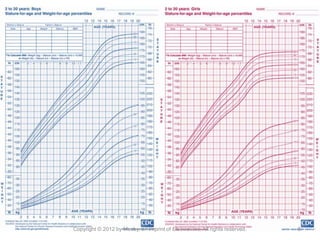
Copyright © 2012 by Mosby, an imprint of Elsevier Inc. All rights reserved. 8
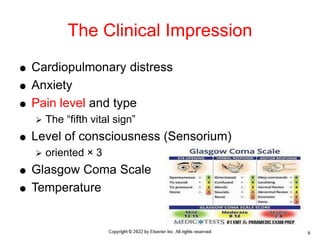
 Cardiopulmonary distress
 Anxiety
 Pain level and type
 The “fifth vital sign”
 Level of consciousness (Sensorium)
 oriented × 3
 Glasgow Coma Scale
 Temperature
The Clinical Impression
9
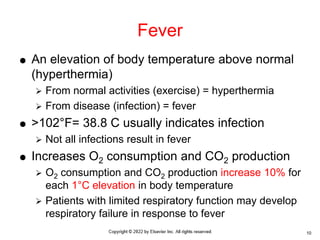
 An elevation of body temperature above normal
(hyperthermia)
 From normal activities (exercise) = hyperthermia
 From disease (infection) = fever
 >102°F= 38.8 C usually indicates infection
 Not all infections result in fever
 Increases O2 consumption and CO2 production
 O2 consumption and CO2 production increase 10% for
each 1°C elevation in body temperature
 Patients with limited respiratory function may develop
respiratory failure in response to fever
Fever
10
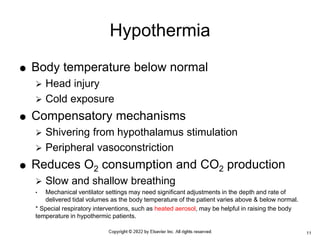
 Body temperature below normal
 Head injury
 Cold exposure
 Compensatory mechanisms
 Shivering from hypothalamus stimulation
 Peripheral vasoconstriction
 Reduces O2 consumption and CO2 production
 Slow and shallow breathing
• Mechanical ventilator settings may need significant adjustments in the depth and rate of
delivered tidal volumes as the body temperature of the patient varies above & below normal.
* Special respiratory interventions, such as heated aerosol, may be helpful in raising the body
temperature in hypothermic patients.
Hypothermia
11
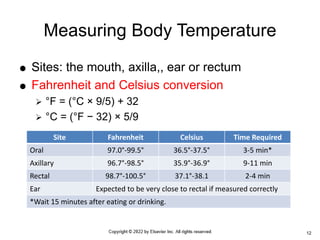
 Sites: the mouth, axilla,, ear or rectum
 Fahrenheit and Celsius conversion
 °F = (°C × 9/5) + 32
 °C = (°F − 32) × 5/9
Measuring Body Temperature
12
Site Fahrenheit Celsius Time Required
Oral 97.0°-99.5° 36.5°-37.5° 3-5 min*
Axillary 96.7°-98.5° 35.9°-36.9° 9-11 min
Rectal 98.7°-100.5° 37.1°-38.1 2-4 min
Ear Expected to be very close to rectal if measured correctly
*Wait 15 minutes after eating or drinking.
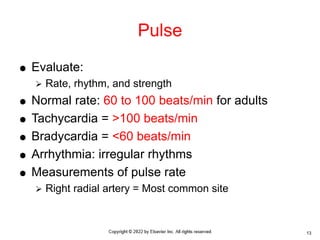
 Evaluate:
 Rate, rhythm, and strength
 Normal rate: 60 to 100 beats/min for adults
 Tachycardia = >100 beats/min
 Bradycardia = <60 beats/min
 Arrhythmia: irregular rhythms
 Measurements of pulse rate
 Right radial artery = Most common site
Pulse
13
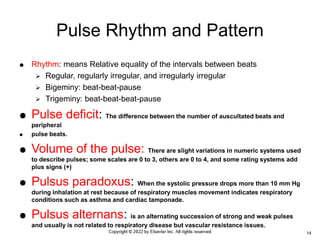
 Rhythm: means Relative equality of the intervals between beats
 Regular, regularly irregular, and irregularly irregular
 Bigeminy: beat-beat-pause
 Trigeminy: beat-beat-beat-pause
 Pulse deficit: The difference between the number of auscultated beats and
peripheral
 pulse beats.
 Volume of the pulse: There are slight variations in numeric systems used
to describe pulses; some scales are 0 to 3, others are 0 to 4, and some rating systems add
plus signs (+)
 Pulsus paradoxus: When the systolic pressure drops more than 10 mm Hg
during inhalation at rest because of respiratory muscles movement indicates respiratory
conditions such as asthma and cardiac tamponade.
 Pulsus alternans: is an alternating succession of strong and weak pulses
and usually is not related to respiratory disease but vascular resistance issues.
Pulse Rhythm and Pattern
14
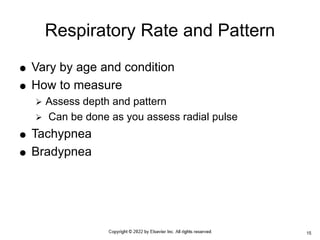
 Vary by age and condition
 How to measure
 Assess depth and pattern
 Can be done as you assess radial pulse
 Tachypnea
 Bradypnea
Respiratory Rate and Pattern
15
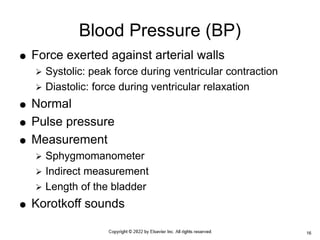
 Force exerted against arterial walls
 Systolic: peak force during ventricular contraction
 Diastolic: force during ventricular relaxation
 Normal
 Pulse pressure
 Measurement
 Sphygmomanometer
 Indirect measurement
 Length of the bladder
 Korotkoff sounds
Blood Pressure (BP)
16
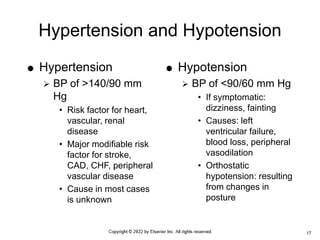
Hypertension and Hypotension
 Hypertension
 BP of >140/90 mm
Hg
• Risk factor for heart,
vascular, renal
disease
• Major modifiable risk
factor for stroke,
CAD, CHF, peripheral
vascular disease
• Cause in most cases
is unknown
 Hypotension
 BP of <90/60 mm Hg
• If symptomatic:
dizziness, fainting
• Causes: left
ventricular failure,
blood loss, peripheral
vasodilation
• Orthostatic
hypotension: resulting
from changes in
posture
17
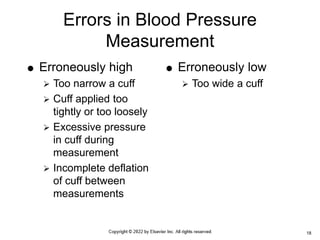
Errors in Blood Pressure
Measurement
 Erroneously high
 Too narrow a cuff
 Cuff applied too
tightly or too loosely
 Excessive pressure
in cuff during
measurement
 Incomplete deflation
of cuff between
measurements
 Erroneously low
 Too wide a cuff
18
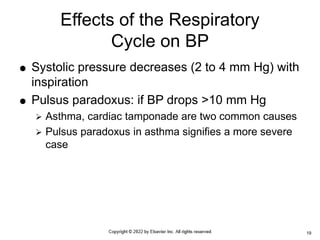
 Systolic pressure decreases (2 to 4 mm Hg) with
inspiration
 Pulsus paradoxus: if BP drops >10 mm Hg
 Asthma, cardiac tamponade are two common causes
 Pulsus paradoxus in asthma signifies a more severe
case
Effects of the Respiratory
Cycle on BP
19

Vital Signs..........................pptx

  • 1.
  • 2.
     Vital signs(VS) are used to:  Determine the general status of the patient  Establish a baseline  Monitor response to therapy  Observe for trends  Determine the need for further evaluation or intervention Overview 2
  • 3.
     Four classicVS  Temperature  Pulse  Respirations  Blood pressure  Additional observations  Height and weight  Level of consciousness and responsiveness (sensorium)  Level and type of pain  General clinical impression  Pulse oximetry  Electrocardiogram (ECG) Obtaining VS and Clinical Impression 3
  • 4.
     Frequency  Baselinemeasurement  For acutely ill inpatients in the ICU  Patients with conditions affecting only selected organ systems  Certain procedures may determine frequency  VS should always be monitored and recorded as often as necessary VS Measurement 4
  • 5.
     Isolated measurementprovides limited information  Normal VS for a patient depends on:  Age  Presence of chronic disease  Treatment protocols  Trend = baseline + measurements over time  Multiple-day graph Monitoring Vital Sign Trends 5
  • 6.
     Shows changein patient’s condition  Comparing changes in VS, signs, and symptoms  Establishing differential diagnosis • Comparing multiple signs and symptoms to arrive at the patient’s diagnosis  Determining if patient is improving or deteriorating  Key to expert assessment:  Look at the patient, listen, touch, question, validate, reassess, analyze, and trend Comparing VS Information 6
  • 7.
     Routinely measured If hospitalized = admission weight  Document in kilograms (1 kg = 2.2 lb)  Follow up every 24 to 48 h  Dehydration or fluid overload • Follow the intake/output (I&O) chart.  Scales must be age-appropriate and regularly calibrated Height and Weight 7
  • 8.
    Copyright © 2012by Mosby, an imprint of Elsevier Inc. All rights reserved. 8
  • 9.
     Cardiopulmonary distress Anxiety  Pain level and type  The “fifth vital sign”  Level of consciousness (Sensorium)  oriented × 3  Glasgow Coma Scale  Temperature The Clinical Impression 9
  • 10.
     An elevationof body temperature above normal (hyperthermia)  From normal activities (exercise) = hyperthermia  From disease (infection) = fever  >102°F= 38.8 C usually indicates infection  Not all infections result in fever  Increases O2 consumption and CO2 production  O2 consumption and CO2 production increase 10% for each 1°C elevation in body temperature  Patients with limited respiratory function may develop respiratory failure in response to fever Fever 10
  • 11.
     Body temperaturebelow normal  Head injury  Cold exposure  Compensatory mechanisms  Shivering from hypothalamus stimulation  Peripheral vasoconstriction  Reduces O2 consumption and CO2 production  Slow and shallow breathing • Mechanical ventilator settings may need significant adjustments in the depth and rate of delivered tidal volumes as the body temperature of the patient varies above & below normal. * Special respiratory interventions, such as heated aerosol, may be helpful in raising the body temperature in hypothermic patients. Hypothermia 11
  • 12.
     Sites: themouth, axilla,, ear or rectum  Fahrenheit and Celsius conversion  °F = (°C × 9/5) + 32  °C = (°F − 32) × 5/9 Measuring Body Temperature 12 Site Fahrenheit Celsius Time Required Oral 97.0°-99.5° 36.5°-37.5° 3-5 min* Axillary 96.7°-98.5° 35.9°-36.9° 9-11 min Rectal 98.7°-100.5° 37.1°-38.1 2-4 min Ear Expected to be very close to rectal if measured correctly *Wait 15 minutes after eating or drinking.
  • 13.
     Evaluate:  Rate,rhythm, and strength  Normal rate: 60 to 100 beats/min for adults  Tachycardia = >100 beats/min  Bradycardia = <60 beats/min  Arrhythmia: irregular rhythms  Measurements of pulse rate  Right radial artery = Most common site Pulse 13
  • 14.
     Rhythm: meansRelative equality of the intervals between beats  Regular, regularly irregular, and irregularly irregular  Bigeminy: beat-beat-pause  Trigeminy: beat-beat-beat-pause  Pulse deficit: The difference between the number of auscultated beats and peripheral  pulse beats.  Volume of the pulse: There are slight variations in numeric systems used to describe pulses; some scales are 0 to 3, others are 0 to 4, and some rating systems add plus signs (+)  Pulsus paradoxus: When the systolic pressure drops more than 10 mm Hg during inhalation at rest because of respiratory muscles movement indicates respiratory conditions such as asthma and cardiac tamponade.  Pulsus alternans: is an alternating succession of strong and weak pulses and usually is not related to respiratory disease but vascular resistance issues. Pulse Rhythm and Pattern 14
  • 15.
     Vary byage and condition  How to measure  Assess depth and pattern  Can be done as you assess radial pulse  Tachypnea  Bradypnea Respiratory Rate and Pattern 15
  • 16.
     Force exertedagainst arterial walls  Systolic: peak force during ventricular contraction  Diastolic: force during ventricular relaxation  Normal  Pulse pressure  Measurement  Sphygmomanometer  Indirect measurement  Length of the bladder  Korotkoff sounds Blood Pressure (BP) 16
  • 17.
    Hypertension and Hypotension Hypertension  BP of >140/90 mm Hg • Risk factor for heart, vascular, renal disease • Major modifiable risk factor for stroke, CAD, CHF, peripheral vascular disease • Cause in most cases is unknown  Hypotension  BP of <90/60 mm Hg • If symptomatic: dizziness, fainting • Causes: left ventricular failure, blood loss, peripheral vasodilation • Orthostatic hypotension: resulting from changes in posture 17
  • 18.
    Errors in BloodPressure Measurement  Erroneously high  Too narrow a cuff  Cuff applied too tightly or too loosely  Excessive pressure in cuff during measurement  Incomplete deflation of cuff between measurements  Erroneously low  Too wide a cuff 18
  • 19.
     Systolic pressuredecreases (2 to 4 mm Hg) with inspiration  Pulsus paradoxus: if BP drops >10 mm Hg  Asthma, cardiac tamponade are two common causes  Pulsus paradoxus in asthma signifies a more severe case Effects of the Respiratory Cycle on BP 19