Visualizing Global Citiesa dynamic tool for exploring indices of citiesSeth FlaxmanÉcole Polytechnique Fédérale de LausanneJoint workwith Jeffrey Huang, Xavier Comtesse, & John Stephenson
ThinkStudio
www.cityrank.ch
1. cities2. city data3. our tool4. future research
cities
Source: NASA Visible Earth
Source: NASA GSFC, MITI, ERSDAC, JAROS, and U.S./Japan ASTER Science Team
city datastatistics, indicators, network
Source: Nicolas Nova on Flickr
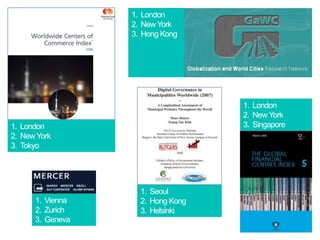
LondonNew YorkHong KongLondonNew YorkSingaporeLondonNew YorkTokyoSeoulHong KongHelsinkiViennaZurichGeneva
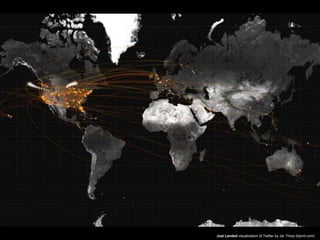
Just Landed visualization of Twitter by Jer Thorp (blprnt.com)
our toolwhat, how, why
www.cityrank.ch
Credit: Hubsquircle by Clearly Ambiguous  on Flickr
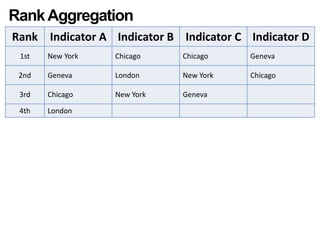
Rank Aggregation
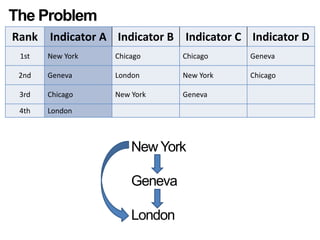
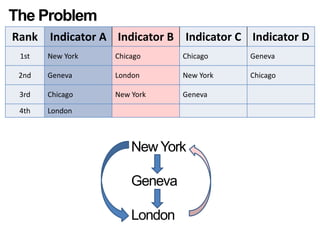
The ProblemNew YorkGenevaLondon
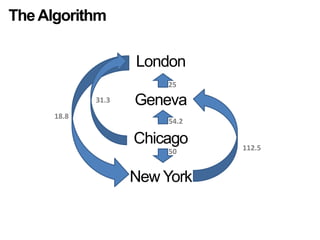
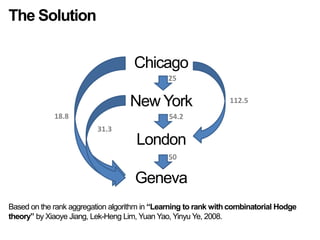
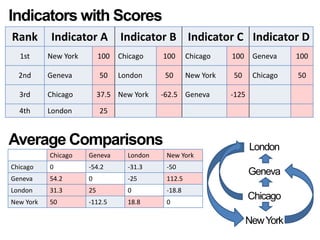
The AlgorithmLondonGenevaChicagoNew York2531.318.854.2112.550
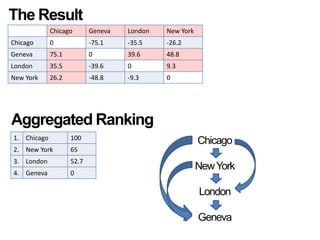
The SolutionChicagoNew YorkLondonGeneva25112.518.854.231.350Based on the rank aggregation algorithm in “Learning to rank with combinatorial Hodge theory” by Xiaoye Jiang, Lek-Heng Lim, Yuan Yao, Yinyu Ye, 2008.
future researchacademics, policy makers, designers
conclusions
www.cityrank.ch
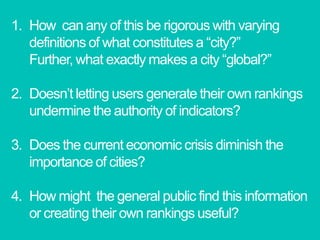
How  can any of this be rigorous with varying definitions of what constitutes a “city?”  Further, what exactly makes a city “global?”Doesn’t letting users generate their own rankings undermine the authority of indicators?Does the current economic crisis diminish the importance of cities?How might  the general public find this information or creating their own rankings useful?
referencesState of the World's Cities 2008-2009: Harmonious Cities, United Nations Human Settlements Programme, October 2008, www.unhabitat.orgGlobalization and World Cities Research Network, www.lboro.ac.uk/gawcLearning to rank with combinatorial Hodge theory, www.arxiv.orgMore online: www.cityrank.ch/learn
Indicators with ScoresLondonGenevaChicagoNew YorkAverage Comparisons
The ResultAggregated RankingChicagoNew YorkLondonGeneva

CityRank.ch: Visualizing Global Cities

Editor's Notes

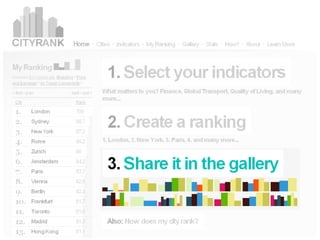
  • #4 You can find CityRank online at www.cityrank.ch. I’ll show a live demo a bit later, but in short, the idea of CityRank is that it is a repository of data on cities and it allows users to interact with this data by building their own rankings of cities. Here’s a view of the gallery of CityRank where various users have saved the rankings of cities that they created.
  • #5 Now let me give you a brief outline of my talk.I’m going to talk about cities, why they’re interesting, why we should care about them, and why they’re becoming increasingly important in understanding the world.I am going to talk about the various types of data available on cities.Of course, I’m going to talk more about our tool, CityRank.If you are playing with it right now online, remember you will have plenty of time after my talk. Finally, I’ll end with some thoughts for future research.
  • #6 Now, why cities?
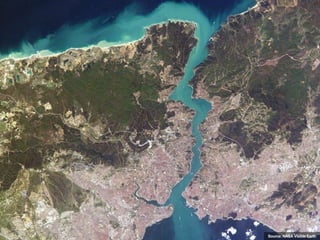
  • #7 This is a photograph of Istanbul from space. The land mass that you see on the left is Europe, the land mass you see on the right is Asia.Istanbul and its surrounding urban area have a population of 12.5 million, larger than the country of Greece. The reddish-gray patches are the result of centuries of urban sprawl;A settlement from 6500 BCE was discovered recently during construction of a rail tunnel in the city, linking Europe and Asia.How can we understand this region’s role connecting two continents? Istanbul has been a bridge between east and west much longer than this region has been a part of the modern State of Turkey, so we would not want to answer this question by looking at Turkey. Istanbul has been part of other large political bodies over its long history, empires have come and gone over thousands of years. What has remained is the city and what has been constant about the city, even as its name and rulers have changed, is its role as a connector. In the network of the cities of the world, Istanbul has a role to play because of its unique geography, and it continues to play that role as an important world city, the modern state of Turkey aside.
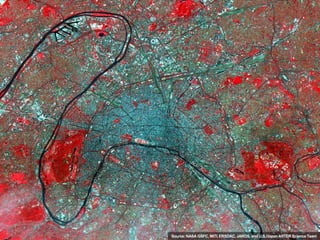
  • #8 So let’s return to today and where we are right now. This is Paris from space. The UN is calling the 21st century the ”Century of the City” -- last year as you’ve probably heard for the first time in human history more than 50% of the world’s population was living in cities. [source: State of the World’s Cities 2008/2009 - Harmonious Cities – http://www.unhabitat.org/pmss/getPage.asp?page=bookView&book=2562] By 2050, the world’s population as a whole is projected to be 70% urban.Cities are where we live and where we work. They’re where we make policy and where we make art. Cities are where politcal activity is organized. Cities are where economic activity is generated and cities are also where greenhouse gases are generated. I am not arguing that states do not matter; they do, but cities matter as well, and the way they are organized effects half the world’s population at least. They’re worth trying to understand.
  • #9 Towards that end, let me talk about what sorts of data are available on cities, sources we considered drawing upon in creating a ranking of cities, which is let me remind you, where this all is headed. The take away message from this section is that as a whole, the body of data on the world’s cities is sorely lacking.
  • #10 Now first, as you might expect, there are indeed a great deal of statistics on cities.Cities collect these statistics themselves, countries collect data on their cities, and of course NGOs, academics, and other organizations contribute as well. There are at least two challenging problems with city statistics.The first problem is in definitions. What’s a city? Urban agglomerations, metropolitan areas, and even city boundaries are not precise terms, which makes talking about the population of a city hard. And if population is hard, consider an index of higher education in which we assign institutions to cities—this assignment is not always obvious; we might all agree that Harvard and MIT belong with Boston, not Cambridge, but does my school, 60 kms from Geneva and in another canton belong with Geneva?The second problem is in the usability and compare-ability of data. Even if cities or organizations have data to share, the task of assembling relevant, accurate data collected using the same methodology on a comprehensive set of the cities of the world is very hard.For this second problem, we believe that with the Internet there is a great, if unrealized, potential for coordination and collaboration, and we’re hoping CityRank can spur that.
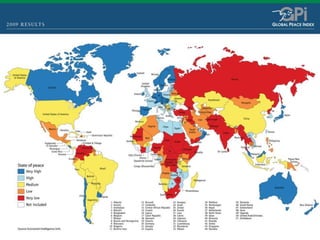
  • #11 Moving from statistics to indicators, which are usually based in whole or in part on statistics. There are dozens if not hundreds of indicators for countries. Shown here is the is 2009 Global Peace Index. These types of indicators garner a lot of media attention and cover a lot of ground. [Source: http://www.visionofhumanity.org/gpi/]These indicators are most useful when they’re updated regularly, their methodologies are transparent, and the input data sources and final results are freely available. So what about indicators for cities? Unfortunately, the number of city indicators is quite limited, especially when compared to the number of country indicators. And few are regularly updated. There are no more than two dozen city indicators out there.There’s a caveat to what I’m saying, which is that if you’re interested in specific countries, like the United States, or if you’re interested in cities within the European Union, say, then there are indicators out there. But the situation is bleak for the world as a whole.
  • #12 So what is out there? And how good is it? Many if not most indicators are created by consulting groups for industry, so often full data is only available at a prohibitive price for researchers, and even if some data is available to the public, methodologies are often not published. For example, the consulting group Mercer compiles a Quality of Living Index every year, garnering press headlines for the 50 top cities. But as they readily admit, their stated goal is to help “governments and major companies place employees” not the kind of focus that would be useful for comparing the quality of life in cities for inhabitants in general.The City of London publishes a Global Financial Centres Index and MasterCard publishes a Worldwide Centers of Commerce Index.There is some academic work as well, like the Digital Governance in Municipalities Worldwide study and the various academic studies from the Globalization and World Cities Research Network at Loughborough University.But the problem is clear--where are the indicators on cultural production or innovation? Intellectual and academic achievements? Environmental sustainability? Health of residents?They just don’t exist. Yet. But we’re hoping someone will create them, and we’re hoping CityRank can help with that.
  • #13 So I’ve told you about indicators and statistics, and the problems with both when it comes to cities.A final point I’d like to mention is that indicators and statistics are themselves limited in understanding the roles that world cities play in the network of cities. PJ Taylor of the World Cities Research Network makes the critical point that the correct analytical methodology is not to look inside a city, and count the number of lawyers or bankers or NGOs. Instead, it’s to look at a city’s position in the network of cities around the globe. Analyzing position in a network means looking at the connections, the ties, between cities. Alas, this data is in very short supply. There is data on flights between airports, a nice visualization of which is shown here, there’s data on Multinational Corporation headquarters and their branches and there’s data on advanced service firms. But that’s basically it. So in sum, there’s stats but there’s plenty of space for more and better coordination, there’s indicators, but not many and not with good coverage, and there’s network data, which I just told you about.
  • #14 OK. Now I will turn to our contribution, the CityRank tool. Our research had three goals:- First, we wanted to get a handle on the problems with city data I just outlined, share that knowledge with others, and begin thinking about a framework for collaboration to address those problemsSecond, we hope that CityRank is an example of empowering users to interact with data that is meaningful to them in straightforward waysThird, we wanted to experiment with the idea of rank aggregation and specifically with a new algorithm that was just published in the last year