simulanis.com
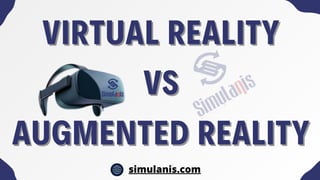
VIRTUAL REALITY
VIRTUAL REALITY
VS
VS
AUGMENTED REALITY
AUGMENTED REALITY
Exploring the Divide:
Understanding the Differences
Between Virtual Reality and
Augmented Reality with
Simulanis
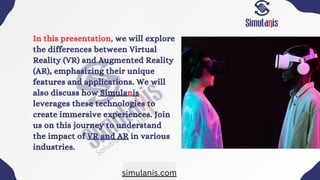
In this presentation, we will explore
the differences between Virtual
Reality (VR) and Augmented Reality
(AR), emphasizing their unique
features and applications. We will
also discuss how Simulanis
leverages these technologies to
create immersive experiences. Join
us on this journey to understand
the impact of VR and AR in various
industries.
simulanis.com
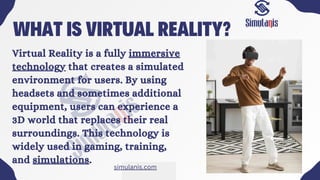
WHAT IS VIRTUAL REALITY?
Virtual Reality is a fully immersive
technology that creates a simulated
environment for users. By using
headsets and sometimes additional
equipment, users can experience a
3D world that replaces their real
surroundings. This technology is
widely used in gaming, training,
and simulations.
simulanis.com
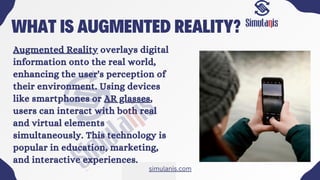
WHAT IS AUGMENTED REALITY?
Augmented Reality overlays digital
information onto the real world,
enhancing the user's perception of
their environment. Using devices
like smartphones or AR glasses,
users can interact with both real
and virtual elements
simultaneously. This technology is
popular in education, marketing,
and interactive experiences.
simulanis.com
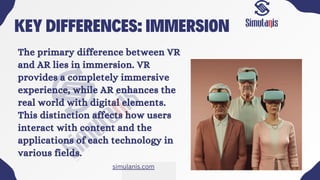
KEY DIFFERENCES: IMMERSION
The primary difference between VR
and AR lies in immersion. VR
provides a completely immersive
experience, while AR enhances the
real world with digital elements.
This distinction affects how users
interact with content and the
applications of each technology in
various fields.
simulanis.com
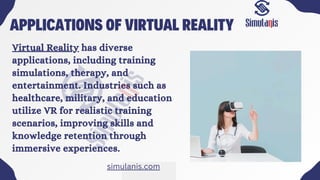
APPLICATIONS OF VIRTUAL REALITY
Virtual Reality has diverse
applications, including training
simulations, therapy, and
entertainment. Industries such as
healthcare, military, and education
utilize VR for realistic training
scenarios, improving skills and
knowledge retention through
immersive experiences.
simulanis.com
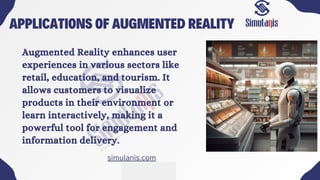
APPLICATIONS OF AUGMENTED REALITY
Augmented Reality enhances user
experiences in various sectors like
retail, education, and tourism. It
allows customers to visualize
products in their environment or
learn interactively, making it a
powerful tool for engagement and
information delivery.
simulanis.com
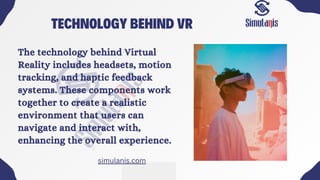
TECHNOLOGY BEHIND VR
The technology behind Virtual
Reality includes headsets, motion
tracking, and haptic feedback
systems. These components work
together to create a realistic
environment that users can
navigate and interact with,
enhancing the overall experience.
simulanis.com
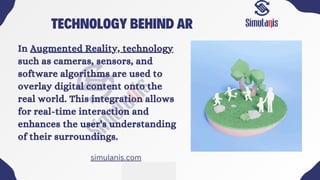
TECHNOLOGY BEHIND AR
In Augmented Reality, technology
such as cameras, sensors, and
software algorithms are used to
overlay digital content onto the
real world. This integration allows
for real-time interaction and
enhances the user's understanding
of their surroundings.
simulanis.com
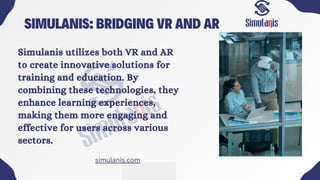
SIMULANIS: BRIDGING VR AND AR
Simulanis utilizes both VR and AR
to create innovative solutions for
training and education. By
combining these technologies, they
enhance learning experiences,
making them more engaging and
effective for users across various
sectors.
simulanis.com
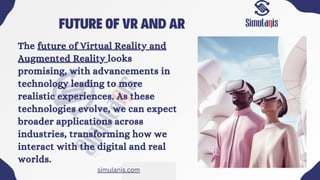
FUTURE OF VR AND AR
The future of Virtual Reality and
Augmented Reality looks
promising, with advancements in
technology leading to more
realistic experiences. As these
technologies evolve, we can expect
broader applications across
industries, transforming how we
interact with the digital and real
worlds.
simulanis.com
CONCLUSION
In conclusion, understanding the differences between
Virtual Reality and Augmented Reality is crucial for
leveraging their unique capabilities. As demonstrated
by Simulanis, both technologies have the potential to
revolutionize learning and engagement across various
fields, paving the way for innovative solutions.
simulanis.com
THANK YOU
Contact Information for Simulanis Solutions
Thank you for your participation today! If you have any further inquiries or need
additional information about Virtual Reality vs. Augmented Reality, please feel
free to reach out. You can contact us at:
Email: support@simulanis.com
Phone: +91 999 091 2140
Website: www.simulanis.com

virtual reality vs augmented reality Simulanis.pdf

  • 1.
  • 2.
    Exploring the Divide: Understandingthe Differences Between Virtual Reality and Augmented Reality with Simulanis
  • 3.
    In this presentation,we will explore the differences between Virtual Reality (VR) and Augmented Reality (AR), emphasizing their unique features and applications. We will also discuss how Simulanis leverages these technologies to create immersive experiences. Join us on this journey to understand the impact of VR and AR in various industries. simulanis.com
  • 4.
    WHAT IS VIRTUALREALITY? Virtual Reality is a fully immersive technology that creates a simulated environment for users. By using headsets and sometimes additional equipment, users can experience a 3D world that replaces their real surroundings. This technology is widely used in gaming, training, and simulations. simulanis.com
  • 5.
    WHAT IS AUGMENTEDREALITY? Augmented Reality overlays digital information onto the real world, enhancing the user's perception of their environment. Using devices like smartphones or AR glasses, users can interact with both real and virtual elements simultaneously. This technology is popular in education, marketing, and interactive experiences. simulanis.com
  • 6.
    KEY DIFFERENCES: IMMERSION Theprimary difference between VR and AR lies in immersion. VR provides a completely immersive experience, while AR enhances the real world with digital elements. This distinction affects how users interact with content and the applications of each technology in various fields. simulanis.com
  • 7.
    APPLICATIONS OF VIRTUALREALITY Virtual Reality has diverse applications, including training simulations, therapy, and entertainment. Industries such as healthcare, military, and education utilize VR for realistic training scenarios, improving skills and knowledge retention through immersive experiences. simulanis.com
  • 8.
    APPLICATIONS OF AUGMENTEDREALITY Augmented Reality enhances user experiences in various sectors like retail, education, and tourism. It allows customers to visualize products in their environment or learn interactively, making it a powerful tool for engagement and information delivery. simulanis.com
  • 9.
    TECHNOLOGY BEHIND VR Thetechnology behind Virtual Reality includes headsets, motion tracking, and haptic feedback systems. These components work together to create a realistic environment that users can navigate and interact with, enhancing the overall experience. simulanis.com
  • 10.
    TECHNOLOGY BEHIND AR InAugmented Reality, technology such as cameras, sensors, and software algorithms are used to overlay digital content onto the real world. This integration allows for real-time interaction and enhances the user's understanding of their surroundings. simulanis.com
  • 11.
    SIMULANIS: BRIDGING VRAND AR Simulanis utilizes both VR and AR to create innovative solutions for training and education. By combining these technologies, they enhance learning experiences, making them more engaging and effective for users across various sectors. simulanis.com
  • 12.
    FUTURE OF VRAND AR The future of Virtual Reality and Augmented Reality looks promising, with advancements in technology leading to more realistic experiences. As these technologies evolve, we can expect broader applications across industries, transforming how we interact with the digital and real worlds. simulanis.com
  • 13.
    CONCLUSION In conclusion, understandingthe differences between Virtual Reality and Augmented Reality is crucial for leveraging their unique capabilities. As demonstrated by Simulanis, both technologies have the potential to revolutionize learning and engagement across various fields, paving the way for innovative solutions. simulanis.com
  • 14.
    THANK YOU Contact Informationfor Simulanis Solutions Thank you for your participation today! If you have any further inquiries or need additional information about Virtual Reality vs. Augmented Reality, please feel free to reach out. You can contact us at: Email: support@simulanis.com Phone: +91 999 091 2140 Website: www.simulanis.com