Influenza Virus
Infection
Ahmad Kabrah
Ayoub Al Othaim
Wassem Al-zamzami
Outline
• Etiology
• Virus structure
• Type of Influenza
• Antigenic shift and
drift
• Pathogenesis
• Clinical features
• Symptoms
• Complication
• Transmission
• Epidemiology
• Diagnosis
• Treatment
• prevention
• Influenza vaccine
Etiology
• There are three genera of influenza viruses: influenza
virus A, influenza virus B and influenza virus C.
• These viruses are also called type A, type B and type C
influenza viruses.
• This subtype based on hemagglutinin (H) and
neuraminindase (N) protein.
Virus structure
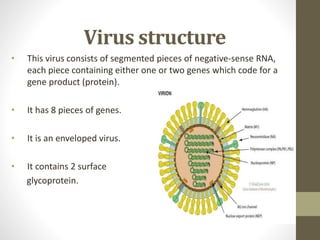
• This virus consists of segmented pieces of negative-sense RNA,
each piece containing either one or two genes which code for a
gene product (protein).
• It has 8 pieces of genes.
• It is an enveloped virus.
• It contains 2 surface
glycoprotein.
Influenza A viruses
• Influenza A viruses include avian, swine, equine and canine
influenza viruses, as well as the human influenza A viruses
• Influenza A viruses are classified into subtypes based on two
surface antigens, the hemagglutinin (H) and neuraminidase
(N) proteins.
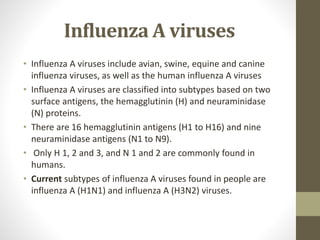
• There are 16 hemagglutinin antigens (H1 to H16) and nine
neuraminidase antigens (N1 to N9).
• Only H 1, 2 and 3, and N 1 and 2 are commonly found in
humans.
• Current subtypes of influenza A viruses found in people are
influenza A (H1N1) and influenza A (H3N2) viruses.
Influenza A viruses
• Swine influenza is a respiratory disease of pigs causes by type
A influenza virus.
• Swine influenza viruses changing among swine and causes
new virus can infect humans.
• Influenza change may be occur by antigenic drift or antigenic
shift.
Antigenic shift and drift in
influenza A viruses
Antigenic Drift
• It is small changes in the virus that happen continually and
slowly over time. Antigenic drift produces new virus strains
that may not be recognized by the body's immune system. This
is one of the main reasons why people can get the flu more
than one time.
• In most years, one or two of the three virus strains in the
influenza vaccine are updated to keep up with the changes in
the circulating flu viruses. So, people who want to be protected
from flu need to get a flu shot every year.
Antigenic Shift
• Antigenic shift results when two different flu strains combine
and infect the same cell.
• It is an abrupt, major change in the influenza viruses, resulting
in new hemagglutinin and/or new hemagglutinin and
neuraminidase proteins in influenza viruses that infect
humans.
• Shift allows flu viruses to move from animals to humans. An
example of that is H1N1 virus which occurred in the spring of
2009.
Influenza B viruses
• Influenza B viruses are known to circulate only in human
populations.
• These viruses can cause epidemics, but they have not, to date,
been responsible for pandemics.
• They have also been found rarely in animals.
• Influenza B viruses are categorized into lineages rather than
subtypes.
• They are also classified into strains.
• Influenza B viruses undergo antigenic drift, though it occurs
more slowly than in influenza A viruses.
Influenza B viruses
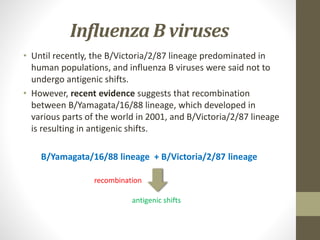
• Until recently, the B/Victoria/2/87 lineage predominated in
human populations, and influenza B viruses were said not to
undergo antigenic shifts.
• However, recent evidence suggests that recombination
between B/Yamagata/16/88 lineage, which developed in
various parts of the world in 2001, and B/Victoria/2/87 lineage
is resulting in antigenic shifts.
B/Yamagata/16/88 lineage + B/Victoria/2/87 lineage
recombination
antigenic shifts
Influenza C viruses
• Influenza C viruses circulate in human populations, and are
mainly associated with disease in people.
• Until recently, they had never been linked to large-scale
epidemics.
• Influenza C viruses have also been found in animals.
• They are classified into strains. Each strain is antigenically
stable, and accumulates few changes over time.
Pathogenesis
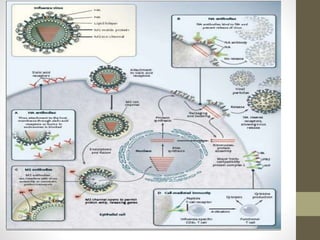
• Following respiratory transmission, the virus
attaches to and penetrates respiratory
epithelial cells in the trachea and bronchi.
• Viral replication occurs, which results in the
destruction of the host cell.
• Viremia has rarely been documented.
• Virus is shed in respiratory secretions for 5–
10 days.
Clinical Features
• Incubation period 2 days (range 1-4 days)
• Severity of illness depends on prior
experience with related variants
• Abrupt onset of fever, myalgia, sore throat,
nonproductive cough, headache
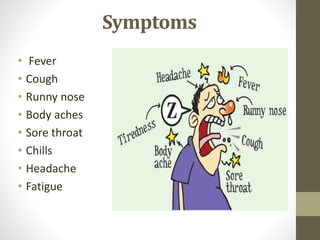
Symptoms
• Fever
• Cough
• Runny nose
• Body aches
• Sore throat
• Chills
• Headache
• Fatigue
Influenza Complications
 Many people with flu have had vomiting and diarrhea.
 Flu can cause neurologic symptoms in children can be
very severe often fatal.
 The severity of symptoms sometimes require
hospitalization.
 In some cases, severe complications such as pneumonia
and respiratory failure can cause death.
 Death 0.5-1 per 1,000 cases
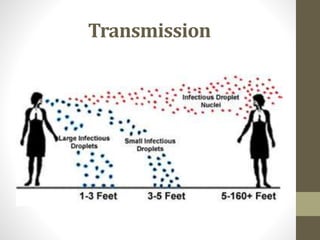
Transmission
Influenza Epidemiology
• Reservoir - Human, animals (type A only)
• Transmission - Respiratory Probably
airborne
• Temporal pattern - Peak December - March
in temperate climate May occur earlier or
later
• Communicability - 1 day before to 5 days
after onset (adults)
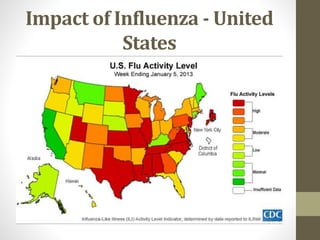
Impact of Influenza - United
States
Impact of Influenza
• Highest rates of complications and
hospitalization among young children and
person > or =65 years
• Average of >200,000 influenza-related excess
hospitalizations
• 57% of hospitalizations among persons <65
years of age
• Greater number of hospitalizations during
type A (H3N2) epidemics
Diagnosis
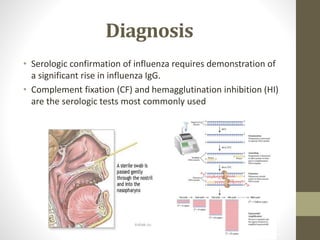
• The diagnosis of influenza is usually suspected on the basis of
characteristic clinical findings, particularly if influenza has
been reported in the community.
• Human influenza A and influenza B infections can be
diagnosed by virus isolation or by the detection of antigens or
nucleic acids .
• The viruses can be isolated in cell lines or chicken embryos
with identification by hemagglutination and neuraminidase
inhibition tests or RT-PCR
• Antigens can be detected in respiratory secretions by
immunofluorescence or enzyme-linked immunosorbent assays
(ELISAs).
Diagnosis
• Serologic confirmation of influenza requires demonstration of
a significant rise in influenza IgG.
• Complement fixation (CF) and hemagglutination inhibition (HI)
are the serologic tests most commonly used
TREATMENT
• Most people with the flu recover within one to two weeks
without treatment. However, serious complications of the flu
can occur.
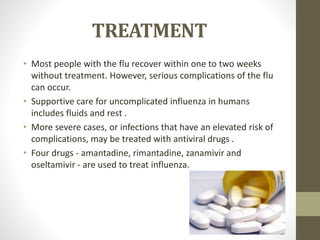
• Supportive care for uncomplicated influenza in humans
includes fluids and rest .
• More severe cases, or infections that have an elevated risk of
complications, may be treated with antiviral drugs .
• Four drugs - amantadine, rimantadine, zanamivir and
oseltamivir - are used to treat influenza.
Outbreak detection
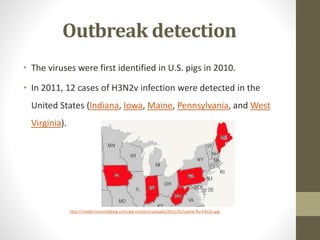
• The viruses were first identified in U.S. pigs in 2010.
• In 2011, 12 cases of H3N2v infection were detected in the
United States (Indiana, Iowa, Maine, Pennsylvania, and West
Virginia).
http://modernsurvivalblog.com/wp-content/uploads/2012/01/swine-flu-h3n2v.jpg
Recent Outbreak Detection
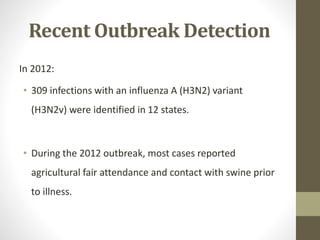
In 2012:
• 309 infections with an influenza A (H3N2) variant
(H3N2v) were identified in 12 states.
• During the 2012 outbreak, most cases reported
agricultural fair attendance and contact with swine prior
to illness.
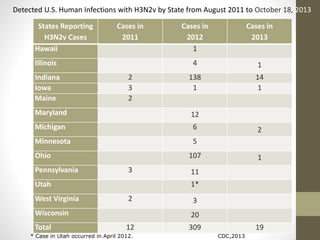
States Reporting
H3N2v Cases
Cases in
2011
Cases in
2012
Cases in
2013
Hawaii 1
Illinois 4 1
Indiana 2 138 14
Iowa 3 1 1
Maine 2
Maryland 12
Michigan 6 2
Minnesota 5
Ohio 107 1
Pennsylvania 3 11
Utah 1*
West Virginia 2 3
Wisconsin 20
Total 12 309 19
Detected U.S. Human Infections with H3N2v by State from August 2011 to October 18, 2013
* Case in Utah occurred in April 2012. CDC,2013
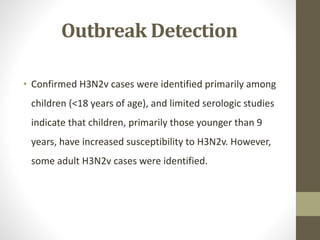
Outbreak Detection
• Confirmed H3N2v cases were identified primarily among
children (<18 years of age), and limited serologic studies
indicate that children, primarily those younger than 9
years, have increased susceptibility to H3N2v. However,
some adult H3N2v cases were identified.

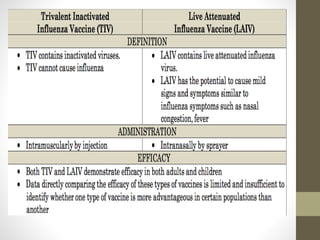
Influenza virus vaccine
• A vaccine is a biological preparation that improves immunity
to a particular disease.
• Two types of influenza vaccine are available in the United
States. Trivalent inactivated influenza vaccine (TIV) and Live
attenuated influenza vaccine (LAIV).
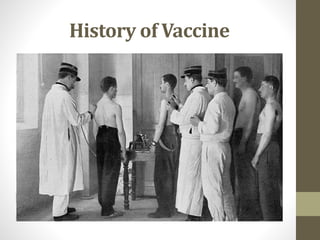
History of Vaccine
Vaccine effectiveness
• Effectiveness is variable from year to year and among
populations
•  Generally lower than routine EPI vaccines
 Factors that affect true vaccine effectiveness
•  Antigenic relatedness between vaccine virus to circulating
strains
•  Host factors
 Age (immune responses in very young and very old) 
Underlying illnesses
•  Vaccine type
 Programmatic issues
Challenges
• Expanding or introducing influenza vaccine programs is
challenging:
• Variety of vaccine products/types
• Developing policy requires a solid evidence base
• (e.g. risk groups, timing of campaign)
• Most risk groups are not those targeted by routine EPI
vaccines – new partners, training, etc.
• Communicating value is complicated
• Need for annual vaccination
Gaps
• Most partners need education on the need / value of the
vaccine
• Relative benefit of annual campaigns in countries with
substantial year-round disease is poorly understood
• Relatively few data on the performance of vaccine in
developing country populations
• Disease burden and economic burden (or CE of vaccine)
poorly understood in many places (but data being generated
quickly)
• NRAs gaining experience with approval of influenza vaccines
Opportunities
• New developers and producers of influenza vaccines
• – Capacity has increased dramatically and will continue to
• Interest in influenza prevention post-pandemic – Will wane
quickly though
• Substantial and high quality surveillance and disease burden
data now available for most countries
• New WHO SAGE recommendations to use vaccine
References
• Influenza Vaccines for the Future
Linda C. Lambert, Ph.D., and Anthony S. Fauci, M.D.
• http://www.who.int/influenza/GIP_InfluenzaVirusInfectionsHu
mans_Jul13.pdf?ua=1.
• CDC.com
• Medical Microbiology and Immunology 8th edition
• http://www.cdc.gov/flu/about/viruses/types.htm
virology last .pptx

virology last .pptx

  • 1.
  • 2.
    Outline • Etiology • Virusstructure • Type of Influenza • Antigenic shift and drift • Pathogenesis • Clinical features • Symptoms • Complication • Transmission • Epidemiology • Diagnosis • Treatment • prevention • Influenza vaccine
  • 3.
    Etiology • There arethree genera of influenza viruses: influenza virus A, influenza virus B and influenza virus C. • These viruses are also called type A, type B and type C influenza viruses. • This subtype based on hemagglutinin (H) and neuraminindase (N) protein.
  • 4.
    Virus structure • Thisvirus consists of segmented pieces of negative-sense RNA, each piece containing either one or two genes which code for a gene product (protein). • It has 8 pieces of genes. • It is an enveloped virus. • It contains 2 surface glycoprotein.
  • 5.
    Influenza A viruses •Influenza A viruses include avian, swine, equine and canine influenza viruses, as well as the human influenza A viruses • Influenza A viruses are classified into subtypes based on two surface antigens, the hemagglutinin (H) and neuraminidase (N) proteins. • There are 16 hemagglutinin antigens (H1 to H16) and nine neuraminidase antigens (N1 to N9). • Only H 1, 2 and 3, and N 1 and 2 are commonly found in humans. • Current subtypes of influenza A viruses found in people are influenza A (H1N1) and influenza A (H3N2) viruses.
  • 6.
    Influenza A viruses •Swine influenza is a respiratory disease of pigs causes by type A influenza virus. • Swine influenza viruses changing among swine and causes new virus can infect humans. • Influenza change may be occur by antigenic drift or antigenic shift.
  • 7.
    Antigenic shift anddrift in influenza A viruses Antigenic Drift • It is small changes in the virus that happen continually and slowly over time. Antigenic drift produces new virus strains that may not be recognized by the body's immune system. This is one of the main reasons why people can get the flu more than one time. • In most years, one or two of the three virus strains in the influenza vaccine are updated to keep up with the changes in the circulating flu viruses. So, people who want to be protected from flu need to get a flu shot every year.
  • 8.
    Antigenic Shift • Antigenicshift results when two different flu strains combine and infect the same cell. • It is an abrupt, major change in the influenza viruses, resulting in new hemagglutinin and/or new hemagglutinin and neuraminidase proteins in influenza viruses that infect humans. • Shift allows flu viruses to move from animals to humans. An example of that is H1N1 virus which occurred in the spring of 2009.
  • 10.
    Influenza B viruses •Influenza B viruses are known to circulate only in human populations. • These viruses can cause epidemics, but they have not, to date, been responsible for pandemics. • They have also been found rarely in animals. • Influenza B viruses are categorized into lineages rather than subtypes. • They are also classified into strains. • Influenza B viruses undergo antigenic drift, though it occurs more slowly than in influenza A viruses.
  • 11.
    Influenza B viruses •Until recently, the B/Victoria/2/87 lineage predominated in human populations, and influenza B viruses were said not to undergo antigenic shifts. • However, recent evidence suggests that recombination between B/Yamagata/16/88 lineage, which developed in various parts of the world in 2001, and B/Victoria/2/87 lineage is resulting in antigenic shifts. B/Yamagata/16/88 lineage + B/Victoria/2/87 lineage recombination antigenic shifts
  • 12.
    Influenza C viruses •Influenza C viruses circulate in human populations, and are mainly associated with disease in people. • Until recently, they had never been linked to large-scale epidemics. • Influenza C viruses have also been found in animals. • They are classified into strains. Each strain is antigenically stable, and accumulates few changes over time.
  • 13.
    Pathogenesis • Following respiratorytransmission, the virus attaches to and penetrates respiratory epithelial cells in the trachea and bronchi. • Viral replication occurs, which results in the destruction of the host cell. • Viremia has rarely been documented. • Virus is shed in respiratory secretions for 5– 10 days.
  • 15.
    Clinical Features • Incubationperiod 2 days (range 1-4 days) • Severity of illness depends on prior experience with related variants • Abrupt onset of fever, myalgia, sore throat, nonproductive cough, headache
  • 16.
    Symptoms • Fever • Cough •Runny nose • Body aches • Sore throat • Chills • Headache • Fatigue
  • 17.
    Influenza Complications  Manypeople with flu have had vomiting and diarrhea.  Flu can cause neurologic symptoms in children can be very severe often fatal.  The severity of symptoms sometimes require hospitalization.  In some cases, severe complications such as pneumonia and respiratory failure can cause death.  Death 0.5-1 per 1,000 cases
  • 18.
  • 19.
    Influenza Epidemiology • Reservoir- Human, animals (type A only) • Transmission - Respiratory Probably airborne • Temporal pattern - Peak December - March in temperate climate May occur earlier or later • Communicability - 1 day before to 5 days after onset (adults)
  • 20.
    Impact of Influenza- United States
  • 21.
    Impact of Influenza •Highest rates of complications and hospitalization among young children and person > or =65 years • Average of >200,000 influenza-related excess hospitalizations • 57% of hospitalizations among persons <65 years of age • Greater number of hospitalizations during type A (H3N2) epidemics
  • 22.
    Diagnosis • The diagnosisof influenza is usually suspected on the basis of characteristic clinical findings, particularly if influenza has been reported in the community. • Human influenza A and influenza B infections can be diagnosed by virus isolation or by the detection of antigens or nucleic acids . • The viruses can be isolated in cell lines or chicken embryos with identification by hemagglutination and neuraminidase inhibition tests or RT-PCR • Antigens can be detected in respiratory secretions by immunofluorescence or enzyme-linked immunosorbent assays (ELISAs).
  • 23.
    Diagnosis • Serologic confirmationof influenza requires demonstration of a significant rise in influenza IgG. • Complement fixation (CF) and hemagglutination inhibition (HI) are the serologic tests most commonly used
  • 24.
    TREATMENT • Most peoplewith the flu recover within one to two weeks without treatment. However, serious complications of the flu can occur. • Supportive care for uncomplicated influenza in humans includes fluids and rest . • More severe cases, or infections that have an elevated risk of complications, may be treated with antiviral drugs . • Four drugs - amantadine, rimantadine, zanamivir and oseltamivir - are used to treat influenza.
  • 26.
    Outbreak detection • Theviruses were first identified in U.S. pigs in 2010. • In 2011, 12 cases of H3N2v infection were detected in the United States (Indiana, Iowa, Maine, Pennsylvania, and West Virginia). http://modernsurvivalblog.com/wp-content/uploads/2012/01/swine-flu-h3n2v.jpg
  • 27.
    Recent Outbreak Detection In2012: • 309 infections with an influenza A (H3N2) variant (H3N2v) were identified in 12 states. • During the 2012 outbreak, most cases reported agricultural fair attendance and contact with swine prior to illness.
  • 28.
    States Reporting H3N2v Cases Casesin 2011 Cases in 2012 Cases in 2013 Hawaii 1 Illinois 4 1 Indiana 2 138 14 Iowa 3 1 1 Maine 2 Maryland 12 Michigan 6 2 Minnesota 5 Ohio 107 1 Pennsylvania 3 11 Utah 1* West Virginia 2 3 Wisconsin 20 Total 12 309 19 Detected U.S. Human Infections with H3N2v by State from August 2011 to October 18, 2013 * Case in Utah occurred in April 2012. CDC,2013
  • 29.
    Outbreak Detection • ConfirmedH3N2v cases were identified primarily among children (<18 years of age), and limited serologic studies indicate that children, primarily those younger than 9 years, have increased susceptibility to H3N2v. However, some adult H3N2v cases were identified.
  • 30.
    Influenza virus vaccine •A vaccine is a biological preparation that improves immunity to a particular disease. • Two types of influenza vaccine are available in the United States. Trivalent inactivated influenza vaccine (TIV) and Live attenuated influenza vaccine (LAIV).
  • 32.
  • 33.
    Vaccine effectiveness • Effectivenessis variable from year to year and among populations •  Generally lower than routine EPI vaccines  Factors that affect true vaccine effectiveness •  Antigenic relatedness between vaccine virus to circulating strains •  Host factors  Age (immune responses in very young and very old)  Underlying illnesses •  Vaccine type  Programmatic issues
  • 34.
    Challenges • Expanding orintroducing influenza vaccine programs is challenging: • Variety of vaccine products/types • Developing policy requires a solid evidence base • (e.g. risk groups, timing of campaign) • Most risk groups are not those targeted by routine EPI vaccines – new partners, training, etc. • Communicating value is complicated • Need for annual vaccination
  • 35.
    Gaps • Most partnersneed education on the need / value of the vaccine • Relative benefit of annual campaigns in countries with substantial year-round disease is poorly understood • Relatively few data on the performance of vaccine in developing country populations • Disease burden and economic burden (or CE of vaccine) poorly understood in many places (but data being generated quickly) • NRAs gaining experience with approval of influenza vaccines
  • 36.
    Opportunities • New developersand producers of influenza vaccines • – Capacity has increased dramatically and will continue to • Interest in influenza prevention post-pandemic – Will wane quickly though • Substantial and high quality surveillance and disease burden data now available for most countries • New WHO SAGE recommendations to use vaccine
  • 37.
    References • Influenza Vaccinesfor the Future Linda C. Lambert, Ph.D., and Anthony S. Fauci, M.D. • http://www.who.int/influenza/GIP_InfluenzaVirusInfectionsHu mans_Jul13.pdf?ua=1. • CDC.com • Medical Microbiology and Immunology 8th edition • http://www.cdc.gov/flu/about/viruses/types.htm

Editor's Notes

  • #29 This chart indicates the number of CDC-reported infections with H3N2v variant influenza A viruses since August 2011 and is current as of October 18, 2013. This case count will be updated each Friday as new cases are reported.