The OSI Model:A
Comprehensive Guide
This presentation will explore the Open Systems Interconnection (OSI)
model. We will discuss its history, benefits, and each of its seven layers.
The OSI model standardizes network communication, improving
interoperability.
by Mahendra Subedi
2.
Application Layer: TheUser Interface
What it does
The application layer is the closest to the end-user. It
provides network access to applications.
• Enables user interaction
• Supports protocols like HTTP, SMTP, and FTP
Examples
Web browsers like Chrome and Firefox use HTTP to access
websites.
Email clients such as Outlook and Gmail use SMTP to send
emails.
3.
Presentation Layer: DataTransformation
Translation
Translates data between different systems.
Encryption
Secures data using protocols like SSL/TLS.
Compression
Reduces data size for efficient transmission.
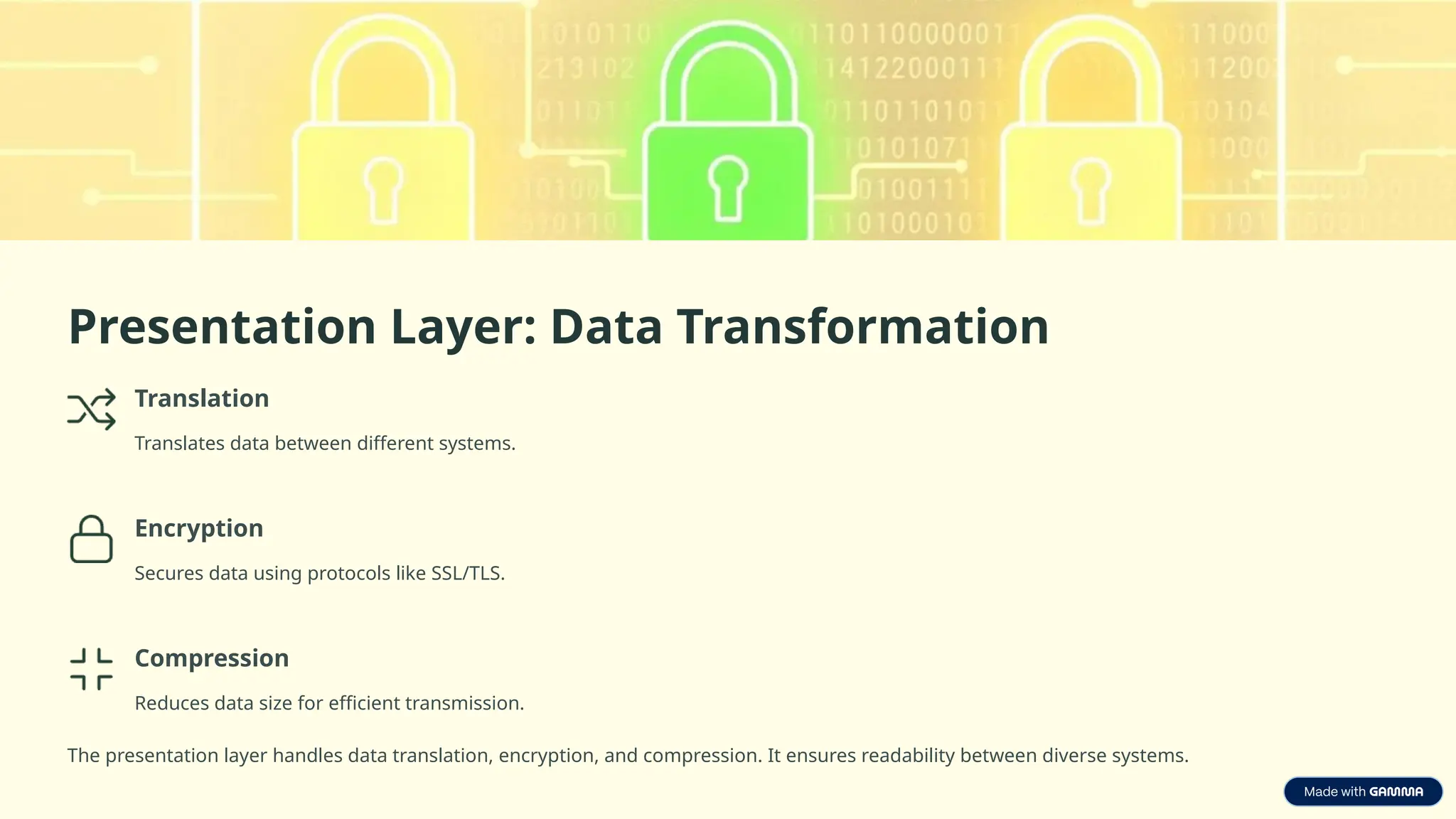
The presentation layer handles data translation, encryption, and compression. It ensures readability between diverse systems.
4.
Session Layer: Connection
Management
Establish
Setsup connections between applications.
Maintain
Keeps connections active during data transfer.
Terminate
Closes connections after data transfer.
The session layer manages connections between applications. It establishes,
maintains, and terminates sessions.
5.
Transport Layer: Reliable
DataTransfer
TCP
Connection-oriented protocol
for reliable delivery.
UDP
Connectionless protocol for
fast, but less reliable, transfer.
Segmentation
Breaks data into smaller segments.
The transport layer ensures reliable data transfer between endpoints.
TCP and UDP are key protocols.
6.
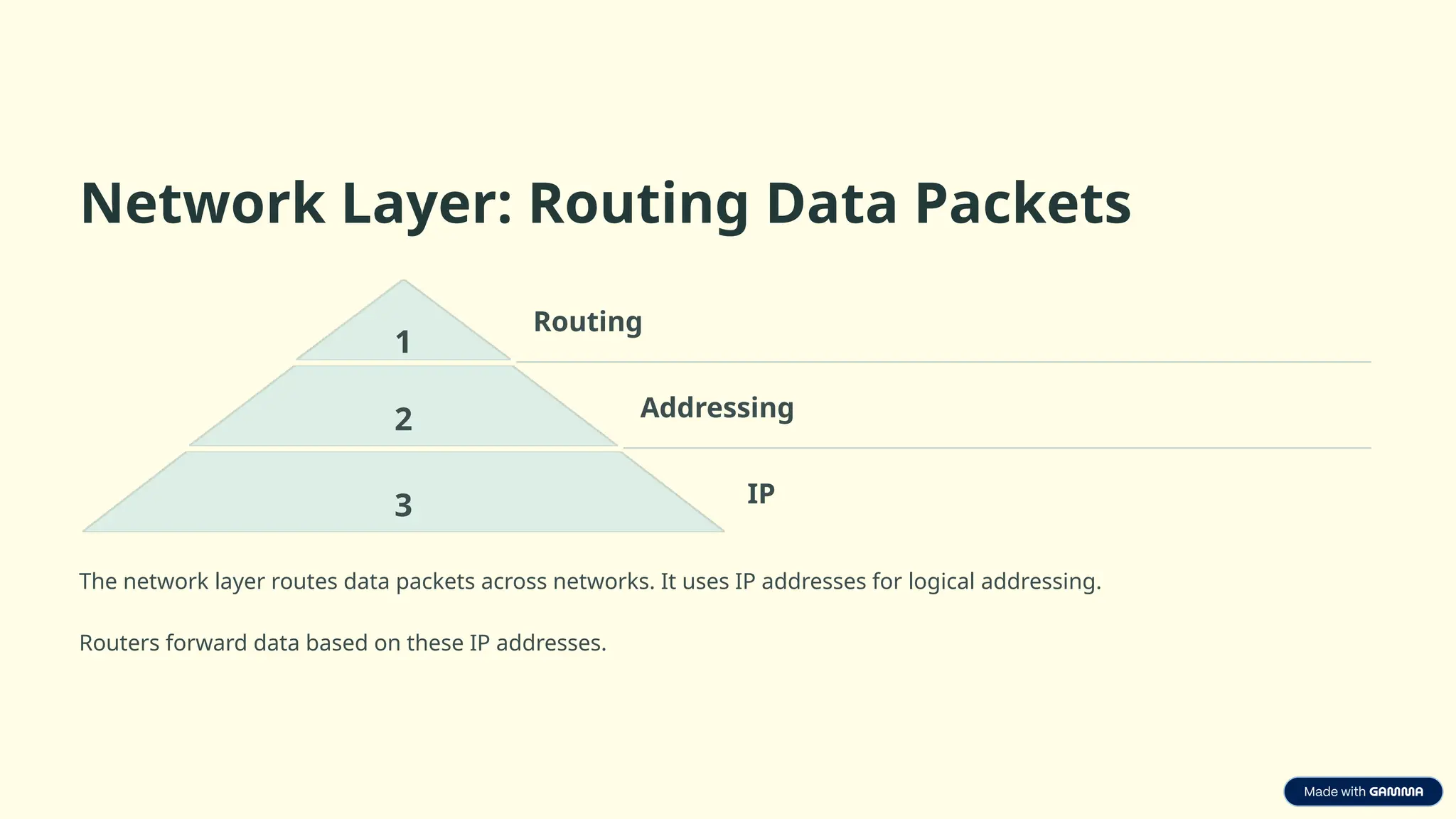
Network Layer: RoutingData Packets
1
Routing
2 Addressing
3 IP
The network layer routes data packets across networks. It uses IP addresses for logical addressing.
Routers forward data based on these IP addresses.
7.
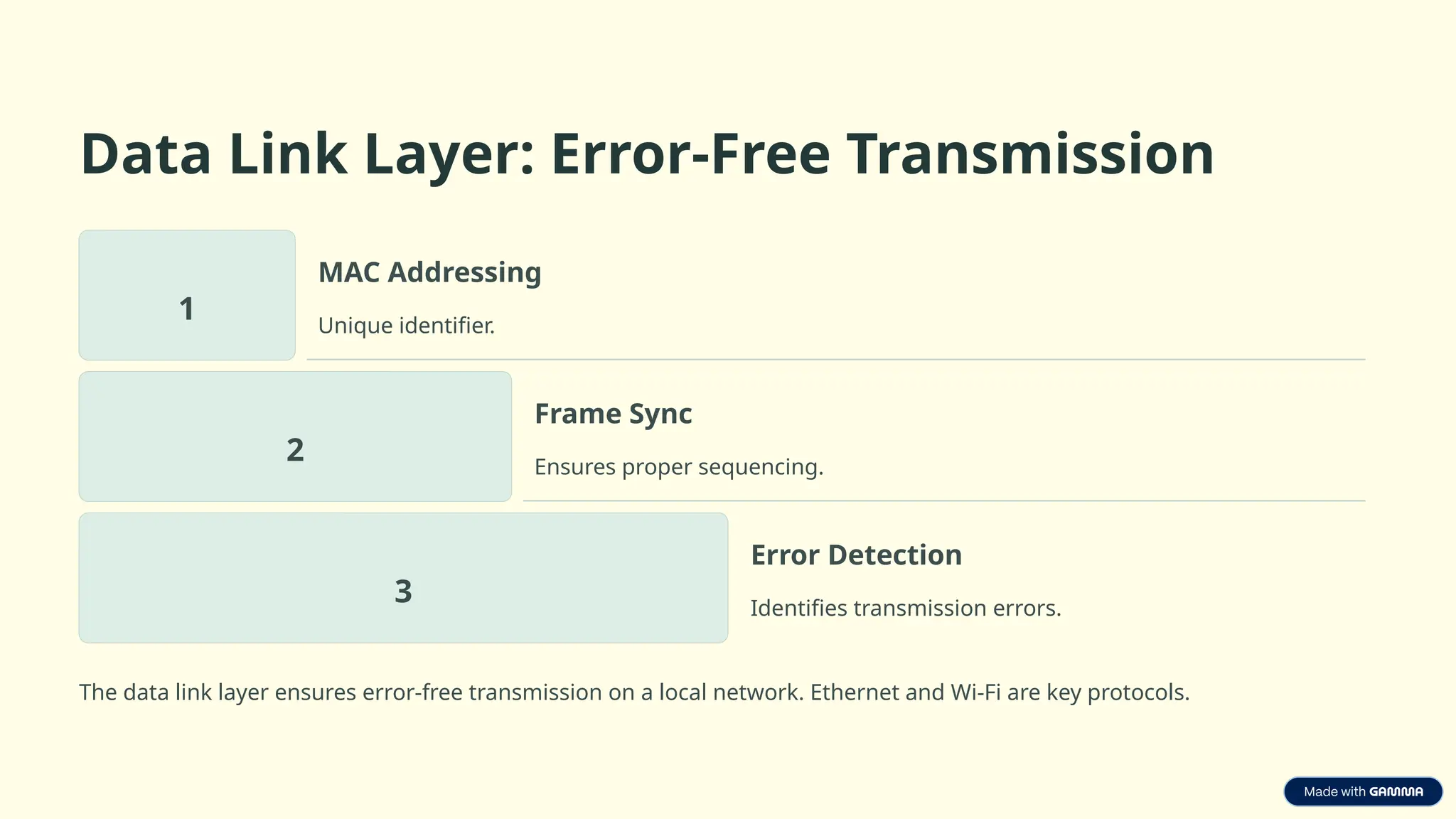
Data Link Layer:Error-Free Transmission
1
MAC Addressing
Unique identifier.
2
Frame Sync
Ensures proper sequencing.
3
Error Detection
Identifies transmission errors.
The data link layer ensures error-free transmission on a local network. Ethernet and Wi-Fi are key protocols.
8.
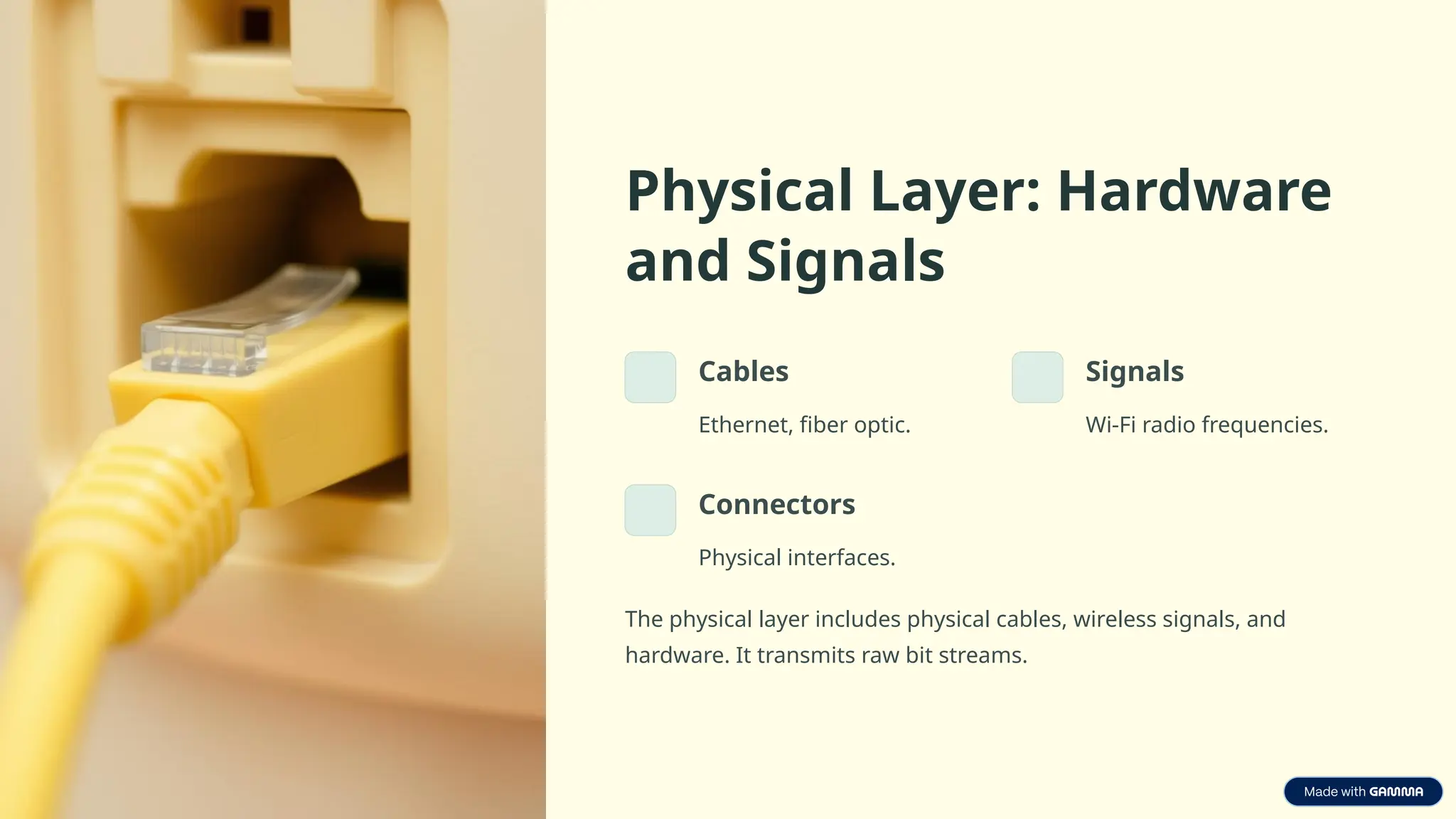
Physical Layer: Hardware
andSignals
Cables
Ethernet, fiber optic.
Signals
Wi-Fi radio frequencies.
Connectors
Physical interfaces.
The physical layer includes physical cables, wireless signals, and
hardware. It transmits raw bit streams.