--
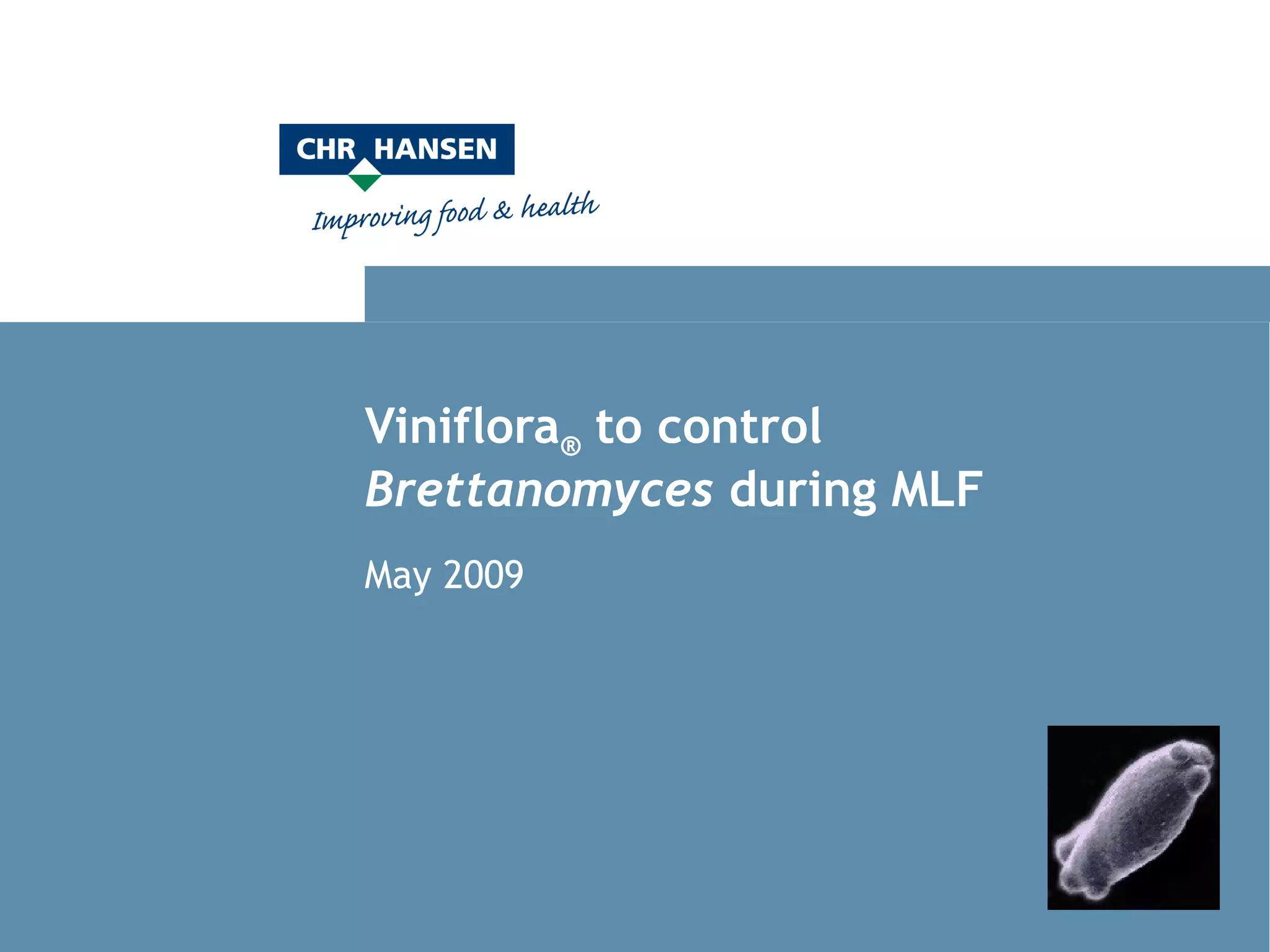
Viniflora® to control Brettanomyces during MLF
What is ‘Brett’?
Brettanomyces sp. are yeast species found in wineries and wine
Is extremely challenging to remove once present
Contaminates wine mainly by producing:
‘off-flavours’
Biogenic amines
Those ‘off-flavours’ heavily reduce your chances of sales successes
in some growing markets (UK, USA, North Europe…)
Brett contamination a serious problem in some regions
Malolactic fermentation (MLF) seen as most critical process
in controlling Brett
The effects of Brett in wine
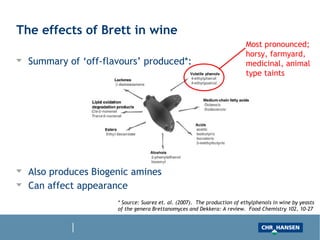
Summary of ‘off-flavours’ produced*:
Also produces Biogenic amines
Can affect appearance
Most pronounced;
horsy, farmyard,
medicinal, animal
type taints
* Source: Suarez et. al. (2007). The production of ethylphenols in wine by yeasts
of the genera Brettanomyces and Dekkera: A review. Food Chemistry 102, 10-27
Curative vs. preventative solutions
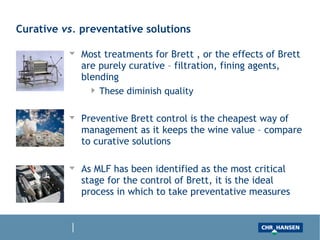
Most treatments for Brett , or the effects of Brett are purely curative – filtration, fining
agents, blending
These diminish quality
Preventive Brett control is the cheapest way of management as it keeps the wine value –
compare to curative solutions
As MLF has been identified as the most critical stage for the control of Brett, it is the ideal
process in which to take preventative measures
Why MLF to control Brett?
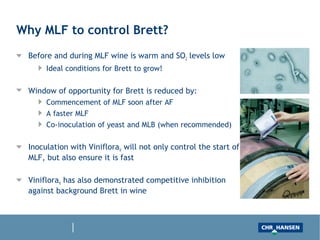
Before and during MLF wine is warm and SO2 levels low
Ideal conditions for Brett to grow!
Window of opportunity for Brett is reduced by:
Commencement of MLF soon after AF
A faster MLF
Co-inoculation of yeast and MLB (when recommended)
Inoculation with Viniflora® will not only control the start of
MLF, but also ensure it is fast
Viniflora® has also demonstrated competitive inhibition
against background Brett in wine
Case study: spontaneous MLF and Brett
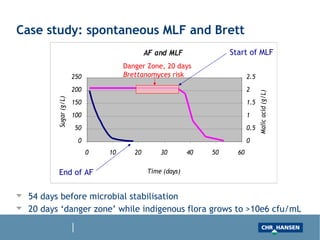
54 days before microbial stabilisation
20 days ‘danger zone’ while indigenous flora grows to >1E+06 cfu/mL
AF and MLF
0
50
100
150
200
250
0 10 20 30 40 50 60
Time (days)
Sugar(g/L)
0
0.5
1
1.5
2
2.5
Malicacid(g/L)
End of AF
Start of MLF
Danger Zone, 20 days
Brettanomyces risk
AF and MLF
0
50
100
150
200
250
0 10 20 30 40 50 60
Time (days)
Sugar(g/L)
0
0.5
1
1.5
2
2.5
Malicacid(g/L)
Case study: MLF managed with Viniflora®
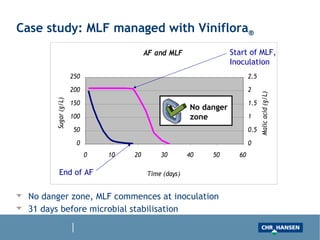
No danger zone, MLF commences at inoculation
31 days before microbial stabilisation
End of AF
Start of MLF,
Inoculation
No danger
zone
Other factors…..
Other factors are also important to control Brett:
Commercial yeast is recommended for a clean and efficient primary fermentation
Prevents Brett becoming established during AF
Use Chr. Hansen range of yeasts selected to give complexity and facilitate MLF
(very low production of SO2 for instance)
High standard of hygiene is required including thorough barrel cleaning and
management
Ensures background levels of Brett in winery are kept low
Thank you for your attention!
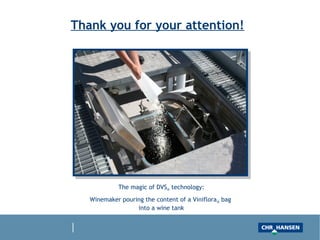
The magic of DVS® technology:
Winemaker pouring the content of a Viniflora® bag of malolactic
cultures ready for real direct inoculation
into a wine tank

Viniflora® to control Brettanomyces during MLF

  • 1.
    -- Viniflora® to controlBrettanomyces during MLF
  • 2.
    What is ‘Brett’? Brettanomycessp. are yeast species found in wineries and wine Is extremely challenging to remove once present Contaminates wine mainly by producing: ‘off-flavours’ Biogenic amines Those ‘off-flavours’ heavily reduce your chances of sales successes in some growing markets (UK, USA, North Europe…) Brett contamination a serious problem in some regions Malolactic fermentation (MLF) seen as most critical process in controlling Brett
  • 3.
    The effects ofBrett in wine Summary of ‘off-flavours’ produced*: Also produces Biogenic amines Can affect appearance Most pronounced; horsy, farmyard, medicinal, animal type taints * Source: Suarez et. al. (2007). The production of ethylphenols in wine by yeasts of the genera Brettanomyces and Dekkera: A review. Food Chemistry 102, 10-27
  • 4.
    Curative vs. preventativesolutions Most treatments for Brett , or the effects of Brett are purely curative – filtration, fining agents, blending These diminish quality Preventive Brett control is the cheapest way of management as it keeps the wine value – compare to curative solutions As MLF has been identified as the most critical stage for the control of Brett, it is the ideal process in which to take preventative measures
  • 5.
    Why MLF tocontrol Brett? Before and during MLF wine is warm and SO2 levels low Ideal conditions for Brett to grow! Window of opportunity for Brett is reduced by: Commencement of MLF soon after AF A faster MLF Co-inoculation of yeast and MLB (when recommended) Inoculation with Viniflora® will not only control the start of MLF, but also ensure it is fast Viniflora® has also demonstrated competitive inhibition against background Brett in wine
  • 6.
    Case study: spontaneousMLF and Brett 54 days before microbial stabilisation 20 days ‘danger zone’ while indigenous flora grows to >1E+06 cfu/mL AF and MLF 0 50 100 150 200 250 0 10 20 30 40 50 60 Time (days) Sugar(g/L) 0 0.5 1 1.5 2 2.5 Malicacid(g/L) End of AF Start of MLF Danger Zone, 20 days Brettanomyces risk
  • 7.
    AF and MLF 0 50 100 150 200 250 010 20 30 40 50 60 Time (days) Sugar(g/L) 0 0.5 1 1.5 2 2.5 Malicacid(g/L) Case study: MLF managed with Viniflora® No danger zone, MLF commences at inoculation 31 days before microbial stabilisation End of AF Start of MLF, Inoculation No danger zone
  • 8.
    Other factors….. Other factorsare also important to control Brett: Commercial yeast is recommended for a clean and efficient primary fermentation Prevents Brett becoming established during AF Use Chr. Hansen range of yeasts selected to give complexity and facilitate MLF (very low production of SO2 for instance) High standard of hygiene is required including thorough barrel cleaning and management Ensures background levels of Brett in winery are kept low
  • 9.
    Thank you foryour attention! The magic of DVS® technology: Winemaker pouring the content of a Viniflora® bag of malolactic cultures ready for real direct inoculation into a wine tank