FASHION STORY
V
ikram Phadnis, the man who courted fame by
stealing hearts with his diaphanous ethnic
designs, recently completed twenty five
successful years in the sartorial heaven. In a recent
heart-to-heart with the suave designer of the block,
he enlightened us with all the reasons why the
journey as a fashion designer has been a delightful
ride for him. We also took this opportunity to dive
into the details of ‘Adhvan’. With Amitabh Bachchan
as the show stopper, Vikram’s latest couture
collection that was presented at JW Marriot
Mumbai, witnessed applauds, that could have
lasted the entire night, by the most prominent
fashion innovators of the industry.
❏ How and when did the journey as a fashion designer
begin for you?
It all started in 1988, but it was after a year of anticipation in
1989, when I finally experienced the ‘right’ moment in the
industry. In the initial part of my years, I started as a
professional fashion choreographer for shows, events and
other designers. Eventually, I moved onto where I probably
always belonged – fashion designing.
❏ How drastically do you think the industry has
changed since you joined?
The industry has changed in many ways ever since, not just
one. The whole platform that the designers get in today’s
date, the infrastructure, the visibility, the opportunity to
graduate in a course of designing, or looking at it as a
possible profession for the future is impeccable. Fashion did
not have its grandeur or importance that it enjoys today. In
today’s world, everybody has become quite aware and
conscious about what they wear and how they look. I have
seen the whole gamut of it, since the yesteryears and when I
see it today, I feel glad to realise that fashion has gained a lot
more importance.
❏ How did you get your first break in the industry?
I got my first celebrity project with the Bajaj Garment
Manufacturing Association. It was a beautiful experience.
The kind of visibility and freedom of expression it offered to
me was incredible for my career. I was allowed to play with
25Celebrating
in the Sartorial Heaven
years
Fashion Story:Fashion & Style 3.qxd 2/15/2016 2:19 PM Page 2
the light, sound and music. For me it was overwhelming.
Although the experience was not that challenging, I was not
really certain of taking it up as a full time career.
❏ How do you think the international fashion industry
has been influencing Indian Fashion?
I think we have been influencing them. They come to us for
embroidery. All the hand work you see in some of the best
designers’ of abroad, happens in our country. I do Indian
clothes so I am really not influenced by the western world,
but I think the western world depends on us for a lot like
fabric, embroidery and more that we don’t even
acknowledge or recognise.
❏ What has been your most memorable moment in the
industry so far?
It was the time when I started working with Salman Khan,
because that firmly rooted the fact that I would not give up
on what I do. I think the experience of working with Salman
gave me the foothold and confirmation that I would continue
in this industry because I finally had somebody supporting
me and backing up my work.
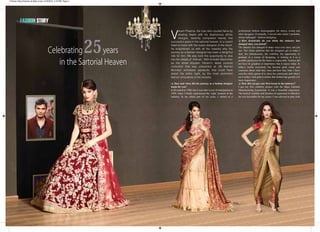
❏ Tell us something about your latest clothing line.
It is called “Adhvan” meaning the journey of 25 years. The
entire line is done in beige gold, peaches and maroon shades.
It’s all very light and easy, and dreamy for the brides to be
and there’s nothing fussy about the clothing line. It’s for the
modern bride, it is not the typical lehenga choli. It’s couture
and it’s a mix and blend of everything I saw during my
experience in the industry for the last 25 years.
❏ What makes your collection stand out in the world of
ethnic wear?
I think the idea is not to stand out. The idea is to have your
own idea. In today’s date one can compare whose collection
is better than whom. Nobody can be consistent in winning
the limelight. We are all doing good work, but sometimes it
ends up to be bad work and I really believe there are different
phases that we go through. My line is very practical, and it is
always for the buyer to choose, but essentially the whole idea
behind my designs is to stand out in terms of practicality and
affordability. People have always had this question, whether
they can wear the clothes of the runway to one of their
events. My clothing line tries to answer their needs with a
‘yes’ every time.
❏ You are renowned for creating masterpieces in the
ethnic wear industry. From where do you derive the
inspiration for your collections?
I don’t work on any particular inspiration. I am a commercial
designer. I don’t do two collections a year. I don’t design
according to fashion weeks. I do collections when I feel I
want to get into the market with my sense of style. I believe
in selling clothes to the men and women of today’s
generation who enjoy wearing an epitome of style on a daily
basis and not the kind who pick up a couture to wear it one
time in a year. I make the efforts to understand the sartorial
needs of my target audience, and suffice to what is expected
out of my collections. My collections are for all the lovers of
fashion to wear and flaunt.
❏ Given an opportunity to revolutionise the ethnic
fashion industry, what are the changes you would like to
bring to it?
The things where I would like to bring in a positive change
would be the infrastructure and recognising the embroidery
work of the artisans. I feel we must make measures to retain
and acknowledge the efforts made behind the embroidery in
clothing because it’s on the verge of extinction today. As far
as I have noticed, the embroidery experts do not take
interest in watching their sons grow into an embroidery
person anymore. One of the major reasons is that people no
longer have the accessibility to that kind of infrastructure.
The government must support the fashion industry with
projects to facilitate this work of art, through ways in which
we can look after these workers. In my opinion, this is the
need of the hour.
❏ Tell us something about the aspects from the
yesteryears that have inspired your collection so far, or
might in your upcoming couture lines.
The fashion recurring cycle phenomenon is quite prominent
in the industry. I think the two elements that inspire designers
to come up with new product lines are history and cinema.
There has not been a particular era or a period that my
collections have been inspired from so far. However, it is the
element of drama, the flamboyance of the yesteryears that
inspire most of my collections.
❏ Fashion follower or fashion innovator, what in your
opinion should one strive to be?
Definitely, a fashion innovator. Why blindly follow someone
else when you can have your own style?
❏ Your fashion tips for the brides and grooms-to-be.
Don’t simply follow a trend from the latest bridal couture
collection or your favourite celeb’s wardrobe. Don’t do
fashion that is over the top. You have to be real and get your
personality out rather than following anyone else. One
celebrity wears a particular outfit and the fans go gaga over
it because they believe that this is what improving your
fashion game is all about. I believe you got to stay real and
figure out what kind of a bride you wish to be and what are
the designs that suit your persona. ■
Actress: Nora Fatehi
Makeup & Hair: Jaywant Thakre & Shaida Sheikh
Photographer: Hitesh Kaneria
Jewellery: Anmol Jewellers
Location Courtesy : Krasaa by Vikram Phadnis
Fashion Story:Fashion & Style 3.qxd 2/15/2016 2:19 PM Page 4

Vikram phadnis

  • 1.
    FASHION STORY V ikram Phadnis,the man who courted fame by stealing hearts with his diaphanous ethnic designs, recently completed twenty five successful years in the sartorial heaven. In a recent heart-to-heart with the suave designer of the block, he enlightened us with all the reasons why the journey as a fashion designer has been a delightful ride for him. We also took this opportunity to dive into the details of ‘Adhvan’. With Amitabh Bachchan as the show stopper, Vikram’s latest couture collection that was presented at JW Marriot Mumbai, witnessed applauds, that could have lasted the entire night, by the most prominent fashion innovators of the industry. ❏ How and when did the journey as a fashion designer begin for you? It all started in 1988, but it was after a year of anticipation in 1989, when I finally experienced the ‘right’ moment in the industry. In the initial part of my years, I started as a professional fashion choreographer for shows, events and other designers. Eventually, I moved onto where I probably always belonged – fashion designing. ❏ How drastically do you think the industry has changed since you joined? The industry has changed in many ways ever since, not just one. The whole platform that the designers get in today’s date, the infrastructure, the visibility, the opportunity to graduate in a course of designing, or looking at it as a possible profession for the future is impeccable. Fashion did not have its grandeur or importance that it enjoys today. In today’s world, everybody has become quite aware and conscious about what they wear and how they look. I have seen the whole gamut of it, since the yesteryears and when I see it today, I feel glad to realise that fashion has gained a lot more importance. ❏ How did you get your first break in the industry? I got my first celebrity project with the Bajaj Garment Manufacturing Association. It was a beautiful experience. The kind of visibility and freedom of expression it offered to me was incredible for my career. I was allowed to play with 25Celebrating in the Sartorial Heaven years Fashion Story:Fashion & Style 3.qxd 2/15/2016 2:19 PM Page 2
  • 2.
    the light, soundand music. For me it was overwhelming. Although the experience was not that challenging, I was not really certain of taking it up as a full time career. ❏ How do you think the international fashion industry has been influencing Indian Fashion? I think we have been influencing them. They come to us for embroidery. All the hand work you see in some of the best designers’ of abroad, happens in our country. I do Indian clothes so I am really not influenced by the western world, but I think the western world depends on us for a lot like fabric, embroidery and more that we don’t even acknowledge or recognise. ❏ What has been your most memorable moment in the industry so far? It was the time when I started working with Salman Khan, because that firmly rooted the fact that I would not give up on what I do. I think the experience of working with Salman gave me the foothold and confirmation that I would continue in this industry because I finally had somebody supporting me and backing up my work. ❏ Tell us something about your latest clothing line. It is called “Adhvan” meaning the journey of 25 years. The entire line is done in beige gold, peaches and maroon shades. It’s all very light and easy, and dreamy for the brides to be and there’s nothing fussy about the clothing line. It’s for the modern bride, it is not the typical lehenga choli. It’s couture and it’s a mix and blend of everything I saw during my experience in the industry for the last 25 years. ❏ What makes your collection stand out in the world of ethnic wear? I think the idea is not to stand out. The idea is to have your own idea. In today’s date one can compare whose collection is better than whom. Nobody can be consistent in winning the limelight. We are all doing good work, but sometimes it ends up to be bad work and I really believe there are different phases that we go through. My line is very practical, and it is always for the buyer to choose, but essentially the whole idea behind my designs is to stand out in terms of practicality and affordability. People have always had this question, whether they can wear the clothes of the runway to one of their events. My clothing line tries to answer their needs with a ‘yes’ every time. ❏ You are renowned for creating masterpieces in the ethnic wear industry. From where do you derive the inspiration for your collections? I don’t work on any particular inspiration. I am a commercial designer. I don’t do two collections a year. I don’t design according to fashion weeks. I do collections when I feel I want to get into the market with my sense of style. I believe in selling clothes to the men and women of today’s generation who enjoy wearing an epitome of style on a daily basis and not the kind who pick up a couture to wear it one time in a year. I make the efforts to understand the sartorial needs of my target audience, and suffice to what is expected out of my collections. My collections are for all the lovers of fashion to wear and flaunt. ❏ Given an opportunity to revolutionise the ethnic fashion industry, what are the changes you would like to bring to it? The things where I would like to bring in a positive change would be the infrastructure and recognising the embroidery work of the artisans. I feel we must make measures to retain and acknowledge the efforts made behind the embroidery in clothing because it’s on the verge of extinction today. As far as I have noticed, the embroidery experts do not take interest in watching their sons grow into an embroidery person anymore. One of the major reasons is that people no longer have the accessibility to that kind of infrastructure. The government must support the fashion industry with projects to facilitate this work of art, through ways in which we can look after these workers. In my opinion, this is the need of the hour. ❏ Tell us something about the aspects from the yesteryears that have inspired your collection so far, or might in your upcoming couture lines. The fashion recurring cycle phenomenon is quite prominent in the industry. I think the two elements that inspire designers to come up with new product lines are history and cinema. There has not been a particular era or a period that my collections have been inspired from so far. However, it is the element of drama, the flamboyance of the yesteryears that inspire most of my collections. ❏ Fashion follower or fashion innovator, what in your opinion should one strive to be? Definitely, a fashion innovator. Why blindly follow someone else when you can have your own style? ❏ Your fashion tips for the brides and grooms-to-be. Don’t simply follow a trend from the latest bridal couture collection or your favourite celeb’s wardrobe. Don’t do fashion that is over the top. You have to be real and get your personality out rather than following anyone else. One celebrity wears a particular outfit and the fans go gaga over it because they believe that this is what improving your fashion game is all about. I believe you got to stay real and figure out what kind of a bride you wish to be and what are the designs that suit your persona. ■ Actress: Nora Fatehi Makeup & Hair: Jaywant Thakre & Shaida Sheikh Photographer: Hitesh Kaneria Jewellery: Anmol Jewellers Location Courtesy : Krasaa by Vikram Phadnis Fashion Story:Fashion & Style 3.qxd 2/15/2016 2:19 PM Page 4