1


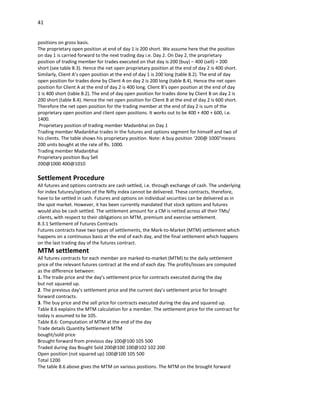
                              School of Advance Management


                                 Industrial Training Project

                                             On

                                   DERIVATIVES MARKET


                             Submitted as a partial fulfillment of
                           Post Graduate Diploma in Management
                                     Batch (2010-2012)


Faculty Guide:

Prof. neetu jain

Submitted By :

Vijay Singh Chouhan

PGDM 3rd Trim(2010-2012)
2


                                CERTIFICATE FROM FACULTY GUIDE


This is to certify that Mr.vijay singh chouhan a student of PGDM Batch (2010 -2012) Trimester II of Sanghvi
Institute of Management and Science, Indore has carried out an Industrial Training Project titled “derivative
market ”. The work done by her/him is genuine and authentic.

The work carried out by the student is found satisfactory. We wish her/him all success in career.


Signature:

Prof. neetu jain


Date:

.
3


DECLARATION


I, vijay singh chouhan student of PGDM Batch (2010 -2012), Term II of Sanghvi Institute of Management and
Science, Indore hereby declare that the work done by me during Industrial Training titled “Derivative market ” is
genuine and authentic.


Signature:

Vijay Singh Chouhan


Date:
4


ACKNOWLEDGEMENT

I sincerely and religiously acknowledge the valuable contribution of all the gem of persons who have openly and
silently left an ineradicable mark on this assignment so that they may be brought into consideration and given their
share of credit, which they genuinely and outstandingly deserve.

This expedition of assignment encountered many trials, troubles and tortures along the way. I am essentially
indebted to my guide, Prof. V.S. Gulati for this sweating learning experience. He overlooked my faults and follies,
constantly inspired and mentored via the proficient direction. It was a privilege to work under his sincere guidance.

I express my thanks to Dr. Prashant Gupta, Director, Sanghvi Institute of Management and Science, Indore for his
considerate support whenever and wherever needed. I express my indebtedness to the management of Sanghvi
Institute of Management and Science, for inspiring us to grab and utilize this opportunity.

With profound sense of gratitude, I would like to truthfully thank a recognizable number of individuals whom I
have not mentioned here, but who have visibly or invisibly facilitated in transforming this assignment into a
success saga.

Above all, I would like conscientiously thank the Omnipotent, Omnipresent and Omniscient God for his priceless
blessings!


Signature:

Vijay Singh Chouhan


Date:
5


            CONTENT
    1) Introduction of swastika[ vision,mission,strentgh]

    2) Proposed activities ,Advantage

    3) Introduction to derivatives

    4) Understanding intrest rates and stock indices

    5) Future mechanism and pricing

    6) Option contracts ,mechanism and application

    7) Pricing of option contracts and greek letters

    8) Trading of derivatives contracts

    9) Clearing and settlement

    10) Regulatory framework

    11) Accounting for derivatives

    12) Learnings

    13) Biblography


      SWASTIKA INVESTMART
       Introduction-Swastika Investmart Ltd. (Formerly known as Swastika Fin-Lease Ltd.), a Public Limited
       Company, was incorporated in 1992 with its Registered Office in Mumbai and Administrative office at
       Indore (M.P.). It was promoted by Mr. Sunil Nyati belonging to the Swastika group of Rajasthan, engaged
6


    in diversified business since 1959. In the year 1995 the company came out with a Public issue of 15 Lac
    equity shares of Rs.10/- each for cash at par,aggregating Rs.150 Lacs.

    Company profile-Swastika Investmart Ltd. (Formerly known as Swastika Fin-Lease Ltd.), a Public Limited
    Company, was incorporated in 1992 with its Registered Office in Mumbai and Administrative office at
    Indore (M.P.). It was promoted by Mr. Sunil Nyati belonging to the Swastika group of Rajasthan, engaged
    in diversified business since 1959.

    In the year 1995 the company came out with a Public issue of 15 Lac equity shares of Rs.10/- each for cash
    at par, aggregating Rs.150 Lacs. The shares of company are listed on BSE and is one of the few listed
    companies, engaged in Stock broking and Capital Markets activities.

    Since incorporation till 1998, the company was actively involved in the field of Hire Purchase and Lease
    Finance. It started the stock broking business as a sub-broker in the year 1998 and after getting the
    experience and with the blessings of its satisfied customers, it took the Corporate Membership of NSE in
    2000 and BSE in 2004. Later, it got registered with CDSL in 2006 as Depository Participant as well.

    In the year 2007 the company has acquired membership of two premier Commodity Exchanges of India,
    NCDEX and MCX through its wholly owned subsidiary company Swastika Commodity Pvt. Ltd. It has also
    got the corporate membership of Currency Derivatives with NSE and MCX-SX in the year 2008.

    Over the years, Swastika has followed a consistent growth path and is established as one of the leading
    broking houses of the country with the support and confidence of its clients, investors, employees and
    associates. Today the Swastika group is managed by a team of over 200 professional staff members and
    has got a nationwide network.
    Swastika Investmart Limited, corporate member of all the premier stock and commodity exchanges, is
    providing best value for money through personalised services, committed to high standards of corporate
    governance, highest levels of transparency, accountability and integrity in all its activities.


    Vision


    "To be a prominent destination to enhance the Prosperity of it’s Clients, Investors, Associates and Employees,
    always"


    "To provide best value for money to clients through personalised service, innovative products, best trading and
    investment strategies and state-of-the-art technologies. We at Swastika believe that 'Our services combined with
    our investors' trust will lead to a prosperous Swastika family'"
7


     Mission

      • Institutional Broking – Empanelment with Banks, FIs, & Insurance Companies,

      • Mutual Fund business,

      • Merchant Banking Services,

      • Registrar & Transfer Agents Services,

      • Equity Placement & Venture Capital Funding,

      • Dealing in Forex,

      • Financing & Loans Syndication.


    strengths of swastika

      • Corporate Membership of NSE, BSE, NCDEX & MCX-SX .

      • Internet Based Trading Platform.

      • Depository Participants of CDSL

      • Own Private VSAT Net Work

      • 30 Own Branches

      • Business Partners and Sub Brokers – More than 300

      • More than 26000+ Registered Clients (Individual & Corporate).

      • Annual turnover in C M & F&O (NSE & BSE): More than Rs. 50,000 Crores.

      • Annual turnover in Commodity (NCDEX & MCX): More than Rs. 2000 Crores.

      • Annual turnover in Currency (NSE & MCX-SX): More than Rs. 100 Crores.

    proposed activities of swastika

    • Institutional Broking – Empanelment with Banks, Financial Institutions and FIIs.
    • Merchant Banking Services.
    • Registrar & Transfer Agents Services.

    • Dealing in Forex.

    • Financing & Loans Syndication
8


    • Insurance Broking


    Swastika is committed for:

     • Integrity and transparency in all transactions,

    • Providing investment solutions based on quality and unbiased research,

    • Providing personalized services to all investors and business associates,
    Achieving success through client’s growth .


     advantage of swastika( Started from Zero)
    • Our biggest strength is that we started our stock broking business from level zero, as a Sub broker and
    later took trading memberships. Hence, we understand the needs of our clients and our business partners
    very wel
    . Integrated and transparent services
     We value integrity and transparency in client’s transactions and provide the best value for money to our
    clients. Our dedicated relationship managers are trained to provide excellent services and complete
    satisfaction to all their clients
    . All services under one umbrella
     All the memberships are in one Company name, no hassle of account transfers, deliveries adjustments.
    One can buy stock in one exchange and sell in another and get arbitrage opportunities, absolutely hassle-
    free.
     Accurate and timely research
     We are always endeavored to provide timely research based advice to our clients. Our research team
    comprises of experienced Fundamental, Technical and Derivative Strategies analysts.
     24*7 Online Back Office Software
    Web-enabled centralized 24*7 back office software, providing direct access to all Branches, Business
    associates and clients to complete account related information, anytime-anywhere.


    ABOUT THE MANAGMENT

    Swastika is managed by a team of 200+ experienced and qualified professionals across all the levels of
    management. The company was promoted by Mr. Sunil Nyati

     KEY PERSONNEL Mr. Sunil Nyati, Managing - Director
    Swastika has been on a growth path under his able leadership and rich experience. He is a science
    graduate, having more than 15 years of experience in capital markets. He has been our guide all
    throughout success path of Swastika. His values of integrity and transparency have been inculcated in all
9


    the employees. He always innovates new ideas, adapts latest technology so as to provide quality and
    unbiased investment solutions to the investors.

    Mr. Anil Nyati - Director
    A commerce graduate having 20 years of experience in business development and marketing. He has
    played a key role in establishment of regional offices in Jaipur and Delhi for establishment of branch
    network across Rajasthan, UP and Hariyana. He currently heads business development and marketing for
    the company for North region.

     Mr. Vinod Gupta - Director
    A chartered accountant having overall 12 years experience in financial services and 6 years of experience
    in the Merchant Banking Industry. He is with the organisation since 1996 and is instrumental in setting up
    Company's business in Rajasthan and managing portfolio of High net worth individuals of his region. He is
    also developing the Merchant Banking and Private Equity placement business of the company.

     mrs.anita nyati
    Mrs. Anita Nyati has been with Swastika Investmart Ltd for 15 years and has served as capital market
    consultant and accounts advisor. Her academic qualifications include Bachelor in Commerce and NCFM
    Certification in Capital Market and Derivatives Modules. She has over 20 years experience in accounting
    and capital market research.

    Mr. Vinit Rathi, Vice President - Marketing
    An MBA with good experience in marketing for distribution of shares, derivatives market and other
    financial services and development of Franchises and Sub broker network. He is with the organisation
    since 2005 and his administrative and technical skills help us to continuously improve

    our operations and provide excellent services to all our Channel Partners.

    Milestone--1992 : Incorporation with registered Office at Mumbai.

    1993 : Actively involved in financing. Hire-purchase and leasing business.

    1995 : Came out with an initial Public Issue, Listed at Bombay Stock Exchange.

    1998 : Registered with RBI as NBFC,

    2000 : Membership of NSE - Capital Market Division.

    2002 : Membership of NSE - Future & Option Segment.

    2003 : Setting up Research Desk and Mutual Fund Desk.

    2004 : Membership of BSE - Capital Market Division

    2005 : Centralised Back Office Software successfully implemented.

    2006 : Registered with CDSL as Depository Participants.
10


         2007 : Membership of NCDEX & MCX.
         2008 : Membership of Currencies Derivatives of NSE and MCX-SX.

[1]introduction to derivatives
The term ‘Derivative’ stands for a contract whose price is derived from or is dependent upon
an underlying asset. The underlying asset could be a financial asset such as currency, stock
and market index, an interest bearing security or a physical commodity. Today, around the
world, derivative contracts are traded on electricity, weather, temperature and even volatility.
According to the Securities Contract Regulation Act, (1956) the term “derivative” includes:
(i) a security derived from a debt instrument, share, loan, whether secured or unsecured,
risk instrument or contract for differences or any other form of security;
(ii) a contract which derives its value from the prices, or index of prices, of underlying
securities.
Types of Derivative Contracts
Derivatives comprise four basic contracts namely Forwards, Futures, Options and Swaps. Over
the past couple of decades several exotic contracts have also emerged but these are largely
the variants of these basic contracts. Let us briefly define some of the contracts
 Forward Contracts: These are promises to deliver an asset at a pre- determined date
in future at a predetermined price. Forwards are highly popular on currencies and interest
rates. The contracts are traded over the counter (i.e. outside the stock exchanges, directly
between the two parties) and are customized according to the needs of the parties. Since
these contracts do not fall under the purview of rules and regulations of an exchange, they
generally suffer from counterparty risk i.e. the risk that one of the parties to the contract may
not fulfill his or her obligation.
 Futures Contracts: A futures contract is an agreement between two parties to buy or
sell an asset at a certain time in future at a certain price. These are basically exchange traded,
standardized contracts. The exchange stands guarantee to all transactions and counterparty
risk is largely eliminated.
The buyers of futures contracts are considered having a long position whereas the sellers are
considered to be having a short position. It should be noted that this is similar to any asset
market where anybody who buys is long and the one who sells in short.
Futures contracts are available on variety of commodities, currencies, interest rates, stocks
and other tradable assets. They are highly popular on stock indices, interest rates and foreign
exchange.


 Options Contracts: Options give the buyer (holder) a right but not an obligation to buy
or sell an asset in future. Options are of two types - calls and puts. Calls give the buyer the
right but not the obligation to buy a given quantity of the underlying asset, at a given price on

or before a given future date. Puts give the buyer the right, but not the obligation to sell a
given quantity of the underlying asset at a given price on or before a given date. One can buy
and sell each of the contracts. When one buys an option he is said to be having a long position
and when one sells he is said to be having a short position.
It should be noted that, in the first two types of derivative contracts (forwards and futures)
both the parties (buyer and seller) have an obligation; i.e. the buyer needs to pay for the asset
to the seller and the seller needs to deliver the asset to the buyer on the settlement date. In
case of options only the seller (also called option writer) is under an obligation and not the
buyer (also called option purchaser). The buyer has a right to buy (call options) or sell (put
11


options) the asset from / to the seller of the option but he may or may not exercise this right.
Incase the buyer of the option does exercise his right, the seller of the option must fulfill
whatever is his obligation (for a call option the seller has to deliver the asset to the buyer of
the option and for a put option the seller has to receive the asset from the buyer of the option).
An option can be exercised at the expiry of the contract period (which is known as European
option contract) or anytime up to the expiry of the contract period (termed as American option
contract). We will discuss option contracts in detail in chapters 5 and 6.
Swaps: Swaps are private agreements between two parties to exchange cash flows in
the future according to a prearranged formula. They can be regarded as portfolios of forward
contracts. The two commonly used swaps are:
• Interest rate swaps: These entail swapping only the interest related cash flows between
the parties in the same currency.
• Currency swaps: These entail swapping both principal and interest between the parties,
with the cash flows in one direction being in a different currency than those in the
opposite direction.
Over the Counter (OTC) Derivative Contracts
Derivatives that trade on an exchange are called exchange traded derivatives, whereas privately
negotiated derivative contracts are called OTC contracts. The OTC derivatives markets have
the following features compared to exchange-traded derivatives:
(i) The management of counter-party (credit) risk is decentralized and located within individual institutions,
(ii) There are no formal centralized limits on individual positions, leverage, or margining,
(iii) There are no formal rules for risk and burden-sharing, (iv) There are no formal rules or
mechanisms for ensuring market stability and integrity, and for safeguarding the collective
interests of market participants, and (iv) The OTC contracts are generally not regulated by
a regulatory authority and the exchange’s self-regulatory organization. They are however,
affected indirectly by national legal systems, banking supervision and market surveillance.

History of Financial Derivatives Markets
Financial derivatives have emerged as one of the biggest markets of the world during the past
two decades. A rapid change in technology has increased the processing power of computers
and has made them a key vehicle for information processing in financial markets. Globalization
of financial markets has forced several countries to change laws and introduce innovative
financial contracts which have made it easier for the participants to undertake derivatives
transactions.
Early forward contracts in the US addressed merchants’ concerns about ensuring that there
were buyers and sellers for commodities. ‘Credit risk’, however remained a serious problem.
To deal with this problem, a group of Chicago businessmen formed the Chicago Board of Trade
(CBOT) in 1848. The primary intention of the CBOT was to provide a centralized location
(which would be known in advance) for buyers and sellers to negotiate forward contracts. In
1865, the CBOT went one step further and listed the first ‘exchange traded” derivatives contract
in the US. These contracts were called ‘futures contracts”. In 1919, Chicago Butter and Egg
Board, a spin-off of CBOT, was reorganized to allow futures trading. Its name was changed to
Chicago Mercantile Exchange (CME). The CBOT and the CME remain the two largest organized
futures exchanges, indeed the two largest “financial” exchanges of any kind in the world
today.
The first exchange-traded financial derivatives emerged in 1970’s due to the collapse of fixed
exchange rate system and adoption of floating exchange rate systems. As the system broke
down currency volatility became a crucial problem for most countries. To help participants in
foreign exchange markets hedge their risks under the new floating exchange rate system,
foreign currency futures were introduced in 1972 at the Chicago Mercantile Exchange. In
1973, the Chicago Board of Trade (CBOT) created the Chicago Board Options Exchange (CBOE)
to facilitate the trade of options on selected stocks. The first stock index futures contract was
12


traded at Kansas City Board of Trade. Currently the most popular stock index futures contract
in the world is based on S&P 500 index, traded on Chicago Mercantile Exchange. During the
mid eighties, financial futures became the most active derivative instruments generating volumes
many times more than the commodity futures. Index futures, futures on T-bills and Euro-
Dollar futures are the three most popular futures contracts traded today. Other popular
international exchanges that trade derivatives are LIFFE in England, DTB in Germany, SGX in
Singapore, TIFFE in Japan, MATIF in France, Eurex etc.

History of Derivative Trading at NSE
The derivatives trading on the NSE commenced on June 12, 2000 with futures trading
on S&P CNX Nifty Index. Subsequent trading in index options and options on individual
securities commenced on June 4, 2001 and July 2, 2001. Single stock futures were
launched on November 9, 2001. Ever since the product base has increased to include
trading in futures and options on CNX IT Index, Bank Nifty Index, Nifty Midcap 50
Indices etc. Today, both in terms of volume and turnover, NSE is the largest derivatives
exchange in India. The derivatives contracts have a maximum of 3-month expiration
cycles except for a long dated Nifty Options contract which has a maturity of 5 years.
Three contracts are available for trading, with 1 month, 2 months and 3 months to
expiry. A new contract is introduced on the next trading day following the expiry of the
near month contract.
Futures contracts on interest-bearing government securities were introduced in mid-1970s.
The option contracts on equity indices were introduced in the USA in early 1980’s to help fund
managers to hedge their risks in equity markets. Afterwards a large number of innovative
products have been introduced in both exchange traded format and the Over the Counter
(OTC) format. The OTC derivatives have grown faster than the exchange-traded contracts in
the recent years
exchange currency swap forward
future
.
Participants in a Derivative Market
The derivatives market is similar to any other financial market and has following three broad
categories of participants:
• Hedgers: These are investors with a present or anticipated exposure to the underlying
asset which is subject to price risks. Hedgers use the derivatives markets primarily for
price risk management of assets and portfolios.
• Speculators: These are individuals who take a view on the future direction of the
markets. They take a view whether prices would rise or fall in future and accordingly
buy or sell futures and options to try and make a profit from the future price movements
of the underlying asset.
• Arbitrageurs: They take positions in financial markets to earn riskless profits. The
arbitrageurs take short and long positions in the same or different contracts at the
same time to create a position which can generate a riskless profit.
Economic Function of the Derivative Market
The derivatives market performs a number of economic functions. In this section, we discuss
some of them.
• Prices in an organized derivatives market reflect the perception of the market participants
about the future and lead the prices of underlying to the perceived future level. The
prices of derivatives converge with the prices of the underlying at the expiration of the
derivative contract. Thus derivatives help in discovery of future as well as current
prices.
• The derivatives market helps to transfer risks from those who have them but do not
like them to those who have an appetite for them.
13


• Derivatives, due to their inherent nature, are linked to the underlying cash markets.
With the introduction of derivatives, the underlying market witnesses higher trading
volumes. This is because of participation by more players who would not otherwise
participate for lack of an arrangement to transfer risk.
• Speculative trades shift to a more controlled environment in derivatives market. In the
absence of an organized derivatives market, speculators trade in the underlying cash
markets. Margining, monitoring and surveillance of the activities of various participants
become extremely difficult in these kind of mixed marketsAn important incidental benefit that flows from
derivatives trading is that it acts as a
catalyst for new entrepreneurial activity. The derivatives have a history of attracting
many bright, creative, well-educated people with an entrepreneurial attitude. They
often energize others to create new businesses, new products and new employment
opportunities, the benefit of which are immense.
In a nut shell, derivatives markets help increase savings and investment in the long run.

Transfer of risk enables market participants to expand their volume of activity.

[2]undersatnding intrest rate
In this chapter we will discuss the interest rates and market index related issues, since it will
help better understand the functioning of derivatives markets. We will also learn about derivative
contracts on indices which have the index as underlying.
Understanding Interest rates
The interest rates can be discrete or continuous. When people invest in financial markets
(such as equity shares), returns on assets change continuously and lead to the fact that
continuous compounding should be used. On the other hand a fixed deposit is discretely
compounded and the frequency could be from annual to quarterly to daily.
The interest rates are always quoted on per annum basis. However, they also indicate the
frequency along with the per annum rates. For example the statement that interest rate on a
given deposit is equal to 10% per annum implies that the deposit provides an interest rate of
10% on an annually compounded basis (using the formula A=P(1+r/t)t ) where P is the principal,
r is the rate of interest and t is the time. Thus, if Rs 100 is deposited in a fixed deposit it would
give a return of Rs 100(1+0.1) = Rs 110. However the final amount will be different if the
compounding frequency changes. For instance, if the compounding frequency is changed to
semi annual and the rate of interest on Rs.100 is 10% then the amount on maturity would be
Rs. 110.250.
The table 2.1 below shows the change in amount when the same interest rate is compounded
more frequently i.e. from annual to daily and finally continuous compounding.
Interest Rate and Compounding Frequency

principal               Intrest                  Compounding                                           Amont in one
(Rs)                    Rate(%)                  Frequency                calculation                  Year(Rs)

100                     10%                      annual                   100(1+10%)                   110.000
100                     10%                      Semi annual              100[1+(10%/2)]    2
                                                                                                       110.250
100                     10%                      quaterly                 100[1+(10%/4)]    4
                                                                                                       110.381
100                     10%                      monthly                  100[1+(10%/12)]       12
                                                                                                       110.417
100                     10%                      daily                    100[1+(10%/365)]       365
                                                                                                       110.516
100                     10%                      continuously             100e [(0.1)(1)]              110.517


It should be noted that daily compounding is the new norm for calculating savings accounts
14


balances by banks in India (starting from April 1, 2010). The continuous compounding is done
by multiplying the principal with ert where r is the rate of interest and t the time period. e is
exponential function which is equal to 2.718.
Illustration 1
What is the equivalent rate for continuous compounding for an interest rate which is quoted:
(a) 8% per annum semi annual compounding?
(b) 8% per annum annual compounding?
Solution: (a) 2ln(1+0.08/2)=0.078441=7.844%
(b) ln(1+.08) =0.07696=7.696%
Illustration 2
A bank quotes you an interest rate of 10% per annum with quarterly compounding. What is
the equivalent rate when it is:
(a) Continuous compounding
(b) Annual compounding.
Solution: (a) 4ln (1+0.10/4)=0.098770=9.877%
(b) [(1+0.10/4)4]-1= 10.38%
Part (b) of Illustration 2.2 is also called effective annual rate calculation. By this method any
given interest rate or return can be converted to its effective annual interest rate or effective
annual return.
Understanding the Stock Index.
An index is a number which measures the change in a set of values over a period of time. A
stock index represents the change in value of a set of stocks which constitute the index. More
specifically, a stock index number is the current relative value of a weighted average of the
prices of a pre-defined group of equities. A stock market index is created by selecting a group
of stocks that are representative of the entire market or a specified sector or segment of the
market. It is calculated with reference to a base period and a base index value. The beginning
value or base of the index is usually set to a number such as 100 or 1000. For example, the
base value of the Nifty was set to 1000 on the start date of November 3, 1995.
Stock market indices are meant to capture the overall behavior of equity markets. Stock
market indices are useful for a variety of reasons. Some uses of them are:
1. As a barometer for market behaviour,
2. As a benchmark for portfolio performance,
3. As an underlying in derivative instruments like Index futures, Index options, and
4. In passive fund management by index funds/ETFs


Economic Significance of Index Movements.
Index movements reflect the changing expectations of the stock market about future dividends
of the corporate sector. The index goes up if the stock market perceives that the prospective
dividends in the future will be better than previously thought. When the prospects of dividends
in the future become pessimistic, the index drops. The ideal index gives us instant picture
about how the stock market perceives the future of corporate sector.
Every stock price moves for two possible reasons:
1. News about the company- micro economic factors (e.g. a product launch, or the closure
of a factory, other factors specific to a company)
2. News about the economy – macro economic factors (e.g. budget announcements,
changes in tax structure and rates, political news such as change of national government,
other factors common to all companies in a country)
The index captures the second part, the movements of the stock market as a whole (i.e. news
about the macroeconomic factors related to entire economy). This is achieved by averaging.
Each stock contains a mixture of two elements - stock news and index news. When we take an
average of returns on many stocks, the individual stock news tends to cancel out and the only
15


thing left is news that is common to all stocks. The news that is common to all stocks is news
about the economy. The correct method of averaging is that of taking a weighted average,
giving each stock a weight proportional to its market capitalization.
Example: Suppose an index contains two stocks, A and B. A has a market capitalization of
Rs.1000 crore and B has a market capitalization of Rs.3000 crore. Then we attach a weight of
1/4 to movements in A and 3/4 to movements in B.
Index Construction Issues
A good index is a trade-off between diversification and liquidity. A well diversified index is
more representative of the market/economy. There are however, diminishing returns to
diversification. Going from 10 stocks to 20 stocks gives a sharp reduction in risk. Going from
50 stocks to 100 stocks gives very little reduction in risk. Going beyond 100 stocks gives
almost zero reduction in risk. Hence, there is little to gain by diversifying beyond a point. The
more serious problem lies in the stocks which are included into an index when it is broadened.
If the stock is illiquid, the observed prices yield contaminated information and actually worsen
an index.
The computational methodology followed for construction of stock market indices are (a) Free
Float Market Capitalization Weighted Index, (b) Market Capitalization Weighted index and the
(c) Price Weighted Index.
Free Float Market Capitalisation Weighted Index: The free float factor (Investible Weight
Factor), for each company in the index is determined based on the public shareholding of the
companies as disclosed in the shareholding pattern submitted to the stock exchange by these
companies1 . The Free float market capitalization is calculated in the following manner:
Free Float Market Capitalisation = Issue Size * Price * Investible Weight Factor
The Index in this case is calculated as per the formulae given below:
         Free float current market capitlization
Index=                                            Base value
         free float base market capitlization

The India Index Services Limited (IISL), a joint venture between the NSE and CRISIL, introduced
the free float market capitalization methodology for its main four indices, viz., S&P CNX Nifty,
S&P CNX Defty, CNX Nifty Junior and CNX 100. With effect from May 4, 2009 CNX Nifty Junior
and with effect from June 26, 2009, S&P CNX Nifty, CNX 100 and S&P CNX Defty are being
calculated using free float market capitalisation.
Market Capitalisation Weighted Index: In this type of index calculation, each stock in the
index affects the index value in proportion to the market value of all shares outstanding. In
this the index would be calculated as per the formulae below:
Where,
Current market capitalization = Sum of (current market price * Issue size) of all securities in
the index.
Base market capitalization = Sum of (market price * issue size) of all securities as on base
date.
Similarly, in a price weighted index each stock influences the index in proportion to its price
per share. The value of the index is generated by adding the prices of each of the stocks in the
index and dividing then by the total number of stocks. Stocks with a higher price will be given
more weight and, therefore, will have a greater influence over the performance of the index.


Desirable Attributes of an Index
A good market index should have three attributes:
• It should capture the behaviour of a large variety of different portfolios in the market.
• The stocks included in the index should be highly liquid.
• It should be professionally maintained.
16


[3]future contracts and mechanism
In recent years, derivatives have become increasingly important in the field of finance. While
futures and options are now actively traded on many exchanges, forward contracts are popular
on the OTC market. We shall first discuss about forward contracts along with their advantages
and limitations. We then introduce futures contracts and describe how they are different from
forward contracts. The terminology of futures contracts along with their trading mechanism
has been discussed next.
The key idea of this chapter however is the pricing of futures contracts. The concept of cost of
carry for calculation of the forward price has been a very powerful concept. One would realize
that it essentially works as a parity condition and any violation of this principle can lead to
arbitrage opportunities. The chapter explains mechanism and pricing of both Index futures
and futures contracts on individual stocks.
Forward Contracts
A forward contract is an agreement to buy or sell an asset on a specified date for a specified
price. One of the parties to the contract assumes a long position and agrees to buy the underlying
asset on a certain specified future date for a certain specified price. The other party assumes
a short position and agrees to sell the asset on the same date for the same price. Other
contract details like delivery date, price and quantity are negotiated bilaterally by the parties
to the contract. The forward contracts are normally traded outside the exchanges.
The salient features of forward contracts are as given below:
• They are bilateral contracts and hence exposed to counter-party risk.
• Each contract is custom designed, and hence is unique in terms of contract size,
expiration date and the asset type and quality.
• The contract price is generally not available in public domain.
• On the expiration date, the contract has to be settled by delivery of the asset.
• If the party wishes to reverse the contract, it has to compulsorily go to the same
counter-party, which often results in high prices being charged.
Limitations of forward markets
Forward markets world-wide are posed by several problems:
• Lack of centralization of trading,
• Illiquidity and
• Counterparty risk
In the first two of these, the basic problem is that of too much flexibility and generality. The
forward market is like a real estate market, in which any two consenting adults can form
contracts against each other. This often makes them design the terms of the deal which are
convenient in that specific situation, but makes the contracts non-tradable.
Counterparty risk arises from the possibility of default by any one party to the transaction.
When one of the two sides to the transaction declares bankruptcy, the other suffers. When
forward markets trade standardized contracts, though it avoids the problem of illiquidity, still
the counterparty risk remains a very serious issue.

Introduction to Futures
A futures contract is an agreement between two parties to buy or sell an asset at a certain time
in the future at a certain price. But unlike forward contracts, the futures contracts are
standardized and exchange traded. To facilitate liquidity in the futures contracts, the exchange
specifies certain standard features of the contract. It is a standardized contract with standard
underlying instrument, a standard quantity and quality of the underlying instrument that can
be delivered, (or which can be used for reference purposes in settlement) and a standard
17


timing of such settlement. A futures contract may be offset prior to maturity by entering into
an equal and opposite transaction. The standardized items in a futures contract are:
• Quantity of the underlying
• Quality of the underlying
• The date and the month of delivery
• The units of price quotation and minimum price change
• Location of settlement
Distinction between Futures and Forwards Contracts
Forward contracts are often confused with futures contracts. The confusion is primarily because
both serve essentially the same economic functions of allocating risk in the presence of future
price uncertainty. However futures are a significant improvement over the forward contracts
as they eliminate counterparty risk and offer more liquidity. Table 3.1 lists the distinction
between the forwards and futures contracts.
future                                                      forwards
trade on an organized exchange                              OTCin nature
standerdized contract terms                                 customise contract terms
more liquid                                                 less liquid
requires margin payment                                     no margin payment
follows daily settlement                                    settlement happens at end of period

Futures Terminology.
• Spot price: The price at which an underlying asset trades in the spot market.
• Futures price: The price that is agreed upon at the time of the contract for the
delivery of an asset at a specific future date.
• Contract cycle: It is the period over which a contract trades. The index futures contracts
on the NSE have one-month, two-month and three-month expiry cycles which expire
on the last Thursday of the month. Thus a January expiration contract expires on the
last Thursday of January and a February expiration contract ceases trading on the last
Thursday of February. On the Friday following the last Thursday, a new contract having
a three-month expiry is introduced for trading.
• Expiry date: is the date on which the final settlement of the contract takes place.
• Contract size: The amount of asset that has to be delivered under one contract. This
is also called as the lot size.
• Basis: Basis is defined as the futures price minus the spot price. There will be a
different basis for each delivery month for each contract. In a normal market, basis
will be positive. This reflects that futures prices normally exceed spot prices.
• Cost of carry: Measures the storage cost plus the interest that is paid to finance the
asset less the income earned on the asset.
• Initial margin: The amount that must be deposited in the margin account at the time
a futures contract is first entered into is known as initial margin.
• Marking-to-market: In the futures market, at the end of each trading day, the margin
account is adjusted to reflect the investor’s gain or loss depending upon the futures
closing price. This is called marking-to-market.
• Maintenance margin: Investors are required to place margins with their trading members
before they are allowed to trade. If the balance in the margin account falls below the
maintenance margin, the investor receives a margin call and is expected to top up the
margin account to the initial margin level before trading commences on the next day.
Trading Underlying vs. Trading Single Stock Futures.
The single stock futures market in India has been a great success story. One of the reasons for
the success has been the ease of trading and settling these contracts.
To trade securities, one must open a security trading account with a securities broker and a
18


demat account with a securities depository. Buying security involves putting up all the money
upfront. With the purchase of shares of a company, the holder becomes a part owner of the
company. The shareholder typically receives the rights and privileges associated with the
security, which may include the receipt of dividends, invitation to the annual shareholders
meeting and the power to vote.
Selling securities involves buying the security before selling it. Even in cases where short
selling is permitted, it is assumed that the securities broker owns the security and then “lends”
it to the trader so that he can sell it.
To trade in futures, one must open a futures trading account with a derivatives broker. Buying
futures simply involves putting in the margin money. They enable the futures traders to take
a position in the underlying security without having to open an account with a securities
broker. With the purchase of futures on a security, the holder essentially makes a legally
binding promise or obligation to buy the underlying security at some point in the future (the
expiration date of the contract). Security futures do not represent ownership in a corporation
and the holder is therefore not regarded as a shareholder.
Futures Payoffs.
Futures contracts have linear or symmetrical payoffs. It implies that the losses as well as
profits for the buyer and the seller of a futures contract are unlimited. These linear payoffs are
fascinating as they can be combined with options and the underlying to generate various
complex payoffs.
Payoff for buyer of futures: Long futures.
The payoff for a person who buys a futures contract is similar to the payoff for a person who
holds an asset. He has a potentially unlimited upside as well as a potentially unlimited downside.
Take the case of a speculator who buys a two-month Nifty index futures contract when the
Nifty stands at 2220.
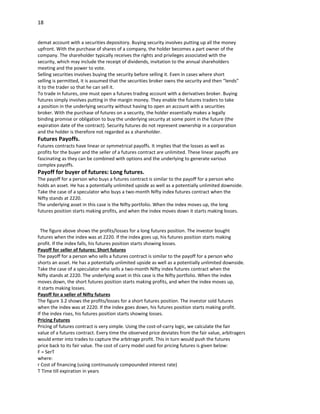
The underlying asset in this case is the Nifty portfolio. When the index moves up, the long
futures position starts making profits, and when the index moves down it starts making losses.


  The figure above shows the profits/losses for a long futures position. The investor bought
futures when the index was at 2220. If the index goes up, his futures position starts making
profit. If the index falls, his futures position starts showing losses.
Payoff for seller of futures: Short futures
The payoff for a person who sells a futures contract is similar to the payoff for a person who
shorts an asset. He has a potentially unlimited upside as well as a potentially unlimited downside.
Take the case of a speculator who sells a two-month Nifty index futures contract when the
Nifty stands at 2220. The underlying asset in this case is the Nifty portfolio. When the index
moves down, the short futures position starts making profits, and when the index moves up,
it starts making losses.
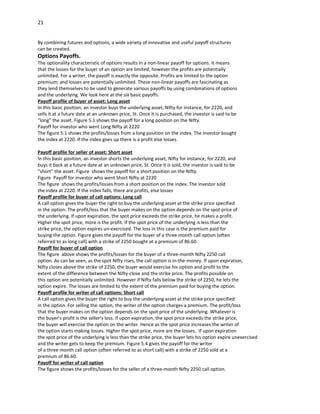
Payoff for a seller of Nifty futures
The figure 3.2 shows the profits/losses for a short futures position. The investor sold futures
when the index was at 2220. If the index goes down, his futures position starts making profit.
If the index rises, his futures position starts showing losses.
Pricing Futures
Pricing of futures contract is very simple. Using the cost-of-carry logic, we calculate the fair
value of a futures contract. Every time the observed price deviates from the fair value, arbitragers
would enter into trades to capture the arbitrage profit. This in turn would push the futures
price back to its fair value. The cost of carry model used for pricing futures is given below:
F = SerT
where:
r Cost of financing (using continuously compounded interest rate)
T Time till expiration in years
19


e 2.71828
Example: Security XYZ Ltd trades in the spot market at Rs. 1150. Money can be invested at
11% p.a. The fair value of a one-month futures contract on XYZ is calculated as follows:


[4]option contracts,mechanism and applications.
Options are the most recent and evolved derivative contracts. They have non linear or asymmetrical
profit profiles making them fundamentally very different from futures and forward
contracts. Options have allowed both theoreticians as well as practitioner’s to explore wide
range of possibilities for engineering different and sometimes exotic pay off profiles. Option
contracts help a hedger reduce his risk with a much wider variety of strategies.
An option gives the holder of the option the right to do something in future. The holder does


not have to exercise this right. In contrast, in a forward or futures contract, the two parties
have committed themselves or are obligated to meet their commitments as specified in the
contract. Whereas it costs nothing (except margin requirements) to enter into a futures contract,
the purchase of an option requires an up-front payment. This chapter first introduces
key terms which will enable the reader understand option terminology. Afterwards futures
have been compared with options and then payoff profiles of option contracts have been
defined diagrammatically. Readers can create these payoff profiles using payoff tables. They
can also use basic spreadsheet software such as MS-Excel to create these profiles.
Option Terminology
• Index options: Have the index as the underlying. They can be European or American.
They are also cash settled.
• Stock options: They are options on individual stocks and give the holder the right to
buy or sell shares at the specified price. They can be European or American.
• Buyer of an option: The buyer of an option is the one who by paying the option
premium buys the right but not the obligation to exercise his option on the seller/
writer.
• Writer of an option: The writer of a call/put option is the one who receives the option
premium and is thereby obliged to sell/buy the asset if the buyer exercises on him.
There are two basic types of options, call options and put options.
• Call option: It gives the holder the right but not the obligation to buy an asset by a
certain date for a certain price.
• Put option: A It gives the holder the right but not the obligation to sell an asset by a
certain date for a certain price.
• Option price/premium: It is the price which the option buyer pays to the option
seller. It is also referred to as the option premium.
• Expiration date: The date specified in the options contract is known as the expiration
date, the exercise date, the strike date or the maturity.
• Strike price: The price specified in the options contract is known as the strike price or
20


the exercise price.
• American options: These can be exercised at any time upto the expiration date.
• European options: These can be exercised only on the expiration date itself. European
options are easier to analyze than American options and properties of an American
option are frequently deduced from those of its European counterpart.
• In-the-money option: An in-the-money (ITM) option would lead to a positive cash
flow to the holder if it were exercised immediately. A call option on the index is said to
be in-the-money when the current index stands at a level higher than the strike price
(i.e. spot price > strike price). If the index is much higher than the strike price, the call
is said to be deep ITM. In the case of a put, the put is ITM if the index is below the
strike price.
• At-the-money option: An at-the-money (ATM) option would lead to zero cash flow if
it were exercised immediately. An option on the index is at-the-money when the current
index equals the strike price (i.e. spot price = strike price).
• Out-of-the-money option: An out-of-the-money (OTM) option would lead to a negative
cash flow if it were exercised immediately. A call option on the index is out-of-themoney
when the current index stands at a level which is less than the strike price (i.e.
spot price < strike price). If the index is much lower than the strike price, the call is
said to be deep OTM. In the case of a put, the put is OTM if the index is above the strike
price.
• Intrinsic value of an option: The option premium has two components - intrinsic
value and time value. Intrinsic value of an option at a given time is the amount the
holder of the option will get if he exercises the option at that time. The intrinsic value
of a call is Max[0, (St — K)] which means that the intrinsic value of a call is the
greater of 0 or (St — K). Similarly, the intrinsic value of a put is Max[0, K — St],i.e. the
greater of 0 or (K — St). K is the strike price and St is the spot price.
• Time value of an option: The time value of an option is the difference between its
premium and its intrinsic value. Both calls and puts have time value. The longer
the time to expiration, the greater is an option’s time value, all else equal. At expiration,
an option should have no time value.
Comparison between Futures and Options.
Options are different from futures in several interesting senses. At a practical level, the option
buyer faces an interesting situation. He pays for the option in full at the time it is purchased.
After this, he only has an upside. There is no possibility of the options position generating any
further losses to him (other than the funds already paid for the option). This is different from
futures, which is free to enter into, but can generate very large losses. This characteristic
makes options attractive to many occasional market participants, who cannot put in the time
to closely monitor their futures positions. Table presents the comparison between the
futures and options.
Buying put options is buying insurance. To buy a put option on Nifty is to buy insurance which
reimburses the full extent to which Nifty drops below the strike price of the put option. This is
attractive to many people, and to mutual funds creating “guaranteed return products”.
future                                                       options
Exchange traded with novation                                same as future .
Exchange defines the product price                           same as futures.
price is zero,strike price moves                             strike price is fixed,price moves.
price is zero                                                price is always positive.
linear payoff                                                nonlinear payoff.
both long and short at risk                                  only short at risk.

More generally, options offer “nonlinear payoffs” whereas futures only have “linear payoffs”.
21


By combining futures and options, a wide variety of innovative and useful payoff structures
can be created.
Options Payoffs.
The optionality characteristic of options results in a non-linear payoff for options. It means
that the losses for the buyer of an option are limited; however the profits are potentially
unlimited. For a writer, the payoff is exactly the opposite. Profits are limited to the option
premium; and losses are potentially unlimited. These non-linear payoffs are fascinating as
they lend themselves to be used to generate various payoffs by using combinations of options
and the underlying. We look here at the six basic payoffs.
Payoff profile of buyer of asset: Long asset
In this basic position, an investor buys the underlying asset, Nifty for instance, for 2220, and
sells it at a future date at an unknown price, St. Once it is purchased, the investor is said to be
“long” the asset. Figure 5.1 shows the payoff for a long position on the Nifty.
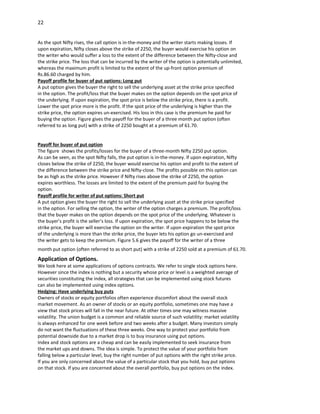
Payoff for investor who went Long Nifty at 2220
The figure 5.1 shows the profits/losses from a long position on the index. The investor bought
the index at 2220. If the index goes up there is a profit else losses.

Payoff profile for seller of asset: Short asset
In this basic position, an investor shorts the underlying asset, Nifty for instance, for 2220, and
buys it back at a future date at an unknown price, St. Once it is sold, the investor is said to be
“short” the asset. Figure shows the payoff for a short position on the Nifty.
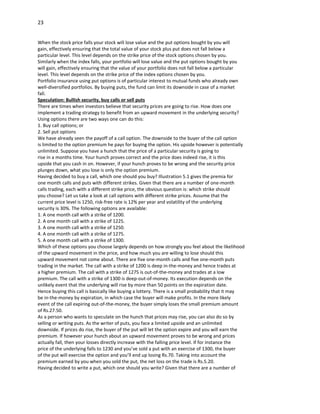
Figure Payoff for investor who went Short Nifty at 2220
The figure shows the profits/losses from a short position on the index. The investor sold
the index at 2220. If the index falls, there are profits, else losses
Payoff profile for buyer of call options: Long call
A call option gives the buyer the right to buy the underlying asset at the strike price specified
in the option. The profit/loss that the buyer makes on the option depends on the spot price of
the underlying. If upon expiration, the spot price exceeds the strike price, he makes a profit.
Higher the spot price, more is the profit. If the spot price of the underlying is less than the
strike price, the option expires un-exercised. The loss in this case is the premium paid for
buying the option. Figure gives the payoff for the buyer of a three month call option (often
referred to as long call) with a strike of 2250 bought at a premium of 86.60.
Payoff for buyer of call option
The figure above shows the profits/losses for the buyer of a three-month Nifty 2250 call
option. As can be seen, as the spot Nifty rises, the call option is in-the-money. If upon expiration,
Nifty closes above the strike of 2250, the buyer would exercise his option and profit to the
extent of the difference between the Nifty-close and the strike price. The profits possible on
this option are potentially unlimited. However if Nifty falls below the strike of 2250, he lets the
option expire. The losses are limited to the extent of the premium paid for buying the option.
Payoff profile for writer of call options: Short call
A call option gives the buyer the right to buy the underlying asset at the strike price specified
in the option. For selling the option, the writer of the option charges a premium. The profit/loss
that the buyer makes on the option depends on the spot price of the underlying. Whatever is
the buyer’s profit is the seller’s loss. If upon expiration, the spot price exceeds the strike price,
the buyer will exercise the option on the writer. Hence as the spot price increases the writer of
the option starts making losses. Higher the spot price, more are the losses.. If upon expiration
the spot price of the underlying is less than the strike price, the buyer lets his option expire unexercised
and the writer gets to keep the premium. Figure 5.4 gives the payoff for the writer
of a three month call option (often referred to as short call) with a strike of 2250 sold at a
premium of 86.60.
Payoff for writer of call option
The figure shows the profits/losses for the seller of a three-month Nifty 2250 call option.
22


As the spot Nifty rises, the call option is in-the-money and the writer starts making losses. If
upon expiration, Nifty closes above the strike of 2250, the buyer would exercise his option on
the writer who would suffer a loss to the extent of the difference between the Nifty-close and
the strike price. The loss that can be incurred by the writer of the option is potentially unlimited,
whereas the maximum profit is limited to the extent of the up-front option premium of
Rs.86.60 charged by him.
Payoff profile for buyer of put options: Long put
A put option gives the buyer the right to sell the underlying asset at the strike price specified
in the option. The profit/loss that the buyer makes on the option depends on the spot price of
the underlying. If upon expiration, the spot price is below the strike price, there is a profit.
Lower the spot price more is the profit. If the spot price of the underlying is higher than the
strike price, the option expires un-exercised. His loss in this case is the premium he paid for
buying the option. Figure gives the payoff for the buyer of a three month put option (often
referred to as long put) with a strike of 2250 bought at a premium of 61.70.


Payoff for buyer of put option
The figure shows the profits/losses for the buyer of a three-month Nifty 2250 put option.
As can be seen, as the spot Nifty falls, the put option is in-the-money. If upon expiration, Nifty
closes below the strike of 2250, the buyer would exercise his option and profit to the extent of
the difference between the strike price and Nifty-close. The profits possible on this option can
be as high as the strike price. However if Nifty rises above the strike of 2250, the option
expires worthless. The losses are limited to the extent of the premium paid for buying the
option.
Payoff profile for writer of put options: Short put
A put option gives the buyer the right to sell the underlying asset at the strike price specified
in the option. For selling the option, the writer of the option charges a premium. The profit/loss
that the buyer makes on the option depends on the spot price of the underlying. Whatever is
the buyer’s profit is the seller’s loss. If upon expiration, the spot price happens to be below the
strike price, the buyer will exercise the option on the writer. If upon expiration the spot price
of the underlying is more than the strike price, the buyer lets his option go un-exercised and
the writer gets to keep the premium. Figure 5.6 gives the payoff for the writer of a three
month put option (often referred to as short put) with a strike of 2250 sold at a premium of 61.70.
Application of Options.
We look here at some applications of options contracts. We refer to single stock options here.
However since the index is nothing but a security whose price or level is a weighted average of
securities constituting the index, all strategies that can be implemented using stock futures
can also be implemented using index options.
Hedging: Have underlying buy puts
Owners of stocks or equity portfolios often experience discomfort about the overall stock
market movement. As an owner of stocks or an equity portfolio, sometimes one may have a
view that stock prices will fall in the near future. At other times one may witness massive
volatility. The union budget is a common and reliable source of such volatility: market volatility
is always enhanced for one week before and two weeks after a budget. Many investors simply
do not want the fluctuations of these three weeks. One way to protect your portfolio from
potential downside due to a market drop is to buy insurance using put options.
Index and stock options are a cheap and can be easily implemented to seek insurance from
the market ups and downs. The idea is simple. To protect the value of your portfolio from
falling below a particular level, buy the right number of put options with the right strike price.
If you are only concerned about the value of a particular stock that you hold, buy put options
on that stock. If you are concerned about the overall portfolio, buy put options on the index.
23


When the stock price falls your stock will lose value and the put options bought by you will
gain, effectively ensuring that the total value of your stock plus put does not fall below a
particular level. This level depends on the strike price of the stock options chosen by you.
Similarly when the index falls, your portfolio will lose value and the put options bought by you
will gain, effectively ensuring that the value of your portfolio does not fall below a particular
level. This level depends on the strike price of the index options chosen by you.
Portfolio insurance using put options is of particular interest to mutual funds who already own
well-diversified portfolios. By buying puts, the fund can limit its downside in case of a market
fall.
Speculation: Bullish security, buy calls or sell puts
There are times when investors believe that security prices are going to rise. How does one
implement a trading strategy to benefit from an upward movement in the underlying security?
Using options there are two ways one can do this:
1. Buy call options; or
2. Sell put options
We have already seen the payoff of a call option. The downside to the buyer of the call option
is limited to the option premium he pays for buying the option. His upside however is potentially
unlimited. Suppose you have a hunch that the price of a particular security is going to
rise in a months time. Your hunch proves correct and the price does indeed rise, it is this
upside that you cash in on. However, if your hunch proves to be wrong and the security price
plunges down, what you lose is only the option premium.
Having decided to buy a call, which one should you buy? Illustration 5.1 gives the premia for
one month calls and puts with different strikes. Given that there are a number of one-month
calls trading, each with a different strike price, the obvious question is: which strike should
you choose? Let us take a look at call options with different strike prices. Assume that the
current price level is 1250, risk-free rate is 12% per year and volatility of the underlying
security is 30%. The following options are available:
1. A one month call with a strike of 1200.
2. A one month call with a strike of 1225.
3. A one month call with a strike of 1250.
4. A one month call with a strike of 1275.
5. A one month call with a strike of 1300.
Which of these options you choose largely depends on how strongly you feel about the likelihood
of the upward movement in the price, and how much you are willing to lose should this
upward movement not come about. There are five one-month calls and five one-month puts
trading in the market. The call with a strike of 1200 is deep in-the-money and hence trades at
a higher premium. The call with a strike of 1275 is out-of-the-money and trades at a low
premium. The call with a strike of 1300 is deep-out-of-money. Its execution depends on the
unlikely event that the underlying will rise by more than 50 points on the expiration date.
Hence buying this call is basically like buying a lottery. There is a small probability that it may
be in-the-money by expiration, in which case the buyer will make profits. In the more likely
event of the call expiring out-of-the-money, the buyer simply loses the small premium amount
of Rs.27.50.
As a person who wants to speculate on the hunch that prices may rise, you can also do so by
selling or writing puts. As the writer of puts, you face a limited upside and an unlimited
downside. If prices do rise, the buyer of the put will let the option expire and you will earn the
premium. If however your hunch about an upward movement proves to be wrong and prices
actually fall, then your losses directly increase with the falling price level. If for instance the
price of the underlying falls to 1230 and you’ve sold a put with an exercise of 1300, the buyer
of the put will exercise the option and you’ll end up losing Rs.70. Taking into account the
premium earned by you when you sold the put, the net loss on the trade is Rs.5.20.
Having decided to write a put, which one should you write? Given that there are a number of
24


one-month puts trading, each with a different strike price, the obvious question is: which
strike should you choose? This largely depends on how strongly you feel about the likelihood
of the upward movement in the prices of the underlying. If you write an at-the-money put, the
option premium earned by you will be higher than if you write an out-of-the-money put.
However the chances of an at-the-money put being exercised on you are higher as well.
Illustration. One month calls and puts trading at different strikes
The spot price is 1250. There are five one-month calls and five one-month puts trading in the
market. The call with a strike of 1200 is deep in-the-money and hence trades at a higher
premium. The call with a strike of 1275 is out-of-the-money and trades at a low premium. The
call with a strike of 1300 is deep-out-of-money. Its execution depends on the unlikely event
that the price of underlying will rise by more than 50 points on the expiration date. Hence
buying this call is basically like buying a lottery. There is a small probability that it may be inthe-
money by expiration in which case the buyer will profit. In the more likely event of the call
expiring out-of-the-money, the buyer simply loses the small premium amount of Rs. 27.50.
Figure shows the payoffs from buying calls at different strikes. Similarly, the put with a
strike of 1300 is deep in-the-money and trades at a higher premium than the at-the-money
put at a strike of 1250. The put with a strike of 1200 is deep out-of-the-money and will only be
exercised in the unlikely event that underlying falls by 50 points on the expiration date. Figure
 shows the payoffs from writing puts at different strikes.
Underlying                        Strike price of option         Call Premium (Rs.)             Put Premium (Rs.)

1250                           1200                           80.10                          18.15
1250                           1250                           63.65                          26.50
1250                           1250                           49.45                          37.00
1250                           1275                           37.50                          49.80
1250                           1300                           27.50                          64.80

In the example in Figure at a price level of 1250, one option is in-the-money and one is
out-of-the-money. As expected, the in-the-money option fetches the highest premium of
Rs.64.80 whereas the out-of-the-money option has the lowest premium of Rs. 18.15.
 Speculation: Bearish security, sell calls or buy puts
Do you sometimes think that the market is going to drop? Could you make a profit by adopting
a position on the market? Due to poor corporate results, or the instability of the government,
many people feel that the stocks prices would go down. How does one implement a trading
strategy to benefit from a downward movement in the market? Today, using options, you have
two choices:
1. Sell call options; or
2. Buy put options
We have already seen the payoff of a call option. The upside to the writer of the call option is
limited to the option premium he receives upright for writing the option. His downside however
is potentially unlimited. Suppose you have a hunch that the price of a particular security
is going to fall in a months time. Your hunch proves correct and it does indeed fall, it is this
downside that you cash in on. When the price falls, the buyer of the call lets the call expire and
you get to keep the premium. However, if your hunch proves to be wrong and the market soars
up instead, what you lose is directly proportional to the rise in the price of the security.
Payoff for buyer of call options at various strikes
The figure shows the profits/losses for a buyer of calls at various strikes. The in-themoney
option with a strike of 1200 has the highest premium of Rs.80.10 whereas the out-ofthe-
money option with a strike of 1300 has the lowest premium of Rs. 27.50.
Payoff for writer of put options at various strikes
The figure above shows the profits/losses for a writer of puts at various strikes. The in-themoney
25


option with a strike of 1300 fetches the highest premium of Rs.64.80 whereas the outof-
the-money option with a strike of 1200 has the lowest premium of Rs. 18.15.
Having decided to write a call, which one should you write? Illustration 5.2 gives the premiums
for one month calls and puts with different strikes. Given that there are a number of one44
month calls trading, each with a different strike price, the obvious question is: which strike
should you choose? Let us take a look at call options with different strike prices. Assume that
the current stock price is 1250, risk-free rate is 12% per year and stock volatility is 30%. You
could write the following options:
1. A one month call with a strike of 1200.
2. A one month call with a strike of 1225.
3. A one month call with a strike of 1250.
4. A one month call with a strike of 1275.
5. A one month call with a strike of 1300.
Which of this options you write largely depends on how strongly you feel about the likelihood
of the downward movement of prices and how much you are willing to lose should this downward
movement not come about. There are five one-month calls and five one-month puts
trading in the market. The call with a strike of 1200 is deep in-the-money and hence trades at
a higher premium. The call with a strike of 1275 is out-of-the-money and trades at a low
premium. The call with a strike of 1300 is deep-out-of-money. Its execution depends on the
unlikely event that the stock will rise by more than 50 points on the expiration date. Hence
writing this call is a fairly safe bet. There is a small probability that it may be in-the-money by
expiration in which case the buyer exercises and the writer suffers losses to the extent that the
price is above 1300. In the more likely event of the call expiring out-of-the-money, the writer
earns the premium amount of Rs.27.50.
As a person who wants to speculate on the hunch that the market may fall, you can also buy
puts. As the buyer of puts you face an unlimited upside but a limited downside. If the price
does fall, you profit to the extent the price falls below the strike of the put purchased by you.
If however your hunch about a downward movement in the market proves to be wrong and
the price actually rises, all you lose is the option premium. If for instance the security price
rises to 1300 and you’ve bought a put with an exercise of 1250, you simply let the put expire.
If however the price does fall to say 1225 on expiration date, you make a neat profit of Rs.25.
Having decided to buy a put, which one should you buy? Given that there are a number of onemonth
puts trading, each with a different strike price, the obvious question is: which strike
should you choose? This largely depends on how strongly you feel about the likelihood of the
downward movement in the market. If you buy an at-the-money put, the option premium paid
by you will by higher than if you buy an out-of-the-money put. However the chances of an atthe-
money put expiring in-the-money are higher as well.
: One month calls and puts trading at different strikes
The spot price is 1250. There are five one-month calls and five one-month puts trading in the
market. The call with a strike of 1200 is deep in-the-money and hence trades at a higher
premium. The call with a strike of 1275 is out-of-the-money and trades at a low premium. The
call with a strike of 1300 is deep-out-of-money. Its execution depends on the unlikely event
that the price will rise by more than 50 points on the expiration date. Hence writing this call is
a fairly safe bet. There is a small probability that it may be in-the-money by expiration in
which case the buyer exercises and the writer suffers losses to the extent that the price is
above 1300. In the more likely event of the call expiring out-of-the-money, the writer earns
the premium amount of Rs.27.50. Figure 5.9 shows the payoffs from writing calls at different
strikes. Similarly, the put with a strike of 1300 is deep in-the-money and trades at a higher
premium than the at-the-money put at a strike of 1250. The put with a strike of 1200 is deep
out-of-the-money and will only be exercised in the unlikely event that the price falls by 50
points on the expiration date. The choice of which put to buy depends upon how much the
speculator expects the market to fall. Figure 5.9 shows the payoffs from buying puts at different
26


strikes.
Price Strike price of option Call Premium(Rs.) Put Premium(Rs.)
1250 1200 80.10 18.15
1250 1225 63.65 26.50
1250 1250 49.45 37.00
1250 1275 37.50 49.80
1250 1300 27.50 64.80
Payoff for seller of call option at various strikes
The figure 5.9 shows the profits/losses for a seller of calls at various strike prices. The in-themoney
option has the highest premium of Rs.80.10 whereas the out-of-the-money option has
the lowest premium of Rs. 27.50.

shows the profits/losses for a buyer of puts at various strike prices. The in-themoney
option has the highest premium of Rs.64.80 whereas the out-of-the-money option has
the lowest premium of Rs. 18.50.
Bull spreads - Buy a call and sell another
There are times when you think the market is going to rise over the next two months, however
in the event that the market does not rise, you would like to limit your downside. One way you
could do this is by entering into a spread. A spread trading strategy involves taking a position
in two or more options of the same type, that is, two or more calls or two or more puts. A
spread that is designed to profit if the price goes up is called a bull spread.
How does one go about doing this? This is basically done utilizing two call options having the
same expiration date, but different exercise prices. The buyer of a bull spread buys a call with
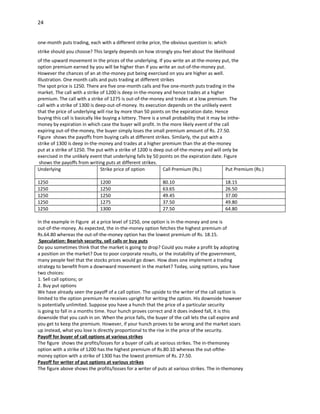
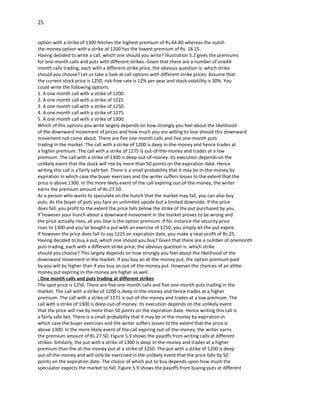
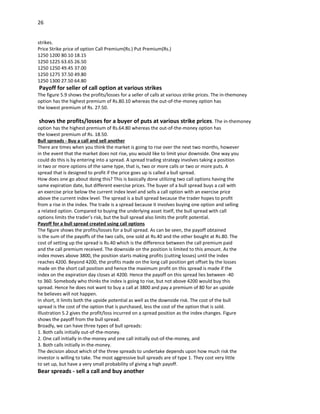
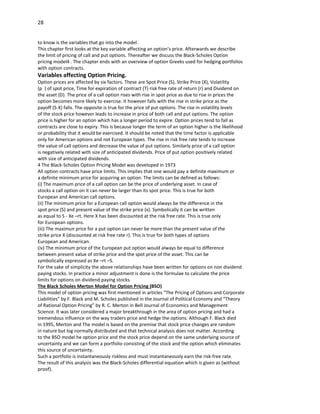
an exercise price below the current index level and sells a call option with an exercise price
above the current index level. The spread is a bull spread because the trader hopes to profit
from a rise in the index. The trade is a spread because it involves buying one option and selling
a related option. Compared to buying the underlying asset itself, the bull spread with call
options limits the trader’s risk, but the bull spread also limits the profit potential.
Payoff for a bull spread created using call options
The figure shows the profits/losses for a bull spread. As can be seen, the payoff obtained
is the sum of the payoffs of the two calls, one sold at Rs.40 and the other bought at Rs.80. The
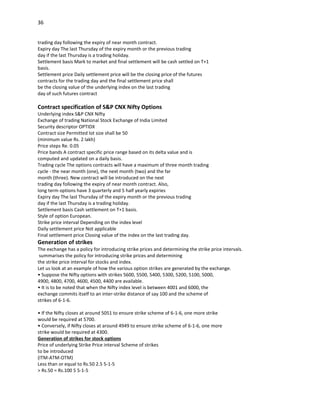
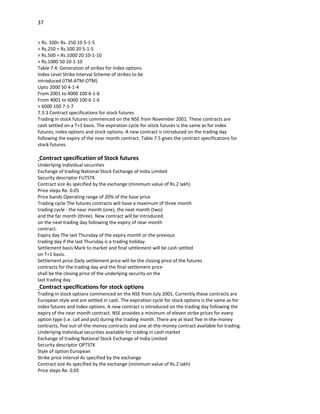
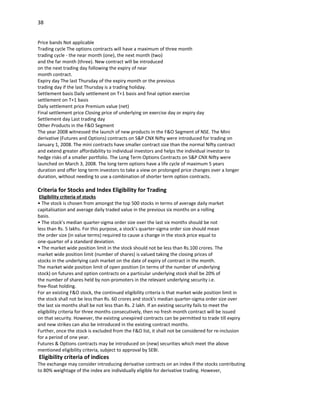
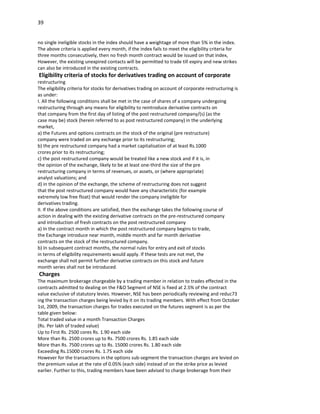
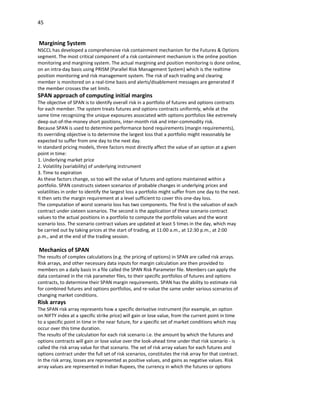
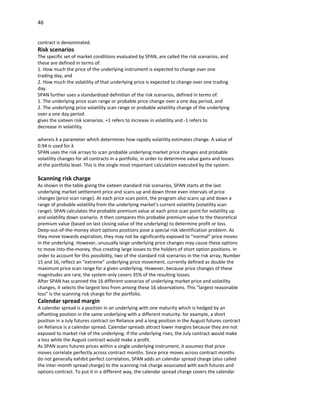
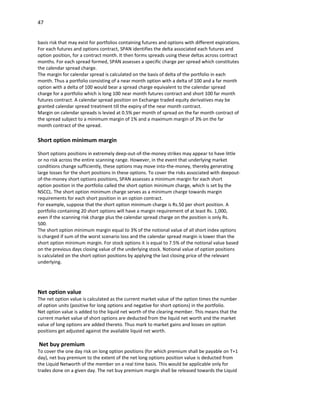
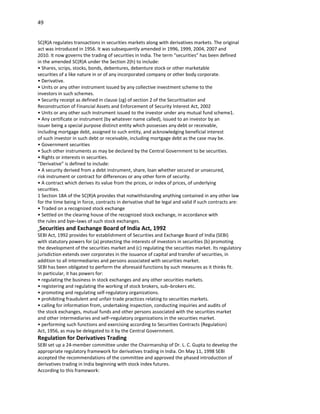
cost of setting up the spread is Rs.40 which is the difference between the call premium paid
and the call premium received. The downside on the position is limited to this amount. As the
index moves above 3800, the position starts making profits (cutting losses) until the index
reaches 4200. Beyond 4200, the profits made on the long call position get offset by the losses
made on the short call position and hence the maximum profit on this spread is made if the
index on the expiration day closes at 4200. Hence the payoff on this spread lies between -40
to 360. Somebody who thinks the index is going to rise, but not above 4200 would buy this
spread. Hence he does not want to buy a call at 3800 and pay a premium of 80 for an upside
he believes will not happen.
In short, it limits both the upside potential as well as the downside risk. The cost of the bull
spread is the cost of the option that is purchased, less the cost of the option that is sold.
Illustration 5.2 gives the profit/loss incurred on a spread position as the index changes. Figure
shows the payoff from the bull spread.
Broadly, we can have three types of bull spreads:
1. Both calls initially out-of-the-money.
2. One call initially in-the-money and one call initially out-of-the-money, and
3. Both calls initially in-the-money.
The decision about which of the three spreads to undertake depends upon how much risk the
investor is willing to take. The most aggressive bull spreads are of type 1. They cost very little
to set up, but have a very small probability of giving a high payoff.
Bear spreads - sell a call and buy another
27


There are times when you think the market is going to fall over the next two months. However
in the event that the market does not fall, you would like to limit your downside. One way you
could do this is by entering into a spread. A spread trading strategy involves taking a position
in two or more options of the same type, that is, two or more calls or two or more puts. A
spread that is designed to profit if the price goes down is called a bear spread.
This is basically done utilizing two call options having the same expiration date, but different
exercise prices. In a bear spread, the strike price of the option purchased is greater than the
strike price of the option sold. The buyer of a bear spread buys a call with an exercise price
above the current index level and sells a call option with an exercise price below the current
index level. The spread is a bear spread because the trader hopes to profit from a fall in the
index. The trade is a spread because it involves buying one option and selling a related option.
Compared to buying the index itself, the bear spread with call options limits the trader’s risk, but
it also limits the profit potential. In short, it limits both the upside potential as well as the
downside risk.
A bear spread created using calls involves initial cash inflow since the price of the call sold is
greater than the price of the call purchased. Illustration 5.4 gives the profit/loss incurred on a
spread position as the index changes. Figure 5.12 shows the payoff from the bear spread.
Broadly we can have three types of bear spreads:
1. Both calls initially out-of-the-money.
2. One call initially in-the-money and one call initially out-of-the-money, and
3. Both calls initially in-the-money.
The decision about which of the three spreads to undertake depends upon how much risk the
investor is willing to take. The most aggressive bear spreads are of type 1. They cost very little
to set up, but have a very small probability of giving a high payoff. As we move from type 1 to
type 2 and from type 2 to type 3, the spreads become more conservative and cost higher to
set up. Bear spreads can also be created by buying a put with a high strike price and selling a
put with a low strike price.
Payoff for a bear spread created using call options
The figure 5shows the profits/losses for a bear spread. As can be seen, the payoff obtained
is the sum of the payoffs of the two calls, one sold at Rs. 150 and the other bought at Rs.50.
The maximum gain from setting up the spread is Rs. 100 which is the difference between the
call premium received and the call premium paid. The upside on the position is limited to this
amount. As the index moves above 3800, the position starts making losses (cutting profits)
until the spot reaches 4200. Beyond 4200, the profits made on the long call position get offset
by the losses made on the short call position. The maximum loss on this spread is made if the
index on the expiration day closes at 2350. At this point the loss made on the two call position
together is Rs.400 i.e. (4200-3800). However the initial inflow on the spread being Rs.100,
the net loss on the spread turns out to be 300. The downside on this spread position is limited
to this amount. Hence the payoff on this spread lies between +100 to -300.
50:


[5] Pricing of Options Contracts andGreek Letters
An option buyer Shas the right but not the obligation to exercise on the seller. The worst that
can happen to a buyer is the loss of the premium paid by him. His downside is limited to this
premium, but his upside is potentially unlimited. This optionality is precious and has a value,
which is expressed in terms of the option price. Just like in other free markets, it is the supply
and demand in the secondary market that drives the price of an option.
There are various models which help us get close to the true price of an option. Most popular
among them are the binomial option pricing model and the much celebrated Black-Scholes
model. Today most calculators and spread-sheets come with a built-in Black-Scholes options
pricing formula so to price options we don’t really need to memorize the formula. All we need
28


to know is the variables that go into the model.
This chapter first looks at the key variable affecting an option’s price. Afterwards we describe
the limit of pricing of call and put options. Thereafter we discuss the Black-Scholes Option
pricing model4 . The chapter ends with an overview of option Greeks used for hedging portfolios
with option contracts.
Variables affecting Option Pricing.
Option prices are affected by six factors. These are Spot Price (S), Strike Price (X), Volatility
(p ) of spot price, Time for expiration of contract (T) risk free rate of return (r) and Dividend on
the asset (D). The price of a call option rises with rise in spot price as due to rise in prices the
option becomes more likely to exercise. It however falls with the rise in strike price as the
payoff (S-X) falls. The opposite is true for the price of put options. The rise in volatility levels
of the stock price however leads to increase in price of both call and put options. The option
price is higher for an option which has a longer period to expire. Option prices tend to fall as
contracts are close to expiry. This is because longer the term of an option higher is the likelihood
or probability that it would be exercised. It should be noted that the time factor is applicable
only for American options and not European types. The rise in risk free rate tends to increase
the value of call options and decrease the value of put options. Similarly price of a call option
is negatively related with size of anticipated dividends. Price of put option positively related
with size of anticipated dividends.
4 The Black-Scholes Option Pricing Model was developed in 1973
All option contracts have price limits. This implies that one would pay a definite maximum or
a definite minimum price for acquiring an option. The limits can be defined as follows:
(i) The maximum price of a call option can be the price of underlying asset. In case of
stocks a call option on it can never be larger than its spot price. This is true for both
European and American call options.
(ii) The minimum price for a European call option would always be the difference in the
spot price (S) and present value of the strike price (x). Symbolically it can be written
as equal to S - Xe –rt. Here X has been discounted at the risk free rate. This is true only
for European options.
(iii) The maximun price for a put option can never be more than the present value of the
strike price X (discounted at risk free rate r). This is true for both types of options
European and American.
(iv) The minimum price of the European put option would always be equal to difference
between present value of strike price and the spot price of the asset. This can be
symbolically expressed as Xe –rt –S.
For the sake of simplicity the above relationships have been written for options on non dividend
paying stocks. In practice a minor adjustment is done is the formulae to calculate the price
limits for options on dividend paying stocks.
The Black Scholes Merton Model for Option Pricing (BSO)
This model of option pricing was first mentioned in articles “The Pricing of Options and Corporate
Liabilities” by F. Black and M. Scholes published in the Journal of Political Economy and “Theory
of Rational Option Pricing” by R. C. Merton in Bell Journal of Economics and Management
Science. It was later considered a major breakthrough in the area of option pricing and had a
tremendous influence on the way traders price and hedge the options. Although F. Black died
in 1995, Merton and The model is based on the premise that stock price changes are random
in nature but log normally distributed and that technical analysis does not matter. According
to the BSO model he option price and the stock price depend on the same underlying source of
uncertainty and we can form a portfolio consisting of the stock and the option which eliminates
this source of uncertainty.
Such a portfolio is instantaneously riskless and must instantaneously earn the risk-free rate.
The result of this analysis was the Black-Scholes differential equation which is given as (without
proof).
29


Here S is stock price t is term of the option (time to maturity) r the risk free rate and ó the
volatility of stock price.

The Black-Scholes formulas for the prices of European calls and puts with strike price X on a
non-dividend paying stock are the roots of the differential equation 6.5 (without proof):
• N(x) is the cumulative distribution function for a standardized normal distribution.
• The expression N(d2) is the probability that the option will be exercised in a risk neutral
world, so that N(d2) is the strike price times the probability that the strike price will be
paid.
• The expression S0N(d1)ert is the expected value of a variable that equals ST if ST>X and
is 0 otherwise in a risk neutral world. Here ST is the spot price at time T and X is the
strike price.
• r i is a measure of volatility, is the annualized standard deviation of continuously
compounded returns on the underlying. When daily sigma is given, they need to be
converted into annualized sigma.
• Sigma annual = sigma daily × vNumber of trading days per year. On an average there are
250 trading days in a year.
• X is the exercise price, S the spot price and T the time to expiration measured in years.
• When S becomes very large a call option is almost certain to be exercised.
• It also becomes similar to a forward contract with a delivery price K. Thus the call
option price will be c = S – Xe–r T
• As S becomes very large both N(d1) and N(d2) are both close to 1.0.
• Similarly the put option price will be 0 as N(-d1) and N (-d2) will be close to 0.
• Similarly when ó approaches zero d1 and d2 tend to infinity so that N(d1) and N(d2)
tend to 1.0 and the value of call option is:
c = S – X e–r T
Thus the call price will always be the max(S – X e–r T ,0).
The Black Scholes model uses continuous compounding as discussed in Chapter 2. One need
not remember the formulae or equation as several option price calculators are available freely
(in spreadsheet formats also).
The Greeks
Each Greek letter measures a different dimension to the risk in an option position. These are
used by traders who have sold options in the market. Aim of traders is to manage the Greeks
in order to manage their overall portfolio. There are five Greeks used for hedging portfolios of
options with underlying assets (index or individual stocks). These are denoted by delta, theta,
gamma, vega and rho each represented by Greek letters _c_s ) . Tand .
Delta (_)
In general delta (_) of a portfolio is change in value of portfolio with respect to change in price
of underlying asset. Delta of an option on the other hand is rate of change of the option price
with respect to price of the underlying asset.
_
is the rate of change of option price with respect to the price of the underlying asset. For
example, the delta of a stock is 1. It is the slope of the curve that relates the option price to the
price of the underlying asset. Suppose the _ of a call option on a stock is 0.5. This means that
when the stock price changes by one, the option price changes by about 0.5, or 50% of the
change in the stock price. Figure 5.13 shows the delta of a stock option.
Expressed differently, _ is the change in the price of call option per unit change in the spot
price of the underlying asset. _ = ∂C/∂S. The delta of a European call on a stock paying
dividends at rate q is N (d1)e– qT .The delta of a European put is
e–qT [N (d1) - 1]
The _
30


of a call is always positive and the _ of a put is always negative. As the stock price
(underlying asset) changes delta of the option also changes. In order to maintain delta at the
same level a given number of stocks (underlying asset) need to be bought or sold in the
market. Maintaining delta at the same level is known as delta neutrality or delta hedging.
 _ as slope

Gamma
Gais the rate of change of the option’s Delta _
with respect to the price of the underlying asset.
In other words, it is the second derivative of the option price with respect to price of the
underlying asset.
Theta
T h f a portfolio of options, is the rate of change of the value of the portfolio with respect to the
   o
passage of time with all else remaining the same. o is also referred to as the time decay of the
portfolio. t i is the change in the portfolio value when one day passes with all else remaining the
same. We can either measure n “per calendar day” or “per trading day”. To obtain the per
calendar day, the formula for Theta must be divided by 365; to obtain Theta per trading day,
it must be divided by 250.
Vega
The vega of a portfolio of derivatives is the rate of change in the value of the portfolio with
respect to volatility of the underlying asset. If o is high in absolute terms, the portfolio’s value
is very sensitive to small changes in volatility. If s is low in absolute terms, volatility changes
have relatively little impact on the value of the portfolio.
Rho
The r of a portfolio of options is the rate of change of the value of the portfolio with respect to
the interest rate. It measures the sensitivity of the value of a portfolio to interest rates.
[6]trading of derivatives contracts
 This chapter provides an overview of the trading system for NSE’s futures and options market.
First section describes entities in the trading system; basis of trading, Client-broker relationship
in derivative segment and order types and conditions. The second section describes the
trader workstation using screenshots from trading screens at NSE. This section also describes
how to place orders.
The best way to get a feel of the trading system, however, is to actually watch the screen and
observe trading.
Futures and Options Trading System
The futures & options trading system of NSE, called NEAT-F&O trading system, provides a fully
automated screen-based trading for Index futures & options and Stock futures & options on a
nationwide basis as well as an online monitoring and surveillance mechanism. It supports an
order driven market and provides complete transparency of trading operations. It is similar to
that of trading of equities in the cash market segment.
The software for the F&O market has been developed to facilitate efficient and transparent
trading in futures and options instruments. Keeping in view the familiarity of trading members
with the current capital market trading system, modifications have been performed in the
existing capital market trading system so as to make it suitable for trading futures and options.
Entities in the trading system
Following are the four entities in the trading system:
• Trading members: Trading members are members of NSE. They can trade either on
their own account or on behalf of their clients including participants. The exchange
assigns a trading member ID to each trading member. Each trading member can have
more than one user. The number of users allowed for each trading member is notified
by the exchange from time to time. Each user of a trading member must be registered
31


with the exchange and is assigned an unique user ID. The unique trading member ID
functions as a reference for all orders/trades of different users. This ID is common for
all users of a particular trading member. It is the responsibility of the trading member
to maintain adequate control over persons having access to the firm’s User IDs.
• Clearing members: Clearing members are members of NSCCL. They carry out risk
management activities and confirmation/inquiry of trades through the trading system.
• Professional clearing members: A professional clearing member is a clearing member
who is not a trading member. Typically, banks and custodians become professional
clearing members and clear and settle for their trading members.
• Participants: A participant is a client of trading members like financial institutions.
These clients may trade through multiple trading members but settle through a single
clearing member.
Basis of trading
The NEAT F&O system supports an order driven market, wherein orders match automatically.
Order matching is essentially on the basis of security, its price, time and quantity. All quantity
fields are in units and price in rupees. The exchange notifies the regular lot size and tick size
for each of the contracts traded on this segment from time to time. When any order enters the
trading system, it is an active order. It tries to find a match on the other side of the book. If it
finds a match, a trade is generated. If it does not find a match, the order becomes passive and
goes and sits in the respective outstanding order book in the system.
Corporate hierarchy
In the F&O trading software, a trading member has the facility of defining a hierarchy amongst
users of the system. This hierarchy comprises corporate manager, branch manager dealer and
admin.
• Corporate manager: The term is assigned to a user placed at the highest level in a
trading firm. Such a user can perform all the functions such as order and trade related
activities of all users, view net position of all dealers and at all clients level, can receive
end of day consolidated trade and order reports dealer wise for all branches of the
trading member firm and also all dealers of the firm. Only a corporate manager can
sign off any user and also define exposure limits for the branches of the firm and its
dealers.
• Branch manager: This term is assigned to a user who is placed under the corporate
manager. Such a user can perform and view order and trade related activities for all
dealers under that branch.
• Dealer: Dealers are users at the bottom of the hierarchy. A Dealer can perform view
order and trade related activities only for oneself and does not have access to information
on other dealers under either the same branch or other branches.
• Admin: Another user type, ‘Admin’ is provided to every trading member along with
the corporate manager user. This user type facilitates the trading members and the
clearing members to receive and capture on a real-time basis all the trades, exercise
requests and give up requests of all the users under him. The clearing members can
receive and capture all the above information on a real time basis for the members
and participants linked to him. All this information is written to comma separated files
which can be accessed by any other program on a real time basis in a read only mode.
This however does not affect the online data capture process. Besides this the admin
users can take online backup, view and upload net position, view previous trades,
view give-up screens and exercise request for all the users (corporate managers,
branch managers and dealers) belonging to or linked to the member. The ‘Admin’ user
can also view the relevant messages for trades, exercise and give up requests in the
message area. However, ‘Admin’ user cannot put any orders or modify & cancel them.
A brief description of the activities of each member is given below:
• Clearing member corporate manager: Can view outstanding orders, previous
32


trades and net position of his client trading members by putting the TM ID (Trading
member identification) and leaving the branch ID and dealer ID blank.
• Clearing member and trading member corporate manager: Can view:
(a) Outstanding orders, previous trades and net position of his client trading members
by putting the TM ID and leaving the branch ID and the dealer ID blank.
(b) Outstanding orders, previous trades and net positions entered for himself by
entering his own TM ID, branch ID and user ID. This is his default screen.
(c) Outstanding orders, previous trades and net position entered for his branch by
entering his TM ID and branch ID fields.
(d) Outstanding orders, previous trades, and net positions entered for any of his
users/dealers by entering his TM ID, branch ID and user ID fields.
• Clearing member and trading member dealer: Can only view requests entered by
him.
• Trading member corporate manager: Can view:
(a) Outstanding requests and activity log for requests entered by him by entering
his own branch and user IDs. This is his default screen.
(b) Outstanding requests entered by his dealers and/or branch managers by either
entering the branch and/or user IDs or leaving them blank.
• Trading member branch manager: He can view:
(a) Outstanding requests and activity log for requests entered by him by entering
his own branch and user IDs. This is his default screen.
(b) Outstanding requests entered by his users either by filling the user ID field
with a specific user or leaving the user ID field blank.
• Trading member dealer: He can only view requests entered by him.
Client Broker Relationship in Derivative Segment
A trading member must ensure compliance particularly with relation to the following while
dealing with clients:
• Filling of ‘Know Your Client’ form
• Execution of Client Broker agreement
• Bring risk factors to the knowledge of client by getting acknowledgement of client on
risk disclosure document
• Timely execution of orders as per the instruction of clients in respective client codes.
• Collection of adequate margins from the client
• Maintaining separate client bank account for the segregation of client money.
• Timely issue of contract notes as per the prescribed format to the client
• Ensuring timely pay-in and pay-out of funds to and from the clients
• Resolving complaint of clients if any at the earliest.
• Avoiding receipt and payment of cash and deal only through account payee cheques
• Sending the periodical statement of accounts to clients
• Not charging excess brokerage
• Maintaining unique client code as per the regulations.
Order types and conditions
The system allows the trading members to enter orders with various conditions attached to
them as per their requirements. These conditions are broadly divided into the following categories:
• Time conditions
• Price conditions
• Other conditions
• Time conditions
- Day order: A day order, as the name suggests is an order which is valid for
the day on which it is entered. If the order is not executed during the day,
the system cancels the order automatically at the end of the day.
- Immediate or Cancel (IOC): An IOC order allows the user to buy or sell
33


a contract as soon as the order is released into the system, failing which
the order is cancelled from the system. Partial match is possible for the
order, and the unmatched portion of the order is cancelled immediately.


Price condition
- Stop-loss: This facility allows the user to release an order into the system,
after the market price of the security reaches or crosses a threshold price
e.g. if for stop-loss buy order, the trigger is 1027.00, the limit price is
1030.00 and the market (last traded) price is 1023.00, then this order is
released into the system once the market price reaches or exceeds 1027.00.
This order is added to the regular lot book with time of triggering as the
time stamp, as a limit order of 1030.00. For the stop-loss sell order, the
trigger price has to be greater than the limit price.
Other conditions
- Market price: Market orders are orders for which no price is specified at
the time the order is entered (i.e. price is market price). For such orders,
the system determines the price.
- Trigger price: Price at which an order gets triggered from the stop-loss
book.
- Limit price: Price of the orders after triggering from stop-loss book.
- Pro: Pro means that the orders are entered on the trading member’s own
account.
- Cli: Cli means that the trading member enters the orders on behalf of a
client.
The Trader Workstation
The Market Watch Window
The following windows are displayed on the trader workstation screen:
• Title bar
• Ticker window of futures and options market
• Ticker window of underlying (capital) market
• Toolbar
• Market watch window
• Inquiry window
• Snap quote
• Order/trade window
• System message window
As mentioned earlier, the best way to familiarize oneself with the screen and its various segments
is to actually spend some time studying a live screen. In this section we shall restrict
ourselves to understanding just two segments of the workstation screen, the market watch
window and the inquiry window.
The market watch window is the third window from the top of the screen which is always
visible to the user. The purpose of market watch is to allow continuous monitoring of contracts
or securities that are of specific interest to the user. It displays trading information for contracts
selected by the user. The user also gets a broadcast of all the cash market securities on
the screen. This function also will be available if the user selects the relevant securities for
display on the market watch screen. Display of trading information related to cash market
securities will be on “Read only” format, i.e. the dealer can only view the information on cash
market but, cannot trade in them through the system. This is the main window from the
dealer’s perspective.
 Inquiry window
The inquiry window enables the user to view information such as Market by Price (MBP),
34


Previous Trades (PT), Outstanding Orders (OO), Activity log (AL), Snap Quote (SQ), Order
Status (OS), Market Movement (MM), Market Inquiry (MI), Net Position, On line backup, Multiple
index inquiry, Most active security and so on. Relevant information for the selected contract/
security can be viewed. We shall look in detail at the Market by Price (MBP) and the
Market Inquiry (MI) screens.
Market by price (MBP): The purpose of the MBP is to enable the user to view passive orders
in the market aggregated at each price and are displayed in order of best prices. The window
can be invoked by pressing the [F6] key. If a particular contract or security is selected, the
details of the selected contract or security can be seen on this screen. Figure 7.1 gives the
screen shot of the Market by Price window in the NEAT F&O.
Market inquiry (MI): The market inquiry screen can be invoked by using the [F11] key. If a
particular contract or security is selected, the details of the selected contract or selected
security defaults in the selection screen or else the current position in the market watch
defaults. The first line of the screen gives the Instrument type, symbol, expiry, contract status,
total traded quantity, life time high and life time low. The second line displays the closing
price, open price, high price, low price, last traded price and indicator for net change from
closing price. The third line displays the last traded quantity, last traded time and the last
traded date. The fourth line displays the closing open interest, the opening open interest, day
high open interest, day low open interest, current open interest, life time high open interest,
life time low open interest and net change from closing open interest. The fifth line display
very important information, namely the carrying cost in percentage terms. Figure 7.2 shows
the Market Inquiry screen of the NEAT F&O.
placing order on the trading system
For both the futures and the options market, while entering orders on the trading system,
members are required to identify orders as being proprietary or client orders. Proprietary
orders should be identified as ‘Pro’ and those of clients should be identified as ‘Cli’. Apart from
this, in the case of ‘Cli’ trades, the client account number should also be provided.
The futures market is a zero sum game i.e. the total number of long in any contract always
equals the total number of short in any contract. The total number of outstanding contracts
(long/short) at any point in time is called the “Open interest”. This Open interest figure is a
good indicator of the liquidity in every contract. Based on studies carried out in international
exchanges, it is found that open interest is maximum in near month expiry contracts.
Market spread/combination order entry
The NEAT F&O trading system also enables to enter spread/combination trades. Figure 7.3
shows the spread/combination screen. This enables the user to input two or three orders
simultaneously into the market. These orders will have the condition attached to it that unless
and until the whole batch of orders finds a countermatch, they shall not be traded. This
facilitates spread and combination trading strategies with minimum price risk. The combinations
orders are traded with an IOC attribute whereas spread orders are traded with ‘day’
order attribute.
Futures and Options Market Instruments
The F&O segment of NSE provides trading facilities for the following derivative instruments:
1. Index based futures
2. Index based options
3. Individual stock options
4. Individual stock futures
Contract specifications for index futures
On NSE’s platform one can trade in Nifty, CNX IT, BANK Nifty, Mini Nifty etc. futures contracts
having one-month, two-month and three-month expiry cycles. All contracts expire on the last
Thursday of every month. Thus, a January expiration contract would expire on the last Thursday
of January and a February expiry contract would cease trading on the last Thursday of
February. On the Friday following the last Thursday, a new contract having a three-month
35


expiry would be introduced for trading. Thus, as shown in Figure 7.4 at any point in time, three
contracts would be available for trading with the first contract expiring on the last Thursday of
that month. On the recommendations given by the SEBI, Derivatives Market Review Committee,
NSE also introduced the ‘Long Term Options Contracts’ on S&P CNX Nifty for trading in the
F&O segment. There would be 3 quarterly expiries, (March, June, September and December)
and after these, 5 following semi-annual months of the cycle June/December would be available.
Now option contracts with 3 year tenure are also available. Depending on the time period
for which you want to take an exposure in index futures contracts, you can place buy and sell
orders in the respective contracts. The Instrument type refers to “Futures contract on index”
and Contract symbol - NIFTY denotes a “Futures contract on Nifty index” and the Expiry date
represents the last date on which the contract will be available for trading. Each futures contract
has a separate limit order book. All passive orders are stacked in the system in terms of
price-time priority and trades take place at the passive order price (similar to the existing
capital market trading system). The best buy order for a given futures contract will be the
order to buy the index at the highest index level whereas the best sell order will be the order
to sell the index at the lowest index level. Table 7.1 gives the contract specifications for index
futures trading on the NSE.
Example: If trading is for a minimum lot size of 50 units and the index level is around 5000,
then the appropriate value of a single index futures contract would be Rs.250,000. The minimum
tick size for an index future contract is 0.05 units. Thus a single move in the index value
would imply a resultant gain or loss of Rs.2.50 (i.e. 0.05*50 units) on an open position of 50
units.
Contract cycle
The figure shows the contract cycle for futures contracts on NSE’s derivatives market. As
can be seen, at any given point of time, three contracts are available for trading - a nearmonth,
a middle-month and a far-month. As the January contract expires on the last Thursday
of the month, a new three-month contract starts trading from the following day, once more
making available three index futures contracts for trading.
Contract specification for index options
On NSE’s index options market, there are one-month, two-month and three-month expiry
contracts with minimum nine different strikes available for trading. Hence, if there are three
serial month contracts available and the scheme of strikes is 6-1-6, then there are minimum
3 x 13 x 2 (call and put options) i.e. 78 options contracts available on an index. Option
contracts are specified as follows: DATE-EXPIRYMONTH-YEAR-CALL/PUT-AMERICAN/ EUROPEAN-
STRIKE. For example the European style call option contract on the Nifty index with a
strike price of 5000 expiring on the 26th November 2009 is specified as ’26NOV2009 5000 CE’.
Just as in the case of futures contracts, each option product (for instance, the 26 NOV 2009
5000 CE) has it’s own order book and it’s own prices. All index options contracts are cash
settled and expire on the last Thursday of the month. The clearing corporation does the novation.
The minimum tick for an index options contract is 0.05 paise. Table 5.2 gives the contract
specifications for index options trading on the NSE.
Contract specification of S&P CNX Nifty Futures
Underlying index S&P CNX Nifty
Exchange of trading National Stock Exchange of India Limited
Security descriptor FUTIDX
Contract size Permitted lot size shall be 50
(minimum value Rs.2 lakh)
Price steps Re. 0.05
Price bands Operating range of 10% of the base price
Trading cycle The futures contracts will have a maximum of three month trading
cycle - the near month (one), the next month (two) and the
far month (three). New contract will be introduced on the next
36


trading day following the expiry of near month contract.
Expiry day The last Thursday of the expiry month or the previous trading
day if the last Thursday is a trading holiday.
Settlement basis Mark to market and final settlement will be cash settled on T+1
basis.
Settlement price Daily settlement price will be the closing price of the futures
contracts for the trading day and the final settlement price shall
be the closing value of the underlying index on the last trading
day of such futures contract

Contract specification of S&P CNX Nifty Options
Underlying index S&P CNX Nifty
Exchange of trading National Stock Exchange of India Limited
Security descriptor OPTIDX
Contract size Permitted lot size shall be 50
(minimum value Rs. 2 lakh)
Price steps Re. 0.05
Price bands A contract specific price range based on its delta value and is
computed and updated on a daily basis.
Trading cycle The options contracts will have a maximum of three month trading
cycle - the near month (one), the next month (two) and the far
month (three). New contract will be introduced on the next
trading day following the expiry of near month contract. Also,
long term options have 3 quarterly and 5 half yearly expiries
Expiry day The last Thursday of the expiry month or the previous trading
day if the last Thursday is a trading holiday.
Settlement basis Cash settlement on T+1 basis.
Style of option European.
Strike price interval Depending on the index level
Daily settlement price Not applicable
Final settlement price Closing value of the index on the last trading day.
Generation of strikes
The exchange has a policy for introducing strike prices and determining the strike price intervals.
 summarises the policy for introducing strike prices and determining
the strike price interval for stocks and index.
Let us look at an example of how the various option strikes are generated by the exchange.
• Suppose the Nifty options with strikes 5600, 5500, 5400, 5300, 5200, 5100, 5000,
4900, 4800, 4700, 4600, 4500, 4400 are available.
• It is to be noted that when the Nifty index level is between 4001 and 6000, the
exchange commits itself to an inter-strike distance of say 100 and the scheme of
strikes of 6-1-6.

• If the Nifty closes at around 5051 to ensure strike scheme of 6-1-6, one more strike
would be required at 5700.
• Conversely, if Nifty closes at around 4949 to ensure strike scheme of 6-1-6, one more
strike would be required at 4300.
Generation of strikes for stock options
Price of underlying Strike Price interval Scheme of strikes
to be introduced
(ITM-ATM-OTM)
Less than or equal to Rs.50 2.5 5-1-5
> Rs.50 = Rs.100 5 5-1-5
37


> Rs. 100= Rs. 250 10 5-1-5
> Rs.250 = Rs.500 20 5-1-5
> Rs.500 = Rs.1000 20 10-1-10
> Rs.1000 50 10-1-10
Table 7.4: Generation of strikes for Index options
Index Level Strike Interval Scheme of strikes to be
introduced (ITM-ATM-OTM)
Upto 2000 50 4-1-4
From 2001 to 4000 100 6-1-6
From 4001 to 6000 100 6-1-6
> 6000 100 7-1-7
7.3.3 Contract specifications for stock futures
Trading in stock futures commenced on the NSE from November 2001. These contracts are
cash settled on a T+1 basis. The expiration cycle for stock futures is the same as for index
futures, index options and stock options. A new contract is introduced on the trading day
following the expiry of the near month contract. Table 7.5 gives the contract specifications for
stock futures.

Contract specification of Stock futures
Underlying Individual securities
Exchange of trading National Stock Exchange of India Limited
Security descriptor FUTSTK
Contract size As specified by the exchange (minimum value of Rs.2 lakh)
Price steps Re. 0.05
Price bands Operating range of 20% of the base price
Trading cycle The futures contracts will have a maximum of three month
trading cycle - the near month (one), the next month (two)
and the far month (three). New contract will be introduced
on the next trading day following the expiry of near month
contract.
Expiry day The last Thursday of the expiry month or the previous
trading day if the last Thursday is a trading holiday.
Settlement basis Mark to market and final settlement will be cash settled
on T+1 basis.
Settlement price Daily settlement price will be the closing price of the futures
contracts for the trading day and the final settlement price
shall be the closing price of the underlying security on the
last trading day.
Contract specifications for stock options
Trading in stock options commenced on the NSE from July 2001. Currently these contracts are
European style and are settled in cash. The expiration cycle for stock options is the same as for
index futures and index options. A new contract is introduced on the trading day following the
expiry of the near month contract. NSE provides a minimum of eleven strike prices for every
option type (i.e. call and put) during the trading month. There are at least five in-the-money
contracts, five out-of-the-money contracts and one at-the-money contract available for trading.
Underlying Individual securities available for trading in cash market
Exchange of trading National Stock Exchange of India Limited
Security descriptor OPTSTK
Style of option European
Strike price interval As specified by the exchange
Contract size As specified by the exchange (minimum value of Rs.2 lakh)
Price steps Re. 0.05
38


Price bands Not applicable
Trading cycle The options contracts will have a maximum of three month
trading cycle - the near month (one), the next month (two)
and the far month (three). New contract will be introduced
on the next trading day following the expiry of near
month contract.
Expiry day The last Thursday of the expiry month or the previous
trading day if the last Thursday is a trading holiday.
Settlement basis Daily settlement on T+1 basis and final option exercise
settlement on T+1 basis
Daily settlement price Premium value (net)
Final settlement price Closing price of underlying on exercise day or expiry day
Settlement day Last trading day
Other Products in the F&O Segment
The year 2008 witnessed the launch of new products in the F&O Segment of NSE. The Mini
derivative (Futures and Options) contracts on S&P CNX Nifty were introduced for trading on
January 1, 2008. The mini contracts have smaller contract size than the normal Nifty contract
and extend greater affordability to individual investors and helps the individual investor to
hedge risks of a smaller portfolio. The Long Term Options Contracts on S&P CNX Nifty were
launched on March 3, 2008. The long term options have a life cycle of maximum 5 years
duration and offer long term investors to take a view on prolonged price changes over a longer
duration, without needing to use a combination of shorter term option contracts.

Criteria for Stocks and Index Eligibility for Trading
 Eligibility criteria of stocks
• The stock is chosen from amongst the top 500 stocks in terms of average daily market
capitalisation and average daily traded value in the previous six months on a rolling
basis.
• The stock’s median quarter-sigma order size over the last six months should be not
less than Rs. 5 lakhs. For this purpose, a stock’s quarter-sigma order size should mean
the order size (in value terms) required to cause a change in the stock price equal to
one-quarter of a standard deviation.
• The market wide position limit in the stock should not be less than Rs.100 crores. The
market wide position limit (number of shares) is valued taking the closing prices of
stocks in the underlying cash market on the date of expiry of contract in the month.
The market wide position limit of open position (in terms of the number of underlying
stock) on futures and option contracts on a particular underlying stock shall be 20% of
the number of shares held by non-promoters in the relevant underlying security i.e.
free-float holding.
For an existing F&O stock, the continued eligibility criteria is that market wide position limit in
the stock shall not be less than Rs. 60 crores and stock’s median quarter-sigma order size over
the last six months shall be not less than Rs. 2 lakh. If an existing security fails to meet the
eligibility criteria for three months consecutively, then no fresh month contract will be issued
on that security. However, the existing unexpired contracts can be permitted to trade till expiry
and new strikes can also be introduced in the existing contract months.
Further, once the stock is excluded from the F&O list, it shall not be considered for re-inclusion
for a period of one year.
Futures & Options contracts may be introduced on (new) securities which meet the above
mentioned eligibility criteria, subject to approval by SEBI.
Eligibility criteria of indices
The exchange may consider introducing derivative contracts on an index if the stocks contributing
to 80% weightage of the index are individually eligible for derivative trading. However,
39


no single ineligible stocks in the index should have a weightage of more than 5% in the index.
The above criteria is applied every month, if the index fails to meet the eligibility criteria for
three months consecutively, then no fresh month contract would be issued on that index,
However, the existing unexpired contacts will be permitted to trade till expiry and new strikes
can also be introduced in the existing contracts.
Eligibility criteria of stocks for derivatives trading on account of corporate
restructuring
The eligibility criteria for stocks for derivatives trading on account of corporate restructuring is
as under:
I. All the following conditions shall be met in the case of shares of a company undergoing
restructuring through any means for eligibility to reintroduce derivative contracts on
that company from the first day of listing of the post restructured company/(s) (as the
case may be) stock (herein referred to as post restructured company) in the underlying
market,
a) the Futures and options contracts on the stock of the original (pre restructure)
company were traded on any exchange prior to its restructuring;
b) the pre restructured company had a market capitalisation of at least Rs.1000
crores prior to its restructuring;
c) the post restructured company would be treated like a new stock and if it is, in
the opinion of the exchange, likely to be at least one-third the size of the pre
restructuring company in terms of revenues, or assets, or (where appropriate)
analyst valuations; and
d) in the opinion of the exchange, the scheme of restructuring does not suggest
that the post restructured company would have any characteristic (for example
extremely low free float) that would render the company ineligible for
derivatives trading.
II. If the above conditions are satisfied, then the exchange takes the following course of
action in dealing with the existing derivative contracts on the pre-restructured company
and introduction of fresh contracts on the post restructured company
a) In the contract month in which the post restructured company begins to trade,
the Exchange introduce near month, middle month and far month derivative
contracts on the stock of the restructured company.
b) In subsequent contract months, the normal rules for entry and exit of stocks
in terms of eligibility requirements would apply. If these tests are not met, the
exchange shall not permit further derivative contracts on this stock and future
month series shall not be introduced.
Charges
The maximum brokerage chargeable by a trading member in relation to trades effected in the
contracts admitted to dealing on the F&O Segment of NSE is fixed at 2.5% of the contract
value exclusive of statutory levies. However, NSE has been periodically reviewing and reduc73
ing the transaction charges being levied by it on its trading members. With effect from October
1st, 2009, the transaction charges for trades executed on the futures segment is as per the
table given below:
Total traded value in a month Transaction Charges
(Rs. Per lakh of traded value)
Up to First Rs. 2500 cores Rs. 1.90 each side
More than Rs. 2500 crores up to Rs. 7500 crores Rs. 1.85 each side
More than Rs. 7500 crores up to Rs. 15000 crores Rs. 1.80 each side
Exceeding Rs.15000 crores Rs. 1.75 each side
However for the transactions in the options sub-segment the transaction charges are levied on
the premium value at the rate of 0.05% (each side) instead of on the strike price as levied
earlier. Further to this, trading members have been advised to charge brokerage from their
40


clients on the Premium price (traded price) rather than Strike price. The trading members
contribute to Investor Protection Fund of F&O segment at the rate of Re. 1/- per Rs. 100 crores
of the traded value (each side).


[7 ]Clearing and Settlement
National Securities Clearing Corporation Limited (NSCCL) undertakes clearing and settlement
of all trades executed on the futures and options (F&O) segment of the NSE. It also acts as
legal counterparty to all trades on the F&O segment and guarantees their financial settlement.
This chapter gives a detailed account of clearing mechanism, settlement procedure and risk
management systems at the NSE for trading of derivatives contracts.
Clearing Entities
Clearing and settlement activities in the F&O segment are undertaken by NSCCL with the help
of the following entities:
Clearing Members
In the F&O segment, some members, called self clearing members, clear and settle their
trades executed by them only either on their own account or on account of their clients. Some
others called trading member-cum-clearing member, clear and settle their own trades as well
as trades of other trading members (TMs). Besides, there is a special category of members,
called professional clearing members (PCM) who clear and settle trades executed by TMs. The
members clearing their own trades and trades of others, and the PCMs are required to bring in
additional security deposits in respect of every TM whose trades they undertake to clear and
settle.
Clearing Banks
Funds settlement takes place through clearing banks. For the purpose of settlement all clearing
members are required to open a separate bank account with NSCCL designated clearing bank
for F&O segment. The Clearing and Settlement process comprises of the following three main
activities:
1) Clearing
2) Settlement
3) Risk Management
Clearing Mechanism
The clearing mechanism essentially involves working out open positions and obligations of
clearing (self-clearing/trading-cum-clearing/professional clearing) members. This position is
considered for exposure and daily margin purposes. The open positions of CMs are arrived at
by aggregating the open positions of all the TMs and all custodial participants clearing through
him, in contracts in which they have traded. A TM’s open position is arrived at as the summation
of his proprietary open position and clients’ open positions, in the contracts in which he has

traded. While entering orders on the trading system, TMs are required to identify the orders.
These orders can be proprietary (if they are their own trades) or client (if entered on behalf of
clients) through ‘Pro/ Cli’ indicator provided in the order entry screen. Proprietary positions
are calculated on net basis (buy - sell) for each contract. Clients’ positions are arrived at by
summing together net (buy - sell) positions of each individual client. A TM’s open position is
the sum of proprietary open position, client open long position and client open short position
(as shown in the example below).
Consider the following example given from Table 8.1 to Table 8.4. The proprietary open position
on day 1 is simply = Buy - Sell = 200 - 400 = 200 short. The open position for client A = Buy
(O) – Sell (C) = 400 - 200 = 200 long, i.e. he has a long position of 200 units. The open
position for Client B = Sell (O) – Buy (C) = 600 - 200 = 400 short, i.e. he has a short position
of 400 units. Now the total open position of the trading member Madanbhai at end of day 1 is
800, where 200 is his proprietary open position on net basis plus 600 which is the client open
41


positions on gross basis.
The proprietary open position at end of day 1 is 200 short. We assume here that the position
on day 1 is carried forward to the next trading day i.e. Day 2. On Day 2, the proprietary
position of trading member for trades executed on that day is 200 (buy) – 400 (sell) = 200
short (see table 8.3). Hence the net open proprietary position at the end of day 2 is 400 short.
Similarly, Client A’s open position at the end of day 1 is 200 long (table 8.2). The end of day
open position for trades done by Client A on day 2 is 200 long (table 8.4). Hence the net open
position for Client A at the end of day 2 is 400 long. Client B’s open position at the end of day
1 is 400 short (table 8.2). The end of day open position for trades done by Client B on day 2 is
200 short (table 8.4). Hence the net open position for Client B at the end of day 2 is 600 short.
Therefore the net open position for the trading member at the end of day 2 is sum of the
proprietary open position and client open positions. It works out to be 400 + 400 + 600, i.e.
1400.
 Proprietary position of trading member Madanbhai on Day 1
Trading member Madanbhai trades in the futures and options segment for himself and two of
his clients. The table shows his proprietary position. Note: A buy position ‘200@ 1000"means
200 units bought at the rate of Rs. 1000.
Trading member Madanbhai
Proprietary position Buy Sell
200@1000 400@1010

Settlement Procedure
All futures and options contracts are cash settled, i.e. through exchange of cash. The underlying
for index futures/options of the Nifty index cannot be delivered. These contracts, therefore,
have to be settled in cash. Futures and options on individual securities can be delivered as in
the spot market. However, it has been currently mandated that stock options and futures
would also be cash settled. The settlement amount for a CM is netted across all their TMs/
clients, with respect to their obligations on MTM, premium and exercise settlement.
8.3.1 Settlement of Futures Contracts
Futures contracts have two types of settlements, the Mark-to-Market (MTM) settlement which
happens on a continuous basis at the end of each day, and the final settlement which happens
on the last trading day of the futures contract.
MTM settlement
All futures contracts for each member are marked-to-market (MTM) to the daily settlement
price of the relevant futures contract at the end of each day. The profits/losses are computed
as the difference between:
1. The trade price and the day’s settlement price for contracts executed during the day
but not squared up.
2. The previous day’s settlement price and the current day’s settlement price for brought
forward contracts.
3. The buy price and the sell price for contracts executed during the day and squared up.
Table 8.6 explains the MTM calculation for a member. The settlement price for the contract for
today is assumed to be 105.
Table 8.6: Computation of MTM at the end of the day
Trade details Quantity Settlement MTM
bought/sold price
Brought forward from previous day 100@100 105 500
Traded during day Bought Sold 200@100 100@102 102 200
Open position (not squared up) 100@100 105 500
Total 1200
The table 8.6 above gives the MTM on various positions. The MTM on the brought forward
42


contract is the difference between the previous day’s settlement price of Rs.100 and today’s
settlement price of Rs.105. Hence on account of the position brought forward, the MTM shows
a profit of Rs.500. For contracts executed during the day, the difference between the buy price
and the sell price determines the MTM. In this example, 200 units are bought @ Rs. 100 and

100 units sold @ Rs. 102 during the day. Hence the MTM for the position closed during the day
shows a profit of Rs.200. Finally, the open position of contracts traded during the day, is
margined at the day’s settlement price and the profit of Rs.500 credited to the MTM account.
So the MTM account shows a profit of Rs. 1200.
The CMs who have a loss are required to pay the mark-to-market (MTM) loss amount in cash
which is in turn passed on to the CMs who have made a MTM profit. This is known as daily
mark-to-market settlement. CMs are responsible to collect and settle the daily MTM profits/
losses incurred by the TMs and their clients clearing and settling through them. Similarly, TMs
are responsible to collect/pay losses/profits from/to their clients by the next day. The pay-in
and pay-out of the mark-to-market settlement are effected on the day following the trade day.
In case a futures contract is not traded on a day, or not traded during the last half hour, a
‘theoretical settlement price’ is computed as per the following formula:
F = SerT.
After completion of daily settlement computation, all the open positions are reset to the daily
settlement price. Such positions become the open positions for the next day.
Final settlement for futures:
On the expiry day of the futures contracts, after the close of trading hours, NSCCL marks all
positions of a CM to the final settlement price and the resulting profit/loss is settled in cash.
Final settlement loss/profit amount is debited/ credited to the relevant CM’s clearing bank
account on the day following expiry day of the contract.
Settlement prices for futures
Daily settlement price on a trading day is the closing price of the respective futures contracts
on such day. The closing price for a futures contract is currently calculated as the last half an
hour weighted average price of the contract in the F&O Segment of NSE. Final settlement price
is the closing price of the relevant underlying index/security in the capital market segment of
NSE, on the last trading day of the contract.
Settlement of options contracts
Options contracts have two types of settlements, daily premium settlement and final exercise
settlement.
Daily premium settlement
Buyer of an option is obligated to pay the premium towards the options purchased by him.
Similarly, the seller of an option is entitled to receive the premium for the option sold by him.
The premium payable amount and the premium receivable amount are netted to compute the
net premium payable or receivable amount for each client for each option contract.

Final exercise settlement
Final exercise settlement is effected for all open long in-the-money strike price options existing
at the close of trading hours, on the expiration day of an option contract. All such long positions
are exercised and automatically assigned to short positions in option contracts with the same
series, on a random basis. The investor who has long in-the-money options on the expiry date
will receive the exercise settlement value per unit of the option from the investor who is short
on the option.
Exercise process
The period during which an option is exercisable depends on the style of the option. On NSE,
index options and options on securities are European style, i.e. options are only subject to
automatic exercise on the expiration day, if they are in-the-money. Automatic exercise means
43


that all in-the-money options would be exercised by NSCCL on the expiration day of the
contract. The buyer of such options need not give an exercise notice in such cases.
Exercise settlement computation
In case of option contracts, all open long positions at in-the-money strike prices are automatically
exercised on the expiration day and assigned to short positions in option contracts with the
same series on a random basis. Final exercise is automatically effected by NSCCL for all open
long in-the-money positions in the expiring month option contract, on the expiry day of the
option contract. The exercise settlement price is the closing price of the underlying (index or
security) on the expiry day of the relevant option contract. The exercise settlement value is
the difference between the strike price and the final settlement price of the relevant option
contract. For call options, the exercise settlement value receivable by a buyer is the difference
between the final settlement price and the strike price for each unit of the underlying conveyed
by the option contract, while for put options it is difference between the strike price and the
final settlement price for each unit of the underlying conveyed by the option contract. Settlement
of exercises of options is currently by payment in cash and not by delivery of securities.
The exercise settlement value for each unit of the exercised contract is computed as follows:
Call options = Closing price of the security on the day of exercise — Strike price
Put options = Strike price — Closing price of the security on the day of exercise
The closing price of the underlying security is taken on the expiration day. The exercise
settlement value is debited / credited to the relevant CMs clearing bank account on T + 1 day
(T = exercise date).
Special facility for settlement of institutional deals
NSCCL provides a special facility to Institutions/Foreign Institutional Investors (FIIs)/Mutual
Funds etc. to execute trades through any TM, which may be cleared and settled by their own
CM. Such entities are called custodial participants (CPs). To avail of this facility, a CP is requir
to register with NSCCL through his CM. A unique CP code is allotted to the CP by NSCCL. All
trades executed by a CP through any TM are required to have the CP code in the relevant field
on the trading system at the time of order entry. Such trades executed on behalf of a CP are
confirmed by their own CM (and not the CM of the TM through whom the order is entered),
within the time specified by NSE on the trade day though the on-line confirmation facility. Till
such time the trade is confirmed by CM of concerned CP, the same is considered as a trade of
the TM and the responsibility of settlement of such trade vests with CM of the TM. Once
confirmed by CM of concerned CP, such CM is responsible for clearing and settlement of deals
of such custodial clients. FIIs have been permitted to trade subject to compliance of the
position limits prescribed for them and their sub-accounts, and compliance with the prescribed
procedure for settlement and reporting. A FII/a sub-account of the FII, as the case may be,
intending to trade in the F&O segment of the exchange, is required to obtain a unique Custodial
Participant (CP) code allotted from the NSCCL. FII/sub-accounts of FIIs which have been
allotted a unique CP code by NSCCL are only permitted to trade on the F&O segment.
Risk Management
NSCCL has developed a comprehensive risk containment mechanism for the F&O segment.
Risk containment measures include capital adequacy requirements of members, monitoring of
member performance and track record, stringent margin requirements, position limits based
on capital, online monitoring of member positions and automatic disablement from trading
when limits are breached. The salient features of risk containment mechanism on the F&O
segment are:
There are stringent requirements for members in terms of capital adequacy measured in
terms of net worth and security deposits.
1. NSCCL charges an upfront initial margin for all the open positions of a CM. It specifies
the initial margin requirements for each futures/options contract on a daily basis. The
CM in turn collects the initial margin from the TMs and their respective clients.
2. Client margins: NSCCL intimates all members of the margin liability of each of their
44


client. Additionally members are also required to report details of margins collected
from clients to NSCCL, which holds in trust client margin monies to the extent reported
by the member as having been collected form their respective clients.
3. The open positions of the members are marked to market based on contract settlement
price for each contract. The difference is settled in cash on a T+1 basis.
4. NSCCL’s on-line position monitoring system monitors a CM’s open positions on a realtime
basis. Limits are set for each CM based on his capital deposits. The on-line position
monitoring system generates alerts whenever a CM reaches a position limit set up by
NSCCL. At 100% the clearing facility provided to the CM shall be withdrawn. Withdrawal
of clearing facility of a CM in case of a violation will lead to withdrawal of trading facility
for all TMs and/ or custodial participants clearing and settling through the CM
5. CMs are provided a trading terminal for the purpose of monitoring the open positions
of all the TMs clearing and settling through him. A CM may set exposure limits for a TM
clearing and settling through him. NSCCL assists the CM to monitor the intra-day
exposure limits set up by a CM and whenever a TM exceed the limits, it stops that
particular TM from further trading. Further trading members are monitored based on
positions limits. Trading facility is withdrawn when the open positions of the trading
member exceeds the position limit.
6. A member is alerted of his position to enable him to adjust his exposure or bring in
additional capital..
7. A separate settlement guarantee fund for this segment has been created out of the
capital of members.
The most critical component of risk containment mechanism for F&O segment is the margining
system and on-line position monitoring. The actual position monitoring and margining is carried
out on-line through Parallel Risk Management System (PRISM). PRISM uses SPAN(r) (Standard
Portfolio Analysis of Risk) system for the purpose of computation of on-line margins, based on
the parameters defined by SEBI.
NSCCL-SPAN
The objective of NSCCL-SPAN is to identify overall risk in a portfolio of all futures and options
contracts for each member. The system treats futures and options contracts uniformly, while
at the same time recognizing the unique exposures associated with options portfolios, like
extremely deep out-of-the-money short positions and inter-month risk. Its over-riding objective
is to determine the largest loss that a portfolio might reasonably be expected to suffer from
one day to the next day based on 99% VaR methodology.
Types of margins
The margining system for F&O segment is explained below:
• Initial margin: Margin in the F&O segment is computed by NSCCL upto client level for
open positions of CMs/TMs. These are required to be paid up-front on gross basis at
individual client level for client positions and on net basis for proprietary positions.
NSCCL collects initial margin for all the open positions of a CM based on the margins
computed by NSE-SPAN. A CM is required to ensure collection of adequate initial margin
from his TMs and his respective clients. The TM is required to collect adequate initial
margins up-front from his clients.
• Premium margin: In addition to initial margin, premium margin is charged at client
level. This margin is required to be paid by a buyer of an option till the premium
settlement is complete.

• Assignment margin: Assignment margin is levied in addition to initial margin and
premium margin. It is required to be paid on assigned positions of CMs towards exercise
settlement obligations for option contracts, till such obligations are fulfilled. The margin
is charged on the net exercise settlement value payable by a CM.
45


Margining System
NSCCL has developed a comprehensive risk containment mechanism for the Futures & Options
segment. The most critical component of a risk containment mechanism is the online position
monitoring and margining system. The actual margining and position monitoring is done online,
on an intra-day basis using PRISM (Parallel Risk Management System) which is the realtime
position monitoring and risk management system. The risk of each trading and clearing
member is monitored on a real-time basis and alerts/disablement messages are generated if
the member crosses the set limits.
SPAN approach of computing initial margins
The objective of SPAN is to identify overall risk in a portfolio of futures and options contracts
for each member. The system treats futures and options contracts uniformly, while at the
same time recognizing the unique exposures associated with options portfolios like extremely
deep out-of-the-money short positions, inter-month risk and inter-commodity risk.
Because SPAN is used to determine performance bond requirements (margin requirements),
its overriding objective is to determine the largest loss that a portfolio might reasonably be
expected to suffer from one day to the next day.
In standard pricing models, three factors most directly affect the value of an option at a given
point in time:
1. Underlying market price
2. Volatility (variability) of underlying instrument
3. Time to expiration
As these factors change, so too will the value of futures and options maintained within a
portfolio. SPAN constructs sixteen scenarios of probable changes in underlying prices and
volatilities in order to identify the largest loss a portfolio might suffer from one day to the next.
It then sets the margin requirement at a level sufficient to cover this one-day loss.
The computation of worst scenario loss has two components. The first is the valuation of each
contract under sixteen scenarios. The second is the application of these scenario contract
values to the actual positions in a portfolio to compute the portfolio values and the worst
scenario loss. The scenario contract values are updated at least 5 times in the day, which may
be carried out by taking prices at the start of trading, at 11:00 a.m., at 12:30 p.m., at 2:00
p.m., and at the end of the trading session.

Mechanics of SPAN
The results of complex calculations (e.g. the pricing of options) in SPAN are called risk arrays.
Risk arrays, and other necessary data inputs for margin calculation are then provided to
members on a daily basis in a file called the SPAN Risk Parameter file. Members can apply the
data contained in the risk parameter files, to their specific portfolios of futures and options
contracts, to determine their SPAN margin requirements. SPAN has the ability to estimate risk
for combined futures and options portfolios, and re-value the same under various scenarios of
changing market conditions.
Risk arrays
The SPAN risk array represents how a specific derivative instrument (for example, an option
on NIFTY index at a specific strike price) will gain or lose value, from the current point in time
to a specific point in time in the near future, for a specific set of market conditions which may
occur over this time duration.
The results of the calculation for each risk scenario i.e. the amount by which the futures and
options contracts will gain or lose value over the look-ahead time under that risk scenario - is
called the risk array value for that scenario. The set of risk array values for each futures and
options contract under the full set of risk scenarios, constitutes the risk array for that contract.
In the risk array, losses are represented as positive values, and gains as negative values. Risk
array values are represented in Indian Rupees, the currency in which the futures or options
46


contract is denominated.
Risk scenarios
The specific set of market conditions evaluated by SPAN, are called the risk scenarios, and
these are defined in terms of:
1. How much the price of the underlying instrument is expected to change over one
trading day, and
2. How much the volatility of that underlying price is expected to change over one trading
day.
SPAN further uses a standardized definition of the risk scenarios, defined in terms of:
1. The underlying price scan range or probable price change over a one day period, and
2. The underlying price volatility scan range or probable volatility change of the underlying
over a one day period.
gives the sixteen risk scenarios. +1 refers to increase in volatility and -1 refers to
decrease in volatility.

whereis λ a parameter which determines how rapidly volatility estimates change. A value of
0.94 is used for λ
SPAN uses the risk arrays to scan probable underlying market price changes and probable
volatility changes for all contracts in a portfolio, in order to determine value gains and losses
at the portfolio level. This is the single most important calculation executed by the system.

Scanning risk charge
As shown in the table giving the sixteen standard risk scenarios, SPAN starts at the last
underlying market settlement price and scans up and down three even intervals of price
changes (price scan range). At each price scan point, the program also scans up and down a
range of probable volatility from the underlying market’s current volatility (volatility scan
range). SPAN calculates the probable premium value at each price scan point for volatility up
and volatility down scenario. It then compares this probable premium value to the theoretical
premium value (based on last closing value of the underlying) to determine profit or loss.
Deep-out-of-the-money short options positions pose a special risk identification problem. As
they move towards expiration, they may not be significantly exposed to “normal” price moves
in the underlying. However, unusually large underlying price changes may cause these options
to move into-the-money, thus creating large losses to the holders of short option positions. In
order to account for this possibility, two of the standard risk scenarios in the risk array, Number
15 and 16, reflect an “extreme” underlying price movement, currently defined as double the
maximum price scan range for a given underlying. However, because price changes of these
magnitudes are rare, the system only covers 35% of the resulting losses.
After SPAN has scanned the 16 different scenarios of underlying market price and volatility
changes, it selects the largest loss from among these 16 observations. This “largest reasonable
loss” is the scanning risk charge for the portfolio.
Calendar spread margin
A calendar spread is a position in an underlying with one maturity which is hedged by an
offsetting position in the same underlying with a different maturity: for example, a short
position in a July futures contract on Reliance and a long position in the August futures contract
on Reliance is a calendar spread. Calendar spreads attract lower margins because they are not
exposed to market risk of the underlying. If the underlying rises, the July contract would make
a loss while the August contract would make a profit.
As SPAN scans futures prices within a single underlying instrument, it assumes that price
moves correlate perfectly across contract months. Since price moves across contract months
do not generally exhibit perfect correlation, SPAN adds an calendar spread charge (also called
the inter-month spread charge) to the scanning risk charge associated with each futures and
options contract. To put it in a different way, the calendar spread charge covers the calendar
47


basis risk that may exist for portfolios containing futures and options with different expirations.
For each futures and options contract, SPAN identifies the delta associated each futures and
option position, for a contract month. It then forms spreads using these deltas across contract
months. For each spread formed, SPAN assesses a specific charge per spread which constitutes
the calendar spread charge.
The margin for calendar spread is calculated on the basis of delta of the portfolio in each
month. Thus a portfolio consisting of a near month option with a delta of 100 and a far month
option with a delta of 100 would bear a spread charge equivalent to the calendar spread
charge for a portfolio which is long 100 near month futures contract and short 100 far month
futures contract. A calendar spread position on Exchange traded equity derivatives may be
granted calendar spread treatment till the expiry of the near month contract.
Margin on calendar spreads is levied at 0.5% per month of spread on the far month contract of
the spread subject to a minimum margin of 1% and a maximum margin of 3% on the far
month contract of the spread.

Short option minimum margin

Short options positions in extremely deep-out-of-the-money strikes may appear to have little
or no risk across the entire scanning range. However, in the event that underlying market
conditions change sufficiently, these options may move into-the-money, thereby generating
large losses for the short positions in these options. To cover the risks associated with deepout-
of-the-money short options positions, SPAN assesses a minimum margin for each short
option position in the portfolio called the short option minimum charge, which is set by the
NSCCL. The short option minimum charge serves as a minimum charge towards margin
requirements for each short position in an option contract.
For example, suppose that the short option minimum charge is Rs.50 per short position. A
portfolio containing 20 short options will have a margin requirement of at least Rs. 1,000,
even if the scanning risk charge plus the calendar spread charge on the position is only Rs.
500.
The short option minimum margin equal to 3% of the notional value of all short index options
is charged if sum of the worst scenario loss and the calendar spread margin is lower than the
short option minimum margin. For stock options it is equal to 7.5% of the notional value based
on the previous days closing value of the underlying stock. Notional value of option positions
is calculated on the short option positions by applying the last closing price of the relevant
underlying.


Net option value
The net option value is calculated as the current market value of the option times the number
of option units (positive for long options and negative for short options) in the portfolio.
Net option value is added to the liquid net worth of the clearing member. This means that the
current market value of short options are deducted from the liquid net worth and the market
value of long options are added thereto. Thus mark to market gains and losses on option
positions get adjusted against the available liquid net worth.

Net buy premium
To cover the one day risk on long option positions (for which premium shall be payable on T+1
day), net buy premium to the extent of the net long options position value is deducted from
the Liquid Networth of the member on a real time basis. This would be applicable only for
trades done on a given day. The net buy premium margin shall be released towards the Liquid
48


Networth of the member on T+1 day after the completion of pay-in towards premium settlement.
Overall portfolio margin requirement
The total margin requirements for a member for a portfolio of futures and options contract
would be computed by SPAN as follows:
1. Adds up the scanning risk charges and the calendar spread charges.
2. Compares this figure to the short option minimum charge and selects the larger of the
two. This is the SPAN risk requirement.
3. Total SPAN margin requirement is equal to SPAN risk requirement less the net option
value, which is mark to market value of difference in long option positions and short
option positions.
4. Initial margin requirement = Total SPAN margin requirement + Net Buy Premium.
Cross Margining
Cross margining benefit is provided for off-setting positions at an individual client level in
equity and equity derivatives segment. The cross margin benefit is provided on following
offsetting positionsa.
Index Futures and constituent Stock Futures positions in F&O segment
b. Index futures position in F&O segment and constituent stock positions in CM segment
c. Stock futures position in F&O segment and stock positions in CM segment
1. In order to extend the cross margining benefit as per (a) and (b) above, the basket of
constituent stock futures/ stock positions needs to be a complete replica of the index futures.
3. The positions in F&O segment for stock futures and index futures of the same expiry
month are eligible for cross margining benefit.
4. The position in a security is considered only once for providing cross margining benefit.
E.g. Positions in Stock Futures of security A used to set-off against index futures
positions is not considered again if there is a off-setting positions in the security A in
Cash segment.
5. Positions in option contracts are not considered for cross margining benefit.
The positions which are eligible for offset are subjected to spread margins. The spread
margins shall be 25% of the applicable upfront margins on the offsetting positions.

Prior to the implementation of a cross margining mechanism positions in the equity and equity
derivatives segment were been treated separately, despite being traded on the common
underlying securities in both the segments. For example, Mr. X bought 100 shares of a security
A in the capital market segment and sold 100 shares of the same security in single stock
futures of the F&O segment. Margins were payable in the capital market and F&O segments
separately. If the margins payable in the capital market segment is Rs.100 and in the F&O
segment is Rs. 140, the total margin payable by MR. X is Rs.240. The risk arising out of the
open position of Mr. X in the capital market segment is significantly mitigated by the
corresponding off-setting position in the F&O segment. Cross margining mechanism reduces the margin for Mr. X
from Rs. 240 to only Rs. 60


[8] Regulatory Framework
The trading of derivatives is governed by the provisions contained in the SC(R)A, the SEBI Act,
the rules and regulations framed under that and the rules and bye–laws of the stock exchanges.
This Chapter takes a look at the legal and regulatory framework for derivatives trading in
India. It also, discusses in detail the recommendation of the LC Gupta Committee for trading
of derivatives in India.
Securities Contracts (Regulation) Act, 1956
49


SC(R)A regulates transactions in securities markets along with derivatives markets. The original
act was introduced in 1956. It was subsequently amended in 1996, 1999, 2004, 2007 and
2010. It now governs the trading of securities in India. The term “securities” has been defined
in the amended SC(R)A under the Section 2(h) to include:
• Shares, scrips, stocks, bonds, debentures, debenture stock or other marketable
securities of a like nature in or of any incorporated company or other body corporate.
• Derivative.
• Units or any other instrument issued by any collective investment scheme to the
investors in such schemes.
• Security receipt as defined in clause (zg) of section 2 of the Securitisation and
Reconstruction of Financial Assets and Enforcement of Security Interest Act, 2002
• Units or any other such instrument issued to the investor under any mutual fund scheme1.
• Any certificate or instrument (by whatever name called), issued to an investor by an
issuer being a special purpose distinct entity which possesses any debt or receivable,
including mortgage debt, assigned to such entity, and acknowledging beneficial interest
of such investor in such debt or receivable, including mortgage debt as the case may be.
• Government securities
• Such other instruments as may be declared by the Central Government to be securities.
• Rights or interests in securities.
“Derivative” is defined to include:
• A security derived from a debt instrument, share, loan whether secured or unsecured,
risk instrument or contract for differences or any other form of security.
• A contract which derives its value from the prices, or index of prices, of underlying
securities.
1 Section 18A of the SC(R)A provides that notwithstanding anything contained in any other law
for the time being in force, contracts in derivative shall be legal and valid if such contracts are:
• Traded on a recognized stock exchange
• Settled on the clearing house of the recognized stock exchange, in accordance with
the rules and bye–laws of such stock exchanges.
Securities and Exchange Board of India Act, 1992
SEBI Act, 1992 provides for establishment of Securities and Exchange Board of India (SEBI)
with statutory powers for (a) protecting the interests of investors in securities (b) promoting
the development of the securities market and (c) regulating the securities market. Its regulatory
jurisdiction extends over corporates in the issuance of capital and transfer of securities, in
addition to all intermediaries and persons associated with securities market.
SEBI has been obligated to perform the aforesaid functions by such measures as it thinks fit.
In particular, it has powers for:
• regulating the business in stock exchanges and any other securities markets.
• registering and regulating the working of stock brokers, sub–brokers etc.
• promoting and regulating self-regulatory organizations.
• prohibiting fraudulent and unfair trade practices relating to securities markets.
• calling for information from, undertaking inspection, conducting inquiries and audits of
the stock exchanges, mutual funds and other persons associated with the securities market
and other intermediaries and self–regulatory organizations in the securities market.
• performing such functions and exercising according to Securities Contracts (Regulation)
Act, 1956, as may be delegated to it by the Central Government.
Regulation for Derivatives Trading
SEBI set up a 24-member committee under the Chairmanship of Dr. L. C. Gupta to develop the
appropriate regulatory framework for derivatives trading in India. On May 11, 1998 SEBI
accepted the recommendations of the committee and approved the phased introduction of
derivatives trading in India beginning with stock index futures.
According to this framework:
50


• Any Exchange fulfilling the eligibility criteria can apply to SEBI for grant of recognition
under Section 4 of the SC(R)A, 1956 to start trading derivatives. The derivatives
exchange/segment should have a separate governing council and representation of
trading/clearing members shall be limited to maximum of 40% of the total members
of the governing council. The exchange would have to regulate the sales practices of
its members and would have to obtain prior approval of SEBI before start of trading in
any derivative contract.
• The Exchange should have minimum 50 members.
The members of an existing segment of the exchange would not automatically become
the members of derivative segment. The members seeking admission in the derivative
segment of the exchange would need to fulfill the eligibility conditions.
• The clearing and settlement of derivatives trades would be through a SEBI approved
clearing corporation/house. Clearing corporations/houses complying with the eligibility
conditions as laid down by the committee have to apply to SEBI for approval.
• Derivative brokers/dealers and clearing members are required to seek registration
from SEBI. This is in addition to their registration as brokers of existing stock exchanges.
The minimum networth for clearing members of the derivatives clearing corporation/
house shall be Rs.300 Lakh. The networth of the member shall be computed as follows:
• Capital + Free reserves
• Less non-allowable assets viz.,
(a) Fixed assets
(b) Pledged securities
(c) Member’s card
(d) Non-allowable securities (unlisted securities)
(e) Bad deliveries
(f) Doubtful debts and advances
(g) Prepaid expenses
(h) Intangible assets
(i) 30% marketable securities
• The minimum contract value shall not be less than Rs.2 Lakh. Exchanges have to
submit details of the futures contract they propose to introduce.
• The initial margin requirement, exposure limits linked to capital adequacy and margin
demands related to the risk of loss on the position will be prescribed by SEBI/Exchange
from time to time.
• There will be strict enforcement of “Know your customer” rule and requires that every
client shall be registered with the derivatives broker. The members of the derivatives
segment are also required to make their clients aware of the risks involved in derivatives
trading by issuing to the client the Risk Disclosure Document and obtain a copy of the
same duly signed by the client The trading members are required to have qualified approved user and sales person
who should have passed a certification programme approved by SEBI.
Forms of collateral’s acceptable at NSCCL
Members and authorized dealers have to fulfill certain requirements and provide collateral
deposits to become members of the F&O segment. All collateral deposits are segregated into
cash component and non-cash component. Cash component means cash, bank guarantee,
fixed deposit receipts, T-bills and dated government securities. Non-cash component mean all
other forms of collateral deposits like deposit of approved demat securities.
Requirements to become F&O segment member
The eligibility criteria for membership on the F&O segment is as given in table 9.1. Requirements
for professional clearing membership are provided in table 9.2. Anybody interested in taking
membership of F&O segment is required to take membership of “CM and F&O segment” or
“CM, WDM and F&O segment”. An existing member of CM segment can also take membership
of F&O segment. A trading member can also be a clearing member by meeting additional
51


requirements. There can also be only clearing members.


Requirements for Professional Clearing Membership
(Amount in Rs. lakh)
Particulars CM Segment F&O Segment
Eligibility Trading Member of NSE/SEBI Registered Custodians/Recognised Banks
Net Worth 300 300
Interest Free Security
Deposit (IFSD)* 25 25
Collateral Security
Deposit (CSD) 25 25
Annual Subscription 2.5 Nil
*The Professional Clearing Member (PCM) is required to bring in IFSD of Rs. 2 lakh and CSD of
Rs. 8 lakh per trading member whose trades he undertakes to clear in the F&O segment and
IFSD of Rs. 6 lakh and CSD of Rs. 17.5 lakh (Rs. 9 lakh and Rs. 25 lakh respectively for
corporate Members) per trading member in the CM segment.
Requirements to become authorized / approved user
Trading members and participants are allowed to appoint, with the approval of the F&O segment
of the exchange, authorized persons and approved users to operate the trading workstation(s).
These authorized users can be individuals, registered partnership firms or corporate bodies as
defined under the Companies Act, 1956.
Authorized persons cannot collect any commission or any amount directly from the clients he
introduces to the trading member who appointed him. However he can receive a commission
or any such amount from the trading member who appointed him as provided under regulation.
Approved users on the F&O segment have to pass a certification program which has been
approved by SEBI. Each approved user is given a unique identification number through which
he will have access to the NEAT system. The approved user can access the NEAT system

through a password and can change such password from time to time.


Position limits
Position limits have been specified by SEBI at trading member, client, market and FII levels
respectively.
Trading member position limits
Trading member position limits are specified as given below:
1. Trading member position limits in equity index option contracts: The trading member
position limits in equity index option contracts is higher of Rs.500 crore or 15% of the
total open interest in the market in equity index option contracts. This limit is applicable
on open positions in all option contracts on a particular underlying index.
2. Trading member position limits in equity index futures contracts: The trading member
position limits in equity index futures contracts is higher of Rs.500 crore or 15% of the
total open interest in the market in equity index futures contracts. This limit is applicable
on open positions in all futures contracts on a particular underlying index.
3. Trading member position limits for combined futures and options position:
• For stocks having applicable market-wise position limit (MWPL) of Rs.500 crores
or more, the combined futures and options position limit is 20% of applicable
MWPL or Rs.300 crores, whichever is lower and within which stock futures
position cannot exceed 10% of applicable MWPL or Rs.150 crores, whichever
52


is lower.
• For stocks having applicable market-wise position limit (MWPL) less than Rs.500
crores, the combined futures and options position limit is 20% of applicable
MWPL and futures position cannot exceed 20% of applicable MWPL or Rs.50
crore which ever is lower. The Clearing Corporation shall specify the trading
member-wise position limits on the last trading day month which shall be
reckoned for the purpose during the next month.
Client level position limits
The gross open position for each client, across all the derivative contracts on an underlying,
should not exceed 1% of the free float market capitalization (in terms of number of shares) or
5% of the open interest in all derivative contracts in the same underlying stock (in terms of
number of shares) whichever is higher.

Market wide position limits
The market wide limit of open position (in terms of the number of underlying stock) on futures
and option contracts on a particular underlying stock is 20% of the number of shares held by
non-promoters in the relevant underlying security i.e. 20% of the free–float in terms of no. of

shares of a company. This limit is applicable on all open positions in all futures and option
contracts on a particular underlying stock. The enforcement of the market wide limits is done
in the following manner:
• At end of the day the exchange tests whether the market wide open interest for any
scrip exceeds 95% of the market wide position limit for that scrip. In case it does so,
the exchange takes note of open position of all client/TMs as at end of that day for that
scrip and from next day onwards they can trade only to decrease their positions through
offsetting positions.
• At the end of each day during which the ban on fresh positions is in force for any scrip,
the exchange tests whether any member or client has increased his existing positions
or has created a new position in that scrip. If so, that client is subject to a penalty
equal to a specified percentage (or basis points) of the increase in the position (in
terms of notional value). The penalty is recovered before trading begins next day. The
exchange specifies the percentage or basis points, which is set high enough to deter
violations of the ban on increasing positions.
• The normal trading in the scrip is resumed after the open outstanding position comes
down to 80% or below of the market wide position limit. Further, the exchange also
checks on a monthly basis, whether a stock has remained subject to the ban on new
position for a significant part of the month consistently for three months. If so, then
the exchange phases out derivative contracts on that underlying.
FII / MFs position limits
FII and MFs position limits are specified as given below:
1. The FII and MF position limits in all index options contracts on a particular underlying
index are Rs. 500 crores or 15% of the total open interest of the market in index
options, whichever is higher, per exchange. This limit is applicable on open positions in
all option contracts on a particular underlying index.
2. FII and MF position limits in all index futures contracts on a particular underlying index
is the same as mentioned above for FII and MF position limits in index option contracts.
This limit is applicable on open positions in all futures contracts on a particular underlying
index.
In addition to the above, FIIs and MF’s can take exposure in equity index derivatives
subject to the following limits:
a. Short positions in index derivatives (short futures, short calls and long puts)
not exceeding (in notional value) the FIIs/MF’s holding of stocks.
53


b. Long positions in index derivatives (long futures, long calls and short puts) not

exceeding (in notional value) the FIIs/MF’s holding of cash, government
securities, T-bills and similar instruments.
In this regards, if the open positions of the FII/MF exceeds the limits as stated in point
no. (a) and (b) above, such surplus is deemed to comprise of short and long positions
in the same proportion of the total open positions individually. Such short and long
positions in excess of the said limits are compared with the FIIs/MFs holding in stocks,
cash etc in a specified format.
3. For stocks having applicable market-wide position limit (MWPL) of Rs. 500 crores or
more, the combined futures and options position limit is 20% of applicable MWPL or
Rs. 300 crores, whichever is lower and within which stock futures position cannot
exceed 10% of applicable MWPL or Rs. 150 crores, whichever is lower.
For stocks having applicable market-wide position limit of less than Rs. 500 crores, the
combined futures and options position limit is 20% of applicable MWPL and futures
position cannot exceed 20% of the applicable MWPL or Rs. 50 crore whichever is lower.
The FIIs should report to the clearing member (custodian) the extent of the FIIs holding of
stocks, cash, government securities, T-bills and similar instruments before the end of the day.
The clearing member (custodian) in turn should report the same to the exchange. The exchange
monitors the FII position limits. The position limit for sub-account is same as that of client
level position limits.
At the level of the FII sub-account /MF scheme
Mutual Funds are allowed to participate in the derivatives market at par with Foreign Institutional
Investors (FII). Accordingly, mutual funds shall be treated at par with a registered FII in
respect of position limits in index futures, index options, stock options and stock futures
contracts. Mutual funds will be considered as trading members like registered FIIs and the
schemes of mutual funds will be treated as clients like sub-accounts of FIIs.
The position limits for Mutual Funds and its schemes shall be as under:
1. Position limit for MFs in index futures and options contracts
A disclosure is required from any person or persons acting in concert who together
own 15% or more of the open interest of all futures and options contracts on a particular
underlying index on the Exchange. Failing to do so, is a violation of the rules and
regulations and attracts penalty and disciplinary action.
2. Position limit for MFs in stock futures and options
The gross open position across all futures and options contracts on a particular underlying
security, of a sub-account of an FII, / MF scheme should not exceed the higher of:
• 1% of the free float market capitalisation (in terms of number of shares), OR

• 5% of the open interest in the derivative contracts on a particular underlying
stock (in terms of number of contracts). These position limits are applicable on
the combined position in all futures and options contracts on an underlying
security on the Exchange.
Reporting of client margin
Clearing Members (CMs) and Trading Members (TMs) are required to collect upfront initial
margins from all their Trading Members/ Constituents.
CMs are required to compulsorily report, on a daily basis, details in respect of such margin
amount due and collected, from the TMs/ Constituents clearing and settling through them,
with respect to the trades executed/ open positions of the TMs/ Constituents, which the CMs
have paid to NSCCL, for the purpose of meeting margin requirements.
Similarly, TMs are required to report on a daily basis details in respect of such margin amount
due and collected from the constituents clearing and settling through them, with respect to
the trades executed/ open positions of the constituents, which the trading members have paid
54


to the CMs, and on which the CMs have allowed initial margin limit to the TMs.
Adjustments for Corporate Actions
Adjustments for corporate actions for stock options would be as follows:
• The basis for any adjustment for corporate action shall be such that the value of the
position of the market participants on cum and ex-date for corporate action shall
continue to remain the same as far as possible. This will facilitate in retaining the
relative status of positions namely in-the-money, at-the-money and out-of-money.
This will also address issues related to exercise and assignments.
• Adjustment for corporate actions shall be carried out on the last day on which a security
is traded on a cum basis in the underlying cash market.
• Adjustments shall mean modifications to positions and/or contract specifications namely
strike price, position, market lot, multiplier. These adjustments shall be carried out on
all open, exercised as well as assigned positions.
• The corporate actions may be broadly classified under stock benefits and cash benefits.
The various stock benefits declared by the issuer of capital are bonus, rights, merger/
de–merger, amalgamation, splits, consolidations, hive–off, warrants and secured
premium notes and dividends.
• The methodology for adjustment of corporate actions such as bonus, stock splits and
consolidations is as follows:
– Strike price: The new strike price shall be arrived at by dividing the old strike

price by the adjustment factor as under.
– Market lot/multiplier: The new market lot/multiplier shall be arrived at by
multiplying the old market lot by the adjustment factor as under.
– Position: The new position shall be arrived at by multiplying the old position by
the adjustment factor, which will be computed using the pre-specified
methodology.
The adjustment factor for bonus, stock splits and consolidations is arrived at as follows:
– Bonus: Ratio - A:B; Adjustment factor: (A+B)/B
– Stock splits and consolidations: Ratio - A:B ; Adjustment factor: B/A
– Right: Ratio - A:B
• Premium: C
• Face value: D
• Existing strike price: X
• New strike price: ((B * X) + A * (C + D))/(A+B)
– Existing market lot / multiplier / position: Y ; New issue size : Y * (A+B)/B
The above methodology may result in fractions due to the corporate action e.g. a bonus ratio
of 3:7. With a view to minimizing fraction settlements, the following methodology is proposed
to be adopted:
1. Compute value of the position before adjustment.
2. Compute value of the position taking into account the exact adjustment factor.
3. Carry out rounding off for the Strike Price and Market Lot.
4. Compute value of the position based on the revised strike price and market lot.
The difference between 1 and 4 above, if any, shall be decided in the manner laid down by the
group by adjusting strike price or market lot, so that no forced closure of open position is
mandated.
• Dividends which are below 10% of the market value of the underlying stock, would be
deemed to be ordinary dividends and no adjustment in the strike price would be made
for ordinary dividends. For extra-ordinary dividends, above 10% of the market value
of the underlying stock, the strike price would be adjusted.
• The exchange will on a case to case basis carry out adjustments for other corporate
actions as decided by the group in conformity with the above guidelines.
55


[9] Accounting for Derivatives
This chapter gives a brief overview of the process of accounting of derivative contracts namely,
index futures, stock futures, index options and stock options. The chapter takes a quick relook
at the terms used in derivatives markets and discusses the principles of taxation for these
contracts. It would however be pertinent to keep oneself updated with the changes in accounting
norms for derivatives by regularly cross checking the website of the Institute of Chartered
Accountants of India (www.icai.org.).
Accounting for futures.
The Institute of Chartered Accountants of India (ICAI) has issued guidance notes on accounting
of index futures contracts from the view point of parties who enter into such futures contracts
as buyers or sellers. For other parties involved in the trading process, like brokers, trading
members, clearing members and clearing corporations, a trade in equity index futures is
similar to a trade in, say shares, and does not pose any peculiar accounting problems. Hence
in this section we shall largely focus on the accounting treatment of equity index futures in the
books of the client.
Accounting at the inception of a contract
Every client is required to pay to the trading member/clearing member, the initial margin
determined by the clearing corporation as per the bye-laws/regulations of the exchange for
entering into equity index futures contracts. Initial margin paid/payable should be debited to
“Initial margin - Equity index futures account”. Additional margins, if any, should also be
accounted for in the same manner. It may be mentioned that at the time when the contract is
entered into for purchase/sale of equity index futures, no entry is passed for recording the
contract because no payment is made at that time except for the initial margin. On the balance
sheet date, the balance in the ‘Initial margin - Equity index futures account’ should be shown
separately under the head ‘current assets’. In those cases where any amount has been paid in
excess of the initial/additional margin, the excess should be disclosed separately as a deposit
under the head ‘current assets’. In cases where instead of paying initial margin in cash, the
client provides bank guarantees or lodges securities with the member, a disclosure should be
made in the notes to the financial statements of the client.
Accounting at the time of daily settlement
Payments made or received on account of daily settlement by the client would be credited/
debited to the bank account and the corresponding debit or credit for the same should be
made to an account titled as “Mark-to-market margin - Equity index futures account”.
The client may also deposit a lump sum amount with the broker/trading member in respect of
mark-to-market margin money instead of receiving/paying mark-to-market margin money on
daily basis. The amount so paid is in the nature of a deposit and should be debited to an
appropriate account, say, “Deposit for mark-to-market margin account”. The amount of “markto-
market margin” received/paid from such account should be credited/debited to “Mark-tomarket
margin - Equity index futures account” with a corresponding debit/credit to “Deposit
for mark-to-market margin account”. At the year-end, any balance in the “Deposit for markto-
market margin account” should be shown as a deposit under the head “current assets”.
Accounting for open positions
Position left open on the balance sheet date must be accounted for. Debit/credit balance in the
“mark-to-market margin - Equity index futures account”, represents the net amount paid/
received on the basis of movement in the prices of index futures up to the balance sheet date.
Keeping in view ‘prudence’ as a consideration for preparation of financial statements, provision
for anticipated loss, which may be equivalent to the net payment made to the broker (represented
by the debit balance in the “mark-to-market margin - Equity index futures account”) should be
created by debiting the profit and loss account. Net amount received (represented by credit
balance in the “mark-to-market margin - Equity index futures account”) being anticipated
56


profit should be ignored and no credit for the same should be taken in the profit and loss
account. The debit balance in the said “mark-to-market margin - Equity index futures account”,
i.e., net payment made to the broker, may be shown under the head “current assets, loans and
advances” in the balance sheet and the provision created there-against should be shown as a
deduction therefrom. On the other hand, the credit balance in the said account, i.e., the net
amount received from the broker, should be shown as a current liability under the head “current
liabilities and provisions in the balance sheet”.
Accounting at the time of final settlement
At the expiry of a series of equity index futures, the profit/loss, on final settlement of the
contracts in the series, should be calculated as the difference between final settlement price
and contract prices of all the contracts in the series. The profit/loss, so computed, should be
recognized in the profit and loss account by corresponding debit/credit to “mark-to-market
margin - Equity index futures account”. However, where a balance exists in the provision
account created for anticipated loss, any loss arising on such settlement should be first charged
to such provision account, to the extent of the balance available in the provision account, and
the balance of loss, if any, should be charged to the profit and loss account. Same accounting
treatment should be made when a contract is squared-up by entering into a reverse contract.
It appears that, at present, it is not feasible to identify the equity index futures contracts.
Accordingly, if more than one contract in respect of the series of equity index futures contracts
to which the squared-up contract pertains is outstanding at the time of the squaring of the
contract, the contract price of the contract so squared-up should be determined using First-In,
First-Out (FIFO) method for calculating profit/loss on squaring-up.
101
On the settlement of equity index futures contract, the initial margin paid in respect of the
contract is released which should be credited to “Initial margin - Equity index futures account”,
and a corresponding debit should be given to the bank account or the deposit account (where
the amount is not received).
Accounting in case of a default
When a client defaults in making payment in respect of a daily settlement, the contract is
closed out. The amount not paid by the Client is adjusted against the initial margin. In the
books of the Client, the amount so adjusted should be debited to “mark-to-market - Equity
index futures account” with a corresponding credit to “Initial margin - Equity index futures
account”. The amount of initial margin on the contract, in excess of the amount adjusted
against the mark-to-market margin not paid, will be released. The accounting treatment in
this regard will be the same as explained above. In case, the amount to be paid on daily
settlement exceeds the initial margin the excess is a liability and should be shown as such
under the head ‘current liabilities and provisions’, if it continues to exist on the balance sheet
date. The amount of profit or loss on the contract so closed out should be calculated and
recognized in the profit and loss account in the manner dealt with above.
Disclosure requirements
The amount of bank guarantee and book value as also the market value of securities lodged
should be disclosed in respect of contracts having open positions at the year end, where initial
margin money has been paid by way of bank guarantee and/or lodging of securities.
Total number of contracts entered and gross number of units of equity index futures traded
(separately for buy/sell) should be disclosed in respect of each series of equity index futures.
The number of equity index futures contracts having open position, number of units of equity
index futures pertaining to those contracts and the daily settlement price as of the balance
sheet date should be disclosed separately for long and short positions, in respect of each
series of equity index futures.
Accounting for options
The Institute of Chartered Accountants of India issued guidance note on accounting for index
options and stock options from the view point of the parties who enter into such contracts as
57


buyers/holder or sellers/writers. Following are the guidelines for accounting treatment in case
of cash settled index options and stock options:
Accounting at the inception of a contract
The seller/writer of the option is required to pay initial margin for entering into the option
contract. Such initial margin paid would be debited to ‘Equity Index Option Margin Account’ or
to ‘Equity Stock Option Margin Account’, as the case may be. In the balance sheet, such
account should be shown separately under the head ‘Current Assets’. The buyer/holder of the
option is not required to pay any margin. He is required to pay the premium. In his books,
such premium would be debited to ‘Equity Index Option Premium Account’ or ‘Equity Stock
Option Premium Account’, as the case may be. In the books of the seller/writer, such premium
received should be credited to ‘Equity Index Option Premium Account’ or ‘Equity Stock Option
Premium Account’ as the case may be.
Accounting at the time of payment/receipt of margin
Payments made or received by the seller/writer for the margin should be credited/debited to
the bank account and the corresponding debit/credit for the same should also be made to
‘Equity Index Option Margin Account’ or to ‘Equity Stock Option Margin Account’, as the case
may be. Sometimes, the client deposit a lump sum amount with the trading/clearing member
in respect of the margin instead of paying/receiving margin on daily basis. In such case, the
amount of margin paid/received from/into such accounts should be debited/credited to the
‘Deposit for Margin Account’. At the end of the year the balance in this account would be shown
as deposit under ‘Current Assets’.
Accounting for open positions as on balance sheet dates
The ‘Equity Index Option Premium Account’ and the ‘Equity Stock Option Premium Account’
should be shown under the head ‘Current Assets’ or ‘Current Liabilities’, as the case may be.
In the books of the buyer/holder, a provision should be made for the amount by which the
premium paid for the option exceeds the premium prevailing on the balance sheet date. The
provision so created should be credited to ‘Provision for Loss on Equity Index Option Account’
to the ‘Provision for Loss on Equity Stock Options Account’, as the case may be. The provision
made as above should be shown as deduction from ‘Equity Index Option Premium’ or ‘Equity
Stock Option Premium’ which is shown under ‘Current Assets’.
In the books of the seller/writer, the provision should be made for the amount by which
premium prevailing on the balance sheet date exceeds the premium received for that option.
This provision should be credited to ‘Provision for Loss on Equity Index Option Account’ or to
the ‘Provision for Loss on Equity Stock Option Account’, as the case may be, with a corresponding
debit to profit and loss account. ‘Equity Index Options Premium Account’ or ‘Equity Stock
Options Premium Account’ and ‘Provision for Loss on Equity Index Options Account’ or ’Provision
for Loss on Equity Stock Options Account’ should be shown under ‘Current Liabilities and
Provisions’.
In case of any opening balance in the ‘Provision for Loss on Equity Stock Options Account’ or
the ‘Provision for Loss on Equity Index Options Account’, the same should be adjusted against
the provision required in the current year and the profit and loss account be debited/credited
with the balance provision required to be made/excess provision written back.
Accounting at the time of final settlement
On exercise of the option, the buyer/holder will recognize premium as an expense and debit
the profit and loss account by crediting ‘Equity Index Option Premium Account’ or ‘Equity
Stock Option Premium Account’. Apart from the above, the buyer/holder will receive favorable
difference, if any, between the final settlement price as on the exercise/expiry date and the
strike price, which will be recognized as income. On exercise of the option, the seller/writer
will recognize premium as an income and credit the profit and loss account by debiting ‘Equity
Index Option Premium Account’ or ‘Equity Stock Option Premium Account’. Apart from the
above, the seller/writer will pay the adverse difference, if any, between the final settlement
price as on the exercise/expiry date and the strike price. Such payment will be recognized as
58


a loss.
As soon as an option gets exercised, margin paid towards such option would be released by
the exchange, which should be credited to ‘Equity Index Option Margin Account’ or to ‘Equity
Stock Option Margin Account’, as the case may be, and the bank account will be debited.
Accounting at the time of squaring off an option contract
The difference between the premium paid and received on the squared off transactions should
be transferred to the profit and loss account. Following are the guidelines for accounting
treatment in case of delivery settled index options and stock options: The accounting entries
at the time of inception, payment/receipt of margin and open options at the balance sheet
date will be the same as those in case of cash settled options. At the time of final settlement,
if an option expires un-exercised then the accounting entries will be the same as those in case
of cash settled options. If the option is exercised then shares will be transferred in consideration
for cash at the strike price. For a call option the buyer/holder will receive equity shares for
which the call option was entered into. The buyer/holder should debit the relevant equity
shares account and credit cash/bank. For a put option, the buyer/holder will deliver equity
shares for which the put option was entered into. The buyer/holder should credit the relevant
equity shares account and debit cash/bank. Similarly, for a call option the seller/writer will
deliver equity shares for which the call option was entered into. The seller/writer should credit
the relevant equity shares account and debit cash/bank. For a put option the seller/writer will
receive equity shares for which the put option was entered into. The seller/writer should debit
the relevant equity shares account and credit cash/bank. In addition to this entry, the premium
paid/received will be transferred to the profit and loss account, the accounting entries for
which should be the same as those in case of cash settled options.
Taxation of Derivative Transaction in Securities.
Taxation of Profit/Loss on derivative transaction in securities
Prior to Financial Year 2005–06, transaction in derivatives were considered as speculative
transactions for the purpose of determination of tax liability under the Income-tax Act. This is
in view of section 43(5) of the Income-tax Act which defined speculative transaction as a
transaction in which a contract for purchase or sale of any commodity, including stocks and
shares, is periodically or ultimately settled otherwise than by the actual delivery or transfer of
the commodity or scrips. However, such transactions entered into by hedgers and stock exchange
members in course of jobbing or arbitrage activity were specifically excluded from the purview
of definition of speculative transaction.
In view of the above provisions, most of the transactions entered into in derivatives by investors
and speculators were considered as speculative transactions. The tax provisions provided for
differential treatment with respect to set off and carry forward of loss on such transactions.
Loss on derivative transactions could be set off only against other speculative income and the
same could not be set off against any other income. This resulted in payment of higher taxes
by an assessee.
Finance Act, 2005 has amended section 43(5) so as to exclude transactions in derivatives carried
out in a “recognized stock exchange” for this purpose. This implies that income or loss on
derivative transactions which are carried out in a “recognized stock exchange” is not taxed as
speculative income or loss. Thus, loss on derivative transactions can be set off against any other
income during the year. In case the same cannot be set off, it can be carried forward to subsequent
assessment year and set off against any other income of the subsequent year. Such losses can
be carried forward for a period of 8 assessment years. It may also be noted that securities
transaction tax paid on such transactions is eligible as deduction under Income-tax Act, 1961.
Securities transaction tax on derivatives transactions
As per Chapter VII of the Finance (No. 2) Act, 2004, Securities Transaction Tax (STT) is levied
on all transactions of sale and/or purchase of equity shares and units of equity oriented fund
and sale of derivatives entered into in a recognized stock exchange.
As per Finance Act 2008, the following STT rates are applicable w.e.f. 1st June, 2008 in relation to
59


sale of a derivative, where the transaction of such sale in entered into in a recognized stock exchange.
Sl. No. Taxable securities transaction Rate Payable by
1 Sale of an option in securities 0.017% Seller
2. Sale of an option in securities,
where option is exercised 0.125% Purchaser
3. Sale of a futures in securities 0.017% Seller
Consider an example. Mr. A. sells a futures contract of M/s. XYZ Ltd. (Lot Size: 1000) expiring
on 29-Sep-2005 for Rs. 300. The spot price of the share is Rs. 290. The securities transaction
tax thereon would be calculated as follows:
1. Total futures contract value = 1000 x 300 = Rs. 3,00,000
2. Securities transaction tax payable thereon 0.017% = 3,00,000 x 0.017% = Rs. 51
Note: No tax on such a transaction is payable by the buyer of the futures contract.


Learnings
What is share market.
What is call,put,option
Hedging,speculating
Arbitraging
Symbols knowledge of market
Index moving
Forward, future contracts
Knowledge about OTC
Risk mangement
Many more


Biblography
www.swastikainvestmart.co.in
www.derivativesindia.com
www.derivatives-r-us.com
www.igidr.ac.in./~ajayshah
www.mof.nic.in
/www.nseindia.com
www.rediff/money/derivatives
www.sebi.gov.in
google.co.in

Vijay singh derivatives2011[1]

  • 1.
    1 School of Advance Management Industrial Training Project On DERIVATIVES MARKET Submitted as a partial fulfillment of Post Graduate Diploma in Management Batch (2010-2012) Faculty Guide: Prof. neetu jain Submitted By : Vijay Singh Chouhan PGDM 3rd Trim(2010-2012)
  • 2.
    2 CERTIFICATE FROM FACULTY GUIDE This is to certify that Mr.vijay singh chouhan a student of PGDM Batch (2010 -2012) Trimester II of Sanghvi Institute of Management and Science, Indore has carried out an Industrial Training Project titled “derivative market ”. The work done by her/him is genuine and authentic. The work carried out by the student is found satisfactory. We wish her/him all success in career. Signature: Prof. neetu jain Date: .
  • 3.
    3 DECLARATION I, vijay singhchouhan student of PGDM Batch (2010 -2012), Term II of Sanghvi Institute of Management and Science, Indore hereby declare that the work done by me during Industrial Training titled “Derivative market ” is genuine and authentic. Signature: Vijay Singh Chouhan Date:
  • 4.
    4 ACKNOWLEDGEMENT I sincerely andreligiously acknowledge the valuable contribution of all the gem of persons who have openly and silently left an ineradicable mark on this assignment so that they may be brought into consideration and given their share of credit, which they genuinely and outstandingly deserve. This expedition of assignment encountered many trials, troubles and tortures along the way. I am essentially indebted to my guide, Prof. V.S. Gulati for this sweating learning experience. He overlooked my faults and follies, constantly inspired and mentored via the proficient direction. It was a privilege to work under his sincere guidance. I express my thanks to Dr. Prashant Gupta, Director, Sanghvi Institute of Management and Science, Indore for his considerate support whenever and wherever needed. I express my indebtedness to the management of Sanghvi Institute of Management and Science, for inspiring us to grab and utilize this opportunity. With profound sense of gratitude, I would like to truthfully thank a recognizable number of individuals whom I have not mentioned here, but who have visibly or invisibly facilitated in transforming this assignment into a success saga. Above all, I would like conscientiously thank the Omnipotent, Omnipresent and Omniscient God for his priceless blessings! Signature: Vijay Singh Chouhan Date:
  • 5.
    5 CONTENT 1) Introduction of swastika[ vision,mission,strentgh] 2) Proposed activities ,Advantage 3) Introduction to derivatives 4) Understanding intrest rates and stock indices 5) Future mechanism and pricing 6) Option contracts ,mechanism and application 7) Pricing of option contracts and greek letters 8) Trading of derivatives contracts 9) Clearing and settlement 10) Regulatory framework 11) Accounting for derivatives 12) Learnings 13) Biblography SWASTIKA INVESTMART Introduction-Swastika Investmart Ltd. (Formerly known as Swastika Fin-Lease Ltd.), a Public Limited Company, was incorporated in 1992 with its Registered Office in Mumbai and Administrative office at Indore (M.P.). It was promoted by Mr. Sunil Nyati belonging to the Swastika group of Rajasthan, engaged
  • 6.
    6 in diversified business since 1959. In the year 1995 the company came out with a Public issue of 15 Lac equity shares of Rs.10/- each for cash at par,aggregating Rs.150 Lacs. Company profile-Swastika Investmart Ltd. (Formerly known as Swastika Fin-Lease Ltd.), a Public Limited Company, was incorporated in 1992 with its Registered Office in Mumbai and Administrative office at Indore (M.P.). It was promoted by Mr. Sunil Nyati belonging to the Swastika group of Rajasthan, engaged in diversified business since 1959. In the year 1995 the company came out with a Public issue of 15 Lac equity shares of Rs.10/- each for cash at par, aggregating Rs.150 Lacs. The shares of company are listed on BSE and is one of the few listed companies, engaged in Stock broking and Capital Markets activities. Since incorporation till 1998, the company was actively involved in the field of Hire Purchase and Lease Finance. It started the stock broking business as a sub-broker in the year 1998 and after getting the experience and with the blessings of its satisfied customers, it took the Corporate Membership of NSE in 2000 and BSE in 2004. Later, it got registered with CDSL in 2006 as Depository Participant as well. In the year 2007 the company has acquired membership of two premier Commodity Exchanges of India, NCDEX and MCX through its wholly owned subsidiary company Swastika Commodity Pvt. Ltd. It has also got the corporate membership of Currency Derivatives with NSE and MCX-SX in the year 2008. Over the years, Swastika has followed a consistent growth path and is established as one of the leading broking houses of the country with the support and confidence of its clients, investors, employees and associates. Today the Swastika group is managed by a team of over 200 professional staff members and has got a nationwide network. Swastika Investmart Limited, corporate member of all the premier stock and commodity exchanges, is providing best value for money through personalised services, committed to high standards of corporate governance, highest levels of transparency, accountability and integrity in all its activities. Vision "To be a prominent destination to enhance the Prosperity of it’s Clients, Investors, Associates and Employees, always" "To provide best value for money to clients through personalised service, innovative products, best trading and investment strategies and state-of-the-art technologies. We at Swastika believe that 'Our services combined with our investors' trust will lead to a prosperous Swastika family'"
  • 7.
    7 Mission • Institutional Broking – Empanelment with Banks, FIs, & Insurance Companies, • Mutual Fund business, • Merchant Banking Services, • Registrar & Transfer Agents Services, • Equity Placement & Venture Capital Funding, • Dealing in Forex, • Financing & Loans Syndication. strengths of swastika • Corporate Membership of NSE, BSE, NCDEX & MCX-SX . • Internet Based Trading Platform. • Depository Participants of CDSL • Own Private VSAT Net Work • 30 Own Branches • Business Partners and Sub Brokers – More than 300 • More than 26000+ Registered Clients (Individual & Corporate). • Annual turnover in C M & F&O (NSE & BSE): More than Rs. 50,000 Crores. • Annual turnover in Commodity (NCDEX & MCX): More than Rs. 2000 Crores. • Annual turnover in Currency (NSE & MCX-SX): More than Rs. 100 Crores. proposed activities of swastika • Institutional Broking – Empanelment with Banks, Financial Institutions and FIIs. • Merchant Banking Services. • Registrar & Transfer Agents Services. • Dealing in Forex. • Financing & Loans Syndication
  • 8.
    8 • Insurance Broking Swastika is committed for: • Integrity and transparency in all transactions, • Providing investment solutions based on quality and unbiased research, • Providing personalized services to all investors and business associates, Achieving success through client’s growth . advantage of swastika( Started from Zero) • Our biggest strength is that we started our stock broking business from level zero, as a Sub broker and later took trading memberships. Hence, we understand the needs of our clients and our business partners very wel . Integrated and transparent services We value integrity and transparency in client’s transactions and provide the best value for money to our clients. Our dedicated relationship managers are trained to provide excellent services and complete satisfaction to all their clients . All services under one umbrella All the memberships are in one Company name, no hassle of account transfers, deliveries adjustments. One can buy stock in one exchange and sell in another and get arbitrage opportunities, absolutely hassle- free. Accurate and timely research We are always endeavored to provide timely research based advice to our clients. Our research team comprises of experienced Fundamental, Technical and Derivative Strategies analysts. 24*7 Online Back Office Software Web-enabled centralized 24*7 back office software, providing direct access to all Branches, Business associates and clients to complete account related information, anytime-anywhere. ABOUT THE MANAGMENT Swastika is managed by a team of 200+ experienced and qualified professionals across all the levels of management. The company was promoted by Mr. Sunil Nyati KEY PERSONNEL Mr. Sunil Nyati, Managing - Director Swastika has been on a growth path under his able leadership and rich experience. He is a science graduate, having more than 15 years of experience in capital markets. He has been our guide all throughout success path of Swastika. His values of integrity and transparency have been inculcated in all
  • 9.
    9 the employees. He always innovates new ideas, adapts latest technology so as to provide quality and unbiased investment solutions to the investors. Mr. Anil Nyati - Director A commerce graduate having 20 years of experience in business development and marketing. He has played a key role in establishment of regional offices in Jaipur and Delhi for establishment of branch network across Rajasthan, UP and Hariyana. He currently heads business development and marketing for the company for North region. Mr. Vinod Gupta - Director A chartered accountant having overall 12 years experience in financial services and 6 years of experience in the Merchant Banking Industry. He is with the organisation since 1996 and is instrumental in setting up Company's business in Rajasthan and managing portfolio of High net worth individuals of his region. He is also developing the Merchant Banking and Private Equity placement business of the company. mrs.anita nyati Mrs. Anita Nyati has been with Swastika Investmart Ltd for 15 years and has served as capital market consultant and accounts advisor. Her academic qualifications include Bachelor in Commerce and NCFM Certification in Capital Market and Derivatives Modules. She has over 20 years experience in accounting and capital market research. Mr. Vinit Rathi, Vice President - Marketing An MBA with good experience in marketing for distribution of shares, derivatives market and other financial services and development of Franchises and Sub broker network. He is with the organisation since 2005 and his administrative and technical skills help us to continuously improve our operations and provide excellent services to all our Channel Partners. Milestone--1992 : Incorporation with registered Office at Mumbai. 1993 : Actively involved in financing. Hire-purchase and leasing business. 1995 : Came out with an initial Public Issue, Listed at Bombay Stock Exchange. 1998 : Registered with RBI as NBFC, 2000 : Membership of NSE - Capital Market Division. 2002 : Membership of NSE - Future & Option Segment. 2003 : Setting up Research Desk and Mutual Fund Desk. 2004 : Membership of BSE - Capital Market Division 2005 : Centralised Back Office Software successfully implemented. 2006 : Registered with CDSL as Depository Participants.
  • 10.
    10 2007 : Membership of NCDEX & MCX. 2008 : Membership of Currencies Derivatives of NSE and MCX-SX. [1]introduction to derivatives The term ‘Derivative’ stands for a contract whose price is derived from or is dependent upon an underlying asset. The underlying asset could be a financial asset such as currency, stock and market index, an interest bearing security or a physical commodity. Today, around the world, derivative contracts are traded on electricity, weather, temperature and even volatility. According to the Securities Contract Regulation Act, (1956) the term “derivative” includes: (i) a security derived from a debt instrument, share, loan, whether secured or unsecured, risk instrument or contract for differences or any other form of security; (ii) a contract which derives its value from the prices, or index of prices, of underlying securities. Types of Derivative Contracts Derivatives comprise four basic contracts namely Forwards, Futures, Options and Swaps. Over the past couple of decades several exotic contracts have also emerged but these are largely the variants of these basic contracts. Let us briefly define some of the contracts Forward Contracts: These are promises to deliver an asset at a pre- determined date in future at a predetermined price. Forwards are highly popular on currencies and interest rates. The contracts are traded over the counter (i.e. outside the stock exchanges, directly between the two parties) and are customized according to the needs of the parties. Since these contracts do not fall under the purview of rules and regulations of an exchange, they generally suffer from counterparty risk i.e. the risk that one of the parties to the contract may not fulfill his or her obligation. Futures Contracts: A futures contract is an agreement between two parties to buy or sell an asset at a certain time in future at a certain price. These are basically exchange traded, standardized contracts. The exchange stands guarantee to all transactions and counterparty risk is largely eliminated. The buyers of futures contracts are considered having a long position whereas the sellers are considered to be having a short position. It should be noted that this is similar to any asset market where anybody who buys is long and the one who sells in short. Futures contracts are available on variety of commodities, currencies, interest rates, stocks and other tradable assets. They are highly popular on stock indices, interest rates and foreign exchange. Options Contracts: Options give the buyer (holder) a right but not an obligation to buy or sell an asset in future. Options are of two types - calls and puts. Calls give the buyer the right but not the obligation to buy a given quantity of the underlying asset, at a given price on or before a given future date. Puts give the buyer the right, but not the obligation to sell a given quantity of the underlying asset at a given price on or before a given date. One can buy and sell each of the contracts. When one buys an option he is said to be having a long position and when one sells he is said to be having a short position. It should be noted that, in the first two types of derivative contracts (forwards and futures) both the parties (buyer and seller) have an obligation; i.e. the buyer needs to pay for the asset to the seller and the seller needs to deliver the asset to the buyer on the settlement date. In case of options only the seller (also called option writer) is under an obligation and not the buyer (also called option purchaser). The buyer has a right to buy (call options) or sell (put
  • 11.
    11 options) the assetfrom / to the seller of the option but he may or may not exercise this right. Incase the buyer of the option does exercise his right, the seller of the option must fulfill whatever is his obligation (for a call option the seller has to deliver the asset to the buyer of the option and for a put option the seller has to receive the asset from the buyer of the option). An option can be exercised at the expiry of the contract period (which is known as European option contract) or anytime up to the expiry of the contract period (termed as American option contract). We will discuss option contracts in detail in chapters 5 and 6. Swaps: Swaps are private agreements between two parties to exchange cash flows in the future according to a prearranged formula. They can be regarded as portfolios of forward contracts. The two commonly used swaps are: • Interest rate swaps: These entail swapping only the interest related cash flows between the parties in the same currency. • Currency swaps: These entail swapping both principal and interest between the parties, with the cash flows in one direction being in a different currency than those in the opposite direction. Over the Counter (OTC) Derivative Contracts Derivatives that trade on an exchange are called exchange traded derivatives, whereas privately negotiated derivative contracts are called OTC contracts. The OTC derivatives markets have the following features compared to exchange-traded derivatives: (i) The management of counter-party (credit) risk is decentralized and located within individual institutions, (ii) There are no formal centralized limits on individual positions, leverage, or margining, (iii) There are no formal rules for risk and burden-sharing, (iv) There are no formal rules or mechanisms for ensuring market stability and integrity, and for safeguarding the collective interests of market participants, and (iv) The OTC contracts are generally not regulated by a regulatory authority and the exchange’s self-regulatory organization. They are however, affected indirectly by national legal systems, banking supervision and market surveillance. History of Financial Derivatives Markets Financial derivatives have emerged as one of the biggest markets of the world during the past two decades. A rapid change in technology has increased the processing power of computers and has made them a key vehicle for information processing in financial markets. Globalization of financial markets has forced several countries to change laws and introduce innovative financial contracts which have made it easier for the participants to undertake derivatives transactions. Early forward contracts in the US addressed merchants’ concerns about ensuring that there were buyers and sellers for commodities. ‘Credit risk’, however remained a serious problem. To deal with this problem, a group of Chicago businessmen formed the Chicago Board of Trade (CBOT) in 1848. The primary intention of the CBOT was to provide a centralized location (which would be known in advance) for buyers and sellers to negotiate forward contracts. In 1865, the CBOT went one step further and listed the first ‘exchange traded” derivatives contract in the US. These contracts were called ‘futures contracts”. In 1919, Chicago Butter and Egg Board, a spin-off of CBOT, was reorganized to allow futures trading. Its name was changed to Chicago Mercantile Exchange (CME). The CBOT and the CME remain the two largest organized futures exchanges, indeed the two largest “financial” exchanges of any kind in the world today. The first exchange-traded financial derivatives emerged in 1970’s due to the collapse of fixed exchange rate system and adoption of floating exchange rate systems. As the system broke down currency volatility became a crucial problem for most countries. To help participants in foreign exchange markets hedge their risks under the new floating exchange rate system, foreign currency futures were introduced in 1972 at the Chicago Mercantile Exchange. In 1973, the Chicago Board of Trade (CBOT) created the Chicago Board Options Exchange (CBOE) to facilitate the trade of options on selected stocks. The first stock index futures contract was
  • 12.
    12 traded at KansasCity Board of Trade. Currently the most popular stock index futures contract in the world is based on S&P 500 index, traded on Chicago Mercantile Exchange. During the mid eighties, financial futures became the most active derivative instruments generating volumes many times more than the commodity futures. Index futures, futures on T-bills and Euro- Dollar futures are the three most popular futures contracts traded today. Other popular international exchanges that trade derivatives are LIFFE in England, DTB in Germany, SGX in Singapore, TIFFE in Japan, MATIF in France, Eurex etc. History of Derivative Trading at NSE The derivatives trading on the NSE commenced on June 12, 2000 with futures trading on S&P CNX Nifty Index. Subsequent trading in index options and options on individual securities commenced on June 4, 2001 and July 2, 2001. Single stock futures were launched on November 9, 2001. Ever since the product base has increased to include trading in futures and options on CNX IT Index, Bank Nifty Index, Nifty Midcap 50 Indices etc. Today, both in terms of volume and turnover, NSE is the largest derivatives exchange in India. The derivatives contracts have a maximum of 3-month expiration cycles except for a long dated Nifty Options contract which has a maturity of 5 years. Three contracts are available for trading, with 1 month, 2 months and 3 months to expiry. A new contract is introduced on the next trading day following the expiry of the near month contract. Futures contracts on interest-bearing government securities were introduced in mid-1970s. The option contracts on equity indices were introduced in the USA in early 1980’s to help fund managers to hedge their risks in equity markets. Afterwards a large number of innovative products have been introduced in both exchange traded format and the Over the Counter (OTC) format. The OTC derivatives have grown faster than the exchange-traded contracts in the recent years exchange currency swap forward future . Participants in a Derivative Market The derivatives market is similar to any other financial market and has following three broad categories of participants: • Hedgers: These are investors with a present or anticipated exposure to the underlying asset which is subject to price risks. Hedgers use the derivatives markets primarily for price risk management of assets and portfolios. • Speculators: These are individuals who take a view on the future direction of the markets. They take a view whether prices would rise or fall in future and accordingly buy or sell futures and options to try and make a profit from the future price movements of the underlying asset. • Arbitrageurs: They take positions in financial markets to earn riskless profits. The arbitrageurs take short and long positions in the same or different contracts at the same time to create a position which can generate a riskless profit. Economic Function of the Derivative Market The derivatives market performs a number of economic functions. In this section, we discuss some of them. • Prices in an organized derivatives market reflect the perception of the market participants about the future and lead the prices of underlying to the perceived future level. The prices of derivatives converge with the prices of the underlying at the expiration of the derivative contract. Thus derivatives help in discovery of future as well as current prices. • The derivatives market helps to transfer risks from those who have them but do not like them to those who have an appetite for them.
  • 13.
    13 • Derivatives, dueto their inherent nature, are linked to the underlying cash markets. With the introduction of derivatives, the underlying market witnesses higher trading volumes. This is because of participation by more players who would not otherwise participate for lack of an arrangement to transfer risk. • Speculative trades shift to a more controlled environment in derivatives market. In the absence of an organized derivatives market, speculators trade in the underlying cash markets. Margining, monitoring and surveillance of the activities of various participants become extremely difficult in these kind of mixed marketsAn important incidental benefit that flows from derivatives trading is that it acts as a catalyst for new entrepreneurial activity. The derivatives have a history of attracting many bright, creative, well-educated people with an entrepreneurial attitude. They often energize others to create new businesses, new products and new employment opportunities, the benefit of which are immense. In a nut shell, derivatives markets help increase savings and investment in the long run. Transfer of risk enables market participants to expand their volume of activity. [2]undersatnding intrest rate In this chapter we will discuss the interest rates and market index related issues, since it will help better understand the functioning of derivatives markets. We will also learn about derivative contracts on indices which have the index as underlying. Understanding Interest rates The interest rates can be discrete or continuous. When people invest in financial markets (such as equity shares), returns on assets change continuously and lead to the fact that continuous compounding should be used. On the other hand a fixed deposit is discretely compounded and the frequency could be from annual to quarterly to daily. The interest rates are always quoted on per annum basis. However, they also indicate the frequency along with the per annum rates. For example the statement that interest rate on a given deposit is equal to 10% per annum implies that the deposit provides an interest rate of 10% on an annually compounded basis (using the formula A=P(1+r/t)t ) where P is the principal, r is the rate of interest and t is the time. Thus, if Rs 100 is deposited in a fixed deposit it would give a return of Rs 100(1+0.1) = Rs 110. However the final amount will be different if the compounding frequency changes. For instance, if the compounding frequency is changed to semi annual and the rate of interest on Rs.100 is 10% then the amount on maturity would be Rs. 110.250. The table 2.1 below shows the change in amount when the same interest rate is compounded more frequently i.e. from annual to daily and finally continuous compounding. Interest Rate and Compounding Frequency principal Intrest Compounding Amont in one (Rs) Rate(%) Frequency calculation Year(Rs) 100 10% annual 100(1+10%) 110.000 100 10% Semi annual 100[1+(10%/2)] 2 110.250 100 10% quaterly 100[1+(10%/4)] 4 110.381 100 10% monthly 100[1+(10%/12)] 12 110.417 100 10% daily 100[1+(10%/365)] 365 110.516 100 10% continuously 100e [(0.1)(1)] 110.517 It should be noted that daily compounding is the new norm for calculating savings accounts
  • 14.
    14 balances by banksin India (starting from April 1, 2010). The continuous compounding is done by multiplying the principal with ert where r is the rate of interest and t the time period. e is exponential function which is equal to 2.718. Illustration 1 What is the equivalent rate for continuous compounding for an interest rate which is quoted: (a) 8% per annum semi annual compounding? (b) 8% per annum annual compounding? Solution: (a) 2ln(1+0.08/2)=0.078441=7.844% (b) ln(1+.08) =0.07696=7.696% Illustration 2 A bank quotes you an interest rate of 10% per annum with quarterly compounding. What is the equivalent rate when it is: (a) Continuous compounding (b) Annual compounding. Solution: (a) 4ln (1+0.10/4)=0.098770=9.877% (b) [(1+0.10/4)4]-1= 10.38% Part (b) of Illustration 2.2 is also called effective annual rate calculation. By this method any given interest rate or return can be converted to its effective annual interest rate or effective annual return. Understanding the Stock Index. An index is a number which measures the change in a set of values over a period of time. A stock index represents the change in value of a set of stocks which constitute the index. More specifically, a stock index number is the current relative value of a weighted average of the prices of a pre-defined group of equities. A stock market index is created by selecting a group of stocks that are representative of the entire market or a specified sector or segment of the market. It is calculated with reference to a base period and a base index value. The beginning value or base of the index is usually set to a number such as 100 or 1000. For example, the base value of the Nifty was set to 1000 on the start date of November 3, 1995. Stock market indices are meant to capture the overall behavior of equity markets. Stock market indices are useful for a variety of reasons. Some uses of them are: 1. As a barometer for market behaviour, 2. As a benchmark for portfolio performance, 3. As an underlying in derivative instruments like Index futures, Index options, and 4. In passive fund management by index funds/ETFs Economic Significance of Index Movements. Index movements reflect the changing expectations of the stock market about future dividends of the corporate sector. The index goes up if the stock market perceives that the prospective dividends in the future will be better than previously thought. When the prospects of dividends in the future become pessimistic, the index drops. The ideal index gives us instant picture about how the stock market perceives the future of corporate sector. Every stock price moves for two possible reasons: 1. News about the company- micro economic factors (e.g. a product launch, or the closure of a factory, other factors specific to a company) 2. News about the economy – macro economic factors (e.g. budget announcements, changes in tax structure and rates, political news such as change of national government, other factors common to all companies in a country) The index captures the second part, the movements of the stock market as a whole (i.e. news about the macroeconomic factors related to entire economy). This is achieved by averaging. Each stock contains a mixture of two elements - stock news and index news. When we take an average of returns on many stocks, the individual stock news tends to cancel out and the only
  • 15.
    15 thing left isnews that is common to all stocks. The news that is common to all stocks is news about the economy. The correct method of averaging is that of taking a weighted average, giving each stock a weight proportional to its market capitalization. Example: Suppose an index contains two stocks, A and B. A has a market capitalization of Rs.1000 crore and B has a market capitalization of Rs.3000 crore. Then we attach a weight of 1/4 to movements in A and 3/4 to movements in B. Index Construction Issues A good index is a trade-off between diversification and liquidity. A well diversified index is more representative of the market/economy. There are however, diminishing returns to diversification. Going from 10 stocks to 20 stocks gives a sharp reduction in risk. Going from 50 stocks to 100 stocks gives very little reduction in risk. Going beyond 100 stocks gives almost zero reduction in risk. Hence, there is little to gain by diversifying beyond a point. The more serious problem lies in the stocks which are included into an index when it is broadened. If the stock is illiquid, the observed prices yield contaminated information and actually worsen an index. The computational methodology followed for construction of stock market indices are (a) Free Float Market Capitalization Weighted Index, (b) Market Capitalization Weighted index and the (c) Price Weighted Index. Free Float Market Capitalisation Weighted Index: The free float factor (Investible Weight Factor), for each company in the index is determined based on the public shareholding of the companies as disclosed in the shareholding pattern submitted to the stock exchange by these companies1 . The Free float market capitalization is calculated in the following manner: Free Float Market Capitalisation = Issue Size * Price * Investible Weight Factor The Index in this case is calculated as per the formulae given below: Free float current market capitlization Index= Base value free float base market capitlization The India Index Services Limited (IISL), a joint venture between the NSE and CRISIL, introduced the free float market capitalization methodology for its main four indices, viz., S&P CNX Nifty, S&P CNX Defty, CNX Nifty Junior and CNX 100. With effect from May 4, 2009 CNX Nifty Junior and with effect from June 26, 2009, S&P CNX Nifty, CNX 100 and S&P CNX Defty are being calculated using free float market capitalisation. Market Capitalisation Weighted Index: In this type of index calculation, each stock in the index affects the index value in proportion to the market value of all shares outstanding. In this the index would be calculated as per the formulae below: Where, Current market capitalization = Sum of (current market price * Issue size) of all securities in the index. Base market capitalization = Sum of (market price * issue size) of all securities as on base date. Similarly, in a price weighted index each stock influences the index in proportion to its price per share. The value of the index is generated by adding the prices of each of the stocks in the index and dividing then by the total number of stocks. Stocks with a higher price will be given more weight and, therefore, will have a greater influence over the performance of the index. Desirable Attributes of an Index A good market index should have three attributes: • It should capture the behaviour of a large variety of different portfolios in the market. • The stocks included in the index should be highly liquid. • It should be professionally maintained.
  • 16.
    16 [3]future contracts andmechanism In recent years, derivatives have become increasingly important in the field of finance. While futures and options are now actively traded on many exchanges, forward contracts are popular on the OTC market. We shall first discuss about forward contracts along with their advantages and limitations. We then introduce futures contracts and describe how they are different from forward contracts. The terminology of futures contracts along with their trading mechanism has been discussed next. The key idea of this chapter however is the pricing of futures contracts. The concept of cost of carry for calculation of the forward price has been a very powerful concept. One would realize that it essentially works as a parity condition and any violation of this principle can lead to arbitrage opportunities. The chapter explains mechanism and pricing of both Index futures and futures contracts on individual stocks. Forward Contracts A forward contract is an agreement to buy or sell an asset on a specified date for a specified price. One of the parties to the contract assumes a long position and agrees to buy the underlying asset on a certain specified future date for a certain specified price. The other party assumes a short position and agrees to sell the asset on the same date for the same price. Other contract details like delivery date, price and quantity are negotiated bilaterally by the parties to the contract. The forward contracts are normally traded outside the exchanges. The salient features of forward contracts are as given below: • They are bilateral contracts and hence exposed to counter-party risk. • Each contract is custom designed, and hence is unique in terms of contract size, expiration date and the asset type and quality. • The contract price is generally not available in public domain. • On the expiration date, the contract has to be settled by delivery of the asset. • If the party wishes to reverse the contract, it has to compulsorily go to the same counter-party, which often results in high prices being charged. Limitations of forward markets Forward markets world-wide are posed by several problems: • Lack of centralization of trading, • Illiquidity and • Counterparty risk In the first two of these, the basic problem is that of too much flexibility and generality. The forward market is like a real estate market, in which any two consenting adults can form contracts against each other. This often makes them design the terms of the deal which are convenient in that specific situation, but makes the contracts non-tradable. Counterparty risk arises from the possibility of default by any one party to the transaction. When one of the two sides to the transaction declares bankruptcy, the other suffers. When forward markets trade standardized contracts, though it avoids the problem of illiquidity, still the counterparty risk remains a very serious issue. Introduction to Futures A futures contract is an agreement between two parties to buy or sell an asset at a certain time in the future at a certain price. But unlike forward contracts, the futures contracts are standardized and exchange traded. To facilitate liquidity in the futures contracts, the exchange specifies certain standard features of the contract. It is a standardized contract with standard underlying instrument, a standard quantity and quality of the underlying instrument that can be delivered, (or which can be used for reference purposes in settlement) and a standard
  • 17.
    17 timing of suchsettlement. A futures contract may be offset prior to maturity by entering into an equal and opposite transaction. The standardized items in a futures contract are: • Quantity of the underlying • Quality of the underlying • The date and the month of delivery • The units of price quotation and minimum price change • Location of settlement Distinction between Futures and Forwards Contracts Forward contracts are often confused with futures contracts. The confusion is primarily because both serve essentially the same economic functions of allocating risk in the presence of future price uncertainty. However futures are a significant improvement over the forward contracts as they eliminate counterparty risk and offer more liquidity. Table 3.1 lists the distinction between the forwards and futures contracts. future forwards trade on an organized exchange OTCin nature standerdized contract terms customise contract terms more liquid less liquid requires margin payment no margin payment follows daily settlement settlement happens at end of period Futures Terminology. • Spot price: The price at which an underlying asset trades in the spot market. • Futures price: The price that is agreed upon at the time of the contract for the delivery of an asset at a specific future date. • Contract cycle: It is the period over which a contract trades. The index futures contracts on the NSE have one-month, two-month and three-month expiry cycles which expire on the last Thursday of the month. Thus a January expiration contract expires on the last Thursday of January and a February expiration contract ceases trading on the last Thursday of February. On the Friday following the last Thursday, a new contract having a three-month expiry is introduced for trading. • Expiry date: is the date on which the final settlement of the contract takes place. • Contract size: The amount of asset that has to be delivered under one contract. This is also called as the lot size. • Basis: Basis is defined as the futures price minus the spot price. There will be a different basis for each delivery month for each contract. In a normal market, basis will be positive. This reflects that futures prices normally exceed spot prices. • Cost of carry: Measures the storage cost plus the interest that is paid to finance the asset less the income earned on the asset. • Initial margin: The amount that must be deposited in the margin account at the time a futures contract is first entered into is known as initial margin. • Marking-to-market: In the futures market, at the end of each trading day, the margin account is adjusted to reflect the investor’s gain or loss depending upon the futures closing price. This is called marking-to-market. • Maintenance margin: Investors are required to place margins with their trading members before they are allowed to trade. If the balance in the margin account falls below the maintenance margin, the investor receives a margin call and is expected to top up the margin account to the initial margin level before trading commences on the next day. Trading Underlying vs. Trading Single Stock Futures. The single stock futures market in India has been a great success story. One of the reasons for the success has been the ease of trading and settling these contracts. To trade securities, one must open a security trading account with a securities broker and a
  • 18.
    18 demat account witha securities depository. Buying security involves putting up all the money upfront. With the purchase of shares of a company, the holder becomes a part owner of the company. The shareholder typically receives the rights and privileges associated with the security, which may include the receipt of dividends, invitation to the annual shareholders meeting and the power to vote. Selling securities involves buying the security before selling it. Even in cases where short selling is permitted, it is assumed that the securities broker owns the security and then “lends” it to the trader so that he can sell it. To trade in futures, one must open a futures trading account with a derivatives broker. Buying futures simply involves putting in the margin money. They enable the futures traders to take a position in the underlying security without having to open an account with a securities broker. With the purchase of futures on a security, the holder essentially makes a legally binding promise or obligation to buy the underlying security at some point in the future (the expiration date of the contract). Security futures do not represent ownership in a corporation and the holder is therefore not regarded as a shareholder. Futures Payoffs. Futures contracts have linear or symmetrical payoffs. It implies that the losses as well as profits for the buyer and the seller of a futures contract are unlimited. These linear payoffs are fascinating as they can be combined with options and the underlying to generate various complex payoffs. Payoff for buyer of futures: Long futures. The payoff for a person who buys a futures contract is similar to the payoff for a person who holds an asset. He has a potentially unlimited upside as well as a potentially unlimited downside. Take the case of a speculator who buys a two-month Nifty index futures contract when the Nifty stands at 2220. The underlying asset in this case is the Nifty portfolio. When the index moves up, the long futures position starts making profits, and when the index moves down it starts making losses. The figure above shows the profits/losses for a long futures position. The investor bought futures when the index was at 2220. If the index goes up, his futures position starts making profit. If the index falls, his futures position starts showing losses. Payoff for seller of futures: Short futures The payoff for a person who sells a futures contract is similar to the payoff for a person who shorts an asset. He has a potentially unlimited upside as well as a potentially unlimited downside. Take the case of a speculator who sells a two-month Nifty index futures contract when the Nifty stands at 2220. The underlying asset in this case is the Nifty portfolio. When the index moves down, the short futures position starts making profits, and when the index moves up, it starts making losses. Payoff for a seller of Nifty futures The figure 3.2 shows the profits/losses for a short futures position. The investor sold futures when the index was at 2220. If the index goes down, his futures position starts making profit. If the index rises, his futures position starts showing losses. Pricing Futures Pricing of futures contract is very simple. Using the cost-of-carry logic, we calculate the fair value of a futures contract. Every time the observed price deviates from the fair value, arbitragers would enter into trades to capture the arbitrage profit. This in turn would push the futures price back to its fair value. The cost of carry model used for pricing futures is given below: F = SerT where: r Cost of financing (using continuously compounded interest rate) T Time till expiration in years
  • 19.
    19 e 2.71828 Example: SecurityXYZ Ltd trades in the spot market at Rs. 1150. Money can be invested at 11% p.a. The fair value of a one-month futures contract on XYZ is calculated as follows: [4]option contracts,mechanism and applications. Options are the most recent and evolved derivative contracts. They have non linear or asymmetrical profit profiles making them fundamentally very different from futures and forward contracts. Options have allowed both theoreticians as well as practitioner’s to explore wide range of possibilities for engineering different and sometimes exotic pay off profiles. Option contracts help a hedger reduce his risk with a much wider variety of strategies. An option gives the holder of the option the right to do something in future. The holder does not have to exercise this right. In contrast, in a forward or futures contract, the two parties have committed themselves or are obligated to meet their commitments as specified in the contract. Whereas it costs nothing (except margin requirements) to enter into a futures contract, the purchase of an option requires an up-front payment. This chapter first introduces key terms which will enable the reader understand option terminology. Afterwards futures have been compared with options and then payoff profiles of option contracts have been defined diagrammatically. Readers can create these payoff profiles using payoff tables. They can also use basic spreadsheet software such as MS-Excel to create these profiles. Option Terminology • Index options: Have the index as the underlying. They can be European or American. They are also cash settled. • Stock options: They are options on individual stocks and give the holder the right to buy or sell shares at the specified price. They can be European or American. • Buyer of an option: The buyer of an option is the one who by paying the option premium buys the right but not the obligation to exercise his option on the seller/ writer. • Writer of an option: The writer of a call/put option is the one who receives the option premium and is thereby obliged to sell/buy the asset if the buyer exercises on him. There are two basic types of options, call options and put options. • Call option: It gives the holder the right but not the obligation to buy an asset by a certain date for a certain price. • Put option: A It gives the holder the right but not the obligation to sell an asset by a certain date for a certain price. • Option price/premium: It is the price which the option buyer pays to the option seller. It is also referred to as the option premium. • Expiration date: The date specified in the options contract is known as the expiration date, the exercise date, the strike date or the maturity. • Strike price: The price specified in the options contract is known as the strike price or
  • 20.
    20 the exercise price. •American options: These can be exercised at any time upto the expiration date. • European options: These can be exercised only on the expiration date itself. European options are easier to analyze than American options and properties of an American option are frequently deduced from those of its European counterpart. • In-the-money option: An in-the-money (ITM) option would lead to a positive cash flow to the holder if it were exercised immediately. A call option on the index is said to be in-the-money when the current index stands at a level higher than the strike price (i.e. spot price > strike price). If the index is much higher than the strike price, the call is said to be deep ITM. In the case of a put, the put is ITM if the index is below the strike price. • At-the-money option: An at-the-money (ATM) option would lead to zero cash flow if it were exercised immediately. An option on the index is at-the-money when the current index equals the strike price (i.e. spot price = strike price). • Out-of-the-money option: An out-of-the-money (OTM) option would lead to a negative cash flow if it were exercised immediately. A call option on the index is out-of-themoney when the current index stands at a level which is less than the strike price (i.e. spot price < strike price). If the index is much lower than the strike price, the call is said to be deep OTM. In the case of a put, the put is OTM if the index is above the strike price. • Intrinsic value of an option: The option premium has two components - intrinsic value and time value. Intrinsic value of an option at a given time is the amount the holder of the option will get if he exercises the option at that time. The intrinsic value of a call is Max[0, (St — K)] which means that the intrinsic value of a call is the greater of 0 or (St — K). Similarly, the intrinsic value of a put is Max[0, K — St],i.e. the greater of 0 or (K — St). K is the strike price and St is the spot price. • Time value of an option: The time value of an option is the difference between its premium and its intrinsic value. Both calls and puts have time value. The longer the time to expiration, the greater is an option’s time value, all else equal. At expiration, an option should have no time value. Comparison between Futures and Options. Options are different from futures in several interesting senses. At a practical level, the option buyer faces an interesting situation. He pays for the option in full at the time it is purchased. After this, he only has an upside. There is no possibility of the options position generating any further losses to him (other than the funds already paid for the option). This is different from futures, which is free to enter into, but can generate very large losses. This characteristic makes options attractive to many occasional market participants, who cannot put in the time to closely monitor their futures positions. Table presents the comparison between the futures and options. Buying put options is buying insurance. To buy a put option on Nifty is to buy insurance which reimburses the full extent to which Nifty drops below the strike price of the put option. This is attractive to many people, and to mutual funds creating “guaranteed return products”. future options Exchange traded with novation same as future . Exchange defines the product price same as futures. price is zero,strike price moves strike price is fixed,price moves. price is zero price is always positive. linear payoff nonlinear payoff. both long and short at risk only short at risk. More generally, options offer “nonlinear payoffs” whereas futures only have “linear payoffs”.
  • 21.
    21 By combining futuresand options, a wide variety of innovative and useful payoff structures can be created. Options Payoffs. The optionality characteristic of options results in a non-linear payoff for options. It means that the losses for the buyer of an option are limited; however the profits are potentially unlimited. For a writer, the payoff is exactly the opposite. Profits are limited to the option premium; and losses are potentially unlimited. These non-linear payoffs are fascinating as they lend themselves to be used to generate various payoffs by using combinations of options and the underlying. We look here at the six basic payoffs. Payoff profile of buyer of asset: Long asset In this basic position, an investor buys the underlying asset, Nifty for instance, for 2220, and sells it at a future date at an unknown price, St. Once it is purchased, the investor is said to be “long” the asset. Figure 5.1 shows the payoff for a long position on the Nifty. Payoff for investor who went Long Nifty at 2220 The figure 5.1 shows the profits/losses from a long position on the index. The investor bought the index at 2220. If the index goes up there is a profit else losses. Payoff profile for seller of asset: Short asset In this basic position, an investor shorts the underlying asset, Nifty for instance, for 2220, and buys it back at a future date at an unknown price, St. Once it is sold, the investor is said to be “short” the asset. Figure shows the payoff for a short position on the Nifty. Figure Payoff for investor who went Short Nifty at 2220 The figure shows the profits/losses from a short position on the index. The investor sold the index at 2220. If the index falls, there are profits, else losses Payoff profile for buyer of call options: Long call A call option gives the buyer the right to buy the underlying asset at the strike price specified in the option. The profit/loss that the buyer makes on the option depends on the spot price of the underlying. If upon expiration, the spot price exceeds the strike price, he makes a profit. Higher the spot price, more is the profit. If the spot price of the underlying is less than the strike price, the option expires un-exercised. The loss in this case is the premium paid for buying the option. Figure gives the payoff for the buyer of a three month call option (often referred to as long call) with a strike of 2250 bought at a premium of 86.60. Payoff for buyer of call option The figure above shows the profits/losses for the buyer of a three-month Nifty 2250 call option. As can be seen, as the spot Nifty rises, the call option is in-the-money. If upon expiration, Nifty closes above the strike of 2250, the buyer would exercise his option and profit to the extent of the difference between the Nifty-close and the strike price. The profits possible on this option are potentially unlimited. However if Nifty falls below the strike of 2250, he lets the option expire. The losses are limited to the extent of the premium paid for buying the option. Payoff profile for writer of call options: Short call A call option gives the buyer the right to buy the underlying asset at the strike price specified in the option. For selling the option, the writer of the option charges a premium. The profit/loss that the buyer makes on the option depends on the spot price of the underlying. Whatever is the buyer’s profit is the seller’s loss. If upon expiration, the spot price exceeds the strike price, the buyer will exercise the option on the writer. Hence as the spot price increases the writer of the option starts making losses. Higher the spot price, more are the losses.. If upon expiration the spot price of the underlying is less than the strike price, the buyer lets his option expire unexercised and the writer gets to keep the premium. Figure 5.4 gives the payoff for the writer of a three month call option (often referred to as short call) with a strike of 2250 sold at a premium of 86.60. Payoff for writer of call option The figure shows the profits/losses for the seller of a three-month Nifty 2250 call option.
  • 22.
    22 As the spotNifty rises, the call option is in-the-money and the writer starts making losses. If upon expiration, Nifty closes above the strike of 2250, the buyer would exercise his option on the writer who would suffer a loss to the extent of the difference between the Nifty-close and the strike price. The loss that can be incurred by the writer of the option is potentially unlimited, whereas the maximum profit is limited to the extent of the up-front option premium of Rs.86.60 charged by him. Payoff profile for buyer of put options: Long put A put option gives the buyer the right to sell the underlying asset at the strike price specified in the option. The profit/loss that the buyer makes on the option depends on the spot price of the underlying. If upon expiration, the spot price is below the strike price, there is a profit. Lower the spot price more is the profit. If the spot price of the underlying is higher than the strike price, the option expires un-exercised. His loss in this case is the premium he paid for buying the option. Figure gives the payoff for the buyer of a three month put option (often referred to as long put) with a strike of 2250 bought at a premium of 61.70. Payoff for buyer of put option The figure shows the profits/losses for the buyer of a three-month Nifty 2250 put option. As can be seen, as the spot Nifty falls, the put option is in-the-money. If upon expiration, Nifty closes below the strike of 2250, the buyer would exercise his option and profit to the extent of the difference between the strike price and Nifty-close. The profits possible on this option can be as high as the strike price. However if Nifty rises above the strike of 2250, the option expires worthless. The losses are limited to the extent of the premium paid for buying the option. Payoff profile for writer of put options: Short put A put option gives the buyer the right to sell the underlying asset at the strike price specified in the option. For selling the option, the writer of the option charges a premium. The profit/loss that the buyer makes on the option depends on the spot price of the underlying. Whatever is the buyer’s profit is the seller’s loss. If upon expiration, the spot price happens to be below the strike price, the buyer will exercise the option on the writer. If upon expiration the spot price of the underlying is more than the strike price, the buyer lets his option go un-exercised and the writer gets to keep the premium. Figure 5.6 gives the payoff for the writer of a three month put option (often referred to as short put) with a strike of 2250 sold at a premium of 61.70. Application of Options. We look here at some applications of options contracts. We refer to single stock options here. However since the index is nothing but a security whose price or level is a weighted average of securities constituting the index, all strategies that can be implemented using stock futures can also be implemented using index options. Hedging: Have underlying buy puts Owners of stocks or equity portfolios often experience discomfort about the overall stock market movement. As an owner of stocks or an equity portfolio, sometimes one may have a view that stock prices will fall in the near future. At other times one may witness massive volatility. The union budget is a common and reliable source of such volatility: market volatility is always enhanced for one week before and two weeks after a budget. Many investors simply do not want the fluctuations of these three weeks. One way to protect your portfolio from potential downside due to a market drop is to buy insurance using put options. Index and stock options are a cheap and can be easily implemented to seek insurance from the market ups and downs. The idea is simple. To protect the value of your portfolio from falling below a particular level, buy the right number of put options with the right strike price. If you are only concerned about the value of a particular stock that you hold, buy put options on that stock. If you are concerned about the overall portfolio, buy put options on the index.
  • 23.
    23 When the stockprice falls your stock will lose value and the put options bought by you will gain, effectively ensuring that the total value of your stock plus put does not fall below a particular level. This level depends on the strike price of the stock options chosen by you. Similarly when the index falls, your portfolio will lose value and the put options bought by you will gain, effectively ensuring that the value of your portfolio does not fall below a particular level. This level depends on the strike price of the index options chosen by you. Portfolio insurance using put options is of particular interest to mutual funds who already own well-diversified portfolios. By buying puts, the fund can limit its downside in case of a market fall. Speculation: Bullish security, buy calls or sell puts There are times when investors believe that security prices are going to rise. How does one implement a trading strategy to benefit from an upward movement in the underlying security? Using options there are two ways one can do this: 1. Buy call options; or 2. Sell put options We have already seen the payoff of a call option. The downside to the buyer of the call option is limited to the option premium he pays for buying the option. His upside however is potentially unlimited. Suppose you have a hunch that the price of a particular security is going to rise in a months time. Your hunch proves correct and the price does indeed rise, it is this upside that you cash in on. However, if your hunch proves to be wrong and the security price plunges down, what you lose is only the option premium. Having decided to buy a call, which one should you buy? Illustration 5.1 gives the premia for one month calls and puts with different strikes. Given that there are a number of one-month calls trading, each with a different strike price, the obvious question is: which strike should you choose? Let us take a look at call options with different strike prices. Assume that the current price level is 1250, risk-free rate is 12% per year and volatility of the underlying security is 30%. The following options are available: 1. A one month call with a strike of 1200. 2. A one month call with a strike of 1225. 3. A one month call with a strike of 1250. 4. A one month call with a strike of 1275. 5. A one month call with a strike of 1300. Which of these options you choose largely depends on how strongly you feel about the likelihood of the upward movement in the price, and how much you are willing to lose should this upward movement not come about. There are five one-month calls and five one-month puts trading in the market. The call with a strike of 1200 is deep in-the-money and hence trades at a higher premium. The call with a strike of 1275 is out-of-the-money and trades at a low premium. The call with a strike of 1300 is deep-out-of-money. Its execution depends on the unlikely event that the underlying will rise by more than 50 points on the expiration date. Hence buying this call is basically like buying a lottery. There is a small probability that it may be in-the-money by expiration, in which case the buyer will make profits. In the more likely event of the call expiring out-of-the-money, the buyer simply loses the small premium amount of Rs.27.50. As a person who wants to speculate on the hunch that prices may rise, you can also do so by selling or writing puts. As the writer of puts, you face a limited upside and an unlimited downside. If prices do rise, the buyer of the put will let the option expire and you will earn the premium. If however your hunch about an upward movement proves to be wrong and prices actually fall, then your losses directly increase with the falling price level. If for instance the price of the underlying falls to 1230 and you’ve sold a put with an exercise of 1300, the buyer of the put will exercise the option and you’ll end up losing Rs.70. Taking into account the premium earned by you when you sold the put, the net loss on the trade is Rs.5.20. Having decided to write a put, which one should you write? Given that there are a number of
  • 24.
    24 one-month puts trading,each with a different strike price, the obvious question is: which strike should you choose? This largely depends on how strongly you feel about the likelihood of the upward movement in the prices of the underlying. If you write an at-the-money put, the option premium earned by you will be higher than if you write an out-of-the-money put. However the chances of an at-the-money put being exercised on you are higher as well. Illustration. One month calls and puts trading at different strikes The spot price is 1250. There are five one-month calls and five one-month puts trading in the market. The call with a strike of 1200 is deep in-the-money and hence trades at a higher premium. The call with a strike of 1275 is out-of-the-money and trades at a low premium. The call with a strike of 1300 is deep-out-of-money. Its execution depends on the unlikely event that the price of underlying will rise by more than 50 points on the expiration date. Hence buying this call is basically like buying a lottery. There is a small probability that it may be inthe- money by expiration in which case the buyer will profit. In the more likely event of the call expiring out-of-the-money, the buyer simply loses the small premium amount of Rs. 27.50. Figure shows the payoffs from buying calls at different strikes. Similarly, the put with a strike of 1300 is deep in-the-money and trades at a higher premium than the at-the-money put at a strike of 1250. The put with a strike of 1200 is deep out-of-the-money and will only be exercised in the unlikely event that underlying falls by 50 points on the expiration date. Figure shows the payoffs from writing puts at different strikes. Underlying Strike price of option Call Premium (Rs.) Put Premium (Rs.) 1250 1200 80.10 18.15 1250 1250 63.65 26.50 1250 1250 49.45 37.00 1250 1275 37.50 49.80 1250 1300 27.50 64.80 In the example in Figure at a price level of 1250, one option is in-the-money and one is out-of-the-money. As expected, the in-the-money option fetches the highest premium of Rs.64.80 whereas the out-of-the-money option has the lowest premium of Rs. 18.15. Speculation: Bearish security, sell calls or buy puts Do you sometimes think that the market is going to drop? Could you make a profit by adopting a position on the market? Due to poor corporate results, or the instability of the government, many people feel that the stocks prices would go down. How does one implement a trading strategy to benefit from a downward movement in the market? Today, using options, you have two choices: 1. Sell call options; or 2. Buy put options We have already seen the payoff of a call option. The upside to the writer of the call option is limited to the option premium he receives upright for writing the option. His downside however is potentially unlimited. Suppose you have a hunch that the price of a particular security is going to fall in a months time. Your hunch proves correct and it does indeed fall, it is this downside that you cash in on. When the price falls, the buyer of the call lets the call expire and you get to keep the premium. However, if your hunch proves to be wrong and the market soars up instead, what you lose is directly proportional to the rise in the price of the security. Payoff for buyer of call options at various strikes The figure shows the profits/losses for a buyer of calls at various strikes. The in-themoney option with a strike of 1200 has the highest premium of Rs.80.10 whereas the out-ofthe- money option with a strike of 1300 has the lowest premium of Rs. 27.50. Payoff for writer of put options at various strikes The figure above shows the profits/losses for a writer of puts at various strikes. The in-themoney
  • 25.
    25 option with astrike of 1300 fetches the highest premium of Rs.64.80 whereas the outof- the-money option with a strike of 1200 has the lowest premium of Rs. 18.15. Having decided to write a call, which one should you write? Illustration 5.2 gives the premiums for one month calls and puts with different strikes. Given that there are a number of one44 month calls trading, each with a different strike price, the obvious question is: which strike should you choose? Let us take a look at call options with different strike prices. Assume that the current stock price is 1250, risk-free rate is 12% per year and stock volatility is 30%. You could write the following options: 1. A one month call with a strike of 1200. 2. A one month call with a strike of 1225. 3. A one month call with a strike of 1250. 4. A one month call with a strike of 1275. 5. A one month call with a strike of 1300. Which of this options you write largely depends on how strongly you feel about the likelihood of the downward movement of prices and how much you are willing to lose should this downward movement not come about. There are five one-month calls and five one-month puts trading in the market. The call with a strike of 1200 is deep in-the-money and hence trades at a higher premium. The call with a strike of 1275 is out-of-the-money and trades at a low premium. The call with a strike of 1300 is deep-out-of-money. Its execution depends on the unlikely event that the stock will rise by more than 50 points on the expiration date. Hence writing this call is a fairly safe bet. There is a small probability that it may be in-the-money by expiration in which case the buyer exercises and the writer suffers losses to the extent that the price is above 1300. In the more likely event of the call expiring out-of-the-money, the writer earns the premium amount of Rs.27.50. As a person who wants to speculate on the hunch that the market may fall, you can also buy puts. As the buyer of puts you face an unlimited upside but a limited downside. If the price does fall, you profit to the extent the price falls below the strike of the put purchased by you. If however your hunch about a downward movement in the market proves to be wrong and the price actually rises, all you lose is the option premium. If for instance the security price rises to 1300 and you’ve bought a put with an exercise of 1250, you simply let the put expire. If however the price does fall to say 1225 on expiration date, you make a neat profit of Rs.25. Having decided to buy a put, which one should you buy? Given that there are a number of onemonth puts trading, each with a different strike price, the obvious question is: which strike should you choose? This largely depends on how strongly you feel about the likelihood of the downward movement in the market. If you buy an at-the-money put, the option premium paid by you will by higher than if you buy an out-of-the-money put. However the chances of an atthe- money put expiring in-the-money are higher as well. : One month calls and puts trading at different strikes The spot price is 1250. There are five one-month calls and five one-month puts trading in the market. The call with a strike of 1200 is deep in-the-money and hence trades at a higher premium. The call with a strike of 1275 is out-of-the-money and trades at a low premium. The call with a strike of 1300 is deep-out-of-money. Its execution depends on the unlikely event that the price will rise by more than 50 points on the expiration date. Hence writing this call is a fairly safe bet. There is a small probability that it may be in-the-money by expiration in which case the buyer exercises and the writer suffers losses to the extent that the price is above 1300. In the more likely event of the call expiring out-of-the-money, the writer earns the premium amount of Rs.27.50. Figure 5.9 shows the payoffs from writing calls at different strikes. Similarly, the put with a strike of 1300 is deep in-the-money and trades at a higher premium than the at-the-money put at a strike of 1250. The put with a strike of 1200 is deep out-of-the-money and will only be exercised in the unlikely event that the price falls by 50 points on the expiration date. The choice of which put to buy depends upon how much the speculator expects the market to fall. Figure 5.9 shows the payoffs from buying puts at different
  • 26.
    26 strikes. Price Strike priceof option Call Premium(Rs.) Put Premium(Rs.) 1250 1200 80.10 18.15 1250 1225 63.65 26.50 1250 1250 49.45 37.00 1250 1275 37.50 49.80 1250 1300 27.50 64.80 Payoff for seller of call option at various strikes The figure 5.9 shows the profits/losses for a seller of calls at various strike prices. The in-themoney option has the highest premium of Rs.80.10 whereas the out-of-the-money option has the lowest premium of Rs. 27.50. shows the profits/losses for a buyer of puts at various strike prices. The in-themoney option has the highest premium of Rs.64.80 whereas the out-of-the-money option has the lowest premium of Rs. 18.50. Bull spreads - Buy a call and sell another There are times when you think the market is going to rise over the next two months, however in the event that the market does not rise, you would like to limit your downside. One way you could do this is by entering into a spread. A spread trading strategy involves taking a position in two or more options of the same type, that is, two or more calls or two or more puts. A spread that is designed to profit if the price goes up is called a bull spread. How does one go about doing this? This is basically done utilizing two call options having the same expiration date, but different exercise prices. The buyer of a bull spread buys a call with an exercise price below the current index level and sells a call option with an exercise price above the current index level. The spread is a bull spread because the trader hopes to profit from a rise in the index. The trade is a spread because it involves buying one option and selling a related option. Compared to buying the underlying asset itself, the bull spread with call options limits the trader’s risk, but the bull spread also limits the profit potential. Payoff for a bull spread created using call options The figure shows the profits/losses for a bull spread. As can be seen, the payoff obtained is the sum of the payoffs of the two calls, one sold at Rs.40 and the other bought at Rs.80. The cost of setting up the spread is Rs.40 which is the difference between the call premium paid and the call premium received. The downside on the position is limited to this amount. As the index moves above 3800, the position starts making profits (cutting losses) until the index reaches 4200. Beyond 4200, the profits made on the long call position get offset by the losses made on the short call position and hence the maximum profit on this spread is made if the index on the expiration day closes at 4200. Hence the payoff on this spread lies between -40 to 360. Somebody who thinks the index is going to rise, but not above 4200 would buy this spread. Hence he does not want to buy a call at 3800 and pay a premium of 80 for an upside he believes will not happen. In short, it limits both the upside potential as well as the downside risk. The cost of the bull spread is the cost of the option that is purchased, less the cost of the option that is sold. Illustration 5.2 gives the profit/loss incurred on a spread position as the index changes. Figure shows the payoff from the bull spread. Broadly, we can have three types of bull spreads: 1. Both calls initially out-of-the-money. 2. One call initially in-the-money and one call initially out-of-the-money, and 3. Both calls initially in-the-money. The decision about which of the three spreads to undertake depends upon how much risk the investor is willing to take. The most aggressive bull spreads are of type 1. They cost very little to set up, but have a very small probability of giving a high payoff. Bear spreads - sell a call and buy another
  • 27.
    27 There are timeswhen you think the market is going to fall over the next two months. However in the event that the market does not fall, you would like to limit your downside. One way you could do this is by entering into a spread. A spread trading strategy involves taking a position in two or more options of the same type, that is, two or more calls or two or more puts. A spread that is designed to profit if the price goes down is called a bear spread. This is basically done utilizing two call options having the same expiration date, but different exercise prices. In a bear spread, the strike price of the option purchased is greater than the strike price of the option sold. The buyer of a bear spread buys a call with an exercise price above the current index level and sells a call option with an exercise price below the current index level. The spread is a bear spread because the trader hopes to profit from a fall in the index. The trade is a spread because it involves buying one option and selling a related option. Compared to buying the index itself, the bear spread with call options limits the trader’s risk, but it also limits the profit potential. In short, it limits both the upside potential as well as the downside risk. A bear spread created using calls involves initial cash inflow since the price of the call sold is greater than the price of the call purchased. Illustration 5.4 gives the profit/loss incurred on a spread position as the index changes. Figure 5.12 shows the payoff from the bear spread. Broadly we can have three types of bear spreads: 1. Both calls initially out-of-the-money. 2. One call initially in-the-money and one call initially out-of-the-money, and 3. Both calls initially in-the-money. The decision about which of the three spreads to undertake depends upon how much risk the investor is willing to take. The most aggressive bear spreads are of type 1. They cost very little to set up, but have a very small probability of giving a high payoff. As we move from type 1 to type 2 and from type 2 to type 3, the spreads become more conservative and cost higher to set up. Bear spreads can also be created by buying a put with a high strike price and selling a put with a low strike price. Payoff for a bear spread created using call options The figure 5shows the profits/losses for a bear spread. As can be seen, the payoff obtained is the sum of the payoffs of the two calls, one sold at Rs. 150 and the other bought at Rs.50. The maximum gain from setting up the spread is Rs. 100 which is the difference between the call premium received and the call premium paid. The upside on the position is limited to this amount. As the index moves above 3800, the position starts making losses (cutting profits) until the spot reaches 4200. Beyond 4200, the profits made on the long call position get offset by the losses made on the short call position. The maximum loss on this spread is made if the index on the expiration day closes at 2350. At this point the loss made on the two call position together is Rs.400 i.e. (4200-3800). However the initial inflow on the spread being Rs.100, the net loss on the spread turns out to be 300. The downside on this spread position is limited to this amount. Hence the payoff on this spread lies between +100 to -300. 50: [5] Pricing of Options Contracts andGreek Letters An option buyer Shas the right but not the obligation to exercise on the seller. The worst that can happen to a buyer is the loss of the premium paid by him. His downside is limited to this premium, but his upside is potentially unlimited. This optionality is precious and has a value, which is expressed in terms of the option price. Just like in other free markets, it is the supply and demand in the secondary market that drives the price of an option. There are various models which help us get close to the true price of an option. Most popular among them are the binomial option pricing model and the much celebrated Black-Scholes model. Today most calculators and spread-sheets come with a built-in Black-Scholes options pricing formula so to price options we don’t really need to memorize the formula. All we need
  • 28.
    28 to know isthe variables that go into the model. This chapter first looks at the key variable affecting an option’s price. Afterwards we describe the limit of pricing of call and put options. Thereafter we discuss the Black-Scholes Option pricing model4 . The chapter ends with an overview of option Greeks used for hedging portfolios with option contracts. Variables affecting Option Pricing. Option prices are affected by six factors. These are Spot Price (S), Strike Price (X), Volatility (p ) of spot price, Time for expiration of contract (T) risk free rate of return (r) and Dividend on the asset (D). The price of a call option rises with rise in spot price as due to rise in prices the option becomes more likely to exercise. It however falls with the rise in strike price as the payoff (S-X) falls. The opposite is true for the price of put options. The rise in volatility levels of the stock price however leads to increase in price of both call and put options. The option price is higher for an option which has a longer period to expire. Option prices tend to fall as contracts are close to expiry. This is because longer the term of an option higher is the likelihood or probability that it would be exercised. It should be noted that the time factor is applicable only for American options and not European types. The rise in risk free rate tends to increase the value of call options and decrease the value of put options. Similarly price of a call option is negatively related with size of anticipated dividends. Price of put option positively related with size of anticipated dividends. 4 The Black-Scholes Option Pricing Model was developed in 1973 All option contracts have price limits. This implies that one would pay a definite maximum or a definite minimum price for acquiring an option. The limits can be defined as follows: (i) The maximum price of a call option can be the price of underlying asset. In case of stocks a call option on it can never be larger than its spot price. This is true for both European and American call options. (ii) The minimum price for a European call option would always be the difference in the spot price (S) and present value of the strike price (x). Symbolically it can be written as equal to S - Xe –rt. Here X has been discounted at the risk free rate. This is true only for European options. (iii) The maximun price for a put option can never be more than the present value of the strike price X (discounted at risk free rate r). This is true for both types of options European and American. (iv) The minimum price of the European put option would always be equal to difference between present value of strike price and the spot price of the asset. This can be symbolically expressed as Xe –rt –S. For the sake of simplicity the above relationships have been written for options on non dividend paying stocks. In practice a minor adjustment is done is the formulae to calculate the price limits for options on dividend paying stocks. The Black Scholes Merton Model for Option Pricing (BSO) This model of option pricing was first mentioned in articles “The Pricing of Options and Corporate Liabilities” by F. Black and M. Scholes published in the Journal of Political Economy and “Theory of Rational Option Pricing” by R. C. Merton in Bell Journal of Economics and Management Science. It was later considered a major breakthrough in the area of option pricing and had a tremendous influence on the way traders price and hedge the options. Although F. Black died in 1995, Merton and The model is based on the premise that stock price changes are random in nature but log normally distributed and that technical analysis does not matter. According to the BSO model he option price and the stock price depend on the same underlying source of uncertainty and we can form a portfolio consisting of the stock and the option which eliminates this source of uncertainty. Such a portfolio is instantaneously riskless and must instantaneously earn the risk-free rate. The result of this analysis was the Black-Scholes differential equation which is given as (without proof).
  • 29.
    29 Here S isstock price t is term of the option (time to maturity) r the risk free rate and ó the volatility of stock price. The Black-Scholes formulas for the prices of European calls and puts with strike price X on a non-dividend paying stock are the roots of the differential equation 6.5 (without proof): • N(x) is the cumulative distribution function for a standardized normal distribution. • The expression N(d2) is the probability that the option will be exercised in a risk neutral world, so that N(d2) is the strike price times the probability that the strike price will be paid. • The expression S0N(d1)ert is the expected value of a variable that equals ST if ST>X and is 0 otherwise in a risk neutral world. Here ST is the spot price at time T and X is the strike price. • r i is a measure of volatility, is the annualized standard deviation of continuously compounded returns on the underlying. When daily sigma is given, they need to be converted into annualized sigma. • Sigma annual = sigma daily × vNumber of trading days per year. On an average there are 250 trading days in a year. • X is the exercise price, S the spot price and T the time to expiration measured in years. • When S becomes very large a call option is almost certain to be exercised. • It also becomes similar to a forward contract with a delivery price K. Thus the call option price will be c = S – Xe–r T • As S becomes very large both N(d1) and N(d2) are both close to 1.0. • Similarly the put option price will be 0 as N(-d1) and N (-d2) will be close to 0. • Similarly when ó approaches zero d1 and d2 tend to infinity so that N(d1) and N(d2) tend to 1.0 and the value of call option is: c = S – X e–r T Thus the call price will always be the max(S – X e–r T ,0). The Black Scholes model uses continuous compounding as discussed in Chapter 2. One need not remember the formulae or equation as several option price calculators are available freely (in spreadsheet formats also). The Greeks Each Greek letter measures a different dimension to the risk in an option position. These are used by traders who have sold options in the market. Aim of traders is to manage the Greeks in order to manage their overall portfolio. There are five Greeks used for hedging portfolios of options with underlying assets (index or individual stocks). These are denoted by delta, theta, gamma, vega and rho each represented by Greek letters _c_s ) . Tand . Delta (_) In general delta (_) of a portfolio is change in value of portfolio with respect to change in price of underlying asset. Delta of an option on the other hand is rate of change of the option price with respect to price of the underlying asset. _ is the rate of change of option price with respect to the price of the underlying asset. For example, the delta of a stock is 1. It is the slope of the curve that relates the option price to the price of the underlying asset. Suppose the _ of a call option on a stock is 0.5. This means that when the stock price changes by one, the option price changes by about 0.5, or 50% of the change in the stock price. Figure 5.13 shows the delta of a stock option. Expressed differently, _ is the change in the price of call option per unit change in the spot price of the underlying asset. _ = ∂C/∂S. The delta of a European call on a stock paying dividends at rate q is N (d1)e– qT .The delta of a European put is e–qT [N (d1) - 1] The _
  • 30.
    30 of a callis always positive and the _ of a put is always negative. As the stock price (underlying asset) changes delta of the option also changes. In order to maintain delta at the same level a given number of stocks (underlying asset) need to be bought or sold in the market. Maintaining delta at the same level is known as delta neutrality or delta hedging. _ as slope Gamma Gais the rate of change of the option’s Delta _ with respect to the price of the underlying asset. In other words, it is the second derivative of the option price with respect to price of the underlying asset. Theta T h f a portfolio of options, is the rate of change of the value of the portfolio with respect to the o passage of time with all else remaining the same. o is also referred to as the time decay of the portfolio. t i is the change in the portfolio value when one day passes with all else remaining the same. We can either measure n “per calendar day” or “per trading day”. To obtain the per calendar day, the formula for Theta must be divided by 365; to obtain Theta per trading day, it must be divided by 250. Vega The vega of a portfolio of derivatives is the rate of change in the value of the portfolio with respect to volatility of the underlying asset. If o is high in absolute terms, the portfolio’s value is very sensitive to small changes in volatility. If s is low in absolute terms, volatility changes have relatively little impact on the value of the portfolio. Rho The r of a portfolio of options is the rate of change of the value of the portfolio with respect to the interest rate. It measures the sensitivity of the value of a portfolio to interest rates. [6]trading of derivatives contracts This chapter provides an overview of the trading system for NSE’s futures and options market. First section describes entities in the trading system; basis of trading, Client-broker relationship in derivative segment and order types and conditions. The second section describes the trader workstation using screenshots from trading screens at NSE. This section also describes how to place orders. The best way to get a feel of the trading system, however, is to actually watch the screen and observe trading. Futures and Options Trading System The futures & options trading system of NSE, called NEAT-F&O trading system, provides a fully automated screen-based trading for Index futures & options and Stock futures & options on a nationwide basis as well as an online monitoring and surveillance mechanism. It supports an order driven market and provides complete transparency of trading operations. It is similar to that of trading of equities in the cash market segment. The software for the F&O market has been developed to facilitate efficient and transparent trading in futures and options instruments. Keeping in view the familiarity of trading members with the current capital market trading system, modifications have been performed in the existing capital market trading system so as to make it suitable for trading futures and options. Entities in the trading system Following are the four entities in the trading system: • Trading members: Trading members are members of NSE. They can trade either on their own account or on behalf of their clients including participants. The exchange assigns a trading member ID to each trading member. Each trading member can have more than one user. The number of users allowed for each trading member is notified by the exchange from time to time. Each user of a trading member must be registered
  • 31.
    31 with the exchangeand is assigned an unique user ID. The unique trading member ID functions as a reference for all orders/trades of different users. This ID is common for all users of a particular trading member. It is the responsibility of the trading member to maintain adequate control over persons having access to the firm’s User IDs. • Clearing members: Clearing members are members of NSCCL. They carry out risk management activities and confirmation/inquiry of trades through the trading system. • Professional clearing members: A professional clearing member is a clearing member who is not a trading member. Typically, banks and custodians become professional clearing members and clear and settle for their trading members. • Participants: A participant is a client of trading members like financial institutions. These clients may trade through multiple trading members but settle through a single clearing member. Basis of trading The NEAT F&O system supports an order driven market, wherein orders match automatically. Order matching is essentially on the basis of security, its price, time and quantity. All quantity fields are in units and price in rupees. The exchange notifies the regular lot size and tick size for each of the contracts traded on this segment from time to time. When any order enters the trading system, it is an active order. It tries to find a match on the other side of the book. If it finds a match, a trade is generated. If it does not find a match, the order becomes passive and goes and sits in the respective outstanding order book in the system. Corporate hierarchy In the F&O trading software, a trading member has the facility of defining a hierarchy amongst users of the system. This hierarchy comprises corporate manager, branch manager dealer and admin. • Corporate manager: The term is assigned to a user placed at the highest level in a trading firm. Such a user can perform all the functions such as order and trade related activities of all users, view net position of all dealers and at all clients level, can receive end of day consolidated trade and order reports dealer wise for all branches of the trading member firm and also all dealers of the firm. Only a corporate manager can sign off any user and also define exposure limits for the branches of the firm and its dealers. • Branch manager: This term is assigned to a user who is placed under the corporate manager. Such a user can perform and view order and trade related activities for all dealers under that branch. • Dealer: Dealers are users at the bottom of the hierarchy. A Dealer can perform view order and trade related activities only for oneself and does not have access to information on other dealers under either the same branch or other branches. • Admin: Another user type, ‘Admin’ is provided to every trading member along with the corporate manager user. This user type facilitates the trading members and the clearing members to receive and capture on a real-time basis all the trades, exercise requests and give up requests of all the users under him. The clearing members can receive and capture all the above information on a real time basis for the members and participants linked to him. All this information is written to comma separated files which can be accessed by any other program on a real time basis in a read only mode. This however does not affect the online data capture process. Besides this the admin users can take online backup, view and upload net position, view previous trades, view give-up screens and exercise request for all the users (corporate managers, branch managers and dealers) belonging to or linked to the member. The ‘Admin’ user can also view the relevant messages for trades, exercise and give up requests in the message area. However, ‘Admin’ user cannot put any orders or modify & cancel them. A brief description of the activities of each member is given below: • Clearing member corporate manager: Can view outstanding orders, previous
  • 32.
    32 trades and netposition of his client trading members by putting the TM ID (Trading member identification) and leaving the branch ID and dealer ID blank. • Clearing member and trading member corporate manager: Can view: (a) Outstanding orders, previous trades and net position of his client trading members by putting the TM ID and leaving the branch ID and the dealer ID blank. (b) Outstanding orders, previous trades and net positions entered for himself by entering his own TM ID, branch ID and user ID. This is his default screen. (c) Outstanding orders, previous trades and net position entered for his branch by entering his TM ID and branch ID fields. (d) Outstanding orders, previous trades, and net positions entered for any of his users/dealers by entering his TM ID, branch ID and user ID fields. • Clearing member and trading member dealer: Can only view requests entered by him. • Trading member corporate manager: Can view: (a) Outstanding requests and activity log for requests entered by him by entering his own branch and user IDs. This is his default screen. (b) Outstanding requests entered by his dealers and/or branch managers by either entering the branch and/or user IDs or leaving them blank. • Trading member branch manager: He can view: (a) Outstanding requests and activity log for requests entered by him by entering his own branch and user IDs. This is his default screen. (b) Outstanding requests entered by his users either by filling the user ID field with a specific user or leaving the user ID field blank. • Trading member dealer: He can only view requests entered by him. Client Broker Relationship in Derivative Segment A trading member must ensure compliance particularly with relation to the following while dealing with clients: • Filling of ‘Know Your Client’ form • Execution of Client Broker agreement • Bring risk factors to the knowledge of client by getting acknowledgement of client on risk disclosure document • Timely execution of orders as per the instruction of clients in respective client codes. • Collection of adequate margins from the client • Maintaining separate client bank account for the segregation of client money. • Timely issue of contract notes as per the prescribed format to the client • Ensuring timely pay-in and pay-out of funds to and from the clients • Resolving complaint of clients if any at the earliest. • Avoiding receipt and payment of cash and deal only through account payee cheques • Sending the periodical statement of accounts to clients • Not charging excess brokerage • Maintaining unique client code as per the regulations. Order types and conditions The system allows the trading members to enter orders with various conditions attached to them as per their requirements. These conditions are broadly divided into the following categories: • Time conditions • Price conditions • Other conditions • Time conditions - Day order: A day order, as the name suggests is an order which is valid for the day on which it is entered. If the order is not executed during the day, the system cancels the order automatically at the end of the day. - Immediate or Cancel (IOC): An IOC order allows the user to buy or sell
  • 33.
    33 a contract assoon as the order is released into the system, failing which the order is cancelled from the system. Partial match is possible for the order, and the unmatched portion of the order is cancelled immediately. Price condition - Stop-loss: This facility allows the user to release an order into the system, after the market price of the security reaches or crosses a threshold price e.g. if for stop-loss buy order, the trigger is 1027.00, the limit price is 1030.00 and the market (last traded) price is 1023.00, then this order is released into the system once the market price reaches or exceeds 1027.00. This order is added to the regular lot book with time of triggering as the time stamp, as a limit order of 1030.00. For the stop-loss sell order, the trigger price has to be greater than the limit price. Other conditions - Market price: Market orders are orders for which no price is specified at the time the order is entered (i.e. price is market price). For such orders, the system determines the price. - Trigger price: Price at which an order gets triggered from the stop-loss book. - Limit price: Price of the orders after triggering from stop-loss book. - Pro: Pro means that the orders are entered on the trading member’s own account. - Cli: Cli means that the trading member enters the orders on behalf of a client. The Trader Workstation The Market Watch Window The following windows are displayed on the trader workstation screen: • Title bar • Ticker window of futures and options market • Ticker window of underlying (capital) market • Toolbar • Market watch window • Inquiry window • Snap quote • Order/trade window • System message window As mentioned earlier, the best way to familiarize oneself with the screen and its various segments is to actually spend some time studying a live screen. In this section we shall restrict ourselves to understanding just two segments of the workstation screen, the market watch window and the inquiry window. The market watch window is the third window from the top of the screen which is always visible to the user. The purpose of market watch is to allow continuous monitoring of contracts or securities that are of specific interest to the user. It displays trading information for contracts selected by the user. The user also gets a broadcast of all the cash market securities on the screen. This function also will be available if the user selects the relevant securities for display on the market watch screen. Display of trading information related to cash market securities will be on “Read only” format, i.e. the dealer can only view the information on cash market but, cannot trade in them through the system. This is the main window from the dealer’s perspective. Inquiry window The inquiry window enables the user to view information such as Market by Price (MBP),
  • 34.
    34 Previous Trades (PT),Outstanding Orders (OO), Activity log (AL), Snap Quote (SQ), Order Status (OS), Market Movement (MM), Market Inquiry (MI), Net Position, On line backup, Multiple index inquiry, Most active security and so on. Relevant information for the selected contract/ security can be viewed. We shall look in detail at the Market by Price (MBP) and the Market Inquiry (MI) screens. Market by price (MBP): The purpose of the MBP is to enable the user to view passive orders in the market aggregated at each price and are displayed in order of best prices. The window can be invoked by pressing the [F6] key. If a particular contract or security is selected, the details of the selected contract or security can be seen on this screen. Figure 7.1 gives the screen shot of the Market by Price window in the NEAT F&O. Market inquiry (MI): The market inquiry screen can be invoked by using the [F11] key. If a particular contract or security is selected, the details of the selected contract or selected security defaults in the selection screen or else the current position in the market watch defaults. The first line of the screen gives the Instrument type, symbol, expiry, contract status, total traded quantity, life time high and life time low. The second line displays the closing price, open price, high price, low price, last traded price and indicator for net change from closing price. The third line displays the last traded quantity, last traded time and the last traded date. The fourth line displays the closing open interest, the opening open interest, day high open interest, day low open interest, current open interest, life time high open interest, life time low open interest and net change from closing open interest. The fifth line display very important information, namely the carrying cost in percentage terms. Figure 7.2 shows the Market Inquiry screen of the NEAT F&O. placing order on the trading system For both the futures and the options market, while entering orders on the trading system, members are required to identify orders as being proprietary or client orders. Proprietary orders should be identified as ‘Pro’ and those of clients should be identified as ‘Cli’. Apart from this, in the case of ‘Cli’ trades, the client account number should also be provided. The futures market is a zero sum game i.e. the total number of long in any contract always equals the total number of short in any contract. The total number of outstanding contracts (long/short) at any point in time is called the “Open interest”. This Open interest figure is a good indicator of the liquidity in every contract. Based on studies carried out in international exchanges, it is found that open interest is maximum in near month expiry contracts. Market spread/combination order entry The NEAT F&O trading system also enables to enter spread/combination trades. Figure 7.3 shows the spread/combination screen. This enables the user to input two or three orders simultaneously into the market. These orders will have the condition attached to it that unless and until the whole batch of orders finds a countermatch, they shall not be traded. This facilitates spread and combination trading strategies with minimum price risk. The combinations orders are traded with an IOC attribute whereas spread orders are traded with ‘day’ order attribute. Futures and Options Market Instruments The F&O segment of NSE provides trading facilities for the following derivative instruments: 1. Index based futures 2. Index based options 3. Individual stock options 4. Individual stock futures Contract specifications for index futures On NSE’s platform one can trade in Nifty, CNX IT, BANK Nifty, Mini Nifty etc. futures contracts having one-month, two-month and three-month expiry cycles. All contracts expire on the last Thursday of every month. Thus, a January expiration contract would expire on the last Thursday of January and a February expiry contract would cease trading on the last Thursday of February. On the Friday following the last Thursday, a new contract having a three-month
  • 35.
    35 expiry would beintroduced for trading. Thus, as shown in Figure 7.4 at any point in time, three contracts would be available for trading with the first contract expiring on the last Thursday of that month. On the recommendations given by the SEBI, Derivatives Market Review Committee, NSE also introduced the ‘Long Term Options Contracts’ on S&P CNX Nifty for trading in the F&O segment. There would be 3 quarterly expiries, (March, June, September and December) and after these, 5 following semi-annual months of the cycle June/December would be available. Now option contracts with 3 year tenure are also available. Depending on the time period for which you want to take an exposure in index futures contracts, you can place buy and sell orders in the respective contracts. The Instrument type refers to “Futures contract on index” and Contract symbol - NIFTY denotes a “Futures contract on Nifty index” and the Expiry date represents the last date on which the contract will be available for trading. Each futures contract has a separate limit order book. All passive orders are stacked in the system in terms of price-time priority and trades take place at the passive order price (similar to the existing capital market trading system). The best buy order for a given futures contract will be the order to buy the index at the highest index level whereas the best sell order will be the order to sell the index at the lowest index level. Table 7.1 gives the contract specifications for index futures trading on the NSE. Example: If trading is for a minimum lot size of 50 units and the index level is around 5000, then the appropriate value of a single index futures contract would be Rs.250,000. The minimum tick size for an index future contract is 0.05 units. Thus a single move in the index value would imply a resultant gain or loss of Rs.2.50 (i.e. 0.05*50 units) on an open position of 50 units. Contract cycle The figure shows the contract cycle for futures contracts on NSE’s derivatives market. As can be seen, at any given point of time, three contracts are available for trading - a nearmonth, a middle-month and a far-month. As the January contract expires on the last Thursday of the month, a new three-month contract starts trading from the following day, once more making available three index futures contracts for trading. Contract specification for index options On NSE’s index options market, there are one-month, two-month and three-month expiry contracts with minimum nine different strikes available for trading. Hence, if there are three serial month contracts available and the scheme of strikes is 6-1-6, then there are minimum 3 x 13 x 2 (call and put options) i.e. 78 options contracts available on an index. Option contracts are specified as follows: DATE-EXPIRYMONTH-YEAR-CALL/PUT-AMERICAN/ EUROPEAN- STRIKE. For example the European style call option contract on the Nifty index with a strike price of 5000 expiring on the 26th November 2009 is specified as ’26NOV2009 5000 CE’. Just as in the case of futures contracts, each option product (for instance, the 26 NOV 2009 5000 CE) has it’s own order book and it’s own prices. All index options contracts are cash settled and expire on the last Thursday of the month. The clearing corporation does the novation. The minimum tick for an index options contract is 0.05 paise. Table 5.2 gives the contract specifications for index options trading on the NSE. Contract specification of S&P CNX Nifty Futures Underlying index S&P CNX Nifty Exchange of trading National Stock Exchange of India Limited Security descriptor FUTIDX Contract size Permitted lot size shall be 50 (minimum value Rs.2 lakh) Price steps Re. 0.05 Price bands Operating range of 10% of the base price Trading cycle The futures contracts will have a maximum of three month trading cycle - the near month (one), the next month (two) and the far month (three). New contract will be introduced on the next
  • 36.
    36 trading day followingthe expiry of near month contract. Expiry day The last Thursday of the expiry month or the previous trading day if the last Thursday is a trading holiday. Settlement basis Mark to market and final settlement will be cash settled on T+1 basis. Settlement price Daily settlement price will be the closing price of the futures contracts for the trading day and the final settlement price shall be the closing value of the underlying index on the last trading day of such futures contract Contract specification of S&P CNX Nifty Options Underlying index S&P CNX Nifty Exchange of trading National Stock Exchange of India Limited Security descriptor OPTIDX Contract size Permitted lot size shall be 50 (minimum value Rs. 2 lakh) Price steps Re. 0.05 Price bands A contract specific price range based on its delta value and is computed and updated on a daily basis. Trading cycle The options contracts will have a maximum of three month trading cycle - the near month (one), the next month (two) and the far month (three). New contract will be introduced on the next trading day following the expiry of near month contract. Also, long term options have 3 quarterly and 5 half yearly expiries Expiry day The last Thursday of the expiry month or the previous trading day if the last Thursday is a trading holiday. Settlement basis Cash settlement on T+1 basis. Style of option European. Strike price interval Depending on the index level Daily settlement price Not applicable Final settlement price Closing value of the index on the last trading day. Generation of strikes The exchange has a policy for introducing strike prices and determining the strike price intervals. summarises the policy for introducing strike prices and determining the strike price interval for stocks and index. Let us look at an example of how the various option strikes are generated by the exchange. • Suppose the Nifty options with strikes 5600, 5500, 5400, 5300, 5200, 5100, 5000, 4900, 4800, 4700, 4600, 4500, 4400 are available. • It is to be noted that when the Nifty index level is between 4001 and 6000, the exchange commits itself to an inter-strike distance of say 100 and the scheme of strikes of 6-1-6. • If the Nifty closes at around 5051 to ensure strike scheme of 6-1-6, one more strike would be required at 5700. • Conversely, if Nifty closes at around 4949 to ensure strike scheme of 6-1-6, one more strike would be required at 4300. Generation of strikes for stock options Price of underlying Strike Price interval Scheme of strikes to be introduced (ITM-ATM-OTM) Less than or equal to Rs.50 2.5 5-1-5 > Rs.50 = Rs.100 5 5-1-5
  • 37.
    37 > Rs. 100=Rs. 250 10 5-1-5 > Rs.250 = Rs.500 20 5-1-5 > Rs.500 = Rs.1000 20 10-1-10 > Rs.1000 50 10-1-10 Table 7.4: Generation of strikes for Index options Index Level Strike Interval Scheme of strikes to be introduced (ITM-ATM-OTM) Upto 2000 50 4-1-4 From 2001 to 4000 100 6-1-6 From 4001 to 6000 100 6-1-6 > 6000 100 7-1-7 7.3.3 Contract specifications for stock futures Trading in stock futures commenced on the NSE from November 2001. These contracts are cash settled on a T+1 basis. The expiration cycle for stock futures is the same as for index futures, index options and stock options. A new contract is introduced on the trading day following the expiry of the near month contract. Table 7.5 gives the contract specifications for stock futures. Contract specification of Stock futures Underlying Individual securities Exchange of trading National Stock Exchange of India Limited Security descriptor FUTSTK Contract size As specified by the exchange (minimum value of Rs.2 lakh) Price steps Re. 0.05 Price bands Operating range of 20% of the base price Trading cycle The futures contracts will have a maximum of three month trading cycle - the near month (one), the next month (two) and the far month (three). New contract will be introduced on the next trading day following the expiry of near month contract. Expiry day The last Thursday of the expiry month or the previous trading day if the last Thursday is a trading holiday. Settlement basis Mark to market and final settlement will be cash settled on T+1 basis. Settlement price Daily settlement price will be the closing price of the futures contracts for the trading day and the final settlement price shall be the closing price of the underlying security on the last trading day. Contract specifications for stock options Trading in stock options commenced on the NSE from July 2001. Currently these contracts are European style and are settled in cash. The expiration cycle for stock options is the same as for index futures and index options. A new contract is introduced on the trading day following the expiry of the near month contract. NSE provides a minimum of eleven strike prices for every option type (i.e. call and put) during the trading month. There are at least five in-the-money contracts, five out-of-the-money contracts and one at-the-money contract available for trading. Underlying Individual securities available for trading in cash market Exchange of trading National Stock Exchange of India Limited Security descriptor OPTSTK Style of option European Strike price interval As specified by the exchange Contract size As specified by the exchange (minimum value of Rs.2 lakh) Price steps Re. 0.05
  • 38.
    38 Price bands Notapplicable Trading cycle The options contracts will have a maximum of three month trading cycle - the near month (one), the next month (two) and the far month (three). New contract will be introduced on the next trading day following the expiry of near month contract. Expiry day The last Thursday of the expiry month or the previous trading day if the last Thursday is a trading holiday. Settlement basis Daily settlement on T+1 basis and final option exercise settlement on T+1 basis Daily settlement price Premium value (net) Final settlement price Closing price of underlying on exercise day or expiry day Settlement day Last trading day Other Products in the F&O Segment The year 2008 witnessed the launch of new products in the F&O Segment of NSE. The Mini derivative (Futures and Options) contracts on S&P CNX Nifty were introduced for trading on January 1, 2008. The mini contracts have smaller contract size than the normal Nifty contract and extend greater affordability to individual investors and helps the individual investor to hedge risks of a smaller portfolio. The Long Term Options Contracts on S&P CNX Nifty were launched on March 3, 2008. The long term options have a life cycle of maximum 5 years duration and offer long term investors to take a view on prolonged price changes over a longer duration, without needing to use a combination of shorter term option contracts. Criteria for Stocks and Index Eligibility for Trading Eligibility criteria of stocks • The stock is chosen from amongst the top 500 stocks in terms of average daily market capitalisation and average daily traded value in the previous six months on a rolling basis. • The stock’s median quarter-sigma order size over the last six months should be not less than Rs. 5 lakhs. For this purpose, a stock’s quarter-sigma order size should mean the order size (in value terms) required to cause a change in the stock price equal to one-quarter of a standard deviation. • The market wide position limit in the stock should not be less than Rs.100 crores. The market wide position limit (number of shares) is valued taking the closing prices of stocks in the underlying cash market on the date of expiry of contract in the month. The market wide position limit of open position (in terms of the number of underlying stock) on futures and option contracts on a particular underlying stock shall be 20% of the number of shares held by non-promoters in the relevant underlying security i.e. free-float holding. For an existing F&O stock, the continued eligibility criteria is that market wide position limit in the stock shall not be less than Rs. 60 crores and stock’s median quarter-sigma order size over the last six months shall be not less than Rs. 2 lakh. If an existing security fails to meet the eligibility criteria for three months consecutively, then no fresh month contract will be issued on that security. However, the existing unexpired contracts can be permitted to trade till expiry and new strikes can also be introduced in the existing contract months. Further, once the stock is excluded from the F&O list, it shall not be considered for re-inclusion for a period of one year. Futures & Options contracts may be introduced on (new) securities which meet the above mentioned eligibility criteria, subject to approval by SEBI. Eligibility criteria of indices The exchange may consider introducing derivative contracts on an index if the stocks contributing to 80% weightage of the index are individually eligible for derivative trading. However,
  • 39.
    39 no single ineligiblestocks in the index should have a weightage of more than 5% in the index. The above criteria is applied every month, if the index fails to meet the eligibility criteria for three months consecutively, then no fresh month contract would be issued on that index, However, the existing unexpired contacts will be permitted to trade till expiry and new strikes can also be introduced in the existing contracts. Eligibility criteria of stocks for derivatives trading on account of corporate restructuring The eligibility criteria for stocks for derivatives trading on account of corporate restructuring is as under: I. All the following conditions shall be met in the case of shares of a company undergoing restructuring through any means for eligibility to reintroduce derivative contracts on that company from the first day of listing of the post restructured company/(s) (as the case may be) stock (herein referred to as post restructured company) in the underlying market, a) the Futures and options contracts on the stock of the original (pre restructure) company were traded on any exchange prior to its restructuring; b) the pre restructured company had a market capitalisation of at least Rs.1000 crores prior to its restructuring; c) the post restructured company would be treated like a new stock and if it is, in the opinion of the exchange, likely to be at least one-third the size of the pre restructuring company in terms of revenues, or assets, or (where appropriate) analyst valuations; and d) in the opinion of the exchange, the scheme of restructuring does not suggest that the post restructured company would have any characteristic (for example extremely low free float) that would render the company ineligible for derivatives trading. II. If the above conditions are satisfied, then the exchange takes the following course of action in dealing with the existing derivative contracts on the pre-restructured company and introduction of fresh contracts on the post restructured company a) In the contract month in which the post restructured company begins to trade, the Exchange introduce near month, middle month and far month derivative contracts on the stock of the restructured company. b) In subsequent contract months, the normal rules for entry and exit of stocks in terms of eligibility requirements would apply. If these tests are not met, the exchange shall not permit further derivative contracts on this stock and future month series shall not be introduced. Charges The maximum brokerage chargeable by a trading member in relation to trades effected in the contracts admitted to dealing on the F&O Segment of NSE is fixed at 2.5% of the contract value exclusive of statutory levies. However, NSE has been periodically reviewing and reduc73 ing the transaction charges being levied by it on its trading members. With effect from October 1st, 2009, the transaction charges for trades executed on the futures segment is as per the table given below: Total traded value in a month Transaction Charges (Rs. Per lakh of traded value) Up to First Rs. 2500 cores Rs. 1.90 each side More than Rs. 2500 crores up to Rs. 7500 crores Rs. 1.85 each side More than Rs. 7500 crores up to Rs. 15000 crores Rs. 1.80 each side Exceeding Rs.15000 crores Rs. 1.75 each side However for the transactions in the options sub-segment the transaction charges are levied on the premium value at the rate of 0.05% (each side) instead of on the strike price as levied earlier. Further to this, trading members have been advised to charge brokerage from their
  • 40.
    40 clients on thePremium price (traded price) rather than Strike price. The trading members contribute to Investor Protection Fund of F&O segment at the rate of Re. 1/- per Rs. 100 crores of the traded value (each side). [7 ]Clearing and Settlement National Securities Clearing Corporation Limited (NSCCL) undertakes clearing and settlement of all trades executed on the futures and options (F&O) segment of the NSE. It also acts as legal counterparty to all trades on the F&O segment and guarantees their financial settlement. This chapter gives a detailed account of clearing mechanism, settlement procedure and risk management systems at the NSE for trading of derivatives contracts. Clearing Entities Clearing and settlement activities in the F&O segment are undertaken by NSCCL with the help of the following entities: Clearing Members In the F&O segment, some members, called self clearing members, clear and settle their trades executed by them only either on their own account or on account of their clients. Some others called trading member-cum-clearing member, clear and settle their own trades as well as trades of other trading members (TMs). Besides, there is a special category of members, called professional clearing members (PCM) who clear and settle trades executed by TMs. The members clearing their own trades and trades of others, and the PCMs are required to bring in additional security deposits in respect of every TM whose trades they undertake to clear and settle. Clearing Banks Funds settlement takes place through clearing banks. For the purpose of settlement all clearing members are required to open a separate bank account with NSCCL designated clearing bank for F&O segment. The Clearing and Settlement process comprises of the following three main activities: 1) Clearing 2) Settlement 3) Risk Management Clearing Mechanism The clearing mechanism essentially involves working out open positions and obligations of clearing (self-clearing/trading-cum-clearing/professional clearing) members. This position is considered for exposure and daily margin purposes. The open positions of CMs are arrived at by aggregating the open positions of all the TMs and all custodial participants clearing through him, in contracts in which they have traded. A TM’s open position is arrived at as the summation of his proprietary open position and clients’ open positions, in the contracts in which he has traded. While entering orders on the trading system, TMs are required to identify the orders. These orders can be proprietary (if they are their own trades) or client (if entered on behalf of clients) through ‘Pro/ Cli’ indicator provided in the order entry screen. Proprietary positions are calculated on net basis (buy - sell) for each contract. Clients’ positions are arrived at by summing together net (buy - sell) positions of each individual client. A TM’s open position is the sum of proprietary open position, client open long position and client open short position (as shown in the example below). Consider the following example given from Table 8.1 to Table 8.4. The proprietary open position on day 1 is simply = Buy - Sell = 200 - 400 = 200 short. The open position for client A = Buy (O) – Sell (C) = 400 - 200 = 200 long, i.e. he has a long position of 200 units. The open position for Client B = Sell (O) – Buy (C) = 600 - 200 = 400 short, i.e. he has a short position of 400 units. Now the total open position of the trading member Madanbhai at end of day 1 is 800, where 200 is his proprietary open position on net basis plus 600 which is the client open
  • 41.
    41 positions on grossbasis. The proprietary open position at end of day 1 is 200 short. We assume here that the position on day 1 is carried forward to the next trading day i.e. Day 2. On Day 2, the proprietary position of trading member for trades executed on that day is 200 (buy) – 400 (sell) = 200 short (see table 8.3). Hence the net open proprietary position at the end of day 2 is 400 short. Similarly, Client A’s open position at the end of day 1 is 200 long (table 8.2). The end of day open position for trades done by Client A on day 2 is 200 long (table 8.4). Hence the net open position for Client A at the end of day 2 is 400 long. Client B’s open position at the end of day 1 is 400 short (table 8.2). The end of day open position for trades done by Client B on day 2 is 200 short (table 8.4). Hence the net open position for Client B at the end of day 2 is 600 short. Therefore the net open position for the trading member at the end of day 2 is sum of the proprietary open position and client open positions. It works out to be 400 + 400 + 600, i.e. 1400. Proprietary position of trading member Madanbhai on Day 1 Trading member Madanbhai trades in the futures and options segment for himself and two of his clients. The table shows his proprietary position. Note: A buy position ‘200@ 1000"means 200 units bought at the rate of Rs. 1000. Trading member Madanbhai Proprietary position Buy Sell 200@1000 400@1010 Settlement Procedure All futures and options contracts are cash settled, i.e. through exchange of cash. The underlying for index futures/options of the Nifty index cannot be delivered. These contracts, therefore, have to be settled in cash. Futures and options on individual securities can be delivered as in the spot market. However, it has been currently mandated that stock options and futures would also be cash settled. The settlement amount for a CM is netted across all their TMs/ clients, with respect to their obligations on MTM, premium and exercise settlement. 8.3.1 Settlement of Futures Contracts Futures contracts have two types of settlements, the Mark-to-Market (MTM) settlement which happens on a continuous basis at the end of each day, and the final settlement which happens on the last trading day of the futures contract. MTM settlement All futures contracts for each member are marked-to-market (MTM) to the daily settlement price of the relevant futures contract at the end of each day. The profits/losses are computed as the difference between: 1. The trade price and the day’s settlement price for contracts executed during the day but not squared up. 2. The previous day’s settlement price and the current day’s settlement price for brought forward contracts. 3. The buy price and the sell price for contracts executed during the day and squared up. Table 8.6 explains the MTM calculation for a member. The settlement price for the contract for today is assumed to be 105. Table 8.6: Computation of MTM at the end of the day Trade details Quantity Settlement MTM bought/sold price Brought forward from previous day 100@100 105 500 Traded during day Bought Sold 200@100 100@102 102 200 Open position (not squared up) 100@100 105 500 Total 1200 The table 8.6 above gives the MTM on various positions. The MTM on the brought forward
  • 42.
    42 contract is thedifference between the previous day’s settlement price of Rs.100 and today’s settlement price of Rs.105. Hence on account of the position brought forward, the MTM shows a profit of Rs.500. For contracts executed during the day, the difference between the buy price and the sell price determines the MTM. In this example, 200 units are bought @ Rs. 100 and 100 units sold @ Rs. 102 during the day. Hence the MTM for the position closed during the day shows a profit of Rs.200. Finally, the open position of contracts traded during the day, is margined at the day’s settlement price and the profit of Rs.500 credited to the MTM account. So the MTM account shows a profit of Rs. 1200. The CMs who have a loss are required to pay the mark-to-market (MTM) loss amount in cash which is in turn passed on to the CMs who have made a MTM profit. This is known as daily mark-to-market settlement. CMs are responsible to collect and settle the daily MTM profits/ losses incurred by the TMs and their clients clearing and settling through them. Similarly, TMs are responsible to collect/pay losses/profits from/to their clients by the next day. The pay-in and pay-out of the mark-to-market settlement are effected on the day following the trade day. In case a futures contract is not traded on a day, or not traded during the last half hour, a ‘theoretical settlement price’ is computed as per the following formula: F = SerT. After completion of daily settlement computation, all the open positions are reset to the daily settlement price. Such positions become the open positions for the next day. Final settlement for futures: On the expiry day of the futures contracts, after the close of trading hours, NSCCL marks all positions of a CM to the final settlement price and the resulting profit/loss is settled in cash. Final settlement loss/profit amount is debited/ credited to the relevant CM’s clearing bank account on the day following expiry day of the contract. Settlement prices for futures Daily settlement price on a trading day is the closing price of the respective futures contracts on such day. The closing price for a futures contract is currently calculated as the last half an hour weighted average price of the contract in the F&O Segment of NSE. Final settlement price is the closing price of the relevant underlying index/security in the capital market segment of NSE, on the last trading day of the contract. Settlement of options contracts Options contracts have two types of settlements, daily premium settlement and final exercise settlement. Daily premium settlement Buyer of an option is obligated to pay the premium towards the options purchased by him. Similarly, the seller of an option is entitled to receive the premium for the option sold by him. The premium payable amount and the premium receivable amount are netted to compute the net premium payable or receivable amount for each client for each option contract. Final exercise settlement Final exercise settlement is effected for all open long in-the-money strike price options existing at the close of trading hours, on the expiration day of an option contract. All such long positions are exercised and automatically assigned to short positions in option contracts with the same series, on a random basis. The investor who has long in-the-money options on the expiry date will receive the exercise settlement value per unit of the option from the investor who is short on the option. Exercise process The period during which an option is exercisable depends on the style of the option. On NSE, index options and options on securities are European style, i.e. options are only subject to automatic exercise on the expiration day, if they are in-the-money. Automatic exercise means
  • 43.
    43 that all in-the-moneyoptions would be exercised by NSCCL on the expiration day of the contract. The buyer of such options need not give an exercise notice in such cases. Exercise settlement computation In case of option contracts, all open long positions at in-the-money strike prices are automatically exercised on the expiration day and assigned to short positions in option contracts with the same series on a random basis. Final exercise is automatically effected by NSCCL for all open long in-the-money positions in the expiring month option contract, on the expiry day of the option contract. The exercise settlement price is the closing price of the underlying (index or security) on the expiry day of the relevant option contract. The exercise settlement value is the difference between the strike price and the final settlement price of the relevant option contract. For call options, the exercise settlement value receivable by a buyer is the difference between the final settlement price and the strike price for each unit of the underlying conveyed by the option contract, while for put options it is difference between the strike price and the final settlement price for each unit of the underlying conveyed by the option contract. Settlement of exercises of options is currently by payment in cash and not by delivery of securities. The exercise settlement value for each unit of the exercised contract is computed as follows: Call options = Closing price of the security on the day of exercise — Strike price Put options = Strike price — Closing price of the security on the day of exercise The closing price of the underlying security is taken on the expiration day. The exercise settlement value is debited / credited to the relevant CMs clearing bank account on T + 1 day (T = exercise date). Special facility for settlement of institutional deals NSCCL provides a special facility to Institutions/Foreign Institutional Investors (FIIs)/Mutual Funds etc. to execute trades through any TM, which may be cleared and settled by their own CM. Such entities are called custodial participants (CPs). To avail of this facility, a CP is requir to register with NSCCL through his CM. A unique CP code is allotted to the CP by NSCCL. All trades executed by a CP through any TM are required to have the CP code in the relevant field on the trading system at the time of order entry. Such trades executed on behalf of a CP are confirmed by their own CM (and not the CM of the TM through whom the order is entered), within the time specified by NSE on the trade day though the on-line confirmation facility. Till such time the trade is confirmed by CM of concerned CP, the same is considered as a trade of the TM and the responsibility of settlement of such trade vests with CM of the TM. Once confirmed by CM of concerned CP, such CM is responsible for clearing and settlement of deals of such custodial clients. FIIs have been permitted to trade subject to compliance of the position limits prescribed for them and their sub-accounts, and compliance with the prescribed procedure for settlement and reporting. A FII/a sub-account of the FII, as the case may be, intending to trade in the F&O segment of the exchange, is required to obtain a unique Custodial Participant (CP) code allotted from the NSCCL. FII/sub-accounts of FIIs which have been allotted a unique CP code by NSCCL are only permitted to trade on the F&O segment. Risk Management NSCCL has developed a comprehensive risk containment mechanism for the F&O segment. Risk containment measures include capital adequacy requirements of members, monitoring of member performance and track record, stringent margin requirements, position limits based on capital, online monitoring of member positions and automatic disablement from trading when limits are breached. The salient features of risk containment mechanism on the F&O segment are: There are stringent requirements for members in terms of capital adequacy measured in terms of net worth and security deposits. 1. NSCCL charges an upfront initial margin for all the open positions of a CM. It specifies the initial margin requirements for each futures/options contract on a daily basis. The CM in turn collects the initial margin from the TMs and their respective clients. 2. Client margins: NSCCL intimates all members of the margin liability of each of their
  • 44.
    44 client. Additionally membersare also required to report details of margins collected from clients to NSCCL, which holds in trust client margin monies to the extent reported by the member as having been collected form their respective clients. 3. The open positions of the members are marked to market based on contract settlement price for each contract. The difference is settled in cash on a T+1 basis. 4. NSCCL’s on-line position monitoring system monitors a CM’s open positions on a realtime basis. Limits are set for each CM based on his capital deposits. The on-line position monitoring system generates alerts whenever a CM reaches a position limit set up by NSCCL. At 100% the clearing facility provided to the CM shall be withdrawn. Withdrawal of clearing facility of a CM in case of a violation will lead to withdrawal of trading facility for all TMs and/ or custodial participants clearing and settling through the CM 5. CMs are provided a trading terminal for the purpose of monitoring the open positions of all the TMs clearing and settling through him. A CM may set exposure limits for a TM clearing and settling through him. NSCCL assists the CM to monitor the intra-day exposure limits set up by a CM and whenever a TM exceed the limits, it stops that particular TM from further trading. Further trading members are monitored based on positions limits. Trading facility is withdrawn when the open positions of the trading member exceeds the position limit. 6. A member is alerted of his position to enable him to adjust his exposure or bring in additional capital.. 7. A separate settlement guarantee fund for this segment has been created out of the capital of members. The most critical component of risk containment mechanism for F&O segment is the margining system and on-line position monitoring. The actual position monitoring and margining is carried out on-line through Parallel Risk Management System (PRISM). PRISM uses SPAN(r) (Standard Portfolio Analysis of Risk) system for the purpose of computation of on-line margins, based on the parameters defined by SEBI. NSCCL-SPAN The objective of NSCCL-SPAN is to identify overall risk in a portfolio of all futures and options contracts for each member. The system treats futures and options contracts uniformly, while at the same time recognizing the unique exposures associated with options portfolios, like extremely deep out-of-the-money short positions and inter-month risk. Its over-riding objective is to determine the largest loss that a portfolio might reasonably be expected to suffer from one day to the next day based on 99% VaR methodology. Types of margins The margining system for F&O segment is explained below: • Initial margin: Margin in the F&O segment is computed by NSCCL upto client level for open positions of CMs/TMs. These are required to be paid up-front on gross basis at individual client level for client positions and on net basis for proprietary positions. NSCCL collects initial margin for all the open positions of a CM based on the margins computed by NSE-SPAN. A CM is required to ensure collection of adequate initial margin from his TMs and his respective clients. The TM is required to collect adequate initial margins up-front from his clients. • Premium margin: In addition to initial margin, premium margin is charged at client level. This margin is required to be paid by a buyer of an option till the premium settlement is complete. • Assignment margin: Assignment margin is levied in addition to initial margin and premium margin. It is required to be paid on assigned positions of CMs towards exercise settlement obligations for option contracts, till such obligations are fulfilled. The margin is charged on the net exercise settlement value payable by a CM.
  • 45.
    45 Margining System NSCCL hasdeveloped a comprehensive risk containment mechanism for the Futures & Options segment. The most critical component of a risk containment mechanism is the online position monitoring and margining system. The actual margining and position monitoring is done online, on an intra-day basis using PRISM (Parallel Risk Management System) which is the realtime position monitoring and risk management system. The risk of each trading and clearing member is monitored on a real-time basis and alerts/disablement messages are generated if the member crosses the set limits. SPAN approach of computing initial margins The objective of SPAN is to identify overall risk in a portfolio of futures and options contracts for each member. The system treats futures and options contracts uniformly, while at the same time recognizing the unique exposures associated with options portfolios like extremely deep out-of-the-money short positions, inter-month risk and inter-commodity risk. Because SPAN is used to determine performance bond requirements (margin requirements), its overriding objective is to determine the largest loss that a portfolio might reasonably be expected to suffer from one day to the next day. In standard pricing models, three factors most directly affect the value of an option at a given point in time: 1. Underlying market price 2. Volatility (variability) of underlying instrument 3. Time to expiration As these factors change, so too will the value of futures and options maintained within a portfolio. SPAN constructs sixteen scenarios of probable changes in underlying prices and volatilities in order to identify the largest loss a portfolio might suffer from one day to the next. It then sets the margin requirement at a level sufficient to cover this one-day loss. The computation of worst scenario loss has two components. The first is the valuation of each contract under sixteen scenarios. The second is the application of these scenario contract values to the actual positions in a portfolio to compute the portfolio values and the worst scenario loss. The scenario contract values are updated at least 5 times in the day, which may be carried out by taking prices at the start of trading, at 11:00 a.m., at 12:30 p.m., at 2:00 p.m., and at the end of the trading session. Mechanics of SPAN The results of complex calculations (e.g. the pricing of options) in SPAN are called risk arrays. Risk arrays, and other necessary data inputs for margin calculation are then provided to members on a daily basis in a file called the SPAN Risk Parameter file. Members can apply the data contained in the risk parameter files, to their specific portfolios of futures and options contracts, to determine their SPAN margin requirements. SPAN has the ability to estimate risk for combined futures and options portfolios, and re-value the same under various scenarios of changing market conditions. Risk arrays The SPAN risk array represents how a specific derivative instrument (for example, an option on NIFTY index at a specific strike price) will gain or lose value, from the current point in time to a specific point in time in the near future, for a specific set of market conditions which may occur over this time duration. The results of the calculation for each risk scenario i.e. the amount by which the futures and options contracts will gain or lose value over the look-ahead time under that risk scenario - is called the risk array value for that scenario. The set of risk array values for each futures and options contract under the full set of risk scenarios, constitutes the risk array for that contract. In the risk array, losses are represented as positive values, and gains as negative values. Risk array values are represented in Indian Rupees, the currency in which the futures or options
  • 46.
    46 contract is denominated. Riskscenarios The specific set of market conditions evaluated by SPAN, are called the risk scenarios, and these are defined in terms of: 1. How much the price of the underlying instrument is expected to change over one trading day, and 2. How much the volatility of that underlying price is expected to change over one trading day. SPAN further uses a standardized definition of the risk scenarios, defined in terms of: 1. The underlying price scan range or probable price change over a one day period, and 2. The underlying price volatility scan range or probable volatility change of the underlying over a one day period. gives the sixteen risk scenarios. +1 refers to increase in volatility and -1 refers to decrease in volatility. whereis λ a parameter which determines how rapidly volatility estimates change. A value of 0.94 is used for λ SPAN uses the risk arrays to scan probable underlying market price changes and probable volatility changes for all contracts in a portfolio, in order to determine value gains and losses at the portfolio level. This is the single most important calculation executed by the system. Scanning risk charge As shown in the table giving the sixteen standard risk scenarios, SPAN starts at the last underlying market settlement price and scans up and down three even intervals of price changes (price scan range). At each price scan point, the program also scans up and down a range of probable volatility from the underlying market’s current volatility (volatility scan range). SPAN calculates the probable premium value at each price scan point for volatility up and volatility down scenario. It then compares this probable premium value to the theoretical premium value (based on last closing value of the underlying) to determine profit or loss. Deep-out-of-the-money short options positions pose a special risk identification problem. As they move towards expiration, they may not be significantly exposed to “normal” price moves in the underlying. However, unusually large underlying price changes may cause these options to move into-the-money, thus creating large losses to the holders of short option positions. In order to account for this possibility, two of the standard risk scenarios in the risk array, Number 15 and 16, reflect an “extreme” underlying price movement, currently defined as double the maximum price scan range for a given underlying. However, because price changes of these magnitudes are rare, the system only covers 35% of the resulting losses. After SPAN has scanned the 16 different scenarios of underlying market price and volatility changes, it selects the largest loss from among these 16 observations. This “largest reasonable loss” is the scanning risk charge for the portfolio. Calendar spread margin A calendar spread is a position in an underlying with one maturity which is hedged by an offsetting position in the same underlying with a different maturity: for example, a short position in a July futures contract on Reliance and a long position in the August futures contract on Reliance is a calendar spread. Calendar spreads attract lower margins because they are not exposed to market risk of the underlying. If the underlying rises, the July contract would make a loss while the August contract would make a profit. As SPAN scans futures prices within a single underlying instrument, it assumes that price moves correlate perfectly across contract months. Since price moves across contract months do not generally exhibit perfect correlation, SPAN adds an calendar spread charge (also called the inter-month spread charge) to the scanning risk charge associated with each futures and options contract. To put it in a different way, the calendar spread charge covers the calendar
  • 47.
    47 basis risk thatmay exist for portfolios containing futures and options with different expirations. For each futures and options contract, SPAN identifies the delta associated each futures and option position, for a contract month. It then forms spreads using these deltas across contract months. For each spread formed, SPAN assesses a specific charge per spread which constitutes the calendar spread charge. The margin for calendar spread is calculated on the basis of delta of the portfolio in each month. Thus a portfolio consisting of a near month option with a delta of 100 and a far month option with a delta of 100 would bear a spread charge equivalent to the calendar spread charge for a portfolio which is long 100 near month futures contract and short 100 far month futures contract. A calendar spread position on Exchange traded equity derivatives may be granted calendar spread treatment till the expiry of the near month contract. Margin on calendar spreads is levied at 0.5% per month of spread on the far month contract of the spread subject to a minimum margin of 1% and a maximum margin of 3% on the far month contract of the spread. Short option minimum margin Short options positions in extremely deep-out-of-the-money strikes may appear to have little or no risk across the entire scanning range. However, in the event that underlying market conditions change sufficiently, these options may move into-the-money, thereby generating large losses for the short positions in these options. To cover the risks associated with deepout- of-the-money short options positions, SPAN assesses a minimum margin for each short option position in the portfolio called the short option minimum charge, which is set by the NSCCL. The short option minimum charge serves as a minimum charge towards margin requirements for each short position in an option contract. For example, suppose that the short option minimum charge is Rs.50 per short position. A portfolio containing 20 short options will have a margin requirement of at least Rs. 1,000, even if the scanning risk charge plus the calendar spread charge on the position is only Rs. 500. The short option minimum margin equal to 3% of the notional value of all short index options is charged if sum of the worst scenario loss and the calendar spread margin is lower than the short option minimum margin. For stock options it is equal to 7.5% of the notional value based on the previous days closing value of the underlying stock. Notional value of option positions is calculated on the short option positions by applying the last closing price of the relevant underlying. Net option value The net option value is calculated as the current market value of the option times the number of option units (positive for long options and negative for short options) in the portfolio. Net option value is added to the liquid net worth of the clearing member. This means that the current market value of short options are deducted from the liquid net worth and the market value of long options are added thereto. Thus mark to market gains and losses on option positions get adjusted against the available liquid net worth. Net buy premium To cover the one day risk on long option positions (for which premium shall be payable on T+1 day), net buy premium to the extent of the net long options position value is deducted from the Liquid Networth of the member on a real time basis. This would be applicable only for trades done on a given day. The net buy premium margin shall be released towards the Liquid
  • 48.
    48 Networth of themember on T+1 day after the completion of pay-in towards premium settlement. Overall portfolio margin requirement The total margin requirements for a member for a portfolio of futures and options contract would be computed by SPAN as follows: 1. Adds up the scanning risk charges and the calendar spread charges. 2. Compares this figure to the short option minimum charge and selects the larger of the two. This is the SPAN risk requirement. 3. Total SPAN margin requirement is equal to SPAN risk requirement less the net option value, which is mark to market value of difference in long option positions and short option positions. 4. Initial margin requirement = Total SPAN margin requirement + Net Buy Premium. Cross Margining Cross margining benefit is provided for off-setting positions at an individual client level in equity and equity derivatives segment. The cross margin benefit is provided on following offsetting positionsa. Index Futures and constituent Stock Futures positions in F&O segment b. Index futures position in F&O segment and constituent stock positions in CM segment c. Stock futures position in F&O segment and stock positions in CM segment 1. In order to extend the cross margining benefit as per (a) and (b) above, the basket of constituent stock futures/ stock positions needs to be a complete replica of the index futures. 3. The positions in F&O segment for stock futures and index futures of the same expiry month are eligible for cross margining benefit. 4. The position in a security is considered only once for providing cross margining benefit. E.g. Positions in Stock Futures of security A used to set-off against index futures positions is not considered again if there is a off-setting positions in the security A in Cash segment. 5. Positions in option contracts are not considered for cross margining benefit. The positions which are eligible for offset are subjected to spread margins. The spread margins shall be 25% of the applicable upfront margins on the offsetting positions. Prior to the implementation of a cross margining mechanism positions in the equity and equity derivatives segment were been treated separately, despite being traded on the common underlying securities in both the segments. For example, Mr. X bought 100 shares of a security A in the capital market segment and sold 100 shares of the same security in single stock futures of the F&O segment. Margins were payable in the capital market and F&O segments separately. If the margins payable in the capital market segment is Rs.100 and in the F&O segment is Rs. 140, the total margin payable by MR. X is Rs.240. The risk arising out of the open position of Mr. X in the capital market segment is significantly mitigated by the corresponding off-setting position in the F&O segment. Cross margining mechanism reduces the margin for Mr. X from Rs. 240 to only Rs. 60 [8] Regulatory Framework The trading of derivatives is governed by the provisions contained in the SC(R)A, the SEBI Act, the rules and regulations framed under that and the rules and bye–laws of the stock exchanges. This Chapter takes a look at the legal and regulatory framework for derivatives trading in India. It also, discusses in detail the recommendation of the LC Gupta Committee for trading of derivatives in India. Securities Contracts (Regulation) Act, 1956
  • 49.
    49 SC(R)A regulates transactionsin securities markets along with derivatives markets. The original act was introduced in 1956. It was subsequently amended in 1996, 1999, 2004, 2007 and 2010. It now governs the trading of securities in India. The term “securities” has been defined in the amended SC(R)A under the Section 2(h) to include: • Shares, scrips, stocks, bonds, debentures, debenture stock or other marketable securities of a like nature in or of any incorporated company or other body corporate. • Derivative. • Units or any other instrument issued by any collective investment scheme to the investors in such schemes. • Security receipt as defined in clause (zg) of section 2 of the Securitisation and Reconstruction of Financial Assets and Enforcement of Security Interest Act, 2002 • Units or any other such instrument issued to the investor under any mutual fund scheme1. • Any certificate or instrument (by whatever name called), issued to an investor by an issuer being a special purpose distinct entity which possesses any debt or receivable, including mortgage debt, assigned to such entity, and acknowledging beneficial interest of such investor in such debt or receivable, including mortgage debt as the case may be. • Government securities • Such other instruments as may be declared by the Central Government to be securities. • Rights or interests in securities. “Derivative” is defined to include: • A security derived from a debt instrument, share, loan whether secured or unsecured, risk instrument or contract for differences or any other form of security. • A contract which derives its value from the prices, or index of prices, of underlying securities. 1 Section 18A of the SC(R)A provides that notwithstanding anything contained in any other law for the time being in force, contracts in derivative shall be legal and valid if such contracts are: • Traded on a recognized stock exchange • Settled on the clearing house of the recognized stock exchange, in accordance with the rules and bye–laws of such stock exchanges. Securities and Exchange Board of India Act, 1992 SEBI Act, 1992 provides for establishment of Securities and Exchange Board of India (SEBI) with statutory powers for (a) protecting the interests of investors in securities (b) promoting the development of the securities market and (c) regulating the securities market. Its regulatory jurisdiction extends over corporates in the issuance of capital and transfer of securities, in addition to all intermediaries and persons associated with securities market. SEBI has been obligated to perform the aforesaid functions by such measures as it thinks fit. In particular, it has powers for: • regulating the business in stock exchanges and any other securities markets. • registering and regulating the working of stock brokers, sub–brokers etc. • promoting and regulating self-regulatory organizations. • prohibiting fraudulent and unfair trade practices relating to securities markets. • calling for information from, undertaking inspection, conducting inquiries and audits of the stock exchanges, mutual funds and other persons associated with the securities market and other intermediaries and self–regulatory organizations in the securities market. • performing such functions and exercising according to Securities Contracts (Regulation) Act, 1956, as may be delegated to it by the Central Government. Regulation for Derivatives Trading SEBI set up a 24-member committee under the Chairmanship of Dr. L. C. Gupta to develop the appropriate regulatory framework for derivatives trading in India. On May 11, 1998 SEBI accepted the recommendations of the committee and approved the phased introduction of derivatives trading in India beginning with stock index futures. According to this framework:
  • 50.
    50 • Any Exchangefulfilling the eligibility criteria can apply to SEBI for grant of recognition under Section 4 of the SC(R)A, 1956 to start trading derivatives. The derivatives exchange/segment should have a separate governing council and representation of trading/clearing members shall be limited to maximum of 40% of the total members of the governing council. The exchange would have to regulate the sales practices of its members and would have to obtain prior approval of SEBI before start of trading in any derivative contract. • The Exchange should have minimum 50 members. The members of an existing segment of the exchange would not automatically become the members of derivative segment. The members seeking admission in the derivative segment of the exchange would need to fulfill the eligibility conditions. • The clearing and settlement of derivatives trades would be through a SEBI approved clearing corporation/house. Clearing corporations/houses complying with the eligibility conditions as laid down by the committee have to apply to SEBI for approval. • Derivative brokers/dealers and clearing members are required to seek registration from SEBI. This is in addition to their registration as brokers of existing stock exchanges. The minimum networth for clearing members of the derivatives clearing corporation/ house shall be Rs.300 Lakh. The networth of the member shall be computed as follows: • Capital + Free reserves • Less non-allowable assets viz., (a) Fixed assets (b) Pledged securities (c) Member’s card (d) Non-allowable securities (unlisted securities) (e) Bad deliveries (f) Doubtful debts and advances (g) Prepaid expenses (h) Intangible assets (i) 30% marketable securities • The minimum contract value shall not be less than Rs.2 Lakh. Exchanges have to submit details of the futures contract they propose to introduce. • The initial margin requirement, exposure limits linked to capital adequacy and margin demands related to the risk of loss on the position will be prescribed by SEBI/Exchange from time to time. • There will be strict enforcement of “Know your customer” rule and requires that every client shall be registered with the derivatives broker. The members of the derivatives segment are also required to make their clients aware of the risks involved in derivatives trading by issuing to the client the Risk Disclosure Document and obtain a copy of the same duly signed by the client The trading members are required to have qualified approved user and sales person who should have passed a certification programme approved by SEBI. Forms of collateral’s acceptable at NSCCL Members and authorized dealers have to fulfill certain requirements and provide collateral deposits to become members of the F&O segment. All collateral deposits are segregated into cash component and non-cash component. Cash component means cash, bank guarantee, fixed deposit receipts, T-bills and dated government securities. Non-cash component mean all other forms of collateral deposits like deposit of approved demat securities. Requirements to become F&O segment member The eligibility criteria for membership on the F&O segment is as given in table 9.1. Requirements for professional clearing membership are provided in table 9.2. Anybody interested in taking membership of F&O segment is required to take membership of “CM and F&O segment” or “CM, WDM and F&O segment”. An existing member of CM segment can also take membership of F&O segment. A trading member can also be a clearing member by meeting additional
  • 51.
    51 requirements. There canalso be only clearing members. Requirements for Professional Clearing Membership (Amount in Rs. lakh) Particulars CM Segment F&O Segment Eligibility Trading Member of NSE/SEBI Registered Custodians/Recognised Banks Net Worth 300 300 Interest Free Security Deposit (IFSD)* 25 25 Collateral Security Deposit (CSD) 25 25 Annual Subscription 2.5 Nil *The Professional Clearing Member (PCM) is required to bring in IFSD of Rs. 2 lakh and CSD of Rs. 8 lakh per trading member whose trades he undertakes to clear in the F&O segment and IFSD of Rs. 6 lakh and CSD of Rs. 17.5 lakh (Rs. 9 lakh and Rs. 25 lakh respectively for corporate Members) per trading member in the CM segment. Requirements to become authorized / approved user Trading members and participants are allowed to appoint, with the approval of the F&O segment of the exchange, authorized persons and approved users to operate the trading workstation(s). These authorized users can be individuals, registered partnership firms or corporate bodies as defined under the Companies Act, 1956. Authorized persons cannot collect any commission or any amount directly from the clients he introduces to the trading member who appointed him. However he can receive a commission or any such amount from the trading member who appointed him as provided under regulation. Approved users on the F&O segment have to pass a certification program which has been approved by SEBI. Each approved user is given a unique identification number through which he will have access to the NEAT system. The approved user can access the NEAT system through a password and can change such password from time to time. Position limits Position limits have been specified by SEBI at trading member, client, market and FII levels respectively. Trading member position limits Trading member position limits are specified as given below: 1. Trading member position limits in equity index option contracts: The trading member position limits in equity index option contracts is higher of Rs.500 crore or 15% of the total open interest in the market in equity index option contracts. This limit is applicable on open positions in all option contracts on a particular underlying index. 2. Trading member position limits in equity index futures contracts: The trading member position limits in equity index futures contracts is higher of Rs.500 crore or 15% of the total open interest in the market in equity index futures contracts. This limit is applicable on open positions in all futures contracts on a particular underlying index. 3. Trading member position limits for combined futures and options position: • For stocks having applicable market-wise position limit (MWPL) of Rs.500 crores or more, the combined futures and options position limit is 20% of applicable MWPL or Rs.300 crores, whichever is lower and within which stock futures position cannot exceed 10% of applicable MWPL or Rs.150 crores, whichever
  • 52.
    52 is lower. • Forstocks having applicable market-wise position limit (MWPL) less than Rs.500 crores, the combined futures and options position limit is 20% of applicable MWPL and futures position cannot exceed 20% of applicable MWPL or Rs.50 crore which ever is lower. The Clearing Corporation shall specify the trading member-wise position limits on the last trading day month which shall be reckoned for the purpose during the next month. Client level position limits The gross open position for each client, across all the derivative contracts on an underlying, should not exceed 1% of the free float market capitalization (in terms of number of shares) or 5% of the open interest in all derivative contracts in the same underlying stock (in terms of number of shares) whichever is higher. Market wide position limits The market wide limit of open position (in terms of the number of underlying stock) on futures and option contracts on a particular underlying stock is 20% of the number of shares held by non-promoters in the relevant underlying security i.e. 20% of the free–float in terms of no. of shares of a company. This limit is applicable on all open positions in all futures and option contracts on a particular underlying stock. The enforcement of the market wide limits is done in the following manner: • At end of the day the exchange tests whether the market wide open interest for any scrip exceeds 95% of the market wide position limit for that scrip. In case it does so, the exchange takes note of open position of all client/TMs as at end of that day for that scrip and from next day onwards they can trade only to decrease their positions through offsetting positions. • At the end of each day during which the ban on fresh positions is in force for any scrip, the exchange tests whether any member or client has increased his existing positions or has created a new position in that scrip. If so, that client is subject to a penalty equal to a specified percentage (or basis points) of the increase in the position (in terms of notional value). The penalty is recovered before trading begins next day. The exchange specifies the percentage or basis points, which is set high enough to deter violations of the ban on increasing positions. • The normal trading in the scrip is resumed after the open outstanding position comes down to 80% or below of the market wide position limit. Further, the exchange also checks on a monthly basis, whether a stock has remained subject to the ban on new position for a significant part of the month consistently for three months. If so, then the exchange phases out derivative contracts on that underlying. FII / MFs position limits FII and MFs position limits are specified as given below: 1. The FII and MF position limits in all index options contracts on a particular underlying index are Rs. 500 crores or 15% of the total open interest of the market in index options, whichever is higher, per exchange. This limit is applicable on open positions in all option contracts on a particular underlying index. 2. FII and MF position limits in all index futures contracts on a particular underlying index is the same as mentioned above for FII and MF position limits in index option contracts. This limit is applicable on open positions in all futures contracts on a particular underlying index. In addition to the above, FIIs and MF’s can take exposure in equity index derivatives subject to the following limits: a. Short positions in index derivatives (short futures, short calls and long puts) not exceeding (in notional value) the FIIs/MF’s holding of stocks.
  • 53.
    53 b. Long positionsin index derivatives (long futures, long calls and short puts) not exceeding (in notional value) the FIIs/MF’s holding of cash, government securities, T-bills and similar instruments. In this regards, if the open positions of the FII/MF exceeds the limits as stated in point no. (a) and (b) above, such surplus is deemed to comprise of short and long positions in the same proportion of the total open positions individually. Such short and long positions in excess of the said limits are compared with the FIIs/MFs holding in stocks, cash etc in a specified format. 3. For stocks having applicable market-wide position limit (MWPL) of Rs. 500 crores or more, the combined futures and options position limit is 20% of applicable MWPL or Rs. 300 crores, whichever is lower and within which stock futures position cannot exceed 10% of applicable MWPL or Rs. 150 crores, whichever is lower. For stocks having applicable market-wide position limit of less than Rs. 500 crores, the combined futures and options position limit is 20% of applicable MWPL and futures position cannot exceed 20% of the applicable MWPL or Rs. 50 crore whichever is lower. The FIIs should report to the clearing member (custodian) the extent of the FIIs holding of stocks, cash, government securities, T-bills and similar instruments before the end of the day. The clearing member (custodian) in turn should report the same to the exchange. The exchange monitors the FII position limits. The position limit for sub-account is same as that of client level position limits. At the level of the FII sub-account /MF scheme Mutual Funds are allowed to participate in the derivatives market at par with Foreign Institutional Investors (FII). Accordingly, mutual funds shall be treated at par with a registered FII in respect of position limits in index futures, index options, stock options and stock futures contracts. Mutual funds will be considered as trading members like registered FIIs and the schemes of mutual funds will be treated as clients like sub-accounts of FIIs. The position limits for Mutual Funds and its schemes shall be as under: 1. Position limit for MFs in index futures and options contracts A disclosure is required from any person or persons acting in concert who together own 15% or more of the open interest of all futures and options contracts on a particular underlying index on the Exchange. Failing to do so, is a violation of the rules and regulations and attracts penalty and disciplinary action. 2. Position limit for MFs in stock futures and options The gross open position across all futures and options contracts on a particular underlying security, of a sub-account of an FII, / MF scheme should not exceed the higher of: • 1% of the free float market capitalisation (in terms of number of shares), OR • 5% of the open interest in the derivative contracts on a particular underlying stock (in terms of number of contracts). These position limits are applicable on the combined position in all futures and options contracts on an underlying security on the Exchange. Reporting of client margin Clearing Members (CMs) and Trading Members (TMs) are required to collect upfront initial margins from all their Trading Members/ Constituents. CMs are required to compulsorily report, on a daily basis, details in respect of such margin amount due and collected, from the TMs/ Constituents clearing and settling through them, with respect to the trades executed/ open positions of the TMs/ Constituents, which the CMs have paid to NSCCL, for the purpose of meeting margin requirements. Similarly, TMs are required to report on a daily basis details in respect of such margin amount due and collected from the constituents clearing and settling through them, with respect to the trades executed/ open positions of the constituents, which the trading members have paid
  • 54.
    54 to the CMs,and on which the CMs have allowed initial margin limit to the TMs. Adjustments for Corporate Actions Adjustments for corporate actions for stock options would be as follows: • The basis for any adjustment for corporate action shall be such that the value of the position of the market participants on cum and ex-date for corporate action shall continue to remain the same as far as possible. This will facilitate in retaining the relative status of positions namely in-the-money, at-the-money and out-of-money. This will also address issues related to exercise and assignments. • Adjustment for corporate actions shall be carried out on the last day on which a security is traded on a cum basis in the underlying cash market. • Adjustments shall mean modifications to positions and/or contract specifications namely strike price, position, market lot, multiplier. These adjustments shall be carried out on all open, exercised as well as assigned positions. • The corporate actions may be broadly classified under stock benefits and cash benefits. The various stock benefits declared by the issuer of capital are bonus, rights, merger/ de–merger, amalgamation, splits, consolidations, hive–off, warrants and secured premium notes and dividends. • The methodology for adjustment of corporate actions such as bonus, stock splits and consolidations is as follows: – Strike price: The new strike price shall be arrived at by dividing the old strike price by the adjustment factor as under. – Market lot/multiplier: The new market lot/multiplier shall be arrived at by multiplying the old market lot by the adjustment factor as under. – Position: The new position shall be arrived at by multiplying the old position by the adjustment factor, which will be computed using the pre-specified methodology. The adjustment factor for bonus, stock splits and consolidations is arrived at as follows: – Bonus: Ratio - A:B; Adjustment factor: (A+B)/B – Stock splits and consolidations: Ratio - A:B ; Adjustment factor: B/A – Right: Ratio - A:B • Premium: C • Face value: D • Existing strike price: X • New strike price: ((B * X) + A * (C + D))/(A+B) – Existing market lot / multiplier / position: Y ; New issue size : Y * (A+B)/B The above methodology may result in fractions due to the corporate action e.g. a bonus ratio of 3:7. With a view to minimizing fraction settlements, the following methodology is proposed to be adopted: 1. Compute value of the position before adjustment. 2. Compute value of the position taking into account the exact adjustment factor. 3. Carry out rounding off for the Strike Price and Market Lot. 4. Compute value of the position based on the revised strike price and market lot. The difference between 1 and 4 above, if any, shall be decided in the manner laid down by the group by adjusting strike price or market lot, so that no forced closure of open position is mandated. • Dividends which are below 10% of the market value of the underlying stock, would be deemed to be ordinary dividends and no adjustment in the strike price would be made for ordinary dividends. For extra-ordinary dividends, above 10% of the market value of the underlying stock, the strike price would be adjusted. • The exchange will on a case to case basis carry out adjustments for other corporate actions as decided by the group in conformity with the above guidelines.
  • 55.
    55 [9] Accounting forDerivatives This chapter gives a brief overview of the process of accounting of derivative contracts namely, index futures, stock futures, index options and stock options. The chapter takes a quick relook at the terms used in derivatives markets and discusses the principles of taxation for these contracts. It would however be pertinent to keep oneself updated with the changes in accounting norms for derivatives by regularly cross checking the website of the Institute of Chartered Accountants of India (www.icai.org.). Accounting for futures. The Institute of Chartered Accountants of India (ICAI) has issued guidance notes on accounting of index futures contracts from the view point of parties who enter into such futures contracts as buyers or sellers. For other parties involved in the trading process, like brokers, trading members, clearing members and clearing corporations, a trade in equity index futures is similar to a trade in, say shares, and does not pose any peculiar accounting problems. Hence in this section we shall largely focus on the accounting treatment of equity index futures in the books of the client. Accounting at the inception of a contract Every client is required to pay to the trading member/clearing member, the initial margin determined by the clearing corporation as per the bye-laws/regulations of the exchange for entering into equity index futures contracts. Initial margin paid/payable should be debited to “Initial margin - Equity index futures account”. Additional margins, if any, should also be accounted for in the same manner. It may be mentioned that at the time when the contract is entered into for purchase/sale of equity index futures, no entry is passed for recording the contract because no payment is made at that time except for the initial margin. On the balance sheet date, the balance in the ‘Initial margin - Equity index futures account’ should be shown separately under the head ‘current assets’. In those cases where any amount has been paid in excess of the initial/additional margin, the excess should be disclosed separately as a deposit under the head ‘current assets’. In cases where instead of paying initial margin in cash, the client provides bank guarantees or lodges securities with the member, a disclosure should be made in the notes to the financial statements of the client. Accounting at the time of daily settlement Payments made or received on account of daily settlement by the client would be credited/ debited to the bank account and the corresponding debit or credit for the same should be made to an account titled as “Mark-to-market margin - Equity index futures account”. The client may also deposit a lump sum amount with the broker/trading member in respect of mark-to-market margin money instead of receiving/paying mark-to-market margin money on daily basis. The amount so paid is in the nature of a deposit and should be debited to an appropriate account, say, “Deposit for mark-to-market margin account”. The amount of “markto- market margin” received/paid from such account should be credited/debited to “Mark-tomarket margin - Equity index futures account” with a corresponding debit/credit to “Deposit for mark-to-market margin account”. At the year-end, any balance in the “Deposit for markto- market margin account” should be shown as a deposit under the head “current assets”. Accounting for open positions Position left open on the balance sheet date must be accounted for. Debit/credit balance in the “mark-to-market margin - Equity index futures account”, represents the net amount paid/ received on the basis of movement in the prices of index futures up to the balance sheet date. Keeping in view ‘prudence’ as a consideration for preparation of financial statements, provision for anticipated loss, which may be equivalent to the net payment made to the broker (represented by the debit balance in the “mark-to-market margin - Equity index futures account”) should be created by debiting the profit and loss account. Net amount received (represented by credit balance in the “mark-to-market margin - Equity index futures account”) being anticipated
  • 56.
    56 profit should beignored and no credit for the same should be taken in the profit and loss account. The debit balance in the said “mark-to-market margin - Equity index futures account”, i.e., net payment made to the broker, may be shown under the head “current assets, loans and advances” in the balance sheet and the provision created there-against should be shown as a deduction therefrom. On the other hand, the credit balance in the said account, i.e., the net amount received from the broker, should be shown as a current liability under the head “current liabilities and provisions in the balance sheet”. Accounting at the time of final settlement At the expiry of a series of equity index futures, the profit/loss, on final settlement of the contracts in the series, should be calculated as the difference between final settlement price and contract prices of all the contracts in the series. The profit/loss, so computed, should be recognized in the profit and loss account by corresponding debit/credit to “mark-to-market margin - Equity index futures account”. However, where a balance exists in the provision account created for anticipated loss, any loss arising on such settlement should be first charged to such provision account, to the extent of the balance available in the provision account, and the balance of loss, if any, should be charged to the profit and loss account. Same accounting treatment should be made when a contract is squared-up by entering into a reverse contract. It appears that, at present, it is not feasible to identify the equity index futures contracts. Accordingly, if more than one contract in respect of the series of equity index futures contracts to which the squared-up contract pertains is outstanding at the time of the squaring of the contract, the contract price of the contract so squared-up should be determined using First-In, First-Out (FIFO) method for calculating profit/loss on squaring-up. 101 On the settlement of equity index futures contract, the initial margin paid in respect of the contract is released which should be credited to “Initial margin - Equity index futures account”, and a corresponding debit should be given to the bank account or the deposit account (where the amount is not received). Accounting in case of a default When a client defaults in making payment in respect of a daily settlement, the contract is closed out. The amount not paid by the Client is adjusted against the initial margin. In the books of the Client, the amount so adjusted should be debited to “mark-to-market - Equity index futures account” with a corresponding credit to “Initial margin - Equity index futures account”. The amount of initial margin on the contract, in excess of the amount adjusted against the mark-to-market margin not paid, will be released. The accounting treatment in this regard will be the same as explained above. In case, the amount to be paid on daily settlement exceeds the initial margin the excess is a liability and should be shown as such under the head ‘current liabilities and provisions’, if it continues to exist on the balance sheet date. The amount of profit or loss on the contract so closed out should be calculated and recognized in the profit and loss account in the manner dealt with above. Disclosure requirements The amount of bank guarantee and book value as also the market value of securities lodged should be disclosed in respect of contracts having open positions at the year end, where initial margin money has been paid by way of bank guarantee and/or lodging of securities. Total number of contracts entered and gross number of units of equity index futures traded (separately for buy/sell) should be disclosed in respect of each series of equity index futures. The number of equity index futures contracts having open position, number of units of equity index futures pertaining to those contracts and the daily settlement price as of the balance sheet date should be disclosed separately for long and short positions, in respect of each series of equity index futures. Accounting for options The Institute of Chartered Accountants of India issued guidance note on accounting for index options and stock options from the view point of the parties who enter into such contracts as
  • 57.
    57 buyers/holder or sellers/writers.Following are the guidelines for accounting treatment in case of cash settled index options and stock options: Accounting at the inception of a contract The seller/writer of the option is required to pay initial margin for entering into the option contract. Such initial margin paid would be debited to ‘Equity Index Option Margin Account’ or to ‘Equity Stock Option Margin Account’, as the case may be. In the balance sheet, such account should be shown separately under the head ‘Current Assets’. The buyer/holder of the option is not required to pay any margin. He is required to pay the premium. In his books, such premium would be debited to ‘Equity Index Option Premium Account’ or ‘Equity Stock Option Premium Account’, as the case may be. In the books of the seller/writer, such premium received should be credited to ‘Equity Index Option Premium Account’ or ‘Equity Stock Option Premium Account’ as the case may be. Accounting at the time of payment/receipt of margin Payments made or received by the seller/writer for the margin should be credited/debited to the bank account and the corresponding debit/credit for the same should also be made to ‘Equity Index Option Margin Account’ or to ‘Equity Stock Option Margin Account’, as the case may be. Sometimes, the client deposit a lump sum amount with the trading/clearing member in respect of the margin instead of paying/receiving margin on daily basis. In such case, the amount of margin paid/received from/into such accounts should be debited/credited to the ‘Deposit for Margin Account’. At the end of the year the balance in this account would be shown as deposit under ‘Current Assets’. Accounting for open positions as on balance sheet dates The ‘Equity Index Option Premium Account’ and the ‘Equity Stock Option Premium Account’ should be shown under the head ‘Current Assets’ or ‘Current Liabilities’, as the case may be. In the books of the buyer/holder, a provision should be made for the amount by which the premium paid for the option exceeds the premium prevailing on the balance sheet date. The provision so created should be credited to ‘Provision for Loss on Equity Index Option Account’ to the ‘Provision for Loss on Equity Stock Options Account’, as the case may be. The provision made as above should be shown as deduction from ‘Equity Index Option Premium’ or ‘Equity Stock Option Premium’ which is shown under ‘Current Assets’. In the books of the seller/writer, the provision should be made for the amount by which premium prevailing on the balance sheet date exceeds the premium received for that option. This provision should be credited to ‘Provision for Loss on Equity Index Option Account’ or to the ‘Provision for Loss on Equity Stock Option Account’, as the case may be, with a corresponding debit to profit and loss account. ‘Equity Index Options Premium Account’ or ‘Equity Stock Options Premium Account’ and ‘Provision for Loss on Equity Index Options Account’ or ’Provision for Loss on Equity Stock Options Account’ should be shown under ‘Current Liabilities and Provisions’. In case of any opening balance in the ‘Provision for Loss on Equity Stock Options Account’ or the ‘Provision for Loss on Equity Index Options Account’, the same should be adjusted against the provision required in the current year and the profit and loss account be debited/credited with the balance provision required to be made/excess provision written back. Accounting at the time of final settlement On exercise of the option, the buyer/holder will recognize premium as an expense and debit the profit and loss account by crediting ‘Equity Index Option Premium Account’ or ‘Equity Stock Option Premium Account’. Apart from the above, the buyer/holder will receive favorable difference, if any, between the final settlement price as on the exercise/expiry date and the strike price, which will be recognized as income. On exercise of the option, the seller/writer will recognize premium as an income and credit the profit and loss account by debiting ‘Equity Index Option Premium Account’ or ‘Equity Stock Option Premium Account’. Apart from the above, the seller/writer will pay the adverse difference, if any, between the final settlement price as on the exercise/expiry date and the strike price. Such payment will be recognized as
  • 58.
    58 a loss. As soonas an option gets exercised, margin paid towards such option would be released by the exchange, which should be credited to ‘Equity Index Option Margin Account’ or to ‘Equity Stock Option Margin Account’, as the case may be, and the bank account will be debited. Accounting at the time of squaring off an option contract The difference between the premium paid and received on the squared off transactions should be transferred to the profit and loss account. Following are the guidelines for accounting treatment in case of delivery settled index options and stock options: The accounting entries at the time of inception, payment/receipt of margin and open options at the balance sheet date will be the same as those in case of cash settled options. At the time of final settlement, if an option expires un-exercised then the accounting entries will be the same as those in case of cash settled options. If the option is exercised then shares will be transferred in consideration for cash at the strike price. For a call option the buyer/holder will receive equity shares for which the call option was entered into. The buyer/holder should debit the relevant equity shares account and credit cash/bank. For a put option, the buyer/holder will deliver equity shares for which the put option was entered into. The buyer/holder should credit the relevant equity shares account and debit cash/bank. Similarly, for a call option the seller/writer will deliver equity shares for which the call option was entered into. The seller/writer should credit the relevant equity shares account and debit cash/bank. For a put option the seller/writer will receive equity shares for which the put option was entered into. The seller/writer should debit the relevant equity shares account and credit cash/bank. In addition to this entry, the premium paid/received will be transferred to the profit and loss account, the accounting entries for which should be the same as those in case of cash settled options. Taxation of Derivative Transaction in Securities. Taxation of Profit/Loss on derivative transaction in securities Prior to Financial Year 2005–06, transaction in derivatives were considered as speculative transactions for the purpose of determination of tax liability under the Income-tax Act. This is in view of section 43(5) of the Income-tax Act which defined speculative transaction as a transaction in which a contract for purchase or sale of any commodity, including stocks and shares, is periodically or ultimately settled otherwise than by the actual delivery or transfer of the commodity or scrips. However, such transactions entered into by hedgers and stock exchange members in course of jobbing or arbitrage activity were specifically excluded from the purview of definition of speculative transaction. In view of the above provisions, most of the transactions entered into in derivatives by investors and speculators were considered as speculative transactions. The tax provisions provided for differential treatment with respect to set off and carry forward of loss on such transactions. Loss on derivative transactions could be set off only against other speculative income and the same could not be set off against any other income. This resulted in payment of higher taxes by an assessee. Finance Act, 2005 has amended section 43(5) so as to exclude transactions in derivatives carried out in a “recognized stock exchange” for this purpose. This implies that income or loss on derivative transactions which are carried out in a “recognized stock exchange” is not taxed as speculative income or loss. Thus, loss on derivative transactions can be set off against any other income during the year. In case the same cannot be set off, it can be carried forward to subsequent assessment year and set off against any other income of the subsequent year. Such losses can be carried forward for a period of 8 assessment years. It may also be noted that securities transaction tax paid on such transactions is eligible as deduction under Income-tax Act, 1961. Securities transaction tax on derivatives transactions As per Chapter VII of the Finance (No. 2) Act, 2004, Securities Transaction Tax (STT) is levied on all transactions of sale and/or purchase of equity shares and units of equity oriented fund and sale of derivatives entered into in a recognized stock exchange. As per Finance Act 2008, the following STT rates are applicable w.e.f. 1st June, 2008 in relation to
  • 59.
    59 sale of aderivative, where the transaction of such sale in entered into in a recognized stock exchange. Sl. No. Taxable securities transaction Rate Payable by 1 Sale of an option in securities 0.017% Seller 2. Sale of an option in securities, where option is exercised 0.125% Purchaser 3. Sale of a futures in securities 0.017% Seller Consider an example. Mr. A. sells a futures contract of M/s. XYZ Ltd. (Lot Size: 1000) expiring on 29-Sep-2005 for Rs. 300. The spot price of the share is Rs. 290. The securities transaction tax thereon would be calculated as follows: 1. Total futures contract value = 1000 x 300 = Rs. 3,00,000 2. Securities transaction tax payable thereon 0.017% = 3,00,000 x 0.017% = Rs. 51 Note: No tax on such a transaction is payable by the buyer of the futures contract. Learnings What is share market. What is call,put,option Hedging,speculating Arbitraging Symbols knowledge of market Index moving Forward, future contracts Knowledge about OTC Risk mangement Many more Biblography www.swastikainvestmart.co.in www.derivativesindia.com www.derivatives-r-us.com www.igidr.ac.in./~ajayshah www.mof.nic.in /www.nseindia.com www.rediff/money/derivatives www.sebi.gov.in google.co.in