Marketing Plan for
in Switzerland
Preetham Samuel
Tijo Johny
Edita Kodatova
Tsvetelina Toseva
Kevin Elorza
Table of Contents
1. Introduction
2. Macroeconomic Environment in Switzerland
3. Microeconomic Environment in Switzerland
4. Market entry strategies
5. Marketing Mix
6. Final Recommendation
Introduction
 Viessmann Kältetechnik is one of the leading producers of
refrigeration and clean room technology in Europe
 Viessmann is currently looking to expand it's sales revenues
in Switzerland.
 The merger of Viessmann heating of Viessmann Kältetechnik
will provide many opportunities for Viessmann Kältetechnik.
 The marketing plan for Viessman was developed with the
help of macroeconomic and microeconomic analysis of
Switzerland.
MACROECNOMIC ENVIRONMENT
IN
SWITZERLAND
Macroeconomic Environment in
Switzerland
PESTEL Analysis
 PESTEL analysis is used as a tool to
analyse a country.
 Based on this information a
company can decide whether they
should enter a market or not.
 PESTEL analysis gives the whole
picture of the environment of a
country.
GDP and Development
 The GDP of Switzerland is currently $635.65 billion
 The GDP of Switzerland had contracted by 0.1% in the last quarter
of 2012.
 Between 1980 and 1992 the GDP growth rate has been around
0.42 %
GDP – real growth rate in percent, 1999 – 2011
Exports and Imports
 Switzerland exports stand at $190.1 billion
 Switzerland has a trade deficit of $12.9 billion
 Chemical, mechanical and electrical products are currently the
mainstay of Swiss exports.
Export and Import partners of Switzerland
Exports Imports
Germany 20.2% Germany 32.3%
US 10.3% US 10.4%
Italy 7.8% Italy 8.6%
France 7.1% France 5.0%
UK 4.8% UK 4.4%
Trade with Germany
 Germany is Switzerland's most important trading partner.
 One – third of Swiss imports come from Germany.
 Bilateral trade currently stands at almost $91 billion.
 Germany regularly posts a trade surplus vis-à-vis Switzerland.
 Switzerland is the fifth largest foreign direct investor for Germany.
 Vice versa Germany is the 6th largest foreign direct investor for
Switzerland.
Transport System
 Switzerland has a dense network of railways and a very good road
network.
 There are 4,492 kilometers of rail lines and 71,059 kilometers of
roadways.
 Geneva and Zurich are the major airports and the port of Basel on
the river Rhine is a major trading hub.
Technology
 Science and technology in Switzerland play an important role in
economy as very few natural resources are available in the country.
 Switzerland spends 2.9% of the GDP towards R&D.
 The Swiss government supports universities and other public and
private sector organizations for research.
Political stability
• Direct democracy
• The Swiss Constitution – legislation for whole country
• All other minor aspect – left up to legislation of cantons
• Minor changes to the Swiss constitution guite often
(main ideas stay the same)
Demographics
• Population – 7,8 million
• Most part of population lives in Geneva, Basel, Lausanne and
Bern
• 20% immigrants and resident foreigners
Population of Switzerland from 1960 to 2011
Trade Barriers and Restrictions
• Minimal barriers
• High open to foreign trade and investments
• Macroeconomic stability
• Solid monetary stability
• Strong protection of property rights
• The overall tax burden: 30.3%
• The competitive regulatory framework strongly supports commercial activity
• Labor regulations are relatively flexible
• No trade weighted average tariff rate
• Low corruption
Inflation
• The average inflation in 2012: -0.71 %
• The inflation from November 2012: -0,3%
Current CPI inflation Switzerland – last 12 months
Exchange Rate
• Currency: Swiss franc
• 1EUR/1.2090 CHF
MICROECONOMIC ENVIRONMENT
IN
SWITZERLAND
Growth Potential in the Swiss Market
 Refrigeration Companies
 Supermarkets
 Restaurants
 Hotels
 Hospitals, clinics and Laboratories
Competitors
 Narr (Narr Isoliersysteme GmbH).
 Main competitor in Switzerland.
 Product range is similar to
Viessmann’s.
 Flaws: cold rooms cannot be
completely customized, technology
is not the same - is not as
developed as Viessmann’s.
Other main competitors in
Switzerland are Celltherm, SBS, Misa,
Roma
Viessmann vs Competition
 Premium Products
 Quality Guaranteed
 Total customization
 State-of-the-art technology
 Complete after slae service
Potential markets
Supermarkets
 ALDI
 LIDL
 MIGROS
 COOP
 Denner
 SPAR
More than 4000+ stores all together
Supermarkets Market
Migros+Lidl Others
Supermarkets Market
 Migros (1,500+ stores).
 Coop (1990+ stores).
 Aldi (150+ stores).
 Denner (440+ stores).
 Landi (330+ stores).
 Lidl (86+ stores).
 Spar (170+ stores).
Other Markets
Refrigeration companies:
Havo Group, Coldstone and Dinba
Hotels:
Hilton, Sheraton, 4 seasons and Marriot Hotel
Restaurants and Cafe's:
McDonald, Burger King, Hard Rock Café and Starbucks
Other companies:
Norvatis (Pharmaceutical), Sika AG (Chemical), Nestlé (Food
processing)
Customer Behavior in Switzerland
 Customers in Switzerland require Viessmann products to have
150mm thickness for the wall
 Peak demand is during the summer months
 Customers usually tend to buy a lot during the summer months
 Customers in Switzerland also expect the highest quality for any
product and Viessmann delivers it.
Intercultural Aspects
 Switzerland has four official languages, they are German , French ,
Italian and Romansh.
 Swiss people find Germans too unpolite.
 Swiss people view Germans as competition for highly paid jobs.
SWOT analysis
MARKET ENTRY STRATEGY
Forms of Market Entry
Present Situation:
Viessmann Kältetechnik currently directly exports it's products
through Distributors in Switzerland
Suggested Alternative methods:
Joint Venture:
 High return potential
 Access to the distribution network, personal contacts with
suppliers, government officials, special skills etc.
 Control in the activities of the company in the country.
Forms of Market Entry
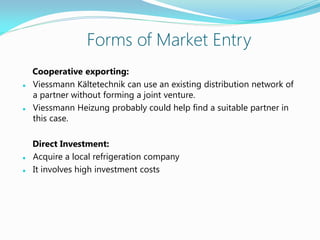
Cooperative exporting:
 Viessmann Kältetechnik can use an existing distribution network of
a partner without forming a joint venture.
 Viessmann Heizung probably could help find a suitable partner in
this case.
Direct Investment:
 Acquire a local refrigeration company
 It involves high investment costs
MARKETING STRATEGY
Viessmann Relevant Market
functionality
Market segments
technology
RC
Supermarkets
Restaurants and hotels
Pharmaceutical companies
Cooling of goods
Storage of goods
Protection of goods
Safe waste disposal
Hospitals
Refrigeration
SilverProtec®
Anti slip floors
Functionality
All features of the cold room
Technology
Different materials which allow for the
various ways to use the product
Market segments
Customers with rather homogenous
needs and characteristics
Porter's Strategy
Competitive
Scope
Broad
target
Narrow
Target
Low Cost Differentiation
Competitive
Advantage
Cost
Leadership
Focus
Differentia
-tion
Cost leadership strategy:
 Company is a low cost producer
in the market
 Uses cheap raw materials and labor
 Economics of scale
 Eg. Misa
Focus strategy:
 Focuses on a particular market
segment
 Products are developed exclusively
for this market.
 A brand loyalty is built among the
clients.
Porter's Strategy
Differentiation strategy:
The main aim of this strategy is to differentiate a company from the rest of it's
competitors
Why follow this strategy?
Viessmann must follow this strategy as it's products are mostly costlier than it's
competitors.
Requirements for this strategy
 A good brand name and good product
 Certificates from the government and other institutions
 “Made in Germany”- feeling of exclusivity
 A good after sales service
Missing requirement
 Good sales persons to explain about the benefits of the products
Market Positioning
Positioning of Viessmann in the Swiss market:
Price Positioning
ProductValue
MARKETING MIX
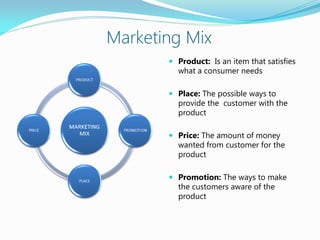
Marketing Mix
 Product: Is an item that satisfies
what a consumer needs
 Place: The possible ways to
provide the customer with the
product
 Price: The amount of money
wanted from customer for the
product
 Promotion: The ways to make
the customers aware of the
product
Product
The three levels of a product:
Augmented Product:
Supplementary the non physical
part
of the product
Actual Product:
Tangible, physical product that the
customer can touch and experience.
Core Product:
Intangible, physical product which
the
customer can’t touch
Product
Core Product:
The Core part for Viessmann products are
 Cooling
 Storage of items
The core benefit will not change for the Swiss market as the
core benefit cooling is the same as in the Swiss market
Product
Actual product:
 Good brand name
 Viessmann products embodies the highest possible
quality.
 Individuality of each product.
 Safe (Siver Protec and Anti Slip floors)
 Good design
 Technologically advanced
Product
Augmented Product:
Quick delivery of the products
 Using company's own vehicles
 Using freight forwarders
Good After Sales Service
 This can be done by the company itself.
Warranty
 Warranty period of 5 years should be good enough
Place
 Describes the channels of distribution used for supplying a
company's product to the customer.
 There are 2 types of distribution: Direct and Indirect
distribution.
 Viessmann currently sells through indirect distribution.
Place
Viessmann Distribution network in Switzerland
Place
Changes recommended:
 Viessmann can look to increase it's percentage of sales to with it's
direct customers like supermarkets and hotels.
 Now around 1% to atleast 5%
 Viessmann needs an exclusive distributor of it's products in order to
differentiate itself from the rest of the competition.
 Viessmann can educate it's existing dealers in Switzerland to explain
the advantages their customers are getting by choosing their
products
Promotion
Describes tools that can be used for promoting
Viessmann products
Corporate Website
Already functioning well but additional language
support can be added
Web Content
Event calendar can be included in the website
Trade Fairs
Partizipation in the potential trade fairs to display
latest innovation
FBK expo is biggest pastry expo held at Bern,
Switzerland.
Trade Fairs
Mefa is the leading Exhibition for meat industry
at Basel Exhibition Center, Switzerland
About 87 exhibitors participated in 2011
Trade Fairs
Vitafoods Europe is the only event in the world to
concentrate exclusively on the expanding market for
nutraceuticals, nutricosmetics, functional foods and
drinks ingredients & raw material
Magazine Advertisement
MSM le mensuel de l'industrieprops and SMM industriezeitschrift für
die praxis are most popular magazines covering industrial trends.
They have their own youtube channel with about 14,479 videos online and
also a facebook page.
Internet Advertising
Viessmann kältetechnik can create a twitter page for better
public connectivity as many consider twitter to be more verified
source.
Youtube Advertising
Youtube channel for Viessmann kältetechnik can be created for
event publishing and marketing purposes
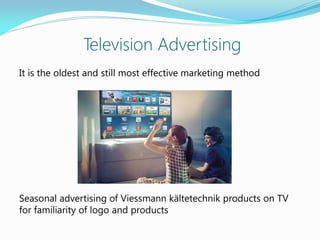
Television Advertising
It is the oldest and still most effective marketing method
Seasonal advertising of Viessmann kältetechnik products on TV
for familiarity of logo and products
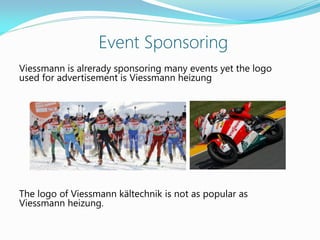
Event Sponsoring
Viessmann is alrerady sponsoring many events yet the logo
used for advertisement is Viessmann heizung
The logo of Viessmann kältechnik is not as popular as
Viessmann heizung.
Price
Pricing is the process of determining what a company will
receive in exchange for its products
The needs of the consumer can be converted into demand only
if the consumer has the willingness and capacity to buy the
product
Marginal Cost Pricing
Marginal-cost pricing the practice of setting the price of a
product to equal the extra cost of producing an extra unit of
output.
Example:
If an item has a marginal cost = $1.00 and normal selling price =
$2.00, the company might wish to lower the price to $1.10 if
demand has waned.
Subsidiary Costing
Creating a low-cost product division by either a subsidiary
company or a sub segment of the parent company which offers
low-priced products.
Recommendation
 There is still tremendous opportunity for growth in Switzerland
 The current economic crisis in Europe might slowdown demand.
 Hiring good sales persons for the Switzerland market is most
important task for a good sales in Switzerland
 Supermarkets is currently the best bet in Switzerland,
Viessmann must tune it's marketing activities to capture a
significant market share.
 Viessmann must look to increase it's percentage of direct
customers in order to earn more revenue.
 Viessmann must also look for exclusive distributors of it's
products
Viessmann must be willing to make some investments in order
to gain a good market share in Switzerland
Thank you

Viessmann project

  • 1.
    Marketing Plan for inSwitzerland Preetham Samuel Tijo Johny Edita Kodatova Tsvetelina Toseva Kevin Elorza
  • 2.
    Table of Contents 1.Introduction 2. Macroeconomic Environment in Switzerland 3. Microeconomic Environment in Switzerland 4. Market entry strategies 5. Marketing Mix 6. Final Recommendation
  • 3.
    Introduction  Viessmann Kältetechnikis one of the leading producers of refrigeration and clean room technology in Europe  Viessmann is currently looking to expand it's sales revenues in Switzerland.  The merger of Viessmann heating of Viessmann Kältetechnik will provide many opportunities for Viessmann Kältetechnik.  The marketing plan for Viessman was developed with the help of macroeconomic and microeconomic analysis of Switzerland.
  • 4.
  • 5.
    Macroeconomic Environment in Switzerland PESTELAnalysis  PESTEL analysis is used as a tool to analyse a country.  Based on this information a company can decide whether they should enter a market or not.  PESTEL analysis gives the whole picture of the environment of a country.
  • 6.
    GDP and Development The GDP of Switzerland is currently $635.65 billion  The GDP of Switzerland had contracted by 0.1% in the last quarter of 2012.  Between 1980 and 1992 the GDP growth rate has been around 0.42 % GDP – real growth rate in percent, 1999 – 2011
  • 7.
    Exports and Imports Switzerland exports stand at $190.1 billion  Switzerland has a trade deficit of $12.9 billion  Chemical, mechanical and electrical products are currently the mainstay of Swiss exports. Export and Import partners of Switzerland Exports Imports Germany 20.2% Germany 32.3% US 10.3% US 10.4% Italy 7.8% Italy 8.6% France 7.1% France 5.0% UK 4.8% UK 4.4%
  • 8.
    Trade with Germany Germany is Switzerland's most important trading partner.  One – third of Swiss imports come from Germany.  Bilateral trade currently stands at almost $91 billion.  Germany regularly posts a trade surplus vis-à-vis Switzerland.  Switzerland is the fifth largest foreign direct investor for Germany.  Vice versa Germany is the 6th largest foreign direct investor for Switzerland.
  • 9.
    Transport System  Switzerlandhas a dense network of railways and a very good road network.  There are 4,492 kilometers of rail lines and 71,059 kilometers of roadways.  Geneva and Zurich are the major airports and the port of Basel on the river Rhine is a major trading hub.
  • 10.
    Technology  Science andtechnology in Switzerland play an important role in economy as very few natural resources are available in the country.  Switzerland spends 2.9% of the GDP towards R&D.  The Swiss government supports universities and other public and private sector organizations for research.
  • 11.
    Political stability • Directdemocracy • The Swiss Constitution – legislation for whole country • All other minor aspect – left up to legislation of cantons • Minor changes to the Swiss constitution guite often (main ideas stay the same)
  • 12.
    Demographics • Population –7,8 million • Most part of population lives in Geneva, Basel, Lausanne and Bern • 20% immigrants and resident foreigners Population of Switzerland from 1960 to 2011
  • 13.
    Trade Barriers andRestrictions • Minimal barriers • High open to foreign trade and investments • Macroeconomic stability • Solid monetary stability • Strong protection of property rights • The overall tax burden: 30.3% • The competitive regulatory framework strongly supports commercial activity • Labor regulations are relatively flexible • No trade weighted average tariff rate • Low corruption
  • 14.
    Inflation • The averageinflation in 2012: -0.71 % • The inflation from November 2012: -0,3% Current CPI inflation Switzerland – last 12 months
  • 15.
    Exchange Rate • Currency:Swiss franc • 1EUR/1.2090 CHF
  • 16.
  • 17.
    Growth Potential inthe Swiss Market  Refrigeration Companies  Supermarkets  Restaurants  Hotels  Hospitals, clinics and Laboratories
  • 18.
    Competitors  Narr (NarrIsoliersysteme GmbH).  Main competitor in Switzerland.  Product range is similar to Viessmann’s.  Flaws: cold rooms cannot be completely customized, technology is not the same - is not as developed as Viessmann’s. Other main competitors in Switzerland are Celltherm, SBS, Misa, Roma
  • 19.
    Viessmann vs Competition Premium Products  Quality Guaranteed  Total customization  State-of-the-art technology  Complete after slae service
  • 20.
    Potential markets Supermarkets  ALDI LIDL  MIGROS  COOP  Denner  SPAR More than 4000+ stores all together
  • 21.
  • 22.
    Supermarkets Market  Migros(1,500+ stores).  Coop (1990+ stores).  Aldi (150+ stores).  Denner (440+ stores).  Landi (330+ stores).  Lidl (86+ stores).  Spar (170+ stores).
  • 23.
    Other Markets Refrigeration companies: HavoGroup, Coldstone and Dinba Hotels: Hilton, Sheraton, 4 seasons and Marriot Hotel Restaurants and Cafe's: McDonald, Burger King, Hard Rock Café and Starbucks Other companies: Norvatis (Pharmaceutical), Sika AG (Chemical), Nestlé (Food processing)
  • 24.
    Customer Behavior inSwitzerland  Customers in Switzerland require Viessmann products to have 150mm thickness for the wall  Peak demand is during the summer months  Customers usually tend to buy a lot during the summer months  Customers in Switzerland also expect the highest quality for any product and Viessmann delivers it.
  • 25.
    Intercultural Aspects  Switzerlandhas four official languages, they are German , French , Italian and Romansh.  Swiss people find Germans too unpolite.  Swiss people view Germans as competition for highly paid jobs.
  • 26.
  • 27.
  • 28.
  • 29.
    Forms of MarketEntry Present Situation: Viessmann Kältetechnik currently directly exports it's products through Distributors in Switzerland Suggested Alternative methods: Joint Venture:  High return potential  Access to the distribution network, personal contacts with suppliers, government officials, special skills etc.  Control in the activities of the company in the country.
  • 30.
    Forms of MarketEntry Cooperative exporting:  Viessmann Kältetechnik can use an existing distribution network of a partner without forming a joint venture.  Viessmann Heizung probably could help find a suitable partner in this case. Direct Investment:  Acquire a local refrigeration company  It involves high investment costs
  • 31.
  • 32.
    Viessmann Relevant Market functionality Marketsegments technology RC Supermarkets Restaurants and hotels Pharmaceutical companies Cooling of goods Storage of goods Protection of goods Safe waste disposal Hospitals Refrigeration SilverProtec® Anti slip floors Functionality All features of the cold room Technology Different materials which allow for the various ways to use the product Market segments Customers with rather homogenous needs and characteristics
  • 33.
    Porter's Strategy Competitive Scope Broad target Narrow Target Low CostDifferentiation Competitive Advantage Cost Leadership Focus Differentia -tion Cost leadership strategy:  Company is a low cost producer in the market  Uses cheap raw materials and labor  Economics of scale  Eg. Misa Focus strategy:  Focuses on a particular market segment  Products are developed exclusively for this market.  A brand loyalty is built among the clients.
  • 34.
    Porter's Strategy Differentiation strategy: Themain aim of this strategy is to differentiate a company from the rest of it's competitors Why follow this strategy? Viessmann must follow this strategy as it's products are mostly costlier than it's competitors. Requirements for this strategy  A good brand name and good product  Certificates from the government and other institutions  “Made in Germany”- feeling of exclusivity  A good after sales service Missing requirement  Good sales persons to explain about the benefits of the products
  • 35.
    Market Positioning Positioning ofViessmann in the Swiss market: Price Positioning ProductValue
  • 36.
  • 37.
    Marketing Mix  Product:Is an item that satisfies what a consumer needs  Place: The possible ways to provide the customer with the product  Price: The amount of money wanted from customer for the product  Promotion: The ways to make the customers aware of the product
  • 38.
    Product The three levelsof a product: Augmented Product: Supplementary the non physical part of the product Actual Product: Tangible, physical product that the customer can touch and experience. Core Product: Intangible, physical product which the customer can’t touch
  • 39.
    Product Core Product: The Corepart for Viessmann products are  Cooling  Storage of items The core benefit will not change for the Swiss market as the core benefit cooling is the same as in the Swiss market
  • 40.
    Product Actual product:  Goodbrand name  Viessmann products embodies the highest possible quality.  Individuality of each product.  Safe (Siver Protec and Anti Slip floors)  Good design  Technologically advanced
  • 41.
    Product Augmented Product: Quick deliveryof the products  Using company's own vehicles  Using freight forwarders Good After Sales Service  This can be done by the company itself. Warranty  Warranty period of 5 years should be good enough
  • 42.
    Place  Describes thechannels of distribution used for supplying a company's product to the customer.  There are 2 types of distribution: Direct and Indirect distribution.  Viessmann currently sells through indirect distribution.
  • 43.
  • 44.
    Place Changes recommended:  Viessmanncan look to increase it's percentage of sales to with it's direct customers like supermarkets and hotels.  Now around 1% to atleast 5%  Viessmann needs an exclusive distributor of it's products in order to differentiate itself from the rest of the competition.  Viessmann can educate it's existing dealers in Switzerland to explain the advantages their customers are getting by choosing their products
  • 45.
    Promotion Describes tools thatcan be used for promoting Viessmann products
  • 46.
    Corporate Website Already functioningwell but additional language support can be added
  • 47.
    Web Content Event calendarcan be included in the website
  • 48.
    Trade Fairs Partizipation inthe potential trade fairs to display latest innovation FBK expo is biggest pastry expo held at Bern, Switzerland.
  • 49.
    Trade Fairs Mefa isthe leading Exhibition for meat industry at Basel Exhibition Center, Switzerland About 87 exhibitors participated in 2011
  • 50.
    Trade Fairs Vitafoods Europeis the only event in the world to concentrate exclusively on the expanding market for nutraceuticals, nutricosmetics, functional foods and drinks ingredients & raw material
  • 51.
    Magazine Advertisement MSM lemensuel de l'industrieprops and SMM industriezeitschrift für die praxis are most popular magazines covering industrial trends. They have their own youtube channel with about 14,479 videos online and also a facebook page.
  • 52.
    Internet Advertising Viessmann kältetechnikcan create a twitter page for better public connectivity as many consider twitter to be more verified source.
  • 53.
    Youtube Advertising Youtube channelfor Viessmann kältetechnik can be created for event publishing and marketing purposes
  • 54.
    Television Advertising It isthe oldest and still most effective marketing method Seasonal advertising of Viessmann kältetechnik products on TV for familiarity of logo and products
  • 55.
    Event Sponsoring Viessmann isalrerady sponsoring many events yet the logo used for advertisement is Viessmann heizung The logo of Viessmann kältechnik is not as popular as Viessmann heizung.
  • 56.
    Price Pricing is theprocess of determining what a company will receive in exchange for its products The needs of the consumer can be converted into demand only if the consumer has the willingness and capacity to buy the product
  • 57.
    Marginal Cost Pricing Marginal-costpricing the practice of setting the price of a product to equal the extra cost of producing an extra unit of output. Example: If an item has a marginal cost = $1.00 and normal selling price = $2.00, the company might wish to lower the price to $1.10 if demand has waned.
  • 58.
    Subsidiary Costing Creating alow-cost product division by either a subsidiary company or a sub segment of the parent company which offers low-priced products.
  • 59.
    Recommendation  There isstill tremendous opportunity for growth in Switzerland  The current economic crisis in Europe might slowdown demand.  Hiring good sales persons for the Switzerland market is most important task for a good sales in Switzerland  Supermarkets is currently the best bet in Switzerland, Viessmann must tune it's marketing activities to capture a significant market share.  Viessmann must look to increase it's percentage of direct customers in order to earn more revenue.  Viessmann must also look for exclusive distributors of it's products Viessmann must be willing to make some investments in order to gain a good market share in Switzerland
  • 60.