01
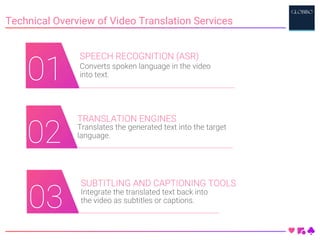
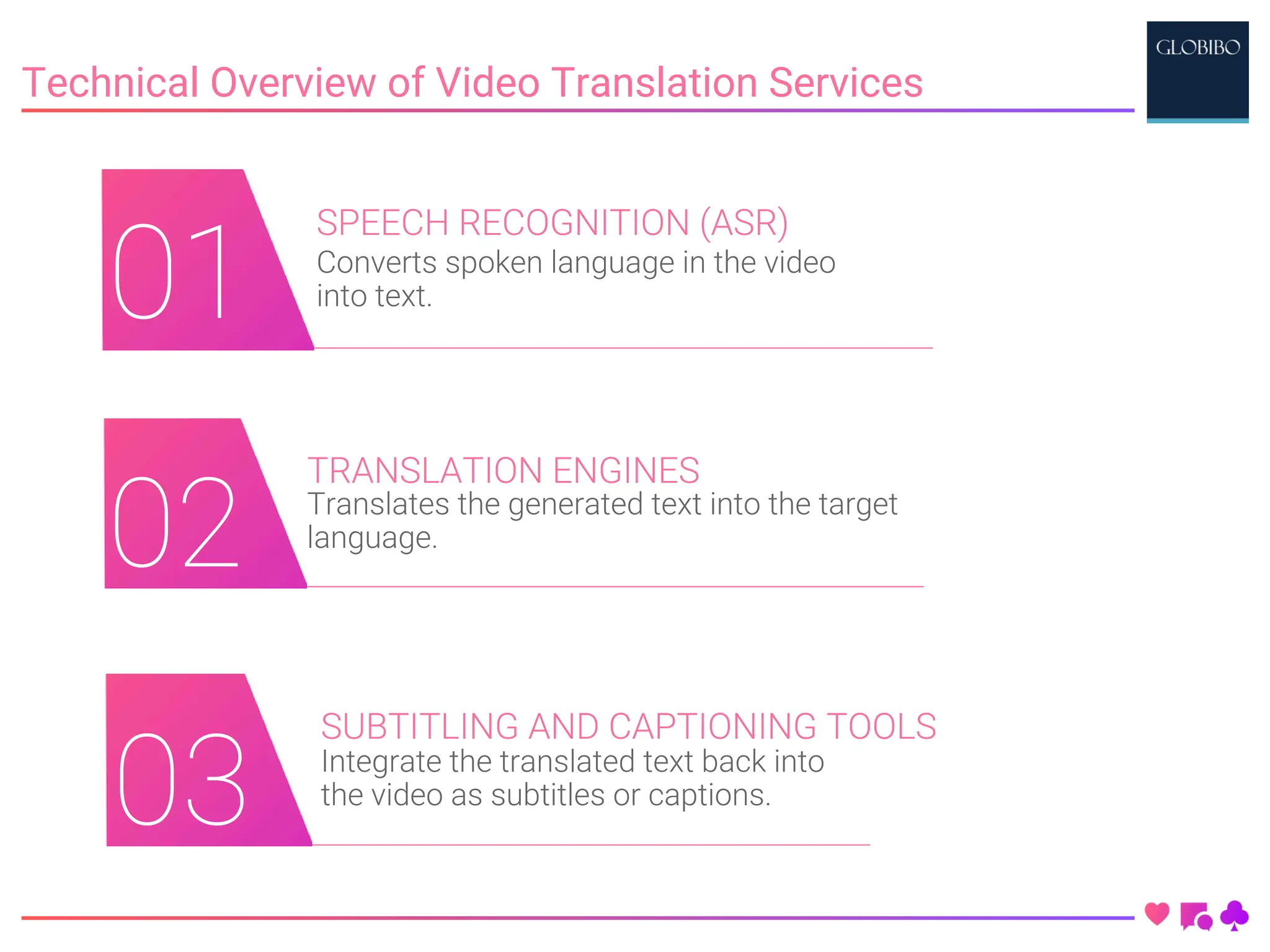
Technical Overview of Video Translation Services
SPEECH RECOGNITION (ASR)
Converts spoken language in the video
into text.
TRANSLATION ENGINES
Translates the generated text into the target
language.
02
01
01SUBTITLING AND CAPTIONING TOOLS
Integrate the translated text back into
the video as subtitles or captions.
03
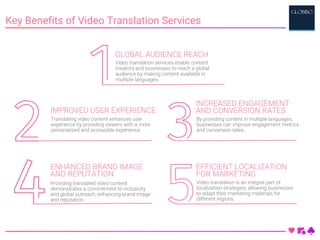
Key Benefits of Video Translation Services
IMPROVED USER EXPERIENCE
Translating video content enhances user
experience by providing viewers with a more
personalized and accessible experience.
INCREASED ENGAGEMENT
AND CONVERSION RATES
By providing content in multiple languages,
businesses can improve engagement metrics
and conversion rates.
Providing translated video content
demonstrates a commitment to inclusivity
and global outreach, enhancing brand image
and reputation.
Video translation is an integral part of
localization strategies, allowing businesses
to adapt their marketing materials for
different regions.
GLOBAL AUDIENCE REACH
Video translation services enable content
creators and businesses to reach a global
audience by making content available in
multiple languages.
ENHANCED BRAND IMAGE
AND REPUTATION
EFFICIENT LOCALIZATION
FOR MARKETING
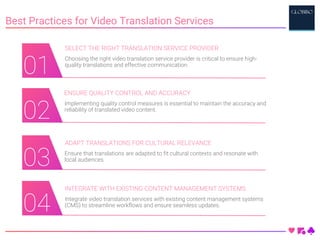
Best Practices for Video Translation Services
SELECT THE RIGHT TRANSLATION SERVICE PROVIDER
Choosing the right video translation service provider is critical to ensure high-
quality translations and effective communication.
01
ENSURE QUALITY CONTROL AND ACCURACY
Implementing quality control measures is essential to maintain the accuracy and
reliability of translated video content.
02
ADAPT TRANSLATIONS FOR CULTURAL RELEVANCE
Ensure that translations are adapted to fit cultural contexts and resonate with
local audiences.
03
INTEGRATE WITH EXISTING CONTENT MANAGEMENT SYSTEMS
Integrate video translation services with existing content management systems
(CMS) to streamline workflows and ensure seamless updates.
04
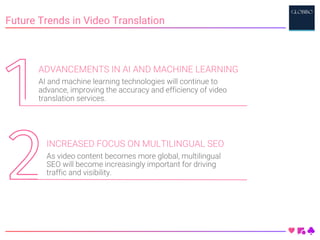
Future Trends in Video Translation
INCREASED FOCUS ON MULTILINGUAL SEO
As video content becomes more global, multilingual
SEO will become increasingly important for driving
traffic and visibility.
ADVANCEMENTS IN AI AND MACHINE LEARNING
AI and machine learning technologies will continue to
advance, improving the accuracy and efficiency of video
translation services.
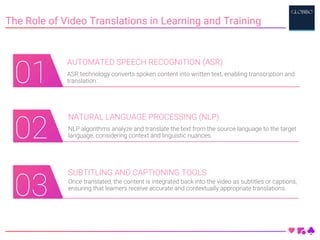
The Role of Video Translations in Learning and Training
AUTOMATED SPEECH RECOGNITION (ASR)
ASR technology converts spoken content into written text, enabling transcription and
translation.
01
NATURAL LANGUAGE PROCESSING (NLP)
NLP algorithms analyze and translate the text from the source language to the target
language, considering context and linguistic nuances.
SUBTITLING AND CAPTIONING TOOLS
Once translated, the content is integrated back into the video as subtitles or captions,
ensuring that learners receive accurate and contextually appropriate translations.
02
03
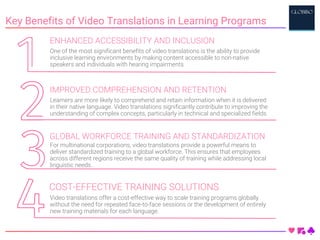
Key Benefits of Video Translations in Learning Programs
ENHANCED ACCESSIBILITY AND INCLUSION
One of the most significant benefits of video translations is the ability to provide
inclusive learning environments by making content accessible to non-native
speakers and individuals with hearing impairments.
IMPROVED COMPREHENSION AND RETENTION
Learners are more likely to comprehend and retain information when it is delivered
in their native language. Video translations significantly contribute to improving the
understanding of complex concepts, particularly in technical and specialized fields.
GLOBAL WORKFORCE TRAINING AND STANDARDIZATION
For multinational corporations, video translations provide a powerful means to
deliver standardized training to a global workforce. This ensures that employees
across different regions receive the same quality of training while addressing local
linguistic needs.
COST-EFFECTIVE TRAINING SOLUTIONS
Video translations offer a cost-effective way to scale training programs globally
without the need for repeated face-to-face sessions or the development of entirely
new training materials for each language.
01
01
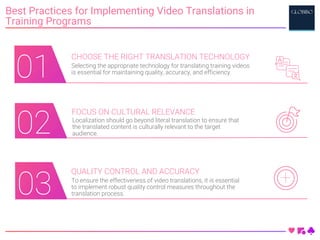
Best Practices for Implementing Video Translations in
Training Programs
CHOOSE THE RIGHT TRANSLATION TECHNOLOGY
Selecting the appropriate technology for translating training videos
is essential for maintaining quality, accuracy, and efficiency.
FOCUS ON CULTURAL RELEVANCE
Localization should go beyond literal translation to ensure that
the translated content is culturally relevant to the target
audience.
QUALITY CONTROL AND ACCURACY
To ensure the effectiveness of video translations, it is essential
to implement robust quality control measures throughout the
translation process.
03
02
01
01
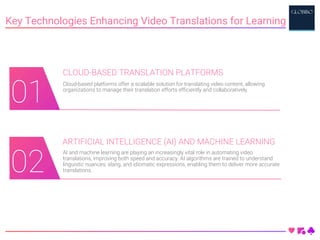
Key Technologies Enhancing Video Translations for Learning
CLOUD-BASED TRANSLATION PLATFORMS
Cloud-based platforms offer a scalable solution for translating video content, allowing
organizations to manage their translation efforts efficiently and collaboratively.
ARTIFICIAL INTELLIGENCE (AI) AND MACHINE LEARNING
AI and machine learning are playing an increasingly vital role in automating video
translations, improving both speed and accuracy. AI algorithms are trained to understand
linguistic nuances, slang, and idiomatic expressions, enabling them to deliver more accurate
translations.
02
01
01
01
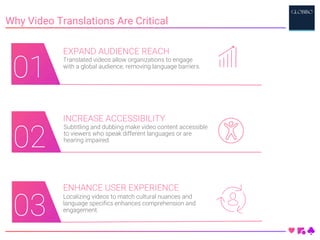
Why Video Translations Are Critical
EXPAND AUDIENCE REACH
Translated videos allow organizations to engage
with a global audience, removing language barriers.
INCREASE ACCESSIBILITY
Subtitling and dubbing make video content accessible
to viewers who speak different languages or are
hearing impaired.
ENHANCE USER EXPERIENCE
Localizing videos to match cultural nuances and
language specifics enhances comprehension and
engagement.
03
02
01
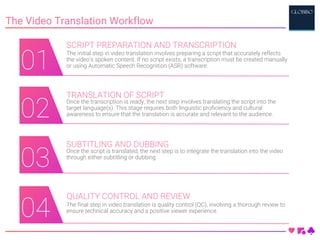
The Video Translation Workflow
SCRIPT PREPARATION AND TRANSCRIPTION
The initial step in video translation involves preparing a script that accurately reflects
the video's spoken content. If no script exists, a transcription must be created manually
or using Automatic Speech Recognition (ASR) software.
01
TRANSLATION OF SCRIPT
Once the transcription is ready, the next step involves translating the script into the
target language(s). This stage requires both linguistic proficiency and cultural
awareness to ensure that the translation is accurate and relevant to the audience.
02
SUBTITLING AND DUBBING
Once the script is translated, the next step is to integrate the translation into the video
through either subtitling or dubbing
03
QUALITY CONTROL AND REVIEW
The final step in video translation is quality control (QC), involving a thorough review to
ensure technical accuracy and a positive viewer experience.
04
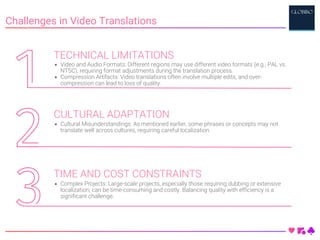
Challenges in Video Translations
TECHNICAL LIMITATIONS
Video and Audio Formats: Different regions may use different video formats (e.g., PAL vs.
NTSC), requiring format adjustments during the translation process.
Compression Artifacts: Video translations often involve multiple edits, and over-
compression can lead to loss of quality.
CULTURAL ADAPTATION
Cultural Misunderstandings: As mentioned earlier, some phrases or concepts may not
translate well across cultures, requiring careful localization.
TIME AND COST CONSTRAINTS
Complex Projects: Large-scale projects, especially those requiring dubbing or extensive
localization, can be time-consuming and costly. Balancing quality with efficiency is a
significant challenge.
01
01
01
01 01
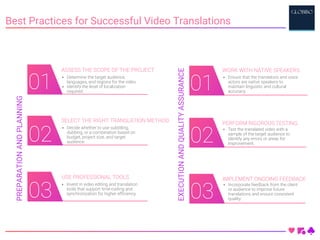
Best Practices for Successful Video Translations
ASSESS THE SCOPE OF THE PROJECT
Determine the target audience,
languages, and regions for the video.
Identify the level of localization
required.
01
02
01
02
03 03
PREPARATION
AND
PLANNING
WORK WITH NATIVE SPEAKERS
Ensure that the translators and voice
actors are native speakers to
maintain linguistic and cultural
accuracy.
SELECT THE RIGHT TRANSLATION METHOD
Decide whether to use subtitling,
dubbing, or a combination based on
budget, project size, and target
audience.
USE PROFESSIONAL TOOLS
Invest in video editing and translation
tools that support time-coding and
synchronization for higher efficiency.
PERFORM RIGOROUS TESTING
Test the translated video with a
sample of the target audience to
identify any errors or areas for
improvement.
IMPLEMENT ONGOING FEEDBACK
Incorporate feedback from the client
or audience to improve future
translations and ensure consistent
quality.
EXECUTION
AND
QUALITY
ASSURANCE
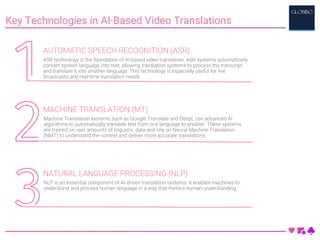
Key Technologies in AI-Based Video Translations
MACHINE TRANSLATION (MT)
Machine Translation systems such as Google Translate and DeepL use advanced AI
algorithms to automatically translate text from one language to another. These systems
are trained on vast amounts of linguistic data and rely on Neural Machine Translation
(NMT) to understand the context and deliver more accurate translations.
NATURAL LANGUAGE PROCESSING (NLP)
NLP is an essential component of AI-driven translation systems. It enables machines to
understand and process human language in a way that mimics human understanding.
AUTOMATIC SPEECH RECOGNITION (ASR)
ASR technology is the foundation of AI-based video translation. ASR systems automatically
convert spoken language into text, allowing translation systems to process the transcript
and translate it into another language. This technology is especially useful for live
broadcasts and real-time translation needs.
01
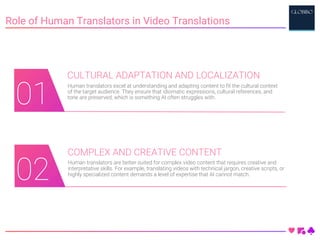
Role of Human Translators in Video Translations
CULTURAL ADAPTATION AND LOCALIZATION
Human translators excel at understanding and adapting content to fit the cultural context
of the target audience. They ensure that idiomatic expressions, cultural references, and
tone are preserved, which is something AI often struggles with.
COMPLEX AND CREATIVE CONTENT
Human translators are better suited for complex video content that requires creative and
interpretative skills. For example, translating videos with technical jargon, creative scripts, or
highly specialized content demands a level of expertise that AI cannot match.
02
01

Video Translation Services by Assist App

  • 1.
    01 Technical Overview ofVideo Translation Services SPEECH RECOGNITION (ASR) Converts spoken language in the video into text. TRANSLATION ENGINES Translates the generated text into the target language. 02 01 01SUBTITLING AND CAPTIONING TOOLS Integrate the translated text back into the video as subtitles or captions. 03
  • 2.
    Key Benefits ofVideo Translation Services IMPROVED USER EXPERIENCE Translating video content enhances user experience by providing viewers with a more personalized and accessible experience. INCREASED ENGAGEMENT AND CONVERSION RATES By providing content in multiple languages, businesses can improve engagement metrics and conversion rates. Providing translated video content demonstrates a commitment to inclusivity and global outreach, enhancing brand image and reputation. Video translation is an integral part of localization strategies, allowing businesses to adapt their marketing materials for different regions. GLOBAL AUDIENCE REACH Video translation services enable content creators and businesses to reach a global audience by making content available in multiple languages. ENHANCED BRAND IMAGE AND REPUTATION EFFICIENT LOCALIZATION FOR MARKETING
  • 3.
    Best Practices forVideo Translation Services SELECT THE RIGHT TRANSLATION SERVICE PROVIDER Choosing the right video translation service provider is critical to ensure high- quality translations and effective communication. 01 ENSURE QUALITY CONTROL AND ACCURACY Implementing quality control measures is essential to maintain the accuracy and reliability of translated video content. 02 ADAPT TRANSLATIONS FOR CULTURAL RELEVANCE Ensure that translations are adapted to fit cultural contexts and resonate with local audiences. 03 INTEGRATE WITH EXISTING CONTENT MANAGEMENT SYSTEMS Integrate video translation services with existing content management systems (CMS) to streamline workflows and ensure seamless updates. 04
  • 4.
    Future Trends inVideo Translation INCREASED FOCUS ON MULTILINGUAL SEO As video content becomes more global, multilingual SEO will become increasingly important for driving traffic and visibility. ADVANCEMENTS IN AI AND MACHINE LEARNING AI and machine learning technologies will continue to advance, improving the accuracy and efficiency of video translation services.
  • 5.
    The Role ofVideo Translations in Learning and Training AUTOMATED SPEECH RECOGNITION (ASR) ASR technology converts spoken content into written text, enabling transcription and translation. 01 NATURAL LANGUAGE PROCESSING (NLP) NLP algorithms analyze and translate the text from the source language to the target language, considering context and linguistic nuances. SUBTITLING AND CAPTIONING TOOLS Once translated, the content is integrated back into the video as subtitles or captions, ensuring that learners receive accurate and contextually appropriate translations. 02 03
  • 6.
    Key Benefits ofVideo Translations in Learning Programs ENHANCED ACCESSIBILITY AND INCLUSION One of the most significant benefits of video translations is the ability to provide inclusive learning environments by making content accessible to non-native speakers and individuals with hearing impairments. IMPROVED COMPREHENSION AND RETENTION Learners are more likely to comprehend and retain information when it is delivered in their native language. Video translations significantly contribute to improving the understanding of complex concepts, particularly in technical and specialized fields. GLOBAL WORKFORCE TRAINING AND STANDARDIZATION For multinational corporations, video translations provide a powerful means to deliver standardized training to a global workforce. This ensures that employees across different regions receive the same quality of training while addressing local linguistic needs. COST-EFFECTIVE TRAINING SOLUTIONS Video translations offer a cost-effective way to scale training programs globally without the need for repeated face-to-face sessions or the development of entirely new training materials for each language.
  • 7.
    01 01 Best Practices forImplementing Video Translations in Training Programs CHOOSE THE RIGHT TRANSLATION TECHNOLOGY Selecting the appropriate technology for translating training videos is essential for maintaining quality, accuracy, and efficiency. FOCUS ON CULTURAL RELEVANCE Localization should go beyond literal translation to ensure that the translated content is culturally relevant to the target audience. QUALITY CONTROL AND ACCURACY To ensure the effectiveness of video translations, it is essential to implement robust quality control measures throughout the translation process. 03 02 01
  • 8.
    01 Key Technologies EnhancingVideo Translations for Learning CLOUD-BASED TRANSLATION PLATFORMS Cloud-based platforms offer a scalable solution for translating video content, allowing organizations to manage their translation efforts efficiently and collaboratively. ARTIFICIAL INTELLIGENCE (AI) AND MACHINE LEARNING AI and machine learning are playing an increasingly vital role in automating video translations, improving both speed and accuracy. AI algorithms are trained to understand linguistic nuances, slang, and idiomatic expressions, enabling them to deliver more accurate translations. 02 01
  • 9.
    01 01 Why Video TranslationsAre Critical EXPAND AUDIENCE REACH Translated videos allow organizations to engage with a global audience, removing language barriers. INCREASE ACCESSIBILITY Subtitling and dubbing make video content accessible to viewers who speak different languages or are hearing impaired. ENHANCE USER EXPERIENCE Localizing videos to match cultural nuances and language specifics enhances comprehension and engagement. 03 02 01
  • 10.
    The Video TranslationWorkflow SCRIPT PREPARATION AND TRANSCRIPTION The initial step in video translation involves preparing a script that accurately reflects the video's spoken content. If no script exists, a transcription must be created manually or using Automatic Speech Recognition (ASR) software. 01 TRANSLATION OF SCRIPT Once the transcription is ready, the next step involves translating the script into the target language(s). This stage requires both linguistic proficiency and cultural awareness to ensure that the translation is accurate and relevant to the audience. 02 SUBTITLING AND DUBBING Once the script is translated, the next step is to integrate the translation into the video through either subtitling or dubbing 03 QUALITY CONTROL AND REVIEW The final step in video translation is quality control (QC), involving a thorough review to ensure technical accuracy and a positive viewer experience. 04
  • 11.
    Challenges in VideoTranslations TECHNICAL LIMITATIONS Video and Audio Formats: Different regions may use different video formats (e.g., PAL vs. NTSC), requiring format adjustments during the translation process. Compression Artifacts: Video translations often involve multiple edits, and over- compression can lead to loss of quality. CULTURAL ADAPTATION Cultural Misunderstandings: As mentioned earlier, some phrases or concepts may not translate well across cultures, requiring careful localization. TIME AND COST CONSTRAINTS Complex Projects: Large-scale projects, especially those requiring dubbing or extensive localization, can be time-consuming and costly. Balancing quality with efficiency is a significant challenge.
  • 12.
    01 01 01 01 01 Best Practicesfor Successful Video Translations ASSESS THE SCOPE OF THE PROJECT Determine the target audience, languages, and regions for the video. Identify the level of localization required. 01 02 01 02 03 03 PREPARATION AND PLANNING WORK WITH NATIVE SPEAKERS Ensure that the translators and voice actors are native speakers to maintain linguistic and cultural accuracy. SELECT THE RIGHT TRANSLATION METHOD Decide whether to use subtitling, dubbing, or a combination based on budget, project size, and target audience. USE PROFESSIONAL TOOLS Invest in video editing and translation tools that support time-coding and synchronization for higher efficiency. PERFORM RIGOROUS TESTING Test the translated video with a sample of the target audience to identify any errors or areas for improvement. IMPLEMENT ONGOING FEEDBACK Incorporate feedback from the client or audience to improve future translations and ensure consistent quality. EXECUTION AND QUALITY ASSURANCE
  • 13.
    Key Technologies inAI-Based Video Translations MACHINE TRANSLATION (MT) Machine Translation systems such as Google Translate and DeepL use advanced AI algorithms to automatically translate text from one language to another. These systems are trained on vast amounts of linguistic data and rely on Neural Machine Translation (NMT) to understand the context and deliver more accurate translations. NATURAL LANGUAGE PROCESSING (NLP) NLP is an essential component of AI-driven translation systems. It enables machines to understand and process human language in a way that mimics human understanding. AUTOMATIC SPEECH RECOGNITION (ASR) ASR technology is the foundation of AI-based video translation. ASR systems automatically convert spoken language into text, allowing translation systems to process the transcript and translate it into another language. This technology is especially useful for live broadcasts and real-time translation needs.
  • 14.
    01 Role of HumanTranslators in Video Translations CULTURAL ADAPTATION AND LOCALIZATION Human translators excel at understanding and adapting content to fit the cultural context of the target audience. They ensure that idiomatic expressions, cultural references, and tone are preserved, which is something AI often struggles with. COMPLEX AND CREATIVE CONTENT Human translators are better suited for complex video content that requires creative and interpretative skills. For example, translating videos with technical jargon, creative scripts, or highly specialized content demands a level of expertise that AI cannot match. 02 01