 Venture capital means funds made available
for startup firms and small businesses with
exceptional growth potential.
 Venture capital is money provided by
professionals who alongside management invest
in young, rapidly growing companies that have
the potential to develop into significant economic
contributors.
3
• Venture capital firms specialize in providing equity financing
for firms that are in an early stage of development (start-ups).
• Examples of companies that received venture capital funding
in their early development include Apple, Federal Express,
Microsoft, Genentech, and Google.
• Venture capital (a.k.a. private equity) is a pool of capital most
commonly organized as a limited partnership. The venture
capital firm serves as the general partner and investors are the
limited partners. Limited partners can include pension funds,
university endowment funds, wealthy individuals, and other
financial institutions and corporations.
Venture Capitalists
4
• Managers of venture capital firms (venture capitalists) closely
follow the technology and market developments in their area
of expertise (e.g., computer software, communications,
computer hardware, medical/health, industrial/energy,
biotechnology, retailing, restaurants, etc.)
• They screen entrepreneurs and their business concepts prior to
making an investment. To diversify risk, they create a venture
fund that is a portfolio of investments in young companies.
• Venture capitalists are not passive equity investors. They
structure a financing deal with great attention to creating the
right incentives and compensation for the start-up firm’s
owners. They are also instrumental in raising additional
financing during future stages of the firm’s lifecycle.
Venture Capitalists generally:
Finance new and rapidly growing companies
Purchase equity securities
Assist in the development of new products or
services
Add value to the company through active
participation.
The SEBI has defined Venture Capital
Fund in its Regulation 1996 as ‘a fund
established in the form of a company or
trust which raises money through loans,
donations, issue of securities or units as
the case may be and makes or proposes
to make investments in accordance with
the regulations’.
Long time horizon
Lack of liquidity
High risk
Equity participation
Participation in management
It injects long term equity finance which provides
a solid capital base for future growth.
The venture capitalist is a business partner,
sharing both the risks and rewards. Venture
capitalists are rewarded by business success and
the capital gain.
The venture capitalist is able to provide practical
advice and assistance to the company based on
past experience with other companies which were
in similar situations.
 The venture capitalist also has a network of contacts
in many areas that can add value to the company.
 The venture capitalist may be capable of providing
additional rounds of funding should it be required to
finance growth.
 Venture capitalists are experienced in the process of
preparing a company for an initial public offering (IPO)
of its shares onto the stock exchanges or overseas
stock exchange such as NASDAQ.
They can also facilitate a trade sale.
1. Seed Money:
Low level financing needed to prove a new idea.
2. Start-up:
Early stage firms that need funding for expenses
associated with marketing and product
development.
3. First-Round:
Early sales and manufacturing funds.
4. Second-Round:
Working capital for early stage companies that
are selling product, but not yet turning a profit .
5. Third-Round:
Also called Mezzanine financing, this is
expansion money for a newly profitable
company
6. Fourth-Round:
Also called bridge financing, it is intended
to finance the "going public" process
Financial
Stage
Period (Funds
locked in
years)
Risk
Perception
Activity to be
financed
Seed Money 7-10 Extreme
For supporting
a concept or
idea or R&D for
product
development
Start Up 5-9 Very High
Initializing
operations or
developing
prototypes
First Stage 3-7 High
Start
commercials
production and
marketing
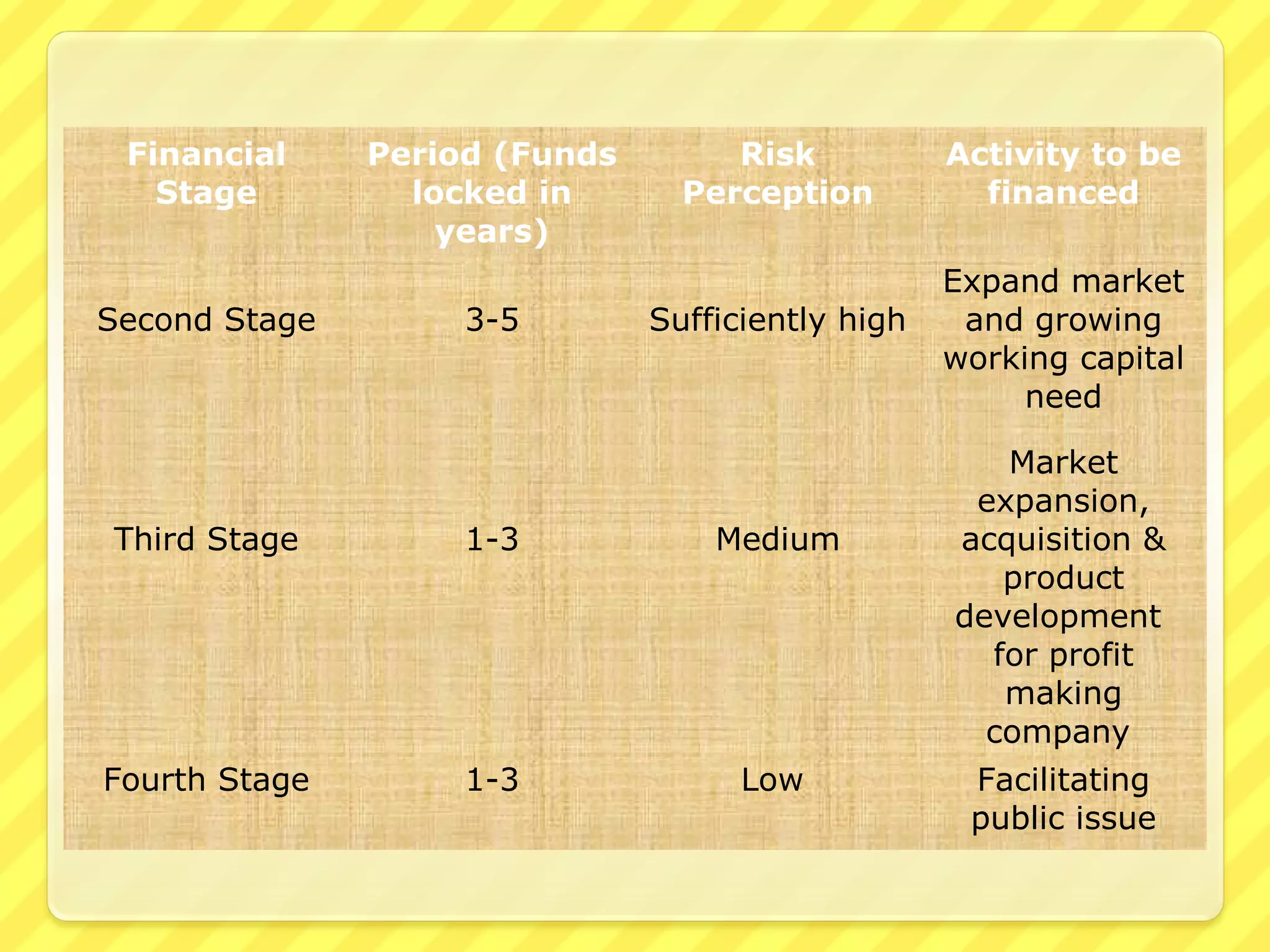
Financial
Stage
Period (Funds
locked in
years)
Risk
Perception
Activity to be
financed
Second Stage 3-5 Sufficiently high
Expand market
and growing
working capital
need
Third Stage 1-3 Medium
Market
expansion,
acquisition &
product
development
for profit
making
company
Fourth Stage 1-3 Low Facilitating
public issue
Deal origination
Screening
Due diligence
(Evaluation)
Deal structuring
Post investment
activity
Exit plan
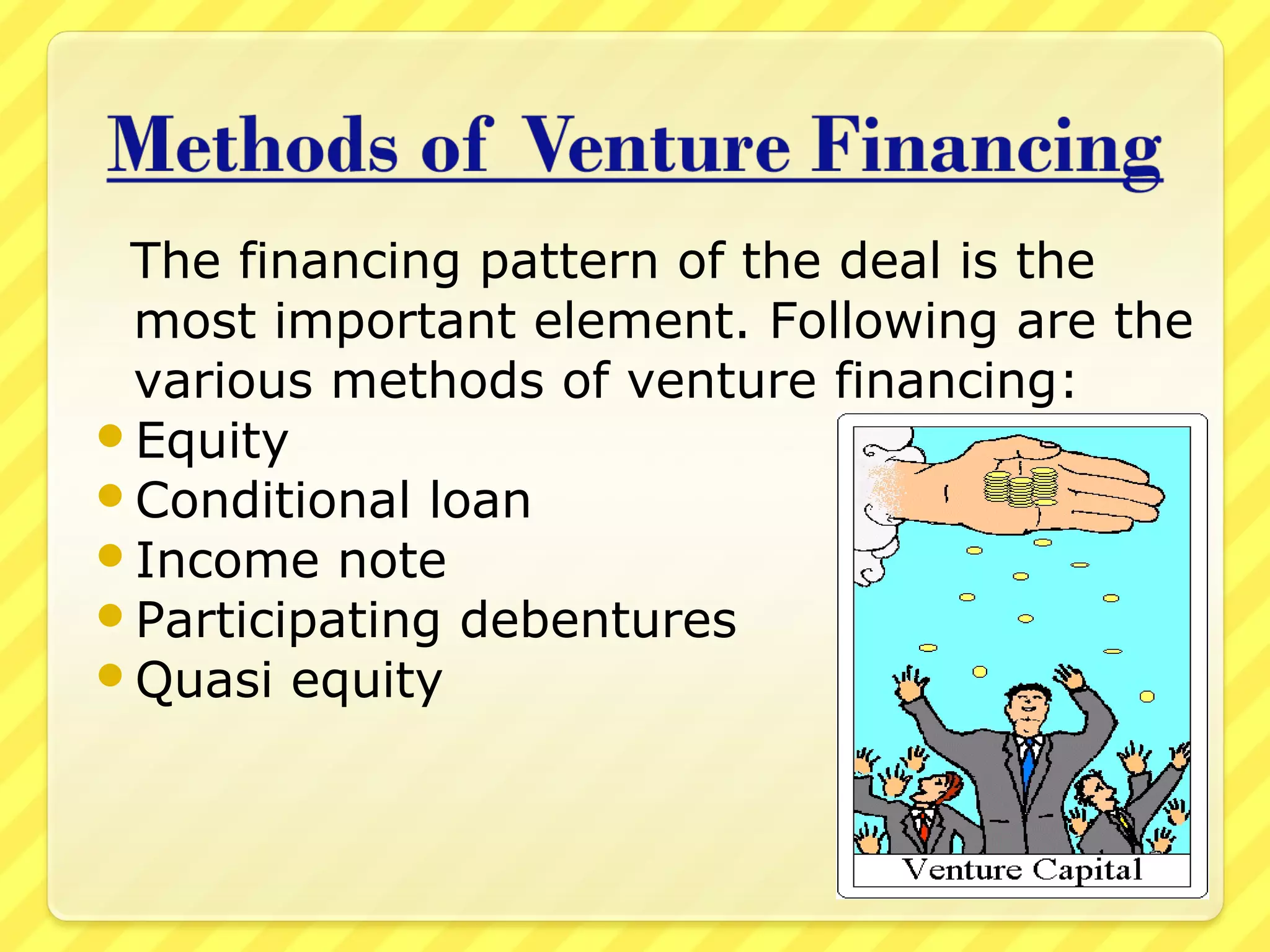
The financing pattern of the deal is the
most important element. Following are the
various methods of venture financing:
Equity
Conditional loan
Income note
Participating debentures
Quasi equity
Initial public offer(IPOs)
Trade sale
Promoter buy back
Acquisition by another company
The concept of venture capital was formally
introduced in India in 1987 by IDBI.
The government levied a 5 per cent cess on all
know-how import payments to create the venture
fund.
ICICI started VC activity in the same year
Later on ICICI floated a separate VC
company - TDICI
VCFs in India can be categorized into
following five groups:
1)Those promoted by the Central
Government controlled development
finance institutions. For example:
- ICICI Venture Funds Ltd.
- IFCI Venture Capital Funds Ltd (IVCF)
- SIDBI Venture Capital Ltd (SVCL)
2) Those promoted by State Government
controlled development finance institutions.
For example:
- Punjab Infotech Venture Fund
- Gujarat Venture Finance Ltd (GVFL)
- Kerala Venture Capital Fund Pvt Ltd.
3) Those promoted by public banks.
For example:
- Canbank Venture Capital Fund
- SBI Capital Market Ltd
4)Those promoted by private sector
companies.
For example:
- IL&FS Trust Company Ltd
- Infinity Venture India Fund
5)Those established as an overseas venture capital
fund.
For example:
- Walden International Investment Group
- HSBC Private Equity
management Mauritius Ltd
 AS PER SEBI
 AS PER INCOME TAX ACT,1961
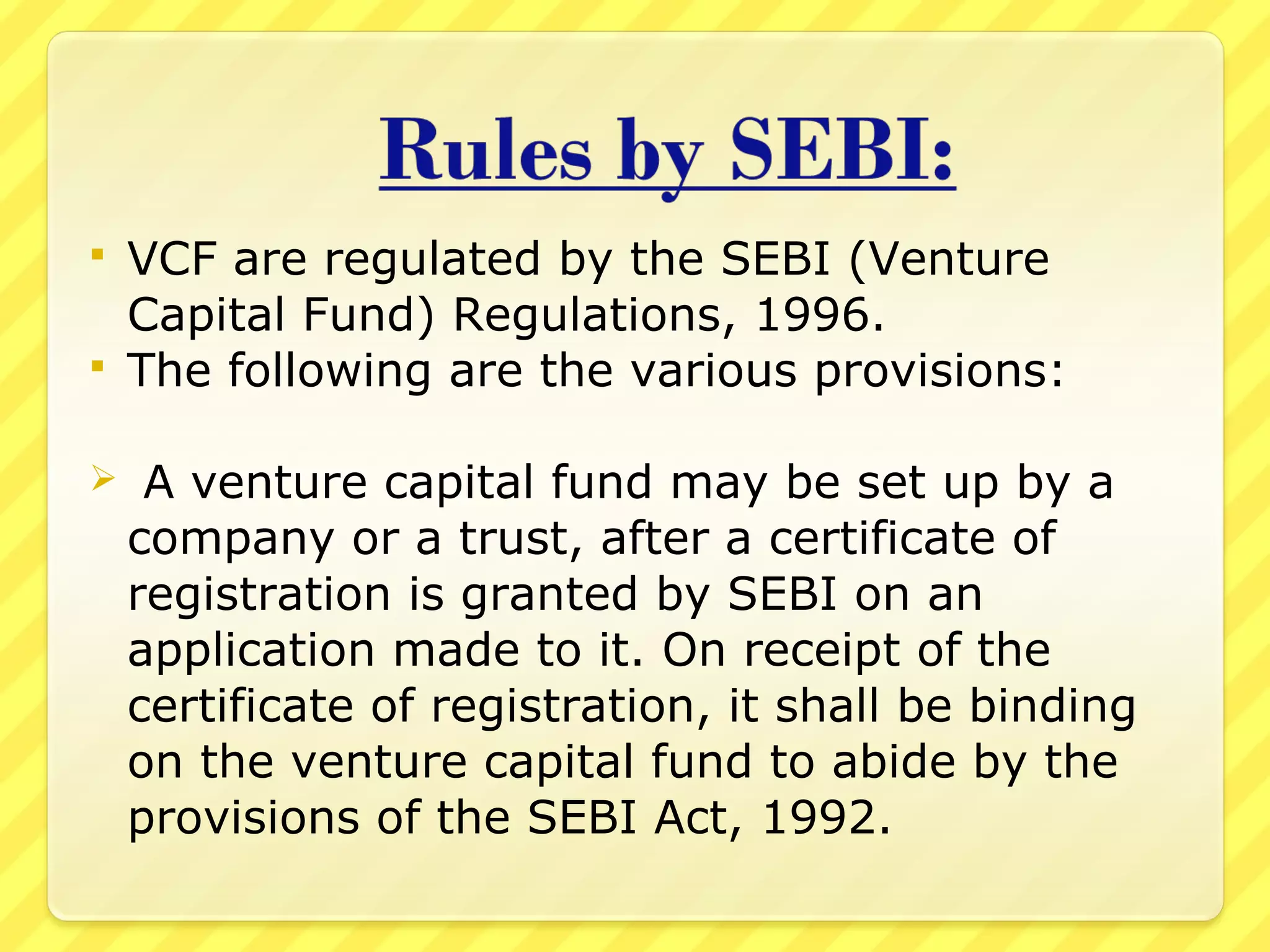
 VCF are regulated by the SEBI (Venture
Capital Fund) Regulations, 1996.
 The following are the various provisions:
 A venture capital fund may be set up by a
company or a trust, after a certificate of
registration is granted by SEBI on an
application made to it. On receipt of the
certificate of registration, it shall be binding
on the venture capital fund to abide by the
provisions of the SEBI Act, 1992.
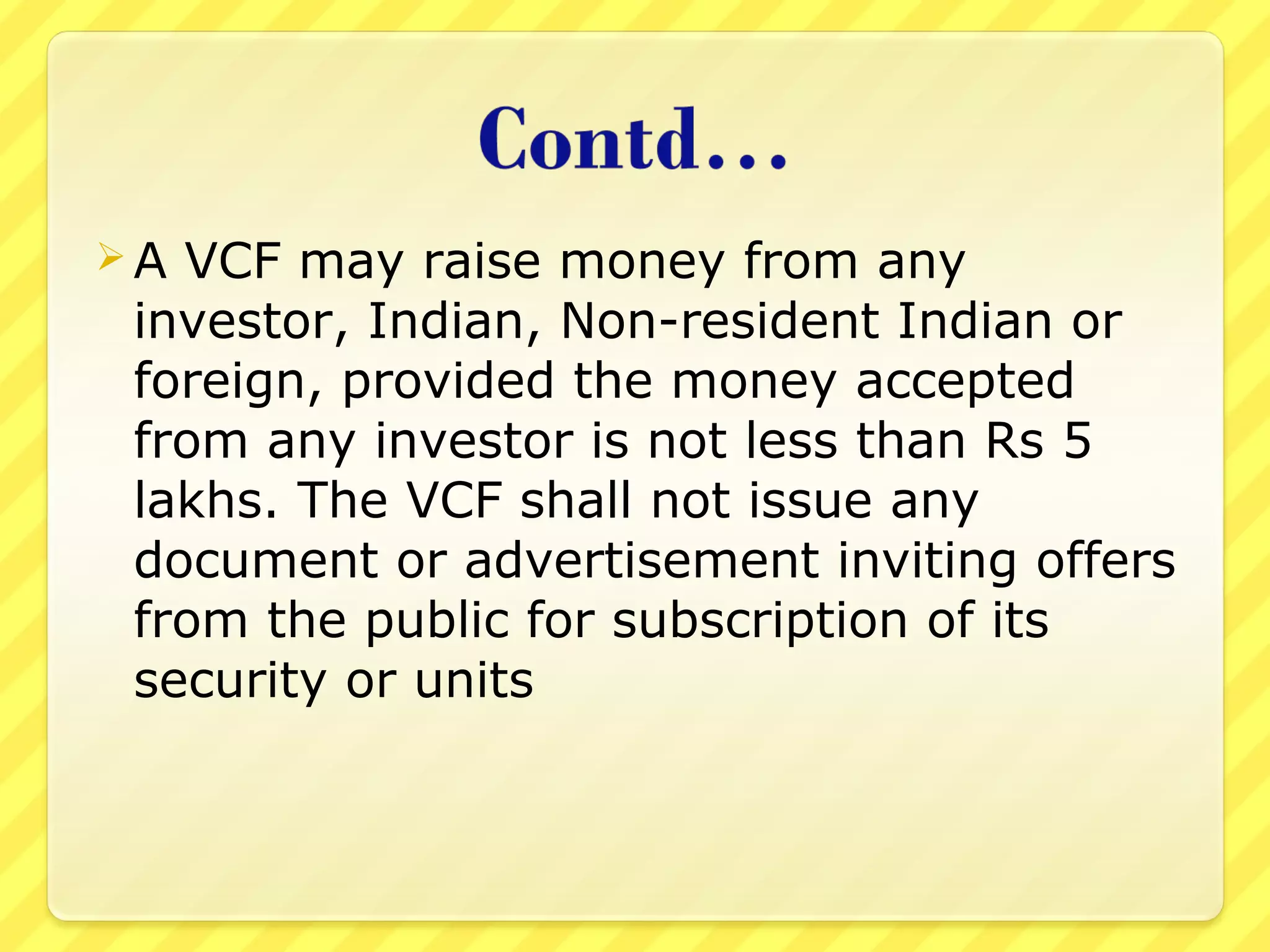
 A VCF may raise money from any
investor, Indian, Non-resident Indian or
foreign, provided the money accepted
from any investor is not less than Rs 5
lakhs. The VCF shall not issue any
document or advertisement inviting offers
from the public for subscription of its
security or units
SEBI regulations permit investment by
venture capital funds in equity or equity
related instruments of unlisted companies
and also in financially weak and sick
industries whose shares are listed or
unlisted
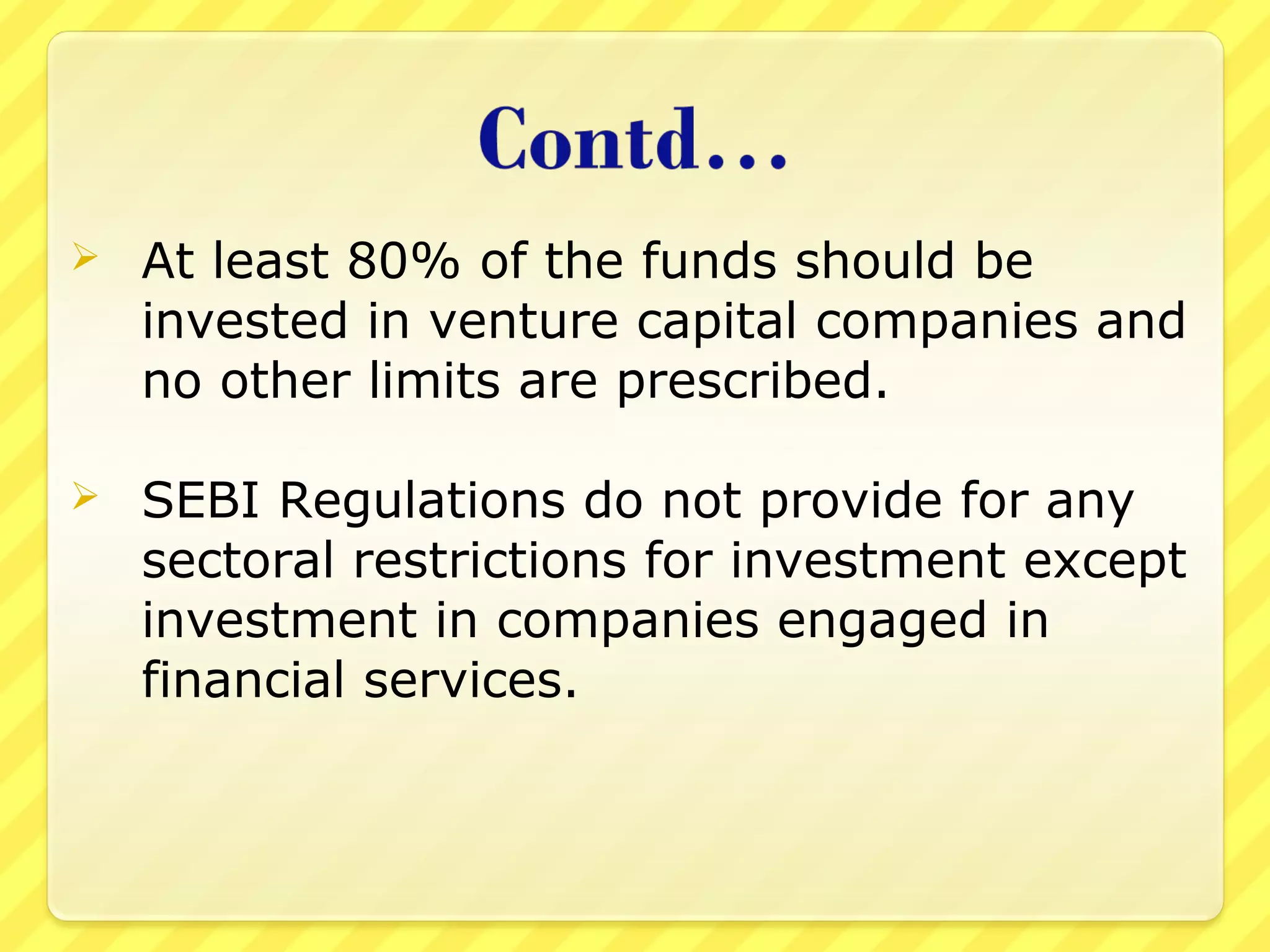
 At least 80% of the funds should be
invested in venture capital companies and
no other limits are prescribed.
 SEBI Regulations do not provide for any
sectoral restrictions for investment except
investment in companies engaged in
financial services.
 A VCF is not permitted to invest in the
equity shares of any company or
institutions providing financial services.
 The securities or units issued by a venture
capital fund shall not be listed on any
recognized stock exchange till the expiry
of 4 years from the date of issuance .
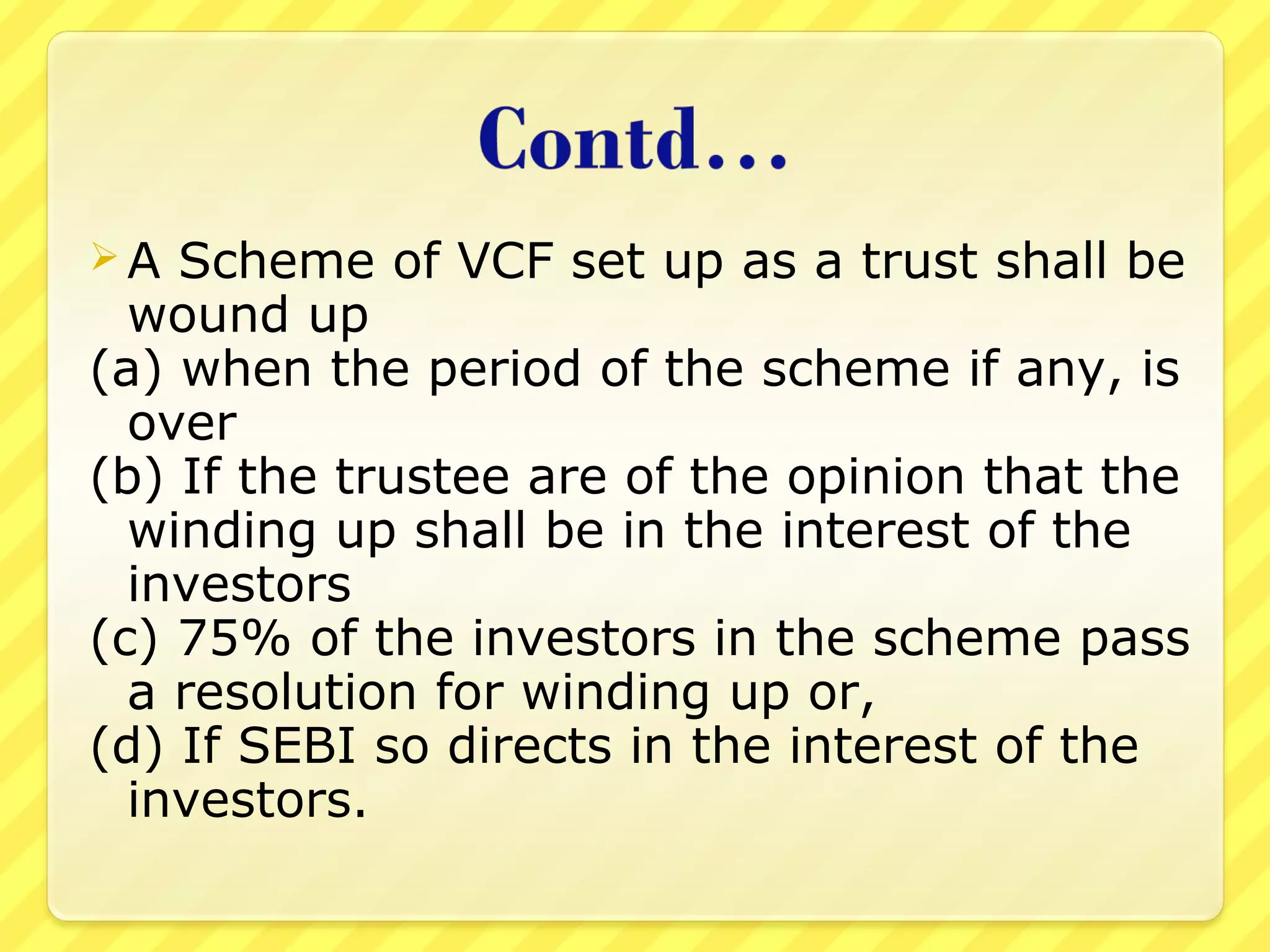
 A Scheme of VCF set up as a trust shall be
wound up
(a) when the period of the scheme if any, is
over
(b) If the trustee are of the opinion that the
winding up shall be in the interest of the
investors
(c) 75% of the investors in the scheme pass
a resolution for winding up or,
(d) If SEBI so directs in the interest of the
investors.
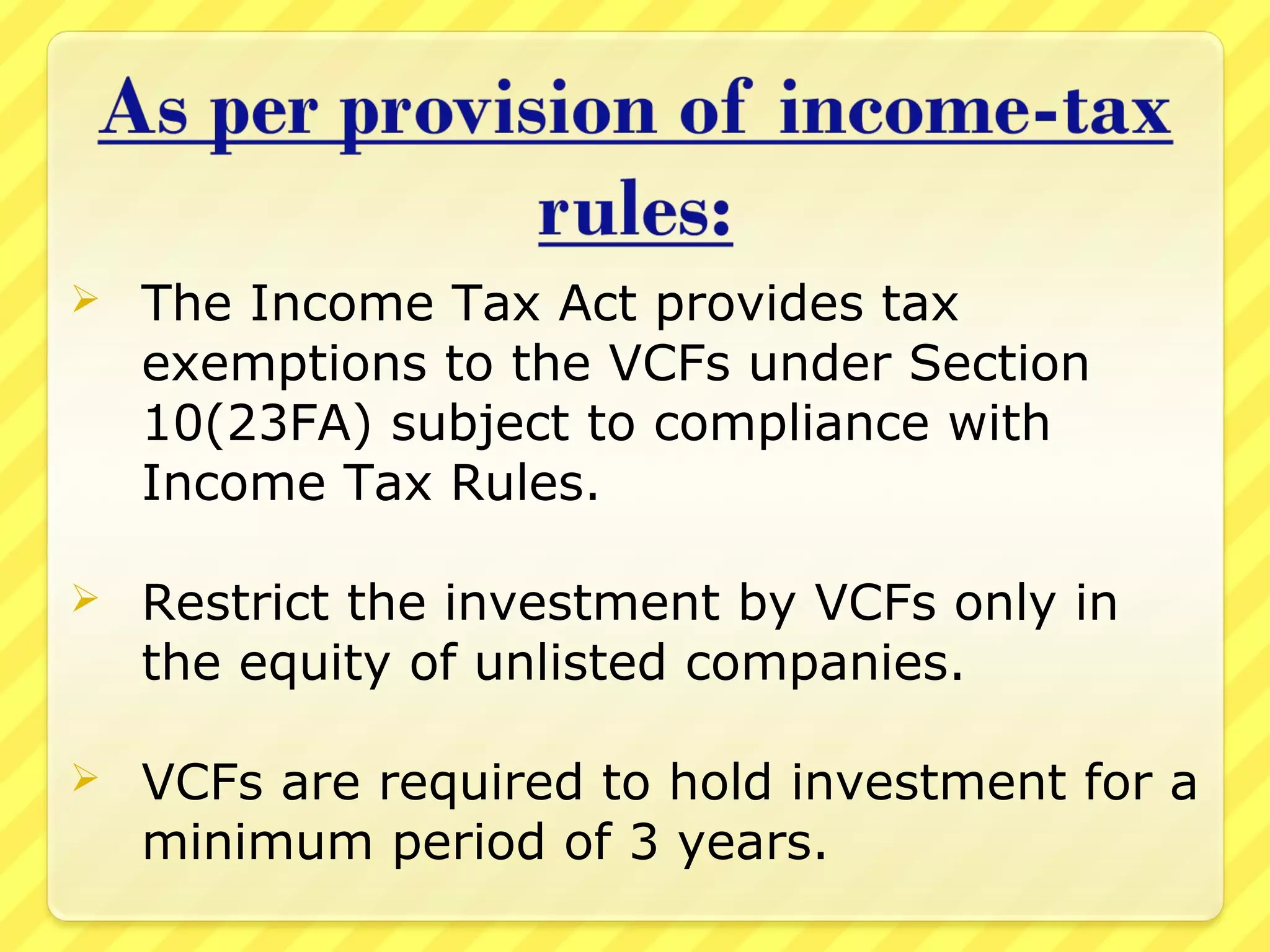
 The Income Tax Act provides tax
exemptions to the VCFs under Section
10(23FA) subject to compliance with
Income Tax Rules.
 Restrict the investment by VCFs only in
the equity of unlisted companies.
 VCFs are required to hold investment for a
minimum period of 3 years.
 The Income Tax Rule until now provided
that VCF shall invest only upto 40% of the
paid-up capital of VCU and also not
beyond 20% of the corpus of the VCF.
 After amendment VCF shall invest only
upto 25% of the corpus of the venture
capital fund in a single company.
 There are sectoral restrictions under the
Income Tax Guidelines which provide that
a VCF can make investment only in
specified companies.
 It was established in 1993 and is based in
Delhi, the capital of India
 It is a member based national organization that
- represents venture capital and private
equity firms
- promotes the industry within India and
throughout the world
- encourages investment in high growth
companies and
- supports entrepreneurial activity and
innovation.
IVCA members comprise venture capital
firms, institutional investors, banks,
incubators, angel groups, corporate
advisors, accountants, lawyers,
government bodies, academic institutions
and other service providers to the venture
capital and private equity industry.
Members represent most of the active
venture capital and private equity firms in
India. These firms provide capital for seed
ventures, early stage companies and later
stage expansion.

venture capital NOTES 2014

  • 2.
     Venture capitalmeans funds made available for startup firms and small businesses with exceptional growth potential.  Venture capital is money provided by professionals who alongside management invest in young, rapidly growing companies that have the potential to develop into significant economic contributors.
  • 3.
    3 • Venture capitalfirms specialize in providing equity financing for firms that are in an early stage of development (start-ups). • Examples of companies that received venture capital funding in their early development include Apple, Federal Express, Microsoft, Genentech, and Google. • Venture capital (a.k.a. private equity) is a pool of capital most commonly organized as a limited partnership. The venture capital firm serves as the general partner and investors are the limited partners. Limited partners can include pension funds, university endowment funds, wealthy individuals, and other financial institutions and corporations. Venture Capitalists
  • 4.
    4 • Managers ofventure capital firms (venture capitalists) closely follow the technology and market developments in their area of expertise (e.g., computer software, communications, computer hardware, medical/health, industrial/energy, biotechnology, retailing, restaurants, etc.) • They screen entrepreneurs and their business concepts prior to making an investment. To diversify risk, they create a venture fund that is a portfolio of investments in young companies. • Venture capitalists are not passive equity investors. They structure a financing deal with great attention to creating the right incentives and compensation for the start-up firm’s owners. They are also instrumental in raising additional financing during future stages of the firm’s lifecycle.
  • 5.
    Venture Capitalists generally: Financenew and rapidly growing companies Purchase equity securities Assist in the development of new products or services Add value to the company through active participation.
  • 6.
    The SEBI hasdefined Venture Capital Fund in its Regulation 1996 as ‘a fund established in the form of a company or trust which raises money through loans, donations, issue of securities or units as the case may be and makes or proposes to make investments in accordance with the regulations’.
  • 7.
    Long time horizon Lackof liquidity High risk Equity participation Participation in management
  • 8.
    It injects longterm equity finance which provides a solid capital base for future growth. The venture capitalist is a business partner, sharing both the risks and rewards. Venture capitalists are rewarded by business success and the capital gain. The venture capitalist is able to provide practical advice and assistance to the company based on past experience with other companies which were in similar situations.
  • 9.
     The venturecapitalist also has a network of contacts in many areas that can add value to the company.  The venture capitalist may be capable of providing additional rounds of funding should it be required to finance growth.  Venture capitalists are experienced in the process of preparing a company for an initial public offering (IPO) of its shares onto the stock exchanges or overseas stock exchange such as NASDAQ. They can also facilitate a trade sale.
  • 10.
    1. Seed Money: Lowlevel financing needed to prove a new idea. 2. Start-up: Early stage firms that need funding for expenses associated with marketing and product development. 3. First-Round: Early sales and manufacturing funds. 4. Second-Round: Working capital for early stage companies that are selling product, but not yet turning a profit .
  • 11.
    5. Third-Round: Also calledMezzanine financing, this is expansion money for a newly profitable company 6. Fourth-Round: Also called bridge financing, it is intended to finance the "going public" process
  • 12.
    Financial Stage Period (Funds locked in years) Risk Perception Activityto be financed Seed Money 7-10 Extreme For supporting a concept or idea or R&D for product development Start Up 5-9 Very High Initializing operations or developing prototypes First Stage 3-7 High Start commercials production and marketing
  • 13.
    Financial Stage Period (Funds locked in years) Risk Perception Activityto be financed Second Stage 3-5 Sufficiently high Expand market and growing working capital need Third Stage 1-3 Medium Market expansion, acquisition & product development for profit making company Fourth Stage 1-3 Low Facilitating public issue
  • 14.
    Deal origination Screening Due diligence (Evaluation) Dealstructuring Post investment activity Exit plan
  • 15.
    The financing patternof the deal is the most important element. Following are the various methods of venture financing: Equity Conditional loan Income note Participating debentures Quasi equity
  • 16.
    Initial public offer(IPOs) Tradesale Promoter buy back Acquisition by another company
  • 18.
    The concept ofventure capital was formally introduced in India in 1987 by IDBI. The government levied a 5 per cent cess on all know-how import payments to create the venture fund. ICICI started VC activity in the same year Later on ICICI floated a separate VC company - TDICI
  • 19.
    VCFs in Indiacan be categorized into following five groups: 1)Those promoted by the Central Government controlled development finance institutions. For example: - ICICI Venture Funds Ltd. - IFCI Venture Capital Funds Ltd (IVCF) - SIDBI Venture Capital Ltd (SVCL)
  • 20.
    2) Those promotedby State Government controlled development finance institutions. For example: - Punjab Infotech Venture Fund - Gujarat Venture Finance Ltd (GVFL) - Kerala Venture Capital Fund Pvt Ltd. 3) Those promoted by public banks. For example: - Canbank Venture Capital Fund - SBI Capital Market Ltd
  • 21.
    4)Those promoted byprivate sector companies. For example: - IL&FS Trust Company Ltd - Infinity Venture India Fund 5)Those established as an overseas venture capital fund. For example: - Walden International Investment Group - HSBC Private Equity management Mauritius Ltd
  • 22.
     AS PERSEBI  AS PER INCOME TAX ACT,1961
  • 23.
     VCF areregulated by the SEBI (Venture Capital Fund) Regulations, 1996.  The following are the various provisions:  A venture capital fund may be set up by a company or a trust, after a certificate of registration is granted by SEBI on an application made to it. On receipt of the certificate of registration, it shall be binding on the venture capital fund to abide by the provisions of the SEBI Act, 1992.
  • 24.
     A VCFmay raise money from any investor, Indian, Non-resident Indian or foreign, provided the money accepted from any investor is not less than Rs 5 lakhs. The VCF shall not issue any document or advertisement inviting offers from the public for subscription of its security or units
  • 25.
    SEBI regulations permitinvestment by venture capital funds in equity or equity related instruments of unlisted companies and also in financially weak and sick industries whose shares are listed or unlisted
  • 26.
     At least80% of the funds should be invested in venture capital companies and no other limits are prescribed.  SEBI Regulations do not provide for any sectoral restrictions for investment except investment in companies engaged in financial services.
  • 27.
     A VCFis not permitted to invest in the equity shares of any company or institutions providing financial services.  The securities or units issued by a venture capital fund shall not be listed on any recognized stock exchange till the expiry of 4 years from the date of issuance .
  • 28.
     A Schemeof VCF set up as a trust shall be wound up (a) when the period of the scheme if any, is over (b) If the trustee are of the opinion that the winding up shall be in the interest of the investors (c) 75% of the investors in the scheme pass a resolution for winding up or, (d) If SEBI so directs in the interest of the investors.
  • 29.
     The IncomeTax Act provides tax exemptions to the VCFs under Section 10(23FA) subject to compliance with Income Tax Rules.  Restrict the investment by VCFs only in the equity of unlisted companies.  VCFs are required to hold investment for a minimum period of 3 years.
  • 30.
     The IncomeTax Rule until now provided that VCF shall invest only upto 40% of the paid-up capital of VCU and also not beyond 20% of the corpus of the VCF.  After amendment VCF shall invest only upto 25% of the corpus of the venture capital fund in a single company.  There are sectoral restrictions under the Income Tax Guidelines which provide that a VCF can make investment only in specified companies.
  • 31.
     It wasestablished in 1993 and is based in Delhi, the capital of India  It is a member based national organization that - represents venture capital and private equity firms - promotes the industry within India and throughout the world - encourages investment in high growth companies and - supports entrepreneurial activity and innovation.
  • 32.
    IVCA members compriseventure capital firms, institutional investors, banks, incubators, angel groups, corporate advisors, accountants, lawyers, government bodies, academic institutions and other service providers to the venture capital and private equity industry. Members represent most of the active venture capital and private equity firms in India. These firms provide capital for seed ventures, early stage companies and later stage expansion.