Conceptualizing Nations,
Nationalism andStates
The Nature and Evolution of
International Relations
Actors of International Relations
Power,Anarchy and Sovereignty in the
International System
4.
1.1. Conceptualizing Nations,Nationalism and States
• Nation
For nationalists, a nation is a collective group of people who share a
number of common social, cultural and ethnic characteristics.
It is a social collective involving various criteria and characteristics
that are unique to each nation. These characteristics can include
language, tradition, ethnicity, religion, myths, beliefs, symbols and
blood ties.
It can also be deemed as persons Ethnic Origin.
The idea of the nation is largely subjective and is self-selective in the
sense that each nation defines what it is to be part of that nation.
The nation, in this sense, is a social phenomenon that differentiates
different peoples in the world.
5.
Cont’d……..
• Nationalism
• Nationalismis the doctrine that asserts the nation as the basic political
unit in organizing society.
• As a political doctrine, nationalism is the belief that the world’s
peoples are divided into nations, and that each of these nations has the
right to self-determination, either as governing units within nations or
as nation states of their own.
• As a cultural ideal, nationalism is the claim that while men and women
have many identities, it is the nation that provides them with their
primary form of belonging.
• As a moral ideal, nationalism is an ethic of heroic sacrifice, justifying
the use of violence in the defense of one’s nation against enemies,
internal or external.
6.
Cont’d……..
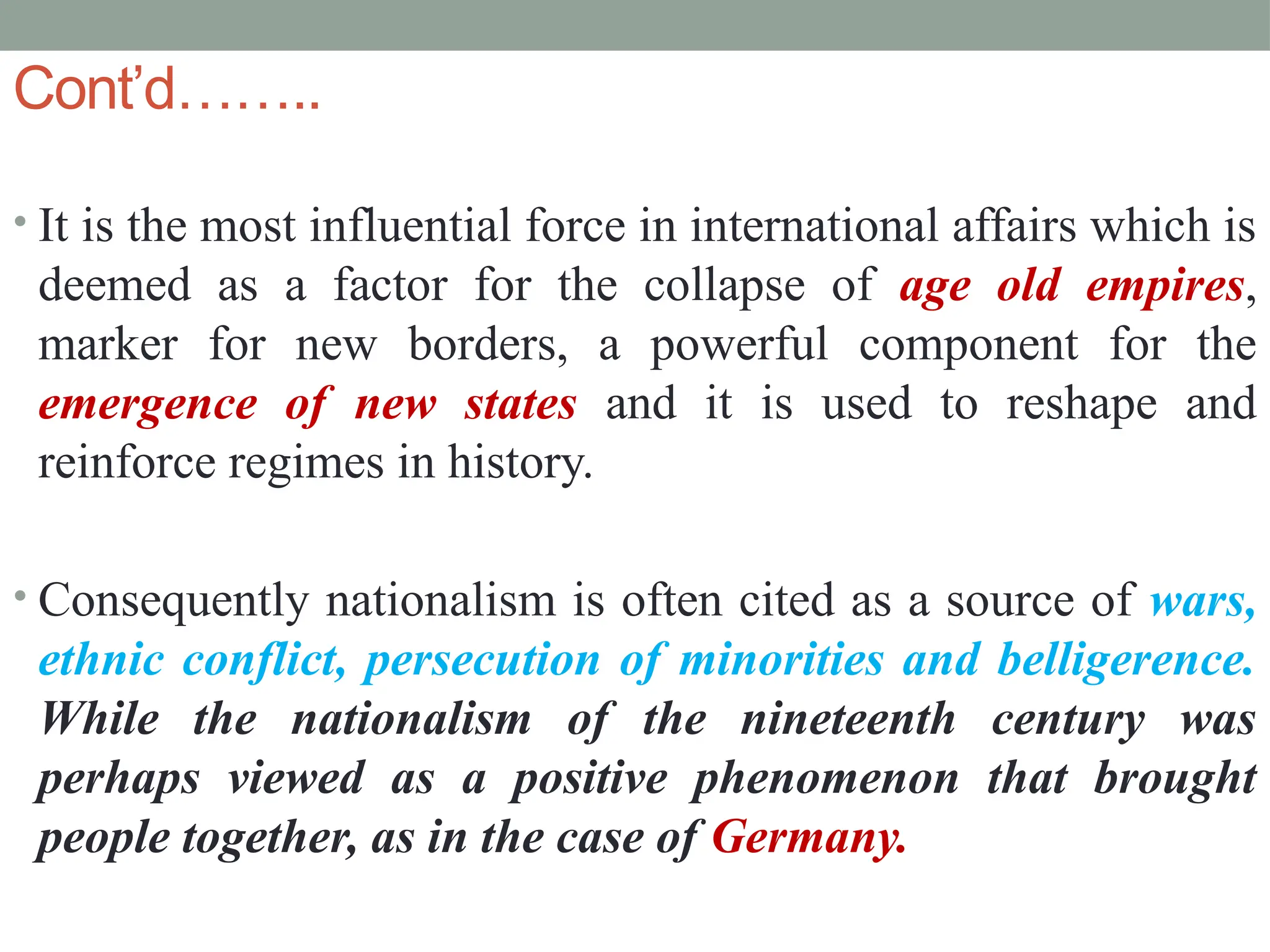
• It isthe most influential force in international affairs which is
deemed as a factor for the collapse of age old empires,
marker for new borders, a powerful component for the
emergence of new states and it is used to reshape and
reinforce regimes in history.
• Consequently nationalism is often cited as a source of wars,
ethnic conflict, persecution of minorities and belligerence.
While the nationalism of the nineteenth century was
perhaps viewed as a positive phenomenon that brought
people together, as in the case of Germany.
7.
Cont’d…….
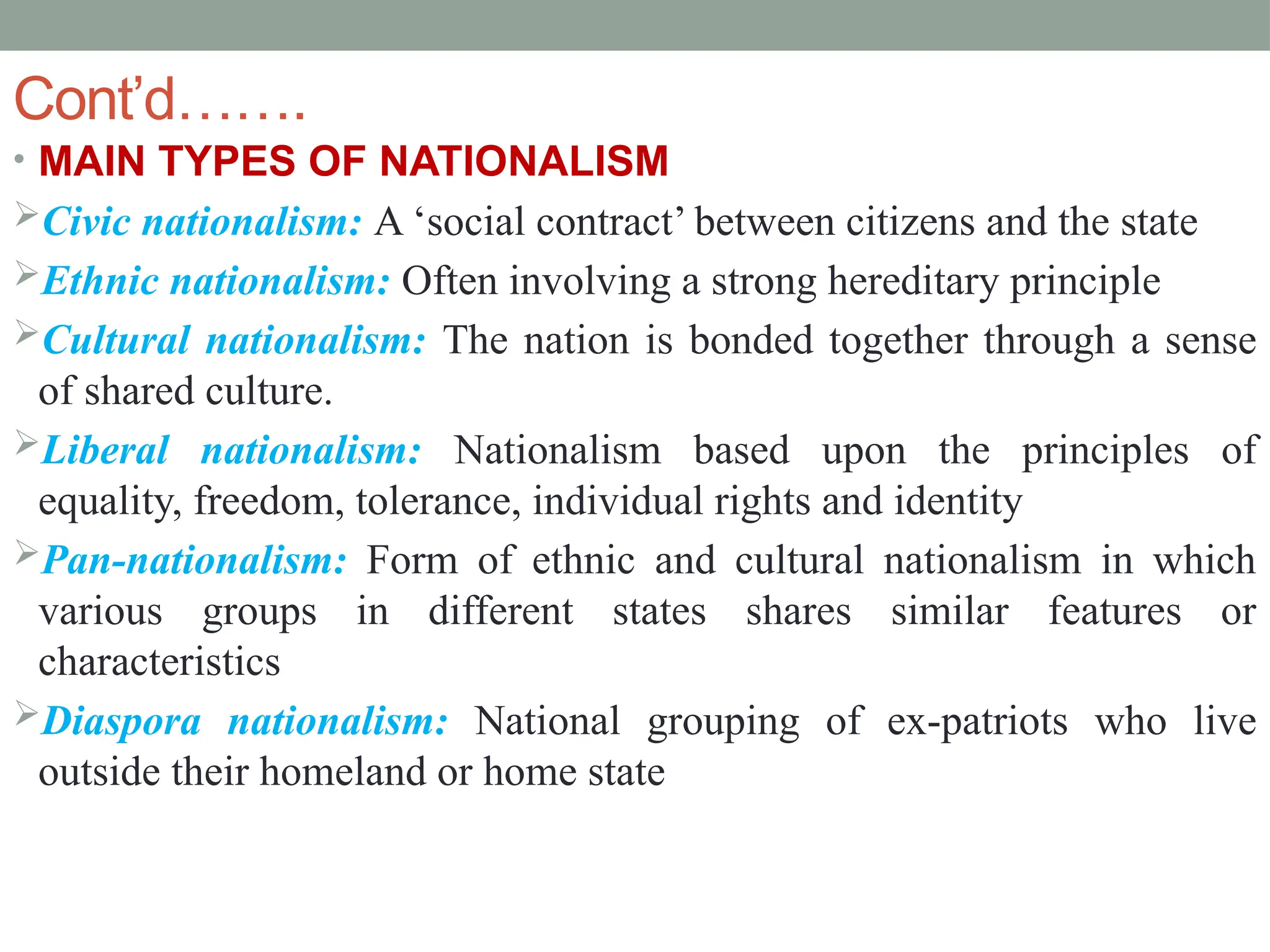
• MAIN TYPESOF NATIONALISM
Civic nationalism: A ‘social contract’ between citizens and the state
Ethnic nationalism: Often involving a strong hereditary principle
Cultural nationalism: The nation is bonded together through a sense
of shared culture.
Liberal nationalism: Nationalism based upon the principles of
equality, freedom, tolerance, individual rights and identity
Pan-nationalism: Form of ethnic and cultural nationalism in which
various groups in different states shares similar features or
characteristics
Diaspora nationalism: National grouping of ex-patriots who live
outside their homeland or home state
8.
Cont’d…………
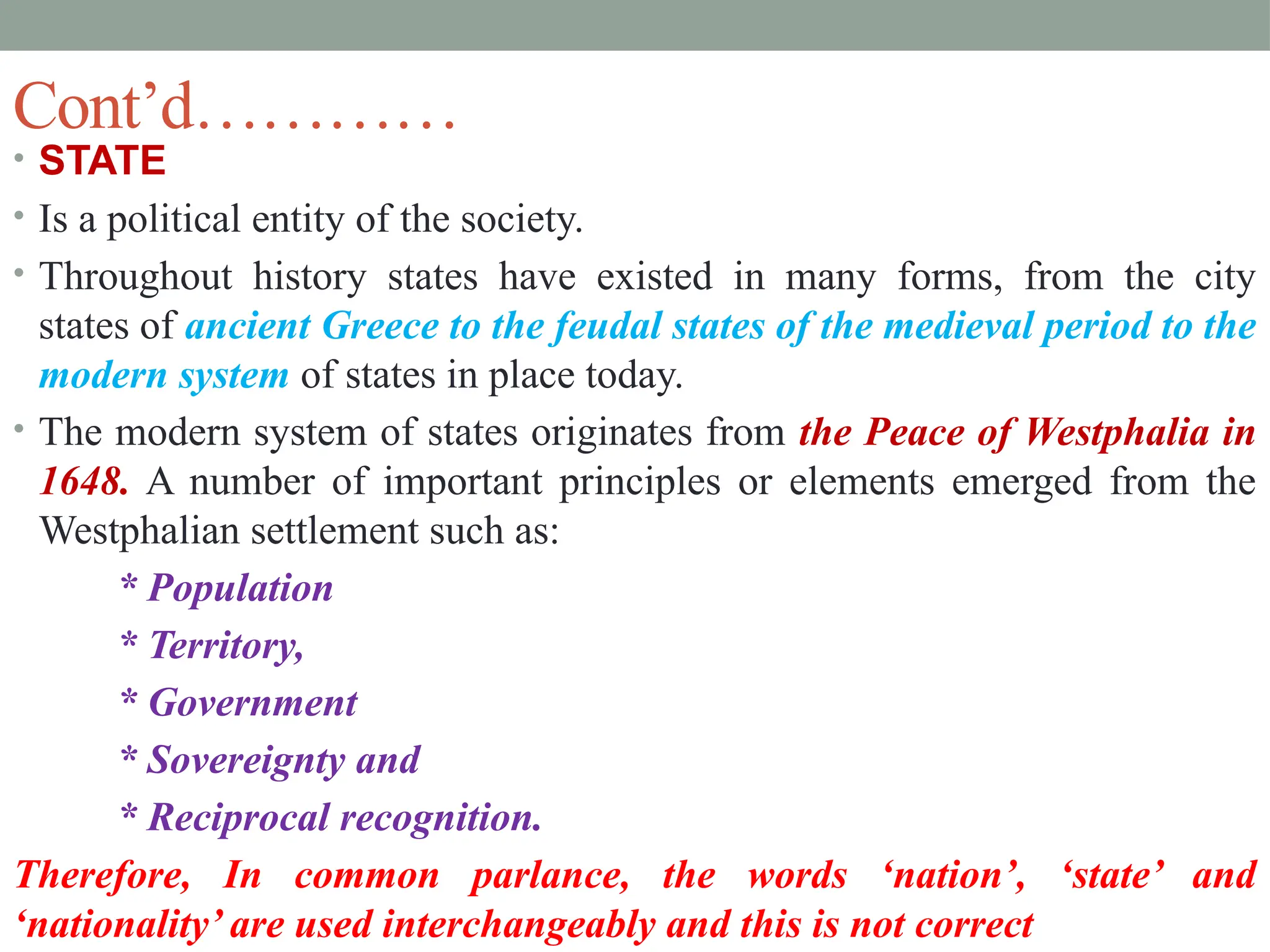
• STATE
• Isa political entity of the society.
• Throughout history states have existed in many forms, from the city
states of ancient Greece to the feudal states of the medieval period to the
modern system of states in place today.
• The modern system of states originates from the Peace of Westphalia in
1648. A number of important principles or elements emerged from the
Westphalian settlement such as:
* Population
* Territory,
* Government
* Sovereignty and
* Reciprocal recognition.
Therefore, In common parlance, the words ‘nation’, ‘state’ and
‘nationality’ are used interchangeably and this is not correct
9.
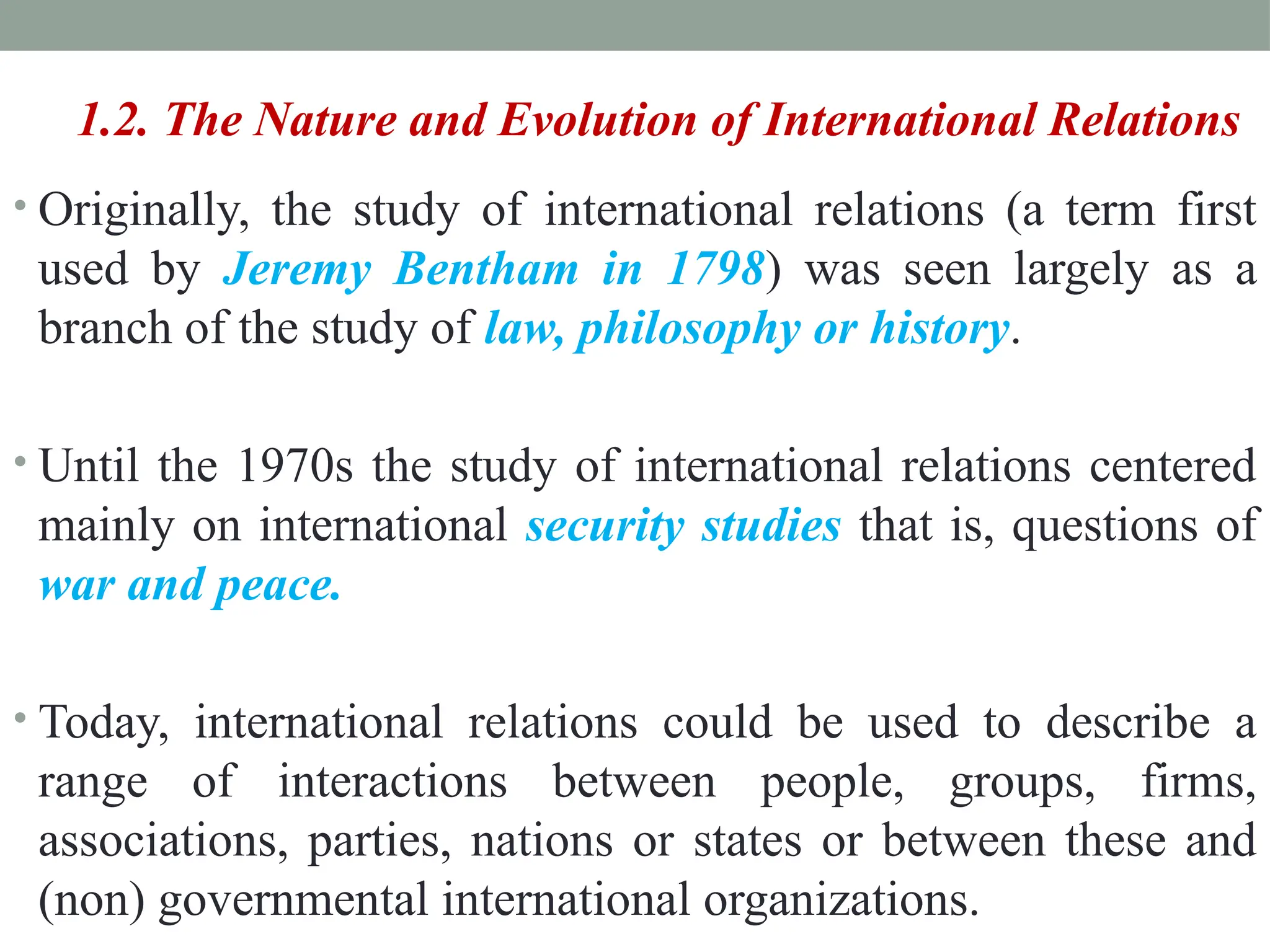
1.2. The Natureand Evolution of International Relations
• Originally, the study of international relations (a term first
used by Jeremy Bentham in 1798) was seen largely as a
branch of the study of law, philosophy or history.
• Until the 1970s the study of international relations centered
mainly on international security studies that is, questions of
war and peace.
• Today, international relations could be used to describe a
range of interactions between people, groups, firms,
associations, parties, nations or states or between these and
(non) governmental international organizations.
10.
Cont’d…….
• International Relation[IR] is the study and practice of
political relationships among the world’s nations, especially
their governments.
• Participation in international relations or politics is also
inescapable. No individual, people, nation or state can exist
in splendid isolation or be master of its own fate.
• On the other hand, there are legal, political and social
differences between domestic and international politics.
Domestic law is generally obeyed, and if not, the police and
courts enforce sanctions.
International law rests on competing legal systems, and
there is no common enforcement.
11.
Cont’d……...
• Scholars andpractitioners in international relations use concepts and
theories which lad to major philosophical disputes about the
fundamental nature of international relations:
The Hobbesian versus the Lockean state of nature in the 17th century.
Thomas Hobbes, writing in 1651, interpreted the state of society to be:
‘continual fear, and danger of violent death; and the life of man,
solitary, poor, nasty, brutish, and short’. (Pessimistic Approach).
Whereas, John Locke took a more optimistic view and suggested that
sociability was the strongest bond between men & men were equal,
sociable and free; but they were not licentious because they were
governed by the laws of nature. (Optimistic Approach).
12.
Cont’d……
• International politicsis also about maintaining international order
through different international organization like UN by the mean's of
power, coercion and bargaining.
Evolution of IR
• In medieval Europe there were two institutions with pretensions to
power over the continent as a whole i.e.
A. The (Catholic) Church and
B. The Empire.
The Church was the spiritual authority, with its centre in Rome.
The Empire known as the Holy Roman Empire (includes todays Italy,
France Netherlands and Belgium.
13.
Cont’d……..
• In thisclimate of Medieval period, the increasingly self-assertive states
were not only picking fights with universal institutions but also with
local ones and leads to break out different driving forces/revolutions
like:
French revolution
Industrial revolution
Reformation
•The European states emerged in the midst of struggle and strife, and the
Treaty of Westphalia, 1648, which concluded the 30 years of bloodiest
warfare (1618-1648), has come to symbolize the new way of organizing
international politics.
14.
Cont’d…..
• From thispoint onwards, international politics was a matter of relations
between states and no other political units which separates the state
from the pope and the emperors. (Turning point in the International
relations).
• Towards the end of the nineteenth century, other European countries
joined in this scramble for colonies, not least in Africa. Colonial
possessions became a symbol of ‘great power’ status, and the new
European nation-states often proved themselves to be very aggressive
colonizers since the colonized peoples had no nation-states and
enjoyed no self-determination.
• After all the world experienced the First World War in 1914 and the
Second world war in 1940’s and this is how the modern world was
made.
15.
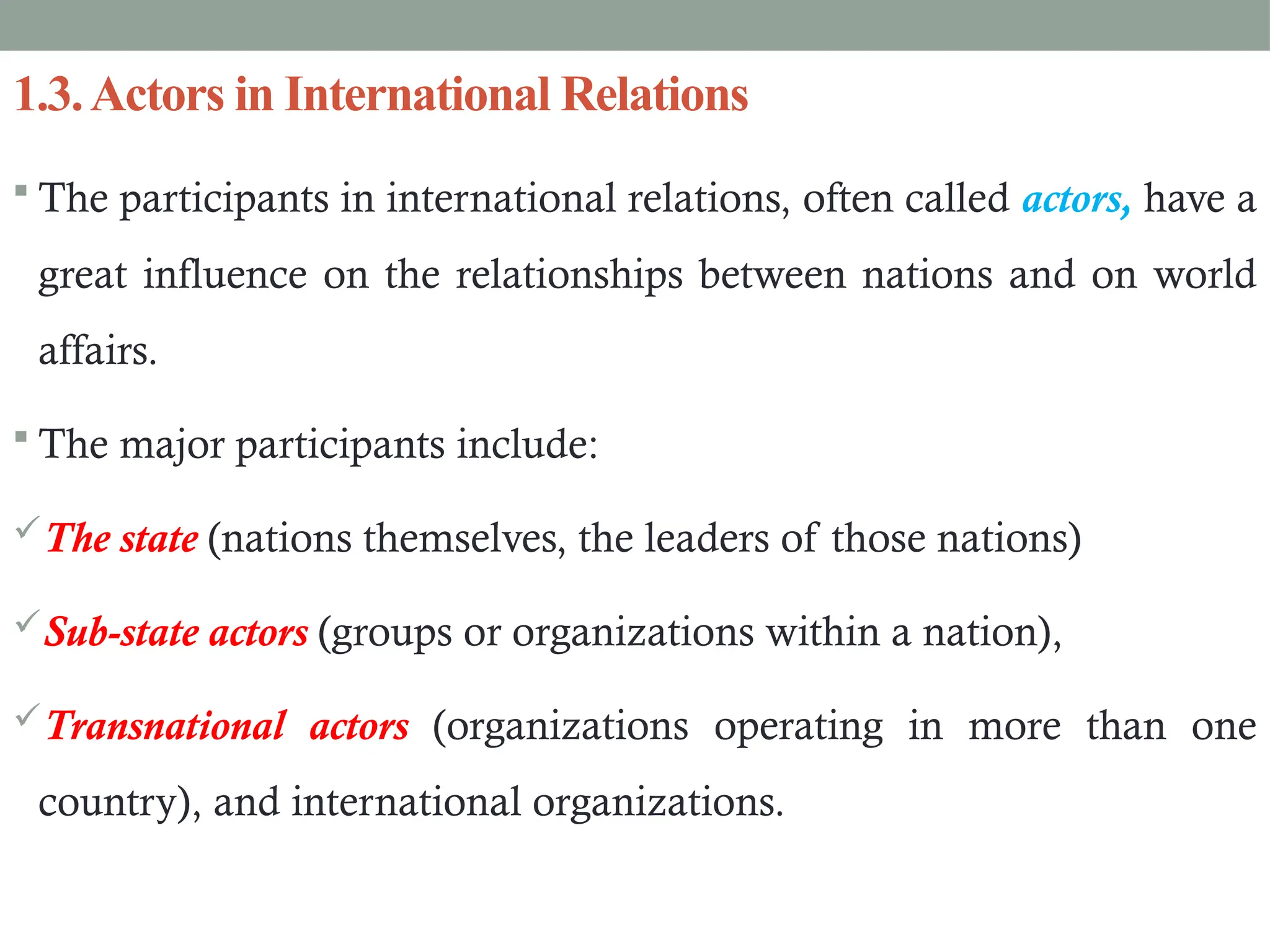
1.3.Actors in InternationalRelations
The participants in international relations, often called actors, have a
great influence on the relationships between nations and on world
affairs.
The major participants include:
The state (nations themselves, the leaders of those nations)
Sub-state actors (groups or organizations within a nation),
Transnational actors (organizations operating in more than one
country), and international organizations.
16.
Cont’d……
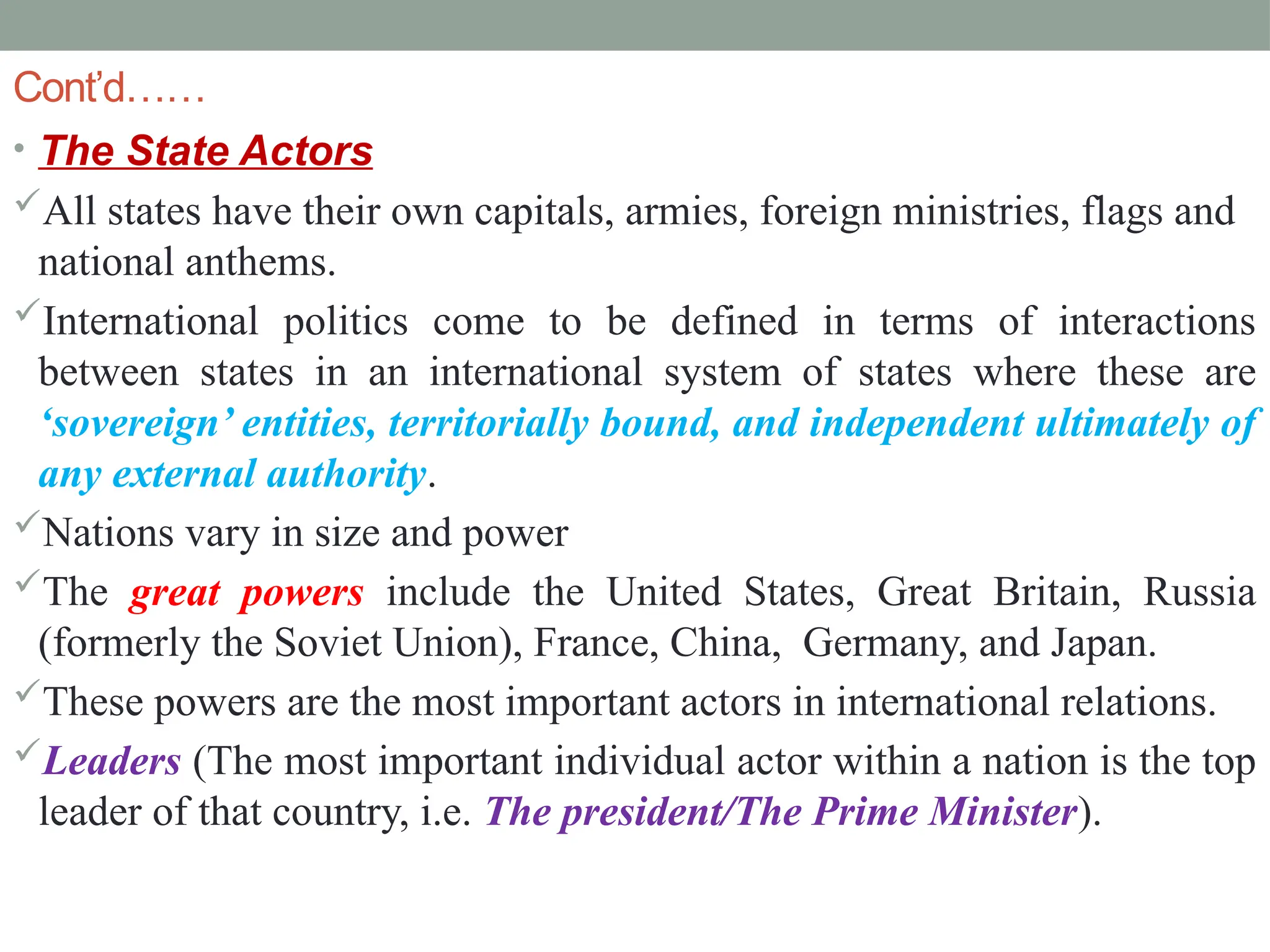
• The StateActors
All states have their own capitals, armies, foreign ministries, flags and
national anthems.
International politics come to be defined in terms of interactions
between states in an international system of states where these are
‘sovereign’ entities, territorially bound, and independent ultimately of
any external authority.
Nations vary in size and power
The great powers include the United States, Great Britain, Russia
(formerly the Soviet Union), France, China, Germany, and Japan.
These powers are the most important actors in international relations.
Leaders (The most important individual actor within a nation is the top
leader of that country, i.e. The president/The Prime Minister).
17.
Cont’d…..
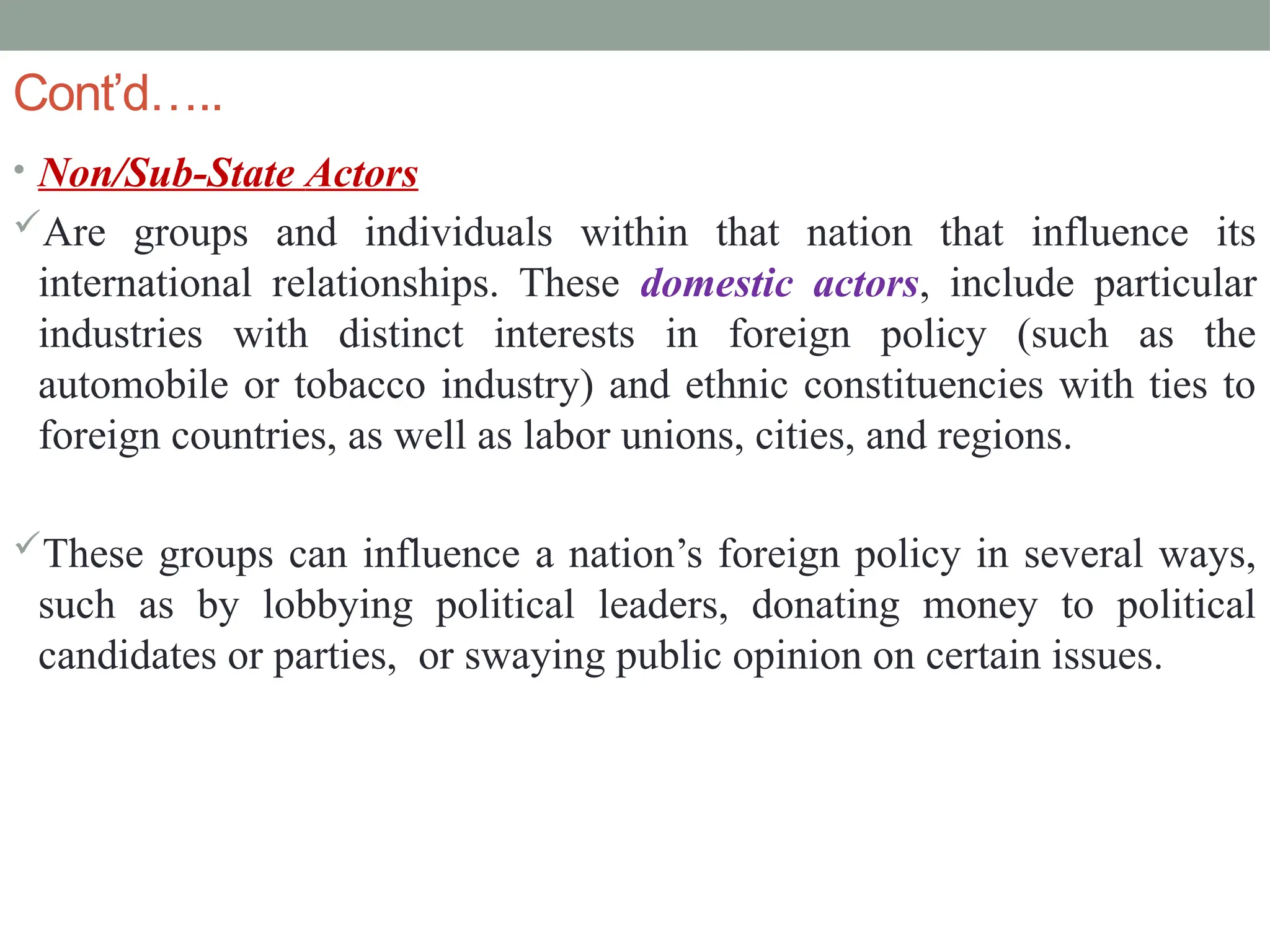
• Non/Sub-State Actors
Aregroups and individuals within that nation that influence its
international relationships. These domestic actors, include particular
industries with distinct interests in foreign policy (such as the
automobile or tobacco industry) and ethnic constituencies with ties to
foreign countries, as well as labor unions, cities, and regions.
These groups can influence a nation’s foreign policy in several ways,
such as by lobbying political leaders, donating money to political
candidates or parties, or swaying public opinion on certain issues.
18.
Cont’d…..
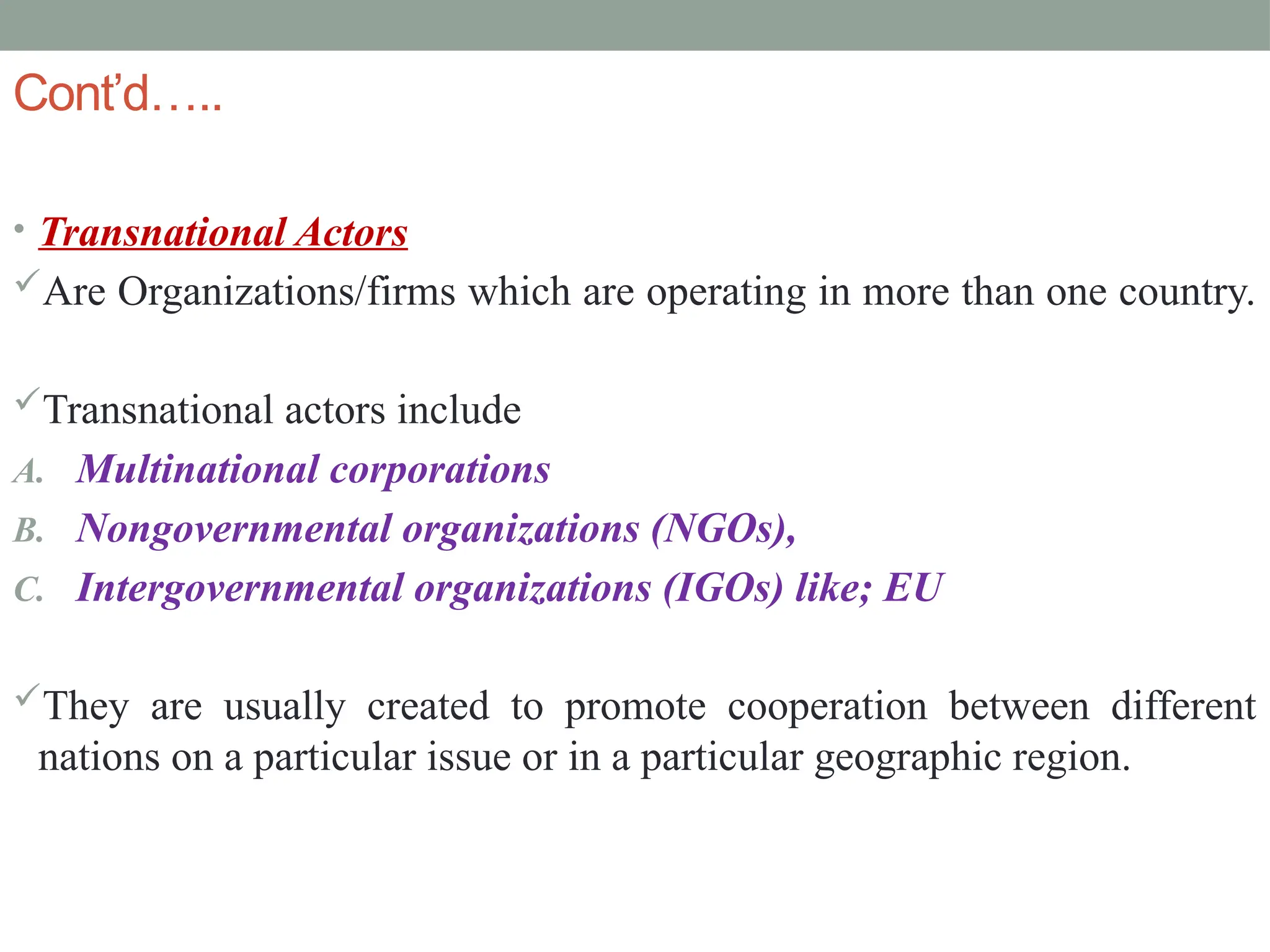
• Transnational Actors
AreOrganizations/firms which are operating in more than one country.
Transnational actors include
A. Multinational corporations
B. Nongovernmental organizations (NGOs),
C. Intergovernmental organizations (IGOs) like; EU
They are usually created to promote cooperation between different
nations on a particular issue or in a particular geographic region.
19.
1.4. Levels ofAnalysis in International Relations
A. The individual level
• International relations can be analyzed from the perspective of
individuals. Here we would look at the behaviors, motivations, beliefs
and orientation of the individual in affecting a particular international
phenomenon.
• This can be seen in the psychology and emotions behind people’s actions
and decisions, their fears and their visions as well as their access to
information and capacity to make a difference.
B. The group level
A group-level analysis focusing on foreign policy would look
at the role of lobbying groups, special interest groups and the
way they influence national decision-making on an issue.
20.
Cont’d……..
C. The statelevel
Also known as ‘state-centrism’.
In this level of analysis the state acts as the arena in which
state officials, politicians and decision-makers operate.
The state is seen as the framework that encapsulates society
and as the main point of reference for the individual.
A state-level study would also require careful consideration
of what kinds of states we are looking at
How they are ordered politically,
Their geographical position,
Their historical ties and experiences and their economic
standing.
21.
Cont’d…….
D. The systemlevel
This level of analysis conceive the global system as the
structure or context within which states cooperate, compete
and confront each other over issues of national interest.
It is a level above the state.
It is usually distributed into three main types of systems i.e.
i. Uni-polar system
ii. Bipolar system and
iii. Multipolar system.
22.
• In auni-polar international system there is one state with the greatest
political, economic, cultural and military power and hence the ability to
totally control other states.
• In the case of the bipolar system, there are two dominant states (super
powers) and the less powerful states join either sides through alliance and
counter alliance formations. (E.g.. Cold war period).
The problem with bipolar system is that it is vulnerable for zero-sum game
politics because when one superpower gains the other would inevitably lose.
•Multipolar system usually reflects various equally powerful states competing
for power.
In such system, it is possible to bring change without gaining or losing
power.
23.
1.5. Power,Anarchy andSovereignty in the International System
Power
Power is the currency of international politics. As money is for
economics, power is for international relations (politics).
In the international system, power determines the relative influence of
actors and it shapes the structure of the international system.
Power can also be defined as ‘A’ s’ ability to get ‘B’.
Anarchy
Anarchy is a situation where there is absence of authority
(government) be it in national or international/global level systems.
Within a country ‘anarchy’ refers to a breakdown of law and order, but
in relations between states it refers to a system where power is
decentralized and there are no shared institutions with the right to
enforce common rules.
24.
Cont’d…….
An anarchical worldis a world where everyone looks after themselves and no
one looks after the system as a whole.
Sovereignty
Sovereignty is another basic concept in international relations and it can be
defined as an expression of:
i. A state’s ultimate authority within its territorial entity (internal sovereignty)
and,
ii. The state’s involvement in the international community (external
sovereignty).
In short, sovereignty denotes double claim of states from the international
system, i.e., autonomy in foreign policy and independence/freedom in its
domestic affairs.

![Cont’d…….
• International Relation [IR] is the study and practice of
political relationships among the world’s nations, especially
their governments.
• Participation in international relations or politics is also
inescapable. No individual, people, nation or state can exist
in splendid isolation or be master of its own fate.
• On the other hand, there are legal, political and social
differences between domestic and international politics.
Domestic law is generally obeyed, and if not, the police and
courts enforce sanctions.
International law rests on competing legal systems, and
there is no common enforcement.](https://image.slidesharecdn.com/chapter1global-251214083720-14393f97/75/Chapter-1oneGlobal-trend-power-point-presentation-10-2048.jpg)


![Global_Affairs-1,_PP Tttt_021210[1].pptx](https://cdn.slidesharecdn.com/ss_thumbnails/globalaffairs-1pptttt0212101-240623113028-36cb9f10-thumbnail.jpg?width=640&height=640&fit=bounds)


