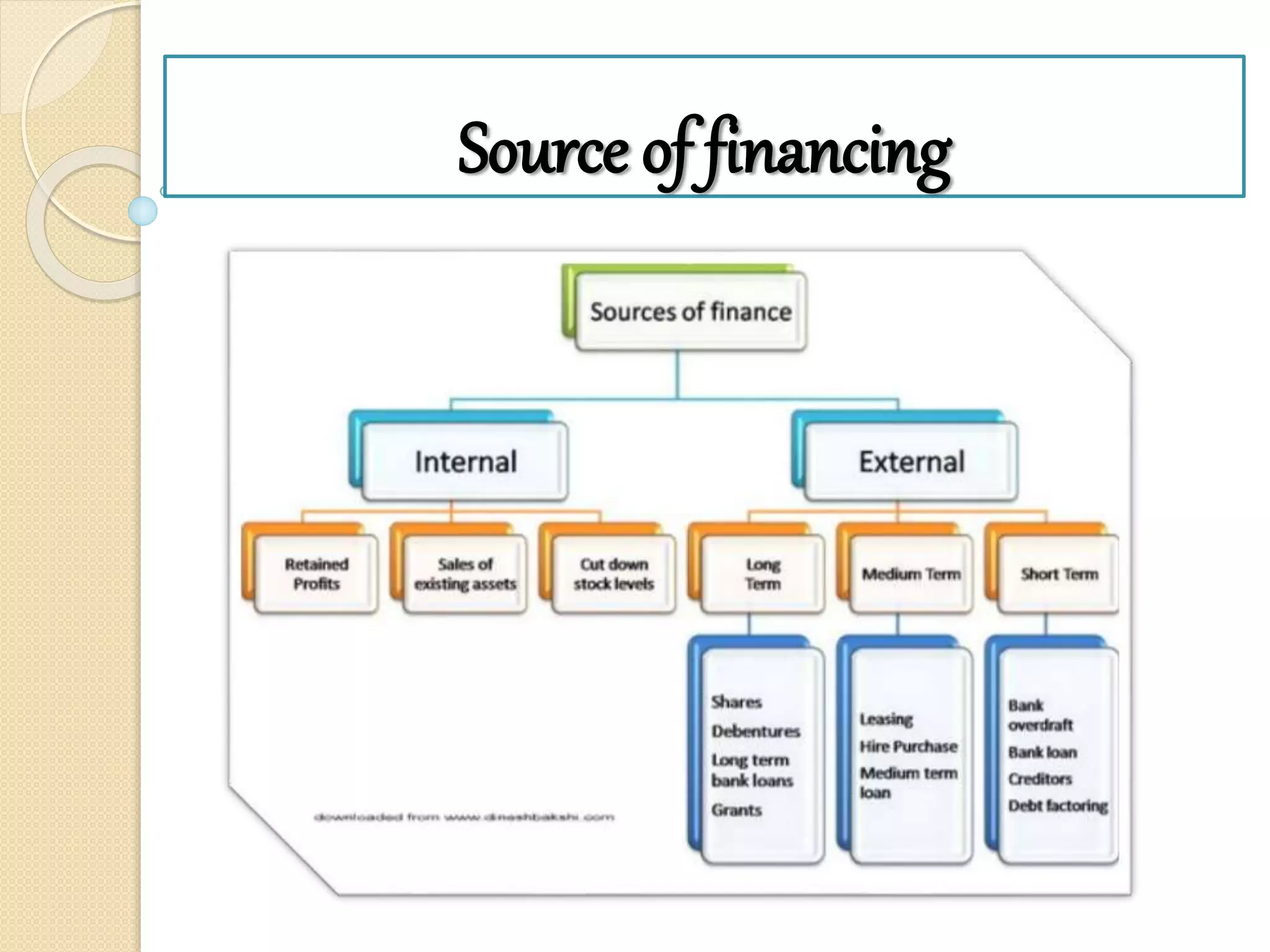
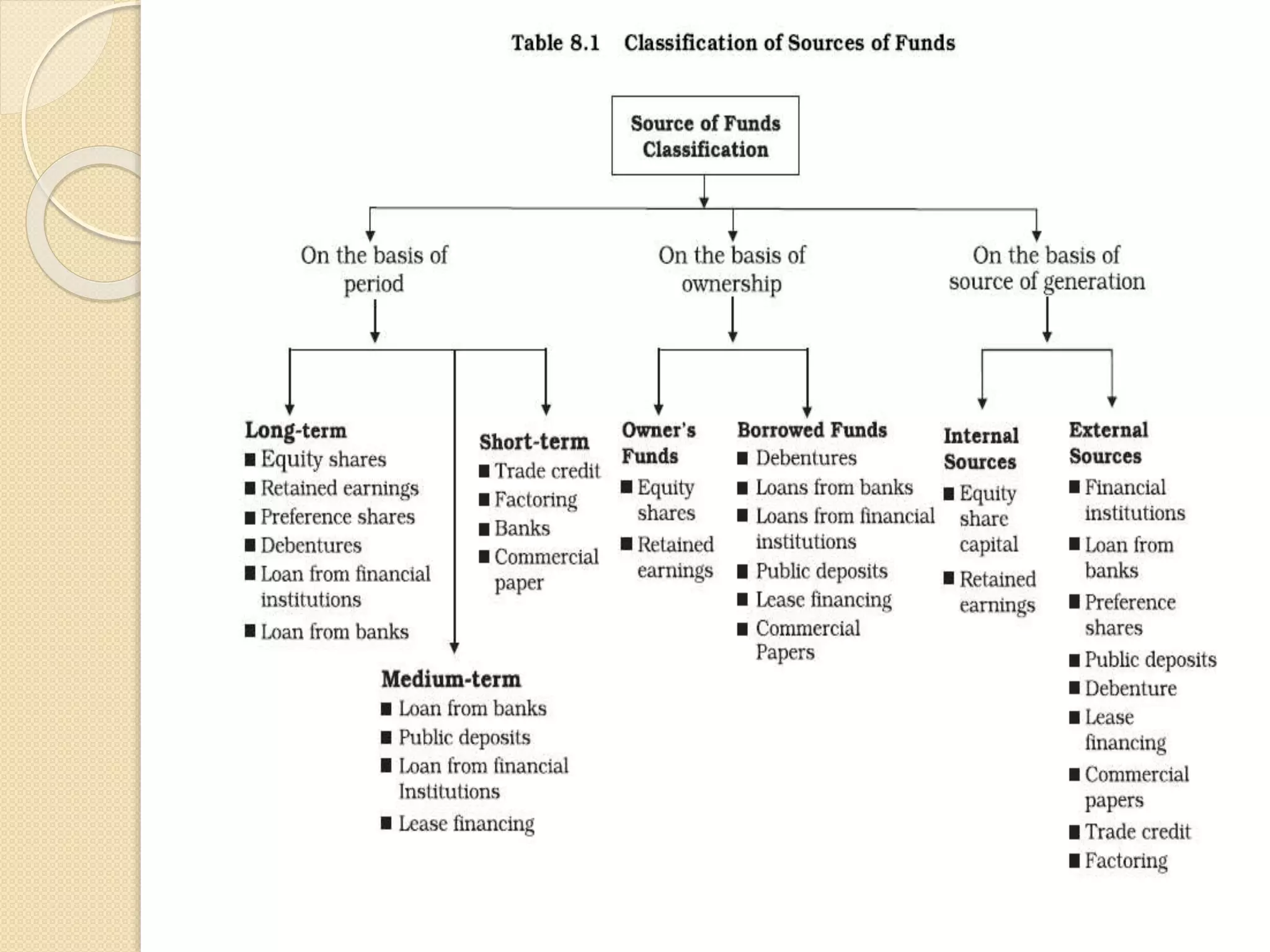
Source of financing
EQUITY SHARES
Meaning :
 Equity shares is the most important
sources of raising long term capital by
company.Equity shares represent the
ownership of company and thus the
capital raised by issue of such shares
is known as ownership capital or
owner’s fund.
 Equity shares capital is a perquisites
to the creation of the company.
Equity Shares:
 Equity share holders do not get fixed
dividend but are the paid on the basis
of earnings of the company.
 They are referred to as “residual
owners” since they receive what is left
after all other claims on the company’s
income and assets have been settled.
 They enjoy the reward as well as bear
the risk ownership.
Equity Shares:
 Their liability, however is limited to the
extent of capital contributed by the
company.
 Further through their right to vote
these share holders have right to
participate in the management of the
company
MERITS
Equity shares are suitable for
investors who are willing to assume
risk for higher returns
Payment of the dividend to the equity
share holders is not compulsory
Equity capital provides credit
worthiness to the company and
confidence to the prospective loan
providers.
Limitations
 Investors who want steady income
may not prefer equity shares as equity
shares get fluctuating returns
 The cost of equity shares is generally
more as compared to the cost of
raising funds through other sources.
Retained Earnings
Retained earnings refer to the percentage
of net earnings not paid to out as
dividends, but retained by the company
to be reinvested in its core business or to
pay debt. It is recorded under
shareholders’ equity on the balance
sheet.
PREFRENCE SHARES
 Preference shares are those which
have preferential right to the payment
of dividend during the life-time of the
company and a preferential right to the
return of capital when the company is
wound up.
TYPES OF PREFERENCE
SHARES
 Cumulative and Non cumulative.
 Participating and Non Participating.
 Convertible and Non Convertible.
 Redeemable and Non Redeemable
CUMULATIVE AND NON-
CUMULATIVE
 Holders of Cumulative preference shares
are entitled to recover the arrears of
preference dividend before any dividend
is paid on equity shares.
 In the case of Non- cumulative Preference
shares arrears of dividend do not
accumulate and hence, if dividend is to be
paid to equity shareholder in any year,
dividend at a fixed rate for only 1 year will
have to be paid to preference shareholder
before equity dividend is paid.
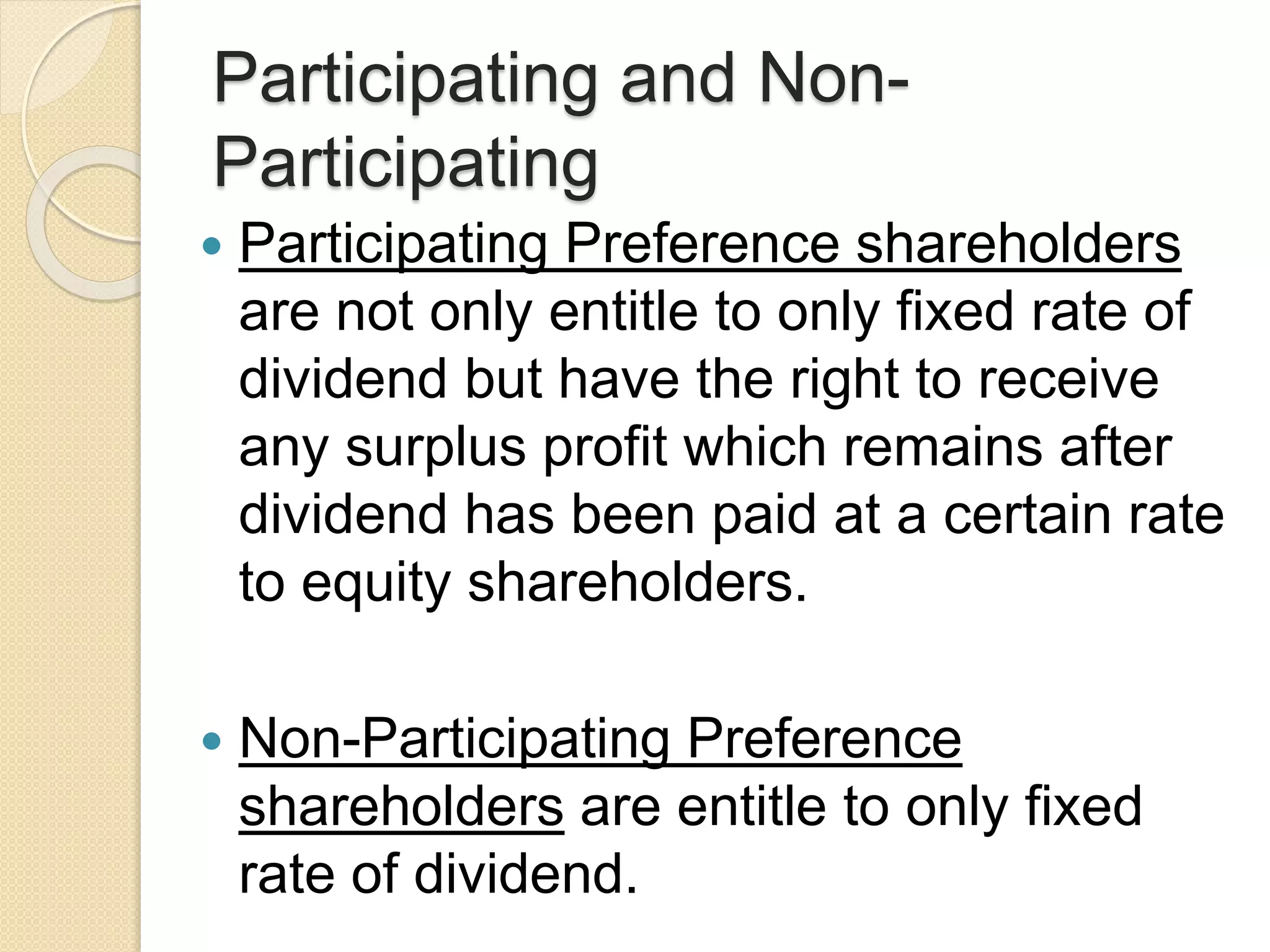
Participating and Non-
Participating
 Participating Preference shareholders
are not only entitle to only fixed rate of
dividend but have the right to receive
any surplus profit which remains after
dividend has been paid at a certain rate
to equity shareholders.
 Non-Participating Preference
shareholders are entitle to only fixed
rate of dividend.
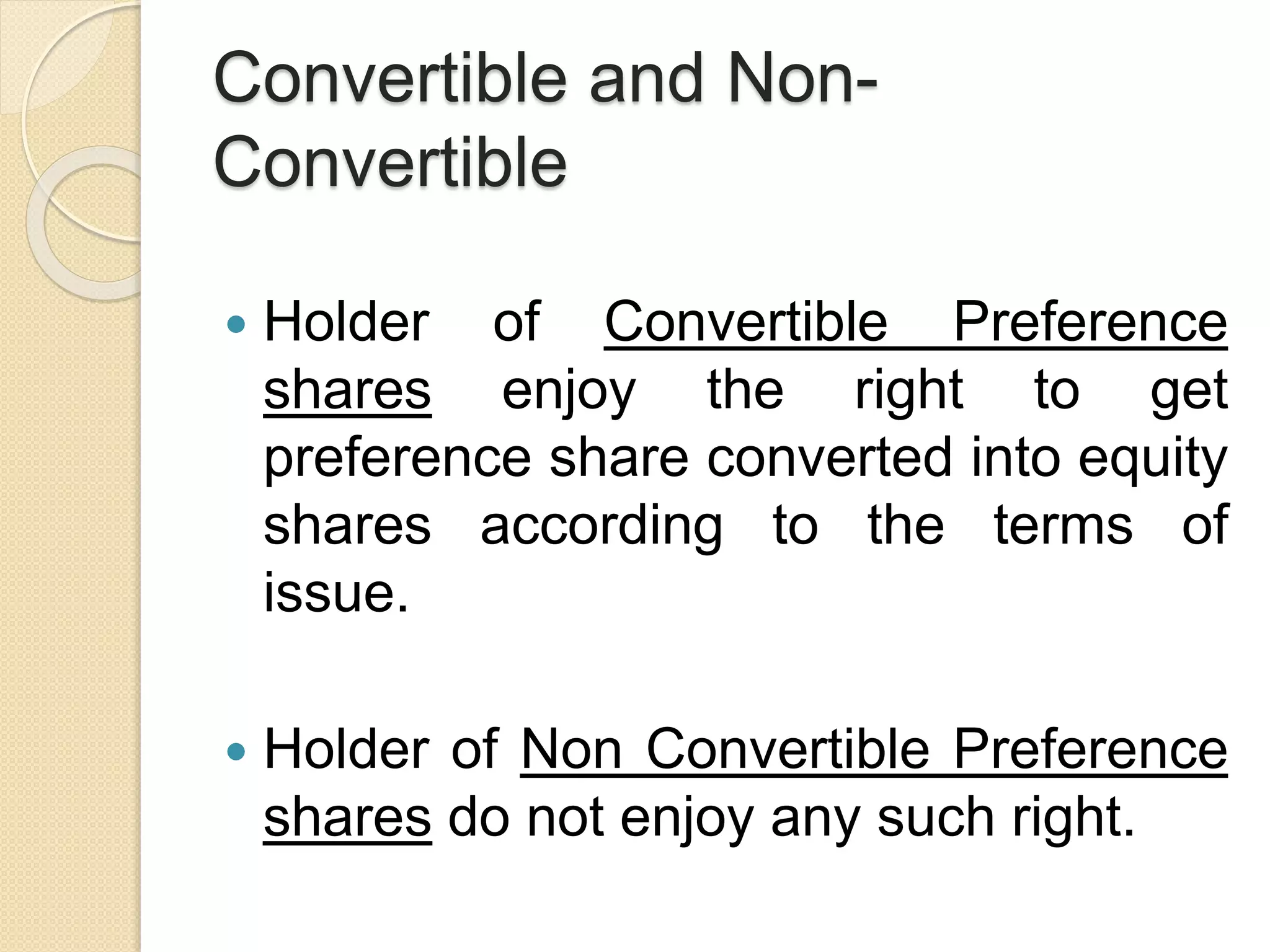
Convertible and Non-
Convertible
 Holder of Convertible Preference
shares enjoy the right to get
preference share converted into equity
shares according to the terms of
issue.
 Holder of Non Convertible Preference
shares do not enjoy any such right.
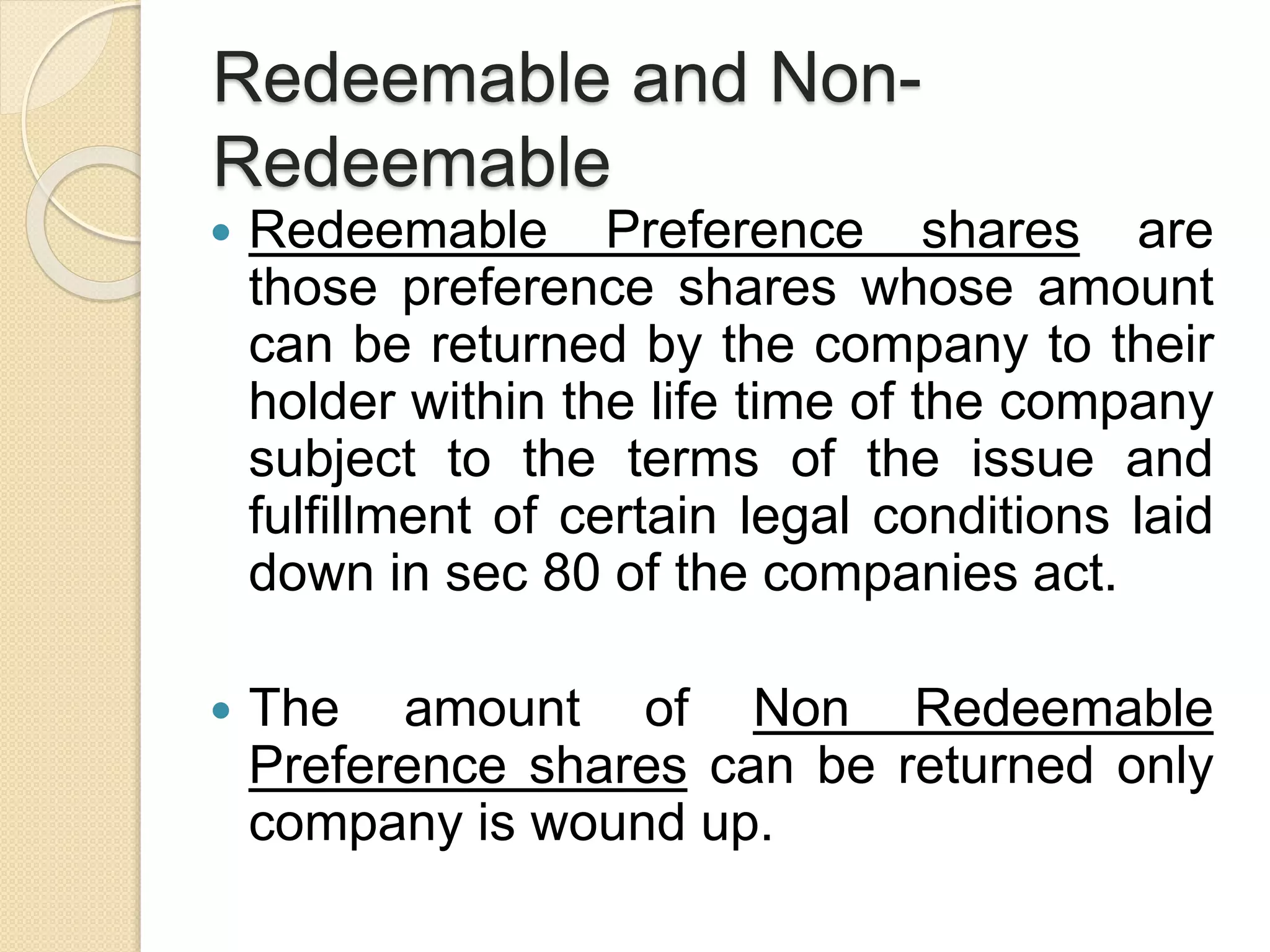
Redeemable and Non-
Redeemable
 Redeemable Preference shares are
those preference shares whose amount
can be returned by the company to their
holder within the life time of the company
subject to the terms of the issue and
fulfillment of certain legal conditions laid
down in sec 80 of the companies act.
 The amount of Non Redeemable
Preference shares can be returned only
company is wound up.
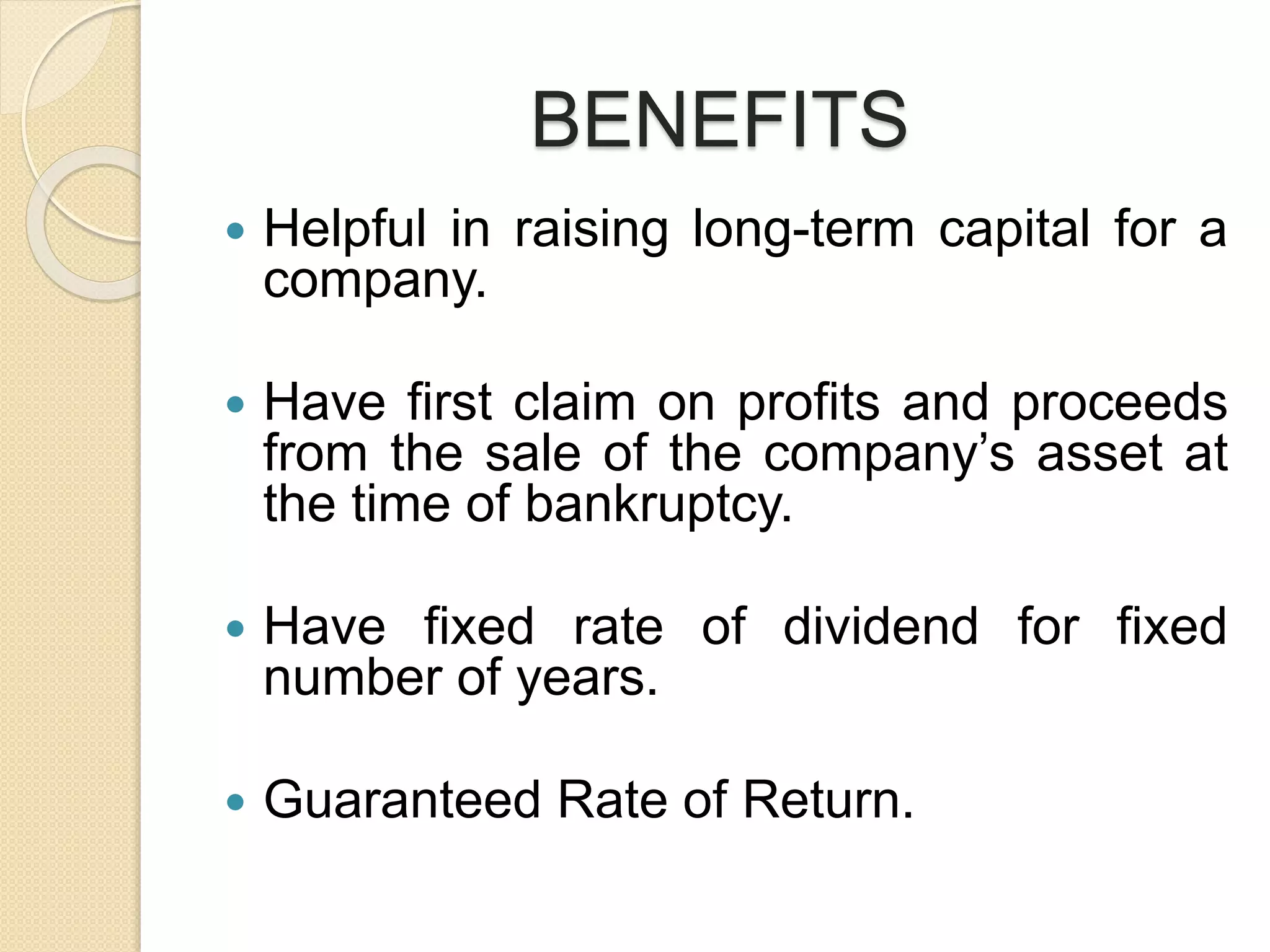
BENEFITS
 Helpful in raising long-term capital for a
company.
 Have first claim on profits and proceeds
from the sale of the company’s asset at
the time of bankruptcy.
 Have fixed rate of dividend for fixed
number of years.
 Guaranteed Rate of Return.
DRAWBACKS
 Not traded in market like ordinary
shares.
 Not available to retail investors.
 Not advantageous to investors form the
point of view of control & management
as preference share do not carry voting
rights.
 Cost of raising preference share capital
is higher.
DEBENTURES
“An honest man’s word is as good as
his debenture bond”- Miguel
 Debentures are an important instrument
for raising long term debt capital.
 The debenture issued by an company is
an acknowledgement that the company
has borrowed a certain amount of money,
which it promises to repay at a future date.
Debenture holders are therefore termed as
“Creditors” of the company.
TYPES OF DEBENTURES
 On the basis of security:-
a. Secured Debentures.
b. Unsecured Debentures.
Secured Debentures are such which create a
charge on the assets of the company, thereby
mortgaging the assets of the company.
Unsecured Debentures do not carry any charge
on the assets of the company.
 On the basis of redemption:-
a) Redeemable Debentures.
b) Non-redeemable Debentures.
These are the debentures which are issued for a
fixed period. It can be redeemed by annual
drawings or by purchasing from the open
market.
These are the debentures which are not
redeemed in the life time of the company. Such
debentures are paid back only when the
company goes to liquidation.
 On the basis of records:-
a) Registered Debentures.
b) Bearer Debentures.
Registered debentures are those which are duly
recorded in the register of debenture holders
maintained by the company.
The debentures which are transferable by mere
delivery are called bearer debentures.
 On the basis of Convertibility:-
a) Convertible Debentures.
b) Non-Convertible Debentures.
Convertible debentures are those
debentures that can be converted into
equity shares after the expiry of a
specified period.
Non- Convertible debentures are those
which cannot be converted into equity
shares.
Advantages
 When the company issues debentures it does not
result in the dilution of Ownership as is the case
with the issue of equity shares.
 Interest paid on a debenture is a tax deductible
expense and hence company gets the tax benefit.
 Since debenture holders do not have any voting
rights they do not interfere with the working of
the organization.
 Debenture holders payment of interest is fixed
and hence firm does not need to share profits
with them.
DISADVANTAGES
 Payment of interest on debenture is mandatory
and when company is making low profits.
Nonpayment of interest can even lead to
bankruptcy for the firm.
 Since on maturity they have to be repaid company
needs to plan properly and keep funds for same. If
company has not maintained enough funds it is a
recipe for a disaster.
 Debentures are bought by large institutional
investors and hence at times it may prove to be
costly and difficult source of finance for the
company.
Loan from financial institution
and loan from bank
Meaning :
In finance and economics,
a financial institution provide financial
services for its clients or members.
One of the most important financial
services provided by financial
institution is acting as a financial
intermediaries most financial
institution regulated by the
government
Functions
 Financial institution provide service as
intermediaries of financial market.
 majorly they are three types of
financial institution
1) Depository institution
2) Contractual institution
3) Investment institution
 1) Depository institution; Deposit
taking institution that and accept and
manage deposit and make loans .
 2) contractual institution – insurance
companies and pension funds etc ..
 3) investment institution -
investment banks, underwriter , brokerage
firm
Public deposits
Public deposits refers to the unsecured deposits
invited by companies from the public mainly to
finance working capital needs. A company
wishing to invite public deposits makes an
advertisement in the newspapers.
Any member of the public can fill up the
prescribed from and deposit the money with the
company. The company in return issues a
deposit receipt.
Lease financing
Lease financing is one of the important sources of
medium - and long-term financing where the owner
of an asset gives another person, the right to use that
asset against periodical payments. The owner of the
asset is known as lessor and the user is called lessee.
The periodical payment made by the lessee to the
lessor is known as lease rental. Under lease
financing, lessee is given the right to use the asset
but the ownership lies with the lessor and at the end
of the lease contract, the asset is returned to the
lessor or an option is given to the lessee either to
purchase the asset or to renew the lease agreement.
What is a trade credit
 A trade credit is an agreement where a
customer can purchase goods on
account (without paying cash), paying
the suppliers at a later date. Usually
when the goods delivered, a trade credit
given for a specific number of days -30,
60 or 90. jewelry businesses sometimes
extend credit to 180 days or longer.
 Trade credit is essentially a credit a
company gives to another for purchases
of goods & services
Meaning of trade credit
 Trade credit is an important external
source of working capital financing. It is a
short term credit extended by suppliers
of goods & services in the normal course
of business, to a buyer in order to
enhance sales.
 Trade credit arises when a supplier of
goods & services allows customers to
pay for goods and services at a later
date. Cash is not immediately paid &
deferral of payment represents a source
Advantages of trade credit
 It is easy and automatic sources of
short term finance.
 It reduces the capital requirement.
 It helps the business focus on core
activities.
 It does not require any negotiation or
formal agreement
Factoring
Factoring is a transaction in which a
business sells its accounts receivable,
or invoices, to a third party commercial
financial company, also known as a
“factor.” This is done so that the
business can receive cash more quickly
than it would by waiting 30 to 60 days
for a customer payment. Factoring is
sometimes called “accounts receivable
financing.”
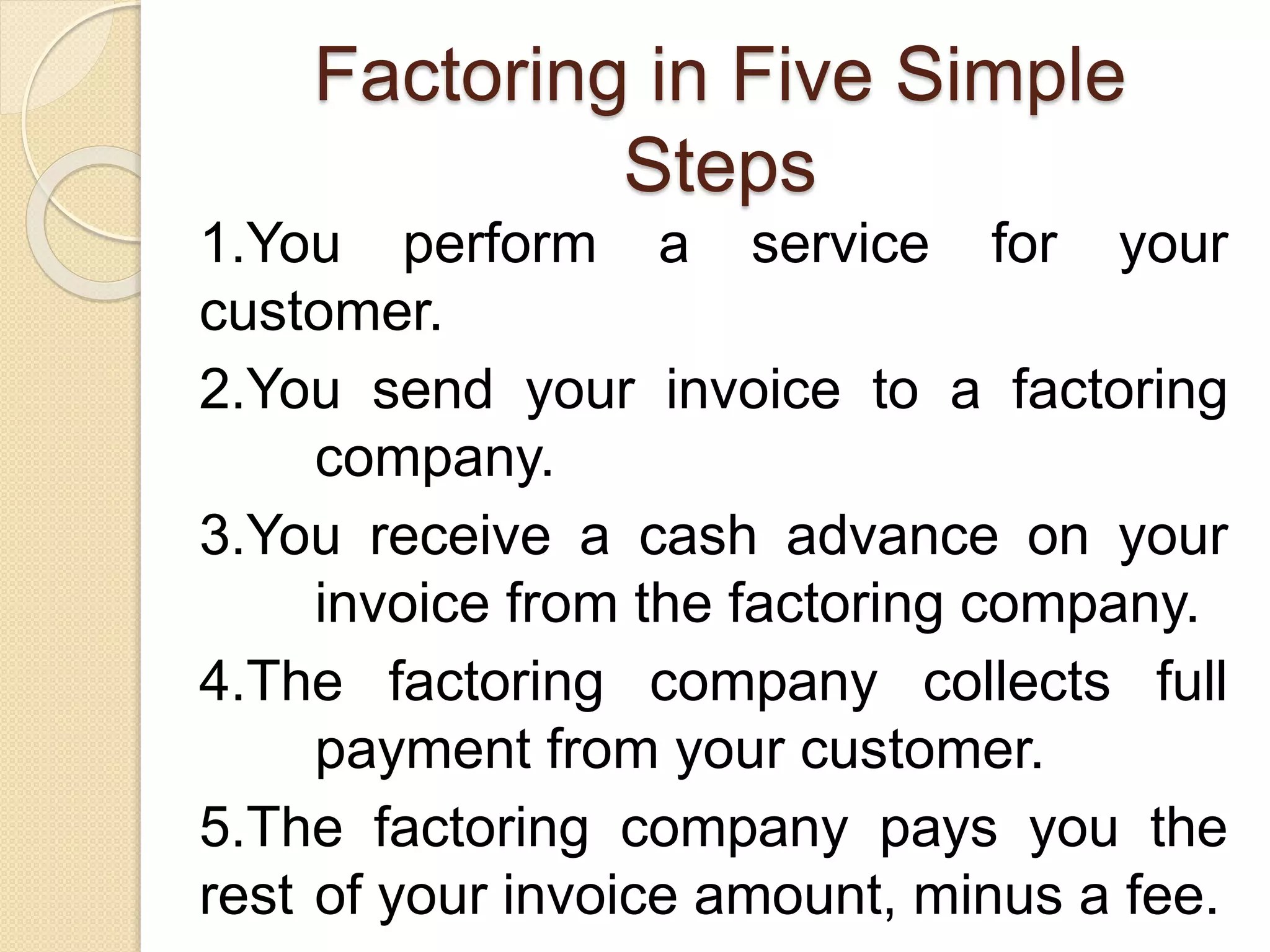
Factoring in Five Simple
Steps
1.You perform a service for your
customer.
2.You send your invoice to a factoring
company.
3.You receive a cash advance on your
invoice from the factoring company.
4.The factoring company collects full
payment from your customer.
5.The factoring company pays you the
rest of your invoice amount, minus a fee.
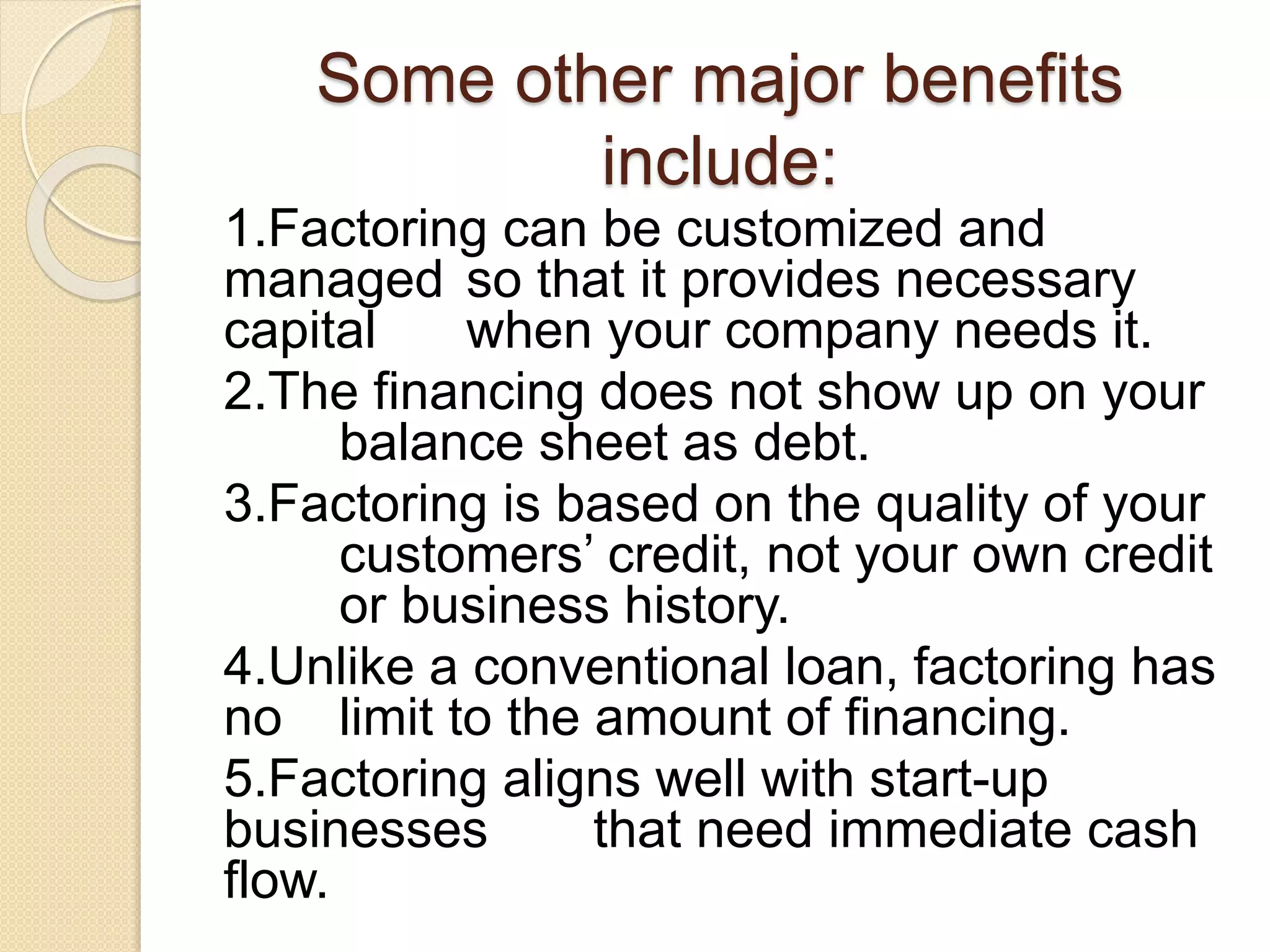
Some other major benefits
include:
1.Factoring can be customized and
managed so that it provides necessary
capital when your company needs it.
2.The financing does not show up on your
balance sheet as debt.
3.Factoring is based on the quality of your
customers’ credit, not your own credit
or business history.
4.Unlike a conventional loan, factoring has
no limit to the amount of financing.
5.Factoring aligns well with start-up
businesses that need immediate cash
flow.
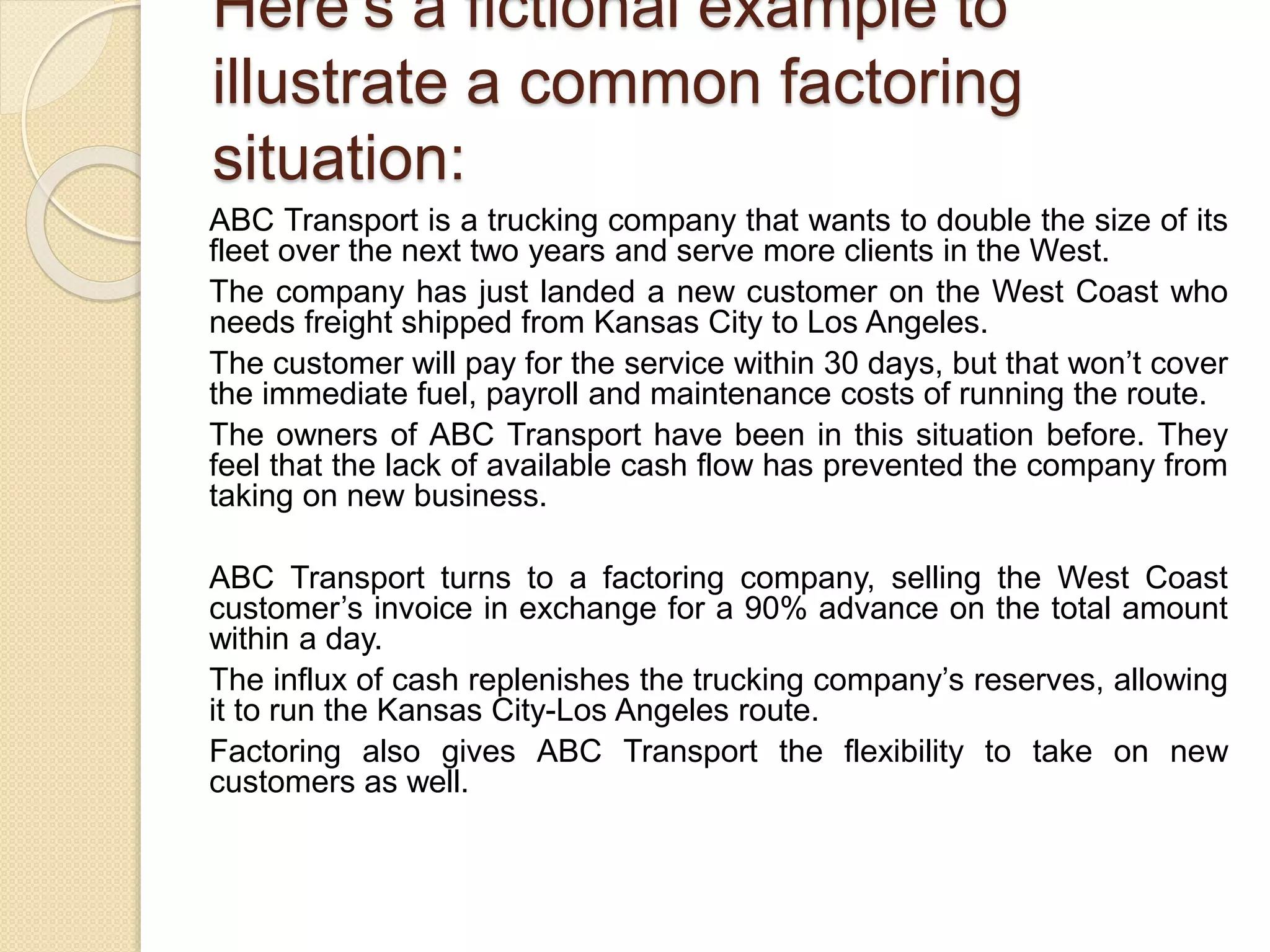
Here’s a fictional example to
illustrate a common factoring
situation:
ABC Transport is a trucking company that wants to double the size of its
fleet over the next two years and serve more clients in the West.
The company has just landed a new customer on the West Coast who
needs freight shipped from Kansas City to Los Angeles.
The customer will pay for the service within 30 days, but that won’t cover
the immediate fuel, payroll and maintenance costs of running the route.
The owners of ABC Transport have been in this situation before. They
feel that the lack of available cash flow has prevented the company from
taking on new business.
ABC Transport turns to a factoring company, selling the West Coast
customer’s invoice in exchange for a 90% advance on the total amount
within a day.
The influx of cash replenishes the trucking company’s reserves, allowing
it to run the Kansas City-Los Angeles route.
Factoring also gives ABC Transport the flexibility to take on new
customers as well.
Banks
A financial institution that is licensed to deal with money and its
substitutes by accepting time and demand deposits, making loans,
and investing in securities. The bank generates profits from the
difference in the interest rates charged and paid.
TYPES OF BANKS
 Retail Banks
Retail banks provide basic banking services to individual
consumers
 Commercial banks
Commercial Banks provide financial services to
businesses, including credit and debit cards, bank
accounts, deposits and loans, and secured and unsecured
loans.
 Cooperative banks
Cooperative Banks are governed by the
provisions of State Cooperative Societies
Act and meant essentially for providing
cheap credit to their members
 Investment Banks
Investment banks aid companies in
acquiring funds and they provide advice for a
wide range of transactions
 Central banks
Central banks provide monetary and
financial policy
Commercial paper
 A short term unsecured negotiable
instrument consisting of promissory
notes
 With fixed maturity
 Generally they are issued by
companies as a means of raising short
term debt
 Issued at a discounted face value
 The issues promises a fixed amount at
future date but pledges no assets
Source of fianace
Source of fianace

Source of fianace

  • 1.
  • 3.
    EQUITY SHARES Meaning : Equity shares is the most important sources of raising long term capital by company.Equity shares represent the ownership of company and thus the capital raised by issue of such shares is known as ownership capital or owner’s fund.  Equity shares capital is a perquisites to the creation of the company.
  • 4.
    Equity Shares:  Equityshare holders do not get fixed dividend but are the paid on the basis of earnings of the company.  They are referred to as “residual owners” since they receive what is left after all other claims on the company’s income and assets have been settled.  They enjoy the reward as well as bear the risk ownership.
  • 5.
    Equity Shares:  Theirliability, however is limited to the extent of capital contributed by the company.  Further through their right to vote these share holders have right to participate in the management of the company
  • 6.
    MERITS Equity shares aresuitable for investors who are willing to assume risk for higher returns Payment of the dividend to the equity share holders is not compulsory Equity capital provides credit worthiness to the company and confidence to the prospective loan providers.
  • 7.
    Limitations  Investors whowant steady income may not prefer equity shares as equity shares get fluctuating returns  The cost of equity shares is generally more as compared to the cost of raising funds through other sources.
  • 8.
    Retained Earnings Retained earningsrefer to the percentage of net earnings not paid to out as dividends, but retained by the company to be reinvested in its core business or to pay debt. It is recorded under shareholders’ equity on the balance sheet.
  • 9.
    PREFRENCE SHARES  Preferenceshares are those which have preferential right to the payment of dividend during the life-time of the company and a preferential right to the return of capital when the company is wound up.
  • 10.
    TYPES OF PREFERENCE SHARES Cumulative and Non cumulative.  Participating and Non Participating.  Convertible and Non Convertible.  Redeemable and Non Redeemable
  • 11.
    CUMULATIVE AND NON- CUMULATIVE Holders of Cumulative preference shares are entitled to recover the arrears of preference dividend before any dividend is paid on equity shares.  In the case of Non- cumulative Preference shares arrears of dividend do not accumulate and hence, if dividend is to be paid to equity shareholder in any year, dividend at a fixed rate for only 1 year will have to be paid to preference shareholder before equity dividend is paid.
  • 12.
    Participating and Non- Participating Participating Preference shareholders are not only entitle to only fixed rate of dividend but have the right to receive any surplus profit which remains after dividend has been paid at a certain rate to equity shareholders.  Non-Participating Preference shareholders are entitle to only fixed rate of dividend.
  • 13.
    Convertible and Non- Convertible Holder of Convertible Preference shares enjoy the right to get preference share converted into equity shares according to the terms of issue.  Holder of Non Convertible Preference shares do not enjoy any such right.
  • 14.
    Redeemable and Non- Redeemable Redeemable Preference shares are those preference shares whose amount can be returned by the company to their holder within the life time of the company subject to the terms of the issue and fulfillment of certain legal conditions laid down in sec 80 of the companies act.  The amount of Non Redeemable Preference shares can be returned only company is wound up.
  • 15.
    BENEFITS  Helpful inraising long-term capital for a company.  Have first claim on profits and proceeds from the sale of the company’s asset at the time of bankruptcy.  Have fixed rate of dividend for fixed number of years.  Guaranteed Rate of Return.
  • 16.
    DRAWBACKS  Not tradedin market like ordinary shares.  Not available to retail investors.  Not advantageous to investors form the point of view of control & management as preference share do not carry voting rights.  Cost of raising preference share capital is higher.
  • 17.
    DEBENTURES “An honest man’sword is as good as his debenture bond”- Miguel
  • 18.
     Debentures arean important instrument for raising long term debt capital.  The debenture issued by an company is an acknowledgement that the company has borrowed a certain amount of money, which it promises to repay at a future date. Debenture holders are therefore termed as “Creditors” of the company.
  • 19.
    TYPES OF DEBENTURES On the basis of security:- a. Secured Debentures. b. Unsecured Debentures. Secured Debentures are such which create a charge on the assets of the company, thereby mortgaging the assets of the company. Unsecured Debentures do not carry any charge on the assets of the company.
  • 20.
     On thebasis of redemption:- a) Redeemable Debentures. b) Non-redeemable Debentures. These are the debentures which are issued for a fixed period. It can be redeemed by annual drawings or by purchasing from the open market. These are the debentures which are not redeemed in the life time of the company. Such debentures are paid back only when the company goes to liquidation.
  • 21.
     On thebasis of records:- a) Registered Debentures. b) Bearer Debentures. Registered debentures are those which are duly recorded in the register of debenture holders maintained by the company. The debentures which are transferable by mere delivery are called bearer debentures.
  • 22.
     On thebasis of Convertibility:- a) Convertible Debentures. b) Non-Convertible Debentures. Convertible debentures are those debentures that can be converted into equity shares after the expiry of a specified period. Non- Convertible debentures are those which cannot be converted into equity shares.
  • 23.
    Advantages  When thecompany issues debentures it does not result in the dilution of Ownership as is the case with the issue of equity shares.  Interest paid on a debenture is a tax deductible expense and hence company gets the tax benefit.  Since debenture holders do not have any voting rights they do not interfere with the working of the organization.  Debenture holders payment of interest is fixed and hence firm does not need to share profits with them.
  • 24.
    DISADVANTAGES  Payment ofinterest on debenture is mandatory and when company is making low profits. Nonpayment of interest can even lead to bankruptcy for the firm.  Since on maturity they have to be repaid company needs to plan properly and keep funds for same. If company has not maintained enough funds it is a recipe for a disaster.  Debentures are bought by large institutional investors and hence at times it may prove to be costly and difficult source of finance for the company.
  • 25.
    Loan from financialinstitution and loan from bank Meaning : In finance and economics, a financial institution provide financial services for its clients or members. One of the most important financial services provided by financial institution is acting as a financial intermediaries most financial institution regulated by the government
  • 26.
    Functions  Financial institutionprovide service as intermediaries of financial market.  majorly they are three types of financial institution 1) Depository institution 2) Contractual institution 3) Investment institution
  • 27.
     1) Depositoryinstitution; Deposit taking institution that and accept and manage deposit and make loans .  2) contractual institution – insurance companies and pension funds etc ..  3) investment institution - investment banks, underwriter , brokerage firm
  • 28.
    Public deposits Public depositsrefers to the unsecured deposits invited by companies from the public mainly to finance working capital needs. A company wishing to invite public deposits makes an advertisement in the newspapers. Any member of the public can fill up the prescribed from and deposit the money with the company. The company in return issues a deposit receipt.
  • 29.
    Lease financing Lease financingis one of the important sources of medium - and long-term financing where the owner of an asset gives another person, the right to use that asset against periodical payments. The owner of the asset is known as lessor and the user is called lessee. The periodical payment made by the lessee to the lessor is known as lease rental. Under lease financing, lessee is given the right to use the asset but the ownership lies with the lessor and at the end of the lease contract, the asset is returned to the lessor or an option is given to the lessee either to purchase the asset or to renew the lease agreement.
  • 30.
    What is atrade credit  A trade credit is an agreement where a customer can purchase goods on account (without paying cash), paying the suppliers at a later date. Usually when the goods delivered, a trade credit given for a specific number of days -30, 60 or 90. jewelry businesses sometimes extend credit to 180 days or longer.  Trade credit is essentially a credit a company gives to another for purchases of goods & services
  • 31.
    Meaning of tradecredit  Trade credit is an important external source of working capital financing. It is a short term credit extended by suppliers of goods & services in the normal course of business, to a buyer in order to enhance sales.  Trade credit arises when a supplier of goods & services allows customers to pay for goods and services at a later date. Cash is not immediately paid & deferral of payment represents a source
  • 32.
    Advantages of tradecredit  It is easy and automatic sources of short term finance.  It reduces the capital requirement.  It helps the business focus on core activities.  It does not require any negotiation or formal agreement
  • 33.
    Factoring Factoring is atransaction in which a business sells its accounts receivable, or invoices, to a third party commercial financial company, also known as a “factor.” This is done so that the business can receive cash more quickly than it would by waiting 30 to 60 days for a customer payment. Factoring is sometimes called “accounts receivable financing.”
  • 34.
    Factoring in FiveSimple Steps 1.You perform a service for your customer. 2.You send your invoice to a factoring company. 3.You receive a cash advance on your invoice from the factoring company. 4.The factoring company collects full payment from your customer. 5.The factoring company pays you the rest of your invoice amount, minus a fee.
  • 35.
    Some other majorbenefits include: 1.Factoring can be customized and managed so that it provides necessary capital when your company needs it. 2.The financing does not show up on your balance sheet as debt. 3.Factoring is based on the quality of your customers’ credit, not your own credit or business history. 4.Unlike a conventional loan, factoring has no limit to the amount of financing. 5.Factoring aligns well with start-up businesses that need immediate cash flow.
  • 36.
    Here’s a fictionalexample to illustrate a common factoring situation: ABC Transport is a trucking company that wants to double the size of its fleet over the next two years and serve more clients in the West. The company has just landed a new customer on the West Coast who needs freight shipped from Kansas City to Los Angeles. The customer will pay for the service within 30 days, but that won’t cover the immediate fuel, payroll and maintenance costs of running the route. The owners of ABC Transport have been in this situation before. They feel that the lack of available cash flow has prevented the company from taking on new business. ABC Transport turns to a factoring company, selling the West Coast customer’s invoice in exchange for a 90% advance on the total amount within a day. The influx of cash replenishes the trucking company’s reserves, allowing it to run the Kansas City-Los Angeles route. Factoring also gives ABC Transport the flexibility to take on new customers as well.
  • 37.
    Banks A financial institutionthat is licensed to deal with money and its substitutes by accepting time and demand deposits, making loans, and investing in securities. The bank generates profits from the difference in the interest rates charged and paid. TYPES OF BANKS  Retail Banks Retail banks provide basic banking services to individual consumers  Commercial banks Commercial Banks provide financial services to businesses, including credit and debit cards, bank accounts, deposits and loans, and secured and unsecured loans.
  • 38.
     Cooperative banks CooperativeBanks are governed by the provisions of State Cooperative Societies Act and meant essentially for providing cheap credit to their members  Investment Banks Investment banks aid companies in acquiring funds and they provide advice for a wide range of transactions  Central banks Central banks provide monetary and financial policy
  • 39.
    Commercial paper  Ashort term unsecured negotiable instrument consisting of promissory notes  With fixed maturity  Generally they are issued by companies as a means of raising short term debt  Issued at a discounted face value  The issues promises a fixed amount at future date but pledges no assets