Presents
Velocity Women’s Clinic
Bre Kowaleski
Austin Cashwell
Quintin Hall
Zack Lappin
Welcome
Today we will ……
Hear a testimonial
Bust common Myths with women
exercising
Share important facts about exercise
Explain some nutrition Facts
Participate in an interactive
demonstration
Testimonial
Common Myths in Exercise
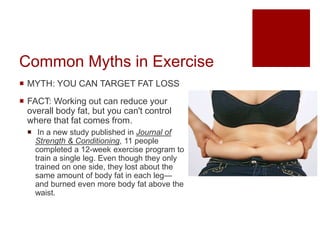
 MYTH: YOU CAN TARGET FAT LOSS
 FACT: Working out can reduce your
overall body fat, but you can't control
where that fat comes from.
 In a new study published in Journal of
Strength & Conditioning, 11 people
completed a 12-week exercise program to
train a single leg. Even though they only
trained on one side, they lost about the
same amount of body fat in each leg—
and burned even more body fat above the
waist.
Common Myths in Exercise
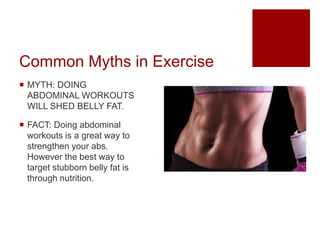
 MYTH: DOING
ABDOMINAL WORKOUTS
WILL SHED BELLY FAT.
 FACT: Doing abdominal
workouts is a great way to
strengthen your abs.
However the best way to
target stubborn belly fat is
through nutrition.
Common Myths in Exercise
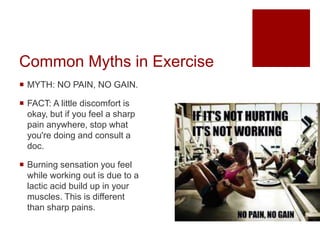
 MYTH: NO PAIN, NO GAIN.
 FACT: A little discomfort is
okay, but if you feel a sharp
pain anywhere, stop what
you're doing and consult a
doc.
 Burning sensation you feel
while working out is due to a
lactic acid build up in your
muscles. This is different
than sharp pains.
Common Myths in Exercise
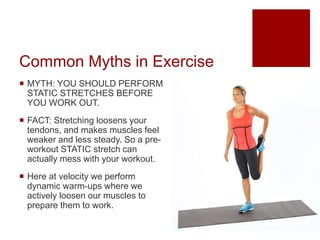
 MYTH: YOU SHOULD PERFORM
STATIC STRETCHES BEFORE
YOU WORK OUT.
 FACT: Stretching loosens your
tendons, and makes muscles feel
weaker and less steady. So a pre-
workout STATIC stretch can
actually mess with your workout.
 Here at velocity we perform
dynamic warm-ups where we
actively loosen our muscles to
prepare them to work.
Common Myths in Exercise
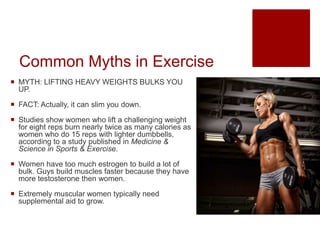
 MYTH: LIFTING HEAVY WEIGHTS BULKS YOU
UP.
 FACT: Actually, it can slim you down.
 Studies show women who lift a challenging weight
for eight reps burn nearly twice as many calories as
women who do 15 reps with lighter dumbbells,
according to a study published in Medicine &
Science in Sports & Exercise.
 Women have too much estrogen to build a lot of
bulk. Guys build muscles faster because they have
more testosterone then women.
 Extremely muscular women typically need
supplemental aid to grow.
Common Myths in Exercise
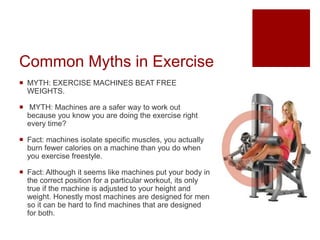
 MYTH: EXERCISE MACHINES BEAT FREE
WEIGHTS.
 MYTH: Machines are a safer way to work out
because you know you are doing the exercise right
every time?
 Fact: machines isolate specific muscles, you actually
burn fewer calories on a machine than you do when
you exercise freestyle.
 Fact: Although it seems like machines put your body in
the correct position for a particular workout, its only
true if the machine is adjusted to your height and
weight. Honestly most machines are designed for men
so it can be hard to find machines that are designed
for both.
Common Myths in Exercise
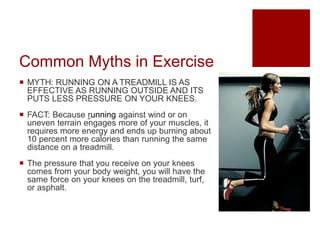
 MYTH: RUNNING ON A TREADMILL IS AS
EFFECTIVE AS RUNNING OUTSIDE AND ITS
PUTS LESS PRESSURE ON YOUR KNEES.
 FACT: Because running against wind or on
uneven terrain engages more of your muscles, it
requires more energy and ends up burning about
10 percent more calories than running the same
distance on a treadmill.
 The pressure that you receive on your knees
comes from your body weight, you will have the
same force on your knees on the treadmill, turf,
or asphalt.
Common Myths in Exercise
 MYTH: SWEATING MEANS YOU'RE OUT OF
SHAPE OR NOT WORKING ENOUGH.
 FACT: "It sounds counterintuitive, but the fitter
you are, the sooner your body begins to sweat,
so a person who's in extremely good shape will
produce more sweat than somebody who
isn't," says Beth Stover, M.S., C.S.C.S., a senior
scientist at the Gatorade Sports Science Institute
in Barrington, Illinois. "With each workout, you
become a more and more efficient sweating
machine.”
 Sweating is not an indicator of exertion. Sweating
is your bodies way of cooling its self off.
Common Myths in Exercise
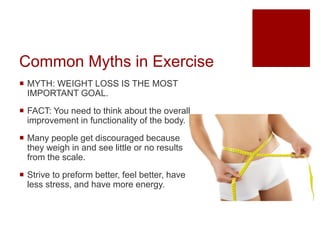
 MYTH: WEIGHT LOSS IS THE MOST
IMPORTANT GOAL.
 FACT: You need to think about the overall
improvement in functionality of the body.
 Many people get discouraged because
they weigh in and see little or no results
from the scale.
 Strive to preform better, feel better, have
less stress, and have more energy.
Common Myths in Exercise
 MYTH: CARDIO IS THE BEST WAY TO BURN
FAT.
 FACT: Fat loss takes more than burning
calories during a single workout—it requires
building metabolism-boosting muscle.
 But many of us want to hit the cardio first, and
have lost our steam by the team we hit the
weights. Instead, hit the weights.When you
have more energy, you'll be able to lift heavier
weights.
 Building muscle will help you burn fat
everywhere, including your belly
IMPORTANT FACTS
 Exercise boosts brain power!
 Exercise increases energy levels
and increases serotonin in the brain,
which leads to improved mental
clarity.
IMPORTANT FACTS
 An aerobic workout will boost your
metabolism for the rest of the day!
 Your metabolism will burn at a
slightly higher rate after finishing an
aerobic work out.
IMPORTANT FACTS
 Exercise gives you energy!
 When endorphins are released into
your blood stream while excising,
you will tend to feel much more
energized for the rest of the day.
IMPORTANT FACTS
 Exercise helps ward off disease!
 Research has shown that exercise can
 slow or help prevent heart disease,
 stroke,
 high blood pressure,
 high cholesterol,
 type 2 diabetes,
 arthritis,
 osteoporosis (bone loss),
 loss of muscle mass.
 It can also help build immune function which
will help you fight off colds.
Nutrition
Facts:
 Less than 5% of adults participate in 30 minutes of
physical activity each day; only one in three adults
receive the recommended amount of physical activity
each week.
 About 90% of Americans eat more sodium than is
recommended for a healthy diet
 US adults consume an average of 3,400 mg/day [of
sodium], well above the current federal guideline of
less than 2,300 mg daily.
Before/After meals
 Circuit training: Combining strength training along with
cardio, requires some adjustments to your diet. Have
your protein 2-3 hours BEFORE your workout. 30-60
minutes before your workout, have a carb-rich snack
such as fruit, toast, or a smoothie.
 Post-workout: Drink plenty of water have have a post-
training meal planned. Replenish your body with a 3:1
ratio of carbohydrates and protein to ensure adequate
muscle repair and recovery.
How many calories should I
consume?
 Women over 40:
 Active women need about 2000 calories a day.
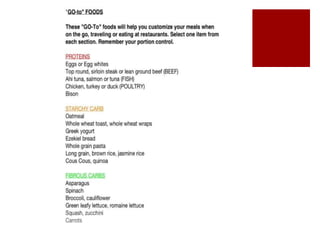
Important Tips
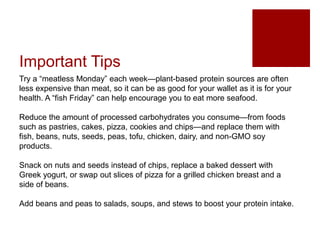
Try a “meatless Monday” each week—plant-based protein sources are often
less expensive than meat, so it can be as good for your wallet as it is for your
health. A “fish Friday” can help encourage you to eat more seafood.
Reduce the amount of processed carbohydrates you consume—from foods
such as pastries, cakes, pizza, cookies and chips—and replace them with
fish, beans, nuts, seeds, peas, tofu, chicken, dairy, and non-GMO soy
products.
Snack on nuts and seeds instead of chips, replace a baked dessert with
Greek yogurt, or swap out slices of pizza for a grilled chicken breast and a
side of beans.
Add beans and peas to salads, soups, and stews to boost your protein intake.
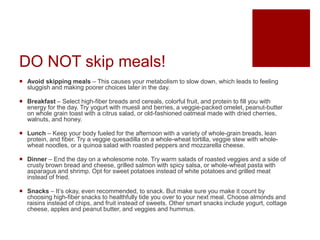
DO NOT skip meals!
 Avoid skipping meals – This causes your metabolism to slow down, which leads to feeling
sluggish and making poorer choices later in the day.
 Breakfast – Select high-fiber breads and cereals, colorful fruit, and protein to fill you with
energy for the day. Try yogurt with muesli and berries, a veggie-packed omelet, peanut-butter
on whole grain toast with a citrus salad, or old-fashioned oatmeal made with dried cherries,
walnuts, and honey.
 Lunch – Keep your body fueled for the afternoon with a variety of whole-grain breads, lean
protein, and fiber. Try a veggie quesadilla on a whole-wheat tortilla, veggie stew with whole-
wheat noodles, or a quinoa salad with roasted peppers and mozzarella cheese.
 Dinner – End the day on a wholesome note. Try warm salads of roasted veggies and a side of
crusty brown bread and cheese, grilled salmon with spicy salsa, or whole-wheat pasta with
asparagus and shrimp. Opt for sweet potatoes instead of white potatoes and grilled meat
instead of fried.
 Snacks – It’s okay, even recommended, to snack. But make sure you make it count by
choosing high-fiber snacks to healthfully tide you over to your next meal. Choose almonds and
raisins instead of chips, and fruit instead of sweets. Other smart snacks include yogurt, cottage
cheese, apples and peanut butter, and veggies and hummus.
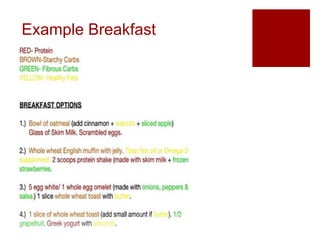
Example Breakfast
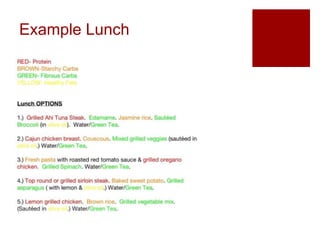
Example Lunch
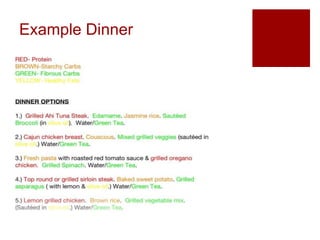
Example Dinner
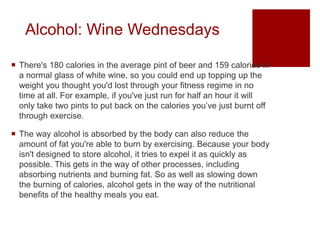
Alcohol: Wine Wednesdays
 There's 180 calories in the average pint of beer and 159 calories in
a normal glass of white wine, so you could end up topping up the
weight you thought you'd lost through your fitness regime in no
time at all. For example, if you've just run for half an hour it will
only take two pints to put back on the calories you’ve just burnt off
through exercise.
 The way alcohol is absorbed by the body can also reduce the
amount of fat you're able to burn by exercising. Because your body
isn't designed to store alcohol, it tries to expel it as quickly as
possible. This gets in the way of other processes, including
absorbing nutrients and burning fat. So as well as slowing down
the burning of calories, alcohol gets in the way of the nutritional
benefits of the healthy meals you eat.
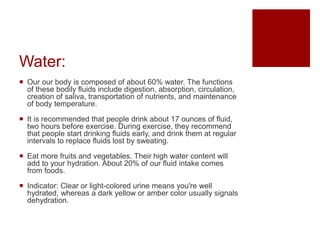
Water:
 Our our body is composed of about 60% water. The functions
of these bodily fluids include digestion, absorption, circulation,
creation of saliva, transportation of nutrients, and maintenance
of body temperature.
 It is recommended that people drink about 17 ounces of fluid,
two hours before exercise. During exercise, they recommend
that people start drinking fluids early, and drink them at regular
intervals to replace fluids lost by sweating.
 Eat more fruits and vegetables. Their high water content will
add to your hydration. About 20% of our fluid intake comes
from foods.
 Indicator: Clear or light-colored urine means you're well
hydrated, whereas a dark yellow or amber color usually signals
dehydration.
No excuses!
 "I don’t like healthy foods”. None of us were born with
a craving for French fries and donuts or an aversion to
broccoli and whole grains. This conditioning happens
over time as we’re exposed to more and more unhealthy
food choices.
 Try including a healthy fruit or veggie at every meal. You
don’t have to change everything all at once. Add a side
salad to your dinner, for example, or substitute unhealthy
fries with baked sweet potato fries, or have a smaller
portion of dessert and fill up with melon and pineapple
slices.
 Focus on how you feel after eating well—this will help
foster new habits and tastes. The more healthy food you
eat, the better you’ll feel afterwards.
Exercise
Demonstrations

Velocity Womens Clinic Final.pptx

  • 1.
  • 2.
    Velocity Women’s Clinic BreKowaleski Austin Cashwell Quintin Hall Zack Lappin
  • 3.
    Welcome Today we will…… Hear a testimonial Bust common Myths with women exercising Share important facts about exercise Explain some nutrition Facts Participate in an interactive demonstration
  • 4.
  • 5.
    Common Myths inExercise  MYTH: YOU CAN TARGET FAT LOSS  FACT: Working out can reduce your overall body fat, but you can't control where that fat comes from.  In a new study published in Journal of Strength & Conditioning, 11 people completed a 12-week exercise program to train a single leg. Even though they only trained on one side, they lost about the same amount of body fat in each leg— and burned even more body fat above the waist.
  • 6.
    Common Myths inExercise  MYTH: DOING ABDOMINAL WORKOUTS WILL SHED BELLY FAT.  FACT: Doing abdominal workouts is a great way to strengthen your abs. However the best way to target stubborn belly fat is through nutrition.
  • 7.
    Common Myths inExercise  MYTH: NO PAIN, NO GAIN.  FACT: A little discomfort is okay, but if you feel a sharp pain anywhere, stop what you're doing and consult a doc.  Burning sensation you feel while working out is due to a lactic acid build up in your muscles. This is different than sharp pains.
  • 8.
    Common Myths inExercise  MYTH: YOU SHOULD PERFORM STATIC STRETCHES BEFORE YOU WORK OUT.  FACT: Stretching loosens your tendons, and makes muscles feel weaker and less steady. So a pre- workout STATIC stretch can actually mess with your workout.  Here at velocity we perform dynamic warm-ups where we actively loosen our muscles to prepare them to work.
  • 9.
    Common Myths inExercise  MYTH: LIFTING HEAVY WEIGHTS BULKS YOU UP.  FACT: Actually, it can slim you down.  Studies show women who lift a challenging weight for eight reps burn nearly twice as many calories as women who do 15 reps with lighter dumbbells, according to a study published in Medicine & Science in Sports & Exercise.  Women have too much estrogen to build a lot of bulk. Guys build muscles faster because they have more testosterone then women.  Extremely muscular women typically need supplemental aid to grow.
  • 10.
    Common Myths inExercise  MYTH: EXERCISE MACHINES BEAT FREE WEIGHTS.  MYTH: Machines are a safer way to work out because you know you are doing the exercise right every time?  Fact: machines isolate specific muscles, you actually burn fewer calories on a machine than you do when you exercise freestyle.  Fact: Although it seems like machines put your body in the correct position for a particular workout, its only true if the machine is adjusted to your height and weight. Honestly most machines are designed for men so it can be hard to find machines that are designed for both.
  • 11.
    Common Myths inExercise  MYTH: RUNNING ON A TREADMILL IS AS EFFECTIVE AS RUNNING OUTSIDE AND ITS PUTS LESS PRESSURE ON YOUR KNEES.  FACT: Because running against wind or on uneven terrain engages more of your muscles, it requires more energy and ends up burning about 10 percent more calories than running the same distance on a treadmill.  The pressure that you receive on your knees comes from your body weight, you will have the same force on your knees on the treadmill, turf, or asphalt.
  • 12.
    Common Myths inExercise  MYTH: SWEATING MEANS YOU'RE OUT OF SHAPE OR NOT WORKING ENOUGH.  FACT: "It sounds counterintuitive, but the fitter you are, the sooner your body begins to sweat, so a person who's in extremely good shape will produce more sweat than somebody who isn't," says Beth Stover, M.S., C.S.C.S., a senior scientist at the Gatorade Sports Science Institute in Barrington, Illinois. "With each workout, you become a more and more efficient sweating machine.”  Sweating is not an indicator of exertion. Sweating is your bodies way of cooling its self off.
  • 13.
    Common Myths inExercise  MYTH: WEIGHT LOSS IS THE MOST IMPORTANT GOAL.  FACT: You need to think about the overall improvement in functionality of the body.  Many people get discouraged because they weigh in and see little or no results from the scale.  Strive to preform better, feel better, have less stress, and have more energy.
  • 14.
    Common Myths inExercise  MYTH: CARDIO IS THE BEST WAY TO BURN FAT.  FACT: Fat loss takes more than burning calories during a single workout—it requires building metabolism-boosting muscle.  But many of us want to hit the cardio first, and have lost our steam by the team we hit the weights. Instead, hit the weights.When you have more energy, you'll be able to lift heavier weights.  Building muscle will help you burn fat everywhere, including your belly
  • 15.
    IMPORTANT FACTS  Exerciseboosts brain power!  Exercise increases energy levels and increases serotonin in the brain, which leads to improved mental clarity.
  • 16.
    IMPORTANT FACTS  Anaerobic workout will boost your metabolism for the rest of the day!  Your metabolism will burn at a slightly higher rate after finishing an aerobic work out.
  • 17.
    IMPORTANT FACTS  Exercisegives you energy!  When endorphins are released into your blood stream while excising, you will tend to feel much more energized for the rest of the day.
  • 18.
    IMPORTANT FACTS  Exercisehelps ward off disease!  Research has shown that exercise can  slow or help prevent heart disease,  stroke,  high blood pressure,  high cholesterol,  type 2 diabetes,  arthritis,  osteoporosis (bone loss),  loss of muscle mass.  It can also help build immune function which will help you fight off colds.
  • 19.
  • 20.
    Facts:  Less than5% of adults participate in 30 minutes of physical activity each day; only one in three adults receive the recommended amount of physical activity each week.  About 90% of Americans eat more sodium than is recommended for a healthy diet  US adults consume an average of 3,400 mg/day [of sodium], well above the current federal guideline of less than 2,300 mg daily.
  • 21.
    Before/After meals  Circuittraining: Combining strength training along with cardio, requires some adjustments to your diet. Have your protein 2-3 hours BEFORE your workout. 30-60 minutes before your workout, have a carb-rich snack such as fruit, toast, or a smoothie.  Post-workout: Drink plenty of water have have a post- training meal planned. Replenish your body with a 3:1 ratio of carbohydrates and protein to ensure adequate muscle repair and recovery.
  • 22.
    How many caloriesshould I consume?  Women over 40:  Active women need about 2000 calories a day.
  • 24.
    Important Tips Try a“meatless Monday” each week—plant-based protein sources are often less expensive than meat, so it can be as good for your wallet as it is for your health. A “fish Friday” can help encourage you to eat more seafood. Reduce the amount of processed carbohydrates you consume—from foods such as pastries, cakes, pizza, cookies and chips—and replace them with fish, beans, nuts, seeds, peas, tofu, chicken, dairy, and non-GMO soy products. Snack on nuts and seeds instead of chips, replace a baked dessert with Greek yogurt, or swap out slices of pizza for a grilled chicken breast and a side of beans. Add beans and peas to salads, soups, and stews to boost your protein intake.
  • 25.
    DO NOT skipmeals!  Avoid skipping meals – This causes your metabolism to slow down, which leads to feeling sluggish and making poorer choices later in the day.  Breakfast – Select high-fiber breads and cereals, colorful fruit, and protein to fill you with energy for the day. Try yogurt with muesli and berries, a veggie-packed omelet, peanut-butter on whole grain toast with a citrus salad, or old-fashioned oatmeal made with dried cherries, walnuts, and honey.  Lunch – Keep your body fueled for the afternoon with a variety of whole-grain breads, lean protein, and fiber. Try a veggie quesadilla on a whole-wheat tortilla, veggie stew with whole- wheat noodles, or a quinoa salad with roasted peppers and mozzarella cheese.  Dinner – End the day on a wholesome note. Try warm salads of roasted veggies and a side of crusty brown bread and cheese, grilled salmon with spicy salsa, or whole-wheat pasta with asparagus and shrimp. Opt for sweet potatoes instead of white potatoes and grilled meat instead of fried.  Snacks – It’s okay, even recommended, to snack. But make sure you make it count by choosing high-fiber snacks to healthfully tide you over to your next meal. Choose almonds and raisins instead of chips, and fruit instead of sweets. Other smart snacks include yogurt, cottage cheese, apples and peanut butter, and veggies and hummus.
  • 26.
  • 27.
  • 28.
  • 29.
    Alcohol: Wine Wednesdays There's 180 calories in the average pint of beer and 159 calories in a normal glass of white wine, so you could end up topping up the weight you thought you'd lost through your fitness regime in no time at all. For example, if you've just run for half an hour it will only take two pints to put back on the calories you’ve just burnt off through exercise.  The way alcohol is absorbed by the body can also reduce the amount of fat you're able to burn by exercising. Because your body isn't designed to store alcohol, it tries to expel it as quickly as possible. This gets in the way of other processes, including absorbing nutrients and burning fat. So as well as slowing down the burning of calories, alcohol gets in the way of the nutritional benefits of the healthy meals you eat.
  • 30.
    Water:  Our ourbody is composed of about 60% water. The functions of these bodily fluids include digestion, absorption, circulation, creation of saliva, transportation of nutrients, and maintenance of body temperature.  It is recommended that people drink about 17 ounces of fluid, two hours before exercise. During exercise, they recommend that people start drinking fluids early, and drink them at regular intervals to replace fluids lost by sweating.  Eat more fruits and vegetables. Their high water content will add to your hydration. About 20% of our fluid intake comes from foods.  Indicator: Clear or light-colored urine means you're well hydrated, whereas a dark yellow or amber color usually signals dehydration.
  • 31.
    No excuses!  "Idon’t like healthy foods”. None of us were born with a craving for French fries and donuts or an aversion to broccoli and whole grains. This conditioning happens over time as we’re exposed to more and more unhealthy food choices.  Try including a healthy fruit or veggie at every meal. You don’t have to change everything all at once. Add a side salad to your dinner, for example, or substitute unhealthy fries with baked sweet potato fries, or have a smaller portion of dessert and fill up with melon and pineapple slices.  Focus on how you feel after eating well—this will help foster new habits and tastes. The more healthy food you eat, the better you’ll feel afterwards.
  • 32.