Project Report
On
Customer Relation Management In Retail Sector
Submitted By:
Vedant Kaushik
2K15/MBA/58
Under the Guidance of:
Dr. P.K.Suri
Professor
DELHI SCHOOL OF MANAGEMENT
Delhi Technological University
Bawana Road Delhi 110042
April 2017
CERTIFICATE
This is to certify that the dissertation report titled “Customer Relation
Management In The Retail Sector” is a bonafide work carried out by Mr.
Vedant Kaushik of MBA 2015-17 and submitted to Delhi School of
Management, Delhi Technological University, Bawana Road, Delhi-42 in partial
fulfillment of the requirement for the award of the Degree of Masters of Business
Administration.
Signature of Guide Signature of Head (DSM)
Seal of Head
Place:
Date:
2
DECLARATION
I, Vedant Kaushik, student of MBA 2015-17 of Delhi School of Management,
Delhi Technological University, Bawana Road, Delhi – 42, hereby declare that
the dissertation report “Customer Relation Management In The Retail Sector”
submitted in partial fulfillment of Degree of Masters of Business Administration is
the original work conducted by me.
The information and data given in the report is authentic to the best of my
knowledge.
This report is not being submitted to any other University, for award of any other
Degree, Diploma or Fellowship.
Place:
Date: Vedant kaushik
3
ACKNOWLEDGEMENT
First of all, I would like to thank Dr. Pradeep Kumar Suri, who was my guide and
my mentor during this project, for providing me with the opportunity to do this
dissertation under his guidance and expertise.
I also extend my gratitude to my scholar guide, Mr. Sahil Malik, who guided me
throughout the project and encouraged me to carry out project and this project
happen.
Lastly, I would like to thank God for giving me the skills and the patience because
of which this project was made possible.
Vedant Kaushik
4
ABSTRACT
Retail is most important industry of India. Retail industry in India is at the crossroads. In
retail, one of the major factors playing a role is income–Increase in disposable incomes of
customers across various sectors. The simple answer to effective CRM is a way of
separation between customers to provide greater value to more valuable customers since
the customer today is far more discerning than he was earlier. Every retailer today is
aiming at an attempt to make a casual customer into a loyal customer who develops a
bond with the retail store he/she visits. Customer relationship management as a
transactional exchange helps the marketer to understand the customer's sentiments and
buying habits so that the customer can be provided with products and services before he
starts demanding them. In this paper describe the role of Customer Relationship
Management (CRM) in Indian retail market and how to enhancing the Customer Lifetime
Value (CLV). A successful and effective CRM programmed results in increase of
Customers Lifetime Value for the store. The importance of the tangible and the intangible
offerings are also discussed. A good CRM Strategy should focus on: Building dynamic
relationship with the customer, CRM is the key element to building customer loyalty to a
store brand and to build a significant competitive advantage.
5
Contents
List of Figures..................................................................................................................... 7
1 Introduction...................................................................................................................... 8
1.1 Introduction of the Industry ...................................................................................... 8
1.1.1Government Initiatives............................................................................................ 9
1.1.2Factors affecting Retail marketing.......................................................................... 9
2.Literature Review........................................................................................................... 13
2.1 Customer Relationship Management...................................................................... 13
2.2 CRM and Organized Retail Sector ......................................................................... 14
2.3 The History of CRM............................................................................................... 14
2.3.1 First Things First.................................................................................................. 15
2.3.2The Right Technology .......................................................................................... 15
2.4 The Future................................................................................................................... 15
2.5 Process of CRM.......................................................................................................... 15
2.5.1Targeted Marketing............................................................................................... 16
2.5.2Consumer Behavior .............................................................................................. 16
2.6Retail Marketing In India............................................................................................. 18
2.7 CRM In Retail Marketing (Big Bazaar)...................................................................... 18
2.7.1 Customer Satisfaction their Top Priority............................................................. 19
2.7.2 Whatever they Promise More, they Deliver ........................................................ 19
2.7.3 Always Give Customers More Than They Expect .............................................. 19
2.8 Advantages of CRM for Big Bazaar........................................................................... 19
3. Research Methodology ................................................................................................. 21
3.1 Data collection ........................................................................................................ 21
3.2 Data analysis ........................................................................................................... 21
3.3The Results of various Questions of the Questionnaire........................................... 23
4 Findings.......................................................................................................................... 26
4.1 SWOT Analysis of Big Bazaar............................................................................... 27
4.2 Challenges For Big Bazaar in CRM implementation ............................................. 28
4.4 CONCLUSION....................................................................................................... 29
5 Annexure........................................................................................................................ 31
6 References...................................................................................................................... 33
6
List of Figures
Figure No. Figure Name Page No.
Figure 1 Key CRM Principles 13
Figure 2 Age Composition of the respondents 22
Figure 3 Gender Composition Of the respondents 22
Figure 4 User category of the respondents 23
7
1 Introduction
1.1 Introduction of the Industry
Retail markets and shops have a very ancient history, dating back to antiquity. Retailing
involves the process of selling consumer goods or services to customers through
multiple channels of distribution to earn a profit. Retailers satisfy demand identified
through a supply chain. Some of the earliest retailers were itinerant peddlers.
Modern retailers typically make a variety of strategic level decisions including the type
of store, the market to be served, the optimal product assortment, customer service,
supporting services and the store's overall market positioning. Once the strategic retail
plan is in place, retailers devise the retail mix which includes product, price, place,
promotion, personnel and presentation. In the digital age, an increasing number of
retailers are seeking to reach broader markets by selling through multiple channels,
including both bricks and mortar and online retailing. Digital technologies are also
changing the way that consumers pay for goods and services. Retailing support services
may also include the provision of credit, delivery services, advisory services, stylist
services and a range of other supporting services.
The term "retailer" is typically applied where a service provider fills the small orders of
a large number of individuals, who are end-users, rather than large orders of a small
number of wholesale, corporate or government clientele. Shopping generally refers to
the act of buying products. Sometimes this is done to obtain final goods, including
necessities such as food and clothing; sometimes it takes place as a recreational activity.
Recreational shopping often involves window shopping (just looking, not buying) and
browsing: it does not always result in a purchase.
The Indian retail industry has emerged as one of the most dynamic and fast-paced
industries due to the entry of several new players. It accounts for over 10 per cent of the
country’s Gross Domestic Product (GDP) and around 8 per cent of the employment. India
is the world’s fifth-largest global destination in the retail space. India’s retail market is
expected to nearly double to US$ 1 trillion by 2020 from US$ 600 billion in 2015, driven
by income growth, urbanisation and attitudinal shifts. While the overall retail market is
expected to grow at 12 per cent per annum, modern trade would expand twice as fast at
20 per cent per annum and traditional trade at 10 per cent.
The Indian retail trading has received Foreign Direct Investment (FDI) equity inflows
totaling US$ 935.74 million during April 2000–December 2016, according to the
Department of Industrial Policies and Promotion (DIPP). With the rising need for
consumer goods in different sectors including consumer electronics and home appliances,
many companies have invested in the Indian retail space in the past few years for
example US apparel retail major Gap Inc, has tied up with Arvind Group’s fashion portal
NNNow.com to sell its products online, which will help the retailer expand its presence
beyond metros and tier-I cities, Hamleys , has stated that India is one of the most
important markets for Hamleys globally, and outlined plans of opening six more stores,
taking its total store count in the country to 32 by the end of March 2017.
8
1.1.1Government Initiatives
The Government of India has taken various initiatives to improve the retail industry in
India.
Government of India has allowed 100 per cent Foreign Direct Investment (FDI) in
online retail of goods and services through the automatic route, thereby providing
clarity on the existing businesses of e-commerce companies operating in India.
The Government of Andhra Pradesh signed pacts worth Rs 1,500 crore (US$ 222.36
million) in a wide range of sectors including retail and steel and gas with Walmart
India, Future Group, Arvind Lifestyle Brands Ltd and Spencer’s Retail, during the
Partnership Summit in Visakhapatnam, while also unveiling a retail policy aimed to
attract retail businesses to invest in the state.
The Ministry of Urban Development has come out with a Smart National Common
Mobility Card (NCMC) model to enable seamless travel by metros and other
transport systems across the country, as well as retail purchases.
IKEA, the world’s largest furniture retailer, bought its first piece of land in India in
Hyderabad, the joint capital of Telangana and Andhra Pradesh, for building a retail
store. IKEA’s retail outlets have a standard design and each location entails an
investment of around Rs 500–600 crore (US$ 74–89 million).
The Government has approved a proposal to scrap the distinctions among different
types of overseas investments by shifting to a single composite limit, which means
portfolio investment up to 49 per cent will not require government approval nor will it
have to comply with sectorial conditions as long as it does not result in a transfer of
ownership and/or control of Indian entities to foreigners. As a result, foreign
investments are expected to increase, especially in the attractive retail sector.
1.1.2Factors affecting Retail marketing
The development of organized retail is dependent on the efforts of several agencies and
institutions. Some of the factors are:
1.1.2.1Government
The first among these is the government. In a country as big as India and with as many
states as ours, it is imperative that the Central government and all state governments
bring in Value Added Taxation or a unified taxation system to ensure that the tax-regimes
are the same across the country.The laws governing retail real estate should also be
looked into, so that it is possible to develop retail-estate beyond the city-limits. Apart
from providing entertainment and retail opportunities, this will also decongest the city
center and facilitate the development of suburbs. The relevant rules should also be
amended to allow retail-stores to operate 7 days a week, 12 hours a day.
9
1.1.2.2Nuclear Families:
Given the hours most urban consumers keep at work, and keeping in mind the increase
in the number of nuclear families, this may, indeed, make sense. This will also help
people enjoy their evenings, out at malls.
1.1.2.3Developers:
The second group, whose participation is essential in making retail a boom-sector in this
millennium, comprises developers. Most properties are developed without considering
the end user; thus, we sometimes find high-
Ceilinged offices and low-ceilinged retail stores. Often, the shopper's convenience is not
taken into consideration while the property is constructed.
1.1.2.4Manufacturers:
There's a lot at stake here: even so early in the 21st Century, India is too large a market to
be ignored by transnational retail giants. From the manufacturing company's perspective,
the focus should be on producing good products, and forging relationships with organised
retail. Manufacturers need to draw a plan of producing quality products and tie in with
retailers. Indeed, the birth of organised retail will also engender the creation of private
labels and store-brands. Thus, if a manufacturing company lacks the resources to build a
brand, it can supply to a retail-chain that has the resources to create a brand of its own.
1.1.2.5Indian Consumers:
With time, the Indian consumer became more mature. Customer-expectations zoomed.
Thus, at the beginning of the New Millennium, retailers have to deal with a customer
who is extremely demanding. Not just in terms of the product-quality, but also in terms of
service, and the entire shopping experience.
Today, the typical customer who shops in a retail outlet compares the time spent at the
check-out counter with that at an efficient petrol station, and the smile of the counter-
person to that decorating the face of a Jet Airways' crew member. To cope with the
new customer, manufacturers have to focus on product quality and brand building. And
retailers, in turn, have to focus on the quality of the shopping experience.
10
In this millennium, like in the last, customers will want to spend time with their
family and friends. They may like to visit an outlet on weekends where everything
will be available under one roof. India will benefit from these developments
because of increased consumption through retailing and the corresponding increase in
employment created by retailing.
Retail organizations exhibit great variety and new forms keep emerging. There are
store retailers, non store retailers, and retail organizations.
Consumers today can shop for goods and services in a wide variety of stores. The best-
known type of retailer is the department store. Japanese department stores such as
Takashimaya and Mitsukoshi attract millions of shoppers each year. These stores feature
art galleries, cooking classes, and children’s playgrounds.
The success of the retail stores, therefore, depends on customers’ reaction to the retailing
mix which influences the profits of the store, its volume of turnover, its share of the
market, its image and status and finally its survival.
Trends in retail marketing
Urban Suburban Rural
New retail forms and combinations continually emerge. Bank branches and ATM
counters have opened in supermarkets. Gas stations include food stores that make
more profit than the gas operation. Bookstores feature coffee shops.
The electronic age has significantly increased the growth of non store retailing consumers
receive sales offers in the mail and over television, computers, and telephones, to which they
can immediately respond by calling a toll-free number or via computer.
11
Competition today is increasingly intertype, or between different types of store outlets.
Discount stores, catalog showrooms, and department stores all compete for the same
consumers. The competition between chain superstores and smaller independently owned
stores have become particularly heated. Because of their bulk buying power, chains get
more favorable terms than independents, and the chains’ large square footage allows
them to put in cafes and bathrooms.
Today’s retailers are moving toward one of two poles, operating either as mass
merchandisers or as specialty retailers. Superpower retailers are emerging. Through
their superior information systems and buying power, these giant retailers are able to
offer strong price savings. These retailers are using sophisticated marketing information
and logistical systems to deliver good service and immense volumes of product at
appealing prices to masses of consumers.
Many retailers are even telling the most powerful manufacturers what to make; how to
price and promote; when and how to ship; and even how to reorganize and improve
production and management. Manufacturers have little choice: They stand to lose 10 to
30 percent of the market if they refuse.
Technology is becoming critical as a competitive tool. Retailers are using computers to
produce better forecasts, control inventory costs, order electronically from suppliers, send
e-mail between stores, and even sell to customers within stores. They are adopting
checkout scanning systems, electronic funds transfer, and improved merchandise-
handling systems.
1.2 Objectives of the study
Considering the emerging scope of retail sector in India, the need for current study was felt
to evaluate the customer relationship management in the country. On the basis of the need
of the study, the following objectives has been derived to set the focus of the study:
1. To carry out the SWOT analysis for Big Bazar.
2. To identify the customer buying behavior at retail chains like Big Bazar
3. To examine the customer satisfaction
4. To study the challenges faced while making purchase at Big Bazar
12
2.Literature Review
2.1 Customer Relationship Management
CRM is a combination of policies, processes, and strategies implemented by an
organization to unify its customer interactions and provide a means to track customer
information. It involves the use of technology in attracting new and profitable customers,
while forming tighter bonds with existing ones. Customer relationship management is an
emerging tool that enables marketers to maintain their presence in the dynamic marketing
environment. Customer relationship management is high on the corporate agenda. Recent
research carried out by Business Intelligence reveals that six out of ten companies have
already started out on the CRM journey. CRM needs a deep understanding of the
customer expectations, attitude & behaviour through a well organized & maintained
customer database & innovative customer strategies. The goal of CRM is to ensure
customer satisfaction & delight at every level of interface with the company.
Figure 1
13
2.2 CRM and Organized Retail Sector
Products are easy to copy, services are harder to copy but the learned relationship that a
customer has with or his supplier is nearly impossible to reproduce. It increases
profitability of the retail business in five key ways:
Customer loyalty translates into reduced price
Customer information allows companies to target profitable customers.
Predictable buying patterns lower inventory holding costs, spoilage, and
distribution costs.
Customer loyalty reduces advertising and marketing costs
Customer loyalty extends products life cycle.”
Ramanakumar, KPV(2008) writes about the Customer Relationship Management or
Relationship Marketing. He refers to all marketing activities directed towards
establishing, developing and maintaining relational exchanges successfully. According to
Ramanathan (2008), Customer Relationship Management is an emerging tool that
enables retail marketers to maintain their presence in the dynamic market environment. In
early days CRM was the tool preferred by the manufacturers in order to motivate and
retain retailers. Now retailers are applying this very same tool in order to retain
customers. Both Ramanakumar and Ramanathan bring certain CRM strategies into lime
light being followed in the retail sector. They mention certain CRM strategies like
personalization strategies, communication strategies like "Stay in Touch", "Inform
Customers About the New Arrival", "Reward Strategies like offer tangible reward,
discounts offers etc. Pahuja (2008) opines that customer relationship management
encompasses certain characteristics aspects. He says that business necessity regardless of
whether one sells to end - consumer or to enterprise customers. According to Deb (2009),
customer loyalty programs are the in - thing in today's retail world and Foodlands in
Mumbai is one of the pioneers in this field in western India. He further gives the reaction
of the a typical consumer that "privilege cards or special offers are nothing but retail trade
gimmicks and the consumer ends up spending more by availing themselves of the offer.
2.3 The History of CRM
Following on from Enterprise Resource Planning or ERP (the business strategy that
promised to automate the “back-office”), the term CRM was first coined in the mid-
1990s. CRM in those days referred to the software used to help businesses manage their
customer relationships. From sales force automation software (SFA) that focused on
customer contact management to integrated knowledge management solutions, these
were the early foundations of CRM. The last couple of years have seen the term broaden
to encompass a more strategic approach and the investment of billions of dollars
worldwide into CRM solutions and services has followed.
14
2.3.1 First Things First
Successful CRM always starts with a business strategy, which drives change in the
organization and work processes, enabled by technology. The reverse rarely works. The
key here is to create a truly Customer-Centric philosophy that touches every point and
more importantly every person in the company. From CSR to CEO everyone must live
and breathe customer focus for all of this to work.
2.3.2The Right Technology
It is estimated that the global market for CRM services and solutions is currently
worth $148 billion. That means a lot of choice when selecting your technology - from
web-based solutions aimed at small businesses with less than 10 employees to
solutions suitable for multi-national enterprises with millions of customers.
2.4 The Future
CRM has already made a big impact in the world of Customer Service and will continue
to do so. As more and more companies become customer-centric those that fail to do so
will lose competitive advantage. As technology increases to develop at a startling rate
the key emphasis will be how we can fully utilize it within our business. However let's
not ignore the fact that Customer Relationship Management is about people first and
technology second. That’s where the real value of CRM lies, harnessing the potential of
people to create a greater customer experience, using the technology of CRM as the
enabler.
2.5 Process of CRM
Customer Relationship Management (CRM) is the process of bringing the
customer and the company closer together. There are many different areas in
which Customer Relationship Management can be implemented. The goal
of CRM is to help a company maintain current customers, as well as gain
new customers.
15
2.5.1Targeted Marketing
Targeted marketing is accomplished through collecting information about the
customer. This information can be buying habits or simply demographics. The
idea behind this is that a business analyzes what a customer buys and then
markets specific products to that customer based on his or her buying habits.
Businesses track buying habits using discount cards, and special store credit
cards. Targeted marketing can also be implemented on the Internet. Amazon.com
has product recommendations based on buying habits, and product ratings.
Customers can also be sent e-mails that market targeted products. Marketing the
right products to the right customers can significantly increase a business' sales
with minimal associated costs.
2.5.2Consumer Behavior
Options: Consumers are more likely to choose an alternative after a
relatively inferior option is added as a choice. For example, Simonson
(2012) says, participants in one study were given a choice between $6
and an elegant Cross pen. A second group chose among $6, the same
Cross pen, and a second pen that was clearly less attractive than the
Cross pen. As was predicted, the addition of the unattractive pen
increased the share of the Cross pen at the expense of the $6.”
Alternatives: Consumers prefer alternatives that are compromise choices. Given
a choice between two alternatives, one priced lower than the other, the addition of
a third choice, priced higher than both, will increase the market share of the more
expensive of the original two. This finding suggests that companies can increase
their overall sales and shift purchases to higher-margin items by carefully
designing the sets of alternatives that their customers consider.
16
Floor Displays: Buyers are averse to choosing the lowest-quality alternative in
sets of three or more choices. One of the implications of this finding is that
marketers of well-known, high-priced brands should encourage retailers to
organize floor displays by model type, whereas marketers of lesser-known, lower-
priced brands should prefer organization by brand.”
Brands: Consumers who think about the possibility that their purchase
decisions will be wrong are more likely to choose better known brands. In a test
case, Simonson showed that consumers debating between a better known, more
expensive brand and a lesser-known, less expensive brand expect to feel greater
regret if they err by choosing the cheaper option. Indeed, after thinking about the
possibility of regret, consumers were more likely to select the better-known
brand. Kodak film has capitalized on this finding with an advertising campaign
that asks consumers to consider how they would feel if they bought cheap film
and their pictures didn't turn out.
Preferences: Consumers tend to select variety when buying multiple products for
consumption at a later time. In each of three weeks, Simonson asked a group of
respondents to select one of six familiar snacks for immediate consumption. A
second group was asked to pick three snacks -- one for immediate consumption
and one for each of the next two weeks. Both groups were told that they could
pick the same snack as many times as they wished. Those in the first group
tended to select the same snack all three times, whereas most in the second group
selected three different snacks.
Product Modifications: Modifying a product with a feature or premium that is of
little or no value to the consumer, even without raising the price, may actually
decrease sales. When consumers are uncertain about their preferences, a product
that offers an unneeded add-on (such as an offer to purchase a Pillsbury
Doughboy collector's plate) provides them with a reason for rejecting it.
17
While marketing professionals can use these findings to influence consumer
decision making, consumers, too, can benefit by understanding their own
behavior. "One of the points of our research is to inform consumers about some
of the factors that influence their decisions," Simonson says. "With such
knowledge, they may be able to make better, more thoughtful decisions.
2.6Retail Marketing In India
There are various ways of making goods available to consumers like:
Company to distributor to wholesaler to retailer to consumer(B2B2C)
Company to salesperson to consumer(B2B2C)
Company to consumers (online/ phone/ catalog ordering)(B2C)
These three are among the most common ways of making the goods available to
consumers. But in India the three layered system of distributor, wholesaler and retailer,
forms the backbone of the front-end logistics of most of the consumer-good companies.
There are a number of reasons behind this fragmented retail market. Some of the major
reasons being:
Poverty and lower literacy levels.
Low per capita income.
Savings focused and less indulgence mindset.
Poor infrastructure facilities like roads etc.
Restrictions on intra-state good movement.
High taxes.
No exposure to media
High import duties on imported goods.
FDI in retailing is not allowed.”
2.7 CRM In Retail Marketing (Big Bazaar)
Customer relationship activities have the most impact on customer retention. Every
customer service encounter has the potential to gain repeat business or have the opposite
effect. The expectation of personalized, relevant offers and service is becoming a primary
driver of customer satisfaction and retention in financial services.
18
“The degree of customer satisfaction you deliver determines the level of long-term
success you will achieve in business. --- Training Mantra for Sales Force
2.7.1 Customer Satisfaction their Top Priority
Don't just make sales. Create customers - satisfied customers. In addition to the
immediate profit they provide on the first sale, satisfied customers help you build
your business in 2 other important ways:
1. They become a reservoir of repeat buyers. For some businesses that means repeat
buyers for more of the same product or service. For every business, it means buyers for
additional products and services.
2. They automatically refer more business to you from their friends and business
contacts. This is highly profitable business for you because it doesn't cost you any time
or money to get it.
2.7.2 Whatever they Promise More, they Deliver
Never make any promises you can't (or won't) keep. Nothing alienates customers faster
than getting something less than they expect from a business transaction. They won't
do business with you again. And they will tell everybody they know about their
unhappy experience - causing you to lose future customers.
2.7.3 Always Give Customers More Than They Expect
Over deliver on quality and service. Always exceed your customers'
expectations. You will win their long term loyalty. It also makes it difficult
for competitors to steal customers from you - even if they have lower prices.
Customers will not risk an uncertain experience with a competitor when
they know they will get more than they expect from you.
2.7.4 Customers know how much they value them
Let your customers know you are always thinking about them. Communicate
with them regularly. For example, create some special deals just for your
existing customers. And announce new products or services to them before
you announce them to the general market.
2.8 Advantages of CRM for Big Bazaar
Using CRM, at the management of Big Bazaar can:
❖
Provide better customer service
19
❖
Increase customer revenues
❖
Discover new customers
❖
Cross sell/Up Sell products more effectively
❖
Help sales staff close deals faster
❖
Make call centers more efficient
❖
Simplify marketing and sales processes
By applying this methodology Big Bazaar learned more about customers' needs and
behaviors in order to develop stronger relationships with them. They implemented CRM
as a process that brought together lots of pieces of information about customers, sales,
marketing effectiveness, responsiveness and market trends.
CRM helps businesses use technology and human resources to gain insight into
the behavior of customers and the value of those customers.
20
3. Research Methodology
The current study is based on primary data collected from respondents who qualified for
the survey in the Delhi region. The respondents comprises of students, housewives,
professionals and people in service. A 10item questionnaire was designed to collect the
information from the respondents with the help of Google Forms. The questionnaire
comprised questions regarding their buying experience and practices at Big Bazar
.Further , a qualitative analysis was conducted to achieve the objectives.
3.1 Data collection
The questionnaire was sent to the potential respondents through online and personal.
The questionnaire was sent to a total of 150 people out of which only 110 responded
and 100 qualified the screener section.
3.2 Data analysis
3.2.1Demographic Profile of Respondents:
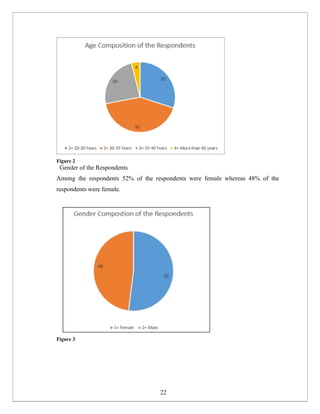
Age composition of the respondents
Majority of the respondents i.e. 42% were from the 30-35years age group whereas
30%of the respondents were in the 20-30years age group. People from the 30-35years
age group comprised a 24% of the respondents and only 4% above 40
21
Figure 2
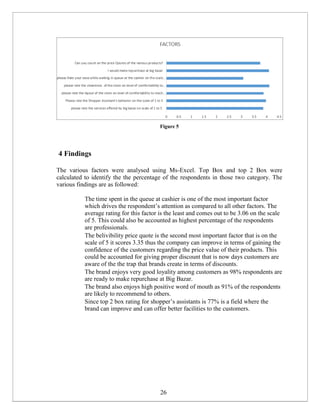
Gender of the Respondents
Among the respondents 52% of the respondents were female whereas 48% of the
respondents were female.
Figure 3
22
User Category of the Respondents
Majority of the respondents were those who buys households sometimes constituting
44% of the total respondents around 20% of the respondents were those who buys
households on daily basis and 18% of the respondents were those who bought households
sometimes and the percentage was same for those who bought households rarely that is
18%”
Figure 4
3.3The Results of various Questions of the Questionnaire
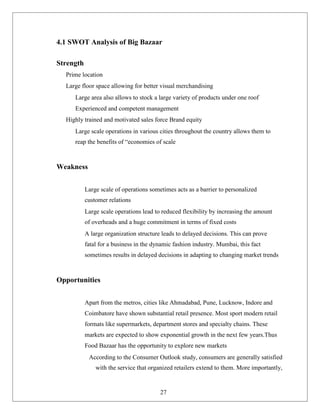
Please rate the shopper assistant’s behavior on the scale of 1 to 5
Count of 5 Count of 4 Total Top Box % Top 2 Box %
Count
20 57 100 20 77
23
Please Rate the cleanliness of the store on the scale of 1 to 5
Count of 5 Count of 4 Total Count Top Box Top 2
% Box %
24 62 100 24 86
Please rate the layout of store on the basis of comfortability to reach out to the products
Count of 5 Count of 4 Total Count Top Box % Top 2 Box %
17 54 100 17 71
Please rate your ease while waiting in queue at cashier on scale of 1 to 5
Count of 5 Count of 4 Total Count Top Box % Top 2 Box %
0 7 100 0 7
Please rate weather you’ll make repurchase at Big Bazar on the scale of 1 to 5
Count of 5
Count of 4 Total Count Top Box % Top 2 Box %
11 89 100 11 98
24
Will you recommend Big Bazar to others? Please rate it on the scale of 1 to 5
Count of Count of 4 Total Count Top Box % Top 2 Box % 5
27 64 100 27 91
Do count on the price quote of the various products?
Count of 5 Count of 4 Total Count Top box % Top 2 Box %
0 33 100 0 33
25
Figure 5
4 Findings
The various factors were analysed using Ms-Excel. Top Box and top 2 Box were
calculated to identify the the percentage of the respondents in those two category. The
various findings are as followed:
The time spent in the queue at cashier is one of the most important factor
which drives the respondent’s attention as compared to all other factors. The
average rating for this factor is the least and comes out to be 3.06 on the scale
of 5. This could also be accounted as highest percentage of the respondents
are professionals.
The belivibility price quote is the second most important factor that is on the
scale of 5 it scores 3.35 thus the company can improve in terms of gaining the
confidence of the customers regarding the price value of their products. This
could be accounted for giving proper discount that is now days customers are
aware of the the trap that brands create in terms of discounts.
The brand enjoys very good loyality among customers as 98% respondents are
are ready to make repurchase at Big Bazar.
The brand also enjoys high positive word of mouth as 91% of the respondents
are likely to recommend to others.
Since top 2 box rating for shopper’s assistants is 77% is a field where the
brand can improve and can offer better facilities to the customers.
26
4.1 SWOT Analysis of Big Bazaar
Strength
Prime location
Large floor space allowing for better visual merchandising
Large area also allows to stock a large variety of products under one roof
Experienced and competent management
Highly trained and motivated sales force Brand equity
Large scale operations in various cities throughout the country allows them to
reap the benefits of “economies of scale
Weakness
Large scale of operations sometimes acts as a barrier to personalized
customer relations
Large scale operations lead to reduced flexibility by increasing the amount
of overheads and a huge commitment in terms of fixed costs
A large organization structure leads to delayed decisions. This can prove
fatal for a business in the dynamic fashion industry. Mumbai, this fact
sometimes results in delayed decisions in adapting to changing market trends
Opportunities
Apart from the metros, cities like Ahmadabad, Pune, Lucknow, Indore and
Coimbatore have shown substantial retail presence. Most sport modern retail
formats like supermarkets, department stores and specialty chains. These
markets are expected to show exponential growth in the next few years.Thus
Food Bazaar has the opportunity to explore new markets
According to the Consumer Outlook study, consumers are generally satisfied
with the service that organized retailers extend to them. More importantly,
27
they are increasingly regarding these organized retailers as providing `value-
for-money’. These findings indicate that large retailers will capture most of
the higher consumer spending
Increasing penetration of the internet into Indian homes has provided Food
Bazaar Mall to break the geographical barriers and to increase their customer
base. The entry into online retailing, would, in fact, expand the product
categories available to the consumer
Threats
The time when retailers had to worry about competition only from their peers
down the street has come to an end. Food Bazaar is now facing increased
competition in the form of international retail chains that are making a beeline
towards the highly potential Indian markets. Moreover many big Indian
business houses are also vying a space in the Indian retail scene.
4.2 Challenges For Big Bazaar in CRM implementation
Difficulty in acquiring new customers can be a result of any one, or
combination, of the following problems.
Inaccurate and Slow Quoting Organizations may be unable to accurately
estimate and quickly deliver successful proposals, often leading to missed
opportunities, bad profit margins and upset prospects.
Lack of Product Knowledge Within their Sales Force
Problems can arise when products were sold that didn’t fit company's
profitability strategy such as selling a customer one product when
another would be better for the customer and more profitable for you.
Difficulty and Delay in Updating Pricing and Product Information
When the sales force is relies on incomplete product, pricing and customer
information, then they're probably not selling the most profitable products
you offer.
28
Customers prefer a combination of differing channels in which to deal with
your company. Self-service on the web can even be done for complex
products. Plus, self-service on the web offers retail banks the opportunity to
shift cost out to the customer.
4.4 Conclusion
1 Growing your business will be a difficult task at best if you don’t perform, meet and
exceed your client’s expectations, and provide service that creates customers for life.
2 Customer service is all about the customer’s perception. You have to do more than
just get the job done. You must deliver on all the things (big and small) that affect
the relationship with your client. Consider opportunities for improvement in the
following areas.
3 Setting/Reviewing Expectations: Do you work with your client to set clear,
appropriate, realistic expectations that you can always meet or exceed? Are you clear
about the responsibilities (both yours’ and the client’s), timelines, and expectations of
results? Are you then willing to go back and review these expectations with the client
at key points along the way?
4: Communication: Do you have mechanisms in place to ensure you’re
communicating with clients at every stage of the engagement, from the sales process
through to completion of the project? Being clear about where you’re at, what’s
been completed, what’s coming up next, who’s responsible, what results you can
expect, etc.? Has the client ever had to ask you for these things?
5: Organization: Are you organized? Punctual? Reliable? When you show up to work
with your clients, have you done the work and are you prepared to make them feel
comfortable and taken care of? Even though you’ve done it hundreds, maybe
thousands of times before, do you take the time to organize and prepare to make it
the best client experience possible?”
6: Committing to the Little Things: Don’t ever dismiss the power of all the little
things. Together they can make all the difference and really separate you from
the competition. Returning calls and emails in a timely manner. Providing useful
29
information to folks on a regular basis. Showing appreciation for your clients through
things like thank you notes, exclusive client-only briefings, and open house, etc.
Clearly these are not the only relevant areas for creating great customer service, I
assure you. But these were some of the Factors which might
Provide a boost to the sales figures, though I am sure the organization would have
already implemented most of these measures already.”
30
5 Annexure
QUESTIONAIRE ON CUSTOMER-RELATIONSHIP
MANAGEMENT IN RETAIL-SECTOR (BIG
BAZAAR) CUSTOMER BASED SURVEY
Welcome!
Thank you for agreeing to participate in this important survey. The purpose is
to understand how we can improve our service. Your honest, candid responses
are critical to the success of this study. This survey should take 8 - 10 minutes to
complete.”
1.What is your age?
20-30 years
30-35 years
35-40 years
More than 40 years
2. You Are
Housewife
Professional
Student
Service
Any other Specify
3.Your Gender
Male
Female
4.Please select
I buy all household every time I
buy households very frequently
I buy households sometimes.
I never buy households
5 Have you been to Big Bazar
Yes
No (Qualifying Criteria)
31
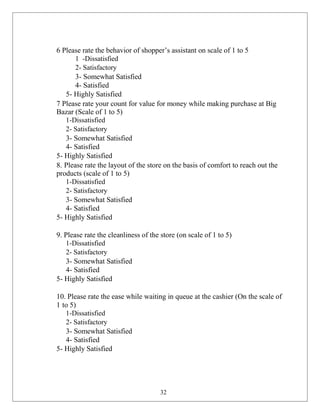
6 Please rate the behavior of shopper’s assistant on scale of 1 to 5
1 -Dissatisfied
2- Satisfactory
3- Somewhat Satisfied
4- Satisfied
5- Highly Satisfied
7 Please rate your count for value for money while making purchase at Big
Bazar (Scale of 1 to 5)
1-Dissatisfied
2- Satisfactory
3- Somewhat Satisfied
4- Satisfied
5- Highly Satisfied
8. Please rate the layout of the store on the basis of comfort to reach out the
products (scale of 1 to 5)
1-Dissatisfied
2- Satisfactory
3- Somewhat Satisfied
4- Satisfied
5- Highly Satisfied
9. Please rate the cleanliness of the store (on scale of 1 to 5)
1-Dissatisfied
2- Satisfactory
3- Somewhat Satisfied
4- Satisfied
5- Highly Satisfied
10. Please rate the ease while waiting in queue at the cashier (On the scale of
1 to 5)
1-Dissatisfied
2- Satisfactory
3- Somewhat Satisfied
4- Satisfied
5- Highly Satisfied
32
6 References
Galbreath, J. (1998) ‘Relationship management environments’, CreditWorld,
November–December, pp. 14–21.
http://searchcrm.techtarget.com/sDefinition/0,,sid11- _gci213567,00.html
Woolf, B. P. (1996) ‘Customer specific marketing’, Teal Books, USA.
Crosby, L. A. and Johnson, S. L. (2000) ‘What to do before going 1-to-1’,
Marketing Management, Vol. 9, No. 4.
Mitchell, A. (2003) ‘CRM failing as it yields one-sided relationships’, Precision
Marketing.
Hirschowitz, A. (2001) ‘Closing the CRM loop: The 21st century marketer’s
challenge: transforming customer insight into customer value’, Journal of
Targeting, Measurement and Analysis for Marketing, Vol. 10, No. 2.
Starkey, M. and Woodcock, N. (2002) ‘CRM systems: Necessary, but not
sufficient. REAP the benefits of customer management’, Journal of Database
Marketing, Vol. 9, No. 3.
Kaplan, R. S. and Norton, D. P. (2001) ‘The strategy-focused organization’,
Harvard Business School Publishing Corporation.
33

Vedant_MBA_Final-converted.pdf

  • 1.
    Project Report On Customer RelationManagement In Retail Sector Submitted By: Vedant Kaushik 2K15/MBA/58 Under the Guidance of: Dr. P.K.Suri Professor DELHI SCHOOL OF MANAGEMENT Delhi Technological University Bawana Road Delhi 110042 April 2017
  • 2.
    CERTIFICATE This is tocertify that the dissertation report titled “Customer Relation Management In The Retail Sector” is a bonafide work carried out by Mr. Vedant Kaushik of MBA 2015-17 and submitted to Delhi School of Management, Delhi Technological University, Bawana Road, Delhi-42 in partial fulfillment of the requirement for the award of the Degree of Masters of Business Administration. Signature of Guide Signature of Head (DSM) Seal of Head Place: Date: 2
  • 3.
    DECLARATION I, Vedant Kaushik,student of MBA 2015-17 of Delhi School of Management, Delhi Technological University, Bawana Road, Delhi – 42, hereby declare that the dissertation report “Customer Relation Management In The Retail Sector” submitted in partial fulfillment of Degree of Masters of Business Administration is the original work conducted by me. The information and data given in the report is authentic to the best of my knowledge. This report is not being submitted to any other University, for award of any other Degree, Diploma or Fellowship. Place: Date: Vedant kaushik 3
  • 4.
    ACKNOWLEDGEMENT First of all,I would like to thank Dr. Pradeep Kumar Suri, who was my guide and my mentor during this project, for providing me with the opportunity to do this dissertation under his guidance and expertise. I also extend my gratitude to my scholar guide, Mr. Sahil Malik, who guided me throughout the project and encouraged me to carry out project and this project happen. Lastly, I would like to thank God for giving me the skills and the patience because of which this project was made possible. Vedant Kaushik 4
  • 5.
    ABSTRACT Retail is mostimportant industry of India. Retail industry in India is at the crossroads. In retail, one of the major factors playing a role is income–Increase in disposable incomes of customers across various sectors. The simple answer to effective CRM is a way of separation between customers to provide greater value to more valuable customers since the customer today is far more discerning than he was earlier. Every retailer today is aiming at an attempt to make a casual customer into a loyal customer who develops a bond with the retail store he/she visits. Customer relationship management as a transactional exchange helps the marketer to understand the customer's sentiments and buying habits so that the customer can be provided with products and services before he starts demanding them. In this paper describe the role of Customer Relationship Management (CRM) in Indian retail market and how to enhancing the Customer Lifetime Value (CLV). A successful and effective CRM programmed results in increase of Customers Lifetime Value for the store. The importance of the tangible and the intangible offerings are also discussed. A good CRM Strategy should focus on: Building dynamic relationship with the customer, CRM is the key element to building customer loyalty to a store brand and to build a significant competitive advantage. 5
  • 6.
    Contents List of Figures.....................................................................................................................7 1 Introduction...................................................................................................................... 8 1.1 Introduction of the Industry ...................................................................................... 8 1.1.1Government Initiatives............................................................................................ 9 1.1.2Factors affecting Retail marketing.......................................................................... 9 2.Literature Review........................................................................................................... 13 2.1 Customer Relationship Management...................................................................... 13 2.2 CRM and Organized Retail Sector ......................................................................... 14 2.3 The History of CRM............................................................................................... 14 2.3.1 First Things First.................................................................................................. 15 2.3.2The Right Technology .......................................................................................... 15 2.4 The Future................................................................................................................... 15 2.5 Process of CRM.......................................................................................................... 15 2.5.1Targeted Marketing............................................................................................... 16 2.5.2Consumer Behavior .............................................................................................. 16 2.6Retail Marketing In India............................................................................................. 18 2.7 CRM In Retail Marketing (Big Bazaar)...................................................................... 18 2.7.1 Customer Satisfaction their Top Priority............................................................. 19 2.7.2 Whatever they Promise More, they Deliver ........................................................ 19 2.7.3 Always Give Customers More Than They Expect .............................................. 19 2.8 Advantages of CRM for Big Bazaar........................................................................... 19 3. Research Methodology ................................................................................................. 21 3.1 Data collection ........................................................................................................ 21 3.2 Data analysis ........................................................................................................... 21 3.3The Results of various Questions of the Questionnaire........................................... 23 4 Findings.......................................................................................................................... 26 4.1 SWOT Analysis of Big Bazaar............................................................................... 27 4.2 Challenges For Big Bazaar in CRM implementation ............................................. 28 4.4 CONCLUSION....................................................................................................... 29 5 Annexure........................................................................................................................ 31 6 References...................................................................................................................... 33 6
  • 7.
    List of Figures FigureNo. Figure Name Page No. Figure 1 Key CRM Principles 13 Figure 2 Age Composition of the respondents 22 Figure 3 Gender Composition Of the respondents 22 Figure 4 User category of the respondents 23 7
  • 8.
    1 Introduction 1.1 Introductionof the Industry Retail markets and shops have a very ancient history, dating back to antiquity. Retailing involves the process of selling consumer goods or services to customers through multiple channels of distribution to earn a profit. Retailers satisfy demand identified through a supply chain. Some of the earliest retailers were itinerant peddlers. Modern retailers typically make a variety of strategic level decisions including the type of store, the market to be served, the optimal product assortment, customer service, supporting services and the store's overall market positioning. Once the strategic retail plan is in place, retailers devise the retail mix which includes product, price, place, promotion, personnel and presentation. In the digital age, an increasing number of retailers are seeking to reach broader markets by selling through multiple channels, including both bricks and mortar and online retailing. Digital technologies are also changing the way that consumers pay for goods and services. Retailing support services may also include the provision of credit, delivery services, advisory services, stylist services and a range of other supporting services. The term "retailer" is typically applied where a service provider fills the small orders of a large number of individuals, who are end-users, rather than large orders of a small number of wholesale, corporate or government clientele. Shopping generally refers to the act of buying products. Sometimes this is done to obtain final goods, including necessities such as food and clothing; sometimes it takes place as a recreational activity. Recreational shopping often involves window shopping (just looking, not buying) and browsing: it does not always result in a purchase. The Indian retail industry has emerged as one of the most dynamic and fast-paced industries due to the entry of several new players. It accounts for over 10 per cent of the country’s Gross Domestic Product (GDP) and around 8 per cent of the employment. India is the world’s fifth-largest global destination in the retail space. India’s retail market is expected to nearly double to US$ 1 trillion by 2020 from US$ 600 billion in 2015, driven by income growth, urbanisation and attitudinal shifts. While the overall retail market is expected to grow at 12 per cent per annum, modern trade would expand twice as fast at 20 per cent per annum and traditional trade at 10 per cent. The Indian retail trading has received Foreign Direct Investment (FDI) equity inflows totaling US$ 935.74 million during April 2000–December 2016, according to the Department of Industrial Policies and Promotion (DIPP). With the rising need for consumer goods in different sectors including consumer electronics and home appliances, many companies have invested in the Indian retail space in the past few years for example US apparel retail major Gap Inc, has tied up with Arvind Group’s fashion portal NNNow.com to sell its products online, which will help the retailer expand its presence beyond metros and tier-I cities, Hamleys , has stated that India is one of the most important markets for Hamleys globally, and outlined plans of opening six more stores, taking its total store count in the country to 32 by the end of March 2017. 8
  • 9.
    1.1.1Government Initiatives The Governmentof India has taken various initiatives to improve the retail industry in India. Government of India has allowed 100 per cent Foreign Direct Investment (FDI) in online retail of goods and services through the automatic route, thereby providing clarity on the existing businesses of e-commerce companies operating in India. The Government of Andhra Pradesh signed pacts worth Rs 1,500 crore (US$ 222.36 million) in a wide range of sectors including retail and steel and gas with Walmart India, Future Group, Arvind Lifestyle Brands Ltd and Spencer’s Retail, during the Partnership Summit in Visakhapatnam, while also unveiling a retail policy aimed to attract retail businesses to invest in the state. The Ministry of Urban Development has come out with a Smart National Common Mobility Card (NCMC) model to enable seamless travel by metros and other transport systems across the country, as well as retail purchases. IKEA, the world’s largest furniture retailer, bought its first piece of land in India in Hyderabad, the joint capital of Telangana and Andhra Pradesh, for building a retail store. IKEA’s retail outlets have a standard design and each location entails an investment of around Rs 500–600 crore (US$ 74–89 million). The Government has approved a proposal to scrap the distinctions among different types of overseas investments by shifting to a single composite limit, which means portfolio investment up to 49 per cent will not require government approval nor will it have to comply with sectorial conditions as long as it does not result in a transfer of ownership and/or control of Indian entities to foreigners. As a result, foreign investments are expected to increase, especially in the attractive retail sector. 1.1.2Factors affecting Retail marketing The development of organized retail is dependent on the efforts of several agencies and institutions. Some of the factors are: 1.1.2.1Government The first among these is the government. In a country as big as India and with as many states as ours, it is imperative that the Central government and all state governments bring in Value Added Taxation or a unified taxation system to ensure that the tax-regimes are the same across the country.The laws governing retail real estate should also be looked into, so that it is possible to develop retail-estate beyond the city-limits. Apart from providing entertainment and retail opportunities, this will also decongest the city center and facilitate the development of suburbs. The relevant rules should also be amended to allow retail-stores to operate 7 days a week, 12 hours a day. 9
  • 10.
    1.1.2.2Nuclear Families: Given thehours most urban consumers keep at work, and keeping in mind the increase in the number of nuclear families, this may, indeed, make sense. This will also help people enjoy their evenings, out at malls. 1.1.2.3Developers: The second group, whose participation is essential in making retail a boom-sector in this millennium, comprises developers. Most properties are developed without considering the end user; thus, we sometimes find high- Ceilinged offices and low-ceilinged retail stores. Often, the shopper's convenience is not taken into consideration while the property is constructed. 1.1.2.4Manufacturers: There's a lot at stake here: even so early in the 21st Century, India is too large a market to be ignored by transnational retail giants. From the manufacturing company's perspective, the focus should be on producing good products, and forging relationships with organised retail. Manufacturers need to draw a plan of producing quality products and tie in with retailers. Indeed, the birth of organised retail will also engender the creation of private labels and store-brands. Thus, if a manufacturing company lacks the resources to build a brand, it can supply to a retail-chain that has the resources to create a brand of its own. 1.1.2.5Indian Consumers: With time, the Indian consumer became more mature. Customer-expectations zoomed. Thus, at the beginning of the New Millennium, retailers have to deal with a customer who is extremely demanding. Not just in terms of the product-quality, but also in terms of service, and the entire shopping experience. Today, the typical customer who shops in a retail outlet compares the time spent at the check-out counter with that at an efficient petrol station, and the smile of the counter- person to that decorating the face of a Jet Airways' crew member. To cope with the new customer, manufacturers have to focus on product quality and brand building. And retailers, in turn, have to focus on the quality of the shopping experience. 10
  • 11.
    In this millennium,like in the last, customers will want to spend time with their family and friends. They may like to visit an outlet on weekends where everything will be available under one roof. India will benefit from these developments because of increased consumption through retailing and the corresponding increase in employment created by retailing. Retail organizations exhibit great variety and new forms keep emerging. There are store retailers, non store retailers, and retail organizations. Consumers today can shop for goods and services in a wide variety of stores. The best- known type of retailer is the department store. Japanese department stores such as Takashimaya and Mitsukoshi attract millions of shoppers each year. These stores feature art galleries, cooking classes, and children’s playgrounds. The success of the retail stores, therefore, depends on customers’ reaction to the retailing mix which influences the profits of the store, its volume of turnover, its share of the market, its image and status and finally its survival. Trends in retail marketing Urban Suburban Rural New retail forms and combinations continually emerge. Bank branches and ATM counters have opened in supermarkets. Gas stations include food stores that make more profit than the gas operation. Bookstores feature coffee shops. The electronic age has significantly increased the growth of non store retailing consumers receive sales offers in the mail and over television, computers, and telephones, to which they can immediately respond by calling a toll-free number or via computer. 11
  • 12.
    Competition today isincreasingly intertype, or between different types of store outlets. Discount stores, catalog showrooms, and department stores all compete for the same consumers. The competition between chain superstores and smaller independently owned stores have become particularly heated. Because of their bulk buying power, chains get more favorable terms than independents, and the chains’ large square footage allows them to put in cafes and bathrooms. Today’s retailers are moving toward one of two poles, operating either as mass merchandisers or as specialty retailers. Superpower retailers are emerging. Through their superior information systems and buying power, these giant retailers are able to offer strong price savings. These retailers are using sophisticated marketing information and logistical systems to deliver good service and immense volumes of product at appealing prices to masses of consumers. Many retailers are even telling the most powerful manufacturers what to make; how to price and promote; when and how to ship; and even how to reorganize and improve production and management. Manufacturers have little choice: They stand to lose 10 to 30 percent of the market if they refuse. Technology is becoming critical as a competitive tool. Retailers are using computers to produce better forecasts, control inventory costs, order electronically from suppliers, send e-mail between stores, and even sell to customers within stores. They are adopting checkout scanning systems, electronic funds transfer, and improved merchandise- handling systems. 1.2 Objectives of the study Considering the emerging scope of retail sector in India, the need for current study was felt to evaluate the customer relationship management in the country. On the basis of the need of the study, the following objectives has been derived to set the focus of the study: 1. To carry out the SWOT analysis for Big Bazar. 2. To identify the customer buying behavior at retail chains like Big Bazar 3. To examine the customer satisfaction 4. To study the challenges faced while making purchase at Big Bazar 12
  • 13.
    2.Literature Review 2.1 CustomerRelationship Management CRM is a combination of policies, processes, and strategies implemented by an organization to unify its customer interactions and provide a means to track customer information. It involves the use of technology in attracting new and profitable customers, while forming tighter bonds with existing ones. Customer relationship management is an emerging tool that enables marketers to maintain their presence in the dynamic marketing environment. Customer relationship management is high on the corporate agenda. Recent research carried out by Business Intelligence reveals that six out of ten companies have already started out on the CRM journey. CRM needs a deep understanding of the customer expectations, attitude & behaviour through a well organized & maintained customer database & innovative customer strategies. The goal of CRM is to ensure customer satisfaction & delight at every level of interface with the company. Figure 1 13
  • 14.
    2.2 CRM andOrganized Retail Sector Products are easy to copy, services are harder to copy but the learned relationship that a customer has with or his supplier is nearly impossible to reproduce. It increases profitability of the retail business in five key ways: Customer loyalty translates into reduced price Customer information allows companies to target profitable customers. Predictable buying patterns lower inventory holding costs, spoilage, and distribution costs. Customer loyalty reduces advertising and marketing costs Customer loyalty extends products life cycle.” Ramanakumar, KPV(2008) writes about the Customer Relationship Management or Relationship Marketing. He refers to all marketing activities directed towards establishing, developing and maintaining relational exchanges successfully. According to Ramanathan (2008), Customer Relationship Management is an emerging tool that enables retail marketers to maintain their presence in the dynamic market environment. In early days CRM was the tool preferred by the manufacturers in order to motivate and retain retailers. Now retailers are applying this very same tool in order to retain customers. Both Ramanakumar and Ramanathan bring certain CRM strategies into lime light being followed in the retail sector. They mention certain CRM strategies like personalization strategies, communication strategies like "Stay in Touch", "Inform Customers About the New Arrival", "Reward Strategies like offer tangible reward, discounts offers etc. Pahuja (2008) opines that customer relationship management encompasses certain characteristics aspects. He says that business necessity regardless of whether one sells to end - consumer or to enterprise customers. According to Deb (2009), customer loyalty programs are the in - thing in today's retail world and Foodlands in Mumbai is one of the pioneers in this field in western India. He further gives the reaction of the a typical consumer that "privilege cards or special offers are nothing but retail trade gimmicks and the consumer ends up spending more by availing themselves of the offer. 2.3 The History of CRM Following on from Enterprise Resource Planning or ERP (the business strategy that promised to automate the “back-office”), the term CRM was first coined in the mid- 1990s. CRM in those days referred to the software used to help businesses manage their customer relationships. From sales force automation software (SFA) that focused on customer contact management to integrated knowledge management solutions, these were the early foundations of CRM. The last couple of years have seen the term broaden to encompass a more strategic approach and the investment of billions of dollars worldwide into CRM solutions and services has followed. 14
  • 15.
    2.3.1 First ThingsFirst Successful CRM always starts with a business strategy, which drives change in the organization and work processes, enabled by technology. The reverse rarely works. The key here is to create a truly Customer-Centric philosophy that touches every point and more importantly every person in the company. From CSR to CEO everyone must live and breathe customer focus for all of this to work. 2.3.2The Right Technology It is estimated that the global market for CRM services and solutions is currently worth $148 billion. That means a lot of choice when selecting your technology - from web-based solutions aimed at small businesses with less than 10 employees to solutions suitable for multi-national enterprises with millions of customers. 2.4 The Future CRM has already made a big impact in the world of Customer Service and will continue to do so. As more and more companies become customer-centric those that fail to do so will lose competitive advantage. As technology increases to develop at a startling rate the key emphasis will be how we can fully utilize it within our business. However let's not ignore the fact that Customer Relationship Management is about people first and technology second. That’s where the real value of CRM lies, harnessing the potential of people to create a greater customer experience, using the technology of CRM as the enabler. 2.5 Process of CRM Customer Relationship Management (CRM) is the process of bringing the customer and the company closer together. There are many different areas in which Customer Relationship Management can be implemented. The goal of CRM is to help a company maintain current customers, as well as gain new customers. 15
  • 16.
    2.5.1Targeted Marketing Targeted marketingis accomplished through collecting information about the customer. This information can be buying habits or simply demographics. The idea behind this is that a business analyzes what a customer buys and then markets specific products to that customer based on his or her buying habits. Businesses track buying habits using discount cards, and special store credit cards. Targeted marketing can also be implemented on the Internet. Amazon.com has product recommendations based on buying habits, and product ratings. Customers can also be sent e-mails that market targeted products. Marketing the right products to the right customers can significantly increase a business' sales with minimal associated costs. 2.5.2Consumer Behavior Options: Consumers are more likely to choose an alternative after a relatively inferior option is added as a choice. For example, Simonson (2012) says, participants in one study were given a choice between $6 and an elegant Cross pen. A second group chose among $6, the same Cross pen, and a second pen that was clearly less attractive than the Cross pen. As was predicted, the addition of the unattractive pen increased the share of the Cross pen at the expense of the $6.” Alternatives: Consumers prefer alternatives that are compromise choices. Given a choice between two alternatives, one priced lower than the other, the addition of a third choice, priced higher than both, will increase the market share of the more expensive of the original two. This finding suggests that companies can increase their overall sales and shift purchases to higher-margin items by carefully designing the sets of alternatives that their customers consider. 16
  • 17.
    Floor Displays: Buyersare averse to choosing the lowest-quality alternative in sets of three or more choices. One of the implications of this finding is that marketers of well-known, high-priced brands should encourage retailers to organize floor displays by model type, whereas marketers of lesser-known, lower- priced brands should prefer organization by brand.” Brands: Consumers who think about the possibility that their purchase decisions will be wrong are more likely to choose better known brands. In a test case, Simonson showed that consumers debating between a better known, more expensive brand and a lesser-known, less expensive brand expect to feel greater regret if they err by choosing the cheaper option. Indeed, after thinking about the possibility of regret, consumers were more likely to select the better-known brand. Kodak film has capitalized on this finding with an advertising campaign that asks consumers to consider how they would feel if they bought cheap film and their pictures didn't turn out. Preferences: Consumers tend to select variety when buying multiple products for consumption at a later time. In each of three weeks, Simonson asked a group of respondents to select one of six familiar snacks for immediate consumption. A second group was asked to pick three snacks -- one for immediate consumption and one for each of the next two weeks. Both groups were told that they could pick the same snack as many times as they wished. Those in the first group tended to select the same snack all three times, whereas most in the second group selected three different snacks. Product Modifications: Modifying a product with a feature or premium that is of little or no value to the consumer, even without raising the price, may actually decrease sales. When consumers are uncertain about their preferences, a product that offers an unneeded add-on (such as an offer to purchase a Pillsbury Doughboy collector's plate) provides them with a reason for rejecting it. 17
  • 18.
    While marketing professionalscan use these findings to influence consumer decision making, consumers, too, can benefit by understanding their own behavior. "One of the points of our research is to inform consumers about some of the factors that influence their decisions," Simonson says. "With such knowledge, they may be able to make better, more thoughtful decisions. 2.6Retail Marketing In India There are various ways of making goods available to consumers like: Company to distributor to wholesaler to retailer to consumer(B2B2C) Company to salesperson to consumer(B2B2C) Company to consumers (online/ phone/ catalog ordering)(B2C) These three are among the most common ways of making the goods available to consumers. But in India the three layered system of distributor, wholesaler and retailer, forms the backbone of the front-end logistics of most of the consumer-good companies. There are a number of reasons behind this fragmented retail market. Some of the major reasons being: Poverty and lower literacy levels. Low per capita income. Savings focused and less indulgence mindset. Poor infrastructure facilities like roads etc. Restrictions on intra-state good movement. High taxes. No exposure to media High import duties on imported goods. FDI in retailing is not allowed.” 2.7 CRM In Retail Marketing (Big Bazaar) Customer relationship activities have the most impact on customer retention. Every customer service encounter has the potential to gain repeat business or have the opposite effect. The expectation of personalized, relevant offers and service is becoming a primary driver of customer satisfaction and retention in financial services. 18
  • 19.
    “The degree ofcustomer satisfaction you deliver determines the level of long-term success you will achieve in business. --- Training Mantra for Sales Force 2.7.1 Customer Satisfaction their Top Priority Don't just make sales. Create customers - satisfied customers. In addition to the immediate profit they provide on the first sale, satisfied customers help you build your business in 2 other important ways: 1. They become a reservoir of repeat buyers. For some businesses that means repeat buyers for more of the same product or service. For every business, it means buyers for additional products and services. 2. They automatically refer more business to you from their friends and business contacts. This is highly profitable business for you because it doesn't cost you any time or money to get it. 2.7.2 Whatever they Promise More, they Deliver Never make any promises you can't (or won't) keep. Nothing alienates customers faster than getting something less than they expect from a business transaction. They won't do business with you again. And they will tell everybody they know about their unhappy experience - causing you to lose future customers. 2.7.3 Always Give Customers More Than They Expect Over deliver on quality and service. Always exceed your customers' expectations. You will win their long term loyalty. It also makes it difficult for competitors to steal customers from you - even if they have lower prices. Customers will not risk an uncertain experience with a competitor when they know they will get more than they expect from you. 2.7.4 Customers know how much they value them Let your customers know you are always thinking about them. Communicate with them regularly. For example, create some special deals just for your existing customers. And announce new products or services to them before you announce them to the general market. 2.8 Advantages of CRM for Big Bazaar Using CRM, at the management of Big Bazaar can: ❖ Provide better customer service 19
  • 20.
    ❖ Increase customer revenues ❖ Discovernew customers ❖ Cross sell/Up Sell products more effectively ❖ Help sales staff close deals faster ❖ Make call centers more efficient ❖ Simplify marketing and sales processes By applying this methodology Big Bazaar learned more about customers' needs and behaviors in order to develop stronger relationships with them. They implemented CRM as a process that brought together lots of pieces of information about customers, sales, marketing effectiveness, responsiveness and market trends. CRM helps businesses use technology and human resources to gain insight into the behavior of customers and the value of those customers. 20
  • 21.
    3. Research Methodology Thecurrent study is based on primary data collected from respondents who qualified for the survey in the Delhi region. The respondents comprises of students, housewives, professionals and people in service. A 10item questionnaire was designed to collect the information from the respondents with the help of Google Forms. The questionnaire comprised questions regarding their buying experience and practices at Big Bazar .Further , a qualitative analysis was conducted to achieve the objectives. 3.1 Data collection The questionnaire was sent to the potential respondents through online and personal. The questionnaire was sent to a total of 150 people out of which only 110 responded and 100 qualified the screener section. 3.2 Data analysis 3.2.1Demographic Profile of Respondents: Age composition of the respondents Majority of the respondents i.e. 42% were from the 30-35years age group whereas 30%of the respondents were in the 20-30years age group. People from the 30-35years age group comprised a 24% of the respondents and only 4% above 40 21
  • 22.
    Figure 2 Gender ofthe Respondents Among the respondents 52% of the respondents were female whereas 48% of the respondents were female. Figure 3 22
  • 23.
    User Category ofthe Respondents Majority of the respondents were those who buys households sometimes constituting 44% of the total respondents around 20% of the respondents were those who buys households on daily basis and 18% of the respondents were those who bought households sometimes and the percentage was same for those who bought households rarely that is 18%” Figure 4 3.3The Results of various Questions of the Questionnaire Please rate the shopper assistant’s behavior on the scale of 1 to 5 Count of 5 Count of 4 Total Top Box % Top 2 Box % Count 20 57 100 20 77 23
  • 24.
    Please Rate thecleanliness of the store on the scale of 1 to 5 Count of 5 Count of 4 Total Count Top Box Top 2 % Box % 24 62 100 24 86 Please rate the layout of store on the basis of comfortability to reach out to the products Count of 5 Count of 4 Total Count Top Box % Top 2 Box % 17 54 100 17 71 Please rate your ease while waiting in queue at cashier on scale of 1 to 5 Count of 5 Count of 4 Total Count Top Box % Top 2 Box % 0 7 100 0 7 Please rate weather you’ll make repurchase at Big Bazar on the scale of 1 to 5 Count of 5 Count of 4 Total Count Top Box % Top 2 Box % 11 89 100 11 98 24
  • 25.
    Will you recommendBig Bazar to others? Please rate it on the scale of 1 to 5 Count of Count of 4 Total Count Top Box % Top 2 Box % 5 27 64 100 27 91 Do count on the price quote of the various products? Count of 5 Count of 4 Total Count Top box % Top 2 Box % 0 33 100 0 33 25
  • 26.
    Figure 5 4 Findings Thevarious factors were analysed using Ms-Excel. Top Box and top 2 Box were calculated to identify the the percentage of the respondents in those two category. The various findings are as followed: The time spent in the queue at cashier is one of the most important factor which drives the respondent’s attention as compared to all other factors. The average rating for this factor is the least and comes out to be 3.06 on the scale of 5. This could also be accounted as highest percentage of the respondents are professionals. The belivibility price quote is the second most important factor that is on the scale of 5 it scores 3.35 thus the company can improve in terms of gaining the confidence of the customers regarding the price value of their products. This could be accounted for giving proper discount that is now days customers are aware of the the trap that brands create in terms of discounts. The brand enjoys very good loyality among customers as 98% respondents are are ready to make repurchase at Big Bazar. The brand also enjoys high positive word of mouth as 91% of the respondents are likely to recommend to others. Since top 2 box rating for shopper’s assistants is 77% is a field where the brand can improve and can offer better facilities to the customers. 26
  • 27.
    4.1 SWOT Analysisof Big Bazaar Strength Prime location Large floor space allowing for better visual merchandising Large area also allows to stock a large variety of products under one roof Experienced and competent management Highly trained and motivated sales force Brand equity Large scale operations in various cities throughout the country allows them to reap the benefits of “economies of scale Weakness Large scale of operations sometimes acts as a barrier to personalized customer relations Large scale operations lead to reduced flexibility by increasing the amount of overheads and a huge commitment in terms of fixed costs A large organization structure leads to delayed decisions. This can prove fatal for a business in the dynamic fashion industry. Mumbai, this fact sometimes results in delayed decisions in adapting to changing market trends Opportunities Apart from the metros, cities like Ahmadabad, Pune, Lucknow, Indore and Coimbatore have shown substantial retail presence. Most sport modern retail formats like supermarkets, department stores and specialty chains. These markets are expected to show exponential growth in the next few years.Thus Food Bazaar has the opportunity to explore new markets According to the Consumer Outlook study, consumers are generally satisfied with the service that organized retailers extend to them. More importantly, 27
  • 28.
    they are increasinglyregarding these organized retailers as providing `value- for-money’. These findings indicate that large retailers will capture most of the higher consumer spending Increasing penetration of the internet into Indian homes has provided Food Bazaar Mall to break the geographical barriers and to increase their customer base. The entry into online retailing, would, in fact, expand the product categories available to the consumer Threats The time when retailers had to worry about competition only from their peers down the street has come to an end. Food Bazaar is now facing increased competition in the form of international retail chains that are making a beeline towards the highly potential Indian markets. Moreover many big Indian business houses are also vying a space in the Indian retail scene. 4.2 Challenges For Big Bazaar in CRM implementation Difficulty in acquiring new customers can be a result of any one, or combination, of the following problems. Inaccurate and Slow Quoting Organizations may be unable to accurately estimate and quickly deliver successful proposals, often leading to missed opportunities, bad profit margins and upset prospects. Lack of Product Knowledge Within their Sales Force Problems can arise when products were sold that didn’t fit company's profitability strategy such as selling a customer one product when another would be better for the customer and more profitable for you. Difficulty and Delay in Updating Pricing and Product Information When the sales force is relies on incomplete product, pricing and customer information, then they're probably not selling the most profitable products you offer. 28
  • 29.
    Customers prefer acombination of differing channels in which to deal with your company. Self-service on the web can even be done for complex products. Plus, self-service on the web offers retail banks the opportunity to shift cost out to the customer. 4.4 Conclusion 1 Growing your business will be a difficult task at best if you don’t perform, meet and exceed your client’s expectations, and provide service that creates customers for life. 2 Customer service is all about the customer’s perception. You have to do more than just get the job done. You must deliver on all the things (big and small) that affect the relationship with your client. Consider opportunities for improvement in the following areas. 3 Setting/Reviewing Expectations: Do you work with your client to set clear, appropriate, realistic expectations that you can always meet or exceed? Are you clear about the responsibilities (both yours’ and the client’s), timelines, and expectations of results? Are you then willing to go back and review these expectations with the client at key points along the way? 4: Communication: Do you have mechanisms in place to ensure you’re communicating with clients at every stage of the engagement, from the sales process through to completion of the project? Being clear about where you’re at, what’s been completed, what’s coming up next, who’s responsible, what results you can expect, etc.? Has the client ever had to ask you for these things? 5: Organization: Are you organized? Punctual? Reliable? When you show up to work with your clients, have you done the work and are you prepared to make them feel comfortable and taken care of? Even though you’ve done it hundreds, maybe thousands of times before, do you take the time to organize and prepare to make it the best client experience possible?” 6: Committing to the Little Things: Don’t ever dismiss the power of all the little things. Together they can make all the difference and really separate you from the competition. Returning calls and emails in a timely manner. Providing useful 29
  • 30.
    information to folkson a regular basis. Showing appreciation for your clients through things like thank you notes, exclusive client-only briefings, and open house, etc. Clearly these are not the only relevant areas for creating great customer service, I assure you. But these were some of the Factors which might Provide a boost to the sales figures, though I am sure the organization would have already implemented most of these measures already.” 30
  • 31.
    5 Annexure QUESTIONAIRE ONCUSTOMER-RELATIONSHIP MANAGEMENT IN RETAIL-SECTOR (BIG BAZAAR) CUSTOMER BASED SURVEY Welcome! Thank you for agreeing to participate in this important survey. The purpose is to understand how we can improve our service. Your honest, candid responses are critical to the success of this study. This survey should take 8 - 10 minutes to complete.” 1.What is your age? 20-30 years 30-35 years 35-40 years More than 40 years 2. You Are Housewife Professional Student Service Any other Specify 3.Your Gender Male Female 4.Please select I buy all household every time I buy households very frequently I buy households sometimes. I never buy households 5 Have you been to Big Bazar Yes No (Qualifying Criteria) 31
  • 32.
    6 Please ratethe behavior of shopper’s assistant on scale of 1 to 5 1 -Dissatisfied 2- Satisfactory 3- Somewhat Satisfied 4- Satisfied 5- Highly Satisfied 7 Please rate your count for value for money while making purchase at Big Bazar (Scale of 1 to 5) 1-Dissatisfied 2- Satisfactory 3- Somewhat Satisfied 4- Satisfied 5- Highly Satisfied 8. Please rate the layout of the store on the basis of comfort to reach out the products (scale of 1 to 5) 1-Dissatisfied 2- Satisfactory 3- Somewhat Satisfied 4- Satisfied 5- Highly Satisfied 9. Please rate the cleanliness of the store (on scale of 1 to 5) 1-Dissatisfied 2- Satisfactory 3- Somewhat Satisfied 4- Satisfied 5- Highly Satisfied 10. Please rate the ease while waiting in queue at the cashier (On the scale of 1 to 5) 1-Dissatisfied 2- Satisfactory 3- Somewhat Satisfied 4- Satisfied 5- Highly Satisfied 32
  • 33.
    6 References Galbreath, J.(1998) ‘Relationship management environments’, CreditWorld, November–December, pp. 14–21. http://searchcrm.techtarget.com/sDefinition/0,,sid11- _gci213567,00.html Woolf, B. P. (1996) ‘Customer specific marketing’, Teal Books, USA. Crosby, L. A. and Johnson, S. L. (2000) ‘What to do before going 1-to-1’, Marketing Management, Vol. 9, No. 4. Mitchell, A. (2003) ‘CRM failing as it yields one-sided relationships’, Precision Marketing. Hirschowitz, A. (2001) ‘Closing the CRM loop: The 21st century marketer’s challenge: transforming customer insight into customer value’, Journal of Targeting, Measurement and Analysis for Marketing, Vol. 10, No. 2. Starkey, M. and Woodcock, N. (2002) ‘CRM systems: Necessary, but not sufficient. REAP the benefits of customer management’, Journal of Database Marketing, Vol. 9, No. 3. Kaplan, R. S. and Norton, D. P. (2001) ‘The strategy-focused organization’, Harvard Business School Publishing Corporation. 33