Cross Border Venture Capital Syndication
A Network of Emerging Trust
May 18, 2014
Daniel S. Hain 1,2 Sofia A. Johan 3 Daojuan Wang 1
1Department of Business and Management, Aalborg University
2Scancor, Stanford University (Visiting Scholar)
3Schulich School of Business, York University
1
Background
Positioning Venture Capital
Venture Capital and its Impact
Venture capitalists: Financial intermediaries acting as a blend of technological and
financial competences, specialized on providing financial and managerial support
for knowledge based entrepreneurship.
Catalyst for commercialization (Samila & Sorenson, 2010), facilitating innovation
and entrepreneurship (Kortum & Lerner, 2000), and bringing innovation to market
rapidly (Bygrave, 1992; Cumming & Johan, 2007)
Recent trends in VC
Shift towards globally distributed investment pattern (Aizenmann & Kendall, 2008;
Guler & Gullien, 2010; Baygan & Freudenberg, 2000)
Explanations of cross-border VC flows by macro and financial economists:
Market capitalization (Black & Gilson, 1998)
Growth rates (Romain & Van Pottelsberghe, 2004)
Institutional environment (Guler & Gullien,2005; 2010)
Recently, attention of research and VC investment community turns to emerging
economies (Dai et al., 2012; Bruton et al., 2004)
2
background
Motivation
Motivation
Wile promising VC investment opportunities nowadays spring up everywhere
around the globe, we need to understand what enables the formerly more local
VC industry to invest in geographically, culturally and institutionally very distant
targets.
Prosmising candidates suggested by former research (e.g. Tykvova & Scherter,
2013): (I) Institutional trust, (II) Teaming up with local VCs
VC investments in emerging economies steadily increase, yet well lack in
empirical evidence regarding the determinants on investment and entry mode
decisions in such settings. Furthermore, emerging economies are often
characterized by weaker legal institution and property rights.
3
Theory and Hypotheses
Geographical, Institutional & Cultural Distance
Interpersonal interaction necessary in pre-deal due diligence and post deal
monitoring and value adding.
VC investment profit from spatial proximity, hence geographical concentration of
investments
VC might also suffer from higher operating costs in foreign environments with very
different institutions, business practices, cultures and ethics
However, teaming up with a local venture capitalists can be used to bridge high
geographical, cultural and institutional distance
Hypothesis 1
HYPOTHESIS 1A - Geographical, cultural and institutional distance negatively affect venture capital
investment activity between countries.
HYPOTHESIS 1B - The negative effects of geographical, cultural and institutional distance negatively
are less pronounced in cross border investments syndicated with a domestic VC.
4
Theory and Hypotheses
relational & Institutional Trust
VCs do their best to mitigate agency costs of venture (Fiet, 1995a,b; Shepherd
and Zacharakis, 2001) using effective contracts and governance structures to
protect themselves against opportunistic behavior
Such risks can never be totally eliminated, especially in destination countries with
less efficient laws and corporate structures (Cumming and Johan, 2006; La Porta
et al., 1998, 2000, 1997)
Institutional trust in destination country might decrease the investors needs to use
more resources to protect themselves, even in such less efficient regulatory
environments
Hypothesis 2
HYPOTHESIS 2A - Institutional and relational trust positively affects bilateral venture capital
investment activity and diminishes the negative effects of geographical, social and institutional
distance.
HYPOTHESIS 2B - The positive effects of institutional trust appears stronger for investments in
emerging vis-á-vis investments in developed economies.
HYPOTHESIS 2C - The positive effects of institutional trust appears weaker for cross-border
investments syndicated with domestic venture capitalists.
HYPOTHESIS 2D - The positive effects of relational trust appears stronger for cross-border
investments syndicated with domestic venture capitalists.
5
Empirical Strategy
Data & Model
Data & Model Setup
Data Source: Zephir M&A Database, extracting only deals including VC
investments
Period 2000–2013, ca. 30,650 deals, 78 countries
Deploying a 2-stage GLS model, correcting for zero-inflation of the many
zero-investment-pairs of country dyads
Dependent Variables
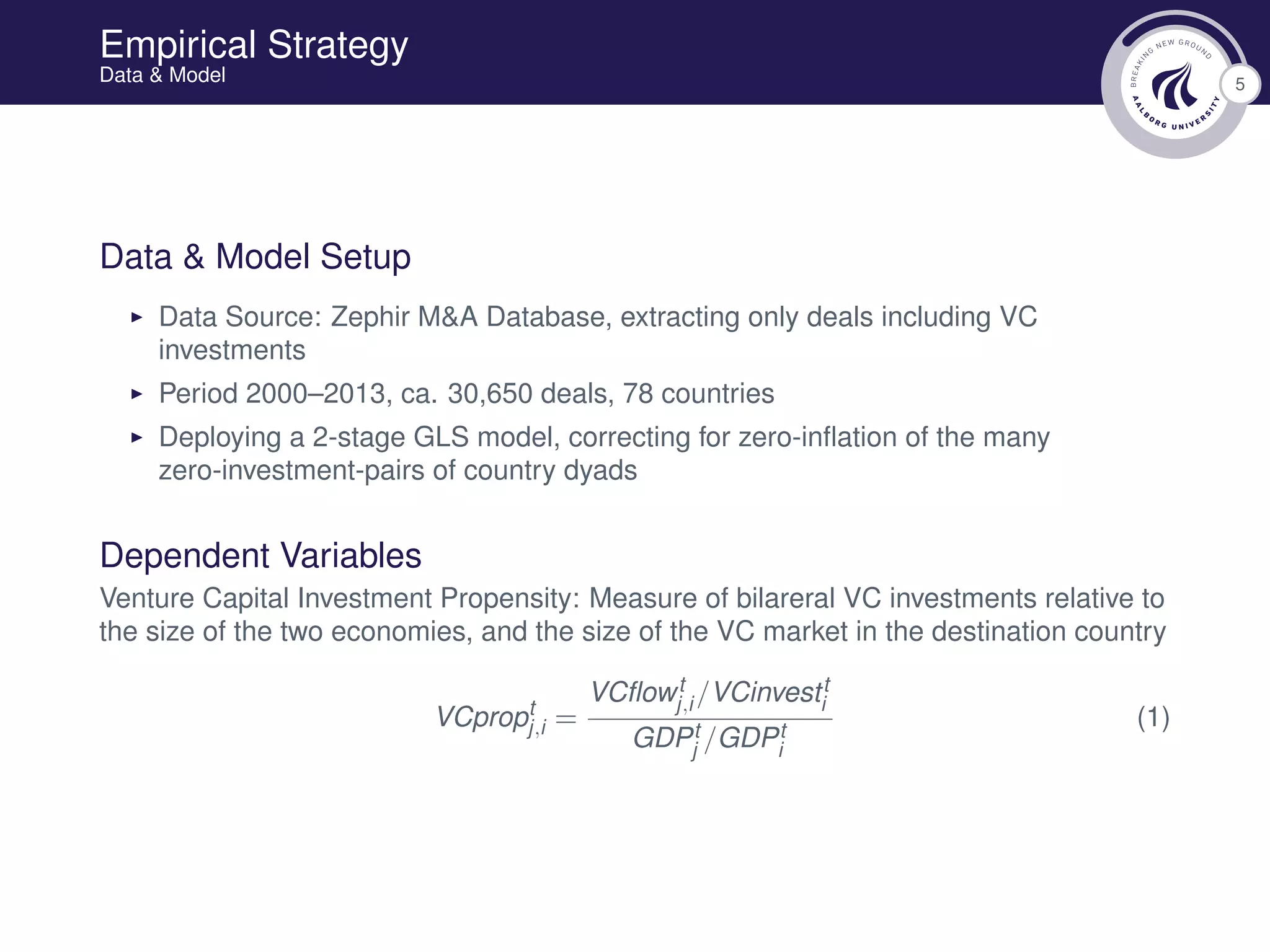
Venture Capital Investment Propensity: Measure of bilareral VC investments relative to
the size of the two economies, and the size of the VC market in the destination country
VCpropt
j,i =
VCflowt
j,i /VCinvestt
i
GDPt
j /GDPt
i
(1)
6
Empirical Strategy
Independent Variables
Distance
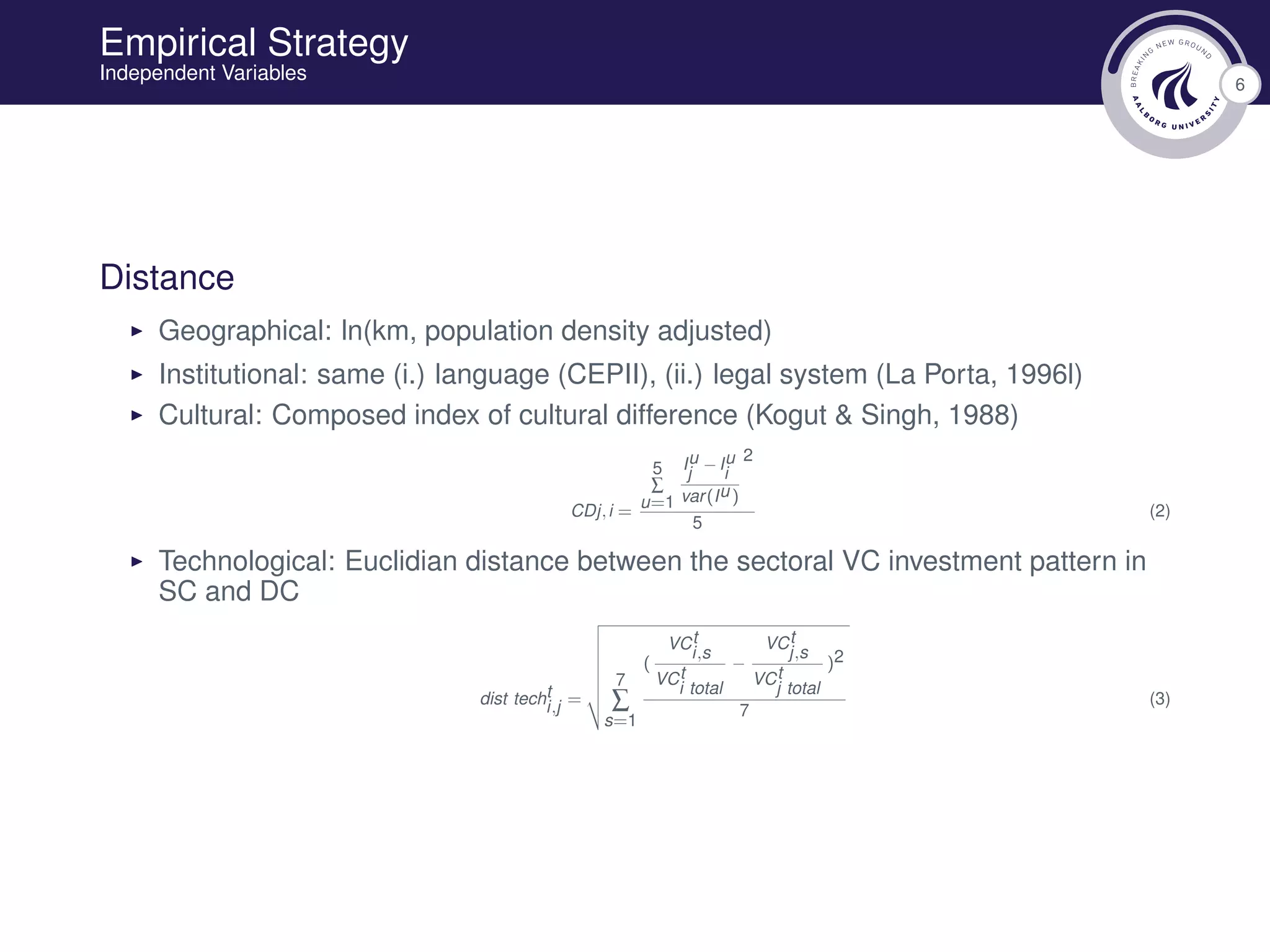
Geographical: ln(km, population density adjusted)
Institutional: same (i.) language (CEPII), (ii.) legal system (La Porta, 1996l)
Cultural: Composed index of cultural difference (Kogut & Singh, 1988)
CDj,i =
5
∑
u=1
Iu
j
−Iu
i
var(Iu)
2
5
(2)
Technological: Euclidian distance between the sectoral VC investment pattern in
SC and DC
dist techt
i,j =
7
∑
s=1
(
VCt
i,s
VCt
i total
−
VCt
j,s
VCt
j total
)2
7
(3)
7
Empirical Strategy
Independent Variables, cont’d
Relational & Institutional Trust
Institutional Trust (World Value Survey)
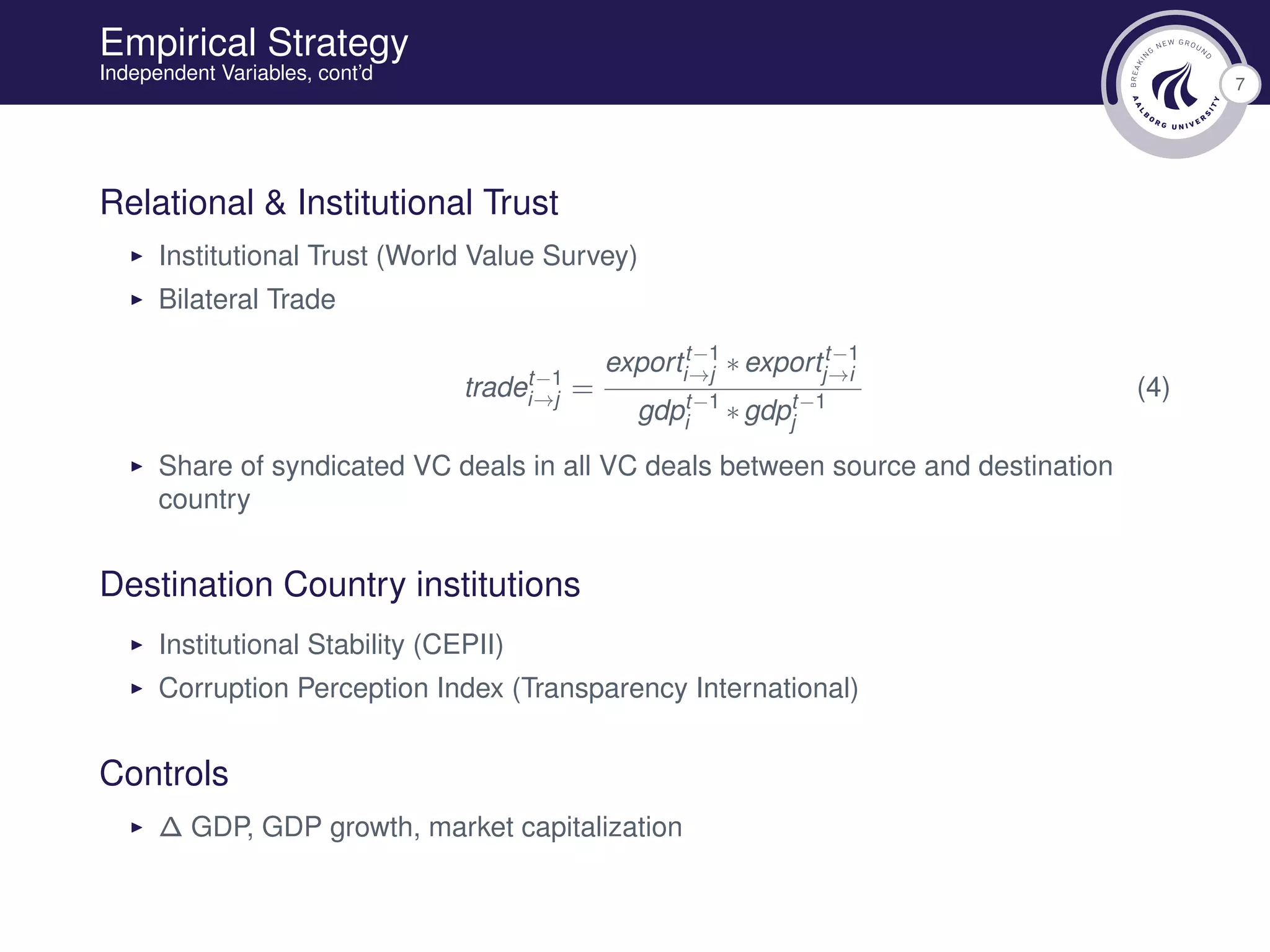
Bilateral Trade
tradet−1
i→j =
exportt−1
i→j ∗exportt−1
j→i
gdpt−1
i ∗gdpt−1
j
(4)
Share of syndicated VC deals in all VC deals between source and destination
country
Destination Country institutions
Institutional Stability (CEPII)
Corruption Perception Index (Transparency International)
Controls
∆ GDP, GDP growth, market capitalization
8
Empirical Strategy
Descriptives
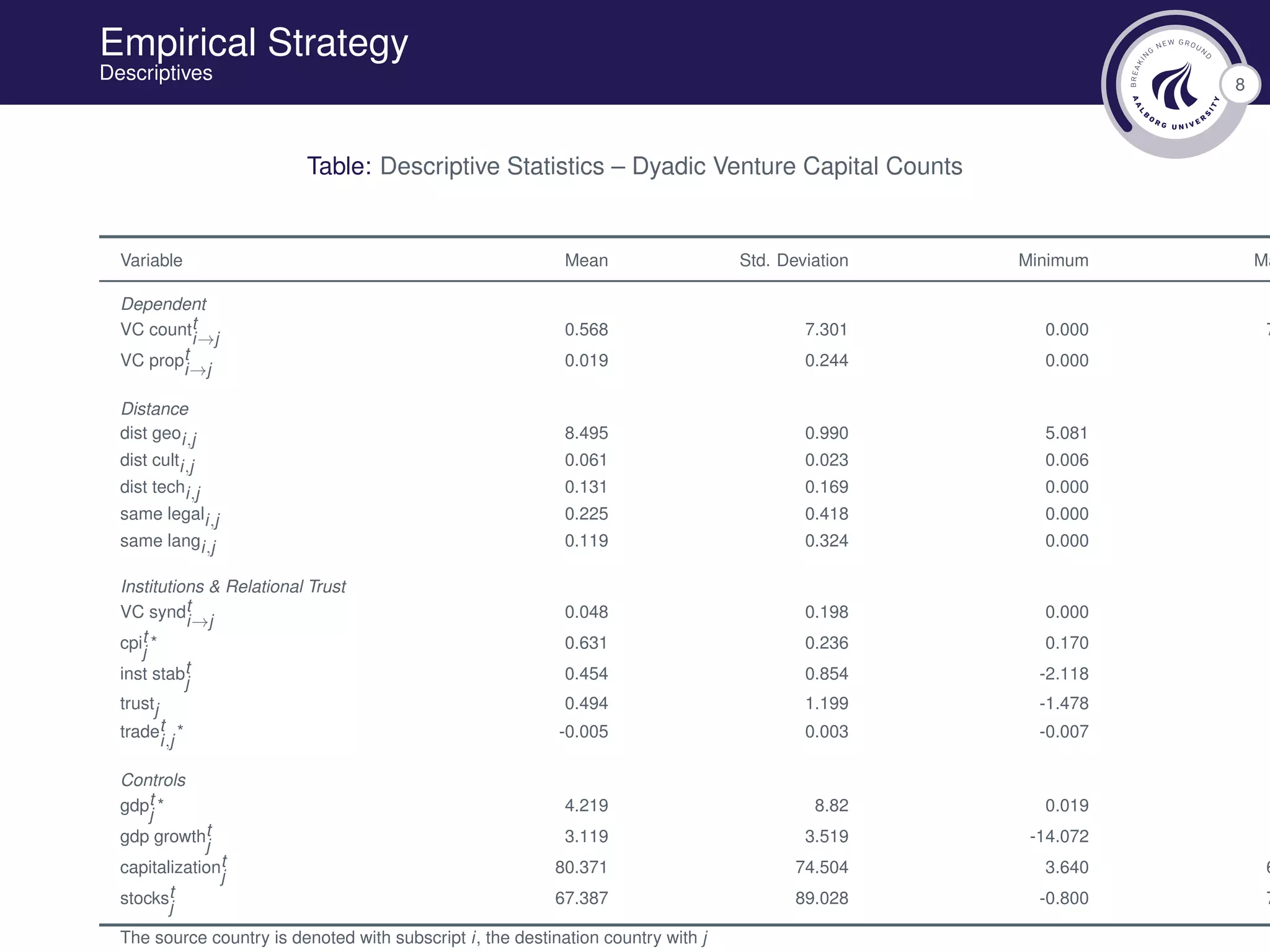
Table: Descriptive Statistics – Dyadic Venture Capital Counts
Variable Mean Std. Deviation Minimum Ma
Dependent
VC countt
i→j
0.568 7.301 0.000 7
VC propt
i→j
0.019 0.244 0.000
Distance
dist geoi,j 8.495 0.990 5.081
dist culti,j 0.061 0.023 0.006
dist techi,j 0.131 0.169 0.000
same legali,j 0.225 0.418 0.000
same langi,j 0.119 0.324 0.000
Institutions & Relational Trust
VC syndt
i→j
0.048 0.198 0.000
cpit
j
* 0.631 0.236 0.170
inst stabt
j
0.454 0.854 -2.118
trustj 0.494 1.199 -1.478
tradet
i,j
* -0.005 0.003 -0.007
Controls
gdpt
j
* 4.219 8.82 0.019
gdp growtht
j
3.119 3.519 -14.072
capitalizationt
j
80.371 74.504 3.640 6
stockst
j
67.387 89.028 -0.800 7
The source country is denoted with subscript i, the destination country with j
9
Results & Discussion
All vs. hosted deals
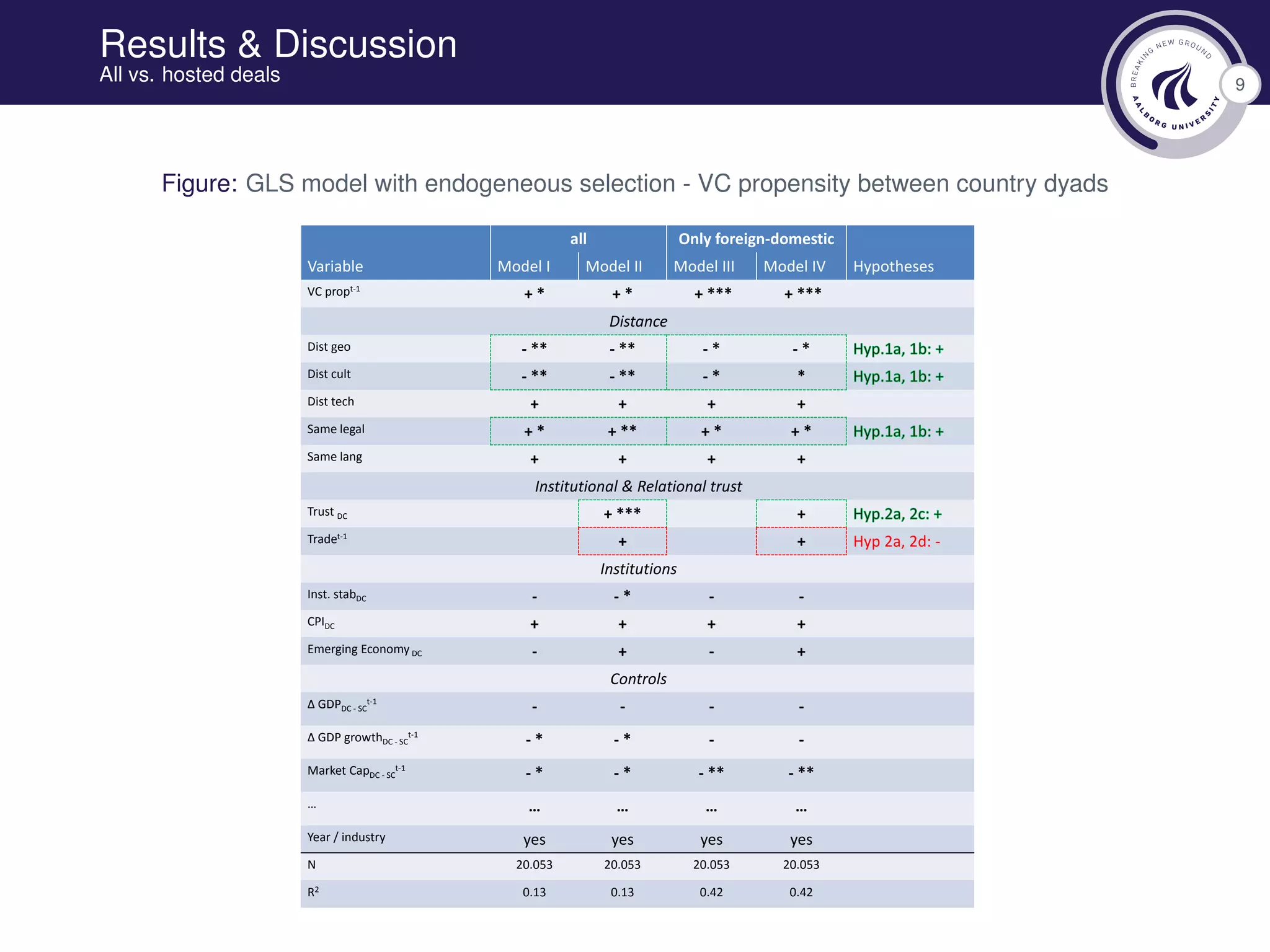
Figure: GLS model with endogeneous selection - VC propensity between country dyads
all Only foreign-domestic
Variable Model I Model II Model III Model IV Hypotheses
VC propt-1
+ * + * + *** + ***
Distance
Dist geo - ** - ** - * - *
Dist cult - ** - ** - * *
Dist tech + + + +
Same legal + * + ** + * + *
Same lang + + + +
Institutional & Relational trust
Trust DC + *** +
Tradet-1
+ + Hyp 2a, 2d: -
Institutions
Inst. stabDC - - * - -
CPIDC + + + +
Emerging Economy DC - + - +
Controls
Δ GDPDC - SC
t-1
- - - -
Δ GDP growthDC - SC
t-1
- * - * - -
Market CapDC - SC
t-1
- * - * - ** - **
… … … … …
Year / industry yes yes yes yes
N 20.053 20.053 20.053 20.053
R2 0.13 0.13 0.42 0.42
10
Results & Discussion
Developed vs. Emerging Economies
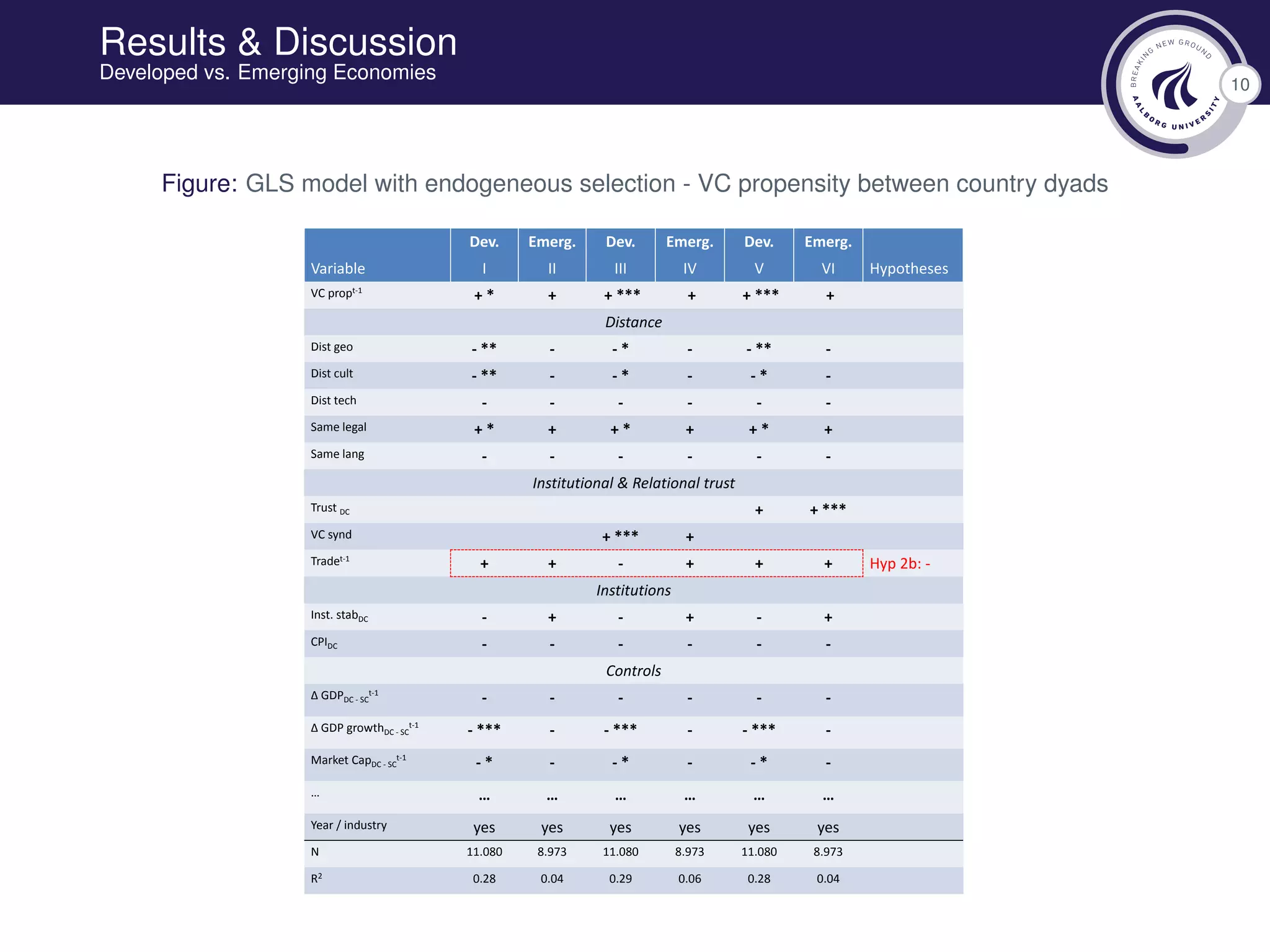
Figure: GLS model with endogeneous selection - VC propensity between country dyads
Dev. Emerg. Dev. Emerg. Dev. Emerg.
Variable I II III IV V VI Hypotheses
VC propt-1
+ * + + *** + + *** +
Distance
Dist geo - ** - - * - - ** -
Dist cult - ** - - * - - * -
Dist tech - - - - - -
Same legal + * + + * + + * +
Same lang - - - - - -
Institutional & Relational trust
Trust DC + + ***
VC synd + *** +
Tradet-1
+ + - + + + Hyp 2b: -
Institutions
Inst. stabDC - + - + - +
CPIDC - - - - - -
Controls
Δ GDPDC - SC
t-1
- - - - - -
Δ GDP growthDC - SC
t-1
- *** - - *** - - *** -
Market CapDC - SC
t-1
- * - - * - - * -
… … … … … … …
Year / industry yes yes yes yes yes yes
N 11.080 8.973 11.080 8.973 11.080 8.973
R2 0.28 0.04 0.29 0.06 0.28 0.04
11
Conclusion
Concluding Remarks
Destination Country institutions
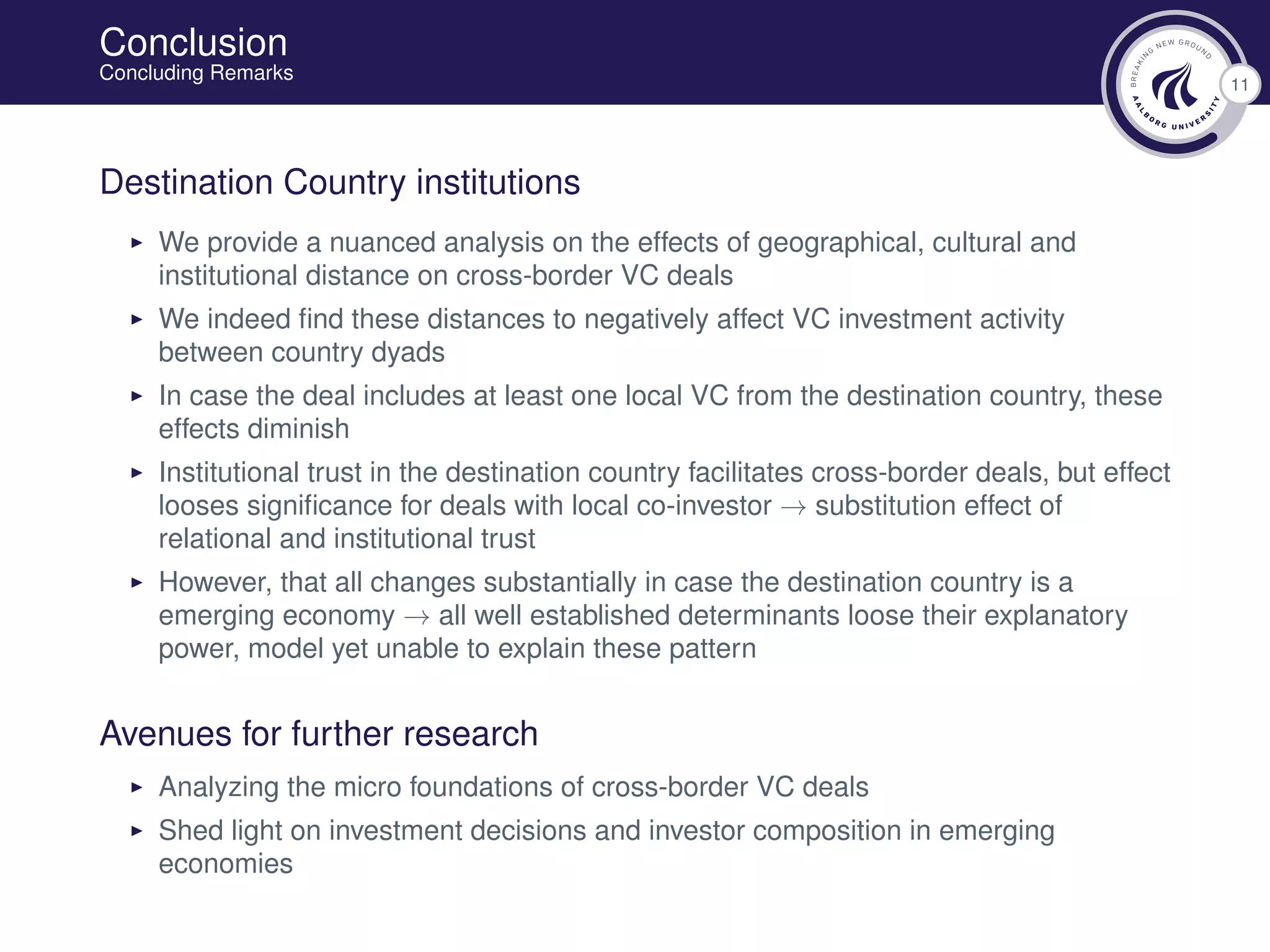
We provide a nuanced analysis on the effects of geographical, cultural and
institutional distance on cross-border VC deals
We indeed find these distances to negatively affect VC investment activity
between country dyads
In case the deal includes at least one local VC from the destination country, these
effects diminish
Institutional trust in the destination country facilitates cross-border deals, but effect
looses significance for deals with local co-investor → substitution effect of
relational and institutional trust
However, that all changes substantially in case the destination country is a
emerging economy → all well established determinants loose their explanatory
power, model yet unable to explain these pattern
Avenues for further research
Analyzing the micro foundations of cross-border VC deals
Shed light on investment decisions and investor composition in emerging
economies
12
Conclusion
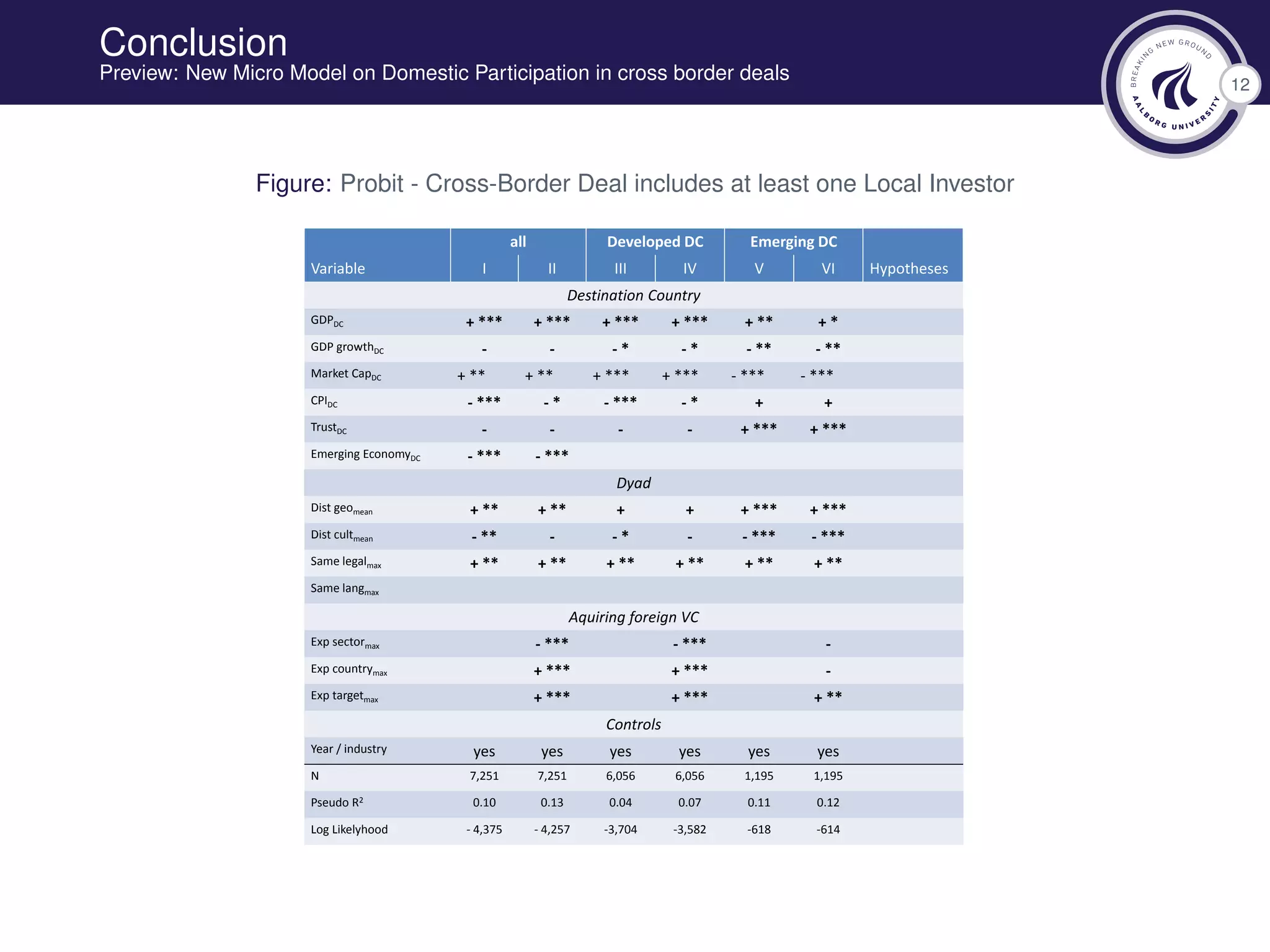
Preview: New Micro Model on Domestic Participation in cross border deals
Figure: Probit - Cross-Border Deal includes at least one Local Investor
all Developed DC Emerging DC
Variable I II III IV V VI Hypotheses
Destination Country
GDPDC + *** + *** + *** + *** + ** + *
GDP growthDC - - - * - * - ** - **
Market CapDC + ** + ** + *** + *** - *** - ***
CPIDC - *** - * - *** - * + +
TrustDC - - - - + *** + ***
Emerging EconomyDC - *** - ***
Dyad
Dist geomean + ** + ** + + + *** + ***
Dist cultmean - ** - - * - - *** - ***
Same legalmax + ** + ** + ** + ** + ** + **
Same langmax
Aquiring foreign VC
Exp sectormax - *** - *** -
Exp countrymax + *** + *** -
Exp targetmax + *** + *** + **
Controls
Year / industry yes yes yes yes yes yes
N 7,251 7,251 6,056 6,056 1,195 1,195
Pseudo R2 0.10 0.13 0.04 0.07 0.11 0.12
Log Likelyhood - 4,375 - 4,257 -3,704 -3,582 -618 -614
13
Feedback
Thanks for your attention!
I am glad to answer your questions now.

Cross Border VC Syndication. Tibet Presentation

  • 1.
    Cross Border VentureCapital Syndication A Network of Emerging Trust May 18, 2014 Daniel S. Hain 1,2 Sofia A. Johan 3 Daojuan Wang 1 1Department of Business and Management, Aalborg University 2Scancor, Stanford University (Visiting Scholar) 3Schulich School of Business, York University
  • 2.
    1 Background Positioning Venture Capital VentureCapital and its Impact Venture capitalists: Financial intermediaries acting as a blend of technological and financial competences, specialized on providing financial and managerial support for knowledge based entrepreneurship. Catalyst for commercialization (Samila & Sorenson, 2010), facilitating innovation and entrepreneurship (Kortum & Lerner, 2000), and bringing innovation to market rapidly (Bygrave, 1992; Cumming & Johan, 2007) Recent trends in VC Shift towards globally distributed investment pattern (Aizenmann & Kendall, 2008; Guler & Gullien, 2010; Baygan & Freudenberg, 2000) Explanations of cross-border VC flows by macro and financial economists: Market capitalization (Black & Gilson, 1998) Growth rates (Romain & Van Pottelsberghe, 2004) Institutional environment (Guler & Gullien,2005; 2010) Recently, attention of research and VC investment community turns to emerging economies (Dai et al., 2012; Bruton et al., 2004)
  • 3.
    2 background Motivation Motivation Wile promising VCinvestment opportunities nowadays spring up everywhere around the globe, we need to understand what enables the formerly more local VC industry to invest in geographically, culturally and institutionally very distant targets. Prosmising candidates suggested by former research (e.g. Tykvova & Scherter, 2013): (I) Institutional trust, (II) Teaming up with local VCs VC investments in emerging economies steadily increase, yet well lack in empirical evidence regarding the determinants on investment and entry mode decisions in such settings. Furthermore, emerging economies are often characterized by weaker legal institution and property rights.
  • 4.
    3 Theory and Hypotheses Geographical,Institutional & Cultural Distance Interpersonal interaction necessary in pre-deal due diligence and post deal monitoring and value adding. VC investment profit from spatial proximity, hence geographical concentration of investments VC might also suffer from higher operating costs in foreign environments with very different institutions, business practices, cultures and ethics However, teaming up with a local venture capitalists can be used to bridge high geographical, cultural and institutional distance Hypothesis 1 HYPOTHESIS 1A - Geographical, cultural and institutional distance negatively affect venture capital investment activity between countries. HYPOTHESIS 1B - The negative effects of geographical, cultural and institutional distance negatively are less pronounced in cross border investments syndicated with a domestic VC.
  • 5.
    4 Theory and Hypotheses relational& Institutional Trust VCs do their best to mitigate agency costs of venture (Fiet, 1995a,b; Shepherd and Zacharakis, 2001) using effective contracts and governance structures to protect themselves against opportunistic behavior Such risks can never be totally eliminated, especially in destination countries with less efficient laws and corporate structures (Cumming and Johan, 2006; La Porta et al., 1998, 2000, 1997) Institutional trust in destination country might decrease the investors needs to use more resources to protect themselves, even in such less efficient regulatory environments Hypothesis 2 HYPOTHESIS 2A - Institutional and relational trust positively affects bilateral venture capital investment activity and diminishes the negative effects of geographical, social and institutional distance. HYPOTHESIS 2B - The positive effects of institutional trust appears stronger for investments in emerging vis-á-vis investments in developed economies. HYPOTHESIS 2C - The positive effects of institutional trust appears weaker for cross-border investments syndicated with domestic venture capitalists. HYPOTHESIS 2D - The positive effects of relational trust appears stronger for cross-border investments syndicated with domestic venture capitalists.
  • 6.
    5 Empirical Strategy Data &Model Data & Model Setup Data Source: Zephir M&A Database, extracting only deals including VC investments Period 2000–2013, ca. 30,650 deals, 78 countries Deploying a 2-stage GLS model, correcting for zero-inflation of the many zero-investment-pairs of country dyads Dependent Variables Venture Capital Investment Propensity: Measure of bilareral VC investments relative to the size of the two economies, and the size of the VC market in the destination country VCpropt j,i = VCflowt j,i /VCinvestt i GDPt j /GDPt i (1)
  • 7.
    6 Empirical Strategy Independent Variables Distance Geographical:ln(km, population density adjusted) Institutional: same (i.) language (CEPII), (ii.) legal system (La Porta, 1996l) Cultural: Composed index of cultural difference (Kogut & Singh, 1988) CDj,i = 5 ∑ u=1 Iu j −Iu i var(Iu) 2 5 (2) Technological: Euclidian distance between the sectoral VC investment pattern in SC and DC dist techt i,j = 7 ∑ s=1 ( VCt i,s VCt i total − VCt j,s VCt j total )2 7 (3)
  • 8.
    7 Empirical Strategy Independent Variables,cont’d Relational & Institutional Trust Institutional Trust (World Value Survey) Bilateral Trade tradet−1 i→j = exportt−1 i→j ∗exportt−1 j→i gdpt−1 i ∗gdpt−1 j (4) Share of syndicated VC deals in all VC deals between source and destination country Destination Country institutions Institutional Stability (CEPII) Corruption Perception Index (Transparency International) Controls ∆ GDP, GDP growth, market capitalization
  • 9.
    8 Empirical Strategy Descriptives Table: DescriptiveStatistics – Dyadic Venture Capital Counts Variable Mean Std. Deviation Minimum Ma Dependent VC countt i→j 0.568 7.301 0.000 7 VC propt i→j 0.019 0.244 0.000 Distance dist geoi,j 8.495 0.990 5.081 dist culti,j 0.061 0.023 0.006 dist techi,j 0.131 0.169 0.000 same legali,j 0.225 0.418 0.000 same langi,j 0.119 0.324 0.000 Institutions & Relational Trust VC syndt i→j 0.048 0.198 0.000 cpit j * 0.631 0.236 0.170 inst stabt j 0.454 0.854 -2.118 trustj 0.494 1.199 -1.478 tradet i,j * -0.005 0.003 -0.007 Controls gdpt j * 4.219 8.82 0.019 gdp growtht j 3.119 3.519 -14.072 capitalizationt j 80.371 74.504 3.640 6 stockst j 67.387 89.028 -0.800 7 The source country is denoted with subscript i, the destination country with j
  • 10.
    9 Results & Discussion Allvs. hosted deals Figure: GLS model with endogeneous selection - VC propensity between country dyads all Only foreign-domestic Variable Model I Model II Model III Model IV Hypotheses VC propt-1 + * + * + *** + *** Distance Dist geo - ** - ** - * - * Dist cult - ** - ** - * * Dist tech + + + + Same legal + * + ** + * + * Same lang + + + + Institutional & Relational trust Trust DC + *** + Tradet-1 + + Hyp 2a, 2d: - Institutions Inst. stabDC - - * - - CPIDC + + + + Emerging Economy DC - + - + Controls Δ GDPDC - SC t-1 - - - - Δ GDP growthDC - SC t-1 - * - * - - Market CapDC - SC t-1 - * - * - ** - ** … … … … … Year / industry yes yes yes yes N 20.053 20.053 20.053 20.053 R2 0.13 0.13 0.42 0.42
  • 11.
    10 Results & Discussion Developedvs. Emerging Economies Figure: GLS model with endogeneous selection - VC propensity between country dyads Dev. Emerg. Dev. Emerg. Dev. Emerg. Variable I II III IV V VI Hypotheses VC propt-1 + * + + *** + + *** + Distance Dist geo - ** - - * - - ** - Dist cult - ** - - * - - * - Dist tech - - - - - - Same legal + * + + * + + * + Same lang - - - - - - Institutional & Relational trust Trust DC + + *** VC synd + *** + Tradet-1 + + - + + + Hyp 2b: - Institutions Inst. stabDC - + - + - + CPIDC - - - - - - Controls Δ GDPDC - SC t-1 - - - - - - Δ GDP growthDC - SC t-1 - *** - - *** - - *** - Market CapDC - SC t-1 - * - - * - - * - … … … … … … … Year / industry yes yes yes yes yes yes N 11.080 8.973 11.080 8.973 11.080 8.973 R2 0.28 0.04 0.29 0.06 0.28 0.04
  • 12.
    11 Conclusion Concluding Remarks Destination Countryinstitutions We provide a nuanced analysis on the effects of geographical, cultural and institutional distance on cross-border VC deals We indeed find these distances to negatively affect VC investment activity between country dyads In case the deal includes at least one local VC from the destination country, these effects diminish Institutional trust in the destination country facilitates cross-border deals, but effect looses significance for deals with local co-investor → substitution effect of relational and institutional trust However, that all changes substantially in case the destination country is a emerging economy → all well established determinants loose their explanatory power, model yet unable to explain these pattern Avenues for further research Analyzing the micro foundations of cross-border VC deals Shed light on investment decisions and investor composition in emerging economies
  • 13.
    12 Conclusion Preview: New MicroModel on Domestic Participation in cross border deals Figure: Probit - Cross-Border Deal includes at least one Local Investor all Developed DC Emerging DC Variable I II III IV V VI Hypotheses Destination Country GDPDC + *** + *** + *** + *** + ** + * GDP growthDC - - - * - * - ** - ** Market CapDC + ** + ** + *** + *** - *** - *** CPIDC - *** - * - *** - * + + TrustDC - - - - + *** + *** Emerging EconomyDC - *** - *** Dyad Dist geomean + ** + ** + + + *** + *** Dist cultmean - ** - - * - - *** - *** Same legalmax + ** + ** + ** + ** + ** + ** Same langmax Aquiring foreign VC Exp sectormax - *** - *** - Exp countrymax + *** + *** - Exp targetmax + *** + *** + ** Controls Year / industry yes yes yes yes yes yes N 7,251 7,251 6,056 6,056 1,195 1,195 Pseudo R2 0.10 0.13 0.04 0.07 0.11 0.12 Log Likelyhood - 4,375 - 4,257 -3,704 -3,582 -618 -614
  • 14.
    13 Feedback Thanks for yourattention! I am glad to answer your questions now.