Town of Oro Valley
Board of Adjustment
Variance Request
Gene and Tracey Alexander
525 W Golf View Dr
July 28, 2020
Overview We purchased a Thomas Gist home built in 1959 located in the
historic neighborhood of Oro Valley Country Club Estates in Feb
2019. It is one of the first homes completed around the Oro
Valley Country Club Golf Course which opened in 1959.
The town of Oro Valley Historic Preservation Commission (HPC)
had worked with the previous owners to begin the process of
listing the home on the local historic registry.
We spoke with Lynanne Dellerman from HPC about our desire to
replace the carport with a garage while maintaining the historical
integrity of the property.
We hired a well-known local preservation architect, Jon Mirto, of
Poster Mirto McDonald to design a garage to complement the
historical structure in conformance with the Secretary of the
Interior Standards as it relates to additions and changes to
historic properties; making it compatible but different.
Upon submission to the town of Oro Valley for a building permit,
a staff member in the Planning and Zoning department denied
our request because the structure did not meet the required
front setback from the road.
Thomas Gist
(1917-2000) • Tom Gist was a custom home designer/builder
prominent in Tucson from the mid-1950’s through
late 1970’s. His unique design aesthetic, along
with a problem-solving approach to custom home
design and superb building skills, created many
superior examples of mid-century modern design
with a Tucson flair. His homes of burnt adobe with
Catalina view-facing window walls and sumptuous
mahogany interior woodwork embodied Gist’s
concept of “gracious natural living at its best”.
• Many of the over 170 homes he designed and
built were regularly featured in print publications
of the time. The second home he built for himself
and his wife Tish is listed on the National Register
of Historic Places (NRHP), and many more of his
homes are contributing properties to Historic
Districts throughout Tucson. A multiple property
NRHP nomination is currently pending with the
State of Arizona.
Thomas Gist
(1917-2000) Cont.
• Besides the local designation the HPC is interested
in for the Gist house, the Town of Oro Valley may
be unaware that The National Register Multiple
Property Documentation Form (MPDF) also has its
eye on this property. The MPDF documents groups
of thematically related properties. This form
defines and describes one or more historic
contexts, describes associated property types
related to the historic context(s) and establishes
significance and integrity requirements for
nominating properties to the National Register.
There is a current draft of an MPDF for Thomas
Gist properties in the works at the state level that
includes this home. The MPDF draft is under
review by the State Historic Preservation Office
(SHPO) and the Historic Sites Review Committee
(HSRC). If/when this document is approved, we (or
the Town of Oro Valley) may nominate our
property for review and approval through the
HSRC.
Request for Variance
• Preserve our 1959 historic home
built by Thomas Gist, a well-
known local architect and builder
of mid-century modern homes
• Obtain a variance of 2.5 feet to the
front setback of the property to
build an enclosed garage in the
footprint of the existing carport
and privacy wall
• Replace rotting carport with
enclosed garage
Site Plan
and
Request for Variance
The current location of the carport privacy wall
is the approximate desired location of the street
side wall of the new garage structure.
This location allows for the garage to be
attached at the roofline (a zoning requirement),
yet set away from the historic dwelling, thus
preserving its historical integrity.
This location is approximately 2.5 feet into the
required setback from the property line for a
structure. In other words, 27.5 feet from the
setback instead of 30 feet. The setback begins
15 feet into the property from the road edge.
So, instead of 45 feet from the road edge, we
request to locate the street side garage wall
37.5 feet from the road edge.
The road curves away from the property in both
directions, so visibility is not affected by moving
slightly closer to the road.
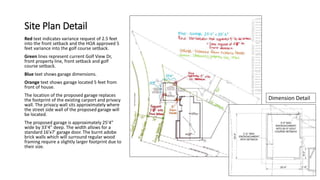
Site Plan Detail
Red text indicates variance request of 2.5 feet
into the front setback and the HOA approved 5
feet variance into the golf course setback.
Green lines represent current Golf View Dr,
front property line, front setback and golf
course setback.
Blue text shows garage dimensions.
Orange text shows garage located 5 feet from
front of house.
The location of the proposed garage replaces
the footprint of the existing carport and privacy
wall. The privacy wall sits approximately where
the street side wall of the proposed garage will
be located.
The proposed garage is approximately 25’4”
wide by 33’4” deep. The width allows for a
standard 16’x7’ garage door. The burnt adobe
brick walls which will surround regular wood
framing require a slightly larger footprint due to
their size.
Dimension Detail
2’-6”
5’-0”
Architectural Design
Statement
GIST
A renowned mid-century architectural designer and builder, Gist is increasingly recognized as a notable and distinctive contributor to Tucson’s
built environment and architectural history. He was a master practitioner whose work was representative of his time, style, and method of
construction, and was of high artistic value. His homes helped to pioneer a unique regional modernism and were regularly featured in the
Tucson Citizen, Better Homes and Gardens, and Sunset Magazine. One of his residential properties has the high honor of individual listing on the
National Register of Historic Places (NRHP), and many more of his homes are contributing properties to Historic Districts throughout Tucson. A
multiple property NRHP nomination is currently pending with the State of Arizona to recognize the full body of his work. As a builder he built
homes designed by some of Tucson’s most accomplished architects including Josias Joesler and Arthur Brown. By the mid-1950’s he had
developed his own unique design aesthetic which, coupled with his skill as a builder, would continue to distinguish his work in Tucson for the
next 25 years. Gist homes featured:
· Mid-century ranch house style
· Elongated floor plans
· Long, linear, horizontal roofs
· Carports and floating rooflines
· Ribbon windows and window walls
· Integrated patio walls
· Lightly mortar washed Burnt adobe
· Interior mahogany woodwork
DESIGN STATEMENT
The house at 525 W. Golf View Drive, built in 1959, is a significant and high integrity surviving example of Gist’s fully developed regional modern
style. The applicant seeks modest relief from the front and side yard setbacks to allow for a sensitive and historically compatible garage addition.
The design proposes to join the structural roofing of the existing and new but allow for a breezeway between the two. Essential elements and
goals of this design approach are:
Retain and preserve historic fabric and character. Detaching the new addition will limit the removal of (and damage to) historic materials,
features and spatial relationships that characterize the property. The new construction will be undertaken in such a manner that, if removed in
the future, the essential form and integrity of the historic property will be unimpaired.
Avoid a false sense of historical development. Separating the new from the old will allow for a clear interpretation of the historical development
of the property. The new work will be modestly differentiated from the old but will remain compatible with the historic materials, features, size,
scale and proportion, and massing to protect the integrity of the property and its environment.
Limit risk, complexity, and expense. Attaching the new garage to the historic home would require underpinning of foundations and soils
investigations, may require invasive structural tie-ins, and risks differential settlement and future property damage. This approach helps to
support the expense of the historically compatible high-quality materials and detailing.
Compatible design features. The breezeway, along with glass garage door and ribbon windows, creates an expression of a floating roof and
sense of “carport”. The breezeway, together with integrated adobe site walls, creates layered usable outdoor patios. All of these features are
characteristic of Gist’s original design approach.
Access and function. Locating the new garage slightly west of the main house will allow driveway access from the south without disturbing the
historic planter attached to the front of the house. The southern approach is the historic land use pattern for the property and should be
preserved. Also, the new garage requires a 7’-0” door head, which is 1-1/2” higher than the historic. Setting the garage slightly west will allow for
this more modern head height without disrupting the lines of the historic house.
Design statement from Jon Mirto, Architect
and Principal; Poster, Mirto, McDonald.
POSTER MIRTO McDONALD
317 N Court Ave
Tucson, AZ 85701
520.882.6310
www.pmm.design
Elevation
Jon Mirto’s architectural rendering of the
approximate location and look of the
property with an enclosed garage in the
location of the existing carport and privacy
wall, attached at the roofline.
Roofline Attachment
Attaching the enclosed garage to the house
at the roofline allows for proper drainage of
runoff and complies with zoning law OVZC
23.6.A.2.b.
OVCC Estates HOA
Architectural Review
Committee Approval
We have obtained permission to locate the
garage structure 5 feet into the required 50-
foot side yard setback to the golf course from
the Architectural Review Committee with our
Homeowners Association, Oro Valley Country
Club Estates.
OVCC Estates HOA
Architectural Review
Committee Denial
We inquired about permission from our HOA
about locating the entire garage on the side
yard next to the golf course. This would
require a large variance to the setback of the
golf course property line. This inquiry was
denied for a variety of reasons.
Hello Tracey,
Thank you for submitting your request for consideration of the garage. John and I have reviewed
the information. Would you be so kind as to clarify some information for us? If we are reading
the site plan correctly the proposed location of the garage structure is right on the setback line
(0-foot setback) with the golf course. Is that correct?
We took a look at the setback requirements in the CC&Rs for the community. They prohibit the
HOA from giving a variance of any more than 10 feet for anything other than a wall, fence or
hedge. In addition the CC&R’s are quite specific actually that walls, fences and hedges exceeding
5 feet in height may not be erected nearer than 30’ from any property line abutting the golf
course. As this structure will have walls higher than 5 feet, I believe that would contradict
provision (f) as well, but of course that primary provision relating to structures is (B) which sets
the setback at 50 feet from the golf course property line.
Unfortunately, the HOA and ARC cannot grant the request of the variance you are
seeking at this location based on our governing documents. The location as requested is
in close proximity to the golf cart path and this location would set a precedent that we
concur that placement here would not be in the community’s interest. It appears that if
the plan is to remove the existing carport which is deteriorating there are options to
replace the structure with a new garage in the carport's current location. This area would
be closer to the home, would facilitate egress and may permit for a more reasonable
variance to the setbacks, one that the HOA has authority to grant under the above
mentioned criteria. Is there a reason why the Town of Oro Valley Zoning is not in favor of
reconstruction in the current location? Please feel free to contact me with any questions
you may have. My phone number is 520-907-5497.
Thank you!
Alexis Paterson
ARC Chair, Oro Valley Country Club Estates
Oro Valley Country
Club Estates HOA
CC&Rs Excerpt
Setback requirements and variance request
allowances from HOA CC&Rs.
Page 2, line 25, number 9b; golf course
setback: No structure, other than a fence or
wall, shall be located nearer than fifty (50)
feet to any property line abutting on the golf
course property.
Page 3, line 4, (f) second paragraph;
limitation to variance allowance into setback:
In no event shall the said architect or agent
permit a structure other than a fence or wall
to be located nearer than ten (10) feet to any
property line.
Overhead View
Google map with superimposed 15-foot
property line setback (black line) from Pima
maps website.
Neither side yard provides space for a garage
within the required side yard setbacks and
HOA golf course setback.
Rear of property would situate a garage
more than 150 feet from any entrance to the
home. The original burnt adobe wall
enclosing the backyard has no gate access.
This would create unreasonable ingress and
egress between the house and vehicles.
Closest Point to
Setback
Using the measurement tool on Pima Maps
website, the distance from the setback to the
closest point of the privacy wall is
approximately 26 1/2 feet.
The front corner of the garage will begin
approximately 12 feet to the north of the
existing corner of the privacy wall. This will
position the street side garage wall further
from the road/setback as the street curves
away from the property.
Current view of privacy
wall from the road
Privacy wall represents approximate location
of street side wall of the enclosed garage.
Home from middle of
Golf View Dr.
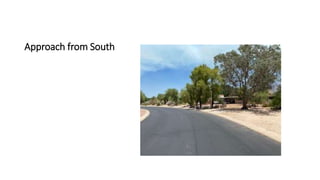
Approach from South
Approach from North
Carport Rot
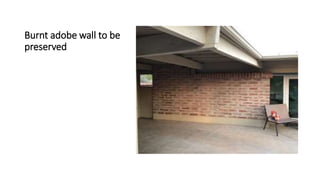
Burnt adobe wall to be
preserved
Gist Garages; building
and location
excerpt: • As automobile ownership became more mainstream, Gist began
designing homes with garages
• Garages were designed at the end of the house if the
property was wide enough, with the entrance to the side
• Narrow property, like ours, garage placed in front of house
• Garage door facing sideways at a 90 angle to the front
door, not facing the street
Excerpt:
6. Carport In the mid-20th century, the automobile was both a status
symbol and a symbol of the machine age. It represented freedom of
movement and opportunity and was an integral part of the suburban
lifestyle. Starting in the 1940s, most Gist houses had open carports
where the vehicle was clearly visible from the street. Some carports
were located beneath the extended eave of the house, creating a longer
profile for the house. In subdivisions where the lots were narrower, it
was common to locate the carport in front of the house. In higher end
subdivisions, such as Tucson Country Club, neighborhood restrictions
were in place to limit the visibility of the carport from the street. The
large lot sizes in these subdivisions also provided sufficient space to
allow the carport to be located at the end of the house and screened
from view. While carports were typical, there were also a few houses
with garages. The garage door was rarely visible from the front of the
house.
United States Department of the Interior
National Park Service
National Register of Historic Places
Continuation Sheet
Section number E Page 10
Name of Property
Pima County, Arizona
County and State
Residences of Tom Gist in Southern Arizona,
1947-1981
Other OVCC Estates
Properties
A sampling of other, newer properties
located on Golf View Dr. that appear to have
been granted a variance to the 30-foot
setback from the front property line.
Line indicates (approximately) 30 feet from
front setback. These homes are all located
less than 30 feet from the setback.
1. 415 W. Golf View Dr.
2. 475 W. Golf View Dr.
3. 565 W. Golf View Dr.
The 30-foot setback is indicated on our
original set of blueprints from 1959, so
newer homes would be held to the same
setback requirements.
We are not asking for a precedent setting
variance. We are asking for the same
consideration these properties received
when they were built.
415 W Golf View Dr
475 W Golf View Dr
565 W Golf View Dr
Unusual Zoning in Oro
Valley Country Club
Estates
This area is located within Oro Valley Country
Club Estates less than ¾ of a mile from our
property. These are all single-family homes of
similar size and value on similar sized lots. All
these properties are part of the Oro Valley
Country Club Estates neighborhood and HOA.
The yellow area, where our property is located
is zoned R1-36; single family residences, low
density.
The brown area is zoned R-6; multi-family
residential. There are no multi-family homes in
this zone, the property lines include the roads,
multiple lots overlap two zones, one home is
positioned on the property line with the
driveway on the adjacent lot.
The green area is labeled PAD Zoning TZ-5;
multiple residence zone. It is unclear what kind
of zone this meant to be and the link for more
information is broken on OV website. However,
there is a zero-foot setback to the road and
many lots are located within two zones.
Community Support
Letter of support from Daniel Biel. This is Mr.
Biel’s personal support of our request for a
zoning variance. Mr. Biel is a Commissioner
on the Historic Preservation Commission
with the Town of Oro Valley.
Community Support
Letter of support from Mike Wilson. This is
Mr. Wilson’s personal support of our request
for a zoning variance. Mr. Wilson is a
Commissioner on the Historic Preservation
Commission with the Town of Oro Valley.
University of Arizona
College of Architecture
Project
Students and faculty of the College of
Architecture, Planning and Landscape
Architecture at the University of Arizona
created a project to preserve the legacy of
Thomas Gist and to maintain his place among
the historic collection of homes in and
around Tucson.
Among other purposes, this project
assembled an inventory of Gist properties,
including this one, to assure that his buildings
remain true to their original design intent.
Tucson Historic
Preservation
Foundation Executive Committee, Michael Fassett, MD, President
• A native Arizonan currently residing in Los Angeles, Dr. Fassett began his
advocacy for preservation of Tucson’s mid-century modern architecture in
2004, after witnessing the demolition of a Catalina Foothills Estates
modernist residence for the purpose of speculative, in-fill
development. Michael has restored mid-century modern homes in
Windsor Park and Indian Ridge Estates. He has won numerous awards
from the Tucson-Pima County Historical Commission. Fassett has restored
his Tucson home designed and built by Tucson modernist Tom Gist, and is
involved with preparing a nomination to the National Register for Gist’s
residential work in Tucson. Fassett is authoring a forthcoming book on the
residential work of Tom Gist. While studying as a Grady and Kathryn
Gammage Scholar at Arizona State University, Michael earned his B.A. in
French and B.S. in Microbiology. He received his M.D. from the University
of Arizona College of Medicine.
• This book will follow Gist through his childhood and military career, and
explore the development of his unique design and construction style. The
evolution of Gist’s style and detailed building techniques will be illustrated
through a combination of archival images, current photographs,
interviews with clients and contemporaries. This book will serve as the
ultimate reference for Gist’s work for current and future Tucsonans.
Since March of 1984 the Tucson Historic
Preservation Foundation has been working
to save Tucson's heritage and cultural
resources. For over 30 years we have been
on the front lines advocating and strategizing
to protect the places that make Tucson
unique. Throughout the year we offer a
variety of programing including lecturers,
tours, films and exclusive access to otherwise
inaccessible historic properties. We partner
with numerous organizations throughout our
city and region to help protect our shared
past. Only with the support of our members
and donors can we fulfill our mission.
Summary
1. This property, made up of land and a firmly
attached, immovable structure includes an
historic, well preserved mid-century modern
home built in 1959 by well-known architect,
Thomas Gist. It is the only one of its kind in Oro
Valley that has not been significantly and
irrevocably altered. This makes it special relative
to all other properties in the area.
2. Gist created this mid-century modern home.
Thoughtful owners who appreciated and valued
Gist’s vision over the last 60 years preserved its
original style and design. We had no hand in
creating this property. The carport from 1959 is
rotting. It is a safety hazard and must be
removed. Building a safe, secure replacement to
the carport is a reasonable expectation for a
circumstance not created by the current
homeowner. Building a new structure away
from the main house maintains the historical
significance of the firmly attached structure
portion of the property.
3. The existing carport must be removed.
Replacing it with an enclosed garage is a
reasonable expectation for the preservation and
enjoyment of substantial property rights and for
homes of this value in this neighborhood. There
is no other location on the property to put a
garage.
Summary
Cont.
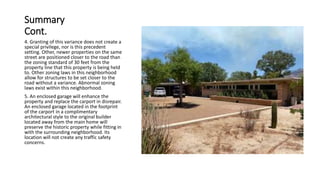
4. Granting of this variance does not create a
special privilege, nor is this precedent
setting. Other, newer properties on the same
street are positioned closer to the road than
the zoning standard of 30 feet from the
property line that this property is being held
to. Other zoning laws in this neighborhood
allow for structures to be set closer to the
road without a variance. Abnormal zoning
laws exist within this neighborhood.
5. An enclosed garage will enhance the
property and replace the carport in disrepair.
An enclosed garage located in the footprint
of the carport in a complimentary
architectural style to the original builder
located away from the main home will
preserve the historic property while fitting in
with the surrounding neighborhood. Its
location will not create any traffic safety
concerns.

Variance documentation PP REVISED.pptx

  • 1.
    Town of OroValley Board of Adjustment Variance Request Gene and Tracey Alexander 525 W Golf View Dr July 28, 2020
  • 2.
    Overview We purchaseda Thomas Gist home built in 1959 located in the historic neighborhood of Oro Valley Country Club Estates in Feb 2019. It is one of the first homes completed around the Oro Valley Country Club Golf Course which opened in 1959. The town of Oro Valley Historic Preservation Commission (HPC) had worked with the previous owners to begin the process of listing the home on the local historic registry. We spoke with Lynanne Dellerman from HPC about our desire to replace the carport with a garage while maintaining the historical integrity of the property. We hired a well-known local preservation architect, Jon Mirto, of Poster Mirto McDonald to design a garage to complement the historical structure in conformance with the Secretary of the Interior Standards as it relates to additions and changes to historic properties; making it compatible but different. Upon submission to the town of Oro Valley for a building permit, a staff member in the Planning and Zoning department denied our request because the structure did not meet the required front setback from the road.
  • 3.
    Thomas Gist (1917-2000) •Tom Gist was a custom home designer/builder prominent in Tucson from the mid-1950’s through late 1970’s. His unique design aesthetic, along with a problem-solving approach to custom home design and superb building skills, created many superior examples of mid-century modern design with a Tucson flair. His homes of burnt adobe with Catalina view-facing window walls and sumptuous mahogany interior woodwork embodied Gist’s concept of “gracious natural living at its best”. • Many of the over 170 homes he designed and built were regularly featured in print publications of the time. The second home he built for himself and his wife Tish is listed on the National Register of Historic Places (NRHP), and many more of his homes are contributing properties to Historic Districts throughout Tucson. A multiple property NRHP nomination is currently pending with the State of Arizona.
  • 4.
    Thomas Gist (1917-2000) Cont. •Besides the local designation the HPC is interested in for the Gist house, the Town of Oro Valley may be unaware that The National Register Multiple Property Documentation Form (MPDF) also has its eye on this property. The MPDF documents groups of thematically related properties. This form defines and describes one or more historic contexts, describes associated property types related to the historic context(s) and establishes significance and integrity requirements for nominating properties to the National Register. There is a current draft of an MPDF for Thomas Gist properties in the works at the state level that includes this home. The MPDF draft is under review by the State Historic Preservation Office (SHPO) and the Historic Sites Review Committee (HSRC). If/when this document is approved, we (or the Town of Oro Valley) may nominate our property for review and approval through the HSRC.
  • 5.
    Request for Variance •Preserve our 1959 historic home built by Thomas Gist, a well- known local architect and builder of mid-century modern homes • Obtain a variance of 2.5 feet to the front setback of the property to build an enclosed garage in the footprint of the existing carport and privacy wall • Replace rotting carport with enclosed garage
  • 6.
    Site Plan and Request forVariance The current location of the carport privacy wall is the approximate desired location of the street side wall of the new garage structure. This location allows for the garage to be attached at the roofline (a zoning requirement), yet set away from the historic dwelling, thus preserving its historical integrity. This location is approximately 2.5 feet into the required setback from the property line for a structure. In other words, 27.5 feet from the setback instead of 30 feet. The setback begins 15 feet into the property from the road edge. So, instead of 45 feet from the road edge, we request to locate the street side garage wall 37.5 feet from the road edge. The road curves away from the property in both directions, so visibility is not affected by moving slightly closer to the road.
  • 7.
    Site Plan Detail Redtext indicates variance request of 2.5 feet into the front setback and the HOA approved 5 feet variance into the golf course setback. Green lines represent current Golf View Dr, front property line, front setback and golf course setback. Blue text shows garage dimensions. Orange text shows garage located 5 feet from front of house. The location of the proposed garage replaces the footprint of the existing carport and privacy wall. The privacy wall sits approximately where the street side wall of the proposed garage will be located. The proposed garage is approximately 25’4” wide by 33’4” deep. The width allows for a standard 16’x7’ garage door. The burnt adobe brick walls which will surround regular wood framing require a slightly larger footprint due to their size. Dimension Detail 2’-6” 5’-0”
  • 8.
    Architectural Design Statement GIST A renownedmid-century architectural designer and builder, Gist is increasingly recognized as a notable and distinctive contributor to Tucson’s built environment and architectural history. He was a master practitioner whose work was representative of his time, style, and method of construction, and was of high artistic value. His homes helped to pioneer a unique regional modernism and were regularly featured in the Tucson Citizen, Better Homes and Gardens, and Sunset Magazine. One of his residential properties has the high honor of individual listing on the National Register of Historic Places (NRHP), and many more of his homes are contributing properties to Historic Districts throughout Tucson. A multiple property NRHP nomination is currently pending with the State of Arizona to recognize the full body of his work. As a builder he built homes designed by some of Tucson’s most accomplished architects including Josias Joesler and Arthur Brown. By the mid-1950’s he had developed his own unique design aesthetic which, coupled with his skill as a builder, would continue to distinguish his work in Tucson for the next 25 years. Gist homes featured: · Mid-century ranch house style · Elongated floor plans · Long, linear, horizontal roofs · Carports and floating rooflines · Ribbon windows and window walls · Integrated patio walls · Lightly mortar washed Burnt adobe · Interior mahogany woodwork DESIGN STATEMENT The house at 525 W. Golf View Drive, built in 1959, is a significant and high integrity surviving example of Gist’s fully developed regional modern style. The applicant seeks modest relief from the front and side yard setbacks to allow for a sensitive and historically compatible garage addition. The design proposes to join the structural roofing of the existing and new but allow for a breezeway between the two. Essential elements and goals of this design approach are: Retain and preserve historic fabric and character. Detaching the new addition will limit the removal of (and damage to) historic materials, features and spatial relationships that characterize the property. The new construction will be undertaken in such a manner that, if removed in the future, the essential form and integrity of the historic property will be unimpaired. Avoid a false sense of historical development. Separating the new from the old will allow for a clear interpretation of the historical development of the property. The new work will be modestly differentiated from the old but will remain compatible with the historic materials, features, size, scale and proportion, and massing to protect the integrity of the property and its environment. Limit risk, complexity, and expense. Attaching the new garage to the historic home would require underpinning of foundations and soils investigations, may require invasive structural tie-ins, and risks differential settlement and future property damage. This approach helps to support the expense of the historically compatible high-quality materials and detailing. Compatible design features. The breezeway, along with glass garage door and ribbon windows, creates an expression of a floating roof and sense of “carport”. The breezeway, together with integrated adobe site walls, creates layered usable outdoor patios. All of these features are characteristic of Gist’s original design approach. Access and function. Locating the new garage slightly west of the main house will allow driveway access from the south without disturbing the historic planter attached to the front of the house. The southern approach is the historic land use pattern for the property and should be preserved. Also, the new garage requires a 7’-0” door head, which is 1-1/2” higher than the historic. Setting the garage slightly west will allow for this more modern head height without disrupting the lines of the historic house. Design statement from Jon Mirto, Architect and Principal; Poster, Mirto, McDonald. POSTER MIRTO McDONALD 317 N Court Ave Tucson, AZ 85701 520.882.6310 www.pmm.design
  • 9.
    Elevation Jon Mirto’s architecturalrendering of the approximate location and look of the property with an enclosed garage in the location of the existing carport and privacy wall, attached at the roofline.
  • 10.
    Roofline Attachment Attaching theenclosed garage to the house at the roofline allows for proper drainage of runoff and complies with zoning law OVZC 23.6.A.2.b.
  • 11.
    OVCC Estates HOA ArchitecturalReview Committee Approval We have obtained permission to locate the garage structure 5 feet into the required 50- foot side yard setback to the golf course from the Architectural Review Committee with our Homeowners Association, Oro Valley Country Club Estates.
  • 12.
    OVCC Estates HOA ArchitecturalReview Committee Denial We inquired about permission from our HOA about locating the entire garage on the side yard next to the golf course. This would require a large variance to the setback of the golf course property line. This inquiry was denied for a variety of reasons. Hello Tracey, Thank you for submitting your request for consideration of the garage. John and I have reviewed the information. Would you be so kind as to clarify some information for us? If we are reading the site plan correctly the proposed location of the garage structure is right on the setback line (0-foot setback) with the golf course. Is that correct? We took a look at the setback requirements in the CC&Rs for the community. They prohibit the HOA from giving a variance of any more than 10 feet for anything other than a wall, fence or hedge. In addition the CC&R’s are quite specific actually that walls, fences and hedges exceeding 5 feet in height may not be erected nearer than 30’ from any property line abutting the golf course. As this structure will have walls higher than 5 feet, I believe that would contradict provision (f) as well, but of course that primary provision relating to structures is (B) which sets the setback at 50 feet from the golf course property line. Unfortunately, the HOA and ARC cannot grant the request of the variance you are seeking at this location based on our governing documents. The location as requested is in close proximity to the golf cart path and this location would set a precedent that we concur that placement here would not be in the community’s interest. It appears that if the plan is to remove the existing carport which is deteriorating there are options to replace the structure with a new garage in the carport's current location. This area would be closer to the home, would facilitate egress and may permit for a more reasonable variance to the setbacks, one that the HOA has authority to grant under the above mentioned criteria. Is there a reason why the Town of Oro Valley Zoning is not in favor of reconstruction in the current location? Please feel free to contact me with any questions you may have. My phone number is 520-907-5497. Thank you! Alexis Paterson ARC Chair, Oro Valley Country Club Estates
  • 13.
    Oro Valley Country ClubEstates HOA CC&Rs Excerpt Setback requirements and variance request allowances from HOA CC&Rs. Page 2, line 25, number 9b; golf course setback: No structure, other than a fence or wall, shall be located nearer than fifty (50) feet to any property line abutting on the golf course property. Page 3, line 4, (f) second paragraph; limitation to variance allowance into setback: In no event shall the said architect or agent permit a structure other than a fence or wall to be located nearer than ten (10) feet to any property line.
  • 14.
    Overhead View Google mapwith superimposed 15-foot property line setback (black line) from Pima maps website. Neither side yard provides space for a garage within the required side yard setbacks and HOA golf course setback. Rear of property would situate a garage more than 150 feet from any entrance to the home. The original burnt adobe wall enclosing the backyard has no gate access. This would create unreasonable ingress and egress between the house and vehicles.
  • 15.
    Closest Point to Setback Usingthe measurement tool on Pima Maps website, the distance from the setback to the closest point of the privacy wall is approximately 26 1/2 feet. The front corner of the garage will begin approximately 12 feet to the north of the existing corner of the privacy wall. This will position the street side garage wall further from the road/setback as the street curves away from the property.
  • 16.
    Current view ofprivacy wall from the road Privacy wall represents approximate location of street side wall of the enclosed garage.
  • 17.
    Home from middleof Golf View Dr.
  • 18.
  • 19.
  • 20.
  • 21.
    Burnt adobe wallto be preserved
  • 22.
    Gist Garages; building andlocation excerpt: • As automobile ownership became more mainstream, Gist began designing homes with garages • Garages were designed at the end of the house if the property was wide enough, with the entrance to the side • Narrow property, like ours, garage placed in front of house • Garage door facing sideways at a 90 angle to the front door, not facing the street Excerpt: 6. Carport In the mid-20th century, the automobile was both a status symbol and a symbol of the machine age. It represented freedom of movement and opportunity and was an integral part of the suburban lifestyle. Starting in the 1940s, most Gist houses had open carports where the vehicle was clearly visible from the street. Some carports were located beneath the extended eave of the house, creating a longer profile for the house. In subdivisions where the lots were narrower, it was common to locate the carport in front of the house. In higher end subdivisions, such as Tucson Country Club, neighborhood restrictions were in place to limit the visibility of the carport from the street. The large lot sizes in these subdivisions also provided sufficient space to allow the carport to be located at the end of the house and screened from view. While carports were typical, there were also a few houses with garages. The garage door was rarely visible from the front of the house. United States Department of the Interior National Park Service National Register of Historic Places Continuation Sheet Section number E Page 10 Name of Property Pima County, Arizona County and State Residences of Tom Gist in Southern Arizona, 1947-1981
  • 23.
    Other OVCC Estates Properties Asampling of other, newer properties located on Golf View Dr. that appear to have been granted a variance to the 30-foot setback from the front property line. Line indicates (approximately) 30 feet from front setback. These homes are all located less than 30 feet from the setback. 1. 415 W. Golf View Dr. 2. 475 W. Golf View Dr. 3. 565 W. Golf View Dr. The 30-foot setback is indicated on our original set of blueprints from 1959, so newer homes would be held to the same setback requirements. We are not asking for a precedent setting variance. We are asking for the same consideration these properties received when they were built. 415 W Golf View Dr 475 W Golf View Dr 565 W Golf View Dr
  • 24.
    Unusual Zoning inOro Valley Country Club Estates This area is located within Oro Valley Country Club Estates less than ¾ of a mile from our property. These are all single-family homes of similar size and value on similar sized lots. All these properties are part of the Oro Valley Country Club Estates neighborhood and HOA. The yellow area, where our property is located is zoned R1-36; single family residences, low density. The brown area is zoned R-6; multi-family residential. There are no multi-family homes in this zone, the property lines include the roads, multiple lots overlap two zones, one home is positioned on the property line with the driveway on the adjacent lot. The green area is labeled PAD Zoning TZ-5; multiple residence zone. It is unclear what kind of zone this meant to be and the link for more information is broken on OV website. However, there is a zero-foot setback to the road and many lots are located within two zones.
  • 25.
    Community Support Letter ofsupport from Daniel Biel. This is Mr. Biel’s personal support of our request for a zoning variance. Mr. Biel is a Commissioner on the Historic Preservation Commission with the Town of Oro Valley.
  • 26.
    Community Support Letter ofsupport from Mike Wilson. This is Mr. Wilson’s personal support of our request for a zoning variance. Mr. Wilson is a Commissioner on the Historic Preservation Commission with the Town of Oro Valley.
  • 27.
    University of Arizona Collegeof Architecture Project Students and faculty of the College of Architecture, Planning and Landscape Architecture at the University of Arizona created a project to preserve the legacy of Thomas Gist and to maintain his place among the historic collection of homes in and around Tucson. Among other purposes, this project assembled an inventory of Gist properties, including this one, to assure that his buildings remain true to their original design intent.
  • 28.
    Tucson Historic Preservation Foundation ExecutiveCommittee, Michael Fassett, MD, President • A native Arizonan currently residing in Los Angeles, Dr. Fassett began his advocacy for preservation of Tucson’s mid-century modern architecture in 2004, after witnessing the demolition of a Catalina Foothills Estates modernist residence for the purpose of speculative, in-fill development. Michael has restored mid-century modern homes in Windsor Park and Indian Ridge Estates. He has won numerous awards from the Tucson-Pima County Historical Commission. Fassett has restored his Tucson home designed and built by Tucson modernist Tom Gist, and is involved with preparing a nomination to the National Register for Gist’s residential work in Tucson. Fassett is authoring a forthcoming book on the residential work of Tom Gist. While studying as a Grady and Kathryn Gammage Scholar at Arizona State University, Michael earned his B.A. in French and B.S. in Microbiology. He received his M.D. from the University of Arizona College of Medicine. • This book will follow Gist through his childhood and military career, and explore the development of his unique design and construction style. The evolution of Gist’s style and detailed building techniques will be illustrated through a combination of archival images, current photographs, interviews with clients and contemporaries. This book will serve as the ultimate reference for Gist’s work for current and future Tucsonans. Since March of 1984 the Tucson Historic Preservation Foundation has been working to save Tucson's heritage and cultural resources. For over 30 years we have been on the front lines advocating and strategizing to protect the places that make Tucson unique. Throughout the year we offer a variety of programing including lecturers, tours, films and exclusive access to otherwise inaccessible historic properties. We partner with numerous organizations throughout our city and region to help protect our shared past. Only with the support of our members and donors can we fulfill our mission.
  • 29.
    Summary 1. This property,made up of land and a firmly attached, immovable structure includes an historic, well preserved mid-century modern home built in 1959 by well-known architect, Thomas Gist. It is the only one of its kind in Oro Valley that has not been significantly and irrevocably altered. This makes it special relative to all other properties in the area. 2. Gist created this mid-century modern home. Thoughtful owners who appreciated and valued Gist’s vision over the last 60 years preserved its original style and design. We had no hand in creating this property. The carport from 1959 is rotting. It is a safety hazard and must be removed. Building a safe, secure replacement to the carport is a reasonable expectation for a circumstance not created by the current homeowner. Building a new structure away from the main house maintains the historical significance of the firmly attached structure portion of the property. 3. The existing carport must be removed. Replacing it with an enclosed garage is a reasonable expectation for the preservation and enjoyment of substantial property rights and for homes of this value in this neighborhood. There is no other location on the property to put a garage.
  • 30.
    Summary Cont. 4. Granting ofthis variance does not create a special privilege, nor is this precedent setting. Other, newer properties on the same street are positioned closer to the road than the zoning standard of 30 feet from the property line that this property is being held to. Other zoning laws in this neighborhood allow for structures to be set closer to the road without a variance. Abnormal zoning laws exist within this neighborhood. 5. An enclosed garage will enhance the property and replace the carport in disrepair. An enclosed garage located in the footprint of the carport in a complimentary architectural style to the original builder located away from the main home will preserve the historic property while fitting in with the surrounding neighborhood. Its location will not create any traffic safety concerns.