SPEED CONTROL OF AC MOTORS BY
FREQUENCY CONTROL METHOD
USING
VARIABLE FREQUENCY DRIVE
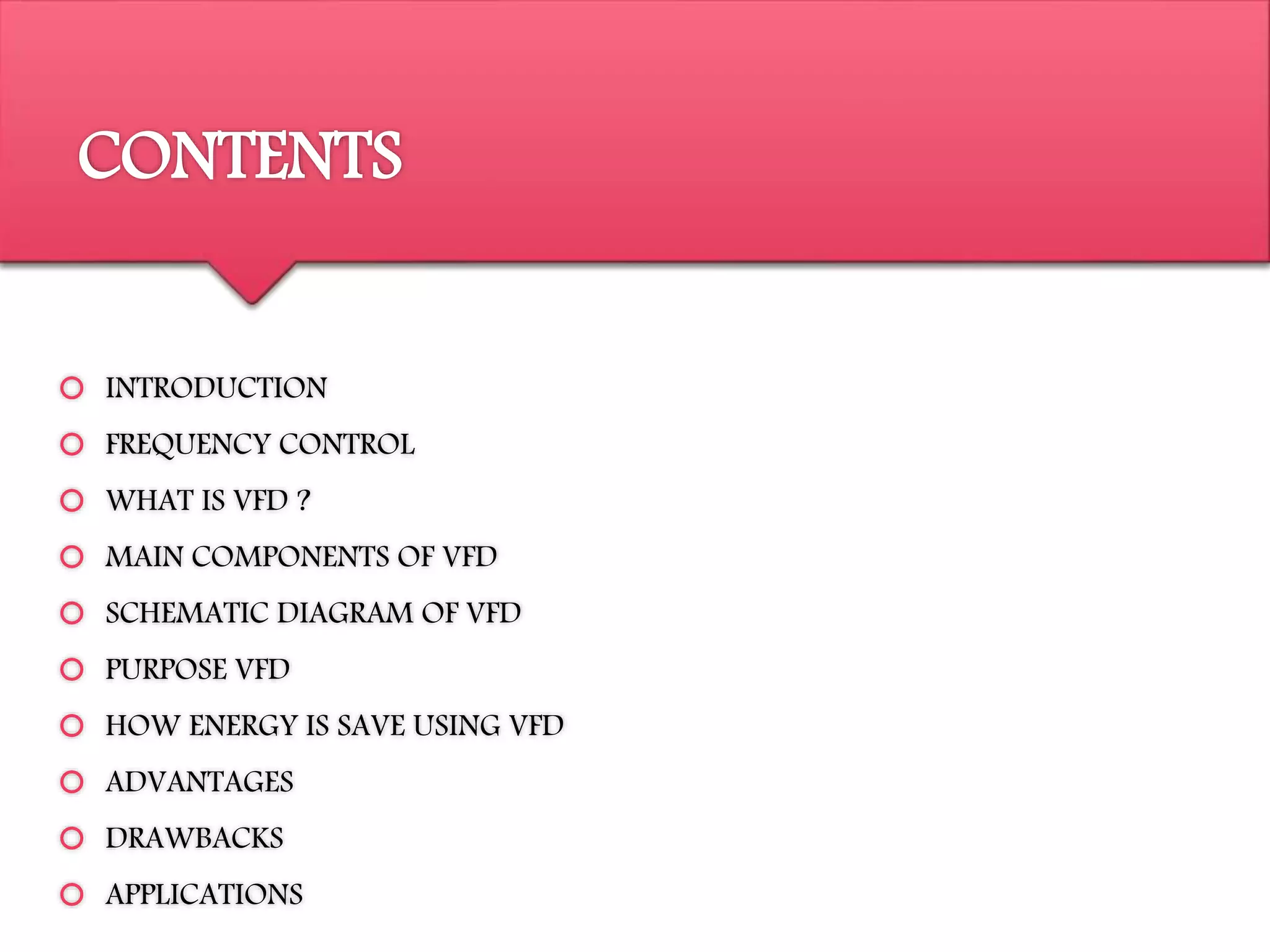
SPEED CONTROL OF AC MOTORS
USING
VARIABLE FREQUENCY DRIVE
Government polytechnic, Nagpur
Presented by,
RUSHIKESH ARUN PORATE
ELECTRICAL ENGG.
(3RD YEAR)
GUIDE BY :-H.N.KHARKAR SIR
CONTENTS
 INTRODUCTION
 FREQUENCY CONTROL
 WHAT IS VFD ?
 MAIN COMPONENTS OF VFD
 SCHEMATIC DIAGRAM OF VFD
 PURPOSE VFD
 HOW ENERGY IS SAVE USING VFD
 ADVANTAGES
 DRAWBACKS
 APPLICATIONS
INTRODUCTION
• A Variable Frequency Drive (VFD) controls the speed of a motor, specifically a three phase
motor. To better understand a VFD, let's examine the motors they control.
• Most commercial HVAC systems require powerful motors, and often operate on a three
phase power (The standard method for electric power distribution systems because of its
efficiency).
• A three phase motor is cheaper to operate than single phase motors because it uses less
current (less current often results in reduced wire size and cost), especially where large
motor requirements are necessary.
• A VFD eliminates high in-rush current - When a standard motor is turned on, it draws a
very high amount of current for a very short duration of time.
• A Variable Frequency Drive is designed to slowly start, therefore preventing inrush
current; reducing the stress on the components of the motor; thus extending the motor
life.
• A VFD controls the speed of a three phase AC motor, while resulting in energy savings! It
saves energy because the motor does not require as much current at lower speeds.
The solution is a Variable Frequency Drive (VFD).
HOW SPEED OF INDUCTION MOTOR IS CONTROL
BY FREQUENCY CONTROL METHOD ????
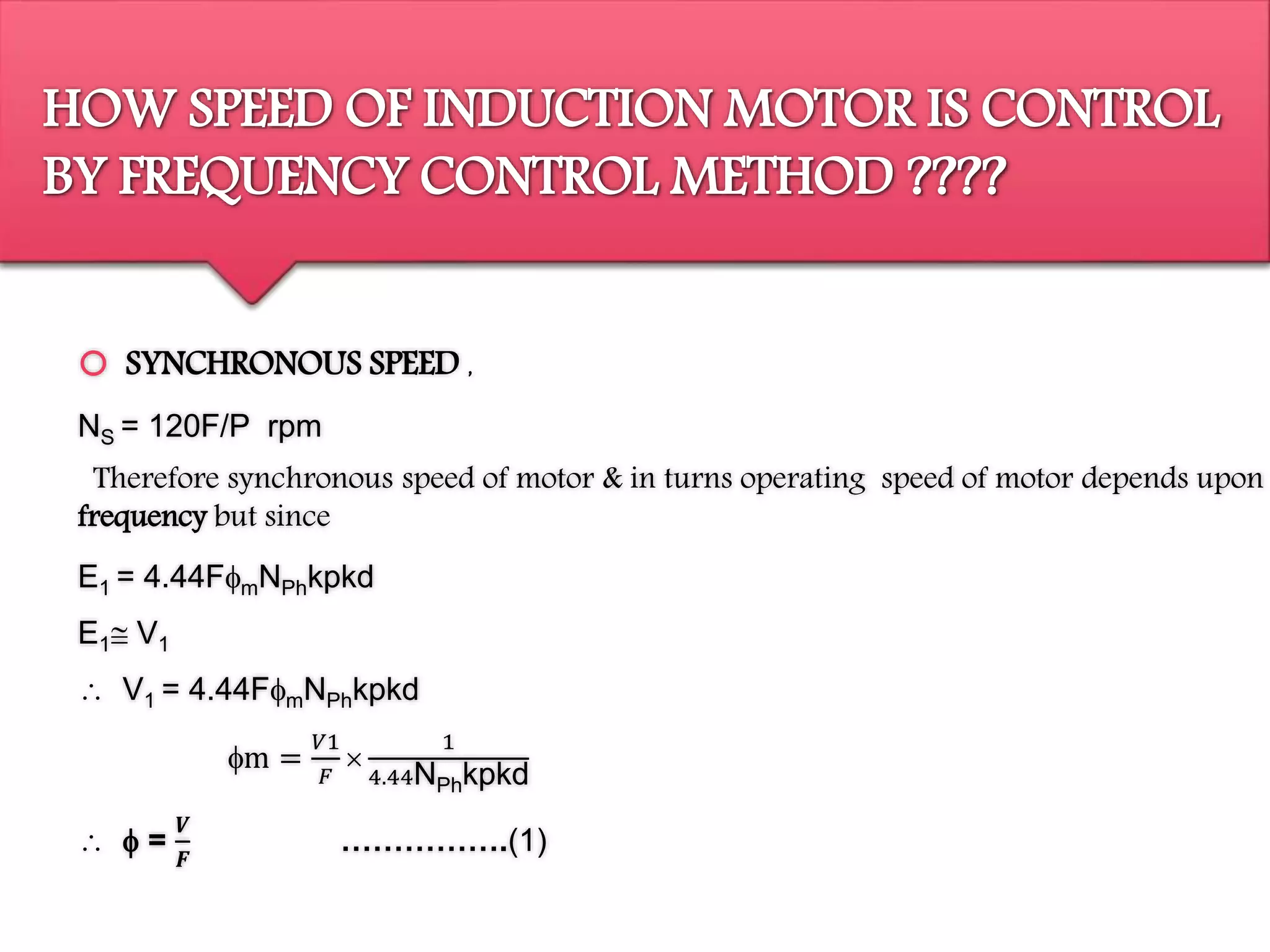
 SYNCHRONOUS SPEED ,
NS = 120F/P rpm
Therefore synchronous speed of motor & in turns operating speed of motor depends upon
frequency but since
E1 = 4.44FmNPhkpkd
E1 V1
 V1 = 4.44FmNPhkpkd
m =
𝑉1
𝐹

1
4.44NPhkpkd
  =
𝑽
𝑭
…………….(1)
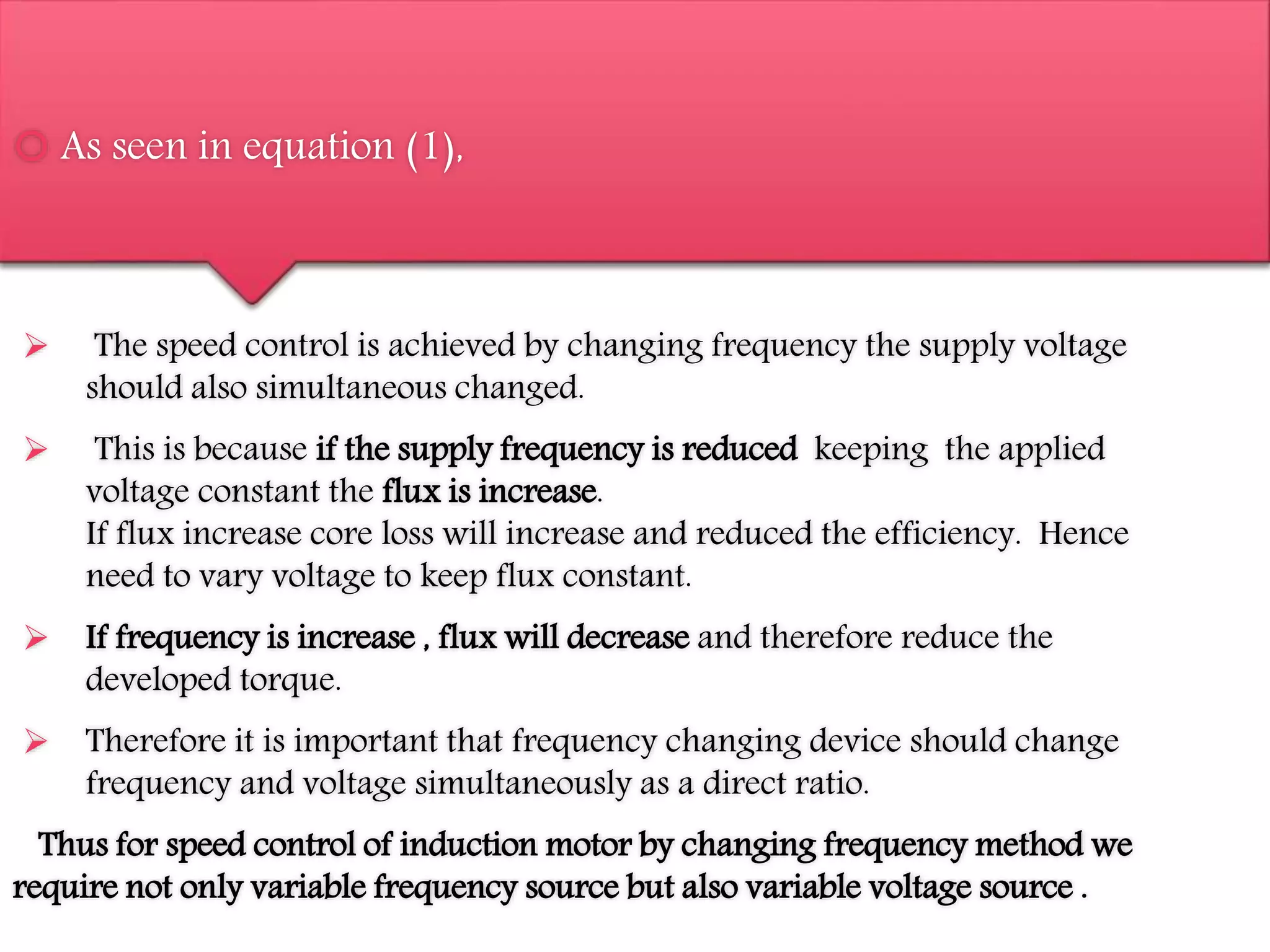
 As seen in equation (1),
 The speed control is achieved by changing frequency the supply voltage
should also simultaneous changed.
 This is because if the supply frequency is reduced keeping the applied
voltage constant the flux is increase.
If flux increase core loss will increase and reduced the efficiency. Hence
need to vary voltage to keep flux constant.
 If frequency is increase , flux will decrease and therefore reduce the
developed torque.
 Therefore it is important that frequency changing device should change
frequency and voltage simultaneously as a direct ratio.
Thus for speed control of induction motor by changing frequency method we
require not only variable frequency source but also variable voltage source .
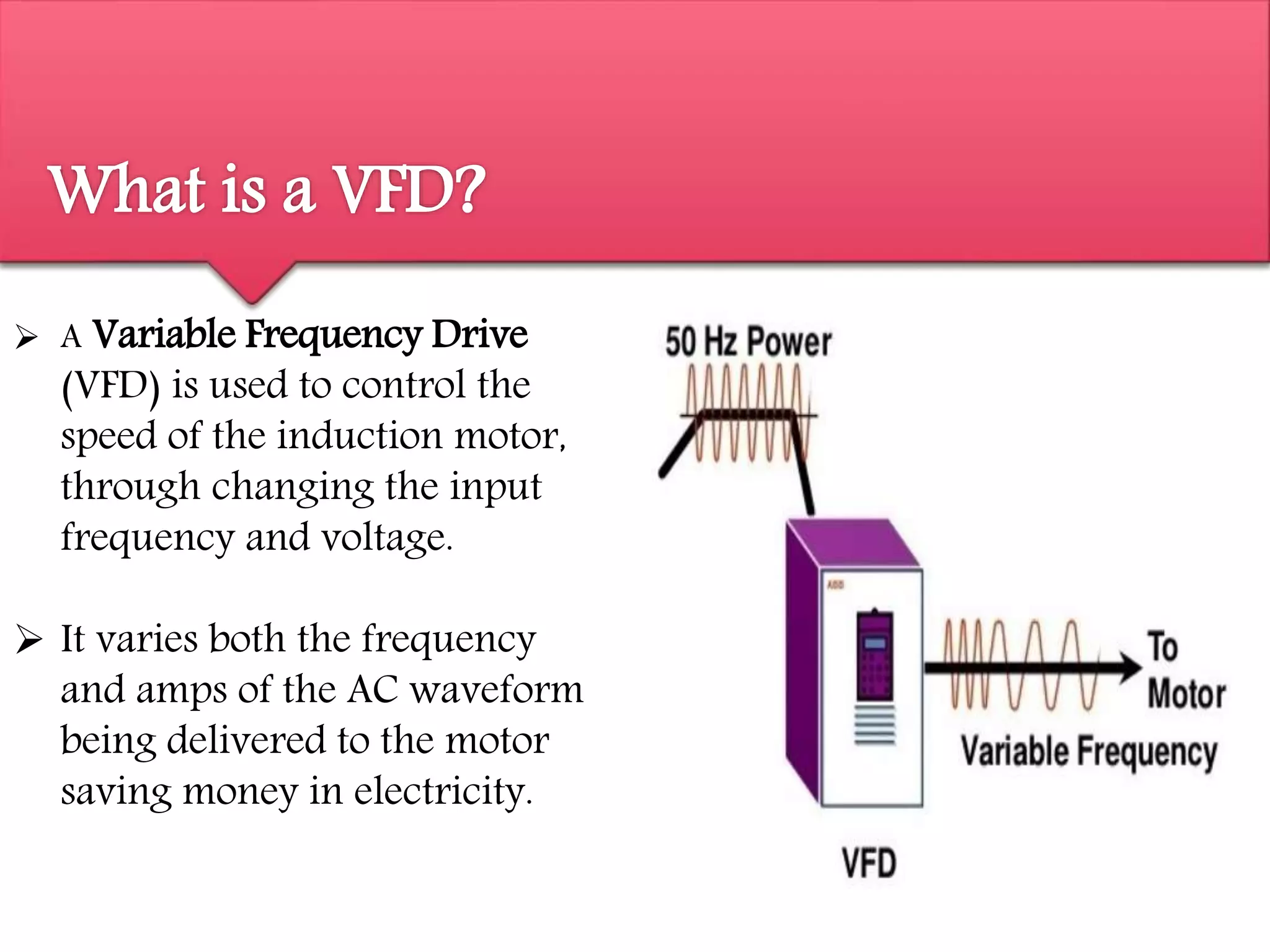
What is a VFD?
 A Variable Frequency Drive
(VFD) is used to control the
speed of the induction motor,
through changing the input
frequency and voltage.
 It varies both the frequency
and amps of the AC waveform
being delivered to the motor
saving money in electricity.
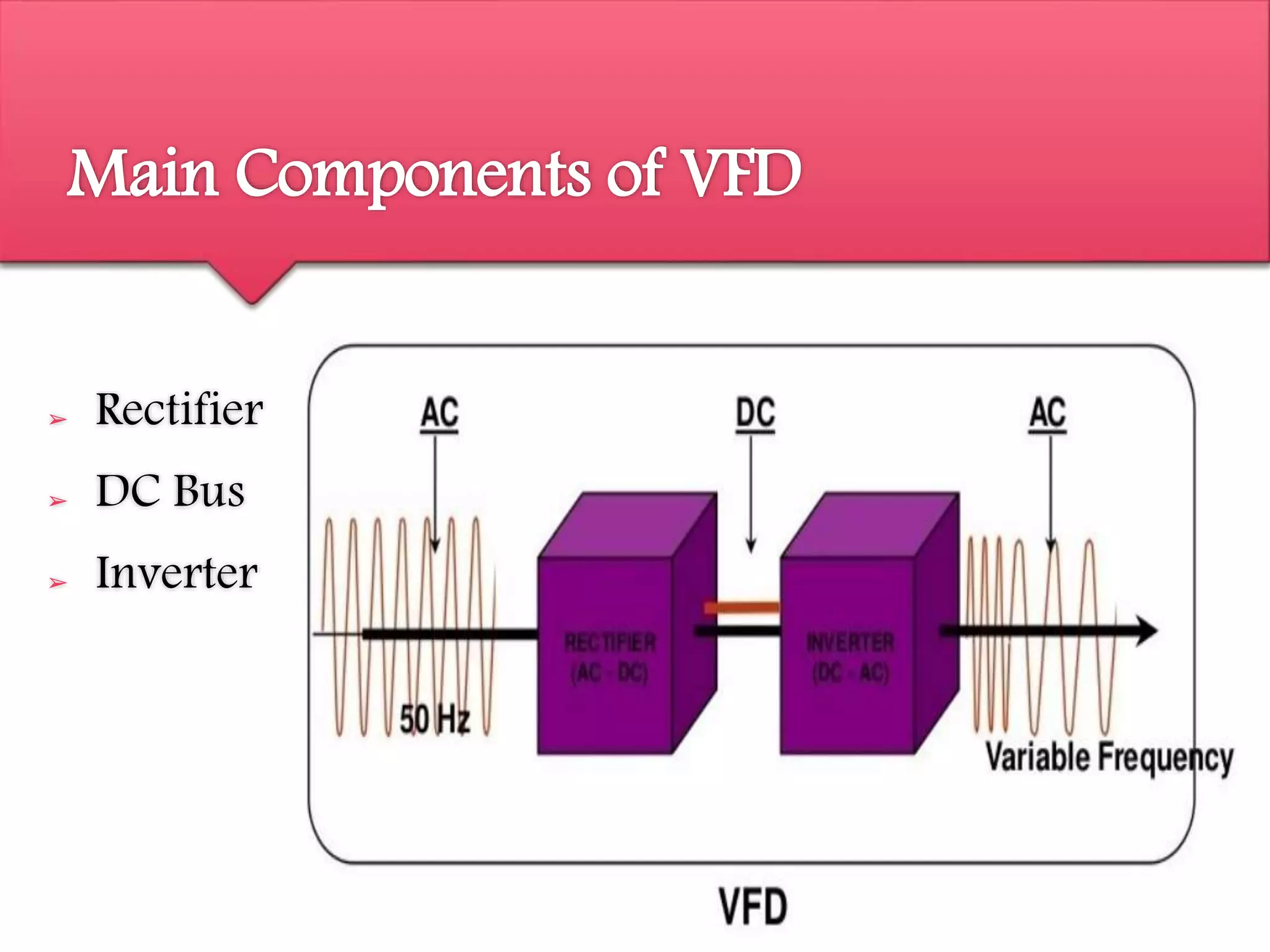
Main Components of VFD
➢ Rectifier
➢ DC Bus
➢ Inverter
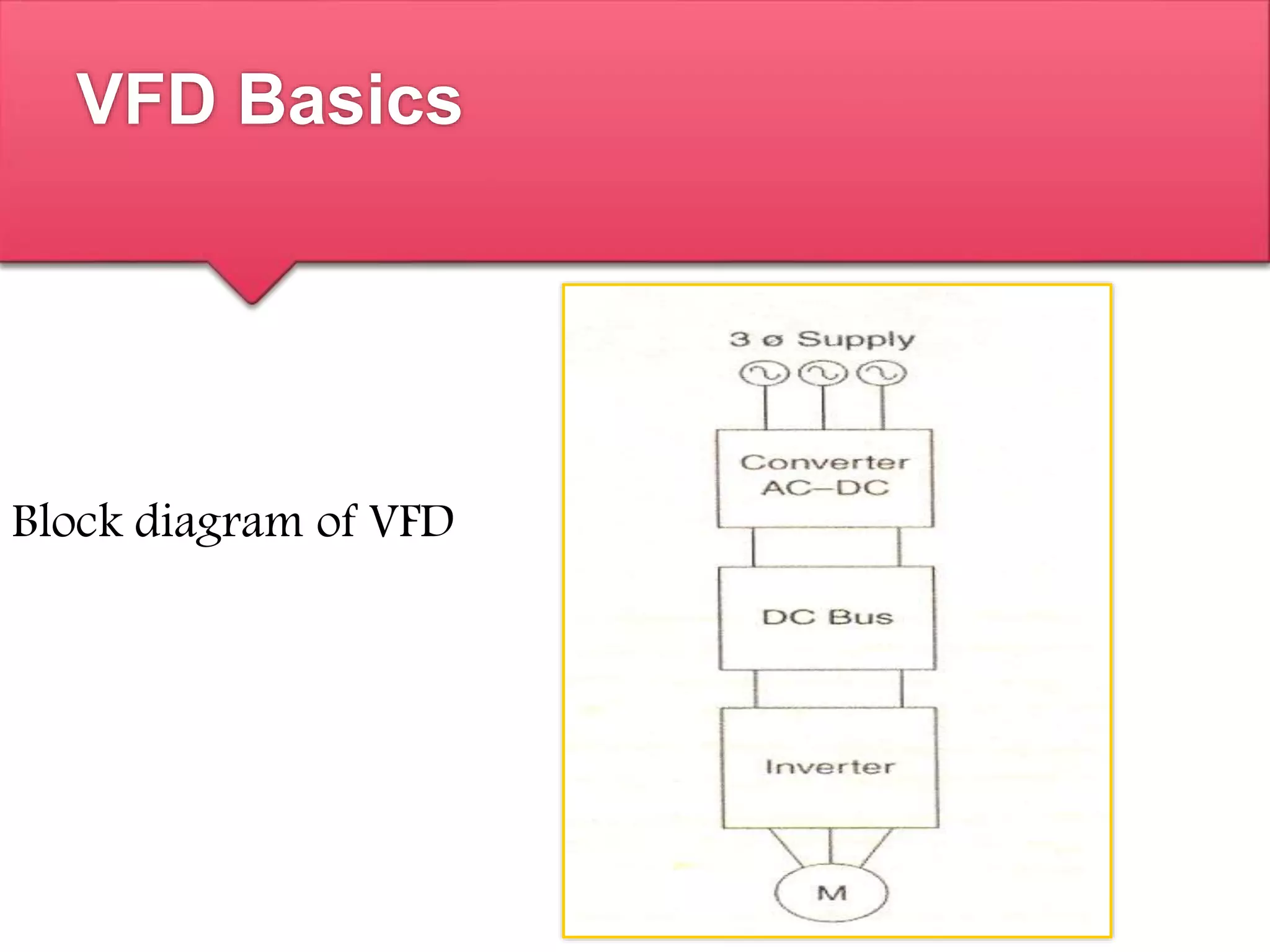
VFD Basics
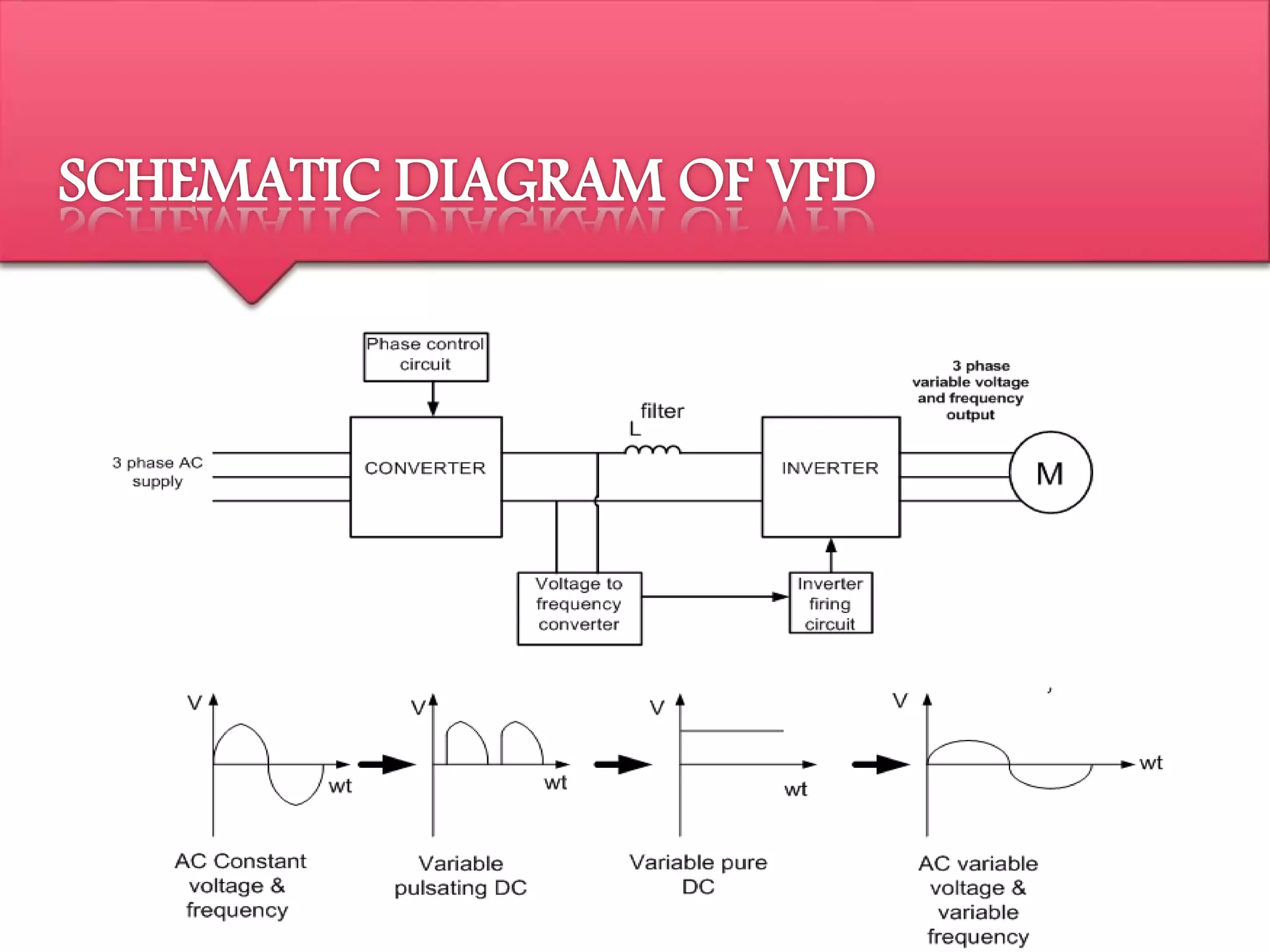
Block diagram of VFD
HOW SPEED IS CONTROLLED
USING VFD?
RECTIFIER
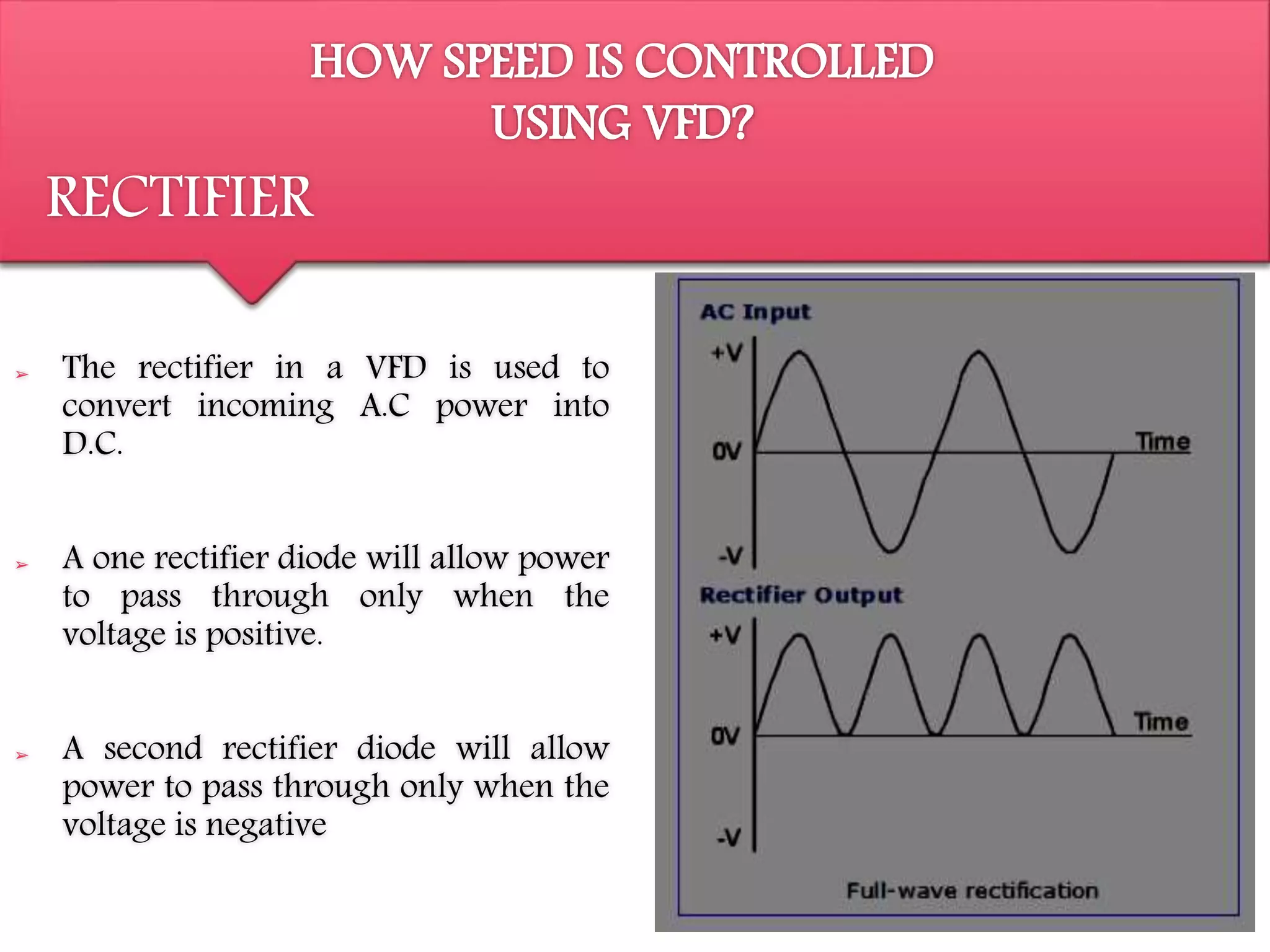
➢ The rectifier in a VFD is used to
convert incoming A.C power into
D.C.
➢ A one rectifier diode will allow power
to pass through only when the
voltage is positive.
➢ A second rectifier diode will allow
power to pass through only when the
voltage is negative
DC BUS
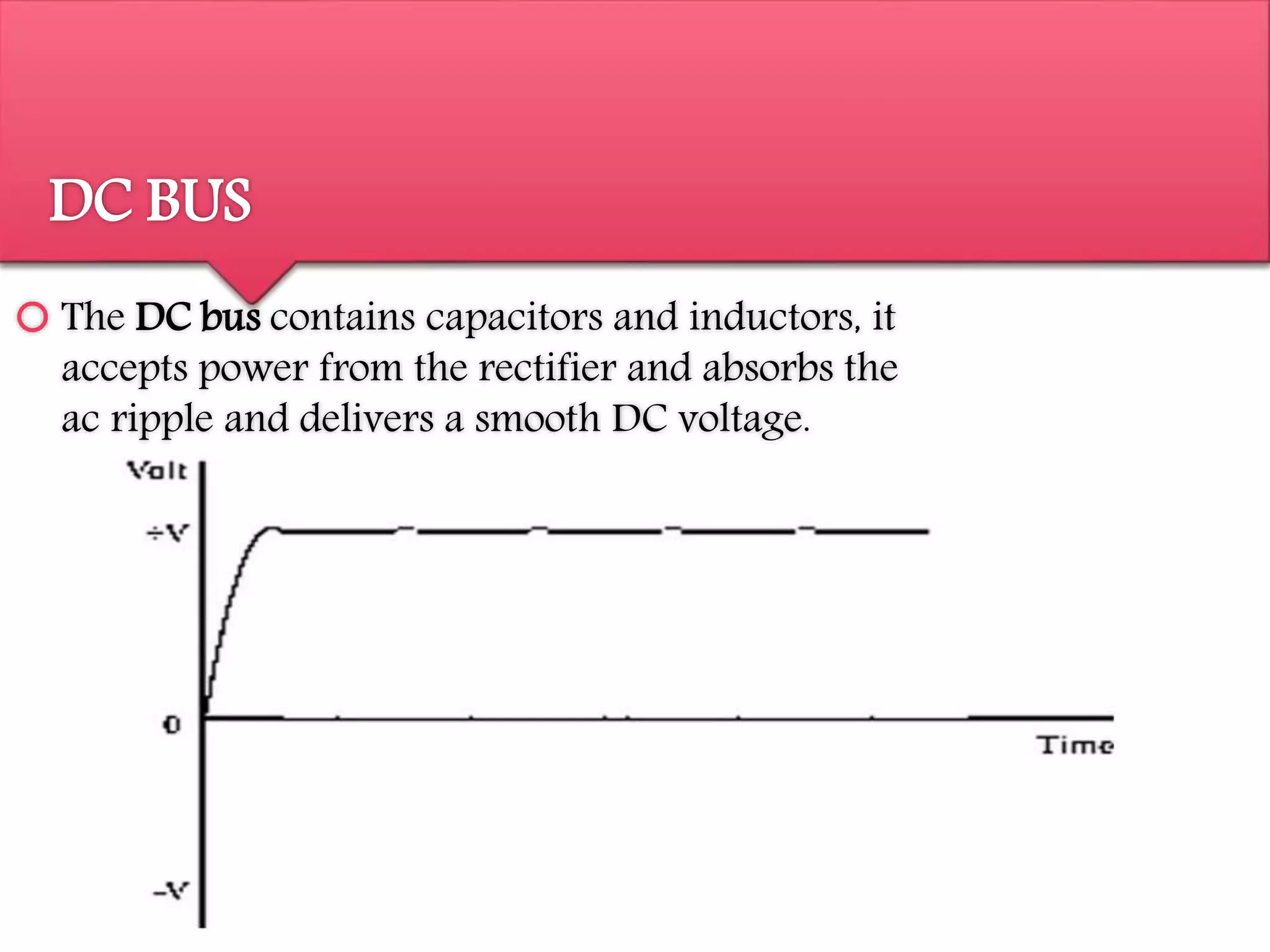
 The DC bus contains capacitors and inductors, it
accepts power from the rectifier and absorbs the
ac ripple and delivers a smooth DC voltage.
Inverter
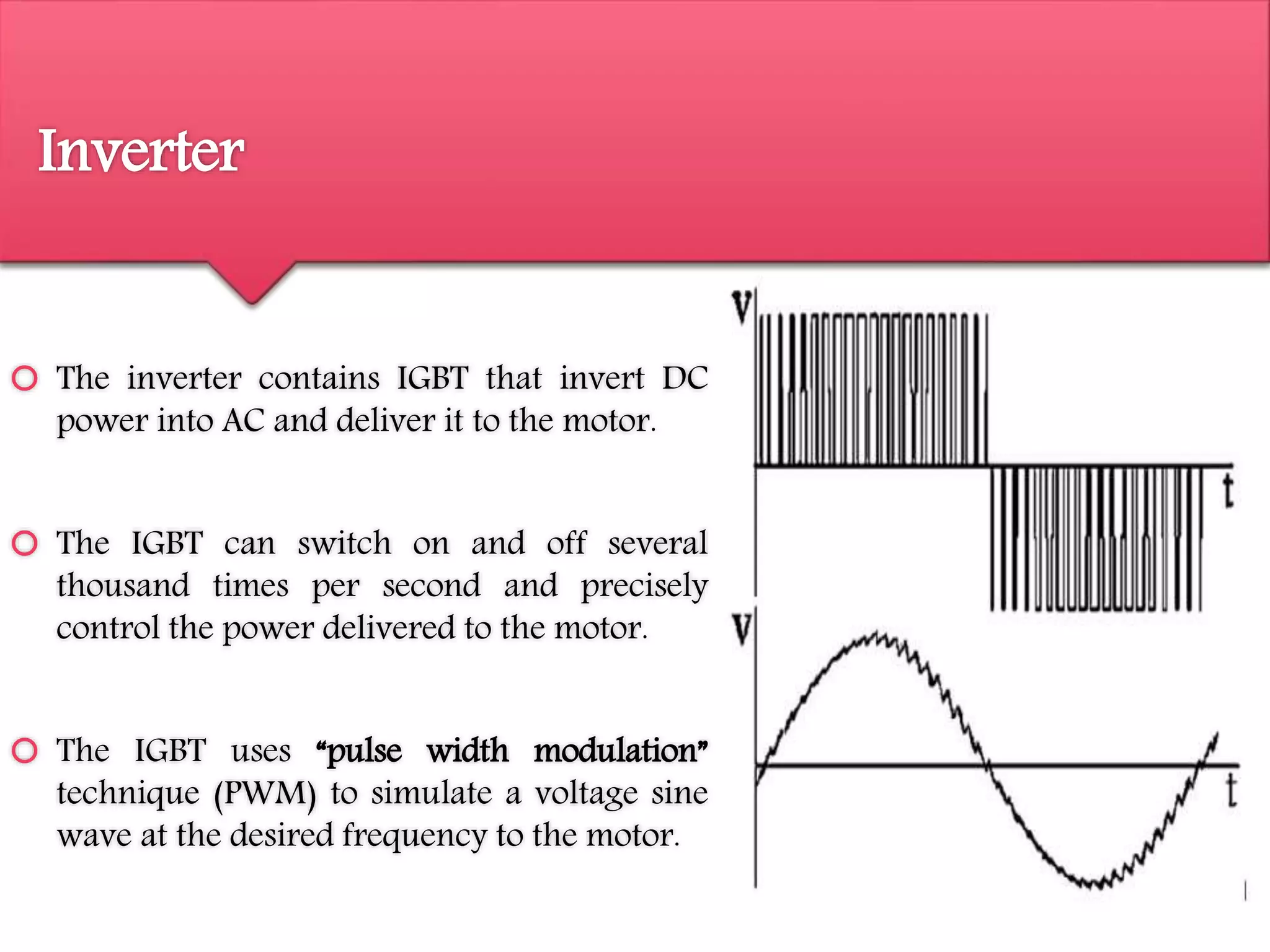
 The inverter contains IGBT that invert DC
power into AC and deliver it to the motor.
 The IGBT can switch on and off several
thousand times per second and precisely
control the power delivered to the motor.
 The IGBT uses “pulse width modulation”
technique (PWM) to simulate a voltage sine
wave at the desired frequency to the motor.
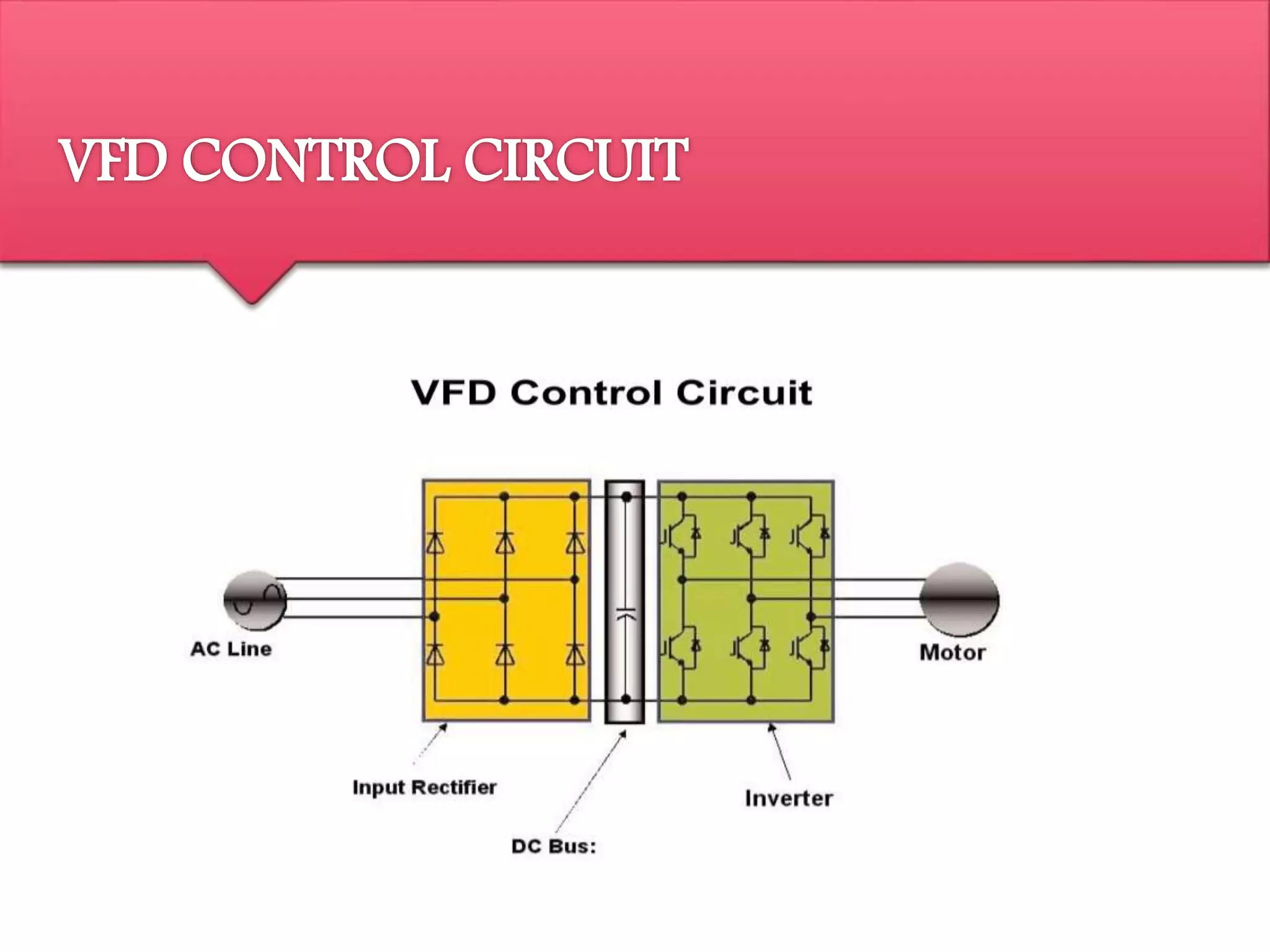
VFD CONTROL CIRCUIT
SCHEMATIC DIAGRAM OF VFD
PURPOSE OF VARIABLE FREQUENCY
DRIVES
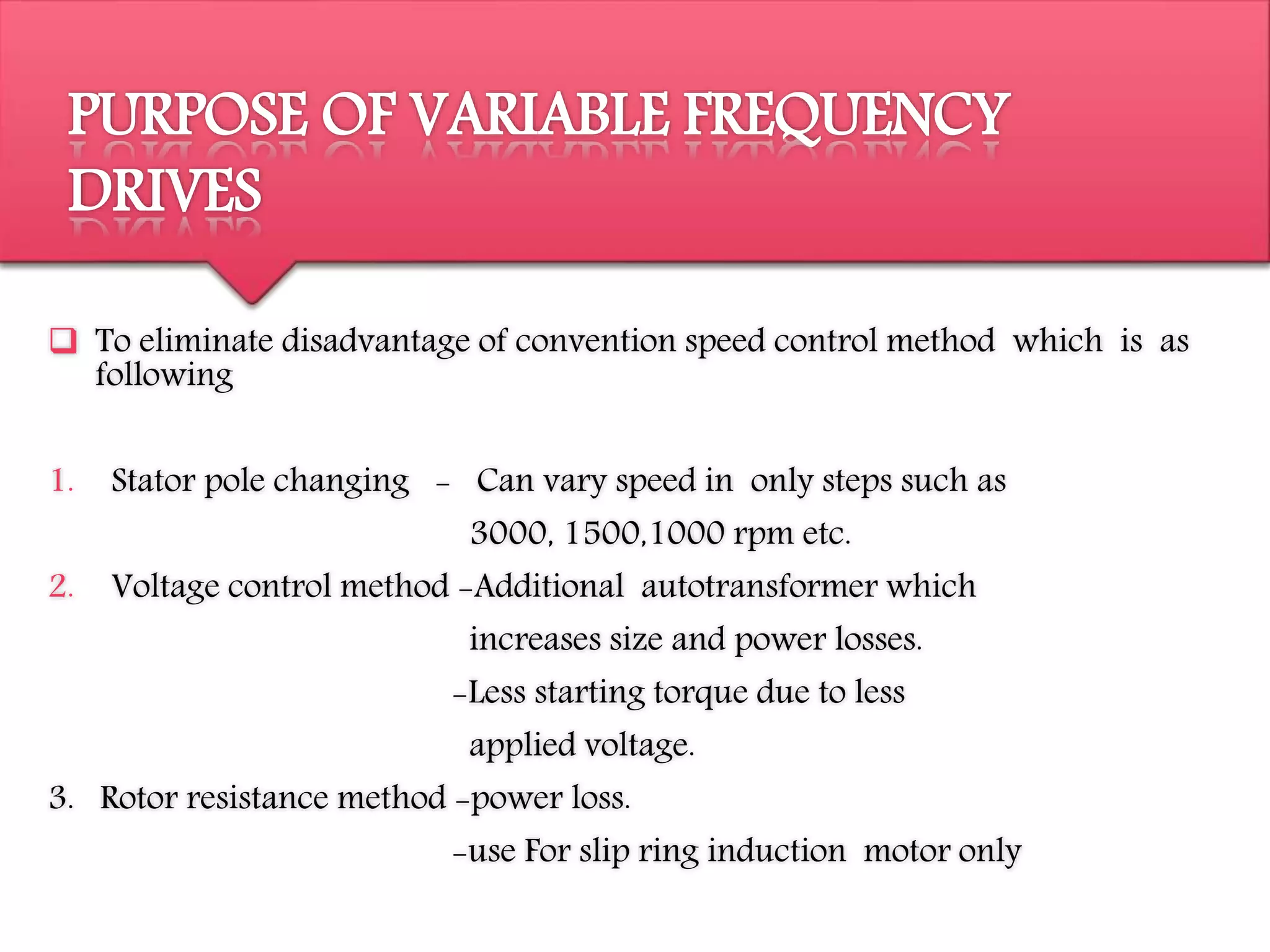
 To eliminate disadvantage of convention speed control method which is as
following
1. Stator pole changing - Can vary speed in only steps such as
3000, 1500,1000 rpm etc.
2. Voltage control method -Additional autotransformer which
increases size and power losses.
-Less starting torque due to less
applied voltage.
3. Rotor resistance method -power loss.
-use For slip ring induction motor only
How Energy is Saved Using VFD
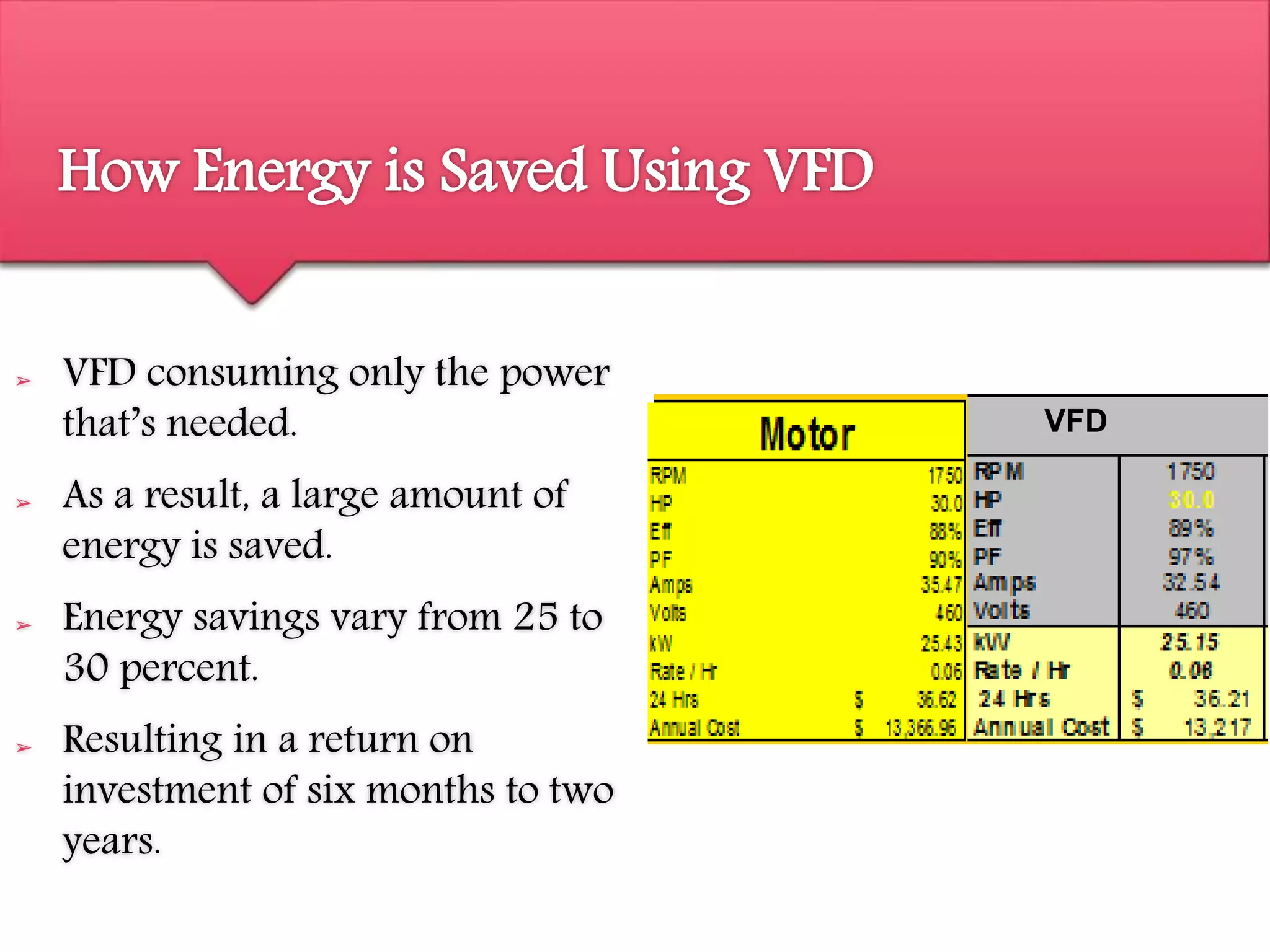
➢ VFD consuming only the power
that’s needed.
➢ As a result, a large amount of
energy is saved.
➢ Energy savings vary from 25 to
30 percent.
➢ Resulting in a return on
investment of six months to two
years.
VFD
ADVANTAGES
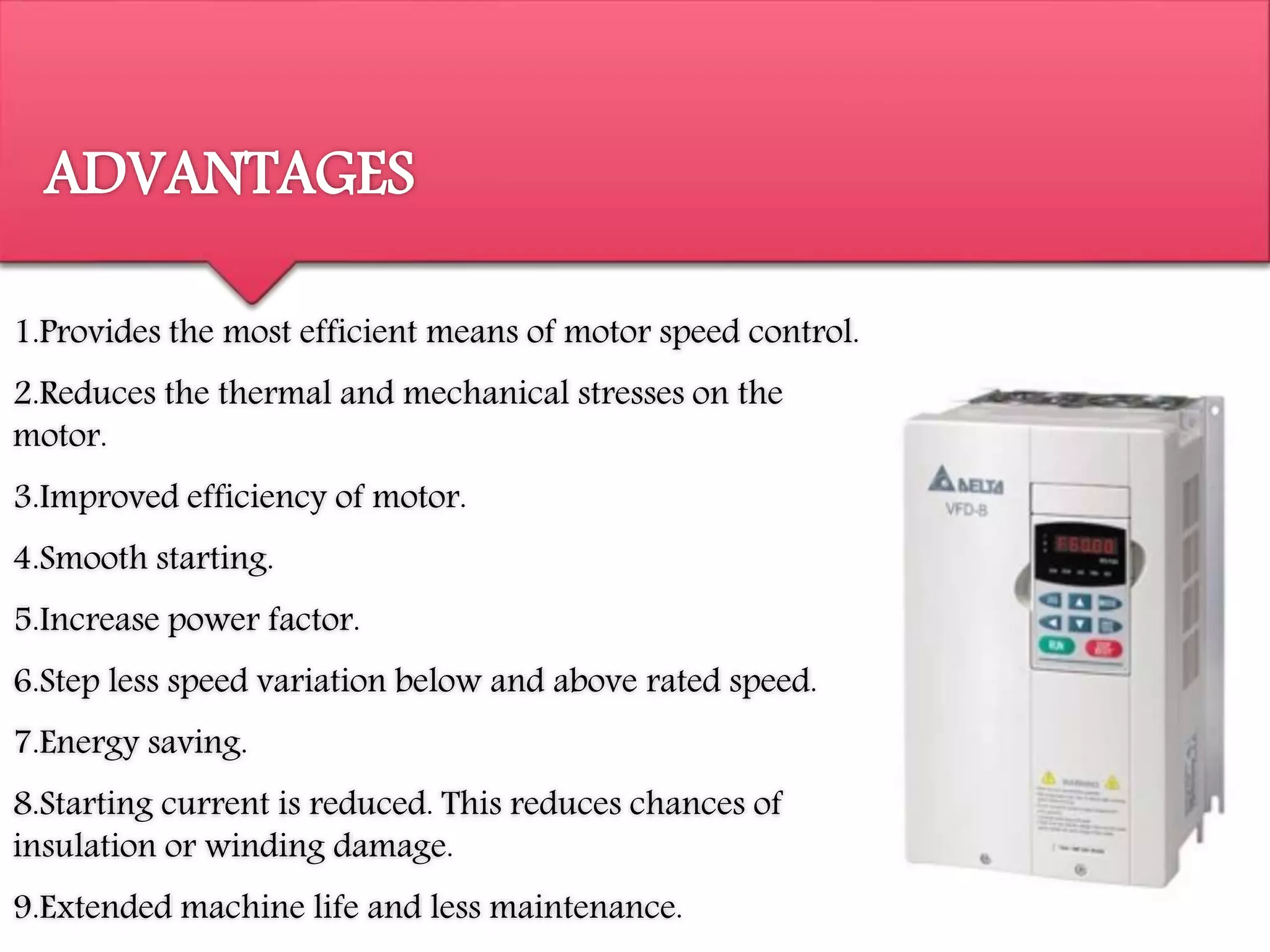
1.Provides the most efficient means of motor speed control.
2.Reduces the thermal and mechanical stresses on the
motor.
3.Improved efficiency of motor.
4.Smooth starting.
5.Increase power factor.
6.Step less speed variation below and above rated speed.
7.Energy saving.
8.Starting current is reduced. This reduces chances of
insulation or winding damage.
9.Extended machine life and less maintenance.
DRAWBACKS
➢ Initial cost of installing VFDs can be expensive
➢ VFDs can produce harmonic distortion
➢ Special shielded cable is used
➢ Separate arrangement is required for VFD
APPLICATION OF VFD
1. They are mostly used in industries for large induction motor
whose power rating from few kW to few MW.
2. They are also used in modern lifts, pumping system.
3. Nowadays they are being also used in energy efficient
refrigerators, AC’s .
4. Variable frequency drive is used in traction system. In India it is
being used by Delhi Metro Rail Corporation.
CONCLUSION
 VFDs provide the most energy efficient means of capacity control.
 VFDs have the lowest starting current of any starter type.
 VFDs reduce thermal and mechanical stresses on motors and belts.
 VFD installation is as simple as connecting the power supply to the VFD.
 VFDs provide high power factor.
 VFDs provide lower KVA.
THANK YOU

variable frequency drive

  • 1.
    SPEED CONTROL OFAC MOTORS BY FREQUENCY CONTROL METHOD USING VARIABLE FREQUENCY DRIVE SPEED CONTROL OF AC MOTORS USING VARIABLE FREQUENCY DRIVE Government polytechnic, Nagpur Presented by, RUSHIKESH ARUN PORATE ELECTRICAL ENGG. (3RD YEAR) GUIDE BY :-H.N.KHARKAR SIR
  • 2.
    CONTENTS  INTRODUCTION  FREQUENCYCONTROL  WHAT IS VFD ?  MAIN COMPONENTS OF VFD  SCHEMATIC DIAGRAM OF VFD  PURPOSE VFD  HOW ENERGY IS SAVE USING VFD  ADVANTAGES  DRAWBACKS  APPLICATIONS
  • 3.
    INTRODUCTION • A VariableFrequency Drive (VFD) controls the speed of a motor, specifically a three phase motor. To better understand a VFD, let's examine the motors they control. • Most commercial HVAC systems require powerful motors, and often operate on a three phase power (The standard method for electric power distribution systems because of its efficiency). • A three phase motor is cheaper to operate than single phase motors because it uses less current (less current often results in reduced wire size and cost), especially where large motor requirements are necessary. • A VFD eliminates high in-rush current - When a standard motor is turned on, it draws a very high amount of current for a very short duration of time. • A Variable Frequency Drive is designed to slowly start, therefore preventing inrush current; reducing the stress on the components of the motor; thus extending the motor life. • A VFD controls the speed of a three phase AC motor, while resulting in energy savings! It saves energy because the motor does not require as much current at lower speeds. The solution is a Variable Frequency Drive (VFD).
  • 4.
    HOW SPEED OFINDUCTION MOTOR IS CONTROL BY FREQUENCY CONTROL METHOD ????  SYNCHRONOUS SPEED , NS = 120F/P rpm Therefore synchronous speed of motor & in turns operating speed of motor depends upon frequency but since E1 = 4.44FmNPhkpkd E1 V1  V1 = 4.44FmNPhkpkd m = 𝑉1 𝐹  1 4.44NPhkpkd   = 𝑽 𝑭 …………….(1)
  • 5.
     As seenin equation (1),  The speed control is achieved by changing frequency the supply voltage should also simultaneous changed.  This is because if the supply frequency is reduced keeping the applied voltage constant the flux is increase. If flux increase core loss will increase and reduced the efficiency. Hence need to vary voltage to keep flux constant.  If frequency is increase , flux will decrease and therefore reduce the developed torque.  Therefore it is important that frequency changing device should change frequency and voltage simultaneously as a direct ratio. Thus for speed control of induction motor by changing frequency method we require not only variable frequency source but also variable voltage source .
  • 6.
    What is aVFD?  A Variable Frequency Drive (VFD) is used to control the speed of the induction motor, through changing the input frequency and voltage.  It varies both the frequency and amps of the AC waveform being delivered to the motor saving money in electricity.
  • 7.
    Main Components ofVFD ➢ Rectifier ➢ DC Bus ➢ Inverter
  • 8.
  • 9.
    HOW SPEED ISCONTROLLED USING VFD? RECTIFIER ➢ The rectifier in a VFD is used to convert incoming A.C power into D.C. ➢ A one rectifier diode will allow power to pass through only when the voltage is positive. ➢ A second rectifier diode will allow power to pass through only when the voltage is negative
  • 10.
    DC BUS  TheDC bus contains capacitors and inductors, it accepts power from the rectifier and absorbs the ac ripple and delivers a smooth DC voltage.
  • 11.
    Inverter  The invertercontains IGBT that invert DC power into AC and deliver it to the motor.  The IGBT can switch on and off several thousand times per second and precisely control the power delivered to the motor.  The IGBT uses “pulse width modulation” technique (PWM) to simulate a voltage sine wave at the desired frequency to the motor.
  • 12.
  • 13.
  • 14.
    PURPOSE OF VARIABLEFREQUENCY DRIVES  To eliminate disadvantage of convention speed control method which is as following 1. Stator pole changing - Can vary speed in only steps such as 3000, 1500,1000 rpm etc. 2. Voltage control method -Additional autotransformer which increases size and power losses. -Less starting torque due to less applied voltage. 3. Rotor resistance method -power loss. -use For slip ring induction motor only
  • 15.
    How Energy isSaved Using VFD ➢ VFD consuming only the power that’s needed. ➢ As a result, a large amount of energy is saved. ➢ Energy savings vary from 25 to 30 percent. ➢ Resulting in a return on investment of six months to two years. VFD
  • 16.
    ADVANTAGES 1.Provides the mostefficient means of motor speed control. 2.Reduces the thermal and mechanical stresses on the motor. 3.Improved efficiency of motor. 4.Smooth starting. 5.Increase power factor. 6.Step less speed variation below and above rated speed. 7.Energy saving. 8.Starting current is reduced. This reduces chances of insulation or winding damage. 9.Extended machine life and less maintenance.
  • 17.
    DRAWBACKS ➢ Initial costof installing VFDs can be expensive ➢ VFDs can produce harmonic distortion ➢ Special shielded cable is used ➢ Separate arrangement is required for VFD
  • 18.
    APPLICATION OF VFD 1.They are mostly used in industries for large induction motor whose power rating from few kW to few MW. 2. They are also used in modern lifts, pumping system. 3. Nowadays they are being also used in energy efficient refrigerators, AC’s . 4. Variable frequency drive is used in traction system. In India it is being used by Delhi Metro Rail Corporation.
  • 19.
    CONCLUSION  VFDs providethe most energy efficient means of capacity control.  VFDs have the lowest starting current of any starter type.  VFDs reduce thermal and mechanical stresses on motors and belts.  VFD installation is as simple as connecting the power supply to the VFD.  VFDs provide high power factor.  VFDs provide lower KVA.
  • 20.