Copyright 2016 Innermetrix Incorporated • All rights reserved
Brooke Denton
November 11, 2016
This Innermetrix Values Index is a combination of the research of Dr. Eduard Spranger
and Gordon Allport into what drives and motivates an individual. The seven
dimensions of value discovered between these two researchers help understand the
reasons that drive an individual to utilize their talents in the unique way they do. This
Values Index will help you understand your motivators and drivers and how to
maximize your performance by achieving better alignment and passion for what you
do.
Anthony Robbins Coaching
www.tonyrobbins.com
The Values Index Introduction
BrookeDenton
Copyright 2016 Innermetrix Incorporated • All rights reserved 2
About This Report
Research conducted by Innermetrix shows that the most successful people share the common trait of
self-awareness. They recognize the situations that will make them successful, and this makes it easy
for them to find ways of achieving objectives that resonate with their motivations. They also understand
their limitations and where they are not effective and this helps them understand what does not inspire
them or what will not motivate them to succeed. Those who understand their natural motivators better
arefarmorelikelytopursuetherightopportunities,fortherightreasons,andgettheresultstheydesire.
This report measures seven dimensions of motivation. They are:
• Aesthetic - a drive for balance, harmony and form.
• Economic - a drive for economic or practical returns.
• Individualistic - a drive to stand out as independent and unique.
• Political - a drive to be in control or have influence.
• Altruist - a drive for humanitarian efforts or to help others altruistically.
• Regulatory - a drive to establish order, routine and structure.
• Theoretical - a drive for knowledge, learning and understanding.
The Values Index Seven Dimensions of Value and Motivation
BrookeDenton
Copyright 2016 Innermetrix Incorporated • All rights reserved 3
The Elements of the Values Index
This Values Index is unique in the marketplace in that it examines seven independent and unique
aspects of value or motivation. Most other values instruments only examine six dimensions of value
by combining the Individualistic and Political into one dimension. The Values Index remains true to
the original works and models of two of the most significant researchers in this field, thus delivering
to you a profile that truly helps you understand your own unique motivations and drivers.
Also, the Values Index is the first to use a click & drag approach to rank the various statements in the
instrument, which makes taking the instrument more intuitive, natural and in the end you can actually
create the order you see in your mind on the screen.
Finally, the Values Index instrument contains the most contemporary list of statements to make your
choices more relevant to your life today, which helps ensure the most accurate results possible.
The Values Index Seven Dimensions of Value and Motivation
BrookeDenton
Copyright 2016 Innermetrix Incorporated • All rights reserved 4
A closer look at the seven dimensions
Values help influence behavior and action and can be considered somewhat of a
hidden motivation because they are not readily observable. Understanding your
values helps to tell you why you prefer to do what you do.
It is vital for superior performance to ensure that your motivations are satisfied
by what you do. This drives your passion, reduces fatigue, inspires you and
increases drive.
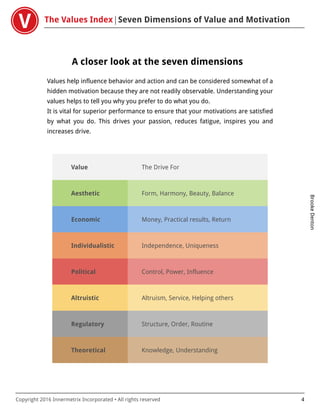
Value The Drive For
Aesthetic Form, Harmony, Beauty, Balance
Economic Money, Practical results, Return
Individualistic Independence, Uniqueness
Political Control, Power, Influence
Altruistic Altruism, Service, Helping others
Regulatory Structure, Order, Routine
Theoretical Knowledge, Understanding
The Values Index Seven Dimensions of Value and Motivation
BrookeDenton
Copyright 2016 Innermetrix Incorporated • All rights reserved 5
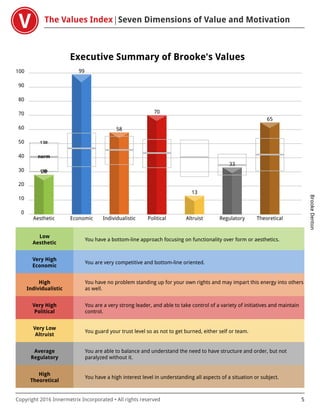
Executive Summary of Brooke's Values
0
10
20
30
40
50
60
70
80
90
100
Aesthetic Economic Individualistic Political Altruist Regulatory Theoretical
norm
1 SD
1 SD28
99
58
70
13
33
65
Low
Aesthetic
You have a bottom-line approach focusing on functionality over form or aesthetics.
Very High
Economic
You are very competitive and bottom-line oriented.
High
Individualistic
You have no problem standing up for your own rights and may impart this energy into others
as well.
Very High
Political
You are a very strong leader, and able to take control of a variety of initiatives and maintain
control.
Very Low
Altruist
You guard your trust level so as not to get burned, either self or team.
Average
Regulatory
You are able to balance and understand the need to have structure and order, but not
paralyzed without it.
High
Theoretical
You have a high interest level in understanding all aspects of a situation or subject.
The Values Index Seven Dimensions of Value and Motivation
BrookeDenton
Copyright 2016 Innermetrix Incorporated • All rights reserved 6
The Values Index Your Aesthetic Drive
BrookeDenton
Copyright 2016 Innermetrix Incorporated • All rights reserved 7
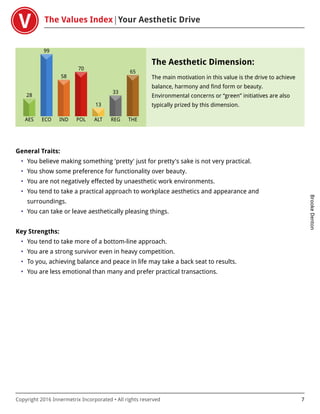
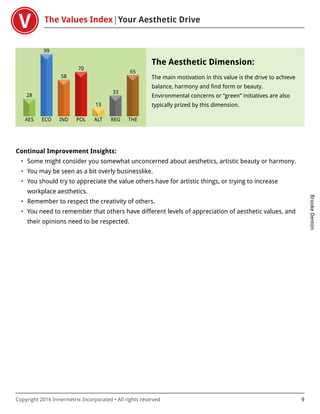
AES
28
ECO
99
IND
58
POL
70
ALT
13
REG
33
THE
65
The Aesthetic Dimension:
The main motivation in this value is the drive to achieve
balance, harmony and find form or beauty.
Environmental concerns or “green” initiatives are also
typically prized by this dimension.
General Traits:
• You believe making something 'pretty' just for pretty's sake is not very practical.
• You show some preference for functionality over beauty.
• You are not negatively effected by unaesthetic work environments.
• You tend to take a practical approach to workplace aesthetics and appearance and
surroundings.
• You can take or leave aesthetically pleasing things.
Key Strengths:
• You tend to take more of a bottom-line approach.
• You are a strong survivor even in heavy competition.
• To you, achieving balance and peace in life may take a back seat to results.
• You are less emotional than many and prefer practical transactions.
The Values Index Your Aesthetic Drive
BrookeDenton
Copyright 2016 Innermetrix Incorporated • All rights reserved 8
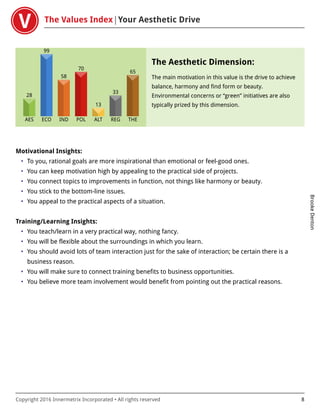
AES
28
ECO
99
IND
58
POL
70
ALT
13
REG
33
THE
65
The Aesthetic Dimension:
The main motivation in this value is the drive to achieve
balance, harmony and find form or beauty.
Environmental concerns or “green” initiatives are also
typically prized by this dimension.
Motivational Insights:
• To you, rational goals are more inspirational than emotional or feel-good ones.
• You can keep motivation high by appealing to the practical side of projects.
• You connect topics to improvements in function, not things like harmony or beauty.
• You stick to the bottom-line issues.
• You appeal to the practical aspects of a situation.
Training/Learning Insights:
• You teach/learn in a very practical way, nothing fancy.
• You will be flexible about the surroundings in which you learn.
• You should avoid lots of team interaction just for the sake of interaction; be certain there is a
business reason.
• You will make sure to connect training benefits to business opportunities.
• You believe more team involvement would benefit from pointing out the practical reasons.
The Values Index Your Aesthetic Drive
BrookeDenton
Copyright 2016 Innermetrix Incorporated • All rights reserved 9
AES
28
ECO
99
IND
58
POL
70
ALT
13
REG
33
THE
65
The Aesthetic Dimension:
The main motivation in this value is the drive to achieve
balance, harmony and find form or beauty.
Environmental concerns or “green” initiatives are also
typically prized by this dimension.
Continual Improvement Insights:
• Some might consider you somewhat unconcerned about aesthetics, artistic beauty or harmony.
• You may be seen as a bit overly businesslike.
• You should try to appreciate the value others have for artistic things, or trying to increase
workplace aesthetics.
• Remember to respect the creativity of others.
• You need to remember that others have different levels of appreciation of aesthetic values, and
their opinions need to be respected.
The Values Index Your Economic Drive
BrookeDenton
Copyright 2016 Innermetrix Incorporated • All rights reserved 10
AES
28
ECO
99
IND
58
POL
70
ALT
13
REG
33
THE
65
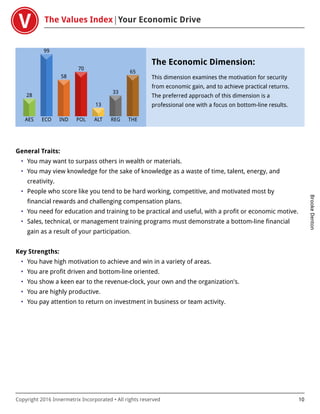
The Economic Dimension:
This dimension examines the motivation for security
from economic gain, and to achieve practical returns.
The preferred approach of this dimension is a
professional one with a focus on bottom-line results.
General Traits:
• You may want to surpass others in wealth or materials.
• You may view knowledge for the sake of knowledge as a waste of time, talent, energy, and
creativity.
• People who score like you tend to be hard working, competitive, and motivated most by
financial rewards and challenging compensation plans.
• You need for education and training to be practical and useful, with a profit or economic motive.
• Sales, technical, or management training programs must demonstrate a bottom-line financial
gain as a result of your participation.
Key Strengths:
• You have high motivation to achieve and win in a variety of areas.
• You are profit driven and bottom-line oriented.
• You show a keen ear to the revenue-clock, your own and the organization's.
• You are highly productive.
• You pay attention to return on investment in business or team activity.
The Values Index Your Economic Drive
BrookeDenton
Copyright 2016 Innermetrix Incorporated • All rights reserved 11
AES
28
ECO
99
IND
58
POL
70
ALT
13
REG
33
THE
65
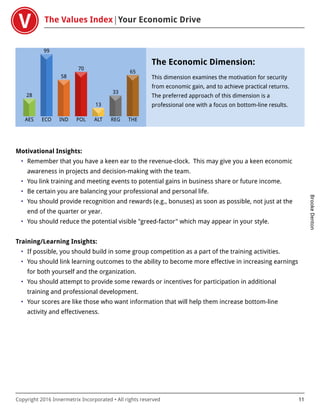
The Economic Dimension:
This dimension examines the motivation for security
from economic gain, and to achieve practical returns.
The preferred approach of this dimension is a
professional one with a focus on bottom-line results.
Motivational Insights:
• Remember that you have a keen ear to the revenue-clock. This may give you a keen economic
awareness in projects and decision-making with the team.
• You link training and meeting events to potential gains in business share or future income.
• Be certain you are balancing your professional and personal life.
• You should provide recognition and rewards (e.g., bonuses) as soon as possible, not just at the
end of the quarter or year.
• You should reduce the potential visible "greed-factor" which may appear in your style.
Training/Learning Insights:
• If possible, you should build in some group competition as a part of the training activities.
• You should link learning outcomes to the ability to become more effective in increasing earnings
for both yourself and the organization.
• You should attempt to provide some rewards or incentives for participation in additional
training and professional development.
• Your scores are like those who want information that will help them increase bottom-line
activity and effectiveness.
The Values Index Your Economic Drive
BrookeDenton
Copyright 2016 Innermetrix Incorporated • All rights reserved 12
AES
28
ECO
99
IND
58
POL
70
ALT
13
REG
33
THE
65
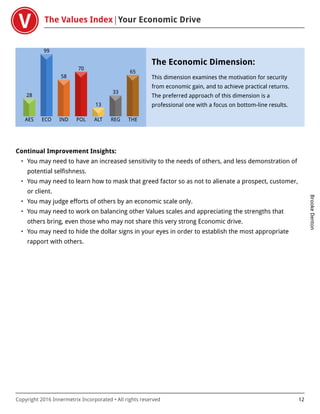
The Economic Dimension:
This dimension examines the motivation for security
from economic gain, and to achieve practical returns.
The preferred approach of this dimension is a
professional one with a focus on bottom-line results.
Continual Improvement Insights:
• You may need to have an increased sensitivity to the needs of others, and less demonstration of
potential selfishness.
• You may need to learn how to mask that greed factor so as not to alienate a prospect, customer,
or client.
• You may judge efforts of others by an economic scale only.
• You may need to work on balancing other Values scales and appreciating the strengths that
others bring, even those who may not share this very strong Economic drive.
• You may need to hide the dollar signs in your eyes in order to establish the most appropriate
rapport with others.
The Values Index Your Individualistic Drive
BrookeDenton
Copyright 2016 Innermetrix Incorporated • All rights reserved 13
AES
28
ECO
99
IND
58
POL
70
ALT
13
REG
33
THE
65
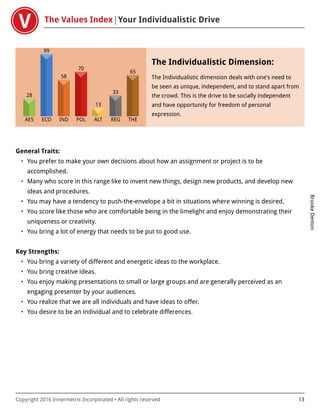
The Individualistic Dimension:
The Individualistic dimension deals with one's need to
be seen as unique, independent, and to stand apart from
the crowd. This is the drive to be socially independent
and have opportunity for freedom of personal
expression.
General Traits:
• You prefer to make your own decisions about how an assignment or project is to be
accomplished.
• Many who score in this range like to invent new things, design new products, and develop new
ideas and procedures.
• You may have a tendency to push-the-envelope a bit in situations where winning is desired.
• You score like those who are comfortable being in the limelight and enjoy demonstrating their
uniqueness or creativity.
• You bring a lot of energy that needs to be put to good use.
Key Strengths:
• You bring a variety of different and energetic ideas to the workplace.
• You bring creative ideas.
• You enjoy making presentations to small or large groups and are generally perceived as an
engaging presenter by your audiences.
• You realize that we are all individuals and have ideas to offer.
• You desire to be an individual and to celebrate differences.
The Values Index Your Individualistic Drive
BrookeDenton
Copyright 2016 Innermetrix Incorporated • All rights reserved 14
AES
28
ECO
99
IND
58
POL
70
ALT
13
REG
33
THE
65
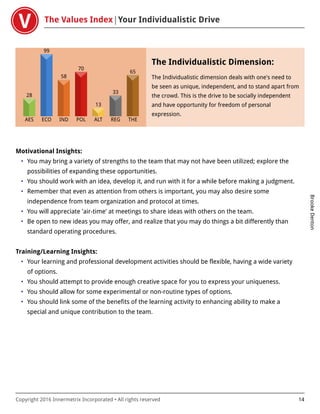
The Individualistic Dimension:
The Individualistic dimension deals with one's need to
be seen as unique, independent, and to stand apart from
the crowd. This is the drive to be socially independent
and have opportunity for freedom of personal
expression.
Motivational Insights:
• You may bring a variety of strengths to the team that may not have been utilized; explore the
possibilities of expanding these opportunities.
• You should work with an idea, develop it, and run with it for a while before making a judgment.
• Remember that even as attention from others is important, you may also desire some
independence from team organization and protocol at times.
• You will appreciate 'air-time' at meetings to share ideas with others on the team.
• Be open to new ideas you may offer, and realize that you may do things a bit differently than
standard operating procedures.
Training/Learning Insights:
• Your learning and professional development activities should be flexible, having a wide variety
of options.
• You should attempt to provide enough creative space for you to express your uniqueness.
• You should allow for some experimental or non-routine types of options.
• You should link some of the benefits of the learning activity to enhancing ability to make a
special and unique contribution to the team.
The Values Index Your Individualistic Drive
BrookeDenton
Copyright 2016 Innermetrix Incorporated • All rights reserved 15
AES
28
ECO
99
IND
58
POL
70
ALT
13
REG
33
THE
65
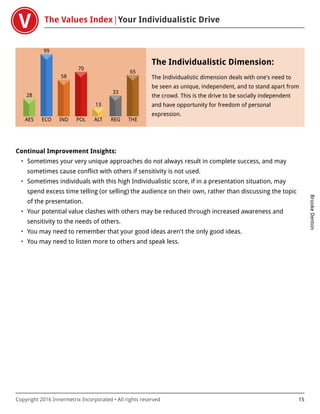
The Individualistic Dimension:
The Individualistic dimension deals with one's need to
be seen as unique, independent, and to stand apart from
the crowd. This is the drive to be socially independent
and have opportunity for freedom of personal
expression.
Continual Improvement Insights:
• Sometimes your very unique approaches do not always result in complete success, and may
sometimes cause conflict with others if sensitivity is not used.
• Sometimes individuals with this high Individualistic score, if in a presentation situation, may
spend excess time telling (or selling) the audience on their own, rather than discussing the topic
of the presentation.
• Your potential value clashes with others may be reduced through increased awareness and
sensitivity to the needs of others.
• You may need to remember that your good ideas aren't the only good ideas.
• You may need to listen more to others and speak less.
The Values Index Your Political Drive
BrookeDenton
Copyright 2016 Innermetrix Incorporated • All rights reserved 16
AES
28
ECO
99
IND
58
POL
70
ALT
13
REG
33
THE
65
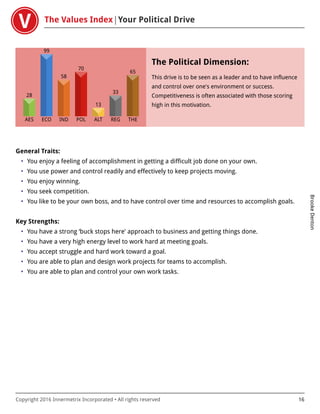
The Political Dimension:
This drive is to be seen as a leader and to have influence
and control over one's environment or success.
Competitiveness is often associated with those scoring
high in this motivation.
General Traits:
• You enjoy a feeling of accomplishment in getting a difficult job done on your own.
• You use power and control readily and effectively to keep projects moving.
• You enjoy winning.
• You seek competition.
• You like to be your own boss, and to have control over time and resources to accomplish goals.
Key Strengths:
• You have a strong ‘buck stops here' approach to business and getting things done.
• You have a very high energy level to work hard at meeting goals.
• You accept struggle and hard work toward a goal.
• You are able to plan and design work projects for teams to accomplish.
• You are able to plan and control your own work tasks.
The Values Index Your Political Drive
BrookeDenton
Copyright 2016 Innermetrix Incorporated • All rights reserved 17
AES
28
ECO
99
IND
58
POL
70
ALT
13
REG
33
THE
65
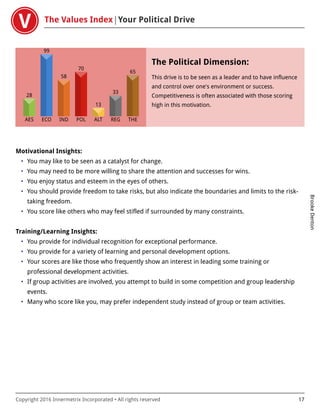
The Political Dimension:
This drive is to be seen as a leader and to have influence
and control over one's environment or success.
Competitiveness is often associated with those scoring
high in this motivation.
Motivational Insights:
• You may like to be seen as a catalyst for change.
• You may need to be more willing to share the attention and successes for wins.
• You enjoy status and esteem in the eyes of others.
• You should provide freedom to take risks, but also indicate the boundaries and limits to the risk-
taking freedom.
• You score like others who may feel stifled if surrounded by many constraints.
Training/Learning Insights:
• You provide for individual recognition for exceptional performance.
• You provide for a variety of learning and personal development options.
• Your scores are like those who frequently show an interest in leading some training or
professional development activities.
• If group activities are involved, you attempt to build in some competition and group leadership
events.
• Many who score like you, may prefer independent study instead of group or team activities.
The Values Index Your Political Drive
BrookeDenton
Copyright 2016 Innermetrix Incorporated • All rights reserved 18
AES
28
ECO
99
IND
58
POL
70
ALT
13
REG
33
THE
65
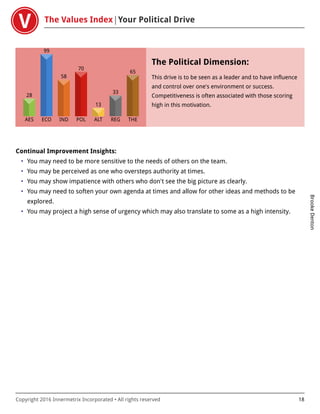
The Political Dimension:
This drive is to be seen as a leader and to have influence
and control over one's environment or success.
Competitiveness is often associated with those scoring
high in this motivation.
Continual Improvement Insights:
• You may need to be more sensitive to the needs of others on the team.
• You may be perceived as one who oversteps authority at times.
• You may show impatience with others who don't see the big picture as clearly.
• You may need to soften your own agenda at times and allow for other ideas and methods to be
explored.
• You may project a high sense of urgency which may also translate to some as a high intensity.
The Values Index Your Altruist Drive
BrookeDenton
Copyright 2016 Innermetrix Incorporated • All rights reserved 19
AES
28
ECO
99
IND
58
POL
70
ALT
13
REG
33
THE
65
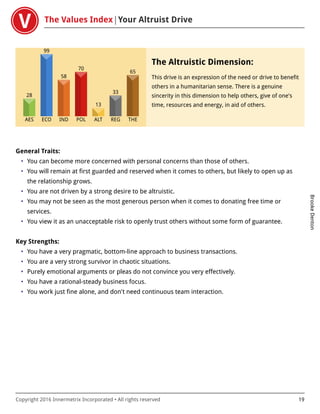
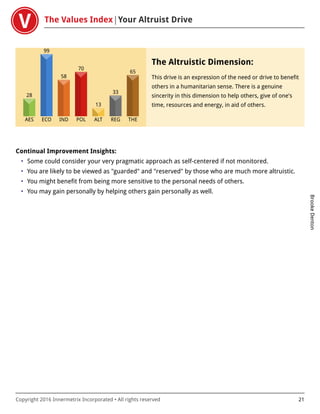
The Altruistic Dimension:
This drive is an expression of the need or drive to benefit
others in a humanitarian sense. There is a genuine
sincerity in this dimension to help others, give of one's
time, resources and energy, in aid of others.
General Traits:
• You can become more concerned with personal concerns than those of others.
• You will remain at first guarded and reserved when it comes to others, but likely to open up as
the relationship grows.
• You are not driven by a strong desire to be altruistic.
• You may not be seen as the most generous person when it comes to donating free time or
services.
• You view it as an unacceptable risk to openly trust others without some form of guarantee.
Key Strengths:
• You have a very pragmatic, bottom-line approach to business transactions.
• You are a very strong survivor in chaotic situations.
• Purely emotional arguments or pleas do not convince you very effectively.
• You have a rational-steady business focus.
• You work just fine alone, and don't need continuous team interaction.
The Values Index Your Altruist Drive
BrookeDenton
Copyright 2016 Innermetrix Incorporated • All rights reserved 20
AES
28
ECO
99
IND
58
POL
70
ALT
13
REG
33
THE
65
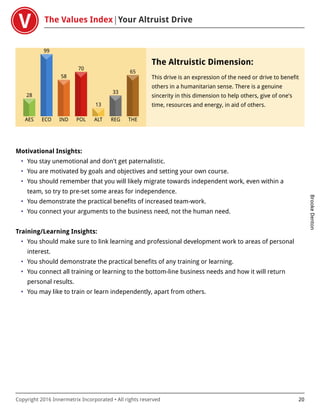
The Altruistic Dimension:
This drive is an expression of the need or drive to benefit
others in a humanitarian sense. There is a genuine
sincerity in this dimension to help others, give of one's
time, resources and energy, in aid of others.
Motivational Insights:
• You stay unemotional and don't get paternalistic.
• You are motivated by goals and objectives and setting your own course.
• You should remember that you will likely migrate towards independent work, even within a
team, so try to pre-set some areas for independence.
• You demonstrate the practical benefits of increased team-work.
• You connect your arguments to the business need, not the human need.
Training/Learning Insights:
• You should make sure to link learning and professional development work to areas of personal
interest.
• You should demonstrate the practical benefits of any training or learning.
• You connect all training or learning to the bottom-line business needs and how it will return
personal results.
• You may like to train or learn independently, apart from others.
The Values Index Your Altruist Drive
BrookeDenton
Copyright 2016 Innermetrix Incorporated • All rights reserved 21
AES
28
ECO
99
IND
58
POL
70
ALT
13
REG
33
THE
65
The Altruistic Dimension:
This drive is an expression of the need or drive to benefit
others in a humanitarian sense. There is a genuine
sincerity in this dimension to help others, give of one's
time, resources and energy, in aid of others.
Continual Improvement Insights:
• Some could consider your very pragmatic approach as self-centered if not monitored.
• You are likely to be viewed as "guarded" and "reserved" by those who are much more altruistic.
• You might benefit from being more sensitive to the personal needs of others.
• You may gain personally by helping others gain personally as well.
The Values Index Your Regulatory Drive
BrookeDenton
Copyright 2016 Innermetrix Incorporated • All rights reserved 22
AES
28
ECO
99
IND
58
POL
70
ALT
13
REG
33
THE
65
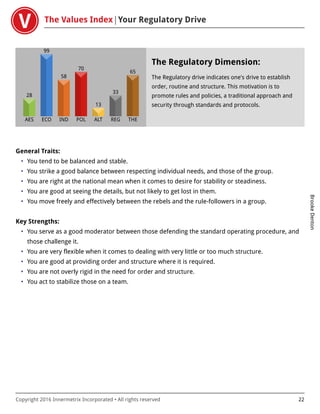
The Regulatory Dimension:
The Regulatory drive indicates one's drive to establish
order, routine and structure. This motivation is to
promote rules and policies, a traditional approach and
security through standards and protocols.
General Traits:
• You tend to be balanced and stable.
• You strike a good balance between respecting individual needs, and those of the group.
• You are right at the national mean when it comes to desire for stability or steadiness.
• You are good at seeing the details, but not likely to get lost in them.
• You move freely and effectively between the rebels and the rule-followers in a group.
Key Strengths:
• You serve as a good moderator between those defending the standard operating procedure, and
those challenge it.
• You are very flexible when it comes to dealing with very little or too much structure.
• You are good at providing order and structure where it is required.
• You are not overly rigid in the need for order and structure.
• You act to stabilize those on a team.
The Values Index Your Regulatory Drive
BrookeDenton
Copyright 2016 Innermetrix Incorporated • All rights reserved 23
AES
28
ECO
99
IND
58
POL
70
ALT
13
REG
33
THE
65
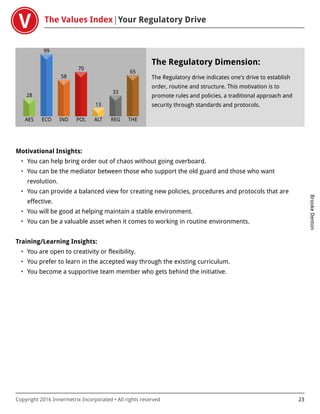
The Regulatory Dimension:
The Regulatory drive indicates one's drive to establish
order, routine and structure. This motivation is to
promote rules and policies, a traditional approach and
security through standards and protocols.
Motivational Insights:
• You can help bring order out of chaos without going overboard.
• You can be the mediator between those who support the old guard and those who want
revolution.
• You can provide a balanced view for creating new policies, procedures and protocols that are
effective.
• You will be good at helping maintain a stable environment.
• You can be a valuable asset when it comes to working in routine environments.
Training/Learning Insights:
• You are open to creativity or flexibility.
• You prefer to learn in the accepted way through the existing curriculum.
• You become a supportive team member who gets behind the initiative.
The Values Index Your Regulatory Drive
BrookeDenton
Copyright 2016 Innermetrix Incorporated • All rights reserved 24
AES
28
ECO
99
IND
58
POL
70
ALT
13
REG
33
THE
65
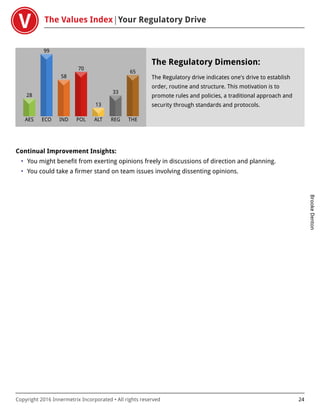
The Regulatory Dimension:
The Regulatory drive indicates one's drive to establish
order, routine and structure. This motivation is to
promote rules and policies, a traditional approach and
security through standards and protocols.
Continual Improvement Insights:
• You might benefit from exerting opinions freely in discussions of direction and planning.
• You could take a firmer stand on team issues involving dissenting opinions.
The Values Index Your Theoretical Drive
BrookeDenton
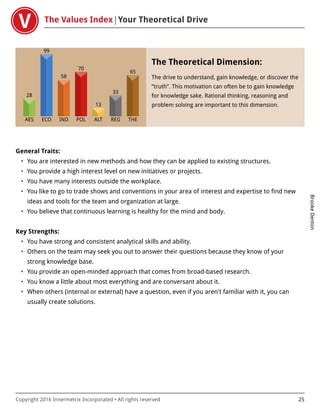
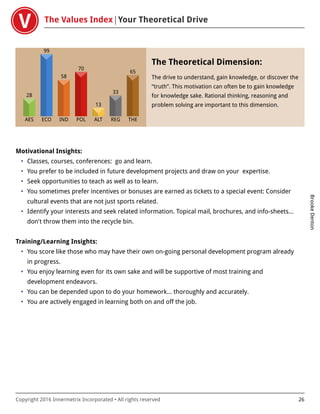
Copyright 2016 Innermetrix Incorporated • All rights reserved 25
AES
28
ECO
99
IND
58
POL
70
ALT
13
REG
33
THE
65
The Theoretical Dimension:
The drive to understand, gain knowledge, or discover the
“truth”. This motivation can often be to gain knowledge
for knowledge sake. Rational thinking, reasoning and
problem solving are important to this dimension.
General Traits:
• You are interested in new methods and how they can be applied to existing structures.
• You provide a high interest level on new initiatives or projects.
• You have many interests outside the workplace.
• You like to go to trade shows and conventions in your area of interest and expertise to find new
ideas and tools for the team and organization at large.
• You believe that continuous learning is healthy for the mind and body.
Key Strengths:
• You have strong and consistent analytical skills and ability.
• Others on the team may seek you out to answer their questions because they know of your
strong knowledge base.
• You provide an open-minded approach that comes from broad-based research.
• You know a little about most everything and are conversant about it.
• When others (internal or external) have a question, even if you aren't familiar with it, you can
usually create solutions.
The Values Index Your Theoretical Drive
BrookeDenton
Copyright 2016 Innermetrix Incorporated • All rights reserved 26
AES
28
ECO
99
IND
58
POL
70
ALT
13
REG
33
THE
65
The Theoretical Dimension:
The drive to understand, gain knowledge, or discover the
“truth”. This motivation can often be to gain knowledge
for knowledge sake. Rational thinking, reasoning and
problem solving are important to this dimension.
Motivational Insights:
• Classes, courses, conferences: go and learn.
• You prefer to be included in future development projects and draw on your expertise.
• Seek opportunities to teach as well as to learn.
• You sometimes prefer incentives or bonuses are earned as tickets to a special event: Consider
cultural events that are not just sports related.
• Identify your interests and seek related information. Topical mail, brochures, and info-sheets…
don't throw them into the recycle bin.
Training/Learning Insights:
• You score like those who may have their own on-going personal development program already
in progress.
• You enjoy learning even for its own sake and will be supportive of most training and
development endeavors.
• You can be depended upon to do your homework… thoroughly and accurately.
• You are actively engaged in learning both on and off the job.
The Values Index Your Theoretical Drive
BrookeDenton
Copyright 2016 Innermetrix Incorporated • All rights reserved 27
AES
28
ECO
99
IND
58
POL
70
ALT
13
REG
33
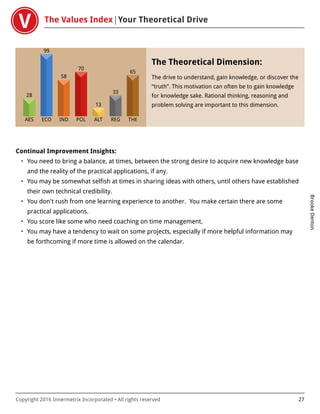
THE
65
The Theoretical Dimension:
The drive to understand, gain knowledge, or discover the
“truth”. This motivation can often be to gain knowledge
for knowledge sake. Rational thinking, reasoning and
problem solving are important to this dimension.
Continual Improvement Insights:
• You need to bring a balance, at times, between the strong desire to acquire new knowledge base
and the reality of the practical applications, if any.
• You may be somewhat selfish at times in sharing ideas with others, until others have established
their own technical credibility.
• You don't rush from one learning experience to another. You make certain there are some
practical applications.
• You score like some who need coaching on time management.
• You may have a tendency to wait on some projects, especially if more helpful information may
be forthcoming if more time is allowed on the calendar.
The Values Index Relevance Section
BrookeDenton
Copyright 2016 Innermetrix Incorporated • All rights reserved 28
Use this sheet to help you track which motivators are well aligned and which are not and what you can
do about it.
Action Step: Looking at your Values Index report, find which motivators are the most powerful for you
(i.e., which ones are highest and farthest above the norm). Write down the top two in the space below,
and record how well your current roles align with these motivators (i.e., how well what you do satisfies
what you are passionate about).
To reach Genius levels of passion, you must increase alignment of your environment with your passions.
Motivator #1: What aspects of your company or role can you get involved in that would satisfy this
motivator?
___________________________________________________________________________________________________________
___________________________________________________________________________________________________________
Motivator #2: What aspects of your company or role can you get involved in that would satisfy this
motivator?
___________________________________________________________________________________________________________
___________________________________________________________________________________________________________
Alignment
Poorly Highly
Motivator #1: ______________________ 1 2 3 4 5
Motivator #2: ______________________ 1 2 3 4 5
Legend:
• 2-4 = Poor • 8-9 = Excellent
• 4-5 = Below Average • 10 = Genius
• 6-7 = Average
Tally your score here:
The Values Index Success Connection
BrookeDenton
Copyright 2016 Innermetrix Incorporated • All rights reserved 29
Your final step to making sure you really benefit from the information in this report is to understand
how your values style contributes to, and perhaps hinders, your overall success.
Supporting Success: Overall, how well do your motivators and drivers help support your success? (cite
specific examples):
___________________________________________________________________________________________________________
___________________________________________________________________________________________________________
___________________________________________________________________________________________________________
___________________________________________________________________________________________________________
___________________________________________________________________________________________________________
___________________________________________________________________________________________________________
___________________________________________________________________________________________________________
___________________________________________________________________________________________________________
___________________________________________________________________________________________________________
Limiting Success: Overall, how do your natural drivers or motivators not support your success? (cite
specific examples):
___________________________________________________________________________________________________________
___________________________________________________________________________________________________________
___________________________________________________________________________________________________________
___________________________________________________________________________________________________________
___________________________________________________________________________________________________________
___________________________________________________________________________________________________________
___________________________________________________________________________________________________________
___________________________________________________________________________________________________________

VALUES-Brooke_Denton

  • 1.
    Copyright 2016 InnermetrixIncorporated • All rights reserved Brooke Denton November 11, 2016 This Innermetrix Values Index is a combination of the research of Dr. Eduard Spranger and Gordon Allport into what drives and motivates an individual. The seven dimensions of value discovered between these two researchers help understand the reasons that drive an individual to utilize their talents in the unique way they do. This Values Index will help you understand your motivators and drivers and how to maximize your performance by achieving better alignment and passion for what you do. Anthony Robbins Coaching www.tonyrobbins.com
  • 2.
    The Values IndexIntroduction BrookeDenton Copyright 2016 Innermetrix Incorporated • All rights reserved 2 About This Report Research conducted by Innermetrix shows that the most successful people share the common trait of self-awareness. They recognize the situations that will make them successful, and this makes it easy for them to find ways of achieving objectives that resonate with their motivations. They also understand their limitations and where they are not effective and this helps them understand what does not inspire them or what will not motivate them to succeed. Those who understand their natural motivators better arefarmorelikelytopursuetherightopportunities,fortherightreasons,andgettheresultstheydesire. This report measures seven dimensions of motivation. They are: • Aesthetic - a drive for balance, harmony and form. • Economic - a drive for economic or practical returns. • Individualistic - a drive to stand out as independent and unique. • Political - a drive to be in control or have influence. • Altruist - a drive for humanitarian efforts or to help others altruistically. • Regulatory - a drive to establish order, routine and structure. • Theoretical - a drive for knowledge, learning and understanding.
  • 3.
    The Values IndexSeven Dimensions of Value and Motivation BrookeDenton Copyright 2016 Innermetrix Incorporated • All rights reserved 3 The Elements of the Values Index This Values Index is unique in the marketplace in that it examines seven independent and unique aspects of value or motivation. Most other values instruments only examine six dimensions of value by combining the Individualistic and Political into one dimension. The Values Index remains true to the original works and models of two of the most significant researchers in this field, thus delivering to you a profile that truly helps you understand your own unique motivations and drivers. Also, the Values Index is the first to use a click & drag approach to rank the various statements in the instrument, which makes taking the instrument more intuitive, natural and in the end you can actually create the order you see in your mind on the screen. Finally, the Values Index instrument contains the most contemporary list of statements to make your choices more relevant to your life today, which helps ensure the most accurate results possible.
  • 4.
    The Values IndexSeven Dimensions of Value and Motivation BrookeDenton Copyright 2016 Innermetrix Incorporated • All rights reserved 4 A closer look at the seven dimensions Values help influence behavior and action and can be considered somewhat of a hidden motivation because they are not readily observable. Understanding your values helps to tell you why you prefer to do what you do. It is vital for superior performance to ensure that your motivations are satisfied by what you do. This drives your passion, reduces fatigue, inspires you and increases drive. Value The Drive For Aesthetic Form, Harmony, Beauty, Balance Economic Money, Practical results, Return Individualistic Independence, Uniqueness Political Control, Power, Influence Altruistic Altruism, Service, Helping others Regulatory Structure, Order, Routine Theoretical Knowledge, Understanding
  • 5.
    The Values IndexSeven Dimensions of Value and Motivation BrookeDenton Copyright 2016 Innermetrix Incorporated • All rights reserved 5 Executive Summary of Brooke's Values 0 10 20 30 40 50 60 70 80 90 100 Aesthetic Economic Individualistic Political Altruist Regulatory Theoretical norm 1 SD 1 SD28 99 58 70 13 33 65 Low Aesthetic You have a bottom-line approach focusing on functionality over form or aesthetics. Very High Economic You are very competitive and bottom-line oriented. High Individualistic You have no problem standing up for your own rights and may impart this energy into others as well. Very High Political You are a very strong leader, and able to take control of a variety of initiatives and maintain control. Very Low Altruist You guard your trust level so as not to get burned, either self or team. Average Regulatory You are able to balance and understand the need to have structure and order, but not paralyzed without it. High Theoretical You have a high interest level in understanding all aspects of a situation or subject.
  • 6.
    The Values IndexSeven Dimensions of Value and Motivation BrookeDenton Copyright 2016 Innermetrix Incorporated • All rights reserved 6
  • 7.
    The Values IndexYour Aesthetic Drive BrookeDenton Copyright 2016 Innermetrix Incorporated • All rights reserved 7 AES 28 ECO 99 IND 58 POL 70 ALT 13 REG 33 THE 65 The Aesthetic Dimension: The main motivation in this value is the drive to achieve balance, harmony and find form or beauty. Environmental concerns or “green” initiatives are also typically prized by this dimension. General Traits: • You believe making something 'pretty' just for pretty's sake is not very practical. • You show some preference for functionality over beauty. • You are not negatively effected by unaesthetic work environments. • You tend to take a practical approach to workplace aesthetics and appearance and surroundings. • You can take or leave aesthetically pleasing things. Key Strengths: • You tend to take more of a bottom-line approach. • You are a strong survivor even in heavy competition. • To you, achieving balance and peace in life may take a back seat to results. • You are less emotional than many and prefer practical transactions.
  • 8.
    The Values IndexYour Aesthetic Drive BrookeDenton Copyright 2016 Innermetrix Incorporated • All rights reserved 8 AES 28 ECO 99 IND 58 POL 70 ALT 13 REG 33 THE 65 The Aesthetic Dimension: The main motivation in this value is the drive to achieve balance, harmony and find form or beauty. Environmental concerns or “green” initiatives are also typically prized by this dimension. Motivational Insights: • To you, rational goals are more inspirational than emotional or feel-good ones. • You can keep motivation high by appealing to the practical side of projects. • You connect topics to improvements in function, not things like harmony or beauty. • You stick to the bottom-line issues. • You appeal to the practical aspects of a situation. Training/Learning Insights: • You teach/learn in a very practical way, nothing fancy. • You will be flexible about the surroundings in which you learn. • You should avoid lots of team interaction just for the sake of interaction; be certain there is a business reason. • You will make sure to connect training benefits to business opportunities. • You believe more team involvement would benefit from pointing out the practical reasons.
  • 9.
    The Values IndexYour Aesthetic Drive BrookeDenton Copyright 2016 Innermetrix Incorporated • All rights reserved 9 AES 28 ECO 99 IND 58 POL 70 ALT 13 REG 33 THE 65 The Aesthetic Dimension: The main motivation in this value is the drive to achieve balance, harmony and find form or beauty. Environmental concerns or “green” initiatives are also typically prized by this dimension. Continual Improvement Insights: • Some might consider you somewhat unconcerned about aesthetics, artistic beauty or harmony. • You may be seen as a bit overly businesslike. • You should try to appreciate the value others have for artistic things, or trying to increase workplace aesthetics. • Remember to respect the creativity of others. • You need to remember that others have different levels of appreciation of aesthetic values, and their opinions need to be respected.
  • 10.
    The Values IndexYour Economic Drive BrookeDenton Copyright 2016 Innermetrix Incorporated • All rights reserved 10 AES 28 ECO 99 IND 58 POL 70 ALT 13 REG 33 THE 65 The Economic Dimension: This dimension examines the motivation for security from economic gain, and to achieve practical returns. The preferred approach of this dimension is a professional one with a focus on bottom-line results. General Traits: • You may want to surpass others in wealth or materials. • You may view knowledge for the sake of knowledge as a waste of time, talent, energy, and creativity. • People who score like you tend to be hard working, competitive, and motivated most by financial rewards and challenging compensation plans. • You need for education and training to be practical and useful, with a profit or economic motive. • Sales, technical, or management training programs must demonstrate a bottom-line financial gain as a result of your participation. Key Strengths: • You have high motivation to achieve and win in a variety of areas. • You are profit driven and bottom-line oriented. • You show a keen ear to the revenue-clock, your own and the organization's. • You are highly productive. • You pay attention to return on investment in business or team activity.
  • 11.
    The Values IndexYour Economic Drive BrookeDenton Copyright 2016 Innermetrix Incorporated • All rights reserved 11 AES 28 ECO 99 IND 58 POL 70 ALT 13 REG 33 THE 65 The Economic Dimension: This dimension examines the motivation for security from economic gain, and to achieve practical returns. The preferred approach of this dimension is a professional one with a focus on bottom-line results. Motivational Insights: • Remember that you have a keen ear to the revenue-clock. This may give you a keen economic awareness in projects and decision-making with the team. • You link training and meeting events to potential gains in business share or future income. • Be certain you are balancing your professional and personal life. • You should provide recognition and rewards (e.g., bonuses) as soon as possible, not just at the end of the quarter or year. • You should reduce the potential visible "greed-factor" which may appear in your style. Training/Learning Insights: • If possible, you should build in some group competition as a part of the training activities. • You should link learning outcomes to the ability to become more effective in increasing earnings for both yourself and the organization. • You should attempt to provide some rewards or incentives for participation in additional training and professional development. • Your scores are like those who want information that will help them increase bottom-line activity and effectiveness.
  • 12.
    The Values IndexYour Economic Drive BrookeDenton Copyright 2016 Innermetrix Incorporated • All rights reserved 12 AES 28 ECO 99 IND 58 POL 70 ALT 13 REG 33 THE 65 The Economic Dimension: This dimension examines the motivation for security from economic gain, and to achieve practical returns. The preferred approach of this dimension is a professional one with a focus on bottom-line results. Continual Improvement Insights: • You may need to have an increased sensitivity to the needs of others, and less demonstration of potential selfishness. • You may need to learn how to mask that greed factor so as not to alienate a prospect, customer, or client. • You may judge efforts of others by an economic scale only. • You may need to work on balancing other Values scales and appreciating the strengths that others bring, even those who may not share this very strong Economic drive. • You may need to hide the dollar signs in your eyes in order to establish the most appropriate rapport with others.
  • 13.
    The Values IndexYour Individualistic Drive BrookeDenton Copyright 2016 Innermetrix Incorporated • All rights reserved 13 AES 28 ECO 99 IND 58 POL 70 ALT 13 REG 33 THE 65 The Individualistic Dimension: The Individualistic dimension deals with one's need to be seen as unique, independent, and to stand apart from the crowd. This is the drive to be socially independent and have opportunity for freedom of personal expression. General Traits: • You prefer to make your own decisions about how an assignment or project is to be accomplished. • Many who score in this range like to invent new things, design new products, and develop new ideas and procedures. • You may have a tendency to push-the-envelope a bit in situations where winning is desired. • You score like those who are comfortable being in the limelight and enjoy demonstrating their uniqueness or creativity. • You bring a lot of energy that needs to be put to good use. Key Strengths: • You bring a variety of different and energetic ideas to the workplace. • You bring creative ideas. • You enjoy making presentations to small or large groups and are generally perceived as an engaging presenter by your audiences. • You realize that we are all individuals and have ideas to offer. • You desire to be an individual and to celebrate differences.
  • 14.
    The Values IndexYour Individualistic Drive BrookeDenton Copyright 2016 Innermetrix Incorporated • All rights reserved 14 AES 28 ECO 99 IND 58 POL 70 ALT 13 REG 33 THE 65 The Individualistic Dimension: The Individualistic dimension deals with one's need to be seen as unique, independent, and to stand apart from the crowd. This is the drive to be socially independent and have opportunity for freedom of personal expression. Motivational Insights: • You may bring a variety of strengths to the team that may not have been utilized; explore the possibilities of expanding these opportunities. • You should work with an idea, develop it, and run with it for a while before making a judgment. • Remember that even as attention from others is important, you may also desire some independence from team organization and protocol at times. • You will appreciate 'air-time' at meetings to share ideas with others on the team. • Be open to new ideas you may offer, and realize that you may do things a bit differently than standard operating procedures. Training/Learning Insights: • Your learning and professional development activities should be flexible, having a wide variety of options. • You should attempt to provide enough creative space for you to express your uniqueness. • You should allow for some experimental or non-routine types of options. • You should link some of the benefits of the learning activity to enhancing ability to make a special and unique contribution to the team.
  • 15.
    The Values IndexYour Individualistic Drive BrookeDenton Copyright 2016 Innermetrix Incorporated • All rights reserved 15 AES 28 ECO 99 IND 58 POL 70 ALT 13 REG 33 THE 65 The Individualistic Dimension: The Individualistic dimension deals with one's need to be seen as unique, independent, and to stand apart from the crowd. This is the drive to be socially independent and have opportunity for freedom of personal expression. Continual Improvement Insights: • Sometimes your very unique approaches do not always result in complete success, and may sometimes cause conflict with others if sensitivity is not used. • Sometimes individuals with this high Individualistic score, if in a presentation situation, may spend excess time telling (or selling) the audience on their own, rather than discussing the topic of the presentation. • Your potential value clashes with others may be reduced through increased awareness and sensitivity to the needs of others. • You may need to remember that your good ideas aren't the only good ideas. • You may need to listen more to others and speak less.
  • 16.
    The Values IndexYour Political Drive BrookeDenton Copyright 2016 Innermetrix Incorporated • All rights reserved 16 AES 28 ECO 99 IND 58 POL 70 ALT 13 REG 33 THE 65 The Political Dimension: This drive is to be seen as a leader and to have influence and control over one's environment or success. Competitiveness is often associated with those scoring high in this motivation. General Traits: • You enjoy a feeling of accomplishment in getting a difficult job done on your own. • You use power and control readily and effectively to keep projects moving. • You enjoy winning. • You seek competition. • You like to be your own boss, and to have control over time and resources to accomplish goals. Key Strengths: • You have a strong ‘buck stops here' approach to business and getting things done. • You have a very high energy level to work hard at meeting goals. • You accept struggle and hard work toward a goal. • You are able to plan and design work projects for teams to accomplish. • You are able to plan and control your own work tasks.
  • 17.
    The Values IndexYour Political Drive BrookeDenton Copyright 2016 Innermetrix Incorporated • All rights reserved 17 AES 28 ECO 99 IND 58 POL 70 ALT 13 REG 33 THE 65 The Political Dimension: This drive is to be seen as a leader and to have influence and control over one's environment or success. Competitiveness is often associated with those scoring high in this motivation. Motivational Insights: • You may like to be seen as a catalyst for change. • You may need to be more willing to share the attention and successes for wins. • You enjoy status and esteem in the eyes of others. • You should provide freedom to take risks, but also indicate the boundaries and limits to the risk- taking freedom. • You score like others who may feel stifled if surrounded by many constraints. Training/Learning Insights: • You provide for individual recognition for exceptional performance. • You provide for a variety of learning and personal development options. • Your scores are like those who frequently show an interest in leading some training or professional development activities. • If group activities are involved, you attempt to build in some competition and group leadership events. • Many who score like you, may prefer independent study instead of group or team activities.
  • 18.
    The Values IndexYour Political Drive BrookeDenton Copyright 2016 Innermetrix Incorporated • All rights reserved 18 AES 28 ECO 99 IND 58 POL 70 ALT 13 REG 33 THE 65 The Political Dimension: This drive is to be seen as a leader and to have influence and control over one's environment or success. Competitiveness is often associated with those scoring high in this motivation. Continual Improvement Insights: • You may need to be more sensitive to the needs of others on the team. • You may be perceived as one who oversteps authority at times. • You may show impatience with others who don't see the big picture as clearly. • You may need to soften your own agenda at times and allow for other ideas and methods to be explored. • You may project a high sense of urgency which may also translate to some as a high intensity.
  • 19.
    The Values IndexYour Altruist Drive BrookeDenton Copyright 2016 Innermetrix Incorporated • All rights reserved 19 AES 28 ECO 99 IND 58 POL 70 ALT 13 REG 33 THE 65 The Altruistic Dimension: This drive is an expression of the need or drive to benefit others in a humanitarian sense. There is a genuine sincerity in this dimension to help others, give of one's time, resources and energy, in aid of others. General Traits: • You can become more concerned with personal concerns than those of others. • You will remain at first guarded and reserved when it comes to others, but likely to open up as the relationship grows. • You are not driven by a strong desire to be altruistic. • You may not be seen as the most generous person when it comes to donating free time or services. • You view it as an unacceptable risk to openly trust others without some form of guarantee. Key Strengths: • You have a very pragmatic, bottom-line approach to business transactions. • You are a very strong survivor in chaotic situations. • Purely emotional arguments or pleas do not convince you very effectively. • You have a rational-steady business focus. • You work just fine alone, and don't need continuous team interaction.
  • 20.
    The Values IndexYour Altruist Drive BrookeDenton Copyright 2016 Innermetrix Incorporated • All rights reserved 20 AES 28 ECO 99 IND 58 POL 70 ALT 13 REG 33 THE 65 The Altruistic Dimension: This drive is an expression of the need or drive to benefit others in a humanitarian sense. There is a genuine sincerity in this dimension to help others, give of one's time, resources and energy, in aid of others. Motivational Insights: • You stay unemotional and don't get paternalistic. • You are motivated by goals and objectives and setting your own course. • You should remember that you will likely migrate towards independent work, even within a team, so try to pre-set some areas for independence. • You demonstrate the practical benefits of increased team-work. • You connect your arguments to the business need, not the human need. Training/Learning Insights: • You should make sure to link learning and professional development work to areas of personal interest. • You should demonstrate the practical benefits of any training or learning. • You connect all training or learning to the bottom-line business needs and how it will return personal results. • You may like to train or learn independently, apart from others.
  • 21.
    The Values IndexYour Altruist Drive BrookeDenton Copyright 2016 Innermetrix Incorporated • All rights reserved 21 AES 28 ECO 99 IND 58 POL 70 ALT 13 REG 33 THE 65 The Altruistic Dimension: This drive is an expression of the need or drive to benefit others in a humanitarian sense. There is a genuine sincerity in this dimension to help others, give of one's time, resources and energy, in aid of others. Continual Improvement Insights: • Some could consider your very pragmatic approach as self-centered if not monitored. • You are likely to be viewed as "guarded" and "reserved" by those who are much more altruistic. • You might benefit from being more sensitive to the personal needs of others. • You may gain personally by helping others gain personally as well.
  • 22.
    The Values IndexYour Regulatory Drive BrookeDenton Copyright 2016 Innermetrix Incorporated • All rights reserved 22 AES 28 ECO 99 IND 58 POL 70 ALT 13 REG 33 THE 65 The Regulatory Dimension: The Regulatory drive indicates one's drive to establish order, routine and structure. This motivation is to promote rules and policies, a traditional approach and security through standards and protocols. General Traits: • You tend to be balanced and stable. • You strike a good balance between respecting individual needs, and those of the group. • You are right at the national mean when it comes to desire for stability or steadiness. • You are good at seeing the details, but not likely to get lost in them. • You move freely and effectively between the rebels and the rule-followers in a group. Key Strengths: • You serve as a good moderator between those defending the standard operating procedure, and those challenge it. • You are very flexible when it comes to dealing with very little or too much structure. • You are good at providing order and structure where it is required. • You are not overly rigid in the need for order and structure. • You act to stabilize those on a team.
  • 23.
    The Values IndexYour Regulatory Drive BrookeDenton Copyright 2016 Innermetrix Incorporated • All rights reserved 23 AES 28 ECO 99 IND 58 POL 70 ALT 13 REG 33 THE 65 The Regulatory Dimension: The Regulatory drive indicates one's drive to establish order, routine and structure. This motivation is to promote rules and policies, a traditional approach and security through standards and protocols. Motivational Insights: • You can help bring order out of chaos without going overboard. • You can be the mediator between those who support the old guard and those who want revolution. • You can provide a balanced view for creating new policies, procedures and protocols that are effective. • You will be good at helping maintain a stable environment. • You can be a valuable asset when it comes to working in routine environments. Training/Learning Insights: • You are open to creativity or flexibility. • You prefer to learn in the accepted way through the existing curriculum. • You become a supportive team member who gets behind the initiative.
  • 24.
    The Values IndexYour Regulatory Drive BrookeDenton Copyright 2016 Innermetrix Incorporated • All rights reserved 24 AES 28 ECO 99 IND 58 POL 70 ALT 13 REG 33 THE 65 The Regulatory Dimension: The Regulatory drive indicates one's drive to establish order, routine and structure. This motivation is to promote rules and policies, a traditional approach and security through standards and protocols. Continual Improvement Insights: • You might benefit from exerting opinions freely in discussions of direction and planning. • You could take a firmer stand on team issues involving dissenting opinions.
  • 25.
    The Values IndexYour Theoretical Drive BrookeDenton Copyright 2016 Innermetrix Incorporated • All rights reserved 25 AES 28 ECO 99 IND 58 POL 70 ALT 13 REG 33 THE 65 The Theoretical Dimension: The drive to understand, gain knowledge, or discover the “truth”. This motivation can often be to gain knowledge for knowledge sake. Rational thinking, reasoning and problem solving are important to this dimension. General Traits: • You are interested in new methods and how they can be applied to existing structures. • You provide a high interest level on new initiatives or projects. • You have many interests outside the workplace. • You like to go to trade shows and conventions in your area of interest and expertise to find new ideas and tools for the team and organization at large. • You believe that continuous learning is healthy for the mind and body. Key Strengths: • You have strong and consistent analytical skills and ability. • Others on the team may seek you out to answer their questions because they know of your strong knowledge base. • You provide an open-minded approach that comes from broad-based research. • You know a little about most everything and are conversant about it. • When others (internal or external) have a question, even if you aren't familiar with it, you can usually create solutions.
  • 26.
    The Values IndexYour Theoretical Drive BrookeDenton Copyright 2016 Innermetrix Incorporated • All rights reserved 26 AES 28 ECO 99 IND 58 POL 70 ALT 13 REG 33 THE 65 The Theoretical Dimension: The drive to understand, gain knowledge, or discover the “truth”. This motivation can often be to gain knowledge for knowledge sake. Rational thinking, reasoning and problem solving are important to this dimension. Motivational Insights: • Classes, courses, conferences: go and learn. • You prefer to be included in future development projects and draw on your expertise. • Seek opportunities to teach as well as to learn. • You sometimes prefer incentives or bonuses are earned as tickets to a special event: Consider cultural events that are not just sports related. • Identify your interests and seek related information. Topical mail, brochures, and info-sheets… don't throw them into the recycle bin. Training/Learning Insights: • You score like those who may have their own on-going personal development program already in progress. • You enjoy learning even for its own sake and will be supportive of most training and development endeavors. • You can be depended upon to do your homework… thoroughly and accurately. • You are actively engaged in learning both on and off the job.
  • 27.
    The Values IndexYour Theoretical Drive BrookeDenton Copyright 2016 Innermetrix Incorporated • All rights reserved 27 AES 28 ECO 99 IND 58 POL 70 ALT 13 REG 33 THE 65 The Theoretical Dimension: The drive to understand, gain knowledge, or discover the “truth”. This motivation can often be to gain knowledge for knowledge sake. Rational thinking, reasoning and problem solving are important to this dimension. Continual Improvement Insights: • You need to bring a balance, at times, between the strong desire to acquire new knowledge base and the reality of the practical applications, if any. • You may be somewhat selfish at times in sharing ideas with others, until others have established their own technical credibility. • You don't rush from one learning experience to another. You make certain there are some practical applications. • You score like some who need coaching on time management. • You may have a tendency to wait on some projects, especially if more helpful information may be forthcoming if more time is allowed on the calendar.
  • 28.
    The Values IndexRelevance Section BrookeDenton Copyright 2016 Innermetrix Incorporated • All rights reserved 28 Use this sheet to help you track which motivators are well aligned and which are not and what you can do about it. Action Step: Looking at your Values Index report, find which motivators are the most powerful for you (i.e., which ones are highest and farthest above the norm). Write down the top two in the space below, and record how well your current roles align with these motivators (i.e., how well what you do satisfies what you are passionate about). To reach Genius levels of passion, you must increase alignment of your environment with your passions. Motivator #1: What aspects of your company or role can you get involved in that would satisfy this motivator? ___________________________________________________________________________________________________________ ___________________________________________________________________________________________________________ Motivator #2: What aspects of your company or role can you get involved in that would satisfy this motivator? ___________________________________________________________________________________________________________ ___________________________________________________________________________________________________________ Alignment Poorly Highly Motivator #1: ______________________ 1 2 3 4 5 Motivator #2: ______________________ 1 2 3 4 5 Legend: • 2-4 = Poor • 8-9 = Excellent • 4-5 = Below Average • 10 = Genius • 6-7 = Average Tally your score here:
  • 29.
    The Values IndexSuccess Connection BrookeDenton Copyright 2016 Innermetrix Incorporated • All rights reserved 29 Your final step to making sure you really benefit from the information in this report is to understand how your values style contributes to, and perhaps hinders, your overall success. Supporting Success: Overall, how well do your motivators and drivers help support your success? (cite specific examples): ___________________________________________________________________________________________________________ ___________________________________________________________________________________________________________ ___________________________________________________________________________________________________________ ___________________________________________________________________________________________________________ ___________________________________________________________________________________________________________ ___________________________________________________________________________________________________________ ___________________________________________________________________________________________________________ ___________________________________________________________________________________________________________ ___________________________________________________________________________________________________________ Limiting Success: Overall, how do your natural drivers or motivators not support your success? (cite specific examples): ___________________________________________________________________________________________________________ ___________________________________________________________________________________________________________ ___________________________________________________________________________________________________________ ___________________________________________________________________________________________________________ ___________________________________________________________________________________________________________ ___________________________________________________________________________________________________________ ___________________________________________________________________________________________________________ ___________________________________________________________________________________________________________