@ned_potter
ETHNOGRAPHY + POSSIBILITIES
FOR LIBRARIES, ARCHIVES AND MUSEUMS
UX
University of York
At the University of York Library we’ve undertaken
several projects using UX techniques, which has given
us a hugely rich understanding of our users. It’s
increasingly embedded in our way of working. These
slides detail some of the techniques we’ve used.
You can read more about our ethnographic work on
the Lib-Innovation Blog: there’s a link at the end of
the presentation (as Slideshare doesn’t allowworking
links in the first fewslides online…).
TERMINOLOGY
Ethnographic Museum
Ethnographic Archive
Ethnographic Library
TERMINOLOGY
Ethnographic Museum
Ethnographic Archive
Ethnographic Library
This is about using ethnography to observe
users of libraries, archives and museums…
TERMINOLOGY
INTRODUCTION: A UX PRIMER
UX has
become an
IP
UMBRELLA
term to
cover a
suite of
techniques
that can be
divided
roughly into
two parts:
ethnography
and design
SIMPLY PUT
Ethnographic techniques and observation lead to a
deeper and more complex understanding of user
needs and behaviour than traditional data gather
methods normally allow. (Examples follow)
Simply put,
HUMAN CENTRED
D
E
S
I
G
N
prioritises the end user, their
needs, and their behaviour, at
every stage of the design
process, with an aim to making
several small changes to
improve the user experience…
In recent years the User
Experience in Libraries
movement (UX) has
spread from the US
and Scandinavia
to the UK
UX
is
not
UX
is
not
Libraries are
using UX to
make an
IMPACT on
their users’ day
to day lives
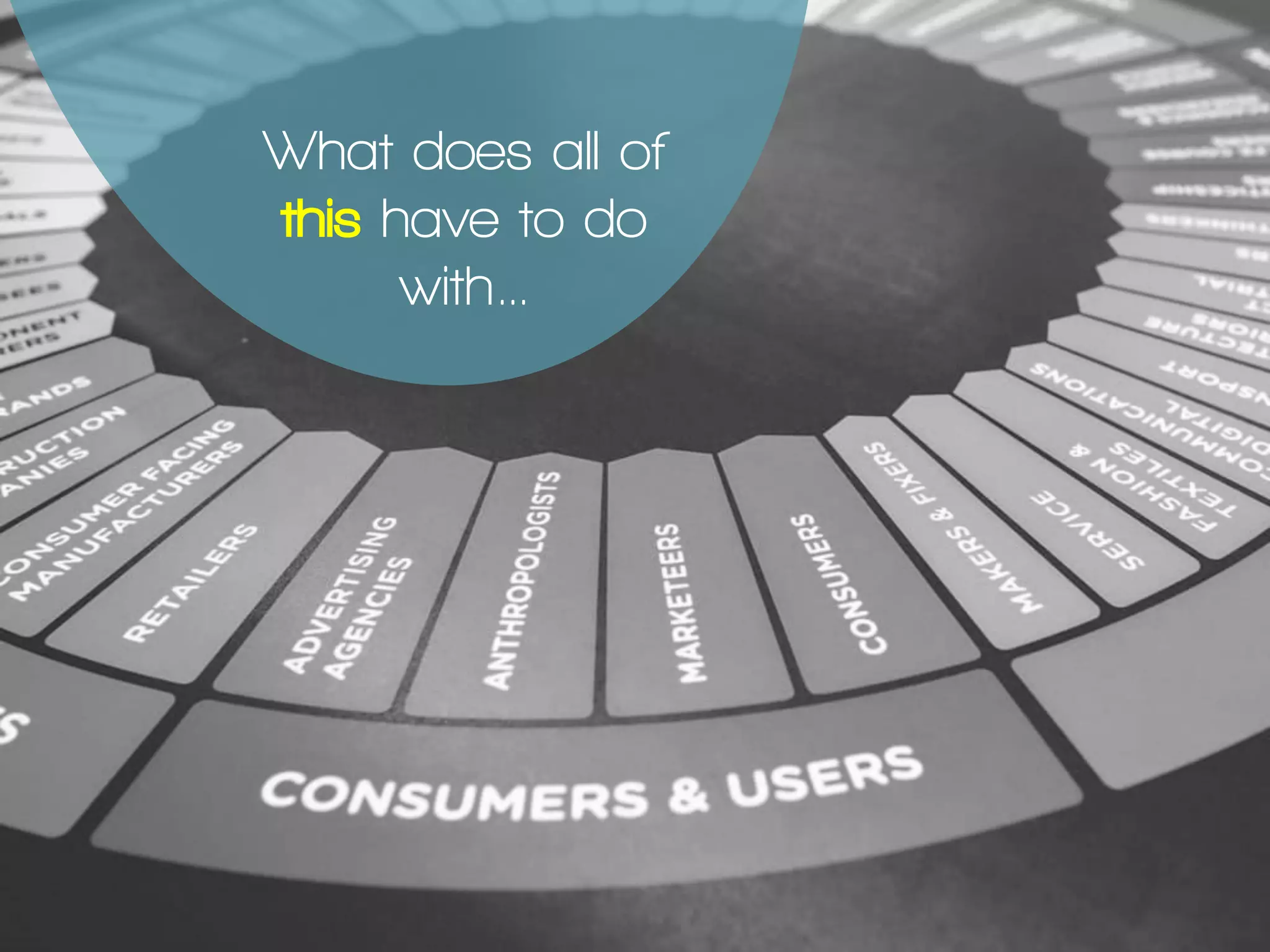
What does all of
this have to do
with…
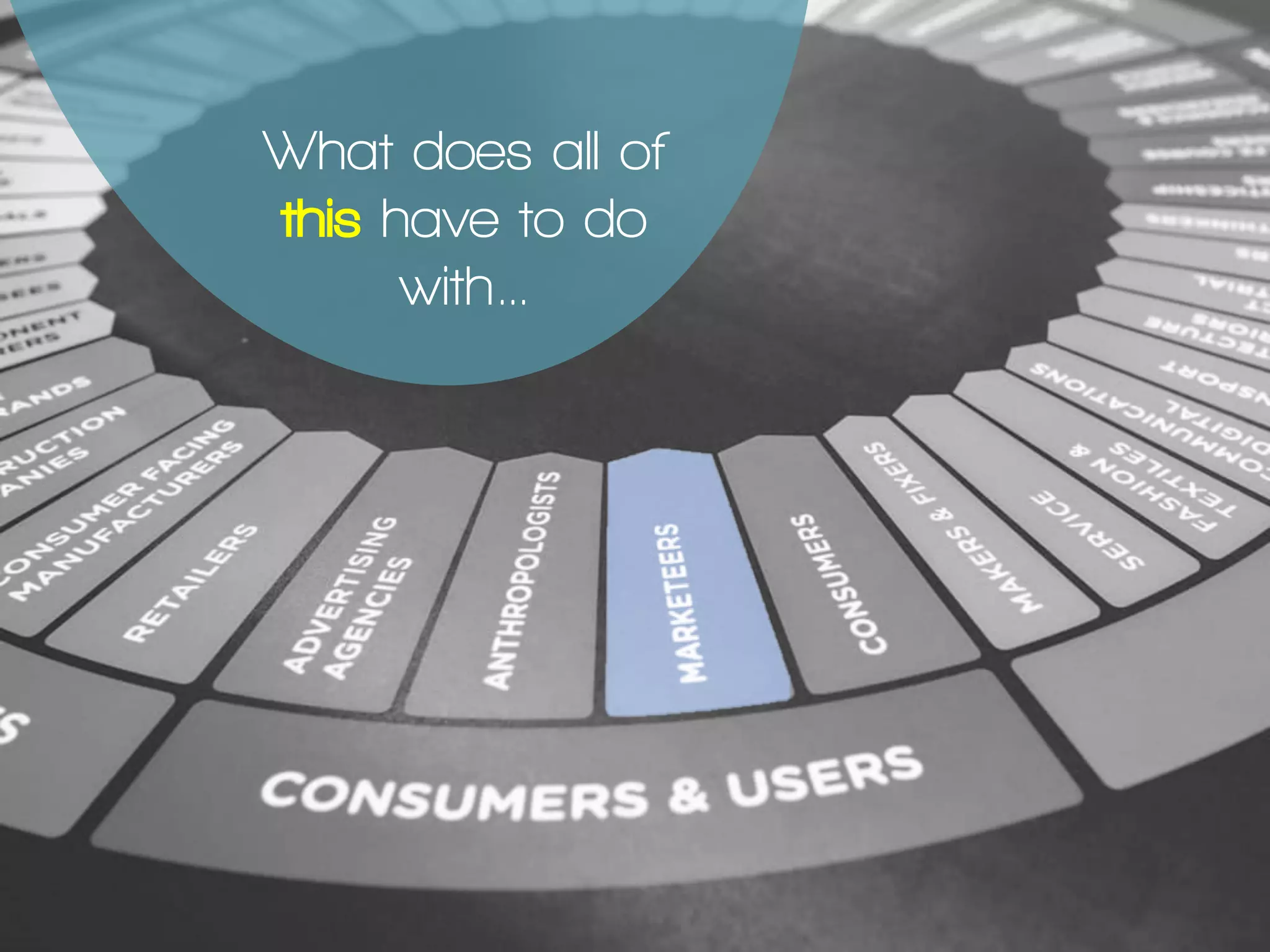
What does all of
this have to do
with…
PART ONE: ETHNOGRAPHY
7 KEY ETHNOGRAPHIC TECHNIQUES
Observation / Behavioural Mapping
Unstructured and Semi-Structured
Interviews
Cognitive Mapping
Touchstone Tours
Love Letters / Breakup Letters
Cultural Probes
Graffiti Walls
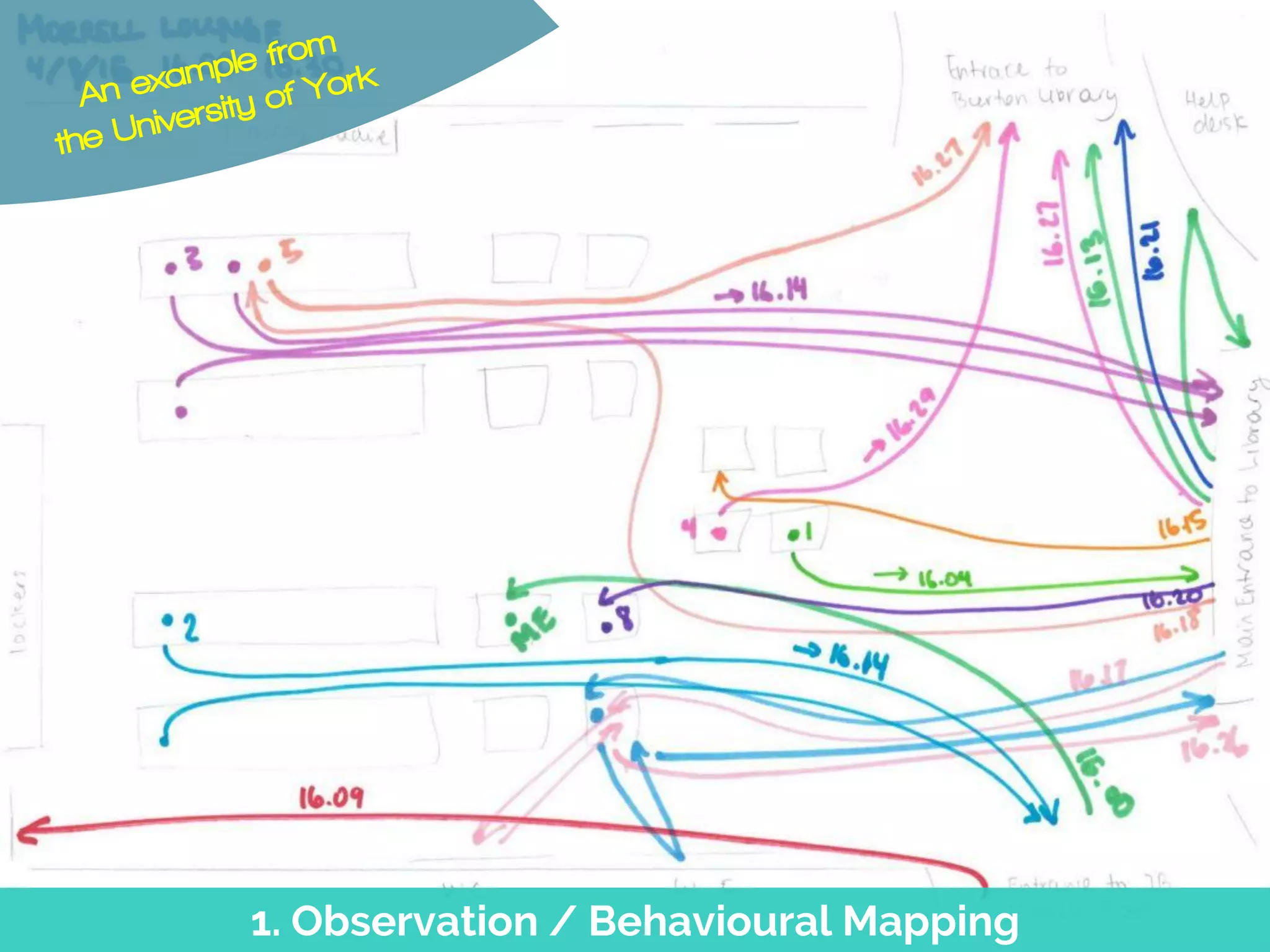
1. Observation / Behavioural Mapping
Note your users as
they move through and
interact with the space.
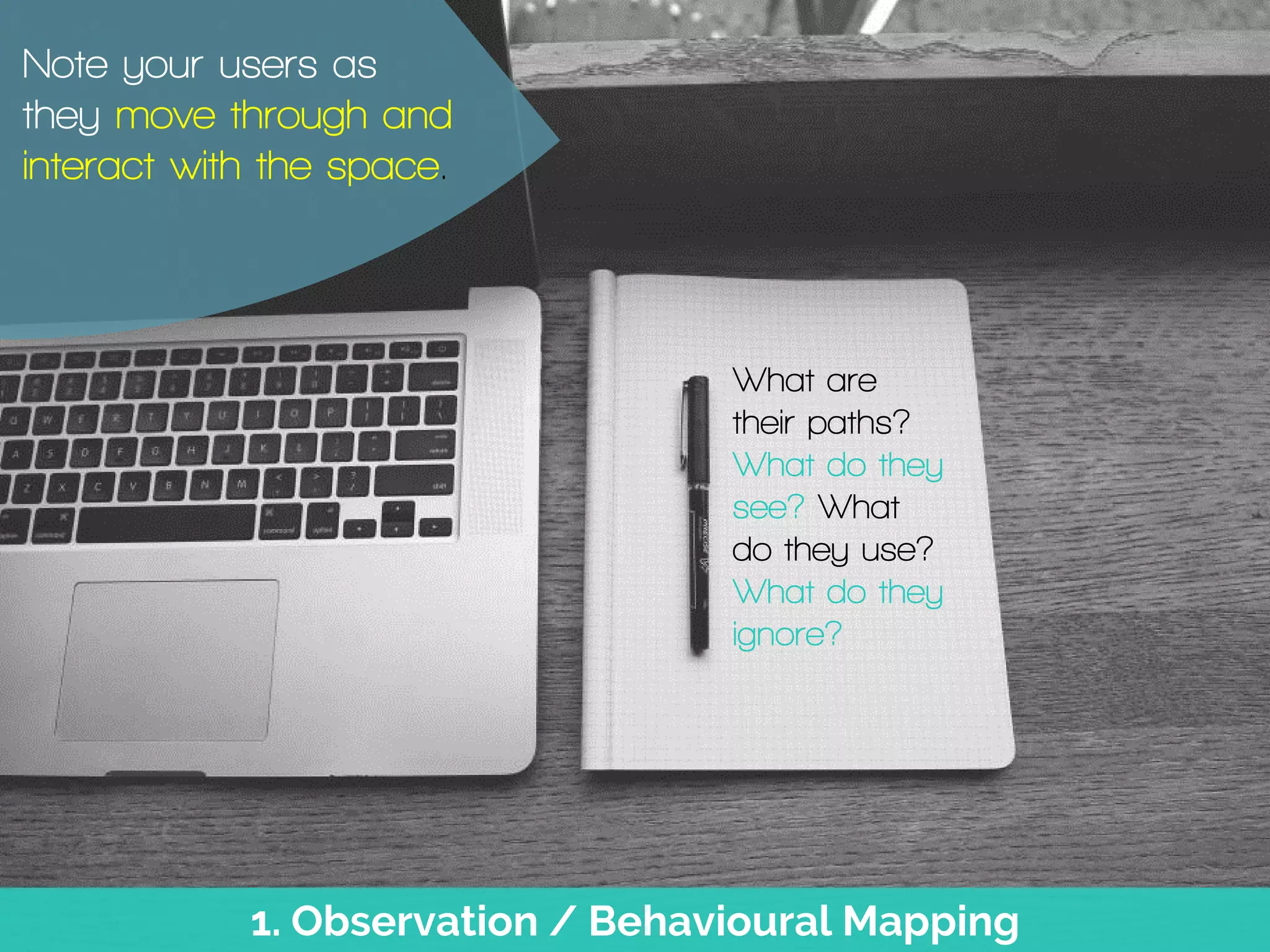
1. Observation / Behavioural Mapping
Note your users as
they move through and
interact with the space.
What are
their paths?
What do they
see? What
do they use?
What do they
ignore?
1. Observation / Behavioural Mapping
2. Unstructured/ Semi-Structured Interviews
Interview your subject about
their working / scholarly /
cultural LIFE, not just the
institution. Ask open
questions, based on what
they’re saying rather than
based on a pre-prepared list.
2. Unstructured/ Semi-Structured Interviews
For example ask not
‘what e-resources do
you use?’ but ‘what’s
your process when
you’re set an
assignment / job-
hunting?’
2. Unstructured/ Semi-Structured Interviews
For example ask not
‘what is your favourite
part of the museum?’
but ‘how do museum
visits fit in with your
other cultural
activities?’
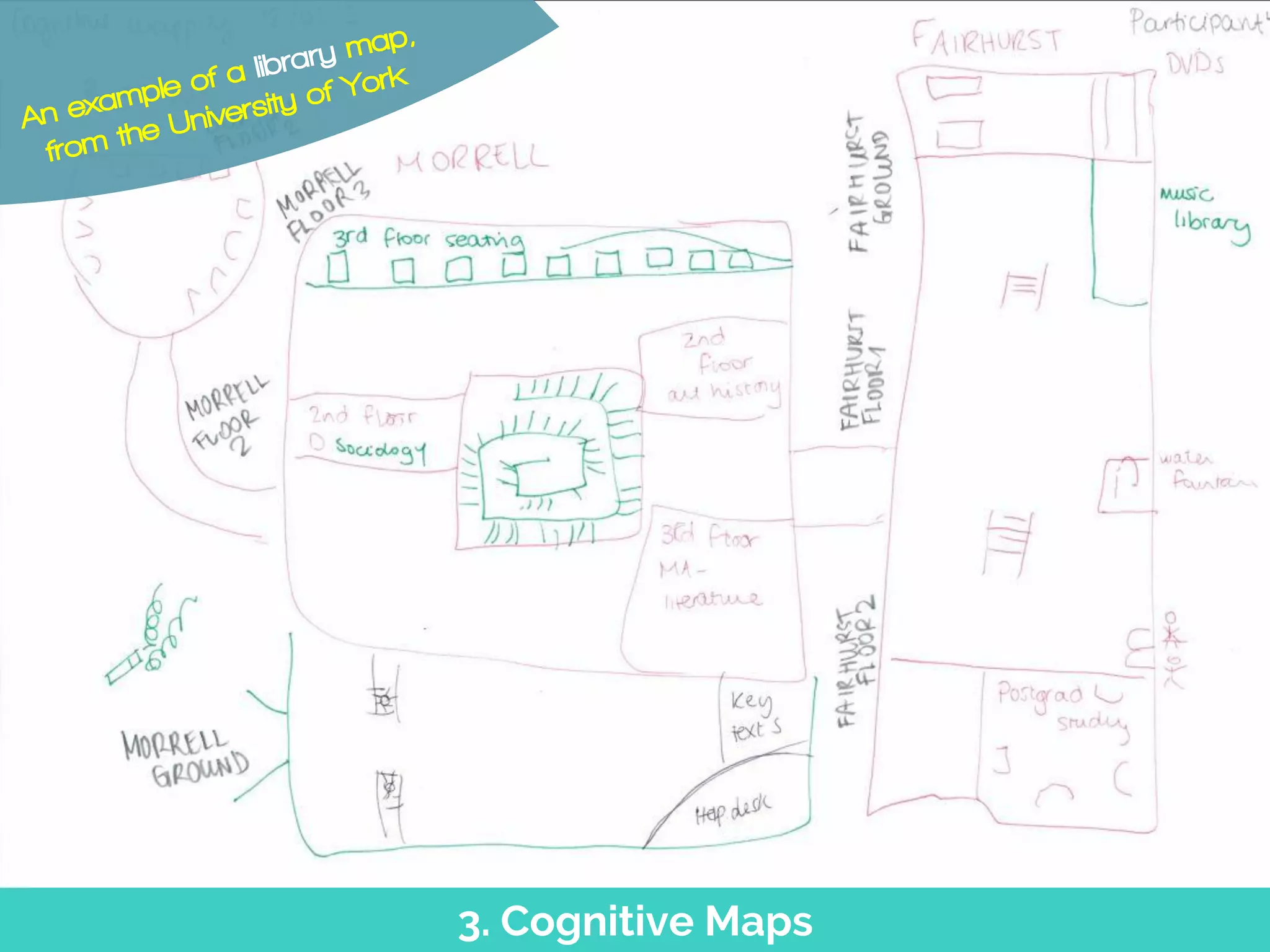
3. Cognitive Maps
A brilliant jumping off point for the
interview is the Cognitive Map. Ask
your subject to draw a map from
memory.
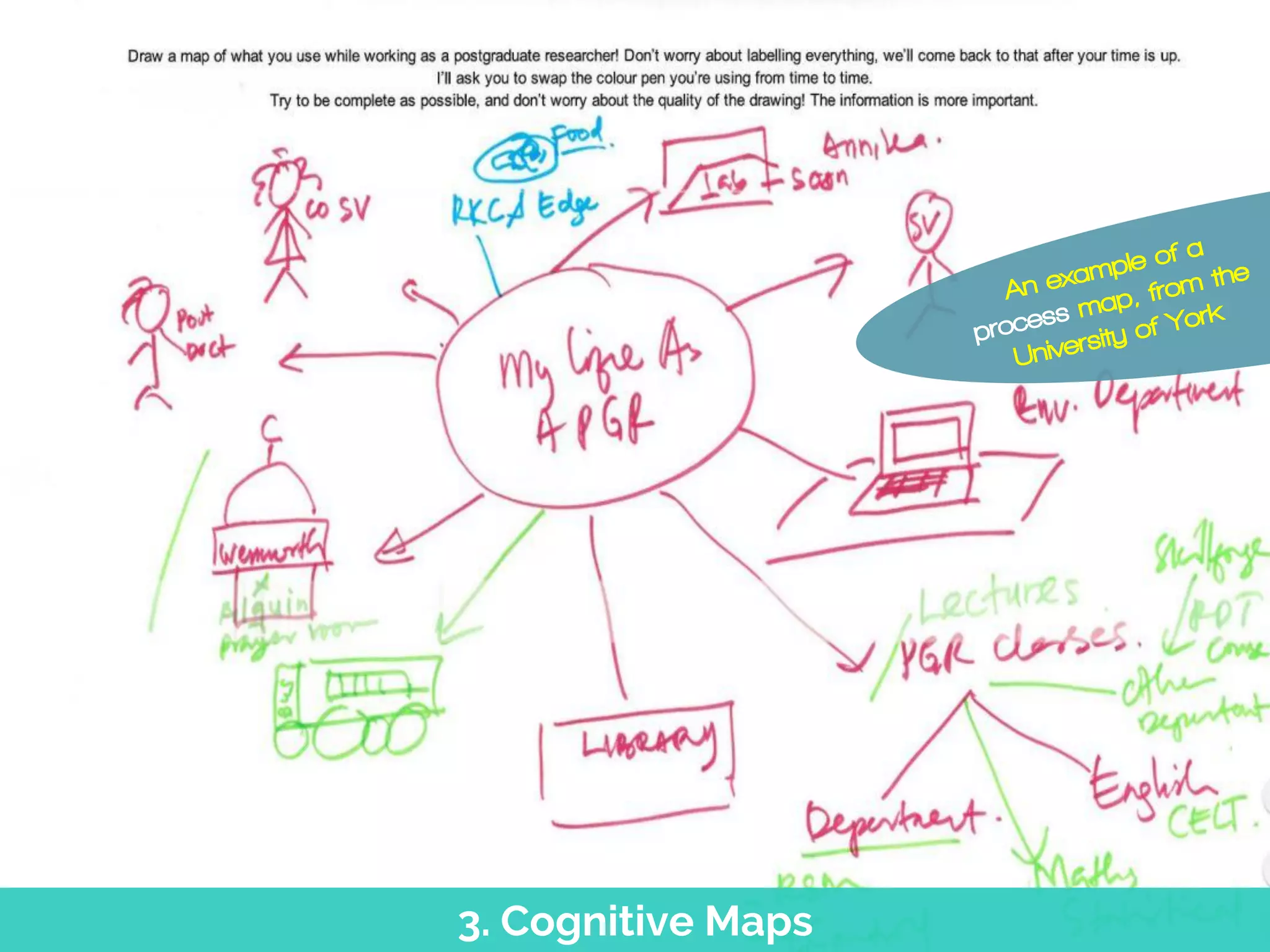
3. Cognitive Maps
The Cognitive Map can be of a
building or space – but it can also
be of a process, like researching
their family tree, or completing a
college assignment.
They have 6 minutes to do this,
changing colour of pen every
2 minutes.
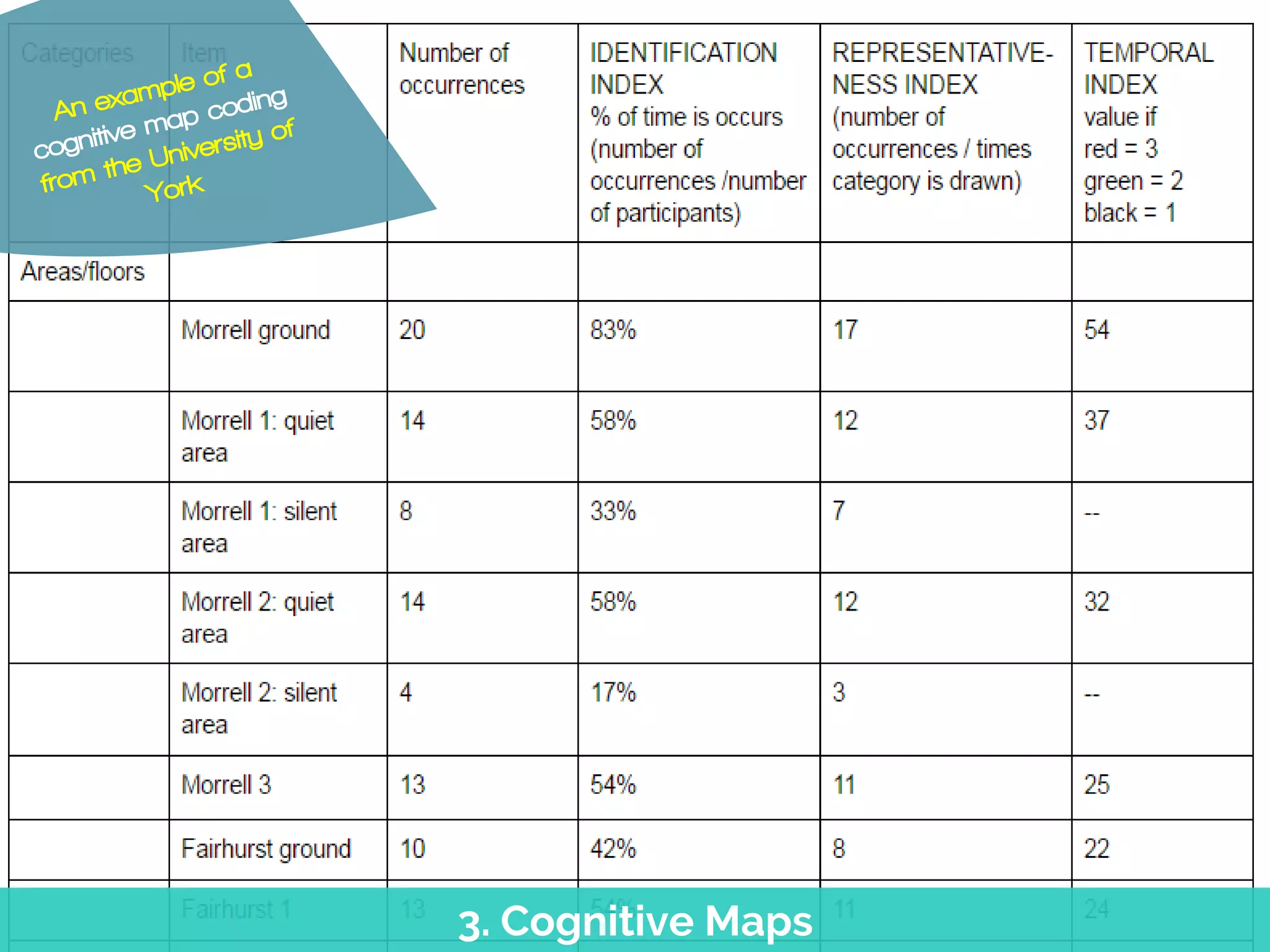
3. Cognitive Maps
Note what they put down first,
what’s a last minute addition, what
they leave out entirely. You can
code this later.
Then to introduce the unstructured
or semi-structured interview, ask
them to talk you through their
map. Use what they tell you
to inform your questions.
3. Cognitive Maps
3. Cognitive Maps
3. Cognitive Maps
4. Touchstone Tours
Rather than showing your users around, let them
take YOU on a tour of the building (and record
what they say). Does their understanding of
processes, systems and the space match your
expectations?
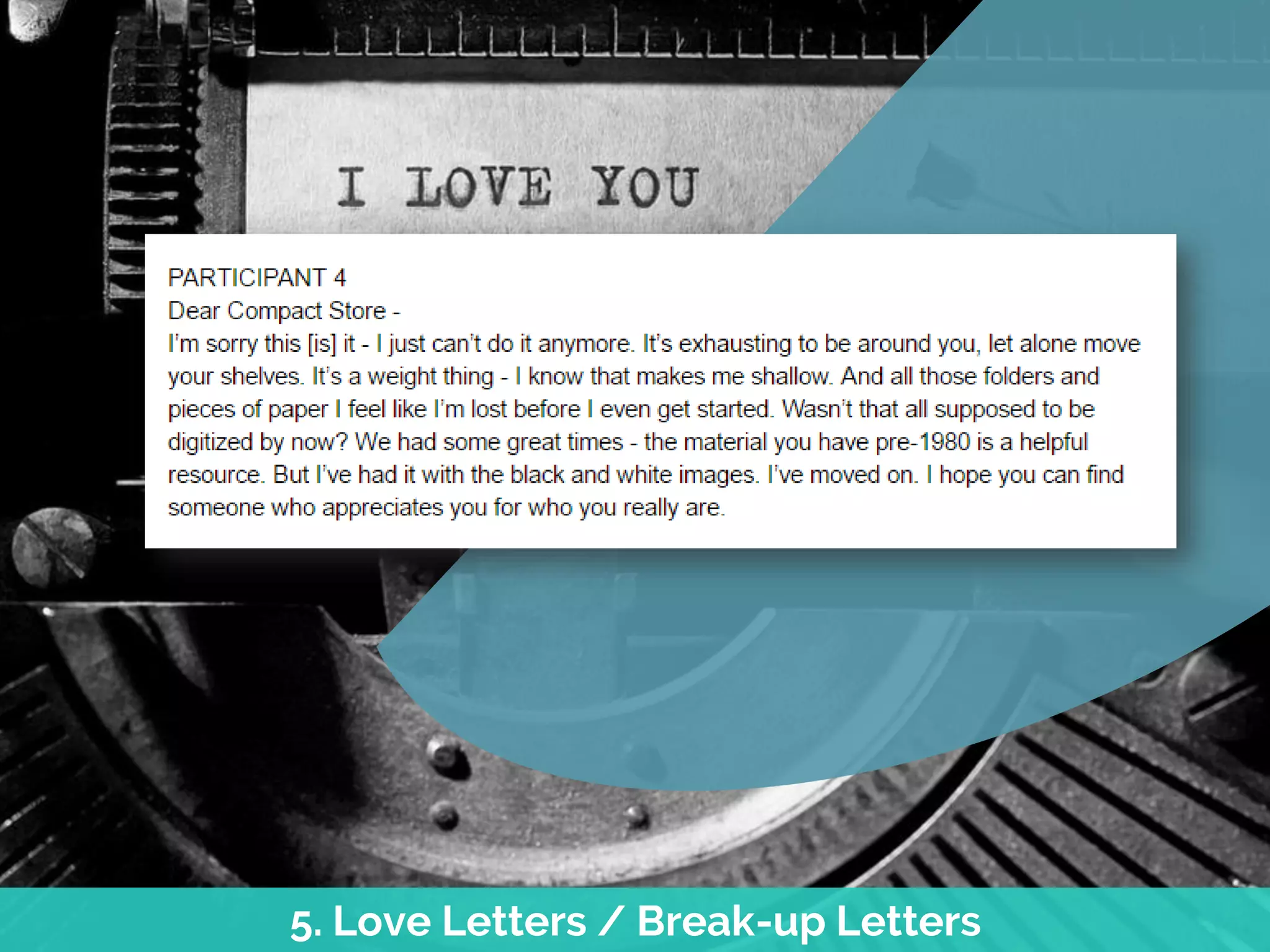
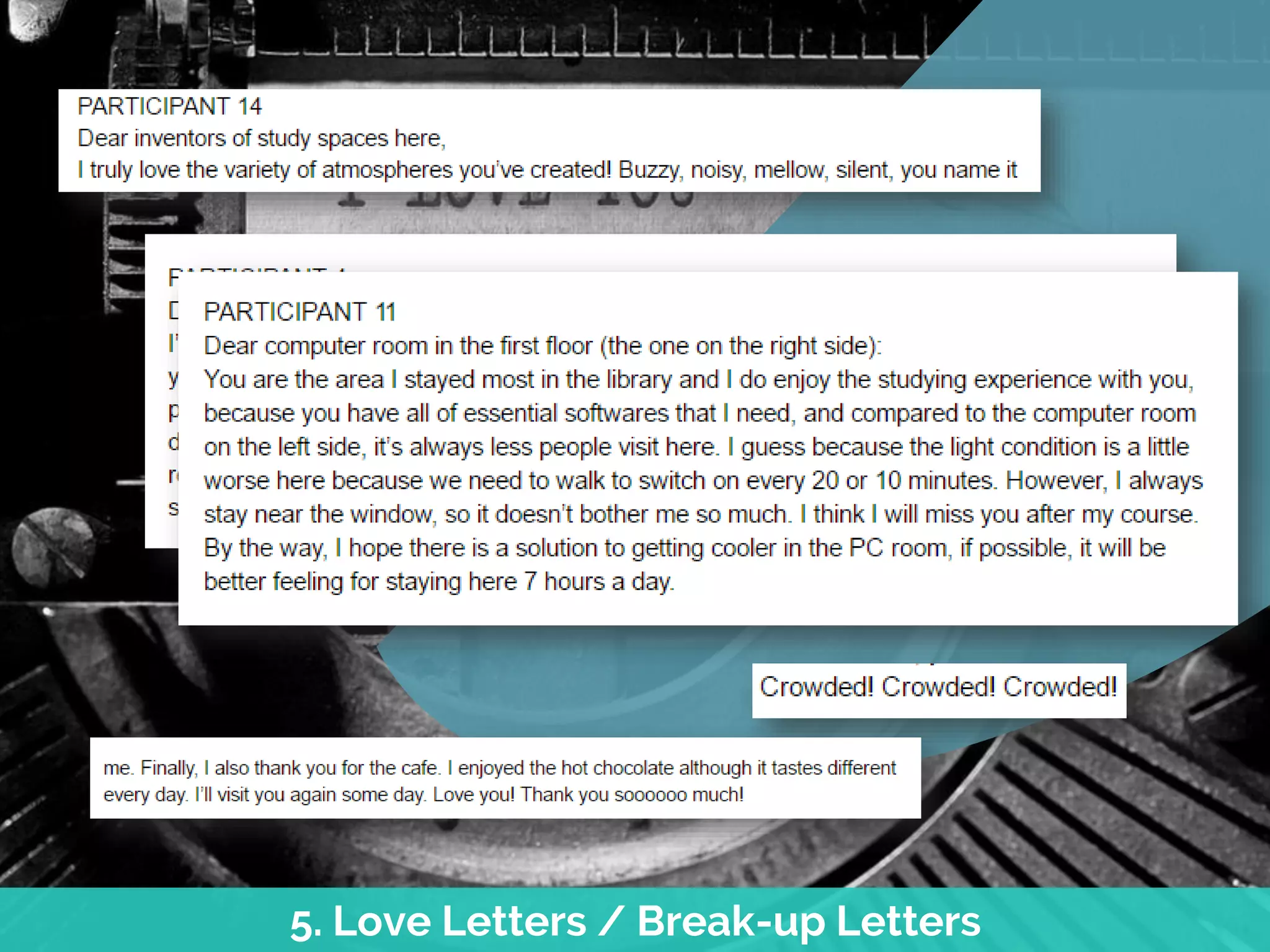
5. Love Letters / Break-up Letters
Ask
your users
to write a letter
to a collection or
service (NOT a member
of staff!) – either professing
their love for, or breaking up
with, that service. This seems
very gimmicky and won’t work with
everyone, but when it does work it
really allows you to understand the
emotion engendered by the
user experiences
5. Love Letters / Break-up Letters
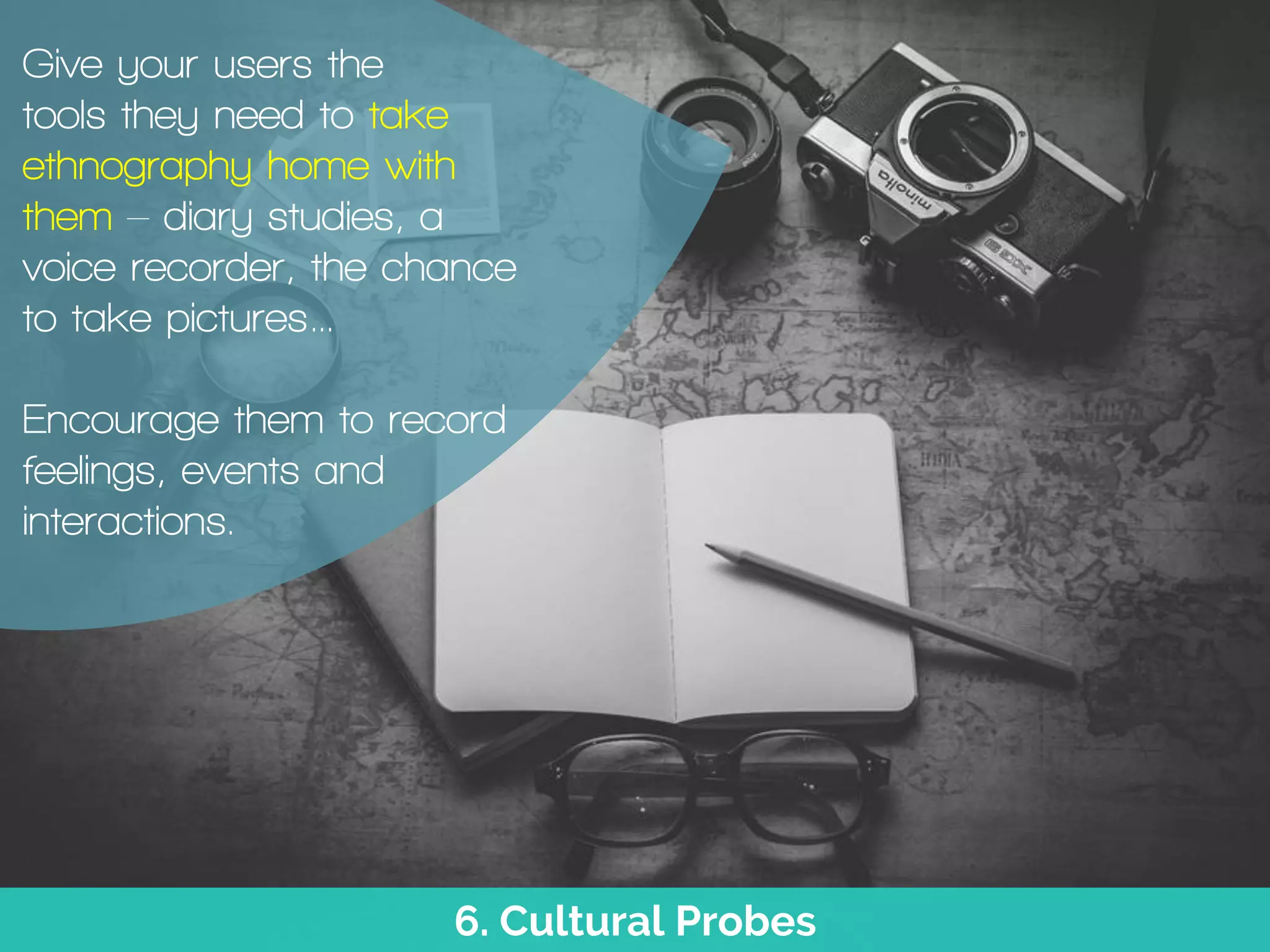
6. Cultural Probes
Give your users the
tools they need to take
ethnography home with
them – diary studies, a
voice recorder, the chance
to take pictures…
Encourage them to record
feelings, events and
interactions.
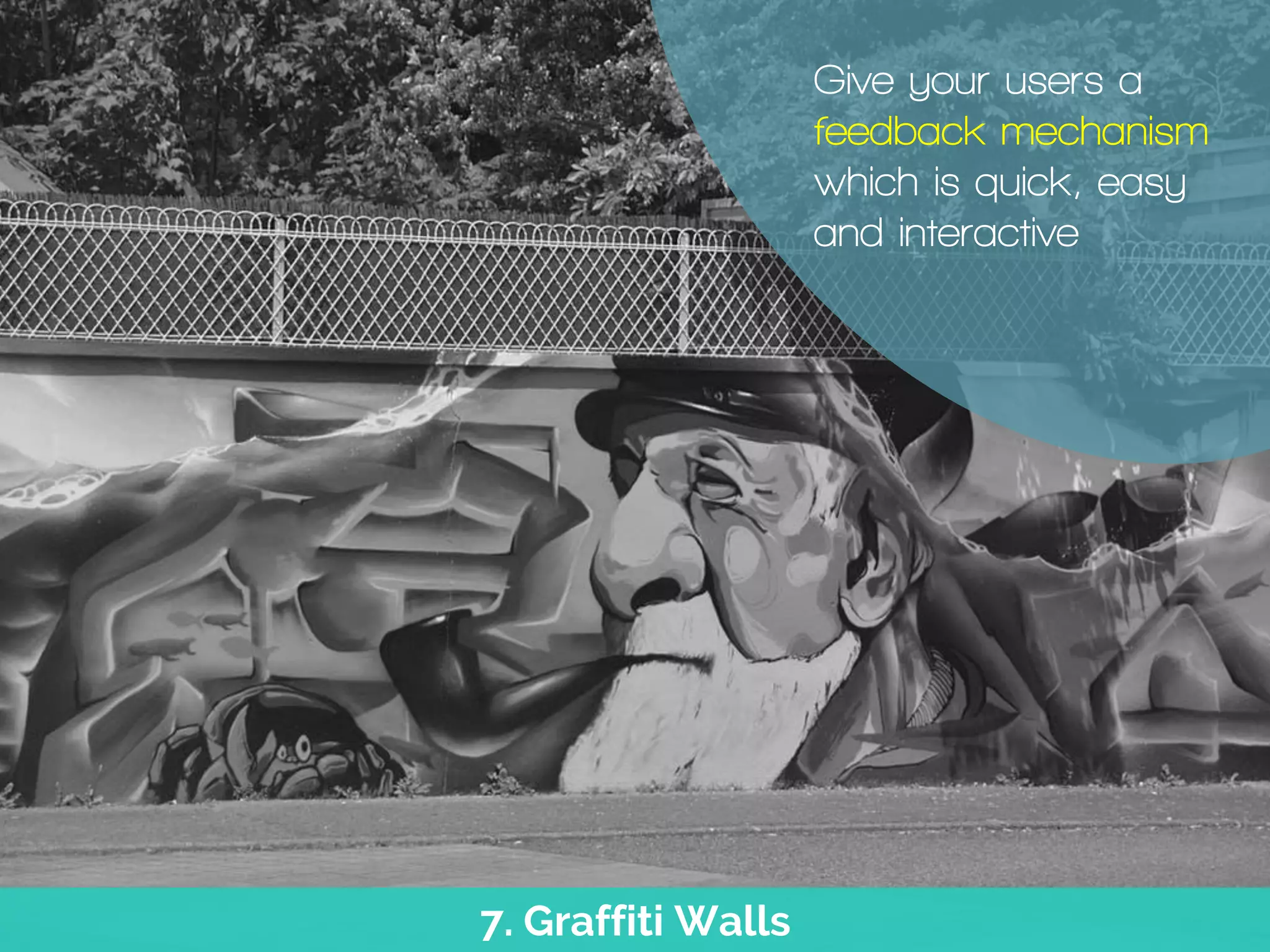
7. Graffiti Walls
Give your users a
feedback mechanism
which is quick, easy
and interactive
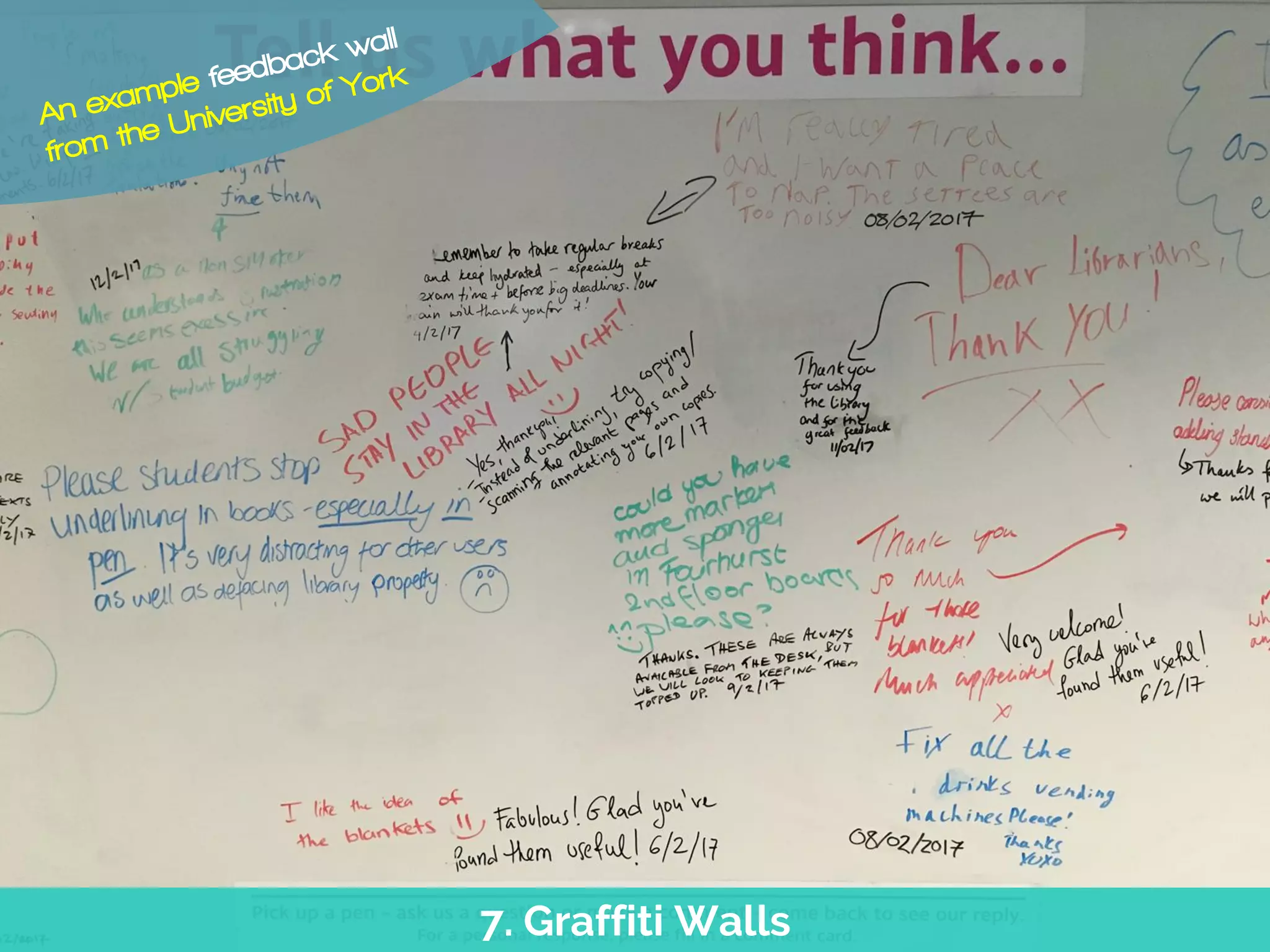
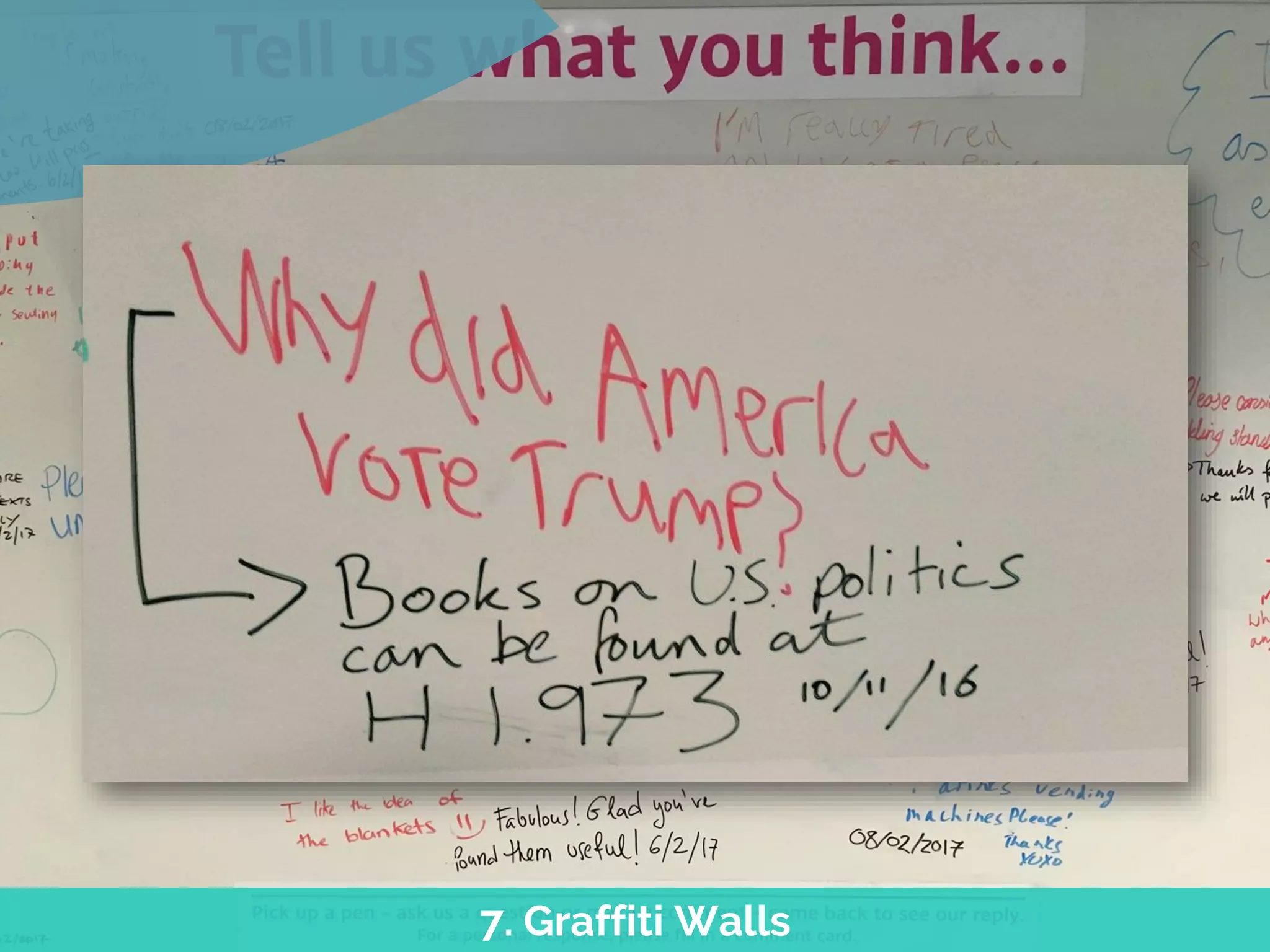
7. Graffiti Walls
7. Graffiti Walls
These methods for
feedback gathering
tend to reveal very in-
depth and varied
views, feelings and
experiences
The key is not to get stuck on
the ethnography phase – the next step
is to design changes to your service
based on what you’ve learned.
PART TWO: DESIGN
The aim is to tweak the
service to make the user
experience better. This
may mean a small number
of large changes – you
never know what the data
will tell you – but most
often this will mean a large
number of small changes
that positively influence the
user day to day
The Design Thinking process first defines the
problem and then implements the solutions,
always with the needs of the user demographic at
the core of concept development. This process
focuses on needfinding, understanding, creating,
thinking, and doing. At the core of this process is
a bias towards action and creation: by creating
and testing something, you can continue to learn
and improve upon your initial ideas.
“
Stanford Design School
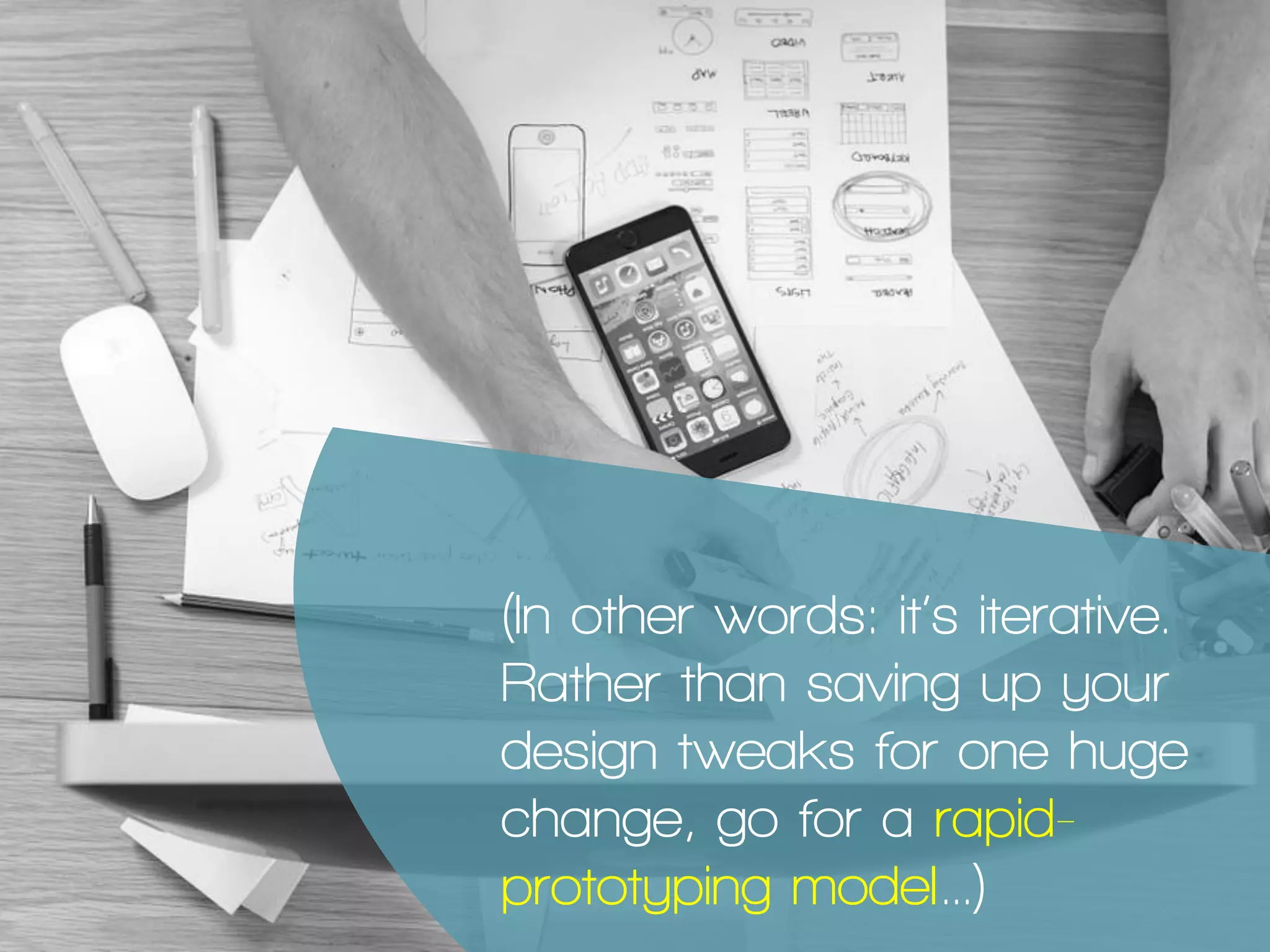
(In other words: it’s iterative.
Rather than saving up your
design tweaks for one huge
change, go for a rapid-
prototyping model…)
Make changes
early and often,
monitor your users’
responses, and
don’t be afraid
to fail.
Just make sure
you record and
learn from
failure
Perhaps it’s better to make something self-
righting than to aim for perfection. Can your
users find their own way out of difficulties?
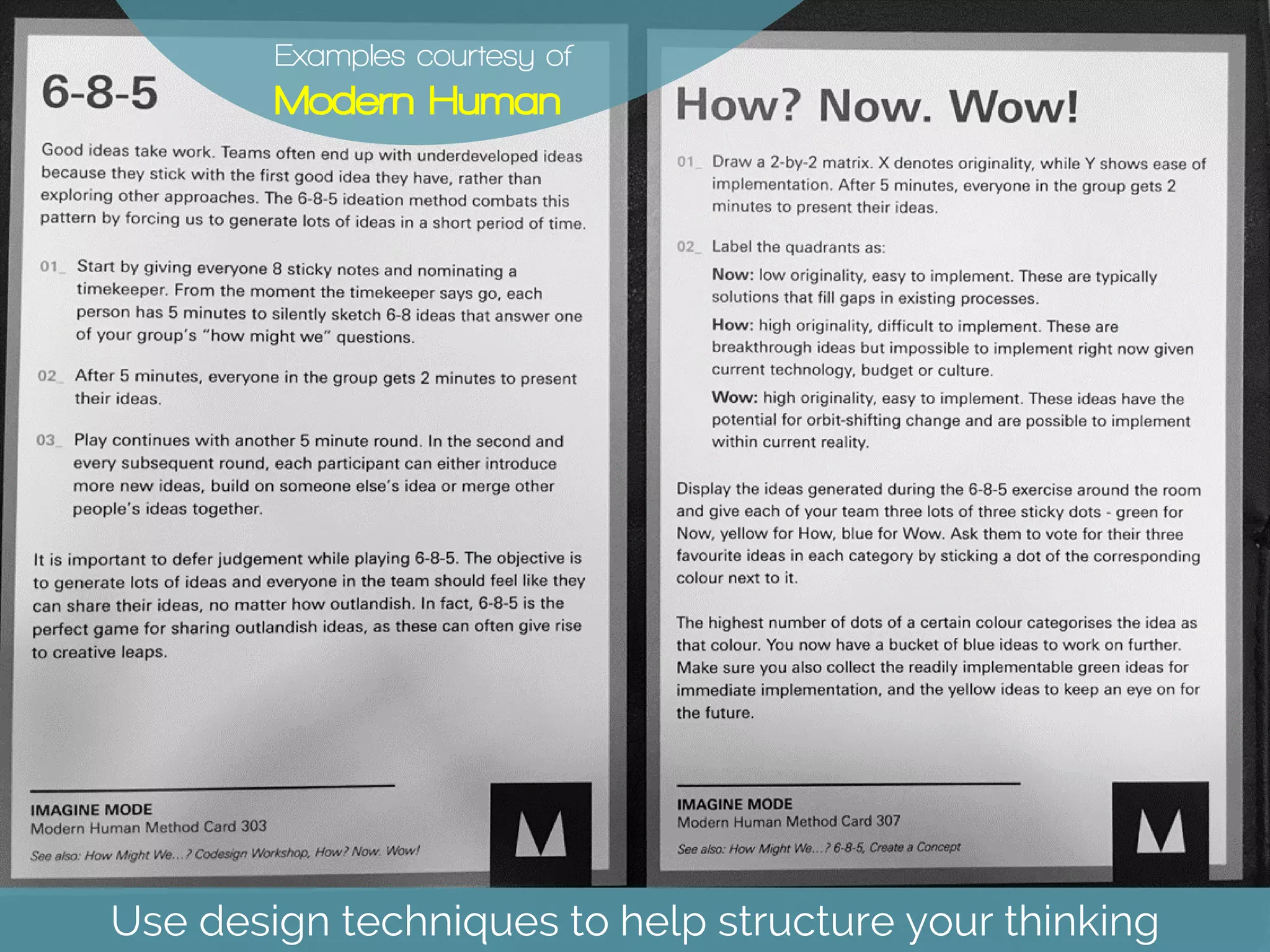
Use design techniques to help structureyour thinking
Examples courtesy of
Modern Human
PART THREE: UX-LED CHANGES
Here are some examples of changes: tweaks to our
services at the University of York, informed or
supported by our three major UX projects since 2015.
We installed hot-drinking-water taps,
for those who prefer to drink hot
water during the winter months
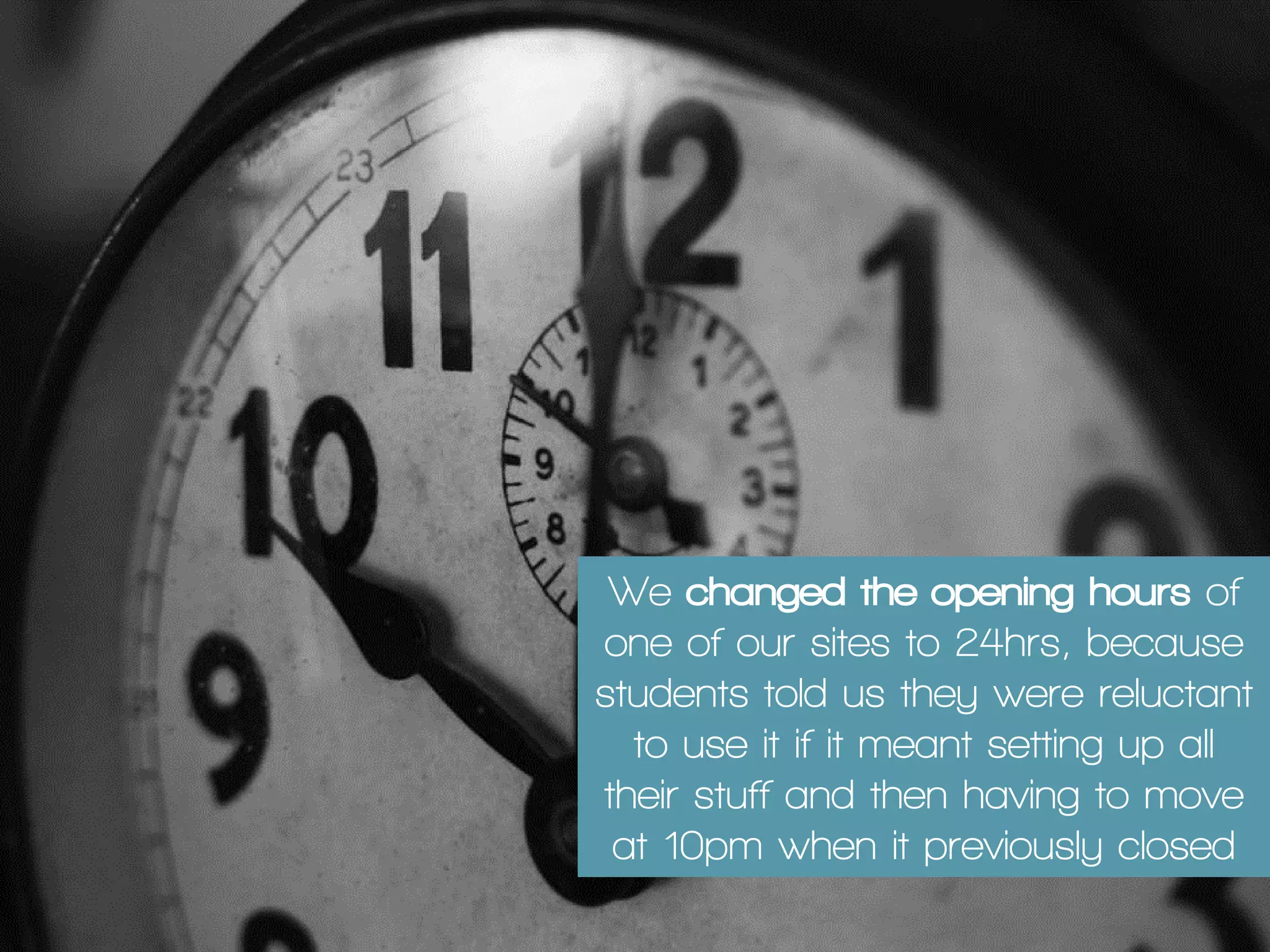
We changed the opening hours of
one of our sites to 24hrs, because
students told us they were reluctant
to use it if it meant setting up all
their stuff and then having to move
at 10pm when it previously closed
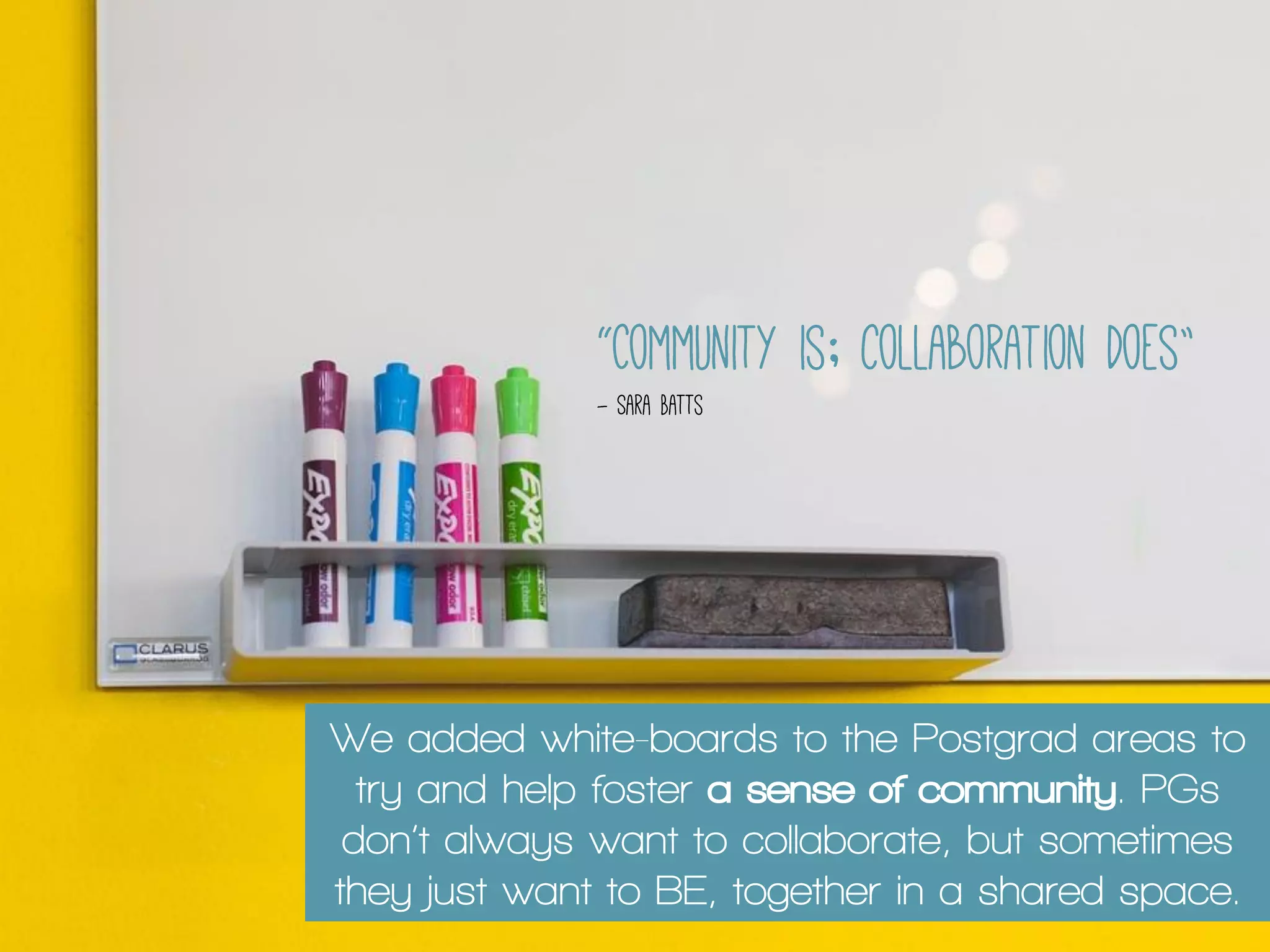
We added white-boards to the
Postgrad areas to try and help
foster a sense of community.
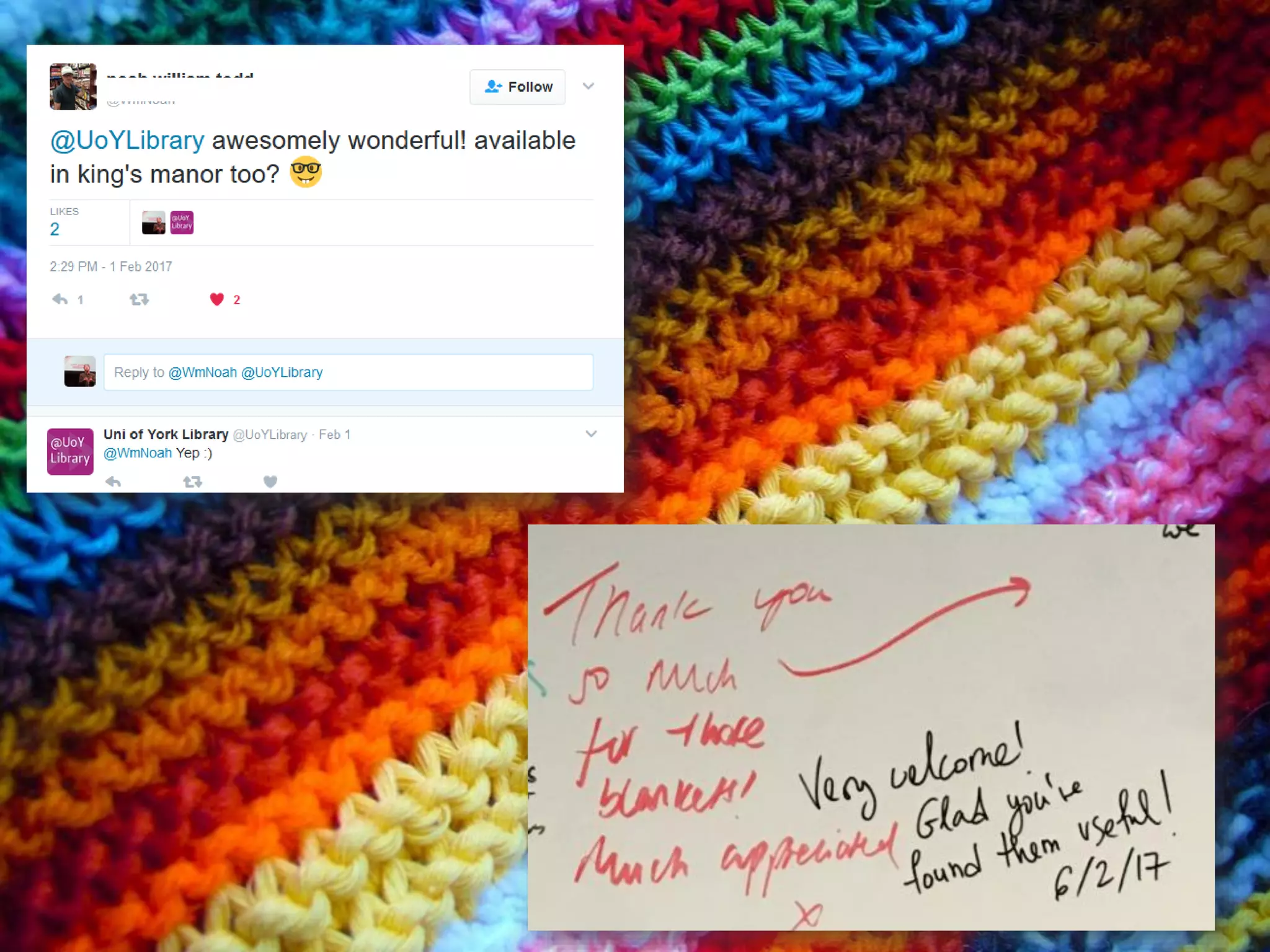
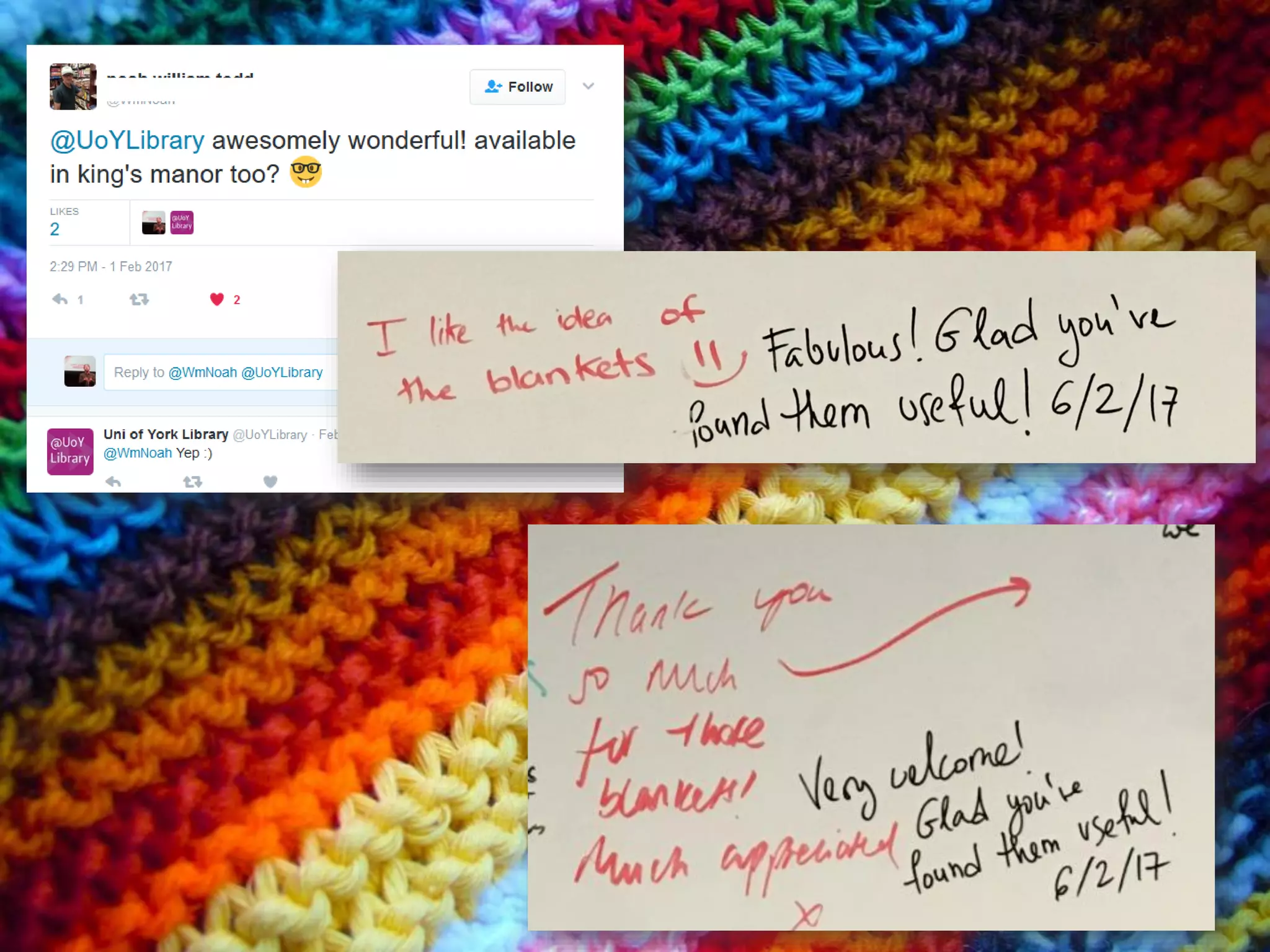
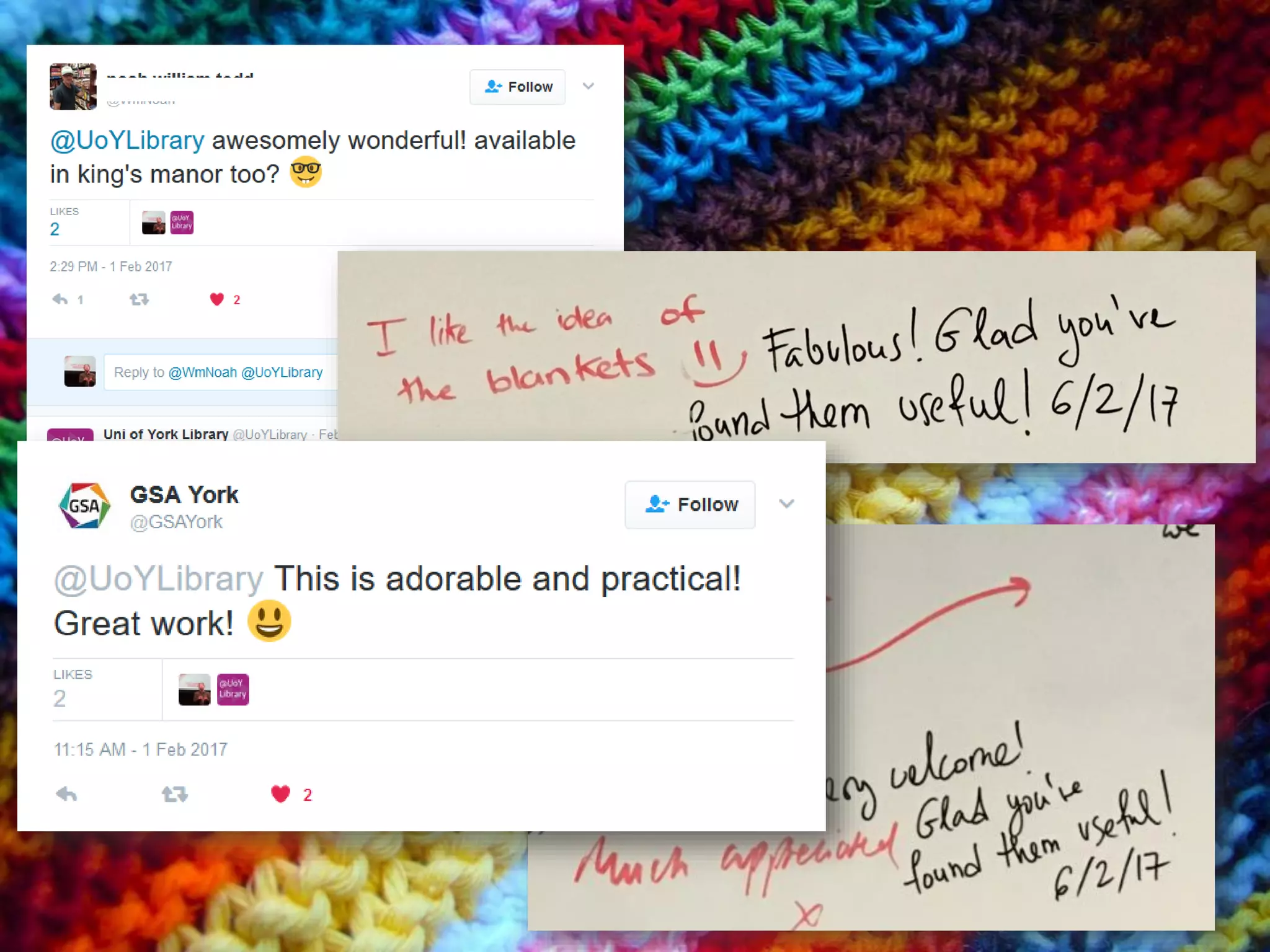
We bought blankets for all our sites.
It may not seem like much, but…
We bought blankets for all our sites.
It may not seem like much, but…
We changed the way our Flexible Loans system
works for the academic community, and data from
ethnographic fieldwork also fed into changes to the
catalogue front-end, and our reading list system
We changed the way we
communicate with our users
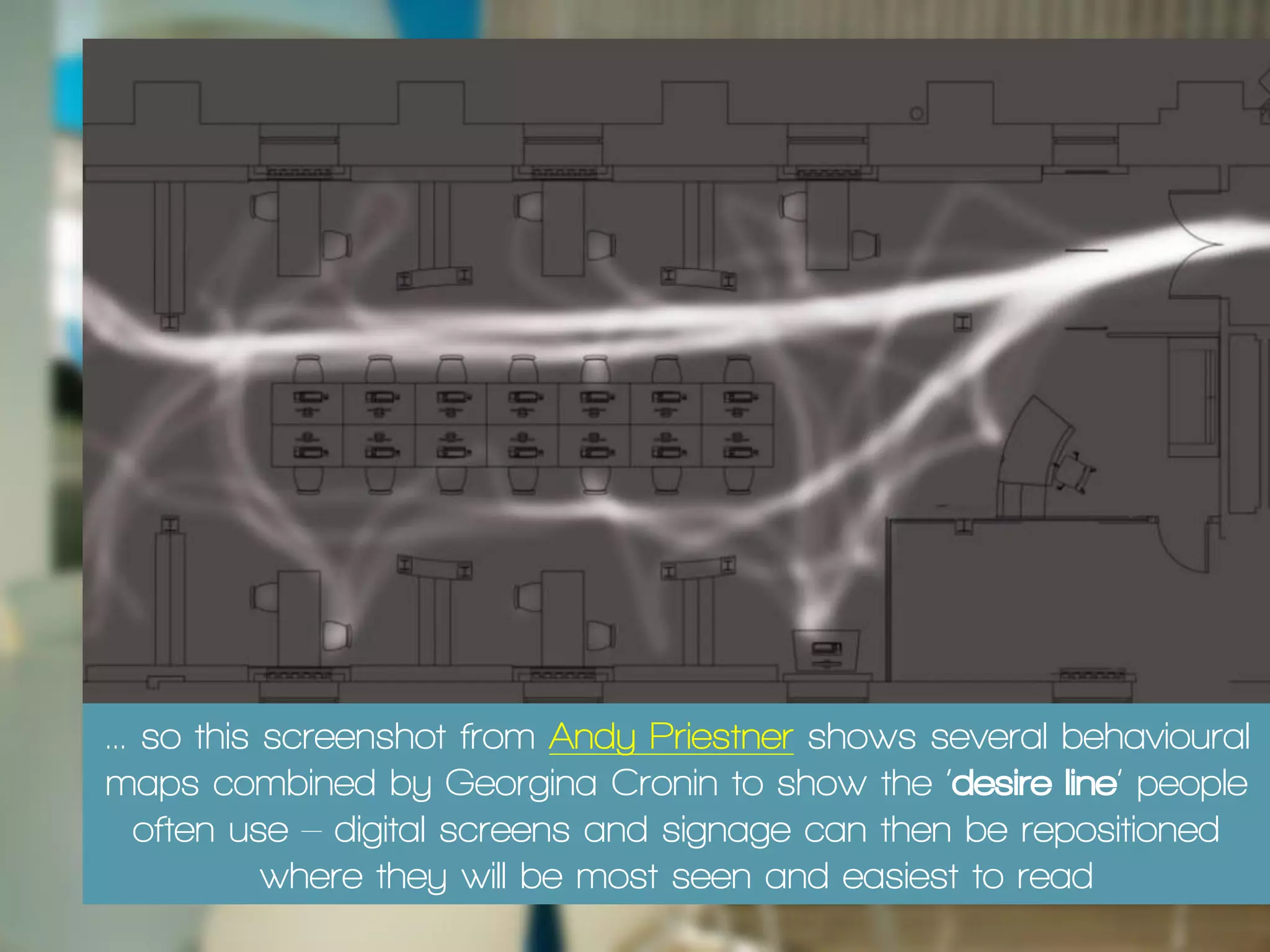
Examples of changes at other institutions include changing the
location of digital screens, to areas where they’ll be actually
engaged with by a larger number of people…
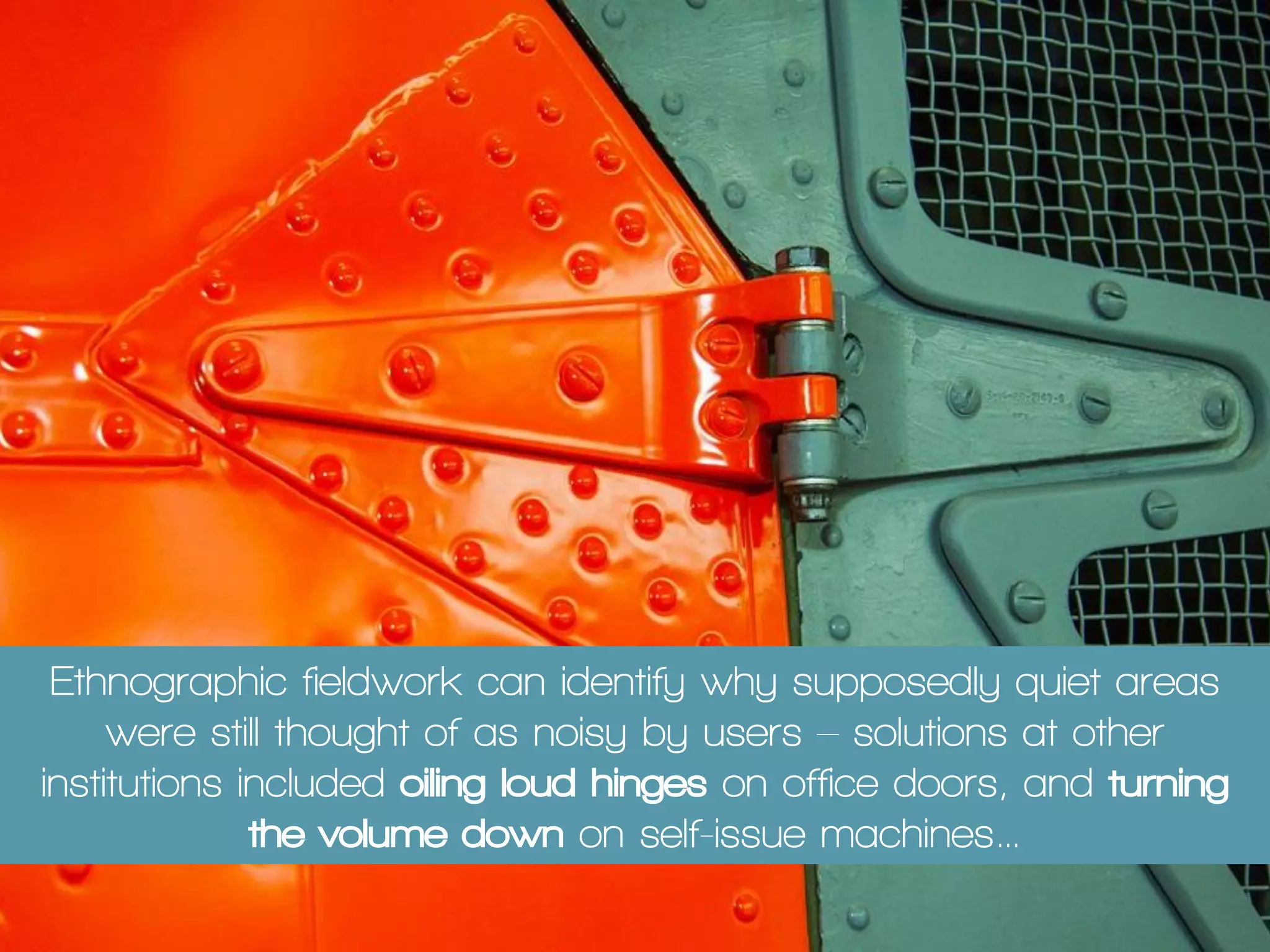
… or of identifying why supposedly quiet areas were still thought of
as noisy by users – solutions included oiling loud hinges on office
doors, and turning the volume down on self-issue machines…
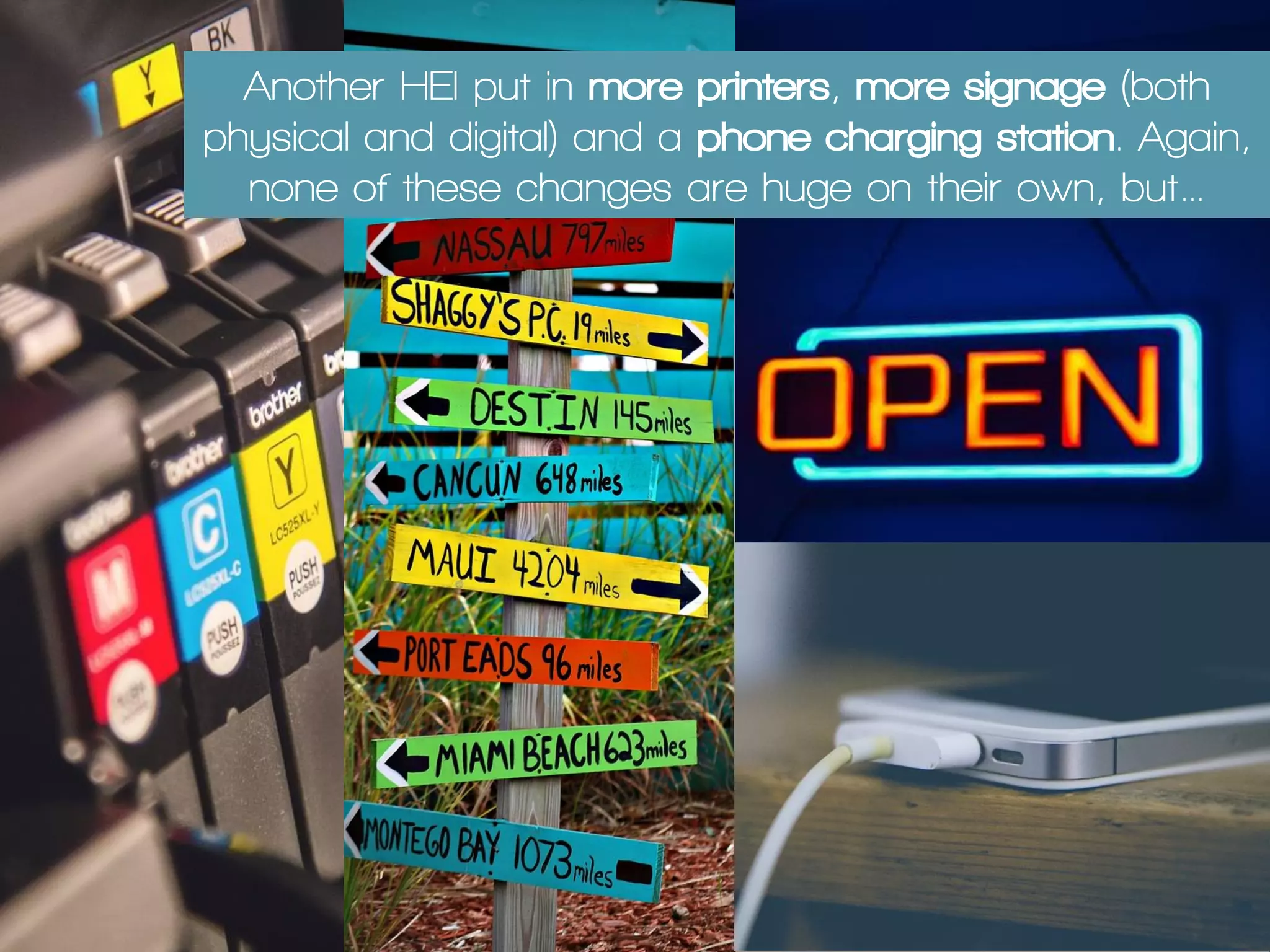
Another HEI put in more printers, more signage (both
physical and digital) and a phone charging station. Again,
none of these changes are huge on their own, but…
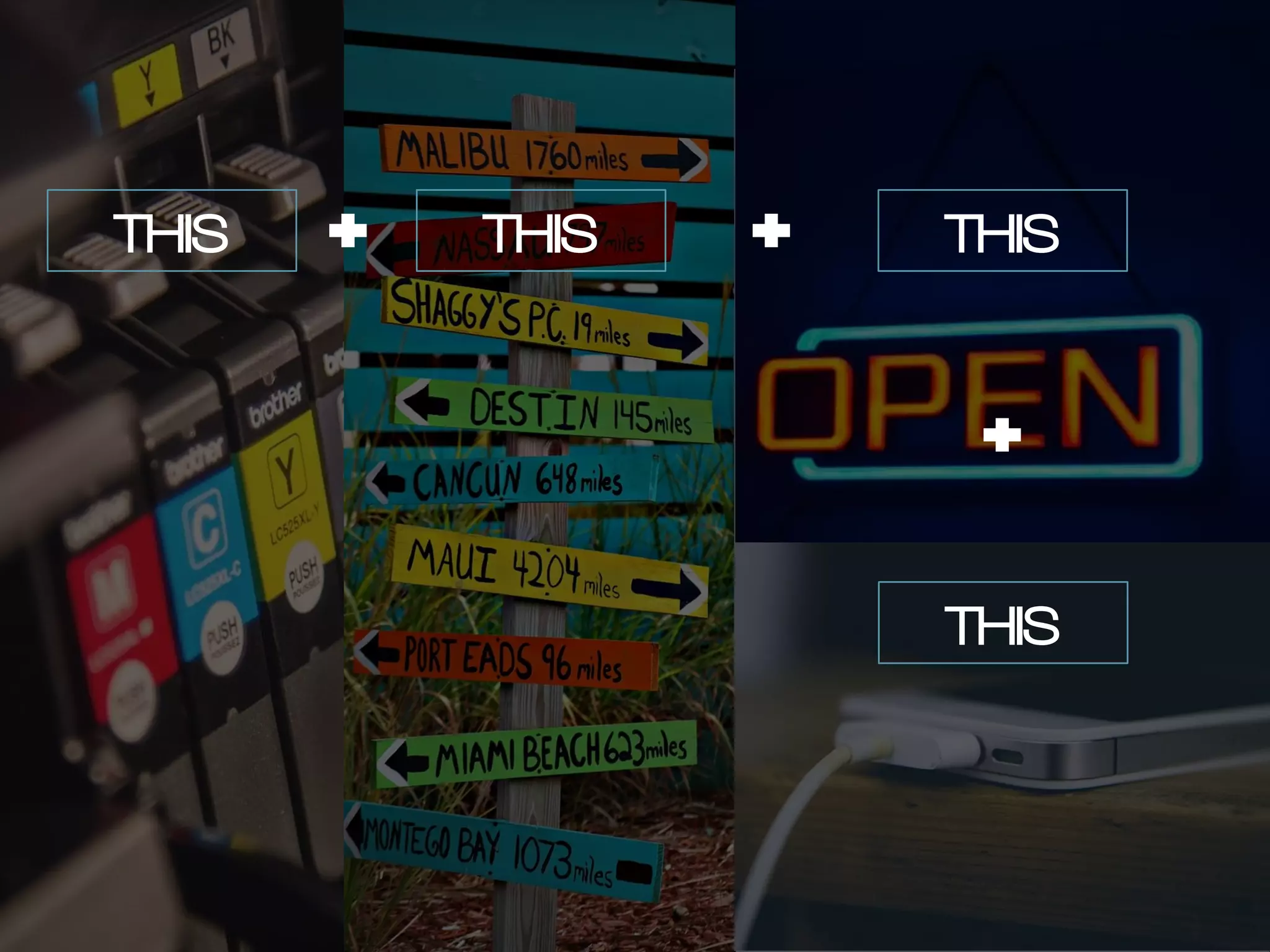
THIS THIS THIS
THIS
= a better user experience,
happier users
Often UX fieldwork can be
the evidence and trigger
required to make the
changes you’ve known
you want to do for a while…
FINALLY: NEXT STEPS
If you’d like to try this at your library, museum or archive
(or any other organisation) here’s a potential path forward:
1. Choose either a space or a demographic
2. Choose some ethnographic fieldwork to try
out. Behavioural Mapping is a good way to
start for space. Cognitive Mapping and
Interviews are good to do with a
demographic.
3. Practice on colleagues first!
1. Choose either a space or a demographic
2. Choose some ethnographic fieldwork to try
out. Behavioural Mapping is a good way to
start for space. Cognitive Mapping and
Interviews are good to do with a
demographic.
3. Practice on colleagues first!
4. Try to avoid going in trying to solve a
specific problem. Be led by the data.
1. Choose either a space or a demographic
2. Choose some ethnographic fieldwork to try
out. Behavioural Mapping is a good way to
start for space. Cognitive Mapping and
Interviews are good to do with a
demographic.
3. Practice on colleagues first!
4. Try to avoid going in trying to solve a
specific problem. Be led by the data.
5. As soon as you find something you can
change, design and implement the change
right away.
1. Choose either a space or a demographic
2. Choose some ethnographic fieldwork to try
out. Behavioural Mapping is a good way to
start for space. Cognitive Mapping and
Interviews are good to do with a
demographic.
3. Practice on colleagues first!
4. Try to avoid going in trying to solve a
specific problem. Be led by the data.
5. As soon as you find something you can
change, design and implement the change
right away.
6. Have fun!
SOME CREDITS
All photos are CC0 (sourced via
Pixabay & Pexels) except the
Touchstone Tour pic, courtesy of
Georgina Cronin and the Modern
Human design cards, taken by me.
Thanks to Andy Priestner, Jenny
Foster, Ingela Wahlgren and Carl
Barrow for their examples of UX-led
changes. Follow them on Twitter for
more good stuff!
Read more about UX at the
University of York Library
libinnovation.blogspot.co.uk
a structured introduction to UX:
ned-potter.com
chat to me on twitter: @ned_potter
THANKS FOR LISTENING!
Find out about the UXLibs Conference:
uxlib.org

UX, ethnography and possibilities: for Libraries, Museums and Archives

  • 1.
    @ned_potter ETHNOGRAPHY + POSSIBILITIES FORLIBRARIES, ARCHIVES AND MUSEUMS UX University of York
  • 2.
    At the Universityof York Library we’ve undertaken several projects using UX techniques, which has given us a hugely rich understanding of our users. It’s increasingly embedded in our way of working. These slides detail some of the techniques we’ve used.
  • 3.
    You can readmore about our ethnographic work on the Lib-Innovation Blog: there’s a link at the end of the presentation (as Slideshare doesn’t allowworking links in the first fewslides online…).
  • 4.
  • 5.
  • 6.
    Ethnographic Museum Ethnographic Archive EthnographicLibrary This is about using ethnography to observe users of libraries, archives and museums… TERMINOLOGY
  • 7.
  • 8.
    UX has become an IP UMBRELLA termto cover a suite of techniques that can be divided roughly into two parts: ethnography and design
  • 9.
    SIMPLY PUT Ethnographic techniquesand observation lead to a deeper and more complex understanding of user needs and behaviour than traditional data gather methods normally allow. (Examples follow)
  • 10.
    Simply put, HUMAN CENTRED D E S I G N prioritisesthe end user, their needs, and their behaviour, at every stage of the design process, with an aim to making several small changes to improve the user experience…
  • 11.
    In recent yearsthe User Experience in Libraries movement (UX) has spread from the US and Scandinavia to the UK
  • 12.
  • 13.
  • 16.
    Libraries are using UXto make an IMPACT on their users’ day to day lives
  • 17.
    What does allof this have to do with…
  • 18.
    What does allof this have to do with…
  • 22.
  • 24.
    7 KEY ETHNOGRAPHICTECHNIQUES Observation / Behavioural Mapping Unstructured and Semi-Structured Interviews Cognitive Mapping Touchstone Tours Love Letters / Breakup Letters Cultural Probes Graffiti Walls
  • 25.
    1. Observation /Behavioural Mapping Note your users as they move through and interact with the space.
  • 26.
    1. Observation /Behavioural Mapping Note your users as they move through and interact with the space. What are their paths? What do they see? What do they use? What do they ignore?
  • 27.
    1. Observation /Behavioural Mapping
  • 28.
    2. Unstructured/ Semi-StructuredInterviews Interview your subject about their working / scholarly / cultural LIFE, not just the institution. Ask open questions, based on what they’re saying rather than based on a pre-prepared list.
  • 29.
    2. Unstructured/ Semi-StructuredInterviews For example ask not ‘what e-resources do you use?’ but ‘what’s your process when you’re set an assignment / job- hunting?’
  • 30.
    2. Unstructured/ Semi-StructuredInterviews For example ask not ‘what is your favourite part of the museum?’ but ‘how do museum visits fit in with your other cultural activities?’
  • 31.
    3. Cognitive Maps Abrilliant jumping off point for the interview is the Cognitive Map. Ask your subject to draw a map from memory.
  • 32.
    3. Cognitive Maps TheCognitive Map can be of a building or space – but it can also be of a process, like researching their family tree, or completing a college assignment. They have 6 minutes to do this, changing colour of pen every 2 minutes.
  • 33.
    3. Cognitive Maps Notewhat they put down first, what’s a last minute addition, what they leave out entirely. You can code this later. Then to introduce the unstructured or semi-structured interview, ask them to talk you through their map. Use what they tell you to inform your questions.
  • 34.
  • 35.
  • 36.
  • 37.
    4. Touchstone Tours Ratherthan showing your users around, let them take YOU on a tour of the building (and record what they say). Does their understanding of processes, systems and the space match your expectations?
  • 38.
    5. Love Letters/ Break-up Letters Ask your users to write a letter to a collection or service (NOT a member of staff!) – either professing their love for, or breaking up with, that service. This seems very gimmicky and won’t work with everyone, but when it does work it really allows you to understand the emotion engendered by the user experiences
  • 39.
    5. Love Letters/ Break-up Letters
  • 40.
    5. Love Letters/ Break-up Letters
  • 41.
    5. Love Letters/ Break-up Letters
  • 42.
    5. Love Letters/ Break-up Letters
  • 43.
    6. Cultural Probes Giveyour users the tools they need to take ethnography home with them – diary studies, a voice recorder, the chance to take pictures… Encourage them to record feelings, events and interactions.
  • 44.
    7. Graffiti Walls Giveyour users a feedback mechanism which is quick, easy and interactive
  • 45.
  • 46.
  • 47.
    These methods for feedbackgathering tend to reveal very in- depth and varied views, feelings and experiences
  • 48.
    The key isnot to get stuck on the ethnography phase – the next step is to design changes to your service based on what you’ve learned.
  • 49.
  • 50.
    The aim isto tweak the service to make the user experience better. This may mean a small number of large changes – you never know what the data will tell you – but most often this will mean a large number of small changes that positively influence the user day to day
  • 51.
    The Design Thinkingprocess first defines the problem and then implements the solutions, always with the needs of the user demographic at the core of concept development. This process focuses on needfinding, understanding, creating, thinking, and doing. At the core of this process is a bias towards action and creation: by creating and testing something, you can continue to learn and improve upon your initial ideas. “ Stanford Design School
  • 52.
    (In other words:it’s iterative. Rather than saving up your design tweaks for one huge change, go for a rapid- prototyping model…)
  • 53.
    Make changes early andoften, monitor your users’ responses, and don’t be afraid to fail. Just make sure you record and learn from failure
  • 54.
    Perhaps it’s betterto make something self- righting than to aim for perfection. Can your users find their own way out of difficulties?
  • 55.
    Use design techniquesto help structureyour thinking Examples courtesy of Modern Human
  • 56.
  • 57.
    Here are someexamples of changes: tweaks to our services at the University of York, informed or supported by our three major UX projects since 2015.
  • 58.
    We installed hot-drinking-watertaps, for those who prefer to drink hot water during the winter months
  • 59.
    We changed theopening hours of one of our sites to 24hrs, because students told us they were reluctant to use it if it meant setting up all their stuff and then having to move at 10pm when it previously closed
  • 60.
    We added white-boardsto the Postgrad areas to try and help foster a sense of community.
  • 61.
    We bought blanketsfor all our sites. It may not seem like much, but…
  • 62.
    We bought blanketsfor all our sites. It may not seem like much, but…
  • 67.
    We changed theway our Flexible Loans system works for the academic community, and data from ethnographic fieldwork also fed into changes to the catalogue front-end, and our reading list system
  • 68.
    We changed theway we communicate with our users
  • 69.
    Examples of changesat other institutions include changing the location of digital screens, to areas where they’ll be actually engaged with by a larger number of people…
  • 70.
    … or ofidentifying why supposedly quiet areas were still thought of as noisy by users – solutions included oiling loud hinges on office doors, and turning the volume down on self-issue machines…
  • 71.
    Another HEI putin more printers, more signage (both physical and digital) and a phone charging station. Again, none of these changes are huge on their own, but…
  • 72.
  • 73.
    = a betteruser experience, happier users
  • 74.
    Often UX fieldworkcan be the evidence and trigger required to make the changes you’ve known you want to do for a while…
  • 75.
  • 76.
    If you’d liketo try this at your library, museum or archive (or any other organisation) here’s a potential path forward:
  • 77.
    1. Choose eithera space or a demographic
  • 78.
    1. Choose eithera space or a demographic 2. Choose some ethnographic fieldwork to try out. Behavioural Mapping is a good way to start for space. Cognitive Mapping and Interviews are good to do with a demographic. 3. Practice on colleagues first!
  • 79.
    1. Choose eithera space or a demographic 2. Choose some ethnographic fieldwork to try out. Behavioural Mapping is a good way to start for space. Cognitive Mapping and Interviews are good to do with a demographic. 3. Practice on colleagues first! 4. Try to avoid going in trying to solve a specific problem. Be led by the data.
  • 80.
    1. Choose eithera space or a demographic 2. Choose some ethnographic fieldwork to try out. Behavioural Mapping is a good way to start for space. Cognitive Mapping and Interviews are good to do with a demographic. 3. Practice on colleagues first! 4. Try to avoid going in trying to solve a specific problem. Be led by the data. 5. As soon as you find something you can change, design and implement the change right away.
  • 81.
    1. Choose eithera space or a demographic 2. Choose some ethnographic fieldwork to try out. Behavioural Mapping is a good way to start for space. Cognitive Mapping and Interviews are good to do with a demographic. 3. Practice on colleagues first! 4. Try to avoid going in trying to solve a specific problem. Be led by the data. 5. As soon as you find something you can change, design and implement the change right away. 6. Have fun!
  • 82.
    SOME CREDITS All photosare CC0 (sourced via Pixabay & Pexels) except the Touchstone Tour pic, courtesy of Georgina Cronin and the Modern Human design cards, taken by me. Thanks to Andy Priestner, Jenny Foster, Ingela Wahlgren and Carl Barrow for their examples of UX-led changes. Follow them on Twitter for more good stuff!
  • 83.
    Read more aboutUX at the University of York Library libinnovation.blogspot.co.uk a structured introduction to UX: ned-potter.com chat to me on twitter: @ned_potter THANKS FOR LISTENING! Find out about the UXLibs Conference: uxlib.org