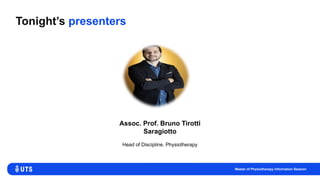
Tonight’s presenters
Assoc. Prof.Bruno Tirotti
Saragiotto
Head of Discipline, Physiotherapy
Master of Physiotherapy Information Session
3.
Acknowledgment of Country
Iwould like to acknowledge the Gadigal
people of the Eora Nation upon whose
ancestral lands our City campus now
stands. I would also like to pay respect
to the Elders both past and present,
acknowledging them as the traditional
custodians of knowledge for this land.
'Over Time We Come Together 2015' by Cassie Leatham
4.
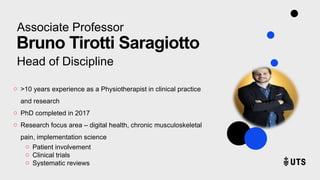
Associate Professor
Bruno TirottiSaragiotto
Head of Discipline
o >10 years experience as a Physiotherapist in clinical practice
and research
o PhD completed in 2017
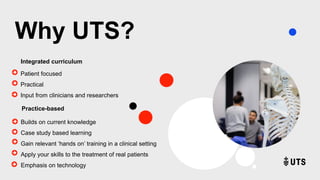
o Research focus area – digital health, chronic musculoskeletal
pain, implementation science
o Patient involvement
o Clinical trials
o Systematic reviews
5.
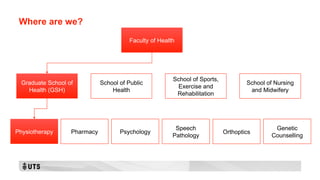
Where are we?
Facultyof Health
Graduate School of
Health (GSH)
School of Public
Health
School of Sports,
Exercise and
Rehabilitation
School of Nursing
and Midwifery
Physiotherapy Pharmacy Psychology
Speech
Pathology
Orthoptics
Genetic
Counselling
6.
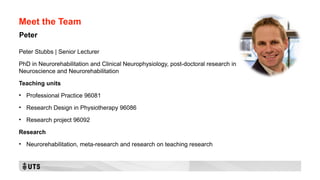
Meet the Team
PeterStubbs | Senior Lecturer
PhD in Neurorehabilitation and Clinical Neurophysiology, post-doctoral research in
Neuroscience and Neurorehabilitation
Teaching units
• Professional Practice 96081
• Research Design in Physiotherapy 96086
• Research project 96092
Research
• Neurorehabilitation, meta-research and research on teaching research
Peter
7.
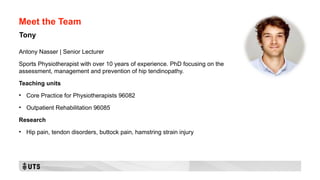
Meet the Team
AntonyNasser | Senior Lecturer
Sports Physiotherapist with over 10 years of experience. PhD focusing on the
assessment, management and prevention of hip tendinopathy.
Teaching units
• Core Practice for Physiotherapists 96082
• Outpatient Rehabilitation 96085
Research
• Hip pain, tendon disorders, buttock pain, hamstring strain injury
Tony
8.
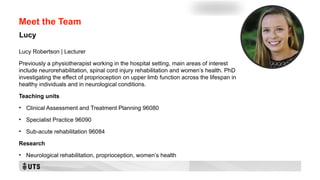
Meet the Team
LucyRobertson | Lecturer
Previously a physiotherapist working in the hospital setting, main areas of interest
include neurorehabilitation, spinal cord injury rehabilitation and women’s health. PhD
investigating the effect of proprioception on upper limb function across the lifespan in
healthy individuals and in neurological conditions.
Teaching units
• Clinical Assessment and Treatment Planning 96080
• Specialist Practice 96090
• Sub-acute rehabilitation 96084
Research
• Neurological rehabilitation, proprioception, women’s health
Lucy
9.
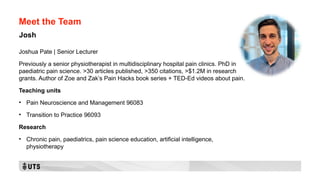
Meet the Team
JoshuaPate | Senior Lecturer
Previously a senior physiotherapist in multidisciplinary hospital pain clinics. PhD in
paediatric pain science. >30 articles published, >350 citations, >$1.2M in research
grants. Author of Zoe and Zak’s Pain Hacks book series + TED-Ed videos about pain.
Teaching units
• Pain Neuroscience and Management 96083
• Transition to Practice 96093
Research
• Chronic pain, paediatrics, pain science education, artificial intelligence,
physiotherapy
Josh
10.
Meet the Team
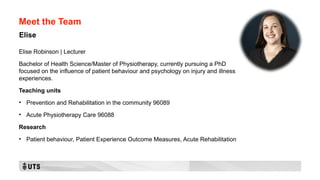
EliseRobinson | Lecturer
Bachelor of Health Science/Master of Physiotherapy, currently pursuing a PhD
focused on the influence of patient behaviour and psychology on injury and illness
experiences.
Teaching units
• Prevention and Rehabilitation in the community 96089
• Acute Physiotherapy Care 96088
Research
• Patient behaviour, Patient Experience Outcome Measures, Acute Rehabilitation
Elise
11.
Meet the Team
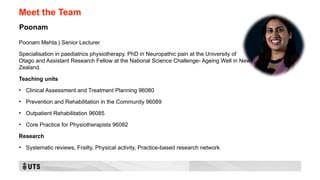
PoonamMehta | Senior Lecturer
Specialisation in paediatrics physiotherapy. PhD in Neuropathic pain at the University of
Otago and Assistant Research Fellow at the National Science Challenge- Ageing Well in New
Zealand.
Teaching units
• Clinical Assessment and Treatment Planning 96080
• Prevention and Rehabilitation in the Community 96089
• Outpatient Rehabilitation 96085
• Core Practice for Physiotherapists 96082
Research
• Systematic reviews, Frailty, Physical activity, Practice-based research network
Poonam
12.
Meet the Team
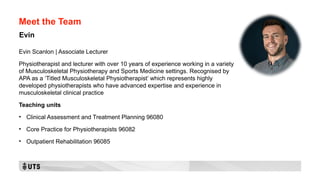
EvinScanlon | Associate Lecturer
Physiotherapist and lecturer with over 10 years of experience working in a variety
of Musculoskeletal Physiotherapy and Sports Medicine settings. Recognised by
APA as a ‘Titled Musculoskeletal Physiotherapist’ which represents highly
developed physiotherapists who have advanced expertise and experience in
musculoskeletal clinical practice
Teaching units
• Clinical Assessment and Treatment Planning 96080
• Core Practice for Physiotherapists 96082
• Outpatient Rehabilitation 96085
Evin
13.
Meet the Team
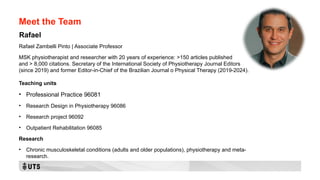
RafaelZambelli Pinto | Associate Professor
MSK physiotherapist and researcher with 20 years of experience: >150 articles published
and > 8,000 citations. Secretary of the International Society of Physiotherapy Journal Editors
(since 2019) and former Editor-in-Chief of the Brazilian Journal o Physical Therapy (2019-2024).
Teaching units
• Professional Practice 96081
• Research Design in Physiotherapy 96086
• Research project 96092
• Outpatient Rehabilitation 96085
Research
• Chronic musculoskeletal conditions (adults and older populations), physiotherapy and meta-
research.
Rafael
14.
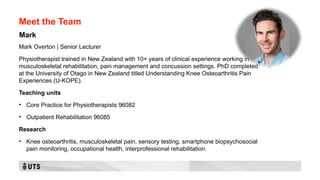
Meet the Team
MarkOverton | Senior Lecturer
Physiotherapist trained in New Zealand with 10+ years of clinical experience working in
musculoskeletal rehabilitation, pain management and concussion settings. PhD completed
at the University of Otago in New Zealand titled Understanding Knee Osteoarthritis Pain
Experiences (U-KOPE).
Teaching units
• Core Practice for Physiotherapists 96082
• Outpatient Rehabilitation 96085
Research
• Knee osteoarthritis, musculoskeletal pain, sensory testing, smartphone biopsychosocial
pain monitoring, occupational health, interprofessional rehabilitation.
Mark
15.
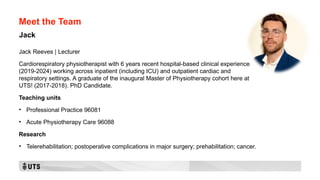
Meet the Team
JackReeves | Lecturer
Cardiorespiratory physiotherapist with 6 years recent hospital-based clinical experience
(2019-2024) working across inpatient (including ICU) and outpatient cardiac and
respiratory settings. A graduate of the inaugural Master of Physiotherapy cohort here at
UTS! (2017-2018). PhD Candidate.
Teaching units
• Professional Practice 96081
• Acute Physiotherapy Care 96088
Research
• Telerehabilitation; postoperative complications in major surgery; prehabilitation; cancer.
Jack
16.
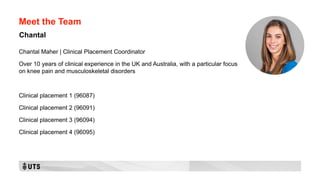
Meet the Team
ChantalMaher | Clinical Placement Coordinator
Over 10 years of clinical experience in the UK and Australia, with a particular focus
on knee pain and musculoskeletal disorders
Clinical placement 1 (96087)
Clinical placement 2 (96091)
Clinical placement 3 (96094)
Clinical placement 4 (96095)
Chantal
17.
Meet the Team
AbaDaoud | Clinical Placement Coordinator
Over 10 years of clinical experience as musculoskeletal physiotherapy and private practice.
As the founder of Flex Allied Health, Aba has led his clinic's growth into a leading
multidisciplinary practice, recognised for delivering elite, evidence-based care and clinical
education.
Teaching units
Clinical placement 1 (96087)
Clinical placement 2 (96091)
Clinical placement 3 (96094)
Clinical placement 4 (96095)
Aba
18.
Our WORKPLACE philosophy
Buildinga Supportive, Collaborative, and Growth-Oriented Environment
Our workplace philosophy is rooted in fostering an environment where
teamwork, communication, and mutual respect are at the forefront. We
believe in the power of collaboration, where each team member's voice is
valued, and we actively engage in open communication to ensure everyone
feels heard and supported.
19.
Our VISION
To prepareculturally competent physiotherapists who
are skilled, adaptable, and committed to delivering
patient-centred, evidence-based care.
20.
Our PHILOSOPHY
We arecommitted to fostering a learning environment that values
collaboration, diversity, and integrity. Our teaching philosophy focuses on
developing future physiotherapists who are skilled, empathetic, adaptable,
culturally competent, ethical, and reflective professionals.
21.
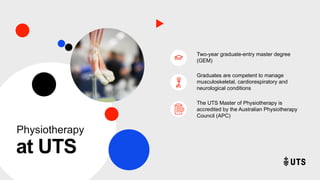
at UTS
Two-year graduate-entrymaster degree
(GEM)
Graduates are competent to manage
musculoskeletal, cardiorespiratory and
neurological conditions
The UTS Master of Physiotherapy is
accredited by the Australian Physiotherapy
Council (APC)
Physiotherapy
22.
Why UTS?
Patient focused
Practical
Inputfrom clinicians and researchers
Integrated curriculum
Practice-based
Builds on current knowledge
Case study based learning
Gain relevant ‘hands on’ training in a clinical setting
Apply your skills to the treatment of real patients
Emphasis on technology
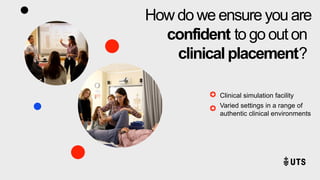
Clinical simulation facility
Variedsettings in a range of
authentic clinical environments
How do we ensure you are
confident to go out on
clinical placement?
25.
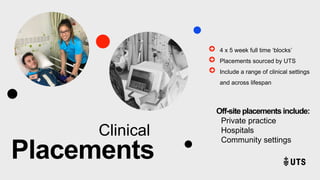
Clinical
Placements
4 x 5week full time ‘blocks’
Placements sourced by UTS
Include a range of clinical settings
and across lifespan
Off-site placements include:
Private practice
Hospitals
Community settings
26.
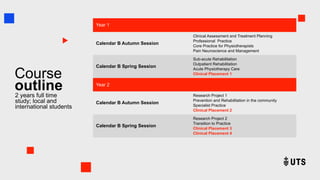
Year 1
Calendar BAutumn Session
Clinical Assessment and Treatment Planning
Professional Practice
Core Practice for Physiotherapists
Pain Neuroscience and Management
Calendar B Spring Session
Sub-acute Rehabilitation
Outpatient Rehabilitation
Acute Physiotherapy Care
Clinical Placement 1
Year 2
Calendar B Autumn Session
Research Project 1
Prevention and Rehabilitation in the community
Specialist Practice
Clinical Placement 2
Calendar B Spring Session
Research Project 2
Transition to Practice
Clinical Placement 3
Clinical Placement 4
Course
outline
2 years full time
study; local and
international students
27.
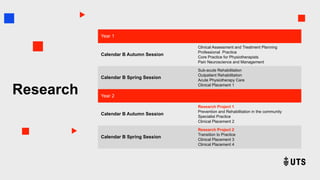
Year 1
Calendar BAutumn Session
Clinical Assessment and Treatment Planning
Professional Practice
Core Practice for Physiotherapists
Pain Neuroscience and Management
Calendar B Spring Session
Sub-acute Rehabilitation
Outpatient Rehabilitation
Acute Physiotherapy Care
Clinical Placement 1
Year 2
Calendar B Autumn Session
Research Project 1
Prevention and Rehabilitation in the community
Specialist Practice
Clinical Placement 2
Calendar B Spring Session
Research Project 2
Transition to Practice
Clinical Placement 3
Clinical Placement 4
Research
28.
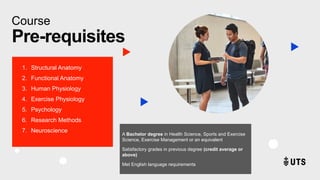
Course
Pre-requisites
1. Structural Anatomy
2.Functional Anatomy
3. Human Physiology
4. Exercise Physiology
5. Psychology
6. Research Methods
7. Neuroscience
A Bachelor degree in Health Science, Sports and Exercise
Science, Exercise Management or an equivalent
Satisfactory grades in previous degree (credit average or
above)
Met English language requirements
29.
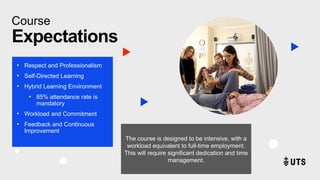
Course
Expectations
• Respect andProfessionalism
• Self-Directed Learning
• Hybrid Learning Environment
• 85% attendance rate is
mandatory
• Workload and Commitment
• Feedback and Continuous
Improvement
The course is designed to be intensive, with a
workload equivalent to full-time employment.
This will require significant dedication and time
management.
30.
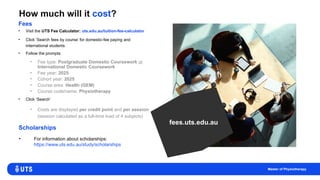
How much willit cost?
• Visit the UTS Fee Calculator: uts.edu.au/tuition-fee-calculator
• Click ‘Search fees by course’ for domestic-fee paying and
international students
• Follow the prompts
• Fee type: Postgraduate Domestic Coursework or
International Domestic Coursework
• Fee year: 2025
• Cohort year: 2025
• Course area: Health (GEM)
• Course code/name: Physiotherapy
• Click ‘Search’
• Costs are displayed per credit point and per session
(session calculated as a full-time load of 4 subjects)
Fees
Scholarships
fees.uts.edu.au
Master of Physiotherapy
• For information about scholarships:
https://www.uts.edu.au/study/scholarships
31.
Is there feesupport available?
Government loan scheme for tuition fees for
domestic students
You do not pay fees upfront - inform your employer
you have a FEE-HELP loan and they will withhold
your payments through the PAYG tax system
Compulsory repayments proportionate to income.
Tuition fees may be tax deductible if related to your
employment - contact your financial advisor or the
ATO www.ato.gov.au
For further information see the Australian
Government Study Assist website:
http://studyassist.gov.au
FEE-HELP
studyassist.gov.au
Master of Physiotherapy
32.
z
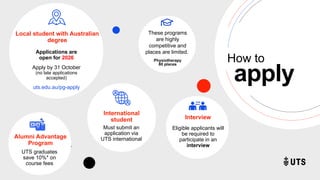
Local student withAustralian
degree
Applications are
open for 2026
Apply by 31 October
(no late applications
accepted)
uts.edu.au/pg-apply
z
apply
How to
International
student
Must submit an
application via
UTS international
These programs
are highly
competitive and
places are limited.
Physiotherapy
80 places
z
Interview
Eligible applicants will
be required to
participate in an
interview
Alumni Advantage
Program
UTS graduates
save 10%* on
course fees
33.
For questions andenquiries,
contact us via
gsh.future@uts.edu.au
Follow UTS Graduate School of
Health on social media
Facebook, LinkedIn, Twitter
Thanks for
joining us
Question?
Editor's Notes
#1 Welcome/Holding Slide
Marketing Lead - welcome attendees, wait for all to connect to audio + acknowledgement of country. “I would like to acknowledge the Gadigal people of the Eora Nation upon whose ancestral lands our City campus now stands. I would also like to pay respect to the Elders both past and present, acknowledging them as the traditional custodians of knowledge for this land”.
#2 [SLIDE 4]
Marketing Lead – introduce presenter and hand over
PRESENTERS - [Self introduction]
Please introduce yourself.
#22 Usual course content
We have a real focus on making sure what we teach is highly relevant to what clinicians are doing right now. We teach holistically, so you’ll learn about several physio areas and how they come together rather than focusing on one area and then moving on to the next.
I believe that what really makes us stand out is our learning model, we focus on patients and use case studies to help you learn.
We don’t have the traditional end of semester exam, instead we use authentic assessments
We also treat our students as professionals in training, and make sure you are practice ready.
We also engage a lot with industry – we have clinicians give guest presentations and they also contribute to our teaching, making sure that what we teach our students is the latest. We are also aligned with sports teams such as Sydney FC and we have the amazing facility at Moore Park.
Our students also have access to working physiotherapists. We invite Clinicians to give guest presentations and many of our teachers are practicing, or have very recently practiced, which ensures what we are teaching reflects what happening in the real world.
And, of course, key to making you a confident practitioner, is clinical placements, our students undertake 800 hours of placements.
Tech – slow motion video analysis – assessing quality of movement
#23 Usual course content
So what does a typical class look like?
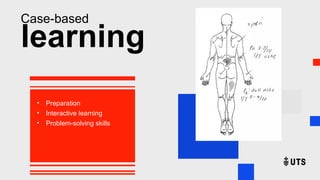
Here is in example of the type of case-based learning in the course
In Clinical Assessment and Treatment – one of your first session subjects – you would be presented with a case study
At the beginning of workshops we set a manageable amount of preparation
Case study is introduced and by the end of the session you are able to present a diagnosis or management plan for the patient
Enables you to engage and interact with fellow students and lecturers and develop problem-solving skills
#24 Usual course content
Unique to UTS is that you start placements in your first year. And to make sure you’re confident in the lead-up to this, we use Nursing’s simulated hospital environment, so you get immersed in this setting before you start your first placement.
Speak about in-class simulated learning
#25 Usual course content
Clinical placements are how we make sure you’re job-ready when you leave, gaining that hands on training before you graduate.
Placements start in your first year, and then in your second year, you will complete 3 placements. Each placement is 5 weeks and sourced by us.
Students have quite a few options for off-site placements – private practice, hospital and community settings.
#26 Usual course content
This is an overview of what you will study during your 2 years with us.
What’s important to notice here is that you start clinical placements in your first year.
Handover to Tony Nasser to talk about Clinical Placements
#27 Usual course content
In the 2nd year we teach how to critically appraise research.
Due to research, the Physiotherapy profession became a well respected and evidence based profession
In our course we want to make sure what there will be the same new people that will in the future continue to contribute to the knowledgebase of this beautiful profession.
#30 All fees info is online: fees.uts.edu.au
No need to spend much time on this slide. This is merely to let students know where they can go to get an idea of the fee structure of the course.
The prompts are the most important part here (so they know which breadcrumbs to follow).
Remind students they are getting a copy of the slides so no need to fret about this info right this second.
#31 Same notes as previous slide – just brining attention to these assistance schemes.
#32 Usual course content
If you are keen to study at UTS I would encourage you to submit your application online tonight.
The process for applying is now completely online. You will need to register on our online portal (if you haven’t already done so) and commence your application. Applications will close once the 60 places have been filled and last year we closed after round 1.
If you are international student you do need to apply online via UTS international.
#33 [Open chat box to view questions]
We’ll now take some of your questions that you’ve sent through.
[After designated session time is over]
If you have further questions, please contact us at gsh.future@uts.edu.au. We will also email you the presentation and useful information. Best of luck with your applications. Hope to see you at UTS next year. End session