CFA Institute Research Challenge
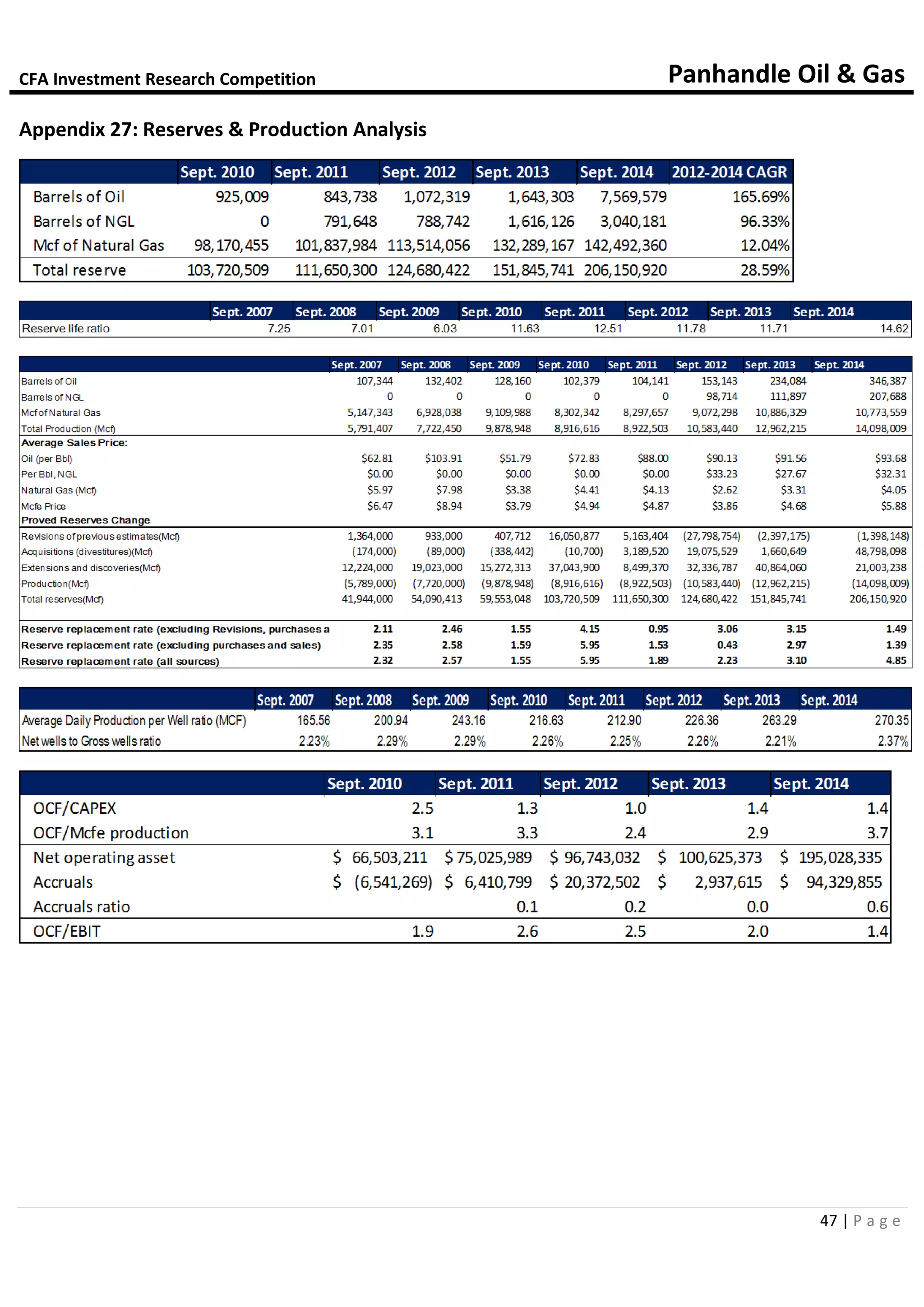
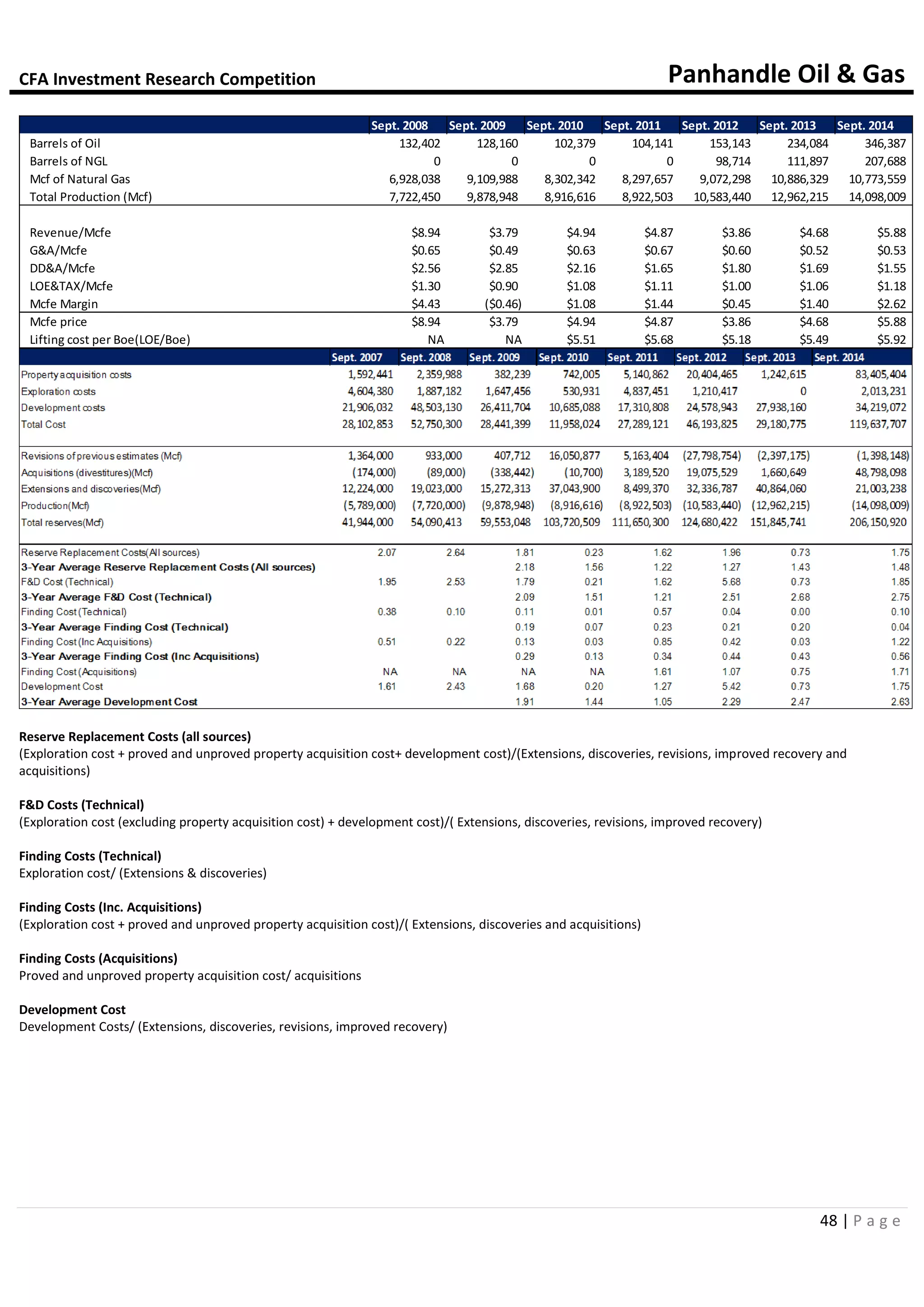
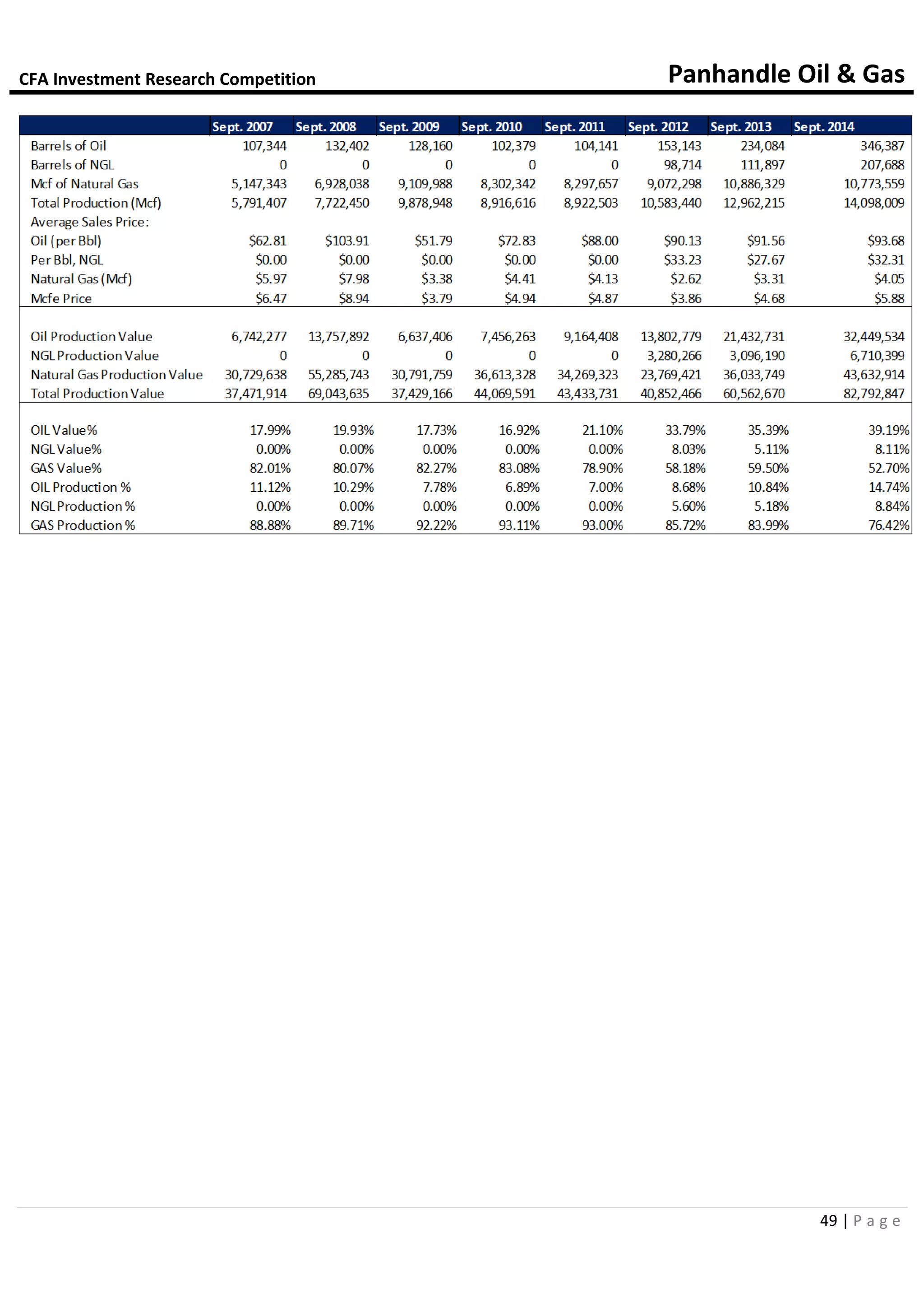
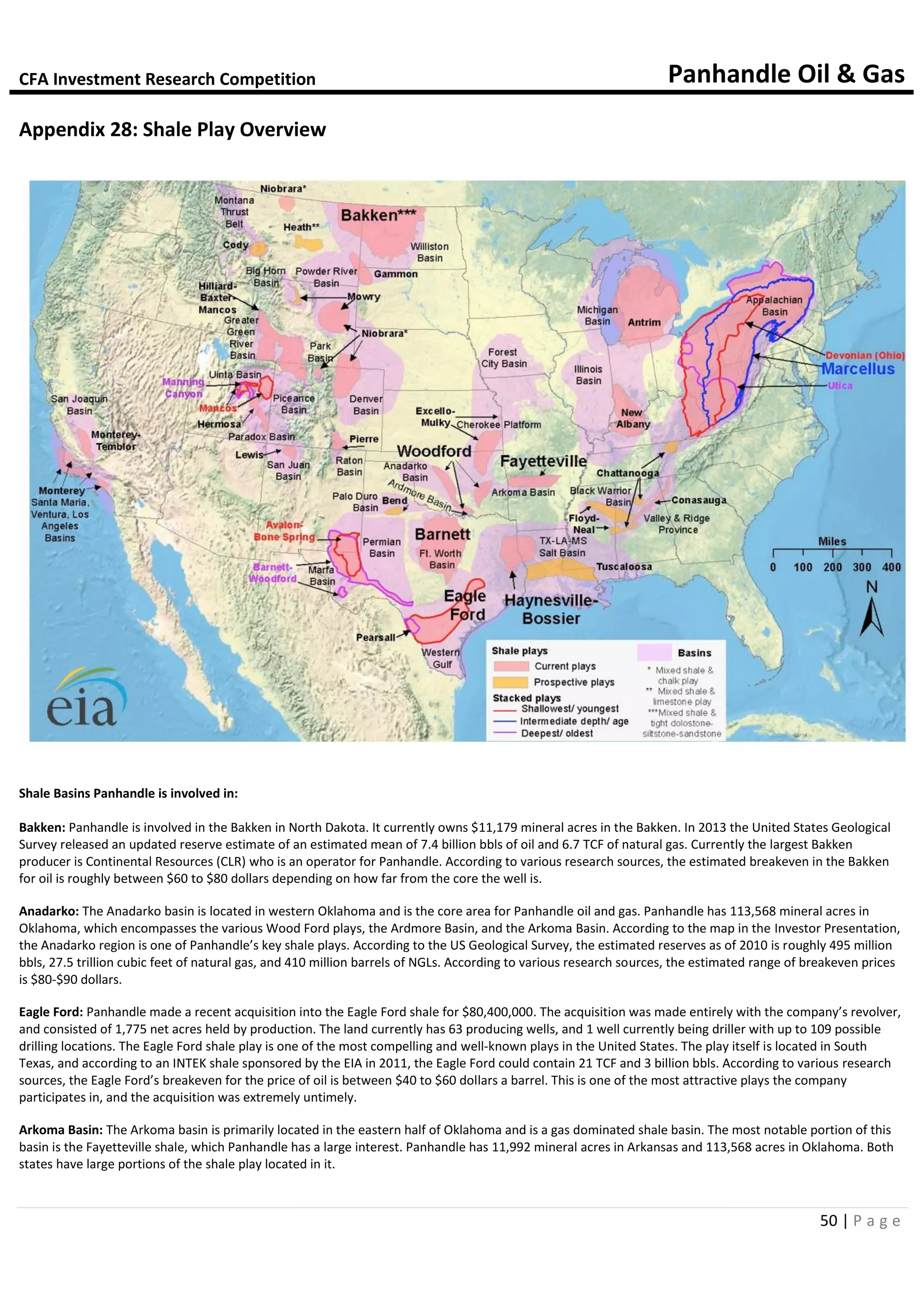
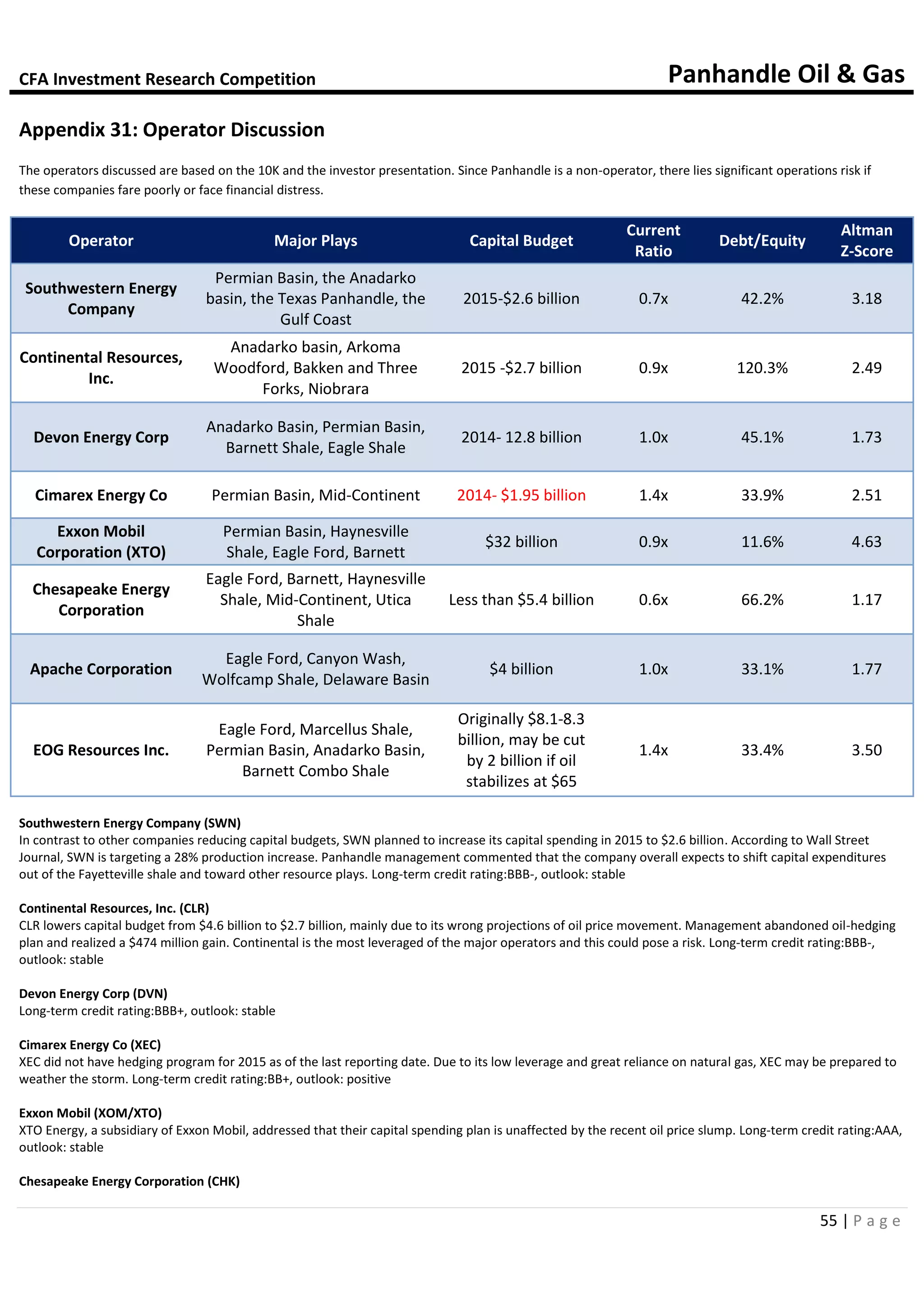
Hosted by:
CFA Societies Texas, Louisiana, and Oklahoma
Local Challenge- Southwest US
The University of Texas at Dallas
1 | P a g e
Market Profile (As of 1/31/15)
Market Value (M) $355,797.84
Enterprise value (M) $434,275.99
Shares Outstanding Diluted (M) 16,991
Average Daily Volume (mm) 0.11
Dividend Yield 0.76%
Float % 90.4%
Short Interest (mm) 0.4
Beta (5Y) 0.69
P/E 14.0x
P/B 3.0x
EV/ EBITDAX 7.2x
EV / Proved Reserves 2.1x
Reserves/Production 14.6x
PD / Proved Reserves 56%
$12 $14 $16 $18 $20 $22 $24
Bear Case Bull Case
Base Case
Current Price
$20.94
Financials 2014 2015E 2016E
Revenue $84,411 $65,204 $67,983
Op. Margin (%) 44.2% 36.8% 39.2%
Net Margin (%) 30.0% 23.8% 25.8%
EPS 1.50 0.91 1.04
BV Per share 7.01 7.81 8.71
ROE 21.0% 11.5% 11.7%
ROA 10.1% 6.0% 6.5%
Investment Highlights
Unique Business Model
Panhandle is an Oil and Gas company with a unique business model. The company owns
mineral rights on land, which are operated on by independent companies. Panhandle can
elect to receive either a royalty or a working interest, which gives Panhandle flexibility to
choose to participate in working interest and/or royalties.
Valuable Assets
Panhandle Oil and Gas has a large amount of mineral acres, much of which was purchased
in the early 20
th
century at a low cost. The mineral acreage of the land was purchased at a
cost significantly below current value, which currently leads to a cost basis of $90 a share.
Inability to Monetize Assets
Panhandle owns a large amount of assets listed at below book value, but due to lack of
control over operations, Panhandle lacks the ability to turn the acreage into reserves. In
addition, management has stressed that they do not sell mineral acreage, and this poses
the risk of the mineral acreage never being realized due to external factors. The mineral
acreage might be attractive in the extreme long term, but the value the company will be
able to obtain from them is unidentifiable.
Positioned to Weather Downturn
Panhandle is positioned to weather the downturn due to low leverage relative to peers, a
strong balance sheet, and a large undrawn revolver that is secured against nonproducing
land (per management guidance). The downturn might be attractive to Panhandle with the
possibility of acquiring additional HBP working interests and mineral acreage.
Entirely Subject to Energy Prices
As with the risk of all oil and gas companies, Panhandle’s revenue is entirely subject to
energy prices. This coupled with low operational control and extreme market uncertainty
creates a potentially risky investment considering the company is influenced by such a
large number of external factors.
Don’t Catch a Falling Barrel
Sector
Energy
Industry
Oil and Gas
Ticker
NYSE:PHX
52-Week Range
$15.68 – $34.45
Price
$20.94 (1/31/2015)
Price Target
$21.69 (3.5% Undervalued)
Recommendation: Hold
CFA Investment Research Competition Panhandle Oil & Gas, Inc.
2 | P a g e
Source: Company Data as of 9/30/14
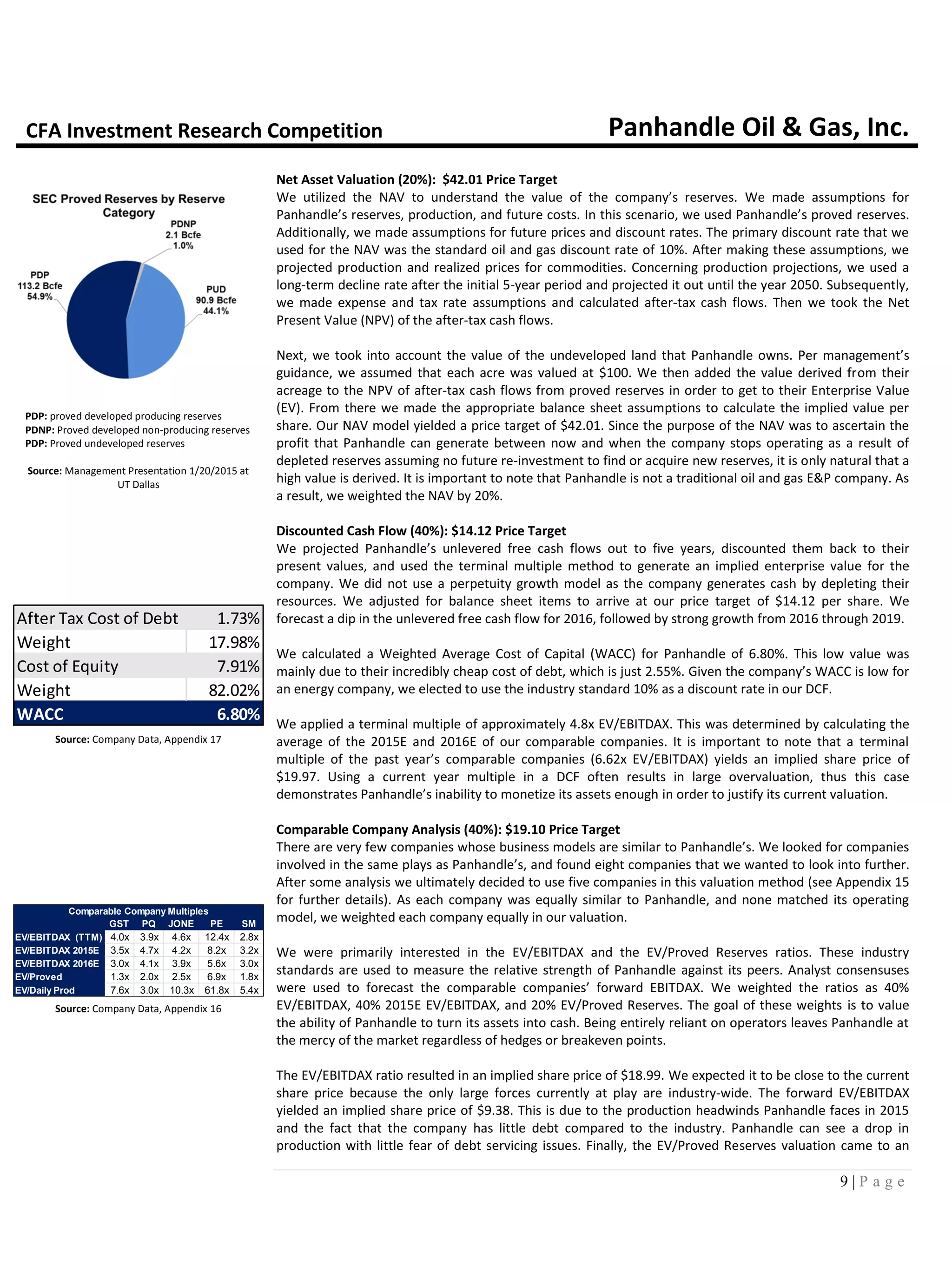
22%
9%
69%
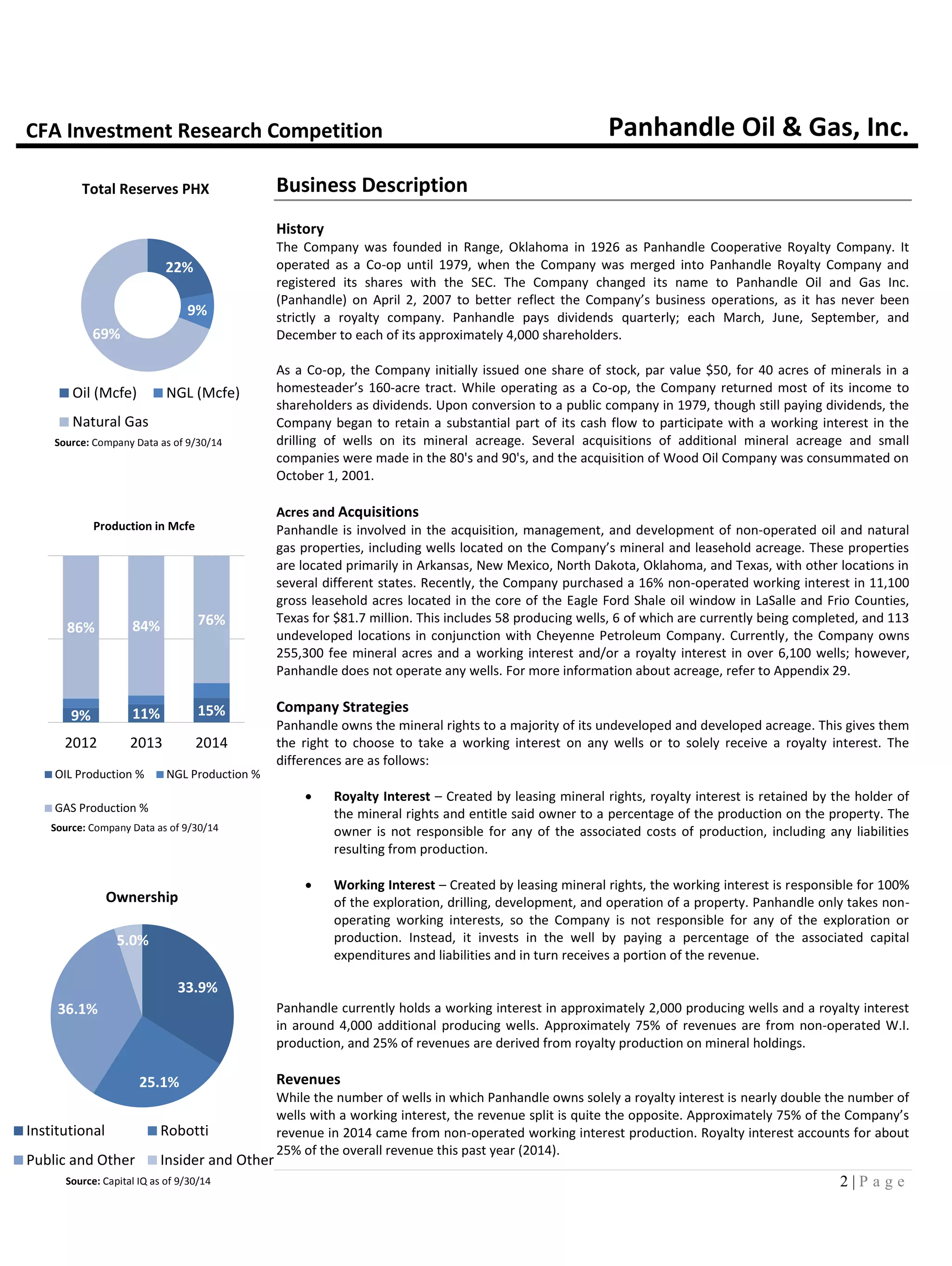
Total Reserves PHX
Oil (Mcfe) NGL (Mcfe)
Natural Gas
9% 11% 15%
86% 84% 76%
2012 2013 2014
Production in Mcfe
OIL Production % NGL Production %
GAS Production %
Source: Company Data as of 9/30/14
33.9%
25.1%
36.1%
5.0%
Ownership
Institutional Robotti
Public and Other Insider and Other
Source: Capital IQ as of 9/30/14
Business Description
History
The Company was founded in Range, Oklahoma in 1926 as Panhandle Cooperative Royalty Company. It
operated as a Co-op until 1979, when the Company was merged into Panhandle Royalty Company and
registered its shares with the SEC. The Company changed its name to Panhandle Oil and Gas Inc.
(Panhandle) on April 2, 2007 to better reflect the Company’s business operations, as it has never been
strictly a royalty company. Panhandle pays dividends quarterly; each March, June, September, and
December to each of its approximately 4,000 shareholders.
As a Co-op, the Company initially issued one share of stock, par value $50, for 40 acres of minerals in a
homesteader’s 160-acre tract. While operating as a Co-op, the Company returned most of its income to
shareholders as dividends. Upon conversion to a public company in 1979, though still paying dividends, the
Company began to retain a substantial part of its cash flow to participate with a working interest in the
drilling of wells on its mineral acreage. Several acquisitions of additional mineral acreage and small
companies were made in the 80's and 90's, and the acquisition of Wood Oil Company was consummated on
October 1, 2001.
Acres and Acquisitions
Panhandle is involved in the acquisition, management, and development of non-operated oil and natural
gas properties, including wells located on the Company’s mineral and leasehold acreage. These properties
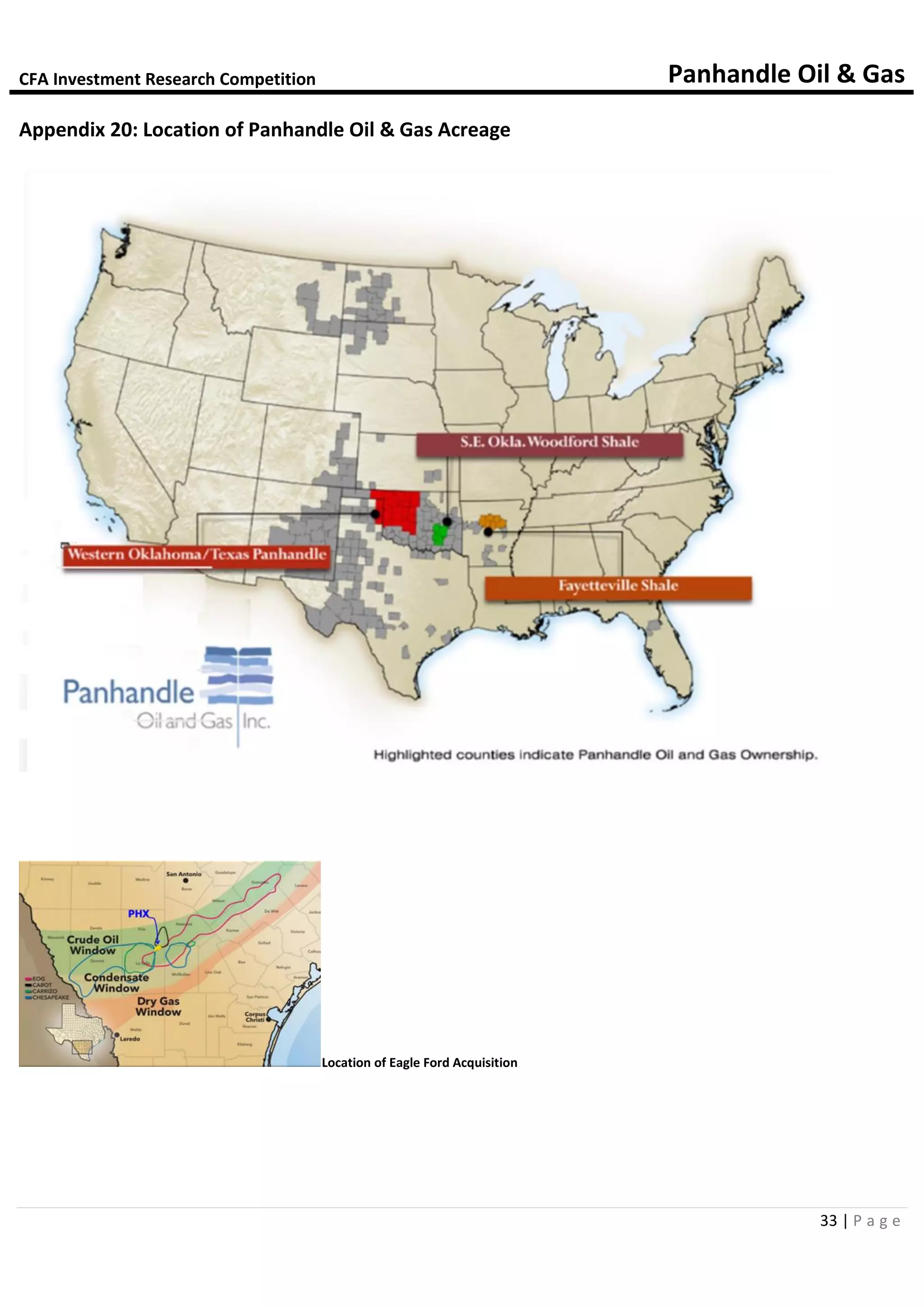
are located primarily in Arkansas, New Mexico, North Dakota, Oklahoma, and Texas, with other locations in
several different states. Recently, the Company purchased a 16% non-operated working interest in 11,100
gross leasehold acres located in the core of the Eagle Ford Shale oil window in LaSalle and Frio Counties,
Texas for $81.7 million. This includes 58 producing wells, 6 of which are currently being completed, and 113
undeveloped locations in conjunction with Cheyenne Petroleum Company. Currently, the Company owns
255,300 fee mineral acres and a working interest and/or a royalty interest in over 6,100 wells; however,
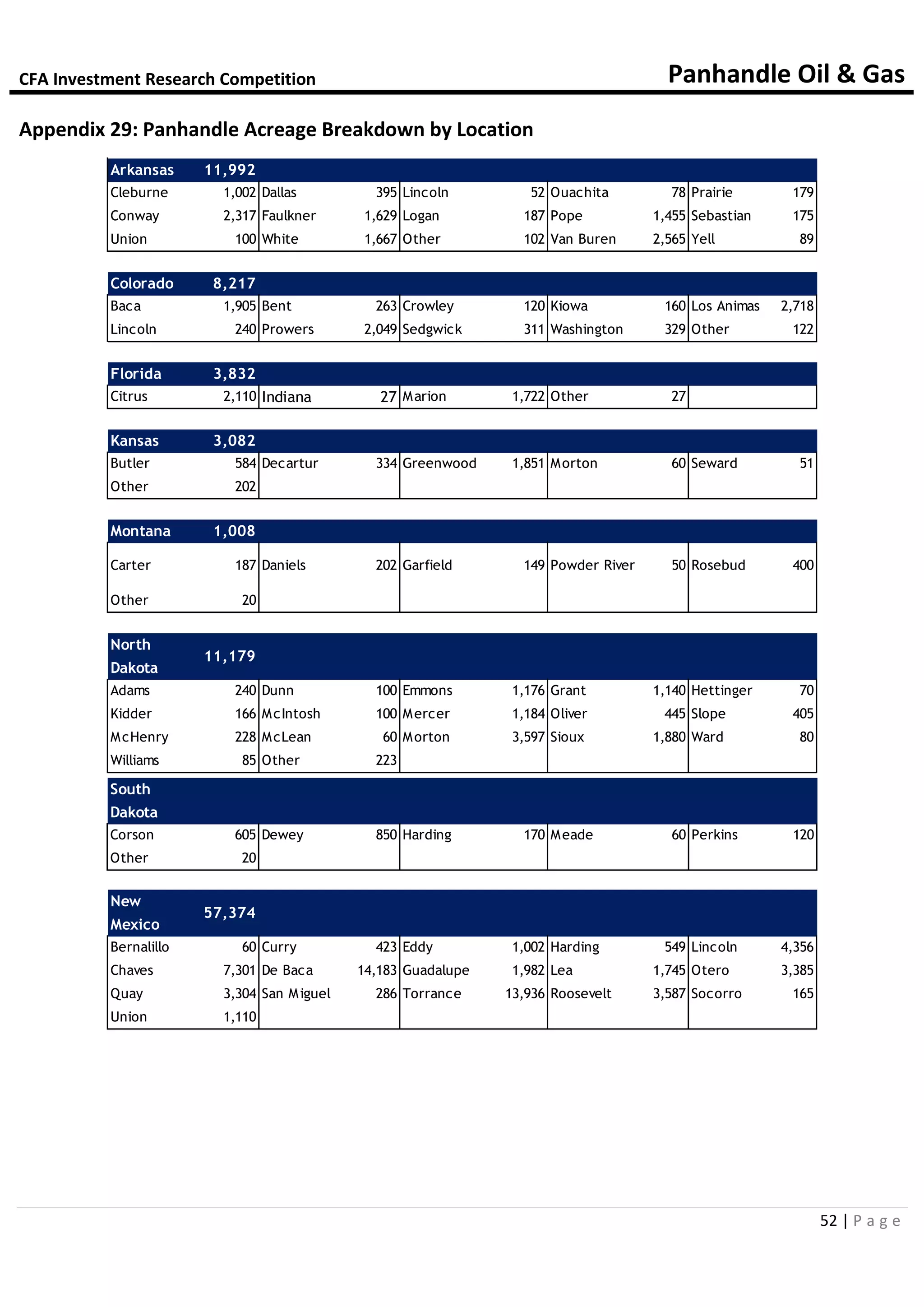
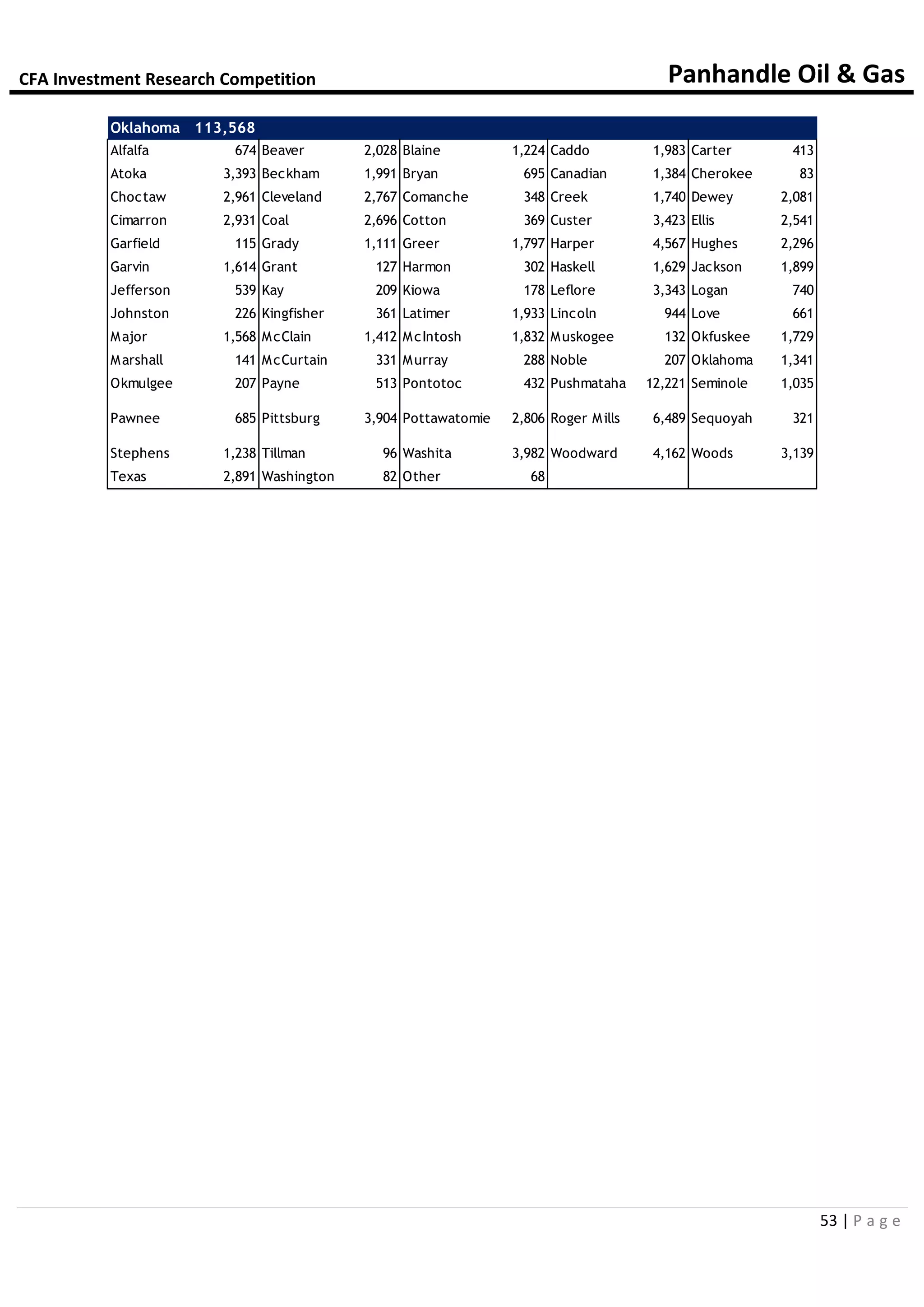
Panhandle does not operate any wells. For more information about acreage, refer to Appendix 29.
Company Strategies
Panhandle owns the mineral rights to a majority of its undeveloped and developed acreage. This gives them
the right to choose to take a working interest on any wells or to solely receive a royalty interest. The
differences are as follows:
 Royalty Interest – Created by leasing mineral rights, royalty interest is retained by the holder of
the mineral rights and entitle said owner to a percentage of the production on the property. The
owner is not responsible for any of the associated costs of production, including any liabilities
resulting from production.
 Working Interest – Created by leasing mineral rights, the working interest is responsible for 100%
of the exploration, drilling, development, and operation of a property. Panhandle only takes non-
operating working interests, so the Company is not responsible for any of the exploration or
production. Instead, it invests in the well by paying a percentage of the associated capital
expenditures and liabilities and in turn receives a portion of the revenue.
Panhandle currently holds a working interest in approximately 2,000 producing wells and a royalty interest
in around 4,000 additional producing wells. Approximately 75% of revenues are from non-operated W.I.
production, and 25% of revenues are derived from royalty production on mineral holdings.
Revenues
While the number of wells in which Panhandle owns solely a royalty interest is nearly double the number of
wells with a working interest, the revenue split is quite the opposite. Approximately 75% of the Company’s
revenue in 2014 came from non-operated working interest production. Royalty interest accounts for about
25% of the overall revenue this past year (2014).
CFA Investment Research Competition Panhandle Oil & Gas, Inc.
3 | P a g e
2
4
6
8
0
1000
2000
3000
4000
Jan-14 Jul-14 Jan-15
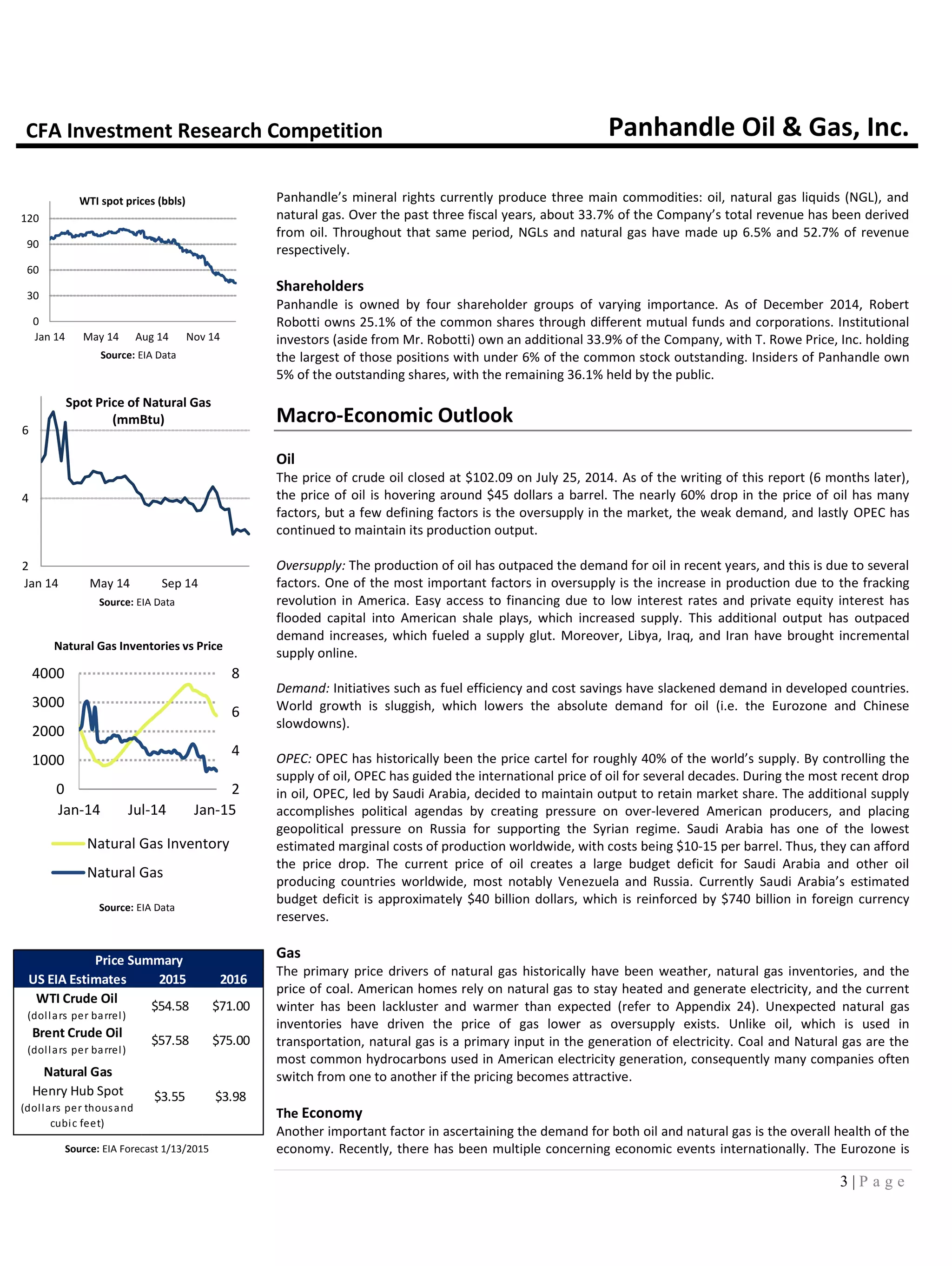
Natural Gas Inventories vs Price
Natural Gas Inventory
Natural Gas
Source: EIA Data
US EIA Estimates 2015 2016
WTI Crude Oil
(dollars per barrel)
$54.58 $71.00
Brent Crude Oil
(dollars per barrel)
$57.58 $75.00
Natural Gas
Henry Hub Spot
(dollars per thousand
cubic feet)
$3.55 $3.98
Price Summary
Source: EIA Forecast 1/13/2015
2
4
6
Jan 14 May 14 Sep 14
Spot Price of Natural Gas
(mmBtu)
Source: EIA Data
0
30
60
90
120
Jan 14 May 14 Aug 14 Nov 14
WTI spot prices (bbls)
Source: EIA Data
Panhandle’s mineral rights currently produce three main commodities: oil, natural gas liquids (NGL), and
natural gas. Over the past three fiscal years, about 33.7% of the Company’s total revenue has been derived
from oil. Throughout that same period, NGLs and natural gas have made up 6.5% and 52.7% of revenue
respectively.
Shareholders
Panhandle is owned by four shareholder groups of varying importance. As of December 2014, Robert
Robotti owns 25.1% of the common shares through different mutual funds and corporations. Institutional
investors (aside from Mr. Robotti) own an additional 33.9% of the Company, with T. Rowe Price, Inc. holding
the largest of those positions with under 6% of the common stock outstanding. Insiders of Panhandle own
5% of the outstanding shares, with the remaining 36.1% held by the public.
Macro-Economic Outlook
Oil
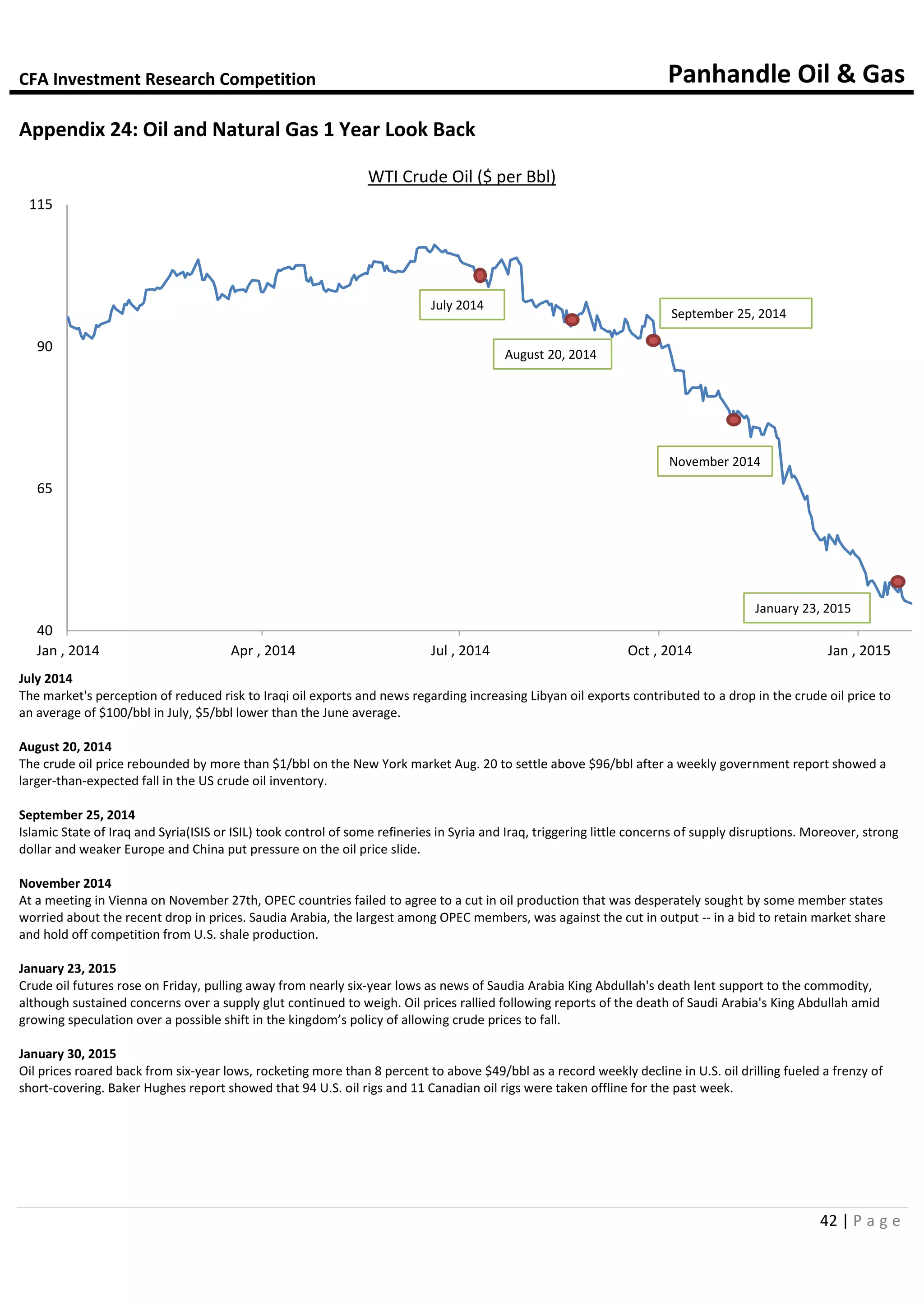
The price of crude oil closed at $102.09 on July 25, 2014. As of the writing of this report (6 months later),
the price of oil is hovering around $45 dollars a barrel. The nearly 60% drop in the price of oil has many
factors, but a few defining factors is the oversupply in the market, the weak demand, and lastly OPEC has
continued to maintain its production output.
Oversupply: The production of oil has outpaced the demand for oil in recent years, and this is due to several
factors. One of the most important factors in oversupply is the increase in production due to the fracking
revolution in America. Easy access to financing due to low interest rates and private equity interest has
flooded capital into American shale plays, which increased supply. This additional output has outpaced
demand increases, which fueled a supply glut. Moreover, Libya, Iraq, and Iran have brought incremental
supply online.
Demand: Initiatives such as fuel efficiency and cost savings have slackened demand in developed countries.
World growth is sluggish, which lowers the absolute demand for oil (i.e. the Eurozone and Chinese
slowdowns).
OPEC: OPEC has historically been the price cartel for roughly 40% of the world’s supply. By controlling the
supply of oil, OPEC has guided the international price of oil for several decades. During the most recent drop
in oil, OPEC, led by Saudi Arabia, decided to maintain output to retain market share. The additional supply
accomplishes political agendas by creating pressure on over-levered American producers, and placing
geopolitical pressure on Russia for supporting the Syrian regime. Saudi Arabia has one of the lowest
estimated marginal costs of production worldwide, with costs being $10-15 per barrel. Thus, they can afford
the price drop. The current price of oil creates a large budget deficit for Saudi Arabia and other oil
producing countries worldwide, most notably Venezuela and Russia. Currently Saudi Arabia’s estimated
budget deficit is approximately $40 billion dollars, which is reinforced by $740 billion in foreign currency
reserves.
Gas
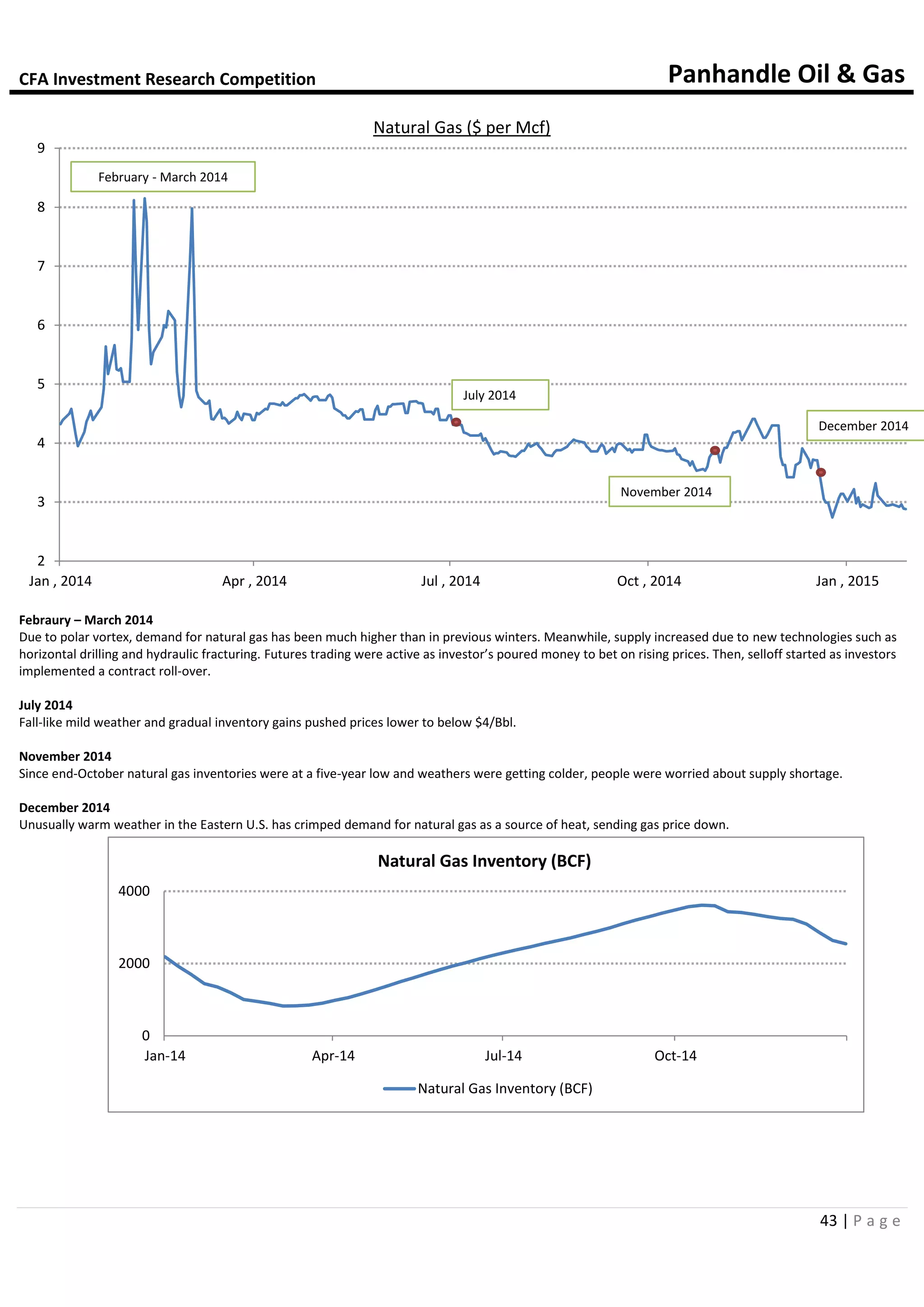
The primary price drivers of natural gas historically have been weather, natural gas inventories, and the
price of coal. American homes rely on natural gas to stay heated and generate electricity, and the current
winter has been lackluster and warmer than expected (refer to Appendix 24). Unexpected natural gas
inventories have driven the price of gas lower as oversupply exists. Unlike oil, which is used in
transportation, natural gas is a primary input in the generation of electricity. Coal and Natural gas are the
most common hydrocarbons used in American electricity generation, consequently many companies often
switch from one to another if the pricing becomes attractive.
The Economy
Another important factor in ascertaining the demand for both oil and natural gas is the overall health of the
economy. Recently, there has been multiple concerning economic events internationally. The Eurozone is
CFA Investment Research Competition Panhandle Oil & Gas, Inc.
4 | P a g e
Source: IMF Data and Forecast
Source: Cowen & Co.’s annual E&P study for 2015
Source: Baker Hughes 1/30/2015
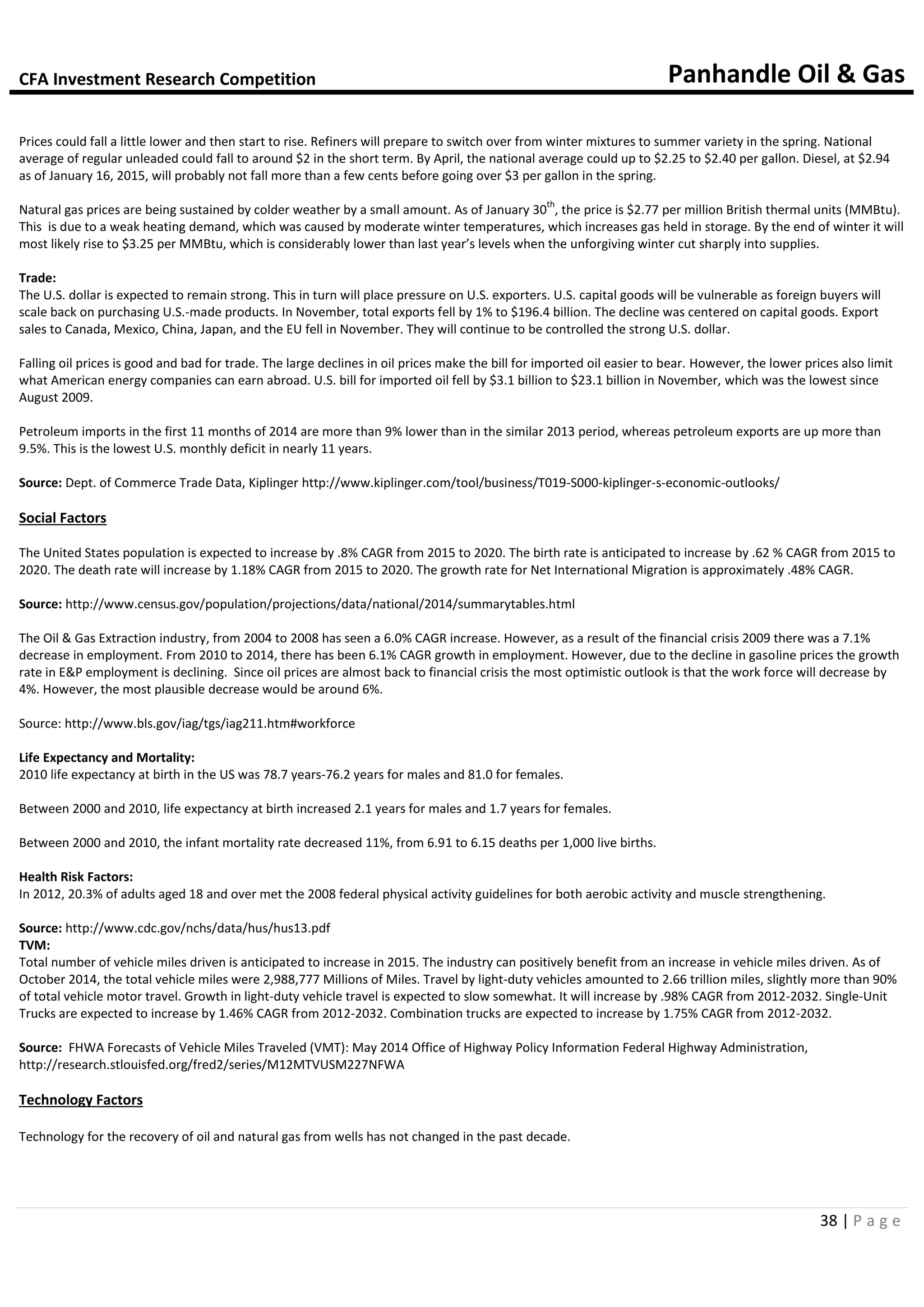
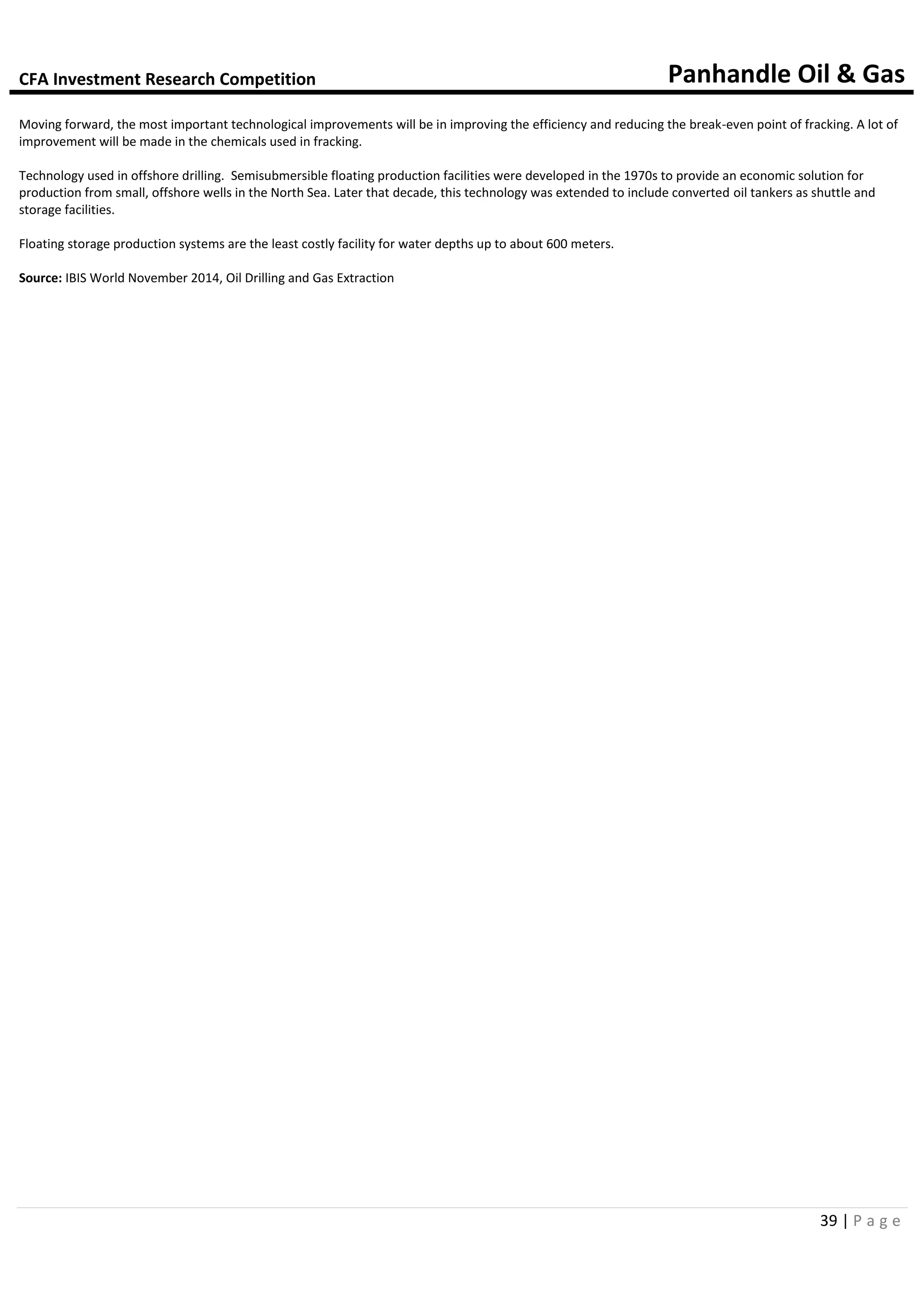
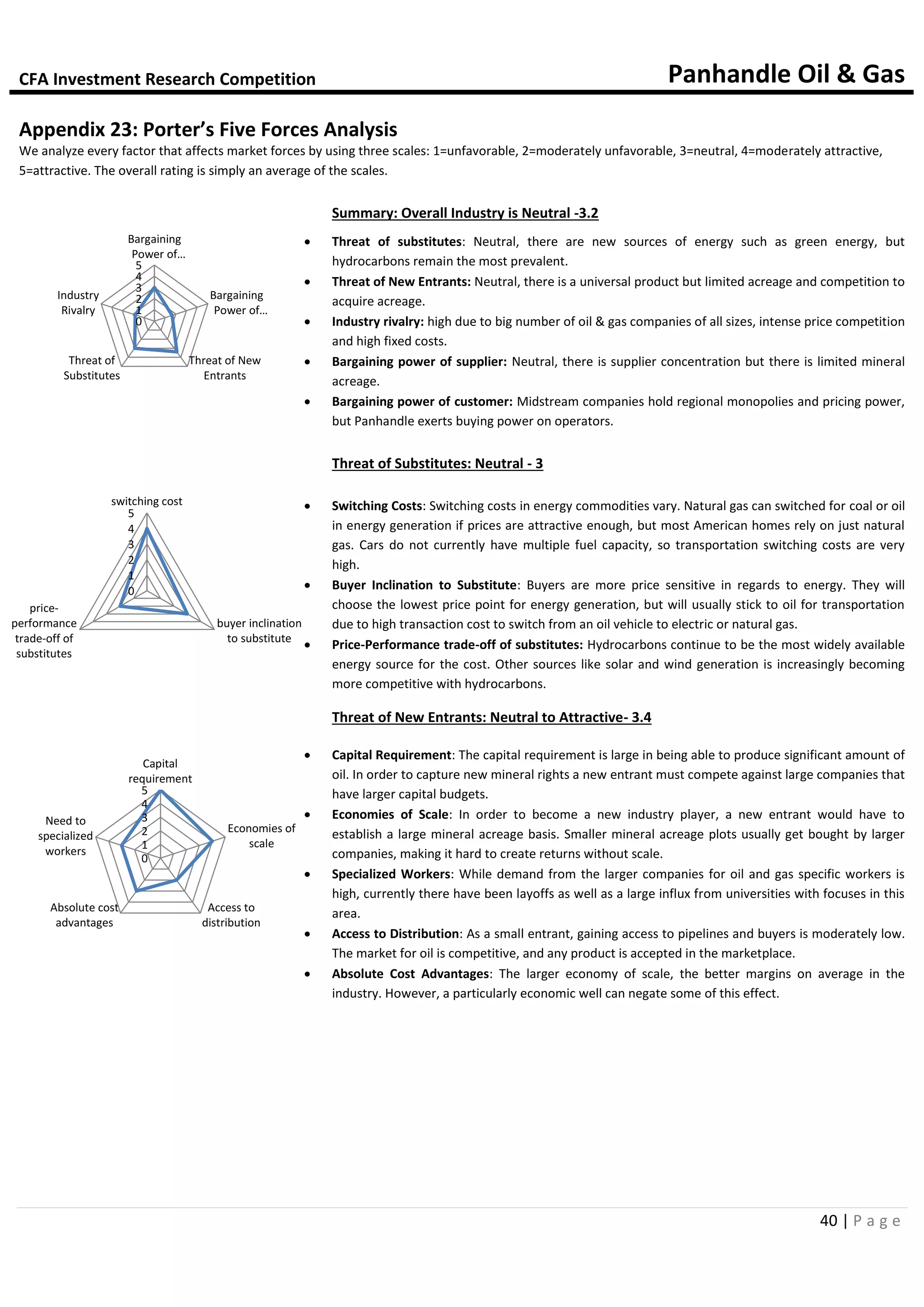
Bargain Power
Supplier
Bargain Power
Customer
Threat of New
Entrants
Threat of
Substitutes
Industry
Rivalry
Source: Appendix 23
facing possible deflation, and is struggling to keep the monetary union afloat while being burdened by
sanctions imposed on Russia. In Latin America, countries such as Brazil and Venezuela rely on oil prices to
sustain budget deficits. In light of recent events both countries are now battling budget deficits and this has
had negative consequences on their respective economies. Lastly, China’s growth has seemed to slow
down, and while the country has maintained a 7.5% growth target, real numbers seem to be significantly
lower. All of these factors create a troubling economic outlook in the near future.
Price Assumptions Given Economic Backdrop:
The price assumptions for the report are based on the January 13 forecast made by the U.S. Energy
Information Administration (EIA). The rationale for this is that the EIA report not only includes future pricing
in their forecasts, but also global supply and demand, GDP growth, and other economic factors. We believe
that relying on this multifactor assumption is the best method to encompass all foreseeable price risks in
our analysis.
Industry Overview & Competitive Positioning
Industry Overview
Possible E&P Liquidity Crunch
Exploration and Production (E&P) companies face larger than average capital expenditures to maintain their
operations. As such, it is not surprising that the sector takes on more debt on average than other industries.
As energy prices fall, the value of the reserves securing debt has decreased. Oil and gas companies that
have minimum cash balances and debt maturing soon may face considerable distress. Twice a year, the
lending bank will reassess each energy company’s borrowing capacity. Panhandle just had its borrowing
base reaffirmed in October and given their ability to use more land to secure debt, should pass through any
industry liquidity troubles unscathed.
Drilling and Production Costs Changing
Several factors indicate that oil and gas service providers might shrink costs in the future. The recent
consolidation of Baker Hughes and Halliburton might lead to lower service costs in the long-run if cost
synergies are realized. The merger of the second and third largest firms in the Oil Field Services industry will
take some time, so the decreased pricing effect will not be immediate. The current energy prices will affect
the prices that the company will charge in the near term quicker. In the 3
rd
quarter conference call, the
current CEO of Occidental (OXY) said, “[OXY] also expects that since service companies were happy to raise
prices when oil was going up that they would have been just as happy to have their prices lower in the
future”.
Declining Growth of New Wells
Drilling new wells to maintain production is vital for most companies to retain market share. In recent
weeks, we have seen a stark drop in rotary rig counts (the drilling equipment required drilling a new well).
Rotary rigs are only needed in the beginning stages of drilling and can be used for months on end depending
on the depth of the well. The rig count provided by Baker Hughes is a forward indicator regarding the
amount of new production being brought online. The rig count has dropped 20% since October, and as
more continuing projects are completed and fewer are started, we can expect this number to decline.
Competitive Positioning
Unparalleled Flexibility
Panhandle enjoys the luxury of choice in its operations. They receive a royalty interest from each well using
their mineral acreage, but they also have the protected right to choose to take a working interest in the
well. This gives Panhandle the ability to judge each well given current and future economic conditions to
ensure a reliable return on capital. If the project does not meet the 20% pre-tax IRR management threshold,
they can simply receive their royalty interest on a small cost basis.
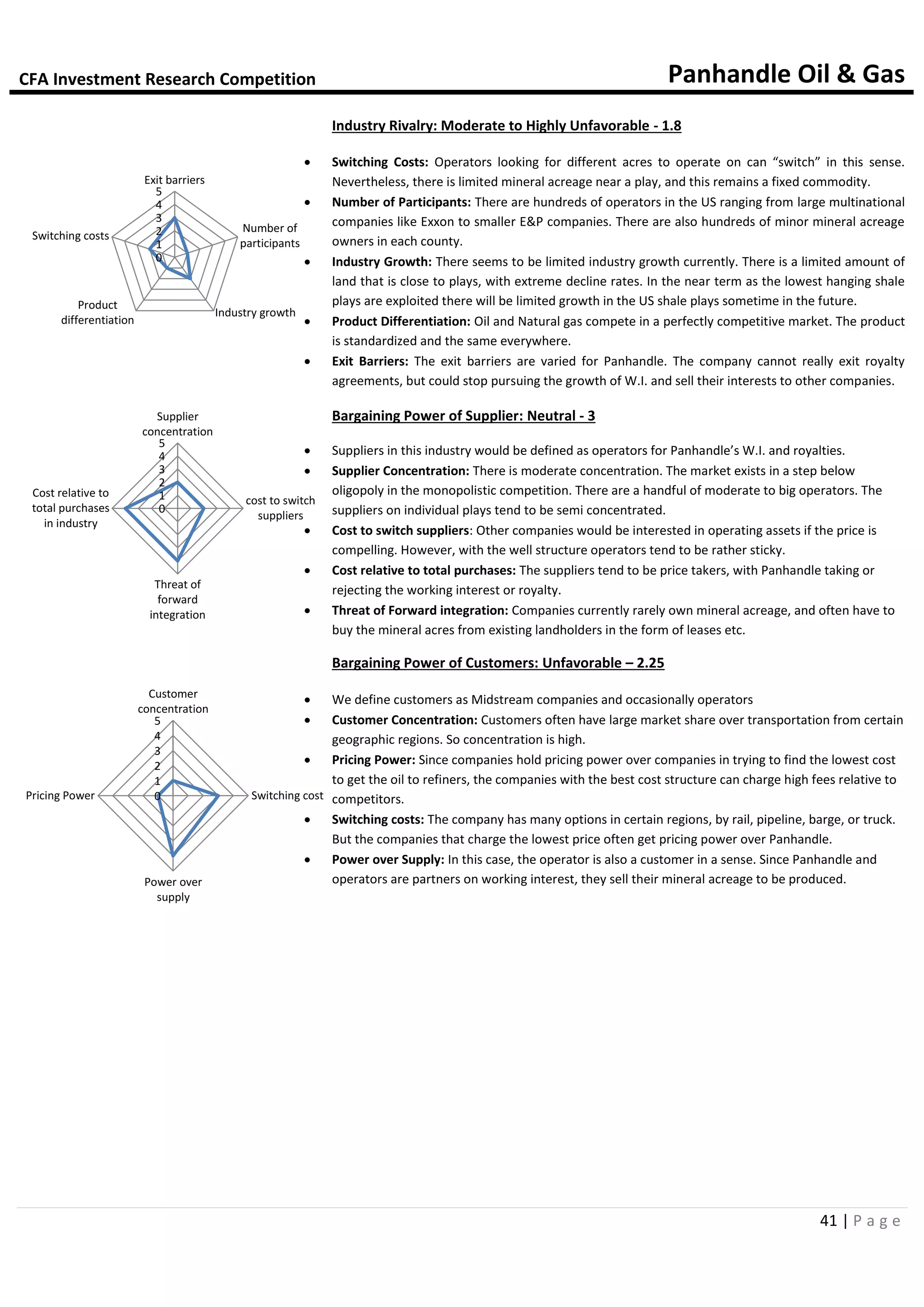
Porter’s 5 Forces
CFA Investment Research Competition Panhandle Oil & Gas, Inc.
5 | P a g e
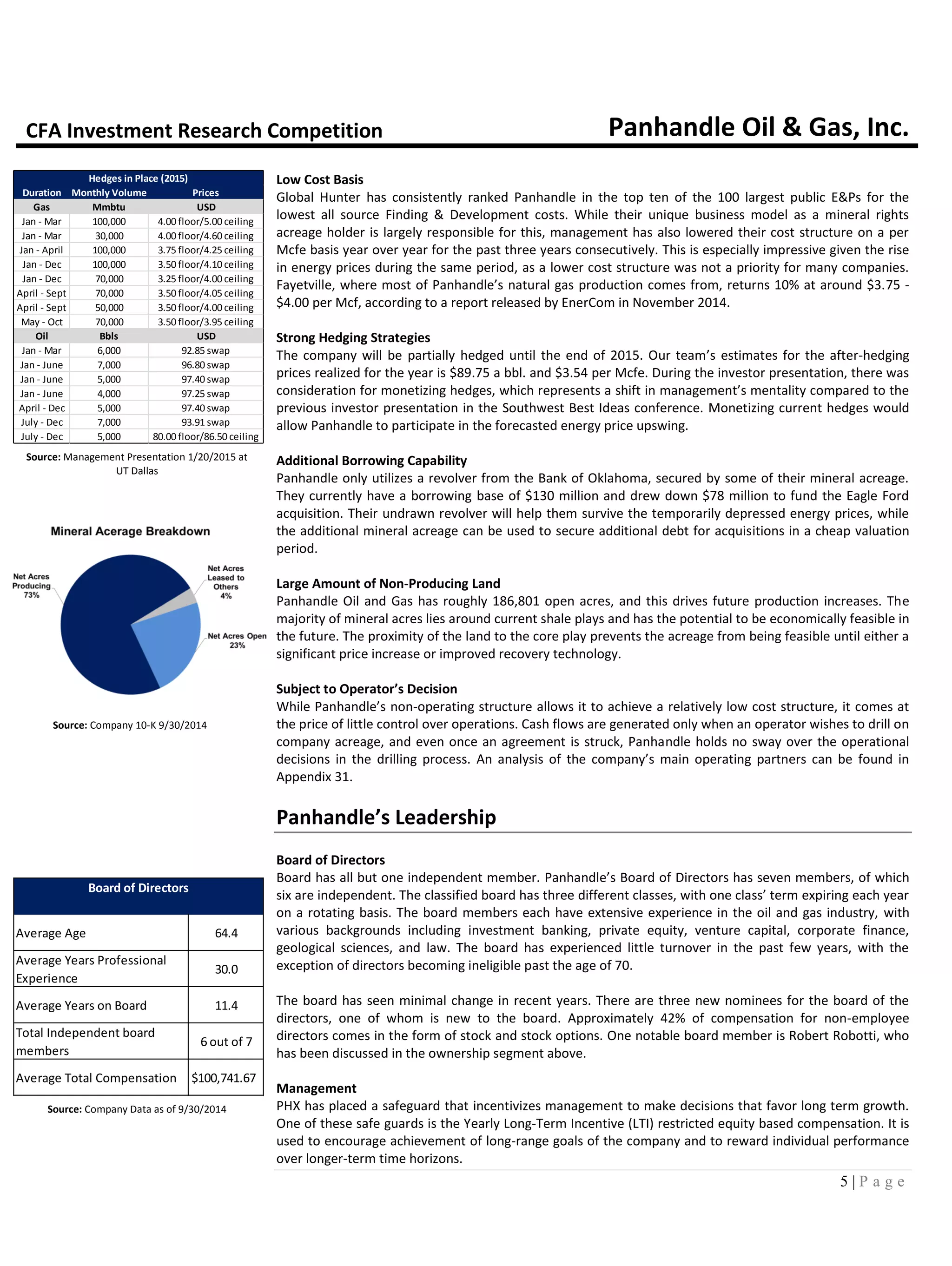
Duration Monthly Volume Prices
Gas Mmbtu USD
Jan - Mar 100,000 4.00 floor/5.00 ceiling
Jan - Mar 30,000 4.00 floor/4.60 ceiling
Jan - April 100,000 3.75 floor/4.25 ceiling
Jan - Dec 100,000 3.50 floor/4.10 ceiling
Jan - Dec 70,000 3.25 floor/4.00 ceiling
April - Sept 70,000 3.50 floor/4.05 ceiling
April - Sept 50,000 3.50 floor/4.00 ceiling
May - Oct 70,000 3.50 floor/3.95 ceiling
Oil Bbls USD
Jan - Mar 6,000 92.85 swap
Jan - June 7,000 96.80 swap
Jan - June 5,000 97.40 swap
Jan - June 4,000 97.25 swap
April - Dec 5,000 97.40 swap
July - Dec 7,000 93.91 swap
July - Dec 5,000 80.00 floor/86.50 ceiling
Hedges in Place (2015)
Source: Management Presentation 1/20/2015 at
UT Dallas
Board of Directors
Average Age 64.4
Average Years Professional
Experience
30.0
Average Years on Board 11.4
Total Independent board
members
6 out of 7
Average Total Compensation $100,741.67
Source: Company Data as of 9/30/2014
Source: Company 10-K 9/30/2014
Low Cost Basis
Global Hunter has consistently ranked Panhandle in the top ten of the 100 largest public E&Ps for the
lowest all source Finding & Development costs. While their unique business model as a mineral rights
acreage holder is largely responsible for this, management has also lowered their cost structure on a per
Mcfe basis year over year for the past three years consecutively. This is especially impressive given the rise
in energy prices during the same period, as a lower cost structure was not a priority for many companies.
Fayetville, where most of Panhandle’s natural gas production comes from, returns 10% at around $3.75 -
$4.00 per Mcf, according to a report released by EnerCom in November 2014.
Strong Hedging Strategies
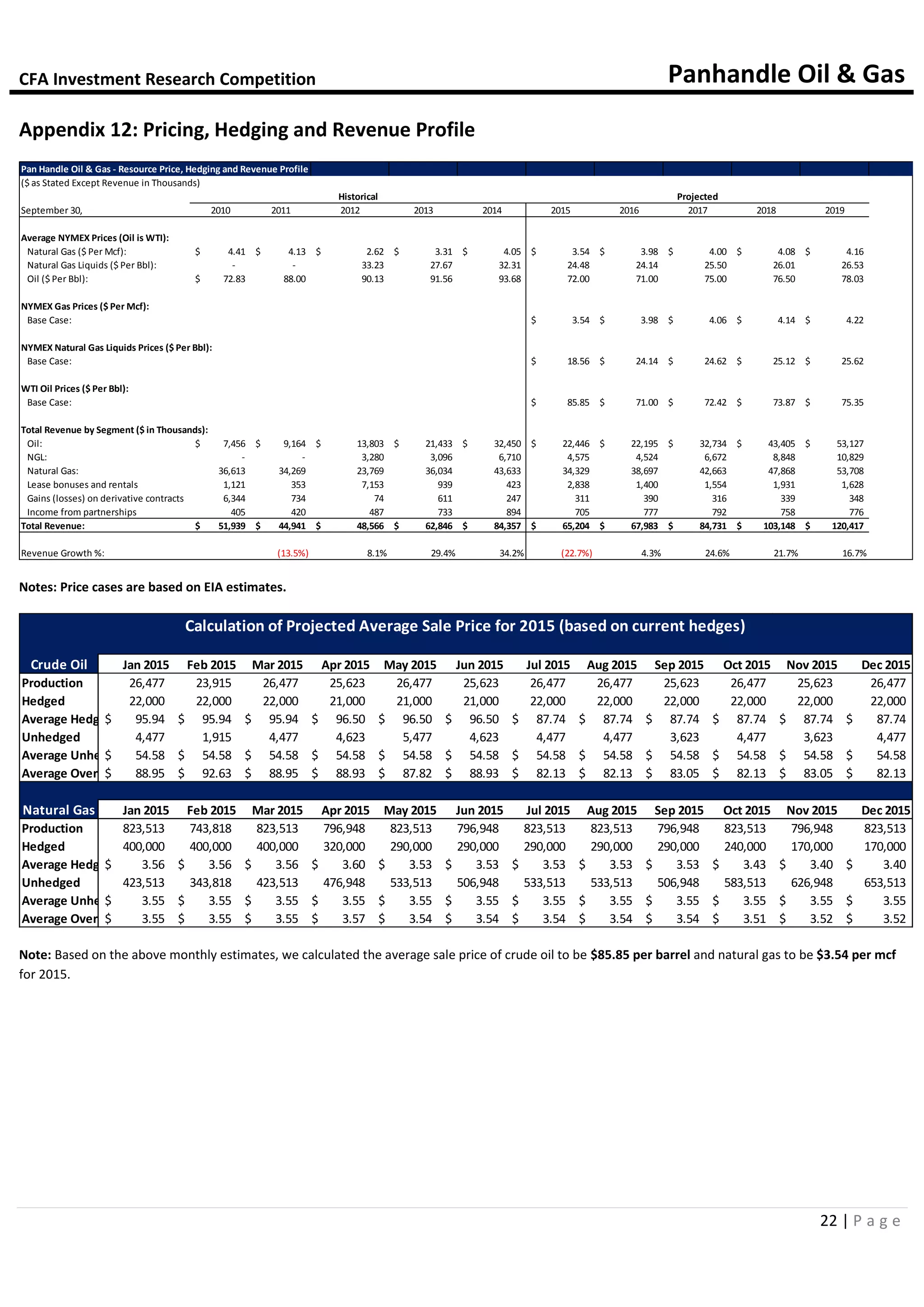
The company will be partially hedged until the end of 2015. Our team’s estimates for the after-hedging
prices realized for the year is $89.75 a bbl. and $3.54 per Mcfe. During the investor presentation, there was
consideration for monetizing hedges, which represents a shift in management’s mentality compared to the
previous investor presentation in the Southwest Best Ideas conference. Monetizing current hedges would
allow Panhandle to participate in the forecasted energy price upswing.
Additional Borrowing Capability
Panhandle only utilizes a revolver from the Bank of Oklahoma, secured by some of their mineral acreage.
They currently have a borrowing base of $130 million and drew down $78 million to fund the Eagle Ford
acquisition. Their undrawn revolver will help them survive the temporarily depressed energy prices, while
the additional mineral acreage can be used to secure additional debt for acquisitions in a cheap valuation
period.
Large Amount of Non-Producing Land
Panhandle Oil and Gas has roughly 186,801 open acres, and this drives future production increases. The
majority of mineral acres lies around current shale plays and has the potential to be economically feasible in
the future. The proximity of the land to the core play prevents the acreage from being feasible until either a
significant price increase or improved recovery technology.
Subject to Operator’s Decision
While Panhandle’s non-operating structure allows it to achieve a relatively low cost structure, it comes at
the price of little control over operations. Cash flows are generated only when an operator wishes to drill on
company acreage, and even once an agreement is struck, Panhandle holds no sway over the operational
decisions in the drilling process. An analysis of the company’s main operating partners can be found in
Appendix 31.
Panhandle’s Leadership
Board of Directors
Board has all but one independent member. Panhandle’s Board of Directors has seven members, of which
six are independent. The classified board has three different classes, with one class’ term expiring each year
on a rotating basis. The board members each have extensive experience in the oil and gas industry, with
various backgrounds including investment banking, private equity, venture capital, corporate finance,
geological sciences, and law. The board has experienced little turnover in the past few years, with the
exception of directors becoming ineligible past the age of 70.
The board has seen minimal change in recent years. There are three new nominees for the board of the
directors, one of whom is new to the board. Approximately 42% of compensation for non-employee
directors comes in the form of stock and stock options. One notable board member is Robert Robotti, who
has been discussed in the ownership segment above.
Management
PHX has placed a safeguard that incentivizes management to make decisions that favor long term growth.
One of these safe guards is the Yearly Long-Term Incentive (LTI) restricted equity based compensation. It is
used to encourage achievement of long-range goals of the company and to reward individual performance
over longer-term time horizons.
CFA Investment Research Competition Panhandle Oil & Gas, Inc.
6 | P a g e
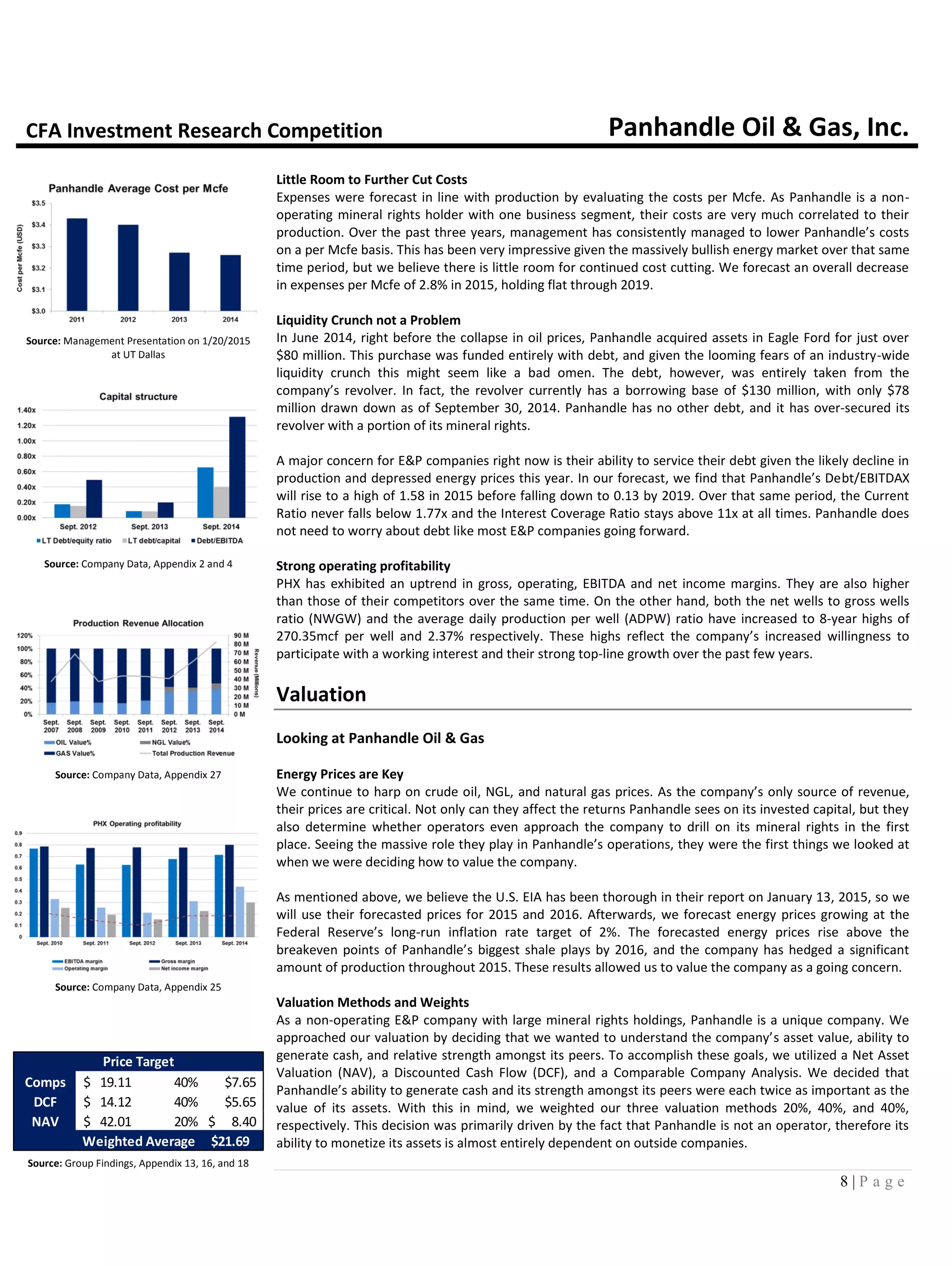
Source: Appendix 19
Source: Company Data as of 9/30/2014
Average Age 54.3
Average Years with PHX 12
Average Compensation $824,528
Management Since the company owns unique assets, it is vital that the management team manages PHX based on a
longer-term time horizon than the archetypal oil and gas E&P Company.
The seasoned management of PHX has on average 12 years of experience with the company and many
years of experience in oil and gas E&P. Recently, one of their most experienced members, Ben
Spriestersbach, retired on October 2014. This can put pressure on PHX to find a viable replacement for Mr.
Spriestersbach. Paul F. Blanchard served as the Vice President of the Mid-Continent Business Unit for Range
Resources Corporation and has many years of leadership experience in oil and gas E&P. He currently serves
as the Senior Vice President and Chief Operating Officer and has been instrumental to PHX’s success in
recent years. Lonnie J. Lowry has 9 years of experience with PHX and is currently serving as the Chief
Financial Officer and Secretary
Responds Well to Pressure
In response to the recent oil and gas price pressure, management will most likely respond with possible
acquisitions at depressed prices. An example of this is the additional Fayetteville acquisition in 2011 in
response to low gas prices. As non-operators on working interests, PHX does not have the ability to dictate
the capital expenditures on their portion of working interests, so their future capital expenditures is
dependent on the various operators. The management team must then be very careful about who they
decide to partner up with on a well.
Investment Summary
HOLD with a price target of $21.69 per share
At the current price of $20.94, we issue a HOLD recommendation on Panhandle Oil and Gas with a price
target of $21.69. The company has a strong competitive position for its size, and the management team can
continue to use its unique business model to create value in the long-term. We expect that Panhandle will
continue to utilize its assets and we are confident that operators will increase production rapidly in the
future. The current price, however, does not justify the company’s ability to monetize those great assets
over the next few years.
Valuable Assets
In the early 20
th
century, the company purchased a large percentage of its current mineral acreage holdings.
These mineral rights were bought at a significant discount to current value. They are the main driver behind
Panhandle’s current cost basis of just under $100 per acre. Mineral rights in some of Panhandle’s current
plays can cost over $1,000 per acre today, as explained by management in their presentation at UT Dallas
on 1/20/2015. Robert Robotti, a prominent deep value investor, is heavily invested in Panhandle. The low
cost basis the company enjoys supports his investing style. While Panhandle has this competitive
advantage, it is not enough to justify their current value, as seen by the other investment takeaways.
Poor Monetization
Panhandle’s ability to generate cash flows going forward does not support its current market valuation. The
DCF valuation method yielded a price target of $14.02 per share. With an energy bear market, and a
possible E&P liquidity crunch, the company’s considerable hedges will not prevent their operators from
scaling back production. While Panhandle’s assets are considerable and cheaply valued currently, the
dependency on other E&P companies leaves Panhandle with little chance of monetizing them within the
next few years. We believe Panhandle will eventually be a stellar value pick, but current cash flow
generation indicates this is not the time to take advantage of its discounted assets.
Conservative Management Prevents Slide
We have seen energy prices plummet over the past six months by about 50%. With bank reassessments of
E&P securities coming up around April, and the energy sector being highly levered, the market is expecting
a wave of defaults and hard times overall for the industry. Panhandle’s management team has positioned
the company to not only weather the problems associated with depressed energy prices, but also mitigate
much of the downside. Their only debt takes the form of a revolver, almost half of which is undrawn. It is
about 25% over-secured by only a portion of their land. In addition, much of their production in 2015 will be
Source: Capital IQ
Source: Company Data, Group Findings
CFA Investment Research Competition Panhandle Oil & Gas, Inc.
7 | P a g e
Source: Company Data, Appendix 27
Source: Company Data, Appendix27
Source: Company Data, Group Findings
Source: Company Data, EIA Data
sold at hedged prices similar to those of early 2014. With little debt, and little exposure to the dramatic
down tick in energy prices, Panhandle will experience headwinds to a much less extent than the overall
industry.
Not Likely to Be Acquired
With large, undervalued assets but a poor ability to monetize them in the near term, Panhandle would
seem to be a juicy acquisition target. Unfortunately, given the incredibly high cost of purchasing mineral
rights and the economics of the industry, a buyout is not likely to happen. An E&P company can just lease a
small plot of mineral rights in an area. When they drill, the other mineral rights holders are forced to take a
royalty interest and are given the option to take a working interest.
Share Price Does Not Reflect Current Commodity Prices
The current share price has not fully priced in the move in Oil and Gas in recent months. The outlook also is
dimmer compared to the past, and the longer run estimates of Oil and Gas will not be enough to sustain
share price. Another consideration is that production growth reflects past years, and does not incorporate
the 2015 capital expenditure cuts made by operators, as well as diminishing growth prospects.
Financial Analysis
Production and Revenue Déjà Vu
When energy prices fell in 2009, we saw Panhandle weather it better than most. WTI Crude Oil went from
over $100 per barrel to below $40. Due to that drop, the company saw about a 10% decrease in production
in 2010 followed by a relatively flat 2011. As history appears to be repeating itself, we expect production to
follow the same trends for the next two years. While Panhandle does have conservative hedging practices,
they are bystanders as the operators control production.
With the rise of energy prices from 2010 through 2013, Panhandle experienced massive production growth
over the past three years. As energy prices rebound to the EIA forecasted 2016 amounts, the company’s
biggest areas of production will become very profitable again. As a result of those forecasted energy prices,
we expect to see similarly strong growth from 2017 through 2019. As natural gas prices are expected to just
hit the acceptable IRR levels for many of Panhandle’s operating partners, we forecast moderately strong
growth.
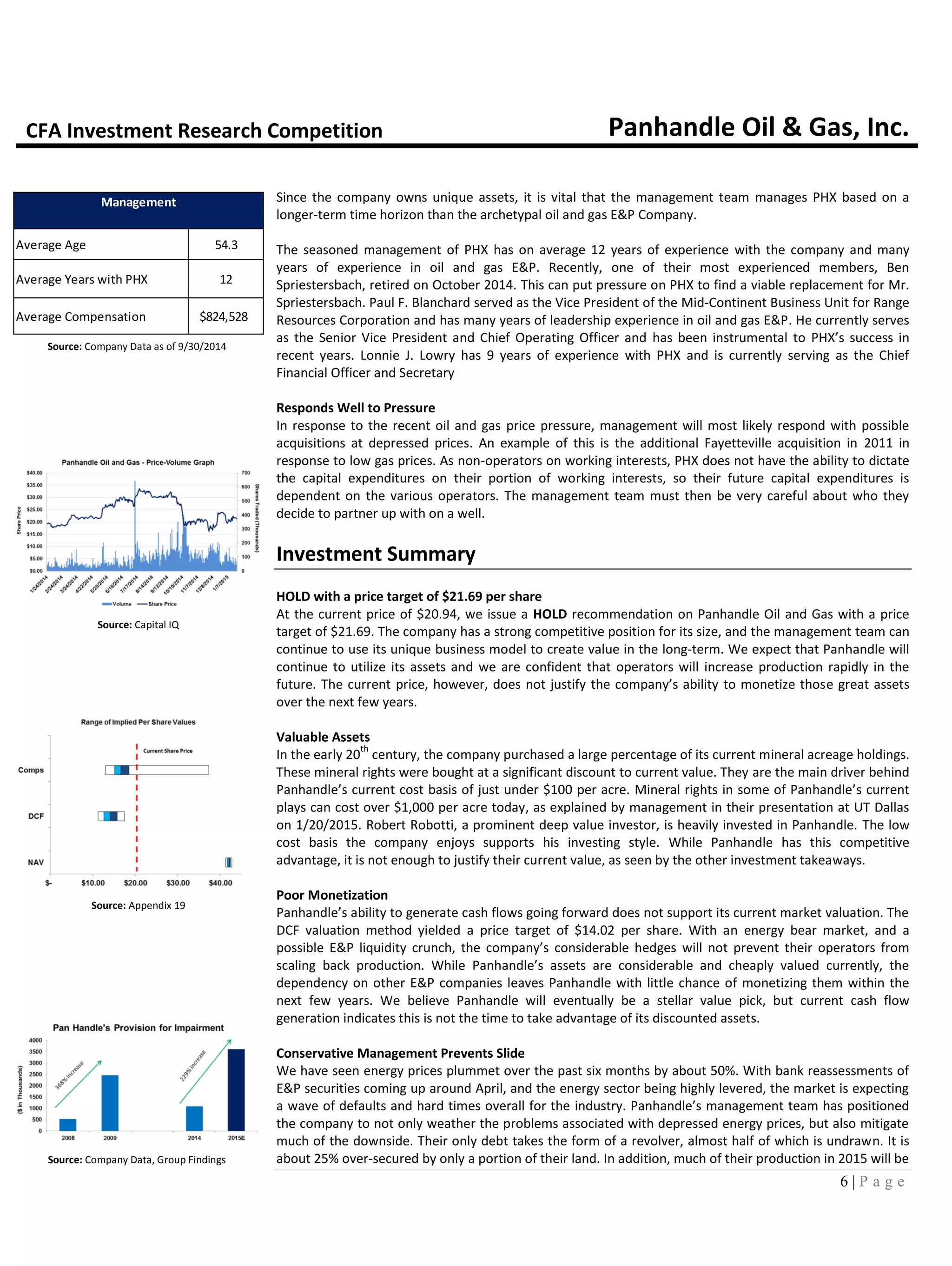
Ratios 2010 2011 2012 2013 2014 2015 2016 2017 2018 2019
Margins
Gross Margin 78.67% 77.41% 77.92% 77.75% 80.06% 77.07% 77.91% 79.39% 80.47% 81.10%
EBITDAX Margin 83.63% 66.52% 65.96% 70.41% 72.49% 66.20% 67.66% 69.53% 70.94% 71.77%
Net Income Margin 25.27% 19.38% 15.37% 22.68% 30.02% 23.76% 25.83% 28.89% 31.16% 32.62%
Profitability
Return on Assets 10.86% 7.62% 5.45% 9.44% 10.14% 6.04% 6.55% 8.58% 10.45% 11.76%
Return on Equity 15.52% 10.78% 8.79% 14.59% 20.98% 11.50% 11.66% 14.19% 15.88% 16.40%
Activity
Total Asset Turnover 0.49 0.40 0.36 0.43 0.34 0.26 0.26 0.30 0.34 0.36
AR Turnover 5.73 5.10 5.81 4.58 5.20 5.25 5.25 5.25 5.25 5.25
Avg. DSO 63.69 71.51 62.97 79.63 70.17 69.56 69.75 69.56 69.56 69.56
Avg. DPO 189.01 188.90 233.15 258.57 183.42 192.08 192.61 192.08 192.08 192.08
Short Term Solvency
Current Ratio 2.39 2.23 1.52 1.73 2.05 1.71 1.77 1.88 1.99 2.06
Quick Ratio 2.22 2.12 1.35 1.65 1.95 1.60 1.66 1.79 1.90 1.98
Cash Ratio 0.77 0.59 0.26 0.28 0.05 0.05 0.05 0.05 0.04 0.04
Interest Coverage Ratio 244.41 -- 79.69 121.68 78.73 11.66 14.58 21.45 30.41 46.99
Debt Servicing
Debt/Equity 0 0 0.18 0.09 0.65 0.51 0.40 0.28 0.16 0.05
Debt/EBITDAX 0 0 0.47 0.19 1.29 1.58 1.30 0.82 0.44 0.13
Shareholder Profitability
Earnings per Share 0.68 0.51 0.44 0.84 1.50 0.91 1.04 1.46 1.92 2.36
Dividend Payout Ratio 20.38% 27.34% 31.49% 16.67% 10.65% 17.49% 15.42% 10.99% 8.32% 6.78%
CFA Investment Research Competition Panhandle Oil & Gas, Inc.
8 | P a g e
Source: Management Presentation on 1/20/2015
at UT Dallas
Source: Company Data, Appendix 25
Source: Company Data, Appendix 2 and 4
Source: Company Data, Appendix 27
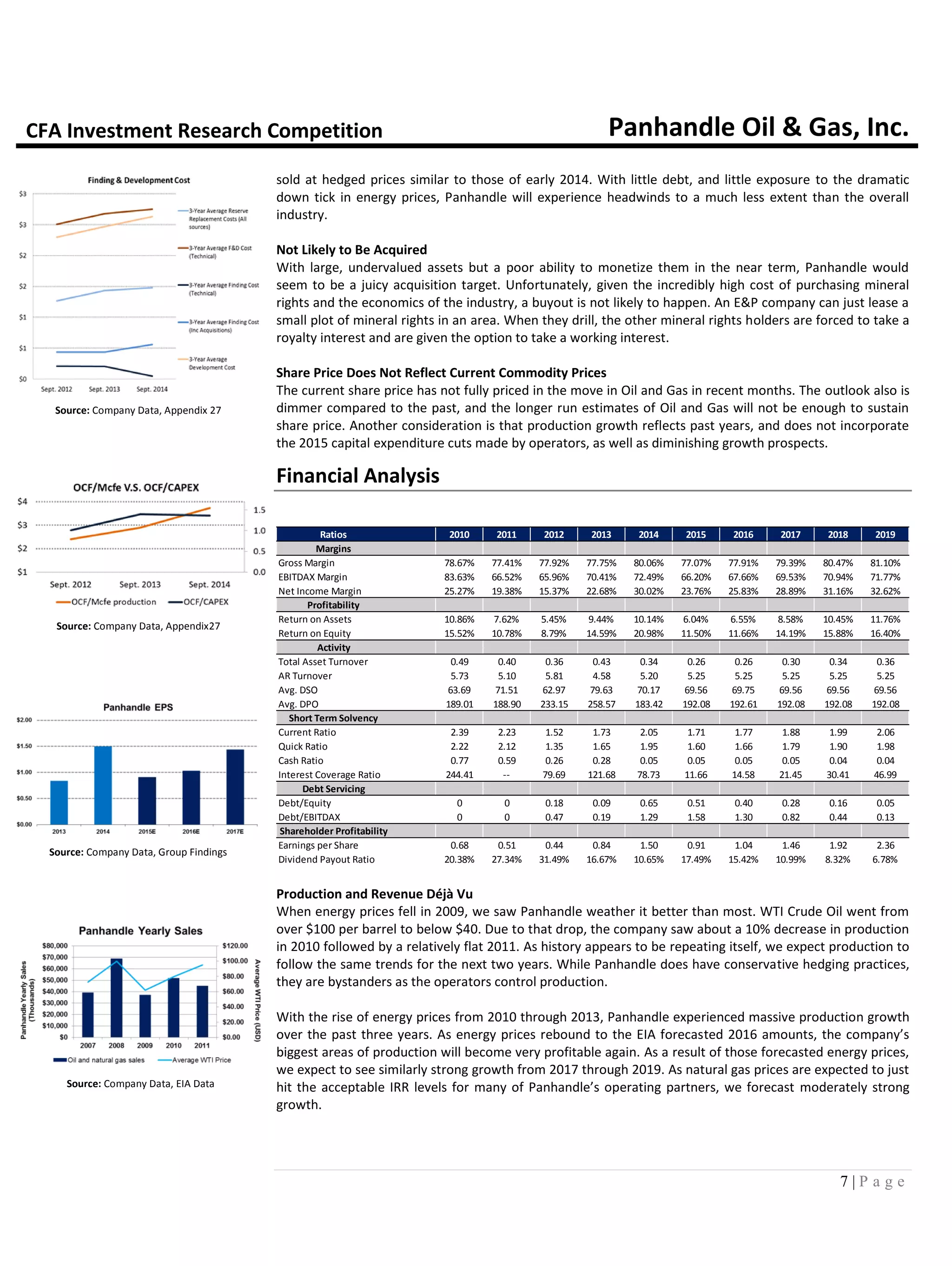
Source: Group Findings, Appendix 13, 16, and 18
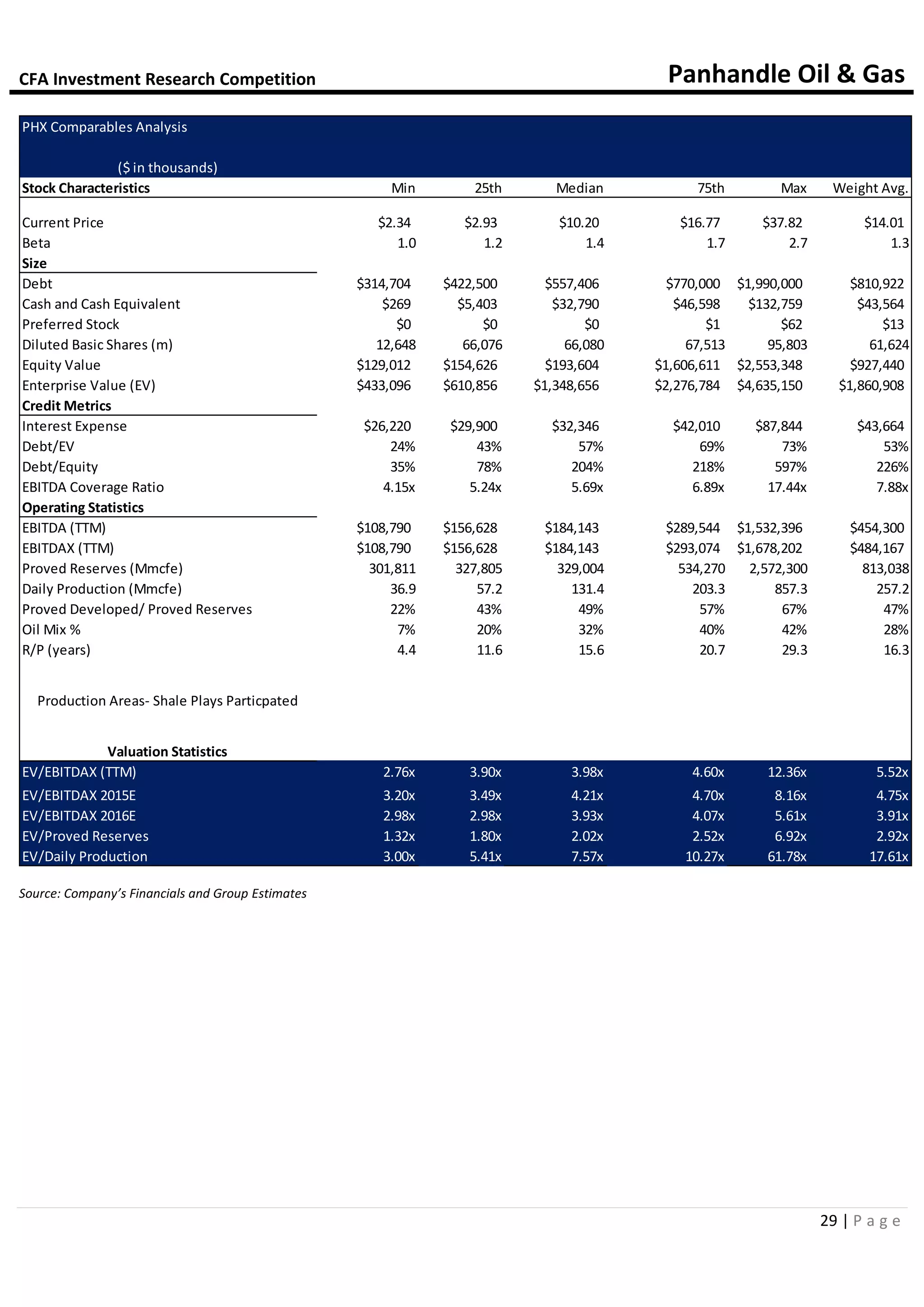
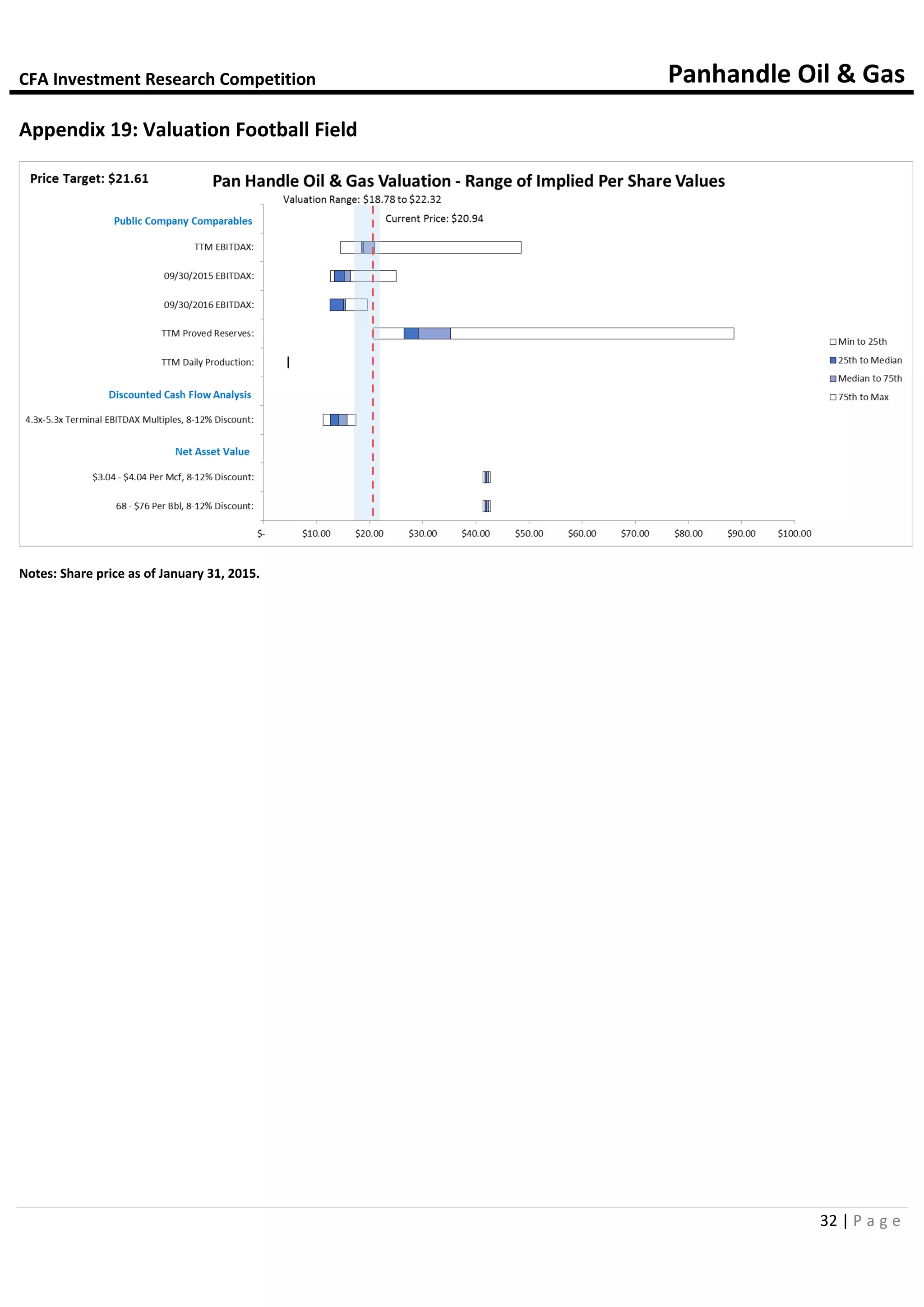
Comps 19.11$ 40% $7.65
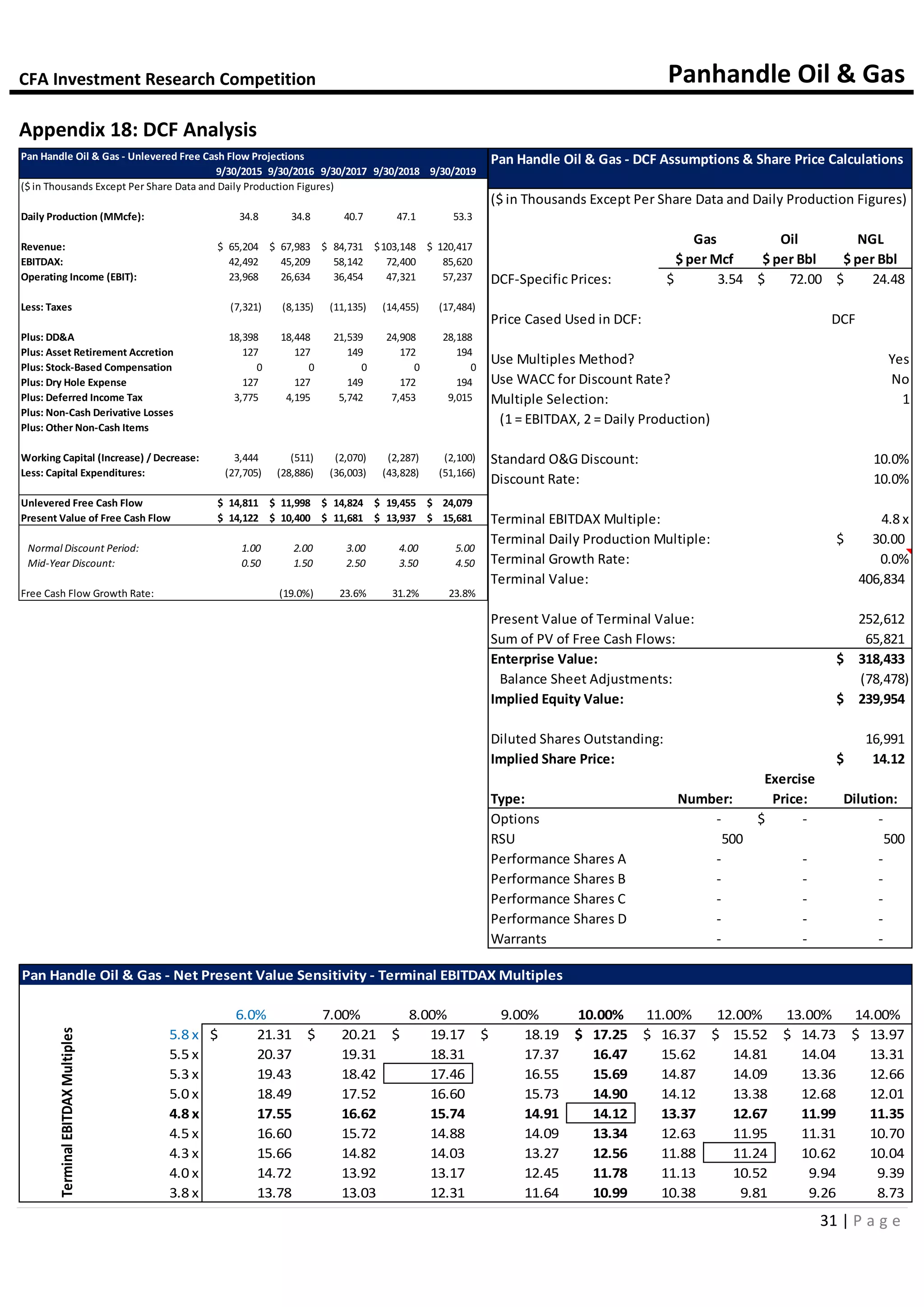
DCF 14.12$ 40% $5.65
NAV 42.01$ 20% 8.40$
Weighted Average $21.69
Price Target
Little Room to Further Cut Costs
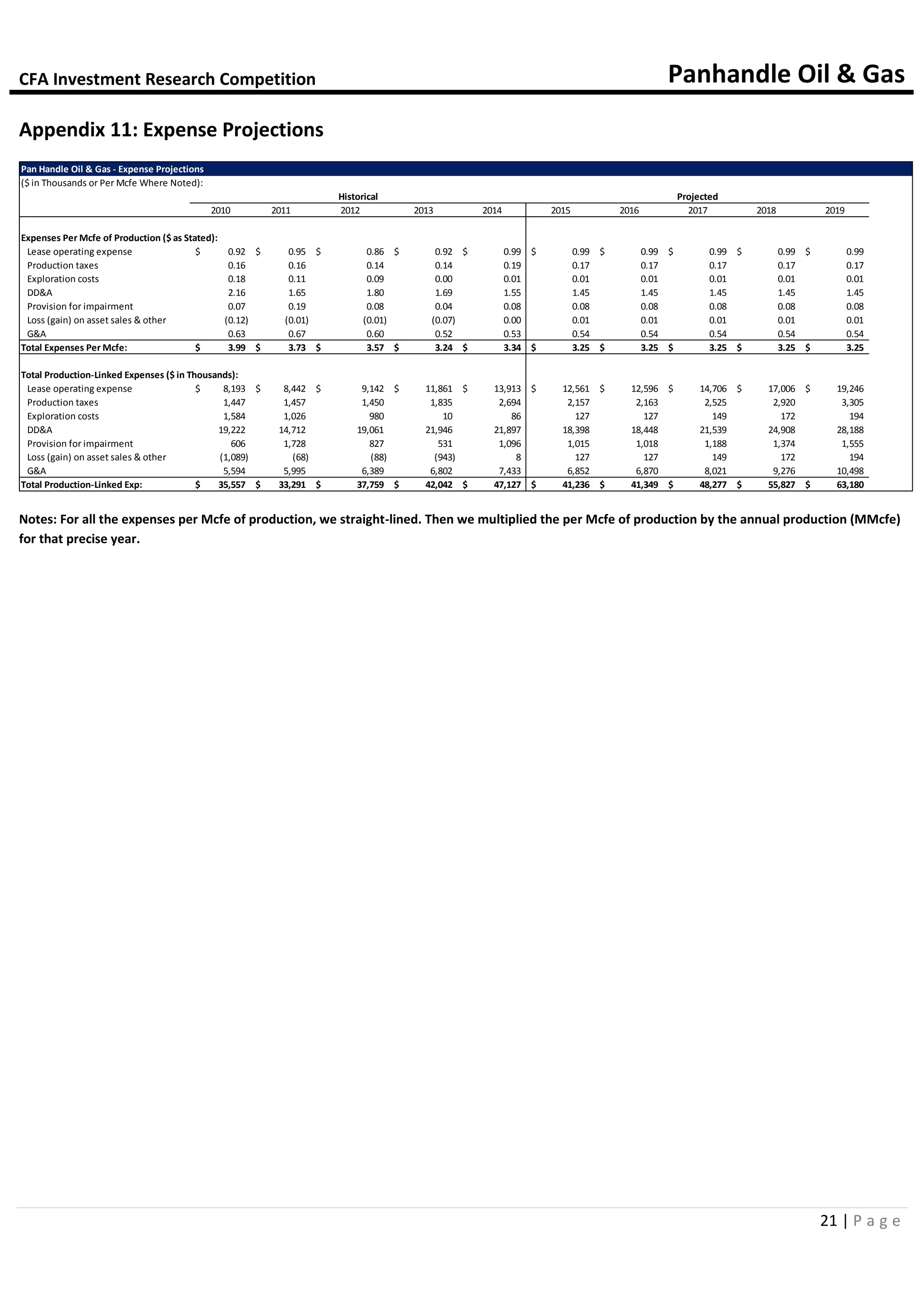
Expenses were forecast in line with production by evaluating the costs per Mcfe. As Panhandle is a non-
operating mineral rights holder with one business segment, their costs are very much correlated to their
production. Over the past three years, management has consistently managed to lower Panhandle’s costs
on a per Mcfe basis. This has been very impressive given the massively bullish energy market over that same
time period, but we believe there is little room for continued cost cutting. We forecast an overall decrease
in expenses per Mcfe of 2.8% in 2015, holding flat through 2019.
Liquidity Crunch not a Problem
In June 2014, right before the collapse in oil prices, Panhandle acquired assets in Eagle Ford for just over
$80 million. This purchase was funded entirely with debt, and given the looming fears of an industry-wide
liquidity crunch this might seem like a bad omen. The debt, however, was entirely taken from the
company’s revolver. In fact, the revolver currently has a borrowing base of $130 million, with only $78
million drawn down as of September 30, 2014. Panhandle has no other debt, and it has over-secured its
revolver with a portion of its mineral rights.
A major concern for E&P companies right now is their ability to service their debt given the likely decline in
production and depressed energy prices this year. In our forecast, we find that Panhandle’s Debt/EBITDAX
will rise to a high of 1.58 in 2015 before falling down to 0.13 by 2019. Over that same period, the Current
Ratio never falls below 1.77x and the Interest Coverage Ratio stays above 11x at all times. Panhandle does
not need to worry about debt like most E&P companies going forward.
Strong operating profitability
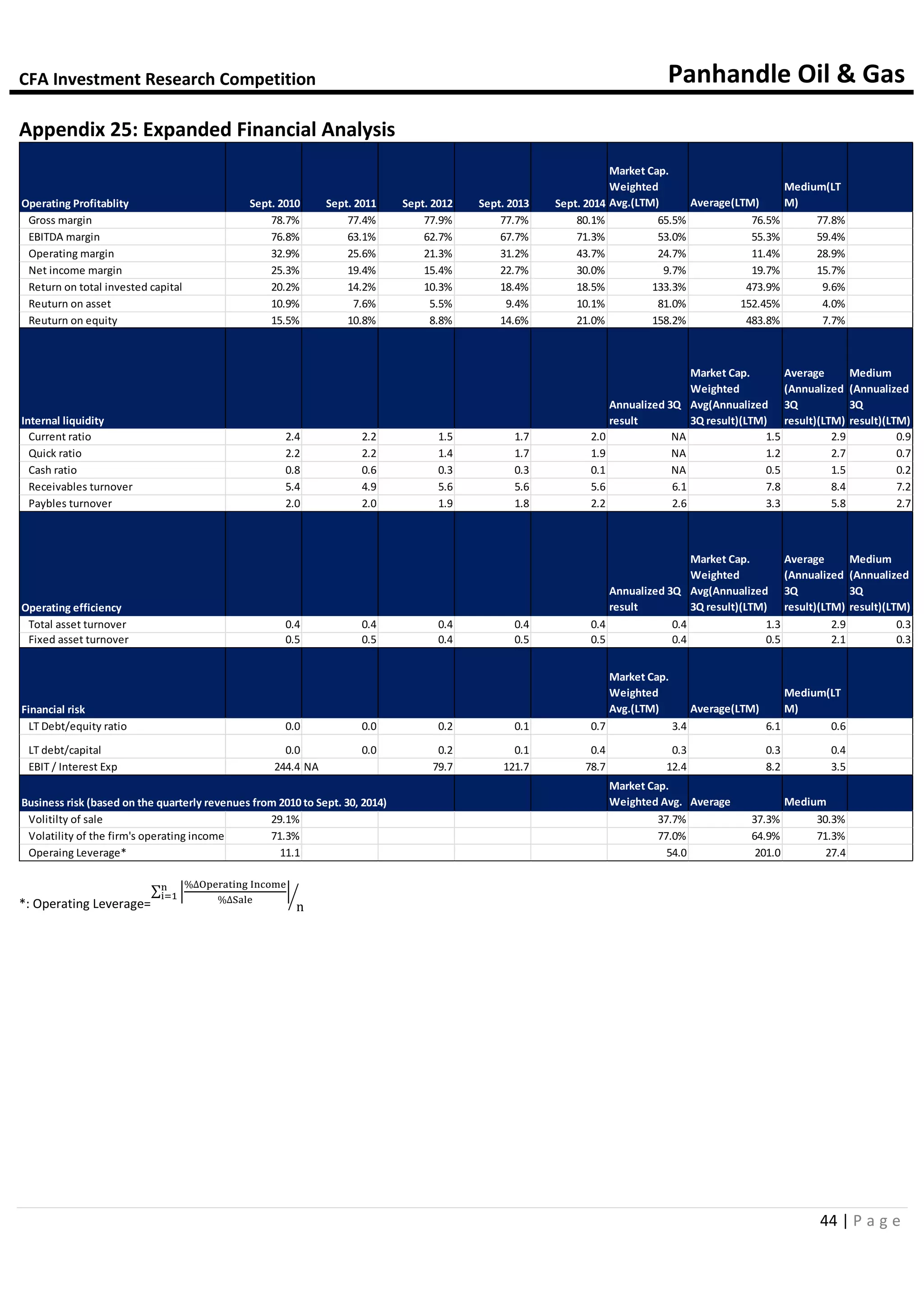
PHX has exhibited an uptrend in gross, operating, EBITDA and net income margins. They are also higher
than those of their competitors over the same time. On the other hand, both the net wells to gross wells
ratio (NWGW) and the average daily production per well (ADPW) ratio have increased to 8-year highs of
270.35mcf per well and 2.37% respectively. These highs reflect the company’s increased willingness to
participate with a working interest and their strong top-line growth over the past few years.
Valuation
Looking at Panhandle Oil & Gas
Energy Prices are Key
We continue to harp on crude oil, NGL, and natural gas prices. As the company’s only source of revenue,
their prices are critical. Not only can they affect the returns Panhandle sees on its invested capital, but they
also determine whether operators even approach the company to drill on its mineral rights in the first
place. Seeing the massive role they play in Panhandle’s operations, they were the first things we looked at
when we were deciding how to value the company.
As mentioned above, we believe the U.S. EIA has been thorough in their report on January 13, 2015, so we
will use their forecasted prices for 2015 and 2016. Afterwards, we forecast energy prices growing at the
Federal Reserve’s long-run inflation rate target of 2%. The forecasted energy prices rise above the
breakeven points of Panhandle’s biggest shale plays by 2016, and the company has hedged a significant
amount of production throughout 2015. These results allowed us to value the company as a going concern.
Valuation Methods and Weights
As a non-operating E&P company with large mineral rights holdings, Panhandle is a unique company. We
approached our valuation by deciding that we wanted to understand the company’s asset value, ability to
generate cash, and relative strength amongst its peers. To accomplish these goals, we utilized a Net Asset
Valuation (NAV), a Discounted Cash Flow (DCF), and a Comparable Company Analysis. We decided that
Panhandle’s ability to generate cash and its strength amongst its peers were each twice as important as the
value of its assets. With this in mind, we weighted our three valuation methods 20%, 40%, and 40%,
respectively. This decision was primarily driven by the fact that Panhandle is not an operator, therefore its
ability to monetize its assets is almost entirely dependent on outside companies.
CFA Investment Research Competition Panhandle Oil & Gas, Inc.
9 | P a g e
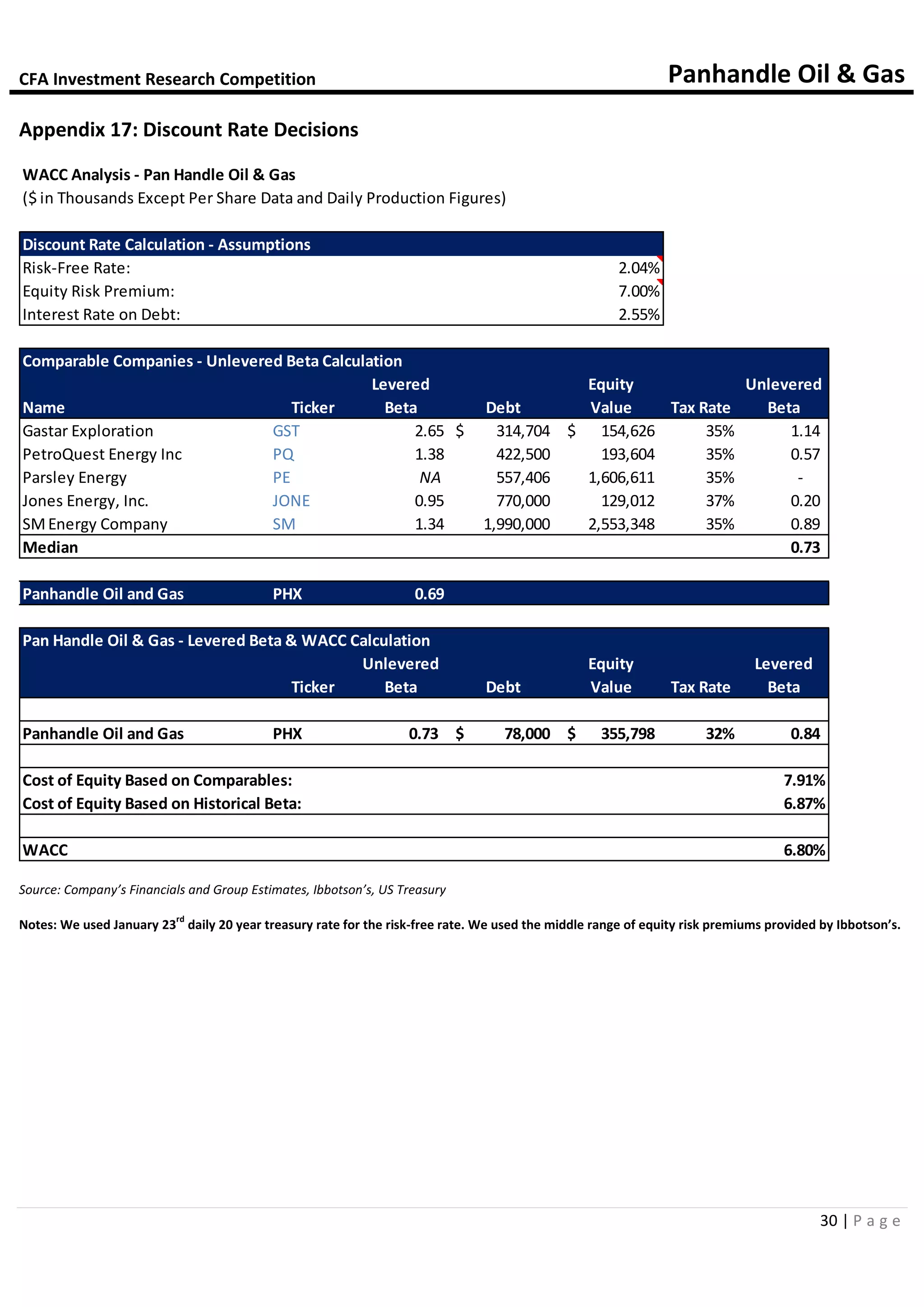
After Tax Cost of Debt 1.73%
Weight 17.98%
Cost of Equity 7.91%
Weight 82.02%
WACC 6.80%
Source: Company Data, Appendix 17
GST PQ JONE PE SM
EV/EBITDAX (TTM) 4.0x 3.9x 4.6x 12.4x 2.8x
EV/EBITDAX 2015E 3.5x 4.7x 4.2x 8.2x 3.2x
EV/EBITDAX 2016E 3.0x 4.1x 3.9x 5.6x 3.0x
EV/Proved 1.3x 2.0x 2.5x 6.9x 1.8x
EV/Daily Prod 7.6x 3.0x 10.3x 61.8x 5.4x
Comparable Company Multiples
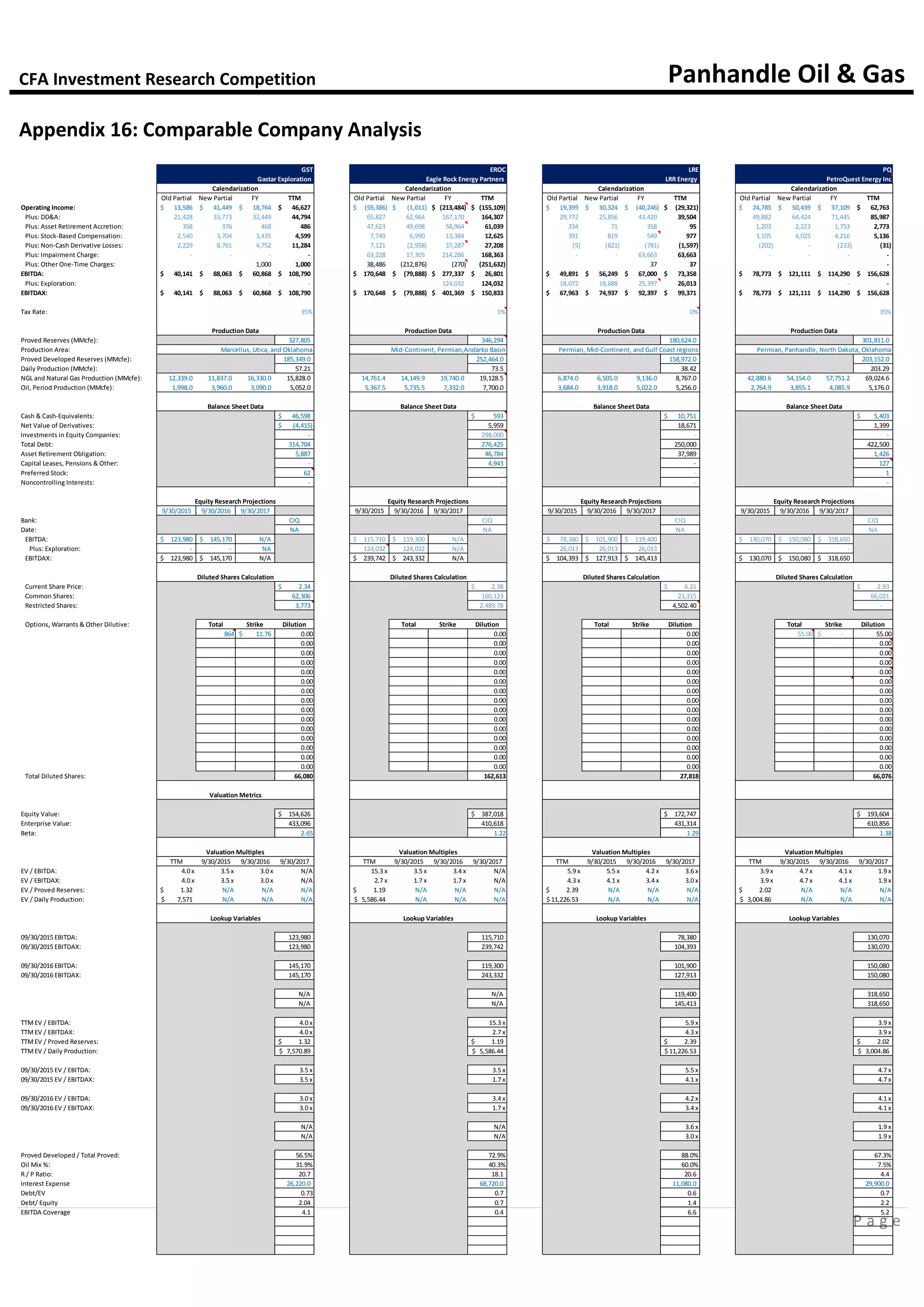
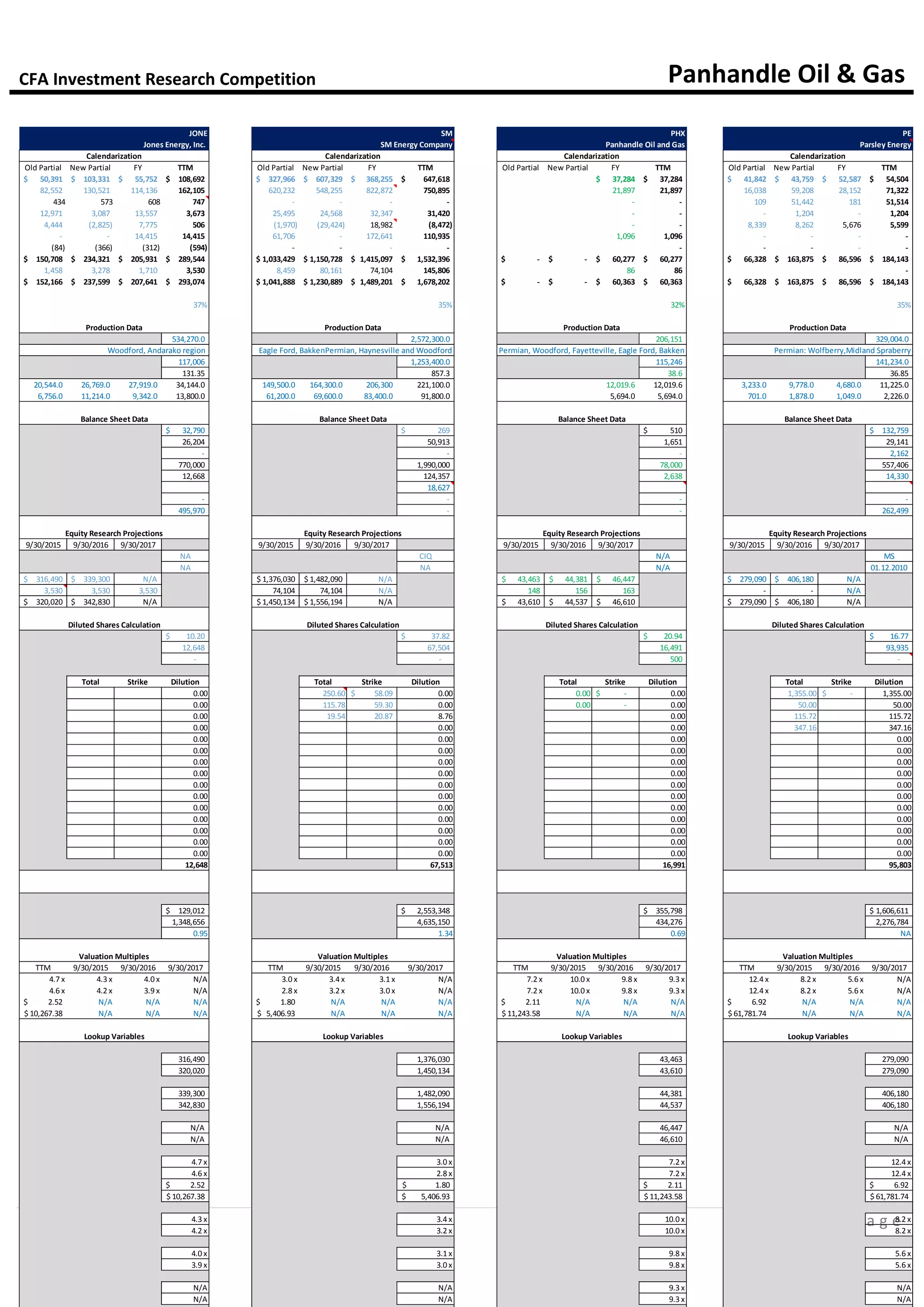
Source: Company Data, Appendix 16
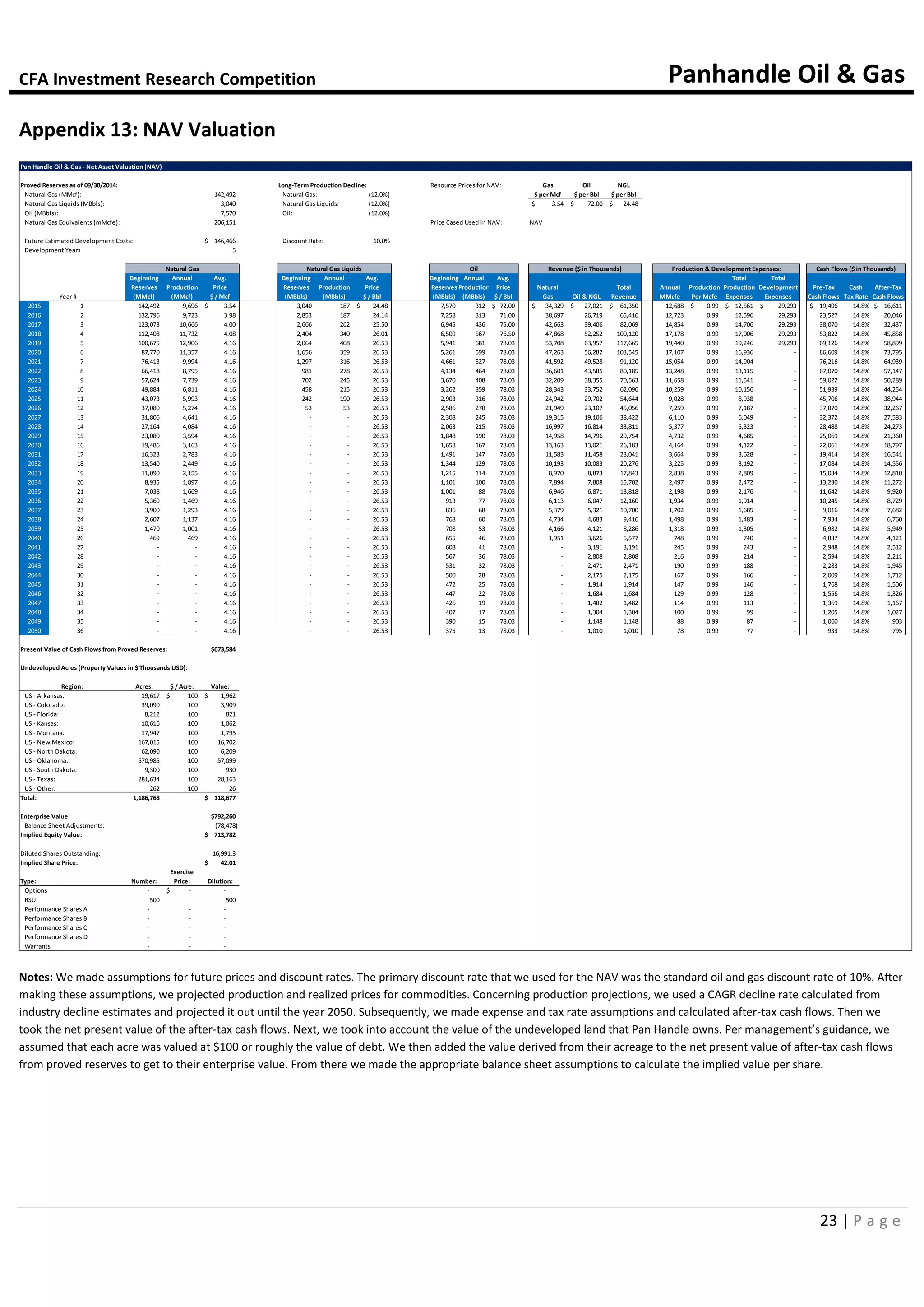
Net Asset Valuation (20%): $42.01 Price Target
We utilized the NAV to understand the value of the company’s reserves. We made assumptions for
Panhandle’s reserves, production, and future costs. In this scenario, we used Panhandle’s proved reserves.
Additionally, we made assumptions for future prices and discount rates. The primary discount rate that we
used for the NAV was the standard oil and gas discount rate of 10%. After making these assumptions, we
projected production and realized prices for commodities. Concerning production projections, we used a
long-term decline rate after the initial 5-year period and projected it out until the year 2050. Subsequently,
we made expense and tax rate assumptions and calculated after-tax cash flows. Then we took the Net
Present Value (NPV) of the after-tax cash flows.
Next, we took into account the value of the undeveloped land that Panhandle owns. Per management’s
guidance, we assumed that each acre was valued at $100. We then added the value derived from their
acreage to the NPV of after-tax cash flows from proved reserves in order to get to their Enterprise Value
(EV). From there we made the appropriate balance sheet assumptions to calculate the implied value per
share. Our NAV model yielded a price target of $42.01. Since the purpose of the NAV was to ascertain the
profit that Panhandle can generate between now and when the company stops operating as a result of
depleted reserves assuming no future re-investment to find or acquire new reserves, it is only natural that a
high value is derived. It is important to note that Panhandle is not a traditional oil and gas E&P company. As
a result, we weighted the NAV by 20%.
Discounted Cash Flow (40%): $14.12 Price Target
We projected Panhandle’s unlevered free cash flows out to five years, discounted them back to their
present values, and used the terminal multiple method to generate an implied enterprise value for the
company. We did not use a perpetuity growth model as the company generates cash by depleting their
resources. We adjusted for balance sheet items to arrive at our price target of $14.12 per share. We
forecast a dip in the unlevered free cash flow for 2016, followed by strong growth from 2016 through 2019.
We calculated a Weighted Average Cost of Capital (WACC) for Panhandle of 6.80%. This low value was
mainly due to their incredibly cheap cost of debt, which is just 2.55%. Given the company’s WACC is low for
an energy company, we elected to use the industry standard 10% as a discount rate in our DCF.
We applied a terminal multiple of approximately 4.8x EV/EBITDAX. This was determined by calculating the
average of the 2015E and 2016E of our comparable companies. It is important to note that a terminal
multiple of the past year’s comparable companies (6.62x EV/EBITDAX) yields an implied share price of
$19.97. Using a current year multiple in a DCF often results in large overvaluation, thus this case
demonstrates Panhandle’s inability to monetize its assets enough in order to justify its current valuation.
Comparable Company Analysis (40%): $19.10 Price Target
There are very few companies whose business models are similar to Panhandle’s. We looked for companies
involved in the same plays as Panhandle’s, and found eight companies that we wanted to look into further.
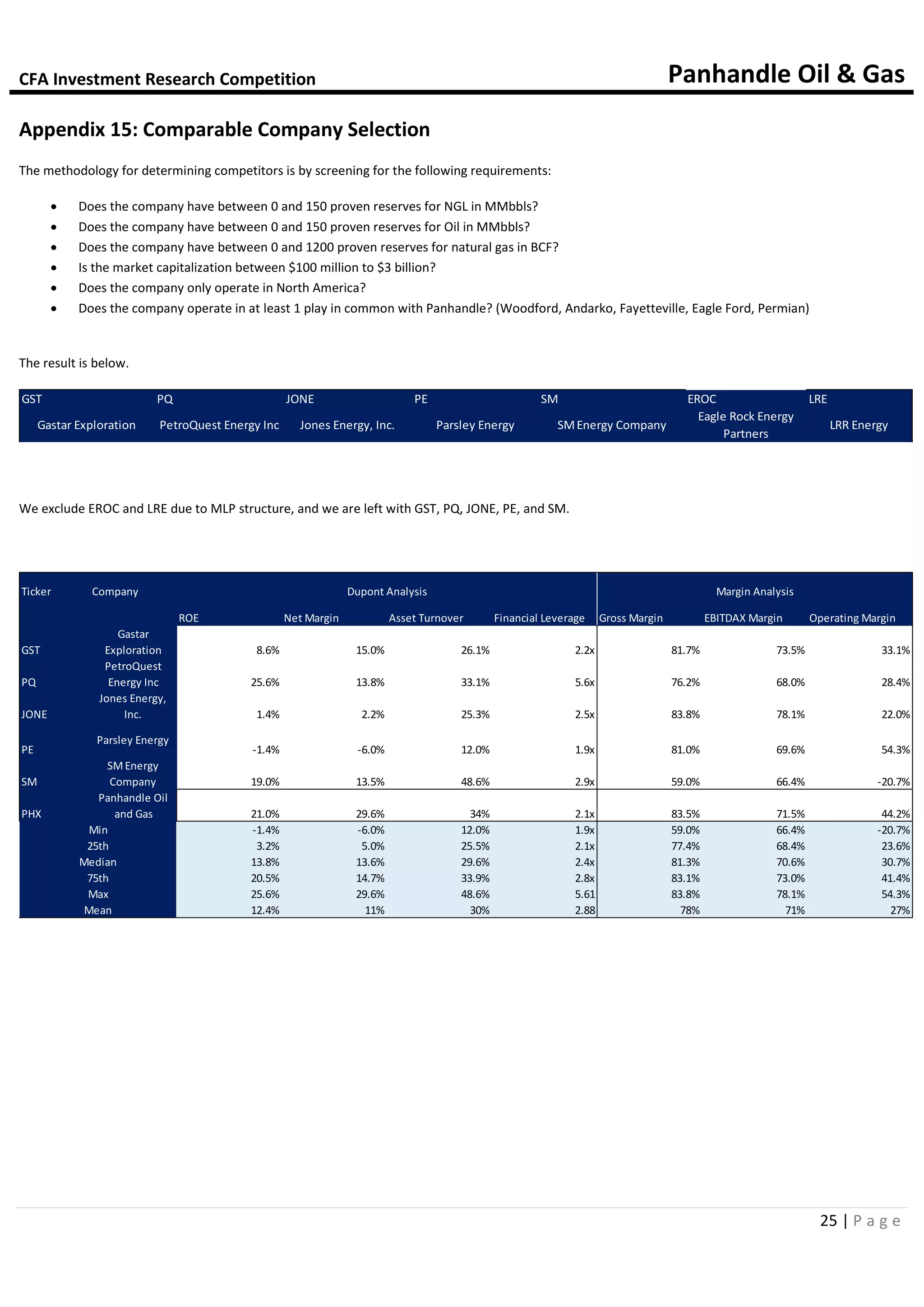
After some analysis we ultimately decided to use five companies in this valuation method (see Appendix 15
for further details). As each company was equally similar to Panhandle, and none matched its operating
model, we weighted each company equally in our valuation.
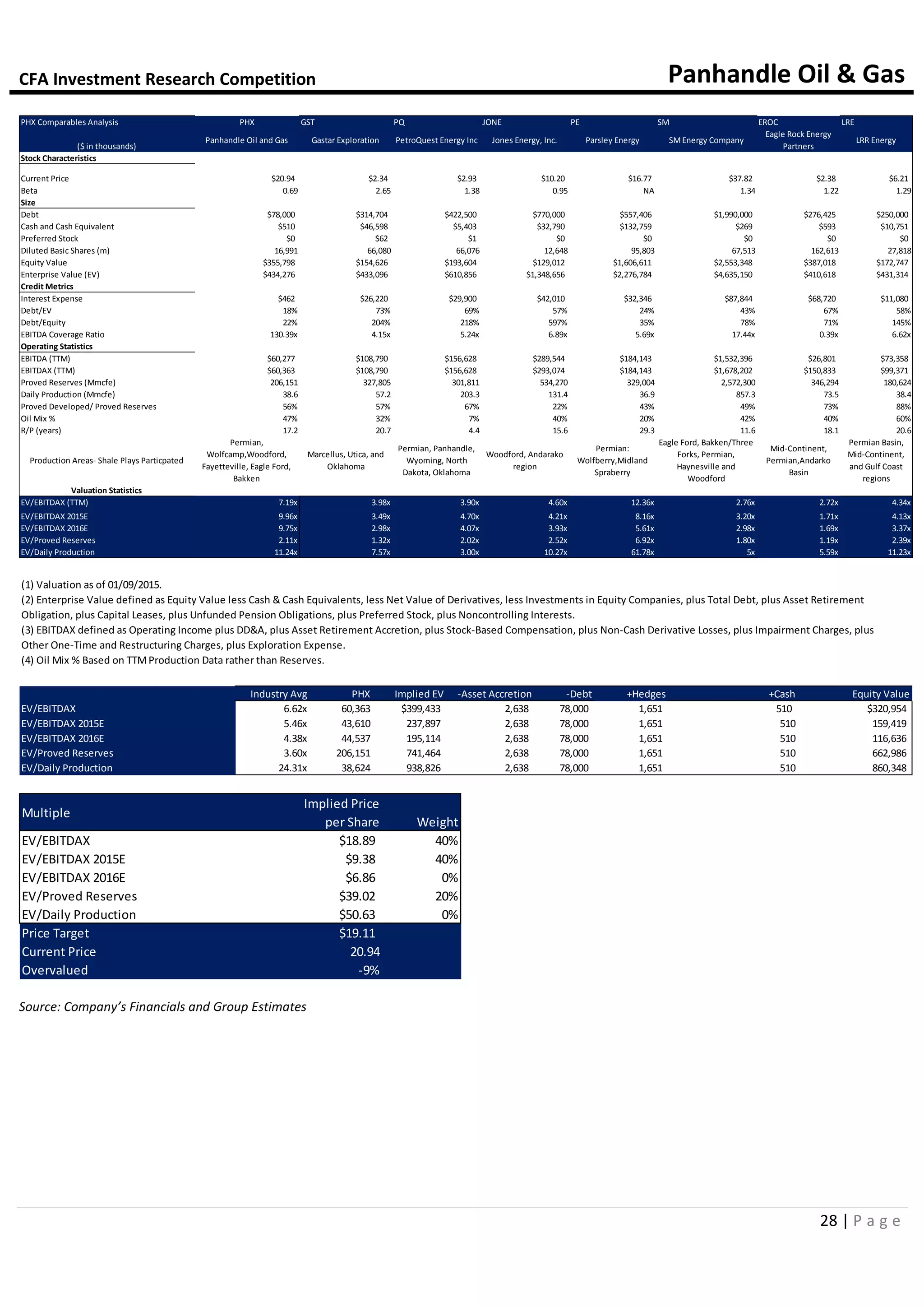
We were primarily interested in the EV/EBITDAX and the EV/Proved Reserves ratios. These industry
standards are used to measure the relative strength of Panhandle against its peers. Analyst consensuses
were used to forecast the comparable companies’ forward EBITDAX. We weighted the ratios as 40%
EV/EBITDAX, 40% 2015E EV/EBITDAX, and 20% EV/Proved Reserves. The goal of these weights is to value
the ability of Panhandle to turn its assets into cash. Being entirely reliant on operators leaves Panhandle at
the mercy of the market regardless of hedges or breakeven points.
The EV/EBITDAX ratio resulted in an implied share price of $18.99. We expected it to be close to the current
share price because the only large forces currently at play are industry-wide. The forward EV/EBITDAX
yielded an implied share price of $9.38. This is due to the production headwinds Panhandle faces in 2015
and the fact that the company has little debt compared to the industry. Panhandle can see a drop in
production with little fear of debt servicing issues. Finally, the EV/Proved Reserves valuation came to an
PDP: proved developed producing reserves
PDNP: Proved developed non-producing reserves
PDP: Proved undeveloped reserves
Source: Management Presentation 1/20/2015 at
UT Dallas
CFA Investment Research Competition Panhandle Oil & Gas, Inc.
10 | P a g e
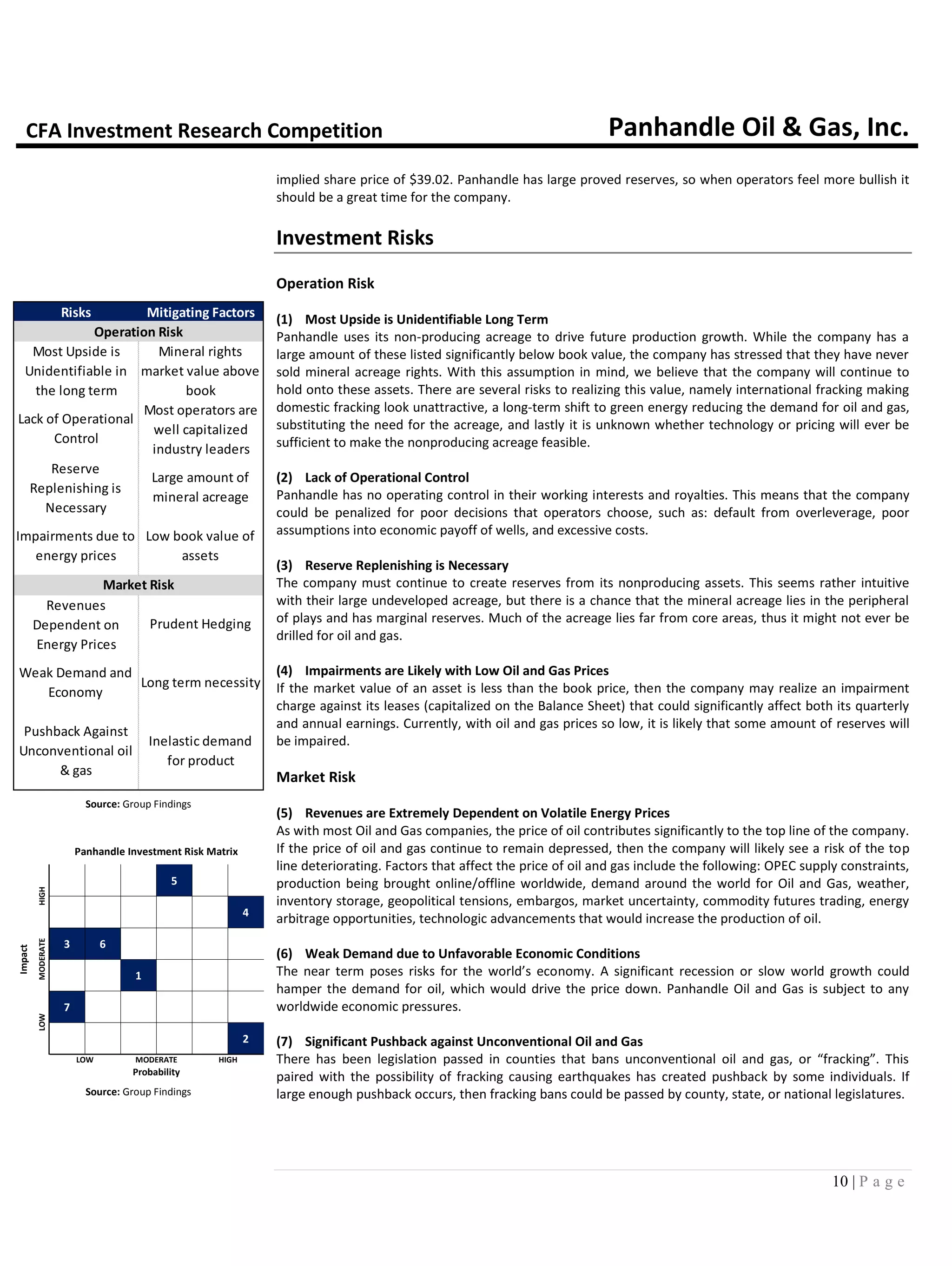
Risks Mitigating Factors
Operation Risk
Pushback Against
Unconventional oil
& gas
Inelastic demand
for product
Market Risk
Most Upside is
Unidentifiable in
the long term
Mineral rights
market value above
book
Lack of Operational
Control
Most operators are
well capitalized
industry leaders
Reserve
Replenishing is
Necessary
Large amount of
mineral acreage
Impairments due to
energy prices
Low book value of
assets
Revenues
Dependent on
Energy Prices
Prudent Hedging
Weak Demand and
Economy
Long term necessity
Source: Group Findings
5
4
3 6
1
7
2
LOW MODERATE HIGH
Probability
Panhandle Investment Risk Matrix
LOWMODERATEHIGH
Impact
Source: Group Findings
implied share price of $39.02. Panhandle has large proved reserves, so when operators feel more bullish it
should be a great time for the company.
Investment Risks
Operation Risk
(1) Most Upside is Unidentifiable Long Term
Panhandle uses its non-producing acreage to drive future production growth. While the company has a
large amount of these listed significantly below book value, the company has stressed that they have never
sold mineral acreage rights. With this assumption in mind, we believe that the company will continue to
hold onto these assets. There are several risks to realizing this value, namely international fracking making
domestic fracking look unattractive, a long-term shift to green energy reducing the demand for oil and gas,
substituting the need for the acreage, and lastly it is unknown whether technology or pricing will ever be
sufficient to make the nonproducing acreage feasible.
(2) Lack of Operational Control
Panhandle has no operating control in their working interests and royalties. This means that the company
could be penalized for poor decisions that operators choose, such as: default from overleverage, poor
assumptions into economic payoff of wells, and excessive costs.
(3) Reserve Replenishing is Necessary
The company must continue to create reserves from its nonproducing assets. This seems rather intuitive
with their large undeveloped acreage, but there is a chance that the mineral acreage lies in the peripheral
of plays and has marginal reserves. Much of the acreage lies far from core areas, thus it might not ever be
drilled for oil and gas.
(4) Impairments are Likely with Low Oil and Gas Prices
If the market value of an asset is less than the book price, then the company may realize an impairment
charge against its leases (capitalized on the Balance Sheet) that could significantly affect both its quarterly
and annual earnings. Currently, with oil and gas prices so low, it is likely that some amount of reserves will
be impaired.
Market Risk
(5) Revenues are Extremely Dependent on Volatile Energy Prices
As with most Oil and Gas companies, the price of oil contributes significantly to the top line of the company.
If the price of oil and gas continue to remain depressed, then the company will likely see a risk of the top
line deteriorating. Factors that affect the price of oil and gas include the following: OPEC supply constraints,
production being brought online/offline worldwide, demand around the world for Oil and Gas, weather,
inventory storage, geopolitical tensions, embargos, market uncertainty, commodity futures trading, energy
arbitrage opportunities, technologic advancements that would increase the production of oil.
(6) Weak Demand due to Unfavorable Economic Conditions
The near term poses risks for the world’s economy. A significant recession or slow world growth could
hamper the demand for oil, which would drive the price down. Panhandle Oil and Gas is subject to any
worldwide economic pressures.
(7) Significant Pushback against Unconventional Oil and Gas
There has been legislation passed in counties that bans unconventional oil and gas, or “fracking”. This
paired with the possibility of fracking causing earthquakes has created pushback by some individuals. If
large enough pushback occurs, then fracking bans could be passed by county, state, or national legislatures.
CFA Investment Research Competition Panhandle Oil & Gas
11 | P a g e
Appendix 1: Table of Contents
Appendix 1: Table of Contents Page 11
Appendix 2: Income Statement Page 12
Appendix 3: Cash Flow Statement Page 13
Appendix 4: Balance Sheet Page 14
Appendix 5: Debt Schedule Page 15
Appendix 6: Dividends and Stock Repurchases Page 16
Appendix 7: Working Capital & Cash Flow Statement Projections Page 17
Appendix 8: Tax Rate Calculations Page 18
Appendix 9: EBITDAX Calculations Page 19
Appendix 10: Production Projections Page 20
Appendix 11: Expense Projections Page 21
Appendix 12: Pricing, Hedging and Revenue Profile Page 22
Appendix 13: NAV Valuation Page 23
Appendix 14: NAV Sensitivity Analysis Page 24
Appendix 15: Comparable Company Selection Page 25
Appendix 16: Comparable Company Analysis Page 26
Appendix 17: Discount Rate Decisions Page 30
Appendix 18: DCF Analysis Page 31
Appendix 19: Valuation Football Field Page 32
Appendix 20: Location of Panhandle Oil & Gas Mineral Acreage Page 33
Appendix 21: Management Personnel Page 34
Appendix 22: PEST Analysis Page 36
Appendix 23: Porter’s Five Forces Analysis Page 40
Appendix 24: Oil & Natural Gas One Year Look Back Page 42
Appendix 25: Expanded Financial Analysis Page 44
Appendix 26: E&P Industry Ratio Calculations Page 45
Appendix 27: Reserves and Production Analysis Page 47
Appendix 28: Shale Play Overview Page 50
Appendix 29: Panhandle Acreage Breakdown by Location Page 52
Appendix 30: Forecast Situation Tree Page 54
Appendix 31: Operator Analysis Page 55
Appendix 32: List of Sources Page 57
CFA Investment Research Competition Panhandle Oil & Gas
12 | P a g e
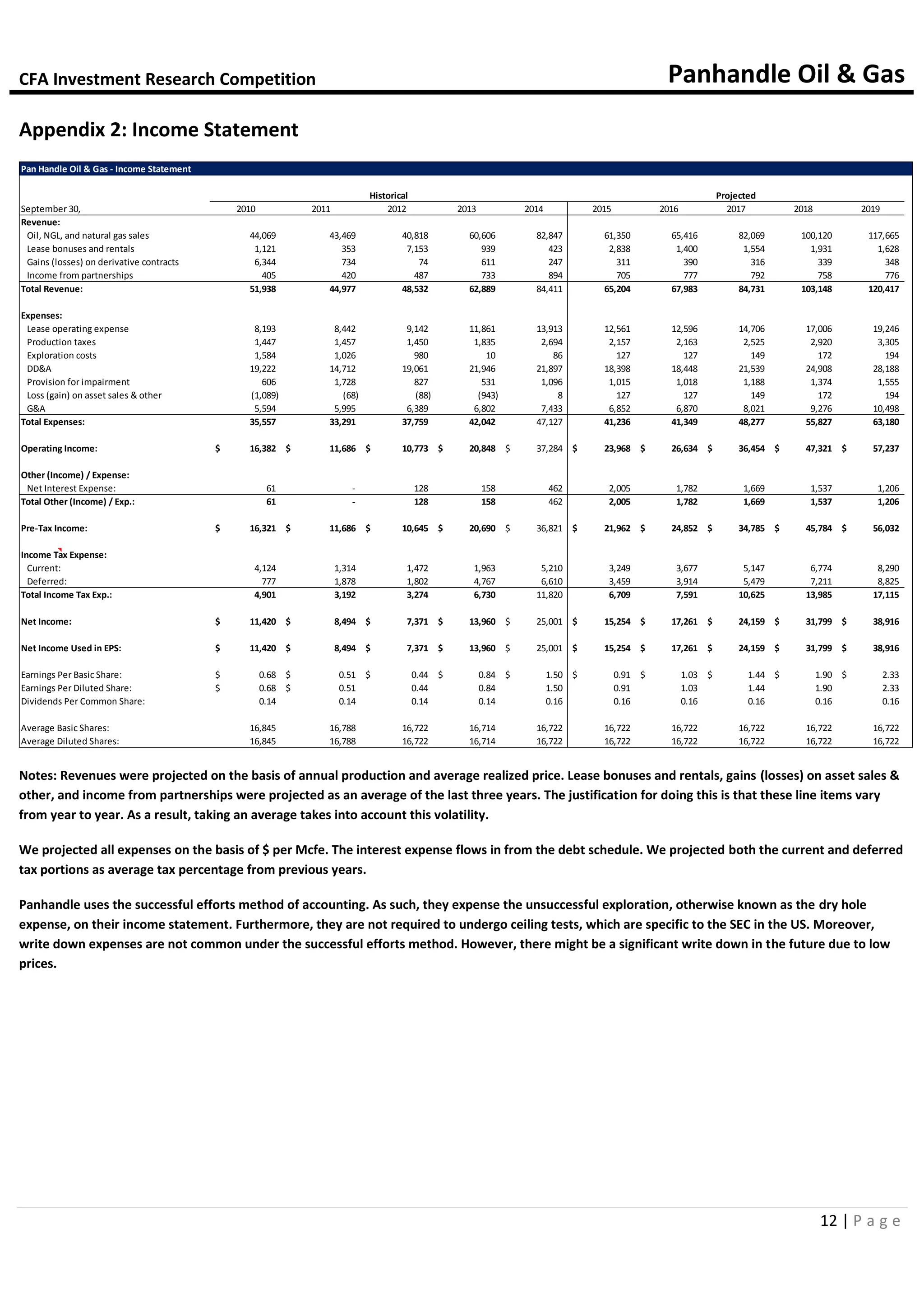
Appendix 2: Income Statement
Notes: Revenues were projected on the basis of annual production and average realized price. Lease bonuses and rentals, gains (losses) on asset sales &
other, and income from partnerships were projected as an average of the last three years. The justification for doing this is that these line items vary
from year to year. As a result, taking an average takes into account this volatility.
We projected all expenses on the basis of $ per Mcfe. The interest expense flows in from the debt schedule. We projected both the current and deferred
tax portions as average tax percentage from previous years.
Panhandle uses the successful efforts method of accounting. As such, they expense the unsuccessful exploration, otherwise known as the dry hole
expense, on their income statement. Furthermore, they are not required to undergo ceiling tests, which are specific to the SEC in the US. Moreover,
write down expenses are not common under the successful efforts method. However, there might be a significant write down in the future due to low
prices.
Pan Handle Oil & Gas - Income Statement
Historical Projected
September 30, 2010 2011 2012 2013 2014 2015 2016 2017 2018 2019
Revenue:
Oil, NGL, and natural gas sales 44,069 43,469 40,818 60,606 82,847 61,350 65,416 82,069 100,120 117,665
Lease bonuses and rentals 1,121 353 7,153 939 423 2,838 1,400 1,554 1,931 1,628
Gains (losses) on derivative contracts 6,344 734 74 611 247 311 390 316 339 348
Income from partnerships 405 420 487 733 894 705 777 792 758 776
Total Revenue: 51,938 44,977 48,532 62,889 84,411 65,204 67,983 84,731 103,148 120,417
Expenses:
Lease operating expense 8,193 8,442 9,142 11,861 13,913 12,561 12,596 14,706 17,006 19,246
Production taxes 1,447 1,457 1,450 1,835 2,694 2,157 2,163 2,525 2,920 3,305
Exploration costs 1,584 1,026 980 10 86 127 127 149 172 194
DD&A 19,222 14,712 19,061 21,946 21,897 18,398 18,448 21,539 24,908 28,188
Provision for impairment 606 1,728 827 531 1,096 1,015 1,018 1,188 1,374 1,555
Loss (gain) on asset sales & other (1,089) (68) (88) (943) 8 127 127 149 172 194
G&A 5,594 5,995 6,389 6,802 7,433 6,852 6,870 8,021 9,276 10,498
Total Expenses: 35,557 33,291 37,759 42,042 47,127 41,236 41,349 48,277 55,827 63,180
Operating Income: 16,382$ 11,686$ 10,773$ 20,848$ 37,284$ 23,968$ 26,634$ 36,454$ 47,321$ 57,237$
Other (Income) / Expense:
Net Interest Expense: 61 - 128 158 462 2,005 1,782 1,669 1,537 1,206
Total Other (Income) / Exp.: 61 - 128 158 462 2,005 1,782 1,669 1,537 1,206
Pre-Tax Income: 16,321$ 11,686$ 10,645$ 20,690$ 36,821$ 21,962$ 24,852$ 34,785$ 45,784$ 56,032$
Income Tax Expense:
Current: 4,124 1,314 1,472 1,963 5,210 3,249 3,677 5,147 6,774 8,290
Deferred: 777 1,878 1,802 4,767 6,610 3,459 3,914 5,479 7,211 8,825
Total Income Tax Exp.: 4,901 3,192 3,274 6,730 11,820 6,709 7,591 10,625 13,985 17,115
Net Income: 11,420$ 8,494$ 7,371$ 13,960$ 25,001$ 15,254$ 17,261$ 24,159$ 31,799$ 38,916$
Net Income Used in EPS: 11,420$ 8,494$ 7,371$ 13,960$ 25,001$ 15,254$ 17,261$ 24,159$ 31,799$ 38,916$
Earnings Per Basic Share: 0.68$ 0.51$ 0.44$ 0.84$ 1.50$ 0.91$ 1.03$ 1.44$ 1.90$ 2.33$
Earnings Per Diluted Share: 0.68$ 0.51$ 0.44 0.84 1.50 0.91 1.03 1.44 1.90 2.33
Dividends Per Common Share: 0.14 0.14 0.14 0.14 0.16 0.16 0.16 0.16 0.16 0.16
Average Basic Shares: 16,845 16,788 16,722 16,714 16,722 16,722 16,722 16,722 16,722 16,722
Average Diluted Shares: 16,845 16,788 16,722 16,714 16,722 16,722 16,722 16,722 16,722 16,722
CFA Investment Research Competition Panhandle Oil & Gas
13 | P a g e
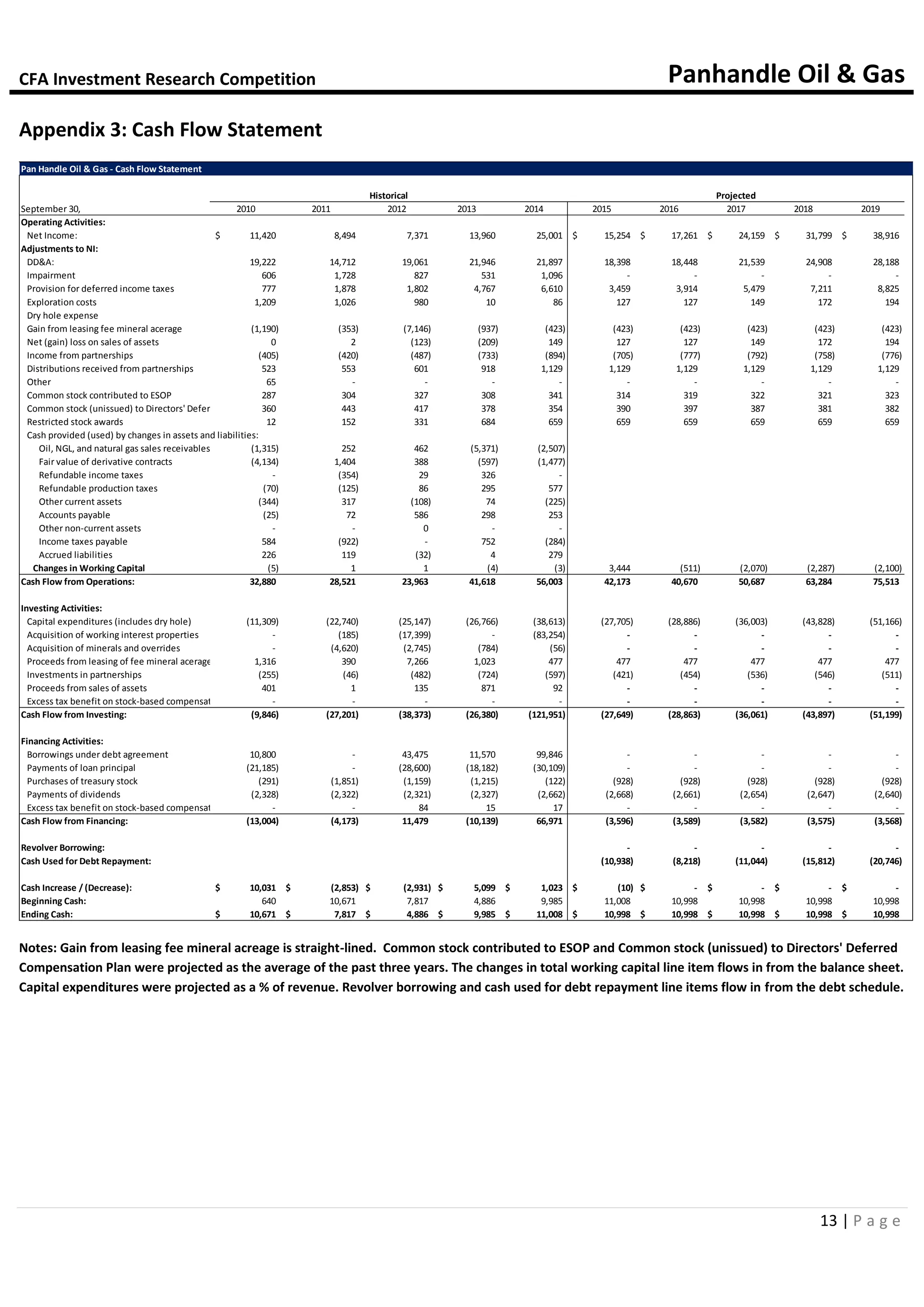
Appendix 3: Cash Flow Statement
Notes: Gain from leasing fee mineral acreage is straight-lined. Common stock contributed to ESOP and Common stock (unissued) to Directors' Deferred
Compensation Plan were projected as the average of the past three years. The changes in total working capital line item flows in from the balance sheet.
Capital expenditures were projected as a % of revenue. Revolver borrowing and cash used for debt repayment line items flow in from the debt schedule.
Pan Handle Oil & Gas - Cash Flow Statement
Historical Projected
September 30, 2010 2011 2012 2013 2014 2015 2016 2017 2018 2019
Operating Activities:
Net Income: 11,420$ 8,494 7,371 13,960 25,001 15,254$ 17,261$ 24,159$ 31,799$ 38,916$
Adjustments to NI:
DD&A: 19,222 14,712 19,061 21,946 21,897 18,398 18,448 21,539 24,908 28,188
Impairment 606 1,728 827 531 1,096 - - - - -
Provision for deferred income taxes 777 1,878 1,802 4,767 6,610 3,459 3,914 5,479 7,211 8,825
Exploration costs 1,209 1,026 980 10 86 127 127 149 172 194
Dry hole expense
Gain from leasing fee mineral acerage (1,190) (353) (7,146) (937) (423) (423) (423) (423) (423) (423)
Net (gain) loss on sales of assets 0 2 (123) (209) 149 127 127 149 172 194
Income from partnerships (405) (420) (487) (733) (894) (705) (777) (792) (758) (776)
Distributions received from partnerships 523 553 601 918 1,129 1,129 1,129 1,129 1,129 1,129
Other 65 - - - - - - - - -
Common stock contributed to ESOP 287 304 327 308 341 314 319 322 321 323
Common stock (unissued) to Directors' Deferred Compensation Plan360 443 417 378 354 390 397 387 381 382
Restricted stock awards 12 152 331 684 659 659 659 659 659 659
Cash provided (used) by changes in assets and liabilities:
Oil, NGL, and natural gas sales receivables (1,315) 252 462 (5,371) (2,507)
Fair value of derivative contracts (4,134) 1,404 388 (597) (1,477)
Refundable income taxes - (354) 29 326 -
Refundable production taxes (70) (125) 86 295 577
Other current assets (344) 317 (108) 74 (225)
Accounts payable (25) 72 586 298 253
Other non-current assets - - 0 - -
Income taxes payable 584 (922) - 752 (284)
Accrued liabilities 226 119 (32) 4 279
Changes in Working Capital (5) 1 1 (4) (3) 3,444 (511) (2,070) (2,287) (2,100)
Cash Flow from Operations: 32,880 28,521 23,963 41,618 56,003 42,173 40,670 50,687 63,284 75,513
Investing Activities:
Capital expenditures (includes dry hole) (11,309) (22,740) (25,147) (26,766) (38,613) (27,705) (28,886) (36,003) (43,828) (51,166)
Acquisition of working interest properties - (185) (17,399) - (83,254) - - - - -
Acquisition of minerals and overrides - (4,620) (2,745) (784) (56) - - - - -
Proceeds from leasing of fee mineral acerage 1,316 390 7,266 1,023 477 477 477 477 477 477
Investments in partnerships (255) (46) (482) (724) (597) (421) (454) (536) (546) (511)
Proceeds from sales of assets 401 1 135 871 92 - - - - -
Excess tax benefit on stock-based compensation - - - - - - - - - -
Cash Flow from Investing: (9,846) (27,201) (38,373) (26,380) (121,951) (27,649) (28,863) (36,061) (43,897) (51,199)
Financing Activities:
Borrowings under debt agreement 10,800 - 43,475 11,570 99,846 - - - - -
Payments of loan principal (21,185) - (28,600) (18,182) (30,109) - - - - -
Purchases of treasury stock (291) (1,851) (1,159) (1,215) (122) (928) (928) (928) (928) (928)
Payments of dividends (2,328) (2,322) (2,321) (2,327) (2,662) (2,668) (2,661) (2,654) (2,647) (2,640)
Excess tax benefit on stock-based compensation - - 84 15 17 - - - - -
Cash Flow from Financing: (13,004) (4,173) 11,479 (10,139) 66,971 (3,596) (3,589) (3,582) (3,575) (3,568)
Revolver Borrowing: - - - - -
Cash Used for Debt Repayment: (10,938) (8,218) (11,044) (15,812) (20,746)
Cash Increase / (Decrease): 10,031$ (2,853)$ (2,931)$ 5,099$ 1,023$ (10)$ -$ -$ -$ -$
Beginning Cash: 640 10,671 7,817 4,886 9,985 11,008 10,998 10,998 10,998 10,998
Ending Cash: 10,671$ 7,817$ 4,886$ 9,985$ 11,008$ 10,998$ 10,998$ 10,998$ 10,998$ 10,998$
CFA Investment Research Competition Panhandle Oil & Gas
14 | P a g e
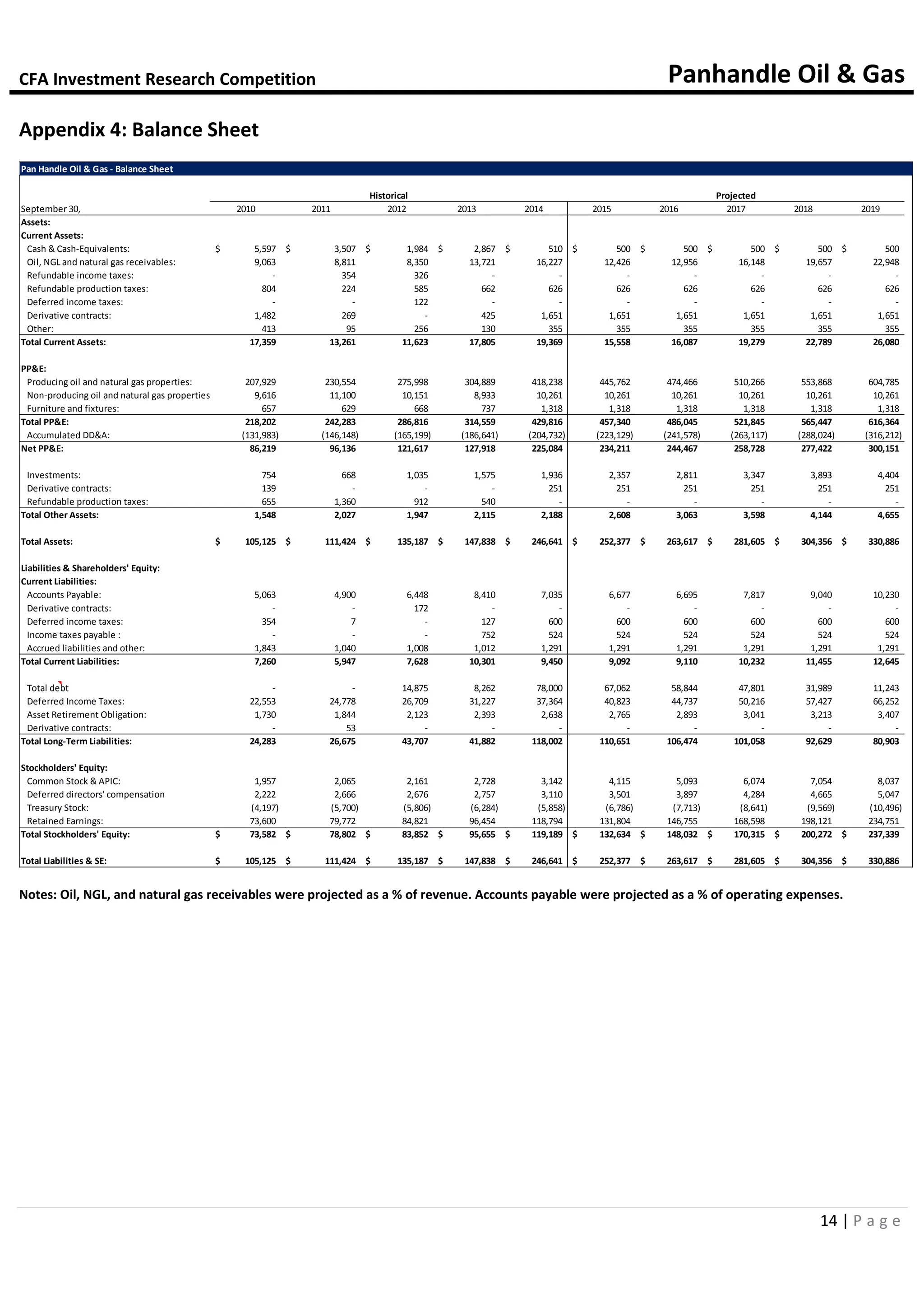
Appendix 4: Balance Sheet
Notes: Oil, NGL, and natural gas receivables were projected as a % of revenue. Accounts payable were projected as a % of operating expenses.
Pan Handle Oil & Gas - Balance Sheet
Historical Projected
September 30, 2010 2011 2012 2013 2014 2015 2016 2017 2018 2019
Assets:
Current Assets:
Cash & Cash-Equivalents: 5,597$ 3,507$ 1,984$ 2,867$ 510$ 500$ 500$ 500$ 500$ 500$
Oil, NGL and natural gas receivables: 9,063 8,811 8,350 13,721 16,227 12,426 12,956 16,148 19,657 22,948
Refundable income taxes: - 354 326 - - - - - - -
Refundable production taxes: 804 224 585 662 626 626 626 626 626 626
Deferred income taxes: - - 122 - - - - - - -
Derivative contracts: 1,482 269 - 425 1,651 1,651 1,651 1,651 1,651 1,651
Other: 413 95 256 130 355 355 355 355 355 355
Total Current Assets: 17,359 13,261 11,623 17,805 19,369 15,558 16,087 19,279 22,789 26,080
PP&E:
Producing oil and natural gas properties: 207,929 230,554 275,998 304,889 418,238 445,762 474,466 510,266 553,868 604,785
Non-producing oil and natural gas properties: 9,616 11,100 10,151 8,933 10,261 10,261 10,261 10,261 10,261 10,261
Furniture and fixtures: 657 629 668 737 1,318 1,318 1,318 1,318 1,318 1,318
Total PP&E: 218,202 242,283 286,816 314,559 429,816 457,340 486,045 521,845 565,447 616,364
Accumulated DD&A: (131,983) (146,148) (165,199) (186,641) (204,732) (223,129) (241,578) (263,117) (288,024) (316,212)
Net PP&E: 86,219 96,136 121,617 127,918 225,084 234,211 244,467 258,728 277,422 300,151
Investments: 754 668 1,035 1,575 1,936 2,357 2,811 3,347 3,893 4,404
Derivative contracts: 139 - - - 251 251 251 251 251 251
Refundable production taxes: 655 1,360 912 540 - - - - - -
Total Other Assets: 1,548 2,027 1,947 2,115 2,188 2,608 3,063 3,598 4,144 4,655
Total Assets: 105,125$ 111,424$ 135,187$ 147,838$ 246,641$ 252,377$ 263,617$ 281,605$ 304,356$ 330,886$
Liabilities & Shareholders' Equity:
Current Liabilities:
Accounts Payable: 5,063 4,900 6,448 8,410 7,035 6,677 6,695 7,817 9,040 10,230
Derivative contracts: - - 172 - - - - - - -
Deferred income taxes: 354 7 - 127 600 600 600 600 600 600
Income taxes payable : - - - 752 524 524 524 524 524 524
Accrued liabilities and other: 1,843 1,040 1,008 1,012 1,291 1,291 1,291 1,291 1,291 1,291
Total Current Liabilities: 7,260 5,947 7,628 10,301 9,450 9,092 9,110 10,232 11,455 12,645
Total debt - - 14,875 8,262 78,000 67,062 58,844 47,801 31,989 11,243
Deferred Income Taxes: 22,553 24,778 26,709 31,227 37,364 40,823 44,737 50,216 57,427 66,252
Asset Retirement Obligation: 1,730 1,844 2,123 2,393 2,638 2,765 2,893 3,041 3,213 3,407
Derivative contracts: - 53 - - - - - - - -
Total Long-Term Liabilities: 24,283 26,675 43,707 41,882 118,002 110,651 106,474 101,058 92,629 80,903
Stockholders' Equity:
Common Stock & APIC: 1,957 2,065 2,161 2,728 3,142 4,115 5,093 6,074 7,054 8,037
Deferred directors' compensation 2,222 2,666 2,676 2,757 3,110 3,501 3,897 4,284 4,665 5,047
Treasury Stock: (4,197) (5,700) (5,806) (6,284) (5,858) (6,786) (7,713) (8,641) (9,569) (10,496)
Retained Earnings: 73,600 79,772 84,821 96,454 118,794 131,804 146,755 168,598 198,121 234,751
Total Stockholders' Equity: 73,582$ 78,802$ 83,852$ 95,655$ 119,189$ 132,634$ 148,032$ 170,315$ 200,272$ 237,339$
Total Liabilities & SE: 105,125$ 111,424$ 135,187$ 147,838$ 246,641$ 252,377$ 263,617$ 281,605$ 304,356$ 330,886$
CFA Investment Research Competition Panhandle Oil & Gas
15 | P a g e
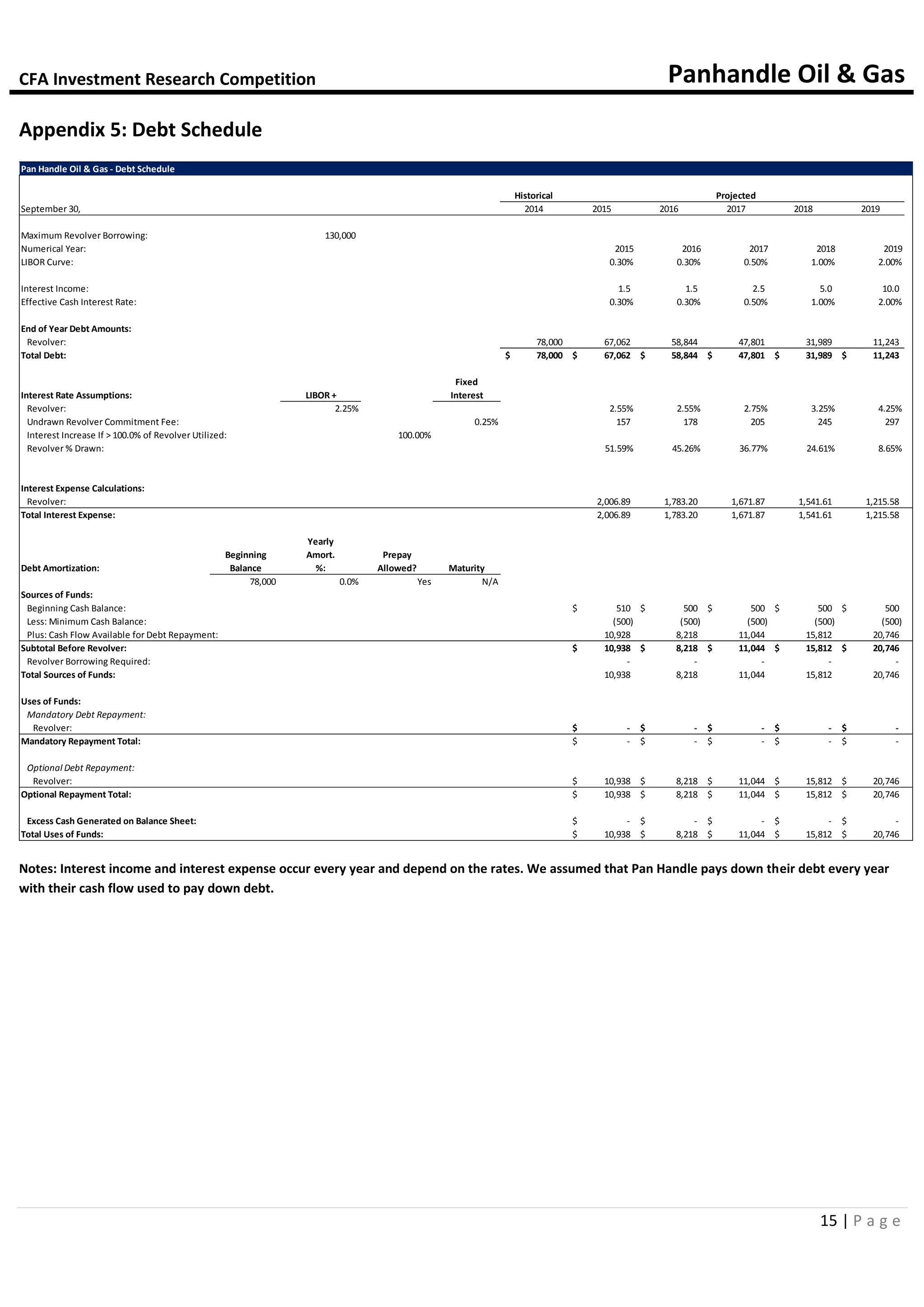
Appendix 5: Debt Schedule
Notes: Interest income and interest expense occur every year and depend on the rates. We assumed that Pan Handle pays down their debt every year
with their cash flow used to pay down debt.
Pan Handle Oil & Gas - Debt Schedule
Historical Projected
September 30, 2014 2015 2016 2017 2018 2019
Maximum Revolver Borrowing: 130,000
Numerical Year: 2015 2016 2017 2018 2019
LIBOR Curve: 0.30% 0.30% 0.50% 1.00% 2.00%
Interest Income: 1.5 1.5 2.5 5.0 10.0
Effective Cash Interest Rate: 0.30% 0.30% 0.50% 1.00% 2.00%
End of Year Debt Amounts:
Revolver: 78,000 67,062 58,844 47,801 31,989 11,243
Total Debt: 78,000$ 67,062$ 58,844$ 47,801$ 31,989$ 11,243$
Fixed
Interest Rate Assumptions: LIBOR + Interest
Revolver: 2.25% 2.55% 2.55% 2.75% 3.25% 4.25%
Undrawn Revolver Commitment Fee: 0.25% 157 178 205 245 297
Interest Increase If > 100.0% of Revolver Utilized: 100.00%
Revolver % Drawn: 51.59% 45.26% 36.77% 24.61% 8.65%
Interest Expense Calculations:
Revolver: 2,006.89 1,783.20 1,671.87 1,541.61 1,215.58
Total Interest Expense: 2,006.89 1,783.20 1,671.87 1,541.61 1,215.58
Yearly
Beginning Amort. Prepay
Debt Amortization: Balance %: Allowed? Maturity
78,000 0.0% Yes N/A
Sources of Funds:
Beginning Cash Balance: 510$ 500$ 500$ 500$ 500$
Less: Minimum Cash Balance: (500) (500) (500) (500) (500)
Plus: Cash Flow Available for Debt Repayment: 10,928 8,218 11,044 15,812 20,746
Subtotal Before Revolver: 10,938$ 8,218$ 11,044$ 15,812$ 20,746$
Revolver Borrowing Required: - - - - -
Total Sources of Funds: 10,938 8,218 11,044 15,812 20,746
Uses of Funds:
Mandatory Debt Repayment:
Revolver: -$ -$ -$ -$ -$
Mandatory Repayment Total: -$ -$ -$ -$ -$
Optional Debt Repayment:
Revolver: 10,938$ 8,218$ 11,044$ 15,812$ 20,746$
Optional Repayment Total: 10,938$ 8,218$ 11,044$ 15,812$ 20,746$
Excess Cash Generated on Balance Sheet: -$ -$ -$ -$ -$
Total Uses of Funds: 10,938$ 8,218$ 11,044$ 15,812$ 20,746$
CFA Investment Research Competition Panhandle Oil & Gas
16 | P a g e
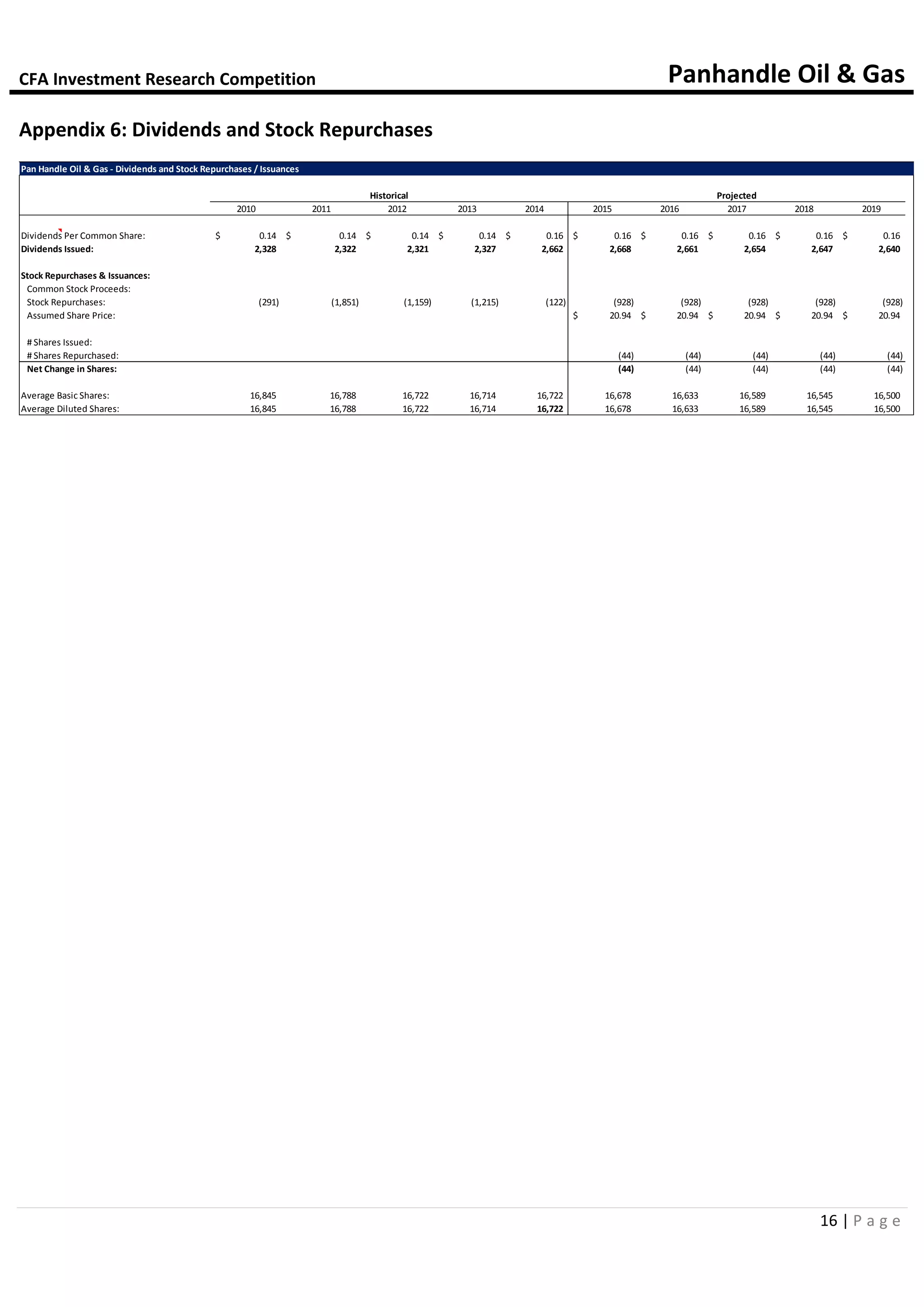
Appendix 6: Dividends and Stock Repurchases
Pan Handle Oil & Gas - Dividends and Stock Repurchases / Issuances
Historical Projected
2010 2011 2012 2013 2014 2015 2016 2017 2018 2019
Dividends Per Common Share: 0.14$ 0.14$ 0.14$ 0.14$ 0.16$ 0.16$ 0.16$ 0.16$ 0.16$ 0.16$
Dividends Issued: 2,328 2,322 2,321 2,327 2,662 2,668 2,661 2,654 2,647 2,640
Stock Repurchases & Issuances:
Common Stock Proceeds:
Stock Repurchases: (291) (1,851) (1,159) (1,215) (122) (928) (928) (928) (928) (928)
Assumed Share Price: 20.94$ 20.94$ 20.94$ 20.94$ 20.94$
# Shares Issued:
# Shares Repurchased: (44) (44) (44) (44) (44)
Net Change in Shares: (44) (44) (44) (44) (44)
Average Basic Shares: 16,845 16,788 16,722 16,714 16,722 16,678 16,633 16,589 16,545 16,500
Average Diluted Shares: 16,845 16,788 16,722 16,714 16,722 16,678 16,633 16,589 16,545 16,500
CFA Investment Research Competition Panhandle Oil & Gas
17 | P a g e
Appendix 7: Working Capital & Cash Flow Statement Projections
Pan Handle Oil & Gas - Working Capital and Cash Flow Statement Projections
Historical Projected
September 30, 2010 2011 2012 2013 2014 2015 2016 2017 2018 2019
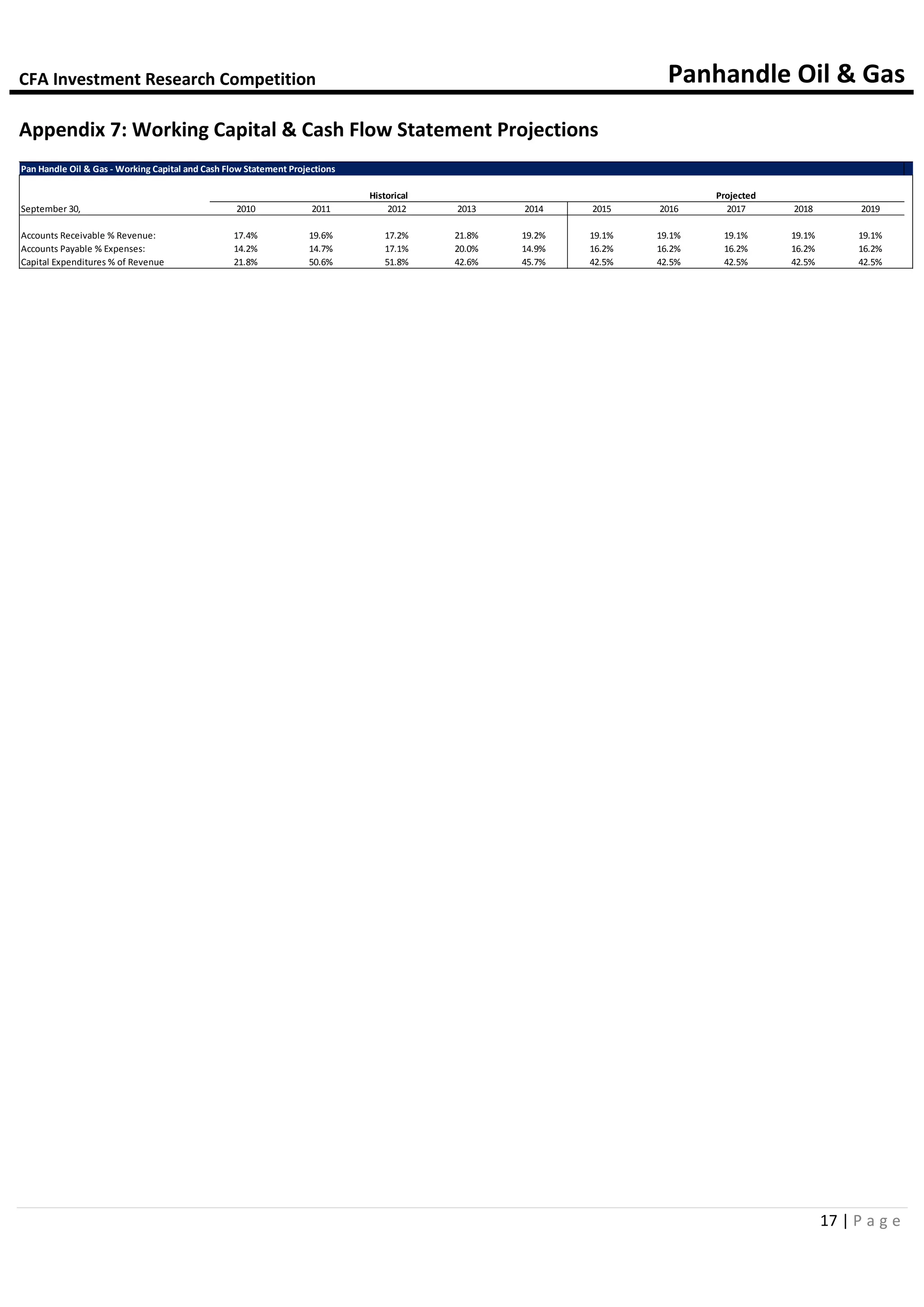
Accounts Receivable % Revenue: 17.4% 19.6% 17.2% 21.8% 19.2% 19.1% 19.1% 19.1% 19.1% 19.1%
Accounts Payable % Expenses: 14.2% 14.7% 17.1% 20.0% 14.9% 16.2% 16.2% 16.2% 16.2% 16.2%
Capital Expenditures % of Revenue 21.8% 50.6% 51.8% 42.6% 45.7% 42.5% 42.5% 42.5% 42.5% 42.5%
CFA Investment Research Competition Panhandle Oil & Gas
18 | P a g e
Appendix 8: Tax Rate Projections
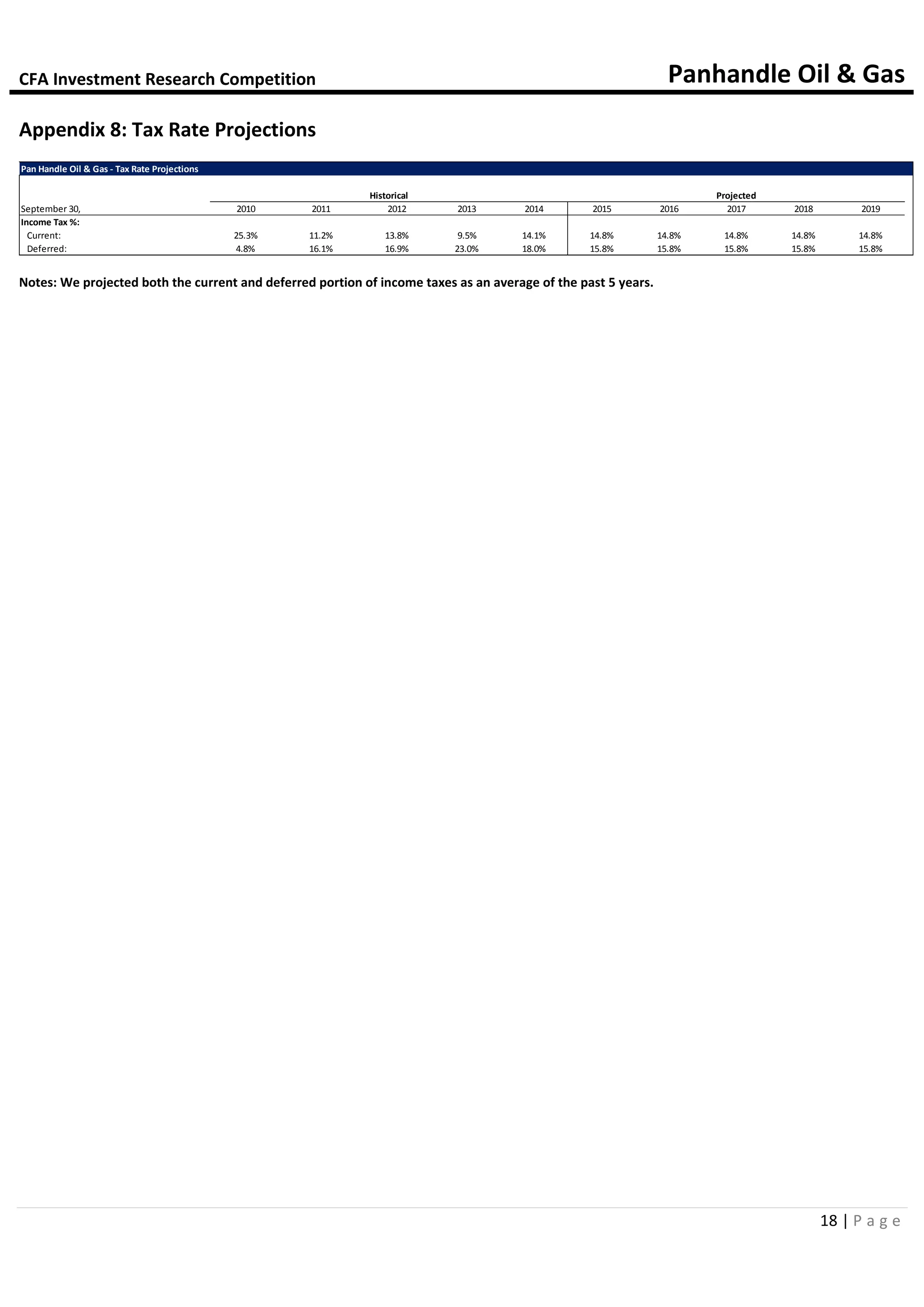
Notes: We projected both the current and deferred portion of income taxes as an average of the past 5 years.
Pan Handle Oil & Gas - Tax Rate Projections
Historical Projected
September 30, 2010 2011 2012 2013 2014 2015 2016 2017 2018 2019
Income Tax %:
Current: 25.3% 11.2% 13.8% 9.5% 14.1% 14.8% 14.8% 14.8% 14.8% 14.8%
Deferred: 4.8% 16.1% 16.9% 23.0% 18.0% 15.8% 15.8% 15.8% 15.8% 15.8%
CFA Investment Research Competition Panhandle Oil & Gas
19 | P a g e
Appendix 9: EBITDAX Calculations
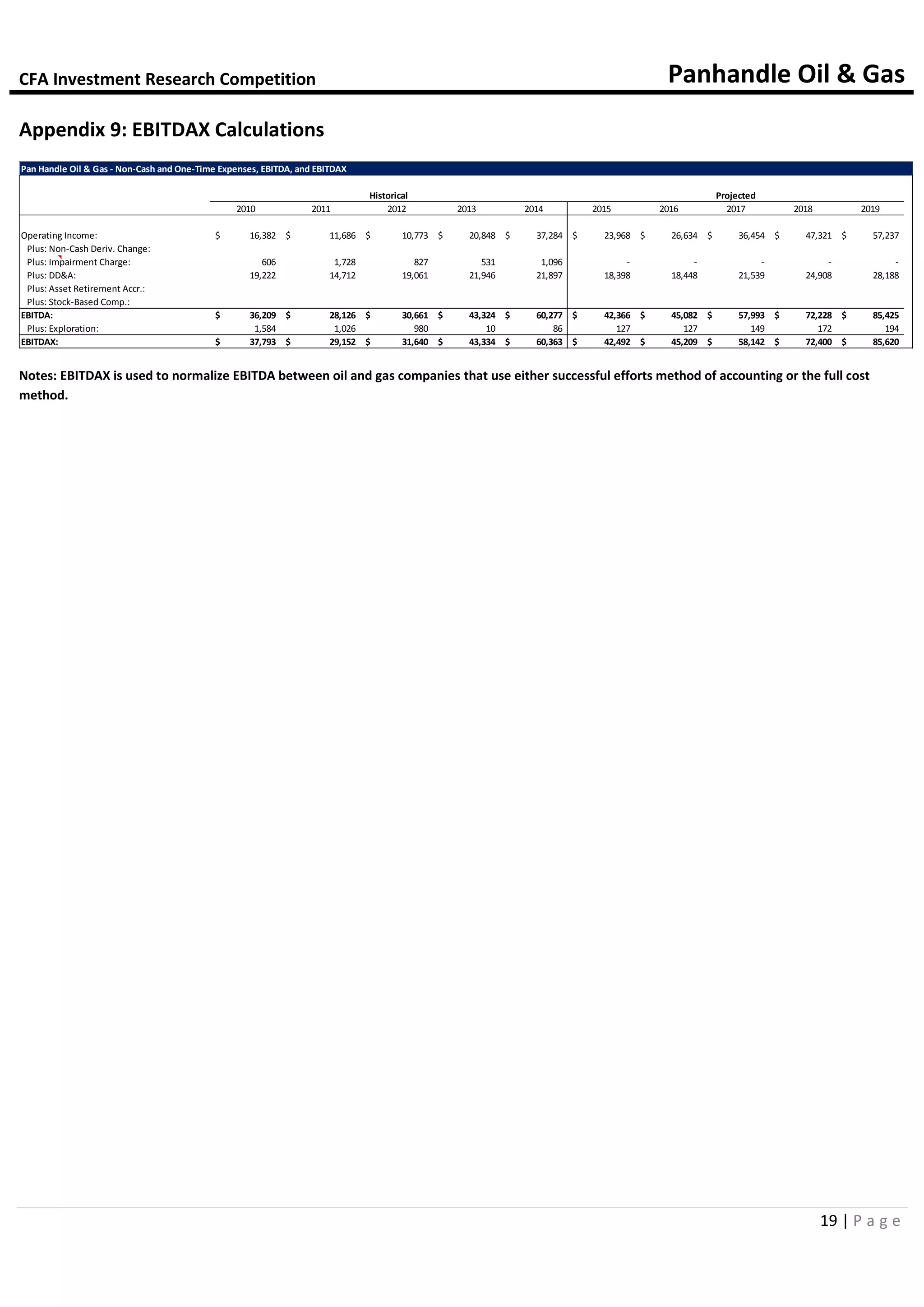
Notes: EBITDAX is used to normalize EBITDA between oil and gas companies that use either successful efforts method of accounting or the full cost
method.
Pan Handle Oil & Gas - Non-Cash and One-Time Expenses, EBITDA, and EBITDAX
Historical Projected
2010 2011 2012 2013 2014 2015 2016 2017 2018 2019
Operating Income: 16,382$ 11,686$ 10,773$ 20,848$ 37,284$ 23,968$ 26,634$ 36,454$ 47,321$ 57,237$
Plus: Non-Cash Deriv. Change:
Plus: Impairment Charge: 606 1,728 827 531 1,096 - - - - -
Plus: DD&A: 19,222 14,712 19,061 21,946 21,897 18,398 18,448 21,539 24,908 28,188
Plus: Asset Retirement Accr.:
Plus: Stock-Based Comp.:
EBITDA: 36,209$ 28,126$ 30,661$ 43,324$ 60,277$ 42,366$ 45,082$ 57,993$ 72,228$ 85,425$
Plus: Exploration: 1,584 1,026 980 10 86 127 127 149 172 194
EBITDAX: 37,793$ 29,152$ 31,640$ 43,334$ 60,363$ 42,492$ 45,209$ 58,142$ 72,400$ 85,620$
CFA Investment Research Competition Panhandle Oil & Gas
20 | P a g e
Appendix 10: Production Projections
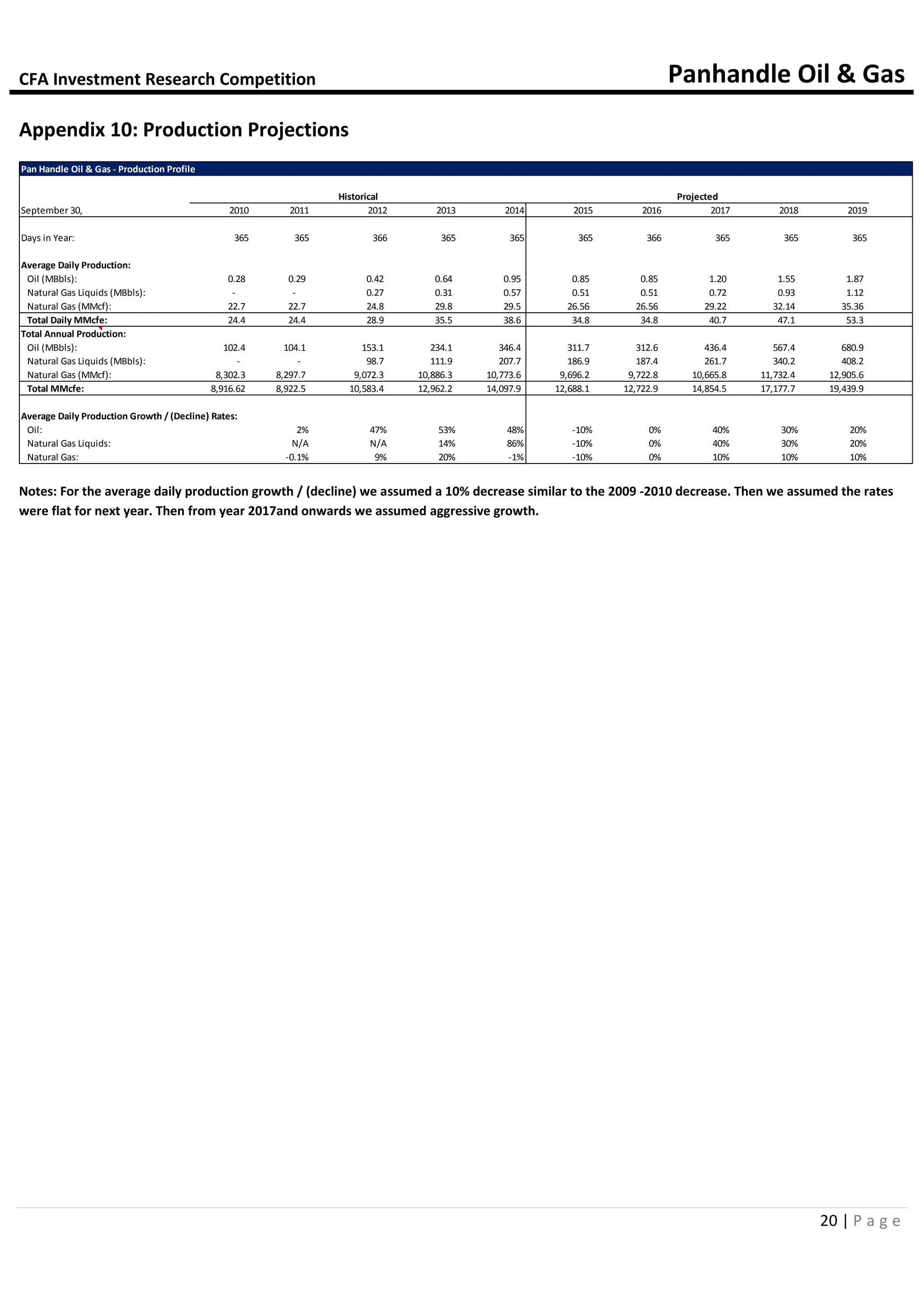
Notes: For the average daily production growth / (decline) we assumed a 10% decrease similar to the 2009 -2010 decrease. Then we assumed the rates
were flat for next year. Then from year 2017and onwards we assumed aggressive growth.
Pan Handle Oil & Gas - Production Profile
Historical Projected
September 30, 2010 2011 2012 2013 2014 2015 2016 2017 2018 2019
Days in Year: 365 365 366 365 365 365 366 365 365 365
Average Daily Production:
Oil (MBbls): 0.28 0.29 0.42 0.64 0.95 0.85 0.85 1.20 1.55 1.87
Natural Gas Liquids (MBbls): - - 0.27 0.31 0.57 0.51 0.51 0.72 0.93 1.12
Natural Gas (MMcf): 22.7 22.7 24.8 29.8 29.5 26.56 26.56 29.22 32.14 35.36
Total Daily MMcfe: 24.4 24.4 28.9 35.5 38.6 34.8 34.8 40.7 47.1 53.3
Total Annual Production:
Oil (MBbls): 102.4 104.1 153.1 234.1 346.4 311.7 312.6 436.4 567.4 680.9
Natural Gas Liquids (MBbls): - - 98.7 111.9 207.7 186.9 187.4 261.7 340.2 408.2
Natural Gas (MMcf): 8,302.3 8,297.7 9,072.3 10,886.3 10,773.6 9,696.2 9,722.8 10,665.8 11,732.4 12,905.6
Total MMcfe: 8,916.62 8,922.5 10,583.4 12,962.2 14,097.9 12,688.1 12,722.9 14,854.5 17,177.7 19,439.9
Average Daily Production Growth / (Decline) Rates:
Oil: 2% 47% 53% 48% -10% 0% 40% 30% 20%
Natural Gas Liquids: N/A N/A 14% 86% -10% 0% 40% 30% 20%
Natural Gas: -0.1% 9% 20% -1% -10% 0% 10% 10% 10%
CFA Investment Research Competition Panhandle Oil & Gas
21 | P a g e
Appendix 11: Expense Projections
Notes: For all the expenses per Mcfe of production, we straight-lined. Then we multiplied the per Mcfe of production by the annual production (MMcfe)
for that precise year.
Pan Handle Oil & Gas - Expense Projections
($ in Thousands or Per Mcfe Where Noted):
Historical Projected
2010 2011 2012 2013 2014 2015 2016 2017 2018 2019
Expenses Per Mcfe of Production ($ as Stated):
Lease operating expense 0.92$ 0.95$ 0.86$ 0.92$ 0.99$ 0.99$ 0.99$ 0.99$ 0.99$ 0.99$
Production taxes 0.16 0.16 0.14 0.14 0.19 0.17 0.17 0.17 0.17 0.17
Exploration costs 0.18 0.11 0.09 0.00 0.01 0.01 0.01 0.01 0.01 0.01
DD&A 2.16 1.65 1.80 1.69 1.55 1.45 1.45 1.45 1.45 1.45
Provision for impairment 0.07 0.19 0.08 0.04 0.08 0.08 0.08 0.08 0.08 0.08
Loss (gain) on asset sales & other (0.12) (0.01) (0.01) (0.07) 0.00 0.01 0.01 0.01 0.01 0.01
G&A 0.63 0.67 0.60 0.52 0.53 0.54 0.54 0.54 0.54 0.54
Total Expenses Per Mcfe: 3.99$ 3.73$ 3.57$ 3.24$ 3.34$ 3.25$ 3.25$ 3.25$ 3.25$ 3.25$
Total Production-Linked Expenses ($ in Thousands):
Lease operating expense 8,193$ 8,442$ 9,142$ 11,861$ 13,913$ 12,561$ 12,596$ 14,706$ 17,006$ 19,246$
Production taxes 1,447 1,457 1,450 1,835 2,694 2,157 2,163 2,525 2,920 3,305
Exploration costs 1,584 1,026 980 10 86 127 127 149 172 194
DD&A 19,222 14,712 19,061 21,946 21,897 18,398 18,448 21,539 24,908 28,188
Provision for impairment 606 1,728 827 531 1,096 1,015 1,018 1,188 1,374 1,555
Loss (gain) on asset sales & other (1,089) (68) (88) (943) 8 127 127 149 172 194
G&A 5,594 5,995 6,389 6,802 7,433 6,852 6,870 8,021 9,276 10,498
Total Production-Linked Exp: 35,557$ 33,291$ 37,759$ 42,042$ 47,127$ 41,236$ 41,349$ 48,277$ 55,827$ 63,180$
CFA Investment Research Competition Panhandle Oil & Gas
22 | P a g e
Appendix 12: Pricing, Hedging and Revenue Profile
Notes: Price cases are based on EIA estimates.
Note: Based on the above monthly estimates, we calculated the average sale price of crude oil to be $85.85 per barrel and natural gas to be $3.54 per mcf
for 2015.
Pan Handle Oil & Gas - Resource Price, Hedging and Revenue Profile
($ as Stated Except Revenue in Thousands)
Historical Projected
September 30, 2010 2011 2012 2013 2014 2015 2016 2017 2018 2019
Average NYMEX Prices (Oil is WTI):
Natural Gas ($ Per Mcf): 4.41$ 4.13$ 2.62$ 3.31$ 4.05$ 3.54$ 3.98$ 4.00$ 4.08$ 4.16$
Natural Gas Liquids ($ Per Bbl): - - 33.23 27.67 32.31 24.48 24.14 25.50 26.01 26.53
Oil ($ Per Bbl): 72.83$ 88.00 90.13 91.56 93.68 72.00 71.00 75.00 76.50 78.03
NYMEX Gas Prices ($ Per Mcf):
Base Case: 3.54$ 3.98$ 4.06$ 4.14$ 4.22$
NYMEX Natural Gas Liquids Prices ($ Per Bbl):
Base Case: 18.56$ 24.14$ 24.62$ 25.12$ 25.62$
WTI Oil Prices ($ Per Bbl):
Base Case: 85.85$ 71.00$ 72.42$ 73.87$ 75.35$
Total Revenue by Segment ($ in Thousands):
Oil: 7,456$ 9,164$ 13,803$ 21,433$ 32,450$ 22,446$ 22,195$ 32,734$ 43,405$ 53,127$
NGL: - - 3,280 3,096 6,710 4,575 4,524 6,672 8,848 10,829
Natural Gas: 36,613 34,269 23,769 36,034 43,633 34,329 38,697 42,663 47,868 53,708
Lease bonuses and rentals 1,121 353 7,153 939 423 2,838 1,400 1,554 1,931 1,628
Gains (losses) on derivative contracts 6,344 734 74 611 247 311 390 316 339 348
Income from partnerships 405 420 487 733 894 705 777 792 758 776
Total Revenue: 51,939$ 44,941$ 48,566$ 62,846$ 84,357$ 65,204$ 67,983$ 84,731$ 103,148$ 120,417$
Revenue Growth %: (13.5%) 8.1% 29.4% 34.2% (22.7%) 4.3% 24.6% 21.7% 16.7%
Crude Oil Jan 2015 Feb 2015 Mar 2015 Apr 2015 May 2015 Jun 2015 Jul 2015 Aug 2015 Sep 2015 Oct 2015 Nov 2015 Dec 2015
Production 26,477 23,915 26,477 25,623 26,477 25,623 26,477 26,477 25,623 26,477 25,623 26,477
Hedged 22,000 22,000 22,000 21,000 21,000 21,000 22,000 22,000 22,000 22,000 22,000 22,000
Average Hedge Price95.94$ 95.94$ 95.94$ 96.50$ 96.50$ 96.50$ 87.74$ 87.74$ 87.74$ 87.74$ 87.74$ 87.74$
Unhedged 4,477 1,915 4,477 4,623 5,477 4,623 4,477 4,477 3,623 4,477 3,623 4,477
Average Unhedged Price54.58$ 54.58$ 54.58$ 54.58$ 54.58$ 54.58$ 54.58$ 54.58$ 54.58$ 54.58$ 54.58$ 54.58$
Average Overall Price88.95$ 92.63$ 88.95$ 88.93$ 87.82$ 88.93$ 82.13$ 82.13$ 83.05$ 82.13$ 83.05$ 82.13$
Natural Gas Jan 2015 Feb 2015 Mar 2015 Apr 2015 May 2015 Jun 2015 Jul 2015 Aug 2015 Sep 2015 Oct 2015 Nov 2015 Dec 2015
Production 823,513 743,818 823,513 796,948 823,513 796,948 823,513 823,513 796,948 823,513 796,948 823,513
Hedged 400,000 400,000 400,000 320,000 290,000 290,000 290,000 290,000 290,000 240,000 170,000 170,000
Average Hedge Price 3.56$ 3.56$ 3.56$ 3.60$ 3.53$ 3.53$ 3.53$ 3.53$ 3.53$ 3.43$ 3.40$ 3.40$
Unhedged 423,513 343,818 423,513 476,948 533,513 506,948 533,513 533,513 506,948 583,513 626,948 653,513
Average Unhedged Price3.55$ 3.55$ 3.55$ 3.55$ 3.55$ 3.55$ 3.55$ 3.55$ 3.55$ 3.55$ 3.55$ 3.55$
Average Overall Price3.55$ 3.55$ 3.55$ 3.57$ 3.54$ 3.54$ 3.54$ 3.54$ 3.54$ 3.51$ 3.52$ 3.52$
Calculation of Projected Average Sale Price for 2015 (based on current hedges)
CFA Investment Research Competition Panhandle Oil & Gas
23 | P a g e
Appendix 13: NAV Valuation
Notes: We made assumptions for future prices and discount rates. The primary discount rate that we used for the NAV was the standard oil and gas discount rate of 10%. After
making these assumptions, we projected production and realized prices for commodities. Concerning production projections, we used a CAGR decline rate calculated from
industry decline estimates and projected it out until the year 2050. Subsequently, we made expense and tax rate assumptions and calculated after-tax cash flows. Then we
took the net present value of the after-tax cash flows. Next, we took into account the value of the undeveloped land that Pan Handle owns. Per management’s guidance, we
assumed that each acre was valued at $100 or roughly the value of debt. We then added the value derived from their acreage to the net present value of after-tax cash flows
from proved reserves to get to their enterprise value. From there we made the appropriate balance sheet assumptions to calculate the implied value per share.
Pan Handle Oil & Gas - Net Asset Valuation (NAV)
Proved Reserves as of 09/30/2014: Long-Term Production Decline: Resource Prices for NAV: Gas Oil NGL
Natural Gas (MMcf): 142,492 Natural Gas: (12.0%) $ per Mcf $ per Bbl $ per Bbl
Natural Gas Liquids (MBbls): 3,040 Natural Gas Liquids: (12.0%) 3.54$ 72.00$ 24.48$
Oil (MBbls): 7,570 Oil: (12.0%)
Natural Gas Equivalents (mMcfe): 206,151 Price Cased Used in NAV: NAV
Future Estimated Development Costs: 146,466$ Discount Rate: 10.0%
Development Years 5
Natural Gas Natural Gas Liquids Oil Revenue ($ in Thousands) Production & Development Expenses: Cash Flows ($ in Thousands)
Beginning Annual Avg. Beginning Annual Avg. Beginning Annual Avg. Total Total
Reserves Production Price Reserves Production Price ReservesProduction Price Natural Total Annual Production Production Development Pre-Tax Cash After-Tax
Year # (MMcf) (MMcf) $ / Mcf (MBbls) (MBbls) $ / Bbl (MBbls) (MBbls) $ / Bbl Gas Oil & NGL Revenue MMcfe Per Mcfe Expenses Expenses Cash Flows Tax Rate Cash Flows
2015 1 142,492 9,696 3.54$ 3,040 187 24.48$ 7,570 312 72.00$ 34,329$ 27,021$ 61,350$ 12,688 0.99$ 12,561$ 29,293$ 19,496$ 14.8% 16,611$
2016 2 132,796 9,723 3.98 2,853 187 24.14 7,258 313 71.00 38,697 26,719 65,416 12,723 0.99 12,596 29,293 23,527 14.8% 20,046
2017 3 123,073 10,666 4.00 2,666 262 25.50 6,945 436 75.00 42,663 39,406 82,069 14,854 0.99 14,706 29,293 38,070 14.8% 32,437
2018 4 112,408 11,732 4.08 2,404 340 26.01 6,509 567 76.50 47,868 52,252 100,120 17,178 0.99 17,006 29,293 53,822 14.8% 45,858
2019 5 100,675 12,906 4.16 2,064 408 26.53 5,941 681 78.03 53,708 63,957 117,665 19,440 0.99 19,246 29,293 69,126 14.8% 58,899
2020 6 87,770 11,357 4.16 1,656 359 26.53 5,261 599 78.03 47,263 56,282 103,545 17,107 0.99 16,936 - 86,609 14.8% 73,795
2021 7 76,413 9,994 4.16 1,297 316 26.53 4,661 527 78.03 41,592 49,528 91,120 15,054 0.99 14,904 - 76,216 14.8% 64,939
2022 8 66,418 8,795 4.16 981 278 26.53 4,134 464 78.03 36,601 43,585 80,185 13,248 0.99 13,115 - 67,070 14.8% 57,147
2023 9 57,624 7,739 4.16 702 245 26.53 3,670 408 78.03 32,209 38,355 70,563 11,658 0.99 11,541 - 59,022 14.8% 50,289
2024 10 49,884 6,811 4.16 458 215 26.53 3,262 359 78.03 28,343 33,752 62,096 10,259 0.99 10,156 - 51,939 14.8% 44,254
2025 11 43,073 5,993 4.16 242 190 26.53 2,903 316 78.03 24,942 29,702 54,644 9,028 0.99 8,938 - 45,706 14.8% 38,944
2026 12 37,080 5,274 4.16 53 53 26.53 2,586 278 78.03 21,949 23,107 45,056 7,259 0.99 7,187 - 37,870 14.8% 32,267
2027 13 31,806 4,641 4.16 - - 26.53 2,308 245 78.03 19,315 19,106 38,422 6,110 0.99 6,049 - 32,372 14.8% 27,583
2028 14 27,164 4,084 4.16 - - 26.53 2,063 215 78.03 16,997 16,814 33,811 5,377 0.99 5,323 - 28,488 14.8% 24,273
2029 15 23,080 3,594 4.16 - - 26.53 1,848 190 78.03 14,958 14,796 29,754 4,732 0.99 4,685 - 25,069 14.8% 21,360
2030 16 19,486 3,163 4.16 - - 26.53 1,658 167 78.03 13,163 13,021 26,183 4,164 0.99 4,122 - 22,061 14.8% 18,797
2031 17 16,323 2,783 4.16 - - 26.53 1,491 147 78.03 11,583 11,458 23,041 3,664 0.99 3,628 - 19,414 14.8% 16,541
2032 18 13,540 2,449 4.16 - - 26.53 1,344 129 78.03 10,193 10,083 20,276 3,225 0.99 3,192 - 17,084 14.8% 14,556
2033 19 11,090 2,155 4.16 - - 26.53 1,215 114 78.03 8,970 8,873 17,843 2,838 0.99 2,809 - 15,034 14.8% 12,810
2034 20 8,935 1,897 4.16 - - 26.53 1,101 100 78.03 7,894 7,808 15,702 2,497 0.99 2,472 - 13,230 14.8% 11,272
2035 21 7,038 1,669 4.16 - - 26.53 1,001 88 78.03 6,946 6,871 13,818 2,198 0.99 2,176 - 11,642 14.8% 9,920
2036 22 5,369 1,469 4.16 - - 26.53 913 77 78.03 6,113 6,047 12,160 1,934 0.99 1,914 - 10,245 14.8% 8,729
2037 23 3,900 1,293 4.16 - - 26.53 836 68 78.03 5,379 5,321 10,700 1,702 0.99 1,685 - 9,016 14.8% 7,682
2038 24 2,607 1,137 4.16 - - 26.53 768 60 78.03 4,734 4,683 9,416 1,498 0.99 1,483 - 7,934 14.8% 6,760
2039 25 1,470 1,001 4.16 - - 26.53 708 53 78.03 4,166 4,121 8,286 1,318 0.99 1,305 - 6,982 14.8% 5,949
2040 26 469 469 4.16 - - 26.53 655 46 78.03 1,951 3,626 5,577 748 0.99 740 - 4,837 14.8% 4,121
2041 27 - - 4.16 - - 26.53 608 41 78.03 - 3,191 3,191 245 0.99 243 - 2,948 14.8% 2,512
2042 28 - - 4.16 - - 26.53 567 36 78.03 - 2,808 2,808 216 0.99 214 - 2,594 14.8% 2,211
2043 29 - - 4.16 - - 26.53 531 32 78.03 - 2,471 2,471 190 0.99 188 - 2,283 14.8% 1,945
2044 30 - - 4.16 - - 26.53 500 28 78.03 - 2,175 2,175 167 0.99 166 - 2,009 14.8% 1,712
2045 31 - - 4.16 - - 26.53 472 25 78.03 - 1,914 1,914 147 0.99 146 - 1,768 14.8% 1,506
2046 32 - - 4.16 - - 26.53 447 22 78.03 - 1,684 1,684 129 0.99 128 - 1,556 14.8% 1,326
2047 33 - - 4.16 - - 26.53 426 19 78.03 - 1,482 1,482 114 0.99 113 - 1,369 14.8% 1,167
2048 34 - - 4.16 - - 26.53 407 17 78.03 - 1,304 1,304 100 0.99 99 - 1,205 14.8% 1,027
2049 35 - - 4.16 - - 26.53 390 15 78.03 - 1,148 1,148 88 0.99 87 - 1,060 14.8% 903
2050 36 - - 4.16 - - 26.53 375 13 78.03 - 1,010 1,010 78 0.99 77 - 933 14.8% 795
Present Value of Cash Flows from Proved Reserves: $673,584
Undeveloped Acres (Property Values in $ Thousands USD):
Region: Acres: $ / Acre: Value:
US - Arkansas: 19,617 100$ 1,962$
US - Colorado: 39,090 100 3,909
US - Florida: 8,212 100 821
US - Kansas: 10,616 100 1,062
US - Montana: 17,947 100 1,795
US - New Mexico: 167,015 100 16,702
US - North Dakota: 62,090 100 6,209
US - Oklahoma: 570,985 100 57,099
US - South Dakota: 9,300 100 930
US - Texas: 281,634 100 28,163
US - Other: 262 100 26
Total: 1,186,768 118,677$
Enterprise Value: $792,260
Balance Sheet Adjustments: (78,478)
Implied Equity Value: 713,782$
Diluted Shares Outstanding: 16,991.3
Implied Share Price: 42.01$
Exercise
Type: Number: Price: Dilution:
Options - -$ -
RSU 500 500
Performance Shares A - - -
Performance Shares B - - -
Performance Shares C - - -
Performance Shares D - - -
Warrants - - -
CFA Investment Research Competition Panhandle Oil & Gas
24 | P a g e
Appendix 14: NAV Sensitivity Analysis
Notes: Top left bordered number is the maximum number we used in our valuation summary range. Bottom right bordered number is the minimum
number we used in our valuation summary range.
Pan Handle Oil & Gas - Net Present Value Sensitivity - Natural Gas Prices
Discount Rate
42.01$ 6.0% 7.00% 8.00% 9.00% 10.00% 11.00% 12.00% 13.00% 14.0%
4.54$ 43.96$ 43.57$ 43.19$ 42.82$ 42.45$ 42.09$ 41.73$ 41.39$ 41.04$
4.29 43.85 43.46 43.08 42.71 42.34 41.98 41.63 41.28 40.94
4.04 43.73 43.35 42.97 42.60 42.23 41.87 41.52 41.17 40.83
3.79 43.62 43.23 42.86 42.48 42.12 41.76 41.41 41.06 40.72
3.54 43.50 43.12 42.74 42.37 42.01 41.65 41.30 40.96 40.62
3.29 43.39 43.01 42.63 42.26 41.90 41.54 41.19 40.85 40.51
3.04 43.28 42.89 42.52 42.15 41.79 41.43 41.08 40.74 40.40
2.79 43.16 42.78 42.41 42.04 41.68 41.32 40.98 40.63 40.30
2.54 43.05 42.67 42.29 41.93 41.57 41.21 40.87 40.53 40.19
NaturalGasPrices($Per
Mcf)
Pan Handle Oil & Gas - Net Present Value Sensitivity - Oil Prices
Discount Rate
42.01$ 6.0% 7.00% 8.00% 9.00% 10.00% 11.00% 12.00% 13.00% 14.0%
80.00$ 43.62$ 43.24$ 42.86$ 42.49$ 42.12$ 41.76$ 41.41$ 41.07$ 40.73$
78.00 43.59 43.21 42.83 42.46 42.09 41.74 41.38 41.04 40.70
76.00 43.56 43.18 42.80 42.43 42.07 41.71 41.36 41.01 40.67
74.00 43.53 43.15 42.77 42.40 42.04 41.68 41.33 40.98 40.65
72.00 43.50 43.12 42.74 42.37 42.01 41.65 41.30 40.96 40.62
70.00 43.48 43.09 42.71 42.34 41.98 41.62 41.27 40.93 40.59
68.00 43.45 43.06 42.68 42.32 41.95 41.60 41.24 40.90 40.56
66.00 43.42 43.03 42.66 42.29 41.92 41.57 41.22 40.87 40.54
64.00 43.39 43.00 42.63 42.26 41.89 41.54 41.19 40.85 40.51
OilPrices($PerBBl)
CFA Investment Research Competition Panhandle Oil & Gas
25 | P a g e
Appendix 15: Comparable Company Selection
The methodology for determining competitors is by screening for the following requirements:
 Does the company have between 0 and 150 proven reserves for NGL in MMbbls?
 Does the company have between 0 and 150 proven reserves for Oil in MMbbls?
 Does the company have between 0 and 1200 proven reserves for natural gas in BCF?
 Is the market capitalization between $100 million to $3 billion?
 Does the company only operate in North America?
 Does the company operate in at least 1 play in common with Panhandle? (Woodford, Andarko, Fayetteville, Eagle Ford, Permian)
The result is below.
We exclude EROC and LRE due to MLP structure, and we are left with GST, PQ, JONE, PE, and SM.
GST PQ JONE PE SM EROC LRE
Gastar Exploration PetroQuest Energy Inc Jones Energy, Inc. Parsley Energy SMEnergy Company
Eagle Rock Energy
Partners
LRR Energy
Ticker Company Dupont Analysis Margin Analysis
ROE Net Margin Asset Turnover Financial Leverage Gross Margin EBITDAX Margin Operating Margin
GST
Gastar
Exploration 8.6% 15.0% 26.1% 2.2x 81.7% 73.5% 33.1%
PQ
PetroQuest
Energy Inc 25.6% 13.8% 33.1% 5.6x 76.2% 68.0% 28.4%
JONE
Jones Energy,
Inc. 1.4% 2.2% 25.3% 2.5x 83.8% 78.1% 22.0%
PE
Parsley Energy
-1.4% -6.0% 12.0% 1.9x 81.0% 69.6% 54.3%
SM
SMEnergy
Company 19.0% 13.5% 48.6% 2.9x 59.0% 66.4% -20.7%
PHX
Panhandle Oil
and Gas 21.0% 29.6% 34% 2.1x 83.5% 71.5% 44.2%
Min -1.4% -6.0% 12.0% 1.9x 59.0% 66.4% -20.7%
25th 3.2% 5.0% 25.5% 2.1x 77.4% 68.4% 23.6%
Median 13.8% 13.6% 29.6% 2.4x 81.3% 70.6% 30.7%
75th 20.5% 14.7% 33.9% 2.8x 83.1% 73.0% 41.4%
Max 25.6% 29.6% 48.6% 5.61 83.8% 78.1% 54.3%
Mean 12.4% 11% 30% 2.88 78% 71% 27%
CFA Investment Research Competition Panhandle Oil & Gas
26 | P a g e
GST EROC LRE PQ
Gastar Exploration Eagle Rock Energy Partners LRR Energy PetroQuest Energy Inc
Calendarization Calendarization Calendarization Calendarization
Old Partial New Partial FY TTM Old Partial New Partial FY TTM Old Partial New Partial FY TTM Old Partial New Partial FY TTM
Operating Income: 13,586$ 41,449$ 18,764$ 46,627$ (59,386)$ (1,011)$ (213,484)$ (155,109)$ 19,399$ 30,324$ (40,246)$ (29,321)$ 24,785$ 50,439$ 37,109$ 62,763$
Plus: DD&A: 21,428 33,773 32,449 44,794 65,827 62,964 167,170 164,307 29,772 25,856 43,420 39,504 49,882 64,424 71,445 85,987
Plus: Asset Retirement Accretion: 358 376 468 486 47,623 49,698 58,964 61,039 334 71 358 95 1,203 2,223 1,753 2,773
Plus: Stock-Based Compensation: 2,540 3,704 3,435 4,599 7,749 6,990 13,384 12,625 391 819 549 977 3,105 4,025 4,216 5,136
Plus: Non-Cash Derivative Losses: 2,229 8,761 4,752 11,284 7,121 (2,958) 37,287 27,208 (5) (821) (781) (1,597) (202) - (233) (31)
Plus: Impairment Charge: - - - - 63,228 17,305 214,286 168,363 - - 63,663 63,663 - - - -
Plus: Other One-Time Charges: 1,000 1,000 38,486 (212,876) (270) (251,632) 37 37 -
EBITDA: 40,141$ 88,063$ 60,868$ 108,790$ 170,648$ (79,888)$ 277,337$ 26,801$ 49,891$ 56,249$ 67,000$ 73,358$ 78,773$ 121,111$ 114,290$ 156,628$
Plus: Exploration: - - 124,032 124,032 18,072 18,688 25,397 26,013 - -
EBITDAX: 40,141$ 88,063$ 60,868$ 108,790$ 170,648$ (79,888)$ 401,369$ 150,833$ 67,963$ 74,937$ 92,397$ 99,371$ 78,773$ 121,111$ 114,290$ 156,628$
Tax Rate: 35% 1% 0% 35%
Production Data Production Data Production Data Production Data
Proved Reserves (MMcfe): 327,805 346,294 180,624.0 301,811.0
Production Area: Marcellus, Utica, and Oklahoma w Mid-Continent, Permian,Andarko Basin w Permian, Mid-Continent, and Gulf Coast regions w Permian, Panhandle, North Dakota, Oklahoma
Proved Developed Reserves (MMcfe): 185,349.0 252,464.0 158,972.0 203,152.0
Daily Production (MMcfe): 57.21 73.5 38.42 203.29
NGL and Natural Gas Production (MMcfe): 12,339.0 11,837.0 16,330.0 15,828.0 14,761.4 14,149.9 19,740.0 19,128.5 6,874.0 6,505.0 9,136.0 8,767.0 42,880.6 54,154.0 57,751.2 69,024.6
Oil, Period Production (MMcfe): 1,998.0 3,960.0 3,090.0 5,052.0 5,367.5 5,735.5 7,332.0 7,700.0 3,684.0 3,918.0 5,022.0 5,256.0 2,764.9 3,855.1 4,085.9 5,176.0
Balance Sheet Data Balance Sheet Data Balance Sheet Data Balance Sheet Data
Cash & Cash-Equivalents: 46,598$ 593$ 10,751$ 5,403$
Net Value of Derivatives: (4,415)$ 5,959 18,671 1,399
Investments in Equity Companies: - 298,000 - -
Total Debt: 314,704 276,425 250,000 422,500
Asset Retirement Obligation: 5,887 46,784 37,989 1,426
Capital Leases, Pensions & Other: - 4,943 - 127
Preferred Stock: 62 - - 1
Noncontrolling Interests: - - - -
Equity Research Projections Equity Research Projections Equity Research Projections Equity Research Projections
9/30/2015 9/30/2016 9/30/2017 9/30/2015 9/30/2016 9/30/2017 9/30/2015 9/30/2016 9/30/2017 9/30/2015 9/30/2016 9/30/2017
Bank: CIQ CIQ CIQ CIQ
Date: NA NA NA NA
EBITDA: 123,980$ 145,170$ N/A 115,710$ 119,300$ N/A 78,380$ 101,900$ 119,400$ 130,070$ 150,080$ 318,650$
Plus: Exploration: - - NA 124,032 124,032 N/A 26,013 26,013 26,013 - - -
EBITDAX: 123,980$ 145,170$ N/A 239,742$ 243,332$ N/A 104,393$ 127,913$ 145,413$ 130,070$ 150,080$ 318,650$
Diluted Shares Calculation Diluted Shares Calculation Diluted Shares Calculation Diluted Shares Calculation
Current Share Price: 2.34$ 2.38$ 6.21$ 2.93$
Common Shares: 62,306 160,123 23,315 66,021
Restricted Shares: 3,773 2,489.78 4,502.40 -
Options, Warrants & Other Dilutive: Total Strike Dilution Total Strike Dilution Total Strike Dilution Total Strike Dilution
864 11.76$ 0.00 0.00 0.00 55.00 -$ 55.00
0.00 0.00 0.00 0.00
0.00 0.00 0.00 0.00
0.00 0.00 0.00 0.00
0.00 0.00 0.00 0.00
0.00 0.00 0.00 0.00
0.00 0.00 0.00 0.00
0.00 0.00 0.00 0.00
0.00 0.00 0.00 0.00
0.00 0.00 0.00 0.00
0.00 0.00 0.00 0.00
0.00 0.00 0.00 0.00
0.00 0.00 0.00 0.00
0.00 0.00 0.00 0.00
0.00 0.00 0.00 0.00
Total Diluted Shares: 66,080 162,613 27,818 66,076
Valuation Metrics
Equity Value: 154,626$ 387,018$ 172,747$ 193,604$
Enterprise Value: 433,096 410,618 431,314 610,856
Beta: 2.65 1.22 1.29 1.38
Valuation Multiples Valuation Multiples Valuation Multiples Valuation Multiples
TTM 9/30/2015 9/30/2016 9/30/2017 TTM 9/30/2015 9/30/2016 9/30/2017 TTM 9/30/2015 9/30/2016 9/30/2017 TTM 9/30/2015 9/30/2016 9/30/2017
EV / EBITDA: 4.0 x 3.5 x 3.0 x N/A 15.3 x 3.5 x 3.4 x N/A 5.9 x 5.5 x 4.2 x 3.6 x 3.9 x 4.7 x 4.1 x 1.9 x
EV / EBITDAX: 4.0 x 3.5 x 3.0 x N/A 2.7 x 1.7 x 1.7 x N/A 4.3 x 4.1 x 3.4 x 3.0 x 3.9 x 4.7 x 4.1 x 1.9 x
EV / Proved Reserves: 1.32$ N/A N/A N/A 1.19$ N/A N/A N/A 2.39$ N/A N/A N/A 2.02$ N/A N/A N/A
EV / Daily Production: 7,571$ N/A N/A N/A 5,586.44$ N/A N/A N/A 11,226.53$ N/A N/A N/A 3,004.86$ N/A N/A N/A
Lookup Variables Lookup Variables Lookup Variables Lookup Variables
09/30/2015 EBITDA: 123,980 115,710 78,380 130,070
09/30/2015 EBITDAX: 123,980 239,742 104,393 130,070
09/30/2016 EBITDA: 145,170 119,300 101,900 150,080
09/30/2016 EBITDAX: 145,170 243,332 127,913 150,080
N/A N/A 119,400 318,650
N/A N/A 145,413 318,650
TTMEV / EBITDA: 4.0 x 15.3 x 5.9 x 3.9 x
TTMEV / EBITDAX: 4.0 x 2.7 x 4.3 x 3.9 x
TTMEV / Proved Reserves: 1.32$ 1.19$ 2.39$ 2.02$
TTMEV / Daily Production: 7,570.89$ 5,586.44$ 11,226.53$ 3,004.86$
09/30/2015 EV / EBITDA: 3.5 x 3.5 x 5.5 x 4.7 x
09/30/2015 EV / EBITDAX: 3.5 x 1.7 x 4.1 x 4.7 x
09/30/2016 EV / EBITDA: 3.0 x 3.4 x 4.2 x 4.1 x
09/30/2016 EV / EBITDAX: 3.0 x 1.7 x 3.4 x 4.1 x
N/A N/A 3.6 x 1.9 x
N/A N/A 3.0 x 1.9 x
Proved Developed / Total Proved: 56.5% 72.9% 88.0% 67.3%
Oil Mix %: 31.9% 40.3% 60.0% 7.5%
R / P Ratio: 20.7 18.1 20.6 4.4
Interest Expense 26,220.0 68,720.0 11,080.0 29,900.0
Debt/EV 0.73 0.7 0.6 0.7
Debt/ Equity 2.04 0.7 1.4 2.2
EBITDA Coverage 4.1 0.4 6.6 5.2
Appendix 16: Comparable Company Analysis
CFA Investment Research Competition Panhandle Oil & Gas
27 | P a g e
JONE SM PHX PE
Jones Energy, Inc. SM Energy Company Panhandle Oil and Gas Parsley Energy
Calendarization Calendarization Calendarization Calendarization
Old Partial New Partial FY TTM Old Partial New Partial FY TTM Old Partial New Partial FY TTM Old Partial New Partial FY TTM
50,391$ 103,331$ 55,752$ 108,692$ 327,966$ 607,329$ 368,255$ 647,618$ 37,284$ 37,284$ 41,842$ 43,759$ 52,587$ 54,504$
82,552 130,521 114,136 162,105 620,232 548,255 822,872 750,895 21,897 21,897 16,038 59,208 28,152 71,322
434 573 608 747 - - - - - - 109 51,442 181 51,514
12,971 3,087 13,557 3,673 25,495 24,568 32,347 31,420 - - - 1,204 - 1,204
4,444 (2,825) 7,775 506 (1,970) (29,424) 18,982 (8,472) - - 8,339 8,262 5,676 5,599
- - 14,415 14,415 61,706 - 172,641 110,935 1,096 1,096 - - - -
(84) (366) (312) (594) - - - - - - - - -
150,708$ 234,321$ 205,931$ 289,544$ 1,033,429$ 1,150,728$ 1,415,097$ 1,532,396$ -$ -$ 60,277$ 60,277$ 66,328$ 163,875$ 86,596$ 184,143$
1,458 3,278 1,710 3,530 8,459 80,161 74,104 145,806 86 86 -
152,166$ 237,599$ 207,641$ 293,074$ 1,041,888$ 1,230,889$ 1,489,201$ 1,678,202$ -$ -$ 60,363$ 60,363$ 66,328$ 163,875$ 86,596$ 184,143$
37% 35% 32% 35%
Production Data Production Data Production Data Production Data
534,270.0 2,572,300.0 206,151 329,004.0
Woodford, Andarako region w Eagle Ford, BakkenPermian, Haynesville and Woodford w Permian, Woodford, Fayetteville, Eagle Ford, Bakken Permian: Wolfberry,Midland Spraberry
117,006 1,253,400.0 115,246 141,234.0
131.35 857.3 38.6 36.85
20,544.0 26,769.0 27,919.0 34,144.0 149,500.0 164,300.0 206,300 221,100.0 12,019.6 12,019.6 3,233.0 9,778.0 4,680.0 11,225.0
6,756.0 11,214.0 9,342.0 13,800.0 61,200.0 69,600.0 83,400.0 91,800.0 5,694.0 5,694.0 701.0 1,878.0 1,049.0 2,226.0
Balance Sheet Data Balance Sheet Data Balance Sheet Data Balance Sheet Data
32,790$ 269$ 510$ 132,759$
26,204 50,913 1,651 29,141
- - - 2,162
770,000 1,990,000 78,000 557,406
12,668 124,357 2,638 14,330
18,627
- - - -
495,970 - - 262,499
Equity Research Projections Equity Research Projections Equity Research Projections Equity Research Projections
9/30/2015 9/30/2016 9/30/2017 9/30/2015 9/30/2016 9/30/2017 9/30/2015 9/30/2016 9/30/2017 9/30/2015 9/30/2016 9/30/2017
NA CIQ N/A MS
NA NA N/A 01.12.2010
316,490$ 339,300$ N/A 1,376,030$ 1,482,090$ N/A 43,463$ 44,381$ 46,447$ 279,090$ 406,180$ N/A
3,530 3,530 3,530 74,104 74,104 N/A 148 156 163 - - N/A
320,020$ 342,830$ N/A 1,450,134$ 1,556,194$ N/A 43,610$ 44,537$ 46,610$ 279,090$ 406,180$ N/A
Diluted Shares Calculation Diluted Shares Calculation Diluted Shares Calculation Diluted Shares Calculation
10.20$ 37.82$ 20.94$ 16.77$
12,648 67,504 16,491 93,935
- - 500 -
Total Strike Dilution Total Strike Dilution Total Strike Dilution Total Strike Dilution
0.00 250.60 58.09$ 0.00 0.00 -$ 0.00 1,355.00 -$ 1,355.00
0.00 115.78 59.30 0.00 0.00 - 0.00 50.00 50.00
0.00 19.54 20.87 8.76 0.00 115.72 115.72
0.00 0.00 0.00 347.16 347.16
0.00 0.00 0.00 0.00
0.00 0.00 0.00 0.00
0.00 0.00 0.00 0.00
0.00 0.00 0.00 0.00
0.00 0.00 0.00 0.00
0.00 0.00 0.00 0.00
0.00 0.00 0.00 0.00
0.00 0.00 0.00 0.00
0.00 0.00 0.00 0.00
0.00 0.00 0.00 0.00
0.00 0.00 0.00 0.00
12,648 67,513 16,991 95,803
129,012$ 2,553,348$ 355,798$ 1,606,611$
1,348,656 4,635,150 434,276 2,276,784
0.95 1.34 0.69 NA
Valuation Multiples Valuation Multiples Valuation Multiples Valuation Multiples
TTM 9/30/2015 9/30/2016 9/30/2017 TTM 9/30/2015 9/30/2016 9/30/2017 TTM 9/30/2015 9/30/2016 9/30/2017 TTM 9/30/2015 9/30/2016 9/30/2017
4.7 x 4.3 x 4.0 x N/A 3.0 x 3.4 x 3.1 x N/A 7.2 x 10.0 x 9.8 x 9.3 x 12.4 x 8.2 x 5.6 x N/A
4.6 x 4.2 x 3.9 x N/A 2.8 x 3.2 x 3.0 x N/A 7.2 x 10.0 x 9.8 x 9.3 x 12.4 x 8.2 x 5.6 x N/A
2.52$ N/A N/A N/A 1.80$ N/A N/A N/A 2.11$ N/A N/A N/A 6.92$ N/A N/A N/A
10,267.38$ N/A N/A N/A 5,406.93$ N/A N/A N/A 11,243.58$ N/A N/A N/A 61,781.74$ N/A N/A N/A
Lookup Variables Lookup Variables Lookup Variables Lookup Variables
316,490 1,376,030 43,463 279,090
320,020 1,450,134 43,610 279,090
339,300 1,482,090 44,381 406,180
342,830 1,556,194 44,537 406,180
N/A N/A 46,447 N/A
N/A N/A 46,610 N/A
4.7 x 3.0 x 7.2 x 12.4 x
4.6 x 2.8 x 7.2 x 12.4 x
2.52$ 1.80$ 2.11$ 6.92$
10,267.38$ 5,406.93$ 11,243.58$ 61,781.74$
4.3 x 3.4 x 10.0 x 8.2 x
4.2 x 3.2 x 10.0 x 8.2 x
4.0 x 3.1 x 9.8 x 5.6 x
3.9 x 3.0 x 9.8 x 5.6 x
N/A N/A 9.3 x N/A
N/A N/A 9.3 x N/A
CFA Investment Research Competition Panhandle Oil & Gas
28 | P a g e
Source: Company’s Financials and Group Estimates
PHX Comparables Analysis PHX GST PQ JONE PE SM EROC LRE
($ in thousands)
Panhandle Oil and Gas Gastar Exploration PetroQuest Energy Inc Jones Energy, Inc. Parsley Energy SMEnergy Company
Eagle Rock Energy
Partners
LRR Energy
Stock Characteristics 20% 20% 20% 20% 20% 0% 0%
Current Price $20.94 $2.34 $2.93 $10.20 $16.77 $37.82 $2.38 $6.21
Beta 0.69 2.65 1.38 0.95 NA 1.34 1.22 1.29
Size
Debt $78,000 $314,704 $422,500 $770,000 $557,406 $1,990,000 $276,425 $250,000
Cash and Cash Equivalent $510 $46,598 $5,403 $32,790 $132,759 $269 $593 $10,751
Preferred Stock $0 $62 $1 $0 $0 $0 $0 $0
Diluted Basic Shares (m) 16,991 66,080 66,076 12,648 95,803 67,513 162,613 27,818
Equity Value $355,798 $154,626 $193,604 $129,012 $1,606,611 $2,553,348 $387,018 $172,747
Enterprise Value (EV) $434,276 $433,096 $610,856 $1,348,656 $2,276,784 $4,635,150 $410,618 $431,314
Credit Metrics
Interest Expense $462 $26,220 $29,900 $42,010 $32,346 $87,844 $68,720 $11,080
Debt/EV 18% 73% 69% 57% 24% 43% 67% 58%
Debt/Equity 22% 204% 218% 597% 35% 78% 71% 145%
EBITDA Coverage Ratio 130.39x 4.15x 5.24x 6.89x 5.69x 17.44x 0.39x 6.62x
Operating Statistics
EBITDA (TTM) $60,277 $108,790 $156,628 $289,544 $184,143 $1,532,396 $26,801 $73,358
EBITDAX (TTM) $60,363 $108,790 $156,628 $293,074 $184,143 $1,678,202 $150,833 $99,371
Proved Reserves (Mmcfe) 206,151 327,805 301,811 534,270 329,004 2,572,300 346,294 180,624
Daily Production (Mmcfe) 38.6 57.2 203.3 131.4 36.9 857.3 73.5 38.4
Proved Developed/ Proved Reserves 56% 57% 67% 22% 43% 49% 73% 88%
Oil Mix % 47% 32% 7% 40% 20% 42% 40% 60%
R/P (years) 17.2 20.7 4.4 15.6 29.3 11.6 18.1 20.6
Production Areas- Shale Plays Particpated
Permian,
Wolfcamp,Woodford,
Fayetteville, Eagle Ford,
Bakken
Marcellus, Utica, and
Oklahoma
Permian, Panhandle,
Wyoming, North
Dakota, Oklahoma
Woodford, Andarako
region
Permian:
Wolfberry,Midland
Spraberry
Eagle Ford, Bakken/Three
Forks, Permian,
Haynesville and
Woodford
Mid-Continent,
Permian,Andarko
Basin
Permian Basin,
Mid-Continent,
and Gulf Coast
regions
Valuation Statistics
EV/EBITDAX (TTM) 7.19x 3.98x 3.90x 4.60x 12.36x 2.76x 2.72x 4.34x
EV/EBITDAX 2015E 9.96x 3.49x 4.70x 4.21x 8.16x 3.20x 1.71x 4.13x
EV/EBITDAX 2016E 9.75x 2.98x 4.07x 3.93x 5.61x 2.98x 1.69x 3.37x
EV/Proved Reserves 2.11x 1.32x 2.02x 2.52x 6.92x 1.80x 1.19x 2.39x
EV/Daily Production 11.24x 7.57x 3.00x 10.27x 61.78x 5x 5.59x 11.23x
(1) Valuation as of 01/09/2015.
(2) Enterprise Value defined as Equity Value less Cash & Cash Equivalents, less Net Value of Derivatives, less Investments in Equity Companies, plus Total Debt, plus Asset Retirement
Obligation, plus Capital Leases, plus Unfunded Pension Obligations, plus Preferred Stock, plus Noncontrolling Interests.
(3) EBITDAX defined as Operating Income plus DD&A, plus Asset Retirement Accretion, plus Stock-Based Compensation, plus Non-Cash Derivative Losses, plus Impairment Charges, plus
Other One-Time and Restructuring Charges, plus Exploration Expense.
(4) Oil Mix % Based on TTMProduction Data rather than Reserves.
Industry Avg PHX Implied EV -Asset Accretion -Debt +Hedges +Cash Equity Value
EV/EBITDAX 6.62x 60,363 $399,433 2,638 78,000 1,651 510 $320,954
EV/EBITDAX 2015E 5.46x 43,610 237,897 2,638 78,000 1,651 510 159,419
EV/EBITDAX 2016E 4.38x 44,537 195,114 2,638 78,000 1,651 510 116,636
EV/Proved Reserves 3.60x 206,151 741,464 2,638 78,000 1,651 510 662,986
EV/Daily Production 24.31x 38,624 938,826 2,638 78,000 1,651 510 860,348
Multiple
Implied Price
per Share Weight
EV/EBITDAX $18.89 40%
EV/EBITDAX 2015E $9.38 40%
EV/EBITDAX 2016E $6.86 0%
EV/Proved Reserves $39.02 20%
EV/Daily Production $50.63 0%
Price Target $19.11
Current Price 20.94
Overvalued -9%
CFA Investment Research Competition Panhandle Oil & Gas
29 | P a g e
Source: Company’s Financials and Group Estimates
PHX Comparables Analysis
($ in thousands)
Stock Characteristics Min 25th Median 75th Max Weight Avg.
Current Price $2.34 $2.93 $10.20 $16.77 $37.82 $14.01
Beta 1.0 1.2 1.4 1.7 2.7 1.3
Size
Debt $314,704 $422,500 $557,406 $770,000 $1,990,000 $810,922
Cash and Cash Equivalent $269 $5,403 $32,790 $46,598 $132,759 $43,564
Preferred Stock $0 $0 $0 $1 $62 $13
Diluted Basic Shares (m) 12,648 66,076 66,080 67,513 95,803 61,624
Equity Value $129,012 $154,626 $193,604 $1,606,611 $2,553,348 $927,440
Enterprise Value (EV) $433,096 $610,856 $1,348,656 $2,276,784 $4,635,150 $1,860,908
Credit Metrics
Interest Expense $26,220 $29,900 $32,346 $42,010 $87,844 $43,664
Debt/EV 24% 43% 57% 69% 73% 53%
Debt/Equity 35% 78% 204% 218% 597% 226%
EBITDA Coverage Ratio 4.15x 5.24x 5.69x 6.89x 17.44x 7.88x
Operating Statistics
EBITDA (TTM) $108,790 $156,628 $184,143 $289,544 $1,532,396 $454,300
EBITDAX (TTM) $108,790 $156,628 $184,143 $293,074 $1,678,202 $484,167
Proved Reserves (Mmcfe) 301,811 327,805 329,004 534,270 2,572,300 813,038
Daily Production (Mmcfe) 36.9 57.2 131.4 203.3 857.3 257.2
Proved Developed/ Proved Reserves 22% 43% 49% 57% 67% 47%
Oil Mix % 7% 20% 32% 40% 42% 28%
R/P (years) 4.4 11.6 15.6 20.7 29.3 16.3
Production Areas- Shale Plays Particpated
Valuation Statistics
EV/EBITDAX (TTM) 2.76x 3.90x 3.98x 4.60x 12.36x 5.52x
EV/EBITDAX 2015E 3.20x 3.49x 4.21x 4.70x 8.16x 4.75x
EV/EBITDAX 2016E 2.98x 2.98x 3.93x 4.07x 5.61x 3.91x
EV/Proved Reserves 1.32x 1.80x 2.02x 2.52x 6.92x 2.92x
EV/Daily Production 3.00x 5.41x 7.57x 10.27x 61.78x 17.61x
CFA Investment Research Competition Panhandle Oil & Gas
30 | P a g e
Appendix 17: Discount Rate Decisions
Source: Company’s Financials and Group Estimates, Ibbotson’s, US Treasury
Notes: We used January 23
rd
daily 20 year treasury rate for the risk-free rate. We used the middle range of equity risk premiums provided by Ibbotson’s.
WACC Analysis - Pan Handle Oil & Gas
($ in Thousands Except Per Share Data and Daily Production Figures)
Discount Rate Calculation - Assumptions
Risk-Free Rate: 2.04%
Equity Risk Premium: 7.00%
Interest Rate on Debt: 2.55%
Comparable Companies - Unlevered Beta Calculation
Levered Equity Unlevered
Name Ticker Beta Debt Value Tax Rate Beta
Gastar Exploration GST 2.65 314,704$ 154,626$ 35% 1.14
PetroQuest Energy Inc PQ 1.38 422,500 193,604 35% 0.57
Parsley Energy PE NA 557,406 1,606,611 35% -
Jones Energy, Inc. JONE 0.95 770,000 129,012 37% 0.20
SMEnergy Company SM 1.34 1,990,000 2,553,348 35% 0.89
Median 0.73
Panhandle Oil and Gas PHX 0.69
Pan Handle Oil & Gas - Levered Beta & WACC Calculation
Unlevered Equity Levered
Ticker Beta Debt Value Tax Rate Beta
Panhandle Oil and Gas PHX 0.73 78,000$ 355,798$ 32% 0.84
Cost of Equity Based on Comparables: 7.91%
Cost of Equity Based on Historical Beta: 6.87%
WACC 6.80%
CFA Investment Research Competition Panhandle Oil & Gas
31 | P a g e
Pan Handle Oil & Gas - Unlevered Free Cash Flow Projections
9/30/2015 9/30/2016 9/30/2017 9/30/2018 9/30/2019
($ in Thousands Except Per Share Data and Daily Production Figures)
Daily Production (MMcfe): 34.8 34.8 40.7 47.1 53.3
Revenue: 65,204$ 67,983$ 84,731$ 103,148$ 120,417$
EBITDAX: 42,492 45,209 58,142 72,400 85,620
Operating Income (EBIT): 23,968 26,634 36,454 47,321 57,237
Less: Taxes (7,321) (8,135) (11,135) (14,455) (17,484)
Plus: DD&A 18,398 18,448 21,539 24,908 28,188
Plus: Asset Retirement Accretion 127 127 149 172 194
Plus: Stock-Based Compensation 0 0 0 0 0
Plus: Dry Hole Expense 127 127 149 172 194
Plus: Deferred Income Tax 3,775 4,195 5,742 7,453 9,015
Plus: Non-Cash Derivative Losses
Plus: Other Non-Cash Items
Working Capital (Increase) / Decrease: 3,444 (511) (2,070) (2,287) (2,100)
Less: Capital Expenditures: (27,705) (28,886) (36,003) (43,828) (51,166)
Unlevered Free Cash Flow 14,811$ 11,998$ 14,824$ 19,455$ 24,079$
Present Value of Free Cash Flow 14,122$ 10,400$ 11,681$ 13,937$ 15,681$
Normal Discount Period: 1.00 2.00 3.00 4.00 5.00
Mid-Year Discount: 0.50 1.50 2.50 3.50 4.50
Free Cash Flow Growth Rate: (19.0%) 23.6% 31.2% 23.8%
Pan Handle Oil & Gas - DCF Assumptions & Share Price Calculations
($ in Thousands Except Per Share Data and Daily Production Figures)
Gas Oil NGL
$ per Mcf $ per Bbl $ per Bbl
DCF-Specific Prices: 3.54$ 72.00$ 24.48$
Price Cased Used in DCF: DCF
Use Multiples Method? Yes
Use WACC for Discount Rate? No
Multiple Selection: 1
(1 = EBITDAX, 2 = Daily Production)
Standard O&G Discount: 10.0%
Discount Rate: 10.0%
Terminal EBITDAX Multiple: 4.8 x
Terminal Daily Production Multiple: 30.00$
Terminal Growth Rate: 0.0%
Terminal Value: 406,834
Present Value of Terminal Value: 252,612
Sum of PV of Free Cash Flows: 65,821
Enterprise Value: 318,433$
Balance Sheet Adjustments: (78,478)
Implied Equity Value: 239,954$
Diluted Shares Outstanding: 16,991
Implied Share Price: 14.12$
Exercise
Type: Number: Price: Dilution:
Options - -$ -
RSU 500 500
Performance Shares A - - -
Performance Shares B - - -
Performance Shares C - - -
Performance Shares D - - -
Warrants - - -
Pan Handle Oil & Gas - Net Present Value Sensitivity - Terminal EBITDAX Multiples
16,991.30$ 6.0% 7.00% 8.00% 9.00% 10.00% 11.00% 12.00% 13.00% 14.00%
5.8 x 21.31$ 20.21$ 19.17$ 18.19$ 17.25$ 16.37$ 15.52$ 14.73$ 13.97$
5.5 x 20.37 19.31 18.31 17.37 16.47 15.62 14.81 14.04 13.31
5.3 x 19.43 18.42 17.46 16.55 15.69 14.87 14.09 13.36 12.66
5.0 x 18.49 17.52 16.60 15.73 14.90 14.12 13.38 12.68 12.01
4.8 x 17.55 16.62 15.74 14.91 14.12 13.37 12.67 11.99 11.35
4.5 x 16.60 15.72 14.88 14.09 13.34 12.63 11.95 11.31 10.70
4.3 x 15.66 14.82 14.03 13.27 12.56 11.88 11.24 10.62 10.04
4.0 x 14.72 13.92 13.17 12.45 11.78 11.13 10.52 9.94 9.39
3.8 x 13.78 13.03 12.31 11.64 10.99 10.38 9.81 9.26 8.73
TerminalEBITDAXMultiples
Appendix 18: DCF Analysis
CFA Investment Research Competition Panhandle Oil & Gas
32 | P a g e
Appendix 19: Valuation Football Field
Notes: Share price as of January 31, 2015.
CFA Investment Research Competition Panhandle Oil & Gas
33 | P a g e
Appendix 20: Location of Panhandle Oil & Gas Acreage
Location of Eagle Ford Acquisition
CFA Investment Research Competition Panhandle Oil & Gas
34 | P a g e
Appendix 21: Management Personnel
Board of Directors Position Held Since Background
Duke Ligon Director Since 2007  an Owner of Mekusukey Oil Company, LLC and serves as its Manager
 Director of Emerald Oil, Inc., , and Heritage Trust Company
 Partner at Bracewell & Patterson
 Director of LegalShield since
 Director at Vantage Drilling Company
 Director of Blueknight Energy Partners G.P., LLC
 Member of Board of Trustees at Civil War Trust
 Trustee at SteelPath MLP Funds Trust - SteelPath MLP and Infrastructure
Debt Fund
 Executive Director of the Love's Entrepreneurship Center at Oklahoma City
University
 on the Advisory Board of the International and Comparative Law Center of
the Southwestern Legal Foundation and also serves on the University of
Texas Law School's Foundation Board
Robert Lorenz Lead Independent
Director
Director Since 2003
Lead Independent
Director since 2008
 Partner of Arthur Andersen LLP
 Director of Oklahoma Gas and Electric Company (OG&E), a subsidiary of OGE
Energy Corp.
 Director of Kerr-McGee Corporation
 Director of OGE Energy Corp
 Director of Xcel Energy Inc.
 Director of United Way of Central Oklahoma
 Director of Infinity Energy Resources Inc.
Robert Reece Director Since 1986  Counsel of Crowe & Dunlevy
 Attorney and active in the management of his family's investments
 Director of National Bank of Commerce and Director of NBC Bank
Robert Robotti Director Since 2004  President and Portfolio Manager at Robotti & Company
 Chairman at Pulse Seismic Inc.
 Director of Building Materials Holding Corporation(also known as BMC
Select, Inc)
 Board member of Bishop Capital Corporation
 Board member of the Catholic Medical Mission Board
Darryl Smette Director Since 2010  Executive Vice President of Marketing, Facilities, Pipeline & Supply Chain at
Devon Energy Corporation
 Executive Vice President of Devon Gas Services, L.P., Southwestern Gas
Pipeline, Inc., Enlink Midstream Services, LLC and SWG Pipeline, L.L.C
 Chief Operating Officer of DLP GP, L.L.C
 Managing Member and Independent Director of EnLink Midstream GP, LLC
H. Grant
Swartzwelder
Director Since 2002  Founder and Managing Director of PetroGrowth Advisors
 Managing Director at PetroGrowth Merchant Funding
 Vice-President of Principal Financial Securities, Inc.
 Director of Mendell Energy Technolgies Inc.
 extensive experience with mid-stream participants, service companies, and
selected manufacturers in the energy industry
Note: Michael Coffman is also on the Board of Directors
CFA Investment Research Competition Panhandle Oil & Gas
35 | P a g e
Management Position Held Since Background
Michael Coffman Director,
President, CEO
Director since 2006
President and CEO
since August 2007
 serves as Director of Oklahoma City Branch at Federal Reserve Bank
Of Kansas City
 financial officer of three publicly owned companies involved in the
oil and gas industry
 Chief Financial Officer, Vice President, Secretary and Treasurer of
Wood Oil Company
 Director of Equal Energy Ltd. from May 13, 2013 to 2014
Lonnie Lowry Chief Financial
Officer, Vice
President and
Corporate
Secretary
CFO since 2009
Vice President since
2010
 served as controller of Wood Oil Company for 15 years
 33 years of experience working for both private and publicly held oil
and gas exploration and production companies
Paul Blanchard Chief Operating
Officer, Senior
Vice President
COO since 2009
Vice President since
2010
 played an instrumental role at Range Resources Corporation where
he served as Vice President of the Mid-Continent Business Unit in
Oklahoma City
 directed the development of annual drilling programs in excess of
100 wells per year where he managed the growth of the business
unit through strategic acquisitions and a capital budget of over $100
million
 over twenty-six-year experience in the Mid-Continent area
Robb Winfield Chief Accounting
Officer, Controller
Controller since 2008
Chief Accounting
Officer since 2009
 served for three years in the Revenue Reporting Group at
Chesapeake Energy Corporation
 served for five years as an auditor with Ernst & Young LLP with a
concentration in the oil and gas industry
CFA Investment Research Competition Panhandle Oil & Gas
36 | P a g e
Appendix 22: PEST Analysis
Political, Economic, Social, and Technology Analysis
Political Factors
The industry is currently heavily regulated in the US. Stricter regulation continues to be placed due to the increased importance of environmental
conservation in the US. The federal, state and county governments are involved in all stages of production.
The Federal Energy Regulatory Commission, FERC, plays a relatively minor role in the oil market. The FERC regulates the rates and practices of oil companies
engaged in interstate transportation (under the Interstate Commerce Act and the Energy Policy Act). They also help to assure shippers equal access to
pipeline transportation, equal service conditions on a pipeline, and reasonable rates for moving petroleum and petroleum products by pipeline. They do
this to encourage the maximum use of oil pipelines.
The federal government maintains The Strategic Petroleum Reserve (SPR). It was established by the Energy Policy and Conservation Act of 1975 (EPCA) in
response to the oil crises in the early 1970s. The SPR provides a stock of oil that can be drawn down in the event of a major shock in the market. The
President is the only one that can authorize the use of these strategic reserves.
The US has several laws in place that regulate the export of crude oil products and help to protect domestic supply. The Mineral Leasing Act of 1920 (MLA)
and the EPCA both restrict the sale of crude oil abroad. The MLA also grants the US government with the ability to manage the mineral rights of public
lands, which are leased to industry operators. The EPCA grants the President the right to restrict the export of energy related materials.
The Energy Policy Act of 2005 contains measures that are aimed at increasing US energy self-sufficiency. Among other items, the act authorizes an
expansion of the SPR from 700 million barrels to one billion barrels; provides incentives to continue production from marginal offshore oil wells; provides
incentives for gas production from deep wells in the shallow waters of the Gulf of Mexico, depending on gas prices; authorizes the granting of royalty relief
for leases in deep water areas, depending on oil prices; provides for the suspension of offshore Alaska royalties in order to promote increased production;
and provides a five-year, $20 million annual authorization to the Secretary of the Interior to develop a program to remediate, reclaim and close orphaned,
abandoned or idled wells on federal land.
The industry is not protected by tariffs and does not receive any nontariff protection.
Source: IBIS World November 2014, Oil Drilling and Gas Extraction
Economic Factors
GDP:
Economic growth is anticipated to increase to 3.0% this year -- from 2.3% in 2014. It is also anticipated to increase next year as well.
Lower oil prices could potentially fuel U.S. GDP growth as consumers disburse less at the gas pump and more on other goods and services, which in turn will
incentivize businesses to increase investment in new production capacity.
The economy possibly will be stimulated by an increase in jobs. The number of job openings is at a 14-year-high and will keep rising, adding to the
improving mood of consumers -- who account for two-thirds of the nation’s economy.
Housing is also in a recovery mode, with builders expected to increase the pace of new-home construction this year.
On the downside, the strong dollar and sluggish economic expansion abroad will hurt U.S. exporters. And though the Federal Reserve’s interest rate hikes
coming this year are expected to be modest, uncertainty about the impact of higher rates will make some investors nervous.
Source: Dept. of Commerce: GDP Data, Kiplinger
Employment:
The job market is expected to be strong in 2015 and forward years. The monthly job gains in 2015 are expected to average 250,000, which results in about 3
million job gains for the year. This is marginally better than 2014’s addition of 2.95 million jobs.
Unemployment rate anticipated to finish at 5.3% by the end of 2015. This strong job market will most likely induce more people back into the labor force.
The number of those who aren’t looking for work but do wish to work is approximately 500,000 higher than before the last recession.
Wage growth for nonsupervisory workers is likely to end up at 2.4 % in 2015. This is a small increase from 2014’s rate of 2%. The wages fell by about 6 cents
an hour in December, which is the most in over 50 years. Fall in inflation rates and gasoline prices may be causing lower than normal cost of living
adjustments to wages.
CFA Investment Research Competition Panhandle Oil & Gas
37 | P a g e
Source: Dept. of Labor: Employment Data, Kiplinger
Interest rates:
There is a possibility of short-term rates by the Federal Reserve in the middle of 2015. The federal funds rate and the bank prime rate are expected to be
about .75% and 4% by end of year 2015, respectively.
The long rates are less likely to move substantially. The 10-year Treasuries will most likely end around 2.5 % at the end of the year if the rate hike continues
as expected.
Short rates are almost completely dependent on the federal funds rate. Long rates and bond prices are affected by a multitude of other factors. Numerous
inhibiting influences are preventing them from rising faster. This is predicated on the fact that there has been a slowdown of the world’s other economies
(i.e. China, Eurozone, and Russia, Latin America). This slowdown has investors flocking to the U.S.
The value of the US Dollar has been increasing in value relative to other currencies due to the U.S. economy’s comparative strength.
US inflation rates are showing little sign of upward movement. This is even with the assumption that oil prices will slightly rebound in the coming months.
There are long term expectations of steady inflation. This is supporting bond prices and keeping rates low.
The 30 year fixed mortgages could see a steadier rise of up to 4.4% at the end of 2015. Although this is relatively low compared to historical rates, it
considered to be the new normal. This predicated on the fact that rates have been considerably low for a prolonged period of time recently.
Source: Federal Open Market Committee, Kiplinger
Inflation:
It is expected that consumer prices will rise substantially faster in 2015. However, this pickup will be misleading. The higher rate, probably around 2%, and
the less than 1 % of 2014 are largely due to gasoline prices. Gasoline prices were the primary cause for the stifled inflation in 2014. In 2015, energy prices
are expected to rebound slightly and stay low compared to recent year averages. Therefore, while they won’t push consumer prices up, they won’t have
the same deflationary impact that the price drops had in 2014. However, the rising pressure on food prices that was seen in 2014 should ease in 2015. This
in turn will lead to slightly lower prices. Meat prices seem to be heading down, as shown in December 2014.
The core inflation rate is expected to rise by 1.8% in 2015, which is approximately the same as 2014. Shelter costs will most likely continue to rise by a rate
of about 3%.
Ultimately, the potentially stronger economy will boost general inflation. However, that is probably not likely until 2016 or later. This will allow the Federal
Reserve more flexibility to manage interest rates.
Business Spending:
A continuing pickup in the pace of U.S. economic activity will bring about stronger investment to expand output. However, it will most likely fall short of a
spending boom. It is expected that there will be a 7% increase next year in total expenditures on new equipment and facilities. This is primarily to meet
both the stronger consumer demand for factory-made items (i.e. new cars, home furnishings, appliances) and business demand for larger products (i.e.
commercial aircraft, machinery for overseas markets).
If it business spending a modest jump from 2014’s gain of 5%. The U.S economy is on track for larger expansion of about 3% GDP growth in 2015.
There still some concerns about weakness abroad and its potential impact on U.S. exports. Japan is in a recession, Latin America is suffering under the
energy slump, China’s growth rate is slowing, and Europe is trying to avoid falling into a recession and deflation.
The primary push for more capital spending is coming from the manufacturing sector. Sales of new cars and light trucks are expected to go up to 16.5
million in 2015.
Source: Census Bureau: Durable Goods Report, Census Bureau: Business Inventories, Census Bureau: Construction Activity, Kiplinger
Energy:
Price of West Texas Intermediate (WTI), U.S. crude benchmark, fell back to $48 a barrel on January 16
th
. OPEC and IEA both said that they expect less new
oil to come on the market in 2015, which eased some concerns about a supply glut.
Low prices are beginning to hammer the oil industry. The number of rigs drilling for crude in the U.S. fell considerably in January. Energy firms scaling back
their plans for new wells. Furthermore, spending cutbacks and layoffs are anticipated to increase.
WTI price could see a rebound to 70 to 75 a barrel. This will likely occur due to stronger seasonal demand and a reduction in excess supply that has been
weighing prices recently.
CFA Investment Research Competition Panhandle Oil & Gas
38 | P a g e
Prices could fall a little lower and then start to rise. Refiners will prepare to switch over from winter mixtures to summer variety in the spring. National
average of regular unleaded could fall to around $2 in the short term. By April, the national average could up to $2.25 to $2.40 per gallon. Diesel, at $2.94
as of January 16, 2015, will probably not fall more than a few cents before going over $3 per gallon in the spring.
Natural gas prices are being sustained by colder weather by a small amount. As of January 30
th
, the price is $2.77 per million British thermal units (MMBtu).
This is due to a weak heating demand, which was caused by moderate winter temperatures, which increases gas held in storage. By the end of winter it will
most likely rise to $3.25 per MMBtu, which is considerably lower than last year’s levels when the unforgiving winter cut sharply into supplies.
Trade:
The U.S. dollar is expected to remain strong. This in turn will place pressure on U.S. exporters. U.S. capital goods will be vulnerable as foreign buyers will
scale back on purchasing U.S.-made products. In November, total exports fell by 1% to $196.4 billion. The decline was centered on capital goods. Export
sales to Canada, Mexico, China, Japan, and the EU fell in November. They will continue to be controlled the strong U.S. dollar.
Falling oil prices is good and bad for trade. The large declines in oil prices make the bill for imported oil easier to bear. However, the lower prices also limit
what American energy companies can earn abroad. U.S. bill for imported oil fell by $3.1 billion to $23.1 billion in November, which was the lowest since
August 2009.
Petroleum imports in the first 11 months of 2014 are more than 9% lower than in the similar 2013 period, whereas petroleum exports are up more than
9.5%. This is the lowest U.S. monthly deficit in nearly 11 years.
Source: Dept. of Commerce Trade Data, Kiplinger http://www.kiplinger.com/tool/business/T019-S000-kiplinger-s-economic-outlooks/
Social Factors
The United States population is expected to increase by .8% CAGR from 2015 to 2020. The birth rate is anticipated to increase by .62 % CAGR from 2015 to
2020. The death rate will increase by 1.18% CAGR from 2015 to 2020. The growth rate for Net International Migration is approximately .48% CAGR.
Source: http://www.census.gov/population/projections/data/national/2014/summarytables.html
The Oil & Gas Extraction industry, from 2004 to 2008 has seen a 6.0% CAGR increase. However, as a result of the financial crisis 2009 there was a 7.1%
decrease in employment. From 2010 to 2014, there has been 6.1% CAGR growth in employment. However, due to the decline in gasoline prices the growth
rate in E&P employment is declining. Since oil prices are almost back to financial crisis the most optimistic outlook is that the work force will decrease by
4%. However, the most plausible decrease would be around 6%.
Source: http://www.bls.gov/iag/tgs/iag211.htm#workforce
Life Expectancy and Mortality:
2010 life expectancy at birth in the US was 78.7 years-76.2 years for males and 81.0 for females.
Between 2000 and 2010, life expectancy at birth increased 2.1 years for males and 1.7 years for females.
Between 2000 and 2010, the infant mortality rate decreased 11%, from 6.91 to 6.15 deaths per 1,000 live births.
Health Risk Factors:
In 2012, 20.3% of adults aged 18 and over met the 2008 federal physical activity guidelines for both aerobic activity and muscle strengthening.
Source: http://www.cdc.gov/nchs/data/hus/hus13.pdf
TVM:
Total number of vehicle miles driven is anticipated to increase in 2015. The industry can positively benefit from an increase in vehicle miles driven. As of
October 2014, the total vehicle miles were 2,988,777 Millions of Miles. Travel by light-duty vehicles amounted to 2.66 trillion miles, slightly more than 90%
of total vehicle motor travel. Growth in light-duty vehicle travel is expected to slow somewhat. It will increase by .98% CAGR from 2012-2032. Single-Unit
Trucks are expected to increase by 1.46% CAGR from 2012-2032. Combination trucks are expected to increase by 1.75% CAGR from 2012-2032.
Source: FHWA Forecasts of Vehicle Miles Traveled (VMT): May 2014 Office of Highway Policy Information Federal Highway Administration,
http://research.stlouisfed.org/fred2/series/M12MTVUSM227NFWA
Technology Factors
Technology for the recovery of oil and natural gas from wells has not changed in the past decade.
CFA Investment Research Competition Panhandle Oil & Gas
39 | P a g e
Moving forward, the most important technological improvements will be in improving the efficiency and reducing the break-even point of fracking. A lot of
improvement will be made in the chemicals used in fracking.
Technology used in offshore drilling. Semisubmersible floating production facilities were developed in the 1970s to provide an economic solution for
production from small, offshore wells in the North Sea. Later that decade, this technology was extended to include converted oil tankers as shuttle and
storage facilities.
Floating storage production systems are the least costly facility for water depths up to about 600 meters.
Source: IBIS World November 2014, Oil Drilling and Gas Extraction
CFA Investment Research Competition Panhandle Oil & Gas
40 | P a g e
0
1
2
3
4
5
Bargaining
Power of…
Bargaining
Power of…
Threat of New
Entrants
Threat of
Substitutes
Industry
Rivalry
0
1
2
3
4
5
switching cost
buyer inclination
to substitute
price-
performance
trade-off of
substitutes
0
1
2
3
4
5
Capital
requirement
Economies of
scale
Access to
distribution
Absolute cost
advantages
Need to
specialized
workers
Appendix 23: Porter’s Five Forces Analysis
We analyze every factor that affects market forces by using three scales: 1=unfavorable, 2=moderately unfavorable, 3=neutral, 4=moderately attractive,
5=attractive. The overall rating is simply an average of the scales.
 Threat of substitutes: Neutral, there are new sources of energy such as green energy, but
hydrocarbons remain the most prevalent.
 Threat of New Entrants: Neutral, there is a universal product but limited acreage and competition to
acquire acreage.
 Industry rivalry: high due to big number of oil & gas companies of all sizes, intense price competition
and high fixed costs.
 Bargaining power of supplier: Neutral, there is supplier concentration but there is limited mineral
acreage.
 Bargaining power of customer: Midstream companies hold regional monopolies and pricing power,
but Panhandle exerts buying power on operators.
 Switching Costs: Switching costs in energy commodities vary. Natural gas can switched for coal or oil
in energy generation if prices are attractive enough, but most American homes rely on just natural
gas. Cars do not currently have multiple fuel capacity, so transportation switching costs are very
high.
 Buyer Inclination to Substitute: Buyers are more price sensitive in regards to energy. They will
choose the lowest price point for energy generation, but will usually stick to oil for transportation
due to high transaction cost to switch from an oil vehicle to electric or natural gas.
 Price-Performance trade-off of substitutes: Hydrocarbons continue to be the most widely available
energy source for the cost. Other sources like solar and wind generation is increasingly becoming
more competitive with hydrocarbons.
 Capital Requirement: The capital requirement is large in being able to produce significant amount of
oil. In order to capture new mineral rights a new entrant must compete against large companies that
have larger capital budgets.
 Economies of Scale: In order to become a new industry player, a new entrant would have to
establish a large mineral acreage basis. Smaller mineral acreage plots usually get bought by larger
companies, making it hard to create returns without scale.
 Specialized Workers: While demand from the larger companies for oil and gas specific workers is
high, currently there have been layoffs as well as a large influx from universities with focuses in this
area.
 Access to Distribution: As a small entrant, gaining access to pipelines and buyers is moderately low.
The market for oil is competitive, and any product is accepted in the marketplace.
 Absolute Cost Advantages: The larger economy of scale, the better margins on average in the
industry. However, a particularly economic well can negate some of this effect.
Threat of Substitutes: Neutral - 3
Summary: Overall Industry is Neutral -3.2
Threat of New Entrants: Neutral to Attractive- 3.4
CFA Investment Research Competition Panhandle Oil & Gas
41 | P a g e
0
1
2
3
4
5
Exit barriers
Number of
participants
Industry growth
Product
differentiation
Switching costs
0
1
2
3
4
5
Supplier
concentration
cost to switch
suppliers
Threat of
forward
integration
Cost relative to
total purchases
in industry
0
1
2
3
4
5
Customer
concentration
Switching cost
Power over
supply
Pricing Power
 Switching Costs: Operators looking for different acres to operate on can “switch” in this sense.
Nevertheless, there is limited mineral acreage near a play, and this remains a fixed commodity.
 Number of Participants: There are hundreds of operators in the US ranging from large multinational
companies like Exxon to smaller E&P companies. There are also hundreds of minor mineral acreage
owners in each county.
 Industry Growth: There seems to be limited industry growth currently. There is a limited amount of
land that is close to plays, with extreme decline rates. In the near term as the lowest hanging shale
plays are exploited there will be limited growth in the US shale plays sometime in the future.
 Product Differentiation: Oil and Natural gas compete in a perfectly competitive market. The product
is standardized and the same everywhere.
 Exit Barriers: The exit barriers are varied for Panhandle. The company cannot really exit royalty
agreements, but could stop pursuing the growth of W.I. and sell their interests to other companies.
 Suppliers in this industry would be defined as operators for Panhandle’s W.I. and royalties.
 Supplier Concentration: There is moderate concentration. The market exists in a step below
oligopoly in the monopolistic competition. There are a handful of moderate to big operators. The
suppliers on individual plays tend to be semi concentrated.
 Cost to switch suppliers: Other companies would be interested in operating assets if the price is
compelling. However, with the well structure operators tend to be rather sticky.
 Cost relative to total purchases: The suppliers tend to be price takers, with Panhandle taking or
rejecting the working interest or royalty.
 Threat of Forward integration: Companies currently rarely own mineral acreage, and often have to
buy the mineral acres from existing landholders in the form of leases etc.
 We define customers as Midstream companies and occasionally operators
 Customer Concentration: Customers often have large market share over transportation from certain
geographic regions. So concentration is high.
 Pricing Power: Since companies hold pricing power over companies in trying to find the lowest cost
to get the oil to refiners, the companies with the best cost structure can charge high fees relative to
competitors.
 Switching costs: The company has many options in certain regions, by rail, pipeline, barge, or truck.
But the companies that charge the lowest price often get pricing power over Panhandle.
 Power over Supply: In this case, the operator is also a customer in a sense. Since Panhandle and
operators are partners on working interest, they sell their mineral acreage to be produced.
Industry Rivalry: Moderate to Highly Unfavorable - 1.8
Bargaining Power of Supplier: Neutral - 3
Bargaining Power of Customers: Unfavorable – 2.25
CFA Investment Research Competition Panhandle Oil & Gas
42 | P a g e
Appendix 24: Oil and Natural Gas 1 Year Look Back
WTI Crude Oil ($ per Bbl)
July 2014
The market's perception of reduced risk to Iraqi oil exports and news regarding increasing Libyan oil exports contributed to a drop in the crude oil price to
an average of $100/bbl in July, $5/bbl lower than the June average.
August 20, 2014
The crude oil price rebounded by more than $1/bbl on the New York market Aug. 20 to settle above $96/bbl after a weekly government report showed a
larger-than-expected fall in the US crude oil inventory.
September 25, 2014
Islamic State of Iraq and Syria(ISIS or ISIL) took control of some refineries in Syria and Iraq, triggering little concerns of supply disruptions. Moreover, strong
dollar and weaker Europe and China put pressure on the oil price slide.
November 2014
At a meeting in Vienna on November 27th, OPEC countries failed to agree to a cut in oil production that was desperately sought by some member states
worried about the recent drop in prices. Saudia Arabia, the largest among OPEC members, was against the cut in output -- in a bid to retain market share
and hold off competition from U.S. shale production.
January 23, 2015
Crude oil futures rose on Friday, pulling away from nearly six-year lows as news of Saudia Arabia King Abdullah's death lent support to the commodity,
although sustained concerns over a supply glut continued to weigh. Oil prices rallied following reports of the death of Saudi Arabia's King Abdullah amid
growing speculation over a possible shift in the kingdom’s policy of allowing crude prices to fall.
January 30, 2015
Oil prices roared back from six-year lows, rocketing more than 8 percent to above $49/bbl as a record weekly decline in U.S. oil drilling fueled a frenzy of
short-covering. Baker Hughes report showed that 94 U.S. oil rigs and 11 Canadian oil rigs were taken offline for the past week.
40
65
90
115
Jan , 2014 Apr , 2014 Jul , 2014 Oct , 2014 Jan , 2015
July 2014
August 20, 2014
September 25, 2014
November 2014
January 23, 2015
CFA Investment Research Competition Panhandle Oil & Gas
43 | P a g e
0
2000
4000
Jan-14 Apr-14 Jul-14 Oct-14
Natural Gas Inventory (BCF)
Natural Gas ($ per Mcf)
Febraury – March 2014
Due to polar vortex, demand for natural gas has been much higher than in previous winters. Meanwhile, supply increased due to new technologies such as
horizontal drilling and hydraulic fracturing. Futures trading were active as investor’s poured money to bet on rising prices. Then, selloff started as investors
implemented a contract roll-over.
July 2014
Fall-like mild weather and gradual inventory gains pushed prices lower to below $4/Bbl.
November 2014
Since end-October natural gas inventories were at a five-year low and weathers were getting colder, people were worried about supply shortage.
December 2014
Unusually warm weather in the Eastern U.S. has crimped demand for natural gas as a source of heat, sending gas price down.
2
3
4
5
6
7
8
9
Jan , 2014 Apr , 2014 Jul , 2014 Oct , 2014 Jan , 2015
February - March 2014
July 2014
November 2014
December 2014
CFA Investment Research Competition Panhandle Oil & Gas
44 | P a g e
Appendix 25: Expanded Financial Analysis
*: Operating Leverage=
∑ | |⁄
Operating Profitablity Sept. 2010 Sept. 2011 Sept. 2012 Sept. 2013 Sept. 2014
Market Cap.
Weighted
Avg.(LTM) Average(LTM)
Medium(LT
M)
Gross margin 78.7% 77.4% 77.9% 77.7% 80.1% 65.5% 76.5% 77.8%
EBITDA margin 76.8% 63.1% 62.7% 67.7% 71.3% 53.0% 55.3% 59.4%
Operating margin 32.9% 25.6% 21.3% 31.2% 43.7% 24.7% 11.4% 28.9%
Net income margin 25.3% 19.4% 15.4% 22.7% 30.0% 9.7% 19.7% 15.7%
Return on total invested capital 20.2% 14.2% 10.3% 18.4% 18.5% 133.3% 473.9% 9.6%
Reuturn on asset 10.9% 7.6% 5.5% 9.4% 10.1% 81.0% 152.45% 4.0%
Reuturn on equity 15.5% 10.8% 8.8% 14.6% 21.0% 158.2% 483.8% 7.7%
Internal liquidity
Annualized 3Q
result
Market Cap.
Weighted
Avg(Annualized
3Q result)(LTM)
Average
(Annualized
3Q
result)(LTM)
Medium
(Annualized
3Q
result)(LTM)
Current ratio 2.4 2.2 1.5 1.7 2.0 NA 1.5 2.9 0.9
Quick ratio 2.2 2.2 1.4 1.7 1.9 NA 1.2 2.7 0.7
Cash ratio 0.8 0.6 0.3 0.3 0.1 NA 0.5 1.5 0.2
Receivables turnover 5.4 4.9 5.6 5.6 5.6 6.1 7.8 8.4 7.2
Paybles turnover 2.0 2.0 1.9 1.8 2.2 2.6 3.3 5.8 2.7
Operating efficiency
Annualized 3Q
result
Market Cap.
Weighted
Avg(Annualized
3Q result)(LTM)
Average
(Annualized
3Q
result)(LTM)
Medium
(Annualized
3Q
result)(LTM)
Total asset turnover 0.4 0.4 0.4 0.4 0.4 0.4 1.3 2.9 0.3
Fixed asset turnover 0.5 0.5 0.4 0.5 0.5 0.4 0.5 2.1 0.3
Financial risk
Market Cap.
Weighted
Avg.(LTM) Average(LTM)
Medium(LT
M)
LT Debt/equity ratio 0.0 0.0 0.2 0.1 0.7 3.4 6.1 0.6
LT debt/capital 0.0 0.0 0.2 0.1 0.4 0.3 0.3 0.4
EBIT / Interest Exp 244.4 NA 79.7 121.7 78.7 12.4 8.2 3.5
Business risk (based on the quarterly revenues from 2010 to Sept. 30, 2014)
Market Cap.
Weighted Avg. Average Medium
Volitilty of sale 29.1% 37.7% 37.3% 30.3%
Volatility of the firm's operating income 71.3% 77.0% 64.9% 71.3%
Operaing Leverage* 11.1 54.0 201.0 27.4
CFA Investment Research Competition Panhandle Oil & Gas
45 | P a g e
Appendix 26: E&P Industry Financial Ratios
CFA Investment Research Competition Panhandle Oil & Gas
46 | P a g e
Screening Criteria
1) Industry Classifications: Oil and Gas Exploration and Production (Primary)
2) Geographic Locations: United States of America (Primary)
3) Company Type: Public Company
4) Market Capitalization [Latest] ($USDmm, Historical rate): is greater than 50
CFA Investment Research Competition Panhandle Oil & Gas
47 | P a g e
Appendix 27: Reserves & Production Analysis
CFA Investment Research Competition Panhandle Oil & Gas
48 | P a g e
Reserve Replacement Costs (all sources)
(Exploration cost + proved and unproved property acquisition cost+ development cost)/(Extensions, discoveries, revisions, improved recovery and
acquisitions)
F&D Costs (Technical)
(Exploration cost (excluding property acquisition cost) + development cost)/( Extensions, discoveries, revisions, improved recovery)
Finding Costs (Technical)
Exploration cost/ (Extensions & discoveries)
Finding Costs (Inc. Acquisitions)
(Exploration cost + proved and unproved property acquisition cost)/( Extensions, discoveries and acquisitions)
Finding Costs (Acquisitions)
Proved and unproved property acquisition cost/ acquisitions
Development Cost
Development Costs/ (Extensions, discoveries, revisions, improved recovery)
Sept. 2008 Sept. 2009 Sept. 2010 Sept. 2011 Sept. 2012 Sept. 2013 Sept. 2014
Barrels of Oil 132,402 128,160 102,379 104,141 153,143 234,084 346,387
Barrels of NGL 0 0 0 0 98,714 111,897 207,688
Mcf of Natural Gas 6,928,038 9,109,988 8,302,342 8,297,657 9,072,298 10,886,329 10,773,559
Total Production (Mcf) 7,722,450 9,878,948 8,916,616 8,922,503 10,583,440 12,962,215 14,098,009
Revenue/Mcfe $8.94 $3.79 $4.94 $4.87 $3.86 $4.68 $5.88
G&A/Mcfe $0.65 $0.49 $0.63 $0.67 $0.60 $0.52 $0.53
DD&A/Mcfe $2.56 $2.85 $2.16 $1.65 $1.80 $1.69 $1.55
LOE&TAX/Mcfe $1.30 $0.90 $1.08 $1.11 $1.00 $1.06 $1.18
Mcfe Margin $4.43 ($0.46) $1.08 $1.44 $0.45 $1.40 $2.62
Mcfe price $8.94 $3.79 $4.94 $4.87 $3.86 $4.68 $5.88
Lifting cost per Boe(LOE/Boe) NA NA $5.51 $5.68 $5.18 $5.49 $5.92
CFA Investment Research Competition Panhandle Oil & Gas
49 | P a g e
CFA Investment Research Competition Panhandle Oil & Gas
50 | P a g e
Appendix 28: Shale Play Overview
Shale Basins Panhandle is involved in:
Bakken: Panhandle is involved in the Bakken in North Dakota. It currently owns $11,179 mineral acres in the Bakken. In 2013 the United States Geological
Survey released an updated reserve estimate of an estimated mean of 7.4 billion bbls of oil and 6.7 TCF of natural gas. Currently the largest Bakken
producer is Continental Resources (CLR) who is an operator for Panhandle. According to various research sources, the estimated breakeven in the Bakken
for oil is roughly between $60 to $80 dollars depending on how far from the core the well is.
Anadarko: The Anadarko basin is located in western Oklahoma and is the core area for Panhandle oil and gas. Panhandle has 113,568 mineral acres in
Oklahoma, which encompasses the various Wood Ford plays, the Ardmore Basin, and the Arkoma Basin. According to the map in the Investor Presentation,
the Anadarko region is one of Panhandle’s key shale plays. According to the US Geological Survey, the estimated reserves as of 2010 is roughly 495 million
bbls, 27.5 trillion cubic feet of natural gas, and 410 million barrels of NGLs. According to various research sources, the estimated range of breakeven prices
is $80-$90 dollars.
Eagle Ford: Panhandle made a recent acquisition into the Eagle Ford shale for $80,400,000. The acquisition was made entirely with the company’s revolver,
and consisted of 1,775 net acres held by production. The land currently has 63 producing wells, and 1 well currently being driller with up to 109 possible
drilling locations. The Eagle Ford shale play is one of the most compelling and well-known plays in the United States. The play itself is located in South
Texas, and according to an INTEK shale sponsored by the EIA in 2011, the Eagle Ford could contain 21 TCF and 3 billion bbls. According to various research
sources, the Eagle Ford’s breakeven for the price of oil is between $40 to $60 dollars a barrel. This is one of the most attractive plays the company
participates in, and the acquisition was extremely untimely.
Arkoma Basin: The Arkoma basin is primarily located in the eastern half of Oklahoma and is a gas dominated shale basin. The most notable portion of this
basin is the Fayetteville shale, which Panhandle has a large interest. Panhandle has 11,992 mineral acres in Arkansas and 113,568 acres in Oklahoma. Both
states have large portions of the shale play located in it.
CFA Investment Research Competition Panhandle Oil & Gas
51 | P a g e
Permian: The Permian basin is located Western Texas and has several plays at varying depths. In 2014 Panhandle devoted only 2% of its capital drilling
commitment to the area. The basin has an estimated 2.6 billion bbls of oil recoverable. The company has a large mineral acreage position in the region, but
devotes very little capital drilling to the region. According to various research sources, the break-even estimate is between $50 to $80 dollars vicinity to the
core of the play.
Sources
http://www.usgs.gov/blogs/features/usgs_top_story/usgs-releases-new-oil-and-gas-assessment-for-bakken-and-three-forks-formations/
http://pubs.usgs.gov/fs/2011/3003/pdf/FS11-3003.pdf
http://pubs.usgs.gov/fs/2012/3051/fs2012-3051.pdf
CFA Investment Research Competition Panhandle Oil & Gas
52 | P a g e
Appendix 29: Panhandle Acreage Breakdown by Location
Arkansas 11,992
Cleburne 1,002 Dallas 395 Lincoln 52 Ouachita 78 Prairie 179
Conway 2,317 Faulkner 1,629 Logan 187 Pope 1,455 Sebastian 175
Union 100 White 1,667 Other 102 Van Buren 2,565 Yell 89
Colorado 8,217
Baca 1,905 Bent 263 Crowley 120 Kiowa 160 Los Animas 2,718
Lincoln 240 Prowers 2,049 Sedgwick 311 Washington 329 Other 122
Florida 3,832
Citrus 2,110 Indiana 27 Marion 1,722 Other 27
Kansas 3,082
Butler 584 Decartur 334 Greenwood 1,851 Morton 60 Seward 51
Other 202
Montana 1,008
Carter 187 Daniels 202 Garfield 149 Powder River 50 Rosebud 400
Other 20
North
Dakota
11,179
Adams 240 Dunn 100 Emmons 1,176 Grant 1,140 Hettinger 70
Kidder 166 McIntosh 100 Mercer 1,184 Oliver 445 Slope 405
McHenry 228 McLean 60 Morton 3,597 Sioux 1,880 Ward 80
Williams 85 Other 223
South
Dakota
Corson 605 Dewey 850 Harding 170 Meade 60 Perkins 120
Other 20
New
Mexico
57,374
Bernalillo 60 Curry 423 Eddy 1,002 Harding 549 Lincoln 4,356
Chaves 7,301 De Baca 14,183 Guadalupe 1,982 Lea 1,745 Otero 3,385
Quay 3,304 San Miguel 286 Torrance 13,936 Roosevelt 3,587 Socorro 165
Union 1,110
CFA Investment Research Competition Panhandle Oil & Gas
53 | P a g e
Oklahoma 113,568
Alfalfa 674 Beaver 2,028 Blaine 1,224 Caddo 1,983 Carter 413
Atoka 3,393 Beckham 1,991 Bryan 695 Canadian 1,384 Cherokee 83
Choctaw 2,961 Cleveland 2,767 Comanche 348 Creek 1,740 Dewey 2,081
Cimarron 2,931 Coal 2,696 Cotton 369 Custer 3,423 Ellis 2,541
Garfield 115 Grady 1,111 Greer 1,797 Harper 4,567 Hughes 2,296
Garvin 1,614 Grant 127 Harmon 302 Haskell 1,629 Jackson 1,899
Jefferson 539 Kay 209 Kiowa 178 Leflore 3,343 Logan 740
Johnston 226 Kingfisher 361 Latimer 1,933 Lincoln 944 Love 661
Major 1,568 McClain 1,412 McIntosh 1,832 Muskogee 132 Okfuskee 1,729
Marshall 141 McCurtain 331 Murray 288 Noble 207 Oklahoma 1,341
Okmulgee 207 Payne 513 Pontotoc 432 Pushmataha 12,221 Seminole 1,035
Pawnee 685 Pittsburg 3,904 Pottawatomie 2,806 Roger Mills 6,489 Sequoyah 321
Stephens 1,238 Tillman 96 Washita 3,982 Woodward 4,162 Woods 3,139
Texas 2,891 Washington 82 Other 68
CFA Investment Research Competition Panhandle Oil & Gas
54 | P a g e
Appendix 30: Forecast Situation Tree
Situation Tree
Bull Case
Current Price
Demand Factors Supply Factors
Natural GasOilOilNatural Gas
Bear Case
Bull Case
Bear Case
Bull Case Bull Case Bear CaseBear Case
A cold winter would decrease
inventories driving prices higher. If coal
prices increased significantly this could
also drive the price higher as substitute
demand increases
A strong economy, particularly the
America consumer, kicks the economy
into drive as we see strong GDP growth
domestically and eventually world wide.
Additionally consumers could drive less
A weaker economy creates less demand,
and the consumer becomes more green
minded.
Decreasing rig counts and decline rates
brings American Natural gas higher.
New technologies could drive further
supply growth for natural gas.
American oil cuts supply as predicted,
prompting a price hike. Politcally
unstable countries could also cut supply
if war breaks out.
OPEC continues output for an extended
amount of time.
A weak end to winter would create less
demand for Natural gas for heating
homes
CFA Investment Research Competition Panhandle Oil & Gas
55 | P a g e
Appendix 31: Operator Discussion
The operators discussed are based on the 10K and the investor presentation. Since Panhandle is a non-operator, there lies significant operations risk if
these companies fare poorly or face financial distress.
Operator Major Plays Capital Budget
Current
Ratio
Debt/Equity
Altman
Z-Score
Southwestern Energy
Company
Permian Basin, the Anadarko
basin, the Texas Panhandle, the
Gulf Coast
2015-$2.6 billion 0.7x 42.2% 3.18
Continental Resources,
Inc.
Anadarko basin, Arkoma
Woodford, Bakken and Three
Forks, Niobrara
2015 -$2.7 billion 0.9x 120.3% 2.49
Devon Energy Corp
Anadarko Basin, Permian Basin,
Barnett Shale, Eagle Shale
2014- 12.8 billion 1.0x 45.1% 1.73
Cimarex Energy Co Permian Basin, Mid-Continent 2014- $1.95 billion 1.4x 33.9% 2.51
Exxon Mobil
Corporation (XTO)
Permian Basin, Haynesville
Shale, Eagle Ford, Barnett
$32 billion 0.9x 11.6% 4.63
Chesapeake Energy
Corporation
Eagle Ford, Barnett, Haynesville
Shale, Mid-Continent, Utica
Shale
Less than $5.4 billion 0.6x 66.2% 1.17
Apache Corporation
Eagle Ford, Canyon Wash,
Wolfcamp Shale, Delaware Basin
$4 billion 1.0x 33.1% 1.77
EOG Resources Inc.
Eagle Ford, Marcellus Shale,
Permian Basin, Anadarko Basin,
Barnett Combo Shale
Originally $8.1-8.3
billion, may be cut
by 2 billion if oil
stabilizes at $65
1.4x 33.4% 3.50
Southwestern Energy Company (SWN)
In contrast to other companies reducing capital budgets, SWN planned to increase its capital spending in 2015 to $2.6 billion. According to Wall Street
Journal, SWN is targeting a 28% production increase. Panhandle management commented that the company overall expects to shift capital expenditures
out of the Fayetteville shale and toward other resource plays. Long-term credit rating:BBB-, outlook: stable
Continental Resources, Inc. (CLR)
CLR lowers capital budget from $4.6 billion to $2.7 billion, mainly due to its wrong projections of oil price movement. Management abandoned oil-hedging
plan and realized a $474 million gain. Continental is the most leveraged of the major operators and this could pose a risk. Long-term credit rating:BBB-,
outlook: stable
Devon Energy Corp (DVN)
Long-term credit rating:BBB+, outlook: stable
Cimarex Energy Co (XEC)
XEC did not have hedging program for 2015 as of the last reporting date. Due to its low leverage and great reliance on natural gas, XEC may be prepared to
weather the storm. Long-term credit rating:BB+, outlook: positive
Exxon Mobil (XOM/XTO)
XTO Energy, a subsidiary of Exxon Mobil, addressed that their capital spending plan is unaffected by the recent oil price slump. Long-term credit rating:AAA,
outlook: stable
Chesapeake Energy Corporation (CHK)
CFA Investment Research Competition Panhandle Oil & Gas
56 | P a g e
According to their latest investor presentation, reducing capital budget is a major point. CHK will target at capital budget at no greater than $5.4 billion in
2015. Chesapeake has a low Altman Z score, a predictor of bankruptcy risk. This could be a potential going forward. Long-term credit rating:BB+, outlook:
stable
Apache Corporation (APA)
In its North American Update in November 2014, APA adjusted capital budget from $4.6 billion to $4 billion. A disciplined capital approach is followed to
make sure CAPEX is within 10% of cash flow. Long-term credit rating:A-, outlook: negative
EOG Resources Inc. (EOG)
As one of the lowest-cost producers in the world, EOG can realize 10% after-tax rate of return in Eagle Ford even if oil drops to $40/Bbl. Long-term credit
rating:A-, outlook: positive
CFA Investment Research Competition Panhandle Oil & Gas
57 | P a g e
Appendix 31: List of Sources
Company Filings (SEC)
Bloomberg
Capital IQ
Ibbotson’s
U.S. Treasury
Kipplinger
IBIS World
U.S. Energy Information Administration
U.S. Bureau of Labor Statistics
BP Statistical Review
NYMEX
Disclosures:
Ownership and material conflicts of interest:
The author(s), or a member of their household, of this report does not hold a financial interest in the
securities of this company.

The author(s), or a member of their household, of this report does not know of the existence of any
conflicts of interest that might bias the content or publication of this report.

Receipt of compensation:
Compensation of the author(s) of this report is not based on investment
banking revenue.

Position as a officer or director:
The author(s), or a member of their household, does not serve as an
officer, director or advisory board member of the subject company.

Market making:
The author(s) does not act as a market maker in the subject company’s securities.

Disclaimer:
The information set forth herein has been obtained or derived from sources generally
available to the public and believed by the author(s) to be reliable, but the author(s) does not make any
representation or warranty, express or implied, as to its accuracy or completeness. The information is not
intended to be used as the basis of any investment decisions by any person or entity. This information
does not constitute investment advice, nor is it an offer or a solicitation of an offer to buy or sell any
security. This report should not be considered to be a recommendation by any individual affiliated with
CFA Societies of Texas, Louisiana, and Oklahoma CFA Institute or the CFA Institute Research Challenge
with regard to this company’s stock.

UT Dallas CFA IRC 2015

  • 1.
    CFA Institute ResearchChallenge Hosted by: CFA Societies Texas, Louisiana, and Oklahoma Local Challenge- Southwest US The University of Texas at Dallas
  • 2.
    1 | Pa g e Market Profile (As of 1/31/15) Market Value (M) $355,797.84 Enterprise value (M) $434,275.99 Shares Outstanding Diluted (M) 16,991 Average Daily Volume (mm) 0.11 Dividend Yield 0.76% Float % 90.4% Short Interest (mm) 0.4 Beta (5Y) 0.69 P/E 14.0x P/B 3.0x EV/ EBITDAX 7.2x EV / Proved Reserves 2.1x Reserves/Production 14.6x PD / Proved Reserves 56% $12 $14 $16 $18 $20 $22 $24 Bear Case Bull Case Base Case Current Price $20.94 Financials 2014 2015E 2016E Revenue $84,411 $65,204 $67,983 Op. Margin (%) 44.2% 36.8% 39.2% Net Margin (%) 30.0% 23.8% 25.8% EPS 1.50 0.91 1.04 BV Per share 7.01 7.81 8.71 ROE 21.0% 11.5% 11.7% ROA 10.1% 6.0% 6.5% Investment Highlights Unique Business Model Panhandle is an Oil and Gas company with a unique business model. The company owns mineral rights on land, which are operated on by independent companies. Panhandle can elect to receive either a royalty or a working interest, which gives Panhandle flexibility to choose to participate in working interest and/or royalties. Valuable Assets Panhandle Oil and Gas has a large amount of mineral acres, much of which was purchased in the early 20 th century at a low cost. The mineral acreage of the land was purchased at a cost significantly below current value, which currently leads to a cost basis of $90 a share. Inability to Monetize Assets Panhandle owns a large amount of assets listed at below book value, but due to lack of control over operations, Panhandle lacks the ability to turn the acreage into reserves. In addition, management has stressed that they do not sell mineral acreage, and this poses the risk of the mineral acreage never being realized due to external factors. The mineral acreage might be attractive in the extreme long term, but the value the company will be able to obtain from them is unidentifiable. Positioned to Weather Downturn Panhandle is positioned to weather the downturn due to low leverage relative to peers, a strong balance sheet, and a large undrawn revolver that is secured against nonproducing land (per management guidance). The downturn might be attractive to Panhandle with the possibility of acquiring additional HBP working interests and mineral acreage. Entirely Subject to Energy Prices As with the risk of all oil and gas companies, Panhandle’s revenue is entirely subject to energy prices. This coupled with low operational control and extreme market uncertainty creates a potentially risky investment considering the company is influenced by such a large number of external factors. Don’t Catch a Falling Barrel Sector Energy Industry Oil and Gas Ticker NYSE:PHX 52-Week Range $15.68 – $34.45 Price $20.94 (1/31/2015) Price Target $21.69 (3.5% Undervalued) Recommendation: Hold
  • 3.
    CFA Investment ResearchCompetition Panhandle Oil & Gas, Inc. 2 | P a g e Source: Company Data as of 9/30/14 22% 9% 69% Total Reserves PHX Oil (Mcfe) NGL (Mcfe) Natural Gas 9% 11% 15% 86% 84% 76% 2012 2013 2014 Production in Mcfe OIL Production % NGL Production % GAS Production % Source: Company Data as of 9/30/14 33.9% 25.1% 36.1% 5.0% Ownership Institutional Robotti Public and Other Insider and Other Source: Capital IQ as of 9/30/14 Business Description History The Company was founded in Range, Oklahoma in 1926 as Panhandle Cooperative Royalty Company. It operated as a Co-op until 1979, when the Company was merged into Panhandle Royalty Company and registered its shares with the SEC. The Company changed its name to Panhandle Oil and Gas Inc. (Panhandle) on April 2, 2007 to better reflect the Company’s business operations, as it has never been strictly a royalty company. Panhandle pays dividends quarterly; each March, June, September, and December to each of its approximately 4,000 shareholders. As a Co-op, the Company initially issued one share of stock, par value $50, for 40 acres of minerals in a homesteader’s 160-acre tract. While operating as a Co-op, the Company returned most of its income to shareholders as dividends. Upon conversion to a public company in 1979, though still paying dividends, the Company began to retain a substantial part of its cash flow to participate with a working interest in the drilling of wells on its mineral acreage. Several acquisitions of additional mineral acreage and small companies were made in the 80's and 90's, and the acquisition of Wood Oil Company was consummated on October 1, 2001. Acres and Acquisitions Panhandle is involved in the acquisition, management, and development of non-operated oil and natural gas properties, including wells located on the Company’s mineral and leasehold acreage. These properties are located primarily in Arkansas, New Mexico, North Dakota, Oklahoma, and Texas, with other locations in several different states. Recently, the Company purchased a 16% non-operated working interest in 11,100 gross leasehold acres located in the core of the Eagle Ford Shale oil window in LaSalle and Frio Counties, Texas for $81.7 million. This includes 58 producing wells, 6 of which are currently being completed, and 113 undeveloped locations in conjunction with Cheyenne Petroleum Company. Currently, the Company owns 255,300 fee mineral acres and a working interest and/or a royalty interest in over 6,100 wells; however, Panhandle does not operate any wells. For more information about acreage, refer to Appendix 29. Company Strategies Panhandle owns the mineral rights to a majority of its undeveloped and developed acreage. This gives them the right to choose to take a working interest on any wells or to solely receive a royalty interest. The differences are as follows:  Royalty Interest – Created by leasing mineral rights, royalty interest is retained by the holder of the mineral rights and entitle said owner to a percentage of the production on the property. The owner is not responsible for any of the associated costs of production, including any liabilities resulting from production.  Working Interest – Created by leasing mineral rights, the working interest is responsible for 100% of the exploration, drilling, development, and operation of a property. Panhandle only takes non- operating working interests, so the Company is not responsible for any of the exploration or production. Instead, it invests in the well by paying a percentage of the associated capital expenditures and liabilities and in turn receives a portion of the revenue. Panhandle currently holds a working interest in approximately 2,000 producing wells and a royalty interest in around 4,000 additional producing wells. Approximately 75% of revenues are from non-operated W.I. production, and 25% of revenues are derived from royalty production on mineral holdings. Revenues While the number of wells in which Panhandle owns solely a royalty interest is nearly double the number of wells with a working interest, the revenue split is quite the opposite. Approximately 75% of the Company’s revenue in 2014 came from non-operated working interest production. Royalty interest accounts for about 25% of the overall revenue this past year (2014).
  • 4.
    CFA Investment ResearchCompetition Panhandle Oil & Gas, Inc. 3 | P a g e 2 4 6 8 0 1000 2000 3000 4000 Jan-14 Jul-14 Jan-15 Natural Gas Inventories vs Price Natural Gas Inventory Natural Gas Source: EIA Data US EIA Estimates 2015 2016 WTI Crude Oil (dollars per barrel) $54.58 $71.00 Brent Crude Oil (dollars per barrel) $57.58 $75.00 Natural Gas Henry Hub Spot (dollars per thousand cubic feet) $3.55 $3.98 Price Summary Source: EIA Forecast 1/13/2015 2 4 6 Jan 14 May 14 Sep 14 Spot Price of Natural Gas (mmBtu) Source: EIA Data 0 30 60 90 120 Jan 14 May 14 Aug 14 Nov 14 WTI spot prices (bbls) Source: EIA Data Panhandle’s mineral rights currently produce three main commodities: oil, natural gas liquids (NGL), and natural gas. Over the past three fiscal years, about 33.7% of the Company’s total revenue has been derived from oil. Throughout that same period, NGLs and natural gas have made up 6.5% and 52.7% of revenue respectively. Shareholders Panhandle is owned by four shareholder groups of varying importance. As of December 2014, Robert Robotti owns 25.1% of the common shares through different mutual funds and corporations. Institutional investors (aside from Mr. Robotti) own an additional 33.9% of the Company, with T. Rowe Price, Inc. holding the largest of those positions with under 6% of the common stock outstanding. Insiders of Panhandle own 5% of the outstanding shares, with the remaining 36.1% held by the public. Macro-Economic Outlook Oil The price of crude oil closed at $102.09 on July 25, 2014. As of the writing of this report (6 months later), the price of oil is hovering around $45 dollars a barrel. The nearly 60% drop in the price of oil has many factors, but a few defining factors is the oversupply in the market, the weak demand, and lastly OPEC has continued to maintain its production output. Oversupply: The production of oil has outpaced the demand for oil in recent years, and this is due to several factors. One of the most important factors in oversupply is the increase in production due to the fracking revolution in America. Easy access to financing due to low interest rates and private equity interest has flooded capital into American shale plays, which increased supply. This additional output has outpaced demand increases, which fueled a supply glut. Moreover, Libya, Iraq, and Iran have brought incremental supply online. Demand: Initiatives such as fuel efficiency and cost savings have slackened demand in developed countries. World growth is sluggish, which lowers the absolute demand for oil (i.e. the Eurozone and Chinese slowdowns). OPEC: OPEC has historically been the price cartel for roughly 40% of the world’s supply. By controlling the supply of oil, OPEC has guided the international price of oil for several decades. During the most recent drop in oil, OPEC, led by Saudi Arabia, decided to maintain output to retain market share. The additional supply accomplishes political agendas by creating pressure on over-levered American producers, and placing geopolitical pressure on Russia for supporting the Syrian regime. Saudi Arabia has one of the lowest estimated marginal costs of production worldwide, with costs being $10-15 per barrel. Thus, they can afford the price drop. The current price of oil creates a large budget deficit for Saudi Arabia and other oil producing countries worldwide, most notably Venezuela and Russia. Currently Saudi Arabia’s estimated budget deficit is approximately $40 billion dollars, which is reinforced by $740 billion in foreign currency reserves. Gas The primary price drivers of natural gas historically have been weather, natural gas inventories, and the price of coal. American homes rely on natural gas to stay heated and generate electricity, and the current winter has been lackluster and warmer than expected (refer to Appendix 24). Unexpected natural gas inventories have driven the price of gas lower as oversupply exists. Unlike oil, which is used in transportation, natural gas is a primary input in the generation of electricity. Coal and Natural gas are the most common hydrocarbons used in American electricity generation, consequently many companies often switch from one to another if the pricing becomes attractive. The Economy Another important factor in ascertaining the demand for both oil and natural gas is the overall health of the economy. Recently, there has been multiple concerning economic events internationally. The Eurozone is
  • 5.
    CFA Investment ResearchCompetition Panhandle Oil & Gas, Inc. 4 | P a g e Source: IMF Data and Forecast Source: Cowen & Co.’s annual E&P study for 2015 Source: Baker Hughes 1/30/2015 Bargain Power Supplier Bargain Power Customer Threat of New Entrants Threat of Substitutes Industry Rivalry Source: Appendix 23 facing possible deflation, and is struggling to keep the monetary union afloat while being burdened by sanctions imposed on Russia. In Latin America, countries such as Brazil and Venezuela rely on oil prices to sustain budget deficits. In light of recent events both countries are now battling budget deficits and this has had negative consequences on their respective economies. Lastly, China’s growth has seemed to slow down, and while the country has maintained a 7.5% growth target, real numbers seem to be significantly lower. All of these factors create a troubling economic outlook in the near future. Price Assumptions Given Economic Backdrop: The price assumptions for the report are based on the January 13 forecast made by the U.S. Energy Information Administration (EIA). The rationale for this is that the EIA report not only includes future pricing in their forecasts, but also global supply and demand, GDP growth, and other economic factors. We believe that relying on this multifactor assumption is the best method to encompass all foreseeable price risks in our analysis. Industry Overview & Competitive Positioning Industry Overview Possible E&P Liquidity Crunch Exploration and Production (E&P) companies face larger than average capital expenditures to maintain their operations. As such, it is not surprising that the sector takes on more debt on average than other industries. As energy prices fall, the value of the reserves securing debt has decreased. Oil and gas companies that have minimum cash balances and debt maturing soon may face considerable distress. Twice a year, the lending bank will reassess each energy company’s borrowing capacity. Panhandle just had its borrowing base reaffirmed in October and given their ability to use more land to secure debt, should pass through any industry liquidity troubles unscathed. Drilling and Production Costs Changing Several factors indicate that oil and gas service providers might shrink costs in the future. The recent consolidation of Baker Hughes and Halliburton might lead to lower service costs in the long-run if cost synergies are realized. The merger of the second and third largest firms in the Oil Field Services industry will take some time, so the decreased pricing effect will not be immediate. The current energy prices will affect the prices that the company will charge in the near term quicker. In the 3 rd quarter conference call, the current CEO of Occidental (OXY) said, “[OXY] also expects that since service companies were happy to raise prices when oil was going up that they would have been just as happy to have their prices lower in the future”. Declining Growth of New Wells Drilling new wells to maintain production is vital for most companies to retain market share. In recent weeks, we have seen a stark drop in rotary rig counts (the drilling equipment required drilling a new well). Rotary rigs are only needed in the beginning stages of drilling and can be used for months on end depending on the depth of the well. The rig count provided by Baker Hughes is a forward indicator regarding the amount of new production being brought online. The rig count has dropped 20% since October, and as more continuing projects are completed and fewer are started, we can expect this number to decline. Competitive Positioning Unparalleled Flexibility Panhandle enjoys the luxury of choice in its operations. They receive a royalty interest from each well using their mineral acreage, but they also have the protected right to choose to take a working interest in the well. This gives Panhandle the ability to judge each well given current and future economic conditions to ensure a reliable return on capital. If the project does not meet the 20% pre-tax IRR management threshold, they can simply receive their royalty interest on a small cost basis. Porter’s 5 Forces
  • 6.
    CFA Investment ResearchCompetition Panhandle Oil & Gas, Inc. 5 | P a g e Duration Monthly Volume Prices Gas Mmbtu USD Jan - Mar 100,000 4.00 floor/5.00 ceiling Jan - Mar 30,000 4.00 floor/4.60 ceiling Jan - April 100,000 3.75 floor/4.25 ceiling Jan - Dec 100,000 3.50 floor/4.10 ceiling Jan - Dec 70,000 3.25 floor/4.00 ceiling April - Sept 70,000 3.50 floor/4.05 ceiling April - Sept 50,000 3.50 floor/4.00 ceiling May - Oct 70,000 3.50 floor/3.95 ceiling Oil Bbls USD Jan - Mar 6,000 92.85 swap Jan - June 7,000 96.80 swap Jan - June 5,000 97.40 swap Jan - June 4,000 97.25 swap April - Dec 5,000 97.40 swap July - Dec 7,000 93.91 swap July - Dec 5,000 80.00 floor/86.50 ceiling Hedges in Place (2015) Source: Management Presentation 1/20/2015 at UT Dallas Board of Directors Average Age 64.4 Average Years Professional Experience 30.0 Average Years on Board 11.4 Total Independent board members 6 out of 7 Average Total Compensation $100,741.67 Source: Company Data as of 9/30/2014 Source: Company 10-K 9/30/2014 Low Cost Basis Global Hunter has consistently ranked Panhandle in the top ten of the 100 largest public E&Ps for the lowest all source Finding & Development costs. While their unique business model as a mineral rights acreage holder is largely responsible for this, management has also lowered their cost structure on a per Mcfe basis year over year for the past three years consecutively. This is especially impressive given the rise in energy prices during the same period, as a lower cost structure was not a priority for many companies. Fayetville, where most of Panhandle’s natural gas production comes from, returns 10% at around $3.75 - $4.00 per Mcf, according to a report released by EnerCom in November 2014. Strong Hedging Strategies The company will be partially hedged until the end of 2015. Our team’s estimates for the after-hedging prices realized for the year is $89.75 a bbl. and $3.54 per Mcfe. During the investor presentation, there was consideration for monetizing hedges, which represents a shift in management’s mentality compared to the previous investor presentation in the Southwest Best Ideas conference. Monetizing current hedges would allow Panhandle to participate in the forecasted energy price upswing. Additional Borrowing Capability Panhandle only utilizes a revolver from the Bank of Oklahoma, secured by some of their mineral acreage. They currently have a borrowing base of $130 million and drew down $78 million to fund the Eagle Ford acquisition. Their undrawn revolver will help them survive the temporarily depressed energy prices, while the additional mineral acreage can be used to secure additional debt for acquisitions in a cheap valuation period. Large Amount of Non-Producing Land Panhandle Oil and Gas has roughly 186,801 open acres, and this drives future production increases. The majority of mineral acres lies around current shale plays and has the potential to be economically feasible in the future. The proximity of the land to the core play prevents the acreage from being feasible until either a significant price increase or improved recovery technology. Subject to Operator’s Decision While Panhandle’s non-operating structure allows it to achieve a relatively low cost structure, it comes at the price of little control over operations. Cash flows are generated only when an operator wishes to drill on company acreage, and even once an agreement is struck, Panhandle holds no sway over the operational decisions in the drilling process. An analysis of the company’s main operating partners can be found in Appendix 31. Panhandle’s Leadership Board of Directors Board has all but one independent member. Panhandle’s Board of Directors has seven members, of which six are independent. The classified board has three different classes, with one class’ term expiring each year on a rotating basis. The board members each have extensive experience in the oil and gas industry, with various backgrounds including investment banking, private equity, venture capital, corporate finance, geological sciences, and law. The board has experienced little turnover in the past few years, with the exception of directors becoming ineligible past the age of 70. The board has seen minimal change in recent years. There are three new nominees for the board of the directors, one of whom is new to the board. Approximately 42% of compensation for non-employee directors comes in the form of stock and stock options. One notable board member is Robert Robotti, who has been discussed in the ownership segment above. Management PHX has placed a safeguard that incentivizes management to make decisions that favor long term growth. One of these safe guards is the Yearly Long-Term Incentive (LTI) restricted equity based compensation. It is used to encourage achievement of long-range goals of the company and to reward individual performance over longer-term time horizons.
  • 7.
    CFA Investment ResearchCompetition Panhandle Oil & Gas, Inc. 6 | P a g e Source: Appendix 19 Source: Company Data as of 9/30/2014 Average Age 54.3 Average Years with PHX 12 Average Compensation $824,528 Management Since the company owns unique assets, it is vital that the management team manages PHX based on a longer-term time horizon than the archetypal oil and gas E&P Company. The seasoned management of PHX has on average 12 years of experience with the company and many years of experience in oil and gas E&P. Recently, one of their most experienced members, Ben Spriestersbach, retired on October 2014. This can put pressure on PHX to find a viable replacement for Mr. Spriestersbach. Paul F. Blanchard served as the Vice President of the Mid-Continent Business Unit for Range Resources Corporation and has many years of leadership experience in oil and gas E&P. He currently serves as the Senior Vice President and Chief Operating Officer and has been instrumental to PHX’s success in recent years. Lonnie J. Lowry has 9 years of experience with PHX and is currently serving as the Chief Financial Officer and Secretary Responds Well to Pressure In response to the recent oil and gas price pressure, management will most likely respond with possible acquisitions at depressed prices. An example of this is the additional Fayetteville acquisition in 2011 in response to low gas prices. As non-operators on working interests, PHX does not have the ability to dictate the capital expenditures on their portion of working interests, so their future capital expenditures is dependent on the various operators. The management team must then be very careful about who they decide to partner up with on a well. Investment Summary HOLD with a price target of $21.69 per share At the current price of $20.94, we issue a HOLD recommendation on Panhandle Oil and Gas with a price target of $21.69. The company has a strong competitive position for its size, and the management team can continue to use its unique business model to create value in the long-term. We expect that Panhandle will continue to utilize its assets and we are confident that operators will increase production rapidly in the future. The current price, however, does not justify the company’s ability to monetize those great assets over the next few years. Valuable Assets In the early 20 th century, the company purchased a large percentage of its current mineral acreage holdings. These mineral rights were bought at a significant discount to current value. They are the main driver behind Panhandle’s current cost basis of just under $100 per acre. Mineral rights in some of Panhandle’s current plays can cost over $1,000 per acre today, as explained by management in their presentation at UT Dallas on 1/20/2015. Robert Robotti, a prominent deep value investor, is heavily invested in Panhandle. The low cost basis the company enjoys supports his investing style. While Panhandle has this competitive advantage, it is not enough to justify their current value, as seen by the other investment takeaways. Poor Monetization Panhandle’s ability to generate cash flows going forward does not support its current market valuation. The DCF valuation method yielded a price target of $14.02 per share. With an energy bear market, and a possible E&P liquidity crunch, the company’s considerable hedges will not prevent their operators from scaling back production. While Panhandle’s assets are considerable and cheaply valued currently, the dependency on other E&P companies leaves Panhandle with little chance of monetizing them within the next few years. We believe Panhandle will eventually be a stellar value pick, but current cash flow generation indicates this is not the time to take advantage of its discounted assets. Conservative Management Prevents Slide We have seen energy prices plummet over the past six months by about 50%. With bank reassessments of E&P securities coming up around April, and the energy sector being highly levered, the market is expecting a wave of defaults and hard times overall for the industry. Panhandle’s management team has positioned the company to not only weather the problems associated with depressed energy prices, but also mitigate much of the downside. Their only debt takes the form of a revolver, almost half of which is undrawn. It is about 25% over-secured by only a portion of their land. In addition, much of their production in 2015 will be Source: Capital IQ Source: Company Data, Group Findings
  • 8.
    CFA Investment ResearchCompetition Panhandle Oil & Gas, Inc. 7 | P a g e Source: Company Data, Appendix 27 Source: Company Data, Appendix27 Source: Company Data, Group Findings Source: Company Data, EIA Data sold at hedged prices similar to those of early 2014. With little debt, and little exposure to the dramatic down tick in energy prices, Panhandle will experience headwinds to a much less extent than the overall industry. Not Likely to Be Acquired With large, undervalued assets but a poor ability to monetize them in the near term, Panhandle would seem to be a juicy acquisition target. Unfortunately, given the incredibly high cost of purchasing mineral rights and the economics of the industry, a buyout is not likely to happen. An E&P company can just lease a small plot of mineral rights in an area. When they drill, the other mineral rights holders are forced to take a royalty interest and are given the option to take a working interest. Share Price Does Not Reflect Current Commodity Prices The current share price has not fully priced in the move in Oil and Gas in recent months. The outlook also is dimmer compared to the past, and the longer run estimates of Oil and Gas will not be enough to sustain share price. Another consideration is that production growth reflects past years, and does not incorporate the 2015 capital expenditure cuts made by operators, as well as diminishing growth prospects. Financial Analysis Production and Revenue Déjà Vu When energy prices fell in 2009, we saw Panhandle weather it better than most. WTI Crude Oil went from over $100 per barrel to below $40. Due to that drop, the company saw about a 10% decrease in production in 2010 followed by a relatively flat 2011. As history appears to be repeating itself, we expect production to follow the same trends for the next two years. While Panhandle does have conservative hedging practices, they are bystanders as the operators control production. With the rise of energy prices from 2010 through 2013, Panhandle experienced massive production growth over the past three years. As energy prices rebound to the EIA forecasted 2016 amounts, the company’s biggest areas of production will become very profitable again. As a result of those forecasted energy prices, we expect to see similarly strong growth from 2017 through 2019. As natural gas prices are expected to just hit the acceptable IRR levels for many of Panhandle’s operating partners, we forecast moderately strong growth. Ratios 2010 2011 2012 2013 2014 2015 2016 2017 2018 2019 Margins Gross Margin 78.67% 77.41% 77.92% 77.75% 80.06% 77.07% 77.91% 79.39% 80.47% 81.10% EBITDAX Margin 83.63% 66.52% 65.96% 70.41% 72.49% 66.20% 67.66% 69.53% 70.94% 71.77% Net Income Margin 25.27% 19.38% 15.37% 22.68% 30.02% 23.76% 25.83% 28.89% 31.16% 32.62% Profitability Return on Assets 10.86% 7.62% 5.45% 9.44% 10.14% 6.04% 6.55% 8.58% 10.45% 11.76% Return on Equity 15.52% 10.78% 8.79% 14.59% 20.98% 11.50% 11.66% 14.19% 15.88% 16.40% Activity Total Asset Turnover 0.49 0.40 0.36 0.43 0.34 0.26 0.26 0.30 0.34 0.36 AR Turnover 5.73 5.10 5.81 4.58 5.20 5.25 5.25 5.25 5.25 5.25 Avg. DSO 63.69 71.51 62.97 79.63 70.17 69.56 69.75 69.56 69.56 69.56 Avg. DPO 189.01 188.90 233.15 258.57 183.42 192.08 192.61 192.08 192.08 192.08 Short Term Solvency Current Ratio 2.39 2.23 1.52 1.73 2.05 1.71 1.77 1.88 1.99 2.06 Quick Ratio 2.22 2.12 1.35 1.65 1.95 1.60 1.66 1.79 1.90 1.98 Cash Ratio 0.77 0.59 0.26 0.28 0.05 0.05 0.05 0.05 0.04 0.04 Interest Coverage Ratio 244.41 -- 79.69 121.68 78.73 11.66 14.58 21.45 30.41 46.99 Debt Servicing Debt/Equity 0 0 0.18 0.09 0.65 0.51 0.40 0.28 0.16 0.05 Debt/EBITDAX 0 0 0.47 0.19 1.29 1.58 1.30 0.82 0.44 0.13 Shareholder Profitability Earnings per Share 0.68 0.51 0.44 0.84 1.50 0.91 1.04 1.46 1.92 2.36 Dividend Payout Ratio 20.38% 27.34% 31.49% 16.67% 10.65% 17.49% 15.42% 10.99% 8.32% 6.78%
  • 9.
    CFA Investment ResearchCompetition Panhandle Oil & Gas, Inc. 8 | P a g e Source: Management Presentation on 1/20/2015 at UT Dallas Source: Company Data, Appendix 25 Source: Company Data, Appendix 2 and 4 Source: Company Data, Appendix 27 Source: Group Findings, Appendix 13, 16, and 18 Comps 19.11$ 40% $7.65 DCF 14.12$ 40% $5.65 NAV 42.01$ 20% 8.40$ Weighted Average $21.69 Price Target Little Room to Further Cut Costs Expenses were forecast in line with production by evaluating the costs per Mcfe. As Panhandle is a non- operating mineral rights holder with one business segment, their costs are very much correlated to their production. Over the past three years, management has consistently managed to lower Panhandle’s costs on a per Mcfe basis. This has been very impressive given the massively bullish energy market over that same time period, but we believe there is little room for continued cost cutting. We forecast an overall decrease in expenses per Mcfe of 2.8% in 2015, holding flat through 2019. Liquidity Crunch not a Problem In June 2014, right before the collapse in oil prices, Panhandle acquired assets in Eagle Ford for just over $80 million. This purchase was funded entirely with debt, and given the looming fears of an industry-wide liquidity crunch this might seem like a bad omen. The debt, however, was entirely taken from the company’s revolver. In fact, the revolver currently has a borrowing base of $130 million, with only $78 million drawn down as of September 30, 2014. Panhandle has no other debt, and it has over-secured its revolver with a portion of its mineral rights. A major concern for E&P companies right now is their ability to service their debt given the likely decline in production and depressed energy prices this year. In our forecast, we find that Panhandle’s Debt/EBITDAX will rise to a high of 1.58 in 2015 before falling down to 0.13 by 2019. Over that same period, the Current Ratio never falls below 1.77x and the Interest Coverage Ratio stays above 11x at all times. Panhandle does not need to worry about debt like most E&P companies going forward. Strong operating profitability PHX has exhibited an uptrend in gross, operating, EBITDA and net income margins. They are also higher than those of their competitors over the same time. On the other hand, both the net wells to gross wells ratio (NWGW) and the average daily production per well (ADPW) ratio have increased to 8-year highs of 270.35mcf per well and 2.37% respectively. These highs reflect the company’s increased willingness to participate with a working interest and their strong top-line growth over the past few years. Valuation Looking at Panhandle Oil & Gas Energy Prices are Key We continue to harp on crude oil, NGL, and natural gas prices. As the company’s only source of revenue, their prices are critical. Not only can they affect the returns Panhandle sees on its invested capital, but they also determine whether operators even approach the company to drill on its mineral rights in the first place. Seeing the massive role they play in Panhandle’s operations, they were the first things we looked at when we were deciding how to value the company. As mentioned above, we believe the U.S. EIA has been thorough in their report on January 13, 2015, so we will use their forecasted prices for 2015 and 2016. Afterwards, we forecast energy prices growing at the Federal Reserve’s long-run inflation rate target of 2%. The forecasted energy prices rise above the breakeven points of Panhandle’s biggest shale plays by 2016, and the company has hedged a significant amount of production throughout 2015. These results allowed us to value the company as a going concern. Valuation Methods and Weights As a non-operating E&P company with large mineral rights holdings, Panhandle is a unique company. We approached our valuation by deciding that we wanted to understand the company’s asset value, ability to generate cash, and relative strength amongst its peers. To accomplish these goals, we utilized a Net Asset Valuation (NAV), a Discounted Cash Flow (DCF), and a Comparable Company Analysis. We decided that Panhandle’s ability to generate cash and its strength amongst its peers were each twice as important as the value of its assets. With this in mind, we weighted our three valuation methods 20%, 40%, and 40%, respectively. This decision was primarily driven by the fact that Panhandle is not an operator, therefore its ability to monetize its assets is almost entirely dependent on outside companies.
  • 10.
    CFA Investment ResearchCompetition Panhandle Oil & Gas, Inc. 9 | P a g e After Tax Cost of Debt 1.73% Weight 17.98% Cost of Equity 7.91% Weight 82.02% WACC 6.80% Source: Company Data, Appendix 17 GST PQ JONE PE SM EV/EBITDAX (TTM) 4.0x 3.9x 4.6x 12.4x 2.8x EV/EBITDAX 2015E 3.5x 4.7x 4.2x 8.2x 3.2x EV/EBITDAX 2016E 3.0x 4.1x 3.9x 5.6x 3.0x EV/Proved 1.3x 2.0x 2.5x 6.9x 1.8x EV/Daily Prod 7.6x 3.0x 10.3x 61.8x 5.4x Comparable Company Multiples Source: Company Data, Appendix 16 Net Asset Valuation (20%): $42.01 Price Target We utilized the NAV to understand the value of the company’s reserves. We made assumptions for Panhandle’s reserves, production, and future costs. In this scenario, we used Panhandle’s proved reserves. Additionally, we made assumptions for future prices and discount rates. The primary discount rate that we used for the NAV was the standard oil and gas discount rate of 10%. After making these assumptions, we projected production and realized prices for commodities. Concerning production projections, we used a long-term decline rate after the initial 5-year period and projected it out until the year 2050. Subsequently, we made expense and tax rate assumptions and calculated after-tax cash flows. Then we took the Net Present Value (NPV) of the after-tax cash flows. Next, we took into account the value of the undeveloped land that Panhandle owns. Per management’s guidance, we assumed that each acre was valued at $100. We then added the value derived from their acreage to the NPV of after-tax cash flows from proved reserves in order to get to their Enterprise Value (EV). From there we made the appropriate balance sheet assumptions to calculate the implied value per share. Our NAV model yielded a price target of $42.01. Since the purpose of the NAV was to ascertain the profit that Panhandle can generate between now and when the company stops operating as a result of depleted reserves assuming no future re-investment to find or acquire new reserves, it is only natural that a high value is derived. It is important to note that Panhandle is not a traditional oil and gas E&P company. As a result, we weighted the NAV by 20%. Discounted Cash Flow (40%): $14.12 Price Target We projected Panhandle’s unlevered free cash flows out to five years, discounted them back to their present values, and used the terminal multiple method to generate an implied enterprise value for the company. We did not use a perpetuity growth model as the company generates cash by depleting their resources. We adjusted for balance sheet items to arrive at our price target of $14.12 per share. We forecast a dip in the unlevered free cash flow for 2016, followed by strong growth from 2016 through 2019. We calculated a Weighted Average Cost of Capital (WACC) for Panhandle of 6.80%. This low value was mainly due to their incredibly cheap cost of debt, which is just 2.55%. Given the company’s WACC is low for an energy company, we elected to use the industry standard 10% as a discount rate in our DCF. We applied a terminal multiple of approximately 4.8x EV/EBITDAX. This was determined by calculating the average of the 2015E and 2016E of our comparable companies. It is important to note that a terminal multiple of the past year’s comparable companies (6.62x EV/EBITDAX) yields an implied share price of $19.97. Using a current year multiple in a DCF often results in large overvaluation, thus this case demonstrates Panhandle’s inability to monetize its assets enough in order to justify its current valuation. Comparable Company Analysis (40%): $19.10 Price Target There are very few companies whose business models are similar to Panhandle’s. We looked for companies involved in the same plays as Panhandle’s, and found eight companies that we wanted to look into further. After some analysis we ultimately decided to use five companies in this valuation method (see Appendix 15 for further details). As each company was equally similar to Panhandle, and none matched its operating model, we weighted each company equally in our valuation. We were primarily interested in the EV/EBITDAX and the EV/Proved Reserves ratios. These industry standards are used to measure the relative strength of Panhandle against its peers. Analyst consensuses were used to forecast the comparable companies’ forward EBITDAX. We weighted the ratios as 40% EV/EBITDAX, 40% 2015E EV/EBITDAX, and 20% EV/Proved Reserves. The goal of these weights is to value the ability of Panhandle to turn its assets into cash. Being entirely reliant on operators leaves Panhandle at the mercy of the market regardless of hedges or breakeven points. The EV/EBITDAX ratio resulted in an implied share price of $18.99. We expected it to be close to the current share price because the only large forces currently at play are industry-wide. The forward EV/EBITDAX yielded an implied share price of $9.38. This is due to the production headwinds Panhandle faces in 2015 and the fact that the company has little debt compared to the industry. Panhandle can see a drop in production with little fear of debt servicing issues. Finally, the EV/Proved Reserves valuation came to an PDP: proved developed producing reserves PDNP: Proved developed non-producing reserves PDP: Proved undeveloped reserves Source: Management Presentation 1/20/2015 at UT Dallas
  • 11.
    CFA Investment ResearchCompetition Panhandle Oil & Gas, Inc. 10 | P a g e Risks Mitigating Factors Operation Risk Pushback Against Unconventional oil & gas Inelastic demand for product Market Risk Most Upside is Unidentifiable in the long term Mineral rights market value above book Lack of Operational Control Most operators are well capitalized industry leaders Reserve Replenishing is Necessary Large amount of mineral acreage Impairments due to energy prices Low book value of assets Revenues Dependent on Energy Prices Prudent Hedging Weak Demand and Economy Long term necessity Source: Group Findings 5 4 3 6 1 7 2 LOW MODERATE HIGH Probability Panhandle Investment Risk Matrix LOWMODERATEHIGH Impact Source: Group Findings implied share price of $39.02. Panhandle has large proved reserves, so when operators feel more bullish it should be a great time for the company. Investment Risks Operation Risk (1) Most Upside is Unidentifiable Long Term Panhandle uses its non-producing acreage to drive future production growth. While the company has a large amount of these listed significantly below book value, the company has stressed that they have never sold mineral acreage rights. With this assumption in mind, we believe that the company will continue to hold onto these assets. There are several risks to realizing this value, namely international fracking making domestic fracking look unattractive, a long-term shift to green energy reducing the demand for oil and gas, substituting the need for the acreage, and lastly it is unknown whether technology or pricing will ever be sufficient to make the nonproducing acreage feasible. (2) Lack of Operational Control Panhandle has no operating control in their working interests and royalties. This means that the company could be penalized for poor decisions that operators choose, such as: default from overleverage, poor assumptions into economic payoff of wells, and excessive costs. (3) Reserve Replenishing is Necessary The company must continue to create reserves from its nonproducing assets. This seems rather intuitive with their large undeveloped acreage, but there is a chance that the mineral acreage lies in the peripheral of plays and has marginal reserves. Much of the acreage lies far from core areas, thus it might not ever be drilled for oil and gas. (4) Impairments are Likely with Low Oil and Gas Prices If the market value of an asset is less than the book price, then the company may realize an impairment charge against its leases (capitalized on the Balance Sheet) that could significantly affect both its quarterly and annual earnings. Currently, with oil and gas prices so low, it is likely that some amount of reserves will be impaired. Market Risk (5) Revenues are Extremely Dependent on Volatile Energy Prices As with most Oil and Gas companies, the price of oil contributes significantly to the top line of the company. If the price of oil and gas continue to remain depressed, then the company will likely see a risk of the top line deteriorating. Factors that affect the price of oil and gas include the following: OPEC supply constraints, production being brought online/offline worldwide, demand around the world for Oil and Gas, weather, inventory storage, geopolitical tensions, embargos, market uncertainty, commodity futures trading, energy arbitrage opportunities, technologic advancements that would increase the production of oil. (6) Weak Demand due to Unfavorable Economic Conditions The near term poses risks for the world’s economy. A significant recession or slow world growth could hamper the demand for oil, which would drive the price down. Panhandle Oil and Gas is subject to any worldwide economic pressures. (7) Significant Pushback against Unconventional Oil and Gas There has been legislation passed in counties that bans unconventional oil and gas, or “fracking”. This paired with the possibility of fracking causing earthquakes has created pushback by some individuals. If large enough pushback occurs, then fracking bans could be passed by county, state, or national legislatures.
  • 12.
    CFA Investment ResearchCompetition Panhandle Oil & Gas 11 | P a g e Appendix 1: Table of Contents Appendix 1: Table of Contents Page 11 Appendix 2: Income Statement Page 12 Appendix 3: Cash Flow Statement Page 13 Appendix 4: Balance Sheet Page 14 Appendix 5: Debt Schedule Page 15 Appendix 6: Dividends and Stock Repurchases Page 16 Appendix 7: Working Capital & Cash Flow Statement Projections Page 17 Appendix 8: Tax Rate Calculations Page 18 Appendix 9: EBITDAX Calculations Page 19 Appendix 10: Production Projections Page 20 Appendix 11: Expense Projections Page 21 Appendix 12: Pricing, Hedging and Revenue Profile Page 22 Appendix 13: NAV Valuation Page 23 Appendix 14: NAV Sensitivity Analysis Page 24 Appendix 15: Comparable Company Selection Page 25 Appendix 16: Comparable Company Analysis Page 26 Appendix 17: Discount Rate Decisions Page 30 Appendix 18: DCF Analysis Page 31 Appendix 19: Valuation Football Field Page 32 Appendix 20: Location of Panhandle Oil & Gas Mineral Acreage Page 33 Appendix 21: Management Personnel Page 34 Appendix 22: PEST Analysis Page 36 Appendix 23: Porter’s Five Forces Analysis Page 40 Appendix 24: Oil & Natural Gas One Year Look Back Page 42 Appendix 25: Expanded Financial Analysis Page 44 Appendix 26: E&P Industry Ratio Calculations Page 45 Appendix 27: Reserves and Production Analysis Page 47 Appendix 28: Shale Play Overview Page 50 Appendix 29: Panhandle Acreage Breakdown by Location Page 52 Appendix 30: Forecast Situation Tree Page 54 Appendix 31: Operator Analysis Page 55 Appendix 32: List of Sources Page 57
  • 13.
    CFA Investment ResearchCompetition Panhandle Oil & Gas 12 | P a g e Appendix 2: Income Statement Notes: Revenues were projected on the basis of annual production and average realized price. Lease bonuses and rentals, gains (losses) on asset sales & other, and income from partnerships were projected as an average of the last three years. The justification for doing this is that these line items vary from year to year. As a result, taking an average takes into account this volatility. We projected all expenses on the basis of $ per Mcfe. The interest expense flows in from the debt schedule. We projected both the current and deferred tax portions as average tax percentage from previous years. Panhandle uses the successful efforts method of accounting. As such, they expense the unsuccessful exploration, otherwise known as the dry hole expense, on their income statement. Furthermore, they are not required to undergo ceiling tests, which are specific to the SEC in the US. Moreover, write down expenses are not common under the successful efforts method. However, there might be a significant write down in the future due to low prices. Pan Handle Oil & Gas - Income Statement Historical Projected September 30, 2010 2011 2012 2013 2014 2015 2016 2017 2018 2019 Revenue: Oil, NGL, and natural gas sales 44,069 43,469 40,818 60,606 82,847 61,350 65,416 82,069 100,120 117,665 Lease bonuses and rentals 1,121 353 7,153 939 423 2,838 1,400 1,554 1,931 1,628 Gains (losses) on derivative contracts 6,344 734 74 611 247 311 390 316 339 348 Income from partnerships 405 420 487 733 894 705 777 792 758 776 Total Revenue: 51,938 44,977 48,532 62,889 84,411 65,204 67,983 84,731 103,148 120,417 Expenses: Lease operating expense 8,193 8,442 9,142 11,861 13,913 12,561 12,596 14,706 17,006 19,246 Production taxes 1,447 1,457 1,450 1,835 2,694 2,157 2,163 2,525 2,920 3,305 Exploration costs 1,584 1,026 980 10 86 127 127 149 172 194 DD&A 19,222 14,712 19,061 21,946 21,897 18,398 18,448 21,539 24,908 28,188 Provision for impairment 606 1,728 827 531 1,096 1,015 1,018 1,188 1,374 1,555 Loss (gain) on asset sales & other (1,089) (68) (88) (943) 8 127 127 149 172 194 G&A 5,594 5,995 6,389 6,802 7,433 6,852 6,870 8,021 9,276 10,498 Total Expenses: 35,557 33,291 37,759 42,042 47,127 41,236 41,349 48,277 55,827 63,180 Operating Income: 16,382$ 11,686$ 10,773$ 20,848$ 37,284$ 23,968$ 26,634$ 36,454$ 47,321$ 57,237$ Other (Income) / Expense: Net Interest Expense: 61 - 128 158 462 2,005 1,782 1,669 1,537 1,206 Total Other (Income) / Exp.: 61 - 128 158 462 2,005 1,782 1,669 1,537 1,206 Pre-Tax Income: 16,321$ 11,686$ 10,645$ 20,690$ 36,821$ 21,962$ 24,852$ 34,785$ 45,784$ 56,032$ Income Tax Expense: Current: 4,124 1,314 1,472 1,963 5,210 3,249 3,677 5,147 6,774 8,290 Deferred: 777 1,878 1,802 4,767 6,610 3,459 3,914 5,479 7,211 8,825 Total Income Tax Exp.: 4,901 3,192 3,274 6,730 11,820 6,709 7,591 10,625 13,985 17,115 Net Income: 11,420$ 8,494$ 7,371$ 13,960$ 25,001$ 15,254$ 17,261$ 24,159$ 31,799$ 38,916$ Net Income Used in EPS: 11,420$ 8,494$ 7,371$ 13,960$ 25,001$ 15,254$ 17,261$ 24,159$ 31,799$ 38,916$ Earnings Per Basic Share: 0.68$ 0.51$ 0.44$ 0.84$ 1.50$ 0.91$ 1.03$ 1.44$ 1.90$ 2.33$ Earnings Per Diluted Share: 0.68$ 0.51$ 0.44 0.84 1.50 0.91 1.03 1.44 1.90 2.33 Dividends Per Common Share: 0.14 0.14 0.14 0.14 0.16 0.16 0.16 0.16 0.16 0.16 Average Basic Shares: 16,845 16,788 16,722 16,714 16,722 16,722 16,722 16,722 16,722 16,722 Average Diluted Shares: 16,845 16,788 16,722 16,714 16,722 16,722 16,722 16,722 16,722 16,722
  • 14.
    CFA Investment ResearchCompetition Panhandle Oil & Gas 13 | P a g e Appendix 3: Cash Flow Statement Notes: Gain from leasing fee mineral acreage is straight-lined. Common stock contributed to ESOP and Common stock (unissued) to Directors' Deferred Compensation Plan were projected as the average of the past three years. The changes in total working capital line item flows in from the balance sheet. Capital expenditures were projected as a % of revenue. Revolver borrowing and cash used for debt repayment line items flow in from the debt schedule. Pan Handle Oil & Gas - Cash Flow Statement Historical Projected September 30, 2010 2011 2012 2013 2014 2015 2016 2017 2018 2019 Operating Activities: Net Income: 11,420$ 8,494 7,371 13,960 25,001 15,254$ 17,261$ 24,159$ 31,799$ 38,916$ Adjustments to NI: DD&A: 19,222 14,712 19,061 21,946 21,897 18,398 18,448 21,539 24,908 28,188 Impairment 606 1,728 827 531 1,096 - - - - - Provision for deferred income taxes 777 1,878 1,802 4,767 6,610 3,459 3,914 5,479 7,211 8,825 Exploration costs 1,209 1,026 980 10 86 127 127 149 172 194 Dry hole expense Gain from leasing fee mineral acerage (1,190) (353) (7,146) (937) (423) (423) (423) (423) (423) (423) Net (gain) loss on sales of assets 0 2 (123) (209) 149 127 127 149 172 194 Income from partnerships (405) (420) (487) (733) (894) (705) (777) (792) (758) (776) Distributions received from partnerships 523 553 601 918 1,129 1,129 1,129 1,129 1,129 1,129 Other 65 - - - - - - - - - Common stock contributed to ESOP 287 304 327 308 341 314 319 322 321 323 Common stock (unissued) to Directors' Deferred Compensation Plan360 443 417 378 354 390 397 387 381 382 Restricted stock awards 12 152 331 684 659 659 659 659 659 659 Cash provided (used) by changes in assets and liabilities: Oil, NGL, and natural gas sales receivables (1,315) 252 462 (5,371) (2,507) Fair value of derivative contracts (4,134) 1,404 388 (597) (1,477) Refundable income taxes - (354) 29 326 - Refundable production taxes (70) (125) 86 295 577 Other current assets (344) 317 (108) 74 (225) Accounts payable (25) 72 586 298 253 Other non-current assets - - 0 - - Income taxes payable 584 (922) - 752 (284) Accrued liabilities 226 119 (32) 4 279 Changes in Working Capital (5) 1 1 (4) (3) 3,444 (511) (2,070) (2,287) (2,100) Cash Flow from Operations: 32,880 28,521 23,963 41,618 56,003 42,173 40,670 50,687 63,284 75,513 Investing Activities: Capital expenditures (includes dry hole) (11,309) (22,740) (25,147) (26,766) (38,613) (27,705) (28,886) (36,003) (43,828) (51,166) Acquisition of working interest properties - (185) (17,399) - (83,254) - - - - - Acquisition of minerals and overrides - (4,620) (2,745) (784) (56) - - - - - Proceeds from leasing of fee mineral acerage 1,316 390 7,266 1,023 477 477 477 477 477 477 Investments in partnerships (255) (46) (482) (724) (597) (421) (454) (536) (546) (511) Proceeds from sales of assets 401 1 135 871 92 - - - - - Excess tax benefit on stock-based compensation - - - - - - - - - - Cash Flow from Investing: (9,846) (27,201) (38,373) (26,380) (121,951) (27,649) (28,863) (36,061) (43,897) (51,199) Financing Activities: Borrowings under debt agreement 10,800 - 43,475 11,570 99,846 - - - - - Payments of loan principal (21,185) - (28,600) (18,182) (30,109) - - - - - Purchases of treasury stock (291) (1,851) (1,159) (1,215) (122) (928) (928) (928) (928) (928) Payments of dividends (2,328) (2,322) (2,321) (2,327) (2,662) (2,668) (2,661) (2,654) (2,647) (2,640) Excess tax benefit on stock-based compensation - - 84 15 17 - - - - - Cash Flow from Financing: (13,004) (4,173) 11,479 (10,139) 66,971 (3,596) (3,589) (3,582) (3,575) (3,568) Revolver Borrowing: - - - - - Cash Used for Debt Repayment: (10,938) (8,218) (11,044) (15,812) (20,746) Cash Increase / (Decrease): 10,031$ (2,853)$ (2,931)$ 5,099$ 1,023$ (10)$ -$ -$ -$ -$ Beginning Cash: 640 10,671 7,817 4,886 9,985 11,008 10,998 10,998 10,998 10,998 Ending Cash: 10,671$ 7,817$ 4,886$ 9,985$ 11,008$ 10,998$ 10,998$ 10,998$ 10,998$ 10,998$
  • 15.
    CFA Investment ResearchCompetition Panhandle Oil & Gas 14 | P a g e Appendix 4: Balance Sheet Notes: Oil, NGL, and natural gas receivables were projected as a % of revenue. Accounts payable were projected as a % of operating expenses. Pan Handle Oil & Gas - Balance Sheet Historical Projected September 30, 2010 2011 2012 2013 2014 2015 2016 2017 2018 2019 Assets: Current Assets: Cash & Cash-Equivalents: 5,597$ 3,507$ 1,984$ 2,867$ 510$ 500$ 500$ 500$ 500$ 500$ Oil, NGL and natural gas receivables: 9,063 8,811 8,350 13,721 16,227 12,426 12,956 16,148 19,657 22,948 Refundable income taxes: - 354 326 - - - - - - - Refundable production taxes: 804 224 585 662 626 626 626 626 626 626 Deferred income taxes: - - 122 - - - - - - - Derivative contracts: 1,482 269 - 425 1,651 1,651 1,651 1,651 1,651 1,651 Other: 413 95 256 130 355 355 355 355 355 355 Total Current Assets: 17,359 13,261 11,623 17,805 19,369 15,558 16,087 19,279 22,789 26,080 PP&E: Producing oil and natural gas properties: 207,929 230,554 275,998 304,889 418,238 445,762 474,466 510,266 553,868 604,785 Non-producing oil and natural gas properties: 9,616 11,100 10,151 8,933 10,261 10,261 10,261 10,261 10,261 10,261 Furniture and fixtures: 657 629 668 737 1,318 1,318 1,318 1,318 1,318 1,318 Total PP&E: 218,202 242,283 286,816 314,559 429,816 457,340 486,045 521,845 565,447 616,364 Accumulated DD&A: (131,983) (146,148) (165,199) (186,641) (204,732) (223,129) (241,578) (263,117) (288,024) (316,212) Net PP&E: 86,219 96,136 121,617 127,918 225,084 234,211 244,467 258,728 277,422 300,151 Investments: 754 668 1,035 1,575 1,936 2,357 2,811 3,347 3,893 4,404 Derivative contracts: 139 - - - 251 251 251 251 251 251 Refundable production taxes: 655 1,360 912 540 - - - - - - Total Other Assets: 1,548 2,027 1,947 2,115 2,188 2,608 3,063 3,598 4,144 4,655 Total Assets: 105,125$ 111,424$ 135,187$ 147,838$ 246,641$ 252,377$ 263,617$ 281,605$ 304,356$ 330,886$ Liabilities & Shareholders' Equity: Current Liabilities: Accounts Payable: 5,063 4,900 6,448 8,410 7,035 6,677 6,695 7,817 9,040 10,230 Derivative contracts: - - 172 - - - - - - - Deferred income taxes: 354 7 - 127 600 600 600 600 600 600 Income taxes payable : - - - 752 524 524 524 524 524 524 Accrued liabilities and other: 1,843 1,040 1,008 1,012 1,291 1,291 1,291 1,291 1,291 1,291 Total Current Liabilities: 7,260 5,947 7,628 10,301 9,450 9,092 9,110 10,232 11,455 12,645 Total debt - - 14,875 8,262 78,000 67,062 58,844 47,801 31,989 11,243 Deferred Income Taxes: 22,553 24,778 26,709 31,227 37,364 40,823 44,737 50,216 57,427 66,252 Asset Retirement Obligation: 1,730 1,844 2,123 2,393 2,638 2,765 2,893 3,041 3,213 3,407 Derivative contracts: - 53 - - - - - - - - Total Long-Term Liabilities: 24,283 26,675 43,707 41,882 118,002 110,651 106,474 101,058 92,629 80,903 Stockholders' Equity: Common Stock & APIC: 1,957 2,065 2,161 2,728 3,142 4,115 5,093 6,074 7,054 8,037 Deferred directors' compensation 2,222 2,666 2,676 2,757 3,110 3,501 3,897 4,284 4,665 5,047 Treasury Stock: (4,197) (5,700) (5,806) (6,284) (5,858) (6,786) (7,713) (8,641) (9,569) (10,496) Retained Earnings: 73,600 79,772 84,821 96,454 118,794 131,804 146,755 168,598 198,121 234,751 Total Stockholders' Equity: 73,582$ 78,802$ 83,852$ 95,655$ 119,189$ 132,634$ 148,032$ 170,315$ 200,272$ 237,339$ Total Liabilities & SE: 105,125$ 111,424$ 135,187$ 147,838$ 246,641$ 252,377$ 263,617$ 281,605$ 304,356$ 330,886$
  • 16.
    CFA Investment ResearchCompetition Panhandle Oil & Gas 15 | P a g e Appendix 5: Debt Schedule Notes: Interest income and interest expense occur every year and depend on the rates. We assumed that Pan Handle pays down their debt every year with their cash flow used to pay down debt. Pan Handle Oil & Gas - Debt Schedule Historical Projected September 30, 2014 2015 2016 2017 2018 2019 Maximum Revolver Borrowing: 130,000 Numerical Year: 2015 2016 2017 2018 2019 LIBOR Curve: 0.30% 0.30% 0.50% 1.00% 2.00% Interest Income: 1.5 1.5 2.5 5.0 10.0 Effective Cash Interest Rate: 0.30% 0.30% 0.50% 1.00% 2.00% End of Year Debt Amounts: Revolver: 78,000 67,062 58,844 47,801 31,989 11,243 Total Debt: 78,000$ 67,062$ 58,844$ 47,801$ 31,989$ 11,243$ Fixed Interest Rate Assumptions: LIBOR + Interest Revolver: 2.25% 2.55% 2.55% 2.75% 3.25% 4.25% Undrawn Revolver Commitment Fee: 0.25% 157 178 205 245 297 Interest Increase If > 100.0% of Revolver Utilized: 100.00% Revolver % Drawn: 51.59% 45.26% 36.77% 24.61% 8.65% Interest Expense Calculations: Revolver: 2,006.89 1,783.20 1,671.87 1,541.61 1,215.58 Total Interest Expense: 2,006.89 1,783.20 1,671.87 1,541.61 1,215.58 Yearly Beginning Amort. Prepay Debt Amortization: Balance %: Allowed? Maturity 78,000 0.0% Yes N/A Sources of Funds: Beginning Cash Balance: 510$ 500$ 500$ 500$ 500$ Less: Minimum Cash Balance: (500) (500) (500) (500) (500) Plus: Cash Flow Available for Debt Repayment: 10,928 8,218 11,044 15,812 20,746 Subtotal Before Revolver: 10,938$ 8,218$ 11,044$ 15,812$ 20,746$ Revolver Borrowing Required: - - - - - Total Sources of Funds: 10,938 8,218 11,044 15,812 20,746 Uses of Funds: Mandatory Debt Repayment: Revolver: -$ -$ -$ -$ -$ Mandatory Repayment Total: -$ -$ -$ -$ -$ Optional Debt Repayment: Revolver: 10,938$ 8,218$ 11,044$ 15,812$ 20,746$ Optional Repayment Total: 10,938$ 8,218$ 11,044$ 15,812$ 20,746$ Excess Cash Generated on Balance Sheet: -$ -$ -$ -$ -$ Total Uses of Funds: 10,938$ 8,218$ 11,044$ 15,812$ 20,746$
  • 17.
    CFA Investment ResearchCompetition Panhandle Oil & Gas 16 | P a g e Appendix 6: Dividends and Stock Repurchases Pan Handle Oil & Gas - Dividends and Stock Repurchases / Issuances Historical Projected 2010 2011 2012 2013 2014 2015 2016 2017 2018 2019 Dividends Per Common Share: 0.14$ 0.14$ 0.14$ 0.14$ 0.16$ 0.16$ 0.16$ 0.16$ 0.16$ 0.16$ Dividends Issued: 2,328 2,322 2,321 2,327 2,662 2,668 2,661 2,654 2,647 2,640 Stock Repurchases & Issuances: Common Stock Proceeds: Stock Repurchases: (291) (1,851) (1,159) (1,215) (122) (928) (928) (928) (928) (928) Assumed Share Price: 20.94$ 20.94$ 20.94$ 20.94$ 20.94$ # Shares Issued: # Shares Repurchased: (44) (44) (44) (44) (44) Net Change in Shares: (44) (44) (44) (44) (44) Average Basic Shares: 16,845 16,788 16,722 16,714 16,722 16,678 16,633 16,589 16,545 16,500 Average Diluted Shares: 16,845 16,788 16,722 16,714 16,722 16,678 16,633 16,589 16,545 16,500
  • 18.
    CFA Investment ResearchCompetition Panhandle Oil & Gas 17 | P a g e Appendix 7: Working Capital & Cash Flow Statement Projections Pan Handle Oil & Gas - Working Capital and Cash Flow Statement Projections Historical Projected September 30, 2010 2011 2012 2013 2014 2015 2016 2017 2018 2019 Accounts Receivable % Revenue: 17.4% 19.6% 17.2% 21.8% 19.2% 19.1% 19.1% 19.1% 19.1% 19.1% Accounts Payable % Expenses: 14.2% 14.7% 17.1% 20.0% 14.9% 16.2% 16.2% 16.2% 16.2% 16.2% Capital Expenditures % of Revenue 21.8% 50.6% 51.8% 42.6% 45.7% 42.5% 42.5% 42.5% 42.5% 42.5%
  • 19.
    CFA Investment ResearchCompetition Panhandle Oil & Gas 18 | P a g e Appendix 8: Tax Rate Projections Notes: We projected both the current and deferred portion of income taxes as an average of the past 5 years. Pan Handle Oil & Gas - Tax Rate Projections Historical Projected September 30, 2010 2011 2012 2013 2014 2015 2016 2017 2018 2019 Income Tax %: Current: 25.3% 11.2% 13.8% 9.5% 14.1% 14.8% 14.8% 14.8% 14.8% 14.8% Deferred: 4.8% 16.1% 16.9% 23.0% 18.0% 15.8% 15.8% 15.8% 15.8% 15.8%
  • 20.
    CFA Investment ResearchCompetition Panhandle Oil & Gas 19 | P a g e Appendix 9: EBITDAX Calculations Notes: EBITDAX is used to normalize EBITDA between oil and gas companies that use either successful efforts method of accounting or the full cost method. Pan Handle Oil & Gas - Non-Cash and One-Time Expenses, EBITDA, and EBITDAX Historical Projected 2010 2011 2012 2013 2014 2015 2016 2017 2018 2019 Operating Income: 16,382$ 11,686$ 10,773$ 20,848$ 37,284$ 23,968$ 26,634$ 36,454$ 47,321$ 57,237$ Plus: Non-Cash Deriv. Change: Plus: Impairment Charge: 606 1,728 827 531 1,096 - - - - - Plus: DD&A: 19,222 14,712 19,061 21,946 21,897 18,398 18,448 21,539 24,908 28,188 Plus: Asset Retirement Accr.: Plus: Stock-Based Comp.: EBITDA: 36,209$ 28,126$ 30,661$ 43,324$ 60,277$ 42,366$ 45,082$ 57,993$ 72,228$ 85,425$ Plus: Exploration: 1,584 1,026 980 10 86 127 127 149 172 194 EBITDAX: 37,793$ 29,152$ 31,640$ 43,334$ 60,363$ 42,492$ 45,209$ 58,142$ 72,400$ 85,620$
  • 21.
    CFA Investment ResearchCompetition Panhandle Oil & Gas 20 | P a g e Appendix 10: Production Projections Notes: For the average daily production growth / (decline) we assumed a 10% decrease similar to the 2009 -2010 decrease. Then we assumed the rates were flat for next year. Then from year 2017and onwards we assumed aggressive growth. Pan Handle Oil & Gas - Production Profile Historical Projected September 30, 2010 2011 2012 2013 2014 2015 2016 2017 2018 2019 Days in Year: 365 365 366 365 365 365 366 365 365 365 Average Daily Production: Oil (MBbls): 0.28 0.29 0.42 0.64 0.95 0.85 0.85 1.20 1.55 1.87 Natural Gas Liquids (MBbls): - - 0.27 0.31 0.57 0.51 0.51 0.72 0.93 1.12 Natural Gas (MMcf): 22.7 22.7 24.8 29.8 29.5 26.56 26.56 29.22 32.14 35.36 Total Daily MMcfe: 24.4 24.4 28.9 35.5 38.6 34.8 34.8 40.7 47.1 53.3 Total Annual Production: Oil (MBbls): 102.4 104.1 153.1 234.1 346.4 311.7 312.6 436.4 567.4 680.9 Natural Gas Liquids (MBbls): - - 98.7 111.9 207.7 186.9 187.4 261.7 340.2 408.2 Natural Gas (MMcf): 8,302.3 8,297.7 9,072.3 10,886.3 10,773.6 9,696.2 9,722.8 10,665.8 11,732.4 12,905.6 Total MMcfe: 8,916.62 8,922.5 10,583.4 12,962.2 14,097.9 12,688.1 12,722.9 14,854.5 17,177.7 19,439.9 Average Daily Production Growth / (Decline) Rates: Oil: 2% 47% 53% 48% -10% 0% 40% 30% 20% Natural Gas Liquids: N/A N/A 14% 86% -10% 0% 40% 30% 20% Natural Gas: -0.1% 9% 20% -1% -10% 0% 10% 10% 10%
  • 22.
    CFA Investment ResearchCompetition Panhandle Oil & Gas 21 | P a g e Appendix 11: Expense Projections Notes: For all the expenses per Mcfe of production, we straight-lined. Then we multiplied the per Mcfe of production by the annual production (MMcfe) for that precise year. Pan Handle Oil & Gas - Expense Projections ($ in Thousands or Per Mcfe Where Noted): Historical Projected 2010 2011 2012 2013 2014 2015 2016 2017 2018 2019 Expenses Per Mcfe of Production ($ as Stated): Lease operating expense 0.92$ 0.95$ 0.86$ 0.92$ 0.99$ 0.99$ 0.99$ 0.99$ 0.99$ 0.99$ Production taxes 0.16 0.16 0.14 0.14 0.19 0.17 0.17 0.17 0.17 0.17 Exploration costs 0.18 0.11 0.09 0.00 0.01 0.01 0.01 0.01 0.01 0.01 DD&A 2.16 1.65 1.80 1.69 1.55 1.45 1.45 1.45 1.45 1.45 Provision for impairment 0.07 0.19 0.08 0.04 0.08 0.08 0.08 0.08 0.08 0.08 Loss (gain) on asset sales & other (0.12) (0.01) (0.01) (0.07) 0.00 0.01 0.01 0.01 0.01 0.01 G&A 0.63 0.67 0.60 0.52 0.53 0.54 0.54 0.54 0.54 0.54 Total Expenses Per Mcfe: 3.99$ 3.73$ 3.57$ 3.24$ 3.34$ 3.25$ 3.25$ 3.25$ 3.25$ 3.25$ Total Production-Linked Expenses ($ in Thousands): Lease operating expense 8,193$ 8,442$ 9,142$ 11,861$ 13,913$ 12,561$ 12,596$ 14,706$ 17,006$ 19,246$ Production taxes 1,447 1,457 1,450 1,835 2,694 2,157 2,163 2,525 2,920 3,305 Exploration costs 1,584 1,026 980 10 86 127 127 149 172 194 DD&A 19,222 14,712 19,061 21,946 21,897 18,398 18,448 21,539 24,908 28,188 Provision for impairment 606 1,728 827 531 1,096 1,015 1,018 1,188 1,374 1,555 Loss (gain) on asset sales & other (1,089) (68) (88) (943) 8 127 127 149 172 194 G&A 5,594 5,995 6,389 6,802 7,433 6,852 6,870 8,021 9,276 10,498 Total Production-Linked Exp: 35,557$ 33,291$ 37,759$ 42,042$ 47,127$ 41,236$ 41,349$ 48,277$ 55,827$ 63,180$
  • 23.
    CFA Investment ResearchCompetition Panhandle Oil & Gas 22 | P a g e Appendix 12: Pricing, Hedging and Revenue Profile Notes: Price cases are based on EIA estimates. Note: Based on the above monthly estimates, we calculated the average sale price of crude oil to be $85.85 per barrel and natural gas to be $3.54 per mcf for 2015. Pan Handle Oil & Gas - Resource Price, Hedging and Revenue Profile ($ as Stated Except Revenue in Thousands) Historical Projected September 30, 2010 2011 2012 2013 2014 2015 2016 2017 2018 2019 Average NYMEX Prices (Oil is WTI): Natural Gas ($ Per Mcf): 4.41$ 4.13$ 2.62$ 3.31$ 4.05$ 3.54$ 3.98$ 4.00$ 4.08$ 4.16$ Natural Gas Liquids ($ Per Bbl): - - 33.23 27.67 32.31 24.48 24.14 25.50 26.01 26.53 Oil ($ Per Bbl): 72.83$ 88.00 90.13 91.56 93.68 72.00 71.00 75.00 76.50 78.03 NYMEX Gas Prices ($ Per Mcf): Base Case: 3.54$ 3.98$ 4.06$ 4.14$ 4.22$ NYMEX Natural Gas Liquids Prices ($ Per Bbl): Base Case: 18.56$ 24.14$ 24.62$ 25.12$ 25.62$ WTI Oil Prices ($ Per Bbl): Base Case: 85.85$ 71.00$ 72.42$ 73.87$ 75.35$ Total Revenue by Segment ($ in Thousands): Oil: 7,456$ 9,164$ 13,803$ 21,433$ 32,450$ 22,446$ 22,195$ 32,734$ 43,405$ 53,127$ NGL: - - 3,280 3,096 6,710 4,575 4,524 6,672 8,848 10,829 Natural Gas: 36,613 34,269 23,769 36,034 43,633 34,329 38,697 42,663 47,868 53,708 Lease bonuses and rentals 1,121 353 7,153 939 423 2,838 1,400 1,554 1,931 1,628 Gains (losses) on derivative contracts 6,344 734 74 611 247 311 390 316 339 348 Income from partnerships 405 420 487 733 894 705 777 792 758 776 Total Revenue: 51,939$ 44,941$ 48,566$ 62,846$ 84,357$ 65,204$ 67,983$ 84,731$ 103,148$ 120,417$ Revenue Growth %: (13.5%) 8.1% 29.4% 34.2% (22.7%) 4.3% 24.6% 21.7% 16.7% Crude Oil Jan 2015 Feb 2015 Mar 2015 Apr 2015 May 2015 Jun 2015 Jul 2015 Aug 2015 Sep 2015 Oct 2015 Nov 2015 Dec 2015 Production 26,477 23,915 26,477 25,623 26,477 25,623 26,477 26,477 25,623 26,477 25,623 26,477 Hedged 22,000 22,000 22,000 21,000 21,000 21,000 22,000 22,000 22,000 22,000 22,000 22,000 Average Hedge Price95.94$ 95.94$ 95.94$ 96.50$ 96.50$ 96.50$ 87.74$ 87.74$ 87.74$ 87.74$ 87.74$ 87.74$ Unhedged 4,477 1,915 4,477 4,623 5,477 4,623 4,477 4,477 3,623 4,477 3,623 4,477 Average Unhedged Price54.58$ 54.58$ 54.58$ 54.58$ 54.58$ 54.58$ 54.58$ 54.58$ 54.58$ 54.58$ 54.58$ 54.58$ Average Overall Price88.95$ 92.63$ 88.95$ 88.93$ 87.82$ 88.93$ 82.13$ 82.13$ 83.05$ 82.13$ 83.05$ 82.13$ Natural Gas Jan 2015 Feb 2015 Mar 2015 Apr 2015 May 2015 Jun 2015 Jul 2015 Aug 2015 Sep 2015 Oct 2015 Nov 2015 Dec 2015 Production 823,513 743,818 823,513 796,948 823,513 796,948 823,513 823,513 796,948 823,513 796,948 823,513 Hedged 400,000 400,000 400,000 320,000 290,000 290,000 290,000 290,000 290,000 240,000 170,000 170,000 Average Hedge Price 3.56$ 3.56$ 3.56$ 3.60$ 3.53$ 3.53$ 3.53$ 3.53$ 3.53$ 3.43$ 3.40$ 3.40$ Unhedged 423,513 343,818 423,513 476,948 533,513 506,948 533,513 533,513 506,948 583,513 626,948 653,513 Average Unhedged Price3.55$ 3.55$ 3.55$ 3.55$ 3.55$ 3.55$ 3.55$ 3.55$ 3.55$ 3.55$ 3.55$ 3.55$ Average Overall Price3.55$ 3.55$ 3.55$ 3.57$ 3.54$ 3.54$ 3.54$ 3.54$ 3.54$ 3.51$ 3.52$ 3.52$ Calculation of Projected Average Sale Price for 2015 (based on current hedges)
  • 24.
    CFA Investment ResearchCompetition Panhandle Oil & Gas 23 | P a g e Appendix 13: NAV Valuation Notes: We made assumptions for future prices and discount rates. The primary discount rate that we used for the NAV was the standard oil and gas discount rate of 10%. After making these assumptions, we projected production and realized prices for commodities. Concerning production projections, we used a CAGR decline rate calculated from industry decline estimates and projected it out until the year 2050. Subsequently, we made expense and tax rate assumptions and calculated after-tax cash flows. Then we took the net present value of the after-tax cash flows. Next, we took into account the value of the undeveloped land that Pan Handle owns. Per management’s guidance, we assumed that each acre was valued at $100 or roughly the value of debt. We then added the value derived from their acreage to the net present value of after-tax cash flows from proved reserves to get to their enterprise value. From there we made the appropriate balance sheet assumptions to calculate the implied value per share. Pan Handle Oil & Gas - Net Asset Valuation (NAV) Proved Reserves as of 09/30/2014: Long-Term Production Decline: Resource Prices for NAV: Gas Oil NGL Natural Gas (MMcf): 142,492 Natural Gas: (12.0%) $ per Mcf $ per Bbl $ per Bbl Natural Gas Liquids (MBbls): 3,040 Natural Gas Liquids: (12.0%) 3.54$ 72.00$ 24.48$ Oil (MBbls): 7,570 Oil: (12.0%) Natural Gas Equivalents (mMcfe): 206,151 Price Cased Used in NAV: NAV Future Estimated Development Costs: 146,466$ Discount Rate: 10.0% Development Years 5 Natural Gas Natural Gas Liquids Oil Revenue ($ in Thousands) Production & Development Expenses: Cash Flows ($ in Thousands) Beginning Annual Avg. Beginning Annual Avg. Beginning Annual Avg. Total Total Reserves Production Price Reserves Production Price ReservesProduction Price Natural Total Annual Production Production Development Pre-Tax Cash After-Tax Year # (MMcf) (MMcf) $ / Mcf (MBbls) (MBbls) $ / Bbl (MBbls) (MBbls) $ / Bbl Gas Oil & NGL Revenue MMcfe Per Mcfe Expenses Expenses Cash Flows Tax Rate Cash Flows 2015 1 142,492 9,696 3.54$ 3,040 187 24.48$ 7,570 312 72.00$ 34,329$ 27,021$ 61,350$ 12,688 0.99$ 12,561$ 29,293$ 19,496$ 14.8% 16,611$ 2016 2 132,796 9,723 3.98 2,853 187 24.14 7,258 313 71.00 38,697 26,719 65,416 12,723 0.99 12,596 29,293 23,527 14.8% 20,046 2017 3 123,073 10,666 4.00 2,666 262 25.50 6,945 436 75.00 42,663 39,406 82,069 14,854 0.99 14,706 29,293 38,070 14.8% 32,437 2018 4 112,408 11,732 4.08 2,404 340 26.01 6,509 567 76.50 47,868 52,252 100,120 17,178 0.99 17,006 29,293 53,822 14.8% 45,858 2019 5 100,675 12,906 4.16 2,064 408 26.53 5,941 681 78.03 53,708 63,957 117,665 19,440 0.99 19,246 29,293 69,126 14.8% 58,899 2020 6 87,770 11,357 4.16 1,656 359 26.53 5,261 599 78.03 47,263 56,282 103,545 17,107 0.99 16,936 - 86,609 14.8% 73,795 2021 7 76,413 9,994 4.16 1,297 316 26.53 4,661 527 78.03 41,592 49,528 91,120 15,054 0.99 14,904 - 76,216 14.8% 64,939 2022 8 66,418 8,795 4.16 981 278 26.53 4,134 464 78.03 36,601 43,585 80,185 13,248 0.99 13,115 - 67,070 14.8% 57,147 2023 9 57,624 7,739 4.16 702 245 26.53 3,670 408 78.03 32,209 38,355 70,563 11,658 0.99 11,541 - 59,022 14.8% 50,289 2024 10 49,884 6,811 4.16 458 215 26.53 3,262 359 78.03 28,343 33,752 62,096 10,259 0.99 10,156 - 51,939 14.8% 44,254 2025 11 43,073 5,993 4.16 242 190 26.53 2,903 316 78.03 24,942 29,702 54,644 9,028 0.99 8,938 - 45,706 14.8% 38,944 2026 12 37,080 5,274 4.16 53 53 26.53 2,586 278 78.03 21,949 23,107 45,056 7,259 0.99 7,187 - 37,870 14.8% 32,267 2027 13 31,806 4,641 4.16 - - 26.53 2,308 245 78.03 19,315 19,106 38,422 6,110 0.99 6,049 - 32,372 14.8% 27,583 2028 14 27,164 4,084 4.16 - - 26.53 2,063 215 78.03 16,997 16,814 33,811 5,377 0.99 5,323 - 28,488 14.8% 24,273 2029 15 23,080 3,594 4.16 - - 26.53 1,848 190 78.03 14,958 14,796 29,754 4,732 0.99 4,685 - 25,069 14.8% 21,360 2030 16 19,486 3,163 4.16 - - 26.53 1,658 167 78.03 13,163 13,021 26,183 4,164 0.99 4,122 - 22,061 14.8% 18,797 2031 17 16,323 2,783 4.16 - - 26.53 1,491 147 78.03 11,583 11,458 23,041 3,664 0.99 3,628 - 19,414 14.8% 16,541 2032 18 13,540 2,449 4.16 - - 26.53 1,344 129 78.03 10,193 10,083 20,276 3,225 0.99 3,192 - 17,084 14.8% 14,556 2033 19 11,090 2,155 4.16 - - 26.53 1,215 114 78.03 8,970 8,873 17,843 2,838 0.99 2,809 - 15,034 14.8% 12,810 2034 20 8,935 1,897 4.16 - - 26.53 1,101 100 78.03 7,894 7,808 15,702 2,497 0.99 2,472 - 13,230 14.8% 11,272 2035 21 7,038 1,669 4.16 - - 26.53 1,001 88 78.03 6,946 6,871 13,818 2,198 0.99 2,176 - 11,642 14.8% 9,920 2036 22 5,369 1,469 4.16 - - 26.53 913 77 78.03 6,113 6,047 12,160 1,934 0.99 1,914 - 10,245 14.8% 8,729 2037 23 3,900 1,293 4.16 - - 26.53 836 68 78.03 5,379 5,321 10,700 1,702 0.99 1,685 - 9,016 14.8% 7,682 2038 24 2,607 1,137 4.16 - - 26.53 768 60 78.03 4,734 4,683 9,416 1,498 0.99 1,483 - 7,934 14.8% 6,760 2039 25 1,470 1,001 4.16 - - 26.53 708 53 78.03 4,166 4,121 8,286 1,318 0.99 1,305 - 6,982 14.8% 5,949 2040 26 469 469 4.16 - - 26.53 655 46 78.03 1,951 3,626 5,577 748 0.99 740 - 4,837 14.8% 4,121 2041 27 - - 4.16 - - 26.53 608 41 78.03 - 3,191 3,191 245 0.99 243 - 2,948 14.8% 2,512 2042 28 - - 4.16 - - 26.53 567 36 78.03 - 2,808 2,808 216 0.99 214 - 2,594 14.8% 2,211 2043 29 - - 4.16 - - 26.53 531 32 78.03 - 2,471 2,471 190 0.99 188 - 2,283 14.8% 1,945 2044 30 - - 4.16 - - 26.53 500 28 78.03 - 2,175 2,175 167 0.99 166 - 2,009 14.8% 1,712 2045 31 - - 4.16 - - 26.53 472 25 78.03 - 1,914 1,914 147 0.99 146 - 1,768 14.8% 1,506 2046 32 - - 4.16 - - 26.53 447 22 78.03 - 1,684 1,684 129 0.99 128 - 1,556 14.8% 1,326 2047 33 - - 4.16 - - 26.53 426 19 78.03 - 1,482 1,482 114 0.99 113 - 1,369 14.8% 1,167 2048 34 - - 4.16 - - 26.53 407 17 78.03 - 1,304 1,304 100 0.99 99 - 1,205 14.8% 1,027 2049 35 - - 4.16 - - 26.53 390 15 78.03 - 1,148 1,148 88 0.99 87 - 1,060 14.8% 903 2050 36 - - 4.16 - - 26.53 375 13 78.03 - 1,010 1,010 78 0.99 77 - 933 14.8% 795 Present Value of Cash Flows from Proved Reserves: $673,584 Undeveloped Acres (Property Values in $ Thousands USD): Region: Acres: $ / Acre: Value: US - Arkansas: 19,617 100$ 1,962$ US - Colorado: 39,090 100 3,909 US - Florida: 8,212 100 821 US - Kansas: 10,616 100 1,062 US - Montana: 17,947 100 1,795 US - New Mexico: 167,015 100 16,702 US - North Dakota: 62,090 100 6,209 US - Oklahoma: 570,985 100 57,099 US - South Dakota: 9,300 100 930 US - Texas: 281,634 100 28,163 US - Other: 262 100 26 Total: 1,186,768 118,677$ Enterprise Value: $792,260 Balance Sheet Adjustments: (78,478) Implied Equity Value: 713,782$ Diluted Shares Outstanding: 16,991.3 Implied Share Price: 42.01$ Exercise Type: Number: Price: Dilution: Options - -$ - RSU 500 500 Performance Shares A - - - Performance Shares B - - - Performance Shares C - - - Performance Shares D - - - Warrants - - -
  • 25.
    CFA Investment ResearchCompetition Panhandle Oil & Gas 24 | P a g e Appendix 14: NAV Sensitivity Analysis Notes: Top left bordered number is the maximum number we used in our valuation summary range. Bottom right bordered number is the minimum number we used in our valuation summary range. Pan Handle Oil & Gas - Net Present Value Sensitivity - Natural Gas Prices Discount Rate 42.01$ 6.0% 7.00% 8.00% 9.00% 10.00% 11.00% 12.00% 13.00% 14.0% 4.54$ 43.96$ 43.57$ 43.19$ 42.82$ 42.45$ 42.09$ 41.73$ 41.39$ 41.04$ 4.29 43.85 43.46 43.08 42.71 42.34 41.98 41.63 41.28 40.94 4.04 43.73 43.35 42.97 42.60 42.23 41.87 41.52 41.17 40.83 3.79 43.62 43.23 42.86 42.48 42.12 41.76 41.41 41.06 40.72 3.54 43.50 43.12 42.74 42.37 42.01 41.65 41.30 40.96 40.62 3.29 43.39 43.01 42.63 42.26 41.90 41.54 41.19 40.85 40.51 3.04 43.28 42.89 42.52 42.15 41.79 41.43 41.08 40.74 40.40 2.79 43.16 42.78 42.41 42.04 41.68 41.32 40.98 40.63 40.30 2.54 43.05 42.67 42.29 41.93 41.57 41.21 40.87 40.53 40.19 NaturalGasPrices($Per Mcf) Pan Handle Oil & Gas - Net Present Value Sensitivity - Oil Prices Discount Rate 42.01$ 6.0% 7.00% 8.00% 9.00% 10.00% 11.00% 12.00% 13.00% 14.0% 80.00$ 43.62$ 43.24$ 42.86$ 42.49$ 42.12$ 41.76$ 41.41$ 41.07$ 40.73$ 78.00 43.59 43.21 42.83 42.46 42.09 41.74 41.38 41.04 40.70 76.00 43.56 43.18 42.80 42.43 42.07 41.71 41.36 41.01 40.67 74.00 43.53 43.15 42.77 42.40 42.04 41.68 41.33 40.98 40.65 72.00 43.50 43.12 42.74 42.37 42.01 41.65 41.30 40.96 40.62 70.00 43.48 43.09 42.71 42.34 41.98 41.62 41.27 40.93 40.59 68.00 43.45 43.06 42.68 42.32 41.95 41.60 41.24 40.90 40.56 66.00 43.42 43.03 42.66 42.29 41.92 41.57 41.22 40.87 40.54 64.00 43.39 43.00 42.63 42.26 41.89 41.54 41.19 40.85 40.51 OilPrices($PerBBl)
  • 26.
    CFA Investment ResearchCompetition Panhandle Oil & Gas 25 | P a g e Appendix 15: Comparable Company Selection The methodology for determining competitors is by screening for the following requirements:  Does the company have between 0 and 150 proven reserves for NGL in MMbbls?  Does the company have between 0 and 150 proven reserves for Oil in MMbbls?  Does the company have between 0 and 1200 proven reserves for natural gas in BCF?  Is the market capitalization between $100 million to $3 billion?  Does the company only operate in North America?  Does the company operate in at least 1 play in common with Panhandle? (Woodford, Andarko, Fayetteville, Eagle Ford, Permian) The result is below. We exclude EROC and LRE due to MLP structure, and we are left with GST, PQ, JONE, PE, and SM. GST PQ JONE PE SM EROC LRE Gastar Exploration PetroQuest Energy Inc Jones Energy, Inc. Parsley Energy SMEnergy Company Eagle Rock Energy Partners LRR Energy Ticker Company Dupont Analysis Margin Analysis ROE Net Margin Asset Turnover Financial Leverage Gross Margin EBITDAX Margin Operating Margin GST Gastar Exploration 8.6% 15.0% 26.1% 2.2x 81.7% 73.5% 33.1% PQ PetroQuest Energy Inc 25.6% 13.8% 33.1% 5.6x 76.2% 68.0% 28.4% JONE Jones Energy, Inc. 1.4% 2.2% 25.3% 2.5x 83.8% 78.1% 22.0% PE Parsley Energy -1.4% -6.0% 12.0% 1.9x 81.0% 69.6% 54.3% SM SMEnergy Company 19.0% 13.5% 48.6% 2.9x 59.0% 66.4% -20.7% PHX Panhandle Oil and Gas 21.0% 29.6% 34% 2.1x 83.5% 71.5% 44.2% Min -1.4% -6.0% 12.0% 1.9x 59.0% 66.4% -20.7% 25th 3.2% 5.0% 25.5% 2.1x 77.4% 68.4% 23.6% Median 13.8% 13.6% 29.6% 2.4x 81.3% 70.6% 30.7% 75th 20.5% 14.7% 33.9% 2.8x 83.1% 73.0% 41.4% Max 25.6% 29.6% 48.6% 5.61 83.8% 78.1% 54.3% Mean 12.4% 11% 30% 2.88 78% 71% 27%
  • 27.
    CFA Investment ResearchCompetition Panhandle Oil & Gas 26 | P a g e GST EROC LRE PQ Gastar Exploration Eagle Rock Energy Partners LRR Energy PetroQuest Energy Inc Calendarization Calendarization Calendarization Calendarization Old Partial New Partial FY TTM Old Partial New Partial FY TTM Old Partial New Partial FY TTM Old Partial New Partial FY TTM Operating Income: 13,586$ 41,449$ 18,764$ 46,627$ (59,386)$ (1,011)$ (213,484)$ (155,109)$ 19,399$ 30,324$ (40,246)$ (29,321)$ 24,785$ 50,439$ 37,109$ 62,763$ Plus: DD&A: 21,428 33,773 32,449 44,794 65,827 62,964 167,170 164,307 29,772 25,856 43,420 39,504 49,882 64,424 71,445 85,987 Plus: Asset Retirement Accretion: 358 376 468 486 47,623 49,698 58,964 61,039 334 71 358 95 1,203 2,223 1,753 2,773 Plus: Stock-Based Compensation: 2,540 3,704 3,435 4,599 7,749 6,990 13,384 12,625 391 819 549 977 3,105 4,025 4,216 5,136 Plus: Non-Cash Derivative Losses: 2,229 8,761 4,752 11,284 7,121 (2,958) 37,287 27,208 (5) (821) (781) (1,597) (202) - (233) (31) Plus: Impairment Charge: - - - - 63,228 17,305 214,286 168,363 - - 63,663 63,663 - - - - Plus: Other One-Time Charges: 1,000 1,000 38,486 (212,876) (270) (251,632) 37 37 - EBITDA: 40,141$ 88,063$ 60,868$ 108,790$ 170,648$ (79,888)$ 277,337$ 26,801$ 49,891$ 56,249$ 67,000$ 73,358$ 78,773$ 121,111$ 114,290$ 156,628$ Plus: Exploration: - - 124,032 124,032 18,072 18,688 25,397 26,013 - - EBITDAX: 40,141$ 88,063$ 60,868$ 108,790$ 170,648$ (79,888)$ 401,369$ 150,833$ 67,963$ 74,937$ 92,397$ 99,371$ 78,773$ 121,111$ 114,290$ 156,628$ Tax Rate: 35% 1% 0% 35% Production Data Production Data Production Data Production Data Proved Reserves (MMcfe): 327,805 346,294 180,624.0 301,811.0 Production Area: Marcellus, Utica, and Oklahoma w Mid-Continent, Permian,Andarko Basin w Permian, Mid-Continent, and Gulf Coast regions w Permian, Panhandle, North Dakota, Oklahoma Proved Developed Reserves (MMcfe): 185,349.0 252,464.0 158,972.0 203,152.0 Daily Production (MMcfe): 57.21 73.5 38.42 203.29 NGL and Natural Gas Production (MMcfe): 12,339.0 11,837.0 16,330.0 15,828.0 14,761.4 14,149.9 19,740.0 19,128.5 6,874.0 6,505.0 9,136.0 8,767.0 42,880.6 54,154.0 57,751.2 69,024.6 Oil, Period Production (MMcfe): 1,998.0 3,960.0 3,090.0 5,052.0 5,367.5 5,735.5 7,332.0 7,700.0 3,684.0 3,918.0 5,022.0 5,256.0 2,764.9 3,855.1 4,085.9 5,176.0 Balance Sheet Data Balance Sheet Data Balance Sheet Data Balance Sheet Data Cash & Cash-Equivalents: 46,598$ 593$ 10,751$ 5,403$ Net Value of Derivatives: (4,415)$ 5,959 18,671 1,399 Investments in Equity Companies: - 298,000 - - Total Debt: 314,704 276,425 250,000 422,500 Asset Retirement Obligation: 5,887 46,784 37,989 1,426 Capital Leases, Pensions & Other: - 4,943 - 127 Preferred Stock: 62 - - 1 Noncontrolling Interests: - - - - Equity Research Projections Equity Research Projections Equity Research Projections Equity Research Projections 9/30/2015 9/30/2016 9/30/2017 9/30/2015 9/30/2016 9/30/2017 9/30/2015 9/30/2016 9/30/2017 9/30/2015 9/30/2016 9/30/2017 Bank: CIQ CIQ CIQ CIQ Date: NA NA NA NA EBITDA: 123,980$ 145,170$ N/A 115,710$ 119,300$ N/A 78,380$ 101,900$ 119,400$ 130,070$ 150,080$ 318,650$ Plus: Exploration: - - NA 124,032 124,032 N/A 26,013 26,013 26,013 - - - EBITDAX: 123,980$ 145,170$ N/A 239,742$ 243,332$ N/A 104,393$ 127,913$ 145,413$ 130,070$ 150,080$ 318,650$ Diluted Shares Calculation Diluted Shares Calculation Diluted Shares Calculation Diluted Shares Calculation Current Share Price: 2.34$ 2.38$ 6.21$ 2.93$ Common Shares: 62,306 160,123 23,315 66,021 Restricted Shares: 3,773 2,489.78 4,502.40 - Options, Warrants & Other Dilutive: Total Strike Dilution Total Strike Dilution Total Strike Dilution Total Strike Dilution 864 11.76$ 0.00 0.00 0.00 55.00 -$ 55.00 0.00 0.00 0.00 0.00 0.00 0.00 0.00 0.00 0.00 0.00 0.00 0.00 0.00 0.00 0.00 0.00 0.00 0.00 0.00 0.00 0.00 0.00 0.00 0.00 0.00 0.00 0.00 0.00 0.00 0.00 0.00 0.00 0.00 0.00 0.00 0.00 0.00 0.00 0.00 0.00 0.00 0.00 0.00 0.00 0.00 0.00 0.00 0.00 0.00 0.00 0.00 0.00 0.00 0.00 0.00 0.00 Total Diluted Shares: 66,080 162,613 27,818 66,076 Valuation Metrics Equity Value: 154,626$ 387,018$ 172,747$ 193,604$ Enterprise Value: 433,096 410,618 431,314 610,856 Beta: 2.65 1.22 1.29 1.38 Valuation Multiples Valuation Multiples Valuation Multiples Valuation Multiples TTM 9/30/2015 9/30/2016 9/30/2017 TTM 9/30/2015 9/30/2016 9/30/2017 TTM 9/30/2015 9/30/2016 9/30/2017 TTM 9/30/2015 9/30/2016 9/30/2017 EV / EBITDA: 4.0 x 3.5 x 3.0 x N/A 15.3 x 3.5 x 3.4 x N/A 5.9 x 5.5 x 4.2 x 3.6 x 3.9 x 4.7 x 4.1 x 1.9 x EV / EBITDAX: 4.0 x 3.5 x 3.0 x N/A 2.7 x 1.7 x 1.7 x N/A 4.3 x 4.1 x 3.4 x 3.0 x 3.9 x 4.7 x 4.1 x 1.9 x EV / Proved Reserves: 1.32$ N/A N/A N/A 1.19$ N/A N/A N/A 2.39$ N/A N/A N/A 2.02$ N/A N/A N/A EV / Daily Production: 7,571$ N/A N/A N/A 5,586.44$ N/A N/A N/A 11,226.53$ N/A N/A N/A 3,004.86$ N/A N/A N/A Lookup Variables Lookup Variables Lookup Variables Lookup Variables 09/30/2015 EBITDA: 123,980 115,710 78,380 130,070 09/30/2015 EBITDAX: 123,980 239,742 104,393 130,070 09/30/2016 EBITDA: 145,170 119,300 101,900 150,080 09/30/2016 EBITDAX: 145,170 243,332 127,913 150,080 N/A N/A 119,400 318,650 N/A N/A 145,413 318,650 TTMEV / EBITDA: 4.0 x 15.3 x 5.9 x 3.9 x TTMEV / EBITDAX: 4.0 x 2.7 x 4.3 x 3.9 x TTMEV / Proved Reserves: 1.32$ 1.19$ 2.39$ 2.02$ TTMEV / Daily Production: 7,570.89$ 5,586.44$ 11,226.53$ 3,004.86$ 09/30/2015 EV / EBITDA: 3.5 x 3.5 x 5.5 x 4.7 x 09/30/2015 EV / EBITDAX: 3.5 x 1.7 x 4.1 x 4.7 x 09/30/2016 EV / EBITDA: 3.0 x 3.4 x 4.2 x 4.1 x 09/30/2016 EV / EBITDAX: 3.0 x 1.7 x 3.4 x 4.1 x N/A N/A 3.6 x 1.9 x N/A N/A 3.0 x 1.9 x Proved Developed / Total Proved: 56.5% 72.9% 88.0% 67.3% Oil Mix %: 31.9% 40.3% 60.0% 7.5% R / P Ratio: 20.7 18.1 20.6 4.4 Interest Expense 26,220.0 68,720.0 11,080.0 29,900.0 Debt/EV 0.73 0.7 0.6 0.7 Debt/ Equity 2.04 0.7 1.4 2.2 EBITDA Coverage 4.1 0.4 6.6 5.2 Appendix 16: Comparable Company Analysis
  • 28.
    CFA Investment ResearchCompetition Panhandle Oil & Gas 27 | P a g e JONE SM PHX PE Jones Energy, Inc. SM Energy Company Panhandle Oil and Gas Parsley Energy Calendarization Calendarization Calendarization Calendarization Old Partial New Partial FY TTM Old Partial New Partial FY TTM Old Partial New Partial FY TTM Old Partial New Partial FY TTM 50,391$ 103,331$ 55,752$ 108,692$ 327,966$ 607,329$ 368,255$ 647,618$ 37,284$ 37,284$ 41,842$ 43,759$ 52,587$ 54,504$ 82,552 130,521 114,136 162,105 620,232 548,255 822,872 750,895 21,897 21,897 16,038 59,208 28,152 71,322 434 573 608 747 - - - - - - 109 51,442 181 51,514 12,971 3,087 13,557 3,673 25,495 24,568 32,347 31,420 - - - 1,204 - 1,204 4,444 (2,825) 7,775 506 (1,970) (29,424) 18,982 (8,472) - - 8,339 8,262 5,676 5,599 - - 14,415 14,415 61,706 - 172,641 110,935 1,096 1,096 - - - - (84) (366) (312) (594) - - - - - - - - - 150,708$ 234,321$ 205,931$ 289,544$ 1,033,429$ 1,150,728$ 1,415,097$ 1,532,396$ -$ -$ 60,277$ 60,277$ 66,328$ 163,875$ 86,596$ 184,143$ 1,458 3,278 1,710 3,530 8,459 80,161 74,104 145,806 86 86 - 152,166$ 237,599$ 207,641$ 293,074$ 1,041,888$ 1,230,889$ 1,489,201$ 1,678,202$ -$ -$ 60,363$ 60,363$ 66,328$ 163,875$ 86,596$ 184,143$ 37% 35% 32% 35% Production Data Production Data Production Data Production Data 534,270.0 2,572,300.0 206,151 329,004.0 Woodford, Andarako region w Eagle Ford, BakkenPermian, Haynesville and Woodford w Permian, Woodford, Fayetteville, Eagle Ford, Bakken Permian: Wolfberry,Midland Spraberry 117,006 1,253,400.0 115,246 141,234.0 131.35 857.3 38.6 36.85 20,544.0 26,769.0 27,919.0 34,144.0 149,500.0 164,300.0 206,300 221,100.0 12,019.6 12,019.6 3,233.0 9,778.0 4,680.0 11,225.0 6,756.0 11,214.0 9,342.0 13,800.0 61,200.0 69,600.0 83,400.0 91,800.0 5,694.0 5,694.0 701.0 1,878.0 1,049.0 2,226.0 Balance Sheet Data Balance Sheet Data Balance Sheet Data Balance Sheet Data 32,790$ 269$ 510$ 132,759$ 26,204 50,913 1,651 29,141 - - - 2,162 770,000 1,990,000 78,000 557,406 12,668 124,357 2,638 14,330 18,627 - - - - 495,970 - - 262,499 Equity Research Projections Equity Research Projections Equity Research Projections Equity Research Projections 9/30/2015 9/30/2016 9/30/2017 9/30/2015 9/30/2016 9/30/2017 9/30/2015 9/30/2016 9/30/2017 9/30/2015 9/30/2016 9/30/2017 NA CIQ N/A MS NA NA N/A 01.12.2010 316,490$ 339,300$ N/A 1,376,030$ 1,482,090$ N/A 43,463$ 44,381$ 46,447$ 279,090$ 406,180$ N/A 3,530 3,530 3,530 74,104 74,104 N/A 148 156 163 - - N/A 320,020$ 342,830$ N/A 1,450,134$ 1,556,194$ N/A 43,610$ 44,537$ 46,610$ 279,090$ 406,180$ N/A Diluted Shares Calculation Diluted Shares Calculation Diluted Shares Calculation Diluted Shares Calculation 10.20$ 37.82$ 20.94$ 16.77$ 12,648 67,504 16,491 93,935 - - 500 - Total Strike Dilution Total Strike Dilution Total Strike Dilution Total Strike Dilution 0.00 250.60 58.09$ 0.00 0.00 -$ 0.00 1,355.00 -$ 1,355.00 0.00 115.78 59.30 0.00 0.00 - 0.00 50.00 50.00 0.00 19.54 20.87 8.76 0.00 115.72 115.72 0.00 0.00 0.00 347.16 347.16 0.00 0.00 0.00 0.00 0.00 0.00 0.00 0.00 0.00 0.00 0.00 0.00 0.00 0.00 0.00 0.00 0.00 0.00 0.00 0.00 0.00 0.00 0.00 0.00 0.00 0.00 0.00 0.00 0.00 0.00 0.00 0.00 0.00 0.00 0.00 0.00 0.00 0.00 0.00 0.00 0.00 0.00 0.00 0.00 12,648 67,513 16,991 95,803 129,012$ 2,553,348$ 355,798$ 1,606,611$ 1,348,656 4,635,150 434,276 2,276,784 0.95 1.34 0.69 NA Valuation Multiples Valuation Multiples Valuation Multiples Valuation Multiples TTM 9/30/2015 9/30/2016 9/30/2017 TTM 9/30/2015 9/30/2016 9/30/2017 TTM 9/30/2015 9/30/2016 9/30/2017 TTM 9/30/2015 9/30/2016 9/30/2017 4.7 x 4.3 x 4.0 x N/A 3.0 x 3.4 x 3.1 x N/A 7.2 x 10.0 x 9.8 x 9.3 x 12.4 x 8.2 x 5.6 x N/A 4.6 x 4.2 x 3.9 x N/A 2.8 x 3.2 x 3.0 x N/A 7.2 x 10.0 x 9.8 x 9.3 x 12.4 x 8.2 x 5.6 x N/A 2.52$ N/A N/A N/A 1.80$ N/A N/A N/A 2.11$ N/A N/A N/A 6.92$ N/A N/A N/A 10,267.38$ N/A N/A N/A 5,406.93$ N/A N/A N/A 11,243.58$ N/A N/A N/A 61,781.74$ N/A N/A N/A Lookup Variables Lookup Variables Lookup Variables Lookup Variables 316,490 1,376,030 43,463 279,090 320,020 1,450,134 43,610 279,090 339,300 1,482,090 44,381 406,180 342,830 1,556,194 44,537 406,180 N/A N/A 46,447 N/A N/A N/A 46,610 N/A 4.7 x 3.0 x 7.2 x 12.4 x 4.6 x 2.8 x 7.2 x 12.4 x 2.52$ 1.80$ 2.11$ 6.92$ 10,267.38$ 5,406.93$ 11,243.58$ 61,781.74$ 4.3 x 3.4 x 10.0 x 8.2 x 4.2 x 3.2 x 10.0 x 8.2 x 4.0 x 3.1 x 9.8 x 5.6 x 3.9 x 3.0 x 9.8 x 5.6 x N/A N/A 9.3 x N/A N/A N/A 9.3 x N/A
  • 29.
    CFA Investment ResearchCompetition Panhandle Oil & Gas 28 | P a g e Source: Company’s Financials and Group Estimates PHX Comparables Analysis PHX GST PQ JONE PE SM EROC LRE ($ in thousands) Panhandle Oil and Gas Gastar Exploration PetroQuest Energy Inc Jones Energy, Inc. Parsley Energy SMEnergy Company Eagle Rock Energy Partners LRR Energy Stock Characteristics 20% 20% 20% 20% 20% 0% 0% Current Price $20.94 $2.34 $2.93 $10.20 $16.77 $37.82 $2.38 $6.21 Beta 0.69 2.65 1.38 0.95 NA 1.34 1.22 1.29 Size Debt $78,000 $314,704 $422,500 $770,000 $557,406 $1,990,000 $276,425 $250,000 Cash and Cash Equivalent $510 $46,598 $5,403 $32,790 $132,759 $269 $593 $10,751 Preferred Stock $0 $62 $1 $0 $0 $0 $0 $0 Diluted Basic Shares (m) 16,991 66,080 66,076 12,648 95,803 67,513 162,613 27,818 Equity Value $355,798 $154,626 $193,604 $129,012 $1,606,611 $2,553,348 $387,018 $172,747 Enterprise Value (EV) $434,276 $433,096 $610,856 $1,348,656 $2,276,784 $4,635,150 $410,618 $431,314 Credit Metrics Interest Expense $462 $26,220 $29,900 $42,010 $32,346 $87,844 $68,720 $11,080 Debt/EV 18% 73% 69% 57% 24% 43% 67% 58% Debt/Equity 22% 204% 218% 597% 35% 78% 71% 145% EBITDA Coverage Ratio 130.39x 4.15x 5.24x 6.89x 5.69x 17.44x 0.39x 6.62x Operating Statistics EBITDA (TTM) $60,277 $108,790 $156,628 $289,544 $184,143 $1,532,396 $26,801 $73,358 EBITDAX (TTM) $60,363 $108,790 $156,628 $293,074 $184,143 $1,678,202 $150,833 $99,371 Proved Reserves (Mmcfe) 206,151 327,805 301,811 534,270 329,004 2,572,300 346,294 180,624 Daily Production (Mmcfe) 38.6 57.2 203.3 131.4 36.9 857.3 73.5 38.4 Proved Developed/ Proved Reserves 56% 57% 67% 22% 43% 49% 73% 88% Oil Mix % 47% 32% 7% 40% 20% 42% 40% 60% R/P (years) 17.2 20.7 4.4 15.6 29.3 11.6 18.1 20.6 Production Areas- Shale Plays Particpated Permian, Wolfcamp,Woodford, Fayetteville, Eagle Ford, Bakken Marcellus, Utica, and Oklahoma Permian, Panhandle, Wyoming, North Dakota, Oklahoma Woodford, Andarako region Permian: Wolfberry,Midland Spraberry Eagle Ford, Bakken/Three Forks, Permian, Haynesville and Woodford Mid-Continent, Permian,Andarko Basin Permian Basin, Mid-Continent, and Gulf Coast regions Valuation Statistics EV/EBITDAX (TTM) 7.19x 3.98x 3.90x 4.60x 12.36x 2.76x 2.72x 4.34x EV/EBITDAX 2015E 9.96x 3.49x 4.70x 4.21x 8.16x 3.20x 1.71x 4.13x EV/EBITDAX 2016E 9.75x 2.98x 4.07x 3.93x 5.61x 2.98x 1.69x 3.37x EV/Proved Reserves 2.11x 1.32x 2.02x 2.52x 6.92x 1.80x 1.19x 2.39x EV/Daily Production 11.24x 7.57x 3.00x 10.27x 61.78x 5x 5.59x 11.23x (1) Valuation as of 01/09/2015. (2) Enterprise Value defined as Equity Value less Cash & Cash Equivalents, less Net Value of Derivatives, less Investments in Equity Companies, plus Total Debt, plus Asset Retirement Obligation, plus Capital Leases, plus Unfunded Pension Obligations, plus Preferred Stock, plus Noncontrolling Interests. (3) EBITDAX defined as Operating Income plus DD&A, plus Asset Retirement Accretion, plus Stock-Based Compensation, plus Non-Cash Derivative Losses, plus Impairment Charges, plus Other One-Time and Restructuring Charges, plus Exploration Expense. (4) Oil Mix % Based on TTMProduction Data rather than Reserves. Industry Avg PHX Implied EV -Asset Accretion -Debt +Hedges +Cash Equity Value EV/EBITDAX 6.62x 60,363 $399,433 2,638 78,000 1,651 510 $320,954 EV/EBITDAX 2015E 5.46x 43,610 237,897 2,638 78,000 1,651 510 159,419 EV/EBITDAX 2016E 4.38x 44,537 195,114 2,638 78,000 1,651 510 116,636 EV/Proved Reserves 3.60x 206,151 741,464 2,638 78,000 1,651 510 662,986 EV/Daily Production 24.31x 38,624 938,826 2,638 78,000 1,651 510 860,348 Multiple Implied Price per Share Weight EV/EBITDAX $18.89 40% EV/EBITDAX 2015E $9.38 40% EV/EBITDAX 2016E $6.86 0% EV/Proved Reserves $39.02 20% EV/Daily Production $50.63 0% Price Target $19.11 Current Price 20.94 Overvalued -9%
  • 30.
    CFA Investment ResearchCompetition Panhandle Oil & Gas 29 | P a g e Source: Company’s Financials and Group Estimates PHX Comparables Analysis ($ in thousands) Stock Characteristics Min 25th Median 75th Max Weight Avg. Current Price $2.34 $2.93 $10.20 $16.77 $37.82 $14.01 Beta 1.0 1.2 1.4 1.7 2.7 1.3 Size Debt $314,704 $422,500 $557,406 $770,000 $1,990,000 $810,922 Cash and Cash Equivalent $269 $5,403 $32,790 $46,598 $132,759 $43,564 Preferred Stock $0 $0 $0 $1 $62 $13 Diluted Basic Shares (m) 12,648 66,076 66,080 67,513 95,803 61,624 Equity Value $129,012 $154,626 $193,604 $1,606,611 $2,553,348 $927,440 Enterprise Value (EV) $433,096 $610,856 $1,348,656 $2,276,784 $4,635,150 $1,860,908 Credit Metrics Interest Expense $26,220 $29,900 $32,346 $42,010 $87,844 $43,664 Debt/EV 24% 43% 57% 69% 73% 53% Debt/Equity 35% 78% 204% 218% 597% 226% EBITDA Coverage Ratio 4.15x 5.24x 5.69x 6.89x 17.44x 7.88x Operating Statistics EBITDA (TTM) $108,790 $156,628 $184,143 $289,544 $1,532,396 $454,300 EBITDAX (TTM) $108,790 $156,628 $184,143 $293,074 $1,678,202 $484,167 Proved Reserves (Mmcfe) 301,811 327,805 329,004 534,270 2,572,300 813,038 Daily Production (Mmcfe) 36.9 57.2 131.4 203.3 857.3 257.2 Proved Developed/ Proved Reserves 22% 43% 49% 57% 67% 47% Oil Mix % 7% 20% 32% 40% 42% 28% R/P (years) 4.4 11.6 15.6 20.7 29.3 16.3 Production Areas- Shale Plays Particpated Valuation Statistics EV/EBITDAX (TTM) 2.76x 3.90x 3.98x 4.60x 12.36x 5.52x EV/EBITDAX 2015E 3.20x 3.49x 4.21x 4.70x 8.16x 4.75x EV/EBITDAX 2016E 2.98x 2.98x 3.93x 4.07x 5.61x 3.91x EV/Proved Reserves 1.32x 1.80x 2.02x 2.52x 6.92x 2.92x EV/Daily Production 3.00x 5.41x 7.57x 10.27x 61.78x 17.61x
  • 31.
    CFA Investment ResearchCompetition Panhandle Oil & Gas 30 | P a g e Appendix 17: Discount Rate Decisions Source: Company’s Financials and Group Estimates, Ibbotson’s, US Treasury Notes: We used January 23 rd daily 20 year treasury rate for the risk-free rate. We used the middle range of equity risk premiums provided by Ibbotson’s. WACC Analysis - Pan Handle Oil & Gas ($ in Thousands Except Per Share Data and Daily Production Figures) Discount Rate Calculation - Assumptions Risk-Free Rate: 2.04% Equity Risk Premium: 7.00% Interest Rate on Debt: 2.55% Comparable Companies - Unlevered Beta Calculation Levered Equity Unlevered Name Ticker Beta Debt Value Tax Rate Beta Gastar Exploration GST 2.65 314,704$ 154,626$ 35% 1.14 PetroQuest Energy Inc PQ 1.38 422,500 193,604 35% 0.57 Parsley Energy PE NA 557,406 1,606,611 35% - Jones Energy, Inc. JONE 0.95 770,000 129,012 37% 0.20 SMEnergy Company SM 1.34 1,990,000 2,553,348 35% 0.89 Median 0.73 Panhandle Oil and Gas PHX 0.69 Pan Handle Oil & Gas - Levered Beta & WACC Calculation Unlevered Equity Levered Ticker Beta Debt Value Tax Rate Beta Panhandle Oil and Gas PHX 0.73 78,000$ 355,798$ 32% 0.84 Cost of Equity Based on Comparables: 7.91% Cost of Equity Based on Historical Beta: 6.87% WACC 6.80%
  • 32.
    CFA Investment ResearchCompetition Panhandle Oil & Gas 31 | P a g e Pan Handle Oil & Gas - Unlevered Free Cash Flow Projections 9/30/2015 9/30/2016 9/30/2017 9/30/2018 9/30/2019 ($ in Thousands Except Per Share Data and Daily Production Figures) Daily Production (MMcfe): 34.8 34.8 40.7 47.1 53.3 Revenue: 65,204$ 67,983$ 84,731$ 103,148$ 120,417$ EBITDAX: 42,492 45,209 58,142 72,400 85,620 Operating Income (EBIT): 23,968 26,634 36,454 47,321 57,237 Less: Taxes (7,321) (8,135) (11,135) (14,455) (17,484) Plus: DD&A 18,398 18,448 21,539 24,908 28,188 Plus: Asset Retirement Accretion 127 127 149 172 194 Plus: Stock-Based Compensation 0 0 0 0 0 Plus: Dry Hole Expense 127 127 149 172 194 Plus: Deferred Income Tax 3,775 4,195 5,742 7,453 9,015 Plus: Non-Cash Derivative Losses Plus: Other Non-Cash Items Working Capital (Increase) / Decrease: 3,444 (511) (2,070) (2,287) (2,100) Less: Capital Expenditures: (27,705) (28,886) (36,003) (43,828) (51,166) Unlevered Free Cash Flow 14,811$ 11,998$ 14,824$ 19,455$ 24,079$ Present Value of Free Cash Flow 14,122$ 10,400$ 11,681$ 13,937$ 15,681$ Normal Discount Period: 1.00 2.00 3.00 4.00 5.00 Mid-Year Discount: 0.50 1.50 2.50 3.50 4.50 Free Cash Flow Growth Rate: (19.0%) 23.6% 31.2% 23.8% Pan Handle Oil & Gas - DCF Assumptions & Share Price Calculations ($ in Thousands Except Per Share Data and Daily Production Figures) Gas Oil NGL $ per Mcf $ per Bbl $ per Bbl DCF-Specific Prices: 3.54$ 72.00$ 24.48$ Price Cased Used in DCF: DCF Use Multiples Method? Yes Use WACC for Discount Rate? No Multiple Selection: 1 (1 = EBITDAX, 2 = Daily Production) Standard O&G Discount: 10.0% Discount Rate: 10.0% Terminal EBITDAX Multiple: 4.8 x Terminal Daily Production Multiple: 30.00$ Terminal Growth Rate: 0.0% Terminal Value: 406,834 Present Value of Terminal Value: 252,612 Sum of PV of Free Cash Flows: 65,821 Enterprise Value: 318,433$ Balance Sheet Adjustments: (78,478) Implied Equity Value: 239,954$ Diluted Shares Outstanding: 16,991 Implied Share Price: 14.12$ Exercise Type: Number: Price: Dilution: Options - -$ - RSU 500 500 Performance Shares A - - - Performance Shares B - - - Performance Shares C - - - Performance Shares D - - - Warrants - - - Pan Handle Oil & Gas - Net Present Value Sensitivity - Terminal EBITDAX Multiples 16,991.30$ 6.0% 7.00% 8.00% 9.00% 10.00% 11.00% 12.00% 13.00% 14.00% 5.8 x 21.31$ 20.21$ 19.17$ 18.19$ 17.25$ 16.37$ 15.52$ 14.73$ 13.97$ 5.5 x 20.37 19.31 18.31 17.37 16.47 15.62 14.81 14.04 13.31 5.3 x 19.43 18.42 17.46 16.55 15.69 14.87 14.09 13.36 12.66 5.0 x 18.49 17.52 16.60 15.73 14.90 14.12 13.38 12.68 12.01 4.8 x 17.55 16.62 15.74 14.91 14.12 13.37 12.67 11.99 11.35 4.5 x 16.60 15.72 14.88 14.09 13.34 12.63 11.95 11.31 10.70 4.3 x 15.66 14.82 14.03 13.27 12.56 11.88 11.24 10.62 10.04 4.0 x 14.72 13.92 13.17 12.45 11.78 11.13 10.52 9.94 9.39 3.8 x 13.78 13.03 12.31 11.64 10.99 10.38 9.81 9.26 8.73 TerminalEBITDAXMultiples Appendix 18: DCF Analysis
  • 33.
    CFA Investment ResearchCompetition Panhandle Oil & Gas 32 | P a g e Appendix 19: Valuation Football Field Notes: Share price as of January 31, 2015.
  • 34.
    CFA Investment ResearchCompetition Panhandle Oil & Gas 33 | P a g e Appendix 20: Location of Panhandle Oil & Gas Acreage Location of Eagle Ford Acquisition
  • 35.
    CFA Investment ResearchCompetition Panhandle Oil & Gas 34 | P a g e Appendix 21: Management Personnel Board of Directors Position Held Since Background Duke Ligon Director Since 2007  an Owner of Mekusukey Oil Company, LLC and serves as its Manager  Director of Emerald Oil, Inc., , and Heritage Trust Company  Partner at Bracewell & Patterson  Director of LegalShield since  Director at Vantage Drilling Company  Director of Blueknight Energy Partners G.P., LLC  Member of Board of Trustees at Civil War Trust  Trustee at SteelPath MLP Funds Trust - SteelPath MLP and Infrastructure Debt Fund  Executive Director of the Love's Entrepreneurship Center at Oklahoma City University  on the Advisory Board of the International and Comparative Law Center of the Southwestern Legal Foundation and also serves on the University of Texas Law School's Foundation Board Robert Lorenz Lead Independent Director Director Since 2003 Lead Independent Director since 2008  Partner of Arthur Andersen LLP  Director of Oklahoma Gas and Electric Company (OG&E), a subsidiary of OGE Energy Corp.  Director of Kerr-McGee Corporation  Director of OGE Energy Corp  Director of Xcel Energy Inc.  Director of United Way of Central Oklahoma  Director of Infinity Energy Resources Inc. Robert Reece Director Since 1986  Counsel of Crowe & Dunlevy  Attorney and active in the management of his family's investments  Director of National Bank of Commerce and Director of NBC Bank Robert Robotti Director Since 2004  President and Portfolio Manager at Robotti & Company  Chairman at Pulse Seismic Inc.  Director of Building Materials Holding Corporation(also known as BMC Select, Inc)  Board member of Bishop Capital Corporation  Board member of the Catholic Medical Mission Board Darryl Smette Director Since 2010  Executive Vice President of Marketing, Facilities, Pipeline & Supply Chain at Devon Energy Corporation  Executive Vice President of Devon Gas Services, L.P., Southwestern Gas Pipeline, Inc., Enlink Midstream Services, LLC and SWG Pipeline, L.L.C  Chief Operating Officer of DLP GP, L.L.C  Managing Member and Independent Director of EnLink Midstream GP, LLC H. Grant Swartzwelder Director Since 2002  Founder and Managing Director of PetroGrowth Advisors  Managing Director at PetroGrowth Merchant Funding  Vice-President of Principal Financial Securities, Inc.  Director of Mendell Energy Technolgies Inc.  extensive experience with mid-stream participants, service companies, and selected manufacturers in the energy industry Note: Michael Coffman is also on the Board of Directors
  • 36.
    CFA Investment ResearchCompetition Panhandle Oil & Gas 35 | P a g e Management Position Held Since Background Michael Coffman Director, President, CEO Director since 2006 President and CEO since August 2007  serves as Director of Oklahoma City Branch at Federal Reserve Bank Of Kansas City  financial officer of three publicly owned companies involved in the oil and gas industry  Chief Financial Officer, Vice President, Secretary and Treasurer of Wood Oil Company  Director of Equal Energy Ltd. from May 13, 2013 to 2014 Lonnie Lowry Chief Financial Officer, Vice President and Corporate Secretary CFO since 2009 Vice President since 2010  served as controller of Wood Oil Company for 15 years  33 years of experience working for both private and publicly held oil and gas exploration and production companies Paul Blanchard Chief Operating Officer, Senior Vice President COO since 2009 Vice President since 2010  played an instrumental role at Range Resources Corporation where he served as Vice President of the Mid-Continent Business Unit in Oklahoma City  directed the development of annual drilling programs in excess of 100 wells per year where he managed the growth of the business unit through strategic acquisitions and a capital budget of over $100 million  over twenty-six-year experience in the Mid-Continent area Robb Winfield Chief Accounting Officer, Controller Controller since 2008 Chief Accounting Officer since 2009  served for three years in the Revenue Reporting Group at Chesapeake Energy Corporation  served for five years as an auditor with Ernst & Young LLP with a concentration in the oil and gas industry
  • 37.
    CFA Investment ResearchCompetition Panhandle Oil & Gas 36 | P a g e Appendix 22: PEST Analysis Political, Economic, Social, and Technology Analysis Political Factors The industry is currently heavily regulated in the US. Stricter regulation continues to be placed due to the increased importance of environmental conservation in the US. The federal, state and county governments are involved in all stages of production. The Federal Energy Regulatory Commission, FERC, plays a relatively minor role in the oil market. The FERC regulates the rates and practices of oil companies engaged in interstate transportation (under the Interstate Commerce Act and the Energy Policy Act). They also help to assure shippers equal access to pipeline transportation, equal service conditions on a pipeline, and reasonable rates for moving petroleum and petroleum products by pipeline. They do this to encourage the maximum use of oil pipelines. The federal government maintains The Strategic Petroleum Reserve (SPR). It was established by the Energy Policy and Conservation Act of 1975 (EPCA) in response to the oil crises in the early 1970s. The SPR provides a stock of oil that can be drawn down in the event of a major shock in the market. The President is the only one that can authorize the use of these strategic reserves. The US has several laws in place that regulate the export of crude oil products and help to protect domestic supply. The Mineral Leasing Act of 1920 (MLA) and the EPCA both restrict the sale of crude oil abroad. The MLA also grants the US government with the ability to manage the mineral rights of public lands, which are leased to industry operators. The EPCA grants the President the right to restrict the export of energy related materials. The Energy Policy Act of 2005 contains measures that are aimed at increasing US energy self-sufficiency. Among other items, the act authorizes an expansion of the SPR from 700 million barrels to one billion barrels; provides incentives to continue production from marginal offshore oil wells; provides incentives for gas production from deep wells in the shallow waters of the Gulf of Mexico, depending on gas prices; authorizes the granting of royalty relief for leases in deep water areas, depending on oil prices; provides for the suspension of offshore Alaska royalties in order to promote increased production; and provides a five-year, $20 million annual authorization to the Secretary of the Interior to develop a program to remediate, reclaim and close orphaned, abandoned or idled wells on federal land. The industry is not protected by tariffs and does not receive any nontariff protection. Source: IBIS World November 2014, Oil Drilling and Gas Extraction Economic Factors GDP: Economic growth is anticipated to increase to 3.0% this year -- from 2.3% in 2014. It is also anticipated to increase next year as well. Lower oil prices could potentially fuel U.S. GDP growth as consumers disburse less at the gas pump and more on other goods and services, which in turn will incentivize businesses to increase investment in new production capacity. The economy possibly will be stimulated by an increase in jobs. The number of job openings is at a 14-year-high and will keep rising, adding to the improving mood of consumers -- who account for two-thirds of the nation’s economy. Housing is also in a recovery mode, with builders expected to increase the pace of new-home construction this year. On the downside, the strong dollar and sluggish economic expansion abroad will hurt U.S. exporters. And though the Federal Reserve’s interest rate hikes coming this year are expected to be modest, uncertainty about the impact of higher rates will make some investors nervous. Source: Dept. of Commerce: GDP Data, Kiplinger Employment: The job market is expected to be strong in 2015 and forward years. The monthly job gains in 2015 are expected to average 250,000, which results in about 3 million job gains for the year. This is marginally better than 2014’s addition of 2.95 million jobs. Unemployment rate anticipated to finish at 5.3% by the end of 2015. This strong job market will most likely induce more people back into the labor force. The number of those who aren’t looking for work but do wish to work is approximately 500,000 higher than before the last recession. Wage growth for nonsupervisory workers is likely to end up at 2.4 % in 2015. This is a small increase from 2014’s rate of 2%. The wages fell by about 6 cents an hour in December, which is the most in over 50 years. Fall in inflation rates and gasoline prices may be causing lower than normal cost of living adjustments to wages.
  • 38.
    CFA Investment ResearchCompetition Panhandle Oil & Gas 37 | P a g e Source: Dept. of Labor: Employment Data, Kiplinger Interest rates: There is a possibility of short-term rates by the Federal Reserve in the middle of 2015. The federal funds rate and the bank prime rate are expected to be about .75% and 4% by end of year 2015, respectively. The long rates are less likely to move substantially. The 10-year Treasuries will most likely end around 2.5 % at the end of the year if the rate hike continues as expected. Short rates are almost completely dependent on the federal funds rate. Long rates and bond prices are affected by a multitude of other factors. Numerous inhibiting influences are preventing them from rising faster. This is predicated on the fact that there has been a slowdown of the world’s other economies (i.e. China, Eurozone, and Russia, Latin America). This slowdown has investors flocking to the U.S. The value of the US Dollar has been increasing in value relative to other currencies due to the U.S. economy’s comparative strength. US inflation rates are showing little sign of upward movement. This is even with the assumption that oil prices will slightly rebound in the coming months. There are long term expectations of steady inflation. This is supporting bond prices and keeping rates low. The 30 year fixed mortgages could see a steadier rise of up to 4.4% at the end of 2015. Although this is relatively low compared to historical rates, it considered to be the new normal. This predicated on the fact that rates have been considerably low for a prolonged period of time recently. Source: Federal Open Market Committee, Kiplinger Inflation: It is expected that consumer prices will rise substantially faster in 2015. However, this pickup will be misleading. The higher rate, probably around 2%, and the less than 1 % of 2014 are largely due to gasoline prices. Gasoline prices were the primary cause for the stifled inflation in 2014. In 2015, energy prices are expected to rebound slightly and stay low compared to recent year averages. Therefore, while they won’t push consumer prices up, they won’t have the same deflationary impact that the price drops had in 2014. However, the rising pressure on food prices that was seen in 2014 should ease in 2015. This in turn will lead to slightly lower prices. Meat prices seem to be heading down, as shown in December 2014. The core inflation rate is expected to rise by 1.8% in 2015, which is approximately the same as 2014. Shelter costs will most likely continue to rise by a rate of about 3%. Ultimately, the potentially stronger economy will boost general inflation. However, that is probably not likely until 2016 or later. This will allow the Federal Reserve more flexibility to manage interest rates. Business Spending: A continuing pickup in the pace of U.S. economic activity will bring about stronger investment to expand output. However, it will most likely fall short of a spending boom. It is expected that there will be a 7% increase next year in total expenditures on new equipment and facilities. This is primarily to meet both the stronger consumer demand for factory-made items (i.e. new cars, home furnishings, appliances) and business demand for larger products (i.e. commercial aircraft, machinery for overseas markets). If it business spending a modest jump from 2014’s gain of 5%. The U.S economy is on track for larger expansion of about 3% GDP growth in 2015. There still some concerns about weakness abroad and its potential impact on U.S. exports. Japan is in a recession, Latin America is suffering under the energy slump, China’s growth rate is slowing, and Europe is trying to avoid falling into a recession and deflation. The primary push for more capital spending is coming from the manufacturing sector. Sales of new cars and light trucks are expected to go up to 16.5 million in 2015. Source: Census Bureau: Durable Goods Report, Census Bureau: Business Inventories, Census Bureau: Construction Activity, Kiplinger Energy: Price of West Texas Intermediate (WTI), U.S. crude benchmark, fell back to $48 a barrel on January 16 th . OPEC and IEA both said that they expect less new oil to come on the market in 2015, which eased some concerns about a supply glut. Low prices are beginning to hammer the oil industry. The number of rigs drilling for crude in the U.S. fell considerably in January. Energy firms scaling back their plans for new wells. Furthermore, spending cutbacks and layoffs are anticipated to increase. WTI price could see a rebound to 70 to 75 a barrel. This will likely occur due to stronger seasonal demand and a reduction in excess supply that has been weighing prices recently.
  • 39.
    CFA Investment ResearchCompetition Panhandle Oil & Gas 38 | P a g e Prices could fall a little lower and then start to rise. Refiners will prepare to switch over from winter mixtures to summer variety in the spring. National average of regular unleaded could fall to around $2 in the short term. By April, the national average could up to $2.25 to $2.40 per gallon. Diesel, at $2.94 as of January 16, 2015, will probably not fall more than a few cents before going over $3 per gallon in the spring. Natural gas prices are being sustained by colder weather by a small amount. As of January 30 th , the price is $2.77 per million British thermal units (MMBtu). This is due to a weak heating demand, which was caused by moderate winter temperatures, which increases gas held in storage. By the end of winter it will most likely rise to $3.25 per MMBtu, which is considerably lower than last year’s levels when the unforgiving winter cut sharply into supplies. Trade: The U.S. dollar is expected to remain strong. This in turn will place pressure on U.S. exporters. U.S. capital goods will be vulnerable as foreign buyers will scale back on purchasing U.S.-made products. In November, total exports fell by 1% to $196.4 billion. The decline was centered on capital goods. Export sales to Canada, Mexico, China, Japan, and the EU fell in November. They will continue to be controlled the strong U.S. dollar. Falling oil prices is good and bad for trade. The large declines in oil prices make the bill for imported oil easier to bear. However, the lower prices also limit what American energy companies can earn abroad. U.S. bill for imported oil fell by $3.1 billion to $23.1 billion in November, which was the lowest since August 2009. Petroleum imports in the first 11 months of 2014 are more than 9% lower than in the similar 2013 period, whereas petroleum exports are up more than 9.5%. This is the lowest U.S. monthly deficit in nearly 11 years. Source: Dept. of Commerce Trade Data, Kiplinger http://www.kiplinger.com/tool/business/T019-S000-kiplinger-s-economic-outlooks/ Social Factors The United States population is expected to increase by .8% CAGR from 2015 to 2020. The birth rate is anticipated to increase by .62 % CAGR from 2015 to 2020. The death rate will increase by 1.18% CAGR from 2015 to 2020. The growth rate for Net International Migration is approximately .48% CAGR. Source: http://www.census.gov/population/projections/data/national/2014/summarytables.html The Oil & Gas Extraction industry, from 2004 to 2008 has seen a 6.0% CAGR increase. However, as a result of the financial crisis 2009 there was a 7.1% decrease in employment. From 2010 to 2014, there has been 6.1% CAGR growth in employment. However, due to the decline in gasoline prices the growth rate in E&P employment is declining. Since oil prices are almost back to financial crisis the most optimistic outlook is that the work force will decrease by 4%. However, the most plausible decrease would be around 6%. Source: http://www.bls.gov/iag/tgs/iag211.htm#workforce Life Expectancy and Mortality: 2010 life expectancy at birth in the US was 78.7 years-76.2 years for males and 81.0 for females. Between 2000 and 2010, life expectancy at birth increased 2.1 years for males and 1.7 years for females. Between 2000 and 2010, the infant mortality rate decreased 11%, from 6.91 to 6.15 deaths per 1,000 live births. Health Risk Factors: In 2012, 20.3% of adults aged 18 and over met the 2008 federal physical activity guidelines for both aerobic activity and muscle strengthening. Source: http://www.cdc.gov/nchs/data/hus/hus13.pdf TVM: Total number of vehicle miles driven is anticipated to increase in 2015. The industry can positively benefit from an increase in vehicle miles driven. As of October 2014, the total vehicle miles were 2,988,777 Millions of Miles. Travel by light-duty vehicles amounted to 2.66 trillion miles, slightly more than 90% of total vehicle motor travel. Growth in light-duty vehicle travel is expected to slow somewhat. It will increase by .98% CAGR from 2012-2032. Single-Unit Trucks are expected to increase by 1.46% CAGR from 2012-2032. Combination trucks are expected to increase by 1.75% CAGR from 2012-2032. Source: FHWA Forecasts of Vehicle Miles Traveled (VMT): May 2014 Office of Highway Policy Information Federal Highway Administration, http://research.stlouisfed.org/fred2/series/M12MTVUSM227NFWA Technology Factors Technology for the recovery of oil and natural gas from wells has not changed in the past decade.
  • 40.
    CFA Investment ResearchCompetition Panhandle Oil & Gas 39 | P a g e Moving forward, the most important technological improvements will be in improving the efficiency and reducing the break-even point of fracking. A lot of improvement will be made in the chemicals used in fracking. Technology used in offshore drilling. Semisubmersible floating production facilities were developed in the 1970s to provide an economic solution for production from small, offshore wells in the North Sea. Later that decade, this technology was extended to include converted oil tankers as shuttle and storage facilities. Floating storage production systems are the least costly facility for water depths up to about 600 meters. Source: IBIS World November 2014, Oil Drilling and Gas Extraction
  • 41.
    CFA Investment ResearchCompetition Panhandle Oil & Gas 40 | P a g e 0 1 2 3 4 5 Bargaining Power of… Bargaining Power of… Threat of New Entrants Threat of Substitutes Industry Rivalry 0 1 2 3 4 5 switching cost buyer inclination to substitute price- performance trade-off of substitutes 0 1 2 3 4 5 Capital requirement Economies of scale Access to distribution Absolute cost advantages Need to specialized workers Appendix 23: Porter’s Five Forces Analysis We analyze every factor that affects market forces by using three scales: 1=unfavorable, 2=moderately unfavorable, 3=neutral, 4=moderately attractive, 5=attractive. The overall rating is simply an average of the scales.  Threat of substitutes: Neutral, there are new sources of energy such as green energy, but hydrocarbons remain the most prevalent.  Threat of New Entrants: Neutral, there is a universal product but limited acreage and competition to acquire acreage.  Industry rivalry: high due to big number of oil & gas companies of all sizes, intense price competition and high fixed costs.  Bargaining power of supplier: Neutral, there is supplier concentration but there is limited mineral acreage.  Bargaining power of customer: Midstream companies hold regional monopolies and pricing power, but Panhandle exerts buying power on operators.  Switching Costs: Switching costs in energy commodities vary. Natural gas can switched for coal or oil in energy generation if prices are attractive enough, but most American homes rely on just natural gas. Cars do not currently have multiple fuel capacity, so transportation switching costs are very high.  Buyer Inclination to Substitute: Buyers are more price sensitive in regards to energy. They will choose the lowest price point for energy generation, but will usually stick to oil for transportation due to high transaction cost to switch from an oil vehicle to electric or natural gas.  Price-Performance trade-off of substitutes: Hydrocarbons continue to be the most widely available energy source for the cost. Other sources like solar and wind generation is increasingly becoming more competitive with hydrocarbons.  Capital Requirement: The capital requirement is large in being able to produce significant amount of oil. In order to capture new mineral rights a new entrant must compete against large companies that have larger capital budgets.  Economies of Scale: In order to become a new industry player, a new entrant would have to establish a large mineral acreage basis. Smaller mineral acreage plots usually get bought by larger companies, making it hard to create returns without scale.  Specialized Workers: While demand from the larger companies for oil and gas specific workers is high, currently there have been layoffs as well as a large influx from universities with focuses in this area.  Access to Distribution: As a small entrant, gaining access to pipelines and buyers is moderately low. The market for oil is competitive, and any product is accepted in the marketplace.  Absolute Cost Advantages: The larger economy of scale, the better margins on average in the industry. However, a particularly economic well can negate some of this effect. Threat of Substitutes: Neutral - 3 Summary: Overall Industry is Neutral -3.2 Threat of New Entrants: Neutral to Attractive- 3.4
  • 42.
    CFA Investment ResearchCompetition Panhandle Oil & Gas 41 | P a g e 0 1 2 3 4 5 Exit barriers Number of participants Industry growth Product differentiation Switching costs 0 1 2 3 4 5 Supplier concentration cost to switch suppliers Threat of forward integration Cost relative to total purchases in industry 0 1 2 3 4 5 Customer concentration Switching cost Power over supply Pricing Power  Switching Costs: Operators looking for different acres to operate on can “switch” in this sense. Nevertheless, there is limited mineral acreage near a play, and this remains a fixed commodity.  Number of Participants: There are hundreds of operators in the US ranging from large multinational companies like Exxon to smaller E&P companies. There are also hundreds of minor mineral acreage owners in each county.  Industry Growth: There seems to be limited industry growth currently. There is a limited amount of land that is close to plays, with extreme decline rates. In the near term as the lowest hanging shale plays are exploited there will be limited growth in the US shale plays sometime in the future.  Product Differentiation: Oil and Natural gas compete in a perfectly competitive market. The product is standardized and the same everywhere.  Exit Barriers: The exit barriers are varied for Panhandle. The company cannot really exit royalty agreements, but could stop pursuing the growth of W.I. and sell their interests to other companies.  Suppliers in this industry would be defined as operators for Panhandle’s W.I. and royalties.  Supplier Concentration: There is moderate concentration. The market exists in a step below oligopoly in the monopolistic competition. There are a handful of moderate to big operators. The suppliers on individual plays tend to be semi concentrated.  Cost to switch suppliers: Other companies would be interested in operating assets if the price is compelling. However, with the well structure operators tend to be rather sticky.  Cost relative to total purchases: The suppliers tend to be price takers, with Panhandle taking or rejecting the working interest or royalty.  Threat of Forward integration: Companies currently rarely own mineral acreage, and often have to buy the mineral acres from existing landholders in the form of leases etc.  We define customers as Midstream companies and occasionally operators  Customer Concentration: Customers often have large market share over transportation from certain geographic regions. So concentration is high.  Pricing Power: Since companies hold pricing power over companies in trying to find the lowest cost to get the oil to refiners, the companies with the best cost structure can charge high fees relative to competitors.  Switching costs: The company has many options in certain regions, by rail, pipeline, barge, or truck. But the companies that charge the lowest price often get pricing power over Panhandle.  Power over Supply: In this case, the operator is also a customer in a sense. Since Panhandle and operators are partners on working interest, they sell their mineral acreage to be produced. Industry Rivalry: Moderate to Highly Unfavorable - 1.8 Bargaining Power of Supplier: Neutral - 3 Bargaining Power of Customers: Unfavorable – 2.25
  • 43.
    CFA Investment ResearchCompetition Panhandle Oil & Gas 42 | P a g e Appendix 24: Oil and Natural Gas 1 Year Look Back WTI Crude Oil ($ per Bbl) July 2014 The market's perception of reduced risk to Iraqi oil exports and news regarding increasing Libyan oil exports contributed to a drop in the crude oil price to an average of $100/bbl in July, $5/bbl lower than the June average. August 20, 2014 The crude oil price rebounded by more than $1/bbl on the New York market Aug. 20 to settle above $96/bbl after a weekly government report showed a larger-than-expected fall in the US crude oil inventory. September 25, 2014 Islamic State of Iraq and Syria(ISIS or ISIL) took control of some refineries in Syria and Iraq, triggering little concerns of supply disruptions. Moreover, strong dollar and weaker Europe and China put pressure on the oil price slide. November 2014 At a meeting in Vienna on November 27th, OPEC countries failed to agree to a cut in oil production that was desperately sought by some member states worried about the recent drop in prices. Saudia Arabia, the largest among OPEC members, was against the cut in output -- in a bid to retain market share and hold off competition from U.S. shale production. January 23, 2015 Crude oil futures rose on Friday, pulling away from nearly six-year lows as news of Saudia Arabia King Abdullah's death lent support to the commodity, although sustained concerns over a supply glut continued to weigh. Oil prices rallied following reports of the death of Saudi Arabia's King Abdullah amid growing speculation over a possible shift in the kingdom’s policy of allowing crude prices to fall. January 30, 2015 Oil prices roared back from six-year lows, rocketing more than 8 percent to above $49/bbl as a record weekly decline in U.S. oil drilling fueled a frenzy of short-covering. Baker Hughes report showed that 94 U.S. oil rigs and 11 Canadian oil rigs were taken offline for the past week. 40 65 90 115 Jan , 2014 Apr , 2014 Jul , 2014 Oct , 2014 Jan , 2015 July 2014 August 20, 2014 September 25, 2014 November 2014 January 23, 2015
  • 44.
    CFA Investment ResearchCompetition Panhandle Oil & Gas 43 | P a g e 0 2000 4000 Jan-14 Apr-14 Jul-14 Oct-14 Natural Gas Inventory (BCF) Natural Gas Inventory (BCF) Natural Gas ($ per Mcf) Febraury – March 2014 Due to polar vortex, demand for natural gas has been much higher than in previous winters. Meanwhile, supply increased due to new technologies such as horizontal drilling and hydraulic fracturing. Futures trading were active as investor’s poured money to bet on rising prices. Then, selloff started as investors implemented a contract roll-over. July 2014 Fall-like mild weather and gradual inventory gains pushed prices lower to below $4/Bbl. November 2014 Since end-October natural gas inventories were at a five-year low and weathers were getting colder, people were worried about supply shortage. December 2014 Unusually warm weather in the Eastern U.S. has crimped demand for natural gas as a source of heat, sending gas price down. 2 3 4 5 6 7 8 9 Jan , 2014 Apr , 2014 Jul , 2014 Oct , 2014 Jan , 2015 February - March 2014 July 2014 November 2014 December 2014
  • 45.
    CFA Investment ResearchCompetition Panhandle Oil & Gas 44 | P a g e Appendix 25: Expanded Financial Analysis *: Operating Leverage= ∑ | |⁄ Operating Profitablity Sept. 2010 Sept. 2011 Sept. 2012 Sept. 2013 Sept. 2014 Market Cap. Weighted Avg.(LTM) Average(LTM) Medium(LT M) Gross margin 78.7% 77.4% 77.9% 77.7% 80.1% 65.5% 76.5% 77.8% EBITDA margin 76.8% 63.1% 62.7% 67.7% 71.3% 53.0% 55.3% 59.4% Operating margin 32.9% 25.6% 21.3% 31.2% 43.7% 24.7% 11.4% 28.9% Net income margin 25.3% 19.4% 15.4% 22.7% 30.0% 9.7% 19.7% 15.7% Return on total invested capital 20.2% 14.2% 10.3% 18.4% 18.5% 133.3% 473.9% 9.6% Reuturn on asset 10.9% 7.6% 5.5% 9.4% 10.1% 81.0% 152.45% 4.0% Reuturn on equity 15.5% 10.8% 8.8% 14.6% 21.0% 158.2% 483.8% 7.7% Internal liquidity Annualized 3Q result Market Cap. Weighted Avg(Annualized 3Q result)(LTM) Average (Annualized 3Q result)(LTM) Medium (Annualized 3Q result)(LTM) Current ratio 2.4 2.2 1.5 1.7 2.0 NA 1.5 2.9 0.9 Quick ratio 2.2 2.2 1.4 1.7 1.9 NA 1.2 2.7 0.7 Cash ratio 0.8 0.6 0.3 0.3 0.1 NA 0.5 1.5 0.2 Receivables turnover 5.4 4.9 5.6 5.6 5.6 6.1 7.8 8.4 7.2 Paybles turnover 2.0 2.0 1.9 1.8 2.2 2.6 3.3 5.8 2.7 Operating efficiency Annualized 3Q result Market Cap. Weighted Avg(Annualized 3Q result)(LTM) Average (Annualized 3Q result)(LTM) Medium (Annualized 3Q result)(LTM) Total asset turnover 0.4 0.4 0.4 0.4 0.4 0.4 1.3 2.9 0.3 Fixed asset turnover 0.5 0.5 0.4 0.5 0.5 0.4 0.5 2.1 0.3 Financial risk Market Cap. Weighted Avg.(LTM) Average(LTM) Medium(LT M) LT Debt/equity ratio 0.0 0.0 0.2 0.1 0.7 3.4 6.1 0.6 LT debt/capital 0.0 0.0 0.2 0.1 0.4 0.3 0.3 0.4 EBIT / Interest Exp 244.4 NA 79.7 121.7 78.7 12.4 8.2 3.5 Business risk (based on the quarterly revenues from 2010 to Sept. 30, 2014) Market Cap. Weighted Avg. Average Medium Volitilty of sale 29.1% 37.7% 37.3% 30.3% Volatility of the firm's operating income 71.3% 77.0% 64.9% 71.3% Operaing Leverage* 11.1 54.0 201.0 27.4
  • 46.
    CFA Investment ResearchCompetition Panhandle Oil & Gas 45 | P a g e Appendix 26: E&P Industry Financial Ratios
  • 47.
    CFA Investment ResearchCompetition Panhandle Oil & Gas 46 | P a g e Screening Criteria 1) Industry Classifications: Oil and Gas Exploration and Production (Primary) 2) Geographic Locations: United States of America (Primary) 3) Company Type: Public Company 4) Market Capitalization [Latest] ($USDmm, Historical rate): is greater than 50
  • 48.
    CFA Investment ResearchCompetition Panhandle Oil & Gas 47 | P a g e Appendix 27: Reserves & Production Analysis
  • 49.
    CFA Investment ResearchCompetition Panhandle Oil & Gas 48 | P a g e Reserve Replacement Costs (all sources) (Exploration cost + proved and unproved property acquisition cost+ development cost)/(Extensions, discoveries, revisions, improved recovery and acquisitions) F&D Costs (Technical) (Exploration cost (excluding property acquisition cost) + development cost)/( Extensions, discoveries, revisions, improved recovery) Finding Costs (Technical) Exploration cost/ (Extensions & discoveries) Finding Costs (Inc. Acquisitions) (Exploration cost + proved and unproved property acquisition cost)/( Extensions, discoveries and acquisitions) Finding Costs (Acquisitions) Proved and unproved property acquisition cost/ acquisitions Development Cost Development Costs/ (Extensions, discoveries, revisions, improved recovery) Sept. 2008 Sept. 2009 Sept. 2010 Sept. 2011 Sept. 2012 Sept. 2013 Sept. 2014 Barrels of Oil 132,402 128,160 102,379 104,141 153,143 234,084 346,387 Barrels of NGL 0 0 0 0 98,714 111,897 207,688 Mcf of Natural Gas 6,928,038 9,109,988 8,302,342 8,297,657 9,072,298 10,886,329 10,773,559 Total Production (Mcf) 7,722,450 9,878,948 8,916,616 8,922,503 10,583,440 12,962,215 14,098,009 Revenue/Mcfe $8.94 $3.79 $4.94 $4.87 $3.86 $4.68 $5.88 G&A/Mcfe $0.65 $0.49 $0.63 $0.67 $0.60 $0.52 $0.53 DD&A/Mcfe $2.56 $2.85 $2.16 $1.65 $1.80 $1.69 $1.55 LOE&TAX/Mcfe $1.30 $0.90 $1.08 $1.11 $1.00 $1.06 $1.18 Mcfe Margin $4.43 ($0.46) $1.08 $1.44 $0.45 $1.40 $2.62 Mcfe price $8.94 $3.79 $4.94 $4.87 $3.86 $4.68 $5.88 Lifting cost per Boe(LOE/Boe) NA NA $5.51 $5.68 $5.18 $5.49 $5.92
  • 50.
    CFA Investment ResearchCompetition Panhandle Oil & Gas 49 | P a g e
  • 51.
    CFA Investment ResearchCompetition Panhandle Oil & Gas 50 | P a g e Appendix 28: Shale Play Overview Shale Basins Panhandle is involved in: Bakken: Panhandle is involved in the Bakken in North Dakota. It currently owns $11,179 mineral acres in the Bakken. In 2013 the United States Geological Survey released an updated reserve estimate of an estimated mean of 7.4 billion bbls of oil and 6.7 TCF of natural gas. Currently the largest Bakken producer is Continental Resources (CLR) who is an operator for Panhandle. According to various research sources, the estimated breakeven in the Bakken for oil is roughly between $60 to $80 dollars depending on how far from the core the well is. Anadarko: The Anadarko basin is located in western Oklahoma and is the core area for Panhandle oil and gas. Panhandle has 113,568 mineral acres in Oklahoma, which encompasses the various Wood Ford plays, the Ardmore Basin, and the Arkoma Basin. According to the map in the Investor Presentation, the Anadarko region is one of Panhandle’s key shale plays. According to the US Geological Survey, the estimated reserves as of 2010 is roughly 495 million bbls, 27.5 trillion cubic feet of natural gas, and 410 million barrels of NGLs. According to various research sources, the estimated range of breakeven prices is $80-$90 dollars. Eagle Ford: Panhandle made a recent acquisition into the Eagle Ford shale for $80,400,000. The acquisition was made entirely with the company’s revolver, and consisted of 1,775 net acres held by production. The land currently has 63 producing wells, and 1 well currently being driller with up to 109 possible drilling locations. The Eagle Ford shale play is one of the most compelling and well-known plays in the United States. The play itself is located in South Texas, and according to an INTEK shale sponsored by the EIA in 2011, the Eagle Ford could contain 21 TCF and 3 billion bbls. According to various research sources, the Eagle Ford’s breakeven for the price of oil is between $40 to $60 dollars a barrel. This is one of the most attractive plays the company participates in, and the acquisition was extremely untimely. Arkoma Basin: The Arkoma basin is primarily located in the eastern half of Oklahoma and is a gas dominated shale basin. The most notable portion of this basin is the Fayetteville shale, which Panhandle has a large interest. Panhandle has 11,992 mineral acres in Arkansas and 113,568 acres in Oklahoma. Both states have large portions of the shale play located in it.
  • 52.
    CFA Investment ResearchCompetition Panhandle Oil & Gas 51 | P a g e Permian: The Permian basin is located Western Texas and has several plays at varying depths. In 2014 Panhandle devoted only 2% of its capital drilling commitment to the area. The basin has an estimated 2.6 billion bbls of oil recoverable. The company has a large mineral acreage position in the region, but devotes very little capital drilling to the region. According to various research sources, the break-even estimate is between $50 to $80 dollars vicinity to the core of the play. Sources http://www.usgs.gov/blogs/features/usgs_top_story/usgs-releases-new-oil-and-gas-assessment-for-bakken-and-three-forks-formations/ http://pubs.usgs.gov/fs/2011/3003/pdf/FS11-3003.pdf http://pubs.usgs.gov/fs/2012/3051/fs2012-3051.pdf
  • 53.
    CFA Investment ResearchCompetition Panhandle Oil & Gas 52 | P a g e Appendix 29: Panhandle Acreage Breakdown by Location Arkansas 11,992 Cleburne 1,002 Dallas 395 Lincoln 52 Ouachita 78 Prairie 179 Conway 2,317 Faulkner 1,629 Logan 187 Pope 1,455 Sebastian 175 Union 100 White 1,667 Other 102 Van Buren 2,565 Yell 89 Colorado 8,217 Baca 1,905 Bent 263 Crowley 120 Kiowa 160 Los Animas 2,718 Lincoln 240 Prowers 2,049 Sedgwick 311 Washington 329 Other 122 Florida 3,832 Citrus 2,110 Indiana 27 Marion 1,722 Other 27 Kansas 3,082 Butler 584 Decartur 334 Greenwood 1,851 Morton 60 Seward 51 Other 202 Montana 1,008 Carter 187 Daniels 202 Garfield 149 Powder River 50 Rosebud 400 Other 20 North Dakota 11,179 Adams 240 Dunn 100 Emmons 1,176 Grant 1,140 Hettinger 70 Kidder 166 McIntosh 100 Mercer 1,184 Oliver 445 Slope 405 McHenry 228 McLean 60 Morton 3,597 Sioux 1,880 Ward 80 Williams 85 Other 223 South Dakota Corson 605 Dewey 850 Harding 170 Meade 60 Perkins 120 Other 20 New Mexico 57,374 Bernalillo 60 Curry 423 Eddy 1,002 Harding 549 Lincoln 4,356 Chaves 7,301 De Baca 14,183 Guadalupe 1,982 Lea 1,745 Otero 3,385 Quay 3,304 San Miguel 286 Torrance 13,936 Roosevelt 3,587 Socorro 165 Union 1,110
  • 54.
    CFA Investment ResearchCompetition Panhandle Oil & Gas 53 | P a g e Oklahoma 113,568 Alfalfa 674 Beaver 2,028 Blaine 1,224 Caddo 1,983 Carter 413 Atoka 3,393 Beckham 1,991 Bryan 695 Canadian 1,384 Cherokee 83 Choctaw 2,961 Cleveland 2,767 Comanche 348 Creek 1,740 Dewey 2,081 Cimarron 2,931 Coal 2,696 Cotton 369 Custer 3,423 Ellis 2,541 Garfield 115 Grady 1,111 Greer 1,797 Harper 4,567 Hughes 2,296 Garvin 1,614 Grant 127 Harmon 302 Haskell 1,629 Jackson 1,899 Jefferson 539 Kay 209 Kiowa 178 Leflore 3,343 Logan 740 Johnston 226 Kingfisher 361 Latimer 1,933 Lincoln 944 Love 661 Major 1,568 McClain 1,412 McIntosh 1,832 Muskogee 132 Okfuskee 1,729 Marshall 141 McCurtain 331 Murray 288 Noble 207 Oklahoma 1,341 Okmulgee 207 Payne 513 Pontotoc 432 Pushmataha 12,221 Seminole 1,035 Pawnee 685 Pittsburg 3,904 Pottawatomie 2,806 Roger Mills 6,489 Sequoyah 321 Stephens 1,238 Tillman 96 Washita 3,982 Woodward 4,162 Woods 3,139 Texas 2,891 Washington 82 Other 68
  • 55.
    CFA Investment ResearchCompetition Panhandle Oil & Gas 54 | P a g e Appendix 30: Forecast Situation Tree Situation Tree Bull Case Current Price Demand Factors Supply Factors Natural GasOilOilNatural Gas Bear Case Bull Case Bear Case Bull Case Bull Case Bear CaseBear Case A cold winter would decrease inventories driving prices higher. If coal prices increased significantly this could also drive the price higher as substitute demand increases A strong economy, particularly the America consumer, kicks the economy into drive as we see strong GDP growth domestically and eventually world wide. Additionally consumers could drive less A weaker economy creates less demand, and the consumer becomes more green minded. Decreasing rig counts and decline rates brings American Natural gas higher. New technologies could drive further supply growth for natural gas. American oil cuts supply as predicted, prompting a price hike. Politcally unstable countries could also cut supply if war breaks out. OPEC continues output for an extended amount of time. A weak end to winter would create less demand for Natural gas for heating homes
  • 56.
    CFA Investment ResearchCompetition Panhandle Oil & Gas 55 | P a g e Appendix 31: Operator Discussion The operators discussed are based on the 10K and the investor presentation. Since Panhandle is a non-operator, there lies significant operations risk if these companies fare poorly or face financial distress. Operator Major Plays Capital Budget Current Ratio Debt/Equity Altman Z-Score Southwestern Energy Company Permian Basin, the Anadarko basin, the Texas Panhandle, the Gulf Coast 2015-$2.6 billion 0.7x 42.2% 3.18 Continental Resources, Inc. Anadarko basin, Arkoma Woodford, Bakken and Three Forks, Niobrara 2015 -$2.7 billion 0.9x 120.3% 2.49 Devon Energy Corp Anadarko Basin, Permian Basin, Barnett Shale, Eagle Shale 2014- 12.8 billion 1.0x 45.1% 1.73 Cimarex Energy Co Permian Basin, Mid-Continent 2014- $1.95 billion 1.4x 33.9% 2.51 Exxon Mobil Corporation (XTO) Permian Basin, Haynesville Shale, Eagle Ford, Barnett $32 billion 0.9x 11.6% 4.63 Chesapeake Energy Corporation Eagle Ford, Barnett, Haynesville Shale, Mid-Continent, Utica Shale Less than $5.4 billion 0.6x 66.2% 1.17 Apache Corporation Eagle Ford, Canyon Wash, Wolfcamp Shale, Delaware Basin $4 billion 1.0x 33.1% 1.77 EOG Resources Inc. Eagle Ford, Marcellus Shale, Permian Basin, Anadarko Basin, Barnett Combo Shale Originally $8.1-8.3 billion, may be cut by 2 billion if oil stabilizes at $65 1.4x 33.4% 3.50 Southwestern Energy Company (SWN) In contrast to other companies reducing capital budgets, SWN planned to increase its capital spending in 2015 to $2.6 billion. According to Wall Street Journal, SWN is targeting a 28% production increase. Panhandle management commented that the company overall expects to shift capital expenditures out of the Fayetteville shale and toward other resource plays. Long-term credit rating:BBB-, outlook: stable Continental Resources, Inc. (CLR) CLR lowers capital budget from $4.6 billion to $2.7 billion, mainly due to its wrong projections of oil price movement. Management abandoned oil-hedging plan and realized a $474 million gain. Continental is the most leveraged of the major operators and this could pose a risk. Long-term credit rating:BBB-, outlook: stable Devon Energy Corp (DVN) Long-term credit rating:BBB+, outlook: stable Cimarex Energy Co (XEC) XEC did not have hedging program for 2015 as of the last reporting date. Due to its low leverage and great reliance on natural gas, XEC may be prepared to weather the storm. Long-term credit rating:BB+, outlook: positive Exxon Mobil (XOM/XTO) XTO Energy, a subsidiary of Exxon Mobil, addressed that their capital spending plan is unaffected by the recent oil price slump. Long-term credit rating:AAA, outlook: stable Chesapeake Energy Corporation (CHK)
  • 57.
    CFA Investment ResearchCompetition Panhandle Oil & Gas 56 | P a g e According to their latest investor presentation, reducing capital budget is a major point. CHK will target at capital budget at no greater than $5.4 billion in 2015. Chesapeake has a low Altman Z score, a predictor of bankruptcy risk. This could be a potential going forward. Long-term credit rating:BB+, outlook: stable Apache Corporation (APA) In its North American Update in November 2014, APA adjusted capital budget from $4.6 billion to $4 billion. A disciplined capital approach is followed to make sure CAPEX is within 10% of cash flow. Long-term credit rating:A-, outlook: negative EOG Resources Inc. (EOG) As one of the lowest-cost producers in the world, EOG can realize 10% after-tax rate of return in Eagle Ford even if oil drops to $40/Bbl. Long-term credit rating:A-, outlook: positive
  • 58.
    CFA Investment ResearchCompetition Panhandle Oil & Gas 57 | P a g e Appendix 31: List of Sources Company Filings (SEC) Bloomberg Capital IQ Ibbotson’s U.S. Treasury Kipplinger IBIS World U.S. Energy Information Administration U.S. Bureau of Labor Statistics BP Statistical Review NYMEX
  • 59.
    Disclosures: Ownership and materialconflicts of interest: The author(s), or a member of their household, of this report does not hold a financial interest in the securities of this company.
 The author(s), or a member of their household, of this report does not know of the existence of any conflicts of interest that might bias the content or publication of this report.
 Receipt of compensation:
Compensation of the author(s) of this report is not based on investment banking revenue.
 Position as a officer or director:
The author(s), or a member of their household, does not serve as an officer, director or advisory board member of the subject company.
 Market making:
The author(s) does not act as a market maker in the subject company’s securities.
 Disclaimer:
The information set forth herein has been obtained or derived from sources generally available to the public and believed by the author(s) to be reliable, but the author(s) does not make any representation or warranty, express or implied, as to its accuracy or completeness. The information is not intended to be used as the basis of any investment decisions by any person or entity. This information does not constitute investment advice, nor is it an offer or a solicitation of an offer to buy or sell any security. This report should not be considered to be a recommendation by any individual affiliated with CFA Societies of Texas, Louisiana, and Oklahoma CFA Institute or the CFA Institute Research Challenge with regard to this company’s stock.