“In preparing for battle I have
always found that plans are
useless, but planning is
indispensable.”
~Dwight D. Eisenhower
Stages of Pre-Writing
1. Knowing the kind of paper that you will be
required to write.
What are you being asked to do?
How long the paper should be?
2. Determining the writing situation, or the
context of your assignment.
What is the purpose and audience of your
paper?
Defining Pre-Writing
The first stage of the writing process is pre-writing,
which pertains to different techniques that help you
discover ideas before writing the first draft of a paper.
0 You use a variety of strategies to find out things
that interest you about a topic or new ways of
thinking about it
0 It also helps you identify what else you need to know
about a topic.
The Purpose of Your Paper
The first consideration is determining your
purpose. This is the reason why you are
writing. When you think about your purpose,
you begin to make decisions about form,
content, length, organization, support and tone.
Purpose in writing is answered by these
questions:
What do you want to accomplish?
Why are you sending this message?
The Purpose of Your Paper
Your purpose may be to:
1. inform
2. explain
3. persuade
4. entertain
The Audience of Your Paper
To write effectively, it is always best to assume
that you are writing to be read. Your audience
is your target reader. You must recognize who
your readers are and anticipate their
expectations, background, and knowledge of the
topic if you are to tailor-fit your writing to their
tastes.
Some questions to help you analyze your
audience
0Who is most likely to read my work? Will I have
multiple audiences?
0What would they find interesting about it?
0Why should they be concerned about my opinion?
0What do I want them to learn from my work?
0How do I want to influence them?
0Will they act on what I want them to do?
0What questions would they have for me?
After you have determined your audience and
purpose, you are ready to think about your paper’s
topic.
The topic is the subject or the specific issue that
your paper will discuss.
0 Topic should be specific.
0 The topic should be related to the assignment and
interesting to you.
0 It must be something that you know or are willing to
learn more about.
After you have thought about your purpose,
audience, and topic, it would be good to
consider the tone you plan to use. This refers to
the attitudes and feelings you want your writing
to reflect toward your purpose, topic, audience,
and yourself. These are manifested in your
chosen point-of-view (first, second, or third),
sentence structure (long and short sentences),
and chosen words (connotation and
denotation).
Using Pre-Writing Strategies
Ways to find your writing topic:
1. Brainstorming
0 Begin at the top of a sheet of paper and list
down everything that comes into your mind as
fast as you can for a certain amount of time.
0 After listing down all your ideas, browse
through them and pick the one that best
appeals to you, or the one that you know best.
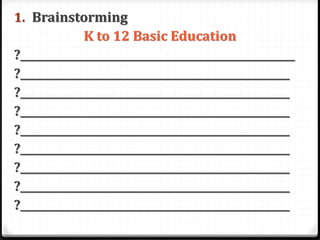
1. Brainstorming
K to 12 Basic Education
?____________________________________________________
?___________________________________________________
?___________________________________________________
?___________________________________________________
?___________________________________________________
?___________________________________________________
?___________________________________________________
?___________________________________________________
?___________________________________________________
Using Pre-Writing Strategies
Ways to find your writing topic:
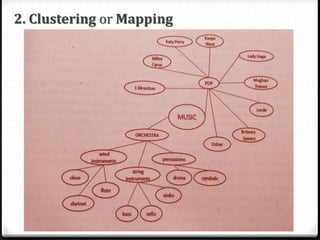
2. Clustering or Mapping
0 Start by writing a word or phrase at the center
of the page and encircle it; this becomes your
main topic.
0 Think of other words and phrases related to
that main topic, write them down, encircle
them, and draw lines connecting them to the
main topic. These becomes your subtopics.
From there, you can branch off the subtopics
with other supporting ideas.
2. Clustering or Mapping
Using Pre-Writing Strategies
Ways to find your writing topic:
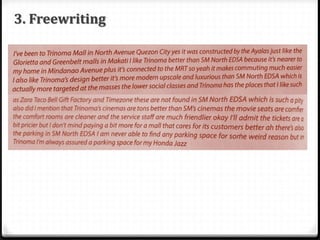
3. Freewriting
0 Writing down your thoughts nonstop, in the
exact order, language, and form in that you
think them.
0 Write as quickly as you can to create constant
momentum for your thoughts to keep on
flowing.
3. Freewriting
Journal Writing
A good way to sustain writing practice is the
habit of your journal writing.
Journal is “a book in which you write down
your personal experiences and thoughts”
(Merriam-Webster)
Things you will ever need in journal writing:
0 favorite pen
0 a nice clean notebook
0 the drive to keep on writing
Application
A. Use a pre-writing strategy specified in the
parentheses to narrow it down to several topics.
1. Social media (brainstorming)
2. Summer vacation (mapping)
Rodriguez, Maxine Rafaella C. and Marella
Therese A. Tiongson. 2016. Reading and Writing
Skills. Manila: Rex Book Store, Inc.

Pre-Writing Strategies

  • 2.
    “In preparing forbattle I have always found that plans are useless, but planning is indispensable.” ~Dwight D. Eisenhower
  • 3.
    Stages of Pre-Writing 1.Knowing the kind of paper that you will be required to write. What are you being asked to do? How long the paper should be? 2. Determining the writing situation, or the context of your assignment. What is the purpose and audience of your paper?
  • 4.
    Defining Pre-Writing The firststage of the writing process is pre-writing, which pertains to different techniques that help you discover ideas before writing the first draft of a paper. 0 You use a variety of strategies to find out things that interest you about a topic or new ways of thinking about it 0 It also helps you identify what else you need to know about a topic.
  • 5.
    The Purpose ofYour Paper The first consideration is determining your purpose. This is the reason why you are writing. When you think about your purpose, you begin to make decisions about form, content, length, organization, support and tone. Purpose in writing is answered by these questions: What do you want to accomplish? Why are you sending this message?
  • 6.
    The Purpose ofYour Paper Your purpose may be to: 1. inform 2. explain 3. persuade 4. entertain
  • 7.
    The Audience ofYour Paper To write effectively, it is always best to assume that you are writing to be read. Your audience is your target reader. You must recognize who your readers are and anticipate their expectations, background, and knowledge of the topic if you are to tailor-fit your writing to their tastes.
  • 8.
    Some questions tohelp you analyze your audience 0Who is most likely to read my work? Will I have multiple audiences? 0What would they find interesting about it? 0Why should they be concerned about my opinion? 0What do I want them to learn from my work? 0How do I want to influence them? 0Will they act on what I want them to do? 0What questions would they have for me?
  • 9.
    After you havedetermined your audience and purpose, you are ready to think about your paper’s topic. The topic is the subject or the specific issue that your paper will discuss. 0 Topic should be specific. 0 The topic should be related to the assignment and interesting to you. 0 It must be something that you know or are willing to learn more about.
  • 10.
    After you havethought about your purpose, audience, and topic, it would be good to consider the tone you plan to use. This refers to the attitudes and feelings you want your writing to reflect toward your purpose, topic, audience, and yourself. These are manifested in your chosen point-of-view (first, second, or third), sentence structure (long and short sentences), and chosen words (connotation and denotation).
  • 11.
    Using Pre-Writing Strategies Waysto find your writing topic: 1. Brainstorming 0 Begin at the top of a sheet of paper and list down everything that comes into your mind as fast as you can for a certain amount of time. 0 After listing down all your ideas, browse through them and pick the one that best appeals to you, or the one that you know best.
  • 12.
    1. Brainstorming K to12 Basic Education ?____________________________________________________ ?___________________________________________________ ?___________________________________________________ ?___________________________________________________ ?___________________________________________________ ?___________________________________________________ ?___________________________________________________ ?___________________________________________________ ?___________________________________________________
  • 13.
    Using Pre-Writing Strategies Waysto find your writing topic: 2. Clustering or Mapping 0 Start by writing a word or phrase at the center of the page and encircle it; this becomes your main topic. 0 Think of other words and phrases related to that main topic, write them down, encircle them, and draw lines connecting them to the main topic. These becomes your subtopics. From there, you can branch off the subtopics with other supporting ideas.
  • 14.
  • 15.
    Using Pre-Writing Strategies Waysto find your writing topic: 3. Freewriting 0 Writing down your thoughts nonstop, in the exact order, language, and form in that you think them. 0 Write as quickly as you can to create constant momentum for your thoughts to keep on flowing.
  • 16.
  • 17.
    Journal Writing A goodway to sustain writing practice is the habit of your journal writing. Journal is “a book in which you write down your personal experiences and thoughts” (Merriam-Webster) Things you will ever need in journal writing: 0 favorite pen 0 a nice clean notebook 0 the drive to keep on writing
  • 18.
    Application A. Use apre-writing strategy specified in the parentheses to narrow it down to several topics. 1. Social media (brainstorming) 2. Summer vacation (mapping)
  • 19.
    Rodriguez, Maxine RafaellaC. and Marella Therese A. Tiongson. 2016. Reading and Writing Skills. Manila: Rex Book Store, Inc.