Process Writing
Prewriting
• Prewriting is thinking and planning the writer
does before drafting. It considers the following:
- the topic, audience and purpose
- gathering information
- choosing a form
- making a plan to organizing and elaborate ideas
Determine Your Purpose
• Purpose is the reason for writing.
• We always have a purpose for writing. Most
writing fits into one of three categories:
–Expressive Writing
–Informative Writing
–Persuasive Writing
More than one of these may be used, but one
will be primary.
Determine Tone
• Tone is the mood or attitude we
adopt to write.
– Serious or frivolous/humorous?
– Formal, Intimate or detached?
Determine Point-of-View
• Point-of-view is the perspective from
which we write an essay.
• One of the most common errors in
writing occurs when the writer shifts
point-of-view unnecessarily!
Choose/Narrow the Topic
• Ask yourself three questions about the
topic:
1. Does it interest you?
2. Do you have something to say about it?
3. Is it specific?
Determine Your Audience
• Ask yourself:
– Who are my readers?
– What do my readers know about the topic?
– What do my readers need to know about
the topic?
– How do my readers feel about the topic?
Reasons for Prewriting
• By using prewriting strategies, we are
more effective writers because we are
able to more successfully choose and
narrow a topic.
• Prewriting also helps writers develop the
topic, and plan how to write about it.
Pre-Writing Strategies
– brainstorming
– Clustering and concept mapping
– free writing
– outlining
–asking the questions
Brainstorming
• Brainstorming is a process of generating a lot of
information within a short time by building on the
association of previous terms you have mentioned.
• Jot down all the possible terms that emerge from the
general topic you are thinking about.
• Group the items that you have listed according to
arrangements that make sense to you.
• Give each group a label
• Don’t worry about ‘good’ or ‘bad’ ideas.
Brainstorming
• Brainstorming is a process of generating a lot of
information within a short time by building on the
association of previous terms you have mentioned.
• Jot down all the possible terms that emerge from the
general topic you are thinking about.
• Group the items that you have listed according to
arrangements that make sense to you.
• Give each group a label
• Don’t worry about ‘good’ or ‘bad’ ideas.
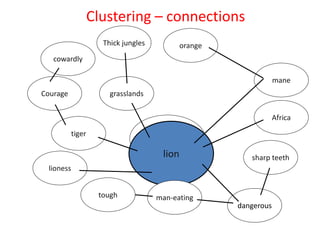
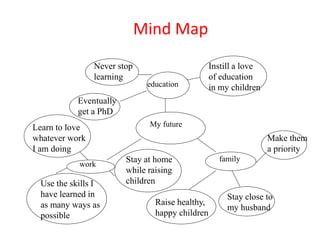
Clustering/Webbing/Mind Mapping
• Clustering is a strategy that allows you to
explore the relationships between ideas.
• Put the subject in the center of a page. Circle
or underline it.
• As you think of other ideas, link the new ideas
to the central circle with lines.
• As you think of ideas that relate to the new
ideas, add to those in the same way.
• Locate clusters of interest to you, and use the
terms you attached to the key ideas as
paragraph topics and supporting details.
Clustering – connections
lion
Africa
orange
sharp teeth
dangerous
mane
tiger
grasslands
man-eating
Courage
cowardly
Thick jungles
lioness
tough
Mind Map
My future
family
Raise healthy,
happy children
Stay close to
my husband
Make them
a priority
education
work
Eventually
get a PhD
Never stop
learning
Instill a love
of education
in my children
Learn to love
whatever work
I am doing
Use the skills I
have learned in
as many ways as
possible
Stay at home
while raising
children
Linking Ideas
• Clustering is especially useful in determining
the relationship between ideas.
• You will be able to distinguish how the ideas
fit together, especially where there is an
abundance of ideas.
• Clustering your ideas lets you see them
visually in a different way, so that you can
more readily understand possible directions
your essay may take.
Outlining
“Outlining” is an more organized form of
pre-writing.
• It can be used after you have generated
ideas through brainstorming, free writing,
or other pre-writing techniques.
• It works well for structured types of
writing such as essays.
• You can use phrases instead of writing
complete sentences
Free-writing
• Free-writing is a process of generating a lot of
information by writing non-stop. It allows you to
focus on a specific topic, but forces you to write so
quickly that you are unable to edit any of your
ideas.
• Free-write on the assignment or general topic for
5-10 minutes non-stop.
• Force yourself to continue writing even if nothing
specific comes to mind.
Free Writing
• Generating ideas is what is important, not the
grammar or the spelling.
• After you've finished free-writing, look back over
what you have written and highlight the most
prominent and interesting ideas; then you can
begin all over again, with a narrower focus.
• You will narrow your topic and, in the process, you
will generate several relevant points about the
topic.
WH Questions
• Ask WH questions when you are writing
assignments, 5 W's and 1 H:
Who?, What?, Where?, When?, Why?, How?
• You can use these questions to explore the
topic you are writing about for an assignment.
• A key to using these questions is to make them
flexible enough to account for the specific
details of your topic.
Who?
• Who are the participants?
• Who is affected?
• Who are the primary actors?
• Who are the secondary actors?
What?
• What is the topic?
• What is the significance of the topic?
• What is the basic problem?
• What are the issues?
Where?
• Where does the activity take place?
• Where does the problem or issue have its
source?
• At what place is the cause or effect of the
problem most visible?
When?
• When is the issue most apparent? (past? present?
future?)
• When did the issue or problem develop?
• What historical forces helped shape the problem or
issue and at what point in time will the problem or
issue culminate in a crisis?
• When is action needed to address the issue or
problem?
Why?
• Why did the issue or problem arise?
• Why did the issue or problem develop in the
way that it did?
How?
• How is the issue or problem significant?
• How can it be addressed?
• How does it affect the participants?
• How can the issue or problem be resolved?
Self Addressed Questions
• Self-addressed questions are a powerful
way to develop a great deal of information
about a topic very quickly.
• At times during writing an assignment, you
may wish to go back and ask these
questions again to clarify important points
that may be getting lost in your planning
and drafting.
Writing a Draft
Writing a Draft
Basics of a good draft:
– Has a fully developed introduction and
conclusion
– Has fully developed body paragraphs, each
containing a topic sentence, at least two
examples, and detailed support
– Follows standard structure and uses
complete sentences
Write Your Introduction
• Your introductory paragraph should ….
– Be a minimum of 4-6 sentences
– Tell the audience what to expect from your
discussion (thesis)
– Move from general to specific, with the thesis
as the last sentence in the intro
– Get the reader’s attention
– Set the tone for the rest of the essay
Introduction ….
• Strategies for developing an Introduction include:
– Providing background information
– Telling a personal anecdote
– Beginning with a quotation
– Using an opposite
– Asking a question
Write Paragraphs
• Each paragraph should develop one of the
specific points mentioned in the thesis.
• Each paragraph should contain:
–Topic Sentence—main idea
– Primary Support—examples
– Secondary Support—details
Paragraphs: Topic Sentence
• A Topic Sentence expresses the main idea of the
paragraph.
• Begin each body paragraph with a Topic Sentence
that..
– Narrows the focus of the paragraph
– Accurately predicts the direction of the paragraph
– Refers back to the Thesis statement
Paragraphs..
• Paragraphs must have:
–Unity—everything refers back to main
point
–Support—examples and details
–Coherence—all points connect to form
a whole; one point leads to another
Paragraphs: Unity
• Unity is achieved when everything refers
back to the main point
– ALL SENTENCES SHOULD RELATE BACK
TO TOPIC SENTENCE & THESIS.
– Do not include any ideas that are
irrelevant or off-topic.
Paragraphs: Support
• Support is achieved through adequate
examples and details.
• Each body paragraph should include at least
two examples to support the main idea of the
paragraph.
• Each example should include at least one
specific detail that further illustrates the point.
Paragraphs: Coherence
• Coherence is achieved when all points connect
to form a whole; one point leads to another.
• Coherence is mainly achieved through the use of
transitions.
–Transitions—words and phrases which connect
your sentences so that your writing flows
smoothly.
Write Your Conclusion
• The concluding paragraph should
– Contain a minimum of four sentences
– Refer back to the main point, but not simply repeat
the thesis
– Make an observation on what is written
– NOT introduce any new ideas
– Create a sense of closure

process writing1a.pptx

  • 1.
  • 2.
    Prewriting • Prewriting isthinking and planning the writer does before drafting. It considers the following: - the topic, audience and purpose - gathering information - choosing a form - making a plan to organizing and elaborate ideas
  • 3.
    Determine Your Purpose •Purpose is the reason for writing. • We always have a purpose for writing. Most writing fits into one of three categories: –Expressive Writing –Informative Writing –Persuasive Writing More than one of these may be used, but one will be primary.
  • 4.
    Determine Tone • Toneis the mood or attitude we adopt to write. – Serious or frivolous/humorous? – Formal, Intimate or detached?
  • 5.
    Determine Point-of-View • Point-of-viewis the perspective from which we write an essay. • One of the most common errors in writing occurs when the writer shifts point-of-view unnecessarily!
  • 6.
    Choose/Narrow the Topic •Ask yourself three questions about the topic: 1. Does it interest you? 2. Do you have something to say about it? 3. Is it specific?
  • 7.
    Determine Your Audience •Ask yourself: – Who are my readers? – What do my readers know about the topic? – What do my readers need to know about the topic? – How do my readers feel about the topic?
  • 8.
    Reasons for Prewriting •By using prewriting strategies, we are more effective writers because we are able to more successfully choose and narrow a topic. • Prewriting also helps writers develop the topic, and plan how to write about it.
  • 9.
    Pre-Writing Strategies – brainstorming –Clustering and concept mapping – free writing – outlining –asking the questions
  • 10.
    Brainstorming • Brainstorming isa process of generating a lot of information within a short time by building on the association of previous terms you have mentioned. • Jot down all the possible terms that emerge from the general topic you are thinking about. • Group the items that you have listed according to arrangements that make sense to you. • Give each group a label • Don’t worry about ‘good’ or ‘bad’ ideas.
  • 11.
    Brainstorming • Brainstorming isa process of generating a lot of information within a short time by building on the association of previous terms you have mentioned. • Jot down all the possible terms that emerge from the general topic you are thinking about. • Group the items that you have listed according to arrangements that make sense to you. • Give each group a label • Don’t worry about ‘good’ or ‘bad’ ideas.
  • 12.
    Clustering/Webbing/Mind Mapping • Clusteringis a strategy that allows you to explore the relationships between ideas. • Put the subject in the center of a page. Circle or underline it. • As you think of other ideas, link the new ideas to the central circle with lines. • As you think of ideas that relate to the new ideas, add to those in the same way. • Locate clusters of interest to you, and use the terms you attached to the key ideas as paragraph topics and supporting details.
  • 13.
    Clustering – connections lion Africa orange sharpteeth dangerous mane tiger grasslands man-eating Courage cowardly Thick jungles lioness tough
  • 14.
    Mind Map My future family Raisehealthy, happy children Stay close to my husband Make them a priority education work Eventually get a PhD Never stop learning Instill a love of education in my children Learn to love whatever work I am doing Use the skills I have learned in as many ways as possible Stay at home while raising children
  • 15.
    Linking Ideas • Clusteringis especially useful in determining the relationship between ideas. • You will be able to distinguish how the ideas fit together, especially where there is an abundance of ideas. • Clustering your ideas lets you see them visually in a different way, so that you can more readily understand possible directions your essay may take.
  • 16.
    Outlining “Outlining” is anmore organized form of pre-writing. • It can be used after you have generated ideas through brainstorming, free writing, or other pre-writing techniques. • It works well for structured types of writing such as essays. • You can use phrases instead of writing complete sentences
  • 17.
    Free-writing • Free-writing isa process of generating a lot of information by writing non-stop. It allows you to focus on a specific topic, but forces you to write so quickly that you are unable to edit any of your ideas. • Free-write on the assignment or general topic for 5-10 minutes non-stop. • Force yourself to continue writing even if nothing specific comes to mind.
  • 18.
    Free Writing • Generatingideas is what is important, not the grammar or the spelling. • After you've finished free-writing, look back over what you have written and highlight the most prominent and interesting ideas; then you can begin all over again, with a narrower focus. • You will narrow your topic and, in the process, you will generate several relevant points about the topic.
  • 19.
    WH Questions • AskWH questions when you are writing assignments, 5 W's and 1 H: Who?, What?, Where?, When?, Why?, How? • You can use these questions to explore the topic you are writing about for an assignment. • A key to using these questions is to make them flexible enough to account for the specific details of your topic.
  • 20.
    Who? • Who arethe participants? • Who is affected? • Who are the primary actors? • Who are the secondary actors? What? • What is the topic? • What is the significance of the topic? • What is the basic problem? • What are the issues?
  • 21.
    Where? • Where doesthe activity take place? • Where does the problem or issue have its source? • At what place is the cause or effect of the problem most visible?
  • 22.
    When? • When isthe issue most apparent? (past? present? future?) • When did the issue or problem develop? • What historical forces helped shape the problem or issue and at what point in time will the problem or issue culminate in a crisis? • When is action needed to address the issue or problem?
  • 23.
    Why? • Why didthe issue or problem arise? • Why did the issue or problem develop in the way that it did? How? • How is the issue or problem significant? • How can it be addressed? • How does it affect the participants? • How can the issue or problem be resolved?
  • 24.
    Self Addressed Questions •Self-addressed questions are a powerful way to develop a great deal of information about a topic very quickly. • At times during writing an assignment, you may wish to go back and ask these questions again to clarify important points that may be getting lost in your planning and drafting.
  • 25.
  • 26.
    Writing a Draft Basicsof a good draft: – Has a fully developed introduction and conclusion – Has fully developed body paragraphs, each containing a topic sentence, at least two examples, and detailed support – Follows standard structure and uses complete sentences
  • 27.
    Write Your Introduction •Your introductory paragraph should …. – Be a minimum of 4-6 sentences – Tell the audience what to expect from your discussion (thesis) – Move from general to specific, with the thesis as the last sentence in the intro – Get the reader’s attention – Set the tone for the rest of the essay
  • 28.
    Introduction …. • Strategiesfor developing an Introduction include: – Providing background information – Telling a personal anecdote – Beginning with a quotation – Using an opposite – Asking a question
  • 29.
    Write Paragraphs • Eachparagraph should develop one of the specific points mentioned in the thesis. • Each paragraph should contain: –Topic Sentence—main idea – Primary Support—examples – Secondary Support—details
  • 30.
    Paragraphs: Topic Sentence •A Topic Sentence expresses the main idea of the paragraph. • Begin each body paragraph with a Topic Sentence that.. – Narrows the focus of the paragraph – Accurately predicts the direction of the paragraph – Refers back to the Thesis statement
  • 31.
    Paragraphs.. • Paragraphs musthave: –Unity—everything refers back to main point –Support—examples and details –Coherence—all points connect to form a whole; one point leads to another
  • 32.
    Paragraphs: Unity • Unityis achieved when everything refers back to the main point – ALL SENTENCES SHOULD RELATE BACK TO TOPIC SENTENCE & THESIS. – Do not include any ideas that are irrelevant or off-topic.
  • 33.
    Paragraphs: Support • Supportis achieved through adequate examples and details. • Each body paragraph should include at least two examples to support the main idea of the paragraph. • Each example should include at least one specific detail that further illustrates the point.
  • 34.
    Paragraphs: Coherence • Coherenceis achieved when all points connect to form a whole; one point leads to another. • Coherence is mainly achieved through the use of transitions. –Transitions—words and phrases which connect your sentences so that your writing flows smoothly.
  • 35.
    Write Your Conclusion •The concluding paragraph should – Contain a minimum of four sentences – Refer back to the main point, but not simply repeat the thesis – Make an observation on what is written – NOT introduce any new ideas – Create a sense of closure