


Use of new
technologies and
artificial intelligence
in data processing
And their implementation on procurements
Boris Jerkovic - CEO of Deutrix
01
Introduction
In today's world, data is being generated at an unprecedented rate. With this
explosion of data, there is a need for new technologies and innovative solutions to
process and analyze it efficiently.
This is where artificial intelligence comes in. AI has the potential to revolutionize
the way we process and analyze data, making it faster, more accurate, and more
efficient than ever before.
With the use of Natural Language Processing (NLP), Machine Learning (ML) and AI
models we can speed and automate processes.
Introduction
01.1
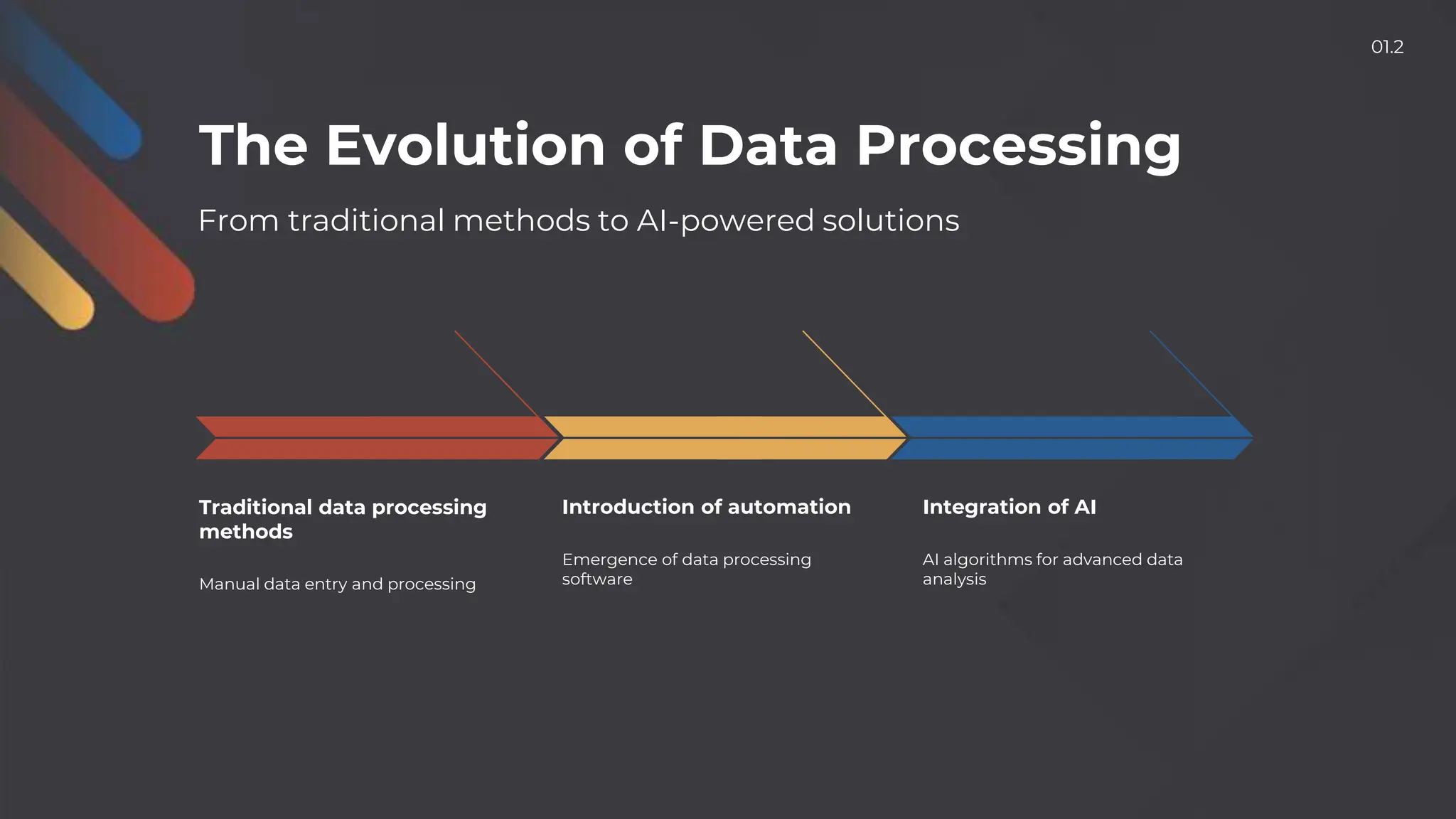
The Evolution of Data Processing
Traditional data processing
methods
Manual data entry and processing
Introduction of automation
Emergence of data processing
software
Integration of AI
AI algorithms for advanced data
analysis
From traditional methods to AI-powered solutions
01.2
Benefits of AI
in Data
Processing
02
Faster processing
speed
● AI algorithms process data at a
much higher speed
● Processing large amounts of the
data
● Ability to read multiple document
formats
02.1
Improved accuracy
● AI reduces errors and improves data
quality
● Recognition of the patterns from
past behavior
02.2
Cost savings
● Reduced the need for manual labor
and streamlined processes
● Automated data extraction
02.3
Challenges in
Implementing
AI in Data
Processing
03
While the use of artificial intelligence (AI) in data processing has the potential to
revolutionize the way we analyze and make decisions based on data, there are a
number of challenges that must be addressed in order to fully realize these
benefits.
Challenges in Implementing AI in
Data Processing
03.1
Challenges in Implementing AI in
Data Processing
01 Data Quality and Quantity
One of the key challenges in implementing AI in data processing is
ensuring that the data used to train AI models is of sufficient quality
and quantity. This requires careful attention to data collection,
cleaning, and validation processes, as well as consideration of the
potential biases and limitations of the data being used.
03.2
Challenges in Implementing AI in
Data Processing
02 Technical Complexity
Implementing AI in data processing also requires significant
technical expertise and resources, including specialized hardware
and software, as well as skilled data scientists and engineers. This
can make it challenging for smaller organizations or those with
limited resources to fully take advantage of AI in their data
processing workflows.
03.3
Challenges in Implementing AI in
Data Processing
03 Ethical and Legal Considerations
Another challenge in implementing AI in data processing is
ensuring that the use of AI is ethical and legal. This includes
considerations such as data privacy, security, and transparency, as
well as potential impacts on employment and social equity.
03.4
Challenges in Implementing AI in
Data Processing
04 Accuracy of the results
Occasionally, we may encounter instances of false positives, results
with diminished confidence, and instances of hallucinations in our
data. It is essential to measure the reliability and validity of these
results as a critical component of the optimization process.
03.4
Challenges in Implementing AI in
Data Processing
05 Lack of Understanding and Trust
Finally, a lack of understanding and trust in AI can also present
challenges in implementing it in data processing workflows. This
can include concerns about the accuracy and reliability of AI
models, as well as fears about the potential impact on jobs and
society as a whole. Addressing these concerns requires education
and communication about the benefits and limitations of AI, as well
as efforts to build trust in the technology and its applications.
03.5
Use Cases of
AI in Data
Processing
04
Use Cases of AI in Data Processing
Data Visualization
AI can help in creating
interactive and real-time
data visualizations that
can help businesses make
informed decisions.
Predictive Analytics
AI can help in analyzing
large amounts of data to
identify potential
business opportunities
and threats, and provide
insights for decision-
making.
Natural Language
Processing
AI can help in extracting
insights from unstructured
data such as social media
feeds, customer reviews, and
chat logs, and provide
valuable insights for
businesses.
04.1
Future of AI
in Data
Processing
05
Future of AI in Data
Processing
Improved Efficiency
AI has the ability to process large amounts of data at a faster
rate than humans. As AI technology continues to advance, it
will become even more efficient in processing and analyzing
data.
05.1
Future of AI in Data
Processing
Increased Accuracy
AI algorithms are designed to learn from data and improve
accuracy over time. As a result, AI can provide more accurate
insights and predictions.
05.2
Integration with Other Technologies
AI can be integrated with other technologies such as machine
learning and natural language processing to provide even
more advanced data processing capabilities.
Future of AI in Data
Processing
05.3
The impact of AI on the data
processing industry includes
enhanced efficiency, accuracy,
and the ability to analyze large
datasets rapidly, transforming
traditional methods and
enabling more insightful
decision-making.
Impact on
Procurements
06
Use Cases
● Procurement Analyzer
● Requirement Analyzer
● Smart Search
● Scoring Qualification
● Pricing Guidance
● Probability to win
● Forecast performance
● Fighting corruption
06.1
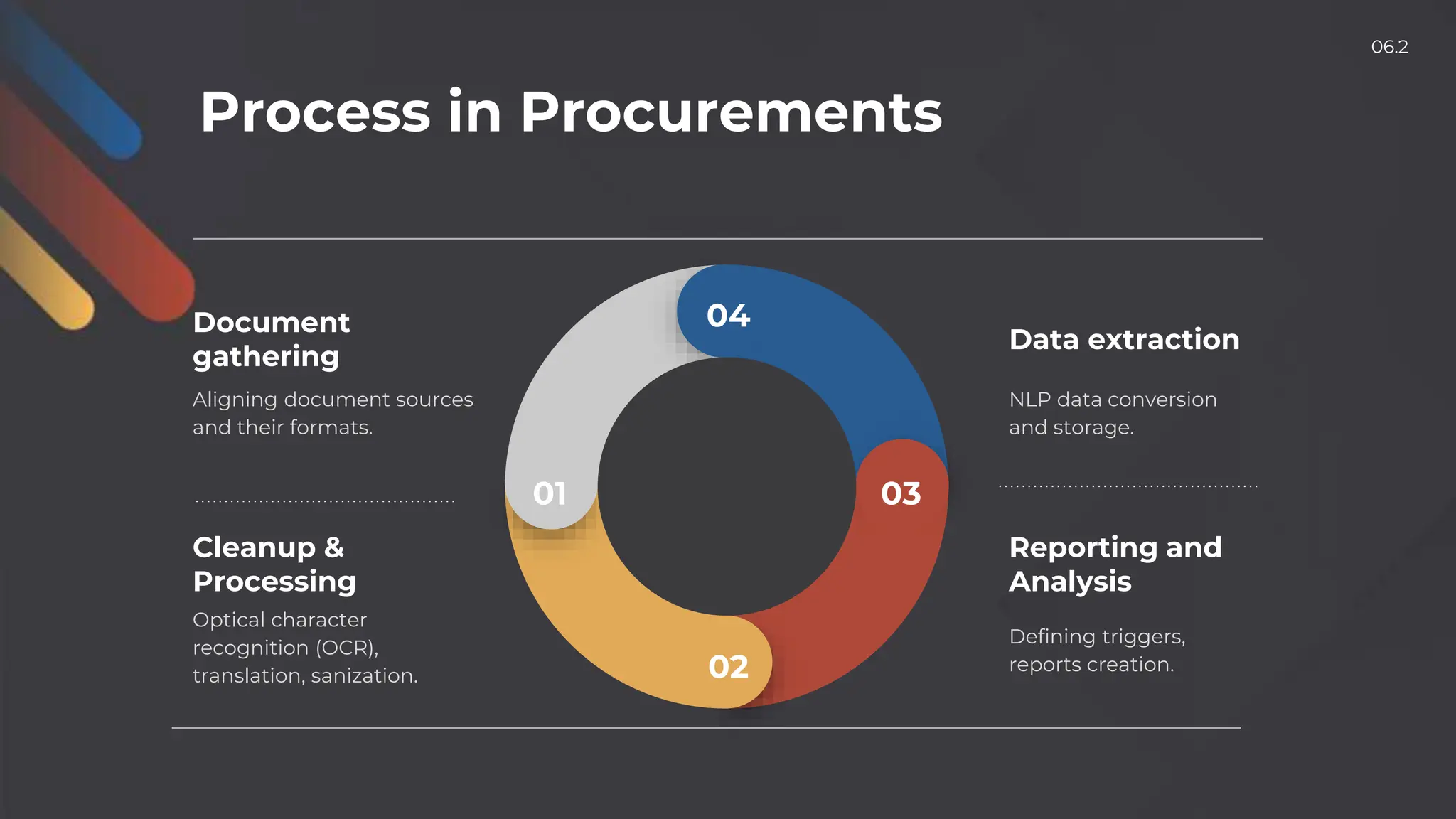
Process in Procurements
Document
gathering
Aligning document sources
and their formats.
Cleanup &
Processing
Optical character
recognition (OCR),
translation, sanization.
Data extraction
NLP data conversion
and storage.
Reporting and
Analysis
Defining triggers,
reports creation.
01
02
03
04
06.2
Thank you!

Use of new technologies and artificial intelligence in data processing.pptx

  • 1.
    Use of new technologiesand artificial intelligence in data processing And their implementation on procurements Boris Jerkovic - CEO of Deutrix
  • 2.
  • 3.
    In today's world,data is being generated at an unprecedented rate. With this explosion of data, there is a need for new technologies and innovative solutions to process and analyze it efficiently. This is where artificial intelligence comes in. AI has the potential to revolutionize the way we process and analyze data, making it faster, more accurate, and more efficient than ever before. With the use of Natural Language Processing (NLP), Machine Learning (ML) and AI models we can speed and automate processes. Introduction 01.1
  • 4.
    The Evolution ofData Processing Traditional data processing methods Manual data entry and processing Introduction of automation Emergence of data processing software Integration of AI AI algorithms for advanced data analysis From traditional methods to AI-powered solutions 01.2
  • 5.
    Benefits of AI inData Processing 02
  • 6.
    Faster processing speed ● AIalgorithms process data at a much higher speed ● Processing large amounts of the data ● Ability to read multiple document formats 02.1
  • 7.
    Improved accuracy ● AIreduces errors and improves data quality ● Recognition of the patterns from past behavior 02.2
  • 8.
    Cost savings ● Reducedthe need for manual labor and streamlined processes ● Automated data extraction 02.3
  • 9.
  • 10.
    While the useof artificial intelligence (AI) in data processing has the potential to revolutionize the way we analyze and make decisions based on data, there are a number of challenges that must be addressed in order to fully realize these benefits. Challenges in Implementing AI in Data Processing 03.1
  • 11.
    Challenges in ImplementingAI in Data Processing 01 Data Quality and Quantity One of the key challenges in implementing AI in data processing is ensuring that the data used to train AI models is of sufficient quality and quantity. This requires careful attention to data collection, cleaning, and validation processes, as well as consideration of the potential biases and limitations of the data being used. 03.2
  • 12.
    Challenges in ImplementingAI in Data Processing 02 Technical Complexity Implementing AI in data processing also requires significant technical expertise and resources, including specialized hardware and software, as well as skilled data scientists and engineers. This can make it challenging for smaller organizations or those with limited resources to fully take advantage of AI in their data processing workflows. 03.3
  • 13.
    Challenges in ImplementingAI in Data Processing 03 Ethical and Legal Considerations Another challenge in implementing AI in data processing is ensuring that the use of AI is ethical and legal. This includes considerations such as data privacy, security, and transparency, as well as potential impacts on employment and social equity. 03.4
  • 14.
    Challenges in ImplementingAI in Data Processing 04 Accuracy of the results Occasionally, we may encounter instances of false positives, results with diminished confidence, and instances of hallucinations in our data. It is essential to measure the reliability and validity of these results as a critical component of the optimization process. 03.4
  • 15.
    Challenges in ImplementingAI in Data Processing 05 Lack of Understanding and Trust Finally, a lack of understanding and trust in AI can also present challenges in implementing it in data processing workflows. This can include concerns about the accuracy and reliability of AI models, as well as fears about the potential impact on jobs and society as a whole. Addressing these concerns requires education and communication about the benefits and limitations of AI, as well as efforts to build trust in the technology and its applications. 03.5
  • 16.
    Use Cases of AIin Data Processing 04
  • 17.
    Use Cases ofAI in Data Processing Data Visualization AI can help in creating interactive and real-time data visualizations that can help businesses make informed decisions. Predictive Analytics AI can help in analyzing large amounts of data to identify potential business opportunities and threats, and provide insights for decision- making. Natural Language Processing AI can help in extracting insights from unstructured data such as social media feeds, customer reviews, and chat logs, and provide valuable insights for businesses. 04.1
  • 18.
    Future of AI inData Processing 05
  • 19.
    Future of AIin Data Processing Improved Efficiency AI has the ability to process large amounts of data at a faster rate than humans. As AI technology continues to advance, it will become even more efficient in processing and analyzing data. 05.1
  • 20.
    Future of AIin Data Processing Increased Accuracy AI algorithms are designed to learn from data and improve accuracy over time. As a result, AI can provide more accurate insights and predictions. 05.2
  • 21.
    Integration with OtherTechnologies AI can be integrated with other technologies such as machine learning and natural language processing to provide even more advanced data processing capabilities. Future of AI in Data Processing 05.3
  • 22.
    The impact ofAI on the data processing industry includes enhanced efficiency, accuracy, and the ability to analyze large datasets rapidly, transforming traditional methods and enabling more insightful decision-making. Impact on Procurements 06
  • 23.
    Use Cases ● ProcurementAnalyzer ● Requirement Analyzer ● Smart Search ● Scoring Qualification ● Pricing Guidance ● Probability to win ● Forecast performance ● Fighting corruption 06.1
  • 24.
    Process in Procurements Document gathering Aligningdocument sources and their formats. Cleanup & Processing Optical character recognition (OCR), translation, sanization. Data extraction NLP data conversion and storage. Reporting and Analysis Defining triggers, reports creation. 01 02 03 04 06.2
  • 25.