BOUTIQUE
RESEARCH-ORIENTED
STRATEGIC ADVISORY
&
CONSULTING FIRM
Woman-Owned and Managed
WHY NETWORKING?
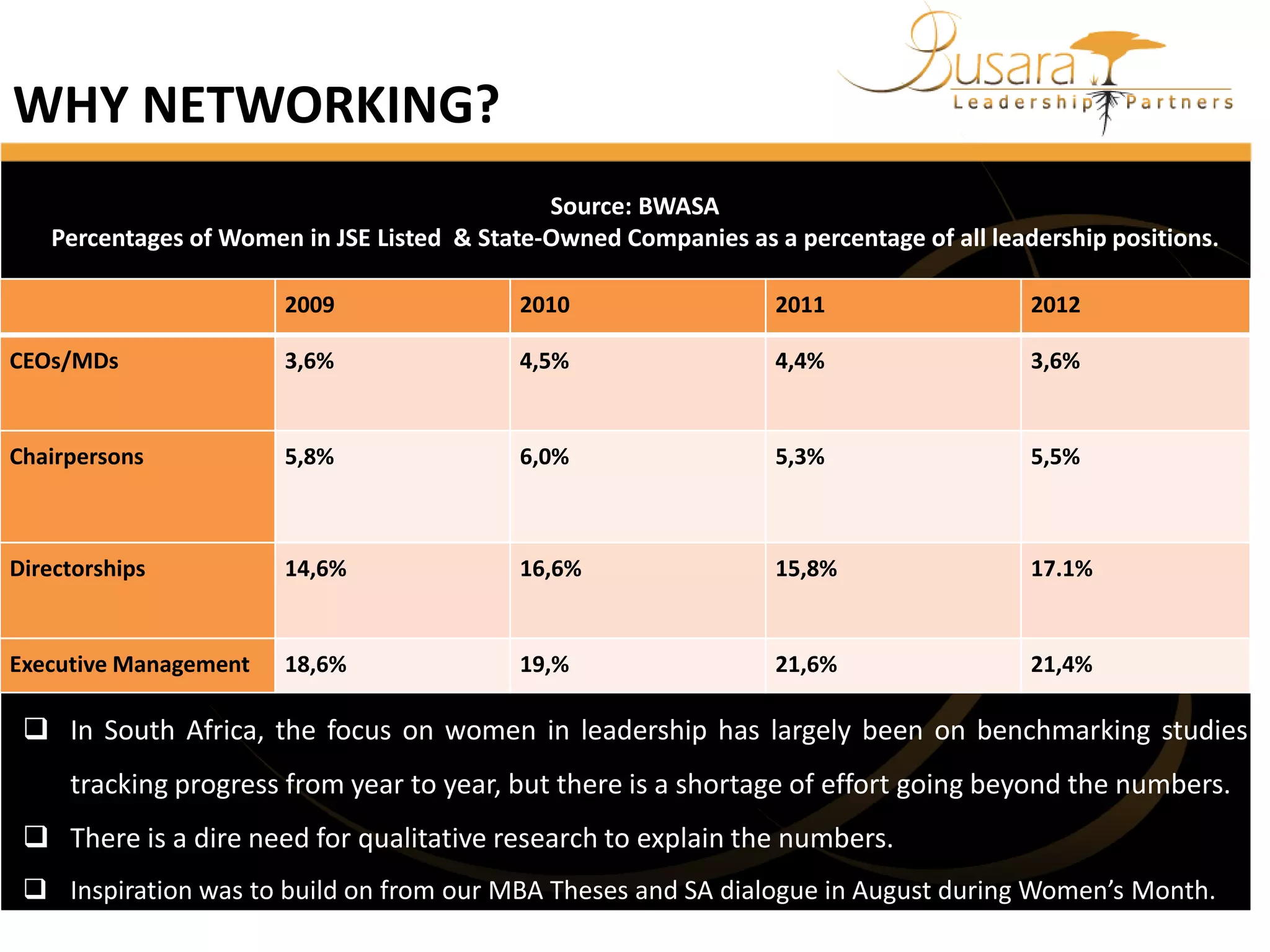
Source: BWASA
Percentages of Women in JSE Listed & State-Owned Companies as a percentage of all leadership positions.
2009

2010

2011

2012

CEOs/MDs

3,6%

4,5%

4,4%

3,6%

Chairpersons

5,8%

6,0%

5,3%

5,5%

Directorships

14,6%

16,6%

15,8%

17.1%

Executive Management

18,6%

19,%

21,6%

21,4%

 In South Africa, the focus on women in leadership has largely been on benchmarking studies

tracking progress from year to year, but there is a shortage of effort going beyond the numbers.
 There is a dire need for qualitative research to explain the numbers.
 Inspiration was to build on from our MBA Theses and SA dialogue in August during Women’s Month.
WHY NETWORKING
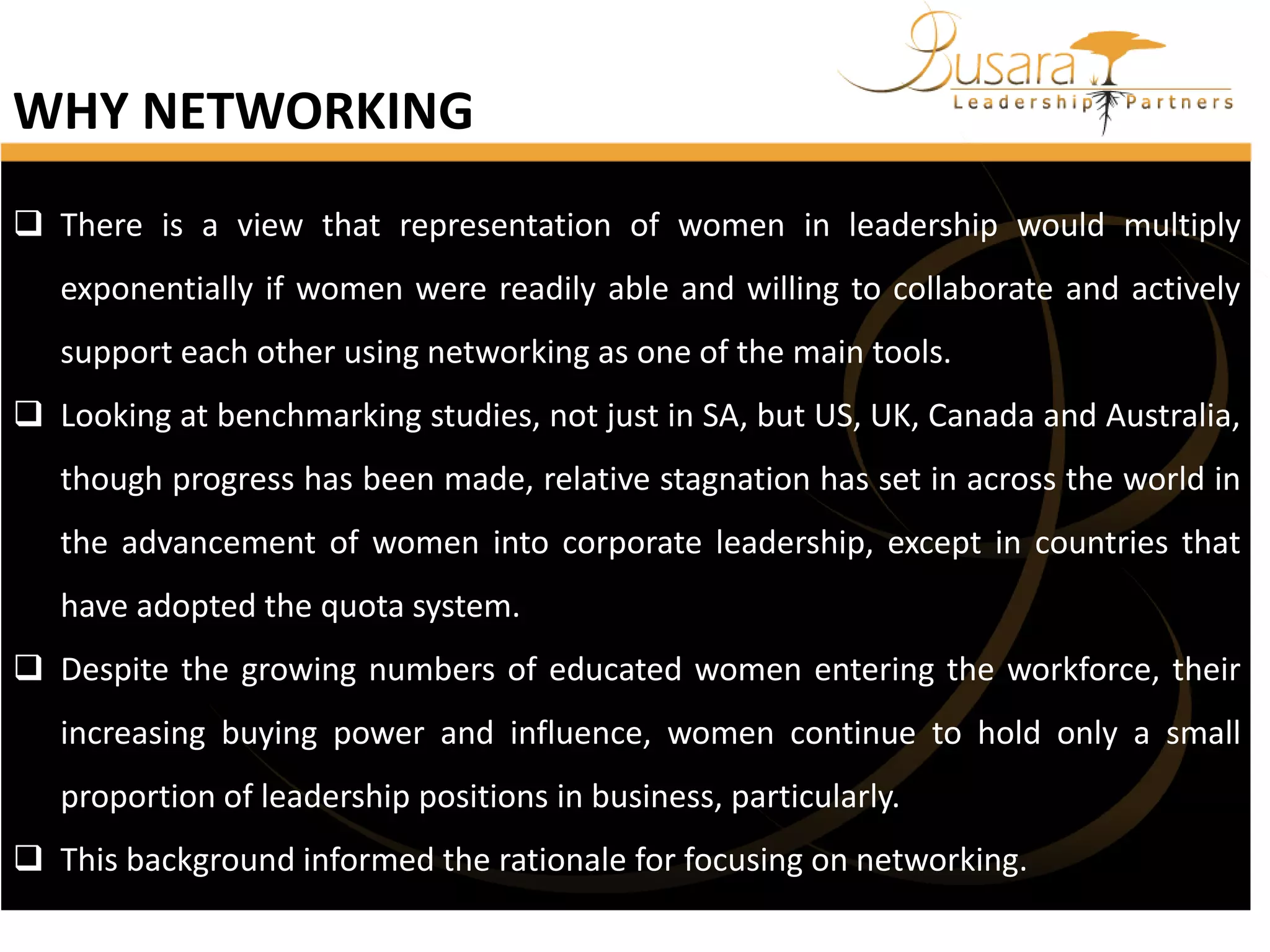
 There is a view that representation of women in leadership would multiply
exponentially if women were readily able and willing to collaborate and actively
support each other using networking as one of the main tools.
 Looking at benchmarking studies, not just in SA, but US, UK, Canada and Australia,
though progress has been made, relative stagnation has set in across the world in
the advancement of women into corporate leadership, except in countries that
have adopted the quota system.
 Despite the growing numbers of educated women entering the workforce, their

increasing buying power and influence, women continue to hold only a small
proportion of leadership positions in business, particularly.
 This background informed the rationale for focusing on networking.
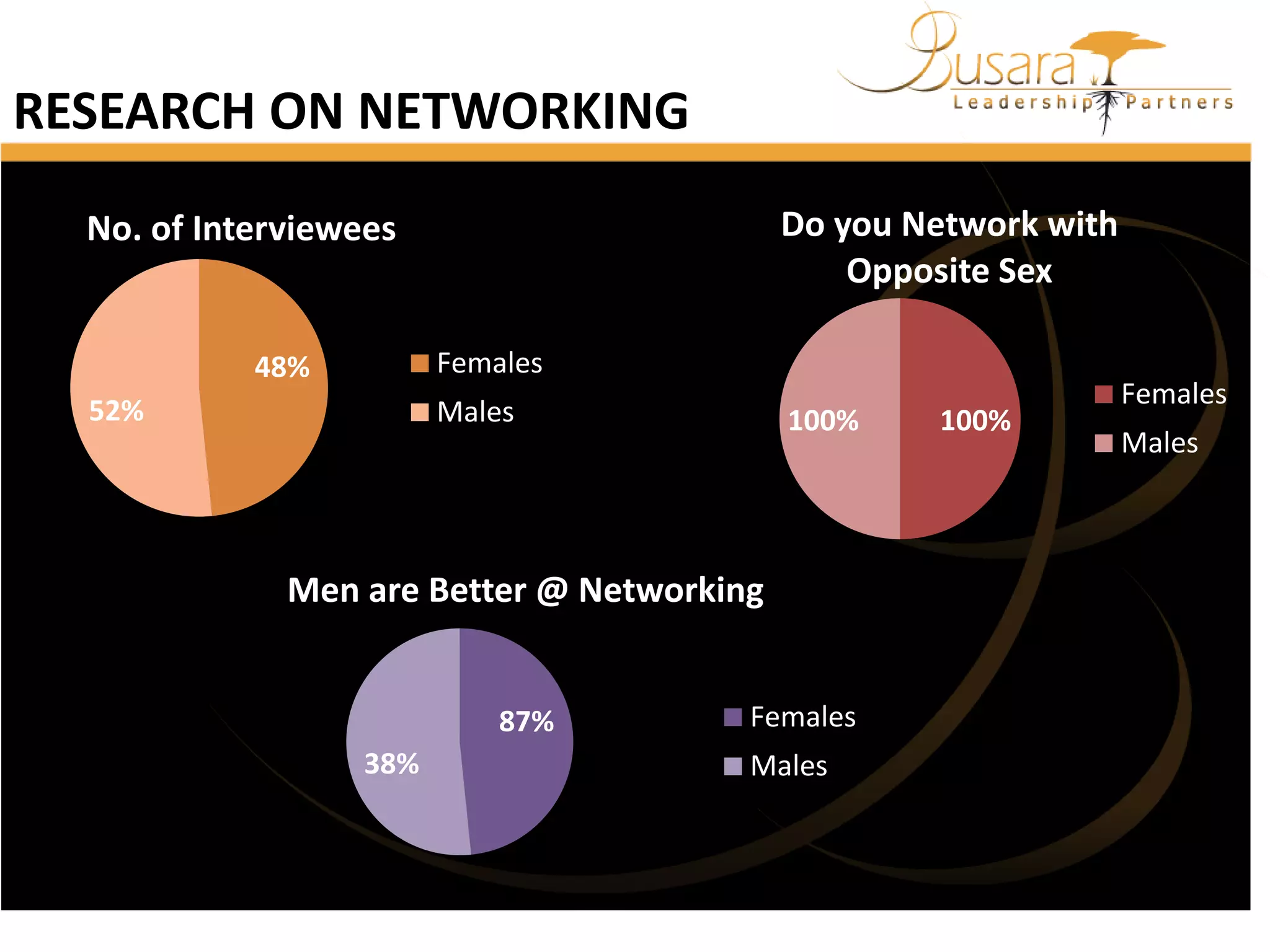
RESEARCH ON NETWORKING
Do you Network with
Opposite Sex

No. of Interviewees

Females

48%
52%

Males

100%

Men are Better @ Networking

87%
38%

Females

Males

100%

Females

Males
PART ONE: FINDINGS ON NETWORKING

UPSIDE & DOWNSIDE
OF
NETWORKING
UPSIDE & DOWNSIDE OF NETWORKING

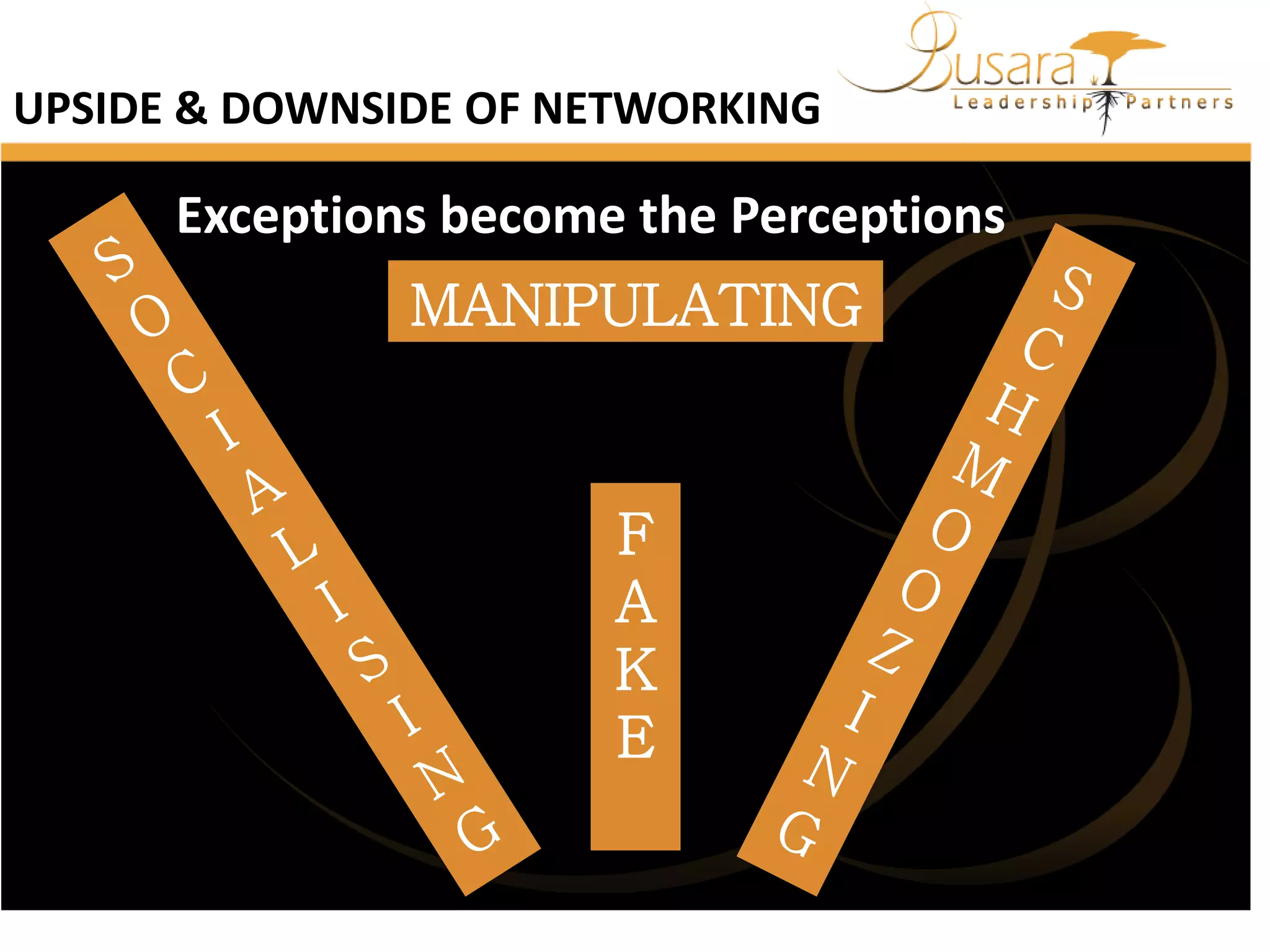
Exceptions become the Perceptions
MANIPULATING

F
A
K
E
UPSIDE & DOWNSIDE OF NETWORKING

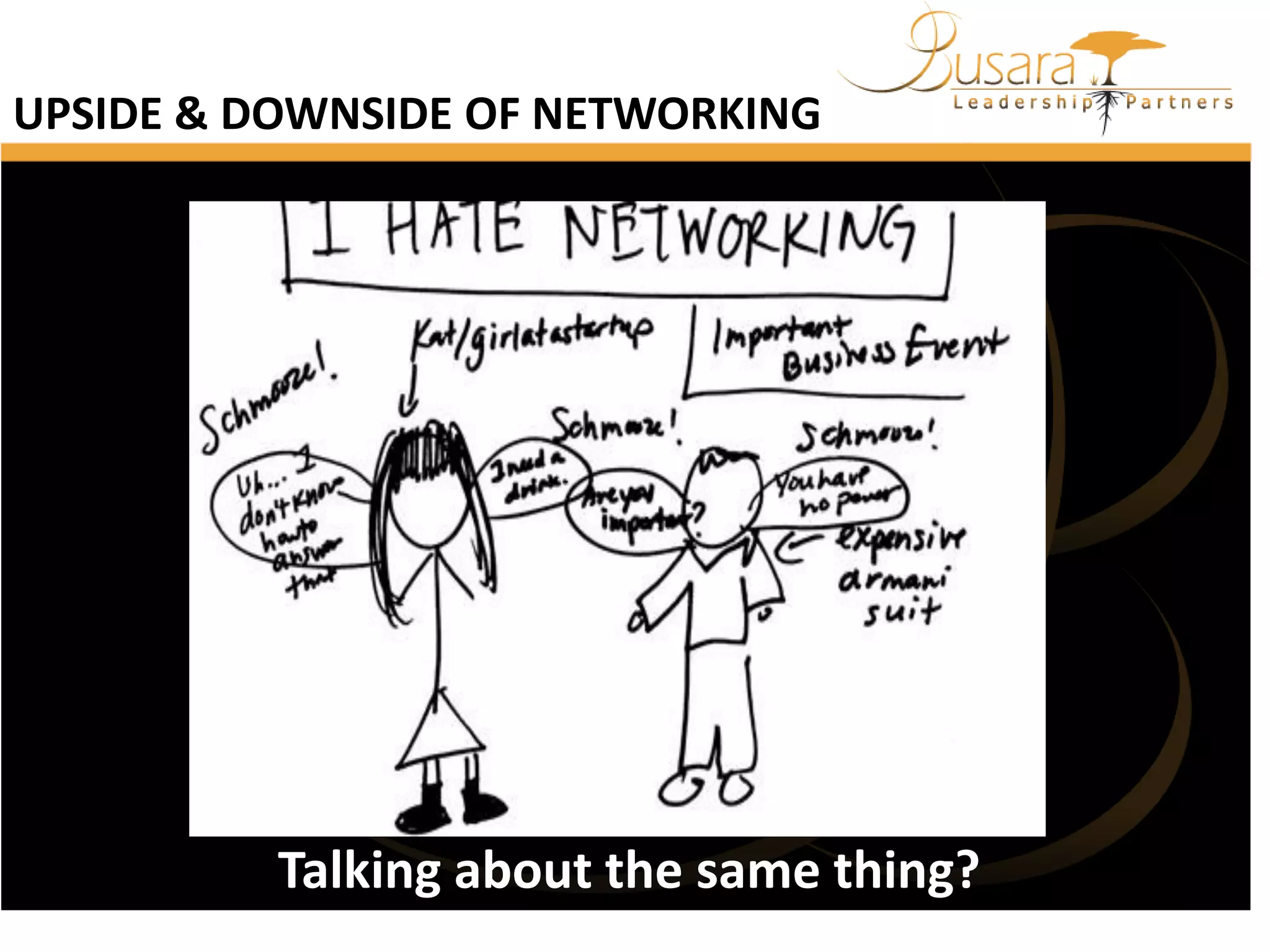
Talking about the same thing?
UPSIDE & DOWNSIDE OF NETWORKING

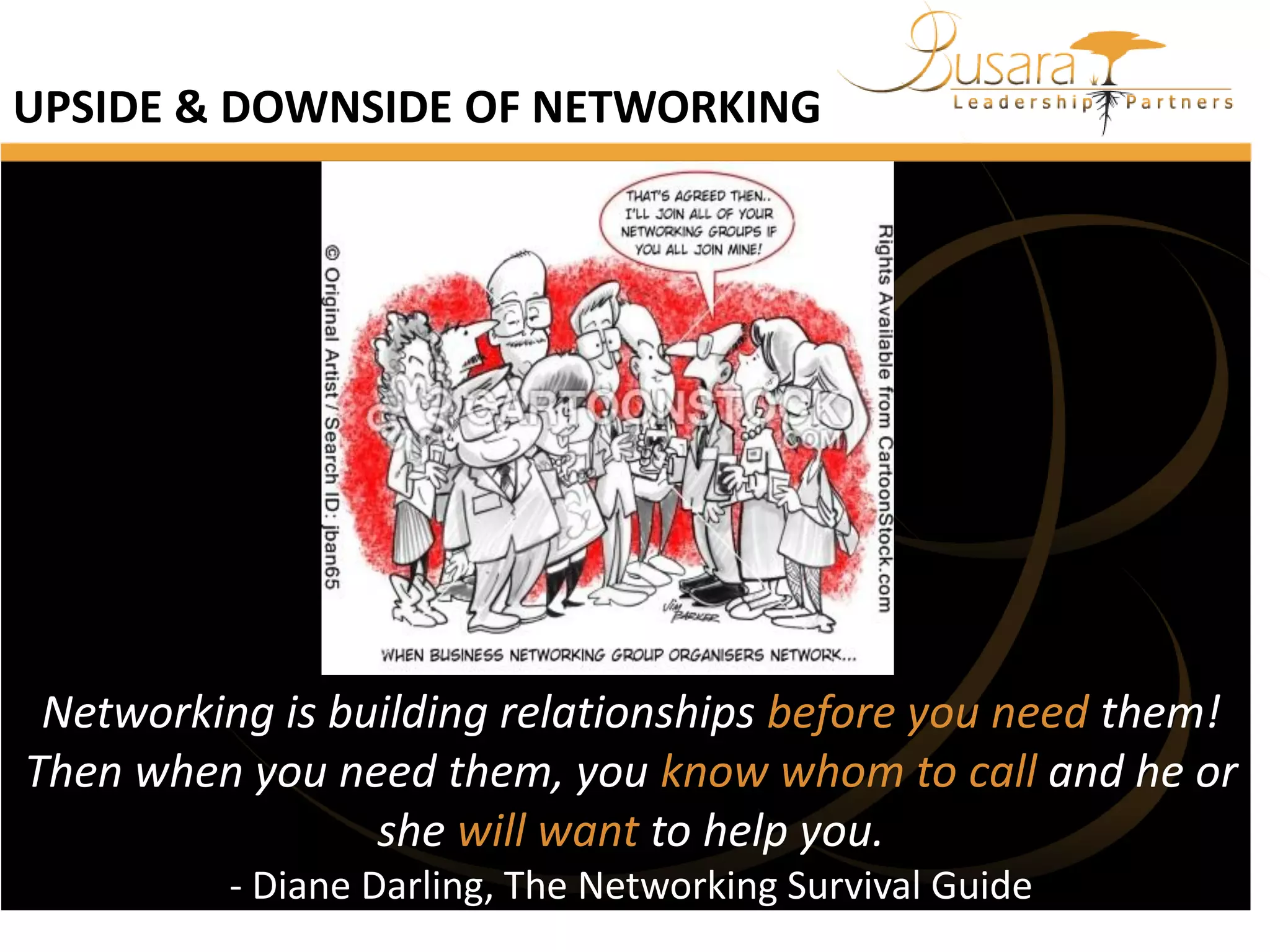
Networking is building relationships before you need them!
Then when you need them, you know whom to call and he or
she will want to help you.
- Diane Darling, The Networking Survival Guide
UPSIDE & DOWNSIDE OF NETWORKING
Top 5 Networking Wisdom:
1. Networking is performed consciously and unconsciously, every day from when we are
born. Can be inherited. It is meaningful relationship building, overtime, that is reciprocal
(give & take), fosters trust, makes netbank deposits (social capital) and results in genuine
depth of knowledge of the other person. Networking is not about investing A with the
expectation of immediately receiving B. (Short-termism results in the negative
connotations and corruptive practices).
2. Social capital is the strength of the relationship you have with another person. There is a
spectrum of what you can reasonably ask another person to do for you dependent in

part on the social capital you have with that person. What is more important than the
number of your contacts is the amount of social capital you have within your network.
People that “actively push your agenda themselves.” (Fine balance in pushing the agenda
within good governance practices).
UPSIDE & DOWNSIDE OF NETWORKING
Top 5 Networking Wisdom:
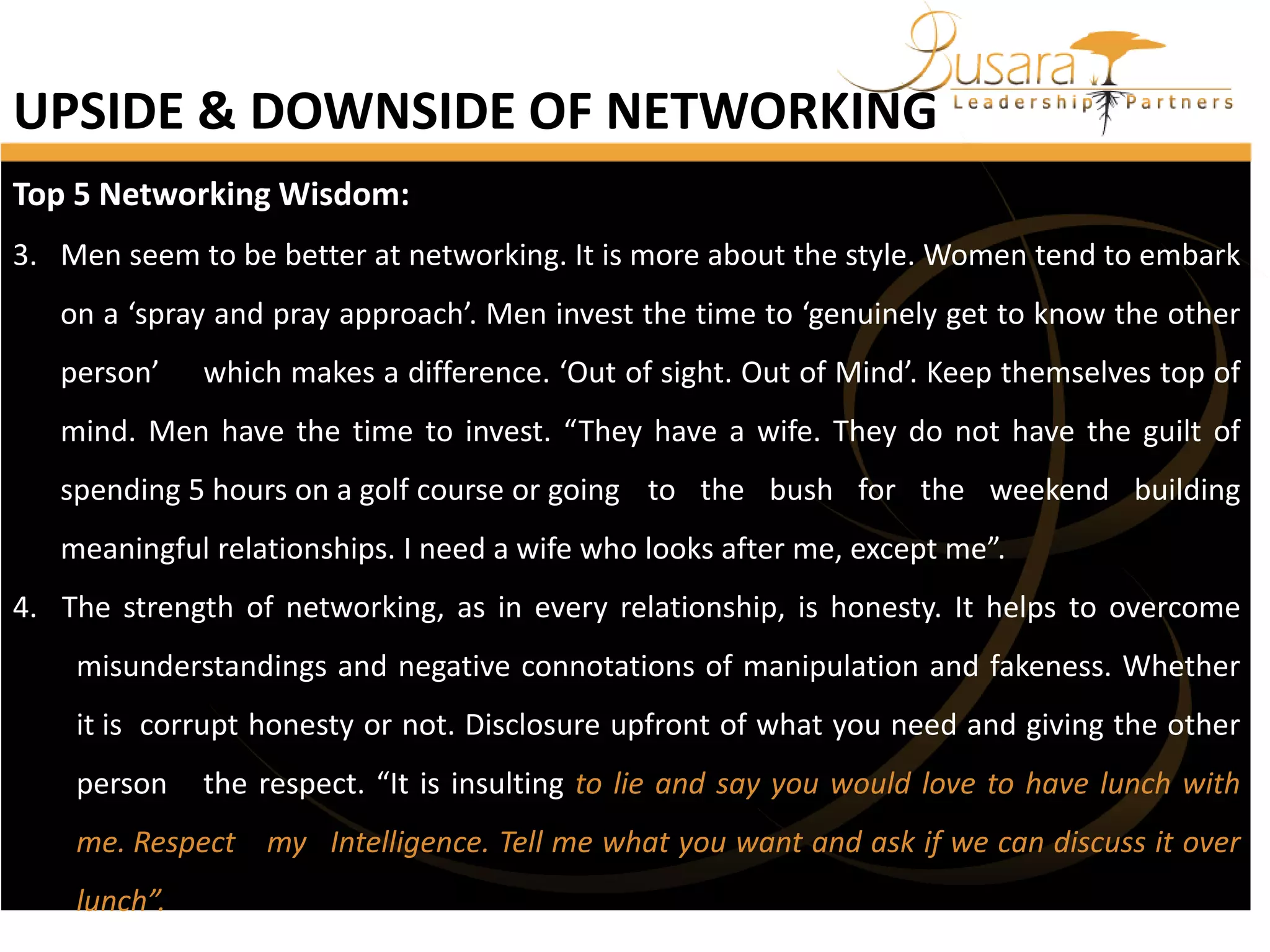
3. Men seem to be better at networking. It is more about the style. Women tend to embark
on a ‘spray and pray approach’. Men invest the time to ‘genuinely get to know the other
person’

which makes a difference. ‘Out of sight. Out of Mind’. Keep themselves top of

mind. Men have the time to invest. “They have a wife. They do not have the guilt of
spending 5 hours on a golf course or going to the bush for the weekend building
meaningful relationships. I need a wife who looks after me, except me”.
4. The strength of networking, as in every relationship, is honesty. It helps to overcome
misunderstandings and negative connotations of manipulation and fakeness. Whether
it is corrupt honesty or not. Disclosure upfront of what you need and giving the other
person

the respect. “It is insulting to lie and say you would love to have lunch with

me. Respect my Intelligence. Tell me what you want and ask if we can discuss it over

lunch”.
UPSIDE & DOWNSIDE OF NETWORKING
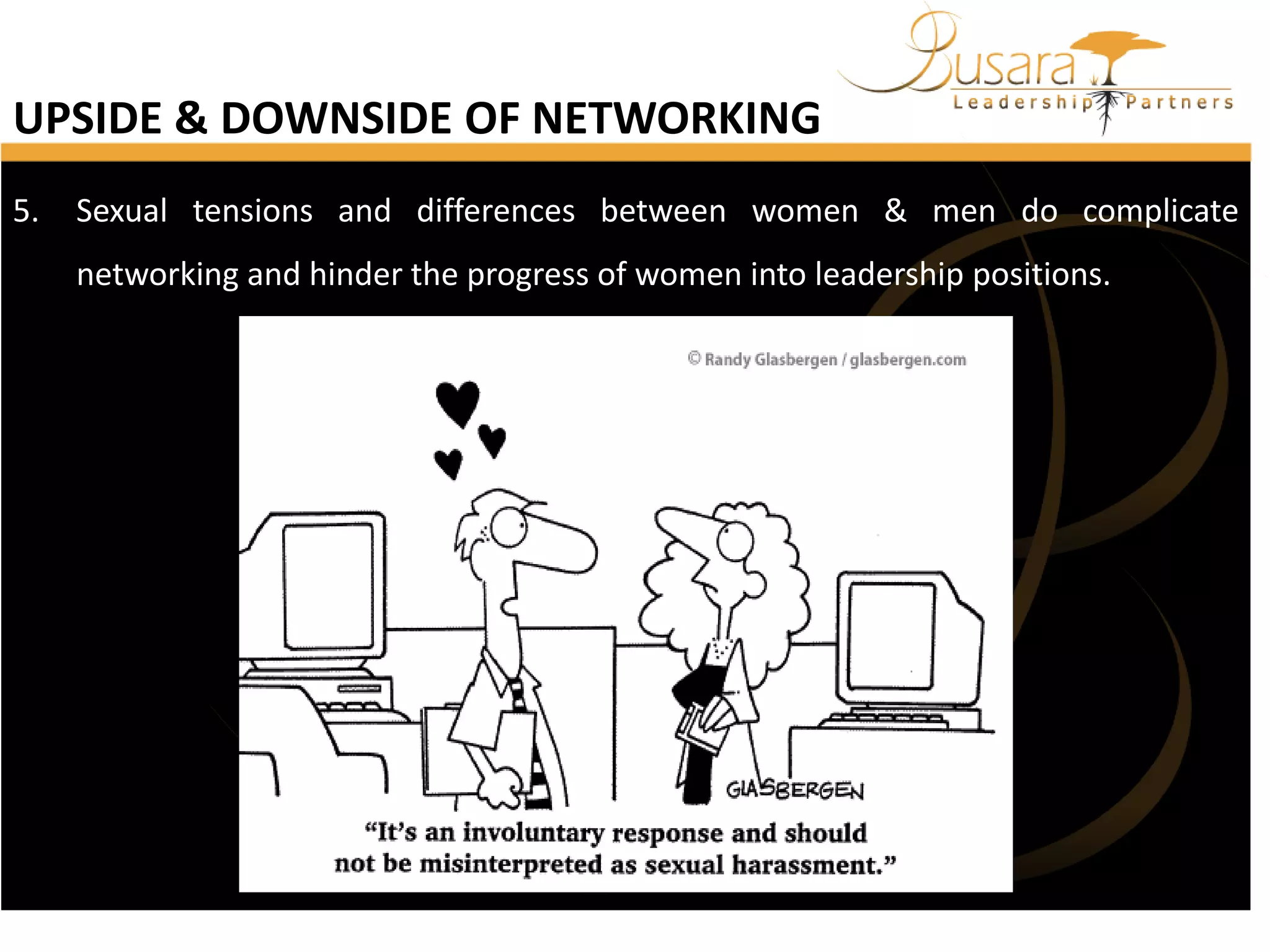
5.

Sexual tensions and differences between women & men do complicate
networking and hinder the progress of women into leadership positions.
UPSIDE & DOWNSIDE OF NETWORKING
Top 5 Networking Wisdom:
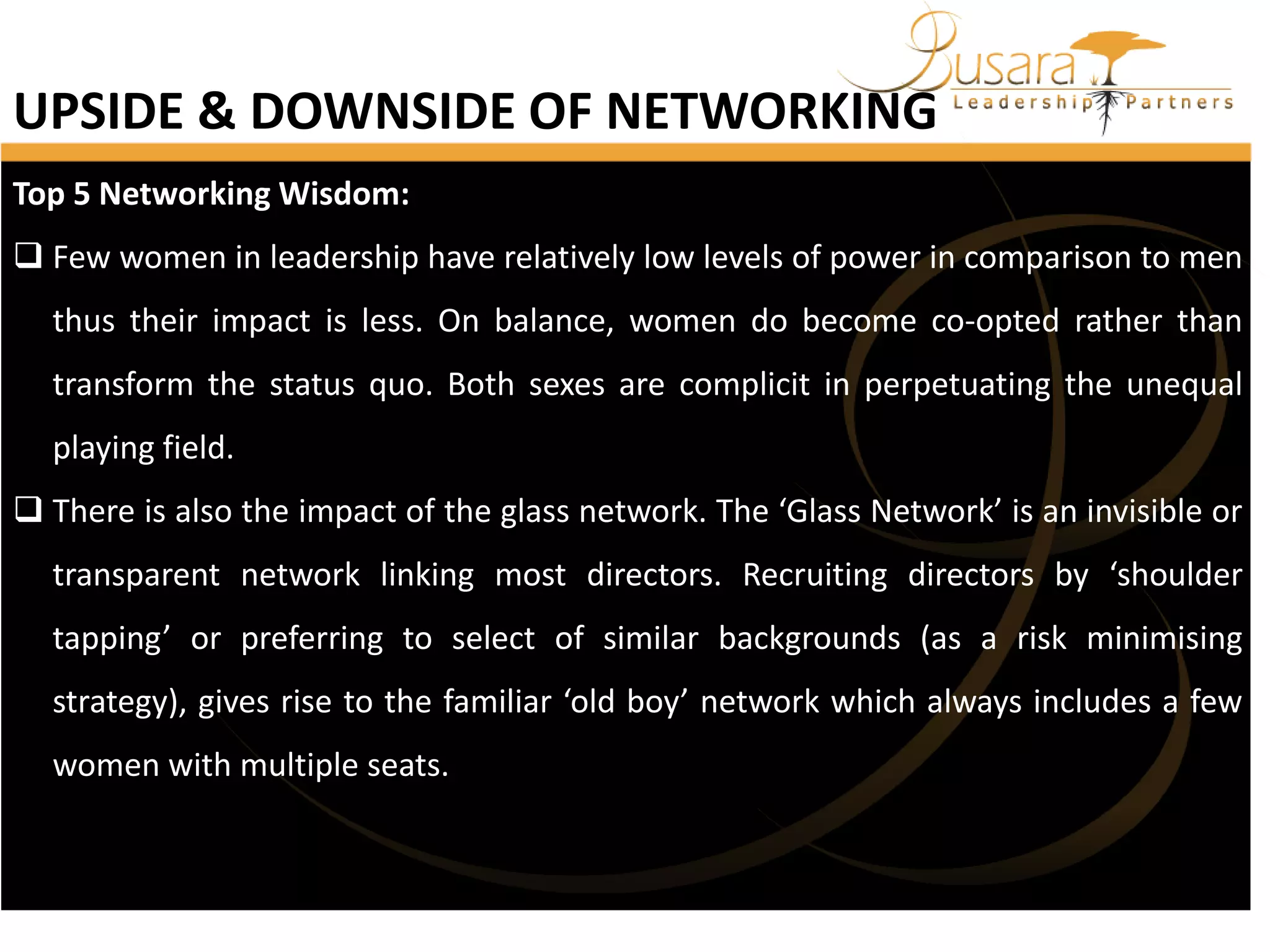
 Few women in leadership have relatively low levels of power in comparison to men
thus their impact is less. On balance, women do become co-opted rather than
transform the status quo. Both sexes are complicit in perpetuating the unequal
playing field.
 There is also the impact of the glass network. The ‘Glass Network’ is an invisible or

transparent network linking most directors. Recruiting directors by ‘shoulder
tapping’ or preferring to select of similar backgrounds (as a risk minimising
strategy), gives rise to the familiar ‘old boy’ network which always includes a few
women with multiple seats.
UPSIDE & DOWNSIDE OF NETWORKING
Top 5 Networking Wisdom:
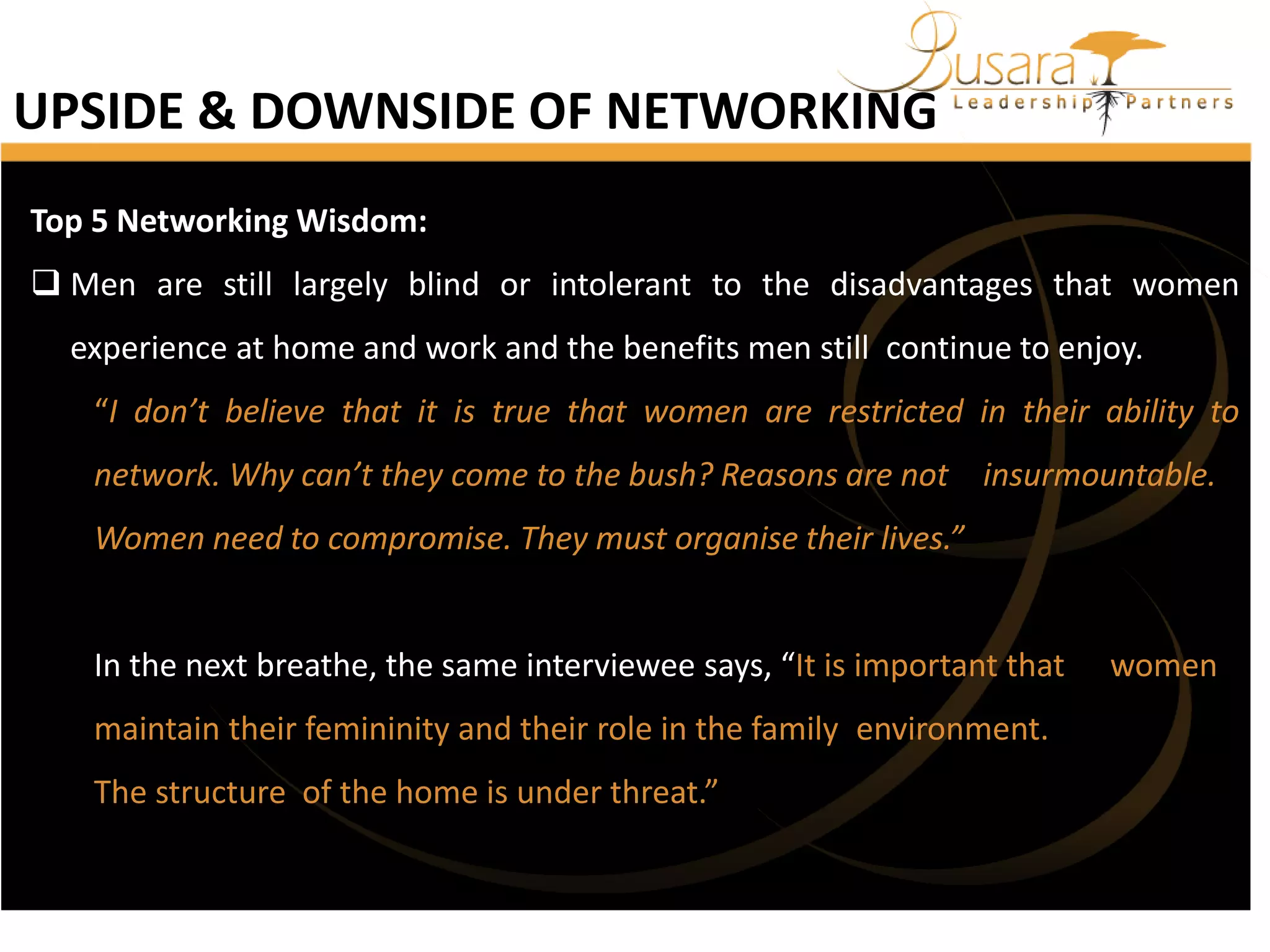
 Men are still largely blind or intolerant to the disadvantages that women
experience at home and work and the benefits men still continue to enjoy.
“I don’t believe that it is true that women are restricted in their ability to
network. Why can’t they come to the bush? Reasons are not insurmountable.
Women need to compromise. They must organise their lives.”

In the next breathe, the same interviewee says, “It is important that
maintain their femininity and their role in the family environment.
The structure of the home is under threat.”

women
UPSIDE & DOWNSIDE OF NETWORKING
Top Five Networking Wisdom:
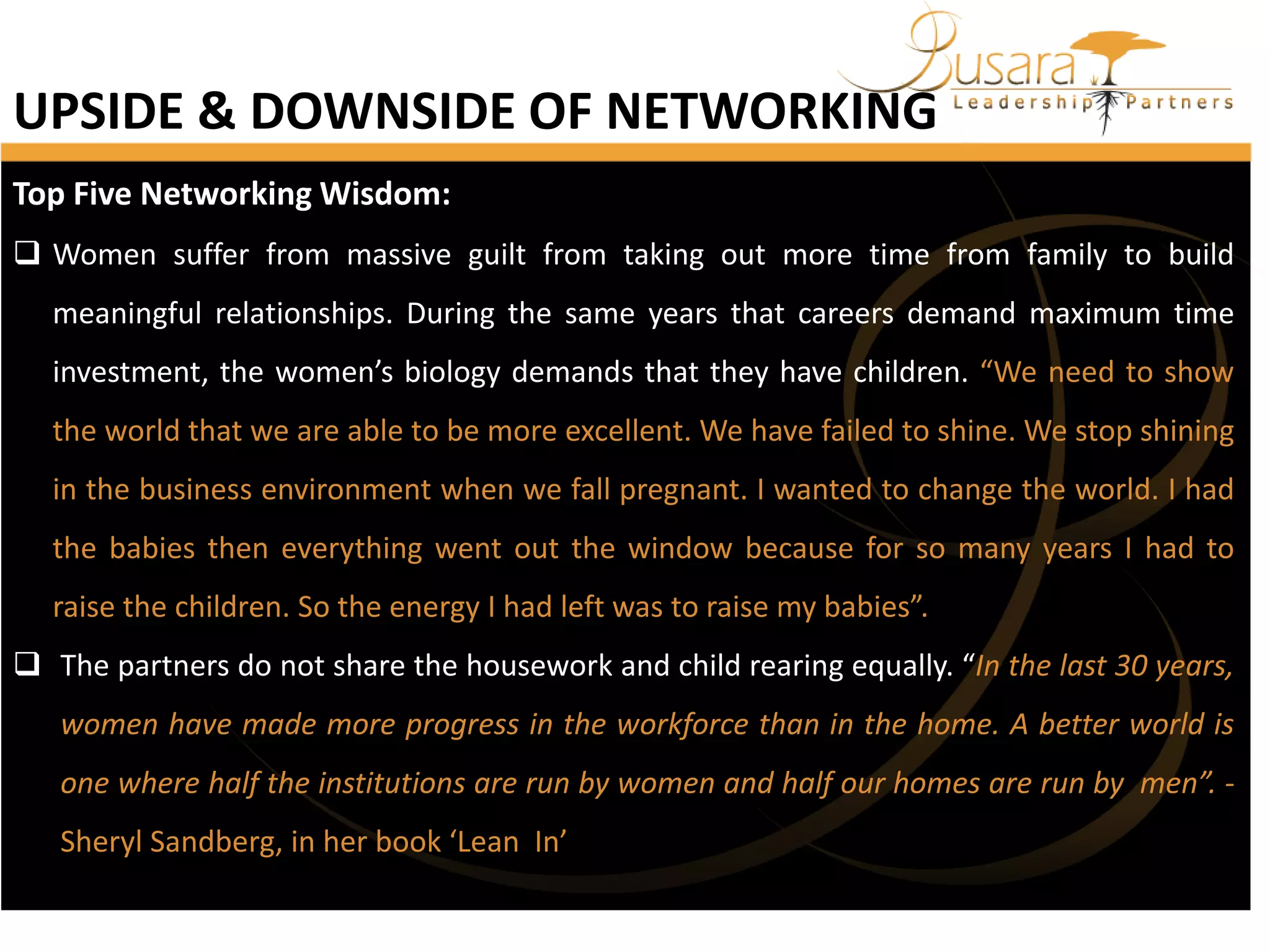
 Women suffer from massive guilt from taking out more time from family to build
meaningful relationships. During the same years that careers demand maximum time
investment, the women’s biology demands that they have children. “We need to show
the world that we are able to be more excellent. We have failed to shine. We stop shining
in the business environment when we fall pregnant. I wanted to change the world. I had
the babies then everything went out the window because for so many years I had to
raise the children. So the energy I had left was to raise my babies”.
 The partners do not share the housework and child rearing equally. “In the last 30 years,
women have made more progress in the workforce than in the home. A better world is

one where half the institutions are run by women and half our homes are run by men”. Sheryl Sandberg, in her book ‘Lean In’
UPSIDE & DOWNSIDE OF NETWORKING
Top 5 Networking Wisdom:
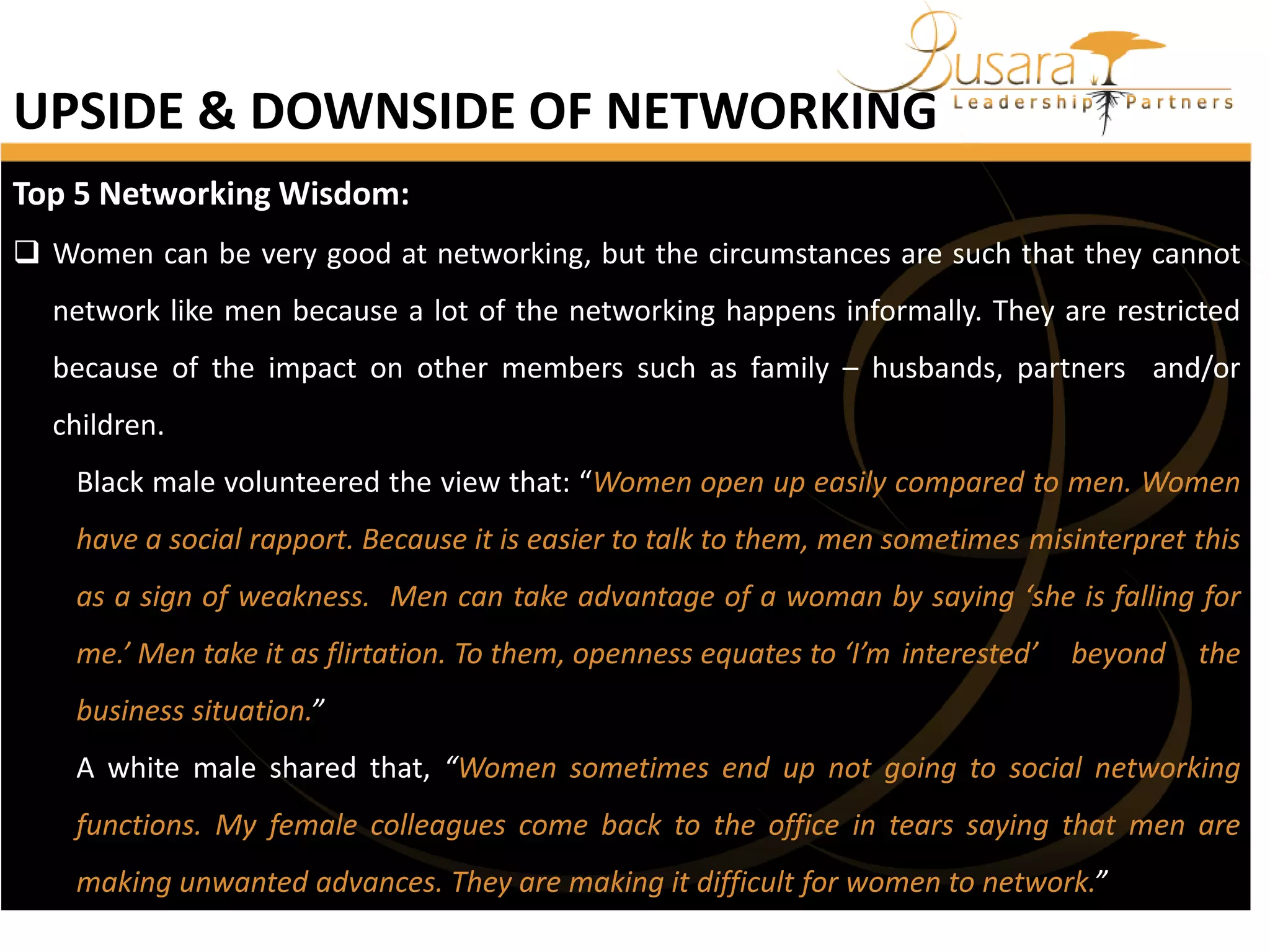
 Women can be very good at networking, but the circumstances are such that they cannot
network like men because a lot of the networking happens informally. They are restricted

because of the impact on other members such as family – husbands, partners and/or
children.
Black male volunteered the view that: “Women open up easily compared to men. Women
have a social rapport. Because it is easier to talk to them, men sometimes misinterpret this
as a sign of weakness. Men can take advantage of a woman by saying ‘she is falling for
me.’ Men take it as flirtation. To them, openness equates to ‘I’m interested’

beyond

the

business situation.”
A white male shared that, “Women sometimes end up not going to social networking
functions. My female colleagues come back to the office in tears saying that men are
making unwanted advances. They are making it difficult for women to network.”
UPSIDE & DOWNSIDE OF NETWORKING
Upside:
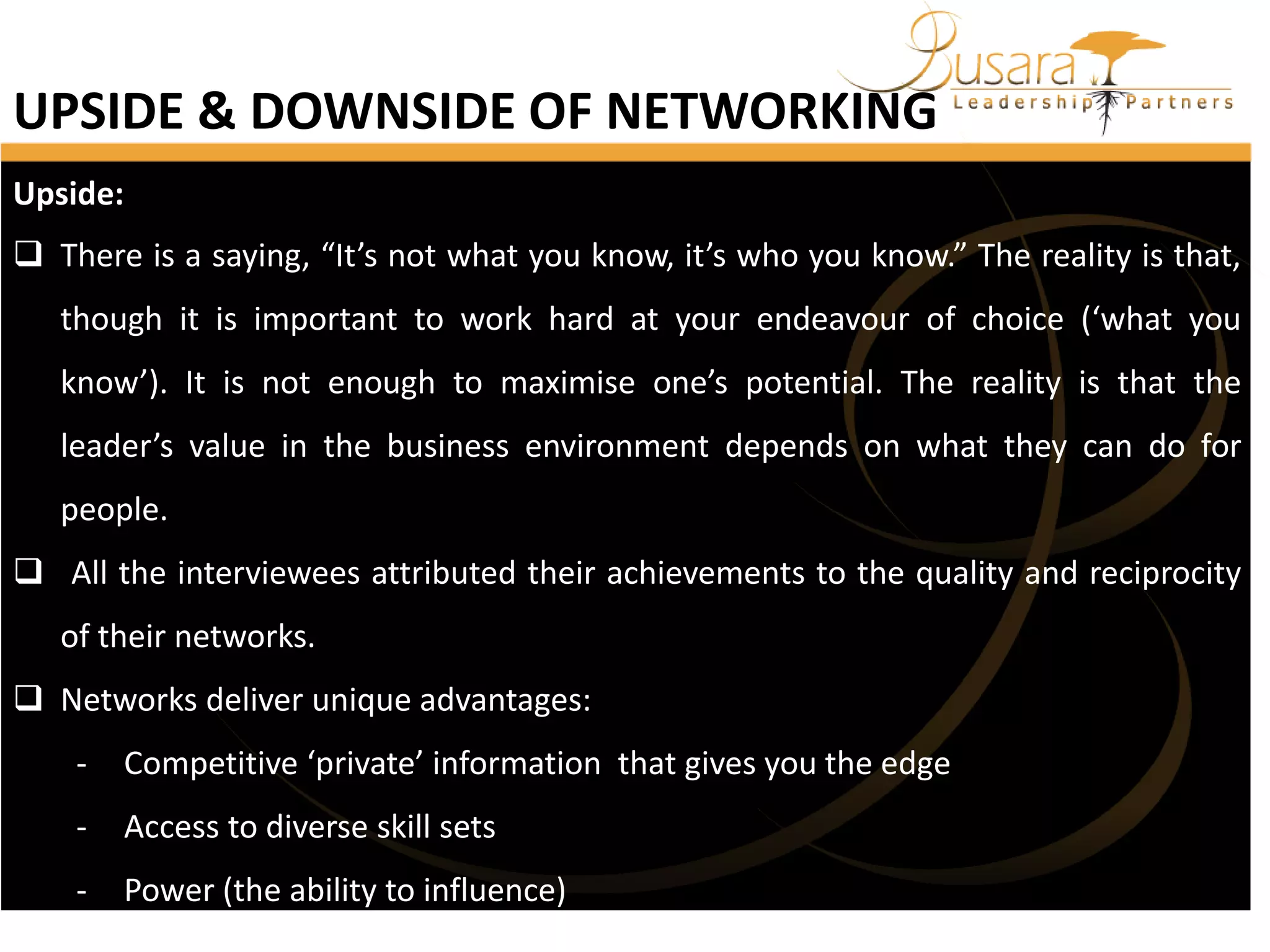
 There is a saying, “It’s not what you know, it’s who you know.” The reality is that,
though it is important to work hard at your endeavour of choice (‘what you

know’). It is not enough to maximise one’s potential. The reality is that the
leader’s value in the business environment depends on what they can do for
people.

 All the interviewees attributed their achievements to the quality and reciprocity
of their networks.
 Networks deliver unique advantages:
-

Competitive ‘private’ information that gives you the edge

-

Access to diverse skill sets

-

Power (the ability to influence)
UPSIDE & DOWNSIDE OF NETWORKING

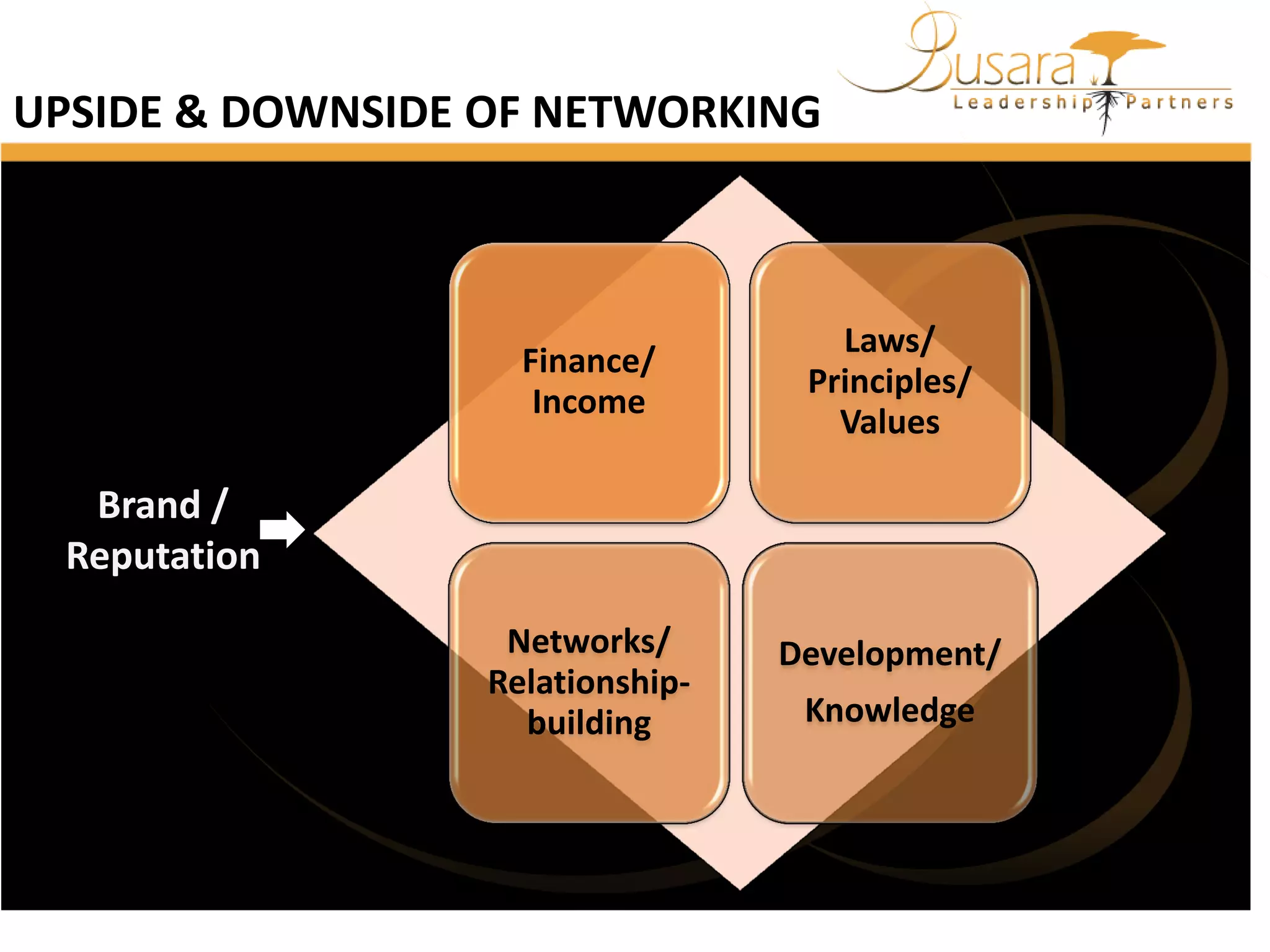
Finance/
Income

Laws/
Principles/
Values

Brand /
Reputation
Networks/
Relationshipbuilding

Development/
Knowledge
UPSIDE & DOWNSIDE OF NETWORKING
Downside:
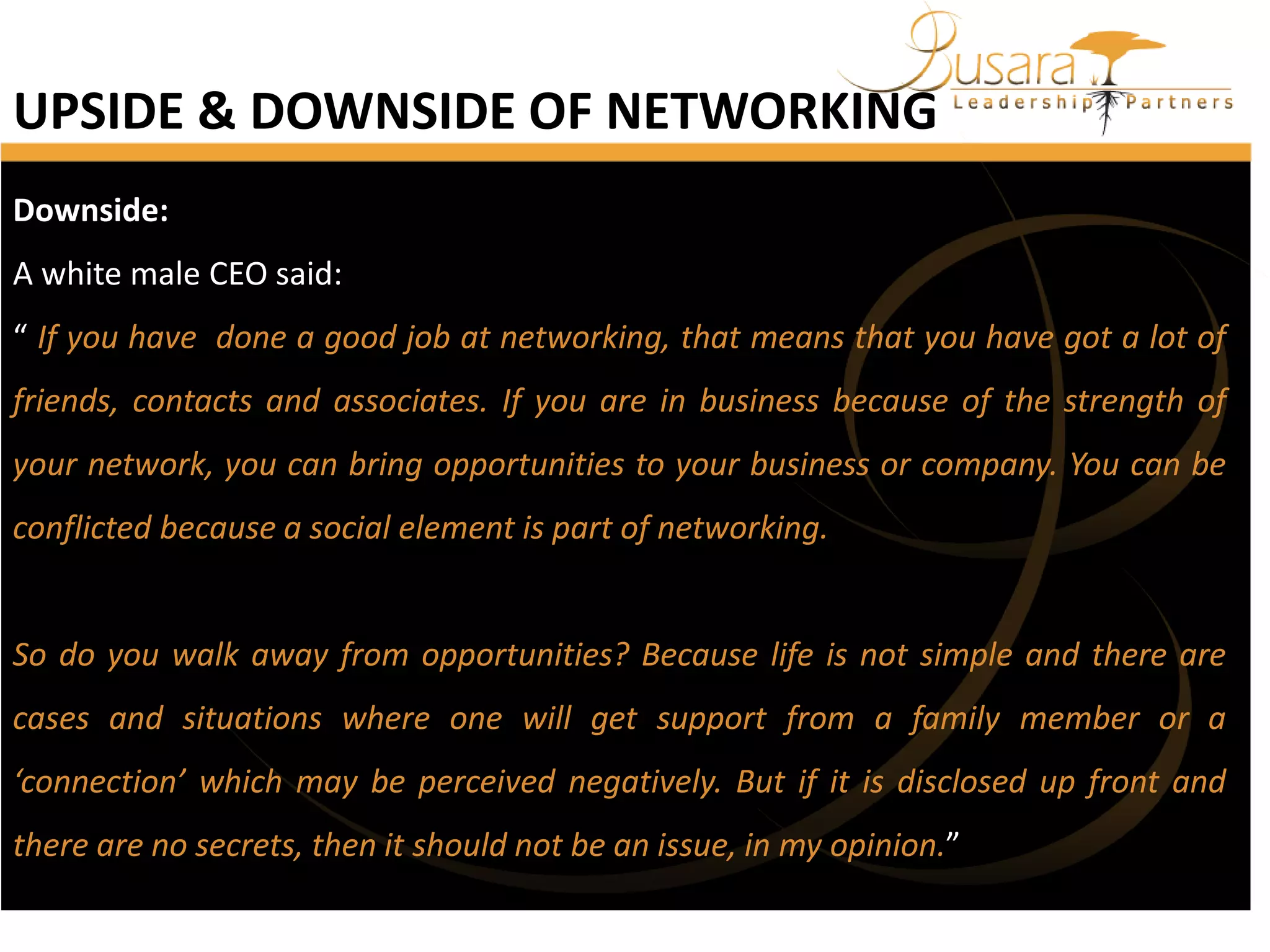
A white male CEO said:
“ If you have done a good job at networking, that means that you have got a lot of

friends, contacts and associates. If you are in business because of the strength of
your network, you can bring opportunities to your business or company. You can be
conflicted because a social element is part of networking.

So do you walk away from opportunities? Because life is not simple and there are
cases and situations where one will get support from a family member or a
‘connection’ which may be perceived negatively. But if it is disclosed up front and

there are no secrets, then it should not be an issue, in my opinion.”
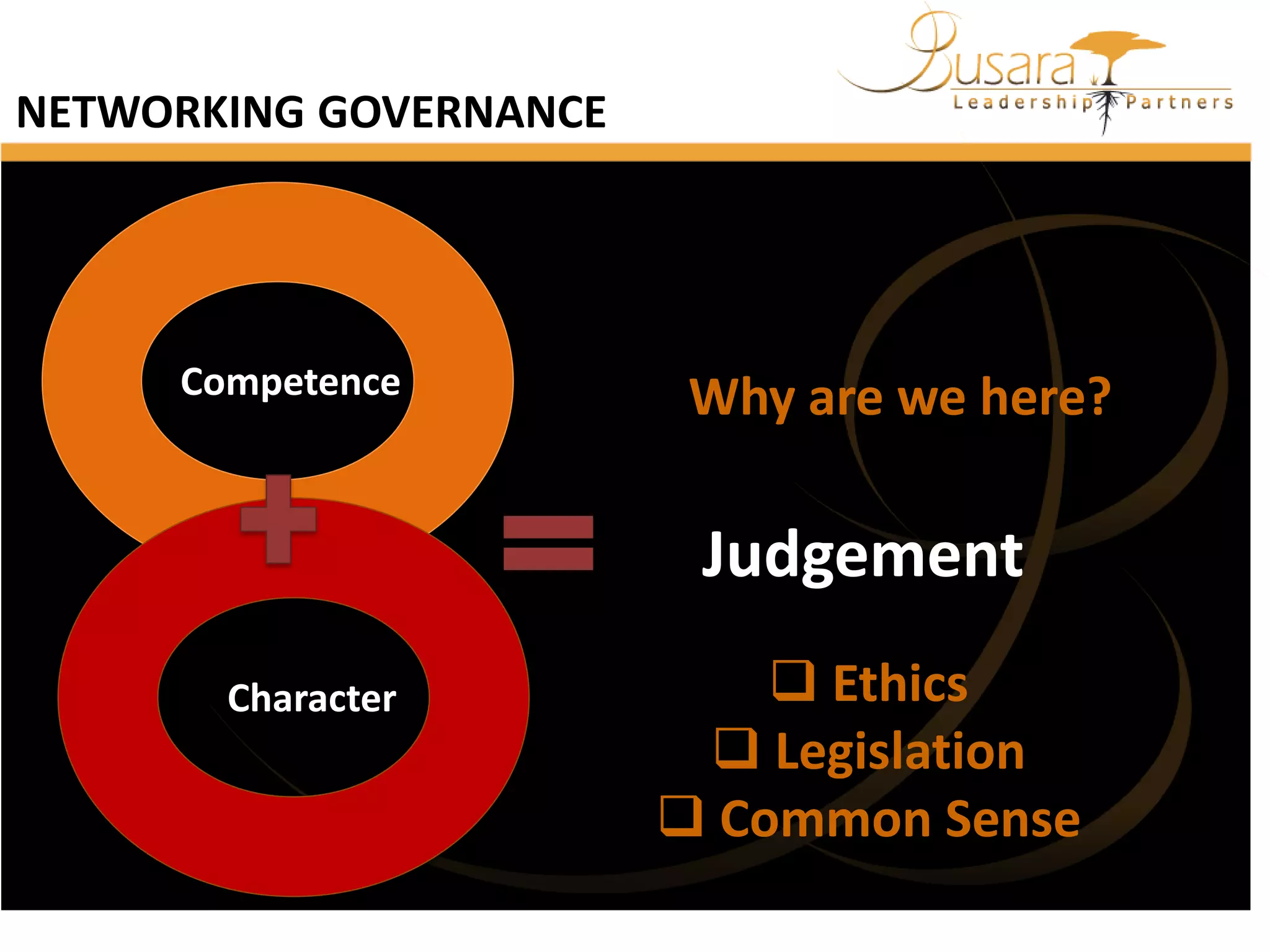
NETWORKING GOVERNANCE

Competence

Why are we here?

Judgement
Character

 Ethics
 Legislation
 Common Sense
THANK YOU
TO THE
NETWORKING RESEARCH
INTERVIEWEES
NETWORKING RESEARCH INTERVIEWEES

 Portia Molefe, Director, UBU Investment Holdings

 Nhlanhla Nene, Deputy Minister, National Treasury
 Prof Nick Binedell, Dean, Gordon Institute of Business Science (GIBS)
 Paolo Cavelieri, Chairman, Etana Insurance

 Michael Judin, Partner, Goldman Judin Maisels Inc.
 Prof Adrian Saville, Chief Investment Officer, Cannon Asset Management
 Mpho Makwana, Chairman, Arcelor Mittal

 Dube Tshidi, Executive Officer, Financial Services Board (FSB)
 Elias Masilela, Chief Executive, Public Investments Corporation (PIC)
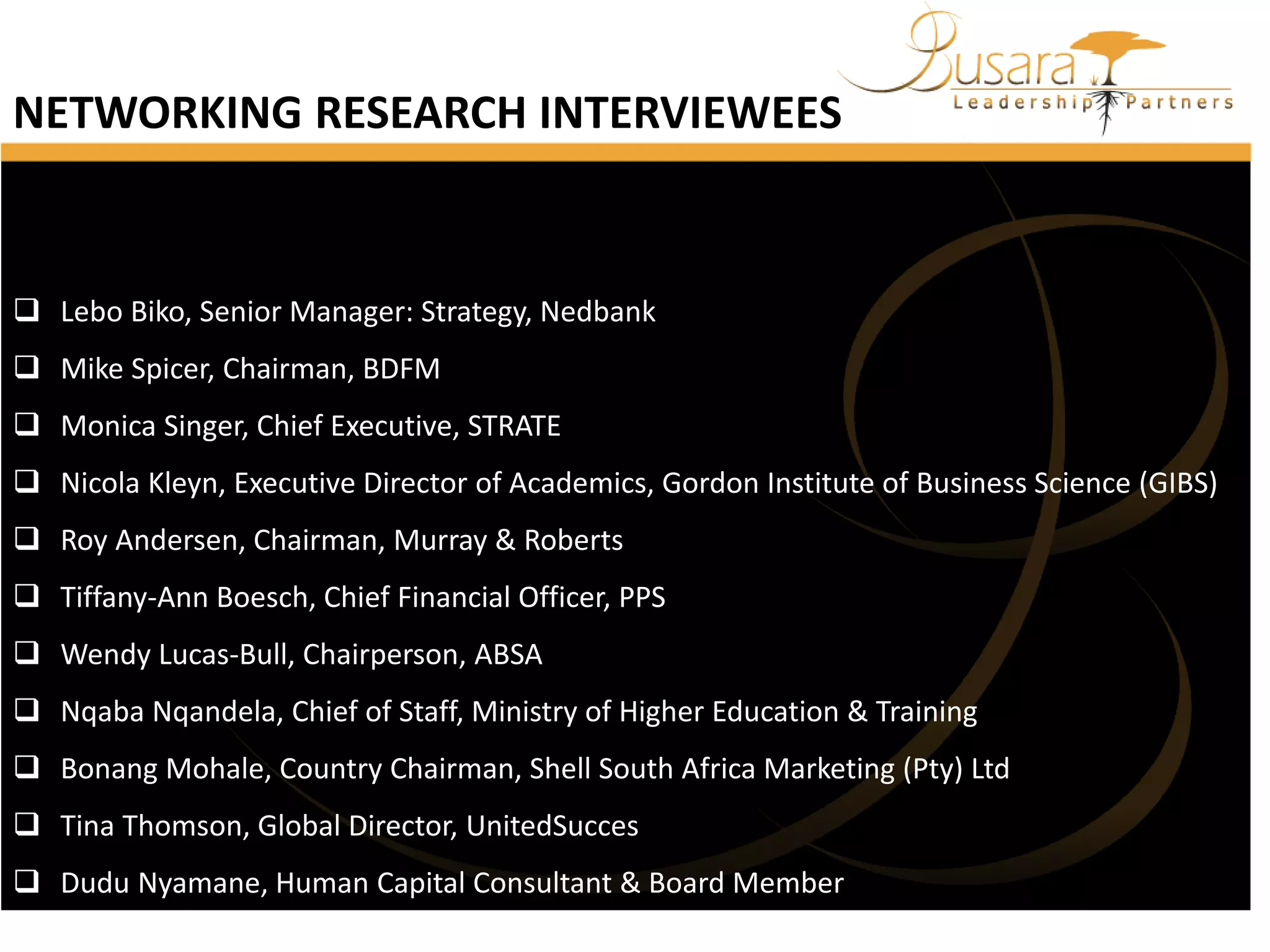
NETWORKING RESEARCH INTERVIEWEES

 Lebo Biko, Senior Manager: Strategy, Nedbank
 Mike Spicer, Chairman, BDFM

 Monica Singer, Chief Executive, STRATE
 Nicola Kleyn, Executive Director of Academics, Gordon Institute of Business Science (GIBS)
 Roy Andersen, Chairman, Murray & Roberts
 Tiffany-Ann Boesch, Chief Financial Officer, PPS
 Wendy Lucas-Bull, Chairperson, ABSA
 Nqaba Nqandela, Chief of Staff, Ministry of Higher Education & Training
 Bonang Mohale, Country Chairman, Shell South Africa Marketing (Pty) Ltd
 Tina Thomson, Global Director, UnitedSucces
 Dudu Nyamane, Human Capital Consultant & Board Member
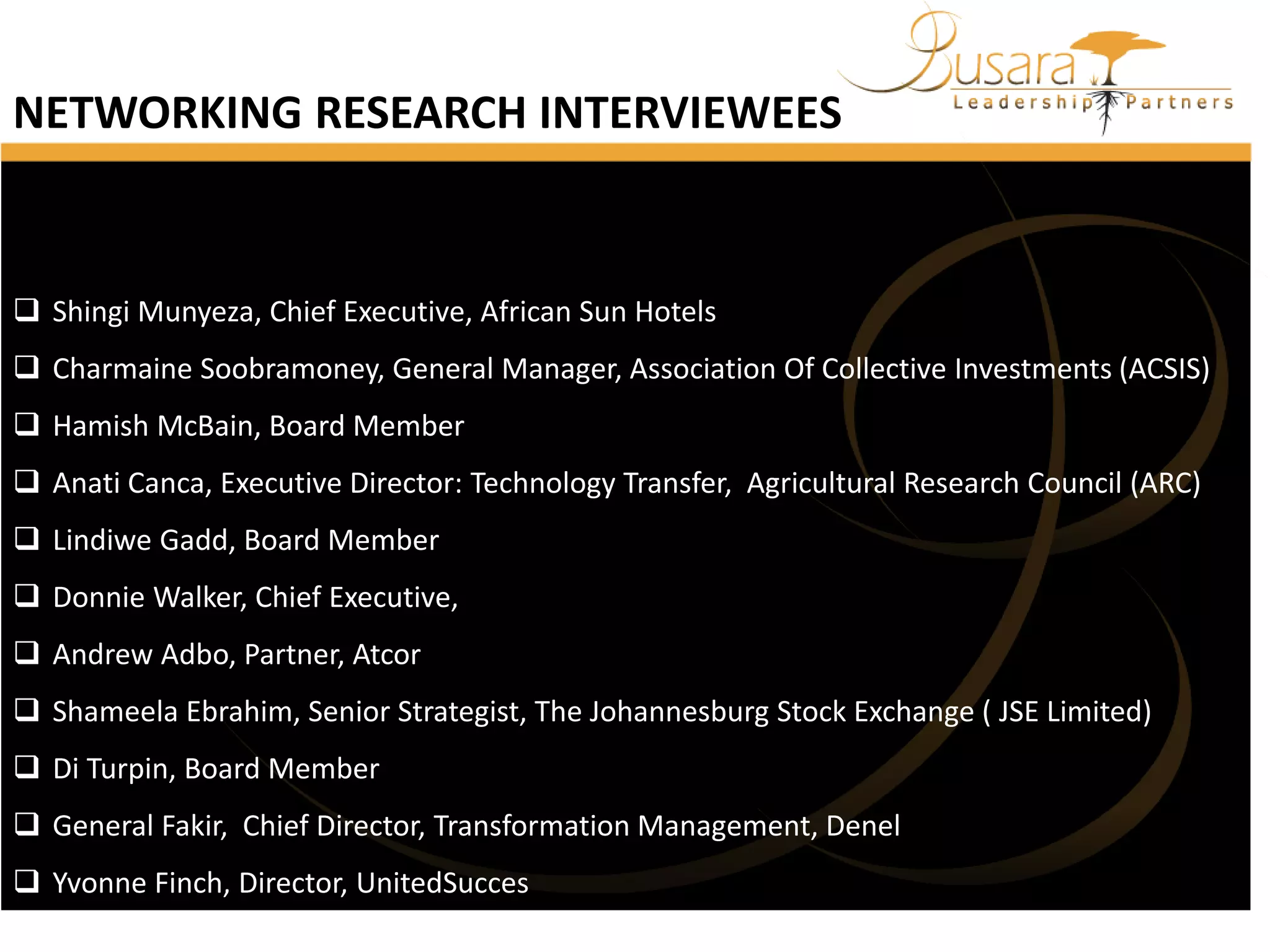
NETWORKING RESEARCH INTERVIEWEES

 Shingi Munyeza, Chief Executive, African Sun Hotels
 Charmaine Soobramoney, General Manager, Association Of Collective Investments (ACSIS)

 Hamish McBain, Board Member
 Anati Canca, Executive Director: Technology Transfer, Agricultural Research Council (ARC)
 Lindiwe Gadd, Board Member
 Donnie Walker, Chief Executive,
 Andrew Adbo, Partner, Atcor
 Shameela Ebrahim, Senior Strategist, The Johannesburg Stock Exchange ( JSE Limited)
 Di Turpin, Board Member
 General Fakir, Chief Director, Transformation Management, Denel
 Yvonne Finch, Director, UnitedSucces

Upside and Downside of Networking by Dudu Msomi

  • 1.
  • 2.
    WHY NETWORKING? Source: BWASA Percentagesof Women in JSE Listed & State-Owned Companies as a percentage of all leadership positions. 2009 2010 2011 2012 CEOs/MDs 3,6% 4,5% 4,4% 3,6% Chairpersons 5,8% 6,0% 5,3% 5,5% Directorships 14,6% 16,6% 15,8% 17.1% Executive Management 18,6% 19,% 21,6% 21,4%  In South Africa, the focus on women in leadership has largely been on benchmarking studies tracking progress from year to year, but there is a shortage of effort going beyond the numbers.  There is a dire need for qualitative research to explain the numbers.  Inspiration was to build on from our MBA Theses and SA dialogue in August during Women’s Month.
  • 3.
    WHY NETWORKING  Thereis a view that representation of women in leadership would multiply exponentially if women were readily able and willing to collaborate and actively support each other using networking as one of the main tools.  Looking at benchmarking studies, not just in SA, but US, UK, Canada and Australia, though progress has been made, relative stagnation has set in across the world in the advancement of women into corporate leadership, except in countries that have adopted the quota system.  Despite the growing numbers of educated women entering the workforce, their increasing buying power and influence, women continue to hold only a small proportion of leadership positions in business, particularly.  This background informed the rationale for focusing on networking.
  • 4.
    RESEARCH ON NETWORKING Doyou Network with Opposite Sex No. of Interviewees Females 48% 52% Males 100% Men are Better @ Networking 87% 38% Females Males 100% Females Males
  • 5.
    PART ONE: FINDINGSON NETWORKING UPSIDE & DOWNSIDE OF NETWORKING
  • 6.
    UPSIDE & DOWNSIDEOF NETWORKING Exceptions become the Perceptions MANIPULATING F A K E
  • 7.
    UPSIDE & DOWNSIDEOF NETWORKING Talking about the same thing?
  • 8.
    UPSIDE & DOWNSIDEOF NETWORKING Networking is building relationships before you need them! Then when you need them, you know whom to call and he or she will want to help you. - Diane Darling, The Networking Survival Guide
  • 9.
    UPSIDE & DOWNSIDEOF NETWORKING Top 5 Networking Wisdom: 1. Networking is performed consciously and unconsciously, every day from when we are born. Can be inherited. It is meaningful relationship building, overtime, that is reciprocal (give & take), fosters trust, makes netbank deposits (social capital) and results in genuine depth of knowledge of the other person. Networking is not about investing A with the expectation of immediately receiving B. (Short-termism results in the negative connotations and corruptive practices). 2. Social capital is the strength of the relationship you have with another person. There is a spectrum of what you can reasonably ask another person to do for you dependent in part on the social capital you have with that person. What is more important than the number of your contacts is the amount of social capital you have within your network. People that “actively push your agenda themselves.” (Fine balance in pushing the agenda within good governance practices).
  • 10.
    UPSIDE & DOWNSIDEOF NETWORKING Top 5 Networking Wisdom: 3. Men seem to be better at networking. It is more about the style. Women tend to embark on a ‘spray and pray approach’. Men invest the time to ‘genuinely get to know the other person’ which makes a difference. ‘Out of sight. Out of Mind’. Keep themselves top of mind. Men have the time to invest. “They have a wife. They do not have the guilt of spending 5 hours on a golf course or going to the bush for the weekend building meaningful relationships. I need a wife who looks after me, except me”. 4. The strength of networking, as in every relationship, is honesty. It helps to overcome misunderstandings and negative connotations of manipulation and fakeness. Whether it is corrupt honesty or not. Disclosure upfront of what you need and giving the other person the respect. “It is insulting to lie and say you would love to have lunch with me. Respect my Intelligence. Tell me what you want and ask if we can discuss it over lunch”.
  • 11.
    UPSIDE & DOWNSIDEOF NETWORKING 5. Sexual tensions and differences between women & men do complicate networking and hinder the progress of women into leadership positions.
  • 12.
    UPSIDE & DOWNSIDEOF NETWORKING Top 5 Networking Wisdom:  Few women in leadership have relatively low levels of power in comparison to men thus their impact is less. On balance, women do become co-opted rather than transform the status quo. Both sexes are complicit in perpetuating the unequal playing field.  There is also the impact of the glass network. The ‘Glass Network’ is an invisible or transparent network linking most directors. Recruiting directors by ‘shoulder tapping’ or preferring to select of similar backgrounds (as a risk minimising strategy), gives rise to the familiar ‘old boy’ network which always includes a few women with multiple seats.
  • 13.
    UPSIDE & DOWNSIDEOF NETWORKING Top 5 Networking Wisdom:  Men are still largely blind or intolerant to the disadvantages that women experience at home and work and the benefits men still continue to enjoy. “I don’t believe that it is true that women are restricted in their ability to network. Why can’t they come to the bush? Reasons are not insurmountable. Women need to compromise. They must organise their lives.” In the next breathe, the same interviewee says, “It is important that maintain their femininity and their role in the family environment. The structure of the home is under threat.” women
  • 14.
    UPSIDE & DOWNSIDEOF NETWORKING Top Five Networking Wisdom:  Women suffer from massive guilt from taking out more time from family to build meaningful relationships. During the same years that careers demand maximum time investment, the women’s biology demands that they have children. “We need to show the world that we are able to be more excellent. We have failed to shine. We stop shining in the business environment when we fall pregnant. I wanted to change the world. I had the babies then everything went out the window because for so many years I had to raise the children. So the energy I had left was to raise my babies”.  The partners do not share the housework and child rearing equally. “In the last 30 years, women have made more progress in the workforce than in the home. A better world is one where half the institutions are run by women and half our homes are run by men”. Sheryl Sandberg, in her book ‘Lean In’
  • 15.
    UPSIDE & DOWNSIDEOF NETWORKING Top 5 Networking Wisdom:  Women can be very good at networking, but the circumstances are such that they cannot network like men because a lot of the networking happens informally. They are restricted because of the impact on other members such as family – husbands, partners and/or children. Black male volunteered the view that: “Women open up easily compared to men. Women have a social rapport. Because it is easier to talk to them, men sometimes misinterpret this as a sign of weakness. Men can take advantage of a woman by saying ‘she is falling for me.’ Men take it as flirtation. To them, openness equates to ‘I’m interested’ beyond the business situation.” A white male shared that, “Women sometimes end up not going to social networking functions. My female colleagues come back to the office in tears saying that men are making unwanted advances. They are making it difficult for women to network.”
  • 16.
    UPSIDE & DOWNSIDEOF NETWORKING Upside:  There is a saying, “It’s not what you know, it’s who you know.” The reality is that, though it is important to work hard at your endeavour of choice (‘what you know’). It is not enough to maximise one’s potential. The reality is that the leader’s value in the business environment depends on what they can do for people.  All the interviewees attributed their achievements to the quality and reciprocity of their networks.  Networks deliver unique advantages: - Competitive ‘private’ information that gives you the edge - Access to diverse skill sets - Power (the ability to influence)
  • 17.
    UPSIDE & DOWNSIDEOF NETWORKING Finance/ Income Laws/ Principles/ Values Brand / Reputation Networks/ Relationshipbuilding Development/ Knowledge
  • 18.
    UPSIDE & DOWNSIDEOF NETWORKING Downside: A white male CEO said: “ If you have done a good job at networking, that means that you have got a lot of friends, contacts and associates. If you are in business because of the strength of your network, you can bring opportunities to your business or company. You can be conflicted because a social element is part of networking. So do you walk away from opportunities? Because life is not simple and there are cases and situations where one will get support from a family member or a ‘connection’ which may be perceived negatively. But if it is disclosed up front and there are no secrets, then it should not be an issue, in my opinion.”
  • 19.
    NETWORKING GOVERNANCE Competence Why arewe here? Judgement Character  Ethics  Legislation  Common Sense
  • 20.
    THANK YOU TO THE NETWORKINGRESEARCH INTERVIEWEES
  • 21.
    NETWORKING RESEARCH INTERVIEWEES Portia Molefe, Director, UBU Investment Holdings  Nhlanhla Nene, Deputy Minister, National Treasury  Prof Nick Binedell, Dean, Gordon Institute of Business Science (GIBS)  Paolo Cavelieri, Chairman, Etana Insurance  Michael Judin, Partner, Goldman Judin Maisels Inc.  Prof Adrian Saville, Chief Investment Officer, Cannon Asset Management  Mpho Makwana, Chairman, Arcelor Mittal  Dube Tshidi, Executive Officer, Financial Services Board (FSB)  Elias Masilela, Chief Executive, Public Investments Corporation (PIC)
  • 22.
    NETWORKING RESEARCH INTERVIEWEES Lebo Biko, Senior Manager: Strategy, Nedbank  Mike Spicer, Chairman, BDFM  Monica Singer, Chief Executive, STRATE  Nicola Kleyn, Executive Director of Academics, Gordon Institute of Business Science (GIBS)  Roy Andersen, Chairman, Murray & Roberts  Tiffany-Ann Boesch, Chief Financial Officer, PPS  Wendy Lucas-Bull, Chairperson, ABSA  Nqaba Nqandela, Chief of Staff, Ministry of Higher Education & Training  Bonang Mohale, Country Chairman, Shell South Africa Marketing (Pty) Ltd  Tina Thomson, Global Director, UnitedSucces  Dudu Nyamane, Human Capital Consultant & Board Member
  • 23.
    NETWORKING RESEARCH INTERVIEWEES Shingi Munyeza, Chief Executive, African Sun Hotels  Charmaine Soobramoney, General Manager, Association Of Collective Investments (ACSIS)  Hamish McBain, Board Member  Anati Canca, Executive Director: Technology Transfer, Agricultural Research Council (ARC)  Lindiwe Gadd, Board Member  Donnie Walker, Chief Executive,  Andrew Adbo, Partner, Atcor  Shameela Ebrahim, Senior Strategist, The Johannesburg Stock Exchange ( JSE Limited)  Di Turpin, Board Member  General Fakir, Chief Director, Transformation Management, Denel  Yvonne Finch, Director, UnitedSucces