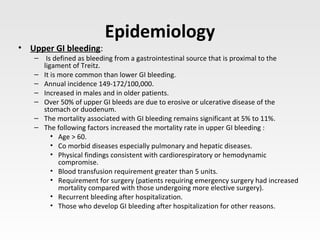
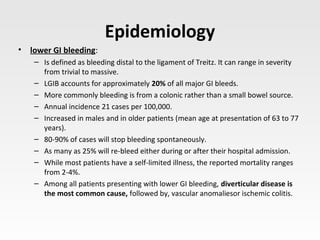
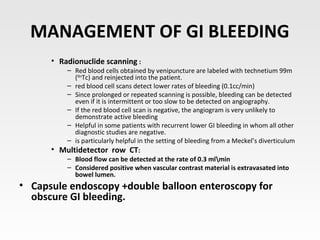
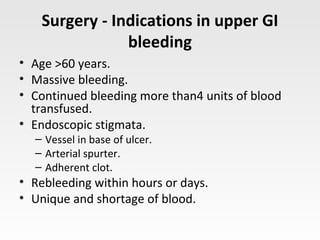
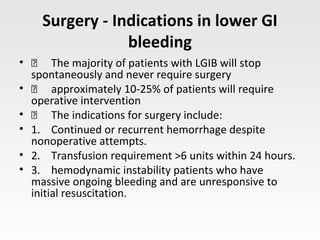
This document discusses gastrointestinal tract bleeding. It defines upper and lower GI bleeding and provides epidemiological data. Common causes of upper GI bleeding include peptic ulcers, varices, Mallory-Weiss tears, and angiodysplasia. Lower GI bleeding is commonly caused by diverticular disease, angiodysplasia, and ischemic colitis. Management involves resuscitation, endoscopy for diagnosis and treatment, and angiography for severe or obscure bleeding. The mortality of GI bleeding remains significant.


![PERI-PROSTHETIC FRACTURE NAIL-PLATE CONSTRUCT [NPC].pptx](https://cdn.slidesharecdn.com/ss_thumbnails/drarunkumardrmohamedashrafperiprostheticfrasturenail-plateconstructnpc-260209164459-7e9d15a1-thumbnail.jpg?width=640&height=640&fit=bounds)


