Upper GI bleeding

Chitlada Limjindaporn, MD
Diplomate of American Board of Emergency
Medicine
Faculty of Medicine, Thammasat University
Upper GI bleeding
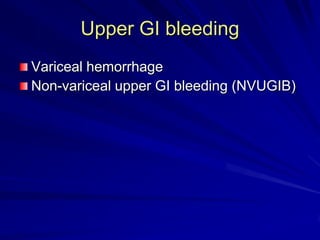
Variceal hemorrhage
Non-variceal upper GI bleeding (NVUGIB)
Upper GI bleeding

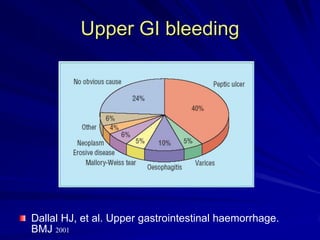
Dallal HJ, et al. Upper gastrointestinal haemorrhage.
BMJ 2001
Nonvariceal bleeding
Approximately 80% of ulcers stop
bleeding.
The overall mortality rate is approximately
10%
Elderly with significant comorbidity :
increase mortality.
Mortality/Morbidity
Retrospective chart review
73.2% of deaths occurred in patients older than
60 years.
One or more comorbid illnesses were noted in
98.3% of patients who died.

Yavorski RT, Wong RK, Maydonovitch C, Battin LS, Furnia A, Amundson
DE. Analysis of 3,294 cases of upper gastrointestinal bleeding in military
medical facilities. Am J Gastroenterol. Apr 1995;90(4):568-73.
ED approach
Initial resuscitation
Clinical assessment and risk stratification
Identification source of bleeding
Specific therapy
Early resuscitation
Early intensive resuscitation of patients with
upper gastrointestinal bleeding decreases
mortality.
Aggressive hemodynamic resuscitation,
correction of hematocrit ( >28%)and
coagulopathy (INR>1.8)
Mortality significantly decrease in intensive
resuscitation group
No difference in rebleeding, surgical intervention
Baradarian R, Ramdhaney S, Chapalamadugu R, Skoczylas L, Wang K,
Rivilis S, et al. Am J Gastroenterol. Apr 2004;99(4):619-22.
Initial resuscitation
ABC, IV,Oxygen
Intubation
NPO
Fluid resuscitation
PRC, FFP transfusion
Foley catheter
Nasogastric Aspiration
– Severity assessment
– Remove clot
ED approach
Initial resuscitation
Clinical assessment and risk stratification
Identification source of bleeding
Specific therapy
Initial clinical assessment
Diagnosis of UGIB
– Signs and Symptoms
– NG tube placement

Severity of bleeding
Risk stratification
Signs and Symptoms
Age, Sex
Symptoms: weakness, dizziness, syncope
–
–
–
–

melena (50-100ml)
Hematemesis (1000ml)
Coffee ground
Hematochezia (>1000ml/hr)

Associated symptoms: pale, jaundice, ascites
History of previous bleeding
History of severe vomiting
Medication: NSAID, ASA
Signs and Symptoms
Underlying diseases
– Peptic ulcer disease/ gastritis
– Liver disease : cirrhosis, hepatitis, alcoholism
– Malignancy
– Hematologic disease: coagulopathy, chronic
anemia
– Cardiovascular disease
– Pulmonary disease
– Renal disease
Nasogastric lavage
Diagnosis
– confirm recent bleeding (coffee ground
appearance)
– possible active bleeding (red blood in the
aspirate that does not clear)
– a lack of blood in the stomach (not exclude an
upper gastrointestinal lesion).

Severity of the hemorrhage
– The characteristics of the nasogastric lavage
fluid (eg, red, coffee grounds, clear) and the
stool (eg, red, black, brown) can indicate the
severity of the hemorrhage.
Risk Factors
American Society for Gastrointestinal
Endoscopy (ASGE),
Risk factors associated with increased mortality,
recurrent bleeding, the need for endoscopic
hemostasis, or surgery
– age older than 60 years
– severe comorbidity
– active bleeding (eg, witnessed hematemesis, red
blood per nasogastric tube, fresh blood per rectum),
– Hemodynamic instability :hypotension
– red blood cell transfusion greater than or equal to 6
units
– severe coagulopathy.
Adler DG, Leighton JA, Davila RE, Hirota WK, Jacobson BC, Qureshi
WA, et al. ASGE guideline: The role of endoscopy in acute non-variceal
upper-GI hemorrhage. Gastrointest Endosc. Oct 2004;60(4):497-504.
High clinical risk factors
– Host factors
Age >60
Comorbidity : renal failure, cirrhosis,
ischemic heart disease, COPD
Hemodynamic instability: HR> 100,
SBP<100 mmHg
Coagulopathy
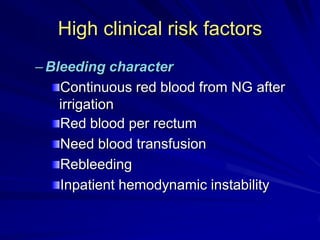
High clinical risk factors
– Bleeding character
Continuous red blood from NG after
irrigation
Red blood per rectum
Need blood transfusion
Rebleeding
Inpatient hemodynamic instability
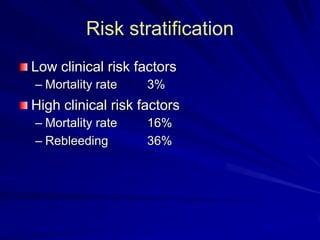
Risk stratification
Low clinical risk factors
– Mortality rate

3%

High clinical risk factors
– Mortality rate
– Rebleeding

16%
36%
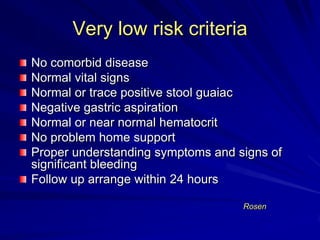
Very low risk criteria
No comorbid disease
Normal vital signs
Normal or trace positive stool guaiac
Negative gastric aspiration
Normal or near normal hematocrit
No problem home support
Proper understanding symptoms and signs of
significant bleeding
Follow up arrange within 24 hours
Rosen
ED approach
Initial resuscitation
Clinical assessment and risk stratification
Identification source of bleeding
Specific therapy
Identification source of bleeding
Endoscopic for diagnosis
Intervention for diagnosis
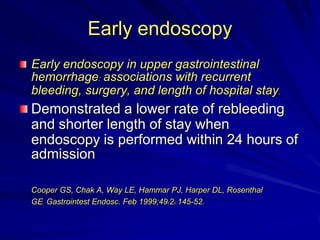
Early endoscopy
Early endoscopy in upper gastrointestinal
hemorrhage: associations with recurrent
bleeding, surgery, and length of hospital stay.

Demonstrated a lower rate of rebleeding
and shorter length of stay when
endoscopy is performed within 24 hours of
admission
Cooper GS, Chak A, Way LE, Hammar PJ, Harper DL, Rosenthal
GE. Gastrointest Endosc. Feb 1999;49(2):145-52.
Early endoscopy
High risk patients
– Stop bleeding and save life

Low risk patients
– Discharge early from hospital
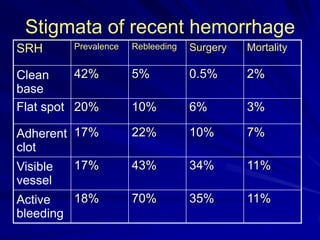
Stigmata of recent hemorrhage
Rebleeding

Surgery

Mortality

42%
Clean
base
Flat spot 20%

5%

0.5%

2%

10%

6%

3%

Adherent 17%
clot
17%
Visible
vessel
18%
Active
bleeding

22%

10%

7%

43%

34%

11%

70%

35%

11%

SRH

Prevalence
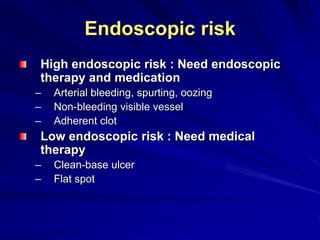
Endoscopic risk
High endoscopic risk : Need endoscopic
therapy and medication
–
–
–

Arterial bleeding, spurting, oozing
Non-bleeding visible vessel
Adherent clot

Low endoscopic risk : Need medical
therapy
–
–

Clean-base ulcer
Flat spot
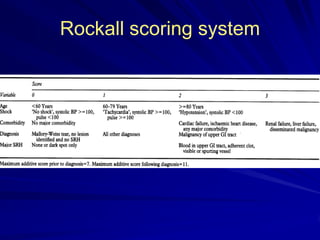
Rockall scoring system
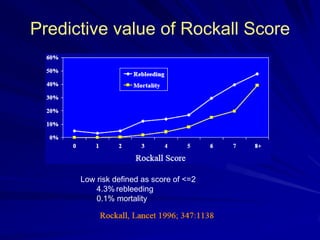
Predictive value of Rockall Score

Low risk defined as score of <=2
4.3% rebleeding
0.1% mortality
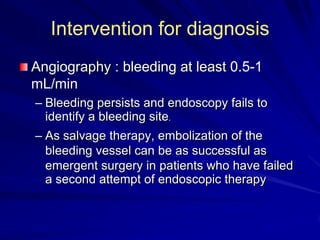
Intervention for diagnosis
Angiography : bleeding at least 0.5-1
mL/min
– Bleeding persists and endoscopy fails to
identify a bleeding site.
– As salvage therapy, embolization of the
bleeding vessel can be as successful as
emergent surgery in patients who have failed
a second attempt of endoscopic therapy
ED approach
Initial resuscitation
Clinical assessment and risk stratification
Identification source of bleeding
Specific therapy
Specific therapy
Medical therapy
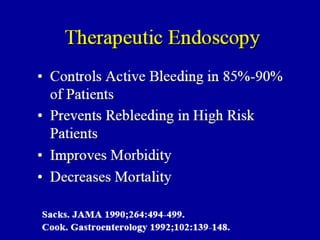
Endoscopic therapy
Radiologic intervention
Surgery
Role of Acid in Hemostasis
Impairs clot formation
– Impairs platelet aggregation & causes
disaggregation

Accelerates clot lysis
– pH<5 pepsin accelerate clot lysis

May impair integrity of mucus/bicarbonate
barrier
Role of Acid in Hemostasis
pH>6
– Effective platelet aggregation
– Irriversible inactivation of pepsin
– Optimal maintenance of hemostasis
H2-receptor antagonists
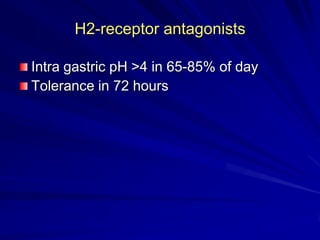
Intra gastric pH >4 in 65-85% of day
Tolerance in 72 hours
Meta-analysis: the efficacy of intravenous
H2-receptor antagonists in bleeding peptic
ulcer.
30 RCT,3786 bleeding GU and DU
The use of H2-receptor antagonists has not
been shown to be effective in altering the course
of UGIB.
Conclusion : There was a possible minor benefit
with intravenous H2 antagonists in bleeding
gastric ulcers but no benefit in duodenal ulcers
Levine JE, Leontiadis GI, Sharma VK, Howden
CW. Aliment Pharmacol Ther. Jun 2002;16(6):1137-42.
Proton pump inhibitor therapy for peptic ulcer
bleeding: Cochrane collaboration meta-analysis of
randomized controlled trials.

A meta-analysis of 24 randomized controlled
trials that evaluated PPIs for bleeding ulcers
(with or without endoscopic therapy)
Significant reduction in the risk of rebleeding, the
need for repeat endoscopic hemostasis, and
surgery.
Not effect overall mortality, but reduced mortality
in Asian trials and in patients with active
bleeding or nonbleeding visible vessels.
Leontiadis GI, Sharma VK, Howden CW. Mayo Clin
Proc. Mar 2007;82(3):286-96.
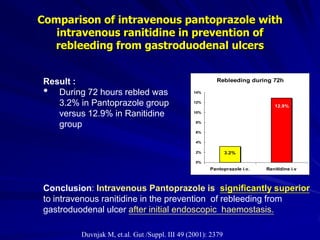
Comparison of intravenous pantoprazole with
intravenous ranitidine in prevention of
rebleeding from gastroduodenal ulcers

Result :
• During 72 hours rebled was
3.2% in Pantoprazole group
versus 12.9% in Ranitidine
group

Rebleeding during 72h
14%
12%

12.9%
10%
8%
6%
4%
2%

3.2%

0%

Pantoprazole i.v.

Ranitidine i.v

Conclusion: Intravenous Pantoprazole is significantly superior
to intravenous ranitidine in the prevention of rebleeding from
gastroduodenal ulcer after initial endoscopic haemostasis.
Duvnjak M, et.al. Gut /Suppl. III 49 (2001): 2379
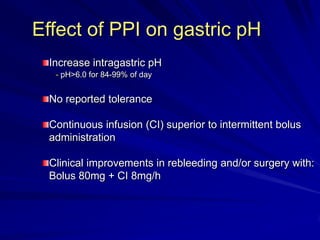
Effect of PPI on gastric pH
Increase intragastric pH
- pH>6.0 for 84-99% of day
No reported tolerance
Continuous infusion (CI) superior to intermittent bolus
administration

Clinical improvements in rebleeding and/or surgery with:
Bolus 80mg + CI 8mg/h
PPI dose and administration
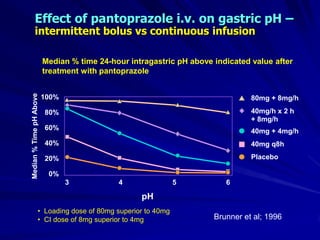
Effect of pantoprazole i.v. on gastric pH –
intermittent bolus vs continuous infusion

Median % Time pH Above

Median % time 24-hour intragastric pH above indicated value after
treatment with pantoprazole
100%

80mg + 8mg/h

80%

40mg/h x 2 h
+ 8mg/h

60%

40mg + 4mg/h

40%

40mg q8h

20%

Placebo

0%

Brunner et al; 1996

3

4

5

6

pH
• Loading dose of 80mg superior to 40mg
• CI dose of 8mg superior to 4mg

Brunner et al; 1996
Pantoprazole i.v. in patients with UGIB after
endoscopic hemostasis (1)

Median Intragastric pH

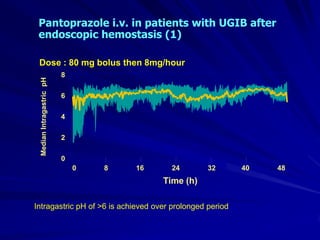
Dose : 80 mg bolus then 8mg/hour
8
6
4
2
0
0

8

16

24

32

Time (h)
Intragastric pH of >6 is achieved over prolonged period

van Rensburg et al; 1997

40

48
Pantoprazole sodium
Particulate matter จากการผสมยาต้นตารับ
pantoprazole iv สูตรเดิม จึงต้องใช้ in-line filter
4 ปีต่อมาหลังการวางตลาดขาย ใน USA ได้มีการปรับสูตรผงยาฉีด
pantoprazole ใหม่ โดยผสม EDTA และ sodium
hydroxide
จนถึงปัจจุบัน USA ยังคงไม่พิจารณาให้ขึ้นทะเบียนยาสามัญของ
สูตรผงยาฉีด pantoprazole sodium
PPI after endoscopic therapy
An increasing amount of evidence in the
literature states that therapy with highdose PPIs (IV bolus followed by
continuous infusion) may decrease the rate
of rebleeding after endoscopic therapy. By
increasing the gastric pH above 6, the clot
is stabilized.
Pantoprazole infusion as adjuvant therapy to
endoscopic treatment in patients with peptic ulcer
bleeding: Prospective randomized controlled trial

Showkat AZ, et al.J Gastroenterol Hepatol 2006;21:716-721
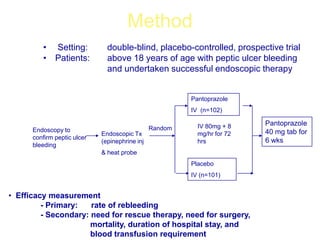
Method
• Setting:
• Patients:

double-blind, placebo-controlled, prospective trial
above 18 years of age with peptic ulcer bleeding
and undertaken successful endoscopic therapy

Pantoprazole
IV (n=102)

Endoscopy to
confirm peptic ulcer
bleeding

Endoscopic Tx
(epinephrine inj

Random

IV 80mg + 8
mg/hr for 72
hrs

& heat probe
Placebo
IV (n=101)

• Efficacy measurement
- Primary:
rate of rebleeding
- Secondary: need for rescue therapy, need for surgery,
mortality, duration of hospital stay, and
blood transfusion requirement

Pantoprazole
40 mg tab for
6 wks
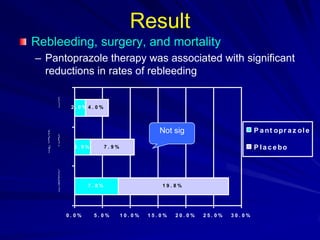
Result
Rebleeding, surgery, and mortality
– Pantoprazole therapy was associated with significant
reductions in rates of rebleeding

2. 0% 4. 0%

Not sig
2. 9%

P l a c e bo

7. 9%

7. 8%

0. 0%

P a nt opr a z ol e

5. 0%

19. 8%

10. 0%

15. 0%

20. 0%

25. 0%

30. 0%
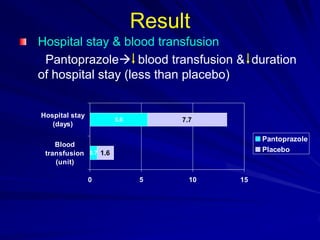
Result
Hospital stay & blood transfusion
- Pantoprazole blood transfusion & duration
of hospital stay (less than placebo)

Hospital stay
(days)

7.7

5.6

Pantoprazole
Placebo

Blood
transfusion 0.7 1.6
(unit)
0

5

10

15
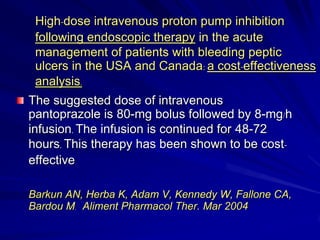
High-dose intravenous proton pump inhibition
following endoscopic therapy in the acute
management of patients with bleeding peptic
ulcers in the USA and Canada: a cost-effectiveness
analysis.
The suggested dose of intravenous
pantoprazole is 80-mg bolus followed by 8-mg/h
infusion. The infusion is continued for 48-72
hours. This therapy has been shown to be costeffective
Barkun AN, Herba K, Adam V, Kennedy W, Fallone CA,
Bardou M. Aliment Pharmacol Ther. Mar 2004
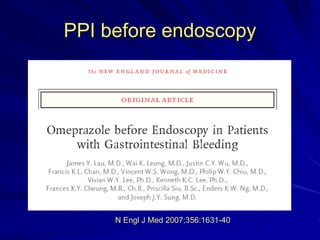
PPI before endoscopy

N Engl J Med 2007;356:1631-40
Conclusion
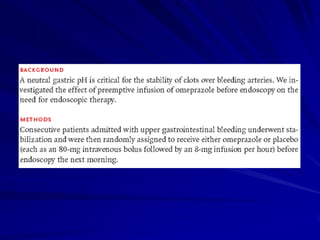
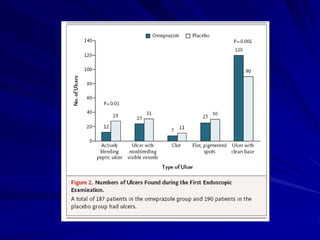
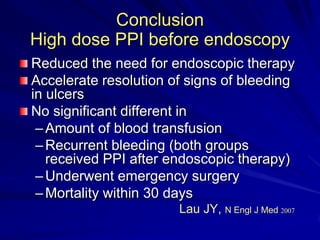
High dose PPI before endoscopy
Reduced the need for endoscopic therapy
Accelerate resolution of signs of bleeding
in ulcers
No significant different in
– Amount of blood transfusion
– Recurrent bleeding (both groups
received PPI after endoscopic therapy)
– Underwent emergency surgery
– Mortality within 30 days
Lau JY, N Engl J Med 2007
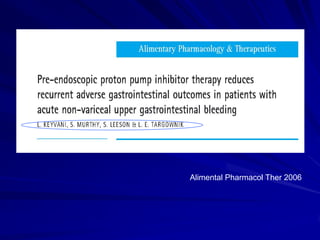
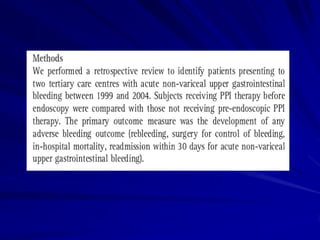
Alimental Pharmacol Ther 2006
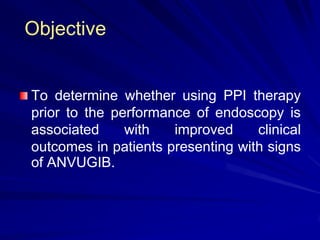
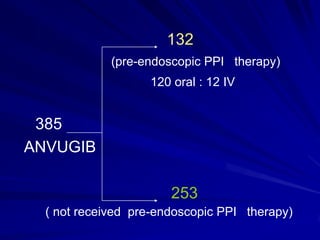
Objective

To determine whether using PPI therapy
prior to the performance of endoscopy is
associated
with
improved
clinical
outcomes in patients presenting with signs
of ANVUGIB.
132
(pre-endoscopic PPI therapy)

120 oral : 12 IV

385
ANVUGIB
253
( not received pre-endoscopic PPI therapy)
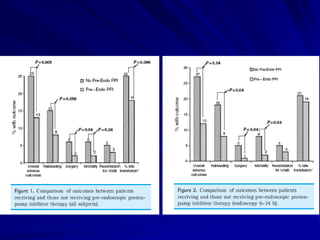
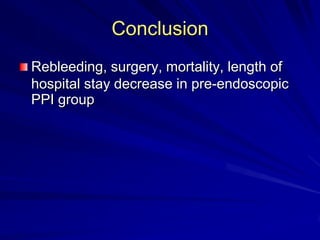
Conclusion
Rebleeding, surgery, mortality, length of
hospital stay decrease in pre-endoscopic
PPI group
Radiological intervention
Angiography with Injection vasopressin
Angiography with Embolic materials
Indication
– Endoscopic therapy failure

– Not stable enough to undergo surgery
Surgery
Indications
– Severe bleeding, not response to
resuscitation
– Endoscopic therapy failure
– Rebleeding after endoscopic therapy
– Surgical condition: perforation, obstruction,
malignancy
Surgery
Aim : Stop bleeding, not to reduce acid
secretion
Contraindications to emergency surgery
include impaired cardiopulmonary status
and bleeding diathesis
แนวทางการดูแลรักษาผู้ป่วย
ที่มาด้วยภาวะเลือดออกในทางเดินหายใจส่วนต้นใน
ประเทศไทย

สมาคมแพทย์ทางเดินอาหารแห่งประเทศไทย
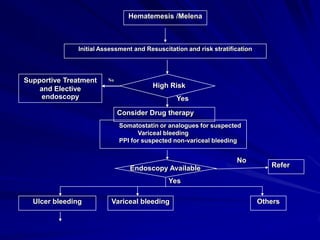
Hematemesis /Melena

Initial Assessment and Resuscitation and risk stratification

Supportive Treatment
and Elective
endoscopy

No

High Risk
Yes
Consider Drug therapy
Somatostatin or analogues for suspected
Variceal bleeding
PPI for suspected non-variceal bleeding

No
Endoscopy Available

Refer

Yes
Ulcer bleeding

Variceal bleeding

Others
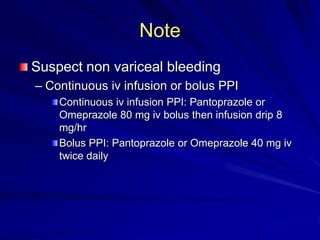
Note
Suspect non variceal bleeding
– Continuous iv infusion or bolus PPI
Continuous iv infusion PPI: Pantoprazole or
Omeprazole 80 mg iv bolus then infusion drip 8
mg/hr
Bolus PPI: Pantoprazole or Omeprazole 40 mg iv
twice daily
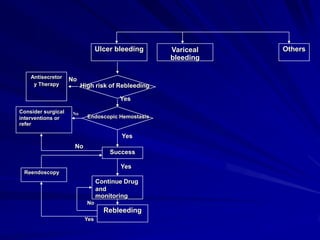
Ulcer bleeding

Antisecretor
y Therapy

No
High risk of Rebleeding
Yes

Consider surgical
interventions or
refer

No

Endoscopic Hemostasis

Yes
No
Success
Yes
Reendoscopy

Continue Drug
and
monitoring
No

Rebleeding
Yes

Variceal
bleeding

Others
Chitlada upper gi bleeding 2

Chitlada upper gi bleeding 2

  • 1.
    Upper GI bleeding ChitladaLimjindaporn, MD Diplomate of American Board of Emergency Medicine Faculty of Medicine, Thammasat University
  • 2.
    Upper GI bleeding Varicealhemorrhage Non-variceal upper GI bleeding (NVUGIB)
  • 3.
    Upper GI bleeding DallalHJ, et al. Upper gastrointestinal haemorrhage. BMJ 2001
  • 4.
    Nonvariceal bleeding Approximately 80%of ulcers stop bleeding. The overall mortality rate is approximately 10% Elderly with significant comorbidity : increase mortality.
  • 5.
    Mortality/Morbidity Retrospective chart review 73.2%of deaths occurred in patients older than 60 years. One or more comorbid illnesses were noted in 98.3% of patients who died. Yavorski RT, Wong RK, Maydonovitch C, Battin LS, Furnia A, Amundson DE. Analysis of 3,294 cases of upper gastrointestinal bleeding in military medical facilities. Am J Gastroenterol. Apr 1995;90(4):568-73.
  • 6.
    ED approach Initial resuscitation Clinicalassessment and risk stratification Identification source of bleeding Specific therapy
  • 7.
    Early resuscitation Early intensiveresuscitation of patients with upper gastrointestinal bleeding decreases mortality. Aggressive hemodynamic resuscitation, correction of hematocrit ( >28%)and coagulopathy (INR>1.8) Mortality significantly decrease in intensive resuscitation group No difference in rebleeding, surgical intervention Baradarian R, Ramdhaney S, Chapalamadugu R, Skoczylas L, Wang K, Rivilis S, et al. Am J Gastroenterol. Apr 2004;99(4):619-22.
  • 8.
    Initial resuscitation ABC, IV,Oxygen Intubation NPO Fluidresuscitation PRC, FFP transfusion Foley catheter Nasogastric Aspiration – Severity assessment – Remove clot
  • 9.
    ED approach Initial resuscitation Clinicalassessment and risk stratification Identification source of bleeding Specific therapy
  • 10.
    Initial clinical assessment Diagnosisof UGIB – Signs and Symptoms – NG tube placement Severity of bleeding Risk stratification
  • 11.
    Signs and Symptoms Age,Sex Symptoms: weakness, dizziness, syncope – – – – melena (50-100ml) Hematemesis (1000ml) Coffee ground Hematochezia (>1000ml/hr) Associated symptoms: pale, jaundice, ascites History of previous bleeding History of severe vomiting Medication: NSAID, ASA
  • 12.
    Signs and Symptoms Underlyingdiseases – Peptic ulcer disease/ gastritis – Liver disease : cirrhosis, hepatitis, alcoholism – Malignancy – Hematologic disease: coagulopathy, chronic anemia – Cardiovascular disease – Pulmonary disease – Renal disease
  • 13.
    Nasogastric lavage Diagnosis – confirmrecent bleeding (coffee ground appearance) – possible active bleeding (red blood in the aspirate that does not clear) – a lack of blood in the stomach (not exclude an upper gastrointestinal lesion). Severity of the hemorrhage – The characteristics of the nasogastric lavage fluid (eg, red, coffee grounds, clear) and the stool (eg, red, black, brown) can indicate the severity of the hemorrhage.
  • 14.
    Risk Factors American Societyfor Gastrointestinal Endoscopy (ASGE), Risk factors associated with increased mortality, recurrent bleeding, the need for endoscopic hemostasis, or surgery – age older than 60 years – severe comorbidity – active bleeding (eg, witnessed hematemesis, red blood per nasogastric tube, fresh blood per rectum), – Hemodynamic instability :hypotension – red blood cell transfusion greater than or equal to 6 units – severe coagulopathy. Adler DG, Leighton JA, Davila RE, Hirota WK, Jacobson BC, Qureshi WA, et al. ASGE guideline: The role of endoscopy in acute non-variceal upper-GI hemorrhage. Gastrointest Endosc. Oct 2004;60(4):497-504.
  • 15.
    High clinical riskfactors – Host factors Age >60 Comorbidity : renal failure, cirrhosis, ischemic heart disease, COPD Hemodynamic instability: HR> 100, SBP<100 mmHg Coagulopathy
  • 16.
    High clinical riskfactors – Bleeding character Continuous red blood from NG after irrigation Red blood per rectum Need blood transfusion Rebleeding Inpatient hemodynamic instability
  • 17.
    Risk stratification Low clinicalrisk factors – Mortality rate 3% High clinical risk factors – Mortality rate – Rebleeding 16% 36%
  • 18.
    Very low riskcriteria No comorbid disease Normal vital signs Normal or trace positive stool guaiac Negative gastric aspiration Normal or near normal hematocrit No problem home support Proper understanding symptoms and signs of significant bleeding Follow up arrange within 24 hours Rosen
  • 19.
    ED approach Initial resuscitation Clinicalassessment and risk stratification Identification source of bleeding Specific therapy
  • 20.
    Identification source ofbleeding Endoscopic for diagnosis Intervention for diagnosis
  • 21.
    Early endoscopy Early endoscopyin upper gastrointestinal hemorrhage: associations with recurrent bleeding, surgery, and length of hospital stay. Demonstrated a lower rate of rebleeding and shorter length of stay when endoscopy is performed within 24 hours of admission Cooper GS, Chak A, Way LE, Hammar PJ, Harper DL, Rosenthal GE. Gastrointest Endosc. Feb 1999;49(2):145-52.
  • 22.
    Early endoscopy High riskpatients – Stop bleeding and save life Low risk patients – Discharge early from hospital
  • 23.
    Stigmata of recenthemorrhage Rebleeding Surgery Mortality 42% Clean base Flat spot 20% 5% 0.5% 2% 10% 6% 3% Adherent 17% clot 17% Visible vessel 18% Active bleeding 22% 10% 7% 43% 34% 11% 70% 35% 11% SRH Prevalence
  • 24.
    Endoscopic risk High endoscopicrisk : Need endoscopic therapy and medication – – – Arterial bleeding, spurting, oozing Non-bleeding visible vessel Adherent clot Low endoscopic risk : Need medical therapy – – Clean-base ulcer Flat spot
  • 25.
  • 26.
    Predictive value ofRockall Score Low risk defined as score of <=2 4.3% rebleeding 0.1% mortality
  • 27.
    Intervention for diagnosis Angiography: bleeding at least 0.5-1 mL/min – Bleeding persists and endoscopy fails to identify a bleeding site. – As salvage therapy, embolization of the bleeding vessel can be as successful as emergent surgery in patients who have failed a second attempt of endoscopic therapy
  • 28.
    ED approach Initial resuscitation Clinicalassessment and risk stratification Identification source of bleeding Specific therapy
  • 29.
    Specific therapy Medical therapy Endoscopictherapy Radiologic intervention Surgery
  • 30.
    Role of Acidin Hemostasis Impairs clot formation – Impairs platelet aggregation & causes disaggregation Accelerates clot lysis – pH<5 pepsin accelerate clot lysis May impair integrity of mucus/bicarbonate barrier
  • 31.
    Role of Acidin Hemostasis pH>6 – Effective platelet aggregation – Irriversible inactivation of pepsin – Optimal maintenance of hemostasis
  • 32.
    H2-receptor antagonists Intra gastricpH >4 in 65-85% of day Tolerance in 72 hours
  • 33.
    Meta-analysis: the efficacyof intravenous H2-receptor antagonists in bleeding peptic ulcer. 30 RCT,3786 bleeding GU and DU The use of H2-receptor antagonists has not been shown to be effective in altering the course of UGIB. Conclusion : There was a possible minor benefit with intravenous H2 antagonists in bleeding gastric ulcers but no benefit in duodenal ulcers Levine JE, Leontiadis GI, Sharma VK, Howden CW. Aliment Pharmacol Ther. Jun 2002;16(6):1137-42.
  • 34.
    Proton pump inhibitortherapy for peptic ulcer bleeding: Cochrane collaboration meta-analysis of randomized controlled trials. A meta-analysis of 24 randomized controlled trials that evaluated PPIs for bleeding ulcers (with or without endoscopic therapy) Significant reduction in the risk of rebleeding, the need for repeat endoscopic hemostasis, and surgery. Not effect overall mortality, but reduced mortality in Asian trials and in patients with active bleeding or nonbleeding visible vessels. Leontiadis GI, Sharma VK, Howden CW. Mayo Clin Proc. Mar 2007;82(3):286-96.
  • 35.
    Comparison of intravenouspantoprazole with intravenous ranitidine in prevention of rebleeding from gastroduodenal ulcers Result : • During 72 hours rebled was 3.2% in Pantoprazole group versus 12.9% in Ranitidine group Rebleeding during 72h 14% 12% 12.9% 10% 8% 6% 4% 2% 3.2% 0% Pantoprazole i.v. Ranitidine i.v Conclusion: Intravenous Pantoprazole is significantly superior to intravenous ranitidine in the prevention of rebleeding from gastroduodenal ulcer after initial endoscopic haemostasis. Duvnjak M, et.al. Gut /Suppl. III 49 (2001): 2379
  • 36.
    Effect of PPIon gastric pH Increase intragastric pH - pH>6.0 for 84-99% of day No reported tolerance Continuous infusion (CI) superior to intermittent bolus administration Clinical improvements in rebleeding and/or surgery with: Bolus 80mg + CI 8mg/h
  • 37.
    PPI dose andadministration
  • 38.
    Effect of pantoprazolei.v. on gastric pH – intermittent bolus vs continuous infusion Median % Time pH Above Median % time 24-hour intragastric pH above indicated value after treatment with pantoprazole 100% 80mg + 8mg/h 80% 40mg/h x 2 h + 8mg/h 60% 40mg + 4mg/h 40% 40mg q8h 20% Placebo 0% Brunner et al; 1996 3 4 5 6 pH • Loading dose of 80mg superior to 40mg • CI dose of 8mg superior to 4mg Brunner et al; 1996
  • 39.
    Pantoprazole i.v. inpatients with UGIB after endoscopic hemostasis (1) Median Intragastric pH Dose : 80 mg bolus then 8mg/hour 8 6 4 2 0 0 8 16 24 32 Time (h) Intragastric pH of >6 is achieved over prolonged period van Rensburg et al; 1997 40 48
  • 40.
    Pantoprazole sodium Particulate matterจากการผสมยาต้นตารับ pantoprazole iv สูตรเดิม จึงต้องใช้ in-line filter 4 ปีต่อมาหลังการวางตลาดขาย ใน USA ได้มีการปรับสูตรผงยาฉีด pantoprazole ใหม่ โดยผสม EDTA และ sodium hydroxide จนถึงปัจจุบัน USA ยังคงไม่พิจารณาให้ขึ้นทะเบียนยาสามัญของ สูตรผงยาฉีด pantoprazole sodium
  • 41.
    PPI after endoscopictherapy An increasing amount of evidence in the literature states that therapy with highdose PPIs (IV bolus followed by continuous infusion) may decrease the rate of rebleeding after endoscopic therapy. By increasing the gastric pH above 6, the clot is stabilized.
  • 42.
    Pantoprazole infusion asadjuvant therapy to endoscopic treatment in patients with peptic ulcer bleeding: Prospective randomized controlled trial Showkat AZ, et al.J Gastroenterol Hepatol 2006;21:716-721
  • 43.
    Method • Setting: • Patients: double-blind,placebo-controlled, prospective trial above 18 years of age with peptic ulcer bleeding and undertaken successful endoscopic therapy Pantoprazole IV (n=102) Endoscopy to confirm peptic ulcer bleeding Endoscopic Tx (epinephrine inj Random IV 80mg + 8 mg/hr for 72 hrs & heat probe Placebo IV (n=101) • Efficacy measurement - Primary: rate of rebleeding - Secondary: need for rescue therapy, need for surgery, mortality, duration of hospital stay, and blood transfusion requirement Pantoprazole 40 mg tab for 6 wks
  • 44.
    Result Rebleeding, surgery, andmortality – Pantoprazole therapy was associated with significant reductions in rates of rebleeding 2. 0% 4. 0% Not sig 2. 9% P l a c e bo 7. 9% 7. 8% 0. 0% P a nt opr a z ol e 5. 0% 19. 8% 10. 0% 15. 0% 20. 0% 25. 0% 30. 0%
  • 45.
    Result Hospital stay &blood transfusion - Pantoprazole blood transfusion & duration of hospital stay (less than placebo) Hospital stay (days) 7.7 5.6 Pantoprazole Placebo Blood transfusion 0.7 1.6 (unit) 0 5 10 15
  • 46.
    High-dose intravenous protonpump inhibition following endoscopic therapy in the acute management of patients with bleeding peptic ulcers in the USA and Canada: a cost-effectiveness analysis. The suggested dose of intravenous pantoprazole is 80-mg bolus followed by 8-mg/h infusion. The infusion is continued for 48-72 hours. This therapy has been shown to be costeffective Barkun AN, Herba K, Adam V, Kennedy W, Fallone CA, Bardou M. Aliment Pharmacol Ther. Mar 2004
  • 47.
    PPI before endoscopy NEngl J Med 2007;356:1631-40
  • 50.
    Conclusion High dose PPIbefore endoscopy Reduced the need for endoscopic therapy Accelerate resolution of signs of bleeding in ulcers No significant different in – Amount of blood transfusion – Recurrent bleeding (both groups received PPI after endoscopic therapy) – Underwent emergency surgery – Mortality within 30 days Lau JY, N Engl J Med 2007
  • 51.
  • 52.
    Objective To determine whetherusing PPI therapy prior to the performance of endoscopy is associated with improved clinical outcomes in patients presenting with signs of ANVUGIB.
  • 54.
    132 (pre-endoscopic PPI therapy) 120oral : 12 IV 385 ANVUGIB 253 ( not received pre-endoscopic PPI therapy)
  • 56.
    Conclusion Rebleeding, surgery, mortality,length of hospital stay decrease in pre-endoscopic PPI group
  • 58.
    Radiological intervention Angiography withInjection vasopressin Angiography with Embolic materials Indication – Endoscopic therapy failure – Not stable enough to undergo surgery
  • 59.
    Surgery Indications – Severe bleeding,not response to resuscitation – Endoscopic therapy failure – Rebleeding after endoscopic therapy – Surgical condition: perforation, obstruction, malignancy
  • 60.
    Surgery Aim : Stopbleeding, not to reduce acid secretion Contraindications to emergency surgery include impaired cardiopulmonary status and bleeding diathesis
  • 61.
  • 62.
    Hematemesis /Melena Initial Assessmentand Resuscitation and risk stratification Supportive Treatment and Elective endoscopy No High Risk Yes Consider Drug therapy Somatostatin or analogues for suspected Variceal bleeding PPI for suspected non-variceal bleeding No Endoscopy Available Refer Yes Ulcer bleeding Variceal bleeding Others
  • 63.
    Note Suspect non varicealbleeding – Continuous iv infusion or bolus PPI Continuous iv infusion PPI: Pantoprazole or Omeprazole 80 mg iv bolus then infusion drip 8 mg/hr Bolus PPI: Pantoprazole or Omeprazole 40 mg iv twice daily
  • 64.
    Ulcer bleeding Antisecretor y Therapy No Highrisk of Rebleeding Yes Consider surgical interventions or refer No Endoscopic Hemostasis Yes No Success Yes Reendoscopy Continue Drug and monitoring No Rebleeding Yes Variceal bleeding Others