Upcycling
for Everyone
Upcycling is a material, cultural and business practice that transforms used or waste
products, components and materials into a new product or material of higher quality and/or
value than the compositional elements. Upcycling includes innovative forms of repair, reuse,
refurbishment, remake, remanufacture, recycling and more. It reduces solid waste,
improves resource efficiency, and reduces industrial energy consumption and associated
carbon emissions. It creates new job opportunities, saves money for individuals and
businesses, and contributes to people’s emotional wellbeing.
When it comes to upcycling at home, creating positive personal and collective beliefs is
paramount to encouraging people to engage in upcycling. Community events are known to
be an effective intervention for raising awareness and changing beliefs and practices. The
project aimed to further our knowledge of how to get everyone involved in upcycling at
household level in the UK, and to co-create and deliver art and design-based interventions
(community events) to promote upcycling behaviour.
We organised participatory, listening and co-creation workshops in four Midlands cities -
Birmingham, Derby, Leicester and Nottingham - in January 2024 in order to understand
opportunities and barriers to upcycling at home, as well as to identify and co-create
appropriate and effective art and design-based intervention community events. Based on
the results of the workshops, we planned for three hands-on upcycling events on three
Saturdays in April, May and June 2024 at Leicester Museum & Art Gallery. We contacted
suitable local upcycling practitioners to co-organise the events: (i) paper/cardboard
upcycling with Tim Neath in April; (ii) textile upcycling with Bonita Keay in May; and (iii)
upcycling plastic bottles with Sarah Turner in June.
This project was funded by De Montfort University’s (DMU) QR Funding for Participatory
Research and supported in part by the International Upcycling Research Network project,
funded by the Arts and Humanities Research Council [grant number: AH/W007134/1]. We
had two main project partners: Leicester Museum & Art Gallery and LCB Depot. EVA
Organisation for Women and Green Meadows supported two listening and co-creation
workshops (Leicester and Nottingham). Dr Kyungeun Sung, Senior Lecturer in Product
Design at DMU led this project, and three DMU students, Yi Zhong, Nik Trzcinowicz, Raynel
Albin worked on this project.
Listening and co-creation workshops 1-2
We organised the first workshop at De Montfort University in Leicester on 19 January 2024,
and ten people participated in the workshop. Dr Sadiyo Siad, founder of the Eva
Organization for Women in Leicester, supported the participant recruitment. The second
workshop was organised at QUAD in Derby on 20 January 2024, and nine people
participated.
Listening and co-creation workshops 3-4
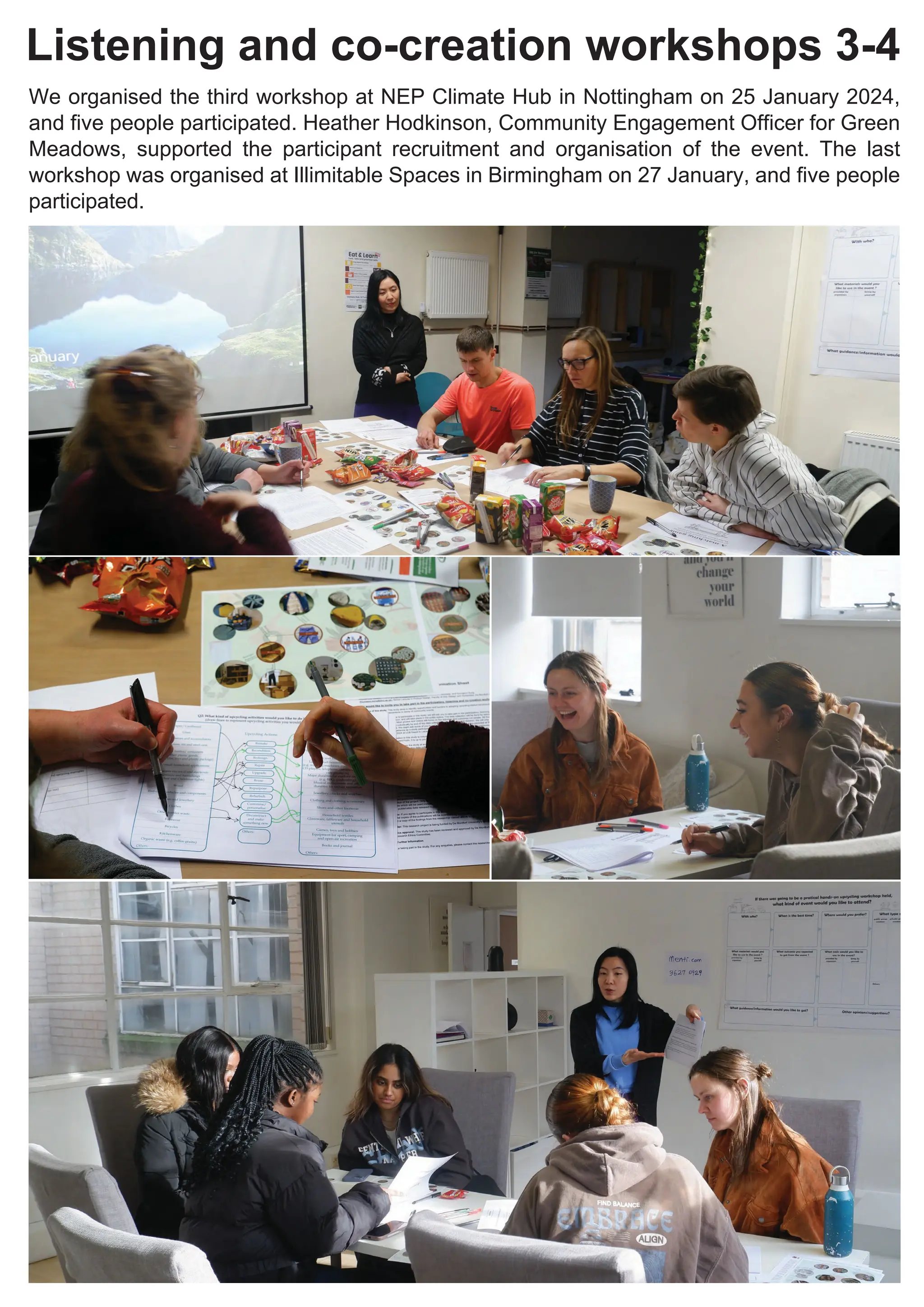
We organised the third workshop at NEP Climate Hub in Nottingham on 25 January 2024,
and five people participated. Heather Hodkinson, Community Engagement Officer for Green
Meadows, supported the participant recruitment and organisation of the event. The last
workshop was organised at Illimitable Spaces in Birmingham on 27 January, and five people
participated.
Event 1: Paper/cardboard upcycling
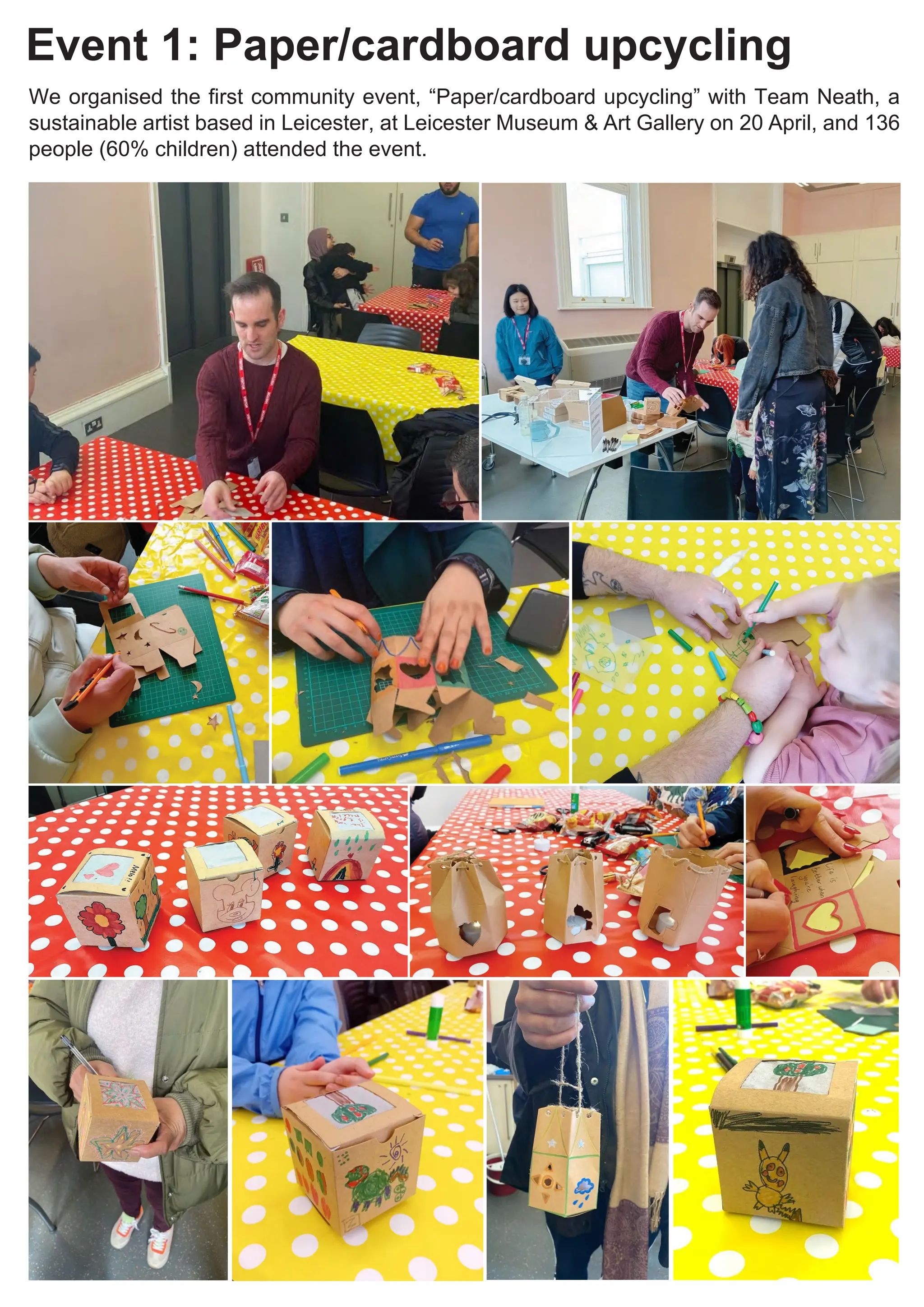
We organised the first community event, “Paper/cardboard upcycling” with Team Neath, a
sustainable artist based in Leicester, at Leicester Museum & Art Gallery on 20 April, and 136
people (60% children) attended the event.
Event 2: Textile upcycling
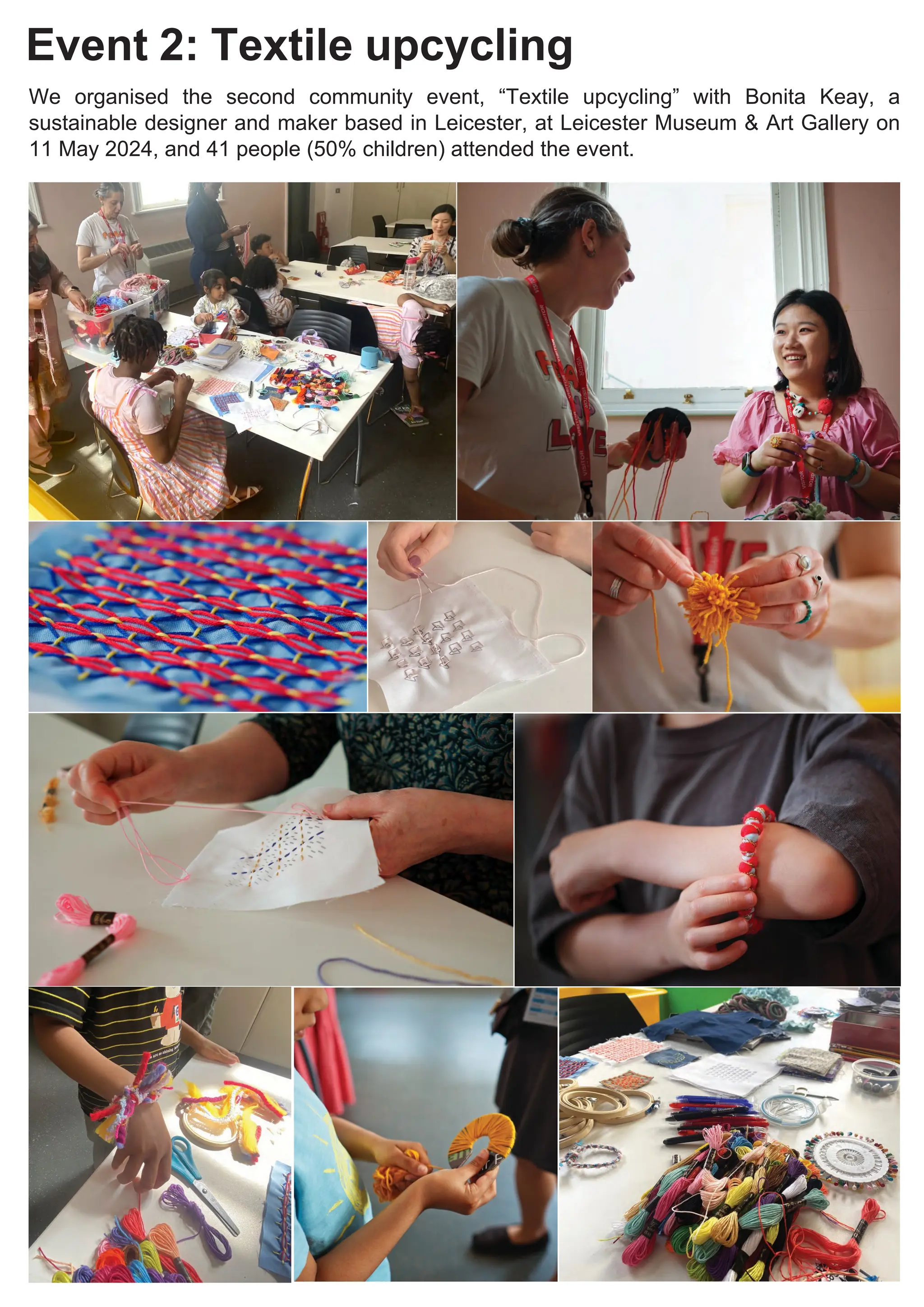
We organised the second community event, “Textile upcycling” with Bonita Keay, a
sustainable designer and maker based in Leicester, at Leicester Museum & Art Gallery on
11 May 2024, and 41 people (50% children) attended the event.
Event 3: Upcycling plastic bottles
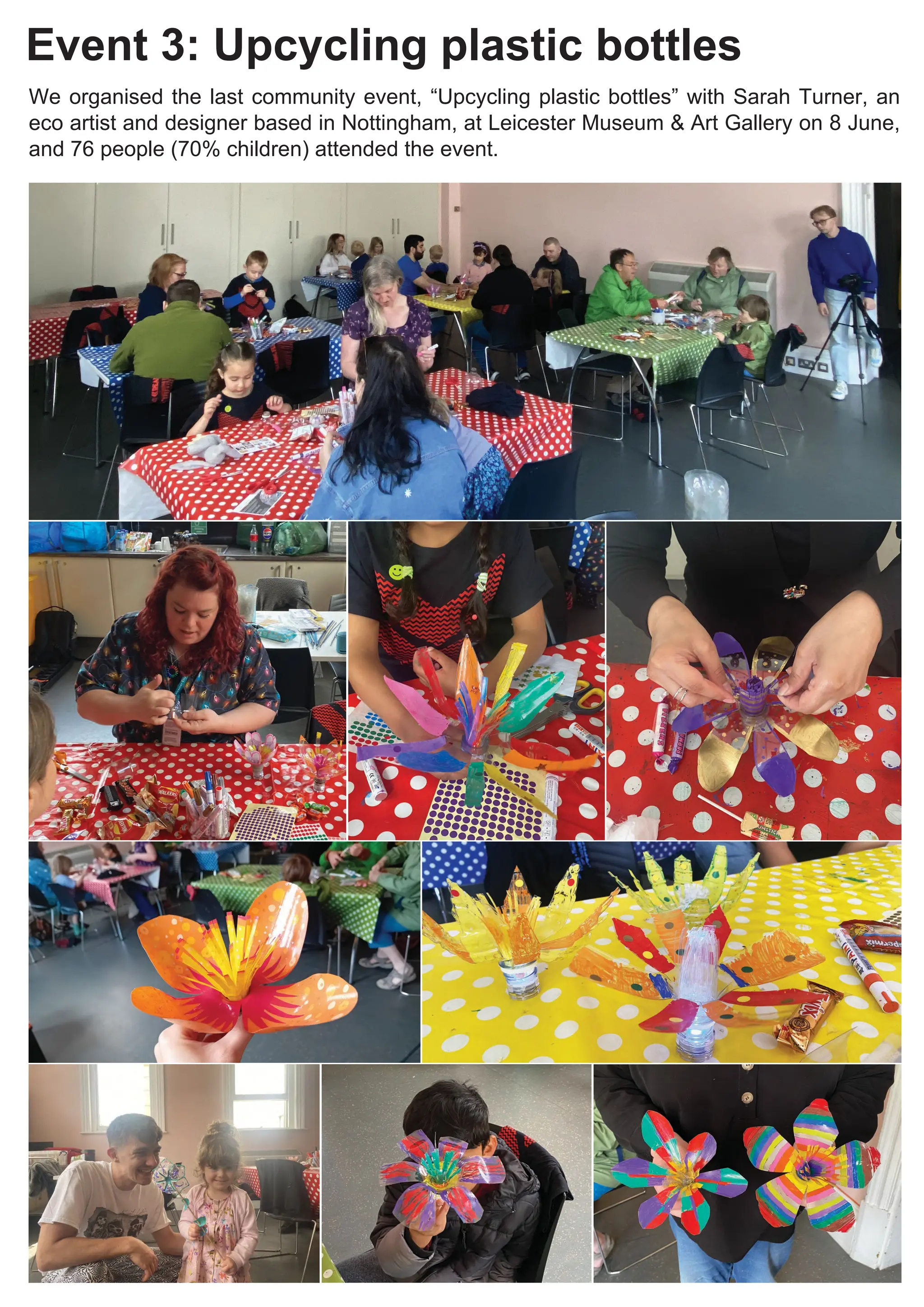
We organised the last community event, “Upcycling plastic bottles” with Sarah Turner, an
eco artist and designer based in Nottingham, at Leicester Museum & Art Gallery on 8 June,
and 76 people (70% children) attended the event.

Upcycling for Everyone project exhibition posters

  • 1.
    Upcycling for Everyone Upcycling isa material, cultural and business practice that transforms used or waste products, components and materials into a new product or material of higher quality and/or value than the compositional elements. Upcycling includes innovative forms of repair, reuse, refurbishment, remake, remanufacture, recycling and more. It reduces solid waste, improves resource efficiency, and reduces industrial energy consumption and associated carbon emissions. It creates new job opportunities, saves money for individuals and businesses, and contributes to people’s emotional wellbeing. When it comes to upcycling at home, creating positive personal and collective beliefs is paramount to encouraging people to engage in upcycling. Community events are known to be an effective intervention for raising awareness and changing beliefs and practices. The project aimed to further our knowledge of how to get everyone involved in upcycling at household level in the UK, and to co-create and deliver art and design-based interventions (community events) to promote upcycling behaviour. We organised participatory, listening and co-creation workshops in four Midlands cities - Birmingham, Derby, Leicester and Nottingham - in January 2024 in order to understand opportunities and barriers to upcycling at home, as well as to identify and co-create appropriate and effective art and design-based intervention community events. Based on the results of the workshops, we planned for three hands-on upcycling events on three Saturdays in April, May and June 2024 at Leicester Museum & Art Gallery. We contacted suitable local upcycling practitioners to co-organise the events: (i) paper/cardboard upcycling with Tim Neath in April; (ii) textile upcycling with Bonita Keay in May; and (iii) upcycling plastic bottles with Sarah Turner in June. This project was funded by De Montfort University’s (DMU) QR Funding for Participatory Research and supported in part by the International Upcycling Research Network project, funded by the Arts and Humanities Research Council [grant number: AH/W007134/1]. We had two main project partners: Leicester Museum & Art Gallery and LCB Depot. EVA Organisation for Women and Green Meadows supported two listening and co-creation workshops (Leicester and Nottingham). Dr Kyungeun Sung, Senior Lecturer in Product Design at DMU led this project, and three DMU students, Yi Zhong, Nik Trzcinowicz, Raynel Albin worked on this project.
  • 2.
    Listening and co-creationworkshops 1-2 We organised the first workshop at De Montfort University in Leicester on 19 January 2024, and ten people participated in the workshop. Dr Sadiyo Siad, founder of the Eva Organization for Women in Leicester, supported the participant recruitment. The second workshop was organised at QUAD in Derby on 20 January 2024, and nine people participated.
  • 3.
    Listening and co-creationworkshops 3-4 We organised the third workshop at NEP Climate Hub in Nottingham on 25 January 2024, and five people participated. Heather Hodkinson, Community Engagement Officer for Green Meadows, supported the participant recruitment and organisation of the event. The last workshop was organised at Illimitable Spaces in Birmingham on 27 January, and five people participated.
  • 4.
    Event 1: Paper/cardboardupcycling We organised the first community event, “Paper/cardboard upcycling” with Team Neath, a sustainable artist based in Leicester, at Leicester Museum & Art Gallery on 20 April, and 136 people (60% children) attended the event.
  • 5.
    Event 2: Textileupcycling We organised the second community event, “Textile upcycling” with Bonita Keay, a sustainable designer and maker based in Leicester, at Leicester Museum & Art Gallery on 11 May 2024, and 41 people (50% children) attended the event.
  • 6.
    Event 3: Upcyclingplastic bottles We organised the last community event, “Upcycling plastic bottles” with Sarah Turner, an eco artist and designer based in Nottingham, at Leicester Museum & Art Gallery on 8 June, and 76 people (70% children) attended the event.